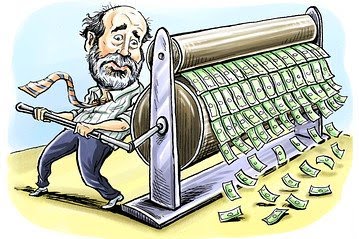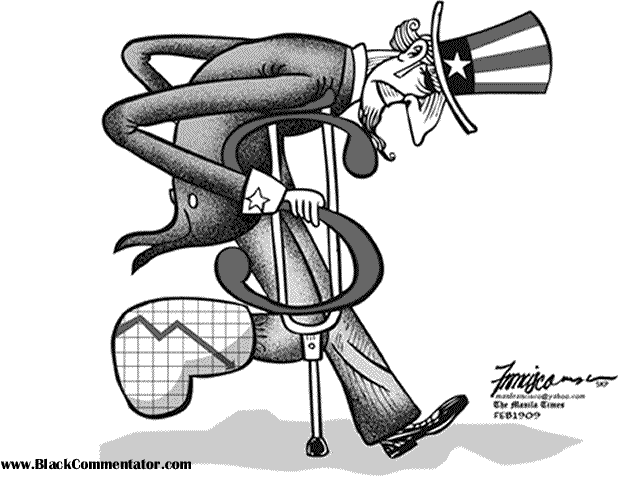
The product of neocon economics:
Our badly damaged financial system
By Sherman DeBrosse / The Rag Blog / December 5, 2009
The Democrats could lose between 20 and 35 House seats in 2010 because the banks are sitting on over $1 trillion in excess of reserve requirements. The normal practice is to hold this sleeping money to a minimum. In September 2008 it amounted to $2 billion.
Though bank stocks have soared, the fact is that we are still not half way through the bank default cycle that resulted from Bush administration policies. The trillion in unused money is a massive drag on recovery and reemployment.
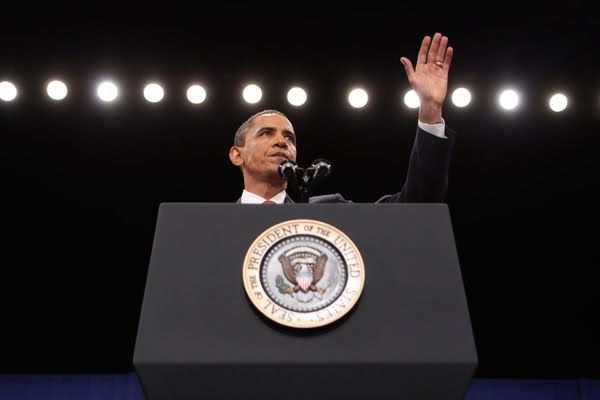
In the September 22, 2008, issue of investment Commentary, BlackRock vice chairman Bob Doll wrote that “The financial system did come close to a meltdown last week as credit borrowing and lending… came close to breaking down.” That all happened on George W. Bush’s watch. Now we’re 11 months into the administration of President Barack Obama, and Republicans are making great headway blaming all our economic and financial problems on him.
The near meltdown
The financial system collapse was so great that respected observers like Martin Wolf are saying we should count it a great victory that it still exists at all. Less money is being lent now than last year, and the big banks are again hoarding cash and making the same kinds of bets that created disaster before. In the last six months, loans at commercial banks have dropped by 6%. The banking sector is still very unhealthy, and none of this can be blamed on President Obama. In fact, Obama played a big role in pulling us back from the precipice.
This writer believed that the Obama Administration should have come as close as possible — but just short of nationalization — to following the advice of Nobel Prize winners Paul Stiglitz and Joseph Stiglitz in moving quickly to purge the banks of bad assets. Instead, Obama opted for “intelligent centrism,” perhaps because things were so bad that only insiders knew how to rejigger the financial system. Timothy Geithner offered them a means for purging some assets that was more than generous, and the bankers simply held out for assistance from the Fed on their terms.
As might be expected, Republicans behave as though there were all sorts of other options available, but they name none! We can do little but hold our breath and hope they know what they are doing because we need them to restore lost capitalization as quickly as possible.
Our financial system has been badly damaged and will be fragile for some years. The economy cannot run well without a solid financial system, and there are no signs that we can repair in the short term the damage done by the gradual deterioration of the industrial sector.
Elizabeth Warren put it bluntly: “Today’s business model is about making money through tricks and traps.” That has certainly been the case in the financial sector, where people behave recklessly in what seems like a very high stakes casino because (1) the potential rewards are fantastic, and (2) they know government will cover their bets. Their firms are too big to fail.
The average employee at Goldman Sachs stands to earn $700,000 this year. The present formulae for rewarding traders in financial houses seem to encourage reckless behavior. Congress needs to investigate these formulae and use the tax code to discourage irresponsible conduct. We should prevent the bubble from growing still more, with high taxes on unreasonable bonuses and by requiring that one third of each bonus be held in escrow for three years to see how the transaction turns out and to provide a reserve for people hurt by bad transactions.
We need to slowly let some of the air out of the financial services bubble as a means of preventing a catastrophe. While doing this, we must begin to phase in new regulations that protect depositors in commercial banks and patrons of insurance companies. The big financial houses must be weaned off of the wild bets that almost destroyed our financial system. All this must be done slowly and gradually so as not to disrupt either the economy or the financial system.
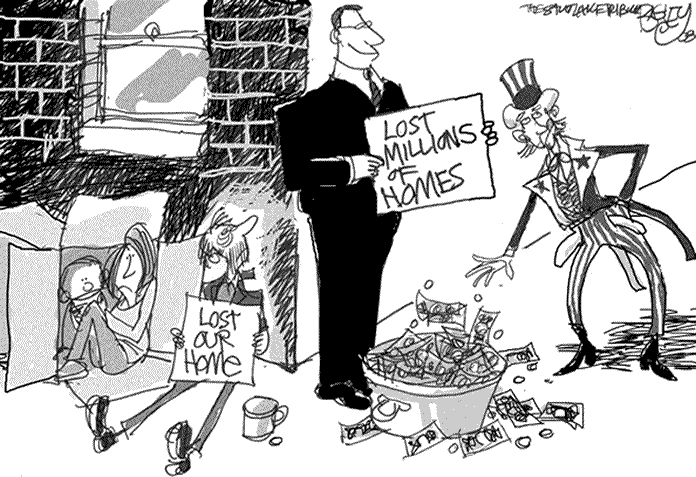
Bubbles
Of late, our markets have been driven by bubbles — technology, dot coms, then housing. We remember that Thomas Jefferson was one of many famous men to write and warn about bubbles. The problem is that they are not always easy to spot, and Ben Bernanke says spotting them is “perhaps the most difficult problem for monetary policy this decade.” Until last year, the common wisdom was that bubbles do not burst and that the best way to address them is to do nothing. Now we know that some bubbles must be pricked.
One way to deal with bubbles is to raise interest rates. The problem is that doing so can slow the whole economy. Perhaps we need to commission studies in how differentiated rediscount rates could be applied. That is to say that the rediscount rate for investment in plants, retail inventories, and housing might be lower than that on money borrowed for financial speculation.
Another approach would be requiring banks to have larger capital cushions.
There is a concern that today people are borrowing dollars at very low interest rates to speculate in assets here and abroad. The Asian nations are complaining that our investors are creating a bubble in Asian assets. This could be the next bubble to disrupt the world of finance. We need to invest in having economists create models that show how much interest rates should be raised when financial leverage and asset prices get too high.
The Fed has created a “quantitative surveillance group” to gather all sorts of data that will help it detect and deal with booms. The two major Congressional committees dealing with banking should create a parallel mechanism so that they can better monitor what the Fed does. While Congress is doing that, it might take a fresh look at the practice of letting the banks appoint six of the nine people on each of the regional FED boards.
The two committees should also hire experts with proven records in monitoring what goes on in the financial sector. If I were doing the hiring, I would ask former Governor Eliot Spitzer to recommend appointees. After all he, in a now famous Op-Ed, saw the financial meltdown coming and explained what had gone wrong.
Backstopping the banks
The larger problem was that government got into the habit of covering the massive losses of investment banks. The precedent was set when Ronald Reagan used Brady Bonds to make foolish and massive Latin American loans underwritten by bankers greedy for excessive commissions.
Then there was the very quiet bailout of Citi in the mid 1980s. That period was marked by the junk bond spree and unrealistic housing prices. The Fed had to come to the rescue with great amounts of new currency and low interest rates. We all know about the S & L and commercial banks bailouts under Daddy Bush. All of that came to a little less than $7 trillion in underwriting by the Treasury and the Fed. Now, there was the poorly conceived TARP, and who knows how many Fed guarantees. Then add another two or three trillion in guarantees issued before Bush left office.
Recently, the Republicans claimed that the Obama administration had incurred $14 trillion in new debt. Of course, they provided no data on how they reached this figure. For one thing, they are lumping together actual borrowing, as in the case of Bush’s TARP, with commitments to securitize bank assets. It may well be that the two together will come to $14 billion if the financial houses need much more help. Nine or 10 trillion of that was incurred under Republicans, and the rest will have been spent to fix a financial system the GOP said was desirable and sound. Moreover, it is usually the case that the doubtful assets that are being covered have some value.
Obama‘s Public Private Investment Program was designed to avoid any step that looked at all like nationalization help the big banks. For the most part, the bankers did not bite. They went back to the strategy that began back in 1981 when they blackmailed Reagan into covering all their bad debt with Brady Bonds. Now, the Federal Reserve has agreed to simply cover almost all the bad securities.
None of this can be fixed until a significant part of the public comes to understand the problem and no longer goes into panic attacks when Republicans start screaming about “nationalization” and socialism.” If those tactics continue to be successful, there is no way to fix our financial system. The Europeans, especially the Germans, are appalled that we are doing so little to fix a bad system. Our trans-Atlantic critics simply do not understand the power the folklore of Capitalism possesses here. While the European banks have been cleaning up and shrinking their balance sheets, there is little evidence that our institutions have emulated their example.
All the financial crises of the last 200 years began with the threatened or actual collapse of a first, second, or even third tier institution. At that point, all the talk about rational expectations goes out the window. What happens is that people panic and that leads to large systemic crisis. People like Richard Shelby, ranking Republican on the Senate Banking Committee, can talk endlessly about simply letting banks fail, but that would only intensify the panic. It’s a non-option and would make things a lot worse.
The scale of the derivatives problem
In the recent near-crash of the financial system, trade in derivatives greatly magnified problems created by the housing bubble. Manufacturing and energy firms also trade in derivatives. Derivative financial instruments are based on collateralized mortgages that were bundled as “collateralized debt obligations,” and many other things. For the most part, the financial services boom was based on trade in these bundled mortgages.
What is hard to understand for the layman is how the same batch of mortgages can become the collateral for a number of derivative instruments that are essentially laid on top of one another. One form of derivative is the credit default swap, which was invented as a sort of insurance on risky loans. What they became were wagers on what bundled securities would turn out to be profitable. Then people placed bets on the bets, and on and on. In September 2008 there was $54 trillion in the credit swaps market. To put this in perspective, we should look at the 2008 Gross Domestic Product, $14,441,425,000. The $54 trillion gambled on one kind of derivative far exceeds the $14.4 trillion GDP.
When one comprehends how many times a single bundle of mortgages was the object of bets, it becomes clear that if government were to simply pay off all home mortgages it would not have addressed the problem presented by all the paper based on bundled mortgages.
It has been assumed that markets work efficiently and that we can expect that markets place correct values on things because people use all the available information to inform their investment decisions. Low interest rates and huge amounts of money available for doubtful loans created a housing bubble. Regulators and policy makers should have looked at the low interest rates and have expected problems.
We need to concede to Republicans that Henry Cisneros and Andrew Cuomo made too much Fannie Mae and Freddie Mac money available for doubtful mortgages. But the excesses of the private sector far outstripped federal foolishness. For example, New Century Financial was bragging that it could generate a mortgage offer in as little as twelve seconds.
If a big outfit like Lehman Brothers issued a hundred million in residential mortgage bonds, it would pay a rating agency $40,000 to put out a credit rating. The agency, of course, gave a good rating rather than see the business go elsewhere.
The Commodity Futures Commission warned about excesses in the derivatives trade in the late 1990s and wanted to regulate them. The big bankers said any such regulation would destroy world financial markets; nothing happened. Now, some steps might be taken to regulate derivative instruments, but they probably will not be sufficient.
Now we know that a second big variable in bringing about the crash was the low margins set by the banks for investors borrowing on the basis of packages of collateralized securities. The lower the margins, the more these people gambled. That drove prices to unrealistically high levels.
There was nothing efficient or rational about the market in derivatives. One bit of bad news would drive lenders to jack up margins, forcing the borrower to quickly sell at large losses. Again, the value of the securities in question might now be unrealistically low. It appears that margin demands are far more important in the collateralized securities market than the interest rates. At the moment, the economists seem to have no models for understanding how this works. We have no exact information that regulators could be using.
People are admitting that the financial economists, who analyze Wall Street, may not quite understand how the things they study influence the overall economy. This writer has seen no evidence that even the greatest macroeconomists understand that. The accounts of what happened to Lehman Brothers and other big firms suggest that the financial economists did not grasp what the “quants“ were doing. In the case of the housing mortgages. these people, often physicists or pure mathematicians, designed the derivative instruments that somehow were to pay far more in dividends than could ever be yielded by the interest rates collected on the home mortgages that underpinned them. How was that possible?
We read that former Secretary of the Treasury Robert Rubin urged his firm, Rubin, to invest more in securities he did not understand. Likewise, Robert Willumstad, CEO of AIG, did not have a clear idea of what his quants and derivative traders were doing. Some firms replaced CEOs who might have reigned in risk with men who had no fear of risk, had no understanding of some of the securities they held, and asked no questions about their firms’ obligations. Lehman Brothers met half of its capital requirement in treasuries in 2003, and in 2006, its mortgage and asset-backed securities tripled.
We do not know much about the leverage cycle in derivatives, yet it seems that the big financial casino is operating the same as it did before the collapse, except that the bets are not being based on home mortgages. Enormous amounts of money are being set aside to reward the people who design the instruments and place the bets.Similarly, all financial institutions should be required to have liability reserves. Granted, this would have to be phased in slowly as they need time to clear their balances of bad assets. Future assistance from the Fed should be accompanied by strict repurchase agreements.
There is still another way to get a handle on how much is being bet on derivatives and in hedge funds. There is much we barely understand about today’s badly flawed financial system. On November 3, 2009, The Wall Street Journal printed a table showing the executive pension obligations of 10 big firms. It said “Total owed in billions” and noted that the money was for from four to six top executives. Given that the sums set aside were in the billions, it was logical for me to assume that we are executive teams over a number of years, So my assumption was that these firms were really putting aside money for several teams that could number together somewhere around 25 people.
At the top of the list was General Electric with an obligation of $140 billion. Its obligation rose by 13% this year. Next was Exxon Mobil at $108.2 billion. Its obligation rose by 18%. At the bottom of the lost was Bank of America at $63.2%. Its obligation only rose by 2%. Those are huge sums, and one wonders what these men earned for the corporations to produce such sums. Maybe this is partly understandable as far as the four energy companies are concerned.
One might think that the WSJ table was in error and that it meant “millions” rather than “billions.” But three weeks passed and no correction was printed.
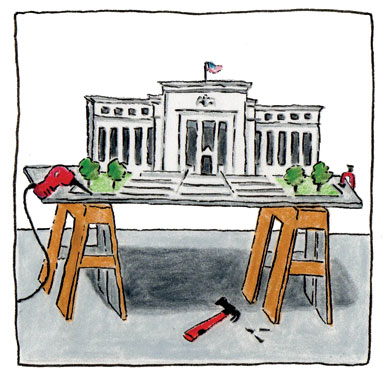
Reregulation
Europeans are very impatient with us because so little is being done to reregulate our financial markets. We have no idea how much money is in the various complex derivative instruments created by “quants,” usually physicists and pure mathematicians. But it has to be a lot more than the $54 billion mentioned above. We also know that the big investment houses are setting aside billions as bonuses for their traders. So far this year, Goldman Sachs has set aside $16 billion for this purpose. That gives us some idea of how that single firm has bet in the great financial casino.
The simple fact is that the taxpayers are on the hook for the whole financial system. Rational people might consider letting the government own almost all the big banks, but that is a non-starter here. The best we can do is dissolve the distinction between banks and non-banks, subject them all to much tougher regulation, legislate disclosure requirement that will make regulation easier, and hire many more regulators. There should also be a strong safety net erected which would be paid for by fees collected from anyone who does anything that looks like banking.
Representative Ed Perlmutter thinks we should prevent some companies from operating both banks and insurance companies. That would be a good beginning. Representative Paul Kanjorski would give bank regulators power to limit the size and risks of any company when it seems to be acting in a way that could endanger the economy. He said, “It essentially gives us the power to amputate the leg before the infection kills the entire body.” Good idea, but the trick would be to find regulators who believed enough in regulations to do difficult things. More derivatives should be traded through central counterparties or on exchanges. In that way regulators could better keep track of what is going on.
It is clear that meaningful regulations will emerge from the work of the Frank Committee in the House and the Dodd Committee in the Senate. As soon as the new Democratic administration took power, work began on reregulation. In the case of Japan, nothing happened for more than six years, and that economy remained in the doldrums.
We should establish a central clearing house for derivatives, but so far it appears it would only deal with “standardized” derivatives. We should do more, and even the Chinese have moved to place all their derivatives in a central market. Our clearinghouse, should deal with all derivatives and no exception should be made for “customized” derivatives. The proposed regulations do not include oil companies and other non-financial institutions that issue derivatives. They should be included.
There is probably no good way to impose the kinds of reasonable regulations the financiers will accept. In reregulating, our problem is that we cannot do anything to rapidly deflate what is still a humungous financial services bubble. To do so would unleash financial pandemonium that would make 1929 look like a minor event.
In the long run, we must move toward Paul Voelker’s solution, reinstating Glass-Steagall so that ordinary commercial banks can no longer gamble with the savings of ordinary folks. A second step would be to prevent insurance companies from investing the premiums we pay in very risky instruments. When some of those firms lost large portions of their reserves last year, they went to state insurance commissions and easily got permission to boost premium rates that were supposed to be fixed 20% or more. But both of these goals can only be pursued in stages.
Political dimensions
The Republicans so far have been quiet about what they think about restoring regulations they busily dismantled for decades. That is partly because some who will be elected next November seem to want some limited regulations. With the growing power of the teabaggers, it may be necessary and very good politics to denounce their Wall Street banker friends and support regulation. Democrats need to seize the initiative here to blunt Republican exploitation of economic populism and to place the blame where it belongs, with the GOP and the NeoCons.
This is the moment to reregulate the financial sector because the Republicans will find it too politically dangerous to speak out against reregulation. One wonders what the teabaggers would think if they learned their hero former Representative Dick Armey is an architect of deregulation and a minion of the Wall Street bankers?
Reregulation must be done soon, and certainly before the next Congress is seated. By then the GOP may be in a position to block the process. The Obama Administration is making a serious mistake moving so slowly in replacing U.S. Attorneys and filling the many vacancies in the federal judiciary. It should move rapidly in both directions. After 2011, it might be much more difficult to confirm progressive judges.
The political pollsters tell us that it is impossible to get voters to listen to two and three step economic arguments. They say that the independents, who now comprise between 19 and 24% of the electorate, are mostly people who dislike both parties, dislike politics, and do not examine issues with any care. Hence, they are prone to be impatient and to swing back and forth on many questions. It is wrong to think of them as being in the center: to assume that at the moment they are blaming the Democrats for not fixing the economy instantly, and that they will probably think the same way in November 2010.
At the moment, the Republican strategy of obstruction, offering no alternatives, and peddling false information is paying off. They are activating their base and appealing to independents, most of whom look for simplistic explanations. But if those independents have investments and retirement programs, it may be dawning on them that they need to be learning a little more about economic matters just so they can make decisions about retirement, sending the kids to college, and the like.
Forty and 50 years ago, I marveled at the economic literacy of ordinary British voters, most of whom had not gone beyond secondary school. It was phenomenal and largely due to the hard work of the British Labour Party. Labour was able to get ordinary people to focus on economics because Britain faced hard times then.
Democrats must begin the very difficult task of educating voters about the source of our problems — Republican economics — and showing voters what progressive solutions can do. Above all, we need to make economic populism an important weapon for the Democratic Party.
In the short term, this strategy may somewhat trim Republican gains in 2010. The long-term prospects are not for a healthy economy, a stable financial system, or a strong dollar. Even though the recession is supposed to be officially over, the Fed’s balance sheet continues to swell. It is doubtful that inflation or even stagflation can be held at bay for long. There is no evidence that the living standard of the middle class will improve. It will continue to erode, and progressives must dedicate themselves to explaining why.
Given all this, it makes sense for the Democrats to learn how to educate people on economics. In time, this strategy will move the political fulcrum to the left and usher in an era of Democratic dominance wherein the party will no longer need the likes of near turncoats like Joe Lieberman.
[Sherman DeBrosse is a retired history teacher. Sherm spent seven years writing an analytical chronicle of what the Republicans have been up to since the 1970s. The New Republican Coalition : Its Rise and Impact, The Seventies to Present (Publish America) can be acquired by calling 301-695-1707. On line, go here.]
Also see
- Legacy of the Neocons : Understanding our Economic Fix by Sherman DeBrosse / The Rag Blog / November 29, 2009