The bitter tears of Johnny Cash
The untold story of Johnny Cash, protest singer and Native American activist, and his feud with the music industry

By Antonino D’Ambrosio / November 9, 2009

In July 1972, musician Johnny Cash sat opposite President Richard Nixon in the White House’s Blue Room. As a horde of media huddled a few feet away, the country music superstar had come to discuss prison reform with the self-anointed leader of America’s “silent majority.” “Johnny, would you be willing to play a few songs for us,” Nixon asked Cash. “I like Merle Haggard’s ‘Okie From Muskogee’ and Guy Drake’s ‘Welfare Cadillac.'” The architect of the GOP’s Southern strategy was asking for two famous expressions of white working-class resentment.

“I don’t know those songs,” replied Cash, “but I got a few of my own I can play for you.” Dressed in his trademark black suit, his jet-black hair a little longer than usual, Cash draped the strap of his Martin guitar over his right shoulder and played three songs, all of them decidedly to the left of “Okie From Muskogee.” With the nation still mired in Vietnam, Cash had far more than prison reform on his mind. Nixon listened with a frozen smile to the singer’s rendition of the explicitly antiwar “What Is Truth?” and “Man in Black” (“Each week we lose a hundred fine young men”) and to a folk protest song about the plight of Native Americans called “The Ballad of Ira Hayes.” It was a daring confrontation with a president who was popular with Cash’s fans and about to sweep to a crushing reelection victory, but a glimpse of how Cash saw himself — a foe of hypocrisy, an ally of the downtrodden. An American protest singer, in short, as much as a country music legend.

Years later, “Man in Black” is remembered as a sartorial statement, and “What Is Truth?” as a period piece, if at all. Of the three songs that Cash played for Nixon, the most enduring, and the truest to his vision, was “The Ballad of Ira Hayes.” The song was based on the tragic tale of the Pima Indian war hero who was immortalized in the Iwo Jima flag-raising photo, and in Washington’s Iwo Jima monument, but who died a lonely death brought on by the toxic mixture of alcohol and indifference and alcoholism. The song became part of an album of protest music that his record label didn’t want to promote and that radio stations didn’t want to play, but that Cash would always count among his personal favorites.

* Continue Reading

The story of Cash and “Ira Hayes” began a decade before the meeting with Nixon. On the night of May 10, 1962, Cash made a much-anticipated New York debut at Carnegie Hall. But instead of impressing the cognoscenti, Cash, who had begun struggling with drug addiction, bombed. His voice was hoarse and hard to hear, and he left the stage in what he described as a “deep depression.” Afterward, he consoled himself by heading downtown with a folksinger friend to hear some music at Greenwich Village’s Gaslight Café.

Onstage was protest balladeer Peter La Farge, performing “The Ballad of Ira Hayes.” A former rodeo cowboy, playwright, actor and Navy intelligence operative, La Farge was also the son of longtime Native activist and novelist Oliver La Farge, who had won a Pulitzer Prize for his 1930 Navajo love story, “Laughing Boy.” The younger La Farge had carved out an intriguing niche in the New York folk revival scene by devoting himself to a single issue. “Pete was doing something special and important,” recalls folksinger Pete Seeger. “His heart was so devoted to the Native American cause at a time that no one was really saying anything about it. I think he went deeper than anyone before or since.”

Cash never pretended that music could stay immune from social, but he tried his best to “not mix in politics.” Instead he talked about the things that unite us like the dignity of honest work. “If you were a baker,” he told writer Christopher Wren in 1970, “and you baked a loaf of bread and it fed somebody, then your life has been worthwhile. And if you were a weaver, and you wove some cloth and your cloth kept somebody warm, your life has been worthwhile.”

Raised in rural poverty on the margins of America, Cash empathized with outsiders like convicts, the poor and Native Americans. But his identification with Indians was especially deep — even delusional. During the depths of his early ’60s drug abuse, he convinced himself, and told others, that he was Native American himself, with both Cherokee and Mohawk blood. (He would later recant this claim.)

At the Gaslight, once he had listened to “Ira Hayes’ and La Farge’s other Indian protest tunes, including “As Long as the Grass Shall Grow” and “Custer,” Cash was hooked. “Johnny wanted more than the hillbilly jangle,” Peter La Farge would write later about meeting Cash at the Gaslight. “He was hungry for the depth and truth heard only in the folk field (at least until Johnny came along). The secret is simple, Johnny has the heart of a folksinger in the purest sense.” In fact, Cash had written an Indian folk protest ballad of his own in 1957. “I wrote ‘Old Apache Squaw,'” Cash later explained to Seeger. “Then I forgot the so-called protest song for a while. No one else seemed to speak up for the Indian with any volume or voice [until Peter La Farge].”

Cash, like many in the 1960s, could see that everything that was certain, rigid and hard was breaking apart. Social movements were blossoming. But the thunderous American choir that was singing “We Shall Overcome” and “We Shall All Be Free” drowned out the cry of the loose-knit Native movement. As Martin Luther King and other leaders steered their people toward legislative victories that would further integrate them into a society they were locked out of, the rising tide of Native youth activists wanted something different.

“In my mind, Native people could not have a civil rights movement,” American Indian Movement activist and musician John Trudell says. “The civil rights issue was between the blacks and the whites and I never viewed it as a civil rights issue for us. They’ve been trying to trick us into accepting civil rights but America has a legal responsibility to fulfill those treaty law agreements. If you’re looking at civil rights, you’re basically saying ‘all right treat us like the way you treat the rest of your citizens’. I don’t look at that as a climb up.” Rather than pursue assimilation into the American system, Native American activists wanted to maintain their slipping grip on sovereignty and the little land they still possessed.

By the early ’60s, the burgeoning National Indian Youth Council (NIYC) was attempting to stake its own claim for their equal share of justice. With the expansion of fishing treaty violations and the breach of two major land treaties that led to the loss of thousands of acres of tribal land in upstate New York for the Tuscarora and Allegany Seneca (the story behind La Farge’s “As Long as the Grass Shall Grow”), the NIYC, led by Native activists like Hank Adams, responded by adapting the sit-in protest. Rechristened as the “fish-in,” the NIYC disputed the denial of treaty rights by fishing in defiance of state law. Fish-ins were held in New York and the Pacific Northwest.

The fish-in tactic worked in helping build some public support, but it did little to stop the treaty violations. Instead, the U.S. government ramped up its efforts to crush any momentum the Native movement was building. Oftentimes their tactics were brutal and violent. “This was the time of Selma and there was a lot of unrest in the nation,” remembers Bill Frank Jr. of Washington state’s Nisqually tribe. “Congress had funded some big law enforcement programs and they got all kinds of training and riot gear-shields, helmets. And they got fancy new boats. These guys had a budget. This was a war.”

By 1964, the Native American cause had attracted the interest of another celebrity. On March 2 the NIYC gained national attention as actor Marlon Brando joined a Washington state fish-in. Already an outspoken supporter of the civil rights movement, Brando’s very public support and subsequent arrest for catching salmon “illegally” in Puyallup River helped to boost the Native movement. Brando’s involvement with the Native cause had begun when he contacted D’Arcy McNickle after reading the Flathead Indian’s book “The Surrounded,” a powerful novel depicting reservation life in 1936. Brando’s involvement in Native issues led to government surveillance that lasted decades. His FBI file, bursting with memos detailing possible means of silencing the actor, quickly grew to more than 100 pages.

Three days after Brando’s arrest in Washington, Cash, fresh off the biggest chart success of his career, the single “Ring of Fire,” and having just finished recording a very commercial album called “I Walk the Line,” began recording another, very different album. When Cash left Sun Studios for Columbia in the late 1950s, he believed his rising star would give him the creative capital to produce and record something a little outside the pop and country mainstream — albums of folk music and live prison concerts. He was alternating folky albums like “Blood Sweat and Tears,” a celebration of the working man, with commercial discs laden with radio-ready singles. “Ring of Fire,” which had reached No. 1 on the country charts and had crossed over to pop, had bought him the permission of Columbia to make an album of what he called “Indian protest songs.”

In the two years since Cash had first met La Farge and listened to “The Ballad of Ira Hayes,” Cash had educated himself about Native American issues. “John had really researched a lot of the history,” Cash’s longtime emcee Johnny Western recalled. “It started with Ira Hayes.”

As Cash explained, “I dove into primary and secondary sources, immersing myself in the tragic stories of the Cherokee and the Apache, among others, until I was almost as raw as Peter. By the time I actually recorded the album I carried a heavy load of sadness and outrage.”

But Cash felt a special kinship with Ira Hayes. Both men had served in the military as a way to escape their lives of rural poverty longing to create new opportunities. Plus, both suffered from addiction problems; Cash and his pills and Hayes with alcohol. He decided to anchor the album with “The Ballad of Ira Hayes.” And since the song had provided the spark for Cash’s vision, it just felt right that he should learn more about the song’s subject.

Cash contacted Ira Hayes’ mother and then visited her and her family at the Pima reservation in Arizona. Before Cash left the Pima Reservation, Hayes’ mother presented him with a gift, a smooth black translucent stone. The Pima call it an “Apache tear.” The legend behind the opaque volcanic black glass is rooted in the last U.S. cavalry attack on Native people, which took place on Apaches in the state of Arizona. After the slaughter, the soldiers refused to allow the Apache women to put the dead up on stilts, a sacred Apache tradition. Legend says that overcome by intense grief, Apache women shed tears for the first time ever, and the tears that fell to the earth turned black. Cash, moved by the gift, polished the stone and mounted it on a gold chain.

With the Apache tear draped around his neck, Cash cut his protest album. He recorded five of La Farge’s songs, two of his own, and one he’d co-written with Johnny Horton. All were Native American themed. “When we went back into the studio to record what became ‘Bitter Tears,'” Cash bassist Marshall Grant says, “we could see that John really had a special feeling for this record and these songs.”

Yet the album’s first single, “Ira Hayes,” went nowhere. Few radio stations would play the song. Was the length of the song, four minutes and seven seconds, the problem? Radio stations liked three-minute tracks. Or maybe disc jockeys wanted Cash to “entertain, not educate,” as one Columbia exec put it.

“I know that a lot of people into Johnny Cash weren’t into ‘Bitter Tears,’ ” explains Dick Weissman, a folksinger, ex-member of the Journeymen and friend of La Farge. “They wanted a ‘Ballad of Teenage Queen’ not ‘The Ballad of Ira Hayes.’ They wanted ‘Folsom Prison.’ They didn’t want songs about how American’s mistreated Indians.”

The stations wouldn’t play the song and Columbia Records refused to promote it. According to John Hammond, the legendary producer and Cash champion who worked at Columbia, executives at the label just didn’t think it had commercial potential. Billboard, the music industry trade magazine, wouldn’t review it, even though Cash was at the height of his fame, and had just scored another No. 1 country single with “Understand Your Man” and No. 1 country album with “I Walk the Line.”

One editor of a country music magazine demanded that Cash resign from the Country Music Association because “you and your crowd are just too intelligent to associate with plain country folks, country artists and country DJs.” Johnny Western, a DJ, singer and actor who for many years was part of Cash’s road show, recalls a conversation with “a very popular and powerful DJ.” According to Western, the DJ was “connected to many of the music associations and other influential recording industry groups. He had always been incredibly supportive of John.” Western and the DJ started discussing Cash’s new album and the “Ira Hayes” single. “He asked me why John did this record. I told him that John and all of us had a great feeling for the American Indian cause. He responded that he felt that the music, in his mind, was un-American and that he would never play the record on air and had strongly advised other DJs and radio stations to do the same. Just ignore it until John came back to his senses, is what he told me.”

“When John was attacked for ‘Ira Hayes’ and then ‘Bitter Tears,'” explains Marshall Grant, “it just ripped him apart. Hayes was forced to drink by the abuse and treatment of white people who used and abandoned him. To us, it meant Hayes was being tortured and that’s the story we told and it’s true.”

When “Bitter Tears” and its single did not get the attention he felt they deserved, Cash insisted on having the last word. He composed a letter to the entire record industry and placed it in Billboard as a full-page ad on Aug. 22, 1964.

“D.J.’s — station managers — owners, etc.,” demanded Cash, “Where are your guts?” He referred to his own supposed half Cherokee and Mohawk heritage and spoke of the record as unvarnished truth. “These lyrics take us back to the truth … you’re right! Teenage girls and Beatle record buyers don’t want to hear this sad story of Ira Hayes … This song is not of an unsung hero.” Cash slammed the record industry for its cowardice, “Regardless of the trade charts — the categorizing, classifying and restrictions of air play, this not a country song, not as it is being sold. It is a fine reason though for the gutless [Cash’s emphasis] to give it a thumbs down.”

Cash demanded that the industry explain its resistance to his single. “I had to fight back when I realized that so many stations are afraid of Ira Hayes. Just one question: WHY???” And then Cash answered for them. “‘Ira Hayes’ is strong medicine … So is Rochester, Harlem, Birmingham and Vietnam.”

As Cash later explained, “I talked about them wanting to wallow in meaninglessness and their lack of vision for our music. Predictably enough, it got me off the air in more places than it got me on.” In reality, however, as Cash noted in his letter, “Ira Hayes” was already outselling many country hits. Ultimately, thanks in part to aggressive promotion by Cash, who personally promoted the song to disc jockeys he knew, “Ira Hayes” reached No. 3 on the country singles charts, and “Bitter Tears” peaked at 2 on the album charts.

Later, long after “Bitter Tears,” and after he’d won his battle with drugs, Cash would dial back his claims of Indian ancestry. But he never wavered from his support for the Native cause. He went on to perform benefit shows on reservations — including the Sioux reservation at Wounded Knee in 1968, five years before the armed standoff there between the FBI and the American Indian Movement — to help raise money for schools, hospitals and other critical resources denied by the government. In 1980, Cash told a reporter: “We went to Wounded Knee before Wounded Knee II [the 1973 standoff] to do a show to raise money to build a school on the Rosebud Indian Reservation” and do a movie for “Public Broadcasting System called ‘Trail of Tears.'” He joined with fellow musicians Kris Kristofferson, Willie Nelson and Robbie Robertson to call for the release of jailed AIM leader Leonard Peltier.

Since Cash first recorded “The Ballad of Ira Hayes” in 1964, many musicians have recorded their own versions. Kris Kristofferson is one of those musicians. He summed up the spirit behind Cash’s now nearly forgotten protest album in his eulogy for Cash, who died in 2003. Cash, he said, was a “holy terror … a dark and dangerous force of nature that also stood for mercy and justice for his fellow human beings.” Four years before his famous concert at Folsom Prison, four years before the American Indian Movement formed, and at the pinnacle of his commercial success, Cash insisted on producing an uncommercial, deeply personal protest record that was a close as he could come to truth. He would always cherish it. “I’m still particularly proud of ‘Bitter Tears,'” Cash would say near the end of his life, while talking about the topical music he recorded in the 1960s. “Apart from the Vietnam War being over, I don’t see much reason to change my position today. The old are still neglected, the poor are still poor, the young are still dying before their time, and we’re not making any moves to make things right. There’s still plenty of darkness to carry off.”

[Antonino D’Ambrosio is the author of A Heartbeat and a Guitar: Johnny Cash and the Making of Bitter Tears. Research assistance for this article was provided by the Investigative Fund of the Nation Institute.]


Type rest of the post here

Source /

Source

Thanks to Thomas Cleaver / The Rag Blog

Posted in RagBlog | Leave a comment

History as Politics : Remembering the Berlin Wall

Man straddles Berlin Wall in 1989. Photo from photosfan.com.

History as politics, Politics as history:
Remembering the Berlin Wall

By Harry Targ / The Rag Blog / November 9, 2009

…you are Americans and are meant to carry liberty and justice and the principles of humanity wherever you go, go out and sell goods that will make the world more comfortable and more happy, and convert them to the principles of America.

Woodrow Wilson shortly after the Russian Revolution quoted in L.S. Stavrianos, Global Rift, 1981, 492.

There are two great evils at work in the world today, Absolutism, the power of which is waning, Bolshevism, the power of which is increasing. We have seen the hideous consequences of Bolshevik rule in Russia, and we know that the doctrine is spreading westward. The possibility of proletarian despotism over Central Europe is terrible to contemplate.

Secretary of State Robert Lansing shortly after the Russian Revolution in Stavrianos, 494.

Daniel Barenboim, who was in town the night the Berlin Wall came down in 1989,” … said that “the fall of the wall ‘has changed so much of Europe for the better,’ Barenboim said in an interview at the Berlin Staatsoper, where he is chief conductor. ‘It has given so many thousands, probably millions of people, a better existence’

Catherine Hickley, Washington Post, November 8, 2009

Debasing the Socialist vision

Reflections on the anniversary of the tearing down of the Berlin Wall in 1989 should stimulate a reexamination of the pain and suffering of the twentieth century.

It was a century in which over 100 million died in wars all around the globe (60 million alone in the two World Wars). Nazis killed six million Jews and six million others in Europe: liberals, communists, gays, opponents of genocide of every persuasion. And, during the Cold War years (1945 to 1991) approximately six million Vietnamese and Korean peoples died in wars and hundreds of thousands in Central Europe, Latin American, and South Asia.

The great revolutions of the twentieth century promised a different outcome for humankind: peace, justice, and democracy. Perhaps the biggest disappointment, the gap between the dream and the practice, resulted from the failures of the former Soviet Union. Masses of its citizens died in campaigns to collectivize agriculture and the purge of dissidents.

The regime developed an omnipresent dictatorship and following the revelations about Stalinism evolved into an autocratic state driven by top down bureaucracy. In addition, the Soviet Union would not tolerate political independence from the Socialist states of Eastern Europe, invading both Hungary and Czechoslovakia to crush reform movements. So from this vantage point, the tearing down of the Berlin Wall was cause for celebration.

But history is complicated

However, as the sentiments of President Wilson and his Secretary of State suggest, the United States as superpower emerged from World War I to embark on a global campaign to crush the new Soviet Union economically. As we know, the United States, along with a dozen other nations sent troops into the Soviet Union to help counter-revolutionaries overthrow the new Bolshevik regime.

In subsequent years, until 1933, the United States refused to recognize the Soviet Union. Western powers watched as Germany rearmed and expanded its control across the heartland of Europe. Italian fascist armies and German airpower were used to destroy democratic Spain, again with the United States and the British on the sidelines.

After the war, the Truman Administration launched a “cold war,” against the Soviet Union. It transferred resources to Western Europe to rebuild the capitalist part of it. It unleashed covert operators to infiltrate trade unions and political parties in Europe and Latin America and began beaming propaganda and sending operatives into Eastern Europe to undermine Soviet influence.

Germany was the centerpiece of this new global struggle. As the source of military forces that killed 27 million Soviet citizens in World War II, the status of Germany became most critical to the Soviets. And for the United States a reindustrialized, remilitarized Germany would constitute the centerpiece of the campaign to fight Communism and promote capitalism on the world stage.

Ironically, the Cold War started over Germany and could have ended there with a mutually derived agreement to create a neutralized and united Germany (much as was agreed to in Austria). But western diplomats ignored Soviet offers to negotiate the creation of such a Germany.

Without revisiting all the critical points of contestation between the East and the West, it is important to make clear that the Soviet Union, the weaker of the two “superpowers,” was targeted for challenge and defeat by every United States administration from 1917 to 1991. This cost both countries and their allies trillions of dollars in military spending and millions of lives.

The Soviet Union had something to do with social change

There were some positive developments during the Cold War years for which the Soviet Union may have made a contribution.

In 1945 most of Africa was still living under the yoke of colonialism. The British, French, Dutch and others still controlled territories and peoples in Asia. The Chinese were mired in a violent civil war. And all of Latin America was “in the backyard” of the United States. Within thirty years all this had changed. Africa achieved its independence, the Communist movement came to power in China, Indochina was freed from French and then American colonialism, and the Cuban revolution provided a beacon of hope for peoples living in the Western Hemisphere.

The Soviet Union provided arms, economic assistance, technical assistance, and inspiration for those seeking independence and economic development. Further, and this may be the most important point, the Soviet Union served as a check on the unbridled expansion of military and economic power of the United States and the Western alliance.

What if the Soviet Union had not collapsed?

Of course, we can never know what might have happened since 1991 if the Soviet Union, after its Eastern European allies, had not collapsed. But we do know what has happened. And we can make educated guesses about what might have happened in a world in which a power competitive in military, economic, and ideological resources with the West still existed.

First, the Gulf War might not have occurred in the way it did, (While the Soviet Union did collaborate with President George Herbert Walker Bush in the fall, 1990, on Gulf War policy, the collaboration was from a position of considerable marginalization). For sure, the Soviet Union would have waged a propaganda war against the U.S. military operation and the economic embargo of Iraq and bombing campaigns that continued throughout the 1990s and, particularly, the second war on Iraq in 2003.

Probably, in the bipolar world of the Cold War, the United States would not have been able to launch a war on Afghanistan and continue it for eight years.

And what about the global economy? Neoliberal globalization, initiated in the 1980s but expanded to every corner of the globe in the 1990s, would have been checked by Soviet influence and arguments about overweening reliance on the “free market.” The mal-distribution of wealth and income might not have been as grotesque as it has become if there had been a Soviet Union critiquing International Monetary Fund and World Bank policies.

Without exaggerating the influence or good intentions of a surviving Soviet Union, I would argue that the world since 1991 might have been different; particularly given the hundreds of thousands who have died in war since 1991 and the devastating impacts of growing economic inequality.

And back to Germany

Bruni de la Motte in the Guardian, Nov. 8, 2009, reported that the collapse of the former German Democratic Republic and its integration into West Germany led to social breakdown of society, widespread unemployment, “crass materialism,” the privatization of public enterprises, farms and forests, and two million lost homes. Hundreds of thousands of professional workers including teachers and professors lost their jobs and were blacklisted because they had been credentialed in the old regime.

There is no question, as one U.S. trade unionist once said to me, the former Soviet Union and the GDR were not “workers’ paradises” but they provided basic economic security to workers. That has long since been lost most places around the world.

And about history

It is a common place now to repeat the old adage: “History is written by the winners.” Old adage or not, the celebration of the twentieth anniversary of the tearing down of the Berlin Wall is being orchestrated by the same kinds of imperial voices that have been raised for almost one hundred years now.

As contentious as it might be, it is time for progressives to revisit the history of the Cold War in a way that is not chauvinistic and self-serving and does not justify current and future wars.

[Harry Tarq is a professor in American Studies who lives in West Lafayette, Indiana. He blogs at Diary of a Heartland Radical, where this article also appears.]

The Rag Blog

Posted in Rag Bloggers | Tagged , , , , , , , , | 1 Comment

Development: US fails to measure up on ‘human index’

Nation slumps from 2nd to 12th in global table
· Richest fifth take home $168,000, poorest $11,000

* Buzz up!
* Digg it

* Ashley Seager
* The Guardian, Thursday 17 July 2008

Despite spending $230m (£115m) an hour on healthcare, Americans live shorter lives than citizens of almost every other developed country. And while it has the second-highest income per head in the world, the United States ranks 42nd in terms of life expectancy.

These are some of the startling conclusions from a major new report which attempts to explain why the world’s number-one economy has slipped to 12th place – from 2nd in 1990- in terms of human development.

The American Human Development Report, which applies rankings of health, education and income to the US, paints a surprising picture of a country that spends well over $5bn each day on healthcare – more per person than any other country.

The report, Measure of America, was funded by Oxfam America, the Conrad Hilton Foundation and the Rockefeller Foundation. It shows each of the 11 countries that rank higher than the US in human development has a lower per-capita income.

Those countries score better on the health and knowledge indices that make up the overall human development index (HDI), which is calculated each year by the United Nations Development Programme.

And each has achieved better outcomes in areas such as infant mortality and longevity, with less spending per head.

Japanese, for example, can expect to outlive Americans, on average, by more than four years. In fact, citizens of Israel, Greece, Singapore, Costa Rica, South Korea and every western European and Nordic country save one can expect to live longer than Americans.

There are also wider differences, the report shows. The average Asian woman, for example, lives for almost 89 years, while African-American women live until 76. For men of the same groups, the difference is 14 years.

One of the main problems faced by the US, says the report, is that one in six Americans, or about 47 million people, are not covered by health insurance and so have limited access to healthcare.

As a result, the US is ranked 42nd in global life expectancy and 34th in terms of infants surviving to age one. The US infant mortality rate is on a par with that of Croatia, Cuba, Estonia and Poland. If the US could match top-ranked Sweden, about 20,000 more American babies a year would live to their first birthday.

“Human development is concerned with what I take to be the basic development idea: namely, advancing the richness of human life, rather than the richness of the economy in which human beings live, which is only a part of it,” said the Nobel laureate economist Amartya Sen, who developed the HDI in 1990.

“We get in this report … an evaluation of what the limitations of human development are in the US but also … how the relative place of America has been slipping in comparison with other countries over recent years.”

The US has a higher percentage of children living in poverty than any of the world’s richest countries.

In fact, the report shows that 15% of American children – 10.7 million – live in families with incomes of less than $1,500 per month.

It also reveals 14% of the population – some 40 million Americans – lack the literacy skills to perform simple, everyday tasks such as understanding newspaper articles and instruction manuals.

And while in much of Europe, Canada, Japan and Russia, levels of enrolment of three and four-year-olds in pre-school are running at about 75%, in the US it is little more than 50%.

The report not only highlights the differences between the US and other countries, it also picks up on the huge discrepancies between states, the country’s 436 congressional districts and between ethnic groups.

“The Measure of America reveals huge gaps among some groups in our country to access opportunity and reach their potential,” said the report’s co-author, Sarah Burd-Sharps. “Some Americans are living anywhere from 30 to 50 years behind others when it comes to issues we all care about: health, education and standard of living.

“For example, the state human development index shows that people in last-ranked Mississippi are living 30 years behind those in first-ranked Connecticut.”

Inequality remains stark. The richest fifth of Americans earn on average $168,170 a year, almost 15 times the average of the lowest fifth, who make do with $11,352.

The US is far behind many other countries in the support given to working families, particularly in terms of family leave, sick leave and childcare. The country has no federally mandated maternity leave.

The US also ranks first among the 30 rich countries of the Organisation of Economic Cooperation and Development in terms of the number of people in prison, both in absolute terms and as a percentage of the total population.

It has 5% of the world’s people but 24% of its prisoners.


Type rest of the post here

Source /

The Rag Blog

Posted in RagBlog | Leave a comment

Mexico : Drug Decrim and the 10,000-Ton Monkey

Pot smoker in Mexico City. Mexicans consume an estimated 342 tons of marijuana a year. Photo by Castillo / AP.

Legalization is the only answer…
Mexico’s massive drug problem

As poet Juan Pablo Garcia posited long ago in his 1985 Pacheco (marijuana user) Manifesto: ‘drugs don’t make us criminals but laws against drugs do.’

By John Ross / The Rag Blog / November 9, 2009

MEXICO CITY — Mexico has a 10,000 ton monkey on its back and its name is Washington D.C.

While U.S. drug enforcers gloat that 15-foot walls, high tech sensors, drones, blimps, spotter planes and rampant militarization have put a significant dent in the flow of cocaine across its porous southern border, drug use escalates exponentially south of that border. The reason: Colombian-Mexican cartels are now holding their loads longer in Mexico, waiting for the appropriate arrangements to be made to move the blow into El Norte.

Inevitably, the cocaine and to a lesser extent crystal meth and heroin (marijuana is readily available in the U.S., the world’s largest producer of the weed) leak into the Mexican street where fierce competition for sales and consumption is out of control. As a result, over 13,000 lives have been lost since President Felipe Calderon went to war with the drug cartels in December 2006, many of them in turf battles over trans-shipment routes and retail sales in Mexican cities.

Moreover, in the three years of Calderon’s drug war, which is being underwritten by $3,000,000,000 in Washington’s Merida Initiative funds, the number of “addicts” on this side of the border has risen by 460,000 and now totals almost a million, according to the estimates provided by the National Council on Addictions, and first-time users have jumped from 3.5 million to 4.5 million — some drug experts calculate that 10 million would be closer to the mark, depending on definitions of “user” and “addict.” One dangerous corollary: the Mexican prison system is bursting apart at the seams and lethal violence is on the rise.

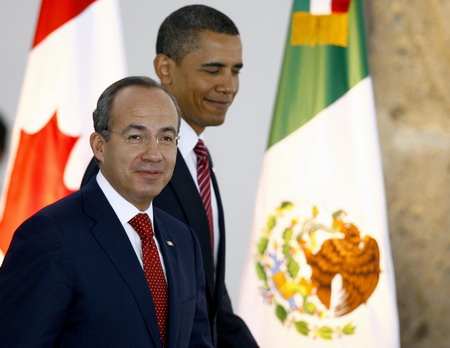
Among long-time observers of Mexican drug wars, there are some, this writer included, who suspect that Washington’s militarization of the border and the consequent user boom here was a well-thought out strategy concocted by U.S. drug fighters to force its proxies in this distant neighbor nation to engage and confront the cartels. Viewed from this perspective, the thousands of dead on the ground here are simply cannon fodder in the U.S. War on Drugs initiated by Richard Nixon in 1969, officially declared by Ronald Reagan in 1985, and zealously executed by four U.S. presidents ever since. Barack Obama, a prohibitionist who likens Felipe Calderon to Al Capone’s nemesis Elliot Ness, is only the latest puppet-master in this grotesque dance of death.

Partners in the Drug War: Presidents Calderon and Obama.

With jails exploding — prison riots are reported at least once a week — the Calderon administration has moved to tamp down dangerous overcrowding by “decriminalizing” the possession of small quantities of illicit drugs. This past August 21st, the Mexican president signed off on legislation that gives users and “addicts” (as health officers prefer to lump them) the option of treatment or prison if arrested with small amounts of drugs for personal use — two grams of marijuana (about four skinny joints), a half gram of cocaine, 40 milligrams of meth amphetamines, and 10 milligrams of heroin. Instead of immediate imprisonment, the drugs will be confiscated and the user/addict booked and fingerprinted and their biometrics recorded in a national registry of “addicts.”

Those pulled in are then released with the obligation of enrollment in government treatment programs that are still not operational. If the user/addict fails to show up for treatment or is arrested a third time, prison time is prescribed.

Those nabbed with larger amounts, calculated at a thousand times the minimum quantities, are automatically assigned to terminally overcrowded state prisons as “traffickers” — “traffickers” arrested with any amount over the higher quantities are sent to maximum security federal penitentiaries as kingpins.

There is no middle ground in this schema notes science writer Javier Flores in the national daily La Jornada: one is either a user/addict or a narcotraficante.

The Mexican congress passed similar legislation in 2006 during the waning days of Vicente Fox’s presidency but when the measure hit his desk, the red telephone rang and George W. Bush was on the line threatening grave repercussions if Fox did not veto the decrim bill – which, of course, he did.

What has decrim meant on the streets of Mexico City? A few weeks ago, my friend Xochi (not her real name), a street dealer who makes house calls, and this writer visited a sick friend — Xochi brought along a bag of medicinal marijuana and I some cannabis cookies. The conversation turned to Calderon’s recently promulgated decrim and we consulted our offerings to determine if we were users, “addicts,” or kingpins. It goes without saying that we were criminally over the limit but fortunately the local gendarmes did not bust down the door.

According to Xochi, decrim is turning into a bonanza for Mexico City cops who have taken to carrying scales to weigh confiscated drugs and shaking down those “criminals” who exceed the decreed limits. Shaking down small-time users and dealers is nothing new in this the most corrupt, crime-ridden, and conflictive city in the western hemisphere. Indeed, crooked cops have been planting drugs on unwary citizens as long as cops have patrolled these mean streets. Long before decrim was a gleam in Calderon’s eye, those “found” with drugs in their possession did not immediately go straight to jail if they could come up with the “mordida” (literally “bite” or bribe) to get the cops off their backs.

As poet Juan Pablo Garcia posited long ago in his 1985 Pacheco (marijuana user) Manifesto: “drugs don’t make us criminals but laws against drugs do.”

Overwhelmed by millions of users, addicts, narcotraffickers, and kingpins, Calderon has turned to God for relief. Young people who use drugs do not have God in their (miserable) lives, he explained to Catholic bishops attending a family crisis conference last month, citing the recent death of pop idol Michael Jackson as an example — although there is no evidence that Jacko did not believe in God or was even a user/addict (the official autopsy concluded that Michael was overdosed by a doctor with a lethal anesthetic.)

The president’s hypothesis was promptly shot down on editorial and op-ed pages all over the country. Aside from increased availability in Mexico thanks to Washington’s worldwide crusade against demon drugs, critics pinned the dramatic increase in users-“addicts” on a battered economy in which more than 2,000,000 workers have lost their jobs in the past year as a more pertinent explanation of the boom. With nearly a million young people entering the job market each year, Calderon, who once billed himself as “the president of employment,” has floundered badly as a job creator. On the other hand, drug cropping and retail street dealing (“narcominudeo“) provide gainful employment for millions of kids without jobs.

Prison riots are reported at least once a week. This one, in Tijuana on Sept. 18, 2009, left 19 killed and a dozen wounded.

In fact, there are multiple indicators that drug users, dealers, “addicts”, and kingpins do have God in their (miserable) lives. “We, the Marijuanos, are Guadalupanos (devotees of the Virgin of Guadalupe) not goddamn communist whores,” Juan Pablo Garcia wrote in his Pacheco Manifesto. Narcotraficantes are celebrated for their devotion to their faith, buying Masses, hiring priests for baptisms and weddings and funerals and even building churches. Drug money — “narco-limosnas” (drug alms) are a significant component of Church finances, concedes Bishop Carlos Aguiar Retes, president of the Mexican Bishops Conference (CEM.) For the Catholic Church, explains Aguascalientes bishop Ramon Godinez, turning illegitimate gains into good works is perfectly pardonable.

Although cocaine and meth (Mexico does not produce much heroin) are considered to be killer drugs, reefer madness is alive and kicking south of the border. Mexicans consume 357 tons of drugs annually, advances Secretary of Public Security Genero Garcia Luna, of which marijuana accounts for 343. Marijuana is considered a dangerous drug by crusaders like Garcia Luna and his boss Calderon and those who use it are considered “addicts” in need of “treatment” — actually Mexican marijuana is typically punchless and low in THC content when compared to hot house-grown, high-potency strains in the U.S. where cannabis is considered to be medicinal in some states. What makes treatment propositions even more absurd is that there are no treatment centers to accommodate newly decriminalized pot smokers.

For hard-core addicts desperate to get off the crack pipe or the needle, public detox clinics have been stripped back to the bone. While wealthy user/”addicts” sign themselves into deluxe spas to detox, the poor have few options. Like every other public service the Calderon government is charged with providing, drug treatment has been privatized under the prevailing neoliberal economic model.

Evangelical churches run treatment programs in many working class colonies that force addicts to go cold turkey. Corporal punishment and the Word of God are means of coercion to get young people off drugs.

The drug gangs themselves run their own treatment programs for street dealers that get hooked on the goods they push according to one Ciudad Juarez pistolero Julio Cesar Aleman, a member of a hit squad known as “The Artists of Assassination,” enforcers for the Sinaloa cartel, who are charged by federal authorities with a total of 45 killings — 28 of them at two treatment homes in that Gran Guignol border city. La Linea (a rival drug gang) gets them off drugs, fattens them up, and sends them back out on the street to deal,” he explained to police agents to justify the homicidal assaults.

Decriminalizing drugs in a country through which 80% of the U.S. cocaine supply passes (Drug Enforcement Administration estimates) changes little in Mexico so long as it borders the biggest drug market on the planet. Even as decrim takes root north of the border, more than 800,000 Americans were arrested for possession of marijuana in 2008 according to Ethan Nadelman of the Drug Policy Institute. Legalization and not decrim is the only answer.

Drug reform is catching on in Latin America. In addition to Mexico’s feeble and misplaced efforts at providing alternatives to incarceration, Argentina courts recently ruled that personal possession of marijuana is not criminal. In Colombia, decriminalization of small amounts of cocaine has been the law since the 1990s. In Bolivia, President Evo Morales champions the medicinal properties of the coca leaf, the source of powdered cocaine, and endorses the industrialization of the plant. At a 2008 drug policy conference in Brazil, former presidents Fernando Henrique Cardoso, Cesar Gaviria of Colombia, and Ernesto Zedillo, the squarest Mexican president to ever administrate the affairs of this country, declared that the prohibitionist approach had failed.

So has decrim. The 10,000-ton monkey is not going to get off Mexico’s back until drugs are legalized everywhere in the Americas, including the United States. As the godfather of Jamaican ganja reggae Peter Tosh croons “Doctors smoke it, nurses smoke it, even judges smoke it, and lawyers too: Legalize It! Don’t Criticize It! Legalize It! Don’t Criminalize It!”

Or decriminalize it either.

[John Ross will present his just-published (Nation Books) cult classic, the monstrous El Monstruo — Dread & Redemption in Mexico City, Friday the 13th at Northtown Books in Arcata, CA (7 p.m.); Wednesday, Nov. 18th at Modern Times Bookstore in San Francisco’s Mission District (7 PM); and Nov. 19th at UC-Berkeley’s Center for Latino Policy Studies (3:30 PM.) Admission to all three events is gratis.]

The Rag Blog

Posted in Rag Bloggers | Tagged , , , , , | 18 Comments

Surprise! : Betrayal in Honduras as ‘Golpistas’ Ignore Accord

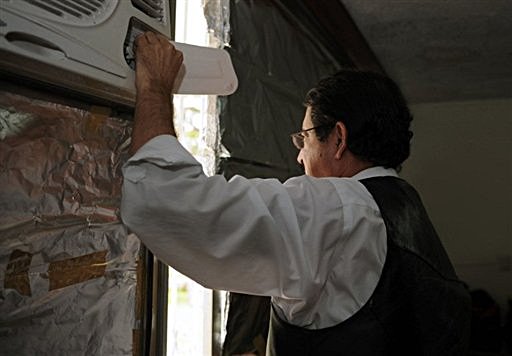
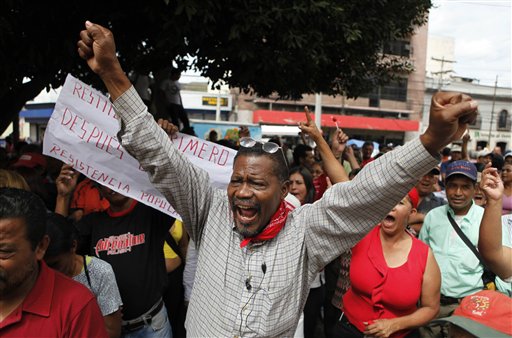
Manuel Zelaya closes a window at the Brazilian embassy in Tegucigalpa. Photo from AFP.

Celebration was premature;
United States expresses ‘disappointment’

…negotiating with the golpistas for reinstatement of the democratically elected president is like negotiating with thieves for the return of stolen property.

By David Holmes Morris / The Rag Blog / November 8, 2009

See David Morris’ translations of articles by Arturo Cano and Pablo Ordaz, Below.

Within a week of the signing of the agreement that was to end the four-month political crisis in Honduras, the de facto government has betrayed its purpose and the constitutional government has given it up as one last failed attempt to undo the coup d’état.

The Tegucigalpa/San José Accord, signed on October 29, was the result of three weeks of negotiation between representatives of de facto president Roberto Micheletti and democratically elected President Manuel Zelaya. It appeared at first to solve the thorny issue of Zelaya’s restitution by approving it in principle and leaving final approval to the country’s unicameral legislature, thus confirming, symbolically at least, that Zelaya had been removed from office in a coup d’état and not as punishment for criminal acts, as the coup government had claimed.

But delaying resolution of the crisis until after the November 29 elections has been the golpistas’ plan all along and the congressional leadership was more than willing to further the plan. It decided to consult with the Supreme Court and several other institutions before calling a special session of the legislature to consider restitution, a process that could easily stall any action until the next president is elected three weeks from now. The Accord did not establish a deadline for restitution.

In the meantime, Micheletti ceremoniously fulfilled the letter of another provision of the Accord by forming, unilaterally, a government of “national unity and reconciliation” by the deadline established in the Accord. Zelaya refused to submit names for the new government because, he argued, the spirit, if not the letter, of the Accord called for him, as constitutional president, to preside over such a government. Zelaya calls Micheletti’s move crass manipulation, dismisses the Accord as a failure and calls for boycotting the elections and for protests in the streets to continue.

What is left unsaid in official circles is that negotiating with the golpistas for reinstatement of the democratically elected president is like negotiating with thieves for the return of stolen property.

Journalist Arturo Cano has been reporting on events in Honduras for La Jornada of Mexico City since the crisis began. The following is my translation of an article of his published on November 6. Following that is an article from El País of Madrid by Pablo Ordaz about ordinary people in Honduras struggling to survive in bad and worsening circumstances.

Zelaya declares that ‘the Accord is now worthless’

TEGUCIGALPA, Nov. 6, 2009 — The golpistas say everybody condemns them because nobody knows what was really going on in Honduras before June 28. Last week, when everybody thought they knew, as they celebrated the signing of an agreement that, according to news media all over the world, would end more than four months of crisis, it turned out that the golpistas were right: nobody knows what is going on in Honduras.

How else can we explain why, a week after the Tegucigalpa/San José Accord was signed, the United States feels “disappointed” and the Organization of American States “deplores” the “disruption” of compliance with the Accord?

From Washington, OAS Secretary General José Miguel Insulza urges Roberto Micheletti and Manuel Zelaya to reach an agreement on the government of “unity and reconciliation,” which “should be presided over, naturally, by the person the Honduran people elected to carry out the duties of the president of the republic.”

The Union of South American Nations demands the “immediate restitution” of Zelaya and the foreign ministers of Latin America and the Caribbean condemn golpista Micheletti’s unilateral appointment of a cabinet of “national unity.”

The de facto president doesn’t even lose his composure. Night falls in the midst of warnings of the “imminent” appointment of the new cabinet and of threats against anyone daring to organize a boycott of the electoral process.

In practical terms, the only opinion that matters to the de facto government is broadcast time and again on the official television channel: an interview with U.S. Assistant Secretary of State Thomas Shannon, who says Zelaya’s restitution, or otherwise, is the “business of Hondurans.” News shows on the private channels also play it over and over again.

Micheletti appears on television with renewed vigor, happy, accompanied by all his officials, those who are leaving and those who are staying, since even his own office has leaked the names of the ministries in which there will be no change: the ministries of the presidency, foreign affairs, finance, agriculture, defense and security.

Twenty-three days before they are to occur, the elections are the topic of the headlines and of most of the space in all the news media. The golpista government and the media owners who support it don’t doubt that the United States will recognize the elections. By their priorities, the rest of the countries of the world are in a distant second place.

The zelayistas and all those who celebrated the Accord a week ago had placed their trust in the existence of “two Accords, one written and one understood,” Marvin Ponce of the Partido Unificación Democrática explained three days after the signing. “The businessmen and the politicians who orchestrated the coup accepted Zelaya’s restitution because otherwise they would be back at point zero. Now we’ll see whether there is the political will.”

Demonstrators supporting Manuel Zelaya shout slogans in Tegucigalpa, Nov. 2, 2009. Photo by Eduardo Verdugo / AP.

Congress received the document, which had been signed on October 30, on Monday, November 2. Its governing board, controlled by Micheletti’s congressmen, decided on its own to consult the Supreme Court and three other institutions. The justices didn’t receive the petition until Thursday the fifth. “We have acted with the greatest diligence,” says congressional chairman José Alfredo Saavedra.

“The measures agreed to in the Accord are clear and were endorsed freely by all the parties. I would hope that they will be implemented without further evasion in order to re-establish democracy, institutional legitimacy and harmony among Hondurans,” Insulza declared in a statement issued from the U.S. capital.

They don’t see it that way here. “I don’t know why they signed that. They left their flanks exposed,” says a leader of the resistance, his head bowed, his face revealing the mood of the zelayistas, still in the streets for the 131st day since the coup d’état.

The Frente de Resistencia meets again in front of Congress, which isn’t meeting, and then more than 500 people march to the area of the Brazilian embassy, where President Zelaya is in refuge.

“I don’t want Afghan elections for my country,” the constitutional leader tells Radio Globo. “I’m not willing to legitimize fraud or to legitimize the imposition of power or to whitewash this coup d’état.”

His followers in the streets radicalize the discourse: “It’s not a simple matter of not voting. Just as they took the ballot boxes from us (for the poll on the Constituent Assembly) on June 28, we must take the ballot boxes from them as well,” says indigenous leader Salvador Zúñiga.

Although some of the zelayistas, particularly those who are members of the Partido Liberal, hold to the idea of “not leaving the whole cake for the golpistas,” the more active organizations in the resistance have decided not to endorse “the electoral fraud.” From this day forward, “politicians are forbidden from entering our neighborhoods and communities and we are going to forbid them from setting up polling places,” Zúñiga says.

Zelaya, for his part, declares that “the Accord is now worthless” and he rejects it as a failure. His representatives nevertheless still hold meetings with OAS officials, although without much hope for a solution.

The president reaches out again to the continental community. “Let them reach the decisions they consider suitable,” he says of the members of the OAS.

But the voice that matters most sticks with the talks, which favor the golpistas. Ian Kelly, spokesman for the State Department, urges the parties to return to the negotiating table to work out their differences.

“A unilaterally decided government is not a government of unity,” he says of Micheletti’s move. “They have to sit down and start talking again. They need to stop making dire statements that the agreement is dead,” he blurts out against Zelaya. “We’re disappointed that both sides are not following this very clear path which has been laid out in this accord.”

He confirms for certain that Washington is giving technical assistance for the November 29 elections, which will continue as long as “the paties respect and implement this accord, step by step.”

And Pablo Ordaz, a correspondent in Tegucigalpa for the Madrid daily El País describes how the coup has changed the lives of one family. Below is my translation of his article for November 7.

Ángel David’s life, which hadn’t been good, began to get worse

Angel David and his mother show scar from police gunshot wound. Photo from El Pais.

TEGUCIGALPA, Nov. 5, 2009 — Since before the coup, Ángel David has lived in this neighborhood in Tegucigalpa where the only green, level ground is in the cemetery, so the kids take advantage of a hole in the wall to play soccer or hide-and-seek among their grandparents’ graves. Ángel David’s outlook wasn’t very promising. He shared eight square meters in a wooden shanty with his father, an out-of-work gardener, his mother, newly pregnant with her fifth child, and his brothers, the oldest 16 and the youngest two. They hadn’t had a bathroom since the last storm washed it down the hill, but they did have electricity and a telephone, a good upbringing and miraculously clean clothes.

But the coup came along and Ángel David’s life, which hadn’t been good, began to get worse. His country, the second poorest in Latin America, became the object of sanctions by the international community and its 70 percent poor (40 percent getting by on less than a dollar a day) became even more helpless. Ángel David’s father found ever less work. His mother, ever less money to juggle. And he, ever fewer hours in school. As though that were not enough, on the days when Roberto Micheletti’s government declared a curfew, they all had to take off running for fear of the police. They got home on time every day, until September 21.

On that day a rumor spread throughout Honduras that President Manuel Zelaya had managed to return in secret to his country. To celebrate, his supporters called for rallies in different areas of Tegucigalpa and Ángel David’s father decided to attend the one in the February 21st Colonia, next to his own neighborhood. On the way home, as the hour of the curfew approached, they took a shortcut through an alley. They were startled by the noise of a motorcycle approaching them. They turned around. There were two policemen riding it. The one in back aimed at them.. Five shots were heard. Ángel David, 13 years old, fell to the ground. With a gunshot wound in his back.

A month and a half has gone by. The taxi driver makes his way into the June 23rd Colonia. The vehicle can hardly move along among the rocks — the only paved street is long gone — and for fear of the groups of boys hanging out on the corners. At a certain point we can’t go on by car. His mother, Nelly Rodríguez, invites us into her only room, which is orderly and clean, and proudly introduces her sons, who are well brought up and well dressed. Her account of what happened is exact and concise and it portrays with no embellishment the reality of Honduras since the coup. “My husband and my sons were walking along, and the police could see that there were two children, but even so they shot at them. The bullet injured his intestine, his colon, his spleen, his liver and part of his lung too. Show the gentleman the scar.”

Ángel David stands up obediently. He has the mark of the gunshot on his back and a large scar from the surgery. What did you feel at that moment? “Agony, sir.” And pain? “That too.” And did you lose consciousness? “Yes.” What is agony? “Thinking that you’re going to die.” And were you afraid? “Yes.” And did you cry? “No.”

Nelly Rodríguez continues her account. “They performed an emergency operation. He almost died. The operation lasted three hours and he was in a coma for about five days. Until finally he opened his eyes and began to talk to me. He had oxygen and many drugs that they gave him at the teaching hospital. But since they didn’t have all the drugs he needed, we had to buy them ourselves. They didn’t even have needles or adhesive tape or cotton. Not even plasma.”

What followed reveals the degree to which defenders of the coup have persecuted those who resist. “One day a public prosecutor came and told me, ‘Look, I work for the rights of minors and you are at risk of losing your children because it wasn’t the policeman who shot at him who is to blame for what happened to your son, it is you.’ She told me I was the guilty one.” Nelly begins to cry, a slow and quiet sobbing that is touching. The kids around her pay attention. “And she told me that while my son was in a coma, right there, by his bed. Yes. She told me the policeman wasn’t guilty, I was.” Nelly was threatened with the loss of her son until the organization COFADEH, which is concerned with the families of the detained and disappeared in Honduras, came to her assistance.

Ángel David’s story is one of hundreds of dramatic cases. According to UNICEF, “1,600 Hunduran children under the age of five have died since June 28, 2009, at the rate of 13 children a day.” Malnutrition and very poor attention to health conditions in the face of epidemics like haemorrhagic dengue are some of the causes. Every day, some 60 children are taken to the Tegucigalpa hospital afflicted with that disease. But there is no means of treating them. All of this in the midst of a wave of violence that leaves 14 dead every day and an endless number of illegal detentions.

It is true that life in Honduras before the coup was not good, but now it is worse. Right, Ángel David?

[San Antonio native David Holmes Morris is an army veteran, a language major, a retired printer, a sometime journalist, and a gay liberationist.]

  • For previous Rag Blog coverage of Honduras, go here.

The Rag Blog

Posted in Rag Bloggers | Tagged , , , , , | 2 Comments

Through the Gate in ’66 : Howling Wolf Au Go Go

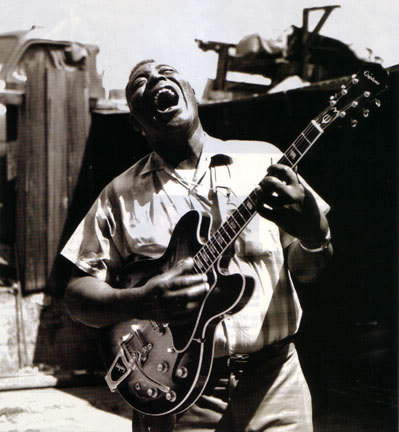
Chester Arthur Burnett, aka Howling Wolf.

When I was sixteen:
Hitting the Village with my grandfather

Wolf sang every song to the pretty hippie boy sitting directly in front of me, who turned out to be Davy Jones of the Monkees.

By Carl R. Hultberg / The Rag Blog / November 8, 2009

When I was sixteen I made a fateful trip to New York City to visit my grandfather, Jazz critic Rudi Blesh. Rudi lived off the Bowery and in the Village he was in his element.

Guiding me out into the New York night he brought me to this brightly lit venue on Bleecker Street. As we entered the dark nightclub and went to the table an amplified voice from a little booth quietly announced Rudi’s entrance. The pianist on stage (Erroll Garner?) quickly segued into a little bit of Trad Jazz (Memories of You?) and a little Ragtime bit. Perhaps even a spotlight might have found us at the table.

At any rate, I was mortified and on pretense of finding the men’s room I slipped out of the club. It was 1966 man, what did I need to be listening to Jazz for?

Coming on a little hole in the wall I realized it was the Night Owl, no longer a real cafe, just a poster shop. Still a teenage band was working out right at eye level. It was probably James Taylor, Danny Kortchmar and the original Flying Machine but it wasn’t the Lovin’ Spoonful so I got out of there with my $5 intact before they hit me for a charge.

Across the street down a flight of stairs was the Cafe au Go Go. The shill at the door was looking to fill some tables. “How much you got?” I told him $3 and he motioned to a second row table. The first act was the Siegal Schwall Blues Band. Having heard the Butterfield unit I wasn’t too impressed. Still they tried hard. The next guy who stumbled onto the platform was none other than Tim Hardin. This was important for me and I was floored, despite the fact that it was a short set and Tim didn’t really seem totally awake.

Art D’Lugoff at the Village Gate. Photo by Béatrice de Géa for The New York Times.

The next act took some time to set up on the main stage. What I got to see and hear next was none other than Howling Wolf with his band. The man sat in a chair with his microphone and harmonicas singing while his sharkskin suited accompianists played flawless electric Blues dancing side to side in lockstep behind him. Wolf sang every song to the pretty hippie boy sitting directly in front of me, who turned out to be Davy Jones of the Monkees.

There really are no words to describe this set for me. Pulling out of the club hours later and returning to the East 4th Street pad I had to smooth things over after ditching Rudi. Telling him I’d seen Howling Wolf didn’t hurt.

The man who’d announced Rudi’s entrance at the Village Gate was owner Art D’Lugoff. The club closed a few years ago (it’s now a CVS drugstore). Art himself passed away this week. He was eighty five years old.

The Rag Blog

Posted in Rag Bloggers | Tagged , , , , , , , | 2 Comments

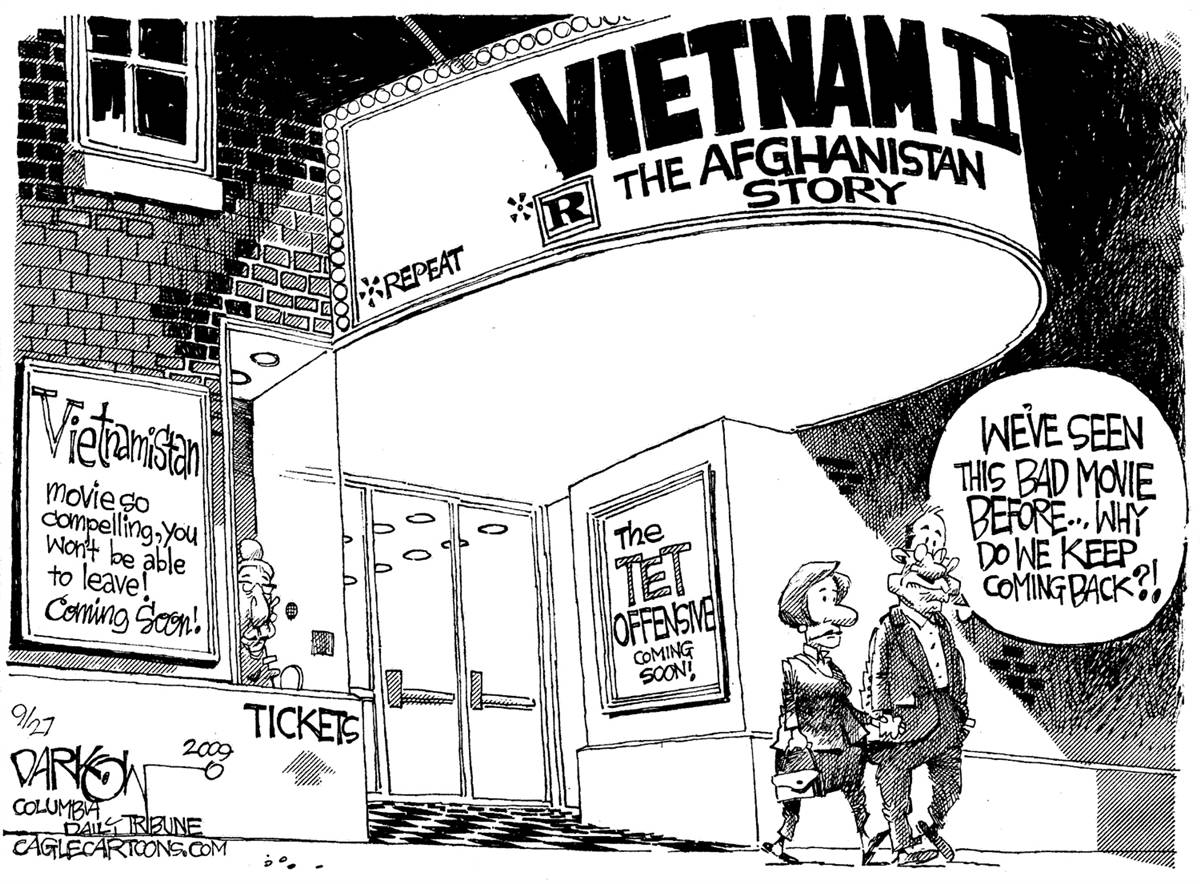
Matthew Hoh and Vietnamistan : Déjà vu all Over Again


A bright and shining lie:
Hoh’s Afghanistan and John Paul Vann’s Vietnam

By Richard Lee / The Rag Blog / November 8, 2009

I just got a copy of diplomat Matthew Hoh’s resignation letter from a friend in Canada. I don’t get a lot of news from up in the States and what few blips I do get are in Spanish. There was some reporting of the letter but with only a couple of quotes, mostly from the first and second paragraph. Mostly it just passed me by. I heard it was more thoroughly covered by what you call the “news” up in the states.

I read it through a couple of times; it had a familiar ring to it. Where had I heard this before? Oh yeah, then I remembered, it was in Neil Sheehan’s book, A Bright and Shining Lie, John Paul Vann and America in Vietnam.

Their stories parallel and at the same time mirror each other. Like Hoh, Vann first went to Vietnam as a soldier, a Major who went there as an “advisor” for an ARVN Battalion in the upper Mekong delta. He served under General Paul Harkin the commander of MACV in 1962-63. Both later returned to the battle zone as civilian workers for the USG.

It became clear to Vann in that year that President Kennedy and the boys at the Pentagon were clearly on a wrong course. The strategy of attrition and the belief that the Diem government wanted to win against the communist could only lead to disaster.

Hoh cites the Afghani government as an alien body, “unknown and unwanted by its people.” Vann saw the same feelings in the people toward the government of Diem, who was also unknown and unwanted in Vietnam. Both Karzi and Diem wanted the war, not to win it and certainly not to lose it, but to have it and profit in power and wealth for themselves and their friends. It certainly was a stroke of good luck for each that they had the Americans to fight it for them.

In Afghanistan, Hoh writes that “from at least the end of King Zahir Shah’s reign (it) has violently and savagely pitted the urban, secular, educated and modern of Afghanistan against the rural, religious, illiterate and traditional.” In that other war the urban, catholic, educated and modern, from the end of the reign Bao Dai, was pitted against the rural, illiterate and traditional. A class war within the civil war.

John Vann’s war was sustained by the struggle against a corrupt and brutal army backed by foreign invaders who were totally ignorant of the history, culture and traditions of the people of Vietnam. Hoh finds the same conditions in Afghanistan. He writes, “The United States presence in Afghanistan greatly contributes to the legitimacy and strategic message of the Pashtun insurgency. In a like manner our backing of the Afghan government in its current form continues to distance the government from the people.”

Both Hoh and Vann cite the same conditions:

  • Glaring corruption and unabashed graft
  • A president whose confidents and advisors comprise… war crimes villains, who mock our own rule of law…
  • A system of district and provincial leaders constituted of local power brokers, opportunist and strongmen allied to the United States solely for and limited by, the value of our USAID… contracts and whose own political and economic interests stand nothing to gain from any positive and genuine attempts at reconciliation.
  • The… election process dominated by fraud…

Hoh’s resignation letter goes on to find his own analogies to that other war and like Vann he was always aware of the courage and skill of our own troops.

John Vann died in Vietnam in a helicopter crash, still trying to get the generals and politicians to heed their folly; Hoh resigned in a public way hoping the generals and politicians would heed the words of his letter and discover their current folly.

From me to Mr. Hoh: I’ve been there, don’t hold your breath.

The Rag Blog

Posted in Rag Bloggers | Tagged , , , , , | 14 Comments

BOOKS / ‘Eating Animals’ : The Beef with Factory Farms


Jonathan Safran Foer’s Eating Animals:
A sweeping indictment of factory farms

…what we should be talking about is how upward of 99 percent of animals are raised and what it does to them, what it does to the environment, what it does to rural communities, what it does to farmers.

By Jessica Roy / November 8, 2009

Jonathan Safran Foer is a strict vegetarian, but his most recent book, Eating Animals, is not a screed against meat. It is, rather, an indictment of the corrupt, large-scale factory farming that dominates the American meat market.

A journalistic work with a novelistic feel, the book is the result of three years investigating the U.S. meat industry, and it weaves together animal activist and farmer interviews with statistical research and even memoir to provide a sweeping account of Big Beef and its social, economical and environmental impact. Descriptions of animals suffering on the “kill floor” are enough to incite squirms from even non-animal lovers, but cruelty is not Foer’s only grievance: There are health concerns and devastating environmental damage at issue as well.

Eating Animals may be Foer’s first big swing at nonfiction, but primary themes hearken back to Foer’s two critically polarizing novels, Everything Is Illuminated and Extremely Loud and Incredibly Close. Family folklore and ideas about the complexity of memory permeate each; Eating Animals begins with a section titled “Storytelling,” about Foer’s grandmother, a Holocaust survivor (and passionate carnivore). “The story of her relationship with food,” he writes, “holds all of the other stories that could be told about her.”

The book is not without controversy, of course. Food politics gets at the very heart of what it means to be American — alas, human — and the subject of how and if we eat meat stirs up intense feeling. Last week, Natalie Portman kicked up a tiny tempest when she wrote about Eating Animals in a column on Huffington Post, championing Foer’s argument but adding her own painfully tone-deaf riff about rape. (The controversy took place after the Salon interview but when I reached him afterward via e-mail, Foer had this to say about Portman’s column: “It was such a thoughtful and generous piece of writing. I felt gratefulness more than anything else.”)

I met with Foer recently in a coffee shop near his home in Park Slope, Brooklyn, where he spoke about what’s wrong with PETA, how he finally went so local he ditched Amazon — and what Americans can do to help put an end to the evils of factory farms.

This is not a straightforward case for vegetarianism. What is this book making a case for?

It’s an explanation of my own vegetarianism, and it’s a straightforward case for caring and thinking, and for the ideas that matter. These little daily choices that we’re so used to thinking are irrelevant are the most important thing we do all day long. An enormous and very destructive force — historically, it’s unprecedented how destructive our farm system is — has taken over America and is starting to take over the world.

And unlike so many other horrible systems, this one doesn’t require electing a new government or raising billions of dollars or fighting a war. It can be dismantled just by people making different choices. I think there are a lot of different choices people can make that will lead to dismantling the system. It’s not like everybody has to go vegetarian. There are plenty of people who feel like, for whatever reason, they just can’t stop eating meat, but if they bought meat at the green market, from farmers they know by name, that’s as effective a rebuttal.

What if you live in a city and you don’t live near a farm? I’m sure there are tons of people like that in New York. What’s your suggestion for them?

Well, in New York everybody is near a green market. Everybody is near a source of family-farmed meat. In fact, cities are frankly the best place to be in terms of that. But you ask a good question because there are a lot of times when you don’t have a choice. Like, in a restaurant, you never have a choice, with the exception of — maybe there’s 10 restaurants in New York City. In restaurants people are often faced with this problem, like, “Well, I’m either going to have to leave my values at the door and just eat this stuff, or eat vegetarian.” Those are the only two choices we have.

And then people think, what does it mean to care about something if you don’t act on that care? Even if it makes things less convenient, even if it makes your meal less enjoyable — which is totally possible. But we make decisions all the time guided by our values that make our lives less convenient and less enjoyable. We do them because they’re things that matter more to us than a momentary pleasure, momentary comfort. I don’t know why food would be an exception.

How has writing and researching this book changed the way you and your family eat?

We were vegetarians before, and we continue to be, and we’re raising our kids vegetarian. One thing that has interested me about my response to this whole project is that it’s made me care about other things. I mean, caring is contagious. It’s very hard to care about one thing and not care about its neighbor.

For example, I was not a huge advocate of buying things locally, not food but like books — anything. I would buy books on Amazon all the time. But for whatever reason, the subject does not have anything to do with that, but the process of writing it made me much more concerned about buying things locally, supporting my neighborhood stores, it mattering that I know the person who’s selling me something.

That’s something that’s great about food is that so much intersects there. Tolstoy famously said, “If there were no more slaughterhouses there would be no more battlefields.” I don’t think that’s true, and I don’t think all battlefields are bad, but what is true is that when you start to care about food and think about the animals and how we raise them, it encourages you to have lots of other thoughts.

This is your first nonfiction book.

Well, it’s my first and my last. I don’t think I’ll ever do it again. It’s not something that interests me. I felt a little bit like dressing up for Halloween. Although, my interests at the end of the day were never really journalistic and it always did feel personal. And the themes that this book falls back on are the themes that my novels fall back on, like, how are lessons transmitted through generations and families, how do our decisions matter, how do they influence others?

So, part of what inspired me to write about this was not that I cared about it so much but that nobody was writing about it. There are a lot of things I care about, but great people are writing about them. And there hasn’t really been a mainstream book about meat, despite the fact that it’s everything. I mean, if it isn’t the biggest, most important issue in our country right now, it’s up there.

Did any specific authors or works influence your book?

Many. Of course, Michael Pollan, Eric Schlosser, Peter Singer. I mean if any of them had written the thing that I wanted to read, I wouldn’t have had to write my book. See, Pollan is wonderful, but he doesn’t really get into meat too deeply; he sort of goes up to the edge of it and then stops. The same with Schlosser. Peter Singer writes about meat very directly, but in a way that I feel doesn’t include enough of the messiness of being a person in the world and having cravings, having personal history, having family. Reason has something to do with our food decisions, but not a lot. Most food decisions are made out of emotions or psychology or impulse, and so I wanted a book that included those things.

What were some of the most surprising or disturbing things you found in your research?

The most disturbing thing is not any instance, but the rule. It’s a shame in a way that PETA videos or slaughterhouse videos are most people’s exposure to factory farming because it gives the impression that the horrible things are the exception, when in fact they’re the rule. So an animal running and getting beaten up or running around with its neck slit open: That is the exception, even on the worst farms it’s still the exception. But the rule that happens even on the best factory farms is animals are genetically modified to the point of being unable to reproduce sexually, animals that never see the sun and never touch the earth, animals whose cages are never cleaned.

These things are not as shocking and don’t work as well in a video, but they’re something to be concerned with much more because they’re happening to billions and billions of animals every year. It’s the way that the notion that an animal is a thing has been systematized and it’s part of the business model and that everyone thinks this way. That was the most surprising thing.

You also talk about your dog George, and consider why people will eat farm animals but not dogs. Can you elaborate on that?

The book in the beginning sort of presents two approaches. One is philosophical — is it right or isn’t it right? Why do we do this at all? And the other is practical. I side with the practical. I mean, the book moves in the direction of the practical because in a way the philosophical questions are irrelevant. “Is it right to eat an animal, is it not right to eat an animal?” That’s how most people talk about vegetarianism. But to me it doesn’t even matter.

The truth is I actually don’t know what I think about that question. What I know is that it’s wrong to do it the way that we’re doing it. And we could sit here and argue about a perfect farm where animals are treated perfectly and slaughtered perfectly and whether that’s right. But if it exists at all it exists in a place that is impossible for us to find on any regular basis. So what we should be talking about is how upward of 99 percent of animals are raised and what it does to them, what it does to the environment, what it does to rural communities, what it does to farmers. And that’s bad; I mean, those things are bad. And that conversation preempts the philosophical conversation.

Your grandmother was a huge influence on your concept of food, and you also say she’s an unapologetic meat eater. How did she react to the book?


I don’t think she’s read it yet. I think she will agree with a lot of what I said. I don’t think she’s going to change. I think she’s past changing. But I’ve had pretty frank conversations with her about what’s right and what’s wrong, and she’ll agree — as will everybody, by the way. There’s not a reader of this interview who will say it’s right to make animals suffer unnecessarily.

So then it becomes a question of what is suffering to different people and what is necessary to different people. And people can have all kinds of different, very respectable differences of opinion on this question, but I’ve spoken to my grandmother about why this might be wrong and she doesn’t disagree. It’s sad. She said in a very upfront way, “I don’t think about it, I’m not going to think about it.”

For someone like my grandmother — frankly, for a lot of people — I don’t really push it. I think for people who are still forming their habits, like high school students or college students, that kind of willed ignorance is lame at best and something much worse because they’re most able to change. They’re the ones who are ultimately going to have to foot the bill of factory farming and are more required to do the uncomfortable thinking that a 90-year-old doesn’t.

Can you talk a little bit about America’s obsession with food?

There’s never been a culture that wasn’t obsessed with food. The sort of sad thing is that our obsession is no longer with food, but with the price of food. Factory farming supplies a demand for cheap meat. That’s it. It doesn’t taste good, it’s not healthy for us. The only good thing about it is that it’s cheap.

But the thing is that it’s not cheap. It’s cheap at the cash register, and it’s sold as cheap — that’s the defense for factory farming, “Look, we’re making affordable food for normal people and all other arguments are elitist.” But in fact factory farming is like the ultimate elitism because it’s the most expensive food ever produced in the history of mankind. We pay very little at the cash register, but we pay and our kids are going to pay for the environmental toll, obviously the animals are paying, rural communities are paying.

And for what? So that corporations can prosper. The huge agribusiness — companies make hundreds of millions and sometimes billions of dollars, not in the name of feeding the world, but in the name of making something that’s so cheap that people become literally addicted to it.

Aside from getting green meat and eating locally, what are things that both vegetarians and meat eaters can do to help the transition from factory farms to something better?

First of all, they just have to say no to factory farms always. Not sometimes, not most of the time, but always, which means eating vegetarian a lot of the time. I think this issue is frankly more important than our conversation about the environment, because it is the No. 1 cause of global warning. The World Watch just released a report that showed that they thought animal agriculture was responsible for 18 percent of greenhouse gases, but it turns out it’s 51 percent. So to talk about the environment and not talk about this is not to talk about the environment.

This conversation has to be totally mainstreamed. There has to be a consensus behind it that factory farming is bad and we’re not going to support it and we’re done with it. And it has to be unacceptable either to pretend these problems don’t exist or not to actively engage with them. I’m not saying everybody has to reach the same conclusions, but they do have to agree on the common enemy.

Source / Salon

Thanks to Janet Gilles / The Rag Blog

Posted in RagBlog | Tagged , , , , , , , , , | 6 Comments

American Health Care : Monster Run Amok

Cartoon by RS Janes / LTSaloon.

Once the envy of the world…
The American health care disgrace

By Dr. Stephen R. Keister / The Rag Blog / November 7, 2009

Between 1910 and 1970 American medicine was the envy of the world. The giants of American culture were its physicians: William Osler. Howard Kelly, Harvey Cushing, Elliott Joslin, Charles and Will Mayo, W.W.G. Maclachlan, Jonas Salk, Alfred Sabin, to name a few. Mothers dreamed of their sons growing up to be physicians, who were considered on a par with clerics, or college professors.

From the 1970s on, many physicians ceased to be idealists who took care of the ill, regardless of ability to pay, and became content to make a decent living without idealizing money. Things have indeed changed. The physicians’ respect in the community has diminished to a point that is akin to that of the MBA, used-car salesman, or fundamentalist preacher. (My apologies to the used car salesman as I have several very honest, upright acquaintances in that area of business.)

The average American — except those who are very well-to-do and count doctors among their golfing buddies — think of medical care in terms of CT Scans, MRI machines, laboratories, and medical device purveyors. No longer, to most folks, is the doctor a friend and confidant.

With this surrender to the for-profit insurance industry the once proud, idealistic physician has morphed into the “provider,” paid and manipulated by the insurance executives. Happily, the current health care debate suggests that many idealistic physicians have survived — as evidenced by the 60%-plus support among doctors for a government provided alternative to the insurance cartel’s monopolistic rationing and manipulation of health care. My gratitude to Physicians for a National health Care Program and The American College of Physicians, with their thousands of dedicated members.

Currently the system of medical care in the United States is a blot on our international reputation. Most of those living in Western Europe, and many in the Third World, are baffled about how this great nation could countenance having 50 million individuals without regular medical care. And they wonder how we could allow 45,000 persons to die yearly for lack of insurance (according to a report from the American Journal of Public Health), and how we could have let 17,000 children die over the past two decades (according to a study released by the Johns Hopkins Children’s Center).

They are confused why the richest country in the world needs to import physicians from the Third World to make up for the inadequacy of trained American physicians. (My thanks to the numerous very capable physicians from India that I have encountered, as well as many from Iran and other Middle Eastern nations.) Nowhere else in the world, save in the USA, do we see signs posted in malls announcing a spaghetti dinner at a fire house to help defray the costs of a child’s brain tumor surgery.

And take this mind-boggling piece of information: according to The World Health Organization, only one of thirty companies producing H1N1 flue vaccine is based in the United States, that being Aviron/Wyeth/Lederle, which makes a nasal vaccine. Our main supplier is the U.S. branch of Sanofi Pasteur, a French company located in this country, Nearly all European nations have one or more companies producing the vaccine; Korea has three and China seven. When I retired in 1990 I recall that three U.S.-based companies were making influenza vaccine. I have been told that production was discontinued because of excessive unused inventory of the vaccine, which is dated, which diminished the profits of the manufacturer.

There are still many excellent if harried physicians remaining in the United States; however, getting into a physicians office on short notice has become a problem for most people. I am aware of a friend with a torn knee cartilage who was told that it would take six weeks to get an appointment with an orthopedic surgeon, while another older lady with digestive problems had to wait six weeks to have an esophagoscopy scheduled.

A third elderly acquaintance, with interstitial cystitis, has seen a urologist on three occasions, totaling approximately 20 minutes, was never examined, and on each occasion was prescribed antibiotics purely on the basis of a questionable, voided urine culture. Never did she receive an explanation of her condition, or its long term implications, or was cystoscopy suggested. I finally accessed her literature relative to the condition from the Mayo Clinic via Google.

Where I live, obtaining an appointment with a dermatologist may well take several months. Yet, the opponents of decent health care in the United States continue to spread the myth that ours is “the best system in the world” and that in other nations you can expect long waits to get an appointment — which is most likely to be true only if you are seeking a specific physician at a major institution. Currently the U.S. Chamber of Commerce is in the forefront of the lies and deceit industry, joining the Health Insurance industry in promulgating ad after ad on television, and a large percentage of the unsophisticated American public tends to confuse this promotional material with factual information.

Last Thursday, Nov. 5, we saw a well choreographed demonstration in Washington, with thousands of the uninformed and misinformed brought in on busses and provided with placards which they frequently did not understand, and all this was paid for by institutions associated with the health insurance industry. In addition the mainstream TV programs continue to provide panels of talking heads to discuss health care, most of them provided by the conservative think tanks.

The other clever maneuver of the insurance industry is to incite the anti-abortion lobby and get them aligned against decent health care. These folks, who are interested primarily in ovocysts, and not in children once born, rail against decent health care as if the whole plan was devised as a scheme to provide abortions for the poor — when the Hyde Amendment already makes it illegal to use federal funds to provide abortions. The opponents of decent care for all Americans are stooping to any ruse or deceit, as evidenced by the ads espousing Medicare Advantage as “good health care,” to influence the ill informed, culpable American public.

I write this on the eve of the intended House of Representatives vote on a bill for health care for all. Of course, we would hope that such bill would include the core features outlined by Health Care for America Now:

  1. A public health insurance option for all established by the federal government,
  2. One that is available to individuals and employers across the nation,
  3. Not merely a panel of private plans (such as FEHBP, the health insurance available to federal employees), and not limited to low income individuals,
  4. A government body, or independent entity established by government, sets policies and bears the risk for paying medical claims,
  5. May hire insurance companies, where efficient and appropriate, to handle administrative functions such as paying claims,
  6. Provides broad access to providers that meet defined participation standards,
  7. Consults with providers and nonpartisan experts to establish provider rates and develop and implement payment system reforms that promote quality care, prevention, and good management for chronic care,
  8. Operates separately from existing public programs such as Medicare, but may tap into their infrastructure (e.g. payment systems, claims processing, and appeals processes).

Further details cam be found here.

The next step, of course, is to try to inject some reason into the discussion in the Senate which appears at times to have abandoned any sense of logic. Take, for instance, the bizarre, suggestion that health care reform include coverage for “prayer treatment.” Odd that we in the United States will even suggest the commercialization of prayer! Next, maybe we should claim airfare to Lourdes as a “medical expense” when we file our income tax deductions.

But, seriously, we keep hearing from Harry Reid that it will be difficult to get the 60 votes to pass a decent health care bill. This is undoubtedly true, if the Senate lies down and acts like a whipped dog. There is a solution under parliamentary rules and it’s called the “nuclear option.” Change to Senate Rules is discussed in detail on Wikipedia.

The key part reads as follows:

The nuclear option is used in response to a filibuster or other dilatory tactic. A senator makes a point of order calling for an immediate vote on the measure before the body, outlining what circumstances allow for this. The presiding officer of the Senate, usually the Vice President of the United States or the president pro tempore, makes a parliamentary ruling upholding the senator/s point of order. The Constitution is cited at this point, since otherwise the presiding officer is bound by precedent. A supporter of the filibuster may challenge the ruling by asking, “Is the decision of the Chair to stand as the judgment of the Senate?” This is referred to as “appealing to the Chair.” An opponent of the filibuster will then move to table the appeal. As tabling is non-debatable, a vote is held immediately.

A simple majority decides the issue. If the appeal is successfully tabled, then the presiding officer’s ruling that the filibuster is unconstitutional is thereby upheld. Thus a simple majority is able to cut off debate, and the Senate moves to vote on the substantive issue under consideration. The effect of the nuclear option is not limited to the single question under consideration as it would be in a cloture vote. Rather, the nuclear option effects a change in the operational rules of the Senate, so that the filibuster or dilatory tactic would therefore be barred by the new precedent.

The proponents of decent healthcare-for-all face the Rubicon. We the public must exert enough pressure on our elected representatives, and upon President Obama, to offset the chicanery in the House and Senate, and to try with reason and compassion to counter the bribing of our elected officials, and the misinformation and outright lies deluging the public. Time is short, but this old man would like to finish his later days with head high, once again seeing our country as a leader in health care.

We would like to see our nation respected as a leader in ethics and morality, rather than being looked upon as a Third World nation when it comes to treating the sick and disadvantaged. Ours should be a nation based on doing what is correct and not one subservient to the fringe manipulated by the big corporations, the financial elite, and those who allow their ambition to overcome our traditions of kindness and charity as expressed in the Sermon on the Mount and the Beatitudes.

Dr. Richard Wolff, economist at The University of Massachusetts, says that our economic collapse — which has gradually developed over the past 150 years and has accelerated since 1970 with wage stagnation, and excessive profits — may take years to correct, if it can be corrected at all. But let us show the humanity, the sense of community, that we see in the Western European nations. Their epiphany occurred after World War II, when they moved beyond the devotion to self interest, to accumulated wealth at all costs, that is inherent in the doctrine of “private enterprise” and neoliberal economics.

Perhaps those folks who keep pretending that this is a “Christian Nation” should review the true meaning of their alleged faith. Perhaps it is time to cast out the money changers and show some compassion for our fellow man. Remember what Lyof Tolstoy wrote in 1893 in The Kingdom of God Is Within You:

The Christian churches and Christianity have nothing in common save name: they are hostile opposites. The churches are arrogance, violence, ursurpation, rigidity, death; Christianity is humility, penitence, submissiveness, progress, life.

Let good Americans stand for life and good health.

[Dr. Stephen R. Keister lives in Erie, Pennsylvania. He is a retired physician who is active in health care reform. His writing appears regularly on The Rag Blog.]

The Rag Blog

Posted in Rag Bloggers | Tagged , , , , | 14 Comments

Real Unemployment Rate : Closing in on the Great Depression


Good times around the corner?
Real unemployment rate at 17.5 percent

This economic disaster was created by far too many years of Reagan-Bush-supply-side-trickle-down-union-busting-corporate-welfare-market-driven economic policy.

By Ted McLaughlin / The Rag Blog / November 7, 2009

Yes, I know the federal government says the unemployment rate is now 10.2% — up from 9.8% after the country suffered a net loss of another 190,000 jobs in October. And that is a very scary figure in itself. After all, it shows nearly 16 million Americans are out of work.

But those are the “adjusted” figures the federal government uses to keep the American people from knowing just how bad unemployment really is in this country. When you add in the number of people who have given up trying to find a job and the people who have accepted part-time work because they can’t find a full-time job, you get much closer to the REAL unemployment rate.

The sad fact is that the real unemployment rate is now at least 17.5%. That means more than one out of every six workers in this country cannot find a full-time job.

Folks, that’s rapidly approaching the unemployment figures from the Great Depression, when the rate of unemployment climbed over 20%. And the government admits that the rate will continue to climb over the next several months (and probably longer). It is within the realm of possibility that we’ll reach those Great Depression numbers.

What bothers me is that the government and private economic pundits are currently trying to convince Americans that better times are just around the corner. They tell us the recession is actually over (because one quarter of GDP showed some growth). Then they assure us that unemployment is just a lagging indicator and will turn around in a few months as the economy continues to grow.

I wish I could believe that, but I don’t. All of the jobs were not lost due to the poor economy. Some of those jobs were cut so the companies could show a short-term gain and drive up their stocks — making millions for executives and investors. Many other good-paying jobs have been shipped overseas where the companies can exploit low-wage workers. None of these jobs are coming back, regardless of how much the economy rebounds.


Around 70% of the GDP (Gross Domestic Product) figure depends on consumer buying in this country. With the job losses continuing to rise each month in this country, fewer people each month will have money to spend. Those who still are working will also close their pocketbooks even tighter because the tanking economy scares them.

Even when the economy does start producing jobs instead of losing them, what kind of jobs will they be? Will they be good-paying jobs with benefits, or minimum wage jobs with no benefits? There is no shame in flipping burgers, but you certainly can’t buy food, make house payments and pay for a car with that kind of job.

Political pundits are now saying that if the economy and jobs don’t turn around before the next election, it will be blamed on the Democrats because they are in power. That’s probably true, even though it may be unfair.

Lest we forget, this mess wasn’t created by the Democrats. This economic disaster was created by far too many years of Reagan-Bush-supply-side-trickle-down-union-busting-corporate-welfare-market-driven economic policy. The elder Bush was right when he called it “voodoo economics” (before he sold out and went along with it).

The truth is that the recession is not over. It won’t be over until the economy starts producing good jobs. But fasten your seat belts, because that’s a long way down a very bumpy road.

[Rag Blog contributor Ted McLaughlin also posts at jobsanger.]

The Rag Blog

Posted in Rag Bloggers | Tagged , , , | 17 Comments

BOOKS / Caliban and the Witch : The Creation of Capitalism


Who Were the Witches?
Patriarchal Terror and the Creation of Capitalism

By Alex Knight / The Rag Blog / November 6, 2009

This Halloween season, there is no book I could recommend more highly than Silvia Federici’s brilliant Caliban and the Witch: Women, the Body, and Primitive Accumulation (Autonomedia 2004), which tells the dark saga of the Witch Hunt that consumed Europe for more than 200 years.

In uncovering this forgotten history, Federici exposes the origins of capitalism in the heightened oppression of workers (represented by Shakespeare’s character Caliban), and most strikingly, in the brutal subjugation of women. She also brings to light the enormous and colorful European peasant movements that fought against the injustices of their time, connecting their defeat to the imposition of a new patriarchal order that divided male from female workers.

Today, as more and more people question the usefulness of a capitalist system that has thrown the world into crisis, Caliban and the Witch stands out as essential reading for unmasking the shocking violence and inequality that capitalism has relied upon from its very creation.

Who were the witches?

Parents putting a pointed hat on their young son or daughter before Trick-or-Treating might never pause to wonder this question, seeing witches as just another cartoonish Halloween icon like Frankenstein’s monster or Dracula. But deep within our ritual lies a hidden history that can tell us important truths about our world, as the legacy of past events continues to affect us 500 years later.

In this book, Silvia Federici takes us back in time to show how the mysterious figure of the witch is key to understanding the creation of capitalism, the profit-motivated economic system that now reigns over the entire planet.

During the 15th – 17th centuries the fear of witches was ever-present in Europe and Colonial America, so much so that if a woman was accused of witchcraft she could face the cruelest of torture until confession was given, or even be executed based on suspicion alone. There was often no evidence whatsoever.

The author recounts, “for more than two centuries, in several European countries, hundreds of thousands of women were tried, tortured, burned alive or hanged, accused of having sold body and soul to the devil and, by magical means, murdered scores of children, sucked their blood, made potions with their flesh, caused the death of their neighbors, destroyed cattle and crops, raised storms, and performed many other abominations” (169). In other words, just about anything bad that might or might not have happened was blamed on witches during that time. So where did this tidal wave of hysteria come from that took the lives so many poor women, most of whom had almost certainly never flown on broomsticks or stirred eye-of-newt into large black cauldrons?

Caliban underscores that the persecution of witches was not just some error of ignorant peasants, but in fact the deliberate policy of Church and State, the very ruling class of society. To put this in perspective, today witchcraft would be a far-fetched cause for alarm, but the fear of hidden terrorists who could strike at any moment because they “hate our freedom” is widespread. Not surprising, since politicians and the media have been drilling this frightening message into people’s heads for years, even though terrorism is a much less likely cause of death than, say, lack of health care.1

And just as the panic over terrorism has enabled today’s powers-that-be to attempt to remake the Middle East, this book makes the case that the powers-that-were of Medieval Europe exploited or invented the fear of witches to remake European society towards a social paradigm that met their interests.

Interestingly, a major component of both of these crusades was the use of so-called “shock and awe” tactics to astound the population with “spectacular displays of force,” which help to soften up resistance to drastic or unpopular reforms.2 In the case of the Witch Hunt, shock therapy was applied through the witch burnings — spectacles of such stupefying violence that they apparently paralyzed whole villages and regions into accepting fundamental restructuring of medieval society.3

Federici describes a typical witch burning as, “an important public event, which all the members of the community had to attend, including the children of the witches, especially their daughters who, in some cases, would be whipped in front of the stake on which they could see their mother burning alive” (186).

The book argues that these gruesome executions not only punished “witches” but graphically demonstrated the repercussions for any kind of disobedience to the clergy or nobility. In particular, the witch burnings were meant to terrify women into accepting “a new patriarchal order where women’s bodies, their labor, their sexual and reproductive powers were placed under the control of the state and transformed into economic resources” (170).

Federici puts forward that up until the 16th century, though living in a sexist society, European women retained significant economic independence from men that they typically do not under capitalism, where gender roles are more distinguished. She goes on, “If we also take into account that in medieval society collective relations prevailed over familial ones, and most of the tasks that female serfs performed (washing, spinning, harvesting, and tending to animals on the commons) were done in cooperation with other women, we then realize… [this] was a source of power and protection for women. It was the basis for an intense female sociality and solidarity that enabled women to stand up to men.” But the Witch Hunt initiated a period where women were forced to become what she calls “servants of the male work force” (115) — excluded from receiving a wage, they were confined to the unpaid labor of raising children, caring for the elderly and sick, nurturing their husbands or partners, and maintaining the home. In Federici’s words, this was the “housewifization of women,” the reduction to a second-class status where women became totally dependent on the income of men (27).

Federici goes on to show how female sexuality, which was seen as a source of women’s potential power over men, became an object of suspicion and came under sharp attack by the authorities. The assault manifested in new laws that took away women’s control over the reproductive process, such as the banning of birth control measures, the replacement of midwives with male doctors, and the outlawing of abortion and infanticide.4 Federici calls this an attempt to turn the female body into “a machine for the reproduction of labor,” such that women’s only purpose in life was supposedly to produce children (144).

But we also learn that this was just one component of a broader move by Church and State to ban all forms of sexuality that were considered “non-productive.” For example, “homosexuality, sex between young and old, sex between people of different classes, anal coitus, coitus from behind, nudity, and dances. Also proscribed was the public, collective sexuality that had prevailed in the Middle Ages, as in the Spring festivals of pagan origins that, in the 16th-century, were still celebrated all over Europe” (194). To this end, the Witch Hunt targeted not only female sexuality but homosexuality and gender non-conformity as well, helping to craft the patriarchal sexual boundaries that define our society to this day.


Capitalism: Born in flames

What separates Caliban from other works exploring the “witch” phenomenon is that this book puts the persecution of witches into the context of the development of capitalism. For Silvia Federici, it’s no accident that “the witch-hunt occurred simultaneously with the colonization and extermination of the populations of the New World, the English enclosures, [or] the beginning of the slave trade” (164).

She instructs that all of these seemingly unrelated tragedies were initiated by the same European ruling elite at the very moment that capitalism was in formation, the late 15th through 17th centuries. Contrary to “laissez-faire” orthodoxy which holds that capitalism functions best without state intervention, Federici posits that it was precisely the state violence of these campaigns that laid the foundation for capitalist economics.

Thankfully for the reader, who may not be very familiar with the history of this era, Federici outlines these events in clear and accessible language. She focuses on the Land Enclosures in particular because their significance has been largely lost in time. Many of us will not remember that during Europe’s Middle Ages even the lowliest of serfs had their own plot of land with which they could use for just about any purpose. Federici adds, “With the use of land also came the use of the ‘commons’ — meadows, forests, lakes, wild pastures – that provided crucial resources for the peasant economy (wood for fuel, timber for building, fishponds, grazing grounds for animals) and fostered community cohesion and cooperation” (24).

This access to land acted as a buffer, providing security for peasants who otherwise were mostly subject to the whim of their “Lord.” Not only could they grow their own food, or hunt in the relatively plentiful forests which were still standing in that era, but connection to the commons also gave peasants territory with which to organize resistance movements and alternative economies outside the control of their masters.

The Enclosures were a process by which this land was taken away — closed off by the State and typically handed over to entrepreneurs to pursue a profit in sheep or cow herding, or large-scale agriculture. Instead of being used for subsistence as it had been, the land’s bounty was sold off to fledgling national and international markets. A new class of profit-motivated landowners emerged, known as “gentry,” but the underside of this development was the trauma experienced by the evicted peasants.

In the author’s words, “As soon as they lost access to land, all workers were plunged into a dependence unknown in medieval times, as their landless condition gave employers the power to cut their pay and lengthen the working-day” (72). For Federici, then, the chief creation of the Enclosures was a property-less, landless working class, a “proletariat” who were left with little option but to work for a wage in order to survive; wage labor being one of the defining features of capitalism.

Cut off from their traditional soil, many communities scattered across the countryside to find new homesteads. But the State countered with the so-called “Bloody Laws”, which made it legal to capture wandering “vagabonds” and force them to work for a wage, or put them to death. Federici tells the result: “What followed was the absolute impoverishment of the European working class… Evidence is the change that occurred in the workers’ diets. Meat disappeared from their tables, except for a few scraps of lard, and so did beer and wine, salt and olive oil” (77).

Although European workers typically labored for longer hours under their new capitalist employers, living standards were reduced sharply throughout the 16th century, and it wasn’t until the middle of the 19th century that earnings returned to the level they had been before the Enclosures.5

According to Federici, the witch hunts played a key role in facilitating this process by driving a sexist wedge into the working class that “undermined class solidarity,” making it more difficult for communities to resist displacement (48). And while women were faced with the threat of horrific torture and death if they did not conform to new submissive gender roles, men were in effect bribed with the promise of obedient wives and new access to women’s bodies.

The author cites that “Another aspect of the divisive sexual politics to diffuse workers’ protest was the institutionalization of prostitution, implemented through the opening of municipal brothels soon proliferating throughout Europe” (49). And in addition to prostitution, a legalization of sexual violence provided further sanction for the exploitation of women’s bodies. She explains, “In France, the municipal authorities practically decriminalized rape, provided the victims were women of the lower class” (47). This initiated what Federici calls a “virtual rape movement,” making it unsafe for women to even leave their homes.

The witch trials were the final assault, which all but obliterated the integrity of peasant communities by fostering mutual suspicion and fear. Amidst deteriorating conditions, neighbors were encouraged to turn against one another, so that any insult or annoyance became grounds for an accusation of witchcraft. As the terror spread, a new era was forged in the flames of the witch burnings. Surveying the damage, Silvia Federici concludes that “the persecution of the witches, in Europe as in the New World, was as important as colonization and the expropriation of the European peasantry from its land were for the development of capitalism” (12).

A forgotten revolution

Federici maintains that it didn’t have to turn out this way. “Capitalism was not the only possible response to the crisis of feudal power. Throughout Europe, vast communalistic social movements and rebellions against feudalism had offered the promise of a new egalitarian society built on social equality and cooperation” (61).

Caliban’s most inspiring chapters make visible an enormous continent-wide series of poor people’s movements that nearly toppled Church and State at the end of the Middle Ages. These peasant movements of the 13th – 16th centuries were often labeled “heretical” for challenging the religious power of the Vatican, but as the book details they aimed for a much broader transformation of feudal society.

The so-called “heretics” often “denounced social hierarchies, private property and the accumulation of wealth, and disseminated among the people a new, revolutionary conception of society that, for the first time in the Middle Ages, redefined every aspect of daily life (work, property, sexual reproduction, and the position of women), posing the question of emancipation in truly universal terms” (33).

Silvia Federici shows us how the heretical movements took many forms, from the vegetarian and anti-war Cathars of southern France to the communistic and anti-nobility Taborites of Bohemia, but were united in the call for the elimination of social inequality. Many put forth the argument that it was anti-Christian for the clergy and nobility to live in opulence while so many suffered from lack of adequate food, housing or medical attention.

The vegetarian and anti-war Cathars were rounded up by the Crusaders.

Another common thread weaving the European peasant movements together was the leadership of women. Federici describes that, “[Heretical women] had the same rights as men, and could enjoy a social life and mobility that nowhere else was available to them in the Middle Ages… Not surprisingly, women are present in the history of heresy as in no other aspect of medieval life.” (38). Some heretical sects, like the Cathars, discouraged marriage and emphasized birth control – advocating a sexual liberation which directly challenged the Church’s moral authority.

The gender politics of peasant movements proved to be a strength, and they attracted a wide following that undercut the power of a feudal system which was already in crisis. Federici explains how the movements became increasingly revolutionary as they grew in size.

In the course of this process, the political horizon and the organizational dimensions of the peasant and artisan struggle broadened. Entire regions revolted, forming assemblies and recruiting armies. At times, the peasants organized in bands, attacking the castles of the lords, and destroying the archives where the written marks of their servitude were kept” (45).

What started as a religious movement became increasingly revolutionary. For example, in the 1420s and 30s, the Taborites fought to liberate all of Bohemia, beating back several Crusades of 100,000+ men organized by the Vatican (54-55). The uprisings became contagious, so much so that in the crucial period of 1350-1500, unprecedented concessions were made including the doubling of wages, reduction in prices and rents, and a shorter working day. In the words of Silvia Federici, “the feudal economy was doomed” (62).

The author documents that the initial reaction by elites was to institute the “Holy Inquisition,” a brutal campaign of state repression that included torturing and even burning heretics to death. But as time went on, ruling class strategy shifted from targeting heretics in general to specifically targeting female community leaders. The Inquisition morphed into the Witch Hunt.

Soon, simple meetings of peasant women were stigmatized as possible “Sabbats,” where women were supposedly seduced by the devil to become witches, but as Federici clarifies, it was the rebellious politics and non-conforming gender relations of such gatherings which were demonized (177). Strong, defiant women were murdered by the tens of thousands, and along with them the Witch Hunt also destroyed “a whole world of female practices, collective relations, and systems of knowledge that had been the foundation of women’s power in pre-capitalist Europe, and the condition for their resistance in the struggle against feudalism” (103).

For elite European nobles and clergy, the Witch Hunt succeeded in stifling a working class revolution that had increasingly threatened their rule. Even more, Silvia Federici puts forward that the Witch Hunt facilitated the rise of a new, capitalist social paradigm — based on large-scale economic production for profit and the displacement of peasants from their lands into the burgeoning urban workforce. In time, this capitalist system would dominate all of Europe and be dispersed through conquistadors’ “guns, germs and steel” to every corner of the globe, destroying countless ancient civilizations and cultures in the process.6

Federici’s analysis is that, “Capitalism was the counter-revolution that destroyed the possibilities that had emerged from the anti-feudal struggle — possibilities which, if realized, might have spared us the immense destruction of lives and the environment that has marked the advance of capitalist relations worldwide” (22). How might things be different if the forgotten revolution had won?

Conclusion: Rediscovering the magic of truth-telling

“Day by day, it’s worse for my people, especially for the women. And that’s why, because of all of these main reasons, we say this is the mockery of democracy and mockery of War on Terror.” – Malalai Joya, Afghan democracy activist, 2009

Caliban and the Witch is a book that challenges many important myths about the world we live in. First and foremost among these is the widely-held belief that capitalism, though perhaps flawed in its current form, started out as a “progressive” development that liberated workers and improved the conditions of women, people of color and other oppressed groups.

Silvia Federici has done impressive work to take us back to the very foundations of the capitalist system in late-medieval Europe to uncover a secret history of land dispossession and impoverishment, gender and sexual terror, and brutal colonization of non-Europeans. This terrible legacy leads her to the profound conclusion that the system is “necessarily committed to racism and sexism,” and most strongly, “It is impossible to associate capitalism with any form of liberation or attribute the longevity of the system to its capacity to satisfy human needs. If capitalism has been able to reproduce itself it is only because of the web of inequalities that it has built into the body of the world proletariat, and because of its capacity to globalize exploitation. This process is still unfolding under our eyes, as it has for the last 500 years” (17).

It’s been said that we can measure a society by how it treats its women. This book provides compelling documentation to suggest that capitalism is and has always been a male dominated system, which reduces opportunities and security for women as well as marginalizing those who don’t fit within narrow gender boundaries. In particular, it uses the story of the Witch Hunt to illuminate the inner workings of capitalism to show the restraining, silencing, and demonizing of female sexual power built into it.7

Responding to our question that started this essay, Silvia Federici writes, “The witch was not only the midwife, the woman who avoided maternity, or the beggar who eked out a living by stealing some wood or butter from her neighbors. She was also the loose, promiscuous woman — the prostitute or adulteress, and generally, the woman who exercised her sexuality outside the bonds of marriage and procreation… The witch was also the rebel woman who talked back, argued, swore, and did not cry under torture” (184).

In other words, the witches were those women who in one way or another resisted the establishment of an unjust social order — the mechanical exploitation of capitalism. The witches represented a whole world that Europe’s new masters were anxious to destroy: a world with strong female leadership, a world rooted in local communities and knowledge, a world alive with magical possibilities, a world in revolt.

We need not despair for the world that has been lost. Indeed, it is still with us today in the struggles of people everywhere organizing for justice. Today from Afghanistan we can hear the clarion voice of Malalai Joya, a courageous woman who was expelled from the Afghan parliament in 2007 for speaking out against the U.S.-installed warlords who now rule her country. She appeared recently on Democracy Now! saying, “Now my people are sandwiched between two powerful enemies: from the sky, occupation forces bombing and killing innocent civilians… [and] on the ground, Taliban and these warlords together continue to deliver fascism against our people.”8

Joya risks her life to make these comments, but her words carry the sparkling truth that is so necessary to end the insanity of war and occupation in the Middle East. Those who are summoned to action by her call do so in the immortal spirit of the “heretics” and “witches” who resisted capitalism and feudalism before it, carrying forward a movement that is wide as the Earth and old as time.

Notes

  1. Harvard University researchers released a study on Sept. 17, 2009, showing that approximately 45,000 Americans die unnecessarily from lack of medical coverage every year, unfortunately many times more than the number killed on September 11, 2001. See this article for more on the Harvard study.
  2. “Shock and Awe”, Wikipedia. Accessed Nov. 2, 2009.
  3. This “shock therapy” strategy is examined in detailed case studies by Naomi Klein in the excellent The Shock Doctrine: The Rise of Disaster Capitalism. Metropolitan Books 2007. For example she offers that the US-led devastation of Iraq’s social infrastructure, including destruction of hospitals, food and water systems traumatized the Iraqi people such that they could not prevent the highly unpopular privatization of the country’s oil wealth.
  4. for more on the Witch Hunt’s effect on the male domination of reproduction and medicine, see Barbara Ehrenreich’s Witches, Midwives and Nurses: A History of Women Healers, The Feminist Press at CUNY 1972, pamphlet.
  5. “The high point of wages was immediately preceding the ‘long’ sixteenth century [roughly 1450], and the low point was at its end [roughly 1650]. The drop during the sixteenth century was immense.” Wallerstein, Immanuel. The Modern World-System. Capitalist Agriculture and the Origins of the European World-Economy in the Sixteenth Century. New York: Academic Press, 1974. pg. 80.
  6. see Guns, Germs and Steel: The Fates of Human Societies, W.W. Norton Press 2005. Jared Diamond’s study of the rise of Europe focuses more on ecology than patriarchy, but is nonetheless useful for exposing the carnage of the colonization process.
  7. for a brilliant collection of insights into the many ways female sexuality is still under attack, see Friedman, Jaclyn & Jessica Valenti. Yes Means Yes! Visions of Female Sexual Power and A World Without Rape. Seal Press 2008. My review of this book can also be found here.
  8. Democracy Now! October 28, 2009 broadcast. “A Woman Among Warlords: Afghan Democracy Activist Malalai Joya Defies Threats to Challenge US Occupation, Local Warlords.” Online here.

[Alex Knight is an organizer and writer in Philadelphia. He is currently organizing with Philly Students for a Democratic Society (SDS) and the People’s Caravan, which recently completed a story-listening and action trip to the G20 summit in Pittsburgh. He also maintains the website endofcapitalism.com and is in the process of writing a book called The End of Capitalism. He can be reached at activistalex@gmail.com.]

The Rag Blog

Posted in Rag Bloggers | Tagged , , , , , , , | 4 Comments

Sherman DeBrosse : Pipeline Politics and the Afghanistan War


Worth all the blood?
The Trans Afghanistan Pipeline

By Sherman DeBrosse / The Rag Blog / November 6, 2009

President Barack Obama recently honored eighteen fallen American soldiers at a midnight ceremony at Dover Air Force Base in Delaware. Let us hope that none of these heroes died in order to pave the way for the Trans Afghanistan Pipeline.

Advocates of the TAP — sometimes known as TAPI — see it as a modern-day extension of the ancient Silk Road. Congress has passed two Silk Road Strategy Acts (1999-2006) that essentially voice strong support for projecting U.S. military and economic power into the Eurasian Corridor in Central Asia. Talk about moving natural gas on the TAP does not pass the lips of our politicians or pundits, but has been a big factor in our dealings with Afghanistan since the 1990s.

Operation Enduring Freedom was about terrorism, but much more was involved. Noam Chomsky has reminded us that the pipeline would sharply reduce the region’s dependency upon Iran for energy. There is also the matter of competition with Russia. In September, Zamir Kabulov, Russian ambassador to Afghanistan, said that the “U.S. and its allies are competing with Russia for influence in the energy-rich region… Afghanistan remains a strategic prize because of its location.”

The Clinton and Bush administrations both sought stability in Afghanistan to permit California-based construction of a planned twin pipelines — Caspian natural gas and oil — to take Caspian fuels through Afghanistan into Pakistan and India. TAP only briefly involved oil as well as gas; it is now a natural gas venture.

A major benefit is that it would provide Caspian fuel not controlled by Russia’s Gazprom. It would begin in the Daulatabad gas field and bring gas to Pakistan and India. The line would also outflank a proposed Iran-Pakistan-India (IPI) line that would probably benefit China and its China National Petroleum Corporation. India has been hedging its bets by using the second line with Iran and China, and there were some breakthroughs in the negotiations with Iran in 2008.

The United States, of course, has been actively opposing the project, in part because it would hasten economic development in Iran. The U.S. is pressuring India to withdraw from discussions of the IPI and not to agree to buy natural gas from the IPI. Iran is pressing India for a definite commitment and is threatening to go it alone, with the help of China. Recent reverses in the Afghan War have given new life to prospects for the IPI.

There is no way of knowing how important the pipeline is as a motive for the Afghan War. All we can do is review the facts.

Bridas vs. U.S. oil

The 1040 mile pipeline was the idea of Carlos A. Budgheroni of Bridas, an Argentine firm. In 1995, he thought he had a secure agreement with Afghanistan and Turkmenistan to develop the project. He invited California-based Unocal to join his consortium, but the American firm soon elbowed out Bridas and launched its own consortium. In March 1995 the governments of Turkmenistan and Pakistan signed a memorandum of agreement to cooperate on the pipeline.

Unocal created the Central Asian Gas and Pipeline Consortium in August 1996, with Unocal holding 46.5 %. The government of Turkmenistan had some involvement and by 2000, Halliburton was in Turkmenistan to provide “integrated drilling services with an estimated value of $30 million for the total package.” There were firms from Russia, Saudi Arabia, Indonesia, Japan, Pakistan, and South Korea.

Unocal, which was to be purchased by Chevron, soon began courting the Taliban faction and brought some of its leaders to its headquarters in Sugarland, Texas, in 1997. The delegation, led by Mullah Mohammed Ghaus, visited Unocal headquarters in Sugarland, toured NASA Space Center facilities, and visited the Houston Zoo. The corporation sponsored the training of Afghans in oil technology at the University of Nebraska, but soon backed off and gave the impression it was no longer interested in the Afghan venture It seemed that the desired deal was about to be signed, but the Taliban seemed to lose interest in dealing with the U.S .

The Taliban, which had been created with the help of the U.S. and Pakistan, was seen as a vehicle for providing stability in Afghanistan. It had a bad record on its treatment of women and on human rights, but the U.S. and Unocal still supported it. In 1996, the Taliban gained the upper hand in the civil war when it occupied Kabul. At that time it invited Osama bin Laden to Afghanistan as a guest.

The Taliban’s honored guest supported Bridas. His engineers had taken the trouble to sip tea with Afghan leaders, and some of the Taliban agreed with Bin Laden that the contract should go to Bridas. He also offered to let Afghanistan tap some of the gas from the line, while the Americans were not promising that. The French newspaper Le Figaro reported that U.S. intelligence people maintained contacts with Bin Laden in hopes that he could find a way to renew his ties with the United States. An agent met with him in July, 2001 but could not restore ties. Bin Laden remained angry that there were U.S. troops in Saudi Arabia, which he considered holy soil.

Afghanistan’s Hamid Karzai and President George W. Bush.

Unocal employed two influential Pashtuns — Taliban backer Kalmay Khalizad, a Chicago Ph.D., and Hamid Karzai, leader of the Pashtun Durrani tribe who also had ties to the royal family. Khalizad was to be on the Bush National Security Council, and Karzai would preside over the regime that U.S. would install in Afghanistan. Patrick Martin has written, “If history had skipped over September 11 and the events of that day had never happened, it is very likely that the United States would have gone to war in Afghanistan anyway, and on much the same schedule.”

In January, 1998, the Taliban selected CentGas over the Argentine firm to build the pipelines. The Russians pulled out of the deal in June. Due to Al Qaeda’s bombing of two African embassies, the Clinton administration, in 1998, banned further negotiations with Afghanistan.

Enron and the line

Unocal suspended activities in pursuit of the pipeline, in December, 1998, but Enron quietly began to take a leadership role. Enron was facing a financial crisis, and the pipeline would make Enron lands in the Caspian Basin very valuable. Enron had just purchased enormous tracts of land in Turkmenistan and gambled that the pipeline would make the acquisitions very profitable. Construction of the TAP would also make it possible to get cheap natural gas to the Dabhol, India, power plant, which was then a huge financial liability for Enron and General Electric.

Bush policy toward Afghanistan

The Bush administration, in early 2001, lifted the Clinton ban, probably to give Enron one last chance to negotiate a successful pipeline deal and possibly reverse its fortunes. Secretary of State Colin Powell quickly gave the Taliban $43 million for “humanitarian purposes.” It is possible that the younger Bush knew nothing about the pipeline deal. Condoleezza Rice was a former member of the Chevron board, but it should be recalled that she did not see the Phoenix memo on terrorism before 9/11. It was thought essential that relations with Saudi Arabia improve if the pipeline negotiations were to be successful.

The effort to force the Taliban to accept U.S. demands was probably related to attempts to assist Enron Corporation avoid financial shipwreck. If a coalition government emerged quickly in Afghanistan, it was believed conditions would be right for the construction of gas and oil pipelines across that country, a venture in which Enron was heavily involved. The gas pipeline would also place Enron’s $3 billion power plant in Dabhol, India, on a profitable basis. In an unprecedented effort to assist a private concern, the National Security Council was then coordinating a government-wide drive to force India to make payments to the Enron power plant in Dabhol. To assist Enron and other energy wholesalers make the most of the energy crisis in California, the administration resisted calls to reinstate price caps on interstate energy sales. Enron and Ken Lay were permitted to exert great influence in fashioning the Bush energy plan.

The Bush administration sharply reversed U.S. policy with respect to Afghanistan. Whether the new approach to diplomacy with the Taliban was related to the administration’s somewhat relaxed approach to counterterrorism cannot be known. Contacts with the Taliban were reopened and a vigorous carrot and stick approach was pursued in an effort to have Bin Laden turned over and set in motion a coalition government there. A coalition government, which would open the door to the proposed twin pipeline across Afghanistan. The Afghan government would benefit from fees paid for construction rights and later for sending oil and natural gas through the lines.

Laili Helms, niece by marriage to former CIA director Richard Helms and a relative of King Zahir Shah, quickly arranged for Sayed Rahmatullah Hashami, an envoy of Mullah Omar, to visit Washington. Helms, whose two grandfathers had been Afghan officials, was working as a public relations consultant for the Taliban. Hashami brought a carpet for George W. Bush, a gift from his one-eyed leader. According to the Village Voice, he offered to detain Osama bin Laden long enough for U.S. agents to seize the terrorist, but for some reason the U.S. did not accept the offer. Not long after that, bin Laden announced in a written statement that he and Omar had sworn baya or blood brotherhood. At this time, the Voice of America’s Pashtun service broadcasted so much favorable information about Mullah Omar and the Taliban that wags called the woman heading that division “Kandahar Rose.”

Dr. Christina Rocca, who had been a CIA operative in Afghanistan from 1982 to 1997, began working on the Afghanistan problem for the State Department in May, 2001. At the same time, State maintained constant contact with the Taliban diplomatic mission in Queens and remained hostile to the Northern Alliance’s Islamic State of Afghanistan, which was recognized by the United Nations. As late as July, the CIA welcomed Qazi Hussein Ahmed, head of the pro-Bin Laden Jamiaat-i-Islami Party, at the George H. W. Bush Intelligence Center in Langley, Virginia. The policy was clearly to work out a gas deal with the Taliban.

Enron gambled that the pipeline would make their land in the Caspian Basin much more valuable.

Diplomacy rarely discussed in U.S. press

State Department representatives met with counterparts from Iran, Italy, Germany, and in Geneva to devise ways to force the Taliban to enter an oil/gas deal with the United States. The Six plus Two negotiating process was also in motion with Francesc Vendrell, personal representative of UN Secretary-General Kofi Annan, making five trips to Kandahar and Kabul between April 19 and August 17, 2001. There was also a stormy UN-sponsored meeting in Brussels on May 15 which the Taliban foreign minister refused to attend because Dr. Abdullah Abdullah, the Northern Alliance representative, was there. Twenty-one nations had representatives at Weston Park in England in July, where a coalition government under the oversight of former King Zahir Shah was tentatively agreed.

There was a March meeting of the UN-sponsored A group of Six plus Two in Berlin. The Six plus Two meetings were “level-2” discussions because they were attended by former government officials. These former officials tried to reflect the policies of their governments, but their lack of official positions gave their governments a large measure of desirability if something went wrong. Nevertheless, they were useful forums for exchanging ideas that clearly represented the positions of the governments involved.

The small U.S. delegation included Tom Simons, former ambassador to Pakistan, and Robert Oakley, a Unocal lobbyist and former ambassador. In a May meeting in Geneva, the U.S. unveiled plans to attack Afghanistan. Representatives of Iran, Germany, and Italy were present. In July, war with Afghanistan was again discussed at the Group of Eight meeting in Genoa. An Indian observer was also present for these discussions and even contributed plans. The U.S. was busy acquiring base rights in Pakistan, Uzbekistan, and Tajikistan.

Another Berlin meeting was held in July. The Taliban was expected to send a spokesman, but he did not appear, probably because the Northern Alliance was represented there. It was later reported in Europe that the U.S. spokesman said that the Taliban could either “accept our offer of a carpet of gold, or we bury you under a carpet of bombs.” Simons denied that a direct threat was made in these words but conceded that the subject of force may have come up in connection with a discussion of the investigation of the attack on the USS Cole. He also said, “It is possible that an American participant, acting mischievously, after some glasses, evoked the gold carpets and the carpet bombs.” Whatever Simons’ exact words were, people came away convinced that the U.S. was determined to employ force in Afghanistan if it did not get its way.

A British newspaper later reported that it was said that the bombing could begin as early as October. Niaz Naik, Pakistan’s former foreign minister, reported back to his government in mid-July that the U.S. would resort to force if Pakistan could not persuade the Taliban to come into line. Pakistan passed this information on to the Taliban. It was later reported on French television that “Islamabad and Pakistani military circles were buzzing with rumors of war.” The Indian press reported in October that “Tajikistan and Uzbekistan will lead the ground attack with a strong military back up of the U.S. and Russia. Vital Taliban installations and military assets will be targeted.”

MSNBC reported that the plan to invade Afghanistan was on Bush’s desk before 9/11 and included giving a red light to the Northern Alliance to mount a major campaign against the Taliban. On the afternoon of September 11, General Richard Myers reported at a teleconferenced NSC meeting that the Pentagon had 42 major Taliban bombing targets. After the 9/11 attacks, the Bush administration immediately attributed it to Osama Bin Laden, but he repeatedly denied any involvement for several weeks. Later, a videotape turned up in Afghanistan in which Bin Laden supposedly took credit for the attack; however, some translators deny that is what he said.

Dr. Christina Rocca, represented the U.S. at its last meeting with the Taliban, which occurred on August 2 in Islamabad — five weeks before September 11. The Taliban, at this point, was in the process of awarding the twin pipeline deal to an Argentine-led consortium. At that meeting Rocca demanded that the Taliban turn over bin Laden. In an interview, Brisard commented on the Islamabad meeting:

We believe that when [Rocca] went to Pakistan in [August] 2001 she was there to speak about oil, and unfortunately the Osama bin Laden case was just a technical part of the negotiations. He said “ I’m not sure about the pipeline specifically, but we make it clear she was there to speak about oil. There are witnesses, including the Pakistani foreign minister.

Journalists outside the United States have discussed these events in detail and raise the possibility that the threat of military action may have had a direct effect on the timing of Al Qaeda’s attack on America. The last US-Taliban meeting occurred five days before 9/11. The Taliban continued to grant hospitality to Osama bin Laden and refused to turn him over until the U.S. promised him a fair trial and submitted the proper extradition papers. Those papers were not submitted.

After the successful U.S. attack on Afghanistan, the U.S. installed a government led by a former employee of Unocal/Chevron, Hamid Karzai. His regime, on February 8, 2002, agreed with Pakistan to enter into a long-term agreement with a U.S.-led consortium to build a twin pipeline that would bring gas and oil from the Caspian Basin down through Afghanistan and to the coast of Pakistan and to India. Kevin Phillips, a Republican writer, was to note that U.S. troops in Afghanistan were to become “pipeline protection troops.” The value of Caspian oil and gas has been placed at $4 trillion. However, little progress has been made on the pipeline, and Unocal, since 1998, has claimed that it is no longer involved in the consortium.

Recent developments

In December, 2002, the leaders of Turkmenistan, Pakistan, and Afghanistan signed a new agreement to move ahead with the pipelines. Six years later, the governments of India, Pakistan, and Afghanistan agreed to purchase gas coming through the pipeline. The Asian Development Bank will finance the $7.6 billion venture. In 2006, the United States assured India that the project would go ahead. In 2008, Afghanistan assured India that land mines would be cleared, making construction possible. Technical experts met in Ashgabat to deal with transit agreements and other details.

It appears that the project will be financed through the Asia Development Bank, whose largest share holders are the U.S. and Japan. The Indian Gas authority has suggested that Russia’s Gazprom be brought in as a consultant and maybe even be the eventual operator of the line. However, the project cannot move forward because southern Afghanistan is controlled by the Taliban.

If the TAP is ever built, the Afghan government will receive 8% of the revenue. It may well be that the Afghans, in their failure to resolve their problems, have frittered away the prospect of this windfall There is growing doubt in the region that stability will be restored in Afghanistan, and there is now talk of using the proposed IPI line that would not involve Afghanistan. Two problems are that using this line would benefit Iran and China, not the U.S.

[Sherman DeBrosse is a retired history teacher. Sherm spent seven years writing an analytical chronicle of what the Republicans have been up to since the 1970s. The New Republican Coalition : Its Rise and Impact, The Seventies to Present (Publish America) can be acquired by calling 301-695-1707. On line, go here.]

The Rag Blog

Posted in Rag Bloggers | Tagged , , , , , , | Leave a comment