Robert Jensen : Teaching Journalism with a Mission


Can journalism schools be relevant in a world on the brink?

By Robert Jensen / The Rag Blog / September 15, 2009

Journalism schools have much in common with the mainstream news media they traditionally serve. As the business model for conventional corporate journalism collapses and digital technologies reshape the media landscape, journalism schools struggle with parallel problems around curricula and personnel.

As I begin my third decade of teaching journalism, I hear more and more students doubting the relevance of journalism schools — for good reasons. The best of our students are worried not just about whether they can find a job after graduation but also whether those jobs will allow them to contribute to shaping a decent future for a world on the brink.

Can journalism and journalism education be relevant as it becomes increasing clear that the political, economic, and social systems that structure our world are failing us on all counts? Do these institutions have the capacity to see past the problems of falling ad revenues and outdated curricula, and struggle to understand the crises of our age? Can journalists and journalism educators find the courage to grapple with these challenges?

The question isn’t whether journalism and education are important in a democratic society but whether the institutions in which those two endeavors traditionally have been carried out can adapt — not only to the specific changes in that industry, but to that world in crisis.

My answer is a tentative “yes, but” — only if both enterprises jettison the illusions of neutrality that have hampered their ability to monitor the centers of power for citizens and model real critical thinking for students.

Journalism’s business problems provide an opportunity for journalism education to remake itself, which should start with a declaration of independence from the mainstream media and a renunciation of the corporate media’s allegiances to the existing power structure. Our only hope is in getting radical, going to the root of the problems.

Toward that end, I proposed a new mission statement to my faculty colleagues in the School of Journalism at the University of Texas at Austin. I argued that by stating bluntly the nature of the crises we face in today’s world and breaking with our longstanding subordination to the industry, we could offer an exciting alternative to students who don’t want to repeat the failures of our generation.

It quickly became clear that while some colleagues agreed with some aspects of the statement below, only a handful would endorse it as a mission statement. Some disagreed with my assessment of the crises we face, while others thought it politically ill-advised to criticize the industry and corporate power so directly. But nothing in that discussion dissuaded me from my conclusion that if journalism education is to be relevant in the coming decades, we must change course dramatically.

So, I offer this mission statement to a broader audience as one starting point for debate about the future of journalism schools, which must be connected to a discussion about the fundamental distribution of wealth and power in the larger world. Journalism alone can’t turn around a dying culture, of course, but it can be part of the process by which a more just and sustainable alternative emerges.

Journalism for Justice /
Storytelling for Sustainability:

News Media Education for a New Future

Schools of journalism must recognize that our work goes forward in a society facing multiple crises — political and cultural, economic and ecological. These crises are not the product of temporary downturns but evidence of a permanent decline if the existing systems and structures of power continue on their present trajectory.

These failing systems produce too little equality within the human family and too much devastation in the larger ecosystem. We face a world that is profoundly unjust in the distribution of wealth and power, and fundamentally unsustainable in our use of the ecological resources of the planet. The task of journalism is to deepen our understanding of these challenges and communicate that understanding to the public to foster the meaningful dialogue necessary for real democracy.

The best traditions of journalism are based in resistance to the illegitimate structures of authority at the heart of our problems. From Thomas Paine to Upton Sinclair, Ida B. Wells and Ida Tarbell, the most revered journalists have had the courage to take a stand for ordinary people and against arrogant concentrations of power. But today, commercial journalism is constrained by diversionary and deceptive claims to neutrality, leaving journalists trapped in a corporate-defined and -directed subservience to the status quo. Increasingly we live with a journalism that rarely speaks truth to power and routinely echoes the platitudes of the powerful. Even when journalists raise critical questions, too often it is within the parameters set by the wealthy and their political allies.

In a world in which an increasingly predatory global corporate economy leaves half the population living on less than $2.50 a day, can we ignore the call for justice? In a world in which all indicators of the health of the ecosystem that makes our lives possible are in dramatic decline, can we ignore the cry of the living world? Mass media have a moral responsibility to produce journalism for justice and storytelling for sustainability.

As the journalism industry faces a broken business model and struggles for solutions, there are great opportunities to reshape journalism to serve people and the planet, following the traditions of the spirited independent journalists of the past and present. The curriculum for this should not only offer training for a job but also inspire a collective search for the values and ideas that can animate a just and sustainable society. We invite you to join us in this exciting time for journalism. By remembering the inspirational lessons of our past and facing honestly the problems of the present, we help make possible a new future in which justice and sustainability define not just our dreams but our lives.

A note to critics: Some might argue that this mission statement threatens to “politicize the classroom.” This kind of complaint is based on the naïve notion that a curriculum in the humanities and social sciences can be magically constructed outside of, and unaffected by, the distribution of wealth and power in the larger society. The choices that go into all teaching — from the identification of relevant problems, to the selection of appropriate materials, to the analyses offered in lectures — are based on claims about the nature of a good life and a good society. The important questions are whether instructors are open with students about how those choices are made and can justify those choices on intellectual grounds. In other words, there is a politics to all teaching, but good teaching is more than the assertion of one’s politics.

When a department constructs a curriculum that supports the existing distribution of wealth and power, challenges rarely arise. Perhaps the most politicized departments on any college campus are in the business school, where the highly ideological assertions of corporate capitalism are rarely challenged and the curriculum is built on that ideology. In a healthy educational institution with real academic freedom, we should encourage a diversity of approaches to complex questions. This mission statement identifies problems and suggests we consider the systemic and structural roots of those problems without asserting simplistic solutions. Such an approach honors the best traditions in journalism and scholarship, offering a path for struggling with difficult questions rather than dictating simplistic answers.

[Robert Jensen is a professor in the School of Journalism of the University of Texas at Austin and a board member of the Third Coast Activist Resource Center. His latest book is All My Bones Shake: Seeking a Progressive Path to the Prophetic Voice (Soft Skull Press, 2009). Jensen can be reached at rjensen@uts.cc.utexas.edu. His articles on The Rag Blog are here and his writing can also be found here.]

The Rag Blog

Posted in Rag Bloggers | Tagged , , , , | 1 Comment

Siegelman Case : Holder Carries Water for Bushies

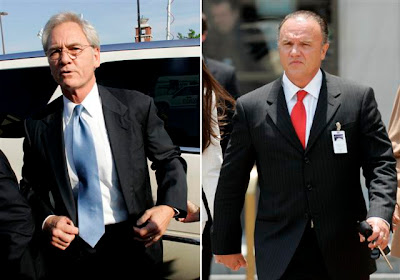
Former Alabama Gov. Don Siegelman, left, and former HealthSouth CEO Richard Scrushy. Image from AP.

Eric Holder’s DOJ supports the prosecution:
No new trial for former Alabama Gov. Don Siegelman

Many progressives have joined in complaining about a thoroughly politicized DOJ. Yet AG Holder proceeds as though there was nothing amiss.

By Sherman DeBrosse / The Rag Blog / September 15, 2009

On September 13, the Eleventh Circuit Court refused to grant former Alabama Governor Don Siegelman (1999-2003) a new trial. The panel sent Siegelman back to the same politically motivated judge who helped railroad the popular Democrat in the first place.

Eric Holder’s Department of Justice refused to look at compelling whistle-blower evidence and worked hard to defeat Siegelman, who was most likely the victim of a successful effort to remove him from political life. The case became intertwined with the plitically-motivated firings of federal prosecutors because it was claimed that Karl Rove was involved in these ugly incidents.

The Siegelman Case illustrates the kind of political prosecution that has become common in the Republican South. These prosecutions hinge on a very vague and short piece of legislation that imposes stiff penalties upon officials accused of providing citizens with “honest services” due to corruption.

Siegelman wanted a state lottery to fund education and accepted two bundled donations of $250,000 each to the Alabama Educational Foundation from Richard Scrushy, CEO of Health South. Siegelman then appointed Scrushy to a state hospital board. Three former governors had appointed this CEO to state boards. The prosecutors were unable to prove corrupt intent when they attempted to prove bribery.

Siegelman’s attorney found potentially exculpatory information in comments made by landfill developer Clayton Lamar (Lanny) Young, but President Judge Mark Fuller would not permit them to introduce the evidence. Two jurors worked together to find evidence on the internet that they could use to persuade other jurors to vote against Siegelman. Some of the arguments they gave their colleagues came from a TV station blog that was critical of Siegelman. When their e-mails were discovered, the judge did nothing about the situation.

The case hinged upon testimony of former chief aide Nick Bailey, who said he negotiated bribes on behalf of the governor. Bailey admitted he was not present when Siegelman appointed Scrushy. The prosecutors had Bailey rehearse his testimony in seventy practice sessions and did not give the defense their interview notes. Bailey received a light sentence in return for his testimony. His employer, Luther “Stan” Pate, said the federal officials got him to testify by threatening to use information he used drugs and by referring to rumors that Bailey and the governor were sexual partners.

Siegelman was sentenced to seven years and four months in June, 2007. President Judge Mark Fuller denied Siegelman the customary 45 days to get his affairs in order and had the former governor carted off to jail in leg irons and handcuffs. The federal marshall only permitted him to use the King James version of the Bible while he was being shunted around from prison to prison before settling in Oakdale, Louisiana.

When prisoner Siegelman took his case to the press, the prosecutors threatened to charge him with obstruction and conspiring to bring the court into public contempt. Fuller threatened to add five to seven years to the sentence. Last spring, Siegelman was released on bond pending an effort to get a new trial.

Governor Siegelman’s problems began in 2002, when he narrowly lost a reelection bid to Republican Bob Riley. Siegelman lost when Baldwin County returns were restated, reducing his total there by 7,000 votes. No Democratic observers were present when this happened, and the state Attorney General Bob Pryor successfully blocked efforts to look into the matter or have a recount there. Siegelman launched a legal challenge that went nowhere.

Before that, Republicans had unsuccessfully sought to jail Siegelman. He had angered Republicans with his efforts to fight casinos, and Jack Abramoff was funding Riley to the tune of $1.3 million in return for shutting down Poach Creek, which drew customers from Abramoff clients out of state. The documents on all were suppressed by Senator John McCain when he was investigating Abramoff.

When Siegelman challenged the election results, these efforts were renewed in earnest. Dana Jill Simpson, an attorney and Republican operative, later testified that she heard William Canary, Riley’s chief advisor, say that he would get “his girls” to work on Siegelman and would enlist the help of his friend Karl Rove. “His girls” was a reference to U.S. Attorney Leura Canary, his wife, and to another U.S. Attorney.

The “girls” soon got busy and when their efforts seemed to flag, the Professional Responsibilities Division of the DOJ prodded them on. The Justice Department rejected an FOIA request for documents relevant to whether she had a conflict of interest in the case. Eventually, Mrs. Canary had to recuse herself, but only after having shaped the case. Though the 93 U.S. Attorneys are supposed to resign with the election of a new president, Mrs. Canary remains at her post today.

Acting U.S. Attorney Louis V. Franklin, who became the lead prosecutor, has had unusual and contradictory things to say about how the decision was made to indict Siegelman. Clearly, Franklin was going out of his way to suggest the matter was of no importance to Washington.

Mr. Canary later testified that he had talked about getting the girls to work against Siegelman. The most recent DOJ filing says he swore under oath that he had not contacted Karl Rove, but none of this appears in his Congressional testimony. After the successful prosecution, Rove threw a party for Steve Feaga, one of the prosecutors, at his Rosemary Beach, Florida home. Feaga is a Reserve Colonel who served in the legal office at Langley AFB. Perhaps he could have had a role in reviewing the fueling contract held by Judge Fuller’s firm.

Simpson also said that she heard in early 2005 that a federal judge was about to be appointed who “hated” Siegelman and was determined to “hang him.” There was a danger then that Siegelman might try to run again for governor. The new federal judge turned out to be Mark Fuller, a former Republican official who believed Siegelman was responsible for having him audited. Fuller had been very active in the 2002 campaign.

Miss Simpson had known Governor Riley since law school. She became disenchanted with politics when she was asked to do research that would essentially frame several Democrats. Since coming forward, she has had some troubling experiences. Her house was accidentally burned to the ground, and she was forced off the road by an Alabama state law enforcement official. Her car was totaled. Before she testified before Congress, a helpful Democrat recommended she hire a lawyer who had worked for the GOP for decades. She declined. Her testimony led Representative Randy Forbes (R-VA.) to demand a Congressional investigation of her.

President Judge Mark Fuller.

Fuller was a very wealthy man, controlling 43.7% of Doss Aviation, which did $300 million worth of business with the Defense Department in the George W. Bush years. That fact alone gave the appearance of bias and should have resulted in Fuller removing himself from the case.

Retired federal district judge U.C. Clemon complained that the prosecutors poisoned the jury pool, engaged in judge shopping, and were guilty of other forms of misconduct. Seventy five former attorneys general from forty states denounced the handling of the Siegelman Case and demanded a retrial. They wrote, in part:

At best, the facts outlined by the Government show that: (1) Governor Siegelman felt that Mr. Scrushy ought to donate more to his favored issue campaign [the state lottery] than Mr. Scrushy donated to the campaign of his competitor; (2) Mr. Scrushy was aware that Governor Siegelman expected at least a $500,000 contribution to the lottery fund; (3) Governor Siegelman was aware that Mr. Scrushy wanted to be reappointed to the CON Board: (4) Governor Siegelman did not think that such an appointment would cause any problems; and (5) Governor Siegelman did, in fact, reappoint Mr. Scrushy to the CON Board.

Completely absent from the Trial Record is any evidence that Governor Siegelman and Mr. Scrushy entered into an explicit agreement whereby Mr. Scrushy’s appointment to the CON Board was conditioned upon Mr. Scrushy’s making the political contributions in question. Two previous Governors had appointed Scrushy to the same position without incident. [Emphasis added.]

Legal scholar Bruce Fine, a conservative, complained during the G.W. Bush years, “We have a Justice Department that has substantially been turned into a political arm of the White House.” Many progressives have joined in complaining about a thoroughly politicized DOJ. Yet AG Holder proceeds as though there was nothing amiss.

The great majority of Bush’s 93 U.S. Attorneys are still in place. Now Holder backstops the political prosecution of Don Siegelman. It would probably be too much to suggest that President Obama pardon this victim of selective prosecution or at least commute the sentence to time served. The latter course would still serve the GOP by preventing Siegelman from ever seeking elective office.

[For much more information on Republican misdeeds, see Sherm’s The New Republican Coalition : Its Rise and Impact, The Seventies to Present (Publish America). It can be acquired by calling 301-695-1707. On line, go here, or find it at Amazon.com.]

The Rag Blog

Posted in Rag Bloggers | Tagged , | 2 Comments

B. Lee: ‘Let Us Not Become the Evil We Deplore’

Thanks to Mariann Wizard / The Rag Blog

Posted in RagBlog | Tagged , , | 14 Comments

Campaign Finance : Will the Supremes Dance on Democracy’s Corpse?

Straight jacket? “Money Shirt” by Rob Lee / Flickr / Concurring Opinions.

The Supreme Court:
Set to rule on campaign finance

The Court may be poised to shred a century of judicial and legislative attempts to preserve even a semblance of restraint on how Big Money buys laws and legal decisions.

By Harvey Wasserman / The Rag Blog / September 14, 2009

The Four Courtsmen of the Apocalypse are poised to finally bury American democracy in corporate money. The most powerful institution in human history — the global corporation — may soon take definitive possession of our electoral process.

It could happen very soon.

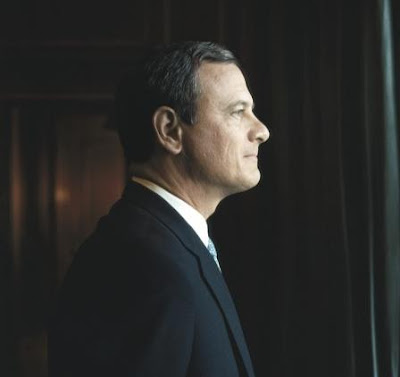
While America agonizes over health care, energy and war, Justices John Roberts, Antonin Scalia, Sam Alito and Clarence Thomas could make it all moot. They may now have the fifth Supreme Court vote they need to open the final floodgates on corporate spending in political campaigns.

In short, the Court may be poised to shred a century of judicial and legislative attempts to preserve even a semblance of restraint on how Big Money buys laws and legal decisions. The ensuing tsumani of corporate cash could turn every election hence into a series of virtual slave auctions, with victory guaranteed only to those candidates who most effectively grovel at the feet of the best-heeled lobbyists.

Not that this is so different from what we have now. The barriers against cash dominating our elections have already proven amazingly ineffective.

But a century ago, corporations were barred from directly contributing to political campaigns. The courts have upheld many of the key requirements.

Meanwhile the barons of Big Money have metastasized into all-powerful electoral juggernauts. The sum total of all these laws, right up to the recently riddled McCain-Feingold mandates, has been to force the corporations to hire a few extra lawyers, accountants and talk show bloviators to run interference for them.

Even that may be too much for the Court’s corporate core. John Roberts’ Supremes may now be fast-tracking a decision on CITIZENS UNITED v. FEDERAL ELECTION COMMISSION, centered on a corporate-financed campaign film attacking Hillary Clinton. According to the Washington Post’s account of oral arguments, “a majority of the court seemed impatient with an increasingly complicated federal scheme intended to curb the role of corporations, unions and special interest groups in elections.”

Former solicitor general Theodore B. Olson, who in 2000 “persuaded” the Court to stop a recount of votes in Florida and put George W. Bush in the White House, said such laws “smothered” the First Amendment and “criminalized” free speech.

The conservative Gang of Four has already been joined by Anthony Kennedy, the Court’s swing voter, in signaling the likely overturn of two previous decisions upholding laws that ban direct corporate spending in elections.

Chief Justice John Roberts: Breach of faith?

When he was confirmed as the Court’s Chief, Roberts promised Congress he would be loathe to overturn major legal precedents. But the signals of betrayal now seem so clear that Senators John McCain and Russell Feingold have issued personal statements warning Roberts that a radical assault on campaign finance laws would be considered a breach of faith with the Congress that confirmed him.

Liberal Justice Ruth Bader Ginsburg did assert during oral arguments that “a corporation, after all, is not endowed by its creator with inalienable rights.”

But since the 1880s the courts have generally granted corporations human rights with no human responsibilities. Thom Hartmann (UNEQUAL PROTECTION) and Ted Nace (GANGS OF AMERICA) have shown with infuriating detail how corporate lawyers twisted the 14th Amendment, designed to protect the rights of freed slaves, into a legal weapon used to bludgeon the democratic process into submission.

Civil libertarians like Floyd Abrams and the American Civil Liberties Union have somehow argued that depriving these mega-conglomerations of cash and greed their “right” to buy elections might somehow impinge on the First Amendment.

But the contradiction between human rights and corporate power is at the core of the cancer now killing our democracy. As early as 1815 Thomas Jefferson joined Tom Paine in warning against the power of “the moneyed aristocracy.” In 1863 sometime railroad lawyer Abraham Lincoln compared the evils of corporate power with those of slavery. By the late 1870s Rutherford B. Hayes, himself the beneficiary of a stolen election, mourned a government “of, by and for the corporations.”

The original U.S. corporations — there were six at the time of the Revolution — were chartered by the states, and restricted as to what kinds of business they might do and where. After the Civil War, those restrictions were erased. As Richard Grossman and the Project on Corporate Law & Democracy have shown, the elastic nature of the corporate charter has birthed a mutant institution whose unrestrained money and power has transformed the planet.

Simply put, globalized corporations, operating solely for profit, have become the most dominant institutions in human history, transcending ancient emperors, feudal lords, monarchs, dictators and even the church in their wealth, reach and ability to dominate all avenues of economic and cultural life.

The Roberts Court now seems intent on disposing of the feeble, flimsy McCain-Feingold campaign finance law as well as the 1990 AUSTIN decision that upheld a state law barring corporations from spending to defeat a specific candidate.

Scalia, Kennedy and Thomas all voted to overturn McCain-Feingold in 2003, and nobody doubts Roberts and Alito will join them now. The only question seems centered on how broad the erasure will be. This, after all, is a “conservative” wing whose intellectual leader, Antonin Scalia, recently argued that wrongly convicted citizens can be put to death even if new evidence confirms their innocence.

Should our worst fears be realized, the torrent of cash into the electoral process could sweep all else before it. With five corporations controlling the major media and all members of the courts, Congress and the Executive at the mercy of corporate largess, who will heed the people?

“We don’t put our First Amendment rights in the hands of Federal Election Commission bureaucrats,” Roberts said in the oral arguments.

Instead he may put ALL our rights in the hands of a board room barony whose global reach and financial dominance are without precedent.

At this point, only an irreversible ban on ALL private campaign money — corporate or otherwise — might save the ability of our common citizenry to be heard. Those small pockets where public financing and enforceable restrictions have been tried DO work.

A rewrite of all corporate charters must ban political activity and demand strict accountability for what they do to their workers, the natural environment and the common good.

It was the property of the world’s first global corporation — the East India Tea Company — that our revolutionary ancestors pitched into Boston Harbor. Without a revolution to now obliterate corporate personhood and the “right” to buy elections, we might just as well throw in the illusion of a free government.

This imminent, much-feared Court decision on campaign finance is likely to make the issue of corporate money versus real democracy as clear as it’s ever been.

Likewise the consequences.

[Harvey Wasserman’s History of the United States is at www.harveywasserman.com, along with Solartopia! Our Green-Powered Earth. This article was also posted at www.freepress.org, where Harvey and Bob Fitrakis will soon write on the monopolization of voting machines.]

The Rag Blog

Posted in Rag Bloggers | Tagged , , | 5 Comments

Grownup Talk for Obama : Not such Simple Arithmetic

Hard choices are upon us. The political costs of candor will be high. The political costs of a lack of candor will be higher…

By Steve Russell / The Rag Blog / September 14, 2009

My favorite thing about Obama is that he sounds like a grownup talking to grownups. Most of the time.

But when he fails that aspiration, he fails big time.

In the primary (and, yes, I pointed it out at the time even though I was supporting Obama), Clinton said that the only way to get a handle on health care costs is to get everybody in the pool with a mandate. Obama said no, he could support a mandate only for children and adults should have the right to go naked.

The problem with his argument, which Clinton pointed out, is that the choice to go naked is just a way to game the system at the expense of us all, because we are not as a matter of political reality going to let people die in a highly visible way. The only reason we let people die now is because they can’t get treated AFTER they are stabilized in the emergency room. We Americans have that much understanding of health care as a test of national character, but we lack the attention span to follow the chronic as well as the acute.

The next failure is this. Everybody knows that we must either cut spending or raise taxes to get out of the ditch the Reagan Revolution put us in. But the truth is we have to do both.

Taxing the top 5% at 100% would not save us.

The only budget items that can be cut and have an impact are Social Security, Medicare/Medicaid, and Defense. We could literally chop the entire rest of the budget and that would not save us.

The Obamites tell us, probably correctly, that the next economic wave will be clean energy. They have not, however, been able to pass the policies that could put us on top of that wave. While Europe is better positioned than we are, the leader of innovation in the face of American default is becoming… China, our principal creditor.

Did we reply with a carbon tax to move away from waste and fire up creativity? No, we have cap and trade pending, which would better be labeled smoke and mirrors, since in practice it manages to lack both carrot and stick. This was a case where we could have learned from the European mistake but instead chose to repeat it.

Hard choices are upon us. The political costs of candor will be high.

The political costs of a lack of candor will be higher and they will be insignificant compared to the economic costs.

The Rag Blog

Posted in Rag Bloggers | Tagged , , , | 6 Comments

Bicentennial Mexico : Textbooks Revise History, Delete Spanish Conquest

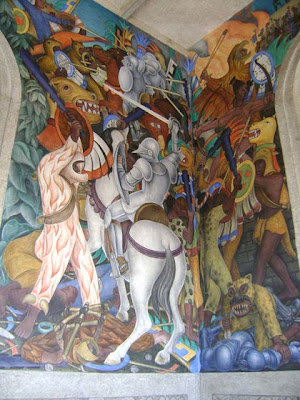
Detail of Mural by Diego Rivera showing Spanish conquistadors conquering Mexican indigenous peoples, Palacio de Cortes, Cuernavaca, Mexico.

Just in time for the Bicentennial:
Much of Mexico’s history becomes, well, history

This August 24th when sixth graders returned to their classrooms, many were stunned to discover that nearly 30 pages… had disappeared from their history textbooks.

By John Ross / The Rag Blog / September 14, 2009

MEXICO CITY — On the eve of the Bicentennial of its Independence from the Spanish Crown and the 100th anniversary of the Mexican Revolution, this distant neighbor of a republic is awash with patriotic colors. The official countdown to the twin Centennials begins on Mexican Independence Day September 16th, the nation’s maximum patriotic holiday that celebrates the uprising of the profligate country priest Miguel Hidalgo in Guanajuato on that day in 1810.

Although Hidalgo’s rebellion was a flop, uncorking a geyser of blood (the priest himself was dragged before the Holy Inquisition, gunned down by a firing squad, beheaded, and his head hung from a public building), Mexico finally won its liberation from Spanish domination 11 arduous years later in 1821. Thousands of local and national events over the next year will commemorate Hidalgo’s flawed insurrection (at least 100,000 killed) and the even more gore-splattered Mexican revolution a hundred years later in 1910, which is thought to have cost more than a million lives.

But a funny thing has happened to Mexico on its way to the dueling Centennials: it seems to have lost its history.

This August 24th when sixth graders returned to their classrooms, many were stunned to discover that nearly 30 pages (pp. 147-173) had disappeared from their history textbooks. The missing pages discussed the European Conquest of Mexico and three centuries of colonial rule.

The textbook revision has generated an uproar in this history-obsessed country. Mexico is largely Mestizo, genetically mixing the Indigenous with the European, and the elimination of teaching the Conquest and the Colony “mutilates our identity” decries Olac Fuentes Molinar, the former under-secretary of basic education for the Secretariat of Public Education (SEP.)

Diminished attention on the Conquest of between 12.5 and 25 million indigenous peoples (only 1.5 million survived to be counted in the first census taken by the Crown a hundred years later) is seen as a slap at Mexico’s pluri-cultural roots. The disappearance of colonial history and the cruel indignities the indigenas suffered under the Spanish yoke further depreciates the role of Mexico’s Indians and flies in the face of the country’s traditional anti-colonial trajectory.

Such revisionist history is “Eurocentric,” argues Hugo Casanova of the National Autonomous University’s (UNAM) Educational Investigation Institute. “Our children will never know the complex, painful origins of our nation.”

The Secretariat of Public Education insists that it’s all a big confusion. Only 7,000,000 revised history books (out of a total of 27,000,000) will be distributed to primary school students this year, explains sub-secretary Francisco Gonzalez Sanchez who, as the SEP’s point man on basic education was charged with overseeing the text book revisions. Sections on the Conquest and the Colony were previously incorporated in fourth grade text books but now are being rewritten and moved to sixth grade curriculum and will be ready by 2011 — just in time to miss the twin centennials.

Nonetheless, when the revisions are in place, Gonzalez Sanchez promises that Mexico will have “the best text books in history” (sic.) Historians are aghast at the SEP’s gaffe. But the loudest protests have come from students who have not yet received their eviscerated books three weeks into the new term.

Sub-secretary Gonzalez Sanchez acquired his sinecure in 2006 through flagrant political nepotism — he is the son-in-law of National Education Workers Union (SNTE) Czarina Elba Esther Gordillo. With 1.3 million members, the SNTE is the largest labor organization in Latin America and Gordillo has considerable clout in the administration of rightist president Felipe Calderon of the National Action or PAN party. A former honcho of the once and future ruling party, the PRI, Gordillo broke with her old cronies in crime in a power squabble prior to the 2000 presidential election and threw her weight to Calderon’s predecessor Vicente Fox. From her satrap at the SNTE, “La Maestra” (sometimes known as “La Ticher“) mobilized her followers to commit wholesale ballot box fraud in the much-questioned 2006 elections that boosted Calderon to power. In return, Gordillo was handed the SEP to run as a semi-feudal family enterprise.

Under her son-in-law’s “Integral Basic Education Reform” (RIEB), history now plays second fiddle to math, science, and technology. But even the teaching of science has been tampered with charges UNAM biologist Edna Suarez who is writing up a “report card” on the revised textbooks. One example: Charles Darwin, whose Theory of Evolution marks its 150th anniversary this year, is assigned just two paragraphs in grade school science texts, the same as ascribed to an explanation of daylight savings time. Suarez observes that Darwin’s Theory of Evolution is downgraded to just one possible explanation for the origins of the human race, a supposition that invites the teaching of Creationism.

The Calderon administration’s focus on math and science runs contrary to the national character. Mexicans are addicts to their nation’s history. Sometimes it seems as if the past is more present than the present here and the future is just a word bandied about by politicos to plant false hopes in the hearts of their constituents. “History is the foundation of our collective memory,” writes anthropologist Manuel Hermann. The revised history books are an exercise in “disremembering.”

Arnaldo Cordoba, an historic leader of the Mexican Communist Party, isn’t surprised by the PAN-fried history texts. “History has no value for the right,” he wrote in a recent La Jornada (a left daily) op-ed. “The Conquest and the Colony should be the PAN’s favorite epochs but they’ve discarded them… probably because of printing costs.” By removing accounts of these two vital periods, “the PAN wants us to believe that our history began with Iturbide,” counters Alfonso Suarez Del Real, a leftist ex-deputy affiliated with Calderon’s fiercest critic Andres Manuel Lopez Obrador (AMLO), himself a history buff.

Agustin Iturbide was a “criollo” (Spaniard born in Mexico) who led the Army of Three Guarantees that finally won liberation from the Crown in 1821 and promptly crowned himself emperor — he was hung by a furious mob three years later.

Mexicans of all walks of life from senators to street sweepers are constantly revisiting and revising their country’s history, sliding it under the microscope, examining little known texts and debating their most arcane clauses. Antiquarian bookstores clustered in the old quarter of the city do a land office business in dog-eared volumes that record the nuances of the Conquest and the Colony. Each Friday night, dozens gather at a crumbling building on Tacuba Street in the Centro Historico to discuss history’s lessons for the current political imbroglio. Such study circles, inspired by partisans of Lopez Obrador, have spread into neighbors throughout this monstrous megalopolis.

On a recent rainy evening, Edna Orozco, a National Autonomous University history professor was elucidating the exploits of Francisco Villa when he overran Mexico City at the apogee of the revolution in 1914-15. “My papa put me up on his shoulders so that I could see Pancho Villa when he rode in with his Dorados,” 95 year-old Melesio Escobar told the gathering. “Villa was a giant! The presidents now are dwarves!” (Felipe Calderon barely stands five feet.)

Felipe Calderon and his co-religionists are the lineal descendants of 19th century Conservatives who aligned themselves with the Catholic Church, the Crown, and the land-owning class and squared off against Zapotec Indian Benito Juarez and his secular Liberals. Now the neo-conservatives are charged with teaching a history that lionizes their traditional enemies like Juarez and the wild-haired Hidalgo and those ruffian bandits Pancho Villa and Emiliano Zapata. “The PAN wants to get rid of Hidalgo and his leprous, naked Indians,” comments Paco Ignacio Taibo II, a writer who approaches Mexican history from the left.

As if to confirm Taibo’s thesis, arch-rightist philosopher-historian Gabriel Zaid recently penned a daily Reforma (a PANista paper) op ed entitled “The Assassins Who Gave Us A Fatherland” which depicts Hidalgo and his confederate Jose Maria Morelos, also a defrocked priest, as a pair of killers.

Under Calderon’s predecessor Vicente Fox, a similarly traumatic revision of secondary education textbooks was undertaken and in classic neo-liberal style publication was privatized. Santillana, the publishing arm of the Spanish media conglomerate Grupo Prisa (publishers of El Pais), marketed a popular seventh grade text, “The History of Mexico” in which the European invaders were pictured as bringing civilization to the unruly natives — the book also champions the Catholic Church and its missionaries for delivering the heathens to Christ.

Fox’s fans at Santillana and the SEP even included a chapter on his own place in history that concludes abruptly: “his crucial six years in office came to an end with the development of incipient democracy and so Vicente Fox passed into histo—” (sic.)

History is, of course, written by the victors and in Mexico this means whichever party won the last election. “Every time a new party comes to power, it wants to change history,” complains Patricia Espinosa, the ex-director of the General Archives of the Nation and a devout PRIista who rejects the PAN’s skew on Mexican history. Indeed, the PRI used free government textbooks to burnish its own image during seven decades at the helm of state, extolling its contributions to the nation’s development and well-being.

But like the PAN, the ex-official party was sometimes blindsided by the arrogance of power. In 1992, Secretary of Education Ernesto Zedillo, later president, was forced to recall and shred 10,000,000 revised grade school history texts because the re-write suggested that the military had played a role in the massacre of hundreds of Mexico City students in 1968. Subsequent revelations have established beyond a shadow of a doubt that the Army engineered the debacle. In the revision of the revised text, Mexican history ended in 1967.

Paco Taibo protests the political manipulation of history by the SEP. Schoolbooks are often assembled by bureaucrats and bourgeois historians for whom history is an abstract in which the people don’t count. Taibo II advocates “secularization” and “democratization” of the writing process that would involve teachers and parents and social activists.

Not only the Left is up in arms over the SEP’s revision of Mexican history. The Catholic Church has a rich history of conflicts with the Mexican government over its depiction in history texts. Under depression era president Lazaro Cardenas, “socialist” education flourished to the Church and the nascent PAN’s enormous displeasure — indeed the PAN gained political relevance in its successful battle to have the word “socialism” expunged from the text books.

The Church fiercely opposes sex education and textbooks that speak of abortion and birth control are burned by anti-abortion zealots like Pro-Vida. Now the Episcopal Council of Bishops (CEM) is furious because public school textbooks allege that Hildago and Morelos were excommunicated by the Catholic Church, a well-documented turn of events. But Father Hugo Valdemar, spokesperson for the Mexico City diocese, argues that both defrocked priests confessed their sins and accepted the Host before they were put before a firing squad and decapitated.

Besides denouncing the SEP for kidnapping the Father of the Country from the bosom of Holy Mother Church, Valdemar kvetches that the Catholic Church is being excluded from the celebration of the Bicentennial.

Taibo insists that, like the textbooks, the Bicentennial is being “deMexicanized.” The popular author has unearthed a catalogue of 1800 projects scheduled for the celebration, about three and a half events a day — although the deep economic crisis that has left 80,000,000 Mexicans below the poverty line may modify extravagance warns Calderon’s current Bicentennial CEO Juan Manuel Villalpando.

The preamble to 2010 unfolded this September 5th with the lighting of the Bicentennial Torch. In a schlocky knock-off of the Olympic Games, athletes carried the flame from the Monument of the Independence up the elegant Paseo de Reforma to the National Palace where it was blessed by the President. Now the Flame of the Bicentennial will travel to 31 states before it returns to the capital in September 2010 — the twin celebrations will be most intense between Independence Day September 15th-16th and November 20th, the 100th anniversary of the declaration of the Mexican revolution.

Amongst the events scheduled for this patriotic orgy are multiple military parades, the refurbishment of historical buildings, the re-naming of streets and parks for the Heroes of the Fatherland, and the construction of a safe site for the General Archives of the Nation which are currently moldering in an old prison of ill-repute, the Lecumberri Black Palace, built by dictator Porfirio Diaz on the eve of the revolution to house his political prisoners.

Many of the Bi-centennial projects listed seem to have more to do with crass commercial opportunism than the celebration of the Patria. Nayarit state resorts will sponsor a beach volleyball championship. Nayarit will also be the site of a Guinness Book of Records gathering of country brass bands (“Bandas de Guerra“). The state of Tamaulipas is planning a potato festival and Chiapas a graffiti competition. The Secretary of Labor will issue a coffee table-sized book “The History of Labor” and the Secretary of Finances will hold a “fiscal fair.” Manzanillo will do its part with the inauguration of a cruise ship port and Mexico City is building a “bicentennial” Metro line. Neighboring Mexico state will hold a world frontennis tournament and Chihuahua is hosting an NBA exhibition game to celebrate the War of Independence and the Mexican revolution.

Some of the events seem wildly out of synch with what the Centennials are all about. The state of Oaxaca will hold a yearlong celebration of the tyrant Porfirio Diaz, a native son, whose iron-fisted 34 year-long rule ignited the revolution. Chihuahua will honor the Creel dynasty that controlled Indian lands the size of the kingdom of Belgium. The Catholic Church will illuminate a giant Christ in Torreon Coahuila and publish a book on the miracles of Our Lady of Ocotlan Jalisco to celebrate the Bicentennial.

At the nadir of the worst economic plunge since the Great Depression with millions out of work, Felipe Calderon is spending billions of pesos on the big fiesta. Villalpando is reportedly negotiating with SpecTak, an Australian entertainment juggernaut that bedazzled the world with its costly fireworks display at the Sidney Olympics, to supply world-class pyrotechnics.

Last spring, Calderon laid the cornerstone for a monumental Bicentennial Arch at the foot of the Paseo de la Reforma, a boulevard in which Porfirio Diaz invested heavily for the 1900 centennial. In fact, Diaz spent so much on fireworks and monuments and new pants for the poor that social budgets were depleted and the dissatisfaction of the downtrodden at being excluded from the party triggered a revolution.

Today, a hundred and two hundred years later, the misery of the people has never been alleviated and social unrest is similarly stewing.

So goes the old song and dance: Those who do not know their own history are doomed to repeat it.

[John Ross’s monstrous (500 pages) El Monstruo – Dread & Redemption in Mexico City will be published by Nation Books this November. Iraqigirl (Haymarket), a diary of a teenager coming of age under U.S. occupation that has been called “an Anne Frank for our times,” is in the stores. Ross will be touring with both books this fall and next spring. For possible venues write johnross@igc.org.]

The Rag Blog

Posted in Rag Bloggers | Tagged , , | 1 Comment

What Really Did Bother People About Obama’s Education Speech?


Indoctrination and Education: Who’s Really Brainwashing Our Children?
By Nima Shirazi / The Rag Blog / September 13, 2009

Establishing lasting peace is the work of education; all politics can do is keep us out of war. – Maria Montessori, physician and educator

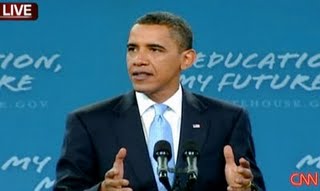
I am certainly not in the habit of defending Barack Obama against his detractors, but the controversy drummed up by rabid right-wing hysterics over the President’s back-to-school speech on Tuesday is quite simply bizarre and absurd. However, the manufactured uproar and outrage over the President’s socialist/fascist/communitarianist (hey, pick an ideology, any ideology!) “brainwashing” of unsuspecting and impressionable students on one of their first days of school brings up very real and very serious concerns over both the potential and realities of aggressive government indoctrination and the abuse of open access to America’s youth.

In the days leading up to Obama’s fifteen-minute long, syndicated speech, the conservative netherworld was abuzz over what sort of cultish and dangerous hypnotism our Kenyan-born Commie Muslim commander-in-chief would dish out in classrooms all over the country. The paranoia and fear promoted by political and media demagogues and repeated thoughtlessly by their audience of ventriloquist dummies created a sort of dual-McCarthyism, equal parts Joe and Charlie.

Last week, Glenn Beck warned listeners of his radio show about the dangers of Obama’s upcoming speech and “the indoctrination of your children,” saying that the Presidential address was evidence of the “get ’em while they’re young” approach of of big government’s brainwashing tactics. Meanwhile, NewsBuster’s contributing editor Mark Finkelstein repeatedly compared the address to Chinese communism, likened Obama to Mao Zedong, and even inquiring in one blog post whether “our MSM report on the interesting parallel between our president’s plan for our children and the approach of another Great Leader from the past?” Then there was Mark Steyn, a Canadian author and political commentator, who, while speaking on the Rush Limbaugh Show made extensive reference to Saddam Hussein’s cult of personality in Iraqi schools and warned against Obama’s attempt to do the same here in the United States.

On September 2nd, Michelle Malkin accused Obama’s classroom address (still six days away at that time) of serving as a government tool for recruiting “junior lobbyists” to serve as foot-soldiers for promoting his crazed liberal agenda, citing the “activist tradition of government schools” (I think they’re called public schools, actually) as evidence:

“Zealous teacher’s unions have enlisted captive schoolchildren as letter-writers in their campaigns for higher education spending. Out-of-control activists have enlisted their secondary-school charges in pro-illegal immigration protests, gay marriage ceremonies, environmental propaganda stunts, and anti-war events.”

Yeah, if only.

In a recent article, Lauri Regan of American Thinker wrote that “Obama has turned his team of brainwashers on the task of indoctrinating America’s youth…My children are off limits,” while Townhall.com‘s Meredith Jessup bemoans the loss of mandatory prayer and religion in public schooling as “big-government influence continues to be ushered in.” Jessup thusly concludes that “This massive abuse of government power – reaching into our kids’ classrooms – is unacceptable.”

A OneNewsNow column from September 4th identifies Diane Jewell, a parent in Indiana, as worrying that “her daughter is being indoctrinated into socialism” by attending public Junior High School. Jewell believes that “it is not Obama’s place to talk to children directly, without parental input” adding that she is “very concerned with the increasing involvement of federal government in education.” Obviously, Jewell now “regrets her decision to quit homeschooling and in retrospect she wishes she had stayed at home in order to continue homeschooling her daughter.”

In a September 1 post featured on her tellingly-titled “Atlas Shrugs” blog (and headlined “Obama in the Classroom: Keep Your Kids Home from School September 8”), Newsmax.com contributor Pamela Geller wrote,

The fascist in chief is taking his special brand of brainwashing to the classroom. Keep your kids home. I think this man is a threat to our basic unalienable rights. I don’t want him indoctrinating my children. Seriously.

Ask your school what their participation is in this leftist indoctrination outrage. Keep politics out of the classroom. Keep communists and their propagandists away from small children.

Seriously?

Not to be outcrazied, American Family Association radio host and conservative activist Bryan Fischer wrote in a September 1 column that Obama’s speech “is likely to be an exercise in nation-wide indoctrination…The capacity for mischief here is enormous.” Then, echoing Geller’s sentiments that parents should opt their children out of viewing the speech, Fischer continues,

Unless we get public assurances from the White House that the president won’t address health care or global warming or the homosexual agenda (under the color of “human rights for people different than us”) this might be a great time for parents to exercise their opt-out authority and give their students a biography of George Washington to read while the President turns the minds of an entire generation to mush.

WorldNetDaily news editor Bob Unruh floated the idea that Obama’s speech to students has “been cited as raising the specter of the Civilian National Security Force, to which he’s referred several times since his election campaign began, but never fully explained” while also pointing out how creepy it is for the elected President of the United States of America to speak directly to the nation’s children about the importance of education. “Parents across the country are rebelling against plans by President Barack Obama to speak directly to their children through the classrooms of the nation’s public schools without their presence, participation and approval,” Unruh wrote, before quoting random insane rantings of conservative web-forum comments:

“He’s recruiting his civilian army. His ‘Hitler’ youth brigade,” wrote one participant in a forum at Free Republic.

“I am not going to compare President Obama to Hitler. We’ll leave that to others and you can form your own opinions about them and their analogies. … However, we can learn a lot from the spread of propaganda in Europe that led to Hitler’s power. A key ingredient in that spread of propaganda was through the youth,” wrote a blogger at the AmericanElephant.com blog, where the subject of the day was a national “Keep-Your-Child-at-Home-Day.”

“Totalitarian regimes around the world have sought to spread their propaganda and entrench their power by brainwashing the children. I guess it’s easier to indoctrinate a six-year-old instead of fighting a 26-year-old or being challenged by a 46-year-old in the voting booth,” the blogger wrote.

Brett Curtis, an engineer from Texas, told the New York Times that the idea of the speech “seemed like a direct channel from the president of the United States into the classroom, to my child,” and would therefore keep his three children home from school that day since he doesn’t “want our schools turned over to some socialist movement.” Jim Greer, the Republican Party chairman in Florida, said he “was appalled that taxpayer dollars are being used to spread President Obama’s socialist ideology,” while Kansas City talk show host Chris Stigall, with thoughts of sugar plums and executive pedophilia floating in his head, stated that he “wouldn’t let my next-door neighbor talk to my kid alone; I’m sure as hell not letting Barack Obama talk to him alone.”

Never mind the sheer ignorance of all these people, especially the clear fact that none of them knows the definition of fascism or socialism, or could explain the difference between a democracy and a republic, for that matter. Never mind the fear-mongering and hateful resentment of a recently beaten-up political party. Never mind the fact that Obama’s speech wound up being totally innocuous, completely devoid of politics whatsoever, and called upon this nation’s students to take pride in their education, try hard, and do their best to achieve their goals. Never mind that, as Time.com‘s Michael Scherer put it, “President Obama’s speech to your kids reads like a paean to individual striving and free market capitalism, the sort of thing that Ayn Rand and Barry Goldwater might have signed onto. At root, Obama’s message is one of individual responsibility, a disquisition on the freedom of American youth to fail or succeed on their own tenacity and merits,” and was anything but “lefty, neo-socialist, communitarian brainwashing.”

Never mind that this country’s education system is already tailor-made to spread misinformation, entrench mythologies, and promote American exceptionalism to our young children. American history, as taught in schools, is generally nonsense meant to instill and preserve a sense of City-on-a-Hill nationalism, along with healthy doses of tall-tale founding myths, gung-ho militarism, and ethnic cleansing justification in the form of righteous Manifest Destiny. As James W. Loewen explains in his 1995 book Lies My Teacher Told Me: Everything Your American History Textbook Got Wrong, textbooks used to teach our children “leave out anything that might reflect badly upon our national character.” More to the point, Helen Keller (y’know the deaf, mute, and blind kid who was actually a radical and progressive political thinker, one of the founders of the ACLU, and a staunch supporter of the NAACP and actual socialism) stated clearly why American history is made up of gross simplifications and hero worship: “People do not like to think. If one thinks, one must reach conclusions…Conclusions are not always pleasant.” Anyone who has actually studied real American history knows this to be true.

Students in the United States are taught that Christopher Columbus discovered America and proved that the earth was round (not true); they are not taught that Columbus was a genocidal manic (true). Institutionalized racism and ethnocentrism is all but ignored in history class, Native Americans are demonized as savages (they weren’t) and colonists (who were savages) are celebrated as civilized co-existers. (The reason the Pilgrims in New England had such bountiful crops is because all the Native Americans who planted them had either died from European-borne plague or had fled in fear of plague, which John Winthrop, governor of the Massachusetts Bay Colony, called “miraculous.”) Students are taught that Albert Einstein failed his math class (he didn’t, and was, in fact, a mathematical prodigy by the age of 12). They learn that Isaac Newton was hit on the head by a falling apple and “discovered” gravity (not true), Benjamin Franklin flew a kite in a storm and “discovered” electricity (also not true), and that George Washington chopped down his father’s prized cherry-tree and then didn’t lie about doing it. (This is a fairy tale created by a man named Mason Locke “Parson” Weems, author of the “biography” The Life of George Washington, with Curious Anecdotes Laudable to Himself and Exemplary to his Countrymen, in which Weems recalled many fantastic, adulatory confabulations about a fabulously deified Washington, with particular emphasis on his overwhelming moral fortitude and infallibility. At various points in the work, Weems refers to Washington as a “hero,” a “demigod,” “the Jupiter Conservator” [or, “Jupiter, Savior of the World”] and, quite simply, the “greatest man that ever lived”.)

Perhaps it was Weems’ Washington biography that Bryan Fischer wants children to read while they’re busy skipping Obama’s speech. Additionally, what makes Fischer’s suggestion that the President’s speech would turn “the minds of an entire generation to mush” especially ironic is that the school system in this country already is doing just fine pulverizing truth and stifling critical thought without Obama’s help.

Never mind that in November 1988, President Ronald Reagan spoke directly to students on political issues via C-Span. During his address, Reagan even called taxes “such a penalty on people that there’s no incentive for them to prosper…because they have to give so much to the government.” Never mind that in 1989, President George H.W. Bush spoke to America’s youth about drugs via a live television feed. Then, in 1991, he delivered another speech on the value of education via a telecast on CNN and PBS. Media Matters for America reminds us that “while president, George H.W. Bush gave a speech to schoolchildren intended ‘to motivate America’s students to strive for excellence; to increase students’ as well as parents’ responsibility/accountability; and to promote students’ and parents’ awareness of the educational challenge we face.'” According to an article in The Washington Post from October 2, 1991, the “White House sent letters to schools across the nation to encourage teachers and principals to allow students to tune in the speech, which was also carried live by the Mutual Broadcasting and NBC Radio Network. The live television and radio coverage was arranged at the request of the Education Department.”

Never mind that, as researcher Simon Maloy points out, George W. Bush posted a “teacher’s guide” on the White House website intended to help students understand the “freedom timeline” and encouraged them to “explor[e] the biographies of the President, Mrs. Bush, Vice President, and Mrs. Cheney.”

Never mind that Obama tells our nation’s children, “What you make of your education will decide nothing less than the future of this country. What you’re learning in school today will determine whether we as a nation can meet our greatest challenges in the future,” while Bush promoted an agenda to make the United States, in his own words, “a more literate country and a hopefuller country,” especially by urging us, in a May 1, 2002 speech, to “take advantage of our fantastic opportunistic society.” Whereas on Tuesday Obama spoke of responsibility and accountability, encouraging our young students to stay in school and to “develop your talents, skills and intellect so you can help solve our most difficult problems. If you don’t do that – if you quit on school – you’re not just quitting on yourself, you’re quitting on your country,” Bush told a crowd in South Carolina on February 21, 2001 that if “you teach a child to read…he or her will be able to pass a literacy test.” Bush also pointed out, in early January of 2000, that “One of the great things about books is sometimes there are some fantastic pictures” and philosophically mused that “Rarely is the questioned asked: Is our children learning?” Sure, Obama may have motivated whole classrooms full of young, inspired minds with his hopeful expectations when he concluded that “Here in America, you write your own destiny. You make your own future,” but Bush hit the nail on the head when, in LaCrosse, Wisconsin on October 18, 2000, he dazzled his audience with this deft word-smithery: “Families is where our nation finds hope, where wings take dream.”

And yet, apparently it didn’t seem dangerous for that man to be allowed to talk to children. In school.

Wow.

But hey, regardless of everything else, one thing seems clear. The right-wing commentators attacking Obama’s student address all seem to have something in common: they sure do love America’s innocent children and want to protect them, at all costs, from the malevolent machinations (whether Fascist or Communist..or both, together, no matter how mutually exclusive they may be) of a nefarious federal government brain trust. How dare the commander-in-chief and his minions seek to manipulate, indoctrinate, and take advantage of our country’s young people by luring them into blindly supporting and advancing the president’s every whim? How can decent, freedom-loving, and patriotic citizens simply stand back and do nothing about the looming specter of brainwashed hordes of American students, duped and enlisted by an administration’s imperial motivations and ideological agenda, pouring out of government schools as robotic, unthinking recruits and unwitting defenders of a terrifyingly authoritarian regime?

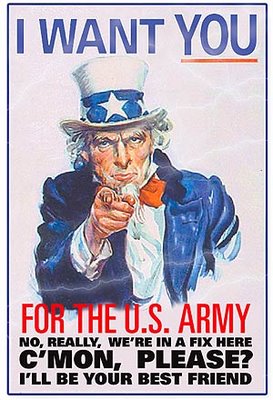
It would come as no surprise that the very same people lambasting Obama for attempting to infiltrate America’s school system in an effort to indoctrinate the malleable minds of our youth are staunch advocates of the United States’ military might, planetary hegemony, who put “Support Our Troops” bumper stickers on their American-made, gas-guzzling clunkers. The irony here is that the people who are apparently trying to “protect” our children from the grasp of “big government” have no problem with federally-mandated programs that, not only allow, but guarantee US military recruiters access to school kids. It seems that while they fear the multicultural commander-in-chief’s motives for telling students to study hard, they are just fine with the military’s invasion of those same students’ privacy in an effort to condition them to kill indigenous people in foreign countries at the behest of that same commander-in-chief.

A recent piece by journalist David Goodman reveals:

“In the past few years, the military has mounted a virtual invasion into the lives of young Americans. Using data mining, stealth websites, career tests, and sophisticated marketing software, the Pentagon is harvesting and analyzing information on everything from high school students’ GPAs and SAT scores to which video games they play. Before an Army recruiter even picks up the phone to call a prospect…the soldier may know more about the kid’s habits than do his own parents.”

Goodman, in his Mother Jones article, explains that a provision slipped into the No Child Left Behind Act by Louisiana Republican then-Representative (now Senator) David Vitter and signed into law by George W. Bush in 2002, was a boon to military recruiters. The provision “requires high schools to give recruiters the names and contact details of all juniors and seniors. Schools that fail to comply risk losing their NCLB funding.” As a result, Goodman continues, “this little-known regulation effectively transformed President George W. Bush’s signature education bill into the most aggressive military recruitment tool since the draft. Students may sign an opt-out form — but not all school districts let them know about it.”

But that’s not all.

Goodman reports that, in 2005, it was discovered that the Pentagon had spent the past two years amassing records from Selective Service, state DMVs, and data brokers to create a database of tens of millions of young adults and teens, some as young as 15, Goodman reports. The result of this massive data-mining project, overseen by the Joint Advertising Market Research & Studies program, is a recruiting database holding over 34 million names. The JAMRS database, run by credit report heavyweight Equifax, is described by its own website as “arguably the largest repository of 16-25-year-old youth data in the country.”

Ari Rosmarin, Senior Advocacy Coordinator at the New York Civil Liberties Union and currently working on the NYCLU’s “Project on Military Recruitment and Students’ Rights,” explains how difficult, if not impossible, it is for students to opt-out of the JAMRS database. In an interview on Democracy Now!, Rosmarin said, “According to the Pentagon, the only way to what they call opt-out of the database is for your parent — a student cannot do this his or herself — a parent needs to send a letter to the Pentagon, asking the Pentagon to take their student out of the list. And even then, you’re not removed from the list; you’re put into what’s called a suppression file, which is a separate list within the JAMRS system and database system that keeps you away out of that list, but you’re never really removed from the list.”

Even though the NYCLU filed and ultimately settled a lawsuit against the Pentagon in 2005, charging them with violating the Privacy Act and the Defense Act, which prohibits keeping information on students as young as fifteen, maintaining the information for over three years, the collection of Social Security numbers, and clarifying opt-out information, the military refused to cease the collection of racial and ethnic data.

This data is vital because the recruiters prey on poor and minority students. As a result, black and latino kids wind up in the military in disproportionate numbers to all other demographics. Eric Ruder reports, “In 1995, Tom Wilson, then a high-level official in charge of the Army’s personnel department, let the truth slip out in an interview. He explained how the military targeted students “particularly in inner cities…I hesitate to use the term at-risk kids, but kids who would otherwise be called at-risk.” Perhaps the war-crazy right-wing in this country was worried that if minority students are inspired by an African-American president’s motivation to become writers, inventors, doctors, lawyers, or architects, there might not be enough soldiers left to invade and occupy more foreign countries.

The Pentagon spends roughly $600,000 every year collecting information from commercial data brokers such as the Student Marketing Group and the American Student List, which keep records on millions of high school students. The government also secretly gathers information from unsuspecting internet users, vocational test-takers, and even videogame enthusiasts. Goodman reports,

This year, the Army spent $1.2 million on the website March2Success.com, which provides free standardized test-taking tips devised by prep firms such as Peterson’s, Kaplan, and Princeton Review. The only indications that the Army runs the site, which registers an average of 17,000 new users each month, are a tiny tagline and a small logo that links to the main recruitment website, GoArmy.com. Yet visitors’ contact information can be sent to recruiters unless they opt out, and students also have the option of having a recruiter monitor their practice test scores. Terry Backstrom, who runs March2Success.com for the US Army Recruiting Command at Fort Knox, insists that it is about “good will,” not recruiting. “We are providing a great service to schools that normally would cost them.”

Recruiters are also data mining the classroom. More than 12,000 high schools administer the Armed Services Vocational Aptitude Battery, a three-hour multiple-choice test originally created in 1968 to match conscripts with military assignments. Rebranded in the mid-1990s as the “ASVAB Career Exploration Program,” the test has a cheerful home page that makes no reference to its military applications, instead declaring that it “is designed to help students learn more about themselves and the world of work.” A student who takes the test is asked to divulge his or her Social Security number, GPA, ethnicity, and career interests—all of which is then logged into the JAMRS database. In 2008, more than 641,000 high school students took the ASVAB; 90 percent had their scores sent to recruiters. Tony Castillo of the Army’s Houston Recruiting Battalion says that ASVAB is “much more than a test to join the military. It is really a gift to public education.”

To put all its data to use, the military has enlisted the help of Nielsen Claritas, a research and marketing firm whose clients include BMW, AOL, and Starbucks. Last year, it rolled out a “custom segmentation” program that allows a recruiter armed with the address, age, race, and gender of a potential “lead” to call up a wealth of information about young people in the immediate area, including recreation and consumption patterns. The program even suggests pitches that might work while cold-calling teenagers. “It’s just a foot in the door for a recruiter to start a relevant conversation with a young person,” says Donna Dorminey of the US Army Center for Accessions Research.

The efforts of aggressive military recruiters are also aided by a number of popular videogames. One of them, “American’s Army,” was created by the Pentagon itself and is available to play free online. According to Goodman, “one in four males between the age of thirteen and twenty-four have played this game” and the users who play it are, according to the Army, “29% more likely to be interested in serving in the military.” The other is the insanely popular Xbox game “Halo 3,” which has sold more copies than the entire Harry Potter series. The Army spent over a million dollars to sponsor the game and, in turn, players can link automatically from the game to the GoArmy.com recruiting website.

There have been endless stories about recruiting misconduct and lies military recruiters tell our nation’s vulnerable youth, once the recruiting process begins in earnest. Recruiters lie about non-binding contracts, “no combat” clauses in contracts, and threaten young recruits who change their minds about joining the military after signing up for the Delayed Enlistment Program.

But it seems that this stuff doesn’t bother conservative commentators or lawmakers, few of whom have actually served in the military themselves. The inconsistency of right-wing attacks never ceases to boggle the mind. They fear big government infiltration of public schools and yet support the most appalling example of big government: endless war and aggressive imperialism. In order to stay at war and maintain the Empire, the United States needs soldiers, by any means necessary. It doesn’t seem to matter that while some schools don’t have adequate or appropriate learning materials or resources for their students and faculties and that vital programs like “music” are being cut from budgets due to lack of funding, the US government, under President Barack Obama, has a yearly defense budget of over $700 billion (which doesn’t include the $100 billion per year that Iraq and Afghanistan cost). In fact, as Goodman tells us, “for every new GI it signed up last year, the Army spent $24,500 on recruitment. (In contrast, four-year colleges spend an average of $2,000 per incoming student.)”

On second thought, maybe Obama just wants our nation’s children to stay in school so that military recruiters know right where to find them. Hey, Fischer, what’s that cherry-tree story again?

This article also appeared on Wide Asleep in America on September 10, 2009.

The Rag Blog

Posted in RagBlog | Tagged , , , | Leave a comment

Losing or Giving Up the Fight Against Racism?

US president Barack Obama: has he gone back on pledges made to black America? Photo: Michael Reynolds/EPA.

Obama’s big silence: the race question: Has the president turned his back on black America?
By Naomi Klein / September 12, 2009

Americans began the summer still celebrating the dawn of a “post-racial” era. They are ending it under no such illusion. The summer of 2009 was all about race, beginning with Republican claims that Sonia Sotomayor, Barack Obama’s nominee to the US Supreme Court, was “racist” against whites. Then, just as that scandal was dying down, up popped “the Gates controversy”, the furore over the president’s response to the arrest of African American academic Henry Louis Gates Jr in his own home. Obama’s remark that the police had acted “stupidly” was evidence, according to massively popular Fox News host Glenn Beck, that the president “has a deep-seated hatred for white people”.

Obama’s supposed racism gave a jolt of energy to the fringe movement that claims he has been carrying out a lifelong conspiracy to cover up his (fictional) African birth. Then Fox News gleefully discovered Van Jones, White House special adviser on green jobs. After weeks of being denounced as “a black nationalist who is also an avowed communist”, Jones resigned last Sunday.

The undercurrent of all these attacks was that Obama, far from being the colour-blind moderate he posed as during the presidential campaign, is actually obsessed with race, in particular with redistributing white wealth into the hands of African Americans and undocumented Mexican workers. At town hall meetings across the US in August, these bizarre claims coalesced into something resembling an uprising to “take our country back”. Henry D Rose, chair of Blacks For Social Justice, recently compared the overwhelmingly white, often armed, anti-Obama crowds to the campaign of “massive resistance” launched in the late 50s – a last-ditch attempt by white southerners to block the racial integration of their schools and protect other Jim Crow laws. Today’s “new era of ‘massive resistance’,” writes Rose, “is also a white racial project.”

There is at least one significant difference, however. In the late 50s and early 60s, angry white mobs were reacting to life-changing victories won by the civil rights movement. Today’s mobs, on the other hand, are reacting to the symbolic victory of an African American winning the presidency. Yet they are rising up at a time when non-elite blacks and Latinos are losing significant ground, with their homes and jobs slipping away from them at a much higher rate than from whites. So far, Obama has been unwilling to adopt policies specifically geared towards closing this ever-widening divide. The result may well leave minorities with the worst of all worlds: the pain of a full-scale racist backlash without the benefits of policies that alleviate daily hardships. Meanwhile, with Obama constantly painted by the radical right as a cross between Malcolm X and Karl Marx, most progressives feel it is their job to defend him – not to point out that, when it comes to tackling the economic crisis ravaging minority communities, the president is not doing nearly enough.

For many antiracist campaigners, the realisation that Obama might not be the leader they had hoped for came when he announced his administration would be boycotting the UN Durban Review Conference on racism, widely known as “Durban II”. Almost all of the public debate about the conference focused on its supposed anti-Israel bias. When it actually took place in April in Geneva, virtually all we heard about was Iranian president Mahmoud Ahmadinejad’s inflammatory speech, which was met with rowdy disruptions, from the EU delegates who walked out, to the French Jewish students who put on clown wigs and red noses, and tried to shout him down.

Lost in the circus atmosphere was the enormous importance of the conference to people of African descent, and nowhere more so than among Obama’s most loyal base. The US civil rights movement had embraced the first Durban conference, held in summer 2001, with great enthusiasm, viewing it as the start of the final stage of Martin Luther King’s dream for full equality. Though most black leaders offered only timid public criticism of the president’s Durban II boycott, the decision was discussed privately as his most explicit betrayal of the civil rights struggle since taking office.

The original 2001 gathering was not all about Israelis v Palestinians, or antisemitism, as so many have claimed (though all certainly played a role). The conference was overwhelmingly about Africa, the ongoing legacy of slavery and the huge unpaid debts that the rich owe the poor.

Holding the 2001 World Conference against Racism in what was still being called “the New South Africa” had seemed a terrific idea. World leaders would gather to congratulate themselves on having slain the scourge of apartheid, then pledge to defeat the world’s few remaining vestiges of discrimination – things such as police violence, unequal access to certain jobs, lack of adequate healthcare for minorities and intolerance towards immigrants. Appropriate disapproval would be expressed for such failures of equality, and a well-meaning document pledging change would be signed to much fanfare. That, at least, is what western governments expected to happen.

They were mistaken. When the conference arrived in Durban, many delegates were shocked by the angry mood in the streets: tens of thousands of South Africans joined protests outside the conference centre, holding signs that said “Landlessness = racism” and “New apartheid: rich and poor”. Many denounced the conference as a sham, and demanded concrete reparations for the crimes of apartheid. South Africa’s disillusionment, though particularly striking given its recent democratic victory, was part of a much broader global trend, one that would define the conference, in both the streets and the assembly halls. Around the world, developing countries were increasingly identifying the so-called Washington Consensus economic policies as little more than a clever rebranding effort, a way for former northern colonial powers to continue to drain the southern countries of their wealth without being inconvenienced by the heavy lifting of colonialism. Roughly two years before Durban, a coalition of developing countries had refused further to liberalise their economies, leading to the collapse of World Trade Organisation talks in Seattle. A few months later, a newly militant movement calling for a debt jubilee disrupted the annual meetings of the World Bank and the International Monetary Fund. Durban was a continuation of this mounting southern rebellion, but it added something else to the mix: an invoice for past thefts.

Although it was true that southern countries owed debts to foreign banks and lending institutions, it was also true that in the colonial period – the first wave of globalisation – the wealth of the north was built, in large part, on stolen indigenous land and free labour provided by the slave trade. Many in Durban argued that when these two debts were included in the calculus, it was actually the poorest regions of the world – especially Africa and the Caribbean – that turned out to be the creditors and the rich world that owed a debt. All big UN conferences tend to coalesce around a theme, and in Durban 2001 the clear theme was the call for reparations. The overriding message was that even though the most visible signs of racism had largely disappeared – colonial rule, apartheid, Jim Crow-style segregation – profound racial divides will persist and even widen until the states and corporations that profited from centuries of state-sanctioned racism pay back some of what they owe.

African and Caribbean governments came to Durban with two key demands. The first was for an acknowledgment that slavery and even colonialism itself constituted “crimes against humanity” under international law; the second was for the countries that perpetrated and profited from these crimes to begin to repair the damage. Most everyone agreed that reparations should include a clear and unequivocal apology for slavery, as well as a commitment to returning stolen artefacts and to educating the public about the scale and impact of the slave trade. Above and beyond these more symbolic acts, there was a great deal of debate. Dudley Thompson, former Jamaican foreign minister and a longtime leader in the Pan-African movement, was opposed to any attempt to assign a number to the debt: “It is impossible to put a figure to killing millions of people, our ancestors,” he said. The leading reparations voices instead spoke of a “moral debt” that could be used as leverage to reorder international relations in multiple ways, from cancelling Africa’s foreign debts to launching a huge develop­ ment programme for Africa on a par with Europe’s Marshall Plan. What was emerging was a demand for a radical New Deal for the global south.

African and Caribbean countries had been holding high-level summits on reparations for a decade, with little effect. What prompted the Durban breakthrough was that a similar debate had taken off inside the US. The facts are familiar, if commonly ignored. Even as individual blacks break the colour barrier in virtually every field, the correlation between race and poverty remains deeply entrenched. Blacks in the US consistently have dramatically higher rates of infant mortality, HIV infection, incarceration and unemployment, as well as lower salaries, life expectancy and rates of home ownership. The biggest gap, however, is in net worth. By the end of the 90s, the average black family had a net worth one eighth the national average. Low net worth means less access to traditional credit (and, as we’d later learn, more sub-prime mortgages). It also means families have little besides debt to pass from one generation to the next, preventing the wealth gap closing on its own.

In 2000, Randall Robinson published The Debt: What America Owes To Blacks, which argued that “white society… must own up to slavery and acknowledge its debt to slavery’s contemporary victims”. The book became a national bestseller, and within months the call for reparations was starting to look like a new anti-apartheid struggle. Students demanded universities disclose their historical ties to the slave trade, city councils began holding public hearings on reparations, chapters of the National Coalition of Blacks for Reparations in America had sprung up across the country and Charles Ogletree, the celebrated Harvard law professor (and one of Obama’s closest mentors), put together a team of all-star lawyers to try to win reparations lawsuits in US courts.

By spring 2001, reparations had become the hot-button topic on US talkshows and op-ed pages. And though opponents consistently portrayed the demand as blacks wanting individual handouts from the government, most reparations advocates were clear they were seeking group solutions: mass scholarship funds, for instance, or major investments in preventive healthcare, inner cities and crumbling schools. By the time Durban rolled around in late August, the conference had taken on the air of a black Woodstock. Angela Davis was coming. So were Jesse Jackson and Danny Glover. Small radical groups such as the National Black United Front spent months raising money to buy hundreds of plane tickets to South Africa. Activists travelled to Durban from 168 countries, but the largest delegation by far came from the US: approximately 3,000 people, roughly 2,000 of them African Americans. Ogletree pumped up the crowds with an energetic address: “This is a movement that cannot be stopped… I promise we will see reparations in our lifetime.”

The call for reparations took many forms, but one thing was certain: antiracism was transformed in Durban from something safe and comfortable for elites to embrace into something explosive and potentially very, very costly. North American and European governments, the debtors in this new accounting, tried desperately to steer the negotiations on to safe terrain. “We are better to look forward and not point fingers backward,” national security adviser Condoleezza Rice said. It was a losing battle. Durban, according to Amina Mohamed, chief negotiator for the Africa bloc, was Africa’s “rendezvous with history”.

Not everyone was willing to show up for the encounter, however, and that is where the Israel controversies come in. Durban, it should be remembered, took place in the aftermath of the collapse of the Oslo Accords, and there were those who hoped the conference could somehow fill the political vacuum. Six months before the meeting in Durban, at an Asian preparatory conference in Tehran, a few Islamic countries requested language in their draft of the Durban Declaration that described Israeli policies in the occupied territories as “a new kind of apartheid” and a “form of genocide”. Then, a month before the conference, there was a new push for changes: references to the Holocaust were paired with the “ethnic cleansing of the Arab population in historic Palestine”, while references to “the increase in antisemitism and hostile acts against Jews” were twinned with phrases about “the increase of racist practices of Zionism”, and Zionism was described as a movement “based on racism and discriminatory ideas”.

There were cases to be made for all of it, but this was language sure to tear the meeting apart (just as “Zionism equals racism” resolutions had torn apart UN gatherings before). Meanwhile, as soon as the conference began, the parallel forum for non-governmental organisations began to spiral out of control. With more than 8,000 participants and no ground rules to speak of, the NGO forum turned into a free-for-all, with, among other incidents, the Arab Lawyers Union passing out a booklet that contained Der Stürmer–style cartoons of hook-nosed Jews with bloody fangs.

High-profile NGO and civil rights leaders roundly condemned the antisemitic incidents, as did Mary Robinson, then UN high commissioner for human rights. None of the controversial language about Israel and Zionism made it into the final Durban Declaration. But for the newly elected administration of George W Bush, that was besides the point. Already testing the boundaries of what would become a new era of US unilateralism, Bush latched on to the gathering’s alleged anti-Israel bias as the perfect excuse to flee the scene, neatly avoiding the debates over Israel and reparations. Early in the conference, the US and Israel walked out.

Despite the disruptions, Africa was not denied its rendezvous with history. The final Durban Declaration became the first document with international legal standing to state that “slavery and the slave trade are a crime against humanity and should always have been so, especially the transatlantic slave trade”. This language was more than symbolic. When lawyers had sought to win slavery reparations in US courts, the biggest barrier was always the statute of limitations, which had long since expired. But if slavery was “a crime against humanity”, it was not restricted by any statute.

On the final day of the conference, after Canada tried to minimise the significance of the declaration, Amina Mohamed, now a top official in the Kenyan government, took the floor in what many remember as the most dramatic moment of the gathering. “Madame President,” Mohamed said, “it is not a crime against humanity just for today, nor just for tomorrow, but for always and for all time. Nuremberg made it clear that crimes against humanity are not time-bound.” Any acts that take responsibility for these crimes, therefore, “are expected and are in order”. The assembly hall erupted in cheers and a long standing ovation.

Groups of African American activists spent their last day at the conference planning a “Millions for Reparations” march on Washington. Attorney Roger Wareham, co-counsel on a high-profile reparations lawsuit and one of the organisers, recalled that as they left South Africa, “people were on a real rolling high” – ready to take their movement to the next level.

That was 9 September 2001. Two days later, Africa’s “rendezvous with history” was all but forgotten. The profound demands that rose up from Durban during that first week of September 2001 – for debt cancellation, for reparations for slavery and apartheid, for land redistribution and indigenous land rights, for compensation, not charity – have never again managed to command international attention. At various World Bank meetings and G8 summits there is talk, of course, of graciously providing aid to Africa and perhaps “forgiving” its debts. But there is no suggestion that it might be the G8 countries that are the debtors and Africa the creditor. Or that it is we, in the west, who should be asking forgiveness.

Because Durban disappeared before it had ever fully appeared, it’s sometimes hard to believe it happened at all. As Bill Fletcher, author and long-time advocate for African rights, puts it: “It was as if someone had pressed a giant delete button.”

When news came that the Durban follow-up conference would take place three months into Obama’s presidency, many veterans of the first gathering were convinced the time had finally come to restart that interrupted conversation. And at first the Obama administration seemed to be readying to attend, even sending a small delegation to one of the preparatory conferences. So when Obama announced that he, like Bush before him, would be boycotting, it came as a blow. Especially because the state department’s official excuse was that the declaration for the new conference was biased against Israel. The evidence? That the document – which does not reference Israel once – “reaffirms” the 2001 Durban Declaration. Never mind that that was so watered down that Shimon Peres, then Israel’s foreign minister, praised it at the time as “an accomplishment of the first order for Israel” and “a painful comedown for the Arab League”.

When disappointed activists reconvened for the Durban Review Conference this April, talk in the corridors often turned to the unprecedented sums governments were putting on the line to save the banks. Roger Wareham, for instance, pointed out that if Washington can find billions to bail out AIG, it can also say, “We’re going to bail out people of African descent because this is what’s happened historically.” It’s true that, at least on the surface, the economic crisis has handed the reparations movement some powerful new arguments. The hardest part of selling reparations in the US has always been the perception that something would have to be taken away from whites in order for it to be given to blacks and other minorities. But because of the broad support for large stimulus spending, there is a staggering amount of new money floating around – money that does not yet belong to any one group.

Obama’s approach to stimulus spending has been rightly criticised for lacking a big idea – the $787bn package he unveiled shortly after taking office is a messy grab bag, with little ambition actually to fix any one of the problems on which it nibbles. Listening to Wareham in Geneva, it occurred to me that a serious attempt to close the economic gaps left by slavery and Jim Crow is as good a big stimulus idea as any.

What is tantalising (and maddening) about Obama is that he has the skills to persuade a great many Americans of the justice of such an endeavour. The one time he gave a major campaign address on race, prompted by controversy over the Reverend Jeremiah Wright, he told a story about the historical legacies of slavery and legalised discrimination that have structurally prevented African Americans from achieving full equality, a story not so different from the one activists such as Wareham tell in arguing for reparations. Obama’s speech was delivered six months before Wall Street collapsed, but the same forces he described go a long way toward explaining why the crash happened in the first place: “Legalised discrimination… meant that black families could not amass any meaningful wealth to bequeath to future generations,” Obama said, which is precisely why many turned to risky sub-prime mortgages. In Obama’s home city of Chicago, black families were four times more likely than whites to get a sub-prime mortgage.

The crisis in African American wealth has only been deepened by the larger economic crisis. In New York City, for instance, the unemployment rate has increased four times faster among blacks than among whites. According to the New York Times, home “defaults occur three times as often in mostly minority census tracts as in mostly white ones”. If Obama traced the Wall Street collapse back to the policies of redlining and Jim Crow, all the way to the betrayed promise of 40 acres and a mule for freed slaves, a broad sector of the American public might well be convinced that finally eliminating the structural barriers to full equality is in the interests not just of minorities but of everyone who wants a more stable economy.

Since the economic crisis hit, John A Powell and his team at the Kirwan Institute for the Study of Race and Ethnicity at Ohio State University have been engaged in a project they call “Fair Recovery”. It lays out exactly what an economic stimulus programme would look like if eliminating the barriers to equality were its overarching idea. Powell’s plan covers everything from access to technology to community redevelopment. A few examples: rather than simply rebuilding the road system by emphasising “shovel ready” projects (as Obama’s current plan does), a “fair recovery” approach would include massive investments in public transport to address the fact that African Americans live farther away than any other group from where the jobs are. Similarly, a plan targeting inequality would focus on energy-efficient home improvements in low-income neighbourhoods and, most importantly, require that contractors hire locally. Combine all of these targeted programmes with real health and education reform and, whether or not you call it “reparations”, you have something approaching what Randall Robinson called for in The Debt: “A virtual Marshall Plan of federal resources” to close the racial divide.

In his Philadelphia “race speech”, Obama was emphatic that race was something “this nation cannot afford to ignore”; that “if we simply retreat into our respective corners, we will never be able to come together and solve challenges like healthcare, or education, or the need to find good jobs for every American”. Yet as soon as the speech had served its purpose (saving Obama’s campaign from being engulfed by the Wright scandal), he did simply retreat. And his administration has been retreating from race ever since.

Public policy activists report that the White House is interested in hearing only about projects that are “race neutral” – nothing that specifically targets historically disadvantaged constituencies. Its housing and education programmes do not tackle the need for desegregation; indeed Obama’s enthusiasm for privately-run “charter” schools may well deepen segregation, since charters are some of the most homogenous schools in the country. When asked specific questions about what his administration is doing to address the financial crisis’s wildly disproportionate impact on African Americans and Latinos, Obama has consistently offered a variation on the line that, by fixing the economy and extending benefits, everyone will be helped, “black, brown and white”, and the vulnerable most of all.

All this is being met with mounting despair among inequality experts. Extending unemployment benefits and job retraining mainly help people who’ve just lost their jobs. Reaching those who have never had formal employment – many of whom have criminal records – requires a far more complex strategy that takes down multiple barriers simultaneously. “Treating people who are situated differently as if they were the same can result in much greater inequalities,” Powell warns. It will be difficult to measure whether this is the case because the White House’s budget office is so far refusing even to keep statistics on how its programmes affect women and minorities.

There were those who saw this coming. The late Latino activist Juan Santos wrote a much-circulated essay during the presidential campaign in which he argued that Obama’s unwillingness to talk about race (except when his campaign depended upon it) was a triumph not of post-racialism but of racism, period. Obama’s silence, he argued, was the same silence every person of colour in America lives with, understanding that they can be accepted in white society only if they agree not to be angry about racism. “We stay silent, as a rule, on the job. We stay silent, as a rule, in the white world. Barack Obama is the living symbol of our silence. He is our silence writ large. He is our Silence running for president.” Santos predicted that “with respect to Black interests, Obama would be a silenced Black ruler: A muzzled Black emperor.”

Many of Obama’s defenders responded angrily: his silence was a mere electoral strategy, they said. He was doing what it took to make racist white people comfortable voting for a black man. All that would change, of course, when Obama took office. What Obama’s decision to boycott Durban demonstrated definitively was that the campaign strategy is also the governing strategy.

Two weeks after the close of the Durban Review Conference, Rush Limbaugh sprang a new theory on his estimated 14 million listeners. Obama, Limbaugh claimed, was deliberately trashing the economy so he could give more handouts to black people. “The objective is more food stamp benefits. The objective is more unemployment benefits. The objective is an expanding welfare state. The objective is to take the nation’s wealth and return it to the nation’s ‘rightful owners’. Think reparations. Think forced reparations here, if you want to understand what actually is going on.”

It was nonsense, of course, but the outburst was instructive. No matter how race-neutral Obama tries to be, his actions will be viewed by a large part of the country through the lens of its racial obsessions. So, since even his most modest, Band-Aid measures are going to be greeted as if he is waging a full-on race war, Obama has little to lose by using this brief political window actually to heal a few of the country’s racial wounds.

[A longer version of this article appears in the September issue of Harper’s Magazine.]

Source / The Guardian

The Rag Blog

Posted in RagBlog | Tagged , , , | 1 Comment

Juan Cole’s Tale of Two (Not So Regular) Joes

All graphics courtesy Health Industry lobby has given $244,196 in campaign contributions, was of course himself lying when he implied that President Obama’s plan will cover illegal immigrants. It will not.

President Obama graciously accepted Wilson’s subsequent apology, even though no modern president has been yelled at that way by a minor rural politician.

On July 6, 2003 another Joe Wilson called a president a liar, in an opinion essay for the New York Times. This Joe Wilson had bravely stared down Saddam Hussein in fall, 1990 as acting ambassador in Baghdad and been commended for his courage by George H. W. Bush.

George W. Bush had falsely alleged in his State of the Union Speech that Iraq had recently bought yellowcake uranium from the West African country of Niger. The allegation was based on a clumsily forged document that had been discounted by the CIA and was proven false within 24 hours when finally shared with the International Atomic Energy Agency.

Wilson’s complaint that the assertion had been false and that he had shown it false before the war was deeply embarrassing to the Bush administration. It responded by smearing Wilson and then attempting to out his wife, Valerie Plame, as an undercover CIA operative working against Iran’s nuclear program. Plame’s career was destroyed and all her known agents and contacts around the world were burned; some of them may have quietly been killed (we have no way of knowing). Ultimately, the truth of the anti-Wilson, anti-Plame campaign came out and Richard Bruce Cheney’s chief of staff, was found guilty of an attempted cover-up. Cheney had ordered the outing of Plame; it happened via another route, but Cheney was conniving at it. Cheney is a traitor and should be rotting in jail.

Note that the first Joe Wilson was dead wrong, but that the Obama administration responded in a gentlemanly way to his charge.

The Bush-Cheney administration, in contrast, attempted to besmirch the reputation and the life of a dedicated lifetime civil servant because he spoke the truth to the president.

The story of the two Joe Wilsons and how they were treated is the story of two visions of America. The Bush-Cheney vision is a nightmarish landscape of blighted lives and cruel indifference to basic human decency. The Obama vision is just the Golden Rule, with which the people who vote for the evil Joe Wilson typically profess acquaintance.

The evil Joe Wilson (R-SC) is the remnant of Cheneyism in this new America, painfully being born from the rubble made by the old. He needn’t remain in office, defiling the halls of the Congress of the United States of America. He has an opponent in the next election, Rob Miller, an Iraq War veteran. An honorable man. Here is his campaign site.

We only need the one kind of Joe Wilson, the one who shouts “truth” to lies; not the one who shouts “lies” to the truth.

Source / Informed Comment

The Rag Blog

Posted in RagBlog | Tagged , , , | 2 Comments

Thousands March Against Their Own Self-Interest

When you see this happening, you just know that big insurance has already won the battle. Health care reform in Amerikkka is a pipe dream. Joe Bageant tried to help me understand why so many vote against their own self-interest, but I still don’t get it. I mean, these people are so misinformed that they think that a public health care plan will break the bank, while attacking innocent nations overseas (i.e., revenge, the most evil of evils) is good for us (and doesn’t seem to have a fiscal implication in their minds). Me, I think I’ll move back to Canada (or maybe Venezuela) where there is still a semblance of sanity.

Richard Jehn / The Rag Blog

Thousands Protest Health Care Plan
By Nafeesa Syeed / September 12, 2009

WASHINGTON – Thousands of people marched to the U.S. Capitol on Saturday, carrying signs with slogans such as “Obamacare makes me sick” as they protested the president’s health care plan and what they say is out-of-control spending.

The line of protesters spread across Pennsylvania Avenue for blocks, all the way to the capitol, according to the D.C. Homeland Security and Emergency Management Agency. People were chanting “enough, enough” and “We the People.” Others yelled “You lie, you lie!” and “Pelosi has to go,” referring to California congresswoman Nancy Pelosi.

Demonstrators waved U.S. flags and held signs reading “Go Green Recycle Congress” and “I’m Not Your ATM.” Men wore colonial costumes as they listened to speakers who warned of “judgment day” — Election Day 2010.

Richard Brigle, 57, a Vietnam War veteran and former Teamster, came from Paw Paw, Mich. He said health care needs to be reformed — but not according to President Barack Obama’s plan.

“My grandkids are going to be paying for this. It’s going to cost too much money that we don’t have,” he said while marching, bracing himself with a wooden cane as he walked.

FreedomWorks Foundation, a conservative organization led by former House Majority Leader Dick Armey, organized several groups from across the country for what they billed as a “March on Washington.”

Organizers say they built on momentum from the April “tea party” demonstrations held nationwide to protest tax policies, along with growing resentment over the economic stimulus packages and bank bailouts.

Many protesters said they paid their own way to the event — an ethic they believe should be applied to the government. They say unchecked spending on things like a government-run health insurance option could increase inflation and lead to economic ruin.

Terri Hall, 45, of Starke, Fla., said she felt compelled to become political for the first time this year because she was upset by government spending.

“Our government has lost sight of the powers they were granted,” she said. She added that the deficit spending was out of control, and said she thought it was putting the country at risk.

Norman Kennedy, 64, of Charleston, S.C., said he wants to send a message to federal lawmakers that America is “deeply in debt.” He said though he’d like everyone to have free health care, he said there’s no money to pay for it.

“We want change and we’re going to get change,” Kennedy said. “I want to see fiscal responsibility and if that means changing Congress that will be a means to that end.”
Other sponsors of the rally include the Heartland Institute, Americans for Tax Reform and the Ayn Rand Center for Individuals Rights.

Copyright 2009 The Associated Press.

Source / America On Line

The Rag Blog

Posted in RagBlog | Tagged , , | 10 Comments

We’re Number Thirty-Seven

Thanks to Jeffrey Segal / The Rag Blog

Posted in RagBlog | Tagged , , , | 3 Comments

Foodie Friday: Food Is Power

Graphic from the Environmental Working Group.

The Carbon Trade
By Janet Gilles / The Rag Blog / September 11, 2009

Seventy percent of the farm subsidy goes to just a small number of states in the upper Mississippi River basin, where farmers are advised to put ten times the amount of nitrates their crops need onto the ground, because most of it will not be held by this land that has received no mulch in a long time.

Mulching puts carbon into the ground, plowing opens the earth and puts the carbon into the atmosphere. The Obama administration is working to change the way farmers are paid. If you saw the movies, Food Inc. or King Corn, you might remember that this type of farming is a big money loser, but the government subsidies make it profitable.

Thus, the government pays to pollute the Mississippi River and the Gulf of Mexico. The United Nations Environmental Group says nitrate pollution is the greatest threat to our fisheries world wide.

In exchange for cheap corn fed beef, fish, chicken, and pork, which have little nutritional value as the animals are no longer getting the rich assortment of greens from their natural diet, we are killing the wild fish.

Right now, farmers are paid for the number of acres under cultivation for “commodity crops”, which are crops that go to a manufacturer, such as Archer Daniels Midlands, before they go to the table.

Real foods, fruits and vegetables and nuts, are not subsidized. In fact, if a farmer getting his $200,000 a year for growing soy or corn decides to grow a few acres of food for the table (specialty foods in the legislation), say he decides to grow some tomatoes, he loses his entire $200K.

No more crop rotation. Only industrial agriculture gets the subsidy.

This is set in stone, even Doggett voted for it, Nancy Pelosi got it through.

Vilsack proposes carbon trading to revive real farming, the kind that puts carbon into the ground, and has been going around speaking to farmers groups to explain to them that a new way to make money is afoot.

The Rodale Institute has been fighting industrial agriculture since the fifties, when the FBI fought to stop the publication of his books by telling the publisher he was a Communist, forcing him to self publish. At that time, he was demonstrating that heart disease was skyrocketing with the advent of large quantities of corn fed beef. The government was trying to help the defense industry move over to a civilian use of their nitrate explosives which became fertilizer, and their nerve gas, which became herbicides and pesticides.

The Rodale Institute recently has published studies, along with Cornell University, showing that organic farming sequesters substantial amounts of Carbon, far more even than anything else imagined, including the far out seeding of the clouds and so on.
US agriculture, according to Rodale, Cornell University, and the Agricultural Research Service have collaborated to develop estimates of carbon sequestration in soils with organic methods.

U.S. agriculture releases 750 million tons of CO2 annually into the atmosphere. Converting all US grasslands to organic production would eliminate agriculture’s massive emissions problem. In fact, 811 million tons would be sequestered.

If just 10,000 medium sized farms in the US, or 2% of the total farmed area, converted to organic, they would store the equivalent of taking 1,174,400 cars off the road.

Our health experts say we can never solve the health crisis in this country so long as the government subsidizes junk foods. Carbon trading will subsidize organic and local and the giant mid-western soy and corn producers will be out of business, along with the manufacturers who cater to them.

Right now, the US Government pays 5 billion dollars a year, or $160 a person, to subsidize junk food (commodities in the legislation). If we took that money and subsidized local organic, that would be $160 million dollars a year in a city the size of Austin, Texas.

Organic fruits and vegetables would be cheap and abundant, and junk food would be effete and expensive.

Here’s what Rodale has said about Agriculture Secretary Vilsack:

Like Nixon to China, Vilsack reshaping USDA landscape

Few of his contemporaries expected President Richard M. Nixon to break with Cold War politics and open full diplomatic relations the People’s Republic of China in 1972. Because he was playing against type (a moderate Republican reaching out to a staunchly Communist regime), he had credibility that a more liberal leader could not have mustered. The breathtaking move stunned conservatives, as it largely jettisoned ideology for more pragmatic considerations in U.S.-China relations.

We’re on the cusp of a similarly noteworthy shift in the posture of the USDA under its new secretary, Tom Vilsack of Iowa. Initially dismissed by many progressive food and farming activists as a tool of corporate agribusiness, the new leader is making waves several times a day in what is starting to feel like a tsunami of positive change. Consider these items:

On February 5, Vilsack says he wants to expand farmers’ choices to include opportunities in energy—such as wind, solar and geothermal power—and in the growing market for organic and whole foods.

On February 21, Vilsack makes his first visit to a farm group outside Washington, addressing 300 farmers and agriculture professionals at the Federation of Southern Cooperatives/Land Assistance Fund’s Georgia Farmer’s Conference. He said he wanted to send a message that the USDA is serious about civil rights issues. He admitted that “some folks refer to USDA as’ the last plantation,’ and it has a pretty poor history of taking care of people of color.”

On February 24, Vilsack announces that Kathleen Merrigan will be his deputy secretary, putting the person who drafted Organic Foods Production Act of 1990 into the Department’s number 2 position.

On February 25, Vilsack is “called out” for skipping the 2009 Commodity Classic in Grapevine, Texas—the annual pow-wow of conventional corn, soybean, sorghum and wheat growers and agri-business powers. The official blog of Hoosier Ag Today radio quoted an American Soybean Association officer as saying of Vilsack: “Even though he is from the state of Iowa, he has a tendency not to lean towards truly production and modern agriculture, and we have to work on that.”

On February 26, Vilsack says cuts to U.S. farm commodity payments will be directed at farmers and ranchers with large incomes and big sales, and could affect 3 percent of U.S. farmers.

Do you feel the earth moving yet? Commodity lobbyists are already swarming Capitol Hill to hogtie their Congressional friends, but the horse of food policy change seems to be out of the barn. However, it will be a long, hard run. If you don’t have a trusted group advocating for organic and sustainable agricultural decisions on your behalf, now is the time to engage one.

The Rag Blog

Posted in RagBlog | Tagged , , | 3 Comments