Wendell Potter: Health Insurance Executive Speaks the Truth


Health Care Fit for Animals
By Nicholas D. Kristof / August 26, 2009

Opponents suggest that a “government takeover” of health care will be a milestone on the road to “socialized medicine,” and when he hears those terms, Wendell Potter cringes. He’s embarrassed that opponents are using a playbook that he helped devise.

“Over the years I helped craft this messaging and deliver it,” he noted.

Mr. Potter was an executive in the health insurance industry for nearly 20 years before his conscience got the better of him. He served as head of corporate communications for Humana and then for Cigna.

He flew in corporate jets to industry meetings to plan how to block health reform, he says. He rode in limousines to confabs to concoct messaging to scare the public about reform. But in his heart, he began to have doubts as the business model for insurance evolved in recent years from spreading risk to dumping the risky.

Then in 2007 Mr. Potter attended a premiere of “Sicko,” Michael Moore’s excoriating film about the American health care system. Mr. Potter was taking notes so that he could prepare a propaganda counterblast — but he found himself agreeing with a great deal of the film.

A month later, Mr. Potter was back home in Tennessee, visiting his parents, and dropped in on a three-day charity program at a county fairgrounds to provide medical care for patients who could not afford doctors. Long lines of people were waiting in the rain, and patients were being examined and treated in public in stalls intended for livestock.

“It was a life-changing event to witness that,” he remembered. Increasingly, he found himself despising himself for helping block health reforms. “It sounds hokey, but I would look in the mirror and think, how did I get into this?”

Mr. Potter loved his office, his executive salary, his bonus, his stock options. “How can I walk away from a job that pays me so well?” he wondered. But at the age of 56, he announced his retirement and left Cigna last year.

This year, he went public with his concerns, testifying before a Senate committee investigating the insurance industry.

“I knew that once I did that my life would be different,” he said. “I wouldn’t be getting any more calls from recruiters for the health industry. It was the scariest thing I have done in my life. But it was the right thing to do.”

Mr. Potter says he liked his colleagues and bosses in the insurance industry, and respected them. They are not evil. But he adds that they are removed from the consequences of their decisions, as he was, and are obsessed with sustaining the company’s stock price — which means paying fewer medical bills.

One way to do that is to deny requests for expensive procedures. A second is “rescission” — seizing upon a technicality to cancel the policy of someone who has been paying premiums and finally gets cancer or some other expensive disease. A Congressional investigation into rescission found that three insurers, including Blue Cross of California, used this technique to cancel more than 20,000 policies over five years, saving the companies $300 million in claims.

As The Los Angeles Times has reported, insurers encourage this approach through performance evaluations. One Blue Cross employee earned a perfect evaluation score after dropping thousands of policyholders who faced nearly $10 million in medical expenses.

Mr. Potter notes that a third tactic is for insurers to raise premiums for a small business astronomically after an employee is found to have an illness that will be very expensive to treat. That forces the business to drop coverage for all its employees or go elsewhere.

All this is monstrous, and it negates the entire point of insurance, which is to spread risk.

The insurers are open to one kind of reform — universal coverage through mandates and subsidies, so as to give them more customers and more profits. But they don’t want the reforms that will most help patients, such as a public insurance option, enforced competition and tighter regulation.

Mr. Potter argues that much tougher regulation is essential. He also believes that a robust public option is an essential part of any health reform, to compete with for-profit insurers and keep them honest.

As a nation, we’re at a turning point. Universal health coverage has been proposed for nearly a century in the United States. It was in an early draft of Social Security.

Yet each time, it has been defeated in part by fear-mongering industry lobbyists. That may happen this time as well — unless the Obama administration and Congress defeat these manipulative special interests. What’s un-American isn’t a greater government role in health care but an existing system in which Americans without insurance get health care, if at all, in livestock pens.

Source / New York Times

The Rag Blog

Posted in RagBlog | Tagged , , | 2 Comments

Texan Creekmore Fath : He Paddled His Own Canoe

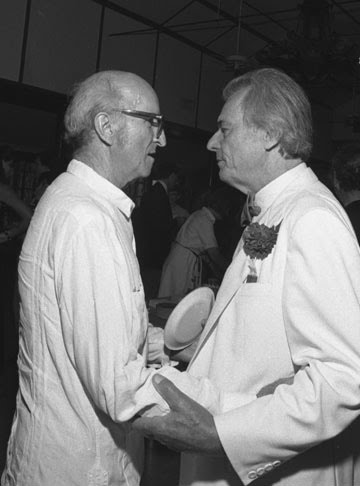
Creekmore Fath with former law partner — and U.S. Congressman — Bob Eckhardt. Photo by Alan Pogue.

So Long to the ‘Communist Threat’:
Creekmore Fath, last of a generation of progressive activists

I met Fath during… future U.S. Sen. Ralph Yarborough’s losing 1954 campaign for governor against conservative Democrat Allan Shivers… To win, Shivers campaigned for the death penalty for Communist Party members…

By Dave Richards / August 27, 2009

[This article appears in the August 21 issue of The Texas Observer, Texas’ progressive biweekly that’s been fighting the good fight for more than five decades.]

When Creekmore Fath died in June at 93, we’d officially seen the last of an influential cluster of liberal activists who came of age during the Great Depression at the University of Texas. It’s a generation worth celebrating, especially since they deserve plenty of thanks for what modicum of racial justice exists in Texas.

Fath’s often-storybook life (even his name sounds Elizabethan) in many ways exemplified what set apart these UT liberals — Chris Dixie of Houston, Otto Mullinax of Dallas, Maury Maverick Jr. of San Antonio, Bob Eckhardt of Houston, and Fath of Austin. And what kept them together.

I met Fath during my initial foray into politics, future U.S. Sen. Ralph Yarborough’s losing 1954 campaign for governor against conservative Democrat Allan Shivers. The race was close enough to alarm the ruling elite. To win, Shivers campaigned for the death penalty for Communist Party members, along with traditional racist attacks on the NAACP and integration.

By 1956, Texas’ conservative rulers were so worried about the Yarborough threat that they persuaded Price Daniel to abandon his Senate seat and run for governor against the liberal menace. That same year, U.S. Sen. Lyndon Johnson and House Speaker Sam Rayburn decided to challenge the Shivercrats for control of the Texas Democrats. Yarborough forces, including Fath, also mounted a challenge from the left.

I ended up an Austin delegate to the state convention from the liberal wing. We arrived to find ourselves locked out because the Johnson forces controlled the tickets. Some of us got into the building through a women’s restroom window. Others made it to the floor with counterfeit tickets printed up by Harry Holman, a union carpenter from Austin. We scrambled in to find the 200-plus-member Travis County delegation in disarray, equally divided between Johnson and Yarborough.

At one point, the key vote was seating the liberal delegation from Harris County. Travis County delegates had to be polled. Fath counted for the liberals, and Johnson lawyer John Cofer for the other side. At the conclusion of each polling, the two would solemnly announce results that were contrary. Fath had the liberals winning, Cofer had the Johnsonites winning. After polling the delegation three times and getting the same contradictory outcomes, Travis County had to pass without a vote. Even so, the convention was a success. The liberal dynamo from Houston, Frankie Randolph, defeated Johnson’s candidate for the Democratic National Committee. The next year, Yarborough won Price Daniel’s Senate seat in a special election—the first liberal win since Jimmie Allred in the 1930s.

All of this strange carrying-on had its roots at UT in the 1930s. While the university was the heart of intellectual ferment in the state, the Texas Legislature was focusing its periodic red-baiting hysteria on the campus as a hotbed of radicalism. At UT, Fath joined with Dixie, Mullinax, and Herman Wright to reorganize the Young Democrats into the Progressive Democrats. In 1936, Mullinax, Wright, and Dixie (with Fath running the latter’s campaign) ran losing state-legislature campaigns from their home counties. All ran on a Progressive Democratic issue: taxing the extraction of sulfur, a notion floated by another influential liberal, Bob Montgomery.

Montgomery was a favorite target of the red-baiters in Austin. Soon after the election, at the instigation of Johnson friend Roy Miller, a powerful sulfur lobbyist, the Legislature began investigating Montgomery and trying to expose the Progressive Democrats as communists. Along with Montgomery, Mullinax was subpoenaed. “Three of us ran for the Legislature on a program to tax sulfur,” he told the lawmakers, “and were defeated on the charge of being communists.”

Asked during his testimony whether he believed in the “profit system,” Montgomery replied: “I most certainly do. I would like to see it extended to 120 million people.”

The UT liberals all went on to law school and into practice in the early ’40s. Fath and Eckhardt, one of the state’s first labor lawyers, briefly had a joint practice in Austin. Fath went into the army during World War II and then served the aging President Franklin Roosevelt as an aide.

Back in Austin, Fath plunged back into politics. When Johnson ran for Senate in 1948, Fath announced for Johnson’s vacant U.S. House seat as an unreconstructed New Dealer. He and his wife, the daughter of a former secretary of state, campaigned in a car with a canoe roped on top and painted with the slogan, “Fath for Congress … He Paddles His Own Canoe.”

Somehow the slogan didn’t do the trick. Fath finished third in the Democratic primary. Then he went to work, with mixed feelings, for Johnson’s Senate campaign. Liberals like Fath had never been cozy with the future president’s go-with-the-political-wind ideology. “We viewed Johnson with some reserve,” Fath wrote, with appropriate reserve, decades later in an autobiographical essay.

With no Republican Party to speak of, the state’s liberal and conservative Democrats were bitter enemies. Fath and fellow liberals liked to call themselves “loyal Democrats.” Shivers and Daniel preferred to be known as Democratic Regulars who had supported GOP presidential candidates. Johnson often tried to play both sides. With Fath and other liberals reluctantly behind him, he pulled off his infamous 48-vote “landslide” in a Democratic Senate runoff still notorious for its corruption.

In William Roger Louis’s collection of autobiographical essays, Burnt Orange Brittania (2006), Fath opens his often-witty entry by writing, “The history of my life can be summed up by saying that I am devoted above all to two things: the Democratic Party and the University of Texas.”

He might have added ­liberalism to the list. After failing in his one run for elective office, Fath went on to be a political rainmaker and strategist behind the ’50s and ’60s Yarborough campaigns, and the early ’70s near-misses of Sissy Farenthold for ­governor. “He could pick up the phone and call,” Farenthold recalls, and “I don’t care what county it was, he’d know somebody there. There would have been no campaign without Creekmore.”

While Fath was working for a more liberal-minded Texas, fellow UT’ers Dixie and Mullinax joined Herman Wright in Houston, representing labor unions in what was becoming an industrial ­center. Unlike their British ­counterparts at Cambridge, who wandered off to communism, the Texas liberals mostly remained staunch New Dealers. In 1948, Wright linked up with Henry Wallace and became the Progressive Party candidate for governor. Dixie and Mullinax broke with their friend and supported the Democrats. Shortly thereafter, Eckhardt joined Dixie in his Houston practice. Maury Maverick Jr. practiced law in San Antonio and soon joined Fath in the political arena.

Maury Junior, as he was called, became one of the state’s foremost civil liberties lawyers. Early on, he represented a black prizefighter, Sporty Harvey, in a challenge to the Texas prohibition against interracial boxing matches. Later he sued the state on behalf of John Stanford, secretary of the Texas Communist Party, attacking the search and seizure of Stanford’s library and correspondence in a case that made it to the U.S. Supreme Court. After leaving the Legislature, he spent his later years writing somewhat incendiary columns for the San Antonio Express-News, inveighing against the Vietnam War and later speaking out about the plight of the Palestinians.

Eckhardt, who died in 2001, ended up in both the Legislature and Congress, championing progressive populist causes and becoming a leading advocate for open beaches. (See Gary Keith’s excellent biography, Eckhardt: There Once Was a Congressman from Texas.) Dixie was always a pre-eminent union lawyer. He successfully sued the notorious Texas Ranger, A.Y. Allee, on behalf of Pancho Medrano and others involved in the famous 1966-67 farm workers’ strike at La Casita Melons in Rio Grande City. On the political front, along with Frankie Randolph, Dixie was the driving force behind the Harris County Democrats, the first organization that truly took the battle to the Shivercrats. He was, as founding Observer editor Ronnie Dugger once said of him in these pages, “tough as cactus.”

So was Mullinax. Not long into his career, Mullinax did what was almost unthinkable for the times: He filed a damage suit on behalf of a young black man against the police chief of Nacogdoches, alleging police brutality. The case was lost, of course, but it speaks volumes about these liberals’ tenacity; Mullinax later told me he always carried a firearm when he drove with his client back and forth across East Texas.

These liberals practiced classic coalition politics. Among other accomplishments, they brought together elements of organized labor with historically disenfranchised blacks and Latinos—to the point where, by 1962, it was no longer politically possible to attack the NAACP or the GI Forum, Hector Garcia’s Hispanic organization. When John Connally ran for governor in 1962, he became the first establishment Democrat to court and win segments of this coalition—reportedly at the urging of Johnson.

One other thing to know about Fath, Eckhardt, Dixie, Mullinax and Randolph, along with another great liberal, Minnie Fisher Cunningham of New Waverley: They all helped found the Observer in 1954.

While they never lived to see the Texas they’d worked toward since the 1930s, Creekmore Fath and his liberal cohorts made many previously unthinkable things happen. (And Fath got to witness the once-unfathomable election of Barack Obama before he died.) They opened the way for a progressive future in the state that could be broader and far more influential. It wouldn’t hurt the new liberal Texans to aim for the same kind of integrity and stubbornness that Fath and the “commie ­liberals” showed.

[Dave Richards is an attorney and author.]

Source / The Texas Observer

Thanks to Steve Russell / The Rag Blog

Posted in RagBlog | Tagged , , , , , , | 3 Comments

Joe Nick Patoski : Jim Dickinson Was One Cool Memphis Cat

It’s not just the whites reaching for the black culture, it’s the blacks reaching for the white culture. It’s about the collision.
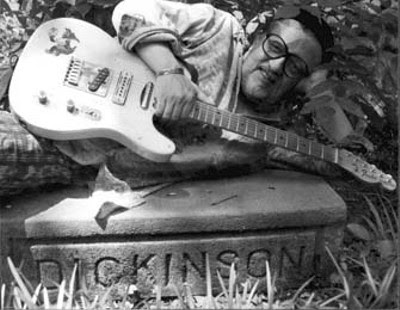
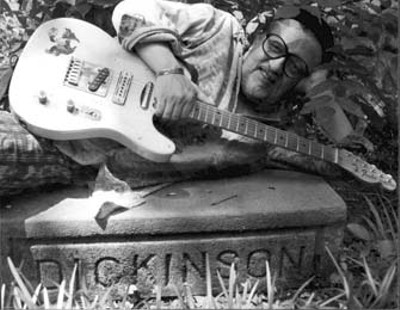
Jim Dickinson. Photo from Memphis Flyer.

Memphis musician Jim Dickinson dies at 67
Career of artist, producer touched four decades, many lives

The North Mississippi Allstars have lost their father, Bob Dylan has lost a “brother,” rock and roll has lost one of its great cult heroes and Memphis has lost a musical icon with the death of Jim Dickinson.

The 67-year-old Dickinson passed away early Saturday morning in his sleep. The Memphis native and longtime Mississippi resident had been in failing health for the past few months and was recuperating from heart surgery at Methodist Extended Care Hospital…

— Bob Mehr / Memphis Commercial Appeal / August 15, 2009

An oral history:

James Luther Dickinson of Memphis

By Joe Nick Patoski / The Rag Blog / August 27, 2009

There are cool cats and there are cool Memphis cats but no one, not Elvis, not Jerry Lee, not even the Wolf came close to epitomizing Memphis and cool like Jim Dickinson did. He was the Top Cat Daddy, an inspiration, a mentor and my friend.

If you knew his music and understood his role as one of the links between black and white culture and between blues and rock and roll, you know what I’m talking about. If he is unfamiliar to you, now’s as good time as any to get to know him, even though he’s checked out of the motel.

Read Jim Dickinson’s obitiuary in the Memphis Commercial-Appeal’s obituary.

In honor of his spirit, I share the oral history he did for me back when I was working on the Voices of Civil Rights project in 2004. His physical body may be gone, but his words and his music live on.
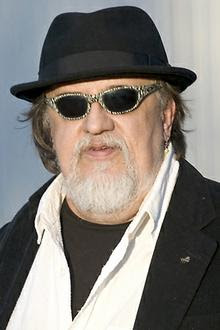

Jim Dickinson: An oral history

To passersby on the two-lane blacktop winding through the Hill Country of northern Mississippi just south of Memphis, the eclectic collection on the other side of the gate consisting of two mobile homes, a ramshackle barn, a small one-room frame house known as the Fortress of Solitude, an abandoned yellow school bus, and an ancient pre-Airstream trailer may appear to be nothing more than a duct-taped testament to Southern poverty. But as far as Jim Dickinson is concerned, he lives in the lap of luxury.

The barn houses a recording studio where Dickinson, a noted Memphis musician and record producer, works. The TV is wired to cable so he can watch old black-and-white westerns and his beloved wrestling. His hound dog Lightnin’ rests at his feet contentedly while his wife, Mary Lindsay, goes on and on bragging about their sons, Luther and Cody, and their band, the Northern Mississippi All-Stars — Luther’s Jaguar is parked in front of their mobile home while they’re on tour. The family photograph hanging among the Zebra skins and various and sundry memorabilia cluttering the walls was taken by Annie Leibowitz.

“Jim, you have everything a man could want,” Bob Dylan told him when he visited the spread known as Zebra Ranch a few years back. “A man could do a lot of thinking here.”

Jim Dickinson makes a passionate, articulate case for Memphis being the greatest music city in modern history. As the home of Elvis Presley, it was for all practical purposes the birthplace of rock n’ roll. It is also the rich melting pot where blues, rhythm ‘n’ blues, and soul, hillbilly, rockabilly, and country & western mixed and blended to create the most American of sounds. To achieve this feat, Memphis musicians like Dickinson, both black and white, defied Jim Crow laws and crossed color lines out of the simple desire to make music. By doing so, they broke down barriers long before the courts or lawmakers got around to changing laws.
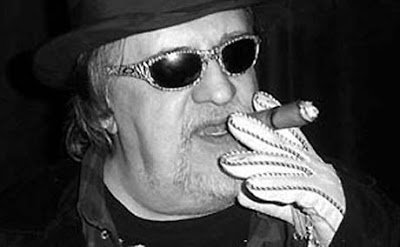
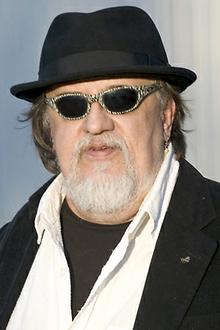
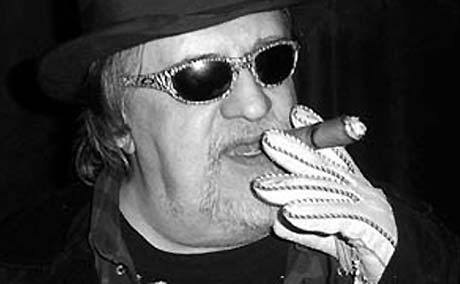
Blowing smoke. Photo from exclaim.ca.

I was born in Little Rock, lived in Hollywood as a tiny infant for six months, moved to Chicago where I lived until I was almost 9. In 1949, we moved to Memphis, where I was actually conceived. The fifties were about to happen. The world changed in front of my eyes.

My father worked for Diamond Match Company. He’d been an executive vice-president until they closed the Chicago office. Rather than move to New York like the rest of the company did, he’d saved himself with a demotion job in the South, so he could be near his family in Little Rock. Memphis was as close as he could get.

I thought we’d moved to Hell. I was a city boy. I’d spent times at my grandparents in Little Rock in the summer, so I’d been exposed to the South. We moved into what wasn’t yet suburban East Memphis: there were cotton fields in front of my house and a truck farm behind it. I was coming from the National College of Education in Evanston where in the first grade I had six teachers and we changed classes. I had an arts & crafts teacher who had a navel jewel on her forehead. I came to Memphis to a school in Shelby County where they let out classes for cotton picking. I seriously thought it was a school for farmers. “Well, farmers gotta go to school somewhere. This must be it.”

I really thought it’d been a terrible mistake. Gradually, I came to love it and can live only here now.

Cultural differences? My father bought this three-acre piece of property in east Memphis with a big ol’ house on it. It’d been vacant for some time due to a divorce case. He had hired this black guy from the local crossroads called Orr’s Corner where the blacks hung out to clean the place up when he bought it. My mother and I were still in Chicago.

We drove in the driveway for the first time, the first thing I saw was Alec. His name was Timothy Teel, but they called him Alec because he was a smart alec. He was real short. He was the first thing I saw in my new home. He became my teacher.

He took it upon himself as part of his job to teach me the things I needed to know, and not be a smart alec Yankee kid, which I was. Alec taught me about nature and life.

He taught me how to throw a knife underhanded. How to shoot craps, play pittypat and smut. He was a great singer but he didn’t play an instrument, and when he realized I wanted to play music, he brought me musicians to teach me. It was very Uncle Remus, very politically incorrect, and probably the most valuable relationship of my life outside my family.

Alec must have been in his late twenties. He was very much the young buck. They called him The Ram in the neighborhood. He stabbed a couple guys. My father had to get him out of jail periodically. He was an inspirational role model.

He was the yard man. He’d put on his white jacket and do dinner parties for my mother. His mother was a part-time maid. His wife was my baby-sitter. It was like a family deal.

My father became very much the white man of the neighborhood. We referred to the colored section as being Down The Road. It was like another world, and totally inaccessible. Old man Orr, who owned the grocery at Orr’s Corner, would lend blacks money at real high interest rates, a real plantation mentality. My father developed into the anti-Mr. Orr. He was very much the Captain and was treated as such. I grew up with a very definite double standard in that way.

The single, most important motivating thing that happened to me in that same period of time was seeing the Memphis Jug Band — Will Shade, Charlie Burse, Good Kid [considered the most important jug band of all time, with roots dating back to the 1920s.] It took me years to find out who they were, but I saw them downtown with my father one Saturday afternoon. After hearing that music, other things in life didn’t seem to be as important as that did. I spent the next 10, 15 years of my life, trying to find that music.

It was right down the road, literally, but I couldn’t get there in 1950. A white kid couldn’t go where the music was.

I’d never heard anything like it. You have to imagine what music was like in 1950. I was already interested in music and had taken music lessons. My mother was a piano player, played in the Baptist Church. I was classically trained, but I had real screwed up vision. I couldn’t see multiple images and I still can’t read music to this day. So at this point, in my mother’s eyes, I was already a failure as a musician.

I heard some Dixieland and some boogie-woogie on the radio that had interested me. There was a piano player in Chicago called Two-Ton Baker the Music Maker, who had a radio show. I heard him playing boogie-woogie and that kind of interested me. There was no rock and roll on earth.

But when I heard Will Shade and the Memphis Jug Band, it was like hearing Martians play music. It was so transcultural. He was singing, “Come on down to my house, Honey. There’s nobody home but me” and playing this string tub bass, which was this string coming out of this metal washtub tied on to a broom stick while Good Kid played a washboard with drumsticks. This was not typical music that a nine year old white kid would encounter.

It utterly changed my life.
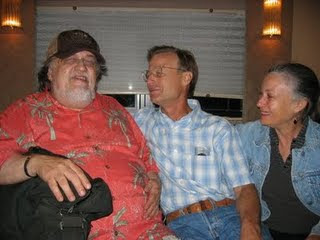
From left, Jim Dickinson, Joe Nick Patoski and Christina Patoski, taken on Jim’s bus outside Joe’s Pub in NYC, June 6, 2006.

Jim, me, and my sister, Christina Patoski, looking at him was
Several years later, Alec brought me a piano player to teach me. He’d work half a day on Saturday and come in hungover, wash my father’s car, and get paid. On Saturdays is when he’d bring me musicians. He brought me this guy who was legendary. I don’t know what his real name was. They called him Dishrag. You hear people talking about Memphis music history, talking about Dishrag. He was a notorious alcoholic and was dead drunk the day I saw him. Obviously, they’d both been up all night. Never took his overcoat or his hat off, sat down at my mother’s piano, and started to play like nothing I’d ever heard.

I asked him if he knew, “Come On Down to My House, Honey, There’s Nobody Home But Me,” the song I’d heard Will Shade sing, which believe me, I’d never heard again. He grinned and kind of chuckled and said, “How do you know that song? That song’s older than you are.”

It opened him up and Dishrag showed me the thing that enabled me to learn to play the piano, the thing my mother and my other piano teacher had been incapable of doing.

He said — again, this is as politically incorrect as it could possibly be, and I have to go into ebonics — he said, “Everything in music is made up out of codes.” I thought he meant codes like secret codes, Captain Marvel, Morse code. Of course, he meant chords. But I thought he said it was all made up out of codes and I thought, “No wonder I can’t damn well do it. My mother didn’t tell me it was code. This guy’s about to give me the secret here.”

And he did.

He said, “You takes a note, any note” — his index finger went to an E note on the piano. “You goes three up” — and his hand went up three keys — “And you goes four down” — and his next finger went four down. These are not musical half-steps. These are just keys on the piano. He ended up with one finger on C, one finger on E, and one finger on G — which is a major C triad. And it works anywhere on the piano — he said, “You goes three up and four down, just like poker.” That’s the part I never understood because that’s not the way I was taught to play poker. Obviously, it was for Dishrag. You go three up and four down and it makes a code. At that point, I realized he was talking about a chord, nonetheless, he gave me the information that I needed. Because it does work anywhere on the piano, it does make a major triad, and your thumb is always on the tonic root note.

With that piece of information, with a chord in my right hand, and an octave in my left hand, that’s all you need to play rock and roll. To this day, that’s basically what I do. I play an octave and a major triad. If you play it back and forth between your hands, right, left, right, left, then you have a shuffle. If you play it straight, you’ve got eighth-note rock and roll.

That’s the racial difference.

The racial difference of music is how the implied eighth-notes of rock and roll are handled. Whether it’s politically incorrect or not, I don’t care. It’s absolutely true. Black people do it one way. White people do it another way. The difference is feeling, therefore, interior. Not to be too anthropologic.

My parents thought it was a good thing. My mother and Alec had a very special relationship. As a Christian lady, she took it upon herself to reform Alec, to give him the information and education that he had lacked in his life.

She had a picture of Shakespeare and a little miniature of Romeo and Juliet on the wall of the room my grandmother stayed in. Alec was in the room with my mother one day, looking at the picture of Shakespeare. “Who that be?” he asked. “Abraham Lincoln?”

Imagine my mother explained to Alec, who dropped out of school in the fourth grade, who Shakespeare was. This is the kind of thing I witnessed as a child.

Alec, when he came to work for us, didn’t believe the world was round. As he was dusting one day, he saw a globe and asked my mother what it was. When she explained it to him, he didn’t believe it. Finally she convinced him that the world was round like a ball. When I talked to him later, he explained he thought it was a ball, but that we were inside. Which does make a lot of sense.

He gave me many an important life’s lesson.

Years later, I recorded him in my carport for a project I did for Beale Street redevelopment. He couldn’t sing inside, and he had to work in order to sing, so he chopped wood while he sang and I recorded him. People hear the recording say it sounds like a chain gang, which is entirely different from what it really is. It’s one of the best recordings I ever made.

[As a young man, Dickinson’s quest forced him to cross barriers erected by segregation.]

The lines were very real and could not be crossed. Music created the problem. My parents certainly saw it as the problem. The racial situations that developed in my family were all a result of me seeking after the music.

After I’d been to college and supposedly knew better, I signed my first record deal with Ruben Cherry’s Home of the Blues label. Ruben Cherry had a record store on Beale Street. ‘Course, he was a white Jewish guy. Everybody on the label but me was black. I had this lame Jimmy Reed thing I was doing. He would play my tape for a roomful of people and have them guess who was singing. They’d guess everybody who was black before me. He called me Little Muddy. He used to take me to these various black functions where we’d be the only white people.

One of which was an Ike and Tina Turner Show where I ended up in this photograph I would give anything to have now, of me standing between Ike and Tina Turner. It was taken by Ernest Withers, the famous Beale Street photographer who is now a famous art photographer. Back then, he was a black society photographer.

I came home, drunk. The picture fell out of my sport coat pocket when my mother hung it up the next morning. There was hell to pay. My father said, “Don’t you realize this would ruin my business?” And it would’ve, then. My parents, who were good Christian people and did not think of themselves as racists, were. Our politics were never the same. The older I got, the worse it got. But the music was always the thorn of the problem.

The only time I heard my parents speak the N-word was in regards to the music, not any human being or person: “Don’t go playing it.” Listening to it was bad enough.

“Why do you have to play that loud N—– music?”

I tell you why. Because it was in my head and it was driving me crazy.

One of the most important things Alec showed me was WDIA, the black spot on the dial [the Memphis radio station at 1070 on the AM band that was the first radio station in America to be programmed by African-Americans for African-Americans]. This was not common knowledge in the white community in 1950. It’d just been on the air three years. When Alec came in to eat his lunch, he’d change the radio to this wonderful thing. It didn’t take me long to figure it out. Everything was segregated, even the damned radio.
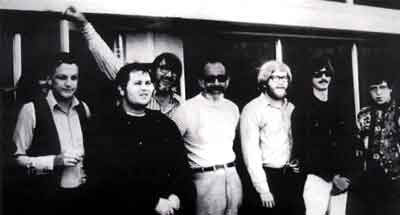
An early photo from Muscle Shoals, Dickinson on the far right. Early ’70s. Photo from Pop Culture Press.

That’s what Dewey Phillips did in Memphis that was so revolutionary. There can be no discussion about race relations in Memphis without talking about Dewey Phillips. He’s the disc jockey credited with playing Elvis Presley on the radio for the very first time. Which would have been enough, if that was all he ever did. But what Dewey did was, he created the mindset in Memphis, Tennessee that was Elvis Presley.

Elvis Presley heard “That’s All Right, Mama” on Dewey Phillips’ “Red, Hot & Blue” radio show on WHBQ because Dewey Phillips was the only white man who played black music. There were four radio stations that played white music for white people and two black stations that played black music for black people. Dewey Phillips would come on the air and he’d play his theme music and say, “Ho, ho, good people” because that’s who Dewey was talking to — good people. He played good music for good people. He’d play Hank Williams and then he’d play Sister Rosetta Tharpe. This created a mindset in Memphis that’s still there.

Until recently, we had a white county mayor and a black city mayor. Both of these mayors are roughly my age or younger. And at one six month period of time, they both quoted Dewey Phillips in the newspaper, and I don’t think either one of them was aware of the fact they were quoting Dewey Phillips. Because Dewey Phillips was so powerful a force on the radio in Memphis, that everyone in the city was affected by him. Certainly every child, everybody listened to this crazy, pilled-up redneck playing this insane music.

It wasn’t until I went to college in Texas that I realized everybody wasn’t hearing it. I realized I had this arcane information that they didn’t have, simply from listening to Dewey Phillips on the radio. The racial idea that he got across, was the idea of Elvis.

Think about the five records Elvis Presley recorded on Sun Records, 45 rpm records, two songs, one on each side. On one side of each record was a jump blues song, or “black music.” On the other side was a country ballad, “white” music. This is what was happening in Memphis at the time. The urban blacks coming to town and the urban whites coming to town — rednecks, if you will — were culturally colliding. And what was coming out, was Elvis Presley.

He was not unique. He represented a lifestyle that already existed in Memphis. It was almost a racial imperative for some of these white redneck guys to play this weird black music. I know these men. And some of them are still not comfortable with it, racially, but they were compelled to do it.

It’s freedom. It does the same thing to me that it does to everybody all over the world. It symbolizes individual freedom of expression and freedom. That’s what it is.

To find it, it’s like my first music lessons when I couldn’t see the music. I would have never understood music in the European tradition. I still don’t. But when I heard Afro-American music, something happened. And it wasn’t just me. It was a whole generation of crazy white boys that this happened to. That’s what rock and roll is. Us trying to be them.

Alec brought me a guy named Butterfly Washington, fresh off the penal farm, still had a penal farm haircut. He didn’t teach me anything, he just played for me. His father owned a gambling joint down on Broad St where Alec used to go.

This is pathetic, but it’s true. For a middle-class white kid in the fifties, even though this music was literally right down the road, the only way I could think of to find it was in books. So I went to the library, and sure enough there weren’t any. There was a Nat Hentoff book called You Hear Me Talkin’ which had one chapter about blues and jug band music with specific references to the Memphis Jug Band. So I did find what I exactly needed. But that was all there was. There were no books about the blues because white culture didn’t care about the blues, and black culture was ashamed of it at this point.

When Sam Charters wrote the Book of Country Blues in 1959 it was the first book on the blues. Although it’s filled with misinformation, it’s still probably the best book on the rural blues. I assumed incorrectly this music was antique. I should have known from seeing Howlin’ Wolf on the radio broadcasting from West Memphis, Arkansas. I didn’t know who he was, but heard the music, followed the music, saw the strange black man playing, till my father came and got me, just like with the jug band.

I knew the music was there, somewhere out in the bushes, but I couldn’t get to it. Through books, I thought I could. When Charters came through Memphis, being a Yankee and relatively insensitive, he cut quite a wide path. I just followed his path. By following his path I found Gus Cannon, who was first for me. He was right there, cutting somebody’s yard. Gus told me where Furry [Lewis] was. Hell, I thought Furry Lewis was dead. He was sweeping Beale Street twice a day with a garbage can on wheels and a push broom. He did it for 36 years. When he retired, the city found out he had only had one leg, which made him disabled therefore unemployable, so he didn’t get any of his benefits. And that’s why they call it the blues.

Furry literally swept Beale Street and he was prouder of that than making records, and proudly so. I used to work with Furry and Bukka White. Right before he died I taught him to play “Sunshine of Your Love.” He thought it was so funny. He could only play part of the riff, then he’d crack up.

Through Ruben Cherry’s Home of the Blues record label, the music became accessible. It did become an obsession to seek out this music and try to emulate it. Rufus Thomas and I used to be on panels together and would always start arguments whether or not white people could play the blues. Towards the end of his life, we did this interview for some TV show, I realized we had both changed our minds. He used to always jump in there, “Aw, white people can’t play the blues.” This time, he said, “I’ve just changed my mind. I’ve decided that white people can play the blues — they can’t sing it but they can play it.”

I told him that I had changed my mind. That after 40 years of trying to play the blues, I’d decided that white people can’t play the blues. The same thing that had changed Rufus’ mind was the same thing that changed my mind, which was Stevie Ray Vaughan, who as far as I’m concerned, was playing rock and roll. Like me, he was trying, but something was coming out. It’s the same with the Beastie Boys or Justin Timberlake. They can play them but they can’t feel the syncopated nuance of the implied eighth-note shuffle. It is a thing that is black. And I’m sorry, but it is.

Before the Beatles, this was not all right. It was not cool to be a musician. This was socially questionable to be doing what I was doing. It was not all right to play black music, believe me. The Rolling Stones made it OK. When I was doing it in 1958 in East Memphis, it was not all right.

William Brown, who was one of the black engineers at Stax and one of the singers in the Mad Lads, a brilliant singer who’s sung background on a lot of my records, told this story to someone who asked how long he’d known me. He’d said, “I’ve known him since we was both too young to be where we were.”

He sang with his uncles then. He was the youngest person in the group. (I never told anyone why I had to play before. Interesting) There’s no liquor by the drink, a lot of the entertainment was private parties. This was a high school fraternity party at this dump behind a motorcycle shop on Summer Avenue at this place called the Theatrical Arts Club, which had nothing to do with theater or art, believe me. They did have a stage and had a PA.

My band played a lot of parties there. It was illegal to play racially mixed. This was an all white band that night playing behind black singers, which was illegal. William says that before the gig started, I started an argument with the guy from the fraternity because he was paying the band $15 a piece and he was paying the singers $12 a piece because they were black. I told him that my band wasn’t going to perform with $12 singers. Either he was going to pay the singers $15 or my band wasn’t going to play.

William never forgot it.

I didn’t see any reason to pay them less than me. Certainly I wasn’t as good as they were. He should’ve been paying me less than them.

There’s a certain thing which you can only learn playing with black musicians. There’s a look that a black musician can give you, when you’ve done something stupid, that causes you to never do that again. There’s no other way to learn that. You don’t have to experience that putdown more than two or three times to change your stupid white way.

I first started playing mixed when I started playing Mar-Keys jobs. The real Mar-Keys had kind of broken up and Ray Brown would take one Mar-Key and five other people and take them to Sikeston, Missouri, to play for a sock hop. I did a lot of that stuff. Some of the most fun I’ve had in my life.

There were hassles, even up into the sixties. I remember one night, coming home from a Mar-Key gig, a mixed band in the car, and the cops, I guess, picked us up at Dyer’s Drive In, the only place with a black side and a white side that stayed open late, one of the only places to get something to eat after a gig. We left some white guy off, they didn’t hassle us. We left the Shann brothers somewhere downtown in one of the ghettos. They were the last two black guys in the car. When they got out, the cops drove up and rolled down the window, this big ol’ redneck cop stuck his head out and says, “You might as well just go on and live with them.”

That was the way it was. I was glad they drove away.

I was more afraid of cops than any of the black joints I ever went in. (NEVER SAID THIS BEFORE) The biggest hassle I had in the fifties and early sixties going into black joints was from gays. Being hit on by black homosexuals, assuming because I was white in a black joint, I must have been gay.

I think the Civil Rights movement was a little different in Memphis than it was in other places. I sang “We Shall Overcome” a couple times at folk music shows and tried to be as politically incendiary as I could be, but I didn’t march or sit-in.

I was on a picnic with my then girlfriend and her family the weekend Ole Miss was integrated and we saw the helicopters go overhead. We were just south of Memphis. When I got back home, the phone had been ringing off the wall from friends who were going down to Oxford to participate in the disturbance.

You sort of didn’t talk about it, not till the mid sixties. By then, I was already so entrenched in what I was doing, I was obviously a social misfit and outcast amongst my people. It wasn’t an issue for me. I didn’t see a choice. I saw how emotional my parents became when they watched Little Rock Central, which they both attended, integrated on television. It was difficult to deal with. I still remember my mother’s preacher, who was an Ole Miss graduate, his sermon during the Ole Miss integration. It was hard for them good Christian folks to deal with. But it couldn’t change how I felt about the music and what I saw as a more honest way of life.

Things changed in 1968, but again, I think things changed less in Memphis. If King had been assassinated anywhere but Memphis, it’d still be on fire. But because of Dewey Phillips and the mindset that was at work here, when King was assassinated, Detroit caught fire, Atlanta caught fire, DC caught fire, LA caught fire. But Memphis didn’t burn. Because it’s different.

I think it’s because of Dewey Phillips. I think it’s that simple. It’s because of the music.

The body politic was the anchor, they were pulling it the other direction. Mr. Crump don’t like it! That’s what the song says, “Mr. Crump don’t like it/They ain’t gonna have it here.”

Mr. Crump is just dead, he’s not gone. Believe me, he’s down there right now and he still don’t like it. What it is that he don’t like is what we’re talking about. But, like the rest of the song says, “We don’t care what Mr. Crump don’t allow/We’re gonna barrelhouse anyhow.” That’s the way Memphis is.
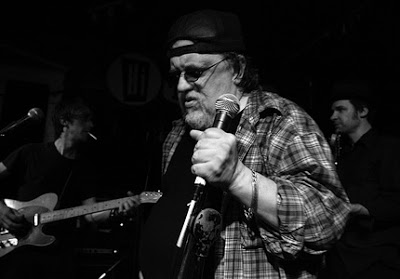
Photo from Paste Magazine.

I honestly believe there’s no place like Memphis, not racially. Today, every issue in Memphis comes down to race. The black culture is strong enough to survive, like Faulkner said. You have to look no further than rap music as proof that at this late date black culture is strong enough to do something that would be both repulsive to white people and compelling to their children. Is that not a miracle?

One of the reasons I live in Mississippi and you look around you here and see what has been depicted in the press, in both fact and fiction, as rural poverty. I don’t see it as poverty. It don’t look poor to me. It don’t look poor compared to Watts. These people will be here after the bomb drops. It’ll be cockroaches and the people in these sharecropper cabins. And their life isn’t even going to change much.

Now that’s not true of all of Mississippi. The Delta is mean, but it’s always been mean. It’s mean-spirited. It’s not just the white people that are mean. Black people are mean too. The Hill Country is not that way. The Hill Country is not like the Delta because it wasn’t desirable for plantation ownership. Some of these farms go back three, four generations — the black farms. There’s musical families who’ve been here long enough to create a tradition. This was not true in the Delta because all the people were itinerant, if they weren’t sharecroppers. They weren’t tied to the land. The musicians weren’t tied to the land. They all moved around. So there was no feeling of community like there is here. I love it here.

At least not have to answer to the man.

Again, it’s the fear of the cops. It’s the fear of authority.

The Hill Country hanging on to the blues tradition is some kind of miracle.

Somehow, Robert Palmer, the writer, was right. When he moved to Holly Springs, I thought he was crazy. But he was dead right. The Fat Possum label, although I disagree with them and their marketing technique of presenting the blues artist as primitive savage, a man I think of as literally a holy figure, what they’ve done is a miracle. First time I heard R.L. Burnside was 30 some odd years ago. Friend of mine made a tape of him. The first word out of his mouth was the N-word. I thought to myself, “God, this is so good, no one will ever hear it.” Well, now, R.L. Burnside has had a career. He opened for the Beastie Boys, the Cramps — that’s a miracle. And that’s progress. You can’t tell me it’s not racial progress.

Couple years ago at the Sunflower Blues Festival which is the only Mississippi blues festival left that hasn’t turned into a Bobby Rush concert — not to say there’s anything wrong with Bobby Rush, he just doesn’t have much to do with the Mississippi blues — I had been invited to be on some panel. My wife and I went down to Moon Lake, have a romantic night before the event. We went down into Clarksdale for breakfast in the morning. This was on the square, traditional little Mississippi restaurant. At the back table were these six big fat guzzled-gutted redneck businessmen who obviously were there every morning.

Without really listening, we could hear these men talking. Within the 45 minutes it took us to eat our breakfast, these guys who I venture to say 10-15 years earlier would have been in the Klan, may have still been — one guy obviously owned the restaurant — discussed Robert Johnson and William Faulkner. These are names that would have not been spat from these men’s mouths 10-15 years ago. They were discussing them both, in terms of tourism, admittedly. But they were still discussing Robert Johnson and William Faulkner as positive elements in their community.

As we left, they were standing up to leave about the same time we were, the big fat one who obviously owned the restaurant said, “You know, sometimes I have a hard time with them damn Faulkner stories. I don’t understand them.” This other guy, quick as a heartbeat, said, “Yeah, well, sometimes you’ve got to read them two or three times.”

Maybe there hasn’t been much progress, but anyone who says things haven’t changed in Mississippi doesn’t know how bad it used to be.

It was so bad, it created music and art that are second to none anywhere on earth.

The Delta blues itself was maybe 30 men for eight years. And it won’t go away. Robert Johnson is on the pop charts. The Delta blues continues to be reissued, reexamined, recategorized, redocumented. How many millions of dollars did Martin Scorsese spend on putting on that extravaganza of the blues? Do you think Charley Patton thought about that? I don’t. How surprised would Robert Johnson be, that he had generated $5 million in income? I think he’d be pretty surprised. But I think he would equally surprised his picture was on the front page of the Commercial-Appeal newspaper. Things have changed.

My point is, pop music is created as a disposable item. It makes you want more, like ice cream. You’re not even supposed to keep it. The blues is ultimately collectable, there’s a beginning and end. You can put the blues in a box in a corner and stack it up. There’s something appealing about that to western man. The blues is not going to go away. The Delta blues, unlike commercial music, is art. And art endures.

There’s nothing like the literary tradition here in Mississippi anywhere in America. How can you explain blues and writers? It’s not just William Faulkner, it’s Larry Brown. It’s going on as we speak. It’s because of something in the area. I think it’s the spirit. I don’t mean to get too metaphysical on you here, but people think it’s literally in the air and the water and all that. Although that has a little to do with it — I think it has a lot to do with the altitude we’re at — but I think there’s a spirit. I think it comes and goes. You can always feel a little of it.

As bad as Beale Street is now — it’s turned into a tourist trap; anyone would admit that. I got in trouble describing it in the press as a city-owned liquor mall, but that’s what it is. The racial implications of what they did with Beale Street is truly ugly — if you walk down the middle of Beale Street, especially when there’s nobody there, you can still feel something. It ain’t like what W.C. Handy felt. And it’s not the Beale Street of Will Shade. But there’s still something there and what you feel is that spirit.

Obviously it likes it here, or it wouldn’t keep coming back.

Memphis is the capital of Arkansas and Mississippi. It’s certainly unlike everything east of the Tennessee River. The Delta literally begins in the lobby of the Peabody Hotel in Memphis. You come down off Rabbit Ridge and there it is — the Delta. Flat. There’s nothing like it in America. I can’t leave. I tried to leave once and I had to come back. If I stay away from Memphis too long, I start to play really funny.

It’s not just the whites reaching for the black culture, it’s the blacks reaching for the white culture. It’s about the collision. If you drove through the ghetto in the sixties, you heard Eric Clapton on the radio, you didn’t hear Ray Charles. That’s what Stax [Records] was. Stax represents the period of time where the races really met, culturally, and then, interestingly enough, went beyond each other. Which is what is happening now. What happened was special and unique. It will never go away. Isn’t that the prediction of Faulkner, of Jim Bond, that it would all turn gray? Isn’t that what should happen.

Justin Timberlake [of the teen singing group N’Sych] was exposed to the result of Dewey Phillips. He was certainly exposed to Al Green. He’s doing the same thing Elvis did. He’s using a black idea, he’s singing in falsetto. What’s getting him across is the way he dances. He’s tremendously professional. He’s crossing racial boundaries. I think it’s a good thing. I don’t buy into any of this exploitation crap, the white musicians exploiting the black culture. That could not be farther than what I buy into. What it’s all about is the white musicians reaching for the black culture and the black musicians reaching for the white culture. If we all stay in our own backyard, what fun is that?

What was Nat King Cole if he wasn’t trying to sound white? There isn’t anything wrong with that. He was the first black man in Bel-Air. That was an accomplishment. He wouldn’t have got there if he was singing like Howlin’ Wolf. Here Johnny Ace from Memphis trying to sing like Perry Como back in the fifties. He wanted to get across. Should’ve kept that gun out of his mouth. That’s another issue.

I was conceived in Memphis and my mother thought is was somehow pagan to be born in Memphis so I was born in Little Rock. I think I somehow belong here. I must have been supposed to see what I saw, because I saw it.

If nothing else, a lot of black pseudo-intellectuals can listen to this and be horrified.

[Joe Nick Patoski, who lives near the village of Wimberley in the Texas Hill Country, writes about Texas and Texans. He has authored biographies of Willie Nelson, Selena and Stevie Ray Vaughan and has been published in numerous periodicals including Rolling Stone and Texas Monthly. This article was also posted to his blog, Notes and Musings.]

The Rag Blog

Posted in Rag Bloggers | Tagged , , , , , , , , , | 2 Comments

Rabbi Arthur Waskow : Poster Child for Lousy Health Insurance

Don’t mourn, organize:
How I became a poster child for lousy private health insurance

By Rabbi Arthur Waskow / The Rag Blog / August 27, 2009

For 25 years I have been a member of a private health insurance plan that seemed to be meeting my needs. My problems were routine, and so were their responses.

No longer.

Last Friday, I was involved in a moderate auto accident, driving on I-95 south of Philadelphia. My first resting place after the accident was a hospital bed in Chester,Pennsylvania, where I was diagnosed with a fracture of the “Tibia plateau” in my left leg where my leg hit the lower part of the dashboard, and four broken ribs and a broken breastbone where my chest hit the seat belt.

My leg was put in an “immobilizer,” with the expectation it would take about 8 weeks to heal. The broken ribs make it very hard to use crutches or a walker (because putting weight on my chest HURTS). So my own primary doc and the hospital docs agreed I should go to a rehabilitation center that would focus on physical and occupational therapy to get me quickly strengthened and trained to function well. The rehab people came, looked, and agreed I was the Perfect candidate.

But not the health insurance company.

Rehab is too good. Services higher-level that I needed. Costs them more than “skilled nursing,” which does PT only one hour a day — rehab does three. Rehab costs more, reduces insurance-company profits. If I had broken both legs, yes. “BUT,” we said, appealing the decision, “remember the ribs? This is hard and painful work. The more intensive time and energy I can put in, the quicker it will be over!”

NOPE.

Now this kind of decision, remember, was what the companies charged would result from a “government-sponsored public option.” The government would interfere between me and my doctors. But in tens of thousands of cases, the companies do exactly what they say the government would do. They are insuring not good medicine but high profits. The Public option would be able to say, “It’s good medicine, and we don’t seek a profit. Rehab, quick.” They would compete with the private insurers, and keep them honest.

When I told the hospital doc what had happened, he muttered, “What is wrong with us?” Then he said, “Universal health care is what we need.” Then he was quiet for a while and muttered again, “There’s too much power in too few hands.”

“See,” I said. “You knew all along what was wrong with us.”

Ted Kennedy, the one Senator who had so many sick siblings and sick kids that he really understood, died yesterday. The old saying, “Don’t mourn; organize,” is wrong. DO mourn – and 0rganize. Make every moment of your mourning for him a time of organizing, and every moment you spend organizing a time to mourn. Your Senators are home this week. Call. Ask them whether, like Senator Sherrod Brown of Ohio, they are willing to give up their own fancy public health-insurance until a public option exists for everybody in our country.

I’m awake at 3 a.m. because my ribs are hurting. I would be grateful if you would pray for my healing. I would be many times more grateful if you would set aside seven sacred minutes to call your senators to urge them to put a “Public Option” in the health-care bill. If you can’t find their home offices, call the US Capitol at 202/224-3121 in Washington, and ask for the Senators from your state.

That’s the healing we ALL need.

Shalom, salaam, shantih — Peace!

Arthur

[Rabbi Arthur Waskow is director of The Shalom Center. He can be reached at awaskow@shalomctr.org.]

The Rag Blog
Posted in Rag Bloggers | Tagged , , , , | Leave a comment

For the First Time: A Two-State Israel/Palestine Solution with a Specific Time Line

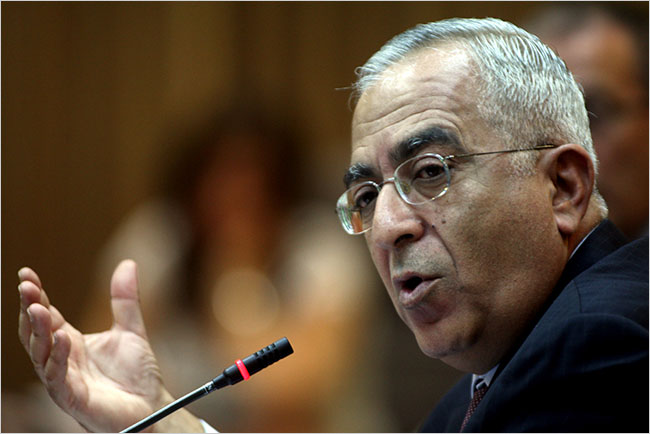
Prime Minister Salam Fayyad announced the plan, the first of its kind from the Palestinian Authority, in his Ramallah office. Photo: Abbas Momani/Agence France-Presse — Getty Images.

Palestinians Plan State, but Will Netanyahu Block it?
By Juan Cole / August 26, 2009

The Palestinian prime minister, Salam Fayyad, has put forward a plan for a Palestinian state to be attained within 2 years. This is the first time such a blueprint with a timeline has been offered and it is a very big deal. The reason it can be taken more seriously than most talking points generated by the Israeli-Palestinian ‘negotiations’ (the longest-running ugly divorce in contemporary history) is that President Obama is dedicated to a two-state solution. If he is going to get one, something like Fayyad’s plan is crucial, and so is a timetable of some sort (it has to be before the presidential campaign season in 2012).

Of course, the Likud government of Israel is all about preying on the Palestinians’ land and resources and is die-hard opposed to a two-state solution. Israel is strangling the Palestinian economy.

The Israelis are restricting Palestinians’ water supply and essentially using their water at a rate 4 times that of the Palestinians.

Dozens of Palestinians in East Jerusalem have been pushed out of their property by Israeli squatters and are now forced to sleep in the streets.

Israeli illegal immigrants into the Palestinian West Bank routinely act like thugs, beating up on Palestinians and stealing from them.

Israel has 11,000 Palestinians behind bars, and has repeatedly blocked family visits to prisoners, which the Red Cross has called a violation of the Geneva Conventions and international law more generally.

The Israeli military justified the attack on an unarmed American peace protester as a ‘justifiable act of war.’ (He is in a perhaps permanent coma).

Much of the US press, as usual, is ignoring the belligerent statements of Likudniks in the Israeli government and misrepresenting the Palestinians, whose statelessness (and consequent lack of human and legal rights) is imposed on them by a brutal Israeli military occupation and/or perpetual siege and blockade.

If there is going to be a two-state solution, as Obama insists and toward which the Fatah government in the West Bank is now moving quickly, it will depend on level-headed Israelis who recognize that the occupation of the Palestinians is actually a threat to Israel. I’m not optimistic that the rumored turn to a harder line against Iran by Obama in return for a Likud acquiescence in a Palestinian state will actually work. A gasoline boycott on Iran won’t be effective, and the Likud will likely drag its feet so that in the end it will get everything its leaders want– no real Palestinian state, continued subjection and exploitation of the Palestinians, and plus bad US-Iran relations and sanctions on Iran.

Now may be a time for Avi Shaked, the multi-billionaire internet entrepreneur, to make another offer.

On April 4, 2009, Haaretz revealed that Avi Shaked had been an extremely influential figure in the Geneva Accord Track II negotiations between liberal Israelis and the Palestinians.

In 2006, Shaked made headlines by offering then Prime Minister Ehud Olmert and Palestinian Authority President Mahmoud Abbas a billion dollars. (H/t to this poker site for preserving this news item) if only they would just make peace already. Given how corrupt both governments are, it is amazing that no one took Shaked up on his offer.

I’m being a little tongue in cheek, of course. But influential and prominent pro-peace Israelis like Shaked do exist, and even the right of center Kadima Party has accepted the need for two states. I keep hoping that Netanyahu’s government will fall and that those Israelis who want to do the right thing, for themselves and for the Palestinians, will get in in time for Obama to finally settle this dispute, which has poisoned the Middle East against the United States and generates enormous violence and tragedy on both sides.

Source / Informed Comment

The Rag Blog

Posted in RagBlog | Tagged , , , | Leave a comment

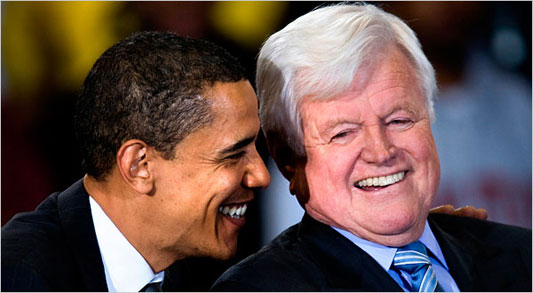
Tom Hayden : On the Death of Ted Kennedy

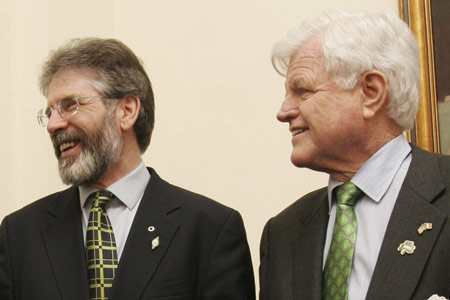
Ted Kennedy, right, with Sinn Fein leader Gerry Adams, worked for an Irish peace.

Were he alive today, the Democratic Party would be less likely to drift away from its progressive legacy in the name of victory at any price.

By Tom Hayden / August 26, 2009

In his final months, he became the progressive anchor of the Barack Obama campaign. When I saw them together early in 2008, it was not easy for Ted Kennedy to oppose the party’s favorite, Hillary Clinton, on behalf of a young tribune of hope. But he did. Ted Kennedy sailed against the wind.

Were he alive today, we would have a better health care bill than anything that will emerge from this Congress. Perhaps the Senate could be shamed into voting for a bill worth of his name, but I am doubtful. Were he alive today, he surely would have counseled the president to extract our troops from Afghanistan as rapidly as possible, just as his brother Robert in 1967 decided to separate himself from his brother John’s earliest Vietnam policy. The president will miss Ted Kennedy’s wisdom amidst all the current preening and chattering in the newest ranks of the best and the brightest.

Were he alive today, Ted Kennedy would recommend diplomacy toward our apparent adversaries, just as he supported a US visa to permit Gerry Adams to enter America in search of an Irish peace. Kennedy favored the visa against the counsel of the State Department and CIA at the time.

Were he alive today, the Democratic Party would be less likely to drift away from its progressive legacy in the name of victory at any price. He was too old and experienced, had suffered through too much, to fall victim to the latest fads of the ambitious. He knew that the winds of change always return, even in the slackest tides.

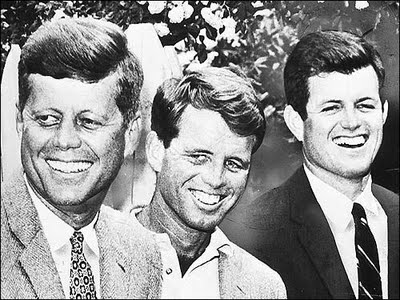
I first met Ted Kennedy in 1962, when he was the kid brother, already a US senator. I hated the system of perks and privileges when most young men of my generation were facing the grim reaper of the draft. I thought his brothers were full of progressive possibility, but too imprisoned in the Democratic machine, too ambitious for technical fixes. All that began to change when they were deceived by their own CIA and Joint Chiefs at the Bay of Pigs, and again in South Vietnam, which led them to consider withdrawal from Southeast Asia and the horrifying Cold War nuclear arms race. They awakened to the spirit of the civil rights and student movements too. Then came the Dallas assassination, then the King assassination, then Bobby’s assassination here in Los Angeles.

The utter madness of it all surely contributed to Teddy’s spiral downward. The miracle was his steady recovery and his eventual restoration and extension of the Kennedy family legacy. When I last saw him, during an informal get-together in his Senate office, it was as if much of his youth, his ironic humor, his fighting spirit, and his empathy for social movements, had returned.

If we understand Ted Kennedy as the most progressive and effective member of the United States Senate, whose politics are echoed generally across the whole Kennedy family, we must draw the conclusion for our generation and the country as a whole. If either of the earlier Kennedy brothers had not been murdered, the likelihood is that American would have evolved steadily in a progressive direction, without Vietnam, without the black uprisings and repressions, without Nixon and Watergate, because that was the trajectory where Ted Kennedy believed his brothers’ legacy would be honored.

That is why, as Jack Newfield wrote in 1968, we would become not a generation of has-beens, but a generation of might-have-beens, while we were very young.

Ted Kennedy knew at the deepest level that only a new and hopeful generation of activists might lift America from the life of sorrows that he, and the rest of us, were forced to endure.

[Tom Hayden is a former state senator and leader of Sixties peace, justice and environmental movements. He currently teaches at Pitzer College in Los Angeles. His books include The Port Huron Statement [new edition], Street Wars and The Zapatista Reader.]

Source / The Huffington Post

Thanks to Carl Davidson / The Rag Blog

Posted in RagBlog | Tagged , , , , | 1 Comment

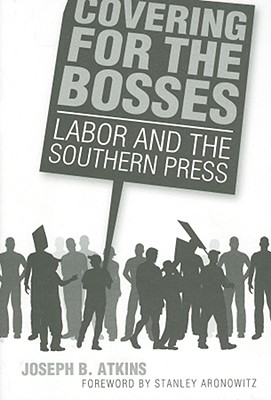
BOOKS / Covering for the Bosses : Labor and the Southern Press


Dixie Media Versus Unions

How Southern media have strengthened the region’s corporatocracy.

By Roger Bybee / August 26, 2009

[Covering for the Bosses: Labor and the Southern Press by Joseph B. Atkins, 224 pp, University Press of Mississippi, July 1, 2008, $45.00.]

The slavocracy — rooted Southern model of low wages and harshly anti-union labor relations has successfully undermined and defeated many social-welfare protections throughout the nation. Indeed, the South increasingly sets the terms of America’s social contract between labor and capital, as was apparent during last December’s debate over federal aid to General Motors and Chrysler.

Southern senators –all from states home to non-union auto factories run by international firms — claimed that excessive United Auto Worker (UAW) wages were responsible for Detroit’s crisis, insisting that only massive wage cuts imposed immediately by the federal government would address the problem. As a result, the UAW has been forced to accept a starting wage of $14.50 per hour for new autoworkers -— a bit more than half the typical $26 to $28 union wage.

More broadly, the Southern model of all-powerful management, docile low-wage labor and public subsidy-fueled operations has become the dominant form of U.S. capitalism exported around the globe, argues Joseph Atkins in his compelling book Covering for the Bosses: Labor and the Southern Press (University Press of Mississippi, 2008). The media of the former Confederacy has played a crucial role in promoting the low-wage Southern model, and Atkins traces its development alongside the still-strong oligarchic pillars of the South.

Throughout the Southern system’s history, the region’s media have almost invariably been part of what Atkins labels the “solid phalanx” of powerful interests: a unified business community, elected officials, the clergy and other opinion shapers. Southern newspapers and radio stations joined the forces relentlessly battling unions, the New Deal and advancements in civil rights for African-Americans.

Southern media acted as uncritical stenographers transmitting and amplifying the crudely racist views of segregationist politicians like Strom Thurmond and Theodore Bilbo, who viewed the Congress of Industrial Organizations, the civil rights movement and communism as equal partners in a grand conspiracy to destroy the Southern way of life.

Eventually, the overt resistance by Southern media to African-American rights receded, as it conflicted with the image of a tranquil, cosmopolitan “New South” open to investors from the entire world. But to this day, the Southern press routinely celebrates corporations’ investments —- however richly subsidized by the public —- as a beneficent gift to local communities. Few media outlets have investigated any corporate misconduct or even acknowledged the existence of unions and the plight of low-wage workers.

By the 1970s, the South had become the main fulcrum by which Corporate America gained the leverage to engage in what the late UAW President Douglas Fraser in 1976 called “a new class war.” The war escalated in the 1980s as unionized workers in the North were routinely threatened with the loss of their jobs to the South unless they took pay cuts. State legislatures across the North found themselves under pressure to slash corporate taxes to create a “good business climate.”

Corporations succeeded in winning enormous state and local tax cuts and reaped the benefits of an ever-escalating competition between states for jobs. But in many cases, corporations merely pocketed these tax benefits and joined an onrushing tide of Northern-based firms opening up new non-union subsidiaries in the South. The South became the nation’s fastest growing region, in terms of both jobs and population.

This approach to luring industry with subsidies has during the past eight decades evolved into an interstate race to the bottom, encouraging low wages, low corporate tax rates and rich packages of incentives for corporations that don’t need them —- all at the expense of public needs.

Ironically, as Atkins notes, the South has been hit hard by “free-trade” agreements like the North American Free Trade Agreement, which was aggressively promoted by Arkansas-born President Bill Clinton and gained overwhelming support from corporate-friendly Southern legislators of both parties. Corporate America’s leap-frogging to even-lower-wage nations like Mexico and China has begun to seriously deplete the former Confederacy’s manufacturing base, in much the same way that the South once sapped jobs from Northern states. Thus, capital’s mobility has succeeded in undermining the U.S. labor movement as an effective force for economic and social democracy, especially in the South.

As Atkins’ book vividly shows, another crucial component of genuine democracy has been grievously lacking in the South: independent mass media willing to challenge and investigate corporate power and to serve as the voice of those shut up by bosses, shut out of power and shut down by multinational corporations seeking ever cheaper labor.

[Roger Bybee is a Milwaukee-based freelance writer and progressive publicity consultant whose work has appeared in numerous national publications and websites, including Z magazine, Dollars & Sense, Yes!, The Progressive, Multinational Monitor, The American Prospect and Foreign Policy in Focus. Bybee edited The Racine Labor weekly newspaper for 14 years in his hometown of Racine, Wis., where his grandfathers and father were socialist and labor activists. His website can be found here.]

Source / In These Times

Find Covering for the Bosses: Labor and the Southern Press at Amazon.com.

The Rag Blog

Posted in RagBlog | Tagged , , , , , | Leave a comment

Whole Foods : Investment Group Calls for John Mackey’s Head


Investment group calls for Mackey’s head;
Whole Foods tries damage control

CtW Investment Group calls on Whole Foods board to remove Chair and CEO John Mackey; Says damage caused by WSJ op-ed shows Mackey is a ‘liability’

See full text of letter, Below.

The CtW Investment Group called on the Whole Foods Market (NYSE:WFMI) board to remove CEO John Mackey as Chairman and to begin the process of naming a new CEO in a letter to Whole Foods’ lead independent director, Dr. John Elstrott, yesterday afternoon [October 24, 2009]. Citing the risk to Whole Foods’ brand reputation caused by Mr. Mackey’s editorial opposing President Obama’s proposed healthcare reform, CtW urged the board to take immediate action to prevent continued damage in the face of a quickly-growing boycott by Whole Foods’ progressive customer base.

“Mr. Mackey attempted to capitalize on the brand reputation of Whole Foods to champion his personal political views, but has instead deeply offended a key segment of Whole Foods consumer base,” said CtW Investment Group Executive Director Bill Patterson. “This is not the first time Mr. Mackey’s unsanctioned communications have damaged Whole Foods’ image with consumers and investors. At a time when shareholders are looking for Whole Foods’ management to focus on improving operations in an uncertain economy, we can not afford the risk to our Company’s brand reputation caused by Mr. Mackey’s indiscretion. He has become a liability and the board should begin the process of identifying a suitable replacement.”

CtW Investment Group

Whole Foods attempts to quell boycott cries

By Alex Palmer / August 26, 2009

Protesters and unhappy customers have taken to the streets and to social networking sites to express their displeasure regarding Whole Foods chief executive John Mackey’s recent Wall Street Journal op-ed column. Some are threatening to boycott the store altogether.

The column, which appeared on Aug. 12, was critical of President Obama’s healthcare plan. It urged the country to embrace a more free-market healthcare system. “A careful reading of both the Declaration of Independence and the Constitution will not reveal any intrinsic right to healthcare, food or shelter. That’s because there isn’t any. This ‘right’ has never existed in America,” Mackey wrote in the piece.

Today, members of the Washington, D.C.-based United Food and Commercial Workers Union demonstrated outside Whole Foods stores in two locations in Ohio and plan to continue disseminating educational materials to shoppers over the next few weeks.

The group has emphasized the incongruity between Mackey’s assertions and the brand image that Whole Foods has built. “Whole Foods has attempted to wrap itself in a progressive image, but when you peel back the layers you see that it is run by an executive who repeatedly pushes extreme positions,” said Scott Frotman, spokesman for the union. “Frankly, Mackey’s ideology seems more in line with the radical tea baggers harassing people at town hall meetings than the men and women waiting in line to buy organic green tea in his stores.”

Online, the playwright Mark Rosenthal’s “Boycott Whole Foods” Facebook group now has over 26,000 members. Whole Foods’ Facebook page has comments from numerous supporters stating their solidarity with Mackey and commitment to their local stores.

“While Whole Foods Market has no official company-wide position on the healthcare reform issue, we would not want our very successful and sustainable healthcare coverage to be jeopardized,” said the company in a statement. “We have heard from individuals who both agree and disagree with John’s ideas, as there are many opinions and emotions surrounding the ongoing healthcare reform issue, including lots of differing views here inside of Whole Foods Market. We appreciate those diverse perspectives, but it is unfortunate there is misinformation and confusion out there to cloud John’s good intentions.”

Whole Foods sent out letters to customers apologizing for any offense that may have been created and started a forum on its Web site for discussion of healthcare reform (Currently it has over 17,000 posts, compared to 249 on favorite recipe swaps.)

Still, consumers are likely to lump the CEO’s personal opinion together with the brand. Especially considering Whole Foods has a highly engaged customer base, many of whom are deeply concerned about the issues of health and food, said Amy Shea, global director of Brand Keys. “It becomes problematic for a brand when you have the emotional side firing, and that’s what [Mackey] did, he tripped that wire. It’s never a good idea for a CEO to do an op-ed piece on such a volatile topic. Of all the topics he could have chosen, he chose one that is very, very close to the space in which the brand participates.”

Source / Brandweek / Posted Aug. 24, 2009

Letter from the CtW Investment Group to the Whole Foods Market Board of Directors

August 24, 2009

Dr. John B. Elstrott
Lead Independent Director
c/o Director of Internal Audit
Whole Foods Market
550 Bowie Street,
Austin, TX 78703

Dear Dr. Elstrott:

Events of the past week establish yet again that John Mackey’s lack of personal discipline makes him a liability for Whole Foods Market, Inc. Despite past indications that the board needed to exercise independent oversight of Mr. Mackey and supervise his external communications closely – most notably his postings on the Yahoo! Finance bulletin board, which led to an SEC inquiry – you and your fellow directors failed to take meaningful action to prevent Mr. Mackey’s uncompensated brand and reputational risk to our Company.

The board must now recognize that managing reputational risk is central to building shareholder value at Whole Foods and act accordingly. Replacing Mr. Mackey as Chairman and CEO is the critical first step in this process. We first raised questions regarding Mr. Mackey’s leadership in a July 25, 2007 letter to you in which we called on the board to immediately remove him as Chairman and determine what additional steps were warranted in response to Mr. Mackey’s ill-advised Yahoo! Finance postings. As a result of the board’s inaction, Mr. Mackey’s indiscretion has continued to place our Company’s brand reputation at risk. We therefore call on the board to immediately undertake the following:

  • Immediately remove Mr. Mackey as Chairman of the Board.
  • Establish and disclose to shareholders a clear succession plan so that he can be removed expeditiously from his position as CEO as soon as feasible; the plan should detail how the board intends to ensure that CEO succession is a routine topic of discussion by the board, there is an emphasis on development of internal candidates while remaining open to external candidates, all board members are given exposure to internal candidates, and that there is both a long-term perspective to address expected CEO transition periods and a short-term perspective to address crisis management in the event of death, disability, or an untimely departure of the CEO.
  • Quickly implement a board policy and process for supervision of executive communications in order to ensure that Mr. Mackey can cause no further damage to Whole Foods’ brand and reputation in his remaining time with the company.
  • Commit to issuing a thorough and exacting annual review of all political or partisan uses of corporate resources, including a justification of any such expenditure, and make this review publically available.

The CtW Investment Group works with pension funds sponsored by unions affiliated with Change to Win, a federation of unions representing nearly 6 million members, to enhance long-term shareholder returns through active ownership. These funds are substantial long-term Whole Foods shareholders.

Whole Foods’ Unique Strength and Vulnerability

Whole Foods is the leading national provider of natural and organic foods, and as such has benefitted from growing environmental and health consciousness among affluent urban consumers. However, this leading position makes Whole Foods uniquely vulnerable to disaffection from these core customers if they perceive that the company is not managed in a manner consistent with their values. Following the publication of Mr. Mackey’s op-ed piece opposing President Obama’s health care reform proposal on August 16, 2009, Whole Foods customers have reacted with outrage: at least 26,000 have now joined a Whole Foods Boycott page on Facebook. Numerous commentators have noted that a boycott of Whole Foods by politically progressive customers could cause a significant loss of shareholder value. We note with apprehension that the Company’s letter of apology to customers – the necessity of which reinforces our concerns – appears to have done nothing to soften the backlash against Mr. Mackey, and unfortunately, Whole Foods itself.

While we respect Mr. Mackey’s First Amendment right to express his political views, as he did for instance in noting that the Constitution contains no “right” to health care, we hasten to point out that neither the First Amendment nor any other provision of the Constitution give Mr. Mackey or any other CEO the right to retain their position regardless of behavior or performance. Moreover, Mr. Mackey’s article was not a citizen’s “letter to the editor,” but a lengthy op-ed that explicitly tied him to Whole Foods by identifying him as the CEO. Given Whole Foods’ unique exposure to a key segment of the customer base, Mr. Mackey’s decision to express his views in such a public way, and on an issue of such enormous moment, seems ill-advised at best.

As noted above, we first called on the board to remove Mr. Mackey as chairman and to evaluate his suitability as director and CEO in a letter to you over two years ago. In that letter, we specifically called the board to investigate whether Mr. Mackey’s Yahoo! Finance postings violated Whole Foods’ code of conduct and to establish clear disciplinary policies for unsanctioned executive communications. Unfortunately, you failed to take any meaningful action, and now Whole Foods shareholders again face potentially damaging fallout from unmanaged and uncompensated reputational risk.

Similar inaction now is unacceptable. The board must act immediately to address the burgeoning crisis caused by Mr. Mackey’s undisciplined behavior or shareholders will have little option but to conclude that you and your fellow directors are unable or unwilling to hold management accountable.

Sincerely,

William Patterson
Director

CC: Whole Foods Market Board of Directors

Source / CTW Investment Group

Thanks to Roger Baker / The Rag Blog

Posted in RagBlog | Tagged , , , , , | 4 Comments

The Lion Passes: A Different Look at Chappaquiddick


Teddy Kennedy and Chappaquiddick:
The official story doesn’t wash

After the airplane crash and the shooting of JFK and RFK, killing Ted Kennedy would not do. Gullible as the public is, too many would think a plot was afoot. Kennedy had to be neutralized by some sort of scandal that would damage any run for the White House.

By Sherman DeBrosse / The Rag Blog / August 26, 2009

Brain cancer has claimed the life of Edward M. Kennedy, most likely the greatest U.S. Senator of recent times. Over the decades, “the Lion of the Senate” courageously stuck by his guns, bucking a national conservative tide, seeking justice and to improve the lives of his fellow citizens.

Some historians will see a parallel between Ted and his two slain brothers and the Gracci brothers of ancient Rome who fought for ordinary citizens in the second century BC. Senator Kennedy was known for a great sense of humor and compassion for the sufferings of others. For example, he often sat by the bedside of Senator Phil Hart and performed many kindnesses for columnist Mary McGrory, when a stroke felled her and made it difficult to speak.

Sen. Edward Kennedy with President Barack Obama.

Yet, it is likely that he will be remembered for the 1969 incident at Chappaquiddick, in which Mary Jo Kopechne, 28, drowned in an accident most blame on Kennedy. Witnesses said she did not drink that night or at other times, yet she had a high blood alcohol level. There was a puncture mark on the back of her neck, and it is possible to inject ethanol that way.

Ms. Kopechne was a self described “novena Catholic,” who did not like bad language or sexual impropriety. She was described as an idealist and serious. She was close to being engaged to a foreign service officer. She was one of the “boiler room girls” who had worked in the Robert F. Kennedy presidential campaign. They were all well-educated and professional people of good character, not mere secretaries looking for a good time. Mary Jo was simply attending a reunion of campaign friends.

The public perception of that incident is based largely on the assumption that Kennedy was a very different man. It could be that we do not have the full story of the event that was to be forever linked with his name.

Conservatives assume heavy drinking and sexual involvement without a shred of evidence about either. Kennedy admits to letting nine hours elapse before reporting the accident, which would place the blame for a death on him. However, very little of that story makes a lot of sense.

A writer named Bob Cutler put together a scenario of what could have happened. Here it is in the words of Richard Sprague.

The Group hired several men and at least one woman to be at Chappaquiddick during the weekend of the yacht race and the planned party on the island. They ambushed Ted and Mary Jo after they left the cottage and knocked Ted out with blows to his head and body. They took the unconscious or semi-conscious Kennedy to Martha’s Vineyard and deposited him in his hotel room.

Another group took Mary Jo to the bridge in Ted’s car, force fed her with a knock out potion of alcoholic beverage, placed her in the back seat, and caused the car to accelerate off the side of the bridge into the water. They broke the windows on one side of the car to insure the entry of water; then they watched the car until they were sure Mary Jo would not escape.

Mary Jo actually regained consciousness and pushed her way to the top of the car (which was actually the bottom of the car — it had landed on its roof) and died from asphyxiation. The group with Teddy revived him early in the morning and let him know he had a problem. Possibly they told him that Mary Jo had been kidnapped. They told him his children would be killed if he told anyone what had happened and that he would hear from them.

On Chappaquiddick, the other group made contact with Markham and Gargan, Ted’s cousin and lawyer. They told both men that Mary Jo was at the bottom of the river and that Ted would have to make up a story about it, not revealing the existence of the group. One of the men resembled Ted and his voice sounded something like Ted’s. Markham and Gargan were instructed to go the the Vineyard on the morning ferry, tell Ted where Mary Jo was, and come back to the island to wait for a phone call at a pay station near the ferry on the Chappaquiddick side.

The two men did as they were told and Ted found out what had happened to Mary Jo that morning. The three men returned to the pay phone and received their instructions to concoct a story about the “accident” and to report it to the police. The threat against Ted’s children was repeated at that time.

Ted, Markham and Gargan went right away to police chief Arena’s office on the Vineyard where Ted reported the so-called “accident.” Almost at the same time scuba diver John Farror was pulling Mary Jo out of the water, since two boys who had gone fishing earlier that morning had spotted the car and reported it.

Ted called together a small coterie of friends and advisors including family lawyer Burke Marshall, Robert MacNamara, Ted Sorenson, and others. They met on Squaw Island near the Kennedy compound at Hyannisport for three days. At the end of that time they had manufactured the story which Ted told on TV, and later at the inquest. Bob Cutler calls the story, “the shroud.” Even the most cursory examination of the story shows it was full of holes and an impossible explanation of what happened.

Ted’s claim that he made the wrong turn down the dirt road toward the bridge by mistake is an obvious lie. His claim that he swam the channel back to Martha’s Vineyard is not believable. His description of how he got out of the car under water and then dove down to try to rescue Mary Jo is impossible. Markham and Gargan’s claims that they kept diving after Mary Jo are also unbelievable.

Leaving aside talk of an unidentified “group,” Cutler’s theory still makes a lot more sense than Ted Kennedy’s first statement, which follows:

On July 18, 1969, at approximately 11.15 on Chappaquiddick Island, Martha’s Vineyard, I was driving my car on Main Street on my way to get the ferry back to Edgartown.

I was unfamiliar with the road and turned onto Dyke Road instead of bearing left on Main Street. After proceeding for approximately a half mile on Dyke Road I descended a hill and came upon a narrow bridge. The car went off the side of the bridge.

There was one passenger with me, Miss Kopechne, a former secretary of my brother Robert Kennedy. The car turned over and sank into the water and landed with the roof resting on the bottom. I attempted to open the door and window of the car but have no recollection of how I got out of the car. I came to the surface and then repeatedly dove down to the car in an attempt to see if the passenger was still in the car. I was unsuccessful in the attempt.

I was exhausted and in a state of shock. I recall walking back to where my friends were eating. There was a car parked in front of the cottage and I climbed into the back seat. I then asked for someone to bring me back to Edgartown. I remember walking around for a period of time and then going back to my hotel room. When I fully realized what had happened this morning, I immediately contacted the police.

It took Kennedy and his circle three days to concoct a more complete explanation of what happened. They had to deal with the fact that the young woman died in the back of his car after running out of air. Ted’s pregnant wife Joan was at Martha’s Vineyard, and the girl had been at a party that Kennedy attended.

The brothers: from left, Jack, Bobby and Teddy.

It was better to let people make assumptions about alcohol than illicit sex. Oddly, the Kennedys paid to have tests conducted to see if the car would have come off the dock and into the water in the manner Ted said it did. They should have looked into the likelihood of his getting out of a submerged car. They must not have really known what happened. It is doubtful if anything the Kennedy circle said after the official story came out can be believed. Their comments all supported a very implausible story.

He said he got out of the car, which was underwater and then started diving into Poucha Pond to save Mary Jo. Did he open the car door, exit, and then close it? This might happen in the movies, but not in real life. In The Bridge at Chappaquiddick, Jack Olsen argues that the water pressure would have been too great for Kennedy to open the car door. A window was broken, admitting water, but only Harry Hudini could have gotten out through it.

After eight attempts to rescue her, Kennedy went back to the cottage, got help, and returned to the diving.

The wounds above his ear and the large bump on the top of his head indicate he was probably knocked unconscious. But how and where? Police saw the broken windshield and wondered why Kennedy’s head and face did not reflect the level of damage associated with a wreck of that scale. . His face bore no marks.

Markings on the bridge suggest the car was at rest and then somehow greatly accelerated. It had to have been in the air for a distance before landing in the water. There was a rope attached to a stick that could have been attached to the rear-view mirror, which was askew and hanging only by one screw.

The Kennedy story does not match the testimony of Deputy Sheriff Christopher Look and three others, that two women were with Kennedy that night at 12:45 . Of course, the senator was completely familiar with those roads, but there had to be an explanation for where the car was found.

There are some other odd things about the official story. All the witnesses who knew Mary Jo said she did not drink at all and that she did not drink that night. Yet there was alcohol in her blood stream.

It is just assumed Kennedy was smashed, but no witness said this was the case. His chauffeur John Crimmins was present and could have driven Kennedy. If he wanted sex with Mary Jo, he would have stayed at the Lawrence cottage. Why did he not have Crimmins drive and Mary J to the hotel?
.
Senator Kennedy said he swam a complicated route from Chappaquiddick back to the inn on Martha’s Vineyard. Professional swimmers have not been able to duplicate swimming that route at the same time and against the same tides. People assume he swam it dressed, but if it happened at all, he had to be in his shorts. But Kennedy, exhausted from the night’s exertions, claimed he was able to do this. No one saw an all wet Kennedy when he reached the Edgartown inn.

Even at the time, in 1969, many noted that he did not behave at the hotel the next morning as though he knew that Mary Jo was dead or that anything was wrong. It is pretty clear that he did not know until former U.S. Attorney Paul Markham and Joe Gargan arrived and told him about the tragedy. An elderly couple saw Kennedy coming into the dining room. He was relaxed and completely at ease. When the two men spoke to him he seemed to be completely shocked and upset.

The three men then made the trip over to Chappaquiddick to use the pay phone. This makes no sense unless they went there to receive a call, not make one. There were pay phones at the hotel.

Some wonder about the June, 1964 airplane crash in western Massachusetts in which only Edward Kennedy emerged a survivor. He was laid up for some time with serious injuries. Teddy came out of that alive. If anyone wanted to harm Ted Kennedy it was either to prevent him from running for president or, more likely, to prevent him from using the power of that office to examine the deaths of his brothers.

After the airplane crash and the shooting of JFK and RFK, killing Ted Kennedy would not do. Gullible as the public is, too many would think a plot was afoot. Kennedy had to be neutralized by some sort of scandal that would damage any run for the White House.

E. Howard Hunt, later a Watergate burglar, was at Martha’s Vineyard.

One witness has said that James McCord, a CIA agent, and one Albert Peterson followed Kennedy throughout 1969. The witness added that Peterson was an alias for E. Howard Hunt. Frank Sturgis and E. Howard Hunt were on Martha’s Vineyard at the time for a Regatta. Both had CIA connections and would be among the Watergate burglars later. Hunt explained to Watergate investigators that he was there to gather dirt on Kennedy but only admitted to getting there after the accident.

He came to see some unknown person and admitted to having a disguise and a voice alteration device. Charles Colson later obtained the disguise from the CIA and Hunt used them at the burglary of the office of Daniel Ellsberg’s psychiatrist and at the break-in at the Democratic National Committee Headquarters at the Watergate. Hunt’s son St. John said his father spoke with approval of the murders of JFK and RFK and wanted to finish the job on Ted Kennedy. David Morales, a CIA hit man, was photographed at the Ambassador Hotel.

Richard Milhouse Nixon also had an operative there that day, but the president may not have known about it at the time. Nixon had established Operation Sandwedge to keep track of Kennedy and other enemies. Tony Ulasewicz, a skilled investigator in Nixon’s employ, admits being there the morning after the accident. He said he was sent there to dig up dirt on Kennedy. However, he was seen there that morning before news of the accident was public.

In a conversation between John Dean and President Nixon, Dean refers to him without mentioning him by name, saying that he was there again in 1971, both times posing as a reporter and steering other reporters to look into matters that would damage Kennedy. However, it appears he was poking around there for about two years and may have come up with something that showed Kennedy had been set up. Dean said to Nixon, “If Kennedy knew the bear trap he was walking into…”

It sounds as though they could prove the White House had nothing to do with the accident, but perhaps they knew who did. If Nixon had an even more damaging story about Kennedy and Chappaquiddick, he would have used it. Ulasewicz’s salary was financed with money left over from the 1968 convention. He was controlled by John Caulfield, who first answered to John Ehrlichman and then to John Dean.

The Boston office of the FBI investigated the incident on orders from the White House. The agency had earlier put out stories that Ted Kennedy had cheated on an exam and was a poor student.

Finally, there is the remote possibility that Mary Jo’s death had something to do with dealing with two birds with one stone, or event. Mary Jo shared an apartment with Nancy Carole Tyler, a real looker who worked for Bobby Baker, who owned the building and had parties there while the girls occupied it. . She later expressed frustration that Baker did not leave his wife to marry her. Tyler died in a 1965 plane crash.

At one point she refused to talk to investigators about Bobby Baker but then had changed her mind. She knew a great deal about Baker and corrupt deals in the Senate and could have shared information with Mary J. Kopechne worked for Senator George Smathers, who was close to LBJ and Baker. Smathers claimed to be a Kennedy friend, but he put out the story about the Kennedy brothers’ involvement with Marilyn Monroe. She became RFK’s secretary after the assassination of JFK. These two girls knew about JFK’s efforts to dump LBJ and leaked the story. After RFK’s death. Mary Jo allegedly had the job of packing Bobby’s files and then worked for a Kennedy-connected consulting firm.

It is said that Edward Kennedy does not express an interest in getting behind the official accounts of his brothers’ deaths and that he urges friends not to probe these questions. What happened at Chappaquiddick will never be known. He may have learned something then that convinced him it was best to leave these matters alone. Christian Cafarakis, Jackie’s butler in Athens, wrote in 1972 that Aristotle Onassis hired a New York firm to look into the JFK assassination. It gave Jackie the names of the four assassins and told who was behind it. Jackie was dissuaded from turning over the report to LBJ by threats to the lives of members of her family.

There is no way to know what happened that night at Chappaquiddick. We do know that John Dean said to Nixon in 1973, “If Teddy knew the bear trap he was walking into at Chappaquiddick. . . .” Those who have long disliked Senator Edward Kennedy will assume the worst and think that he somehow got out of that car and went back to the inn without another thought about that young woman.

Others may see the courageous, compassionate man he has proven himself to be and give him the benefit of the doubt or even analyze the evidence more closely and conclude that Bob Cutler was not that far wrong.

[Sherman DeBrosse spent seven years writing an analytical chronicle of what the Republicans have been up to since the 1970s. It discusses elements in the Republican coalition, their ideologies, strategies, informational and financial resources, and election shenanigans. Abuses of power by the Reagan and G. W. Bush administration and the Republican Congresses are detailed. The New Republican Coalition : Its Rise and Impact, The Seventies to Present (Publish America) can be acquired by calling 301-695-1707. On line, go to here.]

The Rag Blog

Posted in Rag Bloggers | Tagged , , , , , , | 4 Comments

James Retherford : Who Watches the Watchman? Paranoia and Persecution


Part VI
Who Watches the Watchman?

COINTELPRO and the Federal Government’s
Clandestine Attack on the U.S. Constitution

Paranoia strikes deep / into your life it will creep
it starts when you’re always afraid
step out of line and they’ll come
and take you away… — Buffalo Springfield

By James Retherford / The Rag Blog / August 25, 2009

Quis custodiet ipsos custodes?
Juvenal, Satires, VI, 347

During the 1960s, movement activists discovered a new definition of the clinical term, paranoia. If classic paranoia is an irrational response to irrational fears, then the new paranoia could be defined as an irrational response to rational fears. One of the FBI COINTELPRO’s most effective initiatives was to create and exploit paranoia in order to disrupt the organizing work of the American Left.

The following is a list, both paranoid and rational, of known and suspected COINTELPRO operations that I experienced as an underground newspaper editor in Bloomington, Indiana, and later as a writer and anti-war organizer in New York City. Please note that because of continued secrecy surrounding many federal covert operations I am forced to include events that are unproven but fit the COINTELPRO profile. This illustrates precisely why paranoia proved to be such an effective weapon against dissidents:

1. Sometime in late 1967, small calibre gunshots fired through my front door in Bloomington, Indiana. Later this was revealed to be a “fear” tactic used by the FBI against activists, usually carried out by off-duty local police officers or members of right-wing support groups (such as the Bloomington Ku Klux Klan who months later firebombed an African-American bookstore near the Indiana University campus). (The offices of Space City! in Houston were shot up in similar fashion, with the local police and KKK later implicated.)

2. Publication in a local right-wing newspaper of a rude, crude caricature intended to ridicule my appearance and politics. (Note: one wonders whether FBI field agents perhaps had too much time on their hands — the cartoon made great refrigerator art.) In Los Angeles, a COINTELPRO-produced Black Panther “coloring book” exploited tensions between the Panthers and white cops, on one hand, and Ron Karenga’s black nationalist US, on the other.

When the smoke had cleared, Black Panthers Bunchy Carter and John Huggins had been shot to death on the UCLA campus, and Geronimo Pratt, targeted by a COINTELPRO operation to “neutralize Pratt as an effective BPP functionary,” spent 27 years in prison falsely imprisoned on a murder charge based solely on the testimony of FBI and Los Angeles Police Department informant Julius Butler. Pratt’s conviction was vacated in 1997 when his defense team discovered Butler’s secret “business relationship” with the police.

3. A probable “snitch jacket”operation in Bloomington, revealed in 1967 when friends told me that someone was spreading rumors that I was an undercover agent. During this period, snitch rumors also were rampant about other local activists, narc rumors about some notable potheads, persistent rumors about impending busts. (One local crazy figured out where the rumors were coming from and started his own counter-counter intelligence rumor campaign: a plot to spike the Bloomington drinking water supply with LSD. The reverse rumor operation peaked when the governor publicly announced plans to call out the National Guard to circle and protect the waters of Lake Lemon, and we — temporarily — had to find a new place to go skinny dipping.)

4. A fairly recent discovery, thanks to Texan Geoffrey Rips, that Director Hoover himself approved an attempt by the Indianapolis field office to publish a fake “underground newspaper” — called Armageddon News — in another crude attempt to discredit The Spectator and divide the local New Left leadership. Hoover himself critiqued the first issue, chiding his field officers for failing to use words and phrases that would sound “authentic” to students.

A note to Ragsters: the FBI created a similar faux underground newspaper in Austin during this time. It was called Longhorn Tales (though a more apt name would have been The Bull Sheet.) I have not spoken with anyone in Bloomington or in Austin who remembers seeing either of the FBI’s “journalistic” enterprises. However, I briefly examined Armageddon Times at the Indiana University Archives several years ago and have to say that it was NOT one of COINTELPRO’s most effective endeavors.

5. Use of the sympathetic courts to “railroad” activists into prison: While this tactic was successful in imprisoning African American, Native American, and hispanic leaders for decades, it was also used against white activists such as myself. In December 1967 I learned that I was the subject of two federal grand indictments alleging Selective Service law violations. (In January a third indictment was announced.) The indictments were so specious that one must wonder whether the government’s intention was actually to gain a conviction or merely to overextend the Bloomington movement’s limited resources and put The Spectator out of business. The government’s “case” was pathetic, as evidenced by the fact that Attorney General Ramsey Clark ordered the federal prosecutor to stop the investigation and later to drop all charges. The judge refused, and in June 1968 I went on trial.

I did not go on trial, however, for technical violations of the Selective Service act, though that is what was written on the indictments. Rather I was put on trial for the editorial content of The Spectator. Lengthy excerpts of articles and editorials were recited into the court record to build a case of sedition. I was portrayed as a revolutionary advocating the violent overthrow of the government, a communist subversive, a seditious traitor. Every time my attorney attempted to object on grounds of relevance to the actual charges, he was overruled by the trial judge, who, time and again, ruled that the prosecution’s relentless political attack was relevant to the case. I was found guilty on all counts and sentenced to six years in federal prison.

Next the judge ruled that my appeal had been improperly filed, and I was incarcerated for almost three months while my new attorney, Leonard Boudin (representing the Emergency Civil Liberties Committee), successfully appealed for my right to appeal. A year later, noting that my order to appear for “additional processing” was not only unsigned but also hand written on blank note paper, rather than official Selective Service stationary as required by law, and that I “was never officially declared delinquent by the Selective Service System,” a stipulated prerequisite for draft law prosecution, Federal Circuit Court of Appeals for the Seventh Circuit on October 2, 1969, overturned all convictions with a strongly worded rebuke to the prosecution and the presiding district trial judge.

6. Discovery of a new “snitch jacket” operation in New York City, where I had moved in late 1968 to assist Boudin’s preparation of my appeal. As before, friends told me about a rumor that I was an FBI informer. At the time, such rumors were rampant in the close-knit Lower East Side activist community, and, indeed, the Movement had been hard hit by police infiltrators and agents provocateurs, notably Crazy George Demerle in the Sam Melville bombing case.

7. Proverbial cracks, hisses, and buzzes during telephone conversations.

8. Numerous observations of New York Police Red Squad and the ubiquitous Detective Finnegan taking photographs as activists entered and exited public meetings at Washington Square Church and other popular Movement meeting places.

9. Discovery of an electronic surveillance operation set up in an adjoining apartment on West Sixteenth Street near Eighth Avenue. The FBI and local authorities moved my next-door neighbor to another location and then used his apartment to eavesdrop on my activities. During this time frame, the same thing happened to my friends Stew Albert and Judy Gumbo (see below).

After I met my neighbor in the hallway with suitcases in hand, leaving for what he said was a theatre gig in upstate New York, I became suspicious when I ran into a crew cut white male — 30ish, wearing suit, tie and London Fog trenchcoat, and looking very out-of-his-element in this dilapidated tenement building — leaving the neighbor’s apartment. When he had gone down the stairs, I tapped on the apartment door. When no one answered, I edged my way out on the fire escape landing through my living room window and peeked into the neighbor’s window. Inside the dark room in front of the common wall separating the two apartments, I spotted banks of green-glowing VU meters illuminating slowly moving tape reels.

10. A couple weeks later, I was awakened by a loud banging on my door. I opened it to discover a half-dozen trenchcoat-clad clones, some very large, nasty-looking guys wearing jeans and jackboots, and about a dozen uniformed SWAT police carrying shotguns lining the hallway. Stepping forth, one of the men identified himself as a federal marshal and handed me a subpoena to appear to a federal grand jury hearing.


11. The Guy Goodwin Grand Jury. Following the bombing of a washroom in the Capitol Building in Washington, the FBI faced increased pressure from the White House to catch some radicals. First they seized my friend Leslie Bacon, age 19, from her bed in the Student Mobilization collective house in Washington, D.C., and transported her incommunicado by automobile to Seattle where they put her, represented by counsel arranged by the government, in front of a specially convened grand jury. For two days, Leslie answered seemingly innocuous questions about her personal life and friends. This was the beginning of the infamous Guy Goodwin grand juries; Goodwin used the names revealed by Leslie to issue subpoenas for grand jury proceedings all over the U.S.

I was one of seven activists commanded to testify in New York. Our response was quite appropriate. Stew Albert, a large man with a big blonde afro, wore a custom-made rainbow-sequined dress with appliqué spelling out the name “Bernardine” (for Bernardine Dohrn, the Weather Underground spokeswoman who had announced the group’s responsibility for the Capitol bombing and a number of other equally provocative “armed” actions). Judy “Gumbo” Clavet and Santa Barbara-Isla Vista activist Sandra Wardwell dressed as witches and carried broomsticks… to assist Goodwin in his witch hunt.

I rented a gorilla costume and showed up at the grand jury chambers as King Cong — remember, Goodwin was looking for, ah, gorilla fighters… Only Walter Teague (who headed a National Liberation Front support group with perhaps the longest set of initials in U.S. movement history) actually got invited into the chamber — he was wearing his “Walter Teague” working class disguise, i.e., plaid flannel work shirt, jeans, and work boots, and thus probably looked less frightening to the geriatrics who typically serve on grand jury panels. Walter was quickly dismissed after he recited the litany of constitutional amendments which our legal team was using to launch a legal challenge to the government’s “witch hunt.”

Goodwin eventually was forced to call off all grand jury probes when it became obvious that the government could not make any cases without producing volumes of evidence obtained from illegal wiretaps, electronic surveillance, and other illicit operations.

12. “Dumpster diving” and trashcan espionage: several weeks after the subpoena was served, my apartment house superintendent stopped me on my way in. With a big grin splashed across his face, he asked me if I knew that the FBI had been pulling up in a big garbage truck and hauling off trash for the entire building.


13. In the summer of 1974, Fred Newman’s small New York City Upper West Side psychotherapy cult, newly merged into Lyndon LaRouche’s National Caucus of Labor Committees (NCLC), went to the FBI and Justice Department with the story that I had harbored fugitives such as Jane Alpert, at that time on the FBI most-wanted list as one of Sam Melville’s accomplices. The Newmanites also told the FBI that I was working with the Weather Underground.

At that time, I was “underground” myself, having moved my infant son to safety far away from the Newman cult in whose hands Jesse had been criminally neglected, abused, and almost killed. The group was under investigation for child endangerment. This was the period when NCLC was staging violent attacks on public meetings held by the Communist Party USA and the Socialist Workers Party, when Chairman LaRouche appeared to be mentally unstable and a number of suspected agents (including Zeke Boyd, who had been thrown out of the Baltimore Black Panther chapter as an agent provocateur) had moved into secondary leadership positions and were orchestrating the group’s orgy of thuggery and intimidation. Many New York activists already had concluded that NCLC had, by this time, become a front for the government’s attack on the anti-racism/anti-imperialism movement.

14. As late as 1990 or 1991, in the midst of a very mellow buzz, my telephone range, and the disturbing voice of a man who said something like, “Hey, Jim. This is [name unintelligible]. I’ve been wondering what you’ve been up to. I haven’t seen you since I ran into you at the Indianapolis jail in 1968.” The diction was neither African American nor Southern White, which meant he had not been in lock-up with me. My heightened sense of awareness told me that he sounded like an FBI bureaucrat assigned to work an old case file, trying to scare up some action.

[James Retherford knows firsthand what it was like to be targeted by COINTELPRO. A founder and editor of The Spectator in Bloomington, Indiana, in 1966, Retherford is a director of the New Journalism Project, the nonprofit organization that publishes The Rag Blog.]

Please see

Also see James Retherford : Brandon Darby, The Texas 2, and the FBI’s Runaway Informants by James Retherford / The Rag Blog / May 26, 2009

And for more background on the history of informants in Texas, read The Spies of Texas by Thorne Dreyer / The Texas Observer / Nov. 17, 2006.

The Rag Blog

Posted in Rag Bloggers | Tagged , , , , , , , , , , , , , | 3 Comments

Backlash : Whole Foods Rep Takes Serious Dip

Whole Foods Buzz

As the Whole Foods Boycott grows on Facebook, brand perception is dropping

By Jennifer Van Grove / August 25, 2009

As the Whole Foods Boycott on Facebook continues to swell — the group now has over 27,000 members — we’re finding out that CEO John Mackey’s statements in The Wall Street Journal are affecting more than just angry Facebookers, but consumers in general.

According to YouGov’s BrandIndex, which tracks the daily consumer perception of brands, consumer opinion towards Whole Foods has been falling fast on the Web since the editorial appeared.

YouGov scores brands from 100 to -100, with zero being neutral, based on daily interviews from respondents, and they track the change in the score to show a rise or decline in overall brand perception.

Their buzz chart is a reflection of how buzz perception changes over time. They ask consumers, “If you’ve heard anything about the brand in the last two weeks, was it positive or negative?” Their results indicate that Whole Foods had a buzz score of 22.8 on August 12th, and that score fell to 13.6 by August 20th. That’s almost a 10 point drop in just over a week.

Whole Foods Rep

The reputation chart is scored in the same manner, but asks respondents, “Would you be proud or embarrassed to work for this brand?” According to their research, the reputation score is suffering even more. On August 12th Whole Foods had a 33.3 score, but by the 20th they were down to 20.3.

Can the results be trusted? Well, according to the firm, “YouGov’s BrandIndex interviews 5,000 people each weekday from a representative US population sample, more than 1.2 million interviews per year. Respondents are drawn from an online panel of more than 1MM individuals. Margin of error is a very accurate +/- 2%.”

While we take no sides on the issue, it’s hard not to attribute at least some of the drop in consumer perception to the vocal Facebook group that has emerged in the aftermath of the CEO’s Wall Street Journal op-ed. Should YouGov’s research be as accurate as it claims to be, then Whole Foods definitely needs to be concerned about this social media backlash that’s negatively impacting consumer opinion.

Source / Mashable

For previous Rag Blog articles on Whole Foods and founder John Mackey, go here.

Thanks to David P. Hamilton / The Rag Blog

Posted in RagBlog | Tagged , , , | 6 Comments

Pirate Radio and the FCC : Blue Meanies in Austin

Blue Meanie (with antennas at alert) / Yellow Submarine.

TAB conference in Austin:
Keeping it legal

By Jim Radio / The Rag Blog / August 25, 2009

AUSTIN — The Texas Associaton of Broadcasting (TAB) annual conference was held here in Austin last week. A local radio activist group infiltrated the industry conference and filed this dispatch.

During the Q&A following his “Keeping it Legal, Avoiding FCC Fines,” presentation to about thirty Texas radio industry members, Mr. Stephen Lee, an FCC Resident Agent, based in Houston, was immediately asked a number of questions about “unlicensed radio operations,” AKA radio pirates.

“We actually chased a guy house to house here in Austin!” (I suspect the diminutive Mr. Lee would not be much of a challenge in a foot race…)

He was referring not to a literal foot chase, but repeated visits to followers of Austin’s infamous Alex Jones. Jones’ numerous inflammatory, conspiracy-inflaming programs are distributed on the commercially-supported Republic Broadcasting Network online and are broadcast on both licensed and increasingly, unlicensed, stations across the country.

According to those who routinely monitor the Austin airwaves, there are currently at least two such RBN stations operating somewhere in the city. Thus you now have the phenomenon of “commercial pirates,” touting gold futures, water filters, dried fruits, and of course, Jones’ numerous videos.

“Even after visiting one house,” said Lee, “we have to check tax records, etc. to check ownership before visiting another house.”


After a few more questions on the pirate issue, one of the undercover reconn team members, smartly dressed in a suit and tie, with a perfect copy of the conference registration badge draped around his neck, weighed in.

“I was in California recently and visited both Free Radio Santa Cruz which has been broadcasting for years without a license, overtly, publicly, they even run the local city council meetings! (Big laugh from audience. Lee squirmed.) And the Pirate Cat Radio/Cafe in SF which is operating with impunity from their own popular coffee shop. With the ready availability for anyone to purchase an FM transmitter over the internet (armstrongradio.com; freeradio.org) and the ability to deliver a signal via the internet to virtually anywhere, how is the Commission going to address this issue? I mean, it seems like there’s a real movement afoot to forgo all the regulatory hassles and just go straight on the air.”

Stammering a little, Lee responded, “Well, um, that’s a little above my pay grade. The Commission has to deal with the ‘problem de jour,’ and there has not been the same push for [busting] pirates as there has been, say, for cell phone jammers, which is a big issue. I really can’t advise you all policy-wise.” (methodshop.com; phonejammer.com.)

About that time, cell phone service in the room mysteriously went out…

[Jim Radio is a community media activist in Austin.]

The Rag Blog

Posted in RagBlog | Tagged , , , , , | 5 Comments