Solar Powered Flight: The Potential of Renewable Energies

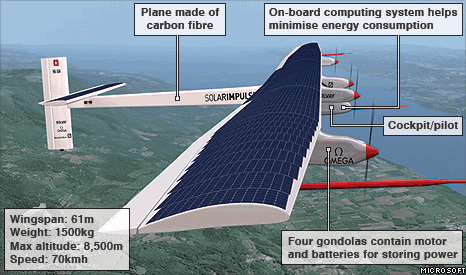
Solar Impulse plane

Solar plane to make public debut
By Jonathan Amos / June 26, 2009

Swiss adventurer Bertrand Picard is set to unveil a prototype of the solar-powered plane he hopes eventually to fly around the world.

The initial version, spanning 61m but weighing just 1,500kg, will undergo trials to prove it can fly at night.

Mr Picard, who made history by circling the globe non-stop in a balloon in 1999, says he wants to demonstrate the potential of renewable energies.

He expects to make a crossing of the Atlantic in 2012.

The flight would be a risky endeavour. Only now is solar and battery technology becoming mature enough to sustain flight through the night – and then only in unmanned planes.

But Picard’s Solar Impulse team has invested tremendous energy – and no little money – in trying to find what they believe is a breakthrough design.

“I love this type of vision where you set the goal and then you try to find a way to reach it, because this is challenging,” he told BBC News.

Testing programme

The HB-SIA has the look of a glider but is on the scale – in terms of its width – of a modern airliner.

The aeroplane incorporates composite materials to keep it extremely light and uses super-efficient solar cells, batteries, motors and propellers to get it through the dark hours.

Picard will begin testing with short runway flights in which the plane lifts just a few metres into the air.

As confidence in the machine develops, the team will move to a day-night circle. This has never been done before in a piloted solar-powered plane.

HB-SIA should be succeeded by HB-SIB. It is likely to be bigger, and will incorporate a pressurised capsule and better avionics.

It is probable that Picard will follow a route around the world in this aeroplane close to the path he took in the record-breaking Breitling Orbiter 3 balloon – going from the United Arab Emirates, to China, to Hawaii, across the southern US, southern Europe, and back to the UAE.

Measuring success

Although the vehicle is expected to be capable of flying non-stop around the globe, Picard will in fact make five long hops, sharing flying duties with project partner Andre Borschberg.

“The aeroplane could do it theoretically non-stop – but not the pilot,” said Picard.

“We should fly at roughly 25 knots and that would make it between 20 and 25 days to go around the world, which is too much for a pilot who has to steer the plane.

“In a balloon you can sleep, because it stays in the air even if you sleep. We believe the maximum for one pilot is five days.”

The public unveiling on Friday of the HB-SIA is taking place at Dubendorf airfield near Zürich.

“The real success for Solar Impulse would be to have enough millions of people following the project, being enthusiastic about it, and saying ‘if they managed to do it around the world with renewable energies and energy savings, then we should be able to do it in our daily life’.”

Source / BBC News

Thanks to Deva Wood / The Rag Blog

Posted in RagBlog | Tagged , , | 1 Comment

Mexican Elections : Calderón Beats Law and Order Drum

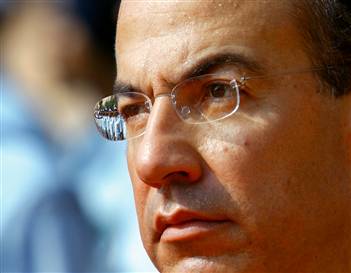
Mexican President Felipe Calderón: his political muscle will be weakened. Photo by Gurinder Osan / AP.

With all that sucking the sand from beneath his feet, President Felipe Calderón, like every beleagured right-winger since Nixon, is beating the Law and Order drum.

By Michael Reynolds / The Rag Blog / June 25, 2009

Mexico’s mid-term elections are July 5, just ten days away. The voters will cast ballots for 500 deputies to the Mexican congress, six state governors and hundreds of mayors. The way its shaping up, President Felipe Calderón and his National Action Party (PAN) will take losses. Calderón’s political muscle will be weakened, the only thing uncertain at this date is by how much.

The Institutional Revolutionary Party (PRI) that ruled Mexico for over 70 years is currently leading in the polls with 37% of likely voters. Calderón’s PAN comes in at 33%. The Party of the Democratic Revolution (PRD)lags with 16%. Lopez Obrador, Calderón’s opponent in the controversial 2006 presidential election, is not campaigning for PRD candidates, though he remains in the party. Instead Obrador is stumping for candidates from two smaller leftist groups — Convergencia and the Workers Party (PT).

The PRD might have done well in this election but spent the past six months in an internal pissing-match between its left wing and right wing. The rightists won, taking charge of the party. So Lopez Obrador, supported by the PRD left faction, took a walk along with his “Legitimate Government” — a shadow cabinet combined with state and municipal organizations — and hooked up with Convergencia and the PT. The PRD hasn’t recovered from this.

The Mexican Legislature, both its Senate and House, are pretty much equally divided between PAN, PRI, and PRD. At this date PAN has a few more senators and representatives. The PRI and PAN ussually ally on important issues. That gives them over two-thirds of the votes, leaving the PRD out of the game. On July 5 the PRD would have to more than double its number of legislators to put the brakes on the right-wing governance. That isn’t in the cards.

Then there is the mounting “none-of-the-above” movement — primarily a “netroots” campaign that’s gaining traction. Voters are being urged to strike off all the names on their ballot, simply file it blank, or stay home. Right now this bloc is polling at 11%. Expect to see this number climb.

A low voter turnout is predicted — about 30%, a major drop from the 41.75 that voted in the 2003 midterms and less than half of the voters in the 2006 presidential election. The youth vote is nowhere to be seen. Polls show that 18-20 year-olds are not even registering to vote.

Mexicans feel hammered by their country’s cumulative crises.

  • the crisis of legitimacy of Calderón’s election. About a third to half of the electorate —- those who voted for López Obrador and some others —- don’t believe that Calderón is the legitimate president. For more on that grand goat screw, check archived PBS On-Line News Hour’s page.
  • the crisis of the drug wars and its accompanying militarization and violence. While many Mexicans support Calderón and the drug war, there is also a deep fear about what is happening to the country. A fear that Mexico might become Colombia in the nineties. This week the NGO, Mexico United against Deliquency, executed a poll showing 80% of its respondents support the use of the army to combat the narcos, but 76% said public safety is worse than before Calderon sent in the troops. Less than half of those polled consider it all a success. More telling detail on this from Frontera Norte Sur “Some in Chihuahua and Mexican Media See Drug War Failing.”
  • the crisis of Mexico’s cratered economy. The country’s official unemployment rate is now at 5.25 percent, extremely high by Mexico’s standards. That number -– like those here in the U.S. –- doesn’t reflect the actual numbers of unemployed and underemployed in the country or the 10% of the population that crossed the border north to look for jobs. Further on this at The Economist.
  • the crisis of the swine flu outbreak. The virus was later renamed H1N1 but was first attributed to a pig factory farm in Mexico that led to a freakout on both sides of the border. 7,000 Mexicans fell victim to the flu and over 100 have died, many of them children.
  • the crisis of the daycare center fire in Hermosillo that killed 47 children and is now the subject of a federal investigation. Read John Ross’s scathing piece from last week at July Dogs and the latest from AP reporter Eduardo Castillo here.

With all that sucking the sand from beneath his feet, President Felipe Calderón, like every beleaguered right-winger since Nixon, is beating the Law and Order drum.

From an AP story, June 25, 2009:

Crime Threatens Democracy, Mexico’s President Warns

Mr. Calderón painted a grim picture of the security situation in some of the most violent parts of the country, noting that crime gangs and drug cartels were carrying out “an interminable recruitment of young people without hope, family, opportunities, future, beliefs or convictions.”

And where did all the “hope… opportunities… future” go? A case can be made that they were roadkill on Calderon’s deregulated free-market highway lined with religious-right “family values” billboards. Since that has resulted in the same disaster witnessed here under Bush and the Republicans, Calderon needs the narcoguerra, needs the cartels, needs the violence to distract from the fundamental incompetence of his administration — like his old BFF Bush needed the “war on terror.”

And when Calderon takes up the hammer on the narco corruption in his rivals’ parties, he best be careful. That long green spreads wide.

[This story was also posted at NarcoGuerra Times.]

The Rag Blog

Posted in Rag Bloggers | Tagged , , | Leave a comment

Alan Haber : Exposing the Dark Forces

As long as these forces operate, and are not pursued, there is no democracy, whatever the window dressings.

By Alan Haber / The Rag Blog / June 25, 2009

See ‘Did the CIA kill Bobby Kennedy?’ by Shane O’Sullivan, Below.

I was stuck by the concluding paragraph in the article below from 2006 –- about the CIA and the assassination of Bobby Kennedy — about the relevance now of this old story. Robert Kennedy’s 81st birthday would have been last Sunday

My mind was on Iran. I was thinking we (such American movement as we are) should keep the focus on the United States’ role, grievous problems with our own elections, human rights, and covert operations and operators. Then I see this article, which underscores for me an urgency here to go after and expose the dark forces in this government, past and present, continuing to operate, both the covert ones connected with assassinations and coups, etc, and the overt ones like wars of choice in Iraq, and arming Israeli attacks on Palestine.

As long as these forces operate, and are not pursued, there is no democracy, whatever the window dressings. The Iranian democracy in the streets should be a spur to our own struggle, to root out the powers behind the powers here. Full investigations, no statute of limitations on criminal politics, no praise to the secret keepers, accountability forever. Here and Iran, both. Here, as there, the powers privatize the commons and steal the national wealth.

I hope those seeking a more open society can prevail in Iran. Moussavi and the other challengers will become captive to the increasingly principled — meaning radical — demands of the movement. Such insurgencies were put down in Hungary, Czechoslovakia, China. In other places they overwhelmed national authority, and stirred the people’s desire to be free. I heard an Iranian student say, on a phone broadcast, “This is our best chance to be free. If we fail, it will be a long time before we have a chance again.”

When the freedom call merges with “god is great,” it can be a powerful force indeed: an underground organized from the rooftops. The people are furious, it can lead to an awakening of consciousness, rethinking everything, until there is no going back. Iranian young people chanting and marching against the government and for respect (drawing praise from the right wing government in Israel and the American right also).

I hope the youth of Palestine and in America take it to heart, that the voice of the youth be heard.

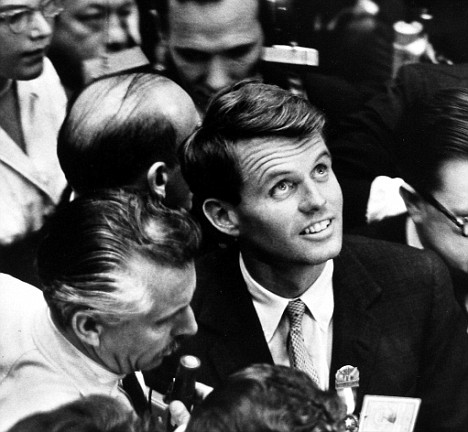
Did the CIA kill Bobby Kennedy?

In 1968, Robert Kennedy seemed likely to follow his brother, John, into the White House. Then, on June 6, he was assassinated — apparently by a lone gunman. But the author says he has evidence implicating three CIA agents in the murder.

By Shane O’Sullivan

[This article was originally published by The Guardian on Nov. 20, 2006. It was reposted on The Sixties website on June 21, 2009.]

At first, it seems an open-and-shut case. On June 5, 1968, Robert Kennedy wins the California Democratic primary and is set to challenge Richard Nixon for the White House. After midnight, he finishes his victory speech at the Ambassador hotel in Los Angeles and is shaking hands with kitchen staff in a crowded pantry when 24-year-old Palestinian Sirhan Sirhan steps down from a tray-stacker with a “sick, villainous smile” on his face and starts firing at Kennedy with an eight-shot revolver.

As Kennedy lies dying on the pantry floor, Sirhan is arrested as the lone assassin. He carries the motive in his shirt-pocket (a clipping about Kennedy’s plans to sell bombers to Israel) and notebooks at his house seem to incriminate him. But the autopsy report suggests Sirhan could not have fired the shots that killed Kennedy. Witnesses place Sirhan’s gun several feet in front of Kennedy, but the fatal bullet is fired from one inch behind. And more bullet-holes are found in the pantry than Sirhan’s gun can hold, suggesting a second gunman is involved. Sirhan’s notebooks show a bizarre series of “automatic writing” — “RFK must die RFK must be killed — Robert F Kennedy must be assassinated before 5 June 68” – and even under hypnosis, he has never been able to remember shooting Kennedy. He recalls “being led into a dark place by a girl who wanted coffee,” then being choked by an angry mob. Defence psychiatrists conclude he was in a trance at the time of the shooting and leading psychiatrists suggest he may have be a hypnotically programmed assassin.

Three years ago, I started writing a screenplay about the assassination of Robert Kennedy, caught up in a strange tale of second guns and “Manchurian candidates” (as the movie termed brainwashed assassins). As I researched the case, I uncovered new video and photographic evidence suggesting that three senior CIA operatives were behind the killing. I did not buy the official ending that Sirhan acted alone, and started dipping into the nether-world of “assassination research,” crossing paths with David Sanchez Morales, a fearsome Yaqui Indian.

Morales was a legendary figure in CIA covert operations. According to close associate Tom Clines, if you saw Morales walking down the street in a Latin American capital, you knew a coup was about to happen. When the subject of the Kennedys came up in a late-night session with friends in 1973, Morales launched into a tirade that finished: “I was in Dallas when we got the son of a bitch and I was in Los Angeles when we got the little bastard.” From this line grew my odyssey into the spook world of the 60s and the secrets behind the death of Bobby Kennedy.

Working from a Cuban photograph of Morales from 1959, I viewed news coverage of the assassination to see if I could spot the man the Cubans called El Gordo — The Fat One. Fifteen minutes in, there he was, standing at the back of the ballroom, in the moments between the end of Kennedy’s speech and the shooting. Thirty minutes later, there he was again, casually floating around the darkened ballroom while an associate with a pencil moustache took notes.

The source of early research on Morales was Bradley Ayers, a retired US army captain who had been seconded to JM-Wave, the CIA’s Miami base in 1963, to work closely with chief of operations Morales on training Cuban exiles to run sabotage raids on Castro. I tracked Ayers down to a small town in Wisconsin and emailed him stills of Morales and another guy I found suspicious — a man who is pictured entering the ballroom from the direction of the pantry moments after the shooting, clutching a small container to his body, and being waved towards an exit by a Latin associate.

Ayers’ response was instant. He was 95% sure that the first figure was Morales and equally sure that the other man was Gordon Campbell, who worked alongside Morales at JM-Wave in 1963 and was Ayers’ case officer shortly before the JFK assassination.

I put my script aside and flew to the US to interview key witnesses for a documentary on the unfolding story. In person, Ayers positively identified Morales and Campbell and introduced me to David Rabern, a freelance operative who was part of the Bay of Pigs invasion force in 1961 and was at the Ambassador hotel that night. He did not know Morales and Campbell by name but saw them talking to each other out in the lobby before the shooting and assumed they were Kennedy’s security people. He also saw Campbell around police stations three or four times in the year before Robert Kennedy was shot.

This was odd. The CIA had no domestic jurisdiction and Morales was stationed in Laos in 1968. With no secret service protection for presidential candidates in those days, Kennedy was guarded by unarmed Olympic decathlete champion Rafer Johnson and football tackler Rosey Grier — no match for an expert assassination team.

Trawling through microfilm of the police investigation, I found further photographs of Campbell with a third figure, standing centre-stage in the Ambassador hotel hours before the shooting. He looked Greek, and I suspected he might be George Joannides, chief of psychological warfare operations at JM-Wave. Joannides was called out of retirement in 1978 to act as the CIA liaison to the House Select Committee on Assassinations (HSCA) investigating the death of John F Kennedy.

Ed Lopez, now a respected lawyer at Cornell University, came into close contact with Joann-des when he was a young law student working for the committee. We visit him and show him the photograph and he is 99% sure it is Joannides. When I tell him where it was taken, he is not surprised: “If these guys decided you were bad, they acted on it.

We move to Washington to meet Wayne Smith, a state department official for 25 years who knew Morales well at the US embassy in Havana in 1959-60. When we show him the video in the ballroom, his response is instant: “That’s him, that’s Morales.” He remembers Morales at a cocktail party in Buenos Aires in 1975, saying Kennedy got what was coming to him. Is there a benign explanation for his presence? For Kennedy’s security, maybe? Smith laughs. Morales is the last person you would want to protect Bobby Kennedy, he says. He hated the Kennedys, blaming their lack of air support for the failed Bay of Pigs invasion in 1961.

We meet Clines in a hotel room near CIA headquarters. He does not want to go on camera and brings a friend, which is a little unnerving. Clines remembers “Dave” fondly. The guy in the video looks like Morales but it is not him, he says: “This guy is fatter and Morales walked with more of a slouch and his tie down.” To me, the guy in the video does walk with a slouch and his tie is down.

Clines says he knew Joannides and Campbell and it is not them either, but he fondly remembers Ayers bringing snakes into JM-Wave to scare the secretaries and seems disturbed at Smith’s identification of Morales. He does not discourage our investigation and suggests others who might be able to help. A seasoned journalist cautions that he would expect Clines “to blow smoke,” and yet it seems his honest opinion.

As we leave Los Angeles, I tell the immigration officer that I am doing a story on Bobby Kennedy. She has seen the advertisements for the new Emilio Estevez movie about the assassination, Bobby. “Who do you think did it? I think it was the Mob,” she says before I can answer.

“I definitely think it was more than one man,” I say, discreetly.

Morales died of a heart attack in 1978, weeks before he was to be called before the HSCA. Joannides died in 1990. Campbell may still be out there somewhere, in his early 80s. Given the positive identifications we have gathered on these three, the CIA and the Los Angeles Police Department need to explain what they were doing there. Lopez believes the CIA should call in and interview everybody who knew them, disclose whether they were on a CIA operation and, if not, why they were there that night.

Today would have been Robert Kennedy’s 81st birthday. The world is crying out for a compassionate leader like him. If dark forces were behind his elimination, it needs to be investigated

Source / The Sixties

The Rag Blog

Posted in Rag Bloggers | Tagged , , , , , | Leave a comment

Neda and the Kent State 4 : Heartbreaking Then and Now

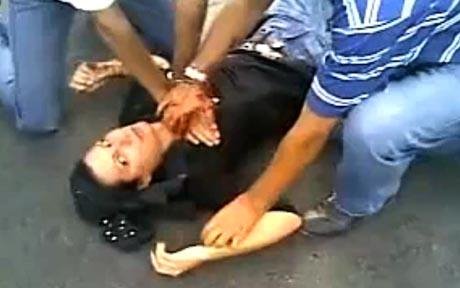
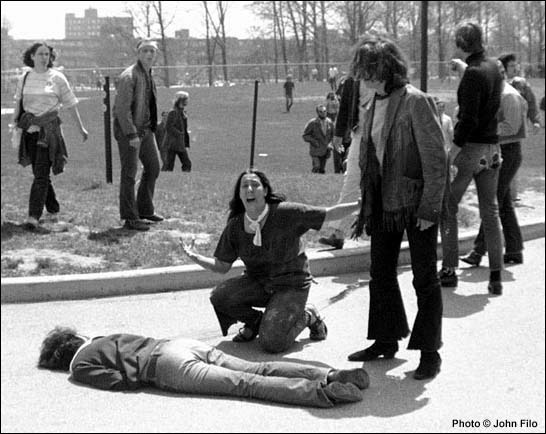
(Above) Neda Agha-Soltan, 27, who bled to death on the streets of Tehran, Saturday, June 20, 2009. Still shot from video taken with cell phone and posted to YouTube. (Below) Mary Ann Vecchio, a fourteen-year-old runaway, kneeling over the dead body of Jeffrey Miller after he was shot by the National Guard during demonstrations at Kent State, May 4, 1970. He was one of four students killed. Pulitzer Prize-winning photo by John Filo from Wikipedia.

Four dead in Ohio…
Heartbreaking then and now

Just as it is unlikely anyone will ever be prosecuted for the murder of Neda Agha-Soltan, no one has ever been prosecuted for the murders at Kent State or Jackson State.

By Jay D. Jurie / The Rag Blog / June 25, 2009

President Obama responded to a question at his June 23 press conference that he was “appalled and outraged” by the violence following the controversial electoral outcome in Iran.

Asked specifically about Neda Agha-Soltan, 26, a bystander at the protests whose shooting death on a Tehran street has been blamed on Iran governmental forces and is the subject of a widely-circulated video, Obama responded it is “heartbreaking.” He went on to say “I think that anybody who sees it knows that there’s something fundamentally unjust about that.”

This eminently reasonable assessment can be contrasted with official opinion in the wake of the fatal shooting of four students at Kent State University on May 4, 1970. None of the four students killed by the Ohio National Guard on that day, Allison Krause, who had just turned 19, Jeffrey Miller, 20, Sandy Scheuer, 21, or William Schroeder, 19, were armed. Two, Scheuer and Schroeder, like Neda Agha-Soltan, were not participants in the demonstration, they just happened to be at the wrong place at the wrong time.

Then-President Richard Nixon expressed no sense of fundamental injustice. According to his official statement, “This should remind us all once again that when dissent turns to violence, it invites tragedy.” Characteristically, then-Vice President Spiro Agnew went even further, assigning blame to a “calculated, consistent, and well-publicized barrage of criticism against the principles of this nation.”

These statements are not wholly inconsistent with what Iranian Supreme Leader Sayyed Ali Khameini had to say about the protests in his country: “I have insisted and will insist on implementing the law in issues related to the presidential election, and the Islamic system and people will not give in to pressure at any cost.”

On May 15, 1970, two African-American students at Jackson State University, Phillip Gibbs, 21, and James Green, 17, were shot and killed in similar circumstances. Again, these slayings elicited no official sense of fundamental injustice.

Let us hope we now have an administration more attuned to injustice than that of Nixon and Agnew. Will the spotlight be fixed on injustice in Iran while turning a blind eye to injustice at home or elsewhere?

Just as it is unlikely anyone will ever be prosecuted for the murder of Neda Agha-Soltan, no one has ever been prosecuted for the murders at Kent State or Jackson State.

Nor are there any indications that any indictments for crimes against humanity in the “war on terror” are likely.

We must insist there be no double standard. Accountability applies to our own government as well as others.

President Obama concluded his remarks about the murder of Neda Agha-Soltan with the observation, “While this loss is raw and extraordinarily painful we also know this: those who stand up for justice are always on the right side of history.”

[Sources: alancanfora.com; Charles A. Thomas Papers — KSU May 4 Collection; Helen Kennedy, “President Obama Calls Iranian Martyr Neda’s Death ‘heartbreaking’,” NY Daily News, June 23, 2009; I.F. Stone, The Killings at Kent State: How Murder Went Unpunished, NY: New York Review of Books, 1970; “Leader Says People Won’t Yield to Lawlessness,” Tehran Times, June 25, 2009.]

The Rag Blog

Posted in Rag Bloggers | Tagged , , , , | 1 Comment

NASA Scientist, Actress Hannah, Arrested in Coal Mining Protest

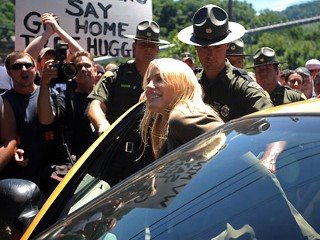
Actress Darryl Hannah is arrested by West Virginia State Police Tuesday, June 23, 2009 following a mountaintop removal mining protest in Naoma, W.Va. She was among several hundred protesters who held a rally outside Marsh Fork Elementary school that sits about 300 feet away from a Massey Energy coal processing plant. Photo by Jeff Gentner / AP.

Foremost authority on climate change arrested at mountaintop removal protest.

By Roger Baker / The Rag Blog / June 25, 2009

For those who follow the climate issue, a top NASA scientist, James Hansen, foremost authority on climate change, was arrested at a non-violent protest of mountaintop removal coal mining in West Virginia. (Actress Daryl Hannah was also arrested at the protest.)

For an account of the action organized by Rainforest Action Network (RAN), go here, and here(from Michael Brune, executive director of Rainforest Action Network:

…I can’t remember a more charged atmosphere. The majority of people surrounded one-half of the stage, supporting each speaker calling for an end to mountain blasting. Separated by police, the remainder crowded around the rest of the stage, wearing Massey t-shirts and shouting their disapproval.

I spoke shortly after Ken Hechler, the 94-year-old former Congressional Representative who has decried the effects of mountaintop removal in his region for more than three decades. “I want to thank Don Blankenship for inviting me to this rally,” I began, to a mixture of catcalls and applause. I told the crowd that mountaintop removal isn’t just a local issue, it’s an American problem — brought to us by Massey Energy and other coal companies…

The Rag Blog

Posted in Rag Bloggers | Tagged , , , | 2 Comments

Short Attention-Span News (A Little Birdie Told Me)


Trippin’ down the cobblestones:
Short Attention-Span News

By Mariann G. Wizard / The Rag Blog / June 25, 2009

[“slow down, you move too fast; you got to make the morning last; just trippin down the cobblestones, lookin for fun and feelin groovy! la la la la la la”

It must be the heat…]

I’ve taken up tweeting n the last week (@Pollyanna46 + @CannabisResourc); I love it! N Austin’s record heat, brevity is next 2 goddessness.

* * *
Theresa Anthony, 29, black, busted 4 pot poss., DIED N HARRIS CNTY JAIL 6/20. Her Mom was told by fone. No cause of death has been released.
* * *
Sen Lautenberg (D-NJ; David Codrea sez D-Mordor) will intro law to keep any on terrorist “watch list” from buying guns. NJ, will Sauron win?
* * *
New Scientist reports nat. gas n permafrost, under seabed (methane clathrate) cd fuel world 100s of years &/r push global warming; explode.
* * *
Pres Obama has declared cyberspace a domain of warfare. New Pentagon command 2 oversee ops. Hacker recruits will get 2 play games for real!
* * *
India‘s largest tiger sanctuary has few tigers, prey of poachers, feared by farmers. Hindu vegetarian Dharmendra Khandal seeks to save them.
* * *
60+years’ abuse n Irish R.C. skools revealed n new report recalls Holocaust. Big Diff: few survived Auschwitz; 100,000s Irish knew; did zip.
* * *
Dilute lemongrass oil repels fleas; ticks from humans; animals. N footbath, refreshes; aids excess sweating. Lemongrass tea aids digestion.
* * *
TX Freedom Network (www.tfn.org) has candidate training 7/22 for ANYONE interested n a seat on State Bd of Education; 8 incumbents up n ’10.
* * *
19th Annual Havana Intrntl Book Fair, 2/13-20.2010, legal 4 US professional librarians 2 go. Overlaps w/ Intrntl Jazz Fest; ur waiting 4???
* * *
“The sun has a working schedule, & the snow, & the birds, & every green leaf. Perhaps you should have one 2?” — Mary Oliver (APSMuseletter)

[Note: Follow The Rag Blog on Twitter: twitter.com/TheRagBlog.]

The Rag Blog

Posted in Rag Bloggers | Tagged | Leave a comment

Health Insurance : The High Cost of ‘Competition’


Can private insurers compete?

The truth is that the Republicans aren’t opposed to a government-run system because the private companies can do it better and cheaper — they can’t. They oppose the public insurance choice because they want to protect the egregious and exorbitant profits of their rich buddies…

By Ted McLaughlin / The Rag Blog / June 25, 2009

Conservative Republicans have been talking out of both sides of their mouths when discussing health insurance and health care in the United States. First they will tell you that thanks to competition in the marketplace, private insurance can do a better job of holding down health care costs and delivering health insurance that will be better than what the government could do.

But then they turn around and whine that a government-run health insurance program would run them out of business. How can that possibly be, if they can do it better than the government can? Wouldn’t the people want the best product — the one that delivers the most for the least cost? If the private companies can really do it better, wouldn’t consumers flock to that better product?

President Obama put it well in his speech the other night, when he said, “Why would it drive private insurers out of business? If private insurers say that the marketplace provides the best quality healthcare, if they tell us that they’re offering a good deal, then why is it that the government — which they say can’t run anything — suddenly is going to drive them out of business? That’s not logical.”

He’s right. It’s not logical. Unless the Republicans and the insurance companies have been lying to us. And that’s exactly what they’ve been doing. The private companies really can’t compete because they are one of the major causes of the inflated cost of health care.

There are two reasons why they can’t compete. The first is overhead. The private companies are notoriously inefficient, with overhead costs running 15-40% of premiums. By comparison, Medicare overhead is only about 2% of premiums (and there is no reason why another government-run program can’t perform just as efficiently as Medicare). The famous market competition certainly hasn’t helped the private companies to hold down costs.

The second reason is company profits. Private insurance companies aren’t in business to provide exceptional health care to their consumers. They are in business to make a profit — the larger the better. And the sad fact is that the less they pay out for health care, the larger their profits will be. Meanwhile, a government-run health insurance system doesn’t have to show even a penny of profit. Except for the 2% overhead, ALL of the premiums paid to a public insurance system will go to pay for consumer health care.

If the private companies can compete, let them do it. If they can’t, then they should go out of business because they are not providing the best health care for the dollars spent.

The truth is that the Republicans aren’t opposed to a government-run system because the private companies can do it better and cheaper — they can’t. They oppose the public insurance choice because they want to protect the egregious and exorbitant profits of their rich buddies — the owners of private insurance companies.

Our health care system in the United States is a broken mess. Countless millions of people have no insurance coverage at all. Many more are driven into bankruptcy by medical bills (even though most of them had private insurance). Millions are praying they don’t lose their jobs, because if they do they’ll lose what little insurance coverage they have. And millions more are losing their insurance because their bills have gotten too high (even though they’ve paid their premiums).

Forcing everyone to buy private insurance will not solve these problems. It will just give the huge insurance companies their biggest payday, and they can go on abusing their consumers to make ever larger profits.

This is not the time to assure the insurance companies of maximum profits. This is the time to give American citizens health insurance at a decent price, that cannot be cancelled, and provides them with their choice of doctor and hospital. Private companies cannot or will not do that. A government-run insurance system will do it.

The only real fix for our health care mess is public insurance.

[Rag Blog contributor Ted McLaughlin also posts at jobsanger, an excellent Texas political blog.]

The Rag Blog

Posted in Rag Bloggers | Tagged , , , | Leave a comment

Bad Boy Mark Sanford, and the Freedom Fighters from Martin Jr. High

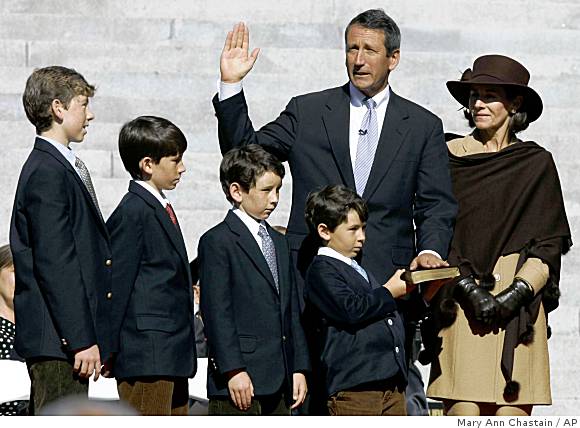
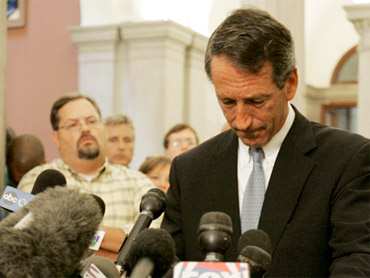
South Carolina Gov. Mark Sanford, no longer MIA, fesses up. Photo by Mary Ann Chastain / AP.

Modern-day Freedom Fighters

On June 4, the state Supreme Court ruled 5-0 against Gov. Sanford, finding that he must apply for the $700 million in federal stimulus money for its intended purposes, including educational enhancement.

By Jay D. Jurie / The Rag Blog / June 24, 2009

According to his staff, missing South Carolina Governor Mark Sanford was merely enjoying Father’s Day away from his family, hiking the Appalachian Trail. This prompted the observation from TV commentator Keith Olbermann that Father’s Day was also “national hike naked day.” One might wonder if perhaps Sanford was at a rendezvous in the woods with fellow Republicans Mark Foley, Larry Craig, and Charlie Crist. Olbermann’s guest, columnist Gene Robinson, mentioned something about a movie called Deliverance…

Upon his re-appearance, Gov. Sanford, contrary to the staff cover story, revealed that he was having a tryst in Argentina.

This has not been Gov. Sanford’s first brush with notoriety.

Ty-Sheoma Bethea, an 8th grader from J.V. Martin Jr. High in Dillon, South Carolina, was invited to sit next to Michelle Obama during President Obama’s Feb. 24 address to a joint session of Congress. Obama quoted from a letter Ms. Bethea had sent Congress about the deplorable condition of her school, “we’re not quitters,” as part of the urgent necessity of passing a stimulus program benefiting education and other needs.

It seemed apparent that relief was on the way, and that J.V. Martin Jr. High would almost certainly be earmarked for reconstruction assistance. Then Gov. Sanford intervened, refusing to apply for the stimulus money unless he could use it to pay down state debt rather than for its intended purposes.

Shortly thereafter, two other South Carolina students got involved. Casey Edwards, a senior at Chapin High in Chapin, and Justin Williams, a third-year University of South Carolina law student, acted as lead plaintiffs in the suit Edwards and Williams v. State, and SCASA (South Carolina Association of School Administrators) v. Sanford. On June 4, the state Supreme Court ruled 5-0 against Gov. Sanford, finding that he must apply for the $700 million in federal stimulus money for its intended purposes, including educational enhancement.

Conditions in schools like J.V. Martin Jr. High along South Carolina’s I-95 “Corridor of Shame” were cited by Edwards and Williams as primary reasons for their suit.

Ty-Sheoma Bethea, Casey Edwards, and Justin Williams are modern-day freedom fighters.

[Sources: Katie Jones, “USC Law Student Sues Sanford,” Daily Gamecock, June 10, 2009, CNN, Chicago Tribune, Bud Ferillo “Corridor of Shame” documentary, 2005.]

The Rag Blog

Posted in RagBlog | Tagged , , , , , | 1 Comment

Fight for the Amazon : The Planet’s at Stake

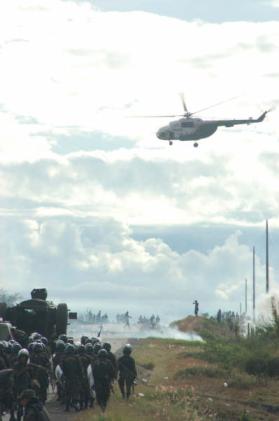
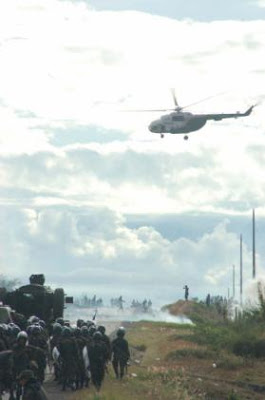
A police helicopter takes away indigenous protesters who have been arrested in the Peruvian rainforest. It returns later and is used to fire tear gas at protesters. Photo by Thomas Quirynen and Marijke Deleu / Independent, U.K.

A fight for the Amazon that should inspire the world

The Uprising in the Amazon Is More Urgent Than Iran’s: It Will Determine the Future of the Planet

By Johann Hari / June 24, 2009

While the world nervously watches the uprising in Iran, an even more important uprising has been passing unnoticed — yet its outcome will shape your fate, and mine.

In the depths of the Amazon rainforest, the poorest people in the world have taken on the richest people in the world to defend a part of the ecosystem none of us can live without. They had nothing but wooden spears and moral force to defeat the oil companies — and, for today, they have won.

Here’s the story of how it happened — and how we all need to pick up this fight.

Earlier this year, Peru’s President, Alan Garcia, sold the rights to explore, log and drill 70 percent of his country’s swathe of the Amazon to a slew of international oil companies. Garcia seems to see rainforest as a waste of good resources, saying of the Amazon’s trees: “There are millions of hectares of timber there lying idle.”

There was only one pesky flaw in Garcia’s plan: the indigenous people who live in the Amazon. They are the first people of the Americas, subject to wave after wave of genocide since the arrival of the Conquistadors. They are weak. They have no guns. They barely have electricity. The government didn’t bother to consult them: what are a bunch of Indians going to do anyway?

But the indigenous people have seen what has happened elsewhere in the Amazon when the oil companies arrive. Occidental Petroleum are currently facing charges in US courts of dumping an estimated nine billion barrels of toxic waste in the regions of the Amazon where they operated from 1972 to 2000. Andres Sandi Mucushua, the spiritual leader of the area known to the oil companies as Block 1AB, said in 2007: “My people are sick and dying because of Oxy. The water in our streams is not fit to drink and we can no longer eat the fish in our rivers or the animals in our forests.” The company denies liability, saying they are “aware of no credible data of negative community health impacts”.

In the Ecuadorian Amazon, according to an independent report, toxic waste allegedly dumped after Chevron-Texaco’s drilling has been blamed by an independent scientific investigation for 1,401 deaths, mostly of children from cancer. When the BBC investigator Greg Palast put these charges to Chevron’s lawyer, he replied: “And it’s the only case of cancer in the world? How many cases of children with cancer do you have in the States?… They have to prove it’s our crude, [which] is absolutely impossible.”

The people of the Amazon do not want to see their forests felled and their lands poisoned. And here, the need of the indigenous peoples to preserve their habitat has collided with your need to preserve your habitat. The rainforests inhale massive amounts of warming gases and keep them stored away from the atmosphere. Already, we are chopping them down so fast that it is causing 25 percent of man-made carbon emissions every year — more than planes, trains and automobiles combined. But it is doubly destructive to cut them down to get to fossil fuels, which then cook the planet yet more. Garcia’s plan was to turn the Amazon from the planet’s air con into its fireplace.

Why is he doing this? He was responding to intense pressure from the US, whose new Free Trade Pact requires this “opening up”, and from the International Monetary Fund, paid for by our taxes. In Peru, it has also been alleged that the ruling party, APRA, is motivated by oil-bribes. Some of Garcia’s associates have been caught on tape talking about how to sell off the Amazon to their cronies. The head of the parliamentary committee investigating the affair, Rep. Daniel Abugattas, says: “The government has been giving away our natural resources to the lowest bidders. This has not benefited Peru, but the administration’s friends.”

So the indigenous peoples acted in their own self-defense, and ours. Using their own bodies and weapons made from wood, they blockaded the rivers and roads to stop the oil companies getting anything in or out. They captured two valves of Peru’s sole pipeline between the country’s gas field and the coast, which could have led to fuel rationing. Their leaders issued a statement explaining: “We will fight together with our parents and children to take care of the forest, to save the life of the equator and the entire world.”

Garcia responded by sending in the military. He declared a “state of emergency” in the Amazon, suspending almost all constitutional rights. Army helicopters opened fire on the protesters with live ammunition and stun-grenades. Over a dozen protesters were killed. But the indigenous peoples did not run away. Even though they were risking their lives, they stood their ground. One of their leaders, Davi Yanomami, said simply: “The earth has no price. It cannot be bought, or sold or exchanged. It is very important that white people, black people and indigenous peoples fight together to save the life of the forest and the earth. If we don’t fight together what will our future be?”

And then something extraordinary happened. The indigenous peoples won. The Peruvian Congress repealed the laws that allowed oil company drilling, by a margin of 82 votes to 12. Garcia was forced to apologize for his “serious errors and exaggerations”. The protesters have celebrated and returned to their homes deep in the Amazon.

Of course, the oil companies will regroup and return — but this is an inspirational victory for the forces of sanity that will be hard to reverse.

Human beings need to make far more decisions like this: to leave fossil fuels in the ground, and to leave rainforests standing. In microcosm, this rumble in the jungle is the fight we all face now. Will we allow a small number of rich people to make a short-term profit from seizing and burning resources, at the expense of our collective ability to survive?

If this sounds like hyperbole, listen to Professor Jim Hansen, the world’s leading climatologist, whose predictions have consistently turned out to be correct. He says: “Clearly, if we burn all fossil fuels,we will destroy the planet we know. We would set the planet on a course to the ice-free state, with a sea level 75 meters higher. Coastal disasters would occur continually. The only uncertainty is the time it would take for complete ice sheet disintegration.”

Of course, fossil fools will argue that the only alternative to burning up our remaining oil and gas supplies is for us all to live like the indigenous peoples in the Amazon. But next door to Peru, you can see a very different, environmentally sane model to lift up the poor emerging — if only we will grasp it.

Ecuador is a poor country with large oil resources underneath its rainforests — but its president, Rafael Correa, is offering us the opposite of Garcia’s plan. He has announced he is willing to leave his country’s largest oil reserve, the Ishpingo Tmabococha Tiputini field, under the soil, if the rest of the world will match the $9.2bn in revenues it would provide.

If we don’t start reaching for these alternatives, we will render this month’s victory in the Amazon meaningless. The Hadley Center in Britain, one of the most sophisticated scientific centers for studying the impacts of global warming, has warned that if we carry on belching out greenhouse gases at the current rate, the humid Amazon will dry up and burn down — and soon.

Their study earlier this year explained :

The Amazonian rainforest is likely to suffer catastrophic damage even with the lowest temperature rises forecast under climate change. Up to 40 percent of the rainforest will be lost if temperature rises are restricted to 2C, which most climatologists regard as the least that can be expected by 2050. A 3C rise is likely to result in 75 percent of the forest disappearing while a 4C rise, regarded as the most likely increase this century unless greenhouse gas emissions are slashed, will kill off 85 perfect of the forest.

That would send gigatons of carbon into the atmosphere — making the world even more inhabitable.

There is something thrilling about the fight in the Amazon, yet also something shaming. These people had nothing, but they stood up to the oil companies. We have everything, yet too many of us sit limp and passive, filling up our tanks with stolen oil without a thought for tomorrow. The people of the Amazon have shown they are up for the fight to save our ecosystem. Are we?

[Johann Hari is a writer for the Independent. To read more of his articles, click here or for an archive of his writings about environmental issues, click here.]

Source / Independent, U.K.

The Rag Blog

Posted in RagBlog | Tagged , , , , , , , , , | 1 Comment

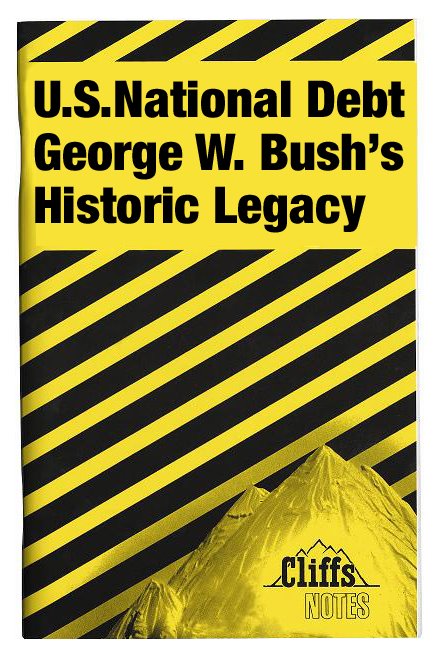
U.S. National Debt : Cliffs Notes for Conservatives

Graphic by Larry Ray / The Rag Blog. With apologies to Cliffs Notes.

Cliffs Notes for Conservatives

I find it both bewildering and angering when Republican conservatives lambaste President Obama for the present state of indebtedness on America’s balance sheet as if it was all his fault, spending like a drunken sailor. As if the previous eight years never happened.

By Larry Ray / The Rag Blog / June 24, 2009

As soon as Barack Obama’s hand left the Lincoln bible after taking his oath of office as President of the United States of America, the race was on within the tattered ranks of the Republican party to see who could scream “tax and spend” the loudest.

The same conservatives who uttered not a dissenting word during the past eight years of Republican “spend and spend” now sputter forth about their perceived perilous excesses of President Obama.

It is time for a review of some hard facts and numbers.

Mr. Obama has calmly and deliberately taken charge, faced with inherited wars in Iraq and Afghanistan, the threat of a global financial meltdown, and a laundry list of national and international challenges. And all the while he is pressing ahead and funding promised new programs and change. His Republican detractors, ranting about the national debt, seem to have forgotten George W. Bush’s early months as president.

Mr. Bush inherited a federal budget that had been balanced for three consecutive years and a surplus of $236 billion, the largest surplus in American history. Even sweeter, we were running an on-budget surplus no longer diverting surplus from the Social Security Trust Fund to fund other government programs. This conservative largess, of course, came from the previous Democratic administration.

When Mr. Bush took office, the national debt was $5.727 trillion. By September 2008, the national debt had soared to more than $9.849 trillion, an almost 72 percent increase during Mr. Bush’s two terms. And those are the debt figures before the basically unregulated, free-for-all banking and financial system received Mr. Bush’s $700 billion Wall Street bailout money.

And as President Obama walked into the Oval office, Mr. and Mrs. George W. Bush were closing the deal on their mansion in a Dallas, Texas gated community, leaving the biggest increase in the national debt under any president in U.S history as a going away present to the American people.

Mr. Bush must have erased the collective memory of his record national debt from the minds of the Republican party. With stern faces they attempt daily to paint the accumulated national debt as President Obama’s dangerous “socialist” agenda to send America to the poorhouse. Well, we have already been sent there, and Barack Obama did not do the sending.

Here’s a quick review:

  • Shortly after taking office, President Bush spoke to the the Republican Congressional Retreat in Williamsburg and blithely declared that his budget would “pay down the national debt.”
  • President Bush raised the national debt limit eight times during his administration.
  • On July 30, 2008, President Bush signed the Housing and Economic Recovery Act, which contained a quiet little provision raising the debt ceiling to $10.615 trillion.
  • One week before leaving office, Bush asked Congress for the remaining $350 billion of the $700 billion Wall Street Troubled Assets Relief Program or TARP bailout package.That same last week, Bush signed the American Recovery and Reinvestment Act of 2009 raising the national debt ceiling for the eighth time to $12.104 trillion to accommodate the $11.3 trillion all time record debt he left the incoming administration.
  • George W. Bush’s $11.3 trillion record debt comes to more than $37,000 each for every man, woman and child in the United States. And it will get worse because of what is is costing to clean up after him while still moving ahead on badly needed changes like national health care to rein in its current out of control cost.

I find it both bewildering and angering when Republican conservatives lambaste President Obama for the present state of indebtedness on America’s balance sheet as if it was all his fault, spending like a drunken sailor. As if the previous eight years never happened.

Mr. Boehner, Mr. Steele, Mr. Cantor and the rest of the GOP spokespersons du jour should all be given special pocket calculators with a built in factor of $11.3 trillion that is automatically deducted from any figures they use to attack the Obama administration.

The factor could have a new four letter mathematical name, the Debt factor, a word that also works perfectly to describe the Bush presidential legacy.

[Retired journalist Larry Ray is a Texas native and former Austin television news anchor. He also posts at The iHandbill.]

The Rag Blog

Posted in Rag Bloggers | Tagged , , , | 1 Comment

Ansel Herz: A Report of a March on T. Don Hutto

Click the arrow button in the bottom right-hand corner for a better view. (Sorry about the wind noise, folks!)

Podcast with pictures: Texans march against Hutto detention center on World Refugee Day
By Ansel Herz / June 22, 2009

This was my second time traveling out to Hutto. Transcript and more information below.

[Chanting]

“I’ve known about this place, this is just my first time coming here. When I first got here, I actually felt like crying because I felt so angry that they would do this to people. Everybody talks about peace in the world and stuff, but this has nothing to do with it…”

18-year-old Yvette Garza joined about a hundred people from around Texas on Saturday afternoon in Taylor, a forty-minute drive from Austin. For the third year in a row, activists marked World Refugee Day with a march across town to the T. Don Hutto Residential Center, an immigrant detention center holding undocumented families, including at least 100 women and young children. Jose Orta, a Taylor resident, said the corporate-run facility should be shut down.

“They are incarcerated. And those children have done nothing, nothing wrong. They are non-criminals. Yet they are in a medium-security prison. No matter what you call it – you can call it a detention facility or a residential facility, whatever. It is a medium-security prison, and T. Don Hutto’s got to go!”

[Marching]

“People started making profits for people wanting to make money off of people’s misery.”

Conrado Acevedo, an activist with the indigenous coalition ‘Defense of Our Mother,’ traveled from Houston.

“They used to let ‘em go and then they would show up in court, which was the more humane way. But now when you put people in jail, especially a mother with kids, I mean that’s totally uncomprehensible in a supposedly democratic society. So we’ve been coming here for two years…”

[Sound]

The march eventually spilled onto an field alongside the facility. Marchers raised their voices, hoping the kids inside would hear them.

The group rallied for another few hours with music and speeches in the blazing sun across from the detention center. They vowed to continue protesting until the facility is closed and the families are released.

It’s June 22, 2009, this has been a Mediahacker.org podcast, and I’m Ansel Herz.

Cross-posted to YouTube and to HIMC. Learn more:

* T. Don Hutto blog
* America’s Family prison short film by Matt Gossage
* “The Least of These” film
* More pictures at Houston Indymedia

Source / Media Hacker

The Rag Blog

Posted in RagBlog | Tagged , , | 1 Comment

Election Fraud in Iran Is Not a Foregone Conclusion

Despite the (mostly shrill) rhetoric surrounding the recent Iranian election, Nima Shirazi maintains that there is remarkably little solid evidence that anything really is awry. Very troubling is the continuing suppression of the media in Iran, but that is not particularly surprising given the history of the theocratic regime. Perhaps it is time for a little simple quiet and patience about events in a country that is not ours to meddle with.

Richard Jehn / The Rag Blog


In Fraud, We Trust?
By Nima Shirazi / The Rag Blog / June 23, 2009

Douter de tout ou tout croire, ce sont deux solutions également commodes, qui l’une et l’autre nous dispensent de réfléchir. [To doubt everything or to believe everything are two equally convenient solutions; both dispense with the need for thought.] – Jules Henri Poincaré, La Science et l’Hypothèse (1901)

By now, we all know the story:

Still high from Barack Obama’s Cairo speech and Lebanon’s recent elections that saw the pro-Western March 14 faction barely maintain its majority in the Chamber of Deputies, the mainstream media fully expected a clean sweep for “reformist” candidate Mir Hossein Mousavi in Iran’s June 12th presidential election. They reported surging poll numbers, an ever-growing Green Wave of support for the challenger, while taking every opportunity to get in their tired and juvenile epithets, their final chance to demonize and defame the incumbent Dr. Mahmoud Ahmadinejad, whom they were convinced had absolutely no chance of winning reelection.

The turnout was a massive 85% by most estimates, resulting in almost forty million ballots cast by the eligible Iranian voting public.

Before the polls even closed, Mousavi had already claimed victory. “In line with the information we have received, I am the winner of this election by a substantial margin,” he said. “We expect to celebrate with people soon.” However, according to the chairman of the Interior Ministry’s Electoral Commission, Kamran Daneshjoo, with the majority of votes counted, the incumbent president had taken a seemingly unassailable lead.

And so it was. Ahmadinejad won. By a lot. Some said by too much.

It didn’t take long before accusations started flying, knee-jerk reactions were reported as expert analysis, and rumor became fact. As Supreme Leader Ali Khamenei congratulated Ahmadinejad on his landslide victory, calling it a “divine assessment,” the opposition candidates all cried foul. Mousavi called the results “treason to the votes of the people” and the election a “dangerous charade.” Karroubi described Ahmadinejad’s reelection as “illegitimate and unacceptable.”

The Western media immediately jumped on board, calling the election a “fraud,” “theft,” and “a crime scene” in both news reports and editorial commentary. Even so-called progressive analysts, from Juan Cole to Stephen Zunes to Dave Zirin to Amy Goodman to Trita Parsi to the New Yorker‘s Laura Secor, opined on the illegitimacy of the results. They cited purported violations, dissident testimony from inside sources, leaked “real” results, and seeming inconsistencies, incongruities, and irregularities with Iran’s electoral history all with the intention of proving that the election was clumsily stolen from Mousavi by Ahmadinejad. These commentators all call the continuing groundswell of protest to the poll results an “unprecedented” show of courage, resistance, and people power, not seen in Iran since the 1979 revolution.

To me, the only thing unprecedented about what we’re seeing in Iran seems to be the constant media hysteria, righteous indignation, and hypocritical pseudo-solidarity of the West; a bogus, biased, and altogether presumptuous and uncritical reaction to hearsay and conjecture, almost totally decontextualized in order to promote sensational headlines and build international consensus for foreign intervention in Iran.

The foregone (and totally unsubstantiated) conclusions drawn by a rabid, clucking media have led to an ever-growing outrage over the elections results. Weak theories are tossed around like beads on Bourbon Street and assumed to be “expert analysis” and beyond reproach. By now, the accusations are well-known. However, with a little perspective and rational thought, the “evidence” that purportedly demonstrates proof of a fixed election winds up sounding pretty forced. With closer inspection and added context, the arguments crumble and are revealed not to be very compelling, let alone convincing.

We read that the reelection of Ahmadinejad was impossible, unbelievable. It was a sham, a hoax, and a coup d’etat. But, in fact, there is no alleged, let alone substantive, proof to suggest that the results were fixed beyond mere speculation, biased and baseless assumptions, and suspect hearsay. It appears quite clear that the pre-election predictions of a soaring Mousavi victory by the Western press were nothing more than the consequence of presumptuous wishful thinking. Analyst James Petras tells us,

“What is astonishing about the West’s universal condemnation of the electoral outcome as fraudulent is that not a single shred of evidence in either written or observational form has been presented either before or a week after the vote count. During the entire electoral campaign, no credible (or even dubious) charge of voter tampering was raised. As long as the Western media believed their own propaganda of an imminent victory for their candidate, the electoral process was described as highly competitive, with heated public debates and unprecedented levels of public activity and unhindered by public proselytizing. The belief in a free and open election was so strong that the Western leaders and mass media believed that their favored candidate would win.”

Most of these claims rest on the brash and offensive assumption that these “experts” know how Iranians would vote better than Iranians do. Clearly, they argue, Mousavi would win his hometown of Tabriz in the heart of East Azerbaijan, since he’s an ethnic Azeri with an “Azeri accent” and Iranians always vote along geographical and ethnic lines. And yet, Ahmadinejad won that province by almost 300,000 votes. Curious, no?

Well, no.

As Flynt Leverett points out,

Ahmadinejad himself speaks Azeri quite fluently as a consequence of his eight years serving as a popular and successful official in two Azeri-majority provinces; during the campaign, he artfully quoted Azeri and Turkish poetry – in the original – in messages designed to appeal to Iran’s Azeri community. (And, we should not forget that the Supreme Leader is Azeri.) The notion that Mousavi was somehow assured of victory in Azeri-majority provinces is simply not grounded in reality.

Furthermore, in a pre-election poll Azeris favored Ahmadinejad by 2 to 1 over Mousavi. Furthermore, Petras notes, “The simplistic assumption [of the Western media] is that ethnic identity or belonging to a linguistic group is the only possible explanation of voting behavior rather than other social or class interests. A closer look at the voting pattern in the East-Azerbaijan region of Iran reveals that Mousavi won only in the city of Shabestar among the upper and the middle classes (and only by a small margin), whereas he was soundly defeated in the larger rural areas, where the re-distributive policies of the Ahmadinejad government had helped the ethnic Azeris write off debt, obtain cheap credits and easy loans for the farmers. Mousavi did win in the West-Azerbaijan region, using his ethnic ties to win over the urban voters.”

Additionally, it should be noted that, although there is a wide diversity of ethnic groups within Iranian society, most of them share a common history and Iranian identity. This is certainly the case within the Azeri community of Northwest Iran. We have been told for quite some time now that “public opinion polls suggest that foreign pressure to discontinue Iran’s nuclear program has contributed to a rise in patriotism because public support for the Iran’s nuclear program has been strong. Support for the program transcends political factions and ethnic groups.” Considering that Ahmadinejad’s four years of standing strong in the face of such aggressive and threatening foreign pressure has played well with the public, as opposed to Mousavi’s more conciliatory tone with regards to bettering relations with Western powers, it is hardly a stretch or a surprise that Ahmadinejad would be supported by such large swaths of the population across all demographics.

The voting habits of ethnic Lur voters in reformist candidate Mehdi Karroubi’s home province are also assumed to be known by Western analysts. If he won five million votes in 2005, why did he only clear about 300,000 this time around? How could Ahmadinejad win in Tehran, when Mousavi’s base of upper and middle class cosmopolitan youths, university students, and wealthy business-owners reside there? Plus, Mousavi is said to have been popular in urban areas, where Ahmadinejad was seen as holding less sway. So how could Mousavi possibly lose? These questions are valid, for sure, but they have equally rational answers.

Karroubi wasn’t a contender in this race like he was four years ago. There was no incumbent president at that time (President Khatami had just completed his second term) and the candidate field was wide open. Karroubi had a pro-reform and pro-populist message that appealed to many unsure of whom to vote for. He did well in his hometown. But 2009 is not 2005. After four years of Ahmadinejad’s presidency, the rural Iranian voting bloc strongly supports his economic, domestic, and foreign policies. It is irresponsible to assume that Karroubi’s “reformist” support would turn heavily to Mousavi since Karroubi had no chance of winning this year. He has long been a staunch opponent of Iranian political stalwart and former president Akbar Hashemi Rafsanjani, who is closely aligned with Mousavi. Karroubi’s populist approach to the economy is more like Ahmadinejad’s than Mousavi’s.

Esam Al-Amin, writing for Counterpunch, astutely observes,

The double standard applied by Western news agencies is striking. Richard Nixon trounced George McGovern in his native state of South Dakota in the 1972 elections. Had Al Gore won his home state of Tennessee in 2000, no one would have cared about a Florida recount, nor would there have been a Supreme Court case called Bush v. Gore. If Vice-Presidential candidate John Edwards had won the states he was born and raised in (South and North Carolina), President John Kerry would now be serving his second term. But somehow, in Western newsrooms Middle Eastern people choose their candidates not on merit, but on the basis of their “tribe.”

The fact that minor candidates such as Karroubi would garner fewer votes than expected, even in their home regions as critics charge, is not out of the ordinary. Many voters reach the conclusion that they do not want to waste their votes when the contest is perceived to be between two major candidates. Karroubi indeed received far fewer votes this time around than he did in 2005, including in his hometown. Likewise, Ross Perot lost his home state of Texas to Bob Dole of Kansas in 1996, while in 2004, Ralph Nader received one eighth of the votes he had four years earlier.

Ahmadinejad didn’t win Tehran, even though this falsehood is repeated constantly in the Western press as evidence of vote tampering. He won Tehran province, yes, but not the metropolitan area. In Tehran proper, which has a total population of about 7.7 million, Mousavi received 2,166,245 votes, which is over 356,000 more than the incumbent Ahmadinejad, and in Shemiranat – the affluent and westernized Northern section of the greater Tehran area, abounding with shopping malls and luxury cars – Mousavi beat Ahmadinejad by almost a 2 to 1 margin, winning 200,931 votes to Ahmadinjead’s 102,433. In fact, according to the official numbers, Ahmadinejad lost in most cities around the country, including Ardabil, Ardakan, Aqqala, Bandar Torkaman, Baneh, Bastak, Bukan, Chabahar, Dalaho, Ganaveh, Garmi, Iranshahr, Javanroud, Kalaleh, Khaf, Khamir, Khash, Konarak, Mahabad, Mako, Maraveh Tappeh, Marivan, Miandoab, Naghadeh, Nikshahr, Oshnavieh, Pars-Abad, Parsian, Paveh, Pilehsavar, Piranshahr, Qeshm, Ravansar, Shabestar, Sadooq, Salmas, Saqqez, Saravan, Sardasht, Showt, Sibsouran, Yazd, Zaboli, and Zahedan. This deficit was more than made up for, however, in working class suburbs, small towns and rural areas. (Since the election, Ahmadinejad’s detractors have enjoyed flaunting the statistic that only 30% of Iranians live in the countryside, without realizing that the adjoining blue-collar neighborhoods and less affluent suburban sprawl of urban centers are not counted as “rural” areas.)

But weren’t the pre-election polls indicating an easy victory for Mousavi? No, they weren’t. An Iranian opinion poll from early May, conducted in Tehran as well as 29 other provincial capitals and 32 important cities, showed that “58.6% will cast their ballots in favor of Mahmoud Ahmadinejad, while some 21.9% will vote for Mousavi.” Even though Western media likes to tell us that polling is notoriously difficult in Iran, there was plenty of pre-election data to analyze. Al-Amin writes,

More than thirty pre-election polls were conducted in Iran since President Mahmoud Ahmadinejad and his main opponent, former Prime Minister Mir Hossein Mousavi, announced their candidacies in early March 2009. The polls varied widely between the two opponents, but if one were to average their results, Ahmadinejad would still come out on top. However, some of the organizations sponsoring these polls, such as Iranian Labor News Agency and Tabnak, admit openly that they have been allies of Mousavi, the opposition, or the so-called reform movement. Their numbers were clearly tilted towards Mousavi and gave him an unrealistic advantage of over 30 per cent in some polls. If such biased polls were excluded, Ahmadinejad’s average over Mousavi would widen to about 21 points.

One poll conducted before the election by two US-based non-profit organizations forecast Ahmadinejad’s reelection with surprising prescience. The survey was jointly commissioned by the BBC and ABC News, funded by the Rockefeller Brothers Fund, and conducted by the New America Foundation’s nonprofit Center for Public Opinion, which, “has a reputation of conducting accurate opinion polls, not only in Iran, but across the Muslim world since 2005.” The poll predicted an election day turnout of 89%, only slightly higher than the actual 85% who voted (that’s a difference of fewer than 2 million ballots). According to pollsters Ken Ballen and Patrick Doherty, the “nationwide public opinion survey of Iranians three weeks before the vote showed Ahmadinejad leading by a more than 2 to 1 margin – greater than his actual apparent margin of victory in Friday’s election.”

Moreover, we hear incessantly about Iran’s all-important youth vote. According to many estimates, about 60% of Iran’s population is under 30 years old; however, what isn’t often reported is that almost a quarter of the population is actually under 15 years old. There are about 25 million Iranians between 15 and 29, which is about 36% of the population of the entire country. Voting age in Iran is 18. Additionally, Ballen and Doherty conclude,

“Much commentary has portrayed Iranian youth and the Internet as harbingers of change in this election. But our poll found that only a third of Iranians even have access to the Internet, while 18-to-24-year-olds comprised the strongest voting bloc for Ahmadinejad of all age groups.

The only demographic groups in which our survey found Mousavi leading or competitive with Ahmadinejad were university students and graduates, and the highest-income Iranians. When our poll was taken, almost a third of Iranians were also still undecided. Yet the baseline distributions we found then mirror the results reported by the Iranian authorities, indicating the possibility that the vote is not the product of widespread fraud.”

Furthermore, this poll was conducted before Ahmadnejad’s impressive showing in widely watched televised debates against his opponents. The debates, aired live nightly between June 2nd and 8th, pitted candidates one-on-one for ninety minutes. According to news reports, the Ahmadinejad-Mousavi debate was watched by more than 40 million people. Leverett notes,

American “Iran experts” missed how Ahmadinejad was perceived by most Iranians as having won the nationally televised debates with his three opponents – especially his debate with Mousavi.

Before the debates, both Mousavi and Ahmadinejad campaign aides indicated privately that they perceived a surge of support for Mousavi; after the debates, the same aides concluded that Ahmadinejad’s provocatively impressive performance and Mousavi’s desultory one had boosted the incumbent’s standing. Ahmadinejad’s charge that Mousavi was supported by Rafsanjani’s sons – widely perceived in Iranian society as corrupt figures – seemed to play well with voters.

Similarly, Ahmadinejad’s criticism that Mousavi’s reformist supporters, including former President Khatami, had been willing to suspend Iran’s uranium enrichment program and had won nothing from the West for doing so tapped into popular support for the program – and had the added advantage of being true.

Anyone who actually watched the debates (one wonders how many Western reporters, pundits, Iran “experts,” and commentators are included in this demographic) would have known first-hand how singularly uncharismatic Mousavi was and how particularly lackluster was his debating style. Mousavi is a mumbler, a low-talker, and has about as much on-screen personality as Ben Stein on Klonopin. (How this man, absent from Iranian politics for the past twenty years, could become the leader of an energetic protest movement is anyone’s guess, but you might want to ask the CIA first.)

Conversely, Ahmadinejad – as both his supporters and detractors would readily admit – is nothing if not an engaging, animated, and impassioned speaker. His outspoken nature and refusal to be bullied by opponents is apparent to anyone who has ever heard or seen him speak, whether they agree with what he says or not. Anyone who believes Mousavi won these debates either didn’t actually watch them and/or decided to uncritically believe talking points distributed by the Mousavi campaign about their candidate’s inspired performance.

Opponents of Ahmadinejad in the Western press – or, more accurately, everyone in the Western press – consistently refer to Ahmadinejad as an entrenched, establishment politician who has the unconditional backing of Iran’s powerful theocratic hierarchy. As such, the current unrest in the nation’s capital has been described as a grassroots, largely secular movement aimed at upsetting the religious orthodoxy of the government – embodied in such reports by Ahmadinejad himself – in an effort to fight for more personal freedoms and human rights in defiance of the country’s revolutionary ideals. These reports betray the journalists’ obvious misunderstanding of Iranian politics in general, and certainly of President Ahmadinejad’s personal politics in particular.

In fact, Newsweek reported that, on Wednesday morning of last week, Mousavi’s wife, Zahra Rahnavard, who was with her husband throughout the presidential campaign, felt the need to remind a group of students that she and her husband still believe in the ideals of the revolution and don’t regard anti-Islamic Revolution elements as their allies.

Furthermore, even though here in the US, he is variably referred to as “hardline” and a religious conservative, Ahmadinejad is far more of a populist politician, consistently favoring nationalization, the redistribution of Iran’s oil wealth, controlled prices of basic consumer goods, increased government subsidies, salaries, benefits, and insurance and continued opposition to foreign investment over his opponents’ calls for more free-market privatization of education and agriculture, as well as the promotion of neoliberal strategies. Leading up to the election, Mousavi condemned what he called Ahmadinejad’s “charity-based economic policy.” I wonder how that attack played with the middle, lower, and impoverished classes of Iran’s voting public. Oh right, Ahmadinejad got 63% of the vote, even if Juan Cole didn’t want him to.

Ahmadinejad has often drawn the ire of both Iranian clerics and legislators alike for his outspoken views. In March 2008, The Economist noted that influential conservative clerics are said to be irritated by his “folksy and superstitious brand of ostentatious piety and his favouritism to men of military rather than clerical backgrounds.” The conservative Rand Corporation even reminds us, “He is not a mullah; public frustration with rule by mullahs made this a very positive characteristic. He comes from a working-class background, which appealed to lower-income Iranians, the bulk of the electorate, yet he has a doctorate in engineering.” In the 2005 presidential election, Ahmadinejad emerged as a dark horse to challenge front-runner and assumed shoe-in, former president Ali Akbar Hashemi Rafsanjani. As the son of a blacksmith, “Ahmadinejad benefited from the contrast between his modest lifestyle and Rafsanjani’s obvious wealth, commonly known to stem from corruption.” The Rand report reiterates that “Rafsanjani is extraordinarily corrupt.”

During both his presidential campaigns of 2005 and 2009, Ahmadinejad focused far more on “bread and butter” issues to win over his constituents, rather than on religion, saying things like this in his speeches: “People think a return to revolutionary values is only a matter of wearing the headscarf. The country’s true problem is employment and housing, not what to wear.”

In the past three months of campaigning for reelection, the incumbent made over sixty campaign trips throughout Iran, while Mousavi visited only major cities. Throughout the recent debates, Ahmadinejad took the opportunity to attack rampant corruption among high-ranking clerics within the Iranian establishment. The New York Times reported that “He accused Mr. Rafsanjani, an influential cleric, and Mr. Rafsanjani’s sons of corruption and said they were financing Mr. Mousavi’s campaign. Mr. Ahmadinejad also cited a long list of officials whom he accused of unspecified corrupt acts, including plundering billions of dollars of the country’s wealth.” The article continued,

Mr. Ahmadinejad contended that the early founders of the Iranian revolution, including Mr. Moussavi, had gradually moved away from the values of the revolution’s early days and had become “a force that considered itself as the owner of the country.”

He suggested that some leaders had indulged in an inappropriately lavish lifestyle, naming, among others, a former speaker of Parliament, Ali Akbar Nateq Nouri, who has opposed some of Mr. Ahmadinejad’s policies. Mr. Nouri, a conservative, ran unsuccessfully for president in 1997. Mr. Ahmadinejad’s remarks seemed to suggest a deepening divide between the president and a number of influential leaders, including some conservatives who belong to a faction that has supported Mr. Ahmadinejad.

Whereas these remarks may have struck a chord with the Iranian public, they provoked a stern rebuke from Supreme Guide Khamenei at last Friday’s post-election prayer service. Khamenei, breaking a long-standing tradition of not mentioning specific people during his address, defended Rafsanjani’s reputation by describing him as “one of the most significant and principal people of the movement in the pre-revolution era…[who] went to the verges of martyrdom several times after the revolution,” also pointing out his bona fides as “a companion of Imam Khomeini, and after the demise of Imam Khomeini was perpetually a comrade of the leader.”

Rafsanjani is currently the speaker of the Assembly of Experts, an 86 member elected council of clerics responsible for appointing and, if need be, dismissing and replacing the Supreme Guide of the Islamic Republic. In September 2007, Rafsanjani was elected speaker after decisively defeating a candidate supported by Ahmadinejad. He is also currently the leader of the Expediency Council which is “responsible for breaking stalemates between the Majlis and the Guardian Council, advising the Supreme Leader, and proposing policy guidelines for the Islamic Republic.” As such, the Expediency Council limits the power wielded by the conservative Guardian Council, a body consisting of twelve jurists who evaluate the compatibility of the Majlis [Parliament]’s legislative decisions with Islamic law and the Iranian constitution. Moreover, in 2005, Khamenei strengthened the role of the Expediency Council by granting it supervisory powers over all branches of government, effectively affording the Expediency Council and its leader, Rafsanjani, oversight over the presidency. As a result, Rafsanjani retains a tremendous amount of power within Iranian politics. His strong support, both outspoken and financial, for Mousavi should show clearly that Mousavi – who was the Iranian Prime Minister during the Iran-Iraq War – is not some scrappy reformist challenger to the upper tiers of the Islamic Republic. He is as establishment as anyone else, if not more so.

But that’s not all. Asia Times correspondant M.K. Bhadrakumar explains,

For those who do not know Iran better, suffice to say that the Rafsanjani family clan owns vast financial empires in Iran, including foreign trade, vast landholdings and the largest network of private universities in Iran. Known as Azad there are 300 branches spread over the country, they are not only money-spinners but could also press into Mousavi’s election campaign an active cadre of student activists numbering some 3 million.

The Azad campuses and auditoria provided the rallying point for Mousavi’s campaign in the provinces. The attempt was to see that the campaign reached the rural poor in their multitudes who formed the bulk of voters and constituted Ahmadinejad’s political base. Rafsanjani’s political style is to build up extensive networking in virtually all the top echelons of the power structure, especially bodies such as the Guardian Council, Expediency Council, the Qom clergy, Majlis, judiciary, bureaucracy, Tehran bazaar and even elements within the circles close to Khamenei. He called into play these pockets of influence.

The Grand Ayatollah Hossein Ali Montazeri has already come out against the election results, once again showing that the dynamic of the Iranian government is not that of a monolithic dictatorship, but a complex network of power plays. Basically, what we’re seeing is all politics, and not a revolutionary uprising.

As allegations of fraud spread, Mousavi supporters in the United States seemed not to be able to get their stories straight. In co-ordinated mass emails, sent widely to promote protests across the country (and with all the “grassroots” pizzazz of those corporate-sponsored Republican Teabagging Parties in April), a number of unsubstantiated claims are noted as “Basic Statistics.”

Some claim that there were not enough ballots available to the voting public, while others suggest that there were too many ballots in an attempt to stuff ballot boxes with pro-Ahmadinejad votes. It is claimed that “Voting irregularities occurred throughout Iran and abroad. Polls closed early, votes were not counted and ballots were confusing.” Without providing any evidence of any of these accusations, the message reveals its own inaccuracy by deliberately spreading misinformation. Because turnout on election day was so high in Iran, polls actually remained open for up to four extra hours to allow as many people to cast ballots as possible. If Iranian authorities were prepared for a totalitarian takeover of the country after a faked election, why bother to keep polls open?

Also, the ballots weren’t confusing. They had no list of names or added legislative initiatives. They had one single, solitary question on them: Who is your pick for president? There is one empty box to note a number corresponding to the candidate of your choice and another box in which you are to write the candidate’s name. No hanging chads, no levers to pull, no political parties to consider. Just write the name of the guy you want to win. How is this confusing?

The suggestion that the ballots were counted too quickly to reflect a genuine result is in itself bizarre and unfounded. Al-Amin tells us, “There were a total of 45,713 ballot boxes that were set up in cities, towns and villages across Iran. With 39.2 million ballots cast, there were less than 860 ballots per box…Why would it take more than an hour or two to count 860 ballots per poll? After the count, the results were then reported electronically to the Ministry of the Interior in Tehran.”

The elections in Iran are organized and monitored. The ballots are counted by teachers and professionals including civil servants and retirees, much like here in the US. An eyewitness from Shiraz provides this account:

“As an employee in City Hall, I was assigned to be a poll worker/watcher at the University of Shiraz on election day and here it was impossible for cheating to have taken place! There were close to 20 observers, from the Guardian Council, the Ministry of the Interior, and more than four-five representatives/observers from each candidate. Everybody was watching every single move, stamp, piece of paper, etc. from the checking of the Shenas-Nameh (personal indentification documentation) to the filling of the ballot boxes, to the counting of each ballot under everyone’s eyes, and then registering the results into the computer and sending them to the Interior Ministry…Also, we had extra ballots in Shiraz. It’s possible that in some of the smaller villages they ran out of ballots, but the voting hours were extended.”

The opposition messages state that “The two main state news agencies in Iran declared the winner before polls closed and votes were counted.” Actually, as mentioned above, it was Mousavi who declared his own victory several hours before the polls closed. Paul Craig Roberts, who is himself a former US government official, suggests that Mousavi’s premature victory declaration is “classic CIA destabilization designed to discredit a contrary outcome. It forces an early declaration of the vote. The longer the time interval between the preemptive declaration of victory and the release of the vote tally, the longer Mousavi has to create the impression that the authorities are using the time to fix the vote. It is amazing that people don’t see through this trick.”

Circulating emails even contain this tidbit: “Two primary opponents of Ahmadinejad reject the notion that he won the election.” Talk about proof!

Even Mousavi’s own official letter of complaint – delivered to the Guardian Council after five days of promoting protests and opposition rallies on the streets of Tehran – is short on substantive allegations and devoid of hard evidence of anything remotely suggestive of voter fraud. The letter, which calls for an annulment of the election results and for a new election to take place, expounds on many non-election related issues, such as the televised debates, the incumbent’s access to state-owned transportation on the campaign trail and use of government-controlled media to promote his candidacy. All previous Iranian presidents, including the reformist Mohammad Khatami, who is a main supporter of Mousavi, have used the resources at their disposal for election purposes. Plus, whereas the last point certainly seems unfair, it hardly amounts to fraud. The debates – the first ever held in the history of the Islamic Republic – also served to even up the score for Ahmadinejad’s challengers.

Kaveh L. Afrasiabi, writing for the Asia Times, explains further:

Mousavi complains that some of his monitors were not accredited by the Interior Ministry and therefore he was unable to independently monitor the elections. However, several thousand monitors representing the various candidates were accredited and that included hundreds of Mousavi’s eyes and ears.

They should have documented any irregularities that, per the guidelines, should have been appended to his complaint. Nothing is appended to Mousavi’s two-page complaint, however. He does allude to some 80 letters that he had previously sent to the Interior Ministry, without either appending those letters or restating their content.

Finally, item eight of the complaint cites Ahmadinejad’s recourse to the support given by various members of Iran’s armed forces, as well as Foreign Minister Manouchehr Mottaki’s brief campaigning on Ahmadinejad’s behalf. These are legitimate complaints that necessitate serious scrutiny since by law such state individuals are forbidden to take sides. It should be noted that Mousavi can be accused of the same irregularity as his headquarters had a division devoted to the armed forces.

Given the thin evidence presented by Mousavi, there can be little chance of an annulment of the result.

In response to the accusation of there being more votes in certain areas than registered voters, it must be acknowledged that in Iran, unlike in the United States, eligible voters may vote anywhere they wish – at any polling location in the entire country – and are not limited to their residential districts or precincts as long as their information is registered and valid in the government’s database. Families vacationing North to avoid the stifling heat of the South would wind up voting in towns in which they are tourists. Afrasiabi even points out that, whereas “Mousavi complains that in some areas the votes cast were higher than the number of registered voters…he fails to add that some of those areas, such as Yazd, were places where he received more votes that Ahmadinejad.”

Are these irrefutable examples of an election that was free of all outside interference, irregularities, or potential problems? No, of course not. But there is also no hard proof of a fixed result, let alone massive vote rigging on a scale never before seen in Iran, a country that – unlike the United States – has no history of fraudulent elections.

[Nima Shirazi was born and raised in Manhattan. He now lives in Brooklyn and writes the weblog Wide Asleep In America under the moniker Lord Baltimore. He can be reached at wideasleepinamerica@gmail.com.]

This article also appeared on Nima’s blog, Wide Asleep in America.

The Rag Blog

Posted in RagBlog | Tagged , , | 2 Comments