Gov. Rick Perry says he’s delighted that Rush Limbaugh has mentioned maybe moving to Texas. And the governor is throwing out the welcome mat to the conservative radio talker. Limbaugh says he’s tired of the taxes in New York and wants to move — and mentioned Texas as a possibility. Perry says he’s in the process of contacting Rush personally to extend the invitation, but we got to him first — so it’s public. Perry told me the Lone Star State would be a great place for El Rushbo.

“He’s not unlike other people who want to go to a place that’s got low taxes and fair regulations and a balanced legal system and a skilled work force. Excellence in Broadcasting hires a lot of people. So if he wants to go somewhere where he works hard and keeps more of what he makes, Texas is the place to do that.”

As we reported last weekend, Limbaugh maintains two residences – New York City and Palm Beach, Florida. He spends most of his time in Florida, but says he wants to maintain two homes/studios to assure he can broadcast uninterrupted during hurricane season.

Apparently, Galveston is out – hurricane season. He’d certainly have no problem finding politically compatible neighbors in Midland or Dallas or, for that matter, much of West Texas. But The Republican governor has another idea for the king of conservative radio to call his second home: Austin.

“I think Austin would be an awesome place for Rush Limbaugh. You know, keep Austin weird. Isn’t that the city’s unofficial motto?”


Type rest of the post here

Source /

Source

The Rag Blog

Posted in RagBlog | Leave a comment

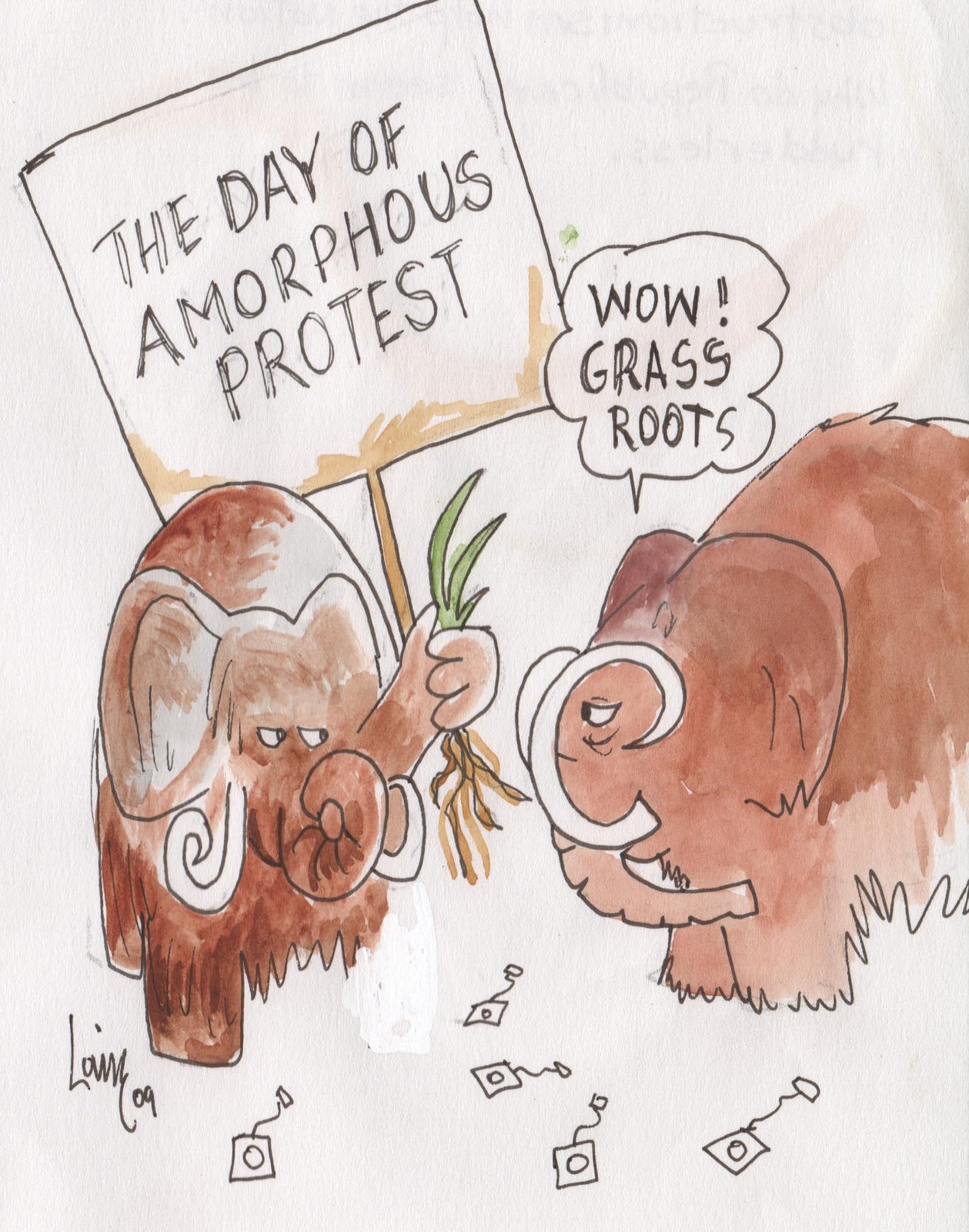
Grassroots Action

Cartoon by Charlie Loving / The Rag Blog

Posted in Rag Bloggers | Tagged , | 2 Comments

Greg Moses : The Perry Laffer Kudlow Report

Whenever the Laffer idea takes hold, as it did in 1980 and 2001, taxes are generally cut to a level below their ability to keep up with actual costs of government. The result is a combination of easy money and a mountain of public debt.

By Greg Moses / The Rag Blog / April 14, 2009

As legend has it, the economic history of the USA was changed on the day that economist Art Laffer drew his famous “Laffer Curve” upon a napkin in order to convince Dick Cheney and Don Rumsfeld that President Gerald Ford’s tax hikes would be a mistake. What the curve intends to teach us is that taxes can be too high.

Laffer’s rationaliztions for low taxes became very popular as banners for the Reagan counter-revolution. And the results of the Laffer idea can be seen quite clearly in a chart of the national debt posted at usgovernmentspending.com. Whenever the Laffer idea takes hold, as it did in 1980 and 2001, taxes are generally cut to a level below their ability to keep up with actual costs of government. The result is a combination of easy money and a mountain of public debt.

Now that the Laffer idea has been run out of town by the current federal administration, you can’t say he didn’t see it coming. In a series of policy studies, some of them done for Texas clients, Laffer has been sandbagging his case for low taxes and small government.

In the latest installment of the Laffer attack, the Texas Public Policy Foundation (TPPF) paid the Laffer associates to produce a rationalization for the state of Texas to send back federal money that was to be funnelled through state agencies. Here’s a link to the pdf at the TPPF website, texaspolicy.com, which, if you have the Netcraft toolbar, you can see is hosted on a server in Canada.

Now the most charming thing about Laffer is that he gets along well with Larry Kudlow, the financial evangelist who can be seen preaching the gospel of wealth most days at CNBC. It’s difficult not to like Kudlow, even when he’s shouting over his liberal guests. But you’d have to get up very early in the morning to find cable news shows these days where the host does not shout over the guest, so in this context the shouting doesn’t seem to harm Kudlow’s charm (that is, until he starts trying to shout over the host of the show that comes after his).

Furthermore, I think we should agree that there is a kernel of truth to the gospel of wealth. If there is such a thing as an American spirit then the gospel of wealth was there at its birth, if only to insist on a quick c-section to get the thing done.

But what happens when the gospel of wealth meets the Laffer Curve is that you get something like the Laffer Cathedral Arch. Instead of placing the curve into a complex field of economic and social analysis, you get led to a place where you have to face private wealth and bow down every time.

On Monday night the Texas Governor, Rick Perry, appeared as a guest on the Kudlow show. True to form for a member of the Laffer posse, the Governor denounced federal stimulus money as counterproductive to state’s rights and private property. The Governor has been speaking in Lafferese most earnestly since he found out that he will have a real fight for re-election against incumbent US Senator Kay Bailey Hutchison. He is pulling what is known in Texas as the Gramm maneuver, which positions each and every opponent as a big-spending liberal.

So these days the Texas Governor is all about the kind of state’s rights that come heavily backed by private wealth. And yes, this is the same Governor who loyally hosted Operation Close the Border or whatever it was called when National Guard troops on Pentagon orders came marching from up North, out West, and back East on down to the Rio Grande. Press two for English if you want to know how that operation worked out.

According to the Governor’s lingo, the stimulus money can only serve to keep more people unemployed longer. And you can see his point insofar as the federal money will not be delivered to some payroll office where it could get right to work making a fortune. What the Governor prefers to brag about is the money he gives directly to entrepreneurs for capital that “creates jobs.” Of course he has to tax somebody to raise that capital. Then the person he gives the money to taxes a bunch of workers, calls it profit, and you have real freedom in the making, not some dreary social oatmeal.

The annoying thing about the Laffer posse is not that they are completely wrong, but that they are so single minded. You give them a chart with a curve on it and they turn it into your one and only train of thought.

In the hands of charming Kudlow, who cannot hide his kitty-cat heart, the Laffer curve can be a healthy counterpoint to big spending liberalism. There is a line we all need to watch. But when the only line that can never be moved is the tax that needs to be paid to do the people’s business, then what we’ll get is more Reaganesque-Bush2 growth that does not, in the words of Mary McLeod Bethune, “Lift as we climb.”

[Greg Moses is editor of the Texas Civil Rights Review and author of Revolution of Conscience: Martin Luther King, Jr. and the Philosophy of Nonviolence. He is a regular contributor to The Rag Blog.]

The Rag Blog

Posted in Rag Bloggers | Tagged , , , , | Leave a comment

Franklin Rosemont, Surrealist Author, Artist and Activist, 1943-2009

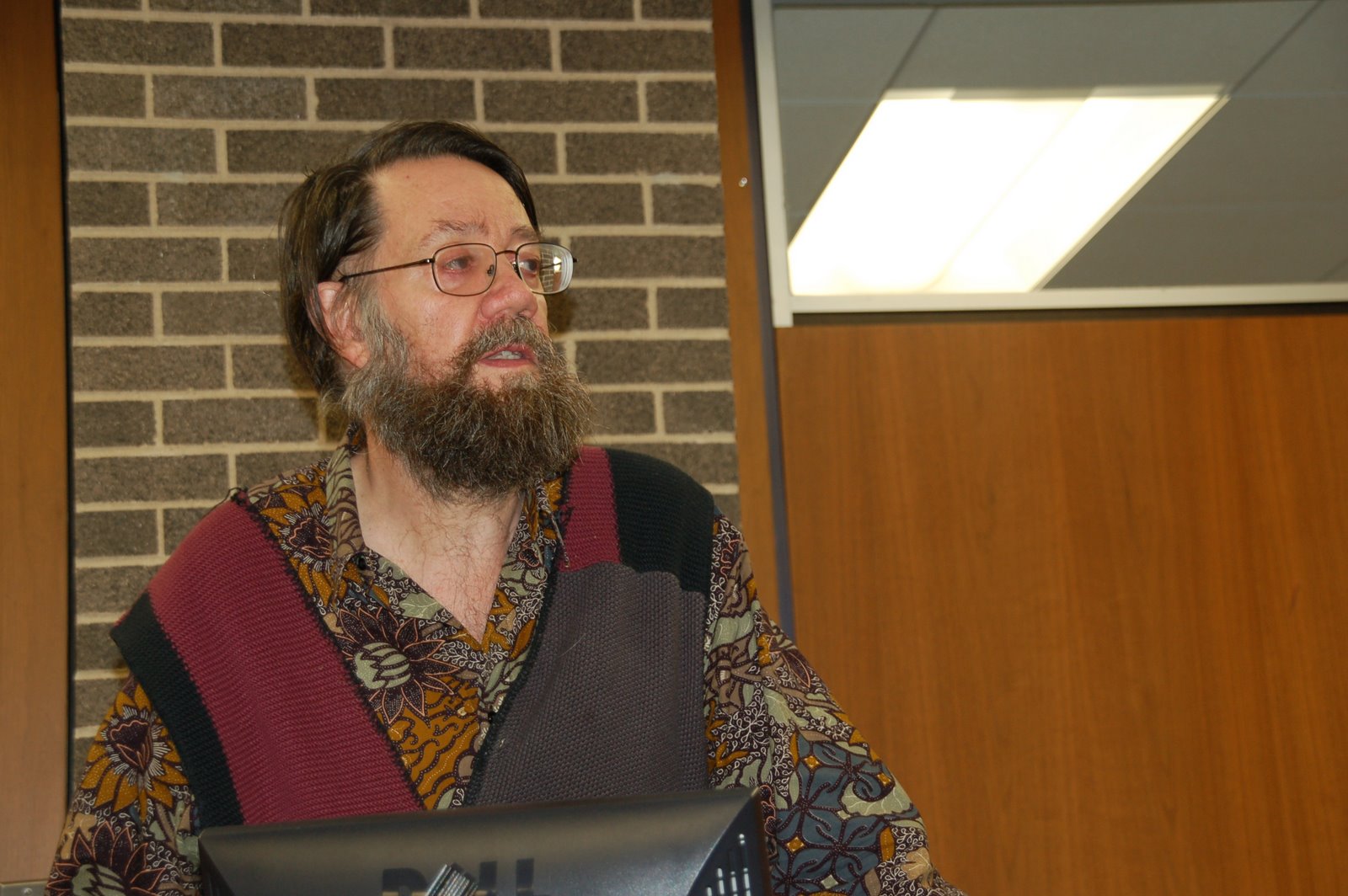
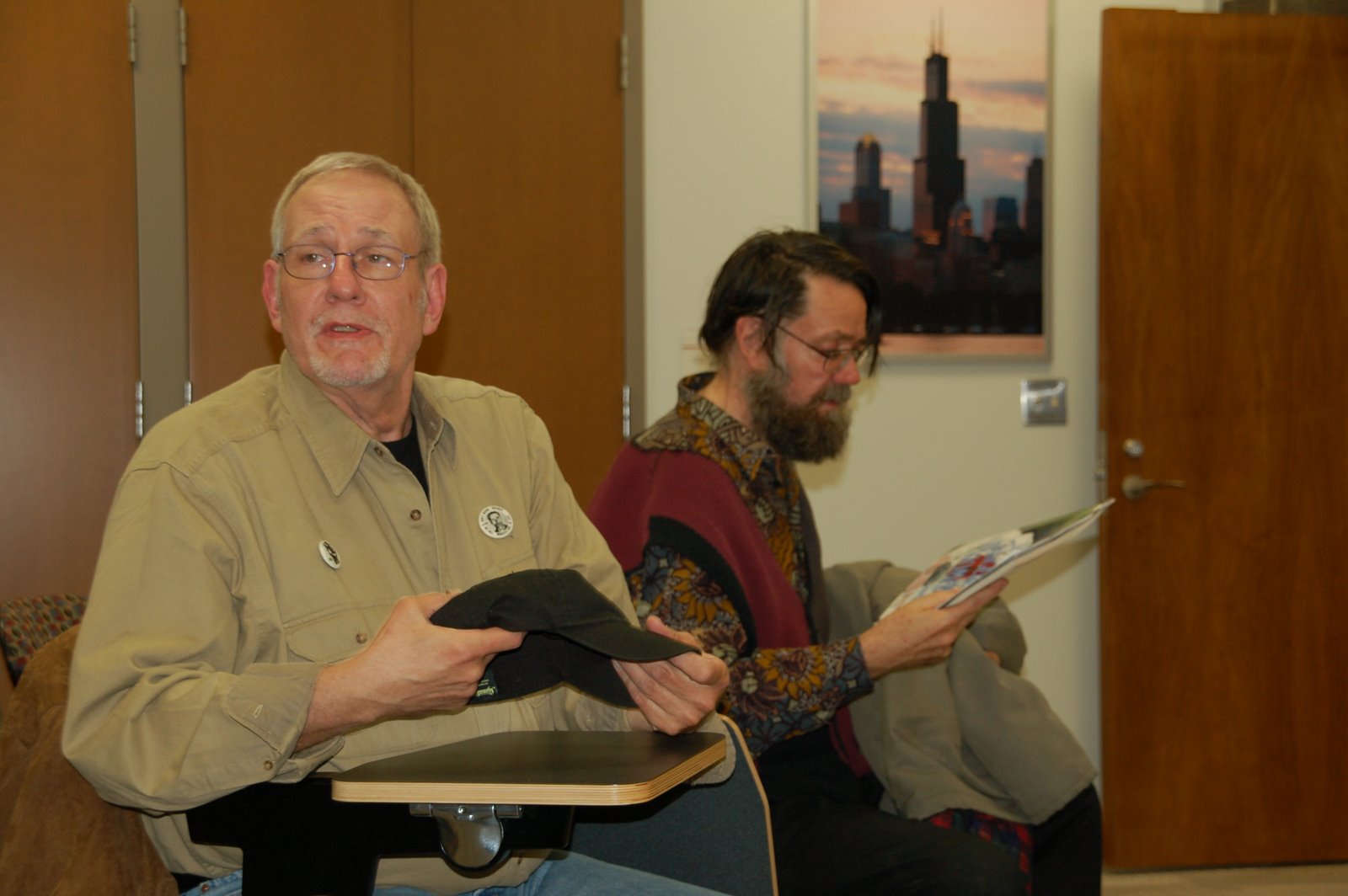
Franklin Rosemont at Movement for a Democratic Society (MDS) National Convergence in Chicago, November 9-11, 2007. Photo by Thomas Good / Next Left Notes.

Franklin Rosemont, surrealist revolutionary, died Sunday, April 12, at the age of 65.

Franklin, 65, came from a working class family. He was a surrealist/poet/artist/revolutionary and a big part of the ’60s Chicago cultural and political scene. I first met both of them in Chicago in ’68 where they were SDS activists.

By Mike Klonsky / The Rag Blog / April 14, 2009

See biographical sketch of Franklin Rosemont and more graphics, Below.

CHICAGO — I ran into old friends Franklin and Penelope Rosemont Saturday at the Heartland Cafe where I was doing the “Live From the Heartland” radio show. The two of them had come to hear a young community activist who followed me on the program, to talk about Franklin’s book, The Rise and Fall of The Dill Pickle, the legendary Chicago jazz club and cultural/political hangout of the Jazz Age. Franklin and Penelope both seemed in great spirits seeing their work being taken up by the current generation.

Yesterday I was stunned to hear the sad news that Franklin had died the next day from an aneurysm.

Franklin, 65, came from a working class family. He was a surrealist/poet/artist/revolutionary and a big part of the ’60s Chicago cultural and political scene. I first met both of them in Chicago in ’68 where they were SDS activists.

Inspired by Jack Kerouac’s On the Road, Franklin had hitchhiked 20,000 miles around the USA and Mexico and wound up in San Francisco in 1960, the heyday of the beat generation poetry renaissance.

Franklin and Penelope went on to create the Chicago Surrealist Group in 1966 after traveling to Paris in 1965 to meet André Breton and attend meetings of the Paris Surrealist Group. The group played a major role in organizing the 1976 World Surrealist Exhibition in Chicago, and has published socially active newspapers and materials through the years. Franklin and Penelope also took over the old Kerr Publishing House and brought it back to life, reviving many classic works of labor history.

Many of their experiences together are documented in Penelope’s wonderful book, Dreams & Everyday Life : Andre Breton, Surrealism, the IWW, Rebel Worker, Students for a Democratic Society and the Seven Cities of Cibola in Chicago, Paris & London.

For more on Franklin Rosemont: Encyclopedia of Road Culture; Bibliography.

[Rag Blog contributor Mike Klonsky is an educator, writer and school reform activist who lives in Chicago. Like many of us here at The Rag Blog, he has roots in Sixties activism and had a decades-long friendship and working relationship with Franklin Rosemont and his partner Penelope. Mike blogs at SmallTalk.]

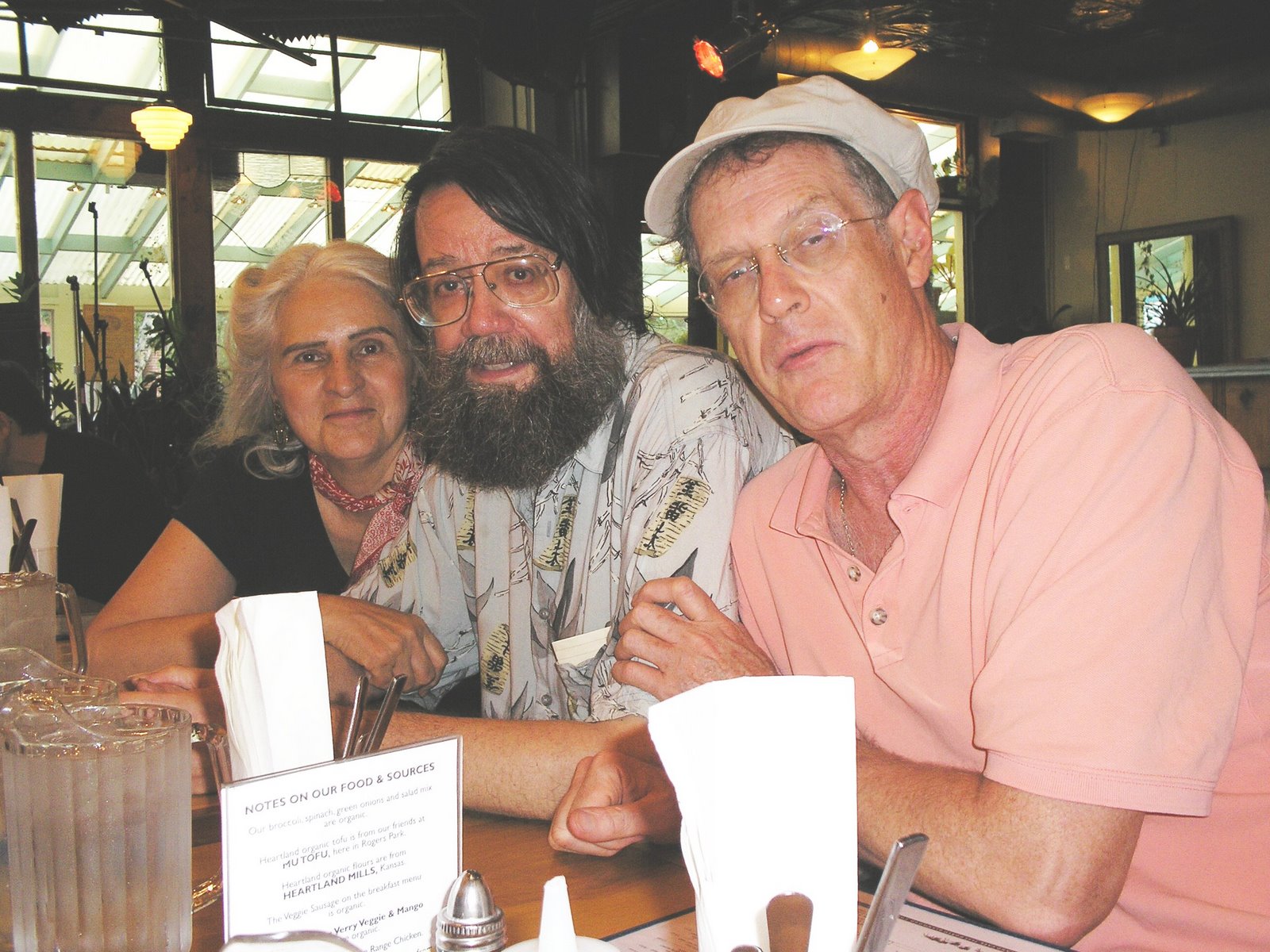
Penelope Rosemont, Franklin Rosemont and historian Paul Buhle. Photo by Thomas Good, NLN.

Franklin Rosemont, 1943-2009

A friend and valued colleague of such figures as Studs Terkel, Mary Low, the poets Philip Lamantia, Diane di Prima, Lawrence Ferlinghetti and Dennis Brutus, the painter Lenora Carrington and the historians Paul Buhle and John Bracey, Rosemont’s own artistic and creative work was almost impossibly varied in inspiration and result.

[The following biographical sketch of Franklin Rosemont was prepared for The Rag Blog by Penelope Rosemont with David Roediger and Paul Garon.]

Franklin Rosemont met André Breton in 1966 and this became a turning point in his life. He became a celebrated, poet, artist, historian, editor, street speaker and surrealist activist. He died on Sunday April 12, 2009, at age 65. With his partner and comrade of more than four decades, Penelope Rosemont, he cofounded in 1966 an enduring and adventuresome Chicago Surrealist Group, making the city a center in the reemergences worldwide of that movement of artistic and political revolt. He has been editing a series on Surrealism for the University of Texas series on surrealism. Most recent in that series is Morning Star by french intellectual Michael Löwy.

Rosemont was born in Chicago on October 2, 1943, to two of the area’s more significant rank-and-file labor activists, the printer Henry Rosemont and the jazz musician Sally Rosemont. Dropping out of Maywood schools, he managed nonetheless to enter Roosevelt University in 1962. There he, already radicalized through family traditions, experiences with miseries inflicted by the educational system and through the reading of momentous political works and comics, entered the stormy left culture of Roosevelt.

The mentorship of the African American scholar St. Clair Drake and his relationship with Penelope led him to much wider worlds. He “hitchhiked 20,000 miles” even as he discovered surrealist texts and art. Soon, with Penelope, he found the surrealist thinker André Breton in Paris. Close study and passionate activity characterized the Rosemonts’ embrace of surrealism as well as their practice in art and organizing.

Active in the 1960s with the Industrial Workers of the World (IWW), the Rebel Worker group and Students for a Democratic Society (SDS), Rosemont helped to lead an IWW strike of blueberry pickers in Michigan in 1964 and began a long and fruitful association with Paul Buhle in publishing a special surrealist issue of Radical America in 1970. Lavish, funny and barbed issues of Arsenal/Surrealist Subversion and special issues of Cultural Correspondence were to follow.

Envelope from Franklin Rosemont to Herbert Marcuse, April 16, 1973, from Marcuse’s papers / Main City Library / Frankfort.

The smashing success of the 1968 world surrealist exhibition at Gallery Bugs Bunny in Chicago announced an ability of the Chicago surrealists to have huge cultural impact without ceasing to be critics of the frozen mainstreams of art and politics. The Rosemonts soon became leading figures in the reorganization of the nation’s oldest radical publisher, the Charles H. Kerr Company. In that role, and in providing coordination for the surrealist Black Swan Press, Rosemont helped to make Chicago a center of nonsectarian revolutionary creativity. In Chicago in 1976 he and Robert Green organized the Largest surrealist exhibition entitled the Marvelous freedom — World Surrealist Exhibition.

A friend and valued colleague of such figures as Studs Terkel, Mary Low, the poets Philip Lamantia, Diane di Prima, Lawrence Ferlinghetti and Dennis Brutus, the painter Lenora Carrington and the historians Paul Buhle and John Bracey, Rosemont’s own artistic and creative work was almost impossibly varied in inspiration and result. Without ever holding a university post, he wrote or edited more than a score of books while acting as a great resource for a host of other writers.


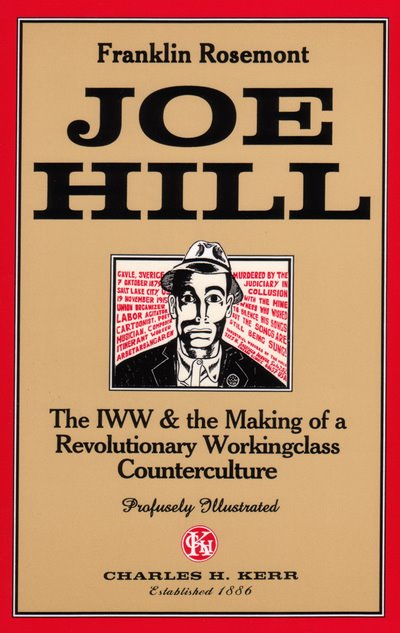
Rosemont’s book, Joe Hill, the IWW & the Making of a Revolutionary Workingclass Counterculture, has recently been translated into French and published in Paris. His coedited volume Haymarket Scrapbook stands as the most beautifully illustrated labor history publication of the recent past. In none of this did Rosemont separate scholarship from art, or art from revolt. His books of poetry include Lamps Hurled at the Stunning Algebra of Ants, The Apple of the Automatic Zebra’s Eye and Penelope. His marvelous fierce, whimsical and funny art work graced countless surrealist publications and exhibitions.

His activity with the Wobblies at Solidarity Bookshop was illustrated in cartoon format in a book by Harvey Pekar edited by Paul Buhle and Nicole Schulman. The SDS activity of Franklin and Penelope was illustrated in another catoon format book by Pekar and Paul Buhle called Students for a Democratic Society, A Graphic History.

Franklin Rosemont and African-American scholar Robin D.G. Kelley have a forthcoming book, Black Brown & Beige, Surrealist Writings from Africa and its Diaspora from University of Texas Press.

Franklin Rosemont with Rag Blog coeditor Thorne Dreyer (left) at the MDS National Convergence in Chicago, November 9-11, 2007. Photo by Thomas Good / NLN.

The Rag Blog

Posted in Rag Bloggers | Tagged , , , , , , , , | Leave a comment

Health Care : ‘I Was Sick and Ye Visited Me’

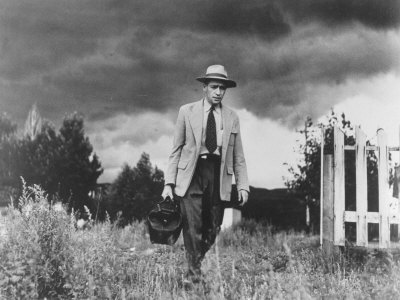
‘Country Doctor Ernest Ceriani Making House Call on Foot in Small Town.’ Photo by W. Eugene Smith / Life Magazine Archives.

Here we are in 21st Century America and health care must be rationed out to the population by money-driven insurance companies. Here, we have rationed medical care predetermined by one’s ability to buy insurance.

By Dr. Stephen R. Keister / The Rag Blog / April 14, 2009

From The Gospel of Matthew:

34 Then shall the King say unto them on his right hand, Come, ye blessed of my Father, inherit the kingdom prepared for you from the foundation of the world: 35 For I was hungered, and ye gave meat; I was thirsty, and ye gave me drink: I was a stranger, and ye took me in; 36 Naked, and ye clothed me; I was sick and ye visited me; I was in prison, and ye came unto me. 37 Then shall the righteous answer him, saying. Lord, when saw we thee hungered, and fed thee? or thirsty, and gave thee drink? 38 When we saw the a stranger, and took thee in? or naked, and clothed thee? 39 Or when saw thee sick, or in prison, and came unto thee? 40 And the King shall answer and say unto them, verily I say unto you, Inasmuch as ye have done it unto one of the least of these my brethren, ye have done it unto me.

As anyone with a fundamental knowledge of history knows, the original hospital care was given in the medieval hospitals by various orders of nuns, such as at the Hotel Dieu or the Groupe Hospitalier Pitie-Salpetriere in Paris. Here the traveler, the victim of the plague, the wounded and infirm were taken care of without consideration of cost or reimbursement by the good sisters at frequently great physical cost to themselves.

However, here we are in 21st Century America and health care must be rationed out to the population by money-driven insurance companies. Here, we have rationed medical care predetermined by one’s ability to buy insurance. Now Sen. Max Baucus and his ilk would turn over a national health program to these insurance companies that have produced in the United States some of the least desirable health care in the world. Thus, is not only horrid, rationed health care perpetuated but much of the cost will be shifted to the taxpayer.

The hypocrisy of the proponents of turning over universal health care to the insurance industry is boundless. They tell us that the purchase of health insurance should be mandated by the government. Their arguments here are absurd. After all, the highest object of medicine is to heal victims of disease, not to destroy them and their families. Studies indicate that medical bills were a factor in 23% of home foreclosures. This suggests that some 1.5 million households are at risk of losing their homes each year due to high costs of medical care. Health care costs have been rising 6% yearly. Families now spend on an average $13,000 for their insurance. Thus medical debt is a central factor in bankruptcy. Last year more than five million people lost their jobs and their health coverage right along with it, and we are now in danger of adding to the 47 million who already lack insurance.

An excellent example of this is described in an article by Kate Michelman from The Nation, posted on Common Dreams. Mrs. Michelman vividly describes the destruction of a middle class life by inadvertent, unexpected medical bills. This could happen to any of us.

Sen Baucus’s plan, which envisions the government mandated purchase of health insurance by all, akin to the failing Massachusetts health plan, may indeed be unconstitutional as I have noted in earlier columns. The insurance lobby assures us that “insurance” will be available to the less fortunate at less cost. Of course this is pure and simple folderol. We get what we pay for. If some slicker tells you that they can get insurance at $400 per month with coverage comparable to insurance costing $2,000 he is a blooming idiot. Of course the $2,000 insurance is all inclusive; however, for $400 the policy will note, in small print, no doubt, that the “beneficiary” must pay the first $5,000 per person insured before the coverage kicks in. He/she must also pay a co-payment of 30% on each doctor’s visit, X-ray etc. And the insurance company beneficently has assured the Senator that they will not turn patients down for pre-existing conditions!

However, beware, for they may provide a policy for a diabetic, but, in fine print, it will note that they will not pay for “diabetic complications,” i.e. blindness, kidney failure, neuropathy, etc. These folks who sell the insurance, and who underwrite many of our elected officials (mostly Republicans, but many Democrats) are out to make money, not to dally around with true, universal health care. Don’t miss the exposé on this subject by Monica Sanchez in the April 3, 2009, Campaign For America’s Future.

Unfortunately, true single payer, universal health care is being ignored or played down by the media. Not even the progressive commentators on MSNBC weeknights mention it. A recent program on PBS’ Frontline about health care in the United States failed to mention single payer universal care (as envisioned by Physicians for a National Health Program). The show was entitled “Sick around America.” Even the PBS ombudsman has sided with the PBS critic who noted the lack of balance in the presentation. One would anticipate that the mainstream media will never give decent coverage to single payer, universal care because of fear of losing their advertisers in the insurance and pharmaceutical industries.

Not only does the MSM suppress information, but television is now being saturated with inaccurate information. Richard Scott, a free market advocate, a wealthy health care executive, a GOP donor, and former owner of The Hospital Corporation of America. Scott is investing $20 million in an effort to deny decent health care to our citizens. We who desire health care in the United States that is comparable in excellence to that provided in the rest of the Free World have hardly made a dent in informing the public. The Manufacturers Association, the Chamber of Commerce and other groups are spending $200 million to fight the Employees Free Choice Act with propaganda that reeks of lies and deceit. See more discussion of this here.

Among the approximately 65% of Americans who desire single payer universal care are unions, civic organizations, academics, and a few religious groups, but where are all of those “Christians” who rail against using a fertilized ovum for research, in an effort to eliminate disease, instead of flushing it down a drain? Why are these people not speaking up and demonstrating for adequate medical care for the poor and disadvantaged? Why are they not expressing concern about our high rate of fetal mortality in the United States, or the fact that millions of our children go to bed hungry each night?

Of course our entire system of medical care is broken and needs to be fixed. One positive idea being suggested is the electronic exchange of medical data. People also propose more extensive preventive medicine, which is great, but proponents of this approach suggest that it is a solution to the problem. These are great ideas, but neither is a substitute for bedside care by an empathetic physician. See Ellen Goodman’s excellent column, “Put ‘care’ in healthcare,” from the April 3, 2009, Boston Globe.

If we are to provide affordable, universal health care we must cut costs. First let us start with Medicare and do away with Medicare Advantage, revise the Medicare Part D Prescription Act and eliminate the billion dollar giveaway to the insurance and pharmaceutical industries. The rampant fraud must be closely investigated and stopped. We must look as well at the industries that provide medical appliances to the medicare patient — their advertising costs must be tremendous and are passed on to the Medicare carriers.

Forty percent of what we pay for prescription drugs goes for marketing costs (to say nothing of the pharmaceutical executives’ salaries). We should do like the rest of the civilized world and ban television advertising for drugs. In the little bit that I watch TV it seems that every other ad is for some medication. And why? The viewer does not buy the drugs directly, and no self respecting, honest, conscientious physician will order a medication merely because it appears on the Idiot Box. The collusion of the drug companies and the academic researchers must be reviewed; as well as the pharmaceutical companies’ sub rosa payments to certain physicians. And, again, we can’t ignore the baksheesh paid by the pharmaceutical industries to our elected representatives.

The government must also take a very hard look at the “nonprofits.” Here we are talking about insurance companies, nursing homes, assisted living situations, not about charities such as the Salvation Army or the Red Cross. We are discussing the tax-exempt businesses that pay excellent six figure or more salaries to their executives, do not have stockholders, but advertise extensively, give grants to symphony orchestras and the like, and buy executive boxes as sporting events for their “guests.”

We must also give some thought to our “fee for service” method of paying our physicians. Nearly every autumn the question arises concerning whether Medicare should cut fees to the “primary physicians,” i.e. internists and family physicians. Why???? The United States has many fewer primary care doctors than any other country in the western world. We need to pay them and train many more of them. This I have discussed in earlier articles. Unhappily, since the insurance industry has made medicine into a business rather than a profession, it seems that money has become the driving force. One calls a physician for advice, and unlike during my practice days, 1950-1990, the physician frequently does not respond to the call but delegates the task to a nurse or PA. I had a partner for many years, a diabetologist, who had a phone hour at home every evening from 6-7 p.m., Monday through Friday, during which time he answered his patients’ queries, discussed diets, etc.

Finally, the example of X and Y. Both want to be doctors. Both take premedical studies for four years. Both attend medical school for four years. Then they decide on a speciality. X goes into endocrinology, Y goes into cardiac surgery. Both spend 4-5 years as interns or residents. Now the zinger! The cardiac surgeon has ten times the income of the endocrinologist. Why? Glamour, working with his hands? Why? The average layman will say, “but Y is saving lives in the operating room!”. Yet X stays up all night with a child in diabetic coma, and saves his life.

Where, I ask is the difference, except for practice and custom? Note as well that several of our more famous clinics in the United States pay by the hour, years of service, ability to write medical articles, rather than by specialty. One more place to look at cost and arrive at a fair and equitable salary, and thus, hopefully, increase our supply of primary physicians.

[Dr. Stephen R. Keister, a regular contributor to The Rag Blog, lives in Erie, PA. He is a retired physician who is active in health care reform. His previous articles on The Rag Blog can be found here.]

The Rag Blog

Posted in Rag Bloggers | Tagged , , , | 4 Comments

Roger Baker : The Reality of ‘Peak Oil,’ Part 2

ASPO USA.

Peak Oil is the point at which the total world oil production reaches its high point and finally starts to decline… We at last have some pretty convincing data to indicate that world oil production probably peaked forever in the summer of 2008… — From Part 1.

By Roger Baker / The Rag Blog / April 13, 2009

[This is the second installment of a two-part series on Peak Oil by Rag Blog contributor Roger Baker. “The Reality of ‘Peak Oil,’ Part 1,” can be found here.]

Assuming that world oil production has indeed already peaked, how should we best respond to that situation?

Most typical US citizens, who are also aware of the global warming problem, when asked to consider this issue would probably prescribe a crash program of building alternative energy infrastructure like wind and solar energy supplies, and plug-in electric vehicles. Maybe they would suggest various home energy conservation techniques and more local food production. Perhaps they would advocate policies meant to encourage compact development and end urban sprawl surrounding major US metro areas, or a return to energy-efficient rail transportation.

Who, knowing our situation, would not applaud such policies as progress? We need to do all that as fast as we can do it. The problem is that once we start crunching the numbers we will start to see that if these policies are to be very effective, they need to be implemented more than a decade in advance of peak oil. Which peak is probably here already.

The problem is that we now lack the time to restructure very much of our unusually oil-addictive US national economy toward better energy efficiency. The energy crunch is thus likely to hit us much harder, and to force widespread involuntary conservation. That won’t make anyone very happy.

The Hirsch Report by Robert L. Hirsch (“Peaking of World Oil Production: Impacts, Mitigation, and Risk Management”) laid out the interactive problems of trying to institute a crash program of rebuilding a greener economy, while lacking sufficient time to do so properly. The Hirsch report was itself not an isolated revelation. It built on earlier works describing the economic limits to rapid industrial and economic transitions tied to energy, such as “Beyond Oil” by Gever, et al. Here is an introduction to Hirsch’s report:

The peaking of world oil production presents the U.S. and the world with an unprecedented risk management problem. As peaking is approached, liquid fuel prices and price volatility will increase dramatically, and, without timely mitigation, the economic, social, and political costs will be unprecedented. Viable mitigation options exist on both the supply and demand sides, but to have substantial impact, they must be initiated more than a decade in advance of peaking.

Perhaps one proper perspective from which to view the current situation is the understanding that we have, since WWII, become an advertising-driven consumerist culture in denial of any natural limits whatsoever. This leaves us in a situation that causes us to try to use politics to turn back history and restore the old status quo of greater material affluence. All the while trying to operate under the increasingly inappropriate social, economic, legal, and political institutions of a society in denial of its natural limits.

Jim Kunstler often writes about that kind of social dysfunction in arguing for change. He says we should make an abrupt shift toward restructuring the economy for survival in the harder times to come. The following, entitled “Full Commanding Denial,” is from March 23, 2009.

If central casting called for a poised, straight-talking, and capable-seeming president, it would be hard to come up with someone better than the Barack Obama who walked and talked around the White House grounds with Steve Croft on “60-Minutes” Sunday night. He may perfectly represent the majority who elected him, though, because he also appears to be in full commanding denial of the realities overtaking our American experience.

Those realities include the fact that we can’t possibly return to the easy credit and no money down “consumer” economy no matter how many nominal dollars get shoveled into the fiery furnaces of banks too-big-to-fail. As Treasury Secretary Geithner’s underling, Stephanie Cutter, said last week, “Our singular focus is on increasing lending to support economic recovery. Everything we do to stabilize the financial system is done with that goal in mind.”

Lending on the scale that became normal over the last decade is for sure the one thing that we will not recover. We turn around in 2009 to find ourselves a much poorer nation than we thought we were a year ago, especially among that broad range of formerly middle-class wage-earners who lived so luxuriously until yesterday. The public can’t process this reality and the president, for all his relaxed charm, is either not ready to articulate it, or can’t process it himself.

Everything that we’re doing right now is engineered to avoid reality, to sustain the unsustainable, to recover the unrecoverable,when the mandate of reality compels us to face our losses in order to move on to the next chapter of a collective American life. The next chapter would be a society that runs on a much more local and modest scale, centered on essential activities like growing food, requiring harder physical work, and focused attention — in other words, the opposite of a society lost in abstractions, long-range daisy chains of off-loaded responsibility, and incessant pleasure-seeking. . .

There are now a number of admirable efforts and individuals urging fast reform, especially in light of global warming. Al Gore is generally trying to lead us in the right direction. Another good effort is Lester Brown’s Earth Policy Institute. There are probably thousands of broadly similar simultaneous reform and environmental efforts going on, all over the blogosphere and on all levels of internet communication.

That said, not many such efforts have a strong focus on peak oil economics. Many liberal economists like Paul Krugman do not seem willing to acknowledge serious limits to growth.

ASPO-USA is an ASPO International affiliate working hard to raise general public consciousness, and to educate Congress. They sponsor Peak Oil News; a valuable daily oil analysis commentary by a distinguished retired CIA analyst, Tom Whipple.

Also deserving of special praise, there is an excellent new non-profit think tank, the Post Carbon Institute, that is actively studying the energy-constrained economic transition problem we all face. There are lots of top quality links on its site.

Environmental resource scholar, and now Post Carbon Institute Fellow, Richard Heinberg puts out an excellent, long-running monthly analysis and commentary titled “Museletter.” Heinberg’s latest Museletter deals with the most likely economic scenarios resulting from the oil peak, with a special focus on the timing of the situation.

The discussion is tied to the economics of the energy crisis. It is impossible to predict where the current economic crisis will lead, due to the fact that nobody knows how much longer the current global deflationary spiral will continue. At some point, the trillions of dollars being injected by the feds, now printing up money without apology, will probably act to turn around the depressed psychology of consumer saving, partly revive an easy spending psychology, leading to a faster velocity of circulation of money. There are big unknowns at work since there is not a strong link between the amount of money in general circulation and consumer confidence. However much economics strives to be a science, it actually turns out to based on a foundation of psychology and politics.

Printing money to stimulate the economy is a tool of last resort, being employed only after interest rate cuts and bank bailouts have failed. Since the average consumers who make up the bulk of the economy are already deep in debt, injecting lots of money is a bit extreme, perhaps akin to using gasoline to revive a smoldering fire. Money stimulation by the US treasury and Federal Reserve is likely to work at some point, but it is also likely to get out of hand and lead to an uncontrolled turnaround in consumer behavior from saving to spending.

This could easily result in hyperinflation at worst, and nothing a whole lot better at best. It seems likely that a lot of the new federal stimulus dollars might start buying oil, which would increase the price. Which would attract even more investors to the new honeypot. In the absence of rationing, this is likely after a time to initiate another debilitating oil price spike.

Here are a few Museletter snips related to some plausible economic scenarios:

The general picture is clear enough. A combination of peak oil, climate change, and the bursting of the mother of all economic bubbles will result in a collapse of the global economy, perhaps of civilization itself. If we are still to avert the worst of a crisis that could eventuate in untold death, destruction, and tragedy, we need to restructure the world’s energy systems and money systems immediately…

But the enormity of the current economic meltdown raises the question: Is this really just a hiccup, or is it the beginning of the end (not of the world, perhaps, but certainly of life as we have known it for the past decades)?

It’s still a judgment call, at this point.

Maybe Geithner and Bernanke can pull off a miracle and stabilize the economy. In that case, with energy demand having fallen so far below its level of just a year ago, it might take as long as five years from no—who knows, maybe even seven—for depletion and decline to cause oil prices to spike again, giving the economy the coup de grace. At that point, there can indeed be no recovery, only adaptation. That’s the best-case scenario I can imagine (in terms of preserving the status quo).

But I have a hard time picturing that. A much more likely scenario, in my view: We will see a few months of fairly gradual economic deterioration (slowed by the mighty efforts of the Bailout Brigade), followed by a truly ugly global economic meltdown. The result will be a general level of economic activity much lower than the world is accustomed to. Efforts to right the ship will include protectionist legislation (that will provoke international confrontations), the convening of world leaders to create a new global currency and financial system (which probably won’t succeed, at least not the first time around), and various populist uprisings that will lead to political instability around the globe. Energy demand will remain low, but energy production will fall dramatically due to lack of investment. Carbon emissions will therefore fall too, so the world’s attention will be diverted from tackling the greenhouse gas issue, even though climate impacts from previous carbon emissions will continue to worsen.

But here’s the crux of the matter: unlike the situation the world faced in the 1970s, there is no prospect for another cheap-energy bounce this time. It’s too late to muddle. We have run out the clock on proactive adaptation. From now on, collective survival will hinge on the strategies we adopt for emergency response. Some strategies will make matters worse, while others will lay the groundwork for better times to come. This is what it has come to. One doesn’t wish to sound shrill, but there it is. . . .

Assuming that Heinberg is correct, what should intelligent environmental visionaries do about the current situation? The Post Carbon Institute has recently issued a manifesto declaring their intent to help prepare us for what to do, offering guidance on how to best and most gracefully reduce peak world industrial production.

This economic sea change that we face does not imply that everything will stagnate and fall into ruin. But we do need to actively restructure things ASAP, with sustainability and long-range human survival kept very much in mind. This even as global warming and water constraints get worse and disrupt our agriculture. Here are some snips from the Post Carbon Institute that set the tone for their efforts. They may not have all the answers, but the Post Carbon group seems to me to be thinking as clearly as any of the visionaries who are pondering our global resource constraints:

. . .It is no coincidence that so many resource peaks are occurring together. All are causally related by way of the historic reality that, for the past 200 years, cheap and abundant energy from fossil fuels has driven technological invention, increases in total and per-capita resource extraction and consumption (including food production), and population growth. We are enmeshed in a classic self-reinforcing feedback loop.

Our starting point for future planning, then, must be the realization that we are living today at the end of the period of greatest material abundance in human history — an abundance based on temporary sources of cheap energy that made all else possible. Now that the most important of those sources are entering their inevitable sunset phase, we are at the beginning of a period of overall economic contraction. . ..

The Role of Post Carbon Institute

Post Carbon Institute is dedicated to answering the central question of our times: How do we manage the transition to a post-growth, post-fossil fuel, climate-changed world?

It will be Post Carbon Institute’s role to publicly discuss these issues in accessible ways, and as aspects of a systemic, interdependent web of crises. We will gather and analyze response strategies (whether proven or under experimentation), and disseminate them to the individuals, communities, businesses, and governments who need them. We will develop the framing and messaging of these issues so as to significantly raise the visibility and impact of emerging solutions.

We will constantly monitor both challenges and exciting new developments in a range of fields: energy, climate, food systems, land use, green building construction and retrofits, biodiversity and ecological restoration, water, transportation, and new economic systems. We will highlight green-leader cities and businesses, Transition Town 8

Through our close relationships with forward-thinking communities and organizations, Post Carbon Institute is uniquely positioned to both draw from their best practices and provide them with the resources they need to quickly scale up and replicate their work. To our knowledge, there is no other organization taking this important leadership role. . .

Also see Roger Baker : The Reality of ‘Peak Oil,’ Part 1 by Roger Baker / The Rag Blog / April 7, 2009

The Rag Blog

Posted in Rag Bloggers | Tagged , , , , | 4 Comments

Dick Cheney : A Political Madness

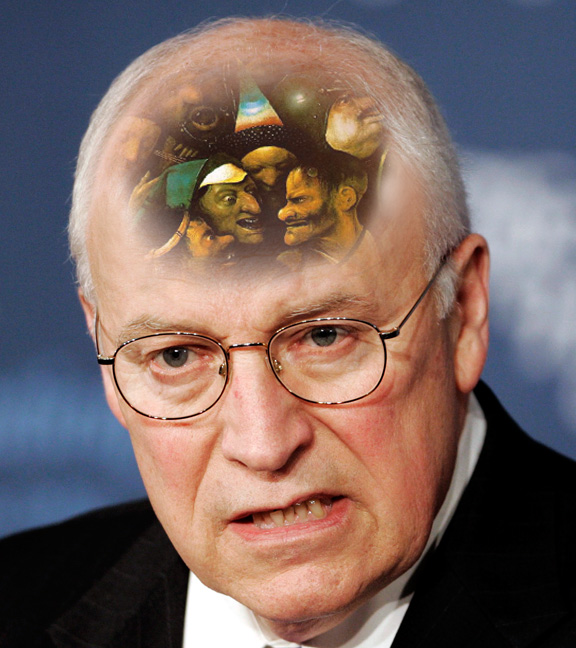
Graphic by Larry Ray / The Rag Blog. (Thanks to Hieronymus Bosch for the look into Dick’s Dark Brain.)

Dick Cheney is sadly childlike in his petulant public outbursts. There is a mad gleam in his eye as he insists that his fantasy world and imagined demons are real.

By Larry Ray / The Rag Blog / April 12, 2009

A storm of delusional rage, classic paranoia, frightening pettiness, and political irrelevance continues to characterize former Vice President of the United States of America, Dick Cheney.

And his madness has recently been on public display wherever he can manage a TV interview.

Dick Cheney is sadly childlike in his petulant public outbursts. There is a mad gleam in his eye as he insists that his fantasy world and imagined demons are real. He is both the raving old uncle bursting into the room, ranting wildly and an overindulged child throwing a tantrum, kicking and screaming on the floor.

Cheney is still fuming that W resolutely refused to pardon his former chief of staff, I. Lewis “Scooter” Libby Jr., who was convicted of several federal counts including perjury for his part in leaking the identity of former CIA agent, Valerie Wilson. Cheney will reportedly be a no-show at a Bush gathering next week of the old administration faithful including Condoleezza Rice, Karen Hughes, Dan Bartlett and other loyal insiders.

That George W. Bush would stand up to him in a heated argument during the last hours of their administration remains a stinging, maddening affront and personal defeat to Cheney, the consummate controller. His reluctance to quietly retire after imposing incalculable damage upon this country really should come as no surprise as we look back at his past.

Cheney began his political career in 1969 as an intern for Wisconsin Congressman William A. Steiger. The fall of Richard Nixon and Gerald Ford’s assumption of the presidency inadvertently opened the doors to the White House to Cheney.

Ford chose wunderkind and Nixon cabinet member, Donald Rumsfeld, to help him regain control of a White House in disorder and crisis. On his tapes, Nixon said of Rumsfeld, “at least Rummy is tough enough” and, “He’s a ruthless little bastard. You can be sure of that.”

The bureaucratically saavy Rumsfeld tapped by then Wyoming Congressman Dick Cheney, as his deputy. Early on, Cheney was characterized by insiders for “making himself valuable by initially doing the lowest forms of bureaucratic scutwork.”

Rolling Stone Magazine succinctly described the Rumsfeld-Cheney power grabbing cabal: “Having turned Ford into their instrument, Rumsfeld and Cheney staged a palace coup. They pushed Ford to fire Defense Secretary James Schlesinger, tell Vice President Nelson Rockefeller to look for another job, and remove Henry Kissinger from his post as national security adviser. Rumsfeld was named secretary of defense, and Cheney became chief of staff to the president. The Yale dropout and draft dodger was, at the age of 34, the second-most-powerful man in the White House.”

After years of steadily parlaying his political power, in 1993 Cheney left Washington and the Defense Department after the Democrats returned to power under Bill Clinton. Cheney joined The American Enterprise Institute and in 1995 until 2000 the career politician became CEO of energy sector giant, Haliburton. In those five years, before returning to politics, Cheney’s net worth was estimated to be between $30 million and $100 million, and said to be largely derived from his position at Haliburton. This was in addition to his gross income of nearly $8.82 million. Not bad for a Yale dropout who eventually earned both a BA and MA in political science.

The world is generally very familiar with Cheney’s transformation in 2000, of the basically powerless office of Vice President of the George W. Bush administration into a secretive Dr. Strangelove operation. The Washington Post noted, “Across the board, the vice president’s office goes to unusual lengths to avoid transparency. Cheney declines to disclose the names or even the size of his staff, generally releases no public calendar, and ordered the Secret Service to destroy his visitor logs. His general counsel has asserted that ‘the vice presidency is a unique office that is neither a part of the executive branch nor a part of the legislative branch,’ and is therefore exempt from rules governing either.”

He did not leave office gracefully, being confined to a wheelchair following a fall. His image is forever burned into our memory as he was wheeled into his place at the Obama Inauguration, bundled up in a lap blanket, dressed in black, and wearing a dark fedora. An image of physical defeat, and dour reluctance to acknowledge that the nation was overwhelmingly, joyfully welcoming in a new era of change, openness and rejection of everything he stands for.

Cheney is sadly like a modern-day Norma Desmond substituting Pennsylvania Avenue for Sunset Boulevard. An over-the-hill, discredited political actor who may be ready for his closeup, but does not realize that it would be in High Definition today, showing all his warts and madness in more detail than anyone wants to see. Like Norma, Dick is better remembered silent. He now must head back, deep into the hills of Wyoming and let America get on with its business.

[Retired journalist Larry Ray is a Texas native and former Austin television news anchor. He also posts at The iHandbill.]

The Rag Blog

Posted in Rag Bloggers | Tagged , , , | 2 Comments

Drone Attacks: Killing Civilians at the Rate of Fifty to One


60 drone hits kill 14 al-Qaeda men, 687 civilians
By Amir Mir / April 10, 2009

LAHORE — Of the 60 cross-border predator strikes carried out by the Afghanistan-based American drones in Pakistan between January 14, 2006 and April 8, 2009, only 10 were able to hit their actual targets, killing 14 wanted al-Qaeda leaders, besides perishing 687 innocent Pakistani civilians. The success percentage of the US predator strikes thus comes to not more than six per cent.

Figures compiled by the Pakistani authorities show that a total of 701 people, including 14 al-Qaeda leaders, have been killed since January 2006 in 60 American predator attacks targeting the tribal areas of Pakistan. Two strikes carried out in 2006 had killed 98 civilians while three attacks conducted in 2007 had slain 66 Pakistanis, yet none of the wanted al-Qaeda or Taliban leaders could be hit by the Americans right on target. However, of the 50 drone attacks carried out between January 29, 2008 and April 8, 2009, 10 hit their targets and killed 14 wanted al-Qaeda operatives. Most of these attacks were carried out on the basis of intelligence believed to have been provided by the Pakistani and Afghan tribesmen who had been spying for the US-led allied forces stationed in Afghanistan.

The remaining 50 drone attacks went wrong due to faulty intelligence information, killing hundreds of innocent civilians, including women and children. The number of the Pakistani civilians killed in those 50 attacks stood at 537, in which 385 people lost their lives in 2008 and 152 people were slain in the first 99 days of 2009 (between January 1 and April 8).

Of the 50 drone attacks, targeting the Pakistani tribal areas since January 2008, 36 were carried out in 2008 and 14 were conducted in the first 99 days of 2009. Of the 14 attacks targeting Pakistan in 2009, three were carried out in January, killing 30 people, two in February killing 55 people, five in March killing 36 people and four were conducted in the first nine days of April, killing 31 people.

Of the 14 strikes carried out in the first 99 days of April 2009, only one proved successful, killing two most wanted senior al-Qaeda leaders – Osama al Kini and Sheikh Ahmed Salim Swedan. Both had lost their lives in a New Year’s Day drone strike carried out in the South Waziristan region on January 1, 2009.

Kini was believed to be the chief operational commander of al-Qaeda in Pakistan and had replaced Abu Faraj Al Libi after his arrest from Bannu in 2004. Both men were behind the 1998 bombings of the US embassies in Dares Salaam, Tanzania, and Nairobi, Kenya, which killed 224 civilians and wounded more than 5,000 others.

There were 36 recorded cross-border US predator strikes inside Pakistan during 2008, of which 29 took place after August 31, 2008, killing 385 people. However, only nine of the 36 strikes hit their actual targets, killing 12 wanted al-Qaeda leaders. The first successful predator strike had killed Abu Laith al Libi, a senior military commander of al-Qaeda who was targeted in North Waziristan on January 29, 2008. The second successful attack in Bajaur had killed Abu Sulayman Jazairi, al-Qaeda’s external operations chief, on March 14, 2008. The third attack in South Waziristan on July 28, 2008, had killed Abu Khabab al Masri, al-Qaeda’s weapons of mass destruction chief. The fourth successful attack in South Waziristan on August 13, 2008, had killed al-Qaeda leader Abdur Rehman.

The fifth predator strike carried out in North Waziristan near Miranshah on Sept 8, 2008 had killed three al-Qaeda leaders, Abu Haris, Abu Hamza, and Zain Ul Abu Qasim. The sixth successful predator hit in the South Waziristan region on October 2008 had killed Khalid Habib, a key leader of al-Qaeda’s paramilitary Shadow Army.

The seventh such attack conducted in North Waziristan on October 31, 2008 had killed Abu Jihad al Masri, a top leader of the Egyptian Islamic group. The eighth successful predator strike had killed al-Qaeda leader Abdullah Azzam al Saudi in east of North Waziristan on November 19, 2008.

The ninth and the last successful drone attack of 2008, carried out in the Ali Khel region just outside Miramshah in North Waziristan on November 22, 2008, had killed al-Qaeda leader Abu Zubair al Masri and his Pakistani fugitive accomplice Rashid Rauf.

According to the figures compiled by the Pakistani authorities, a total of 537 people have been killed in 50 incidents of cross-border US predator strikes since January 1, 2008 to April 8, 2009, averaging 34 killings per month and 11 killings per attack. The average per month killings in predator strikes during 12 months of 2008 stood at 32 while the average per attack killings in the 36 drone strikes for the same year stood at 11.

Similarly, 152 people have been killed in 14 incidents of cross-border predator attacks in the tribal areas in the first 99 days of 2009, averaging 38 killings per month and 11 killings per attack.

Since September 3, 2008, it appears that the Americans have upped their attacks in Pakistani tribal areas in a bid to disrupt the al-Qaeda and the Taliban network, which they allege is being used to launch cross border ambushes against the Nato forces in Afghanistan.

The American forces stationed in Afghanistan carried out nine aerial strikes between September 3 and September 25, 2008, killing 57 people and injuring 38 others. The attacks were launched on September 3, 4, 5, 8, 12, 15, 17, 22 and September 27. However, the September 3, 2008 American action was unique in the sense that two CH-47 Chinook transport helicopters landed in the village of Zawlolai in the South Waziristan Agency with ground troops from the US Special Operation Forces, fired at three houses and killed 17, including five women and four sleeping children.

Besides the two helicopters carrying the US Special Forces Commandos, two jet fighters and two gun-ship helicopters provided the air cover for the half-an-hour American operation, more than a kilometre inside the Pakistani border.

The last predator strike on [April 8, 2009] was carried out hardly a few hours after the Pakistani authorities had rejected an American proposal for joint operations in the tribal areas against terrorism and militancy, as differences of opinion between the two countries over various aspects of the war on terror came out into the open for the first time.

The proposal came from two top US visiting officials, presidential envoy for the South Asia Richard Holbrooke and Chairman of Joint Chiefs of Staff Admiral Mike Mullen. However, the Pakistani military and political leadership reportedly rejected the proposal and adopted a tough posture against a barrage of increasing US predator strikes and criticism emanating from Washington, targeting the Pakistan Army and the Inter Services Intelligence (ISI) and creating doubts about their sincerity in the war on terror and the fight against al-Qaeda and Taliban.

Source / International / The News

The Rag Blog

Posted in RagBlog | Tagged , , , | Leave a comment

Dennis Kucinich: Get Out of Afghanistan, Too

Obama has proposed an $82 trillion dollar WAR SUPPLEMENT to the budget. I do not believe in war, whether in Afghanistan or along the Mexican border, where a huge chunk of this money is also destined.

I am hearing that “some people on the Left” believe that a US invasion of Afghanistan is justified because it will liberate Afghani women. Oh yah, I am sure a military invasion is just what they need to improve their status; doesn’t war ALWAYS help women the most???

“Hey, hey, President Obama,
Invading Afghanistan is nothing but trauma!”

It’s A Thousand Splendid Suns (Khaled Hosseini) that, after all these years doing “anti-war,” has made me a genuine pacifist. Not speaking out STRONGLY against this course of action NOW is a mistake. There are viable alternatives that don’t involve the US rushing in to yet another place it has no business being.

Mariann Wizard / The Rag Blog / April 13, 2009

The Rag Blog

Posted in RagBlog | Tagged , , , , | 1 Comment

The Meaningful Way to Combat Terrorism

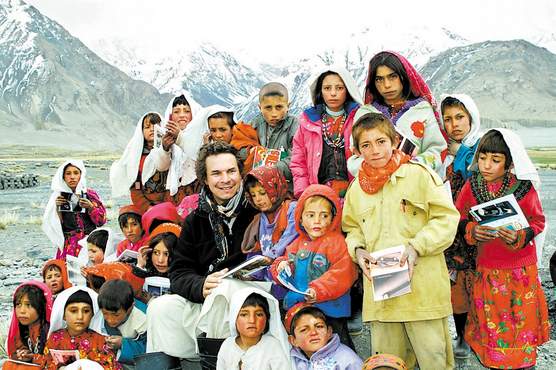
Greg Mortenson, shown with students from the Sitara School he established in northeast Afghanistan in 2005, says education is the best ammunition against misogynistic terrorist regimes like the Taliban. Photo: Greg Mortenson.

Build relationships, author tells cadets
By Alexa James

Recommends ‘3 cups of tea’

WEST POINT — Author and activist Greg Mortenson introduced himself to an auditorium of Army cadets, then told them how to win in Afghanistan:

“Drink more tea.”

Mortenson met with students in West Point’s Counterinsurgency Operations class on Tuesday to discuss his humanitarian work in Central Asia and his best-selling book, “Three Cups of Tea.”

The Army veteran explained: “First cup you’re a stranger, the second cup a guest. On the third cup you become family.”

“That doesn’t mean you just go around drinking tea and having peace and freedom in the world,” he said. “What it means is, you have to build relationships.”

Mortenson, 50, has spent the last 16 years establishing schools in volatile regions of Afghanistan and Pakistan. He’s been kidnapped by feuding tribes, questioned by the CIA and lambasted by foreigners and Americans alike. But through his nonprofit Central Asia Institute, he established nearly 80 schools for some 28,000 boys and girls.

Education, he says, is the best ammunition against misogynistic terrorist regimes like the Taliban. “We can drop bombs or hand out condoms or build roads,” he said, “but if we don’t educate the girls, nothing is going to change.”

Mortenson is not alone in this thinking. He works closely with U.S. commanders on counter-insurgency strategies that consider local customs. On a large screen in the auditorium Tuesday, he talked the cadets through slides approved by the Pentagon specifically for the West Point lecture. The diagrams outlined the complex overlay of tribal and ethnic allegiances in Afghanistan and Pakistan and the ways the Taliban extorts the system to build new allegiances.

Combating that societal shift, Mortenson said, will force American leaders to adjust their policies, too. “Sometimes things seem very unconventional, they seem very risky, like talking with the Taliban. Often, those are where the solutions are.”

Mortenson criticized Secretary of State Hillary Rodham Clinton for ignoring Pakistan and Afghanistan on her recent visit to Asia. He also disparaged the previous administration for refusing to talk with enemies.

And in turn, some of the cadets challenged Mortenson’s approach, pushing him to account for well-educated terrorists, such as those who hijacked the airplanes on September 11.

Intense debates over social and military doctrines are the bread-and-butter of this counterinsurgency course. Maj. James Spies, a Special Forces soldier-turned-professor, encourages his students to question everything and expect change. “What applies this week in Iraq,” he said, “definitely doesn’t apply this week in Afghanistan.”

And it won’t apply to sophomore Tim Clark, 22, when he graduates from West Point. Relying on expertise from those inside and outside the Army’s circles is “vitally important,” he said. “I think Mr. Mortenson is dead on in saying that you need to build relationships.”

Source / Times Herald Record / Originally posted on March 13, 2009

Thanks to Rebecca Jehn / The Rag Blog

Posted in RagBlog | Tagged , , , | 2 Comments

Somali Pirates: Other Than What We Are Told?


Johann Hari: You are being lied to about pirates
By Johann Hari

Some are clearly just gangsters. But others are trying to stop illegal dumping and trawling

Who imagined that in 2009, the world’s governments would be declaring a new War on Pirates? As you read this, the British Royal Navy – backed by the ships of more than two dozen nations, from the US to China – is sailing into Somalian waters to take on men we still picture as parrot-on-the-shoulder pantomime villains. They will soon be fighting Somalian ships and even chasing the pirates onto land, into one of the most broken countries on earth. But behind the arrr-me-hearties oddness of this tale, there is an untold scandal. The people our governments are labelling as “one of the great menaces of our times” have an extraordinary story to tell – and some justice on their side.

Pirates have never been quite who we think they are. In the “golden age of piracy” – from 1650 to 1730 – the idea of the pirate as the senseless, savage Bluebeard that lingers today was created by the British government in a great propaganda heave. Many ordinary people believed it was false: pirates were often saved from the gallows by supportive crowds. Why? What did they see that we can’t? In his book Villains Of All Nations, the historian Marcus Rediker pores through the evidence.

If you became a merchant or navy sailor then – plucked from the docks of London’s East End, young and hungry – you ended up in a floating wooden Hell. You worked all hours on a cramped, half-starved ship, and if you slacked off, the all-powerful captain would whip you with the Cat O’ Nine Tails. If you slacked often, you could be thrown overboard. And at the end of months or years of this, you were often cheated of your wages.

Pirates were the first people to rebel against this world. They mutinied – and created a different way of working on the seas. Once they had a ship, the pirates elected their captains, and made all their decisions collectively, without torture. They shared their bounty out in what Rediker calls “one of the most egalitarian plans for the disposition of resources to be found anywhere in the eighteenth century”.

They even took in escaped African slaves and lived with them as equals. The pirates showed “quite clearly – and subversively – that ships did not have to be run in the brutal and oppressive ways of the merchant service and the Royal Navy.” This is why they were romantic heroes, despite being unproductive thieves.

The words of one pirate from that lost age, a young British man called William Scott, should echo into this new age of piracy. Just before he was hanged in Charleston, South Carolina, he said: “What I did was to keep me from perishing. I was forced to go a-pirateing to live.” In 1991, the government of Somalia collapsed. Its nine million people have been teetering on starvation ever since – and the ugliest forces in the Western world have seen this as a great opportunity to steal the country’s food supply and dump our nuclear waste in their seas.

Yes: nuclear waste. As soon as the government was gone, mysterious European ships started appearing off the coast of Somalia, dumping vast barrels into the ocean. The coastal population began to sicken. At first they suffered strange rashes, nausea and malformed babies. Then, after the 2005 tsunami, hundreds of the dumped and leaking barrels washed up on shore. People began to suffer from radiation sickness, and more than 300 died.

Ahmedou Ould-Abdallah, the UN envoy to Somalia, tells me: “Somebody is dumping nuclear material here. There is also lead, and heavy metals such as cadmium and mercury – you name it.” Much of it can be traced back to European hospitals and factories, who seem to be passing it on to the Italian mafia to “dispose” of cheaply. When I asked Mr Ould-Abdallah what European governments were doing about it, he said with a sigh: “Nothing. There has been no clean-up, no compensation, and no prevention.”

At the same time, other European ships have been looting Somalia’s seas of their greatest resource: seafood. We have destroyed our own fish stocks by overexploitation – and now we have moved on to theirs. More than $300m-worth of tuna, shrimp, and lobster are being stolen every year by illegal trawlers. The local fishermen are now starving. Mohammed Hussein, a fisherman in the town of Marka 100km south of Mogadishu, told Reuters: “If nothing is done, there soon won’t be much fish left in our coastal waters.”

This is the context in which the “pirates” have emerged. Somalian fishermen took speedboats to try to dissuade the dumpers and trawlers, or at least levy a “tax” on them. They call themselves the Volunteer Coastguard of Somalia – and ordinary Somalis agree. The independent Somalian news site WardheerNews found 70 per cent “strongly supported the piracy as a form of national defence”.

No, this doesn’t make hostage-taking justifiable, and yes, some are clearly just gangsters – especially those who have held up World Food Programme supplies. But in a telephone interview, one of the pirate leaders, Sugule Ali: “We don’t consider ourselves sea bandits. We consider sea bandits [to be] those who illegally fish and dump in our seas.” William Scott would understand.

Did we expect starving Somalians to stand passively on their beaches, paddling in our toxic waste, and watch us snatch their fish to eat in restaurants in London and Paris and Rome? We won’t act on those crimes – the only sane solution to this problem – but when some of the fishermen responded by disrupting the transit-corridor for 20 per cent of the world’s oil supply, we swiftly send in the gunboats.

The story of the 2009 war on piracy was best summarised by another pirate, who lived and died in the fourth century BC. He was captured and brought to Alexander the Great, who demanded to know “what he meant by keeping possession of the sea.” The pirate smiled, and responded: “What you mean by seizing the whole earth; but because I do it with a petty ship, I am called a robber, while you, who do it with a great fleet, are called emperor.” Once again, our great imperial fleets sail – but who is the robber?

Source / The Independent, U.K. / Originally posted Jan. 5, 2009

Thanks to Jeffrey Segal / The Rag Blog

Posted in RagBlog | Tagged , , | Leave a comment

Wall Street and the Pentagon : Greed and its Delusions

Greed and its requisite delusions. Art by Tom Payne / Eyeball Press.

At the heart of both scams is the deliberate corruption of information on such a vast scale that it overwhelms the mind of the educated layman to make sense out of it.

By Chuck Spinney / The Rag Blog / April 12, 2009

MARMARIS, Turkey — Bill Moyers conducted a fantastic interview with Professor Bill Black, a specialist in securities fraud, on April 3 (Listen to the podcast here and read Moyers’ analysis of this interview in Counterpunch.) I found the interview fascinating, because the scam in the banking industry is so similar to the scam in the Pentagon, only the scale of the fraud perpetrated by the bankers made the milcrats in the Pentagon look like pikers.

At the heart of both scams is the deliberate corruption of information on such a vast scale that it overwhelms the mind of the educated layman to make sense out of it. This of course is no accident. Overloading other people’s minds results in enormous leverage to the faction doing the overloading — whether that faction is made up of the power hungry Apparatchiks in Versailles on the Potomac or the greedy Oligarchs in Versailles on Hudson.

Moreover, the very process of constructing the Potemkin village of misinformation creates a world view that captures the imagination and thinking of its builders. Note how Black hints that some of the scam artists become true believers. Alan Greenspan’s pathetic revelation that his “model” was wrong proves the power of this effect.

Greenspan’s self delusion is very familiar to old line reformers in the Pentagon. We called it incestuous amplification — or the process by which a decision maker’s orientation, or his interior model of how the world operates, distorts his observations of external events to such a extent that he sees and act on what he wants to see, rather than the external world as it is.

When this happens, the whole decision cycle insensibly becomes disconnected from the external environment it purports to cope with, and the inevitable result is confusion, chaos, and in the presence of menace, it can even devolve into panic, which is now clearly evident in the irrational gyrations of the stock market. Add in the insidious effects of criminal greed (among the relatively few rotten apples) and of self interest (which affects everyone), and incestuous amplification becomes a recipe for a catastrophe on a humongous scale — whether it takes the form of a failure to find weapons of mass destruction in Iraq, a meltdown of the Pentagon’s modernization program, a Wall Street meltdown, or even a national meltdown.

The really scary thing about this kind of behavior is the self-organizing character of the evolving catastrophe, or what I call the anatomy of decline. It evolves more from the bottom up via a process of trial and error than from a top-down conspiratorial design. The morally bankrupt oligarchs on Wall Street did not design their corrupt financial structure from the git go; they evolved it over time through little corruptions or adaptations in an interplay of chance and necessity — lobbying here, creating an instrument there, cleaning out a regulator, constructing new bonus formulae, and so on.

Consequently undoing the intricate web of relations, like those now shaping the collective behavior in the Pentagon or on Wall Street, is the real challenge of reform. Boyd’s work on the OODA loop is really insightful with regard to understanding and attacking this problem (but I must acknowledge that in the end, the reformers led by Boyd failed to reform the Pentagon).

By the way, Bill Black’s interview also highlights the central flaw in the theory (really the ideology) of free market capitalism — namely the necessary assumption that information about the market is freely available to all decision makers. This assumption also implies people have no memories, but conveniently for the theorists, the assumption makes the mechanistic “model” of economic equilibrium possible. Of course, in the real world, information is not free. If information were free, there would be no “experts.” Fraud would be impossible. Indeed, the very existence of the information industry proves that information is not free.

Moreover, if information were free, the information industry would not be a two-edged sword, where the increasing power to manipulate vast amounts of “information” with computers (and increase the complexity of information to mind-numbing levels) also makes fraud, self-delusion, and disequilibrium easier, not harder. I found this systematic corruption of information to be central to the chaos and corruption in the Pentagon, and although I do not know him, I think Bill Black would agree that it is also the case on Wall Street.

Thanks to Thomas Cleaver / The Rag Blog

Posted in Rag Bloggers | Tagged , , | 2 Comments