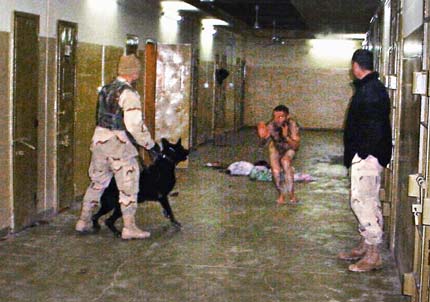
The Problem Is That the Democrats Will Implicate Themselves If There Are Prosecutions for Torture


“I Was Only Following Orders!” Being serious about torture. Or not.
By William Blum / March 5, 2009

In Cambodia they’re once again endeavoring to hold trials to bring some former senior Khmer Rouge officials to justice for their 1975-79 war crimes and crimes against humanity. The current defendant in a United Nations-organized trial, Kaing Guek Eav, who was the head of a Khmer Rouge torture center, has confessed to atrocities, but insists he was acting under orders.1

As we all know, this is the defense that the Nuremberg Tribunal rejected for the Nazi defendants. Everyone knows that, right? No one places any weight on such a defense any longer, right? We make jokes about Nazis declaring: “I was only following orders!” (“Ich habe nur den Befehlen gehorcht!“) Except that both the Bush and Obama administrations have spoken in favor of it.

Here’s the new head of the CIA, Leon Panetta: “What I have expressed as a concern, as has the president, is that those who operated under the rules that were provided by the Attorney General in the interpretation of the law [concerning torture] and followed those rules ought not to be penalized. And … I would not support, obviously, an investigation or a prosecution of those individuals. I think they did their job.”2 Operating under the rules … doing their job … are of course the same as following orders.

The UN Convention Against Torture (first adopted in 1984), which has been ratified by the United States, says quite clearly, “An order from a superior officer or a public authority may not be invoked as a justification of torture.” The Torture Convention enacts a prohibition against torture that is a cornerstone of international law and a principle on a par with the prohibition against slavery and genocide.

Of course, those giving the orders are no less guilty. On the very day of Obama’s inauguration, the United Nation’s special torture rapporteur invoked the Convention in calling on the United States to pursue former president George W. Bush and defense secretary Donald Rumsfeld for torture and bad treatment of Guantanamo prisoners.3

On several occasions, President Obama has indicated his reluctance to pursue war crimes charges against Bush officials, by expressing a view such as: “I don’t believe that anybody is above the law. On the other hand I also have a belief that we need to look forward as opposed to looking backwards.” This is the same excuse Cambodian Prime Minister Hun Sen has given for not punishing Khmer Rouge leaders. In December 1998 he asserted: “We should dig a hole and bury the past and look ahead to the 21st century with a clean slate.”4 Hun Sen has been in power all the years since then, and no Khmer Rouge leader has been convicted for their role in the historic mass murder.

And by not investigating Bush officials, Obama is indeed saying that they’re above the law. Like the Khmer Rouge officials have been. Michael Ratner, a professor at Columbia Law School and president of the Center for Constitutional Rights, said prosecuting Bush officials is necessary to set future anti-torture policy. “The only way to prevent this from happening again is to make sure that those who were responsible for the torture program pay the price for it. I don’t see how we regain our moral stature by allowing those who were intimately involved in the torture programs to simply walk off the stage and lead lives where they are not held accountable.”5

One reason for the non-prosecution may be that serious trials of the many Bush officials who contributed to the torture policies might reveal the various forms of Democratic Party non-opposition and collaboration.

It should also be noted that the United States supported Pol Pot (who died in April 1998) and the Khmer Rouge for several years after they were ousted from power by the Vietnamese in 1979. This support began under Jimmy Carter and his National Security Adviser, Zbigniew Brzezinski, and continued under Ronald Reagan.6 A lingering bitterness by American cold warriors toward Vietnam, the small nation which monumental US power had not been able to defeat, and its perceived closeness to the Soviet Union, appears to be the only explanation for this policy. Humiliation runs deep when you’re a superpower.

Neither should it be forgotten in this complex cautionary tale that the Khmer Rouge in all likelihood would never have come to power, nor even made a serious attempt to do so, if not for the massive American “carpet bombing” of Cambodia in 1969-70 and the US-supported overthrow of Prince Sihanouk in 1970 and his replacement by a man closely tied to the United States.7 Thank you Richard Nixon and Henry Kissinger. Well done, lads.

By the way, if you’re not already turned off by many of Obama’s appointments, listen to how James Jones opened his talk at the Munich Conference on Security Policy on February 8: “Thank you for that wonderful tribute to Henry Kissinger yesterday. Congratulations. As the most recent National Security Advisor of the United States, I take my daily orders from Dr. Kissinger.”8

Lastly, Spain’s High Court recently announced it would launch a war crimes investigation into an Israeli ex-defense minister and six other top security officials for their role in a 2002 attack that killed a Hamas commander and 14 civilians in Gaza.9 Spain has for some time been the world’s leading practitioner of “universal jurisdiction” for human-rights violations, such as their indictment of Chilean dictator Augusto Pinochet a decade ago. The Israeli case involved the dropping of a bomb on the home of the Hamas leader; most of those killed were children. The United States does this very same thing every other day in Afghanistan or Pakistan. Given the refusal of American presidents to invoke even their “national jurisdiction” over American officials-cum-war criminals, we can only hope that someone reminds the Spanish authorities of a few names, names like Bush, Cheney, Rumsfeld, Powell, Rice, Feith, Perle, Yoo, and a few others with a piece missing, a piece that’s shaped like a conscience. There isn’t even a need to rely on international law alone, for there’s an American law against war crimes, passed by a Republican-dominated Congress in 1996.10

The noted Israeli columnist, Uri Avnery, writing about the Israeli case, tried to capture the spirit of Israeli society that produces such war criminals and war crimes. He observed: “This system indoctrinates its pupils with a violent tribal cult, totally ethnocentric, which sees in the whole of world history nothing but an endless story of Jewish victimhood. This is a religion of a Chosen People, indifferent to others, a religion without compassion for anyone who is not Jewish, which glorifies the God-decreed genocide described in the Biblical book of Joshua.”11

It would take very little substitution to apply this statement to the United States — like “American” for “Jewish” and “American exceptionalism” for “a Chosen People”.

Notes

1. Associated Press, August 1, 2007 ↩
2. Press conference, February 25, 2009, transcript by Federal News Service ↩
3. Agence France Presse (AFP), January 20, 2009 ↩
4. New York Times, December 29, 1998 ↩
5. Associated Press, November 17, 2008 ↩
6. See William Blum, “Rogue State”, chapter 10 (“Supporting Pol Pot”) ↩
7. See William Blum, “Killing Hope”, chapter 20 (“Cambodia, 1955-1973”) ↩
8. http://www.realclearpolitics.com/articles/2009/02/jones_munich_conference.html ↩
9. Reuters news agency, January 30, 2009 ↩
10. The War Crimes Act (18 U.S.C. 2441) ↩
11. Haaretz, leading Israeli newspaper, January 30, 2009 ↩

[William Blum is the author of:

* Killing Hope: US Military and CIA Interventions Since World War 2
* Rogue State: A Guide to the World’s Only Superpower
* West-Bloc Dissident: A Cold War Memoir
* Freeing the World to Death: Essays on the American Empire

Portions of the books can be read, and signed copies purchased, at www.killinghope.org.]

Source / Information Clearing House

The Rag Blog

Posted in RagBlog | Tagged , , , | Leave a comment

Crowded Classrooms and Crowded Prisons – Why Is It So Hard to See the Connection?


The Dog Eats Its Tail: Oversized Classes, Overpopulated Prisons
By Jesse Hagopian / March 7, 2009

One in thirty one.

As a public school teacher I am quite familiar with this figure — it’s a typical teacher to student ratio in the classroom. But now that proportion has taken on new significance: A report released on March 2nd by the Pew Center on the States found that one in every thirty-one adults reside in the US corrections system — now totaling some 7.3 million people.

That means roughly one student per classroom in America will end up in prison, on parole, or on probation.

As New School Foundation board member Lisa Fitzhugh notes in her January 19th Seattle Times op-ed, states like Washington even determine how many prison cells to build based on 4th grade reading scores and graduation rates. So rest assured, if your 9-year-old stumbles over syntax or has trouble sounding out the word “priorities,” the state has readied the necessary cellblock accommodations. Why flush money down the sinkhole of reading improvement teachers when there are solitary confinement cells to be built? As the Pew study reports,

“In the past two decades, state general fund spending on corrections increased by more than 300 percent, outpacing other essential government services from education, to transportation and public assistance. Only Medicaid spending has grown faster. Today, corrections imposes a national taxpayer burden of $68 billion a year.”

In Seattle, where I teach, our politicians have magnified this absurdity by simultaneously proposing two pieces of public policy:

1) Mayor Greg Nickels has proposed the construction of a new municipal jail, projected to cost taxpayers over $200 million.

2) Seattle’s School Board voted recently to close five schools and disrupt or discontinue eight other programs.

If you like these policies of planning prison construction based on elementary reading levels, and of closing schools while opening jails, you might consider a couple of other equally rewarding ventures: smashing holes in your boat and investing in buckets to bail out the water, or, equally clever, slashing holes in the tires of your car and subsequently investing in tire patches.

How do we end this illogical, anti-hope scenario and reverse increases in prison spending?

After years of deregulation and outlandish speculation that caused an implosion of the economy, many politicians and corporate heads are venturing out of their boardrooms to examine the rubble at “Main Street Middle School.” Realizing something must be done, they tout their education schemes as “school reform”—including paying teachers according to culturally biased/curriculum narrowing tests their students take, the breaking of teachers’ unions, and the privatization of education through charter schools.

But in an era when CEOs and bankers sabotage the economy and then get to float to the ground on golden parachutes worth tens of millions of dollars, it’s unclear how merit pay for teachers would be structured—in this new age, would it mean that the more students who flunk the test, the bigger bonuses teachers get?

Given the current free market meltdown, they can’t really believe that our public schools are better off following the laissez-faire predisposition for privatized charter schools run by CEOs.

A genuine first step on the path to improving education should center on what teachers, students, and parents have known for a long time: class size matters.

Unfortunately, this common sense approach missed Mayor Bloomberg who was quoted in the New York Times on February 22nd giving his explanation of how to improve education: “It’s the teacher looking a child in the eye, and teachers can look lots of children in the eye,” he added. “If you have to have smaller class size or better teachers, go with the better teachers every time.”

I’ll go for option C: The skilled teacher with the smaller class.

Tennessee’s Project STAR (Student Teacher Achievement Ratio)—the most comprehensive class size study ever conducted—showed students who had been randomly assigned to smaller classes of 13 to 17 students in grades K-3 outperformed their peers in regular classes of 22 to 25 students (and in regular classes with an educational aide). Additionally, by eighth grade, those students who had been placed in small classes through Project STAR were still outperforming students who had been placed in regular classes or regular-plus-aide classes in K-3.

While proven to help, lower class sizes are not popular with the guardians of the bottom line because training and hiring more teachers costs money. I should admit I am not a trained economist like the financial intellectuals who managed asset-backed securities at AIG. However, I feel qualified to assert that unlike the purchase of collateralized debt obligations, spending on our children is a sound investment—morally and financially.

The American Economic Review, one of the longest running journals in the field, recently released a study revealing that only “A one percent increase in the high school completion rate of all men ages 20-60 would save the United States as much as $1.4 billion per year in reduced costs from crime incurred by victims and society at large.”

Having missed this statistic, states across the country are reacting to the financial crisis with school closures and teacher layoffs. While some of the largest districts have postponed massive layoffs for now, recently the Los Angeles Unified Schools threatened 2,300 teachers with pink slips and New York City Schools said they could lay off 15,000. The Seattle School District is planning to terminate or disrupt 13 schools, and Chicago is shuttering 16 of its own. Federal stimulus dollars for education will help ease some of the cuts, but politicians—from governors to local school officials—have promised closures and layoffs nonetheless.

Activists in Seattle, however, are working on an alternative lesson plan for our city that may prove to be a model for saving schools and halting jails.

Representatives from all the schools slated for closure and other community members have formed ESP Vision: Educators, Students and Parents for a Better Vision of the Seattle Schools—rallying hundreds against the school closures, teaming up with the local NAACP to help parents file over 200 grievances with Department of Education, and assisting parents in a formal appeals process to block the closures. Moreover, ESP Vision has teamed up with the Initiative-100 campaign that is attempting to block the building of a new city jail by collecting the 23,000 signatures needed to put its construction to a vote.

Mark Twain once said, “Every time you stop a school, you will have to build a jail. What you gain at one end you lose at the other. It’s like feeding a dog on his own tail. It won’t fatten the dog.” While Twain leaves us with a distasteful image, far more repugnant is a social order that invests in metal bars rather than in cultivating our children’s talents.

[Jesse D. Hagopian is a teacher, education journalist, and a co-founder of ESP Vision: Educators, Students, and Parents for a Better Vision of the Seattle Schools (espvision.org). He can be reached at: jdhagopian@gmail.com.]

Source / Common Dreams

The Rag Blog

Posted in RagBlog | Tagged , , , , | 1 Comment

House Demolitions in East Jerusalem Could Spark More Mid-East Violence

40-year-old Palestinian Mahmoud al-Abbasi stands amid the rubble of his home after it was demolished by the Jerusalem municipality in the East Jerusalem neighborhood of Silwan. Photograph: Gali Tibbon.

East Jerusalem Settlements Ratchet Up Tensions
By Helena Cobban / March 6, 2009

JERUSALEM – As the fires of human misery continue to smolder in Gaza, the situation in Israeli-occupied East Jerusalem is emerging as another potentially explosive issue in, and far beyond, the Middle East.

The long-term governance of the city is considered an issue of prime importance to both Palestinians and Israelis, as well as to their supporters around the world. Jerusalem-related tensions have been sparked several earlier rounds of violence between the two peoples, including when former (and future) Prime Minister Binyamin Netanyahu started work on the new East Jerusalem settlement of Har Homa in 1997.

In September 2000, it was a visit by opposition leader Ariel Sharon to Jerusalem’s Temple Mount – accompanied by 1,000 armed security people – that sparked the Second Intifada. Now, Israeli and Palestinian peace activists warn that the provocative actions of government-backed settler activists within Jerusalem could spark yet another serious escalation of tensions.

Some 220,000 Palestinians live in East Jerusalem, which until 1967 was the commercial and administrative hub of the whole West Bank region, of which it is an integral part. Since Israel occupied the city in 1967, successive Israeli governments have implanted vast (and very expensive) Israeli settlements into the city, whose boundaries they also unilaterally expanded.

Now, around 200,000 Israeli settlers live in those settlements, which surround the Palestinian-peopled core of the city. And for some years now settler activists, most of whose money comes from supporters in the United States, have also been building webs of settlement “outposts” deep inside the Palestinian core.

Two current areas of concern are Silwan, where the Jerusalem municipality recently issued demolition orders to the owners of 88 Palestinian homes, to establish a Jewish-history theme park there, and Sheikh Jarrah, where a massive armed police force last November evicted an older couple from their longtime home so that a group of settlers could move in.

That latter eviction occurred at 3:30 a.m. The man of the house, Abu Kamel al-Kurd, was already chronically sick. He and his wife, Um Kamel, moved into a tent on a vacant lot nearby and a few days later Abu Kamel had a heart attack and died. Um Kamel has continued living in the tent, even through the winter cold and storms.

Her campaign to stay in the tent until her home is restored to her has emerged as a potent rallying point of nonviolent resistance to Israel’s plans to continue colonising East Jerusalem. Israeli police have dismantled her tent six times, most recently on Feb. 23. But on each occasion her supporters – who include both Islamist and secular Palestinians – have re-erected it.

Tents like Um Kamel’s have been evocative symbols of the eviction of Palestinians from their homes ever since 1948, when some 750,000 Palestinians were evicted or fled from their homes in what became Israel. (None have been allowed back, despite United Nations resolutions calling for a return.)

Most recently, many of the displaced Palestinians in Gaza – most of them descendants of refugees from 1948 – have once again been living in tents. And across Jerusalem in Silwan, local residents protesting their latest eviction orders, which will affect some 1,500 family members, have also erected a tent as a focal point for their protest.

In an interview in her tent Tuesday, Um Kamel told IPS, “Though we’re forced into tents, we Palestinians don’t seek tents or donations of things like clothes from the international community. All we seek is our rights! No one can overthrow the rights of other people in the way the Israelis do to us… We need all three groups, the Jews, the Christians, and the Muslims to live here together in Palestine, in peace and equality.”

The Palestinians of East Jerusalem have been in a precarious situation for many decades. In late June 1967 the city’s new Israeli occupiers expanded the municipal boundaries and declared that thenceforth Israel’s law would be applied directly to the city. That act of annexation was further cemented by Israel’s Knesset (parliament) in 1980.

Though the annexation was illegal under international law it has never been vigorously protested by the U.S. Indeed, U.S. government officials engage in complex verbal gymnastics to avoid openly acknowledging that – as all the members of the international community agree – East Jerusalem is indeed still occupied territory. This judgment means that all Israeli settlements there are quite illegal, and the city’s indigenous Palestinian residents should receive all the other protections specified in the Fourth Geneva Convention.

Instead of that happening, the Palestinians’ situation has become progressively worse. Almost immediately after the 1993 Oslo Accords were concluded, the Israeli authorities erected roadblocks and other measures designed to cut off the city’s Palestinians from their compatriots (and often, close family members) elsewhere in the West Bank.

Palestinians from elsewhere in the West Bank were meanwhile suddenly prevented from entering East Jerusalem, and many of the city’s once-thriving institutions – like schools, hospitals, and publishing houses – began to wither.

Until 1993, East Jerusalem had been the national hub of Palestinian politics. After Yasser Arafat returned to the West Bank to establish the new, Oslo-mandated Palestinian Authority (PA), he was forced to do so in nearby Ramallah, not Jerusalem. The Israelis prevented the PA from locating any of its institutions in East Jerusalem and Jerusalem’s people came under mounting pressures to leave their ancestral city.

After Oslo, successive Israeli governments also accelerated their building of new Jews-only settlements inside the city. Har Homa, started by Netanyahu in 1997, now has more than 6,000 residents and vast additional construction projects are now underway there and in nearby Gilo.

In 2001, after the start of the Second Intifada, newly installed Israeli premier Ariel Sharon started solidifying the separation of Jerusalem from the West Bank by building the 30-foot-high concrete walls, punctuated by forbidding cylindrical watch-towers, that now snake around – and sometimes, capriciously, right through – the built-up areas of the city.

The Jerusalem Palestinians always refused to take up Israeli citizenship, arguing that to do so would be an endorsement of Israel’s claim to the whole city. Without citizenship and the voting clout that would come with it, they have suffered grave discrimination at all levels, including in the provision of basic municipal services.

Their voice is excluded from city planning processes. The Israeli authorities prohibit all but a few Jerusalem Palestinians from building on even their own wholly-owned real estate. Eviction orders are routinely issued to Palestinians regarding either homes built long before 1967 or homes built since then whose owners have not gone through the burdensome and expensive process of amassing all the required permits. (Most Israeli Jewish developers meantime receive the government’s strong financial and administrative support for their projects.)

In recent weeks, the settler activists of Silwan and Sheikh Jarrah have received strong support from a rightist-dominated municipality to escalate their activities. The municipality has also stepped up its demolitions of Palestinian homes deemed “illegal” in many parts of the city, to the level of two or three per week.

With Netanyahu now poised to return as prime minister, the scene seems set for further confrontations in this city so dear to millions of believers around the world.

[Helena Cobban is a veteran Middle East analyst and author. She blogs at www.JustWorldNews.org.]

Source / IPS News

The Rag Blog

Posted in RagBlog | Tagged , , | Leave a comment

The Machiavellian Game of Distraction: Will It Continue with Obama?

Bagram Air Force Base, Afghanistan

Obama’s Guantanamo? Bush’s Living Legacy at Bagram Prison
By Karen J. Greenberg / March 5, 2009

Just when you think you’ve woken up from a bad dream…

When it comes to offshore injustice and secret prisons, especially our notorious but little known prison at Bagram Air Base in Afghanistan, let’s hope the Obama years mean never having to complete that sentence.

In the Bush era, those of us who followed his administration’s torture, detention, and interrogation policies often felt like we were unwilling participants in a perverse game of hide-and-seek. Whenever one of us stumbled upon a startling new document, a horrific new practice, a dismal new prison environment, or yet another individual implicated in torture policy, the feeling of revelation would soon be superseded by a sneaking suspicion that we were once again looking in the wrong direction, that the Bush administration was playing a Machiavellian game of distraction with us.

Okay, call it paranoia — a state of mind well suited to the Age of Cheney — but when Abu Ghraib finally came to light, it turned out that our real focus should have been on the administration’s program of “extraordinary rendition” and the CIA secret flights to the foreign countries that were serving as proxy torturers for the United States. And when one case of torture by proxy, that of Maher Arar, achieved some prominence, we began looking at proxy torturers for the United States, when we should have been looking at legalized policies of torture by the U.S.

Several years ago, British human rights lawyer Clive Stafford Smith placed that jewel in the Bush administration’s offshore crown of injustice, Guantanamo, in the category of distraction as well — distraction, that is, from the far grimmer and more important American detention facility at Bagram Air Base in Afghanistan.

Distracted or not, for at least five years some of us have been seeking the hidden outlines of the torture story. Now, President Obama has given it a visible shape by providing a potential endpoint if not to our investigations, then to our focus. Much of what we focused on in these last years he’s declared to be history. Guantanamo will be closed within a year and the American role in the war in Iraq will end as well; torture will once again be banned; a new task force, already assembled, will review all the Bush administration’s detention policies; and people like me will, assumedly, finally be out of work and able to write those novels we used to dream about. For us, no more unwelcome obsessions with detention, abuse, and torture.

Bad Times at Bagram

Still, ever since the Oval Office changed hands in January, I’ve had a nagging feeling that something was amiss. And when I finally focused on it, a single question kept coming to mind: Whatever happened to the U.S. prison at Bagram?

I knew that it had been opened in 2002 on an abandoned Soviet air base the U.S. had occupied and was being massively upgraded after the invasion of Afghanistan, and that its purpose was to hold prisoners in the Global War on Terror at a place as far removed as possible from the prying eyes of American courts or international oversight bodies of any sort. In fact, many of those eventually transported to Guantanamo were originally held under even worse conditions at Bagram and, from early on, they had reported beatings, abuse, and a startlingly wide range of other forms of mistreatment there.

But what else did I know? Thanks to New York Times reporters Carlotta Gall, David Rohde, Tim Golden, and Eric Schmitt, as well as to Alex Gibney’s documentary film Taxi to the Dark Side, I knew that two Afghans, Dilawar and Jullah Habibullah, had been beaten to death by U.S. Army interrogators at the prison in December 2002. I also knew that the use of such beatings, as well as various other forms of torture, had been normalized at Bagram at the very beginning of the Bush administration’s long march of pain that led to Guantanamo and then on to Abu Ghraib and other prisons in Iraq as well as foreign torture chambers.

From the 2004 Church Report (written by Naval Inspector General Admiral T. Church), I knew that military interrogators and guards at Bagram had been given next to no relevant training for the mission of detention and interrogation. I knew as well that a secret CIA prison was allegedly located apart from the regular detention cells at Bagram. I knew that military officials had declared that the interrogation techniques at Bagram seemed to work better than those being used at Guantanamo in the same period. And that, after the Supreme Court issued a decision in 2004 to allow prisoners at Guantanamo to challenge their detentions, the prison population at Bagram began to grow.

What We Don’t Know About a Prison Nightmare

But that was the past. What did I know about the situation in the first weeks of the Obama era?

The unnerving answer was precious little. So, as I had done with Guantanamo and Abu Ghraib, I began by asking the simple questions that had once been so difficult to answer about so many offshore detention facilities of the Bush era: Who was being held at Bagram? How many prisoners were there and from which countries? What status did they have? Were they currently classified as “enemy prisoners of war” or — in the phrase the Bush administration had so favored in an attempt to confound U.S. courts — “unlawful enemy combatants”? How were they being treated? What reports on prison conditions had either the U.S. government or interested non-governmental organizations released?

Setting aside the frustrations of the past seven years, I naively tried a basic Google search to see just what was instantly available, only to discover that the answer was essentially nothing.

It turns out that we can say very little with precision or confidence about that prison facility or even the exact number of prisoners there. News sources had often reported approximately 500-600 prisoners in custody at Bagram, but an accurate count is not available. A federal judge recently asked for “the number of detainees held at Bagram Air Base; the number of Bagram detainees who were captured outside Afghanistan; and the number of Bagram detainees who are Afghan citizens,” but the information the Obama administration offered the court in response remains classified and redacted from the public record.

We don’t even know the exact size of the prison or much about the conditions there, although they have been described as more spartan and far cruder than Guantanamo’s in its worst days. The International Committee of the Red Cross has visited the prison, but it remains unclear whether they were able to inspect all of it. A confidential Red Cross report from 2008 supposedly highlighted overcrowding, the use of extreme isolation as a punishment technique, and various violations of the Geneva Convention.

We do know that a planned expansion of the facility is underway and will — if President Obama chooses to continue the Bush project there — enable up to 1,100 prisoners to be held (a step which will grimly complement the “surge” in American troops now underway in Afghanistan). There are no figures available on how long most of Bagram’s prisoners have been held — although some, it seems, have been imprisoned without charges or recourse for years — or how legal processes are being applied there, if at all. Last spring, the International Herald Tribune reported that Afghans from Bagram were sometimes tried in Afghan criminal proceedings where little evidence and no witnesses were presented.

To students of Guantanamo, this sounds uncomfortably familiar. And there’s more that’s eerily reminiscent of Gitmo’s bleak history. According to the New York Times, even four years after Bagram was established, wire cages were being used as cells, with buckets for toilets — as was also true of the original conditions at Camp X-Ray, the first holding facility at Guantanamo. Similarly, as with Guantanamo, the U.S. has no status of forces agreement with Afghanistan, and so the base and prison can be closed or turned over to the Afghans only on U.S. say-so. Above all, while some Bagram detainees do have lawyers, most do not.

The Prison Where It All Began

While I was wondering about the state of our black hole of incarceration in Afghanistan, the Obama administration issued its first terse statement on the subject. When it came to granting Bagram detainees habeas rights (that is, the right to challenge their detention in U.S. courts), the administration simply stated that it “adheres to [the Justice Department’s] previously articulated position”: habeas would not be granted.

After all, reasoned the new government lawyers (like their predecessors), Bagram is in an indisputable war zone and different legal considerations should apply. But here’s the catch neither the Bush administration, nor evidently the Obama administration, has cared to consider: It’s quite possible that these four individuals, like others at Bagram, were not captured on an Afghan battlefield (as the prisoners claim), but elsewhere on what Bush officials liked to think of as the “global battlefield” of the War on Terror, and then conveniently transported to Bagram to be held indefinitely.

The U.S. government refuses to make public any documentation that would support its case and the new court documents, submitted by the lawyers of the Obama Justice Department, are frustratingly blacked out just as those of the Bush era Justice Department always were. At least for the moment then, when it comes to Bagram, tactics and arguments remain unchanged from the Bush years. No wonder journalists and human rights lawyers have lately taken to referring to that prison as the “other Guantanamo,” or “Guantanamo II,” or more combatively, “Obama’s Guantanamo.”

Sadly, however, even this is inaccurate. From the get-go, Guantanamo was actually the “other Bagram.” The obvious question now is: How will the Obama administration deal with this facility and, in particular, with matters of detention, “enforced disappearance,” and coerced testimony? Will these be allowed to continue into the future, Bush-style, or will the Obama administration extend its first executive orders on Guantanamo and torture practices to deal in new ways with the prison where it all began?

Facing Crimes of the Bush Era

President Obama has given a newly convened task force six months — a long time when people are being held in harsh conditions without charges or recourse — to consider the matter of Bush administration detention practices and formulate new policies (or, of course, retain old ones). Here are some guidelines that may prove helpful when it comes to Bagram:

1. On secrecy: The appeal to secrecy and national security has been an all-purpose refuge of official rogues for the last seven years. Reconsider it. A sunshine policy should apply, above all else, to detention practices. Ideally, the U.S. should simply release full information on Bagram and the prisoners being held there. When, in specific cases, information is not divulged, the reasons for not doing so should be fully revealed. Otherwise, the suspicion will always arise that such withheld information might be part of a cover-up of government incompetence or illegality. That must be ruled out. It is imperative that President Obama’s administration not double down on the Bush administration’s secrecy policy from a desire not to look back and so to avoid future prosecutions of Bush officials.

2. On classification of prisoners: The Obama administration should seriously consider declaring the prisoners at Bagram to be “prisoners of war,” and so subject to the Geneva Conventions. Currently, they are classified as enemy combatants, as are the prisoners at Guantanamo, and so, in the perverse universe of the Bush administration, free from any of the constraints of international law. The idea that the Conventions are too “rigid” for our moment and need to be put aside for this new extra-legal category has always been false and pernicious, primarily paving the way for the use of “enhanced interrogation techniques.”

3. On “ghost prisoners”: The Obama administration should reject out of hand the idea that prisoner invisibility is acceptable anywhere, including at Bagram. The International Committee of the Red Cross must be granted access to all of the prisons or prison areas at Bagram, while conditions of detention there should be brought into accordance with humane treatment and standards. No “ghost prisoners” should be allowed to exist there.

4. On guilt and innocence: The belief that there is a categorical difference between guilt and innocence, which went by the wayside in the last seven years, must be restored. All too often, the military brass still assumes that if you were rounded up by U.S. forces, you are, by definition, guilty. It’s time to change this attitude and return to legal standards of guilt.

In the Bush years, we taught the world a series of harmful lessons: Americans can be as cruel as others. Americans can turn their backs on law and reciprocity among nations as efficiently as any tribally organized dictatorship. Americans, relying on fear and the human impulse toward vengeance, can dehumanize other human beings with a fervor equal to that of others on this planet.

It’s time for a change. It’s time, in fact, to face the first and last legacy of Bush detention era, our prison at Bagram Air Base, and deal with it.

Call me a perpetual optimist, but President Obama has the right team in place to address this nightmarish legacy in a wise and timely way. We should expect no less from them than a full restoration of a government responsible to the law, and confident of its power to deter enemies legally — be it on the battlefield or in the courtroom. So, too, we must expect them to possess the courage to confront truths, even if those truths mean heading down the path towards the prosecution of crimes of the Bush years.

[Karen J. Greenberg is the Executive Director of the Center on Law and Security at the New York University School of Law. Her latest book, The Least Worst Place, Guantanamo’s First 100 Days (Oxford University Press), has just been published. She is also the co-editor of The Torture Papers: The Road to Abu Ghraib, among other works.]

Copyright 2009 Karen J. Greenberg

Source / TomDispatch

The Rag Blog

Posted in RagBlog | Tagged , , , , | 2 Comments

Naomi Wolf’s ‘The End of America’

Naomi Wolf – 2009. Photo by HeyokayMagazine.

Naomi Wolf – The End of America Outlines Path From Freedom To Dictatorship – Compares George Bush To Adolf Hitler
By Tom Madison / March 4, 2009

Although many people compared President Bush and his policies with the actions of Adolph Hitler in Nazi Germany, few were able to itemize the process of converting a free society into a dictatorship like Naomi Wolf in her book and movie titled “The End of America”.

Naomi outlined what President Bush did in his two terms and illustrated the parallels to Germany, Italy and Russia during the 1930s, and Chile during the 1970s. She says there are ten steps to removing freedom from a society.

The great dictators learned from one another on how to close down a society. There were 10 steps taken. Naomi Wolf studied the Pinochet regime 1973. Over the past 8 years, Naomi says that a small group of people set out to undermine the U.S. constitution.

Germany would not have looked much different from the US today. Germany in 1931 had human rights and gay rights organizations. They were relatively free.

Heimat (Homeland) became a popular phrase in discourse within Germany during the 1930s. The Nazis used the historic term, first patriotically but later nationalistically. They employed Heimat to convince their citizens that anything foreign was bad. Soon after September 11th 2001, the government used the term in the newly created mega-agency called “Homeland Security”.

Wolf lays out ten steps necessary to convert a free society to a dictatorship.

1) Invoke an internal and external threat – The Bush Administration used a terrible crime against our nation after 9-11 to launch a “war on terror”. Other countries hit by terrorists went after the bad guys without destroying their own liberty. The government created the Dept of Homeland security to manipulate our levels of fear. Israel does not make some days orange and some days red. They take pride in not trying to frighten their citizens.

In Berlin in 1933 the Reichstag (German parliament) was set on fire by an arsonist. The Nazis used that event to subvert the German constitution. They passed Clause 2 of the Enabling Acts that basically gave Hitler dictatorial power. The state could open the mail and listen to phone calls. Parliament gave up their power. In 2001 the Bush Administration pushed through the Patriot Act. This gave the government power to wiretap without a warrant among other things.

2) Secret Prisons where Torture takes place – Both Hitler and the Bush Administration called torture the same thing – “enhanced interrogation”. They needed prisons outside the rule of law. Wolf said the U.S. government put electrodes on genitals, hung prisoners by their hands, exposed them to heat and cold over and over again, among other things.

The administration said they tortured people because it was necessary to save American lives. Military Order number one stated that the President can pick up any non-citizen anywhere in the world that he thinks is a terrorist. In 2002 John Yoo, a member of Bush’s legal council, wrote a memo that narrowly redefined torture. Severe suffering had to be inflicted with specific intent, according to Yoo. There were 16 approved methods of interrogation. Rumsfeld expanded that to 35.

Wolf says we should care if brown people with Muslim names are tortured. In 1931-32 torture was still illegal in Germany, but the SA would drag people out of their homes and put them in torture chambers. They also called it “enhanced interrogation”. Bush stated that the Geneva Convention does not apply to our detainees.

Retired General James Cullen, Chief Judge of the U.S. Army, said “This is not the last war… What we do today is creating a precedent as to how American prisoner of wars who are not yet born will be treated in the future.”

In 2006 Congress passed the Military Commissions Act (HR-6166) which stripped prisoners of any rights. Prisoners can now be held indefinitely without a trial. This is modeled after Hitler’s People’s Court – you can be tried without anyone knowing it. A US citizen could also be defined as an enemy combatant.

3) Paramilitary Force – Hitler had his brown shirts, and the US has Blackwater. These groups can act outside the Constitution because they are not government agencies.

The Eric Prince family has contributed 2.4 million to Republican Party. Naomi says Blackwater picked torturers and killers from other countries to fight for the US. Naomi says that the government started protecting agents who were accused of murder.

Wolf considers Blackwater a “stealth threat”. Mussolini started using soldiers who came back from war to beat up his own people. His Black Shirts were outside the rule of law. Blackwater has been used in the US during the Katrina disaster. Armed to the teeth, they drove up and down the streets in New Orleans. Jeremy Scahill, author of “Blackwater”, saw contractors shoot at civilians.

Naomi said the Blackwater website stated they hope to focus on protests in the United States (like Manhattan NY). There is a concern that there may be civil unrest if the U.S. economy falls apart.

4) Survail ordinary citizens – Germany kept lists of their citizens. It is a way to keep people in order. You are afraid you might get on the list so you don’t speak up. Hitler developed lists of the Jews so they could quickly round them up.

Later Stasi files were used in East Germany. Every society keeps a list before they remove freedom. You want to make everyone fearful of speaking out.

In the US normal people can get on a “watch list”. The boarding passes will have a SSSS on it. Naomi Wolf has this on her boarding pass and she is always taken away from the line and searched separately.

There are one million people on the list including Edward Kennedy and Nelson Mandela. Many outspoken Americans get on the list. Drew Griffin of CNN was on the list. After one person gets on the list, everyone in the family gets on the watch list.

5) Infiltrate Citizens Groups – The ACLU has received many complaints of government agents infiltrating citizen groups. In 2004 police and FBI agents spied on citizens who protested the war. Undercover state police officers infiltrated various groups including anti-death penalty assemblies.

David Zirin said one informant was named Lucy. He questions whether this is a good way to spend taxpayer money. Wolf says they may send agents into groups to disrupt them.

6) Detain and Release Ordinary Citizens – The Nazis did this at random to keep people in line. This happened to James Yee. He was while returning from service in Guantanamo. He had printed articles from the Internet and was accused of being a terrorist spy. Yee was held in solitary confinement for 76 days. Now every time he crosses a border the government detains him.

Yee was held in Charleston South Carolina where other US enemy combatants are held. This is commonly done to Muslims today. The Nazis began to detain people arbitrarily before they focused on Jews and Gypsies.

7) Target Key Individuals – Similar to book burnings in Germany, The Dixie Chicks were banned by Clear Channel. People began burning their CDS. Members of the popular country group said they were embarrassed that President Bush was from Texas.

CIA agent Valarie Plame was singled out too. Joe Wilson said the Bush Administration exposed his wife to cover up government lies. Later Plame said she noticed that bolts holding her backyard deck up were loosened.

In 1938 Joseph Goebbels targeted key individuals. Goebbels also burned books.

8) Restrict the Press – The Bush Administration targeted the New York Times. “There is no excuse for Newspapers to print it,” President said. They wanted to prosecute reporters under the Espionage Act.

Bilal Hussein was an AP photographer in Iraq. He was arrested by the U.S. military and imprisoned for possessing bomb parts. He was later released for lack of evidence. There are still political questions raised about his arrest.

Josh Wolf was imprisoned in the United States. After a San Francisco Bay area protest, he spent 226 days in jail because he refused to give his tapes to investigators. His sentence was longer than any other journalist in US history. Wolf says the government wanted to know who was protesting the government.

Stalin trampled on the rights of the press and even executed a journalist.

9) Recast Criticism as Espionage and Dissent as Treason – Amy Goodman of Democracy Now was arrested at the Republican Convention. Dozens of reporters were arrested at that political event. Even people who were not protesting at a nearby park were arrested. Police seized all videos at the park except one that was hidden.

The Patriot Act of 2001 may redefine protest as treason. The espionage act can be used to send people away for 10 years, and if you are convicted of treason the defendant can be executed. HR 1955 didn’t pass but it could make speeches against the law.

10) Subvert the Rule of Law – In an investigation by the House of Representatives Judiciary Committee, Harriet Miers and Josh Bolten ignored subpoenas. The House wanted to find out if the Whitehouse wanted to replace all of the US Attorneys. Miers and Bolton blatantly ignored the rule of law.

The President also subverted the law with signing statements. These signing statements changed the intent of the law. President Bush did it 110 times to challenge 750 laws passed by Congress.

Joseph Goebbels purged all of the state attorneys in 1933. Mussolini ignored parliament. Wolf says ignoring the law is the final step before transitioning to a dictatorship.

Naomi Wolf says this is the last stage before declaring martial law. Beginning October 1st 2008, the army began planning to station an active unit inside the United States to serve as an “on call” response to an active emergency. Some 3,000 to 4,000 soldiers will appear on the streets for crowd control and maintain public order.

The American Freedom Agenda

The National Socialists (Nazis) began unloading their war dead off of trains in the middle of the night so no one could see the casualties. Bush didn’t allow pictures of the coffins coming back from Iraq. President Obama recently overturned this policy.

Wolf recommends all Americans stand up for freedom and join the movement to support the American Freedom Agenda Act. The act will stop torture and rendition. The act would also stop the abuse of the Espionage Act and violations caused by the Patriot Act, like illegal wire taps and the ability of police to break into your home without a warrant.

President Obama has already made some moves to overturn Bush signing statements and policies.

www.americanfreedomcampaign.org

Source / Best Syndication

The Rag Blog

Posted in RagBlog | Tagged , , , | 5 Comments

Baxter Contaminates Flu Vaccine with Live Virus


‘Accidental’ Contamination Of Vaccine With Live Avian Flu Virus Virtually Impossible
By Paul Joseph Watson / March 5, 2009

Czech newspapers are questioning if the shocking discovery of vaccines contaminated with the deadly avian flu virus which were distributed to 18 countries by the American company Baxter were part of a conspiracy to provoke a pandemic.

The claim holds weight because, according to the very laboratory protocols that are routine for vaccine makers, mixing a live virus biological weapon with vaccine material by accident is virtually impossible.

“The company that released contaminated flu virus material from a plant in Austria confirmed Friday that the experimental product contained live H5N1 avian flu viruses,” reports the Canadian Press.

Baxter flu vaccines contaminated with H5N1 – otherwise known as the human form of avian flu, one of the most deadly biological weapons on earth with a 60% kill rate – were received by labs in the Czech Republic, Germany, and Slovenia.

Initially, Baxter attempted to stonewall questions by invoking “trade secrets” and refused to reveal how the vaccines were contaminated with H5N1. After increased pressure they then claimed that pure H5N1 batches were sent by accident. This was seemingly an attempt to quickly change the story and hide the fact that the accidental contamination of a vaccine with a deadly biological agent like avian flu is virtually impossible and the only way it could have happened was by wilful gross criminal negligence.

According to a compiled translation from Czech newspaper stories, the media over there is asking tough questions about whether the contamination was part of a deliberate attempt to start a pandemic.

“Was this just a criminal negligence or it was an attempt to provoke pandemia using vaccination against flu to spread the disease – as happened with the anti-B hepatitis vaccination with vaccines containing the HIV virus in US? – and then cash for the vaccines against H5N1 which Baxter develops? How could on Earth a virus as H5N1 come to the ordinary flu vaccines? Don’t they follow even basic precautions in the american pharma companies?” states the translation.

The fact that Baxter mixed the deadly H5N1 virus with a mix of H3N2 seasonal flu viruses is the smoking gun. The H5N1 virus on its own has killed hundreds of people, but it is less airborne and more restricted in the ease with which it can spread. However, when combined with seasonal flu viruses, which as everyone knows are super-airborne and easily spread, the effect is a potent, super-airbone, super deadly biological weapon.

As the Canadian Press article explains, “While H5N1 doesn’t easily infect people, H3N2 viruses do. If someone exposed to a mixture of the two had been simultaneously infected with both strains, he or she could have served as an incubator for a hybrid virus able to transmit easily to and among people.”

There can be little doubt therefore that this was a deliberate attempt to weaponize the H5N1 virus to its most potent extreme and distribute it via conventional flu vaccines to the population who would then infect others to a devastating degree as the disease went airborne.

The Canadian Press article states, “That mixing process, called reassortment, is one of two ways pandemic viruses are created,” but then claims that there is no evidence that this is what Baxter were doing, despite there being no clear explanation as to why Baxter has samples of the live avian flu virus on its premises in the first place.

However, to reiterate, the key aspect of this story is that it is virtually impossible for live avian flu virus to find its way into a vaccine by “accident”.

As health expert Mike Adams points out, “The shocking answer is that this couldn’t have been an accident. Why? Because Baxter International adheres to something called BSL3 (Biosafety Level 3) – a set of laboratory safety protocols that prevent the cross-contamination of materials.”

As explained on Wikipedia:

“Laboratory personnel have specific training in handling pathogenic and potentially lethal agents, and are supervised by competent scientists who are experienced in working with these agents. This is considered a neutral or warm zone. All procedures involving the manipulation of infectious materials are conducted within biological safety cabinets or other physical containment devices, or by personnel wearing appropriate personal protective clothing and equipment. The laboratory has special engineering and design features.”

Under the BSL3 code of conduct, it is impossible for live avian flu viruses to contaminate production vaccine materials that are shipped out to vendors around the world.

This leaves only two possibilities that explain these events:

Possibility #1: Baxter isn’t following BSL3 safety guidelines or is so sloppy in following them that it can make monumental mistakes that threaten the safety of the entire human race. And if that’s the case, then why are we injecting our children with vaccines made from Baxter’s materials?

Possibility #2: A rogue employee (or an evil plot from the top management) is present at Baxter, whereby live avian flu viruses were intentionally placed into the vaccine materials in the hope that such materials might be injected into humans and set off a global bird flu pandemic.

Spreading bird flu would create an instantaneous surge of demand for bird flu vaccines. The profits that vaccine companies such as Baxter International could reap out of such a panic are astronomical.

In addition, as we have previously reported, those that have a stake in the Tamiflu vaccine include top globalists and Bilderberg members like George Shultz, Lodewijk J.R. de Vink and former Secretary of Defense Donald Rumsfeld.

Authorities in both Europe and the U.S. have openly detailed plans for martial law, quarantine and internment should a bird flu pandemic occur.

The other motivation, as we have exhaustively documented on this website for years, is the fact that elites throughout history have openly stated that they want to see a world population reduction of around 80 per cent. Shocking stories like this take the plausibility of that narrative out of the realms of conspiracy theory and into the dangerous reality of conspiracy fact.

“Baxter is acting a whole lot like a biological terrorism organization these days, sending deadly viral samples around the world. If you mail an envelope full of anthrax to your Senator, you get arrested as a terrorist. So why is Baxter — which mailed samples of a far more deadly viral strain to labs around the world — getting away with saying, essentially, “Oops?”, Adams concludes.

This is not the first time that vaccine companies have been caught distributing vaccines contaminated with deadly viruses.

In 2006 it was revealed that Bayer Corporation had discovered that their injection drug, which was used by hemophiliacs, was contaminated with the HIV virus. Internal documents prove that after they positively knew that the drug was contaminated, they took it off the U.S. market only to dump it on the European, Asian and Latin American markets, knowingly exposing thousands, most of them children, to the live HIV virus. Government officials in France went to prison for allowing the drug to be distributed. The documents show that the FDA colluded with Bayer to cover-up the scandal and allowed the deadly drug to be distributed globally. No Bayer executives ever faced arrest or prosecution in the United States.

Source / Prison Planet

The Rag Blog

Posted in RagBlog | Tagged , , , | 2 Comments

Middle East Peace: Probably Not This Year

Hillary Clinton meets with Palestinian President Mahmoud Abbas at his Ramallah headquarters 4 March 2009.

Here we go again?
By Paul Beckett / The Rag Blog / March 6, 2009

So now it’s Hillary Clinton who begins to shuttle, looking for that grail that has eluded all her predecessors, a final peace settlement between Israel and the Palestinians. Will things be different this time? According to former Senator James G. Abourezk, no — unless the Secretary of State can lay aside the “glaring double standard” that blinds us to the realities of the Middle East situation and makes a just peace unattainable.

It’s time for tough love with Israel, Abourezk is saying: there will be no peace settlement unless the U.S. tells Israel it must remove its settlements. Period.

One More Farcical Tour of the Middle East by a Secretary of State: This Time It’s Mrs. Clinton’s Turn
By James G. Abourezk / March 5, 2009

It was almost dreamlike, watching Secretary of State Clinton make her visit to Israel, one that can be called the first of many trips pretending to encourage peace talks between Israel and the Palestinians. It’s a dream I’ve had several times over; one needs only to simply fill in the names of the various U.S. Secretaries of State, say that they’ve met with the Israeli leadership and with Mahmoud Abbas, (who is about as popular with the Palestinians as Rush Limbaugh is with Democrats), and that no progress was made.

Aside from saying that Abbas heads the only legitimate government of Palestine, Mrs. Clinton did say that the building of new settlements was, “unhelpful,” or maybe it was the demolition of several Palestinian apartment blocks in Jerusalem that was unhelpful. It’s hard to remember which one did not help. She did conveniently forget that Abbas’ term as President of the Palestinian Authority has expired, and she also forgot that Hamas won the Parliamentary elections big time. It’s not that the Parliament has been meeting regularly, mostly because Israel arrested most of the Hamas members of Parliament, all of them still behind bars. It was the kind of election that the U.S. did not believe in. It was legal, and showed the preferences of the Palestinian public, something which the U.S. chose to ignore.

Mrs. Clinton did send two diplomats to talk to the Syrians, which is as hopeful as it is interesting. Syria has been on the bad, bad guy list since George W. Bush decided to act on Israel’s dislike of Syria and withdraw the U.S. Ambassador, Margaret Scobey. It was Syria’s support of US and Israeli-designated “terrorists” that caused that diplomatic rupture.

I had lunch in Damascus a few years ago with Ms. Scobey, who told me that the problem “we” had with Syria was that the country was not stopping insurgents from crossing into Iraq to fight the U.S. military. “Why don’t you just put American troops on the border to stop them?” I asked, “Why do you blame Syria for not policing the long border?’

“Well, we don’t have enough troops to do the job,” was her honest answer.

By publicly denouncing Syria, George W. accomplished his goal of making Israel happy, but he also trashed a valuable ally in his “war on terrorism.”

A few years ago, in the early part of Bush’s first term, I was in a meeting with Syria’s president Bashar al Asad. He mentioned that he had given the U.S. information he had uncovered on an attack planned by Al Qaeda on U.S. interests in the Middle East. That early warning allowed our people to disrupt the terrorists’ plans to do harm to us. (I assumed it was an attack planned on the U.S. Naval base in Bahrain, but I was never told exactly where it was). I saw the U.S. Ambassador, Ted Kattouf, shortly after that and asked him if it was true. His response was that, not only was it true, but Syria’s intelligence personnel had uncovered and had stopped more than one planned attack on Americans in the Middle East.

What a visibly irritated President Al Asad told me that day was that if George Bush continued to call Syria a “terrorist” country, he would never again give us warning of an attack.

News sources now tell us that Syria is playing around with the development of nuclear weapons. If that’s true, it’s not good news. But here again we are our own worst enemy with respect to nuclear proliferation. While our politicians loudly denounce Iran’s nuclear ambitions, nothing at all is said about Israel’s possession of over 200 nuclear warheads. The reason Israel’s nuclear arsenal should be openly discussed is that, not surprisingly, it is the cause of its neighbors’ drive to develop their own nukes. Self Defense is a powerful motivation.

When we look back at history, outside of Saddam Hussein’s Iraq, Israel is the only country in that neighborhood that has attacked its neighbors. Iran has not, in the last two or three hundred years, attacked anybody. Nor has Syria. Even Syria’s misadventure in Lebanon was the result of initially being invited into Lebanon to help settle the Civil War back in the 1970s, but it was not a real invasion, not like the ones Israel has specialized in. Syria’s sin was to clumsily overstay its welcome in Lebanon.

What is not widely known, (and one wonders why?) is that both Syria and Iran have proposed a “nuclear weapons free Middle East,” — proposals that were immediately scoffed at both by Israel and by the United States.

This double standard also applies to the Arab militias—Hizbollah and Hamas–that arm themselves to defend from Israel’s assaults on them and their freedoms. Calling Hamas and Hizbollah terrorist groups is, as Mrs. Clinton might say in another context, “unhelpful.” They are, under any definition, except for definitions by the U.S. and by Israel, “liberation groups.” They are trying to liberate their lands from foreign occupiers — namely Israel — an action which we here in the U.S. normally applaud. But Israel has asked our government to identify them as terrorist groups, which our government happily did. Doing Israel that favor was very much like the favor done by Bush’s invasion of Iraq, which was greatly encouraged by Israel’s fear of Iraq’s policies toward them. Of course, the influence of the neocons in the Bush Administration made the decision to go to war much easier to make.

The double standard is so glaring that it would be embarrassing if the American public were ever made aware of it. President Obama is now on record as supporting a multibillion dollar arms gift to Israel over the next ten years. Both Israel and the U.S. decry — in the loudest terms –arms being slipped into Gaza so the people there can defend themselves. The same is true for Hizbollah. Much is made about weapons “smuggling” to Hizbollah, which, like Hamas, does whatever it can to defend their people from Israel’s armed might. But American politicians and American journalists dutifully read Israeli talking points when the time comes to explain their feelings. Hamas’ crude weapons do not quite match the fighter jets, modern tanks, pilotless drones, cluster bombs, phosphorous shells and bombs that Israel inflicted on the civilians in the Gaza Ghetto. The new DIME weapon, which severely burns anything it touches, was particularly effective when used on the civilians of Gaza.

The most prominent talking point handed out by the Israeli propaganda machine during the assault on Gaza was, “We would not stand by and allow our families be targets of someone shooting rockets into our cities.”

Totally unexamined, that was a brilliant piece of propaganda explaining the slaughter of some 1,500 people in Gaza, most of them women and children. Like the Nazis trying to eradicate the Warsaw Ghetto, Israel willfully and deliberately slaughtered civilians who were unable to escape because of the fences that surrounded them. When they were caught doing so, the Israeli military merely said it would investigate. Nothing has ever come from such an investigation, if, in fact, it was ever investigated.

It is embarrassing to see the Lobby for such a small country cause our politicians to quake in their boots. Despite all the demolitions of Palestinian homes, despite the expansion of the settlements in occupied territories, despite the devastating invasions of Lebanon in 1982 and in 2006, the brutal invasion of the Gaza ghetto last year, and despite the holding of thousands of Palestinians in their prisons, most without benefit of charges or trials, we hear not one word of criticism from our Congress or our President. Amazing, is it not?

I have said this before, but it bears repeating—there will be no peace deal between Israel and the Palestinians unless and until the President of the United States tells Israel that they must remove the settlers from the West Bank, thereby allowing a Palestinian state to be formed. If he does not do that, Mrs. Clinton and George Mitchell will tire themselves out traveling to the Middle East under the pretense that they are sponsoring peace talks.

[James G. Abourezk is a lawyer practicing in South Dakota. He is a former United States senator and the author of two books, Advise and Dissent, and a co-author of Through Different Eyes. This article also runs in the current issue of Washington Report For Middle East Affairs. Abourezk can be reached at georgepatton45@gmail.com.]

Source / CounterPunch

The Rag Blog

Posted in RagBlog | Tagged , , , , , | 2 Comments

Krugman, Stiglitz Join Dr. Oliver Fein : Single Payer Health Care a Must

Nobel laureate economist Joseph Stiglitz: “Single payer is the only alternative.”

With a single-payer national health insurance program we can assure lifelong, high quality, comprehensive and affordable coverage for everyone. — Oliver Fein, M.D.

By Dr. Stephen R. Keister / The Rag Blog / March 6, 2009

I will have more to say on the breaking developments regarding universal health care in upcoming articles; however, for the moment I would suggest that Rag Blog readers take note of the presentation by Oliver Fein, M.D., President of Physicians for A National Health Program. I will have further observations following these remarks, which were prepared for distribution at President Obama’s health care summit.

Remarks by Dr. Oliver Fein

Mr. President, Physicians for a National Health Program agrees with your statement during your presidential campaign: health care should be a basic human right.

Physicians recommend an improved and expanded Medicare-for-All – that is, a single-payer national health insurance program, providing care that is publicly financed but largely privately delivered. This fundamental health reform – which enjoys solid majority support among physicians and the public – has become even more urgently needed in view of our severe economic recession.

Millions of people are losing their employer-sponsored health insurance, joining the 46 million who already lack coverage. Millions more, including those with insurance, are finding it harder to pay their co-pays and deductibles and are scrimping on their medications and doctor visits. Many go without care, risking their health and often their very lives.

Physicians find that private, for-profit health insurance companies add cost but no value to the health care system. The administrative waste associated with the private-insurance-based industry – enormous paperwork, marketing costs, and other costs that have nothing to do with delivering care – consumes 31 cents of every health care dollar.

As long as we rely on private health insurers, universal coverage will be unaffordable.

Mandates to buy private insurance are not the answer. Experience with mandate plans in Washington state (1993), Oregon (1992) and Massachusetts (1988 and today), shows they simply don’t work, achieving neither universal health care nor cost containment.

Some of these plans offer a Medicare-like, public option that people could buy into, but experience with Medicare shows that the private plans refuse to compete on a level playing field. They cherry-pick healthier patients and insist on more than their share of payment.

In contrast, single payer guarantees everyone access to comprehensive, quality health care and choice of their own doctor and hospital.

Single-payer health reform, an improved Medicare for All, is the only reform model that offers $400 billion in annual savings in administrative costs. It is the only approach that contains effective cost-containment provisions such as bulk purchasing and global budgeting.

Such economies would allow for expanding health coverage to everyone – with no co-pays or deductibles – with no overall increase in health care spending. In other words, it’s the only health reform proposal that pays for itself.

The single-payer model is the only fiscally prudent proposal available, an especially important consideration at a time of economic distress. And we know from our experience with Medicare and other single-payer systems that it will work.

With a single-payer national health insurance program we can assure lifelong, high quality, comprehensive and affordable coverage for everyone. Such a program will lift the heavy burden of crushing medical expenses off the shoulders of our population, expenses that often lead to personal bankruptcy. And we can save lives: the Institute of Medicine estimated in 2002 that more than 18,000 Americans die each year from lack of health insurance. That number is certainly higher today.

From the standpoint of what benefits our patients, single payer is the health policy model that best reflects their needs and values.

Support for single payer is extensive. In a peer-reviewed statistical study in the Annals of Internal Medicine, 59 percent of U.S. physicians said they would support government action to establish national health insurance. In a recent Associated Press poll, 65 percent of the respondents said, “The United State should adopt a universal health insurance program in which everyone is covered under a program like Medicare that is run by the government and financed by taxes.”

Single-payer health reform is embodied in the U.S. National Health Care Act, H.R. 676, sponsored by Rep. John Conyers (D-Mich.). It had 93 co-sponsors in the 110th Congress, the most of any health reform legislation

We are pleased to be here today and appreciate the implicit recognition of the majority support for single payer in our country. We hope this is the beginning of a serious dialogue on how to enact single-payer health reform and we look forward to working with you and the Congress toward this end.

The Obama Plan is surely inferior, and much more costly than that promulgated by PNHP; however, as we will see later it is a step in the right direction. The Obama plan continues to incorporate private insurance but adds a public component, for those who desire, similar to Medicare. Even this gives the Republican “opposition,” who have no plan of their own, holy fits. They fear that the citizenry will change from their private insurers to the public plan, and yet contend that our present system is the “best health care in the world,” decrying the health care in all other western nations. Yet, they fail to see the anachronism inherent in their argument.

For instance, Charles Krauthammer recently posted an editorial in the Washington Post demeaning the Canadian System, a whipping boy for all of the right wing critics. J Michael Kirkland of Toronto, Canada, responds to Krauthammer’s diatribe as follows:

It is fascinating to watch Americans debate health-care reform once again. As an American living in Canada for the past 30 years, I am always surprised by dismissive references to Canadian, British and French health-care systems. I do not recognize the Canadian system described by American critics such as Mr. Krauthammer.

To be clear: There is no waiting for imperative services here, one can have the doctor of one’s choice and costs are moderated by a stipulated fee-for-service regime.

President Obama’s proposal as described by Mr. Krauthammer – “a reformed system that retains a private health-insurance sector but offers a new government run pla” — would be a half measure made necessary by a stupefying fear of “socialized” medicine. Such a proposal may increase coverage, but it won’t address costs — which are increasingly ruinous.

The United States has a socialized military system, a socialized school system, a socialized national park system, and socialized police and fire departments. Some things simply do not function well for the majority of citizens when run as a business enterprise.

In an article in process we will address health care costs and opinions for the reduction of same. It seems that the fight is joined and that the process is now underway.

Progressives Democrats of America (PDA) has at this moment sent out an e-mailing incorporating a delightful idea in support of HR 676. They request that you fax your health insurance bills or letters of denial to your members of Congress .

Another pertinent e-mailing this morning is from The California Nurses Association; Nobel Prize winning economist Joseph Stiglitz asserts: “Single Payer is the only alternative.”

It seems Dr. Stiglitz has now joined Dr. Paul Krugman , another Nobel Prize winning economist, who has been on board for HR 676 for some time.

The Rag Blog
@pdamerica.org>

Posted in Rag Bloggers | Tagged , , , | Leave a comment

Foodie Friday: World’s Best Tortilla Soup


Healing Broths
By Janet Gilles / The Rag Blog / March 6, 2009

My old buddy David Hamilton, knowing of my recent foray into healing broths, gave me a large grocery sack of collard greens from his garden. Why it took so long to seek out these old remedies I do not know, as throughout the ages broths have been used to heal what ails us. I got out the big soup pot, and cleaned out the fridge, throwing in some old celery, onions, and carrots.

Boiled in three gallons of water for a few hours, I got a couple gallons of terrific broth, which I drink in the evenings instead of wine, beer, tea or coffee. Surprisingly delicious and satisfying. Another one is to take 6 artichokes and boil three hours. Very nice and a great way to spend an evening sipping hot broth with friends that you care about.

Additionally, you have on hand an excellent broth for the making of soup. Guests confirm that this is the best tortilla soup they have eaten!!

World’s Best Tortilla Soup

Take three cups of rich vegetable broth in a pot. Add a sliced tomato or two, and a couple tablespoons of miso, for depth, and for the microbes that we need for proper food digestion. Heat.

In each of two bowls put:

Two tablespoons hummus (mashed garbanzo beans, sesame tahine, garlic, lemon juice, olive oil)
Chopped green onions and cilantro
Sliced corn tortillas (cooked rice also quite delicious!)
Avocado slices

The Rag Blog

Posted in Rag Bloggers | Tagged , | 2 Comments

Like Jeffrey Dahmer Selling Body Parts to a Clinic

Jason Mesnick and his Bachelor’s harem. Photo source: Whitney Port.

The Rant List
By Gail Collins / March 4, 2009

I am having a tough time dealing with news that the former president of Countrywide Financial, the mortgage company that did so much to dig the hole in which we all now reside, is making a killing buying up delinquent mortgage loans from the government at bargain basement rates.

“It’s like Jeffrey Dahmer selling body parts to a clinic,” sniped one of my friends.

As Eric Lipton reported in The Times, Stanford Kurland, who was president of Countrywide during the years when it was selling mortgages with temporary low “teaser” rates that later turned into permanent unaffordable ones, now leads Private National Mortgage Acceptance Company, known to its friends as PennyMac.

In what one company official said was “off-the-charts good” business, PennyMac buys troubled mortgages from the government (which got them from failed banks) at rates like 38 cents on the dollar. Then it offers the beleaguered homeowners a chance to refinance at far more favorable terms. PennyMac makes money, the homeowner gets an affordable mortgage and the government gets a share of the profit.

Everybody’s happy! Except, of course, those of us who helped come up with the other 62 cents on the dollar.

Once again, we are reminded that life is not fair. Lately these unfairness bulletins have been coming so fast and furious that there isn’t time to get upset about all of them. Prioritization is essential.

Given the competition, I can’t get all that worked up about defaulting homeowners who are looking to the government for a rescue. True, a lot of them got in over their heads betting that housing prices would rise forever. But when it comes to stupid financial decisions to vent about, I’m sticking with Alan Greenspan.

Clearly, not everybody agrees. In Congress, warnings about “rewarding those who acted irresponsibly” have bogged down a bill that would allow federal judges to reduce mortgage debt as part of a bankruptcy settlement. A watered-down version is finally coming up for a vote on Thursday in the House. From there it goes to the Senate, whose capacity for watering things down is second only to Category 5 hurricanes.

Earlier efforts by the White House to come to the aid of the hopelessly indebted homeowners sparked the now world-famous unfairness explosion by the CNBC reporter Rick Santelli. “How many of you people want to pay for your neighbors’ mortgage that has an extra bathroom and can’t pay their bills?” howled Santelli, in one really impressive display of righteous wrath and misplaced modifiers.

He got a ton of publicity for his tirade, a reward that was pretty unfair in and of itself. As a Chicagoan, he was even mentioned very, very briefly as a possible replacement for Senator Roland Burris of Illinois.

Although Burris isn’t leaving. While we’re talking unfair, can we point out that Burris, who clearly misled people about what he did to pry the Senate seat out of Rod Blagojevich’s hot little hands, is never going to give it back. Illinois officials can yell all they want. A guy who has already erected his own mausoleum with a list of achievements running down two sides of it is not going to let anybody add “resigned from the U.S. Senate in disgrace” after “President of the National Association of State Auditors, Comptrollers and Treasurers.”

And can we also mention that Blagojevich has gotten a book deal? True, only six figures, but much better than his other offer, an $800-a-month contract to play baseball for the Joliet JackHammers. Have you ever listened to Blagojevich talk? Do you think anybody’s going to want to read a whole book? Phoenix Books, why are you encouraging this person?

When I walked into work on Wednesday, the big unfairness issue people were talking about was not Countrywide, or Illinois pols, but the finale of “The Bachelor,” when the guy who had just picked his lifetime love on national television returned to the airwaves to dump her for the woman who came in second.

“I had to hurt people in a way, but I feel I did it with integrity,” said the bachelor in question, whose name is Jason Mesnick.

The big objection to Mesnick’s behavior is not the dumping but the fact that he waited until everybody had gathered together for a follow-up special to break the news to his about-to-be-ex fiancée. Mesnick told People magazine that he would have preferred to spare the poor woman the humiliation of being rejected in prime time, but the producers wouldn’t allow it. “That was part of the deal,” he said.

Unfair, but not making my Top 10. A woman who volunteers to find true love on a reality TV show is really uniquely qualified to get past this sort of trauma. Plus, at least Mesnick made good on his contract. Not enough of that going around these days.

Source / New York Times

The Rag Blog

Posted in RagBlog | Tagged , , | Leave a comment

Ethnic Media : Important Voice Seriously at Risk


The danger of losing the ethnic media

With their ability to tap into the communities they serve, the ethnic media contribute context, history, and perspectives found nowhere else.

By Sally Lehrman / March 5, 2009

AsianWeek, San Francisco’s English-language weekly for Asian Americans, and San Francisco Bay View, which has served the black community there for three decades, both have dumped their print editions. Siglo21, a Spanish-language paper published in Lawrence, is returning to publishing weekly after three months as a daily due to declining advertising. Ming Pao Daily in New York will shut down entirely, while Hoy New York abandoned print at the end of last year. At the venerable Ebony and Jet in Chicago, all employees must reapply for their jobs – that is, the jobs that remain.

With the ever-deepening cuts across the news business, these losses may seem worth no more than a shrug. AsianWeek, after all, employs only 11 staffers. But the harm goes deep. Ethnic media play a vital role in the communities they serve and do a great deal of unrecognized work for journalism.

Ethnic media, like other news media, recognize that an informed populace will help keep government accountable. Armed with knowledge of current events and issues, the public can become wise participants in societal decision-making. Ethnic media also cultivate democracy in ways that the mainstream seems to have abandoned. Univision, for instance, has led bipartisan citizenship and voter registration drives during the past two presidential elections. This involvement in the democratic process might appear unseemly to some traditionalists. But at least according to the Society of Professional Journalists Code of Ethics, this is the US news media’s fundamental role: to further democracy.

Day after day, the various branches of the ethnic media follow some of the most important and contentious issues, ones that grab the attention of the mainstream only sporadically. Take immigration. A reader might find a story now and then on CNN or the Associated Press. But Impremedia, which owns eight Spanish-language print outlets including Hoy New York, features as many as 10 immigration stories on its website every day.

Ethnic media can help steer the mainstream away from short-sighted and shallow reporting on communities and the ways in which race and ethnicity operate in all of our lives. When the New Yorker and National Public Radio’s Daniel Schorr declared that Barack Obama’s campaign signaled a new, “post-racial” era, the rest of the mainstream took up the theme. We do all get along, the story went, and Obama’s success proved it. The black media, however, were quick to point out that one black president might create dramatic change, but could not transform a history of institutionalized inequities.

When the New Yorker ran its infamous caricature of Barack and Michelle Obama, the mainstream news interviewed comedians who worried about making fun of a black president. But Eric Easter of Ebony/Jet offered more insight. He wrote about the powerful impact of grotesque, racialized cartoons, from political propaganda of the Nazi era to family fare of recent decades, that “still find their ways . . . into the backs of our minds.” The New Yorker cover did not affront because the joke failed, but because it harkened back to the dehumanizing imagery that takes up residence in our reactive minds.

Ethnic media see their role as primarily to give voice to the community, strengthen cohesion, and chronicle community life. They also consider it important to correct misperceptions promulgated by the rest of the news. They report about the community from the inside out, sometimes quite literally. When inmates of the Reeves County Detention Center protested poor medical care at the privately run Texas facility, most outlets highlighted the damage to buildings. Telemundo’s station in Midland/Odessa, Texas, also described the plight of hundreds of inmates – detained there on immigration violations – who slept outside in makeshift tents despite the freezing weather.

More than 42 percent of print newsrooms across the country employ no black, Asian American, Latino, or American Indian journalists at all. According to even the most generous analyses, they consult white sources at least two-thirds of the time. With their ability to tap into the communities they serve, the ethnic media contribute context, history, and perspectives found nowhere else.

[Sally Lehrman holds the Knight Ridder/San Jose Mercury News Endowed Chair for Journalism in the Public Interest at Santa Clara University.]

© Copyright 2009 Globe Newspaper Company.

Source / Boston Globe

Thanks to Media Reform Daily / The Rag Blog

Posted in RagBlog | Tagged , , , | 2 Comments

Michael Meeropol : Business Unites to Fight Workers’ Rights

Virtually the entire organized business lobbying apparatus is united in attempting to convince the public that the Employee Free Choice Act is a terrible blow against workers’ rights.

By Michael Meeropol / The Rag Blog / March 5, 2009

The US is facing its gravest economic crisis since the Great Depression. Last Fall, Congress was stampeded into giving $700 billion to the financial sector with virtually no strings attached. Then Congress refused to authorize less than $20 billion to help two of the US automobile giants stay afloat. One of the reasons advanced was that autoworkers’ wages were too high.

This argument is part of a general campaign that suggests that in the modern era of globalization, union negotiated wage and benefits packages are out of date and counter-productive. This campaign is also aimed at convincing Congress not to pass the Employee Free Choice Act.

Virtually the entire organized business lobbying apparatus is united in attempting to convince the public that the Employee Free Choice Act is a terrible blow against workers’ rights. To hear these individuals (usually lawyers working for firms dedicated to helping employers defeat union organizing efforts) tell it, they and their corporate employers are just sick at heart at the prospect that workers will be denied their rights to a secret ballot election to determine if they want to be represented by a union.

So what is the Employee Free Choice Act? Its major section says, if the majority of workers in a particular company covered by the National Labor Relations Act show that they want to join a union by signing membership cards, then the company must recognize and bargain collectively with that union. Currently, if the majority sign up, then the company may choose whether to recognize and bargain or, as is most common, to require the National Labor Relations Board to conduct a secret ballot election.

Why would such a law be necessary? Why aren’t secret ballots enough? The answer is that employers have proven extremely adept at delaying the vote once the cards are signed and using the time before the vote to intimidate pro-union workers and mislead others by controlling the terms of the debate.

The election campaign with secret ballots is not enough to ensure a democratic process. When people run from Congress or the Presidency, voters have relatively equal access to their positions and the people running have equal access to the voters. Not so in union representation elections. Under the current election process, management has almost unlimited and mandatory access to employees, while union supporters have almost none. This would be the equivalent, in a congressional election, of one candidate owning all the local media outlets and denying the candidate’s opponent any access. In addition, management knows who the employees are, obviously, but union supporters have access very late in the process to a list of their potential constituents.

The argument that absent the secret ballot, “labor goons” will intimidate workers into signing cards even though they do not want to join a union fails the laugh test because management has much more power, the power to deprive employees of their livelihood and to control their pay, hours, and working conditions.

And they use that power. Kate Bronfenbrenner of Cornell University conducted a survey of 400 NLRB election campaigns in 1998 and 1999 for the United States Trade Deficit Review Commission. Her research team found numerous examples of explicit and implicit threats to close the plant if the union won the election. The report (Uneasy Terrain: The Impact of Capital Mobility on Workers, Wages, and Union Organizing, p43) notes that “one in every four employers in our sample discharged workers for union activity.” A major study covering the Chicago area found that 30% of the companies targeted for union organizing fired pro-union workers.

Firing and harassment are against the law but the sanctions are relatively mild (and it takes years to win those cases). Thus, employers routinely employ this tactic and if they do get sanctioned by the NLRB, the fine and back wages become a cost of doing business – well worth the investment because they have kept the union out of their plants.

According to survey after survey, a very high percentage of American workers would like to join unions but they have to this date been defeated by the ability of management to “win” the organizing campaigns in a decidedly unlevel playing field. The Employee Free Choice Act would redress that imbalance.

The great American middle class was built after World War II when a high percentage of the workforce was covered by union-negotiated contracts. As the percentage of the workforce covered by union contracts has declined, workers’ wages have stagnated. In the context of our current efforts to prevent a re-run of the 1930s, we must remember that the key to a prosperous business is a prosperous group of workers who can then buy the products of business.

Congress should pass the Employee Free Choice Act and we must resist the siren song that suggests wage cutting in places like Detroit will solve our economic problems. These are two important steps towards recreating an America where the middle class can rise again.

[Michael Meeropol was Professor of Economics at Western New England College, 1970-2008.]

The Secret Big Business Doesn’t Want You to Know

Learn more about the Employee Free Choice Act here and here.

The Rag Blog

Posted in Rag Bloggers | Tagged , , , | Leave a comment