Death : ‘William Zanzinger Killed Poor Hattie Carroll’

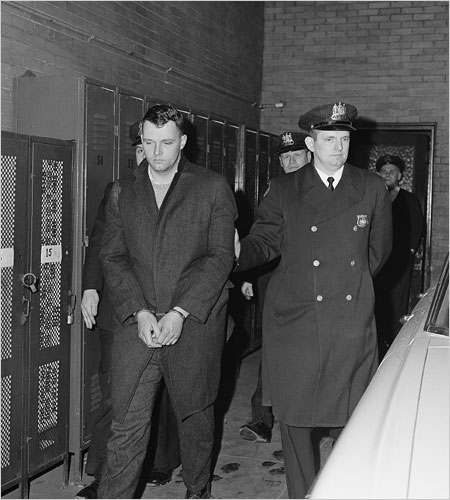
William D. Zantzinger was convicted of manslaughter and sentenced to six months in 1963 in the death of Hattie Carroll. [Dylan dropped the “t” in “Zantzinger.”] Photo from Baltimore Sun via NYT.

W. D. Zantzinger, subject of Dylan song, dies at 69

As the evening progressed, he hit several hotel employees with the cane and used racial epithets. Time magazine said he pushed his wife to the floor. He later strode to the bar and ordered a drink from Mrs. Carroll, 51. But she was too slow, he said, and began criticizing her. Then he repeatedly struck her with the cane. Fleeing to the kitchen, she told co-workers that she felt “deathly ill.”

By Douglas Martin / January 9, 2009

William Devereux Zantzinger, whose six-month sentence in the fatal caning of a black barmaid named Hattie Carroll at a Baltimore charity ball moved Bob Dylan to write a dramatic, almost journalistic song in 1963 that became a classic of modern American folk music, died on Jan. 3. He was 69.

His death was confirmed by an employee of the Brinsfield-Echols Funeral Home, who said Mr. Zantzinger’s family had prohibited the release of more details.

Mr. Dylan took some liberties with the truth in the song, “The Lonesome Death of Hattie Carroll,” though there is disagreement over just how many. He recorded it in 1964 for the Columbia album “The Times They Are A-Changin’,” for some reason dropping the letter “t” from Mr. Zantzinger’s name. It begins:

William Zanzinger killed poor Hattie Carroll

With a cane he twirled around his diamond ring finger

At a Baltimore hotel society gath’rin’.

The incident occurred on Feb. 8, 1963. Mr. Zantzinger, a 24-year-old Maryland tobacco farmer, and his wife, Jane, had stopped with friends at a restaurant on their way to Baltimore’s annual Spinsters’ Ball, a white-tie affair.

Mr. Zantzinger was wearing a top hat and carrying a toy cane he had picked up at a farm fair. At the restaurant, he became disorderly, hitting employees with the cane, then left with his group after they were refused more drinks.

The party moved on to the ball, at the Emerson Hotel. A recapitulation of the evening in The Washington Post Magazine in 1991 said Mr. Zantzinger had entered bellowing: “I just flew in from Texas! Gimme a drink!”

As the evening progressed, he hit several hotel employees with the cane and used racial epithets. Time magazine said he pushed his wife to the floor. He later strode to the bar and ordered a drink from Mrs. Carroll, 51. But she was too slow, he said, and began criticizing her. Then he repeatedly struck her with the cane. Fleeing to the kitchen, she told co-workers that she felt “deathly ill.” An ambulance was called.

Mr. Zantzinger was charged with disorderly conduct and released on $600 bail. But on the morning of Feb. 9, Mrs. Carroll died of a stroke. Now Mr. Zantzinger was charged with murder.

In the trial, Mr. Zantzinger testified that he could not remember hitting anyone. His lawyers said Mrs. Carroll’s stroke could have been caused by the hypertension she was known to have. A three-judge court agreed that the caning alone could not have caused the death and reduced the charge to manslaughter.

Mr. Zantzinger was convicted in June, and in August he was sentenced to six months in prison.

On Aug. 29, The New York Times published a dispatch by United Press International, reporting on the sentencing. A friend of Mr. Dylan showed the singer the article. Some accounts say he wrote the song at an all-night coffee shop on Seventh Avenue in Manhattan, others that he wrote it at the singer Joan Baez’s house in Carmel, Calif.

The literary critic Christopher B. Ricks wrote a chapter about the song in his book, “Dylan’s Visions of Sin” (2004), praising Mr. Dylan’s “exact control of each word.”

Clinton Heylin, in his book “Bob Dylan: Behind the Shades Revisited” (2001), countered that the song “verges on the libelous” because of “its tenuous grasp of the facts of the case.” One criticism was that Mr. Zantzinger’s “high office relations,” as Mr. Dylan called them, were overstated: his father had been a one-term state legislator and a member of the Maryland planning commission.

The song did not mention that Mrs. Carroll was black, although listeners made that correct assumption. It also did not refer to the reduced charge of manslaughter, only the six-month sentence.

One error of fact in the song was that Mrs. Carroll had 10 children; she had 11. Critics suggested that 11 did not fit the meter.

Time magazine called Mr. Zantzinger “a rural aristocrat,” who enjoyed fox-hunting. He attended Sidwell Friends School in Washington and the University of Maryland. The magazine Mother Jones reported in 2004 that he had worked alongside his farm employees, including blacks.

After prison, Mr. Zantzinger left the farm and went into real estate. He sold antiques, became an auctioneer and owned a night club.

In 1991, The Maryland Independent disclosed that Mr. Zantzinger had been collecting rent from black families living in shanties that he no longer owned; Charles County, Md., had foreclosed on them for unpaid taxes. The shanties lacked running water, toilets or outhouses. Not only had Mr. Zantzinger collected rent for properties he did not own, he also went to court to demand past-due rent, and won.

He pleaded guilty to 50 misdemeanor counts of deceptive trade practices, paid $62,000 in penalties and, under an 18-month sentence, spent only nights in jail.

Information on Mr. Zantzinger’s survivors was unavailable. Though he long refused interviews, he did speak to the author Howard Sounes for his book “Down the Highway: The Life of Bob Dylan” (2001), telling him of his scorn for Mr. Dylan.

“I should have sued him and put him in jail,” he said.

Source / The New York Times

Thanks to Harry Edwards / The Rag Blog

Posted in RagBlog | Tagged , , , , | 2 Comments

Robert Jensen : Beyond Grief and Rage: Palestine and the Politics of Resistance

Israeli and American Flags Lapel Pin / Judaica Heaven!.

The grief is achingly real, and the rage is morally justified. Our task today is to think about how to channel the power of those emotions into effective political action.

By Robert Jensen / The Rag Blog / January 11, 2009

[A version of this essay was delivered to the “Day of Action for Gaza” gathering in Austin, Texas, on Jan. 10, 2009.]

We need to analyze and strategize about political realities, but let’s begin with an emotional reality: For the past few weeks the scenes from Gaza have been driving many of us mad.

For all the horrors in the world, there has been something especially brutal and barbaric about Israel’s use of fighter jets and other sophisticated weapons to pound this small strip of land, to target the 1.5 million people crowded there, to destroy a society. Out of that grief flows rage, not just at the sadistic Israeli violence but also at the “we must stand with Israel” declarations coming from Republican and Democratic politicians alike.

The grief is achingly real, and the rage is morally justified. But it’s also true that for anyone who is aware of the suffering of this world, such emotions are part of daily life. To know — to make the choice to know — about the extent of injustice and the depth of misery all over the planet is to accept that we will wake every morning to that grief and rage.

Our task today is to think about how to channel the power of those emotions into effective political action. That is no small task after so many years of struggle and so many failures to change our government’s policies.

Let’s start by remembering the other places where that suffering has been so intense: Iraq, Afghanistan, Latin America, southern Africa, southeast Asia. I mention those places in particular because much of the suffering there has been a result, directly or indirectly, of U.S. economic, military, and foreign policy. Those are some of the places that have borne the brunt of the U.S. empire’s violence since the end of World War II. As a U.S. citizen, those are the places to which I have the clearest moral connection; those of us who claim the United States as home must come to terms with that suffering.

“The West” has been involved in empire-building for 500 years, and for the past 60 years the United States has led that imperial project. It is a project soaked in blood. One of the great apologists for the empire, the late political scientist Samuel Huntington, was at least honest in acknowledging that: “The West won the world not by the superiority of its ideas or values or religion (to which few members of other civilizations were converted) but rather by its superiority in applying organized violence. Westerners often forget this fact; non-Westerners never do.”[1]

Our first task is to refuse to forget, which means recognizing that, in the context of U.S. policy, there is nothing special about Palestine. It is one place where the West and its surrogates have used organized violence to achieve political and economic aims. U.S. support for Israel’s occupation of Palestine has to be seen as part of that imperial project; those of us in the United States who want to defend Palestine have to resist the U.S. empire.

Too often activists in the United States have ignored this. For example, the group “If Americans Knew” has done fine work to distribute information about the occupation, but consider this sentence from its mission statement: “It is our belief that when Americans know the facts on a subject, they will, in the final analysis, act in accordance with morality, justice, and the best interests of their nation, and of the world.”

If only that were true. In fact, many Americans routinely endorse actions in support of the U.S. empire that are immoral and unjust but which they believe are in their best interests, the world be damned. Many others work hard not to know — a willed ignorance — in order to avoid having to face difficult issues. To trust in the moral sensibilities of the U.S. public is to ignore history; in the realm of moral vision, Americans are not special.

Let’s recognize that resisting the U.S. empire puts us in conflict not only with the politicians from the major political parties but also with the majority of U.S. citizens. The problem is not simply that many Americans do not know the real history of the Israel/Palestine conflict (though it’s true that they don’t) or that the U.S. corporate news media outlets present a consistently distorted view of the conflict (though it’s true that they do). The problem goes deeper, to the core of this country and to the lies we tell ourselves about ourselves.

So, to work for justice for Palestine is to work against the U.S. empire. And to work against the U.S. empire is to dig in for the long haul. Our task is not to play to Americans’ sense of being special, but to help this country come to realize that if there is to be a decent future for anyone — indeed, if there is to be a future at all — the United States has to step back from its position of arrogance and affluence. We must imagine what it would be like to live as one nation in the world, not as an arrogant nation that attempts to dominate the world. We must imagine what a good life would look like if we were to give up our commitment to affluence and work toward a just and sustainable world at the end of the high-energy/high-technology era.

All of that is hard to focus on when Israeli bombs are dropping on Gaza, as the U.S. government continues to provide military, diplomatic, and economic support to Israel. It is difficult to take the long view as the grief of the people of Gaza intensifies by the moment.

But I believe that authentic hope lies in seeing one movement with many fronts. The goals must be justice and sustainability, which are inseparably linked. The struggle goes on in Palestine and Iraq, in Venezuela and Bolivia, in Oakland and Austin. The targets are the empire and economic interests it serves. We have to continue to struggle against the corrosive effects of arrogance and affluence, in others and in ourselves.

We all have limited time and energy for political work, and we direct that energy toward activities that are meaningful to us. One person cannot do everything, but each one of us can work within our political groups and communities to develop the analysis needed to integrate these many campaigns for justice and sustainability, linking our efforts with others’.

With that analysis, there is the possibility of authentic solidarity. And that solidarity is our only way to tame the rage, our only way to live with the grief.

[1] Samuel P. Huntington, The Clash of Civilizations and the Remaking of World Order (New York: Simon and Schuster, 1996), p. 51.

[Robert Jensen is a journalism professor at the University of Texas at Austin and board member of the Third Coast Activist Resource Center. His latest book, All My Bones Shake, will be published in 2009 by Soft Skull Press. He also is the author of Getting Off: Pornography and the End of Masculinity (South End Press, 2007); The Heart of Whiteness: Confronting Race, Racism and White Privilege (City Lights, 2005); Citizens of the Empire: The Struggle to Claim Our Humanity (City Lights, 2004); and Writing Dissent: Taking Radical Ideas from the Margins to the Mainstream (Peter Lang, 2002). Jensen can be reached at rjensen@uts.cc.utexas.edu and his articles can be found online here.]

The Rag Blog

Posted in Rag Bloggers | Tagged , , , , , , , | Leave a comment

Dr. Stephen R. Keister : Tell the Republicans: ‘Without Health Life is Not Life’

François Rabelais lisant, anon. drawing, early 17th Century / Wikimedia Commons.
Rabelais: ‘Without health life is only a state of languor and an image of death.’

This reminded me of a painting of a 17th century hospital with its endless wards, white clad sisters and care for nobleman or serf which were the same in the eyes of the then caretakers of the sick.

By Dr. Stephen R. Keister / The Rag Blog / January 11, 2009

Rabelais wrote, “Without health life is not life; it is not living life. Without health life is only a state of languor and an image of death.” Then why is it the simpering Sen. Mitch McConnell and his Republican cohorts in the Senate are opposed to universal health care in America under the guise of fiscal responsibility, of the sanctity of the budget, and the hollow slogan ‘that we in United States have the best health care in the world,” while they themselves are provided excellent health care by the federal government?

I compose this on a Sunday morning, a time for reflection and meditation. I was recalling a dinner I attended some six years ago in Paris, attended by three students, two American, one Swiss, who were attending the American University in Paris. During the course of the conversation I mentioned how nice it was to have The American Hospital available in the 16th Ar. The American students responded almost in unison that that facility was fine if one arrived in a limousine and wearing a mink coat! They noted that if they were ill they attended the dispensary at one of the French hospitals and were given first rate compassionate care, at little expense, with little waiting. This in turn reminded me of a painting, I believe at the Louvre, of a 17th century hospital (the Pitie-Salpetriere or the Hotel Dieu?) with its endless wards, white clad sisters and care for nobleman or serf which were the same in the eyes of the then caretakers of the sick.

I remember as well my intern/residency in the late 1940s at Mercy Hospital in Pittsburgh with its tremendous wards for the indigent patients. In some way these folks got the best of care under the direction of the Sisters and the head of the department of internal medicine, Dr. W.W.G. McLachlan. Many of our patients came from two “flop-houses,” The Friendly Inn and The Improvement of The Poor; most were alcoholics. One morning during rounds Dr Maclachlan paused overly long at a bedside, looking at a chart, and asked the gentleman, who was quite ill with pneumonia, “Is your nickname “Moose” and did you play for the Chicago White Sox? The answer was affirmative. The next day Dr. Maclachlan told us that he had called a patient of his, who owned the Pittsburgh Pirates, and they had scheduled, on an open date for the Pirates and White Sox, an exhibition game at Forbes Field to raise funds to rehabilitate the “Moose.” It came to fruition…. a happy ending. Where has all of this gone? Where is such idealism and compassion today?

When I first started practice in Erie, Pa. we devoted two hours/morning, two months per year to care of charity patients, and as well oversaw a free clinic one morning a week. I was familiar with a dermatologist who at that time made house calls on cold mornings, on sick infants with a dermatitis. The gentleman also urged his patients to call him at home during the evenings. With the advent of the usurpation of medical care in the United States by the insurance conglomerates this vanished, a noble profession was converted to a business, for the benefit of the insurance executives and stockholders.

John Geyman, M.D., writing in Tikkun magazine points out that the inefficiency and bureaucracy of our 1,300 private insurers are not sustainable. (According to the Blue Cross Blue Shield Association there are 17,000 different health plans in Chicago.) In addition premiums for private health insurance have grown by more than 100% since 2000, and are projected to consume all of average household income by 2025. Understandable in view of the fact that administrative overhead of private insurers is 5-9 times higher than not-for-profit Medicare. (Incidentally, Dr. Geyman is a professor of family medicine at the University of Washington and past president of Physicians For A National Health Care Program . Yet the Senate Republican ideologues respond, “There is no health care crises!” and falsely assert that single payer, universal care, or the Obama plan, is some horrible, but non-existent, thing called “socialized medicine.”

A recent Commonwealth Fund study found that across 37 indicators covering quality, access, efficiency, and equity, the United States achieves “an overall score of 65 out of a possible 100 when comparing national averages with benchmarks of best performance achieved internationally.”

Yet beware of seemingly well meaning plans being circulated that MANDATE as part of their format that obligatory purchase of insurance be included.. I have noted that constitutional scholars have raised the question as to whether the government can mandate that a citizen buy anything, including insurance, from a private company. Yes, the government has the right of taxation; however, the right to demand by legislation, that one make a purchase leads into a gray zone that demands an opinion from a Federal Court. I would suggest that Rep. Conyers’ committee study this problem in the meantime.

Our health care problems are larger than just getting a physician for the child’s tonsillitis, mother’s migraines, or father’s angina. This spills over into the field of public health, where hopefully President-elect Obama will appoint a Surgeon General with a background in public health. I look at the Center For Disease Control which has been deprived of much of its professional staff, is underfunded, and has undergone failure of morale under the Bush Administration. In the past year this agency has been unable to determine the source of repeated Salmonella outbreaks. One hopes that it is restaffed with dedicated, competent professionals, rather than political hacks, and funded to a point that it can carry out its intended function.

The Food and Drug Administration as well must be rehabilitated. Nine FDA scientists have sent a letter to President-elect Obama’s transition team, urging the incoming administration to reform the “fundamentally broken” agency. The letter’s authors reveal that President Bush’s FDA managers “ordered, intimidated, and coerced scientists to manipulate their research results in violation of federal law.” Scientists who did not comply with managers faced “the threat of disciplinary action.” In addition, they wrote that the FDA has promoted and rewarded some of the managers involved in the inappropriate practices. Thus, I would respectfully suggest that none of the management, or the scientists, have any relationship to the pharmaceutical industry nor to any association promoting a specific religious ideology.

Collateral public health issues must be addressed by the new administration as well. Young folks in the United States have one of the highest rates of teen age pregnancy in the Western World as well as one of the highest rates of STD among young women. The United States is unique in the civilized world as far as the federal government’s funding of programs for “abstinence” and in opposing the teaching of safe sex and contraception. Here our attitudes parallel some of the central African nations. Yet, our young folks are bombarded by sexual innuendo on TV and in motion pictures day after day, along with neverending violence, and none of the proponents of abstinence are marching on the streets to rectify these influences. Somehow the religious right is only selectively absorbed with the human genitalia! Where public health or human emotional well-being is involved they just do not seem to give a damn. One wonders where the anti-sex education folks are when day after day our children are bombarded by TV commercials for Viagra and the like. What is the eight year old child’s reaction to the announcer noting that “if the erection does not disappear in four hours, see your doctor right away.”

As I study the issue of health care for all, I find no simplistic solutions, as we are involved in a societal and cultural crisis, perhaps larger than any single person or well meaning group of persons. I recently purchased Russ Baker’s new book “Family of Secrets” and find that the Bush dynasty is only symptomatic of a much larger problem here in the United States. I would strongly suggest that anyone interested in contemporary affairs become familiar with the well researched thrust of the author’s thinking. A quotation at the beginning of the first chapter sets the tone. Franklin D. Roosevelt to Colonel Edward House, Oct. 21, 1933: “The real truth of the matter is, as you and I know, that a financial element in the larger centers, has owned the Government ever since the day’s of Andrew Jackson.”

The Rag Blog

Posted in Rag Bloggers | Tagged , , , , , | 1 Comment

The Israeli ‘Public Relations’ Juggernaut Takes No Prisoners

Media bias about the Israeli – Palestine conflict EXPOSED!

Israeli Government Willing to Deliberately Lie About the Facts on the Ground in Gaza
By Richard Jehn / The Rag Blog / January 11, 2009

The video above is only the tip of the iceberg concerning what the Israeli PR machine is doing. This blog has been the subject of scrutiny by organized Israeli propagandists insofar as a deliberate, targeted campaign of commentary was undertaken to discredit the facts cited by one of our writers. It is clear that these commenters are uninterested in what has actually happened: this is a propaganda campaign to counter our stories and statement of opposition to the Gaza invasion and genocide.

The single source of the numbers of comments to the Rag Blog article is the organization named HelpUsWin.org, apparently an Israeli student organization headquartered in the Interdisciplinary Center, Herzliya, Israel, a university that claims the following as a founding principle: “A university that will help remove the walls of hostility in the Middle East, will serve students of all religions from this region and the rest of the world, will emphasize, in its research and its teaching, the importance of development and free movement in the space that is the cradle of humane culture, and will advance the principles of peace, freedom and dignity for mankind.” The hypocrisy of this claim in the current circumstances is beyond comment.

Here is how a Jerusalem Post article describes HelpUsWin.org:

Many supporters of Israel have grown frustrated with hostile feedback posted to Web articles and on blogs since the start of Operation Cast Lead nine days ago. A group of Israeli students has decided to fight back.

HelpUsWin.org is manned by social media experts and Israel activists around the clock, with the main “situation room” based at the Interdisciplinary Center, Herzliya, and sponsored by the Stand With Us education organization. Social media are primarily Internet- and mobile-based tools for sharing and discussing information.

HelpUsWin.org “situation room.” Photo: source.

Students and volunteers have been monitoring and responding to social media Web sites worldwide in several languages, to mount a public diplomacy offensive for Israel on the Internet.

“There is a misconception that the Internet is democratic, but that’s far from the truth,” said Alex Gekker, 24, a student in new media diplomacy at IDC and a volunteer at HelpUsWin headquarters.

But frankly, HelpUsWin.org is a small part of what is happening. Here is a letter I received from the Israeli Prime Minister’s Office in response to my signing a petition opposing the assault on Gaza:

We acknowledge receipt of your e-mail regarding the IDF campaign to protect the residents of southern Israel.

For the past eight years, hundreds of thousands of Israelis have lived under the specter of incessant and indiscriminate rocket attacks from the Gaza Strip. While people in other countries have carried about their normal routines, sending their children to school and walking their dogs in the park, the people of Sderot and its neighboring communities have been denied such luxuries – for fear of being hit by incoming missiles (http://switch3.castup.net/cunet/gm.asp?ai=58&ar=panic02-V&ak=null). No sovereign nation should be expected to tolerate the daily targeting of its people, and yet the State of Israel has exercised maximum restraint and worked relentlessly to achieve a peaceful solution with the Palestinians.

Since seizing control of the Gaza Strip by way of a violent coup in June 2007, Hamas – a terrorist organization allied with Iran, Syria and Hizbullah – has escalated its assault on the State of Israel. Even a truce with Israel was abused by Hamas which persisted in attacking Israeli towns, while also conspiring to upgrade its terrorist capabilities, manufacture and smuggle massive quantities of weapons into Gaza and construct a network of underground tunnels for combat purposes. Now, after Hamas has unilaterally abandoned this ceasefire and expanded the range of its missiles to threaten close to one million Israelis, the State of Israel must act decisively to defend its citizens.

In 2005, the Disengagement plan brought an end to Israel’s presence in the Gaza Strip, with the hope and aspiration that its Palestinian residents would begin to govern themselves and prosper. Israel has no desire to re-establish its hold over Gaza, but has resolved – in self-defense – to gain control over areas from which rockets are being launched on Israeli towns, and to significantly disable the Hamas terrorist infrastructure. Ultimately, Operation Cast Lead aims to produce lasting change in the security predicament affecting residents of Southern Israel, and Israel expects the international community to lend its support in the fight against Hamas terror. Terrorism is terrorism no matter where it occurs.

At the same time, the IDF is taking great pains to direct its activities exclusively against terrorists. Hamas, however, callously places Palestinian civilians in harm’s way, using schools, mosques, other public institutions and even private homes as arsenals and bases of operation – effectively taking the Palestinians of Gaza hostage and using them as human shields. Responsibility for injury to civilians in Gaza rests solely with Hamas. In contrast, the State of Israel is doing its utmost to minimize any harm to the Palestinian civilian populace; hundreds of trucks carrying humanitarian aid have been allowed passage into Gaza and this assistance will continue. There is no humanitarian crisis in the Gaza Strip.

The State of Israel seeks peace and will remain steadfast in its pursuit of a two-state solution that will allow Israelis and Palestinians to live together as neighbors in harmony.

Sincerely,
Prime Minister’s Office – E-Correspondence

This letter from the leader of the nation is rife with counterfactual material. There was no “violent coup in June 2007” whereby Hamas seized control of the Gaza. There was an election that was overseen by numbers of independent observers and certified as democratic. This was thoroughly documented in Jimmy Carter’s 2007 book, Palestine Peace Not Apartheid.

The PMO claims “there is no humanitarian crisis in the Gaza Strip.” This is simply ludicrous – the United Nations, numerous independent observers, and the international press have directly seen the conditions in Gaza, which were dismal prior to the invasion owing to the long-standing Israeli blockade, and have deteriorated significantly since.

And the video link in the letter is blatant propagandizing. The (unidentified) speaker refers to “heavy casualties” suffered in Israel. By the end of December, 2008 a total of 15 people had been killed by Qassam rockets since attacks began in 2001, this according to the Israeli Ministry of Foreign Affairs. It is well known that the casualties from Qassam rockets in Israel have been light in comparison with the dead and injured in Gaza (or anywhere else that Israel has attacked).

Even the Israeli Defense Force (IDF) has video of its own crimes, which very occasionally finds the light of day.

Idfnadesk Doesn’t Want You to See

Frankly, these efforts by the Israelis to hide the facts, barrage factual reporting with negative commentary designed to obfuscate the facts, outright lying as in the letter from the Israeli PMO, and other more sinister, hidden efforts to affect the nature of reporting in North America on the conflict are detestable. It is time to stop the fighting and sit down at the negotiating table to end this war permanently. And it is most especially time to stop lying about what is happening in Gaza in order to sway the final outcome which must, of necessity, satisfy all parties concerned and end the bloodshed.

For a succinct listing of key points of misunderstanding about the Gaza Strip, we highly recommend Rashid Khalidi’s Op-ed in the New York Times of January 7, 2009.

Thanks to Larry Ray and Thorne Dreyer / The Rag Blog

Posted in Rag Bloggers | Tagged , , , , | 6 Comments

John Dean on Fixing the American Presidency

Dawn Johnsen, Obama administration head of the Office of Legal Counsel.

The Damaged Institution of the Presidency, How the Obama Administration Intends to Restore It, And What We Can Expect from New OLC Head Dawn Johnsen
By John W. Dean / January 9, 2009

As George Bush and Dick Cheney take victory laps, in order to pretend nothing is amiss because of the way they have governed for the past eight years, they are claiming to have strengthened the institution of the presidency. Needless to say, they are wrong. Even Chris Wallace of Fox News Sunday, a Bush/Cheney cheerleader, had his doubts about this claim, so he asked Cheney during an exit interview, “Did you overreach? Did you end up making the presidency weaker, not stronger?” Not surprisingly, Cheney responded, “I don’t think so.” When Wallace then mentioned all those Supreme Court decisions overruling Bush and Cheney’s actions, Cheney employed his usual hubris and, with a straight face, explained that he and Bush were correct, and the Court was wrong.

Most Americans now understand that Bush and Cheney see the world as they want to believe it to be, but few live in their alternate reality. Thankfully, it appears that the Obama transition team is very aware of the damage Bush and Cheney have done to the institution of the presidency, and they are taking appropriate actions.

Examples of a Broken Presidency

The former Bush/Cheney Assistant Attorney General in charge of the Office of Legal Counsel, Jack Goldsmith, who left the administration after too many shouting matches with Cheney’s abrasive Chief of Staff (and former Counsel) David Addington’s efforts to operate outside the law, addressed the problem in his book, The Terror Presidency. Goldsmith explained how Bush and Cheney wanted to “restore” power to the presidency, yet accomplished the opposite, since their actions will result in future presidencies being “viewed by Congress and the courts, whose assistance they need, with a harmful suspicion of mistrust because of the unnecessary unilateralism of the Bush years.”

Examples of the President and Vice-President’s overreaching are many: the pervasive secrecy, the flawed legal opinions authorizing torture and ignoring the Geneva Conventions, the endless and vague signing statements announcing the President would not follow the law, and their refusal to comply with an array of long-standing laws – from the Presidential Records Act to the Foreign Intelligence Surveillance Act. None of these actions has strengthened the presidency, rather, it is through these actions that Bush and Cheney have shown themselves to be law-breakers. They have also shown how presidential hubris and shamelessness, accompanied by Congressional timidity and widespread public gullibility, empowered the Bush/Cheney presidency. Such conduct has also established dangerous precedents for any future presidents who have no interest in following the law.

Boston Globe reporter Charlie Savage reported extensively on Bush’s abusive use of signing statements claiming that laws were unconstitutional based on less-than-fully-explained reasons – such as that they conflicted with the “unitary executive” (whatever that means), or the powers of the commander-in-chief (with no specification as to which). Savage also noted that these actions are precedents future presidents may invoke. Citing Supreme Court Justice Robert Jackson, Savage explained, Bush and Cheney’s dubious claims of executive powers will sit “around like a loaded weapon ready for the hand of any authority that can bring forward a plausible claim of an urgent need. Every repetition imbeds that principle more deeply in our law and thinking and expands it to new purposes.”

Fixing the Broken Presidency In the Obama Administration

No better news has emerged from the Obama transition that the selection of Indiana University Law School Professor Dawn E. Johnsen to serve as the head of the Office of Legal Counsel (OLC). She served as acting head of this office late in the Clinton administration, and she has written widely – and wisely – about the uses and abuses of presidential power. For example, she offers a thoughtful criteria that might be employed in the selection of federal judges in “Should Ideology Matter in Selecting Federal Judges?: Ground Rules for the Debate.” Her analysis of how the Reagan White House and Rehnquist Court weakened Congressional powers is enlightened.

Johnsen participated in a symposium on “The Role of the President in the Twenty-First Century” at Boston University on October 11 and 12, 2007, long before it was clear who would be the Democratic Party’s nominee, not to mention who would be elected the next president. Based on that symposium, the Assistant Attorney General-designate wrote a law journal article “What’s A President To Do? Interpreting The Constitution In The Wake Of Bush Administration Abuses” where she not only states the problem – as the title of her article suggests – but also quotes Jack Goldsmith’s assessment and Charlie Savage’s concerns about the precedent, and agrees with both about the problem that now exists.

This post at OLC can have great influence on the exercise of presidential powers. (However, this office was little known to the public before John Yoo arrived as a deputy who authored opinions saying the Bush folks could break the law). Given Johnsen’s extensive writings about the presidency, the approach the Obama Administration will take toward the exercise of presidential powers appears rather clear. With Dawn Johnsen heading OLC, the Obama presidency will not follow Bush and Cheney precedents, and her awareness of the problems can go a long way in correcting them – starting with her confirmation hearing.

Johnsen’s Thinking and Her Upcoming Confirmation Hearing

Notwithstanding the blatant abuses of power by Bush and Cheney, Ms. Johnsen appropriately “urges due care in the formulation of critiques and reforms.” Even before being selected to head OLC, she cautioned that there should not be an over-reaction to Bush and Cheney “to avoid undermining future Presidents’ legitimate authorities or otherwise disrupting the proper balance of powers.” This is her voice of experience.

She has no interest in silencing critics and commentators, but calls for them to be specific, and to “avoid imprecise and over-generalized reactions that might undermine the ability of [the President] to exercise legitimate authorities.” For this reason, she believes that presidential candidate John McCain was wrong in declaring that if elected, he would “never, never, never, never” issue a signing statement.

Johnsen recognizes, and has written extensively, on the role of the president – not to mention the Congress and courts – in interpreting the Constitution. I first became aware of her work regarding how best a president might proceed if he or she believes Congress has enacted an unconstitutional law, and she has written extensively about this subject as well. (When Congress overrode Clinton’s veto of a military-appropriations bill containing a provision that would have forced the president to discharge over a thousand members of the military who tested positive for HIV, the president signed it because the funding was vital for national security, but refused to enforce the rider that misinformed members of Congress had added. Following the advice of OLC (read: Johnsen) he worked with Congress to remove the provision before it became effective, after openly explaining what he was doing and why.)

Dawn Johnsen, working with over a dozen former OLC attorneys, prepared a document that will no doubt become controlling for all OLC attorneys when she heads the office. It is entitled Guidelines for the President’s Legal Advisors. Had this document been in place during the Bush presidency, there would have been no torture memos, nor for that matter, an authorization for war in Iraq or violations of the Foreign Intelligence Surveillance Act. If Johnsen embraces these guidelines during her confirmation hearing – and there is no conceivable reason she will not – it will do much to restore the faith of Congress (and the courts) in the work of OLC.

But guideline number six is going to provoke a tough question for her. It reads: “OLC should publicly disclose its written legal opinions in a timely manner, absent strong reason for delay or non-disclosure.” Johnsen has been highly critical in her writings and public statements about the extreme secrecy of the Bush Administration. For certain, she will be asked during her confirmation if she will make public the legal opinions that Bush’s OLC has refused to release. Hopefully, her answer will be an unequivocal yes. For such disclosure is certainly long past being timely, and the claims of “national security” will never withstand the light of day.

If Johnsen does equivocate with some lawyeresque-type response, however, we will all know that she talks the talk but may not walk the walk of real reform.

[John W. Dean, a FindLaw columnist, is a former counsel to the president.]

Source / FindLaw

The Rag Blog

Posted in RagBlog | Tagged , , | Leave a comment

Imagine Yoko Ono : Tower of Peace

Yoko Ono John Lennon Peace Tower, Reykjavik / Photo by goecco.com.

Yoko Ono. Photo by Christopher Furlong / Getty.

John Lennon was shot 28 years ago this month, but his widow, now 75, travels the world preaching peace and love in his name – and in her art. Here she tells Miranda Sawyer about begging for food as a child in wartime Japan, her two husbands before John, and the daughter who was hidden from her for more than 20 years.

By Miranda Sawyer

Notoriously, John Lennon once described Yoko Ono as “the world’s most famous unknown artist: everyone knows her name, but no one knows what she actually does”. This is still true today. How do you think Yoko spends her time? Lying in bed for peace? Yowling in recording studios? Rubbing her hands as she counts her millions?

Well, on 9 October, Yoko was in Reykjavik, Iceland. She had a packed agenda. First, she was presenting the LennonOno Grant for Peace. This year, its $100,000 was split between Iceland, for its work on geothermal energy, and Dr Vandana Shiva, an environmental activist. Second, Yoko was switching on her Imagine Peace Tower at Reykjavik harbour, which sends a laser beam shining into the air between 9 October (Lennon’s birthday) and 8 December (the date of his death). Third, she was the VIP guest at the launch of an Icelandic postage stamp in honour of Lennon.

Though I couldn’t get my head around this strange collection of occasions – I kept asking the PR: “Yes, but why Iceland?’ – they seemed representative of Yoko’s work, which moves fluidly between peace, art and her late husband’s memory (not so much music these days; she says she doesn’t have the time). So a trip was arranged and we all convened in Reykjavik. Then, overnight, Iceland went bust.

Suddenly, Yoko’s events seemed irrelevant, if not insulting – a foreign artist donating thousands of dollars for peace when the economy of the entire country has just disappeared. For a start, how could Iceland cash the cheque? In the end, Yoko, a tiny figure dressed entirely in black, including cap and sunglasses, made a well-received, if hippy-flavoured, speech: “We are here today to celebrate the unveiling of the true human spirit, which we have been hiding for such a time of need.”

She then sat gamely through interviews with earnest local journalists asking whether Iceland had a special place in John’s heart: “Well, he didn’t make it here when he was living but now he is coming here in a different way, he is here in spirit. He doesn’t go everywhere, you know!”

In the evening, there was a ceremony for the lighting of Yoko’s Imagine Peace Tower. A memorial to Lennon, it has “Imagine Peace” in various languages engraved around the base and was lit for the first time in 2007 when Yoko and others, including Ringo Starr and Olivia Harrison, all stood around the light as it illuminated. I’ve seen a DVD; it looked amazing, if cold. “Could you put it up in the Caribbean next time?” jokes Ringo.

This year, a storm prevented anyone getting to the island where the light is sited, so Yoko’s entourage and Icelandic dignitaries gathered in the top-floor bar of our hotel to witness the Peace Tower lighting. The event lacked a certain drama. Instead of huddling beneath the elements, sea crashing on the rocks below, we stood around, ate nibbles and drank wine. There was a three-two-one moment and Yoko pressed a button. Nothing. Yoko said: “Why isn’t it working?” And then a column of light began to shine into the dark sky.

Sean Lennon, Yoko’s son, was there with his girlfriend. His birthday is 9 October, same as his dad, so every year his celebrations are overshadowed. Peering through the window, Sean said: “Mom, it’s beautiful, fantastic. Really amazing.” Some of Yoko’s team had tears in their eyes. Not me. I squinted at the pale, distant light and thought: what is all the fuss about?

Well, indeed. It’s amazing how much controversy Yoko causes, when her presence is so low key. As I watch her in Iceland, and later in London, I’m struck by her lack of look-at-me ego and her concern for the feelings of those around her. She’s almost motherly, though this is combined with a cool solo exterior. When she speaks, still with a strong Japanese accent, she begins every sentence with a little “hmm”, a short thinking breath.

The fuss about Yoko, of course, lies in her last marriage (it’s often forgotten that Lennon was her third husband.) She will never be forgiven for marrying the best Beatle and then not disappearing demurely into the background. Although, in a way, she did. In public appearances with Lennon, Yoko was ever-present but, somehow, not there; whispering opinions into his ear, rarely speaking out loud, shaping his work while appearing to contribute very little.

Think of the Imagine video. Yoko sits there, impassive, as Lennon plays and sings one of the most cherished songs ever written. At the end, she offers nothing more than a besotted smile. Even now, 28 years after his death, there’s still fuss, at the moment caused by Philip Norman’s excellent Lennon biography. Yoko agreed to be interviewed for it but has rejected the finished article. No one is quite sure why. When I ask her about the book, she responds with a firm: “No comment.”

We meet again in her vast suite at London’s Mandarin Oriental Hotel. By this time, I’ve been to Iceland, also to Liverpool to see the art she’s showing at the Biennial, and to London, to her keynote speech at Frieze Art Fair. Yoko is happy about this: “You’ve seen everything, you were there!” she exclaims. She is wearing a zip-up top with BERLIN on the front, black trousers and bluey-green spectacles disguised as shades. It seems impossible that she’s 75; she looks 20 years younger. We perch on the vast, flowered sofa and go through the catalogue for her new show at the Baltic Centre in Newcastle. It’s a retrospective, showcasing her art from as far back as the 60s, when Yoko was considered a semi-detached part of the wildly avant-garde Fluxus group (there’s a Fluxus exhibition on another floor).

I’m a fan of much of her art, particularly the bossy, conceptual stuff where she commands the viewer to perform, or imagine performing, an impossible action. Such as: “Stay in a room for a month. Do not speak. Do not see. Whisper at the end of the month.”

First things first, though. It’s been bugging me. Why Iceland? What has that got to do with John? Why have a memorial there, as opposed to Liverpool or New York? “To me, the concept of distance is not important,” says Yoko. “Distance doesn’t exist, in fact, and neither does time. Vibrations from love or music can be felt everywhere, at all times. A memorial to John can just as well exist in Iceland as in New York. And the LennonOno Grant for Peace is designed to be public. It’s important for the world to know about geothermal energy. I give money to other causes, but, for instance, with a refuge for battered women, if you give the money, it’s better not to have publicity because then people think, oh, Yoko’s paying – they don’t need support. But with this, it’s important for these people to be acknowledged.”

We talk about two pieces of her work that appear to be her current favourites. One is Wish Tree, a project that has been going since the 1990s in various exhibition venues: you take a paper tag, write a wish on it and hang it off the branches of a bush (provided). And the other is OnoChord, where Yoko hands out torches to an audience and encourages everyone to flash them at each other once, then twice, then three times. This is Yoko semaphore for I Love You. I don’t like either work much; they seem trite, babyish.

When Yoko appeared at Frieze, everyone was waiting for her old, radical performance pieces, such as Cut, where members of the crowd scissor away her clothes until she is naked. She performed one – about political prisoners – and then played a video which showed the Imagine Peace Tower, Wish Tree and crowds merrily flashing “I love you” at each other. It was too sentimental for the audience, who didn’t join in.

“At Frieze they expected some cool art,” says Yoko. “They were a cool crowd. But I thought: why not edit it all down into two essential parts? Love and peace. Afterwards, I was wondering if I was right. But only art and music have the power to bring peace.”

Hang on. Even if every person in the audience at Frieze says “I love you” to each other, or “Imagine peace”, why will that make any difference? They’re not the ones who start wars. “If everybody thinks of something, then it will happen. Your mind is part of the universe. It is connected, you can use its energy. And politicians want people to like them, it’s important to them. They think: why don’t they like me? They will act if their people tell them to.”

Perhaps I’m just a cynical hack, but I’m not sure that flashing I Love You at Robert Mugabe would get you very far if you were wearing an MDC T-shirt. However, it becomes easier to understand Yoko’s obsession with love and peace when you look at the conflict in her younger life. Born on 18 February 1933 in Tokyo, she was the eldest child from the union of two important Japanese families. Isoko, her mother, was a Yasuda, founders of a merchant bank. The Onos were highly educated aristocrats who married into business, eventually running the Bank of Tokyo. Both Yoko’s mother and father Yeisuke were excited by the arts and Yoko was trained in lieder singing, Italian opera and classical piano. “But it was complicated; my father wanted me to learn music but also not to learn it. His mind was conflicted – he didn’t want me to rebel.”

Because of her father’s work, the family moved between Japan and the US, settling back in Tokyo in 1941 when he was transferred to Hanoi in Vietnam. During the Second World War, he was sent to a concentration camp in Saigon; the rest of the family stayed in Tokyo until the fire-bombing of 9 March 1945. Afterwards, Isoko moved the children to the countryside. Yoko remembers this as a difficult time, when she had to grow up. Her mother – “not like a typical housewife, she was quick with her words, sarcastic” – had bought them a small house, but did not come with her children. Instead, she sent the only family servant not called up to work in the factories, an older woman, both physically and mentally handicapped.

The 12-year-old Yoko was forced to take control. She had to beg for food. “I had a big responsibility, to look after my brother and sister and also the help, to make sure they could eat. The country people did not like city people. They said: you think you are above us and called me bata kusai, which means ‘smelling like butter’. Like I was an American.”

After the war, Yoko finished school and was the first female student accepted on the philosophy course at Gakushuin University. Her family ended up in New York where Yoko studied poetry and composition, eventually rebelling against her parents to become part of a loose salon of local creatives, including John Cage. She married composer Toshi Ichiyanagi in 1956. “He was orthodox, conservative. We were very good friends but very different.” She’s still on civil terms with Toshi – he and Sean recently met in New York – but after their relationship ended, Yoko checked herself into a sanatorium, “like a Betty Ford”.

Read all of this article here at CubaNow

Thanks to Karen Lee Wald / The Rag Blog

Posted in RagBlog | Tagged , , , , , , , , | Leave a comment

A Compendium of Leftist Children’s Literature

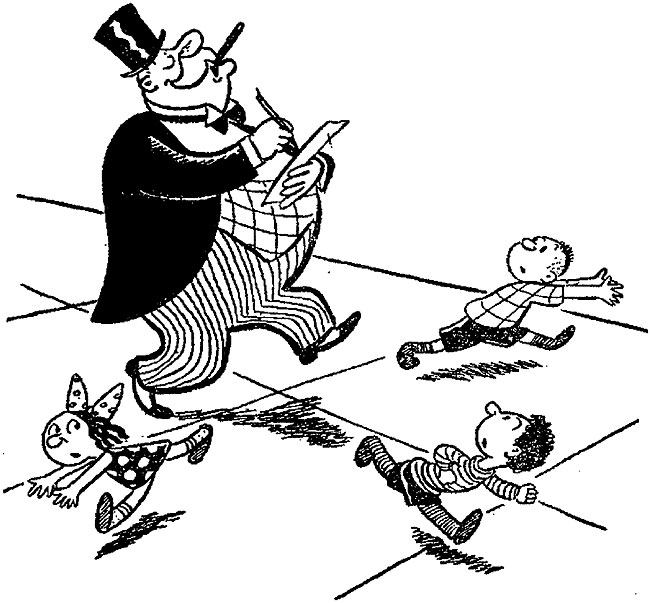
“Mr. His,” by A. Redfield (a k a Syd Hoff), 1939. From “Tales for Little Rebels.”

Children of the Left, Unite!
By Caleb Crain / January 9, 2009

Financial behemoths have been nationalized. The government is promising to spend liberally to combat recession. There are even rumors of universal health care. Socialism is on the march! As we leave capitalism behind, the traditionalists among you may be wondering: Will they come for our children?

Too late. As Julia L. Mickenberg and Philip Nel document in Tales for Little Rebels: A Collection of Radical Children’s Literature (New York University, $32.95), Marxist principles have been dripping steadily into the minds of American youth for more than a century. This isn’t altogether surprising. After all, most parents want their children to be far left in their early years — to share toys, to eschew the torture of siblings, to leave a clean environment behind them, to refrain from causing the extinction of the dog, to rise above coveting and hoarding, and to view the blandishments of corporate America through a lens of harsh skepticism. But fewer parents wish for their children to carry all these virtues into adulthood. It is one thing to convince your child that no individual owns the sandbox and that it is better for all children that it is so. It is another to hope that when he grows up he will donate the family home to a workers’ collective.

Mickenberg, an associate professor of American studies at the University of Texas, Austin, and Nel, a professor of English at Kansas State University, have nonetheless found 44 texts that attempt to attach children to social justice permanently. As they note in an introduction, the tentacles of the left reach deep. Crockett Johnson, creator of the innocuous-seeming “Harold and the Purple Crayon,” was an editor at The New Masses, a Communist weekly. Syd Hoff, known for “Danny and the Dinosaur,” wrote for The Daily Worker. Environmentalism is more or less explicit in such crowd pleasers as “The Lorax” by Dr. Seuss. In fact, so permeated is children’s literature by progressive ideals that Mickenberg and Nel were forced to narrow their scope by focusing on texts that have fallen out of print. They group their rediscoveries according to such themes as economics, unionization and respect for individual difference.

A less ideological reader might be tempted to divvy them up into the categories Charming, Insufferable and Inappropriate. Let’s get Charming out of the way first. In 1939, under the pseudonym “A. Redfield,” Hoff wrote and illustrated “Mr. His,” a book about a portly capitalist with a top hat, a tuxedo and a droopy mustache — like the Monopoly man but more personable. Though elsewhere Mickenberg and Nel warn against trafficking in “the stereotype of the fat capitalist,” they’re lenient with Hoff, perhaps because the rotundity of Mr. His is so charismatic. Mr. His owns a whole town, Histown, where he lives in luxury and the workers in squalor. He gets away with it because “there were no strikes in Histown — and no picket lines and no unions. The newspapers, which Mr. His owned too, said that these things were wicked.” Since this is a children’s story, the workers manage to defy Mr. His despite the false consciousness foisted on them by his mass media, whereupon he temporizes by trying to foment race hatred: “Wuxtry!” he exclaims, hawking issues of his newspaper in person. “Blondes — your real enemy is brunettes!” Unable to resist a villain who shouts “Wuxtry!” I wandered off to the Internet to try to buy a copy of “Mr. His” for my niece. None were for sale. By their reprinting, Mickenberg and Nel have rescued Mr. His from near-complete oblivion.

It is not their only success. In “The Story of Your Coat” (1946), Clara Hollos elaborates an idea from “Das Kapital” by tracing a coat from its origins on the backs of Australian sheep through a unionized textile mill and into a department store. The writing is simple but not simplified; it reminds me of the casual but illuminating way V. S. Pritchett explains the leather trade in his memoir “A Cab at the Door.” In Yehoshua Kaminski’s tale “A Little Hen Goes to Brownsville” (1937), translated from the Yiddish, a chicken sets out to use her near-superhero-caliber egg-laying skills to help the Brooklyn neighborhood’s babies, which she hears are “small and pale, thin and weak.” So unstoppable is her nutritional charity that she lays an egg in Times Square, gets arrested, pays her fine with another egg, and then pays her bus fare with yet an­other. The moral, Mickenberg and Nel infer, is that “justice is best served by a system that is not defined by the strict and inflexible administration of a legal code.” Also, that children should not go hungry.

It’s harder to say exactly what’s politically radical about Lydia Gibson’s “Teacup Whale” (1934), in which a boy finds in a puddle a tiny whale, which his mother persistently mistakes for a polliwog, and which in time must be carted to the wharf in a truck. Does the whale represent the proletariat? Is the boy the opposite of Captain Ahab? The story is, in any case, pleasant to read, and the illustrations are lovely.

As much cannot be said of the Insufferable. I hasten to say there are a lot of stinkers in children’s literature, and I suspect capitalism is responsible for more of them than socialism is. The real culprit isn’t political economics; it’s morality. There seems to be a slightly higher propensity for self-consciously virtuous books to be written by people whose personalities have been paved over by their superegos. In Oscar Saul and Lou Lantz’s insipid “Revolt of the Beavers” (1936), for example, a rebel beaver explains his campaign to a couple of 9-year-olds thusly: “All the beavers were very sad . . . and me too, so I said why don’t you make a club for sad beavers to become glad. So all the beavers say Yayy!” Language so insipid risks turning a sensitive 9-year-old to a life of orthodoxy if not reaction. When I was a child, I felt guilty that I was never able to read more than a few pages of a beautiful edition of Carl Sandburg’s “Rootabaga Stories” (1922), given to my sister and me by our parents. But Mickenberg and Nel reprint a story from the book’s 1923 sequel, and I am at last set free. I didn’t read the stories because no child could — they are stomach-churningly, almost incomprehensibly saccharine. Here, for example, is how Sandburg describes the cost of an episode of militarism: “And the thousand golden ice tongs the sooners gave the boomers, and the thousand silver wheelbarrows the boomers gave the sooners, both with hearts and hands carved on the handles, they were long ago broken up in one of the early wars deciding pigs must be painted both pink and green with both checks and stripes.”

Last but not least among Mickenberg and Nel’s selections are the Inappropriate. For all their caution about the fatness of capitalists, no warning is given that Julius Lester’s “High John the Conqueror” (1969), a retelling of several African-­American folk tales, deploys the N-word with gusto. Another stumper is a 1954 retelling and reillustration by Walt Kelly, of “Pogo” fame, of an episode from Lewis Carroll’s novel “Alice’s Adventures in Wonderland.” The King of Hearts is drawn as a burly, sinister cat with the face of Senator Joseph McCarthy. To show that the McCarthy cat is evil, Kelly gives its eyes no pupils. It has a 5 o’clock shadow, and there’s hair — fur? — on the backs of its hands. The effect is grotesque, of a feline Tony Soprano brutalizing and carnalizing Carroll’s delicate surrealism. I imagine it would give children nightmares. As might the verses of Ned Donn’s 1934 “Pioneer Mother Goose”: “This bloated Pig masters Wall Street, / This little Pig owns your home; / This war-crazed Pig had your brother killed. . . .”

But you can’t make an omelet without laying a few eggs, as any hen can tell you. And in the next few years, as America backs cautiously away from its laissez-faire disasters and reluctantly into an unfamiliar, communal style of politics, some of us may find ourselves wishing we had been scared with such rhymes in kindergarten instead of having had to live through them as adults.

[Caleb Crain has written for n+1, The New Yorker and The London Review of Books.]

Source / The New York Times

Thanks to Betsy Gaines / The Rag Blog

Posted in RagBlog | Tagged , , , | 2 Comments

Warsaw and Gaza : An Inevitable Comparison

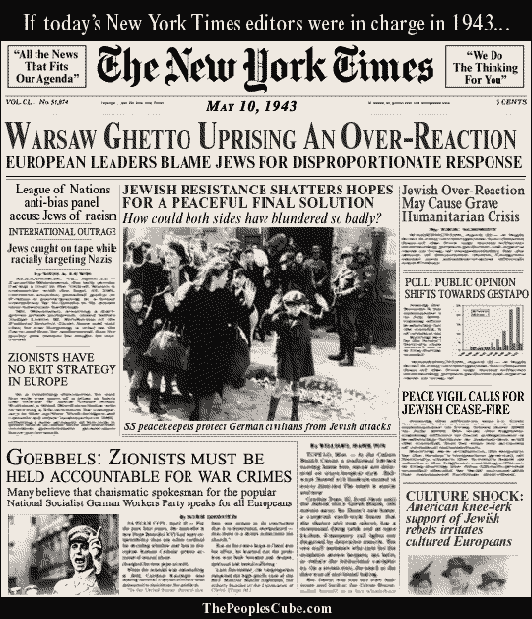
New York Times, May 10th, 1943: ‘Warsaw Ghetto Uprising an Over-Reaction.’ From Kevin Dayhoff’s Storage Closet. Click for larger image..

In 1943 members of the Jewish population dug in and organized a poorly armed last-ditch resistance. They were crushed by a heavily armed and massive German army assault.

By Jay D. Jurie / The Rag Blog / January 10, 2009

As a number of commentators have observed, there is a comparison to be made between the concentration of Jews into the Warsaw ghetto 1939-45 and the current concentration of Palestinians into the Gaza strip.

There are some eerie similarities: the deliberate isolation and containment of an entire population, complete with walls and checkpoints, the imposition of slow death through deprivation of essential resources, including food and medical care.

In 1943 members of the Jewish population dug in and organized a poorly armed last-ditch resistance. They were crushed by a heavily armed and massive German army assault. In Gaza, Hamas has likewise dug in and is conducting an ill-equipped resistance against a heavily armed and massive Israeli Defense Force assault.

A minor dissimilarity: contrary to mythology that has been erected about the Warsaw uprising, that revolt was largely organized by secular left-wing elements rather than the Zionist movement.

A more significant dissimilarity: in Warsaw, the Jewish population was subject to direct eradication, forcibly loaded onto trains for transport to Nazi extermination camps.

Regardless of dissimilarities, in 2009 it is sad that any comparison with Warsaw in 1943 can be so easily made, especially as it involves reversing the role of the former victims and today’s perpetrators.

One of the lessons to be drawn from this experience is that no particular ethnic group holds a monopoly on truth, just as no group holds a monopoly on suffering. As we have been admonished by Albert Camus, “neither victims nor executioners be.”

The Rag Blog

Posted in Rag Bloggers | Tagged , , , | 1 Comment

Israel Bombs Civilians Evacuated by UN

Smoke rises from Gaza for a 15th straight day of bombing. Photo from Mail Onlin, UK.

UN: Israel bombed building used for evacuated Palestinians
January 9, 2009

See the latest news, Below:

Israeli forces have dropped dozens of leaflets over the Gaza Strip warning civilians it is set to ‘escalate’ its military offensive. . .

The Israeli threat to launch a ‘new phase’ in its two-week-old offensive that has already killed more than 800 Palestinians came in defiance of international calls for a cease-fire. . .

JERUSALEM — A United Nations report released Friday said that earlier this week Israeli forces repeatedly shelled a home to which the UN had evacuated about 110 Palestinians in the Zeitoun area of Gaza City, killing around 30 people.

The Israeli military said it had no immediate comment.

‘We received eyewitness accounts from several survivors,’ said Allegrea Pacheco, the deputy head of the UN Office for the Coordination of Humanitarian Affairs (OCHA).

The UN report, based on the testimonies, said that Israeli ground troops evacuated the Palestinians into a single-residence home on Sunday and warned them ‘to stay indoors.’

About half of the Palestinians were children.

Israeli forces then ‘shelled the home repeatedly’ the next morning, the UN official said.

‘It took several days until ambulances could reach the area,’ said Pacheco, explaining that the wounded and dead were stuck together in the same cramped rubble the entire time.

The International Red Cross had said that it was unable until Wednesday to access the area, where it found severely weakened people, including children, and corpses. It condemned Israel for violating international law by denying medical teams access to the area.

The UN said at least 257 of the over 781 Palestinians killed in Operation Cast Lead, were children. Since Israel began its ground operation on January 3 ‘the number of children fatalities has increased by 250 percent.’

‘There is no safe place in Gaza,’ said Pacheco, adding that civilians needed to be protected in times of war.

OCHA said the ongoing Israeli offensive in Gaza, now in its 14th day, has ‘resulted in the largest number of forcibly displaced Palestinians since 1967.’

Source / Deutsche Presse-Ageuter / Monsters and Critics

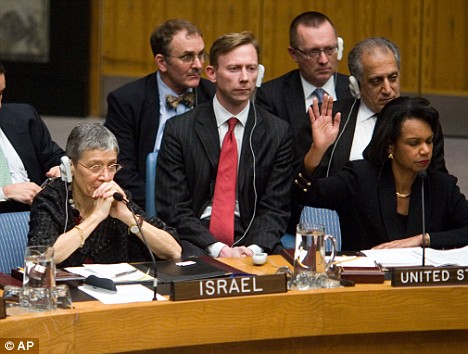
U.S. Secretary of State Condoleezza Rice, right, abstains from voting, as Israeli Ambassador to the U.N. Gabriela Shalev, left, observes at the United Nations Security Council meeting. Photo from Mail Online, UK.

Israel drops leaflets over Gaza warning civilians of ‘escalation’ in violence
By David Williams / January 10, 2009

‘The IDF (Israeli Defense Forces) will escalate the operation in the Gaza Strip,’ the leaflets said in Arabic.

‘The IDF is not working against the people of Gaza but against Hamas and the terrorists only. Stay safe by following our orders.’

Meanwhile flames and smoke rose over Gaza City today amid more heavy fighting, with Israeli tanks advancing and Hamas militants firing rockets at Israel, despite international efforts to put a stop to the conflict.

The Israeli military said more than 15 militants were killed in overnight fighting.

It said aircraft attacked more than 40 targets including 10 rocket-launching sites, weapons-storage facilities, smuggling tunnels, an anti-aircraft missile launcher and gunmen.

In the day’s bloodiest incident, an Israeli tank shell killed nine people in a garden outside a home in the northern Gaza town of Jebaliya.

Separately, a woman was killed by tank fire in the nearby town of Beit Lahiya.

The Israeli army denied carrying out any attacks in the area.

The deaths, including those of several Palestinian gunmen, raised the Palestinian toll to at least 821, according to the Hamas-run Health Ministry in Gaza.

Thirteen Israelis have been killed: 10 soldiers and three civilians hit in rocket fire.

The fighting continued even during a three-hour ceasefire window Israel has established in recent days to allow aid into Gaza to sustain the 1.5 million people living there.

Palestinian Authority president Mahmoud Abbas said all parties would be responsible for continued violence, if they did not accept an Egypt-brokered truce.

Mr Abbas, who was in Cairo for talks on how to halt the conflict, which is in its 15th day, called for an international force in Gaza.

Israel has come under international criticism for the rising number of civilian casualties.

Israeli troops were accused yesterday of evacuating Palestinian civilians to a house in Gaza and then shelling it 24 hours later.

At least 30 died and dozens were injured in the incident which could prompt a war crimes investigation.

The United Nations said about half the dead were children. Witnesses told staff that 110 civilians had taken shelter in the building when it was hit last Sunday.

Israel said it was investigating the war crimes claims, but leading UN human rights official Navi Pillay called for a ‘credible and independent’ inquiry.

Israeli forces have already been accused of killing two UN drivers with tank fire and civilians sheltering at two UN schools.

Hopes of a truce were dashed with Israel rejecting a UN Security Council resolution calling for an ‘immediate and fully respected ceasefire’.

Hamas gave its answer by continuing to fire rockets into Israeli towns – about a dozen rockets were fired today.

The U.N. said it was hoping to resume full aid distribution today after receiving Israeli assurances that its staff would not be harmed.

U.S. Secretary of State Condoleezza Rice, right, abstains from voting, as Israeli Ambassador to the U.N. Gabriela Shalev, left, observes at the United Nations Security Council meeting

The allegations surrounding the death of the 30 civilians are the most serious so far in Israel’s assault on Gaza.

The Red Cross vented its fury at Israel after the strike, saying it had found four starving children at the house clinging to the corpses of their dead mothers.

‘This is a shocking incident,’ said Pierre Wettach, Red Cross regional head. ‘The Israeli military must have been aware of the situation but did not assist the wounded.’

Senior UN official Allegre Pacheco said medical workers found children who were ‘too weak’ from hunger to stand.

The Israeli Defence Force today released a map showing the rocket range into Israel from Gaza. The IDF claims one million people in Israel are within striking range of Gaza rockets

One survivor, Ahmed Ibrahim Samouni, 13, said from hospital: ‘We were asleep when the tanks and the planes struck, we all slept in one room. One shell hit our house.

‘We ran out and saw 15 men, they landed from helicopters on rooftops of buildings.’

Another report yesterday claimed U.S. President-elect Barack Obama was set to open up low-level talks with Hamas when he takes over the presidency.

With agreement growing in Washington that the Bush policy of excluding Hamas is counter-productive, the Guardian cited transition sources who claimed the President-elect is being advised to open clandestine talks with the Islamist organisation – possibly through European channels.

Palestinian children who fled from their homes following an Israeli air strike sit at a United Nations aid centre based in a local school. The UN has accused Israel of killing 30 more civilians in shelling in Gaza.
.
Meanwhile the Bush administration, which abstained in the U.N. vote calling for an end to fighting, has offered further support for Israel’s military goals.

‘This situation will not improve until Hamas stops lobbing rockets into Israel,’ White House spokesman Scott Stanzel said.

Israel’s Prime Minister Ehud Olmert said the UN resolution calling for a ceasefire ‘cannot work’ and declared: ‘The firing of rockets this morning only goes to show that the UN decision is unworkable and will not be adhered to by the murderous Palestinian organisations.’

Source / Mail Online, UK.

Thanks to S. M. Wilhelm / The Rag Blog

Posted in RagBlog | Tagged , , , , , | Leave a comment

Thorne Dreyer : While Opposing Israeli Aggression, We Must Also Fight Anti-Semitism

Anti-Semitic cartoon from Arab press / WMD.

Anti-Semitism is for cowards. We believe Israel as it positions itself in the world to be a reactionary force, a rogue state. But that has nothing to do with the Jewish people or their rich history of dignity and struggle.

By Thorne Dreyer / The Rag Blog / January 10, 2009

See ‘Nazi Imagery, Anti-Semitism Rampant In Arab Media As Gaza Crisis Unfolds,’ Below.

In the world press we are learning about a sharp rise in anti-Semitic activity and Nazi imagery that have accompanied Israel’s assault on and incursion into Gaza. This has occurred in the media and in the streets, not only in the Middle East but in Europe and elsewhere in the world.

At the same time, we are witnessing a consistent stereotyping and villianizing of Palestinians and Arabs, and of those of the Islamic faith – and see this as a serious and growing problem.

The Rag Blog strongly opposes Israel’s inhumane occupation of Palestine and its current operation in Gaza.

We believe Israel’s actions – and those of its loyal and uncritical sponsor, the United States — to be cynical, immoral and in stark violation of international law. And we observe among many of Israel’s supporters a keen and hypocritical ability to ignore facts, to react in a knee-jerk fashion to any criticism of Israel and to label it anti-Semitic.

At the same time, we must recognize that the situation in the Middle East is far from simple, the product of centuries of history involving ethnic and religious fear and hatred. And we hold no truck for terrorism in any form, whether individual or state-sponsored, and find religious fundamentalism, and especially state religion, to be anathema in all its incarnations. We must add, however, that the policies of Israel and of the United States, with all the lip service to fighting terrorism and spreading democracy, are all about markets and politics and territory, and serve, in the face of all the pretty rhetoric, to create and invigorate fundamentalism and terrorism.

But we also must put ourselves on the record in the strongest words possible as opposing racism wherever it rears its horrific head.

Anti-Semitism is for cowards. We believe Israel as it positions itself in the world to be a reactionary force, a rogue state. But that has nothing to do with the Jewish people or their rich history of dignity and struggle.

One can and, we believe, should in all conscience oppose the unconscionable actions of the Israeli state. (While offering a nod to the growing peace movement in Israel and to the courageous resistance of the refuseniks in the Israeli army. )

At the same time, we should never ever allow ourselves to fall for the easy trick of racism and anti-Semitism. We must, in fact, always decry it, never allowing our response to be that of silence.

We can never become the evil that we oppose.

Nazi Imagery, Anti-Semitism Rampant In Arab Media As Gaza Crisis Unfolds
January 8, 2008

New York — As Israel’s operation against the Hamas terrorist infrastructure in Gaza continues, expressions of anti-Semitism and offensive Holocaust imagery have “reached a fever pitch” in the Arab press, according to the Anti-Defamation League (ADL).

Newspapers across the Arab and Muslim world have published editorial cartoons, articles and opinion pieces laced with age-old anti-Semitic themes, including blood-libel accusations and ugly stereotypical depictions of demonic large-nosed, bearded Jews plotting to rule the world. The articles and editorial cartoons have appeared in mainstream newspapers from Egypt and Jordan, to Syria, Saudi Arabia and the United Arab Emirates.

ADL has released an online slide show of anti-Semitic cartoons on Gaza and a compilation of selected articles from the Arab press.

“The Arab press serves both as a powerful influencer of opinion and as mirror of the larger society, and as the conflict between Israel and Hamas plays out in the daily newspapers, anti-Semitism and Nazi comparisons have reached a fever pitch,” said Abraham H. Foxman, ADL National Director and a Holocaust survivor. “In this incendiary environment, where anger at Israel already seethes in the Arab street, cartoonists and editors are doing more than heaping invective on Israel. They are fueling a toxic mix of hatred — for Israel, for America, for Jews, for the West – by dredging up anti-Semitism in its most lethal and virulent form.”

From Riyadh to Damascus and beyond, readers of Arab newspapers are more likely to encounter swastikas and headlines declaiming a Palestinian Holocaust than they are to encounter balanced news, according to ADL, which monitors and translates the Arab and Muslim press from its offices in Israel. Editorial cartoons and banner headlines on the Gaza operation repeatedly draw on analogies to the Holocaust, both by accusing Israel of carrying out a Nazi-like campaign of extermination in Gaza, and by comparing Israelis and Jews to Nazis.

One of the most vicious cartoons, published January 7 in newspapers in Jordan and the U.K., depicted three Israeli leaders in full Nazi regalia under the headline “Israel Has the Reich to Defend Itself.” A menorah above the cabal of leaders is emblazoned with a swastika.

Other cartoons show harshly stereotypical Jews dreaming of taking over the world, or controlling the United States government or the United Nations.

The Anti-Defamation League, founded in 1913, is the world’s leading organization fighting anti-Semitism through programs and services that counteract hatred, prejudice and bigotry.

Source / Anti-Defamation League

The Rag Blog

Posted in Rag Bloggers | Tagged , , , , , , , | 4 Comments

Michael Moore and Paul Krugman : Is Sanjay Gupta a ‘Sicko?’


CNN’s Sanjay Gupta vs. Michael Moore
By Jim Galloway / January 9, 2009

See ‘PNHP Opposes Gupta for Surgeon General,‘ by Larry Jones; and Video of Sanjay Gupta and Michael Moore on the Larry King Show, Below.

Speculation in Washington is building that Democratic opposition to President-elect Barack Obama’s selection of CNN’s Sanjay Gupta as U.S. surgeon general is rooted in Gupta’s clash with another media figure — liberal documentarian Michael Moore.

Today, the newspaper notes:

Conyers also cited a Jan. 6 blog item by Paul Krugman in The New York Times. Unlike Conyers, however, Krugman does not have a problem with Gupta’s qualifications.

Krugman pointed out that Gupta engaged in a televised argument with Moore in 2007 over his movie, “SiCKO.”

Conyers is friends with Moore, a Michigan native who is an ardent backer of the legislator’s universal healthcare bill. Moore’s film made the case for the U.S. to adopt a “single-payer” healthcare system like Canada’s.

On Thursday, Moore’s website prominently highlighted Krugman’s blog on Gupta.

Specifically, here’s what Krugman posted on his NYTimes blog:

I don’t have a problem with Gupta’s qualifications. But I do remember his mugging of Michael Moore over Sicko. You don’t have to like Moore or his film; but Gupta specifically claimed that Moore “fudged his facts”, when the truth was that on every one of the allegedly fudged facts, Moore was actually right and CNN was wrong.

Moore’s web site now also gives prominent display to both Krugman’s remarks and Conyer’s letter of objection.

Below is a YouTube clip of the Moore-Gupta confrontation on CNN’s “Larry King Live” that seems to have caused several pairs of underwear to twist themselves into a wad:

Sanjay Gupta and Michael Moore on CNN’s Larry King

Source / Political Insider / Atlanta Journal-Constitution

PNHP Opposes Gupta for Surgeon General
By Larry Jones / January 8, 2009

Physicians for a National Health Program has declared its opposition to the expected appointment of Dr. Sanjay Gupta as Surgeon General of the U.S.

Here’s why PNHP is opposed to Gupta:

Among our concerns are these:

  • 1. He has very little background in public health, preventive medicine or administration.
  • 2. He has openly opposed progressive health reform, going so far as to cite false information to denigrate single payer (e.g. in his error-laden attack on Michael Moore’s film “Sicko”) and parroting the health insurance lobby’s distortions of single payer.
  • 3. As a media figure, he has been disturbingly cozy with Big Pharma. He co-hosts Turner Private Networks’ monthly show “Accent Health,” which airs in doctors’ offices around the country and which serves as a major conduit for targeted ads from the drug companies. Another example: In 2003, despite mounting evidence to the contrary, he publicly downplayed concerns about the dangers of Vioxx. It was removed from the market a year later by its manufacturer, Merck.
  • 4. In the 2008 election campaign, his reporting on John McCain’s health proposals was misleading and implicitly positive, giving undeserved credence to McCain’s claims that buying private health insurance on the open market is a financially viable option for most Americans.

We urge you to write to President-elect Obama and express your opposition to Gupta’s possible nomination, and to urge Obama to nominate a more acceptable candidate for this critically important post. You can do so by clicking here: http://change.gov/….

Sincerely yours,

Quentin Young, M.D.
National Coordinator

Source / Daily Kos

The Rag Blog

Posted in RagBlog | Tagged , , , , , | 1 Comment

New Reports : Did KBR Poison GIs in Iraq?

Welder testing for hexavalent chromium. Photo by Orbital Joe.

In 2003, James Gentry and his men were responsible for guarding a KBR-run power plant. The soldiers were stationed there for months before being informed that the site was contaminated with a chemical known as hexavalent chromium.

By Paul Riechkoff / January 9, 2009

James Gentry served his country honorably as a battalion commander in Iraq. Now, he is dying of a rare form of lung cancer. And he’s not the only one. A troubling number of troops in Gentry’s Indiana National Guard unit have bloody noses, tumors and rashes. And tragically, one soldier has already died.

New reports suggest these injuries may be the result of exposure to toxins at a KBR-run power plant in Southern Iraq. In 2003, James and his men were responsible for guarding that plant, and protecting KBR’s employees. The soldiers were stationed there for months before being informed that the site was contaminated with a chemical known as hexavalent chromium.

Hexavalent chromium is a deadly carcinogen. It’s the same toxin that Erin Brockovich became famous for campaigning against. James believes that it was the inhalation of this chemical that caused his cancer, and the other rare illnesses among the Guardsmen who served at the plant.

But this is not just some sad story about accidental chemical exposure. This is a question of responsibility. CBS News has uncovered evidence that KBR may have known about the contamination at the power plant months before it took any action to inform the troops stationed there.

If the CBS story is proven true, checks need to be written, contracts should be cancelled, and heads must roll. James signed up to serve his country, and he was told to protect KBR contractors. He did his job. But it doesn’t seem like KBR did theirs. If the company neglected to take quick and decisive action, it must be held responsible for the months of avoidable toxic exposure that may be taking the lives of American servicemembers.

From burn pits to power plants, we are hearing more and more about troops who have been exposed to toxins while serving our country overseas. Senator Evan Bayh of Indiana has announced that he will reintroduce legislation to create a medical registry for military personnel exposed to toxins. That’s a vital first step towards discovering the full extent of toxic exposure in Iraq and Afghanistan, and is critical to preventing a replay of the Agent Orange situation after Vietnam.

We need real answers from KBR. And so far, the company has denied any wrongdoing whatsoever. Iraq and Afghanistan veterans will stand behind our brothers and sisters in demanding accountability. The veterans’ community will fight back, and we need everyone’s help. Add your name to IAVA’s petition, and tell KBR to come clean now. KBR must tell Congress and the American people what they knew, and when they knew it. James Gentry and his fellow soldiers deserve the truth.

[Paul Rieckhoff, 33, is the Executive Director and Founder of Iraq and Afghanistan Veterans of America (IAVA). A non-partisan non-profit group with over 100,000 members around the world, IAVA was founded in 2004 and is America’s first and largest Iraq and Afghanistan Veterans organization. Rieckhoff was a First Lieutenant and infantry rifle platoon leader in the Iraq war from 2003-2004. He is now a nationally recognized authority on the war in Iraq and issues affecting troops, military families and veterans.]

Source / The Huffington Post

The Rag Blog

Posted in RagBlog | Tagged , , , | 1 Comment