Hilda Soliz : A Progressive Choice for Labor

Hilda Soliz: Obama’s pick a good one.

‘The daughter of Mexican and Nicaraguan immigrant laborers, Hilda Solis brings the most solid progressive credentials of any member of the Obama cabinet — including Obama himself.’
By Roberto Lovato / December 19, 2008

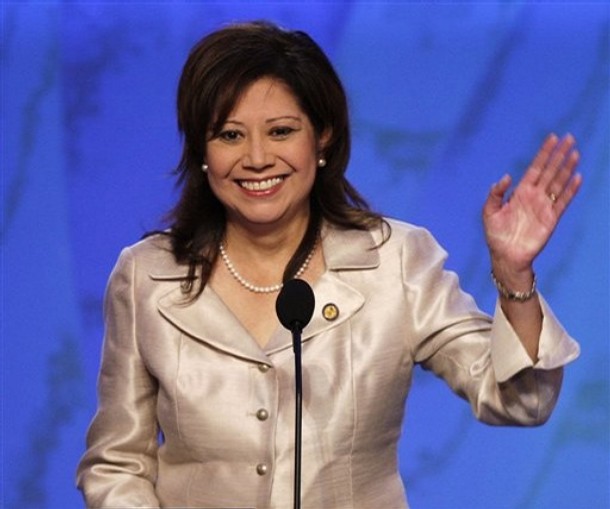
In what will be the first progressive appointment of his administration, President-elect Barack Obama invited Southern California Congresswoman, Hilda Solis, to join his cabinet as the Secretary of Labor. This is especially welcome news to labor and immigrant rights groups who have constituted Solis’ primary base in her rise to national prominence.

The daughter of Mexican and Nicaraguan immigrant laborers, Solis brings the most solid progressive credentials of any member of the Obama cabinet — including Obama himself. She has won abundant praise and wide support because of her positions on labor rights, immigration issues, environmental protection and women’s rights, to name a few. Her appointment reflects the growing power and influence of the labor and immigrant struggles of Southern California and across the country as her trajectory, like that of L.A. Mayor Antonio Villaraigosa, took rapid upward turn thanks to the political energy and power unleashed after the struggles against Proposition 187 in California. For those looking for hope in the great labor and immigration struggles we’re still engaged in, look no further at what your work has wrought: Hilda Solis, Secretary of Labor.

Full disclosure: I know and have worked on a number of issues with Hilda since we fought Proposition 187 in California in the early 90’s and have, since then, found her to be nothing, if not a smart and capable fighter and an upright person. In addition to celebrating Hilda’s political capabilities, I am also likely being moved by the fact that I’ve never seen someone whose extraction so closely resembled my own (Central American immigrant unionist household) enter the Star Chamber of global power, except maybe to clean it. May she enlighten it with the warmth and brilliance of Southern California and the Américas. In sum, I can say without reservation, that this really is one to celebrate as I am about to go do as soon as the this period in my sentence drops…

Source / Of America

Also see Obama to Announce Final Cabinet Picks by Anne E. Kornblut / Washington Post / Dec. 19, 2008

And Cabinet: Middle-of-the-roaders’ dream by Carrie Budoff Brown and Nia-Malika Henderson / Politico / Dec. 19, 2008

Thanks to Dorinda Moreno / The Rag Blog

Posted in RagBlog | Tagged , , , , , | 1 Comment

Bush’s EPA : Another Green Light to Carbon Emissions

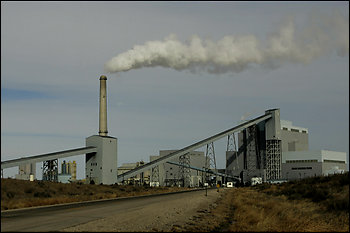
New power plants will not be required to install technology to reduce carbon dioxide emissions, the Environmental Protection Agency has ruled. Photo by Charlie Riedel / AP.

The case at issue yesterday began in 2007 when the EPA issued a permit to a new coal-fired power plant in Bonanza, Utah. The Sierra Club, an environmental group, filed a legal challenge, saying that the permit should have required the plant to control its output of carbon dioxide.

By David A. Fahrenthold and Steven Mufson / December 19, 2008

The Environmental Protection Agency ruled yesterday that new power plants are not required to install technology to reduce carbon dioxide emissions, rejecting an argument from environmental groups.

The ruling, in a memorandum signed by EPA Administrator Stephen L. Johnson, turns on a seemingly arcane regulatory question that could govern the future of new fossil fuel-burning buildings and power plants under the Clean Air Act.

During the Bush administration, the EPA has rejected the idea that greenhouse gases should be regulated like soot, smog precursors and other kinds of air pollution, despite an April 2007 Supreme Court ruling that said carbon dioxide fit the definition of a pollutant that could be regulated under the Clean Air Act.

The case at issue yesterday began in 2007 when the EPA issued a permit to a new coal-fired power plant in Bonanza, Utah. The Sierra Club, an environmental group, filed a legal challenge, saying that the permit should have required the plant to control its output of carbon dioxide.

In a case before the EPA’s Environmental Appeals Board, the Sierra Club cited a rule that required plants to use the best available technology to control all “regulated” pollutants, as well as the April 2007 Supreme Court ruling.

The case revolved around the question of whether carbon dioxide was required to be controlled or simply monitored.

The appeals board, a kind of appeals court for EPA rules, found on Nov. 13 that the rule was unclear. Johnson’s memo yesterday sought to make it plain. Major industrial corporations have been pressing the Bush administration to issue a ruling in the case.

“That is our established interpretation,” Robert Meyers, the head of the EPA office of air and radiation, said in an interview. “We’ve been applying it that way for 30 years.”

It was unclear yesterday what the ruling’s real-world impact will be. The EPA says that about 50 plants — either new or significantly remodeled — must obtain a permit under this provision every year. But Meyers said he does not know if any are positioned to receive final approval before President-elect Barack Obama takes office on Jan. 20.

The Obama administration is likely to review the case, and Democratic officials close to the president-elect’s team say that the Supreme Court ruling and the EPA’s power to regulate carbon dioxide can serve as powerful levers to bring corporations and other parties to a bargaining table about broad framework for controlling greenhouse gases.

Source / Washington Post

The Rag Blog

Posted in RagBlog | Tagged , , , , , | Leave a comment

Obama’s Consensus Building : Rick Warren and, Say, Bull Conner?

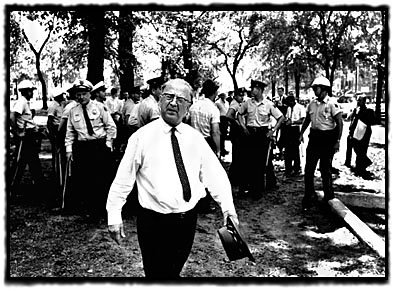
Birmingham Police Commissioner Eugene (Bull) Conner called out the dogs on civil rights demonstrators in 1963. Surely he wouldn’t have been included under President-elect Barack Obama’s umbrella.

‘Using an evangelical mega-church fence-straddling homophobe and anti-abortion champion to offer an inaugurating prayer as he takes the reins of leadership of America is a political cop-out.’
By Larry Ray
/ The Rag Blog / December 19, 2008

OK, a real short line or two here from the gut. Barack Obama proposes to, “. . . build relationships with people of opposing views, and wants his inaugural to reflect that goal.” So, I have to ask, if he had been running for president in the 60’s would he have presented such a seemingly equalizing forum to Bull Conner, Bubba and Billy Bob in Jackson, Mississippi and the followers of George Wallace so we could all somehow get along better?

If this is a preview of Obama’s idea of consensus building and healing, I must wonder if his ideas for improving other things are going to be this delusional and divisive. Using an evangelical mega-church fence-straddling homophobe and anti-abortion champion to offer an inaugurating prayer as he takes the reins of leadership of America is a political cop-out. Is he is trying to build a bridge from reason and acceptance to homophobes and haters with some two-moves-ahead chess ploy to the Right? I fear he has just run off the road big time before his motorcade even gets started. After all the A+ moves the Obama campaign has made from its beginnings to just a day or so ago, this has to be the most mistaken, confusing and contradictory. Why? Where does the politically expedient pandering stop? What am I missing here? Short change we can believe in?

The Rag Blog

Posted in Rag Bloggers | Tagged , , , , , , , , | 4 Comments

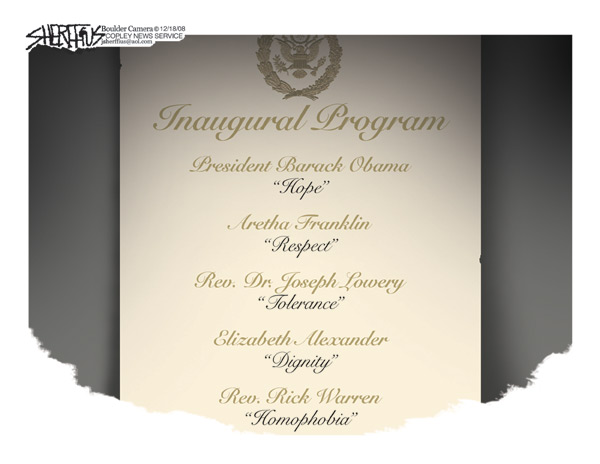
Inaugural Program : Sneak Preview

Thanks to Harry Edwards / The Rag Blog

Posted in RagBlog | Tagged , , , | 2 Comments

Do The Shoes Impact Daily Life in Baghdad?

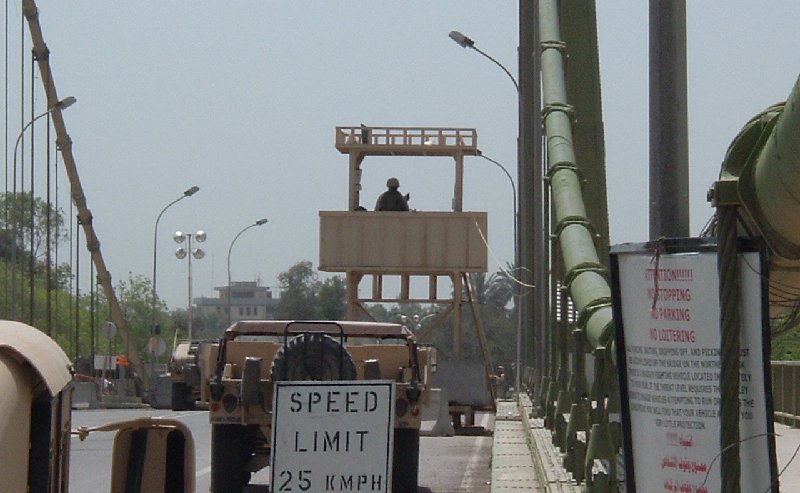
Tamuz Bridge, Baghdad, leading to July 14 Monument.

Did the shoe cause rebellion at Baghdad’s July 14 Bridge?
By Mohammed al Dulaimy / December 17, 2008

BAGHDAD — The square in front of the July 14 Bridge in Baghdad is closed by troops several times a day. The bridge leads into the American-controlled Green Zone. On the square, not far from the Green Zone, lie the offices of the president and the head of the biggest parliamentary bloc. Official convoys come and go all day long.

In the many times that I have been at that square, no one has ever objected to soldiers closing off the road while some official’s convoy passes by. We all turn off our cars and sit there and wait.

Wednesday, however, was different. I couldn’t believe my eyes.

Around 12:30 p.m. several vehicles loaded with Iraqi soldiers accompanying two or three buses stopped in mid square and tried to close it (like every day) but drivers refused to obey. We are tired of closed roads.

The horns of tens of cars were loud. Angry drivers yelled at soldiers. Not even when the soldiers brandished their rifles at the cars would the drivers stop. There were shots in the air, but the vehicles continued on. The military saw, for the first time I think, mass anger for blocking roads.

I have been in this square almost every day for the last four years, on the way to one official function or another, and nothing like this has ever happened. This time, the soldiers were forced to park their vehicles in a way that allowed civilian cars to pass.

There was news Wednesday from Fallujah of students demonstrating, demanding the release of Muntathar al Zaidi, the journalist who threw the shoe at President Bush. The students waved their shoes and threw stones at American soldiers. Things escalated and soldiers started to shoot, witnesses said. One student was injured.

People have been talking about Muntathar everywhere and at all times for the last two days. For many, he’s become an idol and a star to follow.

My question: Did Muntathar’s shoe-throwing cause this?

[Dulaimy is a McClatchy special correspondent.]

Source / McClatchy

The Rag Blog

Posted in RagBlog | Tagged , , | Leave a comment

Don’t Escalate Afghan War; Send in the Peace Corps

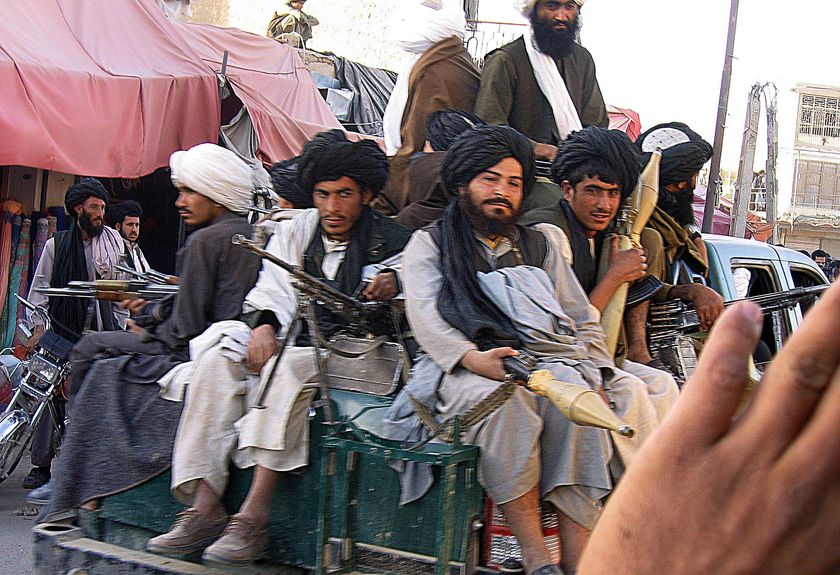
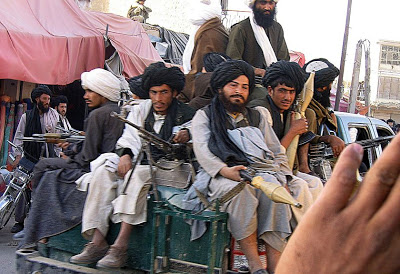
Taliban troops in Afghanistan. Photo from AFP.

‘The basic ingredients of further Afghan disasters are in place,’ warns Norman Solomon, executive director of the Washington-based Institute For Public Accuracy, ‘including, pivotally, a dire lack of wide-ranging debate over Washington’s options.’

By Sherwood Ross / December 17, 2008

President-elect Obama should drop his plans to escalate the war in Afghanistan, a country that never attacked America, out of pity for a helpless civilian population that will only suffer increasing misery from an expanded fight against the Taliban and its allies.

Recall military intervention was used to capture Panamanian military dictator Manuel Noriega for a drug charge in December 20, 1989. That illegal assault, ordered by President George H.W. Bush, killed 500 Panamanian civilians, wounded 3,000 more, and pushed 15,000 people out of their homes, an incredible price innocent people were made to pay to enable the U.S. to nail one drug-runner.

In Afghanistan, the civilian population has already paid a much higher price.
“We will kill bin Laden. We will crush al Qaeda. That has to be our biggest national security priority,” Senator Barack Obama pledged during the televised presidential debate of last October 7.

Yes, and in so doing, thousands of additional Afghan civilians are liable to perish, likely far more of them then the 3,000 Americans massacred on 9/11 in New York and Washington.

In just the first two years after 9/11, the U.S. had already killed between 3,000 and 5,000 Afghan civilians, David Krieger noted in Counterpunch. And Jay Shaft, of the Coalition For Free Thought in Media, points to a United Nations estimate that up to 500 Afghan civilians are dying monthly from U.S. cluster bombs, most of them children and teenage boys.

“The president (Obama) is going to inherit the problem the Soviets had roughly 15 years ago during the Soviet jihad. You cannot tame the people in the North-West Frontier Province and on the border in Pakistan and Afghanistan,” Dalton Fury, the commander of special operations at Tora Bora, recently told Cable News Network.

By its illegal invasion of Iraq, the Bush regime allowed the Taliban in Afghanistan and its allies to regain control of the nation. Anand Gopal, of the Christian Science Monitor, writes that just a 20-minute drive outside the capital Kabul, “the American-backed government of Afghanistan no longer exits.” He states, “Violence has reached record levels this year and Afghanistan is now considered a deadlier battlefield than Iraq.”

This is not to say bin Laden should not be brought to trial or that Americans are not entitled to closure on the 9/11 attacks.

But a leading U.S. international law authority says (1) there is no sufficient proof that bin Laden even masterminded the 9/11 attacks and (2) diplomacy to secure justice would be the more rational and humane approach than armed force.

Francis Boyle, a University of Illinois professor, writes in “Destroying World Order”(Clarity Press): “There is not and may never be conclusive proof as to who was behind the terrible bombings..on Sept. 11… Suffice it to say that the accounts provided by the United States government simply do not add up.”

There is no evidence bin Laden ordered the attack or even that Al Qaeda or the Taliban was involved, Boyle said. Recall that former Secretary of State Colin Powell pledged the U.S. would produce a “White Paper” to document the case against bin Laden, but that he never produced one. Instead, then British Prime Minister Tony Blair, hardly an American official, issued a report the British press ridiculed for its lack of proof.

Boyle also points out the so-called bin Laden video that the Central Intelligence Agency “miraculously discovered” in a bombed out house in Jalalabad, Afghanistan, was “disjointed” and “non-sequential.”

The videotape is suspect because the Pentagon’s translated version was not word for word but an “information flow” paraphrase created at The Johns Hopkins School for Advanced International Studies where Paul Wolfowitz, the war hawk and deputy defense secretary, had just been dean. In case you didn’t know, Johns Hopkins is no impartial academic institution but one of the very biggest Pentagon contractors in terms of the boodle it siphons off from the military-industrial complex.

“The bin Laden video provided no evidence that implicated the Taliban government of Afghanistan in the 11 September 2001 attacks (and)…no justification for the United States to wage war against Afghanistan, a U.N. Member State, in gross violation of the United Nations Charter,” Boyle writes.

Little known to most Americans is that Afghanistan likely was invaded because its Taliban government refused to okay pipelines sought by Union Oil Co. of California(UNOCAL).

“Since Central Asia is landlocked, the United States government wanted to find a way to get the oil and natural gas out, while avoiding Iran, Russia, and China,” Boyle said. “The easiest way to do that was to construct a pipeline south through Afghanistan, into Pakistan and right out to the Arabian Sea. UNOCAL had been negotiating with the Taliban government of Afghanistan for quite some time, still with the full support of the U.S. government into the summer of 2001, but their negotiations had failed. The U.S….then rendered a proverbial offer that could not be refused to the Taliban government.”

A “major consideration” for the U.S. invasion of Afghanistan in 2001 was to put in office a regime favoring the oil and gas pipelines the U.S. sought running from Turkmenistan south through Afghanistan to the Arabian Sea coast of Pakistan, writes Chalmers Johnson in “The Sorrows of Empire”(Owl Books).

Oil “has been a constant motive” driving “the vast expansion of (U.S.) bases in the Persian Gulf” in Bahrain, Kuwait, Oman, Qatar, Saudi Arabia, and UAR, Johnson says. Because Afghanistan’s Taliban regime opposed the U.S.-backed venture, its overthrow became the secret reason behind “the war on terrorism,” Johnson claims.

To build the proposed $2-billion, 918-mile natural gas pipeline and a $4-billion 1,005-mile oil pipeline UNOCAL “needed a government in Kabul it could deal with in obtaining transit rights.”

Thus, Johnson writes, “A remarkable group of Washington insiders came together to promote the Unocal project”:

* UNOCAL hired former President Nixon’s national security adviser Henry Kissinger to negotiate with Turkmenistan, Afghanistan, and Pakistan.

* Kissinger worked with Turkmenistan’s top consultant, none other than his own former White House aide Gen. Alexander Haig, later President Regan’s Secretary of State.

* UNOCAL also employed two well-connected Afghans to influence the Taliban in its favor, naturalized U.S. citizen Zalmay Khalilzad, and Hamid Karzai, both linked to former Afghan king Zahir Shah, then living in Pakistan. The pair later became U.S. Ambassador to Iraq and U.S.-backed President of Afghanistan, respectively.

* President Bush first appointed Khalilzad to his National Security Council(NSC) staff, under Condoleezza Rice, and on December 31, 2001, named him “special envoy” to Afghanistan, only nine days after the Karzai government took office in Kabul.

“It should be recalled,” Johnson writes, Khalilzad joined NSC on May 23, 2001, “just in time to work on an operational order for an attack on Afghanistan.”

Johnson writes “it would appear that the attacks of September 11 provided an opportunity for the United States to act unilaterally to remove the Taliban, without assistance from Russia, India, or any other country.”

According to Boyle, even before 9/11 the Taliban rulers of Afghanistan had made “repeated offers to negotiate a solution” over “the disposition of bin Laden—as well as over the UNOCAL oil pipeline.”

Boyle said the Taliban offered to have bin Laden tried in a neutral Islamic court by Muslim judges applying the laws of Sharia; then they modified this to have him tried before some type of neutral court, which would exclude handing him over to the U.S; and finally, “even offered to try bin Laden themselves provided the United States gave them some credible evidence of his involvement in the ll September attacks, which was never done.”

Bush responded in his September 20, 2001, address “by ruling out any type of negotiations and instead issuing the Taliban government an impossible ultimatum,” Boyle said.

As President Bush put it, “tonight, the United States of America makes the following demands on the Taliban: Deliver to United States authorities all the leaders of al Qaeda who hide in your land. (Applause.) Release all foreign nationals, including American citizens, you have unjustly imprisoned… Close immediately and permanently every terrorist training camp in Afghanistan, and hand over every terrorist, and every person in their support structure, to appropriate authorities. (Applause.) Give the United States full access to terrorist training camps, so we can make sure they are no longer operating.” Bush emphasized: “These demands are not open to negotiation or discussion. (Applause.) The Taliban must act, and act immediately. They will hand over the terrorists, or they will share in their fate.”

Boyle said that by giving an impossible ultimatum to Afghanistan that ruled out negotiations and chose the military path, Bush ignored “12 or so multilateral conventions already on the books that deal with…international terrorism,” “many of which could have been used…to handle this matter in a lawful, effective, and peaceful manner.”

“So a decision was made remarkably early in the process to ignore and abandon the entire framework of international treaties that had been established under the auspices of the UN Organization for the past 25 years,” Boyle summarized, “in order to deal with acts of international terrorism and instead go to war against Afghanistan, a U.N. member state.”

Surely, the hour has come for the U.S. to reverse the failed Bush military approach and negotiate an equitable solution to stop the killing and bring bin Laden to justice. If you think the U.S. cannot negotiate with the Taliban, recall during the 1980s it was the CIA that funneled literally billions of dollars directly into Taliban pockets to overthrow Afghanistan’s Soviet-backed government, increasing the prospect of an invasion by the Red Army, which is exactly what happened.

Hasn’t Afghanistan suffered enough? The U.S. would be far better off if instead of pouring tens of thousands of troops into Afghanistan it sent in a like number of unarmed Peace Corps volunteers with a comparable budget. Time to give non-violence a chance. C’mon, guys, show a little imagination, huh?

[Sherwood Ross is a veteran reporter and public relations consultant. He formerly worked for the City News Bureau of Chicago, the Chicago Daily News, and as a columnist for wire services.]

Source / LA Progressive

Thanks to Dorinda Moreno / The Rag Blog

Posted in RagBlog | Tagged , , , , , , , | Leave a comment

Our Economic Trainwreck : Retooling the Engine


The Wrecked Economy: What Could Be Tried?
By Sherman DeBrosse / The Rag Blog / December 18, 2008

[This is the final installment in a three-part series on the economy by The Rag Blog’s Sherman DeBrosse.]

A new approach to the financial crisis might be built on the idea of being more careful with what is done for the financial sector and focusing upon resolving the mortgage crisis, which affects millions of Americans. If the mortgage crisis were to be remedied, it could have the effect of shoring up banks and financial institutions by giving mortgage based securities greater value. Americans can learn from the Japanese who spent nearly a decade bailing out financial institutions without addressing every day problems. Their economy is still stagnant.

We would be much better off going after the mortgage problem and remembering, in building the Obama stimulus plan, that FDR’s PWA and WPA approach did some good, but it invested far too little. Will half a billion, invested months late, do the trick? Its very doubtful. Ignore the conservative pundits who are writing that the Roosevelt approach will not work and that some sort of new supply side scheme, benefitting the top of the economy, will do the trick. Economists are now suggesting that if the recession ends sometime in 2009 that employment will continue to decline for some time — a somewhat odd and troubling situation. The stimulus package must be big enough to do the job.

The stimulus package that Obama is fashioning must address improving energy policy and repairing the nation’s failing infrastructure. It should also look to improving and modernizing the nation’s industrial facilities. Coupled with that must be a national health care plan that makes it possible to remove health care costs from industrial labor costs. If a new health care scheme can be put in place early on, it will be much easier to resuscitate industry.

Shella Blair, head of the FDIC, offered a $24 billion plan to help homeowners go through the refinancing process and to partially guarantee their loans. The plan has received very little support on Capitol Hill. Some version of her plan should be tried. It could involve much longer payment periods and lower interest, but without trimming mortgage size unless banks share the write offs. It should be combined with subsidized 4.5% mortgages on new construction. That should begin to slow the deterioration of housing values.

A second step is probably necessary to stop the slide in values and create some jobs; it might be necessary to allow all mortgage holders to refinance their homes at 4.8%. In the long run, the federal government would not only recover its investment. Government can now borrow money at a little over 2%, so this should be profitable from the beginning. We would be looking at a huge amount to subsidize those mortgages, but it would all be invested in people rather than being poured down holes dug by speculators.

A three month moratorium on all foreclosures of any kind would give the new policies time to take hold. The Obama administration should be prepared for the possibility that there also may be a need for some sort of short term bank holiday to identify broken banks and place them under conservators. Provision would be made for every-day checking and ATM transactions to go on with some restrictions.

The S & L and banking crises of the late 1980s grew out of deregulation. We know how Charles Keating defrauded his investors, but in 2008 it was considered bad taste to point out that John McCain did his bidding for a time. There is still much we do not know about those banking crises. In 1997, Brooksley Born, chair of the Commodity Futures Commission, was driven out of government because he tried to reign in excessive speculation. In 1999, Congress repealed many safeguards affecting banks with the Gramm-Leach-Bliley Act. Then it passed in 2000 the Commodity Futures Modernization Act, which hade it very difficult to regulate swaps and other derivatives.

It is imperative that the new Congress examine how deregulation contributed to the earlier banking crisis and the current financial melt-down. The deregulation of financial markets was a key element in Republican economics, and we are now facing the grim consequences. The assumption was that freed of regulations the markets would endlessly generate wealth. As Alan Greenspan said, it was unthinkable that the heads of banks and investment firms would do anything to place their shareholders in danger. With time, a minority of Democrats joined the Republicans in embracing what was called “market fundamentalism.” One was Bill Clinton, who signed both of the destructive acts. However, Clinton did resist successful efforts to sharply reduce the powers of the Securities and Exchange Commission. His veto was overridden with the help of John McCain.

We would not be in this fix had Americans looked carefully into the S&L and commercial debacles or the severe problems that accompanied the collapse of Enron and some others. They grew out of excessive deregulation, dishonest accounting, and lack enforcement. An honest and thorough discussion would have laid the blame at the door of Republican market fundamentalism. Some of the New Democrats bought much of this and would come in for some blame, as well. But a full investigation and discussion could have help avert all this pain.

It is time now for Congress to study how deregulation brought us to these dire times. It may well be that in specific instances some deregulation was necessary. This is not a call for restoring all New Deal era regulation. Given how quickly traders, working under recently loosened rules create toxic securities, some speed is needed. Several members of President-elect Obama’s economic team are too closely tied to the old and failed policies of deregulation. This writer would be more comfortable if the new Congress and new administration brought in Joseph Stiglitz or some of his protégés to identify the deregulatory mistakes that first must be fixed.

There is a deep systemic problem in the financial system that must be addressed by careful reregulation and judicious use of public funds. There is probably not enough public borrowing capacity to cover all the problems. Washington has lent much money on the premise that some financial institutions are too big to let fail. AIG has received over $150 billion because it played the role of insuring transactions. Because the rating agencies did not play their role, AIG was stuck with a plethora of bad insurance contracts.

One lesson from these bailouts is that government should carve up into smaller pieces the firms and banks it bails out, and it should avoid creating, through loans, institutions that are too large to fail.

Another lesson is that the few bond rating firms we have cannot be trusted. Their financial well-being is too closely tied to the short-term profits generated by the firms they rate. We must either create an agency that carefully monitors the rating firms, or the government must take over the firms, and then make sure the executive branch cannot force them to pull in their horns. There should have been a mechanism for puncturing the high tech and mortgage bubbles. The Fed blinked on both occasions, assuming the economy is rational and its actors would not make irrational decisions. Maybe reconstituted rating firms can wield mighty needles.

Why Lehman Brothers was allowed to go under and Goldman Sachs and Morgan Stanley were rescued is not clear to this writer. There will be other cases when government must bail out financial institutions. The Bear Stearns bailout might be a model. It was saved because it performed vital functions in international markets. Stockholders lost almost all their equity and chairman James Cayne lost about a billion dollars. Across the board, people who bought bonds or preferred stock will loose huge amounts. Tax law should be revised to permit them to use their losses over a two or three year period. It is likely that these investors would reward Democrats for compassion, but these folks might invest in bonds and preferred stocks again.

It is doubtful that buying bad derivatives will do anything in the long run for the economy. They should not be purchased by government unless it is absolutely necessary to some systematic repair of the financial system.

Something must be done to dampen tendencies toward a Financial Wild West atmosphere, which results in so much long term harm. Congress might consider excess profits taxes in the financial and energy industries.

This recession makes it clear that the time has come to work out a national industrial policy. For too long Americans have maintained the fiction that to do anything along these lines is “socialistic.” The fact is we have long had an ad-hoc policy written into tax policies and corporate welfare. Lacking serious discussion of this matter, we have come to socialism for Wall Street and a wholesale neglect of blue collar workers. There can be no industrial policy without a healthy American-owned auto industry. Like it or not; that is the heart of American industry. Without this, we will even be unable to build here the weapons of war we so love.

The domestic auto industry has made many mistakes, partly because of customer tastes. It has also suffered due to short-sighted, dysfunctional trade deals, and wrong-headed energy policies. At the least, Americans should be willing to invest an equivalent to what the Europeans have invested in their auto industry. To do otherwise, is to do permanent damage to the economies of the Great Lakes states. Much of the resistance to assisting the auto industry is rooted in animosity toward organized labor and the belief that American workers should only come hat in hand when discussing wages and benefits. This is the kind of class consciousness and class prejudice that Americans do not discuss anymore.

[Sherman DeBrosse, the pseudonym for a retired history professor, is a contributor to The Rag Blog and also blogs at Sherm Says and on DailyKos.]

Please see the previous installments in this series by The Rag Blog’s Sherman DeBross:

Sherman DeBrosse : Our Economic Trainwreck , and

Our Economic Trainwreck : Trying to Get Back on Track .

The Rag Blog

Posted in Rag Bloggers | Tagged , , , , | 1 Comment

It’s a Narnia Christmas : A Hodgepodge of History Bound Together by Love

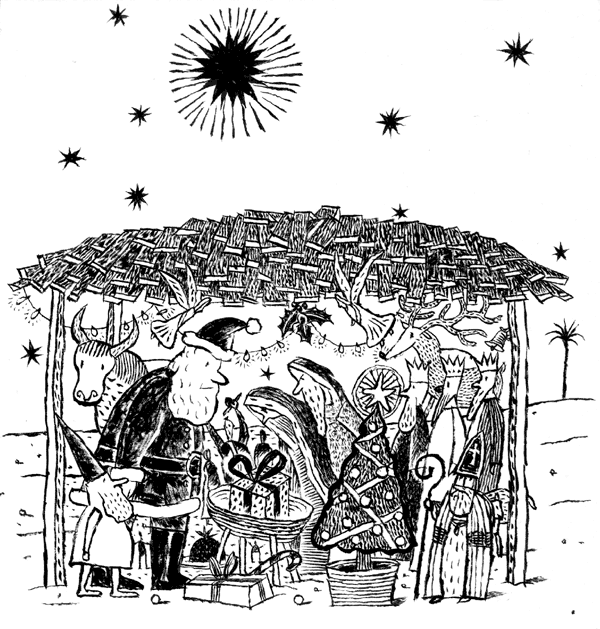
Drawing by Jeffrey Fisher. Copyright 2008 / New York Times.

‘Narnia is a mongrel thing, and so is Christmas. As is often the case, this mongrelizing is the source of its strength.’
By Laura Miller / December 18, 2008

Every Christmas, I re-read C .S. Lewis’s novel “The Lion, the Witch and the Wardrobe.” The holiday seems like the ideal time for an excursion into my imaginative past, and so I return to the paperback boxed set of “The Chronicles of Narnia” that my parents gave me for Christmas when I was 10. For me, Narnia is intimately linked with the season.

I’m not alone. In Britain, stage productions of “The Lion, the Witch and the Wardrobe” are a holiday staple, for good reason. The book rests on a foundation of Christian imagery; its most famous scene is of a little girl standing under a lamppost in a snowy wood; and Father Christmas himself makes an appearance, after the lion god Aslan frees Narnia from an evil witch who decreed that it be “always winter, and never Christmas.”

That I’m not a Christian doesn’t much hinder my enjoyment of either the holiday or the book, but the presence of Father Christmas bothered many of Lewis’s friends, including J.R.R. Tolkien. Tolkien, whose Middle-earth was free of the legends and religions of our world, objected to Narnia’s hodgepodge of motifs: the fauns and dryads lifted from classic mythology, the Germanic dwarfs and contemporary schoolboy slang lumped in with the obvious Christian symbolism.

But Lewis embraced the Middle Ages’ indiscriminate mixing of stories and motifs from seemingly incompatible sources. The medievals, he once wrote, enthusiastically adopted a habit from late antiquity of “gathering together and harmonizing views of very different origin: building a syncretistic model not only out of Platonic, Aristotelian and Stoical, but out of pagan and Christian elements.”

Christmas as we now know it is much the same sort of conglomeration, and when people call for a return to its pure, authentic roots, they’re missing an essential quality of the holiday. Narnia is a mongrel thing, and so is Christmas. As is often the case, this mongrelizing is the source of its strength.

Complaints about the corruption, dilution or fundamental impiety of Christmas have been made for centuries. The Puritans so mistrusted the holiday that its celebration was outlawed in 17th-century Boston. Around the same time, the German theologian Paul Ernst Jablonski asserted that Christmas amounted to a paganization of the authentic faith because the date, Dec. 25, had been appropriated from a festival for a Roman solar god.

(Some Christian scholars, including the current pope, have actually argued that the appropriation went the other way around, and the solar festival was in fact a heathen bid to co-opt the feast day of an increasingly popular monotheistic cult.)

On the other side, non-Christians who relish the holiday like to point out that many Christmas icons — the decorated tree, the Yule log, mistletoe — were originally sacred to Celtic and Northern European pagans.

Yet even the Yuletide customs that are supposedly pagan holdovers must be taken with a grain of salt. We have no written records of the cultures from which they supposedly derive; everything we know about them comes second- and thirdhand from Roman or Christian writers pursuing their own agendas and relying, for the most part, on oral sources.

For decades, historians and folklorists have understood that oral traditions are not very reliable when they refer to anything reputed to have happened more than 100 years ago. What’s presented as hoary legend is in fact more likely a justification of present conditions than an accurate account of the past.

Druids, for example, have over the years been refashioned as the descendants of Noah, as bardic romantics, even as sexual egalitarians; in fact, much of what people think they know about the ancient beliefs and rites of Northern Europeans was concocted by early 20th-century occultist outfits like the Ancient Druid Order and Hermetic Order of the Golden Dawn.

The British historian Ronald Hutton describes this sort of thing as indicative of “the power of literary fiction over fact.” We believe what we choose to believe, and Christmas is no exception.

In recent years, popular histories like “The Battle for Christmas” and “Inventing Christmas,” have shown that many of the holiday’s most hallowed rites, traditions we think of as extending back at least as far as C. S. Lewis’s beloved Middle Ages, were invented less than 200 years ago by such 19th-century literary figures as Washington Irving, Clement Clarke Moore and, of course, Charles Dickens. More than Christian or pagan, Christmas is a Victorian fabrication.

Is this, though, such a bad thing? The unifying principle of Narnia, unlike the vast complex of invented history behind Middle-earth, isn’t an illusion of authenticity or purity. Rather, what binds all the elements of Lewis’s fantasy together is something more like love. Narnia consists of every story, legend, myth or image — pagan or Christian — that moved the author over the course of his life.

Our contemporary, semi-secular Christmas is similarly a collection of everything yearned for: warmth, plenty, peace, family, conviviality. Like Narnia, the holiday is a fantasy, but there are times when a fantasy is exactly what you need.

[Laura Miller, a staff writer at Salon, is the author of “The Magician’s Book: A Skeptic’s Adventures in Narnia.”]

Source / New York Times

Thanks to Jim Retherford / The Rag Blog

Posted in RagBlog | Tagged , , , , , , , | 1 Comment

Obama Invocation a Split Ticket : Civil Rights Legend; Raging Homophobe

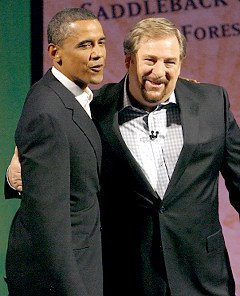
Rev. Rick Warren with President-elect Obama. Warren’s reactionary views on gays, abortion and other social issues have made his pick highly controversial. Photo by Buck / EPA.

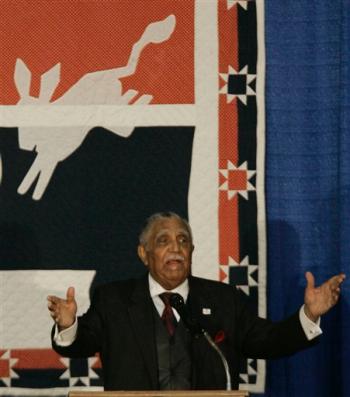
Rev. Joseph Lowery of Atlanta, a long time civil rights leader, shown here at the Jefferson Jackson Hamer Day Dinner in Canton, Miss., March 6, 2008, will also deliver an invocation at Obama’s inaugration. Photo by Rogelio V. Solis / AP.

‘In a news conference Thursday, Obama said he is a “fierce advocate for equality for gay and lesbian Americans.” But he said he will build relationships with people of opposing views, and wants his inaugural to reflect that goal.’

By Rachel Zoll / December 18, 2008

The clergy chosen by President-elect Barack Obama to pray at his inauguration fill separate symbolic roles: One is a nod to the civil rights activists who made Obama’s election possible. The other is an overture to conservative Christians who rankles some Obama supporters.

The Rev. Rick Warren, who will give the invocation, is the most influential pastor in the United States, and a choice that has already caused problems for Obama.

Warren is a Southern Baptist who holds traditional religious beliefs and endorsed California’s Proposition 8, which banned gay marriage. But he also wants to broaden the evangelical agenda to include fighting global warming, poverty and AIDS.

The Rev. Joseph Lowery, 87, is considered the dean of the civil rights movement. For the benediction at the Jan. 20 swearing-in, he says he will pray that the “spirit of fellowship and oneness” at the inauguration endures throughout Obama’s presidency.

“He gets a lot with these choices,” said David Domke, author of “The God Strategy: How Religion Became a Political Weapon in America.”

“Here’s a guy who wants to run a progressive administration getting a substantial lift in his wings from the nation’s most popular evangelical,” Domke said. “But he balances that with Joseph Lowery, who speaks to the more liberal, social justice and African-American heritage.”

By picking Warren, Obama is sending another signal, about his willingness to upset liberals by tilting to the center. Gay rights groups are demanding that Obama rescind the invitation because of Warren’s opposition to same-sex marriage.

“By inviting Rick Warren to your inauguration, you have tarnished the view that gay, lesbian, bisexual and transgender Americans have a place at your table,” said Joe Solmonese, president of the Human Rights Campaign, in a letter to the incoming president.

In a news conference Thursday, Obama said he is a “fierce advocate for equality for gay and lesbian Americans.” But he said he will build relationships with people of opposing views, and wants his inaugural to reflect that goal.

“That dialogue, I think, is part of what my campaign’s been all about: That we’re not going to agree on every single issue, but what we have to do is to be able to create an atmosphere when we — where we can disagree without being disagreeable and then focus on those things that we hold in common as Americans,” he said.

In the past several decades, inaugural prayer has most often been the job of evangelist Billy Graham, who forged relationships with every president from Dwight Eisenhower to George W. Bush. Dubbed “America’s pastor,” Graham is now 90 and off the public stage.

His son, Franklin, stepped in for his father and gave the invocation at Bush’s 2001 swearing-in. Bush’s personal pastor, the Rev. Kirbyjon Caldwell, an African-American Methodist from Houston, was chosen to give the inaugural benediction twice. Caldwell supported Bush in both his presidential campaigns, then backed Obama in 2008.

But Obama no longer has a personal minister. He resigned his membership at Trinity United Church of Christ in Chicago following an uproar over incendiary parts of sermons by his longtime pastor, the Rev. Jeremiah Wright.

Obama instead turned to two preachers who could set a tone for his administration.

“I’m overwhelmed. I’m very grateful. I’m humbled and honored,” Lowery said in a phone interview. “When we worked on the Voting Rights Act in the ’60s, we hoped and felt that one day there would be an African-American president. I honestly can say I didn’t think I’d live long enough to see it.”

Lowery’s biography reads like a history of the civil rights movement.

As a young pastor in 1950s Alabama, he helped lead the Montgomery bus boycotts. With the Rev. Martin Luther King Jr. and others, Lowery created the Southern Christian Leadership Conference, which anchored the national civil rights movement. In 1965, Lowery played a key role in the bloody, pivotal Selma-Montgomery March. He led a delegation of marchers presenting their demands to then-segregationist Alabama Gov. George Wallace.

Lowery, a Methodist, expanded his agenda in later years to fight poverty, stop violence and end apartheid. In 2006, he drew criticism — and a standing ovation — at Coretta Scott King’s funeral by condemning the Iraq war and poverty in the U.S. as Bush looked on.

Warren, 54, has become the most prominent clergyman of his generation.

His Saddleback Community Church in Orange County, Calif., has grown to more than 22,000 worshippers each week. His book, “The Purpose Driven Life” is one of the best-selling books in the world, with more than 30 million copies sold. He is mobilizing churches around the globe to fight poverty and illiteracy through his P.E.A.C.E coalition.

Last month, he joined forces with Reader’s Digest Association Inc., to launch a multimedia juggernaut based on his “Purpose Driven” writing. He and his wife, Kay, have become leading advocates for people with HIV/AIDS. On Dec. 1, World AIDS Day, the Warrens gave Bush an award for creating a multimillion-dollar U.S. fund to combat the virus.

With Warren, “Obama shows he is willing to work with a new breed of evangelical and kind of move beyond the tired figures associated with the religious right,” said Randall Balmer, a Barnard College professor of religious history and author of “God in the White House.”

In August, before the party conventions, Warren hosted Obama and Republican presidential nominee John McCain at Saddleback, quizzing them separately on issues ranging from personal failures to Supreme Court justices. Obama’s campaign had done extensive religious outreach. But he hurt his appeal to churchgoing voters when Warren asked when a baby gets human rights. Obama said it was “above his pay grade” to answer “with specificity.”

Still, Obama and Warren, who does not make political endorsements, are friendly, and the two men pray together. Warren will not comment on his role in the inauguration, a spokeswoman said.

“It’s nice to see a conservative evangelical pastor play such a prominent role in such an important event,” said Tom Minnery, a senior vice president at Focus on the Family, which has fiercely criticized Obama over his support for abortion rights and other issues. “I think what it does is it underscores the importance of evangelicalism in the country.”

Source / AP / Google News

Also see Rick Warren, Obama? Really?!?! by Leah McElrath Renna / The Huffington Post / Dec. 17, 2008

The Rag Blog

Posted in RagBlog | Tagged , , , , , | 1 Comment

Fidel Discusses the Tar Sands, Bank Bailouts


Reflections by Comrade Fidel: The Unjustifiable Destruction of the Environment
By Fidel Castro Ruz / December 15, 2008

Can the capitalist society avoid it? News about this issue are far from encouraging. The project to be submitted for approval on December next year in Copenhagen, where the new Convention that will replace Kyoto’s will be discussed and approved, is being currently analyzed at Poznan.

The Commission in charge of the drafting of this project is presided over by Al Gore, ex presidential candidate of the United States, who was fraudulently defeated by Bush in the elections of 2001. Those who are drafting the project are pinning all their hopes on Barack Obama as if he could change the course of history.

An enlightening example comes from Canada.

An article published by BBC World entitled “Canada’s Black Gold Oil Rush” points out that “the total area currently being mined is 420 Km2 , while the overall area that the Alberta government has leased to oil companies is 64 919 Km2. The area of exploitable reserves is 140 200 Km2 – about the size of Florida.

“From the air, the strip mines have transformed the forest into a moonscape of craters and lakes, with smoke stacks pumping out billowing clouds. All this in a remote part of northern Alberta.”

Further on, the article continues: “…There are three major players at the moment – Suncor, Syncrude and a consortium led by Shell – but more foreign investors and consortiums have piled in.

“…the lack of government action means not enough is being done about the cumulative effects on the environment.

“…an investigation by the Alberta Cancer Board is due to be published soon.

“Earlier this year, 500 ducks died after landing on a tailings pond run by Syncrude…A government investigation is ongoing. Whatever the results, it seems the pace of opposition to the oil sands is quickening.”

According to the Spanish daily “El País”, “… the estimates made by the dependent agency of the OECD (Organization for Economic and Cooperation and Development) are based on the predictions made by the IMF which point to a steady recovery of the global economy as from the second semester of the year 2009, when the world’s oil production will reach 86.3 million barrels per day.”

That same Spanish newspaper announces that “the director of the Department on Climate Change of China wants to state very clearly that Beijing would only limit its emissions in exchange for lots of investments and patents for clean technologies. His signature is indispensable so that all 187 countries gathered at the Polish city could move on to the adoption of a protocol that could replace that of 1997. Obama is causing a twenty years delay in the struggle against climate change.”

Another wire service from the agency NOTIMEX, dated on December 13, explains that “…the colossal fraud in Wall Street carried out by Bernard L. Madoff, ex chief of the firm Nasdaq, is causing losses in Spain amounting to millions”, according to an article published today by the newspaper “Expansión”, specialized in economic issues.

“…This Friday, one of the biggest scandals in Wall Street” –continues the wire service- “has been exposed after the ex chief of Nasdaq, Bernard L. Madoff, was arrested for having taken part in a fraud with an investment fund that could amount to 50 billion dollars.”

“…Madoff, ex founding president of the Nasdaq Stock Market, was arrested on Thursday evening after his own son reported to the federal authorities that his father was part of what he called ‘a huge pyramidal fraud’.”

“…Based on this scheme, only the first investors would obtain dividends from their investments, leaving all of the rest with losses that, according to the Federal Prosecutor’s Office in New York, could amount to the aforementioned figure.”

Another news published by Reuters on the same date stated that: “…President-elect Barack Obama is considering a plan to boost the recession-hit US economy that could be far larger than previous estimates”, the Wall Street Journal reported Saturday.

“…Obama aides, who were considering a half-trillion dollar package two weeks ago, now consider $600 billion –a year- over two years “a very low-end estimate,” the newspaper said,

“…The final size of the stimulus is expected to be $1 trillion over that period, given the deteriorating state of the US economy.

“…Officials with Obama’s camp have declined to comment on media reports about the size of the boost that the Democrat will launch once he takes office as President of the United States on January 20.”

The picture appears to be even gloomier after the news by several press agencies reporting all sorts of problems, ranging from the bankruptcy of the automotive industry as a result of the crisis, up to the natural disasters, including the increasing cost of foodstuffs, starvation, war, and many other facts.

The problem is that there is no more habitable space on our planet. The only one left was Australia, and the United Kingdom took hold of it on January 19, 1788. There’s been a long time since the environment is compromised.

¿Could our species surmount that barrier?

Source / Gobierno de Cuba

Thanks to Karen Lee Wald / The Rag Blog

Posted in RagBlog | Tagged , , , , | Leave a comment

College: American Dream Evaporates, Item by Item


Bye Bye College Education: The Path to Upward Economic Mobility is Fading Away
By Joel Hirschhorn / December 12, 2008

Try to imagine just how much the cost of a college education has increased over the past 25 years. Take your time. Think in terms of how various kinds of things have increased in cost over this period, such as common foods and movie tickets, for example. Odds are that no matter how awful you think inflation has been you will never correctly guess how much a college education has increased in cost.

Are you ready for the ugly truth? The National Center for Public Policy and Higher Education has found that college tuition and fees have increased an amazing and appalling 439 percent over the past 25 years. And forecasts are that those costs will continue to increase rapidly.

One reaction to this fact might be that, as bad as it sounds, perhaps the incomes of American families have increased enough to offset this huge increase in the cost of a college education. Not so. Over this same period, median family income increased by just 147 percent. In other words, college education costs increased nearly three times faster than family income increased.

This explains why borrowing by students and families to cover college education costs has skyrocketed in recent years. And now comes the current economic meltdown. Paying off debts already incurred will be very, very difficult for incredible numbers of Americans. But even worse, in many respects, is that younger people looking forward to a college education may not be able to borrow enough for a college education and, therefore, face a very bleak future. Without affordable college education the path for economic success in America will fade away.

Even attendance at public universities and community colleges will become extremely difficult during what is predicted to be a long and brutal economic recession. All this bad news is the worst for families in the lowest income brackets. This means that economic inequality that is already a problem will only get worse, as poorer American families become increasingly unable to send their children to college. The old idea that college students can work to help pay for their college education also starts to unravel, because in these recessionary times it will be very difficult for students to get those jobs.

Clearly, there is only one possible but unlikely solution. The government could provide more direct financial assistance, not just loans, to help families afford college education. But in these dire fiscal times will the federal government bail out ordinary Americans they way it has been bailing out banks and all kinds of companies? Time will tell.

Source / Associated Content

Thanks to Joel Hirschhorn / The Rag Blog

Posted in RagBlog | Tagged , , , | Leave a comment

Loving: One Last Remark About the Shoe

Cartoon by Charlie Loving / The Rag Blog

Posted in Rag Bloggers | Tagged | 2 Comments