

Cartoon by Charlie Loving / The Rag Blog
Thorne Webb Dreyer, Editor

RECENT POSTS
Cartoon by Charlie Loving / The Rag Blog

I get inspired by the industrial world, all the rigidity of machinery, the network of pipes, wires, refineries, etc. Then I join that with an opposite of flowing graceful, harmonious, and pleasing design of the Baroque and Rococo. And of course I add a bit weirdness and the macabre.
It’s all about how I see the evolution of what man makes his created environment look like. I had such a major emphasis in painting and drawing earlier in my career, and had a great time with it but I always felt something was missing. I knew deep inside I was a builder, and so my 3-d work is the expansion into that realm. I still enjoy painting and doing figurative work, but those moments are reserved for special times. Yet sculptural works are wonderfully intricate constructions of pop culture effluvia like plastic model kits, injection molded toys, dolls, plastic skulls, knick-knack figurines, miniature fencing, toy animals, mechanical parts and ornate frames or furniture parts; assembled into grotesque tableaux that look a bit like an explosion in Hieronymus Bosch’s attic.
Source / Andrew Sullivan / The Daily Dish / The Atlantic / November 16, 2008
Thanks to Larry Piltz / The Rag Blog


Reverend Fred Phelps, the infamous head of the Westboro Baptist Church in Kansas, runs a website called www.godhatesfags.com and wants to erect a monument in Casper, Wyoming’s Historical Monument Plaza depicting Matthew Shepard, the gay University of Wyoming student who was murdered in 1998. The caption would read, “Matthew Shepard entered Hell October 12, 1998, in defiance of God’s warning ‘thou shalt not lie with mankind as with womankind; it is abomination.'”
The city of Casper has declined to host Phelps’ monument. But whether the city can keep it out hinges on how the US Supreme Court decides a major free speech case involving a fringe religious sect that specializes in mummification of its adherents and, occasionally, their pets. If the court comes to the rescue of the religious group, whose cause civil libertarians would normally support, cities and towns across the country might have no choice but to showcase all manner of bizarre or hateful monuments, like the one proposed by Phelps.
On Wednesday, the court heard oral arguments in Pleasant Grove City v. Summum, a case that is essentially forcing the justices to decide which is worse: letting the likes of Phelps fill public plazas with a parade of horrors, or allowing governments like Pleasant Grove to discriminate against religious minorities when it comes to adorning public space. The case got its start in Utah, a perennial hotbed of church/state separation litigation, and centers on a Ten Commandments monument in Pleasant Grove’s Pioneer Park. The monument is one of many erected around the country by the Fraternal Order of Eagles in the 1960s and ’70s with backing from Cecile B. DeMille, who was promoting his Charlton Heston movie. The monuments have generated a host of litigation in the past few years, and at least one previous Supreme Court decision.
Summum is a small religious sect founded in 1975 by the late Summum Bonum Amon Ra (who also went by Corky). The group operates out of a pyramid in Salt Lake City and is most famous for carrying on the Egyptian tradition of mummification, a practice that is also the sect’s primary source of income. Over the past 15 years, the group has become a thorn in the side of Mormon Utah towns that have public displays of the Ten Commandments. Summum first sued several towns to have the monuments removed in the mid-1990s. When those efforts failed, the group sought to erect monuments of its own, displaying its “Seven Aphorisms.” Summum believe that God gave Moses the Aphorisms before he handed down the Ten Commandments, but that Moses destroyed the original tablets because the people weren’t ready for the received wisdom. The Aphorisms, in the shortened version, are “Psychokinesis, Correspondence, Vibration, Opposition, Rhythm, Cause and Effect, and Gender.”
As you might expect, the Utah towns, including Pleasant Grove, all said no to the Aphorism monuments. In response, Summum sued them for violating the Establishment Clause, the constitutional wall between church and state that bars the government from favoring one religion over another. These would normally be slam-dunk cases because the towns so clearly discriminated against the sect. (In Pleasant Grove’s case, the town elders made up new rules for monuments after Summum’s request that conveniently excluded the Aphorisms.) This being Utah, where other nontraditional religious theories are mainstream, the case is anything but simple.
In 1973, the 10th Circuit Court of Appeals, which covers Utah, ruled in Anderson v. Salt Lake City that the Ten Commandments aren’t a religious symbol at all but are principally secular in nature, so governments can display them at will without any fear of violating the Establishment Clause. The case was one of the first to challenge a religious display and has remained the law of the Land of Zion ever since, even though the Supreme Court has found otherwise since then. That’s why Summum’s original attempts to eradicate these monuments initially failed.
Stymied, the Summum changed tactics. To get around the 10th Circuit’s finding, the group argued that favoring one faith over another in public monument selection constitutes not religious discrimination under the Establishment Clause but “viewpoint discrimination,” a free speech violation. That decision proved pivotal, and timely, as it was the same argument that many Christian-right groups were using to score big victories in the Supreme Court to win permission for religious groups to use public school facilities, among other things. Under its free speech argument, Summum won a trio of lawsuits, though still failed to get the Aphorisms installed. The cities of Ogden and Salt Lake chose to remove the Ten Commandments rather than install the Aphorisms. In 2003, the city of Duchesne took the extraordinary measure of privatizing a 10-by-10-foot square around its Ten Commandments monument to prevent a Summum installation.
In 2003, the group sued Pleasant Grove for violating its free speech rights. Again, the case went to federal court. But this time, the court ruled against Summum. The group appealed to the 10th Circuit, where a three-judge panel ordered Pleasant Grove to let Summum install their monument. Pleasant Grove asked for a rehearing on the case by the full circuit, which was denied. But the conflicting opinions of the judges on the rehearing issue, particularly that of Judge Michael McConnell, who is regarded as one of the country’s leading experts on religion and the law, practically begged the Supreme Court to take up the case. (The decision also emboldened Reverend Phelps to make his request for the Matthew Shepard monument.) The case attracted the attention of the religious right and its leading public interest law firm, the American Center for Law & Justice, which had pioneered the use of free speech arguments to expand religion into the public sphere. But in this case it took the exact opposite position, coming out against the sect. With help from the well-known ACLJ lawyer Jay Sekulow, Pleasant Grove appealed, and Wednesday, Sekulow argued the case before the Supreme Court.
Sekulow’s position in the case conflicts with his earlier arguments against religious discrimination. Based on his litigation record, you’d think he’d support more religion in public space, not less. But Sekulow and his supporters don’t want just any religion in public space—just their own. They want the government to be able to discriminate among religious faiths. Christian-right groups also fear that if Pleasant Grove loses this case, Ten Commandment monuments nationwide will be threatened, and ultimately removed, as they were in Ogden and Salt Lake. Hence the brief in Summum filed by Roy Moore, the former Alabama Supreme Court chief justice who lost his job after he ignored a federal court order to remove an enormous Decalogue from his courthouse. Now head of the Foundation for Moral Law, Moore issued a statement on the Summum case saying, “Neither the U.S. Constitution nor the radical opinions of federal courts give judges a right to act as park managers to install the beliefs of a new age religion foreign to our culture and heritage.”
You’d think that in a case like this, civil liberties groups would be eager to defend Summum’s free speech rights from the right wingers in the high court. Instead, the case has totally befuddled the usual defenders of religious minorities. Sadly for Summum, most of those groups are sitting this one out. Americans United for Separation of Church and State and other civil liberties groups filed amicus briefs, but supporting neither side. They simply argued that the case should not be decided on free speech grounds at all and suggested that the court instead correct the 10th Circuit’s screwy 1970s-era decision on the Establishment Clause that said the Ten Commandments weren’t a religious icon. The ACLU chose to abstain from the case altogether. Summum’s supporters are few and far between. The reason, of course, is Fred Phelps. A win for Summum would bar governments from discriminating in its choice of monuments in places like the National Mall, and essentially force federal and state authorities to either let everyone in or get rid of the monuments altogether.
As much as the ACLU and Americans United oppose the government’s discrimination against a religious minority, in this case, there is simply no good outcome for them. “You’re dammed if you do, you’re dammed if you don’t,” says Ayesha Khan, the lawyer for Americans United.
The only hope for Summum is Chief Justice John Roberts’ prediction in oral arguments on Wednesday: They’ll be back. The current case only involves the First Amendment free speech rights. Summum never asked the court to consider whether Pleasant Grove had violated the Establishment Clause by turning down its Seven Aphorisms, which it appears the city clearly did. Roberts noted that the court could expect to see Summum before the court in about five years after it litigates the other issue. After all, Roberts asked, “What is the government doing supporting the Ten Commandments?”
[Stephanie Mencimer is a reporter in Mother Jones’ Washington, DC, bureau and the author of Blocking the Courthouse Door: How the Republican Party and Its Corporate Allies Are Taking Away Your Right to Sue (Free Press, 2006).]
Source / Mother Jones

Treating the disease, not the symptoms: a comparison of proposed solutions to the problems resulting from the bursting of the housing bubble.
By Sid Eschenbach / The Rag Blog / November 16, 2008
There have been a variety of proposals for this line of attack, including recently by Martin Feldstein in the WSJ. I have also proposed a plan, outlined below. Following my plan is a précis of Feldstein’s plan, followed by a comparison of both. There is great merit in a strategy of treating the disease and not the symptoms.
First, some pertinent data points:
There are 7.2 million subprime mortgages out there worth 1.3 trillion, of which possibly 70% of them have exploding rate mortgages, which means about 5 million have exploding rates. Exploding rate mortgages account for 93% of the bad mortgages, which means that possibly 4.5 million of these will go bad, or 63% of the total, at a value of $820 billion and an average value of $180,000. If the ARMs reset from 7% to 12%, the increase in monthly payments is about $590 per month. $590 per month times the total of 5 million is about 3 billion dollars per month. Therefore, $700 billion would pay for 233 months, or nearly 20 years of payments… and this without renegotiating the loans so that maybe they just go to… say… 9% with the government picking up the difference. The holders of all the CDO’s would then be able to value them, mark them back to market, solve their balance sheet problems… financial problems solved.
From the housing markets point of view, it would relieve the pressure of the foreclosure spiral forcing down prices more than ‘normal’, and provide the time cushion necessary for the economy to recover and housing to rebound. Any homeowner who elected to avail himself of the help would give up all or a part of the appreciation of the property over time, penalizing them for getting jammed up, but not penalizing the guy who is paying his mortgage, playing by the rules, and betting that his home is indeed a good investment over the long term.
If the sub-prime ARMS were renegotiated down to 9%, the monthly payments the government would be liable for would be an average of $225 per house per month, or $1.1 billion annually. The $700 billion under those circumstances would be good for 636 months, or 53 years…
So in review, the proposal is to:
Benefits of the action:
This would be a much cheaper and more effective way to solve the problem… renegotiate the exploding rate, paying the difference and profiting from the increase in asset value over time.
The following is the proposal advanced by Feldstein in the WSJ:
The Problem Is Still Falling House Prices
By Martin Feldstein / October 4, 2008The bailout bill doesn’t get at the root of the credit crunch.
A successful plan to stabilize the U.S. economy and prevent a deep global recession must do more than buy back impaired debt from financial institutions. It must address the fundamental cause of the crisis: the downward spiral of house prices that devastates household wealth and destroys the capital of financial institutions that hold mortgages and mortgage-backed securities.
…
We need a firewall to break the downward spiral of house prices. Here’s how it might work. The federal government would offer any homeowner with a mortgage an opportunity to replace 20% of the mortgage with a low-interest loan from the government, subject to a maximum of $80,000. This would be available to new buyers as well as those with mortgages. The interest on that loan would reflect the government’s cost of funds and could be as low as 2%.
…
Consider a homeowner who has a mortgage equal to 90% of the value of his home. The 15% decline in the value of his house that may be needed to bring it back to its prebubble level would shift that homeowner into negative equity. Further price declines would make default attractive. But the 20% mortgage replacement loan would take the loan-to-value ratio to 72% from 90%, making it unlikely that prices would fall far enough to push him into negative equity. An interest saving that could be as large as $3,000 a year would provide a strong incentive to accept the mortgage-replacement loan, even if the individual thinks that he might temporarily have a moderate level of negative equity.
Below is a comparison of the advantages of the two plans point by point:
The Subprime Crisis Index
Number of families who now hold a subprime mortgage: 7.2 million
Proportion of subprime mortgages in default: 14.44 percent
Dollar amount of subprime loans outstanding: $1.3 trillion
Dollar amount of subprime loans outstanding in 2003: $332 billion
Percentage increase from 2003: 292%
Number of subprime mortgages made in 2005-2006 projected to end in foreclosure: 1 in 5
Families with a subprime loan made from 1998 through 2006 who have or will lose their home to foreclosure in the next few years: 2.2 million
Projected maximum equity that will be lost through foreclosure by families holding subprime mortgages: $164 billion
Proportion of subprime mortgages made from 2004 to 2006 that come with “exploding” adjustable interest rates: 89-93%
Proportion approved without fully documented income: 43-50%
Proportion with no escrow for taxes and insurance: 75%
Proportion of subprime loans bundled into mortgage-backed securities made to speculators (those who own but don’t occupy a home) in 2006: 5%
Difference in delinquency rates between speculators and owner-occupants: 0.1 percentage points, or virtually no difference
Difference in delinquency rates between subprime adjustable-rate and fixed-rate mortgages: 14.7 percentage points
Proportion of completed foreclosures attributable to speculators among all adjustable rate loans made in 2006 and bundled in subprime mortgage backed securities: 7%
Proportion of completed foreclosures attributable to adjustable rate loans out of all loans made in 2006 and bundled in subprime mortgage backed securities: 93%
Percentage increase of interest rate on an “exploding” ARM resetting to 12% from 7%: 70%
Typical increase in monthly payment (3rd yr): 30% to 50%
Number of subprime mortgages set for an interest-rate reset in 2007 and 2008: 1.8 million, valued at: $450 billion
Proportion of 2006 home loans to African American families that were subprime: 52.44%
Proportion of 2006 home loans to Hispanic and Latino families that were subprime: 40.66%
Proportion of 2006 home loans to white non-Hispanic families that were subprime: 22.20%
Subprime vs. Prime Loans
Subprime share of all mortgage originations in 2006: 28%
Subprime share of all mortgage origination in 2003: 8%
Subprime share of all home loans outstanding: 14%
Subprime share of foreclosure filings in the 12 months ending June 30, 2007: 64%
Year-over-year increase in foreclosure filings on subprime loans with adjustable rates (2nd quarter 2006 to 2007): 90%
Increase in foreclosure files on prime fixed-rate loans during the same period: 23%
Proportion of subprime mortgages with prepayment penalties: 70%
Proportion of prime mortgages with prepayment penalties: 2%
Estimated proportion of subprime loans made by independent mortgage lenders not affiliated with a federally insured bank
The negative effects of subprime foreclosures are spreading.

Vermont Against General Dynamics: Confronting the Military Industrial Complex
By Ben Dangl / November 16, 2008
On November 1st, in Montpelier, the capital of Vermont, one hundred activists gathered to protest against General Dynamics, a weapons manufacturer operating in the state. The diverse group of activists rallied in support of building a peace economy and movement beyond election day. Speaking to the crowd in front of the statehouse, VT-based filmmaker and writer Eugene Jarecki talked about the presidential election and activism. “There’s a moment of real crossroads here,” he said. “But it’s a crossroad for all of us not to be happy and go to bed but for all of us to be absolutely unrelenting and dissatisfied until real change happens.”
General Dynamics has profited more than any other defense contractor from the Iraq War; its revenues have tripled since 9/11 and in 2007 it earned $27 billion. In spite of this wealth, the company received $3.6 million in Vermont tax breaks in 2007. It’s not as though the state doesn’t need this money – bridges and roads are in disrepair, 2/3 of Vermonters can’t afford the median price of VT home, and 60,000 residents in the small state lack health insurance.
These realities underscored the November 1st rally. While the VT Food Not Bombs group spooned out lunch, and seasoned anti-GD activists mingled with children and college-aged activists, Jarecki and others spoke of the billions of dollars spent on US defense while unemployment soars and the funding for schools and healthcare is slashed.

I asked Jarecki, the producer of “Why We Fight” – a film which explores the roots and results of America’s military industrial complex – to comment on the irony of GD operating in VT, a state known for its liberal politics and green businesses. “It’s a stain on Vermont’s record,” he said. “Vermont is at its best when it strays from the widespread corruption that is a national affliction.”
On May 1st of this year, 10 activists committed civil disobedience by sitting in the lobby of the GD weapons plant in Burlington, VT demanding that “General Dynamics stop giving campaign contributions to the politicians responsible for regulating it, stop making Gatling guns, missiles and other weapons of mass destruction and give back the $3.6 million dollars in Vermont tax breaks General Dynamics received in 2007.” Later, in October, a panel was organized in Montpelier to share stories and strategies from VT activists who had been organizing against GD for decades.
At the November 1st rally, many spoke of the need to continue organizing in spite of Barack Obama’s imminent victory. Lea Wood, an “all around activist” from Montpelier, said, “we have to push Mr. Obama to make sure he’s heading in the right direction.” Wood, a veteran of World War II, said she is surprised when politicians talk about how long it will take to bring the troops home. “After World War II, people came home pretty quickly. Now they say it’s going to take years to bring the troops home from Iraq and Afghanistan – that’s ridiculous.”
Vermont State Senator Ann Cummings was also in the crowd. She agreed that GD was profiting from the wars, and receiving tax breaks in spite of the state’s limited budget. “But I’m here mostly to hear what my constituents are concerned about, I take that very seriously.” Cummings added that she would look into the tax breaks that GD receives and see what can be done.

Matt Howard, an Iraq War Veteran, spoke of why he attended the protest. “I happened to have witnessed the results of the kinds of weapons produced by General Dynamics. I’ve seen first hand what they look like on the ground when they come in contact with real human flesh. As a citizen of Vermont, and a former marine, I cannot in good conscience support our state tax dollars going to enrich the coffers of a company that is making a fortune off the misery and blood of others.”
[Benjamin Dangl is the editor of TowardFreedom.com, a VT-based progressive publication.]
Source / Z-Net
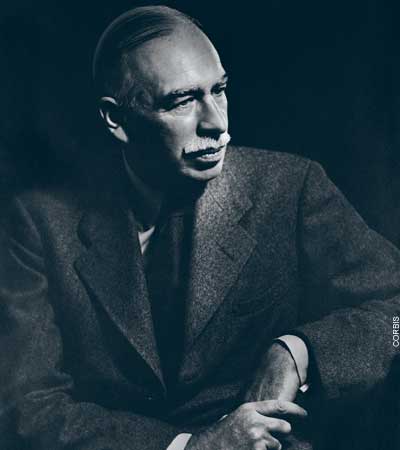
Anyone who is wondering why Chairman Ben Bernanke and Secretary Henry Paulson favor fantastically expensive bailouts of private firms instead of Keynesian policies of direct governmental investments in the public sphere–and why the economics profession has by and large endorsed this approach — would do well to look back to the 2002 celebration of Milton Friedman’s 90th birthday. In his toast, Ben Bernanke, the future Chairman of the Board of the Federal Reserve, said to Friedman and Anna Schwarz, co-author with Friedman of the book ‘A Monetary History of the United States, 1863-1960,’ about the Great Depression: “You’re right; we [the Federal Reserve] did it. We’re very sorry. But thanks to you, we won’t do it again.”
Why was Bernanke so eager to accept responsibility for a failure that occurred more than seventy years before he joined the Board? Because otherwise he and the economics profession in general would have had to concede John Maynard Keynes’ claim that a free market system is not self-regulating.
Of course, in 2002 it was entirely safe to assert that monetary expansion would have prevented the Great Depression. The Depression was long past and the Fed hadn’t taken the route that Friedman, many years later, asserted it should have. But now the country is teetering on the brink of economic disaster, and Bernanke, Friedman’s most devoted disciple, is at the helm of the Federal Reserve; push has come to shove. Either monetary policy alone can prevent the disaster, or the belief that the Free Market is self-regulating is dead.
Curiously, until Friedman brought it back to life, this belief in the Free Market was already dead. Intervention by the Federal Reserve did not use to be part of the definition of self-regulation. In fact, Free Market disciples used to argue that prices, not the Fed, were the mechanism that regulated the market. When the demands for goods and services fall, as they are bound to do when financial assets lose their value, prices fall. And this fall in prices would restore the economy to full employment, they argued. But this is not what happened during the Great Depression.
On October 29, 1929, Black Tuesday, the Dow Jones finished 23% below its level of five days earlier, on Black Thursday. And just as the Free Market disciples had predicted, this started a downward price spiral. Even thought the stock market crash happened at the end of the year, in 1929 prices fell by 2%. In 1930 they fell an additional 9%, in 1931 they fell 10%, and in 1932 they fell 5%. From 4% in 1929 it rose in the next three years to 9%, 16%, and 24% respectively. This is what led Keynes to conclude that unemployment was high not because prices were too high, but because consumers’ and investors’ optimism was too low. To operate at full throttle, Keynes explained, a Free Market system must be given one of two stimulants: Either a large dose of irrational optimism, or a high level of governmental demand for good and services.
The rate of unemployment in the years following WWII affirms Keynes’ view. The rate of unemployment was low (4.6% and below) during four periods, three of which involved irrational optimism, and one in which the government engaged in Keynesian policies. It was low in the 1950s when producers believed that consumers’ demand for home appliances, refrigerators, televisions, and vacuum cleaners, were insatiable. (Unemployment was high in 1954, however.) It was low at the end of the 1990s when the possibilities of the dot com world appeared limitless and people with stock portfolios felt like real millionaires. (At the time, President Clinton thought it made sense to invest some of social security funds in stocks.) And it was low in the years 2006 and 2007, an afterglow of the belief that home prices could only go up. The unemployment rate was most consistently low in the years 1965-1969, however, and this was due not to irrational optimism but to President Lyndon Johnson’s Great Society programs. Over these years the federal government started channeling funds to primary and secondary schools and to universities, and a multitude of new government programs were created, including Medicare, Medicaid, Head Start, Food Stamps, the National Endowment for the Arts, the National Endowment for the Humanities, PBS, and NPR.
The periods of irrational optimism inevitably ended when consumers and investors alike realized that there is no good for which the demand can grow forever, and that no new technology is revolutionary forever. The boost that the Great Society programs provided did not end, but it was no longer sufficient to keep the economy at full employment when at the end of the 1960s jobs in the private sector moved from cities to suburbs and from the Northeast to the South, leaving devastated cities behind.
But in 1967, when the memory of the Great Depression had substantially faded and no other financial meltdown was fresh in people’s minds, Friedman resurrected the argument that the Free Market was self-regulating. Lower prices would have restored the economy to full employment, he argued, if only wages declined sufficiently. Since we are now in the midst of a financial meltdown, it’s worth seeing what happens when Friedman’s argument is applied to today’s markets.
Between August 2007 and August 2008 home prices in the US declined 16%. The September to September numbers have not yet been published, but when they are they are likely to show an even steeper decline. Between September 2007 and September 2008 housing starts declined by 31%, and building permits, an indicator for how many projects are in the pipeline, declined by 38%. Over the same period (September to September) the employment of construction workers declined by 8%. Because of a statistical fluke which will be explained below, the data show that the wages of construction workers have increased by 9% over the same period. Let’s assume for a moment that the increase in wages is real. Following Friedman, do we then believe that if construction wages instead were to fall, housing starts would increase by 31% and building permits would increase by 38%’
The statistical fluke that shows that wages of construction workers increased when they are probably decreasing is this. The first construction workers to lose jobs when a recession starts are those who build small units, such as single family homes. Large projects are not as easy to stop. But workers on large projects are more likely than workers on small project to be union members and to possess high skills. Therefore, the recorded increase in the median wage of construction workers is most probably a reflection not of an increase in the wages of individual construction workers but of the disappearance of the lowest paid workers from the data. Whichever the case may be, it is clear that high wages are not the reason for the collapse of the housing market, nor would the housing market be restored if wages were lower.
The peculiar behavior of the median wage in the construction industry shows that in order to know how wages change over time it is necessary to follow individual workers, rather than industry-wide medians. The car industry was perhaps the most important industry before and during the Great Depression and fortunately there is data about wages, car prices, and employment in individual automobile factories during that time. These data show that when the price of the cars that a particular factory sold decreased, that factory employed fewer workers; the fact that in that factory wages fell by a higher percentage than car prices did, did not make a difference. And when the price of the cars that a particular factor produced rose, this factory employed more workers, notwithstanding the fact that in that factory wages rose faster than car prices did. (Author’s calculations based on the data of Timothy F. Bresnahan and Daniel M.G.Raff.) This would not have been a surprise to Keynes, who explained that falling prices squelch manufacturers’ optimism, and induce consumers to wait for even lower prices before they make their purchases.
But let’s return to Friedman’s argument. Let’s agree for the moment that had wages in the car industry or in any other industry during the Great Depression declined even more than they did, full employment would have been restored. Why didn’t wages fall sufficiently’ According to Friedman and to the economists Robert Lucas (also a Nobel Laureate) and Leonard Rapping — who jointly put Friedman’s argument into a formal model — wages did not decline even further because workers did not realize that the fall in demand that their own employers were experiencing afflicted also other employers. They were willing to quit their jobs instead of to accept lower wages because of the erroneous belief other employers would offer them higher wages. And this is why intervention by the Fed would have averted the Great Depression, according to Friedman. Had the Fed increased the money-supply sufficiently, prices in the economy, instead of falling, would have risen. That would have meant lower real wages for workers, and these lower wages would have restored the economy to full employment.
To economist Albert Rees the claim that the Great Depression was due to workers not realizing that there was a Great Depression was absurd: “How long does it take workers to revise their expectations of normal wages in light of the facts?” he asked. “Unemployment was never below 14 percent of the labor force between 1931 and 1939, and was still 17 percent of the labor force in 1939, a decade after the depression began.”
What all of this means is simple: Bernanke and the other policy-making economists are engaged in an ideological war that the rest of us simply cannot afford. We cannot afford to give hundreds of billions of dollars of government money to private firms and their executives just because their failure would expose the fact that a Free Market system is not self-regulating.
Free of an ideological commitment to the Free Market, the Chinese government has just announced a massive Keynesian program that involves spending on public housing, health, education, environmental protection, and transportation. The US should import this Keynsian prescription from China immediately. We should stop the giveaways while we still can and use the money to refurbish our society–while there is still the opening for making it great again.
[Moshe Adler is the director of Public Interest Economics, a consulting firm. He can be reached at ma82092@gmail.com.]
Source / CounterPunch
 Thanks to Roger Baker / The Rag Blog

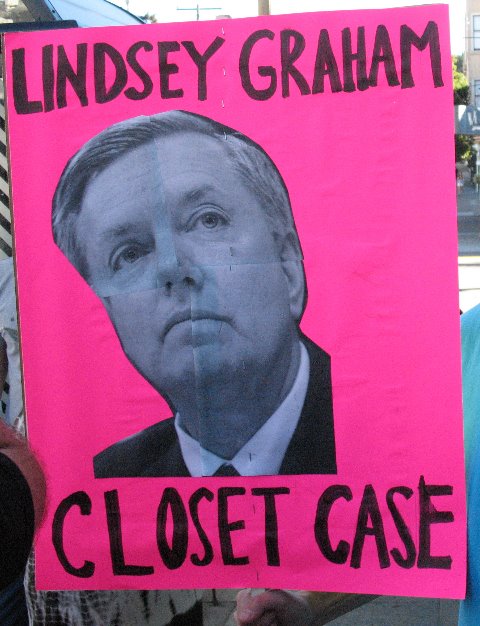
See ‘Signs of the Times’ by Kirk Read, Below.
SAN FRANCISCO — Kirk Read is one of Queer SF’s best writers and performers. His brother is a straight Republican; Kirk held up the Lindsay Graham sign at SF’s protest today.
The rebirth of the grass-roots LGBT [Lesbian, Gay, Bi-Sexual, Transgender] Movement has been amazing: I’m very impressed with the sudden energy and determination we can see all over CA, especially in Palm Springs, where LGBT residents now comprise 62% of the voters. It’s the first time since the early nineties we have been forced to fight back.
In many ways, it is ironic that the gay marriage issue (which many people I know thought secondary or irrelevant — some call for the abolition of government-sanctioned marriage itself), has served as a launch pad for a militant protest movement all over the United States. This defeat at the polls has galvanized a new gay/straight civil rights alliance that will have long–term consequences far exceeding the issue of marriage.
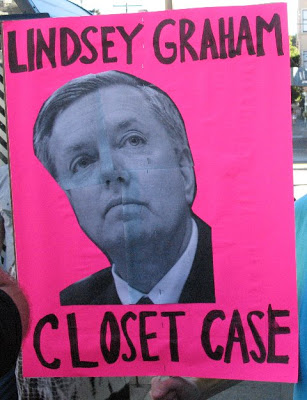
San Francisco: Queer activist Kirk Read’s sign has a message for S.C.’s Sen. Lindsey Graham.
Signs of the times.
Here are some photos from today’s gay marriage rallies.My brother Reid’s sign [at top], which was in the front of the rally at Charlotte, NC’s City Hall rally. Then my LINDSEY GRAHAM CLOSET CASE sign [above]. Reid’s is far superior!
Whatever cynicism and ambivalence I may feel about marriage and the gay movement (not an insignificant amount) is melted by those photos of him.
He wore his NASCAR hat backward, people.
I will add that the tie dye shirt he is wearing was my favorite all time tee shirt from age 11-18. I stole it from my sister and my brother apparently stole it from me. It looks great on him. He put a picture of my book cover on the front of his sign, next to the heart.
The other side of his sign says “Hey Obama! What about us?”
I love that my Republican brother is turning up the heat already among a group of people who expect Obama to do some serious David Copperfield shit with this fucked up country.
Kirk Read / The Rag Blog / November 16, 2008

As he prepares to enter the ring of White House politics, President-elect Barack Obama might need to perfect that left jab just as much as his right hook.
Not only can the Democratic president-to-be expect the predictable shots from the conservative right, but eventually a pounding from the left if he doesn’t deliver “change you can believe in” on issues that concern liberal voters – health care reform, an end to the war in Iraq, environmental protections and taking care of the economy and the housing crisis.
“We gave him a 24-hour honeymoon – and that was generous,” joked Medea Benjamin, co-founder of the anti-war group CodePink, Thursday about the chances of Obama’s election silencing protests for the foreseeable future. “We believe in celebrating and then moving on.”
Her grassroots organization has wasted no time doing just that. On Thursday, CodePink members hit five consulates in San Francisco – those representing Bolivia, Venezuela, Syria, Cuba and Iran – delivering flowers, apple pies and cards with a message as much for the president-elect as for the leaders of those nations: “Yes We Can … Live in Peace.”
“We told them we are embracing Obama’s message, and part of that is to push him,” said Benjamin. “He’s getting a lot of backlash on issues like direct talks with preconditions. But that is what the American people voted for – and we will hold him to that.”
With just over two months until the new administration takes office and the transition in full force, Benjamin’s words underscore the challenges facing a president whose historic campaign was bolstered by an unusual coalition that involved the activism, energy and money of unapologetic progressives like Benjamin as well as moderates and independents who are far more conservative.
Mainstream tack
And many political observers say that means Obama must tack toward the political mainstream to avoid miscalculations made by President Bill Clinton, who veered left and fired up the 1994 Republican backlash and its “Contract with America” – a GOP rebirth scenario Democrats don’t want to see reprised.
Obama supporter Rep. Barbara Lee of Oakland, an icon to liberals because of her long-standing activism on issues such as AIDS/HIV and her opposition to the Iraq war, said that as Democrats celebrate the new president, they are also very aware of issues to be addressed.
“We know that the president-elect – and rightfully so – is going to work to unite the country, and we will have to see how he does that,” said Lee. “I’m not saying it’s going to be easy. If we really want change, you have got to do it differently, you have to accept the process of change and accept that his processes will be more inclusive.”
But, she adds, “we’re certainly not going to lose sight of our goals and our values. … If you look at the progressive promise – 95 percent of what we advocated for, energy independence, infrastructure, health care reform – it’s mainstream,” she said.
‘Symbolic victory’
At the Edmund G. “Pat” Brown Institute of Public Affairs’ California Policy Issues Conference this week, Melina Abdullah, a professor of Pan-African studies at Cal State University Los Angeles, said that although she and millions of other Democrats sang “It’s a New Day” when Obama was elected, “we need to be very clear … this is a symbolic victory.”
African Americans, particularly, who supported Obama “need to think about … the fact that we are overrepresented in the prison population, that infant mortality in our community looks a lot like developing nations,” and that jobs and economic opportunities are still lacking, she said.
“The only way that change can be substantive is if we push him,” she said of Obama. “Push him on the issues that are important to us, … so institutional racism, institutional oppression can really be eroded in eight years,” she told a crowd of young activists and students at the conference, which was held in Los Angeles.
SEIU’s agenda
Andy Stern, who heads the Service Employees International Union – the nation’s largest union, with 2 million members – says that labor fully expects to push ahead on critical interests, such as health care reform.
Especially since SEIU kept a singular focus on the health care issue by spending millions of dollars on advertising that aided the Democrats’ cause – even as tens of thousands of its members provided critical ground troops for his election, he noted.
“Most presidential elections, we are electing a transactional president, someone who comes in and has a set of priorities and bargains with the Congress and tries to find solutions,” Stern said. “Every once in a while, we have a transformational president, who actually changes the rules. And that is the moment where we’re at.
“This is not about transactional discussions with health care. This is about transforming the economy, to change the way we provide health care, to change the opportunities for people to get an education,” he said.
“We say we will have a 21st century economy that can compete globally,” Stern said. “We need a fundamental reworking of our economic theory – and it can’t just be a little stimulus … or to provide health care for children only. It is a moment where we have to transform the way we think.”
Already, there have been complaints from the left regarding Obama’s choice of Rep. Rahm Emanuel as his White House chief of staff. Some liberals have complained that Emanuel was too supportive of the Iraq war, too tied to Wall Street and too connected to entrenched interests to represent change – or the views of the left – in the White House, where he worked in the Clinton administration.
Dan Schnur, a former GOP strategist who now directs the Jesse M. Unruh Institute of Urban Politics at the University of Southern California, said they may have reason to be concerned.
Perils of pull to left
“Rahm Emanuel … understands the perils of a newly elected president who intends to govern from a centrist force and how that president can be pulled leftward,” he told the Brown Institute conference Wednesday.
“Emanuel is one of the five smartest people in American politics. He has that experience, he’s intelligent, he’s tough as nails and he’s one of the few people I know in Washington who would be willing to go down to Capitol Hill” and deliver the message to the left: “If you really want to help this president … then give him some space to enact his agenda,” Schnur said.
Emanuel’s lore includes an incident in which he reportedly sent a dead fish wrapped in newspaper to an adversary, said Schnur.
If Obama is to succeed, he said, “my hope … is that there is a steady stream of such deliveries from one end of Pennsylvania Avenue to another to help President Obama accomplish his agenda.”
Source / San Francisco Chronicle
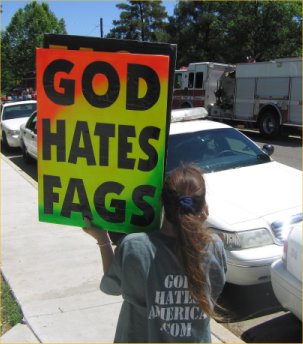
Obbop: ‘Piss on the Gays’
By Thorne Dreyer / The Rag Blog / November 16, 2008
I post most of The Rag Blog’s material to social networking site Reddit. Yesterday I sent a link to an article brother Richard Jehn placed on the blog — Gay Rights Activist Aravosis: ‘Utah Is a Hate State’ — and included the following as a “comment” (actually the subhead and lead to the story):
Church Action Prompts Tourist Boycott of Utah …
Utah’s growing tourism industry and the star-studded Sundance Film Festival are being targeted for a boycott by bloggers, gay rights activists and others seeking to punish the Mormon church for its aggressive promotion of California’s ban on gay marriage. ….
I thought our esteemed and erudite readers might enjoy the following high-level exchange (you know, like: “Turkey Butt!” “Dung Face!” That kind of thing, but with bigger words) between your correspondent (“tdreyer”) and a faceless entity name of “obbop.”
obbop: And I believe a growing percentage of the population is growing to HATE the gay, their supporters and their stick-it-in-your-face agenda tactics.
Piss on the gays.
I still follow a live-and-let-live approach to life but observing the childish uncivil antics of the gay crowd I will strike back via the ballot box.
I assure you PC correct idiots, too many of you are actually hurting your cause.
The backlash will occur.
tdreyer: Gosh. Deja vu. Hey, Obbop, not long ago we could have replaced “blacks” for “gays” in your lovely little spiel and the next comment might well have been, “Get a rope!”obbop: Hey… good idea!!!!!!!!!!!!
tdreyer: Dude. No, leave the rope alone. If you’re feeling suicidal, you should seek professional help.
obbop: Oh, never fear. If the necessity to depart this plane of existence arises a shotgun to the head with no one around to call for medical assistance will ensure the task is accomplished to its completion.
None of that “cry for help” crap from a member of the warrior class.
tdreyer: “Warrior class.” How impressive! How pretentious!
obbop: Warrior class; a concept the brainwashed masses chock-full of political correctness are likely unable to envision.
If you fall into that grouping, I pity thee.
tdreyer: A handy tag for a grandiose bloated self-image, methinks.
Keep your pity, but thanks for the thought.
Feel sure he’ll wish to get in a last word, and I may append.
Later. Gotta post this to Reddit.
The following is part of a discussion among members of Austin MDS about the election of Obama, the possibility of real change through the Democratic Party, and the efficacy of the third party option.
Thorne Dreyer / The Rag Blog / November 16, 2008
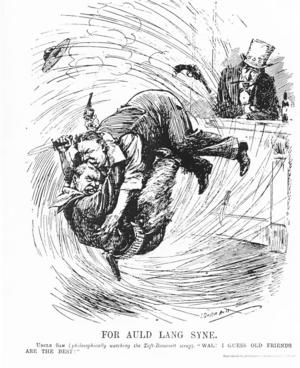 ‘I have come to believe that because of the lack of proportional representation in the American political system, a two party system here is almost a law of physics.’
By David P. Hamilton / The Rag Blog / November 16, 2008
See ‘Two-party system: You can’t correct faulty blueprints by hiring new construction workers’ by Scott Trimble, Below.
I have voted for third (or fourth) party candidates for president eight times. I did not do so in 2008, but I may do it again if I feel a protest vote is in order. However, I have come to believe that because of the lack of proportional representation in the American political system, a two party system here is almost a law of physics. Each of those two parties will be relatively centrist in order to capture a majority.
There have been historical examples of American third parties being “successful” by some definition other than becoming the majority and governing party. The Dixiecrat rebellion against the Democratic Party that began in 1948 triggered by Truman’s integration of the military became the cornerstone of the Republican’s majority embracing racism in 1968. The anti-slavery Republicans emerged to replace the Whigs in 1852, but the two party system remained with the Whigs disappearing altogether. Unless the basic rules of American democracy are changed, we will always end up with a competition between two only slightly ideological political parties. This is also the case in Europe when you have a winner take all situation, such as in France between “Guallist” Sarkozy and “Socialist” Royal.
European democracies have forms of proportional representation and, therefore, many established political parties representing all significant political tendencies. Proportional representation is the key to multi-party democracy. With a winner take all system, you will always end up with just two parties, which define and fight over the center.
For most of my life, the left having access to a presidential administration was realistically a preposterous notion. Whoever thought that we might be accepted into the councils of any Republican or any Democrat since FDR? That is not the case with Obama, and in that way the times have profoundly changed. The peace movement was a very important element of his base. We deserve a continuing presence among his advisers, but we will have to continue to win that role by continuing to build mass movements for change.
I hope that in a couple of years many of those now taking shots at Obama over positions he took in order to get elected in a system where competition for the center is the only game in town (.eg., Afghanistan) will be singing a new tune. In the meantime, many of us can’t get over a lifetime of being on the outside with no key.
Two-party system: You can’t correct faulty blueprints by hiring new construction workers.
By Scott Trimble / The Rag Blog / November 10, 2008Many things that have come to pass once were considered impossible. Just because our political system has failed to produce a third or fourth party does not mean it cannot happen. Very simply, if one-fourth of the population were smart enough to vote Green and another quarter voted Libertarian, then the Republicans and Democrats would have to split the remaining half, leaving us with four relatively equally supported parties. It is not likely in the next couple of years. It will not happen by itself. But that does not mean it is impossible. It has got to start with those of us who are paying enough attention to realize that the Democratic Party and the Republican Party have had a century and a half of shared power, and have utterly failed to represent the people of this nation, except when we have forced their hand by getting out in the streets and/or by winning cases in the courts.
When it was a new party, the radical wing of the Republicans partnered with activists to bring certain civil rights to former slaves, although those rights were still subverted for nearly another century. Neither party helped us break the injustice of child labor. Labor unions helped us achieve that, as well as the forty hour work week with weekends. Neither party gave women the vote. Women themselves had to fight for it. And the realization of those civil rights for the descendants of slaves (or anyone who looked like them), while originally put on the books in the era of the Radical Republicans, did not come about until black Americans worked together to fight for them.
Of course, these gains required more than just the activists on the front lines. They also required cultural shifts in the general population. Women gained the right to vote nationally by a constitutional amendment, which of course, required the support of most of the country. Blacks could not have won their civil rights in the sixties if the rest of the country had still believed the Jim Crow laws (and the oppressive and violent actions of the police) were justified.
Similarly, we will not have a viable third (or fourth, or fifth) party in the US until we have a shift in public opinion that one is needed. When (not if) Obama fails to really change anything in American politics, we may have a small opening. However, in reality, we have to expect a much longer fight. Nevertheless, we cannot wait to begin it. That is part of the reason why I have insisted (many times on this list) that those of you who understand enough to recognize that a vote for either Republocrat in the presidential race here in Texas (or anywhere else in the old south, except Florida) was a wasted vote should have voted for Cynthia McKinney (or for those who lean more right on economic policy, Bob Barr, or for those who lean more right on social policy, Chuck Baldwin). Unfortunately, apparently, some of our best and brightest still failed to heed my call and supported the Democrat. Possibly worse, here in Travis County, about 900-1000 progressives were smart enough not to vote for Obama, but about 700 of them voted for Nader, which was also a wasted vote, and only about 200-250 were smart enough to vote for McKinney. Oh well. We fight on.
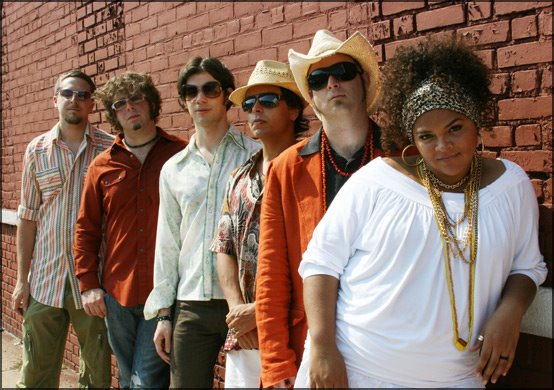
Which nation, and which beat? What makes this group special is that it offers no simple answers. They are rhythm gatherers, harvesting the fruit of 500 years of cultural crossbreeding, which is why the sounds of the northeast of Brazil and the southern United States blend together so seamlessly; NPR’s All Things Considered music writer Banning Eyre calls them “the most original and alluring fusion group I have heard in years.”
At the heart of Nation Beat’s Legends of the Preacher lies a totally original 21st century fusion between thunderous Brazilian maracatu drumming and New Orleans second line rhythms, Appalachian-inspired bluegrass music, funk, rock, and country-blues. Their explosive live show — which is frequently known to burst into crowd-wide Carnaval-style drumming and singing — is attracting music fans from a wide demographic: bluegrass and country music fans, Brazilian music lovers, outdoor festival-goers, and pretty much anyone who loves to dance and loves great music.
See also their MySpace page.
Source / NationBeat.com
Thorne Webb Dreyer, Editor




