Shalom : Jewish Activists Gather to End the War and Heal America


‘The gathering we are holding is intended to restart the energies of Jewish activism.’
By Rabbi Arthur Waskow / The Rag Blog / November 12, 2008

On November 23, The Shalom Center and the Workmen’s Circle will hold an action gathering in New York City: “Jews Uniting to End the War and Heal America.”

Why? Because no President, no Congress, can harvest the fruits of peace, justice, and sustainability unless there is a community in motion — a grass-roots movement — demanding and creating crucial changes in private behavior as well as public policy. One of the communities that by voting record and by asserted values should be in the forefront of such a grass-roots effort is the American Jewish community.

But for too many years, some parts of the American Jewish community have held back from its true vocation to bring peace to America and to the whole region that Abraham and Sarah and Hagar walked, from what is now Iraq to what are now Israel and Palestine and Egypt and Arabia. For too many years, even the Jewish desire for social justice in America has been blunted by refusing to connect that hope with the need to end the Iraq War and to work toward a broader peace. How can a trillion dollars for destruction NOT be a domestic issue?

The gathering we are holding is intended to restart the energies of Jewish activism.

Shalom,

Arthur

Jews Uniting to End the War and Heal America
A Project of The Shalom Center, The Workmen’s Circle/Arbeter Ring, and Jewish Currents

On Sunday, November 23, at Central Synagogue in New York City, The Shalom Center, Jewish Currents, and Workmen’s Circle/Arbeter Ring invite YOU to take part in a one-day action gathering: Jews Uniting to End the War & Heal America: Organizing for Action.

Please go here to register for November 23 and/ or contribute to its success, even if you are too far away to come.

And please send this invitation to your friends.

Speakers and workshop leaders will include Amy Goodman of Democracy Now, Congressman Jerrold Nadler, Rabbi David Saperstein of the Religious Action Center in Washington, Rabbi Peter Knobel, president of the Reform rabbinical association, former Congresswoman Elizabeth Holtzman, Sammie Moshenberg of the National Council of Jewish Women, Leslie Cagan of United for Peace and Justice, Jeremy Ben-Ami of J Street, Michael Ratner, Center for Constitutional Rights— – and many other luminaries of the newest and oldest generations of activist Jews. (See the day’s schedule, below.)

Why are we doing this? Because no President, no Congress can make change happen and heal America without a vigorous grass-roots movement organizing for change, to counter entrenched top-down interests. Because Jewish values and wisdom teach us to pursue peace, justice, and healing of the earth. And because if there is serious Jewish involvement, the grass-roots movement for change in America will be considerably stronger.

Our goals are a) to put ending the Iraq war and turning to domestic needs high on the agenda of major Jewish organizations, not only on paper but in their commitment to mobilize vigorous action by their members, and b) to involve grass-roots Jews of all sorts, in or out of the organizational Jewish world.

Why choose November 23? We will have enough time to start organizing before January 20, when the new US government will come to power. We intend to leave November 23 with an action network ready to move quickly.

ORGANIZING FOR ACTION: Sunday, November 23, 2008 at Central Synagogue, 123 East 55th Street between Park and Lexington Avenues, NYC

Schedule for the Day:

8:00-10:00AM Coffee and bagels available
8:30AM Registration opens for the day (closes 4:30pm)
9:30AM-9:40AM Welcoming/framing of the day (10 min) • Rabbi Ellen Lippmann, The Shalom Center and Kolot Chayeinu/Voices of Our Lives • Melanie Kaye/Kantrowitz, poet and scholar

9:40-10:45AM Opening plenary: Why the Jewish community must take vigorous action to end the war and heal America • Honorable Elizabeth Holtzman, former Congresswoman, author, attorney • Rabbi David Saperstein, Religious Action Center of Reform Judaism • Ann Toback, Workmen’s Circle/Arbeter Ring • Rabbi Arthur Waskow, The Shalom Center

11:00AM-12:15PM —- 5 Concurrent morning sessions on the implications of the peace effort

A. Impacts of Iraq war and peace on the broader Middle East (from Iran to Egypt, and everything in between) • Moderator: JJ Goldberg, former Editor in Chief, The Forward • Diane Balser, Brit Tzedek V’Shalom • Jeremy Ben-Ami, J Street • Lilly Rivlin, Meretz USA • MJ Rosenberg, Israel Policy Forum

B. Impacts of the Iraq war on human rights and civil liberties in the US • Moderator: Rabbi Simkha Weintraub, Rabbis for Human Rights / North America • Honorable Elizabeth Holtzman, former Congresswoman, author and attorney • Rabbi Rachel Kahn-Troster, Rabbis for Human Rights / North America • Michael Ratner, Center for Constitutional Rights

C. Domestic economic consequences of the war and peace • Moderator: Bill Hartung, New America Foundation • Liza Featherstone, journalist and contributing editor to The Nation • Brad Lander, Pratt Center for Community Development • Greg Speeter, National Priorities Project

D. Oil, war and climate crisis • Rabbi Nina Beth Cardin, Baltimore Jewish Environmental Network • Emmaia Gelman, Center for Working Families • Steve Kretzmann, Oil Change International • Charles Komanoff, Carbon Tax Center

E. Healing veterans, their families and the families of the war dead• Moderator: Myriam Miedzian, author “Boys Will Be Boys: Breaking the Link Between Masculinity and Violence” • Jan Barry, Veterans for Peace, Vietnam Veterans Against the War • Penny Coleman, author “Flashback: Post-Traumatic Stress Syndrome, Suicide and the Costs of War” • Sue Niederer, Goldstar Families for Peace

12:15-12:45PM Lunch break-conversations
12:25-12:35 Optional screening “Soldiers of Conscience”
12:40-12:45PM Musical performance • Adrienne Cooper, Workmen’s Circle/Arbeter Ring • Cantor Jonathan Gordon, Woodlands Community Temple

12:45PM-1:05PM Afternoon keynote remarks/An insider’s view from the Hill: • Introduction: Marty Schwartz, Workmen’s Circle/Arbeter Ring • Congressman Jerrold Nadler (D-NY)
1:05-1:30PM Views to the Hill and beyond: • Introduction: Rokhl Kafrissen, Jewish Currents • Leslie Cagan, United for Peace and Justice • Jeremy Ben-Ami, J Street

1:30-2:45PM Afternoon plenary: Confronting the war in the Jewish community at this historic moment of opportunity: Where we’ve come from, where we’re headed, how to capitalize on the change in Administration in Washington • Moderator: Larry Bush, Jewish Currents • Rabbi Marla Feldman, Commission on Social Action of Reform Judaism • Rabbi Peter Knobel, Central Conference of American Rabbis • Sammie Moshenberg, National Council of Jewish Women • Rabbi Arthur Waskow, The Shalom Center

3:00-4:15PM 3 Concurrent afternoon sessions (1 hour 15 min)

A. Jewish values, texts, and organizing with rabbis and synagogues • Moderator: Rabbi Ellen Lippmann, The Shalom Center and Kolot Chayeinu/Voices of Our Lives • Rabbi Rebecca Alpert, Temple University • Rabbi Or Rose, Hebrew College • Rabbi David Shneyer, Am Kolel

B. Building a Jewish anti-war activist network • Moderator: Marty Schwartz, Workmen’s Circle/Arbeter Ring • Jeffrey Dekro, The Shalom Center and founder of The Shefa Fund • Mark Johnson, Fellowship of Reconciliation/Olive Branch Interfaith Partners for Peace • April Rosenblum, author “The Past Didn’t Go Anywhere” and contributor to “Righteous Indignation” • Rabbi Michael Rothbaum, Hillels of Westchester • Tammy Shapiro, Union of Progressive Zionists • Dara Silverman, Jews for Racial and Economic Justice

C. The Media & Changing Jewish Public Opinion • Moderator: Esther Kaplan, The Nation Institute • Jeff Cohen, Park Center for Independent Media • Dan Sieradski, Jewish Telegraphic Agency
4:30-5:15PM Closing keynote remarks and close of the day (45 min) • Introduction: Gary Ferdman, The Shalom Center & Common Cause

• Keynote: Amy Goodman, Democracy Now! • Robert Kaplan, Workmen’s Circle/Arbeter Ring• TBD, The Shalom Center
5:15-6:00PM Musical performance • Basya Schecter and Pharaoh’s Daughter

6:00PM Close of the day

Jews Uniting to End the War & Heal America: Organizing for Action will:

Make clear the connections between the costs of the war and the economic stress Americans are facing; between the savagery of the war and the sinking worldwide reputation of the U.S.; between the deceit and profiteering that have fueled the war and the erosion of true homeland security, including our Constitutional security; between the politics of the war and efforts to undermine the liberal spirit of American Jews.

And it will focus not only on the substantive issues but on how to MAKE CHANGE HAPPEN.

Remember — please go here to register for November 23 and/ or contribute to its success.

The Rag Blog

Posted in Rag Bloggers | Tagged , , , | Leave a comment

Obama’s Bailout Bunch : Sure Seems Like More of the Same

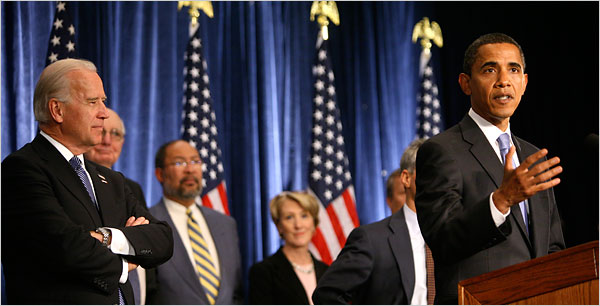
President-elect Barack Obama with Vice President-elect Biden and a group of economic advisers at a news conference in Chicago on Nov. 7, 2008. Photo by Damon winter / NYT.

‘Almost half the people on Obama’s economic advisory board have held fiduciary positions at companies that either fried their financial statements, helped send the world into an economic tailspin, or both.’
By Jonathan Weil / November 11, 2008

It’s hard to believe Barack Obama would even think of calling this change.

Take a good look at some of the 17 people our nation’s president-elect chose last week for his Transition Economic Advisory Board. And then try saying with a straight face that these are the leaders who should be advising him on how to navigate through the worst financial crisis in modern history.

First, there’s former Treasury Secretary Robert Rubin. Not only was he chairman of Citigroup Inc.’s executive committee when the bank pushed bogus analyst research, helped Enron Corp. cook its books, and got caught baking its own. He was a director from 2000 to 2006 at Ford Motor Co., which also committed accounting fouls and now is begging Uncle Sam for Citigroup- style bailout cash.

Two other Citigroup directors received spots on the Obama board: Xerox Corp. Chief Executive Officer Anne Mulcahy and Time Warner Inc. Chairman Richard Parsons. Xerox and Time Warner got pinched years ago by the Securities and Exchange Commission for accounting frauds that occurred while Mulcahy and Parsons held lesser executive posts at their respective companies.

Mulcahy and Parsons also once were directors at Fannie Mae when that company was breaking accounting rules. So was another member of Obama’s new economic board, former Commerce Secretary William Daley. He’s now a member of the executive committee at JPMorgan Chase & Co., which, like Citigroup, is among the nine large banks that just got $125 billion of Treasury’s bailout budget.

There’s More

Obama’s economic crew might as well be called the Bailout Bunch. Another slot went to former White House economic adviser Laura Tyson. She’s been a director for about a decade at Morgan Stanley, which in 2004 got slapped for accounting violations by the SEC and a month ago got $10 billion from Treasury.

That’s not all. There’s Penny Pritzker, the Obama campaign’s national finance chairwoman. She was on the board of the holding company for subprime lender Superior Bank FSB. The Chicago-area thrift, in which her family held a 50 percent stake, was seized by the Federal Deposit Insurance Corp. in 2001. The thrift’s owners agreed to pay the government $460 million over 15 years to help cover the FDIC’s losses.

Even some of the brighter lights on Obama’s board, like Warren Buffett and former SEC Chairman William Donaldson, come with asterisks. Buffett was on the audit committee of Coca-Cola Co.’s board when the SEC found the soft-drink maker had misled investors about its earnings. Donaldson was on the audit committee from 1998 to 2001 at a provider of free e-mail services called Mail.com Inc. Just before he left the SEC, in 2005, the agency disciplined the company over accounting violations that had occurred on his watch.

Telling Stories

So, by my tally, almost half the people on Obama’s economic advisory board have held fiduciary positions at companies that, to one degree or another, either fried their financial statements, helped send the world into an economic tailspin, or both. Do you think any of that came up in the vetting?

Let’s say we give Buffett a pass — smart move he made, skipping the group photo-op last week in Chicago. What about the rest of them? Donaldson, for one, was chairman when the SEC voted in 2004 to let the big Wall Street banks, including Lehman Brothers Holdings Inc. and Bear Stearns Cos., lever up their balance sheets like drunks. Talk about blowing it.

And whom did Obama tap for White House chief of staff? Rahm Emanuel, the Illinois congressman who was a director at Freddie Mac in 2000 and 2001 while it was committing accounting fraud.

Ideally, this job would go to someone who can’t be easily fooled. Think about it: Of all the people Obama could have chosen as his chief of staff, couldn’t he have found someone who wasn’t once on the board of Freddie Mac?

Renewed Confidence

The president-elect needs some new advisers — fast. We are in a crisis of confidence in American capitalism. These aren’t the right people to re-instill its sense of honor.

Many of them should be getting subpoenas as material witnesses right about now, not places in Obama’s inner circle. Did Obama learn nothing from the ill-fated choice of James Johnson, the former Fannie Mae boss, to lead his vice- presidential search committee?

Does he think people like Robert Rubin or Richard Parsons will offer any helpful advice on how to stop crooked bankers or sleep-walking directors from sinking our economy? Or that they won’t mistake the nation’s needs for their own corporate interests? Or that the people who helped get us into our long financial nightmare have any clue how to get us out?

Obama has created hope that our nation can stand for all that is good in the world again. It’s not too late to change course.

Start by scrapping this board.

Source / Bloomberg

Thanks to S. M. Wilhelm / The Rag Blog

Posted in RagBlog | Tagged , , , | 2 Comments

FLASH : McCain was Right! Obama Meets with Dangerous World Leader…

Thanks to Shelia Enid Cheaney / The Rag Blog

Posted in RagBlog | Tagged , , , | 2 Comments

Group Seeks Web-Savvy, More Open Government


‘First and foremost, the group wants Obama to reverse the policies of the Bush administration regarding the handling of public records.’
By Lyndsey Layton / November 12, 2008

The incoming Obama administration needs to use the Internet to publish reams of new information about federal spending, policies and performance as well as other records that have been increasingly shrouded from public view, a coalition of conservative, libertarian and progressive groups is recommending today.

The group, which has been studying government secrecy and ways to fix it for 20 months, called on Congress to invest in technology to bring federal record-keeping and communication into the 21st century.

“This was a group with very different political agendas, but we have enormous common ground on the view that government should be open and we should all have the same information to work with,” said Gary D. Bass, executive director of OMB Watch, a nonpartisan group that organized the effort.

“We view the government as operating in the 20th century — some would say the 19th century,” said Bass, who presented the report to President-elect Barack Obama’s transition team. “But we’re living in the 21st century.”

The report said federal agencies should embrace the Internet and all its possibilities, allowing the public to review pending policies and comment online or through interactive dialogues, tap into extensive databases, and get e-mail updates and RSS feeds.

But first and foremost, the group wants Obama to reverse the policies of the Bush administration regarding the handling of public records.

The Bush White House set the tone early when Vice President Cheney rebuffed lawmakers and environmentalists who requested records from his energy policy task force, a battle the administration eventually won in the Supreme Court.

But after the attacks of Sept. 11, 2001, efforts to shield government decision-making from scrutiny went into overdrive.

In early 2002, then-Attorney General John D. Ashcroft issued a memo to government agencies urging them to reject requests for access to public documents allowed under the Freedom of Information Act if they could find a legal argument against the release. It was a reversal from the Clinton administration’s stance, which assumed that records were public unless government proved otherwise.

Later, then-White House Chief of Staff Andrew H. Card Jr. directed agencies to restrict access to “sensitive but unclassified” information, removing tens of thousands of documents from public view. Some records that previously were publicly available ended up being reclassified and shielded from scrutiny.

“On the national security side, it’s almost become a reflexive response,” Bass said. “The theme was: Secrecy makes us safer. And none of us agree with that.”

The impact of the directives over time is clear.

From 1998 up to when Ashcroft issued the memo, the federal government fully granted 51.3 percent of FOIA requests, according to the Coalition of Journalists for Open Government. Last year, the figure was 35.6 percent. Meanwhile, agencies are taking longer to respond to FOIA requests. From 1998 to 2002, 14.4 percent of FOIA requests were backlogged. By last year, the figure had jumped to 33 percent.

The report said the Obama administration should instruct all agencies not to wait for FOIA requests but to proactively publish records, searchable databases, policy information and performance data.

The report also recommended launching a searchable accountability database on the Internet that includes who gets money from the federal government, how it is spent, who is lobbying the executive branch and who is working in high-level government posts — including their prior jobs and their employment after government service.

The group says it thinks Obama will be receptive to its recommendations, citing his advocacy of opening government to greater scrutiny and his co-sponsorship of a law that requires the Office of Management and Budget to put government contract information online. The site, http://www.usaspending.gov/, was launched this year.

“That was a precedent, an example of the kind of change we need,” Bass said. “With the click of a mouse, you can find out who is getting how much money and for what. We know what Obama is thinking. There’s a clear sense that he believes in the Web 2.0 model of government. There’s a clear sense he thinks there should be much more transparency.”

Obama also ran a tech-savvy campaign, exploiting the Internet and new technologies in ways never before seen in national politics.

Among the group’s other recommendations for Obama:

* Define public information as broadly as possible, including audio, photos and video.

* Rescind an executive order signed by President Bush that limits access to the records of former presidents.

* Make greater use of redaction to release partial records when the administration cannot provide full disclosure, as opposed to making entire documents unavailable.

* Make exemptions from disclosure as narrow and specific as possible.

To read the complete report, go here.

Source / Washington Post

The Rag Blog

Posted in RagBlog | Tagged , , , , , | Leave a comment

New York Times : Is ‘Gray Lady’ Fading Fast?


Is financial demise of The Times at hand?
By Dr. Denny / November 11, 2008

In 1896, Adolph Ochs bought The New York Times and boldly placed on its front-page flag the slogan All The News That’s Fit To Print. Today, its publisher, Arthur Ochs Sulzberger Jr., may need to rewrite that slogan to Less News And Less Money To Print It.

That’s because The Times has fallen on hard times (forgive me). The faltering business model that has strapped financial straitjackets onto other newspapers (witness the Christian Science Monitor ending its print edition) may have finally knee-capped the nation’s best newspaper. It has significant debt coming due, and insignificant cash on hand.

Reports Henry Blodget of the Silicon Valley Insider:

[The company must deliver $400 million to lenders in May of 2009, six months from now. The company has only $46 million of cash on hand, and its operations will likely begin consuming this meager balance this quarter or next. The company has been shut out of the commercial paper market, but has a $366 million short-term credit line remaining that it entered into several years ago, when the industry was strong. It has not yet drawn this cash down, and given the current environment and the trends at the company, we would not take for granted that it will be able to do so. [emphasis added]

Consider numbers we can all understand: In 2002, The Times’ stock price hit nearly $53. On Monday, the last line of a Forbes.com story relayed this telling stat: “Shares in the Times company fell 59 cents, or 6.3 percent, to $8.73 in mid-afternoon trading …” [emphasis added]

The Times‘ suddenly accelerated descent into fiscal disarray has probably irritated Mexican billionaire Carlos Slim Helú. Just two months ago, Mr. Slim bought a 6.4 percent stake of the New York Times Co. at about $14 a share, an investment then worth about $127 million. If he’s still in, he’s lost nearly half his investment.

Recall, please, Mr. Sulzberger’s comment just 21 months ago at the World Economic Forum at Davos, Switzerland, when asked about the future of the print edition of The Times:

I really don’t know whether we’ll be printing The Times in five years, and you know what? I don’t care either.

Bet he cares now. At the time, he said The Times was focused on becoming an Internet news leader, saying it had doubled its online readership to 1.5 million a day to go along with its 1.1 million subscribers for the print edition. But the problem is simple: It may have consistently high readership online, but that’s not translating into sufficient online advertising revenue to meet the expectations of institutional investors concerned primarily with short-term gain.

Here’s the short-term financial picture for the Times company as constructed by Mr. Blodget based on recent NYTCo. filings with the Securities and Exchange Commission:

What NYTCo. has:
• $46 million of cash
• $366 million owed to it by advertisers
Total: $412 million

What NYTCo. owes:
• $398 million of short-term debt (due in May)
• $161 million of accounts payable (newsprint, travel, etc.)
• $100 million of payroll (salaries)
• $159 million of other expenses
• $50 million owed on long-term debt and rent
Total: $865 million

Bottom line, short term: NYTCo. owes $453 million more than it has.

Other harpies have been snipping at The Times‘ heels. Recall, please, that in January a pair of hedge funds demanded changes at the company:

The trouble, according to Firebrand Partners and Harbinger Capital, is that the New York Times company has moved far too slowly to replace the revenue that is being lost as readership figures come under pressure and advertisers shift their spending from newspapers to the internet. [emphasis added]

Firebrand’s founder, Scott Galloway, wants the Times company to diversify. In a January letter to Mr. Sulzberger, Mr. Galloway wrote: “We believe a renewed focus on the core assets and the redeployment of capital to expedite the acquisition of digital assets affords the greatest shareholder appreciation and creates the appropriate platform to compete in today’s media landscape.” [emphasis added]

Well, good luck with appreciating shareholder value with that acquisition of digital assets. (About.com is highly profitable, so why’s the Times company shopping it around?) Too little, too late. The Times, like virtually every major newspaper company in America, refused to accept the Internet as an effective colleague and instead regarded it only as an ineffective, sure-to-fail upstart. Such arrogance is proving costly.

The news worsens. Nielsen reports that advertising spending for the first half of 2008 declined by 1.4 percent compared with the same period in 2007. Its news on Internet advertising is mixed:

Although overall Internet ad spending, when including paid search and online video advertising, was up by 11% during the first half of this year, image-based Internet advertising declined by 6% during the first half of 2008, compared to the same period in 2007. …

The decrease in image-based Internet advertising was driven by a 27% drop in online ad spending by financial services companies, which decreased their spending from $1.5 billion in the first half of 2007 to $1.1 billion during the first two quarters of this year. [emphasis added]

AFP reports that:

The Interactive Advertising Bureau and PricewaterhouseCoopers said Internet advertising revenues rose 15.2 percent in the first six months of 2008 over the first half of 2007. Online advertising revenue was up 12.8 percent in the second quarter over the same period of 2007 but declined 0.3 percent from the first quarter of the year, from 5.8 billion dollars to 5.7 billion dollars, the IAB-PwC survey said. [emphasis added]

And that’s the problem for the Times company and every other newspaper company that has placed its business-model bet on sure-to-be-profitable Internet advertising. Despite double-digit growth in online advertising revenue in recent years, that growth isn’t paying off fast enough.

“Total advertising revenue for the newspaper industry is expected to decline 11.5% to $40.1 billion this year,” reports Jennifer Saba of industry trade journal Editor & Publisher. Print ad revenues, though declining, still provide the bulk of the industry’s income. Internet ad revenues, though increasing, will not produce sufficient revenue soon enough to stave off drastic, perhaps catastrophic, changes in the newspaper industry.

In February, reported The Times‘ Richard Pérez-Peña, “The Times has 1,332 newsroom employees, the largest number in its history; no other American newspaper has more than about 900.” When The Times said in February it would cut 100 jobs, its stock immediately rose 86 cents to $18.84. Now it’s under 10 bucks.

The Times, in fiscally happier times (forgive me again), bet big on expansion in New England to maximize revenue. In 1993, shortly after Tim Berners-Lee released the World Wide Web for full public use, the Times company bought The Boston Globe for $1.1 billion. In 1999, it bought the Worcester, Mass., Telegram & Gazette for $295 million. Both deals were roundly criticized as too pricey for value received. Both deals have proven to be financial drains on the Times company. (The Times did not significantly embrace the Internet for several years and made poor decisions. Remember the ill-fated, pay-for-premium-content TimesSelect?)

Early this week, Forbes reported that the company “increased its estimates for how much The Boston Globe and other New England newspapers it owns have declined in value because of reductions in advertising revenue.” That drop in value — $166 million — occurred in just the third quarter. The Times company said the fourth quarter will bring further devaluation of the properties.

Prediction I: The Times will initially follow the industry’s formula: Cut expenses drastically (read: jobs). Seek to at least maintain current share price. Prediction II: The strategy will fail. Prediction III: The Times will sell assets. Prediction IV: That, too, will fail, because the company has insufficient assets relative to its debt and declining ad revenue. In September, E&P reported that the Times company ad revenue had declined 14.1 percent compared to the same period a year ago. Total revenue dropped 8.8 percent for the month.

Could the Times company raise enough cash to take itself private? Hmmm. Perhaps that’s why About.com may be on sale.

All this in a tanking economy. The Times and other newspaper companies shouldn’t bet on traditional big-bucks advertisers — Detroit, real estate, and want-ad classifieds — to come to the rescue. They’ve got problems of their own.

According to Mr. Blodget, the long-term view for the Times company is equally bleak:

What NYT has:
• $1.355 billion of buildings, real-estate, printing presses, trucks, technology
• $146 million of investments in joint ventures (Red Sox, etc.)
Total: $1.501 billion

What NYT owes:
• $673 million of long-term debt
• $7 million of long-term rent
• $284 million of pension benefits
• $214 million of retiree healthcare and other benefits
• $290 million of other liabilities
Total: $1.468 billion

Bottom line, long term: Balance sheet carrying values can provide a very misleading picture of long-term asset values, especially for things like land and buildings, which may have appreciated (or depreciated) significantly. As a result, there may be significant embedded value in these assets. But assuming the NYT’s land, buildings, and joint-ventures are carried at something approaching market value, NYTCo has only about $33 million more than it owes. [emphasis added]

The Gray Lady badly needs a Green Mistress, but in an American economy this distressed, that’s unlikely to occur. (Oh, Rupert? You interested in a really good deal?)

So what will the Times company do? Sell assets? In this economy, who will buy? Cut jobs? Assuredly, but at what credibility cost to the journalistic product it sells? End its print editions, and not just that of The Times, but of other papers it owns as well? Newsprint and subscriber delivery are costly. Aside from staff cuts, that seems the most likely — and quickest — route to cut costs substantially.

Any change in the Times company’s business model will influence the readership habits and information needs and wants of millions of people. The Times has been the opinion leader of the fabled Eastern Liberal Elite™ for a century and its front page has influenced daily the contents of hundreds of newspapers nationwide.

Perhaps the changes won’t immediately be so drastic, preserving the print edition. Says Mr. Blodget: The Times company’s realistic options have been reduced to:

Major cost cuts (including dividend)
Large asset sales
• Sale of equity at fire sale price.

Like most newspaper companies, the Times company has proven to be short-sighted in its adaptation to the Internet, its recognition of changing demographics and readership needs and desires, and its dog-on-a-short-leash relationship with institutional investors.

We should hope The Times survives with the quality of its journalism intact (wrong-on-WMDs Judith Miller, plagiarist Jayson Blair et al. incidents notwithstanding). With nearly 100 Pulitzer Prizes to show to the tourists, it’s still the best journalism gig in town.

As the new year approaches, The Times will surely and frequently editorially instruct president-elect Barack Obama on the appropriate means to reinvigorate the American economy.

In the midst of its own partially self-induced financial decline, The Times‘ advice ought to be taken cum grano salis.

For links to individual references, to to: Source / Scholars & Rogues

Thanks to Roger Baker / The Rag Blog

Posted in RagBlog | Tagged , , , , , | 1 Comment

A New Model for Managing International Trade and Development , Part I

This is the first part of a four-part series describing a new approach to the conundrum of manufacturing outsourcing. Sid Eschenbach is The Rag Blog‘s newest contributor. We welcome his participation in our growing effort. And we hope you, the readers of TRB, enjoy this proposal for changing the way globalization is taking place.

Richard Jehn / The Rag Blog

Click here for all the posts in the series.

In Development…
…only one road leads to Rome

By Sid Eschenbach / The Rag Blog / November 12, 2008

Introduction

The challenges facing President-Elect Barack Obama could not be clearer: in the U.S., he must reverse the hemorrhaging of high quality jobs and declining real wages, and set a course to restore real economic and wage growth. In particular, Obama’s policies must create real growth… that is, growth not founded on financial card shuffling or fiat spending, but on that growth of old founded upon simple work and production. Not on excess borrowing by American consumers, but earnings from jobs and investments in other than service and financial sector businesses.

The U.S., like most other nations, is finally going to be forced, once again, to make money, like that old Smith-Barney ad stated, the old fashioned way… by earning it… but industrial production is at its lowest level since 1942 as a percentage of the economy.

Over the past 40 years, the historic trade relationships between nations have been fundamentally changed by the introduction of massive, stateless global corporations into the traditional national trade and development equations. Because their interests are not necessarily congruent with those of any nation, the established development paradigm of protect, industrialize, consolidate and export has become distorted by their arguments and interests. I hope to show over the course of this paper that in spite of the self-serving arguments advanced by the global corporations, there is still only one road to generalized prosperity, and that is the traditional road.

It is the road that starts with protected national industrialization and ends with higher worker pay and the creation of a productive and entrepreneurial middle class, features that managed correctly then become self-perpetuating features of the national economy. However, without these precursor states of protection, industrialization and labor gains, the economic benefits generated by innovation and productivity will never be realized, and an otherwise achievable state of generalized and global economic well-being will be impossible to attain. I will further argue that the use of this paradigm does not, in fact, hurt the valid interests of the corporate trade entities, but will rather serve to spur their own prosperity.

However, to achieve this end, we will need to find a remedy to the problem that is at the heart of what currently drives manufacturing to migrate ‘off-shore’, the problem of global surplus labor and the natural and unavoidable exploitation of that resource by international businesses. This is not something that they do because they are inherently evil or abusive by nature, but rather something that they are obliged to do simply in order to survive within the capitalist system.

Fixing this labor problem and strengthening the traditional model of national development will allow us to return to a modified model of what has brought prosperity in the past, but with the added virtue of benefitting from the tremendous creative capacity of the new player in the arena, the international businesses.

The first indication that the above is likely true, that prosperity and well-being in large nations can only be created and sustained through industrialization, is the recognition of the fact that before the Industrial Revolution, no people, no nation and no empire on the planet achieved an economic level where the majority of their people were living above subsistence level.

Not the Greeks, not the Romans, not the Chinese or the Sumerians or the Aztecs or the Incas. Not in London, Rome, Angkor Wat, Baghdad, Cairo or Cuzco… no civilization anywhere achieved states of well-being remotely comparable to what has been achieved by hundreds of millions of people in the past two centuries since the industrial age swept out of England and changed the world. As we will see, it’s not a coincidence.

That being the case, Obama’s economic challenges, while bigger in scale than others, are the same as those faced by most national leaders on the planet… to improve the well-being of his or her people in real, sustainable ways. Amazingly, this is proving difficult to do, in spite of ample historical evidence as to what must be done. This paper will argue that there is one and only one road for any nation or region to successfully develop and achieve a sustainable economic state of comfortable well-being for its people, and that road that stands independent of national identity, cultural values or geographic peculiarity.

Over the last two centuries of competing economic theories, political and cultural policies and in a wide variety of geographic settings, it has been repeatedly shown that there is only one route to economic well-being, one that starts with industrialization and ends with organization of labor, higher worker productivity and innovation. Without them, you’re dead. With them, you are a success and your people are comfortable.

The idea, advanced by corporate interests intent on moving manufacturing to low-wage environments, that a large nation can generate and sustain prosperity through the economic activities of the service or finance sectors alone has finally collapsed, and the demise of this ideologically flawed model is as important to the worlds economic evolution as was the fall of the Berlin Wall in politics. However, unless this economic collapse is understood for what it is, the systemic failure of modern international corporate laissez faire economic ideology, and unless that recognition spurs a complete rethink and redesign of the past 50 years of economic development theory, there is absolutely no hope that that the new American president can, using Keynesian mechanics, rebuild within the United States and the rest of the world a system that by its nature generates and sustains prosperity.

Without overstating the case, this is a moment not unlike that faced by John Locke when he wrote his ‘Two Treatises of Government.’ In it, he first refutes the basis of the then-existing seventeenth-century political order (primogeniture), and then goes on to develop the arguments for an entirely new political system. First, however, he asked all the hard questions, the answers to which demanded a rethink of the political realities of the day… and it is just this type of analysis that is called for at this current time of economic crisis. The king is dead; long live the king.

The situation as it stands today

The current development mantra is the internationalized version of the U.S. domestic ‘trickle-down’ theory first popularized by Ronald Reagan. Its ‘developmental’ premise is that what is good for the top is also good for the bottom; that unrestricted and unregulated corporate ‘free-trade’, the unrestricted manufacture and exchange of goods, will by its nature lead all who participate in it to a developed economic state.

The adoption of this ‘strategy’ is, in historical terms, very recent, and is driven by the particular agenda of the new kid at the party… the powerful and essentially stateless multi-national corporations who, not surprisingly, have their own needs before them. That is because while trade agreements are signed between nations, they are in fact driven by particular business interests that may or may not be congruent with the national interests, and as such, are not necessarily made in their national interests.

Furthermore, the silent partners to these agreements, the multi-national corporate structures, do not share equitably in the true burden1 of the educational, legal, social and environmental services provided for the workers of the multi-nationals… but paid for by the nation-states. Thus, the so-called ‘free-trade’ agreements signed between nation states have invisible co-signatories, the corporate multi-nationals that will be the major beneficiaries of them.

Instead of seeing the outcome as a win/lose or a win/win contract between the national parties involved, the outcomes should more truly be considered to be shared between three parties… the two nations involved… and the corporate parties who will most likely be the real beneficiaries. It is the very nature of this new tripartite relationship that has dramatically changed the historic shape of national development and trade policy.

For many, the new and powerful groups of international corporations are the villains of the piece, a group whose interests are not national and whose goals are distinct from the historical processes used by nations to develop. To the degree that they are the authors and the proponents of the current ‘free-market’ development model, they are indeed the villains. However, in my opinion this is more coincidental than by design, as they simply grew, like nations and individuals, to act in their own best interests… something that should surprise no one.

The challenge is to design a trade and development strategy that joins the goals and the success of the multi-nationals to the goals and the success of the national interests they work between… a situation that we don’t currently enjoy.

Exactly what is different about modern international trade? Surely there has always been trade, and empires from the Venetians to the Dutch were built upon it. The answer is simple: the dominant power of statelessness corporate players. From the time of the Peloponnesians, through the Venetians to the Dutch and the English, all trading was done by national entities that, while acting privately, generally reflected national interests… a fact that is no longer the case.

There are now many companies that while headquartered in a particular nation, actually do the bulk of their business, have the bulk of their workforce and earn the bulk of their profits in other nations than their ‘own’. When they make decisions, then, whose interests do they represent… their own, or the nation where their headquarters is located, their manufacturing done, or their sales consummated?

It is due to the opaque answer to this question that the historical trade and development paradigm has been altered, and that reason is simply because, as stated above, national trade agreements are not any more necessarily in the best interests of the nation where either the manufacturing or the selling takes place, but in the best interests of the manufacturer or the seller… and that may be completely different than any of the nations involved.

As international trade and development policy currently exists, it is harder, not easier, for a nation to implement the policies that will actually lead to the goal line — an industrialized, unionized economic state where innovation and productivity are the engines of well-being. Why? Because as things stand now, international capital can shop production facilities between national sites that are reduced to underbidding; giving more generous tax holidays, forgiving labor and environmental regulations, even paying the potential investor to invest in their country.

This happens because of one simple, commanding and unavoidable reality; the world has a huge surplus of cheap labor. Therefore, under the ‘any job is better than no job’ scenario, for the citizens of most countries these policies constitute nothing less than a game of economic ‘limbo’… how low can you go? For labor, it is quite simply a race to the bottom.

For the corporate entities, it is also a race to the bottom, but their ‘bottom’ is the bottom line. This is the simple result of the inevitable capitalist struggle, their fight for survival among their peers, and their actions represent only what they must do to survive. Therefore, the country that offers the best combination of low labor costs and efficiency, all else being equal, will receive the production facility… which is why it is a race to the bottom.

The international negotiating record is rife with tax holidays, environmental sacrifices, payoffs to national leaders, labor exceptions, etc, tools and gifts employed by both the country and the company to get a ‘better’ deal. It is most often then not on what is best for the country or the people, but upon the argument that anything is better than nothing, even if workers rights, environmental protections and decent pay are sacrificed to get the ‘deal’.

Due to economies of scale and low costs of transportation, it is far better from the corporate and strictly economic point of view to manufacture any product in a low wage – low controls – low obligations environment and sell in the high cost environment. Due to worldwide surpluses of both labor and capital, and in combination with the information technology revolution, this ‘flat’ world phenomena can be expected to continue unhindered unless international trade and development policies change through national legislative actions.

While no one can foretell the future, if the past is any example, what this probably means is a continued decline in the manufacturing sectors in the national economies in the developed world, and very moderate increases in income for the undeveloped and developing world… a situation that is not beneficial for either … and is in fact politically untenable for both.

Because of this recent addition of the multi-nationals to the mix and their advancement of a ‘trade is development’ paradigm, a rethink of the entire situation is past due. The development argument advanced by corporate interests in support of their ‘free-trade’ and ‘out-sourcing’ policies is the following: that the consumer benefits through lower prices and that efficient capitalism (measured by cheap prices) is not only good, but historically inevitable (which, given the policy, becomes a self-fulfilling theory).

It also embodies the argument that trade and consumerism will create development and well-being automatically as a bi-product of the same. However, are there any facts to support this assertion? I would say no.

There is no doubt that the well-being of humanity as a whole has indeed improved, but this is unremarkable in itself: exclusive of short-term variations, human quality of life has always improved over time. The Sumerians lived better than early Homo sapiens, Rome better than Sumeria, etc. Therefore, general or specific cases of improved well-being cannot be used as a particularly compelling argument for the ‘free-trade as development’ model.

Indeed, the fact is that the only national economies that actually have graduated from ‘un’ or ‘under’ developed to developed status did so using the traditional methods of protecting national markets and industries while strengthening them in order to then export and prosper. The examples of the successful use of this historical model would be the Asian tigers, China, and to a lesser degree India. On the other side of the coin, we have all of Africa and South America who were forced to accept the neo-liberal model… and are still struggling to achieve both economic and political well-being.

A Step in the Right Direction

In my opinion the current model of international trade can actually be described in the following equation: abundant international capital + excess international labor + super efficient global communication and transportation systems = development.

It represents the neo-liberal argument that a ‘goods’ based system, the manufacture and trading of goods, will lift the standard of living of everyone. As stated above, the only examples of nations that have in the past 30 years achieved the levels of well-being enjoyed by the previously ‘developed’ world did so by creating a hybrid model, one that utilizes the proven methodology of the past while joining it to the creative and financial power of the international corporate trading and manufacturing entities.

First, they rejected the neo-liberal policies promoted by the IMF, World Bank and what is know as the Washington Consensus and, bucking strong opposition, went traditional: they protected their industry, protected their markets, and kept control over their own national priorities. However, that added a twist to that historical model by taking advantage of the multi-nationals, offering their countries as bases for export manufacturing and thereby gaining the benefits of their technological and financial capacity.

Compared to the regions that did not adopt this ‘amalgamated’ strategy and simply swallowed the neo-liberal philosophy and practices, those many countries that simply opened their borders to the ‘cheap’ consumer articles produced elsewhere, the difference is dramatic. This is not to say that over the past 40 years there has not been uniform and rising global prosperity even in the ‘free-trade’ countries. However, the difference between a star of the neo-liberal world, Chile, and one of the many stars of the modern ‘amalgamated’ world, South Korea, for example, is dramatic. It is not an argument that open-border trade is bad, but rather that real development is better.

And we should not be surprised that even just trade makes things better. After all, man is nothing if not creative and intelligent. Things have been getting better for the past 10,000 years, so we certainly would not expect to go backwards. However, using a ‘things are better’ argument against a ‘things could be much better yet’ argument makes no sense. I am not against trade, but I am against the proposition that trade is the best vehicle for development.

What then, is the best program? Have the Asian economies created a viable new model that combines the best of the past and the best of the modern? What should be at the heart of development? In contrast to the neo-liberal argument that cheap consumer prices are the standard by which success is measured, I believe that they should not the central part but one of the least relevant parts of a successful national development policy.

While price will always drive consumption and consumers behavior, the consumer can only consume if he/she has money to buy… and that must be earned. The question is, from where? How does one produce with one’s labor something that has enough value to purchase the goods produced elsewhere?

The truth is that ‘free’ trade, in the absence of global industrialization and collective bargaining is, as I said above, nothing less than a race to the bottom for the many, all for the benefit of a relative few international parties. When two nations sign a ‘free-trade’ agreement, the businesses that can move do move… from the high-wage nation to the low wage nation, as there is no longer a penalty to export back into that high wage market. Therefore, when that company ‘off-shores’ its manufacturing, the high wage laborers lose, the low wage laborers lose, and the company gains. This is no solution for the peoples of either country.

Note

1 In August, the U.S. Government Accountability Office reported that two-thirds of U.S. corporations paid no income taxes between 1998 and 2005.

Sidney Eschenbach, 60, lives and works in Guatemala, Central America. His thoughts regarding developmental economics and trade are based on decades of development work in Latin America at various levels, community and corporate.

The Rag Blog

Posted in Rag Bloggers | Tagged , , | Leave a comment

Questions About Who’s Getting the Bailout Bucks

Federal Reserve Chairman Ben Bernanke and Treasury Department Secretary Henry Paulson are central figures in the government’s efforts to rescue the country’s financial system — efforts that, thus far, have aroused the concerns of critics concerned with the transparency of the government’s plans.

Government Rescue Spending: Clear or Cloudy?
By Alice Gomstyn / November 11, 2008

Critics Question Transparency of the Treasury Dept., Federal Reserve on Rescue Effort Spending

How much will the AIG bailout ultimately cost? What are the banks applying for the government’s $250 billion capital purchase plan? Who is the Federal Reserve lending to and how can taxpayers be assured they’ll get their money back?

Questions about on how and how much the Federal Reserve and the Treasury Department are spending taxpayer money to help save the country’s financial system.

After weeks of sometimes frenzied efforts by the federal government to rescue the financial system, and on the heels of the government’s latest move — the announcement of a new $40 billion infusion to the ailing insurance giant American International Group — critics say there are many questions but few answers about the work performed by the Treasury Department and the Federal Reserve.

“The bailout, the Treasury, the Federal Reserve — it’s like a three-card monte game, you don’t know where the money’s coming from, you don’t know who it’s going to, and I think the public has every right to be outraged by this,” said Bill Allison, a senior fellow at the Sunlight Foundation, a government transparency watchdog group.

Gerald O’Driscoll, a former vice president at the Federal Reserve Bank of Dallas and a senior fellow at the Cato Institute, a libertarian think tank, said he worried that the failure of the government to provide more information about its rescue spending could signal corruption.

“Nontransparency in government programs is always associated with corruption in other countries, so I don’t see why it wouldn’t be here,” he said.

Federal officials, however, have touted their commitment to transparency.

“We want to inform the public as much as possible about our operations, so we have posted an abundance of information on the Treasury Web site to allow everyone to have insight into our actions,” interim Assistant Treasury Secretary Neel Kashkari, the official in charge of the government’s $700 billion rescue package, said in remarks delivered at a securities summit Monday.

“Transparency will not only give the American people comfort in our execution, it will give the markets confidence in what form our action will take,” he said.

Federal Reserve Chairman Ben Bernanke last month noted the importance of transparency with respect to mortgage-backed securities, investment instruments that have played a key role in the country’s financial crisis.

Because of the complexity of mortgage-backed securities — swaths of mortgages bundled into single investments — “transparency about both the underlying assets and the mortgage-backed security itself is essential,” Bernanke said in a speech at the University of California at Berkley.

The Fed’s Mysterious Borrowers

But questions about transparency at the Federal Reserve, in particular, have prompted a lawsuit: Bloomberg L.P., which operates the news agency Bloomberg News, is suing the Fed for the release of information on its lending to private financial institutions.

The amount of money the Federal Reserve regularly lends to private institutions has increased exponentially since the start of the financial crisis and the creation of new Fed lending programs.

“We really don’t know anything,” Matthew Winkler, the editor-in-chief of Bloomberg News, told ABCNews.com. “All we know is something close to 2 trillion is being used and that money is the taxpayers’. … We don’t know whom it’s being lent to and for what purpose because we can’t see it because it isn’t disclosed.”

The Bloomberg lawsuit specifically requests information on what assets the Fed is taking as collateral in return for its loans. According to the Federal Reserve Web site, the Fed accepts collateral in the form of mortgage-backed securities along with other assets.

“Taxpayers are entitled to understand and assess the decisions by the Fed on the valuation of the collateral it accepts as security for public money being lent to private institutions,” the lawsuit states.

Supporters of the Fed’s work counter that it shouldn’t reveal the identities of the banks that borrow from it –- and, accordingly, what collateral they use -– because that could attach a stigma to borrowing from the Fed and could discourage the use of Fed lending facilities.

A Federal Reserve spokeswoman declined to offer comment on the suit.

While the Fed faces questions about its lending practices, the government as a whole is facing questions about whether its latest multibillion-dollar attempt to bolster AIG has even a remote chance for success.

Months earlier, the government had announced that the Federal Reserve would lend the troubled insurance company $85 billion. Later it announced it would lend an additional $37.8 billion.

The government said Monday that it was restructuring its AIG plan to include a total of $97.8 billion from the Federal Reserve and a $40 billion infusion from the Treasury Department. The Treasury Department would, in return, receive a stake in AIG in the form of preferred shares. The money for the government’s investment would come from the $700 billion financial rescue plan approved last month.

More Money for AIG?

The problem, critics say, is that it’s unclear exactly how much money AIG actually needs because there is no certainty about how much the insurance giant will ultimately lose as a result of its credit default swaps — insurance contracts that kick in when investments such as mortgage-backed securities fail.

“Not only do people not understand what’s on the books, it’s impossible to put a fair valuation on them,” said Barry Ritholtz, the author of “Bailout Nation: How Easy Money Corrupted Wall Street and Shook the World Economy” and the CEO of the institutional research firm Fusion IQ.

Critics question whether the government will have to provide even more money to AIG.

Brookly McLaughlin, a spokeswoman for the Treasury Department, said she wouldn’t speculate on whether the recently-restructured AIG package was enough.

But, she said, “we think that the steps taken today are important to giving them a more sustainable capital structure and helping them to be better able to execute their asset disposition.”

Which Banks Get the Bucks

Under the government’s $700 billion rescue package, $250 billion is supposed to be allocated directly to banks.

By infusing banks with capital, the program aims “to increase the flow of financing to businesses and consumers to support our economy,” Kashkari said at the securities summit.

The Treasury last month named nine big banks that would receive funding through the program –- known as the Capital Purchase Program –- and how much money each would receive. (A list is available here.) Kashkari said Monday that hundreds of other financial institutions have applied for the funds and that “a number of them” had been granted preliminary approval.

But the Treasury isn’t revealing which banks have applied and which have received preliminary approval. McLaughlin said that the department would only provide information on banks that have already received money from the program.

When “everything is finalized, that’s when it’s appropriate to post that information,” she said.

Some say the Treasury should be disclosing the names of the institutions that have applied for its help.

“I think that any time you’re asking for money from the government, it should be a matter of public record,” Allison said.

Will the Government Lose Money?

Still, others, including O’Driscoll, say they understand why the Treasury would want to guard such information.

“It’s legitimate to say, ‘If we tell you everybody who needs money, all it’s going to do is cause a run on the banks, and that defeats the purpose,'” O’Driscoll said.

Deborah Lucas, a finance professor at Kellogg School of Management at Northwestern University, said her gripe about the Treasury Department’s disclosure practices revolved around the true value of the Treasury’s investments in banks participating in the Capital Purchase Program.

In return for its investments in banks, the Treasury is receiving preferred shares in the banks.

In a statement issued last month, Treasury Secretary Henry Paulsen said the program was “an investment, not an expenditure” and said there was “no reason to expect this program will cost taxpayers anything.”

But Lucas said that the market rate for the shares is lower than what the Treasury is paying for them.

Under fair value accounting principles, Lucas said, the Treasury should be reporting the actual value of its stakes in the bank –- but it’s not.

“I think that they were trying to do things very quickly because they felt there was a crisis so that was sort of an excuse to not look too closely at how much things are really costing,” she said.

Asked about Lucas’ concern, the Treasury Department did not immediately provide a response.

With reports from ABC News’ Charles Herman.

Source / ABC News

The Rag Blog

Posted in RagBlog | Tagged , , , | Leave a comment

Not Enough Political Competition in the US


A New Political Party is Needed: Too Little Political Competition in America
By Joel Hirschhorn / November 11, 2008

Set aside any Obama euphoria you feel. The other important news is that third-party presidential candidates had a miserable showing this year, totaling just over one percent of the grand total with 1.5 million votes nationwide, compared to some 123 million votes for Barack Obama and John McCain.

It couldn’t be clearer that Americans are not willing to voice their political discontent by voting for third-party presidential candidates. The two-party duopoly and plutocracy is completely dominant. The US lacks the political competition that exists in other western democracies.

A key problem is that for many years, third parties have not offered presidential candidates that capture the attention and commitment of even a modest fraction of Americans, unlike Ross Perot (8.4 percent in 1996 and 18.9 percent in 1992), and John Anderson (6.6 percent in 1980).

This year, among the four most significant third-party presidential candidates, Ralph Nader without a national party did the best with 685,426 votes or 0.54 percent of the grand total (a little better than in 2004 with 0.4 percent but much worse than in 2000 running as a Green Party candidate with 2.7 percent). He was followed by Bob Barr the Libertarian Party candidate with 503,981 votes or 0.4 percent of the total (typical of all Libertarian candidates in recent elections, including Ron Paul in 1988), followed by Chuck Baldwin of the Constitution Party with just 181,266 votes or 0.1 percent, and then Cynthia McKinney of the Green Party with only 148,546 votes or 0.1 percent.

Showing the problem of ballot access, engineered by the two major parties, is that there were only 15 states where all four were on the ballot. In all but one, Nader received more votes than the other three third-party candidates. In four states only one of the four candidates was on the ballot; in one state none of them were (Oklahoma).

Nader’s best state was California with 81,434 votes, as it was for McKinney’s with 28,624 votes. Baldwin was not on the ballot there. Alan Keyes received 30,787 votes in California. Barr’s best state was Texas with 56,398 votes. None of the other three were on the ballot there. In his home state of Georgia where he had been a Representative Barr received 28,420 votes (and none of the other three were on the ballot). Baldwin’s best state was Michigan with 14, 973 votes. Nader was not on the ballot there.

In round numbers, Barack Obama raised $639 million or about $10 per vote, and John McCain raised $360 million or $6 per vote, compared to Ralph Nader with $4 million and $6 per vote, Bob Barr with about $1 million or $2 per vote, and Cynthia McKinney with only about $118,000 or less than $1 per vote. Money matters, but the ability of the two-party duopoly to keep third-party presidential candidates out of nationally televised debates matters more for media attention, money and votes.

It must also be noted that there were countless congressional races with third-party and independent candidates, but none were able to win office, with only a very few reaching the 20 percent level. That third-party candidates can win local government offices means little because political party affiliation at that level is overshadowed by personal qualifications.

I say that current third-party activists should admit defeat, shut down their unsuccessful parties, and move on. Unlike so much of American history, current third-parties no longer play a significant role in American politics or even in affecting public policies. They have shown their inability to matter.

We need a new, vibrant political party that could bring many millions of American dissidents, progressives and conservatives, and especially chronic non-voters, together behind a relatively simple party platform focused on structural, government system reforms (not merely political change). Examples include: replacing the Electoral College with the popular vote for president, restoring the balance between Congress and the presidency, eliminating the corrupting influence of special interest money from politics, preventing the president to use signing statements to nullify laws passed by Congress.

What would unite people is a shared priority for revitalizing American democracy. It should position itself as a populist alternative and opponent to the two-party plutocracy. It should define itself as against the corporate and other special interests on the left and right that use money to corrupt our political system. Possible names: Patriotic Party, United Party or National Party. With Thomas Jefferson as its spiritual founder it should seek the political revolution he said was needed periodically.

Here is what helps. Despite considerable enthusiasm for Barack Obama, there is widespread unhappiness with both the Democratic and Republican Parties. One indication is that so voters register as independents. Plus there has always been a chorus of negative views about the two-party system. In one pragmatic sense this is the ideal time to create a new party. Why? Because of the incredible loss of stature of the Republican Party. Why not envision a new party that could replace the Republican Party on the national stage and provide a sharp alternative to the Democratic Party? In other words, we don’t need a new third party as much as we need a new major party.

[Joel S. Hirschhorn can be reached through www.delusionaldemocracy.com.]

Source / Associated Content

The Rag Blog

Posted in RagBlog | Tagged , | 2 Comments

Larry Ray : Post-Election Kibbles ‘n Bits


‘A presidential campaign produces a mother lode of ideas. One learns to keep a pad and pen handy.’
By Larry Ray
/ The Rag Blog / November 11, 2008

Every reporter or writer has story ideas and scrawled words left in their notebooks after extended major news events. The daily news focus is ever changing. Wars, global warming, killer hurricanes, and of course, politicians and political campaigns. A presidential campaign produces a mother lode of ideas. One learns to keep a pad and pen handy. It is not possible to use each idea you jot down as a central theme for an article. But it always seems a shame to let them just fade away because the hot theme du jour has changed from wayward politicians caught flagrante delicto, to deadly earthquakes in California.

So, here are some of my recent sketchy notes plumped out into mini-articles. We are in a recession, so best to use everything in the pantry.

America’s veterinarians are reportedly getting an income boost since the campaign is over. Sarah Palin cost them untold dollars in potential exam and treatment fees because, as one Vet observed, “Damn, that woman has a voice that would worm a dog at thirty yards!” And sure enough, soon as her nasal twang quit filling America’s living rooms, dogs again started dragging their butts across those same living room floors about a week after she packed up her designer duds and returned to Alaska. The dogs are reportedly lots happier having the vet worm them than the moose mom.

Continuing the pet theme . . . Billions of American taxpayer’s dollars have been shelled out to “rescue” huge Wall Street firms because of lax Federal oversight allowing greedy management to royally screw up. But there is no such thing as a Chagrined CEO. Soon as the cash was deposited in their depleted tills what did do they do? Go into the conference rooms of their posh high rise office digs and start planning how to get a grip and tighten things up? Oh, no. The almost-on-the-rocks mortgage and insurance moguls booked thousand dollar a night rooms at distant posh resorts and flew the whole management staffs there from Wall Street . . . first class. Poolside penitence. Between spa treatments, lobster niblets and lots of Dom Perignon they discussed how to best spend all the new money we just gave them. A TV news investigative team followed and caught them red-handed. That night America saw the AIG hotshots poolside, sipping drinks with little umbrellas in them. Outrage! Fire them all! (this call for their heads lasted for two, maybe three days)

Then, only a few weeks later, the Fed gives them another 80 billion or so of bailout money to keep their doors open, and guess what the top AIG managers did? A bit of conference room contrition? Not on your life. They kept the doors open at AIG so they could dash out of them again and fly off first class to yet another poolside executive “workshop.” Again they were caught by waiting cameras. We see them on the nightly news stonily walking away from a reporter’s microphone as they are asked why they are pissing away all our money.

This should be called the “Bad Dog” syndrome. These hedge fund hotshots are basically peeing on America’s rug, over and over just like the family’s pedigreed pooch, who despite threats and attempts to change his behavior, continues to pee the carpet. The pooch just won’t learn, but at least he displays a slinking, hang dog indication that he knows it is wrong. Ever see a hang-dog sub-prime hotshot? When they talk about having a leg up on everyone else, we now know what that really means.

Finally, I was playing with the idea of the nation’s self-service gas stations all of a sudden feeling the pinch of the recession with gasoline dropping from four bucks to less than two bucks. Regular gas at the Exxon station near my house has always been lots higher than the big discount station across the street from it. Now they’re having a gas-war with just pennies difference in their prices. Today the discounter had regular for $1.95 and Exxon had it for $1.97. Lots of readers are too young to remember, but when Exxon was Esso, all the stations had a gimmick to get you to buy gas at their pumps. You stayed in the car while an attendant came out, asked you how much and what grade of gas he could put in your tank. Then he checked the oil and cleaned the windshield while the gas was pumping. If you got a fill up, you got a free dinner plate or coffee cup. The idea was to get you to return and eventually get a service for six of dinnerware. Wonder if Exxon and Chevron will be forced to actually compete for business in the coming couple years of recession? There would be no trouble filling the station attendant jobs. But I wonder if folks will have any use for the dinner plates?

[Retired journalist Larry Ray is a Texas native and former Austin news anchor. He also posts at The iHandbill.]

The Rag Blog

Posted in Rag Bloggers | Tagged , , , , | Leave a comment

Republicans Still Accusing Obama of Treachery

These guys just won’t quit, eh? Republicans surely are the most insecure, fucked-up group of people on Earth. Mr. Broun’s remarks say much more about him than they do about Barack Obama or the President-Elect’s policies.

Richard Jehn / The Rag Blog

Rep. Paul Broun, left, says President-elect Obama’s idea for a civilian force is “exactly what Hitler did in Nazi Germany and it’s exactly what the Soviet Union did.”
Photo: AP /Getty Images.

Republican Compares Obama to Hitler
By Ben Evans / November 11, 2008

WASHINGTON – A Republican congressman from Georgia said Monday he fears that President-elect Obama will establish a Gestapo-like security force to impose a Marxist dictatorship.

“It may sound a bit crazy and off base, but the thing is, he’s the one who proposed this national security force,” Rep. Paul Broun said of Obama in an interview Monday with The Associated Press. “I’m just trying to bring attention to the fact that we may — may not, I hope not — but we may have a problem with that type of philosophy of radical socialism or Marxism.”

Broun cited a July speech by Obama that has circulated on the Internet in which the then-Democratic presidential candidate called for a civilian force to take some of the national security burden off the military.

“That’s exactly what Hitler did in Nazi Germany and it’s exactly what the Soviet Union did,” Broun said. “When he’s proposing to have a national security force that’s answering to him, that is as strong as the U.S. military, he’s showing me signs of being Marxist.”

Obama’s comments about a national security force came during a speech in Colorado in which he called for expanding the nation’s foreign service.

“We cannot continue to rely only on our military in order to achieve the national security objectives that we’ve set,” Obama said in July. “We’ve got to have a civilian national security force that’s just as powerful, just as strong, just as well-funded.”

The Obama transition team declined to comment on Broun’s remarks. But spokesman Tommy Vietor said Obama was referring in the speech to a proposal for a civilian reserve corps that could handle postwar reconstruction efforts such as rebuilding infrastructure — an idea endorsed by the Bush administration.

Broun said he believes Obama would move to ban gun ownership if he does build a national security force.

Obama has said he respects the Second Amendment right to bear arms and favors “common sense” gun laws. Gun rights advocates interpret that as meaning he’ll at least enact curbs on ownership of assault weapons and concealed weapons. As an Illinois state lawmaker, Obama supported a ban on semiautomatic weapons and tighter restrictions on firearms generally.

“We can’t be lulled into complacency,” Broun said. “You have to remember that Adolf Hitler was elected in a democratic Germany. I’m not comparing him to Adolf Hitler. What I’m saying is there is the potential of going down that road.”

Copyright 2008 The Associated Press.

Source / America On Line

The Rag Blog

Posted in RagBlog | Tagged , | 2 Comments

Changing the Treatment of Veterans by the US Government


Veterans Day, 2008 : Tasks for the Obama Administration
By Aaron Glantz / November 11, 2008

On Veterans Day, we as a nation pause to honor those who have served their country. Problem is the Bush Administration doesn’t want us to know about their sacrifice. From refusing to allow the press to photograph flag-draped coffins of the dead, to covering up the suicides of veterans after they come home, the officials in Washington who lead us to war have done everything they can to hide it’s terrible cost.

This must end in the new Administration of President Barack Obama. As President, he must send a message to the bureaucrats who crunch numbers at the Pentagon and the Department of Veterans Affairs that the American people deserve to hear the true costs of the war in Iraq.

This includes:

*High profile monthly Pentagon press conferences, where ALL casualty figures are announced to the public. Under President Bush, the Pentagon has only released these statistics in response to Freedom of Information Act requests from journalists and veterans groups. As a result, very few Americans realize that more than 75,000 US soldiers have been medically evacuated from Iraq and Afghanistan for treatment in Germany. (You can find these statistics online on an internal website of the Defense Manpower Data Center)

*High profile monthly press conferences from the Department of Veterans Affairs announcing how many Iraq and Afghanistan veterans have filed disability claims as a result of their service (over 300,000 as of October 2nd), and how many have gone to the VA to treat their war wounds (currently close to 350,000, about 150,000 of whom went to the VA for help with Post Traumatic Stress Disorder or other service-connected mental injuries). Like the Pentagon casualty statistics, these numbers only came to light because a veterans group, Veterans for Common Sense, demanded them under the Freedom of Information Act.

*An end to the culture of intimidation at the VA. Under President Bush, VA officials who have told the truth about the sorry state of veterans health care have been fired. In 2006, Dr. Frances Murphy was working as the under secretary for health policy coordination at the VA when she told the medical journal Psychiatric News that “veterans who are struggling with the aftermath of severe trauma but do not have equitable and timely access to quality mental healthcare.” When the services were available, Dr. Murphy asserted that, “waiting lists render that care virtually inaccessible.” Days later, Dr. Murphy was sent packing. This too must end. We need dedicated public servants like Frances Murphy to help returning veterans rebuild their lives.

*Finally, a new Obama Administration must end the era of obfuscating the number of innocent civilians killed in our occupations. Remember back it was back in 2002, shortly after the fall of the Taliban that General Tommy Franks first brushed off reporters questions with the curt statement “We don’t do body counts.” Six years later, researchers writing in the prestigious British medical journal, the Lancet, estimate as many as a million Iraqis have died in this war. Even if the truth is only half that number the catastrophe is tremendous. The American people deserve a President who’s not afraid to try to quantify the human toll among those we’ve “liberated.”

None of these changes would cost our country any money, and none of them would immediately end the war or make the world a safer place. But being open and honest with the American people would make us all more well informed and, hopefully snap us out of our collective apathy.

Regardless, each of the statistics above represent information we deserve to know as citizens. How can we even begin to honor our veterans, if we don’t even track their sacrifice?

Aaron Glantz reported extensively as an unembedded journalist in Iraq and has been covering the stories of American veterans since his return. He is author of the upcoming book The War Comes Home: Washington’s Battle Against America’s Veterans (UC Press).

Source / Informed Comment

The Rag Blog

Posted in RagBlog | Tagged , , | Leave a comment

Preventing Criminals and Liars from Influencing the Opinions of the American Public

Three members of the White House Iraq Group (l. to r., Condaleeza Rice, Karen Hughes, and Andrew Card), the kindly folks who fabricated the case to attack Iraq, killing more than a million innocent Iraqis.

On November 4, 2008, the American people demanded change in Washington DC.

One of the most important changes must be removing criminals (h/t Juan Cole) and proven liars from serious national policy debates, including our commercial airwaves and opinion pages.

To: ABC, AP, CBS, Chicago Tribune, CNN, FOX, Los Angeles Times, McClatchy, MSNBC, NBC, Newsweek, NPR, New York Times, PBS, Time, USA Today, Washington Post, Wall Street Journal

On November 4, 2008, the American people demanded change in Washington DC.

One of the most important changes must be excluding felons and proven liars from serious national policy debates, including our commercial airwaves and and opinion pages.

This is not a First Amendment issue because we are not asking Congress or the White House to engage in censorship.

Rather, this is an editorial standards issue. We believe any credible news organization should adopt standards that exclude felons and proven liars.

Below is a list of individuals who have disqualified themselves from serious national policy debates.

1. Convicted criminals

Ted Stevens (2008)
Bob Ney (2006)
Duke Cunningham (2005)

2. Under indictment

William Jefferson (2007)
Tom DeLay (2005)

3. Proven Liars

a. Members of the White House Iraq Group (WHIG), who manufactured pre-war propaganda to defraud Congress and the American people into supporting an invasion of Iraq.

Andrew Card (Founder), White House Chief of Staff
Karl Rove (Chair), Deputy White House Chief of Staff
Nick Calio, Assistant to the President for Legislative Affairs
Stephen Hadley, Deputy National Security Advisor
Karen Hughes, Counselor to the President
Scooter Libby, Vice President’s Chief of Staff
Mary Matalin, Counselor to the Vice President
Condi Rice, National Security Advisor
James Wilkinson, Deputy National Security Advisor

b. Former military officers who promoted Pentagon propaganda to invade Iraq while serving as paid consultants to military contractors who benefited from the invasion of Iraq.

Col. Ken Allard
Robert Bevelacqua
Gen. Wayne Downing
Timur Eads
Rick Francona
Lt. Col. Robert Maginnis
Jeffrey McCausland
Lt. Gen. Tom McInerney
Maj. Gen. Bob Scales
Gen. Montgomery Meigs
Maj. Gen. Don Sheppard
Paul Vallely

c. Politicians and journalists who knowingly lied about crimes or ethical violations, under oath or on camera.

Bill Clinton (Monica Lewinsky court testimony, 1998)
Robert Novak (Valerie Plame outing, 2003)
Sarah Palin (Alaska Ethics Violations statement to reporters, 2008)

4. Likely War Criminals

Senior members of the Bush Administration authorized or failed to stop torture and other war crimes.

Elliot Abrams
David Addington
John Ashcroft
John Bolton
Jay Bybee
George Bush
Dick Cheney
Douglas Feith
Alberto Gonzales
William Haynes
Donald Rumsfeld
George Tenet
Paul Wolfowitz
John Yoo

Go here to sign the petition. / Democrats.com

The Rag Blog

Posted in RagBlog | Tagged , | Leave a comment