State of the Union : What Obama Must Do


Obama’s State of the Union must address:

  • Creating jobs
  • Reducing the deficit
  • Re-regulating the banks

By Sherman DeBrosse / The Rag Blog / January 25, 2010

People are enraged by the bonuses the banks are handing out, and many think the Obama administration is too cozy with Wall Street. Many believe Obama has not done enough to address unemployment.

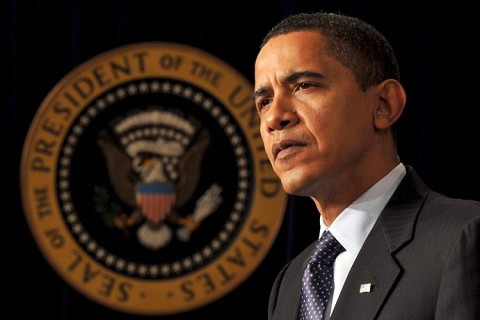
The State of the Union message will give President Barack Obama an opportunity to redirect the nation’s political discourse. He should focus on job creation, propose tougher regulations on the financial sector, and suggest means of cutting costs and raising needed revenue.

Creating jobs

A jobs package should center on New Deal-style work relief projects and tax incentives for small businesses to hire more people.

Tax incentives should be created to reward small businesses for creating new jobs. They could be partly based upon total increases in payroll so that firms would not be rewarded for firing one person and hiring someone else.

Credit has dried up for small business. The banks are unlikely to do much to remedy this situation. Many must amass cash to cover bad assets, and others are more interested in investing in other banks or in complex financial instruments . The administration must find ways to recycle recovered TARP money into Small Business Administration loans. SBA procedures must be streamlined, and it might be necessary to find ways for the SBA to make the loans directly.

Work relief projects could resemble the New Deal’s Civilian Conservation Corps and National Youth Administration projects. Some could work through states and municipalities as did the more recent CETA operations.

Manufacturing employment preservation

This is the time to propose repealing legislation that held out incentives to export jobs. Such legislation has been on the books since the post-World War II years when we were trying to fight communism by building up economies abroad. The last serious effort to repeal this legislation was the Hartke Bill, which Gerald Ford vetoed shortly after becoming president.

Raising funds

Obama’s coming State of the Union address will disappoint many if he does not deal with obscene bonuses in the financial community. For one thing, they soak up funds that will be needed to keep lending and absorb losses. The president should propose legislation taxing bonuses at a higher level. Present tax law treats bonus income the same way capital gains are handled. At the very least, that provision should be repealed so that these people no longer get that very low tax rate. Even better would be to tax the bonuses at a 50% rate.

So far, it appears that the administration is thinking about applying the Medicare payroll tax to investment income. That is a good idea as long as it does not penalize ordinary retirees living off their investments. Perhaps the tax should kick in at the $60,000 level.

Another means of raising funds to reduce the deficit is to levy excess profits taxes on all sectors of the health care industry, including health insurance providers. Excess profits taxes should also be enacted for the petroleum and natural gas industries.

German Finance Minister Peer Steinbruck has proposed a global financial transaction tax of .05 % ( half a percent) that would be applied by all the G20 countries. It should be applied whether or not the transactions occur on recognized exchanges. Some have estimated that it would raise for the Treasury over $600 billion annually. This would include derivatives.

It is unlikely that all 20 nations will agree to it. The Obama Administration seems to prefer a fee on the liabilities of banks and investment companies. It should apply across the board to institutions that took TARP money and those that did not. The president says this should only cover losses from the TARP program. The tax would discourage excessive leveraging in the future. He should consider making the fee permanent.

Moreover, we need to recover more of that money lost through the TARP program. The collapse of the financial system triggered a deep recession, which made necessary a large stimulus package. In addition, bank bailouts since 1980 have cost about $14 trillion in obligations undertaken by the Fed and Treasury. It is high time we begin to recover some of that money.

Obama should make it clear that he will not accept an extension of the Bush tax cuts, which run out this year. He should call for reenactment of an inheritance tax with large carve-outs for family farms and small, family owned businesses.

Fixing Medicare

By all accounts Medicare is fast approaching collapse. One reason is that we lose about $60 billion in fraudulent claims every year. Another reason is that Medicare Advantage, essentially a subsidy to the health insurance industry, is too great a burden.

The president should propose legislation allowing Medicare providers to negotiate for drug prices and establish a formulary with approved medicines. Since this legislation involves the spending of federal funds, it should go through the Senate via the budget reconciliation process to avoid a filibuster.

A great deal more must be invested in hiring people and creating mechanisms to detect Medicare fraud.

If health care reform does not pass, the president should pledge to use administrative means to reduce losses through Medicare Advantage. The current health reform plans have provisions to gradually trim Medicare Advantage.

Even if health care reform somehow passes, it will be in a form that does too little to control costs. Obama should propose legislation that will do more to control medical expenses that are ultimately funded by the federal government. This should include repealing the exemptions from anti-trust legislation now enjoyed by the medical insurance and medical liability insurance industries.

Financial system reform

Senator Dick Durbin said that the banks own Congress, but there is now enough public anger at the banks to enable Congress to pass some reforms.

At the very least, banks that are federally insured or hold our savings should not be permitted to export our money or use it for speculation in stocks, complex financial instruments, and hedge funds. President Obama should reverse his position on creating a Financial Consumer Services Protection Agency, even though Congress might lack the spine to follow his lead.

No doubt Obama will endorse financial regulatory legislation now going through Congress. As the economy improves, there will be more pressure to derail it. He needs to press for rapid passage. Above all, it must include provisions for rapidly placing commercial and investment banks into federal receivership when they face failure. Reregulation should include a ban on ordinary commercial banks gambling with our savings. Much of Glass-Steagall should be restored.

President Obama must urge the independent regulatory agencies to be more vigilant and vigorous in enforcing existing regulatory legislation. He should promise that the Justice Department will focus upon finding and prosecuting those who are guilty of fraud

We must begin to regulate derivatives trading. They should be handled in an open market and there should be no “dark market” where some are traded out of sight, and no entities should be allowed to continue dealing with them in unregulated over the counter trades. The legislation now going through Congress has too many loopholes and invites more abuses and future crashes.

The President’s allies in Congress should begin investigating why Goldman Sachs received 100% compensation for its exposure while AIG had to liquidate many assets under the worst possible circumstances.

Political implications

These steps represent good beginnings for reregulating the financial sector, containing medical care costs, bringing in more revenue, and creating jobs. They will not completely stem the perfect political storm that was building all last year and became obvious to all with the recent election of Senator Scott Brown in the Bay State.

The reregulation of banks will give the GOP still another advantage — full campaign war chests for the coming by-elections.

Progressives need to appeal to economic populism while beginning the slow and difficult process of explaining to voters how our economy and financial system became so fragile. This is a long-term process, and they need to learn a great deal about message management and cognitive science. Republicans are light years ahead in these areas, and their task is so much easier because their success rests on playing to impatience — and to the independents with their disinclination to examine anything closely.

The November elections will not be a happy time for Democrats, but they face great long term challenges. The GOP could produce a favorable political realignment by 1) continuing to reenergize its base, 2) continuing to promote what sociologists call a crisis of legitimacy, and 3) continuing to insist that our economic woes are the result of Democratic policy. If you insist on anything long enough, people will believe it.

Continual obstructionism has created the impression that government cannot produce desired results, and a legitimacy crisis usually hurts those in power. A long-term realignment is possible because, at some level, voters are beginning to realize that the long term prospects for the middle class are not good. When that finally sinks in, someone will pay the price.

[Sherman DeBrosse is a retired history teacher and a regular contributor to The Rag Blog.]

The Rag Blog

Posted in RagBlog | Tagged , , , , , , | 1 Comment

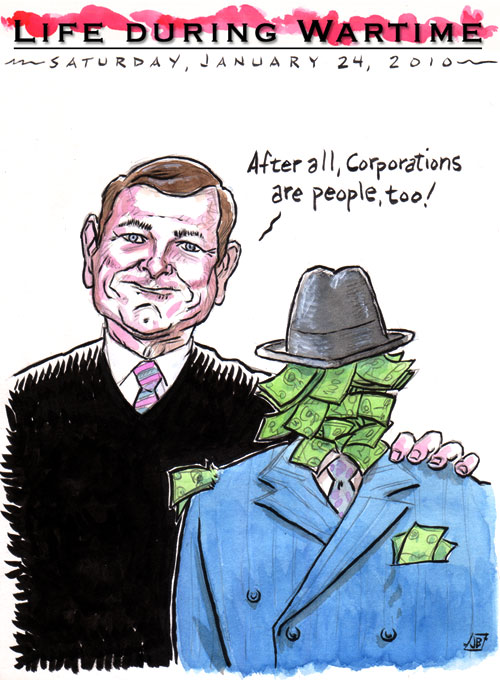
Life During Wartime : Corporations Are People Too!

Political cartoon by Joshua Brown / Historians Against the War / The Rag Blog

Thanks to Dr. S.R. Keister /The Rag Blog

Posted in Rag Bloggers | Tagged , , , , , | Leave a comment

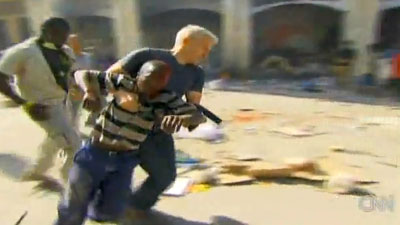
Robert Jensen : How the Media Has Failed Us on Haiti

CNN’s Anderson Cooper helps child hurt in rare incidence of violence in aftermath of Haitian earthquake.

Great television/bad journalism:
Media failures in Haiti coverage

By Robert Jensen / The Rag Blog / January 25, 2010

CNN’s star anchor Anderson Cooper narrates a chaotic street scene in Port-au-Prince. A boy is struck in the head by a rock thrown by a looter from a roof. Cooper helps him to the side of the road, and then realizes the boy is disoriented and unable to get away. Laying down his digital camera (but still being filmed by another CNN camera), Cooper picks up the boy and lifts him over a barricade to safety, we hope.

“We don’t know what happened to that little boy,” Cooper says in his report. “All we know now is, there’s blood in the streets.” (View video below or go here.)

This is great television, but it’s not great journalism. In fact, it’s irresponsible journalism.

Cooper goes on to point out there is no widespread looting in the city and that the violence in the scene that viewers have just witnessed appears to be idiosyncratic. The obvious question: If it’s not representative of what’s happening, why did CNN put it on the air? Given that Haitians generally have been organizing themselves into neighborhood committees to take care of each other in the absence a functioning central government, isn’t that violent scene an isolated incident that distorts the larger reality?

Cooper tries to rescue the piece by pointing out that while such violence is not common, if it were to become common, well, that would be bad — “it is a fear of what might come.” But people are more likely to remember the dramatic images than his fumbling attempt to put the images in context.

Unfortunately, CNN and Cooper’s combination of great TV and bad journalism are not idiosyncratic; television news routinely falls into the trap of emphasizing visually compelling and dramatic stories at the expense of important information that is crucial but more complex.

The absence of crucial historical and political context describes the print coverage as well; the facts, analysis, and opinion that U.S. citizens need to understand these events are rarely provided. For example, in the past week we’ve heard journalists repeat endlessly the observation that Haiti is the poorest country in the Western Hemisphere. Did it ever occur to editors to assign reporters to ask why?

The immediate suffering in Haiti is the result of a natural disaster, but that suffering is compounded by political disasters of the past two centuries, and considerable responsibility for those disasters lies not only with Haitian elites but also with U.S. policymakers.

Journalists have noted that a slave revolt led to the founding of an independent Haiti in 1804 and have made passing reference to how France’s subsequent demand for “reparations” (to compensate the French for their lost property, the slaves) crippled Haiti economically for more than a century.

Some journalists have even pointed out that while it was a slave society, the United States backed France in that cruel policy and didn’t recognize Haitian independence until the Civil War. Occasional references also have been made to the 1915 U.S. invasion under the “liberal” Woodrow Wilson and an occupation that lasted until 1934, and to the support the U.S. government gave to the two brutal Duvalier dictatorships (the infamous “Papa Doc” and “Baby Doc”) that ravaged the country from 1957-86.

But there’s little discussion of how the problems of contemporary Haiti can be traced to those policies.

Even more glaring is the absence of discussion of more recent Haiti-U.S. relations, especially U.S. support for the two coups (1991 and 2004) against a democratically elected president. Jean-Bertrand Aristide won a stunning victory in 1990 by articulating the aspirations of Haiti’s poorest citizens, and his populist economic program irritated both Haitian elites and U.S. policy-makers.

The first Bush administration nominally condemned the 1991 military coup but gave tacit support to the generals. President Clinton eventually helped Artistide return to power in Haiti in 1994, but not until the Haitian leader had been forced to capitulate to business-friendly economic policies demanded by the United States. When Aristide won another election in 2000 and continued to advocate for ordinary Haitians, the second Bush administration blocked crucial loans to his government and supported the violent reactionary forces attacking Aristide’s party.

The sad conclusion to that policy came in 2004, when the U.S. military effectively kidnapped Aristide and flew him out of the country. Aristide today lives in South Africa, blocked by the United States from returning to his country, where he still has many supporters and could help with relief efforts.

How many people watching Cooper’s mass-mediated heroism on CNN know that U.S. policy makers have actively undermined Haitian democracy and opposed that country’s most successful grassroots political movement? During the first days of coverage of the earthquake, it’s understandable that news organizations focused on the immediate crisis. But more than a week later, what excuse do journalists have?

Shouldn’t TV pundits demand that the United States accept responsibility for our contribution to this state of affairs? As politicians express concern about Haitian poverty and bemoan the lack of a competent Haitian government to mobilize during the disaster, shouldn’t journalists ask why they have not supported the Haitian people in the past? When Bill Clinton and George W. Bush are appointed to head up the humanitarian effort, should not journalists ask the obvious, if impolite, questions about those former presidents’ contributions to Haitian suffering?

When mainstream journalists dare to mention this political history, they tend to scrub clean the uglier aspects of U.S. policy, absolving U.S. policymakers of responsibility in “the star-crossed relationship” between the two nations, as a Washington Post reporter put it.

When news reporters explain away Haiti’s problems as a result of some kind of intrinsic “political dysfunction,” as the Post reporter termed it, then readers are more likely to accept the overtly reactionary arguments of op/ed writers who blame Haiti’s problems of its “poverty culture” (Jonah Goldberg, Los Angeles Times) or “progress-resistant cultural influences” rooted in voodoo (David Brooks, New York Times).

One can learn more by monitoring the independent media in the United States (“Democracy Now!,” for example, has done extensive reporting, ) or reading the foreign press (such as this political analysis by Peter Hallward in the British daily The Guardian). When will journalists in the U.S. corporate commercial media provide the same kind of honest accounting?

The news media, of course, have a right to make their own choices about what to cover. But we citizens have a right to expect more.

[Robert Jensen is a journalism professor at the University of Texas at Austin and board member of the Third Coast Activist Resource Center. His latest book is All My Bones Shake: Seeking a Progressive Path to the Prophetic Voice (Soft Skull Press, 2009). Jensen can be reached at rjensen@uts.cc.utexas.edu and his articles can be found online at Source and on The Rag Blog.]

The Rag Blog

Posted in Rag Bloggers | Tagged , , , , , , , , | 1 Comment

Marc Estrin : The Revolutionary Messages of Classical Music

Johannes Brahms by Lucian Tidorescu.

Protest music:
Radical themes of the great composers

The Brahms Requiem is also movement music, unbearably beautiful, revealingly deep — like our afflicted lives.

By Marc Estrin / The Rag Blog / January 25, 2010

In a recent article titled “Movement Music,” the invaluable David Swanson sings a hymn of praise for the equally invaluable David Rovics. Movement music, yes.

Back in 2003, The Nation devoted an entire issue to “The Power of Music” of the “protest music industry.” And here in Vermont we have come up with Free Vermont Radio, a digital online music provider featuring an entire library of Vermont musicians, many of whom write and perform “movement music.”

It’s odd: nowhere in any of the above is there a mention of a thousand years of western classical music.

Why is lefty life — so highly educated, morally aware, philosophically sophisticated, politically savvy — why are we so blind, so deaf, to the radical expression and revolutionary messages therein?

I don’t get it. In “classical” music — from the tenth through the twentieth century — we have inherited a cornucopia of profundities, prompting and announcing social change at every step along the way, educating human consciousness towards ever-greater complexity of perception and thought, coaxing out our emotional and spiritual depths.

The great composers have always demanded from us, and developed in us, precisely those sensibilities we need to confront the hughest issues we face — structure, otherness, variation, modulation, time, change, form, dissipation… love.

I think of the room in which the “Eroica” was first performed — its aristocratic, gold-leafed curlicues, its elaborately carved chairs. I think of Beethoven’s assessment of the “princely rabble” that would seat their asses on those chairs, and the shattering indictment with which he would assault them in the name of freedom. “Seid umschlungen, Millionen,” he intoned in the Ninth Symphony, masses embracing in the kiss of the entire world. Tell it to Cheney and Obama, CENTCOM and the IMF.

Bach’s intensity and structural investigations, Brahms’s sexuality unlimited, Mahler’s catalogue of hetero-interactions, Wagner’s engorging instability, Bartok’s mesto dance, Stravinsky’s primordial landscapes, Berg’s evocation of interstitial states — one could go on and on, and in and in. Are all these irrelevant to the left, and to our goals of head and heart?

Let’s talk about the means of production. Though there are surely classical stars and consumers, by far the greatest number of sounds are made by amateurs at choral or orchestral or chamber music rehearsals and performances, or playing at home — a democratic, participatory picture of growth, education, and community, growing since the eighteenth century.

Yes, David Rovics and the singer-songwriters of the protest industry speak strongly to us and our times. But they are not the only music relevant to the left. We need to recover the largesse of our musical heritage.

Recently, after only a few days of organizing, 200 musicians, along with the Bread and Puppet Theater, came quickly together for a concert of the Brahms Requiem — to raise funds for Haiti relief. Over $10,000 dollars was collected from an audience of 700.

The Brahms Requiem is also movement music, unbearably beautiful, revealingly deep — like our afflicted lives.

[Marc Estrin is a writer and activist, living in Burlington, Vermont. His novels, Insect Dreams, The Half Life of Gregor Samsa, The Education of Arnold Hitler, Golem Song, and The Lamentations of Julius Marantz have won critical acclaim. His memoir, Rehearsing With Gods: Photographs and Essays on the Bread & Puppet Theater (with Ron Simon, photographer) won a 2004 theater book of the year award. He is currently working on a novel about the dead Tchaikovsky.]

The Rag Blog

Posted in Rag Bloggers | Tagged , , , | 2 Comments

San Francisco’s Castro District : How Does Your Garden Grow?

Bill Murphy oversees the care and maintenance of Corwin Street Community Garden in San Francisco’s Castro District. Photo from Hedonia.

Tending our garden:
The politics of planting (and sharing)
:

By Allen Young / The Rag Blog / January 24, 2010

See ‘Fruits of our labor: San Francisco’s Corwin Street Community Garden,’ by Sean Timberlake, Below.

The following article by San Francisco blogger Sean Timberlake is, in part, about my longtime friend Bill Murphy, who can express rage as well as anyone I know about imperialism, militarism, the exploitation of workers, homophobia, and any other form of injustice.

While this article is not about any of those issues, it is, to me, a highly political article, and my desire to share it with you is equally political.

This act of sharing (with the understanding and support of Rag Blog editor Thorne Dreyer, with whom I worked at Liberation News Service in the 1960s) reflects an often forgotten value — that of appreciating our friends and expressing pride in their accomplishments.

Bill Murphy’s work as volunteer coordinator of a community garden, and the blogger’s depiction of his own appreciation of this garden, is the focus of the article. The politics, as I see it, involves shedding positive light on concepts such as cooperation, manual labor, community, neighborhood activism, local history, government support for local initiatives, aesthetics, resource protection, sustainability, environmental awareness, land protection and stewardship, and more.

The writer weaves all of this together in a simple description of a community garden, telling a story that was personally heartwarming to me because of my friendship with Bill (whose picture you can see here on The Rag Blog), but which other readers should also be able to enjoy.

Corwin Garden: planting an urban orchard. Photo from Hedonia.

Fruits of our labor:
San Francisco’s Corwin Street Community Garden

By Sean Timberlake / January 18, 2010

SAN FRANCISCO — Sometimes, you just have to get your hands dirty.

For me, that mostly means finding strata of food under my nails after a sweaty day in the kitchen. But on a chilly morning in December, my hands got dirty with real, actual, honest-to-god dirt. As in, from the earth.

Me and dirt are like oil and water. Gardening is not something I have an innate passion for, but there is one garden I have a soft spot for. Tucked between modern apartment buildings on a dead-end street on the slopes of Eureka Valley in San Francisco, the Corwin Street Community Garden is more than a patch of pretty flowers.

As a tour guide in the neighborhood, I often drag my more ambitious groups up the steep incline to the garden and to the Seward Mini-park below. Here, deep in the residential tracts and close to the geographic heart of the city, they offer surprising morsels of our city’s history.

The garden and park combined fill a narrow strip of land that spans between Corwin and Seward Streets. After a house that occupied the Seward Street plot fell off its foundation and slid into the street below in the 1950s, the land lay vacant for nearly a decade. Plans were laid for a 105-unit apartment building to be erected on the land, spurring neighbors to take the issue of preserving open space up with City Hall. Years of hearings ensued.

In 1966, on the day the contractors arrived to begin construction, the neighbors staged a sit-in, and the developers backed down. Ultimately, these actions led to legislation that set standards for a minimum amount of open space in the city.

For the lower portion of the plot, a contest was held to design a “mini-park” in 1973. The winning design, by 14-year-old Kim Clark, featured a pair of curved concrete slides. These slides never fail to bring out the inner child in everyone. I’ve had walkers of all ages toboggan down on flattened cardboard boxes. If the slides are dry enough, and you recline as if in a luge, you can even catch some air on the way down. It’s exhilarating.

Seward Street Slide. Photo from dogwelder / Flickr.

The park also features a bas relief by local artist Ruth Asawa, whose work can be seen in the lower level of the observation tower at the de Young Museum.

Despite the modern buildings on all sides, pieces of San Francisco’s deeper history lay all around. According to a local neighbor, just steps away on Seward Street, marble steps connecting the walkway and the street are in fact blocks from the original city hall, destroyed in the 1906 earthquake. There’s an adjacent retaining wall of red bricks salvaged from former mayor “Sunny” Jim Rolph’s house.

Acme Alley, the cobblestone passage that runs uphill alongside the park, is a vestige of the cow paths forged from the area’s days as pastureland in the 1800s. At the top, where it intersects Corwin Street, is the garden.

San Francisco has a rich tradition of community gardens, which by and large offer grave-sized plots of land for locals to indulge their gardening habits in an otherwise urban environment. The Corwin Street garden is different. Here, the “habitat garden” is dedicated to showcasing indigenous and drought-tolerant plants, installed in such a way as to be sustainable with San Francisco’s existing rain patterns, and to avoid the use of chemical fertilizers or pesticides.

Unlike other community gardens, the Corwin garden requires a more singularly coordinated effort to maintain. Bill Murphy, pictured above, oversees the care and maintenance of the garden. Once yearly, on the first Saturday of December, he organizes a work day to bring the garden back into shape.

Having schlepped perhaps hundreds of strangers by and through the garden, this was my opportunity to give back, at least a little. As part of a work force of some 30 volunteers, I helped plant iris and artemisia, lay mulch and remove rotten logs to make way for new walkway borders.

This year marked a sea change to the garden. The habitat garden would now be supplemented by an “urban orchard” of citrus trees. Future plans include a fence of fruit trees and berries, and raised beds of herb gardens. The orchard should be complete within the year, and Bill is working out a plan to distribute the product of the garden to contributors and community members.

I’ve often enjoyed the garden as a place of reflection and nourishment for the soul. On balmy spring days, it’s a delight to see the butterflies and hummingbirds flit through to feed on the bounty of blossoms. It enthralls me to think that the garden will now become a source of more literal sustenance for the community.

I can’t help but wonder: What if we were to treat more of our open spaces in cities this way? What if neighbors came together more often to nurture their communities? What if the fruits of their labors could feed the hungry in their own back yards? How can we better tend our gardens?

Source / Hedonia

The Rag Blog

Posted in Rag Bloggers | Tagged , , , , , | 1 Comment

BOOKS / Mike Roselle and Jeffrey St. Clair : Two From the Green Hard Core


Mike Roselle and Jeffrey St. Clair:
Green activism from the front lines

By Harvey Wasserman / The Rag Blog / January 24, 2010

[Tree Spiker: From Earth First! to Lowbagging: My Struggles in Radical Environmental Action by Mike Roselle. Published by St. Martin’s Press, Sept. 29, 2009; hardcover; 272 pp. Born Under a Bad Sky: Notes from the Dark Side of the Earth by Jeffrey St. Clair. Published by CounterPunch/AK Press, Dec. 1, 2007; trade paperback, 460 pp.]

On rare and welcome occasion we meet uncompromised green activists and writers completely focused on winning, and utterly void of bullshit.

Two such specimens are Mike Roselle and Jeffrey St. Clair. Not surprisingly, their recent books are pleasures to behold.

My long-time Greenpeace co-conspirator, Roselle is a “legend in his own crime” who exceeds his advance billing and then some. His Tree Spiker (St. Martin’s Press) tells of a hard-scrabble Louisville childhood well-suited to the gritty green activism required to save forests and stop nukes. From a race along the edge of juvenile delinquency to some of the funniest jail tales you’ll ever read, Roselle constantly amuses and inspires.

From the wrong side of the logging camps to the tops of tripods meant to save those very trees, Roselle sings a song of guts and glory without pomp or guile. Like all good organizers, Mike knows Rule One is “never be boring.” Then there’s the one about knowing you can win — and doing it.

Tree Spiker is a quick, riveting read with all the self-effacing warmth and humor one would expect from a guy who co-founded Earth First! and felt honored by being thrown out of it.

With co-writer Josh Mahan he welcomes you into the world of a pretty big dude known to share (many) beers with various nefarious roughnecks and ideologues while totally outsmarting them all when it comes time to cut the crap and win the victory.

Push really comes to shove at one point when Roselle confronts the vanguard of the Earth First! organization he helped form to establish a Cove/Mallard Coalition aimed at saving some of the most pristine and least known forest stands in the lower 48. “No matter how much we advocated stopping the road” that would kill the region, he complained, “no one would arrest us.”

Camped with little cover or support in the violent wilds of right wing Idaho, Roselle and his hardy cohorts hang on for dear life — the forest’s, and their own. Against all odds, as months of brutal campaigning turn to years, “the chain saws and bulldozers have been silenced in Cove/Mallard, and you can once again hear the howl of a wolf float through the stillness of the night.”

Typically, for Roselle, the lessons of the Cove/Mallard campaign were “opposite of what one might think.” In this remote Idaho backwater, “we weren’t even allowed into local stores or restaurants. Media coverage, with the exception of the alternative press, was universally negative. No foundation would give us funding. No self-respecting environmental group would join our coalition. Yet through tenacity, audacity, and a strong belief that, win or lose, we were all doing the right thing, we outlasted them.”

Mike is now based in the West Virginia boonies, focused on stopping mountaintop removal. He’s the quintessential grassroots activist. When you read Tree Spiker you’ll realize that amidst the horrible devastation being wrecked on these mountains by King Coal, sooner or later, the momentum must turn toward Mother Earth.

And as soon as that happens, Mike will be inundated with requests to spearhead some other campaign, which he will undoubtedly get going, then get booted from, then rally to victory against ridiculous odds, many of them self-imposed by the circular green firing squad which loves to put the hard-core, uncompromised organizers like him in the middle.

My advice, if you still have legs and really want to help save the Earth, would be to read Tree Spiker, then track Mike down in the bar of the town where he’s organizing [roselle@lowbagger.org, Climate Ground Zero , PO Box 166, Rock Creek, West Virginia 25174; (304) 854-7372]. Stand there till he tells you all the stories you can handle. You’ll emerge with the ultimate green education. With consummate charm, Mike will then — before you know what’s happening — put you to righteous use. Together, you will win… as will we all.

Likewise the writings of Jeffrey St. Clair [sitka@comcast.net]. Raised in a rural Indiana now buried under lethal sprawl, he bemoans the fact that “my grandfather’s farm is now a shopping mall. The black soil, milled to such fine fertility by the Wisconsin glaciations, now buried under a black sea of asphalt.”


Anthologized most recently in his Born Under a Bad Sky (CounterPunch/AK Press), St. Clair writes with the incisive precision and wit of a gifted green surgeon going straight for the corporate jugular. Like Peter Mattheissen and very few others, his ability to describe nature in its virginal glory can be deeply compelling. “Destruction of the wild sparks militancy in the heart,” he writes. “Wild places communicate their own passion and power, sensations that are the antithesis of political abstractions.”

Like Roselle, St. Clair’s faith lies in the grassroots, Mother Earth’s army of last resort. “The power of the people can still overwhelm the influence of big money,” he proclaims. “Anything is possible. Find your place, take a stand. People will join you.”

An editor of the uncompromised, infamously acerbic CounterPunch website, St. Clair is at his bitter best bursting the bubbles of greenwashed hypocrites. Senator John Kerry and his fellow Democrats “never aligned themselves in opposition to the interest of the oil cartels,” he writes. “Far from it. In Clintontime, oil industry lobbyists flowed through the White House as easily as crude through the Alaskan pipeline, leaving behind campaign loot and wish lists.”

St. Clair is unique among environmental writers in the scope of what he covers. His superbly informed reportage spans the horizon from forests and water to energy and the chemical industry. He is meticulous, careful and credible. He cuts to the core with gusto and glee, especially when skewering those who most deserve it.

Among much else, St. Clair was one of the very few to grasp the complicity of “Gang Green” mainstream environmental groups in perpetrating the $100 billion scam of utility deregulation, beginning with Ralph Cavanagh of the Natural Resources Defense Council.

With Enron poised to rape and pillage California rate payers, Cavanagh sang Ken Lay’s praises. “With a warble in his throat,” St. Clair reports, “Cavanagh moved into rhetorical high gear” for a panel of state regulators contemplating deregulation.

“Can you trust Enron?” Cavanagh asked. “On stewardship issues and public benefit issues I’ve dealt with this company for a decade, often in the most contentious circumstances, and the answer is, yes.”

Not until George W. Bush would praise those who held New Orleans’s head underwater would such hype be heaped on those who did so much harm. As St. Clair shows, NRDC Founder John Bryson, perched atop southern California’s largest utility, scammed billions from ratepayers to prop up defective nuclear plants, siphoning countless public dollars away from decentralized green energy projects while painting himself as a vanguard environmentalist.

Taken together, Roselle and St. Clair are as good as it gets for a green one-two punch. Tree Spiker Mike takes you into the boondock byroads of some of the toughest forest fights our emerging green nation has won. In his articles at CounterPunch and Born Under a Bad Sky, Jeff cuts to the core of who is bought and who is not.

Both these amazing guys have produced books that are great to read and utterly void of filler or fluff. Imbibe them each. Then go kick some corporate butt. Mother Earth will love you for it.

[Harvey Wasserman’s Solartopia! Our Green-Powered Earth is at www.harveywasserman.com , as is Passions of the Pot Smoking Patriots by “Thomas Paine.” He has been reading Jeffrey St. Clair’s articles for years, and has known Mike Roselle even longer.]

Find:

The Rag Blog

Posted in Rag Bloggers | Tagged , , , , , , , | Leave a comment

Roger Baker : Is America Already a Failed State?


Is America already a failed state?
No public trust for a dysfunctional system

The main obstacle to progress is a corporate dominated political system that resists favoring broad long range public benefits over the short term profits of the few.

By Roger Baker / The Rag Blog / January 23, 2010

It is getting harder to argue that America is not already a failed state. One important reason is the fact that the public, to an alarming degree, doesn’t trust the government anymore. When the public is suffering economically and stops trusting their government to bring relief, nothing the government does is likely to bring much contentment. This is especially true where it is unlikely that the underlying problems causing the pain will get much better soon.

Broadly speaking, top political leaders including Obama and Congress are not being very honest about the poor prospects for economic recovery. The resulting political backlash is a big part of the explanation for the Democratic Party defeat in the Massachusetts senate election. Governmental distrust is now widespread, as Adam Nagourney acknowledges in The New York Times.

Public anger has elevated job creation toward the top of the political agenda. In contrast to their own economic plight, people see the bank bailouts and giant banking bonuses and naturally blame greedy unregulated banks for their economic misery. And not without good cause. In reality, however, the crisis required active cooperation between Wall Street and the politicians who ultimately regulate banking behavior, whereas the politicians involved are inclined, by nature of their job, to hide their own role.

The U.S. political system is already deeply dysfunctional, and is effectively under the bipartisan control of corporate money, a kind of domination just reinforced by the Supreme Court in its decision on corporate campaign financing. This money control normally prevents most Democrats from moving to the left.

The lobbies of greed rule America. The White House, Congress, even the federal judiciary are impotent in the face of capitalist greed. The recent Supreme Court decision permitting corporations to use shareholders’ money in corporate treasuries to influence elections increases the control that corporations have over the outcome of elections and the decisions of the government of the United States.

There is no government of the people, for the people, by the people, only the rule of private interests.

As a consequence of widespread grassroots economic pain, an irresistible political pressure is building that demands change. Here Robert Reich describes the new political dynamics behind the sudden trend for all politicians, but especially the Democrats, to blame banks. Banks make great political targets, and this explains why Obama is finally getting tough on Wall Street:

But suddenly the winds are blowing in a different direction over the Potomac. The 2010 midterms are getting closer, and the Dems are scared. Their polls are plummeting. The upsurge in mad-as-hell populism requires that Democrats become indignant on behalf of Americans, and indignation is meaningless without a target. They can’t target big government because Republicans do that one better, especially when they’re out of power. So what’s the alternative? Wall Street.

If the root problem is based on private corporate control of the whole government, it follows that trying to manage the behavior of bankers with tough-sounding rules imposed by such a government is not likely to lead to a recovery. Not until there are rules that force the banks and private money to invest in ways that they currently see as unprofitable.

The basic reason the economy can’t recover is that for it to recover there have to be new domestic jobs created by the too-big-to-fail investment banks that can get low interest loans from the Federal Reserve. But the banks, not without reason, think that American consumers lack a bright future. Since most states are broke, that leaves the federal government as the jobs creator of last resort. The Treasury is broke in a sense, but it has an unlimited ability to create more money in cooperation with the Federal Reserve. Here is a good explanation from a widely followed, independent energy economics analyst, Tom Whipple:

To support the policy of keeping federal interest rates close to zero, the U.S. Federal Reserve also has been buying up billions dollars worth of new treasury securities. Thanks to the $1 trillion plus deficit the U.S. is now running, Treasury securities are being issued in quantities that have never been seen before and as government revenues continue to plunge are likely to be issued in ever greater quantities.

Amidst the chaos of rising unemployment, spiraling foreclosures, collapsing real estate prices, amazingly enough, the U.S. equity markets have been rising steadily. Some astute observers are beginning to question just what it going on. How can tens of billions of U.S. Treasury securities be auctioned off at such low interest rates each week while many traditional foreign buyers, like China, are backing away from purchasing more U.S. debt as fast as they can without crashing the value of their holdings? How can sensible investors be buying so much stock that prices continue to rise steadily at a time when real unemployment likely is above 20 percent and the prospects for earnings growth by U.S. companies is as bad as it has been in the last 80 years?

The answer, of course is that they probably can’t, and this is why suspicions about just what is going on are starting to be raised. Close examination of available data suggests to some that traditional buyers of U.S. stocks such as retail investors, hedge and mutual funds and foreigners simply aren’t there on a scale needed to support nine months of some of the fastest growth the equity markets have ever seen.

There are suspicions about the Treasury’s auctions too which are consistently oversubscribed with buyers clamoring to buy massive quantities of debt. Obviously there is only one place that all these billions can be coming from and that is the US Federal Reserve which has the capability of creating unlimited amounts of money simply by typing on a computer — you don’t even have to bother to print money anymore.

The theory of what is going on is simple — the Federal Reserve creates a trillion or so dollars and sends lots of it to the big investment banks, called primary dealers, in return for stacks of nearly worthless mortgages the banks collected during the recent housing boom. In return for letting them unload nearly a trillion dollars of worthless securities on the taxpayer, the banks oblige the government by using many of those billions to buy Treasury securities from the government at close to zero interest and to buy enough stocks to keep the market steadily rising.
Everybody is happy. The great depression has been halted in its tracks, the stock market is soaring, signaling to the unwary that all is well, and Wall Street’s multi-million dollar salaries and bonuses are preserved for yet another year.

The question of the year is how long this federal effort can continue. The controlling factor will be interest rates and the length of time the government can keep interest rates close to zero as it issues trillions in new and refinanced securities. A few interest points higher and housing becomes unaffordable given the strictures on lending. A few more and the U.S. debt becomes unaffordable.

The dollar is no doubt overvalued, given the fact that the government, with the help of the private Federal Reserve, is creating so many of them, and so suddenly. It is only when spending picks up that people can discover that there are a lot more dollars than there are things to buy with them. Because of the political pressure generated by the current depression level unemployment, the government has little choice but to borrow and spend enough to try to calm the situation, and try to cause the dollar’s loss in buying power to happen gradually. For political reasons, Obama is afraid to acknowledge this reality.

What does dollar devaluation imply? Arguably, this is a prescription for stagflation as the domestic economy stagnates at the same time as the dollar depreciates in buying power, meaning commodity price inflation. It means soaring fuel and food prices for U.S. consumers before long, since these items are often freely traded global commodities, with prices set by global buyers beyond U.S. governmental control. Many economists spanning the political spectrum now see the current situation as being unsustainable.

In the following piece, David Goldman comes to many of the same conclusions, and now regards the U.S. as an ungovernable failed state. Writing under the pen name Spengler. Goldman is smart Wall street ex-banker, with a good understanding of politics. It is vital to understand politics in order to be a very good economist, or at least to understand the big picture very well.

Is America a failed state?
[….]
During December, more than 600,000 workers disappeared from the official count of the American labor force, erasing the illusion that the employment situation would recover. But the voters knew that before the economists. The most reliable index of economic sentiment is the president’s deteriorating approval rating. For a by-the-numbers explanation of why the U.S. economy will not recover, see my October 6, 2009, essay, “Obama’s permanent depression.”

America is the world’s most successful state, and the one with the greatest longevity in its present constitutional form. But neither of the major parties is presently capable of governing it. The Republicans have been hoping that rage against Obama’s failed economic policies would carry the party through the November congressional elections. But it is entirely conceivable that the Obama presidency will implode as quickly as the Obama campaign metastasized during the 2008 primaries, and that the electorate will call the Republicans’ bluff.

Americans understood well enough in early 2008 that the traditional leadership of both parties had led them into a dead-end. As I wrote in January 2008 (“Obama bin lottery”) after Obama’s surprise landslide in the South Carolina Democratic primary:

People of modest means do not understand the stock market, but they are sly: they can read the panic in the eyes of their leaders. After assuring them for months that all was well, Washington last week offered an emergency interest rate cut for the first time since September 11, 2001, and an emergency economic package which will send a small check to every American family earning less than a certain
threshold. Both President George W. Bush and [Bill] Clinton proposed essentially the same program. If that is “managerial ability,” thought the voters of South Carolina, we might as well buy the lottery ticket.

Most of what Goldman says about the USA being a failed state and why seems to be on target, but the last part of his essay looks to the general public to subsidize the private sector as the price of a possible recovery.

We need to shift the tax burden, moving it away from savings and investment and toward consumption. We should replace individual and corporate income taxes with consumption-based taxes.” Americans need to be told that they will need to invest before they can consume, and that the cure will take years rather than months to take effect. It’s not a happy message, and no one in politics is willing to deliver it — if indeed anyone in politics understands it.

This amounts to saying we should change our national laws to reward investment and savings at the expense of public consumption. In effect Goldman says we need to revive the industrial engine by redistributing wealth away from consumption toward investment if we want to revive the economy. This is akin to saying that we need to gun the engine of our ship to save ourselves, but without steering it.

There are those of us who believe we will have to gun the engine and steer the ship if we want to save ourselves. Those who warn of energy problems, and to a degree the Obama administration, take the position that we need to immediately deal with our addiction to imported oil, largely through a revival of domestic investment in alternative energy. All presidents since Carter have advocated much the same thing, but without delivering.

Wise minds see that we are rapidly headed toward an energy disaster and need to steer around it. Here for example is Jeff Rubin, a Canadian banker, describing the situation.

If there is a way to avoid a wrenching energy and commodity crisis, someone in charge needs to create a targeted industrial policy, with rules that specifically reward investments in energy reform, rather than rewarding new investments in general.

The following is from “Why Obama’s Economic Plan Will Not Work–And a Better Plan” by Robert Freeman

If Obama wants to revive the American economy, he needs to adopt a much more aggressive program than has been contemplated to date. Specifically, he needs to address the chronic shortfall in workers’ incomes and the recent collapse of middle class wealth which are the root causes of the crash. The most effective way to do that is with a Manhattan Project-like program to reconfigure the way the nation uses energy.

This all amounts to saying we need a different kind of government with different kinds of rules to conserve and direct the remaining wealth of our nation. If there is a chance to revive the economy, we need new centralized rules and a coordinated industrial policy that will channel both public and private investments into areas that the private money lenders now consider unprofitable. The main obstacle to progress is a corporate dominated political system that resists favoring broad long range public benefits over the short term profits of the few.

[Roger Baker is a long time transportation-oriented environmental activist, an amateur energy-oriented economist, an amateur scientist and science writer, and a founding member of and an advisor to the Association for the Study of Peak Oil-USA. He is active in the Green Party and the ACLU, and is a director of the Save Our Springs Association and the Save Barton Creek Association. Mostly he enjoys being an irreverent policy wonk and writing irreverent wonkish articles for The Rag Blog.]

The Rag Blog

Posted in Rag Bloggers | Tagged , , , , , , | 11 Comments

Songbird Kate McGarrigle : Heart Like a Wheel

Kate McGarrigle. Photo from BeatCrave courtesy McGarrigles.com

Kate McGarrigle:
The fading art of singing together

“Some say the heart is just like a wheel, once you bend it, you just can’t mend it…”

By Carl R. Hultberg / The Rag Blog / January 23, 2010

See Video of Kate and Anna McGarrigle singing ‘Heart Like a Wheel,’ Below.

Growing up with music in the home is a lost tradition. Not kids with iPods at the dinner table, but whole families singing together. No one will ever know how much we have lost not singing in the home. We’re not singing weekly at church much either. Wouldn’t we get worried if the birds stopped singing? Maybe the canary in the coal mine is us.

One family that never had that problem was the Canadian McGarrigles. Living 50 miles north of Montreal, Frank liked the old parlor songs, Stephen Foster, the mid 19th century folk/pop tradition leading up to ragtime. “Oh Susannah,” “Jimmy Crack Corn,” “Old Black Joe.” Plantation music delivered by music publishers, eventually Tin Pan Alley in New York city. Frank’s wife Gaby played organ in the church and old French Canadian songs at home. And of course they all sang together at regular family gatherings.

As the 1960s ground down into the 1970s, the singer songwriter phenomenon was upon us. Folks like James Taylor (of the singing Taylor family), Joni Mitchell, Laura Nyro, Carole King and many others used elements of folk, rock, show music, soul to create “personal statements.” The me “decade(s)” were here and the narcissistic singer songwriters were either its most benign aspect or a just another part of the overall problem.

One of the artists whose singer songwriter contributions never veered far from the pure folk Americana roots yet who still managed to reach a large audience with her deep personal statements would have to be Kate McGarrigle, sister singer with Anna McGarrigle in the McGarrigle Sisters. Obviously the children of Frank and Gaby who lived north of Montreal. Their first release, “Kate and Anna McGarrigle” (1976) was a welcome breath of northern fresh air in a punk- and discoed-out dismal period for music. Over the decades more sweet music followed.

Kate’s soul searching compositions and the sisters’ warm yet ghostly harmonies brought back memories of the phenomenal Boswell Sisters from the early 1930s. The Boswells were a wonderful singing trio from New Orleans who mixed old folk harmonies with incredibly clever jazz scat arrangements, largely the creative work of arranger/lead singer Connie Boswell.

The Boswell Sisters.

Saying the McGarrigle Sisters were reminiscent of the Boswell Sisters is high praise indeed. There is an intuitive quality to true native sibling harmony that predates everything else humanity has ever come up with. Kate and Anna’s songs breathe with the life of sentiment and sincerity, like music from an age when those words had deep human meanings. Like Stephen Foster.

Success in the pop/folk world can be a mixed blessing. For Kate, marriage to ultra clever American singer songwriter Loudon Wainwright III ended in divorce after they produced two offspring. Mr. Wainwright must have thought he was being extremely clever when he released a song about his breast feeding son: “Rufus is a Tit Man.” Rufus Wainwright grew up to defy his dad on that score (as clever children often do), by becoming perhaps the premier U.S. gay singer hearthrob. Daughter Martha Wainwright has also courted scandal occasionally in her quest for fame as a singer. Many people may know Kate McGarrigle nowadays as the mom of her notorious kids, Rufus and Martha.

But of course, that’s just today’s news. Yesterday’s news is often far more interesting, and believe it or not, can also be much more relevant. The McGarrigle Sisters won’t be making any more new music together in this realm because this week Kate passed away at age 63. But one extremely persuasive theory has it that music is eternal. Certainly the music Kate McGarrigle tapped into with her sister was of that variety. Listen now and you’re sure to hear one of their sweet plaintive songs:

“Some say the heart is just like a wheel, once you bend it, you just can’t mend it…”

[Carl R. Hultberg’s grandfather, Rudi Blesh, was a noted jazz critic and music historian, and Carl was raised in that tradition. After spending many years as a music archivist and social activist in New York’s Greenwich Village, he now lives in an old abandoned foundry in Danbury, New Hampshire, where he runs the Ragtime Society.]


Kate and Anna McGarrigle: Heart Like a Wheel

The Rag Blog

Posted in Rag Bloggers | Tagged , , , , , , , , , , | 1 Comment

Health Care and Campaign Finance : The Corporate Stranglehold

“A Jail for Uncle Sam,” By Arcadio Esquivel / Cagle Cartoons / La Prensa, Panama.

Buying politics in America, Inc:
Supreme Court decision, Massachusetts debacle,
And dimming hopes for health care reform

By Dr. Stephen R. Keister / The Rag Blog / January 23, 2010

I was a junior in college on December 11, 1941, when the course of events in the United States was changed forever. I fear that I saw another sea change on January 21, 2010, when the Supreme Court handed down a decision that may be more significant than the attack on Pearl Harbor, a decision that could well alter the future and well being of our nation.

The Supreme Court in essence has provided the corporations the means to purchase the federal, state, and local governments. Those of you who heard Keith Olbermann’s special comment on January 21 understand.

This brought to mind two telling comments from Benito Mussolini:

  1. “Fascism should rightly be called Corporatism as it is a merge of state and corporate powers.”
  2. Fascism is definitely and absolutely opposed to the doctrine of liberalism, both in the economic and political spheres.”

The problem is compounded by the unchanneled anger of the American people and the total lack of leadership from the White House. Obama has ceded his historic progressive campaign platform to the Liebermans, the Nelsons, the health insurance and pharmaceutical industries, the Wall Street bankers (witness his appointees to the Treasury Department and the White House economic advisors), the Bush apologists in the Justice Department who refuse to punish the Bush clique for its crimes, and the military factions who invite terrorism here within our nation by bombing and killing women and children in foreign lands.

Naomi Klein wrote an article titled “How Corporate Branding Took Over the White House” for the Fourth Estate (distributed by AlterNet). It’s a must read, as is Paul Krugman’s article in the January 20 New York Times which he ends with the following:

“But I have to say, I’m pretty close to giving up on Mr. Obama, who seems determined to confirm every doubt I and others ever had about whether he was ready to fight for what his supporters believe in.”

Not only are we facing an even greater onslaught of corporate money aimed at purchasing our political leaders, but we are also dealing with a volatile, unpredictable American public.

In Barbara Ehrenreich’s new book Bright-Sided: How the Relentless Promotion of Positive Thinking Has Undermined Americareviewed in The Economist — sees an “ideological force in American culture… that encourages us to deny reality.” For instance she notes a popular preacher in Houston who promises that God will give big houses and nice tables in restaurants to those who sincerely wish for them. She recounts how big corporations use self-help mumbo jumbo to inform employees that they bear total responsibility for their own fates, totally absolving the employers.

Among those denying reality are the people we see at the Tea Bagger rallies, unable to make logical decisions for themselves, led by the corporate sponsors of the gatherings. These, unhappily, are the followers, who await the man-on-the-white-horse, and who will be delighted to do his bidding. They carry placards calling Obama “socialist,” (they have no idea what socialism is) when indeed he appears to be the antithesis. They probably think it’s the same thing as calling Obama a “son of a bitch.”

Given the opportunity, will these folks follow in the steps of those who stormed the Bastille, or those who burned down the Reichstag? I fear it would be the latter. Abbe Gabriel Bonnot de Mably said, “Democracy is theoretically splendid but in practice it fails through the ignorance and acquisitiveness of the masses.”

The Supreme Court made its decision two days after the debacle in the Massachusetts senatorial election. The result there should have been of no surprise considering the lack of leadership we’ve seen from the White House. On Tuesday mornings I am privileged to sit in on a discussion group of retired faculty members from a local university, including PhD’s in various areas, attorneys, retired military officers, theologians, and economists. The 18 folks there this past Tuesday, the day of the Massachusetts voting, had all been hard core Obama supporters. But Tuesday morning they all predicted the Democrats would lose the Massachusetts election because of the record of the Obama administration and its desertion of a progressive program,

The great fear was that the Democratic establishment in Washington will listen to those who preach the absurd contention that Obama “has been too liberal” rather than facing the truth that he has covertly surrendered to the special interests. There are still a few months before the 2010 elections to start pressing the jobs issue, showing sympathy for the unemployed and frightened, showing some resolve in finally supporting democracy in Honduras, correcting a century’s mistreatment of the people in Haiti — and to revisit health care reform.

There were several reasons that the Democrats lost Massachusetts. First, the hard core Obama followers were very angry and stayed home, hoping to get a message to the folks in Washington that it is time to give more than lip service to the unemployed, it is time to make some definitive changes in the Treasury and Justice Departments, it is time to take a hard look at some of White House’s close advisers — and to rethink the absurd, fruitless wars that are further bankrupting the Federal Government.

The folks in Massachusetts have been exposed to a faulty health care system on a state level that is commensurate with the Health Insurance Enrichment Act that was been passed by the United States Senate. The mainstream media and its talking heads keep extolling the Massachusetts health plan — a plan that fails to cove 11% of the residents. The Massachusetts plan, run by the insurance industry, is extremely expensive. Definitely read the article, “Massachusetts’s Plan: A Failed Model For Health Care Reform” on the website of the Physicians for a National Health Program

Currently there is intense discussion among Democratic leaders about how to move forward with health care reform. I would suggest that first we start acting like a party in power and legislate in a normal fashion, even if that should mean facing defeat in the legislative process. We must stop deferring to the blue dogs, the quasi-Republicans within the Democratic party.

The electorate in the autumn of 2010 will not vote for a group of sniveling politicians without conviction or courage. We must go after jobs, jobs, jobs, stressing to the public that we are in this sad situation because of Republican economic policy and the fact that in the past eight years our capitalist system has made unprecedented profits by shipping jobs overseas and obtaining cheap labor there at the expense of the American worker.

We must admit that a rebounding stock market has nothing to do with the prosperity of the average American, but is an index of corporate profits, achieved by cutting employment, outsourcing jobs, paying low wages. Our unemployment rate is over 10% and even that isn’t a realistic figure. Unlike the Europeans, who report actual unemployment, our statistics include only those who are getting unemployment insurance and not those whose insurance has run out, those uninsured all along, or those working part time.

There is time to revise thinking on health care, but not before the State of The Union address. Perhaps this is just as well, for if the president is interested in the support of the American people he will propose a plan that will meet these criteria:

  1. It will not tax the middle class, but will finally accept reality, set aside political fear, and tax the extremely wealthy;
  2. It will not mandate the buying of health care insurance by fiat;
  3. There will be a robust public option;
  4. The health insurance companies and those insuring malpractice will be subject to anti-trust law;
  5. If the for profit insurance companies, and the so-called non-profits, are included in the plan, there will be a national insurance exchange;
  6. Medicare will be preserved by eliminating the Medicare-Advantage plans and doing away with Medicare Part D, and appointing a board of forward thinking economists to study the future of Medicare financing.
  7. Finally, include the health care professionals in the discussion. To date the healing professions have merely received photo ops while the insurance and pharmaceutical cartels have dictated policy. The 17,000 member-strong Physicians for A National Health Program, founded in 1987, has done extensive studies of national health care yet has been virtually ignored in the discussions to date, as has the American College of Physicians and the American Nurses Association.

When we see the end of pharmaceutical ads on TV and are allowed to buy prescription drugs from abroad we will know that decent health care has finally arrived.

Erie, my home base, is in the northwest corner of Pennsylvania. I practiced rheumatology here for 40 years, retiring in 1990. Our population is about 200,000 — largely Democratic in the city, Republican in the county and surrounding area.

There is that old comment about Pennsylvania politics: “There are Pittsburgh and Philadelphia, with Alabama in between.” The Erie area is a bit of each. We had a Republican Congressman for many years, and currently a lady, something of a blue dog, but with a generally progressive voting record.

The area was once a manufacturing hub — plastics, foundries, American Sterilizer, G.E., Hammermill Paper, etc. – now all gone. We are largely dependent on tourism and medical centers. We have an active Unitarian Universalist congregation, three orders of very socially conscious nuns, and two generally progressive colleges — though we are not Berkeley, Austin, or Madison.

I give this overview of our area because on January 21 the Erie Times News, a very Republican newspaper, ran a poll asking, “How would you rate President Obama’s performance in his first year in office?” (Obama ran well here.) The poll showed the following: 52.2% Poor; 36% Average; 11.8% Excellent. To be fair, the editorial pages of the ETN are filled with Charles Krauthammer, Jonah Goldberg, George Will, David Broder and Michael Gerson — with just a dash of E.J. Dionne, Eugene Robinson, and Cynthia Tucker.

Still, I find this poll alarming and further evidence that the President must once again demonstrate that he has interest in, and compassion for, the average person. And do it PDQ.

[Dr. Stephen R. Keister lives in Erie, Pennsylvania. He is a retired physician who is active in health care reform. His writing appears regularly on The Rag Blog.]

The Rag Blog

Posted in Rag Bloggers | Tagged , , , , , | 1 Comment

Terrorism, Real and Imagined : Let Us Pray


Fear of flying:
Tefillin or TNT?
Bomb or biblical blessing?

By Larry Ray / The Rag Blog / January 22, 2010

To say that the threat of terrorism has America’s airline passengers a bit goosey is an understatement. Yesterday, Jan. 21, 2010, a US Airways Express flight from New York to Louisville, Kentucky, was diverted when passengers saw a young man attaching two small black boxes to his body, example above, lashing one to his forehead and the other to one arm with long black straps. He then began chanting in some foreign language. Passengers were sure they were about to be blown up by a fanatical suicide bomber.

In fact, a teenage Orthodox Jewish passenger from White Plains, N.Y was merely doing his morning prayers as prescribed in Deuteronomy and Exodus in the ancient Orthodox Jewish Torah.

Passengers and crew, like a majority us, were no more familiar with the “Mitzvah of Tefillin” than they were with the “mixture for teflon.” The imagined, seemingly menacing “little square suicide bombs clearly showing four embedded detonating circuit wires on their sides” immediately put the plane into terrorist mode. The pilot diverted and landed in Philadelphia just to be sure. He didn’t realize that he had elected to unnecessarily land “on a wing and a prayer.”

More on the little black boxes and the long black leather straps used to bind them to the body in a minute.

How ridiculous would it have sounded just six months ago if someone had warned you that the person in seat 14-C could be wearing deadly explosive underwear? Well, by now we have probably all seen the close-up photos of the young Nigerian’s underwear loaded with a Play Dough-like substance after his foiled attempt to blow up an Amsterdam to Detroit, Michigan, flight on Christmas Day December 25, 2009.

The stuff in the underwear was the same thing that was inside Al Qaeda terrorist Richard Reid’s infamous shoe bomb. It was packed with PETN but failed to detonate on a December 22, 2001, American Airlines flight from Paris to Miami. PETN or pentaerythritol trinitrate, is one of the most powerful explosives known.

Just researching this stuff is frightening. A tiny 100 grams or 3.5 ounces of it will destroy an automobile. A box of Jello weighs 3 ounces. And PETN is stable enough to carry around an airport boarding lounge without exploding. But a hard shock or secondary chemical can set it off with deadly effect. Reid had worn the PETN-laden shoe a whole day before his flight and investigators say that the fuse to start the ignition got damp from his sweaty feet and fizzled when he tried to light it. Passengers pounced and Reid is doing life in prison today.

The young Nigerian Muslim fanatic, Umar Farouk Abdulmutallab, mercifully also botched his attempt to blow up Northwest flight 253 and the 289 souls on board on Christmas Day December 25, 2009. An eagle-eyed passenger saw smoke coming from the man’s lap and physically restrained him while other passengers and crew used a fire extinguisher and then immobilized the would-be suicide bomber.

Here are illustrations from an Orthodox Jewish web site showing precisely “how to lay tefillin” or how to properly put these prayer-assist items onto the head and arm. They are also called “phylactery,” or small leather boxes containing Hebrew texts:


Clearly your average American airline passenger and lots of Reform Jews are probably not up on the incredibly complex kosher rules for “laying tefillin” or properly donning the little black cubes in order to do morning prayers.

And it took a little poking around to find out what the “V” shaped four “circuit-board” lines going down into a single point are. It is the embossed letter “Shin” from the Hebrew alphabet that stands for the word Shaddai, a name for God… not detonator wires to set off PETN.

The 17-year old on the US Airways flight and his 16-year old sister were completely cooperative as they explained the innocent daily morning religious ritual. Officials said the kids, “were more alarmed than we were.”

In 2008, Jordanian border officials refused to allow a group of Israeli tourists carrying religious objects, including the little tefillin black boxes, to enter their country saying it was “a safety measure” to avoid potential terror threats. So go figure… clueless Americans saw the chanting kid with the little boxes strapped to his body as a threat. Who knows what the Muslim Jordanian’s reasons were other than possible religious harassment?

The legendary Bob Dylan put on the ancient tefillin and a religious shawl while performing in Israel and an enterprising Jen Taylor Friedman is notorious for having created a Tefillin Barbie. Photos of both are below.

My apologies to Rabbi Aryeh Kaplan and his helpful web page on Tefillin for any shortcomings in my cursory research to help us understand this ancient Orthodox Jewish parallel to rosary beads, swinging incense censers, wearing religious medallions and other similar physical devices used as prayers are offered.

Photos from The Jewish Life Series, Tefillin Barbie from www.hasoferet.com and Jerusalem Post online.

[Retired journalist Larry Ray is a Texas native and former Austin television news anchor. He also posts at The iHandbill.]

The Rag Blog

Posted in Rag Bloggers | Tagged , , , | Leave a comment

Karl Rove’s Revolution : Senator Brown and the Myth of the Middle

Republican strategist Karl Rove. Photo by Doug Mills / NYT.

The Rovian Revolution:
Why the Dems must learn from Massachusetts

By David P. Hamilton / The Rag Blog / January 22, 2010

Over the last 40 years, voter turnout has been steadily declining in the established democracies.[49] This trend has been significant in the United States, Western Europe, Japan and Latin America… During this same period, other forms of political participation have also declined, such as voluntary participation in political parties and the attendance of observers at town meetings.

The decline in voting has also accompanied a general decline in civic participation, such as church attendance, membership in professional, fraternal, and student societies, youth groups, and parent-teacher associations.[50] At the same time, some forms of participation have increased. People have become far more likely to participate in boycotts, demonstrations, and to donate to political campaigns.[51]

— from Wikipedia (on “Voter turnout / Trends in decreasing turnout”)

Karl Rove should be credited with fundamentally changing the electoral strategy of the Republican Party, thereby enabling them to win elections despite most Americans not supporting their positions on issues. In so doing, Rove has revolutionized American politics.

He recognized that the U.S. was a deteriorating democracy with close to the lowest levels of political involvement among all democracies. In such a historical situation you didn’t need the support of a majority of citizens to win elections. The largest contingent among the citizenry didn’t vote at all.

Rove also understood the myth of the middle: the illusion that appealing to the center was the correct strategy to win elections. This accepted truism of moderating positions to appeal to the center in general elections became false in a reduced and polarized electorate.

The modern electorate is not a bell curve with its greatest concentration at the center. The Rovian strategy emphasized base mobilization instead of appeals to a center that hardly existed. Like you and I, he knew almost no one whose vote typically vacillated between Democrats and Republicans.

Appeals designed primarily to mobilize the base are much more ideologically pure. The base mobilization strategy, in the context of a smaller and more highly polarized electorate, has hardened the Republican line and produced greater unity on the right, exemplified by their unanimous opposition to health care reform and other Obama initiatives.

Putting the deficiencies of Obama’s policy positions aside, he and the Democrats will lose elections until they recognize the changed nature of the electoral game and adopt a strategy focused on mobilizing their base.

In American history there have always been two major political parties. The Democratic-Republican configuration has been with us since 1860 and will is unlikely to change in the foreseeable future.

Having two dominant parties is virtually a law of physics given the winner-take-all nature of American elections. The rules of this game will not be changed by those who have succeeded under the existing rules. There will be no progressive third party except one designed to eventually be incorporated into a transformed Democratic Party. Hence, the essential prerequisite for progressives ever coming to power is to take over the Democratic Party.

But the existing Democratic Party is heavily corrupted by corporate money that will staunchly resist any change in electoral strategy that follows the Republican model of emphasizing mobilization of the base. Such a change would necessarily involve direct appeals to class interests, advocacy of seriously fighting climate change, ending American militarism, and the drug war, equal rights for gays and purposefully growing the public sector among many other progressive policy positions that are anathema to corporate Democrats.

Hence, the revolution must first take place within the Democratic Party, to overthrow and displace the corporate capitalist elements within the party. Forget compromise. That’s antiquated centrist thinking.

Unless the Democrats adopt a base mobilization strategy, they will lose. The election of Obama in 2008 was propelled primarily by the profound disgust engendered by George Bush that stigmatized and overwhelmed the Republican candidates. A cowed McCain largely abandoned the Rovian strategy and tried to pass himself off as a “maverick” Republican, i.e., having unpredictable moderate tendencies and being prone to compromise with Democrats.

McCain’s overtures to the center failed while Obama rallied a base ready to march. But since his election, Obama has pursued a determinedly centrist approach. It has probably already cost him his presidency and certainly will do so unless he reverses course dramatically. Since the election, the Republicans have solidified behind the Rovian approach and they are on the march.

The recent election in Massachusetts to replace Ted Kennedy in the U.S. Senate is a case in point and confirms the Rovian strategy. Scott Brown, the Republican, won 52 to 48 percent with 1,168,107 votes garnered because of or despite his unabashedly rightist positions. McCain lost Massachusetts in a “landslide” while earning 1,108,854 votes. Brown only exceeded McCain’s badly losing total by 5.3%. But he did rally his base and grew it marginally.

Meanwhile, the entitled and aristocratic Democrat Coakley received 1,058,682 votes. Compare that to Barack Obama’s 1,904,097 votes in Massachusetts in 2008 when the progressive base was motivated by a hope for genuine change.

Coakley’s total represents a decline of 44.4% from Obama’s total. The total vote declined over 26% compared to 2008. Those 850,000 or so votes that didn’t show up this time were the progressive base.

Coakley lost because the Democrats did not offer a non-elite candidate with a truly progressive agenda working in concert with a truly progressive presidency. Had that been the case, they would have won in Massachusetts. In order to win anywhere, they had best change their entire focus to winning the active support of progressives and directly confronting the right wing.

[David P. Hamilton is an Austin-based activist and writer.]

The Rag Blog

Posted in Rag Bloggers | Tagged , , , , , , , , , | 4 Comments

Military Buildup in Colombia : A Rumor of War

Colombian army soldiers shown during training exercises. Photo from Wikimedia Commons.

A rumor of war:
Shadows of Vietnam in Colombia

By Marion Delgado / The Rag Blog / January 22, 2010

CARTAGENA DE INDIES, Colombia — I borrowed the title of this post from Lt. Philip Caputo’s excellent book covering the U.S. Marines’ first six months in Vietnam, not only because I like the title, but I also see some correlation between his story and the story of our troops now being written in the jungles of Colombia.

As in Caputo’s war, death, destruction, and mayhem were preceded by, first, a troop build-up, and then, small skirmishes which were the precursors to all-out war.

A build-up on all sides has been going on here since the military pact of October 30 was signed in Bogota between the U.S. government and the Colombians. In early November, the first shots were fired along the border. Within days of the signing and the beginning of the U.S. troop invasion of Colombia, tensions between Colombia and Venezuela flared, when the bodies of nine Colombians believed to have been executed by an illegal armed group were found on the Venezuelan border state of Tachira.

At the same time, Venezuela announced the capture of two Colombians and a Venezuelan accused of spying for Colombia’s Administrative Security Department (DAS). Venezuelan Interior Minister Tarek El Aissami presented documents allegedly originating from DAS showing that Colombia had sent spies to Venezuela, Ecuador, and Cuba as part of a CIA operation.

The very next day, the Venezuelan government ordered the closure of the border between Tachira State and Colombia after two members of its Bolivarian National Guard (GNB), on routine duty at the Palotal checkpoint, were shot dead.

According to a report by the Venezuela TV (V-TV) correspondent in the area, a group of four gunmen suddenly appeared at the border post and shot Sergeant Major Gerardo Zambrano and First Sergeant Buyssi Semidy Segnini Lopez in the back.

Then, Venezuelan Vice President and Defense Minister Ramón Carrizales claimed that he had evidence the nine Colombians kidnapped and assassinated a week earlier in Venezuelan territory were part of a “paramilitary infiltration plan” aiming to destabilize the socialist government of President Hugo Chavez.

Venezuela ordered 15,000 more troops to the state of Tachira, adding to 6,000 already there for a total of 21,000 known Venezuelan troops. Colombia, not to be outdone, and emboldened by the backing of their Yankee partners, formed a whole new Army division, the Colombian 8th Infantry Division, now stationed on the Venezuelan border in Yopal, in the Departamento (state) of Casanare. With the addition of the 8th, Colombia now claims 69,000 combat troops on the border.

Colombia says its build-up is in response to the growing number of Fuerzas Armadas Revolucionarias de Colombia — Ejército del Pueblo, (FARC or FARC-EP; Revolutionary Armed Forces of Colombia — Peoples Army) camps across the border, which has led to an increase in FARC activity on the Colombian side.

It may be remembered that Colombia invaded Ecuador last March to kill an encampment of FARC soldiers. A recently released Ecuadoran investigation has revealed that the attack was planned and assisted by U.S. troops and spies at the U.S. airbase at Manta, Ecuador. The base was subsequently closed to U.S. forces in June. Then-president Bush and presidential candidates Hillary Clinton and Barack Obama hailed the Colombian invasion as “necessary.”

Colombia’s military isn’t prepared for an attack by its neighbor Venezuela, according to a classified Colombian government report leaked to news station CM&. The report says Colombia can’t defend itself if Chavez decides to attack, especially lacking anti-tank capacity to deter a ground attack in the flat and relatively accessible northern part of the country . Venezuela has concentrated its tank capacity there and, in case of an attack, a Venezuelan offensive would take place there. Colombia’s Defense Ministry also admits its ports on both the Caribbean and Pacific coasts are “highly vulnerable.”

In late December, the FARC-EP and the Ejercito de Liberacion Nacional, (ELN; the National Liberation Army), the second largest guerrilla force in Colombia, apparently joined forces after years of criticizing each others’ methods of revolutionary war. The ELN follow the Che model of foco organization and conduct sabotage principally against Colombian oil pipelines. Between 1986 and 1997 the ELN was responsible for 636 pipeline bombings resulting in $1.5 billion in lost revenue for the state-owned oil company, the oddly named Ecopetrol.

The two guerrilla armies made public a joint communiqué, saying, among other things:

Please note that we have met in an atmosphere of brotherhood and camaraderie that has allowed us to discuss with sincerity and transparency an analysis of the current moment, the outlook and commitment to assist us as revolutionaries. We also addressed the difficulties that have arisen between the two organizations.

Capitalism is in crisis. The rule, and as always, their solution is through overt war, and in this way increase the occupation troops in Afghanistan by sending tens of thousands more to join existing ones. Today Colombia is converted into a military base at the U.S. disposal, to drown in blood the resistance of our people and seek to reverse the new pride in our America that rides along the valleys and mountains. In response, we urge a rescue of the banner of peace in Colombia as a commitment to the continent.

Understanding the needs of the moment of our revolutionary condition leads us to order all our units:

  1. Stop the confrontation between the two forces from the publication of this document.
  2. Do not allow any collaboration with the enemy of the people, or make public accusations.
  3. Respect non-combatant population, their property and interests, and their social organizations.
  4. Make use of thoughtful and respectful language between the two revolutionary organizations.

Our only enemy is U.S. imperialism and its lackey oligarchy; against them we will commit all our revolutionary fighting energy.

For the FARC-EP: Secretariat of the Central
For the ELN: Central Command
Mountains of Colombia, November 2009

Last, there is news of the effects of your tax dollars and your troops on the belligerence of the Colombians. Their announcement of more military preparations, and progress report on what has been done so far, can only be called, “A rumor of war.”


El Universal
, a Cartagena daily paper, reported on December 19 the creation of seven new Army battalions to strengthen national security, one in the department of Guaviare (south), two in areas bordering Venezuela, and four at two of the bases that will also be used by U.S. troops under a controversial military agreement recently by the two countries. COLAR has also sent another brand new division, the 8th Infantry, to the same border area.

Along with the new Army units, six air battalions of C-130 carriers and a seventh rigged for special operations were announced. With this addition, the Colombian Air Force (COLAF) will become “one of the largest and best trained in Latin America”, the Army said in a statement.

“We’ve received strategic equipment and aircraft for defense and homeland security, with which we are improving our responsiveness,” said National Army commander General Oscar Gonzalez Pena in an official ceremony at Ptolemais airbase (central) inaugurating two of the new battalions.

Meanwhile, at Larandia base (south), also included in the agreement with the U.S., another new aviation unit was activated.

The agreement with the U.S. has caused a crisis for months between Colombia and Venezuela, since the latter’s president, Hugo Chávez, is considered a “threat” to Colombia’s security. Two of the new COLAF battalions were activated in the departments of La Guajira and Arauca along the border with Venezuela.

There is also a project to expand and improve another small military base in La Guajira, “whose capacity would increase from the 50 soldiers who are there now to between 800 and 1, 000,” the Colombian defense minister, Gabriel Silva, announced.

The news release ending by stating that on the border between Colombia and Venezuela in recent weeks several violent incidents have occurred, causing more than a dozen deaths.

The last line of this otherwise pro forma military announcement of troop creation and movements seems like an afterthought, but may well be the first of a long list of “body counts.”

FARC guerrillas. Photo from EFE.

Colombian army largest in South America

Colombian Defense Minister Gabriel Silva says that COLAR is now ready to attack guerrilla bases in other countries, coinciding with the claim that some leaders of the Revolutionary Armed Forces of Colombia (FARC) would be in Venezuelan territory. On the eve of the New Year, he released a document prepared by his ministry proposing to strengthen and modernize Colombia’s weaponry, to deal with the “aggression” of foreign countries that have “ideological and territorial expansionist aspirations” that threaten Colombia.

A militaristic policy appears to thrive in Colombia regardless of what, at least publicly, Presidente Álvaro Uribe says. Without contradicting directly the statement of his Defense Minister, Presidente Uribe has argued that, “I do not authorize, and I say very clearly, as I am president of the country, I do not have a strategy, a course of international aggression.”

Silva, however, hinted that he does not rule out a possible attack on a guerrilla base in Venezuela. Commenting on Venezuelan allegations that Colombia is preparing an attack similar to the one in Ecuador in March 2008 that killed Raúl Reyes, 20 other guerrillas, and visitors to the FARC camp, Silva said that Venezuelans need only worry if there is a guerrilla presence in Venezuela.

It should be noted that, during last year’s campaign, both presidential candidates — Obama and Hillary Clinton — approved of the Colombian invasion of Ecuador as “necessary.”

The number of U.S. troops embedded with the Armed Forces of Colombia has been growing steadily since the ’50s, and even faster in the ‘90s, although all agree that the ability of the surviving guerrillas (FARC and ELN) has decreased.

In 1948, when presidential candidate Jorge Eliecer Gaitan was assassinated, the country had 10,000 troops. In 1974, there were 50,675, climbing to 85,900 in 1984, when peace negotiations began to demobilize various armed organizations. In 1994, there were 120,000 troops, increasing to 160,000 in the first phases of Plan Colombia. By June, 2009, according to official data, the three branches of Colombia’s armed forces had a total of 285,554 troops (surpassing Brazil), to which may be added 142,000 federal police officers.

Neighboring countries Venezuela, Ecuador, and Panama have armed forces greatly inferior in number. Venezuela barely has 60,000, and lacks the preparedness of the Colombian military that has been active in counterinsurgency since the ‘50s.

Moreover, since the implementation of Plan Colombia in August, 2000, for which the U.S. provides equipment, support, intelligence advisors, mercenaries, training, and consultants in the field, the Colombian armed forces had received, through late 2008, some $6 billion in military aid, as well as gains from a “war tax” on the country’s largest fortunes. In the coming year, this tax alone will raise $1 billion for continued military expansion.

— md

The Rag Blog

Posted in Rag Bloggers | Tagged , , , , , , | 2 Comments