Health Care Reform : ‘This Won’t Hurt a Bit’

Cartoon by Puckett from Stand Up For America.

Congress’ health care fix:
Cure worse than the disease?

By Dr. Stephen R. Keister / The Rag Blog / January 4, 2010

“History records that the money changers have used every form of abuse, intrigue, deceit, and violent means possible to maintain their control of government.” — James Madison (With thanks to Steve Berry, The Paris Vendetta)

Christmas arrived with the much publicized terrorist “almost” incident in Detroit, thus giving Fox News and the Republicans another issue to distort and with which to further spread fear among the American public. This worked quite well for Bush/Cheney in 2001; however, perhaps, just perhaps, the American people will have a more mature, more sophisticated reaction to the present episode.
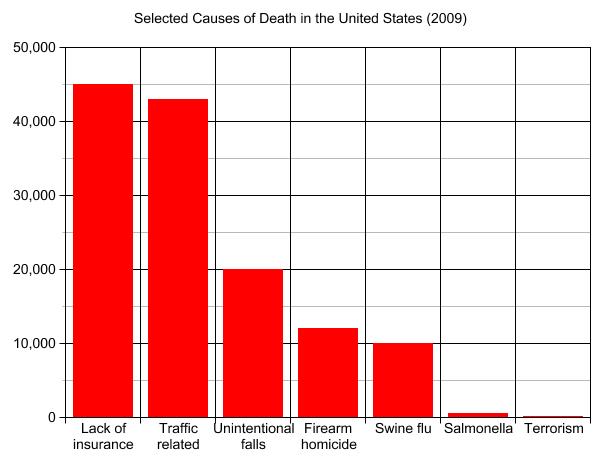
Chart from Firedoglake.

Firedoglake published an article that helps to put the situation into perspective. It charts selected causes of death in the United States for 2009 as follows:

  1. Lack of insurance 45,000
  2. Traffic related 43,000
  3. Unintentional falls 20,000
  4. Firearm homicide 12,000
  5. Swine flu 10,000
  6. Salmonella 1000
  7. Terrorism 16.

With that in mind we return to the ongoing discussion of health care reform, while asking if the pending legislation before Congress will indeed reduce those 45,000 deaths or whether it is, as it has been called by some, “The Health Insurance Enrichment Act.”

In recent days the progressive press has placed more and more attention on the bill’s potential encroachment upon our civil liberties through mandating that an individual be forced by fiat to purchase health insurance from American’s for profit insurance cartel.

An article on Firedoglake by emptywheel entitled “Health Care on the Road to Neo-Feudalism” tells us that “the bill, if it becomes law, would legally require a portion of Americans to pay more than 20% of the fruits of their labor to a private corporation in exchange for 70% of their health care costs.” The author continues,

Consider a family of four making $66,150 — a family at 300% of the poverty level and therefore, hypothetically, at least ‘subsidized.’ That family would be expected to pay $6482.70 (in today’s dollars) for premiums — or $540 a month. But the family could be required to pay $7973 for copays and so on. So if that family had a significant — but not catastrophic — medical event, it would be asked to pay the insurer almost 22% of its income to cover health care.

Senate Democrats are requiring middle class families to give the proceeds of a month of their work to a private corporation — one allowed to make 15% or maybe even 25% profit on the proceeds of their labor. It is one thing to require a citizen to pay taxes — to pay into the commons. It’s another thing to require taxpayers to pay a private corporation, and to have 25% of that go for paying for luxuries like private jets and gyms for the companies CEOs.

Previously on The Rag Blog I have suggested that legislation requiring Americans to buy from a private corporation is unconstitutional.. This question again arises in an article by Ellen Hodgson Brown, J.D. , published in Truthout. Ms. Brown is not a newcomer to the health care discussion; she is co-author of a Forbidden Medicine, Natures Pharmacy, and The Key To Ultimate Health.

Ms. Brown says:

The health reform bills now coming through Congress are not focused on how to make health care cheaper or more effective, how to eliminate waste and fraud or how to cut out expensive middlemen. As originally envisioned, the public option, would have pursued those goals. But the public option has been dropped from the Senate bill and radically watered down in the House bill.

Rather than focusing on making health care affordable, the bills focus on how to force people either to buy health insurance if they don’t have it, or to pay more for it if they do. If you don’t have health insurance and don’t purchase it, you will be subject to a hefty fine. And if you do purchase it, premiums, co-pays, co-insurance payments and deductibles are liable to keep health care cripplingly expensive. Most of the people who don’t have health care can’t afford to pay the deductibles, so they will never use the plans they have been forced to buy.

The author continues,

…compulsory health insurance is like compulsory selective military service (the draft), except that all our numbers have come up. The argument has been made that auto insurance is compulsory so why not health insurance? But the obvious response is that you can choose to drive a car. The only way to escape the vehicle we call a body is to give up the ghost.

Terrance Heath’s lengthy and well-written article at Campaign for America’s Future entitled “The Window or the Stairs: Kill the Mandate or Kill the Bill,” makes this point:

My take is that it is unconscionable to force people to buy a product from a private insurer that enjoys sanctioned monopoly status. It’d be forcing everyone to attend baseball games, but instead of watching the Yankees, they were forced to watch the Kansas City Royals. Or Washington Nationals. It would effectively be a tax — and a huge one — paid directly to a private industry.

Where are the civil libertarians regarding this issue? Where is the ACLU, of which I have been a member for years? Perhaps the ACLU had best forget complaining about total body scanning at our airports and redirect its attention to this much larger issue of personal rights. I prefer to be safe when flying, and did not object to a strip search by El-Al in London some 25-30 years ago. And I did not object to El-Al’s “profiling” that had nothing to do with race or ethnic background, nor to the extra stewards on the flights, well aware that these gentlemen were subtly armed, en route from Kennedy to Tel Aviv, or Tel Aviv to London.

Jane Hampshire in FireDogLake cites reasons that the Senate Bill is unfriendly to the Average American, including the fact that it will be paid for by taxes on the middle class insurance plan you have right now through your employer. It will cause the employers to cut back benefits and increase co-pays.

Many of the taxes to pay for the bill start now, but most Americans won’t see any benefits until 2014 when the program begins. It allows insurance companies to charge older people 300% more than others and grants monopolies to drug companies that keep generic versions of expensive biotech drugs from ever coming to market. It doesn’t allow importation of prescription drugs, which could save consumers $100 billion over 10 years. The cost of medical care will continue to rise, and insurance premiums for a family of four will rise an average of $1,000 a year.

We must remember that this legislation, especially the Senate version, is to a great extent the product of lobbyists for the health insurance and pharmaceutical industries. Common Cause, a nonpartisan, nonprofit watchdog group, blames a “toxic cocktail of insiders and money” for short-circuiting a government-run plan that would have competed with private insurers.

Health industry contributions to congressional candidates have more than doubled so far this decade, rising to $127 million in the 2008 election cycle from $56 million in the 2000 election, with disproportionate sums going to the party in power and to members of committees that oversee health care, according to the Center for Responsive Politics.

If indeed this legislation passes without placing the health insurance industry under the Fair Trade Act, the entire exercise is a sham and a farce. There will be no restrictions on price fixing and collusion among the health insurance carriers. The idea that a few government regulators can control these predators is absurd. Each insurance giant will outmatch the regulators by a personnel ratio of at least 20:1 in defining methods to bypass the regulations and maintain their profits. One can imagine a high school football team playing the New England Patriots. The American public is once again being scammed by their corporate masters and their elected prostitutes.

There is nothing in this legislation that frees the physician to do his duty without interference from the insurance industry. Nothing to free the family doctor from overburdening paper work when he should have that time for seeing the sick. Health care will continue to be rationed to the consumer by the executives and stockholders of the health insurance cartel. The pharmaceutical industry will continue to overcharge the American public and to deprive many folks of lesser means of the medications which they need.

It is not a pretty picture. Our elective representatives have, without shame, taken their constituents to the cleaners.

[Dr. Stephen R. Keister lives in Erie, Pennsylvania. He is a retired physician who is active in health care reform. His writing appears regularly on The Rag Blog.]


The Rag Blog

Posted in Rag Bloggers | Tagged , , , , , | 6 Comments

Stayin’ Alive : Complementary and Alternative Medicine

“Tree of Life,” working design for Stoclet Frieze, Gustav Klimt, 1905/09.

Stayin’ Alive:
Towards a conscious self-health-care continuum

No system of medicine is static, and none has a monopoly on beneficial knowledge or tactics.

By Mariann G. Wizard / The Rag Blog / January 4, 2010

[Introducing a new periodic column by Rag Blogger Mariann G. Wizard, a professional science writer with a wide-ranging knowledge of natural health therapies. Readers may suggest topics for future columns, within the restrictions suggested below, in the Comments section of The Rag Blog.]

“Complementary and alternative medicine” (CAM), in the U.S. and several other nations, refers to health practices that are not currently part of “mainstream” or “conventional” medicine. This flexible definition allows for therapies that accumulate enough scientific evidence — or generate enough patient demand! — to become part of mainstream practices.

In the US, for example, chiropractic, once the domain of energetic and sometimes kooky “bone crackers,” has benefited from the experience of practitioners, the development of comprehensive theory and standards of care, and the establishment of accredited colleges, and is now paid for by most insurance plans — the true test of a treatment’s acceptance! Acupuncture, as well, with demonstrable benefits in pain relief at minimum, has gained mainstream acceptability in the U.S. within very recent memory.

However, the current CAM definition is rather misleading, having been imposed by conventionally-trained and -biased authorities. It is more accurate to think of CAM as all health practices developed over the course of human history, everywhere in the world, before the discovery of microbes, and including many health practices developed since then outside of “Western” medical facilities.

CAM includes, for example, entire multi-modal systems of medicine, such as traditional Tibetan medicine, Ayurveda, naturopathy, and others, some with continuous documentation of use and development over thousands of years. It also includes more recent practices: e.g., aromatherapy, Reiki, and Essiac, each with its own ancient roots.

One difference between most CAM therapies and “conventional” medicine, often cited by CAM skeptics, is a frequent lack of scientific evidence for CAMs, or even “disproof” of their worth. These criticisms are worth a closer look. “Scientific evidence” is not always best acquired in a laboratory setting, and what works in rats doesn’t always have the same effects in people.

Studies are often designed, depending on funding sources, to demonstrate certain hypotheses; their design may not be fair to competitors. Media coverage tends to focus on negative results in science reporting, as it does in other news. For example, a number of studies have found the herb St. John’s wort as effective as prescription drugs in treating mild to moderate depression. However, the most media coverage occurred when the herb was found to be not-so-helpful for serious depression. No one had ever claimed it would be.

So-called “anecdotal evidence” of practitioners and patients provides support for many CAM modalities, and is often discounted by those who understand only randomized, double-blinded, placebo-controlled clinical trials. However, lack of clinical studies is another misleading negative. Such studies are most often funded by pharmaceutical companies, and are extremely costly. Unless a unique, patentable, reproducible compound has been isolated for testing, there is little incentive to fund research on common herbal remedies such as echinacea, ginger, and aloe vera, or even more novel dietary supplements like shark cartilage.

Acupuncture. Image from Phiya Kushi’s Blog.

For some therapies, problems in adequate blinding or other study design factors present substantial obstacles to randomized testing. Acupuncture, for example, is difficult to administer in placebo form. Cannabis medications also present problems in blinding, since experienced cannabis users have no difficulty in distinguishing the real thing from placebo no matter how it is administered; the effects speak for themselves. Different study designs often make it difficult to compare “apples-to-apples” — but this is as true with pharmaceutical drugs as well as with herbal compounds!

Nevertheless, credible research is being done around the world every day on CAMs. For over 10 years, I have reviewed peer-reviewed journal reports of such work for the American Botanical Council’s HerbClips®, and have reported occasionally for ABC’s peer reviewed journal, HerbalGram®, on regulatory and other matters.

During that time, I’ve also — somehow — gotten older, and have begun to experience some of the annoying pitfalls of that process, as well as of ordinary hard knocks and exposure to modern living. While I began my work with ABC without any particular prejudice for or against conventional medicine or CAMs, today, I believe that each has its uses, and its distinct limitations.

I haven’t accepted medical or other advice to “get used to” chronic pain and increasing disability any more than I’ve accepted war, injustice, disharmony, or exploitation. These may all be losing battles in the long run, but what are we doing that’s any more important?

A year or so ago on a rainy day, a homeless guy at the downtown library asked me why so many — pardon the expression, “older ladies in Austin” — were sporting, as I was, a knee or elbow athletic brace. I stopped and thought about it for a minute. “Because,” I finally said, “we are fighting death to the finish!”

No system of medicine is static, and none has a monopoly on beneficial knowledge or tactics. ABC’s knowledge base — including my own work — has been priceless in helping me assess CAM options for my use, and even for friends and family facing health concerns. Like a growing world majority, I now consciously combine CAM practices with conventional medical care in a personal health continuum, making the decisions that affect, literally, my life, for myself, like we used to say in Students for a Democratic Society. I consider myself a “health independent” in the same sense that some voters claim independence from major political parties!

The fact is that conventional medicine is very poor in its ability to treat chronic illnesses, and most CAMs are ineffective or unnecessarily slow in treating acute illnesses such as infections. The fact is that professional health care providers of any kind are becoming less accessible to many of us, and that the costs of health care seemed doomed to skyrocket. The smart thing to do, it seems to me, is to use whatever we can to stay healthy!

Meanwhile, there is a skill to assessing unfamiliar health practices, products, and practitioners that I believe can be applied whether these are “conventional” or CAM-related, and I propose to try to impart some of that skill to readers of The Rag Blog.

If you have questions or suggested topics related to natural health practices, please post them in the Comments section of this article! For the record, I will NOT attempt to diagnose any symptoms, diseases, or medical problems. I will NOT recommend specific products, practices, or practitioners, except as examples of alternatives to be considered. I will NOT answer any questions of an intimate nature, e.g., what to do if you have an erection lasting longer than four hours! If none of you slackers have any interesting questions, I will merely regale you with my own adventures in health care; Lord’a’mercy; we are getting old!

I WILL freely discuss health-protective measures such as diet, exercise, and stress relief. I WILL consult with and drag in health care practitioners, researchers, and patients of all kinds as needed, some of whom may let me quote them. I MAY prescribe familiarity with controversial theories, regulatory policies, and historical tirades; take as directed: always with a grain of salt. Your life and health are your most valuable possessions — guard them well!

Next week: “Osteoarthritis: it takes a village.”

“Bee’s Knees,” by tyrone_31 / photobucket.

Prevention tip of the week:
Save your knees now!

Everybody should do this mild exercise several times a week if at all possible! Especially if you have weak knees, or “bad knees run in the family,” if you’ve had any kind of knee surgery short of a replacement, or if you do any running or jumping, this is a great way to strengthen and protect the most complex joint in your body.

  1. Lie flat on your back on the floor, with feet more or less in line with your shoulders.
  2. Extend your arms comfortably from your shoulders, so that, seen from the ceiling, you make a sort of “t” shape.
  3. Pull your knees up and your feet towards your buttocks as far as you comfortably can, keeping your feet slightly separated and your feet flat on the floor. Seen from the side, you look a little like this: _/\__o
  4. Keeping your upper body flat on the floor, gently lower both bent knees as far as you comfortably can to the right side of your body. Your left hip will lift off the floor. Seen from the ceiling, your knees look like a double chevron: >>. Stretch a little tiny bit closer to the floor with both knees, and hold for 20 seconds.
  5. Return to position 3 and reverse, lowering knees to the left side: . Stretch and hold.
  6. Repeat twice, three times a week, for six months. If you feel the improvement, KEEP DOING IT AS LONG AS YOU CAN GET DOWN ON THE FLOOR AND GET UP AGAIN! Don’t do it in bed or lying on the couch; you may throw your back out, and I don’t want you blaming me for your sciatica!

Hint: If your low-side knee doesn’t go all the way flat to the floor, or the high-side knee doesn’t go parallel to the floor when you stretch to left or right, well, that is a goal you can set. Gently stretch as far as you can without discomfort; and next time go a millimeter further!

This stretch, unlike the bicycling motion often used in post-surgical knee rehab, strengthens muscles and ligaments along both sides of the kneecap that help keep the joint stable — if you’ve ever felt the sickening sideways lurch of thigh-bone or leg-bone pulling away from knee-bone, you know the importance of these supportive structures!

Thanks for this tip to Wendee Whitehead, Doctor of Chiropractic, Austin, Texas, whose exact words to me were, “Knees are totally fixable!” Keep yours strong and flexible with this simple, zero-impact move.

–mgw

The Rag Blog

Posted in Rag Bloggers | Tagged , , , , | 12 Comments

BOOKS / Jonah Raskin : Chinua Achebe’s ‘British-Protected Child’


Chinua Achebe’s sharp and inspiring essays:
The Education of a British-Protected Child

By Jonah Raskin / The Rag Blog / January 4, 2010

[The Education of a British-Protected Child: Essays, by Chinua Achebe. (Knopf, October 6, 2009, 172 pp., $24.95)]

Here’s a contemporary writer of compelling fiction and non-fiction alike with whom I can really identify, and feel a sense of genuine comradeship. In part, that’s because he talks about the “Third World,” “imperialism,” and “neocolonialism” — words that don’t seem to be fashionable in academic circles these days.

The writer’s name is Chinua Achebe, and while he was born in Nigeria, he has spent much of his life in the United States, teaching, writing, and observing American ways and American literature. His latest book — The Education of a British-Protected Child — is a collection of 16 sharp and inspiring essays about politics and language, oppression and the human spirit.

The essays are all written clearly and poetically. They express the perspective of a man of true wisdom, and not just learning or education, and, like the title itself, the essays embody a playful sense of irony. When he was a child the British didn’t protect him at all, he explains, and they didn’t bring democracy to Africa, either, he says. “British colonial administration was not any form of democracy, but a fairly naked dictatorship,” he says.

The author of Things Fall Apart — one of the most widely read and best-known 20th-century African novels — Achebe writes with a sense of compassion and partisanship too. He knows clearly which side he’s on — the side of the oppressed against the oppressors — but he also values what he calls “the middle ground — that place where the human spirit resists an abridgement of its humanity.”

He goes on to say that this quality is “to be found primarily in the camp of the colonized, but now and again in the ranks of the colonizer too.” So, he acknowledges his intellectual debt to British scholars, such as Basil Davidson, the author of The African Slave Trade.

Achebe also gives a nod in the direction of my book, The Mythology of Imperialism, first published in 1971 and reprinted in 2009 by Monthly Review Press. “Mr. Raskin’s title,” Achebe writes, “defines the cultural source out of which Joseph Conrad derived his words and ideas.” Conrad’s work, he adds, “is grounded quite firmly in that mythology of imperialism which has so effectively conditioned contemporary civilization and its modes of education.”

It’s nice to be acknowledged by Achebe, if I do say so myself. What’s more, Achebe’s book provides useful tools for understanding the role of imperialism today, and the ways that individuals buy into it no matter what their skin color.

In an essay entitled “African Literature as Restoration of Celebration,” Achebe describes his own education in Nigeria in a school modeled on the British public school. As a boy, he read books about Africa and Africans by white authors such as John Buchan and Rider Haggard. Achebe came to identity with the white characters not the Africans. “I went through my first level of schooling thinking I was of the party of the white man in his hair-raising adventures and narrow escapes,” he says.

In the 1960s, of course, African Americans who thought they were of the party of the white man were sometimes called “Oreos.” I remembered that word and the image it conjures while reading Achebe’s book, and I thought also of President Obama.

Could it be, I wondered, that like the youthful Achebe, Obama thinks he’s of the party of the white man? And could it be that like Achebe he’ll have an awakening and a kind of conversion? Perhaps Mr. Achebe ought to send Mr. Obama a copy of this book, along with his brilliant first novel Things Fall Apart, which has helped to change the ways that readers around the world see Africa.

Perhaps our president will come to see, along with Achebe, that “Our humanity is contingent on the humanity of our fellows. No person or group can be human alone. We rise above the animal together, or not at all.”

[Jonah Raskin is the author of The Mythology of Imperialism (Monthly Review Press), and Field Days (University of California Press.)]

Find The Education of a British-Protected Child: Essays, by Chinua Achebe, on Amazon.com.

The Rag Blog

Posted in Rag Bloggers | Tagged , , , , , , | Leave a comment

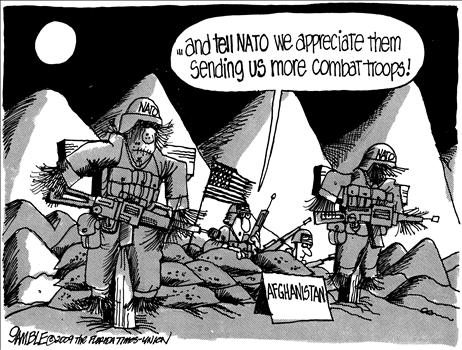
Tom Hayden : Afghanistan and a Reluctant NATO

Cartoon from Florida Times-Union / Netizen News Brief.

The Peace Exchange:
NATO and the Afghan War

By Tom Hayden / The Rag Blog / January 3, 2010

The White House and Pentagon are lobbying hard for an increased NATO troop commitment for the Afghanistan escalation, as public opinion in America, Canada and Europe — and Afghanistan — is increasingly skeptical.

Placing pressure on the U.S. and NATO governments from the bottom up, country by country, will be necessary to reverse the unsustainable dynamic towards militarism and empire.

  • In Afghanistan itself, “nearly everyone agrees that the Afghan government must negotiate with the insurgents,” according to the New York Times [11/6/09]. Even the discredited Afghan president Hamid Karzhai complains that the U.S. is blocking his efforts to talk with the Taliban [see my earlier post in the LA Times], and continues to condemn U.S.-inflicted civilian casualties. In Pakistan, a powerful 64 percent regards the U.S. as their enemy and 72 percent want the American forces out of Afghanistan (here).

    In the United States, President Obama is competing with his critics to win back his Democratic base. So far he has succeeded in winning back about 10 percent, but still depends on Republicans to support his escalation. An AP Dec. 10-14 poll showed 57 percent of Americans opposed overall, while an NBC-Wall Street Journal poll also in mid-December (11-14) found 41 percent against the current Afghanistan approach, and with 44 percent in favor.

  • In Europe and Canada, opposition to the escalation runs highest, with 69 percent of Germans opposed, 66 percent of Canadians, 58 percent of Italians, and 56 percent in the United Kingdom.
  • Troop withdrawals currently are scheduled for Canada [2,800 troops by 2011], the Netherlands [1,770 troops by 2010], while Switzerland has already pulled their 31 troops.

In summary, there are three political battlegrounds of public opinion in addition to the secretive military ones being invaded by foreign troops, Special Ops and drones. The fight against the war is also a fight for democracy and majority rule against the elite global planning for a Long War. [See Hayden on Kilcullen in The Nation.]

The Obama administration’s diplomatic offensive to cement greater NATO support is being under-reported. The British and German governments are planning a late January European conference to “set a timetable for transferring security responsibilities to Afghan forces” at a date uncertain. [Reuters, Nov. 16, 2009]

Like Obama’s two-pronged approach to escalation/de-escalation, the British-German formula is likely to result in short-term escalation of at least 7,000 troops combined with an ambiguous timetable for departure, enough to placate restive public opinion.

In response, the UK’s Stop the War Coalition is sponsoring an anti-war demonstration in London on January 28.

Already the Obama lobbying effort is being hampered by the pressure of public opinion. The U.S. is seeking a commitment of 7,000 new troops from the Europeans, but it appears that 1,500 are those sent to Afghanistan to guard the presidential election this year, and who will not be withdrawn. The 5,000 scheduled by Canada and the Netherlands for withdrawal in the next two years may leave the net numbers approximately the same, but barely increased. The likely increases are from Britain [500], Poland [1000], Italy [600], Spain [400], and smaller nations. Pressure is being applied to Germany and France for another 3,500 [NYT, Dec. 17, 2009]

The logic behind British support for Afghan escalation was expressed recently by the British defense minister, Robert Ainsworth, who offered a domino theory, as follows: “If Afghanistan is not secure, then Pakistan is not secure, and if Pakistan is not secure, Britain is not secure.” [NYT, Nov. 5, 2009] Many European security experts, like Peter Neumann of the Center for Defense Studies at King’s College, claim a “broad agreement” that Europe is a “nerve center for the global jihad.” [Kilcullen, The Accidental Guerrilla, p. 247] Europe and Canada’s human rights laws, they say, create “legislative safe havens” for terrorists to plot and strike.

This argument may gain currency with the recent anxiety over the successful penetration of Western defenses by a 23-year old Nigerian, Umar Farouk Abdulmutallab, who attempted to blow up an airliner flying through Amsterdam to Detroit.

But instead of arguing that bombing Afghanistan and Pakistan, and restricting human rights laws, will make Westerners safe, homeland security officials need to examine once again the institutional incompetence that in this case permitted travel by someone whose own father, a top Nigerian banker, warned American officials that his son had taken a violent and dangerous turn.

After Secretary of Homeland Security Janet Napolitano claimed that “the system worked” in the airline bombing attempt, saying the passengers had played an “important” and “appropriate” role, she could have been forced to resign. Napolitano, a captive of her bureaucracy, was repeating the infamous role of Secretary of State Condoleeza Rice who denied the relevance of a CIA memo warning of al Qaeda attacks shortly before September 11, 2001. As a result, the Obama White House was put on the defensive by the Republican hawks responsible for loopholes in airline security made possible by either incompetence or an ideological commitment to air travel.

There is another explanation for the zealous American lobbying to keep NATO in Afghanistan which is never mentioned. Afghanistan and Pakistan are the glue that holds NATO and the “Western alliance” together and that create incentives for increased militarization in countries like Canada, Germany, and even non-NATO nations like Sweden and Japan. Why, after all, is an armed entity called the North Atlantic Treaty Organization invading and occupying South Asia? The reason was given by Obama’s national security adviser, Gen. James Jones, in 2007, when he previously commanded NATO forces:

In committing the alliance to sustained ground combat operations in Afghanistan…NATO has bet its future. If NATO were to fail, alliance cohesion would be at grave risk. A moribund or unraveled NATO would have a profoundly negative geostrategic impact.” [in Ahmed Rashid, Descent into Chaos, p. 373]

Approvingly, the influential Pakistani journalist Ahmed Rashid, writes that in Afghanistan NATO “would find meaning for its continued existence and recreate the unity that Western Europe showed during the Cold War.” [Rashid, ibid., 372]

This same alarm is voiced by Zbigniew Brzezinski in the current [Jan.-Feb. 2010] issue of Foreign Affairs:

Nothing would be worse for NATO if one part of the alliance [Western Europe] left the other part [the United States] alone in Afghanistan. Such a fissure over NATO’s first campaign initially based on Article 5, the collective defense provision, would probably spell the end of the alliance.

Democracy and domestic priorities will be the casualties in the United States, Canada and Europe if the US-NATO military expansion holds sway.

[A political activist for more than four decades, Tom Hayden is director of the Peace and Justice Resource Center . A founder of SDS and a former California State Senator, Hayden is the author of The Long Sixties (Paradigm, 2009).]

The Rag Blog

Posted in Rag Bloggers | Tagged , , , , , | 1 Comment

South Africa’s Dennis Brutus : A Poet for Human Rights

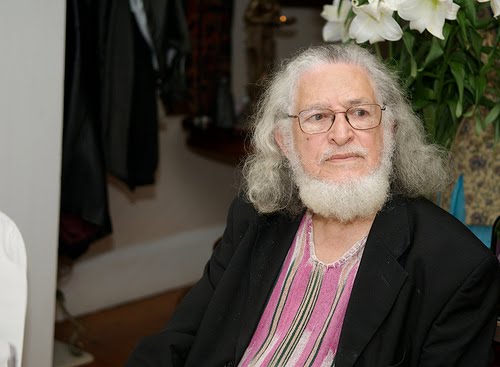
Dennis Brutus. Photos by Victor Dlamini / Flickr.

He will be remembered for his art and for his life:

Liberation poet Dennis Brutus (1924-2009)

By Mariann G. Wizard / The Rag Blog / January 2, 2010

See ‘The Poetic Justice of Dennis Brutus,’ by Amy Goodman, Below.

South African liberation poet Dennis Brutus passed away during the recent holidays. Of several online obituaries and tributes, the following, from Amy Goodman, best illustrates Brutus’ importance to poets and human rights activists worldwide.

At the Rag Blog, some felt a special kinship with the deceased through his connection with our sister, imprisoned anti-imperialist activist and poet Marilyn Buck. Marilyn’s CD, Wild Poppies (2004, Freedom Archives), was recorded while she was — as she still is — in a federal prison in California. She recorded some of her work for the CD, over the telephone — recording equipment is not allowed in prison visiting rooms — with the chaos and pain around her adding their ragged, random accompaniment.

Many other poets (myself included) contributed to Wild Poppies by reading Buck’s poems for her; Dennis Brutus was by far the best-known. (Kwame Ture, the former Stokely Carmichael, voices a tribute to Buck on the CD.)

Some poets who participated read their own poems, touching on themes that pervade Marilyn’s work, or poems Marilyn has translated from Spanish, but the South African Poet Laureate read one of her poems (“One-Hour Yard Poem”) — a very fine compliment from this man who was himself a prisoner of conscience and of apartheid, alongside Nelson Mandela. He also read one of his own (“Letter #18”). (Listen to Dennis Brutus reading these two poems, below.)

Like the great Chilean poet Pablo Neruda, Brutus will be remembered for his life and times as well as his lines, a poet lucky enough to witness extraordinary events, using his gift to open not only prison doors, but the doors of perception.

From Marilyn Buck’s Wild Poppies:

Dennis Brutus reads Marilyn Buck’s ‘One Hour Yard Poem’:


Dennis Brutus reads his ‘Letter #18’:

Photo by Victor Dlamini / Flickr.

There will come a time
There will come a time we believe
When the shape of the planet
and the divisions of the land
Will be less important;
We will be caught in a glow of friendship
a red star of hope
will illuminate our lives
A star of hope
A star of joy
A star of freedom

Dennis Brutus, Caracas, October 18, 2008

The poetic justice of Dennis Brutus

We are going to say to the world: There’s too much of profit, too much of greed, too much of suffering by the poor… — Dennis Brutus

By Amy Goodman / December 29, 2010

Dennis Brutus broke rocks next to Nelson Mandela when they were imprisoned together on notorious Robben Island. His crime, like Mandela’s, was fighting the injustice of racism, challenging South Africa’s apartheid regime. Brutus’ weapons were his words: soaring, searing, poetic. He was banned, he was censored, he was shot. But this poet’s commitment and activism, his advocacy on behalf of the poor, never flagged.

Brutus died in his sleep early on December 26 in Cape Town, at the age of 85, but he lived with his eyes wide open. His life encapsulated the 20th century, and even up until his final days, he inspired, guided and rallied people toward the fight for justice in the 21st century.

Oddly, for this elfin poet and intellectual, it was rugby that early on nagged him about the racial injustice of his homeland. Brutus recalled being sarcastically referred to by a white man as a “future Springbok.”

The Springboks were the national rugby team, and Brutus knew that nonwhites could never be on the team. “It stuck with me, until years later, when I began to challenge the whole barrier — questioning why blacks can’t be on the team.” This issue is depicted in Clint Eastwood’s new feature film, Invictus. President Mandela, played by Morgan Freeman, embraces the Springboks during the 1995 World Cup, admitting that until then blacks always knew whom to root for: any team playing against the Springboks.

In the late 1950s, Brutus was penning a sports column under the pseudonym “A. de Bruin” — meaning “A brown” in Afrikaans. Brutus wrote, “The column… was ostensibly about sports results, but also about the politics of race and sports.” He was banned, an apartheid practice that imposed restrictions on movement, meeting, publishing, and more. In 1963, while attempting to flee police custody, he was shot. He almost died on a Johannesburg street while waiting for an ambulance restricted to blacks.

Brutus spent 18 months in prison, in the same section of Robben Island as Nelson Mandela, where he wrote his first collection of poems, Sirens, Knuckles, Boots. His poem “Sharpeville” described the March 21, 1960, massacre in which South African police opened fire, killing 69 civilians, an event which radicalized him:

Remember Sharpeville
bullet-in-the-back day
Because it epitomized oppression
and the nature of society
more clearly than anything else;
it was the classic event

After prison, Brutus began life as a political refugee. He formed the South African Non-Racial Olympic Committee to leverage sports into a high-profile, global anti-apartheid campaign. He succeeded in getting South Africa banned from the Olympic Games in 1970. Brutus moved to the United States, where he remained as a university professor and anti-apartheid leader, despite efforts by the Reagan administration to deny him continued status as a political refugee and deport him.

After the fall of apartheid and ascension to power of the African National Congress, Brutus remained true to his calling. He told me,

As water is privatized, as electricity is privatized, as people are evicted even from their shacks because they can’t afford to pay the rent of the shacks, the situation becomes worse… The South African government, under the ANC… has chosen to adopt a corporate solution.

He went on:

We come out of apartheid into global apartheid. We’re in a world now where, in fact, wealth is concentrated in the hands of a few; the mass of the people are still poor… a society which is geared to protect the rich and the corporations and actually is hammering the poor, increasing their burden, this is the reverse of what we thought was going to happen under the ANC government.

Many young activists know Dennis Brutus not for his anti-apartheid work but as a campaigner for global justice, ever present at mass mobilizations against the World Trade Organization, the World Bank and the International Monetary Fund — and, most recently, although not present, giving inspiration to the protesters at the UN climate summit in Copenhagen.

He said, on his 85th birthday, days before the climate talks were to commence: “We are in serious difficulty all over the planet. We are going to say to the world: There’s too much of profit, too much of greed, too much of suffering by the poor… The people of the planet must be in action.”

[Amy Goodman is the host of “Democracy Now!,” a daily international TV/radio news hour airing on more than 800 stations in North America. She is the author of Breaking the Sound Barrier, recently released in paperback and now a New York Times best-seller. Denis Moynihan contributed research to this column.]

© 2009 Amy Goodman

Distributed by King Features Syndicate

Source / truthdig

The Rag Blog

Posted in Rag Bloggers | Tagged , , , , , , , , , , , , | 4 Comments

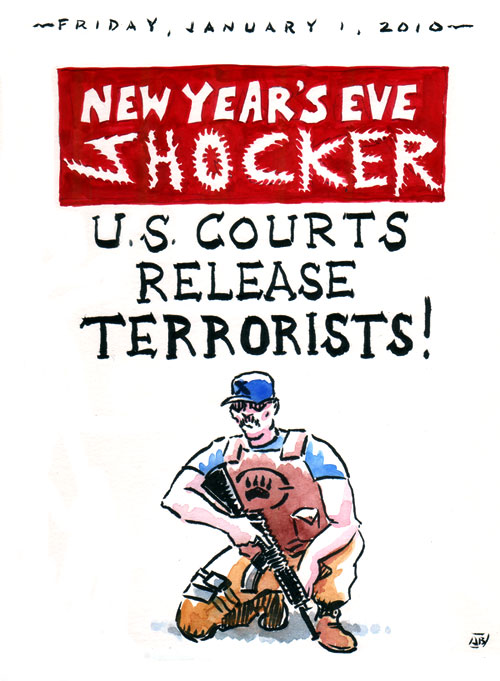
Life During Wartime : Courts Release Terrorists!

CLICK ON IMAGE TO ENLARGE

Political cartoon by Joshua Brown / Historians Against the War / The Rag Blog

Thanks to Dr. S.R. Keister /The Rag Blog

Posted in RagBlog | Tagged , , , , , , | 1 Comment

Antibiotic Abuse : Controlling the Super Bug

Cartoon by Nick Kim.

(Hint: Chill with the antibiotics)
Controlling MRSA, the Super Bug

By Ted McLaughlin / The Rag Blog / January 2, 2010

There is a very scary bacteria called Methicillin-resistant Staphylococcus aureus (MRSA). It is scary because the nasty Staph infection is resistant to virtually all the antibiotics that would be used to treat bacterial infections. Back in October of 2007, I wrote a post about MRSA being found here in Texas. In the slightly more than two years since that post, the incidence of MRSA has virtually exploded and is now found all over the world.

Whereas the percentage of Staph infections caused by MRSA used to be small (1% or 2%), it now makes up a majority of Staph infections in many countries. Here are some representative countries with the percentage of their Staph infections caused by the drug-resistant MRSA:

United States   63%
United Kingdom     45%
Greece 38%
Israel 44%
Japan 80%
Norway 1%

Please note the last country — Norway. That figure of only 1% is for real, and is the lowest percentage of MRSA-caused Staph infections in any country. How have the Norwegians been able to control the spread of MRSA and keep it to such a tiny percentage (and that tiny percentage is mostly made up of cases imported from other countries)?

Jan Hendrick-Binder, Oslo’s MRSA medical advisor, says, “It’s a very sad situation that in some places so many are dying from this, because we have shown here in Norway that Methicillin-resistant Staphylococcus aureus (MRSA) can be controlled, and with not too much effort. But you have to take it seriously, you have to give it attention, and you must not give up.”

How did they do it? Most notably by changing the way they use (or don’t misuse) antibiotics. Here in the United States, if you get a sniffle you’ll probably go to the doctor and ask for an antibiotic, and that doctor will most likely prescribe one for you. While it may help you get rid of that cold or minor infection, it also does a couple of other things. It will cause you to become resistant to that antibiotic eventually, and it will cause bacteria to mutate and become resistant to the antibiotic.

You won’t be prescribed that antibiotic for a minor infection in Norway. A doctor will refuse to prescribe it. Instead, they will tell you to take some over-the-counter drugs like aspirin or tylenol, cough syrup or antihistamines. These will help you to be more comfortable while your body fights off the infection (as the body can and will do most of the time). The antibiotics are saved for only the most serious infections, and because of this they work better when they are needed.

This is the Norwegian way of dealing with MRSA (which is reaching epidemic proportions in most other countries):

Norway’s model is surprisingly straightforward.

Norwegian doctors prescribe fewer antibiotics than any other country, so people do not have a chance to develop resistance to them.

Patients with MRSA are isolated and medical staff who test positive stay at home.

Doctors track each case of MRSA by its individual strain, interviewing patients about where they’ve been and who they’ve been with, testing anyone who has been in contact with them.

The truth is that any country could do what the Norwegians have done. But they must first stop misusing antibiotics. Antibiotics are truly miracle drugs, but we are destroying their effectiveness by abusing them — using them for infections that the body can easily fight off without their help.

Can we change the way we use antibiotics in the United States? I don’t know. I’m afraid that too many patients (and doctors) are locked-in to the wasteful and ultimately hurtful way we use the gift of antibiotics. I’m afraid most people would be very resistant to change. And after viewing the reaction of many to reforming health care reform, I doubt that many would be receptive to legislation to fix the problem.

We can expect Big Pharma to fight this change tooth-and-nail, because they are making tons of money off the misuse of antibiotics (if you’ve paid for a prescription of antibiotics recently, then you know that). Don’t think they will act in the best interest of patients. Like most huge corporations, their only concern is today’s profits — not the future problems this is going to cause for all of us.

We must begin a dialogue in this country — with an eye to changing the public’s (and the doctors’) perception of how antibiotics should be used. And this dialogue must happen now, because we are running out of time.

I do know one thing. If we don’t change this soon, it won’t be too far in the future before we’ll wish that we had.

[Rag Blog contributor Ted McLaughlin also posts at jobsanger.]

The Rag Blog

Posted in Rag Bloggers | Tagged , , | 1 Comment

MUSIC / Dynamic Compression : Yes, It Really is Too Loud!

Christopher Clark graphed the peak levels of and RMS levels of three hit songs a year over the past three decades. Here is a link to a PDF of his full poster, “A Visual History Of Loudness.”

The loudness wars:
Why music sounds worse

By Carrie Brownstein / January 2, 2010

As we have come to the end of the decade, we turn to one of the more dramatic changes we’ve heard in music over those 10 years: It seems to have gotten louder.

We’re talking about compression here, the dynamic compression that’s used a lot in popular music. There’s actually another kind of compression going on today — one that allows us to carry hundreds of songs in our iPods. More on that in a minute.

But first, host Robert Siegel talked to Bob Ludwig, a record mastering engineer. For more than 40 years, he’s been the final ear in the audio chain for albums running from Jimi Hendrix to Radiohead, from Tony Bennett to Kronos Quartet.

Bob pointed to a YouTube video titled The Loudness War. The video uses Paul McCartney’s 1989 song “Figure of Eight” as an example, comparing its original recording with what a modern engineer might do with it.

“It really no longer sounds like a snare drum with a very sharp attack,” Ludwig says. “It sounds more like somebody padding on a piece of leather or something like that,” Ludwig says. He’s referring to the practice of using compressors to squash the music, making the quiet parts louder and the loud parts a little quieter, so it jumps out of your radio or iPod.

Ludwig says the “Loudness War” came to a head last year with the release of Metallica’s album Death Magnetic.

“It came out simultaneously to the fans as [a version on] Guitar Hero and the final CD,” Ludwig says. “And the Guitar Hero doesn’t have all the digital domain compression that the CD had. So the fans were able to hear what it could have been before this compression.”

According to Ludwig, 10,000 or more fans signed an online petition to get the band to remix the record.

“That record is so loud that there is an outfit in Europe called ITU [International Telecommunication Union] that now has standardization measurements for long-term loudness,” he says. “And that Metallica record is one of the loudest records ever produced.”

Old news

“The ‘Loudness Wars’ have gone back to the days of 45s,” Ludwig says. “When I first got into the business and was doing a lot of vinyl disc cutting, one producer after another just wanted to have his 45 sound louder than the next guy’s so that when the program director at the Top 40 radio station was going through his stack of 45s to decide which two or three he was going to add that week, that the record would kind of jump out to the program director, aurally at least.”

That’s still a motivation for some producers. If their record jumps out of your iPod compared with the song that preceded it, then they’ve accomplished their goal.

Bob Ludwig thinks that’s an unfortunate development.

“People talk about downloads hurting record sales,” Ludwig says. “I and some other people would submit that another thing that is hurting record sales these days is the fact that they are so compressed that the ear just gets tired of it. When you’re through listening to a whole album of this highly compressed music, your ear is fatigued. You may have enjoyed the music but you don’t really feel like going back and listening to it again.”

Ludwig’s final assessment of the decade in music?

“It’s been really rough, folks,” he says. “But it can get better and I think it will get better. I’m glad it’s going to be over.”

Digital compression

Digital compression is the process that allows a song to go from being a very big sound file in its natural state to a very small file in your iPod — so you can carry your entire record library in your pocket. But at what cost?

Dr. Andrew Oxenham is a professor in the psychology department at the University of Minnesota. His specialty is auditory perception — how our brains and ears interact. He also started out as a recording engineer.

Robert Siegel asked him to explain digital compression.

“Really, the challenge is to maintain the quality of a CD, but to stuff it into a much smaller space,” Oxenham says. “Let’s think about how digital recording works. You start out with a very smooth sound wave and we’re trying to store that in digital form. So we’re really trying to reproduce a smooth curve [with] these square blocks, which are the digital numbers [the 1s and 0s that are used to encode sound digitally].

“Now, the only way you can make square blocks look like a smooth curve is by using very, very small blocks so it ends up looking as if it’s smooth. Now using lots and lots of blocks means lots of storage, so we end up using [fewer] bigger blocks. Which means we end up not representing that curve very smoothly at all.”

Lost? Go back and re-read it — you’ll get it.

“The difference between the smooth curve and the rough edges you end up with in the digital recording, you can think of as noise because that is perceived as noise,” Oxenham says. “It’s perceived as an error, something that wasn’t there in the original recording. The trick is to take the noise — which is the loss of fidelity — and just make it so you can’t hear it anymore.”

In hiding

It’s called “masking.” Think of it this way: You’re having a conversation in a quiet room, and you can hear every word, every mouth noise, every stomach rumble. But if you were having that same conversation outside on a busy street, you’d get the gist of what was said, but you’d probably miss a few words. The traffic noise would mask them.

So let’s say you’re listening to a Brahms symphony.

“[The loud parts of the music are] giving the coding system a lot of leeway to code things not quite as accurately as it would have to,” Oxenham says, “because the ear is being stimulated so much by the loud sound it won’t pick up very small variations produced by the coding errors.”

In other words, the loud parts of a recording are used to “mask,” or hide that noise produced by the rough-edged squares of those digital 1s and 0s.

But are we missing something?

“There are really different levels of MP3 coding,” Oxenham says. “You can go from much less data — which people can hear the difference — to higher levels of coding which take up more space on your MP3 player but sound better and are basically indistinguishable from a CD. And I would argue that under proper listening conditions — if it’s really indistinguishable from the CD as far as your ear is concerned — then you really haven’t lost anything perceptually.”

Oxenham likes the convenience of portable MP3 players. But ultimately, he says, he prefers going to concerts.

Source / National Public Radio

The Rag Blog

Posted in RagBlog | Tagged , , , | 2 Comments

Harvey Wasserman : A Blue-Mooning, Baby-Booming New Year

The second full moon in a single month is commonly known as a ‘blue moon,’ and that’s what we saw on New Year’s Eve.Photo by Vatsyayana / Getty.

Our blue-mooned, baby-boomed 64th birthday baptism…

When we believed ourselves immortal, as all young people do, there was nothing we could not do. Now we count the victories, and assess what we might win in the time left us.

By Harvey Wasserman / The Rag Blog / January 2, 2010

‘Will you still need me? Will you still feed me…?’ — The Beatles

The moment has come. The first Baby Boomer cohort has turned 64.

It officially happened on midnight December 31-January 1, 2009-10.

I celebrated the moment seven hours and 24 minutes early by jumping into a tiny cove in the Florida Bay.

The chilly but exhilarating water demanded an answer: Will we green the Earth? Will we win social justice? Will we get to Solartopia?

Unlike so many of you reading this, I am not a Boomer. The demographic officially extends from January 1, 1946 to December 31, 1964. It is a giant elephant of a population explosion swallowed by a decades-long python of a population decline.

The soldiers coming back from World War II multiplied like rabbits. The Boom was worldwide. In the U.S. it birthed some 76 million children.

My dad was a submarine welder in Boston’s shipyards, so I came early: at 4:36 p.m., December 31, 1945. Thus the leap into the Bay, which is in desperate need of protection from the ravages of agricultural monsters who are destroying the Everglades on which this fragile but irreplaceable eco-system depends for a clean, steady flow of water.

Those of us who took that astonishing tour through the 1960s have to think of ourselves as “forever young.”

But 64 is a big number. It means many of us have lost one or both of our parents, or are taking care of them as they become increasingly infirm.

It also means WE are meeting such ailments. “Parts wear out,” my mother said.

And we’re “at that age” when we lose friends and lovers, spouses and siblings, and sometimes, worst of all, even children.

“Learning experience” can never fully cover the losses of loved ones. But they do remind us our own days are numbered.

When we believed ourselves immortal, as all young people do, there was nothing we could not do.

Now we count the victories, and assess what we might win in the time left us.

In our lifetimes, undeniable strides have been made in civil rights — for African-Americans and, in tandem, for women, for GLBT and for other national and ethnic minorities, as well as for those with special challenges.

Social justice is another story. Since the end of the New Frontier/Great Society, with the horror of the Vietnam War, income disparities have worsened. Those social programs did work. Now the gap between rich and poor, a downfall of all great nations, is escalating, with no end in sight. We have long had the means to end poverty and hunger, and have chosen simply not to do it.

The root of that choice is war. The Vietnam assault was the biggest blunder of our lifetime. Everything is worse because of it, from homelessness and poverty to the decline of our educational and health systems. That successive Boomer presidents have chosen to repeat the error in Iraq and Afghanistan is beyond tragic.

Likewise the environment. The green movement has many roots. But the fight against nuclear power was the first to put thousands of Americans onto the streets and into the jail cells, and must be ready to do so again. Talk of reviving this failed technology is beyond lunatic.

Above all, in our lifetime, the globalized corporation has metastasized into the most powerful institution in human history. A cancerous beast that has usurped human rights without human responsibilities, the trans-planetary corporation is now beyond the reach of the nation-state. Only a global green movement, tied through the internet and whatever else we can contrive, can overcome the sinister power of these interlinked financial machines, whose only goal is profit.

To fight back, we need a vision, a Solartopian greenprint.

We need to attack the corporation at its root, in its legal charter and wherever we can find a foothold.

To kill the cancer, we must eliminate waste and its worst expression, war, the ultimate breeding ground of illegitimate power.

Only with peace can we win a true democracy, based on social justice. All humans have the right to food, shelter, clothing, medicine, educatio, and dignity. In tandem must come the paper ballot, hand counted, with universal automatic voter registration.

Our food needs to be organically raised, with sustainable agricultural practices.

The question of how many humans our planet can sustain will be answered with the empowerment of women. With equal access to education, employment and reproductive rights, the mothers of our species will bring us a sustainable number of children.

As that happens we can eliminate fossil and nuclear fuels, replacing them with the Solartopian technologies that really work, including solar, wind, sustainable biofuels, geothermal, ocean thermal, tidal, wave, current and other forms of renewables not yet conceived. In a maximally efficient world, with revived mass transit, the green transition we must win to survive does become doable.

So this Blue-Mooned New Year’s Eve, with my growing-up-all-too-fast daughter on my back, we jumped into the Barley Basin to commemorate that moment 64 years ago when my saintly mother gave her final push to get me into this world. The demographic deluge would boom in less than eight hours.

With Bonnie Raitt’s “Nick of Time” running through our brains, the equation simplified:

“With justice comes peace… with peace comes freedom… with freedom, all is possible… even Solartopia.”

That should keep us busy for a while, yes?

The next blue mooned New Year’s Eve is scheduled for 2028. See you then… on a green-powered Earth.

[Harvey Wasserman’s Solartopia! Our Green-Powered Earth is at www.harveywasserman.com, along with A Glipmse of the Big Light: Losing Parents, Finding Spirit, and Harvey Wasserman’s History of the United States]

The Rag Blog

Posted in Rag Bloggers | Tagged , , , , , , , , , | 2 Comments

Bill Ayers and Bernardine Dohrn : Gaza Freedom Marchers Clubbed by Cairo Cops

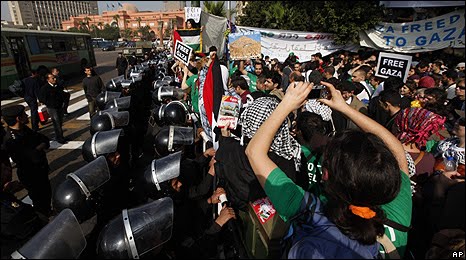
Cairo riot police confront Gaza Freedom March. Top photo from AP. Bottom photo by Brandon Delyzer from rabble.ca.

Gaza Freedom March:
Lively demonstration at the Egyptian Museum

By Bill Ayers and Bernardine Dohrn / The Rag Blog / January 1, 2010

Also see ‘Egyptian security forces attack Gaza protesters,’ by Max Ajl, Below.

CAIRO — In Cairo yesterday, a spirited, highly visible and noisy demonstration held sway at a central traffic point — the Nile Corniche — across from the Egyptian Museum for seven hours, affixing huge banners in Arabic and English to trees and fences. In Gaza, a peace march took place including the 80 GFM participants who were able to enter the blockaded and occupied part of Palestine.

More than 500 people converged in small groups at the museum at 10 a.m. to press for freedom for Gaza and Palestine. Police blockaded the small hotels where marchers were staying, preventing dozens of people from leaving for several hours, and harshly attempted to contain the demonstration.

As the groups came together in the street, numerous marchers were clubbed to the ground, kicked and thrown into the center of Tahrir Square where police barricades and circles of Egyptian security quickly closed in. Those covering the action, observers, and members of the legal team, were seized by security police and pushed into the square.

Medical team personnel treated gashes, lacerations, broken noses, and bruised ribs. As has been true all week, Egyptian citizens who joined in or manifested support were treated most severely or were taken away.

The day before, the French GFM delegation had gone to the pyramids; someone faked an illness and while security forces moved in to respond, they unfurled a giant Palestinian flag across the pyramid. From that photo, they made an enormous color streamer, stamped with GAZA, now rippling in the square. The endless stream of Cairo traffic (23 million people living in this city), buses, taxis, cars and crowds, heard and saw the protest.

At 11:30 pm, under a full moon, we participated in a candlelight vigil in Tahrir Square where we danced and sang in the New Year.

Five days of rallies, actions, frustration and setback: the GFM wanted to enter Gaza 1,400 strong to express solidarity with civil society, witness their struggle for survival and self-determination, and join in a massive peace march. Instead, we found ourselves in Cairo for the week, a determined group from 42 countries trying mightily to realize our original goal in different circumstances.

In the end, we found unity among differences, common ground, and new alliances. There was a gallant effort to make a way out of no way, to keep focused on Gaza and the needs and desires of the Palestinian people, and to press forward to a more robust international peace and justice movement. If there was a silver lining here, perhaps this was it.

Egyptian security forces
Attack Gaza protesters and blockade hotels

By Max Ajl / December 31, 2010

CAIRO — Egyptian security forces were attacking protesters in Tahrir Square, at the core of downtown Cairo, after they sat down in the middle of a busy Cairo street, protesting the imprisonment of the people of Gaza. Others were literally barricaded inside their hotel, the entrance surrounded by steel riot barriers. Egyptian security forces refuse to allow them to leave. Green personnel carriers line the streets. It is pandemonium.

The protesters are part of the Gaza Freedom March, a group of 1,400 delegates from 42 countries, including France, the United States, the Philippines, Italy, Germany, Sweden, Brazil, Australia and Japan. They converged on Cairo intending to march with Gazan civil society in a massive show of nonviolent resistance against the blockade, which 16 international NGO’s and charities condemned in a report released December 22 as “preventing reconstruction and recovery” in the Gaza Strip and which the United Nations Development Program has criticized as contributing to Gaza’s “de-development.”

But Egypt refused them entry into Gaza, just days before most of the marchers were to arrive in Cairo. Since then, the marchers have convoked a series of vigils, demonstrations and marches, accompanied by song, chants and bright banners. The Egyptian state has responded with repression, putting groups of riot police around marchers, harassing hunger strikers, canceling permits, detaining marchers and threatening them with water cannons, arrest and deportation.

Two days ago, Egypt attempted to placate the marchers by offering the organizers permission for a token 100 marchers to enter Gaza. Initially, a segment of the steering committee accepted the offer.

But after many of the core delegations refused to submit to tokenism, including the French EuroPalestine group, which has spent nearly a week sleeping in tents in front of their embassy, and the South African contingent, with leadership strengthened in the crucible of the anti-apartheid struggle, a fuller, more representative segment of the steering committee rejected the offer in deliberations that lasted until dawn, and attempted to prevent the buses from leaving.

Two young Palestinian-American sisters, Dana and Lara Elbrno, their father from Gaza, were among those who refused to go. They said they could not accept the offer and were unwilling to accept the terms the Egyptian government had imposed: the buses allowed into Gaza under the auspices of CodePink and not the Gaza Freedom March, their purpose framed explicitly as a humanitarian convoy and not a political symbol — ultimately, they said, the conversion of a political statement against the siege into charity.

Others, selected among the 100, refused the offer too. Palestinian author Ali Abunimah and Filipino politician and writer Walden Bello of the Akbayan Party disembarked when they heard that the Gaza Freedom March’s core partners in Palestinian civil society, including Haidar Eid, a literature professor at Al-Aqsa University and Omar Barghouthi, the founder of the Boycott, Divestment, and Sanctions campaign, also spurned the offer, claiming it was divisive, and so, “we deeply feel, terrible for the solidarity movement.”

The GFM steering committee in Gaza reportedly abstained from receiving those who boarded the buses in Cairo. The real Gaza Freedom March remains “stalled in Cairo,” says march communications coordinator Ziyaad Lunat.

Or surrounded. A huge group of internationals attempted to march in the direction of Gaza from Tahrir Square. The marchers, hundreds of them, came to the streets from cafes, hookah bars, the KFCs and Hardees that sit on the sidewalks surrounding the square, swarming in from points all around, stopping traffic on the circular ring road around the center of the square. Then they collided with Egyptian riot police.

They sat down, blocking several lanes of traffic for 45 minutes. Retaliation was violent. The plainclothes police picked the protesters up, one by one, pulling them by the hair, roughly throwing them around, until they had them cloistered on a corner, and then closed the museum and the metro. They broke cameras and video cards, and left one delegate with several fractured ribs.

Several were hit, some left bloodied and bruised. One, Suleika Jaouad, a student at Princeton University, was punched in the face. As she says, “I was witness to bloody, indiscriminate violence.” She was on the periphery of the protest and says she was “assaulted just for being there and attempting to film the police brutality – evidence that they clearly did not want to be documented.”

Things got much quieter when the protesters were no longer blocking traffic. They quickly set up an encampment. Conscripted riot police, in visored black helmets, stood around them, blocking sight of anything except for the multi-colored banner hanging from the tree around which they were clustered. Gael Murphy, one of the organizers of the march, says that the protesters “renamed Tahrir Square Free Gaza Square” and sang songs, played the accordion and waved banners reading “those who stand up for human rights will never be wrong.”

There were many chants of “Free Gaza.” Marchers were jumping up and down, practically screaming. One attendee, Max Geller of Brookline, Massachusetts, said, “It’s at a fever pitch, it looks like a rock concert.” The excitement level was alpine. Bill Ayers added, “We shine a light on a dark spot in Gaza,” in the process offering “solidarity with the people of Gaza, letting them know that they’re not alone.”

While the protesters were alternately sitting down and being slammed around in Tahrir Square, others were trapped inside their hotels. Egyptian security forces had preemptively barricaded many of them, in a desperate bid to prevent them from joining today’s protests.

One march participant, Desiree Fairoz, after speaking to the police from outside, attempting to convince them to remove the barriers, “was lifted by the Egyptian police forces and literally tossed over the fence.”

Nonetheless, over 300 internationals made it to the protest, in a show of solidarity with Gaza’s inhabitants and Palestinian society that has riveted the world’s attention on Gaza, and made front-page news in the Egyptian press. Despite not getting to Gaza, it was unprecedented. As one South African marcher commented, “The Gaza Freedom March got 1,400 people to Cairo to march in solidarity with the Palestinian people. That’s amazing.”

Source / truthout

The Rag Blog

Posted in Rag Bloggers | Tagged , , , , , , , , , | 5 Comments

New York : Marching for the Children of Gaza

Thousands marched in New York on Dec. 27, 2009, in support of the people of Gaza. Photo by Bud Korotzer / NLN.

Marching for the children of Gaza:
Thousands demonstrate in New York City

By Fran Korotzer / The Rag Blog / January 1, 2010

NEW YORK — On December 27, the first anniversary of Israel’s brutal attack on Gaza that left 1,400 dead (mostly civilians), thousands wounded, and hundreds of thousands homeless, 2,000 people met in New York’s Times Square.

The throng marched through streets filled with New Yorkers and tourists in holiday mode, passed crowded Rockefeller Center, and ended at the Israeli Consulate at 42nd Street and 2nd Avenue. Participants represented all ages and all racial and ethnic groups. The march was timed to coincide with marches in solidarity with the people of Gaza that are taking place all over the world.

As the marchers moved through the streets they carried signs and Palestinian flags and chanted, “Israel, Israel, you can’t hide. We charge you with genocide.” Or, “Gaza, Gaza, don’t you cry. Palestine will never die.” Many wore buttons supporting the Palestinian liberation struggle. One woman had “Resistance is not Terrorism” printed on the back of her jacket.

A large group of orthodox Jews who oppose the Israeli state marched too. Seeing them, some Jewish people in the streets cursed them and spit at them. They appeared to take it in stride.

At one point a call came in from Kevin Ovington, one of the leaders of the Viva Palestina convoy which was in Jordan with 500 people from 17 countries, and 250 trucks loaded with humanitarian aid for the people of Gaza. Egypt was not allowing them to pass through to Gaza so a hunger strike had begun. He said that they were “determined to enter Gaza and break the siege.” He said, “One day we will all be together in a free Palestine.” The marchers were asked to call the Egyptian Embassy and urge them to allow the Freedom Marchers and humanitarian aid to pass into Gaza.

Outside the Israeli Consulate in New York, the marchers demanded an end to the blockade which protesters argue is a violation of international law.

[Fran Korotzer is an independent journalist and a contributor to Next Left Notes, where this article also appears.]

The Rag Blog

Posted in Rag Bloggers | Tagged , , , , , , | 1 Comment

Rush Limbaugh : Get Well, Class Clown

Rush Limbaugh. From “Republican Clowns” / Daniel Kurtzman / Ask.com.

Sick, sick, sick…
Rush Limbaugh, Class Clown

By Carl R. Hultberg / The Rag Blog / December 31, 2009

There’s one in every classroom. Competing with the teacher for attention, cracking jokes, disrupting the course of study. It doesn’t matter if few other students laugh along with him, a couple will do.

Later they meet in the recreation yard to idolize their rebel leader. This is the guy who will save them from having to read books and consider other people’s points of view, save them from being educated, indoctrinated into the modern adult order. Later, this is the kid who will hopefully give them a job, even though they never got a diploma, when he inherits his father’s auto dealership.

Who do you want to be like, the cool fat kid who mouths off in class or the poor hysterical obviously underpaid teacher? Disrespect can definitely work to make you respectable in the USA. Anti-intellectualism is still very often the smart way to go. We got this far being wrong, who’s going to stop us now?

That’s why so many people worship the ground Rush Limbaugh tramples on.

Rush to judgment (off the radio).

Rush to the hospital. In Hawaii, one of only two states in the Union to have fully socialized medicine. But that’s alright folks, Rushie’s rich and he has made sure to tell everyone that he is self-insured and paying his own way. Being rich will also protect him from having his insurance cancelled for having a problem with a “pre-existing condition.”

Just a few days ago he was castigating Obama for being in Hawaii, possibly not even really part of the USA. (That’s a fallback position in case it turns out BO was actually born there.) But that’s also okay, because Class Clown thrives on being able to drive inconsistencies home by force of his personality. Being wrong and still always sounding right is the best act he’s (we’ve) got. In America, relentless self confidence in the face of adversity/reality is the mechanism that has so far never failed to unlock the gold rush.

After the Gold Rush?

Word has it that Limbaugh’s words were halting and slurred when he called in to his guest-hosted radio show yesterday. Perhaps the man has had a stroke. Obesity, hard drug use and a generally apoplectic personality will eventually add up, even with the best of them.

Although he would never do the same himself for any of us, we would like to join the other members of the liberal blogosphere to wish Rush Limbaugh a speedy recovery.

Free speech is what we should all respect the most. In the world of words, being wrong is far better than being silent or being suppressed. If we are busy hiding lies we may just as soon be hiding the truth.

Class Clown should always have a place in our education system. Let the teachers stop the class to reason it out with the young person. Create a debate. Perhaps the heckler is right. (I sure thought I was. Still do.)

If we learn to take our time in the field of education we might not have so many “children left behind.” People with obvious intelligence but also an eternal ax to grind.

Why Rush?

The Rag Blog

Posted in Rag Bloggers | Tagged , , , , , , , , | 1 Comment