Bernardine Dohrn : Gaza Freedom March: Reimagining Change

UPDATE: See ‘Gaza Freedom march converges on Midan Tahrir,’ Below.

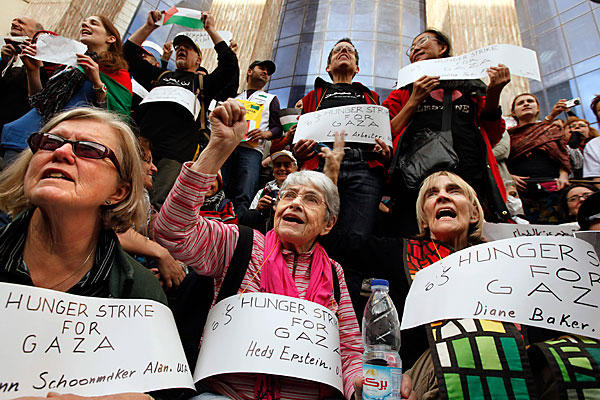
Above, photo from Palestine Chronicle / Aljazeera. Below, holocaust survivor Hedy Epstein, center, and Gaza Freedom March activists in Cairo Tuesday. Photo by Amr Nabil / AP / Christian Science Monitor.

A Movement reimagining change:
Freedom marchers head for Gaza

By Bernardine Dohrn / The Rag Blog / December 31, 2009

More on the Gaza Freedom March, Below.

CAIRO — It has been a tumultuous 15 hours. Two buses, carrying 100 people from the GFM and loads of humanitarian supplies, just departed from Cairo for Gaza. This was a victory and a concession. The decisions and the manner in which this opportunity was framed and promoted by various actors fractured the GFM participants in familiar and unlikely, real and sectarian ways — all documented by media cameras and hundreds of Egyptian security forces.

Ali Abunimah, Veterans for Peace organizers, Israeli journalist Amira Hess, and this writer were among the 100 people on the list to go, who arrived at 6:30 this morning, on the corner of Ramsis by the 6th October Bridge at the Al Gona Bridge, to depart for Gaza.

Tuesday morning, delegates from several countries went to their embassies in Cairo to plead for help getting to Gaza. Most were met with predictable bureaucratic intransigence. The French, however, staged an extraordinary encampment in front of their embassy and their ambassador and his wife came out and spent time speaking with them individually and in small groups.

That action continues today. Bill [Ayers] and I went to the American Embassy at 10 a.m. and asked to see the Ambassador. We were ushered into a holding pen a block away from the embassy building where we joined 35 people already there, surrounded by Egyptian soldiers. Over the next four hours, another dozen Americans arrived, and those of us who asked to leave were denied.

Meanwhile, Medea Benjamin, Kit Kiteredge, and Ali Abunimah were meeting with an embassy official and stressing that we intended to go to Gaza on a nonviolent, humanitarian mission, and requesting their assistance. Further, they asked that the embassy officials release the U.S. citizens who were now clearly being detained outside.

Ali emerged first to tell us that their discussion achieved nothing, and they were now requesting that we be free to go. This process took another hour. Ali refused to enter the holding cage, and spoke to us from outside. At one point, out of nowhere, military personnel grabbed Ali, and Medea — who was standing a few feet away — sprang to action, shouting “No! No!” and grabbing Ali’s arm and pulling him down to the ground with her. As soon as they were prone, the security backed off. It was an impressive display of nonviolent direct action and solidarity in-the-moment, performed with speed, force and clarity.

In late afternoon, a huge demonstration took place outside the Syndicate of Journalists, a traditional site of political mobilizations in downtown Cairo. The GFM was a force, and joined by large numbers of Egyptian citizens chanting in solidarity with Palestine and in opposition to the visit that day by Netanyahu. This action got widespread coverage throughout the Arab world.

Late last night, it was announced at the nightly team leaders’ meeting that our three days of actions across Cairo, the international pressure around the world, and consistent efforts by CodePink leadership to meet with high level Egyptian officials — including a meeting yesterday at the offices of Suzanne Mubarak — resulted in an agreement with the Egyptian government that two buses could leave for the Rafah crossing into Gaza early Wednesday.

The names of the 100, however, had to be submitted to Egyptian officials by Tuesday evening. This resulted in a (necessarily) rushed process, without the opportunity for full debate, discussion, and input about criteria for selection, or about the strategic goals of sending a smaller, incomplete team of people to enter Gaza and participate in the New Year’s freedom march with the people there. By mid-evening, whole delegations (South Africa, New York) announced that they would not participate. In part, they critiqued the process of decision-making; in part, they took the position, “all of us or none.”

As we stood in the morning chill of the stunningly polluted Cairo sky, those boarding the buses felt that it was a partial victory to have two busloads depart for Gaza, that we would take supplies, and witness the realities of life under the occupation/blockade. We thought that our primary objective was to break the isolation of Gaza, and to join with the civil society forces there who wanted us to come join them. The GFM forces opposed to the compromise that left 1,300 of the GFM still in Cairo, gathered at the departure point and began painting banners and chanting against the departure of the buses. Egyptian security grew.

We boarded the buses, loaded supplies, handed over our passports and sat on the buses, excited and exhausted, watching the opposition to our departure gather steam. Signs were hoisted, some began shouting and crying, and chants to Don’t Go, Get off the Bus, and All of Us or None grew in force. Many, unhappy to have worked so hard to get here and who built critical support for Palestinian solidarity and human rights, felt that it was unfair to be left behind, and not to have been consulted. People wavered.

Resentment and criticism of leadership (legitimate and small-minded) and the obvious manipulation of the situation by the Egyptian (and Israeli and U.S.) governments escalated. Al Jazeera ran a story quoting the Egyptian Prime Minister who proclaimed that only the reliable and respectable people had been selected to travel to Gaza (!), leaving behind the rabble rousers and unruly GFM marchers, and claiming credit for delivering the humanitarian supplies to the people of Gaza.

It was clear to us in the hours of debate and delay that some would leave for Gaza, and that others would stay in Cairo to press the demand that the border be opened, the blockade ended, and that all of the GFM participants be allowed to enter Gaza. One of the great difficulties throughout these several days has been to keep ourselves and all participants focused on Gaza.

We find ourselves unwillingly in Cairo, drawn into clashes with authorities and one another on side issues, when what we most want it to keep our eyes on the Palestinian people and our spirits with those confined in Gaza. This is the challenge of the next three days. A large group of us is planning to try to walk to Gaza starting tomorrow, December 31. Buses and taxis containing smaller groups have been turned back all week, and the situation remains fluid, dynamic, and fraught.

The activists who entered Gaza were joined by a few hundred Palestinians as they marched to the Erez crossing. Photo from AFP.

Protesting the siege:
International contingent marching to Gaza

CAIRO — Following Egypt’s refusal to allow the Gaza Freedom Marchers to enter Gaza, the more than 1,300 peace-and-justice activists are setting out on foot. Despite police blockades set up throughout downtown Cairo in an attempt to pen the protesters in and prevent them from demonstrating in solidarity with Palestinians, the internationals are unfurling their banners and calling on supporters of peace around the world to join them to demand the end of the siege of Gaza.

Egypt’s offer to allow 100 of the 1,400 marchers to enter Gaza was denounced as insufficient and deliberately divisive by the organizers. Meanwhile, the Egyptian Minister of Foreign Affairs has sought to spin this last-minute offer as an act of goodwill for Palestinians and isolation of “troublemakers.” The Gaza Freedom March categorically rejects these assertions. Activists are in Cairo because they are being prevented by the Egyptian government from reaching Gaza. “We do not wish to be here, Gaza has always been our final destination”, said Max Ajl one of the marchers.

Some individuals managed to overcome the police barricades and began the march at the meeting point in Tahreer Square in downtown Cairo. They were joined by Egyptians who also wished to denounce the role of their government in sustaining the Gaza siege. The authorities have sought to separate international from the locals. The police is brutally attacking the nonviolent marchers.

Many plainclothes police officers have infiltrated the crowds and are violently assaulting them. “I was lifted by the Egyptian police forces and literally tossed over the fence,” said Desiree Fairooz, one of the protesters. Marchers are chanting and resisting the attempt to disperse them, vowing to remain in the square until they are allowed to go to Gaza. The GFM banner is hanging up high in a tree in the square. Some marchers are bleeding and riot police destroyed their cameras.

The Gaza Freedom March represents people from 43 countries with a diversity of backgrounds. They include peoples of all faiths, community leaders, peace activists, doctors, artists, students, politicians, authors and many others. They share a commitment to nonviolence and a determination to break the siege of Gaza.

“Egypt has tried every way possible to isolate us and to crush our spirit,” the march organizers say. “However, we remain as committed as ever to standing up against tyranny and repression. We will march as far as we can towards Gaza, and if we are stopped by force, we will hold our ground in protest. We call on those committed to justice and peace everywhere to support our stand for freedom for Palestinians.”

Among the participants are Pulitzer Prize winning author Alice Walker, Filipino Parliament member Walden Bello and former European Parliamentarian Luisa Morgantini from Italy. More than 20 of the marchers, including 85-year-old Holocaust survivor Hedy Epstein, have launched a hunger strike against the Egyptian crack-down and are now entering their fourth day.

Source / Gaza Freedom March!

Photo from Reuters.

Endorse the Gaza Freedom March!

Israel’s blockade of Gaza is a flagrant violation of international law that has led to mass suffering. The U.S., the European Union, and the rest of the international community are complicit.

The law is clear. The conscience of humankind is shocked. Yet, the siege of Gaza continues. It is time for us to take action! On Dec. 31, we will end the year by marching alongside the Palestinian people of Gaza in a non-violent demonstration that breaches the illegal blockade.

Our purpose in this March is lifting the siege on Gaza. We demand that Israel end the blockade. We also call upon Egypt to open Gaza’s Rafah border. Palestinians must have freedom to travel for study, work, and much-needed medical treatment and to receive visitors from abroad.

As an international coalition we are not in a position to advocate a specific political solution to this conflict. Yet our faith in our common humanity leads us to call on all parties to respect and uphold international law and fundamental human rights to bring an end to the Israeli military occupation of Palestinian territories since 1967 and pursue a just and lasting peace.

The march can only succeed if it arouses the conscience of humanity.

Statement of Context

Amnesty International has called the Gaza blockade a “form of collective punishment of the entire population of Gaza, a flagrant violation of Israel’s obligations under the Fourth Geneva Convention.” Human Rights Watch has called the blockade a “serious violation of international law.” The United Nations Special Rapporteur for Human Rights in the occupied Palestinian territory, Richard Falk, condemned Israel’s siege of Gaza as amounting to a “crime against humanity.”

Former U.S. president Jimmy Carter has said the Palestinian people trapped in Gaza are being treated “like animals,” and has called for “ending of the siege of Gaza” that is depriving “one and a half million people of the necessities of life.”

One of the world’s leading authorities on Gaza, Sara Roy of Harvard University, has said that the consequence of the siege “is undeniably one of mass suffering, created largely by Israel, but with the active complicity of the international community, especially the U.S. and European Union.”

The law is clear. The conscience of humankind is shocked.

[….]

Sources of Inspiration

The Gaza Freedom March is inspired by decades of nonviolent Palestinian resistance from the mass popular uprising of the first Intifada to the West Bank villagers currently resisting the land grab of Israel’s annexationist wall.

It draws inspiration from the Gazans themselves, who formed a human chain from Rafah to Erez, tore down the border barrier separating Gaza from Egypt, and marched to the six checkpoints separating the occupied Gaza Strip from Israel.

The Freedom March also draws inspiration from the international volunteers who have stood by Palestinian farmers harvesting their crops, from the crews on the vessels who have challenged the Gaza blockade by sea, and from the drivers of the convoys who have delivered humanitarian aid to Gaza.

And it is inspired by Nelson Mandela who said: “I have walked that long road to freedom. I have tried not to falter; I have made missteps along the way. But I have discovered the secret that after climbing a great hill, one only finds that there are many more hills to climb. … I dare not linger, for my long walk is not ended.”

It heeds the words of Mahatma Gandhi, who called his movement Satyagraha-Hold on to the truth, and holds to the truth that Israel’s siege of Gaza is illegal and inhuman.

Gandhi said that the purpose of nonviolent action is to “quicken” the conscience of humankind. Through the Freedom March, humankind will not just deplore Israeli brutality but take action to stop it.

Palestinian civil society has followed in the footsteps of Mandela and Gandhi. Just as those two leaders called on international civil society to boycott the goods and institutions of their oppressors, Palestinian associations, trade unions, and mass movements have since 2005 been calling on all people of conscience to support a non-violent campaign of boycott, divestment and sanctions until Israel fully complies with its obligations under international law.

The Freedom March also draws inspiration from the civil rights movement in the United States.

If Israel devalues Palestinian life then internationals must both interpose their bodies to shield Palestinians from Israeli brutality and bear personal witness to the inhumanity that Palestinians daily confront.

If Israel defies international law then people of conscience must send non-violent marshals from around the world to enforce the law of the international community in Gaza. The International Coalition to End the Illegal Siege of Gaza will dispatch contingents from around the world to Gaza to mark the anniversary of Israel’s bloody 22-day assault on Gaza in December 2008 – January 2009.

The Freedom March takes no sides in internal Palestinian politics. It sides only with international law and the primacy of human rights.

The March is yet another link in the chain of non-violent resistance to Israel’s flagrant disregard of international law.

Citizens of the world are called upon to join ranks with Palestinians in the January 1st March to lift the inhumane siege of Gaza.

Please join us.

Go here to learn more and to sign the pledge.

UPDATE:
Gaza Freedom march converges on Midan Tahrir

By Joshua Brollier / December 31, 2009

CAIRO — Today at 10 a.m., the Gaza Freedom march converged on Midan Tahrir, or Liberation Square in English. This was no easy task for the marchers. We left in small groups to avoid being followed by police who were monitoring our hotels. Several of the larger hotels were monitored more closely, and the Lotus Hotel was completely barricaded, making it impossible for most of the Marchers to leave.

Many marchers, maybe three to four hundred, did make it to the square and a delegation of women gave the signal to converge by waving large flags. We moved into the streets with the intention to occupy a major thoroughfare and march towards Gaza.

Egyptian police and riot cops fanned out of alleyways and side streets as quickly as we came together. The police then attempted to push us out of the street and into the square. As planned, we continued to try to march, but things quickly came to a head. Most of the marchers decided to sit down and lock arms.

The Egyptian cops swiftly became violent and began grabbing, beating, and pulling marchers who did not leave the street. I was kicked in the side and back, punched in the head and slapped in the face. My glasses were broken and one plainclothes officer pulled violently on my hair for what seemed like nearly a minute.

I managed to hold on to one of my comrades,and we held the space in the street for a while longer. Many of the police in uniform were trying to avoid violence, but a handful of plain clothes officers were taking pot shots at the crowd of peaceful and non-violent protesters. Eventually the police succeeded in moving the marchers to the sidewalk where we were barricaded and surrounded by several rows of cops.

I emerged alright from the incident, but several others were not so fortunate. One young man had his shoulder dislocated and others were close to passing out from the trauma of the encounter.

Though we were removed from the square, beaten and prohibited from marching, our spirits were quickly rekindled through the solidarity born out of the struggle and by remembering the much worse hardships that Palestinians often face when they attempt to hold peaceful demonstrations; it is not uncommon for Israeli troops to fire on crowds of Palestinians with rubber and real bullets merely for assembling.

It is difficult to imagine the horror of being trapped in Gaza and having to endure an onslaught like the one that occurred last January. We held a moment of complete silence as we honored those who had died. Not even a cop made a noise.

So we chanted, we marched, we danced, drummed and sang, as we were together in Midan Tahrir. We may not have liberated the Gazan border, but my spirit certainly felt liberated for standing and sitting in solidarity with the Palestinians. We held the space for approximately six hours.

We were a truly international group, and it was inspiring to hear about the different facets of the movement across the world. Many people’s commitments to resisting injustice were renewed; some talked of a Cairo Declaration to unite the worldwide struggle for Palestinian freedom.

After holding a consensus meeting among the different delegations, we decided to disperse and regroup for another action later tonight. What a way to hold a New Year’s celebration; taking action with some of the finest people I’ve ever encountered! It may be held at the French Embassy since many from the French delegation that were encamped at their embassy were prevented by the police from entering the square.

I heard that the group of 85 delegates that headed to Rafah with humanitarian aid did make it into Gaza and have marched there with 6,000 Palestinians to the Israeli border. When reaching the border, the internationals,when within 500 meters of the border,sat down while holding a press conference. I hope to find more details on the scene in Gaza soon.

I’m wishing a happy New Year to all, worldwide! I hope this year to be a year of liberation. May we have liberation in our own hearts, in our relationships, in all of our various countries and especially, liberation to the Palestinians in Gaza and the West Bank.

[Joshua Brollier is a Chicago peace activist who co-coordinates Voices for Creative Nonviolence.]

Source / Voices for Creative Nonviolence

The Rag Blog

Posted in Rag Bloggers | Tagged , , , , , , | 1 Comment

Fear in 2009: Year of the Bullet

“Playing with Guns.” Photo from Mikesjournal.

The fear stimulus:
Year of the Bullet 2009

For every claim that the Obama landslide transformed American culture in 2009 we have ‘bullet points’ that document a grassroots prairie fire of gut fear…

By Greg Moses / The Rag Blog / December 31, 2009

As one hand of history played high keys of hope and change during the inaugural days of 2009, the other hand was reaching for more ominous sound. Across the keyboard of our national concerto, some chimed celebration, others hoarded bullets.

Reporter Harry Pierson Curtis of the Orlando Sentinel wrote about the 2009 stampede for small arms and ammo in early February: “Most in demand is handgun ammunition, including 9 mm and .45-caliber for semiautomatic pistols and .38-caliber for revolvers.” Customers, retailers, manufacturers, and interest groups all had something to say. The usual American demand for 7 billion rounds of ammo per year (23 bullets per capita?) was fixin’ to head North.

“The Ammo Boom is No Dud,” declared ESPNOutdoors.com in late March. Special contributor Colin Moore attributed the “irrational” hoarding frenzy to a “fear factor” caused by the Democratic Party landslide. Handgun owners, especially, were worried that their ammo would soon be taxed into extinction. One Winchester bullet factory was said to be working 24/7 to meet the hyped-up demand.

By Labor Day, the Los Angeles Gun Club had imposed a four-box limit on ammo sales per customer per visit, reported L.A. Times writer W. J. Hennigan. Bullet manufacturers were running “full bore.” Even the military was outsourcing contracts to fill its need for 1.6 billion rounds per year.

Quarterly excise-tax figures posted November 2 by Ted Novin for the National Shooting Sports Foundation (NSSF) confirmed that the gun and ammo sector of the national economy was pumped up. Tax reports for the second-quarter of 2009, compared to the second quarter of 2008, were “up 44.4 percent for handguns, 51.3 percent for long guns, and 57.5 percent for ammunition.” Since the tax rate had not been raised, the increasing tax amounts could be roughly equated to rising sales. Gross Domestic Product meanwhile had fallen over the same two quarters, year over year. For bullet makers, fear of Obama Democrats turned out to be a stealth stimulus.

On the export front, USA ammo manufacturers also logged record sales to global customers. According to a Census Bureau database, exports of small arms ammunition through the first ten months of 2009 have exceeded $2 billion compared to $2.17 billion for all twelve months of 2008.

Through October 2009 we can sort the top eight client nations for American-made small-arms ammo into three clubs: the $Hundred-Million, $Two-Hundred-Million, and $Three-Hundred-Million Clubs. Five members of the $Hundred Million Club received small arms ammo exports ranging from $105 million to $150 million: Poland, Canada, Korea, the United Arab Emirates, and Australia. In the $Two-Hundred-Million Club are two states: the United Kingdom, whose common-law traditions formed the foundation of the U.S. Constitution’s Second Amendment; and Japan, the home of the Peace Constitution. One country stands alone in the $Three-Hundred-Million Club. Can you guess? Israel.

In 2008, the $Two-Hundred-Million Club was curiously occupied by The Netherlands, which has only booked about $17 million in ammunition receivables through October 2009. Israel in all of 2008 had purchased $184 million in American-made ammo supplies. So far in 2009, small arms ammo sales to Israel are up 69 percent.

As an item in the 2009 national account, small arms ammo has been good for GDP and for the balance of trade. Although imports of small-arms ammo are up slightly, edging toward $800 million for the year, American bullet makers are likely to end the year by maintaining something close to a three-to-one trade advantage over their foreign competitors. When it comes to guns and ammo, America knows her stuff.

Shopping for guns in Las Vegas. Photo by Ethan Miller / Getty Images / Life.

According to Google Trends, the “ammunition” search term has leveled out to normal since its Second Quarter spike, although its value to the news industry seems to be steadily growing these past few years. Salt Lake City ranks first for taking interest in the term, followed by Phoenix, Denver, St. Louis, Houston, Dallas, Portland, Tampa, Austin, and Orlando (three cities in Texas, two in Florida, nothing on the East Coast North of Florida or the West Coast South of Portland). If you don’t shop for bullets, you might be interested to read what “ammunition” looks like under Google shopping. Kubrick fans should check out the Winchester Full Metal Jacket Value Pack.

Political theorist Hanes Walton, Jr. developed the concept of the “political context variable” to analyze what happened to history between 1965 and 1995. In the Year of the Bullet 2009 we find hard-core evidence of a singular economic countertrend that defies deindustrialization and depression. If political contexts have a material basis, then we have something material to consider about the political context of the first Obama year.

For every claim that the Obama landslide transformed American culture in 2009 we have “bullet points” that document a grassroots prairie fire of gut fear. If progressive activists have felt tiredness in their bones, it may have something to do with a visceral recognition that fear is what we are fighting but never get the chance to confront.

“Contextual transformation in the political arena is a multi-phased process,” argues Walton, Jr. “First, a desire to transform the political context must be evident, along with a strategy. Second, that desire and strategy must become institutionalized.” What progressives generally want is a different kind of fearlessness than the kind you buy with bullets. Yet the strategy of confronting bullets is not quite the strategy of confronting the fear that organizes the production and distribution of bullets. There will not be an end to the boom in bullets until the fear itself is busted.

In parts of Obama’s agenda there seems to be a spark of fearlessness. Health care security would supplement social security as a means of reducing the daily experience of fear. But Obama is also from the Jane Addams school of social progress, which means he’s not going to make a step forward today that people didn’t first demand yesterday. In 2009, people’s fear of health care insecurity got mowed over by louder fears. How do we strategize and institutionalize a truly disarming fearlessness? In the progressive activism of our post-9/11 world, every time we turn around another fear come smashing up.

Organizers of the upcoming SHOT Show in Las Vegas (Jan. 19-22) report that interest is up for “the world’s premier exposition of combined firearms, ammunition, archery, cutlery, outdoor apparel, optics, camping and related products and services.” If you go to Vegas for the SHOT Show, make sure you are a member of the industry (or media) and don’t forget that “personal firearms or ammunition are not allowed.” You don’t see industry attorneys challenging the Second Amendment infringements of that rule. In the end, even the purveyors of guns and ammo would rather push that fear out their door.

[Greg Moses is editor of the Texas Civil Rights Review and author of Revolution of Conscience: Martin Luther King, Jr. and the Philosophy of Nonviolence. He can be reached at gmosesx@gmail.com.]

The Rag Blog

Posted in Rag Bloggers | Tagged , , , , , , | 1 Comment

VERSE / Larry Piltz : From God’s Lips to Yours

“A Marriage Proposal.” Wood engraving by Barnard from an 1877 issue of The Illustrated London News / Old-Print.com.

From God’s Lips to Yours Happy New Year!

At the calendar’s turn past choice becomes clear
as our marriage strolls into its fourteenth year
that decision writ large wove a soft comfy throw
built a nimbly steered barge with its speed set at slow
with potential adversity more than offset
by inspired hilarities no doubt we’ll have met
two idiosyncrasies set into stone
two radio frequencies sharing a bone
with two sets of families times two sets of friends
the occasional frenzy the holiday binge
the surfacing urges the personal dirges
skirting disasters and nursing the singe

It’s someone to listen with two half-cocked ears
tears of anguish that glisten while craving some beers
the freedom of knowing our bread’s always buttered
the solace each night of our bed partner’s mutter
It’s old faithful the geyser of love and respect
with a pool of concern if one just might defect
It’s years of the same-old flow of life
that waters the hearts of each husband each wife
all deserve the chance of sharing this bliss
and to know it’s street-legal to publicly kiss
in a world whose bright days are meant for all
Now good luck with whom you entangle enthrall

Either way it’s expressive impulsive to care
a bit obsessive-compulsive this permanent share
a boon heart condition this terminal rendition
with pretenses that drop when you’re out of ammunition
My disarming life is a moveable truce
a surrender to hope a set table a deuce
All who want it should be so blessedly mixed
to grow to enjoy that they’re neutered and fixed
Though I joke and laugh I know that I’m blessed
as we learn and evolve and transform this fine mess
I wouldn’t trade even a moment since my wedding
not even the sorrows nor for the hair I’ve been shedding
and certainly not the devotion of wedlock
especially through times of marital gridlock
For what is one egg compared to a basket’s
Yes thank you I’m wedded till forced to my casket

Marriage is kindness stretched to infinity
with the marks to prove it just an amenity
no matter for whom you have an affinity
Your love is your personal God-given identity

Larry Piltz / The Rag Blog

Indian Cove
Austin, Texas
December 28, 2009

Dad and Jean in Omaha at the 2009 College World Series.

The Rag Blog

Posted in Rag Bloggers | Tagged , , , | 2 Comments

UT-Austin’s Kuperman : Bomb Iran’s Nukes

Image from Crusader Rabbit.

UT non-proliferation ‘expert’ calls for
Military strikes against Iran nuclear facilities

[Alan J. Kuperman is] ‘director of the Nuclear Proliferation Prevention Program at the University of Texas at Austin,’ but his Christmas eve call to war relies on disinformation and contradiction, not on objective scholarly analysis.

By Paul Craig Roberts / December 30, 2009

On Christmas eve when Christians were celebrating the Prince of Peace, the New York Times delivered forth a call for war. “There’s only one way to stop Iran,” declared Alan J. Kuperman, and that is “military air strikes against Iran’s nuclear facilities.”

Kuperman is described as the “director of the Nuclear Proliferation Prevention Program at the University of Texas at Austin,” but his Christmas eve call to war relies on disinformation and contradiction, not on objective scholarly analysis.

For example, Kuperman contradicts the unanimous report of America’s 16 intelligence agencies, the reports of the International Atomic Energy Agency, and Russian intelligence with his claim that Iran has a nuclear weapon program. Astonishingly, it does not occur to Kuperman that readers might wonder how an academic bureaucrat in Austin, Texas, has better information than these authorities.

Kuperman is so determined to damn President Obama’s plan to have other countries enrich Iran’s uranium for Iran’s nuclear energy program and medical isotopes that Kuperman commits astounding blunders. After claiming that Iran has a “bomb program,” Kuperman claims that “Iran’s uranium contains impurities” and that Ahmadinejad’s threat “to enrich uranium domestically to the 20 percent level . . . is a bluff, because even if Iran could further enrich its impure uranium, it lacks the capacity to fabricate the uranium into fuel elements.”

What was the New York Times op ed editor thinking when he approved Kuperman’s article? Iran, Kuperman writes, needs “90 percent enriched uranium” to have weapons-grade material, but cannot reach 20 percent or even make fuel elements for its nuclear energy. So, how is Iran going to produce a bomb? Yet, Kuperman writes that “we have reached the point where air strikes are the only plausible option with any prospect of preventing Iran’s acquisition of nuclear weapons. The sooner the United States takes action, the better.”

It could not be made any clearer that, as with the U.S. invasion of Iraq, a military attack on Iran has nothing to do with weapons of mass destruction. An “Iranian nuke” is just another canard behind which hides an undeclared agenda.

One wonders about Kuperman’s non-proliferation credentials. How does a wanton military attack on a country encourage non-proliferation? Aren’t America’s bullying, threats and acts of war more likely to encourage countries to seek nuclear weapons?

At the end of the first decade of the 21st century, the United States has wars ongoing in Iraq where the ancient Chaldean Christian community was destroyed — not by Saddam Hussein but by the neoconservatives’ illegal invasion of Iraq — in Afghanistan, Pakistan, Yemen, and Sudan. The U.S. initiated a war, which it lost, between its puppet ruler in the former Soviet province of Georgia and Russia.

The U.S., the world’s greatest supporter of terrorism, is the main financier of terrorist groups that stage attacks within Iran, and U.S. money succeeded in financing protests against President Ahmadinejad’s reelection and in dividing the ruling Islamic clerics. It was American money, weapons, and diplomatic cover that enabled the Israeli war crimes against the Lebanese people during 2006 and against Palestinian civilians in Gaza during 2008-2009, crimes documented in the Goldstone Report.

Iran has never interfered in U.S. internal affairs, but the U.S. has a long record of interfering in Iranian affairs. In 1953 the U.S. overthrew Iran’s popular prime minister, Mohammed Mosaddeq, and installed a puppet who tortured Iranians who desired political independence. Despite this and other American offenses against Iran, Ahmadinejad has repeatedly expressed Iran’s interest to be on friendly terms with the United States, only to be repeatedly rebuffed. The U.S. wants war with Iran in order to expand U.S. world hegemony.

One might expect a non-proliferation expert to take history into account, but Kuperman fails to do so. Kuperman also has nothing to say about Israel’s, India’s, and Pakistan’s nuclear weapons. Unlike Iran, none of these countries are signatories to the Nuclear Non-Proliferation Treaty. Israel, India, and Pakistan all developed their nuclear weapons in secret, and many experts believe Israel had American help, an act of treason. All three countries have been rewarded by Washington despite their perfidy.

Why is Kuperman concerned about Iran, which submits to the IAEA inspections, but is unconcerned with Israel, a country that has never permitted a single inspection? The answer is that the Israel Lobby, the U.S. military-security complex, and the “Christian” Zionists have succeeded in demonizing Iran.

Every real expert knows that an Iranian nuclear weapon would have no function other than deterring an attack on Iran. Ever since the U.S. lost its monopoly on nuclear weapons, after using them offensively and pointlessly against a defeated Japan, nuclear weapons have served no purpose other than deterrence.

The U.S. has no conflicting economic interests with Iran. Iran is simply a supplier of oil, an important one. A U.S. attack on Iran, such as the one advocated by Kuperman, would most likely shut down oil flows to the West through the Strait of Hormuz. This might benefit refiners, who sell gasoline to the West and could charge enormous prices, but no one else would benefit.

Adding to the war cry are congregations of fake Christians. A great number of them, organized by someone’s money under the banner, “Christian Leaders for a Nuclear-free Iran,” have written to Congress demanding sanctions against Iran that amount to an act of war. The roll call includes the “Christian” Zionist John Hagee, who, according to reports, denigrates Jesus Christ and preaches to his illiterate congregation that it is God’s will for Americans to fight and die for Israel, the oppressor of the Palestinian people.

Among the signatories of the “Christians” demanding an act of war against Iran, are Dr. Pat Robertson, president of Christian Broadcasting Network; Nixon-era criminal Chuck Colson; and Richard Land, president of Ethics and Religious Liberty Commission, Southern Baptist Convention. Obviously, for Southern Baptists, ethics means murdering Islamists, and religious liberty excludes everyone but “Christian” Zionists.

It is a simple matter for an educated person to make fools of these morons who profess to be Christians. However, these morons have vast constituencies numbering in the tens of millions of Americans. There are, in fact, more of them than there are intelligent, informed, moral, and real Christian Americans. The votes of the morons will prevail.

In the second decade of the 21st century, America’s Zionist wars against Islam will expand. America’s wars on behalf of Israel’s territorial expansion will complete the bankruptcy of America. The Treasury’s bonds to finance the U.S. government’s enormous deficits will lack for buyers. Therefore, the bonds will be monetized by the Federal Reserve.

The result will be rising rates of inflation. The inflation will destroy the dollar as world reserve currency, and the U.S. will no longer be able to pay for its imports. Shortages will appear, including food and gasoline, and “Superpower America” will find itself pressed to the wall as a Third World country unable to pay its debts.

America has been brought low, both morally and economically, by its obeisance to the Israel Lobby. Even Jimmy Carter, a former President of the United States and Governor of Georgia, recently had to apologize to the Israel Lobby for his honest criticisms of Israel’s inhumane treatment of the occupied Palestinians in order for his grandson to be able to run for a seat in the Georgia state senate. This should tell the macho super-power American tough guys who really runs “their” country.

[Paul Craig Roberts, a former Assistant Secretary of the U.S. Treasury and former associate editor of the Wall Street Journal, has held numerous academic appointments. He has been reporting shocking cases of prosecutorial abuse for two decades. A new edition of his book, The Tyranny of Good Intentions, co-authored with Lawrence Stratton, a documented account of how Americans lost the protection of law, was published by Random House in March, 2008.]

Source / OpEdNews

The Rag Blog

Posted in RagBlog | Tagged , , , , , , , | 2 Comments

FARC in Colombia : A History of Armed Resistance

“Por la nueva Colombia, la patria grande y socialismo.”(“For the new Colombia, the greater fatherland, and socialism.”) — FARC motto. Photo from HubPages.

Armed struggle for land reform and justice:
Fuerzas Armadas Revolucionarias de Colombia

By Marion Delgado / The Rag Blog / December 30, 2009

CARTAGENA DE INDIES, Colombia — In May 2003 a leak from the Bush Treasury Department indicated that the Office of Foreign Assets Control (OFAC) was about to add to its extensive narcotics traffickers list. This time it would add someone in Colombia.

OFAC would be using one of the enlightened Republican Congress’s new drug war laws, the Foreign Narcotics Kingpin Designation Act. I was pretty sure who the new addition would be. The word “kingpin” was a dead giveaway.

It had to be the guy who had attained high office; whose brother had organized 20 or more death squads and maintained a couple of them out at the family hacienda; whose cousin in the Colombian Congress was the mouthpiece for those death squads as well as a close friend and promoter of various well known narcotrafficantes, including the legendary Pablo Escobar; someone whose own father was wanted by the Colombian police and the U.S. DEA for cocaine trafficking when he was killed in an abortive kidnap plot; and who himself was removed from his position as mayor of Medellín for having well-known ties to drug runners.

Who else could it be, but master criminal and El Presidente himself, Alvaro Uribe?

Imagine my surprise when it was announced the next day, that it was not Uribe after all, but the Revolutionary Armed Forces of Colombia — Peoples Army (FARC or FARC-EP) and 15 of their known or suspected leaders, even though I already knew they had to be a bad bunch of hombres. Five years before, in 1997, they were named a Foreign Terrorist Organization by the U.S. Department of State.

It couldn’t have been easy to make it to the top of two government lists at the same time (the terrorist list and the narcotrafficantes list) and be the defining designees of a whole new hyphenated word, “Narco-terrorist”! That should keep them from gaining credibility with anyone with media access in the U.S.! I started wondering who these FARC guys were. Somebody needed to check them out, find out where they came from, and why.

The roots of FARC-EP

The current civil war in Colombia has been characterized by gross human rights violations, increasing dramatically over the past two decades. International human rights organizations have repeatedly singled out right-wing paramilitary groups (paracos) as being the principal perpetrators of human rights abuses.

The paracos are intertwined with the Colombian Armed Forces as they wage war against, not only the guerrillas, but anyone suspected of being a guerrilla sympathizer: union members, peasant organizers, human rights workers, and religious activists. Some paracos leaders have extended the parameters of the war against the guerrillas and their suspected fellow travelers to include drug addicts, alcoholics, prostitutes, petty criminals, and the homeless, in an attempt to “cleanse” Colombian society. Social cleansing is different from ethnic cleansing only in the presumed reasoning, it has the same results.

Over the years, several Colombian presidents have attempted to address the social, political, and economic injustices that are the principal causes of the conflict. However, these efforts have been repeatedly thwarted by the U.S. and its war on drugs, and by the Colombian political, economic, military elite, who are desperately trying to preserve a “democracy” that has disenfranchised much of the population.

News accounts often label the conflict a “35-year-old civil war,” counting its origin from the official formation of several guerrilla groups in mid-1960. However, the roots of Colombia’s largest guerrilla group, the FARC, date back to peasant armed self-defense movements formed between 1948 and 1958.

The National Front

During the 19th and early 20th centuries, Colombia’s Liberal and Conservative parties, whose influence reached from Bogotá to virtually every village in settled regions of the country, dominated politics. Ideological differences between these elites reverberated throughout society, often resulting in outbreaks of violence that repeatedly pitted loyal Liberal and Conservative factions, both peasant and elite, against each other.

In the late 1940s, dissident Liberal Jorge Eliécer Gaitán emerged from the Liberal and communist-led agrarian and labor reform movements as the leading presidential candidate. On April 9, 1948, Gaitán was assassinated on a Bogotá street. The killing triggered a popular uprising by the Liberal lower classes that resulted in massive destruction and looting in the capital. This uprising, known as the Bogotazo, was the opening act of a 10 year period in Colombian history recalled as La Violencia.

Liberal peasant uprisings occurred throughout the country, pitting rural Liberals and Conservatives against each other. Fearing a peasant-led social rebellion, the elite Liberal leadership supported repression used by the Conservative government to quell the uprisings and preserve the elite oligarchy. But after two high-ranking Liberals were assassinated in 1949, the Liberals boycotted the 1950 presidential election, won uncontested by Conservative Laureano Gomez.

Although rebellion had been effectively quelled in Bogotá, sporadic armed peasant uprisings continued in several rural departments. Gomez, who considered Liberal peasants kin to Communists, responded to these with violent repression. Many Liberal members of the national police force were dismissed and replaced with peasants from the Conservative Boyacá district of Chulavista. The chulavistas became infamous for their brutal tactics in repressing rebellious Liberals and communists.

In the early 1950s, the Gomez regime, supported by the Catholic Church, which had been left out of the various negotiations during the uprisings, and by the U.S., which viewed Communist support for peasants in a Cold War prospective, elevated expression to new heights. Chaotic violence pitted rural Liberals and Conservatives against each other, and resulted in battles between the oligarchy and land-starved peasants. Many large landowners abandoned their properties, fleeing to the relative safety of the cities.

In 1953, Gomez was overthrown by a military coup that brought General Gustavo Rojas Pinilla to power. Rojas Pinilla immediately dispatched the military to reclaim the property of the large landowners still in the cities. In response, armed peasant groups called for agrarian reform.

In June, 1953, in an attempt to end the violence, Rojas Pinilla issued an amnesty to all the armed peasants and responded to their call for agrarian reform by creating the Office of Rehabilitation and Relief. In reality, this office did little to address the agrarian problem, yet the Liberal and Conservative elite felt that Rojas Pinilla was using it to build popular support for himself. To quell their suspicions, in June 1954 Rojas Pinilla extended the amnesty to right wing thugs imprisoned for acts of terror on behalf of the ruling Conservative elite and the Gomez regime.

Many of the Gomezistas released from jail immediately began killing peasants, forcing those that had accepted amnesty to again take up arms. Rojas Pinilla responded in 1955 by launching a major military offensive against the rearmed peasants that became known as La Guerra Villarica. It was in the department of Tolima during this offensive that the armed self-defense movements that would later evolve into the FARC came into existence. The Conservative and Liberal elite blamed the renewal of La Violencia on Rojas Pinilla, and in 1957 organized a general strike and street protests in the capital that forced him to resign.


Following the ouster of Rojas Pinilla, the Conservative and Liberal elite agreed on a power-sharing agreement, the National Front. Beginning in 1958, the parties alternated four-year terms in the presidency (no need to rig elections), and distributed all public positions evenly between the two parties. The formation of the National Front brought an end to the 19th century aspect of La Violencia: conflict between factions of the ruling class. However, the new government still had to contend with armed peasants, whose demand for land reform was being denied.

A FARC is born

According to a 2000 book by Alfredo Molano, Violence and Land Colonization, Violence in Colombia: The Contemporary Crisis in Historical Perspective, many peasants, mostly Liberals and Communists, survived the military offensives of the 1950s by undertaking long marches, under the protection of armed self-defense groups, to the mostly uninhabited eastern departments of Meta and Caquetá.

They cleared and worked new lands in areas they declared “independent republics,” in an attempt to regain subsistence land and free themselves from a national government they distrusted due to “personal experience with social and economic partisanship and… the double value system upheld by the ruling classes.”

However, the colonists soon discovered they had not found the autonomy they so desperately sought. Large landowners, intent on increasing their own holdings, soon began laying claim to the newly cleared lands. Furthermore, the government had no intention of leaving the colonists alone.

“In defining these republics as gangs of communist bandits, the government had an excuse to launch military attacks against them, condemn them politically, and blockade them economically… The only possible outcome was war. One by one the republics fell to the army, and once they were under government control the land became concentrated in the hands of the large landowners,” Molano wrote.

The peasants, forced deeper into the jungle, realized their only chance of achieving social justice lay in their ability to wage war against the government on a national level. As a result, the armed self-defense movements dispersed units to various regions of the country to fight the army on several fronts simultaneously under a central command structure. On July 20, 1964, the various fronts of the armed self-defense movements issued their agrarian reform program. Two years later, they officially became known as the FARC.

Guerrilla groups begat guerrilla groups

In 1960, an independent political party, National Popular Alliance (ANAPO), formed by supporters of Rojas Pinilla was contending in congressional elections. ANAPO’s popularity increased steadily throughout the 1960’s as it appealed to many who had been left out of the National Front alliance. Rojas Pinilla ran as ANAPO’s candidate in the 1970 presidential election and, after holding an early lead, was narrowly defeated by National Front candidate Misael Pastrana Borrero. Many ANAPO supporters accused the government of manipulating the vote count, and in response to perceived electoral fraud; socialist members of ANAPO formed the M-19 guerrilla movement in 1972.


M-19 gained notoriety through a series of daring urban raids that included the occupation of the Dominican Embassy in Bogotá in 1980 and an ill-fated takeover of the Palace of Justice in 1985. The latter resulted in the deaths of more than 100 people, including 11 Supreme Court judges, in a two-day battle in which the army leveled the massive courthouse. In 1989, M-19 guerrillas decided to lay down their weapons in return for a full government pardon. The ex-guerrillas formed a political party, the Democratic Alliance M-19, to participate in the upcoming elections; however, right-wing death squads soon assassinated many of the party’s leaders, including presidential candidate and former M-19 commander Carlos Pizarro.

M-19 had been formed as a response to the National Front, which successfully reserved positions of power for members of the Conservative and Liberal elite. This “limited democracy” spawned other guerrilla movements in the 1960’s. Other factors also came into play.

The Cuban Revolution influenced many radicals in Latin America, as it did in the U.S., convincing them that Ernesto “Che” Guevara’s foco theory of armed insurrection was the revolutionary road to follow. The Colombian Communist Party’s support of resolutions passed by the 20th Congress of the Soviet Communist Party, calling for a peaceful road to revolution, led many young Colombians to split from the Party in order to follow the Cuban model.

The Ejército Popular de Liberacion (Popular Army of Liberation, EPL) was thus formed in the department of Antioquia in the mid-1960’s. Following the Soviet-Chinese split, the EPL espoused the Maoist theory of a “prolonged popular war.” But after 1980 it began to distance itself from the goal of prolonged war and in August 1990 many members laid down their arms in order to participate in the political process, while a small dissident faction continued to fight in northern Colombia.


In 1964, university students who had recently returned from Cuba formed Colombia’s second-largest guerrilla group, the Army for National Liberation (Ejército de Liberación Nacional, ELN), in the department of Santander. The ELN adhered strictly to Che’s principles of rural guerrilla warfare and, in contrast to the M-19 and EPL, has so far refused to lay down its arms and participate in the political process. Sociologist Eduardo Pizarro says that, “In recent years the ELN has focused its activities almost exclusively on efforts to disrupt and destroy the oil industry, attacking with great success the pipelines of the north.”

In fact, between 1986 and 1997 the ELN was responsible for 636 pipeline bombings that resulted in $1.5 billion in lost revenue for the state-owned oil company, the oddly named Ecopetrol. For many years, the FARC and EPL denounced the ELN for pursuing a strategy of economic sabotage that has failed to increase its popular support. However, by the end of the 1990s, the FARC was also targeting pipelines used by multinational corporations to transport oil from remote drilling fields to coastal ports.

The FARC is the only Colombian guerrilla group with peasant roots that pre-date both the National Front and the Cuban Revolution. In contrast, the ELN, EPL and M-19 were all movements led by urban intellectuals, typical of many Latin American guerrilla groups that evolved in the 1960s, Cuban-inspired armed reactions to domestic political, social and economic situation.

FARCing cocaine…

The 1974 presidential election brought an end to the National Front alliance as Liberal and Conservative candidates again ran against each other. Sixteen years of National Front rule had reduced the number of killings — in contrast with the 200,000 Colombians who died during La Violencia — but had failed to address the agrarian issue and a dramatic increase in poverty.

During the National Front years, the percentage of the nation’s work force living in absolute poverty more than doubled, from 25% to 50.7%. Figures were even worse for the rural labor force, where the rate of absolute poverty soared from 25.4% to 67.5%. It is no surprise that when the coca boom began in the late 1970s, the lure of drug profits brought a massive migration of urban jobless and landless peasants to the predominantly FARC-controlled colonized regions.

Initially, the FARC was concerned that the new mass migration would undermine the political and social status quo in areas it controlled. At the same time, its income, from war taxes imposed on the local population in return for maintaining social order, increased dramatically.

New revenue enabled the rebel group to vastly improve its military capabilities, modernizing its weapons and improving the guerrilla fighter’s standard of living. In addition, the FARC was able to offer social and economic services “in the areas of credit, education, health, justice, registry, public works, and ecological and cultural programs.”

During the early years of the coca boom, the guerrillas and the drug lords worked together. Guerrillas controlled many of the coca growing regions while the cartels managed much of the cocaine production and trafficking.

However, this informal alliance collapsed when the leaders of drug cartels in Medellín and Cali began investing their new found wealth in property, primarily large cattle ranches, placing themselves firmly in the ranks of the guerrillas’ traditional enemy. The new narco-landowners soon began organizing their own paramilitary armies in order to fight the guerrillas and those they saw as guerrilla sympathizers.

Until today…

For 50 years the FARC and its predecessors have claimed to be fighting for agrarian reform and social justice for Colombia’s peasant population. The FARC has evolved into a powerful military force of 15,000 to 20,000 fighters who now control approximately 40% of the country. A U.S. Defense Intelligence Agency (DIA) report issued in November 1997 found that “the Colombian Armed Forces could be defeated within five years unless the country’s government regains political legitimacy and its armed forces are drastically restructured.”

U.S. President Bill Clinton’s bizarre Drug Czar, Gen. Barry McCaffrey, echoed these findings when he claimed that Colombian democracy is seriously threatened by the growing military strength of the guerrillas.

Such statements lead one to believe that McCaffrey’s concept of “democracy” involves social order being “maintained” under a military state of siege, impunity for paramilitary forces who regularly massacre the civilian population, political candidates in opposition to the Conservative and Liberal elite being routinely assassinated, a judicial system paralyzed by fear, rigged and stolen elections, and thousands of peasants whose only economic means of survival is illicit coca production.

Indeed, if the ruling political, economic and military elite, aided by the paracos, continue to stifle truly democratic reform, the demise of Colombian “democracy” may well be inevitable.

For its part, the U.S. appears intent on “Salvadorizing” the conflict. Colombia, as was the case with El Salvador in the 1980’s, is today the hemisphere’s leading recipient of U.S. military aid. And it appears that Washington, in its attempt to prevent a guerrilla victory, is once again intent on supporting a repressive military closely allied to right-wing death squads. Such a policy will inevitably result in the continued suffering of the Colombian people, who are routinely subject to massacres, torture, disappearance, kidnapping, and forced displacement.

Any possibility of achieving a peaceful resolution to the conflict depends on the government’s ability to dismantle the paramilitary organizations and create a climate conducive to negotiations between the government and the guerrillas. Then, and only then, will it be possible to address the political, social, and economic causes of the conflict. So far the government has made little headway in eliminating the paracos.

The FARC is absolutely necessary to the survival of the large agrarian class of Colombia. Only land reform, justice, and true democracy will make it unnecessary; this is the only route to the elimination of FARC. Pointless and brutal alternatives, which will not result in the elimination of FARC-EP, is the way chosen by Hillary Clinton, Gates and Obama, sending more arms and U.S. troops, paid for with your money, to maintain civil war within Colombia and perhaps spread it to neighboring countries.

Note: Much research for this article came from various reports produced by the North American Congress on Latin America (NACLA); my thanks to them for keeping track of all this stuff over these many years. — md

  • For Marion Delgado’s previous reports from Colombia on The Rag Blog, go here.

.The Rag Blog

Posted in Rag Bloggers | Tagged , , , , , , | 2 Comments

James Retherford : Sweeping Away the Snow

Art by Mark Fiore. See link to animation below.

Citizens of the earth:
Best wishes in bad times

By James Retherford / The Rag Blog / December 29, 2009

Pardon me if I use this greeting to sweep away the usual seasonal accumulation of snow… and more. This is the time of year when we typically offer each other best wishes and hopes for peace and prosperity in the new year, and I wish each and every one of you all of these things and more.

But this year I also must consider how hollow these thoughts ring when so many of our fellow Americans are jobless and sinking into poverty — and, in too many cases, homelessness. As I think about this, I must, as a citizen of the Earth, also consider how the collapse of the American middle class is but a ripple compared to the economic tsunami unleashed by the worldwide Ponzi scheme hatched by the grifters on Wall Street.

Finally I think of young men and women, forced to choose between careers in legalized war (the military) and illegal wars (drug gangs) because of the wholesale export of American manufacturing jobs to cheap labor markets.

American soldiers are returning from endless deployments to the endless war physically broken and psychologically devastated — haunted by the growing awareness that they have participated not in a noble cause to keep America safe from terrorists or a grand religious crusade against the anti-Christ but rather that they themselves were unwitting pawns in a grand larceny and are nothing more than mercenary terrorists hired by American corporatists to steal the national wealth of Islamic peoples halfway around the world.

This is the season to stop and take stock of where we have been and what we must do. For me — and I strongly hope for you too — this is time to seriously consider what we ALL must do together in 2010 to FIGHT BACK! … to take our nation back from the criminals, the oily oligarchs, the fancy financiers, the war-mongers, the inside-traders, the political hacks, the brown shirts, and — did I mention? — the criminals.

‘Tis the season for giving, so let’s hand out some long prison sentences at hard labor to ALL of those who have been robbing us blind while pimping the Constitution.

Maybe after we give Guantanamo back to its rightful owners, the Cuban government would loan it back to us as a place to incarcerate the corporate crooks and their cronies.

Meanwhile please enjoy Mark Fiore’s seasonal reminder and “Ho! Ho! Whoa!” (Christmas may have passed, but the season of consumption is still with us.)

Oh, and have a happy new year. Please.

CLICK HERE FOR MARK FIORE ANIMATION.

The Rag Blog

Posted in Rag Bloggers | Tagged , , , , , , , | Leave a comment

Health Care Reform : Our Christmas Eve Present


Congress’ health care reform
Promises huge returns for all

‘Their principal job is to reinforce the great ideas of yesterday while suppressing the great ideas of tomorrow.’ — Deepak Chopra on skeptics.

By Janet Gilles / The Rag Blog / December 29, 2009

[The Rag Blog has run numerous articles critical of Congress’ attempt at health care reform. Contributor Janet Gilles has a very different perspective.]

Few politicians have dared to question the health care system itself in this country. Yet, there are 99,000 easily preventable deaths a year from infections acquired in the hospital, according to the Center for Disease Control. The passage of health reform, the Christmas Eve gift to the American public, promises huge returns for everyone, even those with excellent health insurance. Because what good is good insurance when more people die from infections acquired in the hospital than from breast cancer and AIDS combined??

In most states, hospitals are not required to report these rates of infections, which is how they get away with it. New regulations in the health bill which require reporting of hospital acquired infections, will almost entirely eliminate this deadly threat.Other examples of how cost controls are going to result in a betterSystem of health care abound.

For the last decade or two, the costs of health care have skyrocketed. The Mayo Clinic has led the way, and numerous commissions have made simple recommendations to change the rules of the game, by comparing treatments to determine which are most effective. Due to their great promise of cutting costs, most of these measures have made it into the current law now so close to our grasp.

What has been needed has been a restructuring of incentives, a consistent theme in Obama’s health care reform agenda, and we are that close. Because of the power of the right, the new bill does not cover everyone, but Paul Krugman says it best. “Guys, this is a major program to aid lower and lower-middle-income families. How is that not a big progressive victory?”

Jonathan Chait explains why this legislation is the greatest social achievement of our time. Our health care system has been focused on finding the most expensive remedies; this new legislation will require an apples to apples comparison of treatments and end up changing the nature of health care. Change we can depend on.

The Rag Blog

Posted in Rag Bloggers | Tagged , , , , | 2 Comments

Corruption in Panama : Former President on the Lam

Panama’s ex-President Ernesto Pérez Balladares earlier this year. Panama’s ‘Toro’ is currently wanted by law enforcement, if not by Panama’s voters. Photo from telemetro.com.

Panama’s ‘Toro’ goes underground

Warrant issued for arrest of ex-President Ernesto Pérez Balladares for laundering money from gambling concession kickbacks…

By Eric Jackson / The Rag Blog / December 29, 2009

PANAMA CITY, Panama — On December 28 — ironically, the Day of the Holy Innocents, which is Panama’s functional equivalent of April Fools Day in the United States — prosecutors revealed that they had issued an order for police to arrest former President Ernesto “Toro” Pérez Balladares and bring him in for formal interrogation and possible preventive detention on charges that he laundered the proceeds of kickbacks he received from a gambling concession contract awarded by his administration. This was no joke.

The alleged crime is money laundering, arising from a 1997 no-bid gambling concession that the Pérez Balladares administration awarded to Lucky Games SA, a subsidiary of a mostly Spanish-owned investment group. It is alleged that a piece of that business went to a company controlled by Mr. Pérez Balladares, Shelf Holdings SA, and that from the concession’s inception up until the middle of this year Toro received a steady stream of payments from Lucky Games through Shelf Holdings.

The transactions allegedly took place through a complicated network of companies apparently controlled by or in the names of the former president’s close friends. Although a fairly damning paper trail has been published in some of the daily newspapers, Pérez Balladares denies that he has received anything from gambling concessions that his administration granted.

Rumors of the former president’s imminent arrest had been circulating for several days, and a few days before the arrest order was revealed a spokesperson said that he had left the country for Nicaragua on a personal visit. Pérez Balladares’s father was Nicaraguan, which could qualify him for Nicaraguan citizenship that could be an impediment to his extradition. But Migracion said that its records indicated that Toro was still in Panama.

On the afternoon of December 28 the National Police cordoned off part of the Panama Oeste residential area of Punta Barco, where the former president has his beach home. Meanwhile, Pérez Balladares’ lawyers went to court to file a motion to have the arrest warrant quashed. (In Panama, unlike most countries, the courts will entertain legal proceedings by a fugitive from justice and in political corruption cases this is the usual procedure.)

Having served as president from 1994 until 1999, Pérez Balladares was eligible to run for the presidency again in 1999 but after a humiliating loss in the intra-party delegate races for control of the Democratic Revolutionary Party (PRD) he shelved his plans to run in the party’s presidential primary, which in the end was narrowly won by Balbina Herrera. The PRD was routed in this past May’s general elections by Ricardo Martinelli and has been embroiled in severe infighting since then.

One of Toro’s great political liabilities is that he conspicuously flaunts great wealth but has never given any credible explanation as to its source. Over the years he has filed a number of criminal defamation charges and civil lawsuits against people who have suggested where he got his money.

In some diplomatic circles it is said that the fortune dates back to the times when General Omar Torrijos was dictator and Toro was not only a high-ranking economic policy maker but also reputedly the man who for the most part handled the general’s personal finances. However, no diplomat will spell out any details of how the fortune was amassed or even state the theory about the time and circumstances of its origins to a journalist for attribution.

Pérez Balladares was president of Panama when Bill Clinton was president of the United States, and the Clinton administration did a number of things to enrich Toro’s family, for example by incarcerating hundreds of Cuban rafters on an old US military firing range here where there was no water and giving a member of Toro’s family the contract to supply bottled water.

However, during Clinton’s time the U.S. government sought an extension of its tenure at some of the military bases in the old Canal Zone, under the guise of a multinational anti-drug center. Toro’s diplomats negotiated such a deal, but the PRD delegation in the legislature refused to go along with it, and after that the U.S. government began to leak a series of allegations about corruption on Pérez Balladares’s part.

These included participation in a scheme to provide Panamanian visas and passports to Chinese citizens seeking to illegally enter the United States and a scheme with American accomplices to obtain kickbacks in a concession to privatize the maintenance of Panama’s buoys and lighthouses. In recent weeks there have been convictions of at least two of the U.S. citizens involved in the latter scheme in U.S. federal courts.

Shortly after Toro left office in 1999, the U.S. State Department canceled his visa. Stating that such information is confidential, the State Department has never openly publicized its reasons for taking the actions that it did. For years Pérez Balladares employed top Washington attorneys and lobbyists in fruitless attempts to get his U.S. visa back.

(The pattern of Washington playing along with corrupt Panamanian politicians up to the point that the latter can or will no longer deliver what the U.S. government wants, at which point the Americans turn on such officials, has a number of precedents in U.S.-Panamanian bilateral relations. The most infamous of these is the case of one Manuel Antonio Noriega.)

The prosecution of former President Pérez Balladares comes at a time when two former education ministers from the PRD administration of Martín Torrijos are in jail awaiting trial on charges of corruption in building maintenance contracts. The party is split between those who would allow prominent PRD members facing corruption charges to fend for themselves and those who would rally behind the accused, alleging a partisan-motivated political witch hunt.

A series of prosecutions that touches scandals from the Pérez Balladares and Torrijos administrations but ignores the many scandals of the Moscoso administration could give the PRD the political circumstances it would need to make its case to much of the public. Prosecution of Moscoso-era corruption, on the other hand, might drive the Panameñista Party away from its alliance with President Martinelli’s Cambio Democratico.

Martinelli, however, has a fairly effective dodge — it is the semi-autonomous Public Ministry, headed by Attorney General Ana Matilde Gómez, that decides which cases get prosecuted and which do not. The president does not give orders to prosecutors and he can thus stand aside and tell anybody who asks that he’ll allow judicial processes to take their course without interference. This is what Martinelli is doing at the moment.

[Eric Jackson is editor of The Panama News.]

The Rag Blog

Posted in Rag Bloggers | Tagged , , , , | Leave a comment

Avatar : Contradictions of Cameron’s Animation Masterpiece


The contradictions of capital-intensive history:
James Cameron’s animation masterpiece

The stunning experience of nature, culture, and politics does achieve an important spiritual reversal of the Cowboys and Indians plot.

By Greg Moses / The Rag Blog / December 28, 2009

“I’ll sell it to you for $12 what I paid,” she says to a man holding a pale sign that says “Needed, 1 ticket.” Cheery thankyous move the long line forward, one step closer to Avatar on the last day of this box-office- busting Christmas weekend.

Inside the IMAX theater, just before the house lights come down there will be two more tickets to exchange. Mother and son pay cash at the door to strangers and locate a small, impromptu space where they can sit together against the wall, giving the rest of us the chance to see what we look like with our 3-D glasses on.

The one and only preview belongs to the Disney-branded Tim Burton edition of Alice in Wonderland starring Johnny Depp. Everything about it looks brilliant in IMAX 3-D. The Mad Hatter does not fail to chuckle. Imagine seeing all of us from his point of view, looking like a wall of human flies on flypaper, all bug-eyed.

As for the main feature, which opened Dec. 18, 2009 worldwide, it is true what the fan said who chased in vain after James Cameron’s grumpy autograph at LAX: “The plot is so simple a three-year-old could follow it.” Yes, okay, the formula of colonial imperialism is a cosmology that every preschooler can comprehend. It used to go by the name Cowboys and Indians.

Something about Cameron’s capital-intensive mythology is laudable for a Hollywood Blockbuster. The stunning experience of nature, culture, and politics does achieve an important spiritual reversal of the Cowboys and Indians plot. The audience is skillfully maneuvered into anti-imperialist sympathies so that we can tearfully commit to an improbable reversal of the kind of history that any three-year-old knows.

I came away thinking that I might like to try the Xbox version of the Avatar adventure, with opportunities to win battles of liberation using fantastic weapons upon exotic landscapes. Of course, I realized as I was pulling out my car key that a more effective spiritual reversal would have me renouncing all my capital-intensive desires and the battles they advance.

A truly improbable Avatar reversal would produce a global back-to-nature movement liberated from plastic 3-D glasses because something like “real nature” was being returned to its sacred center of attention. “I see you,” we would say to all living things. Cameron’s deeper vision suggests that all living things would be able to sigh a biologically verifiable response of collective awareness: “And I see you.”

At the high point of the plot’s arc, a masculine body of “skin” touches the feminine surface of a producer’s fantasy. In that very moment, the saturated hues of Avatar’s animation affirm what the plot renounces. Experience moves relentlessly toward the desire to be more immersed in the jungle of technology than we already are.

At any rate, the contradictions of the Hollywood Blockbuster are not proprietary to Cameron. They are the contradictions of capital-intensive history itself. With few exceptions here and there, audiences have not failed to purchase their Avatar tickets in advance.

[Greg Moses is editor of the Texas Civil Rights Review and author of Revolution of Conscience: Martin Luther King, Jr. and the Philosophy of Nonviolence. He can be reached at gmosesx@gmail.com.]

The Rag Blog

Posted in Rag Bloggers | Tagged , , , , , , , , | 5 Comments

Carl Davidson : Obama, the Democrats, and the Months Ahead

Carl Davidson. Photo by Thomas Good / Next Left Notes.

A report and perspective from the rust belt:
Obama, the Democrats and the months ahead

By Carl Davidson / The Rag Blog / December 28, 2009

Carl Davidson will be Thorne Dreyer’s guest on Rag Radio, Tuesday, December 29, 2-3 p.m. on KOOP 91.7 FM in Austin. Carl will reflect on Obama’s year and take a look at what’s ahead for the Left. For those outside the listening area, go here to stream the show.

BEAVER COUNTY, PA — I’ve been hearing from too many left activists who are simply fed up with the Democrats and want to leave the electoral arena — and just when the battles there are getting really interesting, even if we don’t have prospects of major victories. To my way of thinking, our present task is to deepen the divisions there, not walk away from them.

The sooner we stop thinking of the “Democratic Party” as if it were a single entity, the better off we will be. That’s why “Democrat control of Congress” is an illusion. The GOP Blue Dog faction in the Democratic Party combined with the regular GOP make it at least a draw. That’s why everything positive gets gutted and turned into its opposite.

The progressive majority’s forces are pretty much limited to the Progressive Caucus, the Black Caucus and the Latino Caucus, and not even all of them. We are a minority force in those upper spheres, not an emerging majority like we are at the base. We can grow to a larger minority in Congress, but to get a true majority, we’d likely have to split both major parties, and we are not close to having that strength yet.

Otherwise, we are mainly limited to passing things where there is a deep divide in finance capital and other big capital at the top, and where one side of it becomes an indirect ally. That may be shaping up on the Afghan war.

But small and medium-sized capital, as well as some larger sectors of productive capital, have yet to stand up to finance capital on HR 676 even though it’s in their interest to do so. We’ll just have to continue our “long march through the institutions” to get it. A carbon tax, immigration reform, and EFCA are going to be even more difficult.

At this point, we have two interconnected mass democratic tasks. Building the left-progressive pole inside and outside the Dems with groups like PDA and other independent forums, and dividing the GOP right to smash the Teabaggers and their allies. Neither is easy, but starting with a clear head helps a lot.

Here in Beaver County in western Pennsylvania we have about 200 or so PDA people and another few dozen Beaver County Peace Links activists. Almost all are blue collar workers or retirees. We, in this sense, are the active antiwar forces here, as well as the active left-progressive side of the spectrum among the unions and a few other groups.

There isn’t much else, save for the Tom Merton Center, the religious-liberal-green-anarchist bunch in nearby Pittburgh. Together with the unions, they pulled out 10,000 for the G20. We took part in it as best as we could. All told, about 6,000 of the 10,000 were from the wider Pittsburgh region and the nearby campuses. That’s our activist core viewed more widely.

Nonetheless a majority of our county, and certainly a majority of Dem voters, are critical of the wars — but they have yet to take any action other than voting. It’s our task to find the activities they will take up, like coming to a vigil or attending an antiwar educational, or even just honking their horns at our weekly vigils.

For the Healthcare not Warfare Afghan war protests here a few weeks ago, we got out about 60 people in the rain and cold. Not bad, considering. At least half those attending were wearing their union jackets. Besides us, the speakers were union folks and local Dem officials, plus Tim Carpenter from PDA. The speeches pushed and warned Obama, but didn’t attack him personally. They told him what he had to do in order to succeed.

If we didn’t take this approach, working with local Dems, I’d guess we could get out less than 10 people, if anyone bothered at all.

Our next project is to make use of Bob Greenwald’s Rethink Afghanistan from Brave New Films. One of our allies showed it last month at a college in the next county. Plus finding ways to work with the Steelworkers on their new collaborative with the Mondragon Coops.

If you think our strategy is reducible to “supporting Obama,” you don’t understand it. To be precise, our strategy here is to aim the main blow at low-road neoliberal finance capital and its right wing populist allies, allying with high road neoKeynesian initiatives at the top, while developing the left-center coalition among labor, minorities, women and youth at the base.

We do that in the form of expanding our PDA group; it’s platform is Out Now, HR 676, Green Jobs, the Employee Free Choice Act (EFCA), Carbon Tax and Debt Relief. Within that, among the advanced, a few of us do revolutionary socialist education that targets neo-Keynesianism as well. We work with Committees of Correspondence for Democracy and Socialism, and that way we grow CCDS in size, too.

That’s the political and class substance of it. Where Obama stands, and where we stand in relation to him, depends on the ebb and flow. We oppose him where he’s wrong, support him where he’s right, and defend him versus the racist onslaughts of the right.

So yes, I’m suggesting that people elsewhere do likewise — although I’m well aware that conditions vary, and adjustments are required.

If one of the left antiwar coalitions thinks they can pull off a march on DC, we’ll probably rent a bus or two, fill them, and go to it. If we do, we’ll try to network horizontally with others like ourselves, perhaps even meet after the march for a confab of some sort.

But we are not interested in wasting energy or resources getting into national pissing matches and intrigues over slogans and speakers. We’ll simply bring the slogans that make sense to us. But in the end, the antiwar forces need to be reoriented and rebuilt at the base, in alliance with the growth in class struggle activity around the economy.

That’s what we’re doing, and have been doing for some time. Other approaches may point to the future as well, and I’m wide open to hearing about them.

Carl Davidson became widely known in the American left as a national officer of SDS (1966-68), as a writer and editor of the New Left newsweekly The Guardian, and as a leader of the anti-Vietnam war movement. In later years, he took up the study of the social impact of technology and the revolutions in communication and high-tech production. Together with Jerry Harris, he is the author of CyberRadicalism: A New Left for a Global Age.

Most recently Carl worked as webmaster for Progressives for Obama, an independent left-progressive voice in the campaign (now renamed as Progressive America Rising). He is also a leader in the U.S. socialist movement, serving as a national co-chair of Committees of Correspondence for Democracy and Socialism. A longtime resident of Chicago, he recently moved back to the Western Pennsylvania milltowns where he was born and his family resides.

The Rag Blog

Posted in Rag Bloggers | Tagged , , , , , , , , | 6 Comments

Deadly Environment : Latin American Anti-Mining Activists Murdered

A close up of murdered anti-mining activist Marcelo Rivera’s eyes on a mural painted in front of the cultural center that he founded in San Isidro, El Salvador. Photo by Dominque Jarry-Shore / The Dominion.

Grassroots movements met with deadly violence:
Mining faces challenges in Latin America

By Val Liveoak / The Rag Blog / December 27, 2009

See ‘Who Killed Marcelo Rivera? Prominent anti-mining activist murdered in El Salvador,’ by Dominique Jarry-Shore, and ‘Chiapas Anti-Mining Organizer Murdered,’ by Kristen Bricker, Below.

There are many grassroots struggles against corporate domination going on in the Empire that we hear little about. I would argue that the military coup in Honduras was triggered in large part by these issues, and I am aware of similar struggles in Mexico, Colombia, and Costa Rica, not to mention West Virginia, Canada and the American West. And now, with the article below, in El Salvador.

Mining companies are the epitome of an extractive industry; typically flaunting concerns about health, labor issues, and the environment, they focus on ripping out tons of earth to get ounces of ore, which is almost always exported outside of the region (and in many cases outside the country) in which it is produced.

And the profits also leave the area as fast as possible. In order to increase their profits, companies must pay the lowest possible wages for hard, dangerous and dirty work, and generally use poisonous chemicals on site, mostly failing to keep them from entering local water, and air. Then they leave behind an ugly and ravaged landscape that can never return to a condition that will even minimally support life without costly rehabilitation — which they never do voluntarily.

The growing world concern with environmental issues has little success when up against these multinational corporations. Not only is it hard to take on the powerful behemoths, but they do their work (their dirty work) in isolated areas, and often control access to their sites, preventing most people from seeing the ugliness, the near enslavement of the miners, and the effects of the poisons — many slow acting — that seep into the earth. Think black lung, mercury poisoning, massive fish kills, hundreds of acres of moonscapes where before there were verdant mountains.

And like other industries that would exploit and extract the most from “their” resources, they are always ready to persecute, threaten, or kill opponents, whether they are labor leaders, environmental activists, concerned local residents, or terminally ill employees.

While global warming was on most minds at the climate conference in Copenhagen, Ecuador offered an innovative way to confront both the local negative effects of the petroleum industry — an archetype of an extractive industry — and the long term effects to the earth and the atmosphere of the consumption of the product: they offered to leave newly found Amazonian petroleum in the ground in exchange for financial support for other types of investment in their country.

It is a shame that El Salvador’s celebrated FMLN President does not have such a — dare I say it — revolutionary offer to make. Instead, as we see from the article below, he will need to be pushed to provide even the simplest protection for Salvadorans who are struggling against a goliath of a company.

Please see the two stories about murdered mining activists in El Salvador and in Chiapas, Mexico, below.

[Texan Val Liveoak is a nonviolent activist currently dividing her time between El Salvador and San Antonio. She coordinates Peacebuilding en las Americas, the Latin American Initiative of Friends Peace Teams that also has programs in the African Great Lakes region and in Indonesia.]

Esaparición y asesinato del activista Marcelo Rivera

His relatives, friends, neighbors. His students from the school, attendees of his art workshops, colleagues of the association (ASIC). His comrades from the party, his partners in the anti-mining fight [in El Salvador]. Everyone. Perhaps even his murderers.

Almost always it is the family members and closest friends who say goodbye to a fallen one by crying profusely. It is rare at a funeral to see everyone in attendance crying. The burial of Gustavo Marcelo Rivera Moreno is one of those exceptional cases, hundreds of children, youth and elders, men and women, all crying together…

The Media Coop

Who Killed Marcelo Rivera?
Prominent anti-mining activist murdered in El Salvador

By Dominique Jarry-Shore / December 16, 2009

SAN ISIDRO, El Salvador — Death and violence are an unfortunate part of everyday life in El Salvador. Local and national newspapers, with their graphic photos of bloodied corpses, track the daily tally of homicide and crime in a country that has one of the highest murder rates in the world. But even by those standards Marcelo Rivera’s torture and death were shocking.

During the evening of June 18, 2009, the community leader and anti-mining activist disappeared when he was lured away from a routine trip a few kilometers from his home in San Isidro. Twelve days later, his body was removed from an empty well 27 meters deep. His body had no hair or fingernails, his trachea had been broken and the thumb of his right hand was stuck in his mouth like a baby’s, tied in place with a piece of rope around his naked body. He had been beaten and his face was unrecognizable.

Rivera was a respected member of the community. He founded a cultural center popular with youth in San Isidro, and had been in charge of the finances of the local chapter of the FMLN, the country’s leftist and currently ruling political party. He had also campaigned vigorously against the El Dorado mining project in Cabanas, owned by Canadian company Pacific Rim Mining Corp.

Vancouver-based Pacific Rim is a publicly traded company that has subsidiaries in El Salvador and the U.S. The company is a junior exploration company that specializes in gold exploration. Pacific Rim has invested $80 million into the El Dorado project in about seven years. They claim to have invested several million dollars in social programs in Cabanas.

But the project has generated conflict in a region characterized by poverty and a dependence on remittances from family members in the U.S. Money provided by Pacific Rim for health and education is seen as a way of buying support from the people and tension is high between those for and against the mine.

The environmental effects of the mine, such as the contamination of soil and water sources like aquifers and wells, are a big worry among residents in Cabanas. Some community members have also complained about the displacement of communities to make room for the mine. On a social level, the arrival of Pacific Rim has generated conflict and violence in the area.

Apart from Rivera’s death, there have been two assassination attempts that seem to be related to anti-mining activism: In July, a priest who hosts a local radio show used as a platform for his anti-mining stance was run off the road. A few weeks later, the leader of a local community development association that is against the mine was shot eight times. Both men now have 24-hour police protection.

Rivera’s brother Miguel Rivera said his brother’s murder has caused fear among those opposed to the project. “People we work with who are against the mining project are afraid because someone has died,” he said. “They say, ‘I could be the second one. I could be next.’”

According to lawyer and activist Hector Berrios, Marcelo Rivera had already been the victim of death threats and at least one assassination attempt near his home in January 2009. “The question is,” Berrios said, “who benefited from Marcelo’s death?”

For his part, Pacific Rim CEO Tom Shrake said the company condemns violence and has spoken to employees to see if they know anything about the murder.

“They have assured us that they had absolutely nothing to do with it,” Shrake said in a telephone interview from his hotel in San Salvador.

“As far as they know—and I’ve heard this from the local police as well—his death had nothing to do with his mining activism. Now whether that’s true or not we’ll see. But we have no knowledge of it.”

That police theory — that Rivera’s death was related to a gang dispute after a night of drinking and not his anti-mining activity — didn’t make sense to Rivera’s family when they heard it. Rivera was not someone who associated with gang members and he didn’t drink alcohol.

“The police invented a scenario to be able to tell people something, because a lot of people were asking about Marcelo,” Miguel Rivera said. “The police theory was that he was killed the same day he disappeared, or early the next day.” But the doctors who examined Marcelo’s body told Miguel that his brother died about eight days after he disappeared.

That was just one of several inconsistencies in the case. Following a complaint they received from Marcelo’s family, El Salvador’s Public Attorney’s Office for the Defense of Human Rights found there had been negligence on the part of the police.

“We found some failures in terms of the lateness in mobilizing to do inspections in places where the body could be,” Gerardo Alegria, a lawyer for the Public Attorney for the Defense of Human Rights, said. “That includes where they found the body. The police had known for a few days already that the body was there.”

Alegria also said the police failed to gather information at the scene that would have helped solve the crime. His office is now keeping an eye on the investigation and Alegria said things have improved. Five adults and one minor have been arrested so far and are awaiting a hearing. But in this part of the world, there is a lot to be said about intellectual versus physical perpetrators of a crime, and questions remain about who was really behind the killing.

Meanwhile El Dorado has been at a standstill. The company stopped investing serious money into the mine about two years ago, when Tony Saca, president of El Salvador at the time, made public statements indicating Pacific Rim’s permits would not be honoured.

Pacific Rim has since filed for arbitration under the Central American Free Trade Agreement (CAFTA), although Shrake said he is confident a settlement will be reached.

As for local opposition to the project, Shrake said that is something that was expected all along. “There’s just a huge international industry that opposes any extractive industry anywhere in the world at this point. So if you don’t expect opposition to any extractive project, you’re living in a closet,” he said.

“You will have people who are emotional about it and are in your face about it but you have to act like Mahatma Ghandi. You cannot react in any way, shape or form.”

Gold mining, a practice that relies on cyanide or mercury for extraction, has long come under fire from environmentalists because of its potential for contamination. Pacific Rim markets itself as an environmentally responsible company that has “raised the bar for environmental protection.”

According to Shrake, the El Dorado design will use two impermeable liners to prevent tailings from coming in contact with the ground. They’ll also use a process called INCO to destroy the cyanide used and they’ll build their own water reservoir instead of using groundwater, purifying the water before it goes back into the water system.

Environmentalist Luis Gonzalez works with the Salvadoran Ecological Unit (UNES) in San Salvador. “It’s a concept, but on an industrial level, green mining doesn’t exist,” he said. “By definition what you’re doing is extracting a non-renewable resource.”

Gonzalez said the INCO process recycles only part of the cyanide and the rest goes into the ground. “Exploration is like exploitation on a smaller scale,” he said, noting people in Cabanas reported their wells and watering holes dried up after exploration activity by Pacific Rim.

Shrake said that was one incident involving some shoddy work on the part of a contractor and that it won’t happen again.

“Once we realized what had happened, within a day we set up a series of tanks so that they’d have water while we corrected the problem… We went back to the drill holes and cemented them from bottom to top and plugged up this disruption to the fracture system and the water’s flowing again, and has been flowing since we made the correction.”

While the future of El Dorado remains unclear, Miguel Rivera has gone ahead and set up the Marcelo Rivera Justice and Freedom Committee. He is holding out hope that his brother’s murderer will be brought to justice.

“He was my brother. Ever since we were little we spent a lot of time together and shared ideas. When we started finding out more about the impacts of mining we started spreading information to people. Marcelo was the person who had a relationship with the community.”

[Dominique Jarry-Shore is a freelance journalist based in Chiapas, Mexico. She traveled to El Salvador with the help of a grant from the International Development Research Center in Ottawa.]

Source / The Dominion

Anti- mining activist was shot to death Dec. 27. Mariano Abarca. Photo from narocsphere.

And in Mexico:
Chiapas anti-mining organizer murdered

Mariano Abarca led a growing movement to kick Canadian mining companies out of Mexican communities

By Kristin Bricker / December 1, 2009

CHIAPAS, Mexico — Mariano Abarca Roblero, one of Mexico’s most prominent anti-mining organizers, was shot to death on the evening of November 27, 2009, in front of his house in Chicomuselo, Chiapas. He left behind a wife and four children. Another man was wounded in the shooting.

The incident came just days after Abarca filed charges against two Blackfire employees, Ciro Roblero Perez and Luis Antonio Flores Villatoro, for threatening to shoot him if he didn’t stop organizing against Canadian mining company Blackfire’s barium mine in Chicomuselo.

According to a formal complaint filed by a government employee who works in the Chicomuselo municipal building, Roblero Perez arrived at the municipal building to say that he had gone to look for Abarca to “fuck him up in a hail of bullets.” He also reportedly said that Abarca and other people were on a list of people Blackfire management wants to hurt. Blackfire public relations manager Luis Antonio Flores Villatoro was mentioned in the government employee’s complaint as one of the people responsible for the list.

Ejido authorities from the Nueva Morelia ejido in Chicomuselo county took the complaint seriously and helped Abarca launch an investigation. The day before the murder, Roblero Perez and Flores Villatoro were summoned to testify regarding the alleged death threats, but they failed to appear.

[An ejido is commonly-held land traditionally managed by assembly.]

A history of harassment

Even though local authorities acted to try to protect Abarca, the Mexican Network of People Affected by Mining (REMA) blames the Chiapas state government for failing to protect the mining leader. On the contrary, the state government seems to have been complicit in Blackfire’s legal harassment of Abarca.

On August 17, 2009, unidentified armed men in unmarked cars kidnapped Abarca as he was leaving an elementary school in Chicomuselo. He had visited the school to request permission on behalf of his organization, REMA, to use the building for an anti-mining meeting scheduled for August 29-30.

The kidnappers turned out to be police. They had arrested Abarca on charges filed by Blackfire regarding a June-July 2009 highway blockade REMA set up to prevent the passage of Blackfire trucks. REMA was protesting the company’s failure to comply with promises it allegedly made regarding community development projects and environmental stewardship. According to community leaders, Blackfire’s open-pit barium mine uses too much of the area’s scarce water resources. They are concerned that the pollution could effect their crop cultivation in the near future.

Acting on Blackfire’s formal complaint, the state government charged Abarca with attacks against public roadways, criminal association, organized crime, and offenses against the peace. Theoretically, organized crime charges are reserved for drug, arms, and human traffickers, and other members of Mexico’s expansive mafia network. However, the Chiapas government has been known to accuse activists and community organizers of organized crime in order to take advantage of restricted due process rights for people accused of organized crime.

That is what happened in Abarca’s case. The organized crime charge allowed the Chiapas government to imprison him under the highly controversial and internationally criticized legal instrument of “arraigo” or pre-charge detention. Under arraigo, the government can arrest a suspect and isolate him or her for months while it pressures and sometimes tortures the person into confessing.

The state government detained Abarca for eight days before it ceded to international public pressure to release him. Abarca was released and the charges were dropped due to lack of evidence. His lawyer, Miguel Angel de los Santos, criticized the Chiapas government for ceding to the mining company’s pressure to arrest Abarca. “There was no legal justification for his arrest and detention. Preliminary investigation began on June 12th, two days after the blockade, and was only just beginning to come together. The investigation had not advanced,” he told Proceso in August following Abarca’s release.

Structural adjustment strikes again

Social discontent regarding mines in Mexico has been steadily building over the past 10 years, beginning when the effects of a World Bank-mandated mining sector deregulation scheme were first felt. A confidential World Bank document entitled “Implementation Completion Report: Mexico Mining Sector Restructuring Project,” which Narco News makes available to the public, outlines exactly how a nine-year loan project drastically transformed Mexico’s mining sector.

The project, first proposed by the Word Bank in 1989 and quickly adopted by the Mexican government, aimed to deregulate the mining industry in Mexico. The Bank proposed the project because, as its Implementation Completion Report (ICR) explains,

Past lending of the Bank for mining in Mexico was oriented towards specific investment projects, with direct lines of credit to the sector… The lessons learned from those operations were that the continued development of the mining sector required increased access to land rights, reduced ownership limitations, revision of the tax legislation, a restructuring of existing institutional setups, as well as policies that stimulate private investment in mining by both domestic and foreign firms. The Bank Mining Sector Review identified an inadequate regulatory and institutional framework as the major constraint to increase private investment and further growth of the sector.

One of the Bank’s main goals for the project was to open up Mexico’s previously protected national mining industry to foreign companies; the Bank listed “open the sector to foreigners” as its first “strategy to restructure the sector.” It hoped to do so by privatizing state-owned mining companies, slashing taxes, awarding mineral and land rights to private companies, and facilitating foreign companies’ ownership of Mexican land in order to “contribute to the increased exploration and exploitation of the vast mining potential of the country, to take advantage of Mexico’s strategic location near the United States and Canada.”

The Bank proposed a set of changes to Mexican law in its Mining Sector Report, and the Mexican government — at that point still under one-party rule — rushed to implement them under a plan called the National Mining Modernization Program. In just four years (1990-1994), the legal framework for mining in Mexico underwent a radical change. Before the ink on the new laws was dry, the Bank began to dole out money to private mining companies to “help finance the surge in demand for investment funding that was expected to result from the improved policy and institutional setting for mining operations.”

The Bank was thrilled with the results of the National Mining Modernization Program and its subsequent loans. According to the Bank, over the course of the project, which ended in 1998, over 8.7 million hectares of land were released and 17,220 new mining concessions were granted.

As a result of the legal changes mandated by the loan, the time required for processing mining concessions went down from five years to five months, and the Mexican government’s backlog of about 14,000 concession requests that were pending since 1989 disappeared virtually overnight.

The Bank was so pleased with the results of the Mining Sector Restructuring Project that it wrote, “Future Bank participation in the sector does not seem justified anymore, in view that mining exploration/exploitation is now open to domestic and foreign investors.”

The Bank’s structural adjustment of Mexico’s mining sector has played a key role in the battle for “land and territory” (as the Zapatistas refer to it) in the country. Private ownership, increased economic pressure on small and subsistence farmers, and top-down “development” projects are acutely felt in mineral-rich communities.

According to Gustavo Castro Soto of the Chiapas-based non-profit Otros Mundos, “Beginning in 2000, almost 10% of the national territory has been ceded to transnational companies through mining concessions.” REMA notes that in Chiapas, 15.21% of the state’s total territory has been ceded through mining concessions. Many of those concessions don’t expire until the year 2050. If the social unrest that frequently follows mining concessions is any indicator, Mexicans are not willingly handing over their land to foreign mining companies.

Mining industry under fire

Mariono Abarca’s murder comes at a time that the mining industry in Mexico is feeling the heat from Mexico’s social movements. Inspired by the national movement of communities affected by hydroelectric dam projects, mining-affected communities are joining forces in a unified front against destructive mining practices.

In 2008, representatives from Chicomuselo travelled to the state of Jalisco to found REMA during the First Encounter of the Mexican Network of People Affected by Mining. Representatives from mining-affected communities in eleven states and the Federal District participated in the historic event: Chihuahua, Sonora, Nayarit, Jalisco, Oaxaca, Chiapas, Guerrero, Mexico City, México State, San Luis Potosí, Coahuila, and Veracruz.

REMA agreed at that meeting to raise consciousness about the social and environmental effects of mining. It also pledged that member organizations would support each other in their struggles against destructive mines in their communities.

One of the most high-profile joint actions that REMA carried out was a protest encampment in front of the Canadian Embassy in Mexico City this past July. Abarca and representatives from other communities affected by Canadian mining companies participated in the encampment, which demanded the withdrawal of Metallic Resources/NewGold, a Canadian company, from Cerro de San Pedro, San Luis Potosi. At the protest, Abarca spoke about Canadian mining companies’ contamination of traditional water sources.

Following the protest, mining-affected communities won a temporary victory: just last month, a federal judge ordered that the Cerro de San Pedro mine be closed because the mining company had failed to comply with environmental stipulations. The closure comes after 10 years of struggle waged by a broad coalition of San Luis Potosi civil society organizations, which include organizations linked to Mexico’s center-left Democratic Revolution Party (PRD) and groups affiliated with the Zapatistas‘ Other Campaign. They opposed the gold mining project because, in addition to environmental concerns, the Cerro de San Pedro is an official historic monument. NewGold has promised to appeal the ruling.

In Chiapas, Abarca led a previously mentioned highway blockade that prevented Blackfire trucks from entering and leaving the Chicomuselo mine this past June and July. The community was protesting the company’s excessive use of scarce water supplies, its failure to follow through on commitments it reportedly made to the community, and its back-door maneuverings that allowed it to purchase 13.5 hectares of ejido land without the required approval of the ejido assembly. Blackfire claims it lost $120,000 pesos ($9,334 dollars) as a direct result of the blockade.

This past August, REMA held its Second Encounter of the Mexican Network of People Affected by Mining in Chiapas. Guatemalan communities who are resisting mining projects traveled to Chiapas to participate and share their experienes. Abarca helped organize the Encounter, and as previously mentioned, it was during the Encounter’s organizing process that state police kidnapped Abarca and charged him with organized crime at Blackfire’s request.

A communique signed by 25 Mexican organizations from six states and Mexico City holds Blackfire’s owners responsible for Abarca’s shooting and any resulting violence in the region. They called for a protest encampment outside of the Canadian Embassy and the Ministry of Economy headquarters in Mexico City on December 3 in solidarity with the people of Chicomuselo.

Source / NarcoSphere

The Rag Blog

Posted in Rag Bloggers | Tagged , , , , , , , | Leave a comment

Dark Ages Redux : Trickle Down Feudalism

Doge Enrico Dandolo preaching the Crusade. Gustave Doré (1832-1883) / Wikimedia Commons.

The reincarnation of the Dark Ages:
White evangelicals are the new Crusaders

In place of mote-defended castles surrounded by thatched-roof shanties will be ‘gated communities’ (sporting high-tech surveillance to keep the homeless and servant class out)…

By Loren Adams / December 27, 2009

The king taxed the peasants to poverty while the royals were exempt from paying any. Reason? Unjust tax codes were a design of the rich, by the rich, and for the rich. That was the “targeted tax-cut” which invariably became law. “He who hath the gold maketh the rules.”

The Dark Ages were the birthplace of “Trickle-Down Economics.” The caste system was embraced, the church was simply a ruling arm of the monarch, and slavery was legitimatized by the religious righteous.

Republicans constantly decry labor’s “class warfare,” but this is the real war being waged across America. The cultural war is basically a derivative of class warfare — where the ruling class has employed white evangelicals to do their bidding: divide and conquer.

During the Dark Ages, wealth was exclusively inherited, not earned. The legal system was purchased like a commodity resulting in jury-less trials, military tribunals, pronouncements by a king acknowledged as sovereign and commissioned by God to rule as if the voice of Providence Himself, executive orders usurping representation, taxation without representation, etc.

Anyone disputing the monarch’s sovereignty was designated a traitor and summarily executed, tortured or banished to dungeon. These were the markings of the Dark Ages. Are they not similar to contemporary Republicanism so glaringly demonstrated during the Bush years?

America’s founders rejected the monarchical system where its legitimacy hinged on approval by the religious supremes. The “separation of church and state” concept of the new republic was established for that reason. Now we are sliding back into the realm where the head of state rides to power on a religious beast, where any successful candidate must be approved by the predominant religious system to win. Even our beloved Barack Obama during the 2008 campaign felt he must do pilgrimage to Saddleback Church and later pay homage to Pastor Rick Warren at Inaugural.

The Dark Ages were not only dark from plagues, they were darkened from ignorance, superstition and greed. The religious right denied the world was round; anyone disputing this “God-derived” doctrine was executed or imprisoned. Science was equated with Satanism. Thus, discovery, invention, innovation, and commercialism could not flourish, and the West plunged into poverty.

Does America not see the similarity? A religious system that wages war on science, denies climate change, rejects evolution, and edits Texas texts for school children to include praise for Limbaugh, Beck and Palin is a system geared toward destroying not only scientific and environmental thought, but the foundation of economy.

The religious system was USED to gain power for monarchs similar to the way current political operatives USE the religious to further their own aims. In the Middle Ages, the doctrine of the “divine right of kings” precluded civil liberties; the king/queen equaled “divinity.” Potentates (royals) were considered surrogates of God. Power was passed down from father to son — Dynasties divinely ordained by entitlement.

So, when we hear of world leaders or presidents bequeathed the title “Man of God,” watch out. It may not be long before civil liberties and human rights become casualties in the name of national unity and security — and with popular support — the masses duped by superstition. Remember the Bush theocratic dynasty.

History has witnessed its booms and busts (some massage as “cyclical market adjustments”). History repeats itself. We were at the core of an unparalleled economic boom at the close of the Clinton years — measured by purchases, low unemployment and budget surpluses. There were more jobs than people to fill them; illegals streamed across the border. Now we’re in a deep recession as a consequence of buying into Republican Dark-Age mentality.

What caused history’s busts? When capital is concentrated among the wealthiest, history warns of ominous collapse. The bubble bursts. It happened in 1837, 1857, 1884, 1893, 1907 and 1929. In all depressions there was glaring disparity of income: The poor — poorer, the rich — richer.

Prosperity is the result of healthy circulation of currency where the vast majority have robust purchasing power. When wealth fails to circulate but is dammed up by a concentration at the top, the economy falls and results in depression or severe recession. When the rich accumulate an overwhelming portion of the wealth, their house of cards comes tumbling down because there remain few to buy the goods sold by the wealthy to sustain the lifestyle.

Sure, other factors — such as over-speculation, Wall Street insider trading, anti-labor trade agreements, deregulation, and tax policies determined by greedy special interests — drive the economy into the ditch. But are not these all related? The world is loaded down with the cancers of Bernie Madoffs and Kenny Lays before downturn metastasizes itself into poverty, crime and collapse.

Consider this ominous fact: The average American’s income has remained flat since 1977 — 33 years ago, while the income of the richest 1% has more than tripled — 228% (Center on Budget and Policy Priorities). CEO (corporate executive officer) incomes rose 400% in the 1990s to $10.6 million annual income per capita, while take-home pay for the average American, the 80%, rose zero percent.

Real life experience bears it out. Most Americans don’t enjoy the purchasing power they once did when a one-income family could raise children, purchase a home, car, and college education for their kids. Now both parents work (if lucky enough to have a job) and still can’t keep up, resulting in less quality education, poor family relations, rising crime, and an eroding moral foundation.

Some in this country never learn from history. The greedy are blinded to the fact that refusing to care for others less fortunate ultimately leads to their own demise. The underlying truth may be that these tightfisted characters are not so much concerned about accumulating wealth as widening the gap. Yes, they delight in seeing the difference. Class consciousness means more to them than money in the bank. Thus, the motive defines the power struggle.

Thom Hartmann’s depiction of America’s economic and educational decline is accurate.

The political will of the radical right is more stubborn than ever. Not only do they want to defeat health care reform, they want to rid the country of any safety-net, Social Security, Medicare, Medicaid, and any other “socialist” program. It’s all “socialism” or “communism” to them. . . “un-American.”

They hide their greed behind such noble causes as “individualism,” “patriotism,” “character and family values” and “national security,” but all the while their ultimate aim is the same. Proudly they wave the flag and claim to be the lead standard bearers for patriotism; all the while we recall they’re missing in action when it really counts; wealthy family ties shield them from risk. Only the rich initiate wars, mostly the poor fight them. The double standard of justice comes from obscene wealth. Principles can be compromised at a price. And so can religion, their primary weapon of choice.

In similar manner, they buy off religious organizations and congressmen, hire the best lobbyists, and manipulate enough voters through the religious system to change laws for their benefit. Their aim? To further concentrate the wealth and leave the rest of the country destitute if need be. Their “compassionate conservatism” is hypocrisy cloaked in a sound bite.

In future years it will be written that the real enemy of our times was not communism or socialism (as many Tea-Baggers scream), but rather the re-emergence of a form of feudalism in alliance with theocracy, or what The Family (“C-Street”) calls “Dominionism.” The Handmaid’s Tale was not too far off.

In place of mote-defended castles surrounded by thatched-roof shanties will be “gated communities” (sporting high-tech surveillance to keep the homeless and servant class out) surrounded by metal trailer shanties housing 21st Century serfs. Recall “Hoovervilles”? The new shanty-towns should be aptly named “Bushvilles.” We’ve come a long way in 1,200 years or so.

Source / TPJ Magazine

Thanks to Roger Baker / The Rag Blog

Posted in RagBlog | Tagged , , , , , , , , | 9 Comments