
Thorne Webb Dreyer, Editor

RECENT POSTS
NAACP Turns 100; Convention Met by Anti-War Protest
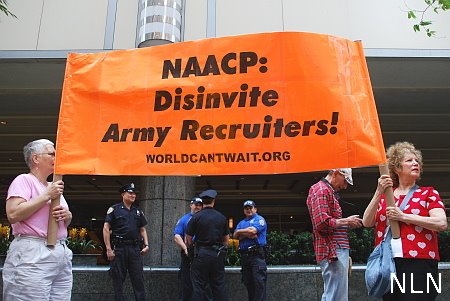
Demonstrators at NAACP confab protest presence of army recruiters
As the NAACP kicked off its convention and 100th birthday bash inside the Sixth Avenue Hilton, a group of protesters from the World Can’t Wait and the Granny Peace Brigade held a protest outside the hotel.
By Thomas Good / The Rag Blog / July 13, 2009
NEW YORK — The National Association for the Advancement of Colored People is celebrating its 100th birthday this year —- with a convention in the city where the association was born.
New York has been home to many civil rights and anti-war organizations. This weekend saw something unusual — an anti-war protest outside a civil rights convention. As the NAACP kicked off its convention and 100th birthday bash inside the Sixth Avenue Hilton, a group of protesters from the World Can’t Wait and the Granny Peace Brigade held a protest outside the hotel. Their issue: that NAACP president and CEO Benjamin Jealous had invited “Army Strong” recruiters to the convention.
The NYPD was also in position outside the hotel, providing security for the event. Officers told protesters they had to move into protest pens around the corner. Protesters stood their ground, arguing that they would be invisible on the side street and that they had a legal right to engage in First Amendment protected activity. Shortly after a legal observer from the National Lawyers Guild arrived on scene police relented.
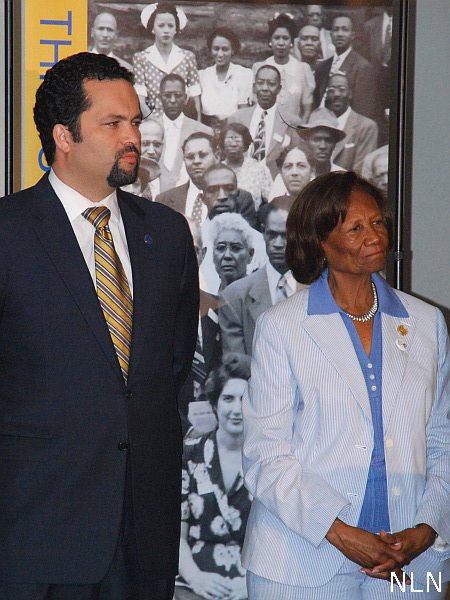
As police and protesters negotiated, the NAACP held a press conference. Roslyn Brock, vice-chair of the NAACP’s board of directors introduced Leon Russell, a national board member from Clearwater, Florida. Russell gave an overview of the convention program which includes an appearance by President Barack Obama, making good on a campaign promise, and the issuing of an award to NAACP chairman and venerable civil rights activist Julian Bond.
Hazel Dukes, chair of the New York State chapter of the NAACP told the assembled journalists, “I hope that when you write this story that you tell the world that the NAACP is alive and well.” Dukes went on to say that she expected 2000 young people would be in attendance at the conference and that in some ways the convention was a passing of the torch. Dukes introduced the current president and CEO of the NAACP, saying that some of the older members of the association had decided to “take a chance” and give the reins of leadership to a “new baby, thirty-six years old, Benjamin Todd Jealous.”
Jealous spoke about the continued relevance of the association in the modern age noting that, despite an African-American president being in office, little has changed for working families.
“The distance between a child’s aspiration and family’s situation is the exact measurement of a parent’s frustration,” he said.
Referring to upcoming Senate confirmation hearings for Supreme Court nominee Judge Sonia Sotomayor, Jealous said that “We are on the eve of the first woman of color being appointed to the Supreme Court.” Jealous said that “We would like to see Senator [Jeff] Sessions tone down his rhetoric.”
“The Republican Party needs to lift up the legacy of their historical leader, of our historical inspiration, President Lincoln, and stop trying to resurrect the nonsense of Jefferson Davis,” Jealous added.
John Payton, president of the NAACP’s Legal Defense Fund, spoke about the historic role of the association in the civil rights struggle, asking the crowd, “What would we look like as a country if we had not had the NAACP?”
Payton provided a list of Supreme Court nominee Sotomayor’s impressive achievements, saying that if he didn’t mention that the judge was a woman and Puerto Rican, people would be united in saying “who better understands the needs of our country?”
Cesar Perales of Latino Justice / Puerto Rican Legal Defense Fund thanked the NAACP for all of its contributions to the Latino community. Perales echoed Payton’s positive assessment of Sotomayor and asked the NAACP faithful to stand behind her during the confirmation hearings.
In a question and answer segment following the prepared remarks an anti-war protester who had written a letter to Benjamin Jealous before the event asked the NAACP CEO why he had invited Army recruiters to the convention.
Jealous told the activist that the NAACP had worked to desegregate the military and would have the traditional dinner to honor those who served.
“While we do oppose this war we are very proud of their service,” he said.
When pressed on the issue by a second activist, Jealous denied that the Army was intending to recruit youth attending the convention, saying that “these are your words, not ours.” He declined to comment further saying that he had already answered the question.
The NAACP’s convention will run through Thursday, July 16. President Obama will address the final plenary on Thursday.
[Thomas Good is the editor of Next Left Notes.]
The Rag Blog
Posted in Rag Bloggers
Tagged African-American, Civil Rights Movement, Military Recruiting, NAACP, Peace Movement, Social Protest
1 Comment
Coup in Honduras : Talks Reach Stalemate as Demonstrations Continue
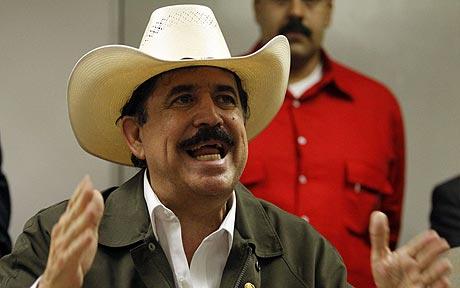
Costa Rican President Óscar Arias mediates controversial talks between Zelaya and Micheletti stand-ins while demonstrations against coup in Honduras continue.
By David Holmes Morris / The Rag Blog / July 13, 2009
After two days of closed meetings in Costa Rica, representatives of deposed Honduran president Manuel Zelaya and de facto president Roberto Micheletti appear not to have reached any substantive agreement.
Acting as mediator, Costa Rican President Óscar Arias met with the two groups at his residence in San José last Thursday and Friday, July 9 and 10, after meeting separately with each of the two claimants to the presidency. Zelaya has asked that the next meeting be in Honduras, but Arias disagrees and so far no further meetings have been scheduled.
Since Zelaya’s term expires next January, a long delay in his reinstatement could make questions of the legality of the de facto government moot.
Arias had accepted the position of mediator at the urging of U.S. Secretary of State Hillary Clinton. Zelaya and Micheletti, neither of whom has expressed any willingness to compromise, agreed to send representatives but declined to attend the sessions themselves. After meeting with Arias, Micheletti returned to Honduras and Zelaya left for the Dominican Republic and later flew toWashington.
The meetings in San José and Arias’ part in them have been criticized by leaders of anti-coup forces in Honduras and by Venezuelan President Hugo Chávez, who see them as legitimizing Micheletti’s de facto presidency. Carlos Reyes, director of the Frente Nacional de Resistencia contra el Golpe de Estado, a coalition of Honduran groups opposing the coup, has reportedly called the arranged meetings a delaying tactic meant to give more room to the imperialists who have been supporting the pro-coup forces in Honduras.
“How horrible it was to see a legitimate president receiving one who had usurped his position, giving him equal treatment,” Chávez told reporters. “This de facto president should have been arrested in Costa Rica.”
Honduran activists have claimed prominent Venezuelan and Cuban rightists, including Robert Carmona-Borjas, in exile in the United States since the failed 2002 coup in Venezuela, and members of the Miami-based Cuban exile group Alfa 66, were in Honduras at the time of the coup and may have been involved in carrying it out.
Large demonstrations against the coup government continue in Honduras, recently blocking several important highways. And reports have surfaced that as many as 800 demonstrators have been jailed since the coup, most of them immediately after the massive demonstration last Sunday at the Toncontín Airport, when authorities declared in late afternoon that the curfew would begin at 6:30 instead of the usual 10:00, giving the activists little time to find safety.
The Salvadoran website El Faro quotes Honduran Cardinal Óscar Rodríguez Maradiaga as saying, “Lately I have verified something that didn’t exist in Honduras before, and that is class hatred. And it is something that appears in a systematic form. Mel Zelaya had advisors from Venezuela, and class hatred was the strategy.”
In the meantime, anti-coup activists point out that Roberto Micheletti was one of a group of representatives who introduced a bill in 1985 to transform the legislature into a constituent assembly for the purpose of modifying the 1982 constitution to permit the re-election of President Roberto Suazo Córdoba, a member of Micheletti’s own Partido Liberal. The bill eventually failed. The coup government claims Zelaya’s effort to poll the citizens on writing a new constitution was intended to permit his reelection and cite it as the illegal act that justified his removal from office.
[San Antonio native David Holmes Morris is an army veteran, a language major, a retired printer, a sometime journalist, and a gay liberationist.]
For previous Rag Blog coverage of Honduras, go here.
Bhopal: Twenty-Five Years Later, Hundreds of New Victims Born Each Year
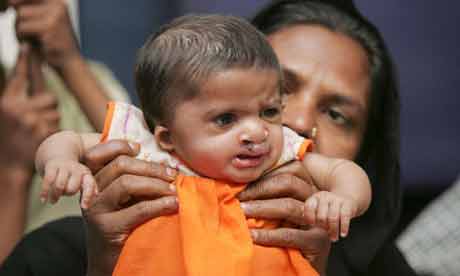
Poisoned legacy
By Billy Briggs / July 12, 2009
The Hiroshima of the chemical industry is still claiming victims – babies born 25 years later with serious birth defects.
Bhopal — UNABLE TO steer safely in the mud, the driver of our rickshaw pulls into the side of the road to allow us to take shelter from torrential rain. There, under a shop’s awning, a small crowd of people are standing together waiting for the weather to break. They include Sapna Sharma and her brother-in-law, Sanjay. Sanjay is holding his 18-month-old nephew, Anshul, who has kohl-rimmed eyes and silver bracelets on his ankles. As we stand talking, some of the people start pointing to the child’s hands and feet while speaking animatedly to us in Hindi. Through our translator, Sapna then explains that her son was born with 12 toes and 12 fingers.
Shortly afterwards, about half a mile away in the Shankar Nagar area of Bhopal, we meet another Indian child with congenital defects, three-year-old, Raj, who is blind, cannot walk and whose head is oversized.
“The doctors said bad water could have been a cause of my son’s condition. Older people here are gas victims and now the younger people are victims of the water,” says his mother, Poona.
advertisement
Here, in the capital city of Madhya Pradesh in India, hundreds of children are being born with deformities and mental health problems. As we walk back to our rickshaw after the interview we come across more afflicted youngsters who have followed us along the road out of curiosity. They include Rajesh, 12, who is barefoot and bald. The other children make fun of him – his mother, Yashdabai, explains that they do so because they believe that her son is “mad”.
Rajesh’s older sister, Sonia, a pretty girl with her black hair pulled back off her face, scolds the other children and tells us that she always has to protect her brother from bullies. Sonia is barefoot, too, and as she speaks a colleague notices that the young girl has huge feet.
This is the horrendous legacy the city of Bhopal is facing 25 years on from one of the world’s worst industrial accident. The Bhopal gas disaster, as it became known, occurred shortly after midnight on December 3, 1984, when a cloud of poisonous gas escaped from a Union Carbide pesticide plant in the city. It has been dubbed the “Hiroshima of the chemical industry”. The accidental release of 42 tonnes of methyl isocyanate (MIC) from the factory exposed more than 500,000 people to toxic gases and up to 10,000 inhabitants are thought to have died within the first 72 hours after the leak.
At least 25,000 people exposed to the gas have since died, and today in Bhopal tens of thousands more Indians suffer from a variety of debilitating gas-related illnesses such as respiratory and psychiatric problems, joint pains, menstrual irregularities, tuberculosis and cancers. More disturbingly, the escalating number of birth defects in children include cleft palates, webbed feet and hands, twisted limbs, brain damage and heart problems.
Shankar Nagar is a slum area of the city just north of the derelict Union Carbide factory site. For years local campaigners have been demanding that Union Carbide – now owned by US multinational Dow Chemicals – clean up the abandoned pesticide plant, but so far their pleas have been ignored.
In 1999, a Greenpeace investigation found severe chemical contamination of the environment surrounding the former Union Carbide factory, including pollution with heavy metals and chemical compounds.
The Greenpeace report also said: “Analysis of water samples drawn from wells serving the local community has also confirmed the contamination of groundwater reserves with chemicals arising either from previous or ongoing activities and/or incidents.
“As a result of the ubiquitous presence of contaminants, the exposure of the communities surrounding the plants to complex mixtures of hazardous chemicals continues on a daily basis. Though less acute than the exposure which took place as a result of the 1984 MIC release, long-term chronic exposure to mixtures of toxic synthetic chemicals and heavy metals is also likely to have serious consequences for the health and survival of the local population.”
Amnesty International’s 2004 Clouds Of Injustice report said: “Toxic wastes continue to pollute the environment and water supply and it is appalling that no-one has been held account for the leak and its appalling consequences.”
The abandoned factory site is now a vast wasteland of weeds and trees that is home to packs of wild dogs. The buildings and structure have been left to rot while tank 610, from where the poison gas escaped, sits like an old rusting locomotive in the sun. Piles of dangerous chemicals are lying in the open air and inside one of the abandoned labs we saw dozens of dusty brown bottles containing chemicals. Campaigners say drums of Sevin – the pesticide Union Carbide was producing at the time using MIC – have never been removed from the site and remain locked in one of the sheds under police guard.
“There are sacks of poisons, mercury drops, toxic carbaryl rocks from which toxic tars ooze into the earth, and subsoil water and tarry liquids that overflow when the monsoon comes,” explained our translator and guide, Sanjay Sharma, 24, a student who lost his three sisters, two brothers and parents in the 1984 disaster. He has one sister left after his only other brother, Sunil, committed suicide on July 26, 2006. Sunil had been 12 at the time of the disaster and was a vociferous campaigner on behalf of victims until be became severely depressed.
“My brother hanged himself. When they found him he was wearing a T-shirt that said, No More Bhopalis’.”
Survivors campaigning for clean water petitioned the Supreme Court of India, which in May 2004 ordered that clean, safe water be piped into the communities, but to date the state government has ignored this order.
In January this year, a major study was embarked upon to try to ascertain the extent of the current health problems facing the population. The year-long investigation is being carried out by the Sambhavna Clinic in Bhopal, an innovative medical facility built in the centre of the city most badly affected by the gas leak. Researcher Santosh Kshatria said 22 different communities near the factory site were believed to be drinking from a contaminated water supply.
“There are 10 researchers. I’m covering 20,000 people in 17 neighbourhoods. So far I have surveyed 5000 people and found more than 200 cases of children with congenital defects. Many have twisted limbs and many have mental health issues. Anecdotally, this is a very high rate of incidence,” she says.
In many cases these are the same families from the poorest slum areas who were decimated by the gas in 1984. They have no option but to drink the water and complain of aches and pains, rashes, fevers, eruptions of boils, headaches, nausea, lack of appetite, dizziness and constant exhaustion.
Lead, mercury and organochlorines have been found in the milk of nursing mothers living near the factory with the result that women are terrified to breastfeed their babies in case they are giving them poison.
Another legacy for Bhopali females is that men have reservations about marrying so-called “gas victims” so many young local women face living in dire poverty having been stigmatised and left single.
Investigations into the 1984 disaster revealed that something had gone fundamentally wrong with a tank that stored methyl isocyanate. During the early hours of December 3, 1984, large amounts of water entered tank 610, containing the highly toxic chemical. The resulting reaction increased the temperature inside the tank to more than 200C, raising the pressure to a level it was not designed to withstand and eventually releasing a large volume of toxic gases.
Union Carbide has always claimed that its Indian subsidiary – Union Carbide India Limited, which was 49%-owned by the state – was solely responsible for the management of the plant and that the accident was the result of sabotage.
Union Carbide was taken over by Dow Chemicals, one of the producers of Agent Orange, in 2001, and the latter insists that all liabilities were settled in 1989 when Union Carbide paid around £300 million to the Indian government to be allocated to survivors. Furthermore, Union Carbide says it did all it could to alleviate the human suffering following the disaster and that it paid for a hospital in Bhopal to offer free medical care to victims.
The company also denies allegations that it abandoned the plant and says UCIL removed tens of thousands of pounds of MIC from the plant and spent around £1.5m undertaking additional clean-up work. The firm also says that a 1998 study of water sources near the plant site by the Madhya Pradesh Pollution Control Board did not find any traces of chemicals linked to any substance used at the UCIL plant.
In 1991, however, Bhopal’s authorities charged Union Carbide’s chief executive, Warren Andersen, with manslaughter. To date the retired American has avoided an international arrest warrant and a US court summons. Andersen was declared a fugitive from justice by the Chief Judicial Magistrate of Bhopal in 1992 for failing to appear at court. Although orders were passed to the Indian government to press for his extradition from America, Bhopal campaigners say ministers have not pushed the case, fearing a backlash from foreign investors.
A quarter of a century on the campaign for justice in Bhopal continues unabated. In June, 27 members of the US Congress appealed to Dow Chemicals to pay to clean up the derelict site and to meet survivors’ demands for medical and economic rehabilitation. The politicians also asked the company to send a representative to take part in court proceedings in India.
“Bhopal is widely regarded as the worst industrial disaster in human history, a catastrophe with widespread implications for the chemical industry, globalisation and human rights,” they said in a letter initiated by Frank Pallone, a Democrat from New Jersey.
They say the polluter, rather than taxpayers, should bear responsibility for environmental damage. Meanwhile, Bhopal’s environmental crisis continues.
Source / Scotland Sunday Herald
The Spirit of Humanity: An Interview with Cynthia McKinney

Cynthia McKinney is a former US Representative who served from 1993-2003 and from 2005-2008 . She was the 2008 Green Party presidential nominee and has been an active member of the Free Gaza Movement. In 2004, The Backbone Campaign awarded her the fifth annual Backbone Award “because she was willing to challenge the Bush administration and called for an investigation into 9/11 when few others dared to air their criticism and questions.” Here, Ishmahil Blagrove, Jr. talks to McKinney about her experience with the situation in Gaza and her views on today’s political landscape.
Last year in the midst of the Israeli onslaught against the people of Gaza, you attempted to break the Israeli siege by entering by boat. What happened?
We were rammed by the Israelis. There I got a chance to see the complicity of the media. We had CNN on board and the CNN reporter was literally arguing in the midst of a tragedy; he was arguing with headquarters because they didn’t believe what he was telling them. They would have rather run the story as the Israelis told them. I have seen how the media self-censor, twist, contort themselves to report misleading stories and then they report outright lies.
What is the situation in Gaza and explain to me why you feel so passionate about getting into Gaza and assisting?
I think we all know at least what we all saw on Al Jazeera Arabic and Press TV: the images of white phosporous and the F16’s and the helicopters. We saw all of that and those two stations in particular ran almost 24-hour coverage. People in the United States couldn’t see those images on CNN because CNN was missing in action, but through the power of and access to the internet, people in the United States were able to see the images. Never have we been able to discuss what US policy is in Israel, but we were able to see the F16’s given to Israel by the United States, the depleted Uranium munitions given to Israel by the United States, the white phosperous given to Israel by the United States. And so the United States is as complicit and even more complicit; the Israelis used it but the Americans gave them the wherewithal to use it.
Why do believe there has not been more international attention given to the plight of the Palestinians?
The media as we know it – and I can only speak mainly about US media and the media that is owned by the US media in other parts of the world – they are what I call special interest media and the special interest media have demonstrated amply that they serve the political aims and values of certain special interests inside the United States, whose goal is to affect the formulation of policy. And so we don’t get a discussion of Gaza and the Palestinian plight inside the United States as we should because it doesn’t serve the special interests in Washington, DC who lobby for a particular point of view that does not favor the Palestinians. There was an advert for Gaza that the BBC were supposed to run and they refused to run it and it was unprecedented that they would refuse to run an advert requesting help, relief for besieged people; but that shows the power of special interests operating in Britain. The Zionist lobby is powerful in the United States; it is the most powerful lobby that operates in Washington, DC and we saw it flex its muscle in Britain during Operation Cast Lead with the BBC.
What are President Obama’s policies in the region?
On the day that we were turned away from embarking upon our peace mission in Cyprus, President Obama signed over a 100 billion dollar supplemental appropriation for more war and occupation in Iraq and Afghanistan. The drones continue to kill people in Pakistan, the increase level of troops in Afghanistan, the perception of Russia and China as enemies throw back to the days of the cold war, the continued search for a home for AFRICOM: these are not things that we should be proud of coming from a President with the name Barrack Hussein Obama. But, in fact, this is what is happening under his administration. We also have seen the greatest transfer of wealth out of the hands of African Americans that we have ever seen probably since slavery, not only out of the hands of African Americans, but out of the hands of Latinos and increasingly out of the hands of middle-class white Americans as well
Many people suggest that because there is an African American president, that change has come. Are you hopeful?
What American people and the global community were subjected to was very well financed Madison Avenue propaganda. A slick media campaign to promote someone whom the United States people didn’t even know. He and I were sworn in together in 2005 in the Congress; this was when he walked into a Senate seat virtually unopposed. Now, when was the last time an African American ever was given a Senate seat? I don’t think it’s ever happened, even during the times of reconstruction when we had black Senators, black Governors; those positions of power were earned, through the blood and the toil of black people who went to the polls and voted in what, at that time, were fair elections.
Then why do you believe that President Obama was elected?
I think the American people were looking for dignity. I think the dignity of our country had been stripped from us as a result of the publication of the photos around Abu Ghraib, the information came out about the lies of Iraq and we had been through 9/11 and the Administration knowingly lied and tied 9/11 to Iraq and so there were a lot of things that the American people wanted desperately to take a blue pill for. And I’m referring to the blue pill of the Matrix, where one takes the blue pill and slips into a world of make believe and so that’s where many people are.
What do you think it will take to get that dramatic shift in American public opinion?
The American people need information. If you look at what happened in Vietnam, the policy was taken out of the hands of the joint Chiefs and put into the hands of the people. When the television images came into every living room in the United States, people understood that they needed to change policy themselves. I hope the American people only need information because once their conscience is pricked with that information then they will be compelled to do something different.
You are back in Cyprus for a second time; what is the purpose of your mission now?
The purpose of the mission is to assert our belief in the Universal Declaration of Human Rights. That it is our right to travel anywhere in the world that we so choose and it is the right of people in other parts of the world to receive us, if they choose to do so.
Why have you taken up the cause of the Palestinian people?
I have been asked that a lot because I am not Arab, I’m not Muslim. So, why do I care? Well, Dr. Martin Luther King, Jr. said it best: “Injustice anywhere is a threat to justice everywhere.” And this is clearly a gross injustice; this is genocide, crimes against humanity. How can anyone remain silent in the face of this? During the civil rights movement, we were outraged at our treatment and we just couldn’t vote; here, Palestinians can’t live.
July 2009
This video is the last footage taken onboard the Spirit Of Humanity before its voyage to bring humanitarian aid to Gaza was prematurely halted by Isreali special forces. It shows the atmosphere inside the cabin as the crew try to negotiate with the Israeli ship via radio.
Source / Rice ‘N’ Peas
Thanks to Jeffrey Segal / The Rag Blog
Posted in RagBlog
Tagged Crimes Against Humanity, Gaza, Israel, Palestine, Palestinian Blockade
12 Comments
Singin’ on Sunday – Dick Gaughan
Dick Gaughan – Handful of Earth
From a 1983 BBC Spectrum Documentary. Dedicated to all the workers out there.
Thanks to Erich Seifert / The Rag Blog
Film / ‘The Hurt Locker’ : Kathryn Bigelow’s Explosive Iraq War Movie
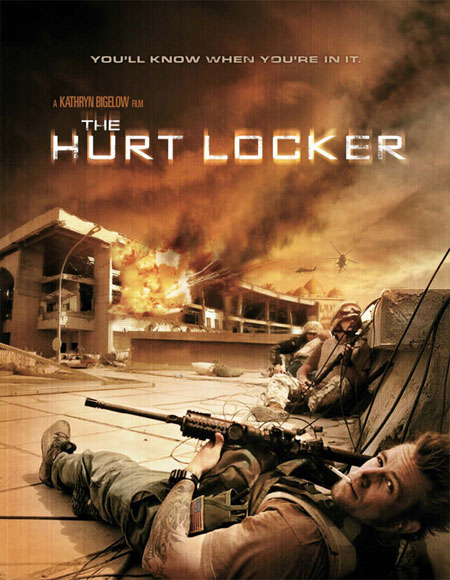
The Hurt Locker will deepen your understanding of what our soldiers have been enduring in Iraq for twelve to fifteen months at a stretch.
By Tod Ensign / The Rag Blog / July 11, 2009
See ‘The Hurt Locker, Ticking Time Bomb of a Movie,’ by Scott Foundas, and Movie Trailer, Below.
Yesterday, I saw a powerful new Iraq War film, The Hurt Locker, directed by Kathryn Bigelow. While it’s a theatrical film, shot mostly in Jordan, it packs all the wallop of a down and dirty documentary. It focuses on the war experiences of three soldiers who are assigned to a IED detection and detonation unit… I found some of the scenes to be so intense that they were almost unwatchable. (Warning: some Iraq and Afghan combat vets may find this film emotionally overwhelming.)
I strongly urge everyone to make a special effort to see The Hurt Locker First, because . Second, because we need to talk up and support this kind of film so that it won’t just vanish from theatres in the next few days.
At present, I believe that it’s only playing in a few large cities. (It’s currently in six NYC theatres.) As often happens, it probably won’t be available in many communities (e.g., the Salmon Mall adjacent to Fort Drum in New York) that would most benefit from seeing it. I just fantasized that somehow we could make it available to every potential recruit before he or she signed their enlistment contract!
[Tod Ensign is a veteran’s rights lawyer and director of Citizen Soldier, a non-profit GI and veteran rights advocacy group.]
The Hurt Locker, Ticking Time Bomb of a Movie
By Scott Foundas / June 24, 2009
Kathryn Bigelow’s Iraq War drama The Hurt Locker is a full-throttle body shock of a movie. It gets inside you like a virus, puts your nerves in a blender, and twists your guts into a Gordian knot.
Set during the last month in the year-long rotation of a three-man U.S. Army bomb squad stationed in Baghdad, it may be the only film made about Iraq — documentary or fiction — that gives us a true sense of what it feels like to be on the front lines of a war fought not in jungles but in cities, where bombs rise up from the ground instead of raining down from the sky, every narrow alley portends an ambush, and every onlooker is a potential insurgent.
It’s an experiential war movie — one that calls to mind the title of the 1950s docudrama series You Are There -— but also a psychologically astute one, matching its intricate sensory architecture with an equally detailed map of the modern soldier’s psyche, a diagram of what motivates the volunteers in a volunteer army.
The movie begins with a typically bracing set piece in which the soldiers of Bravo Company’s Explosive Ordnance Disposal team come upon an IED planted in the center of a busy Baghdad marketplace. When their remote-controlled bomb-detonating robot hits a snag, the team’s affable leader (Guy Pearce) dons a thick Kevlar suit and attempts to set the charge manually. He does not return. His replacement, Staff Sergeant William James (Jeremy Renner), is a career soldier of an entirely different breed, one who prefers to handle bombs up close and personally instead of by remote control, and whose Kevlar suit is part of his daily wardrobe—not just for special occasions.
At first glance, Sgt. James seems like the closest thing to a stock character — the gonzo alpha male living out his childhood cowboy fantasies — in a picture markedly devoid of small-town rubes, poetry-quoting intellectuals, or any other easily reducible war-movie “types.” But like most things in The Hurt Locker, there is considerably more to him than meets the eye. Beneath his blustery macho surface, he may be the movie’s most intricately wired explosive device.
Written by former Village Voice columnist Mark Boal, The Hurt Locker belongs to that subset of Bigelow’s work — including her biker-gang debut The Loveless and the bank-robbing-surfers caper Point Break — devoted to the ethos of hyper-masculine communities, the men who choose to live in them, and those who emerge as their leaders.
Sgt. James is one such character, and Bigelow, Boal, and especially Renner excel at showing us how his reckless displays of bravado are both a coping mechanism and an addiction, a battlefield genius and a form of madness. A secular god with sports hero stats (873 disarmed bombs and counting!), he inspires envy in some, contempt in others, and both in the men under his command—two comparatively by-the-book sergeants (very well played by Anthony Mackie and Brian Geraghty) who also want to prove their mettle as men of war, as long as they go home in one piece.
But for James, who has an ex-wife and child waiting for him somewhere, the adrenaline-rush alterna-reality of Iraq is vastly preferable to the home front, with its prison of domestic responsibility. Like the jacked-in wire trippers of Bigelow’s futuristic Strange Days, he yearns for something more visceral, more cinematic than everyday life.
With her strength of revealing character through action, Bigelow comes closer to the tradition of Anthony Mann, Sam Fuller, and other bygone practitioners of the classic Hollywood war movie than to today’s dominant breed of studio A-listers, who create (mostly incoherent) action at the expense of character. Not that The Hurt Locker, which I take to be the best American film since Paul Thomas Anderson’s There Will Be Blood, much resembles any war movie we’ve ever seen before. Here, combat is more often a solitary rather than a group endeavor — a lone man tracing a rat’s nest of wires back to its source, or exchanging long-distance fire with a single sniper across a vast desert expanse.
There is little, if any, talk about patriotism or homeland security, and there are fewer American flags on display than in any American war movie in memory. When The Hurt Locker premiered last fall at the Venice and Toronto film festivals, this prompted some observers to tag it as an “apolitical” war picture, which is really a way of saying that Bigelow’s film is mercifully free of ham-fisted polemics. Instead of setting out to prove a point, it seeks to immerse us in an environment — something Bigelow does with a conceptual rigor usually associated with those directors whose work is confined to film societies and art houses.
Time is Bigelow’s organizing principle here — the time left in Iraq for the men of Bravo company (displayed on the screen as chapter headings throughout), the time that ticks away between the discovery of a bomb and its eventual disarming or detonation, and the time that, in those unbearably tense moments, seems to stretch out indefinitely toward the horizon. War may be hell, but in The Hurt Locker, it’s also an incredibly pellucid waking dream.
Source / Village Voice
The Hurt Locker — Trailer
Woodstock: The Memories Live On for These Two
Love It: Everyone quoted in the story sounds like they’re still trippin’!
Mariann Wizard / The Rag Blog
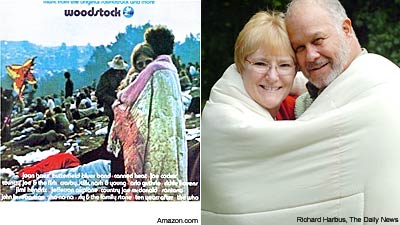
Iconic Woodstock Couple Keeps Festival Spirit Alive
By Adam Horne / July 11, 2009
Forty years after the legendary festival in Bethel, N.Y., a photo of two lovebirds taken at Woodstock has become an iconic symbol of love. Having only met three months prior, the picture captures a young couple — Nick and Bobbi Ercoline, both now 60 — embracing underneath a dirty blanket, surrounded by exhausted concertgoers. To the Ercolines’ surprise, the image became the cover of the ‘Woodstock’ album in 1970 and was featured on posters for the subsequent documentary film.
What resonates most about the photo is that it speaks to what many Woodstock veterans consider to be the true meaning of the festival — not just music but a movement of peace, love and unity. In a recent interview with Spinner, Woodstock performer Richie Havens cited a Martin Luther King Jr. speech, saying “It’s not him or him or him, it’s all of us or nothing. That was our thing, that’s what we went against the war with.”
The couple themselves acknowledge the social significance of the now legendary picture. “It’s an honest representation of a generation. When we look at that photo … I see our generation,” Nick told the NY Daily News.
Original Santana percussionist Michael Carabello witnessed firsthand how his generation came together for three days in 1969. “It was about the music and it was about everything else, but it was more about us getting along.” Noting the hectic and exhausting nature of the festival (as evidenced by the background of the photo), Carabello told Spinner, “You know, you get so absorbed in it you just don’t want to hear it anymore, you forget about it, so the only thing you can do is become a family. You just help one another out.”
Certainly Woodstock has been romanticized over the years, but for many, the image of Nick and Bobbi wrapped in a blanket represents exactly what Carabello is talking about.
What’s more, the couple has been together ever since.
Source / Spinner
Evidence of War Crimes in Afghanistan Coming to Light
Juan Cole says it as well as it can be said: “I can tell by various web metrics that you guys are not interested in the Afghanistan story. You should be and I am going to parse it today anyway. It is one of the advantages of being non-profit that I write what I want and you can read it or not as you like. But really, you should be following this war.“
I agree with Professor Cole. We should not only be following what is happening in Afghanistan, we should also be doing our utmost to end the carnage there. War has outlived its usefulness as ‘a solution.’ I say this especially to those who make remarks on this blog that “there will always be war.” Yes, there will – just as long as there are too many people who say there will always be war. When there are too many people who say “there is a better way,” wars will end.
Richard Jehn / The Rag Blog
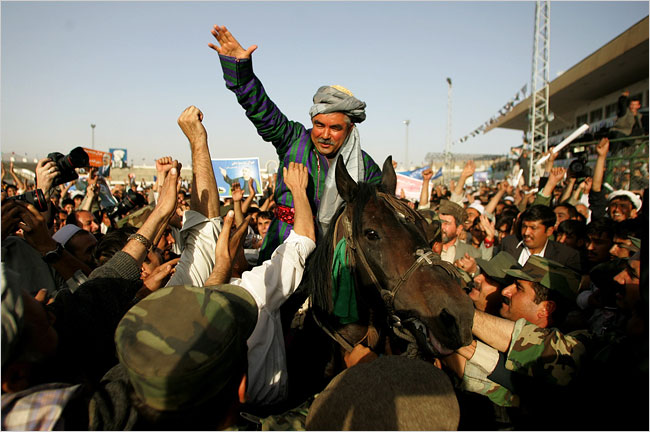
U.S. Inaction Seen After Taliban P.O.W.’s Died
By James Risen / July 10, 2009
WASHINGTON — After a mass killing of hundreds, perhaps thousands, of Taliban prisoners of war by the forces of an American-backed warlord during the 2001 invasion of Afghanistan, Bush administration officials repeatedly discouraged efforts to investigate the episode, according to government officials and human rights organizations.
American officials had been reluctant to pursue an investigation — sought by officials from the F.B.I., the State Department, the Red Cross and human rights groups — because the warlord, Gen. Abdul Rashid Dostum, was on the payroll of the C.I.A. and his militia worked closely with United States Special Forces in 2001, several officials said. They said the United States also worried about undermining the American-supported government of President Hamid Karzai, in which General Dostum had served as a defense official.
“At the White House, nobody said no to an investigation, but nobody ever said yes, either,” said Pierre Prosper, the former American ambassador for war crimes issues. “The first reaction of everybody there was, ‘Oh, this is a sensitive issue; this is a touchy issue politically.’ ”
It is not clear how — or if — the Obama administration will address the issue. But in recent weeks, State Department officials have quietly tried to thwart General Dostum’s reappointment as military chief of staff to the president, according to several senior officials, and suggested that the administration might not be hostile to an inquiry.
The question of culpability for the prisoner deaths — which may have been the most significant mass killing in Afghanistan after the 2001 American-led invasion — has taken on new urgency since the general, an important ally of Mr. Karzai, was reinstated to his government post last month. He had been suspended last year and living in exile in Turkey after he was accused of threatening a political rival at gunpoint.
“If you bring Dostum back, it will impact the progress of democracy and the trust people have in the government,” Mr. Prosper said. Arguing that the Obama administration should investigate the 2001 killings, he added, “There is always a time and place for justice.”
While President Obama has deepened the United States’ commitment to Afghanistan, sending 21,000 more American troops there to combat the growing Taliban insurgency, his administration has also tried to distance itself from Mr. Karzai, whose government is deeply unpopular and widely viewed as corrupt.
A senior State Department official said that Secretary of State Hillary Rodham Clinton and Richard C. Holbrooke, the special representative on Afghanistan and Pakistan, had told Mr. Karzai of their objections to reinstating General Dostum. The American officials have also pressed his sponsors in Turkey to delay his return to Afghanistan while talks continue with Mr. Karzai over the general’s role, said an official briefed on the matter. Asked about looking into the prisoner deaths, the official said, “We believe that anyone suspected of war crimes should be thoroughly investigated.”
The Back Story
While the deaths have been previously reported, the back story of the frustrated efforts to investigate them has not been fully told. The killings occurred in late November 2001, just days after the American-led invasion forced the ouster of the Taliban government in Kabul. Thousands of Taliban fighters surrendered to General Dostum’s forces, which were part of the American-backed Northern Alliance, in the city of Kunduz. They were then transported to a prison run by the general’s forces near the town of Shibarghan.

Survivors and witnesses told The New York Times and Newsweek in 2002 that over a three-day period, Taliban prisoners were stuffed into closed metal shipping containers and given no food or water; many suffocated while being trucked to the prison. Other prisoners were killed when guards shot into the containers. The bodies were said to have been buried in a mass grave in Dasht-i-Leili, a stretch of desert just outside Shibarghan.
A recently declassified 2002 State Department intelligence report states that one source, whose identity is redacted, concluded that about 1,500 Taliban prisoners died. Estimates from other witnesses or human rights groups range from several hundred to several thousand. The report also says that several Afghan witnesses were later tortured or killed.
In Afghanistan, rival warlords have had a history of eliminating enemy troops by suffocating them in sealed containers. General Dostum, however, has said previously that any such deaths of the Taliban prisoners were unintentional. He has said that only 200 prisoners died and blamed combat wounds and disease for most of the fatalities. The general could not be reached for comment, and a spokesman declined to comment for this article.
While a dozen or so bodies were examined and several were autopsied, a full exhumation was never performed, and human rights groups are concerned that evidence has been destroyed. In 2008, a medical forensics team working with the United Nations discovered excavations that suggested the mass grave had been moved. Satellite photos obtained by The Times show that the site was disturbed even earlier, in 2006.
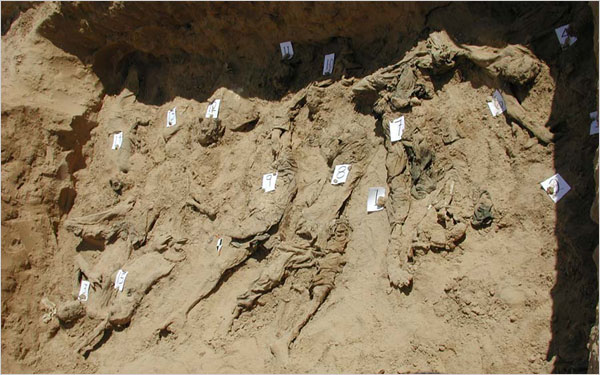
“Our repeated efforts to protect witnesses, secure evidence and get a full investigation have been met by the U.S. and its allies with buck-passing, delays and obstruction,” said Nathaniel Raymond, a researcher for Physicians for Human Rights, a group based in Boston that discovered the mass grave site in 2002.
Seeking an Investigation
The first calls for an investigation came from his group and the International Committee of the Red Cross. A military commander in the United States-led coalition rejected a request by a Red Cross official for an inquiry in late 2001, according to the official, who, in keeping with his organization’s policy, would speak only on condition of anonymity and declined to identify the commander.
A few months later, Dell Spry, the F.B.I.’s senior representative at the detainee prison at Guantánamo Bay, Cuba, heard accounts of the deaths from agents he supervised there. Separately, 10 or so prisoners brought from Afghanistan reported that they had been “stacked like cordwood” in shipping containers and had to lick the perspiration off one another to survive, Mr. Spry recalled. They told similar accounts of suffocations and shootings, he said. A declassified F.B.I. report, dated January 2003, confirms that the detainees provided such accounts.
Mr. Spry, who is now an F.B.I. consultant, said he did not believe the stories because he knew that Al Qaeda trained members to fabricate tales about mistreatment. Still, the veteran agent said he thought the agency should investigate the reports “so they could be debunked.”
But a senior official at F.B.I. headquarters, whom Mr. Spry declined to identify, told him to drop the matter, saying it was not part of his mission and it would be up to the American military to investigate.
“I was disappointed because I believed that, true or untrue, we had to be in front of this story, because someday it may turn out to be a problem,” Mr. Spry said.
The Pentagon, however, showed little interest in the matter. In 2002, Physicians for Human Rights asked Defense Department officials to open an investigation and provide security for its forensics team to conduct a more thorough examination of the gravesite. “We met with blanket denials from the Pentagon,” recalls Jennifer Leaning, a board member with the group. “They said nothing happened.”
Pentagon spokesmen have said that the United States Central Command conducted an “informal inquiry,” asking Special Forces personnel members who worked with General Dostum if they knew of a mass killing by his forces. When they said they did not, the inquiry went no further.
“I did get the sense that there was little appetite for this matter within parts of D.O.D.,” said Marshall Billingslea, former acting assistant defense secretary for special operations, referring to the Department of Defense.
High-Level Conversation
Another former defense official, who would speak only on condition of anonymity, recalled that the prisoner deaths came up in a conversation with Paul D. Wolfowitz, the deputy secretary of defense at the time, in early 2003.
“Somebody mentioned Dostum and the story about the containers and the possibility that this was a war crime,” the official said. “And Wolfowitz said we are not going to be going after him for that.”
In an interview, Mr. Wolfowitz said he did not recall the conversation. However, Pentagon documents obtained by Physicians for Human Rights through a Freedom of Information Act request confirm that the issue was debated by Mr. Wolfowitz and other officials.
As evidence mounted about the deaths, Secretary of State Colin L. Powell assigned Mr. Prosper, the United States ambassador at large for war crimes, to look into them in 2002. He met with General Dostum, who denied the allegations, Mr. Prosper recalled. Meanwhile, Karzai government officials told him that they opposed any investigation.
“They made it clear that this was going to cause a problem,” said Mr. Prosper, who left the Bush administration in 2005 and is now a lawyer in Los Angeles. “They would say, ‘We have had decades of war crimes. Where do you start?’ ”
In Washington, Mr. Prosper encountered similar attitudes. In 2002, Zalmay M. Khalilzad, then the White House coordinator for Afghanistan, made it clear that he was concerned about efforts to investigate General Dostum, Mr. Prosper said. “Khalilzad never opposed an investigation,” Mr. Prosper recalled. “But he definitely raised the political implications of it.”
Mr. Khalilzad, who later served as the American ambassador to Afghanistan, did not respond to a request for comment.
Mr. Prosper said that because of the resistance from American and Afghan officials, his office dropped its inquiry. The State Department mentioned the episode in its annual human rights report for 2002, but took no further action.
Source / New York Times
Loving: The Four Horsemen of Agriculture

Cartoon by Charlie Loving / The Rag Blog
Democrats in Texas : Lone Star State Turning Blue?
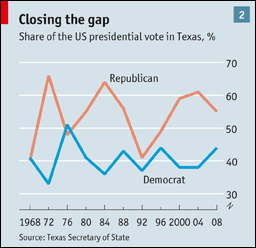
The red and the blue in the Lone Star State:
High hopes for Texas Dems
By The Economist / July 10, 2009
The elected sheriff of Dallas County is a lesbian Latina. The leading candidates to become mayor of Houston in November include a black man and a gay white woman. The speaker of the House of Representatives is the first Jew to hold the job in 164 years of statehood and only the second speaker to be elected from an urban district in modern times.
In this year’s legislative session, bills to compel women to undergo an ultrasound examination before having an abortion (to bring home to them what they are about to do) and to allow the carrying of guns on campus both fell by the wayside; a bill to increase compensation for people wrongly convicted sailed through. Lakewood, in Houston, the biggest church not just in Texas but in America, claims to welcome gays. As Dorothy in “The Wizard of Oz” might have said, we’re not in Texas any more.
Or at least, not in Texas as we have recently come to know it. A Democratic-voting Texas would be nothing new, but political memories are short, and the blunders of the Bush presidency have coloured global perceptions of what Texas is like. It mostly voted Democratic in presidential elections until 1968, when, alone among the former Confederate states, it went for Hubert Humphrey, and 1976, when it voted for Jimmy Carter. Many of those voters were highly conservative “Dixiecrats” and later flipped to the Republicans. But there has always been a strong radical streak too. William Jennings Bryan was hugely popular in Texas. Jim Hightower, a former Texas agriculture commissioner and the perennial voice of Texas populism, says that “Texas has always been a purple state”—up for grabs by either the red Republicans or the blue Democrats.
It had a Democratic governor, in the feisty and liberal shape of Ann Richards, until as recently as 1995; but since that year, which saw George Bush’s ascent to the governor’s mansion, the Republicans have been firmly in control, and no Democrat has won statewide office. Since 2003 the Republicans have controlled the House as well as the Senate, monopolising every lever of power in the state. Now the pendulum is swinging back.
With no prospect of a local son to vote for in future elections (a Bush has been on the ballot paper for six of the past eight presidential votes), the Republicans have lost one big advantage. In the 2008 election the Democrats did much better all over the state. They won the presidential vote in all the big cities except Fort Worth (see map). They made big inroads into the Republicans’ dominance of the suburbs, where American elections are lost and won these days. Overall they took 44% of the vote, up from 38% in 2004, even though Barack Obama barely campaigned in Texas.
They secured a blocking minority, 12 seats out of 31, in the heavily gerrymandered state Senate, and almost took control of the Texas House of Representatives: the Republicans now hold it by just 76 seats to 74. The conservative speaker was promptly ousted and replaced by Joe Straus, who depended for his election on a sizeable block of Democratic votes.
The mild-mannered and charming Mr Straus has turned out to be a bipartisan and moderate figure, though he insists that he made no promises to the Democrats who backed him. But this year’s legislative session showed the Democrats flexing their muscles in the House, blocking a bill on voter identification that they said discriminated against their supporters.
The rise of the Democrats poses a dilemma for Republicans in Texas, just as it does nationally. And just as the national party seems to be lapsing into fratricide, so a vicious internal war has broken out over the governorship. Rick Perry is running for a third full term in the job, but the main challenge he faces is not from the Democrats who, oddly, have come up with a remarkably unconvincing candidate: Tom Schieffer, who used to be Mr Bush’s business partner and who is famous mainly because his brother is a TV presenter. The real rival is within, in the shape of Kay Bailey Hutchison, probably the most popular politician in the state. Mrs Hutchison has served as one of Texas’s two senators in Washington, DC, since 1993, and was last re-elected in 2006 with 62% of the vote.
Internecine warfare
Mr Perry has a strong economic record to run on, but because his toughest fight is against a fellow Republican, this has already turned into a battle for the souls of the 600,000 conservative sorts who vote in the Republican primary, due to be held next March. Mr Perry has lurched to the right to woo this atypical electorate.
Thus, he has backed allowing “Choose Life” to be an official Texas car licence-plate motto. This hurts Mrs Hutchison, who is in trouble with social conservatives for having once voted against overturning Roe v Wade, the Supreme Court decision that protects the right to abortion. He has also refused to take up a big chunk of the stimulus funds offered to Texas to help pay unemployment benefit, on the ground that this would create a long-lasting obligation.
No one doubts that Mrs Hutchison would beat Mr Perry or anyone else in Texas in a general election, but recent polls have her lagging behind Mr Perry in the primary. If she does formally enter the race, as expected, she will have to face being branded as a baby-killer and a creature of spendthrift Washington, DC.
Mrs Hutchison insists that “it’s very important that we don’t build a party around an issue [abortion] that is so personal, on which even families disagree.” She is surely right, but primary voters may not see it that way. This race matters hugely to Texas: it is a moment when the state’s Republicans will have to decide which wing of the party they are on.
The Democrats, meanwhile, are pinning their hopes for the 2010 election on securing a majority in the state House of Representatives and on winning a US Senate seat (which may come up sooner if Mrs Hutchison resigns to concentrate on her race for governor). Their chances in the House are good: as the recession starts to bite in Texas, later than elsewhere in the country, support for the Democrats is likely to rise. On the other hand Barack Obama will not be at the head of the ticket in 2010, as he was in 2008—though in Texas he was never quite the draw he was on the coasts.
The steady rise in the Hispanic population, coupled with a slow but continuous increase in Latinos’ tendency to vote, bodes well for the Democrats. George Bush did an impressive job courting the Hispanic vote, but the Republican Party threw that advantage away by rejecting his plans for immigration reform in 2006-07. In the 2008 presidential election Texas Latinos voted Democrat by 63% to 37%. Mr Obama’s nomination of the first Hispanic Supreme Court justice is unlikely to hurt, and nor will his commitment to immigration reform. As Hispanics increasingly spread out across the state they will start to tip the balance in many suburban counties, which is where the big political battles in America are being fought.
In the Senate race the Democrats’ probable candidate will be Bill White, the current mayor of Houston. He has done an excellent job balancing the needs of business with those of his core voters, and he will have a lot of money behind him.
Texas had become used to being at the centre of events, having supplied the president, the vice-president or at least the treasury secretary for all but a handful of the past 50 years. Now it does not even have a senator in the majority party, meaning that Texas has no voice in any of the big deliberations in Washington, DC. That will help the Democrats too.
But it does seem fair to ask what Texas Democrats actually stand for. They say they want more money spent on health and education, but pretty much every politician in Texas says the same, and the party’s leadership shows no appetite for delivering this by taxing Texans more heavily. Hardly anyone seeks to abolish the death penalty, even though, in most years, Texas executes as many people as the rest of America put together. Gun control and recognition of gay marriage are off the table. Everyone has jumped on the renewable-energy bandwagon.
It would, in short, be possible to imagine Texas slipping back to the Democrats without much happening in consequence, except for two considerations. The first is that, should Texas go Democratic at the presidential level, the Republicans nationally would be in deep trouble: with its 34 electoral-college votes, Texas is the only big state they have regularly won in recent presidential elections. The second consideration is the Hispanics. As they become ever more powerful in an ever stronger Democratic Party, there is every chance that they will turn against a model that has left far too many of them behind.
Source / The Economist
Thanks to Vik Verma / The Rag Blog
James Retherford : Who Watches the Watchman? The Espionage Octopus
Part III
Who Watches the Watchman?
COINTELPRO and the Federal Government’s
Clandestine Attack on the U.S. Constitution
Using FBI and CIA intelligence reports, the federal government compiled a Rabble Rouser Index of activists. By 1973 the National Security Council compiled a ‘watch list’ of 300,000 domestic dissidents with alleged subversive foreign connections.
By James Retherford / The Rag Blog / July 10, 2009
[A version of this series was originally researched and written six years ago. It describes in chilling detail how the U.S. government surreptitiously conspired to maintain lockdown social control of American citizens in the period up to and including post-Watergate. Go here for the introduction to and first two parts of “Who Watches the Watchman.”]
The Federal Bureau of Investigation did not work alone in creating its modern-day conspiratorial shadow government.
The Central Intelligence Agency in 1967 launched Operation CHAOS, a far-reaching and illegal program targeting American dissidents. The National Security Agency, a virtually “invisible” intelligence-gathering agency with a huge budget and workforce, in 1969 expanded what became Operation MINARET, a program for electronically eavesdropping on overseas communications.
In addition, various military intelligence agencies participated in spying not only on dissident military personnel but also on American civilians. Army Intelligence developed its own 100,000-name “enemies” list. Finally, the FBI and other federal agencies developed close working and information sharing relationships with the Internal Revenue Service and the U.S. Postal Service; the bureau’s postal connection facilitated mail spying while IRS connection was used effectively to investigate the finances of targeted groups and individuals. In time the IRS compiled an 11,000-name investigation list at the bureau’s behest.
Over the years these large intelligence-gathering agencies had developed internecine rivalries prompted at least in part by the profession’s apparently pathological aversion to sharing the fruits of their labor with anyone else, including, in some cases, the Justice Department and the president. Following Eisenhower’s 1956 example, succeeding administrations called upon the National Security Council to bring together the nation’s spy agencies into a joint covert domestic operation. Using FBI and CIA intelligence reports, the federal government compiled a Rabble Rouser Index of activists. By 1973 the National Security Council compiled a “watch list” of 300,000 domestic dissidents with alleged subversive foreign connections. More than 26,000 activists were targeted under Nixon’s presidential order for detention in the event of some unspecified “national emergency.”
According to David Kaplan, director of the Center for Investigative Reporting
Until 1974, the CIA conducted a widespread, illegal spying operation within the United States. According to Congressional reports, the names of 300,000 U.S. citizens were cross-indexed within agency files, and thousands of Americans were placed on “watch lists” to have their mail opened and telegrams read. The Pentagon’s intelligence operations spilled into a highly questionable area during the 1960s and early 1970s. The U.S. Army Intelligence Command, among others, ran a far-reaching domestic spying program that, at its height, fielded over 1,500 plainclothes agents from 350 offices to spy on anti-war and civil rights groups. The Army’s program was, in the words of a Congressional subcommittee, “both massive and unrestrained,” and compiled an estimated 100,00 dossiers on U.S. citizens. The Secretary of the Army subsequently ordered those files destroyed, although, like the CIA, there are now indications that such activities may have continued.
The FBI, CIA, NSA, and other governmental agencies, despite many obvious instances in which agents operated with obvious disregard for state and federal laws, nonetheless felt inhibited from engaging in certain types of direct action which, if detected, could bring serious political damage to the agencies themselves and quite possibly to the White House. The simple solution was to create so-called extra-jurisdictional agencies that could operate independent of federal control to carry out the agenda of domestic “counterintelligence.” In 1956 the Law Enforcement Intelligence Unit (LEIU) was the first such semiofficial agency to set up shop with the CIA providing funding, training, surveillance equipment, and a national computer database.
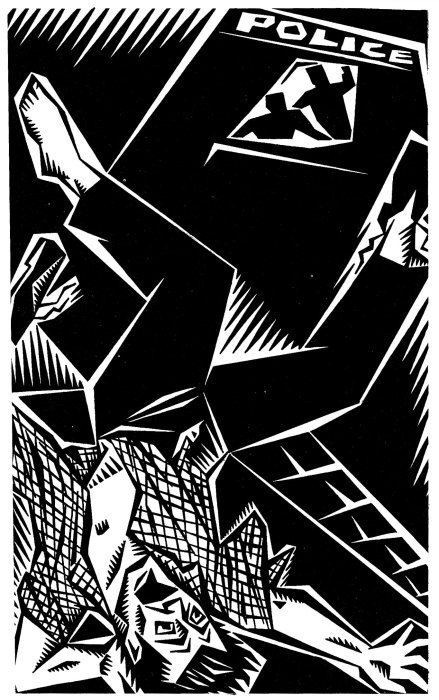
The FBI and various military intelligence commands worked in much the same way with local police departments to create funding conduits via the Law Enforcement Assistance Agency (LEAA) which supplied money, arms, and equipment to paramilitary vigilante groups. For example the 113th Military Intelligence Group provided money and arms to the Chicago Police Department’s “Red Squad.” These resources were, in turn, channeled to the Legion of Justice paramilitary group noted for violent attacks on the underground press and on New Left activists as well as for the break-in and theft of Chicago Seven conspiracy trial defense files.
In San Diego, where the Republicans initially planned to convene their 1972 national convention, one covert action campaign culminated in the January 6, 1972, assassination attempt on anti-convention organizer Peter Bohmer by the so-called “Secret Army Organization” of rightwing militia, a group formed, subsidized, armed, and protected by the FBI.
[James Retherford knows firsthand what it was like to be targeted by COINTELPRO. A founder and editor of The Spectator in Bloomington, Indiana, in 1966, Retherford is a director of the New Journalism Project, the nonprofit organization that publishes The Rag Blog.]
Please see
- James Retherford: Who Watches the Watchman?, Introduction,
- James Retherford: Who Watches the Watchman? J. Edgar Hoover and COINTELPRO, Part I.
- James Retherford: Who Watches the Watchman? Attacks on ‘Negroism’ and CPUSA, Part II.
and
Also see James Retherford : Brandon Darby, The Texas 2, and the FBI’s Runaway Informants by James Retherford / The Rag Blog / May 26, 2009
And for more background on the history of informants in Texas, read The Spies of Texas by Thorne Dreyer / The Texas Observer / Nov. 17, 2006.
Posted in Rag Bloggers
Tagged American History, CIA, Civil Liberties, COINTELPRO, Domestic Spying, Espionage, FBI, James Retherford, Who Watches the Watchman
2 Comments




