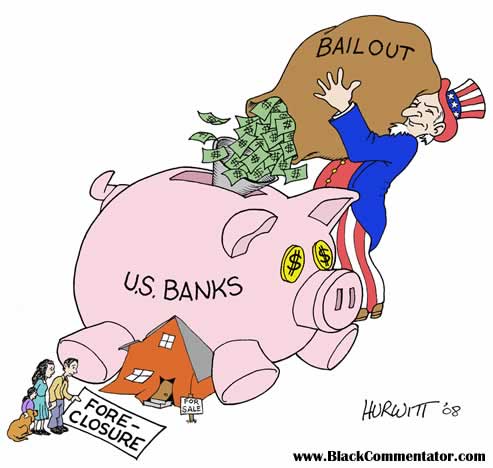
The Bailouts? Not Much For the Common Guy


Trillions to financial Terra Incognita; So far very little for ordinary Americans
By Sherman DeBrosse / The Rag Blog / January 8, 2008

At this moment, the cost of the bailouts, including guarantees, stands at $ 7.2 billion. That includes a $600 billion guarantee for money market funds, $200 billion so far for credit card issuers, $345 to Citigroup, the Fanny and Freddy loans, $200 billion for hedge funds, and on and on and on. Now we hear that the remaining $350 billion from the Troubled Assets Recovery Program has already been committed.

This writer has spent several weeks trying to find one person who could coherently explain why so much money had to be spent covering bad investments that are nearly impossible to understand. No one came forward.

Yes, the money for AIG and a few investment house bailouts were probably necessary because they involved bad securities Americans peddled abroad to people in nations who were accustomed to responsible regulations and did not know casino economics reigned supreme here. It was a matter of joining a joint effort in propping up the international financial system.

Covering the Bets of the Rich

What about trillions committed to banks and banking houses that have not been satisfactorily explained and justified? One of the people I respect most pointed out that we were talking about two economies, one we more or less understand, and the other being the terra incognita of the private casinos of the rich. The Treasury refuses to tell us who gets the remaining $350 billion of TARP, and many of the known recipients refuse to tell how the money was used.

Until someone in Washington begins to explain what is going on, we should be prepared to assume the worst. We have incurred trillions in obligations to cover the bets of the wealthy and keep their private casinos open. None of this resulted in making much more money available for ordinary loans. It is true that some of our pension funds are heavily invested in the hedge funds and derivatives.

Without some explanations, our representatives in Congress should be demanding that no more FED obligations or TARP assets be invested in covering exotic economic transactions. It would be far less expensive to prop up some pension funds than to ship off more money into terra incognita. It is also important to put the trillions of guarantees on hold or drag out indefinitely making good on those promises. First someone should assign verifiable values to all the ethereal financial instruments that have been guaranteed. We all recall in the previous S and L crisis how the culprits were able to repurchase seized assets at pennies on the dollar from the Resolution Trust Corporation.

Let’s Look at the Pig in the Poke

The next administration must take a close look at the loans and guarantees that have already been made and find ways to use them to serve the interests of most Americans. It seems that the TARP money was largely invested in warrants and senior preferred stock. We know far less about what the FED money gained for the taxpayers. In both cases, there should be federal representative on the boards of assisted banks and brokerage firms. Recipients who do not resume normal commercial loans must feel some pain, perhaps inflicted through the tax code.

The banks and financial institutions live in both worlds — terra incognita and the ordinary world of goods and services. So far, the U.S. government has only moved to cover the bets of the big players in the casino. The Democratic Congress has generously bailed out the capitalist system and purchased what appears to be a “pig in a poke” for the taxpayer. I’s no wonder consistent progressives are so often to abandon the Democrats.

Address Suffering in the Real World

Now is the time to address the economic concerns of ordinary people in a financial world we all more or less understand. Congress and the spokesmen for the big money players must be reminded that their long term survival depends on their utility to the American economy.

Funds were extended to banks and the financial services industry with the expectation that credit would again be available to turn the wheels of the economy. But little happened. At first, most of us assumed the recipients of federal money were sitting on these funds because they were covering still more bad debt. There is probably some truth here. We all know that the CPI fell by the greatest amount in 62 months in November and that it still is plunging. The bankers are using our money to cover their balance sheets because they fear a certain amount of deflation is coming and that it will be followed by inflation in several years. We have the twin deficit crises — federal debt and the balance of payments — coupled with a dishonest, Wild West financial industry. Even commercial banks have become high risk operations. The instability of the system and the real threats of deflation and inflation account for why lenders are holding their cards near their chests and the wealthy in record numbers are shipping money overseas.

Free Up Credit

To ward off deflation and eventual inflation, banks must return normal commercial activity now, and the taxpayers need to establish an insurance program for responsible loans. AIG, the taxpayers’ new asset, can be put to use here. Above all, the mortgage crisis must be stemmed to avert a deflationary plunge. One fifth of home mortgages are under water — meaning the value of the mortgaged homes is less than what is owed. Initially,12% of outstanding mortgages were in deep trouble. That number is growing. Housing prices continue to plummet as deflationary forces begin to take hold. Deflation is not a certainty at this point, but it is a possibility that grows with each day of flat consumer spending and inactive credit markets.

The banks are refinancing about 200,000 homes a month. To do more, they need a program that guarantees existing bad housing loans and incentives to greatly accelerate the process. People who are able to handle their mortgages might stop making payments if they see other folks get stabilization deals that are too good. For that reason, the stabilization loans should be for at least 35 years, and interest rates must be at a level to discourage new and unnecessary foreclosures. If there is any appreciation on a covered house, the federal government must receive a piece of it in return for the guarantee. The program would probably have to exclude mortgages that are more than $150,000 under water, unless the banks agreed to swallow some of the loss.

If commercial lending institutions are afraid to participate, use the various federal housing programs to buy up the paper and rewrite the loans. Every month that is wasted adds momentum to deflation. During the New Deal, the Home Owners Loan Corporation saved one in five home owners. The mission was to save people, not banks. We, the people may lose some money, but it will not be the trillions that will disappear by underwriting bad paper in terra incognita. Sheila Bair, head of the FDIC, would be the ideal housing czar to supervise this massive guarantee program.

How Much of a Recovery Can there be Without a Reinvigorated Industrial Sector?

Other decisions about what to do about restoring economic health should be made with the knowledge that we have relied on bubbles in the past to revive the economy. There are no new ones on the horizon, and reliance on bubbles is unhealthy in the long run. The green economy is a necessary and good thing, but many are mistaken in believing it will be an engine powerful enough to make Americans again the consumers of last resort for the entire world. The economy will not recharge itself with a surge in the service and information industries. They still are not large enough to accomplish that. The simple fact is that the industrial sector is essential to recovery — and this means automobiles and heavy industry. European governments understand this and are moving to assist their automakers with loans in the neighborhood of $50 billion.

The debate over the auto industry loan has been fascinating and has revealed a great deal of mendacity and downright ugly attitudes. All sorts of factual matters were distorted. Yes, the domestic industry made many bad decisions, and labor agreements gave workers more than most Americans thought appropriate. But the fact is that the domestic industry was close to bringing labor costs into line, moving legacy costs over to the unions, and dealing with other fundamental issues. Those who advocated Chapter 11 bankruptcy overlooked the fact that the process would be long and tedious and that there would be no private lenders out there with money to but the Big Three back together. Like Chapter 7, it would be a death sentence. Letting the Big Three sink would amount to an irreversible decision to give up on any serious plans to revitalize the manufacturing sector. Those, led by short-sighted Southern senators, who want to destroy the UAW and the Big Three overlook what the wreckage would cost the taxpayers in unemployment benefits for three million people, welfare benefits, decreased income tax revenue, and federal assumption of retirement fund obligations.

There must be a stimulus plan for restructuring the domestic auto industry. In addition to strict accountability components, it might include generous federal assistance to the Big Three’s lending agencies, making it possible for people to acquire new, fuel efficient vehicles with 3% loans. A higher but still advantageous rate would be assigned to the existing inventory of less efficient vehicles. Directly provide them with the funds to make car loans. We are now considering the possibility that 16 million vehicle sales years may never be restored. Federal assistance, through the Big Three, for car loans might rekindle Americans’ love affairs with cars.

Yes, the UAW will have to bite the bullet again. Excess production capacity could be acquired by the federal government and sold or leased bit by bit, in very sweet deals, to small industries with long term-growing pains — outfits that need space but cannot afford to build. Some of the capacity could be used to help build rapid transit and public transportation equipment and machinery and to start restoring the military inventories depleted by two wars.

Rebuilding the American manufacturing sectors will require lowering employer benefit costs, and that can only be done by providing a universal health plan unburdened with successive pharmaceutical costs and insurance company profits. It would be good to pass this now, but it might require a much deeper recession before enough Congressmen acquire enough courage to vote in the interests of most of their constituents.

Consideration should also be given to a Value Added Tax as a means of leveling the playing field among countries that adhere to the General Agreement on Trade and Tariffs. Unfortunately, that is a regressive approach, but is used by our competitors and there seems to be no other approach that works as well to help domestic producers. Given the likelihood of millions more lost jobs in 2009 and 2010, now is the time to consider this.

Of President-Elect Obama’s stimulus package, it appears that $300 million will go to tax cuts — a bow to University of Chicago economics, and $400 billion to the kinds of project that will create assets, work , and send money coursing through the economy. The latter is a tip of the hat to John Maynard Keynes’s economics.

The New Deal Example

Much has been said of late about how FDR’s deployment of Keynes did not end the Great Depression. The fact is that he did not spend enough on pump priming. Before becoming president, he read a book popularizing Keynes, and he scrawled in it something to the effect that you do not get something for nothing. FDR should have spent a lot more because ordinary people no longer had the ability to recharge the economy because there was an inequitable distribution of income. The depression lasted so long due to under-consumption and maldistribution of income. The $300 billion in tax cuts, mostly for ordinary folks, will not accomplish a great deal even if government succeeds in getting the money out fast, perhaps through sharp cuts in FICA deductions.

Those discussing the New Deal example forget that Roosevelt took some steps to deal with inequities in income, particularly by backing unions. That helped prevent economic downturns due to under consumption. It is doubtful if the national climate is such as to make progress on this front possible.

The key is in the pump-priming initiatives, and it is possible that this two year package is too small. The Obama Administration might be in danger of repeating the New Deal’s mistake. The stimulus plan must have a component to rebuild American industry, and that will be costly. There must be enough money borrowed and committed now, while other nations are still taking shelter in Treasury bonds and willing to lend. Our advantage is in being able to borrow at rates far less than those at which we lend. This situation will not last much longer as the world’s monetary situation is due for drastic changes that will not be to our long-term best interest. If the world monetary situation shifts in the direction most expect, we had better have a healthy and productive manufacturing sector or accept the consequences of long-term decline across many fronts.

It will require a number of pieces of separate legislation to implement these plans. We progressives will be facing a four year campaign in putting out accurate information about economic policy if the Obama administration is to prevail in heading off a depression. Already the Republican leadership has signaled that the GOP will delay the stimulus package. It would be a great mistake to promise Republicans up front that concessions would be forthcoming on new estate tax legislation or that the tax cuts for the rich can continue another year. Republicans have 42 more or less disciplined votes and the not-so covert help of a handful of Democratic conservatives in the Senate. It is possible that Mitch McConnell and his minions will be in a position to stop whatever they wish without fear of being punished by the voters. Most of them are in safe red states, and their leaders know that odds are Republicans could pick up seats in 2010, as the opposition party usually gains in off-year elections.

[Sherman DeBrosse, the pseudonym for a retired history professor, is a regular contributor to The Rag Blog and also blogs at Sherm Says and on DailyKos.]

The Rag Blog

Posted in Rag Bloggers | Tagged , , , , | 2 Comments

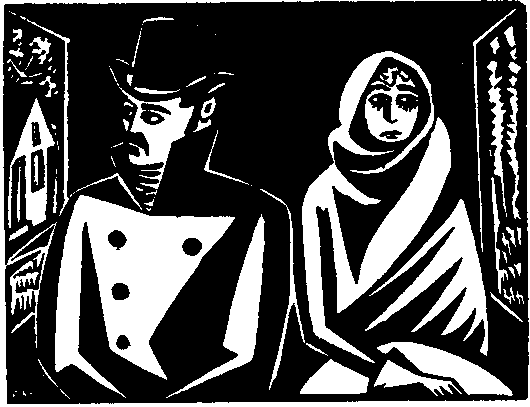
Feeling a Little Depressed? So Does the Economy.

Block print by Frans Masereel.

‘The discretionary spending sector appears to be in freefall — as the economy restructures itself at a lower level around consumer necessities like food and energy. This is global.’
By Roger Baker
/ The Rag Blog / January 7, 2009

There is no concise definition for a depression, unlike a recession. Before the Great Depression, all economic contractions were termed depressions. But as now used the “D” word usually means notable price deflation which then inhibits new investment. The current situation certainly looks like, as Krugman observes, a downward spiral of contracting consumer demand. This leading to further layoffs and disinvestment until spending shifts and stabilizes at some new and depressed level. Americans are learning to cut back on their discretionary purchases, like learning to drive less while anticipating higher energy costs later.

The discretionary spending sector appears to be in freefall — as the economy restructures itself at a lower level around consumer necessities like food and energy. This is global. If you were a cold German family, wouldn’t you try to sacrifice your vacation pay to heat your home? Even by paying much more than what Germany used to pay the Russians until recently?

You now often read accounts about how the US economy is supposed to turn around later this year. The thinking is that if we in the US enjoyed good times up until about a year ago, then those days must certainly be poised to come back, at least part of the way. There is no clear explanation of why that should be so; no clear picture for where US citizens should best fit in to an integrated world economy a decade from now. The USA economy is based on an aging population in heavy debt to the rest of the world.

Obama’s stimulus package, applied domestically, is overstretched in trying to lift us out of the grand canyon of global debt that the deregulated investment banks have created through derivatives and securitization during the bubble expansion days (the world economy is mostly based on a big global finance system that uses the dollar as its standard unit of exchange).

Here’s a Nobel prize winning economist’s opinion:

“Let’s not mince words,” Krugman declared. “This looks an awful lot like the beginning of a second Great Depression.

World Socialist’s (usually smart economics writing) perspective , describing just how broad the contraction is:

…Most mass layoffs now go virtually unnoticed. To cite only a few other examples from Monday and Tuesday: Philadelphia-based health insurance corporation Cigna announced this week that it would cut 1,100 jobs; Los Angeles United School District intends to soon lay off as many as 3,000 teachers; in North Carolina the Robert Bosch Corp. will fire one tenth of the workforce at its North Charleston plant, about 200 workers; and IBM will soon lay off 1,600 workers, according to anonymous sources inside the company.

The layoffs come in advance of the Department of Labor’s report on unemployment, which is to be released Friday. According to a Reuters poll, economists anticipate that 500,000 jobs will have been lost in December, bringing the economy’s overall purge of workers for 2008 to nearly 2.5 million.

In one particularly graphic example of spiraling unemployment, in North Carolina the number of fired workers trying to sign up online for either new or continuing unemployment benefits was so great in recent days as to crash the system, the state’s Employment Security Commission said.

A downward spiral has clearly emerged in the US and global economy, with layoffs and pay cuts growing in response to contraction in economic activity, and then in turn fueling the latter…

In her San Francisco address, Yellen said that “many forecasters expect this to be one of the longest and deepest recessions since the Great Depression.”

On Tuesday, the minutes of the Federal Open Market Committee for December 15 and 16 were published by Federal Reserve Board of Governors. The minutes read like nothing so much as an encyclopedic description of the first months of the Great Depression, with descriptions of across-the-board economic decline in the US and internationally. In the meeting, the Fed determined to lower interests rates effectively to zero, thereby virtually exhausting monetary policy as a tool to counter the crisis, while promising to make the federal currency printing press available to the major financial interests.

To date the efforts of the Federal Reserve and the Treasury Department have done nothing to stem the crisis.

Also see US and global manufacturing collapsing by Joe Kishore / World Socialist / Jan. 3, 2008

The Rag Blog

Posted in Rag Bloggers | Tagged , , , | Leave a comment

Mariann Wizard :
Brandon Darby – ‘To Live Outside the Law You Must Be Honest’

photo of George and Mariann

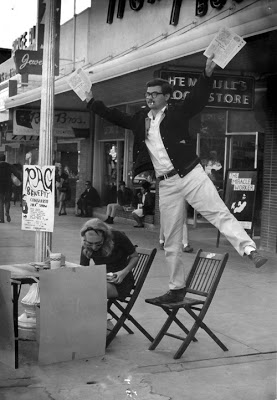
The late George Vizard, murdered in Austin 1n 1967, shown selling The Rag near the UT campus, with his wife Mariann Vizard (now Mariann Wizard).

If Darby had really been worried people he was working with were planning violence, he could have taken it up with other group members. But that would have required honest discussion. When there is no honesty on one side, discussion is meaningless.

By Mariann Wizard | The Rag Blog | January 7, 2009

The news about confessed FBI informant Brandon Darby has stirred up a lot of old feelings in me that stem from personal and group experiences with people like Darby.

Robert Zani, convicted in 1981 of the 1967 murder of George John Vizard IV, my husband, was revealed much later (to the public) to have been a “narc” for the UT Kampus Kops, put in touch with the TX Department of Public Safety by the UT police chief. DPS officers openly attended Students for a Democratic Society (SDS) meetings at UT, as well as meetings of other anti-war and pro-civil rights organizations, but that certainly did not preclude their also placing spies among us, and we know that certain individuals in Austin reported to the Austin police department, and other agencies.

[For more about the death of George Vizard and the spying on Austin activists in the sixties, read The Spies of Texas by The Rag Blog’s Thorne Dreyer, published in the Nov. 17, 2006 issue of The Texas Observer.]

These disillusioning experiences were replicated, and in many cases intensified, nationally. The black liberation movement was targeted even more viciously than the student peace movement, and where black liberation and peace activism came together, infiltration and disruption were most extensive (witness J Edgar Hoover’s unrelenting attempts to “get the dirt” on Martin Luther King). People like Darby were often proponents of violence, urging inexperienced activists to irresponsible acts. The current Maryland State spy revelations are a chilling reminder of what we came, long after the fact, to know as COINTELPRO.

It angers me very much to see today’s idealistic young activists — some of whom I have come to know a little and hope to know for a long time due to their consistency, commitment, and dedication to the struggle — targeted by today’s government spies, and to know that innocent people will undoubtedly be harmed by government’s callous disregard of civil liberties.

The real question raised by Brandon Darby’s spying admission is, “How do you know when a person is honest?” The real answer is, “You can’t.” But enough questions had been raised about Darby, and some reports of his usual behavior are certainly suspicious enough, that in my opinion HE SHOULD HAVE BEEN ASKED POINT-BLANK by group leaders, collectively, if he was an informer, especially before they publicly defended him. This is a hard lesson for young activists, and no fun to learn, but a person can be betrayed by anyone. On the positive side, however, no one is ever betrayed by “just anyone,” but only by the most unscrupulous and morally degenerate of individuals (and yes, that makes it feel even more disgustingly gross to realize you were fooled; like being raped, being informed upon is an invasive and very personal experience!) Raising concerns and resolving them in a principled (HONEST), democratic manner is essential, no matter the topic. If something can’t be talked about and resolved in that way, there is more wrong in a group than the presence of an informer.

In addition, it’s important to recall that in the 60s and 70s, in the student milieu at any rate, our own eschewing of identifiable leaders and decision-making processes too often may have opened a door for the charismatic stranger who liked, e.g., to set fires. I don’t know that the new gen of activists has come up with any better model within their collectives; they don’t seem any more interested in acknowledging “leaders” than we were, but that means new activists also can’t identify who is really being truthful about group goals and methods. (That would make an interesting interview, or better yet, panel discussion.)

What makes a person willing to gain the confidence, friendship, and admiration of others, only to lead them into planning and/or committing bad acts and then “telling on them”?

If Darby had really been worried people he was working with were planning violence, he could have taken it up with other group members. But that would have required honest discussion. When there is no honesty on one side, discussion is meaningless.

If I thought Brandon Darby had the self-critical faculties necessary to provide a useful answer to that question, I might think an interview with him would be interesting. But in all likelihood, the self-justifications, excuses, counter-accusations and outright lies one would hear would effectively conceal whatever moral birth defect is at the root of his deceit. He is the jealous big brother tricking his younger siblings into being naughty in order to win Mama’s affection, perhaps; great fun when one is 10, but soon abandoned by a maturing human being. I was a big sister once, but now I believe that, if this life we are given has any purpose, it is to help one another.

Let us remember the stories of admirable men and women, and recall — perhaps with new insight after all these years? — the immortal words of Robert Zimmerman, “To live OUTSIDE THE LAW you must be HONEST. I know YOU ALWAYS SAY THAT YOU AGREE.”

See Brandon Darby : FBI Informant is Provocateur, Not a Hero by Austin Informant Working Group / The Rag Blog / Jan. 6, 2009

Also see Brandon Darby: Austin Activist Outed as FBI Spy / The Rag Blog / Jan. 2, 2009

Posted in Rag Bloggers | Tagged , , , , , , , , | 8 Comments

Brandon Darby : FBI Informant is Provocateur, Not a Hero

Austin activist and FBI informant Brandon Darby. Photo courtesy of YouTube.

‘FBI informant Brandon Darby did not heroically intervene to stop violence. Rather it appears that he actively sought out people that he could manipulate and entrap.’

By Austin Informant Working Group / The Rag Blog / January 6, 2008

AUSTIN, Texas — A group of Austin activists today released their conclusions from reviewing over 70 pages of FBI documents obtained through a legal case regarding alleged actions to protest the Republican National Convention (RNC). From reading the documents, and from their own experience with him, these activists have concluded that the FBI informant Brandon Darby did not heroically intervene to stop violence. Rather it appears that he actively sought out people that he could manipulate and entrap. The two Texas men that Darby was most closely associated with during the convention, Bradley Crowder and David McKay, are accused of making Molotov cocktails and have been in jail since early September. Their trial is set for January 26. The disclosure of Brandon Darby as the informant casts further doubt on the charges against these two men.

According to the FBI’s documents, Darby, posing as an activist, had been covertly gathering information for the FBI since at least February 2007, twelve months before he ever met Crowder or McKay or knew of any plans for the RNC. “As an older seasoned activist, Darby had a lot of sway over Crowder and McKay, making them susceptible to his often militant rhetoric,” said Gabby Hicks, who was in St. Paul with Darby during the Convention. “He was always the one to suggest violence, when the rest of us clearly disagreed with those strategies.”

Darby has been characterized by many people who have known and worked with him as both persuasive and manipulative, with a history of provocation, instigation, and incitement. According to Lisa Fithian, who worked with Darby for years, “Brandon was always provoking discord and aggression, in the anti-war movement in Austin in 2003, in protests in Houston against Halliburton, and in disaster relief at Common Ground in New Orleans. I worked with Darby in all of those places and saw the disruption he caused.”

The FBI documents make it clear that Darby did not restrict his informing to people he alleges were planning illegal activities. He also gathered information on numerous people who were engaged in lawful activism; including some who had no plans to attend the Republican Convention. “The wider net cast by Darby in his information gathering shows that he was part of an FBI campaign to suppress political dissent and activism,” said Will Potter, an award-winning independent journalist. “By gathering information on law abiding activists and then defending his actions as stopping violence, Darby contributes to the public perception that political dissent is criminal, which has a chilling effect on free speech.”

Because of Darby’s leadership role and his militant rhetoric, two impressionable young men, who have been held without bail since September, now face 7 to 10 years in prison. As the prosecution prepares for trial, friends and family of McKay and Crowder are hoping for a not guilty verdict. “We miss him a lot,” said Mckay’s father. “Every night David calls – at this point those calls mean everything to me.”

For more information contact the Austin Informant Working Group at texas.solidarity@gmail.com. People in this community are also available to speak to the media about their experiences with Darby and the results of his malicious actions.

Gabby Hicks traveled to St. Paul with Darby for the RNC and is named in the documents.
Lisa Fithian is local long-time organizer named in the documents and worked with Brandon in Austin, Houston, and NOLA.
Carly Dickson was a longtime friend of Brandon, represents Austin People’s Legal Collective.
Brent Purdue is a local activist who worked with Brandon.
Heather Mitchell is a local activists.
Scott Crow is a local long-time organizer named in the documents and a long-time friend of Brandon’s.

See Brandon Darby: Austin Activist Outed as FBI Spy / The Rag Blog / Jan. 2, 2008

The Rag Blog

Posted in Rag Bloggers | Tagged , , , , , , , , | 6 Comments

Hamas Speaks: Israel Broke the Cease-Fire First


Hamas speaks
By Mousa Abu Marzook / January 6, 2009

A Hamas official insists that a ‘legacy of suffering’ under Israel is what fuels Palestinian resistance.

From Damascus — While Americans may believe that the current violence in Gaza began Dec. 27, in fact Palestinians have been dying from bombardments for many weeks. On Nov. 4, when the Israeli-Palestinian truce was still in effect but global attention was turned to the U.S. elections, Israel launched a “preemptive” airstrike on Gaza, alleging intelligence about an imminent operation to capture Israeli soldiers; more assaults took place throughout the month.

The truce thus shattered, any incentive by Palestinian leaders to enforce the moratorium on rocket fire was gone. Any extension of the agreement or improvement of its implementation at that point would have required Israel to engage Hamas, to agree to additional trust-building measures and negotiation with our movement — a political impossibility for Israel, with its own elections only weeks away.

Not that the truce had been easy on Palestinians. In the six-month period preceding this week’s bombardment, one Israeli was killed, while dozens of Palestinians lost their lives to Israeli military and police actions, and numerous others died for want of medical care.

The war on Gaza should not be mistaken for an Israeli triumph. Rather, Israel’s failure to make the truce work, and its inevitable resort to bloodshed, demonstrate again that it cannot permit a future built on Palestinian political self-determination. The truce failed because Israel will not open Gaza’s borders, because Israel would rather be a jailer than a neighbor, and because its intransigent leadership forestalls Palestinian destiny and will not make peace with history.

This week’s war is not an attack on the Izzidin al-Qassam units — our movement’s military wing — but is simply aggression targeting the people, infrastructure and economic life of Gaza, designed to sow terror and loose anarchy; it aims to establish new “facts on the ground” — that is, heaps of rubble with bodies trapped beneath — in advance of the coming American administration.

Israel claims loudly that it had no other choice this week but to rain death on refugees in camps, killing dozens of women and children, while Defense Minister Ehud Barak (the once and would-be prime minister) — his eye fixed on February elections — employs mass murder as his party’s latest vote-getting appeal, an electoral strategy fit to shame the most hardened Chicago political operative.

But, of course, options remained available. Israel might have relented months ago, for the sake of the truce, in its criminal determination to starve Gaza, cutting off much of its fuel and choking all commerce to a trickle, blocking relief organizations from delivering food and medicine, and consigning Gaza’s citizens to famine rations. Only the most cynical observer would call this grinding attrition “good faith” adherence to the truce. Blockades, after all, are explicitly acts of war.

Palestinians everywhere mark the closing of the Bush era with relief; nevertheless, skepticism runs high that any justice for our people might come from a new president who remained ominously silent in the presence of the latest Israeli onslaught, and who has aligned himself so thoroughly with Israel’s interests, so long in advance of taking power. Barack Obama’s helicopter ride two years ago above the Holy Land was not unusual in the annals of American parliamentarians junketed on “fact finding” trips by Israel’s lobbyists; yet his fond remarks on what he saw — “houses and streets like ones you might find” in any American suburb — were notable for their silence as to any troubling sights. Did he miss the security roads and checkpoints that riddle the West Bank, or the construction of the wall, or the illegal settlements? Perhaps his helicopter flew too high.

But now, amid Israel’s latest attack on our people, as the death toll rises in the hundreds, with thousands wounded — all victims of American taxpayers’ largesse — Palestinians wonder how Obama will react to the escalating crisis. They demand of the next White House a new paradigm of respect and accountability, because when Palestinians see an F-16 with the Star of David painted on its tail, they see America.

Palestinians are understandably guarded about the coming administration, noting its appointments with trepidation. The soon-to-be secretary of State is unforgettable for urging years ago U.S. recognition of Jerusalem as Israel’s “undivided” capital, while the administration’s chief of staff bears the stain of his father’s service in the banned terrorist Irgun paramilitary, a Zionist group responsible for numerous atrocities.

Renewed calls today for our movement to “recognize the right of Israel to exist,” in the face of murderous onslaught, ring as hollow as Israel’s continuing claims to be acting in “self-defense” as her jets bomb civilians. Without debating here the Zionist state’s fictive, existential “right,” which of the many Israels, precisely, would the West have us recognize? Is it the Israel that militarily occupies land belonging to three of its neighbors, ignoring international law and scores of U.N. resolutions over decades? Is it the Israel that illegally settles its citizens on other people’s land, seizes water sources and uproots olive trees? Is it the Israel that in 60 years has never acknowledged the forced expulsion of Palestinians from their farms and villages as the foundational act of its statehood and denies refugees their right to return?

Through bitter experience, when we hear demands for “recognition” of Israel as a precondition to dialogue, what we hear is a call for acquiescence in its crimes against us, validating the injustices that have been wrought in its name.

Our spirit to fight on is the legacy of collective suffering: With tens of thousands dead or wounded by decades of the “peace process,” you cannot find a family in Palestine — Muslim or Christian, Hamas, Fatah, PFLP or Islamic Jihad — without a son or daughter killed, injured, jailed or tortured, or which does not count itself or its kin among the millions of refugees living in U.N. camps.

Hamas is not a handful of leaders. Israel may kill all of the current leadership in this round of violence, including me, and its organic, social infrastructure will not go away. We are, simply put, a homegrown national liberation resistance movement, with millions of people who support our struggle for freedom and justice.

President-elect Obama spoke courageously in his campaign for a policy of open dialogue, absent preconditions, with those deemed inimical to U.S. interests, and we were listening. One former U.S. president — a true peacemaker — has dared to visit with us and hear our side of this struggle, while offering us no shortage of criticism. It has been a refreshing exchange. Now is the time for the next U.S. president to do the same.

No American leader has ever visited a Palestinian refugee camp anywhere, much less in Gaza — a startling fact, considering the central role America has played in our people’s narrative. None has dared to look our refugees in their faces and experience their suffering directly.

In observance of the storied tradition of Arab hospitality to guests, and anticipating that day when an American president fulfills his promise of change, we extend the invitation now, and we will put the kettle on.

[Mousa Abu Marzook is the deputy of the political bureau of Hamas, the Islamic Resistance Movement.]

Source / Los Angeles Times

Thanks to Jeff Segal / The Rag Blog

Posted in RagBlog | Tagged , , , | 3 Comments

Tom Hayden on Obama’s Afghanistan : Needles and Haystacks

US Troops Stuck in Afghan Sands.

‘In everyday language, Obama’s proposals for Afghanistan and Pakistan can be described as either out of the frying pan and into the fire, or attacking needles by burning down haystacks.’
By Tom Hayden / January 6, 2008

On January 21, President Barack Obama will take personal responsibility for the wars in Afghanistan and Pakistan launched under President Bush. The Afghan-Pakistan war is uniquely Democratic in origin, however. Since John Kerry’s 2004 campaign, hawkish Democratic security and political consultants have asserted that Afghanistan is a good and necessary war in comparison with Iraq which they label a diversionary one.

This argument has allowed Democrats to be critical of the Iraq War without diminishing their standing as hawks who will employ force to hunt down Al Qaeda. As a result, the rank-and-file base of the Democratic Party, and public opinion in general, remains divided and confused over Afghanistan. As a result, opponents of the Afghanistan escalation remain at the margins politically for now, although backed by a healthy public skepticism given the Iraq experience.

Back on July 14, I wrote “Chasing Needles By Burning Haystacks” for the Huffington Post, a criticism of Obama’s Iraq and Afghanistan proposals. In other writings for The Nation, I have been critical of the decision by liberal Democratic donors in 2008 to defund and shut down an independent media campaign that would have carried telelvision and radio messages against “McCain’s wars.” Now that they are becoming Obama’s wars, the challenge will be more difficult, since so many millions of Americans, myself included, want our new president to succeed, restore hope, and launch a new New Deal at home, not be distracted by a quagmire abroad.

The war in Iraq already is fading from public view, although more than 140, 000 American troops remain stationed there. The major television networks have withdrawn. US casualties are far fewer than in traffic accidents on American streets. Iraqi violence is down as well, with 8,955 civilian deaths in 2008 compared to 51,894 in the bloodiest years of 2006-2007. The shift is towards a low-visibility counterinsurgency war like those that ravaged Central America in the 1970s.

The conditions for a massive social movement against the Iraq War are ebbing, for now, unless large-scale fighting suddenly resumes or President Obama unexpectedly caves in to the Pentagon and blatantly breaks his promise to withdraw combat troops in 16 months and all troops by 2011.

That makes Afghanistan the growing focal point for public debate over what counterinsurgency gurus call “the long war” against Islamic jihad.

In everyday language, Obama’s proposals for Afghanistan and Pakistan can be described as either out of the frying pan and into the fire, or attacking needles by burning down haystacks.

The Pentagon paradigm is to defeat al-Qaeda militarily while refusing to address, and thereby worsening, the dire conditions that gave rise to the Taliban and al-Qaeda operatives in the first place. Ahmed Rashid’s new Descent into Chaos [Viking, 2008] provides a horrific portrait of Afghanistan in careful prose based on reputable sources.

It is estimated by RAND that $100 per capita is the minimum required to stabilize a country evolving out of war. Bosnia received $679 per capita, Kosovo $526, while Afghanistan received $57 per capita in the key years, 2001-2003;?- When the US installed the Hamid Karzai government, Afghanistan ranked 172nd out of 178 nations on the United Nation’s Human Development Index, having the highest rate of infant mortality in the world, a life expectancy rate of 44-45 years, and the youngest population of any country; in 2005 95 percent of Kabul’s residents were living without electrical power.?- Seven hundred civilians were killed in the first five months of 2008 alone, according to the United Nations.

Despite some gains in media and currency reform, plus a modest increase in children in school, this was the path of least reconstruction.

And despite media images of Afghan democracy that made loya jirga tribal gatherings appear to be the birth of participatory democracy, a warlord state was entrenched by the CIA. The government is “shot through with corruption and graft”, from the police to the presidential family, writes Dexter Filkins in the New York Times. [Jan. 2, 2009]

There are some 36,000 US troops stretched across Afghanistan, another 17,500 under NATO command, and 18,000 in counterinsurgency and training roles [New York Times, July 14]. It costs the Pentagon $2 billion per month to support the American troops.

The enlarged American forces are likely to “squeeze the Taliban first”. [New York Times, 12-24-08]. The target will be the support networks of the Taliban which are embedded in the vast tribal lands of Pashtun civilians, which stretch from southern Afghanistan into Pakistan. The enlarged American forces are likely to “squeeze the Taliban first”. [New York Times, 12-24-08].

Even Afghanistan’s client president, Hamid Karzai, complains of extra-judicial killings and civilian casualties from the American air war, a pattern of repression and suffering which will only worsen with more American troops pouring into combat zones.

Meanwhile, the war in Pakistan and other Central Asian countries will expand as the additional US troops seek to recover supply lines closed by recent Taliban attacks. [No one comments that the Pentagon is carrying out precisely what it accuses the Taliban of doing, using Pakistan as a supply and staging area for its forces in Afghanistan. Eighty percent of those supplies flow through Pakistan, according to the New York Times, Dec. 31, 2008]

According to Rashid, “Afghanistan is not going to be able to pay for its own army for many years to come — perhaps never.”

As of 2006, Afghanistan’s economy still rested on producing 90 percent of the world’s opium, an eerie narco-state parallel with the US counterinsurgency in Colombia from where most of America’s supply of cocaine originates.

Afghanistan is an unstable police state. By 2005, the Afghan Independent Human Rights Commission cited 800 cases of detainee abuse at some thirty U.S. firebases. “The CIA operates its own secret detention centers, which were off limits to the US military.” Ghost prisoners, known as Persons Under Control [PUCs] are held permanently without any public records of their existence. Warlords operate their own prisons with “unprecedented abuse, torture, and death of Taliban prisoners.” And as the US lowered the number of prisoners at Guantanamo, it increased the numbers held at Bagram, near Kabul. As of January, 2008, there were 630 incarcerated at Bagram, “including some who had been there for five years and whom the ICRC had still not been given access to.” After weeks of hunger strikes about detention conditions, the Taliban recently orchestrated a jailbreak of hundreds of Afghanis from the Kandahar prison, an inside job.

As in Iraq, the US contracted for police training in Afghanistan with DynCorp International; between 2003 and 2005, the US spent $860 million to train 40,000 Afghan police, “but the results were totally useless” according to Rashid. Even Richard Holbrooke described the DynCorp training program as “an appalling joke…a complete shambles.”

When the Taliban government was overthrown, the US installed a Westernized Pashtun, Hamid Karzai, a former lobbyist for Unocal, who had been out of the country during the jihad against the Soviet Union. But the Pashtun tribes themselves were violently displaced from power for the first time in 300 years. They remain by far the largest Afghan minority at 42 percent of the population, heavily concentrated in Kandahar and the southern provinces and across the federally-administered tribal areas in western Pakistan. These are the areas that the Pentagon, the New York Times, and Barack Obama [like John Kerry before him] designate as the central battlefront of the war on terrorism.

The question is not simply a moral one, but whether the expanding war in Afghanistan and Pakistan, fueled by troop transfers from Iraq, is winnable, and in what sense?

Transferring an additional 20, 000 American troops from Iraq to Afghanistan, which Obama proposes, is symbolic, a step on the treadmill of escalation. The American troop level will be pushed to 58,000, in addition to 30,000 other foreign troops. Obama may be proposing an escalation simply in order not to lose, a pattern well-documented in Daniel Ellsberg’s history of the Vietnam War.

The questionable premise of the coming escalation is that military success must precede any political solution. “What we need are more troops in Afghanistan because we need security, and eventually we will get a strategy”, says a former Special Forces officer now with the think tank Center for a New American Security. [Dec. 23, 2008] But it could deepen the quagmire and turn more Afghans against Obama and the US as well.

In Pakistan, the Pentagon has fostered the ascension of a new Pakistani general, Ashfaq Parvez Kayani, whose background includes training at Fort Benning and Fort Leavenworth. An unnamed US military official praises Kayani “for embracing new counterinsurgency training and tactics that could be more effective in countering militants in the country’s tribal areas. [New York Times, Jan. 7. 2008] Over $400 million is being spent to recruit a “frontier corps” of to “turn local tribes against militants” [New York Times, Mar. 4, 2008] CIA and Special Forces operatives already have invaded Pakistan to set up a secret base from which to hunt Osama bin Laden “before Mr. Bush leaves office” as well as fighting al Qaeda and the Taliban on the ground and from pilotless Predator drones. [New York Times, Feb. 22, 2008].

This constitutes another preventive war by the United States, this one in violation of Pakistan’s sovereignty and the overwhelming sentiment of Pakistan’s people. On the Afghan front, the Taliban will be able to retreat in the face of greater US firepower, or attack like Lilliputians from multiple sides if the US concentrates its forces around the Pakistan border. Further violence and tides of anti-American sentiment could sweep across the region into Pakistan with unpredictable results.

Michael Scheuer, the former CIA official once charged with tracking down Osama bin Laden, suggests that the American delusion is that “by establishing a minority-dominated semisecular, pro-Indian government [in Kabul], we would neither threaten the identity nor raise the ire of the Pashtun tribes nor endanger Pakistan’s national security.” Scheuer wrote this year that “for the United States, the war in Afghanistan has been lost. By failing to recognize that the only achievable US mission in Afghanistan was to destroy the Taliban and al-Qaeda and their leaders and get out, Washington is now faced with fighting a protracted and growing insurgency. The only upside of this coming defeat is that it is a debacle of our own making. We are not being defeated by our enemies; we are in the midst of defeating ourselves.” [Marching Toward Hell, 2008]

The beginning of an alternative may require unfreezing American diplomacy towards Iran and considering a “grand bargain” instead. Teheran is the single power, according to CIA director Deutch, who could destabilize the US withdrawal from Iraq. It happens that they were America’s ally against Afghanistan not so long ago. The Iranians have lost thousands of police and soldiers themselves in a border war against Afghan drug lords. According to William Polk, “ironically, the only effective deterrent to the trade is Iran.” [Violent Politics, 2008] In exchange for security guarantees against a US-directed regime change, Iran may be willing to discuss cooperation with the “Great Satan” to stabilize its borders with Iraq and Afghanistan. Improbable? That depends on whether one thinks the alternative is unthinkable.

The great reappraisal might be underway. In December 2008, Lawrence Korb and Laura Conley of the Center for American Progress published an op-ed piece calling for US-Iran talks over Afghanistan. The CAP is headed by John Podesta, senior official in the Obama transition.

Since twists and turns seem to be the only pattern in divide-and-conquer strategies, it is possible that Obama thinks being tough towards Afghanistan and Pakistan is a defensive cover for withdrawing from Iraq, and he will follow up with unspecified diplomacy after he takes office. But history shows that creeping escalations create a momentum and constituency of their own. Obama might get lucky, lower the level of the visible wars, and embrace a diplomatic offensive. But North and South Waziristan could be his Bay of Pigs.

How can this war be opposed effectively? If Obama appears to be negotiating a diplomatic solution with some success, he will enjoy wide support within the media and Congress. If the additional 20-30,000 American troops appear to be “stabilizing” the situation, public criticism may be modest in scale. But there is widespread, if latent, public opposition to anything resembling an occupation or quagmire in Afghanistan-Pakistan, especially with the American economy in dire straights. The time is coming when these will be known as Obama’s wars, and seen as an unproductive distraction from his main mission as president. The deployment of top journalists like the Times’ Dexter Filkins to the Afghan front already has increased the quality of press coverage. International protest is certain to grow, given official reservations already expressed by governments in Germany, Italy, Spain and Poland over civilian casualties, air strikes, human rights violations and counter-narcotics missions. The massive human rights violations in Afghanistan will also begin to produce a round of worldwide condemnation. An international anti-war movement is on the horizon.

The cost of Afghanistan will be seen as unsustainable as well; the $36 billion for annual military operations is certain to climb, while the $11 billion spent since 2002 on non-military development cannot begin to address the country’s problems. Whether Obama can afford guns-and-butter in Afghanistan as America’s own infrastructure and social services fall apart is a question that could move to action “cities for peace”campaigners, health care advocates, Iraq veterans and military families, among many others. And if these wars continue through Obama’s first term, a great moral discontent will grow among many Americans who voted for peace in 2006 and 2008.

[Tom Hayden is a founder of ‘Progressives for Obama’ and the author of Ending the War in Iraq [2007], The Voices of the Chicago Eight [2008], and Writings for a Democratic Society, the Tom Hayden Reader [2008].>

Source / The Huffington Post / Progressives for Obama

Thanks to Carl Davidson / The Rag Blog

Posted in RagBlog | Tagged , , , | Leave a comment

Bigotry Still Rules : The Special Suffering of Gay Americans

Civil rights pioneer Bayard Rustin was fired from the Friendship for Reconciliation, a pacifist group, for being gay.

The way anti-gay bigotry works is that a great deal of the violence and suffering is conducted away from the public eye. The resulting pain suffered is turned inwards, which is why one out of every three gay teens attempts suicide and why some of the most virulent anti-gay bigots turn out, in the end, to be gay themselves.

By Lisa Szefel / January 9, 2009

[Ms. Szefel is an assistant professor of modern American history at Pacific University in Forest Grove, Oregon where she teaches classes on the 1970s, the Reagan era, and the history of capitalism.]

In the summer of 2006 I attended the National Endowment for the Humanities Summer Institute at the W.E.B. Du Bois Institute at Harvard. One of the guest presenters was ninety-five year old Johnnie Carr, the woman who took over the Montgomery Improvement Association in 1956 after the successful bus boycott when Martin Luther King, Jr. went on to form the Southern Christian Leadership Convention.

Carr told stories and fielded questions. I’m not sure how the topic of gay people came up but at the mention of the word “homosexual” her face shriveled up and she moved her hand in a wide sweeping gesture, then exclaimed, “Those DISGUSTING people!” She made some inaudible comments then said the word “DISGUSTING” again. She said this even though Bayard Rustin, the man who co-founded SCLC with King, who assisted in the creation of the Committee on Racial Equality in 1942, organized the first freedom ride and the March on Washington, and helped King convert wholeheartedly to non-violence, was gay. I looked at Waldo Martin and Pat Sullivan, the two seminar leaders, and they looked away but, to their credit, they did not stop the tape recorder.

After Carr left and our group reconvened, I looked around and asked (it took no small amount of courage for me to raise this question and risk losing their respect or being seen as a troublemaker): “Did she really say that gay people were disgusting?” Everyone shrugged it off. An African American professor from North Carolina said, “Oh, that’s just her generation.” Martin replied, “She’s a devoted church lady, that’s just the way they see things.” I responded, “That doesn’t make it hurt any less.”

Now imagine someone lobbed the same spiteful word at a black person in 1955, at a time when key constitutional rights were not yet secured and violence or at least censure was always a risk. That person’s entire character would be defined as essentially racist. It would not be shrugged away, especially not now because we as a nation have come to understand the history and impact of bigotry on African Americans.

Would a newspaper or website run this article with this story and thereby run the risk of tainting the reputation of one of the great civil rights leaders? Is Carr’s reputation more important than the wave of anxiety and shame she triggered in me with her comments? Shouldn’t I be quiet? Am I simply being over-sensitive?

Understanding the sensitivity of the oppressed requires raising awareness. When I was growing up in blue collar Buffalo during the early 1970s busing was in full swing. Everyone talked about the violence at local P.S. 43. Fearing for the safety of their children, my parents sent their kids to Catholic school. I had to clean the hallways and bathrooms after hours (a job affectionately referred to as “the scum crew”) to help defray tuition costs. Years later when I was in graduate school, I told my middle class liberal friends about this. They all insisted my parents were racists and should have sent their kids to public school. In Buffalo as in Boston, it was the poorest school districts that were subjected to busing edicts and the term “limousine liberals,” coined in 1969, became widespread.

My family members were not racist but they did experience cognitive dissonance. They had black friends, neighbors, and co-workers with whom they got along well. Then, as their story goes, their African American acquaintances “one day just up and got angry.” It turns out that, as white people, while they had good intentions, they had very little idea what a black person had to endure. Adjusting to the fact that they had been dead-wrong all-along took them by surprise.

During the recent imbroglio over Barack Obama’s Inaugural invitation to Rick Warren gay people have been demonstrating their anger. Moderate liberals have jumped to the President-elect’s defense. In “Letter from Birmingham Jail” Martin Luther King, Jr. reserved his strongest rebuke for white moderates who want order and peace more than justice. “Lukewarm acceptance is much more bewildering than outright rejection,” he wrote. King also quoted a letter from a white moderate who cautioned patience: “All Christians know that the colored people will receive equal rights eventually, but it is possible that you are in too great a religious hurry,” to which King angrily responded: “Such an attitude stems from a tragic misconception of time, from the strangely irrational notion that there is something in the very flow of time that will inevitably cure all ills.” To the white clergy who had urged him to desist from public protests, King eloquently made the case for why blacks can no longer wait, insisting that freedom is never given but must be demanded, and he detailed the psychological impact of having waited 340 years to receive constitutional and God-given rights. He fiercely rejected justifications of bigotry based on majority opinion.

Few leaders have spoken so powerfully on behalf of gay rights. Hillary Clinton has made eloquent speeches in front of the Human Rights Campaign. She led the fight against the Federal Marriage Amendment and throughout the recent election spoke movingly about gay people she has known. During the primaries when I expressed my support for her over Obama, another professor asked, “Hillary and Obama are both against gay marriage, so they have the exact same stance on that issue. Am I missing something?” To me that demonstrated such a world of ignorance, as if gay people cared only about this one subject, and it neglected the senator’s history of support. Hillary opposed gay marriage as a strategy and argued for a state-by-state plan. Obama, conversely, repeatedly stated that he opposed gay marriage “as a man of Christ,” as if Jesus would be appalled. That is ideology. He also explained by saying that, if he were an advisor to the civil rights movement in 1962, he would not focus on the illegality of racial marriage, preferring to focus first on attaining voting rights.

However, this is an incorrect historical analogy. No gay person is arguing for the right to marry a straight person. They want to marry each other. Black people, after all, were allowed to get married during the hell of Jim Crow. Jewish people were allowed to get married in interwar Germany. The Untouchables in India, Japan, and Korea are allowed to get married. Moreover, many scholars have argued that a link exists between the fact that black people in antebellum America were not allowed to form families and high rates of contemporary poverty; slavery denied black men the ability to be responsible fathers. The veracity of this argument is debatable but, nevertheless, it was expected, that African Americans wanted to form relationships and experience love. What does it signify that, of all the humans on earth, only gay people are singled out as exempt from this right, from these desires? How does the restriction against participation in the most fundamental institution of every civilization on earth from time immemorial affect a gay person’s sense of self-worth? To be hopeful in such an environment would be far too audacious.

When I was growing up I never expected I would have a family of my own. Gay people were openly spoken of and depicted as pedophiles and psychopaths. A sea change occurred when Ellen Degeneres came out on national tv in 1997. Until Ellen there was no figure of stature to reference or model. If rich, powerful people were too afraid to be honest, how should poor, vulnerable people feel? The coming-out episode of her self-named TV show brought a collective sigh of relief: “Finally, someone who admits it.” Yet the visibility this brought spurred Americans across the country to insert anti-gay marriage ballot initiatives in 2000 and 2004. If earning a Ph.D. in History has taught me anything, it is that history is not a straightforward march of progress; often it takes two steps forward then one step backward. Oprah Winfrey, who played the psychologist in Ellen’s coming-out episode, said that she received more hate mail for that role than for any other thing that she has done in her life.

One year after Ellen’s coming out, 21-year-old Matthew Shepard was tortured, pistol whipped, then tied like a scarecrow to a fence and left to die in a remote area of Laramie, Wyoming. News reports indicated that the only part of his face not covered in blood was the skin cleansed by the tracks of Matt’s tears. The lynching shocked the gay community as much as the photo of Emmet Till’s bloated, distended face affected African Americans in 1955: just as young blacks were surprised to learn they could be killed simply for their skin color so too were gays shaken to discover they could be targeted just for the gender of the person who moves their heart.

After the incident Bill Clinton tried to extend the federal hate crimes laws. Before that he had the courage, the moment he became President, to try and do something about the prejudice gays endure. He failed and compromised with “Don’t Ask, Don’t Tell” but at least he tried before it was politically correct to do so. No one else had cared enough to make the attempt. On the contrary, these were the years when the sex abuse scandal rocked the Catholic Church and the uniform response of the all-male clergy was that only gay men commit child molestation. The first black president of the U.S. Conference of Catholic Bishops Wilton D. Gregory went on television to say that if the Catholic Church ferreted out all the gay clergy, there would no longer and not ever again, be a problem. Then Clinton blundered in signing the 1996 Defense of Marriage Act. But he still invited Ellen and Anne to Washington.

When I saw the picture of them with the President at the White House I almost fainted — an openly gay person was allowed inside?

Bernice King was three weeks old when her father wrote “Letter from Birmingham Jail” in 1963. In 2004, at the age of 41 and now a minister, Bernice marched in protest, just as her father did, but only this time, she was campaigning against gay marriage. She moved the funeral of her mother, Coretta, from her home church to a conservative anti-gay church, causing Julian Bond to refuse to attend. Coretta Scott King did believe the gay rights movement was similar to the struggle for black civil rights, for which she received rebuke from her community. She countered: “I still hear people say that I should not be talking about the rights of lesbian and gay people and I should stick to the issue of racial justice. But I hasten to remind them that Martin Luther King Jr. said, ‘Injustice anywhere is a threat to justice everywhere.’ ” Before another group, Coretta insisted that “Homophobia is like racism and anti-Semitism and other forms of bigotry in that it seeks to dehumanize a large group of people, to deny their humanity, their dignity.” Former SNCC leader and Congressman John Lewis too has stood up to denounce homophobia as just another variant of the same “fear, hatred, and intolerance” that animates racism, and he castigates civil unions as just another version of separate but equal.

Similarly, in a 1970 letter to his “Revolutionary Brothers and Sisters about the Women’s Liberation and Gay Liberation Movements,” Black Panther Party co-founder and leader Huey P. Newton urged cooperation while acknowledging prejudice. “I say ‘whatever your insecurities are’ because as we very well know, sometimes our first instinct is to want to hit a homosexual in the mouth.” Newton urged deleting the word “faggot” from the black activist’s vocabulary and he pleaded for understanding: “homosexuals are not given freedom and liberty by anyone in society. They might be the most oppressed people in society.”

Bayard Rustin, Langston Hughes, and James Baldwin had been marginalized from the movement because of their sexuality. Rustin was fired from the Friendship for Reconciliation, a pacifist group, for being gay. In an effort to assume a more prominent position for himself, Adam Clayton Powell, the heroic civil rights leader and congressman from Harlem, threatened to leak news about Rustin’s homosexuality unless King distanced himself from Rustin. Before Rustin died in 1987 he asserted that, just as the treatment of blacks was the barometer of human rights standards, now it was conduct toward gays that determined progress.

Too many Americans, liberals included, have no idea about the amount of suffering gay people endure. To speak in an informed way about gay marriage requires knowledge, whether speaking to a range of gay people about their experiences or reading on a regular basis websites of The Advocate, the Human Rights Campaign, and the International Gay and Lesbian Human Rights Commission. Just in the past two weeks a lesbian in San Francisco was gang-raped by four men who shouted anti-lesbian epithets at her during the attack, and the US and the Vatican refused to sign a UN declaration decriminalizing homosexuality (the Vatican’s head of the Congregation for Catholic Education, Cardinal Grocholewski, has deemed homosexuality not only a “deviation” but a “type of wound”).

The Advocate published a story about the last known gay survivor of the Holocaust, 95-year-old Rudolf Brazda, who, like thousands of others, had to remain silent for decades after World War II ended because homosexuality remained a crime (it was decriminalized in France only in 1982). And Pope Benedict XVI preached that gays are as ominous a threat to the world as climate change. Today, it is illegal for gays to adopt in Florida, Mississippi, Utah, and Arkansas. It is legal in twenty states to fire someone just for being gay. Until last week gays were not allowed to become members in Rick Warren’s Saddleback Church. Gay people in nursing homes are treated like pariahs and shunted off to Alzheimer’s wards to appease their bigoted roommates.

When I once suggested this reading strategy to a friend he furrowed his eyebrows: “Why would anyone want to torture themselves, reading all that bad news?” It was the same friend who, the day after John Kerry lost the 2004 election, said “To be realistic, we have to get rid of support for gay issues otherwise we’ll never win a national election.” That was easy to say for someone who feels secure and who has not endured a lifetime of prejudice.

Hatred for gay people is a global affair. Despite the Holocaust and almost constant warfare against the state of Israel conducted by hostile Muslims, Orthodox Jews turn around and conduct their own brand of global bigotry, protesting vehemently against homosexuals. Despite the thousand-plus years of hostility between Jews, Christians, and Muslims, they join hands in their hatred for gay people. In 2002 when Jerusalem hosted the city’s first gay pride parade, Eli Simchaioff, a city council member and deputy mayor complained, “These are sick people.” Other people held signs, “This is not Sodom!” and chanted, “There’s no place for homosexuals in the Jewish state,” and blamed attacks on Israel as a sign of divine punishment for blasphemy. Pope John Paul II delivered a sermon from the balcony on St. Peter’s Square, calling the parade an “offense to the Christian values of a city that is so dear to the hearts of Catholics across the world.”

Anti-gay bigotry is so omnipresent and potent it offers one way to unite the world. On March 31, 2005, the New York Times front page featured a photo of the religious leaders of the three major religions, Christianity (including Roman Catholic, Greek Orthodox, and Armenian), Judaism, and Islam, who met in Jerusalem to join in protest against the Jerusalem Gay Pride 2005 festival. These individuals would encourage their sons and daughters to die in battle against their religious enemies but they hate gay people even more than they hate each other. “They [homosexuals] are creating a deep and terrible sorrow that is unbearable,” Israel’s Sephardic chief rabbi Shlomo Amar proclaimed at a news conference. An Orthodox Jewish man stabbed three gay men in the parade. “We can’t permit anybody to come and make the Holy City dirty,” Abdel Aziz Bukhari, a Sufi sheik warned. “This is very ugly and very nasty to have these people come to Jerusalem.”

The Clintons were ahead of the zeitgeist. Few people even talked about gay issues before Bill Clinton was elected in 1992. Gay people do not have a political party, a country, or a continent and too often they do not have families because they are disowned the moment they are open and honest about who they are.

My godmother’s husband died of AIDs and it was taken for granted that no one would mention his name again yet alone discuss the cause of death. Another relative was on the verge of dying of AIDs in 1993—his partner had already died—and when he came out to his mother she was horrified. Once she regained her composure she told him she would tell everyone he died of a heart attack. He wrote a letter to my mom to tell her the truth because he did not want his mother to have to live with the shame and endure knowing he died of AIDs on her own. I was too afraid to come out to my father but I did tell my mother and she cried as if I were dying. “Is that why you always wear black?” was the first thing she said. The second thing was, “You can’t tell anyone else, especially Tim [my sister’s husband] because he won’t let you near the boys” [my nephews were young at the time]. At one point I did try and talk with my father about it. He immediately turned beat red, cut me off, and said, “Your sister doesn’t tell us about her sex life. I don’t want to hear about yours!” How he made that leap is ridiculous but understandable considering the prevalence of stereotypes.

A few years later I tried to talk to my sister about it and she walked away, saying “That’s gross!” When I came out to friends their reactions ranged from “You just haven’t met the right man” to “only ugly women are gay because they can’t get a man.” Some close friends stopped calling or returning my calls and my Christian friends gently told me that I am an abomination in God’s eyes. To this day my best friend from college, a black woman from Nigeria, shushes me when I use the word “gay” in front of her two children. “That’s so gay!” is a staple of teen insults.

This lack of support is a reason that the cause of gay rights has not advanced as much as it should. During the African American civil rights movement, family, friends, and church played a decisive role in the lives of activists. Memoirs of those involved in the black freedom struggle routinely discuss the critical part played by their church as well as their mothers and grandmothers who gave them advice and unconditional love on a daily basis as they faced their tormentors and fought their battles.

Melba Beals, one of the nine teenagers who integrated Little Rock high school in Arkansas, Septima Clark, the “Grandmother” of the civil rights movement, Ella Baker, the “Godmother” of the movement, Mary McLeod Bethune, college president and member of Franklin Roosevelt’s “Black Cabinet,” Student Non-violent Coordinating Committee organizer Dorothy Haight—the list of black women who attributed their strength to the aid given by their mothers and fellow Christians is extensive. Even while facing down dirty looks, water hoses, and attack dogs, black activists learned about their culture, went to church, on dates, married, and had children. National organizations sent leaders to their communities to provide counsel and financial aid. Could they have accomplished what they did without their families and community networks, the normality of socially-accepted dating and anticipation of marriage?

By families, friends, churches, and leaders, gay people are routinely silenced, ignored, and denied the hope of being able to build their own families. The way anti-gay bigotry works is that a great deal of the violence and suffering is conducted away from the public eye. The resulting pain suffered is turned inwards, which is why one out of every three gay teens attempts suicide and why some of the most virulent anti-gay bigots turn out, in the end, to be gay themselves. The societal-induced self-loathing cuts deep. Too many gay people become accustomed to dealing with problems by hiding, by digging a whole and wallowing because continuing alone only bodes further despair.

Coming out of the closet does not immediately result in happiness. Resentment over lost time brims. Memories resurface about taunts while a young kid, about the whole range of distasteful notions about gays that saturate society. The step after coming out is often not a celebration but a cauldron of frustration and anger, more akin to post-traumatic stress disorder. Rage, depression, and longing over missed opportunities jostle with the realization that entire years were wasted, spent worrying instead of growing. Huge gaps of time have simply vanished. Chunks of your life fell off yet no one noticed because the torment was invisible.

The bruises of bigotry have a long half-life. Self-loathing cannot remain hermetically sealed; it always seeps out. If it were a chemical element it would be plutonium, oozing out of steel drums, contaminating everything it touches, from water tables to blood.

That is why if gays suffer abuse from others, they suffer even more from among their own ranks. The self-hatred instilled in a young gay boy or girl is so searing and all-consuming that they will go to great lengths to hide their essential identity, even so far as persecuting others to deflect suspicion. It is similar to the “double-consciousness” that W.E.B. Du Bois discussed in his classic 1903 The Souls of Black Folk, where two identities, one legitimate, the other illegitimate, are in constant conflict. “Why did God make me an outcast and a stranger in mine own house?” Du Bois wrote about the plight of blacks in the white world of America:

a world which yields him no true self-consciousness, but only lets him see himself through the revelation of the other world. It is a peculiar sensation, this double-consciousness, this sense of always looking at one’s self through the eyes of others, of measuring one’s soul by the tape of a world that looks on in amused contempt and pity. One ever feels his two-ness, — an American, a Negro; two souls, two thoughts, two unreconciled strivings.

In 2006 another incident revealed that the constant negotiation of two sets of standards results in dissonance and erratic behavior. Ted Haggard, founder of the megachurch New Life Church and head of the National Association of Evangelicals, preached against homosexuality but secretly had sex with a male prostitute. “There is a part of my life that is so repulsive and dark that I’ve been warring against it all of my life,” he confessed.

A precedent had already been set by televangelist Paul Crouch, who founded Trinity Broadcasting Network, one of the largest Christian television and radio network in the world. Crouch paid almost a half of a million dollars, as part of a sexual harassment lawsuit, to a former male employee who alleged a homosexual encounter. In Congress, Larry Craig, the Republican senator from Idaho was arrested for “lewd conduct” in a public bathroom. For years, he voted against laws introduced in the House of Representatives designed to protect gay people, and he sang alongside Senator John Ashcroft and Trent Lott in the barbershop quartet “The Singing Senators.” Jim McGreevy, the married governor of New Jersey, resigned after revealing his affair with a man he had appointed to a lucrative state job, reluctantly making history as the first openly gay governor in U.S. history. Not exactly a hallmark of achievement to celebrate.

I did come out to the rest of my family in 2000 when Hillary was running for the Senate. I was living in Rochester, and family members in Buffalo regularly sent anti-Hillary mass emails. I finally wrote a mass email of my own, informing them that Hillary was the only one willing to stand up for me and requesting they stop circulating the scornful messages. They did. I have a deep and abiding sense of gratitude for Bill and Hillary’s words and actions on behalf of the gay community.

Now that there is increasing public support and momentum to do away with Don’t Ask, Don’t Tell, I have no doubt Obama will revoke it. But during the election he repeatedly said he was against gay marriage “As a man of Christ.” We are so used to hearing Biblical justifications for preventing gay people from marrying that it sounds normal, so Obama’s statement seems ordinary. His invitation to Rick Warren, a man who equates gay marriage with incest, pedophilia, and polygamy, seems reasonable enough. But it is damaging and hurtful.

Martin Luther King had to find an answer for his son’s question: “Daddy, why do white people treat colored people so mean?” A child knows that words hurt, symbols matter, and bullies and bigotry should never be rewarded

Source / History News Network

The Rag Blog

Posted in RagBlog | Tagged , , , , , , , , , | 2 Comments

American Public Opinion Bucks Israeli PR Machine

Public opinion. Illustration courtesy of Pew Research Center.

‘The same pundits who are cheerleading Israel’s assault on Gaza once sold the occupation of Iraq to America, and with a nearly identical set of arguments.’
By Max Blumenthal / January 5, 2009

Almost as soon as the first Israeli missile struck the Gaza Strip, a veteran cheering squad suited up to support the home team. “Israel is so scrupulous about civilian life,” Charles Krauthammer claimed in the Washington Post. Echoing Krauthammer, Alan Dershowitz called the Israeli attack on Gaza, “Perfectly ‘Proportionate.'” And in the New York Times, Israeli historian Benny Morris described his country’s airstrikes as “highly efficient.”

While the cheerleaders testified to the superior moral fiber of their team, the Palestinian civilian death toll mounted. Israeli missiles tore at least fifteen Palestinian police cadets to shreds at a graduation ceremony, blew twelve worshipers to pieces (including six children) while they left evening prayers at a mosque, flattened the elite American International School, killed five sisters while they slept in their beds, and liquidated 9 women and children in order to kill a single Hamas leader. So far, Israeli forces have killed at least 500 Gazans and wounded some two thousand, including hundreds of children. Yesterday, the IDF blanketed parts of Gaza with white phosphorus, a chemical weapon Saddam Hussein once deployed against Kurdish rebels.

“It was Israel at its best,” Yossi Klein Halevi declared in the New Republic.

By New Year’s Day, Israel’s cheering squad had turned the opinion pages of major American newspapers into their own personal romper room. Of all the editorial contributions published by the Washington Post, the Wall Street Journal, and the New York Times since the Israel’s war on Gaza began, to my knowledge only one offered a skeptical view of the assault. But that editorial, by Israeli novelist David Grossman, contained not a single word about the Palestinian casualties of IDF attacks. Even while calling for a cease fire, Grossman promised, “We can always start shooting again.”

Israeli public relations agents fanned out to broadcast studios from the US to Europe, fulfilling an aggressive strategy conceived after the country’s catastrophic 2006 attack on Lebanon. An analysis by Israel’s foreign ministry of eight hours of coverage across international broadcast media concluded that Israeli representatives received a whopping 58 minutes of airtime compared to only 19 minutes for Palestinians. “Quite a few outlets are very favorable to Israel, namely by showing [its] suffering. I am sure it is a result of the new co-ordination,” said Major Avital Leibovich, an IDF spokesperson who has become a fixture on cable news in the past weeks.

But while Israel’s PR machine cranked its Mighty Wurlitzer to full blast, drowning out all opposing voices with its droning sound, a surprisingly substantial portion of the American public decided to dance to its own tune. According to a December 31 Rasmussen poll (so far the only measure of US opinion on the Gaza assault), while Americans remained overwhelmingly supportive of Israel, they were split almost evenly on the question of whether Israel should attack Gaza — 44% in favor of the assault and 41% against it. The internals are even more remarkable.

While Republicans supported the assault on Gaza by a large margin, a predictable finding, only 31% of Democrats did. Members of the Democratic base thus stood in sharp contrast to most of their elected representatives (freshman Rep. Donna Edwards is a notable exception), who backed the latest Israeli assault in lockstep, and seem to support Israel no matter what it does. The rift between the progressive base and the party played out on Barack Obama’s Change.gov site, which was deluged in recent days with demands for a statement condemning Israel’s assault on Gaza.

So what accounts for the surprising trend in American opinion on Gaza? The proliferation of progressive online media and social networking sites could be a factor, but I have another theory: The same pundits who are cheerleading Israel’s assault on Gaza once sold the occupation of Iraq to America, and with a nearly identical set of arguments. In their voices and those of the grim Israeli PR agents carted out for cable news, many Americans hear echoes of the Bush administration’s most fantastical lies. When they see images of Gazans under withering bombardment, they flash back to Fallujah and the assorted horrors of Iraq. When they look at Israel, they see themselves during the darkest days of the Bush era.

Now, an increasing share of Americans know what Israel is doing to Gaza. And they reject it, even when Israel is “at its best.”

Source / The Huffington Post

Thanks to David Hamilton / The Rag Blog

Posted in RagBlog | Tagged , , , , | 1 Comment

Coulterman : Spandex Annie Eats Her Dates

Ms. Coulterman has never married and her housekeeper reportedly was kept employed mainly to sweep up the dried husks of dessicated paramours who mysteriously died after their first date with the self-promoting madwoman.

By Larry Ray / The Rag Blog / January 6, 2009

Trapped in her spandex supersuit, Annie Coulterman is conflicted at the very least. Preparing to make the rounds of talk shows and 4-H County Fairs to promote her new book on sinister organic poison, she had reportedly been unable to unfasten the Velcro and zippers on her around-the-home superbitch lounge wear. The fasteners are all on the far right of her supersuit and she reportedly shredded her housekeeper and stuffed a pillow with her when she was unable to loosen them for her.

Ms. Coulterman has never married and her housekeeper reportedly was kept employed mainly to sweep up the dried husks of dessicated paramours who mysteriously died after their first date with the self-promoting madwoman. Rumors reportedly still abound in the entomology department of her undergraduate alma mater, Cornell University, about supposed sightings of a large red hourglass pattern on her abdomen.

Some individuals of the male species have spent time alone with her with no reported ill effects, including a federal judge who reportedly named Coulterman to a list of the “Top 100 public intellectuals” back in 2001. And Annie Coulterman is public. But she poses no threat to private intellectuals. This female megalomaniac even proudly lists the only five “REPORTERS WHO ARE ALLOWED TO INTERVIEW ANNIE AGAIN” on a web site. But if they are actual reporters, no one I know has ever heard of them or the media for whom they supposedly report.

With the majority throng of liberals who have swept Barack Obama into office, and with the congressional liberal vote clout about to give Orrin Hatch an infarction, Annie would be better advised to go ahead and wear her superwoman suit for her interviews. That way folks might at least notice her on the book tour. Because the airwaves and newspapers are brimming over with news of the new liberal tsunami about to sweep over the remains of the GOP ravaged nation. Sorry Annie. Shout louder and ratchet up your nasal whine if you want to sell your book, but it looks like you will have to do it from atop a soapbox on street corners.

In fact, after NBC canceled your Today Show appearance, and Harry Smith noted in his interview with you on The Early Show that you are “sophomoric” and “goofy,” you might just cut the tour short and minimize your losses. You will be up against Leno in prime time and Saturday Night Live could un-spin your web leaving you to rant neath’ your cape. By the way, I would suggest you have the publicity photo wearing the supersuit touched up a little . . . your ossified ovaries look like, well you know, those things you eat last after one of your first dates.

[Retired journalist Larry Ray is a Texas native and former Austin television news anchor. He also posts at The iHandbill.]

Also see Books / Ann Coulter’s ‘Guilty’: Offensive as Charged by Greg Lewis / Media Matters / The Rag Blog / Jan. 4, 2009

And Guilty: Coulter’s latest book filled with falsehoods / Media Matters / Jan. 4, 2009

The Rag Blog

Posted in Rag Bloggers | Tagged , , , | Leave a comment

When Pigs Fly…

Political cartoon by Joshua Brown / Historians Against the War / The Rag Blog

Thanks to S. R. Keister / The Rag Blog

Posted in Rag Bloggers | Tagged , | Leave a comment

Dr. Stephen R. Keister :
Dante’s Hypocrites and Universal Health Care

image of A Strange Procession of Hypocrites

A Strange Procession of Hypocrites. From Mary Macgregor / The Baldwin Project.

Our Divine Comedy
If we cannot influence our elected representatives, all the great efforts of all these dedicated people who desire single payer, universal health coverage will be for naught, and we must accept that the United States is little better than a Third World nation in providing health care to the majority of the population.

By Dr. Stephen R. Keister | The Rag Blog | January 6, 2009

In The Divine Comedy Dante places the hypocrites at one of the lowest levels of Hell, dressed in the finest raiment, lined with lead, shuffling along forever and making no progress.

We who have been speaking for single payer, universal health care have been encouraged by what appears to be wide spread popular support for such a program as per HR 676 introduced by Rep. John Conyers and backed by some 90 sponsors, The problem is that the bill has been sitting in committee for some years without debate, nor any sign from the House Leadership that it will get to the floor for debate.

On the other hand there are many organizations pushing for health care reform, the majority of which are joining the fight to pass HR 676. This bill was originally conceived, well researched, and well publicized by Physicians For A National Health Program and endorsed by the 125,000 member American College of Physicians, The California Nurses Association, and many labor and civic groups. Recent polls show 55% Of Americans approve of universal care and 64% indicate a willingness to pay higher taxes to finance it. However, all is not well, for during the 2006 election cycle the health care industry spent $99.7 million on campaign contributions to maintain the status quo and their lobbying costs topped $446 million in 2007.

There was an excellent article by Lindsay Beyerstein in AlterNet, Dec. 24, 2008, indicating that defeating single payer, universal care is a number one priority of the Senate Republicans.. These folks even oppose the Obama plan that would establish a public insurance plan for today’s uninsured, or for others who would opt to join it. The article quotes one Mark Hayes, a Republican health policy advisor, who expresses concern that a government plan might have access to price controls and other tools not available to private insurers. This could lead to lower premiums for the government plan and lead consumers to migrate out of the private market. But the Senate is controlled by Democrats who surely would favor universal health care….

But are we sure that the “progressive party” really has that end in mind.

The Republicans in the Senate can always fall back on the filibuster to prevent passage of a health care bill, and the Democratic leadership can always use that excuse for not providing decent health care. Here, let us follow the money utilizing The Center for Responsive Politics as our source. For the 2008 Campaign Finance Cycle Senator Harry Reed, the Democratic Leader, received $232,910 from the insurance industry, $150,425 from hospitals and nursing homes, $115,350 from pharmaceutical companies, and $326,450 from “health professionals.” The minority leader, Mitch McConell received $648,050 from “health professionals,” $512,433 from insurance companies, $386.040 from the insurance industry, and $265,050 from hospitals or nursing homes. The filibuster rule gives the Democratic majority an out for not passing a bill and blaming it on the Republicans.

The Nation Magazine, Dec. 29, 2008, makes it abundantly clear that the Democratic leadership can circumvent the filibuster by merely changing the Senate rules, which requires ONLY A MAJORITY VOTE, to change the filibuster from 60 votes to 55 votes. The question is, does the Democratic majority want this change, or do they wish to hide behind the current rules? Do the Democratic representatives of the people really want to provide decent health care in the United States or are there over-riding personal considerations?

Turning to The House of Representatives, HR 676 has been languishing in Committee for several years. The Leadership has made no effort to move it along. Let us again look at possible reasons for the indifference. Nancy Pelosi in the 2008 cycle received $117,000 from insurance companies, $81,750 from hospitals and nursing homes, $492,550 from the pharmaceutical industry, and $120,950 from hospitals and nursing homes. Her Democratic Colleague Steny Hoyer, received $153,400 from insurance, $84,500 from hospitals and nursing homes, $130,800 from pharmaceuticals, and $203,100 from “health professionals”. (It’s not germane to the present discussion, but these two representatives received $84,490 and $141,850 from AIPAC and related organizations). The Republican leadership in the House, Reps. Boehner and Blunt, received $206,725 and $93,650 from insurance companies and $159,450 and $87,250 from the pharmaceutical industries. One would trust that Speaker Pelosi would show good faith to the people of the country and get HR 676 to the floor for debate,

Many of the “proponents” of health care change emphasize the importance of computerized medical records, and “preventive care” (health club with personal trainer?). Indeed, these suggestions have merit; however, they are used largely as a distraction. We must provide initially the facilities for caring for the child with pneumonia or his father with a heart attack, or his mother with ovarian cancer. After decent care, as provided in other industrialized nations, is available, then we can consider the niceties.

Yet we who are proposing single payer, universal care must address another issue. That issue is physician availability. Ever since I started practice in 1950 until my retirement in 1990 I was aware that, somewhere behind the scenes, there was a concerted effort not to overpopulate the American scene with “too many doctors.” This explains the great number of foreign doctors, largely excellent folks from India, in American medicine. We have a great lack of general practitioners, largely because of the high tuition costs of medical school. The average student graduates owing $120,000 and his natural decision is to try for a high paying specialty such as orthopedics, or cardiovascular surgery. This nation needs family doctors, internists and internal medicine subspecialists. A suggestion which I made to Dr. Robert Doherty at the American College of Physicians:

There should be (1)government subsidization of medical education at university affiliated medical schools to qualified students, or (2)the establishment of a Medical Academy akin to Annapolis or West Point. In either event the graduate will be required to serve at least five years in areas with physician shortages.

In some ways the general public, who by and large will be the beneficiaries of universal health care, must be involved. It was not Jacque who instigated the social reform in France in 1790, but the middle class and the pamphleteers. I fear that we who talk to one another via the internet are not reaching the average American whose support is absolutely necessary. He/she must be weaned from the TV and somehow immersed in the conversation so that the elected representatives will hear from the people. I am sure if Karl Marx was writing Kapital today he would include TV as a second opiate of the people. In the U.K. during the Thatcher period the Prime Minister turned many of the government run facilities including the railroads and water systems over to private companies; however, the people and the medical community stopped her from privatizing medical care.

Finally, we need from the new administration not only a decent system of health care, avoiding the Massachusetts model in which costs are spiraling out of control using private insurance as the base. We need control of the advertising of prescription drugs on TV. We need cost control of pharmaceuticals, leaving the manufacturers reasonable, but not obscene, profits. We need control of the collusion among the pharmaceutical companies, and the publication of studies regarding new prescription drugs, as well as supervision of subsidies to medical schools by pharmaceutical companies.

If we cannot influence our elected representatives, all the great efforts of all these dedicated people who desire single payer, universal health coverage will be for naught, and we must accept that the United States is little better than a Third World nation in providing health care to the majority of the population. We must accept that health care in our nation is rationed depending on the ability to pay. We must accept that we are victim to the economic philosophies of Ayn Rand and Milton Friedman. We must learn to follow the money and recognize the hypocrisy of politicians who aver that they are against the enactment of health care legislation because “it will put a burden on the taxpayer,” and who recite the falsehood that if we have single payer care that “the government will choose your doctor and hospital.”

Finally a thought from Hannah Arendt: “As witness not of our intentions but of our conduct, we can be true or false, and the hypocrite’s crime is that he bears false witness against himself. What makes it so plausible to assume that hypocrisy is the vice of vices is that integrity can exist under the cover of all other vices except this one. Only crime and the criminal, it is true, confront us with the perplexity of radical evil; but only the hypocrite is really rotten to the core.”

[Dr. Stephen R. Keister is a retired physician who writes about health care issues for The Rag Blog.]


Posted in Rag Bloggers | Tagged , , , | Leave a comment

They are Bombing 1.5 million People in a Cage

h/t Juan Cole / The Rag Blog

Posted in RagBlog | Tagged , , , | 1 Comment