Pilgrim’s Pride and Tysons Benefit from Bailout

As our Friend and contributor, Diane Stirling-Stevens, says of this article, “Another bit of news that made me do “#$*&(#$&(*#$&(#*&$#”.” We couldn’t agree more. Big Ag is a significant economic and health issue, and we remain hopeful that the new administration will address it.

Richard Jehn / The Rag Blog


Malia & Sasha Obama Get Organic School Lunches; Your Kids Get Bailout Chicken From Big Ag
By Obama Foodorama / January 8, 2009

Malia and Sasha Obama started school on Monday at Sidwell Friends in Washington, and in addition to a lovely Quaker-inflected education, they’re going to be enjoying a lunch program that relies on organic foods, with menus that are well planned and highly nutritious. It’s all of a piece with Sidewell’s excellent program of environmental stewardship, which teaches ethical and green values with concrete things like locally grown veggie stew. Malia and Sasha definitely won’t be eating lunch meat purchased from companies with terrible food safety, pollution and ethics problems, but your kids might be, because the USDA just bailed out the top two poultry producers in the US with a $42 million purchase of chicken products, which are going into school lunch programs across the country. The bailed-out poultry companies, unfortunately, both have ridiculously bad track records.

Pilgrim’s Pride gets $30 million of the bailout money because they filed for bankruptcy last month. But it’s difficult to believe anyone actually wants to eat Pilgrim’s Pride products, let alone that these products are now going to be fed to children. In 2002, listeria-contaminated products from Pilgrim’s Pride were responsible for 7 deaths, 149 hospitalizations, and a huge wave of illness among people who’d eaten the contaminated foods (more details here). The recall of more than 29.5 million pounds of meat was then a record breaker. Worse, Pilgrim’s Pride had known about their listeria contamination for months before taking action, and the Food Safety and Inspection Service had cited them for more than 40 infractions previously (mold, cockroaches, leftover food on conveyor belts…). In 2004, Pilgrim’s had another very high profile “problem” with horrifying animal abuse in one of their facilities (videotaped, of course), which led to more state and federal investigations, and public outrage.

How, you may wonder, does a food company that murders people, sickens thousands, is cited repeatedly by state and federal agencies for safety infractions, and mistreats its food animals, remain in business and get bailout money, and have their food served to kids, who are even more susceptible to foodborne illnesses than adults?? Yeah, that’s The Question of The Ages.

Tysons Foods, the second largest poultry producer in the US, is also getting bailout bucks, and they have a grim history, too. They’ve been sued many times for making people ill with contaminated products; they’ve been involved in a years-long lawsuit brought by the state of Oklahoma for dumping poultry excrement into the Illinois River watershed (poisoning the water supply), they’ve been sued for injecting eggs with antibiotics so they can claim their chickens are “antibiotic-free;” former employees say the company slaughtered chickens inhumanely; and Tyson’s has also been placed under a federal consent decree for maintaining facilities segregated by race at one of their processing plants.

With this bailout, USDA is, once again, putting economics ahead of public health. Could Barack stop the chicken from these two companies from getting on to childrens’ lunch plate? Another Question For The Ages. He should put an end to this kind of insanity, because he’s a big proponent of school lunch programs. As a Senator, Barack voted for The Farm Bill, and he went on the record as saying it was in part because of the billions of dollars earmarked for nutrition assistance and school lunches. In general, this is a terrific thing, because the statistics hardly need repeating: Nearly one in six children and teens are overweight, and diet-related (Type II) diabetes — until recently rare in children — is reaching epidemic levels. But we’re pretty sure Bam had no idea that two companies with appalling safety records might in future be allowed to dump 60 millions pounds of their products on to lunch trays nationwide. Neither Pilgrim’s Pride nor Tysons represents the kind of “change” in agriculture policies that Obama says he stands for; nor are they ethical or environmentally friendly. But this kind of bailout nonsense is something Barack will face repeatedly when he takes office; the USDA and FDA are both notorious for protecting the interests of business rather than the interests of American consumers. And we haven’t even touched on the nutrition/health aspects of Pilgrim’s Pride and Tyson’s products. Both companies feed their chickens chow that is from genetically modified corn, a controversial food source because it may well lead to health problems on its own, such as infertility, allergies, obesity…and both companies produce “fast foods,” such as chicken fingers and chickens nuggets…

Obama Mamas (and Papas!) all over the country will be sending their kids to school to dine out on the terrible leftovers of the Bush administrations’ awful food and farming policies, and Barack needs to move as swiftly as possible to make sure all kids will be able to eat school lunches like those Malia and Sasha will be enjoying. Alice Waters has been working hard to try to get Barack converted to the ethical/sustainable foodist program, but she hasn’t been lobbying–yet–over school lunch programs, even though her own Chez Panisse Foundation was a pioneer in creating grow-your-own/locally sourced school lunch programs. It’s dire that Barack gets up to speed on this, too. All children should be able to eat the way Malia and Sasha will at Sidwell Friends, and that’s not just pie-in-the sky thinking. It’s possible, and necessary.

Source / La Vida Locavore

Thanks to Diane Stirling-Stevens / The Rag Blog

Posted in RagBlog | Tagged , , , | 2 Comments

Questions About Israel’s Use of US-Made Weapons

Israel rains fire on Gaza with phosphorus shells
By Sheera Frenkel in Jerusalem and Michael Evans, Defence Editor / December 2008

Israel is believed to be using controversial white phosphorus shells to screen its assault on the heavily populated Gaza Strip yesterday. The weapon, used by British and US forces in Iraq, can cause horrific burns but is not illegal if used as a smokescreen.

Israeli artillery shells explode with a chemical agent designed to create smokescreen for ground forces. Photo: Patrick Baz/AFP/Getty Images.

As the Israeli army stormed to the edges of Gaza City and the Palestinian death toll topped 500, the tell-tale shells could be seen spreading tentacles of thick white smoke to cover the troops’ advance. “These explosions are fantastic looking, and produce a great deal of smoke that blinds the enemy so that our forces can move in,” said one Israeli security expert. Burning blobs of phosphorus would cause severe injuries to anyone caught beneath them and force would-be snipers or operators of remote-controlled booby traps to take cover. Israel admitted using white phosphorus during its 2006 war with Lebanon.

The use of the weapon in the Gaza Strip, one of the world’s mostly densely population areas, is likely to ignite yet more controversy over Israel’s offensive, in which more than 2,300 Palestinians have been wounded.

The Geneva Treaty of 1980 stipulates that white phosphorus should not be used as a weapon of war in civilian areas, but there is no blanket ban under international law on its use as a smokescreen or for illumination. However, Charles Heyman, a military expert and former major in the British Army, said: “If white phosphorus was deliberately fired at a crowd of people someone would end up in The Hague. White phosphorus is also a terror weapon. The descending blobs of phosphorus will burn when in contact with skin.”

The Israeli military last night denied using phosphorus, but refused to say what had been deployed. “Israel uses munitions that are allowed for under international law,” said Captain Ishai David, spokesman for the Israel Defence Forces. “We are pressing ahead with the second stage of operations, entering troops in the Gaza Strip to seize areas from which rockets are being launched into Israel.”

The civilian toll in the first 24 hours of the ground offensive — launched after a week of bombardment from air, land and sea— was at least 64 dead. Among those killed were five members of a family who died when an Israeli tank shell hit their car and a paramedic who died when a tank blasted his ambulance. Doctors at Gaza City’s main hospital said many women and children were among the dead and wounded.

The Israeli army also suffered its first fatality of the offensive when one of its soldiers was killed by mortar fire. More than 30 soldiers were wounded by mortars, mines and sniper fire.

Israel has brushed aside calls for a ceasefire to allow humanitarian aid into the besieged territory, where medical supplies are running short.

With increasingly angry anti-Israeli protests spreading around the world, Gordon Brown described the violence in Gaza as “a dangerous moment”.

White phosphorus: the smoke-screen chemical that can burn to the bone

— White phosphorus bursts into a deep-yellow flame when it is exposed to oxygen, producing a thick white smoke

— It is used as a smokescreen or for incendiary devices, but can also be deployed as an anti-personnel flame compound capable of causing potentially fatal burns

— Phosphorus burns are almost always second or third-degree because the particles do not stop burning on contact with skin until they have entirely disappeared — it is not unknown for them to reach the bone

— Geneva conventions ban the use of phosphorus as an offensive weapon against civilians, but its use as a smokescreen is not prohibited by international law

— Israel previously used white phosphorus during its war with Lebanon in 2006

— It has been used frequently by British and US forces in recent wars, notably during the invasion of Iraq in 2003. Its use was criticised widely

— White phosphorus has the slang name “Willy Pete”, which dates from the First World War. It was commonly used in the Vietnam era

Source / Times Online

Note, too, that this behavior dates back to the last conflict with Lebanon. Here is what Congressman Kucinich wrote to Condeleeza Rice on this issue:

Dear Dr. Rice:

I am writing concerning Israel’s military offensive against Gaza, which began on December 27th. I support Israel’s security and its right to exist in peace, without the fear of rocket attacks from Hamas. Moreover, I abhor the violence being visited upon the citizens of our firm ally. However, no nation is immune from the legal conditions placed on the receipt of U.S. military assistance.

I believe that with the current escalation of violence in Gaza, a legal threshold has been reached, warranting a Presidential examination and report to Congress. I hereby request an examination of Israel’s compliance with the provisions of the Arms Export Control Act of 1976 (AECA).

While neither the AECA nor the Foreign Assistance Act of 1961 (FAA) define “internal security” and “legitimate self-defense,” I believe that Israel’s most recent attacks neither further internal security nor do they constitute “legitimate” acts of self-defense. They do, however, “increase the possibility of an outbreak or escalation of conflict,” because they are a vastly disproportionate response to the provocation, and because the Palestinian population is suffering from those military attacks in numbers far exceeding Israeli losses in life and property.

Israel’s current military campaign in Gaza has inflicted a significant toll on Palestinian civilians and society. Israel’s recent aerial and ground offensive against Gaza has killed nearly 600 and injured over 2,500. The Associated Press reported: “children are paying the price… The United Nations has said the death toll includes 34 children… But the broad range of Israel’s targets–police compounds, fire stations, homes of militants, Hamas-run mosques and university buildings–means most shelling is occurring in residential areas.”

The extensive destruction of such civilian institutions violates Article 33 of the Fourth Geneva Convention, which prohibits the wanton destruction of property and collective punishment of a civilian population. There have also been reports of bombings of United Nations (UN) schools, despite the fact that Israeli Defense Forces were allegedly given coordinates of the facilities prior to the current escalation in violence.

The blockade that Israel has imposed on Gaza since 2006 has further exacerbated the extent of collateral damage, as hospitals and morgues have been unable to cope with the magnitude of deaths and injuries as a result of the current escalation in violence and hospitals lack proper supplies needed to treat the injured.

I believe that Israel’s use of defense articles provided by the U.S in the current Gaza military attacks may constitute a violation of the AECA. At a minimum, the conflict is sufficient to warrant an immediate report to Congress as required by 22 U.S.C. §2753. Please contact my office by close of business on January 7, 2009 with the date the report will be submitted.

Sincerely,

Dennis J. Kucinich Member of Congress

h/t Juan Cole / The Rag Blog

Posted in RagBlog | Tagged , , , , | 4 Comments

Cop Nation : Snitch Brandon Darby, and Riot Police With the ‘Kent State’ Gene

Riot cops at 2008 Republic National Convention in St. Paul, Minn. Photo by Pan African News.

‘I fear those individuals, identified only after they explode, who project their anxieties, anger and insecurities by becoming officers of the law and marauding under the protection of a badge.’

By Larry Ray / The Rag Blog / January 8, 2009

Brandon Darby represents more, much more, than just a disordered wannabe spy, snitch, or informant. Darby was attracted to the magnet that America’s local police, sheriff’s offices and even federal agents still purposefully drag around the edges of peaceful protest. A crude “intelligence” effort that tramples constitutional directives and generally attracts the disaffected, unreliable and duplicitous.

That riot police, expensively outfitted in custom made gear designed more for confrontation than personal protection, can become a mob themselves always frightens me. Too many of those in the riot helmets have the “Kent State” gene which overrides sound police training and leads them to trample civil rights and inflict physical damage on innocent people. I greatly appreciate being able to dial 911 and have police respond to help and protect me. This is not an indictment of professional, dedicated law enforcement. This brief observation is about the tattered edges of law enforcement and the dated, worthless practices that some enforcement officers still employ.

I fear those individuals, identified only after they explode, who project their anxieties, anger and insecurities by becoming officers of the law and marauding under the protection of a badge. These types seem to band together under a code of silence within their ranks among police and sheriff’s forces, as well as on the federal agencies across America. And this rogue element shares a similar mentality with Brandon Darby. They share a sick drive to assert themselves toward a narrow and mean expression of their fantasies and delusions. They have no allegiance to truth, fairness or humanity.

I can’t address the pathology of these individuals, because I am a writer, not a mental health professional. But the regular news reports and videos of brutal beatings of subdued, handcuffed people by uniformed officers is disturbing enough to indicate a real ongoing problem. Darby has, without landing a punch or kneeing a groin, vicariously satisfied his sickness, and the pushers providing his fix, the drug of importance he needs, are those Agents who are as indiscriminate in their judgment as the fringe “informants” they seem to select.

This is of small solace to those who are arrested and jailed with barely a nod to Miranda, and who are then forced to prove they have done nothing wrong except exercise their rights to assemble and voice protests. This could be called the “Darby-Hoover” symbiosis. Flawed and medieval, it ultimately forces those arrested to obtain legal counsel to disprove what a potentially mentally unbalanced “informant” fed to eagerly waiting agents. George Bush and his administration have provided more than tacit approval to the trampling of human and civil rights at home and abroad and this has further emboldened law enforcement excesses. As our new administration and legislators attack serious fiscal and energy problems in the coming term, let’s hope overall American law enforcement also undergoes a badly needed house cleaning.

Other Rag Blog posts related to FBI informant Brandon Darby of Austin:

Mariann Wizard on Brandon Darby : ‘To Live Outside the Law You Must Be Honest’ by Mariann Wizard / The Rag Blog / Jan. 7, 2008

Brandon Darby : FBI Informant is Provocateur, Not a Hero by Austin Informant Working Group / The Rag Blog / Jan. 6, 2009

Brandon Darby: Austin Activist Outed as FBI Spy / The Rag Blog / Jan. 2, 2009

The Rag Blog

Posted in Rag Bloggers | Tagged , , , , , , , | 1 Comment

El Paso City Council : Rethink Drug War, Drug Prohibition

Maybe it’s time for a new look at drug prohibition:

A police officer guards a crime scene where four men were gunned down in a drive-by shooting in the border city of Ciudad Juarez Aug. 22, 2008. More than 2,000 people have died this year in Mexico’s drug war, mostly resulting from violence between rival gangs, in a fight for control of smuggling corridors into the United States. Ciudad Juarez, across the border from El Paso, Texas, has the highest murder toll in the country this year, with 867 killed, according to media. Photo by Reuters.

El Paso mayor vetoes unanimous City Council Resolution calling for a new look at causes of the drug war and calling for study of drug legalization.
By Gustavo Reveles Acosta / January 6, 2008

EL PASO — Mayor John Cook on Tuesday vetoed a unanimously supported resolution from City Council asking the federal government to seriously study the legalization of narcotics as a way to respond to the plague of violence that last year killed 1,600 people in Juárez.

The council on Tuesday had voted 8-0 on a resolution drafted by the city’s Border Relations Committee, outlining 11 steps the U.S. and Mexican governments can take to help El Paso’s “beleaguered and besieged sister city.”

All city representatives also supported an amendment by South-West city Rep. Beto O’Rourke that added a 12th step: the encouragement of the U.S. federal government to start a “serious debate” on the legalization of drugs.

Cook said it was the amendment that forced him to use his veto power for just the third time in his administration.

“The action of council … undermines the hard work of the committee by adding new language which may affect the credibility of the entire resolution,” he said in his veto.

“It is not realistic to believe that the U.S. Congress will seriously consider any broad-based debate on the legalization of narcotics,” Cook added. “That position is not consistent with the community standards both locally and nationally.”

Cook’s veto angered several on council, including some of his closest political allies.

“I am really disappointed. I went and told him that personally,” O’Rourke said. “This amendment received unanimous support from council and it also received the support of the members of the committee who wrote the resolution.”

Eastridge/Mid-Valley city Rep. Steve Ortega said he respected Cook’s decision, but disagreed with it.

“The controversial amendment merely calls for the initiation of a debate regarding the prohibition of narcotics … (it) does not endorse the legalization of drugs but it places it on the table for debate,” he said. “Ending cartel related violence in Juárez represents this region’s biggest challenge and justifies an all-inclusive dialogue concerning potential solutions.”

Cook did find some support from U.S. Rep. Silvestre Reyes, D-Texas, who said Tuesday that the council’s resolution wouldn’t have been supported in Washington, D.C.

“Legalizing the types of drugs that are being smuggled across the border is not an effective way to combat the violence in Mexico,” he said. “I would not support efforts in Congress that would seek to do so.”

O’Rourke and others on council said they are not advocating for the legalization of drugs, much less their use.

Rather, they want lawmakers to have a serious debate on whether the end of drug prohibition would have a positive impact on the level of violence that has erupted along the U.S.-Mexico border.

“I completely understand … this is a very uncomfortable conversation to have,” said West-Central city Rep. Susie Byrd. “But the reason that I am compelled to support the resolution as we approved it is that whatever we have been doing in the last 40 years has not worked.”

But Cook said the council missed the point on the message that the resolution as first drafted was meant to send.

“The whole purpose of the resolution was to get national attention to the violence in Juárez,” he said. “After it was amended, the focus was placed instead on legalizing drugs in the United States.”

O’Rourke said that the resolution was powerful as it was originally presented, but that his amendment was successful in taking the document “to the next level.”

“We started a conversation about solutions … a conversation that was supported by everyone on council,” he said. “The mayor, though, didn’t say a word during the meeting. It wasn’t until I received a Xerox copy of his veto that I heard from him.”

Cook said he was sorry that he didn’t voice his opposition to the amendment, but “frankly, I didn’t think it was going to pass.”

Byrd, who has previously criticized Cook’s vetoes, said the mayor needed to take action during the open meeting and not wait until the afternoon to act.

“It’s almost like policy- development in the back room … there is no public discussion,” she said.

Source / El Paso Times

Also see The Power of Ideas in the War on Drugs by by Jacob G. Hornberger / Media With a Conscience / Jan. 7, 2008

The Rag Blog

Posted in RagBlog | Tagged , , , , , , | 2 Comments

FILM / Indie Beat: Hot Amnesia Babe Meets Mexican Mennonites

Charlotte Fich and Anders W. Bertelsen in “Just Another Love Story,” left, and Maria Pankratz in “Silent Light.” Photo courtesy of salon.com.

‘The movies that are most daring and strange — and often the most extraordinary — don’t get much of a shot.’
By Andrew O’Hehir / January 8, 2008

After years of covering the indie-film beat, I’m pretty well convinced of the dogma that drives the business: The audience for art-house films is still out there, no smaller or larger than it ever was. But it’s carved up differently, and the demands on its attention are far more various than they were in the days when reverent big-city throngs lined up for the latest Bergman or Fellini flick.

Basically, the movies that are most daring and strange — and often the most extraordinary — don’t get much of a shot. They have to stop off in a few theaters on the way to video-on-demand or DVD, because otherwise people like me don’t pay attention and the public never hears about them at all. But outside the world of movie bloggers and their readership (hi, guys!), even films that might have provoked furious debate 20 or 30 years ago will just come and go, momentary blips on a bewildering radar screen.

Consider the cases of two movies about adultery, the Danish thriller “Just Another Love Story” and the Mexican rural drama “Silent Light,” pictures that were rapturously received on the 2008 festival circuit. Whatever their virtues and flaws, they’re both arresting and accomplished films that evince a visionary sensibility, reject ordinary storytelling forms and seek to take the viewer on an unpredictable journey. I’d recommend both to any serious film buff. Both are getting quickie releases in Manhattan theaters this week, with some wider release (but not much) to follow. If you don’t live in New York or L.A., very likely your next chance to see them will be in your living room. So it goes these days.

As you may have surmised, the title of writer-director Ole Bornedal’s “Just Another Love Story” is meant to be ironic. Bornedal has made a bloody, showoffy, self-mocking noir, the kind of movie that presumes nothing good ever comes of two people falling in love. It’s narrated by Jonas (Anders W. Bertelsen), whom we see in the opening shot lying prostrate in the rain on a Copenhagen street, evidently bleeding to death. A blond woman arrives to moan and shriek over him, but he isn’t impressed. “The woman,” he tells us in tones of resignation. “There’s always a woman.”

Actually, the blond shrieking woman isn’t the woman. Instead she’s his long-suffering wife, Mette (Charlotte Fich), whom he abandoned some months earlier to go live with the sultry and mysterious Julia (Rebecka Hemse), renegade heiress to a publishing fortune. You see, it’s no wonder Jonas finds himself dying in the street, since he’s violated at least three of the cardinal rules of the film-noir universe: Never leave your wife for the Other Woman; never take the suitcase that doesn’t belong to you; and never pretend to be someone you’re not.

Punishment awaits those who break those rules, of course, and Bornedal’s task is to make all those forbidden fruits completely irresistible to Jonas and bring him full circle, from dying in the street to upstanding family man and back to, well, dying in the street. “Just Another Love Story” is a monumentally implausible tale told with a bravura array of flashbacks, flash-forwards, dream sequences and slo-mo incidents, and involving a beautiful woman suffering from both amnesia and blindness, an undead boyfriend, a mysterious fellow wrapped in mummy-style bandages, and a suicide pact in a Hanoi junkie hotel.

When Jonas’ piece-of-crap car stalls out on the highway, with wife and kids aboard, Julia swerves to avoid it and nearly dies in a head-on collision. She’s just arriving from Frankfurt, where she got off a plane from Vietnam, where she was fleeing a poisonous relationship with a boyfriend named Sebastian (Nikolaj Lie Kaas), whom she met in Asia. But her super-rich family have never met this mysterious paramour, and when Jonas shows up at the hospital to check on the comatose Julia, they all assume that he’s Sebastian. Within minutes he’s been assigned to kiss her and murmur in her ear, bathe her naked body with a loofah glove, and accept a blank check tucked into his pocket by Julia’s publishing-magnate papa.

Look, I said it was ridiculous. Of course when Julia wakes up she can’t see anything and doesn’t remember the real Sebastian anyway (who has reportedly been murdered in Hanoi) and, hey, Jonas has gotten kind of bored with life with Mette and the kids anyway. Work all week, shop on Saturday, have some friends over to dinner — why not chuck all that away and shack up with blind, ultra-rich amnesia-babe, anyway? As you have figured out by now, there are many reasons why not, and those all come together in a crashing finale.

You could call “Just Another Love Story” nothing more than an exercise in style, but A) Bornedal’s got style to burn and B) that’s not quite fair. Beneath all the dazzling cinematography, propulsive score and overcommitted acting, I found this movie an affecting, mordant comedy about male midlife crisis in its most extreme form. As Jonas observes to his best friend — who’s eager to get his paws on Mette, if Jonas doesn’t want her — his own behavior makes him sick. Which doesn’t mean he can stop.

Mexican director Carlos Reygadas — a one-time attorney who reinvented himself as an art-cinema auteur — also has a flair for opening shots. His last film, “Battle in Heaven,” began by bringing us up close and personal with a punk-hippie chick administering an enthusiastic blow job to a remarkably ugly man. In “Silent Light” he goes in a somewhat different direction; the film opens with a six-minute shot of the night sky gradually giving way to dawn, accompanied by a chorus of birds and insects (and ends with a similar shot in reverse, as evening moves into night). It’s amazingly beautiful and it tests your patience; both things are par for the course with Reygadas, After that, you’ve either surrendered to his idiosyncratic sense of rhythm, or you’re out of there.

Unlike Bornedal, Reygadas has no interest in mimicking or tweaking conventional film genres. Despite the in-your-face sexuality of his earlier films, they’re ambiguous and nearly plotless dramas featuring nonprofessional actors and long, contemplative takes, whose roots lie in the cinema of Andrei Tarkovsky or Abbas Kiarostami. “Silent Light” both departs and does not depart from Reygadas’ pattern. There’s no explicit sex at all, but the setting and subject are certainly peculiar. This is presumably the first Mexican film ever made that isn’t in Spanish, as well as the first film from any nation made in Plautdietsch, a Germanic language or dialect spoken (at least in recent centuries) only by isolated communities of Mennonites.

I don’t know how in the world Reygadas recruited Mennonites from the Mexican state of Chihuahua — where about 50,000 Plautdietsch-speakers still hang on — to act in his film. I don’t even know how many of them have ever seen a film. (Unlike their Amish brethren in the United States, the Mexican Mennonites do not universally reject modern technology, but I doubt that movies play a large role in their lives.) Regardless, the results are astonishing. “Silent Light” brings us intimately into the private world of this esoteric society without ever feeling like ethnography or gawkery; at the risk of cliché, this prodigiously atmospheric fable of love and faith feels both timeless and modern. Reygadas deliberately evokes biblical parable and Bergman’s “The Virgin Spring,” but also features a wonderful scene where two men work on an old Chevy pickup and sing along to a norteno hit on the radio.

Like “Battle in Heaven,” “Silent Light” is at least nominally about an individual’s internal moral struggle. Johan (Cornelio Wall), the taciturn father and husband in a Mennonite farm family, has conceived a powerful romantic passion for Marianne (Maria Pankratz), who runs a coffee shop in the nearest town. Johan is too upstanding not to tell his wife, Esther (Miriam Toews), everything, including the fact that he has physically transgressed their marriage vows. For her part, Esther seems determined to bear it all in silence. Advised by a friend that his love for Marianne may be sacred in nature, and by his father (played by Wall’s actual father) that it’s “the work of the Enemy,” Johan is trapped by indecision, which leads first to tragedy and then to miraculous sacrifice and transfiguration.

But as usual with Reygadas, the story accounts for maybe one-quarter of the film’s impact and meaning. His spectacular, ultra-long takes focused on the rituals and details of rural life each become their own little movie, animated by the interaction between the dramatic Chihuahua landscape and the faces and figures of these handsome, stoical people. Are Wall and Pankratz and Toews “acting,” in the normal sense? It’s tough to say. There’s a scene when Johan and his children go for a swim, clad in Mennonite long underwear, in their homemade outdoor pool that’s among the most gorgeous things I’ve ever seen in a motion picture. It isn’t fiction but also isn’t exactly documentary, and it has a passion and mystery and immanent vitality that, for my money, outstrips the film’s somewhat forced conclusion.

“Just Another Love Story” opens Jan. 9 at Cinema Village in New York, with other cities and DVD release to follow. “Silent Light” is now playing at Film Forum in New York, with other cities to follow.

Source / salon.com

The Rag Blog

Posted in RagBlog | Tagged , , , | Leave a comment

Gaza : Israeli Government Doesn’t Want Peace

Stark contrast: Beauty cloaks horror. Smoke rises following an Israeli airstrike in Gaza City, Jan. 8, 2009. Over 600 Palestinians have been killed and more than 2,700 others wounded in Gaza since the so-called Operation Cast Lead began on Dec. 27. Photo by Wissam Nassar / Xinhua.

‘The cease fire failed because Israel does not want peace and subverts any step in that direction. Israel does not want peace because they are the beneficiaries of the status quo’
By David P. Hamilton / The Rag Blog / January 8, 2009

Last June, Hamas initiated a six month cease fire with Israel. They hoped that this ceasefire would lead to an easing of the Israeli blockade of Gaza and greater international recognition of Hamas as a legitimate representative of the people of Gaza. The ceasefire was scrupulously observed by Hamas until November, when it began to unravel.

It failed because Israel and its international supporters, particularly the Bush regime, gave nothing substantial in return. The Israeli blockade of Gaza did not end or significantly diminish. There was no improvement in the acceptance of Hamas as a negotiating partner. Hence, the cease fire lapsed at the end of the six month period and the rocket attacks against Israel, militarily insignificant and misguided as they were, were resumed. The Israelis seized upon this resumption as a pretext to initiate an all out assault on Gaza in an effort to totally destroy Hamas, the legitimately elected government in Gaza.

The result has been, so far, the murder of hundreds of Gaza residents, many of them civilians, including many children and the utter destruction of the paltry preexisting Gaza infrastructure by the IDF, a ratio of killing of roughly 100 Gaza Palestinians for every Israeli killed. This blatant Israeli terrorism is very reminiscent of the Nazi occupation of France, where the Nazi Germans pledged to kill 100 French for every German soldier killed by resistance forces in the occupied zone and on several occasions did so.

The cease fire failed because Israel does not want peace and subverts any step in that direction. Israel does not want peace because they are the beneficiaries of the status quo, in which they continuously strengthen their hold on West Bank land and water that would be part of the future Palestinian state under any conceivable peace treaty.

It is said that Israel has no partner for peace negotiations because the Palestinians call for the destruction of Israel. This is a lie. All Palestinian factions have endorsed the two state solution contained in the Arab League proposals which recognize the right of Israel to exist as a Jewish state. These proposals have met with no Israeli positive response since they were first proposed in 2002.

The simple truth is that the Palestinians have no serious negotiating partner, because Israel does not want peace and undermines every step in that direction. The current massacre has more to do with the ruling Israeli political faction, faced with a challenge by the even more right wing Likud Party, looking tough in order to pander to bellicose Israeli public opinion so as to benefit them in the upcoming Israeli elections rather than countering any actual Palestinian terrorism.

The only thing that can be done to change this dynamic would be for the US to pressure Israel to accept serious negotiations that would lead to the establishment of a viable Palestinian state. Even if the Obama administration did so, the Israelis would resist a peace settlement. The provisions of such a settlement are not obscure. They would have to include Israel returning to its pre-1967 borders, although minor revisions might be negotiable. Israel is unwilling to do so and, therefore, obstructs any steps that might lead to peace.

One obvious outcome of this current Israeli invasion of Gaza will be the further diminution of the moral standing of Israel and that diminution will be richly deserved.

The Rag Blog

Posted in Rag Bloggers | Tagged , , , , | 25 Comments

Tom Hayden : Obama on Palestine: A Deafening Silence

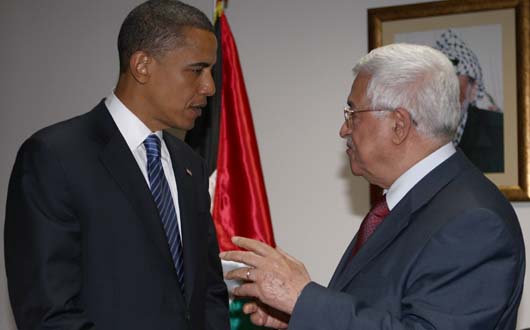
Barack Obama, shown with Palestinian President Mahmoud Abbas.

Obama must know that his continuing silence today is more than expedient. It is immoral. And if being moral is not the business of statecraft, he must know that his November 4 election helped cause the Israelis to thunder into Gaza and change ‘the facts on the ground’ before his inauguration. They are afraid of his coming.

By Tom Hayden / January 8, 2009

Back when Barack Obama was a longshot candidate in the Iowa primary, he was morally candid, saying on March 11, 2007, that “nobody is suffering more than the Palestinian people.” It was one month after the announcement of Obama’s campaign, and the last time he would make such a statement. Three days later, at the AIPAC conference in Washington DC, he was hammered as inexperienced by the New York Times reporter, Patrick Healy, on March 14.

“Less experienced than Mrs. Clinton in the thickets of Jewish and Middle Eastern politics, [Obama] became a bit tangled in the eyes of some voters” at the AIPAC event, Healy commented. After calling himself pro-Israel and endorsing a two-state solution, Obama “pointedly” mentioned the Palestinians. He and Senator Clinton sounded the same themes, Healy wrote, “yet Mr. Obama proved more expansive by bringing up the Palestinians and ruminating on the Holocaust and slavery and on cynicism in politics”, which caused “murmurs” from the audience.

One AIPAC activist, the son of a rabbi and a Hillary fan, was busily “spreading the word at the conference about Mr. Obama’s remarks. ‘It’s just clumsy of him to say that on the eve of the AIPAC conferences.”

While the Obama staff was trying to put up a small speaker’s platform, Mrs Clinton “wanted a big moment…to counteract the curiousity factor and showmanship of Mr. Obama…There was Israeli music on the sound system, there was a sign with Mrs. Clinton’s name in Hebrew, and there were campaign banners and balloons, and a video showing her at work.”

It’s possible to defend Obama’s retreat to a safe pro-Israel position in 2007, especially if he sat down first with long-time Palestinian friends and supporters in Chicago and explained himself. After all, Bush-Cheney and the neo-conservatives were virtually welded to the Israeli hawks, and Hillary Clinton, who once gave Arafat’s wife a kiss on the cheek, was threatening to obliterate Israel’s enemies. Obama would be a fresh start.

But Obama must know that his continuing silence today is more than expedient. It is immoral. And if being moral is not the business of statecraft, he must know that his November 4 election helped cause the Israelis to thunder into Gaza and change “the facts on the ground” before his inauguration. They are afraid of his coming.

He must know that this Israeli offensive is the ultimate effort of the neo-conservatives, with consenting Democratic silence, to wrest a victory in the Middle East. It’s bad enough that William Kristol has gained a coveted columnist’s role at the New York Times; worse is Kristol’s propaganda offensive for the Israelis, claiming that Israel will do Obama a favor by knocking off Hamas. Shamelessly, Kristol adds that this victory will come on top of America’s “success” in Iraq.

Yes, it is difficult to understand much less endorse the apparent Hamas strategy. Knowing what was ahead, they might have taken a disciplined position from October to November of not giving Israel any excuse, any provocation, that could bring the crisis to boil in the interlude between November and the inauguration.

They could have started a diplomatic offensive of their own. Those were their decisions. But it is foolish to ignore and deny, as many do, the deliberate policies of the Israelis and the US to overturn the outcome of the democratic elections that brought Hamas to power.

It is immoral to squeeze the whole Gaza population into collective suffering by the blockade. It is impossible to “destroy” Hamas without guaranteeing the rise of another Palestinian resistance movement, just as Hezbollah was born in the ashes of Lebanon in 1982. And it is simply not true that negotiations between implacable adversaries must be considered forever off the table. As a Hamas spokesman wrote this week, discussions with former President Jimmy Carter have been “a refreshing exchange”, despite Carter’s vocal differences with Hamas. [LAT, Jan. 6, 08] As Obama pointed out in his campaign, it is simple to talk with allies, the point of diplomacy is to talk with enemies or strangers.

Obama is in a process of being cornered, not unlike the efforts to push John Kennedy into the Cuban quagmire in 1961, or the tactics of Richard Nixon to keep Saigon from agreeing to negotiations in 1968.

He is being cornered by his party, too. It is hardly constructive that Sen. Harry Reid said this week that “I think this terrorist organization, Hamas, has got to be put away.” [NYT, Jan. 5, 08] Where are the voices of the Progressive Caucus or Out of Iraq Caucus? Is it possible for Obama to take a stronger position than his own party leaders? Not likely, even though a Rasmussen poll shows a large percentage of Democratic voters supporting diplomatic rather than military approaches.

The silence, Obama must know, is extremely costly. As the bombs fall on Gaza children and civilians, his credibility comes under greater question. The bright promise of moral leadership is sullied and squandered, along with the potential of America’s ability to be an even-handed diplomatic mediator. As January 20 approaches, he will have to make a lonely decision, the first of many, to remember his 2007 words about Palestinian suffering and his campaign pledge to talk unconditionally with adversaries.

Source / The Huffington Post / Progressives for Obama

Thanks to Carl Davidson / The Rag Blog

Posted in RagBlog | Tagged , , , , , , | Leave a comment

The Bailouts? Not Much For the Common Guy


Trillions to financial Terra Incognita; So far very little for ordinary Americans
By Sherman DeBrosse / The Rag Blog / January 8, 2008

At this moment, the cost of the bailouts, including guarantees, stands at $ 7.2 billion. That includes a $600 billion guarantee for money market funds, $200 billion so far for credit card issuers, $345 to Citigroup, the Fanny and Freddy loans, $200 billion for hedge funds, and on and on and on. Now we hear that the remaining $350 billion from the Troubled Assets Recovery Program has already been committed.

This writer has spent several weeks trying to find one person who could coherently explain why so much money had to be spent covering bad investments that are nearly impossible to understand. No one came forward.

Yes, the money for AIG and a few investment house bailouts were probably necessary because they involved bad securities Americans peddled abroad to people in nations who were accustomed to responsible regulations and did not know casino economics reigned supreme here. It was a matter of joining a joint effort in propping up the international financial system.

Covering the Bets of the Rich

What about trillions committed to banks and banking houses that have not been satisfactorily explained and justified? One of the people I respect most pointed out that we were talking about two economies, one we more or less understand, and the other being the terra incognita of the private casinos of the rich. The Treasury refuses to tell us who gets the remaining $350 billion of TARP, and many of the known recipients refuse to tell how the money was used.

Until someone in Washington begins to explain what is going on, we should be prepared to assume the worst. We have incurred trillions in obligations to cover the bets of the wealthy and keep their private casinos open. None of this resulted in making much more money available for ordinary loans. It is true that some of our pension funds are heavily invested in the hedge funds and derivatives.

Without some explanations, our representatives in Congress should be demanding that no more FED obligations or TARP assets be invested in covering exotic economic transactions. It would be far less expensive to prop up some pension funds than to ship off more money into terra incognita. It is also important to put the trillions of guarantees on hold or drag out indefinitely making good on those promises. First someone should assign verifiable values to all the ethereal financial instruments that have been guaranteed. We all recall in the previous S and L crisis how the culprits were able to repurchase seized assets at pennies on the dollar from the Resolution Trust Corporation.

Let’s Look at the Pig in the Poke

The next administration must take a close look at the loans and guarantees that have already been made and find ways to use them to serve the interests of most Americans. It seems that the TARP money was largely invested in warrants and senior preferred stock. We know far less about what the FED money gained for the taxpayers. In both cases, there should be federal representative on the boards of assisted banks and brokerage firms. Recipients who do not resume normal commercial loans must feel some pain, perhaps inflicted through the tax code.

The banks and financial institutions live in both worlds — terra incognita and the ordinary world of goods and services. So far, the U.S. government has only moved to cover the bets of the big players in the casino. The Democratic Congress has generously bailed out the capitalist system and purchased what appears to be a “pig in a poke” for the taxpayer. I’s no wonder consistent progressives are so often to abandon the Democrats.

Address Suffering in the Real World

Now is the time to address the economic concerns of ordinary people in a financial world we all more or less understand. Congress and the spokesmen for the big money players must be reminded that their long term survival depends on their utility to the American economy.

Funds were extended to banks and the financial services industry with the expectation that credit would again be available to turn the wheels of the economy. But little happened. At first, most of us assumed the recipients of federal money were sitting on these funds because they were covering still more bad debt. There is probably some truth here. We all know that the CPI fell by the greatest amount in 62 months in November and that it still is plunging. The bankers are using our money to cover their balance sheets because they fear a certain amount of deflation is coming and that it will be followed by inflation in several years. We have the twin deficit crises — federal debt and the balance of payments — coupled with a dishonest, Wild West financial industry. Even commercial banks have become high risk operations. The instability of the system and the real threats of deflation and inflation account for why lenders are holding their cards near their chests and the wealthy in record numbers are shipping money overseas.

Free Up Credit

To ward off deflation and eventual inflation, banks must return normal commercial activity now, and the taxpayers need to establish an insurance program for responsible loans. AIG, the taxpayers’ new asset, can be put to use here. Above all, the mortgage crisis must be stemmed to avert a deflationary plunge. One fifth of home mortgages are under water — meaning the value of the mortgaged homes is less than what is owed. Initially,12% of outstanding mortgages were in deep trouble. That number is growing. Housing prices continue to plummet as deflationary forces begin to take hold. Deflation is not a certainty at this point, but it is a possibility that grows with each day of flat consumer spending and inactive credit markets.

The banks are refinancing about 200,000 homes a month. To do more, they need a program that guarantees existing bad housing loans and incentives to greatly accelerate the process. People who are able to handle their mortgages might stop making payments if they see other folks get stabilization deals that are too good. For that reason, the stabilization loans should be for at least 35 years, and interest rates must be at a level to discourage new and unnecessary foreclosures. If there is any appreciation on a covered house, the federal government must receive a piece of it in return for the guarantee. The program would probably have to exclude mortgages that are more than $150,000 under water, unless the banks agreed to swallow some of the loss.

If commercial lending institutions are afraid to participate, use the various federal housing programs to buy up the paper and rewrite the loans. Every month that is wasted adds momentum to deflation. During the New Deal, the Home Owners Loan Corporation saved one in five home owners. The mission was to save people, not banks. We, the people may lose some money, but it will not be the trillions that will disappear by underwriting bad paper in terra incognita. Sheila Bair, head of the FDIC, would be the ideal housing czar to supervise this massive guarantee program.

How Much of a Recovery Can there be Without a Reinvigorated Industrial Sector?

Other decisions about what to do about restoring economic health should be made with the knowledge that we have relied on bubbles in the past to revive the economy. There are no new ones on the horizon, and reliance on bubbles is unhealthy in the long run. The green economy is a necessary and good thing, but many are mistaken in believing it will be an engine powerful enough to make Americans again the consumers of last resort for the entire world. The economy will not recharge itself with a surge in the service and information industries. They still are not large enough to accomplish that. The simple fact is that the industrial sector is essential to recovery — and this means automobiles and heavy industry. European governments understand this and are moving to assist their automakers with loans in the neighborhood of $50 billion.

The debate over the auto industry loan has been fascinating and has revealed a great deal of mendacity and downright ugly attitudes. All sorts of factual matters were distorted. Yes, the domestic industry made many bad decisions, and labor agreements gave workers more than most Americans thought appropriate. But the fact is that the domestic industry was close to bringing labor costs into line, moving legacy costs over to the unions, and dealing with other fundamental issues. Those who advocated Chapter 11 bankruptcy overlooked the fact that the process would be long and tedious and that there would be no private lenders out there with money to but the Big Three back together. Like Chapter 7, it would be a death sentence. Letting the Big Three sink would amount to an irreversible decision to give up on any serious plans to revitalize the manufacturing sector. Those, led by short-sighted Southern senators, who want to destroy the UAW and the Big Three overlook what the wreckage would cost the taxpayers in unemployment benefits for three million people, welfare benefits, decreased income tax revenue, and federal assumption of retirement fund obligations.

There must be a stimulus plan for restructuring the domestic auto industry. In addition to strict accountability components, it might include generous federal assistance to the Big Three’s lending agencies, making it possible for people to acquire new, fuel efficient vehicles with 3% loans. A higher but still advantageous rate would be assigned to the existing inventory of less efficient vehicles. Directly provide them with the funds to make car loans. We are now considering the possibility that 16 million vehicle sales years may never be restored. Federal assistance, through the Big Three, for car loans might rekindle Americans’ love affairs with cars.

Yes, the UAW will have to bite the bullet again. Excess production capacity could be acquired by the federal government and sold or leased bit by bit, in very sweet deals, to small industries with long term-growing pains — outfits that need space but cannot afford to build. Some of the capacity could be used to help build rapid transit and public transportation equipment and machinery and to start restoring the military inventories depleted by two wars.

Rebuilding the American manufacturing sectors will require lowering employer benefit costs, and that can only be done by providing a universal health plan unburdened with successive pharmaceutical costs and insurance company profits. It would be good to pass this now, but it might require a much deeper recession before enough Congressmen acquire enough courage to vote in the interests of most of their constituents.

Consideration should also be given to a Value Added Tax as a means of leveling the playing field among countries that adhere to the General Agreement on Trade and Tariffs. Unfortunately, that is a regressive approach, but is used by our competitors and there seems to be no other approach that works as well to help domestic producers. Given the likelihood of millions more lost jobs in 2009 and 2010, now is the time to consider this.

Of President-Elect Obama’s stimulus package, it appears that $300 million will go to tax cuts — a bow to University of Chicago economics, and $400 billion to the kinds of project that will create assets, work , and send money coursing through the economy. The latter is a tip of the hat to John Maynard Keynes’s economics.

The New Deal Example

Much has been said of late about how FDR’s deployment of Keynes did not end the Great Depression. The fact is that he did not spend enough on pump priming. Before becoming president, he read a book popularizing Keynes, and he scrawled in it something to the effect that you do not get something for nothing. FDR should have spent a lot more because ordinary people no longer had the ability to recharge the economy because there was an inequitable distribution of income. The depression lasted so long due to under-consumption and maldistribution of income. The $300 billion in tax cuts, mostly for ordinary folks, will not accomplish a great deal even if government succeeds in getting the money out fast, perhaps through sharp cuts in FICA deductions.

Those discussing the New Deal example forget that Roosevelt took some steps to deal with inequities in income, particularly by backing unions. That helped prevent economic downturns due to under consumption. It is doubtful if the national climate is such as to make progress on this front possible.

The key is in the pump-priming initiatives, and it is possible that this two year package is too small. The Obama Administration might be in danger of repeating the New Deal’s mistake. The stimulus plan must have a component to rebuild American industry, and that will be costly. There must be enough money borrowed and committed now, while other nations are still taking shelter in Treasury bonds and willing to lend. Our advantage is in being able to borrow at rates far less than those at which we lend. This situation will not last much longer as the world’s monetary situation is due for drastic changes that will not be to our long-term best interest. If the world monetary situation shifts in the direction most expect, we had better have a healthy and productive manufacturing sector or accept the consequences of long-term decline across many fronts.

It will require a number of pieces of separate legislation to implement these plans. We progressives will be facing a four year campaign in putting out accurate information about economic policy if the Obama administration is to prevail in heading off a depression. Already the Republican leadership has signaled that the GOP will delay the stimulus package. It would be a great mistake to promise Republicans up front that concessions would be forthcoming on new estate tax legislation or that the tax cuts for the rich can continue another year. Republicans have 42 more or less disciplined votes and the not-so covert help of a handful of Democratic conservatives in the Senate. It is possible that Mitch McConnell and his minions will be in a position to stop whatever they wish without fear of being punished by the voters. Most of them are in safe red states, and their leaders know that odds are Republicans could pick up seats in 2010, as the opposition party usually gains in off-year elections.

[Sherman DeBrosse, the pseudonym for a retired history professor, is a regular contributor to The Rag Blog and also blogs at Sherm Says and on DailyKos.]

The Rag Blog

Posted in Rag Bloggers | Tagged , , , , | 2 Comments

Feeling a Little Depressed? So Does the Economy.

Block print by Frans Masereel.

‘The discretionary spending sector appears to be in freefall — as the economy restructures itself at a lower level around consumer necessities like food and energy. This is global.’
By Roger Baker
/ The Rag Blog / January 7, 2009

There is no concise definition for a depression, unlike a recession. Before the Great Depression, all economic contractions were termed depressions. But as now used the “D” word usually means notable price deflation which then inhibits new investment. The current situation certainly looks like, as Krugman observes, a downward spiral of contracting consumer demand. This leading to further layoffs and disinvestment until spending shifts and stabilizes at some new and depressed level. Americans are learning to cut back on their discretionary purchases, like learning to drive less while anticipating higher energy costs later.

The discretionary spending sector appears to be in freefall — as the economy restructures itself at a lower level around consumer necessities like food and energy. This is global. If you were a cold German family, wouldn’t you try to sacrifice your vacation pay to heat your home? Even by paying much more than what Germany used to pay the Russians until recently?

You now often read accounts about how the US economy is supposed to turn around later this year. The thinking is that if we in the US enjoyed good times up until about a year ago, then those days must certainly be poised to come back, at least part of the way. There is no clear explanation of why that should be so; no clear picture for where US citizens should best fit in to an integrated world economy a decade from now. The USA economy is based on an aging population in heavy debt to the rest of the world.

Obama’s stimulus package, applied domestically, is overstretched in trying to lift us out of the grand canyon of global debt that the deregulated investment banks have created through derivatives and securitization during the bubble expansion days (the world economy is mostly based on a big global finance system that uses the dollar as its standard unit of exchange).

Here’s a Nobel prize winning economist’s opinion:

“Let’s not mince words,” Krugman declared. “This looks an awful lot like the beginning of a second Great Depression.

World Socialist’s (usually smart economics writing) perspective , describing just how broad the contraction is:

…Most mass layoffs now go virtually unnoticed. To cite only a few other examples from Monday and Tuesday: Philadelphia-based health insurance corporation Cigna announced this week that it would cut 1,100 jobs; Los Angeles United School District intends to soon lay off as many as 3,000 teachers; in North Carolina the Robert Bosch Corp. will fire one tenth of the workforce at its North Charleston plant, about 200 workers; and IBM will soon lay off 1,600 workers, according to anonymous sources inside the company.

The layoffs come in advance of the Department of Labor’s report on unemployment, which is to be released Friday. According to a Reuters poll, economists anticipate that 500,000 jobs will have been lost in December, bringing the economy’s overall purge of workers for 2008 to nearly 2.5 million.

In one particularly graphic example of spiraling unemployment, in North Carolina the number of fired workers trying to sign up online for either new or continuing unemployment benefits was so great in recent days as to crash the system, the state’s Employment Security Commission said.

A downward spiral has clearly emerged in the US and global economy, with layoffs and pay cuts growing in response to contraction in economic activity, and then in turn fueling the latter…

In her San Francisco address, Yellen said that “many forecasters expect this to be one of the longest and deepest recessions since the Great Depression.”

On Tuesday, the minutes of the Federal Open Market Committee for December 15 and 16 were published by Federal Reserve Board of Governors. The minutes read like nothing so much as an encyclopedic description of the first months of the Great Depression, with descriptions of across-the-board economic decline in the US and internationally. In the meeting, the Fed determined to lower interests rates effectively to zero, thereby virtually exhausting monetary policy as a tool to counter the crisis, while promising to make the federal currency printing press available to the major financial interests.

To date the efforts of the Federal Reserve and the Treasury Department have done nothing to stem the crisis.

Also see US and global manufacturing collapsing by Joe Kishore / World Socialist / Jan. 3, 2008

The Rag Blog

Posted in Rag Bloggers | Tagged , , , | Leave a comment

Mariann Wizard :
Brandon Darby – ‘To Live Outside the Law You Must Be Honest’

photo of George and Mariann

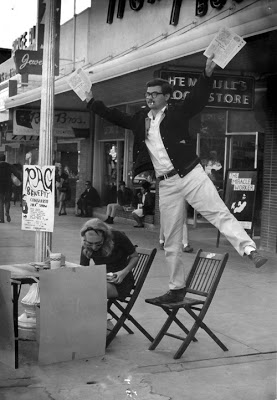
The late George Vizard, murdered in Austin 1n 1967, shown selling The Rag near the UT campus, with his wife Mariann Vizard (now Mariann Wizard).

If Darby had really been worried people he was working with were planning violence, he could have taken it up with other group members. But that would have required honest discussion. When there is no honesty on one side, discussion is meaningless.

By Mariann Wizard | The Rag Blog | January 7, 2009

The news about confessed FBI informant Brandon Darby has stirred up a lot of old feelings in me that stem from personal and group experiences with people like Darby.

Robert Zani, convicted in 1981 of the 1967 murder of George John Vizard IV, my husband, was revealed much later (to the public) to have been a “narc” for the UT Kampus Kops, put in touch with the TX Department of Public Safety by the UT police chief. DPS officers openly attended Students for a Democratic Society (SDS) meetings at UT, as well as meetings of other anti-war and pro-civil rights organizations, but that certainly did not preclude their also placing spies among us, and we know that certain individuals in Austin reported to the Austin police department, and other agencies.

[For more about the death of George Vizard and the spying on Austin activists in the sixties, read The Spies of Texas by The Rag Blog’s Thorne Dreyer, published in the Nov. 17, 2006 issue of The Texas Observer.]

These disillusioning experiences were replicated, and in many cases intensified, nationally. The black liberation movement was targeted even more viciously than the student peace movement, and where black liberation and peace activism came together, infiltration and disruption were most extensive (witness J Edgar Hoover’s unrelenting attempts to “get the dirt” on Martin Luther King). People like Darby were often proponents of violence, urging inexperienced activists to irresponsible acts. The current Maryland State spy revelations are a chilling reminder of what we came, long after the fact, to know as COINTELPRO.

It angers me very much to see today’s idealistic young activists — some of whom I have come to know a little and hope to know for a long time due to their consistency, commitment, and dedication to the struggle — targeted by today’s government spies, and to know that innocent people will undoubtedly be harmed by government’s callous disregard of civil liberties.

The real question raised by Brandon Darby’s spying admission is, “How do you know when a person is honest?” The real answer is, “You can’t.” But enough questions had been raised about Darby, and some reports of his usual behavior are certainly suspicious enough, that in my opinion HE SHOULD HAVE BEEN ASKED POINT-BLANK by group leaders, collectively, if he was an informer, especially before they publicly defended him. This is a hard lesson for young activists, and no fun to learn, but a person can be betrayed by anyone. On the positive side, however, no one is ever betrayed by “just anyone,” but only by the most unscrupulous and morally degenerate of individuals (and yes, that makes it feel even more disgustingly gross to realize you were fooled; like being raped, being informed upon is an invasive and very personal experience!) Raising concerns and resolving them in a principled (HONEST), democratic manner is essential, no matter the topic. If something can’t be talked about and resolved in that way, there is more wrong in a group than the presence of an informer.

In addition, it’s important to recall that in the 60s and 70s, in the student milieu at any rate, our own eschewing of identifiable leaders and decision-making processes too often may have opened a door for the charismatic stranger who liked, e.g., to set fires. I don’t know that the new gen of activists has come up with any better model within their collectives; they don’t seem any more interested in acknowledging “leaders” than we were, but that means new activists also can’t identify who is really being truthful about group goals and methods. (That would make an interesting interview, or better yet, panel discussion.)

What makes a person willing to gain the confidence, friendship, and admiration of others, only to lead them into planning and/or committing bad acts and then “telling on them”?

If Darby had really been worried people he was working with were planning violence, he could have taken it up with other group members. But that would have required honest discussion. When there is no honesty on one side, discussion is meaningless.

If I thought Brandon Darby had the self-critical faculties necessary to provide a useful answer to that question, I might think an interview with him would be interesting. But in all likelihood, the self-justifications, excuses, counter-accusations and outright lies one would hear would effectively conceal whatever moral birth defect is at the root of his deceit. He is the jealous big brother tricking his younger siblings into being naughty in order to win Mama’s affection, perhaps; great fun when one is 10, but soon abandoned by a maturing human being. I was a big sister once, but now I believe that, if this life we are given has any purpose, it is to help one another.

Let us remember the stories of admirable men and women, and recall — perhaps with new insight after all these years? — the immortal words of Robert Zimmerman, “To live OUTSIDE THE LAW you must be HONEST. I know YOU ALWAYS SAY THAT YOU AGREE.”

See Brandon Darby : FBI Informant is Provocateur, Not a Hero by Austin Informant Working Group / The Rag Blog / Jan. 6, 2009

Also see Brandon Darby: Austin Activist Outed as FBI Spy / The Rag Blog / Jan. 2, 2009

Posted in Rag Bloggers | Tagged , , , , , , , , | 8 Comments

Brandon Darby : FBI Informant is Provocateur, Not a Hero

Austin activist and FBI informant Brandon Darby. Photo courtesy of YouTube.

‘FBI informant Brandon Darby did not heroically intervene to stop violence. Rather it appears that he actively sought out people that he could manipulate and entrap.’

By Austin Informant Working Group / The Rag Blog / January 6, 2008

AUSTIN, Texas — A group of Austin activists today released their conclusions from reviewing over 70 pages of FBI documents obtained through a legal case regarding alleged actions to protest the Republican National Convention (RNC). From reading the documents, and from their own experience with him, these activists have concluded that the FBI informant Brandon Darby did not heroically intervene to stop violence. Rather it appears that he actively sought out people that he could manipulate and entrap. The two Texas men that Darby was most closely associated with during the convention, Bradley Crowder and David McKay, are accused of making Molotov cocktails and have been in jail since early September. Their trial is set for January 26. The disclosure of Brandon Darby as the informant casts further doubt on the charges against these two men.

According to the FBI’s documents, Darby, posing as an activist, had been covertly gathering information for the FBI since at least February 2007, twelve months before he ever met Crowder or McKay or knew of any plans for the RNC. “As an older seasoned activist, Darby had a lot of sway over Crowder and McKay, making them susceptible to his often militant rhetoric,” said Gabby Hicks, who was in St. Paul with Darby during the Convention. “He was always the one to suggest violence, when the rest of us clearly disagreed with those strategies.”

Darby has been characterized by many people who have known and worked with him as both persuasive and manipulative, with a history of provocation, instigation, and incitement. According to Lisa Fithian, who worked with Darby for years, “Brandon was always provoking discord and aggression, in the anti-war movement in Austin in 2003, in protests in Houston against Halliburton, and in disaster relief at Common Ground in New Orleans. I worked with Darby in all of those places and saw the disruption he caused.”

The FBI documents make it clear that Darby did not restrict his informing to people he alleges were planning illegal activities. He also gathered information on numerous people who were engaged in lawful activism; including some who had no plans to attend the Republican Convention. “The wider net cast by Darby in his information gathering shows that he was part of an FBI campaign to suppress political dissent and activism,” said Will Potter, an award-winning independent journalist. “By gathering information on law abiding activists and then defending his actions as stopping violence, Darby contributes to the public perception that political dissent is criminal, which has a chilling effect on free speech.”

Because of Darby’s leadership role and his militant rhetoric, two impressionable young men, who have been held without bail since September, now face 7 to 10 years in prison. As the prosecution prepares for trial, friends and family of McKay and Crowder are hoping for a not guilty verdict. “We miss him a lot,” said Mckay’s father. “Every night David calls – at this point those calls mean everything to me.”

For more information contact the Austin Informant Working Group at texas.solidarity@gmail.com. People in this community are also available to speak to the media about their experiences with Darby and the results of his malicious actions.

Gabby Hicks traveled to St. Paul with Darby for the RNC and is named in the documents.
Lisa Fithian is local long-time organizer named in the documents and worked with Brandon in Austin, Houston, and NOLA.
Carly Dickson was a longtime friend of Brandon, represents Austin People’s Legal Collective.
Brent Purdue is a local activist who worked with Brandon.
Heather Mitchell is a local activists.
Scott Crow is a local long-time organizer named in the documents and a long-time friend of Brandon’s.

See Brandon Darby: Austin Activist Outed as FBI Spy / The Rag Blog / Jan. 2, 2008

The Rag Blog

Posted in Rag Bloggers | Tagged , , , , , , , , | 6 Comments

Hamas Speaks: Israel Broke the Cease-Fire First


Hamas speaks
By Mousa Abu Marzook / January 6, 2009

A Hamas official insists that a ‘legacy of suffering’ under Israel is what fuels Palestinian resistance.

From Damascus — While Americans may believe that the current violence in Gaza began Dec. 27, in fact Palestinians have been dying from bombardments for many weeks. On Nov. 4, when the Israeli-Palestinian truce was still in effect but global attention was turned to the U.S. elections, Israel launched a “preemptive” airstrike on Gaza, alleging intelligence about an imminent operation to capture Israeli soldiers; more assaults took place throughout the month.

The truce thus shattered, any incentive by Palestinian leaders to enforce the moratorium on rocket fire was gone. Any extension of the agreement or improvement of its implementation at that point would have required Israel to engage Hamas, to agree to additional trust-building measures and negotiation with our movement — a political impossibility for Israel, with its own elections only weeks away.

Not that the truce had been easy on Palestinians. In the six-month period preceding this week’s bombardment, one Israeli was killed, while dozens of Palestinians lost their lives to Israeli military and police actions, and numerous others died for want of medical care.

The war on Gaza should not be mistaken for an Israeli triumph. Rather, Israel’s failure to make the truce work, and its inevitable resort to bloodshed, demonstrate again that it cannot permit a future built on Palestinian political self-determination. The truce failed because Israel will not open Gaza’s borders, because Israel would rather be a jailer than a neighbor, and because its intransigent leadership forestalls Palestinian destiny and will not make peace with history.

This week’s war is not an attack on the Izzidin al-Qassam units — our movement’s military wing — but is simply aggression targeting the people, infrastructure and economic life of Gaza, designed to sow terror and loose anarchy; it aims to establish new “facts on the ground” — that is, heaps of rubble with bodies trapped beneath — in advance of the coming American administration.

Israel claims loudly that it had no other choice this week but to rain death on refugees in camps, killing dozens of women and children, while Defense Minister Ehud Barak (the once and would-be prime minister) — his eye fixed on February elections — employs mass murder as his party’s latest vote-getting appeal, an electoral strategy fit to shame the most hardened Chicago political operative.

But, of course, options remained available. Israel might have relented months ago, for the sake of the truce, in its criminal determination to starve Gaza, cutting off much of its fuel and choking all commerce to a trickle, blocking relief organizations from delivering food and medicine, and consigning Gaza’s citizens to famine rations. Only the most cynical observer would call this grinding attrition “good faith” adherence to the truce. Blockades, after all, are explicitly acts of war.

Palestinians everywhere mark the closing of the Bush era with relief; nevertheless, skepticism runs high that any justice for our people might come from a new president who remained ominously silent in the presence of the latest Israeli onslaught, and who has aligned himself so thoroughly with Israel’s interests, so long in advance of taking power. Barack Obama’s helicopter ride two years ago above the Holy Land was not unusual in the annals of American parliamentarians junketed on “fact finding” trips by Israel’s lobbyists; yet his fond remarks on what he saw — “houses and streets like ones you might find” in any American suburb — were notable for their silence as to any troubling sights. Did he miss the security roads and checkpoints that riddle the West Bank, or the construction of the wall, or the illegal settlements? Perhaps his helicopter flew too high.

But now, amid Israel’s latest attack on our people, as the death toll rises in the hundreds, with thousands wounded — all victims of American taxpayers’ largesse — Palestinians wonder how Obama will react to the escalating crisis. They demand of the next White House a new paradigm of respect and accountability, because when Palestinians see an F-16 with the Star of David painted on its tail, they see America.

Palestinians are understandably guarded about the coming administration, noting its appointments with trepidation. The soon-to-be secretary of State is unforgettable for urging years ago U.S. recognition of Jerusalem as Israel’s “undivided” capital, while the administration’s chief of staff bears the stain of his father’s service in the banned terrorist Irgun paramilitary, a Zionist group responsible for numerous atrocities.

Renewed calls today for our movement to “recognize the right of Israel to exist,” in the face of murderous onslaught, ring as hollow as Israel’s continuing claims to be acting in “self-defense” as her jets bomb civilians. Without debating here the Zionist state’s fictive, existential “right,” which of the many Israels, precisely, would the West have us recognize? Is it the Israel that militarily occupies land belonging to three of its neighbors, ignoring international law and scores of U.N. resolutions over decades? Is it the Israel that illegally settles its citizens on other people’s land, seizes water sources and uproots olive trees? Is it the Israel that in 60 years has never acknowledged the forced expulsion of Palestinians from their farms and villages as the foundational act of its statehood and denies refugees their right to return?

Through bitter experience, when we hear demands for “recognition” of Israel as a precondition to dialogue, what we hear is a call for acquiescence in its crimes against us, validating the injustices that have been wrought in its name.

Our spirit to fight on is the legacy of collective suffering: With tens of thousands dead or wounded by decades of the “peace process,” you cannot find a family in Palestine — Muslim or Christian, Hamas, Fatah, PFLP or Islamic Jihad — without a son or daughter killed, injured, jailed or tortured, or which does not count itself or its kin among the millions of refugees living in U.N. camps.

Hamas is not a handful of leaders. Israel may kill all of the current leadership in this round of violence, including me, and its organic, social infrastructure will not go away. We are, simply put, a homegrown national liberation resistance movement, with millions of people who support our struggle for freedom and justice.

President-elect Obama spoke courageously in his campaign for a policy of open dialogue, absent preconditions, with those deemed inimical to U.S. interests, and we were listening. One former U.S. president — a true peacemaker — has dared to visit with us and hear our side of this struggle, while offering us no shortage of criticism. It has been a refreshing exchange. Now is the time for the next U.S. president to do the same.

No American leader has ever visited a Palestinian refugee camp anywhere, much less in Gaza — a startling fact, considering the central role America has played in our people’s narrative. None has dared to look our refugees in their faces and experience their suffering directly.

In observance of the storied tradition of Arab hospitality to guests, and anticipating that day when an American president fulfills his promise of change, we extend the invitation now, and we will put the kettle on.

[Mousa Abu Marzook is the deputy of the political bureau of Hamas, the Islamic Resistance Movement.]

Source / Los Angeles Times

Thanks to Jeff Segal / The Rag Blog

Posted in RagBlog | Tagged , , , | 3 Comments