Blum on America’s ‘Stability Operations’ Around the World


The Anti-Empire Report
By William Blum / January 2, 2009

America’s other glorious war

The Pentagon pushes hard for a large increase in troops for Afghanistan. Barack Obama has been calling for the same since well before the November election. Listen to the drumbeats telling us that the security of the United States and the Free World necessitates increased action in this place called Afghanistan. As urgent as Iraq 2003, it is. Why? What is there about this backward, reactionary, woman-hating, failed state that warrants hundreds of deaths of American and NATO soldiers? That justifies tens of thousands of Afghan deaths since the first US bombing attacks in October 2001?

In early December, reports the Washington Post, “standing at Kandahar Air Field in Afghanistan, Defense Secretary Robert M. Gates said the United States is making a ‘sustained commitment’ to that country, one that will last ‘some protracted period of time’.” The story goes on to discuss $300 million in construction projects at this one base to house additional American forces, erecting guard stations and towers and perimeter fencing around the barracks area, putting in vehicle inspection areas, administration offices, cold-storage warehouse, a new power plant, electrical and water distribution systems, communications lines, housing for 1,500 personnel who sustain the systems, maintenance shops, warehouses1 … America’s wealth bleeds out endlessly.

Back in April Maj. Gen. David Rodriguez, commander of the US Army’s 82nd Airborne Division, when asked how long it would take to create “lasting stability” in Afghanistan, replied: “In some way, shape or form … I think it’s a generation.”2 “Stability”, it should be noted, is a code word used regularly by the United States since at least the 1950s to mean that the regime in power is willing and able to behave the way Washington would like it to behave. It is remarkable, and scary, to read the US military writing about how it goes around the world bringing “stability” to (often ungrateful) people. This past October the Army published a manual called “Stability Operations”.3 It discusses numerous American interventions all over the world since the 1890s, one example after another of bringing “stability” to benighted peoples. One can picture the young American service members reading it, or having it fed to them in lectures, full of pride to be a member of such an altruistic fighting force.

For those members of the US military in Afghanistan the most enlightening lesson they could receive is that their government’s plans for that land of sadness have little or nothing to do with the welfare of the Afghan people. In the late 1970s through much of the 1980s, the country had a government that was relatively progressive, with full rights for women; even a Pentagon report of the time testified to the actuality of women’s rights in the country.4 And what happened to that government? The United States was instrumental in overthrowing it. It was replaced by the Taliban.

Since the dissolution of the Soviet Union, US oil companies have been vying with Russia, Iran and other energy interests for the massive, untapped oil and natural gas reserves in the former Soviet republics of Central Asia. The building and protection of oil and gas pipelines in Afghanistan, to continue farther to Pakistan, India, and elsewhere, has been a key objective of US policy since before the 2001 American invasion and occupation of the country, although the subsequent turmoil there has presented serious obstacles to such plans. A planned Turkmenistan-Afghanistan-Pakistan-India pipeline has strong support from Washington because, amongst other reasons, the US is eager to block a competing pipeline that would bring gas to Pakistan and India from Iran.5 But security for such projects remains daunting, and that’s where the US and NATO forces come in to play.

In the late 1990s, the American oil company, Unocal, met with Taliban officials in Texas to discuss the pipelines.6 Zalmay Khalilzad, later chosen to be the US ambassador to Afghanistan, worked for Unocal7; Hamid Karzai, later chosen by Washington to be the Afghan president, also reportedly worked for Unocal, although the company denies this. Unocal’s talks with the Taliban, conducted with the full knowledge of the Clinton administration, and undeterred by the extreme repression of Taliban society, continued as late as 2000 or 2001.

As for NATO, it has no reason to be fighting in Afghanistan. Indeed, NATO has no legitimate reason for existence at all. Their biggest fear is that “failure” in Afghanistan would make this thought more present in the world’s mind. If NATO hadn’t begun to intervene outside of Europe it would have highlighted its uselessness and lack of mission. “Out of area or out of business” it was said.

In June, the Canadian Center for Policy Alternatives published a report saying Taliban and insurgent activity against the US-NATO presence in Kandahar province puts the feasibility of the pipeline project in doubt. The report says southern regions in Afghanistan, including Kandahar, would have to be cleared of insurgent activity and land mines in two years to meet construction and investment schedules.

“Nobody is going to start putting pipe in the ground unless they are satisfied that there is some reasonable insurance that the workers for the pipeline are going to be safe,” said Howard Brown, the Canadian representative for the Asian Development Bank, the major funding agency for the pipeline.8

If Americans were asked what they think their country is doing in Afghanistan, their answers would likely be one variation or another of “fighting terrorism”, with some kind of connection to 9-11. But what does that mean? Of the tens of thousands of Afghans killed by American/NATO bombs over the course of seven years, how many can it be said had any kind of linkage to any kind of anti-American terrorist act, other than in Afghanistan itself during this period? Not one, as far as we know. The so-called “terrorist training camps” in Afghanistan were set up largely by the Taliban to provide fighters for their civil conflict with the Northern Alliance (minimally less religious fanatics and misogynists than the Taliban, but represented in the present Afghan government). As everyone knows, none of the alleged 9-11 hijackers was an Afghan; 15 of the 19 were from Saudi Arabia; and most of the planning for the attacks appears to have been carried out in Germany and the United States. So, of course, bomb Afghanistan. And keep bombing Afghanistan. And bomb Pakistan. Especially wedding parties (at least six so far).

Israel and Palestine, again, forever

Nothing changes. Including what I have to say on the matter. To prove my point, I’m repeating part of what I wrote in this report in July 2006 …

There are times when I think this tired old world has gone on a few years too long. What’s happening in the Middle East is so depressing. Most discussions of the everlasting Israel-Palestine conflict are variations on the child’s eternal defense for misbehavior — “He started it!” Within two minutes of discussing/arguing the latest manifestation of the conflict the participants are back to 1967, then 1948, then biblical times. Instead of getting entangled in who started the current mess, I’d prefer to express what I see as two essential underlying facts of life which remain from one conflict to the next:

1) Israel’s existence is not at stake and hasn’t been so for decades, if it ever was, regardless of the many de rigueur militant statements by Middle East leaders over the years. If Israel would learn to deal with its neighbors in a non-expansionist, non-military, humane, and respectful manner, engage in full prisoner exchanges, and sincerely strive for a viable two-state (if not one-state) solution, even those who are opposed to the idea of a state based on a particular religion could accept the state of Israel, and the question of its right to exist would scarcely arise in people’s minds. But as it is, Israel still uses the issue as a justification for its behavior, as Jews all over the world use the Holocaust and conflating anti-Zionism with anti-Semitism.

2) In a conflict between a thousand-pound gorilla and a mouse, it’s the gorilla who has to make concessions in order for the two sides to progress to the next level. What can the Palestinians offer in the way of concession? Israel would reply to that question: “No violent attacks of any kind.” But that would leave the status quo ante bellum — a life of unmitigated misery for the occupied, captive Palestinian people, confined to the world’s largest open air concentration camp.

It is a wanton act of collective punishment that is depriving the Palestinians of food, electricity, water, money, access to the outside world … and sleep. Israel has been sending jets flying over Gaza at night triggering sonic booms, traumatizing children. “I want nobody to sleep at night in Gaza,” declared Israeli Prime Minister Ehud Olmert9, words suitable for Israel’s tombstone.

Israel has created its worst enemies — they helped create Hamas as a counterweight to Fatah in Palestine, and their occupation of Lebanon created Hezbollah. The current terrible bombings can be expected to keep the process going. Since its very beginning, Israel has been almost continually engaged in fighting wars and taking other people’s lands. Did not any better way ever occur to the idealistic Zionist pioneers?

The question that may never go away: Who really is Barack Obama?

In his autobiography, “Dreams From My Fathers”, Barack Obama writes of taking a job at some point after graduating from Columbia University in 1983. He describes his employer as “a consulting house to multinational corporations” in New York City, and his functions as a “research assistant” and “financial writer”.

The odd part of Obama’s story is that he doesn’t mention the name of his employer. However, a New York Times story of 2007 identifies the company as Business International Corporation.10 Equally odd is that the Times did not remind its readers that the newspaper itself had disclosed in 1977 that Business International had provided cover for four CIA employees in various countries between 1955 and 1960.11

The British journal, Lobster Magazine — which, despite its incongruous name, is a venerable international publication on intelligence matters — has reported that Business International was active in the 1980s promoting the candidacy of Washington-favored candidates in Australia and Fiji.12 In 1987, the CIA overthrew the Fiji government after but one month in office because of its policy of maintaining the island as a nuclear-free zone, meaning that American nuclear-powered or nuclear-weapons-carrying ships could not make port calls.13 After the Fiji coup, the candidate supported by Business International, who was much more amenable to Washington’s nuclear desires, was reinstated to power — R.S.K. Mara was Prime Minister or President of Fiji from 1970 to 2000, except for the one-month break in 1987.

In his book, not only doesn’t Obama mention his employer’s name; he fails to say when he worked there, or why he left the job. There may well be no significance to these omissions, but inasmuch as Business International has a long association with the world of intelligence, covert actions, and attempts to penetrate the radical left — including Students for a Democratic Society (SDS)14 — it’s valid to wonder if the inscrutable Mr. Obama is concealing something about his own association with this world.

On socialist Cuba’s 50th anniversary, January 1, 2009: Notes on the beginning of its unforgivable revolution.

The existence of a revolutionary socialist government with growing ties to the Soviet Union only 90 miles away, insisted the United States government, was a situation which no self-respecting superpower should tolerate, and in 1961 it undertook an invasion of Cuba.

But less than 50 miles from the Soviet Union sat Pakistan, a close ally of the United States, a member since 1955 of the South-East Asia Treaty Organization (SEATO), the US-created anti-communist alliance. On the very border of the Soviet Union was Iran, an even closer ally of the United States, with its relentless electronic listening posts, aerial surveillance, and infiltration into Russian territory by American agents. And alongside Iran, also bordering the Soviet Union, was Turkey, a member of the Russians’ mortal enemy, NATO, since 1951.

In 1962 during the “Cuban Missile Crisis”, Washington, seemingly in a state of near-panic, informed the world that the Russians were installing “offensive” missiles in Cuba. The US promptly instituted a “quarantine” of the island — a powerful show of naval and marine forces in the Caribbean would stop and search all vessels heading towards Cuba; any found to contain military cargo would be forced to turn back.

The United States, however, had missiles and bomber bases already in place in Turkey and other missiles in Western Europe pointed toward the Soviet Union. Russian leader Nikita Khrushchev later wrote:

“The Americans had surrounded our country with military bases and threatened us with nuclear weapons, and now they would learn just what it feels like to have enemy missiles pointing at you; we’d be doing nothing more than giving them a little of their own medicine. … After all, the United States had no moral or legal quarrel with us. We hadn’t given the Cubans anything more than the Americans were giving to their allies. We had the same rights and opportunities as the Americans. Our conduct in the international arena was governed by the same rules and limits as the Americans.”15

Lest anyone misunderstand, as Khrushchev apparently did, the rules under which Washington was operating, Time magazine was quick to explain. “On the part of the Communists,” the magazine declared, “this equating [referring to Khrushchev’s offer to mutually remove missiles and bombers from Cuba and Turkey] had obvious tactical motives. On the part of neutralists and pacifists [who welcomed Khrushchev’s offer] it betrayed intellectual and moral confusion.” The confusion lay, it seems, in not seeing clearly who were the good guys and who were the bad guys, for “The purpose of the U.S. bases [in Turkey] was not to blackmail Russia but to strengthen the defense system of NATO, which had been created as a safeguard against Russian aggression. As a member of NATO, Turkey welcomed the bases as a contribution to her own defense.” Cuba, which had been invaded only the year before, could have, it seems, no such concern. Time continued its sermon, which undoubtedly spoke for most Americans:

“Beyond these differences between the two cases, there is an enormous moral difference between U.S. and Russian objectives … To equate U.S. and Russian bases is in effect to equate U.S. and Russian purposes … The U.S. bases, such as those in Turkey, have helped keep the peace since World War II, while the Russian bases in Cuba threatened to upset the peace. The Russian bases were intended to further conquest and domination, while U.S. bases were erected to preserve freedom. The difference should have been obvious to all.”16

Equally obvious was the right of the United States to maintain a military base on Cuban soil — Guantanamo Naval Base by name, a vestige of colonialism staring down the throats of the Cuban people, which the US, to this day, refuses to vacate despite the vehement protest of the Castro government.

In the American lexicon, in addition to good and bad bases and missiles, there are good and bad revolutions. The American and French Revolutions were good. The Cuban Revolution is bad. It must be bad because so many people have left Cuba as a result of it.

But at least 100,000 people left the British colonies in America during and after the American Revolution. These Tories could not abide by the political and social changes, both actual and feared, particularly that change which attends all revolutions worthy of the name — Those looked down upon as inferiors no longer know their place. (Or as the US Secretary of State put it after the Russian Revolution: The Bolsheviks sought “to make the ignorant and incapable mass of humanity dominant in the earth.”17)

The Tories fled to Nova Scotia and Britain carrying tales of the godless, dissolute, barbaric American revolutionaries. Those who remained and refused to take an oath of allegiance to the new state governments were denied virtually all civil liberties. Many were jailed, murdered, or forced into exile. After the American Civil War, thousands more fled to South America and other points, again disturbed by the social upheaval. How much more is such an exodus to be expected following the Cuban Revolution? — a true social revolution, giving rise to changes much more profound than anything in the American experience. How many more would have left the United States if 90 miles away lay the world’s wealthiest nation welcoming their residence and promising all manner of benefits and rewards?

Notes

[1] Washington Post, December 25, 2008
[2] Reuters, April 29, 2008
[3] http://usacac.army.mil/cac2/Repository/FM307/FM3-07.pdf
[4] U.S. Department of the Army, “Afghanistan, A Country Study” (1986), pp.121, 128, 130, 134, 136, 223, 232-3
[5] Globe & Mail (Toronto), June 19, 2008
[6] BBC News, December 4, 1997, “Taleban [sic] in Texas for talks on gas pipeline”
[7] Washington Post, November 23, 2001
[8] United Press International, July 17, 2008
[9] Associated Press, July 3, 2006
[10] New York Times, October 30, 2007
[11] New York Times, December 27, 1977, p.40
[12] Lobster Magazine, Hull, UK, #14, November 1987
[13] William Blum, “Rogue State: A Guide to the World’s Only Superpower”, pp.199-200
[14] Carl Oglesby, “Ravens in the Storm: A Personal History of the 1960s Antiwar Movement” (2008), passim
[15] “Khrushchev Remembers” (1971) pp.494, 496.
[16] Time magazine, November 2, 1962
[17] Cited by William Appleman Williams, “American Intervention in Russia: 1917-20”, in David Horowitz, ed., “Containment and Revolution” (1967). Written in a letter to President Woodrow Wilson by Secretary of State Robert Lansing, uncle of John Foster and Allen Dulles.

[William Blum is the author of: Killing Hope: US Military and CIA Interventions Since World War 2, Rogue State: A Guide to the World’s Only Superpower, West-Bloc Dissident: A Cold War Memoir, Freeing the World to Death: Essays on the American Empire. Portions of the books can be read, and signed copies purchased, at www.killinghope.org.]

Source / Killing Hope

Thanks to William Blum for sending this to us / The Rag Blog

Posted in RagBlog | Tagged , , , | Leave a comment

Bill Ayers : Obama and Education Reform

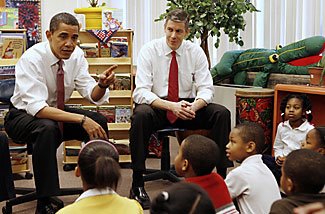
“Arne Duncan was the smart choice.” Nominee for education secretary Duncan, with President-elect Obama, speaks to children at a school in Chicago. Photo by Jeff Haynes / Reuters.

‘Since the Obama victory, many people seem to be suffering a kind of post-partum depression: unable to find any polls to obsess over, we read the tea-leaves and try to penetrate the president-elect’s mind.’
By Bill Ayers / January 2, 2009

[Bill Ayers, known for his sixties activism, is an author and the Distinguished Professor of Education and Senior University Scholar at the University of Illinois at Chicago.]

Of course I would have loved to have seen Linda Darling-Hammond become Secretary of Education in an Obama administration. She’s smart, honest, compassionate and courageous, and perhaps most striking, she actually knows schools and classrooms, curriculum and teaching, kids and child development. These have never counted for much as qualifications for the post, of course, and yet they offer a neat contrast with the four failed urban school superintendents–Michelle Rhee, Joel Klein, Paul Vallas, and Arne Duncan — who were for weeks rumored to be her chief competition.

These four, like George W. Bush’s Secretary of Education, Rod Paige of the fraudulent Texas-miracle, have little to show in terms of school improvement beyond a deeply dishonest public relations narrative. Teacher accountability, relentless standardized testing, school closings, and privatization — this is what the dogmatists and true-believers of the right call “reform.”

Michelle Rhee of Washington D.C., the most ideologically-driven of the bunch, warranted a cover story in Time in early December called “How to Fix America’s Schools” in which she was praised for making more changes in a year and a half on the job than other school leaders, “even reform-minded ones,” make in five: closing 21 schools (15% of the total), firing 100 central office personnel, 270 teachers, and 36 principals. These are all policy moves that are held on faith to stand for improvement; not a word on kids’ learning or engagement with schools, not even a nod at evidence that might connect these moves with student progress. But of course evidence is always the enemy of dogma, and this is faith-based, fact-free school policy at its purest.

So I would have picked Darling-Hammond, but then again I would have picked Noam Chomsky for state, Naomi Klein for defense, Bernardine Dohrn for Attorney General, Bill Fletcher for commerce, James Thindwa for labor, Barbara Ransby for human services, Paul Krugman for treasury, and Amy Goodman for press secretary. So what do I know?

Darling-Hammond would not have been a smart pick for Obama. She was steadily demonized in a concerted campaign to undermine her effectiveness, and she would surely have had great difficulty getting any traction whatsoever for progressive policy change in this environment. Arne Duncan was the smart choice, the unity choice — the least driven by ideology, the most open to working with teachers and unions, the smartest by a mile — and let’s wish him well.

But there’s a deeper point: since the Obama victory, many people seem to be suffering a kind of post-partum depression: unable to find any polls to obsess over, we read the tea-leaves and try to penetrate the president-elect’s mind. What do his moves portend? What magic or disaster awaits us? With due respect, this is a matter of looking entirely in the wrong direction.

Obama is not a monarch — Arne Duncan is not education czar — and we are not his subjects. If we want a foreign policy based on justice, for example, we ought to get busy organizing a robust anti-imperialist peace movement; if we want to end the death penalty we better get smart about changing the dominant narrative concerning crime and punishment. We are not allowed to sit quietly in a democracy awaiting salvation from above. We are all equal, and we all need to speak up and speak out right now.

During Arne Duncan’s tenure in Chicago, a group of hunger-striking mothers organized city-wide support and won the construction of a new high school in a community that had been underserved and denied for years. Another group of parents, teachers, and students mobilized to push military recruiters out of their high school; Duncan didn’t support them and he certainly didn’t lead the charge, but they won anyway. If they’d waited for Duncan to act they’d likely be waiting still. Teachers at another school refused to give one of the endless standardized tests, arguing that this was one test too many, and they organized deep support for their protest; Duncan didn’t support them either, but they won anyway. If they’d waited for Duncan, they’d be waiting still. Why would anyone sit around waiting for Arne now? Stop whining; get busy.

In the realm of education, there is nothing preventing any of us from pressing to change the dominant discourse that has controlled the discussion for many years. It’s reasonable to assume that education in a democracy is distinct from education under a dictatorship or a monarchy, but how? Surely school leaders in fascist Germany or communist Albania or medieval Saudi Arabia all agreed, for example, that students should behave well, stay away from drugs and crime, do their homework, study hard, and master the subject matters, so those things don’t differentiate a democratic education from any other.

What makes education in a democracy distinct is a commitment to a particularly precious and fragile ideal, and that is a belief that the fullest development of all is the necessary condition for the full development of each; conversely, the fullest development of each is necessary for the full development of all.

Democracy, after all, is geared toward participation and engagement, and it’s based on a common faith: every human being is of infinite and incalculable value, each a unique intellectual, emotional, physical, spiritual, and creative force. Every human being is born free and equal in dignity and rights, each is endowed with reason and conscience, and deserves, then, a sense of solidarity, brotherhood and sisterhood, recognition and respect.

We want our students to be able to think for themselves, to make judgments based on evidence and argument, to develop minds of their own. We want them to ask fundamental questions—Who in the world am I? How did I get here and where am I going? What in the world are my choices? How in the world shall I proceed? — and to pursue answers wherever they might take them. Democratic educators focus their efforts, not on the production of things so much as on the production of fully developed human beings who are capable of controlling and transforming their own lives, citizens who can participate fully in civic life.

Democratic teaching encourages students to develop initiative and imagination, the capacity to name the world, to identify the obstacles to their full humanity, and the courage to act upon whatever the known demands. Education in a democracy should be characteristically eye-popping and mind-blowing–always about opening doors and opening minds as students forge their own pathways into a wider world.

How do our schools here and now measure up to the democratic ideal?

Much of what we call schooling forecloses or shuts down or walls off meaningful choice-making. Much of it is based on obedience and conformity, the hallmarks of every authoritarian regime. Much of it banishes the unpopular, squirms in the presence of the unorthodox, hides the unpleasant. There’s no space for skepticism, irreverence, or even doubt. While many of us long for teaching as something transcendent and powerful, we find ourselves too-often locked in situations that reduce teaching to a kind of glorified clerking, passing along a curriculum of received wisdom and predigested and often false bits of information. This is a recipe for disaster in the long run.

Educators, students, and citizens must press now for an education worthy of a democracy, including an end to sorting people into winners and losers through expensive standardized tests which act as pseudo-scientific forms of surveillance; an end to starving schools of needed resources and then blaming teachers and their unions for dismal outcomes; and an end to the rapidly accumulating “educational debt,” the resources due to communities historically segregated, under-funded and under-served. All children and youth in a democracy, regardless of economic circumstance, deserve full access to richly-resourced classrooms led by caring, qualified and generously compensated teachers. So let’s push for that, and let’s make it happen before Arne Duncan or anyone else grants us permission.

Source / The Huffington Post

Thanks to Carl Davidson / The Rag Blog

Posted in RagBlog | Tagged , , , , | Leave a comment

Muslims Denied Air Service; Airline Apologizes

Here’s an example of neglecting refusing to try a worthy New Years’ resolution, instead kicking off 2009 with the status quo. This article shows that racism is still alive and well in America.

Richard Jehn / The Rag Blog

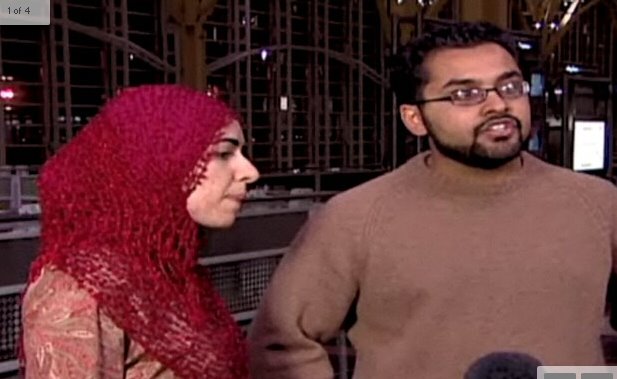
Atif Irfan, right, and members of his family were kicked off an AirTran Airways plane Thursday after other passengers overheard them talking about the “safest” place to sit on the plane. Irfan said it was just a general safety discussion, and the FBI cleared them of any wrong. But the airline refused to rebook them. Photo: CNN.com.

Muslims Kicked Off Plane Get Apology
By Brian Westley / January 2, 2009

AirTran Airways apologized Friday to nine Muslims kicked off a New Year’s Day flight to Florida after other passengers reported hearing a suspicious remark about airplane security.

One of the passengers said the confusion started at Reagan National Airport in Washington, D.C., when he talked about the safest place to sit on an airplane.

Orlando, Fla.-based AirTran said in a statement that it refunded the passengers’ air fare and planned to reimburse them for replacement tickets they bought on US Airways. AirTran also offered to take the passengers back to Washington free of charge.

“We apologize to all of the passengers — to the nine who had to undergo extensive interviews from the authorities and to the 95 who ultimately made the flight,” the statement said. “Nobody on Flight 175 reached their destination on time on New Year’s Day, and we regret it.”

The airline said the incident on the flight from Reagan National Airport to Orlando was a misunderstanding, but the steps taken were necessary.

One of the Muslim passengers, Atif Irfan, said the family probably would not fly home with AirTran because members had already booked tickets on another airline, but appreciated the apology.

“It’s definitely nice to hear,” he said.

Irfan said when he boarded the flight Thursday, he mentioned something to his wife and sister-in-law about having to sit in the back. His sister-in-law replied that she believed the back of the airplane was the safest, but Irfan believed it was better to be by the wings.

“She said, ‘Yes, I guess it makes sense not to be close to the engine in case something happens,” Irfan recalled Friday. “It was a very benign conversation.”

Shortly after taking their seats, members of the group were approached by federal air marshals and taken off the plane, Irfan said. They stood in the jet bridge connected to the airport and answered questions while other passengers exited and glared at them.

Irfan said he thought he and the others were profiled because of their appearance. The men had beards and the women wore headscarves, traditional Muslim attire.

“My wife and I are generally very careful about what we say when we step on the plane,” he said, adding that they have received suspicious looks in the past. “We’re used to this sort of thing — but obviously not to this extent.”

Irfan, 29, is a lawyer who lives in Alexandria, Va. He was traveling to a religious retreat in Florida with his wife, along with his brother and his family, including three children, ages 7, 4 and 2. They were joined by his brother’s sister-in-law and a family friend.

Federal officials ordered the rest of the passengers from the plane and re-screened them before allowing the flight to depart about two hours behind schedule. The family and friend eventually made it to their destination on a US Airways flight.

Family members were upset that AirTran didn’t allow them to book another flight. The airline said in a news release Friday that one of the passengers became irate, made inappropriate comments and had to be escorted away from a gate podium by local law enforcement.

“We felt very disrespected,” Irfan said. He said FBI agents had cleared their names and asked AirTran to put them on another flight, but to no avail.

Christopher White, a federal Transportation Security Administration spokesman, said the situation was handled appropriately.

White said the pilot, after being informed of the remarks, requested that two federal air marshals on board remove the nine passengers. TSA then alerted authorities, including the FBI, which conducted an investigation. Once authorities determined there was no threat, it was up to the airline whether to allow the family to reboard.

“If the pilot is uncomfortable with someone flying on their plane, that’s their decision,” White said.

Discount carrier AirTran Airways is a subsidiary of AirTran Holdings Inc. Its hub is in Atlanta.

[Associated Press Writer Jennifer Kay in Miami contributed to this story.]

Copyright 2008 The Associated Press.

Source / America On Line

The Rag Blog

Posted in RagBlog | Tagged , , , | Leave a comment

Juan Cole Identifies the Top Ten Good Stories from the Middle East for 2008

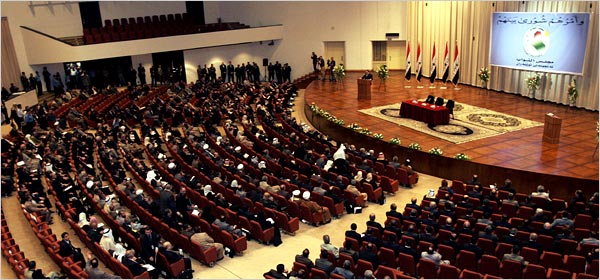
Iraqi Parliament

Top Ten Good News Stories in the Muslim World, 2008 (That Nobody Noticed)
By Juan Cole / January 1, 2009

We all too often focus only on negative developments, and while it is understandable for people to keep their eyes on impending calamities, obsessing about the bad sometimes causes us to miss good news. We see a lot of that even with regard to the US. For instance, there has been a 23% decline in violent crime over the past twenty years in the US, but people who watch a lot of television (especially, I presume, police procedurals) tell pollsters they think crime has gotten worse.

I see significant positive stories in the Muslim world in 2008 that don’t get a lot of press in the US, but which will be important for the incoming Obama administration.

1. The Pakistani public, led by its attorneys, judges and civilian politicians, conducted a peaceful, constitutional overthrow of the military dictatorship of Pervez Musharraf in 2008.

Last February, the Pakistani public gave the largest number of seats in parliament to the left of center, secular Pakistan People’s Party. The fundamentalist religious parties took a bath at the polls. In August, the elected parliament initiated impeachment proceedings against Musharraf, who resigned. A civilian president, Asaf Ali Zardari, was elected. George W. Bush is reported to have been the last man in Washington to relinquish support for Musharraf, who had rampaged around sacking supreme court justices, censoring the press, and imprisoning political enemies on a whim. Pakistan faces an insurgency in the northwestern tribal areas, and problems of terrorism rooted in past military training of guerrillas to fight India in Kashmir. But the civilian parties have a much better chance of curbing such military excesses than does a leader dependent solely on the military for support. True, the new political leadership is widely viewed as corrupt, but South Korean politics was corrupt and that country nevertheless made progress. Besides, after Madoff/Blagojevich, who are we to talk? The triumph of parliamentary democracy over military dictatorship in Pakistan during the past year is good news that Washington-centered US media seldom could appreciate because of Bush’s narrative about military dictatorship equalling stability and a reliable ally in the war on terror. In reality? Not so much.

2. The Iraqi government succeeded in imposing on the Bush administration a military withdrawal from Iraq by 2011. The hard negotiations showed a new confidence on the part of the Iraqi political class that they can stand on their own feet militarily. The relative success of PM Nuri al-Maliki’s Basra campaign last spring was part of the mix here. But so too was the absolute insistence by Grand Ayatollah Ali Sistani that any Status of Forces Agreement not infringe on Iraqi sovereignty. The Sadr Movement resorted to street politics, aiming to thwart any agreement at all, thus providing cover to al-Maliki as he pushed back against Bush’s imperial demands. The Iraqi success in getting a withdrawal agreement has paved the way for President-elect Obama to fulfill his pledge to withdraw from Iraq on a short timetable.

3. Syria has secretly been conducting peace negotiations with Israel, using the Turkish Prime Minister Rejep Tayyip Erdogan as the intermediary. There are few more fraught relationships between countries in the world than the Israel-Syrian divide, but obviously Bashar al-Asad and Ehud Olmert felt that there were things they could fruitfully talk about. Ironically, the clueless George W. Bush went to Israel last spring and condemned talking to the enemy as a form of appeasement. While he got polite applause, the Israeli mainstream is far more realistic than the silly Neocons who write Bush’s speeches, and Olmert went on talking to al-Asad. Unfortunately, the Israeli attack on Gaza has caused Syria to call off the talks for now. It should be a high priority of the Obama administration to start them back up.

4. There has been a “near strategic defeat for al-Qaeda in Saudi Arabia.” “Al-Qaeda in the Arabian Peninsula” conducted numerous bombings and shootings in the period 2003-2006, during which the Saudi authorities got serious about taking it on. Saudi Arabia produces on the order of 11 percent of the world’s petroleum, and instability there threatens the whole world. The dramatic subsiding of terrorism there in 2008 is good news for every one. Opinion polls show support for al-Qaeda in Saudi Arabia plummeting, and determination to fight terrorism is overwhelming. In polling, a solid majority of Saudis say they want better relations with the United States. Yes. The Wahhabis are saying that. And their number one prerequisite for better relations? A US withdrawal from Iraq. (See above).

5. The crisis of state in Lebanon was patched up late last spring by the Doha agreement. Qatar’s King Hamad Al-Thani showed himself a canny negotiator. Hizbullah came into the government and received support as a national guard for the south as long as it pledged not to drag the country into any more wars unilaterally. Lebanese politics is always fragile, but this is the best things have been for years. Lebanese economic conservatism allowed its banks and real estate to avoid the global crash, and hotel occupancy rates are up 25% over 2007, with a 2008 economic growth rate of 6%. The new president, Michel Suleiman, has also pursued responsible diplomacy with Syria, and the two countries are normalizing relations after years of bitterness. For all the potential dangers ahead, 2008 was a success story of major proportions in Lebanon.

6. Indonesia’s transition to democracy that began in 1998 has been ‘consolidated’ (pdf) and it has regained its economic health, paying back $43 billion in loans to the International Monetary Fund. Indonesia is the world fourth most populous country and the world’s largest Muslim country, comprising something like 16 percent or more of all Muslims. It faces many challenges, as do all young democracies, but when 245 million Muslims have kept democracy going for 10 years, the thesis that Islam is somehow incompatible with democracy is clearly fallacious.

7. Turkey avoided a major constitutional crisis in 2008 when the constitutional court declined to find the ruling Justice and Development Party (AKP) guilty of undermining the official ideology of secularism. AKP is mildly Muslim in orientation, in contrast to the militantly secular military. The verdict gave Turks an opportunity to work on bridging the secular-religious divide. Turkey, a country of 70 million the size of Texas, is a linchpin of stability in the Middle East, and it survived a crisis here.

8. Major Arab pop singers jointly performed an anti-war opera that called for co-existence among the region’s Christians, Muslims and Jews and an end to the senseless slaughter. It ran on 15 Arab satellite channels, and one satellite channel ran it nonstop for days. It was the Woodstock of this generation in the Arab world and it got no international press at all.

9. King Abdullah II of Jordan pledged an end to press censorship in Jordan. Tim Sebastian reports,

The man at the center of this event was King Abdullah of Jordan, who last month gathered together the chief editors of Jordan’s main newspapers and told them that from now on there would be big changes in the country’s media environment. Specifically, no more jailing of reporters for writing the wrong thing and a new mechanism would be created to protect the rights of journalists, including their access to information. “Detention of journalists is prohibited,” he said. “I do not see a reason for detaining a journalist because he/she wrote something or for expressing a view.”

It is legitimate to take all this with a grain of salt, to be skeptical, to wait and see. But Sebastian is right that if the king means it, it is big news for Jordan and the Middle East, and the court in Amman should be pressured to stand by the new procedures.

10. The United Arab Emirates is creating the first carbon-free city, “Masdar,” as a demonstration project. That the Oil Gulf, a major source of the fossil fuels that, when burned, are causing climate change and rising sea levels, has become concerned about these problems, it is a very good sign.

Source / Informed Comment

The Rag Blog

Posted in RagBlog | Tagged , , , , | 1 Comment

2009 and the Economy : Not So Good


‘It is getting awful damn hard to be optimistic about the US economy these days. If the problem can be fixed at all, it will probably really require an unprecedented degree of global cooperation.’
By Roger Baker
/ The Rag Blog / January 2, 2009

Here are two interesting, widely read, and intelligent viewpoints regarding where the US economy is headed in 2009. I would advise that they be read in full. Reading Kunstler is like drinking fine champagne. Bottom line: It is getting awful damn hard to be optimistic about the US economy these days. If the problem can be fixed at all, it will probably really require an unprecedented degree of global cooperation.

First we have James Howard Kunstler, a widely read blogger and writer, who wrote the book “The Long Emergency” on the long-range nature of the current economic crisis. It should be noted that Kunstler successfully predicted the beginnings of the current economic crisis as being centered on energy problems back in early 2005; note this link.

Kunstler’s crystal ball may thus be regarded as being admirably clear as judged by his track record. Plus his thinking is complemented with a wealth of detail. Following are a few snips from Kunstler’s 2009 forecast (well worth reading in full, IMO).

Forecast for 2009

. . .Without reviewing all the vertiginous particulars of the year now ending, suffice it to say that the US economy fell on its ass and that the “global economy” did a face-plant as well. The American banking sector imploded spectacularly to the degree that investment banking actually went extinct — as if a meteor landed on the corner of Madison Avenue and 51st Street. The response by our government was to shovel “loans” onto the loading dock of every organization that pretended to be something like a bank, while “bailing out” an ever-longer line of corporate claimants with a pitiable song-and-dance. The oil markets went on a roller coaster ride. The housing bubble collapse grew to avalanche velocity (taking out whole colonies of realtors, mortgage brokers, and construction contractors in its path), the commercial real estate sector developed hemorrhagic fever, retail drove off a cliff on Christmas Eve, the stock market fell in the toilet, jobs and incomes went up in a vapor, and tens of millions of ordinary citizens addicted to revolving credit found themselves in a life-and-death struggle for the means of existence.

None of this is over yet. . .

[. . . .]

Apart from “cleaning up Dodge,” so to speak, and from issues of collective character-and conscience-in-office, I worry that the avalanche of troubles already ongoing will overwhelm Mr. Obama and his people .It’s also well worth worrying whether they will pursue policies similar in kind to the ones pursued by Bush, namely throwing money at everything and anything, and it sure looks like they are planning to do just that. I am especially concerned about an “infrastructure stimulus” project aimed at highway improvement at the expense of public transit. This would be the epitome of a campaign to sustain the unsustainable. We need to begin planning right away for a transition away from automobiles, not in order be good socialists but because Happy Motoring is at the core of our unsustainability trap. The car system is going to fail in manifold ways whether we like it or not, and it will fail due to circumstances already underway. For one thing, it will cease to be democratic as the remnants of the middle class find it impossible to get car loans, or pay for fuel, or insurance, and that will set in motion a very impressive politics-of-grievance setting apart those who are still able to enjoy motoring and those who have been foreclosed from it. Contrary to what you might make of the current situation in the oil markets, we are in for a heap of trouble with both the price and supply of petroleum (more on this below). And there is no chance in hell that any techno rescue remedy to keep all the cars running by other means will materialize. . .

[. . . .]

[Regarding inflation] This is the “other shoe” that a lot of people are waiting to drop. Right now we are caught up in a compressive debt deflation as mortgages stop “performing” and loans of all kinds are welshed on. Since money is loaned into existence, and a great many loans are not being repaid, then a lot of money is going out of existence. That’s what I mean when I say that capital is leaving the system. At the same time, the Federal Reserve has made good on its promise to drop money from helicopters if necessary to prevent an implosion of the banking system (as all that older money goes out of existence), and so it’s now a question as to when the amount of new money will exceed the disappeared old money. (Of course when I say money, I mean “money,” because we are dealing here in a shadow realm of assumed value.) In any case, there is bound to be a lag period between the time that the Fed’s money is dropped from the choppers and the time it actually filters through the banks and other recipients to the so-called “real economy” of people who buy and sell real things. The credible estimates I hear run between six and 18 months.

I’ll only venture to guess that we could see the start of serious inflation sometime in 2009. To some extent, all currencies are now free-falling together, some at slightly faster rates than others, but the situation of the US dollar is so grotesquely dire, and our structural imbalances so monumental, that it is hard to imagine that our currency will not win the international race to the bottom. Gold resumed its movement upward against the dollar a week before Christmas, and that may be an early sign. The government — and anyone badly in debt — benefits much more from inflation than deflation, so every effort will be made to avert the latter. The trouble lies in the government’s dumb incapacity to control dangerous things that it sets in motion, so that an inflationary campaign to avoid compressive deflation can so easily lead to a fiasco of super or hyper inflation — the kind that kills governments and turns societies into murderous monsters. I’ll forecast the that the US dollar is worth 40 percent of its current value by next Christmas. . .

As a second example of judging where the US economy is headed, we have the following snips extracted from an article by Peter S. Goodman in the New York Times. The article notes with some alarm that the US government is printing, permitting, and spreading around gargantuan amounts of freshly generated cash and credit as an emergency measure, since the hundreds of billions of dollars in bank bailouts didn’t have much effect in stopping and reversing the current deflationary spiral.

The Treasury Dept, in cooperation with the Federal Reserve, and many other top US government officials, is generating trillions in new money and credit, including lowering the prime interest rate to zero (the interest rate that the biggest banks have to pay on their federal loans). The theory, in accord with classic Keynesian theory, is that sooner or later, when everyone including the banks are waist-deep in cash, they will be in a mood to start spending it more freely again. Flooding the economy with lots of cash will no doubt get folks spending again at some point.

The downside is that whenever the psychology finally does turn around, it is likely to turn around rather suddenly and unpredictably. Whenever this happens, average cash-strapped consumers who are already strapped by credit card debt are likely to focus their spending on those consumer necessities that are already in short supply. Things like heating oil, gasoline, and food. Such vital necessity prices are likely to get bid up pretty fast. Meanwhile those investors who have extra cash, and with a sense of history, are more likely to spend it on bars of gold, rather than as previously on second homes in Palm Beach or trips to Las Vegas. The New York Times piece lacks the vigor and predictive clarity of Kunstler’s predictions, but a lot of the message is the same.

Debt Sweat: Printing Money – and Its Price

. . .The value of outstanding American Treasury bills now reaches $10.6 trillion, a number sure to increase as dollars are spent building bridges, saving auto jobs and preventing the collapse of government-backed mortgage giants. Worry centers on the possibility that foreigners could come to doubt the American wherewithal to pay back such an extraordinary sum, prompting them to stop — or at least slow — their deposits of savings into the United States.

That could send the dollar plummeting, making imported goods more expensive for American consumers and businesses. It would force the Treasury to pay higher returns to find takers for its debt, increasing interest rates for home- and auto-buyers, for businesses and credit-card holders.

“We got into this mess to a considerable extent by overborrowing,” said Martin N. Baily, a chairman of the Council of Economic Advisers under President Clinton and now a fellow at the Brookings Institution. “Now, we’re saying, ‘Well, O.K., let’s just borrow a bunch more, and that will help us get out of this mess.’ It’s like a drunk who says, ‘Give me a bottle of Scotch, and then I’ll be O.K. and I won’t have to drink anymore.’ Eventually, we have to get off this binge of borrowing.”

Some argue that the moment for sobriety is long overdue, and postponing it further only increases the ultimate costs. “Our government doesn’t have enough spare cash to bail out a lemonade stand,” declared Peter Schiff president of Euro Pacific Capital, a Connecticut-based trading house. “Our standard of living must decline to reflect years of reckless consumption and the disintegration of our industrial base. Only by swallowing this tough medicine now will our sick economy ever recover.”

But most economists cast such thinking as recklessly extreme, akin to putting an obese person on a painful diet in the name of long-term health just as they are fighting off a potentially lethal infection. In the dominant view, now is no time for austerity — not with paychecks disappearing from the economy and gyrating markets wiping out retirement savings. Not with the financial system in virtual lockdown, and much of the world in a similar state of retrenchment, shrinking demand for American goods and services. . .

[. . . .]

. . .The most frequently voiced worry about the bailouts is that the Fed, by sending so much money sloshing through the system, risks generating a bad case of rising prices later on. That puts the onus on the Fed to reverse course and crimp economic activity by lifting interest rates and selling assets back to banks once growth resumes.

But finding the appropriate point to act tends to be more art than science. The Fed might move too early and send the economy back into a tailspin. It might wait too long and let too much money generate inflation.

“It’s a tricky business,” says Allan H. Meltzer, an economist at Carnegie Mellon University, and a former economic adviser to President Reagan. “There’s no math model that tells us when to do it or how.”. . .

The Rag Blog

Posted in Rag Bloggers | Tagged , , , | Leave a comment

U2 Drummer : ‘Bono’s Friendship With War Criminals Makes Me Cringe’

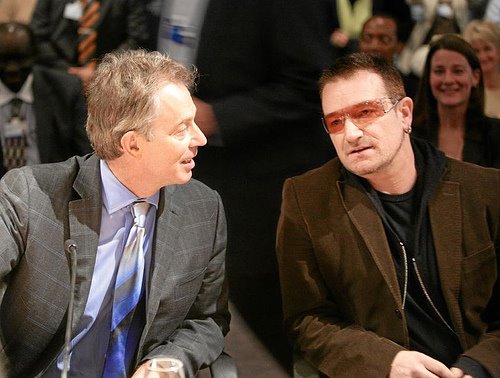
British PM Tony Blair hobs with Bono during the World Economic Forum in Davos, Switzerland, January 26, 2007.

‘The normally reserved musician has launched a stinging attack on his frontman for his involvement with the two world leaders in an interview with music magazine Q.’
By Anne-Marie Walsh

U2 drummer Larry Mullen has admitted he “cringes” when he sees Bono associating with “war criminals” George W Bush and Tony Blair.

The normally reserved musician has launched a stinging attack on his frontman for his involvement with the two world leaders in an interview with music magazine Q.

It is not the first time Mullen has criticised Bono for his campaign work, but this is his most scathing criticism to date. From his appearance at Live Aid and Band Aid in the 1980s, Bono has been involved in numerous charities to raise awareness of crises in Africa, including AIDs.

He praised Mr Bush for increasing aid to Africa and most recently appeared with him during the G8 summit last year. In 2007, he also saluted outgoing British Prime Minister Tony Blair for “doing the things he believed in”, despite the “accusations of a slick PR machine, spin doctoring and the like”.

But his work outside the band has caused a deep rift between Bono and at least one other fellow band member.

In his interview, Mullen suggests the singer’s campaigns have taken their toll on his family life. He admitted that Bono is “prepared to use his weight as a celebrity at great cost to himself and his family, to help other people”, adding: “but, as an outsider looking in, I cringe.”

He brands Mr Blair and Mr Bush “war criminals”.

“Tony Blair is a war criminal and I think he should be tried as a war criminal.

“Then I see Bono and him as pals and I’m going, ‘I don’t like that’. Do I think George Bush is a war criminal? Probably — but the difference between him and Tony Blair is that Blair is intelligent. So, he has no excuse.”

Six years ago, in an interview on American TV, Mullen said he believed Bono’s political crusades were unsettling the band. He told the ’60 Minutes’ programme that the lead singer’s absence was felt each time he took a break to campaign on issues.

“It does interfere with the band,” he said. “It’s a four-legged table, and with one leg missing, even for short periods of time, the thing becomes a little unstable.”

Bono has also come under attack from critics less close to home, including writer Paul Theroux.

Mr Theroux described Bono, Brad Pitt and Angelina Jolie as “mythomaniacs, people who wish to convince the world of their worth.”

He said he was not complaining about humanitarian aid, disaster relief, AIDS education or affordable drugs.

“Instead, I am speaking of the ‘more money’ platform: the notion that what Africa needs is more prestige projects, volunteer labour and debt relief.”

The U2 singer responded by calling his critics “cranks carping from the sidelines”.

“A lot of them wouldn’t know what to do if they were on the field,” he said.

Source / independent.ie / Posted Dec. 29, 2008

Thanks to Carlos Lowry / The Rag Blog

Posted in RagBlog | Tagged , , , , , , | 3 Comments

Brandon Darby : Austin Activist Outed as FBI Spy

Austin activist and admitted FBI informant Brandon Darby.

Austin has its very own FBI spy. Recall that Scrub Bush took all the FBI agents off enforcing banking laws, and put them to work watching political groups here at home. — Janet Gilles / The Rag Blog.

There have always been undercover cops spying on the left in Austin. The now famous right wing pundit William Bennett lived in a hive of leftists and dopers at Nueces College House in 1967-8. Long time chairman of the Republican Party in Travis County and right wing government professor, Alan Sager, hired me to be his research assistant when I returned from a year working for national SDS in 1969. Wonder why? Strange, isn’t it? — David Hamilton / The Rag Blog.

The Rag Blog’s Thorne Dreyer wrote a cover story for the Nov.17, 2006, issue of The Texas Observer about spying on campus radicals and resident bohemians at the University of Texas in Austin in the sixties. Go here to read “The Spies of Texas.”

And go here to see the “Hamilton Files” of former UT-Austin campus police chief Allen Hamilton with all the documents and photographs that accompanied Dreyer’s story.

The Rag Blog / January 2, 2009

Sometimes You Wake Up and It’s Different:
Statement on Brandon Darby, aka, ‘The Unknown Informant’

December 31, 2009

Also see an Open Letter from admitted FBI informant Brandon Darby, Below.

[Scott Crow, who originally posted this story, worked closely with fellow activist Brandon Darby. Darby received substantial media coverage for his role in Katrina recovery efforts in New Orleans.]

Below is a statement by a group of Austin-based community organizers that documents that a local activist, Brandon Michael Darby of Austin, is a government informant/provocateur.

Brandon now publicly acknowledges that he is working with the FBI and has been for some time.

Statement on Brandon Darby, the ‘Unnamed’ Informant/Provocateur in the ‘Texas 2’ Case from Austin, Texas.

As part of the wave of government repression against activists protesting at the Republican National Convention in St. Paul, Minnesota in September, 2008, the FBI arrested two men from Texas, Bradley Crowder (22) and David McKay (23), and indicted them for allegedly possessing molotov cocktails. Crowder and McKay have been in jail since the RNC. They have not been granted bail and their trial has been postponed indefinitely. They are facing 7 to 10 years in federal prison.

As outlined in the affidavit against Crowder and McKay (found here), the case was built almost entirely on the statements of two informants covertly working with the FBI, identified in the affidavit as “Confidential Human Sources” or just “CHS”.

One of these informants was working in the Minneapolis/St. Paul area (“CHS 2” in the affidavit) and has been previously identified as Andy/Panda by people familiar with the situation and the informant. This statement ends speculation and anticipation concern about the identity of the other informant who was operating in Texas and Minnesota.

Using FBI documents previously unknown to us, but recently provided by one of the defendant’s defense teams, we have positively confirmed the identity of the unnamed informant (“CHS 1” in the affidavit) as Brandon Michael Darby of Austin, Texas, based on the following evidence:

1) The FBI documents detail private conversations between Darby and several individuals named in the documents, including scott crow and Lisa Fithian, who have closely reviewed the documents and confirmed that they had the conversations in question with only Darby. In addition they can confirm his participation in events reported in the documents.

2) In verbatim reports from the informant to the FBI, the language, personality, skills, and interests of Darby are readily apparent to those who know him.

3) Cross-referencing the time line provided by the FBI in the documents with people familiar with the situation and course of events shows that Darby was in a position to have the incriminating conversations with McKay referenced in the affidavit.

4) In all of the documents Brandon Darby’s name is conspicuously absent from any and all meetings and events which he attended and was involved in. In fact Darby’s name only appears at the end of all the documents in a confession made by David McKay upon his arrest in Minnesota.

Numerous people familiar with both Brandon Darby and the legal situation of Crowder and McKay have verified this information.

Over the years Brandon Darby has established strong ties with individuals in many different radical communities across the United States. While it is not yet clear how long or to what extent Darby has been acting as an informant, the emerging truth about Darby’s malicious involvement in our communities is heart-breaking and utterly ground-shattering to those of us who were closest to him.

Darby operated in and around the Austin community for about 6 years, and this is the same Brandon Darby who participated in the Common Ground Collective in New Orleans during 2005-2006. Based on the evidence we have, Brandon has been giving the state information since at least November 2007, but there is also information that suggests his informant activities may go back further, at least to 2006 or earlier. In the documents, Darby makes numerous remarks that are inflammatory and often untrue or grossly taken out of context. There is also compelling evidence to suggest that Darby, more than just reporting on Crowder and McKay’s activities, was actively encouraging, enabling, and provoking the two men to take illegal action.

We recognize that suspicions and accusations of Darby have been circulating for some time now, including one corporate media article by David Hanners in the St. Paul Pioneer Press on October 29, 2008. Our aim in releasing this information is to clear the confusion that has circulated in the last few months.

We want to point out that while the conclusions of these suspicions and accusations turned out to be correct, these conclusions were not based on any verifiable facts, and thus, their public airing was inappropriate and irresponsible. When these accusations surfaced, we did what we could to quash them, trusting what we believed to be true about people in the absence of any compelling evidence to the contrary. Having been presented with new evidence, we are acting on it promptly and deliberately.

Through the history of our struggles for a better world, infiltrators and informants have acted as tools for the forces of misery in disrupting and derailing our movements. However, even more dangerous to our communities than setting people up, turning them in, or gathering information, informants sow seeds of fear, paranoia, and distrust that fester and grow in paralyzing and destructive ways. We must be forever vigilante against deceptive, malicious and manipulative actors, while we defend the trust and openness that give our communities cohesion and power.

Now we must get on with the work of supporting the “Texas 2”. In light of these revelations and what we know about Brandon Darby, we believe they were set up and that the charges should be dropped. We urge you to join us in a campaign to “Free the Texas 2”

In solidarity,
The Austin Informant Working Group

Source / Infoshop News

And this on Darby:

It is not clear exactly how long [Brandon Darby] has worked for the FBI for or how many people he gave information on, but it appears that he has been an informant for about two to three years. His information led the to the arrests of two activists who are charged with making Molotov cocktails which they allegedly intended to use at the Republican National Convention protests in St. Paul this past summer.

It is also being speculated that his information may have had something to do with the arrests of eight activists who were rounded up before the week of RNC protests could even begin. The activists, known as the “RNC 8″, are being charged with four felony counts each.

Many of his peers defended him before he was officially outed, saying that he would never spy on his fellow activists and that doing so would be completely against his ideology. Darby disagreed, saying in his letter (which he ironically signed “In Solidarity”) that his ideology supports his choice, a choice he “strongly defends.”

Michael A. Weber / Planetsave

And here is an open letter from Brandon Darby, published on Dec. 30, 2008

To All Concerned,

The struggles for peace and justice have accomplished significant change throughout history. I’ve had the honor to work with many varying groups and individuals on behalf of marginalized communities and in various struggles. There are currently allegations in the media that I have worked undercover for the Federal Bureau of Investigation. This allegation no doubt confuses many activists who know me and probably leaves many wondering why I would seemingly choose to engage in such an endeavor. The simple truth is that I have chosen to work with the Federal Bureau of investigation.

As compelling as the natural human desire to reason and express oneself can be, regardless, I must hold my comments at this time on certain aspects of the situation. That said, there are a few statements and generalizations I will make relating to my recent choices.

Though I’ve made and will no doubt continue to make many mistakes in efforts to better our world, I am satisfied with the efforts in which I have participated. Like many of you, I do my best to act in good conscience and to do what I believe to be most helpful to the world. Though my views on how to give of myself have changed substantially over the years, ultimately the motivations behind my choices remain the same. I strongly stand behind my choices in this matter.

I strongly believe that people innocent of an act should stand up for themselves and that those who choose to engage in an act should accept responsibility and explain the reasoning for their choices.

It is very dangerous when a few individuals engage in or act on a belief system in which they feel they know the real truth and that all others are ignorant and therefore have no right to meet and express their political views.

Additionally, when people act out of anger and hatred, and then claim that their actions were part of a movement or somehow tied into the struggle for social justice only after being caught, it’s damaging to the efforts of those who do give of themselves to better this world. Many people become activists as a result of discovering that others have distorted history and made heroes and assigned intentions to people who really didn’t act to better the world. The practice of placing noble intentions after the fact on actions which did not have noble motivations has no place in a movement for social justice.

The majority of the activists who went to St. Paul did so with pure intentions and simply wanted to express their disagreements with the Republican Party. It’s unfortunate that some used the group as cover for intentions that the rest of the group did not agree with or knew nothing about and are now, consequently, having parts of their lives and their peace of mind uprooted over.

There is no doubt in my mind that many of you reading this letter will say and feel all possible bad things about my choices and for me. I made the choice to have my identity revealed and was well aware of the consequences for doing so. I know that the temptation to silence or ignore the voice of someone who you strongly disagree with can be overwhelming in matters such as this one; and no doubt many people will try to do just that to me. I have confidence that there will be a few people interested in discussion and in better understanding views different from their own, especially from one of their own. My sincere hope is that the entire matter results in better understanding for everyone.

Many of you went against my wishes and spoke publicly in defense of me. Those involved were correct when they wrote that I wasn’t making my choices for financial reasons or to avoid some sort of prosecution. They were incorrect that my ideology didn’t support such choices. One individual who publically defended me stated that they didn’t believe I was working undercover because the government would have used my access to take down a more prominent activist if the allegations were true. If indeed the government or I was interested in doing so, it could have happened in such a manner. However, the incorrect notion that the government was out to silence dissent was the cause for the mistake made by that person. In defense of the individuals who openly did their best to do what they thought was defending me, they did not know the truth and they had no way of knowing the truth due to their ideological and personal attachments to me. It’s unfortunate that the truth couldn’t have come out sooner and that the needed preparations for such a disclosure take time. I really did mean it when I said that I didn’t want to discuss it and that I didn’t want folks addressing the allegations.

Again, I strongly stand behind my choices in this matter. I’m looking forward to open dialogue and debate regarding the motivations and experiences I’ve had and the ethical questions they pose.

In Solidarity,

Brandon Michael Darby
December 29, 2008

Source / Independent Media Center

Read The Spies of Texas by Thorne Dreyer / The Texas Observer / Nov. 17, 2006.

And see the entire “Hamilton Files” of former UT-Austin police chief Allen Hamilton that served as documentation for Dreyer’s story, here.

The Rag Blog

Posted in RagBlog | Tagged , , , , , , , , | 14 Comments

Herdshares, Melamine and the Crazed Priorites of the ‘Regulators’

I wonder what sort of regulatory model we have arrived at that finds it commendable to break up small groups of people wanting to raise and consume a natural product with no harmful properties and yet ignores a massive, fraudulent, intentional contamination of food with industrial toxins.

By Jack Kittredge / The Rag Blog / January 2, 2009

[Jack Kittredge is a former political activist and SDS member who is now an organic farmer in Massachussetts. A version of this article appeared in the newsletter of the Massachussetts Chapter of the Northeast Organic Farming Association (NOFA). This is an excellent piece, pointing to the serious dangers of melamine and the skewed priorities of the FDA and other “regulators,” and we think it deserves a wider audience.]

Some friends involved with the Northeast Organic Farming Association have recently been finding and passing along fascinating (if somewhat chilling) news about developments on the industrial and local food fronts.

Frank Albani forwarded a 13-page document that is the first clear explanation I have seen on melamine. Melamine is the white powder derived from petroleum used in the production of plastic goods. It has nearly the same chemical structure as the milk protein casseinate, but with extra nitrogen ions. It has been added to milk and other foods as a very cheap way to boost the apparent protein content of the food.

If ingested, however, the extra nitrogen ions prevent the compound from being absorbed or excreted by the kidneys. It eventually forms kidney stones that block the tubes that cleanse and excrete urine. This leads to intense pain, swelling, bleeding and eventual death. Emergency surgery can remove the stones, but by then there is often irreversible kidney damage and life-long dialysis, or regular blood-washing hooked up to a machine in a hospital, is necessary.

In 2007 over 50,000 United States cats and dogs died suddenly and investigators found that pet food from China contained high levels of melamine. Starting in 2008 an increase in the number of infant kidney stone cases in China was reported. In August of 2008, the Chinese milk powder Sanlu tested positive for melamine. In September, pressured by New Zealand, China tested a broad line of milk-based food products, many of which showed melamine content. New Zealand, Australia and most EU nations issued recalls and public warnings. The US, however, remained silent.

Billions of dollars worth of milk-based Halloween and holiday candy continue to pour out of China to our shores. Some of the familiar brand names offering products containing dairy ingredients from China include: Kraft, M&M, Nabisco, Nestle, and Snickers.

So much for news on the industrial food front. On to the local angle.

Steve and Barbara Smith operate Meadowsweet Dairy in the Finger Lakes region of New York and process raw milk from their cows into products like yogurt, butter and cream for the 120 shareholding families in their herdshare. (In case you haven’t heard of herdshares, they are legal arrangements whereby consumers purchase a share of a herd of cows and hire a farmer to milk the cows and provide the consumer with the milk—or milk products—from the cow he or she already owns. The idea takes advantage of the almost universal exemption for owners of cows to legally consume their cow’s unpasteurized milk products.)

I interviewed the Smiths for the “Families and Farming” issue of The Natural Farmer in 2001 and found them to be warm and wonderful NOFA farmers and parents, and their lemon kefir simply delicious!

Despite no cases of health or other problems with Meadowsweet Dairy, however, New York’s Department of Agriculture and Markets has been trying to shut them down. In the Empire State, raw milk permits allow the farm to sell just unprocessed raw milk — no cream, butter, yogurt, or other “processed” raw milk products. They apparently see the herdshare as a ruse and an attempt to sell raw milk products outside the law.

Jill Ebbott alerted me and several others to the excellent blogs by David Gumbert regarding federal and state efforts to shut down raw milk dairies, including the Smiths’. Most upsetting when I read these was the news that a New York state court has now ruled against the Smiths, Judge John C. Egan, Jr. saying that herdshares give no exemption from regulation. He ruled that the shareholders were consumers “based on the plain meaning of the word” and that the state had the power to search the dairy, open and seize containers and products, and regulate its operations.

The state is now aggressively following up on this victory by going against other local farmers. In a late November press release the Department of Ag and Markets says their inspectors are organizing squads “dedicated to administering and enforcing the State’s food safety laws and regulations to protect the public health…”

I sometimes wonder what sort of regulatory model we have arrived at in this country that finds it commendable to break up small groups of people wanting to raise and consume a natural product with no harmful properties and which they believe is healthful for their families, and yet ignores a massive, fraudulent, intentional contamination of food with industrial toxins.

I don’t want to believe that there is a deeper villain here. Could it simply be easier to go after the Smiths and the local families they serve than to pick a fight with large corporate food companies that have lawyers and PR departments and friends in high places? Could it be that the FDA is just acting out the anti-regulatory beliefs of the Republicans while the NY zealots are responding to a liberal, Democratic and big government agenda?

Or are some of my friends right — those who believe that our public health enforcers’ fetish for sanitizing is a conscious effort to squeeze out the small farmer and food artisan, leaving only one food system, the industrial, global one. Then, with a population half sick and with no alternatives to regain natural good health, the pharmaceutical and food conglomerates will have us where they want us.

As Gumpert concludes, we have an important fight on our hands — for the sake of our health and our family’s health, we need to keep small farmers and food producers alive and thriving. And as Michael Pollan suggests, we need to stop buying any product of the food industry that needs to have a label; it is no longer a food. If enough of that happens then we can have our sustenance from men and women who know us, want our trade, and are willing to hold to high standards to deserve it.

Also see The Real Melamine Story: The FDA Isn’t Protecting Us by James E. McWilliams / The Rag Blog / Dec. 29, 2008

Thanks to Allen Young / The Rag Blog

Posted in Rag Bloggers | Tagged , , , , , , | 2 Comments

A New Year’s Day Thought

There comes a point in your life when you realize who matters, who never did, who won’t anymore… And who always will. So, don’t worry about people from your past, there’s a reason why they didn’t make it to your future. Be kinder than necessary, because everyone you meet is fighting some kind of battle.

With thanks to Diane Stirling-Stevens / The Rag Blog

Posted in RagBlog | Tagged , | 1 Comment

Houston : The Unexplained Death of Spook Roland Carnaby

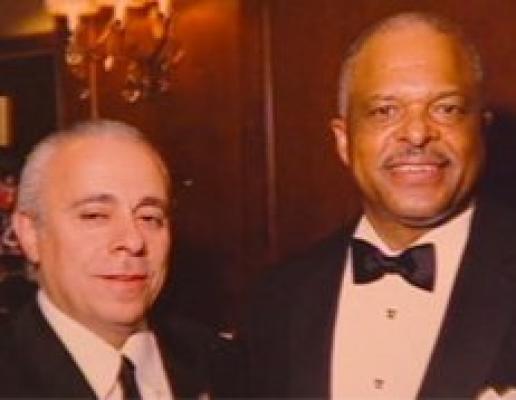
Roland Carnaby, left, in an undated photo with Houston Police Chief Harold Hurtt taken at a HPD Policeman’s Ball. Photo provided by family / KHOU.com.

Roland Carnaby had claimed to be a CIA agent and showed identification. The CIA quickly put out the word that he was not its employee. The papers and corporate media were filled with stories about how this strange fellow was probably a CIA wannabe. The dead man was trashed and ridiculed.

By Sherman DeBrosse / The Rag Blog / January 1, 2009

The news cycle has moved on, and the shooting death of Roland Vincent “Tony” Carnaby has been forgotten. The Houston police shot him on April 29, 2008, after an automobile chase. There were many strange circumstances about the shooting, and it is unlikely that the full truth will ever surface.

The circumstances surrounding the shooting are still unclear. Before the arrest, he had been stopped for speeding. He showed an officer what he said was CIA identification. The officer questioned his identification. It’s a reasonable guess that something spooked Carnaby. We know now that there is one unexplained hole in the left rear passenger door of his car. Did it come earlier or at that point? He took off and there was a 50 mile chase, with speeds up to 120 mph.

He talked to a friend on the cell phone during the chase and was advised to pull over. His response was “I can’t.” He made calls to the FBI and to someone in the Houston Police Department during the chase. After the chase, he refused to roll down the window. Police broke it with a billy club. The first policeman to approach came to the passenger side of the car, and what he might have been doing was not completely captured on a squad car camera. Police claim Carnaby seemed erratic when he stepped out of the vehicle. He then reached under the seat for a shiny Blackberry PDA and seemed to move toward an officer. That move got him killed. An officer saw something shiny and fired into Carnaby’s back.

They have not released their videos of the shooting. His attorney said that Carnaby must have felt he was being set up. Others say that for some reason or other he wanted the police to kill him. A Houston homicide captain later made a strange comment, saying he was told that Carnaby should be arrested for “something” other than speeding.

The black Jeep SUV he was driving was supposedly owned by the National Security Command Center. At first it seemed that there was no such agency. There is, and it is an appendage of the NSA in Fort Meade, Maryland.

Inside the car were two pistols, a shotgun, more CIA identification, a lapatop, and cell phones. A gag order was placed on autopsy information even though autoposy information in Houston is almost always 100% open. His widow has been unable to recover Carnaby possessions removed from the vehicle. Some of the possessions had been seized by federal agents. There are reports that the police disposed of some of the possessions as well as of some videos of the incident.

He had claimed to be a CIA agent and showed identification. The CIA quickly put out the word that he was not its employee. The papers and corporate media were filled with stories about how this strange fellow was probably a CIA wannabe. The dead man was trashed and ridiculed.

Though his home is filled with CIA memorabilia, the agency flat out insisted that he had never been an employee. There were all sorts of articles that suggested a life found in far-flung places. The agency sent a representative to aid the HPD in its investigation. For some reason, there is a lot of effort being exerted to discredit this man. His former wife said he told tall stories and one man speaking to the media about him is considered an asset of a foreign intelligence service. Some of this effort resembles previous attempts to make Valerie Plame appear to have been a mere desk clerk at the CIA.

It is clear that no one came to his defense after the shooting. One close friend and FBI official had called the HPD during the chase asking that it be stopped. Later, the man distanced himself from Carnaby. The CIA also went out of its way to deny ties with Carnaby.

He is being widely portrayed as a CIA wannabee. We can prove that his uncle Boudi was Army Intelligence in World War II and appears on the Association for Intelligence Officers’ CIA Wall of 83 Stars and OSS Memorial. There is also a notation about Roland being president of the Houston chapter. One would think that a local chapter would not elect someone president if there were doubts about his status, but some say he entered the chapter as an associate member. Members have defended his claim to have been a CIA agent, and some other intelligence professionals think he was assassinated. A Russian web site says Carnaby was a CIA agent called by the KGB “Tuxedo.” Perhaps the question comes down to whether he was an actual agent or a contractor. His family has provided many certificates that indicate he was at least a contractor.

We do know that he operated a successful security firm in Houston and most probably had contracts with the US government. He was an expert in financial information and counter-terrorism. He provided some security services for the Houston airports and port authority. Carnaby was about to retire and leave management of the firm to former CIA agent who may have been connected with the rendition of prisoners. The firm has 248 licensed operatives around the world.

He spoke fluent French and Arabic and had good contacts throughout the Middle East, partly through his family’s shipping business. His father had been Lebanese ambassador to several nations. The Carnaby intelligence firm was running 40 operatives out of Rome who were tracking money flows from the Russian-Israeli mafia and Iserael. It apparently relies heavily upon Panamanian banks and has become a presence here in the United States, even getting involved in gambling casinos. He was also tracking Israeli intelligence financial operations and the activities of Israeli agents within the United States. Houston is an important center for Mossad activities in shipping, aviation, sales and warehousing.

Carnaby’s CIA momentos. Photo by Houston Chronicle.

Carnaby had worked for the agency in Beruit and was captured by Hezbollah 1984. After Carnaby’s capture, his boss, William F. Buckley, was captured, tortured, and murdered. Carnaby was returned in an prisoner exchange arranged by the Lebanese government. Recently, Carnaby rejoiced when the man behind his capture died when his car blew up. Mossad had planted as bomb in the seat of the car. But some blamed Carnaby when word was leaked that another seat bomb was earmarked for Hassan Nasrallah, Hezbollah leader in Lebanon. Carnaby had close ties with the Israeli government, and some thought that an aid to Prime Minister Omert tipped off Carnaby. His fear was that killing Nasrallah would set off a war in Lebanon, which would require US intervention against Hezbollah and Syria, and eventually against Iran. The plot against the Hezbollah leader was to come off four or five days before Carnaby was killed.

In 2008, he was working out of the same office building where the office of George H.W. Bush occupies the whole 9th floor. Carnaby’s job concerned the security of the Port of Houston. He was concerned that Homeland Security was doing too little to protect the port and to prevent illegal arms shipments from passing through it. When the Houston police killed him, they seized his laptop and cell phone. Both could be used to learn more about the CIA’s network of NOC (non-official cover) people who worked on such matters. There is a fear that the intelligence agency of another government could have gotten information off the computer and phone.

In 1994, Carnaby, then working in counter-terrorism, testified before a federal grnd jury ab out the 1993 bombing of the World Trade Center. Both CArnaby and his friend John O’Neill knew how much prior knowledge the federal government had about the bombing as well as its links to Saudi Arabia. Much of that information was suppressed. Carnaby carried in his wallet a laminated funeral mass card with the image of his friend John O’Neill. Both were mavericks and patriots. O’Neill even explored the possibility that two Arabs in a dingy were not responsible for the attack on the USS Cole. He asked too many questions and was quickly sent home. By all accounts, O’Neill was our most talented terrorist hunter, but he was quickly forced to resign. Ironically, he became head of security at the World Trade Center and died trying to help people escape.

Carnaby was a friend of James Baker III and George H.W. Bush, who had been seen recently giving Carnaby a hug in a restaurant. He shared their aversion to more military adventures in the Middle East and was angry that Dick Cheney pushed George W. Bush into Iraq. A conservative Republican, Carnaby was backing Ron Paul. Among the pallbearers at his funeral were former president George H. W. Bush, former KBG General Oleg Kalugin and former Deputy Director for Operations James Pavitt. George Tenet was among a cluster of Washington politicians.

Perhaps his killing had to do with other information he had or something he was doing.

There was speculation that he was trying to move weapons to the Aoun faction—the “generals” — in Lebanon. Would that have been a sanctioned activity?

He was an expert in tracing Israeli cash flows around the world. It has been said that a Mossad faction in the police department was behind his death, but Israeli intelligence is too experienced and professional to get involved in such a messy hit.

Investigator Wayne Madsen was told that Carnaby had information on the Jack Abraham political/financial network as well as how the prosecution and death of Deborah Jean Palfrey was related to that. She killed herself on May 1, 2008, in a shed on her mother’s property. Her call girl service was involved with Republican corruption in Maryland, and it is likely that she knew a great deal about the sex rings servicing federal officials and mostly Republican politicians in D.C. Palfrey’s ring was supposedly tied to important federal defense contractors and was used my many ranking politicians and the larger part of one Republican state delegation to Congress.

Much of the money Abramoff distributed to Republicans came from Russian oil and gas interests and the Russian mob, which was buying into US casinos. There was already a messy murder connected with an Abramoff casino in Florida that has been pretty well covered-up. The Russian mob’s casino activitie4s wre probably partly to blame for the wrongful prosecution of Don Siegelman in Alabama. A great deal of the money Abramoff used as part of the K Street scheme for funding the GOP was skimmed off of US defense and intelligence contracts and rerouted back to the Republican Party.

There have been a few prosecutions, including one of a ranking CIA official, but we will probably never know the full extent of this network. It is very likely that at least two US Attorneys were sacked for looking into these matters.

On the other hand, the shooting could be about cops who became very suspicious and hostile when they saw a prosperous Arab guy and somehow got involved in a bad shoot.

If this were the case, it would be a bad situation. But it would not be as bad as having to wonder if this man died at the hands of foreign intelligence services, the Russian mafia, or people tied to a very corrupt domestic criminal activities that will probably never be brought to light.

[Sherman DeBrosse, the pseudonym for a retired history professor, is a regular contributor to The Rag Blog and also blogs at Sherm Says and on DailyKos.]

The Rag Blog

Posted in Rag Bloggers | Tagged , , , | 6 Comments

POETRY / Alyce Guynn : Cardinal in Pyracantha

Cardinal, detail from quilt / Wolven CyberArts

Cardinal in Pyracantha

A wind chime plays softly
the melody of memory
soaked in winter sun

Bright the contrast
between then and now

like the cardinal
in my pyracantha bush

The breeze behind the music
is cold against
the warmth of winter sun

© Alyce Guynn

Alyce Guynn / The Rag Blog
Austin, Texas
December 31, 2008

The Rag Blog

Posted in Rag Bloggers | Tagged , | 2 Comments

Hamas Rockets, Smart Bombs and Israeli Politics

‘Even smart bombing is bound to cause civilian casualties and much of the Israeli bombing is less than smart. So, of course, when the body count of Palestinian civilians exceeds the body count of Israeli civilians (as it always does) the Israeli response is disproportionate.’

By Steve Russell / The Rag Blog / December 31, 2008

Damn Jews. Shooting back.

Overwhelming force applied over a few stray missiles.

No sense of proportion, those Israelis.

What’s going on politically? Bennie Netanyahu was opposed to giving up the Gaza Strip. His position was that land can’t buy peace, and Gaza would just be a launching pad for military attacks on Israel.

It’s the US equivalent of saying “Newt Gingrich was right” but Netanyahu was right, and this massive retaliation is timed to the Israeli elections. It gives the right a chance to say they told the voters so and the left a chance to demonstrate they are not wimpy.

Election cycles do not so constrain Hamas. Their position remains the same. Remember the alien in “Independence Day” after the POTUS has tried to open negotiations to no avail and finally said “What do you want us to do?”

“Die! Die!”

I have been informed by some that strapping bombs on children is simply a low tech way of fighting a war, certainly not a tactic preferred by the poor.

So I don’t suppose I would have any luck criticizing the lobbing of missiles at civilians.

Cue the lecture about moral equivalence. Even smart bombing is bound to cause civilian casualties and much of the Israeli bombing is less than smart. So, of course, when the body count of Palestinian civilians exceeds the body count of Israeli civilians (as it always does) the Israeli response is disproportionate.

And the 15 year old pizza bomber is just more of the same, the moral equivalent of an Israeli jet jockey.

There is, quite literally, no place to put a missile battery in Gaza where it would not be surrounded by civilians, assuming Hamas was suicidal enough to do so. Therefore, any criticism of Hamas for siting missiles among civilians is clearly out of place. Shit, it amounts to arguing that Hamas has no right to lob missiles into Israel, and that’s a clearly untenable position.

It’s possible to point at the Israel lobby when complaining about how US pols cave on cue and seldom put any daylight between our policy and Israel’s.

But it’s also possible to point at Hamas and observe that among ordinary Americans the moral equivalence argument will never fly. I don’t see anything progressive in the moral equivalence argument, so in this matter it’s hard for me to say the voters are stupid.

So Netanyahu’s prediction about what would happen if Israel gave Gaza over to the Palestinians has been shown correct.

If Netanyahu comes back to power, there will be no peace during his time. That suits Hamas just fine but it does not suit me and….well, I won’t speculate on what US policy is beyond seeking a ceasefire.

Bush II’s first foreign policy pronouncements involved ridiculing Clinton’s efforts to broker a deal between the Israelis and the Palestinians and as a result the Israeli right was emboldened to scuttle those efforts.

I don’t think Obama should similarly work the sidelines. He should keep out of it unless asked by the current President to involve himself.

Let’s say that when Obama is sworn in, there is another ceasefire. Or not–it hardly matters. Gaza as a launching pad is not a good idea. Gaza is a worthless piece of real estate because to be economically viable it has to trade freely with Israel or Egypt. While it needs links to the West Bank, and the West Bank has potential for economic viability on its own, the West Bank cannot be an adequate support for Gaza right now even leaving aside the contretemps between Hamas and Fatah.

So, in the immoral words of Lenin, what is to be done?

Never mind the ceasefire. That’s almost irrelevant because it would be temporary. The question is what’s to become of Gaza?

To support its people in the squalor to which they are accustomed, it needs to be economically linked to Egypt or Israel.

Which shall it be, and how shall the linkage be accomplished, keeping the body count on all sides to a minimum?

The Rag Blog

Posted in Rag Bloggers | Tagged , , , | Leave a comment