Our Economic Trainwreck : Trying to Get Back on Track


The Wrecked Economy: What has Been Done to Address It
By Sherman DeBrosse
/ The Rag Blog / December 17, 2008

[This is the second of a three-part series on the economy by The Rag Blog’s Sherman DeBrosse.]

When Secretary of the Treasury Henry Paulson asked for $700 billion in emergency spending authority, he said it was to be spent on bad mortgage-backed securities. His original plan was to buy mortgage-based debt at near par, which probably would not have stopped the slide in values. Then he reversed course and spent very little on these mortgage based securities. The sudden reversal was a signal to insiders that the situation was far worse than most had imagined. They decided to sit on new investments and buy up bargains on the market.

Paulson probably backed off his plan to rescue mortgages because he came to realize there was a great deal more bad debt in the financial sector than anyone had imagined. Treasury started investing heavily in financial houses, insurance companies, and big banks; and it acknowledges having only purchased “a small fraction of the ‘troubled’ assets.” Often there were too few strings attached, and government often did not demand any share in ownership. There were no built-in mechanism to assure that recipient institutions would start lending again. Spreading around all that money did not free-up credit. Some of the rescued institutions used the new money to issue cash dividends, pay bonuses, and buy other banks. Institutions are sitting on the money suspecting potential borrowers—especially other institutions and big borrowers—have more liabilities than can be seen. They also are worried about their own viability.

Now Treasury is holding onto $350,000,000,000 to cover more disasters in the great banking casino Secretary Paulson says the remaining $350 billion from the original package is intended for use by the Obama administration to continue shoring up financial institutions. It is estimated that the financial institutions have at least $2 trillion more of bad debt to deal with.

To deal with the mortgage crisis, the Federal Reserve began purchasing $600 billion in mortgages and securities based on mortgages from Federal Home Loan Banks, Ginnie Mae, Fannie Mae, and Freddie Mac. Remember that the two former institutions had already received massive infusions of cash.

The Fed has also set aside $200 billion to cover questionable credit card debt, auto loans, and student loans. In addition, the Fed started in October to assist money market funds by buying up private business loans and certificates of deposits with a fund set at $540 billion. Recently government regulators made available $4 billion to the credit unions.

The beginning of runs on weak banks forced the FDIC to temporarily raise insurance on accounts from $100,000 to $250,000. People with deposits in excess of $250,000 are still making withdrawals, which partly accounts for why banks are reluctant to make loans. The larger reasons is that so many of them are leveraged over 100% due to excessively speculative investment policies.

The FED and Treasury has pumped hundreds of billions into the financial institutions and credit has not eased up and more jobs are being lost. The longer credit is frozen, the more businesses will fail or at least lay off workers. Housing values continue to plummet and foreclosures are increasing. A public perception is that a great deal is being done for Wall Street but too little is being done for Main Street Something new must be tried.

[Sherman DeBrosse, the pseudonym for a retired history professor, is a contributor to The Rag Blog and also blogs at Sherm Says and on DailyKos.]

Please see Part I of this series: Sherman DeBrosse : Our Economic Trainwreck by Sherman DeBrosse / The Rag Blog / Dec. 12, 2008

The Rag Blog

Posted in Rag Bloggers | Tagged , , , , , | 1 Comment

Obama Picks Duncan and Salazar : A Hit and a Miss?

Arne Duncan, Barack Obama’s nominee for Education Secretary, comes with some impressive references.

Here’s a “thumbs up” and a “thumbs down” from a progressive perspective on two of President-elect Barack Obama’s most recent Cabinet nominees. Arne Duncan appears to be a promising selection for Secretary of Education. Proposed Interior Secretary Ken Salazar seems at best a highly questionable choice.

Arne Duncan Out From Under Mayor Daley’s Thumb?
By Michele McNeil / December 16, 2008

See ‘Newly Proposed Interior Secretary Salazar: Already Obama’s Most Controversial Cabinet Choice?’ Below.

My colleague, Catherine Gewertz, covers Chicago Public Schools as part of EdWeek’s urban beat, and has been talking to folks all day about Arne Duncan’s selection as President-elect Barack Obama’s secretary of education, and what it means for federal education policy. There’s a bigger EdWeek story that’s forthcoming. What follows is a sampling of reaction she’s hearing.

Michael Klonsky, a longtime Chicago activist and the director of the Small Schools Workshop, praised Mr. Duncan’s support of small schools in the city. But he also said he has been concerned that as part of the work of growing the small-school concept there, Mr. Duncan has helped fuel a trend toward using private companies to manage schools. He said he has also been troubled that Mr. Duncan and Mayor Richard M. Daley have eliminated local school councils at some schools, making it harder for parents and the public to influence and access the goings-on at their schools.

“I am hopeful that once he is out from under the thumb of Mayor Daley and the political machine here, and is working with Obama’s people, who I like and respect, Duncan can be liberated to do the things that I know are in his heart as a democratic educator,” said Klonsky, who has helped incubate small schools in Chicago and elsewhere. “He can be a great spokesman for urban public education, even more now on a national scene where he’s not chained to the ideology of the political machine here. I don’t think Arne is an ideologue. He’s a pragmatist at heart and a democrat.”

Julie Woestehoff, the executive director of Parents United for Responsible Education, said that Mr. Duncan’s temperament lends itself to his new position. But she also cautioned people to look at Chicago’s success from all angles. “So much of what is happening in Chicago is around test prep,” she said. “Every teacher in Chicago will say they feel their entire job is test prep. The reality has been that [school] closures have been chaotic and disruptive and have harmed children. And the replacement schools have really not proven themselves to be much different from the schools they replaced. We don’t think the result is worth the uproar.”

Meanwhile, the Chicago Teachers Union has released its statement: “Since becoming CEO of the Chicago Public Schools, Arne Duncan has grown in his awareness of the problems facing America’s public education system, especially the conditions existing in large urban settings such as Chicago. With this background, he is well positioned to assume a national role in addressing the many issues that affect the day-to-day teaching of our nation’s school children.”

[Michele McNeil covered education and state government in Indiana for a decade before joining Education Week as a state policy reporter in June 2006. Alyson Klein, who reports on federal education policy, joined the staff in February 2006 after nearly two years at Congress Daily.]

Source / Education Week

photo of Ken Salazar

Ken Salazar, Obama’s choice for Secretary of the Interior, has a dubious record on the environment.

Newly Proposed Interior Secretary Salazar: Already Obama’s Most Controversial Cabinet Choice?
December 17, 2008

Just hours after Barack Obama’s announcement of Ken Salazar as his choice for Interior Secretary, denunciation of and opposition to Salazar have already turned the Colorado Senator in to the most controversial of President-elect Obama’s many cabinet designees.

This story in NPR, ”Environmentalists Fuming Over Salazar’s New Post,” describes the growing disillusion in the environmental community about the Interior Secretary designate Salazar, who Kieran Suckling, head of the Tucson-based Center for Biological Diversity (CBD) said, “is very closely tied to ranching and mining and very traditional, old-time, Western, extraction industries. We were promised that an Obama presidency would bring change.” A scathing press statement released by CBD includes a litany of pro-polluter anti-environmental positions taken by Salazar, including his vote not to repeal tax breaks for Exxon-Mobil and his vote for oil drilling of the Florida coast.

Questions about Salazar’s past may bring more unwanted negative attention to Obama, who already finds himself fending off questions about his scandal-ridden ally, Illinois Governor Rod Blagojevich. One reliable source in the DC environmental community just told me that the Interior Secretary position “may not be closed” because Salazar “has some issues from his past that may come out.”

Whether or not these rumors do, in fact, materialize and become newsworthy, it will be interesting to see whether Latino groups come out in support of Salazar as they did during the Senate hearings around the appointment of Salazar friend and ally, former Attorney General Alberto Gonzales. Salazar, National Council of La Raza leader, Janet Murguia, and the leaders of other Washington-based Latino organizations came out forcefully in support of Gonzales even after revelations of the former White House Counsel’s role in providing legal facilitation for the acts of torture and humiliation at Abu Ghraib garnered international attention. Salazar and other Latinos in Washington rescinded their support for Gonzales in the final months leading to Gonzales’ resignation.

The following is from a statement by the Center for Biological Diversity

“The Department of the Interior desperately needs a strong, forward-looking, reform-minded Secretary,” said Kieran Suckling, executive director of the Tucson-based Center for Biological Diversity. “Unfortunately, Ken Salazar is not that man. He endorsed George Bush’s selection of Gale Norton as Secretary of Interior, the very woman who initiated and encouraged the scandals that have rocked the Department of Interior. Virtually all of the misdeeds described in yesterday’s Inspector General expose occurred during the tenure of the person Ken Salazar advocated for the position he is now seeking.”

While Salazar has promoted some good environmental actions and fought against off-road vehicle abuse, his overall record is decidedly mixed, and is especially weak in the arenas most important to the next Secretary of the Interior: protecting scientific integrity, combating global warming, reforming energy development and protecting endangered species.

Salazar:

* voted against increased fuel efficiency standards for the U.S. automobile fleet

* voted to allow offshore oil drilling along Florida’s coast

* voted to allow the Army Corps of Engineers to ignore global warming impacts in their water development projects

* voted against the repeal of tax breaks for Exxon-Mobil

* voted to support subsidies to ranchers and other users of public forest and range lands

* Threatened to sue the U.S. Fish and Wildlife Service when its scientists determined the black-tailed prairie dog may be endangered.

Source / Of America

The Rag Blog

Posted in RagBlog | Tagged , , , , , , | 1 Comment

Cheney Admits to Torture Role; Says He’d Still Waterboard

Vice President Dick Cheney says he approved waterboarding at Guantanamo.

If I said what I’d like to say on reading this (and hearing it all day), the NSA agents who are monitoring this board would be sending the Secret Service to knock on my door.

Sooooo…..

‘If my thought dreams could be seen/they’d probably put my head in a guillotine…’ — Bob Dylan

Thomas Cleaver / The Rag Blog / December 17, 2008

The vice president says that the use of waterboarding was appropriate and that the prison at Guantanamo Bay, Cuba, should stay open until ‘the end of the war on terror.’
By Greg Miller / December 16, 2008

See Video of ABC’s interview with Dick Cheney, Below.

WASHINGTON — Vice President Dick Cheney said Monday that he was directly involved in approving severe interrogation methods used by the CIA, and that the prison at Guantanamo Bay, Cuba, should remain open indefinitely.

Cheney’s remarks on Guantanamo appear to put him at odds with President Bush, who has expressed a desire to close the prison, although the decision is expected to be left to the incoming administration of President-elect Barack Obama.

Cheney’s comments also mark the first time that he has acknowledged playing a central role in clearing the CIA’s use of an array of controversial interrogation tactics, including a simulated drowning method known as waterboarding.

“I was aware of the program, certainly, and involved in helping get the process cleared,” Cheney said in an interview with ABC News.

Asked whether he still believes it was appropriate to use the waterboarding method on terrorism suspects, Cheney said: “I do.”

His comments come on the heels of disclosures by a Senate committee showing that high-level officials in the Bush administration were intimately involved in reviewing and approving interrogation methods that have since been explicitly outlawed and that have been condemned internationally as torture.

Soon after the Sept. 11 attacks, Cheney said, the CIA “in effect came in and wanted to know what they could and couldn’t do. And they talked to me, as well as others, to explain what they wanted to do. And I supported it.”

Waterboarding involves strapping a prisoner to a tilted surface, covering his face with a towel and dousing it to simulate the sensation of drowning.

CIA Director Michael V. Hayden has said that the agency used the technique on three Al Qaeda suspects in 2002 and 2003. But the practice was discontinued when lawyers from the Department of Justice and other agencies began backing away from their opinions endorsing its legality.

Cheney has long defended the technique. But he has not previously disclosed his role in pushing to give the CIA such authority.

Cheney’s office is regarded as the most hawkish presence in the Bush administration, pushing the White House toward aggressive stances on the invasion of Iraq and the wiretapping of U.S. citizens.

Asked when the Guantanamo Bay prison would be shut down, Cheney said, “I think that that would come with the end of the war on terror.” He went on to say that “nobody can specify” when that might occur, and likened the use of the detention facility to the imprisonment of Germans during World War II.

“We’ve always exercised the right to capture the enemy and hold them till the end of the conflict,” Cheney said.

The administration’s legal case for holding detainees indefinitely has been eroded by a series of court rulings. Obama has pledged to close the facility, which still holds 250 prisoners.

Cheney’s remarks are the latest in a series of interviews granted by Bush and senior officials defending their decisions as they prepare to leave office. Bush recently said his main regret was that U.S. spy agencies had been so mistaken about Iraq’s alleged weapons programs. Cheney and the Bush administration have been accused of “cherry-picking” intelligence to support going to war with Iraq.

Cheney said that those mistakes didn’t matter, and that the U.S. invasion was justified by Iraqi dictator Saddam Hussein’s ability to reestablish destructive weapons programs. The vice president brushed off a series of findings questioning that view, including a 2006 Senate report concluding that Hussein lacked a “coherent effort” to develop nuclear weapons and had only a “limited capability” for chemical weapons.

“This was a bad actor and the country’s better off, the world’s better off, with Saddam gone, and I think we made the right decision in spite of the fact that the original [intelligence] was off in some of its major judgments,” he said.

ABC’s Interview with Dick Cheney

Also see Cheney Taunts Bush, Pardon Me or Else by David Latt / The Huffington Post / Dec. 17, 2008

The Rag Blog

Posted in RagBlog | Tagged , , , , , , , , , | 1 Comment

Invasive Procedures : Privacy, and Online Behaviorial Targeting


Privacy advocates meet with Obama’s people concerning online advertising and the use of behavioral research.
by Wendy Davis / December 17, 2008

Privacy advocates met Tuesday with members of President-elect Barack Obama’s Federal Trade Commission transition team to urge that the government more aggressively regulate the online advertising industry.

“The overall message was that the Bush FTC gets an ‘F’ on privacy,” said Jeff Chester, executive director of the Center for Digital Democracy. “We’re expecting the Obama team to take a better approach.”

Chester, who two years ago filed a complaint with the FTC about online behavioral targeting, is pressing for new laws that would require marketers to seek Web users’ permission before tracking them for ad purposes.

Other groups at the one-hour meeting Tuesday with FTC transition team heads Susan Ness and Phil Weiser included the ACLU, Consumer Federation of America, Electronic Frontier Foundation, and World Privacy Forum.

Online ad executives and the Interactive Advertising Bureau have argued that the FTC should not restrict behavioral targeting because the practice does not harm consumers. Ad companies also say that behavioral targeting is often anonymous because they don’t collect names, addresses or other so-called personally identifiable information. Instead, companies track users anonymously via cookies as they go from site to site, compile profiles, and then serve ads to users based on their presumed interests.

But privacy advocates have questioned just how anonymous this type of targeting really is. They say that in some circumstances, it might be possible to identify specific individuals from detailed profile information.

In addition, some consumer advocates say behavioral targeting is inherently problematic.

“Behavioral tracking and targeting is actually deceptive on its face because consumers’ information is being collected by entities with whom they have no relationship, to whom they didn’t give their information, and for purposes of which they’re unaware,” said Susan Grant, director of consumer protection at the Consumer Federation of America.

Grant added that her organization was concerned that some consumers could face tangible consequences due to behavioral targeting. For instance, she said, companies could potentially use information gleaned from tracking people online to make different offers to different people.

Some of the advocates also criticized the Network Advertising Initiative’s new privacy guidelines to the transition team. Pam Dixon, executive director of the World Privacy Forum, said those standards don’t adequately protect the privacy of people’s medical information.

“To say they’re non-starters is an understatement,” Dixon said.

The new NAI guidelines call for ad companies to refrain from collecting data about sensitive medical information or serving ads related to such information, unless consumers expressly consent. The prior guidelines said marketers should never collect such data if it was personally identifiable, but allowed them to do so if the information was anonymous and people could opt out.

Source / MediaPost

The Rag Blog

Posted in RagBlog | Tagged , , , , | Leave a comment

US Household Worth Takes a Nosedive : How Do We Get Out of This Mess?

Updated December 17, 2008


Americans strapped for cash so they’re not spending; How will the government pay back all the cash it’s creating?
By Roger Baker / The Rag Blog / December 16, 2008

See ‘Household Net Worth in U.S. Declines Most on Record’ by Shobhana Chandra, Below.

Average Americans are strapped for cash, so they are holding back spending and causing the stock market to crash. Meanwhile the banks are soaking up free taxpayer bailout cash, but since they may be secretly broke (we’re not allowed to know the details), and since the banks know that the economy is tanking, they are afraid to lend. So nothing is trickling down to homeowners or car buyers. You would have to be pretty stupid to risk buying a car from a company on federal life support, right?

One problem is that the massive amounts of bailout cash now being created and printed to try to re-stimulate the US economy eventually have to be paid back by the government. How do you suppose the US government (broke as always) will end up paying back all this newly generated public debt, which they have used to buy up bad bank debt and to try to restore confidence to credit market lenders and thus stimulate the US economy (even though the problem affecting the US is global)?

Do you think the feds will end up paying back its treasury note lenders with big healthy dollars that will still buy a lot of stuff like they used to do?

Or do you think the the feds will pay it back with little bitty deflated dollars that have shrunken in value because they must ultimately depend on US wealth and taxpayer affluence as the long-range source of their value?

Household Net Worth in U.S. Declines Most on Record
By Shobhana Chandra / December 11, 2008

U.S. household wealth fell in the third quarter by the most on record as property values and stock prices tumbled, highlighting the tattered state of consumer finances even before the most recent slump in lending.

Net worth for households and non-profit groups decreased by $2.81 trillion, the most since records began in 1952, according to the Federal Reserve’s Flow of Funds report issued today in Washington. Real-estate-related assets declined by $646.9 billion, three times the prior quarter’s drop.

Combined with the loss of 1.9 million jobs so far this year, almost half of which occurred in the last two months, and the slump in bank financing since the credit crisis intensified, the figures darken an already gloomy outlook for consumer spending. President-elect Barack Obama has called for a stimulus package of unprecedented size as the economy slides toward the longest postwar recession.

“This is not pretty,” said Michael Feroli, an economist at JPMorgan Chase & Co. in New York. “It’s going to take a long time to repair balance sheets that are being severely impaired.” Feroli estimated wealth will drop by about another $4 trillion this quarter if stocks stabilize at current levels and home prices decline at the same pace as in the third quarter.

Household net worth dropped to $56.5 trillion, the lowest level since the last three months of 2006, from $59.4 trillion in the second quarter. The decline over the 12 months ended in September, at 11 percent, is the biggest year-over-year drop since records began, exceeding the slump caused by the bursting of the bubble in technology stocks in 2001.

Consumer Slump

Consumer spending will probably decline 1 percent in 2009, making it the biggest drop since 1942, according to the median forecast of economists surveyed by Bloomberg News this month. The economy is projected to shrink for four straight quarters, the longest contraction since quarterly records began in 1947.
The Fed switched home-price measures to better reflect the slump in property values and revised its calculations to 2000.

The central bank adopted figures supplied by LoanPerformance, a unit of Santa Ana, California-based First American Corp., that track a wider range of properties, including those financed by subprime and jumbo loans. Previously the Fed used a price gauge provided by the Federal Housing Finance Agency that excludes those homes.

Owners’ equity as a share of their total real-estate holdings dropped to a record-low 44.7 percent last quarter, from 46 percent in the second quarter.

Mortgage borrowing by households fell at a 2.4 percent annual pace, after decreasing at a 0.1 percent rate in the prior quarter, the Fed said.

Government Borrowing

Total borrowing by consumers, businesses and government agencies increased at an annual rate of 7.2 percent last quarter compared with a 3.1 percent gain the prior quarter. The increase was led by a jump in government borrowing.

Total borrowing by households fell at a 0.8 percent pace after rising 0.6 percent in the second quarter. Business borrowing climbed at an annual pace of 2.9 percent after rising 5.6 percent the prior quarter.

Borrowing by state and local governments increased at a 2.9 percent rate, the Fed said.

Federal government borrowing surged at an annual rate of 39 percent, more than six times as much as the prior quarter’s pace.

Job losses are making consumers more strapped for cash, and worsening the slowdown in consumer spending, which accounts for two-thirds of the economy.

A Labor Department report today showed the number of Americans filing first-time claims for unemployment benefits surged to 573,000 last week, a 26-year high, and the number of workers receiving benefits also jumped to the highest level since 1982.

Source / Bloomberg

Also see New Poll Shows 63% Are Already Hurt by Downturn by Michael A. Fletcher and Jon Cohen / Washington Post / Dec. 17, 2008

The Rag Blog

Posted in Rag Bloggers | Tagged , , , | 3 Comments

Avoiding Ecological Collapse in the Gulf Dead Zone

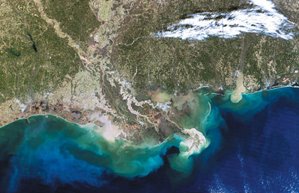
Satellite image of the Gulf of Mexico dead zone, October 2005.

Scientists: act now on Gulf of Mexico’s dead zone
By Cain Burdeau / December 12, 2008

NEW ORLEANS — Scientists have issued a report urging immediate government action to reduce urban and Midwest farmland runoff blamed for feeding an 8,000-square-mile dead zone in the Gulf of Mexico, an oxygen-deprived pool of water that has grown alarmingly off the mouth of the Mississippi River.

A report on Thursday by the National Research Council, a scientific and technology non-profit institution created by Congress, exhorted the federal government to take quick steps to avoid a tipping point and avert an ecosystem collapse similar to what has happened in the Chesapeake Bay and Denmark’s coastal waters.

“Action and progress … have been stalled for years,” the report said in calling for “decisive, immediate actions” to curtail polluting runoff from several Midwestern states that feed the Mississippi River and are blamed as factors in the dead zone’s growth.

The report called for the Environmental Protection Agency and U.S. Department of Agriculture to join in creating a Mississippi River Basin Water Quality Center to coordinate efforts. Pilot projects should be directed at reducing nitrogen and phosphorous runoffs seen as one culprit.

Scientists say the low-oxygen zone — created by massive algae blooms that consume oxygen in waters off Louisiana, Mississippi and Texas — makes it harder for organisms to survive, robbing them of reproductive energy needed to continue life in those waters. The low-oxygen condition is called hypoxia by scientists.

“The existence of gulf hypoxia is a national-level water quality problem that has been persistent, has become larger over time, and will require decisive actions to remedy,” the report warned.

Recent studies, funded by the National Oceanic and Atmospheric Administration and others, have found the dead zone is tampering with the Gulf food chain. The term scientists use to describe changes in the food chain is a “regime shift” in the oxygen-deprived waters

The dead zone was first studied in the 1970s. Since then, the zone has grown and scientists warn it could threaten Gulf fisheries, where the largest fleet of fishermen in the Lower 48 states works.

Studies show the health of copepods, small crustaceans grazed on by larger species, and shrimp have been affected by the dead zone.

“What we’re finding is that we see these regime shifts sometimes where instead of producing a normal food chain we wind up with just jellyfish,” said Paul Montagna, a biologist at Texas A&M University-Corpus Christi.

He said the problem is “very complex” and “very real.”

In recent years, the dead zone has gotten so big that it has stretched from the Texas coast to Mississippi. The low-oxygen area dissipates in the winter months and returns in the spring and summer.

Federal agencies besides NOAA are beginning to acknowledge the phenomenon.

Last year, a report by the Environmental Protection Agency said a “regime shift” in the Gulf caused by the annual flushing of nitrogen and phosphorous from the Midwest through the Mississippi had taken place, the NRC report noted.

The NRC report, requested by EPA, was a follow-up to a 2007 document outlining the dead zone problem.

Thursday’s report comes as President George W. Bush prepares to end his term, leaving the dead zone to President-elect Barack Obama’s administration.

Earlier this week, Obama picked Lisa Jackson to head EPA. To advocates in Louisiana, that’s good news because Jackson’s family is from New Orleans.

Len Bahr, retired director of applied science at Louisiana’s governor’s office who now runs a blog, wrote Friday that NRC’s recommendations “obviously target the Obama transition team” and “reflect long-standing frustration over a decade of failure” to deal with runoff pollution.

“If you put her up against the current EPA administrator, Stephen Johnson, she’s a breath of fresh air,” said Monique Harden, co-director of the New Orleans-based Advocates for Environmental Human Rights.

Jackson did not return telephone calls seeking comment.

She is the chief of staff of New Jersey Gov. Jon Corzine and was a member of Obama’s energy and natural resources transition team. Previously, she worked 16 years at EPA.

She was born in Philadelphia and raised by adopted parents in the Lower 9th Ward, where her family was living when Hurricane Katrina destroyed the neighborhood in August 2005.

On Friday, EPA said it planned to send $3.7 million to 10 groups and organizations in the upper Mississippi River basin to restore wetlands and riverbanks, clean watersheds and document water quality.

“This seed money will grow innovative, cost-effective solutions to speed up the cleanup of impaired watersheds in the Mississippi River Watershed and cut the size of the dead zone in the Gulf of Mexico,” said Benjamin Grumbles, EPA assistant administrator for water.

Source / Houston Chronicle

Thanks to Janet Gilles / The Rag Blog

Posted in RagBlog | Tagged , , | Leave a comment

Vitamin D May Be Important for Diabetics


D for diabetes: Study says vitamin D may be needed for diabetics
By Stephen Daniells / December 16, 2008

Over 75 per cent of young type-1 diabetics may require vitamin D supplements, after a US study reported ‘surprisingly’ high levels of insufficiency.

Writing in The Journal of Pediatrics, Boston-based researchers surveyed 128 youths aged between 18 months and 17.5 years with type 1 diabetes. They found that 61 per cent of the youths had insufficient levels of vitamin D, and 15 per cent were clinically deficient.

Insufficient levels of the vitamin may increase the risk of complications later in life, said the researchers, most notably in terms of weakened bone strength, and an increased risk of risk in middle and older age.

“We need to make sure all youths in general are getting enough vitamin D in their diets,” said Britta Svoren, MD, lead author of the study.

“And, we need to pay particular attention to those with diabetes as they appear to be at an even higher risk of vitamin D deficiency. For children who are not drinking sufficient amounts of vitamin D fortified milk, we are encouraging them to take a vitamin D supplement of 400 IU daily,”she added.

Type-1 diabetes occurs when people are not able to produce any insulin after the cells in the pancreas have been damaged, thought to be an autoimmune response. The disease is most common among people of European descent, with around two million Europeans and North Americans affected.

In addition, the incidence of the disease is on the rise at about three per cent per year, according to the authors of a meta-analysis published earlier this year (Archives of Disease in Childhood, doi:10.1136/adc.2007.128579). The number of new cases is estimated to rise 40 per cent between 2000 and 2010.

Study details

Researchers, from the Joslin Diabetes Center in Boston and Harvard Medical School measured levels of serum 25-hydroxyvitamin D (25(OH)D) in the youths. The participants included both those with recent onset of diabetes and those who had long-established diabetes.

Of the 128 youths in the study, only 24 per cent had sufficient levels, and these were mostly the younger participants. Indeed, deficiencies were mostly observed in the older subjects. Furthermore, 85 per cent of the adolescents in the sample demonstrated inadequate vitamin D levels, said the researchers.

In addition to potential skeletal problems later in life as a result of insufficient vitamin D levels, the researchers note that vitamin D deficiency in infants and children is associated with bone deformation, while insufficiency also prevents youths from attaining their optimal bone mass.

“In addition to inadequate levels of vitamin D, adolescent patients with type-1 diabetes potentially possess multiple risk factors for increased skeletal fragility,” wrote the researchers.

Svoren and her co-workers noted that since many of the risk factors for low vitamin D status may not be modifiable, “ensuring vitamin D sufficiency throughout childhood and during the time of maximal bone mineral accrual seems particularly warranted in this population”.

The researchers were interested in looking at vitamin D levels because of the vitamin’s presumed role in immune modulation and because it is thought to possibly play a role in the occurrence of type-1 diabetes.

Indeed, the earlier meta-analysis in the Archives of Disease in Childhood reported a potential protective role from vitamin D on the occurrence of type-1 diabetes.

Shedding light on the sunshine vitamin

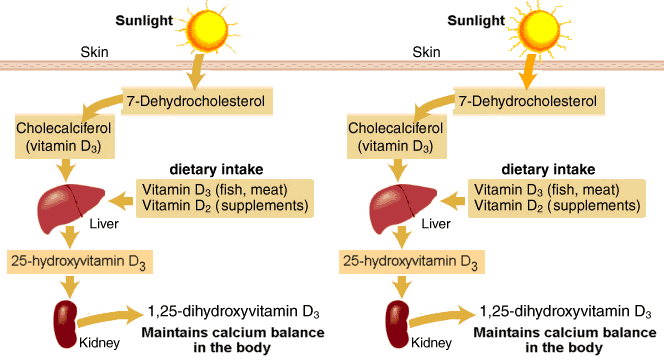
Vitamin D refers to two biologically inactive precursors – D3, also known as cholecalciferol, and D2, also known as ergocalciferol. The former, produced in the skin on exposure to UVB radiation (290 to 320 nm), is said to be more bioactive.

Both D3 and D2 precursors are hydroxylated in the liver and kidneys to form 25- hydroxyvitamin D (25(OH)D), the non-active ‘storage’ form, and 1,25-dihydroxyvitamin D (1,25(OH)2D), the biologically active form that is tightly controlled by the body.

Source: The Journal of Pediatrics
January 2009, Volume 154, Issue 1, Pages 132-134
“Significant Vitamin D Deficiency in Youth with Type 1 Diabetes Mellitus”
Authors: B.M. Svoren, L.K. Volkening, J.R. Wood, L.M.B. Laffel

Source / Nutra-Ingredients-USA

Thanks to Janet Gilles / The Rag Blog

Posted in RagBlog | Tagged , | 1 Comment

Cuba: Ahead of the Curve on Food Sustainability

A banana plantation is seen in San Antonio de los Banos in Havana in this July 18, 2008 file photo. Photo: Reuters/Enrique De La Osa/Files.

In ‘Eat Local’ Movement, Cuba Is Years Ahead
By Esteban Israel / December 16, 2008

HAVANA – After the collapse of the Soviet Union in 1991, Cuba planted thousands of urban cooperative gardens to offset reduced rations of imported food.

Now, in the wake of three hurricanes that wiped out 30 percent of Cuba’s farm crops, the communist country is again turning to its urban gardens to keep its people properly fed.

“Our capacity for response is immediate because this is a cooperative,” said Miguel Salcines, walking among rows of lettuce in the garden he heads in the Alamar suburb on the outskirts of Havana.

Salcines says he is hardly sleeping as his 160-member cooperative rushes to plant and harvest a variety of beets that takes just 25 days to grow, among other crops.

As he talks, dirt-stained men and women kneel along the furrows, planting and watering on land next to a complex of Soviet-style buildings. Machete-wielding men chop weeds and clear brush along the periphery of the field.

Around 15 percent of the world’s food is grown in urban areas, according to the U.S. Department of Agriculture, a figure experts expect to increase as food prices rise, urban populations grow and environmental concerns mount.

Since they sell directly to their communities, city farms don’t depend on transportation and are relatively immune to the volatility of fuel prices, advantages that are only now gaining traction as “eat local” movements in rich countries.

ROOFTOPS AND PARKING LOTS

In Cuba, urban gardens have bloomed in vacant lots, alongside parking lots, in the suburbs and even on city rooftops.

They sprang from a military plan for Cuba to be self-sufficient in case of war. They were broadened to the general public in response to a food crisis that followed the collapse of the Soviet Union, Cuba’s biggest benefactor at the time.

They have proven extremely popular, occupying 35,000 hectares (86,000 acres) of land across the Caribbean island. Even before the hurricanes, they produced half of the leaf vegetables eaten in Cuba, which imports about 60 percent of its food.

“I don’t say they have the capacity to produce enough food for the whole island, but for social and also agricultural reasons they are the most adequate response to a crisis,” said Catherine Murphy, a U.S. sociologist who has studied Cuba’s urban gardens.

GREEN PRODUCTIVITY

In Alamar, the members get a salary and share the garden’s profits, so the more they grow, the more they earn. They make an average of about 950 pesos, or $42.75, per month, more than double the national average, Salcines said.

The co-op, which began in 1997, now produces more than 240 tons of vegetables annually on its 11 hectares (27 acres) of land, which is about the size of 13 soccer fields.

The gardens sell their produce directly to the community and, out of necessity, grow their crops organically.

“Urban agriculture is going to play a key role in guaranteeing the feeding of the people much more quickly than the traditional farms,” said Richard Haep, Cuba coordinator for German aid group Welthungerhilfe, which has supported these kinds of projects since 1994.

When the Soviet Union fell apart, Cuba’s supply of oil slowed to a trickle, hurting big state agricultural operations. Chemical fertilizers were replaced with mountains of manure, and beneficial insects were used instead of pesticides.

Unlike in developed countries, where organic products are more expensive, in Cuba they are affordable.

“We have taken organic agriculture to a social level,” said Salcines.

Some experts fear that rising international food prices along with the destruction of the hurricanes will return Cuba to the path of agrochemicals. The government is planning to construct a fertilizer plant with its oil-rich ally Venezuela.

But Raul Castro, who replaced ailing brother Fidel Castro as president in February, has also borrowed ideas from the urban gardens as he implements reforms to cut the island’s $2.5 billion in annual food imports, much of it from the United States.

Castro has decentralized farm decision-making and raised the prices that the state pays for agricultural products, which has increased milk production, for example, by almost 20 percent.

And, in September, the government began renting out unused state-owned lands to farmers and cooperatives, measures that met with approval of international aid groups.

“Decentralization and economic incentives. If those elements are expanded to the rest of the agricultural sector, the response will be the same,” said Welthungerhilfe’s Haep.

[Reporting by Esteban Israel; Editing by Jeff Franks and Eddie Evans.]

© 2008 Reuters

Source / Common Dreams

The Rag Blog

Posted in RagBlog | Tagged , , , | Leave a comment

Global Warming : Past the Tipping Point


The Most Important Number on Earth
Now that we know how far we are past the carbon tipping point, it’s time to freak out—and get to work
.

By Bill McKibben

Sooner or later, you have to draw a line.

We’ve spent the last 20 years in the opening scenes of what historians will one day call the Global Warming Era—the preamble to the biggest drama that humans have ever staged, the overture that hints at the themes that will follow for centuries to come. But none of the notes have resolved, none of the story lines yet come into clear view. And that’s largely because until recently we didn’t know quite where we were.

From the moment in 1988 when a nasa scientist named James Hansen told Congress that burning coal and gas and oil was warming the earth, we’ve struggled to absorb this one truth: The central fact of our economic lives (the ubiquitous fossil fuel that developed the developed world) is wrecking the central fact of our physical lives (the stable climate and sea level on which civilization rests). For a while, and much longer in the US than elsewhere, we battled over whether this was true. But warm year succeeded warm year and that fight began to subside. Instead, the real question became, is this a future peril, the kind of thing you take out a reasonably priced insurance policy to guard against? Or is it the oh-my-lord crisis you drop everything else to deal with? Will Hitler be happy with the Sudetenland, or is the world going to spend every cent it has, not to mention tens of millions of lives, fighting him off? Trouble, or TROUBLE? These last 12 months, we’ve found out.

It was September 2007 that the tide began to turn. Every summer Arctic sea ice melts, and every fall it refreezes. The amount of open water has been steadily increasing for three decades, a percent or two every year—it’s been going at about the pace that the hairline recedes on a middle-aged man. It was worrisome, and scientists said all the summer ice could be gone by 2070 or so, which is an eyeblink in geologic time but an eternity in politician time. In late summer of last year, though, the melt turned into a rout—it was like those stories of people whose hair turns gray overnight. An area the size of Colorado was disappearing every week; the Northwest Passage was staying wide open all September, for the first time in history. Before long the Arctic night mercifully descended and the ice began to refreeze, but scientists were using words like “astounding.” They were recalculating—by one nasa scientist’s estimate the summer Arctic might now be free of ice by 2012. Which in politician years is “beginning of my second term.”

The key phrase, really, was “tipping point.” As in “I’d say we are reaching a tipping point or are past it for the ice. This is a strong indication that there is an amplifying mechanism here.” That’s Pål Prestrud of the Center for International Climate and Environmental Research-Oslo. Or this, from Mark Serreze, of the National Snow and Ice Data Center at the University of Colorado: “When the ice thins to a vulnerable state, the bottom will drop out…I think there is some evidence that we may have reached that tipping point, and the impacts will not be confined to the Arctic region.”

“Tipping point” is not, in this context, an idle buzzword. It means that the physical world is taking over the process that humans began. We poured carbon into the atmosphere, trapping excess heat; that excess heat began to melt ice. When that ice was melted, there was less white up north to reflect the sun’s rays back out to space, and more blue ocean to absorb them. Events began to feed upon themselves. And in the course of the last year, we’ve seen the same thing happening in other systems. In April, the National Oceanic and Atmospheric Administration released a report showing that 2007 had seen a sudden and dramatic surge in the amount of methane, another heat-trapping gas, in the atmosphere. Apparently, one reason is that when we burned all that fossil fuel and began raising the temperature, we also started melting the permafrost—melting eight times more of it in some places over two decades than had thawed for the previous 1,000 years. And as that frozen soil thaws, it releases methane; enough of it now bubbles out to make “hot spots” in lakes and ponds that don’t freeze during the deepest part of the Siberian winter. The more methane, the more heat, the more methane. Wash, rinse, repeat.

The final piece of the puzzle came early this year, and again from James Hansen. Twenty years after his crucial testimony, he published a paper with several coauthors called “Target Atmospheric CO2” (.pdf). It put, finally, a number on the table—indeed it did so in the boldest of terms. “If humanity wishes to preserve a planet similar to that on which civilization developed and to which life on Earth is adapted,” it said, “paleoclimate evidence and ongoing climate change suggest that CO2 will need to be reduced from its current 385 ppm to at most 350 ppm.”

Get that? Let me break it down for you. For most of the period we call human civilization, the amount of carbon dioxide in the atmosphere hovered at about 275 parts per million. Let’s call that the Genesis number, or depending on your icons, the Buddha number, the Confucius number, the Shakespeare number. Then, in the late 18th century, we started burning fossil fuel in appreciable quantities, and that number started to rise. The first time we actually measured it, in the late 1950s, it was already about 315. Now it’s at 385, and growing by more than 2 parts per million annually.

And it turns out that that’s too high. We never had a number before, so we never knew whether we’d crossed a red line. We half guessed and half hoped that the danger zone might be 450 or 550 parts per million—those were still a little ways in the distance. Therefore we could get away with thinking like the young Augustine: “Lord, make me chaste, but not yet.” Not anymore. We have been told by science that we’re already over the line.

And so we’re now in the land of tipping points. We know that we’ve passed some of them—Arctic sea ice is melting, and so is the permafrost that guards those carbon stores. But the logic of Hansen’s paper was clear. Above 350, we are at constant risk of crossing other, even worse, thresholds, the ones that govern the reliability of monsoons, the availability of water from alpine glaciers, the acidification of the ocean, and, perhaps most spectacularly, the very level of the seas. It is at least conceivable that instead of a slow, steady rise in the height of the oceans, we could see rapid melt in Greenland and the West Antarctic, where much of the world’s frozen water resides. We can’t rule out, warns Hansen, a sea level rise of up to 20 feet this century. Plug that into Google Earth and watch waterfront developments turn into high-priced reefs. We can’t rule out, in other words, the collapse of human society as we’ve known it. “If humanity wishes to preserve a planet similar to that on which civilization developed and to which life on Earth is adapted…” We should add the phrase to the oath of office for every politico on the third planet.

So what does this mean? If you took 350 to be the most important number on the planet, what would it imply?

In essence, it means that we’ve got to transform the world’s economy far more quickly than we’d hoped. Almost everyone knows that this transformation is coming—that by century’s end we won’t be relying on fossil fuel, both because the oil will have run out and because the environmental damage will be intense. But the question is how quickly. The kind of change envisioned before last year was still a little leisurely—maybe the developed world cutting its carbon emissions 15 or 20 percent by 2020. That’s far more than the Bush administration or its energy-industry cronies would go for, of course—at ExxonMobil’s annual meeting last spring, ceo Rex Tillerson said he envisioned a world that still used fossil fuel for two-thirds of its power in 2030. A world where change came slowly enough that everyone could make every last penny off their sunk investments in coal mines and oil platforms. And a world where politicians didn’t need to raise the price of carbon steeply, and hence didn’t need to arouse voters.

But the 350 world looks different. We’re not worried we might have a weight problem. We’ve been to the doctor and the doctor has said, “Your cholesterol is too high. Scaring me. You’re in the danger zone. You need to change your diet and then you need to pray that you get back down where you’re supposed to be before the stroke that’s coming at you.” When that happens, you clean the cheese out of the refrigerator and go cold turkey.

In energy terms, that would look like this:

[ 1 ] No more new coal plants, because although the world still has immense amounts of coal, it’s immensely dirty. And the people who tell you about clean coal are blowing smoke—literally.

[ 2 ] A cap on the amount of carbon the country can produce—which, in essence, is a tax. America would say, just as it does now with sulfur from coal plants, “We’re only going to release so much carbon every year.” CO2 would stop being free; in fact, it would become expensive. In order to simplify the process, the upstream producer who mines, imports, or sells the fossil fuel would get the tab. ExxonMobil would have to pay dearly for a permit to release x amount of carbon, a cost it would pass on to consumers. Then those consumers would use less, and markets would go to work figuring out all the possible ways to cut demand and boost renewables.

[ 3 ] An international agreement, including China and India, to do the same thing around the world.

Now, these are three of the hardest tasks we’ve even thought about since we took on Hitler. They go to the very heart of the way our economy operates: We get most of our electricity from fossil fuels, any increase in the price of energy affects every single part of the economy, and China and India are pulling people out of poverty largely by burning cheap coal. If you’re a person who uses a lot of fossil fuel, i.e. an American, then they’re unappealing. If you’re a person who would like to use even a little energy, i.e. almost anyone in the developing world, then they’re maddening. And yet they are what the physics and chemistry of the situation dictate. So the question becomes, how to make them happen?

The logic imposed by 350 is fairly straightforward. In order to keep Americans from rebelling, we need to take the money we’re charging ExxonMobil for those pollution permits and return it to the taxpayers—everyone needs to get a check every month to, in essence, buy us all off. To help make us whole for the price rises that will inevitably come, the price rises that will do the work of wringing fossil fuel out of the economy. ExxonMobil would pay, then we’d pay—but we’d get some of the money back in the mail. We’ve got to make the switch so fast that it’s going to be brutally expensive—think $10 gas—and our democracy will never support it for long without that monthly check.

But we can’t give ourselves back all the money. Because some of it is needed to make the rest of the world whole—to build windmills for the Indians so they won’t use the same cheap coal that we used for 200 years in order to get rich. That is, we’re going to need a Marshall Plan for carbon—with the same mix of idealism and self-interest that motivated the Marshall Plan in Hitler’s wake.

We also need serious investment in infrastructure, both technological and human. For instance, concepts like concentrated solar power—those big mirror arrays in the desert—have gained real momentum in the last 18 months. Former Clinton administration energy analyst Joseph Romm recently calculated that such arrays could provide America with all of its electricity from a 92-square-mile grid in the Southwest desert—but only if promoted via loan guarantees for the entrepreneurs who build them and a new generation of transcontinental transmission lines. Meanwhile, demand is skyrocketing for small rooftop solar panels, but increasingly there’s a shortage of trained installers, which means our community colleges need money to start training them. No matter what the price of energy, homes aren’t going to insulate themselves—this is the great opening for a green-jobs revolution. (See “The Truth About Green Jobs.”)

You’ll note here I’m talking more about what we should do in the US House (and Senate) in the next year or two than which bulbs you should be changing in your house. diy conservation makes great practical sense, but we won’t save the planet that way. One by one, trying to do the right thing, we add up to…not nearly enough. You cannot make the math work that way—there are too many sockets and too many tailpipes and most of all too much inertia for voluntary action to do the trick. It didn’t work when President Bush made voluntary reduction by corporations his global warming “policy,” and it won’t work fast enough with individuals either.

Which is not to say that life at home doesn’t need to change. It does—and it will, once we’ve taken the political step of making the price of carbon reflect the damage it does to the environment. Look at what happened this past year when the price of gas finally rose far enough to get our attention. We began riding trains and buses in record numbers. Total miles driven fell, sharply, for the first time since we started keeping records in 1942. We groused and moaned and we started to change. General Motors decided to sell its Hummer factory.

If we get that check every month to cover some of the damage, it will help attenuate the very real heat-or-eat dilemma that will grip many people this coming winter, but the incentive to change will still be there. Buses and bikes. Smaller homes that are easier to heat. Solar panels, bought on the installment plan with loans paid off from the power generated on your roof. Local food (and lots more local farmers). Vacations in the neighborhood—no more jetting off for the weekend.

You can see every one of these trends in embryo already, driven by the run-up in energy prices that we’ve seen so far. The quick contraction of the airline industry. The collapse in home values in the distant suburbs, while homes along the commuter rail lines fare better. Again the question is all about pace—what will make them happen fast enough, across a wide enough swath of the planet. Al Gore set the example with his call for a 10-year conversion to noncarbon electricity. It’s at the outer edge of doable, and the outer edge is where we need to be. We’ll have plug-in hybrid electric vehicles on sale by 2010. The question is, can we have nothing else on sale by 2020? We built more than half of the interstate highway system in a decade. Would rebuilding our rail networks to a European standard be all that much harder? Can we get the price of energy up quickly enough to get markets on the task of finding a low-carbon way of life that works? And by works, I mean reverses the flow of carbon into the atmosphere. Because physics and chemistry won’t reward good intentions. Methane is seriously uninterested in compromise. Permafrost, notoriously, refuses to bargain. Even the absolute political power represented by King Canute couldn’t hold back the rising seas. Those forces will only pay attention if we can scramble back below 350.

Forcing that pace requires a new kind of politics. It requires forging a consensus that this toughest of all changes must happen. The consensus must be broad, it must come quickly, and it must encompass the whole earth—they don’t call it global warming for nothing.

The list of things on which we’ve achieved a broad and deep global consensus is pretty much limited to…Coke Is It. And that took billions of dollars and several decades, and it involved inducing people to drink sugar water. The odds against a strong global movement about anything tougher than that are low, with language barriers, religious barriers, cultural barriers. And we start from such incredibly different places—Americans use 12 times the energy of sub-Saharan Africans.

And yet we do have this one tool that at least offers the possibility, a tool that wasn’t fully there even a few years ago. The Internet—and its attendant technologies, like cell phones and texting—does link up most of the known world at this point. You can get pretty far back of beyond in most of the world, and someone in that village has a mobile.

And we have a number—350. The most important number on earth. If the Internet has a cosmic purpose, this could be it—to take that number and spread it everywhere on the planet, so that everyone, even if they knew little else about climate change, understood that it represented a kind of safety, a bulwark against the monsoon turning erratic, the sea rising over their fields, the mosquito spreading up their mountain.

I’m part of a group of people calling ourselves 350.org. Our goal is simple—to try to get people everywhere to spread that number. We’ve started finding musicians and artists, athletes and video makers, and most of all activists, the kinds of people who are working to save watersheds or babies, or to educate girls or to block dams, or any of the other thousand lovely things that won’t happen if we allow the basic physical stability of the planet to come unglued. We need a lot of noise, and we need it fast, in the scant months—14 now—before the world meets in Copenhagen next December to draw up a new climate treaty. Because one clear implication of 350 is that that treaty is our last real chance to get it right. If we don’t, then all we’ll be dealing with is the consequences. Once the ocean really starts to rise, dike building is pretty much the only project.

It’s not clear if a vocal world citizenry will be enough to beat inertia and vested interest. If 350 emerges as the clear bar for success or failure, then the odds of the international community taking effective action increase, though the odds are still long. Still, these are the lines it is our turn to speak. To be human in 2008 is to rise in defense of the planet we have known and the civilization it has spawned.

[This article was first published in the November/December, 2008, issue of Mother Jones.]

Source / Mother Jones

Thanks to David Hamilton / The Rag Blog

Posted in RagBlog | Tagged , , , , | 3 Comments

Kate Braun: Yule Seasonal Message


Yule Seasonal Message
By Kate Braun / The Rag Blog / December 16, 2008

“Hark! the herald angels sing: Glory to the new-born King”

Sunday, December 21, 2008 we celebrate Yule, the Winter Solstice. How appropriate that this day, which marks the beginning of Lord Sun’s ascent to prominence, is Sun-day! Lady Moon is in her 4th quarter, seeming to voluntarily minimize her powers in recognition of Lord Sun’s rebirth. The Wheel is turning; the balance is shifting; the Earth is awakening.

Decorate your altar, table, house, and yourself using the colors red, white, and green. In addition to a Yule Tree, there may be boughs of greenery draped across the fireplace mantle, in front of your altar, over doorways, and as a wreath on the front door. A sprig of holly near the front door invites good fortune for the coming year and other sprigs, tied with a shiny red bow, can be used as party favors for your guests to take home and affix near their front doors. A small Yule Log with holes drilled in it to hold candles and surrounded by greenery can make a lovely centerpiece for your table. The use of evergreens in decoration symbolizes everlasting life, just as Lord Sun’s growing vitality after the dark time that began at Samhain symbolizes the earth’s reawakening and rejuvenation. And don’t forget a sprig of mistletoe to hang over the entrance. In the Long Ago, when warring Celtic tribes met to celebrate Yule, they kissed under the mistletoe as a pledge to set aside all differences during the celebration.

Serve your guests roast meats, nuts, apples, pears, Wassail, apple cider, spicy foods; sing carols in praise of Lord Sun’s rebirth. Yule is a season for celebrations as well as one for contemplation. Enjoy and cherish the company of friends and family. The end of a year and the beginning of the next is a good time to look within, to take some time and listen to our souls’ voices. Spiritually, we are awakening from a “long winter‘s nap“, readying ourselves for the next turn of the Wheel and all the delightful joys awaiting us in the coming year.

Yule, which comes from a Celtic word that means “wheel”, celebrates the change of power from the Holly King, who has ruled the planet since the Summer Solstice, to the Oak King, now filled with youthful energy. The Druids considered the Oak and Holly to be sacred trees; part of the Druidic mythology regarding the Solstices is that the Oak and Holly Kings, twin brothers, engage in semi-annual ritual combat to decide who rules for the next half-year. At the Winter Solstice, the Holly King is king of the old year. He dresses in red, trimmed with white fur, and wears a sprig of mistletoe on his cap. he rides in a sled or sleigh pulled by 8 reindeer — all deer were sacred to the Celtic gods and the number 8 refers to the 8 seasons represented by the 8-spoked Wheel of Life — and will be defeated by the Oak King, who symbolizes the young vitality of the New year. As Father Time is ritually succeeded by a diapered baby, so is the Holly King supplanted by the Oak King. Out with the old year; in with the new; sing songs of praise and exaltation to welcome Lord Sun‘s ascendance!

Reminder: I will be Elaine Ireland’s guest on her live-on-the-internet-radio-talk-show on Thursday, December 18, 2008, at 9 PM CDT. To listen on your computer, log on to www.bbsradio.com; from the options shown, select Channel 1 and from the drop-down menu look for “Going Global for Spirit with Elaine Ireland” and click on it. You will be able to hear me and Elaine nattering on about the Solstice and whatever else comes up. There is also a toll-free number for listeners in the US, in Canada, and in the rest of the world, so callers may phone in with a question, a comment, or to get a short Tarot reading from me.

The first Metaphysical Fair of 2009 will be on Saturday and Sunday, January 2 & 3, 2009, at the Radisson Hotel on Middle Fiskville Road between Highland Mall and Lincoln Village. Friday, January 1, 2009, the annual Prediction Panel of 5 of the psychics participating in the fair will be open to the public at 7:00 PM in the lecture room associated with the Metaphysical Fair at the Radisson Hotel. Admission to the Prediction Panel: free. Admission to the Fair: $8, good for both days. If you come to this fair because you read about it here and decide to get a reading from me, let me know you read this Seasonal Message and you will get an additional 5 minutes free. Whether or not you get a reading from me at this fair, please stop by the Tarot by Kate table and say “hi”. This is helps me monitor my advertising efforts.

Tarot by Kate 512-454-2293
www.tarotbykateinaustin.com
kate_braun2000@yahoo.com

The Rag Blog

Posted in Rag Bloggers | Tagged , | 1 Comment

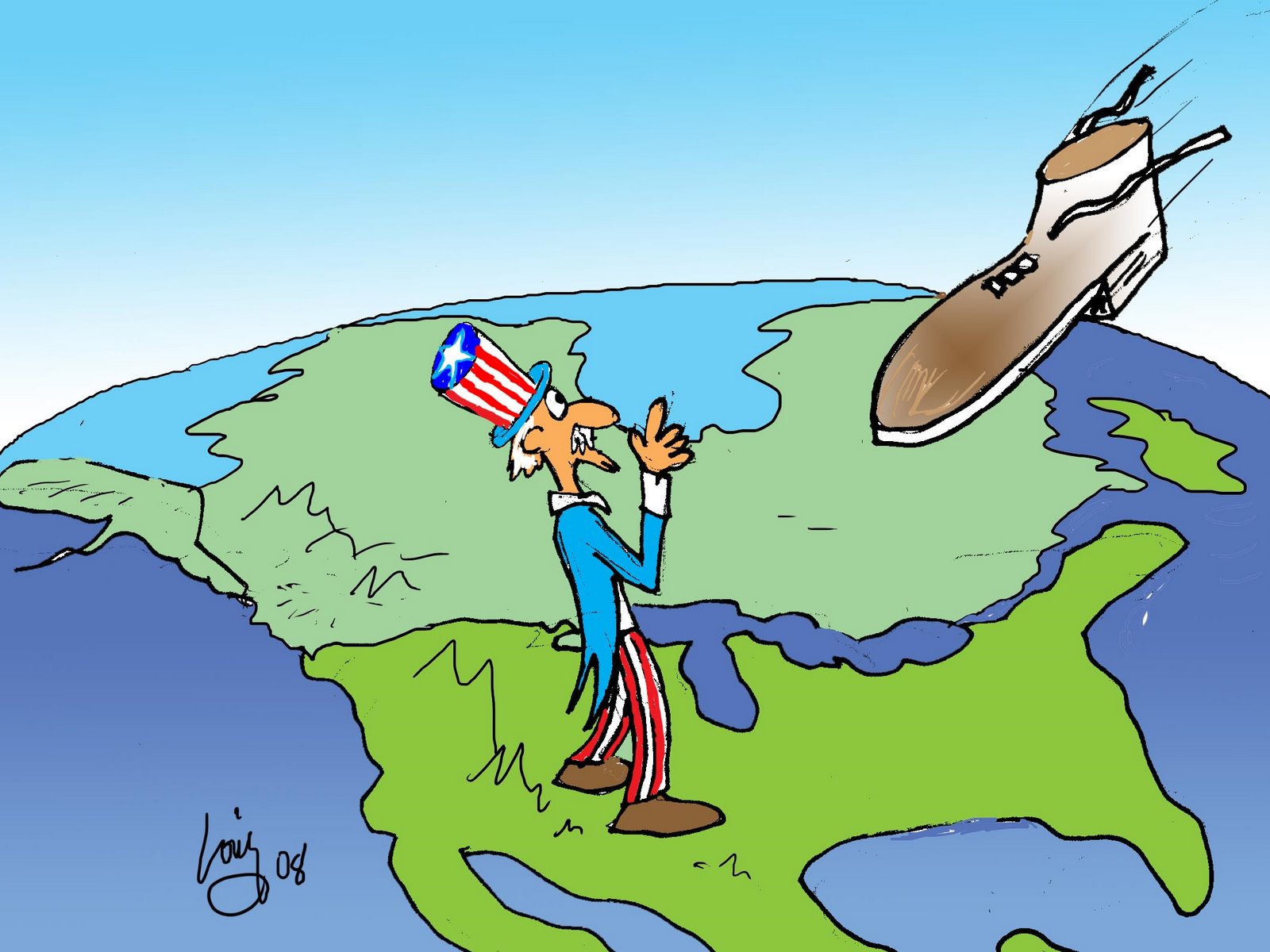
If the Shoe Fits Throw it


Cartoons by Ralph Solonitz / The Rag Blog

Ralph Solonitz’ cartoons also appear on MadasHellClub.net

The Rag Blog

Posted in Rag Bloggers | Tagged , | 2 Comments

Brother: Shoe-Throwing Journalist Hospitalized After Beating

Muntazer al-Zaidi risks a miminum of two years in prison for insulting a visiting head of state. Photo by AFP.
 

Brother says Bush shoe-thrower in hospital after beating: ‘He has been taken to Ibn Sina hospital because he has a broken arm and ribs and is also suffering injuries to his eye and leg.’

December 16, 2008

BAGHDAD — The Iraqi journalist who hurled shoes at US President George W. Bush is in hospital after being beaten up by security guards, his brother charged on Tuesday, as judicial authorities launched a probe into the incident that grabbed headlines around the world.

“He has been taken to Ibn Sina hospital because he has a broken arm and ribs and is also suffering injuries to his eye and leg,” Durgham al-Zaidi said of his brother Muntazer.

The 29-year-old Muntazer al-Zaidi became an instant star in the Arab world when he threw his shoes at Bush on Sunday during the US leader’s farewell visit to the country invaded by American forces in 2003.

Zaidi, a journalist for private Iraqi television channel Al-Baghdadia, was swiftly overpowered by Iraqi security forces after his action, regarded as the supreme mark of disrespect in the Muslim world.

His brother charged that Zaidi had been beaten by Iraqi security guards but was unable to say whether Muntazer had sustained the injuries while being overpowered during Sunday’s protest or while in custody.

He said he had been told that his brother was initially held by Iraqi forces in the Green Zone where the US embassy and most government offices are housed. The Ibn Sina hospital, which is run by American military medical services, is also inside the zone.

An AFP journalist said blood was visible on the ground as he was led away into custody on Sunday although it was unclear if it was his.

“Muntazer al-Zaidi has been transferred to the judicial authorities who have opened an investigation. But it is too soon to say who was behind this act,” General Qassem Atta, spokesman for a Baghdad security plan, told AFP.

Bush, who was on a swansong visit to the battleground that came to dominate his eight-year presidency, ducked when the shoes were thrown and later made light of the incident.

Zaidi’s action won him widespread plaudits in the Arab world where Bush’s policies have drawn broad hostility, although Iraqi reaction was mixed.

In parliament, Baha al-Araji, an MP with the Shiite movement headed by radical anti-American cleric Moqtada al-Sadr, demanded an inquiry into the “brutality” of the security guards.

But Sami al-Askari, a Shiite lawmaker close to Prime Minsiter Nuri al-Maliki, lashed out at Zaidi for what he branded a “shameful act which sullies the reputation of the media.”

An Iraqi lawyer said Zaidi risks a minimum of two years in prison if he is successfully prosecuted for insulting a visiting head of state.

In Gaza, around 20 Palestinian gunmen from the Popular Resistance Committees, a hardline militant group behind a spate of rocket attacks on Israel in recent weeks, staged a demonstration in support of Zaidi.

Wearing fatigues and brandishing Kalashnikov assault rifles, they stamped on photographs of the US president and held banners in support of the journalist.

In Iraq, press comment was divided.

The pro-government Al-Sabah expressed concern about the potential impact on press freedom of what it called Zaidi’s “abnormal individual behaviour.”

But the independent Al-Dustur hailed the journalist as the “only Iraqi whose patriotic feelings made him express his opinion in this way.”

“It is not a declaration by the Iraqi media only, but for all Iraqis who have suffered over the years and we demand that he not be handed over to US forces,” the paper said.

Lebanese television channel NTV, known for its opposition to Washington, went as far as offering a job to the journalist, saying he would be paid “from the moment the first shoe was thrown”.

“Pelting the American president with shoes was the best way for expressing what Iraqis and Arabs feel toward Bush,” wrote the editor of Egypt’s government owned Al-Gomhuria newspaper.

Source / AFP / Google News

The Rag Blog

Posted in RagBlog | Tagged , , , | 1 Comment