Gambling on McCain : The Stakes are Big


John McCain the High Roller
By Sherman De Brosse / The Rag Blog / October 13, 2008

This is the first of several articles by Sherman De Brosse on John McCain and his shady involvements, past and present.

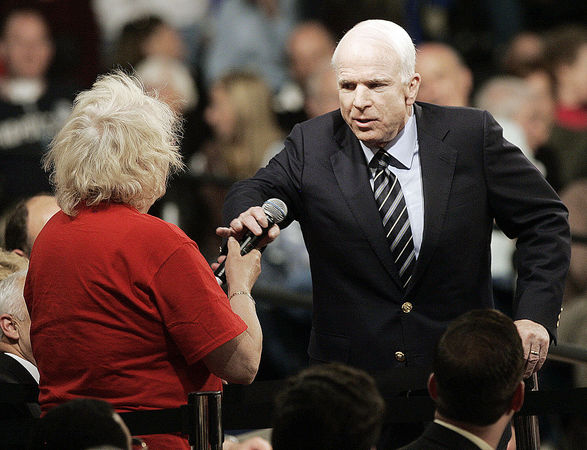
Senator John Mc Cain is known for his love of gambling and frequently engages in gambling marathons in Vegas. He is probably an addict with a serious problem. It is no secret, that he is given to taking great risks at the tables. Sometimes a gambling stint for him will last 14 hours. He does not gamble every day but is prone to monthly binges.

By all accounts, he gambles a lot, and Obama recently criticized McCain for gambling in a Connecticut casino with a lobbyist representing the Mashantucket Pequot tribe. At that time, he chaired the Senate Indian Affairs Committee, which oversaw Native American casinos. The Arizona senator should have refrained from voting on matters that affected that tribe.

However, the Senator, who gambles a few thousand at a time, tried not to take loans or markers from the house. So he is not entirely reckless, yet, some wonder if a legislator should be gambling in the casinos he regulates is proper. Forty of his fundraisers are in the gambling industry. Lately, to avoid publicity he has taken to playing craps in a private room, a right he has as a high roller.

Citizens for Ethics and Responsibility in Government filed a complaint with the Senate Ethics Committee on October 9, claiming McCain never reported on his taxes gambling losses or gains. Reporting losses should be a personal option. Yet it is bothersome that someone with so much influence in this area is not entirely open. Of course, the complaint will not be dealt with until long after the election.

Many of us have noticed over the years that gambling establishment seem to be more often linked with unsavory people than, say, dry cleaning establishments or donut shops. One might wonder what kinds of people Mc Cain meets in these dens for high rollers?

John and Cindy McCain are very rich people, so his gambling habit is not something that will take food off the family table. Some good psychologists claim it may not even be a major character disorder. However, a Swedish study suggests these gamblers are likely to be more impulsive than non gamblers and to be somewhat more dishonest. They are also inclined to extravagant behavior. Gamblers are somewhat less inclined than non-gamblers toward responsible behavior. We do not have enough iron-clad evidence to say McCain is a compulsive gambler. Decide for yourself if Mc Cain seems more impulsive and less responsible and truthful than most people.

Gamblers Anonymous says that compulsive gamblers have problems with emotional security, immaturity, and accepting reality. Think a little about McCain’s explosive temper, and you might see a connection.

McCain is considered one of the founding fathers of the Native American casino industry and he has close ties with many gambling interests. In May, 2007, J. Terrence Lanni, a Vegas casino executive, raised $400,000 for his pal John MC Cain. In 2000, the Bush campaign complained about McCain’s close ties to Native American casinos.

Though his committee, oversees gambling, he does not recuse himself when gambling comes up. He oversaw the investigation of Jack Abramoff’s abuse of Native Americans, which resulted in helping Abramoff’s rivals — McCain’s pals — and also smited some folks in the GOP who had opposed McCain in 2000. He found that Abramoff and others took over $66 million from the Native Americans and promised to get to the bottom of the matter. But the investigation ended there and McCain let the “perps” walk because much of the money was funneled to his Republican Party. He did not even call Ralph Reed to testify, though the Christian Right was deeply involved in Abramoff’s abuse of the Native Americans. In 2008, McCain used Reed in his campaign.

Its up to the reader to decide if the man who has a hand in regulating gambling should be so close to the industry and then fill his presidential campaign with gambling and communications lobbyists. He also has a big role in regulating communications. It does not seem prudent. There is more than a touch of arrogance here. He seems to be saying that everyone should know that John McCain has so much integrity that he need not avoid appearances of impropriety. It is absolutely true that McCain has had a masterful publicity campaign running over more than two decades burnishing his image as Mr. Integrity, but an examination of the facts reveals many chinks in his armor.

Sherman De Brosse, the peudonym for a retired history professor, is a contributor to The Rag Blog and also blogs at Sherm Says and on DailyKos.

Sources for this article.

Temperament and Character in Pathological Gambling / Journal of Gambling Studies

About the Problem of Compulsive Gambling / Gamblers Anonymous

John McCain’s gambling addiction (and tax “issues” too”) / Blog for Arizona

CREW files ethics complaint against Senator John McCain / Citizens for Responsibility and Ethics in Washington

John McCain’s Gambling Problem — and Ours? / By Greg Mitchell / July 7, 2008 / The Huffington Post

John McCain Criticized For Casino Game Playing / by Grant Nelson / Oct. 1, 2008 / 777 Gaming News

John McCain, Gambling Addict by Matthew Yglesias / Oct. 8, 2008, The Atlantic

John McCain’s gambling habit / by Alex Spillius / Sept. 29, 2008 / i report

McCain forged close ties to Las Vegas, tribal casinos / by Jo Becker and Don van Natta Jr. / Sept. 28, 2008 / NY Times News Service / boston.com

Senatorial Courtesy: Will John McCain Let Republican Perps Walk? / By Louis Dubose / Aug. 26, 2008 / Texas Observer

The Rag Blog

Posted in Rag Bloggers | Tagged , , | 1 Comment

Knee-Jerk Bailout Policy as Financial Cure-All? Here’s a Moderate Alternative.

Lower the hammer on knee-jerk policies.

‘The following economic essay is an intelligent alternative to the current economic crisis response under Paulson and Bernanke.’
By Roger Baker
/ The Rag Blog / October 13, 2008

Would the following moderate but sensible approach, offered as an alternative to Federal policy actually work to slowly restore the US economy, as we have known it, back to health?

Even a smart approach to US economic management is unlikely to succeed because it is blind to peak oil/energy constraints. An imbalance between inflexible oil supply and an inflexible but increasing demand for same is a sure prescription for cost-push inflation in the food and energy sector, which simultaneously tends to depress other consumer spending, even if no new money is added to the system. Oil shortages thus naturally tend to lead to stagflation. For the moment oil prices have crashed, but as world oil demand recovers while oil supply contracts, we are soon back to an even worse oil cost crisis.

But at least the following economic essay is an intelligent alternative to the current economic crisis response under Paulson and Bernanke. The point being made by the “Stalinist” reference is that the feds are as rude and crude as Stalin in applying a knee-jerk bailout policy as a financial cure-all.

Federal policy had initially involved bailouts of those stuck with vast derivatives obligations, via buying their bad paper debts. But now a banking or liquidity panic has spread internationally. The dynamics of fear cannot be measured in the numbers of dollars that Bernanke needs to add to the system to cause the fear to subside. If Bernanke’s helicopters start dumping cash on a large scale, it is as likely as not to reduce public confidence in the soundness of the system.

This injection of credit and cash and liquidity is bound to contribute to the other variety of inflation: demand-pull inflation. Bailouts that make good on bad paper, on the required scale, will put vast amounts of new dollars into circulation. These bailout dollars soon diffuse everywhere, causing a more generalized type of inflation.

With these two kinds of inflation are added together, naturally they tend to make the value of the dollar fall in value relative to other currencies. So OPEC will tend to raise the price of oil, which will further depress the US economy because of acute US addiction. That impact will require further bailouts, etc.

While the following prescription does fall well short of the nationalization of US banks and the treasury under public control, it offers a picture of what might be done by a government considerably wiser in its attempts to save the existing system than any that we are likely to have in the near future:

“…Regulating the level of economic activity and counteracting recession should fall under fiscal policies. The government has better means, agencies and fiscal instruments to fight economic recession than central bank monetary policy. The recent world crisis has shown that governments have to address shortages in food, energy, infrastructure, and social programs. Each government can draw a comprehensive stabilization program with properly designed fiscal and sectoral policies without compromising monetary stability…”

Monetary Stalinism in Washington
By Hossein Askari and Noureddine Krichene / October 11, 2008

Amongst the worst tragedies of Soviet collectivization was the Ukraine famine of 1932-33, which took six million lives as Joseph Stalin practiced forced appropriation of crops and imposed very low prices for agricultural products in favor of industrialization. Interference with the pricing mechanism and Stalinism in the form of very low prices for agricultural products also caused famines in India in 1965 and in China in 1969, with a human death toll well into the millions.

Monetary policy as practiced by the US Federal Reserve for the past decade is but a form of financial Stalinism, forcing ridiculously low or negative real interest rates, with catastrophic results that are now plaguing the world. Fed policy has disabled the price mechanism in capital markets and set off uncontrolled credit expansion at the expense of capital productivity and creditworthiness, pushing housing, food, and energy prices to prohibitive levels, and triggering food and energy riots in vulnerable countries. It has undermined the dollar and made the US highly dependent on foreign financing.

The dramatic consequences of Fed policy are unfolding before our very eyes. The financial crisis that broke out in August 2007 has recently taken a turn for the worse. After claiming international and well-established banks and investment banks, it has now reduced the financial savings of ordinary Americans (in retirement accounts) by over 30%.

The fiscal bill for past, ongoing and future bailouts by Fed chairman Ben Bernanke and Treasury Secretary Henry Paulson will be staggering; the US fiscal deficit will be blown up to unthinkable proportions, public debt will be pushed to unprecedented levels, and most public resources will be destined to absorb financial losses at the expense of social and economic programs.

Last, but not least, the long-term inflationary consequences may turn out to be even more dramatic. All these consequences are real and were in part predictable.

So far Bernanke and Paulson have failed miserably in stemming the financial crisis and have brought the US economy to a standstill, in part because Bernanke does not have a feel for the free-market mechanism and in part because he is not a prudent central banker.

It would appear that Bernanke has read a great deal about the Great Depression of 1929-1933 and perhaps very little, or nothing, about the German hyperinflation of 1920-1923. His view is that the Fed was liquidationist of banking institutions during 1929-33. In his view, if the Fed had injected sufficient liquidity during 1929-1932, it would have precluded thousands of bank failures. Therefore, Bernanke is determined not to let that mistake happen again. Consequently, his response to the financial crisis has been a blind and aggressive monetary policy in form of negative interest rates, massive liquidity injection, and massive bailouts.

Bernanke is like the medical doctor who is familiar with one drug, and who prescribes it to every patient he sees at full dose without diagnosis of what ails the patient or thinking what will happen if he takes the wrong medication.

Thinking that the US economy was in a deep recession in 2007, one similar to the Great Depression, he precipitously unleashed monetary policy. His rushed actions have destabilized the financial system, sent commodity prices skyrocketing, and crippled economic growth. The US economy in 2007 had no resemblance to either the institutional setting of the Great Depression or to the immense role and expansionary stance of fiscal policy. Namely, today, there are institutions that can prevent bank runs, such as the Federal Deposit Insurance Corporation, and the federal and state governments (both relatively far bigger than 1929) are running large deficits that should preclude a deep recession, especially if they adopt appropriate policies.

Hence, his inflationary approach was ill-designed and will be very costly in bank failures, high inflation and rising unemployment.

The Fed chairman is by far the most important personality on the US economic and financial landscape. In fact, both Wall Street and Main Street read his statements more carefully than reading the words of a president or the laws of the land. His words and actions are the most influential in the financial and economic world. Being in large part an independent institution, the Fed, largely under Bernanke’s predecessor Alan Greenspan, grasped absolute power over economic policymaking and decided to abandon its regulatory power, enabling the development of financial anarchy under the guise of financial engineering and innovations.

Such myopic faith in the free market has turned the US financial markets into a casino. The US president has negligible influence on economic policymaking and has become merely a symbolic figure. By subscribing fully to Bernanke and Paulson policies, the two presidential contenders have renounced their future economic role. The US Congress has become a rubber stamp of Fed policies. It applauded Greenspan�s policies and it now supports Bernanke-Paulson knee-jerk and costly bailouts. The US public is not so much interested in the presidential debates as in how Bernanke and Paulson policies will affect their jobs, retirement savings, tax liabilities and the very livelihoods of their children.

Wrong course will continue

Once the Fed follows a policy path, it hardly changes course, which means the Fed will perpetuate its cheap monetary policy indefinitely. After institutionalizing negative real interest, the Fed wants to institutionalize high housing prices and rents, and a depreciated dollar. While US banks are in the process of strengthening their balance sheets and opting for safe banking, the Fed is forcing them to extend credit regardless of risk and profitability, and to finance with short time resources long-term loans.

Recent desperate actions by the Fed consist of bypassing the banking system and extending directly low-cost loans to borrowers regardless of risk and nationalizing the banking system. The Fed sees no limit for issuing trillions of dollars by electronically crediting borrowers.

The Fed has arguably created the most uncertain and unstable economic environment in US history. No one would have predicted that the value of shares would tumble by nearly 5,000 points, or approaching a decline of 40%, in the past three months. There is no basis for making sound financial or economic forecasts. No rational entrepreneur can undertake investment plans under such uncertainties. Foreign investors are scared of inflation and a depreciating dollar and are rushing to gold and safer currencies. It is at best a wait and see attitude.

Central bankers are this week convening for their semi-annual meeting in Washington DC, only to find that the world is no better than it was six months ago. Certainly, they will not surrender their excessive powers and most likely will not accept blame for their imprudent monetary policies that have led to the worst financial crisis in the post-war period.

Interest rate setting by central banks has long been repudiated by monetary economists; it creates distortion between the market and natural interest rates, and triggers a self-cumulative inflationary process. As a form of price control, it creates considerable inefficiencies and misallocation of resources into non-productive uses. With a view to unlocking credit markets, it is an utmost priority both in the US and Europe to free interest rates. Such a step will enable banks to mitigate credit risk, improve their earnings, and for productive borrowers to have access to borrowing. It will dispel inflation fear and pave the way for financial consolidation and recovery. If they reject this step, central banks will only aggravate the current crisis.

Central banks’ misguided role

The role of central banks has never been to regulate the economy or promote full employment. It is a simple truth that an economy needs safe money, which serves as a medium of exchange and store of value. The central banks should be principally in charge of managing liquidity and regulating the banking system.

These are the most important functions of a central bank. If properly done, they will contribute to a stable macroeconomic framework conducive to economic growth and employment. Given their total neglect of bank regulation in the past two decades, central banks have a long way to go in updating the regulatory framework, streamline financial products, and mitigating sources of risks and speculation.

Regulating the level of economic activity and counteracting recession should fall under fiscal policies. The government has better means, agencies and fiscal instruments to fight economic recession than central bank monetary policy. The recent world crisis has shown that governments have to address shortages in food, energy, infrastructure, and social programs. Each government can draw a comprehensive stabilization program with properly designed fiscal and sectoral policies without compromising monetary stability.

A 10-year spending program on infrastructure, including education and alternative energy development, would be appropriate today, especially in the United States. At the same time, federal credit should be urgently extended to state and local governments until financial order is restored. However, excessive reliance on credit or ex-nihilo money creation is wrong and hazardous.

Central banks should not interfere with the price mechanism; in this respect, institutionalizing long-term housing price controls would be detrimental to the economy. Central banks have to put in place monetary programming consisting of safe limits on credit and money aggregates. Monetary economists never claim that fixed rules for credit and money supply are free of instability. However, if instability were to occur, it can be addressed by fine-tuning.

The US economic ship could capsize in the coming days and weeks. There is urgency for action before chaos spreads farther a field. The same central banks that have announced a coordinated rate cut should admit that this measure is not the proper solution. It will be damaging to financial institutions and will exacerbate world inflation and economic recession.

Instead, they should announce a coordinated decision for freeing up interest rates. They have to allow banks to undertake orderly and long-term recapitalization, relying in the first instance on shareholders or other private holders of capital and only on a case-by-case basis on federal injections of capital with preferred share ownership for the public. And they must adopt urgent regulatory reform, accompanied by strict supervision and enforcement.

Finally, Bernanke and Paulson must jettison their policy of one bailout at a time. with the intention of addressing other issues later, and adopt a comprehensive plan to address all issues now, including support for state and local governments.

Unfortunately, it would appear that the notion that monetary policy is the panacea for addressing all economic problems has gained total currency among central bankers and politicians.

[Hossein Askari is professor of international business and international affairs at George Washington University. Noureddine Krichene is an economist at the International Monetary Fund and a former advisor, Islamic Development Bank, Jeddah.]

Copyright 2008 Asia Times Online (Holdings) Ltd.

Source / Asia Times

The Rag Blog

Posted in Rag Bloggers | Tagged , , , , | Leave a comment

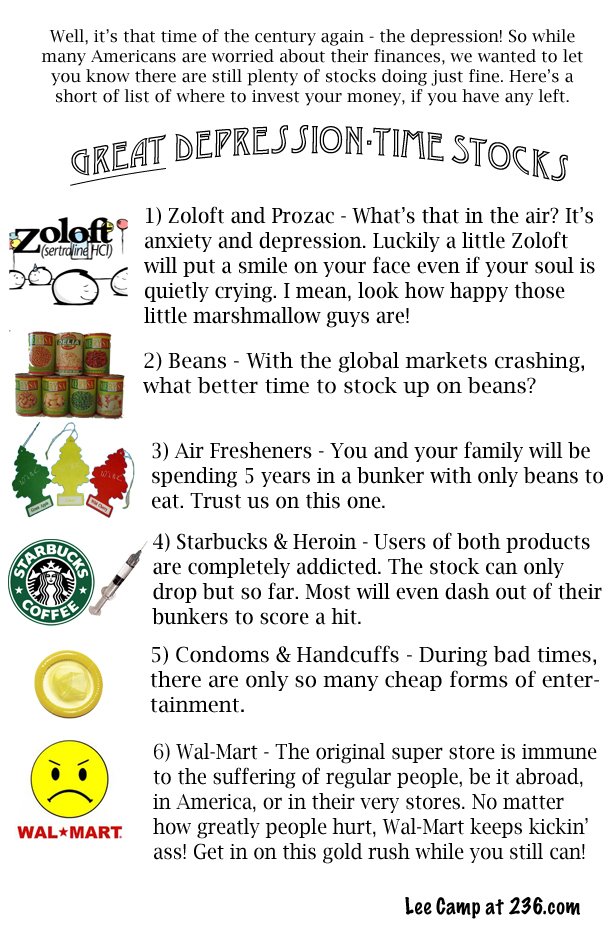
Tomorrow Is Monday – Time to Buy These Stocks!

Click to enlarge

Source / 23/6

Thanks to Diane Stirling-Stevens / The Rag Blog

Posted in RagBlog | Tagged , | Leave a comment

A Strait Shot…

Thanks to S. R. Keister / The Rag Blog

Posted in RagBlog | Tagged , , | 2 Comments

Europe Blames US for Financial Crisis; Failure of Government Oversight

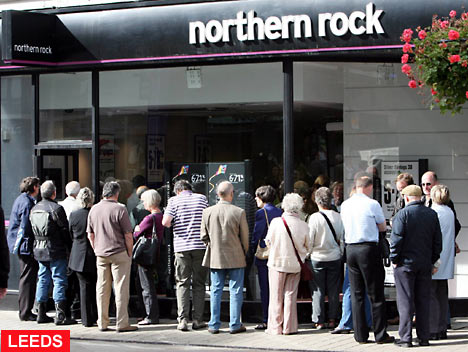
Failed British bank, Northern Rock.

As crisis spreads, Europe points finger at America
By Jenn Abelson / October 11, 2008

LONDON – Financial firms are reeling in the United Kingdom, Ireland, and the Netherlands. Iceland is on the brink of national bankruptcy. A continent that has enjoyed steady growth for years is watching it all melt away.

And everyone is pointing the finger of blame across the Atlantic Ocean.

In the financial district of London, the pubs of Dublin, and on the campuses of Holland, people are citing reckless lending in the US mortgage market, unbridled American consumption, and a lack of government oversight for the financial meltdown that has engulfed Europe. Many dismiss the US bailout as an unwise and hypocritical move that rewards the greedy bankers who caused the crisis and breaches the ideals of the country that pioneered market-driven capitalism.

“It seems to me that the US government supports the people that least deserve it,” said Sanne Castro, 28, a student at the Delft University of Technology in the Netherlands. “But it does prove that even the most hard-core free-market capitalists would rather turn in their fundamental beliefs than their money.”

Europeans are watching the value of their investments plummet, their banks collapse, their ability to borrow or get a mort gage diminish, their currency slide, and their job security become more fragile than ever. In short, they look just as shell-shocked as Americans.

The financial free fall in Europe is, in part, due to a shift in economic philosophy by the major European nations, said William Keylor, director of the International History Institute at Boston University. European nations, seeking to emulate the formula for growth and financial innovation that has propelled the American economy, gave up tight control over financial markets and privatized formerly state-run major industries, such as gas and transportation. When stock markets were advancing and economies were growing, Europeans embraced the changes, Keylor said. But the current crisis has caused many to have second thoughts. Now, some are insisting that the Europeans had it right all along, and government ownership would have limited the risks and curbed the catastrophes now enveloping the region.

“It is hard for them to play the ‘blame game’ when they chose this path freely and continued to follow it when times were good,” Keylor said.

It is clear that times have changed.

The Euro Stoxx 50 Index, which measures 50 European blue-chip stocks, plunged 22 percent just in the past week, mirroring precipitous drops in exchanges in London, Germany, and Paris. As the panic spreads across oceans and national borders, many Europeans are criticizing US leaders for not doing enough to stabilize the global market.

Even British Prime Minister Gordon Brown took a swipe at Americans as he proposed his government’s own roughly $800 billion bailout of its banks earlier this week.

“This problem started in America with irresponsible actions and lending by some institutions,” Brown told a press conference on Wednesday. “The global financial market has ceased to function.”

The anger marks a drastic change among Europeans, who gleefully looked on as the early stages of the US crisis seemed to show the weaknesses of America’s unfettered capitalism, according to Nigel Gault, an economist at Global Insight in Lexington, Mass. But as the economic storm has ripped through Europe, schadenfreude is being replaced by anger.

The most severe excesses came from America, Gault said, but the greed and reckless behavior weren’t confined to the United States, Gault said. Although European banks were much more conservative, their lending policies fueled housing booms in parts of the United Kingdom, Spain, and Ireland that are now going bust. And some European banks, including a state-owned firm in Germany, held billions of dollars in risky mortgage-backed securities.

“Is that America’s fault for selling them toxic assets?” Gault said. “Or Europe’s fault for not more thoroughly investigating just what they were buying?”

Some Europeans, noting the response of the Bush administration to Wall Street’s woes, have chided US leaders who have railed against the European model of managed capitalism for suddenly embracing government intervention in the financial sector.

“These people were the first to state that government regulation in the market is in the long run bad for the economy, for example when it comes to environmental laws, social welfare, and of course Wall Street,” Castro said. “And what are they doing now?”

In London, the wreckage of the US crisis looms over Canary Wharf, the city’s new financial district. A skyscraper here until recently was the main office of Lehman Brothers. At a nearby Starbucks, next to what used to be the headquarters of First Boston Bank, Alastair Green, 50, an investment banker, expressed concern about the relentless market mayhem.

“Everybody assumes there is a solution out there,” Green said. “But what if there’s not?”

Emily Springford, a lawyer who specializes in bankruptcy and insolvency litigation in London, said it’s obvious the United States is the main driver behind the current upheaval here, but Europe cannot escape blame entirely. She supports the US bailout because it was “necessary to take action,” but says British leaders are doing a better job at protecting the people’s interests.

“There is still a sense of disbelief here about how fast the crisis is spreading,” Springford said.

The question for European leaders, Keylor said, is whether the crisis will cause them to reconsider American-style capitalism.

But for Phillip Massey, an information-technology worker in Dublin, the question is not what Europe can do for itself, but whether the American bailout of its financial institutions will mean a worldwide recovery.

“When America sneezes, the whole world catches a cold,” Massey said. “But chicken soup and home remedies aren’t going to fix this one. The world as a whole needs treatment.”

Globe correspondent Michael Goldfarb contributed to this report. Jenn Abelson can be reached at abelson@globe.com.

© Copyright 2008 Globe Newspaper Company.

Source / Boston Globe

The Rag Blog

Posted in RagBlog | Tagged , , | Leave a comment

Sixth Anniversary Anti-War Protest in Boston

Hundreds of protesters gathered on Boston Common yesterday, the sixth anniversary of the congressional vote to authorize the invasion of Iraq. Photo: Wendy Maeda/Globe Staff.

Antiwar activists gather on Common
By Sarah M. Gantz / October 12, 2008

Mark anniversary of vote authorizing the Iraq invasion

Carlos Arredondo has traveled across 20 states with his portable memorial to his son, a Marine who died in Iraq during his second tour of duty in 2004. But yesterday, Arredondo was home in Boston, where he shared his memorial of hundreds of scrap-wood crosses, combat boots, synthetic flowers, and photographs of Alexander Arredondo at an antiwar rally.

Hundreds of protesters, some carrying “war is terrorism” posters, others wearing fluorescent yellow “stop the war” stickers, gathered on Boston Common for a National Day of Action Against the War rally, on the sixth anniversary of the congressional vote that authorized the invasion of Iraq. Veterans, student activists, and politicians were among those who spoke against the war.

“As a father it is my responsibility to honor my son, to let people know how I feel about it,” Arredondo, 48, of Roslindale, said as he gazed at his son’s 20-year-old face staring out from poster-size photographs hanging at his booth. “That’s how wonderful the democracy in this country [is] – why we are all here today.”

Dozens of antiwar groups set up booths to sell T-shirts and hand out pamphlets. In the background, bands and solo performers performed on stage.

Jabbar Magruder, who served as a sergeant with the National Guard in 2005, came from Los Angeles to work as the coordinator for Military Families Speak Out, a Boston antiwar group. Magruder, 25, said he is working to debunk the glorified “Hollywood image” of war that too many people believe to be reality.

He said he felt deceived as a soldier in Iraq, where he said he thought he was defending the Constitution against foreign enemies, when the real threat to democracy was politicians at home who didn’t see his service in the same way.

President Bush has insisted that the invasion of Iraq, which began in March 2003, has made the world better and the United States safer.

But yesterday, local activists and politicians, including District 7 Boston City Councilor Chuck Turner, said the money spent on the war would be better used to benefit Americans, going to such issues as education and healthcare.

Turner encouraged people to look beyond a troop withdrawal. “We can create change, but not just by ending the war, but by pulling the roots out,” Turner yelled into the stage microphone. The roots, he said, is “a foreign policy that does not focus on peace” and an inflated military budget.

Liza Behrendt, a sophomore at Brandeis University, weaved through the crowds of antiwar paraphernalia and protesters dressed in a white Haz-Mat jumpsuit with a bright pink peace sign painted on the front and a Sharpie marker taped to the back. Behrendt said her “walking petition” outfit – she collected signatures on her back – was her effort to meet like-minded people outside her student group.

“Even if [the rally] doesn’t make concrete change, it energizes people,” said Behrendt, 19, who was disappointed only 13 students from her school attended. “How can people not be angry?”

Gabriel Payan, who said he deserted the Army in 2005 while in Germany, was angry. Profanities peppered the 29-year-old veteran’s speech about why he was “sick and tired of this war that has claimed the lives of my brothers and sisters.”

Despite his frustration, Payan said he speaks out because he thinks it gives people hope of change and encourages them to take action themselves.

“I’m not relying on my vote November 4th to make change,” said Payan, referring to the presidential election.

He said he believes it will be the footwork of Americans that brings peace.

© Copyright 2008 Globe Newspaper Company.

Source / Boston Globe

The Rag Blog

Posted in RagBlog | Tagged , , | Leave a comment

The Problem with Projecting Power


Blowback from Afghanistan
By Rick Salutin / October 10, 2008

In the U.S. “debates,” it was the bleakest moment for me so far when Barack Obama said he lamented the war in Iraq because it “weakened our capacity to project power around the world.” Not because it was wrong to invade and occupy a distant country, or even because it was a failed war. But because it hampered U.S. ability to invade and occupy other places. In this, he agrees with John McCain, who says the United States has a “sacred duty to suffer hardship and risk danger to protect the values of our civilization and impart them to humanity” by military might. It is a core component of U.S. political culture. You don’t get to run for president without it.

What is the problem with projecting power – aside from the slaughter, pillage and backlash it routinely generates? Well, the effects on the projectors themselves are often overlooked. Israel, for instance, has occupied Palestinian land for 41 years. An Israeli I knew, long ago, described serving in the West Bank and kicking a Palestinian kid, hard, with his army boot, because the kid held a prohibited Palestinian flag.

To his amazement, the kid stood there, so he kicked again. The shame of it never left him. He dreamed of returning to the village, finding the kid and apologizing.

Canada has been ambivalent about its role in military projections by great powers. We’re never sure whether we belong with the empire or the natives. Our view of our soldiers as peacekeepers was an effort to straddle that dilemma. But in the Afghan occupation, we seem to have tilted: We now identify with the big guys, against the little scumbags.

It hasn’t worked well. Insecurity there has increased. Sixty per cent want foreign troops out. Social progress has been minimal. The Taliban are resurgent. But what I really want to talk about are the “blowback” effects on us, at home, from our big military adventure. Let me take one example.

Stephen Harper’s view for years has been that Canada’s social programs are overblown and humiliatingly socialist. (You can Google it.) Yet they’re awfully popular. How do you combat that as a minority prime minister? Try this: We can’t afford it. Except we seem able to. Hmm, okay. Then lower the GST a couple of points, making less money available for the programs. Not bad. But what next?

Enter the Afghan mission. The parliamentary budget office reported yesterday on its total cost: $14-billion to $18-billion, maybe more: two to three times what the government claimed.

When asked about it, Stephen Harper held his palms up and said it was all “budgeted.” As in: Sorry kids, but there’s no money left at the end of the month for a trip to the zoo. He’d just announced a meagre $10-million for pulmonary diseases, much like yesterday’s $5-million to lure Canadian doctors home. He calls these outlays modest. How about piddling? They are pathetic compared to what’s required for national child care, pharmacare, the cities or aboriginals. Then add his plan to spend $490-billion on the military in the next 20 years, anticipating future Afghanistans.

It may not be why we went in. But military (over)spending is a superb way to tilt an economy away from social goals. It’s the only big public spending neo-cons like Stephen Harper are comfy with. It’s the U.S. model. They spend $700-billion a year on “defence,” more than the rest of the world combined and the very amount of the big bailout – which itself is related to those projections into Iraq and Afghanistan and will severely hamper a President Obama from doing much domestically – but that’s another several stories.

So there you have it: Canadian blowback from Afghanistan. A solution to Stephen Harper’s dilemma: how to place beloved social programs out of reach. And all this even before the shrivelling effects of a global economic crunch. Imagine what the guy could do with a majority.

Source / Globe and Mail

The Rag Blog

Posted in RagBlog | Tagged , | Leave a comment

That Would Be the New World Order COINTELPRO

“None of us are fringe people,” said David Zirin, referring to a characterization made by Maryland’s former state police superintendent. Photo: Kevin Clark / The Washington Post.

Spying on Activists Discussed at Forum: Group Questions Why Some, Not Others
By Lisa Rein / October 12, 2008

The 53 men and women wrongly classified by the Maryland State Police as terrorists include two Catholic nuns, a Democratic candidate for Congress, a man who campaigns against military recruiting at high schools and one person who has never set foot in the state.

They share a passion for peaceful political protest. But as the activists were invited last week to review their files before they are purged from state and federal databases that track terrorism suspects, their identities indicate that the 14-month surveillance operation in 2005 and 2006 targeted not just local opponents of the death penalty and Iraq war, as police claim, but a broader group.

Frederick lawyer Barry Kissin, his wife and two other members of the Frederick Progressive Action Coalition received letters from the police last week notifying them that they were on the list. Since the anthrax attacks in 2001, the group has been devoted to marching peacefully to fight the government’s expansion of biodefense research at Fort Detrick, arguing that the research will pose a health threat.

“That’s what ties the four of us together,” said Kissin, who ran unsuccessfully for Congress as a Democrat in 2006.

Kissin was one of 70 activists who gathered at Takoma Park Presbyterian Church yesterday for a forum sponsored by the Washington Peace Center to discuss a strategy to ensure that their names are erased from any anti-terrorism databases. Among their questions are why some of them were targeted and others spared. Some people named in surveillance logs released in July by the American Civil Liberties Union of Maryland — which sued for the documents under public records laws — have not been contacted by police.

Some who made the list said they were not in Maryland when the spying took place, prompting them to wonder if the operation went on for longer or if their names were culled from other databases. The activists were furious that they will not be allowed to keep paper copies of their files or review them with attorneys for the ACLU, which is representing many of them.

“I am not a fringe person, and none of us are fringe people,” said David Zirin, a sportswriter and death penalty opponent from Silver Spring, referring to a characterization by former state police superintendent Thomas E. Hutchins at a legislative hearing last week.

State police spokesman Greg Shipley said Friday that he did not know how commanders in the Division of Homeland Security and Intelligence decided which names to enter in the databases. “What [State Police Superintendent Col. Terrence B. Sheridan] has said is the action taken wasn’t appropriate and that’s why the individuals’ names are being purged.”

State Sen. Jamie B. Raskin (D-Montgomery) told the group that he plans to co-sponsor a bill in the upcoming legislative session that would prohibit covert monitoring by police of any political group unless they have an “articulated” suspicion of criminal activity.

Their antiwar protests landed Sister Carol Gilbert and Sister Ardeth Platte, both of Baltimore, in federal prison in Colorado after they trespassed on a military base and poured blood into a nuclear missile silo to protest the war in Afghanistan. When they received their letters from the state police, they were offended that they would be able to review only “relevant” information the police have gathered on them. “Anything you have on me is relevant as far as I’m concerned,” Gilbert said.

Nancy Kricorian, a New York writer who coordinates that state’s chapter of Code Pink, a national nonviolent women’s antiwar group, said she received an e-mail from the state police Monday asking for her address. She thought it was a prank. “Honestly, I’ve never been to Maryland,” she said, although she might have driven down Interstate 95 to the District to march in a Mother’s Day peace vigil in Lafayette Square. When Code Pink plans a protest in New York, she’s the one who calls police to let them know. “To me that’s a big irony here, that I’m the police liaison,” she said.

Although most activists on the list appear to represent progressive causes, a neo-Nazi who says he is the leader of the American National Socialist Workers Party said police contacted him last week, too. William A. White said that he moved from Derwood to Roanoke, Va., in 2003, and wondered why he was under surveillance. White said he espouses nonviolence, although he has faced several criminal charges.

Pat Elder of Bethesda said he believed he was targeted for his leadership of a national network that opposes military recruitment in high schools. When he called the police to arrange to review his file, he said he was told he would have only a half-hour. After he requested more time, the commander on the phone told him he could have it because his file was “quite extensive.”

Source / The Washington Post

The Rag Blog

Posted in RagBlog | Tagged , , | Leave a comment

Ethnic Cleansing of Iraq Is Not Yet Finished

A car bomb damaged this Chaldean church in west Mosul on January 17, 2008. Photo: Elizabeth Valgiusti.

3,000 Christians flee Mosul raids
October 12, 2008

MOSUL — Militants blew up three empty Christian homes yesterday in the northern Iraqi city of Mosul, where more than 3,000 Christian families have fled in the past two days.

The governor of northern Ninevah province, Duraid Mohammed Kashmoula, said more than 3,000 Christians have fled Mosul over the past week alone in what he called a “major displacement.”

This is despite months of US and Iraqi military operations to secure the city.

He said most have left for churches, monasteries and the homes of relatives in nearby Christian villages and towns.

“The families were already displaced in two of the houses that were attacked. The militants evacuated the third and then blew it up,” parliamentarian Unadim Kanna said.

“Of course Al Qaeda elements are behind this campaign against Christians,” he said.

Meanwhile, Iraq’s parliament suspended proceedings for one day yesterday in mourning for a Shi’ite MP who was killed in a bomb attack.

Parliamentarians from across rival parties condemned the killing of Saleh Al Ugaili, a member of the parliamentary bloc loyal to anti-American cleric Moqtada Al Sadr.

In fresh violence, Turkish warplanes and artillery attacked 31 Kurdish rebel bases as part of a week-long operation in northern Iraq after an attack that killed 17 Turkish soldiers, the military said.

Ahmed Danees, spokesman for the rebel Kurdistan Workers Party (PKK) in Iraq, said that new shelling had taken place in mountainous areas inside Iraq for about an hour.

The Turkish president said for the first time publicly that Ankara was talking to the Iraqi government about acting against the PKK.

In other violence, a US soldier was killed in a roadside bomb blast in southern Iraq.

In another development, Turkish authorities claimed to have foiled a probable suicide attack by a suspected Kurdish militant in Istanbul yesterday.

Police arrested a woman in her 30s in the heart of Turkey’s largest city who they said had been faking pregnancy and was carrying 8.8kg of explosives, 15 detonators and a manual button in her bag.

The amount of material the suspect was carrying suggested she was preparing an attack on a scale as “murderous” as the twin bombings in Istanbul in July that killed 17 people, sources said.

Source / Gulf Daily News

Thanks to Informed Comment / The Rag Blog

Posted in RagBlog | Tagged , , | Leave a comment

Animals Seek Higher Elevations Fleeing the Heat

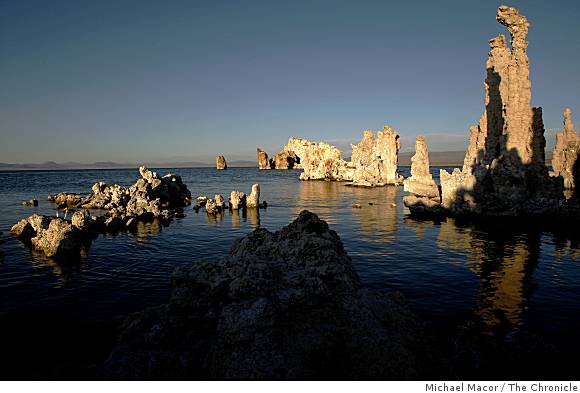
Scientist went to sites, including Mono Lake (pictured here), examined decades ago by Joseph Grinnell, to look at effects of climate change. Photo: Michael Macor/The Chronicle.

Climate change forcing animals to move up
David Perlman / October 10, 2008

SAN FRANCISCO — From the mountains of Yosemite to the tropical lowlands of Costa Rica, global warming is forcing animals and plants to move to higher and higher elevations, searching for climates that have allowed them to evolve and thrive for millions of years.

The exodus from less tolerable habitats to cooler and more benign environments has been taking place for nearly a century, according to scientists who scrambled over rocks and ridges, through steamy rain forests and up steep volcanic slopes to complete their painstaking surveys.

And in a few cases, the moves are taking a toll: Some mountain animals, left with smaller ranges to forage for food, may face extinction, while others are up against Darwinian competition as their new habitats intrude on already-established animal populations.

“These kinds of changes have been going on forever,” said James L. Patton, a biologist at UC Berkeley’s Museum of Vertebrate Zoology. “The only difference is that this has probably happened in our lifetime. It’s the speed with which these changes are taking place that gives one pause.”

As the pace of global warming quickens, change is everywhere: from glaciers melting in Greenland, to ice shelves crumbling in Antarctica, to coral reefs dying in tropic seas – and now to animal and plant life in many parts of the world.

In a report appearing today in the journal Science, Craig Moritz, also of the Museum of Vertebrate Zoology, Patton and their colleagues describe how they surveyed 28 species of mammals studied by the late UC ornithologist Joseph Grinnell beginning in 1914. They covered many of Grinnell’s sites from the San Joaquin Valley across all of Yosemite, over the crest, and down to Mono Lake and then compared the results.

Their report is appearing with another one on the effects of climate change in Costa Rica by an international group headed by Robert K. Colwell, an entomologist at the University of Connecticut who was formerly also a UC Berkeley scientist.

The impacts of warming

Moritz and Patton note that since Grinnell completed his work, the central Sierra has seen continuous warming, with nighttime low temperatures averaging 5 degrees Fahrenheit higher than they were 90 years ago. During the same period, more than half of the species he studied have shifted their ranges upward by as much as 1,600 feet, the researchers said.

Many of the others, Moritz and Patton said, stayed put in ranges that shrank over time, largely the result of human development rather than climate change.

The California vole, the California pocket mouse and the western harvest mouse, for example, have all increased their ranges by moving up-slope, while the bushy-tailed wood rat and Allen’s chipmunk remained at lower levels but their ranges have diminished, the Berkeley scientists found.

Another chipmunk, the alpine species, saw its range shrink before it moved upward more than 2,000 feet seeking a friendly climate, Patton said. Ninety years ago, that same species of alpine chipmunk was common in lodgepole forests below 7,800 feet, but Patton said he found none living lower than 9,600 feet. As a result, he said, it may now face the risk of extinction because of its diminished range.

Similar changes are also endangering plant and insect species in some of the warmest places on Earth, according to the international survey team headed by Colwell, an evolutionary biologist.

In the tropics the climate has warmed by nearly 1.5 degrees Fahrenheit since 1975, Colwell’s report in Science notes, and climate models for the tropics indicate it could get hotter by nearly an additional 6 degrees before the end of the century.

Working their way up the forested slopes of Volcan Barba in Costa Rica – from sea level to the volcano’s summit at nearly 10,000 feet – Colwell and his team of scientists surveyed the ranges of 1,902 different species of insects and plants, including moths and ants, orchids, mosses, ferns, fungi and the shrubs and bushes that live beneath forest canopies.

Trouble ahead for insects

Based on their observations, the scientists foresee trouble ahead: As the climate warms, even in the wet tropics, Colwell said, the ranges of many insect species will become more isolated in their higher habitats.

Some species now living part way up the volcano will have to move their ranges as much as 2,000 feet higher if the climate heats up by as much as 6 degrees, and that will put them into wholly new environments facing competition that evolution hasn’t equipped them to face, the scientists said.

At the same time, species already living near the volcano’s summit will find themselves with nowhere higher to move. In Colwell’s words, they’ll face “mountaintop extinction” as the climate warms even more.

In the tropical lowlands, little opportunity exists for plants or animals to escape future increases in temperature by migrating either north or south – it’s all hot everywhere. So as temperatures increase, according to Colwell’s report, about half the species the Costa Rica team studied will disappear – unless they retained the genetic tolerance for greater heat that their ancestors possessed some 55 million years ago when the world was far hotter than it is now.

The others may seek new habitats in wetter regions that are at least somewhat cooler than where they live now, but even then the warming trend will increase the dangers from drought and forest fire.

So the future looks tough all over.

E-mail David Perlman at dperlman@sfchronicle.com.

Source / San Francisco Chronicle

The Rag Blog

Posted in RagBlog | Tagged , | Leave a comment

Paul Craig Roberts Proposes an Economic Fix

Source, and for additional information about the market free-fall.

A Solution?
By Paul Craig Roberts / October 10, 2008

Readers have been pressing for a solution to the financial crisis. But first it is necessary to understand the problem. Here is the problem as I see it. If my diagnosis is correct, the solution below might be appropriate.

Let’s begin with the fact that the financial crisis is more or less worldwide. The mechanism that spread the American-made financial crisis abroad was the massive US trade deficit. Every year the countries with which the US has trade deficits end up in the aggregate with hundreds of billions of dollars.

Countries don’t put these dollars in a mattress. They invest them. They buy up US companies, real estate, and toll roads. They also purchase US financial assets. They finance the US government budget deficit by purchasing Treasury bonds and bills. They help to finance the US mortgage market by purchasing Fannie Mae and Freddie Mac bonds. They buy financial instruments, such as mortgage-backed securities and other derivatives, from US investment banks, and that is how the US financial crisis was spread abroad. If the US current account was close to balance, the contagion would have lacked a mechanism by which to spread.

One reason the US trade deficit is so large is the practice of US corporations offshoring their production of goods and services for US markets. When these products are brought into the US to be sold, they count as imports.

Thus, economists were wrong to see the trade deficit as a non-problem and to regard offshoring as a plus for the US economy.

The fact that much of the financial world is polluted with US toxic financial instruments could affect the ability of the US Treasury to borrow the money to finance the bailout of the financial institutions. Foreign central banks might need their reserves to bail out their own financial systems. As the US savings rate is approximately zero, the only alternative to foreign borrowing is the printing of money.

Financial deregulation was an important factor in the development of the crisis. The most reckless deregulation occurred in 1999, 2000, and 2004. See Roberts, “The End of American Hegemony.”

Lax mortgage lending policies grew out of pressures placed on mortgage lenders during the 1990s by the US Department of Justice and federal regulatory agencies to race-norm their mortgage lending and to provide below-market loans to preferred minorities. Subprime mortgages became a potential systemic threat when issuers ceased to bear any risk by selling the mortgages, which were then amalgamated with other mortgages and became collateral for mortgage-backed securities.

Federal Reserve chairman Alan Greenspan’s inexplicable low interest rate policy allowed the systemic threat to develop. Low interest rates push up housing prices by lowering monthly mortgage payments, thus increasing housing demand. Rising home prices created equity to justify 100 percent mortgages. Buyers leveraged themselves to the hilt and lacked the ability to make payments when they lost their jobs or when adjustable rates and interest escalator clauses pushed up monthly payments.

Wall Street analysts pushed financial institutions to increase their earnings, which they did by leveraging their assets and by insuring debt instruments instead of maintaining appropriate reserves. This spread the crisis from banks to insurance companies.

Finance chiefs around the world are dealing with the crisis by bailing out banks and by lowering interest rates. This suggests that the authorities see the problem as a solvency problem for the financial institutions and as a liquidity problem. US Treasury Secretary Paulson’s solution, for example, leaves unattended the continuing mortgage defaults and foreclosures. The fall in the US stock market predicts a serious recession, which means rising unemployment and more defaults and foreclosures.

In place of a liquidity problem, I see an over-abundance of debt instruments relative to wealth. A fractional reserve banking system based on fiat money appears to be capable of creating debt instruments faster than an economy can create real wealth. Add in credit card debt, stocks purchased on margin, and leveraged derivatives, and debt is pyramided relative to real assets.

Add in the mark-to-market rule, which forces troubled assets to be under-valued, thus threatening the solvency of institutions, and short-selling, which drives down the shares of troubled institutions, thereby depriving them of credit lines, and you have an outline of the many causes of the current crisis.

If the diagnosis is correct, the solution is multifaceted.

Instead of wasting $700 billion on a bailout of the guilty that does not address the problem, the money should be used to refinance the troubled mortgages, as was done during the Great Depression. If the mortgages were not defaulting, the income flows from the mortgage interest through to the holders of the mortgage-backed securities would be restored. Thus, the solvency problem faced by the holders of these securities would be at an end.

The financial markets must be carefully re-regulated, not over-regulated or wrongly regulated.

To shore up the credibility of the US Treasury’s own credit rating and the US dollar as world reserve currency, the US budget and trade deficits must be addressed. The US budget deficit can be eliminated by halting the Bush Regime’s gratuitous wars and by cutting the extravagant US military budget. The US spends more on military than the rest of the world combined. This is insane and unaffordable. A balanced budget is a signal to the world that the US government is serious and is taking measures to reduce its demand on the supply of world savings.

The trade deficit is more difficult to reduce as the US has stupidly permitted itself to become dependent not merely on imports of foreign energy, but also on imports of foreign manufactured goods including advanced technology products. Steps can be taken to bring home the offshored production of US goods for US markets. This would substantially reduce the trade deficit and, thus, restore credibility to the US dollar as world reserve currency. Follow-up measures would be required to insure that US imports do not greatly exceed exports.

The US will have to set aside the racial privileges that federal bureaucrats pulled out of the Civil Rights Act and restore sound lending practices. It the US government itself wishes to subsidize at taxpayer expense home purchases by non-qualified buyers, that is a political decision subject to electoral ratification. But the US government must cease to force private lenders to breech the standards of prudence.

The issuance of credit cards must be brought back to prudent standards, with checks on credit history, employment, and income. Balances that grow over time must be seen as a problem against which reserves must be provided, instead of a source of rising interest income to the credit card companies.

Fractional reserve banking must be reined in by higher reserve requirements, rising over time perhaps to 100 percent. If banks were true financial intermediaries, they would not have money creating power, and the proliferation of debt relative to wealth would be reduced.

Does the US have the leadership to realize the problem and to deal with it?

Not if Bush, Cheney, Paulson, Bernanke, McCain and Obama are the best leadership that America can produce.

The Great Depression lasted a decade because the authorities were unable to comprehend that the Federal Reserve had allowed the supply of money to shrink. The shrunken money supply could not employ the same number of workers at the same wages, and it could not purchase the same amount of goods and service at the same prices. Thus, prices and employment fell.

The explanation of the Great Depression was not known until the 1960s when Milton Friedman and Anna Schwartz published their Monetary History of the United States. Given the stupidity of our leadership and the stupidity of so many of our economists, we may learn what happened to us this year in 2038, three decades from now.

Source / Information Clearing House

The Rag Blog

Posted in RagBlog | Tagged , | 3 Comments

AIG Proves Corporate America Has No Shame


AIG execs planned SECOND resort trip after bailout
By Helen Kennedy, Daily News Staff Writer / October 8, 2008

Even as the White House on Wednesday branding it “despicable” for bailed-out AIG to spend $443,000 on a swank company junket, honchos were preparing another lavish retreat.

About 50 American International Group managers are set to attend next week’s retreat at the luxurious Ritz-Carlton spa resort in California’s Half Moon Bay.

The insurance giant said the meeting is to educate 150 independent agents who sell AIG coverage to high-end clients.

“They are top business producers, and they are vital to the company,” AIG spokesman Joe Norton said. “If a company is not selling, it’s not profitable.”

The cost of the planned retreat was unknown. Rooms at the Ritz run from $300 to $1,200 a night – extra for a dip in the “Roman-style” mineral baths.

Last month, just days after the government saved AIG from bankruptcy with $85 billion in loans, the company paid for a week-long corporate junket at another California resort. The tab included $10,000 in bar bills and $23,000 in spa treatments.

“It’s pretty despicable,” said White House spokeswoman Dana Perino. “The President did not want to move forward on this rescue package … to help executives go to a spa.”

AIG CEO Edward Liddy said the junket was for independent life insurance brokers, not execs.

In a letter to Treasury Secretary Henry Paulson, Liddy said AIG is “reevaluating the costs of all aspects of our operations.”

Update: The second trip was cancelled.

Source / New York Daily News

The Rag Blog

Posted in RagBlog | Tagged , | 1 Comment