Noam Chomsky on Latin American and Caribbean Unity

Presidents Evo Morales of Bolivia and Hugo Chavez of Venezuela. Photo by Alizar Raldes / AFP / Getty Images.

‘The initiatives taken in Venezuela have had a significant impact throughout the subcontinent, what has now come to be called “the pink tide.”‘
By Noam Chomsky / September 30, 2008

CARACAS — During the past decade, Latin America has become the most exciting region of the world. The dynamic has very largely flowed from right where you are meeting, in Caracas, with the election of a leftist president dedicated to using Venezuela’s rich resources for the benefit of the population rather than for wealth and privilege at home and abroad, and to promote the regional integration that is so desperately needed as a prerequisite for independence, for democracy, and for meaningful development. The initiatives taken in Venezuela have had a significant impact throughout the subcontinent, what has now come to be called “the pink tide.” The impact is revealed within the individual countries, most recently Paraguay, and in the regional institutions that are in the process of formation. Among these are the Banco del Sur, an initiative that was endorsed here in Caracas a year ago by Nobel laureate in economics Joseph Stiglitz; and the ALBA, the Bolivarian Alternative for Latin America and the Caribbean, which might prove to be a true dawn if its initial promise can be realized.

The ALBA is often described as an alternative to the US-sponsored “Free Trade Area of the Americas,” though the terms are misleading. It should be understood to be an independent development, not an alternative. And, furthermore, the so-called “free trade agreements” have only a limited relation to free trade, or even to trade in any serious sense of that term; and they are certainly not agreements, at least if people are part of their countries. A more accurate term would be “investor-rights arrangements,” designed by multinational corporations and banks and the powerful states that cater to their interests, established mostly in secret, without public participation or awareness. That is why the US executive regularly calls for “fast-track authority” for these agreements – essentially, Kremlin-style authority.

Another regional organization that is beginning to take shape is UNASUR, the Union of South American Nations. This continental bloc, modeled on the European Union, aims to establish a South American parliament in Cochabamba, a fitting site for the UNASUR parliament. Cochabamba was not well known internationally before the water wars of 2000. But in that year events in Cochabamba became an inspiration for people throughout the world who are concerned with freedom and justice, as a result of the courageous and successful struggle against privatization of water, which awakened international solidarity and was a fine and encouraging demonstration of what can be achieved by committed activism.

The aftermath has been even more remarkable. Inspired in part by developments in Venezuela, Bolivia has forged an impressive path to true democratization in the hemisphere, with large-scale popular initiatives and meaningful participation of the organized majority of the population in establishing a government and shaping its programs on issues of great importance and popular concern, an ideal that is rarely approached elsewhere, surely not in the Colossus of the North, despite much inflated rhetoric by doctrinal managers.

Much the same had been true 15 years earlier in Haiti, the only country in the hemisphere that surpasses Bolivia in poverty – and like Bolivia, was the source of much of the wealth of Europe, later the United States. In 1990, Haiti’s first free election took place. It was taken for granted in the West that the US candidate, a former World Bank official who monopolized resources, would easily win. No one was paying attention to the extensive grass-roots organizing in the slums and hills, which swept into power the populist priest Jean-Bertrand Aristide. Washington turned at once to undermining the feared and hated democratic government. It took only a few months for a US-backed military coup to reverse this stunning victory for democracy, and to place in power a regime that terrorized the population with the direct support of the US government, first under president Bush I, then Clinton. Washington finally permitted the elected president to return, but only on the condition that he adhere to harsh neoliberal rules that were guaranteed to crush what remained of the economy, as they did. And in 2004, the traditional torturers of Haiti, France and the US, joined to remove the elected president from office once again, launching a new regime of terror, though the people remain unvanquished, and the popular struggle continues despite extreme adversity.

All of this is familiar in Latin America, not least in Bolivia, the scene of today’s most intense and dangerous confrontation between popular democracy and traditional US-backed elites. Archaeologists are now discovering that before the European conquest, Bolivia had a wealthy, sophisticated and complex society – to quote their words, “one of the largest, strangest, and most ecologically rich artificial environments on the face of the planet, with causeways and canals, spacious and formal towns and considerable wealth,” creating a landscape that was “one of humankind’s greatest works of art, a masterpiece.” And of course Bolivia’s vast mineral wealth enriched Spain and indirectly northern Europe, contributing massively to its economic and cultural development, including the industrial and scientific revolutions. Then followed a bitter history of imperial savagery with the crucial connivance of rapacious domestic elites, factors that are very much alive today.

Sixty years ago, US planners regarded Bolivia and Guatemala as the greatest threats to its domination of the hemisphere. In both cases, Washington succeeded in overthrowing the popular governments, but in different ways. In Guatemala, Washington resorted to the standard technique of violence, installing one of the world’s most brutal and vicious regimes, which extended its criminality to virtual genocide in the highlands during Reagan’s murderous terrorist wars of the 1980s – and we might bear in mind that these horrendous atrocities were carried out under the guise of a “war on terror,” a war that was re-declared by George Bush in September 2001, not declared, a revealing distinction when we recall the implementation of Reagan’s “war on terror” and its grim human consequences.

In Guatemala, the Eisenhower administration overcame the threat of democracy and independent development by violence. In Bolivia, it achieved much the same results by exploiting Bolivia’s economic dependence on the US, particularly for processing Bolivia’s tin exports. Latin America scholar Stephen Zunes points out that “At a critical point in the nation’s effort to become more self-sufficient [in the early 1950s], the U.S. government forced Bolivia to use its scarce capital not for its own development, but to compensate the former mine owners and repay its foreign debts.”

The economic policies forced on Bolivia in those years were a precursor of the structural adjustment programs imposed on the continent thirty years later, under the terms of the neoliberal “Washington consensus,” which has generally had disastrous effects wherever its strictures have been observed. By now, the victims of neoliberal market fundamentalism are coming to include the rich countries, where the curse of financial liberalization is bringing about the worst financial crisis since the Great Depression of the 1930s and leading to massive state intervention in a desperate effort to rescue collapsing financial institutions.

We should note that this is a regular feature of contemporary state capitalism, though the scale today is unprecedented. A study by two well-known international economists 15 years ago found that at least twenty companies in the top Fortune 100 would not have survived if they had not been saved by their respective governments, and that many of the rest gained substantially by demanding that governments “socialise their losses.” Such government intervention “has been the rule rather than the exception over the past two centuries,” they conclude from a detailed analysis. [Ruigrok and von Tulder]

We might also take note of the striking similarity between the structural adjustment programs imposed on the weak by the International Monetary Fund, and the huge financial bailout that is on the front pages today in the North. The US executive-director of the IMF, adopt ing an image from the Mafia, described the institution as “the credit community’s enforcer.” Under the rules of the Western-run international economy, investors make loans to third world tyrannies, and since the loans carry considerable risk, make enormous profits. Suppose the borrower defaults. In a capitalist economy, the lenders would incur the loss. But really existing capitalism functions quite differently. If the borrowers cannot pay the debts, then the IMF steps in to guarantee that lenders and investors are protected. The debt is transferred to the poor population of the debtor country, who never borrowed the money in the first place and gained little if anything from it. That is called “structural adjustment.” And taxpayers in the rich country, who also gained nothing from the loans, sustain the IMF through their taxes. These doctrines do not derive from economic theory; they merely reflect the distribution of decision-making power.

The designers of the international economy sternly demand that the poor accept market discipline, but they ensure that they themselves are protected from its ravages, a useful arrangement that goes back to the origins of modern industrial capitalism, and played a large role in dividing the world into rich and poor societies, the first and third worlds.

This wonderful anti-market system designed by self-proclaimed market enthusiasts is now being implemented in the United States, to deal with the very ominous crisis of financial markets. In general, markets have well-known inefficiencies. One is that transactions do not take into account the effect on others who are not party to the transaction. These so-called “externalities” can be huge. That is particularly so in the case of financial institutions. Their task is to take risks, and if well-managed, to ensure that potential losses to themselves will be covered. To themselves. Under capitalist rules, it is not their business to consider the cost to others if their practices lead to financial crisis, as they regularly do. In economists’ terms, risk is underpriced, because systemic risk is not priced into decisions. That leads to repeated crisis, naturally. At that point, we turn to the IMF solution. The costs are transferred to the public, which had nothing to do with the risky choices but is now compelled to pay the costs – in the US, perhaps mounting to about $1 trillion right now. And of course the public has no voice in determining these outcomes, any more than poor peasants have a voice in being subjected to cruel structural adjustment programs.

Read all of this article here. / ZNet

The Rag Blog

Posted in RagBlog | Tagged , , , , , , , | Leave a comment

BANNED BOOKS : ‘Grapes Of Wrath’ And The Politics of Book Burning

Clell Pruett burns a copy of The Grapes Of Wrath as Bill Camp and another leader of the Associated Farmers stand by. At the time this photograph was taken, Pruett had not read the novel. Years later, after he read the book at the behest of Rick Wartzman, Pruett declared that he had no regrets about burning it. Image from Kern County Museum.

Judith Krug: ‘They’re not afraid of the book; they’re afraid of the ideas’
by Lynn Neary / September 30, 2008

Read an excerpt from Obscene in The Extreme: The Burning and Banning of John Steinbeck’s “The Grapes of Wrath,” Below

Sept. 29 marked the beginning of the American Library Association’s annual “Banned Books Week,” a commemoration of all the books that have ever been removed from library shelves and classrooms. Politics, religion, sex, witchcraft — people give a lot of reasons for wanting to ban books, says Judith Krug of the ALA, but most often the bannings are about fear.

“They’re not afraid of the book; they’re afraid of the ideas,” says Krug. “The materials that are challenged and banned say something about the human condition.”

John Steinbeck’s 1939 classic, The Grapes Of Wrath, which chronicles an Oklahoma family’s hapless migration westward, is a perfect example. The book was an immediate best-seller around the country, but it was also banned and burned in a number of places, including Kern County, Calif. — the endpoint of the Joad family’s migration.

Though fictional, Steinbeck’s novel was firmly rooted in real events: Three years before the book was published a drought in the Dust Bowl states forced hundreds of thousands of migrants to California. Penniless and homeless, many landed in Kern County.

When the book came out, some of the powers that be in the county thought that they had been portrayed unfairly; they felt that Steinbeck hadn’t given them credit for the effort they were making to help the migrants. One member of the county board of supervisors denounced the book as a “libel and lie.” In August 1939, by a vote of 4 to 1, the board approved a resolution banning The Grapes Of Wrath from county libraries and schools.

Rick Wartzman, author of the new book Obscene In The Extreme, says what happened in Kern County illustrates the deep divide between left and right in California in the 1930s.

One powerful local player who pushed for the ban was Bill Camp, head of the local Associated Farmers, a group of big landowners who were avid opponents of organized labor. Camp and his colleagues knew how to get a bill passed in the state Legislature — and they also knew how to be physical.

“They knew how to work with tire irons, pick handles and bricks,” says Wartzman. “Things could get really ugly and violent.”

Camp wanted to publicize the county’s opposition to The Grapes Of Wrath. Convinced that many migrants were also offended by their depiction in the novel, he recruited one of his workers, Clell Pruett, to burn the book.

Pruett had never read the novel, but he had heard a radio program about it that made him angry, and so he readily agreed to take part in what Wartzman describes as a “photo op.” The photo shows Camp and another leader of the Associated Farmers standing by as Pruett holds the book above a trash can and sets it on fire.

Meanwhile, local librarian Gretchen Knief was working quietly to get the ban overturned. At the risk of losing her job, she stood up to the county supervisors and wrote a letter asking them to reverse their decision.

“It’s such a vicious and dangerous thing to begin,” she wrote. “Besides, banning books is so utterly hopeless and futile. Ideas don’t die because a book is forbidden reading.”

Knief’s argument may have been eloquent, but it didn’t work. The supervisors upheld the ban, and it remained in effect for a year and a half.

Still, says Krug, the censorship of The Grapes Of Wrath was a key event in the creation of the Library Bill of Rights, the statement Krug describes as ensuring that “as American citizens we have the right to access whatever information we wish without anyone looking over our shoulders. … that we have the right to utilize this information once we have acquired it.”


Excerpt: ‘Obscene In The Extreme’
by Rick Wartzman

The lights dimmed and dimmed some more, and darkness fell upon the Big Room. No one talked or even dared to breathe too loudly. The children had been shushed, whispers stifled, and cigarettes snuffed. The only sound to be heard was the thwack-thwack-thwack of limestone water dripping onto rock. It is impossible to know, of course, what those in the crowd felt as this black blanket swallowed them completely, engulfing the afterglow and playing tricks on their eyes. They had come here, to Carlsbad Caverns, to vacation and take their minds off their workaday concerns; and for some, sitting 750 feet below the surface of the earth, surveying a gargantuan stalagmite known as the Rock of Ages, this undoubtedly was the high point of their trip. Before the lights had gone out, the tourists had soaked in the spectacle: several million years old, wrinkled and tinted with orange, rising up nearly forty feet, as huge as a house. The Rock of Ages was such a wonder that Robert Ripley, Mr. Believe It or Not, had visited this spot just weeks earlier to make a radio broadcast, his voice carried upward by telephone cables and then out across the country by CBS. And yet one can imagine that for others, descending deep into the ground and watching the last trace of light vanish would have brought feelings not of joy and adventure, but of angst and foreboding. It wouldn’t have taken much of a leap, in those thirty seconds when all was quiet and still, to see that darkness was settling upon the world as well.

It was an uneasy time, late summer 1939. Hitler’s troops were amassed along the fifteen-hundred-mile German-Polish border. The Soviets and Japanese clashed along Mongolia’s Khalka River. And Franco was ruthlessly consolidating his power in Spain. At home, America teetered on the edge of war. The worst of the Depression was over, but the economy was still sick. The Roosevelt Recession — in which industrial production had tumbled by 40 percent, unemployment had jumped by four million, and stock prices had plunged by nearly 50 percent — was barely more than a year past. The jobless rate hovered above 17 percent, and personal income and total economic output were no higher than they had been a decade before. Even the national pastime had taken on a melancholy cast: in June, Yankees slugger Lou Gehrig had been diagnosed with amyotrophic lateral sclerosis, cutting short his extraordinary career. He may have just described himself as “the luckiest man on the face of this earth,” but it seemed like an awfully tough break for a thirty-six-year-old dubbed “the Iron Horse.” As for politics, things were as crazy as ever. President Roosevelt’s popularity had ebbed in the last few years, and a volatile mixture of -isms was boiling and bubbling all over the place — Communism, Socialism, Fascism, Coughlinism, Longism, Townsendism. It was hard to tell sometimes which one might slosh out of the pot and stick.

Of all the eyes staring into the cave, among the weariest must have been Gretchen Knief’s. She had trekked to New Mexico by way of theSouth and was on her way back home, to California’s San Joaquin Valley, where she was the chief librarian for Kern County. She was a tall woman, impeccably dressed, her smile warm. No one would have called the thirty-seven-year-old a beauty, and she could be a little awkward at times. But it was an endearing awkwardness, and everybody admired her smarts. Knief had spent a portion of her trip examining libraries in Florida and Louisiana, and she had walked away feeling pleased with how Kern County’s far-flung network of seventy-one branches, many of which she had single-handedly expanded, stacked up by comparison. But pressures were mounting too. Kern’s main library was housed in the basement of the county courthouse in Bakersfield, in quarters so cramped that some of its materials were buried beneath old lighting fixtures, furniture, and other bric-a-brac. A proposed $300,000 bond issue to finance a new facility was scheduled to go before the voters in the fall. But who knew what they’d decide, given the budget squeeze afflicting the county? The situation showed no signs of easing, either, the way people were still streaming in to California’s heartland, taxing public services of all kinds. “Authorities Predict Increase in Migrant Flow to Kern Soon,” read the headline in the August 7 edition of the Bakersfield Californian.

The exodus had been underway for nearly a decade, with as many as four hundred thousand folks from Oklahoma, Arkansas, Texas, Missouri, and other states flocking to California in search of a better life. They were by no means exclusively poor. But many were. And the plight of these human tumbleweeds, as one observer had labeled them, had by now worked its way into the national consciousness. Leading periodicals had sent their correspondents to rural outposts up and down Highway 99 to chronicle the suffering. “Uncle Sam Has His Own Refugee Problem,” the Providence Journal declared during the spring. “Lured to the West, They Find Misery, Squalor, Disease.” Collier’s magazine put it this way: “Perhaps the native and adopted sons of California pitched their voices a note or two too high when they warbled praises of the Golden State. Anyway, they got the idea across, and now they’re sorry. An army is marching into California — an army made up of penniless unemployed, desperately seeking Utopia. ‘Here we are,’ say the invaders, ‘what’re you going to do about us?’ And nobody knows the answer.”

That may have been a tad hyperbolic, but coming up with answers was in no way simple. Kern County, for one, had seen its population swell by more than 60 percent in the last five years, and although health officers had cleaned up the squatter camps that once plagued the area, many migrants were still living in slums with inadequate sewers and drains, ramshackle houses, and litter-strewn dirt roads that would turn to mud after a hard winter rain. Who, though, was culpable for such conditions? Were they the fault of a grudging local government? Or were the newcomers themselves guilty somehow? Many suggested as much. The migrant community in Kern was branded as being full of “drunks, chiselers, exploiters and social leeches” — and that was in an official county report that had just been released. The language used on the street was even more blunt; in the lobby of a Bakersfield movie theater, a sign was posted: “Negroes and Okies Upstairs.”

An alternative view, however, had also found its voice. This one laid the blame for the migrants’ deprivation at the door of California agriculture, an industry that since the late nineteenth century had been defined by one main thing: its enormity. The state’s giant landowners had made a travesty of the Jeffersonian ideal of 160 acres, assembling dominions that ballooned to one thousand times or more that size. “We no longer raise wheat here,” said one grower. “We manufacture it.” This wasn’t family farming; it was agribusiness. And with it came a caste system in which relatively few got rich while many remained mired in the worst sort of poverty: Chinese in the 1870s, Japanese two decades later, Hindustanis early in the new century, Mexicans and Filipinos during and after World War I. Joining this ethnic parade were Armenians and Portuguese, Italians and Swiss — wave after wave of low-priced labor. Among the leviathan landholders were those who took care of their workers, some patronizingly, others with a genuine measure of respect. But many big farmers regarded their hands as expendable — “beasts of the field,” in the words of an 1888 edition of the Kern County Californian. In many ways, things hadn’t changed much in the fifty years since that description had been written, and with the Okies and Arkies now faring so terribly, social critics were pointing their fingers at California’s agricultural elite.

The most articulate and powerful of the finger-pointers was author John Steinbeck, whose book The Grapes of Wrath had not only leapt onto the best-seller list after its publication in April but was also well on its way to becoming seared into the public’s imagination forever. Darryl Zanuck was already busy with the film version of the story, starring Henry Fonda, and Woody Guthrie would soon record his ode to Steinbeck’s protagonist, Tom Joad: Wherever little children are hungry and cry / Wherever people ain’t free. / Wherever men are fightin’ for their rights, / That’s where I’m gonna be, Ma. / That’s where I’m a gonna be. First Lady Eleanor Roosevelt had called her reading of The Grapes of Wrath “an unforgettable experience.” And in the coming months, the president would tell the nation that he, too, had read of the Joads’ journey from the bone-dry plains of Oklahoma to the bountiful lands of California, where they and others toiled away for a pittance and found themselves wishing “them big farmers wouldn’ plague us so.” “There are 500,000 Americans,” the president said, “that live in the covers of that book.” By 1940, The Grapes of Wrath would be invoked so often that it almost seemed to cheapen the novel. Good Samaritans, looking to raise money to aid the migrants, would hold “Grapes of Wrath” parties. The union seeking to organize California’s farm fields — the United Cannery, Agricultural, Packing and Allied Workers of America — recruited five young Broadway actors to tour the West and Southwest, with ticket sales going into UCAPAWA’s coffers. The troupe’s name: The Grapes of Wrath Players. Meanwhile, pundits of all stripes would reference the Joads in articles and speeches, as if they were real: “Meet the Joad Family,” “The Joad Family in Kern County,” “What’s Being Done About the Joads?” “The Joads on Strike.” Men began to wear a hat called the “Joad Cap.”

Knief peered into the inky cavern, and slowly the lights came up, like a sunrise in the distance. Then a ranger’s voice washed over the Big Room:

Rock of Ages, cleft for me,
Let me hide myself in Thee;
Let the water and the blood,
From Thy wounded side which flowed,
Be of sin the double cure;
Save from wrath and make me pure.

In that very instant, it is conceivable that Knief and all the others assembled in the Big Room let their worries — the weight resting on “our troubled and confused generation,” as she once expressed it — melt away. Whether that sense of tranquility lasted very long is another matter. As Knief headed back to Bakersfield, her vacation done, she motored along Route 66, the same stretch of highway on which the migrants “scuttled like bugs to the westward,” as Steinbeck wrote. The Mother Road, as she was known, was the path to California’s promise. Knief counted herself a Steinbeck devotee, having briefly met him during one of his research outings to the area. And on the eve of the publication of The Grapes of Wrath, she had lauded him as “one of our major creative writers in America today,” a literary force on par with Faulkner, Hemingway, Saroyan, and Dos Passos. In “The Reading Hour,” a column that she wrote for the Bakersfield paper, Knief had also noted that this tale of migratory labor was bound to be “of more than passing interest” to local readers.

As she’d soon discover, that would prove to be quite an understatement.

[From the book Obscene in the Extreme by Rick Wartzman. Reprinted by arrangement with PublicAffairs, a member of the Perseus Books Group. Copyright © 2008.]

Source / National Public Radio

Also see Jonathan Yardley on ‘Obscene in the Extreme’ / Washington Post / Sept. 14, 2008

Find Obscene in the Extreme: The Burning and Banning of John Steinbeck’s the Grapes of Wrath on Amazon.com.

The Rag Blog

Posted in RagBlog | Tagged , , , , , , , | 1 Comment

Congressional Bailout Add-Ons : Lotsa Pork in This Baby


Bullseye: Bailout bill now festooned with corporate tax breaks including one for a company that makes arrows for children.
By Ryan J. Donmoyer / October 1, 2008

Rose City Archery Inc., an Oregon company that makes arrows used by children, hit a bull’s-eye with Senate legislation that would rescue Wall Street banks.

Senators attached a provision repealing a 39-cent excise tax on wooden arrows designed for children to an historic $700 billion financial-markets rescue that passed tonight by a vote of 74-25. The provision, originally proposed by Oregon senators Ron Wyden and Gordon Smith, will save manufacturers such as Rose City Archery in Myrtle Point, Oregon, about $200,000 a year.

It’s one of dozens of tax breaks benefiting Hollywood producers, stock-car racetrack owners and Virgin Islands rum- makers included in the broader legislation in an effort to win support from House Republicans, whose defection contributed to a rejection of an earlier version of the legislation two days ago on a 228-205 vote.

“This is how Washington works,” said Keith Ashdown, chief investigator at Taxpayers for Common Sense, a Washington research group. “A big pot of pork is their recipe for final passage.”

Representatives for Wyden, a Democrat, and Smith, a Republican, didn’t immediately return calls. Jerry Dishion, president of Rose City Archery, was in meetings and unavailable to comment, a receptionist at the company said.

Most of the provisions are part of a package of provisions known as “extenders” because they are renewed for only a few years at a time.

Research Tax Credit

Popular with lawmakers, the provisions include a research tax credit worth about $8.3 billion a year for companies such as Microsoft Corp. and Harley-Davidson Inc., and subsidies for the overseas financial services earnings of U.S.-based multinational corporations such as General Electric Co. and Citigroup Inc.

The tax package also would spare 24 million American households from a scheduled increase in the alternative minimum tax amounting to $62 billion this year and renew about $17 billion of incentives to promote energy production from renewable sources such as solar and wind.

Other, smaller provisions, such as one that will save Nascar track builders $109 million this year, have been staples of the tax code since 2004 or earlier. They periodically expire and are renewed, and include hundreds of millions of dollars of tax incentives for companies that invest on Indian reservations, in the District of Columbia, and American Samoa. Other breaks would subsidize renovations of restaurant franchises and cut import duties on wool and wood.

Break for Filmmakers

Several others are new provisions, including two tax breaks worth $478 million over the next decade for movie and television producers who shoot films in the United States. The legislation would allow filmmakers to qualify for a 3 percentage-point reduction from the 35 percent top tax rate approved in 2004 for domestic manufacturers.

The arrows provision seeks to reverse an anomaly in a 2004 law that created the 39 cent excise tax on the weapons. Intended the levy more expensive arrows, the tax also applies to arrows used by Boy Scouts and other youth organizations that cost about 30 cents a piece. Ten manufacturers in nine U.S. states stand to benefit from the change, according to a description of the legislation from Wyden’s office.

Michael Steel, a spokesman for House Minority Leader John Boehner, said the inclusion of the tax breaks “will increase the appeal of the package for our members.”

The Congressional Budget Office said today the tax provisions will add about $112 billion to budget deficits over the next five years because the legislation doesn’t contain enough offsetting revenue increases to keep the budget balanced.

The biggest revenue-raising provision in the bill would cost managers of hedge funds about $25 billion over the next decade by prohibiting an accounting technique they currently use to defer for as long as 10 years U.S. taxes on their income earned in foreign countries, usually tax havens such as the Cayman Islands.

Source / Bloomberg

Thanks to Harry Edwards / The Rag Blog

Posted in RagBlog | Tagged , , , | 2 Comments

Ike Aftermath : Residents of Galveston Public Housing Given Heave-Ho

Clean up after Ike in Galveston. Now it’s the human toll that must be dealt with.

Galveston’s public housing residents ordered out with nowhere to go.

Residents of Galveston’s storm-devastated public housing projects have been ordered to clear their belongings out — but they’re still waiting for answers about where they’re supposed to go.

A reporter with the Galveston Daily News visited the city’s housing projects this week and found inhabitants — many of them elderly or disabled — at wits’ end. The paper reports:

Angry residents stopped every car that drove by the housing projects to search for answers.

Latrice Walker, who’s five months pregnant, cornered the housing authority crew that was battering down doors.

“What are y’all doing?” she shouted. “I live here — you can at least give me some answers.”

She cornered a smartly dressed housing authority building supervisor and started peppering him with the same questions everyone was asking Wednesday morning: Where am I supposed to live? How long do I have to get my things out? Where is FEMA? Where is the housing authority? Are they going to tear this place down?

The housing authority’s employees had no answers for residents. One member of the battering crew said he wasn’t allowed to talk to the media but hoped the “real story” got out about what’s happening.

Many of the residents never signed a lease, he said, and there’s concern they might not quality for federal assistance. He also noted that in order to stay in a hotel paid for by FEMA, the agency requires a credit card — but many residents don’t have one.

The only option left for those with nowhere else to go is a public shelter, but spaces have been scarce. Galveston opened its first shelter Wednesday at a community center, but it offered room for only about 100 people and filled up fast, the Associated Press reports. The city set up a second shelter — tents at an old elementary school — yesterday.

Also yesterday, the Red Cross opened a shelter in Galveston offering 500 slots. But some public housing residents expressed a reluctance to stay in mass shelters because of uncomfortable conditions.

Galveston Mayor Lyda Ann Thomas testified before Congress this week about her city’s needs, but she did not discuss public housing in her prepared statement. Also this week, the U.S. Department of Housing and Urban Development and Federal Emergency Management Agency announced an 18-month housing assistance plan for families displaced by Ike, but it’s not slated to begin until November.

Source / Facing South / Posted Sept. 26, 2008

Also see Galveston needs a housing plan by Heber Taylor / Galveston Daily News / September 27, 2008

Thanks to Houston Indymedia / The Rag Blog

Posted in RagBlog | Tagged , , , , | Leave a comment

Condi Rice: Just Another BushCo War Criminal


Rice Admits She Led High-Level White House Talks About Torture
By Jason Leopold / September 30, 2008

Secretary of State Condoleezza Rice has admitted for the first time that she led high-level discussions beginning in 2002 with other senior Bush administration officials about subjecting suspected al-Qaeda terrorists detained at military prisons to the harsh interrogation technique known as waterboarding, according to documents released late Wednesday by Carl Levin, the Democratic chairman of the Senate Armed Service Committee.

Responding in writing to questions by Levin, who will convene a hearing today on the administration’s interrogation program, John B. Bellinger, Rice’s legal adviser at the State Department, said they recalled participating in meetings with Ashcroft and then-Defense Secretary Donald Rumsfeld in July 2002 about an Army and Air Force survival training program called Survival, Evasion, Resistance and Escape (SERE) meant to prepare U.S. soldiers for abuse they might suffer if captured by an outlaw regime.

Bellinger, who also worked with Rice at the NSC, the then National Security Adviser “expressed concern that the proposed CIA interrogation techniques comply with applicable U.S. law, including our international obligations” and that Rice asked Attorney General John Ashcroft to “personally review the legal guidance” of specific interrogation techniques.

In April, President George W. Bush told an ABC News reporter during an interview that he approved of meetings of a National Security Council’s Principals Committee, whose advisers included Vice President Dick Cheney, former National Security Adviser Condoleezza Rice, Defense Secretary Donald Rumsfeld and Secretary of State Colin Powell, former CIA Director George Tenet and former Attorney General John Ashcroft, where these officials discussed specific interrogation techniques the CIA could use against detainees.

Waterboarding—or simulated drowning–has been regarded as torture since the days of the Spanish Inquisition.

“I recall being told that U.S. military personnel were subjected in training to certain physical and psychological interrogation techniques and that these techniques had been deemed not to cause significant physical or psychological harm,” Rice wrote in response to a question about the SERE techniques.

But those techniques were meant to prepare U.S. soldiers for abuse they might suffer if captured by a brutal regime, not as methods for U.S. Interrogations, which is what Rice said the discussions at the White House centered on. Moreover, the SERE methods were first designed by the communist government of China to be used against U.S. soldiers.

The hearing Wednesday before the Senate Armed Services Committee will focus on the genesis of the SERE techniques used during the interrogations of suspected terrorists.

Rice has denied that the U.S. tortured or abused prisoners. But in declaring the U.S. does not engage in torture, appears to be relying on a narrower U.S. definition of torture than that is accepted under international law, such as the 1984 Convention Against Torture that was signed by the Reagan administration in 1988 and ratified by the U.S. Senate in 1994.

“The threshold for torture is lower under international law: acts that do not amount to torture under U.S. law may do so under international law,” wrote Philippe Sands, law professor at University College London, in a column published in the Dec. 9, 2005, edition of The Financial Times.

“Waterboarding – strapping a detainee to a board and dunking him under water so he believes that he might drown – plainly constitutes torture under international law, even if it may not do so under U.S. law. …

“When the U.S. joined the 1984 convention it entered an ‘understanding’ on the definition of torture, to the effect that the international definition was to be read as being consistent with the U.S. definition The administration relies on the ‘understanding.’

“So, when Ms. Rice says the U.S. does not do torture or render people to countries that practice torture, she does not rely on the international definition. That is wrong: the convention does not allow each country to adopt its own definition, otherwise the convention’s obligations would become meaningless. That is why other governments believe the U.S. ‘understanding’ cannot affect U.S. obligations under the convention.”

There is ongoing debate as to whether the brutal interrogation techniques first used against a suspected terrorists predated an Aug. 1, 2002 legal opinion, widely called the “Torture Memo,” that provided CIA interrogators with the legal authority to use long-outlawed tactics, such as waterboarding, when interrogating so-called high-level terrorist suspects.

Neither Rice nor Bellinger provided dates about the discussions Rice led regarding interrogation methods. Additionally, Levin did not ask Rice whether Bush or Cheney participated in the talks.

In his book, “At the Center of the Storm”, former CIA Director George Tenet wrote that he attended a meeting with Rice in May 2001 where Tenet discussed how Abu Zubaydah, the alleged high-level al-Qaeda operative, planned to attack the US and Israel.

“For my regularly scheduled meeting with Condi Rice on May 30, [2001], I brought along [deputy CIA director] John McLaughlin, [then director of the CIA’s counterterrorist center] Cofer Black, one of Cofer’s top assistants, Rich B. (Rich can’t be further identified here). Joining Condi were [former White House counterterrorism czar Richard] Clarke and [former CIA official] Mary McCarthy,” Tenet wrote. “Rich ran through the mounting warning signs of a coming attack. They were truly frightening. Among other things, we told Condi that a notorious al-Qa’ida operative named Abu Zubaydah was working on attack plans.”

Abu Zubaydah was captured in Pakistan less than a year later and was whisked to a secret CIA prison site in Thailand, where he was interrogated and subjected to waterboarding—believed to have taken place sometime in July 2002 based on the discussions about interrogation methods Rice participated in with other White House officials.

FBI officials objected to the methods CIA interrogators used against Abu Zubaydah, according to previously released documents and testimony.

However, Rice wrote in response to a question from Levin that she did “not recall any specific discussions about withdrawing FBI personnel from the Abu Zubaydah interrogation.”

The Abu Zubaydah case was the first time that waterboarding was used against a prisoner in the “war on terror,” according to Pentagon and Justice Department documents, news reports and several books written about the Bush administration’s interrogation methods.

In his book “The One Percent Doctrine,” author Ron Suskind reported that President George W. Bush had become obsessed with Zubaydah and the information he might have about pending terrorist plots against the United States.

“Bush was fixated on how to get Zubaydah to tell us the truth,” Suskind wrote. Bush questioned one CIA briefer, “Do some of these harsh methods really work?”

The waterboarding of Abu Zubaydah was videotaped, but that record was destroyed in November 2005 after the Washington Post published a story that exposed the CIA’s use of so-called “black site” prisons overseas to interrogate terror suspects.

John Durham, an assistant US attorney in Connecticut, was appointed special counsel earlier this year to investigate the destruction of that videotape as well as destroyed film on other interrogations.

The latest disclosures by Rice undercut assertions by President George W. Bush, Vice President Dick Cheney, Rumsfeld and other senior administration officials who have blamed cruel treatment of detainees on “a few bad apples” who acted on their own.

In June, Levin released dozens of pages of documents that detailed a pattern of humiliation, abuse and even torture inflicted on detainees was a deliberate policy of the Bush administration – debated by mid-level lawyers at the CIA and the Pentagon, given legal cover at the Justice Department and approved at the highest levels of government.

The Armed Services Committee’s 18-month investigation, which generated 38,000 pages of documents, singled out Rumsfeld and William “Jim” Haynes II, the Pentagon’s former general counsel, as the officials who sought guidance on implementing more aggressive interrogation methods.

The committee is expected to release a full report later this year. So far, the probe has found that Rumsfeld and Haynes solicited input from military psychologists in July 2002, months earlier than they had previously acknowledged, about developing harsh methods interrogators could use against detainees held at Guantanamo Bay.

The documents Levin released in June states that as early as July 2002, Rumsfeld, Haynes and other officials queried military psychologists about the use of waterboarding and other brutal methods to extract information that might not be gained through more conventional interrogations methods.

The questions from Rumsfeld and Haynes were raised one month before John Yoo, a deputy in the Justice Department’s Office of Legal Counsel, issued two memos that authorized interrogators to use stress positions, military dogs and other still unknown methods against terror suspects at Guantanamo.

Bellinger said, in a separate memo to Levin, that Yoo participated in the meetings led by Rice and gave the CIA oral guidance on interrogation techniques.

The June documents did not square with previous statements made by Haynes, who testified in 2006 that the impetus for the harsh tactics came from below, from lower-level military personnel who asked the Pentagon in October 2002 about using more aggressive techniques against detainees.

Richard Shiffrin, Haynes’ former deputy on intelligence issues, told the Senate committee that in July 2002 Haynes became interested in using the SERE techniques, such as waterboarding and sleep deprivation, as a form of interrogation against detainees.

According to one document, Jonathan Fredman, chief counsel to the CIA’s Counterterrorism Center, discussed with U.S. military officials how interrogators could use the “wet towel” technique, also known as waterboarding, against detainees to extract information.

“It can feel like you’re drowning. The lymphatic system will react as if you’re suffocating, but your body will not cease to function,” Fredman said on Oct. 2, 2002, during a meeting where specific techniques were reviewed and debated, according to the meeting minutes.

Fredman added that the “wet towel” technique would only be defined as torture “if the detainee dies.”

“It is basically subject to perception,” Fredman said. “If the detainee dies you’re doing it wrong.”

Source / IntelDaily

The Rag Blog

Posted in RagBlog | Tagged , , | 1 Comment

Food Production and Delivery : We May Have to Rethink the Model


‘We all know eating locally grown foods is best and during the normal harvest season we buy locally when we have the choice.’
By Gerry Storm / The Rag Blog / October 1, 2008

Most models of present and future food distribution assume that the supermarket will be with us until the end of time. It will be this institution that will dictate what we eat and how much it will cost. There are different supermarkets for each neighborhood but they all have much in common, especially shelves filled with junk food which is loaded with preservatives, etc. Companies like General Mills and Kraft and Tyson are represented in most all of these markets.

Most of the fruits and vegetables in these stores are grown in California and shipped all across the USA. In some cases this is good since the fruits are often organically grown and shipped with consummate care in refrigerated trucks. But it is unlikely that you will buy fresh foods at your store unless you live in California. Also, these shipped foods have a shorter shelf life and in spite of being sprayed and treated to make them appear to be fresh, they will spoil quickly after you bring them home. And, of course, the cost in diesel fuel involved in the delivery system is huge, not to mention the smoke it adds to the environment.

We all know eating locally grown foods is best and during the normal harvest season we buy locally when we have the choice. For the rest of the year we buy at the supermarket. While this represents an improvement over the traditional past, it is only a partial answer to the problem. Growing food is not so difficult. Processing it is more difficult. Storing it is the most difficult problem.

While we regularly can foods, dry them, grind them into flours, etc. to have them available in the months between harvests, most all these methods destroy much of the nutrition in the foods. Canning involves lots of heat (fuel intensive) as well as the cost of cans, preservatives and other additives, and labor. It works and we have been relying upon it for some time but those with an eye for the fresh and untampered have learned to look upon it as a last choice. That stuff in the can is not the top of the food chain.

Grinding grains into flour and baking them is also a popular way to consume food. Just one little problem with the idea, by the time the flour is ground and cooked most of the nutrition is destroyed. The processing is also quite fuel intensive from the beginning (grinding mills) to the end (baked in ovens which use gas or electricity). Not all cultures are flour users, some use whole grains that are processed at meal time. It is easier to store whole grains than flour and they will retain their nutritive content longer. But the real potential in economical, simple and effective processing and storing is drying foods, dehydration.

When dried and reconstituted all we have to do is add water and the foods come back to life. Yes, there is some loss in the process but it is really negligible. The conflict here is with our habits, our addiction to the easy life provided by the supermarkets. The Native Americans did not have this luxury and they were quite accustomed to living from harvest to harvest off what they hunted and caught and from what they stored. Dried foods were the norm.

I don’t know that we will be easily converted to this lifestyle but I highly recommend that each of us starts thinking in terms of a food stash consisting of bulk grains and nuts and dried fruits and veggies. Yeah, you can dry meat too if that is on your menu. You don’t have to grind and bake the grains, simply soak them overnight and they will not only be ready to eat but also retain virtually all their nutrition. No heat equals live enzymes.

Another important consideration is the support of small local corporate farms, those owned by stockholders who get their food nearby and thus fresher. You pay the farmer in advance and he does the growing for you. This method insures that the farmer will have the capital to plant without borrowing and also be able to have a bad year due to the natural causes without having to abandon the farm. Small farms are better for a variety of reasons; for one, a big storm is not likely to destroy them all the way it can a large farm (look at the Midwestern floods of 2008); for another, they can specialize more easily and make the delivery process much less costly.

In the future we will have to protect crops more than we do today. This will require extensive use of greenhouses and crop covers. Smaller farms can be more versatile with this. For instance, in years when the grasshopper population is great, the farmer has to cover the crops or lose them, much easier to do on 20 acres than on 2,000. A home garden with a greenhouse nearby, power from small solar and wind generators for every household, battery driven appliances and transportation are the directions our society needs to be moving.

We need to spend quality time rethinking our food production and delivery systems. We need to break the habit of blindly supporting supermarkets and eating whatever they offer. And we need to start eating more dried foods in winter. If you think the stock market crash is terrible for our financial future, think about what happens if the big trucks stop running, even for a few weeks, or global warming takes out one of the big valleys in California. Better to make adjustments now than at the last minute.

The Rag Blog

Posted in RagBlog | Tagged , , , , | Leave a comment

British Ambassador : Afghanistan Situation Is Bad


Memo Leak Says Mission In Afghanistan Doomed
By Cernig / October 1, 2008

I’d recently begun to think there was no way back from seven years of Bush administration mismanagement in Afghanistan – but it’s still shocking to hear it from the British ambassador in Kabul.

The London Times reports that Sir Sherard Cowper-Coles told his French counterparts exactly that at a high-level meeting, however, and that the secret memo of the meeting has now been leaked to the French press (h/t our tireless researcher Kat). Le Canard Enchaîné, a “respected French weekly” reproduced the memo.

“The current situation is bad. The security situation is getting worse. So is corruption and the Government has lost all trust. Our public statements should not delude us over the fact that the insurrection, while incapable of winning a military victory, nevertheless has the capacity to make life increasingly difficult, including in the capital.

“The presence — especially the military presence — of the coalition is part of the problem, not the solution. The foreign forces are ensuring the survival of a regime which would collapse without them. In doing so, they are slowing down and complicating an eventual exit from the crisis (which, moreover, will probably be dramatic).”

The French diplomat sent the cable to brief President Sarkozy and Bernard Kouchner, the Foreign Minister, ahead of meetings with Britain and other Nato allies over the Afghan deployment.

…Sir Sherard, 53, was also quoted as saying that while Britain had no alternative to supporting the United States, the Americans should be told to change strategy.

Reinforcing the military presence against the Taleban insurrection would be counter-productive, he said, according to Le Canard. “It would identify us even more clearly as an occupying force and it would multiply the number of targets (for the insurgents),” he was quoted as saying.

The allied governments should start preparing public opinion to accept that the only realistic solution for Afghanistan was to be ruled by “an acceptable dictator”.

“In the short term we should dissuade the American presidential candidates from getting more bogged down in Afghanistan,” the ambassador was quoted as saying.

The British government are saying the French memo is a “parody” of what was actually said at the meeting, with insiders telling the Times that ‘the British position was deliberately “exaggerated” to produce a version that Paris wanted to hear’.

So either the British ambassador to Kabul thinks that the US-led strategy is wrong and the war is as good as lost or he doesn’t quite think that – but very obviously the French up to and including President Sarkozy do and are willing to officially “leak” a possibly hyped-up account of the ambassador’s words as cover and justification. Which doesn’t bode well for NATO solidarity for a new US administration that will have to go cap in hand to European allies for additional troops and political support in Afghanistan (and ever-escalating incursions into Pakistan) even with a partial drawdown in Iraq.

Meanwhile, the new National Intelligence Estimate on Afghanistan is, apparently, too grim to release.

Seth Jones, an expert on Afghanistan at the Rand Corporation think tank, called the situation in Afghanistan “dire.”

“We are now at a tipping point, with about half of the country now penetrated by a range of Sunni militant groups including the Taliban and al Queida,” Jones said. Jones said there is growing concern that Dutch and Canadian forces in Afghanistan would “call it quits.”

“The US military would then need six, eight, maybe ten brigades but we just don’t have that many,” Jones said.

… Perhaps foreshadowing the NIE assessment on Afghanistan, Adm. Mullen told Congress, “absent a broader international and interagency approach to the problems there, it is my professional opinion that no amount of troops in no amount of time can ever achieve all the objectives we seek in Afghanistan.”

There’s not enough troops to provide stability for long enough, even if there were there’s not enough reconstruction and reconcilliation and even if there was there’s not enough regional goodwill for American adventurism. Just like Iraq. And just like Iraq the Afghan occupation is an unwinnable one. Neither nation is looking at long-term internal stability or even freedom from crippling internicene violence. Worse, the violence in Afghanistan has polarized the two major players in the region and contains even more of a prospect of igniting a regional bloodbath than the occupation of Iraq.The best that can be done is a “slow bleed” which will hopefully be less destructive to the region and American interests than a fast one. Just like Iraq, though, there’s no evidence that such is possible.

Yet, unfortunately, both mainstream party’s prospective Presidential candidates will continue to decide foreign policy by the touchstone that America has always used and inflict domestic vote-winning tough talk on foreigners yet again.

Source / Newshoggers

Thanks to Diane Stirling-Stevens / The Rag Blog

Posted in RagBlog | Tagged , , , , | Leave a comment

Sarah Palin : Dinosaurs and Men on Earth Together

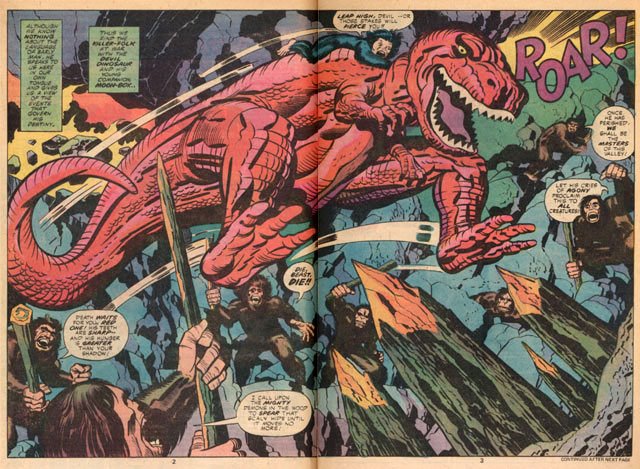
Devil Dinosaur #2.

According to Palin the two species coexisted 6,000 years ago, about 65 million years after dinosaurs are believed to have become extinct.
By Rachel Weiner / September 28, 2008

The LA Times reports:

Soon after Sarah Palin was elected mayor of the foothill town of Wasilla, Alaska, she startled a local music teacher by insisting in casual conversation that men and dinosaurs coexisted on an Earth created 6,000 years ago — about 65 million years after scientists say most dinosaurs became extinct — the teacher said.

After conducting a college band and watching Palin deliver a commencement address to a small group of home-schooled students in June 1997, Wasilla resident Philip Munger said, he asked the young mayor about her religious beliefs.

Palin told him that “dinosaurs and humans walked the Earth at the same time,” Munger said. When he asked her about prehistoric fossils and tracks dating back millions of years, Palin said “she had seen pictures of human footprints inside the tracks,” recalled Munger, who teaches music at the University of Alaska in Anchorage and has regularly criticized Palin in recent years on his liberal political blog, called Progressive Alaska.

The idea of a “young Earth” — that God created the Earth about 6,000 years ago, and dinosaurs and humans coexisted early on — is a popular strain of creationism.

Though in her race for governor she called for faith-based “intelligent design” to be taught along with evolution in Alaska’s schools, Gov. Palin has not sought to require it, state educators say.

In a widely-circulated interview, Matt Damon said of Palin, “I need to know if she really thinks that dinosaurs were here 4000 years ago. I want to know that, I really do. Because she’s gonna have the nuclear codes.”

Source / The Huffington Post

Thanks to Carl Davidson / The Rag Blog

Posted in RagBlog | Tagged , , , , , , | Leave a comment

The Poetry of Sarah Palin


Recent works by the Republican vice presidential candidate.
By Hart Seely / October 1, 2008

See some of Sarah Palin’s finest work, Below.

It’s been barely six weeks since the arctic-fresh voice of Alaskan poet Sarah Heath Palin burst upon the lower 48. In campaign interviews, the governor, mother, and maverick GOP vice presidential candidate has chosen to bypass the media filter and speak directly to fans through her intensely personal verses, spoken poems that drill into the vagaries of modern life as if they were oil deposits beneath a government-protected tundra.

Thursday’s nationally televised debate with Democrat Joe Biden could give Palin the chance to cement her reputation as one of the country’s most innovative practitioners of what she calls “verbiage.”

The poems collected here were compiled verbatim from only three brief interviews. So just imagine the work Sarah Palin could produce over the next four (or eight) years.

“On Good and Evil”

It is obvious to me
Who the good guys are in this one
And who the bad guys are.
The bad guys are the ones
Who say Israel is a stinking corpse,
And should be wiped off
The face of the earth.

That’s not a good guy.

(To K. Couric, CBS News, Sept. 25, 2008)

“You Can’t Blink”

You can’t blink.
You have to be wired
In a way of being
So committed to the mission,

The mission that we’re on,
Reform of this country,
And victory in the war,
You can’t blink.

So I didn’t blink.

(To C. Gibson, ABC News, Sept. 11, 2008)

“Haiku”

These corporations.
Today it was AIG,
Important call, there.

(To S. Hannity, Fox News, Sept. 18, 2008)

“Befoulers of the Verbiage”

It was an unfair attack on the verbiage
That Senator McCain chose to use,
Because the fundamentals,
As he was having to explain afterwards,
He means our workforce.
He means the ingenuity of the American.
And of course that is strong,
And that is the foundation of our economy.
So that was an unfair attack there,
Again based on verbiage.

(To S. Hannity, Fox News, Sept. 18, 2008)

“Secret Conversation”

I asked President Karzai:

“Is that what you are seeking, also?
“That strategy that has worked in Iraq?
“That John McCain had pushed for?
“More troops?
“A counterinsurgency strategy?”

And he said, “Yes.”

(To K. Couric, CBS News, Sept. 25, 2008)

“Outside”

I am a Washington outsider.
I mean,
Look at where you are.
I’m a Washington outsider.

I do not have those allegiances
To the power brokers,
To the lobbyists.
We need someone like that.

(To C. Gibson, ABC News, Sept. 11, 2008)

“On the Bailout”

Ultimately,
What the bailout does
Is help those who are concerned
About the health care reform
That is needed
To help shore up our economy,
Helping the—
It’s got to be all about job creation, too.

Shoring up our economy
And putting it back on the right track.
So health care reform
And reducing taxes
And reining in spending
Has got to accompany tax reductions
And tax relief for Americans.
And trade.

We’ve got to see trade
As opportunity
Not as a competitive, scary thing.
But one in five jobs
Being created in the trade sector today,
We’ve got to look at that
As more opportunity.
All those things.

(To K. Couric, CBS News, Sept. 25, 2008)

“Challenge to a Cynic”

You are a cynic.
Because show me where
I have ever said
That there’s absolute proof
That nothing that man
Has ever conducted
Or engaged in,
Has had any effect,
Or no effect,
On climate change.

(To C. Gibson, ABC News, Sept. 11, 2008)

“On Reporters”

It’s funny that
A comment like that
Was kinda made to,
I don’t know,
You know …

Reporters.

(To K. Couric, CBS News, Sept. 25, 2008)

“Small Mayors”

You know,
Small mayors,
Mayors of small towns—
Quote, unquote—
They’re on the front lines.

(To S. Hannity, Fox News, Sept. 19, 2008)

Source / Slate

The Rag Blog

Posted in RagBlog | Tagged , , , , | 4 Comments

Ron Ridenour: Sounds of Venezuela, Part II

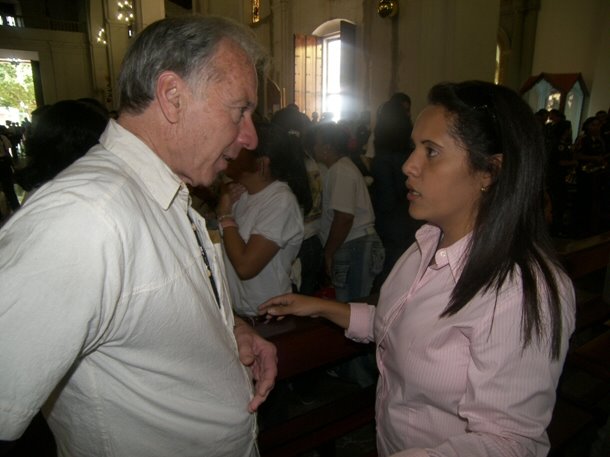
Rosa León in local church with writer during February 12 celebrations of La Victoria’s liberation from Spain. Photo: Ron Ridenour.

Click here to view the entire series.

Sounds of Venezuela
Part II: The Rose Lioness
By Ron Ridenour / The Rag Blog / October 1, 2008

On the day of our interview, Rosa drove alone to the main police station where we were to meet. She was only 90 minutes late. Here are highlights of the interview I taped.

Rosa León’s hope is to utilize more and more of the municipal budget for funding the needs of the people as they see fit. She launched the community councils and there are now 110 of them, although many do not function in reality. While the national government is responsible for building and maintaining the nation’s roadways each municipality has or can have some of its funds to repair city streets. Rosa said her administration had repaired three streets, a total of 7 kilometers. She’d started construction of potable water wells and repairs of others. Progress had been made in the sewage system albeit my ubiquitous, sensitive nose could not confirm that. There were housing projects underway, albeit she could not count more than four houses completed. She was still trying to get weapons for the majority of municipal police; her plan for integrating the three separate policing entities in the municipal area was nearing accomplishment. She believed that 32% of the 63 million Bolivar budget [2.15 Bolivars-BF to $1 at official rate] is dispersed to decentralized entities for social projects, plus one million BF to supplement the national government funds for educational and health missions, operating apart from government entities.

“I don’t have all the figures and projects with me. But you can get the budget from our office,” Rosa told me. “You have to realize that there is a great deal of opposition pressure and even sabotage against our efforts. This state government does not help the Chavez national government or my municipality. Part of our budget, at least four million Bolivars designated for local needs such as potholes, is controlled by the state government, and it has not released these funds to us. Furthermore, some of our budget must go to pay off the large debt [12 million BF] acquired by the previous corrupt mayor, Luis Blanco. He is a friend of Aragua’s governor Didalco Bolivar.

“My first year in government was spent evaluating the structures and learning the people’s needs. Then we began to allocate funds to barrio organizations. For example, we made paths in the hills where people live so that the old, pregnant and handicapped could walk out to the nearby markets and bus stops. We provided some paint for houses and walls. In 2006, social control of some projects began as the community councils took root.

Garbage collection is a major problem not only here but across the nation. The private companies weren’t doing a good job and were extremely costly so I didn’t renew the contracts and let the workers take over the recollection. The problem is they lack the trucks and other necessary equipment. The private companies took everything. We invested 4.5 million BF [7% of the budget] in recollection, in 2007. Almost no one pays tax for garbage collection. Our workers strive to do better but they need more equipment.”

Rosa explained that she had taken a two month leave of office at the end of 2007. She was under attack for fiscal inefficiency. She declared a financial emergency and went off to the state capital, Maracay, to fortify the community council network. Her lawyer cousin took over her mayoral tasks during that time.

“One of our greatest problems is internal,” Rosa confessed during our interview. “We have a tendency to be too casual in our statements and commitments. There is much fugaz [capriciousness]. We start things and don’t finish them; too much Corre Corre [haste and lack of follow through.] I had to go into debt and we’ve been paying it back since January 2008 when I returned to office.”

I mentioned that it would have been a good idea to plan replacement of equipment before ending the private garbage collection company contract. And what about an educational campaign to raise citizens’ consciousness about waste and trash? I recounted how I watch garbage workers come to pick up trash with bear hands—they don’t have gloves or masks—and right before their eyes people drop on the ground everything from cigarette butts and empty packets to food wrappings and empty bottles. Most people wrap their household trash in plastic bags and place them outside, seemly oblivious to the fact that dogs running rampant rip them up for whatever goodies there are inside. There are almost no trash cans. The streets and parks are constantly flooded with wastes. I also noted that the commercial media is 100% anti-Rosa and anti-Chavez and while they all find fault with garbage recollection, among everything else real and unreal, they do nothing to educate people to do their part. Why doesn’t the municipal government, and the political parties backing it, have any media?

“It is an error on my part, to some degree, not to have any media backing,” Rosa affirmed. “We do have some indirect access to two local alternative radio stations but some of the opposition has partial control too. All three local dailies are owned by capitalists and oppositionists. We have allocated a bit of money to creating a local radio station but its start has been delayed. The voceros should soon have a newsletter. And we have just hired a public relations man,” Rosa concluded.

In fact, it is about the same for commercial media on the national level. Of all the newspapers, radio and television stations the pro-Chavez parties and the government itself only control 20%. Practically all newspapers are capitalist owned and are nearly all pro-imperialist. The government only has one national radio station and four television stations. The greatest media asset is Telesur, a regional network begun by the Chavez government. I watch it regularly (also in Denmark) and find it to be professional and credible while delivering pro-socialist, pro-Chavez government plans. There is variety in programming, deep-probing interviews and documentaries, serious entertainment and films. Moreover, the national government has launched 500 community media initiatives in audiovisuals, press and radio stations.

The national opposition and the international mass media spread false propaganda that Chavez is thwarting media democracy. They most often cite the fact that the government refused to renew RCTV’s public license to broadcast, but they do not report the government’s documented reasons: RCTV regularly refused to devote the legally designated time for public service news, and had openly applauded the illegal, armed coup and did not even broadcast the national massive protests which brought him back to power. In fact, RCTV, which is the only medium to be denied public service broadcasting, still broadcasts over cable, which anyone can link up. I often watched it. One of its series concentrated on the poor quality of hospital care. A camera crew filmed inside some of the hospitals, showing real defects and deficiencies, such as: open sewage, dysfunctional medical equipment, broken beds, decaying walls, lack of medicines and low salaries for workers. One program showed sanitary workers complaining to the RCTV crew about these conditions and when hospital security personnel attempted to oust the crew, the medical personnel prevented them from doing so.

From what I have seen, heard and read about the media in the two dozen countries where I have lived and or worked as a journalist over the last four decades, Venezuelans experience the most comprehensive freedom of press extant in the world today.

Shortly after our interview, Rosa, who is studying Social Communication in her spare time, discussed with me the possibility of my assisting her administration and community councils with my journalistic skills. I might conduct radio interviews and lectures, help with the upcoming newsletter and the like. In fact, I did begin a bit before Rosa cut ties with me. I gave a journalistic lecture to the Mission Sucre Social Communication classes conducted at the local university. The 40 students ranged from teenagers to grandparents. They were attentive and inquisitive. They not only asked pertinent questions they also engaged me in debate and challenged some of my views.

Soon thereafter I went to Caracas hoping to interest the pro-Chavez media in the Danish court case concerning seven Danish activists who support FARC and the PFLP in their liberation efforts.

In November 2007, a three-judge Copenhagen court found the activists, “Fighter and Lovers”, innocent of the Justice Ministry’s charge that they had materially supported “terror groups” FARC (Revolutionary Armed Forces of Colombia) and PFLP (Popular Front for the Liberation of Palestine).

The seven solidarity activists had produced and sold t-shirts with FARC and PFLP emblems in an effort to raise a debate about Denmark’s terror law, which is shaped after USA’s Patriotic Act and EU’s terror list where FARC and PFLP appear. The lists are drawn behind closed doors by anonymous politicians whose criteria for selection are secret and the accused are denied rebuttal. Being on the list is therefore not juridical.

Among defense witnesses were the Venezuelan historian Amilcar Figueroa, alternative president of the Latin American Parliament (LAP), and Niels Lindvig, a Danish radio reporter with 25 years experience in covering Colombia and Latin America. They presented facts about President Alvaro Uribe’s ties to drug cartels and mercenaries. The defense referred to a 1991 US Defense Intelligence Agency report, which stated that Uribe collaborated with narcotic cartels (Pablo Escobar) when he was governor of Antioquia.

The court concluded that FARC and PFLP were not engaged in “terrorizing the population,” as is required in Danish law, paragraph 114, in order to be classified as terrorist. But the Danish government, which openly embraces Uribe and Bush, would not accept this decision and appealed the matter. (On September 18, 2008, the Eastern Lands Court voted 5 to 1 to overturn the lower decision that FARC and PFLP are not terrorist groups. Thus, it concluded six of the seven activists are guilty of supporting terror, and they were handed a sentence of from 60 days–suspended–to six months in prison for two of them. The defense is appealing to the Supreme Court.)

Chavez had gained wide acclaim for his humanitarian efforts to negotiate the release of civilian prisoners held by FARC in Colombia. He maintained the same position as “Fighters and Lovers”: that FARC is a legitimate liberation movement representing a majority of Colombia’s peasants in armed uproar for decades against a brutal oligarchy whose governments oppress them. I hoped that if he knew of the Danish court decision Chavez could use that to help sway some who oppose FARC for being terrorists. I was interviewed by the national daily VEA, a few local radio and TV stations and the national VIVE TV station, which reflects grass roots organizations. The interview most viewed was VTV’s “contra golpe” (counterpunch) program with Vanessa Davis. She was later elected on the 15-person leadership council of the new political party PSUV (United Socialist Party of Venezuela), into which 5.7 million of the population of 27 million had registered.

Vanessa Davis went straight to the theme of FARC—was it terrorist or not—and then to EXXON, which was trying to strangle Venezuela’s nationalization of its oil and gas. She gave no time to why I was here or where I lived, which would have allowed me to put in a plug for the La Victoria government of Rosa León. It would have been natural to do so but it was not priority. When I got back to La Victoria I was to meet with Rosa to solidify my role with her administration, but she gave me the cold shoulder for having failed to mention her on TV.

The Rag Blog

Posted in Rag Bloggers | Tagged | Leave a comment

Meet the New Rome, Same as the Old Rome


Will Wall Street’s Meltdown Turn America Into a Police State?
By Scott Thill / September 30, 2008.

Raw capitalism is dead.” — Henry Paulson, U.S. Treasury secretary

Can’t we just all go out and say things are OK?” — President Bush, to congressional leaders during bailout negotiations

I’m not much of an Army Times reader, but after reading that a brigade was shipping from Iraq in October to serve as “an on-call federal response force for natural or manmade emergencies and disasters, including terrorist attacks” in the homeland right before the election, my antennae perked up. Same as they did when I read that an electoral college doomsday scenario exists in which Dick Cheney casts the deciding vote that gives McCain-Palin the White House.

That is, if Cheney and Bush don’t take it for themselves. That may sound like fantasy, but don’t kill the messenger. They are all strands of the Gordian knot the Bush administration has tied around the neck of the American people for the last two presidential terms, best represented today by the failed bailout of banks, brokers and other complicit parties that have since jacked the American people out of trillions. And while the Army Times revelation or election doomsday may turn out to be paranoia rather than prescience, the evidence just isn’t there.

Like I said: antennae.

They’ve come in handy as bullshit detectors since Bush stole the election from a flat-footed Al Gore and set about engineering the greatest transfer of public wealth into private hands in American history. If you factor in Monday’s failed takeover, as well as the $5 trillion the American people now owe thanks to the “bailout” of Fannie Mae and Freddie Mac, not to mention the continuing hyper-expensive occupation of Iraq and so on, our citizenry is now so far in the hole that it’s pointless griping about numbers. If you want one, use the figure put forth by Dennis Kucinich: half a quadrillion dollars. We have evolved past the point of economic or geopolitical reality and entered a phase of pure concept.

And all vectors of that phase point toward the conclusion that the proverbial shit has totally hit the fan — head on, and all over again.

Meet the New Rome, Same as the Old Rome

“Franklin Roosevelt had to save capitalism from itself,” Los Angeles Times business editor Tom Petruno told me as Washington Mutual and Wachovia became the latest banking dominoes to fall. “Is history repeating?”

Indeed, it is, as one could tell from the repetitive usage of loaded terms and phrases like “Great Depression,” “meltdown,” “apocalypse,” “Armageddon” and more to describe the just-on-time cratering of the American economy. After the strange bedfellows in both parties torpedoed Bush, Bernanke and Paulson’s so-called bailout, more than $1 trillion of market value in American equities disappeared in a single day. The Dow Jones average set a record for quickest suicide dive in a single day. Other indexes sunk to multiyear lows, wiping out years of value, and stocks across the board went negative like Ann Coulter. In fact, the only major stock that actually advanced on Monday was Campbell Soup.

Can there be a more fitting metaphor for the American economy stuck beneath the Bush administration’s thumb?

But the reruns, and their loaded terminology, are merging: Bush himself is just another iteration of the infamous “New World Order” instituted by his father while trying to, what else, convince the American public that it needed to go to war against Saddam Hussein. The revisionism is transparent, befitting a government that cares nothing of what its people actually think. Jon Stewart of “The Daily Show” recently juxtaposed Bush’s address on the financial cataclysm with his pre-invasion speech in 2003 and found — surprise! — they were exactly the same.

This is a long way of saying that this particularly frightening crux of historical geopolitics, fascism and environmental calamity has been a long time coming. Failing banks? Deregulation. Endless war? Homeland security. Total information awareness? Transparent government. Bankrupt economy? The fundamentals are strong.

“Here’s my question,” Petruno adds. “If this is remembered as Black September, will that end up being too gentle a reference to what actually happened to the American financial system this month? It is beyond comprehension for people who have been on Wall Street their entire lives. I can only imagine how absolutely stunned the American public must be. Stunned, and very afraid.”

It should be. From a military brigade armed for action in the homeland in blatant transgression of Posse Comitatus to what ex-hedge funder and financial personality Jim Cramer recently called “financial terrorism,” the United States is pushing forward back.

To start with, the bailout was obvious theft, but our situation is more precarious than you think. The hyperreal credit default swap market, which few understand although it is estimated to involve tens if not hundreds of global trillions, is faltering under the weight of its own Ponzi origins. The scenario significantly worsens once you factor in the given that countries like China and others who have denominated their loans in dollars are shouldering our exploding debt, along with oil-soaked sovereign wealth funds from nations whose civil liberties records suck ass. As I wrote last year on this clusterfuck, if the Chinese call in our debts and oil-producing countries decide to peg their petrodollars to the euro, you can more or less kiss the dollar goodbye. Which means the last thing you’ll need to worry about is your stocks, retirement or credit cards. You will instead worry whether or not the cash you have on hand will be worth anything at all. That is the loaded gun that bankers, brokers and the White House is holding to the public’s head, as I write. That trillion erased on Monday, as well as the trillions that have been lost and will be lost in the coming months, was nothing more than a hostage situation engineered by the Bush administration, the Federal Reserve and their partners in crime in finance, insurance and real estate business.

They don’t call that sector FIRE for nothing. Fire destroys everything and leaves little in its catastrophic wake. Which raises the question: What’s left to burn?

“I think our economic situation can get much worse,” argues Danny Schechter, the veteran producer and author whose 2006 indie documentary “In Debt We Trust” covered this volatile territory long before CNN would. “Jobless claims are already at a seven-year high, but the government is worried about the reaction from Asia. We are living on other countries’ money, and when that spigot gets cut off, we will be in deeper doo-doo. Part of the reason for the scale of the bailout is to show Asia and sovereign wealth funds that we will protect their interests.”

But for how long? The Bush administration and Congress’ disdain for the American people has been painfully obvious, so it’s hard to believe they will call from sky-high Dubai to see how we are doing after making off with almost all of our money.

“It’s a high-stakes gamble, which is why Paulson tried to do it quickly in a climate of shock and crisis,” Shechter says. “He knew that the longer it takes, the more opposition it will attract. This plan, if eventually passed, will pre-empt the next president from doing anything about it, because there will be no money. They are wrecking the government by wrecking the economy first.”

That shock doctrine, as Naomi Klein explained in her brilliant book of the same name, has foisted this same kind of disaster capitalism on country after country over the last century. Klein’s book is littered with democracies that slept their way through coups and takeovers, entranced by one simulation or another. The United States was plugged into a matrix that onetime White House press secretary Ari Fleischer described as “an American way of life,” adding without deceit that “it should be the goal of policy makers to protect the American way of life.”

By destroying it? Mission accomplished.

“This is the September of surprise,” Schechter concluded, “not a war on Iran but on America.”

Civil War, the Rerun?

So, what’s the next step for the shoe yet to drop? Perhaps the Army Times has the clues:

(The brigade) may be called upon to help with civil unrest and crowd control or to deal with potentially horrific scenarios such as massive poisoning and chaos in response to a chemical, biological, radiological, nuclear or high-yield explosive, or CBRNE, attack. … The 1st BCT’s soldiers also will learn how to use “the first ever nonlethal package that the Army has fielded,” 1st BCT commander Col. Roger Cloutier said, referring to crowd and traffic control equipment and nonlethal weapons designed to subdue unruly or dangerous individuals without killing them.

Like every move the Bush administration has ever made, from the Patriot Act to the occupation of Iraq and down to bankrupting the American economy, this maneuver is a solution in search of a problem that it seems destined to create. Look around you. Housing is over. Stocks are nosediving. The banks are gone. War is ceaseless. Civil liberties are disappearing. Nerds at the Federal Reserve and the Treasury are taking hostages. It is madness.

And mad people have a tendency to infect everyone around them. The difference is that when you go mad … well, that’s the question mark: What will happen?

Ask the late Iman Morales, who went crazy in Brooklyn on a ledge 10 feet above ground and was illegally tasered by New York police officers, eventually falling to his death, immobilized. A perfect metaphor for our economy, sure, but it’s also the type of literal shock we might be awaiting, as the November election creeps nearer and shit begins to hit the fan with ferocity. Many of us so-called alternative journos are not conspiracy nuts, but realists. We look at galvanizing leaders like Barack Obama, America’s next president, and compare his impact to that of Lincoln, Kennedy or King — without forgetting that all three were eventually assassinated. We are the type of realists who live through two Bush presidents, both of whom configured a New World Order, with and without the approval of the American people and the world at large. The type of realists that notice that after 9/11, we couldn’t fly to Vegas, but Osama bin Laden’s family was flown out of the country on government charter.

And here is what we see today: Crowds protesting in the streets, the people’s money wiped out thanks to the Bush administration’s latest economic shock and awe. An army brigade matter-of-factly betraying Posse Comitatus for the purpose of crowd control. The public trust and wealth almost robbed cleanly with congressional approval.

In other words, we see another unfolding coup, which is to say, a rerun. And there is no telling what the future may hold, or whether or not we are connecting vectors that should remain solitary. But our math has worked just fine in the past — better than Ben Bernanke and Henry Paulson’s math, that’s for sure.

And we’d love to be wrong about what’s coming. But unfortunately that isn’t up to us, and it never has been: It’s up to the Bush administration. And it has never failed to let us down.

Scott Thill runs the online mag Morphizm.com. His writing has appeared on Salon, XLR8R, All Music Guide, Wired and others.

Source / AlterNet

The Rag Blog

Posted in RagBlog | Tagged , , | 1 Comment

Michael Moore : Bucks Not Delivered; People Say ‘No’


‘Hundreds of thousands of Americans woke up yesterday morning and decided it was time for revolt’
By Michael Moore / September 30, 2008

Everyone said the bill would pass. The masters of the universe were already making celebratory dinner reservations at Manhattan’s finest restaurants. Personal shoppers in Dallas and Atlanta were dispatched to do the early Christmas gifting. Mad Men of Chicago and Miami were popping corks and toasting each other long before the morning latte run.

But what they didn’t know was that . The politicians never saw it coming. Millions of phone calls and emails hit Congress so hard it was as if Marshall Dillon, Elliot Ness and Dog the Bounty Hunter had descended on D.C. to stop the looting and arrest the thieves.

The Corporate Crime of the Century was halted by a vote of 228 to 205. It was rare and historic; no one could remember a time when a bill supported by the president and the leadership of both parties went down in defeat. That just never happens.

A lot of people are wondering why the right wing of the Republican Party joined with the left wing of the Democratic Party in voting down the thievery. Forty percent of Democrats and two-thirds of Republicans voted against the bill.

Here’s what happened:

The presidential race may still be close in the polls, but the Congressional races are pointing toward a landslide for the Democrats. Few dispute the prediction that the Republicans are in for a whoopin’ on November 4th. Up to 30 Republican House seats could be lost in what would be a stunning repudiation of their agenda.

The Republican reps are so scared of losing their seats, when this “financial crisis” reared its head two weeks ago, they realized they had just been handed their one and only chance to separate themselves from Bush before the election, while doing something that would make them look like they were on the side of “the people.”

Watching C-Span yesterday morning was one of the best comedy shows I’d seen in ages. There they were, one Republican after another who had backed the war and sunk the country into record debt, who had voted to kill every regulation that would have kept Wall Street in check — there they were, now crying foul and standing up for the little guy! One after another, they stood at the microphone on the House floor and threw Bush under the bus, under the train (even though they had voted to kill off our nation’s trains, too), heck, they would’ve thrown him under the rising waters of the Lower Ninth Ward if they could’ve conjured up another hurricane. You know how your dog acts when sprayed by a skunk? He howls and runs around trying to shake it off, rubbing and rolling himself on every piece of your carpet, trying to get rid of the stench. That’s what it looked like on the Republican side of the aisle yesterday, and it was a sight to behold.

The 95 brave Dems who broke with Barney Frank and Chris Dodd were the real heroes, just like those few who stood up and voted against the war in October of 2002. Watch the remarks from yesterday of Reps. Marcy Kaptur, Sheila Jackson Lee, and Dennis Kucinich. They spoke the truth.

The Dems who voted for the giveaway did so mostly because they were scared by the threats of Wall Street, that if the rich didn’t get their handout, the market would go nuts and then it’s bye-bye stock-based pension and retirement funds.

And guess what? That’s exactly what Wall Street did! The largest, single-day drop in the Dow in the history of the New York Stock exchange. The news anchors last night screamed it out: Americans just lost 1.2 trillion dollars in the stock market!! It’s a financial Pearl Harbor! The sky is falling! Bird flu! Killer Bees!

Of course, sane people know that nobody “lost” anything yesterday, that stocks go up and down and this too shall pass because the rich will now buy low, hold, then sell off, then buy low again.

But for now, Wall Street and its propaganda arm (the networks and media it owns) will continue to try and scare the bejesus out of you. It will be harder to get a loan. Some people will lose their jobs. A weak nation of wimps won’t last long under this torture. Or will we? Is this our line in the sand?

Here’s my guess: The Democratic leadership in the House secretly hoped all along that this lousy bill would go down. With Bush’s proposals shredded, the Dems knew they could then write their own bill that favors the average American, not the upper 10% who were hoping for another kegger of gold.

So the ball is in the Democrats’ hands. The gun from Wall Street remains at their head. Before they make their next move, let me tell you what the media kept silent about while this bill was being debated:

1. The bailout bill had NO enforcement provisions for the so-called oversight group that was going to monitor Wall Street’s spending of the $700 billion;

2. It had NO penalties, fines or imprisonment for any executive who might steal any of the people’s money;

3. It did NOTHING to force banks and lenders to rewrite people’s mortgages to avoid foreclosures — this bill would not have stopped ONE foreclosure!;

4. It had NO teeth anywhere in the entire piece of legislation, using words like “suggested” when referring to the government being paid back for the bailout;

5. Over 200 economists wrote to Congress and said this bill might actually WORSEN the “financial crisis” and cause even MORE of a meltdown.

Put a fork in this slab of pork. It’s over. Now it is time for our side to state very clearly the laws WE want passed. I will send you my proposals later today. We’ve bought ourselves less than 72 hours.

Source / MichaelMoore.com

The Rag Blog

Posted in RagBlog | Tagged , , , , | 2 Comments