Home Sweet Homes : Ten and Counting

John and Cindy McCain’s house keys.

The Rag Blog / Posted August 23, 2008

Posted in RagBlog | Tagged , , , | Leave a comment

Call Your Senator About the Global Poverty Act


The Global Poverty Act: The Most Important Bill You’ve Never Heard Of
by Caroline Schley

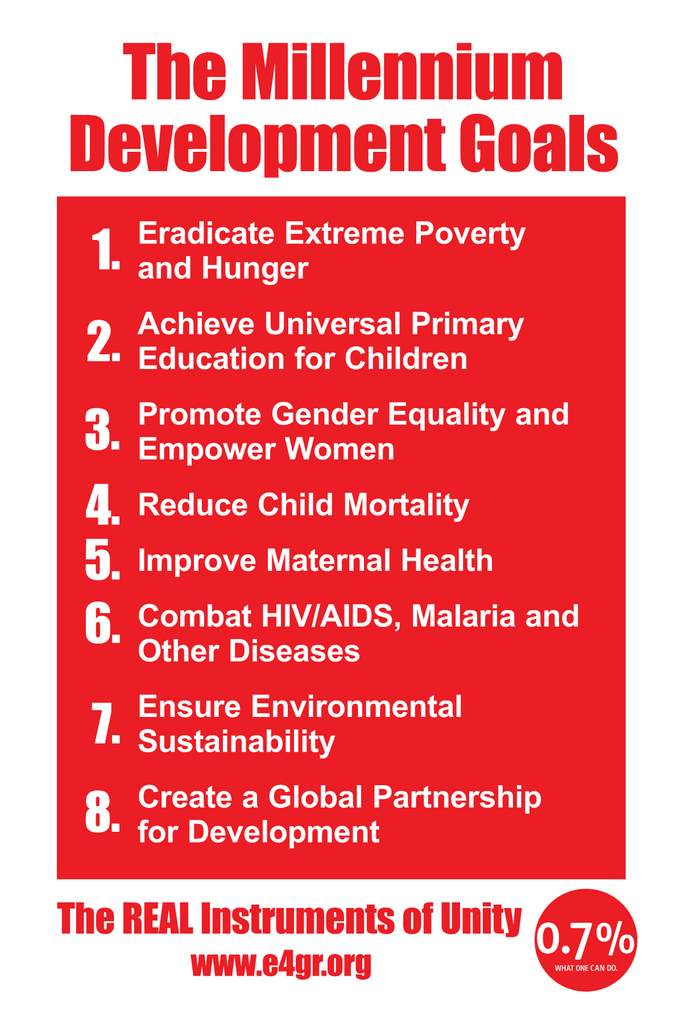
Hopefully you’ve heard of the Global Poverty Act. If not, here’s 30 seconds worth of sounding enlightened at the water cooler: The Global Poverty Act, written by Congressman Adam Smith [D-Wash], would require the President “to develop and implement a comprehensive strategy to further the United States foreign policy objective of promoting the reduction of global poverty, the elimination of extreme global poverty, and the achievement of the Millennium Development Goal of reducing by one-half the proportion of people worldwide, between 1990 and 2015, who live on less than $1 per day.” This would be an important step towards ensuring that the United Nations community addresses the eight Millennium Development Goals before the 2015 deadline. The Millennium Development Goals are, in short, a United Nations plan to ensure that cruel and severe global poverty and injustice are addressed in the international community. Besides poverty they address issues such as infant mortality, AIDS, education, and the environment.

I can hear you asking yourself, “So, what’s the problem? These all sound like very nice ideas.” The House of Representatives thought so, too. They passed the bill last year with an overwhelming bipartisan majority.

Now the bill is in the Senate and Barack Obama is one of the point people spearheading the effort to collect support. Barack Obama … sound the bells for all possible attempts at negative publicity from the Republican camp before November. Conservative publications are blasting the Global Poverty Act left and right (mostly right), claiming it will allocate $845 billion worth of additional foreign aid spending from the United States. While we are having a recession! And an oil crisis!

Here is the thing that has been overlooked in all the hysteria: The Global Poverty Act does not allocate any spending. None, whatsoever, at all. The bill emphasizes cooperation from all United Nations countries, as well as international businesses and NGOs. It calls for better organization of international relief efforts and associations already in place and a review of trade policy and debt relief policy. The bill calls for a US strategy to combat global poverty. It calls for the President to form a plan that includes specific and measurable goals and benchmarks. But the Global Poverty Act does not mandate additional foreign aid commitment.

An official strategy to eliminate global poverty would be beneficial to the United States in several ways. First, as stated by the US National Security Strategy in 2002, “[A] world where some live in comfort and plenty, while half of the human race lives on less than $2 per day, is neither just nor stable. Including all of the world’s poor in an expanding circle of development and opportunity is a moral imperative and one of the top priorities of US international policy.” Conditions of extreme poverty create conditions of social and political unrest. It is imperative to our homeland security and to our international peacekeeping efforts that we combat this problem. Second, the eradication of extreme poverty would create a more favorable global economy. It would create new consumer markets for US goods. Forty-three of the top 50 current consumer nations of American agricultural products were once recipients of United States foreign assistance. We are creating economic markets for our own country.

The United States has made considerable advances so far to combat poverty, a list that includes impressive measures such as the Millennium Challenge Act, the African Growth and Opportunity Act and participation in a G-8 pledge of increased aid funding to Africa. The Global Poverty Act would build off of these impressive efforts and create a model for other UN countries to follow in coming through with their pledge to eradicate global poverty. It is important for the US to be a leader in this fight.

However, the United States Senate has not gotten much of a chance to talk about all the positive outcomes that are possible. The poster child for disagreeable behavior in the United States Senate, Sen. Tom Coburn [R-OK], has placed a hold on the bill, preventing it from going to a vote.

Here’s what you can do to help: Call your Senator. If you don’t know the number call the Capitol Hill switchboard at (202) 224-3121. Explain that global poverty is an important issue for you and you would like to know that your Senator supports the Global Poverty Act and you would like to know what your Senator is doing to ensure that this bill comes to a vote.

[Ed. note: The Wild Sky Wilderness bill overcame a hold by Sen. Coburn a few months ago through parliamentary maneuvers by Congressional Democrats. They can do the same to move the Global Poverty Act–if they’re motivated to act.]

Source / Eat the State

The Rag Blog

Posted in RagBlog | Tagged , , | Leave a comment

America is Pro-Choice, Any Questions?


In support of a woman’s right to choose:

‘According to a recent Gallup poll, we are in the majority by a long shot’
By DarkSyde / August 23, 2008

Is anyone still unsure where We the People stand on choice? That right-wing noise machine is effective, listening to the mighty roar of Fake News and tut-tutting talking heads, it’s easy to think reproductive choice is a shrinking minority. But according to a recent Gallup poll, we are in the majority by a long shot, and have been since the poll was founded over ten years ago. A few tidbits:

Most Americans oppose the idea of passing laws to outlaw abortion and they soundly reject the idea of overturning Roe. v. Wade.

More broadly, a majority of Americans favor keeping abortion legal in the first trimester but would make it illegal in the second and third trimesters.

Only about 20% or less of those polled over the last decade feel abortion should be illegal in all cases — the only possible, rational conclusion for anyone who truly believes that a viable embryo at any stage of development is a person with full Constitutional Rights. Almost two thirds of the sample want restrictions to remain the same or be further loosened. A little over half of those polled do not want to see Roe V. Wade overturned while less than a third want it overturned.

The data goes on and on like this. And what’s remarkable about these numbers is how consistent they’ve remained for more than a decade of polling. Anti-choice talking points have been liberally poured into the nation’s conscious for twenty or thirty years, backed by almost limitless political, religious, and financial resources. The net result of all that right-wing effort is at best maybe a few, scattered points here and there on the margins.

That explains why the most extreme right-wing control freaks in almost a century were notably less than eager to eliminate choice. Tax breaks for billionaires, sweetheart deals for Big Oil, protection for communist sweat shop owners, all sailed through Tom DeLay’s House of Horrors and Bill Frist’s Senate as fast as American jobs sailed overseas. But that same crew of sanctimonious blowhards didn’t even try to put up anything other than a token effort to end what they referred to as mass infanticide, they didn’t try even when they had control of both branches of Congress, the Supreme Court, and the White House. They know damn well it was 1) unpopular, and 2) too useful an issue politically to risk losing. Whatever else we disagree with the grass roots socially conservative right on, and it’s quite a long list, this is one thing we can recognize: they got royally screwed by the Republicans. The question is, do they finally recognize it, and if so, what are they going to do about it?

Source / Daily Kos

The Rag Blog

Posted in RagBlog | Tagged , , , , , , | Leave a comment

US Arrogance: Exported Around the World

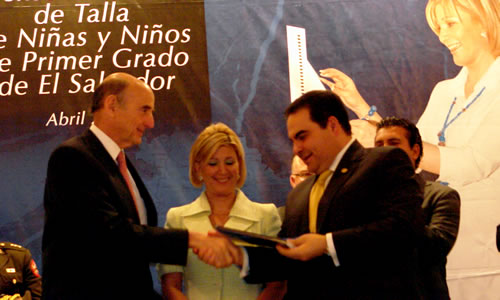
Charles Glazer (left), US Ambassador to El Salvador

Meddling in Elections, Central America-Style
By Burke Stansbury / August 21, 2008

During a recent heated meeting at the US Embassy in El Salvador, Ambassador Charles Glazer admitted that the US government had intervened in the 2004 Salvadoran Presidential Elections on behalf of the right-wing ARENA party. The meeting on June 27 was requested by a group of 12 US citizens, including professors, students, journalists and community activists who were taking part in a 10-day delegation organized by the Committee in Solidarity with the People of El Salvador (CISPES).

In their meeting with the Ambassador, the group focused on continued US intervention in El Salvador. They cited statements made by US State Department officials denouncing the leftist Farabundo Marti Liberation Front (FMLN) party during the 2004 presidential campaign. The delegates also referenced legislation put forward in Congress by Rep. Tom Tancredo (R-CO) that threatened to cut off remittances sent by Salvadorans in the US to their families in El Salvador should the FMLN win. “The US Embassy in El Salvador never countered this absurd threat or clarified the impossibility of such legislation being passed,” said Rosa Lozano, a delegate from Washington DC. “Ultimately, such intervention helped turn a close race for the presidency into a decisive victory for the right-wing Nationalist Republican Alliance (ARENA) party.”

When asked directly if the US government had intervened in the 2004 presidential elections on behalf of the ARENA party, Ambassador Glazer replied in the affirmative. When asked if such intervention would occur again, he said, “No.”

The aggressive, disrespectful conduct of Ambassador Glazer was also of concern to those who attended the meeting. “Mr. Glazer arrived with the idea of attacking our delegation and rudely countering everything we put forward, to the point of being verbally abusive to at least two of the delegates,” said Andrew Kafel, a member of the delegation from New York. “Whether or not the Ambassador agrees with the concerns we laid out about US intervention, he has a duty as a public official to hear us out in a respectful manner,” continued Kafel. “If this is how we as US citizens are treated, we can only imagine how the Ambassador interacts with Salvadorans. We hope that in the future the State Department will better orient its representatives about how to dialogue with those holding a differing opinion.”

During the meeting, the Embassy labor attaché claimed that the possibility of fraud in the 2009 Salvadoran elections will be diminished because of the active monitoring of various international organizations, and emphasized the role to be played by the International Republican Institute (IRI) and the National Democratic Institute (NDI), both subsections of the National Endowment of Democracy (NED). When challenged about the partisan nature of these quasi-non governmental organizations, as well as accusations that the IRI and NDI have played an interventionist role in other Latin American elections, the Embassy representative admitted that there was controversy and doubts surrounding the NED.

Indeed, “in 2007, the IRI–headed by Republican presidential candidate John McCain–presented President Saca with its ‘Freedom Award,’ showing its clear ideological preference in the polarized Salvadoran political process,” said Laura Embree-Lowry, a member of the Boston chapter of CISPES and a participant in the Embassy meeting. “The presence of partisan groups like the IRI and NDI may in fact be counterproductive to the goal of the Salvadoran people, which is to hold free and fair elections in 2009.”

Burke Stansbury is CISPES Executive Director. CISPES is currently campaigning to prevent US intervention in the upcoming Salvadoran elections. For more information and to sign the People’s Pledge to Defend Free and Fair Elections in El Salvador, go to www.cispes.org. You can reach the Seattle CISPES office directly at: seacispes@igc.org, 206-325-5494.

Source / Eat the State

The Rag Blog

Posted in RagBlog | Tagged , | 1 Comment

Police Brutality: Not Just an American Problem

Mourners at Fredy Villanueva’s funeral

No Justice, No Peace: Behind the riots in Montreal after the shooting-death of Fredy Villanueva
By Charles Mostoller / August 23, 2008

MONTREAL-NORD, Montreal–“Why four gunshots? Why?”, asked Patricia Villanueva. “I don’t believe they had reason to shoot four times, just like that. Nothing justifies a death.” Patricia is sister to Fredy Villanueva, an 18 year old Honduran youth who was shot dead by a Montreal police officer on August 9th, sparking a small riot among the fed-up youth of this impoverished immigrant neighborhood in North Montreal.

Villanueva is the latest death in a long line of police killings here in Montreal, although the first to occur in this North Montreal neighborhood.

According to police, two officers approached a group of youths who were playing dice in a park, and attempted to arrest Dany Villanueva, Fredy’s brother. When an argument broke out, one officer fired four shots, killing Fredy and injuring Denis Meas and Jeffrey Sagor Metelus, who are recovering in the hospital. Police have stated that the officers were attacked by a group of about 20 youths, despite statements from witnesses who say that only five or six people were present and that there was no physical confrontation.

“My brother said ‘What are you doing with my brother? Let go of him.’ Then I heard gunshots, and my brother fell to the ground,” said Dany, according to the CBC. According to statements by the Villanueva family, Dany has had some trouble with the law in the past, but Fredy was the ‘good’ son, doing well in school and staying away from drugs and trouble.

Jean Loup Lapointe–the Service de Police de la Ville de Montreal (SPVM) officer from Montreal-Nord’s Station 39 who fatally wounded Villanueva–has not been suspended, although he has been taken off patrol duty.

Although over 30 witnesses have already been questioned in relation to Villanueva’s death, the two police officers responsible for his death have yet to be questioned. His sister wants to know why.

“It’s so important to have a transparent investigation, to know what really happened,” she said. “But they haven’t taken the police officers’ testimony yet. What are they waiting for?” Despite the slow course of the internal police investigation, the Villanueva family hopes that Fredy’s death will finally make police on the island more responsible and less likely to resort to lethal force.

“We want this never to happen again,” said Patricia, speaking after a press conference on Friday. “If it happens once, it can happen again, and it has happened before.” The incident has sparked debate in the media and among politicians here, more over the supposed threat of street-gangs in the area than over the reckless use of force displayed by Montreal’s finest–with many, including Prime Minister Stephen Harper, suggesting the need to beef-up the police units in the area to crack down on gangs. However, Francois du Canal, a spokesperson for the Coalition Against Police Brutality (COBP), believes that the most pressing issue in Montreal’s poor neighborhoods is poverty, not gangs.

“They are treating everyone in the neighborhood like they are would-be gang members,” he said. “There is poverty and a lot of social problems in neighborhoods like Montreal-Nord, but instead of dealing with poverty–like by giving money to community groups–they give millions of dollars to cops.” Take a quick stroll through Montreal-Nord and this is immediately obvious. Local residents gather in front of the dilapidated housing buildings, while groups of five or six police officers patrol the sidewalks and teams of police cruisers line the corners. Many people feel intimidated by the heavy police presence, which has been a part of daily life since long before Villanueva’s death.

“There are too many police here,” said Kevin Garcia, a friend of the Villanueva family. “Caravans of 10 or 15 police cars will come into the neighborhood all of a sudden, and we feel very insecure, because it seems like anything can happen from one moment to the next. It makes us feel very intimidated to have so many police everywhere.” “It seems like they are here to provoke things,” he added. “They see a few young people, and even if there are little kids around, they approach them, trying to intimidate–or what are they looking for? They are provoking things, trying to take this to the next level.” However, it is unlikely that Villanueva’s killers will ever face justice, given the history of impunity for police officers in cases like this. Villanueva is the 43rd person to be killed by the Montreal Police in the last twenty years, yet only two police officers have ever faced charges for their actions–and were acquitted in both cases.

“They kill people, and they’re not even accused of any misdoing,” said Canal. “So they get away with it. That’s what we call impunity, and because of it, they know they can kill people, so they just keep on acting like they can do whatever they want.”

“They use harassment, intimidation and violence as tactics,” he added, “and things like this happen, because the politicians are too afraid to control the police more. And they will continue to happen if nothing happens to these cops.”

Surete du Quebec (SQ)–the Quebec provincial police who are leading the inquiry into Villanueva’s death–have promised “an investigation with impartiality, rigor, objectivity and rapidity,” according to SQ Lt. Francois Dore.

However, past investigations into fatal shooting by the Montreal Police suggest that we may never know what really happened on August 9th.

For example, in the case of Mohamed Anas Bennis–a youth killed in December of 2005 by a Montreal Police officer–the findings of the investigation into his death have still not been made public., two-and-a-half years later. Nor has the officer who killed Bennis, Yannick Bernier, been penalized.

“It’s always the same story,” said Canal. “The cops investigate themselves and there are no accusations, so we never really know what truly happened. The cops are not even suspended.”

In 1996, former SQ investigator Gaëtan Rivest told the COBP that an investigation into the death of Yvon Lafrance–killed by police in 1989–had been tampered with in order to protect the officer responsible, Dominic Chartier. According to the COBP, Rivest confirmed “that such practices are common within the different police services in Quebec.”

“So it really sends a message that the city and the government are backing the police,” said Canal, “even if they say they think about the family and all that. But they really seem more upset that there was a riot than the fact that the cops killed an unarmed youth.”

Communities like Montreal-Nord are fed up with the situation. The riot that happened the day after Villanueva’s death was probably just a release of the neighborhood youth’s pent-up anger, not an action organized by local ‘street gangs’.

“The only street gang around here is the police,” shouted Will Prosper, along with hundreds of other Montreal-Nord residents in front of the town’s municipal building on Wedensday night.

Local residents had gathered in the parking lot in front of Mayor Marcel Parent’s office, calling for an public investigation of Villanueva’s death and an end to police repression in Montreal.

Shouting “No justice, no peace! Disarm the police!” and “Enquête public!”, dozens of residents barged into a meeting the mayor was holding, and Prosper raucously called for the mayor himself to resign–for not trying to help lift Montreal-Nord out of poverty.

“I don’t think he can lead Montreal-Nord correctly, because he’s not listening to his people,” said Prosper. “If he was listening to his people, maybe Fredy Villanueva would still be alive.”

According to Prosper, unemployment among youths has skyrocketed under Mayor Parent , and police abuse has gone unchecked.

“These people want jobs, houses, families–and are tired of police harassment,” he said. “If you don’t give them some options, what are they going to do?”

Both Prosper and Canal feel that in a poor neighborhood like Montreal-Nord, the police just exacerbate the problem.

“The police are not here to help people, they’re here to criminalize people and then they do things like killing people,” said Canal. “This makes it so that everybody in the community feels alienated–like they are being unjustly treated–and that’s one of the reasons why an explosion like the one we saw after the killing of Fredy Villanueva happened.”

In the end, police brutality towards immigrants seems like a systemic problem in Montreal, and one that won’t be going away soon. According to Prosper, minorities are twice as likely to be shot by police in Montreal, and poor immigrant neighborhoods like Montreal-Nord are overrun by police officers.

“They have a gang mentality,” he said. “A lot of police are good officers, but they tolerate abuses by other police officers. How come they don’t say anything about that? They ask the population to anonymously denounce criminals, but then they let criminals in their own ranks.”

“If we could respect the police, the riot wouldn’t have happened. But right now,” he continued, “there’s no trust, no respect. We know what happened that night, and that’s why we want change.”

The political response to police killings is to criminalize immigrant communities and victimize the police, sending in more police to fight against street gangs–in other words, young people. Until less money is spent on police in poor neighborhoods and more is spent on community programs, Canal explained, the vicious cycle that has led to so many deaths at the hands of police will probably continue.

“If they don’t stop police brutality, and their answer to what happened is to put more police on the streets,” said Canal, “then there’s going to be more police brutality and more riots to come.”

Source / Z-Net

The Rag Blog

Posted in RagBlog | Tagged , , | Leave a comment

Cindy McCain ‘Unsure’ How Many Half-sisters She Has

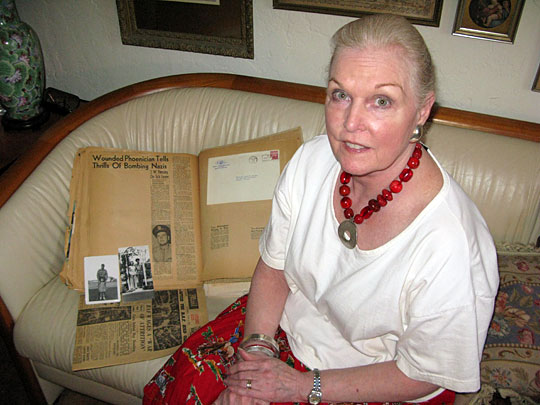
One of Cindy McCain’s half-sisters, Kathleen Hensley Portalski, showing proof of her half-sisterness. How many more are there? Get back to us. Photo by Ted Robbins / NPR.

Says staff member will handle sibling tally
By Andy Borowitz / August 22, 2008

Presumptive first lady nominee Cindy McCain responded to a reporter’s question today about how many half-sisters she had by saying that she was “unsure” about the exact number but would have “a staff member look into it.”

Ms. McCain’s claims of being an only child were clouded this week by revelations that she has at least two heretofore unmentioned half-sisters, leading to reporters’ queries as to whether more undisclosed half-siblings were waiting in the wings.

When a reporter from the Toledo Blade asked Mrs. McCain at a campaign stop in Ohio about how many half-sisters she had, she looked momentarily startled by the question before handing it off to a staff member.

Mrs. McCain’s uncertainty about the precise tally of her siblings, coming on the heels of her husband’s confusion about the number of the couples’ homes, might not be as big a problem for the McCain campaign as some might expect, says Davis Logsdon, professor of economics at the University of Minnesota.

“As long as the couple has more homes than half-sisters, they could easily house one of the half-sisters in each of the residences and keep them happy,” Dr. Logsdon says. “However, if the number of half-sisters grows faster than the number of homes, that could potentially lead to crowding.”

For his part, Sen. McCain said that the campaign would provide a “guesstimate” of how many half-sisters and homes the couple has by the end of next week: “Right now, we’re trying to put it all on a spreadsheet.”

Source / Borowitz Report

Thanks to Shelia Cheaney / The Rag Blog

Posted in RagBlog | Tagged , , , | Leave a comment

Now If We Could Just Get Private Money Out of Elections …


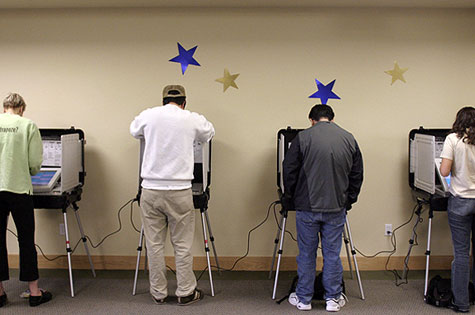
Seven Ways Your Vote Might Not Count This November
By Steven Rosenfeld / August 22, 2008.

Some of the most serious election protection problems can be discovered and fixed before the presidential voting begins.

While many voting rights activists are focused on stopping potential problems on Election Day, there are several milestones between now and the 2008 presidential vote that would preview problems with voting on Nov. 4.

What voters often do not know is that long lines or delays in polling place voting can result from many factors — some administrative, some technical, some partisan. Many of the problems that arise on Election Day not only can be identified before voting in November, they can be resolved by election officials. The following issues will directly impact how voters are accommodated.

Voter Purges

According to the federal law that governs how people may be removed from voter lists, the last day that most registered voters can be purged is 90 days before an election, which would have been Aug. 5 for the presidential election. However, some states are not following the process in the National Voter Registration Act, according to voting rights attorneys. Moreover, because purges are often conducted secretly, people who do not call local election offices to confirm their registration status may discover later this fall that they cannot vote.

Solution: Voters, particularly those who have not voted in recent years, should call their local election office to confirm they are registered at their current address. If they are not properly registered, they should update their voter registration. This must be done before registration closes, which is the first week in October in 27 states. Advocacy groups can facilitate this by accessing a voter registration list and reviewing it with community activists. (Editor’s note: Web sites and experts to help voters are listed below.)

Unprocessed Voter Registrations

After the Democratic Convention, the Obama campaign will launch a national voter registration drive to bring millions of new voters to the polls in November, according to top campaign officials. This could be the largest voter drive in decades. In previous years, local election officials have complained about receiving too many registration forms at the last minute to verify before Election Day. In two Ohio cities in 2004, Cleveland and Toledo, boxes of registrations went unprocessed by Election Day.

Solution: New voters should register sooner rather than later, and then verify that their voter registration forms have been processed by calling local election offices. Remember, it is local election officials, not political parties or third-party groups, who are legally responsible for validating and processing voter registrations.

Obstacles to Student Voting

Historically, students have been criticized for not voting, but what is often overlooked are the obstacles created by local officials or state legislators that discourage student voting. The most frequent barriers involve state residency and ID requirements. In some places, registrars tell students that a campus post office box is not a proper address and refuse to register students for that reason.

Solution: Students who experience problems with voter registration should contact organizations working on voter registration, or the presidential campaigns, or election protection lawyers who have the legal expertise to help with registration and could go to court to enforce student voting rights.

Voting Machine Allocations

How local election officials allocate voting machines — literally the number of machines per polling place — can lead to smooth voting, or long lines prompting some voters to leave without casting a ballot. In 2004 in Ohio, a shortage of voting machines created lines and delayed voting that disenfranchised minority voters in the state’s inner cities. In contrast, nearby wealthier suburbs experienced no lines, due to an ample number of voting machines.

Solution: Local election integrity groups or election activists should ask election officials how they are deploying the machines and ask officials what the basis is for that decision. Election officials tend to use historic turnout patterns over several voting cycles, which, as was the case this spring, underestimated the number of primary and caucus voters. Local officials should be encouraged to use the voter turnout numbers from 2008’s primaries and caucuses and updated voter registration statistics, rather than voter turnout figures from 2004.

Poll Worker Shortages

The nation’s elections are staffed by 2 million poll workers, who typically are senior citizens who undergo a few hours of training before Election Day. A shortage of poll workers, or poll workers who are uncomfortable with the latest electronic voting technology or the latest fine print in election law, will lead to delays in voting.

Solution: Local election integrity activists or local media should ask election officials where there are likely to be shortages of poll workers, and help recruit key staffers there. Election officials, for their part, should turn to local high schools and colleges to recruit poll workers. Arizona, a state with restrictive election laws, even allows 17-year-olds to serve as poll workers. Often these students can receive school credit while learning how elections really work.

Partisan Voter Challenges

In recent years, the GOP has threatened to challenge the credentials of new voters, claiming it is seeking to protect the process from so-called voter fraud, or people posing as other voters. Democrats have not embraced this tactic, which causes delays in voting, with equal vigor. The first sign of voter challenges will come in October, when newly registered voters will receive a non-forwardable postcard from a political party that welcomes the voter to the political process. Sometimes these voters are selected based on race or ethnicity. Those recipients whose cards are returned — because the address is incorrect — can be put on a voter challenge list. Come Election Day, partisan volunteers can stand at the polls and insist those voters produce ID and other verification, such as utility bills, to prove who they are before voting. Voters who cannot produce such identification are not permitted to vote.

Solution: Any voter who registers after Aug. 1 and who receives such a postcard from a political party not of their choosing should recognize they could be on a “caging” or voter challenge list. This is especially true for college students and minority voters. Because vote caging can be illegal in certain circumstances, voters should notify voter protection groups, who should follow up on the vote challenge scheme. Also, those registrants should bring additional ID to the polls on Election Day, and they should alert the presidential campaign they support to investigate if voter caging is likely, as election lawyers take this issue very seriously. If voters are properly credentialed, they will get to vote. This tactic is designed to create delays at the polls, so people often leave in frustration, particularly those who try to vote on their way to work or on their lunch hour.

Early Voting/Absentee Ballot Problems

Problems with voting early or voting by mail can be a sign of election difficulties. For soldiers and others overseas, if absentee ballots are not sent out early enough, they may not get delivered in time for recipients to return them to be counted.

Solution: Any problems with early voting should be reported to voter registration organizations, which will forward them to voting rights lawyers who will investigate and possibly intervene. Voting rights groups can monitor requests for absentee ballots to see how many have been sent out, which will indicate if voting this way will be problematic. The military and some states are instituting a system of registering voters online, but ballots still have to be requested and submitted on time. Federal Express has a program to help deliver military ballots.

Solutions and Resources for Voters

Finding your local election official: The Overseas Vote Foundation has a nationwide directory on its Web site that has all the contact information you need to verify and update voter registration information.

Registering to vote: Many sites offer help with getting voter registration forms, but it is up to the voter to ensure they are filled out properly and returned on time. Two good sites that offer this service include NonProfitVote.org, which has a home page map that launches all kinds of helpful registration and other information from every state; and DeclareYourself.org, which is seeking to register students and young people.

Legal help for any voting problem: The Lawyers Committee for Civil Rights Under Law has a live hotline, 1-866-OUR-VOTE, and callers can talk to a lawyer or expert who will help resolve issues or refer the matter to lawyers who will go to court. This is the country’s largest election protection network, although it now is only taking calls during East Coast business hours. The Campaign Legal Center also is staffed by lawyers and has developed legal templates that anybody could use to use to go to court to protect their right to vote; people or groups experiencing problems are urged to call.

Finding your polling place: The League of Women Voters has a polling place locator on its home page, lwv.org.

Source / AlterNet

The Rag Blog

Posted in RagBlog | Tagged , | Leave a comment

Why Does This Look So Much Like Vietnam?


Occupation’s security: “Burning a village to the ground in order to save it”
By Imad Khadduri

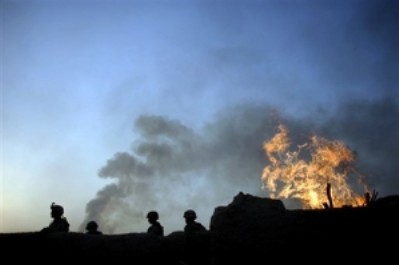
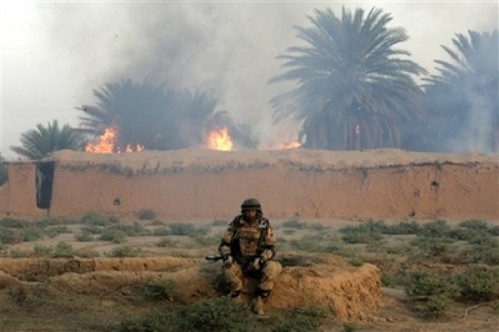
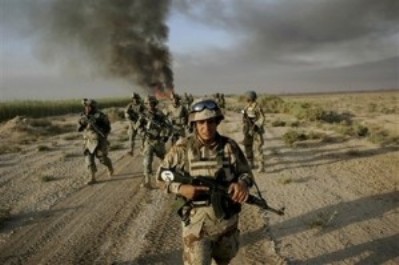
On August 10, 2008 (in Arabic with pictures – not to be seen on CNN or FOX), an entire Iraqi village in Baladrouz, Diyala was destroyed, its mud cottages and date trees burned to the ground, by members of the American 3rd Infantry Division and its puppet Iraqi army as punishment for harbouring Resistance fighters.

Source / Free Iraq

The Rag Blog / Posted August 18, 2008

Posted in RagBlog | Tagged , , , | Leave a comment

I Will Always Be Watched, Or Far Worse, Hunted

Photo of the SS Liberty, Aug 10, 2008

See press release below concerning arrival of SS Liberty and SS Free Gaza in Gaza earlier today.

Intimidation Will Not Stop Our Mission: Sailing to Gaza
By Osama Qashoo / August 23, 2008

This morning I am sorry to find myself back on dry land in Cyprus, separated from my fellow sailors who are now completing the final leg of their trip to Gaza. They are carrying humanitarian and medical aid to a people now suffering both an international boycott and the illegal Israeli occupation. On board the refurbished fishing boats, SS Free Gaza and SS Liberty, are more than 50 activists from 17 nations – Jews, Muslims, Christians, Buddhists, farmers, fishermen, officials, language teachers, piano technicians and one 85-year-old Holocaust survivor – all united in their determination to break the Israeli siege.

After months of preparation, the Free Gaza Movement’s perilous relief mission is under way. But I am not with them, despite the fact that I am the only Palestinian-born organiser involved. Last week, my immediate family, who still live in the West Bank, were attacked and terrorised, and I also received numerous anonymous death threats. My family were warned that I must leave the project, and that I must not contact the media. This psychological terrorism now forces me to make a public protest. Though I am no longer on board, I will not leave this mission, even as potential confrontation with the Israeli military looms closer.

The UN has called the situation in Gaza a humanitarian disaster, but the inhumanity goes on. More than 200 civilians have died due to the refusal to let people leave Gaza to seek medical care. The United States, the country that assumes stewardship of the world and whose influence could change the situation, stands by. Worse still, it endorses absurd Israeli claims, such as the recent labelling of innocent Fulbright scholars as “potential security threats” to bar them from taking up their scholarships abroad.

Internationally, the thin veneer of diplomacy has shattered again. On June 19 Israel agreed to halt military invasion and the indiscriminate shelling of Gaza, in return for an end to the launching of homemade rockets towards Israel. Israel has not met its obligations. Gaza’s borders, gates that imprison 1.5 million civilians, remain locked, and scant supplies get through. Even medical supplies are being blocked.

I grew up in Palestine and have lived in fear since childhood. The horror of witnessing elders of my family being bullied and humiliated, the daily terror of losing my parents. Watching my family elders being humiliated, the child’s voice inside me would cry out silently: “How can I stop this?”

While I was on board the Liberty, I listened to the threatening messages hijacking the ship’s emergency channel, illegal for use unless in distress. These voices reawakened a deep, familiar feeling in me: that no matter how civil, kind, non-violent I am, I will always be watched, or far worse, hunted.

Now I realise that the biggest friend of psychological terror is silence. The Free Gaza Movement aims to challenge the physical stranglehold on Gaza, but more importantly, this mission seeks to break the silence for millions of voiceless civilians whose daily stories of persecution go so cruelly ignored by the international community.

When our boats arrived in Cyprus on August 20 to collect the rest of our 40-plus group, news reached us that Israel’s deputy prime minister and minister of foreign affairs, Tzipi Livni, had finally responded to our invitation. The Free Gaza Movement had invited her to join the Cypriot authorities, who were coming aboard to search our boats in order to address their security concerns. Citing the Oslo accords, a document from the legal department of the foreign ministry asserted Israel’s right to use force against our boats. It claimed that security forces were permitted to detain the vessels upon entry to Gaza’s territorial waters, and that the peaceful, unarmed activists on board could be forcibly arrested, detained and “interrogated” in Israel. Why does a peaceful relief mission bring fury, fear and threat from the Israeli government?

Is this the way Israel observes its responsibilities under the Oslo accords? Under the accords and the Gaza-Jericho agreement, the only authority Israel reserved for itself was for “security” purposes. Our boats are no threat. Our David and Goliath mission is a focused, direct action to challenge the inertia of the international community which allows the “humanitarian disaster” suffered by the people of Gaza to continue. The activists carry no arms or threat of violence. If the Israeli government orders the destruction of this mission, it will surely be an act unequalled since the blowing up of the USS Liberty more than 30 years ago, a secret mission of sabotage to draw the Americans into the war against Egypt.

The prospect casts a shadow on our mission. But Liberty and Free Gaza will bring their peaceful cargo to the people of Gaza. Many families will now be gathered on the Gaza beaches, waiting and praying for the boats’ safe arrival. For those families, simply to be afloat in these crystal blue seas, enjoying the freedom of international waters, would be a truly wonderful thing indeed.

Osama Qashoo is a documentary film-maker and broadcaster.

Source / CounterPunch

Update / August 23, 2008:Source / FreeGaza.org

The Rag Blog

Posted in RagBlog | Tagged , , | Leave a comment

The Man Hiding Behind the Mask of War Hero


Why the Senator is Not a War Hero: John McCain in a New Context
By Patty O’Grady / August 23, 2008

Did you know that when John McCain was away from home for extended periods of time working as a U.S. Senator, Mrs. Cindy McCain would tell her children with his acquiescence that he was “deployed” and imagined herself just another lonely – albeit very, very wealthy – naval wife?

As a military wife and daughter I don’t think living in D.C. – wining and dining lobbyists – is the equivalent of deployment to Afghanistan, Iraq or Vietnam.

Why is this story worth repeating? The Cinderella quality of such imaginings provides a telling context – revealing the man and his presumptions hiding behind the mask of war hero.

In this election season, understanding the full context of presumptions is very important. My husband, also a former Vietnam Prisoner of War (1970-1973), spent time in both the “Hanoi Hilton” and a secondary camp -“Plantation Gardens” – as did John McCain who never mentions time spent in the latter. I am also the daughter of Colonel John F. O’Grady who was known to be a POW captured on the border of Laos and Vietnam in 1967 and who never returned. Like John McCain, John O’Grady was a graduate of the U.S. Naval Academy (1952). John O’Grady earned 7 military commendations for heroic service including the Silver Star and two Distinguished Flying Crosses.

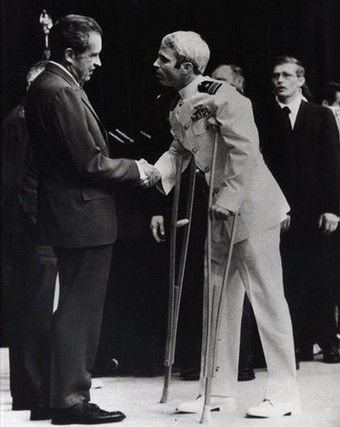
There were many heroes in Vietnam – and there are many freshly bloodied heroes returning from new wars started by old men – and John McCain’s claim is tarnished by long forgotten historical facts that few are brave enough to proffer today for fear of vicious attack on their “patriotism”. My father’s legacy protects me from such attack and so demands that I ask the unspoken questions and remind voters of the forgotten history. When the Vietnam POWS came home in 1973, President Nixon traded a small group of them celebrity status – anointing them as “heroes” – for political support of his failed war policies. John McCain was one of the anointed heroes while others were virtually discarded in exchange for their continued support of the false Nixon plan of “peace with honor” in Vietnam.

Politics can magnify or ignore heroism as it suits. In turn, the select POWS were introduced to very wealthy and influential members of the Republican Party, their records were elevated over other POW heroes with more compelling stories, and many difficult questions were not asked of them.

Today, some of those same POWS are employees of the neo-conservative American Enterprise Institute and many others have profited greatly from their staunch affiliations within the Republican Party.

In 1973, “patriotism” was traded like a commodity and heroes were used as political props. Essentially, the architects of both Vietnam and Iraq (Cheney, Rumsfeld, et. al.) launched a highly successful propaganda campaign (remember the Private First Class Jessica Lynch POW shameful sequel) using Vietnam POWS – at least the ones that were willing to be used wittingly or unwittingly – in an attempt to prop up the failing Nixon administration. Yet, if Mr. McCain is now intent on running on his character and his war record almost – because he has nothing else to offer – while suggesting that others do not care about their country as much as he does – then the wife and daughter of two other Vietnam heroes has a few questions for him:

In the interest of full disclosure why do you refuse to release your Department of Defense POW debriefing?

In the interest of full disclosure why have you failed to release all military medical records including psychological studies – 1973-1993?

Why do you only reference the time spent as a prisoner in the Hanoi Hilton”?

When will you provide details about the time spent in the prison referred to as “Plantation Gardens”?

Did you ever receive any preferential or atypical treatment while a POW in any location where you were held? How soon and when did you reveal your true identity to your Vietnamese captors – did you simply give name, rank and serial number?

Has any other former Vietnam Prisoners of War or Vietnam veteran questioned the record that you claim particularly your claims of “torture”?

What was your connection to the “Peace Committee”?

Have you ever referenced the “blue files” in any speech that you have given? What are the “blue files”? Where are those files housed? Why do you not want those files released?

Have you ever lost your temper with military families who challenged your position?

Have you ever acted in an inappropriate way or in a less than gentlemanly manner with any female spouse of any active duty military personnel member?

Why not let citizens, who know the personal and painful history better than anyone else, ask the questions? Why not let these questions prompt more thorough investigation and scrutiny and less shilling by the press? Why shouldn’t change really mean accountability as framed by ordinary people who also made an extraordinary sacrifice? The answers might provide all citizens the context needed to fully judge some less than credible claims that have aged into myths over time.

There is always the context to consider…

[Patty O’Grady, Ph.D., teaches in the Department of Education at the University of Tampa.]

Source / CounterPunch

The Rag Blog

Posted in RagBlog | Tagged , | 2 Comments

Same Sex Marriage Affects the Whole Country


What impact will it have on the elections? Maybe not much.
By Suzi Steffen / August 22, 2008

Patchwork, partying, pessimism, politics: That’s the state, so to speak, of same-sex marriage around the U.S. since same-sex couples began lining up to get married in California on the afternoon of June 16.

News of the California Supreme Court’s May 15 decision, which said that denying marriage licenses to gay and lesbian couples was unconstitutional, surprised some observers because it came from a Republican-appointed court — and thrilled couples across the country because California does not have residency requirements for marriage.

At the time, Massachusetts, which began offering same-sex couples marriage licenses in 2004, had routinely been denying them to couples from other states thanks to a 1913 law intended to ensure that interracial couples from other states didn’t get married in Massachusetts. That law changed at the end of July.

Many marriage equality proponents hailed California’s decision as a major step forward, but one of the first reactions for some political wonks was markedly more guarded or even pessimistic.

First, the good news, by the numbers. During the first month that licenses were available to same-sex and opposite-sex couples equally, counties in the Bay Area reported larger numbers of licenses granted and of ceremonies performed in clerk’s offices, according to a mid-July Associated Press report.

California does not keep separate count of same-sex marriages, according to the California Department of Public Health, so those curious about the numbers must track county-by-county records or simply look at increases. The AP says that San Francisco, not surprisingly, reported a 131 percent increase in licenses granted, but Sonoma County (a romantic destination in the heart of California’s wine country) also reported an increase of 160 percent, from 340 to 546, and a quadrupling of ceremonies performed in the clerk’s offices. That number went down in at least one California county, however: Kern County, which includes Bakersfield, stopped performing any civil ceremonies at all, whether between opposite- or same-sex couples, on June 15. But the county clerk’s office there must still grant marriage licenses to those who legally qualify.

The economic impact on a budget-constrained state has not been small. According to the AP, the 44 counties in California took in over a quarter of a million dollars more this June than last June. The UCLA School of Law’s Williams Institute released a study in early June, before same-sex marriages began in California, estimating that if the state’s voters didn’t approve a constitutional ban on same-sex marriage on the ballot in November, the ceremonies would “boost California’s economy by over $683.6 million in direct spending over the next three years.”

Massachusetts hasn’t ignored those findings. A study commissioned by the Executive Office of Housing and Economic Development estimated that repealing the 1913 law, which said that the state would not marry those whose marriages would be illegal in other states, could bring in at least $111 million into the state economy over the next three years. The Massachusetts Senate voted for repeal on July 15, and the House added its vote two weeks later. Bay State Governor Deval Patrick added his signature July 31. The bill repealing the old law contained an emergency preamble allowing out-of-state same-sex couples to obtain marriage licenses immediately, and reports in the New York Times indicate that New York couples took advantage of the repeal as soon as it was signed. When a reporter asked Patrick about couples coming to Massachusetts to get married from other states that expressly forbid same-sex marriages, Patrick said, “What we can do is tend our own garden and make sure that it’s weeded, and I think we’ve weeded out a discriminatory law.”

But the state of the union isn’t all wine and roses, cakes decorated with two brides or grandmothers finally able to give their grandsons the heirloom china.

For one thing, in many states, same-sex couples won’t see any legal benefits from getting married in California or Massachusetts. Indeed, Lambda Legal reported earlier this summer that same-sex couples from Wisconsin may face harsh legal penalties if they get hitched on one of the coasts. According to the Milwaukee Journal-Sentinel, the penalty for a marriage “that’s prohibited or declared void in Wisconsin” can range up to a $10,000 fine and up to a nine-month prison sentence — though Wisconsin prosecutors seem uninterested in using what one called “scarce resources” to prosecute same-sex couples. Still, the Wisconsin law (apparently passed in order to discourage underage heterosexual couples from marrying in other states) indicates one of the many concerns progressive voters felt when the California law passed.

It’s not that they didn’t want same sex couples to be able to marry. They were simply worried about what the New York Times reported in 2004 as an increase in conservative voters who voted for Bush at the same time they voted for state initiatives banning same sex marriage.

During the November election in 2004, 11 states — including Oregon, Michigan and Ohio, which were considered battleground states between Republican President George W. Bush and Democratic candidate John Kerry — passed initiatives barring state recognition of same-sex marriages (and in some states, barring state recognition of civil unions or domestic partnerships as well). Though Michigan and Oregon both passed their anti-marriage state initiatives, both states also went for Kerry.

But as you probably recall, Bush won a close election after Kerry decided not to dispute contested results in Ohio. Conventional wisdom then said that Republican strategists like Karl Rove used 2004’s various gay marriage issues as a way to get out the money and get out the vote for their presidential and Congressional candidates. Some religious conservatives, including former GOP presidential candidate Gary Bauer, have since claimed that the California Supreme Court decision will likewise affect the 2008 presidential election.

Even an L.A. Times reporter who wrote about the decision weighed in, stating that the Supreme Court “tossed a highly emotional issue into the election year.” Before the decision, a conservative group wrote an initiative banning same-sex marriage. It will appear on the November ballot in California.

A quick fact check, however, shows that conventional wisdom may have been wrong to begin with. Mark Mellman, a Democratic pollster, wrote in a June op-ed for TheHill.com (an online Congressional newspaper) that of the 11 states with anti-same sex marriage initiatives on the ballot, “no one could reasonably assert” that Kerry would have won eight of the states no matter what else was on the ballot. Kerry won two of the others, and, Mellman says, in Ohio, four times as many people voted on the presidential race but not on the anti-marriage initiative as voted on the initiative but not the presidential race, indicating that the race itself was the important draw. In other words, he concludes, “while casting initiatives as the secret determinant of presidential elections makes for an interesting narrative, it is largely a work of fiction.”

In Oregon, an anti-civil union initiative failed to make the ballot this year, thanks in part to LGBT civil rights group Basic Rights Oregon. BRO Director Jeana Frazzini says that same-sex marriage initiatives are highly unlikely to affect the presidential election. “I think there are some pretty major issues on the minds of voters that are going to take precedence,” she says. On Aug. 14, just after the U.S. 9th Circuit Court of Appeals removed any chance for the initiative to land on the Oregon ballot, Frazzini wrote to BRO supporters that the decision freed time and money to help work on other issues in Oregon — like opposing an initiative outlawing ESL classes — along with supporting California LGBT groups in their fight against Prop. 8.

Even in places that coastal progressives view as conservative, some politicians don’t think the religious right will be able to alter the election because of same-sex marriage. Senator Tom Harkin, D-Iowa, told the rightwing news group CNSNews.com that he believes Iowa’s voters “care about the economic issues and the health care issues and getting out of Iraq,” not “hot-button issues” like same-sex marriage. That’s important because Iowa may be one of the next same-sex marriage battleground states: In August, 2007, a district court declared Iowa’s law defining marriage as between one man and one woman “the most intrusive means by the state to regulate marriage” and struck down the law. One male couple married in Iowa before the district court judge issued a stay on his ruling and sent the case to Iowa’s Supreme Court, which has not yet issued a decision.

But it’s not only liberals and Democrats thinking that same-sex marriage won’t be an issue in 2004. Karl Rove told the L.A. Times on Aug. 14 that “the bigger issues will be the economy, terrorism, healthcare, energy.” Three states now have anti-same-sex marriage initiatives on their ballots in the fall: Arizona, Republican presidential candidate John McCain’s home state; California, where an Obama win seems almost certain; and Florida, the one possible swing state in the mix. The L.A. Times notes that Florida Governor Charlie Crist, a Republican, has “distanced” himself from Florida’s proposition, but he recently changed his mind (he’s rumored to be seeking the VP nomination) and said he supports Amendment 2, which would define marriage as between one man and one woman in Florida’s constitution.

Polls on California’s Proposition 8, which would overturn the California Supreme Court decision, have varied. The most recent, a Field Poll released on July 18, showed that 51 percent of likely voters said they would vote no, while 42 percent said they would vote yes. (A no vote upholds the legality of same-sex marriage.) Perhaps that’s partially because of state Attorney General Jerry Brown, who altered the title of the initiative after the Supreme Court ruling — it had been “Limit on Marriage” when same-sex marriage wasn’t legal, and he changed it to “Eliminates Rights of Same-Sex Couples to Marry.” Though backers of Prop. 8 challenged that change, two court rulings in Brown’s favor convinced them to drop the challenge. Details of the Field Poll revealed splits that politicians and LGBT activists will no doubt take into account during the campaign: among voters who knew someone gay or lesbian, the opposition to Prop. 8 was 54 percent to 40 percent; African-Americans, Asians and white non-Hispanic voters were against the proposition and Latinos for it, both by a margin of five to four; and although Protestant voters were largely in support, Catholic voters were evenly split.

“Polls are notoriously unreliable,” says Dan Savage, “but all the movement is in our direction.” Seattleite Savage, who writes the “Savage Love” sex advice column and is a strong advocate for same-sex marriage, doesn’t feel purely optimistic because of recent history — states locking the definition of marriage into their constitutions, which is hard to undo. But, Savage says, “with gas approaching $5 a gallon and the mortgage crisis, hopefully people are less easily whipped up with bullshit social issues and right-wing fear and smear tactics.”

Meanwhile, as states across the country watch what happens in California, Jeana Frazzini of Oregon says the issue has moved on from 2004’s “political football.” Now, she says, “the dialogue is happening on a personal level. Folks are talking about what it means for their families.” Because of the 2004 ballot initiative that amended Oregon’s constitution, she says that what’s going on in California has a limited impact on couples in Oregon, “but it gives people that sense of hope that things are headed in the right direction.”

Source / AlterNet

The Rag Blog

Posted in RagBlog | Tagged , , , , | Leave a comment

Democrats Have Turned Sharply to the Left


‘They are more liberal than at any time in a generation’
By Steven Thomma / August 22, 2008

DENVER — As they meet for their national convention Monday through Thursday, Democrats are poised to shift their party’s course — and the country’s.

They’re turning to the left — deeply against the war in Iraq, ready to use tax policy to take from the rich and give to the poor and middle class, and growing hungry, after years of centrist politics, for big-government solutions, such as a health-care overhaul, to steer the nation through a time of sweeping economic change.

They are, in short, more liberal than at any time in a generation and eager to end the Reagan era, which dominated not just the other party, but also their own, for nearly three decades.

“Every generation . . . there are changes in people’s relationship with government,” said Sen. Charles Schumer, D-N.Y. This, he said, is such a time.

The shift of the party also reflects a change in much of the population — evidenced in the policy positions advocated by rank-and-file voters as well as the party’s presumptive presidential nominee, Sen. Barack Obama of Illinois.

“Government SHOULD do more, especially when you’re spending tens of billions of dollars in Iraq protecting the interests of millionaires,” said Rebecca Washington, a Democrat and an accountant from Cleveland Heights, Ohio.

“We’ve got to revoke the tax cuts for the wealthy,” said Vicki Balzer, a Democrat and retired teacher from the Cleveland suburb of Berea. “We definitely need to do something more for the economically disadvantaged. . . . We’ve allowed big corporations to take millions for corporate leaders while workers get nothing.”

Nationally, 40 percent of Democrats in the 2006 midterm elections called themselves liberal, the highest since the American National Election Studies program started asking in 1972.

At the same time, the number of Democrats who support a government safety net for the poor — such as guaranteeing food and shelter for the needy and spending to help them even if it means more debt — jumped by 14 percentage points from 1994 to 2007, according to the Pew Research Center.

Support for that safety net also rose by 15 points among independents and 9 points among Republicans.

That’s a remarkable change since the mid-’90s, the decade when centrist Bill Clinton dominated the Democratic Party, signed a welfare overhaul into law that forced recipients to work, expanded free trade against the wishes of organized labor and famously declared the era of big government to be over.

“During the era when Bill Clinton was president, there was a clear re-centering of the party,” said Democratic Gov. Kathleen Sebelius of Kansas.

Today, she added, “there is a growing understanding that government can play a positive role in investing in our country.”

What changed? Several things:

* The Iraq war lasted longer, cost more lives and money, and proved deeply unpopular. A few years ago, Obama was a rare voice in the party opposing the war; today he’s one of a chorus.

* Anxiety about a slowing economy resurrected fears about American jobs and paychecks in the global economy. Promises to change trade deals such as the North American Free Trade Agreement punctuated the Democratic primaries.

Also, Obama promises a dramatically different tax policy, one that would raise taxes on the wealthy, cut taxes for the middle class and offer new “refundable” tax credits to the working poor that would wipe out tax liabilities and deliver anything left over in the form of checks.

He also wants to tax oil companies and use the money to give checks to the poor to pay for high fuel costs, or anything else.

* Many Americans recoiled at the weak federal government response to Hurricane Katrina in 2005.

* Republican George W. Bush turned into one of the most unpopular presidents in modern history. Just as American revulsion at Democrat Jimmy Carter in 1980 helped usher in the Reagan era, rejection of the Bush era could help swing the pendulum the other way.

At the same time, the party has new power centers in liberal groups such as Moveon.org and blogs such as dailykos.com, where antiwar fever and anti-Bush anger are magnified.

They helped propel Howard Dean to an early lead for the 2004 Democratic nomination, lost, then regrouped to help defeat pro-war Democratic Sen. Joseph Lieberman of Connecticut in a 2006 primary, though he went on to win re-election as an independent.

“Enormous dissatisfaction with the Republican Party has brought out the base more,” said Democratic Gov. Bill Richardson of New Mexico.

Ever more vocal and influential heading into this year’s election, that base fed the sense that the party should “return to its core values,” Richardson said. “The rise of the Internet and bloggers have made the party more progressive.”

Schumer also thinks that it’s all part of a historic cycle in American politics — or at least he hopes it is.

He said Americans encouraged and grew accustomed to an activist federal government during the Great Depression of the 1930s, one that Democrat Franklin Roosevelt delivered and Democrat Lyndon Johnson accelerated in the 1960s.

They grew disenchanted with that big government by the 1970s, a government seen as corrupt in the Nixon days, unable to stop oil crises or runaway inflation, and unable to rescue Americans whom Iran had taken hostage.

“By 1980, the average person said, ‘I don’t need government anymore. I’m fine on my own,’ ” Schumer said.

That sentiment drove U.S. politics for years, helping Republicans win five out of seven presidential elections and giving the Democrats two victories only when they nominated a Southern centrist in Clinton.

This year, however, Democrats rejected Hillary Clinton, who, while arguably more liberal than her husband, was to the right of Obama on big issues such as tax policy and had a history of being more hawkish on national security.

Perhaps it’s because Obama was simply a more appealing candidate. But it also might be because times are changing.

Now, Schumer said, Americans feel shaken by big forces such as globalization, terrorism and a sputtering economy. “The whole world changes, and people feel a little bit at sea, and they need help,” Schumer said.

Whether the country will turn to a resurgent-liberal Democratic Party to navigate that less-certain world won’t be known until November. But for Democrats watching their national convention, it’s clear they want something very different.

Source / McClatchy

Thanks to truthout / The Rag Blog

Posted in RagBlog | Tagged , , , , , | Leave a comment