BORRRRING : Republicans Just Can’t Get it Up for Convention


Enthusiasm gap: All the excitement’s in Denver
By Richard T. Cullen / August 11, 2008

While excitement is building for a Democratic Party convention capped by Barack Obama’s historic acceptance speech before a sold-out, 75,000-seat football stadium, the GOP convention the following week is shaping up to be a considerably more staid affair, marked by the conspicuous absence of many of the usual convention attendees.

Republicans aren’t exactly planning to avoid the convention in droves. But compared to past conventions, lawmakers, lobbyists and candidates aren’t beating a path to St. Paul either.

Of the 12 Republicans running in competitive Senate races — five of whom are incumbents — only three have said they will be attending the convention. Six are definite no-shows, and three are on the fence.

“Nobody likes a funeral,” said a Senate Republican press secretary who spoke on the condition of anonymity, citing “the overall climate of general malaise about the party” as the reason for hesitance on the part of Republicans.

On the House side, according to a report in The Hill, during a July 31 conference call National Republican Campaign Committee Chairman Tom Cole of Oklahoma discouraged congressional hopefuls from attending, saying that doing so would potentially be a “waste of time.”

At least a handful of Republican incumbents, ranging from vulnerable incumbents such as Jon C. Porter and Dean Heller, both of Nevada, to safe veteran members such as Jim Sensenbrenner Jr. of Wisconsin and Sue Myrick of North Carolina, have also decided to stay home this year.

“While the congressman believes spending time with the delegates and the party faithful is productive, he is focused on campaigning in his district and ensuring that we keep Nevada red,” said Matt Leffingwell, Porter’s press secretary.

The political environment is just one explanation behind the absence of convention fever. Many GOP lobbyists also have decided the convention isn’t worth the trip — despite the seemingly limitless networking and schmoozing opportunities — in part because of logistics and location.

In 2004, D.C.-based conventioneers could zip in and out of New York City by train. The 2000 convention in Philadelphia was an even shorter ride.

St. Paul, by contrast, requires a flight halfway across the country from Washington — and, of course, the maddening hassle of air travel. The convention dates aren’t great either because opening day falls on Labor Day, which for parents marks the beginning of the school year.

That’s asking a lot of attendees, some of whom question whether, as a destination, the Twin Cities will be worth the aggravation.

“I would definitely say that people aren’t as excited about going to Minneapolis as they were about going to New York City,” said Matthew Keelen, president of the Keelen Group, a D.C.-based lobbying firm. “Minneapolis is a nice city, but it doesn’t quite have the environment and reputation of a New York City, and I think 2004 was a unique convention and a lot of it had to do with where it was,” he said.

“Overall, Republicans have an intensity problem,” added a top Republican lobbyist who requested anonymity. “I have a lot of friends that are just not going that have gone in years past.”

One Republican lobbyist interviewed by Politico said that of all the Republicans in his firm, only half were attending this year’s convention.

The lack of enthusiasm has been a source of frustration for venue owners close to the convention hall at the Xcel Center. Some of them were struggling until recently to meet their reservation expectations .

“We certainly weren’t alone, a lot of venues hadn’t heard anything and were kind of wondering what might of happened,” said David Miller, general manager of the St. Paul Hotel.

Republicans aren’t the only ones who appear less than passionate about their national convention. TV One, a new cable network aimed at African-American viewers, plans to cover the Democratic convention but not the GOP’s.

Rock the Vote, a nonpartisan group that strives to promote youth involvement in the political process, has an elaborate “Ballot Bash” fundraiser scheduled in Denver, which features, according the group’s website, “a live concert featuring exclusive performances and collaborations by marquee artists” in addition to an after-party of “world class DJ’s VIPS and celebrity guests.”

But for the GOP convention, Rock the Vote has more modest aspirations, featuring a “Premier Women’s Event: Political Chicks A Go Go,” sponsored by Lifetime television network and Right Now! with no notable music acts or VIPs.

“As of right now there’s not an equal amount [of events] but we’re working to get it that way,” said Rock the Vote spokeswoman Stephanie Young, who cited “space issues” as part of the reason for the disparity.

Regardless, the Republican National Committee says the level of excitement will be parallel to that of past conventions.

“We’re confident that we’re going to have a great national convention with enthusiastic participation from Republicans nationwide who are working hard every day to elect John McCain in November,” said Amber Wilkerson, an RNC spokeswoman.

Several of the Republicans interviewed contended that the goal isn’t necessarily to compete with the Democratic convention.

“We’re not having a rock concert at a stadium, but yet Republicans are looking at good polling data right now, they’re looking at a candidate who’s getting his sea legs right now,” said Edward Kutler, a Republican lobbyist for Clark and Weinstock. “I really think there is growing enthusiasm about what John McCain is doing and saying.”

Source / Politico

The Rag Blog

Posted in RagBlog | Tagged , , , | Leave a comment

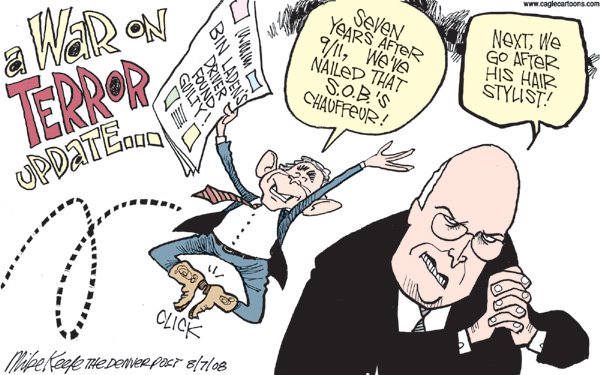
Drawn and Quartered

Mike Keefe / Denver Post

The Rag Blog / Posted August 13, 2008

Posted in RagBlog | Tagged , , | Leave a comment

BOOKS : Small Schools: Public School Reform Meets the Ownership Society


‘Read Small Schools to get angry and radicalized’
By Jill Davidson

Small Schools: Public School Reform Meets the Ownership Society by Michael Klonsky and Susan Klonsky (Routledge, 209 pages, $26.95)

Mike and Susan Klonsky’s Small Schools: Public School Reform Meets the Ownership Society deserves to have sunscreen stains on its pages and sand within as an unlikely recommended summer read. Okay, if there’s a great novel that you’ve been saving for the week that school’s out, read that first. But before school starts up again,* read Small Schools to get angry and radicalized, to remind yourself of the extraordinary value of your work, to cheer for yourselves as worthy alternative underdogs, and to rekindle your fire.

A nightmare gallery of monsters menace public education, and the Klonskys invoke some of the most frightening: the gang of politicians, foundations, think tanks, and corporations that have invaded schools during the still-current Bush administration. Documenting the ways that “the progressive grassroots educational reform movement for small schools has been hijacked by business groups, right-wing ideologues, and the ideology of the Ownership Society,” the Klonskys throw readers into the deep end of the small schools movement, the threats posed by corporate and governmental encroachment on public education, and the toxic ground on which privatization forces have co-opted small schools for corporate gain, both in the authors’ home turf of Chicago and elsewhere.

The breathless pace slows in the first chapter, which unpacks small schools’ “traditional democratic values of Deweyan progressivism combined with Information Age notions of professional community, personalization, and safe learning environments in an unsafe society.” This chapter focuses on the story of opposing school reform movements in Chicago, serving as a useful primer on that city’s tension around school size, control, and ideas of whom its schools are for. This inside baseball of Chicago politics, school reform, and role of the Klonskys’ Small School workshop is contextualized within the movement that includes Deborah Meier’s work in New York, southern Freedom Schools, and other results of progressive efforts around the country. This chapter also captures the “politics of disaster” that have been created in response to public schooling’s complex challenge, describing how a deficit model of education has evolved to dismantle existing public systems.

The sprawling second chapter details and defines the forces and practices of the Ownership Society and its “all-out assault on teachers, public schools, and public space in general.” Featured in President Bush’s 2005 inaugural address, the term was intended to sell the idea that individual citizens should control health care, finances, education, and other key factors of their lives. The Klonskys vehemently oppose the political practices that exemplify the Ownership Society, and their arguments effectively encapsulate the rhetorical co-option of words and ideas—such as the very concept of small schools—that may have originated from the grassroots progressive education movement, but have come to be fully integrated into the current administration’s “demagoguery.” This is compelling stuff.

The third chapter deals with the privatization of our school systems. When the Klonskys write, “In many districts around the country, the best of the small and charter schools have indeed become agents of change, responding to a national sense that the traditional system of public education needs transformation,” you’ll think “Hey, that’s us! That’s CES.” But such schools are anomalies whose existence emphasizes the gulf between intended purpose of charter schools—to provide stimuli to the system and grassroots-driven alternatives—and their current uses as for-profit collectives that rob the public system.

The book concludes with considerations of the role of philanthropy, with most of its attention on the Bill & Melinda Gates Foundation (a CES funder). “It’s hard to say whether the world’s richest man has been part of the problem or part of the solution,” the Klonskys observe. They are far less ambivalent on the role of conservative think tanks that rose to power on a tide of private funding and adept use of technologies that allowed them to emerge from the shadows.

The conclusion “Alternatives to Top-Down Reform,” offers a welcome, and familiar, note of hope, with its faith in the power of professional learning communities. Critical Friends Groups to the rescue! Though its documentation of the forces that oppose what we know works to educate children, and preserve and improve the intellectual and other forms of health of their communities, is daunting and at times heavy-handed, you’ll finish Small Schools with renewed faith in your work as a CES network educator, and a healthy infusion of anger and energy.

* Year round schools: the bane of the education book reviewer. Sorry to slight those of you who are at year-round schools, but you still experience summer, yes? And you still read? Apply this as you see fit (Horace suggests liberally).

[Thie review was first published in the Horace Book Review: Horace Summer 2008, Vol. 24 No. 2.]

Source / CESNationalweb

Find Small Schools: Public School Reform Meets the Ownership Society by Michael Klonsky and Susan Klonsky at Amazon.com.

The Rag Blog

Posted in RagBlog | Tagged , , , , | 1 Comment

Emerging from the Drug War Dark Age : A Psychedelic Drug Revival

Alex Grey’s Oversoul.

LSD and other psychedelic medicines make a comeback
By Charles Shaw

After a 40-year moratorium, credible research for treating illnesses and addictions with psychedelic compounds has made a miraculous comeback.

The return flight from Switzerland was a mix of hope and solemnity for Rick Doblin, the only American to attend the funeral of Dr. Albert Hofmann, the inventor of LSD who had just died at the age of 102. Doblin, a Harvard-educated Ph.D and founder of the Multidisciplinary Association for Psychedelic Studies, an organization that conducts legal research into the healing and spiritual potentials of psychedelics and marijuana, had spent his entire career trying to break through the virtually impenetrable wall of obstinacy that surrounds psychedelic compounds and their potential benefits to society.

More than anyone else in his field, Doblin is all too familiar with what he refers to as the “40-year-long bad trip” that researchers like him have faced in dealing with the fallout from the introduction of LSD and other psychedelic compounds to the Western psyche in the mid 1960s. This 40-year intellectual Dark Age, Doblin says, has been characterized by “enormous fear and misinformation and a vested interest in exaggerated stories about drugs to keep prohibition alive.”

We’ve all heard the tales of kids jumping off rooftops because they think they can fly, of otherwise normal people taking a single hit of LSD and “going insane,” and of course the all-pervasive myth of the “acid flashback.” Although there were acid casualties, most were rare or aberrant tragedies, most often occurring in individuals with pre-existing mental health conditions who never should have taken LSD in the first place. Most of the tales are apocryphal at best, intentional propaganda meant to discourage use.

An Era of Censorship

Why would our government embark on this 40-year Inquisition to burn the psychedelic prophets at the stake and wipe clean from the Earth the true history of psychedelic culture, as if it were the secret of the Holy Grail and the Merovingian dynasty? Why has the psychedelic revolution of the 1960s — one of the most powerful revolutions in human consciousness in all of history — been reduced to pejorative tales of tie-dyed morons skipping through Golden Gate Park in an orgy of self-indulgence? Why would something that the government claims does not deserve respectable attention be the recipient of such Draconian repressive measures? Could it be because, like the secret of Mary Magdalene, the truth could bring the whole order crashing down?

The answer, my friend, blew away in the wind. The extent to which LSD fomented the cultural revolution of the 1960s has all but disappeared in a miasma of drug war propaganda. But do not be fooled. This was no hippie-dippy bullshit. In its time, LSD was more dangerous to the ruling order than Mao, Che or the Founding Fathers themselves. As the New York Times obituary for Hofmann read, “[LSD] was no hustler from a shotgun lab in Tijuana, after all, but a bourgeois revolutionary, born into establishment medicine and able to travel the world and enter societies from the top down, through their most hallowed institutions.”

The U.S. government threw everything but the kitchen sink at getting (certain) Americans to stop “turning on,” launching the drug war that eventually locked up millions of drug users. They handed down ridiculously disproportionate federal sentences to LSD makers that would have made Pablo Escobar commit suicide. But it wasn’t the “turning on” part that they feared, for there are many benefits to having a population otherwise occupied in a false reality. No, it was the “tuning in” and “dropping out” part that kept them awake at night.

Although it may be difficult for the uninitiated to understand at face value, LSD and other psychedelic compounds can have a profound life-altering affect on the user that, more often than not, serves to connect them (or reconnect, as the case may be) to the universal compassion and love for life that is inherent in our species. It invariably causes them to question the validity of the status quo, to examine their life and what surrounds them in terms of beliefs and values.

And in this epoch of industrial civilization, the last thing a corporate culture that survives on war, aggression and consumer spending needs is a consciously awakened population of people who inexorably choose to leave said culture in droves because they see it is killing the planet, themselves, and each other. This is precisely, to the letter, the meaning of “Turn On, Tune In, Drop Out.”

But even for those who would call this hyperbole, what was lost in all the derision and urban myths about LSD and other psychedelic compounds like ayahuasca, peyote, psilocybin and iboga — plant medicines thousands of years old — was the fact that they are miraculously powerful medicines, with the ability to effectively treat, and in some cases, cure some of the most debilitating illnesses and disorders plaguing humanity: addiction, obsessive-compulsive disorder, Post-Traumatic Stress Disorder, and migraine and cluster headaches. They are also effective palliatives for the sick and dying.

Something with such legitimate potential to heal can only be kept in the bottle for so long. In fact, these transcendent therapies are now ebbing back into mainstream respectability. Doblin will be the first to tell you that times are changing, driven by too much government repression, too much scientific orthodoxy, and, perhaps more than any other factor, our culture’s desperate need to learn how to handle what he calls our “collective emotional state.”

“We talk about the veterans suffering PTSD, but it’s really a culture-wide phenomenon,” he said. “We’re at a place where technology and the structure of contemporary life have taken us so far away from our emotions as to create pathological conditions. The systemic violence and selfishness and greed that are in our society need treatment.”

Doblin was one of the first to break through that wall of obstinacy and challenge the Inquisition. He got the U.S. government to approve clinical trials of MDMA-assisted therapy for returning veterans and victims of violent crime or abuse who suffer from Post-Traumatic Stress Disorder. In many ways it was this Newtonian breakthrough that finally challenged the orthodoxy that reigned over the 40-year Dark Age. Western governments had to ask themselves what was more important to them: their irrational and erroneous drug propaganda, or the possibility that the millions of lives they had devastated by war, violence and iniquitous economic policies might actually be repaired. In this, the seeds of a psychedelic renaissance were planted.

A Return to Respectability

Much greater than usual media attention accompanied the most recent World Psychedelic Forum held in March in Basel, Switzerland, the home of Albert Hofmann. A headline in the May issue of the staid British medical journal The Lancet — known for challenging the Pentagon’s Iraq casualty numbers — read, “Research on Psychedelics Moves into the Mainstream.”

The Lancet article identified a number of early-stage clinical trials being conducted on various “anxiety and neurotic disorders” using psychedelic compounds. As previously mentioned, Doblin and MAPS are conducting three parallel studies in Israel, Switzerland and the United States on the use of Ecstasy for treating PTSD. MAPS has also funded the work of controversial Harvard researcher John Halpern and Yale researcher Andrew Sewell, who are studying LSD and psilocybin as treatments for cluster headaches. (Information about their research is available on clusterbusters.com and Erowid, an online clearinghouse for reliable data on virtually every psychoactive plant and chemical known to humans.)

Harvard University, which conducted the last legal research on LSD in the mid-1960s and was the site for one of Halpern’s studies on the effects of MDMA on dying cancer patients, is once again considering clinical trials to support Halpern’s research.

And in a major milestone, on May 13 of this year, Swiss doctor Peter Gasser administered the first legal dose of LSD in more than 36 years. It was for a study of anxiety in palliative care, which helps terminally ill patients transition more peacefully — and with as little pain as possible — into death.

Other complexes like addiction and obsessive-compulsive disorder are being treated with what are called the “shamanic plant medicines”: ayahuasca, the Amazonian vine preparation whose psychoactive component is dimethyltryptamine (DMT); peyote, the North American cactus whose psychoactive component is mescaline; and iboga, an African rainforest shrub.

Addiction is one of the most important new fields of study, not only because of the sheer numbers of afflicted, which the National Institute on Drug Abuse estimates at 23.6 million persons a year at a cost of $181 billion. According to a newly released report from the World Health Organization, the United States is the world’s most addicted society. Of those who are lucky enough to get treatment, half eventually go back to heavy use, and 90 percent suffer brief or episodic relapses for the rest of their lives. This makes the search for an effective and long-lasting new treatment more attractive — and more pressing — than ever.

The Healing Potential of Psychedelics

Unlike other treatments, which have shown pitifully low success rates, psychedelic-assisted therapy focuses on the emotional context under which a patient suffers addiction, not the use of the drugs themselves. “This,” says Tom Roberts, a professor of psychology at Northern Illinois University and the co-editor of a new two-volume compilation, Psychedelic Medicine, “is what makes them uniquely effective. They allow negative ideas and feelings — where most addictions have their origins — to surface into consciousness. With the guidance of a mental health professional, the person can let them go.” Once these negative feelings are gone, Roberts says, the person no longer feels the need to deaden them with drugs or alcohol.

Psychedelic-assisted therapy for addiction pokes a hole in conventional wisdom about drug use, which goes something like this: If, under American law, all illegal drugs are bad for you, how can you then treat an addiction to one drug with another purportedly dangerous drug? This shortsighted line of thinking has been keeping psychedelic compounds illegal in spite of evidence pointing to their benefits.

Indigenous peoples have been using psychedelics as traditional medicine for thousands of years. Ayahuasca and peyote have been used to treat toothaches, pain in childbirth, fever, breast pain, skin diseases, rheumatism, diabetes, colds, blindness, parasites and more. They have also been used as spiritual medicines to cure emotional disorders. Native Americans use peyote to treat the astronomical rates of alcoholism found on the reservations, reportedly with great success, although hard figures are difficult to obtain due to the legal protections given to the Native American Church.

And Western scientists have known of the healing capabilities of psychedelics for decades.

In 1954 two chemists, D.W. Woolley and E. Shaw, published an article in Science magazine that argued that the neurochemical serotonin was the likely culprit behind most major mental disorders, writes Dirk Hanson in Addiction: A Search for a Cure. The worst of the bunch were depression, drug addiction and alcoholism. Woolley and Shaw also confirmed in their study that the most powerful known manipulator of serotonin was LSD because it had an “eerily” similar chemical structure.

Later in the ’50s, a well-known LSD “apostle” named Alfred Matthew “Captain Al” Hubbard started peddling the idea that LSD might hold considerable psychotherapeutic potential. With the assistance of Aldous Huxley and other prominent acid-taking intellectuals, Hubbard gave LSD to Canadian researchers Abram Hoffer, Ross Mclean, and Humphrey Osmond, who studied it as a treatment for alcoholism, while a similar study was conducted at the Stanford Research Institute.

Later, Stan Grof worked with street-level addicts while Timothy Leary conducted psilocybin therapy on prisoners. Even Bill Wilson, the founder of Alcoholics Anonymous, was an acid enthusiast, promoting LSD as a “gateway to an accelerated spiritual awakening.” Wilson noticed that the turnaround in alcoholics did not happen until they hit bottom, and LSD, because it surfaced difficult emotions, hastened an alcoholic’s bottom and helped them avoid more catastrophic bottoms.

The therapy is reinforced through the “afterglow” effect of a “transcendent psychedelic event” (a trip), which Psychedelic Medicine says is “characterized by an elevated and energetic mood and a relative freedom from concerns of the past and from guilt and anxiety.” There emerges an “enhanced disposition and capacity to enter into close relationships.” The “afterglow” usually lasts anywhere from two weeks to a month and then gradually fades into a series of memories that are thought to continue affecting attitude and behavior.

All of these researchers stress that psychological professionals must guide psychedelic sessions, and that full recovery is only possible through continued therapy.

“After 40 years of review,” Doblin takes great care to mention, “we can accurately say it’s not a miracle cure.” Psychedelic-assisted therapy has powerful healing potential, he says, but “does not work for people who don’t really want to look at their inner conflicts.”

[Charles Shaw, a Chicago-based writer, is a regular contributor to AlterNet. He is the former editorial director of the Conscious Choice publications and a contributor to Reality Sandwich and the Huffington Post. He is currently writing Exile Nation, a drug war memoir.]

Source / AlterNet / Posted July 11, 2008

Thanks to radman / The Rag Blog

Posted in RagBlog | Tagged , , , , , , , | 5 Comments

Limbaugh : ‘Edwards Might be Attracted to a Woman Whose Mouth Did Something Other Than Talk’


Limbaugh blowing smoke about Elizabeth Edwards: ‘Could it be that she doesn’t shut up?’
By J.M. / August 12, 2008

On the August 12 broadcast of his nationally syndicated radio show, Rush Limbaugh said of former Sen. John Edwards’ recent disclosure of an extramarital affair:

“I’ve got a theory about the motivations. Well, I don’t know that I could — I don’t know that I can put this one on the air.” Discussing his “theory,” Limbaugh said, “We know — we’ve been told that Elizabeth Edwards is smarter than John Edwards. That’s part of the puff pieces on them that we’ve seen. Ergo, if Elizabeth Edwards is smarter than John Edwards, is it likely that she thinks she knows better than he does what his speeches ought to contain and what kind of things he ought to be doing strategy-wise in the campaign? If she is smarter than he is, could it have been her decision to keep going with the campaign? In other words, could it be that she doesn’t shut up? Now, that’s as far as I’m going to go.”

Limbaugh later added, “It just seems to me that Edwards might be attracted to a woman whose mouth did something other than talk.” Limbaugh went on to say in a subsequent segment: “my theory that I just explained to you about why — you know, what could have John Edwards’ motivations been to have the affair with Rielle Hunter, given his wife is smarter than he is and probably nagging him a lot about doing this, and he found somebody that did something with her mouth other than talk.”

Limbaugh also highlighted his comments on his website, RushLimbaugh.com (subscription required).

From the August 12 broadcast of Premiere Radio Networks’ The Rush Limbaugh Show:

LIMBAUGH: Back to the phones. Winston-Salem, North Carolina, this is James. Nice to have you here, sir. Hello. Is he gone? James, you there? Aw, darn. He wanted to talk about Edwards and who knew and what were the motivations. And I’ve got a theory about the motivations. Well, I don’t know that I could — I don’t know that I can put this one on the air.

JAMES GOLDEN (contributor known on-air as “Bo Snerdley”): Why not?

LIMBAUGH: Well, it’s — I mean, at some point, at some point, you gotta exhibit maturity and restraint. You know, and I do that constantly. But — well, I don’t — look, let me see if I can run you through this and get you to think what I’m thinking without my actually saying it. That might be a pretty big talent if I could do that — make you think what I’m going to say without my having to say it, therefore if anybody gets in trouble for saying it, you say it.

We know — we’ve been told that Elizabeth Edwards is smarter than John Edwards. That’s part of the puff pieces on them that we’ve seen. Ergo, if Elizabeth Edwards is smarter than John Edwards, is it likely that she thinks she knows better than he does what his speeches ought to contain and what kind of things he ought to be doing strategy-wise in the campaign? If she is smarter than he is, could it have been her decision to keep going with the campaign? In other words, could it be that she doesn’t shut up? Now, that’s as far as I’m going to go.

Well, you’re — Snerdley says he’s missing something. If you’re missing it, you’re going to have to provide it. What are you missing? Mm-hmm, mm-hmm.

I can’t close the loop on it. I can’t close the loop on it. I’m on — you know, I’m in a little quicksand already today talking about how the chicks are giving us boring pictures of the female athletes from the Olympics. Because I know — you — the diversity crowd’s going to be upset. They’re going to — “Ooh, do you mean the Olympics are just so you guys can ogle wom–” Yes, because we do not care to watch ’em compete. But back to Elizabeth and the Breck Girl.

I’m sorry, my friends, I just — I can’t. It just seems to me that Edwards might be attracted to a woman whose mouth did something other than talk.

[…]

LIMBAUGH: OK, we’re back. Ladies and gentleman, my theory that I just explained to you about why — you know, what could have John Edwards’ motivations been to have the affair with Rielle Hunter, given his wife is smarter than he is and probably nagging him a lot about doing this, and he found somebody that did something with her mouth other than talk. I think I can back this up from her.

We have a sound bite. This is February 2007. She was on the tabloid show Extra. And this is what she said. Listen very carefully.

HUNTER : The whole experience was life-altering for me. One of the great things about John Edwards is that he’s so open and willing to try new things and do things in new ways.

LIMBAUGH: “Open to new things.” Folks, it is what it is. You get mad at me for bringing the truth to you, but it is what it is.

Source / Media Matters

The Rag Blog

Posted in RagBlog | Tagged , , , , , | 1 Comment

Some Web Firms Say They Track Behavior Without Explicit Consent


‘Increasingly, there are no limits technologically as to what a company can do in terms of collecting information’
By Ellen Nakashima / August 12, 2008

Several Internet and broadband companies have acknowledged using targeted-advertising technology without explicitly informing customers, according to letters released yesterday by the House Energy and Commerce Committee.

And Google, the leading online advertiser, stated that it has begun using Internet tracking technology that enables it to more precisely follow Web-surfing behavior across affiliated sites.

The revelations came in response to a bipartisan inquiry of how more than 30 Internet companies might have gathered data to target customers. Some privacy advocates and lawmakers said the disclosures help build a case for an overarching online-privacy law.

“Increasingly, there are no limits technologically as to what a company can do in terms of collecting information . . . and then selling it as a commodity to other providers,” said committee member Edward J. Markey (D-Mass.), who created the Privacy Caucus 12 years ago. “Our responsibility is to make sure that we create a law that, regardless of the technology, includes a set of legal guarantees that consumers have with respect to their information.”

Markey said he and his colleagues plan to introduce legislation next year, a sort of online-privacy Bill of Rights, that would require that consumers must opt in to the tracking of their online behavior and the collection and sharing of their personal data.

But some committee leaders cautioned that such legislation could damage the economy by preventing small companies from reaching customers. Rep. Cliff Stearns (R-Fla.) said self-regulation that focuses on transparency and choice might be the best approach.

Google, in its letter to committee Chairman John Dingell (D-Mich.), Markey, Stearns and Rep. Joe L. Barton (R-Tex.), stressed that it did not engage in potentially the most invasive of technologies — deep-packet inspection, which companies such as NebuAd have tested with some broadband providers. But Google did note that it had begun to use across its network the “DoubleClick ad-serving cookie,” a computer code that allows the tracking of Web surfing.

Alan Davidson, Google’s director of public policy and government affairs, stated in the letter that users could opt out of a single cookie for both DoubleClick and the Google content network. He also said that Google was not yet focusing on “behavioral” advertising, which depends on Web site tracking.

But on its official blog last week, Google touted how its recent $3.1 billion merger with DoubleClick provides advertisers “insight into the number of people who have seen an ad campaign,” as well as “how many users visited their sites after seeing an ad.”

“Google is slowly embracing a full-blown behavioral targeting over its vast network of services and sites,” said Jeffrey Chester, executive director of the Center for Digital Democracy. He said that Google, through its vast data collection and sophisticated data analysis tools, “knows more about consumers than practically anyone.”

Microsoft and Yahoo have disclosed that they engage in some form of behavioral targeting. Yahoo has said it will allow users to turn off targeted advertising on its Web sites; Microsoft has yet to respond to the committee.

More than a dozen of the 33 companies queried said they do not conduct targeted advertising based on consumers’ Internet activities. But, Chester said, a number of them engage in sophisticated interactive marketing. Advertisers on Comcast.net’s site, for instance, are able to target advertising based on “over 3 billion page views” from “15 million unique users.”

Source / Washington Post

The Rag Blog

Posted in RagBlog | Tagged , , , , , , | 1 Comment

Rush to Arctic As Warming Opens Oil Deposits

US Coast Guard Cutter Healy will embark on Arctic Voyage this week to determine the extent of the continental shelf in Alaska and to map the ocean floor, data that could be used for oil and natural gas exploration. Photo by Prentice Danner / AP.

‘It’s a scramble for the spoils of global warming’
By Zachary Colie / August 12, 2008

It’s a scramble for the spoils of global warming as the rapid melting of Arctic sea ice is opening access to previously unreachable deposits of oil and gas, setting off a race by northern nations – including the United States, Canada and Russia – to claim them.

The pursuit of those resources will be underscored this week as the U.S. Coast Guard cutter Healy sails north from Barrow, Alaska, on Thursday to map the sea floor of the Chukchi Cap, an area at the northern edge of the Beaufort Sea. The maps could bolster U.S. claims to the area as part of its extended outer continental shelf.

The U.S. Geological Survey confirmed last month what the oil industry had long suspected when the agency released an estimate that the area north of the Arctic Circle may hold as much as 90 billion barrels of oil and 1,669 trillion cubic feet of natural gas, or roughly 13 percent of the world’s total undiscovered oil and 30 percent of the undiscovered natural gas.

The dash to stake out territory across the Arctic has accelerated since Russia sent one of its submarines last August to plant the country’s flag on the sea floor beneath the North Pole, provoking an outcry by other nations that viewed it as an unauthorized land grab.

Earlier this month, Canadian officials at a geology conference in Norway detailed their territorial claims to the Lomonosov Ridge, an underseas mountain range that runs beneath the North Pole. Canada argues that the ridge is part of the North American continent, not part of Siberia, as Russia has asserted.

Denmark backs Canada

The Danish government joined in backing Canada’s argument, even though those two nations have also clashed over claims in the Arctic. Why? Because Denmark, which controls Greenland, believes Canada’s assertion could boost its own contention that part of the energy-rich ridge should be Danish territory.

These northern powers are all rushing to complete assessments of how far their underseas territory may extend. Under international law, countries control all natural resources within the “exclusive economic zone,” which extends 200 nautical miles offshore. But if a country’s continental shelf extends far into the ocean, the nation can claim underseas land up to 350 miles offshore under the U.N. Convention on the Law of the Sea.

The United States has signed the Law of the Sea Treaty, but the Senate has not ratified it. Margaret Hayes, who directs the State Department’s Office of Oceanic Affairs, said on a conference call Monday that while the United States moves toward ratifying the treaty, it must gather all the scientific data it will need to justify its territorial claims.

During the Healy’s three-week voyage, scientists from National Oceanic and Atmospheric Administration and University of New Hampshire will use a device called an echo sounder to create a three-dimensional map of the sea floor. The Healy will make a second voyage, from Sept. 6 to Oct. 1, carving a path through the ice, while a Canadian ship, the Louis S. St. Laurent, follows, gathering seismic data about the thickness of the sediments along the sea floor.

While it’s a scientific mission, USGS scientist Deborah Hutchison acknowledged that oil companies will be eager to see the results, which could yield major clues about the size and location of oil and gas deposits.

“The cruises are not intended to look for energy resources. … That is not a primary or even a secondary objective,” Hutchison said. “However, it’s inevitable because there are so few data in this area (of the Arctic), there will be great interest in using this data” to assess the potential for drilling.

Alaska favors drilling

Alaskan officials, who rely on oil revenue and face declining oil fields along the North Slope, see more Arctic drilling as a way to keep the state’s oil economy afloat. While the Atlantic and Pacific coasts have been off-limits to drilling under a federal ban for nearly three decades, the Interior Department is already leasing areas of the Beaufort Sea and Chukchi Sea.

Environmentalists warn of the perils of oil exploration in the region. Critics say that conditions in the Arctic – shortage of natural light in winter, extreme cold, moving ice floes and high winds – make it extremely difficult to respond to an oil spill.

“Ultimately what is going to be needed is a more comprehensive ecological study of that region and some indication as to whether or not any technology that we have today is likely to be able to clean up spilled oil in that set of conditions,” said Richard Charter, a coastal advocate for Defenders of Wildlife Action Fund.

The voyage of the Healy this week is being made possible by the swift melting of the sea ice. Last year, Arctic sea ice retreated at a record-setting pace.

Northwest Passage open

The Inupiat residents of Barrow were stunned last fall when a cruise ship and 400 Germans showed up in their town. They had arrived from Europe via the Northwest Passage over Canada, which for the first time in recorded history was ice-free.

Larry Mayer, an oceanographer at the University of New Hampshire who helped lead a similar Arctic trip last summer, said he was shocked at how easily the team could navigate through the region. He noted the irony that the rapid melting “was bad for the Arctic, but very, very good for mapping.”

© 2008 The San Francisco Chronicle

Source / SF Gate

Thanks to CommonDreams The Rag Blog

Posted in RagBlog | Tagged , , , , , , | 1 Comment

Type your summary here


Type rest of the post here

Source /

The Rag Blog


Posted in RagBlog | Leave a comment

Do No Harm : The Complicity of Psychologists in Cheney-Bush Torture Program

Psychologist protesting APA complicity in torture in 2007.

APA pressured to take a stand…

‘Psychologists have been identified as key figures in the design and conduct of abuses against detainees in US custody’
by Meteor Blades / August 12, 2008

Unlike the people in Stalin’s Soviet Union, no U.S. official risked disappearing into the prison for dissent. Senior State Department and Defense Department official, field commanders, intelligence and FBI officers, and frontline soldiers dissented. They were usually ignored. A few were threatened with administrative sanctions; a few were reassigned; a few requested reassignment. The possibility of dissent makes the silence and complicity of senior and frontline medical personnel in the abuse and neglect of prisoners that much more inexplicable and inexcusable.

Dr. Steven H. Miles, M.D., Oath Betrayed: Torture, Medical Complicity, and the War on Terror

Despite Dr. Miles’s book, despite Jane Mayer’s The Dark Side, despite reports such as the Physicians for Human Rights’ Broken Laws, Broken Lives: Medical Evidence of US Torture and its Impact, Americans still don’t have anywhere near a full picture of what happened after the Cheney-Bush administration decided to spit on the Geneva Conventions, redefine and fine-tune torture and treat human beings like the inferior creatures it thought them to be.

What we do know is horrible enough. Most horrible of all is knowing that medical personnel and psychologists violated the most basic ethics of their professions – Do No Harm – by participating in and helping to design “enhanced” interrogations designed to break prisoners. Some did break. Some were killed. This systematic torture focused on sensory and sleep deprivation, overstimulation, and dependency creation. Massive amounts of pain and fear were also included. For their part, psychologists “reverse-engineered” the military’s Survival, Evasion, Resistance, Escape (SERE) program – designed to help American soldiers and marines resist torture – as a means to teach interrogators how to employ torture against captives.

Let me repeat that. Training established to help American prisoners of war cope with, or at least anticipate, their captors’ efforts to break them down was “reverse-engineered” as a means to break down prisoners at Guantánamo and “black sites” run by the CIA or military intelligence operations in Europe, Asia, North Africa and the island of Diego Garcia in the Indian Ocean.

Talk about becoming the enemy.

We also know that, even after the supposed banning of some measures that had been previously approved by the Secretary of Defense, these techniques continued at the detention center at Guantánamo Bay Naval Base, and probably other prisons, even while the Inspector General was putting a seal of approval on the whole affair.

As Josh White wrote in the Washington Post last Friday:

At least 17 detainees held at Guantanamo Bay were subjected to a program that moved them repeatedly from cell to cell to cause sleep deprivation and disorientation as punishment and to soften detainees for subsequent interrogation, according to U.S. military documents.

Defense Department investigations of abuse had previously revealed that the program was used in a limited manner and only on high-value detainees, but the documents indicate that the program was far more widespread and that the technique was still used months after it was banned at the facility in March 2004. Detainees were moved dozens of times in just days and sometimes more than a hundred times over a two-week period.

Military police logs for cell blocks at Guantanamo Bay, Cuba, show that guards used the program — dubbed the “frequent flyer” program in official documents — on numerous detainees and noted the program in their 2003 and 2004 records. The logs, reviewed by The Washington Post, also indicate that the frequent cell movements took place on the same days a Navy admiral was visiting Guantanamo to assess possible detainee abuses.

The Defense Department claims the program stopped in 2004. A spokesperson told White that all prisoners are treated humanely.

Cough, cough.

“Frequent flyers.” Think about the kind of mentality that not only designs torture methods but turns them into a joke.

Twenty-four-year-old Mohammed Jawad, who will soon go on trial by military tribunal for trying to kill U.S. forces in Afghanistan with a grenade, has sought to have all the charges against him dropped because of abuse he suffered, including that caused by frequent moves.

Air Force Maj. David Frakt, Jawad’s lawyer, said the newly revealed records demonstrate that:

“…no one actually knows the full scope of the abuses at Guantanamo” and that “all of these allegedly comprehensive investigations were whitewashes.”

“This is only the tip of the iceberg,” Frakt said. “This program was approved at the highest levels. … It suggests that people had simply lost their ability to distinguish right from wrong.”

With all due respect to the major, that puts the best face on it. Because among those engaged in vetting, monitoring and carrying out this program approved at the highest levels were some of the very people we count on to help us distinguish right from wrong. In some cases, they evaluated the status of a prisoner and informed interrogators that he was good for another round or two of “questioning.”

This must stop, wrote psychoanalyst Stephen Soldz in a Sunday Boston Globe Op-Ed, Ending the psychological mind games on detainees:

Psychologists have been identified as key figures in the design and conduct of abuses against detainees in US custody at Guantanamo, the CIA’s secret “black sites,” and in Iraq and Afghanistan. Psychologists should not be taking part in such practices.

Yet a steady stream of revelations from government documents, journalistic reports, and congressional hearings has revealed that psychologists designed the CIA’s “enhanced interrogation” techniques – which included locking prisoners in tiny cages in the fetal position, throwing them against the wall head first, prolonged nakedness, sexual humiliation, and waterboarding.

Jane Mayer … reports that the central idea was the psychological concept of “learned helplessness.” Individuals are denied all control over their world, lose their will and become totally dependent upon their captors.

What angers Soldz and hundreds of other professional psychologists and psychoanalysts is that their organization, the American Psychological Association, has taken an official position that the presence of psychologists makes detainees safer at interrogations. That view, Soldz declares every chance he gets, is ludicrous. In fact, the policy enables the torturers.

At the Chronicle of Higher Education, David Glenn writes that, according to Mayer’s book:

…Martin E.P. Seligman, a professor of psychology at the University of Pennsylvania and a former president of the psychology association, accepted a CIA invitation to lecture at a naval training center about his theories of “learned helplessness.”

Mr. Seligman’s widely respected research suggests that when people and animals are traumatized at random intervals, they tend to give up: They stop seeking to rationally help themselves, and they stop responding to ordinary incentives.

Mr. Seligman insists that his 2002 lecture was intended only to help train U.S. soldiers to resist torture if they are captured. But in his 50-person audience that day were Bruce Jessen and James Elmer Mitchell, psychologists who operate a consulting firm that helped the CIA develop interrogation techniques that some critics have called abusive. According to Ms. Mayer’s book, Mr. Mitchell has long been fascinated by learned-helplessness theory. (Through a lawyer, Mr. Mitchell denied to Ms. Mayer that his CIA interrogation techniques were inspired by Mr. Seligman’s work.)

Few people in the psychology association believe that Mr. Seligman consciously assisted in the development of detainee abuses. But many say that the association needs to make a more thorough public accounting of how the work of Mr. Seligman and other prominent members may have been misused by government agencies.

Soldz, and four other authors addressed the Seligman matter at some length in the July 23 issue of Dissident Voice:

This history, along with the current, well-documented authorizations for detainee abuse, should have provided sufficient warning to APA leaders and to individual psychologists about the moral risks in aiding the national security apparatus, especially under the present U.S. administration. But the APA has not taken the lead in helping psychologists confront these dangerous ethical situations. To the contrary, the APA has been insensitive to the use of psychological techniques in torture and to the role of psychologists in aiding that torture. This insensitivity itself has shocked many psychologists here and abroad.

So, for the second year in a row, the issue of torture and illegal detention will be a hot one at the APA’s annual convention, which begins Thursday in Boston. Soldz will be on hand for a protest. In addition to rejecting the APA’s position on torture and interrogations, the protesters will be backing the candidacy of Dr. Steven Reisner for the presidency of the organization as well as the “Aye” vote on a referendum that would reinforce the first principle of the APA ethics code: “Psychologists strive to benefit those with whom they work and take care to do no harm.”

Reisner, a psychoanalyst, is a senior faculty member and supervisor at the International Trauma Studies Program, an adjunct professor of Psychology and Education at Columbia University, and a consultant to the United Nations on stress and trauma. He is a leader of Psychologists for an Ethical Psychology, and, with Soldz and others, a leading critic of the APA’s position. In April, the mail-in nominating procedure for the APA presidency gave Reisner the most votes (more than 30%) of any of the five candidates who will compete with each other for the post in October,

The mail-in referendum has tough opposition. It states:

Be it resolved that psychologists may not work in settings where persons are held outside of, or in violation of, either International Law (e.g., the UN Convention Against Torture and the Geneva Conventions) or the US Constitution (where appropriate), unless they are working directly for the persons being detained or for an independent third party working to protect human rights.

You can read the entire resolution with all its whereases, pro and con statements and pro and con rebuttals here.

For the past few years, the APA bureaucracy and a good piece of the membership has played a game of on-the-one-hand/on-the-other-hand regarding the role of psychologists and psychoanalysts in the kinds of interrogations brought to us by Donald Rumsfeld and other outlaws in the current administration.

There’s just one problem with the APA’s hemming and hawing approach: Torture is not a nuanced issue.

Source / Daily Kos

The Rag Blog

Posted in RagBlog | Tagged , , , , , , , , , | 1 Comment

ROCK ‘N ROLL : The Sixties Series from American Beat


‘Sugar Sugar’: Bubblegum Gold and more…
By Margaret Moser / August 11, 2008

This American Beat series from last year languished under a stack of poorly sorted CDs until my recent excavation. The label’s sense of whimsy and willingness to produce the music pretty much as you got it back then wins my admiration. The Sixties Series divides its music among six genres that distinguished the era, and those distinctions are sometimes muddied in these collections, but it doesn’t hamper the sheer pleasure.

Bubblegum Gold, for example, chews up and spits out certified teenybopper treacle like the Archies’ “Sugar Sugar” and Tommy Roe’s “Dizzy” with legitimate soul numbers like Steam’s “Na Na Hey Hey (Kiss Him Goodbye)” and the vocal pyrotechnics of Lou Christie’s “Lightning Strikes.” The Five Americans’ “Western Union” saves the day.

British Invasion Revisited does better by its title, including Merseybeat boys like Gerry & the Pacemakers’ “Ferry Cross the Mersey.” Real gems glitter in this set: The Hollies “Bus Stop” and the Swinging Blue Jeans’ “Hippy Hippy Shake,” but its beauty is reminding us that three minutes or less is the perfect length for a song.

Make Love Not War: 60s Songs of Peace pushes the usual Top 40 offering with 45 versions of Arlo Guthrie’s “Alice’s Restaurant,” the Zombies’ “Time of the Season,” and Tommy James & the Shondells’ “Crimson & Clover.” Not exactly “Give Peace a Chance” territory though the Youngbloods’ “Get Together” and Country Joe & the Fish’s radio-clean “I-Feel-Like-I’m-Fixin’-to-Die” flash the V-sign amiably enough.

Psychedelic Side of Pop is another specific-sounding collection that doesn’t quite deliver on the idea with ho-hum pop like the Lemon Pipers’ “Green Tambourine” and un-psychedelic but still enjoyable numbers like Procul Harum’s “Whiter Shade of Pale” and the Seeds’ “Pushin’ Too Hard.” The song selections are more than enjoyable, with requisite trippy “Itchykoo Park” from the Small Faces and the Byrds’ “Eight Miles High.”

Sixties Harmony gathers a few of the songs that used to make me turn the radio off (notably Texan Gale Garnett’s “We’ll Sing in the Sunshine”), repeats at least one from another volume (the Youngbloods’ “Get Together”), and throws in other delightfully singable tunes like the 5th Dimension’s “Wedding Bell Blues” and the Cyrkle’s “Red Rubber Ball.” “Mercy Mercy Mercy” by the Buckinghams ups it a notch.

Frat House Hits whacks it out of the ballpark with grand-slam dancefloor favorites like the Isley Brothers’ “Twist and Shout,” Mitch Ryder & the Detroit Wheels’ “Little Latin Lupe Lu,” and Wilson Pickett’s “Land of 1000 Dances.” It’s a no-brainer concept but they got it mostly right, especially by using hits of songs by alternate artists, such as offering Joey Dee & the Starlighters’ “Shout” over the more famous Isley Brothers version.

These CDs are also short in play length. Think of them like a time-travel iPod.

Source / Austin Chronicle

The Rag Blog

Posted in RagBlog | Tagged , , | 1 Comment

Larry Piltz : The NeoContry Fair

‘George W. Bush and the Iraq’ by Werner Horvath
The NeoContry Fair

Come on up now everybody to The NeoContry Fair
drag your spouse out of your cave and all your terror-free lairs
be sure to bring your bulletproof armor-piercing underwear
and your baby’s automatic weaponized high chair
tell good old Sarge to wear his digitalized prosthetic hair
cause no one has a thing to hide at The NeoContry Fair

see the wax drunken President dance naked on a bar
with a relic of his younger days his hash pipe filled with tar
then see the brain of George Bush inside a peanut butter jar
see Dick Cheney’s heart still kept alive inside a robot duck
watch it waddle round the tent and still not give a good fuck
see Don Rumsfeld’s actual skeleton and one of a vampire bat
and the only difference is that Rummy’s fangs are worn flat

there’s William Kristol’s shrunken head and Karl Rove’s vestigial tail
have a piece of Richard Perle sent to you via U.S. mail
buy a single lock of Condeleeza’s petrified hair
when you see it you’ll be shocked but really try hard not to stare
cause it’s inside a locket made of an Iraqi family’s flesh
and when it’s opened it plays Toby Keith performed by John Tesch

come see Dougie Feith’s real cranium the smallest known to man
see the depleted uranium here hold it in your hand
see film of Arab wedding parties actually going up in smoke
watch the White House press corps laughing at it all like it’s a joke
terrorize a country like it’s your own homeboy X-Box game
highest score gets reelected without any real blame

it’s the greatest freaking show the modern world has ever seen
since the German Nazis acted like they were all squeaky clean
watch the NeoCons all squirming even while they all still preen
watch the talking heads pandering to not say what they mean
enter laughing leave crying with your sides practically split
forget about all of your troubles but please not to give a shit
cause the NeoCons were the 21st century’s first real plague
and if we’re fortunate we’ll get to warn them not to break a leg
when their next tour stop brings their act to a gig at The Hague

come on out now one and all to The NeoContry Fair
come on out and sit by me Madame LaFarge will be there
as will the ghosts of countless innocents Iraqis and GIs
when history has its way and shrinks the NeoCons to neo-size
at The NeoContry Fair when justice vindicates the wise
at The NeoContry Fair when justice opens all our eyes
at The NeoContry Fair

Larry Piltz
August 12, 2008
Indian Cove / Austin, Texas

The Rag Blog


Posted in Rag Bloggers | Tagged , , , | 2 Comments

Fox News Suffers Another Debate Snub; Bloggers Take a Bow

‘Fox News has been busy airing doctored, cartoonish images of New York Times journalists, dubbing Obama hand gestures as “terrorist fist jabs”…’
by Eric Boehlert / August 12, 2008

Coveted assignments for presidential debate moderators were handed out last week, and guess who was left off the list … again.

After suffering the bitter, and unprecedented, blow during the Democratic primary season of having candidates refuse — twice — to appear in Fox News-sponsored forums when bloggers raised hell about the news organization’s lack of legitimacy, Rupert Murdoch’s news channel was again left off the list of news anchors tapped to moderate the must-see TV events in the fall.

Instead, the questions during the three presidential forums and one vice presidential debate will be posed by PBS’ Jim Lehrer and Gwen Ifill, as well as NBC’s Tom Brokaw and CBS’ Bob Schieffer.

Unlike the primaries, Fox News this time won’t be locked out entirely; all the networks will be able to broadcast the debates. But the snub means that once again Fox News will be denied the chance to leave its imprint on the all-important debates. It won’t be able to build its brand on the back of Democrats who have injected extraordinary passion and interest into the White House run.

That passion and interest has helped boost ratings for Fox News’ cable competitors, while Fox’s numbers have remained stagnant. Meaning, the unfolding presidential campaign has been a ratings dud so far for Fox News and its unofficial year of woe.

Just as the 9-11 terrorist attacks catapulted Fox News’ ratings into the patriotic stratosphere, the 2008 campaign season may be viewed as the news event that marked the news channel’s fall from ratings dominance.

In turn, Fox News’ ratings woes have opened the door to a much more frank and honest discussion about the news outlet. Like when New York Times media columnist David Carr recently called out Fox News flacks as thugs. And the way MSNBC chief Phil Griffin declared that when it comes to Fox News, “you can’t trust a word they say.” Sure, Griffin’s a competitor. But before this year, that kind of blunt talk was not heard in polite Beltway media circles, and it certainly was not heard on the record.

Fox News has been taken down several notches, and the demotions can be traced back to the blogger-led debate boycott from 2007 and the repercussions it set off.

The point of that media pushback was to begin chipping away, in a serious, consistent method, at Fox News’ reputation. The goal was to portray Fox News as illegitimate, to spell out that Fox News was nothing more than a Republican mouthpiece and that Democrats need not engage with the News Corp. giant, let alone be afraid of it.

In other words, bloggers wanted to badly dent the Fox News brand.

I have no definitive proof that the blue-ribbon Commission on Presidential Debates, which organizes the televised forums, bypassed Fox News in terms of moderators because of the formal boycott that the netroots launched last year or the noisy questions it raised about Fox News’ professionalism. But if there is one thing the staid debate commission seems to detest, it’s controversy.

The commission has made it clear that it wants the forums to be all about the candidates and not about the moderators or, by extension, about the media. The last thing the commission would want this year by tapping a Fox News moderator is to spark a large, and raucous, debate over the nature of Fox News and whether it was appropriate to have one of Rupert Murdoch’s personalities host a presidential debate.

And trust me, formal petitions and online protests would be flying around the Internet right now if the commission had tapped a Fox News anchor to pose the presidential hopeful questions in September or October. You can bet Robert Greenwald at Foxnewsattacks.com and the whole MoveOn.org crew, along with bloggers like Matt Stoller, would be raising holy hell at the prospect of Sen. Barack Obama having to be on stage for 90 minutes and answer questions posed by a Fox News anchor.

It’s true that neither CNN nor MSNBC are represented this cycle in terms of moderators. But since 1988, CNN twice has had one of its anchor moderate a general-election presidential debate. No Fox News anchor has ever been tapped for that honor. For the Fox News family, which desperately wants to be seen as a legitimate news operation, that ongoing slight has got to hurt. (For years, MSNBC’s ratings were so insignificant that it had no chance of being considered for the debates.)

And based on the ongoing pushback that bloggers have unleashed on Murdoch and Co. — based on the questions the bloggers have raised about the brand of journalism being practiced there — I doubt Fox News will ever be seen as fair or professional enough to have one of its big-name hosts help talk Americans through a presidential campaign in the high-profile role of moderator.

Obviously, Bill O’Reilly and Sean Hannity aren’t ever going to be allowed with 500 yards of any commission debate’s moderating table. But what about Brit Hume, Fox News’ high-profile evening anchor who’s been a Beltway news staple, and well-liked within elite circles, for several decades? If he worked for any other network, he would almost certainly be viewed by the commission as a viable choice.

According to The Wall Street Journal, the commission’s 11-member executive board, which selects the moderators, employs an “informal” agreement not to use any of the nightly news anchors for moderators. (I assume that’s to avoid any implication that it’s playing favorites with the network or trying to boost the ratings of one of the nightly newscasts.) So that might explain why Hume hasn’t been asked to host a debate.

Additionally, the Journal reported that the commission uses three criteria for the moderators:

* Knowledge of the candidates and relevant issues.

* Experience in live broadcasting.

* Understanding that a moderator’s role is to facilitate conversation between the candidates, not to participate in it.

Doesn’t Chris Wallace, the host of Fox News Sunday and perhaps its least partisan personality, pretty much meet those criteria? But again, my guess is that as long as Wallace is cashing a Fox News paycheck, he will never moderate a presidential debate, which is seen as a pinnacle achievement in the broadcast news business.

Why? Because bloggers and the entire netroots movement have damaged the Fox News brand and sent a clear signal to Beltway institutions such as the Commission on Presidential Debates that any attempt to bring Fox News into the mainstream, to bestow it with unearned legitimacy, will be met with active protests. (Wallace’s chances for a moderator slot were probably not helped by the fact that Fox News has been busy airing doctored, cartoonish images of New York Times journalists, dubbing Obama hand gestures as “terrorist fist jab[s],” and reportedly leaking gossip about reporters to industry blogs.)

Bloggers deserve the credit because the pushback they initiated was something that members of the Democratic Party had, for years, refused to do. Instead, they adopted a go-along/get-along strategy with Fox News, hoping that if they were nice (and cooperative) with Fox News, then Fox News would be nice (and cooperative) in response.

Indeed, without the online campaign, do you think the head of the Democratic National Committee would have appeared on Fox News and publicly denounced its coverage as being “shockingly biased” the way Howard Dean did in May? I doubt it, since for years Democrats, and particularly the inside-the-Beltway party leaders, acquiesced.

Hell, in 2007 leaders of the Nevada Democratic Party wanted to partner with Fox News to sponsor a debate among the party’s presidential hopefuls.

For online activists, the idea of the Democratic Party itself anointing Fox News as some sort of standard-bearer for election coverage was too much.

The debate itself was actually rather meaningless. Bloggers didn’t really care about the actual forum and certainly were not scared about what kinds of questions the Fox News moderators would pose to the Democrats during the primary. Activists were more concerned about the other 364 days of the year and how Fox News would benefit from the legitimacy attached to moderating a presidential debate and the unspoken seal of approval it implies.

“The lies of FOX News and Roger Ailes have no place in public discourse, journalism, or the Democratic Party presidential debates,” blogger Matt Stoller wrote in 2007, further stressing it was important “to not ratify Fox News as a legitimate news source.”

One year later, the initiative is still paying dividends for Fox’s foes. Not just in terms of watching the news channel being snubbed by the debate commission, but also in watching Fox News’ continued slide in the campaign ratings race.

It’s true that after losing the first quarter prime-time ratings battle this year to CNN (marking CNN’s first quarterly win in nearly seven years), Fox News rebounded and came out on top, barely, for the second quarter. But that doesn’t mean its troubles are over because now the cable news ratings battle has been transformed into a month-to-month dogfight. Fox News no longer posts wins with ease the way it did for nearly a decade.

The simple explanation for the viewership lull is that the current campaign has produced enormous interest among Democratic news consumers, and Democrats don’t watch Fox News. It’s just that simple. Time and again on the nights of primary returns this winter and spring, Fox News floundered.

And by getting shut out of the Democratic debates, the Fox News team was denied the ratings gold the prime-time events generated. The snub also effectively turned Fox News into a bystander in the race.

Fact: Through mid-June this year, CNN added 170,000 viewers a night, on average, when compared the first five-and-a-half months of 2004, or the last time the cablers covered a presidential run. During that same period through June this year, Fox News lost about 90,000 viewers each night vs. 2004, according to The New York Times.

Back when the bloggers rolled out their successful debate boycott strategy in Nevada, Fox News executives reacted with pure venom, denouncing the netroots as “radical fringe out-of-state interest groups.” At the time, the response struck me as being wildly out of proportion. But it seems the Fox News team could see the looming trouble. They could see that a Democratic-friendly election year was going to mean ratings woes for them, and that by refusing to debate on Fox News, the Democratic candidates would be sending a damaging (irreparable?) message about the news organization’s lack of legitimacy.

One year later, the ratings surge for Fox News’ competitors remains in full view, while the selection of the presidential debate moderators confirms that Fox News’ quest for respect has suffered another setback.

Bloggers, take a bow.

Source / Media Matters

The Rag Blog

Posted in RagBlog | Tagged , , , , , , , , , , | 1 Comment