Assessing the Success of the Surge

The Guardian’s Ghaith Abdul-Ahad went back to Baghdad to see the effects of last year’s troop escalation (“surge”). He argues that the US military’s blast walls and forcible division of the city into isolated micro-neighborhoods are the cause of the reduction in deaths, not extra troops.

Source / Informed Comment / The Guardian

The Rag Blog / Posted August 6, 2008

Posted in RagBlog | Tagged , , | Leave a comment

Jim Hightower : Bush’s Empty Promise to Wounded Vets

Portrait of Marine Staff Stg. John Jones by Timothy Greenfield-Sanders.

‘Where is George when thousands severely wounded in his misguided Iraq war need him to act?’
By Jim Hightower / August 6, 2008

When Bear Stearns, Freddie Mac, and Fannie Mae got in a financial crunch, George W was Georgie-on-the-spot, rushing out with a bailout package of more than $130 billion.

But, where is George when America’s wounded veterans – including thousands severely wounded in his misguided Iraq war –need him to act? Last year, the public was disgusted to learn of the scandalous mistreatment these vets were getting at the Army’s Walter Reed hospital and other VA medical centers.

Caught unaware by the furor, Bush hurriedly promised to do something, and in February he claimed success. His army surgeon general told Congress that “we are entirely staffed at the point we need to be,” adding with bravado that “a key element of our warrior ethos is that we never leave a soldier behind on the battlefield – or lost in a bureaucracy.”

Great line! Mission accomplished!

But wait – why aren’t veterans applauding? Because they know that claiming progress is not the same as making it. In June, congressional staffers investigated a wounded vet center in Texas that was set up for 649 patients, but is now jammed with more than 1,300. Another 350 vets are struck on a waiting list and some will languish there up to a year, even though many are at high risk of suicide. Instead of being “entirely staffed,” the center has only half the number of nurse case managers it needs.

Why is there such an outrageous gap between Bush’s promise and performance? The Bushites claim that, gosh, they simply didn’t anticipate so many wounded soldiers coming out of Iraq. Excuse me! The war has been going on for more than five years, and the awful number of casualties has been reported daily. How could they not know?

I’ll bet that if our vets had names like Freddie, Fannie, and Bear – Bush would have covered all of their needs, pronto.

“Wounded Warriors, Empty Promises,” The New York Times, July 25, 2008.

Source / JimHightower.com

See Wounded Warriors, Empty Promises / New York Times / July 25, 2008

The Rag Blog

Posted in RagBlog | Tagged , , , , , , , , , | Leave a comment

FILM : Patti Smith: Dream of Life

Patti Smith. Photo by Steven Sebring.

‘This androgynous Jersey girl obsessed with Rimbaud and Shelley and Whitman came to the big city 40 years ago’
By Andrew O’Hehir / August 6, 2008

Almost at the beginning of Steven Sebring’s documentary “Patti Smith: Dream of Life,” a film and art installation and photography book that have been 12 years in the making, we hear a narration from the eponymous rock goddess-poet, declaiming a short version of her life story in her husky, incantatory contralto. As Sebring shows us black-and-white images of a train journey, perhaps suggestive of the journey Smith once took from rural southern New Jersey, where she grew up, to New York, where she would make her name — and perhaps suggestive of the journey from birth to death — Smith breaks it down.

Quite a life it has been: This androgynous Jersey girl obsessed with Rimbaud and Shelley and Whitman came to the big city 40 years ago and became the muse and friend and partner of Robert Mapplethorpe (no adequate English word exists to describe their relationship), became a poet and then a performance poet and then an underground rock musician and then a rock star, left the stage and the city for life in Michigan as a wife and mother, and then, after the 1994 death of her husband Fred “Sonic” Smith, returned to New York, to music, to poetry and to political activism. Sebring’s film, so long in gestation that it became a major life event for both its director and its subject — one observer opined that the film would only be finished when one or the other of them died — offers an intimate, impressionistic portrait of this later Patti Smith, a woman still blazing her own trail through late middle age, a woman who has seen and suffered much loss and who is perhaps the only major surviving link from the beat era to the ’70s Manhattan art scene to the birth of punk to the present.

Whether this is a flaw is up to you, but Smith’s opening narration provides the only backdrop or exposition we ever get in “Patti Smith: Dream of Life.” Sebring offers a concert film — capturing parts of Smith’s 2005 London performance of her first album, “Horses” — and a travelogue and a chronological voyage; much of his footage (most of it in black-and-white) is beautiful and Smith herself, so often described as a prickly or difficult person, is delightful company. But we often don’t know where she is in space or time, and if we figure that out, we’re not sure what she’s doing there or why. It’s a disorienting whirl from New York to Tokyo to London to Paris to Rome to Atlanta to New Jersey, which I guess is the point.

You could almost say that the tremendous passage of time in the film is itself the point. Smith is visibly, almost geologically older in what appears to be the film’s present tense, an interview in her room at the Chelsea Hotel. (She’s now 61.) Her two children, Jackson and Jesse, are scraggly moppets in some scenes and almost adults in others. Smith’s visit to south Jersey is of course a trip to see her elderly and charming mom and dad, still living in the same aluminum-sided Cape Cod where she grew up. Except that they’re not anymore; both of them died before Sebring could finish the film. (It goes unmentioned here that Smith’s biggest hit, “Because the Night,” was co-written with another New Jerseyite from nearby Asbury Park, so I’ll bring it up for no special reason.)

That’s what goes with the passage of time, of course; everybody gets older and all of them eventually die. Smith talks about her relationships with William Burroughs and Allen Ginsberg and Gregory Corso and her husband Fred Smith and her brother Todd Smith and her keyboard player Richard Sohl, all of them gone. (We hear Fred Smith singing one of his wife’s songs, in a home recording made during his final illness.) She visits Corso’s grave in Italy and Rimbaud’s grave in France and Shelley’s grave in England; the title of Sebring’s movie, and of Smith’s 1988 album, comes from Shelley’s oft-quoted “Adonais”: “Peace, peace! he is not dead, he doth not sleep — he hath awakened from the dream of life.” (Isn’t that exactly what Mick Jagger read onstage at the Hyde Park concert after Brian Jones’ death? It’s not just poetry, it’s rock history!)

Perhaps for comic relief, another living megasaur of ’70s counterculture, Sam Shepard, shows up briefly to jam, atrociously, with Smith on acoustic guitar. Honestly, I don’t know what that scene is doing here; it’s the one moment — well, along with hugging Jesse Jackson backstage at an antiwar rally — that feels like conventional rockumentary. Smith’s activist career gets fairly short shrift in the movie, although it’s an important facet of her recent life. Sebring may not want to remind people how avidly Smith campaigned for Ralph Nader in 2000.

“Patti Smith: Dream of Life” is frequently beautiful and intermittently haunting and could be called a meditation on aging and mortality, an intimate study of a peculiar variety of fame and a portrait of a genuinely remarkable person. It has played at Sundance and Berlin and all over the film festival world, at least in part because everyone’s so amazed it actually got finished. Still, while “Dream of Life” succeeds on its own terms, I can’t help feeling there’s a missed opportunity here, an opportunity to make clear to younger women and men just how amazing Patti Smith’s journey has been. (Maybe, like Julien Temple’s wonderful “Joe Strummer: The Future Is Unwritten,” that kind of film can’t be made while the subject is alive — but I’m not quite sure why that would be so.)

Two decades before the riot grrrls, Smith behaved as if she never even knew that women weren’t supposed to rock, weren’t supposed to have big egos and sexual adventures and write thundering, self-indulgent post-beat poetry. Her albums “Horses” and “Radio Ethiopia” were far ahead of the ’70s rock curve, and to this day remain among the rare fully successful hybrids of rock and poetry. Even as she was being a feminist trailblazer, the younger Smith had a unique Manhattan-hipster ability to be at the center of the action, whether that meant Mapplethorpe’s studio or Burroughs’ booze sessions or Shepard’s plays or CBGB’s with the Ramones, Television and Talking Heads. (She closed that club forever with a three-and-a-half-hour performance in October 2006.) Almost none of that — OK, none at all — is visible in this film, except by inference and reference. If you don’t already think that Patti Smith and the people she hung out with are awesome, this movie won’t tell you about it.

One of the greatest things that can be said about Patti Smith, I think, is that although she was either an inventor or a precursor of punk (depending on how you look at it), it rapidly bored her and she moved on. She couldn’t be contained by any movement or ethos or ism, and anyway was always closer to being Rimbaud or Ginsberg than to being Billy Idol (or, for that matter, Joan Jett), and by the early ’80s she was married and living in suburban Detroit. Her great triumph was not that she was a female rock revolutionary, or that she left music for a domestic life, or that she came back to it when that domestic life ended. It was that she never questioned her right to live her life exactly as she saw fit, to make it up as she went along in the great tradition of all those dead white male artists she worshiped. As Sebring’s film makes clear, she’s still doing that today.

“Patti Smith: Dream of Life” is now playing at Film Forum in New York, and opens Sept. 19 in Columbus, Ohio, and Denver; Oct. 2 in St. Louis; Oct. 17 in Los Angeles and San Francisco; and Oct. 24 in San Diego, with more cities to be announced.

Source / salon.com

The Rag Blog

Posted in RagBlog | Tagged , , , , , , , , | 2 Comments

How Washington’s Right-Wing Wrecking Crew Robbed Us Blind


Conservatives have turned a vast government built for our protection into a device for exploiting us
By Thomas Frank / August 6, 2008

Washington is the city where the scandals happen. Every American knows this, but we also believe, if only vaguely, that the really monumental scandals are a thing of the past, that the golden age of misgovernment-for-profit ended with the cavalry charge and the robber barons, at about the same time presidents stopped wearing beards.

I moved to Washington in 2003, just in time for the comeback, for the hundred-year flood. At first it was only a trickle in the basement, a little stream released accidentally by the president’s friends at Enron. Before long, though, the levees were failing all over town, and the city was inundated with a muddy torrent of graft.

How are we to dissect a deluge like this one? We might begin by categorizing the earmarks handed out by Congress, sorting the foolish earmarks from the costly earmarks from the earmarks made strictly on a cash basis. We could try a similar approach to government contracting: the no-bid contracts, the no-oversight contracts, the no-experience contracts, the contracts handed out to friends of the vice president. We might consider the shoplifting career of one of the president’s former domestic policy advisers or the habitual plagiarism of the president’s liaison to the Christian right. And we would certainly have to find some way to parse the extraordinary incompetence of the executive branch, incompetence so fulsome and steady and reliable that at some point Americans stopped being surprised and began simply to count on it, to think of incompetence as the way government works.

But the onrushing flow swamps all taxonomies. Mass firing of federal prosecutors; bribing of newspaper columnists; pallets of shrink-wrapped cash “misplaced” in Iraq; inexperienced kids running the Baghdad stock exchange; the discovery that many of Alaska’s leading politicians are apparently on the take — our heads swim. We climb to the rooftop, but we cannot find the heights of irony from which we might laugh off the blend of thug and Pharisee that was Tom DeLay — or dispel the nauseating suspicion, quickly becoming a certainty, that the government of our nation deliberately fibbed us into a pointless, catastrophic war.

Bad Apples All Around

So let us begin on the solid ground of these simple facts: this spectacular episode of misrule has coincided with both the political triumph of conservatism and with the rise of the Washington area to the richest rank of American metropolises. In the period I am describing, gentlemen of the right rolled through the capital like lords of creation. Every spigot was open, and every indulgence slopped out for their gleeful wallowing. All the clichs roared at full, unembarrassed volume: the wines gurgled, the T-bones roasted, the golf courses beckoned, the Learjets zoomed, the contractors’ glass buildings sprouted from the earth, and the lobbyists’ mansions grew like brick-colonial mushrooms on the hills of northern Virginia.

Democrats, for their part, have tried to explain the flood of misgovernment as part of a “culture of corruption,” a phrase at once obviously true and yet so amorphous as to be quite worthless. Republicans have an even simpler answer: government failed, they tell us, because it is the nature of government enterprises to fail. As for the great corruption cases of recent years, they cluck, each is merely a one-of-a-kind moral lapse unconnected to any particular ideology — an individual bad apple with no effect on the larger barrel.

Which leaves us to marvel helplessly at what appears to be a spectacular run of lousy luck. My, what a lot of bad apples they are growing these days!

Corruption is uniquely reprehensible in a democracy because it violates the system’s first principle, which we all learned back in the sunshiny days of elementary school: that the government exists to serve the public, not particular companies or individuals or even elected officials. We Are the Government, insisted the title of a civics primer published in the earnest year of 1945. “The White House belongs to you,” its dust jacket told us. “So do all the other splendid buildings in Washington, D.C. For you are a citizen of the United States.” For you, young citizen, does the Post Office carry letters to every hamlet in the nation. For you does the Department of Agriculture research better plowing methods and the Bureau of Labor Statistics add up long columns of numbers.

The government and its vast workforce serve the people: The idea is so deep in the American grain that we can’t bring ourselves to question it, even in this disillusioned age. Republicans and Democrats may fight over how big government should be and exactly what it should do, but almost everyone shares those baseline good intentions, we believe, that devotion to the public interest.

We continue to believe this in even the most improbable circumstances. Take the worst apple of them all, lobbyist Jack Abramoff, whose astonishing career as a corruptionist has been unreeling in newspaper and congressional investigations since I came to Washington. Abramoff started out as a great political success story, a protg and then a confidant of the leaders of the conservative faction of the Republican Party. But his career disintegrated on news of the inventive ways he ripped off his clients and the luxury meals and lavish trips with which he bribed legislators.

Journalistic coverage of the Abramoff affair has stuck closely to the “bad apple” thesis, always taking pains to separate the conservative movement from its onetime superstar. What Abramoff represented was “greed gone wild,” asserts the most authoritative account on the subject. He “went native,” say others. Above all, he was “sui generis,” a one-of-a-kind con man, “engaged in bizarre antics that your average Zegna-clad Washington lobbyist would never have dreamed of.”

In which case, we can all relax: Jack Abramoff’s in jail. The system worked; the bad apple has been plucked; the wild greed and the undreamed-of antics have ceased.

Misgovernment by Ideology

But the truth is almost exactly the opposite, whether we are discussing Abramoff or the wider tsunami of corruption. The truth is as obvious as a slab of sirloin and yet so obscured by decades of pettifoggery that we find it almost impossible to apprehend clearly. The truth slaps your face in every hotel lobby in town, but we still don’t get the message.

It is just this: Fantastic misgovernment of the kind we have seen is not an accident, nor is it the work of a few bad individuals. It is the consequence of triumph by a particular philosophy of government, by a movement that understands the liberal state as a perversion and considers the market the ideal nexus of human society. This movement is friendly to industry not just by force of campaign contributions but by conviction; it believes in entrepreneurship not merely in commerce but in politics; and the inevitable results of its ascendance are, first, the capture of the state by business and, second, all that follows: incompetence, graft, and all the other wretched flotsam that we’ve come to expect from Washington.

The correct diagnosis is the “bad apple” thesis turned upside down. There are plenty of good conservative individuals, honorable folks who would never participate in the sort of corruption we have watched unfold over the last few years. Hang around with grassroots conservative voters in Kansas, and in the main you will find them to be honest, hardworking people. Even our story’s worst villains can be personally virtuous. Jack Abramoff, for example, is known to his friends as a pious, polite, and generous fellow.

But put conservatism in charge of the state, and it behaves very differently. Now the “values” that rightist politicians eulogize on the stump disappear, and in their place we can discern an entirely different set of priorities — priorities that reveal more about the unchanging historical essence of American conservatism than do its fleeting campaigns against gay marriage or secular humanism. The conservatism that speaks to us through its actions in Washington is institutionally opposed to those baseline good intentions we learned about in elementary school.

Its leaders laugh off the idea of the public interest as airy-fairy nonsense; they caution against bringing top-notch talent into government service; they declare war on public workers. They have made a cult of outsourcing and privatizing, they have wrecked established federal operations because they disagree with them, and they have deliberately piled up an Everest of debt in order to force the government into crisis. The ruination they have wrought has been thorough; it has been a professional job. Repairing it will require years of political action.

Conservatism-in-power is a very different beast from the conservatism we meet on the streets of Wichita or the conservatism we overhear talking to itself on the pages of Free Republic. For one thing, what conservatism has done in its decades at the seat of power is fundamentally unpopular, and a large percentage of its leaders have been men of eccentric ideas. While they believe things that would get them laughed out of the American Sociological Association, that only makes them more typical of the movement. And for all their peculiarity, these people — Grover Norquist, Tom DeLay, Jack Abramoff, Newt Gingrich, and the whole troupe of activists, lobbyists, and corpora-trons who got their start back in the Reagan years — have for the last three decades been among the most powerful individuals in America. This wave of misgovernment has been brought to you by ideology, not incompetence.

Yes, today’s conservatives have disgraced themselves, but they have not strayed from the teaching of their forefathers or the great ideas of their movement. When conservatives appoint the opponents of government agencies to head those government agencies; when they auction their official services to the purveyor of the most lavish “golf weekend”; when they mulch millions from groups with business before Congress; when they dynamite the Treasury and sabotage the regulatory process and force government shutdowns — in short, when they treat government with contempt — they are running true to form. They have not done these awful things because they are bad conservatives; they have done them because they are good conservatives, because these unsavory deeds follow naturally from the core doctrines of the conservative tradition.

And, yes, there has been greed involved in the effort — a great deal of greed. Every tax cut, every cleverly engineered regulatory snafu saves industry millions and perhaps even billions of dollars, and so naturally securing those tax cuts and engineering those snafus has become a booming business here in Washington. Conservative rule has made the capital region rich, a showplace of the new plutocratic order. But this greed cannot be dismissed as some personal failing of lobbyist or congressman, some badness-of-apple that can be easily contained. Conservatism, as we know it, is a movement that is about greed, about the “virtue of selfishness” when it acts in the marketplace. In rightwing Washington, you can be a man of principle and a boodler at the same time.

The Wrecking Crew in Full Swing

One of the instructive stories We Are the Government brought before generations of schoolkids was the tale of a smiling dime whose wanderings were meant to introduce us to the government and all that it does for us: the miner who digs the ore for the dime has his “health and safety” supervised by one branch of the government; the bank in which the dime is stored enjoys the protection of a different branch, which “sees that [banks] are safe places for people to keep their money”; the dime gets paid in tax on a gasoline sale; it then lands in the pocket of a Coast Guard lieutenant, who takes it overseas and spends it on a parrot, which is “quarantined for ninety days” when the lieutenant brings it home. All of which is related with the blithest innocence, as though taxes on gasoline and quarantines on parrots were so obviously beneficial that they required little further explanation.

Clearly, a more up-to-date version is required. So let us follow the dime as it wends its way through our present-day capital. Its story, we will find, is the reverse of what it was in 1945. That old dime was all about service, about the things government could do for us. But the new dime is about profit — about the superiority of private enterprise, about the huge sums that can be squeezed out of federal operations. Instead of symbolizing good government, the dime now shows us the wrecking crew in full swing.

Our modern dime first comes to Washington as part of some good citizen’s taxes, and it leaves the U.S. Treasury in a payment to a company that has been hired to do work on the nation’s ports. Back in 1945, the government would have done the work itself, but now it uses contractors for such things. This particular contractor knows how to win a bid, but it doesn’t know how to do the work, so it subcontracts the job to another outfit. The dime follows, and it eventually makes up a worker’s salary, who incorporates it into his monthly car payment. From there it travels into the coffers of an auto industry trade association, which happens to be very upset about a rule proposed by a federal agency that would require cars to notify drivers when their tire pressure is low.

So the trade association gives the dime to a Washington consultant who specializes in fighting federal agencies, and this man launches challenge after challenge to the studies that the agency is using in the tire-pressure matter. It takes many years for the agency to make its way through the flak thrown up by this clever fellow. Meanwhile, with his well-earned dime, he buys himself a big house with nice white columns in front.

But this is only the beginning of the story. As we make our rounds of conservative Washington, we glimpse something much greater than single acts of incompetence or obstruction. We see a vast machinery built for our protection reengineered into a device for our exploitation. We behold the majestic workings of the free market itself, boring ever deeper into the tissues of the state. Ultimately, we gaze upon one of the true marvels of history: democracy buried beneath an avalanche of money.

[From the book The Wrecking Crew: How Conservatives Rule by Thomas Frank, Copyright © 2008 by Thomas Frank. Reprinted by arrangement with Metropolitan Books, an Imprint of Henry Holt and Company, LLC. All Rights Reserved.]

Thomas Frank, the author of What’s the Matter with Kansas?, is the founding editor of The Baffler, a contributing editor at Harper’s, and, most recently, a columnist for the Wall Street Journal. His WSJ columns can be read at his website. He lives, of course, in Washington D.C. and this essay has been adapted from his new book, The Wrecking Crew: How Conservatives Rule (Metropolitan Books, 2008)

Source / AlterNet

Find The Wrecking Crew by Thomas Frank at Amazon.com

The Rag Blog

Posted in RagBlog | Tagged , , , , , , , , , , , | Leave a comment

The PATRIOT Act’s War on Charity


‘New powers granted to the Treasury Department currently allow the government to shut down charities based on unfounded claims’
By Maya Schenwar / August 5, 2008

Since the PATRIOT Act’s passage almost seven years ago, many of its adverse effects on activist organizations and peace groups have become plain. The law grants the government broad new surveillance privileges and access to private property, and protests and demonstrations have been heavily monitored and contained in the wake of 9/11. But according to a new report, the worst effects on nonprofit organizations have garnered little attention. New powers granted to the Treasury Department currently allow the government to shut down charities based on unfounded claims; to bar nonprofits from operating in some international disaster zones, and to freeze the assets of “designated” charities, leaving large sums of money intended for humanitarian causes to fester indefinitely in Treasury vaults.

Post-9/11 regulations forbid any organization to provide or attempt to provide “material support or resources” to groups or individuals designated as “terrorist.” It’s also prohibited to “otherwise associate” with groups labeled “terrorist.” No charges need to be filed for the government to take action: If the Treasury Department has a “reasonable suspicion” that an organization is violating these rules, it can seize its assets and shut down the group.

“U.S. nonprofits operate within a legal regime that harms charitable programs, undermines the independence of the nonprofit sector, and weakens civil society,” states the recent report, co-authored by the watchdog organization OMB Watch and the philanthropic network Grantmakers Without Borders (GWB).

Seven US nonprofits have been completely shut down for “supporting terrorism.”

According to Kay Guinane, OMB Watch’s director of nonprofit speech rights and one of the report’s co-authors, the government has a free hand to act based purely on suspicion when it comes to the nonprofit sector. Executive Order 13224, which outlaws contact with “terrorist organizations,” is vague about the criteria for how the “terrorist” label – or the “terrorist supporter” label – is to be designated or investigated.

In fact, Guinane told Truthout, “The PATRIOT Act itself allows organizations to be shut down ‘pending an investigation.'” One such organization, Kind Hearts for Charitable Human Development, has not even been designated as a supporter of terrorism, though it was shut down a year and a half ago.

All of the organizations shut down by the government have been Muslim-affiliated charities, according to Guinane.

The PATRIOT Act and its cousins deal a particularly hard blow to US charities that operate internationally. The OMB Watch/GWB report notes that after the 2004 tsunami in Southeast Asia, groups attempting to distribute food and water in areas controlled by the Tamil Tigers risked violating the executive order, which forbids providing “material support” to members of terrorist organizations.

For the nonprofit Humanitarian Law Project (HLP), counterterrorism laws hit at the core of some of its goals, such as introducing conflict resolution techniques and human rights practices to groups like the Kurdistan Workers’ Party (PKK), a designated organization. HLP has fought the PATRIOT Act since its inception. According to attorney David Cole, who has argued for HLP’s rights to operate in “terrorist”-controlled areas, counterterrorism legislation often criminalizes purely humanitarian aid.

“This law is so sweeping that it makes it a crime for our clients to provide medical services to tsunami survivors in Sri Lanka and to provide assistance in human rights advocacy to the Kurds in Turkey,” Cole said during a 2005 hearing.

Moreover, according to the OMB Watch/GWB report, for some groups, counterterrorism laws make it tough to adhere to their ethical and moral codes. The principles of the International Red Cross state, “The humanitarian imperative comes first. Aid is given regardless of the race, creed or nationality of the recipients and without adverse distinction of any kind. Aid priorities are calculated on the basis of need alone.” However, if an organization must avoid the possibility of granting humanitarian aid to anyone affiliated with a terrorist group, priorities can take a very different shape.

Some experts, such as Jim Harper of the libertarian Cato Institute, argue that the PATRIOT Act and laws like it are directly counterproductive, due to their stifling effect on nonprofits.

“For only a remote chance of affecting terrorist activity, the US counterterrorism regime may be interfering with charitable work that would weaken the impetus for terrorist activity in the first place,” Harper said during a press briefing in mid-July. “That’s penny-wise and pound-foolish.”

Particularly pound-foolish, according to the OMB Watch/GWB report, is the way in which the Treasury Department deals with funds seized from “designated” nonprofits. When a nonprofit is deemed to be supporting terrorists, the government can freeze all of its assets indefinitely.

Several organizations whose funds were seized have asked that that money be released and put toward government-approved charities. For example, the Islamic American Relief Agency, barred access to its funds, requested that they be used for humanitarian purposes, such as aid programs to assist victims of Hurricane Katrina and of the 2005 earthquake in Pakistan. Those requests were categorically denied.

According to Guinane, the amount of money seized from nonprofits under counterterrorism laws has not been disclosed by the Office of Foreign Assets Control (OFAC), although OMB Watch has repeatedly asked for the information.

OFAC did not return Truthout’s requests for comment.

This type of secrecy is typical of the government’s post-9/11 treatment of nonprofits, according to the OMB Watch/GWB report. To shut down an organization, OFAC need not explain the reasons for its actions, or back them up with evidence. No independent review is granted to charities that attempt to challenge their terrorist designation, and most of their due-process rights are denied. They do not have a chance to present their own evidence to counter the government’s accusations. What’s more, the government has no obligation to notify an organization before it is deemed a terrorist supporter and its funds are seized.

Under the PATRIOT Act, the whims of the administration take precedence over nonprofit groups’ constitutional rights, according to Cole.

“The legal regime employed in the name of cutting off terror financing gives the executive branch a ‘blank check’ to blacklist disfavored individuals and groups, imposes guilt by association, and lacks even minimal attributes of fair process,” Cole said during a July press briefing.

So far, Congress has not moved to keep the administration’s counterterrorism programs in check. According to the OMB Watch/GWB report, in order to repair the PATRIOT Act’s damage to the nonprofit sector, Congressional action is a first step.

“Congress should conduct effective oversight and re-assess the current approach to charities, grantmakers and other nonprofits,” the report states.

Source / truthout

The Rag Blog

Posted in RagBlog | Tagged , , , , | Leave a comment

Cindy Sheehan : ‘This is Horseshit"

Cindy Sheehan. Photo by Jim Watson / AFP / Getty.

‘This nation is teetering on the precipice of financial ruin and dragging the rest of this planet down with us’
By Cindy Sheehan / August 6, 2008

It is not if we will be extremists, but what kind of extremists will we be?

Dr. Martin Luther King, Jr.

You know, I don’t care if it’s not proper for a Congressional candidate to say: “horseshit.” I don’t care if it is not a good “tactic” to get kicked out of a Congressional non-impeachment hearing that was just a bunch of horseshit anyway. I don’t care if I get accused of being too “extreme” for bucking the (cyst)em by doing everything form camping in a ditch in Crawford, Tx to non-violent civil disobedience to, lately, running for Congress as (oh no!) an independent.

If people can’t see how this nation is teetering on the precipice of financial ruin and dragging the rest of this planet down with us as we destroy our ecology, too…and if people don’t realize how desperate our situation is, then I must say, that’s horseshit!

I am angry. No, I am incensed that hundreds of thousands of people are dead, dying, wounded, displaced from their homes or being imprisoned and tortured by the sadists that reside or work at 1600 Pennsylvania Avenue with the approval of their accomplices down the road in Congress. I am furious that I buried my oldest son when he was 24 years old for the unrepentant lies and the unpunished crimes of the Bush mob. Are you incensed? If not, maybe you should ask yourself: “Why?” Hypothetically: “Why am I not enraged that my country has killed or hurt so many people for absolutely no noble cause in my name and with my tacit approval?”

I am steamed that the working class has to, once again, pay for the excesses of the capitalist criminals that feeds its rapacious appetite with the flesh and blood of our children and won’t rest until it owns every penny in this world and has all the power.

You may say, “But Cindy, it is not polite to be angry or to use such strong language in public.” Horseshit! In my opinion, every citizen in this country should rise up in anger and DEMAND that George Bush and Dick Cheney not only be impeached and removed from office, but be tried and convicted for murder and crimes against the peace and humanity!

We should all walk off of our jobs and refuse to work and refuse to be cogs in the wheels of psychotic consumerism until our troops, military contractors and permanent bases are removed from Iraq and Afghanistan. We should, but most of us won’t. We won’t because it may mean that we would lose something of “value.” Material possessions are so transitory, as are our lives. We can leave a lasting impression by our courageous activism and moral sacrifice, or we can leave a pile of rusting metal or rotting wood. I choose the former for myself.

We should come out of our comas of too much TV news and not enough non-biased information to push for alternatives to fossil fuels that are clean and renewable and protest nuclear facilities and off-shore oil drilling like we used to in the olden days when people actually cared enough about not poisoning our world to get off of their couches or (today) out from behind their computer screens to do something constructive instead of complacently shelling out hundreds of dollars a week for gasoline and food.

I get so pissed off when one of my supporters has a tooth ache and can’t afford to go see a dentist to fix it or when my sister has had a cough for almost two years and doesn’t have the health insurance she needs to get fully well. And when I think that almost 50 million people in this country are non-insured or under-insured, I see red. Why, in one of the wealthiest countries in the world, do some have the “privilege” of being fully insured and healthy, when health care is a basic human right, not a privilege for the elitists? My heart hurts every night when the men who sleep propped up against my campaign office, huddled under their blankets against the San Francisco chill, wish me a “good night” and I can’t choke the same words back to them, or do much of anything but give them coffee to keep warm and books to read to help pass the time. My campaign office is being visited on a daily basis by Iraq war vets who can’t access the help they need to get physically or mentally healthy—and I am “extreme” because I actually want things to really change and choose to act on this desire and not sit around passively pretending that this horseshit doesn’t exist?

Since Casey died, even though every day I am filled with pain and longing, I have tried to be the poster-mom for this pain telling my neighbors and fellow Americans how it feels to be profoundly hurt by the Military Industrial Complex and that it wouldn’t be too long before the cancer of BushCo would strike every American home and now that this prediction is awfully coming true, I see more and more apathy and less and less action.

Three years ago today, I first sat in a ditch in Crawford, Texas and three years later, we are in dire straits, my friends, and the prognosis is not good, unless we all make a conscious effort to sacrifice some of today’s comfort for the sake of our children and grand-children’s futures.

Sixty-three years ago today, the monsters of the US war machine dropped a WMD on hundreds of thousands of innocent women and children and since then, this nation has just descended into a further spiral of war and profiting from war and preparing for war and more profiting from war; which is destroying every aspect of our society and we MUST reclaim our very souls from the Military Industrial Complex before it is too late.

Please don’t wait for November, or January or for the Dawning of the Age of Aquarius because every second we allow this demented pattern to continue, is one second too long!

Get moving!

Source / AfterDowningStreet

The Rag Blog

Posted in RagBlog | Tagged , , , , | 1 Comment

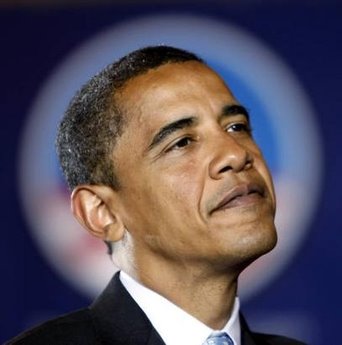
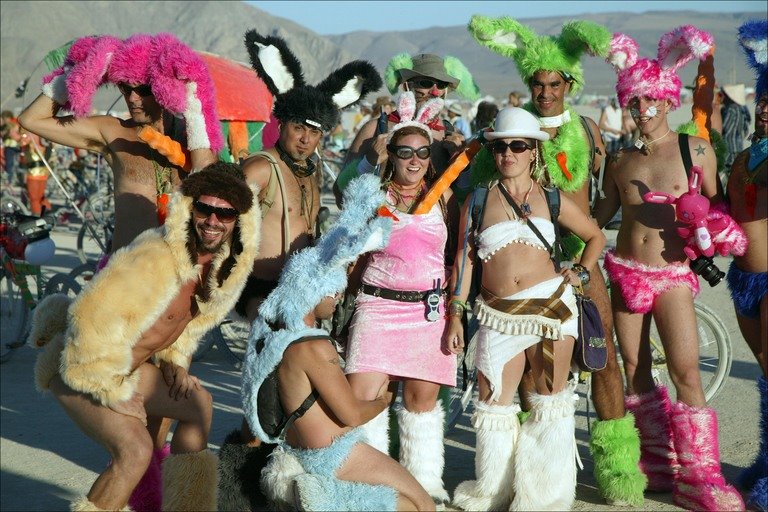
Barack Obama Speaks at Burning Man!

Photo by Declan McCullagh.

‘Festival goers screamed at the top of their lungs, spun in endless circles, and threw up on each other’
By Jeff Lieber / August 5, 2008

Standing on the main stage at a world famous gathering of artists and left-leaners in Nevada on Monday, Barack Obama looked out on a sea of people dressed as ostriches and sexualized vegetables and told them he enjoyed their company much more than that of those who turned out to see John McCain at a supermarket last month.

“As you may know,” he told the thousands gathered, “not long ago, five people stood in the meat aisle to watch my opponent stare down a block of sharp cheddar and a set of sale-item cow testicles. I’ll take the scream of all you people hopped up on narcotics any day!”

Festival goers in the crowd, who had arrived from around the country to partake in the massive outdoor party, screamed at the top of their lungs, spun in endless circles, and threw up on each other numerous times in support of the presumptive Democratic nominee.

Obama said it was music to his ears.

“This is my first time here,” he said, “but I recognize that sound. It’s the sound of freedom.”

In fact, Obama felt so comfortable at the event that he even volunteered his wife to be part of the Horny Nurses Riding Large, Green, Penis-Like Serpent installment, which could be found just behind the half-naked, unpleasant smelling, juggling clowns, but not so far as Cal “The Dude Who Has The Really Good Shit”.

“I encouraged Michelle to take part,” Obama said to cheers. “I told her with a little luck she could be the only woman ever to serve as first lady and get so incredibly high on ecstasy that she would try and have sex with a Winnebago!”

The whole event was treated as just GOOD CLEAN AMERICAN CAMPAIGNING FUN BY AN AMERICAN AMERICAN CANDIDATE FOR THE PRESIDENCY OF AMERICA BY THE NATIONAL MEDIA, because, you see, there’s absolutely nothing strange or creepy about a presumptive nominee standing on a stage in front of a throng of inebriated people and suggesting the possible first lady approximate the gyrations of women in a Warrant video!

Source / Daily Kos

The Rag Blog

Posted in RagBlog | Tagged , , , | Leave a comment

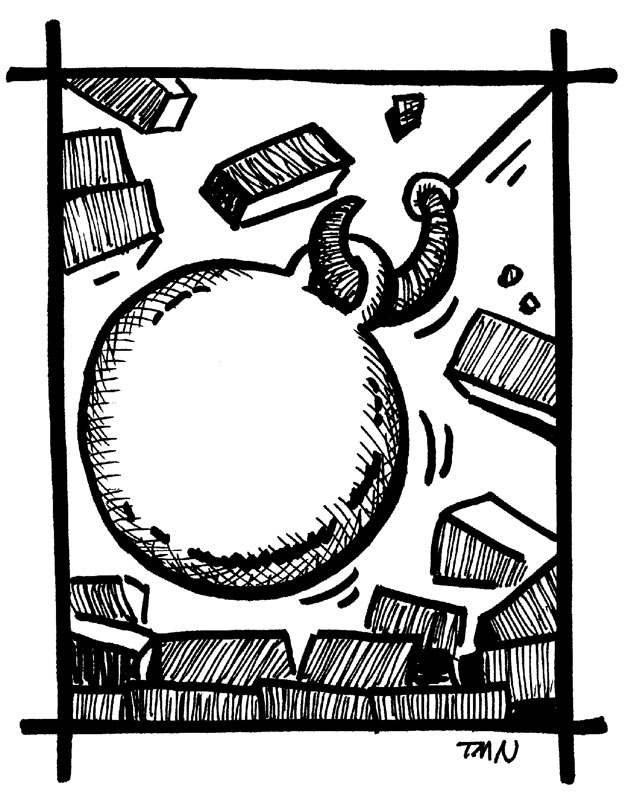
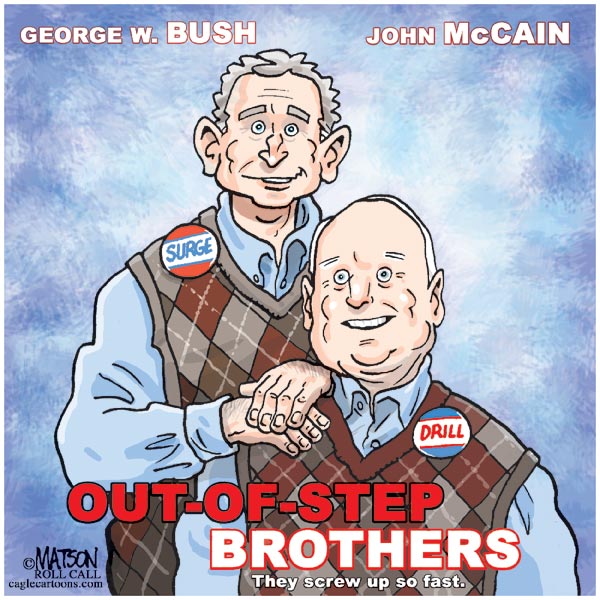
Drawn and Quartered

R.J. Matson / The New York Observer and Roll Call.

Thanks to Harry Edwards / The Rag Blog

Posted in RagBlog | Tagged , , , , | Leave a comment

India : On the Front Lines of the Global Food Crisis

The courtyard of the home where I stayed.

Things that go bump in the night
By Mira Kamdar / August 4, 2008

JAITU, FARIDKOT DISTRICT, India—Wrapped in a musky blanket under a fan that was frantically trying to beat the air free of mosquitoes, exhaustion was finally overtaking me when I vaguely felt something nuzzle my left hand. In theory, I was alone, deadbolted away from the family of six, who were sleeping outside on string cots so I could have the only bed in the only room of their home. At the second nudge, definitely mammalian, adrenaline flooded my body, sending me shrieking into an upright position. A rat scurried away.

I had traveled to this remote part of Punjab to try to understand India’s agricultural dilemma. Squeezed between the relentless pressure to increase production and an environment stressed to the breaking point, the agricultural miracle brought to Punjab by the Green Revolution back in the 1960s was failing, the terrible costs of its success tearing at the fabric of Punjabi society. If Punjab couldn’t find a way out of the current impasse, I didn’t see how India, or the world as a whole, was going to feed a growing population in the face of environmental collapse and growing political instability fueled by scarcity.

The next morning, after tea with milk from the cow tethered out front, my host family’s son Jitinder gave me a ride into town on the back of his motorcycle so I could attend a workshop on natural farming organized by Umendra Dutt, an agricultural activist who runs an organization called Kheti Virasat. Kheti Virasat’s work focuses on raising awareness about the damaging effects of chemical pesticides, synthetic fertilizers, and overwatering, as well as the mass dislocation of people away from their land and communities into an urban-oriented economy that can’t absorb them.

I braced myself as lightly as I could against Jitinder’s body, conscious of being a woman perched behind an unrelated man in a strongly patriarchal culture, as we wove our way out of the dirt lanes of the village and onto a narrow asphalt road that cut through an endless sea of ripening wheat, passing bullock carts piled high with fodder, tractors clanking toward the fields. I hadn’t ridden on the back of a motorcycle in a long time. It was exhilarating to feel the air whipping around my face, the throb and bob of the machine gripped between my legs. I could smell the green scent of the plants and hear the morning bustle of the birds. Farmers and laborers were already wading through the waist-high wheat, spraying pesticide by hand from backpack reservoirs.

When the Green Revolution arrived in Punjab, the “land of five rivers,” India faced chronic food shortages. A combination of massive irrigation infrastructure mandated by the Indian state, new hybrid seeds, chemical fertilizers, and pesticides boosted yields to record levels over the following decades, saving India from the specter of mass famine. With just 1.5 percent of India’s land area, Punjab produces 20 percent of the country’s wheat and 12 percent of its rice. It provides 60 percent of the government’s reserve stocks of wheat and 40 percent of its reserves of rice, the country’s buffer against starvation.

A farmer on the road.

Punjab’s amazing productivity made it possible for India to feed most of a growing population that tripled from 350 million when the country became independent in 1947 to more than 1.2 billion people today. In 2001, India even began to export grain, though critics claim this impressive achievement was gained at the expense of India’s poor.

Only two years later, in 2003, India had to reverse the funnel and import grain, something it had not done in decades. Every year since then, India has imported more and more of its food. Panic-buying by India is credited with helping to raise the price of wheat on global markets by more than 100 percent last year, causing prices to spike around the world, from pasta in Italy to bread in Russia.

In an era of global food scarcity, economic growth does not guarantee India the ability to buy as much food as it needs on the world market. And steps India has taken to liberalize its domestic grain market, a move hailed by some as a necessary corrective to a system riddled with inefficiencies and disincentives to production, may have contributed to the current food crisis by allowing agribusiness giants to siphon off huge quantities of grain.

Meanwhile, the tragic social and environmental costs of the Green Revolution are escalating, threatening a return of the political violence that took the lives of more than 25,000 Punjabis during the 1980s and ’90s when a violent secessionist movement—fueled by profound social disruption caused by the Green Revolution, which dislocated small farmers—militated for an independent Punjab, which would be called Khalistan. The movement had religious overtones derived from Punjab’s majority religion, Sikhism. The Indian state came down on the movement as hard as it could, culminating in June 1984 with an attack by the Indian army on Sikhism’s most sacred site, the Golden Temple in Amritsar. Then-Prime Minister Indira Gandhi was subsequently assassinated by her Punjabi Sikh bodyguards, after which thousands of Sikhs were massacred in retribution. The government, at the least, looked the other way.

The nasty side effects of the Green Revolution have gotten only worse in the years since. The irrigation canals are drying up. Water tables are sinking. According to a new report from Punjabi University in Patiala, pesticide levels, among the most elevated in the world, are being blamed for actually altering the DNA of Punjabis exposed to them.

Meanwhile, there aren’t enough jobs or slots at the better schools and universities. Unemployment is high. The children of farmers, who’ve grown up with the tantalizing images of the new urban India paraded before them on television, have no desire to farm but no skills to do much else. Drug addiction, fueled by heroin transited from Afghanistan via Pakistan through Indian Punjab on its way to Europe and North America, is rampant, claiming an astonishing 40 percent of the state’s youth and 48 percent of its farmers and laborers, according to one recent report.

Before my encounter with the rat, as I sat with my host family around the bed that would become mine for the night, Jitinder’s father, Prem Kumar, proudly showed me a photograph of his father, a Communist rebel who eluded Indian government forces for years. “He was never caught,” he exulted. “He fought in the tradition of Bhagat Singh,” Prem Kumar added proudly, citing a local boy turned national hero who didn’t hesitate to take up arms against the British in the early 20th century.

Prem Kumar explained to me that most of the land around the village was mortgaged to banks or private moneylenders. The water table keeps sinking, and the villagers are having trouble getting enough water to irrigate their fields. Prices for everything have gone up. Many people in the village are sick with cancer.

His 8-year-old granddaughter’s playmate came over to visit with her grandmother.

“She lost her mother just two months ago,” Prem Kumar explained.

“That’s horrible,” I replied. “What happened to her?”

“She had brain cancer,” he replied. Looking at the girl cradled in her grandmother’s lap, he sighed: “Such a beautiful child, like her mother.”

It was true, she was a beautiful child. I looked into her big brown eyes and wondered what her future held.

Source / Slate

The Rag Blog

Posted in RagBlog | Tagged , , , , , | Leave a comment

Nearly Half of all the World’s Primates at Risk of Extinction

The endangered golden lion tamarin. Photo by Anup Shah/Getty Images.

Study paints bleak picture for hundreds of species: Loss of habitat and boom in bushmeat trade blamed
By James Randerson / August 5, 2008

Nearly half of all primate species are now threatened with extinction, according to an evaluation by the International Union for the Conservation of Nature (IUCN).

The study, which drew on the work of hundreds of scientists and is the most comprehensive analysis for more than a decade, found that the conservation outlook for monkeys, apes and other primates has dramatically worsened.

In some regions, the thriving bushmeat trade means the animals are being “eaten to extinction”.

The 2007 IUCN “red list” has 39% of primate species and sub-species in the three highest threat categories – vulnerable, endangered and critically endangered. In today’s revised list, 303 of the 634 species and sub-species – 48% – are in these most threatened categories.

The two biggest threats faced by primates are habitat destruction through logging and hunting for bushmeat and the illegal wildlife trade.

“We’ve raised concerns for years about primates being in peril, but now we have solid data to show the situation is far more severe than we imagined,” said Dr Russell Mittermeier, the chairman of the IUCN Species Survival Commission’s primate specialist group and the president of Conservation International.

“Tropical forest destruction has always been the main cause, but now it appears that hunting is just as serious a threat in some areas, even where the habitat is still quite intact. In many places, primates are quite literally being eaten to extinction.”

The picture in south-east Asia is particularly bleak, where 71% of all Asia primates are now listed as threatened, and in Vietnam and Cambodia, 90% are considered at risk. Populations of gibbons, leaf monkeys and langurs have dropped due to rapid habitat loss and hunting to satisfy the Chinese medicine and pet trade.

“What is happening in south-east Asia is terrifying,” said Dr Jean-Christophe Vié, the deputy head of the IUCN species programme. “To have a group of animals under such a high level of threat is, quite frankly, unlike anything we have recorded among any other group of species to date.”

In Africa, 11 of 13 kinds of red colobus monkey have been listed as critically endangered or endangered. Two – Bouvier’s red colobus and Miss Waldron’s red colobus – may already be extinct.

Overall, 69 species and sub-species (11% of the total) are considered critically endangered, including the mountain gorilla in central Africa, Tonkin snub-nosed monkey in Vietnam and grey-shanked douc langur from Asia.

In the endangered category are another 137 species and sub-species (22%) including the Javan gibbon from Indonesia, golden lion tamarin from Brazil and Berthe’s mouse lemur from Madagascar. Species are judged to be in these categories if they have a small population size, are suffering rapid population declines and have a limited geographic range.

The apparent jump in the numbers of threatened primates from 39% to 48% has not in reality happened in the course of one year. The major new analysis has filled in missing data that was not available previously, according to Michael Hoffman at Conservation International. The last major assessment was carried out in 1996.

“The situation could well have been as bad as this, say, five years ago, we just didn’t know. But now we have a much better indication of the state of the world’s primates – and the news is not good,” he said.

The review, which is funded by Conservation International, the Margot Marsh Biodiversity Foundation, Disney’s Animal Kingdom and the IUCN is part of an unprecedented examination of the state of the world’s mammals to be released at the IUCN World Conservation Congress in Barcelona in October.

However there was some good news for primates. In Brazil, the black lion tamarin has been brought back from the brink of extinction and shifted from the critically endangered to endangered category. This is the result of a concerted conservation effort which has also benefited the golden lion tamarin – it was downlisted to endangered in 2003.

“The work with lion tamarins shows that conserving forest fragments and reforesting to create corridors that connect them is not only vital for primates, but offers the multiple benefits of maintaining healthy ecosystems and water supplies, while reducing greenhouse gas emissions that cause climate change,” said Dr Anthony Rylands, the deputy chair of the IUCN primate specialist group.

The scientists also came close to downlisting the mountain gorilla to endangered following population increases in their forest habitat that spans the borders of Rwanda, Uganda and Democratic Republic of Congo. However, political turmoil in the region and an incident in which eight animals were killed in 2007 led to the decision to delay the planned reclassification.

Primates under threat

There are 634 species and sub-species of primate including apes, monkeys, tarsiers and prosimians. Of these, 69 are now categorised as critically endangered, 137 as endangered, 97 as vulnerable and 36 as near threatened.

In Africa, 63 species or subspecies are in the top three categories (37% of African primates). The new assessment moved L’Hoest’s monkey (Cercopithecus l’hoesti), which is found in Nyungwe National Park, Rwanda, from vulnerable to endangered, for example.

In Asia, 120 species or sub-species are threatened (71%). The grey-shanked douc langur (Pygathrix cinerea) in Vietnam has been moved from endangered to critically endangered.

In Madagascar, 41 species and sub-species are threatened (43%). The black-and-white ruffed lemur, (Varecia variegata) for example, was endangered and is now considered critically endangered.

In Mexico, south and central America 79 species and sub-species are listed as threatened (40%). The cotton-top tamarin (Saguinus oedipus) is now critically endangered, but was endangered.

Source / The Guardian, U.K.

Thanks to CommonDreams / The Rag Blog

Posted in RagBlog | Tagged , , , | 1 Comment

Denver Police Brace for Convention

Security was heavy for the Democratic National Convention in Boston in 2004, including state troopers in riot gear the day before it opened. This year’s convention is in Denver on Aug. 25-28. Photo by Bob Bukaty/Associated Press.

Officials ‘fearing that the convention will become a magnet for militant protest groups’
By David Johnston and Eric Schmitt / August 5, 2008

WASHINGTON — Federal and local authorities are girding for huge protests, mammoth traffic tie-ups and civil disturbances at the Democratic National Convention in Denver this month, fearing that the convention will become a magnet for militant protest groups.

Officials say that what makes Denver different than past conventions is the historic nature of Senator Barack Obama’s nomination, a megawattage event whose global spotlight could draw tens of thousands of demonstrators, including self-described anarchists who the police fear will infiltrate peaceful protest groups to disrupt the weeklong event.

The Secret Service is wary of discussing threats against the people they protect, but with Mr. Obama poised to become the first black presidential nominee, there are special worries. While law enforcement officials say there are no specific, credible threats against Mr. Obama, they expressed concern about low-level chatter on Web sites frequented by white separatists who spew hate about Mr. Obama’s race and what they perceive as his liberal agenda.

One recent scheduling change caused a major shift in security plans. When Mr. Obama announced last month that he would accept his party’s nomination not at the Pepsi Center in downtown Denver, where the convention is being held, but at Invesco Field, home of the Denver Broncos, the Secret Service scrambled to work out plans with local authorities to secure the open-air stadium, which seats more than 75,000 people. Invesco is also adjacent to Interstate 25, a major corridor through the Northern Rockies that will most likely be closed for at least part of Mr. Obama’s acceptance speech.

“The magnitude of the event has expanded,” said John W. Hickenlooper, the mayor of Denver and a Democrat. “It’s bigger and more profound than we expected.”

Officials acknowledge that their projections for the number of protesters are based more on a worst-case chain of events than specific information about who will show up, but they say they cannot take any chances.

As a result, the Secret Service, the Pentagon, the Federal Bureau of Investigation and scores of police departments are moving thousands of agents, analysts, officers and employees to Denver for the Aug. 25-28 convention. They will operate through a complex hierarchy of command centers, steering committees and protocols to respond to disruptions.

National political conventions are a chance for federal agencies to test their latest and most sophisticated technology, and this year is no different. There was a brief flare-up recently between the F.B.I. and the Secret Service, when each wanted to patrol the skies over the convention with their surveillance aircraft, packed with infrared cameras and other electronics. The issue was resolved in favor of the Secret Service, according to people briefed on the matter.

Both Denver and St. Paul, where the Republican National Convention will be held Sept. 1-4, are enlisting thousands of additional officers to help with security. Even so, their numbers will be only about a third of the 10,000 police officers that New York City fielded for the 2004 Republican convention, just three years after the Sept. 11 attacks.

The Denver Police Department will nearly double in size, according to federal officials involved in the planning. The city is bringing in nearly 1,500 police officers from communities throughout Colorado and beyond, even inviting an eight-person mounted unit from Cheyenne, Wyo. State lawmakers changed Colorado law to allow the out-of-state police officers to serve as peace officers in Denver.

The expressions of concern about security at the convention could have more immediate political and legal implications, too. A federal judge, Marcia S. Krieger of United States District Court in Denver, is expected to issue a decision this week in a lawsuit filed by the American Civil Liberties Union seeking to ease security provisions at the convention. The A.C.L.U. has suggested that the Secret Service and the Denver police have exaggerated risks as part of a crackdown on dissent.

The case centers on whether the security zone around the Pepsi Center is so large, and the designated parade route through the city for marches and rallies so far away, as to unnecessarily stifle free speech. New worries about protests and anarchy could bolster the government’s case that the plans are justified.

Last month, under pressure from the A.C.L.U. lawsuit, the city released a list of expenses related to the convention showing that the police were preparing for large demonstrations and mass arrests and that the department had spent $2.1 million on protection equipment for its officers, $1.4 million for barricades and $850,000 for supplies related to the arrest and processing of suspects.

In disclosing the cost breakdown, city officials denied rumors that had circulated for weeks that they had contemplated buying exotic nonlethal weapons that fired an immobilizing goo, or that used radiation or sonic waves to incapacitate people or vehicles.

Similar preparations are under way for the Republican convention in Minnesota, but without the harsh glare that, at the moment, seems to be focused on Denver. St. Paul’s 600-member police force will grow nearly sixfold with about 3,000 additional officers arriving from around Minnesota, as well as from Iowa, Illinois, Wisconsin and the Dakotas, said Tom Walsh, a spokesman for the St. Paul Police Department.

“St. Paul isn’t New York,” he said. “We just don’t have the staffing.”

Kenneth L. Wainstein, the White House adviser on homeland security and counterterrorism, recently visited Denver and St. Paul, a trip that reflected the administration’s interest in the conventions. “In the post-9/11 world, you have to prepare and plan for all contingencies,” Mr. Wainstein said. “That means preparing for everything from a minor disruption and an unruly individual to a broader terrorist event. We need to plan for everything no matter what the threat level is on any particular day.”

Intelligence analysts, however, have not reported a heightened threat from Islamic extremists or domestic threats from antigovernment groups or environmental militants like the kind that operate in many Western states, according to federal officials. “We just aren’t seeing a credible threat,” said James H. Davis, the F.B.I. agent in charge of the Denver office.

Each convention has been designated a National Special Security Event, which makes the Secret Service the lead federal agency responsible for protecting dignitaries and providing overall security. Other agencies will be on standby.

The National Guard in Minnesota and Colorado will each have hundreds of troops on call to their governors to help civilian medical personnel or bomb squads, for instance, if needed. National Guard specialists trained to deal with biological, chemical, nuclear and radiological weapons will also be available.

“There won’t be a visible military presence,” said Maj. Gen. Guy C. Swan III, director of operations for the military’s Northern Command, which is in charge of the military’s response to threats on American soil.

Each city has been awarded $50 million in federal funds for convention costs, a substantial part of which is being spent on security-related equipment and training. And each city has been enlisting the help of neighboring communities to provide more officers to help police the conventions.

The security and safety of convention delegates and visitors has become an increasingly significant issue in Denver and Minneapolis-St. Paul, where local officials were hoping to avoid complaints, heard in 2004 after the Democratic convention in Boston and the Republican convention in New York, that restrictive security arrangements had nearly locked down the convention sites.

From the start, the Democrats’ decision to hold their convention in Denver and the Republicans’ choice of St. Paul stirred concerns about whether local police in each city had enough officers to deal with a wide range of threats, including terrorist attacks or a lone gunman.

The most pressing fears, particularly in Denver, are that as many as 30,000 demonstrators may sweep into the city to disrupt the convention. Much of the city’s planning, in conjunction with federal authorities, has been based on the possibility of such protests, according to federal officials.

Still, these officials acknowledge that they have little concrete intelligence indicating that such large or unruly demonstrations are being planned. But, officials said they had based their assessments on groups like Recreate 68, Tent State and other activist coalitions. Organizers insist the groups are nonviolent, but to the authorities their names alone raise the specter of violent confrontations like those at the 1968 Democratic convention in Chicago.

In Denver, federal officials have expressed concern that demonstrators could try to shut down regular business at several major offices, including the Federal Reserve Bank, the United States Mint, and the federal courthouse.

“Because of the Internet, the ability of protesters to mobilize and share information has metastasized,” said Troy A. Eid, the United States attorney for Colorado. “That would be fine if it were peaceful, as we expect. But we have to plan accordingly.”

In recent days, domestic security officials issued a heightened awareness bulletin urging greater attention because of a number of factors, including the election and the conventions. But law enforcement authorities say they are trying to strike a balance between planning for every conceivable threat, including terrorist attacks and large public demonstrations, and not strangling a city’s commercial life in the process.

“We’re not looking to shut down an entire city,” said Malcolm Wiley, a Secret Service agent involved in security planning for the convention in Denver.

Source / New York Times

Thanks to Michael Pugliese / The Rag Blog

Posted in RagBlog | Leave a comment

Latest About Obama From Toby Keith, New Darling of the Right


Keith: Obama ‘Talks, Acts, And Carries Himself As A Caucasian’
By Max Blumenthal / August 5, 2008

Last week, I reported for the Huffington Post that country singer Toby Keith had performed a pro-lynching anthem on the Colbert Report, and would be playing the same song soon on the Tonight Show with Jay Leno and a slew of nationally televised talk shows.

The lyrics of Keith’s song, “Beer For My Horses,” which I transcribed, could hardly be less explicit — “Hang ’em high, for all the people to see.” In my piece, I also noted the racially tinged nature of the song’s video and the forthcoming movie that Keith’s song inspired.

The response from right-wing blogs was swift and strident. Townhall.com whined that “The Liberal Lynching of Toby Keith” had taken place; Lonewacko claimed that Keith was actually “promoting lawful executions.” And Keith found an avid defender in Robert Stacy McCain, the disgraced former Washington Times reporter and avowed neo-Confederate who once allegedly ranted in the middle of the Times newsroom that slavery was “good for the blacks and good for property owners.”

The comments section of my post was immediately swarmed by right-wing trolls twisting themselves into contortions to defend the indefensible. A typical comment read: “I can’t believe that this Max can’t find something real to complain about in this crazy world… I think Max is the bigot — he obviously hates country music, country singers and Southerners.”

Describing Keith’s over-produced truck commercial schmaltz as “country music” besmirches the dignified tradition established by Bill Monroe, Johnny Cash and Dolly Parton, while insulting the innovative artists propelling the genre into the future, from Neko Case to Son Volt to my good friend Dave Bryan (hear his music here). At his best, Keith is Merle Haggard with a lobotomy. But that’s beside the point.

The comments by the literally hundreds of trolls who leapt to Keith’s defense are significant for only one reason: they reveal the extent to which the radical right has anointed Keith as a icon of its movement. Keith’s schlock rock is the soundtrack of the culturally deprived australopithicenes who populate the cyber-caves of freeperland and comprise the movement’s most fervent activists. As a bellicose chickenhawk who has risen from the ranks of the rural working class to become “White Trash With Money,” Keith has carefully calibrated his image to fit the sensibility of his fans.

Now, Keith has trained his sights on Barack Obama, attacking him in language that startled even the notoriously reactionary radio jock Glenn Beck. During Keith’s appearance on the July 30 broadcast of Beck’s show, he remarked, “I think the black people would say he [Obama] don’t talk, act or carry himself as a black person.”

“What does that even mean?” the audibly shocked Beck replied.

“Well, I don’t know what that means,” Keith drawled, “but I think that that’s what they would say. Even though the black society would pull for him I still think that they think in the back of their mind that the only reason he is in [the general election] is because he talks, acts and carries himself as a Caucasian.”

How will Keith’s fans explain away his remarks without rejecting the essential thrust of his argument? The comments section is open.

Source / The Huffington Post

Toby Keith’s latest: Obama “talks, acts, and carries himself as a Caucasian.”

Also read MUSIC: Toby Keith’s Ode to Lynching / The Rag Blog / July 29, 2008

The Rag Blog

Posted in RagBlog | Tagged , , , , , | 1 Comment