Turning the American Dream Into Cold Cash

Jennifer Marcoe holds the opal ring she received on her first Mother’s Day. The ring is one of the treasures the family has had to pawn in order to make ends meet after husband Richard was laid off. The family is among a growing number of people who’ve been forced to turn to pawnshops and online auctions to raise money to pay the bills. Photo: THOMAS JAMES HURST / THE SEATTLE TIMES

Survival for Sale
By Nancy Bartley / August 4, 2008

At the pawnshop, the needs and the sacrifices are getting bigger.

It’s mid-week, the end of the month, and the wolverine is leaving the pawnshop. When it returns a few weeks later — jaws frozen in a timeless snarl — it’s a sign Charlie is broke. It’s a situation to which he’s become accustomed.

Ever since Charlie was young, growing up in Anchorage, the offspring of Eskimos who made their living in the wilderness, the wolverine was a fixture on the living-room walls, first at Charlie’s grandfather’s house, then his father’s.

Forty years ago Charlie’s great-grandfather trapped it, and over decades it was passed from one relative to another until it came to Charlie — a token of the life his ancestors once lived.

Now it hangs in Charlie’s Everett apartment.

When Charlie was injured on the job at a meat-packing company four years ago, he was unable to go back to the physically demanding work and had to take lesser-paying jobs like the one he has now as an apartment manager.

When his paycheck doesn’t stretch far enough, the prized family heirloom comes to the rescue.

In 2004, Charlie, whose lack of funds makes him too embarrassed to give his last name, took the wolverine to Pacific Pawn in Everett for the first time and used it as collateral for a loan.

Now with the cost of living higher than ever, the wolverine is back in action, being checked in and out of Pacific Pawn as if it were a hotel for taxidermied animals. There’s a python skin on the ceiling and the heads of a moose, a seal and a bison. There’s a raccoon and a duck, too, along with spare parts for humans like prosthetic legs, glass eyes and dentures as well as the usual pawnshop fare — DVDs, wedding rings, power tools and electric guitars.

As the price of gasoline and food soars and the resale value of houses drops, adjustable-rate interest on mortgages climbs and companies lay off employees, these once-cherished family treasures have become commodities traded for dollars to help people trying to make ends meet.

They are being traded at pawnshops, flea markets and online auctions in record numbers, and in many cases are making the difference between eating and going hungry, paying the mortgage and living on the street. And often, the sales are augmenting other urgent efforts to raise money — from hawking sewing, carpentry, computer and other skills to selling blood plasma.

“We are seeing significant growth” in listings, says chief executive officer Maureen Ellenberger at auctionPal, an online business that helps people sell things. On the listing form, auctionPal asks why the item is being sold, and “a lot of people are putting down, ‘I need the money,’ ” Ellenberger says. Recently she listed an entire set of Waterford crystal purchased for a wedding 18 years ago simply because the owner was desperate to pay the rent.
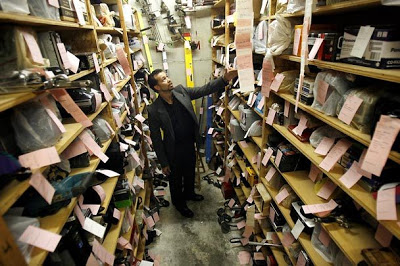
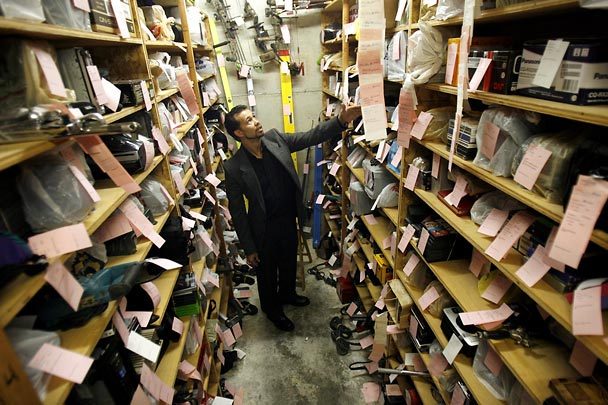
Tony Hargrove searches for a customer’s things held in the back of Pacific Pawn in Everett. Pawnshops store items they loan money on for 90 days. If a customer does not repay the loan or the accrued interest on the loan, the pawn broker can put the item on the shop floor to be sold. Photo: THOMAS JAMES HURST / THE SEATTLE TIMES

“They’re selling things like children’s clothing, things they’d never thought of selling before,” she says. “Or they’re selling things their mother had given them. We feel it’s pretty tough out there.”

Nancy Baughman, chief executive officer of the online e-BizAuctions.com, agrees.

The rising cost of gas tipped the scales for people who already were having a difficult time financially, she says.

“One gentleman lost his job and now he’s selling all his movie memorabilia. A lady on disability is selling her grandmother’s things. It’s heartbreaking. I do what I can for the people.”

Craigslist.com CEO Jim Buckmaster says the online classified-ad site in the first few months of 2008 had a “tremendous surge of activity” in its for-sale section — “beyond anything we’ve really seen before, to the point where we’re scrambling to add additional server capacity.” Especially busy, he noted, is the cars/trucks category “as millions of Americans look to unload their gas guzzlers — which puts money in their pockets and reduces the need for expensive gasoline.” In April 2007, the Web site listed 8 million cars and trucks for sale; a year later, it was 19 million.

The past few months have brought a big change to the pawnshop industry in general, says Nick Buell, state president of the trade group Washington Pawnbrokers Association.

Buell, owner of Kent Jewelry & Loan, says not only are a lot more people coming in, “there’s a change in the nature of why they’re getting loans. Yesterday, half the loans went to people who needed gas money. Some said it was just to get to work. The gas prices are killing them.”

In the past, he says, people got loans for more mundane things like entertainment or a household item or a vacation. “They turned to us to get them over the potholes in the road. Not anymore. Now it’s for survival.”

WHEN CHARLIE pushed open the barred door with the “Nordstrom of pawn shops” sign, carrying the wolverine under his arm, Jeff Maxwell gave him a smile of recognition and got out the paperwork. After four years of making loans on the wolverine, they don’t haggle over prices. The head is tagged, Charlie gets 50 bucks, and he’ll be back to pay off his loan, plus 3 percent interest, in a few weeks.

Pawnshops are regulated by the state, and the amount of interest they can charge is limited to 3 percent, for a maximum of 90 days, plus setup fees, unless a loan is extended. After 90 days, an item can be sold if it hasn’t been reclaimed and the loan repaid.

If the customers are a few days over, Tony Hargrove and Maxwell, both longtime employees, are forgiving and not quick to put the item up for sale. That’s earned them praise and a loyal following. “It’s a family place,” Charlie says. “They’re always willing to help.”

If possible.

Sometimes it’s not. A Graham man who’d lost his heavy-equipment-operator’s job in Enumclaw came into the shop to pawn a rifle scope, binoculars, wedding ring and other items with a retail value of $700. The best he could get was $100.

Although the man begged, Maxwell shook his head, telling him they had to buy items at a low-enough price to still make a profit.

“How can you guys sleep at night?” asked the man, who left in anger.

Although customers who want more for their goods occasionally criticize Maxwell and Hargrove, they say the business is a community service. Hargrove even plays uncle to a generation of kids who visit the shop. He pulls peppermint candy from their ears and keeps a dish on the counter. A champion kick-boxer who’s adept at handling any customer, Hargrove sees it this way:

“They help us and we help them.”

It’s not much different at Yuppie Pawn in Kirkland, a pirate ship of toys for rich boys who also have fallen on hard times. A builder brought in his collection of weapons, including a semi-automatic rifle so high-tech the Terminator could have used it.

In a red building tucked behind a bank, the shop is packed with priceless trinkets: lacquered humidors for keeping cigars, bottles of vintage Champagne and signed photos of sports stars.

“Our economy is so bad the only thing I’m taking now are motorcycles, Rolexes, gold, DVDs, snowmobiles, some original art, jet skis, some cars. Things unique enough we can sell for a low price,” says owner Brian Lurie, who started Yuppie Pawn in 1992 after his real-estate ventures stopped making money.

“I don’t want your laptops, your generators . . . We only take two out of 10 things that walk in the door.”

Like the sleek HK 223-caliber rifle once owned by a real-estate developer who needed cash. “I don’t know what you use this for,” he says, taking the rifle from a vault where he keeps it. “Home defense?”

“This past year’s volume of items for sale and the volume of dollars we’re taking out is so much bigger than before,” he says, attributing his store’s success to the cost of gas, the rise in interest rates and those people who still can afford to shop but want a bargain.

Lurie knows firsthand that “when you’re making a lot of money you live big.” But when hard times come, you’ve got a mortgage to pay like anyone else.

In hard times, it all comes down to sacrificing even very personal items.

THE GOLD NECKLACES

At Kent Jewelry & Loan, Colleen O’Neil pulls a handful of broken gold necklaces out of a brown sack. Frank Buell, Nick Buell’s son, weighs them carefully. Gold is selling high right now, so many in need are cleaning out their jewelry boxes or even bringing in old gold dental crowns to sell.

O’Neil, who was laid off from her job with the city of Seattle, didn’t have the money to fill her tank with gas to go to job interviews.

“It was my son’s idea to take this stuff to a pawnshop,” she says. She leaves with $80, having sold jewelry she hadn’t worn in years.

“She’s a prime example of the people we’re seeing now,” Nick Buell says. “Lots of upper-middle-class people who are short 50 or 60 bucks.”

THE AMETHYST RING

The boxes are packed in Suzanne Lorimer’s drafty Federal Way home. She says she’s eager to leave and head back to California to move in with a friend until she can find a job and get back on her feet.

A year ago, a complicated illness cost Lorimer her job as a paralegal. It was impossible to both work and go to all the doctor appointments for her chronic joint problems. Many surgeries later, she remains unemployed. Lorimer, 45, quickly went through her savings, sold her stocks and eventually was unable to pay the heating bill at her rental house. When the owner wanted to raise the rent, it was more than Lorimer could bear. She gave her notice. And she’s been selling as much as she can to raise cash to move.

“A friend once gave me a Coach purse,” she says. “I sold it for $50. I needed gas to take my son to school. What else could I do?”

She sold the family’s heirloom piano, but her mother bought it back for her. “I’m trying to hang on to that.”

The amethyst ring Lorimer listed on craigslist.com was given to her by her grandmother almost 30 years ago. “I remember hearing stories of the family and the things they had to do and sacrifices they had to make, like not being able to buy a new pair of shoes and always having to get secondhand things during the Depression.

“If anyone would understand my having to sell this ring, my grandmother would.”

THE BABY’S HIGH CHAIR

It’s new, shiny, sleek, gray and crème with two trays — a deluxe high chair for their youngest son, who’s 10 months old.

“He used it only twice, but if it can get us food on the table, it’s one of those things we don’t need,” says Jennifer Marcoe, 25, who put it on craigslist. She also listed necklaces and an opal ring, given to her on her first Mother’s Day.

The ring “has significant value as far as emotional attachment, but I have to do what I have to do. I will always have the memory.”

Jennifer’s husband, Richard Marcoe, 28, is a plumber, but as the housing market slowed, so did his business.

“We’re not ones who’ve ever lived off the state,” she says.

So when she went to apply for food stamps, she was surprised that the family of four — with their $2,100-a-month income, minus $910 in rent, $200 in utilities, car insurance and a car payment — made too much to qualify. She’s learned frugality and stretching the food budget to the max.

“Do you know how much I could buy with $200 in food stamps?” she asks.

As for the high chair, “most of the time, one of us holds him and one feeds him,” Jennifer says.

So many people are struggling, she says, “and it seems the government doesn’t care. I cried last night for a good hour. I just cried because I don’t know what we’re going to do.”

THE ELECTRONIC GAMES

Midmorning not long ago, Wes Smith sauntered into Pacific Pawn, a fresh needle stick in his arm and a handful of electronic games to sell. Smith, who has the names of his sons, David and Jaiden, tattooed on the sides of his neck, is 31, an unemployed security guard who just sold his plasma to help support his family.

His wife, Shaunna, 21, is pregnant and stays home.

Smith is hopeful he’ll get a job soon and be able to move his family out of their federally subsidized apartment in Everett, where they live on $400 to $600 a month and food stamps.

“The cost of everything is killing me,” he says. “Gas, stamps at 42 cents, and kids aren’t getting any cheaper.” He’s listed his truck for sale. He’ll worry about transportation when he gets a job. Because he grew up in foster care in Arizona and dropped out of high school, he wants more for his kids. Patting David’s head as the boy hides his face against his father’s legs, Smith elaborates:

“I want to raise my family like I never got to be raised. We live in a ghetto neighborhood with gang violence and all that. I want to move my family out of that.”

He hopes he’ll be employed soon at a nearby casino and once again have benefits. Until then, there’s the pawnshop, he says, pocketing the $180 he just made.

THE FAIRY DOLL

Her mother made the soft-bodied fairy doll, but when it becomes difficult to pay the rent, it’s no time to be sentimental, Tamra Valle believes.

Tamra and John Valle of Duvall are in their early 30s, both working — one at Safeway, one at Bartell Drugs — and have a 13-year-old daughter. But they, too, are selling all kinds of personal items.

“It’s not that I don’t value it, it’s that I value eating and driving more,” Tamra explains. Her husband’s sword collection went, her rings and finally the little soft-bodied doll made by her mother, listed online for an asking price of $100.

With $1,300 rent, a car payment, $200 a month just for the gas to heat the house and paying other bills, little is left over.

“We sold our condo after the property taxes blew up,” she says. “We don’t drive as much. We cut down on our food bill and use coupons. We haven’t bought clothes in a while. We don’t get a lot of extras like ice cream, just the necessities — fruit and vegetables and meat, the cheap cuts.”

EBay sales have tided them over. But the frustration of never having enough money “makes me want to move . . . maybe to northern Idaho. It’s so expensive here.”

THE HEDGE TRIMMER AND BIKE

Rick Gallegos, 45, was wide-eyed, a man in shock. He had spent the day trying unsuccessfully to find cars to fix and other ways to make a few bucks, and now he is at Yuppie Pawn, pawning the basics of yard maintenance and his weekend touring bike to fill his truck with gas. His middle-class life seems to be sliding away.

For many years, Gallegos — who grew up traveling the world with his diplomat father, who worked for the United Nations — was employed at a bio-tech company that made defibrillators. Not long ago, the company outsourced the work, and he lost his job. Gallegos’ wife works as a bus driver, and he gets $295 a week in unemployment. But with the $3,000-a-month mortgage on their Duvall home, gas and groceries and supporting his 16-year-old son, “we’re living well below our means.”

It rankles him that corporate executives bring in salaries in the high seven figures and outsource the work overseas.

“What can possibly justify that kind of money?” he asks. “Outsourcing is killing anyone with a drive.”

He glances around the pawnshop as if looking for the scuba gear he already brought in. Some of the disappearing trappings of the life he once knew.

Nancy Bartley is a Seattle Times staff reporter. She can be reached at 206-464-8522 or nbartley@seattletimes.com. Thomas James Hurst is a Times staff photographer.

Copyright © 2008 The Seattle Times Company

Source / Seattle Times, Pacific Northwest magazine

The Rag Blog

Posted in RagBlog | Tagged , , | Leave a comment

FILM : The Sociology of Wealth in the USA

Johnson and Johnson heir and filmaker Jamie Johnson.

‘Johnson is obviously thoughtful and also disturbed by his view from the top of the class pyramid of American society’
By Roger Baker / The Rag Blog / August 4, 2008

Having no choice but the slim pickings at Blockbuster to rent a video for entertainment (San Antonio is apparently without a good classic and art video store like Vulcan Video in Austin), I carefully studied the small foreign and documentary section and lucked into two very good ones. First “Why We Fight” about Rumsfeld, Cheney and the military-industrial complex that inevitably pushes us toward war.

My other interestig choice was “Born Rich”, about the sociology of the kids of the ultra-wealthy in the USA. “Born Rich” was made by Johnson and Johnson heir Jamie Johnson, who got in trouble for revealing and discussing the existence of class in the USA . His video has not always flattering portraits of super-rich kids, to which he had unique access because of his own status as a wealthy heir.

“Born Rich” got a lot of exposure after it got picked up by HBO.

Johnson made a second video titled “The One Percent”, which is discussed
here.

Johnson is obviously thoughtful and also disturbed by his view from the top of the class pyramid of American society. The born-rich seem by and large to be average decent kids. But they are born into an exclusive insular class and culture in partial denial of their class status. It often considers discussing money tacky. It is logical that this should be the case, since the super-rich families usually hire the best top managers for increasing their wealth. There are certain things that it is impolite to know about or discuss, whether it is in the details of making the high possible profit or sausage.

Naturally the super-rich regard the latest crop of mere centa-millionaires as troublesome interlopers that get in the way of high society, as opposed to the old wealth and megawealth that make it into the Fortune 500. One pattern is that the super-rich tend by their nature to create exclusive self-perpetuating tribal, social institutions of denial. Blue blood social structures that prevent any feedback arising from the spreading discontent at the bottom from ever reaching and destabilizing or exerting influence at the top.

At least Jamie Johnson is willing to break the code of silence and let us see and try to understand the newest generation of the hereditary US ruling class up close, as the economic base of the pyramid of US wealth erodes. Will the hereditary super-rich in the USA react in similar ways to the British aristocracy, after Britain’s loss of economic power after WWI?

The Rag Blog

Posted in Rag Bloggers | Tagged , , , , | 1 Comment

Foster Kids In Texas Get Lots of Meds

Copyright © Illustration by Olaf Hajek.

They get ‘three times the amount of psychotropic meds as their non-fostered Medicaid counterparts’
By Craig Malisow / August 4, 2008

As if they weren’t getting shafted enough, foster kids on Medicaid in Texas are receiving at least three times the amount of psychotropic meds as their non-fostered Medicaid counterparts – without any proven benefits.

This is according to a study led by Julie Zito, a professor of pharmacy and psychiatry at the University of Maryland-Baltimore, and published in the January issue of the journal Pediatrics.

The findings were based on the review of 32,135 Texas foster care kids enrolled in Medicaid between September 2003 and August 2004. More than 75 percent of the medications were used “off-label,” meaning not for their prescribed purposes.

“When two-thirds of foster care adolescents receive treatment for emotional and behavioral problems, far in excess of the proportion in non-foster care population, we should have assurances that the youth are benefiting from such treatment,” Zito testified in May, before a subcommittee of the U.S. House Ways and Means Committee.

She also testified that “Poverty, social deprivation, and unsafe living environments do not necessarily justify complex, poorly evidenced psychopharmacologic drug regimens.”

Read Zito’s complete testimony here.

Source / Houston Press

The Rag Blog

Posted in RagBlog | Tagged , , , , , , | 2 Comments

Bill Richardson for Obama’s Veep? : Two Views

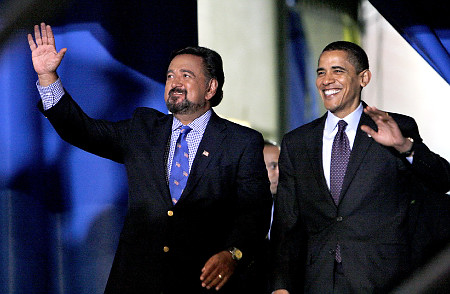
The nation’s only Hispanic governor, New Mexico’s Bill Richardson, formally announced his endorsement of Barack Obama Friday, March 21, in Portland, Oregon. Photo by Brandon / AP.

Richardson is ‘a vicious politician’ and an ‘opportunist’
By Mark Rudd / The Rag Blog / August 4, 2008

As a citizen of New Mexico who has had to suffer through six miserable years of Bill Richardson’s governorship, I could write a book on what a vicious politician and person he is–a true opportunist scumbag. His administration has been thoroughly incompetent, even compared to that of the libertarian jerk who preceded him, with precisely one sole purpose: to get Richardson elected President. As Secretary of Energy he proved himself to be absolutely without principle, reversing his previous positions and supporting every single nuclear initiative as well as persecuting Wen Ho Lee. His reputation as an environmentalist has no substance behind it. His sole principle iin politics and life is Bill Richardson.

Outside New Mexico, Hispanics don’t recognize him at all. his showing in the primaries was insignificant. Plus, he’s really ugly. He takes a terrible picture due to his weight problem, though his recent beard has helped a bit. He also has a terrible Bill Clinton-type womanizing reputation. If Obama selects him as VP he’ll surely bring down the ticket. I’d be surprised if the Obama people don’t already know this. They probably offered him a sinecure like UN ambassador, where he was under Clinton, in return for his switching over during the primary campaign.

Bill Richardson has the ‘best judgement and the best experience’ to be Obama’s running mate
By Michael Alan Dover / The Rag Blog / August 4, 2008

…Since Iowa I’ve been convinced that Gov. Richardson is the best VP candidate and am still convinced. It’s simply a matter of who has the best judgement and the best experience. It’s not what part of the country they are from, what states they can bring, what demographics are needed. And it’s not about having a Governor on the ticket. It’s who inspires trust. And, yes, name recognition is important, and Richardson has that.

What is really amazing is how none of the media mention him, as if two people of color on the ticket would somehow sink it. I don’t agree. It’s not just change people want. It’s honesty and fairness. To deny the VP slot to the clearly most qualified potential candidate because he would be person of color #2 on the ticket would not be fair.

I recall well the Democratic convention which nominated Sen. Lieberman. It was electrifying that a Jew had been nominated, but what was clear to me from the TV version at least was that the most electrified delegates of all were the African-American delegates! They were clearly inspired and excited by the realization that once the religion barrier had finally been broken (first a Catholic, now a Jew and now doubt one year a Muslim such as the Representative from Minnesota), the race barrier would also soon be broken. I recall well and have an MP3 of the very moving concluding prayer from that convention, by an African-American pastor from Arkansas, who went out of the way to include ecumenical content with a strong focus on Old Testament conent. I’ve posted it here.

The phrase “in the City of our God” refers to Los Angeles…

As we ready ourselves for the 2008 convention and consider our political commitments, regardless of our religious views I think it is helpful to hear this.

Now we are on the verge of breaking that very race barrier to the Democratic nomination. Nominating Gov. Richardson would not be about further breaking that race barrier. It would be about selecting the best candidate. But imagine the degree to which people of any religion or any culture or “race” would be electrified by the realization that the political process in this great democracy is potentially open to all.

[Both Mark Rudd and Michael Alan Dover are affiliated with Progressives for Obama.]

The Rag Blog

Posted in Rag Bloggers | Tagged , , | 2 Comments

FILM : Arianna Huffington on ‘Swing Vote"

Kevin Costner in ‘Swing Vote’. Photo courtesy of Walt Disney Pictures.

What the new film tells us about the ’08 race, and why Obama needs to put Kevin Costner on his iPod
By Arianna Huffington / August 4, 2008

The makers of Swing Vote, the new film starring Kevin Costner, have pulled off a rare double play, producing a smart political satire that is also heartfelt and moving. It’s also a film that turns out to be remarkably relevant to the 2008 race.

Costner plays Ernie “Bud” Johnson, a beer-drinking, unemployed resident of Texico, New Mexico who as fate — and a voting machine error — would have it, will single-handedly decide a presidential election (sure, it’s high concept, but don’t forget that in 2000 New Mexico was decided by just 366 votes). The media descends on him, as do both presidential candidates and their win-at-all-costs campaign managers.

The film has lots to say about — and gets plenty of laughs from — the evils of modern campaigns: pollsters, lobbyists, focus groups, and the inevitable mudslinging and negative ads. The film features a bunch of satiric smear ads launched by the competing candidates — incumbent GOP President Andrew Boone (Kelsey Grammar) and his Democratic challenger, Donald Greenleaf (Dennis Hopper). You can see them here, here, here, here, and here.

But as ludicrous and over-the-top as the film’s negative ads are, none of them can hold a candle to the absurd ads unleashed last week by the McCain camp and the RNC.

Paris Hilton and Britney Spears? Really? David Hasselhoff? John McCain has been waiting his whole life to run for president and the best he’s got is Britney, Paris, and the Hoff? And Moses? Everything about the McCain media reeks of desperation — and a stunning disconnect from popular culture. Does the McCain campaign’s computers have Google software than can only go back to 2003? And the RNC’s ad ended with a riff on Leo DiCaprio in Titanic. That was 1997. When John McCain still had principles.

The film shows how, in their hunger to win, the candidates are willing to say or do just about anything — and chalk it up to the price of doing business. At one point near the end of the film, both candidates have crises of conscience. President Boone, disgusted at his own willingness to abandon his core principles to court voters — “dancing the dance,” as his campaign manager calls it — wonders aloud, “What are we about?” To which his campaign manager replies: “Winning. If we don’t win, you can’t do what you set out to do. And everything you’ve done won’t matter.”

But even the two campaign managers — who are the personification of cynicism — eventually admit the emptiness of that realpolitik rationalization. When one of them bemoans “the whole bullshit system,” the other reminds him: “We are the system. If it’s bullshit, it’s because we’re bullshit.”

Watching as these two fictional candidates completely lose sight of why they are running, and lose track of everything other than winning, I couldn’t help but think of McCain, reduced to voting against the banning of torture, and denouncing his own immigration bill.

In a moving speech before the film’s climactic final debate, Bud comes to terms with his own role in the degradation of our politics:

It’s sorta like somewhere along the way I checked out, and it’s not like I had huge dreams to begin with… I have never served or sacrificed. The only heavy lifting I have ever been asked is simple stuff, like pay attention — vote. If America has a true enemy, I guess it’s me.

It’s an incredibly tough scene to pull off — but Costner does it beautifully, giving flesh and blood to a man who has stopped believing that he can make a difference or that politics matters, and has simply given up.

Bud Johnson is a powerful stand-in for the 83 million eligible Americans who didn’t vote in 2004, and is precisely the kind of voter the Obama campaign should be targeting every day. Reaching America’s Buds is more critical than ever; if we don’t, and if the Buds keep turning away, disheartened and disillusioned, we will never see real change.

Instead we’ll see campaigns spending all their time courting the affection of fickle, fence-sitting swing voters. The kinds of people who could be influenced by the Britney/Paris ad.

So each and every day Barack Obama should roll out of bed in the morning and ask himself, “What can I do to get the real life Bud Johnsons of this country to check back in, to pay attention, to vote, to reconnect to the dreams they have abandoned along the way?” I recently suggested that Obama fill his Kindle and his iPod with the great speeches of RFK and Martin Luther King. He should add Costner’s finale to the mix.

I have a very small part in Swing Vote, playing myself. Talk about type casting. We filmed in New Mexico, in an arena. I was in a booth with Aaron Brown and Lawrence O’Donnell. There were laptops all over the set, and I kept pulling up the home page of HuffPost on each of them.

We filmed my scene all night. The producers had gotten me a hotel room, but I never even saw it. We kept shooting and I eventually just went straight from the set to the airport the next morning. In between shots, we would go to Kevin Costner’s trailer and sit outside under the stars while he played guitar.

I watched Costner film his big speech that night. And it was powerful. But not nearly as powerful as it is now, in the context of the current state of the race. So go see Swing Vote. Bring your cynicism, you idealism, and a box of Kleenex.

Source / The Huffington Post

The Rag Blog

Posted in RagBlog | Tagged , , , , | 1 Comment

Barack Obama : Pride and Prejudice

Barack Obama the new Mr Darcy? Dominic Cooper played the part in the BBC adaptation of Jane Austen’s ‘Sense And Sensibility.’

Read ‘Mr. Darcy Comes Courting’ by Maureen Dowd below.

Maureen Dowd hits the nail on the head
By Steve Russell / The Rag Blog / August 4, 2008

Maureen Dowd is no Molly Ivins, but sometimes she can both hit the nail on the head and deliver a chuckle (if not the roaring belly laughs that were Molly’s stock in trade).

I don’t fear that progressives will not hold Obama’s feet to the fire.

I fear that America is not ready to vote for a non-white President. I’ll say it again: the Dems are the left party and they nominated Obama JUST BARELY. Polling suffers from the Tom Bradley error on one side and the no land line error on the other. I just don’t know. I want to believe we’re past color but it’s hard to see right now…

Folks, when it became public knowledge that I’m enrolled Cherokee, thanks to the Austin paper, my IQ went down 20 points over night. Most of the people who did not suddenly treat me differently are on the Rag list. And my experience was AUSTIN, for crying out loud, which was weird enough to vote for me [for Travis County judge] in the first place.

I can’t help but think black is a harder sell than American Indian and most of the country is not as far towards post-racialism as Austin.

Please, let me be wrong!

Mr. Darcy Comes Courting
By Maureen Dowd / August 3, 2008

WASHINGTON — It is a truth universally acknowledged that Barack Obama must continue to grovel to Hillary Clinton’s dead-enders, some of whom mutter darkly that they will not only not vote for him, they will never vote for a man again.

Obama met for an hour Tuesday with three dozen top Hillaryites at a hotel here, seeking their endorsement and beguiling their begrudging. He opened the session by saying that he knew there had been frustration about what they saw as sexism during the primary.

The Los Angeles Times reported that Hillary die-hards want to enshrine a whine in the Democratic platform about how the primaries “exposed pervasive gender bias in the media” and call on party leaders to take “immediate and public steps” to denounce any perceived bias in the future. That is one nutty idea.

Perhaps it is because feminists are still so busy cataloging past slights to Hillary that they have failed to mount a vivid defense of Michelle Obama, who has taken over from Hillary as the one conservatives like to paint as a harridan.

Before the Obama campaign even had a chance to denounce Ludacris, one of the rappers on the senator’s iPod, Hillary Inc. started to mobilize. Susie Tompkins Buell, a former Clinton bundler, told The New York Observer that Obama had to distance himself, given Ludacris’s new song rooting for Obama to “paint the White House black” and calling Hillary the b-word.

Despite Obama’s wooing, some women aren’t warming. As Carol Marin wrote in The Chicago Sun-Times, The Lanky One is like an Alice Waters organic chicken — “sleek, elegant, beautifully prepared. Too cool” — when what many working-class women are craving is mac and cheese.

In The Wall Street Journal, Amy Chozick wrote that Hillary supporters — who loved their heroine’s admission that she was on Weight Watchers — were put off by Obama’s svelte, zero-body-fat figure.

“He needs to put some meat on his bones,” said Diana Koenig, a 42-year-old Texas housewife. Another Clinton voter sniffed on a Yahoo message board: “I won’t vote for any beanpole guy.”

The odd thing is that Obama bears a distinct resemblance to the most cherished hero in chick-lit history. The senator is a modern incarnation of the clever, haughty, reserved and fastidious Mr. Darcy.

Like the leading man of Jane Austen and Bridget Jones, Obama can, as Austen wrote, draw “the attention of the room by his fine, tall person, handsome features, noble mien. …he was looked at with great admiration for about half the evening, till his manners gave a disgust which turned the tide of his popularity; for he was discovered to be proud, to be above his company, and above being pleased.”

The master of Pemberley “had yet to learn to be laught at,” and this sometimes caused “a deeper shade of hauteur” to “overspread his features.”

The New Hampshire debate incident in which Obama condescendingly said, “You’re likable enough, Hillary,” was reminiscent of that early scene in “Pride and Prejudice” when Darcy coldly refuses to dance with Elizabeth Bennet, noting, “She is tolerable; but not handsome enough to tempt me.”

Indeed, when Obama left a prayer to the Lord at the Western Wall in Jerusalem, a note that was snatched out and published, part of his plea was to “help me guard against pride.”

If Obama is Mr. Darcy, with “his pride, his abominable pride,” then America is Elizabeth Bennet, spirited, playful, democratic, financially strained, and caught up in certain prejudices. (McCain must be cast as Wickham, the rival for Elizabeth’s affections, the engaging military scamp who casts false aspersions on Darcy’s character.)

In this political version of “Pride and Prejudice,” the prejudice is racial, with only 31 percent of white voters telling The New York Times in a survey that they had a favorable opinion of Obama, compared with 83 percent of blacks.

And the prejudice is visceral: many Americans, especially blue collar, still feel uneasy about the Senate’s exotic shooting star, and he is surrounded by a miasma of ill-founded and mistaken premises.

So the novelistic tension of the 2008 race is this: Can Obama overcome his pride and Hyde Park hauteur and win America over?

Can America overcome its prejudice to elect the first black president? And can it move past its biases to figure out if Obama’s supposed conceit is really just the protective shield and defense mechanism of someone who grew up half white and half black, a perpetual outsider whose father deserted him and whose mother, while loving, sometimes did so as well?

Can Miss Bennet teach Mr. Darcy to let down his guard, be more sportive, and laugh at himself?

Source / New York Times

The Rag Blog

Posted in Rag Bloggers | Tagged , , , , , | 4 Comments

The High Costs of the Things We Like


The Climate Costs of a Glass of Milk
by Raúl Pierri

MONTEVIDEO – A simple glass of milk on the breakfast table can carry high environmental costs. Because of this, some farmers and scientists are looking for ways to reduce the impacts of agriculture and livestock, which are responsible for 12 to 14 percent of global emissions of greenhouse gases.

There are already studies to measure the climate costs of that glass of milk, or of a country’s entire milk production, from raising the cow to the final product on the table.The farming sector’s emissions of climate change gases grew nearly 17 percent between 1990 and 2005 worldwide, and the biggest increase took place in the developing South (32 percent).

The intestinal fermentation in ruminant livestock, like cattle, releases into the atmosphere methane and nitrous oxide, two potent greenhouse gases. Further emissions come from animal manure and urine, the burning of plant biomass to clear pastures, rice production and biological and chemical processes occurring in soil.

The two gases contribute 70 percent of the emissions coming from the agricultural sector. Methane and nitrous oxide, respectively, have 21 and 300 times more “greenhouse effect” than carbon dioxide, the principal gas associated with climate change, released primarily by vehicles, industry and electricity production.

While countries are looking for ways to produce more food and overcome the current food price crisis, experts from LEARN (Livestock Emission Abatement Research Network) are studying ways to reduce emissions without undercutting productivity.

That was the focus of discussion amongst officials and researchers gathered in Uruguay Jul. 21-24 for the international workshop on agricultural emissions of greenhouse gases, organised by LEARN. Tierramérica was the only media outlet present for the technical segment of the meeting.

In Uruguay, agriculture generates 91 percent of the country’s methane emissions. In neighbouring Argentina, farming and ranching are responsible for 44 percent of national greenhouse emissions.

Because it involves a sector that is very important to countries like Uruguay, the reduction of emissions must ensure that pasture-raised livestock continue to eat a natural, chemical-free diet, Luis Santos, coordinator of Uruguay’s Climate Change Unit, told Tierramérica. One option is to modify the diet of the animals, using varieties of forage that are less rich in methane, he said.

Pastureland accounts for 26 to 40 percent of the world’s productive lands. And cattle emit 37 percent of the methane and 65 percent of the nitrous oxide generated by human-led activities. The vast majority of these gases come from pastures in Latin America and Asia.

Tim Clough, a scientist from New Zealand, noted that the atmospheric concentration of nitrous oxide continues to rise 0.26 percent annually. Globally, the nitrous oxide output is dominated by agricultural sources, he said, stressing the urgent need to reduce these emissions.

The main sources of nitrous oxide in pastures are manure and nitrogen-based fertilisers. Nitrous oxide is produced in the soil through microbe processes like nitrification or the conversion of ammonium nitrate, according to Clough, an expert in soil sciences from Lincoln University in New Zealand.

Clough suggested, as is being done in his country, the use of nitrification inhibitors, chemical substances added to nitrogen fertilisers (mineral or organic) or applied directly to the soil, which inhibit the activity of bacteria.

LEARN was founded last year in New Zealand, and includes representatives from politics, science and industry from some 40 countries, including agricultural giants like the United States, Brazil, Australia, India, China and Argentina.

Its aim is to define methods for measuring, verifying, communicating and mitigating the production of greenhouse gases from the livestock sector.

“The first objective is, in the context of the Framework Convention on Climate Change, to determine the factors of emissions in order to carry out an inventory of greenhouse gases released by the sector,” explained Santos.

“The countries of the developing South, according to the Convention, must adopt measures but are not obligated, like the industrialised countries, to reduce their emissions. That is why we want to know, for the countries like New Zealand that do have an obligation, how much they emit and how they are going to cut emissions,” he said.

To that end, a New Zealand Project presented at the meeting demonstrated the procedures for tracking greenhouse gases in the farming sector. In milk production, for example, this starts with emissions from the cow itself, to industrialisation and transport.

(*Originally published by Latin American newspapers that are part of the Tierramérica network. Tierramérica is a specialised news service produced by IPS with the backing of the United Nations Development Programme, United Nations Environment Programme and the World Bank.) (END/2008)

Copyright © 2008 IPS-Inter Press Service.

Source / Common Dreams

The Rag Blog

Posted in RagBlog | Tagged , , | 1 Comment

Painful Joke of the Day


How does a shitting President negotiate a peace agreement with Iraq?

The answer is ….. ‘DEPENDS.’

Thanks to Diane, a Rag Blog reader / The Rag Blog / Posted August 3, 2008

Posted in RagBlog | Tagged , | 1 Comment

Texas Republican Congressman Pete Sessions’ Week of Scandal

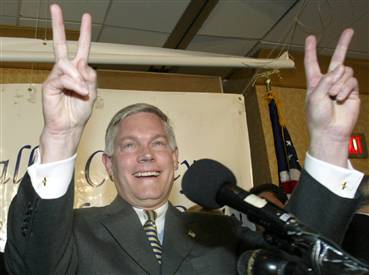
Republican Rep. Pete Sessions celebrates with supporters after claiming victory over Democratic Rep. Martin Frost for the Texas 32nd Congressional District House seat in November, 2004. Photo by Jeff Mitchell / Reuters.

Self-styled ‘morality champion’ pays strippers with campaign money, raises funds from poker players
By Matt Glazer / August 3, 2008

Pete Sessions has had a bad week. [Pete Sessions is the Republican U.S. Congressman from the 32nd District of Texas.] After attending a Las Vegas strip club earlier this week (and paying for it with campaign donations), citizen journalists across the country cried foul. As Americablog points out, “Sessions was publicly livid over Janet Jackson’s ‘liberal values’ when she bared her covered boobs during the SuperBowl a few years back”.

Apparently the outrage began and ended with the Janet, Justin peep show.

Sessions spent more than $5,000 at Kane’s club that night in March, according to federal disclosures. Those reports show Sessions spent another $2,100 on his hotel.

Outrage, decency, hypocrisy, and forty deuce aside, who attended the Sessions fun-draiser? According to D Magazine, the major donors for session weren’t Texans. They weren’t citizens groups. No, instead it was a series of professional poker players.

For example, there’s self-described “professional poker player” Howard Lederer and his wife Susan with a combined donation of $10,000. Andrew Bloch, another “professional poker player,” gave $4,000. Doyle Brunson tossed some more chips on the table with another $4,000. Barry Shulman was in for $2,000, and Linda Johnson matched up to $500.

Now I’m sure all these Las Vegas residents are perfectly respectable citizens, and I for one am glad to see them engaged in the political process. But why did they choose a Dallas congressman as the vessel of their civic participation? Simple. Go to the congressman’s statement on proposed UIGEA regulations issued on April 2, 2008. Then note that this year’s Vegas cash started flowing on April 7, 2008. Seems like Nevada has bought itself an extra congressman.

This isn’t just a Democrat vs. Republican issue. In fact, the conservative Texas Eagle Forum told Gromer Jeffers of the Dallas Morning News, “What’s the difference?’ asked Cathie Adams, president of the Texas Eagle Forum. ‘I don’t think that it’s representative of the constituents of the district. I’m in shock.'”

The focus on Congressional District 32 is clearly spilling over into local elections.

Dallas County Democratic Chairwoman Darlene Ewing called upon Bill Keffer, a candidate for the Texas House, to return campaign monies received from Congressman Pete Sessions.

Bill Keffer is running again for the State House Seat 107, won by Allen Vaught in 2006. Keffer has made shutting down local strip clubs one of the centerpiece issues of his 2008 campaign. In his local campaign mailings, he rails against local clubs calling them “immoral and exploitative operations” (June 10, 2008). Yet, he is happy to take Sessions’ strip club money.

“It is hypocritical for Bill Keffer, who claims to be the champion of morality, to continue accepting Pete Sessions’ political patronage and strip club money. He should denounce Congressman Sessions for using a strip club venue to raise money, and he should return the monies given to him by Sessions or that Sessions helped him raise for use in his own campaign,” said Ewing.

Pete Sessions has played a major role in Keffer’s fundraising and political efforts since his 2006 defeat. Keffer frequently touts Sessions’ endorsement and Sessions has been making phone calls, sending letters, and hosting fund raisers on behalf of Keffer since the middle of the 2007 legislative session.

This is another example of the Republican Party wanting to dictate to Texans and Americans how they should live their lives, but not heed their own advice. It is time for us to vote against hypocrisy and vote for leadership. Sessions needs to go and Bill Keffer should never return to elected office.

You can read more on the Sessions situation at TexasKaos , and Talking Points Memo. In addition, if you know of any other candidate who has received a donation from Pete Sessions, let us know in the comments.

Source / Burnt Orange Report

The Rag Blog

Posted in RagBlog | Tagged , , , , , | 1 Comment

Another Piece of What Iraq Was Really About


Iraq arms sales request worth over nine billion dollars: Pentagon
August 1, 2008

WASHINGTON — The Pentagon said Friday it has notified Congress of proposed military sales to Iraq valued at more than nine billion dollars, including helicopters, tanks and armored vehicles.

The biggest proposed sale was for 392 Light Armored Vehicles, radios and anti-tank weapons at an estimated cost of three billion dollars, the Defense Security and Cooperation Agency said.

Congress also was notified of a possible sale of 140 upgraded M1A1 Abrams tanks as well as armored Humvees, tracked logistics vehicles, armored ambulances, vehicles to carry shelters and command posts, and trucks to transport heavy equipment.

It was valued at 2.16 billion dollars.

A separate 2.4 billion dollar helicopter deal would provide the Iraqi government with 24 Bell Armed 407 helicopters or 24 Boeing AH-6 helicopters, along with engines, missiles, mortars, machineguns, and rocket launchers.

Another proposed sale involved technical assistance in the construction of garrisons, training areas and operational facilities for the Iraqi security forces.

“The total value, if all options are exercised, could be as high as 1.6 billion dollars,” the DSCA said.

On Monday, the DSCA announced a possible contract to sell Iraq six C-130J aircraft, with engines and other equipment, which it said was worth 1.5 billion dollars if all options were exercised.

Source / Yahoo News

The Rag Blog

Posted in RagBlog | Tagged , , | 1 Comment

Death Row and ‘The Rat Trap’

Levon Jones was freed from North Carolina’s death row in May after a paid informant recanted her testimony.

Death row exonerations expose failings of the ‘snitch system’
By Christopher Moraff

Since 1973, 129 innocent people were released from death row — more than 50 of whom were sentenced to death based partly or wholly on false informant testimony.

Levon Jones is supposed to be dead.

If the state of North Carolina had its way, Jones, 49, would have been strapped to a gurney years ago, hooked to an IV and pumped full of a lethal, three-drug cocktail until he asphyxiated.

Instead, on May 2, he walked out of prison a free man after spending 13 years on death row, and another 24 months locked up awaiting retrial — all for a murder he almost certainly did not commit.

Jones — known to friends and family as “Bo” — was released with the help of the American Civil Liberties Union’s (ACLU) Capital Punishment Project after the prosecution’s star witness recanted her testimony against him. (Lovely Lorden, a former girlfriend, admitted she’d collected $4,000 in reward money in exchange for testifying against Jones.)

He was an easy target: an African-American ex-con with a history of mental illness and violent behavior. When Lorden came forward with her story — a full three years after the 1987 shooting of a local bootlegger named Leamon Grady — Jones was doing time on an unrelated assault charge.

The prosecution felt little obligation to question the veracity of Lorden’s claim. And if the witness is to be believed today, investigators actually helped her keep her story straight.

As a result of Lorden’s testimony — and despite the lack of physical evidence tying him to the crime — a jury convicted Jones in 1993 and he was sentenced to die for Grady’s killing.

What Jones’ attorneys didn’t know at the time — and, as it turns out, didn’t really bother trying to uncover — is that Lovely Lorden had made something of a career out of testifying against people close to her. By her own admission, she has aided law enforcement in dozens of investigations and says she helped police make cases against several other boyfriends, as well as her own brother and sons.

What’s more, her work as a confidential informant didn’t stop after Jones was sent to death row. Jones’ attorneys sent In These Times copies of receipts that show Lorden was paid money at least seven times for her work as a confidential informant from December 2003 to April 2004, while Jones sat in jail.

Today, Lorden contends she testified against Jones under pressure from the police, in particular Dalton Jones (no relation), the lead officer in the case.

That doesn’t surprise Jones’ ACLU attorney, Brian Stull, who says it’s not uncommon for police to find a suspect first and worry about making a case later.

“I think often times they look at the usual suspects,” Stull says. “I think Dalton Jones was thinking, ‘This is a dangerous person, and whether he did it or whether he didn’t, I’m going to get him off the street.’ “

Jones owes his freedom in part to an astute federal judge who sensed something amiss with Lorden’s testimony during a 2006 penalty appeal.

In granting Jones a new trial, U.S. District Judge Terrence Boyle, of the Eastern District of North Carolina, noted Lorden’s statements to police were “riddled with inconsistencies” and “reflect that Lorden is unable to fairly and reliably describe the circumstances of the offense.”

Unfortunately, the case of Levon Jones is not an anomaly. He is the fifth death row prisoner to be exonerated in the past year. Since December, North Carolina alone has released three inmates from death row after it was determined that they did not commit the crimes for which they were convicted. Of these three men, two, including Jones, were convicted on the false testimony of snitches.

The other, Jonathon Hoffman, was released in December 2007 after spending seven years on death row. His freedom came when the prosecution’s key witness — Hoffman’s cousin — admitted that he had lied to get back at Hoffman for stealing money and had been both paid for his testimony and given a reduced sentence for bank robbery. At the time of Hoffman’s trial, prosecutors withheld the deal from defense attorneys, the jury and even the judge.

A recipe for disaster

In a country where more than one out of every 100 citizens is now incarcerated, criminal justice advocates are scrutinizing the way in which police and prosecutors go about getting the information to pursue and prosecute suspects. This inquiry has increasingly focused on the extent to which incentivized informants and jailhouse snitches are contributing to the convictions of innocent people.

A cursory review of the Jones case would be enough to suggest something is wrong. But a thousand Levon Jones stories don’t elicit the same amount of outcry as one Kathryn Johnston case does.

In November 2006, Atlanta police gunned down Johnston — an elderly Atlanta grandmother — inside her home. The officers, who were from the city’s narcotics task force, claimed to be acting on information they received from a confidential informant that drugs were being sold from the house. That allegation turned out to be false.

The Johnston tragedy shined a spotlight on the cavalier use of informant information to obtain arrest and search warrants. The Justice Department launched a federal probe and, nine months after the shooting, in July 2007, the House Committee on the Judiciary held a hearing on law enforcement’s use of confidential informants.

“We’ve got a serious problem here that goes beyond coughing up cases where snitches were helpful,” said committee chair Rep. John Conyers (D-Mich.) at the hearing. “The whole criminal justice system is being intimidated by the way this thing is being run, and, in many cases, especially at the local level, mishandled. … A lot of people have died because of misinformation.”

It isn’t known if any of those people have died at the hands of the state; but judging by some of the relevant corollary statistics, it’s plausible that some have.

Falsified informant testimony accounts for nearly half of all wrongful convictions in capital cases nationwide, according to data from Northwestern University Law School’s Center on Wrongful Convictions. Since 1973, 129 innocent people were released from death row — more than 50 of whom were sentenced to death based partly or wholly on false informant testimony, according to the Center.

Alexandra Natapoff, an associate professor of law at Loyola University and one of the country’s foremost authorities on the problems with paid informants, thinks that’s just the tip of the iceberg.

“We have the most data on capital and homicide convictions because they are the most high profile,” she says, “so we have no idea how many wrongful convictions there are in larceny cases or assault cases or any other because nobody is paying any attention to those.”

Natapoff has written extensively on the role of snitch testimony in wrongful convictions and says that informants have become law enforcement’s investigative tool of choice.

“The government’s use of criminal informants is largely secretive, unregulated and unaccountable,” she says. “This lack of oversight and quality control leads to wrongful convictions, more crime, disrespect for the law and sometimes even official corruption.”

She continues: “If the criminal system can’t get homicide cases right, then it’s very unlikely that we’re getting other things right.”

A broken system

With the expansion of the “war on drugs” during the crack epidemic of the late 1980s, police began to abandon traditional investigative work in favor of insider cooperation. Cops say it’s almost impossible to make a drug case any other way. But critics say the practice has led to a “dumbing down” of police work across the board.

“The drug war has eroded law enforcement practices,” says investigative reporter Ethan Brown, whose recently published book, Snitch: Informants, Cooperators and the Corruption of Justice, traces the genesis of the informant culture and its effect on communities.

Those who study the snitch culture trace the problem to a criminal justice policy that has created the perfect atmosphere for what Brown calls the “cooperator institution” to thrive.

Most notably, Brown says, federal sentencing guidelines, adopted in 1987, have exacerbated the growth of the cooperator institution over the past two decades. Until a 2005 Supreme Court ruling gave judges more flexibility in sentencing, the guidelines made cooperating with authorities the only real option for defendants seeking leniency.

“Those guidelines really forced drug defendants into cooperating,” says Brown. “Very few people will look at that kind of prison time and not cooperate.”

But over the years, a practice once confined mainly to drug investigations has become standard operating procedure for the prosecution of all kinds of crime.

The reasons are myriad, but the simple matter of resources looms large. In a system severely taxed by an unwinnable drug war, relying on informants is a cheap and easy investigative option. It can cost thousands of dollars to house, feed and protect an actual witness until trial, and, depending upon the offense and the defendant, such protection can carry on for years after conviction. By contrast, criminal informants are often compensated with leniency or are paid small sums, and often simply released into the same streets from which they came.

“It’s all about this staggering misallocation of resources,” says Brown. “We have this incredible institution for cooperators and informants, yet, for the kind of cooperating we need the most, there are really no resources.”

This mutually beneficial relationship between police officers and their informants is what Natapoff calls “a disturbing marriage of convenience.”

Prosecutors and police know the pitfalls, but in many cases write them off as the cost of doing business and making cases.

In a 1999 study published in the Fordham Law Review, Ellen Yaroshefsky, a law professor from the Benjamin N. Cardozo School of Law, interviewed a number of assistant U.S. attorneys from the Southern District of New York and found that while most said they made every effort to be diligent in assessing the veracity of informants, they admitted it’s easy to get in too deep and lose objectivity.

In her study, Yaroshefsky described this as “fall[ing] in love with their rat.”

“You’re not supposed to, of course. You are trained to maintain your objectivity,” an anonymous participant in Yaroshefsky’s study said. “But you spend time with this guy, you get to know him and his family, you like him. You believe that he has come clean. Hopefully the assistant has a skeptical mindset, but the reality is that the cooperator’s information often becomes your mindset.”

Still, other times investigators are already working under an assumption of guilt and are simply seeking confirmation.

“[Sometimes] prosecutors are convinced they have the guilty guy, then they go about seeking to convict and do not carefully look at things that are funny about their case,” one of Yaroshefsky’s sources said.

Former prosecutor and now Howard University law professor Andrew Taslitz says that when he started out in the Philadelphia district attorney’s office, his youth and ambition often clouded his judgment when it came to reliance on informants who had received incentives. He says he thinks his experience is the norm.

“Most prosecutors are very, very young, especially at the state level,” Taslitz says. “They’re new graduates of law school or they’ve done some other job for a few years but they’re mostly in their late 20s, early 30s tops, with very little experience. It’s one of the reasons that office policies that just tell them what to do are so important.”

Another problem is that many of the assumptions that courts make about how witness testimony is received simply don’t pan out.

The Supreme Court established the constitutional basis for using paid informants in 1966 with U.S. v. Hoffa, which decided that rewarding a witness for testimony does not violate due process. In its opinion, the court wrote: “The established safeguards of the Anglo-American legal system leave the veracity of a witness to be tested by cross examination, and the credibility of his testimony to be determined by a properly instructed jury.”

But Natapoff says, in practice, those mechanisms are deeply ineffective at protecting defendants from lying informants.

“Let’s say the government does disclose [compensation] and the jury knows about it,” she says. “You would think, and the Supreme Court certainly thinks, that that will make a difference. Well, psychological research has found that it makes almost no difference, that jurors ignore the fact that the witness is compensated.”

And that’s only for the cases that go to trial. Because 95 percent of criminal cases are resolved through plea agreements, defendants rarely get the chance to challenge an informant’s story or credibility.

“The Supreme Court has held that while defendants who go to trial are entitled to impeachment material about their informants, defendants who plead guilty are not,” Natapoff says. “So that means that most defendants will never see the deal that the informant got.”

In spite of all the potential pitfalls, police and prosecutors say the benefits of informants outweigh the potential for abuse.

Ronald E. Brooks, president of the National Narcotic Officers’ Associations’ Coalition, calls informants “indispensable investigative assets” and cautions against issuing a blanket judgment on the use of confidential informants by police officers for “a few instances of mismanagement or wrongdoing.”

“When we appropriately manage informants, great cases, ones that make our community safe are the result,” he says. “When informants are improperly used, the results can be devastating. But without the ability to freely use informants, law enforcement would have very few significant investigative successes.”

A call for reform

Since the 2007 House Judiciary Committee hearing in the wake of the death of Kathryn Johnston, little headway has been made in reforming the practice of using incentivized informants to send people to jail — and, possibly, execution.

According to the American Bar Association (ABA), 18 states now require corroboration of an accomplice’s statements. Those that require corroboration for other forms of incentivized witnesses, however, are few and far between.

Illinois currently mandates corroboration in capital cases, and courts in Nebraska and Oklahoma have required corroboration for jailhouse snitches. Texas, meanwhile, has a different requirement, not for jailhouse snitches, but for undercover drug operatives working for the police.

Criminal justice reformers say they want to make sure police and prosecutors are following protocol in how and when they use paid or incentivized informants.

Taslitz, who serves in the ABA’s Criminal Justice Section, says more transparency is needed during the discovery phase. For example, he’d like to see defendants who are negotiating a plea agreement have access to the information and witnesses being used against them.

In a 2005 ABA resolution that Taslitz helped write, the association urged federal, state and local authorities to require that informants meet certain standards of credibility and that courts mandate corroboration in all cases that involve jailhouse snitches.

But so far there has been little in the way of reform.

“It’s a slow process,” Taslitz says, “and it doesn’t have to necessarily be a matter of legislation, but it could be a matter of individual prosecutors’ offices adopting specific policies; it can be a matter of local ordinances; it can be case law where judges start to intervene. It’s a slow process and, as of yet, there is no uniform informants act.”

For cases that do go to trial, Natapoff has been pushing for “pre-trial reliability hearings” as a potential remedy. Under such a system, the burden would be on the government to prove witness reliability by a preponderance of evidence. Courts would be required to consider such factors as the criminal history of the informant, any compensation for their testimony, and other cases in which the informant has testified, among other things.

“Given the prevalence of informant falsehoods in wrongful capital convictions, such hearings should be mandatory in capital cases, even where the defense intends to concede guilt and move directly to the sentencing phase,” Natapoff says.

Considering that for every innocent person convicted of murder, a real murderer escapes justice, requiring such checks and balances is as much a victim’s rights issue as a matter of criminal justice.

For his part, in spite of losing a decade and a half of his life, Levon Jones says he holds no grudge against the snitch that put him on death row.

Rather, he attributes his ordeal to a miscarriage of justice.

Says Jones: “It was the system itself.” 

Source / In These Times / Posted July 30, 2008

The Rag Blog

Posted in RagBlog | Tagged , , , , | 1 Comment

Texas Death Row : Those Who Are About to Die

Photo courtesy of the Wood Family / Austin Chronicle.

Your Texas death machine gets rolling once again
By Jordan Smith / August 1, 2008

A Nation of Laws?

José Medellín.

Scheduled for Execution Aug. 5: José Medellín

There is no doubt that the crime for which 33-year-old José Ernesto Medellín was sentenced to die was horrific. And there is no arguing that Medellín did not participate in the brutal gang rape in Houston that claimed the lives of two teen girls. There is also no question that Medellín, a Mexican national, was denied the opportunity after he was arrested to consult with Mexican consular officials regarding his detention and prosecution, as guaranteed under provisions of the 1963 Vienna Convention on Consular Relations, to which the U.S. is a party.

At issue now, just days before his Aug. 5 execution date, is whether that violation of Convention protection prejudiced Medellín’s defense and, more broadly, whether the state of Texas (or any other state) is actually required to enforce the provisions of international law. To international-law experts, including Sarah Cleveland, a former UT law professor who now teaches at Columbia, Texas’ failure to comply with the provisions of international treaties could have far-reaching implications. The U.S. “has relied repeatedly on the enforceability of this and other treaty obligations abroad,” she said. “If we do not keep our promises to our international partners, we lose the ability to protect our own citizens abroad and damage our nation’s reputation as a reliable player on the world stage.”

On June 24, 1993, then-18-year-old Medellín and six other young men gathered in a Houston park for a fight that served as an initiation rite into the Black and White gang. After the fight was over, the teenagers were walking along a set of nearby railroad tracks when they passed two young girls, 14-year-old Jennifer Ertman and 16-year-old Elizabeth Peña. The boys grabbed them; the two girls were raped multiple times, strangled, and left for dead. Medellín was charged, tried, and convicted of capital murder, but it wasn’t until after he was sentenced to death that the Mexican government was contacted about his situation, when Medellín wrote to Mexican officials from his cell.

Ultimately, Medellín was one of 52 people on death row in the U.S. named in a lawsuit filed in the International Court of Justice (often called the “World Court”) by the Mexican government, which argued that the U.S. had failed to meet its obligations under the Vienna Convention on Consular Relations. The relevant section of the Convention provides that in an effort to maintain “international peace and security,” people traveling abroad should have the right to talk with representatives of their home nation “without delay” if arrested, “committed to prison or to custody pending trial or is detained in any other manner.” These rights “shall be exercised in conformity with the laws and regulations” of the detention state, reads the Convention, “subject to the proviso, however, that the said laws … must enable full effect to be given to the purposes” for which the consular rights are intended.

Although Medellín tried to raise the violation of the Convention as a claim on appeal, the courts rejected his argument. In 2001, the Texas Court of Criminal Appeals ruled: 1) that the claim was procedurally moot because Medellín had failed to raise the issue at trial, 2) that as a private individual he didn’t have standing to enforce the provisions of the international treaty, and 3) that he failed to show the violation caused him any harm since he had been provided with “effective legal representation” at trial and that his “constitutional rights were safeguarded.”

Whether Medellín was in fact provided with adequate representation isn’t at all clear. According to court records, one of his court-appointed attorneys was actually suspended from practicing law during the time he was representing Medellín. And the question of whether these violations caused harm to his defense has never been adequately addressed.

While Medellín’s appeal was pending before the federal appeals court, the ICJ ruled that the U.S. had failed to meet its obligations under the Vienna Convention and that the U.S., “by means of its own choosing,” had to have the cases of every Mexican national reviewed by the courts. In response, Bush issued a memorandum on Feb. 28, 2005, that, in essence, ordered the state courts to “give effect” to the ICJ decision. (Bush also subsequently withdrew U.S. participation in the portion of the Convention that grants the World Court jurisdiction over Convention disputes.) Texas officials balked at the order, and the Court of Criminal Appeals agreed, noting that while the feds may have to honor treaty obligations, individual states were under no obligation to do so.

The question of enforceability made it to the U.S. Supreme Court, which sided with the state, ruling that the state courts were not bound by the ICJ ruling absent any binding action of Congress. Medellín’s case has since been put to rest by the CCA, but scheduling his execution has caused a last round of wrangling: On July 6, the ICJ issued an order calling for a stay of execution, and on July 14, U.S. Rep. Howard Berman, D-Calif., filed legislation that would offer criminal defendants “any relief required to remedy the harm done” by violating the Convention. That legislation has not yet moved beyond committee assignment, prompting state Sen. Rodney Ellis, D-Houston, to appeal to Perry to postpone Medellín’s execution. It is “inappropriate” for a state government to “undermine” foreign policy obligations – and it is especially important to consider the effects that dismissing these concerns would have on “Texans living, working, and visiting abroad,” he wrote.

That argument doesn’t appear to have impressed Perry. “The world court has no standing in Texas and Texas is not bound by a ruling or edict from a foreign court,” spokes­man Robert Black told the Houston Chron­icle. “It is easy to get caught up in discussions of international law and justice and treaties. It’s very important to remember that these individuals are on death row for killing our citizens.”

Feeding the Death Machine

Heliberto Chi.

Scheduled for Execution Aug. 7: Heliberto Chi

Is the Texas method of execution by lethal injection a “cruel and unusual punishment” that violates the Eighth Amendment to the U.S. Constitution?

According to the Texas Court of Criminal Appeals, the state’s highest criminal court, the answer is no. The method, at least as it is set forth in the written protocol by the Texas Department of Criminal Justice, is legally sound, said the CCA earlier this year. On June 9, the court ruled that Heliberto Chi, scheduled for an Aug. 7 execution, is not entitled to a hearing to argue otherwise.

Yet in carrying out its executions, does the state actually follow its own protocol? If not, how can the CCA be certain that the injection method would actually withstand strict scrutiny? And if an inmate isn’t entitled even to a hearing on the matter, will we ever know the truth?

In fact, according to recently filed appeals – and, it would appear, to deposition testimony under seal in a Houston federal court – it’s hard to tell if Texas officials exert any meaningful control over the lethal-injection process. In 1977, Texas followed Oklahoma’s lead, adopting trichemical lethal injection as our method of execution, even though the only expert Texas officials consulted – a veterinarian – advised that the most humane method would be a single, massive dose of the barbiturate pentobarbital. Texas ignored that advice, however, opting for the trichemical cocktail developed for Oklahoma by its medical examiner, Jay Chapman, who, according to court documents, was not of the opinion that execution should be painless. “Perhaps hemlock is the answer for all the bleeding hearts who completely forget about the victims – and their suffering,” Chapman has said. “And we should worry that these horses’ patoots should have a bit of pain, awareness of anything – give me a break.”

And so the trichemical method was adopted and is now central to the claim that the method, as practiced in 36 states, is unconstitutional. In general, the three chemicals – sodium thiopental, pancuronium bromide, and potassium chloride – are injected in succession, and each functions in order to: 1) sedate the prisoner, 2) paralyze all voluntary muscles, and 3) stop the heart. The ability to achieve this goal in a humane manner, however, rests upon the skill and expertise with which the drugs are administered and monitored. The risk of severe pain turns on the proper injection of the first chemical, a mild sedative generally used to temporarily render a patient unconscious during the introduction of anesthesia. Sodium thiopental is “ordinarily used to render a surgical patient unconscious for mere minutes only in the induction phase of anesthesia, specifically so that the patient may reawaken and breathe on his own power if any complications arise,” Dr. Mark Heath, a professor of clinical anesthesia at Columbia, said in a declaration filed with Chi’s appeal. In the context of lethal injection, the sedative is problematic because, if it wears off after the injection of pancuronium bromide, a drug that immobilizes all voluntary muscles – including the diaphragm – the inmate may feel excruciating pain, and, while conscious but incapable of communication, “suffocate to death while experiencing an intense, conscious desire to inhale.”

If monitored properly, these pitfalls might be avoided, but lawyers for Chi (and other death row inmates) argue that the absence of any oversight by medical experts or trained administrators renders the Texas execution method a torturous experience that certainly falls outside the parameters of the Eighth Amendment.

The CCA’s assurance that Texas’ lethal injection method is sound relies exclusively on the U.S. Supreme Court decision this year in the case of two inmates who challenged Kentucky’s use of the method. The Kentucky courts held a seven-day hearing, out of which came a full record for the Supremes to explore. In the end, the high court concluded that the manner in which Kentucky administers lethal injection, using the same trichem cocktail as Texas, is constitutional.

But that does not mean, the high court noted, that all protocols are created equal. In fact, it seems the only thing Texas and Kentucky have in common is that both states have written protocols. In practice, the differences are striking – including the fact that Texas does not use medical professionals to carry out or monitor the execution process, not even to ensure that the IV line is secured properly, that the individual drugs are mixed properly, or that the inmate is unconscious prior to being dosed with the second and third drugs. And that creates a strong likelihood for painful error.

Quantifying that likelihood, however, has been difficult at best for the lawyers representing death row inmates like Chi. State statutes governing lethal injection require only that execution happen by the “injection of a substance or substances in a lethal quantity sufficient to cause death.” The only restriction TDCJ places on the process is that no “torture, or ill treatment, or unnecessary pain, should be inflicted.” What that means in practice has been hard to determine. TDCJ’s written protocol remained secret until 2006, when it was disclosed during discovery in a federal civil lawsuit. What the state – or the CCA – has known about this protocol over the years is also unclear.

However, recent court filings suggest that the TDCJ and the Texas Attorney General’s Office may have been aware since at least March 2007 that Texas’ written protocol has little relevance to the realities of the death chamber. In a recent appeal (for inmate Carlton Turner, executed July 10), lawyers argued that the contents of a 280-page deposition of death unit Warden Charles O’Reilly reflect that “the written protocol is effectively irrelevant to the reality of how Texas carries out execution by lethal injection in practice.” The deposition remains under court seal and was only made available to defense attorneys under a confidentiality agreement inhibiting their ability to provide more specific detail. However, Turner’s attorneys argued, the information in O’Reilly’s deposition “demonstrates that the TDCJ’s assertions that the protocol is applied in Texas just as it is in Kentucky are unsupported allegations and, in large measure, simply false.”

So far, such arguments have not impressed the CCA. In Chi’s case, Judge Barbara Hervey opined for the court majority that because the Kentucky execution protocol is “materially indistinguishable from Texas’ … protocol … Chi’s Eighth Amend-ment claim has no merit.” At present, it appears that only one CCA jurist, Judge Tom Price, has any reservations about the legality of the process: “Apparently the Court will not tolerate actual litigation of the issue if it means the death machine meanwhile must stand idle,” Price wrote in dissent. “But we cannot fix the machine while the cogs are turning.”

Should Have Been Anticipated

Jeffrey Wood.

Scheduled for execution Aug. 21: Jeffrey Wood

Jeffrey Wood did not enter the Gold Star Texaco in Kerrville until after he heard the gunshots.

He was sitting in a pickup truck parked outside the gas station – almost a second home to him, his sister Terri Been says, a real hangout where Wood often went to socialize with friends who worked there, including clerk Kris Keeran – when he heard gunfire. He ran inside, where he found his friend Keeran slumped over near the counter, dead from a single .22-caliber round that caught him between his left eye and the bridge of his nose. Holding the gun was another friend, Danny Reneau. Wood was shocked. Reneau pointed the gun at Wood and barked an order for him to grab a video surveillance camera and VCR. Wood was afraid, he later told police, and did as he was told. Reneau removed the store safe and the pair fled to the home of Wood’s brother in Devine.

Wood did not fire the fatal shot and did not participate in the robbery that preceded the Jan. 2, 1996, murder. Nonetheless, Wood was sentenced to die, based on the state’s “law of parties,” also known as the “conspirator liability” statute. The law provides that if two or more people agree to commit one crime but in the process commit another, each person is guilty of the crime committed – if the crime was “one that should have been anticipated.” This is a more nebulous form of traditional accomplice liability (aiding and abetting) that requires the state to prove specific, individual culpability. The difference here is in intent and foresight: Accomplice liability requires intent; conspiracy requires only a finding that the crime was foreseeable.

In Wood’s case, the state argued that he had planned with Reneau to rob the Texaco and therefore was responsible for Keeran’s death. But it isn’t at all clear that Wood was planning to rob the store. Wood told police that he’d heard Reneau talking with someone else (the store manager, Been says) about a possible robbery – the place had taken in $17,000 over Christmas, and the pair speculated that a similarly hefty stash could be expected just after New Year’s Eve, since the bank holiday would mean the money would not yet have been deposited – but Wood also said he believed the talk was “bullshit in the breeze.” (Family members have said that Wood did initially talk about robbing the store, along with Reneau, the store manager, and Keeran, but insisted that Wood, Keeran, and the manager all dismissed the idea.)

Critics have argued that Texas’ use of the law of parties unconstitutionally broadens the field of death-eligible defendants; the death penalty, they argue, should be reserved for the most culpable and most heinous crimes. In fact, Texas is the only state that uses a conspiracy statute to make defendants eligible for the death penalty. “To pass constitutional scrutiny,” Wood’s attorney Scott Sullivan argued on appeal, “a sentencing statute must not only narrow the class of persons eligible for the death penalty, it must also ensure sentencing decisions are based upon an individual inquiry” of culpability. Texas’ law of parties fails to do that, he wrote. The state, however, argues that the law of parties is not implicated in a decision to impose death: “The Texas capital murder scheme does not allow an individual to be put to death merely for being a party because the law-of-parties cannot be applied in answering the special issues” that jurors must answer, argued then-Bexar Co. Assistant District Attorney Lucy Cavazos. A death sentence is assessed only if jurors find that a defendant would pose a continuing threat to society and that there is no mitigating evidence that might lessen the defendant’s culpability. Yet Cavazos’ argument evades the fact that without the law-of-parties, defendants like Wood wouldn’t be eligible for death in the first place. The courts have sided with the state.

Wood’s case is similar to that of Kenneth Foster, who was sentenced to death for the 1996 murder of Michael LaHood by a companion, based on the Bexar Co. district attorney’s use of the conspiracy statute. Foster was scheduled to die last year but was spared when Gov. Rick Perry accepted the recommendation of the Board of Pardons and Paroles and commuted his sentence to life in prison. “I believe the right and just decision is to commute Foster’s sentence,” he said. Perry did not directly implicate the law of parties in explaining his decision but did raise the issue of culpability, saying he was “concerned” that state law allowed Foster to be tried jointly with triggerman Maurecio Brown.

Given the parallels between the Wood and Foster cases, Wood’s supporters question how the state can execute Wood without further damaging the credibility of the Texas death system. (Indeed, Wood’s sister, Been, argues that her brother is even less culpable of murder than was Foster.) “There will be a full package going to the governor, and I think you will see a lot of similarities between us and Foster,” Sullivan said last week.

Wood’s family and supporters also question whether Wood is actually competent to face execution. He was originally found incompetent to stand trial, because he could not adequately work with his attorneys and participate in his defense. During the sentencing phase, District Judge Stephen Ables ruled that Wood would not be allowed to fire his court-appointed lawyers and represent himself. Nonetheless, Wood would not allow his attorneys to present mitigating evidence – including evidence that Wood was abused as a child and had been diagnosed with serious learning disabilities. Moreover, school records show that Wood’s maturity was notably retarded – school officials noted that although he looked his age, he behaved like a child, constantly sought approval for actions, and was easily led and influenced by others. The evidence further erodes Wood’s culpability, Been argues. “Jeff was just dumb. He’s so trusting of people and has to get burned in order to learn a lesson,” she says. “He doesn’t deserve to die.”

Source / Austin Chronicle

The Rag Blog

Posted in RagBlog | Tagged , , , , | 1 Comment