Fannie, Freddie Rescue Won’t be Cheap

See A government takeover would cost taxpayers, by Chris Isidore, below.

The big lie: Do the math!
By Roger Baker / The Rag Blog / July 30, 2008

At least the media is challenging the government lies that are so ridiculous on their face that they are a farce and badge of dishonor to officials like Paulson. At least the mainstream media, such as it is, is beginning to expose the big lie that the Fannie Freddie bailout is only going to cost us a mere $25 billion.

Do the math. $25,000,000,000 divided by 300,000,000 — Thats only about $83 dollars per capita!!!

Does anyone really seriously imagine that one of the most serious economic problems in the US history, being federal guarantees for trillions of dollars in home mortgages, could possibly be resolved by applying a total of just a little piece of one month’s average citizen’s rent to fixing this problem? Only our Congress would be stupid enough to buy that line of BS.

A government takeover would cost taxpayers far more than current estimates of $25 billion.
By Chris Isidore /July 30, 2008

NEW YORK — When it comes to rescuing Fannie Mae and Freddie Mac, there’s not likely to be any middle ground.

Treasury Secretary Henry Paulson hopes he’ll never have to use the unlimited authority he has just received to bail out the mortgage giants. If he’s right, the cost to taxpayers will be zero.

But if Treasury does have to rescue Fannie and Freddie, it’s likely to cost far more than the current estimate of $25 billion – even well beyond the $100 billion worst-case-estimate from the Congressional Budget Office.

Fannie and Freddie, which have charters with the government, are instrumental to the mortgage process since they provide funding to banks by purchasing pools of home loans and packaging them as securities.

Shares of the two companies have each plunged about 50% in the past month, raising fears about whether they have enough capital to deal with losses brought on by further declines in home prices.

But even if just one of the firms needs to turn to Treasury to borrow money or sell stock in order to raise more capital, the market reaction could be swift. And it would likely start both firms down an inevitable road to a government takeover.

“If one goes down it’s likely to so spook the market that it will bring the other one down as well,” said Jaret Seiberg, financial analyst for the Stanford Group, a research firm.

If that were to occur, taxpayers will be on the hook for huge losses on the $5 trillion in mortgage-backed securities the two firms either own or guarantee. So the cost of a government rescue of Fannie and Freddie is almost certain to soar well beyond last week’s official $25 billion cost estimate.

The CBO came up with its estimate based on the likelihood of different scenarios. The CBO said it believed there was a better than 50% chance that no rescue would be needed. Thus, it wouldn’t cost taxpayers anything.

However, the CBO also said there was about a 5% chance of a rescue that would cost taxpayers “more than $100 billion” because of the need to cover losses at the firms.

Some experts believe the probability of a full-blown takeover is much higher than the CBO’s 5% estimate.

Dan Seiver, a finance professor at San Diego State, said he thinks Fannie and Freddie will run into more financial problems “because the housing market hasn’t bottomed out yet.”

As a result, he believes “their essential independence from the federal government will disappear and they’ll become government entities.”

Just how much assistance, if any, Fannie and Freddie may ultimately need could come into clearer focus next month after the two firms report their latest financial results.

Fannie hasn’t announced a date for its second-quarter report yet but Freddie will release its second quarter results on Aug. 6.

The two companies have lost a combined $12 billion during the past three quarters, mainly due to write-downs in the value of their combined $1.5 trillion portfolio of mortgage backed securities.

Analysts expect losses for both firms to continue through this year, according to Thomson Reuters. And some analysts believe second quarter losses for Fannie and Freddie could top the losses from the first quarter.

Victoria Wagner, the chief credit analyst for the firms at credit rating agency Standard & Poor’s, said Fannie and Freddie are likely to post record losses from defaults and foreclosures on mortgages they own or guarantee.

S&P put Fannie and Freddie on credit watch last week, meaning it is considering whether to downgrade their debt. Still, Wagner said it’s too soon to predict whether Fannie or Freddie will need a bailout.

“Our belief is still they should be able to manage through the cycle,” she said.

Spokespeople for Fannie and Freddie wouldn’t answer questions about whether they could get direct government help and still stay independent.

“We do not believe this will ever happen, so we’re not going to speculate if this did happen, what the next step might be,” said Freddie spokeswoman Sharon McHale.

Treasury Department spokeswoman Jennifer Zuccarelli also did not want to speculate about whether the government would have to take over the firms should direct help from Treasury become necessary.

She did reiterate, however, that the Treasury Department “is interested in keeping Fannie and Freddie in their current shareholder-owned form.”

Source / CNN Money

The Rag Blog

Posted in Rag Bloggers | Tagged , , , , | Leave a comment

Oh Where is the Jon Voight of Yesteryear…


Voight Offensive
By Mike Klonsky / The Rag Blog / July 30, 2008

Wing-nut Jon Voight (channeling his late amigo Charlton Heston) warns us that electing Obama will bring about “a socialst era” in America. I doubt it.

He blames it all on school reformer/educator Bill Ayers, us civil rights and anti-war activists, and other assorted, “militant white and black people” who hypnotized him back in the ’60s. I hope my friend and colleague Bill realizes the kind of power he has. Name me one other progressive educator who can single-handedly so influence the course of American politics.

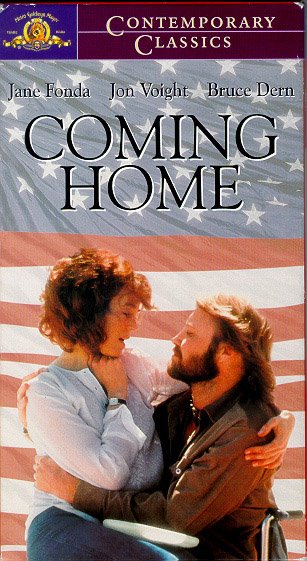
Damn! What ever happened to the Jon Voight in Coming Home, who gave that great speech at the end, to high school students, warning them that the Vietnam war wasn’t all it was cracked up to be?

When I was your age, all I got was some guy standing up like that, man, giving me a lot of bullshit, man, which I caught. I was really in good shape then, man. I was captain of the football team. And I wanted to be a war hero, man, I wanted to go out and kill for my country. And now, I’m here to tell you that I have killed for my country or whatever. And I don’t feel good about it. Because there’s not enough reason, man, to feel a person die in your hands or to see your best buddy get blown away. I’m here to tell you, it’s a lousy thing, man. I don’t see any reason for it. And there’s a lot of shit that I did over there that I find fucking hard to live with. And I don’t want to see people like you, man, coming back and having to face the rest of your lives with that kind of shit. It’s as simple as that. I don’t feel sorry for myself. I’m a lot fucking smarter now than when I went. And I’m just telling you that there’s a choice to be made here.

Maybe he and fellow new-McCarthyites Sol Stern and Checker Finn ought to order it from Netflix, heat up some pop corn, and watch it together.

Mike Klonsky blogs at Small Talk.

See VOIGHT: My concerns for America / Washington Times / July 28, 2008

The Rag Blog

Posted in Rag Bloggers | Tagged , , , , | 1 Comment

Iranian Women : Fighting Back

Iranian women. Image: public domain.

See Iranian women: A force to be reckoned with, by Talajeh Livani, below.

‘Death by stoning’: Save Kobra Najjar
By Catherine Price / July 30, 2008

Her name makes her sound like a bit like a supervillain; Iranian authorities are treating her like one. Equality Now has issued an urgent call for action on behalf of Kobra Najjar, 44, found guilty of “adultery” and sentenced to death by stoning. Iranian advocates working on her case say that she has “exhausted all domestic legal remedies” and could be executed at any moment.

Najjar’s “adultery” was not exactly a furtive affair with the postman. According to Equality Now, she was forced into prostitution by an abusive husband in order to support his heroin addiction, and he was murdered by a client of Najjar’s who sympathized with her plight. They both served eight years in prison, but the murderer was released after paying a fine and receiving 100 lashes. She, meanwhile, faces death for forced prostitution — that is, “adultery.”

Equality Now notes that seven other women and one man are currently facing similar sentences. Adultery is the only crime punishable by stoning in Iran. (At least there’s always hanging.)

Stoning, it should be noted, violates the International Covenant on Civil and Political Rights (ICCPR) — to which Iran is a party — which prohibits cruel and inhuman punishment and limits application of the death penalty to “the most serious crimes.” The U.N. Human Rights Committee has found that consensual sexual activity (and, we’re guessing, being the victim of sexual coercion) is, well, not that.

There is hope, it is said, for saving Najjar without some sort of superhero strike force. As the Press Trust of India notes: “The head of the Iranian judiciary, Ayatollah Shahroudi, passed a [not all that binding] moratorium on stoning in 2002. In March 2008, a woman named Mokarrameh Ebrahimi … was released from prison and her stoning sentence was reversed by Iranian authorities.” (She and her husband, Jafar Kiani — whose marriage had for some reason gone unregistered — had been sentenced to be stoned together. Despite international outrage about both sentences, he was stoned separately in 2007, possibly at the order of a judge who also defied local civilian and governmental opposition.)

“Mokarrameh’s release from prison must not be an isolated case. The example has already been set,” said Taina Bien-Aim, executive director of Equality Now. “We urge Ayatollah Shahroudi to extend the progress made through Mokarrameh’s case by irrevocably reversing all current sentences of death by stoning for so-called ‘immoral acts.’ What is immoral is the act of stoning, and all other forms of violent and inhumane punishment.”

There’s also hope in the bigger picture, considering — for one thing — that Iranian women’s rights groups are (though subject to serious censorship) among the loudest in opposition to stoning of both men and women. The Middle East Times reports that while national political representation of women is “lagging” (see the piece for further explanation), “Iran performs much better than other Middle Eastern countries on female education, health, and labor force participation. Iranian women comprise around two-thirds of university entrants … And, while lower than the world average of 58 percent, Iran’s female labor force participation — 42 percent — is the highest in the Middle East.”

Plus: “Today, Iranian women are present in every educational and employment field that is traditionally male-dominated. And they are active politically, especially at the local level. In the 2006 municipal elections, 44 seats out of the 264 on provincial capital councils went to women. In addition, Iranian women represent such a large share of voters in local and national elections that they are able to significantly influence national politics. For instance, the 2008 parliamentary candidates had to adjust their election campaigns to attract women voters by vowing to change family and labor laws to ensure more equal treatment of women.”

And! “There is strong public support for greater gender equality in Iran. A recent poll … [found] that 78 percent of Iranians think that it is somewhat or very important for women to have full equal rights with men and 70 percent think that the government should make an effort to prevent discrimination against women.”

Back to Kobra Najjar: Equality Now has the 411 for the officials you can contact to urge both her release, and the commutation of all other stoning sentences, in accordance with Iran’s obligations under the ICCPR.

Source / salon.com

Iranian Women a Force to be Reckoned With
By Talajeh Livani / July 16, 2008

Iran’s parliament convened last month for the first time since the April 2008 elections. The results of the parliamentary elections are in and all the votes have been counted. Surprisingly, or perhaps alarmingly, women now account for a mere 2.8 percent of this new conservative-dominated parliament. This is a decline from the already low 4.1 percent representation in the previous Iranian parliament.

Those familiar with Iranian society may find this shocking. Iran performs much better than other Middle Eastern countries on female education, health, and labor force participation. Iranian women comprise around two-thirds of university entrants, which has led to government-imposed quotas on university admittance, where women were dominating fields such as medicine, dentistry, and pharmacy. And, while lower than the world average of 58 percent, Iran’s female labor force participation – 42 percent – is the highest in the Middle East.

How is it then possible that the political representation of Iranian women is lagging, even when compared to other countries in the region; the average for the Middle East and North Africa is approximately 9 percent with Iraq having the highest female representation in parliament – 26 percent.

The answer to this question is complex. First, Iran does not use gender quotas for female political participation like some other Middle Eastern and North African countries; it is not certain how the other countries would have performed without the use of quotas and appointments.

Second, to qualify as a candidate in the parliamentary elections, the conservative Guardian Council – a powerful political body that has the power to veto candidates – has to be convinced of the prospective candidate’s belief in Islam and the Islamic Republic. Women in Iran have played a crucial role in shifting the conservative-liberal balance in the government. Many believe that women were an integral part in bringing to power former Iranian President Mohammad Khatami. Therefore, it may simply be that females who register to run are likely to be less conservative than their male counterparts leading to a lower qualification rate.

Third, some of Iran’s laws discourage women from rising to positions of leadership and decision-making. Women are not allowed to serve as judges or to run for the presidency. And the current president, Mahmoud Ahmadinejad, encourages women to stay at home and focus on the institution of family. Only two women hold secondary cabinet positions, the Center for Women’s Participation has been renamed the Center for Women and Family Affairs and Ahmadinejad has publicly announced support for larger families with women staying at home to take care of children.

Finally, in light of external pressure with regards to its nuclear program, the Iranian government has come to view domestic women’s groups as a threat to national security. There have been crackdowns on the One Million Signatures Campaign, a campaign aimed at collecting 1 million signatures in support of gender equality in Iran, peaceful women’s rights demonstrations, and over the dress code. And the premier women’s magazine, Zanan, was shut down in January 2008 allegedly because it offered a dark picture of the Islamic Republic and compromised the psyche and the mental health of its readers by providing them with “morally questionable information.”

Despite these challenges, Iranian women’s determination to break stereotypes cannot be underestimated. Today, Iranian women are present in every educational and employment field that is traditionally male-dominated. And they are active politically, especially at the local level. In the 2006 municipal elections, 44 seats out of the 264 on provincial capital councils went to women.

In addition, Iranian women represent such a large share of voters in local and national elections that they are able to significantly influence national politics. For instance, the 2008 parliamentary candidates had to adjust their election campaigns to attract women voters by vowing to change family and labor laws to ensure more equal treatment of women.

The government is slowly amending laws that are discriminatory toward women. The most recently passed laws by parliament allow some Iranian women married to foreigners to pass on their Iranian nationality to their children, which was previously not possible. And women suffering injury or death in a car accident are now entitled to the same insurance company compensation as men, whereas previously women received only half of the compensation given to men.

There is strong public support for greater gender equality in Iran. A recent poll conducted by World Public Opinion and Search for Common Ground finds that 78 percent of Iranians think that it is somewhat or very important for women to have full equal rights with men and 70 percent think that the government should make an effort to prevent discrimination against women.

As the world is watching developments in Iran, the women’s movement is likely to be on the forefront. And perhaps it will not be too long before Iranian women become as politically empowered as they are in other spheres of society.

[Talajeh Livani is an Iranian who was raised in Sweden and is currently working as a consultant for the World Bank’s Middle East and North Africa division. This article was written for the Common Ground News Service (CGNews).]

Source. / Middle East Times

The Rag Blog

Posted in RagBlog | Tagged , , , , , , , | Leave a comment

Settling International Disputes by Peaceful Means


End the Occupation of Iraq — and Afghanistan
by Marjorie Cohn / July 29, 2008

So far, Bush’s plan to maintain a permanent U.S. military presence in Iraq has been stymied by resistance from the Iraqi government. Barack Obama’s timetable for withdrawal of American troops has evidently been joined by Iraqi Prime Minister Nuri al-Maliki, Bush has mentioned a “time horizon,” and John McCain has waffled. Yet Obama favors leaving between 35,000 and 80,000 U.S. occupation troops there indefinitely to train Iraqi security forces and carry out “counter-insurgency operations.” That would not end the occupation. We must call for bringing home — not redeploying — all U.S. troops and mercenaries, closing all U.S. military bases, and relinquishing all efforts to control Iraqi oil.

In light of stepped up violence in Afghanistan, and for political reasons — following Obama’s lead — Bush will be moving troops from Iraq to Afghanistan. Although the U.S. invasion of Afghanistan was as illegal as the invasion of Iraq, many Americans see it as a justifiable response to the attacks of September 11, 2001, and the casualties in that war have been lower than those in Iraq — so far. Practically no one in the United States is currently questioning the legality or propriety of U.S. military involvement in Afghanistan. The cover of Time magazine calls it “The Right War.”

The U.N. Charter provides that all member states must settle their international disputes by peaceful means, and no nation can use military force except in self-defense or when authorized by the Security Council. After the 9/11 attacks, the Council passed two resolutions, neither of which authorized the use of military force in Afghanistan. Resolutions 1368 and 1373 condemned the September 11 attacks, and ordered the freezing of assets; the criminalizing of terrorist activity; the prevention of the commission of and support for terrorist attacks; the taking of necessary steps to prevent the commission of terrorist activity, including the sharing of information; and urged ratification and enforcement of the international conventions against terrorism.

The invasion of Afghanistan was not legitimate self-defense under article 51 of the Charter because the attacks on September 11 were criminal attacks, not “armed attacks” by another country. Afghanistan did not attack the United States. In fact, 15 of the 19 hijackers came from Saudi Arabia. Furthermore, there was not an imminent threat of an armed attack on the United States after September 11, or Bush would not have waited three weeks before initiating his October 2001 bombing campaign. The necessity for self-defense must be “instant, overwhelming, leaving no choice of means, and no moment for deliberation.” This classic principle of self-defense in international law has been affirmed by the Nuremberg Tribunal and the U.N. General Assembly.

Bush’s justification for attacking Afghanistan was that it was harboring Osama bin Laden and training terrorists. Iranians could have made the same argument to attack the United States after they overthrew the vicious Shah Reza Pahlavi in 1979 and he was given safe haven in the United States. The people in Latin American countries whose dictators were trained in torture techniques at the School of the Americas could likewise have attacked the torture training facility in Ft. Benning, Georgia under that specious rationale.

Those who conspired to hijack airplanes and kill thousands of people on 9/11 are guilty of crimes against humanity. They must be identified and brought to justice in accordance with the law. But retaliation by invading Afghanistan is not the answer and will only lead to the deaths of more of our troops and Afghanis.

The hatred that fueled 19 people to blow themselves up and take 3,000 innocents with them has its genesis in a history of the U.S. government’s exploitation of people in oil-rich nations around the world. Bush accused the terrorists of targeting our freedom and democracy. But it was not the Statue of Liberty that was destroyed. It was the World Trade Center — symbol of the U.S.-led global economic system, and the Pentagon — heart of the U.S. military, that took the hits. Those who committed these heinous crimes were attacking American foreign policy. That policy has resulted in the deaths of two million Iraqis — from both Bill Clinton’s punishing sanctions and George W. Bush’s war. It has led to uncritical support of Israel’s brutal occupation of Palestinian lands; and it has stationed more than 700 U.S. military bases in foreign countries.

Conspicuously absent from the national discourse is a political analysis of why the tragedy of 9/11 occurred and a comprehensive strategy to overhaul U.S. foreign policy to inoculate us from the wrath of those who despise American imperialism. The “Global War on Terror” has been uncritically accepted by most in this country. But terrorism is a tactic, not an enemy. You cannot declare war on a tactic. The way to combat terrorism is by identifying and targeting its root causes, including poverty, lack of education, and foreign occupation.

There are already 60,000 foreign troops, including 36,000 Americans, in Afghanistan. Large increases in U.S. troops during the past year have failed to stabilize the situation there. Most American forces operate in the eastern part of the country; yet by July 2008, attacks there were up by 40 percent. Zbigniew Brzezinski, national security advisor for Jimmy Carter, is skeptical that the answer for Afghanistan is more troops. He warns that the United States will, like the Soviet Union, be seen as the invader, especially as we conduct military operations “with little regard for civilian casualties.” Brzezinski advocates Europeans bribing Afghan farmers not to cultivate poppies for heroin, as well as the bribery of tribal warlords to isolate al-Qaeda from a Taliban that is “not a united force, not a world-oriented terrorist movement, but a real Afghan phenomenon.”

We might heed Canada’s warning that a broader mission, under the auspices of the United Nations instead of NATO, would be more effective. Our policy in Afghanistan and Pakistan should emphasize economic assistance for reconstruction, development and education, not for more weapons. The United States must refrain from further Predator missile strikes in Pakistan, and pursue diplomacy, not occupation.

Nor should we be threatening war against Iran, which would also be illegal and result in an unmitigated disaster. The U.N. Charter forbids any country to use, or threaten to use, military force against another country except in self-defense or when the Security Council has given its blessing. In spite of the U.N. International Atomic Energy Agency’s conclusion that there is no evidence Iran is developing nuclear weapons, the White House, Congress, and Israel have continued to rattle the sabers in Iran’s direction. Nevertheless, the antiwar movement has so far fended off passage of HR 362 in the House of Representatives, a bill which is tantamount to a call for a naval blockade against Iran — considered an act of war under international law. Credit goes to United for Peace and Justice, Code Pink, Peace Action, and dozens of other organizations that pressured Congress to think twice before taking that dangerous step.

We should pursue diplomacy, not war, with Iran; end the U.S. occupation of Iraq; and withdraw our troops from Afghanistan.

Marjorie Cohn is president of the National Lawyers Guild and a professor at Thomas Jefferson School of Law. She is the author of Cowboy Republic: Six Ways the Bush Gang Has Defied the Law and her new book, Rules of Disengagement: The Politics and Honor of Military Dissent (co-authored with Kathleen Gilberd), will be published this winter. Her articles are archived at http://www.marjoriecohn.com/.

Source / Common Dreams

Thanks to David Hamilton / The Rag Blog

Posted in RagBlog | Tagged , , , | 1 Comment

Giant Chunks Break Off Canadian Ice Shelf

This satellite image shows a large, rectangular chunk of ice at center that broke away from the Ward Hunt Ice Shelf. Other pieces also broke away from the shelf. Photo from NASA.

Cracks had been earlier found on Ward Hunt; ‘more could go’ this summer
July 29, 2008

OTTAWA – Giant sheets of ice totaling almost eight square miles broke off an ice shelf in the Canadian Arctic last week and more could follow later this year, scientists said on Tuesday.

In a development consistent with climate change theories, the enormous icy plain broke free sometime last week and began slowly drifting into the Arctic Ocean. The piece had been a part of the shelf for 3,000 years.

Temperatures in large parts of the Arctic have risen far faster than the global average in recent decades.

The ice broke away from the shelf on Ward Hunt Island, a small island just off giant Ellesmere Island in one of the northernmost parts of Canada.

It was the largest fracture of its kind since the nearby Ayles Ice Shelf — which measured 25 square miles — broke away in 2005.

Scientists had earlier identified deep cracks in the Ward Hunt Ice Shelf, which measures around 155 square miles. The shelf is one of five along Ellesmere Island in the northern Arctic.

“Because the breakoff occurred between two large parallel cracks they’re thinking more could go this summer before the freeze sets in,” said Trudy Wohlleben of the Canadian Ice Service. “More could be a piece as large as the Ayles Ice Shelf.”

Ellesmere Island was once home to a single enormous ice shelf totaling around 3,500 square miles. All that is left of that shelf today are five much smaller shelves that together cover just under 400 square miles.

Melting ice shelves don’t raise sea levels because they are already in the water, but their demise can speed up retreating glaciers, which do raise sea levels.

Sea ice, glaciers also shrinking

“The breakoff is consistent with other changes we’ve seen in the area, such as the reduction in the amount of sea ice, the retreat of the glaciers and the breakup of other ice shelves,” Wohlleben said.

She said a likely reason for the shelf breaking away was a strong wind from the south.

Warwick Vincent, director of the Centre for Northern Studies at Laval University in Quebec, said much of the remaining Ward Hunt Ice Shelf is now in a vulnerable state.

“It underscores the fact that each year we’re now crossing new thresholds in environmental change in the High Arctic, and of course our concern in the longer term is that these may signal the onset of serious change at all latitudes, much further to the south, for example,” he told Reuters.

Derek Mueller, an Arctic ice shelf specialist at Trent University in Ontario, said he was concerned by the rapidity of changes in the High Arctic over the last few years.

“It’s a bit of a wake-up call for those people who aren’t yet affected by climate change that there are places on Earth that are, and the same could be true for them (these people) if you fast-forward a decade or two or three,” he said.

‘No longer … in balance’

Mueller initially estimated that 1.5 square miles of ice had broken off the shelf but increased that figure to eight square miles after studying the data more closely.

“Whatever has kept this ice shelf in balance for 3,000 years is no longer keeping it in balance,” he told Reuters, saying he too would not be surprised to see more ice breaking away from the Ward Hunt shelf this year.

Wohlleben said the ice shelves, which contained unique ecosystems that had yet to be studied, would not be replaced because they took so long to form.

“Once they’ve broken off they’re gone,” she said.

Mueller was careful not to blame the Ward Hunt breakup specifically on climate change, but said it is consistent with the theory. The current Arctic climate certainly isn’t reinforcing ice shelves.

“We’re in a different climate now,” he said. “It’s not conducive to regrowing them. It’s a one-way process.”

A crack in the shelf was first spotted in 2002. Last April, a patrol of Canadian Rangers found the weakness had spread into an extensive network of cracks, some 40 yards wide and 11 miles long. The crack-riddled section of ice was like a jigsaw puzzle, with the pieces held in place only by each other.

Formed by accumulating snow and freezing meltwater, ice shelves are large platforms of thick, ancient sea ice that float on the ocean’s surface. Ellesmere Island was once entirely ringed by a single enormous ice shelf that broke up in the early 1900s.

At 170 square miles in size and 40 yards thick, the Ward Hunt shelf is the largest of those remnants — even bigger than the Antarctic shelf that collapsed earlier this year and seven times the size of the Ayles Ice Shelf chunk that broke off in 2005 from Ellesmere’s western coast.

Despite a period of stability in the 1980s, the Ward Hunt shelf and its characteristic corrugated surface has been steadily declining since the 1930s, said Mueller. Its southern edge has lost seven square miles over the last six years.

Icebreaker searching for sea ice

It’s the same all over the Arctic, said Gary Stern, co-leader of a major international research program on sea ice.

Speaking from the Coast Guard icebreaker Amundsen in Canada’s north, Stern said the Ward Hunt breakup is related to what he’s seeing thousands of miles away.

He hasn’t seen any ice in weeks. Plans to set up an ice camp last February had to be abandoned when usually dependable ice didn’t form for the second year in a row.

“Nobody on the ship is surprised anymore,” said Stern. “We’ve been trying to get the word out for the longest time now that things are happening fast and they’re going to continue to happen fast.”

Many scientists now believe that the Arctic will have ice-free summers by 2013 instead of 2030 as predicted by the International Panel on Climate Change.

“It’s all connected to the warming climate. Everything is connected together,” Stern said.

Source / MSNBC

The Rag Blog

Posted in RagBlog | Tagged , , , , , | Leave a comment

Prisons : Why Texas Still Holds ‘Em


Forget oil and gold. In the Lone Star state, the boomtown business is locking up immigrants.
By Stephanie Mencimer

This article appears in the July/August issue of Mother Jones.

In 1997, with the private prison business booming, the Corrections Corporation of America picked a 64-acre plot near Austin, Texas, for its newest lockup. A medium-security prison, it was named after the company’s cofounder and designed for some 500 federal inmates. But the anticipated stream of prisoners never arrived: By the time the T. Don Hutto Correctional Center opened, a glut of private prison beds, along with cca’s own poor track record, had left the company nearly bankrupt. Its stock, which once traded at around $45 a share, bottomed out at 18 cents. Several of its facilities were shuttered or sat empty for years, including the Hutto prison, which cca moved to close in 2004.

But Hutto, like cca itself, has risen from the ashes thanks to a sudden source of new business: the Bush administration’s crackdown on immigrants. Historically, Mexicans caught illegally entering the country have been dumped back across the border, while immigrants and asylum seekers from other countries were processed and released to await their court dates. (Only those with criminal records were detained.) Most of those released, though, failed to appear for court hearings and removal proceedings, and the government didn’t have the resources to go looking for them. So in 2006, the Immigration and Customs Enforcement (ice) agency ended its traditional “catch and release” policy and instead started incarcerating non-Mexican immigrants—anyone from a Salvadoran migrant to an Iraqi family seeking political asylum—pending their deportation or asylum hearings. Over the two years since, the agency has increased its use of detention facilities by more than half; it now holds some 30,000 people on any given day.

In this new population—and in ice’s $1 billion-plus detention budget—cca saw opportunity. In 2004, when Congress passed legislation authorizing ice to triple the number of immigrant detention beds, cca’s lobbying expenditures reached $3 million; since then, it has spent an additional $7 million on lobbyists. Among them was Philip Perry, Vice President Dick Cheney’s son-in-law, who later became general counsel at the Department of Homeland Security, ice’s parent organization, which has awarded cca millions in contracts; one of them, in 2006, allowed the company to reopen the old Hutto prison, now christened a “residential facility” housing immigrant families, including small children.

CCA isn’t the only firm lining up for ice contracts: There’s so much money to be made warehousing immigrants that in 2006, Cornell Companies, a private prison firm, sent the state of Oklahoma an eviction notice for more than 800 state inmates housed in its facility in Hinton. The company was negotiating with ice to take in immigrants for more than the roughly $45 per diem that Oklahoma paid.

State and local governments are also getting in on the action. In 2006, Willacy County, Texas, floated millions in bonds and, in 90 days, built a tent city for immigrants that it leases to ice for $78 a day per detainee. (A room at the local Best Western Executive Inn costs $65.) Run by the Utah-based Management and Training Corporation, a private prison management company, the camp houses up to 2,000 immigrants in a razor-wire-ringed compound holding 10 Kevlar tents of the sort used by troops in Iraq. Detainees have reported problems with heat and air conditioning, as well as maggot-infested food. The county has since approved another $50 million to add space for 1,000 more detainees.

Elsewhere, detention centers have been sued for providing inadequate health care, food services, and education. The aclu of Texas recently settled a lawsuit with ice over the conditions at Hutto for 26 children ages 1 to 17. According to the aclu, they were kept in cells 11 or 12 hours a day, forced to wear prison garb, fed “unrecognizable substances, mostly starches,” and denied toys, bathroom privacy, and access to medical care.

According to the Washington Post, more than 80 people have died in ice detention, in many cases because of poor health care. The most famous case is that of Francisco Castaneda, a Salvadoran detained in San Diego for eight months. The government denied his request for a penile biopsy while in detention, arguing that it was an “elective outpatient procedure.” He was eventually found to have cancer. His penis was amputated, but the malignancy spread, and he died last year.

On average, ice pays $95 a day per immigrant that it detains, yet research indicates that other, far cheaper, methods can work almost as well in making sure immigrants show up in court. Back in the late 1990s, the agency asked the nonprofit Vera Institute of Justice to run a pilot project under which people facing deportation got intensive supervision and connections to social service agencies. More than 90 percent appeared for their hearings—partly, the institute said, thanks to better information about the process. Intensive supervision costs an average of $14 per detainee per day, according to congressional testimony by Julie Myers, assistant secretary of Homeland Security. Yet in fiscal 2007, ice spent only about $44 million on alternative programs, compared with roughly $1.2 billion on detention—and legislation sponsored last year by representatives Heath Schuler (D-N.C.) and Tom Tancredo (R-Colo.) in the House would authorize the agency to develop another 8,000 detention beds, which must be provided by private contractors such as cca “whenever possible.”

CCA, meanwhile, is contributing to the detention boom in its own small way: Last year, after inspecting the Hutto center’s personnel records, ice officials arrested 10 workers—illegal immigrants themselves.

Source / Mother Jones

The Rag Blog

Posted in RagBlog | Tagged , , , , , , | Leave a comment

Sucking Up to the Bankers : A Bipartisan Lovefest

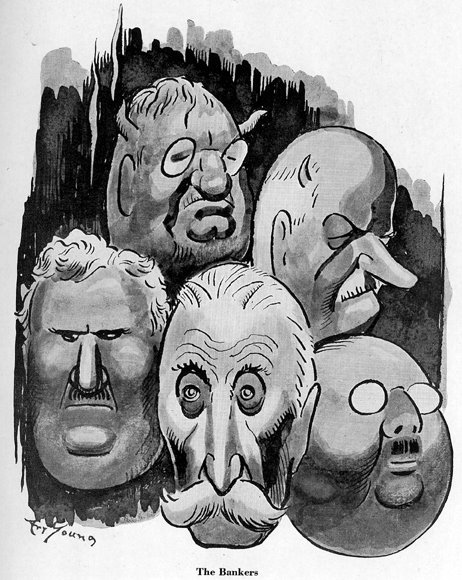
“The Bankers” by Art Young.

They’re the ones who got us into this mess
By Robert Scheer / July 30, 2008

This is a time to condemn the bankers, not to embrace them. They are the scoundrels who got us into the biggest economic mess since the Great Depression, lining their own pockets while destroying the life savings of those who trusted them. Yet both of our leading presidential candidates are scrambling to enlist not only the big-dollar contributions but, more frighteningly, the “expertise” of the very folks who advocated the financial industry deregulations at the heart of this meltdown.

Republican candidate John McCain even appointed as his campaign co-chairman Phil Gramm, who went from being chairman of the Senate Banking Committee, where he sponsored disastrous legislation that empowered the banking bandits, to becoming one of them at UBS Warburg. Gramm was forced to resign from McCain’s campaign only after he went public with his contempt for the financial concerns of ordinary Americans, calling them “whiners” and perpetrators of a “mental recession.”

But Gramm and the Republicans couldn’t have done it without the support of leading Democrats. The most egregious of Gramm’s legislative favors to the financiers took the form of legislation named in part after him–the Gramm-Leach-Bliley Act, which became law only after then-Treasury Secretary Robert Rubin prevailed upon President Clinton to sign the bill. The bill’s immediate major effect was to legitimize the long-sought merger between Citibank and insurance giant Travelers. Rubin’s critical support for the bill was rewarded with an appointment, within days of its passage, to a top job at Citibank (later Citigroup) paying more than $15 million a year.

That is the same Rubin with whom Democratic candidate Barack Obama met, along with other influential advisers, on Tuesday to figure out what to do about the sorry state of our economy. But what in the world did he expect to learn from Rubin? And why did he appoint Rubin’s protégé, Jason Furman, who ran the Rubin-funded Hamilton Project, to be the Obama campaign’s economic director? Hopefully, during their encounter Tuesday, Rubin offered himself as a contrite model of everything that the candidate of change needs to change.

After all, Goldman Sachs, where Rubin spent 25 years of his business career before entering the Clinton administration, has been one of the prime corporate villains in the financial shenanigans that led to the subprime mortgage scandal. As co-chairman of the firm, surely he had knowledge of the financial hanky-panky that would prove so disastrous down the road. Indeed, as Treasury secretary, he favored an extension of the deregulation that enabled this explosion of banking avarice. Not surprisingly, the current Treasury secretary, Henry Paulson, also previously headed Goldman.

When Rubin assumed a top position at Citibank after his stint at the Treasury, he was not above influencing his former employees in the government. In one notorious instance during the fall of 2001, when Enron was going down the tubes Rubin telephoned a Treasury undersecretary and asked him to consider intervening with credit-rating agencies to hold off downgrading Enron’s ratings. When the story was leaked, some media accounts noted the possibility of a conflict of interest because Enron owed Citibank $750 million, which it could not pay if bankrupt.

Despite his skills and his vaunted position as Citibank’s chairman, Rubin was not spared the disastrous consequences of Citibank’s own wild financial manipulations, which, if anything, exceeded those of Enron. Tens of billions in bad mortgage and credit card debt placed the bank at the forefront of the current economic crisis, and so it is weird that Obama would now turn to Rubin for advice.

It’s even weirder that the presumptive Democratic nominee would pick Rubin’s man Furman as his campaign economic director at a time when cleaning up the mess left by the bankers is the highest priority. Furman hardly distinguished himself four years ago in that role in John Kerry’s failed presidential campaign, with its muffled economic message that could not be blamed on the candidate’s stiff style alone.

The bigger problem is that folks such as Rubin and Furman, perhaps best known as an economist for his bold but woefully misguided defense of the Wal-Mart business model, clearly do not feel the pain of the voters who are losing their homes.

But then again, why should Rubin, or Gramm on the Republican side, be expected to care when he has made so many millions off the suffering of those voters? Not good at a time when we need a presidential candidate who sticks it to the bankers instead of sucking up to them.

[Robert Scheer is author of a new book, “The Pornography of Power: How Defense Hawks Hijacked 9/11 and Weakened America.”]

Source / The Huffington Post

The Rag Blog

Posted in RagBlog | Tagged , , , , , , | 2 Comments

Fabulous Furry Freak Brothers : They’re B-a-a-a-a-ck!

Updated July 31, 2008


40th Anniversary ‘Freak Brothers Omnibus’: complete works plus previously unpublished material
By Steve Bunche

This August, the U.K. comics publisher, Knockabout Comics will answer the prayers of classic underground comics aficionados with the publication of a massive 40th anniversary Freak Brothers Omnibus, a 624-page leviathan of laughs, straight from the mind of creator Gilbert Shelton. The book collects every adventure of the hirsute trio since their inception in 1968, as well as previously unpublished material.

The book’s first printing of 10,000 copies will feature an extra dust jacket and an insert detailing how the interested fan can donate funds and invest in Grass Roots, an upcoming animated film featuring the characters, and even get their names inserted into the corner of one of the film’s frames in a promotion called “Name That Frame.” (The investor purchases a frame and their name will be visible only when the film is slowed down on a DVD player). American distribution of the book will be handled by Diamond, Last Gasp, and Rip Off Press for the comics shop specialty market and by Atlas books for Barnes & Noble, Amazon, Borders and independent general book retailers.

But exactly what is the Freak Brothers series and why does it warrant such red carpet treatment? Simply put, The Fabulous Furry Freak Brothers is the Rosetta Stone (no pun intended) of “stoner” humor as we now understand the genre, predating Cheech & Chong’s THC-based antics by a few years and offering narratives that are often hilarious without the aid of various illegal “party favors.” The series revolves around the eponymous characters, a trio related not by blood, but by a common interest—the need for weed—and loony adventures in a rollicking counter-culture universe. The trio includes Phineas (the leftist intellectual), Freewheelin’ Franklin (the baked cowboy), and Fat Freddy (the “Curly” of the bunch). Their lives are driven by marijuana and they spend virtually all of their time trying to get stoned while avoiding the police or getting ripped off by unscrupulous dealers.

But unlike many of its underground contemporaries that wallowed in explicit sex, ultra-violence, and sometimes outright misogyny, the Freak Brothers strips concentrated on solid laughs and earned them and their creator an enduring following among the underground comix cogniscenti and beyond. When asked about how he settled upon his approach to the material Shelton reminisced, “I used to sell strips to weekly leftist newspapers. I was in sympathy with them but they were deadly dull, so I felt they could use a comic strip modeled on old comics.”

Shelton said at the time that he was “more into traditional comic strips like Chester Gould’s Dick Tracy, which seemed outrageously weird when seen from a grownup perspective. Other strips I enjoyed included Bob Montana’s Archie, Peanuts, B.C., The Wizard of Id, Miss Peach, and the old E.C. stuff, especially the original run of Mad when it was still a comic book.” That last influence must have been particularly strong since Shelton’s work on the Freak Brothers seemed like the next logical step from its 1950’s antecedent. The Freak Brothers comics were infused with the same anarchic energy and endearing silliness, only now unleashed in an era of free love and psychedelic mind-expansion. As for the inspiration behind the trio’s comedic adventures, Shelton said, “I took the ambience from real life and used gags that used to be based around alcohol and substituted marijuana for the booze. Take the one about the hippy getting busted on a possession charge and being told by the arresting officer that he had one phone call. The guy uses that call to get a pizza delivery.” And when not focusing on the Brothers themselves, Shelton turns his humorous eye to the antics of Fat Freddy’s Cat, a side-strip also featured in the omnibus that’s every bit as entertaining as the book’s main event.

The enduring popularity of the Freak Brothers has led to the production of Grass Roots, a stop-motion animated feature, but the project has not had smooth sailing; according to Shelton. “Grass Roots has been in progress for five years and Bolex Brothers, a hugely talented studio in Bristol, England, is handling it while actively raising money to fund it,” Shelton explained. He said this was the “6th or 8th time” the rights to a Freak Brothers film have been sold, “including once having been in the hands of Universal some thirty years ago. Obviously nothing came of that.”

Hopefully the combined efforts of the Bolex Brothers and the series’ rabid fan base will result in a happy ending for Shelton and Freak Brothers enthusiasts everywhere and the trio will finally make their bong-hitting way onto the silver screen alongside such stoner descendants as Cheech & Chong and Harold and Kumar. But until then, there are always Shelton’s stories to get us through these Freak-less times. In fact, the book serves as an echo of Shelton’s timeless credo: “Dope will get you through times of no money better than money will get you through times of no dope.” Words to live by, especially in the waning days of Dubya’s America.

Source / Publisher’s Weekly / Posted July 22, 2008

Hi gang,

The Bristol, England film production company Bolexbrothers is still trying to raise money to do their feature-length stop-action animated movie of the Freak Brothers in Grass Roots. They did a few minutes of test footage a couple of years ago which can be seen at Grass Roots the Movie.

If you manage to find this site, you might recognize the voice of Telebob in the intro. Bolexbrothers (and I, too) thought that money would come raining in from rich ex-hippies, but maybe there’s no such thing.

Gilbert Shelton / July 31, 2008

Find the Freak Brothers Omnibus at Atomic Books.

Thanks to radman / The Rag Blog

Posted in RagBlog | Tagged , , , , , , | Leave a comment

Drawn and Quartered

R.J. Matson / The New York Observer and Roll Call.

The Rag Blog / Posted July 30, 2008

Posted in RagBlog | Tagged , , , | Leave a comment

Strained by War, U.S. Army Promotes Unqualified Soldiers

U.S. Army photo by Pfc. Sarah De Boise.

A shortage of skilled sergeants has led to dubious promotions for inexperienced soldiers — even jeopardizing some operations in Iraq.
By Bill Sasser / July 30, 2008

America’s military commitment in Iraq and Afghanistan is certain to remain a key issue in the presidential race — and soon that could include renewed focus on a “stretched thin” U.S. Army. According to a Salon investigation, the Army is facing a troubling shortage of qualified sergeants, the noncommissioned officers considered to be the backbone of training and combat operations. In fact, a new Army policy intended to boost this critical leadership corps of NCOs has prompted a wave of promotions for apparently unqualified soldiers — and even jeopardized some combat operations in Iraq.

In essence, an Army policy implemented in 2005 and expanded this year lowered the bar for enlisted soldiers with the rank of E-4 to gain the rank of sergeant, or E-5, by diminishing the vetting process. According to more than a half dozen current and former Army sergeants interviewed by Salon, the policy has produced sergeants who are not ready to lead. In some cases, soldiers were promoted even after being denied advancement by their own unit commanders. While awarding a promotion once required effort on the part of a commander, those interviewed say, the Army’s current policy actually requires effort to prevent a promotion, and has had negative consequences on the battlefield.

A sergeant interviewed recently at Ft. Hood for this article recounted how he watched his commander feed the promotion papers for one E-4 through a shredder shortly before their unit deployed to Iraq in 2006. After two months in the field, that solider and another E-4 who had also been passed over for promotion were automatically promoted to sergeant anyway, despite their commander’s earlier judgment. Problems soon arose during a combat patrol involving “action on contact,” an encounter with the enemy in which fire is exchanged. “These two NCOs were immature and not ready as far as leading other soldiers, and there were some ‘oh shit’ moments,” said the sergeant, who asked not to be identified and declined to provide specific details about the combat incident because of security restrictions. “We had to have a powwow and pull back on what was going on. Fortunately, no casualties occurred.”

The newly promoted E-5s, he said, also had problems with calling in reports from the field — which, in a combat scenario, could involve such life and death decisions as requesting suppressive fire or determining if an area is safe for medical helicopters to land. “We had to spend a lot of time counseling and mentoring these new E5s in the field,” he said. “They have their sergeant rank and they still have a lot to learn.”

Sgt. Colin Sesek, a medic in the 82nd Airborne Division who returned from a 15-month deployment to Iraq in November 2007, said automatic promotions affected both the morale and effectiveness of medical units in which he served and in combat units he observed. “There was an E-4 in my platoon who was very disorganized and didn’t care about anyone else — he always delegated down the line, even when it was his job to do,” said Sesek. “I’m trying to think of the civilian equivalent of how to describe him — ‘shit bag’ is what we called him. He had been in the Army for a while and boom, he got paper boarded” — a term referring to the Army’s expedited promotions process. “When I heard he got promoted I said, yep, that’s the only way he would have gotten it.”

Sesek said the promotion had wider effects within his unit, as other platoon leaders followed this example and began promoting their own E4s without hesitation. “In infantry platoons, too, I saw people get promoted who shouldn’t have been. The squad leaders told me, ‘Well, if that screwup in that platoon got promoted, then we’ll promote ours too.'”

After six years of war, with multiple tours of duty commonplace, the Army continues struggling to retain and recruit quality soldiers. After failing to meet its recruitment goals in 2005, the Army undertook measures to boost its numbers, with some success. That included stop-loss orders (compulsory postponement of retirements), bonuses of up to $50,000 for re-enlisting, and the loosening of standards on criminal backgrounds, education and age. It also began automatically promoting enlisted personnel with the rank of E-4 to sergeant, or E-5 in the Army’s hierarchy of service ranks, based on a soldier’s time in service, while waiving a requirement that candidates for E-5 appear before a promotions board.

Under the current policy, after 48 months of service E-4s serving in military specialties with shortages are automatically placed on a promotions list. Although a soldier’s name can be removed by his or her commander, each month that soldier’s name is placed back on the list. This was termed “automatic list integration” by the Army (or what the soldiers call “paper boarding”). This April, the policy was expanded to include promotions to staff sergeant, or E-6.

Sgt. Selena Coppa, a communications specialist in the 105th Military Intelligence Battalion, said she has noted a marked lowering of standards for E-4s being promoted to sergeant. “The doctrine now is that you just need to be trainable, and people who are not competent and not good leadership material are being promoted,” said Coppa, who has expressed her concerns through unit performance surveys and spoken directly to her superiors. “A sergeant major told me, ‘Yes, you’re right, but there’s nothing I can do about it.'”

Lt. Col. Elizabeth Edgecomb, branch chief for the Army personnel team at the Department of Defense, explained in an interview with Salon that the Army was short 1,549 sergeants, mostly in combat occupations, when the policy was implemented in February 2005. It has reduced the number of NCO occupational specialties with shortages by 74 percent since then, according to Edgecomb. She added that in many cases promotions are awarded to E-4s who, due to manpower shortages, are already doing the work of E-5s. “The policy does not change Army standards for promotion,” said Edgecomb. “Commanders have the responsibility to stop a potential promotion when they determine a soldier is not trained or is in some way unqualified in accordance with standards.”

Perhaps no part of the U.S. military has carried as heavy a burden in Iraq as Army sergeants, who directly train, mentor, discipline and lead boots-on-the-ground soldiers. After years of war, many of the Army’s most experienced sergeants have retired, left the service, transferred to noncombat posts, or are recovering from battlefield injuries.

“Army NCOs lead on a very personal level and are the backbone of how the U.S. Army is run,” says Lt. Col. Gian Gentile, a former commander in the 4th Infantry Division who teaches military history at West Point. “In combat specialties such as armor and infantry, doing two to three tours is having an effect on NCOs. They have been through a lot and it puts tremendous stress on them and their families.”

The current promotion policy is causing some doubts and bitterness among veteran NCOs. “If these guys don’t work for it and you give it to them, we’re not making leaders, we’re making stripe wearers,” says Staff Sgt. Charles Bunyard, a senior scout in the 1st Cavalry Division at Ft. Hood who commands a unit of Bradley fighting vehicles.

Bunyard has over 15 years of service in the Army, including two deployments to Iraq, where he survived nearly a dozen IED blasts, was grazed in the head by a sniper’s bullet and broke a leg in three places in a training accident. Sent home last year from Diyala province after suffering a dislocated shoulder and a severe concussion in an IED attack, he was diagnosed with post-traumatic stress disorder and traumatic brain injury. But after healing, he returned to duty and volunteered for a third combat tour. After five months of recuperation, he was cleared by Army doctors to return to duty and has volunteered for a third combat tour.

At Ft. Hood, Bunyard is spending 16-hour days training his squad of new recruits for their first deployment later this year. Married and the father of five children, several months ago he stopped going to his scheduled doctor and therapy appointments, which he says interfered with his duties. “I have a large responsibility to these guys, and when I’m gone I’m cheating them out of leadership and ways to learn better,” said Bunyard, who still has memory problems and sometimes speaks with a slur as a result of his brain injury.

While the Army needs thousands of new NCOs to replenish the existing ranks, thousands more are also needed as the force expands. The Army plans to add 65,000 soldiers to its ranks by 2010, as declared by President Bush in his State of the Union Address in January 2007.

Quality and morale issues notwithstanding, official figures from the Defense Department on re-enlistment show that the Army has exceeded its retention goals for the past three years. But the planned expansion will only increase the Army’s need for NCOs and junior officers, who have also been leaving the military in waves. A shortage of qualified NCOs is tied to a shortage of junior officers, as many choose not to re-enlist in order to move up the ranks by becoming officers, says Gentile. “The Army has holes in its officer corps as well, and enlisted soldiers who would have become NCOs — the cream of the crop — are going to Officer Candidate School rather than becoming sergeants,” he explained. According to Gentile, who served two combat tours in Iraq, it’s now not uncommon to see 26-year-olds with seven years of service who are first sergeants in charge of a platoon of 30 soldiers. Before the war, he says, achieving that rank would have taken twice as long.

Some military experts doubt the force’s capability at present, particularly if it is needed to perform on a third war front. Two former undersecretaries of defense for personnel question the ability of the all-volunteer Army to meet its manpower needs in coming years. “Our volunteer Army was not set up to fight a long war,” says Lawrence Korb, who served in that role in the Reagan administration. “The idea was that an active Army would fight when needed and the National Guard and Reserve were on standby as a ready reserve. They’ve all been in constant rotation for over five years, and we no longer have a reserve. What we’re doing is mortgaging the future of our Army.” Edward Dorn, who served in the Clinton administration, sees trouble on the horizon. “I think an increase of 65,000 by 2010 is out of reach with a volunteer force, unless you have a very significant downturn in the economy,” he said.

Not all E-4s are eager for automatic promotions to sergeant, according to Bandon Neely, who served in a military police battalion at Ft. Hood before leaving the service May 2005. When the policy began in 2005, the Army also had begun to impose stop-loss orders to prevent sergeants from leaving the service, “so a lot of E-4s did not want it,” Neely said. “Guys were being put up for promotion who refused to take it.”

Patrick Campbell, a sergeant in the District of Columbia’s National Guard who was recently awarded an automatic promotion, said he has seen both the benefits and drawbacks of the policy. Campbell, who served as a combat medic in Iraq in 2004 to 2005, said battlefield experience quickly turned new sergeants into competent leaders. “Being in combat forces you to learn fast — your life depends on it,” he said. “At the same time, leadership training is needed but it’s being delayed because of the pressure of deployments. If you promote people without training, what does it mean to be a sergeant?”

John Hagedorn, a sergeant who served in 2007 as a forward observer in the 82nd Airborne Division assigned to an artillery unit in Tikrit, said the high rate of NCO promotions disrupted the chain of command in the platoons to which he was attached. Out of 70 personnel in three platoons, only five soldiers returned without having been promoted to sergeant, he said.

“The artillery soldiers I was assigned to would normally be operating 105-mm Howitzer canons, but most of them had no idea how to fire one,” said Hagedon, 23, who served 15 months in Iraq under stop-loss orders and left the Army after his return in 2007. “The guys who were promoted to E-5 would normally be the crew chief in charge of one of these guns, and when they came home they were thrust into the position where they were untrained in their mission. They would be transferred to other posts and would get somewhere else and not know how to use the gun.”

Sgt. Hagedon’s experience appears to point to another Army problem, documented by an internal Pentagon report co-authored this year by Lt. Col. Gentile. The report, which raises concerns that the Army’s current focus on counterinsurgency has weakened its ability to fight conventional wars, cites among other statistics that 90 percent of Army artillery units are unqualified to fire their weapons accurately — the lowest rating in history.

In Iraq, Sgt. Hagedon said, “All those promotions lessened the significance of being in a position of leadership. It brought junior leaders down to Joe Private level and stole thunder from the older NCOs, who didn’t like seeing all these young guys getting promoted so fast.”

Hagedon said consideration of leadership potential played no part in the promotion process, as the new policy created pressure on senior sergeants to promote, regardless of performance. “If all the other E4s are getting promoted, it will look bad if you don’t promote your guy,” he said. “And if everyone else is getting it, they don’t want to cut an E4 out of the pay raise you get — $200 a month.”

The result in the platoons he observed was a breakdown in the chain of command, which followed the soldiers home: “There was really no difference between the enlisted guys and the junior leadership [in Iraq]. They’re hanging out together, being buddies, not like back in the U.S. where the NCOs are constantly correcting soldiers of a lesser rank. Then you come home to a training environment like Ft. Bragg and it’s a problem. You can’t be hanging out drinking beer with the enlisted guys one night and chewing their ass out the next morning. You end up showing favoritism.”

Such concerns may be exacerbating morale problems caused by multiple deployments. In Hagedon’s own platoon of forward observers, part of the 82nd’s Headquarters Division, only two out of 12 sergeants chose to remain in the Army when their enlistment ended.

Sgt. Major Tom Gills, chief of Army enlisted promotions, says that the current policy has returned promotion rates to what the Army had prior to the end of the Cold War. “Over the years, individual units had adopted their own standards that were higher than official standards,” he said. “A lower and lower percentage of soldiers were going before promotion boards. Through the 1980s, 25 percent of soldiers were going up for promotion, while until recently only 5 percent were coming up for promotion.”

But Andrew Bacevich, a retired Army colonel who served in Vietnam and now teaches U.S. military history and foreign policy at Boston University, said soldiers in the all-volunteer Army will continue to be overtaxed, even with the planned expansion. The strength and morale of noncommissioned officers, he said, has always been a critical measure of the Army. “When the Army began to fall apart during Vietnam one of the red flags was the deterioration of the NCO corps,” said Bacevich. “Experienced NCOs began leaving in large numbers, and the Army tried to make up for it with ‘shake and bake NCOs’ — enlisted men who went through a 90-day school. It didn’t work very well and it didn’t stop the erosion.”

Bacevich, whose son, 1st Lt. Andrew J. Bacevich, served in the 1st Cavalry Division and was killed in Iraq in 2007, added, “We don’t have an Army that is large enough to continue with this sustained rate of deployment, particularly if some other conflict arises elsewhere. The best solution I see is to lessen our commitments abroad.”

Source / salon.com

The Rag Blog

Posted in RagBlog | Tagged , , , , | Leave a comment

MUSIC : Toby Keith’s Ode to Lynching


‘Hang them high in the street / For all the people to see’
By Max Blumenthal / July 29, 2008

Despite his background as a comedian, Stephen Colbert is known by many of the authors who have appeared on his show as one of the toughest interviewers in the business. But on July 28, when country music superstar Toby Keith stepped on the set of the Colbert Report to promote his movie, Beer For My Horses, he was greeted by his host with nothing less than reverential admiration. After a jovial, back-slapping sit-down with Keith, Colbert turned the stage over to his guest for a performance of the song that inspired the title and theme of his forthcoming “Southern comedy.”

While Keith belted out “Beer For My Horses,” Colbert’s studio audience clapped to the beat, blithely unaware that they were swaying to a racially tinged, explicitly pro-lynching anthem that calls for the vigilante-style hanging of car thieves, “gangsters doing dirty deeds…crime in the streets,” and other assorted evildoers.

The lyrics to Keith’s ode to lynching are as follows:

Well a man come on the 6 o’clock news
said somebody’s been shot
somebody’s been abused
somebody blew up a building
somebody stole a car
somebody got away
somebody didn’t get to far yeah
they didn’t get too far

Grandpappy told my pappy back in my day, son
A man had to answer for the wicked that he’d done
Take all the rope in Texas
Find a tall oak tree, round up all of them bad boys
Hang them high in the street
For all the people to see

That Justice is the one thing you should always find
You got to saddle up your boys
You got to draw a hard line
When the gun smoke settles we’ll sing a victory tune
And we’ll all meet back at the local saloon
And we’ll raise up our glasses against evil forces singing
whiskey for my men, beer for my horses

We got too many gangsters doing dirty deeds
too much corruption and crime in the streets
It’s time the long arm of the law put a few more in the ground
Send ’em all to their maker and he’ll settle ’em down
You can bet he’ll set ’em down…

During the days when Toby Keith’s “Grandpappy” stalked the Jim Crow South, lynching was an institutional method of terror employed against blacks to maintain white supremacy. According to the Tuskegee Institute, between the years 1882 and 1951, 3,437 African-Americans were lynched in the United States, mostly in the heart of Dixie. Felonious assault and rape (read: corrupting “the flower of white womanhood”) were the two most frequent justifications for lynch mob actions.

Toby Keith: “Hang ’em high in the street, for all the people to see”

Georgia was ground zero for lynch mob activity. Though most of the Peach State’s victims were black, one of its most high-profile hangings claimed the life of a Jew, Leo Frank. Frank, a college-educated Northerner, was wrongly convicted in 1913 of murdering a 13-year-old girl after a show trial in which his prosecutor portrayed him to a grand jury as a bisexual pervert. Before the trial, one juror remarked, “If I get on that jury, I’ll hang that Jew for sure.”

A crowd gathered outside the courtroom as soon as the verdict came down. “Hang the Jew!” they chanted. Above the mob’s cries rose the voice of a country fiddler named John Carson who had come to debut his ode to Frank’s supposed victim, Mary Phagan. He sang:

Leo Frank he met her
With a brutish heart, we know;
He smiled, and said, “Little Mary,
You won’t go home no more.”

The terrifying spectacle outside the courtroom prompted Jewish families to flee Atlanta in droves. Two years later, after the governor commuted Frank’s sentence, a lynch mob spirited Frank from his prison cell, dragged him into the woods and lynched him — from “a tall oak tree,” as Toby Keith sang.

Those who doubt the presence of racist undertones in Keith’s “Beer For My Horses” should see the song’s video. (The embed link to the video’s Youtube version was disabled by Keith’s record label so you have to click here to watch it). Cue ahead to 3:00 and watch as Keith intones, “We got too many gangsters doin’ dirty deeds.” The singer’s words are not-so-subtly accompanied by the image of a swaggering black man sporting short dreads and baggy clothes. Thus the profile of Keith’s ideal lynching candidate is revealed.

Keith’s whirlwind publicity tour continues on July 30 with his appearance on CBS’s Early Show, then sit-down interviews with Esquire Magazine and Us Weekly. The following week, Jay Leno will play host to another raucous rendition of “Beer For My Horses.” Thanks to Keith and his unsuspecting hosts, lynching is becoming cool again.

Update: The trailer to Keith’s “Beer For My Horses” identifies the film’s lead villian: a dark-skinned “Mexican guy” who traffics drugs and kidnaps the girlfriend of Keith’s character.

Source / The Huffington Post

The Rag Blog

Posted in RagBlog | Tagged , , , , , , , , | 1 Comment

Pvt. LaVena Johnson ‘Committed Suicide’ and ‘Was Not Brutally Raped and Murdered’

Pvt. LaVena Johnson.

Another cover-up in a war full of cover-ups and lies
by Meg White / July 29, 2008

They don’t care. They put on a uniform and they say honor and integrity and they have no morals, no honor and no integrity, and I don’t even know how to sleep at night.

Linda Johnson, mother of Pvt. LaVena Johnson

Pvt. LaVena Johnson, 19, was so excited to tell her mother that she was definitely going to be home from Iraq for Christmas, her favorite time of year. The next day, she was dead.

The military’s casualty liaison told the Johnson family she committed suicide, found dead in her barracks with a gunshot wound to the head. However, two separate contacts told LaVena’s father, Dr. John Johnson, that she was found dead in a contractor’s tent. Allegedly, a trail of blood led from the contractor’s tent into her tent, suggesting she was dragged there. Her tent was lit on fire, according to the witness who found her body.

This was back in July 2005. Over the years, more information has slowly come to light. Some of the evidence that contradicted the Army’s version of events was obvious.

“She’s right handed, and the bullet hole was on the left side of her head,” Dr. Johnson said in an interview with Amy Goodman on Democracy Now. When he brought up the bullet wound, a military investigator told him it was actually an exit wound from an M-16 rifle.

In addition to being a doctor, Johnson is also a veteran. He knows an M-16 is 40 inches long and that a woman his daughter’s size (she was 5’1″) would have trouble getting such a weapon into her mouth. Even if she did, the force of an M-16 would do much more damage than the small bullet wound on her left temple.

Moreover, the military’s own residue tests indicate she may not have even handled the weapon that supposedly killed her, and the bullet was never found.

He said that once he was able to examine his daughter’s body, he saw that plastic surgery had been done to disguise wounds to her face, including a broken nose, loose teeth, and a busted lip. Her gloves had been glued to her hands to hide burns on her skin.

At first, Dr. Johnson received only airbrushed, black-and-white photos of the scene of his daughter’s death when he requested information from the Army. There was also a mysterious photocopy of a CD. Dr. Johnson went through a letter-writing war with the Army to get more information from the investigation, eventually having to file a Freedom of Information Act request to get a copy of the CD.

“It was a horrible sight,” Johnson said of the uncensored, color photos of his daughter’s body on the CD. The photos showed bruises, scratches and teeth marks on her body. Her elbow was distended. He said the pictures showed what looked like lye or some other caustic substance had been poured on his daughter’s vaginal area, ostensibly to eliminate DNA evidence of rape.

Dr. Johnson said some of LaVena’s colleagues in Iraq told him she had been murdered. One friend told Johnson the Army was actively covering up for his daughter’s murderer. Two others said she had a great deal of money on her person at the time of her murder, but her family was given only three pennies. Also, her military debit card was never found, though she had used it hours earlier. When Johnson’s father mentioned the money, military investigators did not respond.

Despite all the evidence, the Army says the Johnson case is closed. The Johnsons say they received a letter from the House Armed Services Subcommittee concluding an investigation into the matter that stated satisfaction with the military’s version of events.

According to Col. Ann Wright, a retired 29-year veteran of the U.S. military who is working with the Johnson family, 98 military women have died in the current wars in Iraq and Afghanistan. Of those deaths, 40 have been non-combat related. Of those, 19 have been considered suspicious. After investigation, 13 of those suspicious deaths were ruled suicides.

In an article for CommonDreams.org, Wright tells the stories of 15 suspicious deaths of military women deployed overseas since 2003 that still require investigation; eight are classified as suicides.

One case showed striking similarities to Johnson’s. Pvt. Tina Priest was raped and later found dead in her room. The military said she died from a self-inflicted bullet wound from an M-16. When Priest’s mother questioned how that would be physically possible (Priest was about the same height as Johnson), the Army said Priest must have fired the weapon with her toe.

There is an online petition from the group ColorOfChange.org calling Congress to push for further investigation of Johnson’s death. The group explains that this effort is about more than just Johnson’s case:

“LaVena’s death is part of a disturbing pattern of cases where female soldiers have been raped and killed, and where the military has hidden the truth and labeled the deaths suicides. In virtually all cases, Congress has been slow to investigate or hold the military accountable in any way. Unfortunately, most families simply don’t have the resources, time, and psychological strength to push back.”

Andre Banks, deputy director at ColorOfChange.org said that the petition, which already has 25,000 signatures, hasn’t been delivered to Congress yet. He said the House Oversight Committee hasn’t agreed to have a hearing specifically about Johnson’s death, but that a hearing on sexual assault in the military scheduled to occur this Thursday in the committee’s National Security and Foreign Affairs Subcommittee may yield news:

“We’re hoping LaVena’s case will come up then.”

Rep. Henry Waxman (D-CA), Oversight Committee chair, held a hearing last year on the military lying to the public in the cases of Cpl. Pat Tillman’s death and Pvt. Jessica Lynch’s rescue. Those infamous cases had already received a great deal of media coverage by the time Waxman held the hearing. Before the hearing, Pat Tillman’s mother Mary was quoted by The New York Times as dismayed by the treatment her son’s case received, but also worried about what other military families could be going through.

“This is how they treat a family of a high-profile individual,” she said. “How are they treating others?”

The fact that Pat Tillman was a well-known figure helped the truth emerge about the events surrounding his death. The fact that Pvt. Johnson’s father was a doctor with the courage to examine his own daughter’s broken corpse might be the only reason the truth may eventually come out about her death.

Pushing for the truth from the U.S. military takes more resources than some people can sacrifice. How many families without famous faces or special expertise have been lied to?

Military culture encourages lying about the instances of rape in the military, while the chances of being sexually assaulted by military personnel are on the rise. The military has gone from covering up suicides to using them to cover up for murder. The culture of deception that has flourished in this administration clearly knows no bounds, not even the tearful anguish of military families that just want to know the truth.

Source / BuzzFlash

The Rag Blog

Posted in RagBlog | Tagged , , , , | 1 Comment