Under The Hood : An Anti-War GI Coffeehouse in Texas

Last updated July 28, 2008

Jane Fonda at Oleo Strut Coffee House, Killeen, Texas, circa May, 1970. Photo by Thorne Dreyer / Space City!

The Under the Hood cafe offers an oasis for members of the military to gather and talk of issues of importance.

I welcome the opportunity to meet fellow military in an atmosphere of peace and justice.

Ann Wright, U.S. Army colonel (retired);
Official of the U.S. State Department (retired)

Coming to Killeen: A GI coffeehouse in the grand tradition
By Tom Cleaver / The Rag Blog / July 22, 2008

I’d like to let you all know that “Under The Hood,” a GI antiwar coffeehouse in Killeen TX, outside Fort Hood, will be opening soon. Under the Hood has been founded in the tradition of The Oleo Strut, the GI coffeehouse that was in Killeen from 1968-72, and is the focus of work by the Fort Hood IVAW chapter and their friends and supporters in Austin.

As one of the original staff of The Oleo Strut, I was quite happy this Spring to be able to bring 40 years of additional experience to bear on helping the GIs to organize the project, getting them an Austin law firm to do the work they needed to set up the Fort Hood Support Network pro bono, and to work with Jane Fonda to come up with the initial funding to get the site, equip it and operate it for the first several months. We’re looking forward to opening on Labor Day Weekend.

We have a website that I invite you to visit. We have a PayPal account, or you can send a check to the Fort Hood Support Network. We are in the process of becoming a 501(c)(3) organization, so your contribution will be completely tax deductible.

For those of you who don’t know about the GI antiwar movement and the coffeehouses back in the day, yours truly has written a history of the Oleo Strut. [See below.]

If you really want to “support the troops,” this is the best way to do it. GIs stopped the war in Vietnam and they can stop the war in Iraq. Right now, Fort Hood is a collection of some 30,000 GIs assigned to the 1st Cavalry and the 4th Infantry Division. The average soldier there is 20 years old, has had two tours of combat, and is “stop-lossed.” The only way out of today’s “Action Army” is a wheelchair or a coffin. The guys need your support and we need it on a continuing basis. The GI Antiwar Movement isn’t going to stop at 12:01 p.m. on January 20, 2009 – we will be holding President Obama to his promises.

The troops support Senator Obama, so Progressives for Obama should support the troops.

Thank you in advance for your help.
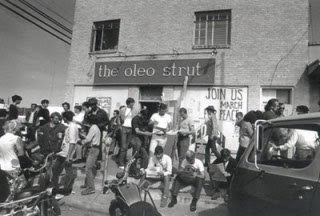
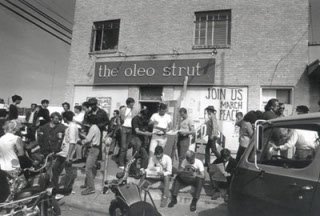
Soldiers hanging out at the Oleo Strut, from 1968 – 1972. Photo (c) Alan Pogue. Used with permission from Sir! No Sir! photo galleries.

Under The Hood is being launched in the spirit of its predecessor coffeehouse, The Oleo Strut. Below is a vivid history of The Oleo Strut, written by someone who was there.

The Oleo Strut Coffeehouse And The G.I. Antiwar Movement
By Thomas McKelvey Cleaver

Writing in the June, 1971, Armed Forces Journal, Colonel Robert D. Heinl, Jr. stated: “By every conceivable indicator, our army that now remains in Vietnam is in a state of approaching collapse, with individual units avoiding or having refused combat, murdering their officers and noncommissioned officers, drug-ridden and dispirited where not near-mutinous… Word of the death of officers will bring cheers at troop movies or in bivouacs of certain units. In one such division, the morale-plagued Americal, fraggings during 1971 have been running about one a week….

As early as mid-1969 an entire company of the 196th Light Infantry Brigade publicly sat down on the battlefield. Later that year, another rifle company, from the famed 1st Air Cavalry Division, flatly refused — on CBS TV — to advance down a dangerous trail… Combat refusal has been precipitated again on the frontier of Laos by Troop B, 1st Cavalry’s mass refusal to recapture their captain’s command vehicle containing communication gear, codes and other secret operation orders… “

Shortly after this article appeared, President Nixon announced the new policy of “Vietnamization” and direct American combat operations came to an end within a year. In 1971, desertion rates were soaring, re-enlistment rates plummeting, and the United States Army was not considered reliable enough to enter major combat. Today, the G.I. Antiwar movement that accomplished this is little-known, but it was the threat of soldiers not being willing to fight and die that stopped that war. Soldiers refusing to fight is the most upsetting image to all of those who claim to rule, since the monopoly of armed force is their ultimate weapon to retain their power. Much of what they have promoted in the 37 years since Heinl wrote that article — the all-volunteer Army, the Rambo version of Vietnam, the resurgence of patriotism that crested with the invasion of Iraq in 2003 –has been in direct response to the specter of GIs deciding a war wasn’t worth it. The war against the war within the American military began almost as soon as America became directly involved in Vietnam, which can be dated to the so-called “Tonkin Gulf Incident,” the excuse for direct American combat.

By 1966, veterans like my old friend, former Army intelligence specialist the late Jeff Sharlet – who would later found “Vietnam GI,” the major GI antiwar newspaper – had returned from their tour of duty and were trying to tell those back in America who they met at college what the real truth was about the war they had served in. Many in the campus antiwar movement did not respond to we veterans, with some purists telling us we were part of the crime for our participation. Somehow we were neither fish nor fowl to many.

The result was that veterans began searching each other out. Eventually, in early 1967, Vietnam Veterans Against the War was founded in New York City and took part as an organization in the spring mobilization against the war. No one was more surprised than the veterans at the positive response they got from bystanders as they marched together as opponents of the war they had fought. By 1967, Fred Gardner, a former editor of the harvard Crimson who had served as an officer in Southeast Asia, had returned to civilian life.By September, Fred had raised enough money to start the organization he had been thinking about for two years: an group that would bring the antiwar movement to the GIs still in the Army who opposed the war.

In September 1967, Gardner and a group of friends arrived in Columbia, South Carolina, home of Fort Jackson. Jokingly known as the “UFO,” a play on the military support organization USO, the coffeehouse quickly became the only integrated place in the city (this was the old South of the 1960s). The regulars soon consisted not just of black and white GIs, but also students from the local university. A few months later, Gardner returned to San Francisco where he established Summer Of Support (later called “Support Our Soldiers”) which was to coordinate the spread of similar coffeehouses to other Army bases. The first two were to be outside Fort Leonard Wood in Missouri, and outside Fort Polk in Louisiana. The Missouri coffeehouse managed to open, while the organizers sent to Louisiana were run out of town before they could even obtain a site for a coffeehouse. Fort Hood was chosen to replace the Fort Polk operation. At the time, no one knew what a momentous decision this would be.

In August, 1967, riots broke out in Detroit, and the 101st Airborne Division was sent to stop it. This was the first time active Army troops had been used to quell a civil disturbance in the United States since the Civil War. In April 1968, Dr. Martin Luther King was assassinated, and riots spread across the country. In response, the Army was called on to establish an organization for suppression of riots that were feared that summer as the time got closer and closer to the Democratic National Convention, to be held in Chicago that August.

Fort Hood in 1968 was the main base where Vietnam veterans who had six months or less left on their enlistments were sent upon completion of their tour of duty in the war. Somehow, the Army thought that these combat veterans would be perfect for use in suppressing the war at home. The Army brass weren’t the only ones who didn’t know the mood of the troops. Neither did we. These were men who had experienced the Tet Offensive, men who had known the truth before Tet – that America was not winning the Vietnam War. They were turned off from their experience and unwilling to participate in a new war, a war against their fellow citizens. Killeen at the time was a typical “old South” garrison town. The town lived off the soldiers, but hated them at the same time.

Soldiers at Fort Hood were seen by the businessmen in town as being there strictly for the picking. Avenue D was a collection of loan sharks (borrow $30 and pay back $42 – the payday loan industry’s been around a long time), pin ball palaces, sharp clothing stores – one had $100 alligator shoes, a brilliant green Nehru jacket in the window with 12 feet of racks stacked with cossack shirts in satin colors – insurance brokers, and overpriced jewelry stores. If a soldier walked into one of these establishments and didn’t pull out his billfold within ten minutes, he’d be asked to leave. Local toughs – known by the derogatory Texan term “goat ropers” – carried on their own war against the GIs, who they would try and catch alone at night and with assault and robbery on their minds. The local police generally sided with the “good old boys” against the “outsider” GIs.

The town was as segregated as any in the South; there was an active Klavern of the KKK to enforce segregation. Killeen had grown from a population of 500 in 1940 (when Fort Hood was established to train Patton’s coming armored corps) to around 35,000 by 1968. It was not a place that was going to welcome “outside agitators” from California and Massachusetts, as we were. I remember an organizer for the Student Non-Violent Coordinating Committee who visited that September and told me he considered Killeen more dangerous than Sunflower County, Mississippi.

The Oleo Strut opened on July 4, 1968, with a public picnic in the local park. GIs had been checking the place out over the previous month as the staff worked to set it up, and there was a large enough crowd that a reporter from the New York Times thought the event important enough to write a story about, that received national play. The coffeehouse was given the name “The Oleo Strut.” An oleo strut is a shock absorber, and we saw this as a metaphor for what we hoped the place would be for the soldiers we hoped to work with. We had no idea what a shock we were about to absorb.

Within a week of opening, soldiers were coming in at night to tell us of riot control training they were taking part in during the day. They’d been told they were going to Chicago to “fight the hippies and the commies” who were going to show up for the Democratic Convention the next month. They were terribly upset at the thought of having to possibly open fire on Americans who they agreed with about the war and the need for change here in America. Soldiers were talking about deserting, about running away to Mexico, about “doing something.” Our response was a little yellow sticker, two inches by two inches. On it was a white hand flashing the “peace sign,” backed by a black fist. We printed up 1,000 of them and passed them out. GIs said they would put these on their helmets if they were called into the streets, to identify themselves to the protestors. At this point, the Army got very upset with us.

The Monday of the convention, 5,000 troops were ordered to board the transports. They were headed for the Great Lakes Naval Training Center in Chicago, as backup for the Chicago Police Department. As the soldiers were preparing to board the airplanes, the bravest act of antiwar protest I ever knew of happened. 43 Black soldiers, all combat veterans, refused to board the airplanes. Due to the self-separation of the races on the base, we had no idea this was going to happen. The Black troops had organized themselves. They knew what they were going to get for this. The minimum qualification to be one of those who would refuse was the Bronze Star and the Purple Heart, so the Army wouldn’t be able to call them cowards.

As this was happening on the base, we were on the way from our house to the Oleo Strut, when we were stopped by the Killeen Police. A search of the car found drugs – we knew immediately we were set up, since we were completely drug-free. We also knew immediately what a terrible threat this was, since at that time the possession of a joint could get one a sentence of 20 years in Huntsville Prison, as had recently happened to an SNCC organizer in Houston who’d had marijuana planted on him by an undercover officer. We were scared. In the end, only Josh Gould was held, since he had been identified as our “leader.” He would stay in the Bell County Jail for six weeks until the Bell County Grand Jury would vote a “no bill” on the indictment, thanks to the tireless efforts of local attorney Davis Bragg.

The world knows what happened in Chicago. A government cannot put soldiers on the street without the prior knowledge that if they are ordered to crack heads, they all will. No one knew how many of the GIs would carry out their threat of resistance if put in the streets, so all were held back. Deprived of their military backup, the Chicago Police Department staged their historic “police riot.” The GI antiwar movement had inflicted its first major blow against the government.

In the months following, the antiwar movement took hold at the Oleo Strut. Soldiers started publication of “The Fatigue Press,” an underground newspaper we ran off down in Austin on a mimeograph the local SDS chapter found for us on the UT campus. In November, 1968, GIs from Fort Hood staged an antiwar teach-in at UT, despite the best efforts of the Army to close the base and prevent their participation. We also endured the daily reports of the court-martials of the 43 Black GIs, each of whom received several years in Leavenworth and a Dishonorable Discharge for their courageous act.

Perhaps most importantly, a GI named Dave Cline walked through the front door that September. Wounded in action with the 25th Infantry Division the year before, Dave was only now out of an extended tour of Army hospitals to deal with his wounds. He was completely dedicated to the cause of opposition to the war, and became the center of the GIs who were involved in anti-war activities on-base. He became the editor of Fatigue Press.

In later years, the rest of the country and the world would come to know Dave Cline, who spent all his life until his death on September 15, 2006, from the wounds he received in Vietnam, fighting for peace and justice as the President of Veterans for Peace. He fought the Veterans Administration for proper care and benefits for all Vietnam vets, fought for both American and Vietnamese victims of Agent Orange; he fought against America’s intervention against the Central American revolutions in the 80s; he stood up against the attack on Panama, the Gulf War, and intervention in Somalia in the early 90s; he opposed the bombing of Serbia and Kosovo in 1999 and traveled to Vieques to show solidarity with the people of Puerto Rico in their fight to stop the U.S. military using it as a practice range; he organized against the invasions of Afghanistan and Iraq, and as his last act organized a Veterans for Peace caravan to bring relief to New Orleans after it was devastated by Hurricane Katrina and neglect by every level of government. A GI Dave knew in the 25th Infantry Division was so impressed by him that in 1986, that GI – Oliver Stone – memorialized him as the main character of “Platoon.” Things weren’t all heavy politicking.

Then as now, Austin had an active music scene and I was able to find bands willing to make the trek up I-35 to entertain the GIs. The most popular of these bands that fall of 1968 was a new blues band fronted by a great young singer who was only 16. Given they couldn’t play in the Austin bars due to his age, they were happy to come up and play for the peanuts I could offer. The place would be packed whenever they appeared. 18 years later, in 1986, when I was at the United States Film Festival in Dallas, Stevie Ray Vaughn recognized me and thanked me for being the first guy to ever give him a break. Over the years between 1968 and 1972, when the Oleo Strut finally closed, many name musicians came and entertained the troops. Among them were Pete Seeger, who played to a packed house in 1971, followed by Country Joe McDonald and Phil Ochs. By 1970, there were some 20 coffeehouses – not all part of Support Our Soldiers – to be found in the vicinity of Army, Air Force, Marine and Navy bases across the country. Their most important role was giving soldiers who had come to understand how wrong the Vietnam war was the knowledge they were not alone.

Eventually, this dissent within the military spread to the front lines in Vietnam, as reported by Colonel Heinl. Of the three original SOS coffee houses, the UFO was closed in 1970 by a court order declaring it a “public nuisance.” The coffeehouse outside Fort Leonard Wood succumbed to harassment and threats in 1969. The Oleo Strut stayed open till the war ended in 1972. Today, the site of the coffeehouse on the corner of 4th and Avenue D (101 Avenue D) is an office complex. One can still, however, find the red paint in the cracks of the sidewalk that was thrown on the door and windows weekly, back 40 years ago.

Source / Under The Hood

Friends,

Thanks to Tom Cleaver for the fascinating history of the Oleo Strut. Of course, he is correct that the Oleo Strut was an inspiration for the idea to open a coffeehouse in Killeen. I’d like to add a bit more information regarding the current project. First, the work to establish ‘Under the Hood’ began after several active duty GIs from Ft. Hood IVAW and Cindy Thomas, a supporter whose spouse is currently deployed in Iraq , asked for assistance. Alice Embree and I agreed to help. It was the vision of these young GIs which motivated us. With Tom’s fundraising talents, the help of an attorney with military law expertise, and the determination of Cindy, a Killeen army wife, we have made a lot of progress.

Though much has been done, including incorporating, launching a website, and initial fundraising, clearly, there is much, much more work ahead of us. If you followed the link to our website, you saw that it is not quite ready for prime time, and that the Pay Pal donation link isn’t working yet. We are still finalizing the 501c3 filing. While we are optimistic, we are not certain that we can open by Labor Day.

The work we have done so far is just the beginning. Raising money to sustain the effort long term and securing resources (accounting, entertainment, counseling, maybe even carpentry!) will be an ongoing challenge. We are going to need all the help we can get; this will require a big commitment on the part of the Texas peace community. I think it is correct to say that this community understands how important GI resistance is to the movement. For this reason, I feel certain that we are all up to the challenges that this new initiative will present.

In Solidarity,
Fran Hanlon

I am proud to say that at Liberation News Service, where I worked with Thorne Dreyer and others on this Rag/Texas list, we were fully informed about the Oleo Strut and other anti-war coffee houses, and we did everything we could to support and promote them and their important work.

The compassion that anti-war people had for the unfortunate low-ranking military guys in the Vietnam era was obvious to me, and this relates to the anger I feel every time I hear the stupid “urban myth” about anti-war protesters spitting at GIs. Not one of the hundreds of anti-war activists I knew would dream of saying nasty things to a GI in uniform, much less spitting at him (or her).

Allen Young

Fuckin’ Aye, my Friend!

It was a myth, perpetrated by the same oppressive assholes who were sacrificing my social class for capitalist hegemony in Asia. That spitting thing … It never fuckin’ happened. It was the Kennedy, Johnson, and Nixon supporters and the Pentagon hacks who spit on us. The Peace Movement loved us and worked hard, some giving up their lives (Remember Kent State?), to save us. Our gratitude to you and to the Thorne Dreyers and to David Hamiltons and to Alice Embrees is forever!

Doug Zachary
USMC 2499357
1968-1970

Agreed, the spitting thing never happened to me, or any vets I knew. The anti-war students at UT were much more likely to offer to buy me a cup of coffee in the Union, or a beer at Able’s or Les Amis, and pick my brain about what happened in Nam, and how in hell I ended up volunteering. I felt no condescension or disdain… just peace, love, curiosity, and support for the Oleo Strut and VVAW.

Peace,
Terry DuBose

No one ever spit on me, as a veteran that is. But I have spoken with at least one veteran who was spit on for being a Vietnam veteran. We must be careful never to say “never”. The overwhelming truth is that the anti-war movement was and is kind to veterans. It is similar to bra burning stories. There may have been a woman or two who burned her bra in protest of sexism but that was never a regular event. Bras do not burn well unless they are 100% cotton. The usual bra is made of synthetics, burns poorly and makes noxious fumes as it does burn. Beware of burning spandex.

If someone had spit on me for being part of the army that killed a million Vietnamese then that would have been a very light punishment for my crime. But the anti-war folks understood what a shallow brain washed youth I had been and I did repent. The real punishment was having been there. Those who sent me deserve much more punishment than being spit upon.

Alan Pogue

Wow! about Tom Cleaver’s article. I spent a lot of time at the Oleo Strut, especially when Bob Bower was going through his courtmartial for speaking at an anti-war rally in uniform, but I this is the first time I ever heard the full story. Thanks so much.

One note: I finally got involved with a right wing wacko in Seattle, and he explained to me that yes, it did happen [the spitting], and a lot. I asked him to tell me a specific. And he explained to me that he was told so by his drill sergeant, and that’s when I understood that the military stopped at nothing to create a sense of isolation and alienation in our soldiers. Over the years I’ve wondered what other propaganda was casually crammed down their throats.

Pat Cuney

In 1985, [Don] Snell and I were part of a anti-nuclear bike ride to Pantex for the 40th anniversary of Hiroshima. On the first day, with the temperature at 103, we left the congregating area in Georgetown to ride to (whatever the name of that town near Fort Hood is)[Killeen].

Snell and I were older than the others. We were not in as good shape as the rest of the riders. If we saw a telephone pole, we stopped in its shadow to rest. Needless to say, we were the last to arrive at the evening dinner/sleep site. They’d sent out spotters to look for us.

But that’s not why I’m writing . . .

As we rode around part of the perimeter of Fort Hood, we spotted a tavern. It looked military, but it also looked like we might be able to get something cool to drink. Politics be damned! We rested our bikes and went in.

We sat at a table and were ready to order when people came to talk to us outsiders. Why, they asked were we on bikes on such a hot day? Where were we going? Pulling up to full height, we told those military-looking people that we were on a pilgrimage to the only nuclear weapons facility in the country – 16 miles northwest of Amarillo. They could hardly believe us.

And then it started: Orange juices started to arrive. Good, nourishing food that would be easy on our tired bodies showed up. We were not allowed to pay a single cent, no tab, no tip. We were treated like cherished colleagues.

We ate, drank, celebrated our conviviality and got back on our bikes. But we were changed, knowing that there were good people everywhere, even in a hellish corner of Texas where we – in our total naiveté – had not expected to find them.

Ruth Roberts

An excellant book on the spitting myth is “the spitting image” by Jerry Lembcke. in my own research I could only find one case of a Viet Nam vet betng spit on and that was Ron Kovic. He was spit on at the Republican Convention by a delegate who called him a communist for yelling “Stop the War”.

Robert Pardun

Thomas Cleaver’s article on the history of the Oleo Strut is one of the best things yet posted on the SDS site. Real original source history that is usually completely ignored in histories of the 1960s. I visited the Strut many times during that four year stretch. Saw both Joe McDonald and Phil Ochs perform. Every trip back was always accompanied by the local police pulling you over and harassing you as you were leaving town. One time they accused me of “pissing on the side of the Killeen State Bank” while they were holding guns to our head and tossing our car. Then they let us go after they berated us with threats and insults. Same old same old.

It should also be noted that the publisher of the Killeen Daily Herald (name escapes me) and Frank Mayborn with the Temple Daily Telegram were both strongly allied with Lyndon Johnson. They definitely took the existence of the Oleo Strut very personally.

Each time we were stopped the local marked unit was followed by an unmarked vehicle with a couple of guys who never got out of the car. Never was sure what agency this was. I always got the impression the local piss-ants were putting on their little show for the benefit of the guys in the unmarked vehicle. One of the worst places to pass through was the little town of Nash just outside of Killeen. You were almost guaranteed to get stopped there by their little gestapo cops if you had anti-war stickers on your car. One of them was about 5’7″ and wore two pistols on backwards. A regular Johnny Ringo.

Does anyone have photos of Joe McDonald or Phil Ochs at the Strut? I had some of McDonald but they have vanished over the years after one too many moves between Texas and California.

It’s a damn shame Sean Penn didn’t follow through with his plans to do a film about Phil Ochs. He was red hot to do this at one time but it never came together.

About twenty years ago I was backpacking around some extremely remote villages in the Yucatan – just thatched huts, loud chattering monkeys, unpaved roads, not even a local cafe — just little stands selling Cokes and stringy chicken tacos. Came around a corner and saw painted on the side of a caliche wall: “Long live Phil Ochs!” in big red letters.

Made my day.

Steve Speir
Austin / July 28, 2008

Also see David Zeiger : Did the GI Movement End the Vietnam War? / The Rag Blog / July 25, 2008

And Austin, 1969 : Bob Bower, Anti-War GI by Henry Mecredy / The Rag Blog / July 24, 2008

The Rag Blog

Posted in Rag Bloggers | Tagged , , , , , , , , , , | 3 Comments

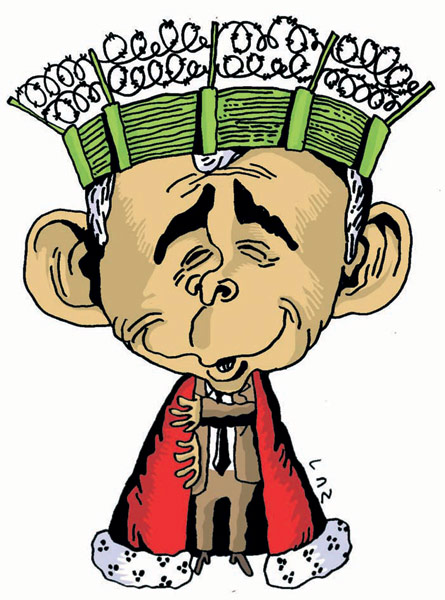
Drawn and Quartered

Humberto Lázaro Miranda Ramírez (LAZ) / Dedeté Humor Magazine / Cuba

The Rag Blog / Posted July 23, 2008

Posted in RagBlog | Tagged , , , , | Leave a comment

HEALTH : Eat Your Veggies!

The reason the United States now ranks 40th in longevity in the world is our massive subsidies of junk food, according to Public health officials. Here’s what real food can do for health.

Janet Gilles / The Rag Blog

Study shows how broccoli fights cancer
By Michael Kahn

Just a few more portions of broccoli each week may protect men from prostate cancer, British researchers reported on Wednesday.

The researchers believe a chemical in the food sparks hundreds of genetic changes, activating some genes that fight cancer and switching off others that fuel tumors, said Richard Mithen, a biologist at Britain’s Institute of Food Research.

There is plenty of evidence linking a healthy diet rich in fruits and vegetables to reduced cancer risk. But the study published in the Public Library of Science journal PLoS One is the first human trial investigating the potential biological mechanism at work, Mithen added in a telephone interview.

“Everybody says eat your vegetables but nobody can tell us why,” said Mithen, who led the study. “Our study shows why vegetables are good.”

Prostate is the second-leading cancer killer of men after lung cancer. Each year, some 680,000 men worldwide are diagnosed with the disease and about 220,000 will die from it.

Mithen and colleagues split into two groups 24 men with pre-cancerous lesions that increase prostate cancer risk and had them eat four extra servings of either broccoli or peas each week for a year.

The researchers also took tissue samples over the course of the study and found that men who ate broccoli showed hundreds of changes in genes known to play a role in fighting cancer.

The benefit would likely be the same in other cruciferous vegetables that contain a compound called isothiocyanate, including brussel sprouts, cauliflower, cabbage, rocket or arugula, watercress and horse radish, they added.

Broccoli, however, has a particularly powerful type of the compound called sulforaphane, which the researchers think gives the green vegetable an extra cancer-fighting kick, Mithen said.

“When people get cancer some genes are switched off and some are switched on,” he said. “What broccoli seems to be doing is switching on genes which prevent cancer developing and switching off other ones that help it spread.”

The broccoli eaters showed about 400 to 500 of the positive genetic changes with men carrying a gene called GSTM1 enjoying the most benefit. About half the population have the gene, Mithen said.

The researchers did not track the men long enough to see who got cancer but said the findings bolster the idea that just a few more vegetable portions each week can make a big difference.

It is also likely that these vegetables work the same way in other parts of the body and probably protect people against a whole range of cancers, Mithen added.

“You don’t need a huge change in your diet,” he said. “Just a few more portions makes a big difference.”

Source / Reuters / Yahoo! News / Posted July 1, 2008

The Rag Blog

Posted in RagBlog | Tagged , , , | 2 Comments

ENVIRONMENT : The Island in the Wind

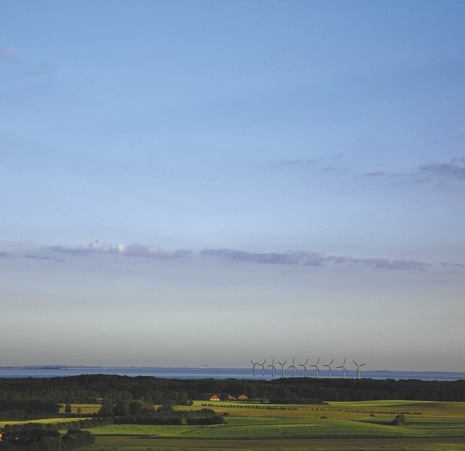
Once people on Samsø started thinking about energy, a local farmer explains, “it became a kind of sport.” Photo by Joachim Ladefoged.

A Danish community’s victory over carbon emissions
by Elizabeth Kolbert

Jørgen Tranberg is a farmer who lives on the Danish island of Samsø. He is a beefy man with a mop of brown hair and an unpredictable sense of humor. When I arrived at his house, one gray morning this spring, he was sitting in his kitchen, smoking a cigarette and watching grainy images on a black-and-white TV. The images turned out to be closed-circuit shots from his barn. One of his cows, he told me, was about to give birth, and he was keeping an eye on her. We talked for a few minutes, and then, laughing, he asked me if I wanted to climb his wind turbine. I was pretty sure I didn’t, but I said yes anyway.

We got into Tranberg’s car and bounced along a rutted dirt road. The turbine loomed up in front of us. When we reached it, Tranberg stubbed out his cigarette and opened a small door in the base of the tower. Inside were eight ladders, each about twenty feet tall, attached one above the other. We started up, and were soon huffing. Above the last ladder, there was a trapdoor, which led to a sort of engine room. We scrambled into it, at which point we were standing on top of the generator. Tranberg pressed a button, and the roof slid open to reveal the gray sky and a patchwork of green and brown fields stretching toward the sea. He pressed another button. The rotors, which he had switched off during our climb, started to turn, at first sluggishly and then much more rapidly. It felt as if we were about to take off. I’d like to say the feeling was exhilarating; in fact, I found it sickening. Tranberg looked at me and started to laugh.

Samsø, which is roughly the size of Nantucket, sits in what’s known as the Kattegat, an arm of the North Sea. The island is bulgy in the south and narrows to a bladelike point in the north, so that on a map it looks a bit like a woman’s torso and a bit like a meat cleaver. It has twenty-two villages that hug the narrow streets; out back are fields where farmers grow potatoes and wheat and strawberries. Thanks to Denmark’s peculiar geography, Samsø is smack in the center of the country and, at the same time, in the middle of nowhere.

For the past decade or so, Samsø has been the site of an unlikely social movement. When it began, in the late nineteen-nineties, the island’s forty-three hundred inhabitants had what might be described as a conventional attitude toward energy: as long as it continued to arrive, they weren’t much interested in it. Most Samsingers heated their houses with oil, which was brought in on tankers. They used electricity imported from the mainland via cable, much of which was generated by burning coal. As a result, each Samsinger put into the atmosphere, on average, nearly eleven tons of carbon dioxide annually.

Then, quite deliberately, the residents of the island set about changing this. They formed energy coöperatives and organized seminars on wind power. They removed their furnaces and replaced them with heat pumps. By 2001, fossil-fuel use on Samsø had been cut in half. By 2003, instead of importing electricity, the island was exporting it, and by 2005 it was producing from renewable sources more energy than it was using.

The residents of Samsø that I spoke to were clearly proud of their accomplishment. All the same, they insisted on their ordinariness. They were, they noted, not wealthy, nor were they especially well educated or idealistic. They weren’t even terribly adventuresome. “We are a conservative farming community” is how one Samsinger put it. “We are only normal people,” Tranberg told me. “We are not some special people.”

This year, the world is expected to burn through some thirty-one billion barrels of oil, six billion tons of coal, and a hundred trillion cubic feet of natural gas. The combustion of these fossil fuels will produce, in aggregate, some four hundred quadrillion B.T.U.s of energy. It will also yield around thirty billion tons of carbon dioxide. Next year, global consumption of fossil fuels is expected to grow by about two per cent, meaning that emissions will rise by more than half a billion tons, and the following year consumption is expected to grow by yet another two per cent.

When carbon dioxide is released into the air, about a third ends up, in relatively short order, in the oceans. (CO2 dissolves in water to form a weak acid; this is the cause of the phenomenon known as “ocean acidification.”) A quarter is absorbed by terrestrial ecosystems—no one is quite sure exactly how or where—and the rest remains in the atmosphere. If current trends in emissions continue, then sometime within the next four or five decades the chemistry of the oceans will have been altered to such a degree that many marine organisms—including reef-building corals—will be pushed toward extinction. Meanwhile, atmospheric CO2 levels are projected to reach five hundred and fifty parts per million—twice pre-industrial levels—virtually guaranteeing an eventual global temperature increase of three or more degrees. The consequences of this warming are difficult to predict in detail, but even broad, conservative estimates are terrifying: at least fifteen and possibly as many as thirty per cent of the planet’s plant and animal species will be threatened; sea levels will rise by several feet; yields of crops like wheat and corn will decline significantly in a number of areas where they are now grown as staples; regions that depend on glacial runoff or seasonal snowmelt—currently home to more than a billion people—will face severe water shortages; and what now counts as a hundred-year drought will occur in some parts of the world as frequently as once a decade.

Today, with CO2 levels at three hundred and eighty-five parts per million, the disruptive impacts of climate change are already apparent. The Arctic ice cap, which has shrunk by half since the nineteen-fifties, is melting at an annual rate of twenty-four thousand square miles, meaning that an expanse of ice the size of West Virginia is disappearing each year. Over the past ten years, forests covering a hundred and fifty million acres in the United States and Canada have died from warming-related beetle infestations. It is believed that rising temperatures are contributing to the growing number of international refugees—“Climate change is today one of the main drivers of forced displacement,” the United Nations’ high commissioner for refugees, António Guterres, said recently—and to armed conflict: some experts see a link between the fighting in Darfur, which has claimed as many as three hundred thousand lives, and changes in rainfall patterns in equatorial Africa.

“If we keep going down this path, the Darfur crisis will be only one crisis among dozens of others,” President Nicolas Sarkozy, of France, told a meeting of world leaders in April. The Secretary-General of the United Nations, Ban Ki-moon, has called climate change “the defining challenge of our age.”

In the context of this challenge, Samsø’s accomplishments could be seen as trivial. Certainly, in numerical terms they don’t amount to much: all the island’s avoided emissions of the past ten years are overwhelmed by the CO2 that a single coal-fired power plant will emit in the next three weeks, and China is building new coal-fired plants at the rate of roughly four a month. But it is also in this context that the island’s efforts are most significant. Samsø transformed its energy systems in a single decade. Its experience suggests how the carbon problem, as huge as it is, could be dealt with, if we were willing to try.

Read all of this article here. / New Yorker / Posted July 7, 2008

Thanks to Gerry Storm / The Rag Blog

Posted in RagBlog | Tagged , , , , , , | Leave a comment

Obama’s Plans for Afghanistan Could Mean Trouble

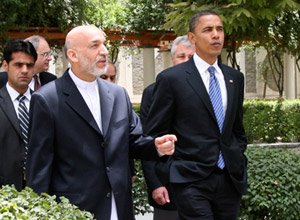
Sen. Barack Obama, right, and Afghan President Hamid Karzai in Kabul, July 20, 2008. Reuters.

Obama is saying the wrong things about Afghanistan
By Juan Cole / July 23, 2008

He hit the right notes during his swing through Iraq, but his plans for that other war could mean trouble.

Barack Obama’s Afghanistan and Iraq policies are mirror images of each other. Obama wants to send 10,000 extra U.S. troops to Afghanistan, but wants to withdraw all American soldiers and Marines from Iraq on a short timetable. In contrast to the kid gloves with which he treated the Iraqi government, Obama repeated his threat to hit at al-Qaida in neighboring Pakistan unilaterally, drawing howls of outrage from Islamabad.

But Obama’s pledge to defeat the Taliban in Afghanistan will not be easy to fulfill. While coalition troop deaths have declined significantly in Iraq, NATO casualties in Afghanistan are way up. By shifting emphasis from Iraq to Afghanistan, would a President Obama be jumping from the frying pan into the fire?

During the Baghdad stop of his ongoing overseas tour, the convergence between the worldview of the presumptive Democratic nominee and that of his Iraqi hosts provided some embarrassing moments for the Bush administration. Obama and his traveling companions, Senate colleagues Chuck Hagel, R-Neb., and Jack Reed, D-R.I., issued a statement Tuesday after a day of consultations with Iraqi politicians and U.S. military commanders, affirming the need to respect Iraqi aspirations for a “timeline, with a clear date, for the redeployment of American combat forces.” By then, in an interview with Germany’s Der Spiegel, Iraqi Prime Minister Nouri al-Maliki had already expressed support for Obama’s proposal to withdraw U.S. troops from Iraq within 16 months of his inauguration next January.

Although al-Maliki’s spokesman, Ali al-Dabbagh, attempted to soothe ruffled GOP feathers by suggesting the Der Spiegel interview was mistranslated, al-Dabbagh came clean while Obama was in Baghdad on Monday. He confirmed that the Iraqi government hoped U.S. troops would be withdrawn within two years. Obama was thus able, in his joint statement with Reed and Hagel, to cite Iraqi attitudes for his own stance: “The prime minister … stated his hope that U.S. combat forces could be out of Iraq in 2010.”

In general, Obama’s policies toward Iraq synchronize neatly with the aspirations of the Shiite-dominated elected Iraqi government, with an affirmation of the need to gain the consent of the Iraqis for any status-of-forces agreement with the U.S., and with a far greater emphasis on addressing the humanitarian crisis provoked by the U.S. invasion. On leaving al-Maliki’s office, Obama was able to call his consultations with the prime minister “very constructive.”

By comparison, Obama’s criticisms of Bush administration policy toward Afghanistan and Pakistan, and his determination to make those countries the centerpiece of his foreign policy, are more problematic. Obama’s determination to put down the tribal insurgencies in northwestern Pakistan and in southern Afghanistan reveals basic contradictions in his announced policies. His plans certainly have the potential to ruffle Afghan and Pakistani feathers, and have already done so in Pakistan.

On July 13, Obama criticized Afghanistan President Hamid Karzai on CNN, saying, “I think the Karzai government has not gotten out of the bunker and helped organize Afghanistan and [the] government, the judiciary, police forces, in ways that would give people confidence.” Although the remark had the potential to make for awkward moments between Karzai and Obama during their meeting Sunday, it was welcomed by the independent Afghan press, which applauded the senator for bucking the “self-centered” policies of Bush and his knee-jerk support of Karzai.

After Obama met with Karzai, reporters asked his aide, Humayun Hamidzada, if the criticism had come up. He tried to put the best face on issue, saying the Afghan government did not see the comment as critical, but as a fair observation, since it had in fact been tied down fighting terrorism.

Less forgiving were the politicians in Pakistan, who reacted angrily to Obama’s comments on unilaterally attacking targets inside that country. The Democratic presidential hopeful told CBS on Sunday, “What I’ve said is that if we had actionable intelligence against high-value al-Qaida targets, and the Pakistani government was unwilling to go after those targets, that we should.” He added that he would put pressure on Islamabad to move aggressively against terrorist training camps in the country’s northwestern tribal areas.

Pakistan, a country of 165 million people, is composed of six major ethnic groups, one of them the Pashtuns of the northwest. The Pakistani Taliban are largely drawn from this group. The more settled Pashtun population is centered in the North-West Frontier province, with its capital at Peshawar. Between the NWFP and Afghanistan are badlands administered rather as Native American reservations are in the U.S., called the Federally Administered Tribal Areas, with a population of some 3 million. These areas abut Pashtun provinces of Afghanistan, also a multiethnic society, but one in which Pashtuns are a plurality.

The tribal Pashtuns of the FATA no man’s land, a third of which is classified as “inaccessible” by the Pakistani government, have sometimes given shelter to al-Qaida or Afghan Taliban militants. Some of the Pashtun tribesmen themselves have turned militant, and have been responsible for suicide bombings at police checkpoints inside Pakistan. They are also accused of attacking targets across the border in Afghanistan and of giving refuge to Afghan Taliban who conduct cross-border raids.

The governor of the North-West Frontier province, Owais Ghani, immediately spoke out against Obama, saying that the senator’s remarks had the effect of undermining the new civilian government elected last February. Ghani warned that a U.S. incursion into the northwestern tribal areas would have “disastrous” consequences for the globe.

The governor underlined that a “war on terrorism” policy depended on popular support for it, and that such support was being leeched away by U.S. strikes on the Pakistan side of the border and by statements such as Obama’s. A recent American attack mistakenly killed Pakistani troops who had been sent to fight the Pakistani Taliban at American insistence. The Pakistani public was furious. Ghani complained, “Candidate Obama gave these statements; I come out openly and say such statements undermine support, don’t do it.”

The NWFP governor is responsible for Pakistani counterinsurgency efforts in his province and in the neighboring tribal regions. He is well thought of in Pakistan because of his successes in Baluchistan province, which he governed for five years prior to January of this year, where he combined political negotiations with militants and targeted military action when he felt it necessary. He firmly subordinated the military strategy to civilian politics and negotiations. That is, Ghani is a politician with long experience in dealing with tribal insurgencies.

Obama’s aggressive stance, on the other hand, could be counterproductive. The Illinois senator had praised the Pakistani elections of last February, issuing a statement the next day saying, “Yesterday, a moderate majority of the Pakistani people made their voices heard, and chose a new direction.” He criticized the Bush administration, saying U.S. interests would be better served by “advancing the interests of the Pakistani people, not just Pakistan’s president.”

Yet the parties elected in February in Pakistan are precisely the ones demanding negotiations with the tribes and militants of the northwest, rather than frontal military assaults. Indeed, it is the Bush administration that has pushed for military strikes in the FATA areas. Obama will have to decide whether he wants to risk undermining the elected government and perhaps increasing the power of the military by continuing to insist loudly and publicly on unilateral U.S. attacks on Pakistani territory.

Nor is it at all clear that sending more U.S. troops to southern Afghanistan can resolve the problem of the resurgence of the Taliban there. American and NATO search-and-destroy missions alienate the local population and fuel, rather than quench, the insurgency. Resentment over U.S. airstrikes on innocent civilians and wedding parties is growing. Brazen attacks on U.S. forward bases and on institutions such as the prison in the southern city of Kandahar are becoming more frequent. To be sure, Obama advocates combining counterinsurgency military operations with development aid and attention to resolving the problem of poppy cultivation. (Afghan poppies are turned into heroin for the European market, and the profits have fueled some of the Taliban’s resurgence.) Stepped-up military action, however, is still the central component of his plan.

Before he jumps into Afghanistan with both feet, Obama would be well advised to consult with another group of officers. They are the veterans of the Russian campaign in Afghanistan. Russian officers caution that Afghans cannot be conquered, as the Soviets attempted to do in the 1980s with nearly twice as many troops as NATO and the U.S. now have in the country, and with three times the number of Afghan troops as Karzai can deploy. Afghanistan never fell to the British or Russian empires at the height of the age of colonialism. Conquering the tribal forces of a vast, rugged, thinly populated country proved beyond their powers. It may also well prove beyond the powers even of the energetic and charismatic Obama. In Iraq, he is listening to what the Iraqis want. In Pakistan, he is simply dictating policy in a somewhat bellicose fashion, and ignoring the wishes of those moderate parties whose election he lauded last February.

Source. / salon.com

The Rag Blog

Posted in RagBlog | Tagged , , , | Leave a comment

John McCain, Please Log On


The crusty ol’ Repub says he has no clue how to use a computer. Isn’t that cute?
By Mark Morford / July 23, 2008

Dear McCain presidential campaign:

You know what’s funny and cute and just a little bit sad? Wacky old pre-industrial war-hungry guys admitting they don’t know a computer from a microwave oven, a hyperlink from a heart med, can’t turn on one of those newfangled PC things if his life depended on it and/or he wanted to see what his weird tattooed bi-curious grandson is posting on his MySpace home docking station whateveryoucallit. Adorable!

Cuter still is when said wisecrackin’ curmudgeon admits he depends on the wife to show him how it all works, to log on and open a browser and check e-mail and describe what it all might mean out there in Interweb Cybertown, as you get the distinct feeling the old guy has no idea what makes it go and believes all this crazy gizmongery is for troublemakin’ whippersnappers anyway, as he pines for the days of teletype machines and prop aeroplanes. Charming!

Or, you know, maybe not. Because you know what’s depressing and just a bit beyond sad? A serious presidential candidate — that is to say, yours — who thinks it’s harmless that he’s actually one of those guys, who admits he’s a complete Luddite when it comes to computers and, by extension, most every aspect of modern multimedia and technology, except perhaps the exact specs of the nuke required to annihilate Iran and/or take out a big pile of “gooks.”

See, word has gotten out. Your boy John McCain says has no clue how to work a computer. He’s an admitted tech illiterate, couldn’t Google his way out of a DailyKos to save his Yahoo.

But here’s the disturbing part: This confession of ignorance apparently bothers him and his campaign not at all, as they apparently believe any sort of tech know-how isn’t really required to run our deeply busted-up ship of state, that you need no real firsthand experience with the most definitive technology of the past 100 years to make decisions that affect the entire planet. Go figure.

So then, the valid question: Is it a big deal? Should you care? Because McCain’s I’m-just-a-clueless-old-guy comment has caused a bit a stir, with anyone with a functioning DSL line calling it a bit of an embarrassment, a bit like running for captain of the swim team while admitting all you know how to do is splash around in the bathtub. Gosh, Senator, don’t you think you need just a passing understanding of the culture in which you live to qualify you to oversee the damnable place? Doesn’t it help?

Maybe not. Maybe McCain’s apologists are right, the POTUS really doesn’t need to have a working knowledge of what hundreds of millions of people use every day to live, work, communicate, shop and blog and breed and porn and tube and book. Hell, just look at President Bush — still giggles every time Laura plugs in the air popcorn popper, has an Irish drinking song as a ringtone, enjoys a working grasp of the English language that borders on infantile. Really, who says a president has to be even modestly versed in the culture of his or her day? Or even passably competent?

But then, that’s not really the point, is it? The point, of course, is about social interconnection. It’s about understanding the basic workings of one of the most powerful, fundamental engines of modern society, its staggering impact and consequence and reach. To not use or comprehend computers and the Net in 2008 is to basically confess to your own cultural irrelevance.

Maybe a short lesson, then? Shall we offer a bit of help to McCain and his hapless crew? Couldn’t hurt.

Look here, Senator, this is a link. You click it to take you somewhere else on the Web. Here’s an example: When we click this link we see this page of — oh I’m sorry, this appears to be a big list of your most significant and appalling flip-flops, major issues you’ve reversed yourself on over weeks, months, years. Goodness, there sure are a lot of them.

Well, let’s scroll around a bit — scrolling is how you move up and down a large page to take it all in. As we move down here … oh look, here’s information about your famed McCain-Feingold bill on campaign finance reform. Except, oh dear, it appears you’re no longer connected to the most high-profile legislation of your career. Heck, now that you’re running for prez and need all the cash you can muster, who wants finance reform? I understand. What a maverick you are. Well, let’s move on.

Here are nice video clips of you decrying the ugly forces of the religious right, and then later kissing Falwell’s fat, nauseating ring. And here’s you trashing Bush’s useless tax cuts for the wealthy, then completely flopping over and supporting them. And whoops, gay marriage might be OK, then it’s definitely not. Torture is absolutely wrong, then it’s not. You say you’re rather clueless about the economy and will need some lessons in basic finance, then here’s you denying outright that you ever said that. Isn’t technology amazing, Senator?

Wow, there sure is a lot of information about your bizarre inconsistency on just about every issue of note. Immigration, energy, health care reform, offshore drilling, Social Security, Roe v. Wade, and, oh my goodness, the Iraq war? You really are all over the place. One thing’s for certain, though: your position on war and violence and America as ruthless pre-emptive aggressor, well, let’s just say you can sometimes make Dick Cheney look like a peacenik. Scary.

Ah, but it’s not all bad. To be fair, there is good amount of evidence of your past battles against Big Money, proof that you truly earned your maverick status in numerous contentious fights against special interests, lobbyists, Big Tobacco, ethanol subsidies (even Barack Obama won’t touch that one), Big Sugar, et al. Your record is — or rather, was — impressive.

Not anymore. It’s amazing what a taste of serious power will do to a man’s values, no? Don’t worry, it’s happening to your rival Obama, too — albeit to a far lesser degree. Hell, it happens to them all. This is another mandatory lesson about the Web, Senator. While it can certainly be a bit unfair and extreme, it’s also startlingly effective in how it tracks of the ugly erosion of your soul.

Maybe we should stop the lesson now. I think I’m beginning to see just why you don’t want to know how to use these hateful little gizmos. Damn things have a painful ability to tell the truth, to keep a dynamic, revealing record of your general inability to understand not just what’s really going on in the world, but what’s going on in your own muddled, fuzzy, increasingly dangerous mind. Ah, modern technology. Ain’t it a bitch?

Source / S.F. Gate

Thanks to Fontaine Maverick / The Rag Blog

Posted in RagBlog | Tagged , , , , , | Leave a comment

Economic Realities Are Killing Our Era of Fantasy Politics

Sen. Bernie Sanders (with Barack Obama): “The middle class is disappearing.”

Election season will be packed with horserace media distractions, but our economic situation is becoming a matter of life and death.
By Matt Taibbi / July 23, 2008

I am a single mother with a 9-year-old boy. To stay warm at night my son and I would pull off all the pillows from the couch and pile them on the kitchen floor. I’d hang a blanket from the kitchen doorway and we’d sleep right there on the floor. By February we ran out of wood and I burned my mother’s dining room furniture. I have no oil for hot water. We boil our water on the stove and pour it in the tub. I’d like to order one of your flags and hang it upside down at the capital building… we are certainly a country in distress.

Letter from a single mother in a Vermont city, to Senator Bernie Sanders

The Republican and Democratic conventions are just around the corner, which means that we’re at a critical time in our nation’s history. For this is the moment when the country’s political and media consensus finally settles on the line of bullshit it will be selling to the public as the “national debate” come fall.

If you pay close attention you can actually see the trial balloons whooshing overhead. There have been numerous articles of late of the Whither the Debate? genus in the country’s major dailes and news mags, pieces like Patrick Healy’s “Target: Barack Obama. Strategy: What Day is it?” in the New York Times. They ostensibly wonder aloud about what respective “plans of attack” Barack Obama and John McCain will choose to pursue against one another in the fall.

In these pieces we already see the candidates trying on, like shoes, the various storylines we might soon have hammered into our heads like wartime slogans. Most hilarious from my viewpoint is the increasingly real possibility that the Republicans will eventually decide that their best shot against Obama is to pull out the old “He’s a flip-flopper” strategy — which would be pathetic, given that this was the same tired tactic they used against John Kerry four years ago, were it not for the damning fact that it might actually work again. (I’m actually not sure sometimes what is more repulsive: the bosh they trot out as campaign “issues,” or the enthusiasm with which the public buys it.)

Naturally we’ll also see the “Patriotism Gap” storyline whipped out and reused over and over again. There will also be much talk emanating from the McCain camp about “experience,” although this line of attack will not be nearly as fruitful for him as it was for Hillary Clinton, mainly because the word “experience” in McCain’s case also has a habit of reminding voters that the Arizona senator is, well, wicked old.

The Obama camp, playing with a big halftime lead as the cliché goes, is going to play this one close to the vest, sticking to a strategy of using larger and larger fonts every week for their “CHANGE” placards, and getting the candidates’ various aides and spokesgoons to use the term “McCain-Bush policies” as many times as possible on political talk shows. Obama will also use this pre-convention period to do what every general election candidate does after a tough primary-season fight, i.e. ditch all the positions he took en route to securing the nomination and replace them with opinions subtly (or sometimes not-so-subtly) reconfigured to fit the latest polling information coming out of certain key swing states. Both sides as well as the pundit class will describe this early positioning for combat over swing-state electoral votes as a “race for the center” (AP, July 3: “Candidates Courting the Center”), as if the “political center” in America were a place where huge chunks of the population tirelessly obsessed over semi-relevant media-driven wedge issues like stem-cell research and gay marriage, even as they lacked money to buy food and make rent every month.

The press, meanwhile, is clearly flailing around for a sensational hook to use in selling the election, as the once-brightly-burning star of blue-red hatred seems unfortunately to have dimmed a little — just in time, perhaps, to torpedo the general election season cable ratings. They are working hard to come up with the WWF-style shorthand labels they always use to sell electoral contests: if 2000 was the “wooden” and ?condescending? Al Gore versus the “dummy” Bush, and 2004 featured that same ?regular guy? Bush against the “patrician” and “bookish” John Kerry (who also “looked French”), in 2008 we?re going to be sold the “maverick” McCain against the “smooth” Obama, or some dumb thing along those lines. Time has even experimented with a “poker versus craps” storyline, feeding off the incidental fact that Obama is a regular poker player while McCain reportedly favors craps, which apparently has some electorally relevant meaning — and if you know what that something is, please let me know.

We’re also going to be fed truckloads of onerous horseshit about the candidate wives. The Michelle Obama content is going to go something like this: the Fox/Limbaugh crowd will first plaster her with Buckwheatesque caricatures (the National Review cover was hilariously over-the-top in that respect) and racially loaded epithets like “baby Mama” (that via Fox News spokeswhore Michelle Malkin, God bless her) and “angry black woman” (via self-aggrandizing, cop-mustached Chicago-based prune Cal Thomas). Next, the so-called “mainstream” press, the “respectable” press, which of course is above such behavior, will amplify those attacks 10 million-fold via endless waves of secondary features soberly pondering the question of whether or not Michelle Obama is a “political liability” — because of stuff like the Thomas column, and Malkin’s quip and the endless rumors about a mysterious “whitey” video. Cindy McCain, meanwhile, will generally be described as a political asset, as the pundit class tends to applaud, mute, stoned-looking candidate wives who have soldiered on bravely while being martyred by rumors of their mostly absent husband’s infidelities. It will help on the martyrdom front that McCain launched his political career with her family money and drove her into an actual, confirmable chemical dependency. As long as she keeps gamely wobbling onstage and trying to smile into the camera, she’s going to get straight As from the political press, guaranteed.

Some combination of all of these things is going to comprise the so-called “national debate” this fall. Now, we live in an age where our media deceptions are so far-reaching and comprehensive that they almost smother reality, at times seeming actually to replace reality — but even in the context of the inane TV-driven fantasyland we’ve grown used to inhabiting, this year’s crude cobbling together of a phony “national conversation” by our political press is an outrageous, monstrously offensive deception. For if, as now seems likely, this fall’s election is ultimately turned into a Swan-esque reality show where America is asked to decide if it can tolerate Michelle Obama’s face longer than John McCain’s diapers, it will be at the expense of an urgent dialogue about a serious nationwide emergency that any sane country would have started having some time ago. And unless you run a TV network or live in Washington, you probably already know what that emergency is.

A few weeks back, I got a call from someone in the office of Vermont Senator Bernie Sanders. Sanders wanted to tell me about an effort his office had recently made to solicit information about his constituents’ economic problems. He sent out a notice on his e-mail list asking Vermont residents to “tell me what was going on in their lives economically.” He expected a few dozen letters at best — but got, instead, more than 700 in the first week alone. Some, like the excerpt posted above, sounded like typical tales of life for struggling single-parent families below the poverty line. More unnerving, however, were the stories Sanders received from people who held one or two or even three jobs, from families in which both spouses held at least one regular job — in other words, from people one would normally describe as middle-class. For example, this letter came from the owner of his own commercial cleaning service:

My 90-year-old father in Connecticut has recently become ill and asked me to visit him. I want to drop everything I am doing and go visit him, however, I am finding it hard to save enough money to add to the extra gas I’ll need to get there. I make more than I did a year ago and I don’t have enough to pay my property taxes this quarter for the first time in many years. They are due tomorrow.

This single mother buys clothes from thrift stores and unsuccessfully tried to sell her house to pay for her son’s schooling:

I don’t go to church many Sundays, because the gasoline is too expensive to drive there. Every thought of an activity is dependent on the cost.

Sanders got letters from working people who have been reduced to eating “cereal and toast” for dinner, from a 71-year-old man who has been forced to go back to work to pay for heating oil and property taxes, from a worker in an oncology department of a hospital who reports that clinically ill patients are foregoing cancer treatments because the cost of gas makes it too expensive to reach the hospital. The recurring theme is that employment, even dual employment, is no longer any kind of barrier against poverty. Not economic discomfort, mind you, but actual poverty. Meaning, having less than you need to eat and live in heated shelter — forgetting entirely about health care and dentistry, which has long ceased to be considered an automatic component of American middle-class life. The key factors in almost all of the Sanders letters are exploding gas and heating oil costs, reduced salaries and benefits, and sharply increased property taxes (a phenomenon I hear about all across the country at campaign trail stops, something that seems to me to be directly tied to the Bush tax cuts and the consequent reduced federal aid to states). And it all adds up to one thing.

“The middle class is disappearing,” says Sanders. “In real ways we’re becoming more like a third-world country.”

Here’s the thing: nobody needs me or Bernie Sanders to tell them that it sucks out there and that times are tougher economically in this country than perhaps they’ve been for quite a long time. We’ve all seen the stats — median income has declined by almost $2,500 over the past seven years, we have a zero personal savings rate in America for the first time since the Great Depression, and 5 million people have slipped below the poverty level since the beginning of the decade. And stats aside, most everyone out there knows what the deal is. If you’re reading this and you had to drive to work today or pay a credit card bill in the last few weeks you know better than I do for sure how fucked up things have gotten. I hear talk from people out on the campaign trail about mortgages and bankruptcies and bill collectors that are enough to make your ass clench with 100 percent pure panic.

None of this is a secret. Here, however, is something that is a secret: that this is a class issue that is being intentionally downplayed by a political/media consensus bent on selling the public a version of reality where class resentments, or class distinctions even, do not exist. Our “national debate” is always a thing where we do not talk about things like haves and have-nots, rich and poor, employers versus employees. But we increasingly live in a society where all the political action is happening on one side of the line separating all those groups, to the detriment of the people on the other side.

We have a government that is spending two and a half billion dollars a day in Iraq, essentially subsidizing new swimming pools for the contracting class in northern Virginia, at a time when heating oil and personal transportation are about to join health insurance on the list of middle-class luxuries. Home heating and car ownership are slipping away from the middle class thanks to exploding energy prices — the hidden cost of the national borrowing policy we call dependency on foreign oil, “foreign” representing those nations, Arab and Chinese, that lend us the money to pay for our wars.

And while we’ve all heard stories about how much waste and inefficiency there is in our military spending, this is always portrayed as either “corruption” or simple inefficiency, and not what it really is — a profound expression of our national priorities, a means of taking money from ordinary, struggling people and redistributing it not downward but upward, to connected insiders, who turn your tax money into pure profit.

You want an example? Sanders has a great one for you. The Senator claims that he has been trying for years to increase funding for the Federally Qualified Health Care (FQHC) program, which finances community health centers across the country that give primary health care access to about 16 million Americans a year. He’s seeking an additional $798 million for the program this year, which would bring the total appropriation to $2.9 billion, or about what we spend every two days in Iraq.

“But for five billion a year,” Sanders insists, “we could provide basic primary health care for every American. That?s how much it would cost, five billion.”

As it is, though, Sanders has struggled to get any additional funding. He managed to get $250 million added to the program in last year’s Labor, Health and Human Services bill, but Bush vetoed the legislation, “and we ended up getting a lot less.”

Okay, now, hold that thought. While we’re unable to find $5 billion for this simple program, and Sanders had to fight and claw to get even $250 million that was eventually slashed, here’s something else that’s going on. According to a recent report by the GAO, the Department of Defense has already “marked for disposal” hundreds of millions of dollars worth of spare parts — and not old spare parts, but new ones that are still on order! In fact, the GAO report claims that over half of the spare parts currently on order for the Air Force — some $235 million worth, or about the same amount Sanders unsuccessfully tried to get for the community health care program last year — are already marked for disposal! Our government is buying hundreds of millions of dollars worth of Defense Department crap just to throw it away!

“They’re planning on throwing this stuff away and it hasn?t even come in yet,” says Sanders.

According to the report, we’re spending over $30 million a year, and employing over 1,400 people, just to warehouse all the defense equipment we don’t need. For instance — we already have thousands of unneeded aircraft blades, but 7,460 on the way, at a cost of $2 million, which will join those already earmarked for the waste pile.

This is why you need to pay careful attention when you hear about John McCain claiming that he’s going to “look at entitlement program” waste as a means of solving the budget crisis, or when you tune into the debate about the “death tax.” We are in the midst of a political movement to concentrate private wealth into fewer and fewer hands while at the same time placing more and more of the burden for public expenditures on working people. If that sounds like half-baked Marxian analysis… well, shit, what can I say? That’s what’s happening. Repealing the estate tax (the proposal to phase it out by the year 2010 would save the Walton family alone $30 billion) and targeting “entitlement” programs for cuts while continually funneling an ever-expanding treasure trove of military appropriations down the befouled anus of pointless war profiteering, government waste and North Virginia McMansions — this is all part of a conversation we should be having about who gets what share of the national pie. But we’re not going to have that conversation, because we’re going to spend this fall mesmerized by the typical media-generated distractions, yammering about whether or not Michelle Obama’s voice is too annoying, about flag lapel pins, about Jeremiah Wright and other such idiotic bullshit.

Bernie Sanders is one of the few politicians out there smart enough and secure enough to understand that the future of American politics is necessarily going to involve some pretty frank and contentious confrontations. The phony blue-red divide, which has been buoyed for years by some largely incidental geographical disagreements over religion and other social issues, is going to give way eventually to a real debate grounded in a brutal economic reality increasingly common to all states, red and blue.

Our economic reality is as brutal as it is for a simple reason: whether we like it or not, we are in the midst of revolutionary economic changes. In the kind of breathtakingly ironic development that only real life can imagine, the collapse of the Soviet Union has allowed global capitalism to get into the political unfreedom business, turning China and the various impoverished dictatorships and semi-dictatorships of the third world into the sweatshop of the earth. This development has cut the balls out of American civil society by forcing the export abroad of our manufacturing economy, leaving us with a service/managerial economy that simply cannot support the vast, healthy middle class our government used to work very hard to both foster and protect. The Democratic party that was once the impetus behind much of these changes, that argued so eloquently in the New Deal era that our society would be richer and more powerful overall if the spoils were split up enough to create a strong base of middle class consumers — that party panicked in the years since Nixon and elected to pay for its continued relevance with corporate money. As a result the entire debate between the two major political parties in our country has devolved into an argument over just how quickly to dismantle the few remaining benefits of American middle-class existence — immediately, if you ask the Republicans, and only slightly less than immediately, if you ask the Democrats.

The Republicans wanted to take Social Security, the signature policy underpinning of the middle class, and put it into private accounts — which is a fancy way of saying that they wanted to take a huge bundle of American taxpayer cash and invest it in the very companies, the IBMs and Boeings and GMs and so on, that are exporting our jobs abroad. They want the American middle class to finance its very own impoverishment! The Democrats say no, let’s keep Social Security more or less as is, and let that impoverishment happen organically.

Now we have a new set of dire problems in the areas of home ownership and exploding energy prices. In both of these matters the basic dynamic is transnational companies raiding the cash savings of the middle class. Because those same companies finance the campaigns of our politicians, we won’t hear much talk about getting private industry to help foot the bill to pay for these crises, or forcing the energy companies to cut into their obscene profits for the public good. We will, however, hear talk about taxpayer-subsidized bailouts and various irrelevancies like McCain’s gas tax holiday (an amusing solution — eliminate taxes collected by government in order to pay for taxes collected by energy companies). Ultimately, however, you can bet that when the middle class finally falls all the way down, and this recession becomes something even worse, necessity will force our civil government — if anything remains of it by then — to press for the only real solution.

“Corporate America is going to have to reinvest in our society,” says Sanders. “It’s that simple.”

These fantasy elections we’ve been having — overblown sports contests with great production values, decided by haircuts and sound bytes and high-tech mudslinging campaigns — those were sort of fun while they lasted, and were certainly useful in providing jerk-off pundit-dickheads like me with high-paying jobs. But we just can’t afford them anymore. We have officially spent and mismanaged our way out of la-la land and back to the ugly place where politics really lives — a depressingly serious and desperate argument about how to keep large numbers of us from starving and freezing to death. Or losing our homes, or having our cars repossessed. For a long time America has been too embarrassed to talk about class; we all liked to imagine ourselves in the wealthy column, or at least potentially so, flush enough to afford this pissing away of our political power on meaningless game-show debates once every four years. The reality is much different, and this might be the year we’re all forced to admit it.

[Matt Taibbi is a writer for Rolling Stone.]

© 2008 RollingStone.com All rights reserved.

Source / RollingStone.com / AlterNet

Thanks to Bob Simmons / The Rag Blog

Posted in RagBlog | Tagged , , , , | 1 Comment

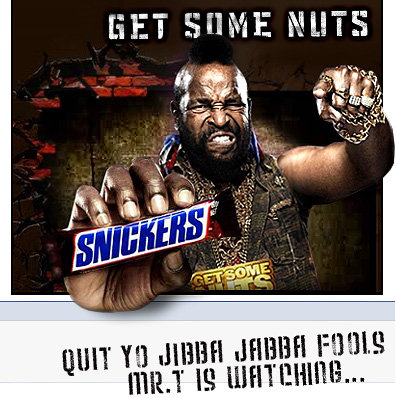
Snickers : ‘Get Some Nuts’


New ad encourages drive-by shootings of unmanly men

See video below.

Via Towleroad comes a new spot for Snickers which appears to endorse violence against the effeminate, or at least against speed-walkers. In the spot, a yellow-shorts-sporting butt-shaking speed-walker is attacked by former A-Team star Mr. T (?!) with a Snickers-shooting machine gun, for being “a disgrace to the man race.” Ga-wha? The ad was created by AMV BBDO, a subsidiary of the retro-futuristically named Omnicom, which turns out to be the company also responsible for a Dodge spot and another Snickers ad that inspired claims of homophobia. Ad Age critic Bob Garfield has written an open letter to Omnicom calling the spots “simply sick.”

I’ve been a vocal proponent of everybody chilling out over fictional portrayals of LGBT people and the gender non-conformist, but this is appalling, and also completely unfunny: making fun of racewalkers is so, like, 1993. Watch the offending ad after the jump. What do you think, Riffers, does it make you feel like “getting some nuts” and having a Snickers?


Snickers TV Commercial – Get Some Nuts – video powered by Metacafe

Source / The Riff / Mother Jones / Posted July 22, 2008

The Rag Blog

Posted in RagBlog | Tagged , , , , , | 1 Comment

Canada’s Spreading Cannabis Crop


Homegrown marijuana has become big business in British Columbia
By Misha Glenny / July 22, 2008

As we walk into John’s basement, the smell is so overwhelming it almost knocks me off my feet.

In front of me stand 120 marijuana plants whose thick bushy leaves cover the strong stems.

John explains quite nonchalantly that this is just a small growing operation, or grow-ops as they are known throughout Canada.

But he pays loving attention to the crop – adjusting temperature, light and nutrient supply – to ensure that it enjoys the best possible environment.

Every two to three months, John harvests some 8lbs (3.6kg) of his crop, worth about $20,000.

So even if he didn’t work at other jobs, that nets him a tidy salary (untaxed of course) of about $80,000 a year.

‘BC Bud’

Inspector Brian Cantera of the Royal Canadian Mounted Police (RCMP) in Vancouver believes that John’s small grow-op is one of 20,000 to be found in residential houses around the province.

That figure excludes the larger grow-ops in industrial locations, not to mention the huge dope farms that are scattered around British Columbia’s vast interior.

If Inspector Cantera’s estimates are accurate, then British Columbia is probably home to the largest concentration of organised criminal syndicates in the world.

The striking aspect of BC’s marijuana trade is that it has gone beyond the boundaries of traditional organised crime groups (although some are still heavily involved) and entered into the middle classes.

Much of the revenue derived from BC Bud, as the cannabis crop is known, goes on paying college fees, perhaps buying a second car or making that holiday to the Caribbean just a little bit more affordable.

The trade is so large that the police in BC are faced with an impossible task.

Inspector Cantera walked me around a cavernous warehouse somewhere east of Vancouver where the RCMP lock up goods confiscated from people involved in the drugs trade.

The most spectacular items are the cars, speedboats and even helicopters which the traffickers use to send the marijuana down to its biggest market across the 49th parallel in the US.

These busts net goods worth millions of dollars but it still isn’t enough to dent the extraordinary profits of the drug runners.

Border divide

Not surprisingly, BC’s drug culture is very controversial both inside Canada and over the border in the US.

Many Canadians believe that the widespread use of marijuana is having a devastating impact on young people in particular.

Billy Weselowski and his wife Kim have devoted themselves to helping vulnerable women caught up in drug and alcohol addiction to restart their lives.

Billy rails against those Canadians who are demanding the legalisation of marijuana.

“I’ve dealt with at least 20,000 addicts, and easily 10,000 will tell you they’ve relapsed on marijuana…That’s the underbelly of what marijuana (is) about – what it’s doing to people. And it’s like alcohol – it runs an industry.”

But the marijuana growers have equally passionate supporters like Michelle Rainey who has the legal right to cultivate a limited amount of marijuana for medicinal purposes.

It is the only non-addictive narcotic which helps relieve the pain inflicted by the debilitating Crohn’s disease from which she suffers.

But she is sought by the US to face charges of conspiracy and money-laundering because of a legal Vancouver-based marijuana seed business with which she was previously involved.

Over the past decade, Canada has been moving slowly towards a more benign regime of toleration towards marijuana (although the current minority federal government of Stephen Harper vehemently opposes this development).

This has placed the trade in the middle of some intense arguments between Canada (and BC in particular) on the one hand and the US and its guardian on drugs orthodoxy, the Office of National Drug Control Policy, on the other.

If BC’s marijuana trade ever did force through a change in the legal status of the drug in Canada, the implications for Canadian-US relations would be profound. This will be a crime story well worth watching.

[Misha Glenny is the author of McMafia: Crime without frontiers.]

Source / BBC News

The Rag Blog

Posted in RagBlog | Tagged , , , , | Leave a comment

Dennis Kucinich : Thanks to You, Impeachment Will Be Heard on Friday

Holding the administration accountable
By Dennis Kucinich / July 22, 2008

I want to thank you for the support which you have given to my efforts to hold this administration accountable for taking us into a war based on lies and for the destruction of the rule of law and the destruction of cherished constitutional principles.

Because of your support, this Friday in Washington, DC, I will make a presentation before the Judiciary Committee of the House of Representatives at which time I will make the case that this president has violated his oath of office, violated United States law and international law, has separated our nation from our constitution, and has taken us on a course that has been so profoundly anti-democratic that it has threatened the core of our nation.

Because of your support, I have been able to advance this series of matters right to the table of the Judiciary Committee.

Because of your support, I have been able to create an opening so we’re finally getting a chance in Washington to discuss the abuses of power, to discuss a war based on lies, to discuss the whole architecture of constitutional principles that have been taken down.

Every serious matter that faces the people of this country today can be linked to an administration which is not accountable.

For example, the price of gasoline. You know that Vice President Cheney with the permission and blessing of President Bush held secret meetings with leaders of the oil industry where they laid out maps of Iraq far in advance of the attack on Iraq. You know and I know the war was about oil, and if we can force the vice president of the United States to have to testify, we can get the information that is necessary to be able to prove that not only has US law been violated, but that the public trust has been under a continuous assault by an alliance between the White House and the oil companies.

You look at the sub-prime lending fiasco with millions of Americans having the dream of home ownership threatened, and you look at an administration that took the cops off the beat at the Securities and Exchange Commission that enabled the Fed to look the other way when they should have been disciplining the banks. The American people had a right to expect the government would protect their interests.

When you look at the shakeout in the stock market and all these small investors who are losing their life savings, again the Bush administration and their alliance with interest groups, violating an oath of office, enabling these interest groups to steal from the American people, over and over and over again.

For the first time we are going to have a chance to raise these issues in the Judiciary Committee in the context of a hearing at which I am going to present the Articles of Impeachment so that the Committee cannot say, well, they just didn’t know. We are going to force this issue because of you.

We are in danger of losing our country to war based on lies, to destruction of our civil liberties, but it is your commitment and your willingness to stand up and speak out that has enabled me to take a stand and to say not only are we going to save what is right and save what is dear to us, but we are going to hold this administration accountable so that it never happens again.

This is truly our moment. Friday is the beginning. Thank you for supporting this effort with signing petitions, with your emails and your letters and your phone calls.

I pledge to you that I will continue my efforts to defend a way of life that the American people have a right to expect – to expect to have a government they can call their own – to expect to have a government that will tell them the truth – to expect to have a government that is worthy of the tradition of democracy.

Thank you.

Source / AfterDowningStreet

The Rag Blog

Posted in RagBlog | Tagged , , , , , | Leave a comment

Jim Hightower : ‘Gooberhead Award’


VA treating vets as lab rats
By Jim Hightower / July 22, 2008

Time for another Gooberhead Award, presented periodically to those in the news who’ve got their mouths going 100 miles an hour – but forgot to put their brains in gear.

There are so many gooberheads in today’s story that it’s hard to tell who is the gooberest of all. It’s certainly not James Elliot, an Army veteran who came back from Iraq with PTSD. During his treatment by the Veterans Administration, he was recruited by VA doctors to be part of a behavioral study of Chantix, an experimental drug developed by Pfizer to help people stop smoking.

But no one told Elliott about one small detail: a side effect of Chantix is that it can make you suicidal. Not good for a PTSD victim. Sure enough, weeks into the drug test, he suffered a mental breakdown, got a gun, and ended up being tasered and arrested by the police.

Three weeks later, the VA finally notified the 940 other vets in the study that… uh… there could be a… uh… side effect. Unabashed, the lead doctor declared that Elliott’s breakdown was no reason to deprive veterans of “an effective method of treatment to help them stop smoking.” Well, yes, suicide is very effective at stopping smoking.

Then came the goobers in the White House to defend their VA appointees for running a dangerous human experiment on vets without telling them. Bush PR flack Tony Fratto hailed the “wonderful leadership” of VA secretary James Peake. Yet, when told that Elliott said he’d been treated like a “lab rat” by the VA, Mr. Wonderful responded that such a comment “hurts me.” Yeah Peake, it’s all about you! Then he said he saw “no evidence to suggest the study should be stopped.” Well, not unless you count Elliott’s breakdown as “evidence.”

So Secretary Peake’s attitude wins today’s Gooberhead Award – because he’s definitely the gooberest of all.

Source / Jim Hightower

Also see ‘Disposable Heroes’ / ABC News

The Rag Blog

Posted in RagBlog | Tagged , , , , , , | Leave a comment

Exposing Bush’s Historic Abuse of Power : Tip of Iceberg?

Revelations about Bush could rival Richard Nixon and the Watergate scandal.

New evidence of post-9/11 spying on Americans.
Obtained documents point to a potential investigation of the White House that could rival Watergate.

By Tim Shorrock / July 23, 2008

The last several years have brought a parade of dark revelations about the George W. Bush administration, from the manipulation of intelligence to torture to extrajudicial spying inside the United States. But there are growing indications that these known abuses of power may only be the tip of the iceberg. Now, in the twilight of the Bush presidency, a movement is stirring in Washington for a sweeping new inquiry into White House malfeasance that would be modeled after the famous Church Committee congressional investigation of the 1970s.

While reporting on domestic surveillance under Bush, Salon obtained a detailed memo proposing such an inquiry, and spoke with several sources involved in recent discussions around it on Capitol Hill. The memo was written by a former senior member of the original Church Committee; the discussions have included aides to top House Democrats, including Speaker Nancy Pelosi and Judiciary Committee chairman John Conyers, and until now have not been disclosed publicly.

Salon has also uncovered further indications of far-reaching and possibly illegal surveillance conducted by the National Security Agency inside the United States under President Bush. That includes the alleged use of a top-secret, sophisticated database system for monitoring people considered to be a threat to national security. It also includes signs of the NSA’s working closely with other U.S. government agencies to track financial transactions domestically as well as globally.

The proposal for a Church Committee-style investigation emerged from talks between civil liberties advocates and aides to Democratic leaders in Congress, according to sources involved. (Pelosi’s and Conyers’ offices both declined to comment.) Looking forward to 2009, when both Congress and the White House may well be controlled by Democrats, the idea is to have Congress appoint an investigative body to discover the full extent of what the Bush White House did in the war on terror to undermine the Constitution and U.S. and international laws. The goal would be to implement government reforms aimed at preventing future abuses — and perhaps to bring accountability for wrongdoing by Bush officials.

“If we know this much about torture, rendition, secret prisons and warrantless wiretapping despite the administration’s attempts to stonewall, then imagine what we don’t know,” says a senior Democratic congressional aide who is familiar with the proposal and has been involved in several high-profile congressional investigations.

“You have to go back to the McCarthy era to find this level of abuse,” says Barry Steinhardt, the director of the Program on Technology and Liberty for the American Civil Liberties Union. “Because the Bush administration has been so opaque, we don’t know [the extent of] what laws have been violated.”

The parameters for an investigation were outlined in a seven-page memo, written after the former member of the Church Committee met for discussions with the ACLU, the Center for Democracy and Technology, Common Cause and other watchdog groups. Key issues to investigate, those involved say, would include the National Security Agency’s domestic surveillance activities; the Central Intelligence Agency’s use of extraordinary rendition and torture against terrorist suspects; and the U.S. government’s extensive use of military assets — including satellites, Pentagon intelligence agencies and U2 surveillance planes — for a vast spying apparatus that could be used against the American people.

Specifically, the ACLU and other groups want to know how the NSA’s use of databases and data mining may have meshed with other domestic intelligence activities, such as the U.S. government’s extensive use of no-fly lists and the Treasury Department’s list of “specially designated global terrorists” to identify potential suspects. As of mid-July, says Steinhardt, the no-fly list includes more than 1 million records corresponding to more than 400,000 names. If those people really represent terrorist threats, he says, “our cities would be ablaze.” A deeper investigation into intelligence abuses should focus on how these lists feed on each other, Steinhardt says, as well as the government’s “inexorable trend towards treating everyone as a suspect.”

“It’s not just the ‘Terrorist Surveillance Program,'” agrees Gregory T. Nojeim from the Center for Democracy and Technology, referring to the Bush administration’s misleading name for the NSA’s warrantless wiretapping program. “We need a broad investigation on the way all the moving parts fit together. It seems like we’re always looking at little chunks and missing the big picture.”

A prime area of inquiry for a sweeping new investigation would be the Bush administration’s alleged use of a top-secret database to guide its domestic surveillance. Dating back to the 1980s and known to government insiders as “Main Core,” the database reportedly collects and stores — without warrants or court orders — the names and detailed data of Americans considered to be threats to national security.

According to several former U.S. government officials with extensive knowledge of intelligence operations, Main Core in its current incarnation apparently contains a vast amount of personal data on Americans, including NSA intercepts of bank and credit card transactions and the results of surveillance efforts by the FBI, the CIA and other agencies. One former intelligence official described Main Core as “an emergency internal security database system” designed for use by the military in the event of a national catastrophe, a suspension of the Constitution or the imposition of martial law. Its name, he says, is derived from the fact that it contains “copies of the ‘main core’ or essence of each item of intelligence information on Americans produced by the FBI and the other agencies of the U.S. intelligence community.”

Some of the former U.S. officials interviewed, although they have no direct knowledge of the issue, said they believe that Main Core may have been used by the NSA to determine who to spy on in the immediate aftermath of 9/11. Moreover, the NSA’s use of the database, they say, may have triggered the now-famous March 2004 confrontation between the White House and the Justice Department that nearly led Attorney General John Ashcroft, FBI director William Mueller and other top Justice officials to resign en masse.

The Justice Department officials who objected to the legal basis for the surveillance program — former Deputy Attorney General James B. Comey and Jack Goldsmith, the former head of the Office of Legal Counsel — testified before Congress last year about the 2004 showdown with the White House. Although they refused to discuss the highly classified details behind their concerns, the New York Times later reported that they were objecting to a program that “involved computer searches through massive electronic databases” containing “records of the phone calls and e-mail messages of millions of Americans.”

According to William Hamilton, a former NSA intelligence officer who left the agency in the 1970s, that description sounded a lot like Main Core, which he first heard about in detail in 1992. Hamilton, who is the president of Inslaw Inc., a computer services firm with many clients in government and the private sector, says there are strong indications that the Bush administration’s domestic surveillance operations use Main Core.

Hamilton’s company Inslaw is widely respected in the law enforcement community for creating a program called the Prosecutors’ Management Information System, or PROMIS. It keeps track of criminal investigations through a powerful search engine that can quickly access all stored data components of a case, from the name of the initial investigators to the telephone numbers of key suspects. PROMIS, also widely used in the insurance industry, can also sort through other databases fast, with results showing up almost instantly. “It operates just like Google,” Hamilton told me in an interview in his Washington office in May.

Since the late 1980s, Inslaw has been involved in a legal dispute over its claim that Justice Department officials in the Reagan administration appropriated the PROMIS software. Hamilton claims that Reagan officials gave PROMIS to the NSA and the CIA, which then adapted the software — and its outstanding ability to search other databases — to manage intelligence operations and track financial transactions. Over the years, Hamilton has employed prominent lawyers to pursue the case, including Elliot Richardson, the former attorney general and secretary of defense who died in 1999, and C. Boyden Gray, the former White House counsel to President George H.W. Bush. The dispute has never been settled. But based on the long-running case, Hamilton says he believes U.S. intelligence uses PROMIS as the primary software for searching the Main Core database.

Hamilton was first told about the connection between PROMIS and Main Core in the spring of 1992 by a U.S. intelligence official, and again in 1995 by a former NSA official. In July 2001, Hamilton says, he discussed his case with retired Adm. Dan Murphy, a former military advisor to Elliot Richardson who later served under President George H.W. Bush as deputy director of the CIA. Murphy, who died shortly after his meeting with Hamilton, did not specifically mention Main Core. But he informed Hamilton that the NSA’s use of PROMIS involved something “so seriously wrong that money alone cannot cure the problem,” Hamilton told me. He added, “I believe in retrospect that Murphy was alluding to Main Core.” Hamilton also provided copies of letters that Richardson and Gray sent to U.S. intelligence officials and the Justice Department on Inslaw’s behalf alleging that the NSA and the CIA had appropriated PROMIS for intelligence use.

Hamilton says James B. Comey’s congressional testimony in May 2007, in which he described a hospitalized John Ashcroft’s dramatic standoff with senior Bush officials Alberto Gonzales and Andrew Card, was another illuminating moment. “It was then that we [at Inslaw] started hearing again about the Main Core derivative of PROMIS for spying on Americans,” he told me.

Through a former senior Justice Department official with more than 25 years of government experience, Salon has learned of a high-level former national security official who reportedly has firsthand knowledge of the U.S. government’s use of Main Core. The official worked as a senior intelligence analyst for a large domestic law enforcement agency inside the Bush White House. He would not agree to an interview. But according to the former Justice Department official, the former intelligence analyst told her that while stationed at the White House after the 9/11 attacks, one day he accidentally walked into a restricted room and came across a computer system that was logged on to what he recognized to be the Main Core database. When she mentioned the specific name of the top-secret system during their conversation, she recalled, “he turned white as a sheet.”

Salon composite / Reuters images.

An article in Radar magazine in May, citing three unnamed former government officials, reported that “8 million Americans are now listed in Main Core as potentially suspect” and, in the event of a national emergency, “could be subject to everything from heightened surveillance and tracking to direct questioning and even detention.”

The alleged use of Main Core by the Bush administration for surveillance, if confirmed to be true, would indicate a much deeper level of secretive government intrusion into Americans’ lives than has been previously known. With respect to civil liberties, says the ACLU’s Steinhardt, it would be “pretty frightening stuff.”

The Inslaw case also points to what may be an extensive role played by the NSA in financial spying inside the United States. According to reports over the years in the U.S. and foreign press, Inslaw’s PROMIS software was embedded surreptitiously in systems sold to foreign and global banks as a way to give the NSA secret “backdoor” access to the electronic flow of money around the world.

In May, I interviewed Norman Bailey, a private financial consultant with years of government intelligence experience dating from the George W. Bush administration back to the Reagan administration. According to Bailey — who from 2006 to 2007 headed a special unit within the Office of the Director of National Intelligence focused on financial intelligence on Cuba and Venezuela — the NSA has been using its vast powers with signals intelligence to track financial transactions around the world since the early 1980s.

From 1982 to 1984, Bailey ran a top-secret program for President Reagan’s National Security Council, called “Follow the Money,” that used NSA signals intelligence to track loans from Western banks to the Soviet Union and its allies. PROMIS, he told me, was “the principal software element” used by the NSA and the Treasury Department then in their electronic surveillance programs tracking financial flows to the Soviet bloc, organized crime and terrorist groups. His admission is the first public acknowledgement by a former U.S. intelligence official that the NSA used the PROMIS software.

According to Bailey, the Reagan program marked a significant shift in resources from human spying to electronic surveillance, as a way to track money flows to suspected criminals and American enemies. “That was the beginning of the whole process,” he said.

After 9/11, this capability was instantly seen within the U.S. government as a critical tool in the war on terror — and apparently was deployed by the Bush administration inside the United States, in cases involving alleged terrorist supporters. One such case was that of the Al-Haramain Islamic Foundation in Oregon, which was accused of having terrorist ties after the NSA, at the request of the Treasury Department, eavesdropped on the phone calls of Al-Haramain officials and their American lawyers. The charges against Al-Haramain were based primarily on secret evidence that the Bush administration refused to disclose in legal proceedings; Al-Haramain’s lawyers argued in a lawsuit that was a violation of the defendants’ due process rights.

According to Bailey, the NSA also likely would have used its technological capabilities to track the charity’s financial activity. “The vast majority of financial movements of any significance take place electronically, so intercepts have become an extremely important element” in intelligence, he explained. “If the government suspects that a particular Muslim charitable organization is engaged in collecting funds to funnel to terrorists, the NSA would be asked to follow the money going into and out of the bank accounts of that charity.” (The now-defunct Al-Haramain Foundation, although affiliated with a Saudi Arabian-based global charity, was founded and based in Ashland, Ore.)

The use of a powerful database and extensive watch lists, Bailey said, would make the NSA’s job much easier. “The biggest problems with intercepts, quite frankly, is that the volumes of data, daily or even by the hour, are gigantic,” he said. “Unless you have a very precise idea of what it is you’re looking for, the NSA people or their counterparts [overseas] will just throw up their hands and say ‘forget it.'” Regarding domestic surveillance, Bailey said there’s a “whole gray area where the initiation of the transaction was in the United States and the final destination was outside, or vice versa. That’s something for the lawyers to figure out.”

Bailey’s information on the evolution of the Reagan intelligence program appears to corroborate and clarify an article published in March in the Wall Street Journal, which reported that the NSA was conducting domestic surveillance using “an ad-hoc collection of so-called ‘black programs’ whose existence is undisclosed.” Some of these programs began “years before the 9/11 attacks but have since been given greater reach.” Among them, the article said, are a joint NSA-Treasury database on financial transactions that dates back “about 15 years” to 1993. That’s not quite right, Bailey clarified: “It started in the early ’80s, at least 10 years before.”

Main Core may be the contemporary incarnation of a government watch list system that was part of a highly classified “Continuity of Government” program created by the Reagan administration to keep the U.S. government functioning in the event of a nuclear attack. Under a 1982 presidential directive, the outbreak of war could trigger the proclamation of martial law nationwide, giving the military the authority to use its domestic database to round up citizens and residents considered to be threats to national security. The emergency measures for domestic security were to be carried out by the Federal Emergency Management Agency (FEMA) and the Army.

In the late 1980s, reports about a domestic database linked to FEMA and the Continuity of Government program began to appear in the press. For example, in 1986 the Austin American-Statesman uncovered evidence of a large database that authorities were proposing to use to intern Latino dissidents and refugees during a national emergency that might follow a potential U.S. invasion of Nicaragua. During the Iran-Contra congressional hearings in 1987, questions to Reagan aide Oliver North about the database were ruled out of order by the committee chairman, Democratic Sen. Daniel Inouye, because of the “highly sensitive and classified” nature of FEMA’s domestic security operations.

In September 2001, according to “The Rise of the Vulcans,” a 2004 book on Bush’s war cabinet by James Mann, a contemporary version of the Continuity of Government program was put into play in the hours after the 9/11 terrorist attacks, when Vice President Cheney and senior members of Congress were dispersed to “undisclosed locations” to maintain government functions. It was during this emergency period, Hamilton and other former government officials believe, that President Bush may have authorized the NSA to begin actively using the Main Core database for domestic surveillance. One indicator they cite is a statement by Bush in December 2005, after the New York Times had revealed the NSA’s warrantless wiretapping, in which he made a rare reference to the emergency program: The Justice Department’s legal reviews of the NSA activity, Bush said, were based on “fresh intelligence assessment of terrorist threats to the continuity of our government.”

It is noteworthy that two key players on Bush’s national security team, Cheney and his chief of staff, David Addington, have been involved in the Continuity of Government program since its inception. Along with Donald Rumsfeld, Bush’s first secretary of defense, both men took part in simulated drills for the program during the 1980s and early 1990s. Addington’s role was disclosed in “The Dark Side,” a book published this month about the Bush administration’s war on terror by New Yorker reporter Jane Mayer. In the book, Mayer calls Addington “the father of the [NSA] eavesdropping program,” and reports that he was the key figure involved in the 2004 dispute between the White House and the Justice Department over the legality of the program. That would seem to make him a prime witness for a broader investigation.

Getting a full picture on Bush’s intelligence programs, however, will almost certainly require any sweeping new investigation to have a scope that would inoculate it against charges of partisanship. During one recent discussion on Capitol Hill, according to a participant, a senior aide to Speaker Pelosi was asked for Pelosi’s views on a proposal to expand the investigation to past administrations, including those of Bill Clinton and George H.W. Bush. “The question was, how far back in time would we have to go to make this credible?” the participant in the meeting recalled.

That question was answered in the seven-page memo. “The rise of the ‘surveillance state’ driven by new technologies and the demands of counter-terrorism did not begin with this Administration,” the author wrote. Even though he acknowledged in interviews with Salon that the scope of abuse under George W. Bush would likely be an order of magnitude greater than under preceding presidents, he recommended in the memo that any new investigation follow the precedent of the Church Committee and investigate the origins of Bush’s programs, going as far back as the Reagan administration.

The proposal has emerged in a political climate reminiscent of the Watergate era. The Church Committee was formed in 1975 in the wake of media reports about illegal spying against American antiwar activists and civil rights leaders, CIA assassination squads, and other dubious activities under Nixon and his predecessors. Chaired by Sen. Frank Church of Idaho, the committee interviewed more than 800 officials and held 21 public hearings. As a result of its work, Congress in 1978 passed the Foreign Intelligence Surveillance Act, which required warrants and court supervision for domestic wiretaps, and created intelligence oversight committees in the House and Senate.

So far, no lawmaker has openly endorsed a proposal for a new Church Committee-style investigation. A spokesman for Pelosi declined to say whether Pelosi herself would be in favor of a broader probe into U.S. intelligence. On the Senate side, the most logical supporters for a broader probe would be Democratic senators such as Patrick Leahy of Vermont and Russ Feingold of Wisconsin, who led the failed fight against the recent Bush-backed changes to FISA. (Both Feingold and Leahy’s offices declined to comment on a broader intelligence inquiry.)

The Democrats’ reticence on such action ultimately may be rooted in congressional complicity with the Bush administration’s intelligence policies. Many of the war on terror programs, including the NSA’s warrantless surveillance and the use of “enhanced interrogation techniques,” were cleared with key congressional Democrats, including Pelosi, Senate Intelligence Committee chairman Rockefeller, and former House Intelligence chairwoman Jane Harman, among others.

The discussions about a broad investigation were jump-started among civil liberties advocates this spring, when it became clear that the Democrats didn’t have the votes to oppose the Bush-backed bill updating FISA. The new legislation could prevent the full story of the NSA surveillance programs from ever being uncovered; it included retroactive immunity for telecommunications companies that may have violated FISA by collaborating with the NSA on warrantless wiretapping. Opponents of Bush’s policies were further angered when Democratic leaders stripped from their competing FISA bill a provision that would have established a national commission to investigate post-9/11 surveillance programs.

The next president obviously would play a key role in any decision to investigate intelligence abuses. Sen. John McCain, the Republican candidate, is running as a champion of Bush’s national security policies and would be unlikely to embrace an investigation that would, foremost, embarrass his own party. (Randy Scheunemann, McCain’s spokesman on national security, declined to comment.)

Some see a brighter prospect in Barack Obama, should he be elected. The plus with Obama, says the former Church Committee staffer, is that as a proponent of open government, he could order the executive branch to be more cooperative with Congress, rolling back the obsessive secrecy and stonewalling of the Bush White House. That could open the door to greater congressional scrutiny and oversight of the intelligence community, since the legislative branch lacked any real teeth under Bush. (Obama’s spokesman on national security, Ben Rhodes, did not reply to telephone calls and e-mails seeking comment.)

But even that may be a lofty hope. “It may be the last thing a new president would want to do,” said a participant in the ongoing discussions. Unfortunately, he said, “some people see the Church Committee ideas as a substitute for prosecutions that should already have happened.”

Source / salon.com

The Rag Blog

Posted in RagBlog | Tagged , , , , , , , , | Leave a comment