Jim Hightower : ‘Lifestyles of the Rich… and Cranky.’

Ferrari F430 Spider, just $3,500 a day. Dude.

Democratizing luxury
By Jim Hightower / July 11, 2006

Time to take another peek into the “Lifestyles of the Rich… and Cranky.”

A problem for many rich people is that they’re merely rich – not fabulously wealthy. And, of course, being Mr. Richie Rich means never having to ask the price of anything. So the merely rich get cranky because, while they might be millionaires, it can be hard for them to keep up with the Joneses who are billionaires. I’m sure you can empathize with their angst.

Take the matter of transportation. In some zip codes, you are what you ride, and mass-market mobiles like Cadillacs and Hummers are simply humdrum vehicles, even if they come with uniformed chauffeurs. No, no, it’s important that your wheels make a statement, so you want something like a Bugatti Veyron, with its 978-horsepower engine. The Bugatti is a favorite of Mr. Richie Rich, but with a sticker price of $1.6 million, it’s out of reach for the merelies.

Luckily, though, enterprising saviors like Beverly Hills Rent-A-Car let common millionaires keep up appearances. While these modestly-wealthy swells can’t afford to buy a sleek Aston Martin Vantage Coupe with a powerhouse engine that has “a nice purr to it” – they can rent one for only $1,600 a day. Or, if they want to strut their stuff in even higher style, they can get behind the wheel of a red Ferrari F430 Spider for $3,500 a day. Its “wow” factor is that it can go 200 miles per hour. Be warned, though, that the $3,500 rental fee only gets you 50 miles a day – it’s an extra $2 a mile beyond that.

Oh, and that eye-popping Bugotti? Yes, for ultimate showmanship, you can even rent one of those babies for $25,000 a day.

In these days of economic stress, it’s good to know that luxury is being democratized so mere millionaires are not priced out of the good life.

“A posh ride, for a day,” Los Angeles Times, June 6, 2008

Source. / Jim Hightower

See A posh ride, for a day / Los Angeles Times

The Rag Blog

Posted in RagBlog | Tagged , , | Leave a comment

Scott Trimble : ‘We Are Not Sufficiently Democratic’


An open letter to Ralph Nader:
The issues we face today

By Scott Trimble / The Rag Blog / July 11, 2008

What is the most important political issue in America today? There are probably many different answers to that question; however, most of them, if not all, can be reduced to one important root. In essence, we might say that root is a deficiency of democracy. That is, the core problem that leads to most or all of our other problems is that we are not sufficiently democratic.

The people of the United States are not provided with sufficiently equal access to participate in our political deliberations and decisions, even though they affect all our lives, and as a consequence, the decisions made by our government are too often contrary to the interests of the American people, or even the nation as a whole. Instead, our political system provides access to corporations and those with the most capital to spend, and these are the beneficiaries of most of our public policy, often to the detriment of the rest of us, to our nation, and to the world.

For instance, if you are in agreement with the plurality of folks in this country, your answer is “the economy.” So then we must ask ourselves what is the problem with the economy? Again, there might be several different answers. In fact, most of the likely answers to this are actually interconnected. Some might say the problem is outsourcing of jobs. Some might say it is the influx of undocumented immigrants. Others might blame the subprime lending crisis. Yet others may reply that the occupation of Iraq is primarily responsible.

The most clearly connected of these issues are immigration and outsourcing. Corporate globalization and so called “free trade” agreements have done considerable harm to the working classes here and in other nations, primarily for the benefit of large multinational corporations. NAFTA is largely responsible for the outsourcing of certain jobs to Mexico while also damaging small farms there and setting off a chain reaction that has led to falling wages throughout Mexico and an increase in immigration, both legal and illegal, into the United States. The combined effect of losing skilled jobs to Mexico and an influx of unskilled labor from Mexico has also had a negative impact on jobs and wages here.

While many try to paint the immigrants themselves as the culprits, they are victims of the same policies that we are. So, why did our government approve a policy that would have these effects? Well, certainly some of the politicians who supported it can honestly claim ignorance. Some of them simply believed their “leaders” who told them it was a good idea, and did not believe the thousands of people in the streets who knew it was not. However, many of them were complicit with or unwitting victims of corporate lobbyists (and their own greed, of course). Who has benefited from NAFTA and other such agreements? Almost exclusively, it has been multinational corporations, the politicians who take their money, and the investor class.

Well, what about the other choices? If you are among those who believe the subprime lending/housing crisis is behind our economic hardships, you are not wrong, but you may be among those who simply did not notice that our economy has actually been going downhill for a while. In reality, the subprime banking industry came about because the economy was already slumping. More and more people were finding themselves unable to meet the credit and cash-on-hand standards to purchase a new home, so a new sector of the banking industry was created to meet a new need. Of course, the nature of banking being what it is, the industry that had already sent many of these folks swirling down the economic drain by sucking out their savings through credit card debt incurred from usurious interest rates had to take yet another stab at squeezing out whatever blood might be left in the stone.

Well, how does that relate to the other issues, or to the common root issue? To answer that, we must ask how this new subsector of the credit industry was allowed to come into existence. Subprime lending, along with higher credit card rates, payday lending, and new bankruptcy laws that favor the creditors more than ever are results of new changes in related laws that all favor whom? That’s right, large multinational (banking) corporations, the politicians who take their money, and those who can afford to invest in those companies.

And who have been the victims? Once again, it has been Americans who have to work 40 or more hours per week to keep food on the table and roofs over their heads. Dare I say “the working class” without fear of some right-wing pundit calling me a class warrior? Yes, I do. One of the hard truths that we must face as a nation is that the solutions to our national problems will inevitably involve the rich becoming less rich. That may not necessarily mean a direct redistribution of wealth, but it does mean at least ending subsidies, no-bid contracts and other sweetheart deals to corporations, tax cuts for the rich, and other laws that favor the wealthy over the rest of us and allow them to get richer from our toil while we get poorer.

That brings us to the other possible answer to what is driving our economy down: the occupation of Iraq. While it is one possible reason for our slumping economy, for other Americans, it is in itself the most important current issue in American politics. So, here we’ll be bridging the gap from the economy to our next subject: the military-industrial complex.

Some of you may call the occupation of Iraq “the war.” I refuse to do that. It is not a war, except a civil war among Iraqis. For the United States military, it is an occupation subsequent to an invasion. Like all our other military misadventures since the end of World War 2, there has been no declaration of war by Congress, and yet again, our troops are there in the middle of another country’s civil war, only this time, they don’t even know which side they’re on.

The problems with the Iraq issue are so numerous, it could easily be a book on its own (and certainly, it already has been), but I will try to keep it as brief as I can. First, I must point out that the invasion was illegal and entirely unwarranted. There were no weapons of mass destruction in Iraq, or even WMD programs. There were no meaningful connections between the Iraqi government and al-Qaeda. There was no authorization from the United Nations Security Council for an invasion. Furthermore, there was a very good reason why there was no such authorization: because anyone who bothered to check the media almost anywhere outside the United States, and even in the “alternative” media within the US knew there were no WMD in Iraq, knew the UN weapons inspectors were doing their jobs and had control of the situation, and knew that Iraq and Saddam Hussein were not a threat to the United States or any of its allies, nor to Iraq’s other neighbors.

Scott Ritter, who had been the UN Chief Weapons Inspector in the 1990’s, before Bill Clinton ordered him and his team out to begin a bombing campaign in Iraq, told us that even then, at least 90-95% of Iraq’s biological and chemical weapons had been destroyed by his team, or destroyed by Iraq and verified by his team. Furthermore, he told us that because of the tough sanctions program and relatively tight monitoring of the Oil For Food program, that US and UK officials inspected just about everything that went into Iraq, and the likelihood of Iraq being able to reconstitute any of its WMD under such scrutiny was very close to zero.

That aspect was further supported by reports from humanitarian activists from the US working in Iraq that many needed medicines and other medical supplies were unable to get through to the people of Iraq because they were deemed by the US-UK coalition to be “dual use” materials. Add to that the fact that well before the invasion the UN had assigned Hans Blix to lead a new team of weapons inspectors and had been able to find no evidence of any WMD.

Similarly, the International Atomic Energy Agency’s chief inspector, Mohamed El Baradei, had found no evidence of any nuclear weapons capability or program. In addition, the US sent Joseph Wilson to investigate claims that Iraq was trying to purchase uranium from Niger, and returned to tell us that those claims were false (and then, of course, his wife was outed as an undercover CIA operative as punishment for not playing along with the administration’s game)….

So that was all before the invasion. The rest of the world knew it, and that is why the Security Council would not approve a resolution that authorized an invasion. I knew it, and millions of other Americans knew it, yet somehow 296 of our Representatives and 77 Senators apparently did not, including 81 of 208 (39%) of the “opposition” Democrats in the House and 29 of 50 (58%) Senate Democrats. And if you believe that, there’s a little place in your neighborhood strip center that would like to offer you a payday loan.

The invasion of Iraq and toppling of its previous regime took around 40 days. Our military has been there now for over five years, and despite occasional lulls in the violence of the civil war, there has been no political progress toward creating any sort of sustainable society for the Iraqi people. So again, let’s ask ourselves who is benefiting and who is suffering as a result. The “winners” in this debacle have been Halliburton, Bechtel, Blackwater and other mercenary groups, the military-industrial complex, the politicians who support them and take their money, and those wealthy enough to invest in those companies…and let’s not forget al-Qaeda, whose recruiting and donations have been rising due to increased antipathy towards the United States, as we show ourselves to be ruthless invaders, imperial occupiers, and corporate colonists.

And of course, once again, the losers are the working class of America, who pay a larger portion of their income in taxes to finance military misadventures we cannot afford instead of rebuilding our schools, roads, bridges, levees or power grid, instead of creating new “green” jobs through promotion of renewable energy, and instead of developing a single-payer universal health care system….

Speaking of which, perhaps some of you wondered why I didn’t mention our health care crisis as a possible reason for our economic woes. Others have simply been waiting for me to get to it as their number one issue in our current political vortex. Certainly, many of our nation’s nearly-poor and newly-poor have gotten there because of health care related debt, and this is undoubtedly having a negative effect on our economy, but that is only a part of the problem.

As of 2005, the people of the United States spend 53% more per capita than the second biggest health care spenders (Switzerland), and 140% more than the median of other industrialized nations (1), yet our health care system is ranked 37th in overall effectiveness and 40th in satisfaction by the World health Organization (2, page 4). Our for-profit health insurance industry spends 31% of its revenue on administrative costs (3), while Medicare overhead costs only about 3%. We spend a large chunk of money reimbursing hospitals for emergency room care for people without insurance, instead of offering a universal health care system that would cost less and cover those same people, and allow them to seek care before it became an emergency, which would, of course, cost even less.

Yes, moving to a single-payer system would add some taxes for many of us, but for most, it would be more than offset by eliminating insurance premiums, co-pays, co-insurance, and other health care costs under our current for-profit private insurance system. In this case, even most corporations would benefit from such a move, as they would no longer have to be responsible for maintaining a corporate health care plan to cover their employees (not that they are forced to by law now, but many must in order to compete for employees and/or to meet the demands of labor unions). So then, who benefits from this wrong-headed system? Just two industries really, but they are very powerful: the insurance and pharmaceutical companies, and again, the politicians who are in their pockets and the investors who own their stocks.

The other two issues that polls show most Americans believe to be among the most important right now have already been mentioned here: terrorism and immigration Let’s address terrorism first. Despite the first bombing of the World Trade Center in 1993 and the bombing in Oklahoma City in 1995, terrorism did not really measure on the public radar as a major issue until the attacks of September 11, 2001. Since then, despite very few terrorism related arrests, and very few terrorism events, it remains near the top of our list. However, while many Americans are concerned about it more than we were before that tragic event, what are we really doing about it? It is difficult to say exactly, as our government has become very secretive, but in general, when they talk about it, they talk about our military operations in Iraq and Afghanistan.

In reality, confronting terrorism has very little to do with the military. Domestic law enforcement is what protects us from most potential avenues of terrorism, and dramatic attacks, like those of 9/11 would involve the military, but in a wholly defensive mode within or very near our own borders, not halfway around the world. Another important step we should be taking to prevent future acts of terrorism is a cultural exchange and outreach to those who seem most likely to threaten us. It is probably common enough knowledge that I need not say it, but I will anyway, to avoid any confusion or ambiguity.

The current threat of terrorism seems to be greatest from radical, fundamentalist Islamist groups. One thing we should be doing as a nation in response to this is educating our own people. Specifically, Americans need to have a better understanding of Islam and Islamic cultures. We need to understand that the threat is not from the average Muslim, not from Islamic nations, is not a by-product of Islam as a religion, but is merely a small percentage of Muslims who have perverted their own religion in similar ways to how many Christians have. From the Spanish Inquisition, the Crusades, and the Salem Witch Trials to the modern apocalyptic fundamentalists who would install a theocracy in place of our pseudo-democracy or the white supremacists who twist the Bible to fit their hatred and xenophobia, we have seen this before in a slightly different mask.

We should also be developing diplomatic, political and economic connections with the people of the world, not only in Islamic nations, but also in southern Africa and South America, rather than pursuing corporate globalization and military hegemony that can only lead to further anti-American sentiment that might lead to new waves of terrorism in the future.

We should also realize that there is a continuing threat of domestic “terrorism.” Within the US, there are separatist and survivalist groups who are usually well-armed and generally unhappy about the current state of affairs in our own country. Despite that threat, our government will often cite anarchists, environmentalists and animal rights groups as our greatest domestic terror threats, despite the fact that these groups, while often guilty of acts of vandalism, almost never cause injury (or death). Nevertheless, whether we call them terrorists or vandals, we should realize that their actions are a response to our society, and while we may not be willing to alter our behavior as they would desire, there might be avenues of progress that could diminish the threat without adversely affecting our society.

Furthermore, there is another type of domestic terrorism that we usually do not call by that name: violent crime, or even crime in general. While our overall crime rate has not risen dramatically, our perception as portrayed in our mainstream media suggests that it has. Furthermore, while the number or percentage of incidents of crime may not be increasing, perhaps the intensity is, although that may also be merely an impression resulting from media sensationalism. In any case, rather than merely calling attention to it, increasing law enforcement efforts (which never actually reduce any sort of crime), imprisoning more Americans, and propagating fear (i.e. terror), we ought to be taking proactive steps to reduce crime in America that can only come from addressing the controllable causes of criminal behavior. For the most part, these are socio-economic: poverty, unemployment, inadequate education, homelessness, social isolation. It should be easy to see that these are interconnected issues that lead us back to where this discussion began: our failing economy.

Moreover, as we look at each of these subgroups of “terrorism,” we see that our military approach to international terrorism has not only failed to decrease the risk, but has actually strengthened the groups we have singled out. The more we antagonize people in Iraq and Afghanistan by destroying their lands and killing their people, including tremendous numbers of civilians, the more we increase anti-American sentiment, which results in both greater funding and new recruits for the very groups we should be trying to diminish. Similarly, our economic and military policies in other parts of the world only increase the risk that new terror threats will grow from them, and our domestic “crack down” approach to crime and home-grown “terrorism” increases the number of people in prisons and children without one or both parents in the home, but does nothing to actually address the conditions that drive people to criminal behavior. Why? The military-industrial complex, the prison-industrial complex, our antiquated fossil-fuel energy industry, and huge agricultural corporations are driving policy rather than the people.

Finally, we come to immigration. As I noted earlier, one of the primary causes of our increases in immigration in the last decade or so has been NAFTA. Passed in 1994 and effective in 1995, it has allowed subsidized American corporations to sell cheap foods and other goods in Mexico, driving many small farms and other small businesses out of business, or at least forcing layoffs as smaller producers transition to niche markets. This drives unskilled workers into urban centers where they can work below standard Mexican wage levels for newly relocated American corporations who have moved there for cheaper labor and production costs. This drives wages down and forces workers north for better wages, and driving some of them, as well as many displaced workers in the north, across the border to find work in the US.

Simultaneously, of course, those jobs that have moved south of the border have evaporated from the American economy, creating higher unemployment here, which in turn creates hostility toward the immigrants who have come here to work. However, the jobs must be here, or they could not stay. Yet our government fails to increase the quotas for immigration to match the actual demand for the labor, so we end up with a tremendous number of undocumented workers. Certainly, they do not remain undocumented and receive lower wages without any occupational safety protection or other standards purely by choice. Some may immigrate hoping to achieve citizenship, others may simply desire employment and an eventual return to their home country, but our failure to provide a pathway to either in sufficient number to meet our own demand is simply that: our failureto provide a pathway to either in sufficient number to meet our own demand is simply that: our failure. The results are:

• the anger of many Americans over what they see as criminal behavior, again as a result of economic conditions imposed by our own policy;

• millions of undocumented people in this country who are probably afraid to come forward to report crimes, create black markets for a variety of goods and services, are virtually untraceable to our law enforcement if they do commit a crime, etc.;

• reduced wages and occupational safety standards for all American workers, especially in those industries that use considerable amounts of undocumented workers.

I probably should not even need to say it by now, but once again, let us ask ourselves who is benefiting from these policies. Undoubtedly our answer again will be corporations (those selling cheap goods in Mexico, those taking advantage of cheaper overhead costs for production, and those hiring undocumented workers at reduced wages and not maintaining proper safety standards here in the US), the politicians who accept their contributions, and the stockholders in those companies.

It should not be difficult to understand now that all of our top political issues are problems stemming from the influence of corporate lobbyists and corporate money in our political system and the solution to all of these problems begins with reversing that. On this, I am sure that Ralph Nader would fundamentally agree; however, where we differ is in how we should confront this problem.

Earlier this year, I attempted to mount a campaign for a seat in the U.S. House of Representatives to initiate a plan to tackle this issue by shifting political power to the people. I believe that it could be a very effective plan, but it will require someone other than me to pick up the banner. I believe you, Ralph Nader, could be that person. While my base of support was a small number of Greens, a few progressive independents and even a few Democrats here in Travis County, several of whom did not even live in the district; you have a national support network, national name recognition and considerably more resources than I. While it is certainly too late for you to exit the presidential contest this year and begin a congressional race, I hope that you may still be willing to consider a congressional run in 2010, utilizing some or all of my plan for bringing the people of your district, and eventually all Americans, into the political process in a much more meaningful way than merely voting.

The main plank of my platform was to develop a path by which every resident in the district could participate directly in discussion and deliberation of the issues; and through a democratic process, reach decisions that will be based on the needs of the people not of corporations; to seek solutions, not quick profits; and to direct their representative in Congress to pursue those solutions, or face a certain defeat in the next election.

My plan might have to be adjusted somewhat to fit the specifics of your district and others, but what I did was divide the district into 16 divisions of between 12 and 19 voting precincts each in such a way that each division was entirely embedded in one county (My district includes six whole counties and portions of two others). If I had been elected, the process would have worked like this:

Twice a year, each precinct would hold a caucus. These would be entirely separate from the partisan caucuses of primary season. Rather, they would be transpartisan, open to every registered voter in the precinct. If a caucus exceeded two hundred participants, it would be subdivided into assemblies of two hundred or fewer. Each caucus (or assembly thereof) would discuss the various issues of concern, and try to achieve some resolutions.

At the end of the session, each caucus would elect four or five delegates using Single Transferable Voting, or some such system that would produce a proportional balance of representation. These delegates would then attend a division assembly, where they would each bring forth the resolutions passed by their precincts. When possible, several resolutions might be combined into a compromise resolution. Again, after their deliberations, they would elect delegates to a district assembly.

The district assembly would meet at least once per month until the next one was elected (roughly six months), and would serve as the advisory committee to the Congressional Representative. In addition to their monthly deliberative sessions, they would also hold an open hearing each month for residents to express their concerns on issues that might arise or change between precinct assemblies.

This process would provide a way for voters to participate directly in discussions and deliberations that could actually affect the way their representative votes in Congress, a more meaningful access path to their representative than letters or phone calls, and would create an organizational structure that citizens could use to oversee their representative, apply political pressure, and if necessary, choose and elect someone else who would be more responsive to the people’s concerns.

Of course, none of the career politicians who currently inhabit our Congress is likely to initiate such a plan, and despite the best efforts of myself and the state and county Green Party organizations, we were unable to provide this opportunity to move closer to democracy here in Texas. I can think of no person besides you who might be both willing and likely to succeed in such a venture. I know that running for the presidency in some sense give you a chance to talk about crucial issues on a national stage, but more and more, you are being shut out from that national stage, despite of, or perhaps because of your presidential bids. This would give you a chance to set in motion a real process of democratization that the corporate media could not stop.

Ideally, if you win and establish these democratic assemblies in your district, it will inspire the residents of other districts to organize in similar fashion and develop a Congress that is entirely accountable to the people. Perhaps that will eventually lead to amending our constitution to enshrine such democracy into our political system officially, and make even more democratic progress, like allowing the people the ability to recall a representative in mid-term. I sincerely hope you will choose to use the popularity and other resources you have won over the years to give the American people one more gift. I am opening the door, but you must step through it. Welcome to democracy.

The Rag Blog

Posted in Rag Bloggers | Tagged , , , | Leave a comment

McCain : The Week That Was

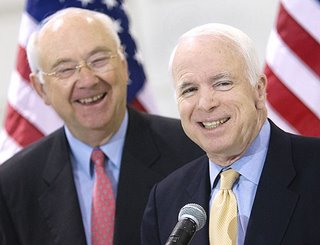
John McCain with economic advisor and former Texas senator Phil Gramm.

The Week That Should Have Ended McCain’s Presidential Hopes
By Max Bergmann / July 10, 2008

This is the week that should have effectively ended John McCain’s efforts to become the next president of the United States. But you wouldn’t know it if you watched any of the mainstream media outlets or followed political reporting in the major newspapers

During this past week: McCain called the most important entitlement program in the U.S. a disgrace, his top economic adviser called the American people whiners, McCain released an economic plan that no one thought was serious, he flip flopped on Iraq, joked about the deaths of Iranian citizens, and denied making comments that he clearly made — TWICE. All this and it is not even Friday! Yet watching and reading the mainstream press you would think McCain was having a pretty decent political week, I mean at least Jesse Jackson didn’t say anything about him.

But let’s unpack McCain’s week in a little more detail.

1. McCain unambiguously called Social Security “an absolute disgrace.” This is not a quote taken out of context. John McCain called one of the most successful and popular government programs, which uses the tax revenues of current workers to support retirement benefits for the elderly “an absolute disgrace.” This is shocking – and if uttered from Obama’s mouth would dominate the news coverage and the Sunday shows, as pundits would speculate about the massive damage the statement would cause him among retirees in Florida.

2. McCain’s top economic policy adviser calls Americans a bunch of “whiners” for being worried about the slumping economy. Words cannot fully explain how devastating this statement should be from Phil Gramm. You would think it would be enough to sink McCain’s campaign. Of course McCain only thinks that the economic problems are psychological.

3. Iraqi leaders call for a timetable for U.S. withdrawal, McCain gets caught in a bizarre denial and flip flop. The Iraqis now want us to begin planning our withdrawal – McCain however wants to stay foooorrreeevvveerrrr. So what does McCain say – First, he refuses to accept Maliki’s statement as being true. Then he concedes that it was an accurate statement, but was probably just a political ploy to curry favor with his own people and WOULD NOT influence his determination to keep US troops in Iraq indefinitely. Yet, McCain in 2004 at the Council on Foreign Relations said that if the Iraqis asked us to leave, we would have to go. No matter what. But that was apparently a younger and less experienced John McCain.

But let’s just look at his comment that Maliki’s statement is “just politics.” If that is true, then it must also be true that the American military presence in Iraq is so unpopular with Iraqis that the government is forced to push for a timetable in order to survive at the ballot box. That’s a reason to stay for 100 years.

4. McCain’s economic plan to cut the deficit has no details and is simply not believable. There are so many things here. McCain pledges he would eliminate the deficit by the end of his first term (the campaign latter flip flop flipped about whether it was four years or eight years), but does not provide any details about how he would do it. Economists on both sides of the political aisle said that this was simply not believable, especially given McCain’s other proposals to a) cut individual and corporate taxes even further, b) extend the Bush tax cuts and c) massively increase defense spending on manpower (200,000 more troops) and d) maintain a long-term sizable military presence in Iraq.

5. McCain’s deficit plan includes bringing the troops home represents a major Iraq flip-flop. Speaking of the long-term military presence – a story that has gotten absolutely no attention is that McCain now believes the war will be over soon. The economic forecasts made by his crack team of economists predict that there will be significant savings during McCain’s first term because we will have achieved “victory” in Iraq and Afghanistan. The savings from victory (ie the savings from not having our troops there) will then be used to pay down the deficit. The only way this could have any impact on the deficit in McCain’s first time is if troop withdrawals start very soon. So McCain believes victory is in our grasps and we can begin withdraw troops from Iraq pretty much right away — doesn’t sound that different from Obama’s plan does it. Someone should at least ask McCain HOW HE DEFINES VICTORY – and why he thinks we will achieve it in the next couple of years.

6. McCain campaign misled about economists support. In the major press release the McCain campaign issued to tout its Jobs for America economic plan that would balance the budget in 4 years, it included the signatures of more than 300 economists who the campaign claimed to support the plan. Only problem is that the economists were actually asked to sign up to SOMETHING COMPLETELY DIFFERENT. Um, hello?

7. McCain makes a joke about killing Iranians. Haha… that’s just McCain being McCain. I am sure that is exactly how it is being reported in Tehran. This guy is running for President not to become a talk radio pundit. Yet according to the AP this was just a humanizing moment between candidate and spouse – I am not sure when joking about the deaths of civilians became humanizing.

8. McCain denies, flatly, that he ever said that he is not an expert in economics. Are you kidding?

9). McCain distorts his record on veterans benefits in response to a question from Vietnam Veteran, who then proceeds to call McCain out on it.

10.) McCain demonstrates he knows nothing about Afghanistan and Pakistan. McCain said “I think if there is some good news, I think that there is a glimmer of improving relationship between Karzai and the Pakistanis.” Pat Barry notes how crazy this comment is…”Just what “glimmer” is McCain talking about?? Maybe he’s referring to President Karzai’s remarks last month, which threatened military action in Pakistan if cross-border attacks persisted? Or maybe McCain is talking about Afghanistan’s allegations that Pakistan’s ISI was involved in a recent assassination attempt on Karzai? Maybe in McCain’s world you could call that a silver-lining, but in reality-land I’d call it something else.”

Any one of these incidents and comments would dominate the news cycle if they came from the Obama campaign. Yet McCain barely gets a mention. The press like to see themselves as political referees – neutral observers that call them like they see em’. But they want this to be a horse race and so all the calls right now are going one way. How else can you explain the furor last week over the Obama “refine” comment – which represented zero change in Obama’s position on Iraq – and the “swift boat” mania over Wesley Clark’s uncontroversial comments (psss… by the way McCain exploits his POW experience in just about every ad – yet he says he doesn’t like to talk about it).

This Sunday expect the ten incidents above to get short shrift from pundit after pundit, because after all Jesse Jackson said he wanted to cut Obama’s nuts off.

Source.

The Rag Blog

Posted in RagBlog | Tagged , | Leave a comment

FISA Bill Challenged in Court

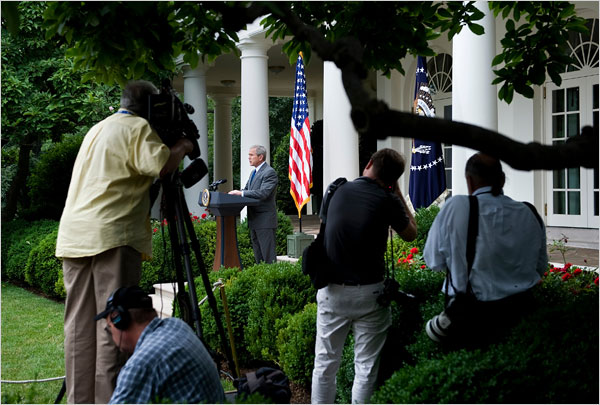
President Bush, in the Rose Garden on Wednesday, called the wiretapping bill “long overdue” and crucial to national security. Photo by Brendan Smialowski / NYT.

Bush Signs Spy Bill, ACLU Sues
By Ryan Singel / July 10, 2008

The American Civil Liberties Union filed suit Thursday over a controversial wiretapping law, challenging the constitutionality of the expanded spy powers Congress granted to the president on Wednesday.

The federal lawsuit was filed with the court just hours after Bush signed the bill into law.

The ACLU is suing on behalf of journalist and human rights groups, asking the court put a halt to Congress’s legalization of Bush’s formerly secret warrantless wiretapping program. The ACLU contends (.pdf) the expanded spying power violates the Constitution’s prohibition on unreasonable searches and seizures.

On Wednesday, the Senate gave final congressional approval to a massive expansion of the Foreign Intelligence Surveillance Act, finishing a year of debate over how far the U.S. government should be able to conduct blanket surveillance using telecom facilities inside the United States.

In passing the FISA Amendments Act, Congress gave the executive branch the power to order Google, AT&T and Yahoo to forward to the government all e-mails, phone calls and text messages where one party to the conversation is thought to be overseas. President Bush signed the bill into law Thursday morning, describing it as a bill that “protect[s] the liberties of our citizens while maintaining the vital flow of intelligence.”

The ACLU contends those blanket powers to grab international communications of Americans without specific court orders violate the Fourth Amendment and would stymie journalists who often speak to confidential sources outside the country.

Plaintiff Naomi Klein, the liberal columnist and author, said the surveillance would compromise her writing about international issues.

“If the U.S. government is given unchecked surveillance power to monitor reporters’ confidential sources, my ability to do this work will be seriously compromised,” Klein said.

Longtime foreign correspondent Christopher Hedges admits that surveillance is not a new obstacle for journalists, but says this goes a step too far.

“There is a lot of monitoring that goes on especially when you are overseas,” Hedges said. “But this creates a further erosion in my ability to work as a journalist.”

The suit, filed in the U.S. District Court for the Southern District of New York Thursday, asks the judge to stay the implementation of the new powers, until its constitutionality is determined.

The Electronic Frontier Foundation, which has spearheaded the still ongoing lawsuits against the nation’s telecoms, will challenge the provision of the bill that gives retroactive amnesty to telecoms that are being sued for helping the government spy on Americans without warrants.

They argue that Congress’s attempt to have citizen lawsuits dismissed violates the separation of powers.

But the San Francisco-based online rights group also announced in a fund-raising letter on Thursday that it would also challenge the constitutionality of the bill’s expanded spying powers.

“We are also preparing a new case against the government for its warrantless wiretapping, past, present and future,” said EFF senior staff attorney Kevin Bankston, who said the details were being withheld to keep the element of surprise.

“But suffice to say it will be quite different from the other cases against the government that have been filed so far,” Bankston said. “Like with our case against AT&T, however, the ultimate goal will be the same: to halt the mass interception of Americans’ communications and to dismantle the dragnet spying network that was first exposed by our witness, AT&T whistleblower Mark Klein.”

Source. / Wired.com

The Rag Blog

Posted in RagBlog | Tagged , , , , , , | Leave a comment

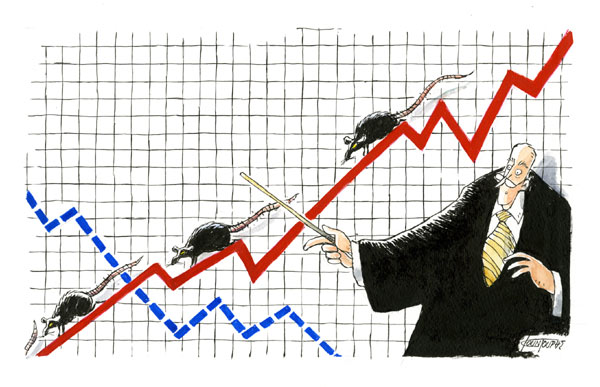
Drawn and Quartered

Michael Kountouris, Greece

The Rag Blog / Posted July 10, 2008

Posted in RagBlog | Tagged , , | Leave a comment

Friendly Skies Dept : Want Some Torture With Your Peanuts?


Airline bracelet id would double as stun device
By Jeffrey Denning

Just when you thought you’ve heard it all…

A senior government official with the U.S. Department of Homeland Security (DHS) has expressed great interest in a so-called safety bracelet that would serve as a stun device, similar to that of a police Taser®. According to the promotional video (view video below) found at the Lamperd Less Lethal, Inc. website, the bracelet would be worn by all airline passengers.

This bracelet would:

• Take the place of an airline boarding pass

• Contain personal information about the traveler

• Be able to monitor the whereabouts of each passenger and his/her luggage

• Shock the wearer on command, completely immobilizing him/her for several minutes

The Electronic ID Bracelet, as it’s referred to, would be worn by every traveler “until they disembark the flight at their destination.” Yes, you read that correctly. Every airline passenger would be tracked by a government-funded GPS, containing personal, private and confidential information, and would shock the customer worse than an electronic dog collar if the passenger got out of line.

Clearly the Electronic ID Bracelet is a euphemism for the EMD Safety Bracelet, or at least it has a nefarious hidden ability (thus the term ID Bracelet is ambiguous at best). EMD stands for Electro-Musclar Disruption. Again, according to the promotional video, the bracelet can completely immobilize the wearer for several minutes.

So is the government really that interested in this bracelet?

Apparently so.

According to this letter from DHS official, Paul S. Ruwaldt of the Science and Technology Directorate, office of Research and Development, which was written to the inventor whom he had previously met with, Ruwaldt wrote, “To make it clear, we [the federal government] are interested in . . . the immobilizing security bracelet, and look forward to receiving a written proposal.”

The letterhead, in case you were wondering, is from a U.S. Department of Homeland Security office at the William J. Hughes Technical Center at the Atlantic City International Airport, or the Federal Aviation Administration headquarters.

In another part of the letter, Mr. Ruwaldt confirmed, “It is conceivable to envision a use to improve air security, on passenger planes.”

Would every paying airline passenger flying on a commercial airplane be mandated to wear one of these devices? I cringe at the thought. Not only could it be used as a physical restraining device, but also as a method of interrogation, according to the same aforementioned letter from Mr. Ruwaldt.

Would you let them put one of those on your wrist? Would you allow the airline employees, which would be mandated by the government, to place such a bracelet on any member of your family?

Why are tax dollars being spent on something like this?

Is this a police state or is this America?

Source. / The Washington Times / Posted July 3, 2008

Promotional Video:
Govt-Issued Stun Bracelets for Airline Passengers

Thanks to Jim Baldauf / The Rag Blog

Posted in RagBlog | Tagged , , | Leave a comment

David Gray : Don’t Use My Music at Guantanamo


Singer-songwriter speaks out against music used in torture
By Andy Worthington

Singer-songwriter David Gray has taken a brave stand by complaining about the use of his music as torture by the US military in “War on Terror” prisons in Guantánamo, in Iraq, and in secret prisons run by the CIA.

On BBC Radio 4’s The World Tonight, singer-songwriter David Gray spoke out against the use of music as torture by the US military.

Gray’s chart-topping song Babylon, played repeatedly at ear-piercing volume, is one of dozens of songs, by artists including Eminem, Bruce Springsteen, Rage Against the Machine and Britney Spears, that has been used by the US military as part of a package of “enhanced interrogation techniques,” intended to “break” prisoners held without charge or trial in the “War on Terror” — in Guantánamo, in Iraq, and in secret prisons run by the CIA.

As the Guardian recently explained, the use of Babylon first came to light “after Haj Ali, the hooded man in the notorious Abu Ghraib photographs, told of being stripped, handcuffed and forced to listen to a looped sample of Babylon, at a volume so high he feared that his head would burst.”

Complaining that the only part of the torture music story that gets noticed is its “novelty aspect” — which he compared to “Guantánamo[‘s] Greatest Hits” — Gray delivered a powerful indictment of the misappropriation of his and other artists’ music.

“What we’re talking about here is people in a darkened room, physically inhibited by handcuffs, bags over their heads and music blaring at them for 24 hours a day, seven days a week,” he told the BBC. “That is torture. That is nothing but torture. It doesn’t matter what the music is — it could be Tchaikovsky’s finest or it could be Barney the Dinosaur. It really doesn’t matter, it’s going to drive you completely nuts.” He added, “No-one wants to even think about it or discuss the fact that we’ve gone above and beyond all legal process and we’re torturing people.”

This is the second time that Gray has spoken out about the use of music as torture. Two weeks ago, he explained, “The moral niceties of whether they’re using my song or not are totally irrelevant. We are thinking below the level of the people we’re supposed to oppose, and it goes against our entire history and everything we claim to represent. It’s disgusting, really. Anything that draws attention to the scale of the horror and how low we’ve sunk is a good thing.”

Reprieve, the legal action charity that represents over 30 prisoners at Guantánamo, recently launched an initiative, Pull the Plug on Torture Music, encouraging artists to sign up to prevent the use of their music as part of the US military’s torture techniques, to insert a clause in their contracts preventing the misuse of their music, and, in general, to raise awareness of the issue by spreading the word and playing anti-torture gigs.

Others who have signed up for Reprieve’s initiative include Massive Attack (who recently hosted a series of Reprieve events at their Meltdown festival at London’s Southbank Centre), Alabama 3, Elbow, the Magic Numbers, Seize the Day, and Tom Morello of Rage Against the Machine, who told Spin magazine in 2006, “The fact that our music has been co-opted in this barbaric way is really disgusting. If you’re at all familiar with ideological teachings of the band and its support for human rights, that’s really hard to stand.”

Whether you like David Gray’s music or not should be irrelevant. He understands what’s really going on with the use of music as torture, and he’s been brave enough to raise his head above the parapet, which is not something that musicians are always prepared to do.

Andy is the author of “The Guantánamo Files: The Stories of the 774 Detainees in America’s Illegal Prison” (published by Pluto Press/the University of Michigan Press).

Source. / DC Indymedia / Posted July 3, 2008

The Rag Blog

Posted in RagBlog | Tagged , , , , | 1 Comment

Julian E. Barnes :
No Surprise from the Most Murderous Nation

George Bush won't sign the ban on cluster bombs. Do the right thin sign the ban.

Activists decry new Pentagon policy on cluster bombs

By Julian E. Barnes | July 10, 2008

They say that taking 10 more years to eliminate the munitions with the highest failure rate for their bomblets ‘is completely inadequate from a humanitarian point of view.’

WASHINGTON — Human rights advocates Wednesday attacked a new Pentagon policy on cluster bombs, saying the military’s effort to build a safer version of the controversial weapon was misguided and likely to fail.

The three-page policy, formally released Wednesday, describes cluster bombs, which release tiny bomblets over a relatively wide area, as “legitimate weapons with clear military utility.”

But critics say the weapons have a high failure rate. Many bomblets may not explode on contact, and later can be accidentally triggered by civilians.

The new policy is designed to reduce the danger of unexploded bomblets by mandating that bombs with a “dud rate” higher than 1% will not be used after 2018. Until then, the use of a cluster bomb with a higher failure rate must be approved by regional commanders.

“For the U.S. to take another 10 years to eliminate the worst of the cluster munitions is completely inadequate from a humanitarian point of view,” said Bonnie Docherty, an arms researcher with Human Rights Watch.

In May, 111 nations, including Britain, endorsed an international ban on the use of cluster munitions. The move was a snub to the United States, Russia, China and Israel, which have opposed prohibitions on use of the munitions.

Each bomb contains several hundred smaller explosive devices, and the U.S. inventory includes a total of about 720 million of the bomblets. The Pentagon adopted a policy in 2005 banning acquisition of cluster bombs with a dud rate higher than 1%, but the inventory contains many munitions purchased before then.

The military has tried to find a weapon that can achieve a failure rate of 1% or lower, said Steve Goose, director of the arms division at Human Rights Watch. “There has been no production of cluster munitions because they cannot meet the standard in the cost range they want,” he said.

Human rights groups say that many have a failure rate of 16% or greater, and that even the improved weapons have had a higher failure rate on the battlefield.

“The military and manufacturers’ claims are one thing, and the reality of what happens in combat are another,” Goose said.

Air Force Lt. Col. Almarah K. Belk, a Pentagon spokeswoman, said certain situations may require the use of cluster bombs, citing as an example the presence of militants on the roof of a building occupied by civilians. A cluster bomb dropped on the roof could kill or injure the militants without destroying the building, she said.

“It is not pretty; nothing about war ever is,” Belk said. “It’s not always your first choice. . . . But the other alternatives aren’t good choices either. They would cause a lot more civilian injury, loss of life, a lot more infrastructure damage.”

Goose rejected that scenario, saying the use of a cluster bomb in a populated area should never be permitted.

“You can’t target one house. You will be littering the entire area with little land mines,” he said.

He said he was puzzled by the new policy because it is at odds with the push to use more precise low-yield weapons.

“It’s totally counter to the trend of being ever more concerned with collateral damage,” Goose said.

Source / Los Angeles Times

The Rag Blog

Posted in RagBlog | Tagged , | Leave a comment

Can’t Fall On Your Fannie Mae

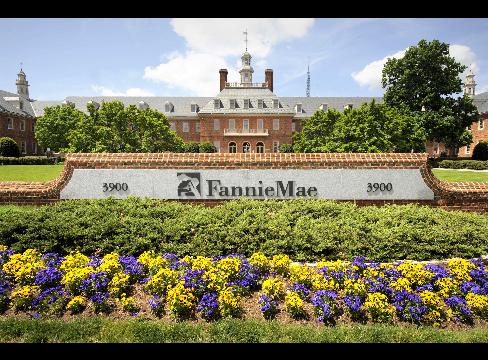
Flowers grow in front of the headquarters of Fannie Mae in Washington. Photo by Ken Cedeno / Bloomberg News.

So lets see if I have things straight. The feds can’t just bail out Freddie and Fannie because that might cause the dollar to collapse. So they can’t do that.

But there is this $1.5 trillion in unprofitable real estate loans so the private investors are bailing out. So its time for the fed to swagger up to the stock market and use its 2.5 billion x 2 = $5 billion default cash accessible to reassure the market.

But the fed is financially out-gunned by a factor of three hundred to one in the cash it can currently use to reassure investors, who probably read the newspapers. So Paulson is begging Congress for bailout cash that could make Bear Stearns look small by comparison.

But whatever it takes, its still worth it because we’re trying to save the dollar, right?

Because if the dollar crashes, then oil might get so expensive we can’t afford to drive to work. Drive to work from the nice suburban homes that we financed with the Freddie and Fannie loans.

Roger Baker / The Rag Blog / July 10, 2008

Fannie, Freddie Are Too Big to Fail, Lawmakers Say
By Dawn Kopecki / July 10, 2008

Fannie Mae and Freddie Mac, the largest buyers of U.S. home loans, are too big for the government to let them fail, leading Republican and Democratic lawmakers said.

The government-chartered companies, which own or guarantee about half the $12 trillion of U.S. mortgages, can count on a federal lifeline, said Republican Senator John McCain, of Arizona, and Democratic Senator Charles Schumer, of New York.

The remarks by the presumptive Republican presidential candidate and the head of the congressional Joint Economic Committee followed a slide in the firms’ shares to the lowest level since 1991. They indicate Congress would push the administration to use government funds to prevent the companies from failing and threatening a deeper housing recession.

“They must not fail,” McCain said today during a campaign stop in Belleville, Michigan. Fannie Mae and Freddie Mac “are vital to Americans’ ability to own their own homes,” he said at an earlier stop in the state, one of the worst affected by the surge in foreclosures.

Central banks, pension funds and other investors hold $5.2 trillion in debt sold by the companies.

While bondholders can count on a backstop, equity investors can’t expect the government to halt a tumble in the companies’ shares, Representative Spencer Bachus, the senior Republican on the House Financial Services Committee, said today.

Fannie Mae slid 14 percent today to close at $13.20 in New York, down 67 percent this year. Freddie Mac declined 22 percent to close at $8, bringing its slump since the end of December to 77 percent.

`Continued Woes’

Stockholders should be prepared for more “difficulties,” said Kevin Flanagan, a fixed-income strategist in Purchase, New York, for Morgan Stanley’s individual investor clients. “Continued woes, continued difficulties are the expectation, and this is going to take a while to play itself out.”

Freddie Mac owed $5.2 billion more than its assets were worth in the first quarter, making it insolvent under fair-value accounting rules. The fair value of Fannie Mae assets fell 66 percent to $12.2 billion, data provided by the Washington-based company show, and may be negative next quarter, former St. Louis Federal Reserve President William Poole said.

“Markets should be assured that the federal government will stand by Fannie Mae and Freddie Mac,” Schumer said in a statement today. They “are too important to go under,” and Congress “will act quickly” if necessary, he said.

Central Role

Fed Chairman Ben S. Bernanke and Treasury Secretary Henry Paulson, while noting the central role of Fannie Mae and Freddie Mac in ending the mortgage-finance crisis, today refrained from endorsing any extra federal backing for the companies.

The companies “are playing a very important and vital role right now,” Paulson said in testimony to the House Financial Services Committee. They “need to continue to play an important role in the future,” he said.

Fannie Mae and Freddie Mac “are well capitalized now” in “a regulatory sense,” Bernanke told the panel. Still, the companies, like all financial institutions, need “to expand their capital bases so that they can be even more proactive in providing credit and support for the economy,” the Fed chief said.

The federal government can’t afford to take over all of Fannie Mae’s and Freddie Mac’s operations, because such a move would more than double federal government debt outstanding and “have disastrous consequences for the dollar,” said Joshua Rosner, an analyst with Graham Fisher & Co. Inc. in New York.

Limited Liability

Instead, the government could move the companies’ combined $1.5 trillion investment portfolios into a separate limited liability corporation that would gradually liquidate the assets, Rosner said. Fannie Mae and Freddie Mac would still be able to support the U.S. housing market by packaging home loans into securities they guarantee.

The U.S. Treasury, which analysts said would play a central role in any rescue of the firms, currently has the authority to buy $2.25 billion in each of the companies’ debt.

Congress created Fannie Mae during the Great Depression to revive the housing market and formed Freddie Mac in 1970. While a federal rescue is “premature,” Representative Paul Kanjorski said lawmakers should prepare for more trouble.

“I don’t think any of us could anticipate all the contingencies that can happen,” said Kanjorski, a Democrat from Pennsylvania. “We recognize that we’re in very dangerous waters, very stormy. We should have contingencies.”

Rescue Option

A rescue shouldn’t be an option, said Representative Jeb Hensarling, chairman of the fiscally conservative Republican Study Committee.

“The government should not be supporting the system as is,” said Hensarling, of Texas. Fannie Mae and Freddie Mac are a “government-sanctioned duopoly” that “no longer helps the market in the way that it once did” while posing “a huge systemic risk” to the economy.

In a sign that bondholder confidence is firm, the difference in yields between Fannie Mae’s 10-year notes and 10- year U.S. Treasury bonds narrowed by 2.2 basis points today from a four-month high of 89.9 basis points Monday. Freddie Mac’s yield narrowed 2 basis points relative to 10-year Treasuries from a four-month high Wednesday of 96 basis points.

The Office of Federal Housing Enterprise Oversight, the companies’ regulator, said today it deemed Fannie Mae and Freddie Mac “adequately capitalized.”

Investors should heed Ofheo’s comments, said House Financial Services Committee Chairman Barney Frank, a Massachusetts Democrat. “I would hope that people would not react to a sense of panic or whatever and would look at the reality and that we’ll be okay,” Frank told reporters.

Source. / Bloomberg

Posted in RagBlog | Tagged , , , , | Leave a comment

G8 : Determined to Kill Off the World’s Poor


The G8: Humanitarian Failure and Making the World Safe for Corporate Power
by Robert Weissman / July 10, 2008

It’s hard to dismiss the temptation to write off the G8 meetings as a meaningless talkfest.

On the other hand, when the political leaders of the most powerful countries get together and issue joint statements, it may be worth looking at what these planetary stewards have in mind. This is particularly true at a time when new global crises — skyrocketing oil prices, the spike in food prices, the impact of the U.S. recession and accelerating global warming — are added to ongoing public health disasters and persistent global poverty.

Is it too much to expect the G8 leaders (the political leaders of the United States, Japan, Canada, Britain, France, Germany, Italy and Russia) to offer something meaningful in response to these problems?

With the G8 meeting in Hokkaido, Japan just concluded, the answer apparently is, yes.

G8 failures seem to fall into two categories: first, promise to do too little, and then renege on commitments made; second, promote harmful policies and projects.

In the first category comes the G8’s statement on global public health. Following aggressive lobbying by public health groups, the G8 agreed to reiterate its commitment to provide universal treatment for HIV/AIDS. But the rich countries have not agreed to put the money on the table to achieve this objective. “The AIDS crisis in Africa is an emergency, and reaching universal access by 2010 will require a quadrupling of spending over current levels,” explains Masaki Inaba of the Africa Japan Forum. “A restating of existing commitments is not a sufficient response by the G8.”

The dominant public health need in the world’s poorest countries is to restore the public health systems decimated by decades of International Monetary Fund and World Bank “structural adjustment” programs. The G8 leaders said only that they aim to “work toward” poor countries achieving the World Health Organization (WHO) target of 2.3 professional health workers per 1,000 people. (By contrast, according to WHO data, the United States has about 31 health workers per 1,000 people, and 56 per 1,000 if you include the category of “health management and support workers.”)

Also in the first category is the pathetic G8 statement on climate change. Dragged down most of all by the anti-leadership of the United States, the G8 announced a commitment to a 50 percent reduction in carbon emissions by 2050. Well, a sort-of commitment.

The best science says the world needs at least an 80 percent reduction from 1990 emissions levels by 2050, and very likely more, so the G8 commitment is totally inadequate on its face.

But the G8 position is even more lame than it first appears. A statement from an environmental coalition including Friends of the Earth International explained the key flaws. “First, the G8 formula is a global cut,” not imposing particular responsibility on the rich, high carbon-polluting countries. Second, “the cut has no clear baseline. It was revealing that in announcing it, Japanese Prime Minister Yasuo Fukuda initially said it was from 1990 levels, then had to take back that statement and subsequently mentioned a 2000 baseline.” Third, the statement is not binding, and “indeed, the G8 announcement reinforces the G8 as a site for climate action that rivals the UN process [for climate change negotiations] and effectively subverts it.”

In the second category of doing direct harm come many of the G8 recommendations in the declarations on the global economy and on food security.

The G8 leaders call for opening and deregulating financial markets, even as it is clear that financial deregulation has helped create the current global financial crisis.

The G8 leaders call for stronger patent, copyright and trademark monopolies. Remarkably, in a document purporting to address the key issues in the global economy, they make space to encourage rapid negotiation and completion of an Anti-Counterfeiting Trade Agreement, a deal that may hinder or criminalize peer-to-peer file sharing, require Internet Service Providers to limit consumers’ web access, and interfere with parallel trade in goods (like Canadian drugs brought into the United States), among other problems.

The G8 leaders call for completion of the Doha Round negotiations at the World Trade Organization, aiming to further deepen reliance on a global food trading system that has driven the poorest people off their land and undermined developing countries’ ability to feed themselves.

The G8 leaders also call for more aid for food-importing, poor countries — to be delivered through IMF lending facilities that typically require countries to adopt more of the market fundamentalist mandates that have driven people off the land and undermined governments’ capacity to assist the poor and pursue expansionary economic policies.

“I’m pleased to report that we’ve had significant success,” said President Bush as the G8 summit concluded.

Not exactly.

[Robert Weissman is editor of the Washington, D.C.-based Multinational Monitor, and director of Essential Action.]

Source / Common Dreams

The Rag Blog

Posted in RagBlog | Tagged , | Leave a comment

Our President : ‘Goodbye from the world’s biggest polluter’


Bush yuks it up with Prime Minister of Japan, Yasuo Fukuda, and Chinese President Hu Jintao at the G8 Summit in Tokyo. Photo by Reuters.

George Bush surprised world leaders with a joke about his poor record on the environment as he left the G8 summit in Japan.
By Robert Winnett and Urmee Khan / July 10, 2008

The American leader, who has been condemned throughout his presidency for failing to tackle climate change, ended a private meeting with the words: “Goodbye from the world’s biggest polluter.”

He then punched the air while grinning widely, as the rest of those present including Gordon Brown and Nicolas Sarkozy looked on in shock.

Mr Bush, whose second and final term as President ends at the end of the year, then left the meeting at the Windsor Hotel in Hokkaido where the leaders of the world’s richest nations had been discussing new targets to cut carbon emissions.

One official who witnessed the extraordinary scene said afterwards: “Everyone was very surprised that he was making a joke about America’s record on pollution.”

Mr Bush also faced criticism at the summit after Silvio Berlusconi, the Italian Prime Minister, was described in the White House press pack given to journalists as one of the “most controversial leaders in the history of a country known for government corruption and vice”.

The White House apologised for what it called “sloppy work” and said an official had simply lifted the characterisation from the internet without reading it.

Concluding the three-day event, leaders from the G8 and developing countries proclaimed a “shared vision” on climate change. However, they failed to bridge differences between rich and emerging nations on curbing emissions.

Source. / Telegraph, U.K.

Thanks to Harry Edwards / The Rag Blog

Posted in RagBlog | Tagged , , , , | Leave a comment

David Sirota on Building a Progressive Movement


Five Ideas to Start Going from Uprising to Movement
By David Sirota / July 9, 2008

David Sirota is a senior editor at In These Times magazine and contributes regularly to The Nation, the American Prospect and the Huffington Post. He is the author of “The Uprising: An Unauthorized Tour of the Populist Revolt Scaring Wall Street and Washington.”

Jared Bernstein asks, “What steps ought we be taking now that will ultimately give progressive uprisings a public conduit through which their goals can be achieved?”

This is the $64,000 question – or, in the age of the Iraq War, the $1 trillion question.

Based on my reporting for The Uprising, here are five concepts I think we need to get comfortable with – one is about our focus, one is about structure, one about what we organize around, ]one is about what instruments of influence we use, and one is about the methods we must rekindle:

Think Global, Demand Local…

Or, Stop Obsessesing About Chris Matthews and Start Obsessing About Your State Legislator: The subject of my upcoming newspaper column this week is the incessant focus on federal politics to the exclusion of everything else. In the blogosphere, this myopia is magnified, as more bandwith is spent fretting over what MSNBC’s Chris Matthews tells his tiny, inside-the-Beltway audience than what our own state legislator is doing to screw us over.

There is a huge amount of power at the state and local level that progressives haven’t used effectively, in part, because we haven’t spent much time trying to use it. According to the Progressive States Network, more than a quarter of all Americans live in states that have both a Democratic governor and full Democratic control of the legislature. Yet, as many good bills that have passed through these legislatures, none of these states have taken truly revolutionary steps. Again, that’s because we haven’t focused nearly the resources and attention that we could – and should – be focusing on these arenas.

End the Oxymoron of Autocratic Progressivism:

Autocratic Progressives, as I discussed yesterday, are those who think you can build a progressive movement with anti-progressive, autocratic, top-down, command-and-control structures. This is elitism at its worst. If we want to take this uprising moment and channel it into a progressive movement, then the movement institutions we build have to be small-d democratic. Sadly, most of the much-vaunted new progressive infrastructure – from Moveon.org to well-funded left-leaning think tanks in Washington, D.C. – run the gamut from mostly undemocratic to completely undemocratic. That’s not the way to build a movement – and I say that not just from a moral, pro-democratic standpoint, but from a pragmatic one.

There’s a reason the most durable and powerful social movement in human history has been – and remains – the labor movement: it’s because that movement is structurally democratic. The labor movement elects leaders at all levels. Now, I’m not saying there haven’t been examples of labor leaders trying to thwart democracy – I’m not saying that at all. But what I am saying is that at the structural level, the labor movement is democratic – and that democratic structure has given members a sense of ownership and control over their movement that does not exist in undemocratic institutions. If we want this uprising to become a progressive movement, we have to get serious about our commitment to democracy.

It’s the Economic Issues, Too:

For about a quarter century now, the Democratic Party has defined its orthodoxies only on social issues – choice, civil rights, guns, etc. – not on economic ones. To know this is true, consider this hypothetical: If a pro-choice, pro-NAFTA congressperson was proposed as the keynote speaker at the Democratic National Convention, this would be billed as not controversial, but if an anti-choice, anti-gay-marriage, anti-NAFTA congressperson was proposed as that speaker, it would be labeled a major controversy. The orthodoxy, you see, is on the social issue – not on the economic one.

Let me be clear – social issues are really, really important (and, of course, I am pro-choice). But the problem is that the orthodoxy is ONLY about social issues (the issues that are unfortunately more culturally divisive) – but not about economic issues (the issues that are more cross-culturally unifying). To build this uprising into a full-fledged progressive movement, that has to change. Movements are about building wide coalitions – and the uprising I describe in the book shows the potential for trans-partisan, trans-geographical, trans-cultural coalitions if progressives and the Democratic Party drop the limousine liberalism that says as long as a politician is, say, pro-choice, it’s OK for that politician to support, say, job-killing trade policies that have decimated the heartland. The most powerful movements of the the past have been those that have powerful economic and class underpinnings.

Elections Are Means, Not Ends:

The flag-pin-fetishizing media tries to make us believe that elections – and specifically federal elections – are the ends, rather than the means. This is amplified by a progressive movement that is still struggling with Partisan War Syndrome – the sickness that says the only thing we have to do is elect Democrats and our problems are solved. The entire frame of mind is, of course, idiotically paternalistic – we believe that the messianic politicians will just hand down change from Mt. Olympus, that all we have to do is make sure the right messiah is on top of the mountain, and that trying to use an election to pressure that messiah will threaten the messiah’s ascent.

This is not how power works – or has ever worked – in American history. Jefferson Smith is right – the most successful movements have been those that meld the best of populism and progressivism, and I would add to that – those that have used elections as instruments of pressure: They have used the politicians’ desperate desire to win election as a way to get policy concessions and seen politicians as vehicles for change, not change unto themselves. When we tamp down that pressure system, or try to transform a potential pressure system like the blogosphere into merely an amplifier of one party or politician, we ignore this history. As Dan Cantor of the Working Families Party told me when I reported on third-party politics, the best kind of politician is a nervous politician – because you can get a nervous politician to be your vehicle if you have done the hard, unglamorous work in the lead-up to organize your movement.

Remember That Thing Called Direct Action:

Along with the paternalistic view of politicians that comes from the obsession with federal elections comes the potential to forget about direct action: the actions outside the electoral arena that can change things. In my book, I detail a number of these – most prominently, the shareholder democracy and labor movements.

The Establishment wants us to focus all of our energy on elections because elections are the controlled space whereby popular ferment can be contained by rules, regulations, etc. And without direct action, republican democracy is truly disempowering: our only means of influence are to beg the Very Serious And Important Intermediary – the congressman, the governor, the president, etc. – to do something on our behalf. But there are many different methods of direct action – ie. taking matters into our own hands – that can wield a tremendous amount of power.

Right now, the labor movement could go out and organize another 10 million workers without a single policy change in Washington, D.C. – and if labor did that, it would increase its power not just in the electoral arena, but in employer-employee negotatiations – the place where the real rubber hits the road on issues like wages, health care, etc. This would be an example of direct action.

I’m not saying this would be easy – nor am I saying labor isn’t trying to do this already, nor am I saying who is in office wouldn’t make it harder or easier for labor unions to accomplish this organizing task. But when I met with organizers at WashTech (the union trying to organize high-tech workers in the Pacific Northwest), they were way less concerned about who is president and who is in Congress than they were about whether they could simply go out and convince enough workers to join their union. Same thing with shareholder activists that I accompanied to ExxonMobil’s 2007 shareholder meeting. These activists weren’t focused on who is ahead in the presidential polls – they were focused on getting as many shareholders to vote for their resolution.

This is the lost legacy of direct action – a legacy that progressives must spend a lot more time rekindling.

Source. / Talking Points Memo

Find The Uprising: An Unauthorized Tour of the Populist Revolt Scaring Wall Street and Washington by David Sirota at Amazon.com.

Thanks to Carlos Lowry / The Rag Blog

Posted in RagBlog | Tagged , , , , , | Leave a comment