Racist Obama Doll Lives

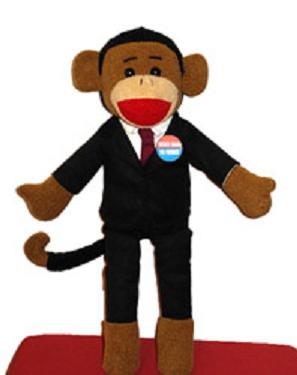
The Sock Obama doll

Creators of The Sock Obama
seek new company to produce doll

By Sheena McFarland / June 18, 2008

A stuffed sock monkey doll dressed as and named after presidential candidate Barack Obama may not be shelved just yet, despite cries of racism from around the country.

David and Elizabeth Lawson, the doll’s creators who live in West Jordan, released a lengthy statement, ending with the sentiment “We hope to meet again soon in a new venue.”

Apparently that new venue is http://sockpoliticians.com. The Web site has the same doll, description and format as the Lawsons’ previous site.

The statement said the mass production of the doll, and the upcoming Sen. John McCain take – JohnnieMcSock – are canceled. However, that comes because Binkley Toys Inc., the Canadian company originally hired to mass produce the doll, pulled out after receiving multiple e-mails pointing out the racist nature of the doll. Binkley owner Rob Bishop – who is not related to Utah Rep. Rob Bishop – called his choice to make a prototype “naive,” but apologized and refused to make the doll.

While West Jordan’s The Sock Obama is issuing refunds to those who had pre-ordered the doll from the United States, Canada, United Kingdom and Australia, the company hopes to find a new manufacturer for their doll.

The Lawsons called the outcry of racism a hypocritical double standard as “thousands of Google sites” contain depictions of President Bush as a chimpanzee.

“In the good ol’ fashion spirit of entrepreneurialism, free enterprise has been censored, and TheSockObama politically plush toy has been discriminated against in the marketplace of the United States of America,” the statement read.

The Lawsons’ statement also said the creators of the puppet are not members of The Church of Jesus Christ of Latter-day Saints, and asked people to “kindly refrain from unkind remarks about our neighbors and friends of the Mormon faith whom we love and hold dear.”

The Lawsons pointed to “the blogging dens of resistance” that have flooded them with e-mails in protest.

“Last we heard, a posse of bloggers from back East are on their way over to conduct – how did they phrase it? – a good ol’ fashioned KKK house burning party at David and Elizabeth’s. Kinda exciting stuff, but this in America?” it stated.

The desire to continue to manufacture the doll is a shift from the Lawsons’ original statement that they did not realize that depicting a black man as a monkey would carry any implications of racism.

That the company is considering pushing ahead with the manufacturing of the doll astounds Charles Henderson, a black Kearns Democrat running for a seat in Utah’s House of Representatives.

“After you’ve been told it’s not acceptable, why do you pursue this unless it’s motivated by financial gain, notoriety or some other more malicious path that you’re trying to take?” Henderson said. “I don’t see a reason why they would go down that path. It’s not acceptable. I hope no one buys it.”

Henderson also wonders who the Lawsons are targeting as their audience after hearing from people such as Jeanetta Williams, president of the local chapter of the National Association for the Advancement of Colored People, who calls the doll “pure racism at its extreme.”

Source. / Salt Lake Tribune

The Rag Blog

Posted in RagBlog | Tagged , , , | 2 Comments

Obama Accuser Has Long Rap Sheet

The Pueblo County Sheriff’s website, which pictures Sinclair under the word ‘Wanted,’ cites felony theft and forgery charges. Courtesy Politico.

Specializes in “Crimes Involving Deceit”
By Ben Smith / June 18, 2008

Larry Sinclair is wanted in Colorado, but you can catch him today (Wednesday, June 18) at the National Press Club.

Sinclair is familiar to political junkies and reporters as the source of outlandish allegations about Senator Barack Obama, tales that began with sex and drugs and moved on to murder.

The Duluth, Minn., resident is the sort of figure who appears at the margins of every presidential campaign, and both Presidents George W. Bush and Bill Clinton had their own obscure accusers with dramatic allegations. But as the old media ignores him, Sinclair has taken full advantage of the Internet, and a video in which he makes his claims that have been viewed more than 900,000 times on YouTube.

This afternoon, he’s reserved the Holeman Lounge at downtown Washington’s National Press Club to try to lend his story the legitimacy that comes with national media attention.

Sinclair’s biography, though, may get in the way of that pitch: Public records and court filings reveal that he has a 27-year criminal record, with a specialty in crimes involving deceit. The record includes forgery charges in two states, one of which drew Sinclair a 16-year jail sentence. The Pueblo County, Colo., Sheriff’s Office also has an outstanding warrant for Sinclair’s arrest for forging an acquaintance’s signature and stealing her tax refunds.

“It is what it is,” said Sinclair’s spokesman, Montgomery Blair Sibley, of his client’s criminal record. “He’s not hiding from it, he’s not denying it.”

Sinclair has, however, addressed elements of his criminal past on his own blog and in court filings punctuated by unusual spellings and capitalizations.

Addressing the Pueblo County theft charges, Sinclair swore in a 2004 affidavit that his “ALLEGED VICTIM SEEKS TO USE DEFENDANT AS SCAPE GOAT FOR HER HUSBANDS AND BROTHERS PROBLEMS WITH MEXICAN DRUG DEALERS.”

Sinclair’s affidavit, which he posted to his blog, accompanied a request to a Colorado judge to dismiss the warrant on the grounds that Sinclair was “disabled with [a] severe spine injury and nerve damage,” that returning to Colorado would put his life in danger, and that he was “terminally ill.”

Sinclair, who is still alive, is 46, stands 5’7″, and weights 168 pounds, according to arrest records. Colorado records list him with 13 aliases, including “Larye Vizcarra Avila” and “Mohammed Gahanan.” His story has generally been ignored by the mainstream media, because he’s been unable to substantiate his allegations. He has come to public attention recently, however, because his planned appearance at the National Press Club drew complaints from a wide array of prominent liberal bloggers, led by Firedoglake’s Jane Hamsher. Their petition to prevent Sinclair from renting space at the club – which bloggers feared would lend him credibility – drew more than 11,000 signatures.

Press Club President Sylvia Smith said Sinclair had rented space at the club, which doesn’t censor speakers.

“I’m not aware that we’ve ever turned anybody away for content,” she said, adding that Sinclair’s allegations “don’t seem very credible.”

Politico isn’t reprinting Sinclair’s allegations because they are unsubstantiated.

This February, the website Whitehouse.com reportedly offered Sinclair $100,000 if he could pass a polygraph test verifying his claims. He took them up on it, and the site said in a press release that the polygraph organizers said his results “indicated deception.” Sinclair then suggested the polygraph’s sponsors had been bribed to skew the results against him, an allegation his lawyer, Sibley, said he would expand on at his press conference.

Sibley is best known as the lawyer for the “D.C. Madam,” the late Deborah Jeane Palfrey. Earlier this year, the Florida Bar Association suspended Sibley’s license to practice law, in part for being a “vexatious litigant,” a suspension that applies in Washington, D.C., as well.

Wednesday, Whitehouse.com has scheduled a competing press conference outside the National Press Club to discuss the results of the polygraph.

Sinclair’s brushes with the government long predate his recent interest in Senator Obama. The details of his criminal record surfaced after he filed a defamation suit in federal court in Washington, D.C., against three anonymous online critics with names like TubeSockTedD who had written, among other claims, that he was living in a mental institution at the time he allegedly met Obama. Sinclair denies the claim.

In response to his suit, a lawyer for the anonymous bloggers hired local attorneys and private investigators, and dug up details of Sinclair’s criminal record from Colorado, Florida, and South Carolina. The lawyer, Paul Levy of the nonprofit Public Citizen Litigation Group, provided his client’s filings in federal court, which are publicly available, to Politico.

The records tell the story of an itinerant life of small-time crime and bad checks, punctuated by stretches of jail time in two states.

He was first arrested on a larceny charge in 1981 in Denver, according to his Colorado arrest record, as filed in federal court. In 1985, he was convicted of theft and of forging a check in Florida, and sentenced to a year in jail, according to Florida records filed in federal court.

After the Florida episode, according to the records, he returned to Colorado, where he faced check fraud and credit card charges in 1986. Then, in 1987, he was convicted in Colorado on more serious forgery charges, and sentenced to 16 years in jail.

In prison, according to state records filed in federal court, Sinclair was disciplined 97 times for infractions including assault, threats, drug possession, intimidation, and verbal abuse, most recently in
1996.

“He has not institutionalized well,” a spokeswoman for the Colorado Department of Corrections, Liz McDonough, told the Denver Post in 1996 after a month-long Sinclair hunger strike. She said he had served time in prisons in Buena Vista, Delta, Limon and Canon City before being transferred to the state’s maximum security penitentiary in 1993.

In the summer of 1996, according to Colorado’s state court database, he began proceedings to formally change his name from LA Rye Viz. Avila to Larry Wayne Sinclair. By 1999, according to a mention in a local newspaper, he was out of jail and living in Pueblo, Colo.

The Public Citizen investigator in Colorado stated that Sinclair’s outstanding legal troubles there appear to date from 2001, and that Sinclair’s effort to convince the judge in 2004 to dismiss those charges failed. The Pueblo County Sheriff’s website, which pictures Sinclair under the word “Wanted,” cites felony theft and forgery charges.

Sinclair was also arrested and charged with disorderly conduct in South Carolina last September, according to state records filed in federal court.

Sinclair has said that he tried to contact Obama in 2007 to discuss his claims and was ignored, forcing him to go public. On January 18, 2008, a one-minute-and-42-second video was posted to YouTube. It features Sinclair, speaking in a high voice and wearing a red shirt and blue baseball cap, reciting his allegations and addressing Obama.

“I challenge you to take a polygraph test,” he says in the video.

Since then, he’s promoted and elaborated on his claims, and engaged in intense online exchanges with infuriated Obama supporters on his blog and in federal court, where Sinclair and Sibley’s defamation claim has suffered a series of legal setbacks.

Obama’s spokesman declined to comment on any aspect of Sinclair’s story, or his appearance at the press club.

Despite the warrant for Sinclair’s arrest, he appears likely to stay out of jail, as long as he stays out of Colorado. Pueblo County Undersheriff J.R. Hall said that the warrant doesn’t allow for extradition from out of state.

“I doubt very seriously we’re going to be in that jurisdiction tomorrow,” Undersheriff Hall said of Washington, D.C.

Sinclair’s notoriety, and his scheduled press conference, however, has drawn the interest of the Colorado authorities.

“We’ve notified the Federal Bureau of Investigation, and they will investigate,” Hall said.

[Disclosure: Public Citizen, which represents the bloggers Sinclair sued, also represents Ben Smith in an unrelated case.]

© 2008 Capitol News Company, LLC

Source. / Politico

The Rag Blog

Posted in RagBlog | Tagged , , , , | Leave a comment

Baracknophobia!!!!

Jon Stewart Mocks Media For Peddling
Insane Obama Rumors

June 17, 2008

On Monday night’s “Daily Show,” Jon Stewart mocked the media’s willingness to peddle insane rumors about Barack Obama — and their tendency to blame the rumor-mongering on internet sites. Calling it “Baracknophobia,” Stewart showed clips of anchor and pundits from all three cable networks repeating baseless rumors (Muslim, plagiarist, sexist, etc.) about Barack Obama (and his wife Michelle).

The highlight of the clip comes about 2:25 in, when Stewart says, “Oh, this is interesting. SomeguyI’veneverheardof.com is reporting presumptive Democratic nominee Barack Obama has lady parts. Obviously scurrilous and unfounded, we’ll examine it tonight in our special, ‘Barack Obama’s Vagina: The October Surprise In His Pants.'”

Source. / The Huffington Post

The Rag Blog

Posted in RagBlog | Tagged , , , , , , , | Leave a comment

We Love an Optimist

Iraqi Parliament

Iraq’s parliament prepares to leave Green Zone
June 17, 2008

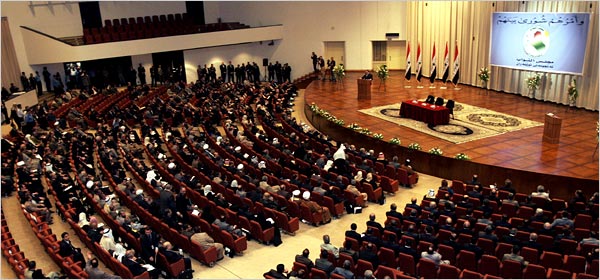
BAGHDAD — Iraq’s parliament will relocate just outside Baghdad’s fortified Green Zone compound in September for the first time since the 2003 U.S.-led invasion, a sign security is improving, the first deputy speaker said on Tuesday.

Khalid al-Attiya said top parliamentary officials had approved moving to a newly renovated building.

The plan was made possible by a drop in violence to a four-year low, a parliamentary spokesman added.

“Tomorrow the committee of security in parliament will meet the minister of interior and defence to arrange security measures for the (new) building,” Attiya said in a statement.

The three-story building to be used is a few hundred metres from the Green Zone, but clear of checkpoints that make the heavily-protected area largely inaccessible to the general public. Numerous government offices and foreign embassies are inside the sprawling Green Zone.

Attiya said the long-term plan was to build a grander structure for parliament on the banks of the Tigris River.

Mohammed Abu Bakr, a parliamentary spokesman, said it had always been parliament’s intention to move but lawmakers were waiting for violence to ease.

“Moving means there is improvement in security and we are getting closer to the people. This is what parliaments all over the world need to do,” he said.

Highlighting the fragility of security improvements in Baghdad, a car bomb in the northwestern al-Hurriya district killed 11 people and wounded 42 on Tuesday, police said.

“We don’t want to say we have no security fears, but we bet more that the situation will improve,” Abu Bakr said.} (Reporting by Khalid al-Ansary, writing by Tim Cocks, Editing by Matthew Jones)

Source / Reuters

The Rag Blog

Posted in RagBlog | Tagged | Leave a comment

Neglecting Our Responsibilities to Iraqis

Iraqi refugees on the Syrian border

Iraq: World Governments Misleading and Failing Iraqi Refugees
By Amnesty International / June 17, 2008

The international community is evading its responsibility towards refugees from Iraq by promoting a false picture of the security situation in Iraq when the country is neither safe nor suitable for return, Amnesty International said today.

In its new report, Rhetoric and reality: the Iraqi refugee crisis, which is based on recent research and interviews with Iraqi refugees, the organization said that the world’s richest states are failing to provide the necessary assistance to Iraqi refugees, most of whom are plunged in despair and hurtling towards destitution.

“Governments have done little or nothing to help Iraqi refugees, failing in their moral, political and legal duty to share responsibility for them,” said Amnesty International. “Instead, apathy and rhetoric have been the overwhelming response to one of the worst refugee crises in the world.”

Amnesty International said that the Government of Iraq and states involved in the invasion of Iraq in 2003, in particular the USA and the UK, highlight “improved” security or “voluntary” returns to Iraq out of political expedience, to demonstrate that their military involvement has been a success.

“Rhetoric cannot hide the reality that the wider human rights situation in Iraq remains dire,” said Amnesty International.

“People are being killed every month by armed groups, the Multinational Force, Iraqi security forces and private military and security guards. Kidnappings, torture, ill-treatment and arbitrary detention pervade the daily lives of Iraqis. People continue to attempt to flee, something that is now very difficult with the recent imposition of visa restrictions on Iraqis by Jordan and Syria.”

According to the latest estimates of the United Nations High Commissioner for Refugees (UNHCR), the number of Iraqis who have fled their homes has now reached 4.7 million, the highest since the US-led invasion of Iraq and the subsequent internal armed conflict.

While Syria and Jordan have shouldered most of the refugee influx, they have now resorted to drastic measures such as restricting entry and deporting people who may be at risk of persecution, partly due to the lack of support from the international community.

Having exhausted savings, many refugees are now living in complete destitution and facing new dangers, such as being forced into so-called “voluntary” return to Iraq and child labour — many families have been forced to send their children to work in the streets in a desperate bid to help them survive.

For some refugees, the difficulties they are facing in the host country are prompting them to make the difficult and dangerous decision to return to Iraq, either temporarily to collect a pension or food ration or for other such reasons, or more permanently because of their desperate situation, not because they feel they are no longer at risk of human rights abuses in Iraq.

They are making this decision as they feel they have no other option.

A 62-year-old retired Shi’a army officer, Majid, a widower with seven adult children all living in Baghdad, told Amnesty International in February that after attempting to find protection in Syria, with only the 50 lira (US$1) in his pocket, he had to return to Iraq. Even though he was extremely scared, he had lost hope, saying “If I die, I die.” Majid fled Iraq in February 2008 after two of his nephews, Mansour and Sami, aged 17 and 19, were beheaded by members of an armed group north of Baghdad. He exhausted his savings in Syria and was soon left with nothing. Weeping, he explained to Amnesty International that he had no alternative but to return to Iraq.

Many European countries are now attempting to deport Iraqis, sometimes to some of the most dangerous parts of Iraq such as the south and central regions. In addition to taking direct actions forcing Iraqis to return, they are using indirect methods such as cutting off basic assistance and services to rejected asylum-seekers in order to force them to “voluntarily” return to Iraq.

Sweden, which is host to the largest number of Iraqi refugees in Europe and once a positive example to its neighbours, has now changed its approach and is denying the vast majority of Iraqis protection and forcibly returning some to very dangerous areas.

Amnesty International is greatly concerned that the failure to respond to this crisis will worsen an already dire situation. Amongst other things, it is calling on the international community to:
• urgently and substantially raise sustainable financial assistance;
• end practices such as forcible returns that put lives at further risk;
• cease practices that result in coerced “voluntary” returns;
• allow individuals to seek paid employment; and
• extensively increase resettlement places for the most vulnerable refugees to start a new life in a third country.

Amnesty International is also calling on the governments of Syria, Jordan, Lebanon and Egypt, as well as those of other countries in the region, to allow unrestricted access to people fleeing Iraq, cease all deportations to Iraq, and grant refugees access to the labour market.

“The international community must make a true commitment to assist Iraq’s displaced people by substantially boosting sustainable financial assistance, ending forcible returns, stopping practices that result in coerced voluntary returns and offering increased numbers of resettlement places,” said Amnesty International.

Source / Information Clearing House

The Rag Blog

Posted in RagBlog | Tagged , | Leave a comment

Not for What We Believe, But Rather for What We Do


Poll: American image remains dim in Muslim world
June 15, 2008

AMMAN — The image of the United States remains overwhelmingly negative in most of the predominantly Muslim countries surveyed, a latest global poll revealed on its website.

According to the Pew Global Attitudes Project, in Jordan, one of the key regional allies of the United States, 79 percent respondents have a negative light of the world power, registering the highest unfavorable rate among the surveyed Muslim nations. Only 19 percent hold positive views.

The survey was conducted among more than 24,000 people in 24 countries between March 17 and April 21.

In Egypt, another key ally of the United States in the Middle East, 22 percent of respondents expressed a favorable view of America, while 39 percent saw the United States as an “enemy” and 19 percent as a “partner.”

Turkey, also a main ally of the United States in this region, had 12 percent of respondents expressing a favorable view of the United States, the lowest positive rate in the entire survey, with70 percent seeing America as “an enemy.”

Lebanon was the only Arab country polled where a majority of 51percent held a favorable opinion of the United States, although this sentiment was divided along sectarian lines as no Shiite respondents expressed a favorable view of the United States.

However, another major trend highlighted by the poll was that most countries held the American people in a more favorable light than the nation itself.

In Jordan, there was a gap of 17 percentage points, with 36 percent of Jordanians expressing a favorable view of the American people, compared to 19 percent of the nation.

The largest gap of favor ability ratings was found in Lebanon, where 74 percent had a favorable view of Americans, compared to 51percent of the country itself.

The Pew Global Attitudes Project, part of the Washington-based “fact tank” Pew Research Center, is a series of worldwide public opinion surveys ranging from people’s assessments of their own lives to their views about the current state of the world.

Source / China View

The Rag Blog

Posted in RagBlog | Tagged , | Leave a comment

An Interview With Noam Chomsky

Noam Chomsky at WritersMugs

In which he discusses Iran, Irag and
other matters of great import

By Wajahat Ali / June 17, 2008

“I’m absolutely deluged with requests right now, but I really would like to do this interview, I just don’t know when,” replied the 79 year old, prolific author, linguist, scholar and political dissident to the first of my many emails over a six-month correspondence. Noam Chomsky is the most cited, and perhaps most controversial, leading living public intellectual according to the 2005 Global Intellectuals Poll. Although mainstream media refuses him airtime, The New York Times states Chomsky remains one of the most “influential” intellectuals alive, constantly sought by students, Universities, activists, academic symposiums, and even world leaders like Venezuela’s Hugo Chavez.

I first met the infamous and controversial scholar activist in 2002 when I moderated a question and answer session with him at my old alma mater, U.C. California, Berkeley. [The educational and informative event was later transcribed in the book Power and Terror: Post 9-11 Talks and Interviews.] Before the program, we had a nice hour to chat, and I was impressed by his inexhaustible memory, low key demeanor, and razor sharp recollection of facts, names and dates when answering my endless questions. When I asked whether he identified himself more as a scholar or an activist, he said neither exclusively, but mentioned dissent was firmly ingrained in him after he wrote his first article condemning the rise of fascism during the Spanish Civil War. [He was ten when he wrote it.] Although many academics and intellectuals’ arrogance is outmatched only by their insecurity thereby reflecting a cold, selfish elitism, I’ve always found Chomsky to be gracious, accommodating and agreeable with his time and knowledge.

Thus, it was no surprise that after six months of email tag, Professor Chomsky “finally found a little time to respond to the questions.” In this exclusive interview, Chomsky discusses the “threat” of Iran, the parallels and dissimilarities between Vietnam and Iraq, the American media, his critics and detractors, Pakistan, and the Norman Finkelstein tenure debacle.

ALI: In 1969, you published your first major political work, American Power and the New Mandarins, a scathing critique of the United States involvement in Vietnam and South East Asia. As you know, many have drawn parallels between our current War in Iraq with our military actions in Vietnam. (Others, of course, reject this comparison). As one with considerable experience researching both significant moments in history, are these parallels premature and presumptuous? Or, are there significant similarities that can be gleaned from both wars in relation to the United States involvement?

CHOMSKY: The primary similarities have to do with how the wars are viewed in the U.S. (and the West generally). Apart from the margins, opinions range from “hawk” to “dove.” In both cases, the hawks say that with more commitment the U.S. could win. The doves, in both cases, take the stand expressed by Barack Obama about Iraq (a “strategic blunder,” too costly to ourselves), or by the prominent liberal historian and Kennedy adviser Arthur Schlesinger in 1966, when Vietnam was coming to be seen as a venture that is too costly for the US. Schlesinger explained that “we all pray” that the hawks will be right, and that more troops (the “surge” of the day) will bring victory. And if they prove to be right, we may all be praising “the wisdom and statesmanship of the American government” in winning victory while leaving “the tragic country gutted and devastated by bombs, burned by napalm, turned into a wasteland by chemical defoliation, a land of ruin and wreck,” with its “political and institutional fabric” pulverized. But escalation probably will not succeed, he felt, and will prove to be too costly for ourselves, so perhaps strategy should be rethought. The position of the doves on Iraq is rather similar. If, for example, General Petraeus could achieve anything like what Putin has achieved in Chechnya, he would be elevated to the Pantheon, with the applause of liberal doves.

It is next to inconceivable, within the mainstream of Western intellectual culture, that one might give a principled critique of the war – that is, the kind of critique we give reflexively, and properly, when some enemy state commits aggression: for example, when Russia invaded Czechoslovakia, or Afghanistan, or Chechnya. We do not criticize those actions on grounds of cost, error, blunder, quagmire. Rather, we condemn the actions as horrendous war crimes, whether they succeed or not.

The Vietnam and Iraq wars themselves, however, are quite different in motivation and character. Vietnam was of no particular value to the U.S. in itself, even though President Eisenhower tried to arouse some support for his undermining of the Geneva peace agreements by bringing up resources of tin and rubber. If Vietnam had disappeared into the sea, it would have been of little concern to U.S. planners. Iraq is entirely different. It has perhaps the second largest oil reserves in the world, which are, furthermore, very cheap to extract: no permafrost or tar sands. And it is right at the center of the world’s greatest resources of easily exploitable energy.

In the case of Vietnam, the concern was that successful independent development there might be a “virus” that would “spread contagion” to others, to borrow Henry Kissinger’s rhetoric with regard to democratic socialism in Chile. That has been a primary motive for military intervention and subversion throughout the world since World War II – the rational version of the “domino theory.” The “contagion” is that others suffering similar burdens might see successful independent development as a model and might try to pursue the same path, and the system of domination might erode. Even the weakest and tiniest country therefore poses extreme threats to order.

International affairs are much like the Mafia: the Godfather cannot tolerate disobedience even from a small storekeeper who fails to pay protection money, or “the rot might spread and spoil the barrel,” in the terminology of US planners: the rot of successful independent development, out of US control. Vietnam, it was feared, might infect surrounding countries, even Indonesia, with its rich resources. And Japan – what the prominent Asia historian John Dower called “the superdomino” – might “accommodate” to an independent East Asia, becoming its industrial and technological center, effectively recreating the “New Order” that fascist Japan had sought to construct by force during World War II. The U.S. was not prepared to lose the Pacific phase of World War II a few years later.

When there is fear that a virus may spread contagion, the proper steps are to destroy the virus and inoculate those who might be infected. That was done. Vietnam was virtually destroyed (along with Indochina altogether, as the U.S. expanded its war to Laos and Cambodia). By the late 1960s it was clear that it would never be a model for anyone, and would be lucky to survive. And the region was “inoculated” by imposition of murderous tyrants: Suharto in Indonesia, Marcos in the Philippines, and so on. Suharto’s military coup in 1965 was particularly important. It was described fairly accurately. The New York Times described it as a “staggering mass slaughter” – and also as “a gleam of light in Asia” — as Suharto’s military forces led the massacre of perhaps a million people, mostly landless peasants; destroyed the only mass popular political party in the country, a party of the poor, as it was described by Australian Indonesia specialist Harold Crouch; and opened the rich resources of the country to exploitation by Western corporations. Euphoria was unconstrained. In retrospect, Kennedy-Johnson National Security Adviser McGeorge Bundy reflected that the U.S. should have called of the Vietnam war in 1965, after this grand victory for freedom and justice.

The U.S. achieved a significant victory in Indochina, though it did not achieve its most far-reaching objective: installing a client state. For the imperial consciousness, the Vietnam war is therefore a “disaster.”

Iraq, as noted, is entirely different. It is far too valuable to destroy. It is imperative that it remain under U.S. control, if at all possible, with an obedient client state that will also house major U.S. military bases. That these were the primary goals of the invasion was always quite obvious, but there is no longer any need to debate it. These plans were made explicit by the Bush administration in its November 2007 declaration and subsequent pronouncements, along with the rather brazen demand that U.S. corporations must have privileged access to Iraq’s enormous oil reserves.

ALI: It seems the American public has finally discovered the existence of Pakistan after 60 years. How sincere was General Musharraf’s intentions in rebuilding a democracy in Pakistan? Specifically, why does the United States trust Musharraf over potential rivals, such as Bhutto and Zardari’s PPP, Nawaaz Sharif and others, in their “War on terrorism” and “hunt for Bin Laden?”

CHOMSKY: We need not tarry on Musharraf’s sincere intentions to rebuild democracy. The U.S. supported him as long as possible, just as it supported earlier tyrants, like Zia ul-Haq. Choice of allies follows a simple criterion: it depends on who is perceived to be the most loyal client, the one who can most be depended on to follow orders. Despite occasional exceptions, the uniformity is impressive.

ALI: Recently, an U.S. intelligence report concluded that Iran had successfully stopped a nuclear weapons program 4 years ago. Iran maintains it never advanced a program in the first place. Regardless, President Bush, Israel President Olmert and ranking officials in Washington claim Iran remains a “dangerous threat” and is still in pursuit of “nuclear weapons.” How tenable are both parties’ claims (U.S. and Iran)? If it is unsubstantiated, why then the aggressive and confrontational rhetoric against Iran, and how does this benefit U.S foreign policy in the Middle Eastern region?

CHOMSKY: The claims should be evaluated by the International Atomic Energy Agency. I have no special knowledge, of course. It would hardly be surprising if it were discovered that Iran has some kind of nuclear weapons program, perhaps contingency plans. The reasons were explained by one of Israel’s leading military historians, Martin van Creveld. He argued that Iran would be “crazy” if it were not developing a nuclear deterrent in its current predicament: with hostile forces of a violent superpower on two borders and a hostile regional power (Israel) brandishing hundreds of nuclear weapons, both calling loudly for “regime change.” Nevertheless, the available evidence indicates that if Iran had such a program, they stopped pursuing it several years ago.

From the U.S. perspective, Iran committed a grave crime in 1979. As we know, in 1953 the U.S. and UK dismantled Iranian parliamentary democracy and installed a brutal tyrant, the Shah, who remained a pillar of U.S. control over the energy-rich region until 1979, when he was overthrown by a popular uprising. That was rather like Cuba’s overthrow of the Somoza dictatorship in 1959, or other acts of “successful defiance” of Washington’s principle, to borrow the terms used in internal documents. The Godfather cannot tolerate “successful defiance.” It is far too great a threat to what is called “stability” – that is, obedience to the master.

Iranian independence is no slight problem. It threatens U.S. domination of one of the most valuable prizes in the world, Middle East oil. Accordingly, from 1979 the U.S. has been bitterly hostile to Iran. Washington backed Saddam Hussein’s vicious and murderous assault against Iran, and even after the war, continued to provide strong support to its friend Saddam, even inviting Iraqi nuclear engineers for advanced training in nuclear weapons development in 1989. It then turned to severe sanctions against Iran, along with regular threats to attack Iran and overthrow the government.

That continues to the present. As I write (June 15, 2008), Reuters reports that ‘Analysts believe that offering Iran security guarantees, an idea floated by Russia, could help end the deadlock, seeing such guarantees as Iran’s fundamental goal given the Bush administration’s “regime change” policy toward it. But the United States last month said major powers had no plans to make such security pledges to Tehran.’

In simple words, the US insists on maintaining its stance as an outlaw state, dismissing core principles of international law, including the UN Charter, which outlaws the threat or use of force in international affairs. Bush is joined by both 2008 presidential candidates and by elite opinion in the U.S. and Europe – but not by the American public, which by a large majority favors diplomacy and opposes the threat of force. But public opinion is largely irrelevant to policy formation, not just in this case.

The political class, across the spectrum with rare exceptions, is committed to maintaining U.S. control over the world’s major energy resources, and to punishing “successful defiance.” Therefore, the U.S. has tried very hard to mobilize an anti-Iranian alliance among the Sunni states of the region, though without much success. Bush’s two trips to Saudi Arabia in early 2008 were complete failures in this regard. The Saudi press, normally very polite to important visitors, condemned the policies proposed to them by Bush and Secretary of State Condoleezza Rice as “not diplomacy in search of peace, but madness in search of war.” The Gulf monarchies are no friends of Iran, but appear to prefer accommodation to confrontation, a bitter blow to U.S. policies. Washington is facing similar problems in Iraq and Lebanon. In the background lies a much broader concern: that the energy producers of the region may turn to the East, perhaps even following Iran to establish links to the Shanghai Cooperation Organization, which includes China, Russia, and the Central Asian states, with India, Pakistan, and Iran as observers, a status denied to Washington.

ALI: A significant rise in Sunni-Shia conflict has arisen over the past few years specifically in Iraq due to the rising insurgency and civil war catalyzed by Saddam Hussein’s fall and the resulting power vacuum. How will the “Sunni-Shia” conflict, if at all, reverberate throughout the Middle East, specifically in countries like Iraq, Iran, and Lebanon and in relation to “The War on Terror?” Are we going to see a rise in terrorism, extremism and Anti-Americanism, or will this lead the way for “Divide and conquer” and help American forces and foreign policy “pacify” the region?

CHOMSKY: According to the studies of popular opinion in Iraq by the Pentagon, sectarian conflict in Iraq was not “catalyzed by Saddam Hussein’s fall and the resulting power vacuum,” but by U.S. aggression. To quote the Washington Post summary of the Pentagon findings released in December 2007, “Iraqis of all sectarian and ethnic groups believe that the U.S. military invasion is the primary root of the violent differences among them, and see the departure of `occupying forces’ as the key to national reconciliation.” As noted, the U.S. has not had great success in inspiring a regional Sunni-Shia conflict, though the tensions and conflicts are real, and ominous.

The Iraqi invasion has increased terrorism, far more than was anticipated: seven-fold, according to an analysis of quasi-official figures by terrorism specialists Peter Bergen and Paul Cruickshank. What happens next depends in no slight measure on what U.S. policies will be, though there are many internal factors in this complex region.

ALI: On September 20, 2006, Venezuelan President Hugo Chávez promoted your book, Hegemony or Survival: America’s Quest for Global Dominance, during his speech at the U.N. General Assembly praising the book for articulating why the greatest danger to world peace currently is the United States. Consequently, there was a media barrage and blitz. You rejected most of the interviews, because you mentioned the reporters didn’t bother or care to actually read the book and discuss its contents, they were instead chasing sensationalism. Does the U.S. media provide an outlet for informative and educational journalism and accurate information that is not tainted by “sensationalism” and ratings-grabbing rhetoric? Does the advent of the Internet and blogs, YouTube, webzines and the like, counter what you have called the “manufacturing of consent,” whereby powerful entities, such as corporations and the U.S. government, spoon feed the media and public convenient propaganda and half truths?

CHOMSKY: If I were restricted to a single newspaper, I would choose the New York Times, even though I have written hundreds of pages documenting in detail its misrepresentations, distortions, and crucial omissions in the service of power – selecting the NYT for close examination specifically because of its importance and unmatched resources. One can learn a great deal by careful and critical reading of the mainstream media, though other sources are very valuable. The internet provides access to an extraordinary range of information, opinion, and interpretation. But as with any source, it is useful to the extent that it is used with discrimination and insight. The best biologists are not the ones who have read the most technical papers in their field, but the ones who have a framework of understanding that enables them to select what is likely to be significant, even in a paper that is otherwise of little value. The same kind of discernment is necessary in the study of human affairs.

ALI: Your critics, and there are many, state your rhetoric and ideologies belie a broken record – an endless litany and screed of repetitive assaults against the U.S., its foreign policy, and its military actions. How do you respond to critics who insist your painting of U.S. foreign policy is both simplistic and cynical? Is the U.S. truly an evil empire? Can we not point to instances where U.S. intervention or aid was truly selfless and altruistic as per the ideals of the Constitution?

CHOMSKY: The kind of criticisms to which you refer are leveled against dissidents in just about every society in history, and are therefore rightly ignored. If critics have arguments and evidence, I am glad to look at them, in this domain or others. When they simply produce tantrums, of the kind to which you refer, we can dismiss the performances as another illustration of what the founder of realist international relations theory, Hans Morgenthau, called “our conformist subservience to those in power,” referring to American (in fact Western) intellectuals, always with a margin of exceptions. I do not respond to the charge that I describe the U.S. as an “evil empire” because the charge is an infantile fabrication by desperate apologists for state power. In fact, I repeatedly stress that the U.S. is very much like other systems of power. True, that stance that is intolerable to nationalists, who insist on U.S. “exceptionalism” – as do the political leadership and the intellectual classes in other powerful states, past and present, quite commonly. As for genuine “selfless and altruistic” intervention, it is very hard to find examples in the historical record, as scholarship has reviewed, though of course virtually every intervention is depicted in such terms by the perpetrators, even the worst monsters. The picture is more ambiguous with regard to aid, but not all that different, when we look closely, again close to a historical universal, as I have discussed.

ALI: What does the Norman Finkelstein tenure debacle at Depaul and his scathing critique and dismantling of Alan Dershowitz’s book, Case for Israel, tell of intellectual honesty and integrity in the United States? Is this a warning for academics and intellectuals who don’t “play by the rules” and openly challenge ideologies espoused by powerful interest groups and lobbies? Or, is this just an isolated incident without profound implications or reflections regarding the intellectual environment of post 9-11?

CHOMSKY: The behavior of the DePaul administration in overturning the faculty recommendation for tenure was of course deplorable, but this case should not be generalized too far. It had special features, notably the role of the desperate and fanatic Harvard Law professor Alan Dershowitz. Finkelstein demonstrated with impeccable scholarship that Dershowitz is a slanderer, a liar, and a vulgar apologist for the crimes of his favored state. Dershowitz turned over heaven and earth to try to prevent the book from being published, and after he failed, launched a hysterical crusade to try to suppress its contents. He is not a fool, and knows that he cannot respond at the level of fact and argument, so turned to what comes naturally to him: a stream of vilification and abuse, and an extraordinary campaign of intimidation, to which the administration finally succumbed, presumably because of concerns that funders would be mobilized. The depraved performance is reviewed with fair accuracy in standard journals, like the Chronicle of Higher Education, and I need not comment further here.

It is true that there are major efforts to prevent honest and independent discussion of Middle East issues, particularly anything relating to Israel. Nonetheless, this is a special case. And it has nothing to do with the post-9/11 environment.

[Wajahat Ali is Pakistani Muslim American who is neither a terrorist nor a saint. He is a playwright, essayist, humorist, and Attorney at Law, whose work, “The Domestic Crusaders” is the first major play about Muslim Americans living in a post 9-11 America. His blog is at http://goatmilk.wordpress.com/. He can be reached at wajahatmali@gmail.com]

Source. / CounterPunch

Thanks to David Hamilton / The Rag Blog

Posted in RagBlog | Tagged , , , , , , , , , , , , | Leave a comment

Tom Hayden : Obama’s Core Constituency is Progressive

Journalist and documentary filmmaker John Pilger.

With All Respect, John Pilger Is Wrong
By Tom Hayden

John Pilger’s “Continuing the Tradition – Obama is a Hawk” was recently published in the British Economist and circulated widely. (See Pilger’s article on The Rag Blog.) It oppossed those urging a vote for Obama.

John Pilger is one of my favorite critics in the world, but he’s very wrong on Barack Obama. Not all wrong, though.

Take Robert Kennedy. Pilger says RFK, like Obama, was “a senator with no achievements to his name.” What? He was US Attorney General during the Freedom Rides; after a token start, he became an important supporter of the Student Nonviolent Coordinating Committee.. He initiated the community action programs that briefly offered hope until the Democratic establishment smothered them. His backdoor diplomacy defused the Cuban missile crisis. He raised hopes in South Africa through a controversial visit. We can disagree with these gestures, in whole or part, but to say RFK had “no achievements” is foolish by far.

Neither is it accurate to assert that Kennedy “continued to support [Vietnam] in private.” What is true is that he was ambivalent in private and public, but determined to reverse a policy that was sinking 500,000 troops in a quagmire. At worst, as president he would have embarked on a gradual de-escalation combined with diplomacy. Pilger’s clear implication is that Kennedy was faking his opposition to Vietnam to seduce the anti-war vote.

Pilger says Kennedy’s motive was to rescue the Democrats from the “threat of real change.” And so he visited Indian reservations, Appalachian hollows, hunger-striking California farmworkers, and the streets of Watts in a deceptive campaign filled with “vacuities.”

To believe this narrative is to deny the living examples of Ted Kennedy, Ethel Kennedy, Bobby Kennedy, junior, and the leaders of black and latino communities who apparently continue the delusion of living out this pattern of “politricks” decade after decade.

Could Bobby Kennedy have been more antiwar? Yes? Was he too hopeful about the remedies to Bedford-Stuyvesant? Yes. But that doesn’t make him a vacuous politician peddling false hope. He would have appointed hundreds of progressives to civil rights, anti-trust, and anti-poverty offices, and been at least responsive to the winds of change which he himself helped to stimulate. For Pilger, it apparently wouldn’t matter if Kennedy, Humphrey or Nixon were president.

Now to Obama. It’s plain crazy to argue that Obama and John McCain are “almost united” on Iraq. It is a truism of politics that rival candidates tend toward the center to win uncommitted votes. That doesn’t obscure the obvious, that their differences on the Iraq war are wide and deep. Further, Pilger sees no differences between the two on domestic issues either. Why? Because Obama takes Wall Street money, apparently eclipsing the unprecedented sums his campaign has raised online.

For Pilger, tens of millions of Americans who either love or hate Obama are victims of mass manipulation, since Obama is neither their savior or enemy, but only another politician “exploiting the electoral power of delusion”…and so on.

Sorry for the unintended sarcasm, but there is an alternative to sitting on the sidelines waiting for people to wake up from their electoral fantasies.

It’s called www.progressivesforobama.blogspot.com.

It’s a network for people who strongly support Obama, or Obama’s movement [myself], or who think Obama is the “best option”, or who simply want to stop McCain and the neo-conservative renaissance. Or people who believe it important to be engaged in mass movements.

We disagree on certain fundamentals with Obama, which is why we are independent of his campaign. We agree that his anti-war proposal will leave tens of thousands of Americans trying to carry out counterinsurgency in Iraq. We believe diplomacy, not escalation, is the best approach to Iran and Afghanistan. We believe deep revisions must be made to NAFTA, CAFTA, FTAA and WTO. Those policies must be reversed by the power of social movements, public opinion and the election of a more progressive Congress.

But we believe that Obama’s core constituency is a progressive one, and the new voters he excites will be progressive political activists for years to come. We believe that certain presidential appointments matter to the progressive movement, such as the US Supreme Court, the civil rights division of the Justice Department, labor standards enforcers, appointments to the Federal Communications Commission, and the head of the Environmental Protection Agency. And more.

As far as I know, none of us believe that a new president is a substitute for the education, organizing and movement-building that is the primary force in progressive social change. But experience teaches that who is president matters. And this is a major point of difference with Pilger, whose belief is that [a] an Obama victory will be “liberalism’s last fling”, and [b] that if Obama wins, “domestic resistance to rapacious America will fall silent.”

It’s also possible that an Obama defeat will accelerate domestic resistance, based on a larger, angrier constituency than ever before, and they won’t be followers of those who sat by dismissing the Obama campaign. On the other hand, a November Obama victory, like the Obama primary victory, will energize a spirit that will lead to a new progressive cycle of organizing and movement building and trigger expectations that will surprise the new president.

Source. / Progressives for Obama

The Rag Blog

Posted in RagBlog | Tagged , , , , , , , , , , | Leave a comment

Imperfect Obama or Republican Brownshirts

A Study in Tyranny: oil sketch, inspired by my interest in politics, persuasion, influence, brain washing, propaganda, as well as sales and marketing. Luscher.

At this point,we have no other choice than Obama, love him or not, unless we want to support some third party candidate who would certainly lose badly as they always do. He will surely do less damage than McCain, but we would be foolish to expect miracles from Obama unless they toss most of the Republicans out of Congress in November or the next election.

Jon Ford / The Rag Blog

Elect Obama or Fall Into Tyranny
By Paul Craig Roberts / June 16, 2008

As recent articles by John Pilger, Alexander Cockburn, and Uri Avnery make clear, by groveling before the Israel Lobby Obama has dispelled any hope that his presidency would make a difference.

Obama told the Lobby that in order to protect Israel he would use all the powers of the presidency to prevent Iran from having a nuclear weapon. As in the case of Saddam Hussein’s “weapons of mass destruction,” the conclusion whether or not Iran is making a nuclear weapon will be determined by propaganda and not by fact. Therefore, there is no difference between Bush, McCain, Obama, and the Lobby with regard to the Middle East.

As Israel has several hundred nuclear weapons, and a modern air force and missiles supplied by the US, the idea that Israel needs American protection from Iran is a fantasy. All Israel needs to do in order to be safe and to live in peace is to stop stealing the West Bank and to drop its designs on southern Lebanon. Obama is too smart not to know that US foreign policy has been Shanghaied by the Lobby not in order to protect innocent Israel but to enable Israel’s territorial expansion.

Obama has dispelled hope on the economic front as well. Obama has appointed two leading apologists for jobs offshoring as his economic advisors–Bill Clinton’s Treasury Robert Rubin and Rubin associate Jason Furman. These two are notorious for their justifications of policies that benefit Wall Street, CEOs, and large retailers at the expense of the economic well being and careers of millions of Americans.

As a result of offshoring, good jobs in America are disappearing. The Bureau of Labor Statistics job figures make it totally clear that the US economy has ceased creating net new middle class jobs in the private economy in the 21st century.

Stressing higher returns to shareholders, Wall Street pressures corporations to move their operations abroad. Wal-Mart tells its American suppliers to “meet the Chinese price” or else, a price that US firms can meet only by offshoring their operations to China.

Every job and product that is offshored increases the US trade deficit and lowers US GDP. It is a losing game for America that rewards the overpaid elite of Wall Street and corporate America, while dismantling the ladders of upward mobility.

By enlarging the trade deficit, offshoring erodes the reserve currency role of the dollar, the real basis of US power. Now that US imports exceed US industrial production, it is unlikely that the US trade deficit can be closed except by a sharp reduction in US consumption, which implies a drop in US living standards. If the dollar loses its reserve currency status, the US government will not be able to finance its budget and trade deficits.

Where is the hope when Obama endorses a foreign policy that benefits only Israeli territorial expansion and an economic policy that benefits only multimillionaires and billionaires?

The answer is that Obama’s election would signify the electorate’s rejection of Bush and the Republicans. Considering the cowardice of the Democratic Congress and its reluctance to hold a criminal regime accountable, electoral defeat is the only accountability that the Bush Republicans are likely to experience.

It is not sufficient accountability, but at least it is some accountability.

If the Republicans win the election and escape accountability, the damage Republicans have done to the US Constitution, civil liberty, and a free society will be irreversible. The Bush Regime and its totalitarians have openly violated US law against spying on Americans without warrants and US and international laws against torture. The regime and its totalitarians have violated the Constitution that they are sworn to uphold. Bush’s attorney general Gonzales even asserted to the Senate Judiciary Committee that the US Constitution does not provide habeas corpus protection to American citizens.

When federal courts acted to stop the regime’s unconstitutional practices and abuse of prisoners, the Republicans passed legislation to overturn the court rulings. The Republican Party has shown beyond all doubt that it holds the US Constitution in total contempt. Today the Republican Party stands for unaccountable executive power.

To reelect such a party is to murder liberty in America.

The June 12 Supreme Court decision pulled America back from the abyss of tyranny. For years hundreds of innocent people have been held by the Bush regime without charges, a handful of which were set to be tried in a kangaroo military tribunal in which they could be convicted on the basis of secret evidence and confession extracted by torture.

The Court ruled 5-4 that detainees have the right to appeal to civilian courts for habeas corpus protection. The Bush Republicans claiming “extraordinary times” had created a gestapo system in which the government could accuse, without presenting any evidence, a person of being a threat and on that basis alone imprison him indefinitely. Justice Anthony Kennedy reminded the Republican Brownshirts that “The laws and Constitution are designed to survive, and remain in force, in extraordinary times.”

Bush’s current attorney general, Michael Mukassey, said he would proceed with his kangaroo trials.

President Bush indicated that he was inclined to again seek to overturn the Court with a law.

Brownshirt Republican Senator Lindsey Graham said he would draft a constitutional amendment to restore the executive branch’s tyrannical power.

Republican presidential nominee John McCain said that the Supreme Court decision protecting habeas corpus “is one of the worst decisions in the history of this country.”

The four Supreme Court justices (Alito, Roberts, Scalia, and Thomas) who voted for tyranny in America are all Republicans. They all came out of the Federalist Society, a highly subversive group of right-wing lawyers who are determined to elevate the powers of the executive branch above Congress and the Supreme Court.

The Republican Party has morphed into a Brownshirt Party. The party worships “energy in the executive.” If the Brownshirt Republicans are reelected, they only need one more Supreme Court appointment in order to destroy American liberty.

That is what is at stake in the November election. As bad as Obama is on important issues, his election will signal rejection of the tyranny to which the Republicans are committed.

Source. / Information Clearing House

The Rag Blog

Posted in RagBlog | Tagged , , , , , , , , , , | Leave a comment

Ride ’em, Corn Dog!

Are you ready, boots? Sen. John Cornyn’s personalized/emblemized black leather cowboy boot. Courtesy Michael Weiss / Wonkette.

“Big John” Cornyn. Now that’s a big one, all right. The junior senator from Texas with the ultra-conservative voting record — known to Dubya as “Corn Dog” and to the rest of us as the president’s “lap dog” because he faithfully does his master’s bidding — may be meeting his match when he faces soldier-statesman Democrat Rick Noriega in the general election.

In the meantime, let him think he’s “Big John.” Just hope he doesn’t fall off that horse.

Thorne Dreyer / The Rag Blog

Texas Senator Cornyn Backs Away
From Wild-West Themed Campaign Video

By Jason Linkins / June 16, 2008

“My staff convinced me it was a good idea…Maybe I need a new staff.”

Those words were spoken by Texas Senator John Cornyn after his staff produced the attached video. Intended as an introduction to the Republican Party of Texas state convention, the video, featuring awesomely overwrought voice overs and the most stoned gospel chorus ever assembled, basically depicts Cornyn as a dull-witted rodeo clown who never descends from his horse or stops dressing like Jon Voight in Midnight Cowboy.

The Austin-American Statesman finds Cornyn gamely attempting to defend the terrible video, saying, “It’s actually an attempt to bring a little humor to a subject I take very seriously. We’re going to have to think differently this year, work smarter and harder, and bury the ‘same-ole, same-ole’ politics of the past.” By which he means: do everything in super, super, super, super slow-motion, apparently.

Source. / The Huffington Post.

Holly Shulman, press secretary to Rick Noriega, the Democratic nominee challenging Cornyn in November, responded: “Cornyn’s call for change today is ironic given his long record of serving Washington special interests instead of Texas families. Texas families are demanding real change – and real solutions to their every day problems. Texans need a senator who will take action, not just be a rubber stamp for the Bush administration’s failed policies as this junior senator has been for the entirety of his time in office.”

Judge the cowboy — uh, video — for yourself.

W. Gardner Selby / Austin American-Statesman / June 16, 2008

See the video at The Huffington Post

The Rag Blog

Posted in RagBlog | Tagged , , , , , , , , | 2 Comments

Pesky Kudzu Fuels Speculation

Good for Something? The kudzu vine, also known as “the plant that ate the South,” was brought from eastern Asia in 1876, can grow more than 6.5 feet a week. Because of its high biomass and resilience, kudzu is being considered by some researchers as a potential biofuel. Photo from Getty Images.

Kudzu Gets Kudos as a Potential Biofuel
By Jessica Marshall / June 16, 2008

As concerns rise over corn ethanol creating competition between food and fuels, ethanol made from one of the country’s most invasive plants — kudzu — could be part of the solution, according to Rowan Sage of the University of Toronto and colleagues at the U.S. Department of Agriculture.

The kudzu vine, also known as “the plant that ate the South,” was brought from eastern Asia in 1876 and can grow more than 6.5 feet a week. Its starchy roots plunge deep into the soil, and just a fragment of the plant remaining in the ground is enough to allow it to come back next season.

“Kudzu is just a large amount of carbohydrate sitting below ground waiting for anyone to come along and dig it up,” Sage said. “The question is, is it worthwhile to dig it up?”

His team gathered samples of kudzu from different locations in the south at different times of year and measured the amount of carbohydrate — which can be converted into ethanol by yeast — present in leaves, vines and roots.

The roots were by far the largest source of carbohydrate in the plant: up to 68 percent carbohydrate by dry weight, compared to a few percent in leaves and vines.

The researchers estimate that kudzu could produce 2.2 to 5.3 tons of carbohydrate per acre in much of the South, or about 270 gallons per acre of ethanol, which is comparable to the yield for corn of 210 to 320 gallons per acre. They recently published their findings in Biomass and Bioenergy.

Crucial to making the plan work would be figuring out whether kudzu could be economically harvested, especially the roots, which can be thick and grow more than six feet deep. To balance this expense, Sage said, the plant requires zero planting, fertilizer or irrigation costs.

Even if equipment could harvest the roots, a large fraction of kudzu vines blanket steep hillsides and would be difficult to access. The team estimated that about one-third of kudzu plants would be harvestable. If so, they calculate that kudzu could offer about 8 percent of the 2006 U.S. bioethanol supply.

“It’s not going to solve anybody’s energy crisis, but it would be a useful supplement,” Sage said.

“You could use it to get rid of the kudzu,” he said, “or, alternatively, you could let it regenerate naturally, and just walk away and then come back and do it again in a few years.”

“There is a conundrum there,” said Irwin Forseth of the University of Maryland in College Park. “Unless you’re going to let it come back and devote some land to cultivating it, it wouldn’t form a stable source. You wouldn’t want to put in a stable infrastructure and work out how to extract it from roots to have it go away after three years.”

However, if existing corn ethanol manufacturing plants could be used to process kudzu, too, then the approach might be feasible, Forseth said.

Bob Tanner of Vanderbilt University in Nashville, Tenn., proposed using kudzu for energy in the energy crisis of the 1970s, but he now suggests that the starch, which is used as a gelling product in food in Japan, carries a higher value as a food product.

He advocates using the starch for food and converting the cellulose — the woody, fibrous carbohydrate that gives structure to the stems and leaves — into ethanol once processes under development are commercially available.

The fibers also make fine textiles, Tanner said. “My suggestion is, be creative. Don’t cuss at it. Use it creatively.”

Source. / Discovery

The Rag Blog

Posted in RagBlog | Tagged , , , , , , | 1 Comment

Del and Phyllis Tie the Knot

San Francisco Mayor Gavin Newsom, left, with Del Martin, seated, and Phyllis Lyon at San Francisco City Hall on Monday. Photo by Jim Wilson / The New York Times.

Same-Sex Marriages Begin in California
By Jesse McKinley / June 17, 2008

SAN FRANCISCO — With a series of simple “I dos,” gay couples across California inaugurated the state’s court-approved and potentially short-lived legalization of same-sex marriage on Monday, the first of what is expected to be a crush of such unions in coming weeks.

The weddings began in a handful of locations around the state at exactly 5:01 p.m., the earliest time allowed by last month’s decision by the California Supreme Court legalizing same-sex marriage. Many more ceremonies will be held on Tuesday when all 58 counties will be issuing marriage licenses to same-sex couples.

In San Francisco, Del Martin, 87, and Phyllis Lyon, 84, longtime gay rights activists, were the first and only couple to be wed here, saying their vows in the office of Mayor Gavin Newsom, before emerging to a throng of reporters and screaming well-wishers.

Ms. Martin and Ms. Lyon, who have been together for more than 50 years, seemed touched, if a little amazed by all the attention.

“When we first got together we weren’t thinking about getting married,” Ms. Lyon said before cutting a wedding cake. “I think it’s a wonderful day.”

Outside City Hall, several hundred supporters and protesters chanted, cheered and jeered in equal measure, giving an unruly carnival feel to the scene, complete with a marching band playing wedding songs and signs reading “Homo Sex is Sin.”

In Oakland, across the bay from San Francisco, Mayor Ron Dellums presided over more than a dozen marriages in the City Council chambers, which had been transformed into a de facto wedding chapel, with stands of flowers and a standing-room-only crowd.

In Sonoma County, the wine-rich region north of here, 18 couples were scheduled to be wed on Monday, including Chris Lechman, 37, and Mark Gren, 42, who called to book their nuptials shortly after the court’s decision.

“We’ve been on pins and needles,” said Mr. Lechman, who celebrated the 15th anniversary of meeting Mr. Gren on Monday. “We are thrilled to be part of history.”

Janice Atkinson, the Sonoma County clerk, said her office would stay open late for the rest of the month to accommodate what she expected would be a heavy load of same-sex weddings.

On Sunday, Ms. Atkinson and staff members were at a gay pride celebration in Sonoma handing out applications for marriage licenses to prospective newlyweds.

“We’re expecting some very happy couples,” she said. “And a lot of media.”

The selection of Ms. Martin and Ms. Lyon as San Francisco’s first same-sex couple was symbolic; the couple wed here in 2004, when the city broke state law by issuing more than 4,000 marriage licenses and conducting weddings in City Hall. Those marriages were later invalidated by the state Supreme Court.

On May 15, however, the same court struck down the two California laws that prohibited such unions, opening the door for California to becomes the second, and largest, American state to legalize same-sex marriage. Massachusetts did so in 2004, and more than 10,500 couples have wed there.

Same-sex marriage has been hotly contested nationwide and state by state in the courts and at the ballot box, and California is no exception.

Voters in the state will decide a ballot measure in November that would effectively overturn the court’s decision by defining marriage as “between a man and a woman.”

Forty-four states already have some sort of legal barrier — either a law or constitutional amendment — barring such unions. In 2004 alone, 13 states passed ballot measures banning same-sex marriage.

This year, however, supporters have found encouragement in both the California Supreme Court decision and in a subsequent order by Gov. David A. Paterson of New York to force his state agencies to recognize same-sex marriages from elsewhere. The California court has also rebuffed several challenges to its May 15 decision made by two conservative legal groups and Republican attorneys general who fear that the marriages will cause legal challenges to be brought in their own states.

One legal challenge was filed last week by the Liberty Counsel, a group based in Florida that wants the California Court of Appeal to halt the weddings to allow the State Legislature time to work out discrepancies in marriage law created by the state Supreme Court’s decision.

Mathew D. Staver, the founder and chairman of Liberty Counsel, said Monday’s ceremonies “make a mockery of marriage.”

“Marriage has traditionally been known, across continents and all geographical regions, as between a man and a woman,” said Mr. Staver, who is 51 and married. “Marriage between the same sex may be some sort of union, but it’s certainly not marriage.”

There has also been some local opposition to the ceremonies. In rural Kern County, north of Los Angeles, the county clerk has canceled all weddings performed by her office, a position she took after consulting with the Alliance Defense Fund, an Arizona legal group that argues against marriage for gay men and lesbians. Weddings at the county clerk’s office — long an affordable, no-frills option for couples — have also been called off in Butte County, north of Sacramento, the state capital.

In more liberal parts of the state, however, the weddings were being warmly embraced.

In Beverly Hills, Robin Tyler and Diane Olson also married, saying their vows under a chuppah on the steps of the city’s courthouse. The ceremony was solemnized by a rabbi, Denise Eger.

“Great floods cannot dampen your love,” Rabbi Eger said. “Your courage brought you here today.”

Carolyn Marshall contributed reporting from San Francisco and Oakland, and Rebecca Cathcart from Beverly Hills.

Source. / New York Times

The Rag Blog

Posted in RagBlog | Tagged , , , , , | 1 Comment