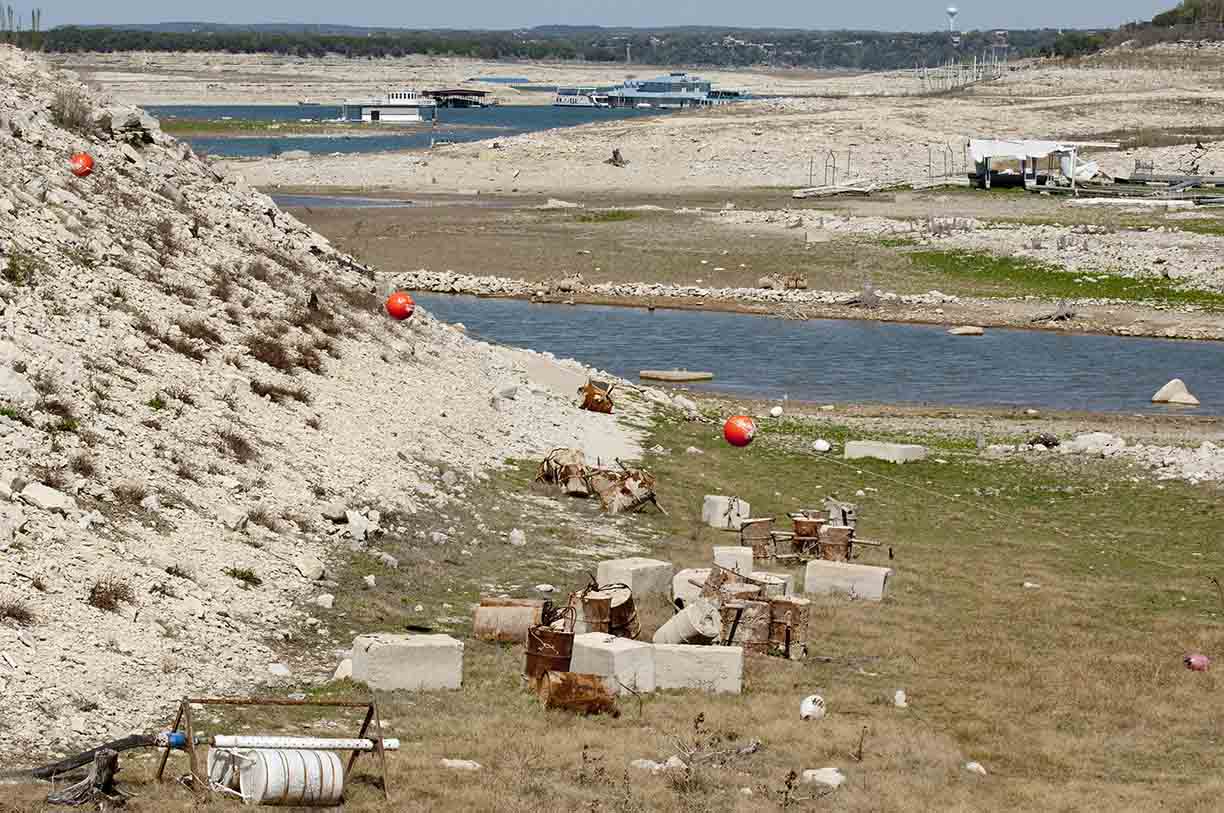
We look at the water-blind politics of Central Texas growth planning, and the developer-friendly role of regional transportation planning group CAMPO.

- Water use chart from stateimpact.npr.
In the graphic above, one can see a dramatic shift to municipal use as the LCRA cut off the rice farmers near the Gulf, who pay far less for their water. The Highland Lakes when full, hold about 2 million acre feet but are now at 763,000 or 38% of this. At 600,000 acre feet, LCRA emergency measures kick in. In 2010, Austin by itself used about 145,000 acre feet but its coal plant demands a lot too. In 2006, Austin used 176 gallons per day per person while much more water conscious San Antonio used about 115.
When water is limited, regional growth distribution — as well as the projected population — affects water supply needs. Compact urban development uses less water, and also doesn’t require laying the long pipes that suburban sprawl development does. — R.B.
Second of three.
You can evade reality, but you cannot evade the consequences of evading reality.
In “Can Austin survive the current Texas drought? Part 1,” we looked at various symptoms of the current Texas drought, which is actually the eastern side of a mega-drought extending throughout the Southwest from Texas to California. We have seen how Texas water politics, bad water law, and climate change denial is leading to urban versus rural conflict over water, as state population grows while the state gets drier.
In Part 2, below, we take a closer look at the water-blind politics of Central Texas growth planning. CAMPO is a regional transportation planning planning group for the region around Austin. They are now drafting a federally sanctioned long range master transportation plan for Central Texas in 2040, as they are required to do every five years to get federal money. In various ways, including its federal authority, CAMPO planning has become the dominant planning force in the Austin region.
Continue reading