
The Rag Blog
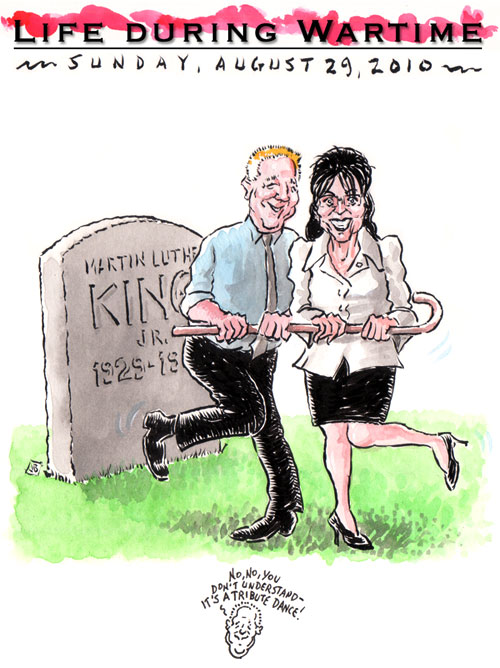
David McReynolds, who was at the great March on Washington in 1963, and heard Dr. King declare that he had a dream, calls it a “proud moment” in history, and provides background on that momentous occasion from an insider. And he contrasts the world of those who organized the event to that of media star Glenn Beck, who rallied his gathering “with all the majesty of Fox News behind him” — an event “funded by the multimillionaires who stand in the shadows behind Beck…”
By Larry Ray / The Rag Blog / August 29, 2010
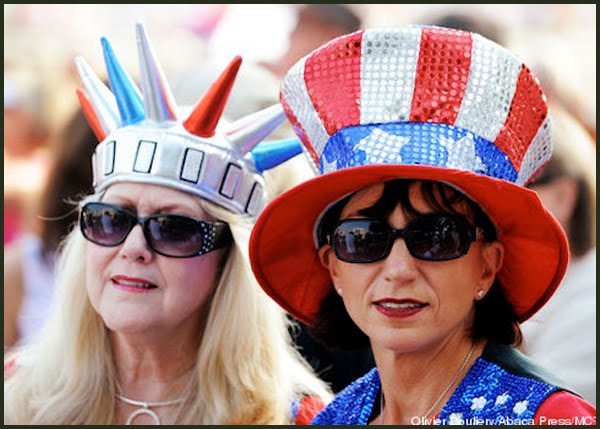
I talk with friends in Italy almost daily and this past year it has been challenging to try to answer their questions about political images beamed to them from America. They are mystified by the clots of angry, mostly white and mostly “mature” Americans who wear strange clown-like hats sometimes with “tanti bustini di tè” (lots of teabags) dangling from them.
Friends in Naples ask, “Who are these people and why do they dress up like that? Is it some sort of folk tradition? Do they still not like dark-skinned people? Why are they so angry?” All are valid questions, especially with the steady stream of news, photos and video being fed constantly to Italy. The loud and bizarre gets lots of play there just like it does here.
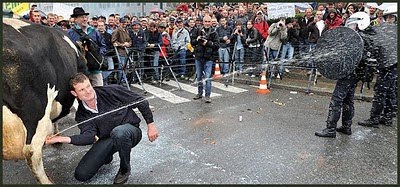
Protests have their extremes in Europe, to be sure. French farmers dumped tons of manure in front of McDonald’s outlets protesting U.S. sanctions. And in Brussels it was not blood running in the streets last year, it was milk. Part of a continuing Pan-European farm fury included the scene below, protesting government controlled milk prices. Frustrated farmers presented a clear message that was milked for all it was worth with not one funny hat, misspelled poster, or misplaced metaphor.
So, how to explain why those frustrated, not too well informed, and very noisy Americans gather to “take their country back” while all decked out in giant Red White and Blue top hats and other strange attire? I was recently asked by my friend, Guido, “Larry, why is the woman with the yellow flag with the coiled snake on it telling everyone not to step on the snake? Is she a snake worshiper?”
For years Italians have seen documentaries about Christian sects in rural America who dance wildly inside their churches while holding and even kissing live poisonous snakes. So, coiled rattlesnakes on flags at heated political gatherings suggest to Italians a reasonable association with the American snake handlers they have seen. But snakes as a national symbol of American patriotism is neither quickly nor easily explained.
You can imagine the challenge in trying to talk about the why and who and what of raucous Tea Party gatherings. I have been unable to connect Boston revolutionaries’ dumping of crates of tea into their harbor over unfair taxation with today’s small tea bags hanging off gaudy sequined hats. Not for my Italian friends or for myself.
The simplistic appeal of Glenn Beck’s dreck, to the people in funny hats is particularly difficult for my friends to understand. Italians who have seen him think Beck is a game show host. I just agreed with them and continued on telling about the Great American Snake.
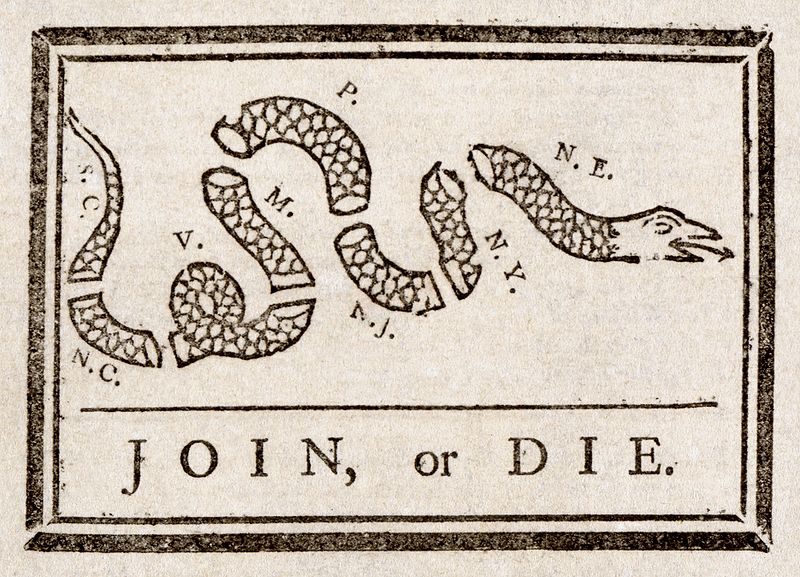
Explaining the yellow “Gadsden flag” to my Italian friends involved starting with a satirical article written by Ben Franklin in 1751 which included a cartoon showing a timber rattlesnake chopped up into eight pieces. Each piece represented one of the eight colonies. Franklin, tongue in cheek, suggested that since the British had sent convicted criminals to America, we should send rattlesnakes to England by way of thanks.
Four years later Continental Congress Colonel Christopher Gadsden reportedly used the image of a coiled rattlesnake that had been painted on marching band snare drums of U.S. Marines interdicting British naval supply ships arriving in the new colonies to create his “Don’t Tread On Me” flag.
Col. Gadsden presented the first feisty banner to his home constituency in South Carolina. It became one of several early American flags. The flag’s image is still all over the place today, even on Nike’s 2010 World Cup soccer ball images, at Boy Scouts of America camp sites, and as the Tea Party’s official flag.
So somehow it makes perfect sense to lots of the disgruntled and fearful here at home to see a 62 year old American woman in an out sized floppy Uncle Sam hat waving the rattlesnake flag warning you not to step on her patriotism… however she may define that. Why she can’t be just as patriotic in regular street clothes puzzles a large majority of Americans as well as my Italian friends.
I will hazard a guess that she and most of the other snake flag wavers have no more idea of the flag’s history than Guido. But to her she is a tightly coiled patriot fighting fascism, communism, socialism, and all the other isms that the new black American president and rabid liberals have in store for her. No real need to define or understand all those isms because “everyone knows what they are.”
Guido asks, still trying to understand the ladies pictured at the top of the page, “That lady in the hat with the colored horns on it, is that for good luck?” In Italy, an animal horn amulet made of real gold or even red plastic wards off evil. I deftly try to say that she is wearing a standard issue Statue of Liberty party hat that has nothing to do with the evil eye or with France who gave the statue to the USA. “So the USA never sent rattlesnakes to France?” I allowed as how I just wasn’t sure about that.
Sarah Palin is easier for Italians to understand since they have had their own national nutcase, Prime Minister Silvio Berlusconi, who dominates the news with his benighted bumbling and endless internationally embarrassing pronouncements.
Berlusconi is a billionaire media mogul. Sarah Louise is hard at work Twittering her way to becoming a multi-millionaire from speaking fees for her illogical, vacuous God and Country utterances. Sarah Louise has a nice figure, nice looks, and great legs, and if she married Berlusconi it would be a marriage made in heaven. And Sarah speaks in tongues. But I digress.
Trying to sum up the discontent, anger, and bizarre headgear issues, I offered a list of suggested questions Guido could toss around with his friends over a cup of tea before we have our next political chit chat. The ladies at the top of the page might take a glance at these as well.
What happens when big government gets out of your life, starts spending less, and each individual American State bears the responsibility for its citizens’ welfare?
Will all the Tea Party folks turn in their Federally subsidized socialized Medicare cards and expect the state and their own private insurance to take care of their health?
When the already collapsing bridges, dams, highways, and other infrastructure finally totally crumbles away while no one has been paying any higher taxes, will the states somehow take care of all those problems within their boundaries? You think Wall Street and your local banker might step in and help you while staying out of your life as well?
And when “the government” has been purged from your lives and “returned to The People” — except for “when Federal Government assistance is needed” — what will the rules be that define when and how much assistance?
Finally, who will make those rules? Mad folks in funny hats who created their own brand of social democracy state bystate?
I look forward to my next chat with Guido. He wants to talk about this great nation of America and how it is made up of immigrants. His great uncle Tonino lived in Brooklyn.
[Retired journalist Larry Ray is a Texas native and former Austin television news anchor. He also posts at The iHandbill.]
By David McReynolds / The Rag Blog / August 29, 2010
What a difference money makes. On Saturday, the 28th of August, 2010, Glenn Beck rallied on the steps of the Lincoln Memorial with all the majesty of Fox News behind him.
Day after day Fox News had trumpeted the event, organizing for it, and if Beck hadn’t gotten a crowd it would have been no fault of those who own Fox News and fund Glenn Beck. (Fox News is one very good reason for an estate tax that would guarantee that no one could buy and own networks, newspapers, and control the media, the way Rupert Murdoch has done.)
I’ve never met Glenn Beck, I don’t expect to. He is — pretty much in common with all the commentators, whether their views are left or right — paid to air his views. I suspect that for the right price Beck would happily change those views.
(I do agree with Beck’s attacks on Woodrow Wilson, who brought segregation back to the White House, got us involved in the bloody First World War, and who jailed the Socialist Party’s leader, Eugene V. Debs, for the crime of speaking out against that war. Irony of ironies, Wilson refused to even consider a pardon for Debs — that remained for the Republican President, Warren G. Harding, who met with Debs in the White House and pardoned him.)
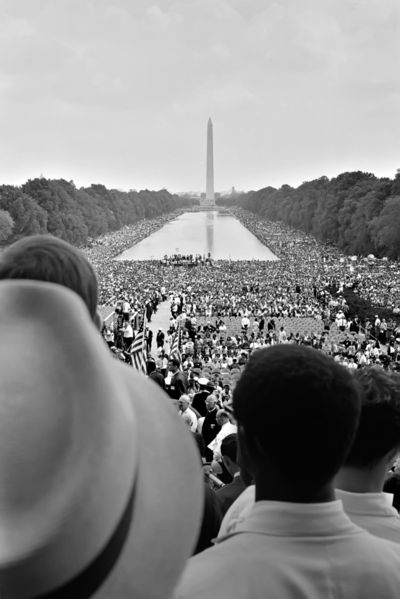
Let me, as someone who has had the good luck to be a guest at history’s table, turn back more than half a century to Wednesday, August 28th, 1963, and the March on Washington for Jobs and Freedom. I was then, at 33, a young radical working for the War Resisters League, which had given Bayard Rustin leave so that he could work in the Civil Rights movement as a special aide to Martin Luther King Jr., and as the primary organizer of the August 28th events.
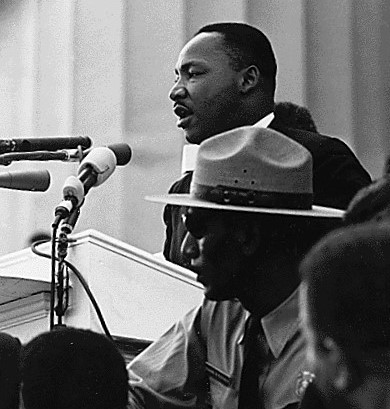
Nor did it take place on Saturday — Bayard knew it had to take place in the middle of the week, when people would need to take time off from their jobs. The event was far more than a weekend outing in the nation’s capitol — it was the largest demonstration of its kind in our history.
Much of the background feeling can be seen in the film about Bayard, Brother Outsider, which gives one a sense of how the demonstration was organized with the support of trade unions, church groups, and the civil rights movement in the South.
There was profound fear in Washington DC. John F. Kennedy had tried to get the march called off. The police were put on special alert. The shops of the city were largely closed, the streets empty, as “White Washington” braced for the flood of Blacks and the inevitable rioting.
Bayard had enlisted the support of the Guardians, the Black police officers in New York City, who came down in force to provide security.
I don’t remember how I got there — I assume I was one of the many thousands of New Yorkers who took buses down. But I shall never forget our march toward the Lincoln Memorial, as thousands and thousands of citizens, most of them black, but many of us white, chanted “Freedom, Freedom, Freedom” with a cadence all its own. Blacks from the South who had never been in a mass demonstration with whites before. All pouring into the area around the Lincoln Memorial.
I had been to Washington many times before (and have been many times since). I had been to the “Prayer Pilgrimages” Bayard had organized, which were a kind of prelude to the great march. I was used to the endless list of speakers at these events, a speaker from each of the sponsoring groups.
Usually, after getting to a march, and making sure I’d be one of those counted by the counters, I’d take a break for a hamburger or a drink. This time I was grateful that I stayed and heard King’s “I Have a Dream” speech, breaking out over the vast assemblage. To compare the majesty of that rolling speech, with the cadence of the Black church and the infinite suffering of Black America, with the commercial hysteria of Glenn Beck is, almost, to make one ashamed of being white.
There was a scene that unfolded before King spoke, as the crowd moved into place. George Lincoln Rockwell, the American Nazi leader (who was later assassinated by one of his followers) had set up a small stand from which to speak, and began to spew hatred of “niggers, kikes, queers, and commies.”
I admired Rockwell for his courage, but he was clearly intending to spark a riot. I watched with fascination as young Black men moved in, formed a ring around Rockwell and his supporters, and locking arms, faced outward, toward any of the marchers who might be tempted to make a physical assault on Rockwell. Rockwell and his cohorts found themselves isolated — and protected — by a ring of young Black men.
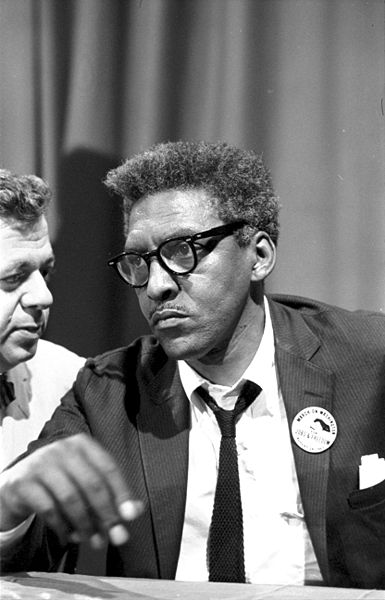
August 28th was a moment of affirmation for the best in America, black and white, young and old. It did not end the struggle for civil rights for Black America — but it was a crucial point in that struggle.
I wonder if those who follow Glenn Beck so avidly will, 10 years from now, look back to this day, this media-organized event on a Saturday when no one had to take off from work, an event funded by the multimillioniares who stand in the shadows behind Beck, and feel they were part of history, in the way those of us who were there in Washington D.C. in 1963 knew we were on the side of the best America had to offer.
[David McReynolds is retired, the former chair of War Resisters International, and the Socialist Party presidential candidate in 1980 and 2000. He lives on the Lower East Side of New York with two cats. He can be reached at dmcreynolds@nyc.rr.com.]
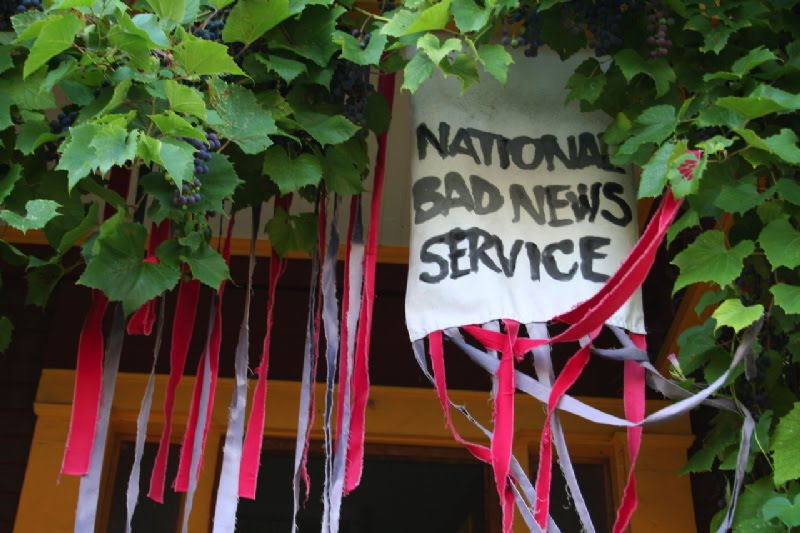
Dionysus reigns! Our front porch is overwhelmed with grapes red and white, leaves bristling out like mad conductor’s hair, fruit hanging in a wall of Eat Me.
The only trouble is that under those grapes are our signs listing the numbers of the dead — military and civilian — in Iraq and Afghanistan, the data output of our locally popular National Bad News Service, a neighborhood landmark, and source of urgent conversation.
Not that the autumn grapes are the only thing hiding those numbers. There is the year-round assault by language, the misdirection of “winning hearts and minds,” of Operation Enduring Freedom, of “bringing democracy” and the upgrade from Bush’s “War On Terror” to Obama’s more Harvard-y “Enduring Struggle Of The Forces Of Moderation Against Those Of Violent Extremism.” A fog of language as dense as the fog of war, year round, and thickening.
Yet rereading Thomas Pynchon’s 1973 masterpiece, Gravity’s Rainbow, I came across a passage that makes me think that our numbers themselves, in deep mid-winter, standing stark against red, clear and nasty as can be — are themselves false fronts for a reality more hideous even than war. In the context of WWII, Pynchon writes:
Don’t forget the real business of the War is buying and selling. The murdering and the violence are self-policing, and can be entrusted to nonprofessionals. The mass nature of wartime death is useful in many ways. It serves as spectacle, as diversion from the real movements of the War. It provides raw material to be recorded into History, so that children may be taught History as sequences of violence, battle after battle, and be more prepared for the adult world. Best of all, mass death is a stimulus to just ordinary folks, little fellows, to try ’n’ grab a piece of that Pie while they’re still here to gobble it up. The true war is a celebration of markets. (p.105)
It’s a little throwaway passage, a remark by one of the characters, not a thesis, not the point of the book, not some commie peacenik agit-prop. Just, oh, you know, the underlying truth.
I think I’ll add it to the explication of the numbers posted on one of our golden-yellow porch posts.
[Marc Estrin is a writer and activist, living in Burlington, Vermont. His novels, Insect Dreams, The Half Life of Gregor Samsa, The Education of Arnold Hitler, Golem Song, and The Lamentations of Julius Marantz have won critical acclaim. His memoir, Rehearsing With Gods: Photographs and Essays on the Bread & Puppet Theater (with Ron Simon, photographer) won a 2004 theater book of the year award. He is currently working on a novel about the dead Tchaikovsky.]
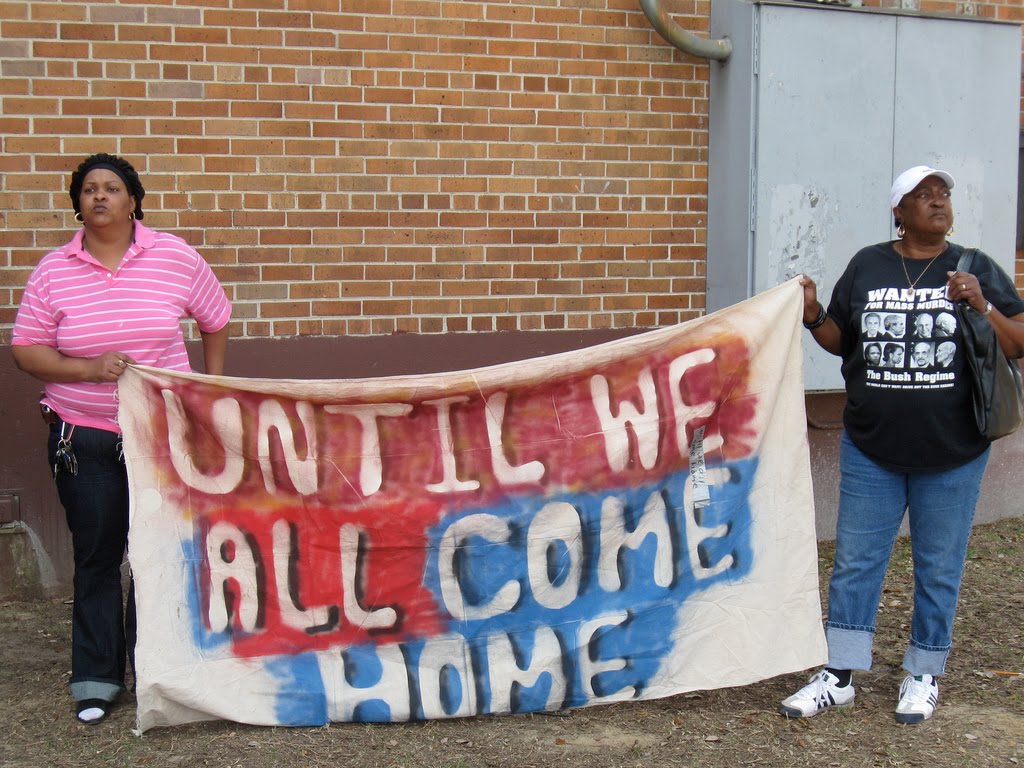
More than 100,000 New Orleanians received a one-way ticket out of town and still have received no help in coming back, and these voices are left out of most stories of the city.
By Jordan Flaherty / The Rag Blog / August 28, 2010
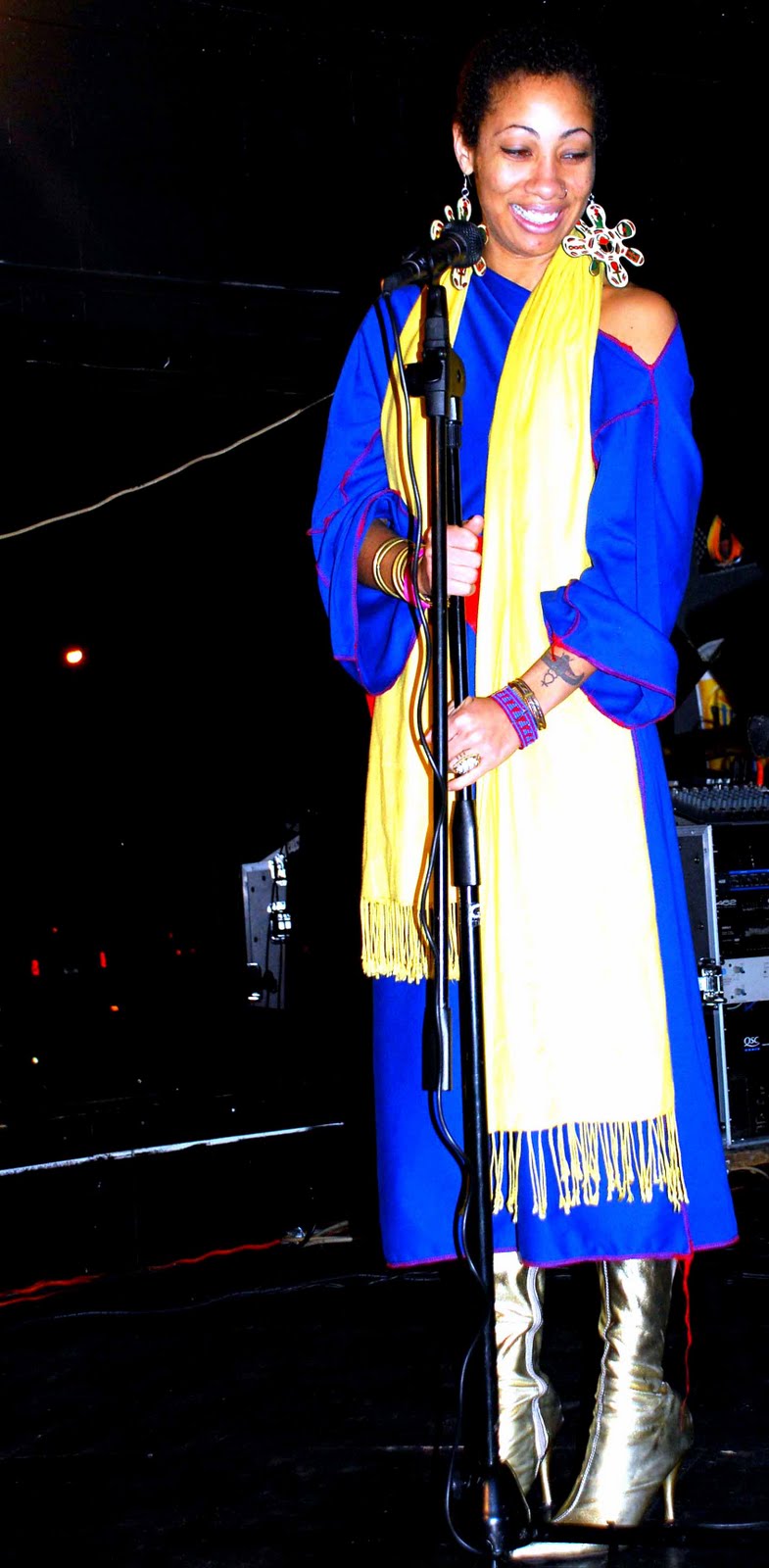
NEW ORLEANS — Poet Sunni Patterson is one of New Orleans’ most beloved artists. She has performed in nearly every venue in the city, toured the U.S., and frequently appears on television and radio, from Democracy Now! to Def Poetry Jam. When she performs her poems in local venues, half the crowd recites the words along with her.
But, like many who grew up here, she was forced to move away from the city she loves. She left as part of a wave of displacement that began with Katrina and still continues to this day. While hers is just one story, it is emblematic of the situation of many African Americans from New Orleans, who no longer feel welcomed in the city they were born in.
Patterson comes from New Orleans’s Ninth Ward. Her family’s house was cut in half by the floodwaters and has since been demolished. Despite the loss of her home, she was soon back in the city, living in the Treme neighborhood. She spent much of the following years traveling the country, performing poetry and trying to raise awareness about the plight of New Orleans.
But her income was not enough — her post-Katrina rent was twice what she had paid before the storm, and she was also putting up money to help her family rebuild as well as preparing for the birth of her son Jibril. “I wound up getting evicted from my apartment because we were still working on the house,” she said. “In the midst of it, you realize that you are not generating the amount of money you need to sustain a living.”
Just as the storm revealed racial inequalities, the recovery has also been shaped by systemic racism. According to a recent survey of New Orleanians by the Kaiser Foundation, 42 percent of African Americans — versus just 16 percent of whites — said they still have not recovered from Katrina. Thirty-one percent of African-American residents — versus eight percent of white respondents — said they had trouble paying for food or housing in the last year. Housing prices in New Orleans have gone up 63 percent just since 2009.
Eleven billion federal dollars went into Louisiana’s Road Home program, which was meant to help the city rebuild. The payouts from this program went exclusively to homeowners, which cut out renters from the primary source of federal aid.
Even among homeowners, the program treated different populations in different ways. U.S. District Judge Henry Kennedy recently found that the program was racially discriminatory in the formula it used to disperse funds. By partially basing payouts on home values instead of on damage to homes, the program favored properties in wealthier — often whiter — neighborhoods. However, the same judge found that nothing in the law obligated the state to correct this discrimination for the 98 percent of applicants whose cases have been closed.
At approximately 355,000, the city’s population remains more than 100,000 lower than it’s pre-Katrina number, and many counted in the current population are among the tens of thousands who moved here post-Katrina. This puts the number of New Orleanians still displaced at well over 100,000 — perhaps 150,000 or more. A survey by the Louisiana Family Recovery Corps found that 75 percent of African Americans who were displaced wanted to return but were being kept out. Like Patterson, most of those surveyed said economic forces kept them from returning.

A changed city
As New Orleans approaches the fifth anniversary of Katrina and begins a long recovery from the BP drilling disaster, the media has been searching for an uplifting angle. Stories of the city’s rebirth are everywhere, and there are reasons to feel good about New Orleans.
The Saints’ Super Bowl victory was a turning point for the city, and the HBO series Treme has gone a long way towards helping the story of the city’s trauma and search for recovery get out to a wider audience. Music festivals like Jazz Fest and Essence Fest, which are so central to the city’s tourism-based economy, have brought in some of their largest crowds in recent years.
But despite positive developments in the city’s recovery, more than 100,000 New Orleanians received a one-way ticket out of town and still have received no help in coming back, and these voices are left out of most stories of the city.
Many from this silenced population complain of post-Katrina decisions that placed obstacles in their paths, such as the firing of nearly 7,000 public school employees and canceling of their union contract shortly after the storm, or the tearing down of nearly 5,000 public housing units — two post-Katrina decisions that disproportionately affected Black residents.
Advocates have also noted that among those who are not counted in the statistics on displacement are the New Orleanians who are in the city, but not home. They fall into the category that international human rights organizations call internally displaced.
The guiding principles of internal displacement, as recognized by the international community, call for more than return. UN principles number 28 and 29 call for, in part, “the full participation of internally displaced persons in the planning and management of their return or resettlement and reintegration.”
They also state that, “They shall have the right to participate fully and equally in public affairs at all levels and have equal access to public services,” as well as to have their property and possessions replaced, or receive “appropriate compensation or another form of just reparation.”
In other words, these principles call for a return that includes restoration and reparations. As civil rights attorney Tracie Washington has said, “I’m still displaced, until the conditions that caused my displacement have been alleviated. I’m still displaced as long as Charity Hospital remains closed. I’m still displaced as long as rents remain unaffordable. I’m still displaced as long as schools are in such bad shape.”
In the U.S., Katrina recovery has fallen under the Stafford Act, a law that specifically excludes many of these rights that international law guarantees.
Among those who are back in New Orleans but still displaced are members of the city’s large homeless population. In a report this week, UNITY for the Homeless estimated from 3,000 to 6,000 persons are living in the city’s abandoned buildings. Seventy-five percent of these undercounted residents are Katrina survivors, most of whom had stable housing before the storm. Eighty-seven percent are disabled, and a disproportionate share are elderly.
Cultural resistance
Sunni Patterson can’t remember a time when she wasn’t a poet. The words flow naturally and seemingly effortlessly from her. When she performs, it is like a divine presence speaking though her body. Her frame is small but she fills the room. Her voice conveys passion and love and pain and loss. Her words illuminate current events and history lessons — her topics ranging from the Black Panthers in the Desire housing projects to domestic violence.
You can hear Sunni Patterson’s influence in the performances of many young poets in New Orleans. And in the work of Patterson, you can hear the history of community elders passed along, the chants of Mardi Gras Indians, and the knowledge and embrace of neighbors and family and friends.
And Patterson is part of a large and thriving community of socially conscious culture workers. Since the late ’90s, you could find spoken word poetry being performed somewhere in New Orleans almost any night of the week. And many of these poets are also teachers, activists, and community organizers.
Although Patterson’s house had been in her family for generations, her relatives had difficulty presenting the proper paperwork for the Road Home Program — a problem shared by many New Orleanians. “We’re dealing with properties that have been passed down from generation to generation,” says Patterson. “The paperwork is not always available. A lot of elders are tired, they don’t know what to do.”
Now, like so many other former New Orleanians, she cannot afford to live in the city she loves. “I’m in Houston,” she says, seemingly stunned by her own words. “Houston. Houston. I can’t say that and make it sound right. It hurts me to my heart that my child’s birth certificate says Houston, Texas.”
One of the hardest aspects of leaving New Orleans has been the loss of her community. “In that same house that I grew up, my great grandmother and grandfather lived,” she says. “Everybody that lived around there, you knew. It was family. In New Orleans, even if you don’t know someone, you still speak and wave and say hello. In other cities, there’s something wrong with you if you speak to someone you don’t know.”
New Orleanians were displaced after the storm to 5,500 cities, spread across every US state. Although the vast majority of former New Orleanians are in nearby cities like Houston, Dallas, or Atlanta, many are still living in further locales from Utah to Maine.
While she is sad to be gone from the city, Patterson wants to see the positive in the loss. “The good part is that New Orleans energy and culture is now dispersed all over the world,” she says. “You can’t kill it. Ain’t that something? That’s what I love about it. So we still gotta give thanks, even in the midst of the atrocity, that poetry is still being created.”
[Jordan Flaherty is a journalist, an editor of Left Turn Magazine, and a staffer with the Louisiana Justice Institute. He was the first writer to bring the story of the Jena Six to a national audience, and his award-winning reporting from the Gulf Coast has been featured in a range of outlets including The New York Times, Mother Jones, and Argentina’s Clarin newspaper. He has produced news segments for Al-Jazeera, TeleSur, and Democracy Now! and appeared as a guest on CNN Morning, Anderson Cooper 360, and Keep Hope Alive with the Reverend Jesse Jackson. Haymarket Books has just released his new book, FLOODLINES: Community and Resistance from Katrina to the Jena Six. He can be reached at neworleans@leftturn.org.]
More information about Floodlines can be found at floodlines.org. Floodlines will also be featured on the Community and Resistance Tour this fall. For more information on the tour, see communityandresistance.wordpress.com.
Resources mentioned in this article:
Other Resources:

Jennifer Aniston sparked a classic Bill O’Reilly firestorm when she said a woman doesn’t need a man to have children and a perfectly fine life, thank you very much.
Defending not her personal situation but the character she plays in The Switch, her hit movie about a single woman who chose to be impregnated by a sperm donor, Aniston opined, “Women are realizing… they don’t have to settle with a man just to have a child.” O’Reilly retorted that Aniston trivialized the role of men, saying she was “throwing out a message to 12 and 13-year-olds that, ‘Hey, you don’t need a dad,’ and that’s destructive.”
It’s no accident that this pregnant pop culture moment occurred near the 90th anniversary of women’s suffrage, Women’s Equality Day, August 26. The Aniston-O’Reilly tiff highlights both the progress women have made and how far we are from reaching parity from the bedroom to the boardroom. We might be able to make babies on our own, but according to the White House Project, only 18 percent of leadership positions across all sectors are held by women.
That includes women like Mary Cheney, either clueless or co-opted or both, who even as she endorses anti-choice, anti-gay candidates, claims her own same-sex relationship and pregnancy choice are private matters.
It includes women like my Pilates instructor, who spent her life savings on achieving a high-tech pregnancy at age 42 and told me, “If men would step up to the plate, women like me wouldn’t be in this situation” of deciding solo whether or not to experience motherhood.
But the focus on these 50,000 or so exceptional conceptions overshadows the concerns and needs of the six million American women who become pregnant the old-fashioned way in any given year.
Besides, separating biology from destiny is just one of many expansions of freedoms women have aspired to as far back as 1776, when Abigail Adams urged her husband John to “remember the ladies,” threatening that the women would rebel if excluded from the Constitution (Yes, the same document Sarah Palin and the Tea Partiers want restored to its original state when enslaved African-American men were counted as 2/3 of persons and women were ignored completely).
The Founding Fathers did not heed Abigail’s plea, the women did not rebel, and as a consequence it took until 1920 for women to achieve ratification of the 19th amendment to the Constitution guaranteeing them the right to vote.
And just as those against women’s suffrage alleged it would trigger the demise of the patriarchal family, what sets off the O’Reilly Factors of the world isn’t so much concern that high-tech turkey-basters will replace the penises they hold dear. It’s terror that the power over others — hegemony they’ve assumed as their gender’s birthright — diminishes in proportion to the rise in women’s power to set the course of their own lives.
Nothing could be further from the truth, of course. Power isn’t a finite pie where a slice for you makes less for me. It’s an abundant resource. The more it is shared, the more the pie grows, and the more everyone thrives.
But if men have not yet figured this out, neither have women decided it’s time to use their power to make the rest of the changes needed to reach full equality.
A recent Harris Poll found three out of five Americans say the U.S. has a long way to go to reach gender equality. Not surprisingly, there’s a gender difference: half of men feel inequality remains whereas 74 percent of women agree. But the startling finding is that both men and women across the age spectrum downplay the importance of rectifying gender inequality, saying there are more pressing issues to fix.
That kind of self-abnegation to which women are still acculturated is why AOL’s electronic greeting card selections celebrated August 26 as National Toilet Paper Day as recently as 2007, yet the company had no card for Women’s Equality Day. Popular culture will continue to imitate what we talk about and what we pay attention to in our daily lives.
And while it’s relatively easy for a celebrity like Jennifer Aniston to get attention for any subject, it’s much harder for the rest of us to shine the public spotlight on other important issues impinging upon equality.
Today’s challenges to reaching a fair gender power balance are rooted not so much in legal barriers as in eliminating lingering constrictive cultural narratives, such as assuming mothers are less competent workers, thus paying them less than men or than women without children.
Women can’t wait for a Jennifer Aniston to lead the charge for change, and we don’t need to.
It took just one woman, unknown to the paparazzi, calling AOL’s oversight to the attention of 10 of her friends, asking each to forward the message to 10 more, to start a viral protest to AOL. An avalanche of complaints ensued, and Women’s Equality Day cards magically appeared.
Assuring that attention is paid by media, decision makers, and policy makers — and by women ourselves — to social and perceptual barriers standing in the way of a fair shake has become the women’s equality issue of these early decades of the 21st century. If we can accomplish that, women’s possibilities will indeed be unlimited.
O’Reilly will continue to be offended. But isn’t that just another sign of progress?
[Gloria Feldt is the author of the forthcoming No Excuses: 9 Ways Women Can Change How We Think About Power. The article was distributed by truthout.]
Source / truthout
By Harvey Wasserman / The Rag Blog / August 26, 2010
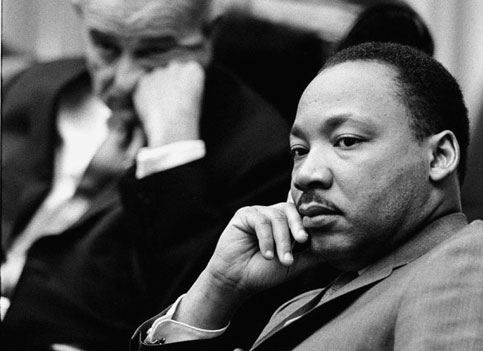
Martin Luther King’s “I Have a Dream” speech is one of history’s greatest orations, as well as one of its most beautiful arias.
To truly honor him and the heartfelt genius he brought us, we must do the one thing that most hurtfully blocked his Dream: we must end the imperial wars in Iraq and Afghanistan, and, at long last, bring our troops home from all over the world.
Because I use it in my U.S. history classes, I have heard Dr. King’s speech scores of times. I play it on a scratchy video whenever possible and never tire of it. It is more sung than delivered, and his sonorous voice and perfect cadence are the equal of any operatic oratorio ever written. Close your eyes and you are in the greatest of all concert halls.
But its message cuts to the core of our entire history. It contains beautiful descriptions of much of our national landscape. It references Stone Mountain, Georgia, where we suffered the formation of the Ku Klux Klan, and Lookout Mountain in Tennessee, the origin of the infamous Scottsboro Boys legal persecution.
It sings with perfect pitch of our most spiritual president, Abraham Lincoln, and the promise made to African-Americans still being given a bad check for 250 years of unrequited labor.
Over the years the speech has gained incredible strength. It was never fully written out, improvised as only a true master can as he went along. With astounding good fortune I did hear it as he gave it, at the age of 17, sitting on the left side of the reflecting pool as you face out from the monument.
In 1966 I met Dr. King as he delivered a hypnotizing sermon in a tiny church in Granada, Mississippi, surrounded by the Klan and the FBI as we marched toward Jackson following the shooting of James Meredith, who had been walking alone to demand the right of black people to vote in the South.
Much has happened since then to frustrate Dr. King’s dream of true social equality. But nothing of more significance than Lyndon Johnson’s horrific decision to escalate the war in Vietnam.
King and Johnson had met over the signing of civil rights legislation that should have revolutionized race relations here and, indeed, throughout the world. There’s no doubt the laws won in the early 1960s through the incredible sacrifices of so many in the civil rights movement have changed this nation for the better.
We now, indeed, have realized the “dream” of an African-American in the White House, something that seemed a far-distant fantasy back then. “In the next century,” we’d say, “there may even be a black man in the White House.” For the first time, it seemed actually possible.
But in the midst of an era of so much promise, the country was ripped asunder from another direction — imperial ambition. The senseless, worthless and ultimately futile tragedy in Vietnam shattered our dreams. It polluted our soul and bankrupted our treasury for no apparent reason beyond what was forever branded “the arrogance of power” by a wise Senator from Arkansas.
This nation has never recovered from that war. Nearly a half-century later, the imperial disease still torments us. From Southeast to Southwest Asia, from the Orient to Africa to Latin America, our troops are still strewn throughout the globe. They are dying in Afghanistan.
Why?
The reasons are myriad, and unacceptable. And it was Dr. King who warned of the ultimate outcome most forcefully of all, by linking the denial of civil rights and social justice directly to the folly of empire.
Leading directly from his “Dream” speech, this is the most powerful thing he did. There are those who believe it got him killed. But it is also what has most thoroughly enshrined him.
Having stood by the side of a President of the United States, Martin Luther King had the ultimate temerity to call Lyndon Johnson on his most tragic and costly error. Had LBJ listened, our nation — and his own life — would have been blessed with much much happier outcomes.
King’s defiance of Johnson over his war policy horrified many of the leaders of the civil rights movement. But he was more than right to do it. In linking the movements for racial equality, social justice, and an end to war, King clarified forever the barriers we must overcome if we are to survive on this planet.
This weekend, on the anniversary of that great aria, there are those who would attempt to hijack the symbolism of that fertile time for opposing purposes. They are of little historic consequence, symptoms rather than cures for the imperial sickness that is dragging us down as surely as it did Athens, Rome, Babylon, and so many other societies that could not overcome their suicidal arrogance.
They all have one thing in common: they ignored — and even killed — those prophets who sing history’s most compelling Truth.
The arc of history bends inexorably toward justice, which can come only with peace.
Thank you so much, Dr. King. We love you.
[Harvey Wasserman has been involved in the struggle for peace, justice, and a green earth since the late 1960’s. Harvey Wasserman’s History of the United States is at www.harveywasserman.com.]
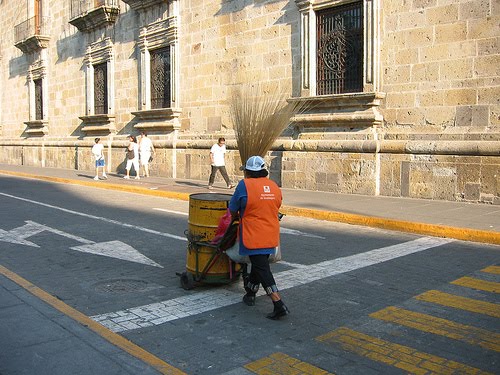
“If a man is called to be a street sweeper, he should sweep streets even as Michelangelo painted, or Beethoven composed music, or Shakespeare wrote poetry. He should sweep streets so well that all the hosts of heaven and earth will pause to say, here lived a great street sweeper who did his job well.” — Martin Luther King, Jr.
Working class heroes:
Mexico city’s army of barrenderos
‘We don’t sweep the streets just for ourselves… Our ancestors, the Great Aztecs, come from this place and now it belongs to all of humanity.’
By John Ross / The Rag Blog / August 26, 2010
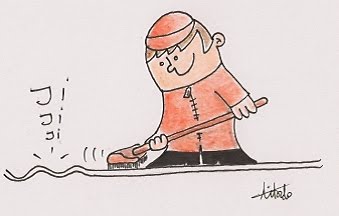
MEXICO CITY — A small army of men and women in florescent orange and green uniforms pushing bright yellow carts hovers on the edge of the overflow crowd in the great Zocalo plaza of this city, ready to pounce. Whether it’s the 62 matches of the World Cup “FIFA Fan Fest” shown on giant screens for the diversion of the masses or a rally of tens of thousands of disgruntled citizens who have gathered to protest the policies of their government, the “barrenderos” are prepared to move in and haul away the mess the “fanaticos” have left behind.
“These Mexicanos are real ‘cochinos‘ (pigs),” kvetched my young pal Alejandro Daniel, a member of the corps of “barrenderos” or street sweepers who are charged with the hopeless mission of keeping Mexico City’s Centro Historico, the old quarter of this ancient capitol, free of debris, as he scooped up plastic cups, half-melted paletas (popsicles), the gnawed butts of tacos and “perros calientes” (hot dogs), several flattened plastic horns, and a sea of greasy waste paper, and artfully stuffed them into his cart.
Alejandro, 22, a second generation barrendero whose mom worked in the city’s street cleaning department before him, is one of 8,500 street sweepers on the Cuauhtemoc borough’s pay roll, 400 of them assigned to patrol the old quarter, a neighborhood which is roughly the configuration of Tenochtitlan, the island kingdom that was the crown jewel of the Aztec empire and is now listed on the UNESCO roster of world heritage sites.
The barrenderos work three shifts around the clock, but keeping the Centro Historico spic and span is an impossible job. By day, the neighborhood is a chaotic confluence of 2 million automobiles, trucks, buses, bicycles, and rickshaws and untold millions of pedestrians — government workers, ambulantes (freelance venders), tourists, demonstrators, and residents — who dump vast cordilleras of “basura” (garbage) onto the city streets.
Alejandro’s “tramo” or route extends down Isabel la Catolica, a narrow street where this writer has lived for the past quarter of a century, eight blocks north to the national pawn shop (“Monte de Piedad” or “Mountain of Piety.”) Along the way, the young barrendero sweeps up the gutters (the sidewalks are cleaned by residents and store owners), and dumps plastic public trash baskets lined up six to a block into his cart.
He also picks up garbage bags from private customers — this take-out service (“la finca“) is strictly prohibited by his bosses in the borough government but Alejandro’s salary is only 1,300 pesos every 15 days (“La Quincena“), approximately $100 Americano, and he desperately needs his finca to make ends meet.
The barrenderos are also charged with following demonstrations through the Centro (there are an average 3.2 a day), sweeping up after the “cochino” marchers, painting out “pintas” or spray-painted slogans scrawled on the walls of the ancient neighborhood, and ripping down leaflets posted by militants. “We leave the ones against (President) Calderon,” confides Alejandro, a partisan of former left mayor Andres Manuel Lopez Obrador.
The worst day of the year for the street sweeper is October 2nd, the annual anniversary of the 1968 student massacre (300 killed) in the Tlatelolco housing complex just north of the Centro Historico. For generations, students have marched to commemorate those who fell in the government-ordered slaughter, spray painting every surface in the neighborhood, battling riot police, and looting convenience stores. When the barrenderos try to wipe out the wall scrawls, they are attacked. “Once they sprayed me from top to bottom and then dumped my cart on top of me,” rues Alejandro.
Mexico City, the largest urban stain in the Americas with 23 million sentient human beings packed into its metropolitan zone, generates a bit under 20,000 tons of garbage daily, about 1.45 kilos of basura per chilango (Mexico City resident). The capitol, which holds a fifth of the population, accounts for a third of the country’s garbage.
Recycling is mostly the domain of the collectors — the barrenderos and the basureros or garbage men. At the dumps, “pepinadores,” garbage pickers, sift through the waste for recyclables that the crews have missed.
From the crack of dawn through high noon, elephantine green trucks swamp the inner city, picking up the residue from shops and restaurants, private businesses and working class colonias, their arrivals still heralded by the ringing of a brass bell.
The garbage men (there are no women although half the street sweepers are female) toss overflowing waste barrels into grinders mounted on the back of the trucks, dump buckets of industrial grease and organic slop, often spewing debris into the gutters for the sweepers to clean up.
Although the barrenderos and the basureros are fierce competitors for the city’s garbage, they have had to forge strategic alliances to get the job done. “We consider the garbage crews to be our companeros,” Alejandro affirms.
I follow Alejandro and his flailing broom through traffic as he darts down Isabel La Catolica, often squeezing between parked cars to retrieve a banana peel or a discarded newspaper. The barrendero wrestles the contents of the street trash baskets into his cart but hesitates outside the dozens of fast food franchises here in the Centro so that the hungry and the homeless can fish for discarded food first.
These days, he is often challenged by can collectors — with unemployment at a record high and old people scraping by on meager pensions, recycled cans bring in a few coins for the underclass. Alejandro is also wary of “pirates” who steal unguarded carts and brooms and swipe the barrenderos’ fincas.
The street sweepers’ brooms are emblematic of their “oficio” (profession) but lately they have become the source of labor tensions. Their bosses, bureaucrats in a city government that has been administrated by the left Party of the Democratic Revolution (PRD) for the past 13 years, insist upon buying commercial brooms rather than the picturesque bundled tree branches with which the barrenderos have historically swept the city’s streets. If the street sweepers want an old-fashioned broom, they have to buy or fashion it themselves.
Alejandro’s gaze is fixed on the gutter. Sometimes he finds coins or lost cell phones, but mostly these days the streets are littered with cigarette butts. Ever since this left-run city barred smoking in office buildings, restaurants, and bars, the streets have been converted into public ashtrays.
Between Uruguay and Carranza streets, the street sweeper bends to retrieve a plastic bag that has escaped from a nearby Sanborn’s department store and wrapped itself around a scraggly tree planted in a tiny square of dirt, one of the few green spaces in the congested heart of the Monster. Although a city ordinance now obligates dog owners to pick up after their curs, street dogs are attracted to these dirt patches and Alejandro has to step smartly to avoid the dogshit.
Just then a driver pulls up to curbside and throws open the car door without looking, a classic “portazo” that knocks the barrandero flat. I offer him a hand.
“Even though we wear these bright orange uniforms so we don’t get run down in traffic, people never see us,” he complains, “we are brooms to them — not people. Its like we are invisible.”
“Los Invisibles” is, in fact, the name of a troupe of barrenderos who do street performances around the Centro Historico.
“We see that we are underappreciated. Sometimes people are personally offensive to us. They call us ‘mugreros‘ (dirty ones) and much worse so we are trying to educate the public to respect us more,” explains Pia V., a founder of The Invisibles. “Our shows also give us an opportunity to make the neighbors more aware of their environment and encourage them to do recycling and help us keep the streets clean.”
Pia and Alejandro invite me to a rehearsal of Los Invisibles on Regina Street, a block devastated by the great 8.1 1985 earthquake here that the city has transformed into a pedestrian cultural passageway. A stage has been cobbled together by the community.
Walking through the Centro/I encountered a broom/that didn’t have an owner/so I started to sweep up Allende Street.
“When I start to sweep/I think about my family/of which I am the strong arm/that maintains them…”
The two girls jump up on the stage and embrace their mom.
Dani follows with a rant about “El Pinche Viejo” (“The Fucking Old Man”), a supervisor who is taking his time about assigning her a street to clean. She frets that she will miss her finca:
Tell me pinche viejo/how long do I have to wait/for you to make up your mind?
The barrenderos raise their brooms in a martial salute. Alejandro launches into a rap about “Derechos de Senoridad” (“Seniority Rights”):
There are people with too much money/while others don’t have enough to eat/the rich are the ones who make all the frauds/our job is to sweep up this black history…
Pia takes on the tourists who flock to the Centro and do not use the public trash baskets:
I ask you please/Not to dirty the streets/In whatever city you come from/And that someday you will remember us/Sweeping up our country.
Neighbors gather in front of the “vecindades,” the spruced up old slum buildings that line Regina Street and laugh and applaud. The barrenderos are popular figures in the inner city barrios of Mexico’s meotroplises, often seen pushing their carts and cans in the company of a string of mangy garbage dogs who live in the “depositos” or collection centers.
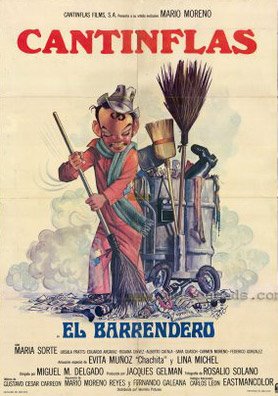
Street sweepers are intensely focused on the neighborhoods they clean and often the source of fresh “chisme” (gossip), the secret fuel that powers Mexican society. Back in the 1960s, barrenderos were often the source of popular troubadour Chava Flores’ urban ballads and the immortal Cantinflas’s final Mexican movie El Barrendero (1982) is about a heroic street sweeper who rescues a stolen painting he finds in the garbage from a gang of thieves.
But too often the city’s barrenderos are seen as little more than street furniture, part of the mob of shoeshine men, newspaper venders, organ grinders, buskers, beggars, “toreros” (freelance ambulantes), and “rateros” (street thugs) who fill up the streets of the Centro. Working class heroes are hard to find and the barrenderos certainly qualify.
The street sweeper brigades were an early feature of the city’s left governments. They came into their own after the two-year long renovation of the Centro Historico under Mayor Lopez Obrador that was financed by the world’s richest tycoon, Carlos Slim, who indeed grew up on these mean streets and is now the virtual owner of the old neighborhood with a reported portfolio of 160 buildings.
“We don’t sweep the streets just for ourselves,” Alejandro explains, “our ancestors, the Great Aztecs, come from this place and now it belongs to all of humanity.”
“When I was a kid I would go to the Alameda Park and the Zocalo with my family and I would wonder who sweeps up these places?” Pia remembers. “Now it is me. It is my responsibility. Although the people are rude to us and pretend not to see us, our city couldn’t breathe without our brooms. Everyone would be buried under the basura.”
[John Ross, the author of El Monstruo: Dread and Redemption in Mexico City, will be walking the garbage-strewn streets of San Francisco for the next weeks.]
Mariann Wizard reviews Nancy Miller Saunders’ book, “Combat by Trial: An Odyssey with 20th Century Winter Soldiers,” about the historically significant anti-war movement that developed among GIs and veterans of the Vietnam War — and the IVAW, the group that led that movement. Mariann herself was involved in those efforts, along with her vet husband, Larry G. Waterhouse, and she also discusses the book she and Larry wrote together in 1971: “Turning the Guns Around: Notes on the GI Movement.”
By Jim Turpin / The Rag Blog / August 25, 2010
Every American citizen has heard the legal phrase “due process of law,” but do you really know what that means?
The Fifth Amendment of the U.S. Constitution states:
No person shall be held to answer for a capital, or otherwise infamous crime, unless on a presentment or indictment of a Grand Jury, except in cases arising in the land or naval forces, or in the Militia, when in actual service in time of War or public danger; nor shall any person be subject for the same to be twice put in jeopardy of life or limb; nor shall be compelled in any criminal case to be a witness against himself, nor be deprived of life, liberty, or property, without due process of law; nor shall private property be taken for public use, without just compensation.
The Fifth Amendment’s Due Process Clause has two aspects: procedural and substantive. Procedural due process is concerned with the process by which legal proceedings are conducted. It requires that all persons who will be materially affected by a legal proceeding receive notice of its time, place, and subject matter so that they will have an adequate opportunity to prepare. It also requires that legal proceedings be conducted in a fair manner by an impartial judge who will allow the interested parties to present fully their complaints, grievances, and defenses. The Due Process Clause governs civil, criminal, and administrative proceedings from the pretrial stage through final appeal, and proceedings that produce arbitrary or capricious results will be overturned as unconstitutional.
It surfaced earlier this year that our President (a former constitutional professor of law and senior lecturer at the University of Chicago) is now authorizing, without Congressional consent, and against constitutional authority, assassinations of U.S. citizens abroad. Dana Priest in the Washington Post reported:
As part of the operations, Obama approved a Dec. 24 (2009) strike against a compound where a U.S. citizen, Anwar al-Aulaqi, was thought to be meeting with other regional al-Qaeda leaders. Although he was not the focus of the strike and was not killed, he has since been added to a shortlist of U.S. citizens specifically targeted for killing or capture by the JSOC, military officials said…
The Obama administration has adopted the same stance. If a U.S. citizen joins al-Qaeda, “it doesn’t really change anything from the standpoint of whether we can target them,” a senior administration official said. “They are then part of the enemy.
Both the CIA and the Joint Special Operations Command (JSOC) maintain lists of individuals, called “High Value Targets” and “High Value Individuals,” whom they seek to kill or capture. The JSOC list includes three Americans, including Aulaqi, whose name was added late last year.
Interestingly, during George W. Bush’s reign, there was intense and heated debated over the indefinite detention and torture of “high value individuals” at Black Ops sites across the world (Bagram Air Force Base, Syria, Egypt, etc.). Even Obama criticized the Bush administration during the presidential race and then promised to close Guantanamo after taking office. This has not happened and most likely never will, even though intelligence shows that Guantanamo remains a recruiting tool, used by extremists around the world.
There have been a number of reports that show the complete innocence of these accused “terrorists” whether U.S. citizens or not:
“There are still innocent people there (Guantanamo),” Lawrence B. Wilkerson, a Republican who was chief of staff to then-Secretary of State Colin Powell, told The Associated Press. “Some have been there six or seven years…” Wilkerson told the AP in a telephone interview that many detainees “clearly had no connection to al-Qaida and the Taliban and were in the wrong place at the wrong time. Pakistanis turned many over for $5,000 a head.”
Glenn Greenwald in Salon (1/27/2010) wrote:
Just think about this for a minute. Barack Obama, like George Bush before him, has claimed the authority to order American citizens murdered based solely on the unverified, uncharged, unchecked claim that they are associated with Terrorism and pose “a continuing and imminent threat to U.S. persons and interests.” They’re entitled to no charges, no trial, no ability to contest the accusations… That’s why we have what are called “trials” — or at least some process — before we assume that government accusations are true and then mete out punishment accordingly.
But now, there seems to be little or no discussion over the assassination of U.S. citizens for their alleged ties to “terrorist organizations.”
The only recent outcry has been from Rep. Dennis Kucinich (D-OH) who introduced a bill (HR 6010) titled: “To prohibit the extrajudicial killing of United States citizens, and for other purposes.”
Democratic Congressman Kucinich’s draft bill H.R. 6010 states in part, “No one, including the president, may instruct a person acting within the scope of employment with the United States Government or an agent acting on behalf of the United States Government to engage in, or conspire to engage in, the extrajudicial killing of a United States citizen… As Kucinich points out, “The US government cannot act as judge, jury, and executioner.”
So the Joint Special Operations Command (JSOC) along with the CIA seems to be carrying out these “extrajudicial” (outside of the law) assassinations all over the world.
Who or what is JSOC?
The Joint Special Operations Command (JSOC) is a component command of the United States Special Operations Command (USSOCOM) and is charged to study special operations requirements and techniques to ensure interoperability and equipment standardization, plan and conduct special operations exercises and training, and develop Joint Special Operations Tactics.
In March 2009, investigative reporter Seymour Hersh described JSOC as “a special wing of our special operations community that is set up independently… They do not report to anybody, except in the Bush-Cheney days, they reported directly to the Cheney office… Congress has no oversight of it.
A few months later, when it was reported that General Stanley McChrystal would be taking over command of U.S. forces in Afghanistan, journalist Gareth Porter noted that McChrystal had been commander of JSOC from April 2003 to August 2008 and commented that his “long specialisation in counter-terrorism operations suggests an officer who is likely to have more interest in targeted killings than in the kind of politically sensitive counterinsurgency programmes that the Obama administration has said it intends to carry out.”
So JSOC is the assassination squad for U.S. citizens or other “high value targets” of interest.
But does the United States train others to do assassinations by proxy? In other words, do the dirty work of eliminating leaders, politicians, social movements or others that are in direct conflict with our “national interest” or “sphere of influence.”
The Western Hemisphere Institute for Security Cooperation (WHINSEC) (formerly known as the School of the Americas (“SOA”), is a United States Department of Defense facility at Ft. Benning, Georgia. This benign sounding “school” or “institute,” established in 1946, has been responsible for training more than 61,000 Latin American soldiers and policemen who have been responsible for some of the most heinous human rights abuses in the 20th century.
From 1946-2001, such infamous dictators (that the U.S. propped up and supported) as Manuel Noriega (Panama) and Augusto Pinochet (Chile) and many others had soldiers and police trained at the SOA. The brutal tactics of “counterinsurgency” taught at the SOA included torture, indefinite detention and extrajudicial killings.
“The U.S. Army School of the Americas (SOA) used training materials that condoned executions of guerillas, extortion, physical abuse, coercion, and false imprisonment” asserts an Intelligence Oversight Board (IOB) Report issued June 28, 1996, in Washington, DC. The IOB, a four-person, independent board created three years ago(1993) by President Clinton, is charged with investigating excesses and abuses by the US intelligence community.
The term “death squads” is closely associated with the training received at the SOA. Many of the countries (Chile, Bolivia, etc.) that formerly sent soldiers for training, now have refused this offer from the United States.
To counter the operations at WHINSEC (the new and “improved” name as of 2001), the “School of Americas Watch” was founded by Mary Knoll Father Roy Bourgeois and a small group of supporters in 1990 to protest the training of mainly Latin American military officers at the School of Americas. Most notably, SOA Watch conducts a vigil each November at the site of the academy, located on the grounds of Fort Benning, a U.S. Army military base near Columbus, Georgia, in protest over myriad human rights abuses committed by graduates of the academy.
So are “extrajudicial” killings (code for assassinations) OK with the American people? Most would most likely answer “NO,” but what can you do to stop these abuses by the U.S. government?
A first step is to call or email your congressional representative and insist that they support Rep. Kucinich’s bill (HR 6010) to stop “extrajudicial” killings of U.S. citizens.
Ironically, Abraham Lincoln signed General Order 100 in Section IX entitled “Assassinations” in April 1863 that stated:
The law of war does not allow proclaiming either an individual belonging to the hostile army, or a citizen, or a subject of the hostile government, an outlaw, who may be slain without trial by any captor, any more than the modern law of peace allows such intentional outlawry; on the contrary, it abhors such outrage. The sternest retaliation should follow the murder committed in consequence of such proclamation, made by whatever authority. Civilized nations look with horror upon offers of rewards for the assassination of enemies as relapses into barbarism.
[Jim Turpin is a native Austinite and member of CodePink Austin. He also volunteers for the GI coffeehouse Under the Hood Cafe at Ft. Hood in Killeen, Texas.]
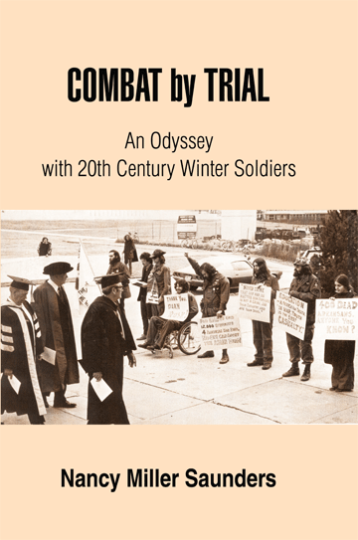
Nancy Miller Saunders’ Combat by Trial:
Documenting 20th century ‘winter soldiers’
By Mariann G. Wizard / The Rag Blog / August 25, 2010
Combat by Trial: An Odyssey with 20th Century Winter Soldiers by Nancy Miller Saunders. (iUniverse, Inc., 2008.) 591 pp, $34.95. Available at www.iuniverse.com.
Turning the Guns Around: Notes on the GI Movement by Larry G. Waterhouse and Mariann G. Wizard (Praeger, 1971). 221 pp., published at $6.95.
In 1971, my second husband and good friend Larry Waterhouse and I, through a fortuitous series of chances and choices, wrote a book on antiwar activity in the U.S. armed forces for a respected New York publisher. Turning the Guns Around: Notes on the GI Movement (Praeger) was researched and written entirely in four months to conform to a deadline occasioned by the failure of a previously contracted writer to deliver a manuscript.
Following Robert Sherrill’s successful Military Justice is to Justice as Military Music is to Music (HarperCollins,1970), Praeger was eager to jump on the military dissent bandwagon, and to fill the hole in their spring line-up.
Turning the Guns Around gave ’em more than they bargained for. With chapter titles like, “Gen. Baconfat vs. the Red Menace” and “Today’s Pig is Tomorrow’s Bacon,” and copiously drawing from the irreverent and often profane underground GI press of the day, we proclaimed the entry of activist grunts, swabbies, jarheads and/or flyboys, along with some servicewomen, into the ranks of revolution.
Drafted out of graduate school at UT Austin on November 25, 1969, Larry made no secret of his sympathy for Vietnam’s National Liberation Front during induction and basic training. As a result, he spent his entire 14-month military career at Ft. Ord, California, near Monterey.
By the time I joined him the next summer, he’d made the transition from leadership in UT’s Students for a Democratic Society (SDS) to leadership in the Ord chapter of Movement for a Democratic Military (MDM). The group rented a house off-post where off-duty soldiers could meet, hang out, and talk; published an erratic newspaper; and engaged in anti-war actions as well as solidarity actions with, groups like the lettuce-boycotting Farmworkers Union, protesting the enormous amounts of lettuce being served in Army mess halls.
We had each worked with individual anti-war vets in Austin, and with anti-war GIs somewhat through the Oleo Strut, an anti-war coffeehouse in Killeen, Texas, near Ft. Hood, and knew from history the potential importance of rising dissent within America’s armed forces.
Despite rising rapidly to a responsible and even rather sensitive position in Ft. Ord’s payroll office, Larry never earned a stripe, remaining a proud buck private throughout his military servitude. His only bling was a Sharpshooter medal.
We signed our book contract at Christmas in 1970, in a Houston hospital, at the bedside of his Mom, who we thought might not live to see the book (she did). We’d flown to Texas on emergency leave when Gretchen had a heart attack, but tried to save money on the way back by delivering a “drive-away” car to Los Angeles. This became a marathon trip-from-Hell that landed us back in Monterey on Jan. 2, 1971, at about 4 a.m. I fell into bed. Larry put on his uniform and went to work.
An hour or so later he woke me with amazing news: he was being summarily, and honorably, discharged. Apparently the brass didn’t want an active duty private authoring a book about dissent in the armed forces!
Back in Austin, we finished the book, found a place to live, figured out what was next in terms of employment and school, and along the way met and started working with a good-natured Army vet, Terry DuBose, to organize an Austin chapter of Vietnam Veterans Against the War (VVAW).
It wasn’t long, however, until we found ourselves in the best place organizers can be: not needed. By the fall of 1971, VVAW was an organization of, by, and for combat vets and their spouses, and Larry and I were politely asked to step out. We continued opposing the seemingly endless Vietnam conflict in other ways.
VVAW continued to emerge as a leading anti-war organization, especially as the beleaguered student movement imploded, until the war finally ended and the last U.S. troops came home.
Nancy Miller Saunders’ memoir, Combat by Trial, tells VVAW’s story not only from her point of view, that of a non-veteran “insider,” but also, by skillfully interweaving the stories of veterans, government documents and vintage press reports, paints a collective memoir of a very crazy time. She was not, and does not present herself, as a VVAW leader, but was a trusted collaborator and confidante of many of VVAW’s key players, especially in the Southern region, over several years.
The liberal film school graduate encountered VVAW as a member of Winterfilm, a collective documenting testimony at VVAW’s first nationally-noted action, the Winter Soldier Investigation.
Held in late January and February 1971, WSI grouped combat vets by service and division to give public testimony about atrocities and war crimes in which they had participated, and/or had witnessed. The first panel was made up of veterans of the Marine Corps’ highly decorated First Division that had been in Vietnam since 1965.
From painfully detailed testimony in this and subsequent panels a pattern of officially-sanctioned brutality over overlapping tours of duty emerged, demonstrating unequivocally that the recently-revealed massacre at My Lai had been no accident, and no particular exception.
Saunders describes the haggard, haunted, but still child-like men who made these bloody confessions, and her own growing awareness that these gallant, all-American boys had been maimed not only, all too often, in their bodies, but in their souls. VVAW’s quest for an end to the war was at once a quest for their own healing, and for the healing of a nation.
Describing her journey, that of her then-partner, Arkansas VVAW coordinator Don Donner, and of VVAW as a whole from concerned patriots to targets of government intrigue, Saunders dips willingly into her own interpretations, but takes care to label them as such, urging readers to draw their own conclusions.
Her point of view differs from mine, for example, on the role of more radical anti-war groups, who she generally regarded then and now as “crazies” who drew attention from VVAW’s powerful statements and needlessly endangered peaceful protesters. However, her own militancy was raised by threatening events and the intense persecution of VVAW. This internal shift, from being a total pacifist to someone who, on occasion, could not sleep without knowing that a loaded pistol was within reach, is powerfully evoked.
The book made me remember walking into the MDM house in Monterey for the first time and seeing the sandbags lining the walls to protect against occasional drive-by shootings. The story of her and Donner’s reception by the New Orleans “Red Squad” gave me a chill; the Monterey police department knew of my arrival almost before I did.
If you are among those who can’t imagine what led some anti-war protesters of the 1960s and 1970s, as well as Black liberationists, to consider violence, this book is “must reading”! The short version: the U.S. government, through its willful lies, delusional fantasies, and brutally destructive acts, brought much enmity upon itself.
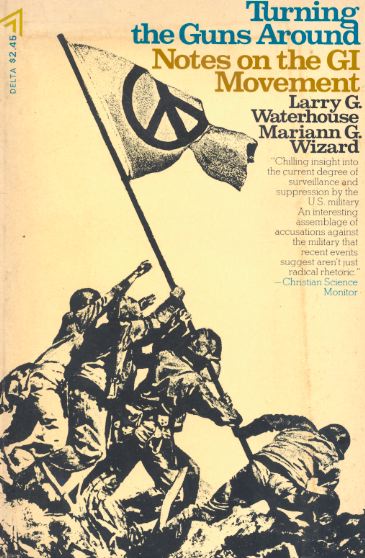
Deliberately false “intelligence” was the result of a political program that aimed to destroy VVAW’s credibility through accusations of planned violence and expensive trials, draining group resources. That this was accomplished, in part, through the testimony of paid informers and provocateurs worked eventually to bring in “not guilty” verdicts for most VVAW members charged with crimes, but the damage had been done. The question of how to defend against such betrayals remains open, and urgent.
In the biggest legal case, veterans were charged with conspiring to riot at the 1972 Republican National Convention in Miami. The trial of the Gainesville 6, that then became the Gainesville 8, and of the “Forgotten 4,” involved Austin’s own “movement lawyers,” most notably Cameron Cunningham for the defense.
Saunders recalls the bickering between and among defendants and defenders; between VVAW’s southern regional leaders — most of those accused in the case — and its compromised national office; as well as the convoluted legal wrangling that led to complete acquittal in Gainesville — but only after the RNC was over and Nixon anointed once more as the nominee.
Although Saunders and Donner were not active here, Austin VVAW’s actions are amply chronicled, largely through Saunders’ conversations with and letters from local leader John Kniffen, one of the Gainesville 8, as well as through her direct observations of VVAW actions in the Dallas-Ft. Worth area and in Killeen.
Kniffin, a taciturn, wiry, former tank commander who did 32 months in-country, joined Austin VVAW in 1971, and became a force regionally, and then in national VVAW, where he demanded — and got — more democratic decision-making.
His recollections, and those of his widow, Cathy, who continues, after John’s death from Agent Orange exposure, to work for veterans’ rights, brought back vivid memories of actions here in which Larry and I participated, the most awesome of which was a gigantic outpouring of peace and justice forces at the official dedication of the Lyndon Baines Johnson Presidential Library, attended by a Who’s Who of U.S. imperialism, including then-President Richard “Tricky Dick” Nixon.
While there are a few errors that old Austinites will readily spot (e.g., the University’s West Mall is referred to repeatedly as the East Mall), it’s also fun figuring out who certain unnamed activists must be, simply from their descriptions.
In what I believe to be an original contribution, using FBI and press reports, Saunders alluringly links dirty tricks played against VVAW with Nixon’s Watergate burglary team. Offices and homes of VVAW members and attorneys were burgled, especially in Florida, where Nixon’s plumbers were based; as in the better-known Washington, D.C. break-ins that ultimately brought down the President, only certain papers were stolen.
In the weeks before the 1972 national political conventions, both of which were in Miami, Florida leaders of VVAW were in discussion with Democratic Party headquarters — one of the targets of Nixon’s buggers — about security for demonstrators (“nondelegates”) who would attend. Democrats feared, and hoped to avoid, a repeat of the 1968 Chicago convention debacle, where anti-war youth had been clubbed through the streets on national television.
Was this discussion the reason Nixon bugged Democratic Party HQ? Did the same crew that burgled Pentagon papers whistle-blower Daniel Ellsburg’s psychiatrist’s office burgle VVAW files in Gainesville? Did Nixon hope to tie national Democratic leaders to VVAW’s alleged conspiracy to riot? While no conclusive proof is presented, “coincidences” of timing and personnel movement are compelling. Has anyone offered a more reasoned explanation of what Watergate was all about?
Saunders also presents evidence that on at least two occasions, VVAW’s release of information gleaned from active-duty contacts (the anti-war movement within the military having continued to grow despite its own problems and persecutions) about U.S. troop and materiel build-ups prevented the war from being intensified on Nixon’s watch, rather than eventually being abandoned. This seems a plausible enough reason for the vengeful, plotting Nixon to want the organization destroyed!
The collective nature of Saunders’ memoir is its true strength. By giving free voice to the many vets who entrusted her with their papers, their unpublished memoirs, their own FBI files, etc., she avoids the self-centered quality common in such memoirs, while still allowing herself free voice.
She knows that no one person has the full story, and in fact not even a group of people such as she draws from see everything that happened around them and to them. Part of the immense satisfaction I found in the book came from seeing other views of events I had seen peripherally, in a time that seems both very long ago and strangely like this morning.
In a funny circle-of-life coincidence, a bus Terry DuBose drove with other veterans to Washington, D.C. — a bus belonging to John Kniffin — and wrote about in an epilogue for Turning the Guns Around, pops up in Nancy’s book, stranded by the side of the road, from a completely different source.
DuBose electronically introduced me to Saunders and her husband, Budd — a sometimes contributor to The Rag Blog from rural “Arkansaw” — a year or so ago, which is how I heard about her book, and requested a swap. As a sometimes self-published author myself, I’m happy to recommend this Internet publication in overall quality and value.
You’ll find as many typos in any book these days, and none of Saunders’ are very off-putting. Spelling errors, etc., in sources quoted, add, in several cases, to the authenticity of her documentary. Saunders still sees life through a film editor’s eye, and has a good gift both for description, especially of people and the places where action takes place, and for dialogue, as well as voluminous resources.
Turning the Guns Around was a snapshot of an emerging movement, a Rorschach blot of a moment. Combat by Trial is a deeper, longer, and more nuanced look at that same movement — military opposition to U.S. military adventurism — as it grew, rose, and fell in the 1970s.
Now it is rising again, in our younger brothers and sisters, sons and daughters, who have been to war in the cauldrons of Iraq and Afghanistan. Saunders doesn’t shy away from drawing parallels between Vietnam and the “Afraq” conflicts, and I will not shy away from pointing out that Turning the Guns Around predicted these wars in some detail 39 years ago. Unlike some Vietnam-era memoirs, Combat by Trial has plenty to offer today’s peace warriors.
[Mariann Wizard, a Sixties radical activist and contributor to The Rag, Austin’s underground newspaper from the 60s and 70s, is a poet, a professional science writer specializing in natural health therapies, and a regular contributor to The Rag Blog.]
Thorne Webb Dreyer, Editor





