An Unaccustomed Truth : Commander McChrystal Admits to Afghan Atrocities

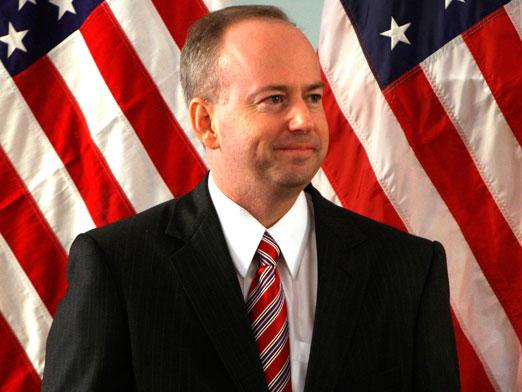
Gen. Stanley McChrystal. Photo by Manuel Balce Ceneta / AP.

Times quotes Afghansistan commander:
American atrocities turn Afghans into insurgents

“We have shot an amazing number of people, but to my knowledge, none has ever proven to be a threat.” — Gen. Stanley A. McChrystal

By Chris Floyd / March 29, 2010

Well, John the Baptist after torturing a thief
Looks up at his hero the Commander-in-Chief
Saying, ‘Tell me great hero, but please make it brief
Is there a hole for me to get sick in?’
Bob Dylan, Tombstone Blues

One can only assume that the regular editors of the New York Times were all out at a party, or left early for a weekend in the Hamptons, or something — but somehow, the paper published a front webpage story that stated — without the usual thousand excuses and extenuations — that American troops are routinely slaughtering Afghan civilians at checkpoints. What’s more, the story unequivocally ties the civilian killings to the “surge” ordered by the noble Nobel Peace laureate, Barack Obama.

Here’s what the Times says:

American and NATO troops firing from passing convoys and military checkpoints have killed 30 Afghans and wounded 80 others since last summer, but in no instance did the victims prove to be a danger to troops, according to military officials in Kabul.

And what is the paper’s authority for this astounding admission of atrocity? Not the usual “unnamed sources” or “senior official in a position to have knowledge of the situation,” but none other than Obama’s hand-picked commander on the Af-Pak front, General Stanley “Black Ops” McChrystal his own self:

“We have shot an amazing number of people, but to my knowledge, none has ever proven to be a threat,” said Gen. Stanley A. McChrystal, who became the senior American and NATO commander in Afghanistan last year. His comments came during a recent videoconference to answer questions from troops in the field about civilian casualties.

Let’s repeat the much-media-lauded general’s statement again: “We have shot an amazing number of people, but to my knowledge, none has ever proven to be a threat.” Now, what would the authorities say if you or I shot “an amazing number of people who have never proven to be a threat?” Why, they would call us murderers — even mass murderers. Yet this is precisely what “the senior American and NATO commander in Afghanistan” has just declared, on videotape.

The story goes on to make the extraordinarily straight — and indisputable — point that these wanton killings of civilians who have never even “proven to be a threat” is fanning the very “insurgency” (which is the Beltway term of art for any resistance to American military presence”) whose quelling is the ostensible reason for the Laureate’s “surge” in the first place:

Failure to reduce checkpoint and convoy shootings, known in the military as “escalation of force” episodes, has emerged as a major frustration for military commanders who believe that civilian casualties deeply undermine the American and NATO campaign in Afghanistan.

Many of the detainees at the military prison at Bagram Air Base joined the insurgency after the shootings of people they knew, said the senior NATO enlisted man in Afghanistan, Command Sgt. Maj. Michael Hall.

“There are stories after stories about how these people are turned into insurgents,” Sergeant Major Hall told troops during the videoconference. “Every time there is an escalation of force we are finding that innocents are being killed,” he said.

The story even states plainly that the official figures of admitted killing of unthreatening civilians — already unconscionably high — might not be the true extent of these atrocities:

Shootings from convoys and checkpoints involving American, NATO and Afghan forces accounted for 36 civilian deaths last year, down from 41 in 2008, according to the United Nations. With at least 30 Afghans killed since last June in 95 such shootings, according to military statistics, the rate shows no signs of abating.

And those numbers do not include shooting deaths caused by convoys guarded by private security contractors. Some tallies have put the total number of escalation of force deaths far higher.

A spokesman for the Afghan Interior Ministry, Zemary Bashary, said private security contractors sometimes killed civilians during escalation of force episodes, but he said he did not know the number of instances.

The story also presents an example of one slaughter of civilians, and shows how it leads directly to the rise of resistance against the American military presence:

One such case was the death of Mohammed Yonus, a 36-year-old imam and a respected religious authority, who was killed two months ago in eastern Kabul while commuting to a madrasa where he taught 150 students.

A passing military convoy raked his car with bullets, ripping open his chest as his two sons sat in the car. The shooting inflamed residents and turned his neighborhood against the occupation, elders there say.

“The people are tired of all these cruel actions by the foreigners, and we can’t suffer it anymore,” said Naqibullah Samim, a village elder from Hodkail, where Mr. Yonus lived. “The people do not have any other choice, they will rise against the government and fight them and the foreigners. There are a lot of cases of killing of innocent people.”

Finally, the story depicts McChrystal — again, the handpicked commander of the commander-in-chief — stating flatly when it comes to the widely ballyhooed “counterinsurgency doctrine” that is supposedly now governing the military occupation of Afghanistan, the right hand does not know what the left hand is doing. In other words, it’s a full-scale, four-star FUBAR:

More recently, General McChrystal moved to bring nearly all Special Operations forces in Afghanistan under his control. NATO officials said concern about civilian casualties caused by these forces was partly behind the decision, along with the need to better coordinate units and ensure that local commanders were aware of what was happening.

One unit could be doing counterinsurgency, while another carried out “a raid that might in fact upset progress,” General McChrystal explained during the videoconference.

Beyond the bare facts reported by the story — i.e., the top American commanders acknowledge that their forces are killing scores of innocent civilians who pose no threat to the occupiers, and that their own incompetent policies are actually breeding more hatred and resistance — there is also the astonishing circumstance that we have a story on the Laureate’s “good war” in Afghanistan that is almost entirely nothing but bare facts.

Of course, the story appeared late on a Friday, and will no doubt disappear down the memory hole in short order… Still, I must admit that when I read the piece, I honestly did a double-take; I thought it was a hoax — or perhaps a hack. Not because the story seemed implausible — but precisely because it didn’t, and because it was shorn of most of the self-serving, empire-justifying bullshit that surrounds accounts of the “Peace Prize Surge.”

Again, just think of it, let it sink in, attend to the word of the commander: “We have shot an amazing number of people, but to my knowledge, none has ever proven to be a threat.” Again: “We have shot an amazing number of people, but to my knowledge, none has ever proven to be a threat.” Again: “We have shot an amazing number of people, but to my knowledge, none has ever proven to be a threat.”

Again: what do you call it when innocent, unarmed, defenseless people who “have never proven to be a threat” are gunned down in cold blood? What do you call such an act?

Source / Empire Burlesque

[A version of the Times article also appeared in the print edition.]

Thanks to Fran Hanlon / The Rag Blog

Posted in RagBlog | Tagged , , , , , | 1 Comment

Colombia and the TLC : Just Who Benefits from ‘Free Trade’?

And we’re not talking “Tender Loving Care” here. Graffiti image from Parades Que Hablan (Talking Walls).

Colombia and the TLC:
Jobs, deficits, and keeping ‘free trade’ alive

The organizations that stand to benefit the most from this trade agreement — U.S. multinational corporations — have been involved in aiding and abetting [the] bloodshed [against trade unionists].

By Marion Delgado / The Rag Blog / March 27, 2010

AT LARGE IN COLOMBIA — On Thursday, February 18, U.S. Senator George LeMieux (R-FL), visited Colombia’s President Álvaro Uribe at his ranch. His pilgrimage promoted a proposed Colombian/U.S. Free Trade Agreement (FTA), known locally as the Tratado de Libre Comercio (TLC).

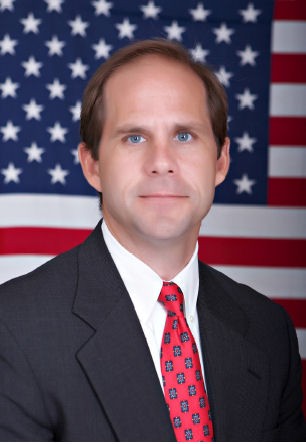
Sen. George

After their rural meeting, LeMieux released a statement in which he said, among other things,

Colombia is a strong ally and partner of the United States. In my meeting with President Uribe, I raised the issue of trade and committed to continue encouraging ratification of the [FTA/TLC]. I again call upon President Obama to send the free trade agreement with Colombia to the United States Congress. Bilateral trade produces clear benefits including jobs in Florida and throughout the United States.

For example, more than 95% of the flowers commercially grown in Colombia come through Miami for distribution throughout the nation. That creates thousands of jobs and opportunities in the United States. Free trade produces prosperity and strengthens democracies in Latin America as well.

He didn’t mention that those “thousands” of jobs and opportunities in the U.S. already exist without the TLC. It’s almost funny; he said that Free Trade produces prosperity; the facts, which Congresspeople never seem to work into their pro-free trade statements, show that just the opposite is true.

Take the original TLC: the North American Free Trade Agreement (NAFTA), between the U.S., Mexico, and Canada.

Prez George

Before leaving office, President George W. Bush of the Bush Crime Family claimed that, “From 1993 to 2007, trade among the NAFTA nations more than tripled, from $297 billion to $930 billion.”

Facts

Never one to rely on facts, Bush skipped over the reality that increased trade flow only benefits an economy as long as it doesn’t lead to unsustainable deficits. Much of the increased volume of trade under NAFTA was a massive surge in imports into the U.S.

A small pre-NAFTA U.S. trade surplus with Mexico in 1993 reversed into a $91 billion deficit in 2007, while a pre-NAFTA deficit with Canada grew exponentially. NAFTA foreign investor protections, which remove most of the risks otherwise associated with offshore production — coupled with the high dollar policies of the Clinton administration — acted as a subsidy for off-shoring U.S. jobs.

The result? A 691% increase in the U.S.’ combined trade deficit with Canada and Mexico, from $24 billion in 1993 to $190 billion in 2007. This artificially induced, distorted composition of trade flows — shaped by specific rules in NAFTA — puts the entire region at economic risk.

Senator LeMieux was big on job creation. He obviously knows nothing of which he speaks, and as with any politician cares less, he just says what he thinks sounds good. The real facts about job creation under NAFTA tell a different story.

More facts

Trade affects the composition of jobs, not the total number. Three million net U.S. manufacturing jobs have been lost under NAFTA.

The job creation claim is particularly sly, as economists know that total employment numbers and unemployment rates are not typically affected by trade policy, but by central bankers who set interest rates. In fact, they define labor force growth as simply income growth minus productivity growth.

Thus, if income growth were 2 percent and productivity growth were 1 percent, this would imply a labor force growth rate of 1 percent, or roughly 1.4 million jobs — irrespective of trade flows.

What trade policy affects is the composition of jobs in the economy, in particular tradable sectors like manufacturing. The original claim by NAFTA boosters in 1993 that the pact would lead to 170,000 annual U.S. job gains was premised on the projection that the U.S. would have a growing trade surplus with Mexico. We were supposed to be exporting U.S.-made goods to them.

Ever since NAFTA critics’ projection of increased trade deficits proved true, pro-NAFTA analysts have tried to move the discussion away from the pact’s damage to U.S. workers and to focus on the combined import-export volume of trade flows’ effect on overall U.S. employment rates.

Here are the relevant numbers: U.S. manufacturing employment declined from 16.8 million people in 1993 to 13.9 million people in 2007, a decrease of nearly 3 million manufacturing jobs, nearly 20% of the total. Moreover, today’s $190 billion U.S. trade deficit with NAFTA countries — as a simple accounting matter — equals manufacturing jobs that could have been here. The Economic Policy Institute estimates that the U.S. could have had over 1 million additional manufacturing jobs had there been trade balance between NAFTA countries alone, or no NAFTA at all.

Sen. George LeMeiux, Republican of Florida. Photo from AP / Politico.

Other Congressional visits

President Uribe also met with a group of U.S. Congressmen on January 9, at a working breakfast at his ranch known as Fertile Farm in Monteria, Cordoba Department, 310km Northeast of Bogota.

Among them was Eliot Engel, a Democrat from New York’s 17th district (Westchester County), chairman of the Western Hemisphere subcommittee of the House.

The meeting marked the start of an offensive by the president to achieve, as soon as possible, ratification of the FTA/TLC by the U.S. Congress.

Uribe’s purpose became clear on December 31, 2009, when he asked the U.S. to “recognize the efforts” of Colombia in the fight against drug trafficking and terrorism. A week later, he reiterated to Democratic Reps. Engel; Lynn Woolsey from Marin County, CA; Shelley Berkley, Las Vegas, NV; and Republican Marsha Blackburn from Southwestern Tennessee, (a T-bagger favorite): “I said with all honesty and with all the solidarity that we need rapid adoption of this treaty.”

What the fight against drug trafficking and “terrorism” has to do with Free Trade is beyond me.

Pending congressional approval

The FTA/TLC was signed by Presidents Bush and Uribe on November 22, 2006. When it enters into force, Colombia will immediately eliminate most tariffs on U.S. exports, with all remaining tariffs phased out over defined time periods.

The FTA/TLC also includes important rules on customs administration and trade facilitation, technical barriers to trade, government procurement, investment, telecommunications, electronic commerce, intellectual property rights, and labor and environmental protection.

Labor Protection?

If labor needs protection anywhere, it is here in Colombia. Here is the situation:

Colombia today has some of the worst labor rights violations in the world. Trade unionists are routinely murdered, tortured, and threatened with death: since 1991, over 2200 have been assassinated. Many of these extrajudicial killings have been directly linked to the Colombian Military and the President’s own secret police, the Administrative Department for Security or Departamento Administrativo de Seguridad (DAS). Out of so many murders, there have been only 37 convictions. The FTA/TLC will only embolden anti-union attacks here.

The organizations that stand to benefit the most from this trade agreement — U.S. multinational corporations — have been involved in aiding and abetting this bloodshed. Cases have been brought against Coca-Cola, Drummond Mining Company, and Occidental Petroleum accusing them of employing paramilitaries that terrorized and killed union organizers.

Forty-three U.S. corporations have been named as having hired paracos to “protect” them from guerrillas and unions. More cases are expected to be made, and fines will be levied. (Not as cheap as the $2000 a head reportedly paid for U.S. Army/mercenary baby killing in Afghanistan, but cheap enough for the Wall Street gang.)

It should be noted that most Colombian workers and their unions are against the proposed FTA/TLC; unlike American investors, workers in Colombia have little to gain by further U.S. investment without real accountability for violence against unions and for multiple other human rights abuses.

U.S. firms will have better access to Colombia’s service sector than other World Trade Organization members under the pact’s General Agreement on Tariffs and Trade. All service sectors are covered by the FTA/TLC except where Colombia has made specific exceptions.

Colombia’s Congress approved the FTA/TLC and a protocol of amendment in 2007. Colombia’s Constitutional Court completed its review in July 2008, and concluded that the FTA/TLC conforms to Colombia’s Constitution.

Obama’s duplicity

In his January 27 State of the Union Speech, President Barack H. Obama said, “We have to seek new markets aggressively, just as our competitors are… And that is why we will continue to shape a… trade agreement that will open…markets…with key partners like Colombia.”

To flesh out what his boss meant, deputy U.S. Trade Representative Demetrios Marantis expounded on trade policy in a morning-after speech before a gathering sponsored by the Center for Strategic and International Studies.

Key pillars of Obama’s trade policy, Marantis said, will include pursuing the Transpacific Partnership (TPP) — while also pushing ratification of already-negotiated free trade agreements with South Korea, Panama, and Colombia. The trade agreements were each presented to Congress at least three years ago but have not been acted upon.

One big question is why Obama is pursuing free trade in the first place. As a candidate, Obama argued that the American public had been oversold on the benefits of free trade and specifically came out against the Colombia FTA. What happened?

Mitch

Mitch McConnell (R-KY), the Senate Minority Clown-in-Chief, was quick to jump on the FTA/TLC band wagon the day after BHO’s speech. “Republicans agree with the need to increase trade and with the need to ratify trade agreements with Colombia and other important trading partners that so far have met resistance on the other side of the aisle,” he declared.

Mitch was referring to the reluctance of some Democrats to address the FTA/TLC created by their awareness of the thousands of murders of trade unionists since 1991. Many other union members were threatened, tortured, and driven out of their country.

For proponents, the FTA/TLC is tied as much to hemispheric politics as it is to trade. The U.S. and Colombia are strategic partners, having signed a Defense Cooperation Agreement on October 30, 2009, which gives the U.S. access to Colombian bases from which to carry out “counter-drug” surveillance flights. Colombia has proved a bulwark against the two countries’ mutual antagonist, the Bolivarian Revolutionary country of Venezuela.

Some Congressional Democrats have spoken out stridently against the FTA/TLC, criticizing the Colombian government for not doing enough to curb violence against union organizers and members.

Harry

Senate majority leader Harry Reid (D-NV), has argued that “it is a major mistake to set up the Colombia [FTA/TLC] legislation as the proxy for support for Colombia… An FTA is not a foreign-aid package. It is neither a favor for friendly governments, nor a substitute for sensible and sustained foreign-policy engagement in the hemisphere.”

Obama may well see the FTA/TLC in strategic terms, but some think Congress is unlikely to follow that lead. One reason is that opponents — most notably, organized labor — comprise part of the Democrats’ political base. In addition, polls show that most Americans have turned away from free trade. A 2009 Rasmussen poll found that 73% of Americans believe that free-trade agreements have had a negative effect on their families, while only 14% say they have benefited.

With those kinds of numbers and congressional elections approaching, it is doubtful members of Congress will want to stick their necks out for free trade, at least this year.

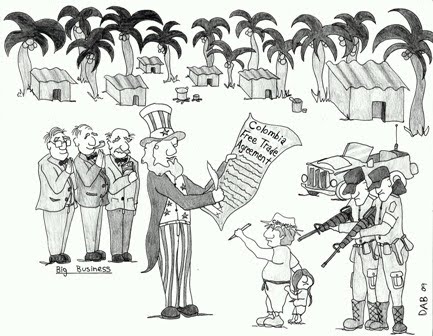
Cartoon from Witness for Peace.

Down but not out

Does that mean the FTA/TLC is dead? Hardly. It lingers ready to go to Congress, an Obama bargaining chip to appease Republicans or to trade for their votes on some other crazy Democratic scheme.

Ron

Colombia’s Trade Minister, Luis Guillermo Plata, asked the U.S. on March 9 to “be sincere and tell us if the [FTA/TLC] is going to go ahead or not.” A response from the White House came the next day when U.S. Trade Representative Ron Kirk, testifying before the Senate Finance Committee, said, “we are hopeful we can come to some resolution with members of Congress over the next several months, if not weeks… so that we can then go back to Colombia with a finite list of what we’d like to see get done.”

Kirk said that passing the agreement with Colombia is a priority of the Obama administration. The U.S. plans to give Colombia a “workable list” of legislative and judicial reforms that the administration would like to see the South American nation execute.

Chuck

Senator Charles “Chuck” Grassley (R-IA), ranking member of the Senate Committee on Finance, whined about the “apparent lack of urgency” in resolving issues surrounding the trade accord. “This delay in implementation hurts U.S. credibility around the world, not just economically but geopolitically as well.” He didn’t elaborate on how that is so, or what credibility he was referring to or what was so urgent about it.

Hillary

U.S. Secretary of State Hillary Clinton, who bypassed Colombia on her recent South American tour, met privately with Uribe in Montevideo, Uruguay, on Monday, Mar. 1, and confirmed Washington’s plans to push the FTA/TLC.

Both were there for the inauguration of President Jose Mujica, a co-founder of the Tupamaro guerrillas who spent 15 years in prison, enduring torture at the hands of the brutal, U.S. backed, military dictatorship that ruled Uruguay from 1973-1985.

A midnight vote on an unrelated bill wherein the FTA/TLC is a silent partner may be more likely than open passage. Transparency, honesty, and giving a shit about the lives of the Colombian working class (or any other workers) are never on the Capitalist agenda. It’s always about the false value of Profit.

The Rag Blog

Posted in Rag Bloggers | Tagged , , , , , | 2 Comments

VERSE / Mariann G. Wizard : Pirates of Health-Care Reform

Corporate Pirate. Image from jacobdivett.


Pirates of Health-Care Reform

Of all the old pirates of story and song,
Blackbeard; and Bluebeard; John Silver, called “Long”;
each had his own favorite way to do wrong!

Some liked to pillage, and some liked to loot,
some preferred swordplay, and some liked to shoot,
and some liked a gangplank for giving the boot!

But the one thing that all of them liked very best
was opening a just-grabbed treasure chest,
right in front of an unwilling guest!

“Was these your fine jools, dear?” they’d pleasantly coo,
“and was these your doubloons? Well, that will not do!”
And they’d take for themselves everything nice or new.

But at least when they did this, they didn’t pretend
it was for your own good, but their larcenous ends,
upon which such thievery clearly depends!

Our modern day pirates are much more discreet,
with old school ties and nicely-shod feet,
and business arrangements so tidy and neat.

They’ve elected themselves to the highest posts,
bought men with money, or blackmailed their hosts;
poisoned the wells and turned us into ghosts.

There’s never a sign of a saber or gun,
just fine-printed contracts and thefts quietly done,
so smooth that the robbers do not even run!

Just the money, that’s all, runs away in the night
to foreign bank fortresses tucked out of sight,
in places where Empire still flexes its might.

The factories left, and all the real jobs
turned into vast slave ships, filled with poor slobs
who don’t even know how bad they’ve been robbed.

And we, poor blighters, left holding the bag,
empty as a promise, wrapped in a flag,
have little left over but a real stone drag!

Now they’ve passed a new law for our pirate lords:
we’re to empty our wallets or face down their swords,
in the form of new taxes and sugar-pill words.

Here’s a thought for the rascals that pillage and steal:
with our dignity may go our bleeding-heart zeal!
We may soon see you lashed to the old breaking wheel!

Let’s bring back the gallows, the rack, and the whip!
Catch these corporate pirates and let the cat rip!
Don’t pay the ransom, you’re just being clipped!

Mariann G. Wizard
27 March 2010

The Rag Blog

Posted in RagBlog | Tagged , , , , | 10 Comments

Next Nuke Nightmare? Paid for with Your Taxes

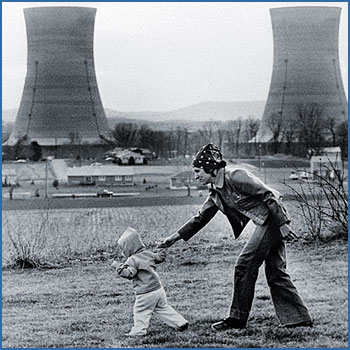
In 1979, roughly 25,000 people lived within five miles of the giant cooling towers at Three Mile Island that became symbols of the nation’s worst commercial nuclear accident. Photo by Martha Cooper / AP.

We are now paying
For the next Three Mile Island

By Harvey Wasserman / The Rag Blog / March 27, 2010

As radiation poured from Three Mile Island 31 years ago this weekend, utility executives rested easy.

They knew that no matter how many people their errant nuke killed, and no matter how much property it destroyed, they would not be held liable.

Today this same class of executives demands untold taxpayer billions to build still more TMIs. No matter how many meltdowns they cause, and how much havoc they visit down on the public, they still believe they’re above the law.

Fueled with more than $600 million public relations slush money, they demand a risk-free “renaissance” financed by you and yours.

As if!

In 1980 I reported from central Pennsylvania on the dead and dying one year after. Dozens of interviews documented a horrifying range of radiation-related diseases including cancer, leukemia, birth defects, still births, malformations, sterility, heart attacks, strokes, emphysema, skin lesions, hair loss, a metallic taste and much more. As reported by the Baltimore News-American among others, such ailments also ripped through the animal population..

To this day no one knows how much radiation was released at the 1979 TMI accident, where it went, or whom it harmed. The official line that “no one was killed” is arguably the biggest lie ever told in U.S. industrial history. It is to public health what the promise of power “too cheap to meter” was to public finance.

It parallels Soviet lies about the 1986 catastrophe at Chernobyl, whose health effects continue to skyrocket. A devastating summary report issued by the New York Academy of Sciences (Yablokov, Nesterenko & Nesterenko: Chernobyl: Consequences of the Catastrophe for People & the Environment) says at least 980,000 people are likely to die from the fallout.

That would be a small fraction of the casualties had 9/11 terrorists dived into the two reactors at New York’s Indian Point instead of hitting the World Trade Center.

In a time of deep financial stress, it also counts that the TMI accident turned a $900 million asset into a $2 billion liability in a matter of minutes. Chernobyl has cost Belarus and Ukraine at least $500 billion and counting. And the price tag on a major meltdown anywhere in the U.S. is virtually beyond calculation.

Thus those who think a flood of new nukes will flow unimpeded into the American pocketbook haven’t been paying attention:

  1. Four northeastern nukes — in Vermont, New Jersey, and the two at Indian Point — are under intense public pressure to shut within the next two years. Numerous other elderly reactors are likely to go down long before any new nukes could come on line.
  2. French President Sarkozy is demanding that world financial institutions buy a bevy of new French-built reactors. But huge delays and cost-overruns at French projects in Finland and France itself have made the investment community wary to say the least, thus prompting his foot-stomping.
  3. Documents leaked from inside France’s national utility EDF indicate cost-cutting has made the new French reactor design exceedingly prone to explosion, further unsettling potential investors.
  4. The future of new U.S. reactor construction hinges on massive loan guarantees and handouts. The public number is $54 billion, but the Nuclear Information and Resource Service says the real bill could top a trillion.
  5. In the polarized, cost-conscious wake of the health care bill, and the apparent demise of cap and trade as a centerpiece of climate legislation, the idea of such huge sums flowing to a deeply polarizing energy source has become increasingly problematic. Without a clear trade-off for fossil/nuclear giveaways, and with stiffening resistance from the rightist National Taxpayers Union, Cato Institute, and Heritage Foundation, the nuke bonanza is anything but certain. The technology may now, in fact, be “too expensive to matter.”
  6. An attempt by Entergy to shift six reactors into an asset-free corporate shell has been nixed by New York authorities, leaving liability for Vermont Yankee, Indian Point and other northeastern nukes in limbo.
  7. As elderly nukes stumble toward oblivion, various funds allegedly set aside for decommissioning may be significantly under-funded, deeply exacerbating the financial battles that now encircle the industry.
  8. As a lame duck, George W. Bush signed agreements apparently obligating the feds to assume responsibility for enough radioactive waste to fill two of the canceled Yucca Mountain waste dumps. The complete lack of even one such facility means the potential taxpayer bill is beyond meaningful calculation.
  9. Above all the exemption from liability for a major accident — first perpetrated by a pro-nuke Congress in 1957 — remains the largest potential cost to us all. Renewed by Bush in 2005, some believe the statute is clearly unconstitutional.

To this day the families of those harmed by radiation at Three Mile Island have been denied the right to make their case in federal court.

But now the shoe is on the other foot.

Desperate for cash, the nuclear industry wants us all to pay hundreds of billions for the joy of living downwind from still more Three Mile Islands for which they intend to assume NO liability.

They want our money AND our lives.

From central Pennsylvania after 31 years, the message is clear: Just Say NO!

[Harvey Wasserman’s Solartopia! is at www.harveywasserman.com, as is The Last Energy War. He is senior advisor to Greenpeace USA and the Nuclear Information and Resource Service.]

The Rag Blog

Posted in Rag Bloggers | Tagged , , | 4 Comments

Health Care : Lies, Damn Lies, and Republicans


Republicans and health care:
The lie as art form

By Ted McLaughlin / The Rag Blog / March 27, 2010

Since the start of the health care reform discussion last year, the Republicans have told us lie after lie. They have accused Democrats of perpetrating a huge government takeover of the health care system.

The truth is that no doctor or hospital will be taken over or run out of business. What they will have is more customers with better insurance to pay for their services. And that insurance will be purchased from private insurance companies in the free market — either directly or through health insurance exchanges.

They have accused the Democrats of creating death panels that will choose to kill off the elderly and disabled. This is one of the most scurrilous of the lies, because none of the proposed legislation or the legislation that was actually passed ever had anything even remotely close to this. The truth is that the elderly will still be covered by Medicare, and the disabled will be covered by either Medicaid or private insurance. And both Medicare and Medicaid have been enhanced to make them function better.

They have told Americans that the new health care bill will create enormous debt for our country. And they are still telling this lie, even though the non-partisan Congressional Budget Office has reported the new laws will actually lower the government deficit by over a trillion dollars in the next 10 years. It’s funny how they swear by the CBO’s numbers when those numbers agree with their position and ignore the numbers when they don’t back up what they are saying.

They claim the new laws amount to a huge tax increase, and imply that this will apply to all Americans. It won’t. There are some increases in Medicare and Medicaid taxes, but they only apply to those making more than $200,000 a year ($250,000 for a married couple). Frankly, if you make more than that in a year, you can afford a small tax increase (and that’s what it is — a small increase). It also imposes a small tax on the most expensive insurance policies — the so-called “Cadillac” policies. You can be sure this will not affect the huge majority of working Americans with private insurance.

Now they are telling us that the new laws will cost many thousands of jobs, because the businesses will not be able to afford buying insurance or alternatively paying a tax for the employees they have. Ridiculous! This argument has the same flaw as their lie about raising the minumum wage costing jobs.

The fact is that there is only one reason a business hires workers — because that business needs those workers to meet the demand for their products or services, and they will hire only the amount they need regardless of the wage scale or need for insurance coverage.

If they hire less than the number that is needed, then their business will suffer because they cannot meet the demand. If they hire more than needed, then it will needlessly cut into owner profits (and no businessman will do that). A business may raise it’s prices to cover costs, but it will always hire only the number of workers needed — not more and not less.

When demand goes up, more workers will be hired. When demand goes down, workers will be laid off. That’s just the way it is in a capitalist system (and all costs are figured into prices and expected profit margin).

Now they are telling Americans that the new law will force doctors to refuse to accept Medicare and Medicaid patients. This is already a problem in many places, but it has nothing to do with the new laws. Do you know who is to blame? THE REPUBLICANS — because in their years in power they repeatedly cut the payments to doctors for Medicare and Medicaid patients. They have always hated these programs and the cuts were an effort to destabilize the programs. Hopefully the Democrats will fix this inequity if the new laws don’t.

But the biggest lie, the most outrageous lie, they are now telling is that they are in favor of health care reform (just not the reform passed by Democrats). Well if they were really in favor of health care reform, why didn’t they do it when they were in control (and had a Republican president for eight of those years). They had a golden opportunity to enact reform on their terms, but did nothing. They spent billions on unnecessary wars and corporate giveaways, but did absolutely nothing to fix the health care system.

It was obvious (and frustrating to many progressives) that President Obama reached out to the Republicans for bipartisan action on reforming health care. Every time he was snubbed. The Republicans had made a decision that they would oppose any effort at reform, because they believed if Obama failed to deliver on health care reform that would help them at the polls. They were more concerned with party politics than helping Americans access needed health care.

These are only a few of the more egregious lies the Republicans have told to try to stop health care reform and protect the profits of Big Insurance and Big Pharma. There were many others. I had hoped the lies and obstructions would stop now that “Obamacare” is law, but if Senator John McCain is to believed it looks like that won’t happen. McCain said the Republicans were so mad about the passage of these two health reform bills that “There will be no cooperation for the rest of the year.”

I really hope that is just another Republican lie, because important things remain to be done and Republican lies and obstructionism will just make it harder (though not impossible). Let me finish with an excellent quote I found on a friend’s blog (a gal and her blog):

In my life I’ve heard that: civil rights for people of color would destroy this country, Medicare would destroy this country, environmental protections would destroy this country. It must be indescribably horrible to live one’s life in fear as these folks seem to be doing.

Now the Republicans are telling us that health care reform will destroy our country. Don’t believe them as they try to spread fear. It’s just another of their many lies.

[Rag Blog contributor Ted McLaughlin also posts at jobsanger.]

The Rag Blog

Posted in Rag Bloggers | Tagged , , | 6 Comments

Health Care Reform : The End of the Beginning

Photo from Circlemp / treehugger.

The end of the beginning:
How ‘historic’ is this reform?

By Dr. Stephen R. Keister / The Rag Blog / March 27, 2010

Health care reform was finally passed by the House and Senate and many consider it an historic occasion. But let’s look at that “historic occasion” and view the legislation objectively. This is primarily health insurance reform and does not produce a sensible program of health care for all citizens on the level to those found in most countries of the civilized world.

We can address that a bit later; however, I am alarmed at the spin-off of a very disruptive right-wing populist movement in the United States, which has emerged out of reaction to the fight for health care reform.

Many of my progressive friends consider this to be a passing phenomenon; however, let us pause for a moment and remember the 9th-10th of November 1938 in Berlin or the 17th Century witch trials in Salem, Massachusetts. Perhaps at my advanced age, with lots of unpleasant memories, I am unduly alarmed; however, more than one social scientist feels that the tea bag movement, which is surreptitiously financed by extremely wealthy members of the financial elite, is of much more concern than many of my liberal friends believe.

I refer all to an article by Chip Berlet, of Political Research Associates, entitled “Right wing ‘populist moment’ could get worse. Message to the Left: stop whining and organize!”

I recall the writings of Eric Hoffer when he noted:

The impression that mass movements, and revolutions in particular, are born of the resolve of the masses to overthrow a corrupt and oppressive tyranny and win for themselves freedom of action, speech and conscience has its origin in the din of words let loose by the intellectual originators of the movement in their skirmishes with the prevailing order. The fact that mass movements as they arise often less individual freedom than the order they supplant, is usually ascribed to the trickery of a power-hungry clique that kidnaps the movement at a critical stage and cheats the masses of the freedom about to dawn.

Coverage on MSNBC last evening was largely dedicated to the proliferation of extreme threats of violence to members of Congress — and their spouses and children — who voted for the health care legislation. Not only are the threats based on misinformation, deceit, and out and out lies, but the foul language being used suggests serious paranoia. It has been estimated that 30% of the population is involved in the right-wing movements; but, considering that the population of the United States is something like 300 million, that’s a lot of crazies.

According to the Erie Times News, my local congressperson, Democrat Kathy Dahlkemper, is receiving extremely frightening messages directed at her and her family. This is a locale where folks line up at the Wal-Mart some mornings waiting for the doors to open so they can buy more ammunition, and where a local gun dealer has problems maintaining his stock in certain types of weapons.

I have disagreements with some of Ms. Dahlkemper’s votes; however, she has given the citizens of her district much more input into matters of national importance than her Republican predecessor did, and she seems much more enlightened in matters of the public good than her likely Republican challengers. In a civilized nation she is deserving of our concern and protection.

I hope that the news media will rise to the occasion and present the news in a fair and honest fashion during the period leading up the elections this coming Autumn, and not give in to the influence of the waves of corporate baksheesh. Meanwhile, it is the responsibility of the Democrats in power to take a cue from the Republican voice machine and do a much better job of getting out the truth to the 70% of the American people who may pay attention to morality and reason

I have had the privilege of following the progress of health care reform on the pages of The Rag Blog for over a year now. This has been an invaluable experience in my final years, and I will forever be grateful to the editor for his forbearance and patience. I would anticipate that my participation will be at irregular intervals in the future, but before I close the current exposition, a few observations:

The current insurance reform legislation in no way resembles a government take over of health care. In fact, as E.J. Dionne of The Washington Post and Commonweal points out, we have a bill that the Republicans could well have passed. It is very similar to the health care legislation that was passed in Massachusetts when Mitt Romney was governor.

There is absolutely nothing in the legislation that resembles a single payer system or even a public option, Medicare for All.

There is nothing in the legislation that approximates the excellent German health system that is, in fact, run by private insurance companies with government oversight of costs and services. Nor is it anything like the Canadian system — for which its driving force, Tommy Douglas, was voted by the people of Canada “the greatest Canadian of all time.”

I notice that health insurance stocks are doing quite well on Wall Street! Unfortunately, in the new legislation there is no effort to control insurance prices or to eliminate the health insurance industry’s anti-trust exemption. I am concerned about the mandatory inclusion of citizens in the plan under threat of fine, and — unlike the Swiss or German plans — it doesn’t at the same time set standards to ensure that the insurance companies provide adequate coverage, and to prevent price-gouging.

I would have wished for less equivocal language regarding the rights of the states to establish honest, effective plans — like that currently proposed in the Commonwealth of Pennsylvania. I would have hoped for the inclusion of community health clinics, as proposed by Sen Bernie Sanders, to be established on the European model. And that the establishment of medical dispensaries be expedited — to address the crowding of emergency rooms and thus reduce the overall cost of medical care, while at the same time providing a reasonable option for follow-up care. These facilities are absolutely necessary considering the fact that the fees paid under Medicaid make it economically impossible for a physician to take many of these folks as ongoing patients and still be able to cover office overhead.

There was some encouraging language in the legislation regarding subsidies for medical education that should result in more physicians for underserved areas; however, this requires much more fine tuning. As has been repeatedly pointed out by the American College of Physicians, much more attention must be directed at the paucity of primary care physicians — general internists, pediatricians, and family physicians — throughout the nation.

This problem is largely due to the inequitable fee schedules for these fields when compared with those in the surgical subspecialists, who are very well rewarded despite spending no more time in training than the internist or pediatrician. This has become a societal problem, largely driven by misinformation on TV that creates the myth that it is only those in the highly publicized specialties who are really in the “life saving” business.

We should express thanks for the collective courage of the orders of Sisters throughout the nation who came out in support of universal health care, especially in the face of pressure from their ecclesiastical “superiors.” We must remember the dedication of the nuns in the areas of healing dating back to the great medieval hospitals they founded during the Middle Ages, including the Hotel-Dieu in Lyons in 542; the Santa Maria della Scala in Siena in 898; St. Bartholomew’s in London in 1123; the Ospedale di Santa Mana degli Innocenti in Florence in 1421; and the Hotel-Dieu in Beaune in 1452.

These Sisters cared for the ill, the infirm, the dying, and the mentally ill without regard to pay or their own well-being as they administered to the dying during the plague. At the same time, the Papacy in Rome, influenced by the Borgia family, was pursuing other less spiritual interests!

In any event we have in hand a bill that according to the AP:

  1. Within 90 days will provide access to high risk pools for people with no insurance because of preexisting conditions. (The politicians like to compare these pools to those provided for the members of Congress, neglecting to say that 80% of their premiums are paid by the government.)
  2. Six months after enactment will bar insurers from denying coverage to children with preexisting conditions; will bar insurers from imposing lifetime caps on coverage; will require insurers to allow children to stay on their parents policies until they turn age 26.
  3. In 2013 will increase the Medicare payroll tax and expand it to cover dividend interest and other unearned income for singles earning more than $200,000 or joint filers making more than $250,000.
  4. In 2014 will provide subsidies for families earning up to 400 percent of the poverty level, currently about $88.000 a year, to purchase health insurance; will require most employers to provide coverage or face penalties; will require most people to obtain coverage or face penalties. (Nowhere, it seems, does the legislation provide assurance that the insurance companies will not triple the rates for those with preexisting conditions.)

We must congratulate the Congress, in a supplement to the health care legislation, for providing student loans directly to the students, and preventing the banking industry from gouging the program as has been the practice in years past.

[Dr. Stephen R. Keister, a regular contributor to The Rag Blog, lives in Erie, PA. He is a retired physician who is active in health care reform.]

The Rag Blog

Posted in Rag Bloggers | Tagged , , , , , , | 16 Comments

Jordan Flaherty : Racist Coup in Waterproof, Louisiana?

Waterproof, LA. Photo from Fox 44 / Baton Rouge.

Did racist coup in northern Louisiana town
Overthrow Black mayor and police chief?

By Jordan Flaherty / The Rag Blog / March 27, 2010

NEW ORLEANS — In Waterproof, a small northern Louisiana town near Natchez, Mississippi, the African-American mayor and police chief assert that they have been forced from office and arrested as part of an illegal coup carried out by an alliance of white politicians and their followers.

In a lawsuit filed last week, Police Chief Miles Jenkins asserts a wide-ranging conspiracy involving the area’s district attorney and parish sheriff, along with several other members of the region’s entrenched political power structure. These events come at a time when the validity of federal power is being questioned because of the race of the U.S. president, and in a state where white political corruption and violence have been and continue to be used as tools to fight Black political power.

About 800 people live in Waterproof, a rural community in the south of Tensas Parish. Tensas has just over 6,000 residents, making it both the smallest parish in the state, and the parish with the state’s fastest declining population. The parish’s schools remain mostly segregated, with nearly all the Black students attending public schools, and nearly all the white students attending private schools.

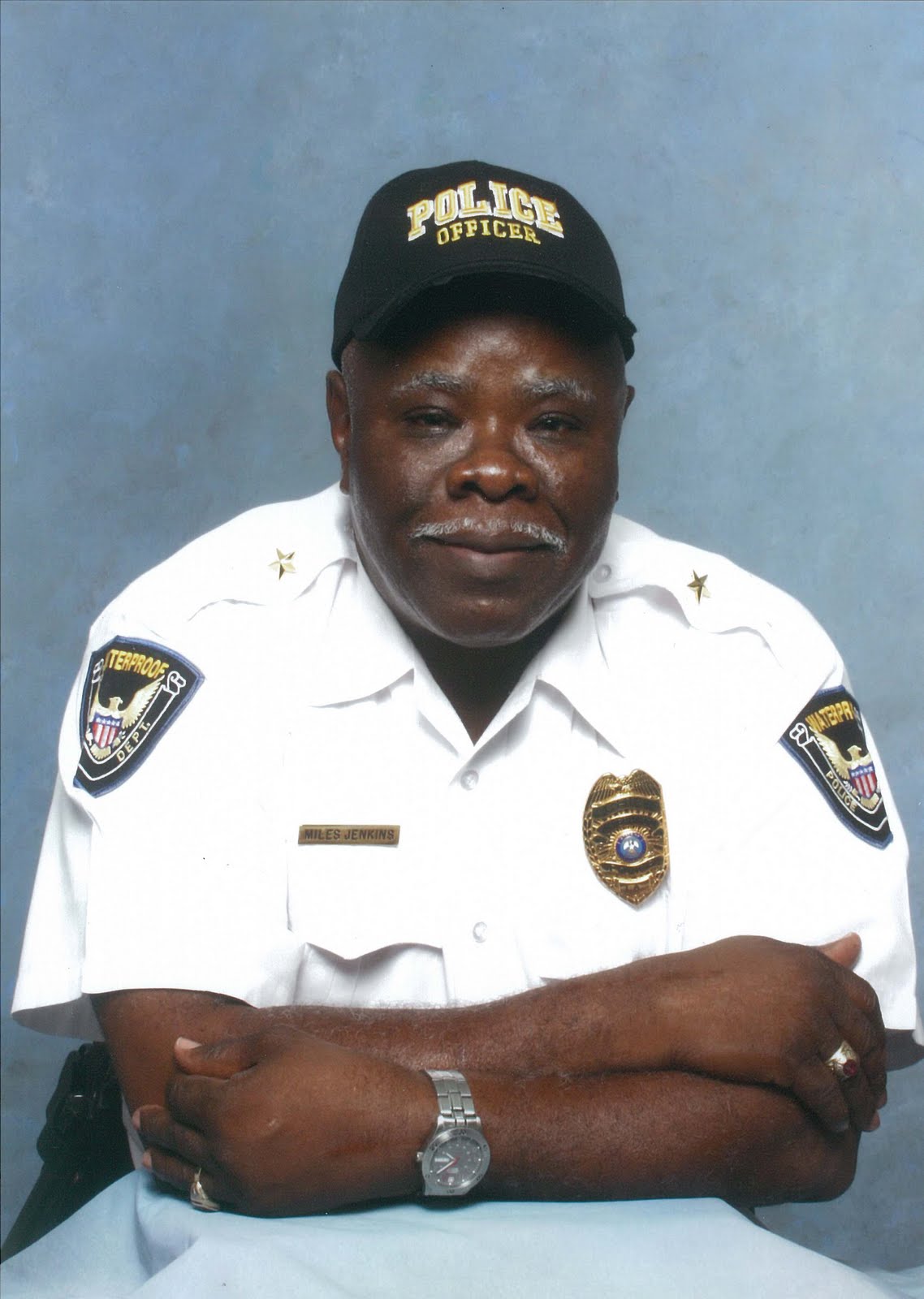
Waterproof Police Chief Miles Jenkins.

With a median household income of $10,250, Waterproof is also one of the poorest communities in the U.S. The only jobs for Black people in town are in work for white farmers, according to Chief Jenkins. “Unless you go out of town to work,” he says, “You’re going to ride the white man’s tractor. That’s it.”

Bobby Higginbotham was elected mayor of Waterproof in September of 2006. The next year, he appointed Miles Jenkins as chief of police. Jenkins, who served in the U.S. military for 30 years and earned a master’s degree in public administration from Troy University in Alabama, immediately began the work of professionalizing a small town police department that had previously been mostly inactive.

“You called the Waterproof police for help before,” says Chief Jenkins, “He would say, wait ‘til tomorrow, it’s too hot to come out today.” He also sought to reform the town’s financial practices, which Chief Jenkins says were in disorder and consumed by debt.

Chief Jenkins asserts that a white political infrastructure, led by the Parish Sheriff Ricky Jones and District Attorney James Paxton, were threatened by their actions. This group immediately sought to orchestrate a coup against the two Black men, including clandestine meetings, false arrests, harassment, and even physical violence.

Court documents describe how Paxton, Jones, and their allies formed an alliance “designed to harass intimidate, arrest, imprison, prosecute, illegally remove plaintiff from his position of police chief, prevent plaintiff from performing his law duties as police chief and/or force plaintiff to leave the town of Waterproof.”

Ms. Annie Watson, a Black school board member in her 60s who was born and raised in Waterproof, worked as a volunteer for the mayor. She says that the mayor and chief, who had both lived in New Orleans, brought a new attitude that Parish officials didn’t like.

“The Mayor and the Chief said you can’t treat people this way, and the Sheriff and DA said you got to know your place. If you’re educated and intelligent and know your rights and in this parish, you are in trouble,” she says. “They are determined to let you know you have a place and if you don’t jump when they say jump you are in trouble.”

Ms. Watson explains that Paxton and Jones were threatened by Chief Jenkins’ efforts to professionalize the town’s police force. Aside from representing a challenge to Sheriff Jones’ political power, this also took away a source of his funding. “Before Mayor Higginbotham, all traffic tickets went to St. Joseph,” she says, referring to the Parish seat, where Sheriff Jones is based. “So he cut their income by having a police department.”

Jack McMillan, an African American deputy sheriff in Tensas Parish, says he tried to warn Chief Jenkins to back down. “You’ve got to adapt to your environment,” he says. “You can’t come to a small town and do things the same way you might in a big city. Like the song says, you got to know when to hold ‘em, and know when to fold ‘em.”

Waterproof District Attorney James Paxton.

Tensas Parish

Tensas and the nearby parishes of Madison and East Carroll all share the sixth judicial district — currently represented by District Attorney James Paxton. Buddy Caldwell, DA for the sixth judicial district from 1979 to 2008, is now Attorney General for the state of Louisiana.

The sixth district parishes all have majority Black populations and mostly white elected officials, which Chief Jenkins and Watson attribute to political corruption and disenfranchisement of Black voters. Prior to the registration of 15 voters in 1964, there was not a single Black voter registered in Tensas, despite having more than 7,000 African American residents (and about 4,000 white residents), making it the last Parish in Louisiana to allow African Americans to register.

Waterproof is “Reminiscent of the bygone days of southern politics,” with a white power structure maintaining political power over a Black majority, according to veteran civil rights attorney Ron Wilson, who is representing Jenkins in his civil rights lawsuit. “At any and all costs, even jeopardizing the life and freedom of my client, they will ruin him to maintain power. This case is ultimately about whether an African-American can be guaranteed the rights that are assured to him in the constitution.”

According to court papers, this Jim Crow alliance dominates elected power in the area, and “even on the local level, where the office holders tend to be African American, they are powerless to control their own destiny.” According to Chief Jenkins, the District Attorney once boasted that he controlled the votes of Waterproof’s Black Aldermen.

Chief Jenkins says he faced an immediate campaign of harassment from Sheriff Jones. “They just wanted this town to be white-controlled,” explained Chief Jenkins. The police chief described being arrested multiple times under the order of District Attorney Paxton and Sheriff Jones.

The charges, says Jenkins, range from charges of theft for a pay raise he received from the town’s board of Aldermen to criminal trespass for going to the home of a citizen who had been stopped for speeding without a valid driver’s license, to disturbing the peace for an incident where individuals threatened the police chief with violence for issuing traffic citations.

Ms. Watson says the charges were invented out of thin air. “It was a sad case of lies,” she says, adding that, “The majority of the town of Waterproof supports the chief and supports the mayor.”

Chief Jenkins says he was arrested and declared a flight risk by District Attorney Paxton, despite living and owning property in the Parish. “In all my years,” says attorney Ron Wilson, “I’ve never seen a police officer, and certainly not a police chief, charged for something like this.”

Chief Jenkins alleges he was attacked and choked by a deputy sheriff, who he says shouted, “Shut up… We are in charge…We are the sheriff and the sheriff controls Tensas Parish. The sooner you all learn this the better off you will be,” an action that Ms. Watson says she also witnessed.

Chief Jenkins says his police car was shoved in a ditch, and when he arrested the people who had committed the act, the DA refused to press charges. In fact, he says the DA refused almost all charges he presented and released anyone he arrested. The chief was even charged with kidnapping for one incident in which he arrested the former town clerk for illegal entry.

“That’s the most ludicrous notion I’ve ever come across,” says Wilson. “That a police chief can be arrested for kidnapping, because he placed someone under arrest who was breaking the law.”

A grand jury has returned indictments of Chief Jenkins and Mayor Higginbotham, and Higginbotham’s trial is scheduled to begin this Monday. The mayor faces 44 charges, including multiple counts of malfeasance in office and felony theft. The charges appear to be based on the results of a state audit of Waterproof that found irregularities in the town’s record keeping going back to before the election of Higginbotham — irregularities that the mayor and police chief say they had repaired.

Waterproof Sheriff Ricky Jones.

Patterns of violence

Mayor Higginbotham was elected at the same time as two other Black mayors of small Louisiana towns, both of whom also received threats based on race. In December of 2006, shortly after Higginbotham was elected mayor of Waterproof, Gerald Washington was shot and killed three days before he was to become the first Black mayor of the small southwest Louisiana town of Westlake.

An official investigation called his death a suicide, but family members call it an assassination. Less than two weeks after that, shots were fired into the house of Earnest Lampkins, the first Black mayor of the northwest Louisiana town of Greenwood. Lampkins reported that he continued to receive threats throughout his term, including a “for sale” sign that someone planted outside his house.

Waterproof was Klan country from the reconstruction era until well into the 20th century, and violence frequently broke out in the area. Seven Black men in Madison Parish were lynched over a period of three days in 1894 for the charge of “insurrection,” apparently because one man refused to follow an order from a sheriff.

“The Klan was very active here,” says Ms. Watson, recalling her childhood in the 50s and 60s. “We had crosses burned on people’s lawns. The school principal had a cross burned on his lawn. A man named Sun Turner was shot and killed on the streets by the Klan.”

Waterproof is an hour south of Tallulah, the site of a notoriously abusive youth prison, and a little more than hour east of Jena, where accusations of systemic racism brought 40,000 people from around the country, including many civil rights leaders, to a 2007 march. Like Jena, Waterproof is also home to a prison that contracts to hold federal immigration prisoners.

When asked for comment on Chief Jenkins’ lawsuit, Tensas Parish Sheriff Ricky Jones denied that race was a factor, claiming that Jenkins had abused his office and that many of the local citizens who filed complaints against him were Black. “I’m not going to support any type of corruption,” said Jones. “Certainly not from him.”

District Attorney Paxton, also named as a defendant in the lawsuit, disputed all accusations from Jenkins, suggesting that he had tried to help Jenkins when he was first elected. “A lot of this will become clear when the case against Mayor Higginbotham goes to trial on Monday,” he added.

Flood Caldwell, one of the town’s aldermen, is currently serving as the town’s mayor. Jenkins points to Caldwell’s appointment as further evidence of a coup, saying that the town aldermen, under the direction of DA Paxton, illegally voted to remove Mayor Higginbotham. “No one recognizes Caldwell as mayor except the DA and his friends,” says Chief Jenkins. The office of the Louisiana Secretary of State confirms that they still have Higginbotham listed as mayor, adding that they cannot comment further because of pending litigation.

Wilson says this case is ultimately about the repression of Black political and civil rights. “I think this has been going on in Tensas for a while,” he says. “I think they’ve gone too far in this case, and someone finally has come along and says they won’t go along.” Wilson hopes this lawsuit will bring federal attention. “We hope the justice department will look into this and bring some much-needed reform to this part of the world,” he says.

Chief Jenkins says he took the Sheriff’s job to serve the community, “You’ve given this country the best years of your life and you get treated like an unwanted stepchild,” he says. “I didn’t realize there was so much politics to just doing your job.”

Ms. Watson believes that this is a struggle for self-determination and basic civil rights. “I was born in 1948,” she says. “Ever since I was born, Blacks never had a say in this parish, until Chief Jenkins and Mayor Higginbotham. They spoke up, and tried to change things. That’s why the parish is going after them.”

Jacques Morial of the Louisiana Justice Institute contributed to this story.

[Jordan Flaherty is a journalist, an editor of Left Turn Magazine, and a staffer with the Louisiana Justice Institute. He was the first writer to bring the story of the Jena Six to a national audience and audiences around the world have seen the television reports he’s produced for Al-Jazeera, TeleSur, Press-TV, GritTV, and Democracy Now, as well as his appearances on Anderson Cooper 360, CNN Headline News, and several other programs. His post-Katrina reporting for ColorLines shared an award from New America Media for best Katrina-related reporting in ethnic press. Haymarket Press will release his new book, FLOODLINES: Community and Resistance from Katrina to the Jena Six, in 2010. He can be reached at neworleans@leftturn.org.]

Links to Resources Mentioned in Story:

Other Resources:

Also by Jordan Flaherty on The Rag Blog:

The Rag Blog

Posted in Rag Bloggers | Tagged , , , , | 6 Comments

Tom Hayden : Health Care a Big Win for Progressives

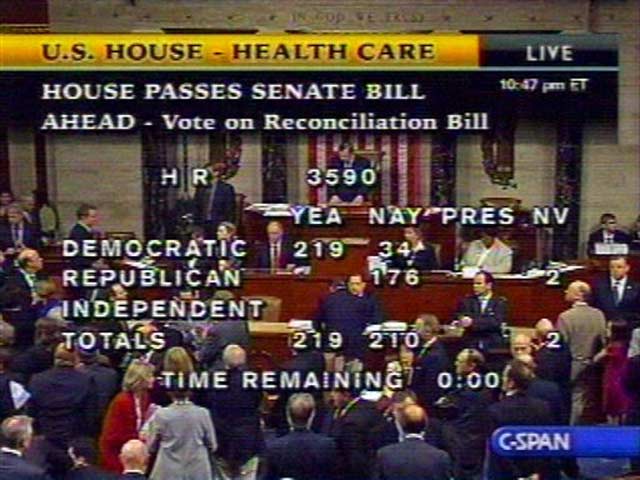
Grab of CSPAN screen. Image from gothamist.

We achieved what was possible:
Health care is victory for progressives

Passage of a trillion-dollar health care package means a trillion dollars not available to the Pentagon for their long war.

By Tom Hayden / The Rag Blog / March 26, 2010

This is not the time for progressives to mourn the defeat of single-payer or the public option, it is the time to cheer the health care victory as an important victory and prepare to stop the right wing in their tracks and discredit their religion of market fundamentalism. It’s the time to push further against that same fundamentalism by demanding such reforms as regulation of Wall Street and a rollback of the Supreme Court decision on campaign finance — all before the November election.

We did not achieve what was politically impossible, Medicare for All. Insurance companies and Big Pharma will benefit from the health care legislation, but the Machiavellians always get their pound of flesh in exchange for conceding reform. We added new health protections for millions of Americans, opened possibilities for further health reforms, and avoided the beginning of the end of the Obama era, which frankly is what the unified right-wing is still trying to bring about.

It is the nature of social movements to fragment and decline when they achieve victories which fall short of their hopes and dreams. It is the nature of counter-movements to become more dangerous and unified when they feel threatened with decline.

There is plenty of analysis of how the public came out ahead in this final package despite all its flaws and chicanery. Let me add one fundamental point no one has mentioned:

Passage of a trillion-dollar health care package means a trillion dollars not available to the Pentagon for their long war.

In his book making the case for the U.S. as a modern Goliath, the conservative political philosopher Michael Mandelbaum wrote of his fear that Sixties social programs will undermine the appetite and resources for empire, which he described as an American “world government.” [MM, The Case for Goliath: How America Acts as the World’s Government for the 21st Century, Public Affairs, 2005]

“Democracy [will] favor butter over guns,” Mandelbaum worried. As programs like health care expand and social security cutbacks are fought, “it will become increasingly difficult for the foreign policy elite to persuade the wider public to support the kinds of policies that, collectively, make up the American role as the world’s government. Foreign policy will be relegated to the back burner,” he groused.

We have no moral right or even competence to be “the world’s government,” of course. The more we invest in our domestic needs — health care, schools and universities, environmental restoration, green jobs — the more unsustainable become trillion-dollar wars in Iraq, Afghanistan, Pakistan, Yemen, and beyond. The seeds of an alternative foreign policy lie in building an alternative domestic one.

[A political activist for more than four decades, Tom Hayden is director of the Peace and Justice Resource Center . A founder of SDS and a former California State Senator, Hayden is the author of The Long Sixties (Paradigm, 2009).]

Thanks to Carl Davidson / The Rag Blog

Posted in Rag Bloggers | Tagged , , , , , , | 4 Comments

Cannabis in California : The Growing Storm

Marijuana campaign image from Photo Bucket.

Cannabis is on the ballot:
All eyes are on California

By Jonah Raskin / The Rag Blog / March 26, 2010

The man in the dark slacks and the blue jacket counted out 100 $100 bills and handed them to the woman in jeans and a faded T shirt that said “Eat the Rich.” She handed the bills to another woman with dark glasses and turquoise rings on her fingers, and she sat down and counted them. They added up. There was $10,000 on the table.

The man in the slacks and jacket walked out of the hotel room with two-and-a-half pounds of organic California-grown marijuana. He was a happy man; he had customers from Pacific Palisades to Pasadena in Los Angeles who were eagerly awaiting their ounces, half ounces, pounds, and even grams. He had a price and a product for everyone no matter what their budget.

Call them potheads. Call them stoners. Call them what you will. They smoke marijuana daily and they go to work. They pay taxes, and on election day this coming November they will go to the polls to vote up or down on a state-wide measure that would allow dealers to sell ounces legally, an ounce at a time.

All the big-time politicians are against the measure. Jerry Brown, the State Attorney General, and the former Governor, known popularly in the 1970s as “Governor Moon Beam” is against it. So is the former eBay chief executive Meg Whitman, a rabid conservative, who is the leading Republican candidate.

Oddly enough, or perhaps not so oddly, many of the marijuana growers themselves — some of them cultivating indoors and some in greenhouses — are also opposed to legalization. “It will mean the end of my business,” one long-time grower told me. “I won’t be able to compete and to make the kind of money I make now. Legalization will ruin me.”

But the growers are in a minority. So are the dealers. The overwhelming majority of people in the pot equation are the pot smokers. There are millions of them in California (and elsewhere of course) and by and large they are sick and tired of being made to feel like criminals. They want pot to be legalized. They want to be able to purchase marijuana in the same way they purchase shoes, hats, tomatoes, and olive oil. They’re perfectly willing for it to be taxed.

Many of them are “true believers.” They feel that pot is practically a sacrament. They insist that it is good for them — good for their hearts, their eyesight, their digestion, and, if they are cancer patients, a remedy for loss of appetite and nausea. The medical evidence increasing shows that they are right.

In the state of California, a place in which there are very few “true believers,” the true believers in the goodness of marijuana will play a decisive role in whether or not the measure to legalize the drug will pass or fail. Every day, in almost everything they do and everything they say, they campaign for marijuana. When they smoke it they share it; when they cook with it they hand out brownies to friends and family members. They push pot constantly, and promote it endlessly.

Ever since 1996 when medical marijuana became legal in California, they have been smoking in public — in pot dispensaries, bars, and on the streets. After 14 years, it is out of control — at least by law enforcement standards; it is not possible to take pot out of the culture and the business of California without also imposing martial law.

And even that will not stop it. Thousands of Californians — and thousands of Americans — have been arrested for possession of marijuana in the last decade. And still the numbers of marijuana smokers have grown. Arrests have inflicted hardship and pain on California citizens from the Oregon border to Mexico.

At a time when the California budget is in deep financial trouble, the promise of tax dollars from the sale of marijuana will be hard to resist. And the call of marijuana as medicine will be hard to resist too.

In the next eight months, marijuana will be in the news in California every week, if not every day. The opponents of legalization will bring out the same old arguments. They will talk once again about that old bugaboo “reefer madness.” And in a way they are right.

Indeed, the pro-marijuana forces are mad. They are mad about the persecution they have suffered. They are mad about the lies and the distortions. They are so mad they are willing to fight in the open, to take their cause everywhere in the State of California.

The gap that exists between the citizens of the Golden State and their elected officials will become clearer and clearer. Marijuana will be a wedge that will drive them apart — except that some politicians like State Assemblyman Tom Ammiano from San Francisco, want legalization too. Ammiano is a true believer. To some he is a saint, to others a devil.

The growing storm will focus in part around him and in Sacramento, the state capitol. But no part of California can or will escape the issue of the legalization of marijuana. And the eyes of the nation will be on California.

[Jonah Raskin co-wrote the story for the marijuana feature length movie, Homegrown, that stars Billy Bob Thornton, Hank Azaria, Kelly Lynch, Ryan Phillippe, Ted Danson, Jamie Lee Curtis, and John Lithgow. Raskin teaches media law at Sonoma State University.]

The Rag Blog

Posted in Rag Bloggers | Tagged , , , , , , | 7 Comments

Robert Jensen : The Collapse of Journalism/The Journalism of Collapse

Image from Knight Science Journalism Tracker.

New Storytelling and a New Story:
The Collapse of Journalism/The Journalism of Collapse

By Robert Jensen / The Rag Blog / March 26, 2010

[A version of this essay was delivered as the Lawrence Dana Pinkham Memorial Lecture, Asian College of Journalism, Chennai, India, March 18, 2010.]

There is considerable attention paid in the United States to the collapse of journalism — both in terms of the demise of the business model for corporate commercial news media, and the evermore superficial, shallow, and senseless content that is inadequate for citizens concerned with self-governance.

This collapse is part of larger crises in the political and economic spheres, crises rooted in the incompatibility of democracy and capitalism. New journalistic vehicles for storytelling are desperately needed.

There has been far less discussion of the need for a journalism of collapse — the challenge to tell the story of a world facing multiple crises in the realms of social justice and sustainability. This collapse of the basic political and economic systems of the modern world, with dramatic consequences on the human and ecological fronts, demands not only new storytelling vehicles but a new story.

In this essay I want to review the failure of existing systems and suggest ideas for how to think about something radically different, through the lens of journalists’ work. The phrase “how to think about” should not be interpreted to mean “provide a well-developed plan for”; I don’t have magical answers to these difficult questions, and neither does anyone else.

The first task is to face the fact that every problem we encounter does not necessarily have a solution that we can identify, or even imagine, in the moment; that identifying how existing systems have failed does not guarantee we have the capacity to devise new systems that will succeed.

This is a realistic attitude, not a defeatist one. The lack of a guarantee of success does not mean the inevitability of failure, and it does not absolve us of our responsibility to struggle to understand what is happening and to act as moral agents in a difficult world. In fact, I think such realism is required for serious attempts at fashioning a response to the crises.

The eventual solutions, if there are to be solutions, may come in frameworks so different from our current understanding that we can’t yet see even their outlines, let alone the details. This is a time when we should be focused on “questions that go beyond the available answers,” to borrow a phrase from sustainable agriculture researcher Wes Jackson.

The old story

Before taking up that challenge, I want to identify the story that dominates our era, what we might call the story of perpetual progress and endless expansion. This is the larger cultural narrative in which specific stories that appear in journalistic outlets are set. Charting the whole history of this story is beyond the scope of this essay, so I will confine myself to the post-WWII era in which I have lived, when this progress/expansion story has dominated not only in the United States and other developed countries but most of the world.

This story goes like this: In the modern world, human beings have dramatically expanded our understanding of how the natural world works, allowing us not only to control and exploit the resources of the non-human world but also to find ways to distribute those resources in a more just and democratic fashion. The progress/expansion story assumes we have knowledge — or the capacity to acquire knowledge — that is adequate to run the world competently, and that the application of that knowledge will produce a constantly expanding bounty that, in theory, can provide for all.

The two great systems of the post-WWII era that were in direct conflict — the capitalist West led by the United States and the communist East led by the Soviet Union — shared an allegiance to this story, that humans had the ability to understand and control, to shape the future, to become God-like in some sense.

Even in places that carved out some independence in the Cold War, such as India, the same philosophy dominated, evidenced most clearly in big dam projects and the Green Revolution’s model of water-intensive, chemical farming.

The failure of the communist challenge was said to be “the end of history,” a point where the only work remaining was the application of our technical knowledge to lingering problems within a system of global capitalism and liberal democracy. Even with the widening of inequality and the clear threats to the ecosystem from human intervention, the progress/expansion story continues to dominate, bolstered by a widely held technological fundamentalism (more on that later).

The bumper-sticker version of this philosophy: More and bigger is better, forever and ever.

There’s one slight problem: If we continue to believe this story, and to base individual decisions and collective policies on it, we will dramatically accelerate the drawdown of the ecological capital of the planet, hastening the point at which the ecosystem will no longer be able to sustain human life as we know it at this level. In the process, we can expect not only more inequality, but in times of intense competition for resources, a dramatic increase in social conflict.

This critique cannot be dismissed as hysteric apocalypticism; it is a reasonable judgment, given all the evidence. The progress/expansion story has left us with enduring levels of human inequality that violate our moral principles and threaten to undermine any social stability, and an endangered ecosystem that threatens our very survival. Whatever systems and institutions we devise to replace those at the root of these problems, the underlying progress/expansion narrative has to change.

The collapse of journalism

In the United States, it is clear that at least in the short term, there will be fewer professional journalists working in fewer outlets with fewer resources for reporting. The Pew Research Center’s Project for Excellence in Journalism sums it up in its 2010 State of the News Media report: “[W]e estimate that the newspaper industry has lost $1.6 billion in annual reporting and editing capacity since 2000, or roughly 30 percent. That leaves an estimated $4.4 billion remaining. Even if the economy improves we predict more cuts in 2010.” Newspapers are hurting the worst, but there is no good news from any news media.

That loss of capacity comes from plunging ad revenues: In 2009, ad revenue fell 26 percent for U.S. newspapers, including online, bringing the total loss over the past three years to 43 percent. Local television ad revenue fell 22 percent, triple the decline the year before. Other media also saw a decline in ad revenue: radio, 22 percent; magazine, 17 percent; network TV, 8 percent (for network news alone, probably more).

Online ad revenue overall fell 5 percent, and revenue to news sites most likely also fared much worse. Cable news was the only commercial news sector keeping its head above water, barely, according to the report.

Revenue is down, and so are audiences. The PEJ study reports audience growth only in digital and cable news, with declines in local TV and network news. Print newspaper circulation fell 10.6 percent in 2009, and since 2000, daily circulation has fallen 25.6 percent.

This decline is also reflected in employment. According to a report by UNITY: Journalists of Color, Inc., there was a 22 percent increase in the journalism jobs lost from September 2008 through August 2009, compared with a general job loss rate of 8 percent. The news industry shed 35,885 jobs in a one-year period straddling 2008 and 2009.

Despite experiments with new ways to organize and support journalists — including grant-funded news operations such as Pro Publica, university/newsroom partnerships, citizen journalism collaborations with professional newsrooms, and various web projects — it is clear that, at least in the short term, there simply will be less journalism created by professional journalists.

It also seems clear that of the journalism remaining, a growing percentage is of less value to the project of enhancing democracy. I don’t want to pretend there was a golden age when professional journalism provided the critical and independent inquiry that citizens need to function as citizens.

For reasons articulated by critics such as Edward Herman and Noam Chomsky, contemporary professional journalism is hamstrung by institutional and ideological constraints that have been built into professional practices. As a result, corporate news owners rarely have to discipline mainstream journalists, who are socialized to accept the ideological prison in which they work and police other inmates.

But even with that rather large caveat, the slide of much of contemporary journalism into banality is frightening. Of public affairs journalism, we might paraphrase an old joke about hard-to-please restaurant patrons: “The food is awful here,” one says, and the friend replies, “Yes, and they’ve reduced the portions.”

The markers of this slide in quality are clear enough: An obsession with entertainment and sports, especially large-scale spectacles; routine exploitation of sexuality and violence in ways corrosive to human dignity; an endless fascination with celebrity, with the standards of what constitutes celebrity continually dropping; and a growing imposition of those spectacle and celebrity values on public affairs.

This is not a screed against entertainment, pleasure, fun, or the people’s desire to gain pleasure from fun entertainment. It is not an attempt to glorify the rational and devalue the emotional. It is not a self-indulgent lament that the kind of journalism I prefer is losing out. It’s an accurate description of our increasing numbed-out and intellectually vapid culture.

How much of this collapse of journalism is driven by the explosion of news outlets in a 24-hour news cycle, as an ever-larger media beast demands to be fed? How much is a product of bottom-line-focused news managers’ longstanding obsession with producing the extraordinary profits demanded by top-floor-dwelling executives? How much is panic caused by these dramatic drops in audience and revenue by so-called legacy media, leading to desperation in programming?

Whatever the relative weight of these causes, the effect is clear: In the mainstream outlets through which most people in the United States get their news, there is less journalism relevant to citizens’ role in a democracy and more journalism-like material that dulls our collective capacity for independent critical thinking. If journalists had only to struggle to return to some previous state in which they did a better job, that would be hard enough. But journalists can’t be satisfied with striving toward standards from the past. A new journalism is needed.

The journalism of collapse

The immediate crises that journalism and journalists face — some rooted in the pathology of professionalism and its illusory claims to neutrality, and some rooted in the predatory nature of capitalism and its illusory commitment to democracy — are serious, but in some sense trivial compared to the long-term crises in a profoundly unjust and fundamentally unsustainable world. We have to deal with the collapse of journalism, but we also must begin to fashion a journalism of collapse.

To reiterate my basic premise: Whatever the specific story being told in modern journalism, those stories typically are set in that larger narrative of perpetual progress and endless expansion. What kind of story is needed for a world that desperately needs to rethink its idea of progress in a world that is no longer expanding?

Here’s the story: On March 17, 2051, the world will pump its last easily accessible barrel of usable oil. By that time, cancer directly attributable to human-created toxicity will kill 125 million people per year, while major disruptions in the hydrological cycle will so dramatically reduce the amount of fresh water that 18.9 percent of the human population will die each year as a direct result.

On June 14, 2047, exactly half of the area of the world’s oceans will be dead zones, incapable of supporting significant marine life. Three and a half years later, topsoil losses will have reached the point where even with petrochemical based fertilizers, pesticides, and herbicides, yields will drop by 50 percent on the most fertile soil and fall to zero on soil that has effectively gone sterile due to contamination and compaction.

But there won’t be any petrochemicals anyway, because there won’t be any oil. And there won’t be enough water. And so there won’t be enough food. And getting reliable broadband internet service will be difficult.

OK, that was all meant to be funny. That, of course, is not the story. The story we need to tell won’t be focused on predictions about specific aspects of collapse. I have no doubt that if the human community continues on its present trajectory, such statistics will be all too real. I have no doubt that if the human community does not change that trajectory in substantial ways fairly soon, the future will be grim.

But rather than scurrying to make specific predictions, journalism should struggle to help people understand the processes that make that preceding paragraph plausible, and hence not funny at all. There’s little humor in the recognition that continued commitment to an ideology of perpetual progress and endless expansion — operationally defined as ever greater human consumption of the ecological capital of the planet — is a dead end. More and bigger not only is not better, it is not possible.

The response I often get to this view is the assertion that we need not worry about the physical limits of the planet because human ingenuity will invent increasingly clever ways of exploiting those resources.

This technological fundamentalism — the belief that the use of evermore sophisticated high-energy, advanced technology is always a good thing and that any problems caused by the unintended consequences of such technology eventually can be remedied by more technology — is more prevalent, and more dangerous, than religious fundamentalism. History teaches that we should be more cautious and pay attention to the unintended effects of such technology with an eye on the long term.

The fundamentalists believe the future is always bright, apparently because they wish it to be so. But the desire to live in an endless expanding world of bounty — a desire found both in those who currently have access to that bounty and those who don’t but crave it — is not a guarantee of it. We certainly know this at the individual level, that “you can’t always get what you want,” as the song goes, and what holds for us as individuals is also true for us as a species.

Those of us who question such declarations are often said to be “anti-technology,” which is a meaningless insult designed to derail serious discussion. All human beings use technology of some kind, whether stone tools or computers. An anti-fundamentalist position is not that all technology is bad, but that the introduction of new technology should be evaluated carefully on the basis of its effects — predictable and unpredictable — on human communities and the non-human world, with an understanding of the limits of our knowledge to control the larger world.

So the first step in crafting a new narrative for journalists is to reject technological fundamentalism and deal with a harsh reality: In the future we will have to make due with far less energy, which means less high-technology and a need for more creative ways of coping. Journalists have to tell stories about what that kind of creativity looks like. They have to reject the gee-whizzery of much of the contemporary science and technology reporting and emphasize the activities of those with a deeper ecological worldview.

There also is a corresponding need to tell stories about redefining our concept of the good life. Again, the basics are in pop songs: “all you need is love,” and “money can’t buy you love.” We all agree, yet that narrative of progress/expansion is rooted in the belief that acquisition and consumption are consistent with a good life, or perhaps even required for it.

Central to that redefinition is accepting that collectively we have to learn to live with less. In a world with grotesque inequalities in the distribution of wealth, some of our sisters and brothers are already living with less — less than what is required for a decent life, which reflects the unjust nature of our social systems.

For those of us in the more affluent sectors, the question is not only whether we will work for a more just distribution within the human family, but how we respond when the world imposes stricter limits on us all.

Living with less is crucial not only to ecological survival but to long-term human fulfillment. People in the United States live with an abundance of most everything — except meaning. The people who defend the existing system most aggressively are typically either in the deepest denial, refusing to acknowledge their culture’s spiritual emptiness, or else have been the privileged beneficiaries of the system. This is not to suggest that poverty produces virtue, but to recognize that affluence tends to erode it.

A world that steps back from high-energy, high-technology answers to all questions will no doubt be a harder world in some ways. But the way people cope without such technological “solutions” can help create and solidify human bonds. Indeed, the high-energy/high-technology world often contributes to impoverished relationships as well as the destruction of longstanding cultural practices and the information those practices transmit.

Stepping back from this fundamentalism is not simply a sacrifice but an exchange of a certain kind of comfort and easy amusement for a different set of rewards. We need not romanticize community life or ignore the inequalities that structure our communities to recognize that human flourishing takes place in community and progressive social change doesn’t happen when people are isolated.

Telling this story is important in a world in which people have come to believe the good life is synonymous with consumption and the ability to acquire increasingly sophisticated technology. The specific stories told in the journalism of collapse will reject technological fundamentalism and aid people in the struggle to redefine the good life.

Journalists need not merely speculate about these things; across the United States people are actively engaged in such projects. Though not yet a majority, these people are planning transition towns, developing permaculture systems, creating community gardens, reclaiming domestic arts that have atrophied, organizing worker-owned cooperative businesses. They are experimenting with alternatives to the dominant culture, and in doing so they are, implicitly or explicitly, rejecting technological fundamentalism and redefining the good life.

This journalism of collapse I am proposing would include stories about the problems we face, the harsh reality of a contracting world of less energy. But it also would include stories about people’s experiments with new definitions of progress and the good life. Such an approach to journalism would not only highlight the threats but also shine a light on the way people are coping with the threats.

Journalism in the prophetic voice

I would call this kind of storytelling “journalism in the prophetic voice,” borrowing a theological term for secular purposes. I prefer to speak about the prophetic voice rather than prophets because everyone is capable of speaking in the voice; the prophetic is not the exclusive property of particular people labeled as prophets.

I also avoid the term prophecy, which is often used to describe a claim to be able to see the future. The complexity of these crises makes any claim to predict the details of what lies ahead absurd. All we can say is that, absent a radical change in our relationship to each other and the non-human world, we’re in for a rough ride in the coming decades. Though the consequences of that ride are likely to be more overwhelming than anything humans have faced, certainly people at other crucial historical moments have faced crises without clear paths or knowledge of the outcome. A twenty-five-year-old Karl Marx wrote about this in a letter to a friend in1843:

The internal difficulties seem to be almost greater than the external obstacles. … Not only has a state of general anarchy set in among the reformers, but everyone will have to admit to himself that he has no exact idea what the future ought to be. On the other hand, it is precisely the advantage of the new trend that we do not dogmatically anticipate the world, but only want to find the new world through criticism of the old one.

We should understand the prophetic as the calling out of injustice, the willingness not only to confront the abuses of the powerful but to acknowledge our own complicity. To speak prophetically requires us first to see honestly — both how our world is structured by illegitimate authority that causes suffering beyond the telling, and how we who live in the privileged parts of the world are implicated in that suffering. In that same letter, Marx went on to discuss the need for this kind of “ruthless criticism”:

But, if constructing the future and settling everything for all times are not our affair, it is all the more clear what we have to accomplish at present: I am referring to ruthless criticism of all that exists, ruthless both in the sense of not being afraid of the results it arrives at and in the sense of being just as little afraid of conflict with the powers that be.

To speak prophetically is to refuse to shrink from what we discover about the injustice of the world. It is to name the wars of empire as unjust; to name an economic system that leaves half the world in abject poverty as unjust; to name the dominance of men, of heterosexuals, of white people as unjust. And it is to name the human destruction of Creation as our most profound failure. At the same time, to speak prophetically is to refuse to shrink from our own place in these systems. We must confront the powers that be, and ourselves.

Another prominent historical figure put it this way in 1909: “One of the objects of a newspaper is to understand the popular feeling and to give expression to it; another is to arouse among the people certain desirable sentiments; and the third is fearlessly to expose popular defects.” That was Mohandas Gandhi, on the first page of Hind Swaraj.

Those tasks — attempting to understand and give expression to what ordinary people feel, and then advocating progressive goals, while at the same time exposing problems in the culture — are not likely to make one’s life easy. Journalists willing to take this position will find themselves in a tense place, between a ruling elite that is not interested in seriously changing the distribution of power and a general public that typically does not want to confront these difficult realities of collapse.

To speak from a prophetic position is to guarantee that one will find little rest and small comfort. Such is the fate of a commitment to truth-telling in difficult times, and times have never been more difficult.

But others have faced similar challenges. Looking to the tradition in the Hebrew Bible, the prophets condemned corrupt leaders and also called out all those privileged people in society who had turned from the demands of justice, which the faith makes central to human life. In his analysis of these prophets, the scholar and activist Rabbi Abraham Joshua Heschel concluded:

Above all, the prophets remind us of the moral state of a people: Few are guilty, but all are responsible. If we admit that the individual is in some measure conditioned or affected by the spirit of society, an individual’s crime discloses society’s corruption. In a community not indifferent to suffering, uncompromisingly impatient with cruelty and falsehood, continually concerned for God and every man, crime would be infrequent rather than common.

That phrase, few are guilty but all are responsible, captures the challenge of the journalism of collapse. We can easily identify those powerful figures guilty of specific crimes. Who is guilty in perpetrating the illegal U.S. invasion of Iraq? That’s easy — Bush, Cheney, Rumsfeld, Powell, Rice. Who is guilty in the bailout of Wall Street and the big banks: That’s easy, too — Bush and Obama, Paulsen and Geithner, Bernanke and the boys. One task of journalists is to pursue the guilty, perhaps with a bit more fervor than contemporary U.S. news media; our journalists are too polite in handling war criminals and servants of the wealthy.

But when we look at the fragile state of the world, in some sense our future depends on recognizing that we all are responsible, depending on our status in society and resources available to us. Those of us in affluent sectors of society have the most to answer for, and the task of journalists is to raise questions uncomfortable for us all. This will rarely make journalists popular, but that also is not new. In each of the four Gospels, Jesus reminds us: “A prophet is not without honor, except in his own country, and among his own kin, and in his own house.” (Mark 6:4)

Since journalism has never really been an honorable profession, perhaps that makes us the perfect candidates for raising our voices prophetically.

[Robert Jensen is a journalism professor at the University of Texas at Austin and board member of the Third Coast Activist Resource Center in Austin. He is the author of All My Bones Shake: Seeking a Progressive Path to the Prophetic Voice, (Soft Skull Press, 2009); Getting Off: Pornography and the End of Masculinity (South End Press, 2007); and The Heart of Whiteness: Confronting Race, Racism and White Privilege (City Lights, 2005); Jensen is also co-producer of the documentary film Abe Osheroff: One Foot in the Grave, the Other Still Dancing. Jensen can be reached at rjensen@uts.cc.utexas.edu and his articles can be found online here.]

The Rag Blog

Posted in Rag Bloggers | Tagged , , , , , | 1 Comment

Singer/Soldier Travis Bishop : War Resister Released from Stockade

Singer/soldier Travis Bishop, who refused deployment to Afghanistan for reasons of consience, has been released from prison. Photo from Dallas Dreamer.

Fort Hood Soldier who refused to deploy:
Travis Bishop released from Fort Lewis stockade

By Alice Embree / The Rag Blog / March 26, 2010

War resister and conscientious objector Travis Bishop was released from the stockade at Fort Lewis, Washington Thursday morning.

During court-martial proceedings at Fort Hood, Texas, Bishop was sentenced to 12 months in prison for refusing to deploy to Afghanistan for reasons of conscience. He received a three-month reduction in sentence due to a successful clemency application to the Commanding General at Fort Hood, as well as receiving extra time off for good behavior.

Bishop served a total of seven months and 12 days of confinement. His rank was reduced from Sergeant to Private and a Bad Conduct Discharge is pending.

Travis Bishop was recognized by Amnesty International as a prisoner of conscience. He received support from hundreds of people from around the world who wrote letters of encouragement for him and called upon military authorities to release him.

“Travis really appreciated the support he received from Amnesty International and from many people throughout the U.S.,” said his lawyer, James Branum. “All those letters lifted his spirits and shortened his time in jail.”

Bishop spoke out about the inhumane conditions at the Fort Lewis stockade, which produced some reform in treatment of prisoners at the facility. Bishop was placed on the facility’s “most difficult” prisoners list for these efforts.

Bishop’s supporters in the Washington area are planning a celebration to take place at Coffee Strong GI Coffeehouse, on Sunday, March 28. Bishop also plans to come back to Killeen to visit his friends and supporters at Under the Hood Café and Outreach Center where additional celebrations will be held.

Bishop, a country music singer-songwriter, plans to resume his musical career.

Also on The Rag Blog:

The Rag Blog

Posted in Rag Bloggers | Tagged , , , , , , , | Leave a comment

BOOKS / Progressive Giants : Celebrating Paul Robeson and Anne Braden


Two books about two progressive giants:
Celebrating Paul Robeson and Anne Braden

By Harry Targ / The Rag Blog / March 25, 2010

The artist must take sides. He must elect to fight for freedom or slavery. I have made my choice. I had no alternative. — Paul Robeson, 1937.

…there are no heroes in this story…no villains…only people, the product of their environment, urged on by forces of history they often do not understand. — Anne Braden, 1958

The Undiscovered Paul Robeson: Quest for Freedom, 1939-1976, by Paul Robeson Jr. (Wiley, January 26, 2010); Hardcover, 432 pp., $35.00.

Subversive Southerner: Anne Braden and the Struggle for Racial Justice in the Cold War South, by Catherine Fosl (The University Press of Kentucky,August 25, 2006); Paperback, 464 pp., $26.95.

Biographies can tell us about ourselves, where we came from, and where we might go. I recently read two narratives of the lives of extraordinary people and their times. I think their lives and politics are relevant to us today.

The Undiscovered Paul Robeson: Quest for Freedom, 1939-1976, by Paul Robeson Jr., chronicles the years of struggle in the life of the theatrical performer, singer, linguist, and fighter for human freedom. Subversive Southerner: Anne Braden and the Struggle for Racial Justice in the Cold War South, by Catherine Fosl, tells the story of a militant Southern woman who rejected the political culture of her day to fight for the liberation of African Americans, always insisting that Southern whites had to play a significant role in that struggle.

Paul Robeson, born in 1898, in Princeton, New Jersey, only the third African American to attend Rutgers University, graduated with academic honors and all-American football status. He received a law degree from Columbia University but gravitated to the theater, the concert hall, film, and linguistics. As his world renown grew, Robeson became politically engaged. In 1937 he declared at a fund raiser for the brigadistas fighting the Spanish fascists that “the artist must take sides.”

Over the remaining 40 years of his life he fought alongside others at home and around the world against colonialism, racism, class exploitation, and imperialism. While he symbolized to the world the struggle for a humane socialist future for all, he became the number one target of racism and anti-communism at home.

Anne Braden, although younger than Robeson, led a parallel life of political activism. She was born in 1924 in Louisville, Kentucky, to a traditional Southern family. Schooled in the values of Southern womanhood, she increasingly saw the white supremacist south as an evil that not only repressed African Americans but served as an impediment to the achievement of human liberation for people everywhere.

She pursued a career as political organizer and journalist, publishing the invaluable periodical, The Southern Patriot. She, with her husband Carl Braden, spent years organizing against racial segregation. Her struggle repeatedly encountered racists who opportunistically used anti-communism to protect their white privilege.

The differences in the backgrounds of these two progressive giants are obvious, but the biographies referred to above illuminate fascinating parallels. First, both Robeson and Braden were raised in political cultures that were hostile to social justice. Each was raised in a supportive though sometimes stern family. The world beyond their immediate families was driven by racism. Robeson experienced it as an object. Braden experienced racism as a person being socialized to accept and endorse it.

Second, through a multiplicity of associations and experiences both came to realize that racism was not only an impediment to their own development as full human beings but was also an impediment to the development of all humanity. Consequently, at relatively young ages, Robeson and Braden came to the view that they must devote their lives to the struggle against racism.

Third, both Robeson and Braden realized in their struggles that capitalism as an economic system stood in the way of human liberation. They understood that the capitalist mode of production was built on the backs of workers. Racism, they understood, was used by capitalists to divide workers who together could organize to create a more humane society.

Fourth, Robeson and Braden accepted as a basic premise of their political work the proposition that human solidarity was a necessary if not sufficient condition for the creation of a humane society. Robeson wrote in his autobiography, Here I Stand, that underlying the world’s diverse folk music traditions there was a common musical form, a pentagonal chord structure. To Robeson this shared chord structure mirrored the fundamental oneness of humankind.

Anne Braden, saw human beings as shaped by their environments. Her own upbringing in a segregated society shaped her consciousness, but circumstances made her realize that people can liberate themselves by organizing resistance to that society. Racism has its roots in economic and political structures, and people are “urged on by forces of history they often do not understand.” But they can come to recognize and oppose those institutions that oppress others and by extension, themselves.

Fifth, both Robeson and Braden committed their lives to organizing against capitalism, imperialism, colonialism, and racism. For them this meant crossing racial lines, participating in union struggles, linking struggles for civil rights with struggles for civil liberties, and unabashedly working with the Left to bring about social change.

Finally, Paul Robeson and Anne Braden became two of the most despised political activists in Cold War America.

Robeson returned to the United States from a long sojourn in Great Britain during much of the 1930s to an America ready to embrace his music and theatrical performances. His classic radio broadcast, “Ballad for Americans,” was heard by millions of Americans.

But after World War II, Robeson turned his attention more toward fighting racism (lynchings, segregated institutions such as baseball, and white supremacy in the South), opposing colonialism, supporting the expansion of the right of workers to join unions, and promoting peace. In the context of the emerging Cold War the former celebration of his life and work turned to anger against him.

In the 1950s, the State Department pulled his passport so he could not travel overseas. He lost his audiences and livelihood as hundreds of his previously scheduled concerts were canceled. Even African American churches were reluctant to host a Robeson concert for fear of government reprisal.

Anne and Carl Braden purchased a home in Louisville in the 1950s and sold it to an African American family. The property was in an all-white neighborhood. This generated a massive campaign to keep the family from occupying their house. The campaign was leveled at the Bradens for their work against segregation as much as against the African American family.

After an extended public trial characterized by charges of Communist subversion Carl Braden was sentenced to prison for “sedition” based on an arcane Kentucky law. Subsequent to the trial and incarceration, virulent anti-communism dogged most organizing campaigns embraced by the Bradens.

The Southern Conference Educational Fund (SCEF), which the Bradens led, was always viewed with suspicion. Anti-communism even crept into the politics of the civil rights movement as it blossomed in the late 1950s. Despite the virulence of it, which usually was linked with racism, Anne Braden became an inspirational force among the young SNCC organizers in the South in the early 1960s, along with Ella Baker. Anne Braden took particular responsibility for building white activism around civil rights.

In the end, anti-communist campaigns, such as those against Robeson and Braden, were used as tools by racist forces to demean, delegitimize, and split the working class and youth and to defeat progressive forces. Anti-communism and the defense of white supremacy became inseparable.

How do we assess the roles of Paul Robeson and Anne Braden in historical perspective? They participated as leaders, as intellectual and moral inspirations at a time when the working class was on the move in the 1930s and 1940s, and civil rights activism spread in the 1950s. As workers mobilized to demand the right to form unions, Robeson was there. Braden committed her life to the struggle against racism and she saw Black/white unity as basic to victory.

Both participated in struggles with allies from the organized Left, particularly with members of the Communist Party USA.

Finally, and most critically, Robeson and Braden participated in and advanced a politics of the Popular Front. Popular Front politics began with a commitment to class struggle. It was based on the presumption that racism was the central barrier to social change. And Popular Front politics prioritized commitments to broad-based networking among people and groups who engaged in a whole array of peace and justice issues.

Are there lessons from these lives for us today? I believe so. Robeson and Braden taught us that the pursuit of social change was a lifetime activity. And they demonstrated to us that our political work must engage the broadest range of issues and the greatest numbers of people in our struggles for a humane future. These two biographies tell insightful and inspiring stories that everyone interested in social change should read.

[Harry Tarq is a professor in American Studies who lives in West Lafayette, Indiana. He blogs at Diary of a Heartland Radical.]

Find:

The Rag Blog

Posted in Rag Bloggers | Tagged , , , , , , , , | 2 Comments