VERSE / Verandah Porche : CORP O RAT ION

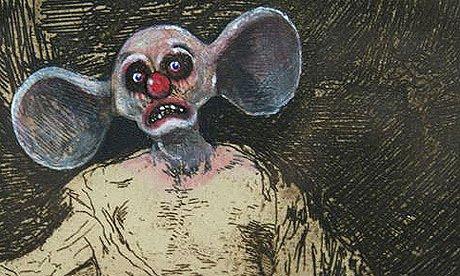
Goya print revisited by Jake and Dinos Chapman. Image from The Guardian.

CORP O RAT ION

Corporation = root or panic

= orca portion = crap iron too

= poor can riot = cop or ration

= raptor coo in = crop oration

= or porno I act = o rancor I opt

= roar no topic = poor art icon

Verandah Porche / The Rag Blog
January 28, 2010

[Verandah Porche is a poet and writing partner in Guilford, Vermont. Read more of her work at verandahporche.com.]

The Rag Blog

Posted in Rag Bloggers | Tagged , , | 2 Comments

People’s Historian : The Singular Legacy of Howard Zinn

Historian and activist Howard Zinn, 1922-2010.

How the great Howard Zinn
Made all our lives better

No American historian has had a more lasting positive impact on our understanding of the true nature of our country…

By Harvey Wasserman / The Rag Blog / January 28, 2010

Howard Zinn was above all a gentleman of unflagging grace, humility, and compassion.

No American historian has had a more lasting positive impact on our understanding of the true nature of our country, mainly because his books reflect a soul possessed of limitless depth.

Howard’s People’s History of the United States will not be surpassed. As time goes on new chapters will be written in its spirit to extend its reach.

But his timeless masterpiece broke astonishing new ground both in its point of view and its comprehensive nature. The very idea of presenting the American story from the point of view of the common citizen was itself revolutionary. That he pulled it off with such apparent ease and readability borders on the miraculous. That at least a million Americans have bought and read it means that its on-going influence is immense. It is truly a history book that has and will continue to change history for the better.

But that doesn’t begin to account for Howard’s personal influence. He was a warm, unfailingly friendly compadre. He shared a beautiful partnership with his wonderful wife Roz, a brilliant, thoroughly committed social worker about whom he once said: “You and I just talk about changing the world. She actually does it.”

But Howard was no ivory tower academic. His lectures were engaging, exciting, and inspirational. But they took on an added dimension because he was personally engaged, committed, and effective. He chose to write books and articles in ways that could impact the world in which they were published. He showed up when he was needed, and always had a sixth sense about exactly what to say, and how.

Perhaps the most meaningful tribute to pay this amazing man is to say how he affected us directly. Here are two stories I know intimately:

In 1974, my organic commune-mate Sam Lovejoy toppled a weather tower as a protest against the coming of a nuclear power plant. When Sam needed someone to testify on how this act of civil disobedience fit into the fabric of our nation’s history, Howard did not hesitate. His testimony in that Springfield, Massachusetts courtroom (see Lovejoy’s Nuclear War) remains a classic discourse on the sanctity of non-violent direct action and its place in our national soul. (Sam was acquitted, and we stopped that nuke!)

Three years earlier I sent Howard a rambling 300-page manuscript under the absurdly presumptuous title A People’s History of the United States, 1860-1920. Written in a drafty communal garage in the Massachusetts hills by a long-haired 20-something graduate school dropout, the manuscript had been rejected by virtually every publisher in America, often accompanied with nasty notes to the tune of: “NEVER send us anything like this again.”

But I sent a copy to Howard, whom I had never met. He replied with a cordial note typed on a single sheet of yellow paper, which I still treasure. I showed it to Hugh Van Dusen at Harper & Row, who basically said Harper had no idea why anyone would ever read such a book, but that if Howard Zinn would write an introduction, they’d publish it (though under a more appropriate title).

He did, and they did…and my life was changed forever.

Thankfully, Hugh then had the good sense to ask Howard to write a REAL people’s history by someone — the ONLY one — who could handle the job. He did… and ALL our lives have been changed forever.

Howard labored long and hard on his masterpiece, always retaining that astonishing mixture of humor and humility that made him such a unique and irreplaceable treasure. No one ever wrote or spoke with a greater instinct for the True and Vital. His unfailing instinct for what is just and important never failed him — or us. The gentle, lilting sound of his voice put it all to unforgettable music that will resonate through the ages.

A few days ago I wrote Howard asking if he’d consider working on a film about the great Socialist labor leader Eugene V. Debs, whose story Howard’s books have uniquely illuminated.

Eugene V. Debs was beloved by millions of Americans who treasured not only his clarity of a shared vision for this nation, but his unshakable honesty and unquestioned integrity.

Debs ran five times for president. He conducted his last campaign from a federal prison cell in Atlanta, where he was locked up by Woodrow Wilson. He got a million votes (that we know of). “While there is a soul in prison,” he said, unforgettably, “I am not free.”

Debs had deeply shaken Wilson with his brilliant, immeasurably powerful opposition to America’s foolish and unjust entry into World War I, and his demands for a society in which all fairly shared. In the course of his magnificent decades as our preeminent labor leader, Debs established a clear vision of where this nation could and should go for a just, sustainable future. Enshrined in Howard’s histories, it remains a shining beacon of what remains to be done.

Through his decades as our preeminent people’s historian, through his activism, his clarity, and his warm genius, Howard Zinn was also an American Mahatma, a truly great soul, capable of affecting us all.

Like Eugene V. Debs, it is no cliché to say that Howard Zinn truly lives uniquely on at the core of our national soul. His People’s History and the gift of his being just who he was, remains an immeasurable, irreplaceable treasure.

Thanks, Howard, for more than we can begin to say.

[Harvey Wasserman is senior editor at www.freepress.org, where this article also appears.]

Find:


The following excellent videos were posted by The Nation:

The Rag Blog

Posted in Rag Bloggers | Tagged , , , , , , , , , | 1 Comment

Rumble on the Right : Teabagging for Fun and Profit

Teabaggin’ dodo bird. Image from Voice of Arizona.

Trouble in paradise:
Tea-bagger convention is for-profit scam

By Ted McLaughlin / The Rag Blog / January 28, 2010

Even though they’ve had their efforts publicized by Fox News and funded by large right-wing organizations like FreedomWorks, the teabaggers are still not a very organized group of people. They can’t even agree on the best way to proceed now that they’ve made a name for themselves.

Some of them want to start a new teabagger third party. Others want to take over the Republican Party (which they rightly believe is owned by Wall Street). This has already happened in Florida, where establishment party leaders have been ousted and replaced by teabagger leaders.

Then there was word of a teabagger convention to be held in Nashville in February of this year. The organizer of the convention, attorney Judson Phillips, tried to pass off the convention as an effort to unify the teabaggers and provide direction for their future efforts. The fly in the ointment is that he has set his organization, Tea Party Nation, up as a for-profit organization.

In other words, if a profit is made off the convention, he’s under no obligation to use those funds toward future teabagger efforts or campaigns. It would be perfectly legal (and very probable) for Phillips to just put the money in his own bank account, and congratulate himself on a successful money-making venture.

Consider the following. He is selling about 500 tickets to the convention for $560 each (and this does NOT include the cost of hotel rooms). That’s a cool $280,000 right there. And don’t forget that he’s booked Sarah Palin for a speech, and he’s selling tickets to an additional 600 people for several hundred dollars each. That pushes the take up to around half a million dollars. And that doesn’t count the sponsors Phillips has lined up for the event.

He does have to pay for a convention room, but not a very large one — it only has to have room for 500 participants (and he can easily squeeze another 600 in for just one speech). This space probably doesn’t even cost as much as he’s paying Sarah Palin to make her speech. And I imagine details like sound system, security, etc. are probably included in the money he’ll pay for the convention space.

That leaves him with the cost of Sarah Palin. Rumor has it that she will receive $100,000 for her (probably incoherent) speech. Neither Phillips nor Palin will confirm or deny that this is what she’ll be paid, but that in itself confirms the amount. As sensitive as Palin is to bad publicity, I’m sure she would make it known if she was receiving less than that.

I’m betting that Phillips will clear at least $200,000 profit off the convention (probably more). And it looks like some of the teabaggers are finally waking up to the fact that they are being scammed by an unscrupulous lawyer.

Knoxville teabagger Antonio Hinton says, “I don’t begrudge people making money, but that’s not what the tea party is about. That convention has nothing to do with the tea party movement, as far as I’m concerned.” A Nashville-based teabagger called Tea Party Nation “dishonest” and said it is “hijacking the tea party movement.”

Conservative and RedState blogger Erick Erickson thinks it “smells scammy” and says, “I think it is a great con of people making money off the passions of others… A $500+ per person fee to a for-profit organization run by people most people have never heard of is neither populist nor accessible for many tea party activists.”

At least three sponsors have also withdrawn their support after learning the event is a profit-making venture for Phillips. American Majority, a training group for teabagger organizations, withdrew and said, “Who is this guy? What are his motivations? And what gives him the credibility to try to step in and insert himself as a leader of the movement?”

And now it looks like the convention may suffer the greatest insult of all. Some teabagger organizations are saying they may actually picket the convention. Can you imagine teabaggers picketing outside of a teabagger convention?

Most readers of this blog will know that I have very little respect for the teabagger movement, but I also hate to see people being taken advantage of. I’m glad they are finally waking up and realizing that this convention is nothing more than a scam to separate them from their hard-earned money.

[Rag Blog contributor Ted McLaughlin also posts at jobsanger.]

The Rag Blog

Posted in Rag Bloggers | Tagged , , , , | 11 Comments

ACLU on Campaign Finance : Standing With the Corporate Hacks


Et tu, ACLU?
It’s not the same as defending the Klan

This decision has transformed the ACLU into a conservative political organization, working to arm the ultimate enemies of democracy with unlimited monetary and political power.

By Bob Fitrakis and Harvey Wasserman / The Rag Blog / January 27, 2010

The Supreme Court’s atrocious Citizen’s United green light for unlimited corporate campaign spending had a willing accomplice — the American Civil Liberties Union.

Why?

As long-time supporters, we are horrified by the ACLU’s betrayal of political reality and plain common sense.

Standing proudly with the victorious corporate hacks on the steps of the SCOTUS was none other than the legendary First Amendment crusader Floyd Abrams.

Keith Olbermann has called him a “Quisling” for aiding and abetting this catastrophic confirmation of corporate “personhood.”

The ACLU has long been the go-to stalwart of First Amendment rights. Its list of accomplishments is long, impressive and essential.

The ACLU has bravely faced divisive, expensive controversy. Long ago it defended the right of American neo-nazis to march through Skokie, a heavily Jewish suburb of Chicago.

The ACLU has also defended the right of such loathsome haters as the Ku Klux Klan to gather and speak.

In these and other such cases, the ACLU has been right, and has courageously paid a price.

But perhaps the organization has confused those valid First Amendment cases with a Citizen’s United decision perpetrated by the most virulent judicial opponents of individual speech in the history of the Court. In reference to this case the ACLU says it “has consistently taken the position that section 203 is facially unconstitutional under the First Amendment because it permits the suppression of core political speech, and our amicus brief takes that position again.”

We respectfully — but vehemently — disagree. Simply put: money is not speech, corporations are not people.

Given the immense sums of cash these corporations have to spend, the Citizen’s United decision is the equivalent not of guaranteeing individual Nazis the freedom to march, but instead of granting the Party itself the right to drive tanks down the street, guns ablazing.

It’s not the same as giving individual Klan members the right to hold a rally, but rather for the organization to do public lynchings as part of a terror campaign aimed at taking tangible power.

Nowhere in the Constitution do the Founders mention the word corporation. There were six of them at the time of ratification, all strictly limited by state charter to where and what kind of business they could do. They bear scant resemblance to the multi-national behemoths we confront today. Those who wrote and ratified the First Amendment would be horrified by their very existence.

The moneyed power of these corporations and their access to the First Amendment through the myth of “personhood” has been the ultimate pox on American politics since the 1880s.

It has been reported that the ACLU Board is now considering endorsing limits on campaign spending. Abrams has been reported as arguing that “The worst thing you could do — the absolutely worst thing you could do — is transform a civil liberties organization into a liberal political organization.”

But this decision has transformed the ACLU into a conservative political organization, working to arm the ultimate enemies of democracy with unlimited monetary and political power.

We are confident the activist community can survive this latest assault on democracy. It will not be easy, but it can be done.

A good first step would be for the ACLU to face reality and now oppose the false claims anti-human money machines have made on our sacred Bill of Rights.

[Attorney Bob Fitrakis and historian Harvey Wasserman have co-authored four books on election protection. Bob’s “Fitrakis Files” are at www.freepress.org, where this article also appears. Harvey’s History of the United Sates is at www.harveywasserman.com.]

The Rag Blog

Posted in Rag Bloggers | Tagged , , , , , , , | 2 Comments

In the Wake of Martha Coakley : Moving Right Along

Martha Coakley: sad state of affairs. Photo from AP.

In the wake of the Coakley debacle:
A lesson to be learned?

I would not lead you into the promised land if I could, because if I led you in, someone else would lead you out. You must use your heads as well as your hands, and get yourself out of your present condition. — Eugene Debs

By Jay D. Jurie / The Rag Blog / January 26, 2010

Much ado has been made of Martha Coakley’s defeat in the race for the U.S. Senate seat left vacant by the late Ted Kennedy.

Ranging from Rachel Maddow describing the Democrats as a “circular firing squad,” to Alexander Cockburn contending that “Obama has disappointed so many constituencies that a rebuke by the voters was inevitable,” progressive commentators have already assigned blame.

There is certainly blame enough to go around. Some of the blame has focused on the complacency of the Democratic Party organization for failing to take seriously the threat posed by a politically-unknown Republican porn star (our very own Alessandra Mussolini?).

Blame has been assigned to Coakley as well, for running an unfocused, lackluster, and complacent campaign. Considerable blame has been laid at the feet of President Obama. Some of the criticism centers on the perception that Obama largely ignored the race until its final days, that he shouldn’t have taken the outcome for granted, and should have personally intervened earlier.

Some of the criticism reaches farther, contending, as does Cockburn, that Coakley was largely a surrogate for Obama, and her defeat really registered voter discontent with the Obama administration. Among the most vitriolic of this type of criticism is that of David Michael Green in his Regressive Antidote blog:

The very same people who might have swallowed hard and reluctantly followed the lead of inspirational new president Obama one year ago, today will join everyone else in the world and spit in the eye of useless, feeble, washed-up Barack…

Green then blamed Obama for the “grandest act of betrayal we’ve seen since Benedict Arnold did his thing.”

Yet there is a larger lesson this blame game has overlooked.

That lesson has to do with the nature of the political system itself. Under our constitutional form of government, citizens have come to believe that in a republic, or a “representative democracy” as it is sometimes known, their responsibility is to turn out at the polls every two or four years and elect someone. In other words that, like professional wrestling on television, politics is primarily a spectator sport. Whoever is elected is supposed to represent their interests.

Close observers of the process know it doesn’t typically work out that way. Those elected tend to best represent those who helped finance their campaigns or provide other means of support. This is what is meant by terms like the “revolving door” or the “iron triangle.”

Republicans and Democratic elected officials alike share in the largesse, while many voters — Republican, Democratic, and independent — believe their interests should be served above, or at least alongside, those of the elites.

Arguably, Democratic voters are more likely to be “idealistic” and subscribe to the idea that the political process should serve the broader “public interest” rather than the “trickle-down” market forces Republicans believe is the key to prosperity for all. When rank-and-file voters observe bank bailouts and exorbitant executive compensation packages while foreclosure and unemployment rates climb, or observe benefits flowing to the insurance industry, while health care reform tanks in the Congress, they become disillusioned with the Democrats they entrusted to fix a broken system.

It is, of course, a misconception to believe the leadership of the Democratic Party, the “corporate liberals” as former SDS President Carl Oglesby once referred to them, will ever fix a broken system. What can and should be expected of the Democrats is twofold. First, that they are the “anti-Republicans.”

For example, while the abuses of the former George W. Bush administration have been swept under the rug, at least the Obama administration understands many of them as an embarrassment. Some of the worst abuses may have lessened, or even possibly ended. The Obama administration may make better Supreme Court appointments, keep Roe v. Wade from being repealed, and so on.

Second, the Democrats, as Barack Obama did openly during his 2008 campaign, offer “hope.” Social change, it can be argued, takes place on the basis of hope, in the belief that “a better world is possible.” It does not matter so much that the hope offered by the Democrats may be largely hollow, or a sham. What is important is that it is offered at all.

It is up to progressives who understand that the Democrats will not deliver on their promises to see this as an opportunity and use it to capitalize on the expectations that they raise. A critical aspect of what must be done is to disabuse the popular notion that the Democrats, or anyone other than the people themselves, will faithfully “represent” the public interest. As Eugene Debs once said, “I would not lead you into the promised land if I could, because if I led you in, someone else would lead you out. You must use your heads as well as your hands, and get yourself out of your present condition.”

Among those who already comprehend at least some aspect of this logic is Melissa Harris-Lacewell, a Princeton professor of African-American Studies and MSNBC commentator. In a recent Bill Moyers Journal episode, Professor Harris-Lacewell noted that of late Republicans have actually been more “democratic” (or at least populist-oriented) than the Democrats. This has clearly been true with the “tea-baggers,” regardless of their mobilizers and their motivations.

On that same Moyers Journal episode, CUNY English professor and Nation columnist Eric Alterman commented that the Democratic Party leadership do not want their base to be fired up; that if they were, they would be difficult to control.

Progressives must sow the perception that politics in a democracy is not an occasional polling place proposition; that in a democracy civic engagement is not only important, but absolutely essential. This was dramatically underscored by the recent U.S. Supreme Court ruling that will allow corporate money to further dominate campaign spending and advertising.

The domestic agenda of the Obama administration has provided some excellent openings for mass public engagement and for progressive organizing: his stated priorities have included health care reform, rebuilding the economy, and environmental protection.

That progressives have failed to coalesce around a substantive push for single-payer health care is not the fault of the Obama administration, it is the fault of progressives for not taking advantage of the opportunity that has been offered them. Much can be said for the other major elements of Obama’s agenda, there is not much evidence of concerted progressive effort to demand that these promises be kept, nor of effort to use these openings to push even farther.

This is the challenge for those who wish to see democracy fulfill its potential. As Harvey Wasserman tells us on The Rag Blog, “Having taken office on the sales pitch of ‘Hope,’ the Democrats can be counted on only for timidity and incompetence. The grassroots can do better. As always, that’s where our true hope resides.”

Or, as Crosby, Stills, Nash and Young told us 40 years ago this spring, “We’re finally on our own.”

The Rag Blog

Posted in Rag Bloggers | Tagged , , , , , , | 5 Comments

Paradigm Shift : Texas Gov. Good Hair and the ‘Anti-Choice’ Brigade

Texas Gov. Rick (Good Hair) Perry gives keynote speech at anti-abortion rally in Austin, January 23, 2010. Photo by Ralph Barrera / Austin American-Statesman

Paradigm shift in abortion debate?
Rick Perry praises ‘anti-choice’ crowd

By Mariann G. Wizard / The Rag Blog / January 26, 2010

“Propaganda, all is phony.” — Bob Dylan

As a sometimes-professional propagandist, I try to keep my ear to the ground, alert for paradigm shifts. But one has occurred recently, documented in the Austin American-Statesman, that really took me off-guard, and made me wonder if I am still living in the U.S. of A. — or Texas, either one.

Back in the days before and after the Supreme Court decided Roe v. Wade, the abortion debate was just beginning. Before the very late 1960s, there was no debate; abortion was illegal in the U.S. and immoral to boot, and only rich bad girls who got caught were allowed to have any.

However, the incomplete Sexual Revolution brought, in addition to more uninhibited, even public, sexual encounters, a more uninhibited public discussion of this most private and deeply personal issue.

Inevitably, politicians got involved, and then various political leeches such as myself, who attempt to mold public opinion through clever words and catch-phrases. Soon, abortion opponents took the cultural high ground, designating themselves as “Pro-Life.”

Since nobody wanted to be “Anti-Life,” abortion defenders soon countered by calling themselves “Pro-Choice.”

And there, as far as I knew, the matter lay dormant all these years.

Oh, there was the occasional bumper sticker spotted on an SUV that proclaimed, “It’s not a Choice; it’s a Life!” — but still, the sides seem to have divvied up nicely, one claiming life and the other claiming choice, and neither wishing to attack the ground on which the other stood.

However, in what strikes me as a seismic event in propaganda terms, last week’s anti-abortion, formerly pro-Life demonstrators in Austin were addressed by our charismatic Governor Rick “Good Hair” Perry, and praised for their “willingness to stand in front of God with your message of anti-choice.”

The demonstrators, who seem from quoted remarks to have a heavily Catholic viewpoint, apparently were not offended by Perry’s remarks. Some offered to pray for pro-choice demonstrators who confronted them at the Capitol.

“Anti-Choice.” The deeper theological implications of Perry’s remarks are still reverberating. Is this the answer to the conundrum of Free Will? The mind reels, as it is intended to, before the assault of the un-mind.

The Rag Blog

Posted in Rag Bloggers | Tagged , , , , , | 4 Comments

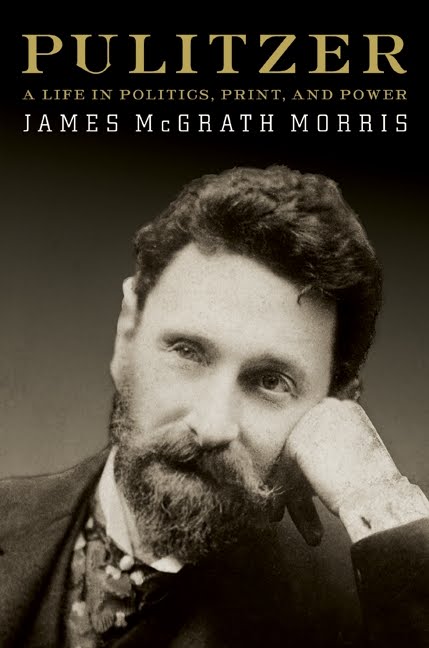
BOOKS / Pulitzer: A Life in Politics, Print, and Power


Who wants yesterday’s papers?
Today’s biographers and cultural critics!

By Jonah Raskin / The Rag Blog / January 26, 2010

[Pulitzer: A Life in Politics, Print, and Power, by James McGrath Morris. Published by HarperCollins, February 2010; hardcover, 576 pp; $29.99.]

What goes up must come down. That seems to be as true of newspapers as of footballs hurled into the air by Vikings quarterback Brett Favre or Saints quarterback Drew Brees.

Indeed, these days newspapers are coming down fast and hard from coast-to-coast and in between too. Once upon a time, they were the lords of the land; now they are vassals to even more powerful lords like Google, which dares to tangle with Communist regimes in countries like China.

As newspapers fold around the country, and as circulation and ad revenue drops, the newspapers of yesterday have taken on new significance, and their editors and publishers have become more than figures of historical curiosity. “Who wants yesterday’s papers?” Mick Jagger asked rhetorically, and followed that question with a terse answer, “No one in the world.”

That’s no longer true. Yesterday’s newspapers are today’s treasure troves. They tell us how citizens were thinking and feeling, and what they were told to think and feel by press lords like Joseph Pulitzer, who ran a tight ship at the St. Louis Post-Dispatch and at The New York World until he died in 1911.

Pulitzer was everything that William Randolph Hearst, the legendary newspaper tycoon, was not. Pulitzer was Jewish and an immigrant. English was his third language, after Hungarian and German, and the United States was his adopted country. But like Hearst he had a passion for print media, and like Hearst, he made newspapers his business, his religion, and his personal credo. Along with Hearst, he helped to give birth to a particular form of American journalism that shaped the ideas and the opinions of the masses, and that created a mass culture.

James McGrath Morris burrows deeply into Pulitzer’s vibrant, explosive life, shakes off the cobwebs, and gives it a distinctly contemporary feeling. If the name Pulitzer rings a bell today it is probably because of the prizes that bear his name, and that are awarded to authors every year, sometimes deservedly and sometimes not. Morris’s book ought to change Pulitzer’s reputation and bring him out of the obscurity in which he now languishes.

A veteran of newsrooms, and radio stations, and an astute critic of the media, Morris is the author of two previous books about newspapers and reporters — The Rose Man of Sing Sing and Jail House Journalism. He brings to his biography of Pulitzer a keen appreciation of the craft of reporting, and the economics and the politics of the newspaper industry. Money is a bright thread that runs through his biography, and makes it of interest at a time when newspapers are struggling to survive financially.

Pulitzer: A Life in Politics, Print, and Power makes use of new and original sources — some of them rescued from a trash bin in St. Louis — along with a long buried memoir by Pulitzer’s brother, sibling rival, and nemesis, Albert, who sold his own newspaper The New York Journal to William Randolph Hearst.

In the 1890s Pulitzer and Hearst engaged in a war of words; both practiced what was called “yellow journalism.” They both urged the United States to go to war in 1898 and invade Cuba, though Morris feels that Pulitzer was not really a warmonger, and argues that on more than one occasion Pulitzer urged negotiations not gunboats or gunboat diplomacy.

Morris’s book is certainly not a repeat of W. A. Swanberg’s massive 1967 biography; from now on it will probably become the definitive work on the subject. Morris begins his story dramatically on Pulitzer’s yacht, the Liberty, in 1909, in Havana, Cuba, shortly before his death. He goes back to the beginning — to Hungary in 1847 — and he follows his story through the upheavals of 19th-century America — from the Civil War to the eve of World War I. Morris shows how the man who was born Politzer Jozsef turned himself upside down and inside out. An outsider, he became a consummate insider.

Though Morris does not defend everything about Pulitzer — certainly not his temper or his meanness to members of his own family and associates in the newspaper business — he tells a tale that is inspiring. The reader cheers Pulitzer as he arrives in New York, climbs his way out of the ghetto, and writes his own rags to riches story, just as the United States was beginning to flex its muscle as a military and industrial power.

The first 200 pages of the book are both entertaining and informative. They hold a reader’s interest. But from that point on, and beginning with the chapter entitled “The Great Theater,” the biography catches fire, and the writing becomes poetic, as for example when Morris says that Pulitzer was “willing to dance with the devil.”

Morris shows that Pulitzer played a major role in creating a provocative, perhaps almost diabolical newspaper style grounded in sensationalism. He shows, too, that he was unafraid to take on the powers-that-be, including President Theodore Roosevelt who thought he was libeled in the pages of The World.

However, even while Pulitzer attacked the wealthy and the powerful in his flagship newspaper, The New York World, he moved in elite circles and rubbed shoulders with the likes of J. P Morgan, John D. Rockefeller, and Cornelius Vanderbilt. He turned his back on the masses and embraced millionaires.

Morris’s biography suggests some of the ways that today’s bloggers and editors might attract new audiences. Indeed, Pulitzer had a knack for publishing front-page stories that had the nation at large talking, debating, and almost battling one another. William Randolph Hearst learned from him, borrowed some of his techniques, and gave him a run for his money, as Orson Welles’s biopic Citizen Kane shows.

In his time, Pulitzer was as charismatic as Hearst, and as famous, too, and reading this biography one wonders why Welles didn’t make a “Citizen Pulitzer.” Perhaps a bright, young director — or even a well-established director like Martin Scorsese, for example, who knows the historical period intimately — will do just that.

Morris’s biography is ready-made for the movies, with big scenes and larger-than-life characters. It looks back to an America when the daily newspaper was an essential part of life, and it makes America itself as much of the story as Pulitzer. Morris’s biography offers hope for the future of journalism, too.

[Jonah Raskin teaches in the communication studies department at Sonoma State University. He is the author of Field Days: A Year of Farming, Eating and Drinking Wine in California.]

  • Find Pulitzer: A Life in Politics, Print, and Power by James McGrath Morris on Amazon.com.

The Rag Blog

Posted in Rag Bloggers | Tagged , , , , , , | Leave a comment

Tom Miller : When Jerry Rubin Came to Tucson

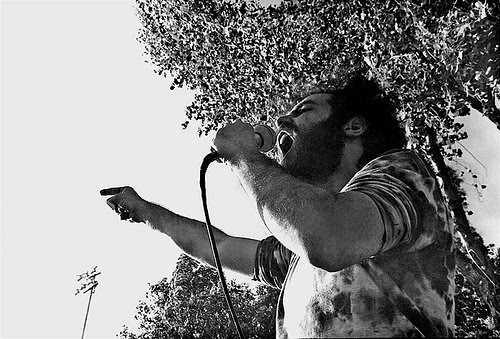
Yippee Jerry Rubin addresses a crowd at a park in Tucson, Arizona in 1970. Photo by David Lee Guss / Flickr.

Yippie activist Jerry Rubin brought
His psychedelic oratory to Arizona

By Tom Miller / The Rag Blog / January 25, 2010

Writer Tom Miller will be Thorne Dreyer’s guest on Rag Radio, Tuesday, January 26, 2-3 p.m. (CST) on KOOP 91.7 FM in Austin. They will discuss Tom’s adventures as an author, journalist, and world traveler — and as an activist and underground journalist in the Sixties. For those outside the listening area, go here to stream the show.

[Tom Miller is an old friend of ours and a fellow graduate of the underground press. In this article he remembers his friendship and adventures with Yippee Jerry Rubin — especially one eventful day in Tucson, Arizona, in 1970. It was first published in the Tucson Weekly in 1995.]

My houseguest was the first to notice. Every hour that night a car would pull up to the curb outside my rental near Grant Road and Tucson Boulevard, dim its lights, and shift into neutral. We’d hear a brief murmur of muffled conversation, and another car would silently drive off. Very quiet. Very discreet. And to my guest, very conspicuous and amusing.

They were FBI cars, making sure that Jerry Rubin, recently convicted for conspiring to incite riots at the Chicago ’68 Democratic convention, wasn’t plotting the same for Tucson, Arizona. That explained the occasional clicks and wheezes that punctuated the obvious echoes on my telephone line.

We expected some sort of surveillance — deep down, we looked forward to it — and J. Edgar Hoover’s men didn’t fail us. “It really works to my advantage,” Rubin said. “It keeps the right-wing vigilante goons away from the door no matter where I’m staying.”

Thirty-two-year-old Jerry Rubin –short, skinny, matted curly hair — was at the peak of his notoriety. He had risen to prominence in Berkeley’s Free Speech Movement in the mid ’60s, and, with Abbie Hoffman, Paul Krassner and a few others, used television advertising techniques to bring a disparate and disorderly constituency into the anti-war fold.

Their letterhead said YIPPIE! — Youth International Party — and white, middle-class apolitical kids who puffed the occasional joint made up their primetime audience. The Yippies successfully linked an unpopular war overseas with the burgeoning counter-culture at home and made uniformed authority the enemy on both fronts.

They used guerrilla theater, inventive slogans and confrontational tactics to ridicule antiquated laws and the police who enforced them. Rather than preach the evils of capitalism, they gleefully exploited their contradictions. Bands like the Jefferson Airplane and the MC5 played their benefits; politicians such as Chicago Mayor Richard Daley and South Carolina Sen. Strom Thurmond proved their foils.

In public, Rubin & Co. were appealingly offensive clowns whose names could draw thousands to a rally as they shouted rehearsed hyperbole and spontaneous rhetoric. To the straight press they were terrific — they spoke in soundbites, wore colorful clothes and had a well-crafted sense of spontaneity.

Unlike orthodox Marxists, they flashed an aura of psychedelic oratory and tie-dyed eloquence. To those of us in the underground and anti-war press they were supportive and respectful, often contributing articles and, if they were passing through a city near deadline, helped with layout or distribution.

I had gone to the Chicago convention as a demonstrator and reporter — objectivity has never been a high priority with me — but instead of joining the pack of journalists trailing the Yippie circus, I traveled with a medical van that treated demonstrators bloodied by Chicago police.

That fall, back in Washington, I covered the House Un-American Activities Committee hearings on the anti-war movement, and Rubin responded to his subpoena wearing a revolutionary war uniform. We had lunch at a fancy Capitol Hill restaurant one day and became fast friends.

Rubin lived with his girlfriend Nancy Kurshan in a small walk-up at 5 St. Mark’s Place on New York’s Lower East Side. Radical publications were strewn about the place, posters of Janis Joplin, Che Guevara, and Jimi Hendrix hung lopsided on the walls, and an oddball assortment of young hippies, middle-aged activists and aging bohemians touched base at all hours of the day and night.

“Jerry, Eldridge telephoned from Algiers; he wants you to call him back this afternoon.” “Hey, Jerry, you just missed Phil Ochs a half-hour ago; said he’d be back to confirm the rally in Gainesville next week.” “Rubin, that ladies’ club on Long Island wants to give $500 to the Yippies. What should I tell them?”

Anyone who was near the door or the phone became part of the Central Committee that swirled around Jerry and his ego. He himself, in private, was an inquisitive fellow, dedicated to social justice and ending the war, and addicted to his persona. He was far more a doer than a thinker, but he usually bounced his plans off the thinkers before going out and doing.

He moved to another, larger apartment on Carmine street in the West Village, and one Saturday afternoon we loaded all his possessions into a borrowed car for the schlep across town. Four of us carefully carried his prized 21-inch color television down the front stairs, when suddenly all the deadbeat junkies on St. Mark’s place started clapping and whistling.

Jerry thought it was for him, and waved amiably to the crowd. “Psst, Jerry,” I whispered. “They think we’re ripping off some guy’s television in broad daylight. They’re applauding our audacity; they don’t know who you are.”

We stayed in touch through his 1969 conspiracy trial, by which time I had moved to Arizona, and when he and his cohorts were found guilty after one of the most bizarre and riveting courtroom tribunals of this century, he went out on the lecture circuit.

His book Do It! [ghost-written by The Rag Blog’s James Retherford] had just been released. Student groups at some universities paid him a handsome honorarium to come and provoke anti-war activity, other ad hoc groups simply hoped they could scrape together enough expense money to bring him in for a speech, feed him and send him on his way.

That’s what brought Jerry Rubin to my Tucson couch, and the FBI to my doorstep, a quarter of a century ago this week.

Tucson had a fairly active anti-war movement. Students for a Democratic Society (SDS) shared a storefront on Sixth Street with a militant pacifist group. UA student government leaders took part in anti-war demonstrations. Renegade airmen from Davis-Monthan spoke out publicly against their commander-in-chief, Richard Nixon. The arrest of some demonstrators in a picket line at a Wildcat-BYU basketball game — we were protesting the Mormon position on blacks — galvanized the city’s progressive forces.

A low-profile but active arts and literary scene nurtured the more politicized crowd and, for a while, proximity to Mexico made the Old Pueblo the Price Club of America’s marijuana trade. Into this milieu a few other recent arrivals and I rented a storefront on Fourth Avenue and called it the Yippie Free Store.

We published an underground newspaper that lasted two issues, took in and gave away used clothing, and put on Sunday afternoon rock concerts at Santa Rita Park on 22nd Street at Fourth Avenue. Local bands volunteered to play, we handed out anti-war propaganda, and earth mothers prepared huge cauldrons of red chili and brown rice. Bikers and students, full-time drop-outs and off-duty servicemen, foothills floozies and the best of the barrio all mixed easily.

No one said boo to the city; we simply made bare-bones plans, spread the word on the street and through sympathetic radio stations, and hoped for the best. When it came time to arrange for Rubin to come to town, however, we responded to a standing invitation from the city’s parks department to formalize our efforts. Secretly, Eddie Cohen, a fast-talking, rambunctious working class Brooklynite, and I met with Parks Director Gene Reid. He offered us two sites; we chose Palo Verde Park, not far from Broadway and Wilmot Road, and plastered the town with fliers.

That April 1970 day started in Tempe, where the ASU administration had grudgingly approved a student group’s request to use Goodwin stadium for a Rubin rally. His appearance there provoked the anticipated First Amendment mutterings; Morris Starsky, a tenured and vocal ASU professor who, in the spectrum of anti-war groups, took the orthodox Trotskyite position, called Rubin a “lunatic,” but defended his right to speak on campus.

Rubin’s Tempe hosts and I greeted his flight at Sky Harbor Airport; he was almost impossible to find among all the burly, DPS plainclothesmen who surrounded him. By the time we got to ASU, close to 3,000 students were waiting. Anti-war whoops greeted Rubin as he took the stage and adjusted to the Arizona sun. The obligatory joints passed through the audience and up to their speaker.

Rubin’s speech, a succession of one-liners, Yippie slogans, and provocative patter geared for Arizona, was a big hit. “We’re going to take the Pentagon,” he yelled, “and turn it into an LSD factory. Then we’ll turn the White House into a crash pad.”

Privately I was somewhat embarrassed at how silly Rubin sounded, but I loved the response he got, all the more so because he was so good at converting apathetic students into constructive activists against the war in Vietnam. “You are all inmates at Arizona State Penitentiary,” he shouted, and the laughing, Sunday afternoon crowd cheered in response. As a parting shot he thanked the ASU administration for its hospitality.

We raced to the airport for the short hop to Tucson before Goodwin stadium had completely emptied. On the flight down we talked about friends in the anti-war movement and about the Weather Underground, a militant group that broke away from SDS to form clandestine cadres of saboteurs.

The Tucson airport didn’t have jetways then, and we had to walk down the mobile stairs and across the tarmac to get inside. Through the glass we could see more DPS plainclothesmen waiting for us. Also waiting was James R. Hood, news director at KTKT radio, whom I had agreed could get an exclusive interview with Rubin in exchange for a lift to Palo Verde Park.

Driving the car was a very straight-looking fellow named Marshall who read the weather report on Hood’s station. I motioned to him and turned to Rubin. “He’s a weatherman,” I said in a low voice. “What?!?” Rubin bellowed, falling for the gag.

Rubin was as offensive and obnoxious in Palo Verde Park as he’d been up north, and the gig went just as smoothly. The park was filled with eastside teenagers and lots of the regulars from our Sunday rock concerts at Santa Rita Park. A layabout California biker named Brother John appointed himself Rubin’s security force.

The news that weekend told of another Tucsonan killed in Vietnam; this time a Chicano marine. President Nixon mentioned that the U.S. had a stake in Cambodia, carefully setting the stage for bombing that country a week later.

“We’re going to make Arizona unsafe for Barry Goldwater!” Rubin shouted halfway through his Tucson soliloquy, and the crowd, even larger than the Tempe gathering, laughed its approval. He came down heavy on heroin pushers, inhaled joints tossed on stage, and urged his followers to protest the war in Vietnam by every means possible. According to my FBI files, which I obtained a few years later through the Freedom of Information Act, “spectators were using marijuana and were in possession of wine.”

Rubin held a press conference at the Yippie Free Store after the rally. Of the dozen or so newshounds shoehorned into our storefront, I remember only Arizona Daily Star photographer Jack Sheaffer, whose smelly charoot and sharp elbows assured him unobstructed access. We ate dinner at a Mexican joint on South Fourth Avenue, with Rubin constantly checking his watch. He didn’t want to miss the 10 o’clock news that night.

As an outside agitator Rubin performed a valuable service. His appearance in town was the buzz of the street for days, and even the orthodox anti-war groups reported a surge of interest. Then in swift succession Nixon starting bombing Cambodia, the Ohio National Guard killed four at Kent State University, and more than 100,000 Americans converged on Washington to protest the expanding war against Southeast Asia. On the University of Arizona campus, students and outsiders took over Old Main, which then housed ROTC. We were a glorious sight.

Rubin continued his role as a “Yippie leader,” a contradiction if ever there were one, and his federal conspiracy conviction was eventually overturned. His next book, an embarrassing tome called We Are Everywhere, was a flop; I had a hand in writing and editing it, but it was nothing to be proud of. Over the next few years we remained close; when Nancy left him for another man, he and I — both in Washington for a short spell — would go on long all-night walks in which he emptied his soul.

He never returned to Tucson, but at some point, a cleaned-up Jerry Rubin moved to California with his considerable promotional abilities, and dined out on the west coast smorgasbord of therapies and feel-good workshops. Back in New York he set up networking salons in which youthful white-collareds paid lots o’ bucks to rub elbows with each other. From there his entrepreneurial spirit led him into a Wall Street venture capital enterprise, and finally back to California to set up a pyramid, Amway-type of distribution scheme for WOW — a powdered drink that contained bee pollen and ginseng.

Over the years I felt increasingly distant from him; our contact became limited to a lame “say hello” through mutual friends. Yet whenever I want to be reminded of that day 25 years ago, all I have to do is pull out my heavily censored FBI file, which speaks of “the visit of [DELETED] to Tucson.” In a memo to their boss from his Phoenix office, Hoover learned that I “spent considerable time with [DELETED].” When Rubin died last November after being hit by a car on Wilshire Boulevard in Los Angeles, I recalled with whimsy my good times with [DELETED].

Fact is, I liked him much more as an obnoxious asshole.

Tom Miller.

Tom Miller is a veteran of the underground press of the 1960s. His writing, much of it about Latin America and the American Southwest, has appeared in Smithsonian, The New Yorker, LIFE, The New York Times, Natural History, and many other publications. His six books include Revenge of the Seguaro (his latest), The Panama Hat Trail, On The Border, and, most recently, Trading with the Enemy: A Yankee Travels through Castro’s Cuba.

His collection of some 80 versions of “La Bamba” led to his Rhino Records release, The Best of La Bamba. His book On the Border has been optioned by Productvision for a theatrical film. He has appeared on NBC, NPR, CNN, HBO, XM, and CSPAN, among other broadcast outlets. The University of Arizona Library acquired Miller’s archives and mounted a major exhibit of the author’s papers.

Tom Miller has lived in Tucson, Arizona, near the Mexican border, since 1969.

The Rag Blog

Posted in Rag Bloggers | Tagged , , , , , , , | 1 Comment

State of the Union : What Obama Must Do


Obama’s State of the Union must address:

  • Creating jobs
  • Reducing the deficit
  • Re-regulating the banks

By Sherman DeBrosse / The Rag Blog / January 25, 2010

People are enraged by the bonuses the banks are handing out, and many think the Obama administration is too cozy with Wall Street. Many believe Obama has not done enough to address unemployment.

The State of the Union message will give President Barack Obama an opportunity to redirect the nation’s political discourse. He should focus on job creation, propose tougher regulations on the financial sector, and suggest means of cutting costs and raising needed revenue.

Creating jobs

A jobs package should center on New Deal-style work relief projects and tax incentives for small businesses to hire more people.

Tax incentives should be created to reward small businesses for creating new jobs. They could be partly based upon total increases in payroll so that firms would not be rewarded for firing one person and hiring someone else.

Credit has dried up for small business. The banks are unlikely to do much to remedy this situation. Many must amass cash to cover bad assets, and others are more interested in investing in other banks or in complex financial instruments . The administration must find ways to recycle recovered TARP money into Small Business Administration loans. SBA procedures must be streamlined, and it might be necessary to find ways for the SBA to make the loans directly.

Work relief projects could resemble the New Deal’s Civilian Conservation Corps and National Youth Administration projects. Some could work through states and municipalities as did the more recent CETA operations.

Manufacturing employment preservation

This is the time to propose repealing legislation that held out incentives to export jobs. Such legislation has been on the books since the post-World War II years when we were trying to fight communism by building up economies abroad. The last serious effort to repeal this legislation was the Hartke Bill, which Gerald Ford vetoed shortly after becoming president.

Raising funds

Obama’s coming State of the Union address will disappoint many if he does not deal with obscene bonuses in the financial community. For one thing, they soak up funds that will be needed to keep lending and absorb losses. The president should propose legislation taxing bonuses at a higher level. Present tax law treats bonus income the same way capital gains are handled. At the very least, that provision should be repealed so that these people no longer get that very low tax rate. Even better would be to tax the bonuses at a 50% rate.

So far, it appears that the administration is thinking about applying the Medicare payroll tax to investment income. That is a good idea as long as it does not penalize ordinary retirees living off their investments. Perhaps the tax should kick in at the $60,000 level.

Another means of raising funds to reduce the deficit is to levy excess profits taxes on all sectors of the health care industry, including health insurance providers. Excess profits taxes should also be enacted for the petroleum and natural gas industries.

German Finance Minister Peer Steinbruck has proposed a global financial transaction tax of .05 % ( half a percent) that would be applied by all the G20 countries. It should be applied whether or not the transactions occur on recognized exchanges. Some have estimated that it would raise for the Treasury over $600 billion annually. This would include derivatives.

It is unlikely that all 20 nations will agree to it. The Obama Administration seems to prefer a fee on the liabilities of banks and investment companies. It should apply across the board to institutions that took TARP money and those that did not. The president says this should only cover losses from the TARP program. The tax would discourage excessive leveraging in the future. He should consider making the fee permanent.

Moreover, we need to recover more of that money lost through the TARP program. The collapse of the financial system triggered a deep recession, which made necessary a large stimulus package. In addition, bank bailouts since 1980 have cost about $14 trillion in obligations undertaken by the Fed and Treasury. It is high time we begin to recover some of that money.

Obama should make it clear that he will not accept an extension of the Bush tax cuts, which run out this year. He should call for reenactment of an inheritance tax with large carve-outs for family farms and small, family owned businesses.

Fixing Medicare

By all accounts Medicare is fast approaching collapse. One reason is that we lose about $60 billion in fraudulent claims every year. Another reason is that Medicare Advantage, essentially a subsidy to the health insurance industry, is too great a burden.

The president should propose legislation allowing Medicare providers to negotiate for drug prices and establish a formulary with approved medicines. Since this legislation involves the spending of federal funds, it should go through the Senate via the budget reconciliation process to avoid a filibuster.

A great deal more must be invested in hiring people and creating mechanisms to detect Medicare fraud.

If health care reform does not pass, the president should pledge to use administrative means to reduce losses through Medicare Advantage. The current health reform plans have provisions to gradually trim Medicare Advantage.

Even if health care reform somehow passes, it will be in a form that does too little to control costs. Obama should propose legislation that will do more to control medical expenses that are ultimately funded by the federal government. This should include repealing the exemptions from anti-trust legislation now enjoyed by the medical insurance and medical liability insurance industries.

Financial system reform

Senator Dick Durbin said that the banks own Congress, but there is now enough public anger at the banks to enable Congress to pass some reforms.

At the very least, banks that are federally insured or hold our savings should not be permitted to export our money or use it for speculation in stocks, complex financial instruments, and hedge funds. President Obama should reverse his position on creating a Financial Consumer Services Protection Agency, even though Congress might lack the spine to follow his lead.

No doubt Obama will endorse financial regulatory legislation now going through Congress. As the economy improves, there will be more pressure to derail it. He needs to press for rapid passage. Above all, it must include provisions for rapidly placing commercial and investment banks into federal receivership when they face failure. Reregulation should include a ban on ordinary commercial banks gambling with our savings. Much of Glass-Steagall should be restored.

President Obama must urge the independent regulatory agencies to be more vigilant and vigorous in enforcing existing regulatory legislation. He should promise that the Justice Department will focus upon finding and prosecuting those who are guilty of fraud

We must begin to regulate derivatives trading. They should be handled in an open market and there should be no “dark market” where some are traded out of sight, and no entities should be allowed to continue dealing with them in unregulated over the counter trades. The legislation now going through Congress has too many loopholes and invites more abuses and future crashes.

The President’s allies in Congress should begin investigating why Goldman Sachs received 100% compensation for its exposure while AIG had to liquidate many assets under the worst possible circumstances.

Political implications

These steps represent good beginnings for reregulating the financial sector, containing medical care costs, bringing in more revenue, and creating jobs. They will not completely stem the perfect political storm that was building all last year and became obvious to all with the recent election of Senator Scott Brown in the Bay State.

The reregulation of banks will give the GOP still another advantage — full campaign war chests for the coming by-elections.

Progressives need to appeal to economic populism while beginning the slow and difficult process of explaining to voters how our economy and financial system became so fragile. This is a long-term process, and they need to learn a great deal about message management and cognitive science. Republicans are light years ahead in these areas, and their task is so much easier because their success rests on playing to impatience — and to the independents with their disinclination to examine anything closely.

The November elections will not be a happy time for Democrats, but they face great long term challenges. The GOP could produce a favorable political realignment by 1) continuing to reenergize its base, 2) continuing to promote what sociologists call a crisis of legitimacy, and 3) continuing to insist that our economic woes are the result of Democratic policy. If you insist on anything long enough, people will believe it.

Continual obstructionism has created the impression that government cannot produce desired results, and a legitimacy crisis usually hurts those in power. A long-term realignment is possible because, at some level, voters are beginning to realize that the long term prospects for the middle class are not good. When that finally sinks in, someone will pay the price.

[Sherman DeBrosse is a retired history teacher and a regular contributor to The Rag Blog.]

The Rag Blog

Posted in RagBlog | Tagged , , , , , , | 1 Comment

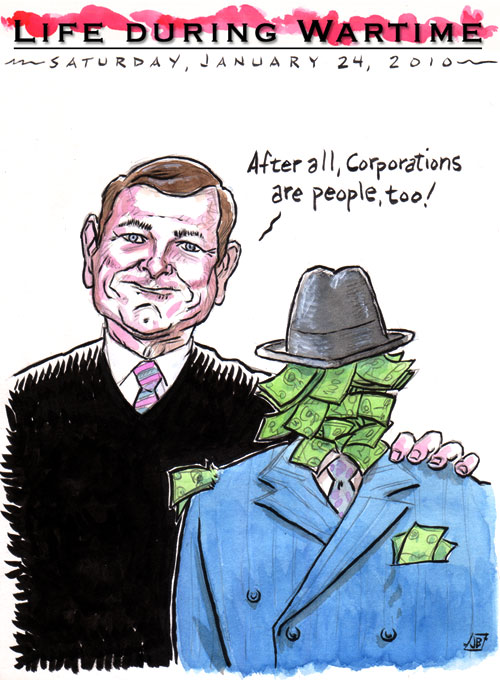
Life During Wartime : Corporations Are People Too!

Political cartoon by Joshua Brown / Historians Against the War / The Rag Blog

Thanks to Dr. S.R. Keister /The Rag Blog

Posted in Rag Bloggers | Tagged , , , , , | Leave a comment

Robert Jensen : How the Media Has Failed Us on Haiti

CNN’s Anderson Cooper helps child hurt in rare incidence of violence in aftermath of Haitian earthquake.

Great television/bad journalism:
Media failures in Haiti coverage

By Robert Jensen / The Rag Blog / January 25, 2010

CNN’s star anchor Anderson Cooper narrates a chaotic street scene in Port-au-Prince. A boy is struck in the head by a rock thrown by a looter from a roof. Cooper helps him to the side of the road, and then realizes the boy is disoriented and unable to get away. Laying down his digital camera (but still being filmed by another CNN camera), Cooper picks up the boy and lifts him over a barricade to safety, we hope.

“We don’t know what happened to that little boy,” Cooper says in his report. “All we know now is, there’s blood in the streets.” (View video below or go here.)

This is great television, but it’s not great journalism. In fact, it’s irresponsible journalism.

Cooper goes on to point out there is no widespread looting in the city and that the violence in the scene that viewers have just witnessed appears to be idiosyncratic. The obvious question: If it’s not representative of what’s happening, why did CNN put it on the air? Given that Haitians generally have been organizing themselves into neighborhood committees to take care of each other in the absence a functioning central government, isn’t that violent scene an isolated incident that distorts the larger reality?

Cooper tries to rescue the piece by pointing out that while such violence is not common, if it were to become common, well, that would be bad — “it is a fear of what might come.” But people are more likely to remember the dramatic images than his fumbling attempt to put the images in context.

Unfortunately, CNN and Cooper’s combination of great TV and bad journalism are not idiosyncratic; television news routinely falls into the trap of emphasizing visually compelling and dramatic stories at the expense of important information that is crucial but more complex.

The absence of crucial historical and political context describes the print coverage as well; the facts, analysis, and opinion that U.S. citizens need to understand these events are rarely provided. For example, in the past week we’ve heard journalists repeat endlessly the observation that Haiti is the poorest country in the Western Hemisphere. Did it ever occur to editors to assign reporters to ask why?

The immediate suffering in Haiti is the result of a natural disaster, but that suffering is compounded by political disasters of the past two centuries, and considerable responsibility for those disasters lies not only with Haitian elites but also with U.S. policymakers.

Journalists have noted that a slave revolt led to the founding of an independent Haiti in 1804 and have made passing reference to how France’s subsequent demand for “reparations” (to compensate the French for their lost property, the slaves) crippled Haiti economically for more than a century.

Some journalists have even pointed out that while it was a slave society, the United States backed France in that cruel policy and didn’t recognize Haitian independence until the Civil War. Occasional references also have been made to the 1915 U.S. invasion under the “liberal” Woodrow Wilson and an occupation that lasted until 1934, and to the support the U.S. government gave to the two brutal Duvalier dictatorships (the infamous “Papa Doc” and “Baby Doc”) that ravaged the country from 1957-86.

But there’s little discussion of how the problems of contemporary Haiti can be traced to those policies.

Even more glaring is the absence of discussion of more recent Haiti-U.S. relations, especially U.S. support for the two coups (1991 and 2004) against a democratically elected president. Jean-Bertrand Aristide won a stunning victory in 1990 by articulating the aspirations of Haiti’s poorest citizens, and his populist economic program irritated both Haitian elites and U.S. policy-makers.

The first Bush administration nominally condemned the 1991 military coup but gave tacit support to the generals. President Clinton eventually helped Artistide return to power in Haiti in 1994, but not until the Haitian leader had been forced to capitulate to business-friendly economic policies demanded by the United States. When Aristide won another election in 2000 and continued to advocate for ordinary Haitians, the second Bush administration blocked crucial loans to his government and supported the violent reactionary forces attacking Aristide’s party.

The sad conclusion to that policy came in 2004, when the U.S. military effectively kidnapped Aristide and flew him out of the country. Aristide today lives in South Africa, blocked by the United States from returning to his country, where he still has many supporters and could help with relief efforts.

How many people watching Cooper’s mass-mediated heroism on CNN know that U.S. policy makers have actively undermined Haitian democracy and opposed that country’s most successful grassroots political movement? During the first days of coverage of the earthquake, it’s understandable that news organizations focused on the immediate crisis. But more than a week later, what excuse do journalists have?

Shouldn’t TV pundits demand that the United States accept responsibility for our contribution to this state of affairs? As politicians express concern about Haitian poverty and bemoan the lack of a competent Haitian government to mobilize during the disaster, shouldn’t journalists ask why they have not supported the Haitian people in the past? When Bill Clinton and George W. Bush are appointed to head up the humanitarian effort, should not journalists ask the obvious, if impolite, questions about those former presidents’ contributions to Haitian suffering?

When mainstream journalists dare to mention this political history, they tend to scrub clean the uglier aspects of U.S. policy, absolving U.S. policymakers of responsibility in “the star-crossed relationship” between the two nations, as a Washington Post reporter put it.

When news reporters explain away Haiti’s problems as a result of some kind of intrinsic “political dysfunction,” as the Post reporter termed it, then readers are more likely to accept the overtly reactionary arguments of op/ed writers who blame Haiti’s problems of its “poverty culture” (Jonah Goldberg, Los Angeles Times) or “progress-resistant cultural influences” rooted in voodoo (David Brooks, New York Times).

One can learn more by monitoring the independent media in the United States (“Democracy Now!,” for example, has done extensive reporting, ) or reading the foreign press (such as this political analysis by Peter Hallward in the British daily The Guardian). When will journalists in the U.S. corporate commercial media provide the same kind of honest accounting?

The news media, of course, have a right to make their own choices about what to cover. But we citizens have a right to expect more.

[Robert Jensen is a journalism professor at the University of Texas at Austin and board member of the Third Coast Activist Resource Center. His latest book is All My Bones Shake: Seeking a Progressive Path to the Prophetic Voice (Soft Skull Press, 2009). Jensen can be reached at rjensen@uts.cc.utexas.edu and his articles can be found online at Source and on The Rag Blog.]

The Rag Blog

Posted in Rag Bloggers | Tagged , , , , , , , , | 1 Comment

Marc Estrin : The Revolutionary Messages of Classical Music

Johannes Brahms by Lucian Tidorescu.

Protest music:
Radical themes of the great composers

The Brahms Requiem is also movement music, unbearably beautiful, revealingly deep — like our afflicted lives.

By Marc Estrin / The Rag Blog / January 25, 2010

In a recent article titled “Movement Music,” the invaluable David Swanson sings a hymn of praise for the equally invaluable David Rovics. Movement music, yes.

Back in 2003, The Nation devoted an entire issue to “The Power of Music” of the “protest music industry.” And here in Vermont we have come up with Free Vermont Radio, a digital online music provider featuring an entire library of Vermont musicians, many of whom write and perform “movement music.”

It’s odd: nowhere in any of the above is there a mention of a thousand years of western classical music.

Why is lefty life — so highly educated, morally aware, philosophically sophisticated, politically savvy — why are we so blind, so deaf, to the radical expression and revolutionary messages therein?

I don’t get it. In “classical” music — from the tenth through the twentieth century — we have inherited a cornucopia of profundities, prompting and announcing social change at every step along the way, educating human consciousness towards ever-greater complexity of perception and thought, coaxing out our emotional and spiritual depths.

The great composers have always demanded from us, and developed in us, precisely those sensibilities we need to confront the hughest issues we face — structure, otherness, variation, modulation, time, change, form, dissipation… love.

I think of the room in which the “Eroica” was first performed — its aristocratic, gold-leafed curlicues, its elaborately carved chairs. I think of Beethoven’s assessment of the “princely rabble” that would seat their asses on those chairs, and the shattering indictment with which he would assault them in the name of freedom. “Seid umschlungen, Millionen,” he intoned in the Ninth Symphony, masses embracing in the kiss of the entire world. Tell it to Cheney and Obama, CENTCOM and the IMF.

Bach’s intensity and structural investigations, Brahms’s sexuality unlimited, Mahler’s catalogue of hetero-interactions, Wagner’s engorging instability, Bartok’s mesto dance, Stravinsky’s primordial landscapes, Berg’s evocation of interstitial states — one could go on and on, and in and in. Are all these irrelevant to the left, and to our goals of head and heart?

Let’s talk about the means of production. Though there are surely classical stars and consumers, by far the greatest number of sounds are made by amateurs at choral or orchestral or chamber music rehearsals and performances, or playing at home — a democratic, participatory picture of growth, education, and community, growing since the eighteenth century.

Yes, David Rovics and the singer-songwriters of the protest industry speak strongly to us and our times. But they are not the only music relevant to the left. We need to recover the largesse of our musical heritage.

Recently, after only a few days of organizing, 200 musicians, along with the Bread and Puppet Theater, came quickly together for a concert of the Brahms Requiem — to raise funds for Haiti relief. Over $10,000 dollars was collected from an audience of 700.

The Brahms Requiem is also movement music, unbearably beautiful, revealingly deep — like our afflicted lives.

[Marc Estrin is a writer and activist, living in Burlington, Vermont. His novels, Insect Dreams, The Half Life of Gregor Samsa, The Education of Arnold Hitler, Golem Song, and The Lamentations of Julius Marantz have won critical acclaim. His memoir, Rehearsing With Gods: Photographs and Essays on the Bread & Puppet Theater (with Ron Simon, photographer) won a 2004 theater book of the year award. He is currently working on a novel about the dead Tchaikovsky.]

The Rag Blog

Posted in Rag Bloggers | Tagged , , , | 2 Comments