Righteous Cause Dept. : Raising Big Bucks to Neuter Joe Lieberman

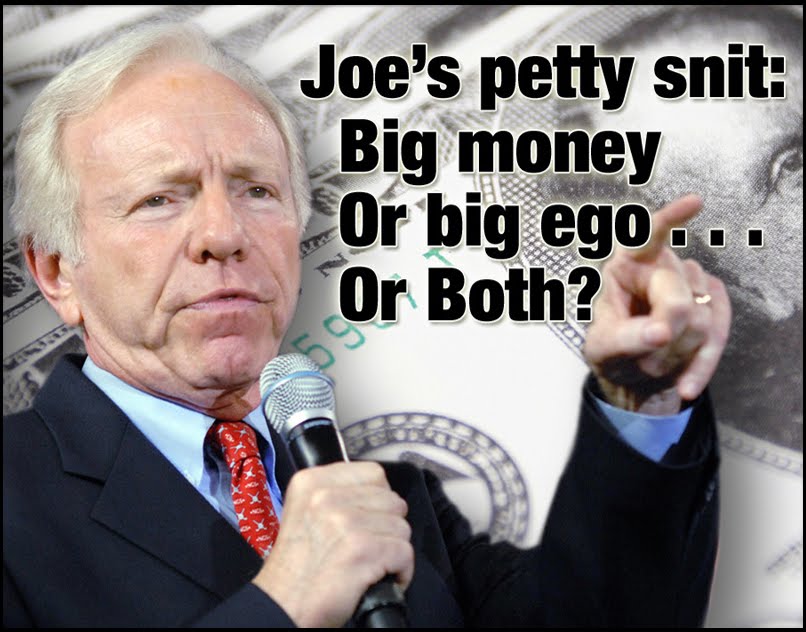
Graphic by Larry Ray / The Rag Blog.

For ad campaign aimed at Connecticut voters:
MoveOn raising big bucks to stop Lord Lieberman

By Larry Ray / The Rag Blog / December 18, 2009

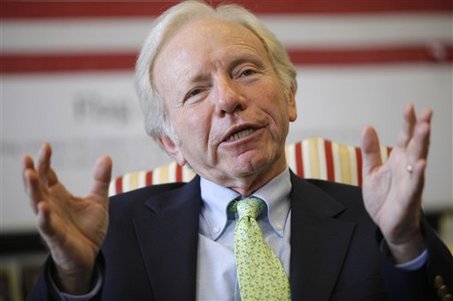
MoveOn.org, one of the largest political action committees in the country is, as I post this, just about $75,000 short of raising one million dollars for a campaign to neuter Senator Joe Lieberman’s single-handed attempt to stall or kill historic health care reform.

Their appeal for 10 bucks is unambiguous: “First, we’re going to launch a huge ad campaign to make sure every last Connecticut voter knows that Senator Lieberman is blocking strong reforms. Then, we’ll push Senate leaders to strip him of his chairmanship and seniority. Finally, we’ll work to defeat him in his next election. We can do this.”

MoveOn’s appeal starts with a quick review of Lieberman’s mad shenanigans,

First, Joe Lieberman helped President Bush invade Iraq, and the Democrats in Washington forgave him. Then, he endorsed John McCain, and they forgave him again. Then, he personally attacked Barack Obama at the Republican National Convention, and still the Democrats forgave him. Now, Joe Lieberman is single handedly gutting health care reform. The time for forgiveness is over. It’s time to hold Senator Lieberman accountable.

This has resonated with enough people to make them pitch in almost one million bucks to slow down this supposedly independent Senator who lost his Democratic bid in 2006 and now seems to be representing only his mercurial petty whims instead of the state of Connecticut… which is a solidly blue state. It went 60% for Obama in 2008. Polls in Connecticut show Lieberman is already in trouble. Thirty percent of Lieberman voters in 2006 later said they would not vote for him again, and, in another poll, he trailed one possible Democratic opponent by a whopping 44 points.

Whether it is big buck political donations from the health insurance and pharmaceutical industries that has has caused his total flip flop on health care reform, or a bruised ego, is not clear. His steadily building Little Caesar rage from feeling he has been snubbed by his caucus seems to many to be driving his decisions.

While holding Democrats hostage for his crucial 60th vote he seems oblivious to his pariah status and seems willing to possibly kill health care reform before it can finish the long hammering-out process ahead. What a legacy that would be for proud, independent Joe. But he gets his gold plated Congressional health insurance plus a fat annual retirement no matter what. He and his colossal ego could ride off into the sunset with no health care worries and plenty of walking around money, happy to say to hell with America.

It has to be more than inflated chutzpah. Maybe, in his delusional state, he also sees his reelection as a sure thing because he is so right and so loved.

Or maybe he has been watching too many WWII Kamikaze movies.

If you have had enough of Loony Lieberman and want to donate a couple of bucks to the MoveOn campaign, here’s the link:

DUMP LIEBERMAN CAMPAIGN

[Retired journalist Larry Ray is a Texas native and former Austin television news anchor. He also posts at The iHandbill.]

The Rag Blog

Posted in Rag Bloggers | Tagged , , , , , | Leave a comment

Listen Up, Senate : Health Care Bill Needs Costs Reduction Amendment

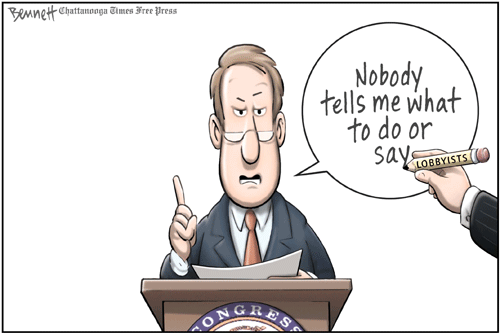
Cartoon from the Chattanooga Times Free Press.

How to save the health care bill:
Add a medical costs reduction amendment

By Sherman DeBrosse / The Rag Blog / December 17, 2009

Dr. Howard Dean, a true progressive and advocate of health care reform has given up on the bill now wending its way through the Senate. He thinks it should be scrapped. It makes too many concessions to the insurance industry, does too little to reduce costs, and will force many to buy health insurance they cannot afford.

However, if the Democrats scuttle the bill, they admit failure and their inability to govern. The election results in 2010 would probably be worse than the perfect storm of 1994.

By passing something now, they establish the principle that all citizens have a right to good health coverage. It has taken seven decades to get most Americans to agree to that basic proposition. Whatever is passed now can be amended later when rising costs force Congress to revisit it.

However, progressive Democratic Senators need to make one concerted effort to pass an amendment they might call the Medical Costs Reduction Amendment. If it does not pass, it could be reconsidered as part of the budget reconciliation process because its parts deal with spending and collecting money.

1. At its core would be a provision requiring that a health insurance company’s “medical loss ratio” cannot go below 90%. That means they must spend 90% on actual health care expenses. Anything above that would be subjected to a healthcare excise profits tax. A similar tax would be applied to salaries of everyone in the health care industry.

2. People purchasing insurance in the new insurance exchanges will be able to buy insurance from providers across state lines.

3. Mechanisms will be established for small businesses to combine bargaining power for the purpose of purchasing health care insurance.

4. Operations in the Justice Department devoted to finding Medicare fraud will be vastly expanded with hundreds of millions being set aside to hire, train, and support new fraud hunters. Thomas Reuters has found that there is about $200 billion of fraud every year in the Medicare system. He found similar fraud in the general medical insurance arena. These fraud hunters would search for fraud throughout both system and be assisted by a robust bounty system for whistleblowers.

5. All medical insurance and medical equipment and service accounting must be absolutely transparent. The Health and Human Services Department must be given several thousand new accountants and agents to dig out waste, inaccurate accounting, and dishonesty. What they learn can eventually be used to regulate insurance rates. We have failed to move toward single-payer insurance, so the only other choice is to follow Germany and Switzerland in working through very tightly regulated insurance providers.

6. Eliminate incentives for doctors and hospitals to overtreat by making lump payments for treatments of illnesses, rather than fees for each procedure.

7. Simplify and streamline billing procedures.

There are many other provisions that should be added, but we have already seen that the tolerance of Senate Democrats for real reform and cost cutting is fairly low. Recently, many of them even voted to kill Kent Conrad’s effort to help people get drugs at lower prices. In this they were upholding a tawdry deal President Obama and Rahm Emmanuel entered into with Big Pharm.

The months-long slog toward some sort of health bill has revealed how strategically inept the Democrats are. They are not good at defending themselves, and it took them forever to begin to sort out differences among themselves. They have also sacrificed opportunities to do something about carbon emissions and restoring some of the rights intended for labor under the Wagner Act. Above all, this sad debate demonstrated how center-right this country really is and how even the Congressional Democrats are in the hip pockets of the big interests.

Thirty years ago, scholars were still writing about the differences between Congressional Republicans and Presidential Republicans, etc. These were intricate discussions about how some people had powerful institutional memories and biases and others had deep commitments to governing well.

All that began to change when Newt Gingrich forced his party to put obstruction ahead of governing. Then Bob Dole, who once had contempt for Gingrich, hit on the tactic of using the threatened filibuster for every important matter before the Senate. When a Black community organizer got into the White House, total obstruction became the order of the day and almost no Republican put governance ahead of partisanship.

Governance at any cost is more of a habit for the Democrats, and this commitment also made them look weak when they were out of power. Some of us saw this tendency in people like Lee Hamilton, but now it seems to characterize the Obama administration.

When one observes all the concessions the administration has made to the big banks and the defense establishment, it is difficult to see progressive principles at work. The Justice Department’s inclination to function like the old Bush injustice operation is also deplorable. On the other hand, the situation would be so much worse if Republicans ran Congress and the White House.

If the Democrats want to go into the 2010 elections as the champions of both health care and health care cost cutting, they had better get some backbone and insist on a Medical Costs Reduction Amendment. They need to put the GOP on the record as fighting tooth and nail to prevent true cost cuts. They might also consider a 50% tax on compensation in excess of $500,000 in the financial services industry. The amendment and the tax might enable them to get back in touch with their natural constituency — ordinary Ameericans.

[Sherman DeBrosse is a retired history teacher. Sherm spent seven years writing an analytical chronicle of what the Republicans have been up to since the 1970s. The New Republican Coalition : Its Rise and Impact, The Seventies to Present (Publish America) can be acquired by calling 301-695-1707. On line, go here.]

The Rag Blog

Posted in RagBlog | Tagged , , , , , | 2 Comments

Barack Obama : The Audacity of Imperial Hubris

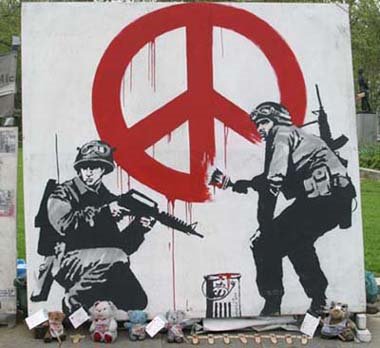
Famed graffiti artist Banksy’s statement on war and peace. Protest poster in Parliament Square, London.

Imperial hubris:
Barack Obama and Nobel’s preemptive strike

Obama might have used the Nobel stage to mark a break from [the] geopolitical approach to U.S. hegemony through militarism… This was clearly the intention of the Nobel Committee…

By Billy Wharton / The Rag Blog / December 17, 2009

Princeton University Philosopher Cornel West brings such an infectious optimism to his social analysis that it is difficult to avoid discovering a sense of hopefulness in even the most mediocre of news.

Awarding the Nobel Peace Prize to an American president managing two active wars and commanding a military force spread throughout the globe seemed to offer little opportunity for a progressive spin. Yet, West quickly discovered a potentially positive edge. “It’s gonna be hard,” he offered during a lecture at a public library in Los Angeles, “to be a war president with a peace prize. Gonna be difficult. Very, very difficult.” The award it seemed could be a “pre-emptive strike for peace.”

West had captured a certain consensus that developed about the award nomination. U.S. President Barack Obama would be so overcome with the honor of receiving the prestigious award that it would trigger an immediate crisis of conscience that would call the country’s military adventures in the Middle East into question and perhaps even hasten a quick retreat.

Obama was certainly aware that he would walk in the footsteps of previous recipients such as Dr. Martin Luther King Jr., Archbishop Desmond Tutu and Mother Theresa. Panelists on the Nobel nomination committee were likely motivated by this neat equation when they arrived at their decision.

Unfortunately for West and others, the one person not in on the scheme was Obama. Instead of imbibing the spirit of peace, he delivered two bombshells. The first came prior to the Nobel ceremonies when he announced that the U.S. would send another 30,000 troops into Afghanistan, in an attempt to establish control of the AfPak border region. Larger than this, his speech at West Point Military Academy bought into large parts of the Bush war rationale.

The Afghanistan invasion, he argued, was forced upon the U.S. A natural response to the terrorist bombings of September 11, 2001. Nervous cadets in the crowd stood blank-faced as they realized that there are many more years of active combat to come. Though Obama made a vague reference to an 18 month time-frame for withdrawal, Secretary of Defense William Gates made the rounds with the media the following day to clarify that it would take years, at least two or three, before an exit from the war-torn country could be considered.

Put aside the escalation speech for a moment. The second bombshell, Obama’s much anticipated Nobel Prize acceptance speech, proves not only that there is almost no chance that the Democratic Party will bring an end to the wars, but that Obama himself has accepted the imperial mantle passed down through generations of American presidents.

Among the first casualties of a speech that can only be described as an expression of American chauvinism, were King and a non-Nobel recipient Mahatma Gandhi. Obama dispensed with them as naïve idealists. “As a head of state,” he argued, “I cannot be guided by their examples alone. I face the world as it is, and cannot stand idle in the face of threats to the American people. For make no mistake: evil does exist in the world.”

Obama went on to endorse the use of force as being based upon, “a recognition of history; the imperfections of man and the limits of reason” not “a call to cynicism.”

Two objections are obvious — one elucidated upon later in his speech, the other quickly tossed aside. First, the notion that war is curative to evil in general and that the U.S., in particular, is an acceptable dispenser of such a cure should raise a skeptical eye.

Obama went further by making the Orwellian claim that “the instruments of war do have a role to play in preserving the peace” and, in a language endorsed by every imperial president, “the United States of America has helped underwrite global security for more than six decades with the blood of our citizens and the strength of our arms.” History offers different lessons.

Far from a neutral operator interested only in the preservation of global peace, the U.S. has engaged in acts of military aggression that substantially contributed to the lessening of peaceful relations amongst nations. Sometimes, as in Iraq, there were direct material motivations. In other cases, political motives or the simple desire to express military superiority fueled the act of aggression.

The military invasions of Korea, Vietnam, Iraq, and Afghanistan so obviously violate the notion of the U.S. as peacemaker that little comment is needed. Even more insidious are the indirect military conflagrations underwritten by the U.S. government. The annals of Latin American history are littered with them — Nicaragua, Cuba, Chile, Guatemala, El Salvador and Operation Condor throughout the region.

Obama might have used the Nobel stage to mark a break from this geopolitical approach to U.S. hegemony through militarism. He could have announced the closure of at least a few of the more than 700 U.S. military bases worldwide. Perhaps Oslo was an ideal site to announce a 50% reduction in the more than 5,000 nuclear missiles the country has.

This was clearly the intention of the Nobel Committee and the hope of Cornell West — to create enough moral pressure to move the president a few steps away from the imperial mantle. No such luck. To have done so, would have necessarily required the help of King and Gandhi, who Obama had dismissed early on.

To say that his role as “a head of state” precludes him from employing the lessons of King and Gandhi is to deny some basic facts of history. Neither King nor Gandhi were intellectuals isolated from social policy or geo-political decision making. The two were not sequestered off from society, like cloistered monks, happy enough to invent a few intellectually engaging, but practically useless, ideas.

They were, instead, historical actors, able to craft new political realities through practical implementation of theories of non-violence. The consequences of which, in terms of both specific policies and broader political inspiration, had global reverberations that are still being felt.

The catch that now separates them from Obama is that both recognized the idea that it is people, mostly regular people, who make history and who often do so against the will of governments both foreign and domestic. India’s anti-imperialist campaign, carried out under Gandhi’s leadership, provides a stinging rebuke to the notion of military occupation. Equally, King’s brave opposition to the U.S. war in Vietnam sharply contradicts Obama’s claim that the U.S. has spent six decades underwriting global security.

Both men offer a notion of social solidarity through peaceful association that works from the local level up into national and international relations. Such lessons might have allowed the U.S. to avoid the military aggressions of the past and to play a significant role in supporting the creation of the kind of peaceful global economic development that both King and Gandhi championed.

Perhaps, in the end, West offers a useful concept, but the wrong social actor. It may eventually be difficult for Obama to manage two wars with a peace prize hanging from his neck. But Obama won’t be the one to determine that. He has left a significant opportunity to offer an alternative to the typical American imperial hubris at the podium in Oslo.

Now it is up to us regular folks, the ones who were so important to King and Gandhi’s movements in the past, to turn the Nobel Prize into a burden. A revitalized anti-war movement in the U.S. that reads deep into the inspirational wells of non-violent movements of the past could be next year’s nominee for the coveted prize. What a righteous replacement that would be for a president committed to war and occupation, arrogant enough to attempt to play this off as a part of global security.

[Billy Wharton is the national co-chair of the Socialist Party USA and editor of The Socialist and the Socialist WebZine.]

The Rag Blog

Posted in Rag Bloggers | Tagged , , , , , , , , | Leave a comment

Liam Clancy : Putting the Irish in Folk

>

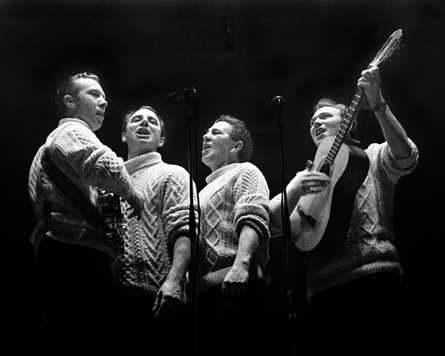
Above, Liam Clancey. Below, The Clancy Brothers and Tommy Makem.

The Clancy Brothers and Tommy Makem:
Irish music and the American folk scene

By Carl R. Hultberg / The Rag Blog / December 17, 2009

In the beginning it was William Clancy, Liam being still too Celtic and “Irish” for Ireland in the early 1950s.

His older brothers, big burly lads, had already gone to America and eventually to New York City to find jobs as Irishmen in various stage productions. William longed to go as well but the chance didn’t come until he met New York City based ethno-musicologist Dianne Hamilton Guggenheim, a protégé of Alan Lomax.

In his autobiography, Liam Clancy tries to deal with his relationship with Ms. Hamilton, an older woman. Whatever personal struggles he might have had with his patroness, the fact remained that she got him to New York City and even tried to set him up as a folksinger. Although Clancy landed a few acting jobs as a stock Irishman, he didn’t really see the future until he met Josh White.

Josh White in the early 1950s was a towering figure in the miniscule folk music scene. Unique among his black blues contemporaries, Josh had found a way to present field hand music in a posh night club setting, more akin to Billie Holiday than to, say, Leadbelly. As Liam marveled in his autobiography, The Mountain of the Women, Josh White was the consummate professional. He would pick up his guitar, throw it into tune and be on stage in minutes with the audience eating out of his hand. Liam wondered how he could ever achieve that level of taste, talent and sophistication.

Singing with his big bruiser brothers he knew the act still lacked something. What would it take to transform them from your average Irish singing family to say, something like Josh White? His mind turned to someone who had also been “discovered” by Dianne Hamilton on her Irish trip. Young Tommy Makem, the son of Ireland’s well known folksinger Sarah Makem.

Sure enough, Tommy had already come to America, was living in New Hampshire, and was ready to sing with the Clancy’s. The model for the modern Irish folksinging unit was now set. With Tommy Makem in the lead singing role, the “Clancy Brothers and Tommy Makem” were now an entertainment reality. Although Tommy forever chaffed against being most of the group’s talent, but restricted to a set of virtual parentheses, Tommy Makem’s and Liam Clancy’s fates were now sealed.

The Clancy Brothers and Tommy Makem did indeed remake the entire image of an Irish folksinging group. Although they did do Irish sentimental favorites, they were no “cry in your beer sad memories of the past” comiseraters. They also did some Irish Republican anthems from the days of the struggles, but were not overly consumed by that passion. What they presented was a broad spectrum of Irish songs, new and old, with something for all types and ages. Not unlike Josh White.

When they did have a politically oriented hit, it was, interestingly, with the bitter “Patriot Game,” which equivocated in its support for armed struggle while still championing the cause. A very sophisticated song which Bob Dylan, who hung around the Clancy’s all he could in his salad days, transformed into “With God On Our Side.”

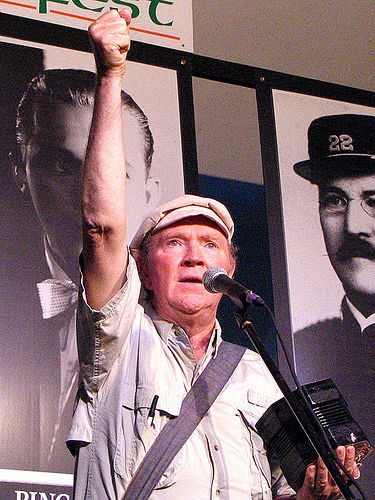
Liam Clancey at the 2005 Milwaukee Irish Fest. Photo by Stacina / Flickr.

That was the wonderful thing about this ancient Irish music. Like the tunes, the themes have been around forever. Irish music made the big time on the Ed Sullivan Show and other top American venues thanks to the Clancy’s and Tommy Makem. But mostly they hung around the White Horse Tavern, a well known watering hole on the West Side of New York’s Greenwich Village. In this setting they would bend their elbows with anyone.

Their solid proletarian comradeship was not necessarily political, it was just Irish and it was infectious. Much of the good energy (and a lot of the good tunes) that later enchanted the USA Folk scene in the 1960s came out of the family atmosphere created by the Clancys and Tommy Makem. If this was folk music, these guys from Ireland were surely the folk. Lift your glass to friendship, mates, the music from the distant blessed archaic past is once again being played by young men of charm and influence. All is not lost.

So Liam Clancy wasn’t necessarily the big talent in the Clancy Brothers and Tommy Makem. Although, unlike his brothers who just sang in the ensemble, he did sing lead on some songs, his soft voice could never carry the group the way Tommy Makem could. Tommy also wrote songs and played the tin whistle. But it was Liam Clancy who set the whole thing up, who’d had the vision and got to see his creation become a big success.

Many decades and albums later it was easy to look back on how Irish music came back to life in the 1950s. Once considered, like black music in the days of the minstrels, a kind of ethnic joke, no one would ever think to disparage this rich heritage again. You can thank the Clancy’s and Tommy Makem for that, especially Liam. One of the reasons young people were able to be so successful as a force for cultural transformation in the 1960s was that they had the historical precedents rightly in place. Black blues, jazz, ragtime, and also Irish music, were finally being understood for what they really were, not just stupid stereotypes.

If we had to pick one song to represent the Clancy Brothers and with Tommy Makem, it would probably be impossible. But one that comes to mind is actually a tune off an album Liam Clancy made with Tommy Makem after the Clancy’s had disbanded. Recorded in 1976, the song by Alan Bell, celebrates the history of wind power in Europe. It seems particularly appropriate to present this song as a sample, especially after having spent some time bemoaning the lack of spiritual energy in the USA regarding alternative energy. Here is that supposedly missing sacred prayer:

Windmills

In days gone by, when the world was much younger
Men harnessed the wind to work for mankind
Seamen built tall ships to sail on the ocean
While landsmen built wheels the corn for to grind

And around and around and around went the big sail
Turning the shaft and the great wooden wheel
Creaking and groaning, the millstones kept turning
Grinding to flour the good corn from the field

In Flanders and Spain and the lowlands of Holland
And the kingdoms of England and Scotland and Wales
Windmills sprang up all along the wild coastline
Ships of the land with their high canvas sails

In Lancashire, lads work hard at the good earth
Ploughing and sowing as the seasons declare
Waiting to reap all the rich, golden harvest
While the miller is idle, his mill to repair

Windmills of wood all blackened by weather
Windmills of stone, glaring white in the sun
Windmills like giants all ready for tilting
Windmills that died in the gales and the sun

Liam Clancy passed away Friday, December 4. Thanks for bringing us The Clancy Brothers and Tommy Makem, a group that changed the course of modern folk music. And thanks also for staying such a simple honest man. That’s actually not an easy act to pull off.

[Carl R. Hultberg’s grandfather, Rudi Blesh, was a noted jazz critic and music historian, and Carl was raised in that tradition. After spending many years as a music archivist and social activist in New York’s Greenwich Village, he now lives in an old abandoned foundry in Danbury, New Hampshire, where he runs the Ragtime Society.]

The Rag Blog

Posted in Rag Bloggers | Tagged , , , , , , , , , | 4 Comments

Colombia : Official Corruption and Mr. Big

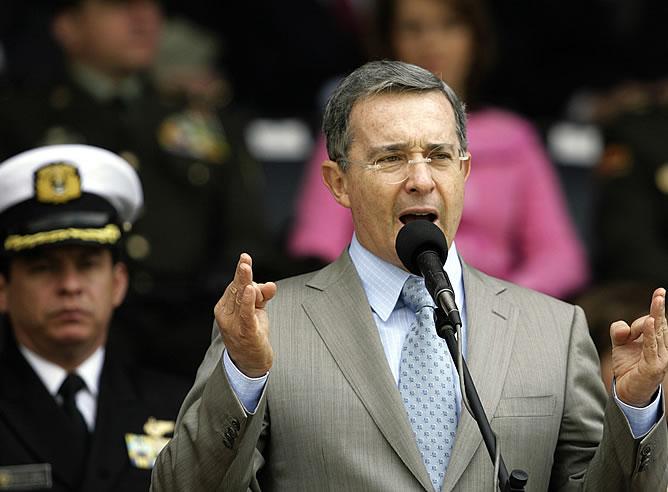
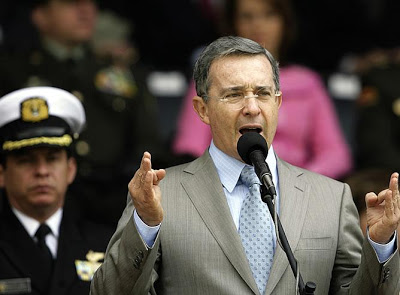
Colombian President Álvaro Uribe.

A history of official corruption:
Colombia and the Uribe family

By Marion Delgado / The Rag Blog / December 16, 2009

See ‘A Stroll down Paramilitary Lane,’ below.

…the sheer number of cases, their geographic spread, and the diversity of military units implicated, indicate that these killings were carried out in a more or less systematic fashion by significant elements within the [Colombian] military… [Whose] cold-blooded, premeditated murder of innocent civilians for profit, stand out as one of the most serious abusive practices by state agents we have documented in Latin America in recent years.” — UN Special Rapporteur.

Cocaine smugglers have infiltrated senior levels of the Colombian army… While other cases of infiltration have been discovered in the past, officials suggested that those cases often were not investigated properly.” — Juan Santos, Minister ofDefense

CARTAGENA DE INDIES, Colombia — Cocaine, corruption, mass murder, right-wing gangs operating with impunity, chainsaw massacres, not just once in a while, but wholesale violations of the Colombian people by well-armed and funded criminals have occurred by the hundreds and thousands for years and years, right up to this very moment.

On March 1, 2008, Colombian armed forces crossed into Ecuador to kill 24 leftist Colombian guerrillas, including a senior commander, Raul Reyes, aka “Sure Shot.” The attack touched off a confrontation pitting Colombia against Ecuador and Venezuela, the latter condemning the violation of Ecuador’s sovereignty and noting that Reyes was a key figure in negotiations over prisoner releases and a possible reduction in political tensions.

Under George W. Bush, the U.S. defended Colombia’s right to attack “terrorists” even if it required crossing a border, a position echoed by last year’s presidential candidates, and this year’s Secretary of State Hillary Clinton and U.S. President Barack Obama.

Despite the corruption disclosures — and Colombian President Álvaro Uribe’s failure to stem Colombian cocaine smuggling to the United States — the Bush administration showered Uribe’s government with trade incentives and billions of dollars in military and development aid.

Obama continues this trend, with more billions of your dollars, first with a military pact to create seven new U.S. military bases, and very soon a new free trade agreement that will send more American jobs to South America, if there are any jobs left to send.

Ironically, the latest evidence against Uribe’s government emerged from a U.S.-backed peace process that offered leniency to right-wing paramilitary death squads and their financial backers in exchange for giving up their guns and disclosing past crimes.

The right-wing paramilitaries and their cocaine-trafficking benefactors testified that elements of the Colombian government collaborated in a decade-long scorched-earth campaign, killing almost 10,000 civilians under the guise of dislodging the Fuerzas Armadas Revolucionarias de Colombia – Ejército del Pueblo, (FARC or FARC-EP; Revolutionary Armed Forces of Colombia – Peoples Army), a leftist guerrilla army.

How deeply is the government involved? Let’s look at who the government is and how he got there. It was all prearranged in 2001, according to paramilitary and drug lord accounts. If Uribe won the presidency, paramilitary leaders would be offered generous sentence reductions and could serve their time outside prison walls if they demobilized and confessed. Go and sin no more; chu hoi; Allie, Allie infree.

The Uribe family

Recent disclosures of official corruption have brought back to public attention the Uribe family’s long history of ties to drug lords and paramilitaries. Colombia’s Supreme Court said in July it was investigating Senator Mario Uribe, the president’s cousin and his point man in the Congress, for alleged links to the Autodefensas Unidas de Colombia, (AUC; United Self-Defense Groups of Colombia). Several paramilitary leaders have said Mario Uribe was their ally and an intermediary with the government. He has denied any wrongdoing.

The purported family link to drug lords dates back several decades. As a young man and an aspiring politician, Álvaro Uribe lost his position as mayor of Medellín — after only five months on the job — because the country’s then-president, Belisario Betancur, ousted him over his family’s suspected connections to traffickers, according to media reports at the time. Betancur’s daughter was running for President when she was kidnapped by the FARC; she was rescued in 2008 after several years in captivity.

The president’s father, Alberto Uribe, a wealthy landowner, reportedly was a close associate of the Medellín cartel and its kingpins Pablo Escobar and the Ochoa brothers were his personal friends. Besides the three Ochoas and Pablito, another elite member of the Medellin cartel, Carlos Lederer, was sentenced to hundreds of years in a U.S. federal prison and admitted to dozens of murders. He was released after testilying against Manuel Noriega and now resides in England where he is the owner of… wait for it… wait… an insurance company.

In 1983 El Presidente’s father, reportedly wanted by the U.S. government for drug trafficking, was killed in a kidnapping attempt by FARC. According to media accounts, his body was airlifted back to his family by one of Pablo Escobar’s helicopters.

In the early 1990s, Álvaro Uribe’s brother, Santiago, was investigated for allegedly organizing and leading a paramilitary outfit headquartered at the Uribe family hacienda. He was never charged, due to a lack of evidence. Santiago was photographed alongside Fabio Ochoa Vasco at a party even after the government declared Ochoa one of the most notorious traffickers of the Medellín cartel. This happened during Álvaro Uribe’s eight years in the Senate, where he opposed extradition of drug suspects. His critics accused him of working for the Medellín drug lords; can you imagine?

The relationship between right-wing narco-financed paramilitaries and the Colombian government has been long and complex, with alliances shifting by the self-interest of the moment.

Alienation from Washington widened in 1994, and the flood of U.S. dollars slowed temporarily, when President Ernesto Samper came to power amid disclosures that his campaign had received generous donations from cartels. The Colombian Army (COLAR) lost ground against the FARC and coca growers. In turn, the Samper government pushed what was known as the Convivir project. It armed, trained and organized local defense cooperatives to provide “special private security and vigilance services” alongside the military, another cover for right-wing paramilitary forces.

The rise of Uribe

Álvaro Uribe’s political rise was tied to the success of Convivir. In 1995, Uribe became the governor of Antioquia, a northwestern Departmento with Medellín as the capital.

He became the country’s most vocal supporter of the defense cooperatives, authorizing almost 20 run by paramilitary leaders including AUC’s then-top commander, Salvatore Mancuso.

Carlos Castaño, originator of AUC’s predecessor, the United Self-Defense Forces of Córdoba and Urabá (ACCU), has been quoted as saying Uribe was the presidential candidate of AUC’s social support base. “Deep down, he’s the closest man to our philosophy,” Castaño said, adding that Uribe’s support for Convivir was based on the same principle that gave rise to paramilitarism in Colombia, the right to self-defense against “guerrillas.”

Confronted with accusations of complicity between Convivir and drug-connected paramilitaries, Uribe said that at the time, nobody knew who the right-wing leaders and coke traffickers were.

After an international outcry, however, the government phased out Convivir. When it was outlawed in 1998, over 200 defense cooperatives, consisting of thousands of men, defied the order to demobilize and joined Castaño’s revived paramilitary alliance, now AUC.

While running for the presidency in 2002, Uribe cited the perceived success of the Convivir program in damaging FARC’s infrastructure in Antioquia as a key reason why Colombians should vote for him. Despite the drug suspicions — and the links to paramilitary death squads — Uribe benefited from public disenchantment with a sputtering peace process that had failed to end the civil war and emerged as the winner with 53% of the vote.

After his election, several drug barons claimed they had financed his campaign. Indicted drug trafficker Fabio Ochoa Vasco said he contributed $150,000 of his own money at AUC’s request.

Ochoa also said he witnessed a conversation between AUC’s leaders and supposed representatives of Uribe’s campaign before the election. “They talked about the peace process,” Fabio Ochoa stated. “They said anyone with problems with the U.S. could get involved. In another meeting, there were businessmen, landowners, and drug traffickers who [the AUC] thought could also be included, so they told them to get ready for the peace process.”

All the paramilitary leaders who negotiated peace agreements “know the truth. They know that to be there, they invested more than 10 million dollars [in the political process, including Uribe’s campaign],” he added.

Government negotiations with the AUC began four months after Uribe took office. Castaño repositioned himself as an opponent of the drug corruption that, by then, clearly pervaded the organization. He resigned as AUC’s military leader. In April, 2004, Castaño was ambushed by 20 elite paramilitaries on orders from AUC’s top leaders. He was shot almost two dozen times in the face, chopped into pieces, and burned.

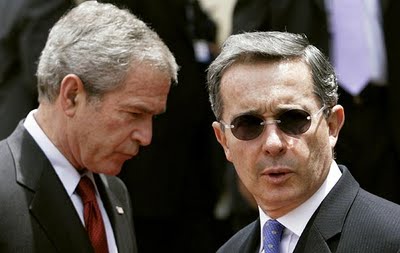
Presidents Uribe and Bush: Partners in crime?

Uribe-Bush alliance

Among opinion makers of Washington, there has been almost no criticism of Colombian President Álvaro Uribe, although his inner circle has long been linked to both right-wing terrorism and cocaine trafficking.

Uribe lined up solidly behind George W. Bush, the only South American leader to endorse the U.S. invasion of Iraq. Uribe in turn sought more U.S. military aid, defining civil war against the leftist FARC as part of the “global war on terror.”

The backbone of U.S. policy in Colombia during the Bush years was Plan Colombia, a mostly military aid program to fight both drug production and irregular armies, most notably the FARC and AUC. Since 2001, Washington has sent over $5 billion to Bogotá.

Nonetheless, Plan Colombia put little dent in cocaine production. The coca acreage in 2006 was slightly up from 2001, after some reductions in 2003 and 2004.

But Uribe’s success in curbing political violence boosted his popularity at home. He vigorously pressed the war against the FARC, forcing the guerrillas into tactical retreat. Overall, Uribe reduced murders, kidnappings and massacres by about one-third.

The Uribe-controlled Congress also passed the Justice and Peace Law, launching a peace process with the right-wing paramilitaries that demobilized 30,000 men and women. The law was written by Sen. Mario Uribe, the cousin now being investigated for his AUC ties. Even the Bush administration criticized its terms for amnesty as overly lenient.

Popularity soaring, Uribe got congressional allies to change the Constitution to permit a second presidential term. He was swept to reelection in 2006, with 62% of the vote.

He is trying to change the Constitution again, to allow himself an unprecedented third term in 2010. Not a peep is heard from the Washington administration or the U.S Congress that went berserk with shouts of “Dictator!” when the same thing was done by President Hugo Chavez in Venezuela.

Still, accusations of corruption and unpunished human rights violations, dog Uribe. Several investigations, especially those led by Colombia’s Supreme Court, have amassed evidence against former and current government officials and prominent members of the country’s elite. Those allegedly working for drug cartels include dozens of current and former members of Congress; high-ranking military officers, including the current chief of staff; entire army battalions; prominent businessmen; and some of Uribe’s closest allies, including the father and brother of Colombia’s former Foreign Minister, Maria Consuelo Araújo.

In December 2006, embarrassed by ongoing criminality in the AUC’s Santa Fe Ralito safe haven, the government put some paramilitary leaders in prison. There, they continued to live the high life and to keep on top of their criminal operations. The local press published last May transcripts of police wiretaps revealing AUC leaders ordering killings and directing drug trafficking from prison, while enjoying dance parties, sex orgies, and alcohol. They hosted “Mexican friends” and had unrestricted access to cell phones and the Internet.

Infuriated by the wiretap disclosures, Uribe fired the top 12 police generals, but said little about evidence of AUC criminality beyond promising yet another investigation.

AUC leaders then threatened to break off the peace process, accusing the government of changing the terms. They felt betrayed, they said, and threatened to incriminate all their elite allies, including politicians, businessmen, and multinationals. Talks finally did break off in July, 2009, leaving some of AUC’s regional blocs (see sidebar below) intact and others free to reorganize.

Regional trouble

The Organization of American States, which has overseen the peace process with the AUC, has been critical of the results. The OAS warns that paramilitaries are rearming and reorganizing under different names, with stronger ties to drug traffickers, led by some of the same leaders who supposedly have surrendered.

Despite Colombia’s corruption, its shaky internal peace process, and ineffective anti-drug program, Bush unstintingly supported Uribe. Calling Uribe a true democrat and strong leader, Dubya visited Colombia twice — once in 2008 — and met with Uribe several times in Washington. “I’m proud to call [Uribe] a friend and strategic ally,” Bush said, during one of Uribe’s visits. In Bogotá, he said: “I appreciate the [Colombian] president’s determination to bring human rights violators to justice… I believe that, given a fair chance, President Uribe can make the case.”

While not as publicly vocal as Bush about Uribe, Obama has continued U.S. financial and military support of the Colombian President.

Bush asked the U.S. Congress to increase financial support for Plan Colombia, but Democrats cut military aid from 80% to 65% of the total allocation, while increasing economic and humanitarian aid. Moreover, the Democrats attached strict conditions on the total $530 million increase. Democrats also more recently conditioned ratification of a free-trade agreement with Colombia on Uribe improving his human rights record and prosecuting paramilitary leaders.

In South America, Uribe has slowly backed himself into a corner by siding with the U.S. While most South American countries have grown more critical of U.S. foreign policy and the “Free Trade Agreement of the Americas,” Colombia staunchly supports the yanquis.

Brazil and Ecuador have closer relations with Venezuela, as do most countries in the region, in stark contrast to the situation a decade ago. Colombia has been left out of South America’s MERCOSUR regional trade union, including a meeting held just this last week. Venezuela was admitted in 2008.

Uribe also has lost some regional backing in his fight against FARC. Ecuador has resisted labeling the FARC a terrorist organization, but criticized Plan Colombia, and sought reparations for collateral damage inflicted by Colombian forces on Ecuador’s border population.

Meanwhile, the drug and corruption scandal keeps growing. Though Uribe has denied most of the accusations, drug lord Fabio Ochoa Vasco said he is willing to negotiate his surrender to the DEA along with proof to support his charges. Fabio did surrender, and it’s widely believed he gave information, because he received a mere five year jail sentence.

Fabio also said some previously defiant AUC leaders and drug traffickers are now willing to surrender to U.S. law-enforcement agencies to avoid being murdered in Colombia, as powerful forces seek desperately to silence them and end the “Para-scandal.”

Whatever is ultimately proven the outpouring of evidence linking Uribe to Colombia’s vast cocaine industry and long history of political murders is bad news for President Obama, if he counts on Uribe to be a model for South America’s future and a bulwark against Chavez and his crazy social programs for the poor.

Right now, Uribe is Colombia’s “Mr. Big,” the man in whom all the monied interests find their best bet. But behind Mr. Big is his northern ally, the much-heralded “change” of U.S. presidents has not changed a damn thing about who is pulling the puppet strings.

This, then, is the Colombian government, and the Colombian military that our servicemen are meeting right now, these are the people they will be working with and fighting for, and this is what the Colombia you are sending your tax dollars to by the billions looks like.

For more about why, look for the next installment of “Build-up in Colombia” in the Rag Blog!

Así es en Colombia.
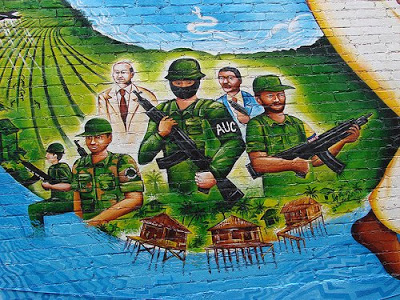
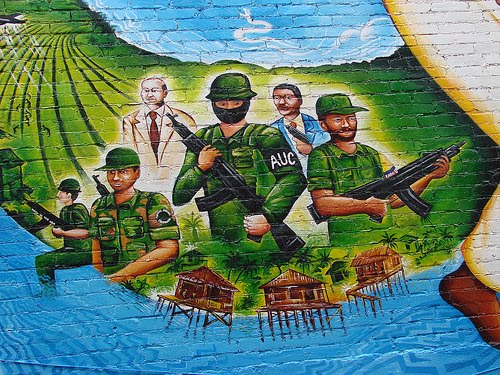
United Self-Defense Groups of Colombia (AUC), detail from the Afro-Colombian mural on U Street, NW, in Washington, DC. Image from Ronnie R / Flickr.
 

A Stroll down Paramilitary Lane

This week, instead of a visit to one of our new U.S. military bases, let’s saunter through the AUC (United Self-Defense Groups of Colombia), bloc by bloc. Amid peace talks with Álvaro Uribe’s government, which began in December 2002, the AUC agreed to a process of bloc-by-bloc demobilization, to culminate in August 2006. While many of the “paracos” claim to have demobilized, along with non-AUC units, each formerly included thousands of foot soldiers and commanded huge sums from narcotraffickers and landowners seeking protection.

Not all Colombian paramilitary blocs demobilized or even participated in the peace talks. In the Meta Department, for example, groups reorganized under mid-level commanders continue to battle over drug trafficking lanes, under the influence of leaders like Vicente Castaño and Hernán Hernandez.

There is certainly no shortage of paramilitaries today. In some areas, new groups step into the void. In urban barrios, paramilitaries made up of “former gangsters,” such as the “Guapo Rincon,” say they are keeping out mal elementos. The AUC name is unlikely to be used again.

The Northern Bloc

Run by AUC military leader Salvatore Mancuso, the Northern Bloc incorporated Fidel and Carlos Castaño’s original ACCU, controlling municipalities from the Panamanian border to the Venezuelan. Authorities believe Mancuso’s deputy on the Caribbean coast, Rodrigo Továr “Jorge 40” Pupo, controlled Colombia’s Caribbean drug routes. Vicente Castaño, Carlos’ and Fidel’s brother, is a third powerful player, widely thought to have played a role in Carlos’ death. The Northern Bloc demobilized in March of 2006. Vicente Castaño is a fugitive from justice.

The “Élmer Cárdenas Bloc”

Led by José Alfredo “El Aleman” Berrío, the Elmer Cárdenas Bloc was originally part of the ACCU that, through brutality and massacres, controlled the strategic Urabá region near the Colombian-Panamanian border in the 1990s. Substantial evidence suggests that Berrío and the Élmer Cárdenas Bloc are very big in coke. This bloc barely participated in peace talks and was one of the last to claim to demobilize.

The Catatumbo Bloc

This unit, an offshoot of the Northern Bloc, operated in the conflicted, drug-producing region of Catatumbo, in Norte de Santander department, near the Venezuelan border. It was commanded by Salvatore Mancuso (at one point AUC’s military commander, see article above), who dominated paramilitary activity in Departmento Córdoba and elsewhere in northwestern Colombia. It demobilized in late 2004.

The Magdalena Medio Bloc

Led by Ramón “El Viejo” Isaza on the west side of the Magdalena River, one of the most veteran paramilitaries, and Victor Triana “Botalón” Arias on the east side, the Magdalena Medio Bloc demobilized in Feb., 2006.

The Central Bolivar Bloc

Deeply involved in the drug trade the BCB rivaled (and perhaps exceeded) the Northern Bloc in size and wealth. Led by Ivan Roberto “Ernesto Baez” Duque and Carlos Mario “Macaco” Jimenez, the BCB controlled much of the greater Magdalena Medio region and significant southern Colombia’s coca-growing regions. The BCB, along with the Northern Bloc, was one of the first to enter negotiations with the government. It officially demobilized in Jan., 2006.

The Mineros Bloc

Though it controlled only a small area in northeast Antioquia, the Mineros Bloc was quite wealthy, largely from narcotrafficking. Led by Ramiro “Cuco” Vanoy, wanted by the U.S. for his participation in the North Valle drug cartel, the Mineros Bloc demobilized in Jan., 2006.

The Calima Bloc

Working in and around Cali and down the Pacific coast to northern Cauca, and led by Hernán Hernandez, this bloc formed in 1999 after the Ejercito de Liberacion Nacional, (ELN; the National Liberation Army, another guerrilla force) pulled a kidnapping at a church in a wealthy Cali neighborhood. Heavily dependent on drug traffickers’ support, they demobilized in Dec., 2004.

The Avengers of Arauca Bloc

Commanded, at least on paper, by Pablo “El Mellizo” Mejia, a Northern Valle cartel figure wanted by the U.S., the Avengers operated in an oil-producing region that has been a principal destination of your military assistance. It demobilized in Dec., 2005.

The Libertadores del Sur Bloc

This outfit operated in the coca-growing zones of Nariño and Putumayo, led by Guillermo Perez “Pablo Sevillano” Alzate, a noted narcotrafficker wanted by U.S. authorities. They demobilized in July, 2005.

The Centauros Bloc

In oil-rich Casanare, Meta, Cundinamarca, and in Bogotá’s slums, this bloc really started disintegrating when its leader, Miguel Arroyave, died at the hands of his own men in Sept., 2004. The Centauros fought a bloody campaign against the Llanos Bloc in Casanare. They demobilized in Sept., 2005.

The Llanos Bloc

Headed by “Martin Llanos” in Casanare, this bloc has been decimated by repeated attacks from the rest of the AUC (especially the Centauros) and COLAR. However, it never participated in peace talks, and remnants still operate.

— Marion Delgado

  • For previous reports from Colombia by Marion Delgado, go here.

.The Rag Blog

Posted in Rag Bloggers | Tagged , , , , , , , , , , , | 3 Comments

Health Care ‘Reform’ : Just Say No to Traitor Joe!


Don’t Surrender to Senator Joe

Vote “No” on the health care joke

By Ted McLaughlin / The Rag Blog / December 16, 2009

It looks like the United States Senate is going to cave in and surrender to Joe Lieberman. They first dumped the most important part of health care reform — the public option. This was the part of the reform bill that would offer inexpensive and decent health care insurance to Americans, and would force the private insurance companies to lower their prices to compete. But Traitor Joe didn’t like it, so it’s gone.

But that wasn’t enough. The Senate then tossed out a compromise idea — the creation of a private non-profit insurance program that would be overseen by a federal government agency. Although not as good as a true public option, this would have also caused some downward pressure on insurance premiums and saved consumers a ton of money. But Traitor Joe didn’t like it, so it’s gone.

Still, that wasn’t enough. Now the Senate is willing to toss out an expansion of Medicare to those between 55 and 64. At age 55, people are entering the years where they are much more prone to medical problems than younger Americans. This would have guaranteed they would be covered by a government insurance program that has been proven to work efficiently and effectively (just ask someone over 65 if they would give up their Medicare). But Traitor Joe didn’t like it, so it’s gone.

I’m beginning to think if Lieberman wanted Senate Democrats to kiss his scrawny ass, most of them would line up, get on their knees and pucker up. Are there any real Democrats left? Do any of them have even a remnant of a spine? Where are the progressives who promised us real health care reform?

All we are left with now is a bill that would force ordinary Americans to give the large private insurance companies a gigantic payday. And they would be forced to do it without getting lower costs or better health care. This bill would still leave medical decisions in the hands of insurance companies rather than doctors. Personally, I am appalled.

I think any Senate progressive with a functioning brain and a fully-developed conscience should vote against this travesty of a bill that is empty of any real health care reform. And it looks like Howard Dean agrees with me. He told Vermont Public Radio the following:

This is essentially the collapse of health care reform in the United States Senate. Honestly the best thing to do right now is kill the Senate bill, go back to the House, start the reconciliation process where you only need 51 votes and it would be a much simpler bill.

I urge any remaining progressive senators — don’t check your conscience at the door to the Senate chamber. Vote against this bill. Kill it, then start over and do it right.

[Rag Blog contributor Ted McLaughlin also posts at jobsanger.]

The Rag Blog

Posted in Rag Bloggers | Tagged , , , , , , , | 4 Comments

Kate Braun : Yule Seasonal Message


Yule: Lord Sun emerges

“What you envision will bloom in the pale moonlight…”

By Kate Braun / The Rag Blog / December 15, 2009

Monday, December 21, 2009, is Yule, the shortest day and longest night of the year, when Lord Sun once again emerges from The Time That Is No Time. Lady Moon is in her first quarter; first-quarter moons are an auspicious time to make plans for rituals that will be implemented in the second quarter and completed by the full moon.

This year the next Full Moon in December (called a Wishing Moon and also a Blue Moon because it is the second full moon in the month) coincides with New Year’s Eve, a traditional time to consider what the coming year’s focus shall be for you. I recommend scheduling some time during your Yule celebration to visualize what you want to manifest in 2010.

You should write these goals on a piece of paper, twist the paper into a spiral, hang it on your holiday tree until New Year’s day, then bury it under a living tree in your yard (your guests will take their spirals with them and perform the rest of the ritual in their own homes). As the living tree grows, so will your plans for the coming year.

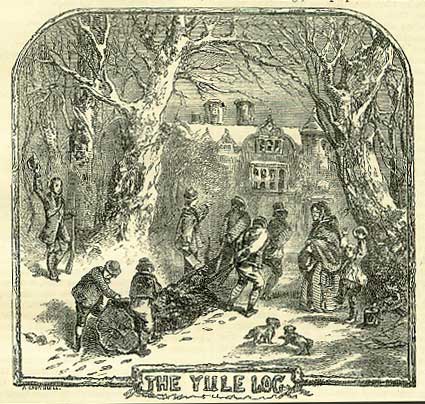
Yule is a fire festival. In the Long Ago, people went into the forests and cut their own Yule Log, using the saved remnants of the previous season’s Yule Log to help ignite it. This is not as easy as it once was, and part of the Yule lore is that the log must not be bought. If you have a fireplace or outdoor grill, you may designate any branch that has fallen into your yard or been pruned from any of your trees as your Yule Log; if you are not building a fire, try to incorporate some dry wood from your yard into decorations that surround the red, white, and green candles you light on your altar and table. The intent will serve just as well.

Use the colors red, white, and green in all your decorations, dress, and party favors. Red for Lord Sun; white for the snow his fire will melt; green for the new growth that will emerge when the snow melts. Use holly, ivy, and mistletoe as well as fir boughs in your decorations. These plants invite the Nature Sprites to join the celebration.


A sprig of holly near the front door invokes good fortune for the coming year; a piece of mistletoe hung over the front door prompts the ceremonial “kiss of peace” that is given to each guest as they arrive. Other decorations may include pomander balls and eight-spoked wheels (and since the eight reindeer that pull Santa Claus’ sleigh represent the eight-spoked Wheel of Life, reindeer statuary is also appropriate to incorporate into your decorating scheme).

Your menu should include roast root veggies (potatoes, carrots, beets, turnips, rutabagas, parsnips), roast meats (pork, beef, turkey, goose), nuts, apples, pears, Wassail, ginger tea. Make toasts both remembering the passing year and welcoming the coming year.

Please remember that there are two retrogrades starting during December that could interfere with your pleasant plans: Mars retrogrades from December 20 to March 10, 2010, and Mercury retrogrades from December 26 to January 15, 2010. A Mars retrograde makes us get angry more easily; a Mercury retrograde creates problems with communication, transportation, and all things electronic, including the brain. During the Yule season, therefore, it will be easier to misunderstand/misinterpret what you are hearing and/or reading and/or seeing as well as to get angrier as a result of the misunderstanding/misinterpretation. I strongly urge each of you to do your best to prevent molehills from growing into erupting volcanoes! This is a time of peace, not war.

This season is about rebalancing, frequently symbolized as a ritual dance between the Holly King (king of the waning year) and the Oak King (king of the waxing year). Neither king can exist without the other; they are interdependent, and the steps of their dance weave a pattern older than time. You and your guests may choose to incorporate dance into your festivities as a gesture of the rebalancing we all do at this season.

[Kate Braun’s website is www.tarotbykatebraun.com. She can be reached at kate_braun2000@yahoo.com.]

Reminder: The first local Metaphysical Fair of 2010 is on January 9 & 10, 2010, at the Radisson Hotel, 6000 Middle Fiskville Rd., Austin, TX (between Highland Mall and Lincoln Village). The annual Prediction Panel that is part of this fair will be on Friday evening, January 8, 2010, at 7 p.m. in the lecture room at the Radisson. The Prediction Panel is free. For more information, go to the Out and Above with Kate page of my website.

The Rag Blog

Posted in Rag Bloggers | Tagged , , , , , | 1 Comment

Changing Climate : Denmark Becoming Police State?

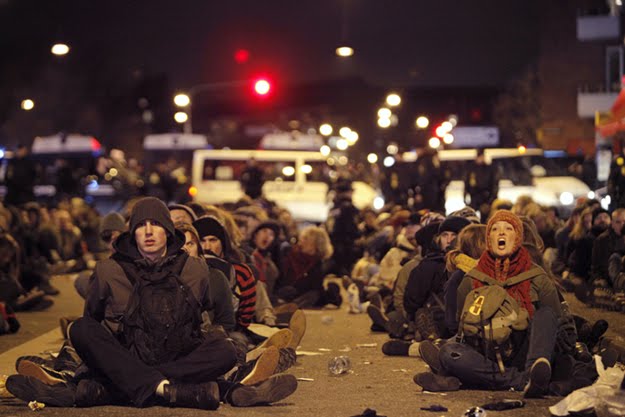
Above, a Danish policeman arrests a demonstrator at Copenhagen climate change summit. Photo from AP. Below, detained demonstrators are seen lined up on a street during mass arrests. Photo by Thibault Camus / AP.

Changing winds in Denmark:
Preventive detention and the UN climate conference

By David Rovics / December 15, 2009

COPENHAGEN — The signs up all over the airport and various places elsewhere in town are calling it Hopenhagen, but everybody I know is calling it Copenhagen, which seems far more appropriate. The international media has been giving this lots of coverage, and rightly so. Of course much of the media is unable to walk and chew gum at the same time, so other things, such as the reason the protests are happening in the first place, can get lost.

Inside the Bella Center lots of stuff is going on. Namely the U.S., Australia and others are leading the way in making sure nothing meaningful takes place there, while many other delegates and activists within try to make the best of it, or at least make the effort to thoroughly expose the bankruptcy of the position taken by the rich countries.

The center itself is divided into floors where the big decisions are being made, and then the rest of the place for the little people, the delegates from unimportant countries like Tuvalu, representatives of small NGOs and other riffraff. Many of the folks involved with the process inside are dividing their time between the meetings and events outside in the streets and at the alternative conference going on elsewhere in town.

Denmark: social democracy to police state?

Copenhagen is a beautiful city. The architecture in the heart of the city is understated but exudes the wealth of a place that was once the capital of a fairly sizeable empire. Of course, though the Danish empire brought some riches home to Copenhagen, the wealth of modern Denmark is far greater, that being the product not so much of empire but of the Danish labor movement and Danish social democracy. It is this check on Danish capitalism that has allowed this wealth to be so impressively distributed, bringing Denmark a quality of life that is the envy of most anyone who knows about it.

Of course, as in any society, there are different forces at work in Denmark. Most Danes would identify much more with those peasants who rebelled in the 17th century and helped pave the way for modern Denmark, not with the soldiers who massacred them, but those soldiers were also Danes. Most Danes would prefer to remember the heroic stories of resistance during the occupation of Denmark in the 1940’s, but there were also many enthusiastic collaborators.

At so many points in history there are pivotal moments when things can go different ways, and something pushes events in a certain direction. The direction of social democracy has been the ascendant one in Denmark for quite some time, but this was able to happen for a variety of reasons — the strength and purpose of the Danish labor movement, the fear on the part of the rich of the specter of communism, the moral bankruptcy of the leaders of society who collaborated with the Nazis after the war, and so on.

If people know anything about this most southerly of the Scandinavian countries they know it’s full of windmills. Germany actually has lots more windmills than Denmark, but many of them are made in Denmark anyway, at the Vespas factories in Jutland (where they recently laid off thousands of workers).

There’s a reason Denmark has been a pioneer in windmill technology, and it is, to a large extent, the Danish environmental movement. In the early 70’s the Danish government was thinking about building its first nuclear reactor, following the example of Sweden, which has one right across the water, upwind.

People inspired by ideas of communal living and experiential learning formed a community centered around a Free School near the little village of Ulfborg and began making plans to build the world’s largest windmill. Over the course of three years, working with scientists, artisans and large numbers of hippies, they built the world’s largest windmill. They refused to patent any of their ground-breaking technology, making it all available for anybody to use. Their windmill, still standing and providing power to the community 35 years later, is the prototype for the big windmills you’ll see scattered around Denmark and the world.

This windmill provided more than just energy — it and the movement that built it provided political capital. Those in parliament arguing for a nuclear reactor lost the fight, and Denmark became a nation of windmills.

For the past decade or so, however, Denmark has been run by a coalition led by the neoliberal, xenophobic Vestre party. They have been privatizing hospitals and passing some of the most restrictive immigration legislation in the world. They have had troops in both Afghanistan and Iraq, and they have been forcibly deporting refugees back to these war-torn countries.

Fueled by the changes to Danish society wrought by membership in the European Union (EU), this conservative coalition keeps winning elections. Along with a love of capitalism and a fear of foreigners, these people also can’t stand hippies or punks or other dissenting elements, and they are on a quest to “normalize” the 900-person intentional community in the heart of Copenhagen known as Christiania. To that end they conducted a police raid early one morning in 2007 and destroyed a house they deemed to have been illegally constructed. (I got my first taste of Danish tear gas there a couple hours later.)

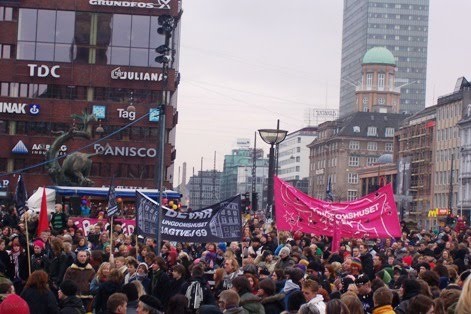
Thousands protest in Copenhagen May 3, 2007, in support of Ungdomshuset youth house. Photo from de.indymedia.

Shortly before this home demolition in Christiania, hundreds of Danish police had landed on the five-story squatted social center known as Ungdomshuset (“Youth House”) by helicopter early one morning. They fumigated the place with tear gas, arrested those inside, jailed them for several months, and proceeded to follow the new government policy of destruction of the house. Masked construction workers from Poland did the dirty work, since Danish unions forbid their members from doing work that requires police protection.

Over the course of the next year and a half, however, the government was forced to backtrack on their plan to “civilize” Denmark. The movement to support Ungdomshuset grew dramatically, involving a number of fairly significant riots and probably more important, a weekly drill of marches every Thursday for a year and a half, involving many hundreds and often thousands every week.

Eventually the chief of police and the mayor of Copenhagen had to admit that their policies had been a mistake and they gave the movement what it was demanding, a new house, bought and paid for by the city. (Left wing foundations had offered to buy a new building for the movement but these offers were refused on principle — the line was that the government destroyed Ungdomshuset and they should replace it with something comparable.)

In the course of the riots and demonstrations around Ungdomshuset the police preemptively arrested hundreds of people on a few occasions. They weren’t technically allowed to do this, but they came up with excuses. One eyewitness told me that the police started arresting people, claiming some of them were throwing rocks at them, although the rock-throwing had clearly started only after the police began arresting the assembled crowd.

Preemptive arrests at climate summit

A new law was passed in preparation for the climate summit which makes this kind of mass preemptive arrest perfectly legal — all the police need to do is arbitrarily determine that an area is designated as a “riot zone” and then they can arrest whoever they want. Any non-Danes arrested can be held for 40 days (including people who were born in Denmark but are not citizens, a reality for many here that may seem surprising to those in the U.S. reading this). It went into effect a week before last Thursday, and since then the Danish police have carried out mass preemptive arrests that dwarf anything they’ve done before. They don’t even need to pretend they have any justification for what is essentially collective punishment.

Those of you in the United States should be familiar with preemptive mass arrests. If you haven’t had your head in the sand for the past few decades then you know this happens regularly at demonstrations throughout our great democracy. But it’s new for Denmark, and it is a serious step in the direction of the Americanization, you could say, of the country.

Being an American, I can say first-hand that emulating U.S. policies in the areas of law enforcement or the privatization and outsourcing of industry is all a very bad idea, at least as far as the vast majority of people are concerned — but the interests of a privileged minority are what moves people like the Danish Prime Minister, not the interests of society as a whole.

Protesters at climate summit. Photo from Monsters and Critics.

The policies and concerns of the new Danish government were represented eloquently by the kettling and mass arrest of a small march that was en route to commit acts of civil disobedience at the docks run by the Maersk corporation. Maersk owner A.P. Mø11er is one of the world’s richest men and runs one of the world’s biggest shipping companies (look for his name, it’s everywhere).

Blockading docks is illegal, of course, and under the normal legal procedures in a democratic society people committing such acts would be told to stop and after a certain amount of time would be arrested, fined, brought to trial or whatever. Yesterday, however, as with the day before, hundreds of people were preemptively arrested, including many who had no intention of committing any illegal acts, such as one reporter for the Times of London.

I narrowly avoided being arrested two days ago. Of those arrested the overwhelming majority had nothing to do with the rock-throwing incident at the stock exchange that apparently set off the police action. The overwhelming majority didn’t even know anything had happened at the stock exchange. All they knew was they were suddenly, randomly being arrested while taking part in a permitted march organized in part by the very mainstream Social Democratic Party. This was a family march involving tens of thousands of people with no civil disobedience or other illegal acts planned as part of it.

The new law may allow for mass preemptive arrests, but international treaties which Denmark has signed called the Geneva Conventions outline certain guidelines for the treatment of detainees which were clearly violated by the Danish police. People were handcuffed in uncomfortable positions for many hours on the frozen pavement, not allowed to move, not allowed to go to the toilet. Some fainted, many wet their pants, adding to the danger posed by the freezing temperatures.

Elderly people were arrested along with teenagers. Anne Feeney’s husband Juli, a 66-year-old Swede who had been slowly walking beside a carriage, was handcuffed and made to sit on the frozen ground. Among the marchers from Tvind, the Free School movement with whom I was walking, those arrested include headmasters and teachers from throughout Europe and Africa. Every one of the Norwegians I had just been hanging out with the day before from Trondheim were arrested.

I participated in a march that was very quickly thrown together involving several hundred people, starting near the Valby train station and going to the prison to which most detainees had been brought. The police surrounded (escorted?) us and seemed to be thinking about arresting all of us, but apparently ultimately thought better of it. Instead they informed us as we were marching towards the prison that most of those detained had just been released, and that we were welcome to march to the prison but no further.

Outside the prison — a temporary prison that used to be a brewery — I heard more stories of how the Anarchist Black Cross representatives who had been attempting to provide soup and solace to people as they were being released were told to leave the premises. When they attempted to set up at the train station a kilometer away they were again told to leave. So as most people left the prison there wasn’t even anyone to meet them and tell them where to find the train station. Most detainees were at no point given any food by the police. After six hours some had been given water.

Tonight after Naomi Klein, Lisa Fithian, and others from Climate Justice Action held a meeting at the Big Tent in Christiania, hundreds of police and dozens of police vehicles were involved in more or less laying siege to Christiania, which was defended, as in the past, by hundreds of masked, black-clad young people making burning barricades and throwing large numbers of bottles at the police, who then fired lots of tear gas. Tonight the police reportedly used a water cannon to extinguish the main burning barricade and arrested 200. Most of this happened while Anne Feeney and I were playing a concert in the Opera House, not far from the main entrance.

The future is not written. There was nothing inevitable about Denmark building a nuclear reactor, and because of the environmental movement it built windmills instead. Equally, there is nothing inevitable about Denmark becoming a neoliberal police state. The years ahead in Denmark — and more broadly in the rest of Europe, run increasingly by pro-business and xenophobic governments — will determine in which direction things will go. And perhaps the next few days will be a particularly important moment in that process.

[David Rovics is an indie singer-songwriter and political activist.]

Source / AfterDowningStreet

Thanks to David Swanson / The Rag Blog

Posted in RagBlog | Tagged , , , , , , , , | 1 Comment

The Future is Now : Mother Earth and Our Great Green Leap

“Mother Earth Father Sky.” Painting by Linda Puiatti.

Curbing carbon’s just the tip of our great green leap

[We must] make corporations serve the public …extinguish their interests in fossil/nuclear fuels …end their profit centers in waste and war … restore organic sustainability and …embrace the power of women on this Earth.

By Harvey Wasserman / The Rag Blog / December 13, 2009

The epic fight over carbon emissions is barely the tip of how we survive.

Mother Earth demands that fossil/nukes be transcended. This green-powered leap defines our technological, economic and ecological survival. Authoritarian “population control” always leads to unintended anti-human consequences. Who is the “too-manieth” person is an issue to be settled between Mother Earth and our mothers. When the world’s women have full human rights, and unlimited access to quality education, fair pay and reproductive freedom, they will deliver our species’ sustainable numeric balance.

But climate chaos and financial ruin do not stand alone. Green gadgetry aside, we don’t get to 2030 unless we confront:

  • The power of the corporations;
  • Social justice and ballot-based democracy;
  • Ending waste and war;
  • Growing food that’s truly organic;
  • Empowering women while harmonizing population growth.

1. Blunting carbon emissions alone will never solve our climate crisis. Nor will it be done without taming the most powerful institution humans have ever created: the global corporation.

Right now no mere government, or gathering of them, can seriously challenge the networked clout of globalized industry and finance.

Corporations claim human rights… and the military clout to enforce them… but no human responsibilities. Their sole mandate is to make money. Human and ecological considerations are ultimately nil.

These same corporations now deem it profitable to face the public with the best greenwashed veneer money can buy. But when push comes to shove (as it always does) corporations must and will opt for the short-term bottom line, filthy and anti-human as ever.

Organizations like the Project on Corporate Law and Democracy, and writers like Richard Grossman, have helped pierce this veil (POCLAD.org). There are no illusions about the magnitude of this challenge.

But without subduing globalized corporate power, nothing else follows.

2. In the long run, the only force capable of overcoming corporate power is social democracy, which demands justice. Without universal access to food, shelter, clothing, medicine and education, the human ecology is not sustainable.

Nor can it survive the scam of electronic voting. Democracy demands hand-counted (recycled) paper ballots with universal automatic registration for all citizens, casting their votes at times convenient to working people as well as the rich.

3. Waste is not sustainable. Nor is its most toxic incarnation — war. Survival demands that nothing be produced that cannot be entirely recycled and re-used.

This includes the military, whose business it is to kill and destroy. War in all forms, in all places, for all reasons, is a private profit center that furthers human, ecological and financial suicide. It is deeply ingrained in the human condition. But, one way or another, war must be definitively relegated to the compost heap of evolution.

4. Likewise agribusiness. Pesticides, herbicides, industrial fertilizers, monoculture, over-farming/grazing/fishing, habitat destruction and genetic modification plough the path to extinction. This applies to biofuels, meat, fish, paper, fiber and all else we take from the soil and seas. Small scale permacultured organics are what will feed us on this planet.

5. Authoritarian “population control” always leads to unintended anti-human consequences. Who is the “too-manieth” person is an issue to be settled between Mother Earth and our mothers.

When the world’s women have full human rights, and unlimited access to quality education, fair pay and reproductive freedom, they will deliver our species’ sustainable numeric balance.

There are also numeric calculations as to how much poison our planet can sustain while still allowing us to live here.

As the revolution in green technology escalates, ridding the planet of fossil/nuclear fuels, installing a Solartopian system of renewables and efficiency becomes the key to employment and our economy, as well as to our ecological survival.

But it all turns on a simple, far more challenging equation:

With justice comes peace… with peace comes freedom… with freedom all is possible… including a sustainable planet.

That demands the human will to make corporations serve the public, to extinguish their interests in fossil/nuclear fuels, to end their profit centers in waste and war, to restore organic sustainability and to embrace the power of women on this Earth.

Like the term Solartopia, achieving these ancient imperatives may seem like little more than an impossible dream. But the alternative is the ultimate nightmare.

The future is now. If it isn’t, we’re history.

[Harvey Wasserman’s Solartopia! Our Green-Powered Earth is at www.harveywasserman.com, along with Harvey Wasserman’s History of the United States. He is senior editor of www.freepress.org where this article also appears.]

The Rag Blog

Posted in Rag Bloggers | Tagged , , , , , , | 12 Comments

James Retherford : The Story of Dada

Alfred Jarry on absinthe.

The Story of Dada (Part One)

Inspired by the edgy transubstantiation of primitive energy and ontological nullity in Dada’s impromptu poetic style, [Hugo] Ball tried to emulate it — but without success.

By James Retherford / The Rag Blog / December 14, 2009

Born in 1871 amidst the revolutionary fervor of the Paris Commune, poet provocateur and pioneer psychedelic explorer D. D. Dada was the love child of deceased visionary author Comte de Lautréamont and Louise (“the Red Virgin”) Michel, conceived on Lautréamont’s death bed in a selfless act of mercy fuck by Paris’ notorious advocate of chastity and revolutionary socialism.

His father dead at an early age and his unchastened but no-longer chaste warrior mother imprisoned and then exiled after the fall of the Commune, young Dada was nurtured in the back alleys of Paris, educated in worldly (and fleshly) ways by the demi-mondes of Montmartre. According to all contemporary accounts, he was a prolific student with a voracious appetite for the subject matter.

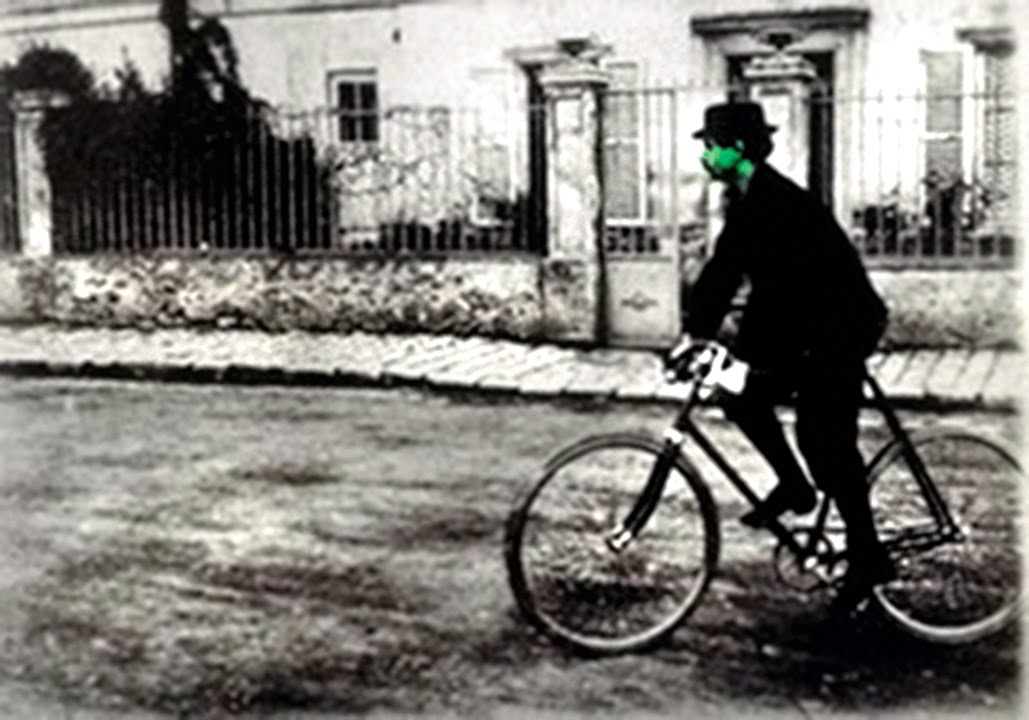
When Dada was in his teens, he had the shocking experience of being run over by a green man standing on the handlebars of a speeding bicycle; the resulting broken pelvis and psychological damage would cause Dada to walk with a limp and talk with a pronounced stutter.

As absurdist fate would have it, the wreckless green bicyclist turned out to be absinthe-fueled Alfred Jarry, who took the injured Dada into his parent’s home to heal and then gave him a job as an apprentice in the family’s pillow-making factory.

Dada proved to be a very imaginative pillow maker and began to make large-scale stuffed creatures and phantasmagorical characters. One such creation was a big green life-sized stuffed doll named King Ubu. Jarry — who was imbibing so much absinthe at the time that his own skin had taken on a permanent green hue — adapted the bright green pillow as his imaginary soul mate and then wrote a seminal play about the big fellow.


Dada would influence Jarry in other ways as well. Growing up within earshot of the fashionable and intellectual coterie of Montmartre and St. Germaine cafe society, he developed an extraordinarily inquisitive and sophisticated mind regarding matters of scientific and philosophical consequence. One biographer credits Jarry’s own excursion into the realm of pataphysics to a potent mix of Hegel — that is, Dada’s impassioned but speech-impediment-challenged discourse thereof — and too much absinthe.

Forced to flee his beloved Paris during the war years, Dada found his way to Zurich in 1915 where he got a job helping Hugo Ball and Emmy Hennings renovate a backroom space into a cultural nexus called Cabaret Voltaire.

One day Ball was standing nearby when Dada, frustrated while trying to install a urinal in the women’s bathroom, began to use his wrench to beat out strange polyrhythms on the metal pipes. As he pounded on the pipe, he also began to utter what sounded like an incantation of nonsensical rhythmic stuttering sounds.

Inspired by the edgy transubstantiation of primitive energy and ontological nullity in Dada’s impromptu poetic style, Ball tried to emulate it — but without success. Soon thereafter he asked the erstwhile plumber/pillow artiste to become the club’s official bathroom cleaner and his own unofficial ghost writer.

Soon Ball and Hennings were joined by other émigré artist/conspirators — Marcel Janco, Richard Huelsenbeck, Jean (Hans) Arp, and Tristan Tzara — and Cabaret Voltaire became the community center for a new anti-fascist peace movement. But when the organizers gathered in the cabaret to brainstorm a name for their new political-cultural tendency, the formidable male egos immediately sprang to full turgidity, creating such a rift that the little ship of the absurd appeared ready to capsize before it cleared the slip.

Amidst the ensuing cacophonous shouting match, Dada had climbed up on a ladder to hang theatre lights and could be heard muttering to himself, banging his hammer as emphasis. As the group argued, Dada chanted and hammered. The louder the argument, the louder he chanted and hammered, slowing building in rhythmic intensity. What he chanted went something like this:

The entire group fell silent.

Textile artist Sophie Tauber had been quiet throughout the loud debate among the men. Now she spoke up. Reminding the ego-embattled males in the group that they were, after all, launching a class-conscious albeit absurdist revolutionary anti-art movement, she suggested that it would be profoundly appropriate to name the organization after this non-aspiring, ego-free man who scrubbed the toilets, hung the lights that would shine upon them, and so brilliantly articulated the heart and soul of their philosophy.

Even Tzara was forced to agree with her flawless anti-logic.

Thus dadaism was born — the 20th century’s first authentic Yippies!

[James Retherford is an editor and designer at The Rag Blog and a director of the New Journalism Project. His attempts to link his lineage to D.D. Dada have been inconclusive. His new blog is Dancing with Dada.]

The author’s Yippie lineage has been confirmed.

The Rag Blog

Posted in Rag Bloggers | Tagged , , , , , , , | 4 Comments

Caracas : Bolivar is Inspiration for New Peoples’ Movement in Latin America

The founding congress of the Movimiento Continental Bolivariano (MCB) in Caracas, Dec. 7, 2009. Photo from kaosenlared.net

Movimiento Continental Bolivariano:

‘Take the open road of hope’

By Marion Delgado / The Rag Blog / December 14, 2009

CARTAGENA DE INDIES, Colombia — Students, workers, peasants, indigenous movements and leftist groups from 30 countries gathered at Caracas last week to found the Movimiento Continental Bolivariano (MCB), seeking a “union of the peoples of the Americas” to oppose “imperialist encroachment,” according to organizers.

Under the motto, “Take the open road of hope,” a quote from the Liberator, Simón Bolívar, the founding congress of MCB on Monday, December 7, expressed determination to “defend the Venezuelan Revolution against imperialists threats,” and “strengthen the fight against the military bases the Yankees have established in Colombia”; this last refers to a recent agreement between Bogotá and Washington allowing U.S. troops to operate in seven military bases in the South American country.

During the meeting, which ended Wednesday, a video of “Alfonso Cano,” the nombre de guerra of a leader of the Fuerzas Armadas Revolucionarias de Colombia — Ejército del Pueblo, (FARC or FARC-EP; Revolutionary Armed Forces of Colombia — Peoples Army) was shown. In it, Cano said that adopting a constitution for MCB is a “duty that cannot be postponed,” and reiterated that the pact between Colombia and the U.S. will “destabilize” democratic processes in Latin America.

“[MCB] constitutes a continental political movement of Bolivarian essence, just when the American empire has deployed its military strength in Colombia and is threatening democracy. The U.S. now has its equipment of war and terror deployed against the Latin America and Caribbean peoples. Formation of the new group and adoption of its constitution is a historical necessity” wrote the fugitive guerrilla leader.

He added that MCB’s formation signals a new dawn of South Americans’ defense of their dignity, independence, history, values, culture, territory, human resources, and a “natural and inalienable right to a sovereign design of our rich future.”

The Venezuelan Continental Movement (VCM), born more than five years ago, will provide a founding structure, expanding to include a Bolivarian Continental Coordinator (BCC) to represent MCB, as a platform for Latin American anti-imperialism.

The Commander of the armed forces of Colombia, General Freddy Padilla de León, requested the group to publicly reject the greeting message and accusations of the FARC.

Reaction in Colombia

Colombia has formally asked Venezuela to clarify its position towards the MCB. “The Government and the people of Colombia consider the recognition made by the Bolivarian Continental Coordinator (BCC) of the narcoterrorista organization ‘the FARC’ an affront to democracy and human rights,” the Ministry of Foreign Affairs said. Colombia stated that the MCB is guaranteeing, by its acceptance of the FARC, the murders, kidnappings, and atrocities against civilians committed by the rebel group in a civil war that has lasted over 45 years.

“Faced with this recognition, the Government of Venezuela should clarify to the international community if it recognizes, adopts, or tolerates the existence of movements or parties that support terrorism and that make apologies for organized crime,” the Colombian government said.

Colombia registered its protest while diplomatic relations with Venezuela are already in crisis, following the latest U.S. military pact.

The current diplomatic crisis is considered the worst since 1987, when the two countries, sharing a land frontier of 2,219 kilometers, were on the brink of war after a Colombian warship was intercepted by the Venezuelan army in a disputed maritime border area.

Previously, Colombian military and political leaders have asked the international community to refrain from giving credibility to FARC in forums such as the meeting in Caracas.

“We cannot accept that, after we have achieved significant success in the tranquility and peace among Colombians, these organizations of pseudopolíticans should give exposure to terrorist organizations,” said General Padilla.

The President of Venezuela, Hugo Chávez, the leading regional critic of Washington, denounced the U.S. as building a platform on Colombian foundations to invade his country and curb his so-called “Bolivarian revolution” that favors the poorest members of society.

Chávez, in the past has denied links with or support for the guerrillas, charged by his opponents, and denied that they use Venezuela as a sanctuary.

In the FARC video shown in Caracas, Cano rejected the military accord of Bogotá and Washington and announced FARC’s support for the newborn pan-South American organization.

The video is the second from Cano, who assumed the position of maximum FARC leader in 2008 after the legendary Manuel Marulanda Velez, died of a heart attack.

In recent months, guerrilla forces have intensified their attacks in an apparent attempt to demonstrate military power and political force. An offensive (Plan Patriota), launched by the Uribe government in 2003, that forced the FARC into a strategic retreat to remote mountainous and forested areas. In that offensive, several important guerrilla leaders such as Raúl Reyes, Martin Caballero, and Tomás Medina Caracas were killed, while thousands of FARC combatants defected, according to the Colombian Government.

  • For previous reports from Colombia by Marion Delgado, go here.

The Rag Blog

Posted in Rag Bloggers | Tagged , , , , | 3 Comments

Tragicomedy in Mexico City : Clown Prince Juanito Calls it Quits

Two thumbs up from Rafael Acosta, aka Juanito. Top, at Mexico City’s Basilica of the Virgin of Guadalupe. Photo by Rene Soto / Milenio Diario. Below, at his office last month before his resignation. Photo from The Independent / AP.

Tragicomedy in Ixtapalapa:
Mexico’s political clown prince resigns

‘Juanito is us all,’ considers Julio Hernandez, La Jornada’s lead political columnist, ‘we are all contaminated by the opportunism, cynicism, and social indifference that infests our political culture.’

By John Ross / The Rag Blog / December 14, 2009

MEXICO CITY — The marquee of the venerable Blanquita Theater here in the old quarter of this unruly megalopolis spotlights the city’s current clown prince, “Juanito,” in the musical review Don’t Give Up! (No Te Rajes!) .

Clowns occupy a special niche in Mexican popular culture. No kids’ party is complete without a payaso to enliven the festivities. Mexican payasos have their own union and their own clown schools and each year mount a pilgrimage to the Basilica of the Virgin of Guadalupe wearing red noses. Street clowns work in Mexico City’s clotted traffic and down in the Metro, usually kids from the misery belt with garishly painted faces, perhaps the world’s saddest clowns.

When Bozo, the dean of Mexican payasos, succumbed to emphysema a few years ago, he was succeeded by “Brozo, El Payaso Tenebroso” or “The Scary Clown.” Outfitted with a shocking green freight wig and a braying delivery, Brozo now works as a prime time political analyst for Televisa, the TV conglomerate.

Mexican clowns come in all shapes and sizes with or without greasepaint. Baggy-pantsed comics were the staple of Mexican vaudeville, which survives at the Blanquita. Stage comedians like Resortes (“Rubberlegs”) and Palillo (“Toothpick”) and Viruta & Capulina, Mexico’s Laurel & Hardy, stir the dust of nostalgia. Tintan, the classic Pachuco wiseguy, and the midget Tuntun mixed it up on the Blanquita stage.

The most celebrated of all these popular funnymen was Mario Moreno aka Cantinflas, a double-talking pelado (have-not) who lived by his wits, ridiculed the pompous, exposed the bad guys, and always got the girl. The star of nearly a hundred black and white movies, Cantinflas was so beloved that he became a perpetual write-in candidate for president to protest the charlatans posted year after year by the once and future ruling PRI party (71 years.)

Mexico’s clowns and comedians flourished in the carpas, street tents in working class neighborhoods where they worked their schtick alongside threadbare mariachis and bored dancers in sequined g-strings. The carpas went inside in the 1950s and theaters like the Blanquita became obligatory venues.

Up until last week, the big name up on the Blanquita marquee, “Juanito” né Rafael Ponfilio Acosta Angeles, was the Delegado or Borough President in Mexico City’s most conflictive and populous delegation, Ixtapalapa. Instantly recognizable by the tri-colored headband that cinches his bushy hair Rambo-style (boxing champ Julio Cesar Chavez’s entourage, which included many notable narcos, wore identical headbands), Juanito’s meteoric rise to popular idol status is the stuff of urban legends — the kind crafted by a well-oiled publicity machine.

Born in a rough and tumble Ixtapalapa colonia in 1958 or 1960 depending on which birth certificate is deemed valid, Rafael Acosta was an eighth grade drop-out who scuffled on the hardscrabble streets of the city, working as a vagonero (hawker in the Metro) and selling used clothes in the neighborhood tianguis (street bazaar.) Nicknamed “Juanito” by barrio soccer teams, he curried small favors as a gofer for minor league politicos, ultimately attaching himself to the tiny PT (Party of Labor), a corruptible clique that has struck it rich as an ally of Andres Manuel Lopez Obrador (AMLO), the once-wildly popular mayor of Mexico City and probable winner of the 2006 presidential election that was awarded to the right-wing PAN party’s Felipe Calderon.

AMLO’s left-center Party of the Democratic Revolution (PRD) — from which he is estranged — has controlled Ixtapalapa for nearly a decade and when the PT rewarded Juanito with a slot on the July 2009 ballot as its candidate to run the borough, Rafael Acosta was not given a hoot-in-hell chance to win office.

Juanito’s abbreviated reign was indeed the baleful fallout of the bitter split in the PRD between Lopez Obrador, who is building what he describes as a social movement both inside and outside the party, and the Chuchus faction, so named because many of its stalwarts like PRD party president Jesus Ortega bear the name of the Christian Savior — the Jesuses are more oriented to negotiating with AMLO’s arch-enemy Calderon for their quota of power.

Operating through Rene Arce, a former guerilla fighter and now a PRD senator, and his family, the Chuchus‘ control of Ixtapalapa has never been challenged so when AMLO fingered long-time local activist Clara Brugada as his choice for the left party’s nomination for delegada, the Chuchus’ antennas went up and Rene Arce’s wife, Silvia Oliva, was chosen to run against Lopez Obrador’s “gallo” in the PRD primaries, victory in which guaranteed election.

Rafael Acosta (Juanito) and and Clara Brugada. Photo from Notimex.

Given to extravagant gowns and killer coifs, Brugada, who bears an uncanny resemblance to Miss Piggy, came to left politics as a teenager in the urban popular movement which sprung up after the 1985 8.1 killer earthquake that took up to 30,000 lives here and ravaged the capital. But although she campaigned with AMLO up on the podium, the election was a tight one and Clara won the nomination by a scant 300 votes.

The Chuchus promptly went into court and had dozens of polling places in which Brugada ran up big numbers thrown out because election officials had not established that they were card-carrying members of the PRD.

Even though Oliva was declared the eventual winner by an electoral tribunal stacked with Calderon appointees, the decision came down too late and Brugada’s name appeared on the ballot with the caveat that every vote cast for Clara would be counted as a vote for Silvia.

AMLO went ballistic at the Chuchus’ flimflam. At a meeting of Brugada’s seething faithful in the heart of Iztapalapa just two weeks before the election, Lopez Obrador rolled out a desperate strategy. Instead of voting for Brugada, Clara’s people should vote for Rafael Acosta, the PT candidate. Andres Manuel threw his am around the startled Juanito and had him swear a public pledge to quit the post if he won and hand it over to Brugada. Veteran observers of Mexico City political imbroglios, including this writer, reasoned that AMLO’s end run around the Chuchus was doomed.

But, in a surprising surge of popular mobilization, Lopez Obrador’s brigadistas poured into Iztapalapa and banged on doors day and night and two weeks later on July 2, Juanito came up 10 points ahead of his closest competitor, Oliva.

The unexpected victory was a heartwarming one for AMLO, who has been so abused by right-wing media, most notably Televisa and its junior partner in crime TV Azteca, that he has retreated from the political spotlight to the periphery and spent much of 2009 visiting 418 tiny indigenous municipalities in the backwaters of Oaxaca. Juanito’s election proved that AMLO still packed a punch and could whip the Chuchus on their own turf.

Moreover, winning Ixtapalapa boosted Lopez Obrador’s credibility in the face-off with his successor as mayor, Marcelo Ebrard, to be the Left’s presidential candidate in 2012.

Political power in Mexico City comes through Ixtapalapa. Cuauhtemoc Cardenas became the first elected mayor of this monster metropolis in 1997 when he swept the delegation by building a coalition of urban militants such as the Francisco Villa Popular Front (Los Panchos) and the Emiliano Zapata Popular Revolutionary Union or UPREZ of which Brugada became a leader.

But Lopez Obrador was not the only winner in Ixtapalapa last July. The PT had never won control of so large and powerful an entity — with 1.8 million residents Ixtapalapa would be Mexico’s 20th largest city if it seceded from the capital. The Party of Labor was instigated by the now-reviled Carlos Salinas to siphon left votes from Cardenas’s 1994 presidential bid. PT boss Alberto Anaya’s talent for opportunism knows no limits.

AMLO’s jubilation was short-lived. He had proclaimed Ixtapalapa “a laboratory for democracy” and now a Frankenstein had been concocted in that laboratory. Rafael Acosta had won the election and was the new delegado, not Clara Brugada and not Andres Manuel Lopez Obrador who Juanito denounced to the eager anti-AMLO press as having used him for his own political ends. He, Juanito, had won the votes and Lopez Obrador was not even on the ballot.

In the three months between Juanito’s election and his October 1 swearing in, the surrogate candidate pulled away from his very public pledge to turn over the delegation to Brugada. Acosta marketed himself to Lopez Obrador’s myriad rivals, principally the Chuchus and the Arces but also the PRI and the Verdes, the so-called Mexican Ecology Party whose only concern for green is the color of the money. He was approached by Calderon’s PAN. Juanito’s son, Carlos Acosta, a marketing major at the National University, took charge of the sale of his father’s conscience to the highest bidder.

Suddenly, Juanito was walking around in Armani suits (he did not relinquish the trademark headband) and driving a Durango SUV, one step down from a Hummer. He moved into a six room suite at a posh five star hotel on Paseo de la Reforma, the capital’s most elegant boulevard, and his naco (a racist upper class term for “ignorant, poor”) mug appeared on the cover of the glossy Chilango magazine and the highbrow Nexus upon whose pages he was celebrated as an Everyman.

As the Anti-AMLO, he was relentlessly interviewed by the two-tongued TV demon. Juanito’s head was inflated by the flattery and the headband grew tighter. Alex Lora, the raspy-voiced founder of the Tri, Mexico’s most long-lived rock ‘n roll band, even wrote a “Rolla for Juanito,” the lyrics of which read in part: “Before you were just another mortal/ Now even your farts smell like perfume.”

With the October 1 swearing in just around the corner, Juanito dug in his heels. He was internationally famous, his name was renowned in “France, Italy, Spain, Russia, China, England, Canada, the U.S., and Costa Rica” he bragged to El Universal. He was not going to step aside.

Juanito in 2008. Photo by David Agren / Flickr.

Confrontation loomed. Clara’s brigades threatened to block the doors to the Mexico City Legislative Assembly where the swearing in of the capital’s 16 newly elected delegates was to be mounted. On the eve of the impending debacle, Mayor Marcelo, who had been loath to get his hands dirty in the Ixtapalapa “mitote” (brawl), summoned Juanito to City Hall and made him an offer he couldn’t refuse, the nature of which has yet to be revealed. That night, a nervous, sweating Juanito told a breathless press conference that he was taking a 59-day leave of absence because of a previously undisclosed heart condition. Clara Brugada would run Iztapalapa in his absence.

Because he had to be sworn in to negotiate his leave of absence, Rafael Acosta took the oath the next day in a legislative assembly ringed by a thousand police and under siege from multitudes cursing him as a traitor. Inside, Juanito tore off all clothing that was branded in PRD and PT colors (yellow and red) and screamed that the Left should die! He was escorted from the chambers by a bevy of beefy bodyguards to protect him from the inflamed mob.

Despite his heart condition, Juanito maintained a feverish pace during his 59 days on leave from his duties as delegado. He reportedly lunched with Emilio Azcarraga Jean, the Televisa kingpin, and the scuttlebutt had Juanito taking over for Brozo or anchoring his own reality show. A biopic, We Are All Juanito, was rumored — in a series of Twitters to his fan base; Juanito rejected the casting of heartthrob Gael Garcia and insisted upon playing himself. “There is only one Juanito.” He bared his chest for the cameras and flexed his flabby muscles. The star of the Ixtapalapa Tae Kwan Do Club, he contemplated a career change as Mexico’s Bruce Lee. Juanito signed a contract for the Blanquita show and went into rehearsal.

In his off hours, Rafael Acosta connived with the PANistas, most publicly with Alexandra Nunez, a confidante of Mariana Gomez, the PAN leader in the legislative assembly and cousin of first lady Margarita Zavala.

After midnight on the eve of the fated 59th day — November 28 — Rafael Acosta propped a ladder up against the back of the Ixtapalapa delegation headquarters and climbed in through a second story window. He brought a locksmith with him and changed all the locks and declared himself in control of the building. He boasted that he had caught Clara Brugada with her pants down “just like the Tiger of Santa Julia,” a picaresque bandido who was captured while responding to a sudden urge to defecate.

Juanito moved in his creature comforts and slept in the Delegation building. It became his bunker. He fired all the Brugada loyalists and forced others to enroll in the PAN. Meanwhile, Clara’s people occupied the esplanade, growing shriller day by day. When Brugada accused Juanito of having “damaged mental faculties,” the Mexico City human rights ombudsman warned her about casting slurs on the disabled.

Iztapalapa was paralyzed by the standoff. Garbage festered in the streets. 250,000 residents were without water last weekend (Dec. 5-6) — in bone-dry Iztapalapa, water is always the point of combustion. 5,000 underclass families in the delegation did not get their food credit cards and even the annual lighting of the new fire, an ancient indigenous rite, has been postponed.

To add to Ixtapalapans’ bad humor, electricity generation has been spotty ever since Calderon fired 42,000 electricity workers in an undisguised move to privatize the industry and the lights flicker on and off. Street venders — the informal economy is the delegation’s overwhelming source of commerce — are nose to nose over space in which to push their goods in a holiday season much diminished by the economic squeeze.

Locals have taken to barricading streets to protest the deteriorating conditions.

“Iztapalapa is a powder keg,” warns former Mexico City prosecutor Bernardo Batiz. The delegation would be a likely venue if the 1910 Mexican revolution, which celebrates its 100-year anniversary next year, were to come alive again.

The PRD needed 44 votes in the Assembly to strip Juanito of his office and only had 39. But Brugada’s allegations that Juanito falsified his birth certificate when he registered as the PT candidate carried weight in this debate since it is a jailable offense and votes changed. Acosta Angeles purportedly altered the document so that he could claim Felipe Angeles, a revered revolutionary general, as his grandfather.

The writing was on the wall. Finally, on December 11, the night before Juanito, No Te Rajes! was to debut at the Blanquita and much prodded by Marcelo, the star of the show abandoned the Iztapalapa delegation building by the same route he arrived — hustled through the back door into a waiting car which in its haste to escape crashed into two city vehicles.

But despite Juanito’s retreat from the Iztapalapa delegation (Clara Brugada was sworn in December 11), the show must go on.

The next night, his public awaited the star of Juanito, No Te Rajes outside the Blanquita with rotten eggs and spoiled tomatoes and hand-made signs that denounced him as a culero (“asshole”) but he eluded them, sneaking through the stage door. Even so, a handful paid $12 Americano to infiltrate the second show and shout insults from the audience. The house, they reported, was about 10 percent full, including the detractors. Mexico City’s former political clown prince appeared on stage for 10 minutes garbed as an Aztec warrior, not what the management had contracted for. The Blanquita is threatening to sue

“Juanito is us all,” considers Julio Hernandez, La Jornada‘s lead political columnist, “we are all contaminated by the opportunism, cynicism, and social indifference that infests our political culture.”

[John Ross’ latest cult classic El Monstruo: Dread & Redemption In Mexico City is an ideal holiday gift for those who delight in gamey tales from the urban underbelly. Ross will launch his Monster Book Tour in February and seeks venues east of the Mississippi. Write johnross@igc,org with bright ideas.]

The Rag Blog

Posted in Rag Bloggers | Tagged , , | 1 Comment