Fixing the Economy? Like Filling a Leaky Bucket

“Old tin bucket.” Photo by {JO} / Flickr.

Bucket’s got a hole in it:
Can we revive the U.S. economy?

By Roger Baker / The Rag Blog / December 13, 2009

Is trying to fix the U.S. economy like trying to fill a leaky bucket? So it seems. The money the U.S. government is printing is not getting down to the grassroots to create jobs. The lack of liquidity and credit is creating a deflationary spiral, a self-perpetuating economic contraction.

The financial tools being used to revive the domestic economy are having little effect. The main tools being tried are the Keynesian stimulus aimed at creating domestic jobs; the guaranteeing of existing commitments like bad home loans and social security; and the very low prime rate accessible to major bank lenders for both domestic and international loans.

Keynesian stimulation is primarily a domestic stimulus effort, a policy which by itself and used alone on a large scale could be quite effective in doing things that need to be done. However, the Congressional Republicans are trying to block more stimulus at a time when much more is needed to stop the deflationary spiral. Here is how Nobel prize winning economist Joseph Stiglitz sees the current situation:

Nobel Prize-winning economist Joseph Stiglitz urged U.S. lawmakers to use “overwhelming force” to cut a 10 percent unemployment rate that is forecast to rise…“Unless action is taken, we risk facing a vicious cycle: unemployment contributing to a weak economy, more mortgage foreclosures, more bad debts, lower demand, and possibly more, but certainly not less, unemployment.” Stiglitz said priorities for spending should include extending unemployment benefits, aiding states facing revenue shortfalls, giving tax credits for weatherizing homes, government jobs programs and research and technology initiatives…

The Keynesian stimulus package is at the same time dwarfed by a much bigger pot of money: the global finance system, largely managed by the bankers who got us into trouble. Here is what Stiglitz goes on to say about that:

…Stiglitz, 66, also said the Federal Reserve contributed to the financial crisis by failing to supervise banks or stem the housing bubble. He questioned proposals to give the central bank more authority to supervise firms whose failure might threaten the financial system. “Giving more power to an institution which has failed so miserably, with results that have imposed such costs on all of us, cannot be the right solution unless there are deep and fundamental reforms in the institution, of a kind that are beyond those currently being discussed,” he said.

In other words, the net effect of the amount of Keynesian stimulus we are likely to get is unlikely to do much good if we are not also reforming the banking system. All the money the U.S. government obligates should be pulling in the same direction. At least the immediate prospects for deep reform of the financial system are not good. Matt Taibbi, who just wrote a devastating critique in Rolling Stone titled “Obama’s Big Sellout,” documents the incestuous relationships between the bankers and their government regulators, who are now increasingly associated with the Obama administration.

Why aren’t the bank failures being followed by reform, with bank nationalization as an option? The problem is more one of politics than of economics. The U.S. government through its bailout policies is in real control of the banks through our legal system. This Atlantic article explains the same situation from a slightly different perspective.

And here’s an overview of the economic situation by an IMF banker. It explains how the U.S. adopted a system of political control by the banking oligarchs; the U.S. is beginning to resemble a third world country in its pattern of entrenched corruption. The thesis is that the current entrenched banker-ocracy will do anything to block reform. The bankers and their political allies are unwilling to step aside, thus blocking adoption of a rational economic cooperation policy based on the needs and desires of the vast majority of the public.

Why do we not take full charge of their management in the public interest? Do we want to keep pretending the banks are solvent using phony profits and non-transparent financing? Or do we have the courage to face reality, to declare the likely bankrupt banks like Citibank insolvent, and then get to the heart of fixing the problem with strict controls, much as prominent Keynesians like Krugman and Galbraith advocate?

The TARP bank bailouts greatly favored the banks while obligating future taxpayers to bear the burden, but there as little reform to benefit the taxpayers in return. The policy of cheap and easy Federal Reserve credit remains, with a prime lending rate down around zero percent. Bernanke says he is going to try to keep this going. Meanwhile, the U.S. government, the big investment banks, and the multinational corporations are first in line for low interest rate loans. This is the Wall Street Journal complaining about the situation:

The Federal Reserve implemented an emergency monetary policy after the 2008 Lehman bankruptcy to salvage the world financial system. In his testimony yesterday… Ben Bernanke said, ‘We must be prepared to withdraw the extraordinary policy support in a smooth and timely way as markets and the economy recover.’ This leaves all-out emergency monetary stimulus in place, but with a different, much weaker justification.

With the system stabilized, the Fed hopes that artificially low interest rates and its purchases of mortgage-backed securities [MBS] will spur growth. Instead they are pushing dollars abroad and wasting precious growth capital in asset and commodity bubbles… more than a year after the heart of the panic, the Fed is still promising near-zero interest rates for an extended period and buying over $3 billion per day of expensive mortgage securities… Capital is being rationed not on price but on availability and connections.

The government gets the most, foreigners second, Wall Street and big companies third, with not much left over. The irony of the zero-rate policy, coupled with Washington’s preference for a weak dollar, is a glut of American capital in Asia (as corporations and investors shun the weakening U.S. currency) and a shortage at home… Much of its current stimulus is being diverted to commodities and foreign economies – hence Asia’s complaint about bubbles … Wall Street will threaten a tantrum if the Fed even thinks about damping the air-raid sirens. The Street utterly loves the Fed’s largess …

Under current unreformed and unregulated conditions, no matter how much cheap low interest rate money is available for loaning out, the banks try to seek out their highest profit. Bankers are, after all, in business to make as much money as possible on their loans. A fast return, high profit loan by a bank is always going to win out over a slow return, low-profit-anticipated loan. This will be so until banking is made to change by externally imposed laws and regulations.

The consumer spending portion of the U.S. economy is continuing to deflate with no obvious recovery stage in sight. Consumers spend most of the total U.S. GNP on personal goods, but the high unemployment and consumer debt mean that there are few profitable domestic loan opportunities in the USA anymore, especially for small businesses catering to the consumer economy.

People are only buying what they really need and not much else. Contraction in this Main Street sector is indeed holding wage inflation down, but at a high social cost in what has become an increasingly service-based U.S. economy. Cheaper U.S labor, delivered through increasing poverty and wage competition, does not translate into more profitable bank loan opportunities so long as U.S. wages remain far above Chinese wages.

A new banking reform bill has just made its way through the House of Representatives. However, on close inspection it looks like token reform, falling far short of the reforms suggested above by Stiglitz. As one example, the bill calls for an audit of the Federal Reserve system, but not for another two years. Another mismatch stems from the fact that we live in a world of international banking. A world that needs international banking reform to coordinate the global economy properly, as Financial Times points out here. The U.S. doesn’t dominate the global economy any more, nor can we fix it on our own.

The leaky bucket

Back to the leaky bucket syndrome. Since the domestic economy is no longer a lucrative source of profit, bank loans are no longer attracted toward domestic investments that might create jobs and help restrain deflation. The opportunities for banks to make much profit on traditional domestic investments involving average people are rare.

Given this situation, we can see why making easy money available through the Federal Reserve is like trying to pour money into an old tin bucket. The theory is that the dollars circulate and stimulate additional general consumer demand, called the “multiplier effect.” The problem is that the money tends to head offshore. Not enough stays to revive domestic demand alongside the relatively insufficient Keynesian stimulus.

The easy money and stimulus the government creates is tending to leak outside of the country into foreign loans, equities and commodities. The guys managing private money watch the fed and the treasury extend credit to prop up all sorts of bad investments and government entitlements. They realize that the total accumulation of U.S. treasury debt is so large that it may never be paid back by the aging population of taxpayers. It looks like U.S. debt may have to use shrunken, devalued dollars as a likely alternative to government default.

The banking investment outlook is different with regard to bank investments in foreign debt, foreign equities, and commodities. The biggest U.S. banks often make loans to corporations that then use the money for profitable investments abroad. A lot of production in the U.S. biotech industry is now relocating to China, with the parent companies evolving into domestic sales outlets. Loans to such companies tend to stimulate foreign economies rather than the domestic economy.

If you buy commodities, you are often stimulating foreign mining and manufacture in the country of production; most commodities (where are we competitive except wheat soybeans, and Boeing airliners?) are largely produced outside the USA. We are now seeing broad price inflation of many commodities since about March 2009, with a rise of about 30-40% so far in just this year.

Those who see this handwriting on the wall are clearly buying metals and commodities which tend to preserve wealth, while dumping their dollars. The rising gold prices is a fundamental sign that people don’t trust dollars to hold their value, so they buy gold, which has always held its value and preserved wealth.

This is an obvious sign that the psychology of the rich guys who run the world is shifting away from the U.S. service economy, to favor the emerging economies of Asia, etc. There is now a global asset bubble that attracts speculative investments in commodities.

This applies to oil too. With annual global oil depletion of about 5%, and a production cushion of perhaps 5 million barrels a day of spare capacity (we have to guess the number), we are probably due for another economy-crippling oil price spike within just a few years. This will happen sooner if the global economy “recovers.” However oil dependence is so basic to the global economy that a tight market and another oil price spike probably cannot be delayed much in any case.

Hope for change?

Not facing reality with regard to the finance system and turning to printing money and phony bank profits could be extremely destructive before long, probably within the next few years. This will most likely be reflected in higher federal interest rates. Why not simply mandate that the banks that get government bailouts must do the stuff that really needs to get done, like setting up nationwide medical clinics, or cooperative community gardens, or homeless relief centers?

The public is now figuring out some of the right answers on its own. People say what they want when they are asked in the polls. The fact that the politicians, who determine how the banks are regulated, are resisting making these changes points to the heart of the problem.

Americans want their government to create jobs through spending on public works, investments in alternative energy or skills training for the jobless.

They also want the deficit to come down. And most are ready to hand the bill to the wealthy.

A Bloomberg National Poll conducted December 3-7 shows two- thirds of Americans favor taxing the rich to reduce the deficit.

Even though almost 9 of 10 respondents also say they believe the middle class will have to make financial sacrifices to achieve that goal, only a little more than one-fourth support an increase in taxes on the middle class. Fewer still back cuts in entitlement programs such as Social Security and Medicare or a new national consumption tax…

If this is what most of the public wants, why is bank nationalization not an option? The problem is more one of politics than of economics.

The government through its bailout policies is in real control of the banks, so why do we not take full charge of bank management in the public interest? Do we need to keep pretending that the banks are solvent or do we have the courage to face reality? Why not declare key banks insolvent, and get to the heart of fixing the problem through strict bank controls, much as prominent Keynesians like Krugman and Galbraith advocate?

If by some political miracle progressives had been put in charge of dealing with the U.S. economic crisis in mid 2008, what might they have done differently? Probably the initial acute part of the current crisis should have been treated with an injection of liquidity and deficit spending along Keynesian stimulus lines to prevent a chain reaction banking panic. This did happen. But there was little followup in terms of fixing the policies that caused the problem.

Given a U.S. political system polarized between two parties, and one in which political influence peddling and lobbying influence plays a large and ongoing role, the bankers have been able politically to resist banking reform. This is now widening into a deep and fundamental conflict between a wealthy oligarchy, with its power centered on finance, and the broad economic interests of the American public.

Why no trials for the most culpable bankers? If Citibank cannot survive without phony profits, why not nationalize it? Unreformed, poorly regulated banks too big to fail are probably a bigger threat than foreign terrorists. I think the proper smart solution is either to break up or to nationalize too-big-to-fail banks so the money gets spent on the low profit things we need in this country. This would send a sign that the public is in charge, and not the banker-ocracy that caused the problems.

If Karl Marx were still around as an observer, I think he would see this as the historically defining class struggle of our times. A conflict between the bankers and their private but destructive interests, in opposition to the public interest of the vast majority, both domestic and globally.

Call it what we will, there is a deep and fundamental problem that our current political institutions seem unable to resolve. This situation is unlikely to change. Not without broad public pressure and political organization generated by most of the 6 billion of us trying to survive in a world run by bankers; those taught to profit by trying to perpetuate infinite growth on our finite planet.

[Roger Baker is a long time transportation-oriented environmental activist, an amateur energy-oriented economist, an amateur scientist and science writer, and a founding member of and an advisor to the Association for the Study of Peak Oil-USA. He is active in the Green Party and the ACLU, and is a director of the Save Our Springs Association and the Save Barton Creek Association. Mostly he enjoys being an irreverent policy wonk and writing irreverent wonkish articles for The Rag Blog.]

Also see:

The Rag Blog

Posted in Rag Bloggers | Tagged , , , , , , , | 8 Comments

PTSD and the Military : Soldiers Go AWOL to Get Help

Photo illustration by Jennifer Clampet / USAG Wiesbaden Public Affairs.

Military health care inadequate:
GI’s go AWOL for PTSD treatment

By Dahr Jamail / December 13, 2009

MARFA, Texas — With a military health care system over-stretched by two ongoing wars in Afghanistan and Iraq, more soldiers are deciding to go absent without leave (AWOL) in order to find treatment for post-traumatic stress disorder (PTSD).

Eric Jasinski enlisted in the military in 2005, and deployed to Iraq in October 2006 as an intelligence analyst with the U.S. Army. He collected intelligence in order to put together strike packets — where air strikes would take place.

Upon his return to the U.S. after his tour, Jasinski was suffering from severe PTSD from what he did and saw in Iraq, remorse and guilt for the work he did that he knows contributed to the loss of life in Iraq.

“What I saw and what I did in Iraq caused my PTSD,” Jasinski, 23, told IPS during a phone interview, “Also, I went through a divorce — she left right before I deployed — and my grandmother passed away when I was over there, so it was all super rough on me.”

In addition, he lost a friend in Iraq, and another of his friends lost his leg due to a roadside bomb attack.

Upon returning home in December 2007, Jasinski tried to get treatment via the military. He was self-medicating by drinking heavily, and an over-burdened military mental health counselor sent him to see a civilian doctor, who diagnosed him with severe PTSD.

“I went to get help, but I had an eight hour wait to see one of five doctors. But after several attempts, finally I got a periodic check up and I told that counselor what was happening, and he said they’d help me… but I ended up getting a letter that instructed me to go see a civilian doctor, and she diagnosed me with PTSD,” Jasinski explained, “Then, I was taking the medications and they were helping, because I thought I was to get out of the Army in February 2009 when my contract expired.”

As the date approached, a problem arose.

“In late 2008 they stop-lossed me, and that pushed me over the edge,” Jasinski told IPS, “They were going to send me back to Iraq the next month.”

During his pre-deployment processing “they gave me a 90-day supply of meds to get me over to Iraq, and I saw a counselor during that period, and I told him “I don’t know what I’m going to do if I go back to Iraq.”

“He asked if I was suicidal,” Jasinski explained, “and I said not right now, I’m not planning on going home and blowing my brains out. He said, ‘well, you’re good to go then.’ And he sent me on my way. I knew at that moment, when they finalized my paperwork for Iraq, that there was no way I could go back with my untreated PTSD. I needed more help.”

SPC Eric Jasinski suffers from severe PTSD.

When Jasinski went on his short pre-deployment leave break, he went AWOL, where he remained out of service until December 11, when he returned to turn himself in to authorities at Fort Hood, in Killeen, Texas.

“He has heavy duty PTSD and never would have gone AWOL if he’d gotten the help he needed from the military,” James Branum, Jasinski’s civilian lawyer who accompanied him to Fort Hood, told IPS. “This case highlights the need of the military to provide better mental health care for its soldiers.”

Branum, who is also co-chair of the Military Law Task Force, added, “Our hope is that his unit won’t court-martial him, but puts him in a warrior transition unit where they will evaluate him to either treat him or give him a medical discharge. He’d be safe there, and eventually, they’d give him a medical discharge because his PTSD symptoms are so severe.”

He’s turning himself in “because he is not a flight risk and wants to take responsibility for what he’s done,” Branum stressed.

“It’s been a year, I want to get on with my life and go to college and become a social worker to help people,” Jasinski said of why he is turning himself in to the military at this time. “I want to get on with life, and I don’t want to hide.”

Kernan Manion is a board-certified psychiatrist, who treated Marines returning from war who suffer from PTSD and other acute mental problems born from their deployments, at Camp Lejeune — the largest Marine base on the East Coast.

While he was engaged in this work, Manion warned his superiors of the extent and complexity of the systemic problems, and he was deeply worried about the possibility of these leading to violence on the base and within surrounding communities.

“If not more Fort Hoods, Camp Liberties, soldier fratricide, spousal homicide, we’ll see it individually in suicides, alcohol abuse, domestic violence, family dysfunction, in formerly fine young men coming back and saying, as I’ve heard so many times, ‘I’m not cut out for society. I can’t stand people. I can’t tolerate commotion. I need to live in the woods,’” Manion explained to IPS. “That’s what we’re going to have. Broken, not contributing, not functional members of society. It infuriates me — what they are doing to these guys, because it’s so ineptly run by a system that values rank and power more than anything else — so we’re stuck throwing money into a fragmented system of inept clinics and the crisis goes on.”

“It’s not just that we’re going to have an immensity of people coming back, but the system itself is thwarting their effective treatment,” Manion explained.

According to the Army, every year from 2006 onwards there has been a record number of reported and confirmed suicides, including 2009.

There has also been an escalation of soldier-on-soldier violence, as the November 5 shooting spree at Fort Hood by Major Nidal Hassan indicates. In 2008 there was also a record number of suicides for the Marine Corps.

Jasinski’s case is representative of a growing number of soldiers returning from the occupations of Iraq and Afghanistan who are going AWOL when they are unable to get proper mental health care treatment from the military for their PTSD.

A 2008 Rand Corporation report revealed that at least 300,000 veterans returning from both wars had been diagnosed with severe depression or PTSD.

Jaskinski’s experience with the military has inspired him to offer advice for other soldiers who need PTSD treatment but are not receiving it.

“Do not, do not let a 5-10 minute review by a military doctor determine if you go to Iraq,” he told IPS. “Even if you have to pay out of pocket, go civilian to a doctor… the military mental health sector is so overwhelmed, they won’t take care of you. Go see a civilian, and hopefully that therapist will help you… even then I’m not sure that will help… but you have to take that chance.”

When asked what he feels the military needs to do in order to rectify this problem, he said: “A total overhaul of the mental health sector in the military is needed… we had nine psychiatrists at our center, and that’s simply not enough staff, they are going to get burned out, after seeing 50 soldiers each in one day. We need an overhaul of the entire system, and more, good psychiatrists, not those just coming for a job, but good, experienced mental health professionals need to be involved.”

Source / IPS

Thanks to Fran Hanlon / The Rag Blog

Posted in RagBlog | Tagged , , , , , | 7 Comments

Rocking New Hampshire : James Montgomery and J. Geils

James Montgomery, coiling and kicking. Photo from The Sun Chronicle.

Rocking New Hampshire blues:
James Montgomery and J. Geils at The Middle

He rushes forward on stage like a ranting king exhorting the other players, filling in rhythm details with showy flashes of the harmonica.

By Carl R. Hultberg / The Rag Blog / December 12, 2009

Driving around doing some errands with a friend, I reached into the back to grab an antique cassette to feed into the dashboard. What an oldie! It’s even got the real old slip-in type commercial cassette case.

James Montgomery. You know the one called First Time Out with someone on the cover getting shot out of a cannon. There’s one song on there called “The Train” about the commuter train to New York out of Boston’s South Station. The way James Montgomery recreated the sound of a barreling Budliner with his harmonica is still dazzling today. As he says in the song, “but chances are you won’t know anybody riding on that train…”

How true. And how true about central New Hampshire as well, where absolutely nothing ever happens. “Where do you think James Montgomery is these days?” we wondered. Probably long gone by now.

Wrong again. Because at the Franklin, New Hampshire, supermarket where I stopped for veggies there was a poster advertising none other than James Montgomery and his Blues Band featuring that night none other than J. Geils, coming to Franklin in two weeks. This has to be a joke. Franklin?

In case you don’t know, it is a rare former mill town in New Hampshire (or Massachusetts) that isn’t a present day disaster. Whether it is the result of now undesirable housing concentrations or some curse of the industrial age, there are few New England towns situated on large rivers that aren’t fighting to stay alive.

Franklin certainly qualifies in this category, and so, for better or for worse, the folks at the Franklin Opera House seem to have hired a slick PR firm to give the place a makeover. I hope they didn’t spend too much, for the historic building will no longer be known as the Opera House. You can now refer to it as “The Middle,” as in the middle of New Hampshire I guess. “The Middle” doesn’t really roll off the tongue as easily as Opera House did but at least the group got this dandy one night show dropped on them from out of the blue. And out of the blues.

The night of the sold out show we hit the local Franklin House of Pizza for a have-a-beer sit down meal. The two gals in the next table were headed for the concert as well. They soon sped off to get to their seats. At the Opera House, I mean The Middle, a crowd was gathering in the lobby. Mostly goateed old men and their wives. A few kids with their grizzled hippie parents.

A young red haired usherette was enthusiastically singing the praises of the opening act, the Brooks Young Blues band out of Concord (NH). Maybe the hot guitar star is her boyfriend. She also let on that she plays baritone sax with the local swing band and a “Tower of Power” funk act. Are you sure this is Franklin?

True to her word the Brooks Young outfit is a gas. Tall and lanky Brooks himself resembles no one more than Jim Carrey doing a really good Keith Richards imitation. That might sound weird but in my book it’s known as being original. He brought on a more than slightly over the hill biker type guy who played some mean harp breaks. The bass player was a youngish looking man with a tie who turned out to be named Rachel.

They ended their set with a drawn out version of an ancient blues song (“Key to the Highway”) that Jay as a singer really killed (literally) with his terrible offbeat phrasing. Oh well, at least the rest of the show was diverting, especially Mr. Young’s hot moves and syrupy blues licks on the guitar. A young band, this Brooks Young Band, with a lot of talent and some even harder to find originality. Alas, if that were all it took…

If that were all it took, James Montgomery would be a millionaire. Still, you won’t find a harder working guy in the music business. As his band took the stage before James came on himself, another optical illusion was in the making. The first song was the old blues standard “Rock Me Baby,” ably sung and played by the solo lead guitarist. It was amazing. The guitarist was the spitting image of J. Geils 35 years ago. Had the man not aged a day since then? Was this the legendary J. Geils whose band had had so many hits out of the Boston area in the 1970s? It was uncanny the resemblance.

Then, James the man himself hit the stage. To describe the stage presence of James Montgomery as theatrical would be a gross understatement. First of all, he looks like Lionel Barrymore, or maybe John Wilkes Booth in his day. Long nosed and very Shakespearean, wizened hair slicked back but soon standing almost on end.

His stage moves are primal and mostly all his own. Coiling and uncoiling his leg and throwing it forward as he plays the harmonica through a microphone. He rushes forward on stage like a ranting king exhorting the other players, filling in rhythm details with showy flashes of the harmonica. Singing the classic blues songs with all the sincerity they were written with. This white man still has it.

J. Geils. Photo from Captain Wolf Music.

You got some respect for history? How about Mr. Montgomery’s take on the Detroit riots of 1967, which he had experienced with fellow hometown bluesman John Lee Hooker who wrote about it in a song. “Detroit’s Burning Down” went down like it had happened yesterday. Touring with the Allman Brothers, Aerosmith, gambling backstage at Capricorn Records with the O’Jays (the big winners). “Schoolin’ Them Dice” was the James Montgomery hit from back then.

The guitarist at his right continued to astound. Had J. Geils found the fountain of youth? It didn’t help that James Montgomery kept introducing him as “the best in the business!” Kind of cryptic. Whoever he was he sure played in every style. Like B.B. King on a vintage gold Les Paul, and a little slide as well on a Strat copy for a Muddy Waters song the band did in both the original and ZZ Top styles. This is the blues like it ought to be played, led by a master who learned from the masters.

James Montgomery was probably most moving and convincing when he did Junior Well’s “Help Me Baby.” Junior Wells was his personal teacher. It was as if the West Side of Chicago from 1965 had been teleported to New Hampshire in 2009.

Then they brought out the real J. Geils. No, he didn’t look anything now like the young guy playing on stage who looked just like him 30 years ago. Much older, taller, a bit gaunt with a drawn out face, slicked back short hair and a baggy 1940s style suit. He looked like the director of the local technical high school getting ready to retire. None the less, he plugged in a big hollow body Gibson and began, perhaps a bit rusty at first, to peal off B.B. King riffs as fast as his impersonater, now relegated to rhythm. A few numbers later he sat down to play a moving Muddy Waters tribute, “Long Distance Call,” on a Telecaster with a slide. Just like Muddy. A few blues tunes later, the legendary J. Geils left the stage. A visiting guitar ghost.

James Montgomery and his band continued pouring out more excitement with their tight, taut take on the blues. After another round of introductions, we learned that the young man who played the smoking lead guitar throughout most of the evening was named George McCann. An encore began with the ever energetic Montgomery starting out on the solo acoustic harmonica while the band found their way back onstage. After the show James Montgomery came into the lobby and mixed with the New Hampshirites there. He never played “The Train” but he sure nailed the classic electric Chicago Blues that night in Franklin.

Checking out the James Montgomery website we find that he plays about a hundred gigs every year around New England and the country. He’s active in good causes like the effort by the Boston House of Blues to provide healthcare coverage for aging bluesmen. It’s kind of sad to see James Montgomery feeling he has to mention the “famous” people he and his band members have played with. Whoever these people might be, except for the classic blues performers like Johnny Winter, Bonnie Raitt, and maybe a Rolling Stone or two, they don’t hold a candle to James Montgomery himself, blues performer extraordinaire and, like a few of the other real greats, like Brian Jones for example, a strict traditionalist and purist blues historian.

New England is very lucky to have James Montgomery as a local blues star. We have seen him make these crusty Yankees shout out and shake about. A living link to the great ones. Are the blues not still the best old American-made interracial human soul defroster? Sure goes down great in an old Opera House in the center of New Hampshire.

[Carl R. Hultberg’s grandfather, Rudi Blesh, was a noted jazz critic and music historian, and Carl was raised in that tradition. After spending many years as a music archivist and social activist in New York’s Greenwich Village, he now lives in an old abandoned foundry in Danbury, New Hampshire, where he runs the Ragtime Society.]

The Rag Blog

Posted in Rag Bloggers | Tagged , , , , , | 2 Comments

Jonah Raskin on Obama Speech : Woefully Ignorant

Barack Obama in Oslo. Photo from CBS.

An open letter to President Obama:
Your speech was a betrayal of American ideals

By Jonah Raskin / The Rag Blog / December 11, 2009

Dear President Obama:

I read your Nobel Peace Prize Acceptance Speech and found it woefully ignorant. Or perhaps it was deliberately meant to mislead. If so it would belong in the same camp as all the war markers who have inhabited the White House.

If you were to read your history — say as written by Howard Zinn — you would see that the United States was born in wartime and evolved in war and that it has been the nation that has bombed more countries in the 20th and 21st centuries than any other nation in the world. The United States is a country that is defined by its bombings, from Hiroshima and Nagasaki to the bombings of Hanoi and Haiphong, to the bombings of civilians in Afghanistan and Iraq.

You say that, “In light of the Cultural Revolution’s horrors, Nixon’s meeting with Mao appeared inexcusable.” How could you forget or omit to say that the United States was at that moment at War in Vietnam. The United States also invaded Laos and Cambodia. Mr. Nixon was a war criminal. He violated the basic rights of Americans during the Vietnam Era, using the FBI and CIA to stifle dissent and to try to destroy the anti-war movement. Not a word did I hear in your speech about American pacifists, from Henry David Thoreau to the young men who burned their draft cards and refused to be part of an invading army in South East Asia in the 1960s and the 1970s.

You say that, “The United States of America has helped underwrite global security for more than six decades with the blood of our citizens and the strength of our arms.” This leaves out the immoral role of the United States in toppling democratically elected governments like that of Salvador Allende in Chile. It neglects to mention the role of the U.S. military in protecting U.S. economic interests in Africa and Asia. The United States had been an empire from its inception. Indians were massacred for hundreds of years; colonies acquired in the Philippines and Puerto Rico.

You talk about international law and America’s adherence to it, but the Bush administration violated international law and human rights for eight years. Not a word have you said about that. America led the world, you say, in terms of protecting human rights, preventing genocide and restricting dangerous weapons. You turn a blind eye on the fact that the United States was the first and the only nation to use nuclear weapons against another nation, that genocide took place in this country, and that the U.S. has been an arms dealer to the world.

Your speech is a betrayal of American ideals. It is a betrayal of democracy. It is an abuse of power. It is an act of deception cloaked behind pretty words and beautiful rhetoric. It cannot hide the realities of America’s belligerence the world over, or the way that the U. S. propped up dictatorial regimes on every continent for almost the entirety of the 20th century. You mention Dr. Marin Luther King, Jr. in your speech. You praise him. But you cannot hide behind him. He was a peacemaker. You are a war maker. The blood of our own soldiers and the people of Afghanistan is on your hands.

Sincerely,

Jonah Raskin

[Jonah Raskin is the author of The Mythology of Imperialism: Revolutionary Critique of British Literature and Society in the Modern Age (Monthly Review Press), and American Scream: Allen Ginsberg’s “Howl” and the Making of the Beat Generation (University of California Press.]

The Rag Blog

Posted in Rag Bloggers | Tagged , , , , , , | 16 Comments

Grisly Calculus : Fudging on Civilian Casualties in Afghanistan

Sar Bland, an Afghan man who was injured in a rocket attack in Tagab, lies on bed at a hospital at the U.S. base at Bagram, Afghanistan. An official said the death of civilians in U.S. rocket attacks presumably aimed at military officials and local leaders underscores the inability of NATO to successfully defeat the Taliban in eastern Afghanistan. Photo by Musadeq Sadeq / AP.

Is the military fudging on civilian casualties
To avoid pentagon oversight?

By Megan Carpentier / December 11, 2009

On Monday, the anonymous blogger Security Crank noticed something interesting: all the U.S. and NATO airstrikes in Afghanistan seemingly kill exactly 30 people every time. How can that be?

Security Crank documented no less than 12 occasions in which news reports, relying on field commanders’ estimates, noted that exactly 30 suspected Taliban were killed in airstrikes and, occasionally, artillery attacks. He said:

But the much more important point remains: how could we possibly have any idea how the war is going, here or anywhere else, when the bad guys seem only to die in groups of 30? The sheer ubiquity of that number in fatality and casualty counts is astounding, to the point where I don’t even pay attention to a story anymore when they use that magic number 30. It is an indicator either of ignorance or deliberate spin… but no matter the case, whenever you see the number 30 used in reference to the Taliban, you should probably close the tab and move onto something else, because you just won’t get a good sense of what happened there.

So, why is it always 30? Do 30 casualties seem like enough to justify a military attack, or few enough to not attract too much attention to an incident?

Another blogger, Joshua Foust of the Central Asia blog Registan, seemingly stumbled upon the answer. In a tweet, he noted:

In 2003, an air strike killing 30 civilians could be launched w/o issues. 31 dead civilians and Rummy had to approve.

Foust then linked to an LA Times article from last July by Nicholas Goldberg that documented what field commanders were told.

In a grisly calculus known as the “collateral damage estimate,” U.S. military commanders and lawyers often work together in advance of a military strike, using very specific, Pentagon-imposed protocols to determine whether the good that will come of it outweighs the cost.

We don’t know much about how it works, but in 2007, Marc Garlasco, the Pentagon’s former chief of high-value targeting, offered a glimpse when he told Salon magazine that in 2003, “the magic number was 30.” That meant that if an attack was anticipated to kill more than 30 civilians, it needed the explicit approval of then-Defense Secretary Donald H. Rumsfeld or President George W. Bush. If the expected civilian death toll was less than 30, the strike could be OKd by the legal and military commanders on the ground.

In other words, the Pentagon determined that 30 casualties, even if they were civilian, were too few to matter politically or to attract the attention of the press for more than a few words. If commanders expected more civilian casualties than that, political leaders had to sign off on the attack in advance to make sure they were prepared for the PR fall-out.

That PR calculus of how many deaths matter to the average American has apparently carried over from the Bush Administration to the Obama Adminstration, at least insofar as ground commanders are concerned. But the American people deserve the truth about how many Afghans — civilian and otherwise — are being killed by our forces. Just because senior officials at the Pentagon think that killing 30 people doesn’t warrant their attention doesn’t mean they’re right.

Source / Air America

Thanks to S.M. Willhelm / The Rag Blog

Posted in RagBlog | Tagged , , , | 1 Comment

War is Peace : WE Must Earn Obama’s Nobel

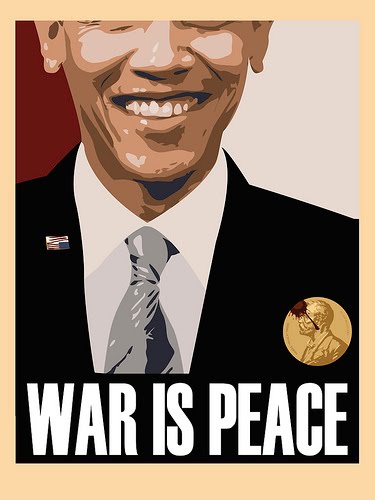
Image by Nick Bygon / Flickr / Creative Commons.

War is NOT peace: Now it’s up to us

Obama devoted his once-in-a-lifetime talk to justifying American warfare, conjuring righteous images of this nation as an armed crusader, and asserting that violence is an immovable piece of the human condition…

By Harvey Wasserman / The Rag Blog / December 11, 2009

The Nobel Prize given to Barack Obama must now be earned by a grassroots movement dedicated to peace. The award was given to an American president now ignobly intent on waging war.

So the task of actually earning this honor falls to us.

Thousands of anti-war activists took to the streets in at least 100 U.S. cities within hours after Obama officially escalated the war on Afghanistan on December 1.

With them came at least one new global internet campaign — The Peace, Justice and Environment Network — devoted to reversing this ghastly attack as well as to saving the environment and winning social justice.

Rep. Dennis Kucinich (D-OH) has introduced legislation to deny the funding for this war.

All around the world a sane citizenry has made it clear that war is not peace.

Perhaps the Nobel committee knew it was taking a gamble on Obama when it gave him a Peace Prize he has not yet earned. Perhaps some voters hoped that it would influence his decision and help him turn away from a clearly catastrophic excursion into the Graveyard of Great Powers.

But the President has delivered his answer: No Such Luck.

The tragedy of his speech and behavior in Norway is heart-wrenching. Obama devoted his once-in-a-lifetime talk to justifying American warfare, conjuring righteous images of this nation as an armed crusader, and asserting that violence is an immovable piece of the human condition rather than the ultimate enemy.

If the Nobel Prize has stood for anything over the decades, it’s been as a beacon to the hope that our species might ultimately evolve into something better.

It was with the hope that Obama would further that vision that the award was given. But he flew into town, pitched an infomercial for war, blew off the traditional niceties of a meeting with the King of Norway, a talk to the Parliament, a visit with local children and much more… and then split town to do… what?… that could be so much more important.

In short, beneath that smooth, calm veneer, Barack Obama was ingracious and rude in a setting designed to epitomize the opposite. For Americans dedicated to global goodwill — many of whom voted for him — he was downright embarrassing. For those committed to justice and peace, he was alarming and infuriating.

Obama did acknowledge that he did not deserve the award, and that his contributions had been “slender.” That much has become an overly kind self-appraisal.

He also acknowledged he came to the award by virtue of the work of Martin Luther King and the Civil Rights movement he helped lead.

But Dr. King would have been utterly heartbroken by Obama’s screed for war in the most inappropriate time and place. It was King who forever linked the unjust war in Vietnam with the moral and financial bankruptcy of the nation waging it. Now his ultimate beneficiary is perpetrating all the good doctor’s worst fears.

Obama’s speech has been brilliantly dissected at great length by superb commentators like Norman Solomon (“Mr. President, War is Not Peace”, Commondreams.org); David Swanson (“Obama’s Infomercial for War,” at Portside); David DeGraw (“Obama Far Outdoes Bush in Escalating War,” at Alternet) and many more.

It’s a tragic picture with a very clear message: the peace movement must reconstitute itself with sufficient power to fulfill the Nobel mandate. For those who might have retained residual hope for or illusions about this young president, this must stand as the definitive departure.

We now face triple crises in war, where the president has escalated; health care, where he has refused to discuss single payer and now presides over the gutting of the public option; and the environment, where he has escalated the ultimate destroyer — war — and may soon open the door to its ultimate evil, atomic power.

It’s not enough to wring our hands. It’s time to move on and figure out how to win. Our ideals — from meaningful peace to universal health care to a Solartopian energy economy — are all tangible, essential and winnable.

The ignoble truth is that the man in the White House is not our ally.

So what else is new? Obama’s failures have made it OUR Nobel.

Yes we can!

[Harvey Wasserman’s History of the United States is at www.harveywasserman.com, along with Solartopia! Our Green-Powered Earth. He is Senior Editor of www.freepress.org, where this article also appears.]

The Rag Blog

Posted in Rag Bloggers | Tagged , , , , , | 7 Comments

Comcast-NBC Merger : Controlling Content and Delivery

Image from ZeroPaid.

The Comcast-NBC marriage:
The importance of Net Neutrality

With a monopoly on delivery, what’s to stop a new breed of ISPs/cable providers from dictating content to customers?

By Jared Moya / December 10, 2009

See ‘Internet war: The fight for free access,’ Below.

A scary thing happened last week when the Comcast Corporation, the largest cable provider in the U.S. and ISP to some 15 million customers, decided to to purchase NBC Universal in order to delve further upstream from the pipe that simply delivers content to the world where’s it created.

“We believe this venture represents a natural evolution in the world of communications and entertainment, a marketplace that becomes more open, more competitive, and more global every day,” it says. “The opportunity to combine these assets makes possible some innovative programming opportunities that will permit the new company to better serve the interests of many key segments of the viewing audience, including local viewers in the markets served by NBCU’s owned-and-operated stations, and the particular interests of Hispanics, African Americans, children and families, and other key audience segments. This combination also permits us to hasten the arrival of the multiplatform, ‘anytime, anywhere’ future that Americans want.”

In other words, it has seen the writing on the wall in terms of streaming video-on-demand services. Consumers increasingly want to watch content when and where they want.

However, the move means Comcast will control every step of the system from content creation to delivery, and could easily begin preventing customers from accessing competing content or charging them more to do so than they would normally as a sort of a penalty.

“While we believe that this transaction is, and will be determined to be, pro-competitive, pro-consumer, and strongly in the public interest, we recognize that competitive concerns will be raised about the combination of such significant multiplatform assets in a single company,” it adds. “Therefore, we also intend to make a number of affirmative voluntary commitments in our applications for approval that we believe will effectively address any such concerns.”

It leaves out the fact that none of its “commitments” say anything about guaranteeing online access to its competitors or allowing competing streaming services to exist on its network. Since streaming is the future of content delivery it’s important that equal access be guaranteed to all, especially since ISPs enjoy regional monopolies around the country (try finding more than one broadband provider in your area).

“I am not exaggerating when I say that Comcast’s proposed acquisition of NBC Universal poses a genuine threat to free expression and diversity of speech in our democratic society,” says Andrew Jay Schwartzman, president of the Media Access Project, a non-profit law firm and free speech advocacy organization that promotes freedom of expression, independent media, and low-cost, universal access to communications services.

“I believe that the sale should not be permitted. The deal is the first attempt at vertical integration of content and delivery in the broadband era. It presents antitrust and communications regulators with the challenge of addressing whether any one company should be allowed to hold dominant positions in both video and Internet delivery,” he says.

Exactly.

The easiest manifestation of the harm it could do to competitors is the simple withholding of NBC content from both standard cable and online competitors. It also has an inherent interest in making sure that competing video streaming services don’t succeed.

Comcast CEO Brian Roberts says that “today NBC makes certain content available online and I can’t imagine we will change that process,” but we all know that could change with time. The primary concern of a business will always be profits, and it’s only a matter of time before Comcast begins attempting to maximize the potential of of NBC content by dictating the price and availability.

Gigi Sohn, executive director of Public Knowledge, a public interest advocacy organization dedicated to promoting the public interest in access to information, warns that the deal will ultimately harm consumer choice and result in higher fees for services.

“With all that programming under its control, Comcast will have every incentive to take its shows off of the Internet and force consumers to buy a cable subscription to get online access to that programming,” she said. “Want to watch reruns of 30 Rock? Buy a Comcast subscription.”

The whole affair makes Network Neutrality even more important. Federal Communications Commission (FCC) Chairman Julius Genachowski has already emphasized that we need to “safeguard the free and open Internet” by ensuring, among other things, that consumers must be able to access the lawful Internet content, applications, and services of their choice.

Without it, Comcast will have a free hand to do as it pleases.

Stay tuned.

Source / ZeroPaid

Graphic from techrepublican.

Internet war:
The fight for free access

There is a silent battle occurring in Washington, D.C., over our ability to freely access and exchange information through our last unbiased medium, the Internet. The telecom industry is feverishly buying up policy-makers in an attempt to block new, unanimously approved FCC regulations on Internet service providers.

The new plan would ensure Internet users’ equal rights to its content, while prohibiting broadband providers such as AT&T, Comcast and Verizon from selectively blocking or slowing content and discriminating against competitors.

In retribution, the big telecom interests are sending a message using their highest paid member of Congress, Sen. John McCain, to submit the Internet Freedom Act, which is anything but. The act states the FCC “shall not propose, promulgate or issue any regulations regarding the Internet or IP-enabled services.”

So the FCC would not be allowed to be the FCC, giving service-providers freedom to control, without checks, any and all bandwidth, connection speed, content and applications.

Misleading policy makers and scare tactics should be ignored. FCC regulations would only affect the big Telecom interests and not the Internet itself. Opponents mistakenly claim regulations might slow innovation. Does this include censoring, blocking or stifling applications such as VoIP, Google Voice and legal peer-to-peer networking applications by companies such as AT&T and Comcast?

Regulation preventing such acts, according to a number of studies, will not only lower prices and guarantee higher performance overall, but open the web to more users — allowing people to share ideas and programs and accelerating innovation and investment. AT&T’s own two year experiment in 2006 with neutrality rules brought about greater increases in investment than any other ISP in America.

What deregulation means to these companies is not freedom from some fictitious dictatorial power but immunity from having to answer for their own irresponsible and inevitably oppressive actions. What has deregulation really given us, besides robbing us of laws designed to protect the environment, worker safety and consumer rights?

Michael A. Burger / CJOnline

  • For previous Rag Blog articles about Net Neutrality, go here.

Thanks to Media Reform Daily / The Rag Blog

Posted in RagBlog | Tagged , , , , , , , , , , , | 1 Comment

Health Care : Senate Clowns Come Up With a Deal

Same old song. Harry Reid’s committee comes up with a health care deal. Image from Liberal Street Fighter.

Health care and the Senate:
The circus comes to town

By Dr. Stephen R. Keister / The Rag Blog / December 10, 2009

Mark Twain in 1891 described Congress like this: “The smallest minds and the selfishest souls and the cowardliest hearts that God makes.” And little has changed as we watch in action the dysfunctional legislative body that is the United States Senate as it fumbles the ball on health care reform.

Finally the physicians of the United States have overcome their fear and their lethargy and the vast majority are willing to speak up for a government health care program for all Americans. They have been joined in this by most of the nurse’s associations, the bulk of the Union movement, and, in fact, the majority of the American people. Sixty-five percent of Americans approve of a public plan.

And so what happens? Our elected representatives, especially in the Senate, have given away the store to their paymasters in the health insurance and pharmaceutical industries, with the exception of a courageous and honorable few. Now, all that stands between a decent health care system for all and total capitulation to the corporatocracy, is the House Progressive Caucus. One hopes that they are able to exhibit the courage of the Greeks at Thermopile or the Cold Stream Guards holding the perimeter at Dunkirk.

Where is the President in all of this? Mr. Obama would appear never to have had any commitment to universal/single payer health care, and in spite of his campaigning for reasonably priced health care he has bent knee to the health insurance cartel and PhARMA, to which the White House has been an open house since his inauguration. The bow to the Emperor of Japan was minor compared to the deference paid to these two cartels.

I believe that the best description of Mr, Obama’s style of leadership comes from Brendan Cooney, writing in Couterpunch about the president’s handling of the Honduran situation:

But perhaps most haunting of all in this mess is the man in the White House. He showed that while he has better instincts for democracy than his predecessor, the results are the same because he does not act on them. What good is a quarterback who can find the open receiver if he can’t pass the ball?

My fear is that his timidity on these issues — just like his Justice Department’s recent interference in the indictment of John Yu, and the administration’s handling of other matters involving Bush war crimes — will leave him with the same legacy with the American progressives as Pierre Laval left with the majority of the French people in 1940.

We have much to hang our heads in shame about. The Progress Report on November 24 reveals that a record 49 million Americans had trouble finding enough to eat in 2008. The USDA reported in the annual food security report that the number of people who “lacked consistent access to adequate food” soared to the highest level since the study began 14 years ago. Even more disturbing, nearly one in four children — almost 17 million — lived in households in which food at times was scarce. Not only do we let people die in this country for lack of a physician, but we also let them go hungry.

The public option appears to be lost in the Senate. Instead Democrats would allow older Americans starting at 55 to buy into Medicare. There is a definite spin to this. The “buy-in” would not kick in until 2011 and a “subsidized buy-in” would not be available until 2014. And only Americans without current health insurance would be eligible. There is no provision for those paying outlandish premiums for private insurance to switch to the Medicare substitute. And what happens to all those Americans under the age of 55 who are being gouged and deceived by the health insurance cartel?

Sen. Jay Rockerfeller would also require insurers to spend at least 90% of premium money on medical care, rather than on administrative costs or profits. Of course we do not know the details of the proposed deal, nor whether it has any possibility of being sustained by the full Senate. To their credit Senators Feingold and Sanders are reserving judgment.

Former insurance industry flak turned reform crusader Wendel Potter wrote in The Huffington Post:

There was a time, in the early 1990s, when health insurance companies devoted more than 95 cents out of every dollar to paying doctors and hospitals for taking care of their members. No more. Since President Bill Clinton’s health plan died 15 years ago, the health insurance industry has come to be dominated by a handful of insurance companies that answer to Wall Street investors, and they have changed that basic math. Today, insurers only pay about 81 cents of each premium dollar on actual medical care. The rest is consumed by rising profits, grotesque executive salaries, huge administrative expenses, and the cost of weeding out people with pre-existing conditions and claims designed to wear out patients with denials and disapproval’s of the care they need most.

Mr. Potter continues:

Wall Street investors expect insurers to pay as little as possible for medical claims. As a result, the nation’s health insurance industry has evolved into a cartel of huge for-profit companies that together reap billions of dollars a year at the expense of their policyholders. The seven largest firms — United Group, WellPoint, Aetna, Humana, Cigna, Health Net, and Coventry Health Care — enroll nearly one of three Americans in their health insurance plans. This year the industry will take about 25 BILLION in profits for getting between American patients and their doctors. Further in Firedoglake of December 4, Jason Rosenbaum revealed that Aetna had cut 600,000 people from its insurance rolls to raise its profits for next year. This was in accord with Wellpoint CEO Angela Braly when she said, ‘We will not sacrifice profitability for membership.

Bill Scher in Campaign For America’s Future discusses another part of the Senate deal.

The new compromise proposal would mean an insurance exchange would offer private plans. This alternative would create a national coverage plan operated by private insurers but run by the Office of Personnel Management, which administers health coverage for federal workers, Senators participating in the talks said the OPM idea had been well received across the ideological spectrum, although details were sketchy.

Public option architect Jacob Hacker rips the idea. He writes,

An even stranger idea is to offer the non-profit plans available in the Federal Employees Health Benefit Plan within the exchange. Since the FEHBP is itself a form of exchange, this amounts to offering a new set of private plans within a new set of private plans. How is this going to provide real pressure on private insurers in a consolidated insurance market in which non-profit plans already have a large presence (and often act little differently from the for-profit plans)?

This sounds to me like another variant of the old shell game.

When buying health insurance, the average American is completely cowed by the legalese in the terms of the policy. The information provided by Isaiah Poole, writing in OurFuture, should be very helpful in this regard. Before buying a private health insurance policy it is always best to discuss the specifics of that policy with your attorney or personal physician.

An excellent summary of the overall health care situation is provided by John Garry Maxwell, M.D. — who has practiced surgery in university and community hospitals for 40 years — in his superbly written op-ed in The Wilmington, Star News.

In Great Britain several years ago, a perceptive woman afflicted with a bowel disease requiring a great deal of medical attention, offered me her view: ‘Americans have no sense of community welfare, no willingness to be discomforted in the least for the greater good of the entire population.’

As I have previously noted, we in the United States have a blindspot in this country when it comes to the public good. Our national problem is much larger that how we provide health care to our citizens. At the core, we have become a “what is good for me,” “lets make a lot of money” society. This may well explain why we in the United states are still fighting for the right for all Americans to have decent health care, a right that has existed in Western European nations, in Canada, Japan and Australia, for decades.

[Dr. Stephen R. Keister lives in Erie, Pennsylvania. He is a retired physician who is active in health care reform. His writing appears regularly on The Rag Blog.]

The Rag Blog

Posted in Rag Bloggers | Tagged , , , , | 8 Comments

Obama Administration : Growing Influence of the Neo-Cons

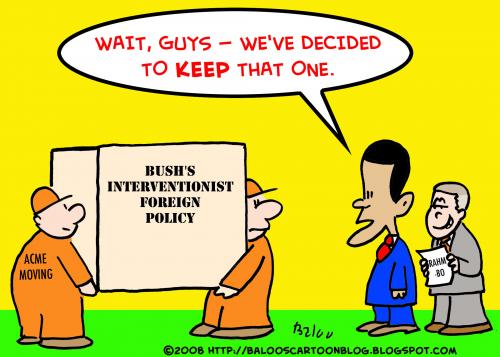
Cartoon By Baloo from Baloo Cartoons.

White House foreign policy:
Globalist/pragmatist hybrid

While the political philosophy articulated or implied by President Obama is far from that of the neo-conservatives, [many of the] concrete policies that he has embraced do in fact resemble Reagan/Bush era policies.

By Harry Targ / The Rag Blog / December 10, 2009

Last January Jonathan Clarke, co-author of America Alone: The Neo-Conservatives and the World Order, posed a question to readers of BBC News: “With the Bush Administration about to recede into history, a widely asked question is whether the neo-conservative philosophy that underpinned its major foreign policy decisions will likewise vanish from the scene.”

While Clarke tended to believe the answer to the question was “yes,” he did warn that pundits had predicted the end of neo-con influence when President Reagan left office as well.

Clarke then listed several key characteristics of neo-conservative foreign policy:

  • viewing the world in terms of the forces of good and evil
  • rejection of diplomacy as a tool of international relations
  • readiness to use military force as a first tool to achieve global goals
  • unilateralism
  • disdain and rejection of international organizations
  • concentration on the Middle East and the Persian Gulf

Years earlier I had labeled the neo-conservative foreign policy advocates the “globalists.” They were committed to an unbridled use of force to transform the world in the political, military, and economic interests of the United States. The doctrine of preemption epitomized this approach to the world. In his National Security Strategy document of 2002, and elsewhere, President Bush asserted the right to engage in military action against nations and/or groups that the United States perceived as a threat. The days of deterrence were over. The United States was prepared to act first.

While globalists dominated United States foreign policy off and on for the last 30 years, they have been challenged by foreign policy influentials I have called the “pragmatists.” Even though both the globalists and pragmatists are driven by the needs of capitalist expansion, the pragmatists see the world as much more complex and demanding of a variety of approaches to other countries and peoples.

Globalists are committed to acting unilaterally while pragmatists are multilateralists; that is they prefer to act in coalition with other nations. Pragmatists regard diplomacy as an important tool for relating to other nations, even when others are enemies.

Whereas globalists are militarists, pragmatists regard the use of the military as a last resort. And when pragmatists endorse the use of violence to achieve particular goals they choose subversion and small wars over big ones. Pragmatists regard international organizations as a site for diplomacy, coalition-building, and engaging in behaviors designed to communicate respect rather than disdain for others. And finally, pragmatists usually embrace deterrence, rather than preemption, as their military doctrine.

Reflecting on Barack Obama’s first year in office we can see evidence of these two kinds of influences on his policymaking. Obama evidenced pragmatism in his performance at the first G20 meeting in London last spring. He engaged in public and private diplomacy and seemed to hear demands from the Global South about increasing its representation in the International Monetary Fund and World Bank. At the G20 meeting and elsewhere in his travels he admitted that the United States is responsible for some of the world’s problems.

Shortly after G20, Obama met with leaders of Western Hemisphere countries and was caught on camera shaking hands with Hugo Chavez of Venezuela. In addition, he lifted some Bush era restrictions on the rights of Cuban Americans to travel to the island to visit relatives and increased the amount of money relatives could send to Cuba.

Regarding the Middle East and Persian Gulf, Obama demanded that the Israeli government halt construction of settlements in the occupied territories and began modest troop reductions from Iraq as part of a phased withdrawal. The President initiated some dialogue with the regime in Iran over the latter’s nuclear program.

In addition pragmatist Obama condemned the military coup in Honduras. And he canceled construction of a US missile shield in Eastern Europe.

However, the President has embraced a variety of policies that resemble those of his predecessors. He committed the United States to establishing seven U.S. military bases in various parts of Colombia. This projected military presence has been coupled with strong words critical of the regime in Venezuela. Despite growing expectations, the Obama administration has not publicly demanded an end to the embargo of Cuba nor has his government acted to reverse the sentences of the Cuban 5. No significant action has been taken to insure that those who carried out the coup against President Zelaya step down. In fact, the administration has declared that it will respect the recently completed Honduran election.

The Obama administration seemed to reduce the pressure it originally applied to Israel about the occupied territories and ongoing violence against the Palestinian people. There still is a large U.S. troop presence in Iraq. Defense Department budget requests continue to rise (despite a few publicized cases of contract cancellations for individual weapons systems).

Finally, President Obama last week announced a substantial increase of some 30,000 U.S. troops to Afghanistan. He claimed that it was necessary to eliminate Al Queda from Afghanistan (even though there are less than 100 in the country) and keep the Taliban from power, even though the current Afghan regime is riddled with corruption and the eight-year war resembles the quagmire that was the Vietnam War.

While the political philosophy articulated or implied by President Obama is far from that of the neo-conservatives, these concrete policies that he has embraced do in fact resemble Reagan/Bush era policies. The language the current president uses to defend these policies does not have the apocalyptic and zealous quality that his predecessors utilized, but the consequences for targets of war and U.S. military personnel are the same.

Perhaps the Obama foreign policy can best be described as a “hybrid globalist/pragmatist” approach. The first task of those committed to peace is to demand of the new president that he reverse, not shift toward, the policies of his predecessor.

[Harry Tarq is a professor in American Studies who lives in West Lafayette, Indiana. He blogs at Diary of a Heartland Radical, where this article also appears.]

The Rag Blog

Posted in Rag Bloggers | Tagged , , , , | 4 Comments

Amy Goodman : Take Me to Your Climate Leader

Photo from NASA.

In a freshly released report on Tuesday, the World Meteorological Organization (WMO) stated that 2000-2009 was the warmest decade ever on record. While the WMO has warned the world about this dire situation before, this new analysis further confirms the urgency and need for us to take action. The agency’s findings arrived in time to counteract the scrutiny of global warming deniers who have been increasingly more vocal as the COP15 conference to fight the effects of climate change commenced in Copenhagen. — inhabitat

Take me to your climate leader:
Activism in Copenhagen

By Amy Goodman / December 9, 2009

COPENHAGEN — “Politicians talk, leaders act” read the sign outside the Bella Center in Copenhagen on the opening day of the United Nations climate summit. Inside the convention center, the official delegations from 192 countries, hundreds of NGOs (nongovernmental organizations)—an estimated 15,000 people in all — are engaging in two weeks of meetings aiming for a global agreement to stave off catastrophic global climate change. Five thousand journalists are covering the event.

Outside, Copenhagen has been transformed into a vibrant, global hub of climate-change activism, forums and protest planning. In one square, an ice sculpture of a polar bear melts day by day, and an open-air exhibit of towering photos displays “100 places to remember that will disappear.”

While the U.S. Environmental Protection Agency this week designated carbon dioxide as a threat to health, President Barack Obama has said that there will not be a binding agreement from this summit. Many see the U.S. as a key obstacle to it and are seizing the opportunity to assert a leadership role in what environmental writer and activist Bill McKibben has described as “the most important diplomatic gathering in the world’s history.” At stake are not only the rules that will govern entire economies, driven for well more than a century by fossil fuels, but the very existence of some nations and cultures, from the tropics to the arctic.

The Republic of Maldives, an island nation in the Indian Ocean, sent 15-year-old Mohamed Axam Maumoon as a climate ambassador. After attending the Children’s Climate Forum, he told me, “We are living at the very edge… because our country is so fragile, only protected by the natural barriers, such as the coral reefs and the white sandy beaches.”

Most of the 200 inhabited islands of the Maldives are at most 3 feet above sea level, and projected sea-level rises would inundate his country. Even at his age, Axam comprehends the enormousness of the threat he and his country face, and starkly frames the question he poses to people in the industrialized world: “Would you commit murder, even while we are begging for mercy and begging for you to stop what you’re doing, change your ways and let our children see the future that we want to build for them?”

Farther north, in Arctic Village, Alaska, indigenous people are fighting to survive. Sarah James is an elder and a chair member of the Gwich’in Steering Committee. I met her this week at Copenhagen’s Klimaforum09, dubbed “The People’s Summit,” where she told me: “Climate change, global warming is real in the Arctic. There’s a lot of erosion, because permafrost is melting… And last summer, there was a fire all summer long, no visibility. Last spring, 20 villages got flooded along the Yukon. Sixty villages within the Yukon area never got their fish.”

Emerging economies like China and India are growing rapidly and are becoming top-tier carbon emitters, yet none approaches the per capita emission levels of the United States. With just 4 percent of the world’s population, the U.S. produces about a quarter of the world’s greenhouse gases. The model for the past century has been clear: If you want to escape poverty, grow your economy by industrializing with fossil fuels as your main source of energy. Yet the wealthy nations have not been willing to pay for the environmental damage they have caused, or significantly change the way they operate.

Author Ross Gelbspan says poverty is at the root of the problem: Take care of poverty, and humanity can solve the climate crisis. He says retooling the planet for a green economy can be the largest jobs program in history, can create more equality among nations, and is necessary, immediately, to avoid catastrophe.

Tuesday, between sessions at the Bella Center, in the cafe area packed with thousands, a group of activists dressed as space aliens, in white spacesuits and with green skin and goggles, walked in. “Take us to your climate leaders!” they demanded. “Show us your binding treaty!” In the rarified diplomatic atmosphere of the summit, such antics stand out. But the calls from the developing world, both inside and outside the summit, to cut emissions and to compensate countries, from Africa to Asia and Latin America, for the devastating effects of global warming they did not cause are no laughing matter.

Protesters are planning confrontations as more than 100 world leaders descend on Copenhagen next week. The battle cry at the Klimaforum09 is “Mobilize, Resist, Transform.” The people are leading, while the politicians talk.

© 2009 Amy Goodman

[Amy Goodman is the host of Democracy Now!, a daily international TV/radio news hour airing on more than 800 stations in North America. She is the author of Breaking the Sound Barrier, recently released in paperback and now a New York Times best-seller. Denis Moynihan contributed research to this column.]

Source / TruthDig / Common Dreams

The Rag Blog

Posted in RagBlog | Tagged , , , , , , , | 6 Comments

Infinite Universes : Death Does Not Exist

Conscioussness and our perception of space and time. Art by Bruce Rolff / FeaturePics.com / Cosmic Log.

Does death exist?
New theory says ‘No’

One of the surest axioms of science is that energy never dies; it can neither be created nor destroyed. But does this energy transcend from one world to the other?

By Dr. Robert Lanza / December 9, 2009

Many of us fear death. We believe in death because we have been told we will die. We associate ourselves with the body, and we know that bodies die. But a new scientific theory suggests that death is not the terminal event we think.

One well-known aspect of quantum physics is that certain observations cannot be predicted absolutely. Instead, there is a range of possible observations each with a different probability. One mainstream explanation, the “many-worlds” interpretation, states that each of these possible observations corresponds to a different universe (the ‘multiverse’). A new scientific theory — called biocentrism — refines these ideas.

There are an infinite number of universes, and everything that could possibly happen occurs in some universe. Death does not exist in any real sense in these scenarios. All possible universes exist simultaneously, regardless of what happens in any of them. Although individual bodies are destined to self-destruct, the alive feeling — the “Who am I?” — is just a 20-watt fountain of energy operating in the brain. But this energy doesn’t go away at death. One of the surest axioms of science is that energy never dies; it can neither be created nor destroyed. But does this energy transcend from one world to the other?

Consider an experiment that was recently published in the journal Science showing that scientists could retroactively change something that had happened in the past. Particles had to decide how to behave when they hit a beam splitter. Later on, the experimenter could turn a second switch on or off. It turns out that what the observer decided at that point, determined what the particle did in the past.

Regardless of the choice you, the observer, make, it is you who will experience the outcomes that will result. The linkages between these various histories and universes transcend our ordinary classical ideas of space and time. Think of the 20-watts of energy as simply holo-projecting either this or that result onto a screen. Whether you turn the second beam splitter on or off, it’s still the same battery or agent responsible for the projection.

According to Biocentrism, space and time are not the hard objects we think. Wave your hand through the air — if you take everything away, what’s left? Nothing. The same thing applies for time. You can’t see anything through the bone that surrounds your brain. Everything you see and experience right now is a whirl of information occurring in your mind. Space and time are simply the tools for putting everything together.

Death does not exist in a timeless, spaceless world. In the end, even Einstein admitted, “Now Besso” (an old friend) “has departed from this strange world a little ahead of me. That means nothing. People like us… know that the distinction between past, present, and future is only a stubbornly persistent illusion.” Immortality doesn’t mean a perpetual existence in time without end, but rather resides outside of time altogether.

This was clear with the death of my sister Christine. After viewing her body at the hospital, I went out to speak with family members. Christine’s husband — Ed — started to sob uncontrollably. For a few moments I felt like I was transcending the provincialism of time. I thought about the 20-watts of energy, and about experiments that show a single particle can pass through two holes at the same time. I could not dismiss the conclusion: Christine was both alive and dead, outside of time.

Christine had had a hard life. She had finally found a man that she loved very much. My younger sister couldn’t make it to her wedding because she had a card game that had been scheduled for several weeks. My mother also couldn’t make the wedding due to an important engagement she had at the Elks Club. The wedding was one of the most important days in Christine’s life. Since no one else from our side of the family showed, Christine asked me to walk her down the aisle to give her away.

Soon after the wedding, Christine and Ed were driving to the dream house they had just bought when their car hit a patch of black ice. She was thrown from the car and landed in a banking of snow.

“Ed,” she said “I can’t feel my leg.”

She never knew that her liver had been ripped in half and blood was rushing into her peritoneum.

After the death of his son, Emerson wrote “Our life is not so much threatened as our perception. I grieve that grief can teach me nothing, nor carry me one step into real nature.”

Whether it’s flipping the switch for the Science experiment, or turning the driving wheel ever so slightly this way or that way on black-ice, it’s the 20-watts of energy that will experience the result. In some cases the car will swerve off the road, but in other cases the car will continue on its way to my sister’s dream house.

Christine had recently lost 100 pounds, and Ed had bought her a surprise pair of diamond earrings. It’s going to be hard to wait, but I know Christine is going to look fabulous in them the next time I see her.

[Robert Lanza, MD, is considered one of the leading scientists in the world, especially for his pioneering work in stem cell research. He is Adjunct Professor at the Institute for Regenerative Medicine, Wake Forest University School of Medicine. He is the author of Biocentrism: How Life and Consciousness Are the Keys to Understanding the True Nature of the Universe , a book that lays out his theory of everything.]

Source / The Huffington Post

Thanks to Harry Edwards / The Rag Blog

Posted in RagBlog | Tagged , , , | 13 Comments

Chrysler for World Peace? : Ad Agency Sour Grapes

To view video, go here.

Rebranding Chrysler?
U.S. ad agency misses message

By Larry Ray / The Rag Blog / December 9, 2009

A truly uplifting 45 second public service television spot features a new Chrysler 300 breaking through the Berlin wall with the flying stones turning into white doves. No overt sales pitch for Chrysler is made at all, but the fact that an appeal for international peace and freedom is being made by Chrysler may be one of their strongest company messages in a while.

However, their long time U.S. ad agency, BBDO, is crying foul because Chrysler Group’s Olivier Francois, the new president-CEO of the Chrysler vehicle brand, hired an Italian ad agency to produce the spot, which is very similar to a Lancia commercial from a year ago. Lancia is part of the Fiat group.

Francois commented in a press release, “For Chrysler, this is a chance to use our brand image to join with others in the fight for peace and to knock down the walls that divide us. We at Chrysler believe in doing the right thing and making a difference.”

The Italian cinematography celebrates Chrysler visually while delivering a strong message for achieving world peace. The spot ends with a call for the release of Aung San Suu Kyi, Burma’s immobilized pro-democracy leader. She is a Nobel Peace Prize Laureate, who has been in and out of house arrest since 1989.

The Chrysler message supports the 10th World Summit of Nobel Peace Laureates being held in Berlin December 10-11, 200, coinciding with the 20th anniversary of the fall of the Berlin wall, as well as an international internet campaign to free Nobel Laureate Aung San Suu Kyi.

BBDO’s contract with Chrysler runs out at the end of next month, and trade publication Advertising Age, had a banner headline today proclaiming, “After Taking U.S. Bailout, Chrysler Hires Italian Agency.” A former Chrysler Group marketing chief, Julie Roehm, blasted the international peace message noting that “social causes have a place in advertising,” but not this one.

“The message is a disconnect to what matters to people here,” she said. Americans are focused now on getting back to work and the economy back on track, she said. “I don’t think the vast majority of Americans know who this woman is or frankly care.”

To Ms. Roehm there apparently is no greater cause for concern than envisioning out of work BBDO staffers at the end of January being forced to pound the pavement in New York City. An international internet awareness effort, Your Face For Freedom, is raising support, money and global awareness for “this woman” for whom Ms. Roehm, in her narrow nearsightedness exhibits such crass indifference.

If she and her chums at BBDO had been doing a more far-sighted job for Chrysler, BBDO might not be losing their contract and Chrysler might not have had to be saved from collapse which involved getting rid of ineffective executives and replacing them with new leadership.

The U.S. financing was loaned to Chrysler to allow it to reorganize and emerge from bankruptcy, which it accomplished in record time. New robust changes are but the beginning of what could eventually see Italy’s Fiat with a 51% ownership of the new Chrysler Group LLC, “if it meets financial and developmental goals for the company.” And those goals center upon revitalizing its manufacturing facilities, parts suppliers and work force in the USA as well as abroad.

Starting to make Chrysler a name known and respected in European and other international markets is what this powerful TV imagery is beginning to do. A friend of mine in Italy who saw the spot emailed me saying, “I think it’s great and almost enough to get me to buy a Chrysler! ALMOST — can I trade in my 2003 Fiat Punto???”

Take a look at the Chrysler spot and see what your gut reaction is.

[Retired journalist Larry Ray is a Texas native and former Austin television news anchor. He also posts at The iHandbill.]

The Rag Blog

Posted in Rag Bloggers | Tagged , , , , | 1 Comment