James Howard Kunstler : Our Gods are not Happy

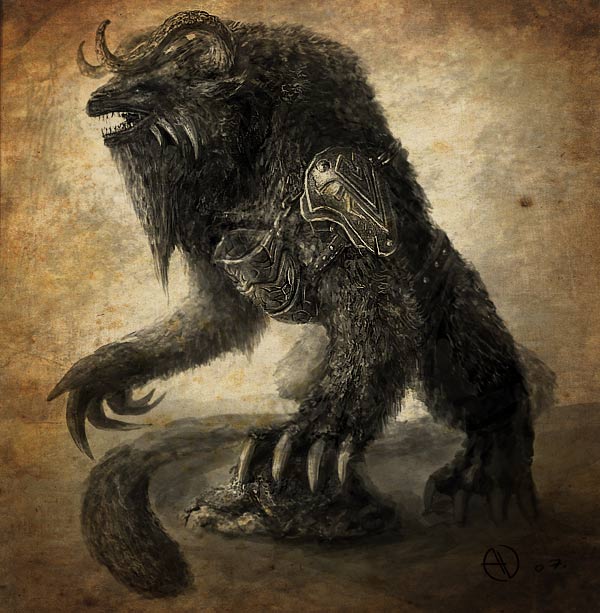
Rough beast, preparing to slouch. Art by Alex “Rhino” Voroshev.

Thinking the unthinkable:
Cornpone Hitlers and the agony of ordinary people

By James Howard Kunstler / November 3, 2009

A side-trip to the local mall — where else to buy ammo around here? — evinced an epic struggle for supremacy of the chain stores between the Great Pumpkin and Santa Claus, with both fat-assed icons trying to shove the other out of the primary display sites as if the store aisle were a WWF ring in some grubby forsaken Palookaville far far from the salons of Washington decision-making, which, I guess, this is.

This is the kind of place that a Jimmy Stewart character would have called home in 1946; only today it looks like a place taken over by a certain species of space aliens, slovenly in mind as well as body.

Our gods are not happy. Anyway, that third fat-assed icon, the Thanksgiving Turkey, was nowhere in sight, perhaps due to the recognition that there is far more grievance than gratitude ‘out here’ in the fly-over zone.

America still does everything possible except prepare to become a different America, perhaps even a better America than the current release, and this is unfortunate because history is merciless. History doesn’t care if the dog peed on your homework… or you had car trouble this morning… or the tattoo on your neck got infected… or (to take this in another direction), you justified robbing scores of billions of dollars out of the mortgage sector because your too-big-to-fail company came down with the financial equivalent of swine flu and the top executives were hallucinating that they lived in a world with no boundaries of law or common decency.

We’re at another one of those weird inflection points of “current events” — a momentous eddy in the larger stream of history. A good deal of the already-proclaimed return to normality (“normalcy” in WGHarding-speak) depends on something close to a normal holiday shopping season, when so much of the nation’s merchandise inventory moves from WalMart to under the Christmas tree.

Of course, even if it were to turn out like a year-2005-type credit card binge, the result would surely be a sort of hemorrhagic fever of buyer’s remorse afterward. An aerial view of the Heartland long about February 1st would show households blowing up like individual kernels of popcorn at an accelerating rate until the terrain itself was obscured by an evil fluff of financial woe suffocating the poor folks trapped under it.

Over the weekend, The Huffington Post ran a McClatchy news service story about Godman Sachs’s misdeeds around the issuance of mortgage backed securities. The basic idea in it was that GS was aggressively gathering trash mortgages from fly-by-night “originators” all over America to bundle into tradable security paper, which they then pawned off on feckless, inattentive investors (pension funds, foreign banks, etc) seeking miracle returns — at the same time that GS was buying credit default swap “insurance” by the bale, knowing full well that the collateral backing their own issuance of MBS was of a quality somewhere between dead carp and dog poop.

In other words, they were shoveling shit investments out of one window, and betting against the value of them from another window. Thus a picture resolves of GS’s “true opinion” of the securities it peddled, and the question arises whether failure to inform the peddled of this opinion constitutes fraud. I certainly think it does.

I’ve been making substantially the same case for two years now, so it is interesting to see the mainstream media awaken to a story-line that an ambitious nine-year-old could have pulled off the Web over recent months. I also continue to assert that a flurry of bonuses paid out this holiday season by Goldman Sachs and its other amigos at the top of the banking food chain will be greeted by violence — which will be the natural outcome of a society whose government fails to even give the appearance of protecting its citizens from organized crime. How did a sock puppet get appointed head of the U.S. Department of Justice, folks will wonder.

How bad is the situation “out there” really? In my view, things are veering toward such extreme desperation that the U.S. government might fall under the sway, by extra-electoral means, of an ambitious military officer, or a group of such, sometime in the near future. I’m not promoting a coup d’etat, you understand, but I am raising it as a realistic possibility as elected officials prove utterly unwilling to cope with a mounting crisis of capital and resources.

The “cornpone Hitler” scenario is still another possibility — Glenn Beck and Sarah Palin vying for the hearts and minds of the morons who want “to keep gubmint out of Medicare!” – but I suspect that there is a growing cadre of concerned officers around the Pentagon who will not brook that fucking nonsense for a Crystal City minute and, what’s more, would be very impatient to begin correcting the many fiascos currently blowing the nation apart from within. Remember, today’s U.S. military elite is battle-hardened after eight years of war in Asia. No doubt they love their country, as Julius Caesar and Napoleon Bonaparte loved theirs. It may pain them to stand by and watch it dissolve like a castle made of sugar in a winter gale.

I raise this possibility because no one else has, and I think we ought to be aware that all kinds of strange outcomes are possible in a society under severe stress. History is a harsh mistress. For all his “star quality” and likable personality, President Obama is increasingly perceived as impotent where the real ongoing disasters of public life are concerned, and he has made the tragic choice to appear to be hostage to the bankers who are systematically draining the life-blood from the middle class.

Whatever we are seeing on the S & P ticker these days does not register the agony of ordinary people losing everything they worked for and even believed in. In a leadership vacuum, centers don’t hold, things come apart, and rough beasts slouch toward Wall Street.

Source / Clusterfuck Nation

Thanks to Roger Baker / The Rag Blog

Posted in RagBlog | Tagged , , , , | 4 Comments

Robert Jensen : War, the Ecology, and the Quest for Justice

Professor Robert Jensen.

War, ecological crises, and the quest for justice:
An interview with Robert Jensen

If you feel overwhelmed, it’s because we face an overwhelming situation.

By Calvin Sloan / The Rag Blog / November 3, 2009

[The following is an edited version of an interview with Robert Jensen conducted by Calvin Sloan for the radio show “The Pursuit of Injustice,” on KVRX in Austin. The podcast can be streamed or downloaded here. An earlier version was published by Energy Bulletin, October 30, 2009.]

Calvin Sloan: So to start off, let’s address some topical issues. The war in Afghanistan has been described in the mainstream media as America’s good war and as the cornerstone of the “War on Terror.” President Obama is currently debating an increase in troop levels there. He’s already sent an additional 21,000 since taking office, and as the Washington Post recently reported, has been deploying without public announcement 13,000 additional troops. You’ve been an outspoken critic of the war since its inception, what is your take on the current situation there?

Robert Jensen: I think any assessment of the current situation has to remember that the U.S. invasion of Afghanistan in 2001 was illegal. The United States invaded the country with no legal authorization. It claimed the right to do this because of the relationship between the governing Taliban and Al Qaeda and the events of 9/11, but there were many ways that the United States could have pursued a just solution to the question of the terrorism of 9/11.

So, why would it pursue an illegal and, I would argue, immoral invasion? Here we have to remember that U.S. military interventions in the Middle East and Central Asia, whatever the stated reason for them, are really about energy resources. The Middle East especially is home to the most extensive reserves of petroleum. There’s a lot of natural gas in Central Asia, plus it has geostrategic importance. So let’s get rid of the idea that this is about the “War on Terror.”

Does the United States want to end terrorist attacks against Americans? Sure, but that doesn’t mean that this particular war is a war on terrorism. We also should remember the phrase is a bad joke, that terrorism is a method by which people try to achieve political goals. You don’t have a war on a method. If you’re going to make war, you’re making war for specific purposes against specific people in specific places, and the “War on Terror” is simply way too obscure for that.

So with all of that background, if the United States were to pursue a just and legal path it would begin a withdrawal from Afghanistan, pay the reparations it owes to the people of Afghanistan, and attempt to work with the appropriate regional and international organizations to try to help Afghanistan transition to a decent government. The United States has no intention of doing that.

So, the proposed buildup in Afghanistan is not only immoral, it’s not only fundamentally unjust, it’s also incredibly stupid. On all counts, anyway you want to evaluate this, the United States is making crucial errors.

The fact that Barrack Obama, the alleged peace candidate in the last election, is willing to pursue this just reminds us of the limits of contemporary mainstream electoral politics with a choice reduced to Republicans and Democrats. What we should be thinking about is the whole structure of, and motivation behind, our involvement in the Middle East and Central Asia, and we should also be rethinking the whole structure of our political discourse at home.

CS: So if this is by all means a stupid endeavor to continue this occupation, why are we doing this? Who is profiting from this? What are the underlying motivations of our occupation?

RJ: Remember that just because people in power might be corrupt and immoral doesn’t mean they’re always competent in pursuing that corruption. If you look back at probably the most grotesque U.S. intervention in the post World War II period, the Vietnam War, there were corrupt and immoral reasons the United States invaded Vietnam — mostly to undermine independent development and try to dominate the third world — but in trying to carry out those objectives there were a lot of incompetent decisions made. And sometimes incompetence compounds itself, so as you get further and further into a set of bad strategic decisions, there is an instinct to want to rescue them, but unfortunately it often leads to even more bad strategic decisions.

So, why are we doing it? Well, there’s a certain amount of irrationality to these strategic decision making, even though it’s in the pursuit of a rational — albeit I would say immoral — goal, which is to dominate the Middle East and Central Asia. Why are we doing it? Are there profit motivations for private contractors, who are making a killing? Sure. Are there oil companies and gas companies that want concessions? Sure. There are always those things, but I think that the driving force behind U.S. foreign policy tends not to be the interest of any particular industry or any particular set of contractors, but the fact that the whole system is designed to perpetuate this quest for dominance. And those other factors, like the interests of Blackwater (which has changed its name to Xe Services) or ExxonMobil, just contribute to the motive force behind the policy more generally.

CS: So here we are in 2009, and we’ve entered the ninth year of the war in Afghanistan and we’ve similarly occupied Iraq since 2003, yet when you look around it’s hard to notice that we’re running on a war economy. It’s become so normalized, and from a student’s perspective it’s interesting to note that the majority of undergraduates across the country have spent all of their high school and college careers with our nation at war.

And my question is, how do you think history will judge this perpetual war? Do you believe we’ve entered into Orwell’s 1984 realm, are we living in a society where war has officially become peace?

RJ: I don’t think we have to wait for history to judge it. I think we can assess it today and it’s pretty straight forward. The U.S. invasion of Afghanistan was illegal. The U.S. invasion of Afghanistan was a cover for other interests, and that’s all doubly true with the U.S. invasion of Iraq. The whole project is corrupt beyond description. Yet, the propaganda industries, not just the propaganda emanating from the government, but the propaganda industries — advertising, entertainment, journalism — are all perpetuating this crazed interpretation of the War on Terror, because they all have an interest in doing that. They are all ideologically connected to the same project.

And yes, it’s Orwellian in that sense, it’s corrupt, it’s immoral, it’s illegal, it’s all these things that we’re talking about, and we don’t have to wait for history 30 years from now to make that judgment. What we have to do is recognize it, and try to organize against it. But I think what we should be doing is not just opposing this war but recognizing that the disease from which this war springs is more deeply set in the culture than ever before.

You can clearly see that on a college campus. Remember that when the United States invaded and began to destroy Vietnam, the opposition to that war started, and was always strongest, on college campuses. There was a kind of “natural,” if you’ll accept the term, resistance from students to that imposition of power from above.

Well in some sense, campuses are the most passive places when it comes to anti-war activity today. To the degree that there is an anti-war movement, it’s mostly rooted in the community. So, that tells us something about what’s happened in universities, the way universities have been turned toward a more corporate and ideologically neutered position, though campuses could potentially be centers of opposition, resistance, and struggle. Well, that’s about not just the war, that’s about what’s happened to American higher education, the corporatization of higher education.

In other words, the war is an indicator not just of the depravity of the war-makers, it’s a very important indicator of what’s going on in society more generally. And about that, I’m terrified. The direction the whole culture is heading is very scary. It’s an imperial culture in decline. The United States remains the most powerful country in the world, at least in raw military terms. It remains the largest economy in the world. But it’s an affluent imperial society in decline, and such a society is very dangerous. I think we should be paying attention not only to what these wars tell us about foreign policy and military affairs, but also what they tell us about our society at a much deeper level.

CS: So are you saying that the universities aren’t actually free? Do you think that that’s affected by the politics of tenure and publishing grants?

RJ: It’s affected by the structure of financing, it’s affected by the rewards and punishments that faculty members respond to in building careers. For students, it’s about the economy that the students are going into, and how students are conditioned to believe that college is career training. It’s about trying to create the University as an allegedly politically neutral space, but of course any time you talk about political neutrality what you’re talking about is de facto support for the existing distribution of power. All of these things are part of it, and we should be concerned with it.

Is the University free? Well at some level, obviously yes. Here we are in a University office, I’m a University professor, we’re talking about things that will be on a University radio station. Of course it’s free in that sense, but it’s also a system structured in a way that is going to divert most people from the kind of conversation we’re having. So there are constraints. That’s true of any institution. There are opportunities and freedoms, and then there are constraints. I think what we should be focused on — whether we’re talking about the Universities or the media or any of the other intellectual institution — is how the freedom that exists on the surface is often masking a deeper kind of pressure toward conformity, a conformity that’s not enforced through the barrel of a gun, as in a totalitarian society, but a conformity that’s enforced in a much more complex, and in some a ways a much more effective, fashion, through the rewards and the punishments we’re talking about.

CS: I’d like to move on to your most recently published article entitled “Is Obama a Socialist?” In this article you express a deep concern for our evolving ecological crisis, specifically I’d like to refer to the following statement: “Capitalism is an economic system based on the concept of unlimited growth, yet we live on a finite planet. Capitalism is, quite literally, crazy.” Can you explain this concept further to us?

RJ: For most of the past couple hundred years, we’ve been living really in a rather unique historical moment. First of all it’s a moment made possible by unleashing the enormous energy of coal, oil, and natural gas, the fossil fuels. That’s a blip in human history. There’s never been energy like that available to human beings before, and we’re quickly running out of it. So, all of this bonanza of consumption and material comfort is really subsidized by that energy source, and there is nothing on the horizon to replace it. All of the talk of alternative fuels and biofuels and wind and solar, that’s fine, they are all going to supply some energy, but they are not going to replace the energy we’ve been using from coal, oil, and natural gas.

The explosion of this energy is also the time in which modern industrial capitalism has emerged. It’s all based on a fantasy that is easy to understand because of all that energy. It did look like we could simply grow endlessly. But the ecological crises, and I use the plural quite specifically — multiple crises, not just global warming but levels of toxicity in the air, water, loss of top soil, the reduction in biodiversity — are part of a global pattern that is uncontroversial: We are reaching, and probably are long beyond, the carrying capacity of the planet, and we are drawing down the ecological capital of the planet at a rate that is increasingly threatening, not just centuries from now, but likely in decades.

That’s all part of an era in which capitalism led us to believe we could have unlimited growth. It’s a crazy claim, and more striking is that it is a crazy claim that is considered to be the conventional wisdom. This is the kind of thing we should be worried about. We’re not having a debate about capitalism in this country — there’s no debate for the most part in the mainstream. Capitalism is taken to be the only way to organize an economy, yet it is a system of organizing an economy that is literally crazy. Well, if that doesn’t scare people, then I don’t know what will.

CS: If you are implying that if we are at a level of overreach, that there will be, that we might reach a population crash?

RJ: I think it’s inevitable. Ecological overshoot is the key concept. The planet has a carrying capacity. The planet can host only so many human beings, depending on the level at which we live. I’m not a scientist, I’m not an ecologist, I’m not trained in any of this, but reading people whose judgment I trust, and trying to synthesize the information that I can, my judgment is that we’re probably well past the carrying capacity of the planet already.

And at the level of first-world consumption, we are dramatically past the carrying capacity. That is, if you are going to expand this high energy consumption and lifestyle of the first world to the whole planet, it would be game-over tomorrow. If everybody in the world lived like you and I live, the planet would literally die tomorrow. So the only reason we can continue this system is the fact that a good portion of the world’s population is living at a dramatically lower level than we are. Even at that level, I don’t think that the world can support this many people. So we’re in a position of overshoot.

When is the crash going to come? Well in some sense the answer is it’s already here. You have half the world’s population living on less than $2.50 a day, you have hundreds of people dying every hour in Africa from easily preventable diseases, you have the beginnings of ecological crises that are manifesting themselves not only in the reduction of biodiversity but in the direct threat to human life.

When is all of this going to come crashing? Well I don’t know, because I don’t have a crystal ball and no one else does. The question shouldn’t be when can you predict all of this is going to fall apart. More important is the recognition that it inevitably will fall apart, and we should prepare for it, in both physical terms and moral terms. My own view is that, if not in my lifetime certainly in yours, there will be a massive human die-off. That’s an antiseptic term — it means that millions upon millions of people will die in large sweeps across the planet. What do we do about that morally? What do you do if you’re living in a world in which you know that simply by virtue of the luck of where you were born, you are protected from a scourge that is literally killing millions around the planet?

Well we’re seeing small examples of that today with such things as the devastation from easily preventable diseases in Africa for instance, but what if that happens on a massive scale? I don’t think the human species has a way to cope with that. We’re not ready physically, technologically, but we’re also not ready morally. And the only way you get ready for that is by openly discussing it, but it’s still a culture that cannot come to terms with this. Everything we’re talking about today would have been unthinkable as subjects for the presidential election. No candidate could talk like this and expect to be elected, because the culture is still in such deep denial about the fundamentally unsustainable nature of our economic system and the moral implications of that.

CS: How do you think nation-states will respond to these collapse scenarios?

RJ: First of all I think we should recognize nation-states are not inevitable for the rest of human history. My own view is that were going to end up finding other ways to organize ourselves politically, because the nation-state is at the center of so much of this destruction.

How will people respond? Well I think a lot of that has to do with how the most powerful nations respond. Remember that one of the aspects of being the most affluent and militarily powerful countries on the planet is that what you do matters a lot. You can continue to pursue insane strategies in a crazy system, or you can tell the truth. And if powerful countries tell the truth, start to actively reduce their energy and other material consumption, start to take seriously the demands of justice in equalizing the distribution of wealth around the world, give up on fantasies of control and domination, well that would have a huge effect.

The developing world, which clearly doesn’t trust us and shouldn’t trust us, might be able to move into a posture of more cooperation. Democratic movements within those countries might strengthen when they know there is in fact a commitment from the powerful states to real law, real democracy, real justice, real moral principles. Well, all of that is possible. It’s not a guarantee of success. We could do everything we can imagine in the realm of just and sustainable policies and still fail. The human species does not have some magic guarantee of endless success. Other species have come and gone, and it’s quite possible — in fact, I would argue it’s probably likely — were going to go that way relatively soon. And people always say, well that’s a rather depressing fact. Well if it’s a fact, it’s a fact, but of course there’s no way to know for sure, and we can struggle to create a different future, without guarantees.

But even if it does seem to be our future, what of the time we are here? I think part of what makes one fully human is to resist that, to struggle, even with no guarantee of success. And that’s where I put my faith. Maybe it’s a faith that is going to be betrayed, but I don’t see any better option at the moment.

CS: If we were to inevitably make this transition, or at least in the process of making it, do you believe that there will be restoration of matriarchal values?

RJ: I don’t think it’s about matriarchy versus patriarchy. Patriarchy is a system that emerged in the last 8,000 to 10,000 years, and it imposed systems of hierarchy, not just around gender but around other differences as well, and we are still trying to get out from under those. If we succeed in that — if we succeed in realizing that power does not come only with the ability to control other people, that power comes in the creative potential of human collaboration, it can come in non-hierarchical ways to organize ourselves — it doesn’t mean obviously that there will be a matriarchy, if by that we mean a world in which women dominate. It means that we move into a real space where mutuality and egalitarian values can reign.

What will that look like? I don’t know. If we were to magically get there in my lifetime I couldn’t begin to imagine what it would look like. I know that it won’t look much like the institutions I live in today — it won’t look like the modern corporation, it won’t look like the modern nation-state, it won’t look like the modern University. But you don’t really predict those things, you try to live them. And you live them in small steps, not in some grand utopian fantasy.

CS: Given our trajectory towards this cliff, this ecological cliff, should college students be rethinking their career choices? Are we being trained properly?

RJ: Reality is going to force college students to reconsider career choices, when certain assumptions will no longer hold. The most important thing that Universities could do right now is be laboratories for experiments outside of the dominant system, which is exactly what we’re not doing.

What we’re doing is still training people to be rats in a maze. Well, what if we said, the maze is over. For now, the maze may still exist out in the world, but we’re going to spend four years here going beyond the maze, and your job as a student, and your job as a faculty member, is to experiment with alternatives. That would mean a dramatically different curriculum, that would mean a dramatically different classroom.

I would like to see that happen. In journalism education, the collapse of the commercial journalism industry — the fact that there are fewer jobs for our students in the traditional journalism institutions — gives us a kind of opportunity. It’s a disaster at one level, in that the way we’ve done things no longer works, but it’s also an opportunity to reshape those methods.

In my own experience, there is a lot of resistance to that kind of change, because it is kind of frightening. If you’ve been doing something on a model that in the past has worked, or at least appeared to work, and now people are saying that model is over, well it’s not exactly easy to jump to that position where everything is up for grabs. But that’s what Universities should be doing. Unfortunately, not only in journalism but in the University at large, I think there is a distinct lack of that spirit. There is an attempt to kind of hunker down, and make this model work, but I don’t think the model can work. I don’t think it ever worked for real education, but it’s certainly not going to work in a dramatically changing landscape.

CS: What advice do you offer UT students, or just to activists of all ages, who want to participate, want to fight the system, but feel overwhelmed by its strength?

RJ: If you feel overwhelmed, let’s recognize that that’s a rational response. If you feel overwhelmed, it’s because we face an overwhelming situation. We’re facing a collapse economically, a collapse of U.S. power around the world, and ecological crises that defy the imagination. Well that is overwhelming. But we should also look at history and realize that this is not the first time the world has appeared to be on the brink, and people didn’t lie down and die in the past. People organized, people committed to long-term projects to create a different future, and we can still do that.

In my case, I’ve moved toward a focus on helping to build local community networks and institutions that can help people explore other alternatives. One of the groups in Austin I’ve connected with is the Workers Defense Project, a wonderful group that helps immigrant workers, especially undocumented immigrant workers, who are vulnerable to exploitation by employers. Through that work it offers a critique of the underlying power structure and a vehicle for people to build the power to change things. It’s really inspiring.

If we’re going to be effective, we’ve got to dig in for the long haul. There’s a paradox in all this. We may feel the crisis is more urgent then ever — and I do feel that, more than ever — but we have to recognize there’s no short-term solution, and we have to dig in for the long haul. That might be difficult, but it’s the only way I can see us moving forward.

[Robert Jensen is a professor in the School of Journalism of the University of Texas at Austin and a board member of the Third Coast Activist Resource Center. His latest book is All My Bones Shake: Seeking a Progressive Path to the Prophetic Voice (Soft Skull Press, 2009). His film, Abe Osheroff: One Foot in the Grave, the Other Still Dancing, has been released by the Media Education Foundation. Jensen can be reached at rjensen@uts.cc.utexas.edu. His articles on The Rag Blog are here and his writing can also be found here.]

The Rag Blog

Posted in Rag Bloggers | Tagged , , , , , , , , , | 1 Comment

Hall of Fame Concerts : Rocking the Garden!

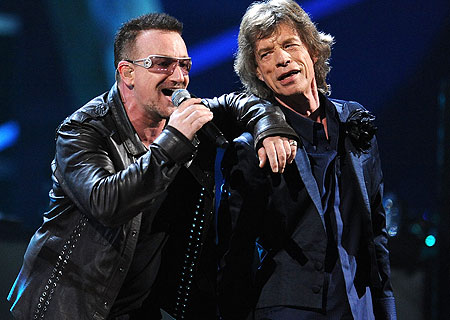
Hall of Fame rock ‘n rollers: Bono and Mick Jagger. Photo from Mirror, U.K.

Hall of Fame benefit:
Taking rock and roll to a new level

By Harvey Wasserman / The Rag Blog / November 3, 2009
[With Gary Baumgarten and Abbie Wasserman]

NEW YORK — Music history has been made with two uniquely powerful nights of performances at Madison Square Garden in celebration of the Rock and Roll Hall of Fame — and the educational foundation it supports.

Bruce Springsteen and the E Street Band; U2; Simon and Garfunkel; Metallica; Aretha Franklin; Annie Lennox; Stevie Wonder; Crosby, Stills & Nash along with Bonnie Raitt, Jackson Browne and James Taylor; Dion; Patti Smith; Smokey Robinson; the Jeff Beck Band; a surprise appearance by Mick Jagger; intros (both nights) by Tom Hanks (who said he did it “just to get the access pass”) and much much more turned midtown into the center of the musical universe once again.

With two (almost) completely different concerts (Jerry Lee Lewis played both nights) the Hall of Fame celebrated its 25th Anniversary and raised more than $4 million for a permanent endowment for the Cleveland-based museum and the educational work in which it specializes. An HBO special from the show will debut at the end of the long Thanksgiving weekend, Sunday, November 29.

Both concerts opened with the 74-year-old Lewis who, in a signature move, kicked over his piano bench the first night, then did it again on Friday.

Since his “Great Balls of Fire” was instrumental in kicking off the musical revolution that became Rock and Roll, it was a fitting pair of gestures.

Crosby, Stills & Nash’s impeccable set opened with their loving ode to the festival at Woodstock, this year celebrating its 40th anniversary. As Graham Nash reminded the audience, 30 years and one month ago, CSN was here in the Garden for the legendary “No Nukes” concerts, whose platinum triple album and feature film raised money and awareness for Musicians United for Safe Energy.

The trio was joined on “Love Has No Pride,” “The Pretender,” “Teach Your Children” and more by MUSE veterans James Taylor, Jackson Browne and Bonnie Raitt, whom David Crosby described as “my favorite singer in the world.”

The “CSN and Friends” show took the form of a “swing (and hug) your partner” fest in which a close-knit extended family of world-class musicians moved from their own songs to hits shared by the group in a graceful, loving minuet. It set the tone for all that followed.

Paul Simon (also a MUSE vet) opened with “Diamonds on the Soles of Her Shoes,” “Me and Julio Down by the Schoolyard,” and “You Can Call Me Al.” He was joined by Dion on “The Wanderer,” Crosby and Nash on “Here Comes the Sun,” and Little Anthony and the Imperials on “Two Kinds of People.” Art Garfunkel brought “The Sounds of Silence,” “Mrs. Robinson,” “Not Fade Away” and “Bridge Over Troubled Water,” in which he indeed conquered the high notes.

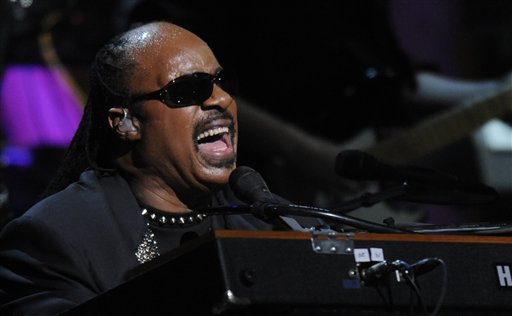
Stevie Wonder then delivered Bob Dylan’s “Blowin’ in the Wind,” “Uptight,” “I Was Made to Love Her” and more. He was joined in succession by Smokey Robinson for “Track of My Tears,” by John Legend for “Mercy, Mercy Me,” by B.B. King for his signature “The Thrill is Gone,” by Sam Moore for “Hold On, I’m Coming,” by Sting for “Higher Ground” and “Roxanne,” and by Jeff Beck for “Superstition,” among others.

Stevie Wonder at Rock and Roll Hall of Fame concert. Photo by Henny Ray Abrams / AP.

Bruce Springsteen and the E Street Band then anchored the stage for the rest of the night. Tom Morello joined in for “the Ghost of Tom Joad,” John Fogerty for “Fortunate Son” and “Proud Mary,” Darlene Love for “A Fine, Fine Boy” and “Da Do Ron Ron” and Billy Joel for “You May Be Right,” “Only the Good Die Young,” and “New York State of Mind.” For a Star Spangled Finale reminiscent of the one with which they closed two MUSE nights in 1979, Fogerty, Moore, Browne, Love, Peter Wolfe and others joined Bruce and the E-Streeters in an unforgettable “Higher and Higher.”

After Hanks again hailed Rock & Roll, and Jerry Lee Lewis again kicked over his seat, Night Two opened with the Queen of Soul, Aretha Franklin’s “Baby I Love You” and “Don’t Play that Song,” in honor of the man who first signed her, the recently departed Ahmet Ertegun. Annie Lennox joined her for “Chain of Fools.” Then came Lenny Kravitz for “Think.” With “Respect” Aretha nailed things down, backed as she was by a 20-piece band that included her son Teddy on guitar.

Jeff Beck returned with a jazz/blues quartet in a set highlighted by “Drown in My Own Tears.” Sting joined in for “People Get Ready,” bluesman Buddy Guy for “Let Me Love You,” followed by ZZ Top’s Billy Gibbons for “Rough Boy” and Jimi Hendrix’s “Foxy Lady.”

After an instrumental version of “Day in the Life,” Beck gave way to Metallica’s high-amp renditions of “For Whom the Bell Tolls” and “One.” Lou Reed contributed “Sweet Jane” and then gave way to Ozzy Osbourne’s “Paranoid” and “Iron.” The Kinks’ Ray Davies set the stage for U2 with the classics “You Really Got Me” and “All Day and All of the Night.”

The rest of the show belonged to Bono and his bandmates and friends. Opening with “Vertigo,” the quartet sailed through “Magnificent” and “No Line on the Horizon.”

Springsteen and Patti Smith came out for a group cover of her “Because of the Night” — twice, apparently for the benefit of HBO, which may have needed the second take to cover a glitch the first time around. It’s a good bet you’ll see that one on the HBO Special at the end of the month.

Also a good bet is “Still Haven’t Found What I’m Looking For,” along with the Black Eyed Peas’ guest version of “Where is the Love.”

To top the two nights, Mick Jagger brought his aerobic instructor’s physique center stage with Fergie to do “Gimme Shelter” and “Stuck in a Moment.”

U2 closed down more than ten hours of the two-night extravaganza with “Beautiful Day.”

But not before Bono gave a monumental nod to “the saints, the heretics, the poets and punks that now make up our Hall of Fame.” Rock, Springsteen added, is a form of liberation that demands everyone “have fun with it.”

The fun was more than evident through both big nights, from Hanks’s loosey-goosey introductions and Jerry Lee’s pyrotechnics to a beautifully choreographed but gritty and completely professional 10-hour marathon from those who have created a culture that simply did not exist a half-century ago, and does not seem to be going away.

That a uniquely crafted museum stands to commemorate it in the nation’s heartland seems every bit as fitting as two powerful nights in the nation’s media center, a landmark event that has made possible the institution’s first permanent endowment.

Close your eyes, for example, and the beautifully bedecked Aretha could have been singing in Detroit’s New Bethel Baptist Church, founded by her father, where she first began to sing in the 1950s. The music industry has changed over the decades, she told us after her Friday performance, but it must do that to stay strong. “R&B, hip hop are alive and well,” she says. “Some of the lyrics I like,” she said, “some not so well.” But the karma of the Rock Hall allows her to “see older members… that have come a long way” along with “the new people.”

Among them might be Jeff Beck, who “thanked” Eric Clapton for being grounded by the gall stone operation that turned Beck from a back-up to a headliner. And Ozzy Osbourne, who challenged us to name another profession in which a performer knows that “when he’s fucked up it’s gonna be a good show.”

A more subdued Steven Van Zandt paid homage to “the British invasion” which got the industry “where we are today.” It was “fun to do a review” of multiple songs with multiple artists, as the E-Streeters did with Springsteen Thursday night. “It’s like an old school rock and roll show. That’s the way it used to be.”

After nominating Darlene Love for membership in the Hall, Van Zandt lamented that if the Rolling Stones were beginning now, his radio show, the “Underground Garage,” would be the only one to play them. “There is no format for new rock and roll,” Van Zandt said. “It’s almost impossible these days” for new groups to make a dent.

“When our generation goes,” he added, “it’s going to be weird.”

John Legend might agree. “I am the luckiest kid in the world,” he told us. “I haven’t paid my dues, and I am humbled and honored to be with Stevie Wonder” and “all these amazing artists that have been making music for a long time.”

“A new generation will be changing the world in different ways,” added Bonnie Raitt. “In the change we feel brewing, I think the Internet and the advent of satellite radio and independent newspapers… will help get the truth out and keep the debate going,” she told us. “I think music and rock and roll will continue to shepherd that along.”

“Rebellion is a life-long thing,” said Jackson Browne. “Rock and roll has always been the language of self-empowerment, freedom and community, and always will be.”

[Harvey Wasserman is author of Solartopia! and Harvey Wasserman’s History of the United States. He helped co-found Musicians United for Safe Energy, and spoke (for Greenpeace USA) at Woodstock II in 1994. Gary Baumgarten is the Paltalk News Network’s director of news and programming and host of the network’s News Talk Online; for CNN Radio he covered the 9/11 attacks in New York and Hurricane Katrina. Abbie Wasserman is a senior at Stern College in New York City, majoring in English literature.]

Rock and Roll Hall of Fame: Stevie Wonder

The Rag Blog

Posted in Rag Bloggers | Tagged , , | 1 Comment

Health Care Naysayers : Please Get the Message

Saying it all in sixty seconds:
Health care reform is a human issue

By Larry Ray / The Rag Blog / Novemeber 3, 2009

I just saw a TV health care message that sensitively illustrates what is happening to too many American lives. A message down on the human level instead of screaming about numbers and cold political minutiae.

Americans for Stable Quality Care produced this :60 second commercial. Its strong message looks at the end of a lifetime of deep love, memories and sharing. With not a word spoken, this powerful one minute message is a clarion call for jaded politicians to look outside their soured, isolated careers and at the need for universal health care for all Americans. This message should urge these career politicians to respond to the Americans they represent by expediting rather than politically picking over and rejecting a plan for health care reform.

Please take a minute to watch this powerful TV message that visually illustrates the words of Health and Human Services Secretary, Kathleen Sebelius, in an August 4, 2009, Washington Post interview:

As the political debate about how to pay for and pass health reform grows louder and more contentious, we shouldn’t lose sight of the reason we’re even having this conversation: We have a huge, once-in-a-lifetime opportunity to improve the lives of all Americans, insured and uninsured alike.

How many of those in the House and Senate who have categorically rejected a proposed universal health care plan could watch this message and with dry eyes still stiffly say NO, clearly for crass personal and partisan reasons? That politicians of all stripes are saying YES to the strong health insurance and big drug manufacturing lobby and their millions in political campaign contributions is truly sickening.

Have a look at the national organizations that make up Americans for Stable Quality Care.

The Rag Blog

Posted in Rag Bloggers | Tagged , , | 2 Comments

Jonah Raskin : Fear and Loathing without Hunter S. Thompson

Gonzo man: Hunter S. Thompson. Illustration by Ralph Steadman / The Badger.

Where is Hunter S. Thompson
Now that we need him?

At times he could he cynical and depressed, but he also had clarity of vision and a commitment to tell the truth.

By Jonah Raskin / The Rag Blog / November 2, 2009

“The Kentucky Derby is Decadent and Depraved.” That is the title of an article by Hunter S. Thompson that appeared in Scanlan’s Monthly in June 1970, almost forty years ago.

The article marked the start of what came to be called “gonzo journalism,” and that reached a crescendo in two powerful books, Fear and Loathing in Las Vegas and Fear and Loathing on the Campaign Trail ‘72. The author, Hunter S. Thompson, was a fearless reporter who loathed the rich and the powerful, and took deadly aim at them in nearly everything that he wrote. Sadly, he committed suicide nearly five years ago on February 20, 2005.

In many ways American journalism has not been the same since his death. Though there are some exceptions, American journalism has become in large part the lapdog for the rich and the powerful. It is fawning, subservient, docile, and toothless. It is the decadent mass media of a decadent empire that stokes the egos of the wealth, and provides distractions from the realities of war, exploitation, poverty and disease. Were he alive today, Hunter S. Thompson would be writing articles entitled “The U. S. Is Decadent and Depraved.”

Thompson saw through the phoniness, the lies, and the deceit of American politicians, and lashed out at them, especially at Richard Milhous Nixon. When Nixon died in 1994, Thompson wrote a piece entitled “He Was a Crook” in which he said, “I beat him like a mad dog with mange every time I got a chance, and I am proud of it. He was scum.”

Thompson spoke and wrote for the disenfranchised, the dispossessed, the poor, the homeless and the persecuted. At times he could he cynical and depressed, but he also had clarity of vision and a commitment to tell the truth. It is true that he was not an objective journalist, that he wasn’t always fair and accurate. It is true, too, that he fictionalized, and that he made himself an essential part of the stories that he wrote about. That was gonzo and that was a part of the greatness and the genius of gonzo.

But gonzo was far more than just fictionalizing and making the author a principal player in the story. Gonzo meant lashing out at the American ruling class that is served by newspapers and magazines such as The New York Times and Vanity Fair with their nauseating adulation of the elite. Gonzo was a karate chop to the heart of the newspaper establishment that lied year after year about war, and the military and economic invasions of countries.

Thompson inspired a generation of reporters. Some of them are still around, still writing, and still fighting the good fight with blogs and books. Thompson’s in-you-face style of reporting was very popular and contagious. Readers loved it because it was real, and because it was alive and genuine. Editors went with it for a time. But that time is past. American journalism is back to its old form: covering up, concealing the bodies, and telling lies.

Professors of journalism say that gonzo can’t be taught. Maybe they’re right. Maybe gonzo is something that a writer has to find for himself or herself in much the same way that Hunter S. Thompson found it for himself. But let’s pray and hope that a new generation comes along that finds inspiration in Hunter S. Thompson’s fearlessness, and his loathing for the likes of politicians such as Nixon, Reagan and the Bushes.

In one of his stories published soon after the Democratic National Convention in Chicago in 1968, he describes himself in the street along with the protesters. Just a few feet away were armed National Guardsmen, city policemen, and the national news media. One of the protesters offered Thompson a joint. He looked at it, looked at the soldiers, police and media and then he took the joint and inhaled. “It seemed at the time like a thing that had to be done,” he wrote. “I knew which side I was on, and to refuse that joint would have been — in my own mind — a fatal equivocation.”

Thompson always knew that there are sides. He always knew, too, what side he was on: the side without the power and the money; the side that had nothing to lose and everything to win. He gave it all he could for as long as he could, and American journalism and American reporting was better because of him.

Some of his former friends and associates are hard on him today. He could not stop drinking, they say. He couldn’t “clean up his act.” But that inability to “clean up his act” was his saving grace. It meant that he never did go to the Kentucky Derby to celebrate with the rich and decadent. He never went to any of the spectacles of the rich and decadent to celebrate with them, but to record and describe their depravity.

[Jonah Raskin is the author of The Mythology of Imperialism: Revolutionary Critique of British Literature and Society in the Modern Age (Monthly Review Press), and American Scream: Allen Ginsberg’s “Howl” and the Making of the Beat Generation (University of California Press.]

The Rag Blog

Posted in Rag Bloggers | Tagged , , , , , | 4 Comments

Brad Will : Mexico’s Legacy of Murdered Journalists

Brad Will — Indymedia journalist murdered in Oaxaca, Mexico, in 2006 — depicted in “Remembering Anarchists of the Americas” mural, Bound Together Bookstore, San Francisco. Image from Wikipedia.

Brad Will is still dead…
(So are 55 other journalists murdered in Mexico)

Despite the appalling absence of resolution in Will’s death three years after the fact, his killers have long been plainly identified.

By John Ross / The Rag Blog / November 2, 2009

MEXICO CITY — Three years after he was gunned down by Oaxaca state security agents October 27, 2006, while filming a confrontation between activists and local police during the oft-violent campaign to oust tyrannical governor Ulisis Ruiz Ortiz (URO), a prominent member of the once-and-future ruling PRI party, U.S. photojournalist Brad Will is still dead.

So are 55 other journalists working in Mexico over the past ten years (eight more remain missing), according to a roster painstakingly complied by Reporters Without Borders, the Paris-based journalists’ group. Sixteen of those on the kill list have been slain since Brad’s still unresolved death. With rare exception, the murders of journalists in Mexico are never solved.

Will, a 35 year-old community activist and troubadour turned Indymedia reporter, covered social protest in such Latin American hot spots as Brazil, Argentina, Bolivia, and Chiapas before arriving in Oaxaca to interview leaders of the APPO (Oaxaca Peoples’ Popular Assembly) and striking teachers whose prolonged street protests demanding URO’s removal as governor galvanized that conflictive southern state during the summer and fall of 2006. Will is the only non-Mexican on the death list held by Reporters Without Borders.

Lead poisoning is an occupational hazard for journalists in Mexico. The most recent killing (at this writing) took place October 9th in the northern state of Durango where crime reporter Gerardo Esparza was executed with a coup de grace to the head in the state capitol; three journalists have been executed in Durango during the first ten months of 2009, two of them last May.

On September 23rd in neighboring Chihuahua, pistoleros burst into the newsroom at Radio Vision in Nueva Casas Grandes and gunned down crusading reporter Norberto “El Gallito” (“the Bantam Rooster”) Miranda who had been probing ties between police and 25 recent killings by drug gangs. Miranda was the third reporter killed in Chihuahua during the military occupation of the state that began in 2007 and is the fifteenth to be assassinated since 2000. In May 2008, Emilio Gutierrez Soto, a correspondent for El Diario, fled Nueva Casas Grande and applied for political asylum in the U.S. after receiving repeated death threats.

Despite the appalling absence of resolution in Will’s death three years after the fact, his killers have long been plainly identified. A front-page photo in the national daily El Universal on the morning after the shooting that has since been displayed around the world frames up four Santa Lucia de Los Caminos’ police agents firing at the Indymedia photojournalist from 35 meters away. Two of the cops, Abel Zarate AKA “El Chapulin” and Manuel Aguilar Coello “El Comandante” were arrested immediately after the murder and then inexplicably cut loose several days later.

Despite the very public identification of the killers (eight other journalists witnessed the killing), URO’s then-chief prosecutor Rosa Lizbeth Cano (now the state auditor) accused four young APPO supporters who had pulled Will out of the line of fire and driven the mortally-wounded U.S. reporter to a local Red Cross hospital, as being responsible for his murder. Arrest warrants for the four remain outstanding.

Although ballistic experts from the National Human Rights Commission (CNDH) and the independent Physicians for Human Rights (PHR was asked to investigate by Brad’s family) established beyond a reasonable doubt that the bullets that slammed into Brad’s chest and side destroying his intestines had been fired from 35 meters away, presumably by the four police agents caught in the Universal photo, the Federal Prosecutor’s Office (PGR), which has taken over the case from Cano, continues to claim that the Indymedia reporter was gunned down by APPO militants with whom he was standing when he fell.

The murder of an American citizen in Mexico did not make much of an impression on the U.S. State Department. Then-ambassador Tony Garza, a Texas political crony of ex-president George Bush, immediately blamed the APPO and Section 22, a rebel local of the National Education Workers Union, for inciting the violence that cost Will his life. Washington’s only response to Brad’s murder was to post travel warnings for U.S. tourists in the region. On the heels of Will’s death and greenlighted by Garza’s accusations, outgoing president Vicente Fox mobilized thousands of federal police to suppress the rebellion in Oaxaca.

Brad Will was not the only victim of police repression in that majority indigenous state. From August through November, 26 militants were gunned down by URO’s police death squads that each night rode through the city firing on APPO barricades. No one has ever been charged in the killings.

Despite efforts by Tony Garza, now a Mexican businessman and married to the wealthiest woman in the country, to sweep the Will case under the diplomatic rug, Brad’s family and friends have struggled to keep the case alive. Their campaign has been backed up by human rights kingpins like Amnesty International and Human Rights Watch. When AI director Irene Khan tried to present Governor Ruiz with her organization’s scathing report on police abuses in Oaxaca, URO rudely rejected the document and handed it back to her.

During 2008, U.S. congressional hearings on the so-called Merida Initiative signed by Bush and Mexican president Felipe Calderon in that Yucatan peninsula city, which provides security forces here with $3,000,000,000 worth of hardware for Calderon’s ill-advised war on Mexican drug cartels (13,000 citizens have died since it was declared in late 2006), Brad Will’s friends and former co-workers disrupted the proceedings, arguing that Mexico’s army and police should not be rewarded for committing human rights abuses.

As a result, language was inserted in the Merida Initiative implementation bill urging the Calderon government to begin a serious investigation into Will’s death. 15% of Merida monies would be held back if a progress report was not issued in the next 120 days.

In October 2008, 48 hours before the 120 day deadline was to expire, the Federal Prosecutor’s Office charged a young APPO supporter, Juan Manuel Martinez, the community sports coordinator in Santa Lucia de los Caminos, with Will’s murder. Martinez was alleged to have been standing near the U.S. photojournalist when he was shot down.

The PGR asserted that it had two eyewitnesses (who it has never formally produced) — one is the nephew of the mayor of Santa Lucia, a URO intimate, and the other a former Televisa camera operator who has reportedly since recanted. Both admitted that they had not seen Martinez with a weapon and were not witnesses to the actual killing. No motive has ever been ascribed to Martinez for the murder. Yet Juan Manuel Martinez remains imprisoned in Santa Maria Ixcotel, Oaxaca’s maximum lock-up, charged with Brad Will’s killing and is facing a 40-year sentence.

On the first anniversary of his arrest this past October 16th, several hundred APPO supporters gathered in the old colonial plaza of the Oaxaca state capital to remind citizens of this on-going miscarriage of justice. Like Will’s death, Martinez’s incarceration has largely been forgotten by the press and the public. Meanwhile, the real killers remain free and several are still on the Santa Lucia de los Caminos police payroll.

“That’s all history now,” PRI federal deputy Adolfo Tinoco, a staunch defender of Ruiz, commented to the left daily La Jornada, “Oaxaca is at peace and in order now thanks to our governor.”

Juan Manuel Martinez’s arrest satisfied the U.S. Congress that the deadline for pursuing Brad Will’s murderer had been met and all Merida funds have since been disbursed. When outgoing Secretary of State Condoleezza Rice paid a goodbye visit to Mexico to distribute checks October 22, 2008, one week after Martinez was jailed, she expressed satisfaction that justice had been done. The Obama administration and current Secretary of State Hillary Clinton have not seen fit to revisit the matter.

Brad Will in Oaxaca on Oct. 26th 2006. Photo from Independent Media Center.

Since Brad Will’s murder October 27, 2006, the political dynamic on both sides of the border has undergone a sea change. Barrack Obama has become the first Afican-American president of the United States and George Bush has been consigned to the garbage heap of history. Felipe Calderon, who came to high office in a fraud-marred election, has faced serial disasters that cripple his credibility.

In the early days of his presidency, Calderon scrupulously avoided any suggestion that human rights abuses had occurred in Oaxaca for fear of offending URO and his PRI party whose support he craved to pass his legislative package — at the top of Calderon’s wish list was the privatization of PEMEX, the national oil monopoly. The privatization of PEMEX is urged by Washington and both Tony Garza and his successor Carlos Pascual speak often of the need for private (U.S.) investment in Mexico’s nationalized oil industry.

The PRI’s hand was enforced by the party’s strong showing in last July’s mid-term elections that gave it a majority in the Mexican congress. Since the Great Tumult of 2006, URO and his party, which ruled Mexico for seven decades before being ousted in 2000 by Calderon’s rightist PAN, have dominated local elections in Oaxaca and Ruiz has become a key player in the PRI’s powerful Governors’ Conference that now includes the chief executives of 22 out of the republic’s 31 states.

With one year left in his stay in the Oaxaca statehouse, Ulisis Ruiz is confident he will finish out his term and hand off the office to “the next PRI governor.” URO is said to have set his sights on Los Pinos, the Mexican White House.

Mexico’s Supreme Court justices are some of the highest priced jurists in the world, knocking down half million dollar salaries that rival both Calderon’s and Obama’s take-home pay. Nonetheless, despite their financial fortunes, the tilt of the 11-judge court is quirky and unpredictable.

The Supreme Court voted to uphold Mexico City’s abortion on demand law by a 10 to one majority (only two of the justices are women) but recently freed paramilitaries convicted of the massacre of 45 Tzotzil Indian supporters of the Zapatista Army of National Liberation.

When charged with investigating human rights abuses by state and federal police in the Mexico state farming village of San Salvador Atenco May 3rd and 4th 2006, during which hundreds were brutalized and arrested, two young men killed by police bullets and tear gas canisters, and 20 women sexually abused, the Court chalked the havoc up to a few rotten cops and absolved the governor Enrique Pena Nieto, the odds-on favorite to be the PRI’s presidential candidate in 2012. After the 2006 incident, Pena Nieto boasted to reporters that he was “proud of his police.”

The Court’s ruling on Atenco did not auger well for victims of Ulisis Ruiz’s hard hand in Oaxaca when the Supremes initiated a probe of the 2006 violence in that impoverished southern state. Indeed, the case was at first handed to one of the panel’s most conservative members, Mariano Azuela, for preliminary investigation.

As anticipated, Judge Azuela produced a massive (926 pages) whitewash, absolving Ruiz and laying the blame for human rights violations on the APPO and the striking teachers whom the justice accused of seeking to overthrow the constitutional state government. Azuela was seconded by another right-wing member of the court, Sergio Anguiano, who labeled the victims “subversives and guerrilleros.” Their draft document excused police misbehavior because Oaxaca, a poor state, does not have adequate police training facilities.

But a funny thing happened to Azuela’s near thousand-page finding on its way to the full court. Despite personnel lobbying of each of the justices by URO to rubberstamp the whitewash, the judges rejected Azuela’s conclusions and, by a seven to four majority, fingered the Oaxaca governor for abuses of authority and related atrocities, including 26 murders committed by his police during the summer and fall of 2006. Nonetheless, the court’s verdict included no penalties or sanctions and the only remedy available — the governor’s impeachment (“juicio politico“) has absolutely no chance of being consummated by a congress in which the PRI holds an absolute majority.

The Supreme Court’s rebuke of URO curiously made no reference to the complicity of ex-president Vicente Fox, Fox’s Secretary of Public Security Eduardo Medina Mora, the late Carlos Abascal, then Interior Secretary, or Felipe Calderon whose presidency overlapped the Oaxaca crackdown.

Federal police under their command were involved in brutal confrontations with the APPO and the striking teachers all summer long and on November 2, 2006, days after Brad Will was murdered, 5000 Federales were airlifted to Oaxaca and rounded up hundreds of Oaxaca citizens, some of them innocent pedestrians trapped in the dragnet, beat and tortured them and shipped them out of state to a federal prison 1200 kilometers away. The Federal Police commander in that carnival of repression, Ardelio Vargas, is now a PRI deputy in the lower house of Congress where he heads up the oversight committee on national security.

Who bears the brunt of responsibility for myriad violations of individual guarantees in Oaxaca in 2006 — the PRIista Ulisis Ruiz’s cops or the federal police sent in by Vicente Fox, a totem of the right-wing PAN? A glance back at the convoluted events on the ground in Oaxaca during that terrible season is instructive.

By July, the PRI had suffered an embarrassing shellacking in the presidential election and URO gave his police carte blanche to maim and kill APPO supporters, anticipating that the turmoil would force Fox’s hand and turn Oaxaca into a federal problem.

But the more out of control the situation became, the deeper Fox dug in his heels and refused the governor’s request for a massive infusion of federal troops. It was only after the murder of a gringo reporter that Fox got the green light from Bush’s ambassador Garza and ordered the Federales in to stamp out the rebellion.

Despite the pivotal role that his murder played in the denouement of the Oaxaca uprising, Brad Will’s name is not even mentioned in the Mexican Supreme Court’s evasive verdict.

Brad Will! Presente!

[John Ross’s monstrous El Monstruo — Dread & Redemption In Mexico City (Nation Books) is hot off the press this Nov. 2nd, the Day of the Dead — you can catch the author reading from El Monstruo at Northtown Books in Arcata on Friday the 13th and at Modern Times in the Mission on the 18th. He will also be speaking at UC-Berkeley on November 19th. These dispatches will be issued every ten days while the author is flogging his books in northern California. The “Ross & Revolution In 2010” book tour is gathering steam — any bright ideas on winter and spring venues? johnross@igc.org Write .]

The Rag Blog

Posted in Rag Bloggers | Tagged , , , , | 3 Comments

HEALTH / Know Thyself (And Watch Thy Back)

Nancy Kennedy, 20, downs soda and fries. Photo from LA Times, 1965.

A good dose of Healthy Skepticism:
Learn what works for you

Each of us is inside our body and we know what it feels like better than the M.D. ever will.

By Kate Braun / The Rag Blog / October 31, 2009

This writing contains no footnotes. No references or links to studies done or research published. What I write comes from my personal experience and experimentation. It comes from the personal experiences of friends and family. It’s more information to use as needed as we do our best to maintain good health. And caring for our physical body is primarily our responsibility.

We can consult medical professionals, we can do online research, we can canvass friends; ultimately, we have to decide what to do or not do to keep our bodies in good working order. It’s important to keep an open mind about what the possibilities are. Print media and TV ads present a variety of pitches urging us to “take this pill” so we will improve our health so we can dance all night and live happily ever after. What’s needed to balance this image, in my opinion, is a good dose of Healthy Skepticism.

M.D.’s treat symptoms. That’s what they’re trained to do. Each of us is inside our body and we know what it feels like better than the M.D. ever will. Listen to your body. You can learn to recognize the onset of a cold before you ever blow your nose. That’s when you should start treating a cold, as soon as you feel it beginning to work on you. Could be vitamins, could be eating lots of grapefruit, could be a pot of chicken soup, could be whatever works best for you. Experiment. Be your own guinea pig. And keep a diary of what you’ve tried to relieve the various discomforts and how well those things have worked or not.

If you are hospitalized, even if it’s day surgery, and you are anesthetized, Watch Your Tongue, starting from when you regain consciousness, for at least 24 hours. There are some Bad Germs in hospitals. They can Eat Your Tissue. If you notice something unusual on your tongue, a sore place, a dent, something that wasn’t there before you entered the hospital, take action. Don’t call the M.D.’s office and make an appointment for next week, grab the bottle of hydrogen peroxide and apply a drop to that sore spot. Hydrogen peroxide will quickly destroy the bacteria that are busily eroding your tongue tissue.

If sensors were applied to your chest while you were hospitalized, note the location and monitor those sites. There could be tiny sharp points in the sensors that could penetrate your skin, which would give viruses and bacteria a place to enter and grow. Again, applying a drop of hydrogen peroxide to each achy site can help. If you tell your M.D. about it, he might decide to give the O.R. crew a lambasting for improperly or incompletely sterilizing the equipment or he might not, but if you put it in writing and send it by certified mail there will be a paper trail to be followed should it prove necessary.

If you eat healthy food, get enough sleep and enough proper exercise, maintain a positive attitude, take vitamins as needed, explore alternatives in health care, learn to listen to your body, and cultivate Healthy Scepticism, my opinion is that you’ll be OK.

A big problem with trying to maintain a healthy lifestyle is not only the ever-present and ever-tempting fast food but also the fat-laden foods doled out to low-income families, as well as ads on TV that continually encourage us to consume more calories than needed. Supersized is Not Better! Read the labels when you buy food. Say “NO” to high fructose corn syrup, phosphates, artificial color, fake wheat bread, sugared cereals, refined sugar. Eat seasonal items, buy local as much as possible, eat lower on the food chain, read Fast Food Nation and re-read Diet For a Small Planet. Remember: You Are What You Eat.

I don’t claim to have all the answers for all and everyone. I know what works best for my body and I try to stay with that regimen. Not always possible, of course, but mostly possible. Perseverance furthers. When you understand what works for you, persevere.

The Rag Blog

Posted in Rag Bloggers | Tagged , , , , , | 8 Comments

Photographer Roy DeCarava : ‘The Sound I Saw’

Photographer Roy DeCarava. Photo by triggahappy76 / Flickr.

Roy DeCarava : 1919-2009

Photographer Roy DeCarava, who died Oct. 27 at age 89, dedicated his 60-year career to capturing images of African Americans. His subjects ranged from daily life in his hometown of Harlem to the Civil Rights movement, but his most noted work featured photographs of jazz greats like Duke Ellington, Thelonious Monk, Billie Holiday and Louis Armstrong…

The first black photographer to win a Guggenheim Fellowship, DeCarava was also awarded the National Medal of Arts… In 1996, his work was the subject of a major traveling retrospective organized by the Museum of Modern Art in New York City.

NPR / October 30, 2009

“pepsi,” 1964. Photo by Roy DeCarava.

The Sound I Saw:
Photography from a black point of view

By Carl R. Hultberg / The Rag Blog / October 31, 2009

Pictures of a man leaving the subway, of a saxophone, a black woman’s face. John Coltrane. Langston Hughes. The black New York City photographer who captured this Harlem history in its latter heyday was Roy DeCarava.

Educated at Cooper Union, and struggling to survive working as an illustrator, Mr. DeCarava always managed to find time to photograph ordinary life in his neighborhood. Whether it was the murky view out a dirty window from a cheap room, or the iconic image of a (now) Jazz Giant, Roy had a way of ennobling everything he snapped. But not in the usual style of strictly European art based traditions or sentimentality. It was as if the simple objects portrayed were the same as the faces of the people, of the Jazz musicians — all possessing a story to tell.

What Roy DeCarava accomplished, and what we now take for granted, is a black point of view. What English word do we use to describe this type of vision? Good question. Perhaps it is better that it doesn’t have a name like “Soul” that could be easily turned into advertising copy and lose all meaning. What Roy DeCarava photographed was the tenderness and quiet pride flowing through everyday Harlem life, the smoldering Jazz solo across a smoke filled club, the structural beauty of a black person’s face.

Included in the seminal photo collection The Family of Man (1955), DeCarava was still mostly intolerant of the white art world. Although he received a Guggenheim Grant in 1952, Roy felt no need to acknowledge that art world or participate in the mainstream art scene. Instead he turned his own apartment in Harlem into a gallery for a few years, exhibiting the work of other art photographers. Instead of working for Life Magazine full time like black photo pioneer Gordon Parks, Roy DeCarava sponsored a protest against the publication.

Roy was also a great photography teacher (at Hunter College), sending hundreds of student camera eyes out into the streets in search of poetic truth. Roy DeCaravara’s great cultural accomplishment was to equate black street life with black Jazz, seemingly in an effort to ensure that one would not rise without the other. It was all about timing, whether it was Jazz, or Photography, or Life.

Asked what he saw in the Jazz performance that made it like photography he said: “I improvise. Improvisation is all about individual interpretations, individual expression. And that’s what I’m doing.” He also said: “in between that one-fifteenth of a second, there is a thickness.” That was a poet speaking. Roy DeCarava passed on this week, but his photographs are still telling their simple eloquent stories of black life.

Also see:

The Rag Blog

Posted in Rag Bloggers | Tagged , , , , , , , , | 4 Comments

Divine Comedy : Joe Lieberman and the Hypocrites

The Hypocrites address Dante, from Canto XXIII of Divine Comedy, Inferno, by Dante Alighieri. Engraving by Gustave Doré from Pantheon Books edition / Wikimedia Commons.

The Eighth Circle of Hell:
Lieberman, Congress and health care reform

Of course, Sen. Lieberman does not stand alone as a hypocrite. In his company are all of those elected representatives in Congress and their families, who receive Federal Employment Health Benefit Programs, the Rolls Royce of health plans.

By Dr. Stephen R. Keister / The Rag Blog / October 31, 2009

Sen. Joe Lieberman’s announcement of his complete and absolute opposition to health care for the poorest and sickest of all Americans took me back to when I was trying to understand Dante Alighieri in my early years. I do recall in his Inferno that Dante subdivided Hell into nine circles, the first circle being the widest and progressively the ninth and inner circle being the smallest and reserved for Lucifer.

Last evening I did a bit of research with Sen. Lieberman in mind and found within the eighth circle the hypocrites, and I quote Dante with a minor modification:

Here we see hypocrites, plodding forever around in their circle: And now we see a people decked with paint, who trod their circling away with fear and groan. And slow, slow steps, seemingly subdued and faint. They all wore cloaks, with deep hoods forward over their eyes, and shaped in fashion like the great cowls some monks wear; Outwardly they were gilded dazzling bright, But all within was lead and weighted thereby, an emperors cape would have seemed feather light. O weary mantle for eternity! Once more we turned to the left, and by their side Paced on, intent upon their mournful cry.

It would appear that Joe Lieberman has become the ultimate hypocrite within the modern American political establishment and that takes quite a bit of effort on his part. During the election that introduced Lieberman to most Americans he designated himself as a very “religious” man who didn’t campaign on The Sabbath. Nevertheless, he voted for every war appropriation designated by the Bush Administration, perhaps inspired, in part, by the two billion for each submarine produced in Connecticut and in part by his representation of Israel’s Likud Party in The U.S. Senate.

He for all practical purposes defected to the Republican Party and actively supported Sen. John McCain for president. He accepted rehabilitation from a naive Sen. Harry Reid after the election, rejoined the Democratic caucus, and was granted chairmanship of the Homeland Security Committee.

Now, after voting for a $1.4 trillion dollar bailout of the insurance giant AIG, it turns out that he thinks the government cannot afford half that amount to provide the American people with decent health care, including health care for the returning veterans’ families, the families of the active military, and the unempowered average American. Once again he plunges a shiv into the back of the Democratic Party and the American people.

Of course, Sen. Lieberman does not stand alone as a hypocrite. In his company are all of those elected representatives in Congress and their families, who receive Federal Employment Health Benefit Programs, the Rolls Royce of health plans. Since this is government insurance, we the tax payers pay 75% of their premiums. Our representatives pay $503 per year for the coverage. Further, if they need an operation they have the option of having it done at a government hospital such as Walter Reed or Bethesda Naval Hospital.

These are the hypocrites who repeat and repeat that socialized medicine is an evil, that the government cannot and should not pay for it. They are protecting us from the government health care which they enjoy. We should also remember that the tax-payer continues to subsidize our elected representatives’ insurance after he/she leaves the congress.

On top of all this we now have Speaker Pelosi introducing health care legislation in the House with a far from “robust” public option. It seems that many of the progressives in the house want payment to physicians to be based on Medicare rates, while the Blue Dogs want these fees to be negotiated. I must admit that I have mixed feelings, as in many geographic areas, Medicare reimbursement is inadequate, and I note that under the Canadian National Health Plan that fees are negotiated yearly at the Provincial level.

It seems to me that the impasse could easily be settled by granting increased fees to primary care physicians — who are in such short supply — under the Medicare schedule. As we have noted previously, and as has been underlined by The American College of Physicians, this shortage will not be solved without making the fees of the general practitioner, the internist and for those in internal medicine subspecialties and pediatrics generally on a par with certain of those traditionally overpaid surgical subspecialties.

Any “public option” — to be effective in reducing insurance costs and providing for the well-being of the public at large — must provide (1) universal coverage, (2) the ability for any and all citizens to opt for the public plan without restrictions, thus reducing health care costs overall, and (3) must begin to provide coverage at the earliest possible time, and not await 2013, as many Americans will continue to die for lack of health insurance in that interval.

Granted, it will require time to provide a well managed, all inclusive program, but it should be instituted gradually over the next three years to start providing coverage for those without insurance. As Dr. Howard Dean pointed out on MSNBC, it is good politics looking forward to the elections of 2010 and 2012 to make the public aware that the government is exhibiting the ability and compassion to implement the program. As for the proposed right for states to “opt-out,” it is probably harmless to include that within a bill but it appears to be a bit of legislative absurdity.

Yesterday the progressives in Congress met with President Obama and the full context of the discussion has not been made public. The President has been a first class waffler relative to health care reform. It is up to the thinking progressives to keep the pressure on for the next several weeks and to try and offer him guidance. Without his leadership the dream of decent health insurance for all can never be achieved.

We must grant that the President has a full plate with both health care and Afghanastan; however, Mr. Obama is an intelligent human being, and was certainly aware of these problems prior to his election. In my opinion, the well being of the American people takes precedence over the umpiring of tribal feuds and pipe line building in a nation in central Asia that has historically, since the time of Alexander the Great, rejected foreign occupation.

On October 20, Robert Reich wrote on his blog,

Last January, as I understand it, the White House promised Big Pharma, big insurance, and the AMA the moral equivalent of what Joel Halderman allegedly demanded of David Letterman: hush money. The groups agreed to stay silent or even be supportive of health care reform, as long as they were paid off. But now it’s time to collect, the bill is larger than the White House expected, and its going to fall like an avalanche on middle class Americans in coming years. That could mean an ugly 2012 election (read Sarah Palin). So the President has to do what Letterman did: refuse to pay.

On October 26 Reuters published an article indicating that our current health care system wastes up to $800 billion per year due to:

  1. Unnecessary care such as overuse of antibiotics and lab tests to protect against malpractice exposure makes up to 37% of health care waste or $200 to $300 billion a year.
  2. Fraud makes up to 22% of health care waste or up to $200 billion a year in fraudulent Medicare claims, kickbacks for referrals for unnecessary services and other scams.
  3. Administrative inefficiency and redundant paper work account for 18% of health care waste.
  4. Medical mistakes account for $50 billion to $100 billion in unnecessary spending each year or 11% of the total.
  5. Preventable conditions such as uncontrolled diabetes cost $30 billion to $50 billion a year.

The same report indicates that the average U.S. hospital spends one quarter of its budget on billing and administration, nearly twice the average in Canada. American physicians spend nearly eight hours per week on paperwork and employ 1.66 clerical workers per doctor, far more than in Canada. Yet, primary care doctors are lacking, forcing wasteful use of emergency rooms.

Yet the On Line Journal reports that

United Health Care’s 155% profits on Medicare Plans (“Medicare Advantage”) must be a company record, especially in a down economy, and an embarrassing fact, particularly as the conservatives in the Senate Finance Committee fight to preserve the present payment structure of United Health Care and its fellow insurance companies. Private insurance plans in medicare cost up to 19% more than the cost to care for the same people under the public Medicare program.

In other words the taxpayers lost $2.7 billion in 2005 to private medicare advantage plans and their parent insurance companies. Yet the insurance industry and its prostitutes “keep telling innocent seniors that they will suffer (even more) if they lose their Medicare Advantage Plans.” This is not true. “Medicare Advantage Plans can hurt people with Medicare. Two studies found that people could end up actually paying out-of-pocket costs in a private plan than in straight Medicare.”

Congress, in the interest of preserving Medicare, must act on this issue, and must also redo the Medicare prescription plan, in the interest in saving the Medicare Plan for future generations.

I have previously warned the consumer about the purchase of insurance, medical devices, or pharmaceuticals advertised on TV. It does not require an Einstein to recognize that TV ads cost money, and that the consumer pays in the end. The current edition of Consumer Reports discusses Flomax, the highly advertised drug for an enlarged prostate. In 2008 the manufacturer spent $116 million advertising Flomax and racked up sales of $1.2 billion. Flomax can cost up to $246 monthly to the patient; however, one can obtain a generic equivalent, Doxazosin, for approximately $10 per month.

Always ask your doctor about generic equivalents, which are just as good as name brands, and are equally safe. If your physician refuses to discuss the matter, you should be concerned that he MIGHT be getting a kickback on the brand name version, or at the least is poorly informed. It is easy to look up this information in a book entitled the Physicians’ Desk Reference.

Unhappily, true health care reform is in the hands of Congress, and that reminds me of a comment by Mary McCarthy:

The American, if he has a spark of national feeling, will be humiliated by the very prospect of a foreigner’s visit to Congress — these, for the most part, illiterate hacks whose fancy vestys are spotted with gravy, and whose speeches, hypocritical, unctuous and slovenly, are spotted with the gravy of political patronage, these persons are a reflection on the democratic process rather than of it; they expose it in its underwear.

[Dr. Stephen R. Keister lives in Erie, Pennsylvania. He is a retired physician who is active in health care reform.]

The Rag Blog

Posted in Rag Bloggers | Tagged , , , , , , | 4 Comments

Honduras : A Deal is Cut to Reinstate Zelaya

Zelaya supporter shouts slogans outside the National Congress. Photo from AFP.

Compromise deal restores Zelaya
Riot police meet demonstrators with tear gas

By David Holmes Morris / The Rag Blog / October 30, 2009

See Val Liveoak’s analysis of the latest developments — plus more photos — Below.

After three weeks of negotiations in a Tegucigalpa hotel, representatives of Honduran President Manuel Zelaya and de facto President Roberto Micheletti have reached an agreement by which Zelaya may be reinstated to the position from which he was ousted in a coup d’état on June 28.

On the same day the accords were announced, the police and the military attacked the several hundred demonstrators outside the Clarión Hotel, where the talks were held, using teargas and beating and arresting an unknown number of protesters. “This government is committed to dialogue,” Micheletti declared in a press release announcing the agreement, “keeping to its goal of defending fundamental principles for the well being of our homeland.”

The agreement, announced late in the night of October 29, results from Micheletti’s concession that Zelaya’s restitution should be ratified by the legislature, as Zelaya had held, and not by the supreme court, as the golpista government had argued. Zelaya and his supporters had claimed that leaving the final decision to the court would constitute an admission that the president was removed from office by due process as a result of the crimes against the constitution that the golpistas have charged him with, while a legislative decision would imply he was removed by decree in a coup d’état.

The accord comes after the direct intercession of U.S. State Department undersecretary Thomas Shannon and follows weeks of efforts by representatives of the Organization of Ameican States.

The agreement would leave the final decision on Zelaya’s reinstatement up to the unicameral legislature, pending approval by the supreme court not of his reinstatement but of the legislature’s authority to decide the question. The court had declared several weeks earlier that it would abide by any decision reached in the talks.

The agreement also calls for formation of a “government of reconciliation,” presumably including at cabinet level representatives of all sectors of society; rejects a proposed amnesty for acts committed in connection with the political crisis; calls for recognition of the results of the November 29 elections; specifies the formation of a truth commission; and calls for asking the international community to remove sanctions imposed on the country as a result of the coup and to send observers to monitor the elections.

Riot police hurling tear gas at a march of Zelaya’s supporters in Tegucigalpa, Thursday, Oct. 29, 2009. Photo by Arnulfo Franco.

Zelaya had agreed early in the negotiations to abandon efforts to organize a constituent assembly, efforts he had made earlier in response to popular pressure, which had sparked the coup. A national opinion poll on rewriting the constitution was scheduled for the same day he was ousted from office.

If actually reinstated, Zelaya will thus serve with no real power for the few weeks left before his term expires in January. “Returing to power might be symbolic,” a Honduran newspaper quotes him as saying two weeks ago, “but what cannot be permitted is that there be coups d’état in any country.”

Elimination of the question of a constituent assembly, central to the concerns of the resistance movement opposing the coup government, brought about the resignation of resistance leader Juan Barahona from Zelaya’s three-member negotiating team. “I didn’t sign [the agreement], I don’t agree with it,” Barahona told the press. “We are never going to renounce the constituent assembly. But we will continue supporting President Zelaya.” Barahona is a director of the Frente de Resistencia contra el Golpe de Estado.

Rafael Alegría, another director of the Frente, has been quoted in the press as declaring that the position of the group is “to continue demanding a constituent assembly and full democracy for the country.” He added, “Our position remains firm: the resistance will not back down, so we are still in the streets demanding President Zelaya’s reinstatement and demanding democracy.”

“Zelaya is a symbol,” Salvador Zúñiga has been quoted as saying, “but he is not the definition.” Zúñiga is director of the Consejo Cívico de Organizaciones Populares e Indígenas de Honduras, the Civil Council of Popular and Indigenous Organizations of Honduras. Writing for La Jornada, journalist Arturo Cano says Zúñiga, part of Zelaya’s team of negotaitors in the earlier San José talks, belongs to a sector of the resistance seeking the formation of a “civilian junta” government which would call a constituent assembly within six months “to carry out the profound reforms the country needs, a possible solution given the deep crisis we are living through.”

Many observers say the golpista plan, as supported and promoted by the United States, is to reinstate Zelaya shortly before the November elections in order to create an appearance of legitimacy for the resulting government. The candidate for the rightist Partido Nacional, Pepe Lobo, is expected to win the presidency. Even with Zelaya back in office, large numbers of Hondurans are expected to boycott the elections. The October 29 agreement, reached a month before the November 29 elections, would seem to fit the alleged plan.

Ousted Honduran President Manuel Zelaya, with supporters, at the Brazilian embassy in Tegucigalpa, Friday, Oc.t 30, 2009. Photo by Esteban Felix.

Some reflections on the accord in Honduras:
The elite will still be in control

By Val Liveoak / The Rag Blog / October 30, 2009

The accord as described in the NYT article below is a mixed bag.

If all this had happened months ago it would have been great. Now, it leaves things on a road not only to the status before the ouster of President Zelaya, but actually before some of the progressive moves his government made.

To my knowledge, none of the registered candidates for President in the now to be recognized elections has offered to maintain his changes — among them almost doubling the minimum wage, ties with ALBA countries, cheaper petroleum from Venezuela, etc. I doubt any will continue the call for a revision of the Constitution, the issue that sparked the ouster — and was about much more than a change in limitations of presidential terms.

Nor will some of the setbacks instituted by the coup government — and Congreso — likely be rolled back. These include privatization of power, water and forest resources which were put into effect, I was told, within a few days of the coup. (There’s talk of selling off the Copan Ruins, the jewel of tourism in Honduras, as well.) In fact, it remains to be seen if the ministers/cabinet members that the coup regime replaced will be able to return to any sort of effective administration in the few months left of Zelaya’s term.

It will be interesting to see how the Resistance coalition responds. They have been calling for delayed elections in which they have the time and security to mount an effective opposition candidate. If they were able to do this, considering their numbers (I believe 75-80% of the population) they would be able to win considerable power in a new government.

Even assuming the government that is elected in November will protect human rights and provide security to opposition candidates, will they be willing to wait for another election cycle? Will the new government make real efforts to address their concerns?

Roberto Micheletti: “Committed to dialogue.” Photo by Tiempo.

An effective Truth commission would be a very good step. We’ll see how it resolves the dilemma between a superficial reconciliation and actually punishing human rights violations. We’ll also see if the new administration after the elections will rein in the security forces in the face of what I expect to be fairly widespread and likely militant opposition. Will formal “legal” repression via security forces and non-formal repression via death squads or paramilitary forces become the standard operating procedure?

In some accounts of the agreement there was more emphasis on the efforts of the OAS. But it looks to me like the U.S.’ efforts chiefly seem to be aimed at legitimizing the November elections (which cannot be the engine for any real change in Honduras unless something changes very fast).

The question is, would an election not accepted by the world have been worse than the one that will return the status quo? Given the reality of the probable results of the elections, it will be extremely important for U.S. and world policy to emphasize protection of human rights of the now large and united opposition.

If the opposition continues to meet violent repression or even finds itself incapable of making changes that Honduras needs to reduce the terrible levels of poverty in the country, the possibility of pressure from some sources for an armed insurgency are likely to increase.

The elite of Honduras will win the election in November, I believe. If they continue to do things as they have done throughout the last four months, Honduras is ripe for revolution.

Here’s what the NYT has to say.

Deal Reached in Honduras to Restore Ousted President
By Elisabeth Malkin / October 30, 2009

MEXICO CITY — A lingering political crisis in Honduras seemed to be nearing an end on Friday after the de facto government agreed to a deal, pending legislative approval, that would allow Manuel Zelaya, the deponed president, to return to office.

The government of Roberto Micheletti, which had refused to let Mr. Zelaya return, signed an agreement with Mr. Zelaya’s negotiators late Thursday that would pave the way for the Honduran Congress to restore the ousted president and allow him to serve out the remaining three months of his term. If Congress agrees, control of the army would shift to the electoral court, and the presidential election set for Nov. 29 would be recognized by both sides.

Honduran resistance leaders Juan Barahona (left) and Rafael Alegría. Photo by TeleSUR.

On Friday, Secretary of State Hillary Rodham Clinton called the deal “an historic agreement.”

“I cannot think of another example of a country in Latin America that, having suffered a rupture of its democratic and constitutional order, overcame such a crisis through negotiation and dialogue,” Mrs. Clinton said in Islamabad, where she has been meeting with Pakistani officials.

The accord came after a team of senior American diplomats flew from Washington to the Honduran capital, Tegucigalpa, on Wednesday to press for an agreement. On Thursday, the assistant secretary of state for Western Hemisphere affairs, Thomas A. Shannon Jr., warned that time was running out for an agreement.

Mr. Micheletti’s government had argued that the Nov. 29 election would put an end to the crisis. But the United States, the Organization of American States and the United Nations suggested they would not recognize the results of the elections without a pre-existing agreement on Mr. Zelaya’s status.

“We were very clearly on the side of the restoration of the constitutional order, and that includes the elections,” Mrs. Clinton said in Islamabad.

According to Mr. Micheletti, the accord reached late Thursday would establish a unity government and a verification commission to ensure that its conditions are carried out. It would also create a truth comisión to investigate the events of the past few months.

The agreement also reportedly asks the international community to recognize the results of the elections and to lift any sanctions that were imposed after the coup. The suspension of international aid has stalled badly needed projects in one of the region’s poorest countries. Negotiators for both men were expected to meet Friday to work out final details. It was not clear what would happen if the Honduran Congreso rejected the deal.

Passage could mean a bookend to months of international pressure and political turmoil in Honduras, where regular marches by Mr. Zelaya’s supporters and curfews have paralyzed the capital.

Latin American governments had pressed the Obama administration to take a forceful approach to ending the political impasse, but Washington had let the Organization of American States take the lead and endorsed negotiations that were brokered by the Costa Rican president, Óscar Arias. But those talks stalled in July.

Demonstrators outside Clarión Hotel. Photo by Indymedia Honduras.

New negotiations began earlier this month but broke down two weeks ago. With the Honduran elections approaching, the United States chose to step up pressure and dispatched Mr. Shannon, along with Dan Restrepo, the senior director for Western Hemisphere affairs at the National Security Council.

Some Honduran political and business leaders have argued that the military coup that ousted Mr. Zelaya on June 28 was a legal response to his attempts to rewrite the Constitution and seek re-election. But that constituency was also concerned by his deepening alliance with Venezuela’s leftist president, Hugo Chávez.

Mr. Zelaya, who was initially deposited in Costa Rica, still in his nightclothes, sneaked back into the country on Sept. 21 and has been living at the Brazilian Embassy since then. It was unclear when Mr. Zelaya would be able to leave the embassy, which has had Honduran soldiers posted outside. The de facto government had said it would arrest him if he came out.

Source / New York Times

The Rag Blog

Posted in Rag Bloggers | Tagged , , , , , | Leave a comment

Paul Baker : Giant of Texas Theater Dies at 98

Paul Baker in front of Dallas Theater Center, designed by Frank Lloyd Wright, 1960. Photo by Eliot Elisofon / Life Images.

Giant of Texas theater Paul Baker:
Director, educator, firebrand dies at 98

See ‘Paul Baker at Baylor: A student remembers,’ by Jim Simons, Below.

Texas has lost one of its legendary artistic mavericks: Theater pioneer Paul Baker died Sunday [October. 25, 2009] of complications from pneumonia at his Central Texas ranch.

Mr. Baker, 98, was the founding artistic director of the Dallas Theater Center, which he led for 23 of its 50 years. His unconventional ideas about education nurtured such playwrights as Preston Jones, and his students have been among the most influential Dallas arts leaders…

Mr. Baker was also known for his mercurial moods and his practical jokes. Actor Charles Laughton, whom he directed in the 1950s, called him “crude, irritating, arrogant, nuts and a genius…”

While a professor at Baylor University in the 1950s, Mr. Baker attracted national attention with his experimental productions. His national profile caused Dallas theater backers to invite him to set the initial course for the city’s leading theatrical institution. He worked with master architect Frank Lloyd Wright on the design of the Theater Center’s home for its first 50 years, the Kalita Humphreys Theater. [This would be Wright’s last building.]

Controversy always lurked near Mr. Baker. In 1963, Baylor University asked him to omit language the school objected to from Eugene O’Neill’s Long Day’s Journey Into Night. He, his wife, Kitty (who taught mathematics at the Baptist-affiliated university), and his entire staff resigned — but immediately set up an even bigger shop at Trinity University, by then in San Antonio.

Lawson Taitte / Dallas Morning News

In the 1950s, Baker invented revolutionary arts training known as “integration of abilities,” which won the attention of theater artists around the world…

…Baker made a crucial voyage to England, Germany, Russia and Japan to observe theater. Insights from this trip helped form a new Baylor theater, Studio One, which placed the audience in swivel chairs embraced by six stages. Over the next decades, Baker would contribute to 10 other Texas theater designs that positioned the dramatic action around the halls, rather than on a 19th century-style picture frame stage.

Michael Barnes / Austin American-Statesman

From left, Burgess Meredith, director Paul Baker, and Charles Laughton at rehearsal for Hamlet, Baylor University. Photo by Myron Davis / Time & Life Pictures /Getty Images.

Paul Baker at Baylor:
A student remembers

By Jim Simons / The Rag Blog / October 30, 2009

In my one year at Baylor University in the late ‘50s, I was not impressed by the quality of education or the professors. Even so, my best college professor at the three universities I attended may well have been Paul Baker at Baylor.

I took two courses he taught: Beginning Playwriting and Introduction to the Creative Process. I quickly confirmed I was no playwright in the making. My heavy-handed play, laden with obvious symbolism and self-consciously intellectual dialogue, earned me a C, generous at that. But the other course was one of the best I ever encountered in Texas academe. We studied all kinds of art — literature, painting (I wrote a paper on Joan Miro), architecture, dance and music in one electrifying semester.

It was the process of creating art that Baker was after. We read what artists themselves had written in letters or essays about their work. We read their works (literature) and the analyses of critics. It was, as you can tell, a lot of work. Work undertaken willingly and enthusiastically. In class Professor Baker lectured in his roving and animated style and he brought in a few of the people we studied to lecture in person. Luckily, all my other courses were a cakewalk and so I made an A in this scintillating class.

At the time I did not realize how truly marvelous this course, or Baker himself, was. It was only years later that I came to view this as a significant part of my education. Day dreaming in law school as the teacher droned on about the Statute of Uses or Texas land titles, I found my mind going back to things we learned from Baker, or more accurately, with Baker. His mind seemed always sweeping over the familiar (to him) material and finding new insights which clearly delighted him. He was equally delighted if one of the lunks seated in the Baylor Theater where the class was held came upon a revelation.

At the time it was said that there were about three avowed liberals on the Baylor faculty. I believe Paul Baker was one of them. I knew my great debate coach, Glenn Capp, was one of them and I had heard that Dr. A.J. Armstrong of the English Department (and his wife Anne) completed the courageous Baylor triumvirate. There might have been a few other pretenders or, as we said in other contexts, “LBJ liberals,” not unlike what Sam Rayburn said of Dixiecrats, they were like “new antiques.” (Of course, Rayburn never said that of his close ally, Lyndon.)

I was shocked to see that the story about Paul Baker’s death at age 98 that ran in the Austin paper failed to even mention Baker’s resignation from Baylor in 1963 over the attempt to censor a play at the Baylor Theater. I wondered whether Baylor University had succeeded in whitewashing history?

In 1963 Paul Baker mounted a production of Eugene O’Neill’s “Long Days Journey Into Night” at Baylor Theater and, if I recall, got to perform it once before Baptist ministers in Waco and others incensed by its language and themes put up a righteous howl, as Baptists do so well. Then president of Baylor Abner McCall ordered Baker to excise all the “bad language” and some of the improper themes before going on with the production.

Baker resigned rather than accede to this demand. Virtually the entire Drama Department, including its graduate students, also resigned. Many followed Baker to Trinity University in San Antonio where he kept teaching and producing plays. His principled stand at Baylor had only enlarged the gigantic stature of this man in my eyes.

A few years ago, perhaps in the ‘90s, I saw Paul Baker again when he appeared at the Hyde Park Theater in Austin to support a play written and performed in by Ken Webster. Did I actually speak to Baker and stumblingly try to tell him how he had lit up my young mind back at Baylor University four decades ago? Or, did I so vividly imagine my encounter with him that I had come to believe my fantasy? I am honestly not sure. I hope I did at least try to tell him what he meant to the education of one kid at Baylor.

Growing up in Waco in the ‘40s I had gotten the idea that Baylor was the pinnacle of the college experience, an experience no one else in my family had. Hence, after my freshman year at SMU, I jumped at the full debate scholarship offered to me by Prof Capp (as he was known by all) and took up residence in old Brooks Hall, a gothic five story men’s dormitory without elevators, now gone, replaced by a gleaming 21st century dorm.

Unfortunately, not all of our youthful ideas survive a reality check. Baylor did not live up to the idea I had of it from living in Waco and rooting for the football team on Saturdays when my long dead father took me to the games. Some of the fondest memories of my life. As a student at Baylor in 1958, even I could see how narrow and parochial the school was and how limited its horizons in assessing the human condition through great literature and science. Diversity was something strenuously resisted and so the intellectual climate there was stifling.

Some five years before the dustup that drove Paul Baker away, I left Waco to take up residence at the Campus Guild Coop on the campus of the big state university in Austin. Home at last. But the part of Baylor I took with me was what I learned three hours a week in Paul Baker’s course, perhaps the best one I had in my checkered college life.

The season has been marked by the shaking of the earth as giants have fallen. Before word of Paul Baker there was another giant who passed. The great American and Texas jurist William Wayne Justice was also taken away. It is likely that they never met each other even though close in age. But both men affected my life and the lives of so many others.

[Civil rights lawyer and activist Jim Simons wrote Molly Chronicles: Serotonin Serenade, a memoir about movement law and radical poitics in Sixties Austin.]

The Rag Blog

Posted in Rag Bloggers | Tagged , , , , , , , | 2 Comments

Afghan Hawks : Make Your Case (And Chill with the Hot Air)

Photo by Michael Yon / Big Hollywood.

A suggestion to the Afghan hawks:
Give us facts, not just hot air

By Sherman DeBrosse / The Rag Blog / October 30, 2009

The supporters of Joe Biden seem to be on the defensive in the debate over what to do in Afghanistan even though the hawks have not advanced a strong case for escalating our involvement there. There seems still to be a basic assumption abroad that Americans must police the world, blindly follow the Pentagon, and apply more force when in doubt.

Those were clearly the assumptions of Dick Cheney, our most outspoken hawk, when he accused President Barack Obama of “dithering,” claiming taking time to deliberate about Afghanistan policy amounted to putting American lives at risk. In conjured images of a surrounded unit waiting for reinforcements. The former vice president has the right to criticize Obama, but we have a right to expect solid arguments rather than loaded words and appeals to emotion. If he had good arguments to offer, he did not bother to make them.

Of course, the greatest hawks are in the military. On October 13, Sy Hersh told a Duke University audience that the Pentagon was at war with the White House, and he bluntly stated that some of this was racially motivated. He added that the struggle is about control of policy and that it was calculated that President Barack Obama will lose support no matter what he does. All of this is reminiscent of the insubordination of Douglas MacArthur, the bad information the Pentagon fed LBJ in 1965, and the Navy’s theft of Nixon documents in 1971-1972.

When Pentagon staffers said they could not prepare a report on the advantages of a counterterrorism-only option because there were none, any serious observer could see that the military was in danger of exceeding its constitutional role. Hersh, a famous investigative reporter whose reports have been consistently well sourced, predicted that the Pentagon would get Obama to accept its will.

The Afghanistan hawks are talking about putting many more Americans in harm’s way. Those lives are precious. We have also reached the point where more care should be taken with the money we spend. By a conservative estimate Bush’s wars will cost between three and five trillion. Who knows how much more McCrystal’s proposed escalation will cost?

There is also the matter of priorities. Conservatives are outraged that almost $900 billion will be spent over ten years to extend health care to almost all Americans. They do not begrudge spending any amount on war and destruction.

Some might remember that the Pentagon strategists used game theory in the Sigma simulations to test various strategies for winning the Vietnam War. They never found one that would assure victory. Nevertheless, we slogged on because it was inconceivable that the commitment of massive forces and resources would not work.

The hawks have not offered compelling reasons to wade deeper into the Afghan morass, nor have they offered a strategy that promises success.

Before committing more troops to Afghanistan, the hawks should be sure that all or almost all of the following are true.

1. There should be a government in place in Kabul that will win the confidence of the great majority of the people.

This is what we know. The Afghans had a disputed election, and the UN sacked Peter Galbraith for revealing that there was a great deal of cheating on behalf of President Hamid Karzai. There were “ghost polling-stations” and far fewer people voted than were claimed. Bitterness against Karzai’s election tactics is intense. No one believes bitterness over the recently rigged election will dissipate soon. A third of the ballots cast for Karzai were tossed out and he now must face a run-off election. It is estimated that again there will be a low turnout due to Taliban threats and the widespread opinion there that the IEC favors Karzai. That may be why the Sirai Haqqani Taliban faction, operating out of North Waziristan in Pakistan, targeted the UN guest houses.

Few think we can be successful in Afghanistan without a government that commands the allegiance of most Afghans. Almost all admit that the Karzai government is impossibly corrupt. It is widely claimed that Ahmed Wali Karzai, the president’s brother, is involved with a drug trafficker who also does business with Al Qaeda and the Taliban. Yet many think this regime will be a solid and useful partner in ending the insurgency there. No one believes bitterness over the recently rigged election will dissipate soon.

In eight years, Karzai has made little progress in building up the army and police forces. The Afghan National Army stands at 94,000 and has had a little success in the north. It will take two years to increase it to 134,000. That is still far short of the 300 or 400 thousand that are needed. Who can remember that there were 91,000 when George W. Bush began to rebuild the ANA.

Counterinsurgency is really about keeping the Taliban from gaining control of any large part of Afghanistan so that they will not give Al Qaeda a safe haven. Richard Barrett, coordinator of the U.N.’s Al Qaeda and Taliban Sanctions Committee, quotes remarks by Mullah Omar to the effect that the Taliban will focus on consolidating power, not bringing in Al Qaeda. The Taliban realize that giving bases to Al Qaeda got them kicked out in the first place. Doing so again would result in tremendous punishment and probable loss of power.

Any extended commitment that looks like imperialism or occupation will fail. To battle that perception, the administration should talk in terms of an expeditionary force that will remain around two years, more or less. Less, if the Afghan government does not appear to improve. . That puts the Karzai regime on notice that it must quickly put its house in order, and it precludes an open-ended war.

2. Pakistan will stop assisting the Afghanistan Taliban and will prevent its Taliban from entering Afghanistan.

Pakistan will continue playing a double game — doing enough to get aid while keeping the Afghan Taliban alive. Pakistan has a vital interest preserving great interest in Afghan affairs. They distrust Karzai because he is too close to India and is permitting Indians to invest in Afghanistan. India is doing many good things there to help the Afghan people; the trouble is that their presence is one reason Pakistan still helps the Afghan Taliban.

Pakistan also complains that the Karzai regime is top heavy with Tajiks and that the Pashtuns are seriously underrepresented. The Pakistanis put the Taliban in power in the mid-1990s and learned that they are not ideal clients. For the moment, they are a useful tool. Pakistan would prefer to broker a new power-sharing arrangement in Afghanistan that would give the Pashtuns the upper hand while keeping the Taliban from the main levers of power.

The second problem with Pakistan is control of its border. It is true that Pakistan has sent 30,000 troops to deal with the Mehsud Taliban. The Nehsud insurgents no longer have much public support, but they will prove to be difficult to handle on the battle field.

It is a battle between troops trained to battle Indians in conventional warfare against guerillas. So far, that army has not shown skill in dealing with civilians in Taliban-infested areas or in helping refugees from the fighting.

The Pakistan Army managed to crack the alliance between the Mehsud and the Pashtun Pakistani Talibans led by Mullah Nazir and Hafiz Gul Bahadur. The army has repeatedly failed to deal effectively with them and has had to resort to bribery. Now Major General Athar Abbas promises to deal with those two, as soon as the Mehsud are crushed: “If you get the biggest bully in [the tribal lands,] all the other guys will fall into line.” If this were believable, Zazir and Bahadur would not have let the alliance with the Mehsud dissolve.

There is also another Pakistani Pashtun Taliban under Sirajuddin Hawwani, which is thought responsible for the Kabul bombings. In the past he had close ties to the ISI, Pakistan’s CIA. Now the Pakis tell us they have no idea where he is. The United States has evidence that he is operating out of North Waziristan. All three of these Paki Pashtun Talibans are Afghanistan-oriented and likely to be sending troops across the border with greater frequency.

Hilary gets an earful. Secy of State Clinton talks with Pakistani tribal people in Islamabad, Friday, Oct. 30, 2009. Photo by Irfan Mahkmood / AP.

Secretary of State Hillary Clinton confronted Pakistan on the matter of Siraj Hawwani and other Taliban who have been hiding out in Pakistan since 2002. Her charge that Pakistan has been colluding with these terrorists offended the Pakistanis, but it was important that she confront them on t his. The Pakistanis are willing to fight home-grown Taliban when those people threaten the regime. So far they have not moved against the Afghan Taliban in the tribal areas.

So long as these units are not attacking the Pakistani army, it is not in the army’s self interest to move against them. Similarly, there is no good reason to injure the Taliban in Afghanistan so long as Karzai pursues the same policies with respect to India and the Pashtuns.

It would be foolish to dismiss the possibility that the Afghan Taliban might eventually obtain shoulder mounted missile launchers from people in the Pakistani military. The Pakistanis have a large store of them, which they have manufactured. Though the military was once thoroughly secular, Islamic fundamentalism jihadism is common among the rank and file and is growing in the officer corps. We know that the Pakistani Taliban is using heavy weapons against the Pakistani army. How did they obtain them?

3. The “surge” techniques used in Iraq will be successful in Afghanistan.

The surge in Iraq focused on urban areas, and there are far fewer of them in Afghanistan. In Iraq, it involved buying off Sunni tribal leaders and their followers. It would be a step toward realistic thinking if advocates of escalation in Afghanistan admitted that purchasing support was a big part of the surge’s success. Bribery is worth trying in Afghanistan, where insurgent fighters get about $10 a month. We should try that in any case, but it is necessary to realize that the tribal structures in Afghanistan are not as powerful and coherent as in Iraq.

Only Bob Woodward has openly discussed another reason why the surge worked. Special Forces in Iraq, under McCrystal, carried out something like the Vietnam War’s Operation Phoenix and eliminated thousands of the insurgent cadre. It seems that that technique may not work in Afghanistan. Black ops there seem to convert people into Taliban supporters. That is partly why pilots and drone operators must get permission from a superior officer and a JAG lawyer before firing missiles. There is also concern about the negative consequences under international law if too many civilians are injured.

A U.S. counterinsurgency program will require far more troops that McCrystal is now requesting, in part because there are fewer urban concentrations and because of disadvantages presented by weather and terrain. Afghans in the south and east already see the U.S. as an occupying power, and the presence of more troops is certain to deepen that impression in those places and possibly spread it to the rest of the country. The McCrystal strategy would be an occupation, and foreign occupations of that country since the time of Alexander the Great have been failures.

Simply put, occupations breed anger, and long occupations breed still more anger and violence. Many experts claim that raising the number of U.S. troops there will simply provoke a great nationalist backlash. The Carnegie Institute concluded earlier this year that the coming of additional American forces actually helped the insurgency as Afghans saw them as occupiers. Success will require substantial forces in remote, mountainous places, where we have not always had great success.

Pakistan has 32 different linguistic groups, a mountain chain that extends 300 miles, and only 11,000 miles of roads — less than a fifth of them paved. This will be an extremely difficult environment for effective counterinsurgency activity by foreign forces.

The battle of Wanat, Afghanistan, lasted only two hours on July 13. The base was up in the mountains at a place where we could disrupt the flow of Taliban fighters coming in from Pakistan. Nine Americans were killed and 29 were injured, amounting to a casualty rate of 75%. Warfare is the number one sport in Afghanistan, and these illiterate warriors are smart when it comes to tactics. They know that frequent bad weather inhibits airpower and they first go after heavy weapons and communications. They look for windows of opportunity to attack.

On that day they attacked at 4:20 a.m., firing rocket grenades at anti-tank rocket launchers and a 50 caliber machine gun. It took time for the choppers to arrive, and visibility was tough. The aircraft took some hits, but we retained the base.

Two weeks ago, at a base north of Wanat, we lost eight soldiers in a bloody day-long battle. They were killed by a well-armed force that dwarfed them in size. Their mission was to try to stem the flow of Pakistani Taliban fighters over the border to join their allies in the Afghan Taliban. Indeed, a number of the fighters were Pakistani Taliban expelled from the Swat Valley by Pakistan’s army.

The guerilla force that confronted the Americans numbered about 300. In Iraq, the guerilla forces seldom exceeded 30, with the possible exception of the fighting in Fallujah.

We found it necessary to abandon both those bases in Nurestan province.

Even General Stanley McCrystal admits we have not mastered the math of counter-insurgency strategy in Afghanistan. Sometimes 20-2+0. That is we take out 2 insurgents and the other eighteen might just quit and go home. Good. But sometimes 20-2= 47. We take out two important insurgents and their male relatives join the Taliban or some groups using that name.

Economic aid is a good thing, but we still have not mastered how to administer it. We have only learned recently that using non-Afghan contractors almost always alienates people. But now we learn that we have to be careful which Afghan contractors should be used.

4. Our allies are prepared to soldier on in Afghanistan for at least several more years.

Afghanistan has become a NATO mission, and our president would be well advised to invite NATO to join in these deliberations. Otherwise, it will appear that we are continuing the Bush policy of dictating to others. Obama was selected for the Nobel Prize in part because he turned away from unilateralism and opted for engaging our allies and others.

Obama asked Germany for more troops, and the Federal Republic refused. Now we learn that Italian troops in Sarobi area of Afghanistan bribed the Taliban not to attack them. This left the French vulnerable to attack because the Italians had not warned the French that they were bribing the Taliban.

The mood in Europe is clearly against sending more troops. France, Germany, and Great Britain have asked for an international conference to discuss how NATO forces can be phased out in Afghanistan. Prime Minister Gordon Brown upped his contribution by 500 troops and said counterinsurgency efforts were necessary. But he tied his commitment to more troops from other NATO countries and Afghan commitments to be more inclusive, fight corruption, and deploy more soldiers.

In view of the growing sentiment in Europe against the Afghanistan operation, it would be wise to learn how much support we could count on if we ramp up the effort to provide population security. Already some writers fear that extended involvement in Afghanistan could be the rock on which the NATO vessel breaks. NATO Secretary General Anders Fogh Rasmussen has endorsed Obama’s decision to review the policy and has said that it is more important to get the right strategy than to rely on putting in more troops.

1. The escalation plan has a diplomatic component that will contribute to success on the ground.

There are diplomatic options, but they do not promise success. Some of them may not be acceptable to the American people.

Hillary Clinton, supported by Henry Kissinger, has suggested that we call for a regional conference to discuss the situation in Afghanistan. It should include Iran, China, India, Pakistan, Turkmenistan, Tajikistan, Kazakhstan, and Russia. Our nervous NATO allies should also be represented. Maybe nothing will come of a conference, but Iran, Russia, China, and India have many reasons to want stability in Afghanistan. The last thing they need is a state that exports terrorism. This would be a remodeled version of the old UN sponsored six plus talks of the 1990s and 2001. The U.S. should be represented by experienced diplomats from both parties.

Talks on Afghanistan might somehow be coordinated with talks about Iran. Russian Foreign Minister Sergi Lavrov told Secretary of State Hillary Clinton, that Russia and China opposed more sanctions against Iran at this time and favored multilateral talks with Iran. The U.S. has previously said it favored talking to the Iranians. Prime Minister Vladimir Putin is in China arranging for the building of a refinery there in return for loans to Russian banks. He is probably also discussing Afghanistan.

Russia and China have been drawing closer to one another and, through the Shanghai Cooperation Council, are demonstrating that they do not want to see U.S. hegemony in Central Asia. They will not stand for Iran being crushed, but they oppose a nuclear armed Iran. It is possible we could work out a broad deal for Central Asia with them.

Our internal discussion of the Iran, Iraq, and Afghanistan questions takes place as though they are not related. But they are interlinked. Many Afghans who are now on our side speak Persian and are strongly influenced by Iran. Iran could make things even worse for us in Afghanistan, but it has no reason now to want an unstable Afghanistan. By the same token, Iran could make the Iraq situation much worse if it supplied Shiite insurgents with ground to air missiles or even simply the devices the mujahedeen used against the Russians.

Our dealings with Iran can impact upon what goes on in Afghanistan. So far, they have gone tit for tat. For each black op and insurgent activity we sponsor in Iran, they have answered in kind. By appearing to be more reasonable than Bush, President Obama has obtained some important concessions from Iran and may be able to do more. But if Israel were to move against Iran, we could expect Iran to use its influence against us among its Afghan clients.

These are all important and relevant questions. The debate over what to do in Afghanistan could be improved if the hawks attempted to answer these questions. So far, the hawks have advanced nothing but macho appeals, emotionalism, and distortions. Years ago, this sort of thing was dismissed as “foreign policy fundamentalism” and was identified with Strangelove types like Curtis LeMay and unsophisticated politicians from the most remote provinces. Today, we hear it from a former Vice President, and it seems to represent the foreign policy of a party once respected for its real politik in foreign policy.

[Sherman DeBrosse is a retired history teacher. Sherm spent seven years writing an analytical chronicle of what the Republicans have been up to since the 1970s. The New Republican Coalition : Its Rise and Impact, The Seventies to Present (Publish America) can be acquired by calling 301-695-1707. On line, go here.]

The Rag Blog

Posted in Rag Bloggers | Tagged , , , , | 1 Comment