Sudanese Journalist : Seven Years at Guantanamo was ‘Living Hell’

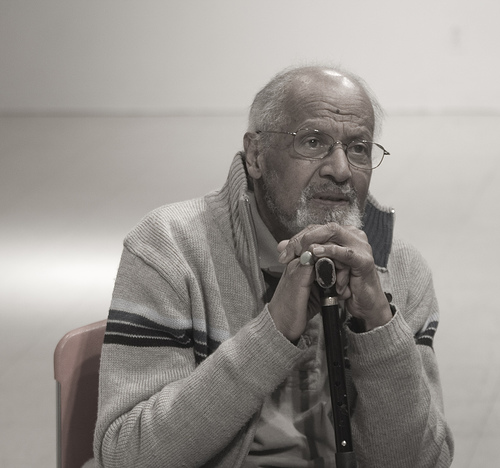
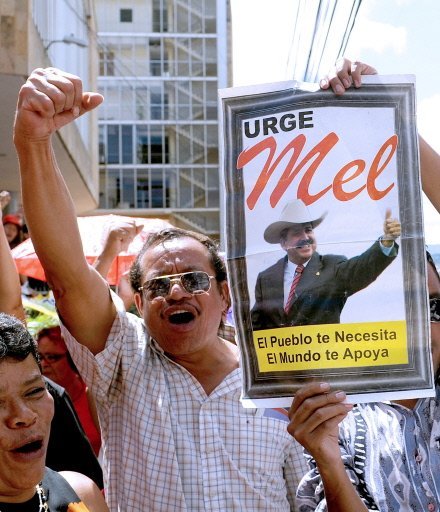
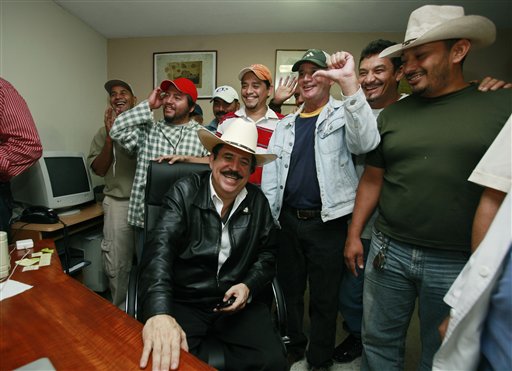
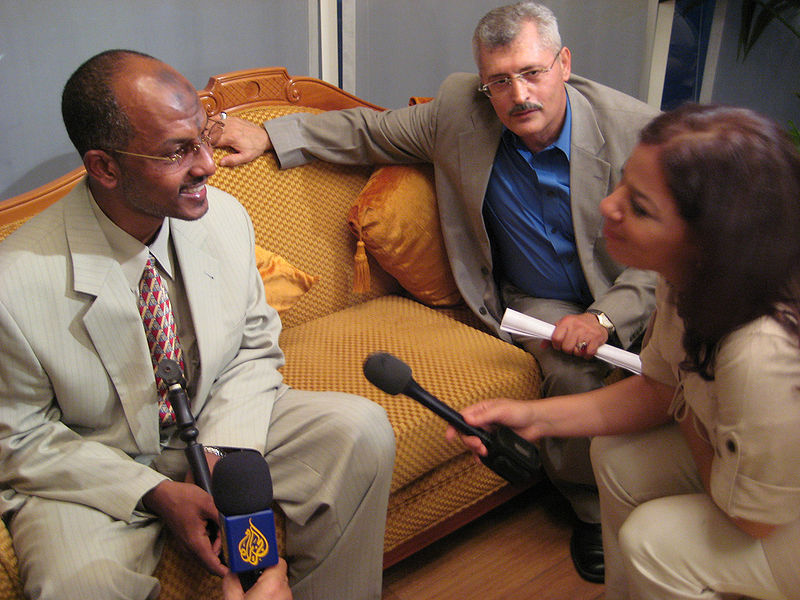
Above, supporters of Sami Al’Hajj unfurl banner during Al’Hajj’s 2008 hunger strike. Below, Al Jazeera interviews Sami Al’Hajj at the Doha International Airport in Quatar, May 30, 2008. Photo by omar_chatriwala / Flickr.

Journalist Al’Hajj describes Guantanamo detention
Before international war crimes conference

By Maria J. Dass / October 29, 2009

A journalist from Al Jazeera who was detained in Guantanamo Bay for seven years described his detention as a living hell.

Sami Al’Hajj, a Sudanese who was released on May 1, 2008, told the Criminalise War International Conference in Kuala Lumpur, Malaysia, of beatings, water boarding, being striped naked, sleep deprivation, degradation of religion and being force-fed through a tube that he endured throughout his detention.

“There were psychiatrists who were part of the programme to psychologically break us,” he said.

He claimed five of the detainees were driven by American soldiers to their death.

Sami was detained by Pakistani authorities at the Afghanistan border on Dec 15, 2001, mistaken for his colleague Tassir Alony who was wanted by the United States for information on Taliban and Osama bin Laden whom he (Tassir) had interviewed after the Sept 11 attacks in New York and Washington.

Sami believes he was a victim of the Pakistani authorities who were eager to hand over people to the US for a bounty of US$5,000 (RM17,129) for each person.

He was first detained at the Bangram detention centre in Afghanistan for six months before being transported to Guantanamo.

“We were shackled in a hunched position with hoods placed over our heads and ear plugs to cut us off completely from what was happening around us.

“My legs were numb from having to hunch for several hours during the journey from Pakistan, and then I was forced to stand up and pushed out of the plane, causing me to fall and break my legs at the knee,” said the 40-year-old who depends on a walking stick as a result of that injury.

The 20-hour journey from Kandahar to Guantanamo was as harrowing.

Sami said although the Americans realised that he was not the person they wanted, they were reluctant to release him probably because they fear he would expose the atrocities he witnessed at the detention centres which held children as young as 11 and men as old as 95.

He appealed to representatives of countries attending the conference to take in prisoners released from Guantanamo who have nowhere to go.

“I appeal to all of you to find homes for men who were tortured and detained without trial, so that they can lead normal and meaningful lives.

“The torture has not ended. The reality is there are 212 detainees at Guantanamo still suffering under the Obama regime,” he said.

He said many of those released were sent home only to be imprisoned in their own countries, such as Tunisia, Libya and Morocco.

“This is despite the fact that they were detained without any sound reason without trial for so many years,” he said.

“Those who have to return to China face the possibility of being imprisoned and tortured worse than they were in Guantanamo Bay.”

According to Sami, the largest group of people at the detention centre at the moment are 97 Yemenis.

Source / Malaysian Sun / Media Channel

Also see When We Torture By Nicholas D. Kristof / New York Times / Feb. 14, 2008

The Rag Blog

Posted in RagBlog | Tagged , , , , | 5 Comments

Rabbi Arthur Waskow : Some Cockamamie Ideas about Afghanistan

Afghani women: Offer micro-loans for economic development. Photo from UNHCR.

Remembering Pharaoh, Plagues and Exodus…
Afghanistan: There has to be a better way

By Rabbi Arthur Waskow / The Rag Blog / October 29, 2009

When some of us outside Washington (and even some inside) say there must be some other way of dealing with Afghanistan, Good Old Official Formal U.S. (GOOFUS) says this is a cockamamie notion. So The Shalom Center is going to put forward four cockamamie plans. Read on!

Present U.S. plans for Afghanistan and present/past U.S. behavior toward fossil fuels and the world’s climate share four factors:

  • Both are based on top-down control over the “weaker” communities of human beings and the web of life on earth;
  • These “weaker” beings turn out to be able to fight back in unexpectedly effective and destructive ways;
  • For a moment, decision-makers in the White House (Afghanistan) and Congress (climate) are shuddering as they see the precipice before them and are trying to imagine change. But the pull of “Top-Down” habit is very strong.
  • In this moment, We the People can make a difference.

This pattern is a very old story. In the Bible, it is called Pharaoh, Plagues, and Exodus.

On Sept. 10, 2009, Matthew Hoh, a senior U.S. diplomat and former Marine resigned from the U.S. Foreign Service after serving more than five years in Iraq and five months in Afghanistan.

This week the Washington Post published his letter and reported he has been invited to meet with Vice President Biden’s staff.

Hoh said:

I fail to see the value or the worth in continued U.S. casualties or expenditures of resources in support of the Afghan government in what is, truly, a 35-year old civil war. The Pashtun insurgency, which is composed of multiple, seemingly infinite, local groups, is fed by what is perceived by the Pashtun people as a continued and sustained assault, going back centuries, on Pashtun land, culture, traditions and religion by internal and external enemies. The United States military presence in Afghanistan greatly contributes to the legitimacy and strategic message of the Pashtun insurgency.

The Shalom Center offers four cockamamie ideas for U.S. policy in Afghanistan, two of which are already under official consideration inside the Washington Beltway.

  1. (“Counter-insurgency”) Send 500,000 U.S. soldiers to occupy the most ornery anti-occupation people on the craggy face of earth, killing thousands of Afghans and Americans along the way and bankrupting any hope of social reform in America;
  2. (“Counter-terrorism”) Keep flinging lightning bolts from the sky to kill bands of “terrorists” who we then discover are wedding guests, thereby multiplying the reserve army of “terrorists” a thousandfold after every wedding.
  3. (“Bribery”) Fire all U.S. generals and diplomats in Afghanistan. Send five women U.S. Senators to negotiate with Afghan women and all male Afghan factional leaders (including the varied Taliban factions) with two promises: (a) Any governance agreement they unanimously agree to will be backed up by one billion dollars a month in U.S. “economic aid,” delivered as five-dollar bills in suitcases, if requested, and by the withdrawal of all US troops; (b) If no such agreement is reached, or if the agreement breaks down, the money and all other U.S. involvement in Afghanistan ends at once.
  4. (“Wild Far Far West,” also known as “Grass-roots gamble”) Call a conference of the independent women’s organizations in Afghanistan. Offer micro-loans for grass-roots economic development to any group of ten women who apply as a group (loans ranging from $1,000 to $5,000). And — offer ten revolvers and 1000 bullets to each group of women: one gun and 50 bullets for each woman for target practice, 50 bullets for defense against anyone who comes to assail them for being uppity. If any women’s group chooses not to receive the guns but to take their chances on nonviolence, their micro-loan doubles. Then the U.S. leaves — Generals, Predators, Drones, and all — except for continuing contact with the micro-loan organizations.

Of the four, which plan is least cockamamie — most likely to save American lives, benefit American society, save Afghan lives, and help self-government grow at the grass roots in Afghanistan?

The Shalom Center is posting this letter on our website at www.theshalomcenter.org and welcomes you to write your own comments there. On the website you will also find a “take action” memo for writing your Senators about Afghanistan, as well as a longer note about urging your Senators to act on global scorching and the climate crisis.

Remember: both issues are at a crossroads, a crucial choice point. We the People can make a difference.

Shalom, salaam, peace!

Arthur

P.S. – For David Hoh’s full letter of resignation from the Foreign Service and his analysis of present failures in Afghanistan, go here.

[Rabbi Arthur Waskow is director of The Shalom Center. He can be reached at awaskow@shalomctr.org.]

The Rag Blog
Posted in RagBlog | Tagged , , , | Leave a comment

Afghanistan : Tom Friedman’s ‘Cronkite Moment’?


Tom Friedman’s “Walter Cronkite Moment”?

Times columnist reverses field on Afghanistan.

By Harvey Wasserman / The Rag Blog / October 29, 2009

The Iraq war’s chief New York Times cheerleader has reversed field on Afghanistan. Does it mean there will be no escalation?

In early 1968, after the devastating Tet Offense, CBS News anchor Walter Cronkite pronounced the Vietnam War unwinnable. Lyndon Johnson knew he had “lost middle America” and soon declined to run for a second term. The war dragged on for seven more hellish years. But the hearts and minds of the American public had been lost.

Tom Friedman is no Walter Cronkite. His Times column is influential in certain circles, but has nowhere near the nationally unifying force as Cronkite’s evening broadcasts.

On the other hand, his admonition to “Don’t Build Up” in Afghanistan indicates that the Pentagon PR blitzkrieg demanding more troops has failed in key corporate circles.

Friedman’s arguments are both strategic and monetary. “We simply do not have the Afghan partners, the NATO allies, the domestic support, the financial resources or the national interest to justify an enlarged and prolonged nation-building effort in Afghanistan,” he warns.

Ceding (finally!) the inability of the United States to dictate to countries that don’t like us, Friedman manages to make the whole argument without mentioning Vietnam. He never even hints at the possibility that the US might not actually have the RIGHT to interfere in the politics of other nations.

But in this case he says the military’s plan to pour troops into “stabilizing” Afghanistan “is a 20-year project at best, and we can’t afford it.”

This stunning admission comes alongside Friedman’s signature assertion that “we are the world. A strong, healthy and self-confident America is what holds the world together and on a decent path.”

What he fears is that “a long slow bleed in Afghanistan” could doom the United States, and thus the planet. “Shrinking down in Afghanistan will create new threats,” he concedes. “But expanding there will too. I’d rather deal with the new threats with a stronger America.”

Above all, we “desperately need nation-building at home.”

Thomas Friedman is nothing if not a megaphone for the corporate elite. He supports atomic power and consistently pumps global trade agreements, U.S. military adventurism and top-down decision-making in ways that can draw howls of outrage with a single smarmy sentence.

His Times cohort Roger Cohen has been selling the war as hard as he can. Puff pieces on hawk General Stanley McChrystal’s global campaign to build military support for a massive escalation have been filling the Times’s pages for weeks now. It recently concocted a non-story about the “impatience” of the military brass awaiting tens of thousands of new troops. It gave front page billing to McChrystal’s completely inappropriate campaigning with NATO commanders who love McChrystal’s demand for more troops but likely won’t be sending more of their own any time soon.

It’s impossible to assign tangible value to Friedman’s loss of faith in escalation. But those of us hoping to avoid a catastrophic dive off the Afghani abyss have expected nothing but grief from this mainstay of the Iraqi catastrophe.

That a key cheerleader for that war is now waving his editorial pompoms for de-escalation can only be good. Let’s make sure the White House gets the message.

[Harvey Wasserman’s Solartopia! Our Green-Powered Earth is at www.harveywasserman.com, along with Harvey Wasserman’s History of the United States.]

The Rag Blog

Posted in Rag Bloggers | Tagged , , , , , | 1 Comment

Dick J. Reavis : SDS and the Great Divide

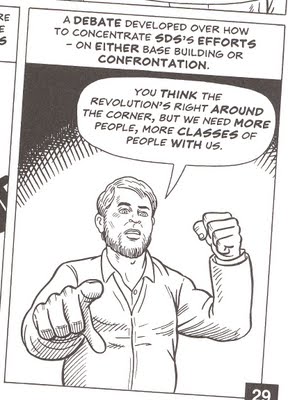
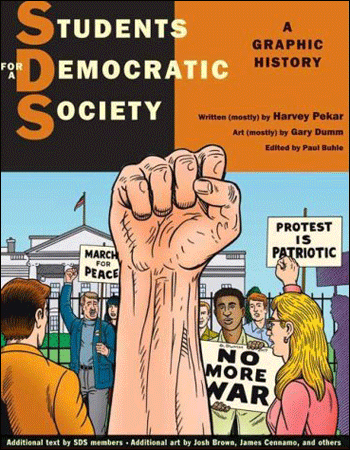
Image from Students for a Democratic Society: A Graphic History.

Today’s Red Book and the demise of SDS

Nobody present had repudiated Leftism, but everyone seemed to have reached a consensus that the heedlessness of youth had been our common flaw.

By Dick J. Reavis / The Rag Blog / October 29, 2009

A few years ago, the Southern Student Organizing Committee, a white-folks group chartered by SNCC (Student Nonviolent Coordinating Committee), held a reunion in Nashville. SSOC was integrationist and anti-war, but generally speaking, less flamboyant than the Students for a Democratic Society (SDS).

Because I had been on its staff for a semester, and because old friends urged me, I attended the reunion. Its most-awaited speaker was Gregg Michel, a professor at UTSA, younger than all of the veterans, who had authored a manuscript on SSOC’s history, now available as a book, The Struggle for a Better South. Conference organizers assigned to him the topic that everyone else dreaded to take: the downfall of SSOC.

Michel spoke at a workshop which about 40 of us attended. In unsmiling terms he blamed SSOC’s demise on the Progressive Labor Party, or PL — then a Maoist outfit — and October League, OL, a Maoist party founded by Mike Klonsky, once a leader of the Revolutionary Youth Movement, or RYM faction of SDS. PL had introduced a resolution at a March 1969 national conference of SDS in Austin, calling for breaking fraternal ties with SSOC. The OL, for reasons of its own, later that year persuaded its leaders to disband.

A few SSOC figures had aided in the dissolution, two of whom were present in the room: me, one of the signers of the PL-SDS resolution, and an Atlanta comrade who, on orders from the OL, had burned SSOC’s records. Michel thought we and our ideological comrades were villains, and had written his final chapter in that vein.

Once he recapitulated SSOC’s demise, fearlessly castigating its liquidators, his audience drew its breath. Somebody raised a hand and in a tentative voice said, “Dr. Michel, I think there’s something you don’t understand. You see, in one way or another, we were all crazy in those days!” Laughter followed. Nobody present had repudiated Leftism, but everyone seemed to have reached a consensus that the heedlessness of youth had been our common flaw.

Michel revised his chapter about the End. His villains became more nearly young fools.

SSOC button, 1965. Use of the Confederate flag led to controversy.

In reading recent histories of SDS, with the possible exception of Mark Rudd’s memoir, I have not detected that same let-bygones-be-bygones approach. I last encountered you-guys-were-to-blame bitterness in Students for a Democratic Society: A Graphic History, in which at least three contributors to The Rag Blog had a hand. Their book was apparently compiled to tell members of the new SDS what the organization’s heritage might be.

A Graphic History lays the blame for the August 1969 collapse of SDS at the feet of both PL and the RYM. The book’s heroes are those upon whom it bestows the title “SDS Regulars,” a formerly unnamed group which for awhile kept on keeping on, even after the final SDS convention, held in Chicago. Several prior books took a similar view, and it’s apparently catechism in the SDS of today.

I haven’t given much thought to SDS for several years. But lately I’ve been reading about Depression-era Leftism in the South, and some explanatory ideas have come to mind.

One of them is that in times of upsurge, left-wing factions tend to merge instead of split. Communists gave up their independent unions and joined the CIO when it started rising to its feet, and in turn, the CIO hired red organizers. The Communist and Socialist parties and even a couple of Trotskyist front groups for the unemployed merged when the New Deal christened its job-creation programs, whose employees they brought into a single unionish group, the Workers Alliance.

But when war preparations began restoring the American economy in 1939-40, membership in the Workers Alliance dropped — and the Socialists and Communist quarreled to its bitter end. When the CIO lost ground to an anti-labor crusade that followed World War II, it started purging its reds, a factional or sectarian move, even if the offending sect was labor’s mainstream.

One conclusion I drew was that in organizations that aren’t conquering new territory, faction fights easily take root. Decline invites blame.

In reading Southern history, I have also noted that groups that don’t accomplish their ends soon wither. Committees to free the Scottsboro Boys, initially formed by the Communist Party and the NAACP as rivals, even after agreements to cooperate, became moribund when the accused weren’t set free. Several anti-lynching groups surged during the ‘30s, only to collapse by the decade’s end because they couldn’t get Congress to pass an anti-lynching law.

The Southern Negro Youth Congress pioneered the struggle to dismantle Jim Crow, but its victories were few, and in the end, it was eclipsed by the patriotic fervor of World War II. No organization is given an open-ended lease on life, and if it doesn’t win, it fades, even when sheltered from the blazing sun of factional hatred.

SDS by early 1969 faced several problems, the chief of which was that it wasn’t ending the war in Vietnam. In less than five years, with teach-ins, demonstrations, and draft resistance, it had developed a wide following. In the process it also produced — an experienced leadership!

Early on, SDS leaders had seen that politely asking the nation’s rulers to end the war, by petitioning, for example, would not bring peace. Some of them raised the Frederick Douglas slogan, “Power concedes nothing without a demand!” — but that only underlined their initial innocence: even with Abolition, it had taken a demand — and a civil war. By 1969, most SDS honchos were convinced that keeping on, keeping on, wouldn’t bring results. Concluding that American democracy was a sham, many, and maybe most of them, began to toy with the idea of revolution.

Of course, they could have maintained a big movement by bringing naive freshmen and high-schoolers into new rounds of demonstrations, but perhaps they were too honest to do a thing like that: what’s the point, if it doesn’t accomplish the goal? Even today, how many of us can believe that we would have ended the war had we merely kept on as before?

In the event, something else happened. In November, 1969 the federal government instituted the draft lottery. Its first drawing was held on Dec. 1. Within a day, the anti-war movement lost thousands, perhaps hundreds of thousands of supporters, those whose numbers had not been called, their parents and girlfriends. From December 2 forward, SDS faced a tougher task, even at keeping on, keeping on. Like the Scottsboro and anti-lynching committees or the Southern Negro Youth Congress, it was not accomplishing its goal, and its base was sliding away, just as Workers Alliance members did when the Depression economy improved.


The downturn in activity that A Graphic History notes as the SDS split approached — which it blames on PL and RYM- — was no doubt owed in part to faction-fighting. But its deeper impetus was probably talk of the lottery draft and the lack of headway towards any peace.

A Graphic History lauds the Keeping On faction, but as I read the record, the war did not end because of their stick-to-it-ness, even despite the record numbers at demonstrations to protest the invasion of Cambodia. Perseverance, sometimes a virtue, can also be a symptom of insincerity or cluelessness.

When I look back on the history of the Dixie Left, it does not concern me that the Southern Tenant Farmers Union was Socialist and the Sharecroppers Union was Communist, nor do I feel afflicted because groups like these did not merge and live happily ever after. What I see in the pages of history is that people who built the Depression-era movements were our forerunners. We might today differ with much of what they advocated, but in their time and in our common place, they were what I would hope we would have been. They were defeated, as we were, because in politics, insurgent movements do not always survive, or win.

I do not think that losing is always attributable to lack of, or betrayal of, the “correct line,” “The Great Helmsman” or anything or anybody of the kind. Failure is not something for which its participants can always be blamed. Were people or factions whom we could name chiefly responsible for the multitudinous setbacks of the Left, we could hope to learn from their errors, and to rebuild a mass Left — tomorrow!

I suppose that those veterans and scholars of SDS who think we still stand a chance of leading the nation will probably continue laying blame; A Graphic History was published last year. And if none of those who admit that we were all crazy in those years is lucky enough to see the Revolution, I suppose it will be because we’ve given up Maoism even in its contemporary form. If we still believed, we’d take A Graphic History as our Red Book — and a few surviving “Regulars,” with the help of the new SDS, would erect grandiose marble statues on our graves.

[Dick J. Reavis — an award-winning journalist, educator and author — was active with SDS and the New Left in the Sixties. He wrote for Austin’s underground newspaper The Rag, and later was a senior editor at Texas Monthly magazine. Dick Reavis’ book, The Ashes of Waco: An Investigation, about the siege and burning of the Branch Davidian compound, was published by Simon and Schuster and may be the definitive work on the subject.]

Also see:

And find on Amazon. com:

The Rag Blog

Posted in Rag Bloggers | Tagged , , , , , , , , , , , , | 13 Comments

FILM / William Kunstler : Disturbing the Universe


William Kunstler: Disturbing the Universe…

Remarkable film tells story of
Famed civil rights attorney

By Alice Embree / The Rag Blog / October 28, 2009

William Kunstler: Disturbing the Universe, a film by Emily Kunstler and Sarah Kunstler, premiered as part of the Austin Film Festival Wednesday, Ocober 27. The film, which was also selected for the 2009 Sundance Film Festival, has it’s public premiere in New York, November 13-15.

The ninety-minute documentary is the story of a larger than life attorney — a man who left his Westchester suburban home, his wife and his children for a journey to the south of Jim Crow and lunch-counter sit-ins. He never returned to the comfortable suburbs.

Along with Leonard Weinglass, Kunstler was defense counsel for the Chicago Seven conspiracy trial. The eighth defendant, Bobby Seale, was bound and gagged in the courtroom for demanding to speak in his own defense. Kunstler was sentenced to 40 months for contempt by Judge Julius Hoffman. Out on bail and fighting appellate battles, he waded into negotiations at the Attica Prison uprising.

He stood outside the gates listening to the gunshots as 31 inmates and nine guards were killed by police fire. He was counsel for the Catonsville Nine, Catholics who burned draft records with homemade napalm. He traveled to Wounded Knee to defend the American Indian Movement.

These legendary legal battles are documented with remarkable footage and interviews with many of the principals, including Bobby Seale, Tom Hayden, Nancy Kurshan, Dennis Banks, an Attica guard and many of Kunstler’s colleagues. But, it is the tender family scenes with his second wife and young daughters (the filmmakers) that add depth and subtlety to this portrait.

As young girls, Emily and Sarah Kunstler were raised to admire their legendary father. But Kunstler’s later years took him into high profile criminal defense of clients accused of gang rape, cop killing and the assassination of a Jewish Defense League leader. These cases brought angry protests to the daughters’ front door. In many ways the film is the effort to reconcile the legend with the man, the lawyer with the father, the civil rights defender with the attorney for murderers.

This is a film about the uprising of the 60s and 70s told from the perspective of a generation that had to live with a larger than life luminary of those times.

Members and friends of the 12th Street Law Collective in Austin held a reunion Oct. 4, 2009. On sofa, left to right, are Jim Simons, Brady Coleman and Cam Cunningham. On chair to their right is Bobby Nelson. John Howard is deceased. Photo by Alan Pogue / The Rag blog.

The film underscores the critical role that attorneys played in the uprisings of those times. On October 4th in Austin, there was a reunion for a law office that took on its local share of 60’s and 70’s defendants. The 12th Street Law Collective principals were Jim Simons, Cam Cunningham, Brady Coleman, Bobby Nelson and John Howard.

Jim was a co-counsel at the Wounded Knee takeover and defender of GI antiwar activists in Killeen. Cam and Brady defended the Gainesville Eight, Vietnam Veterans Against the War accused of conspiracy. Bobby blazed legal trails for women barred from employment as bus drivers, emergency medical technicians, and telephone cable splicers. She took UT to court for sex discrimination and was an early defender of the rights of gays and lesbians.

Those of us who were clients during those years owe a deep debt of gratitude to the attorneys. Their legal fees were often cobbled together through benefits or not at all. Like Kunstler, they used their skills and gave their hearts for the cause.

[Alice Embree, a long-time Austin political activist and writer, was a leader in the Sixties New Left and women’s liberation movements and was a founder of Austin’s The Rag and New York’s Rat, trailblazers in the Sixties underground press.]

The Rag Blog

Posted in Rag Bloggers | Tagged , , , , , , , , , , | 2 Comments

VERSE / Larry Piltz : In the Opt-Out States of America

Big digeridoo. Photo from Pihkva.com.

I pledge new legions to The Hague
and fresh new lesions to The Plague
for medicines to moan and beg
as Corporatocracy humps my leg
in the Opt-Out States of America
Re the Public Option’s widget plans
for bleeding gums and swollen glands
with doctors singing oh yes we can
accompanied by Big Insurance plans
but not in the Opt-Out States of America

yet one new option that arises
fills with joy and great surprises
finally the notion’s granted
militarism’s been supplanted
if war’s not what my state’s about
my state can simply opt right out
in the Opt-Out States of America
with Quakers singing oh yes we do
accompanied by a big didgeridoo
yes in the Opt-Out States of America

In the Opt-Out States of America

Larry Piltz / The Rag Blog

Indian Cove
Austin, Texas
October 26, 2009
2:45 p.m. CST

The Rag Blog

Posted in Rag Bloggers | Tagged , , , , | 21 Comments

FILM / Michael Moore : Anti-Capitalism Goes Mainstream


Capitalism: A love Story…

Michael Moore’s new film names the system
And presents a radical democratic critique

By Alex Knight / The Rag Blog / October 27, 2009

Capitalism: A Love Story, which opened in 962 theaters earlier this month, is Michael Moore’s most ambitious work yet — taking aim at the root cause behind the injustices he’s exposed in his other films over the last 20 years.

This time capitalism itself is the culprit to be maligned in Moore’s trademark docu-tragi-comic style. And by using the platform of a major motion picture to make a direct assault at the root of the problem, Moore has created space in the political mainstream for a radical conversation (radical meaning “going to the root”).

It’s a conversation that is desperately needed as the economic crisis continues to devastate low- and middle-income Americans in spite of President Obama’s and Congress’ efforts to stop the bleeding by throwing trillions of dollars at the banks.

Recently, Democracy Now! reported that while the Dow Jones topped 10,000 for the first time in a year, foreclosures have reached a record level of 940,000 in the third quarter. But with this film airing in major chain cinemas across the nation, the normally taboo topics of how wealth is divided, who owns Congress, and how vital economic decisions are made are now open for discussion in a way they haven’t been in the U.S. for decades.

In Capitalism, Michael Moore features the reality of the economic crisis for America’s usually-invisible poor and working class. The movie begins with a family filming their eviction from their own home. In a terrifying scene, we watch from inside their living room window as seven police cars roll up to throw the ill-fated family onto the street for failing to make their payments.

Moore explained in an interview, “You see [a foreclosure] really for the first time from the point of view of the person being thrown out of the house.” This same bottom-up viewpoint carries the audience through the rest of the film, from the stories of kids in Pennsylvania sent to private detention centers for minor offenses by judges who received kickbacks from the prison company, to airline pilots whose wages are so low they have to go on food stamps.

By grounding the viewers in the human costs of out-of-control capitalism, Moore finds firm footing for launching his attacks on the Wall Street firms that he believes are responsible for this crisis. As the film points out, the richest one percent of Americans now control more wealth than the bottom 95%, a sorry state of affairs that has grown steadily worse since the 1980s. Ronald Reagan, Alan Greenspan, and his two buddies Larry Summers and Robert Rubin are implicated in Capitalism as responsible parties behind the gutting of regulations and the deliverance of the federal government into the hands of the bankers.

Michael Moore’s conversations with congressmen and women about the $700 billion bank bailout passed last October best illustrate this transfer of sovereignty. The congresspeople are remarkably candid in their dismay at what was essentially a blank check to Goldman Sachs, Bank of America and Citigroup.

Representative Baron Hill from Indiana recounts that the bailout bill was pushed through Congress in a similar manner as the Iraq War authorization, under threat of catastrophe and terror. Marcy Kaptur, congresswoman from Ohio, however, does one better. “This was almost like an intelligence operation,” she laments. And when Moore asks her if the bailout represents a “financial coup d’etat” by the bankers, she responds, “I could agree with that. Because the people here [pointing to the Capitol] really aren’t in charge. Wall Street is in charge.”

We also witness Kaptur’s courageous honesty on the floor of the House, urging Americans to resist foreclosure by remaining in their homes. Detroit sheriff Warren Evans stands out as another hero in the film when he announces he will cease foreclosure evictions in his jurisdiction because of the damage to the community caused by making more houses vacant and more families homeless. Moore also features grassroots organization Take Back the Land, which has dramatically responded to the crisis by moving evicted families back into their homes in the Miami area.

Regular folks fighting back against a system that is depriving them of income, housing, health care and other basic needs is inspiring stuff to watch, and it’s not something we’re used to seeing up on the big screen. Capitalism displays this grassroots defiance surprisingly well by humanizing those on the bottom of the pyramid.

One man whose farm is foreclosed on angrily warns, “There’s got to be some kind of rebellion between people who’ve got nothing and people who’ve got it all.” His words are buttressed by a behind-the-scenes look at Republic Windows & Doors, where laid-off workers occupied their Chicago factory and refused to leave until receiving their promised severance pay. For Moore this represents the kind of direct action that everyday people must now begin to take to protect themselves from having to pay for the misdeeds of the wealthiest one percent.

This call to action is well taken. However, one piece lacking in the film’s analysis of capitalism is how the system of economic power interlocks with other structures of oppression, for example U.S. imperialism, patriarchy and white supremacy. Capitalism affects different people in extremely different ways, and while some fear losing their jobs, others fear imprisonment, rape, or even being hit by a drone attack. But Michael Moore seems to avoid a conversation about racism, sexism and homophobia in order to appeal to a mythical homogeneous American working class.

And besides a brief comparison to Rome, the movie also shies away from discussing the U.S. role in the world and how a militaristic foreign policy serves the interests of corporate and financial elites — even though opposition to the wars in Afghanistan/Pakistan and Iraq have never been greater.

Another weakness is how Moore handles Barack Obama with kid gloves. Even while his economic advisers are skewered in the film, President Obama’s role in the bank bailouts is downplayed, and he comes out looking like a champion of the people, or at least a potential champion. In this respect Michael Moore bestows honors like the Nobel Committee, not so much for what the president has done, but for the “hope” of what he might do.

So what does Michael Moore propose as an alternative to capitalism? Not socialism, but a kind of economic democracy — an opportunity for average folks to have a say in how their money is used, from the workplace on up to the government. Moore takes us inside co-ops in America where workers vote on decisions about finances democratically, and where salaries are equal and adequate for everyone in the company. In one factory, assembly line workers and the CEO each make about $60,000.

To reinforce his economic prescription, Moore even dug through archives to recover lost footage of FDR’s long-forgotten proposal for a “Second Bill of Rights,” which called for guaranteeing meaningful work and a living wage, decent housing, adequate medical care, and a good education for every American.

It is striking how such common-sense ideas in our current political climate appear dangerously radical, even coming from the lips of a U.S. president. It seems the overriding purpose of Capitalism: A Love Story is to flip these expectations on their heads. For Michael Moore, guaranteeing basic economic security is as American as apple pie; what is radical is a system that would deny such prosperity to bolster the wealth of a tiny few.

If there is to be any solution to the economic crisis that doesn’t involve millions more people being thrown out of their homes or dropped from their health care, it will have to involve a sharp break from a system that values private profits higher than meeting people’s basic needs.

To this end, Michael Moore has done a great public service by making a film that is essentially an invitation for views outside the bounds of established mainstream discourse to propose what might be done about the economic quagmire we now find ourselves in. It is time for an American Left to come out of the wilderness and speak out with proposals for better ways of organizing our economy. I see no reason to be any less bold than President Roosevelt was 65 years ago.

Here is an excerpt from President Roosevelt’s 1944 “Second Bill of Rights” speech:

We cannot be content, no matter how high that general standard of living may be, if some fraction of our people — whether it be one-third or one-fifth or one-tenth — is ill-fed, ill-clothed, ill-housed, and insecure.

This Republic had its beginning, and grew to its present strength, under the protection of certain inalienable political rights — among them the right of free speech, free press, free worship, trial by jury, freedom from unreasonable searches and seizures. They were our rights to life and liberty.

As our nation has grown in size and stature, however — as our industrial economy expanded — these political rights proved inadequate to assure us equality in the pursuit of happiness.

We have come to a clear realization of the fact that true individual freedom cannot exist without economic security and independence. “Necessitous men are not free men.” People who are hungry and out of a job are the stuff of which dictatorships are made.

In our day these economic truths have become accepted as self-evident. We have accepted, so to speak, a second Bill of Rights under which a new basis of security and prosperity can be established for all — regardless of station, race, or creed.
Among these are:

  • The right to a useful and remunerative job in the industries or shops or farms or mines of the nation;
  • The right to earn enough to provide adequate food and clothing and recreation;
  • The right of every farmer to raise and sell his products at a return which will give him and his family a decent living;
  • The right of every businessman, large and small, to trade in an atmosphere of freedom from unfair competition and domination by monopolies at home or abroad;
  • The right of every family to a decent home;
  • The right to adequate medical care and the opportunity to achieve and enjoy good health;
  • The right to adequate protection from the economic fears of old age, sickness, accident, and unemployment;
  • The right to a good education.

All of these rights spell security. And after this war is won we must be prepared to move forward, in the implementation of these rights, to new goals of human happiness and well-being.

[Alex Knight is an organizer and writer in Philadelphia. He is currently organizing with Philly Students for a Democratic Society (SDS) and the People’s Caravan, which recently completed a story-listening and action trip to the G20 summit in Pittsburgh. He also maintains the website endofcapitalism.com and is in the process of writing a book called The End of Capitalism. He can be reached at activistalex@gmail.com.]

The Rag Blog

Posted in Rag Bloggers | Tagged , , , , , , | 6 Comments

Judge Wiliam Wayne Justice : Hispanics and The Right to Vote

Top, Austin polling place. Photo by T hom / Flickr. Below, Judge William Wayne Justice. Photo from Dallas Morning News.

Judge Justice and single member districts:
Bringing voting power to all Texans

By George Korbel / The Rag Blog / October 27, 2009

[Judge William Wayne Justice was a Texas federal district judge who died at age 89 on Oct. 13, 2009, in Austin. His rulings on landmark class-action suits led to school integration in Texas, as well as sweeping prison reform, the education of undocumented immigrants and much more. David Richards wrote of his legacy in The Rag Blog. Attorney George Korbel now provides a lawyerly take on Judge Justice’s profound effect on voting rights in Texas.]

I came to Texas in late 1971. Since that time I have usually represented Hispanic plaintiffs. Oscar Mauzy had driven up to Tyler to file the case attacking the 1971 House and State Senate redistricting. He then turned it over to David Richards. There was a concerted effort to remove Wayne Justice as the organizing judge. He hung tough and ended up on the panel.

His opinion in Graves v. Barnes affirmed as White v Regester was the first case in which the Supreme Court affirmed a finding of discrimination as a result of at-large elections. Four year later the findings in Graves/White formed the basis for the extension of the special provisions of the Federal Voting Rights Act to Texas. The Judge chronicled the decades of discrimination against Hispanics and litigation to redress it. And he explained how it all impacted the electoral process.

The litigation flowing from the Supreme Court affirmance of his Graves opinion sped up change in Texas. In 1971, all Texas cities and school districts elected their boards of trustees and councils at large which resulted in minimal Hispanic and virtually no African American representation. By the end of the decade, San Antonio, Houston, Dallas, Waco and a host of other cities and school districts were forced into single member districts as a result of Graves/White and the Federal Voting Rights Act.

Now virtually all of the urban areas in Texas, along with the rest of the South with the exception of Austin, elect by single member districts. Every person from every one of these jurisdictions has example after example of what changes were caused by geographic representation.

In San Antonio, every time it rained there were floods. Property was destroyed and people inevitably drowned. Virtually the first effort of the single member district city council was drainage and we have no floods now. The mother of the current mayor of San Antonio was one of the plaintiffs in the single member litigation. Such a simple concept as fair elections not only improved social and economic conditions but provided countless role models for the minority, the poor and the dispirited.

In a suit filed by David Richards, the judge issued first injunction enforcing Section 5 of the Voting Rights Act. Texas was going to purge all of the registered voters and start over from scratch in 1975. This would have been a major setback to minority voting. Fully eight million stamped sealed letters to all of our registered voters were stopped at the last moment.

Judge Justice’s impact on the expanded governmental use of the Spanish Language was likewise significant if less appreciated. His US v. Texas was a grand desegregation suit involving the entire state. An offshoot of that case was his opinion in the Del Rio school case tried by Warren Burnett in the early 1970s circa Graves/White. Judge Justice not only desegregated the schools but ordered bilingual education. Within a few years in one form or another it was common, controversial but common.

The decision in the Del Rio school case together with the Graves findings relating to problems of non-English speaking voters formed a significant part of the legislative history which resulted in the language provisions of the 1975 Voting Rights Act. Literally overnight, all election documents had to be translated into Spanish. People were allowed to vote in a language that only years earlier they had been punished for speaking in school. The success of elections in turn eventually led to the translation of virtually all forms that people have to fill out to obtain benefits from the state.

So many children have benefited from learning in Spanish. So many elections have been won and the benefits of government shared as a result. Though I was not all that close to him, some years ago I had a long chat with him at a reception in his honor in Del Rio where he often sat after moving to Austin. The questions he asked showed how interested he was in the language issues and the types of changes that had come about from single member districts. I ticked off a laundry list of the changes that I had seen. Finally I told him, “Judge, you started all of that.”

[George Korbel is a prominent attorney who specializes in voting rights issues. His offices are in San Antonio.]

Also see David Richards : The Judge Who Brought Justice to Texas by David Richards / The Rag Blog / October 22, 2009

The Rag Blog

Posted in Rag Bloggers | Tagged , , , , , | 2 Comments

American Peace Movement : Missing in Action

Demonstration in San Francisco. Photo from basetree.

Two cheers for health care reform efforts
But whatever happened to the peace movement?

By Harry Targ / The Rag Blog / October 27, 2009

For purposes of comparison I want to make some predictions about the outcome of two current political struggles. I predict that some kind of health care bill will pass the Congress and be grudgingly endorsed by President Obama. It will include a “public option.” I am leaving aside for purposes of this essay the question of whether it will address the fundamental health care needs of the American people.

In addition, I predict that President Obama will authorize the sending of some increment of new troops to Afghanistan, just modestly short of the request made by General McChrystal for between 40,000 to 80,000 troops. While my predictive skills are modest at best — I predict victory for my beloved Chicago Cubs every year — I want to use these predictions to compare what I see as the relative strengths and weaknesses of the health care movement and the peace movement today.

First, let us reflect on the health care movement. Despite an enormous campaign by insurance providers, drug companies, some health professionals, a vigorous and angry anti-government movement from the right, and a 24-7 news advocacy television station partnered with about 80 percent of all of talk radio which is right wing, we are on the cusp of a modest legislative victory for health care reform. What has contributed to this movement?

Two movements, one years old and one relatively new, have been working tirelessly to achieve some substantial increase in access to health care for the American people. The modern single payer movement goes back to the 1970s, inspired by legislative proposals from that time. The vision of comprehensive health care goes back 100 years.

More recently, supporters of so-called “universal health care” embedded in the electoral campaign of candidate Obama have penetrated the consciousness of the entire population. As a result of these two campaigns, almost everyone says the system is broken.

Single payer and other health care reform campaigners are working vibrantly in every state. They are critically supplemented by organized labor’s strong support for health care reform. Polling data indicates that majorities favor some reform and sizable minorities support a single payer system. Health care reform advocates lobby and are in the streets. Cultural performers devote whole musical concerts and documentary films to the subject.

In sum, the health care movement is organized, passionate, well-planned, and targets both ruling elites and the grassroots. It has had some success penetrating the barriers of class, race, and gender.

How about the peace movement?

While the health care movement has some formalized national, state, and local organization connections, the peace movement today seems in disarray. United for Peace and Justice no longer plays a national leadership role in the peace movement and no other national organization is taking its place. The most organized activities come from individual projects such as Robert Greenwald’s encouragement of communities to show his documentary “Rethink Afghanistan.”

Long-time peace activists, from the American Friends Service Committee, to CodePink, to local groups organized around opposition to wars in Iraq or Afghanistan or against Israeli policy in Palestine collaborate for specific public events. They reach out to workers, communities of color, and women’s groups but with limited success.

Mobilizations are organized around a variety of demands: no escalation in Afghanistan, bring the troops home from Iraq, cut military spending, or abolish nuclear weapons. The messages at rallies are diffuse. They do not lend themselves to specific demands, clear petitions, and criteria for evaluating the conduct of politicians.

It is also the case that the diverse peace movement has not clearly enough linked its demands to the living experience of workers, people of color, and women. As to the former, while U.S. Labor Against the War has lobbied vigorously and effectively within the labor movement, the labor movement has not been forced to play a critical role in campaigns for peace the way it has in reference to health care. “Health care not warfare” is demanded at rallies but almost as an “add-on” or afterthought to “end the war” slogans.

I raise these comparisons tentatively and with humility; tentatively because I may be drawing the comparisons too strongly. And the differences may also be a reflection of the immediate context of the two struggles, with health care highlighted by the media and the town hall right wing protests. I raise the comparisons with humility because grassroots peace activists are articulate, passionate, and committed to their struggle.

But if the comparisons are correct there are lessons to be learned. Peace and justice activists have to more rigorously connect the understanding and presentation of their issues — both health care and peace. Bringing a kind of structural analysis to educational work, lobbying, and street action is called for now more than ever. The lack of adequate health care, long-term unemployment, war and military spending, and global warming must be analyzed together.

These analyses require theory and political activism that is shaped by understandings of how the structures of society construct classes, races, and genders.

Finally, we can use our knowledge of history to inform our campaigns. For example, President Johnson promised the American people that he would work to create a “Great Society,’ a society that eliminated poverty. That promise was destroyed in the jungles of Vietnam.

Dr. Martin Luther King was beginning to make the theoretical and practical connections at the end of his life when he said that: “A nation that continues year after year to spend more money on military defense than on programs of social uplift is approaching spiritual death.”

[Harry Tarq is a professor in American Studies who lives in West Lafayette, Indiana. He blogs at Diary of a Heartland Radical, where this article also appears.]

The Rag Blog

Posted in Rag Bloggers | Tagged , , , , , | 2 Comments

Austin Economy : We’re Number 2! Maybe.


Is this picture too rosy?
Austin economy called second strongest

By Roger Baker / The Rag Blog / October 26, 2009

Here’s the proud headline from the October 23, 2009, Austin Business Journal:

BusinessWeek: Austin 2nd strongest economy in the nation

(Texas had half of the top ten. San Antonio was number one; Dallas-Ft. Worth, 5th; Houston, 9th, and El Paso was 10th.)

On close inspection, it turns out that the Austin Business Journal actually borrowed this optimistic outlook from Business Week. In turn, BW got their information from the Brookings Institution. [Source: The Brookings Institution’s MetroMonitor]

Here are the Austin numbers and the context:

Austin-Round Rock, TX; Overall rank: 2

Austin, a high-tech center, is also home to the University of Texas. Employment in the Austin metro peaked in the fourth quarter of last year. Gross metropolitan product peaked in the second quarter. Home prices grew 2.5% in the second quarter compared with the same period a year earlier. And the unemployment rate in June was 7.1%, up 2.6 points from a year earlier. (Please see below for the various criteria used by the Brookings Institution to determine the overall ranking.)

Job growth (since peak) rank: 2
Gross Metro Product (since peak) rank: 2
Unemployment change (year over year) rank: 16
Home price change (year over year) rank: 18

So we click on over to Brookings to find out how they got their information. It turns out they compile something called the GMP or Gross Metropolitan Product. But where does Brookings get its numbers? It turns out that they don’t actually compile their own information, but rather they process information collected by the feds, which we can see by going here and here.

The second link above reveals the following interesting information.

The metropolitan (statistical) areas used by BEA for its entire series of GDP statistics are the county-based definitions developed by the Office of Management and Budget (OMB) for federal statistical purposes and last updated in November 2008.

In other words, when you drill down, the Austin economy didn’t really boom so much as it did less badly than most areas of the United States. The Austin area unemployment rate rose over the last year from 4.5% to its current 7.1% . Also go here for what is probably the most recent employment info, closely tracking the Business Week numbers. It indicates that Austin area unemployment rose from 4.6% to 7.2 from Sept. 2008 to Sept. 2009.

This fairly recent employment data indicates that Austin regional employment actually increased less than 1% year over the year — from about 832,000 to 839,000, even as area unemployment increased sharply. This slight job increase is good, but not not much to brag about; it is likely partly due to the stabilizing effect of government and education, since these factors buffer the Austin economy from decline more than most places.

The #2 rank of Austin’s Gross Metro Product used by Brookings is a snapshot of old federal data, and is likely to reflect the recent boom in construction. But construction has recently decreased sharply. In fact, construction has decreased by more than 20% in the past year. Here is the relevant headline and some numbers.

Bottom line:

We don’t have enough good recent data to draw the conclusions that the local business press likes to brag about. There is no doubt that Austin is doing less badly than most areas of the USA, but Austin’s metro area unemployment has risen sharply in the past year. Construction, one of Austin’s historically important growth sectors, is headed sharply downward. What drives construction employment is of course high growth in other sectors like government, education, and high tech manufacturing. Of these, government was still increasing steadily and rapidly from 2001 to 2008, (the latest numbers available). Likewise, the real estate sector.

However, with deficits increasing on every level of government, it is questionable whether government can continue to pull the Austin area economy, or whether the charts would look the same if extended to 2008-2009.

Interested in high tech business trends? Too bad. The software sector and computer manufacturing sector numbers are suppressed. Also “education and health services.” As the federal Bureau of Economic Analysis puts it: “Not shown in order to avoid the disclosure of confidential information.” What local economic data is not considered to be secret is revealed here. You can generate line charts for the non-confidential sectors of the Austin-Round Rock metro area economy here.

Then go to:

Interactive Charts and Graphs: GDP by State and Metropolitan Area Interactive Chart

The Rag Blog

Posted in Rag Bloggers | Tagged , , , , | 4 Comments

Mexico : ‘Tormenta Electrica’ and the 100th Anniversary of the Revolution


‘!Aqui se ve la fuerza del SME!’
Chronicle of a Tormenta Electrica

I awoke to the racket of Federal Police helicopters buzzing the Centro Historico like giant gnats. Ever since 1968 when Diaz Ordaz’s helicopters dropped flairs to signal the start of the student massacre in the Plaza of Three Cultures, the government has deployed these infernal machines to intimate those who stand against it…

By John Ross / The Rag Blog / October 26, 2009

[This is the second installment of a series by John Ross about the crackdown on the electricity workers’ union in Mexico, with President Calderon’s firing of 44,000 workers — and the aftermath of those actions. For Part I, go here.]

MEXICO CITY – Monday morning broke broodingly over Mexico City. The headlines on a score of newspapers hanging from Vicente Ramirez’s kiosk were universal loas for Calderon’s heroic seizure of Luz y Fuerza del Centro. As usual, La Jornada, the capital’s left daily, was the exception. Political columnist Julio Hernandez noted that on the eve of the centennial of the Revolution of 1910-1919, Mexico stood at a decisive moment: if Calderon was allowed to validate the takeover of the company and destroy the SME, the left’s goose was cooked.

Around the counter at the Café La Blanca, sullen faces were buried in their newspapers. Isidro Zuniga talked about putting 34 years in at a box factory before being shown the door: “I gave them my youth for a handful of pinche lentils. This is how the bosses fuck us. Chinga su Madre Senor President! We will stand with the SME…”

Benito Ruiz, the driver at the hotel where I’ve lived for 25 years, was steaming. Calderon was like the dictator Porfirio Diaz who was dumped by the Revolution, like the president Gustavo Diaz Ordaz who had ordered the massacre of hundreds of students on the eve of the Olympics in 1968. “Watch your back, Senor John,” he warned, “these bastards will stop at nothing…”

Others had less sympathy for the workers. Don Juanito Lopez, a tailor here in the old quarter, was dismissive of Luz y Fuerza which he thought rotten to the core with corruption. When you complained about your light bill or wanted to get something fixed, employees demanded a “stimulus” bribe. Sky-high electric bills have driven a wedge between Luz y Fuerza workers and the general public.

I walked over to the neighborhood Luz y Fuerza office on Carranza Street. It was locked up tight but the Mexican flag was still flapping from the roof. Handwritten signs (“Listen up people! The SME is fighting for you!”) were taped to the dusty windows. A young woman who said she was the daughter of an electricista, handed me a leaflet that explained what Calderon had done “is called fascism just like under Hitler and Mussolini and Pinochet and Diaz Ordaz.”

At five in the afternoon, Felipe Calderon’s arch-nemesis Lopez Obrador had called a rally outside the Chamber of Deputies to offer legislators an alternative budget that would chop government officials’ salaries in half, cancel their million pesos perks, and double the tax rate on Mexico’s 400 top corporations that now pay only 1.7% of their total earnings. Three years after the stolen election, AMLO is still able to drum out thousands but lately attendance has dipped and the die-hards’ energies dampened.

Today, however, the crowd outside Congress was swollen by word of the takeover — for AMLO, the SME would be a force multiplier. Several thousand electricistas packed the street, chanting and pumping their fists into the dank afternoon air: “Aqui se ve la Fuerza del SME!” (“Here you see the strength of the SME!”)

Andres Manuel helped Martin Esparza mount the podium and embraced him. He would put his movement at the SME’s disposal. The opposition would consolidate for a “mega-marcha” on Thursday the 15th. “!Aqui se ve la Fuerza del SME!

Esparza took the mic. He is not a brilliant speaker but he made some pertinent points, rattling off the names of companies and institutions that were exempted from paying their electric bills: the Torre Mayor, the nation’s tallest skyscraper; luxury tourist hotels in the Zona Rosa and the ritzy Polanco district; “Reforma” and “Uno Mas Uno“, newspapers that back Calderon to the hilt; the Chamber of Deputies and Mexico City’s City Hall; Eight distinct federal Secretariats and Los Pinos, the Mexican White House. Electricity rates were high because 70% of the juice is sold to 46,000 private corporations at 45 centavos the kilowatt while home consumers shell out one peso 50 centavos. Esparza’s fist shot up. “!Aqui Se Ve La Fuerza del SME!” When he drove away from the rally, the union leader was shadowed by seven carloads of federal police.

Out at Los Pinos, the Estado Mayor, Calderon’s elite military guard, was installing even more forbidding metal fences around the presidential palace and shutting down all access streets. Los Pinos has always been a bunker but now it was impenetrable. The President has declared “a state of exception” Mayor Marcelo, a prominent figure in Lopez Obrador’s Party of the Democratic Revolution, worried. “We have returned to the 19th century of Porfirio Diaz. I have never seen such disrespect for the workers.”

Tuesday, October 13th: It rained hard all Monday night, a cold late season downpour that always spells trouble for the city’s circuits. Most of Luz y Fuerza’s transformers are at least 50 years old — the company has been starved for investments for decades — and the Federal Electricity Commission engineers who had been brought over to operate the plants had no idea of how to deal with such antique equipment. Blackouts spread into 22 colonias — the prensa vendida suggested sabotage.

Federal Police visited the neighborhoods where SME workers live. One electricista, as reported in La Jornada, says he was offered 25,000 pesos to return to the plant he had been forced out of in the Saturday Night Massacre. He turned down the bribe. Many SME members have climbed into the lower middle class. They have an apartment and a car and payments to make every week. Now they had no work and no paycheck yet they wern’t going to give up their union without a fight. “!Aqui Se Ve la Fuerza del SME!

Weds. October 14th: By Wednesday morning, the blackouts had radiated into 72 colonies in 12 out of the city’s 16 delegations (boroughs.) 90,000 residents in Milpa Alta, a rural delegation, hadn’t had power since Saturday night. The system was said to be on the verge of collapse. When irate customers called Luz y Fuerza, no one answered the phones.

A hundred families in Ocoyouapac, Mexico state on the western flank of the capital had enough. They marched out to the busy federal highway that connects up Toluca with Mexico City at morning rush hour and stood there with their arms folded across their chests, the women holding squirming babies, neighborhood dogs lay at their feet. Auto horns blared. Traffic was backed up for 18 kilometers. The Federal police arrived and threatened arrest. The colonos stood there for two hours and refused to yield until the juice was turned back on. The colonos were not alone. 754 manufacturing businesses in Mexico state had to close shop because of the rolling blackouts. Governor Enrique Pena Nieto, the PRI presidential candidate in 2012, told the prensa vendida that he had proof of SME sabotage.

The Calderon government opened up indemnization pay-out centers on Wednesday morning with terrific fanfare — four pages printed in green ink ran in every newspaper instructing workers where to sign up for their checks. The pay-outs would be conducted under the aegius of the SAE or System for the Liquidation of Embargoed Goods, an agency that is usually charged with auctioning off property seized from narco traffickers. Gomez Montt warned that if the union tried to intimidate workers into refusing the checks, its leaders would be met with the full force of the law.

Despite the offer of spectacular bonuses for those who signed up to be liquidated before the end of the month, the lines were thin outside the centers, mostly administrative personnel who were not even members of the SME, some older workers on the verge of retirement plus a few ex-wives who showed up to see if husbands who owed them child support and food allotments had cashed out. Others lined up just to find out exactly how much they would receive. Carstens had promised that the government would counsel former workers where to invest their windfalls and provide them with incentives for business start-ups.

Those who were inclined to buy the government package waited from 9 a.m. through mid-afternoon and gave up. The computers had crashed and the system was down. A few lucky sell-outs received checks only to discover they were post-dated and needed to be approved by arbitration and conciliation commissions before they could spend them. “Esquiroles!” SME militants yelled at them despite Gomez Montt’s warning, “Scabs!” “What will you do when the money runs out?” one veteran worker called out. “Calderon has created 60,000 quesadilla venders — there won’t be enough tortillas to go around…”

That morning, Felipe Calderon addressed a convention of radio and television executives whose networks had been spouting his government’s calumnies against the SME for weeks. The event had been moved up a day so that the president wouldn’t get caught up in Thursday’s mega-march.

Calderon’s conscience was still clear, he told the execs. He was fighting for Mexico’s poor, the victims of his own neo-liberal regime. When he had done, the executives gave him a ten-minute standing ovation. I punched off the TV. The prolonged applause of the owners of the prensa vendida brought back bitter memories of the standing ovation the Mexican congress had given Gustavo Diaz Ordaz after he slaughtered hundreds of students 41 years ago at Tlatelolco. Such servility and authoritarianism are old stories around here.

Protest march by Mexican Electrical Workers Union. Photo by AFP.

Thurs. October 15th: I awoke to the racket of Federal Police helicopters buzzing the Centro Historico like giant gnats. Ever since 1968 when Diaz Ordaz’s helicopters dropped flairs to signal the start of the student massacre in the Plaza of Three Cultures, the government has deployed these infernal machines to intimate those who stand against it. I stood on my balcony and waved my fist at the intruders. “!Aqui Se Ve La Fuerza del SME!

When I went out for breakfast, it felt like the Centro had been emptied out in preparation for the big march. The banks had not even bothered to open. In the Zocalo, the big tents housing the annual book fair had been dismantled and the books carted off to avoid conflict with the marchers. Mayor Marcelo likes to fill the great square with public spectacles, a skating rink in the winter, an exhibition of dinosaur bones all summer. The mega-march would be an occasion to reclaim this public space to demonstrate the pueblo’s enormous displeasure with the mal gobierno (“bad government”).

By lunchtime, you could hear the rolling steel curtains that protect storefronts in the Centro being slammed shut. There were not nearly as many Mexico City cops in the streets as there had been for the October 2nd commemoration of the ’68 massacre when students tend to maraud. SME workers are not apt to spray paint nasty slogans on the KFCs or plunder 7-11s.

I joined a gang of cultural workers in front of Bellas Artes, the rococo fine arts palace just outside the Centro Historico, captained by Paco Taibo II, the quintessential Mexico City novelist and historian, and Enrique Gonzalez Rojo, a revolutionary poet who is even more ancient than this correspondent. For two hours we stood there behind our banner as an endless river of protesters streamed by, waiting for a space to insert ourselves in the line of march.

The demonstration was clearly the densest since the protests after Lopez Obrador had been robbed of the 2006 election but it was distinct from AMLO’s recent “informative assemblies” that have become stagy and ritualistic. October 15th was indeed a spontaneous response not only to Calderon’s grotesque union busting but also a long painful laundry list of his government’s abuse of social movements in this conflictive city and country.

The spontaneity was made manifest by the thousands and thousands of hand-scrawled signs the marchers waved calling “Fecal” every name in the book of imprecations from dog to snake to rat to asshole to the reincarnation of Gustavo Diaz Ordaz and the dictator Porfirio Diaz. “Feed The Poor!” one sign counseled, advising that Augusto Carstens’ corpulent frame should be rendered into “carnitas” (roast pork.) “If there is no solution, there will be a revolution!” UNAM students bellowed.

The fists punched at the autumn air: “!Aqui Se Ve La Fuerza del SME!” A baby stroller drifted by with a sleeping child aboard, her little fingers curled around a sign that asked “Mommy, why has my daddy lost his job?” Many marchers called upon rate-payers to withhold their payments. Others hollered for a “Huelga General“, a general strike. “1810-1910-2010! The revolution will come again!”

From 4 p.m. through 9:20 that night on my cheap chronometer, the masses poured into the Zocalo. Police estimated the crowd size at 150,000, the organizers 350,000. As a veteran Zocolologist who has been estimating the size of crowds here for a quarter of a century, I’ll go with a quarter of a million.

By 6 p.m., the floor of the great plaza was jam-packed and many contingents had not yet even decamped from the starting point at the Angel five kilometers down Reforma. Lopez Obrador and his thousands of brigadistas who had volunteered to bring up the rear of the mega-march did not even reach the Zocalo before the masses inside that Tiennemen-sized square intoned the National Hymn which is how such rallies wind down around here.

Despite its enormity, Mexico’s largest, longest social outburst in years didn’t even got top billing in the prensa vendidaTelevisa led the nightly news with a story about a kid who was thought to have flown off in a runaway balloon somewhere in Gringolandia. But in a symbolic nod to the strength of the SME, Gomez Montt announced that a “dialogue” would soon be entabled between the mal gobierno and the union. Mayor Marcelo volunteered to mediate.

I joined my friend Berta Robledo, one of AMLO’s “Adelitas,” at the Blanca for coffee. We sat at the counter with five very serious farmers from Zacatecas. They all owned cows but they couldn’t get a price for their milk anymore so they had taken to dumping it out on the highway. The banks were threatening to foreclose. Sure, they supported the SME but they had really traveled 500 miles to manifest their desperation at the worsening conditions of their lives. “Our fathers and grandfathers fought and died for this land,” Don Geronimo Amaya muttered, “we don’t want to see more blood spilled. But if we have to….” His small voice trailed off into the café chatter.

Such is the mood of “los de abajo” on the eve of the 100th anniversary of the Mexican revolution.

To be continued.

[John Ross’s monstrous El Monstruo — Dread & Redemption in Mexico City will be published by Nation Books in November. You can get an earful at Northtown Books in Arcata, Calif.. on Friday the 13th and at Modern Times in San Francisco’s Mish on the 18th. During his upcoming “Ross & Revolution in 2010” book tour, the author will also be traveling with his recently-published Iraqigirl (Haymarket), the diary of a teenager coming of age under U.S. occupation. Any bright ideas about venues? Write johnross@igc.org.]

See the previous article in this series:

The Rag Blog

Posted in Rag Bloggers | Tagged , , , , , | Leave a comment

Immigrant Detention in Raymondville, Texas : City With a Frown

Raymondville vigil – raw footage
from Texans United For Families on Vimeo.

Protesting immigrant detention in
Raymondville: ‘City With a Smile’

…we were on our way out when two pickups zoomed up to crowd us closer together. The uniformed drivers then took out shotguns and loaded them in front of us, pointing the guns in our direction. A more burly man in civilian clothes, who appeared to be their boss, told us it would be best for us to leave.

By Jane Leatherman Van Praag / The Rag Blog / October 26, 2009

The evening of October 16, about forty of us visited the Willacy County Prison Complex at Raymondville, Texas, to protest the incarceration of some 3000 immigrant men, principally for the crime of existing without the proper piece of paper and then having the nerve to ask for a trial.

Don’t get me wrong. I have to admit that the place may be full of criminals without papers, but that pesky U.S. Constitution tells me we don’t know that until the locked up individuals have trials. Call me old fashioned.

We had heard that these people were being detained in a “tent city” rather than a normal detention facility. Because one of the immigrants had gone on a hunger strike, he was considered a troublemaker and transferred to the adjacent prison facility, so we included that place on our route.

The Prison Complex is an odd mix of county, federal, and private for-profit lockups. From the county road you first see the CCA (Corrections Corporation of America, the General Motors of private prisons — only more solvent), then the tent city, next the U.S. Marshall’s prison, and finally a county lockup. The tent city is run by a for-profit prison company called Management and Training Corporation out of Utah.

It was very obvious that our tiny group was no threat. Only a few of us wore thin jackets or sweaters, so we had no place to conceal weapons. Our hands were occupied holding up signs and banners. I am 70 years old and there were several other senior citizens among us, as well as an eight year-old girl.

Having marched around the parking lot, we were on our way out when two pickups zoomed up to crowd us closer together. The uniformed drivers then took out shotguns and loaded them in front of us, pointing the guns in our direction. A more burly man in civilian clothes, who appeared to be their boss, told us it would be best for us to leave.

Our leaving was exactly what armed men had interrupted. We asked these three individuals for some identification, verbal or written, but they remained silent so we have no names or badge numbers or even job titles to report. However, we do have this scene recorded as several among us were filming the entire event. We continued leaving after a good five minutes of calling out to the armed men in English and in Spanish that we wanted to know who they were. The uniformed men were Hispanic; the presumed boss Anglo.

I am sorry to report that everything I’ve previously heard about the tent city in Raymondville and the rest of the prison complex there is true. It was like we had been transported to a banana republic except for the water tower touting Raymondville as a “city with a smile.”

Think about it. People are locked up in tents for a status offense in a land of immigrants. A group of very old and very young citizens protest this treatment and are threatened by armed men who refuse to identify themselves in the land of free speech and freedom of assembly. America, please rethink your priorities.

Thanks to Steve Russell / The Rag Blog

Posted in Rag Bloggers | Tagged , , , , | Leave a comment