Global Peace Index : Nations With More Atheism are More Peaceful

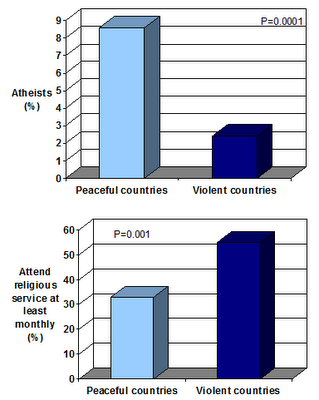
Graphic from Epiphenom.

‘It’s another blow to the idea that secularization leads to social meltdown. Atheist countries are, in fact more peaceful.’

By Tom Rees / June 4, 2009

The 2009 Global Peace Index has just been released. It’s basically a ranking of how turbulent and warlike a country is.

They put it together by assessing 23 criteria, including foreign wars, internal conflicts, respect for human rights, the number of murders, the number of people in jail, the arms trade, and degrees of democracy (Guardian).

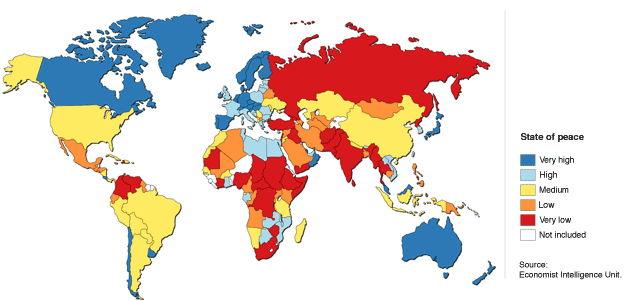
You can see a world map of peace at the Vision of Humanity website, and also take a look at country rankings for 2009, as well as earlier years.

New Zealand came out on top this year. Hmm, New Zealand is a pretty non-religious country. In fact, if you eyeball the rankings, the top few countries are all pretty non-religious.

What I’ve done in the figures here is to take data from the World Values Survey on the percentage of people in each country who say they are a committed atheist, and also on the percentage of people who say that they go to a religious service at least once a month.

World Peace Map from Vision of Humanity.

Click on image to enlarge.

Then I split the sample into two equal groups, based on their score on the Global Peace Index. The ones in the ‘Peaceful’ group are countries with a GPI score less than 1.8.

Sure enough, peaceful countries have more atheists and fewer regular worshippers. The difference is highly statistically significant (P=0.001 or less) — in other words it’s real, not just a chance finding.

Now, there are several possible reasons for this. It could be that people living in turbulent countries turn to religion, or it could be that religion is not a good way to structure modern society. Or it could be that some other factor or combination of factors (democracy? free speech? education? government welfare?) generates citizens who are both peaceful and non-religious.

Whatever, it’s another blow to the idea that secularization leads to social meltdown. Atheist countries are, in fact more peaceful.

Source / Epiphenom

The Rag Blog

Posted in RagBlog | Tagged , , , | 2 Comments

Greg Moses : By George! Austin Leads USA Recovery


Austin Leads in Job Growth

Still, these Texas numbers look like boutique novelties in a warehouse of national economic crisis.

By Greg Moses / By Greg Moses / The Rag Blog / June 5, 2009

It’s a wistful headline, I admit. But it covers a considerable hope.

The Austin-Round Rock metropolitan area was nearly alone among USA cities for its ability to report year-over-year job growth in April, 2009 (up by 3,400 jobs). And it was the only major metro area (out of 38) to report an increase in the employment rate (+0.4 percent). To believe that this slim green shoot is the first sign of economic Springtime in America requires a bit of the Oat Willie determination to go “Onward thru the Fog.” Which, actually, is what I intend to do.

But first a note: more notice should have been given to Odessa-Midland which, unlike Austin-Round Rock, gets split into two separate metro areas. Odessa employment was up by 1,800 over the year, while Midland was up by 1,500. Why these sister cities don’t get hyphenated into a single metro is curious.

Still, these Texas numbers look like boutique novelties in a warehouse of national economic crisis. The volumes are crushingly large. Los Angeles has lost 240,000 jobs, the New York metro area is down by 234,000. Chicago down 190,400, Detroit down 143,400, Phoenix and Atlanta down by 129,700 and 123,600.

How all these jobs will get re-started is not easy to see. Where are the new paradigms of labor to come from?

Stock watchers are reading reports about large dollar supplies stored up by investment managers and standing ready to flow back into a wary market of stocks and bonds as soon as things get more steady. But the dynamic reminds me of Truman’s exhortations on fear. Don’t things continue to fall harder the longer the investment managers wait?

In some circles one hears a constant drumbeat for buying gold, which may be a way to own something that won’t crash in value this year. But what use is gold, really?

In the great classic of American political economy, Progress and Poverty, Henry George defines capital as that part of wealth which is put back into productive use. He encourages a view of capital as something which enables labor to be more productive and he therefore discourages taxation on capital.

Taking a Georgist view, I would think that gold is wealth that serves very little productive purpose. To the extent that gold is a way of holding some savings for retirement or rainy days, I don’t see how it should be valued much differently than any other form of savings.

But to the extent that gold is hoarded up as a pile of fear, doesn’t it become its own effect, pulling wealth out of productive equity investments, drying up more jobs, etc.?

From my armchair view of internet chatter, it seems to me a wise thing for policy makers to devalue the dollar in the near-term as a means of coaxing cash into markets. But if devalued dollars simply get transmuted into gold shares, then the alchemy gets dark.

A Georgist approach to systemic reform begins with tax policy. Capital and labor should be taxed last. Then property values should be clearly divided between improvements and the land they rest upon. Let the improvements also move to the back of the tax line. This leaves land value at the head of the line for taxation.

George’s reasons for land tax could be summed up in a Kudlow motto: “tax it and you get less of it.” But with land, there is no danger of taxation reducing the supply, there is only the promise of land monopolists unloading every acre that they are not already putting to productive purpose.

Thus, under the Georgist model, the land tax — as the only tax — could never result in an absolute decrease in land supply. The land tax would only tend to decrease the amount of land that is held, like piles of gold, for unproductive use. As for gold and other means of piling up unproductive wealth, I can’t see right away why a tax on such things wouldn’t hasten the development of a more productive economy for all.

George says that supply and demand are misleading terms to use when trying to understand the causes of the unemployment cycle. Workers are not quitting their jobs because they have earned all they need. They are not refusing to produce or to consume. We never have all we want, and the example of Austin in April proves that we are ever willing to earn the next leg up. So why do so many workers find themselves at massive rates closed out of productive opportunity?

The problem lies at the door of unproductive wealth, because there is still plenty of it. Yet for some reason unproductive wealth is encouraged and allowed to pile up, even sometimes as an excuse for “real value.” If we taxed land, unproductive wealth, and gold supplies, I wonder, wouldn’t we quickly motivate and incentivize tons of wealth into capital that would eagerly call for full employment now?

[Greg Moses is editor of TexasWorker.Org. He is a regular contributor to The Rag Blog.]

The Rag Blog

Posted in Rag Bloggers | Tagged , , | Leave a comment

Rabbi Arthur Waskow : The President’s Speech Set the Right Tone

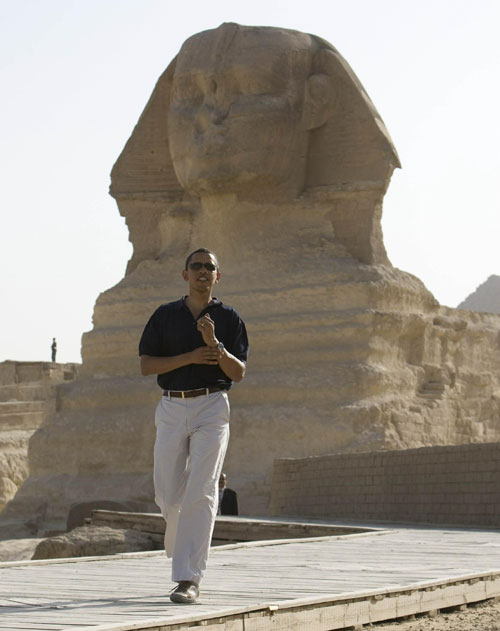
President Barack Obama walks in front of the Sphinx in Giza yesterday. He toured the pyramics after delivering his groundbreaking speech in Cairo. Photo from Gulf Times.

The Cairo speech needs to be given again in Los Angeles, Detroit, the Bronx, Miami, Northeast Philadelphia, Georgia, Alabama, Mississippi — aimed at Jews and evangelical Christians as well as Muslims.

By Rabbi Arthur Waskow / The Rag Blog / June 5, 2009

Salaam aleikum, shalom aleichem, peace be with you!

The President’s opening to the Muslim world was magnificent.

Why “magnificent”? Because in its breadth and depth, the Cairo speech not only set the basic tone of seeking to build a world community rather than an American empire, but also covered all the key specific outstanding issues with a basic outlook of community rather than domination.

In regard to the need for a peace agreement between Israel and an independent Palestine, I wish it had named more clearly and specifically the U.S. insistence on a settlement freeze and reversal, an end to the blockade of civilian goods from entering Gaza, and an end to encroachment on Palestinian neighborhoods in East Jerusalem.

These were encoded in the speech, but clear and public language — as the President himself said, what diplomats say in private we must all now say in public — is necessary to build a public up-swell of commitment to this effort. Which is greater, speech or action? Speech — if it leads to action.

The Cairo speech needs to be given again in Los Angeles, Detroit, the Bronx, Miami, Northeast Philadelphia, Georgia, Alabama, Mississippi — aimed at Jews and evangelical Christians as well as Muslims.

Even more important, from the grass-roots of America, Jews, Christians, and Muslims need to come together, sharing the same platforms and pulpits, to say the words of peace and do the acts of peace with each other. The medium is the message.

On the Shalom Center website you will find an essay laying out the basic values beneath a spiritually rooted peace policy for the Middle East. It begins

The stance from which I approach issues of peace in the Middle East — just like the stance from which I address issues of healing the earth, seeking social justice, encouraging a rhythm of Free Time against overwork — is the stance of a spiritually renewed and renewing Judaism, a tree fed by the universal Breath of Life.

That universal Breath teaches –-

That life is interwoven, that all communities and life-forms can be valued organs within the body of life, each organ different from the others as the heart and liver and brain differ while all are parts of a sacred whole.

That self-restraint by each center of power — not negating its own value but not domineering over others — is crucial.

And then continues with the spiritual values of a life-giving Judaism that lead to specific policy actions.

I invite you to read it here.

And then to call together speakers and teachers and clergy and lobbyists and women — especially women, there must be women in this process — to lead the discussion, the retreats, the classes, the vigils, the visits to Congress, the prayers — above all the prayers, prayers like Rabbi Heschel marching, saying his legs were praying — for a peace and a community like the one the President envisioned.

And to remember — this moment would not have been possible without the work we and you have done — we and you the members and readers and friends of The Shalom Center — and the next crucial steps will also be impossible without us.

Shalom, salaam, peace!

Arthur

[Rabbi Arthur Waskow, a regular contributor to The Rag Blog, is director of The Shalom Center. Rabbi Waskow is co-author of The Tent of Abraham, author of Godwrestling — Round 2, Down-to-Earth Judaism, and a dozen other books on Jewish thought and practice, as well as books on U.S. public policy.]

The Rag Blog

Posted in Rag Bloggers | Tagged , , | Leave a comment

Only In America: The Rebecca Rubin Doll

One Rebecca Rubin has an FBI wanted poster and the other comes with toy challah bread.

Newly Marketed ‘American Girl’ Doll Accidently Named After Alleged Eco-Terrorist
By Tara Lohan / June 2, 2009

Apparently hoping to expand their marketing reach, Mattel recently released their Jewish-themed doll. But it seems the toy company may have accidentally stumbled onto another market. As ABC reports: “Rebecca Rubin — an alleged domestic terrorist on the lam since 2006 — appears to have devoted her life’s work to bringing down the capitalist system. But Rebecca Rubin is also an 18-inch doll, the newest in the American Girl collection, which brings in a whopping $463 million each year for the toy giant Mattel.”

Woops. Apparently Mattel does about as much research as those folks who organized the Tea Bagging protests.

The New York Times explains:

Rebecca J. Rubin, who sometimes goes by the alias Little Missy, is a fugitive who was indicted in 2006 in a series of arson fires in Oregon dating to 1997, according to her F.B.I. wanted poster.

The wanted Ms. Rubin carries a $50,000 reward and “should be considered armed and dangerous,” her wanted poster says. The doll Ms. Rubin costs $95 and can be bought with pet kittens and a toy challah bread.

While Mattel is hoping people regard their Rebecca Rubin fiasco as an unfortunate coincidence, the FBI is hoping it may actually bring in their real suspect. But Hamilton Nolan writing for Gawker has a better idea: “Clearly the solution is to arrest everyone responsible for creating American Girl Dolls.”

Source / AlterNet

Thanks to Jeffrey Segal / The Rag Blog

Posted in RagBlog | Tagged , , | 5 Comments

Spending on Peace Is More Cost Effective

Military spending is set to rise 34% by 2012.

The purchasing power of peace
By Jorn Madslien / June 3, 2009

Purchasing power long ago overtook manpower as the most important lever in the race towards military might.

Currently, personnel expenditure accounts for less than 40% of global defence spending, according to Datamonitor.

As hi-tech machinery continues to reduce the need to use soldiers to fight wars, this proportion is shrinking.

Meanwhile, the amount spent on defence is soaring in every region of the world.

In 2007 alone, global defence spending rose 8.4% to $1,140.5bn, according to Datamonitor, which predicts a near 34% increase to $1,527.6bn by 2012.

Poverty fuels violence

At a time when a deep economic recession is causing much turbulence in the civilian world – buffeting both airlines and aerospace companies – defence giants such as Boeing and EADS, or Finmeccanica and Northrop Grumman, are thus enjoying a reliable and growing revenue stream from countries eager to increase their military might.

Defence spending 2008
   US $374bn
   Asia $173bn
   European Nato $144bn
   Source: IISS.

Defence spending has a tendency to rise during times of economic hardship.

Both geopolitical hostilities and domestic violence tend to flare up during downturns.

Last year, for instance, high food and fuel prices during the first part of the year and the recession later in the year eroded peace, according to the Global Peace Index, published by the Institute for Economics and Peace.

On the domestic stage, meanwhile, “rapidly rising unemployment, pay freezes and falls in the value of house prices, savings and pensions is causing popular resentment”, the report says.

Valuable ‘violence’

Shareholders and employees in the aerospace and defence industry are clearly the ones who benefit most from growing defence spending.

Armed conflict often intensifies during economic
downturns, a report says.

Defence companies, whose main task is to aid governments’ efforts to defend or acquire territory, routinely highlight their capacity to contribute to economic growth and to provide employment.

Indeed, some $2.4 trillion (£1.5tr), or 4.4%, of the global economy “is dependent on violence”, according to the Global Peace Index, referring to “industries that create or manage violence” – or the defence industry.

Economic stimulus

Many governments deem defence spending as a useful tool to fend off recessions – another reason why defence spending often rises during downturns.

Take China, which has doubled its defence budget since 2006 and is planning yet another 15% rise in its official defence budget this year to 480bn yuan ($70bn; £43bn).

The hope is that the additional defence spending should act as a fiscal stimulus and thus help to get the Chinese economy’s wheels turning even faster.

China is not the only Asian country to boost its defence budgets.

Last year, Asia overtook Europe as the second-biggest military spender ($173bn), after the US ($374bn) and ahead of European Nato members ($144bn), according to the International Institute for Strategic Studies (IISS).

Profitable peace

Bank of England, City of London.

If the cost of investing in proactive peace-creation was minimal compared to the lost potential caused by violence, then would it not be fitting for business to engage with government to create peace in the markets in which they operate? Global Peace Index.

Undoubtedly, such additional cash injections will reap benefits in the economies concerned.

But if “violence”, or the threat of such, is economically beneficial, then peace – the “absence of violence” – is even more valuable, according to the Global Peace Index, which has calculated its value in US dollar terms.

“Ideally, living without the threat of instability would mean the violence dollars could be redeployed into areas that would cause other less destructive markets to grow,” the report says.

The economic bonus of peace – or the removal of the cost of “lost peace” – would be $7.2tn a year, based on latest data from 2007, the report has found.

“There is a very, very strong correlation between peace and wealth,” Steve Killelea, founder of the Global Peace Index.

Peace industry

To reach this figure, the report’s authors set out to identify the “peace industry”, as distinct from the defence industry.

“The peace industry comprises those companies and industries whose markets improve, or whose costs decrease with improving peacefulness,” it says.

“Examples include retail, finance, tourism and insurance.”

The report’s findings are not as abstract as they may at first seem. Not only does it insist that “wars are no longer economically viable”. It also calls for companies to promote peace:

“If the cost of investing in proactive peace-creation was minimal compared to the lost potential caused by violence, then would it not be fitting for business to engage with government to create peace in the markets in which they operate?”

Virtuous cycle

Since the end of the Cold War in 1989, the world has become a more peaceful place, as “more wars have ceased than have started”, the Global Peace Index observes.

French engineers practice land mine clearing,
near the Yugoslav border, at Kumanovo, 1999.
Promoting peace may boost economic growth.

“One of the biggest beneficiaries of this has been business.”

More recently, between 2000 and 2007, the number of conflicts fell from 40 to 30. Meanwhile, global GDP, or economic output, has risen from $32tn to $55tn.

This is a direct result of what the report calls a “virtuous cycle”, where productive employment – which can only arise if there is peace – leads to wealth creation.

“People become motivated by the improved standard of their lives, rather than seeking retribution for past wrongs,” it says.

Conversely, when economic development contracts, violence increases, thus harming the business environment.

Military might delivers geopolitical supremacy, but peace delivers economic prosperity and stability.

And that, the report insists, is what is good for business.

For full reports, click here.

Source / BBC News

Thanks to Deva Wood / The Rag Blog

Posted in RagBlog | Tagged , , | Leave a comment

Barbara Ehrenreich to Journalism Grads : Welcome to the Working Class

Drop your sense of entitlement, Ehrenreich tells a graduating class of media makers, journalists are now ‘part of the working class.’

By Barbara Ehrenreich / June 4, 2009.

[The following is the text of Barbara Ehrenreich’s commencement address on May 16 to the University of California, Berkeley Graduate School of Journalism Class of 2009.]

The dean gave me some very strict instructions about what to say today. No whining and no crying at the podium. No wringing of hands or gnashing of teeth. Be upbeat, be optimistic, he said — adding that it wouldn’t hurt to throw in a few tips about how to apply for food stamps.

So let’s get the worst out of the way right up front: You are going to be trying to carve out a career in the worst economic downturn since the Great Depression. You are furthermore going to be trying to do so within what appears to be a dying industry. You have abundant skills and talents — it’s just not clear that anyone wants to pay you for them.

Well, you are not alone.

How do you think it feels to be an autoworker right now? And I’ve spent time with plenty of laid-off paper-mill workers, construction workers and miners. They’ve got skills; they’ve got experience. They just don’t have jobs.

So let me be the first to say this to you: Welcome to the American working class.

You won’t get rich, unless of course you develop a sideline in blackmail or bank robbery. You’ll be living some of the problems you report on — the struggle for health insurance, for child care, for affordable housing. You might never have a cleaning lady. In fact, you might be one. I can’t tell you how many writers I know who have moonlighted as cleaning ladies or waitresses. And you know what? They were good writers. And good cleaning ladies, too, which is no small thing.

Let me tell you about my own career, which I think is relevant, not because I’m representative or exemplary in any way, but because I’ve seen some real ups and downs in this business.

I didn’t start out to be a freelance writer or a journalist, but after a number of false starts and digressions, I discovered that’s what I really loved doing. In about 1980, I was a single mother of two small children, and my work quota was four articles or columns a month. I did my research at the public library. I bought my clothes at Kmart or consignment stores. The kids did not get any special lessons or, when the time came, SAT prep courses.

Then came the fat times, in the ’90s, which I realize now were an anomaly in the history of journalism. The industry was booming; editors would take me out for three-course lunches in Manhattan. I’ll never forget one of those lunches: It was with the top editor of Esquire, and I was trying to pitch him a story on poverty. He looked increasingly bored as we got through the field greens with goat cheese, the tuna carpaccio and so forth — until we finally got to the death-by-chocolate dessert, and he finally said, “OK, do your thing on poverty — but make it upscale.”

It was still an uphill struggle to write what I cared about, but at least I was getting generously paid — up to $10 a word by Time magazine. Imagine that — $10 a word. Most Americans would be happy to make $10 an hour.

Then, bit by bit, it all began to fall apart. The newsweeklies: Time let me go in 1997. The book-publishing industry was in tatters by 2005. And then the newspapers began to shrink within my hands or actually disappear. I was beginning to feel a certain kinship with blacksmiths and elevator operators when the recession hit in 2008, and every single income stream I had began to dry up.

But it was the recession, of course, that saved me from self-pity. I began to get sick and tired of the typical media recession story — which was about rich people having to cut back on the hours they spend with their personal trainers. All right, I realize those are man-bites-dog stories compared to a story about a laid-off roofer being evicted from his trailer home. But it seemed to me that the recession had absolutely eliminated the poor and the working class from the media consciousness. Once again, they had disappeared from sight.

So a couple of weeks ago, I pitched a certain well-known newspaper a series of reported essays on precisely this topic. They took it — but at about only one-quarter of what they had paid me for writing columns five years ago, barely enough to cover expenses. That bothered me. But then I had a kind of epiphany and realized: I’ve got to do this anyway. I’m on a mission, and I’ll do whatever it takes.

Which brings me back to the subject of journalism as a profession. We are not part of an elite. We are part of the working class, which is exactly how journalists have seen themselves through most of American history — as working stiffs. We can be underpaid, we can be jerked around, we can be laid off arbitrarily — just like any autoworker or mechanic or hotel housekeeper or flight attendant.

But there is this difference: A laid-off autoworker doesn’t go into his or her garage and assemble cars by hand. But we — journalists — we can’t stop doing what we do.

As long as there is a story to be told, an injustice to be exposed, a mystery to be solved, we will find a way to do it. A recession won’t stop us. A dying industry won’t stop us. Even poverty won’t stop us, because we are all on a mission here. That’s the meaning of your journalism degree. Do not consider it a certificate promising some sort of entitlement. Consider it a license to fight.

In the ’70s, it was gonzo journalism. For us right now, it’s guerrilla journalism, and we will not be stopped.

[Barbara Ehrenreich is the author of This Land is Their Land: Reports From a Divided Nation (Holt Paperbacks, April 2009). She delivered this commencement address on May 16 to the University of California, Berkeley Graduate School of Journalism Class of 2009.]

Source / AlterNet

Thanks to Mercedes Lynn de Uriarte / The Rag Blog

Posted in RagBlog | Tagged , , , | 2 Comments

POETRY / Gregg Barrios : ‘El hijo de Frida y Diego’

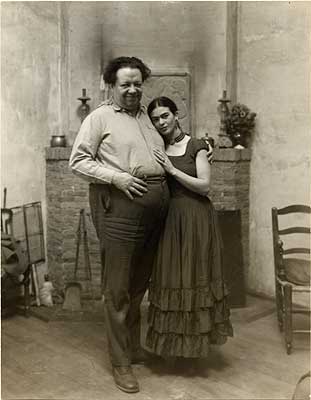
Diego Rivera and Frida Kahlo. Photo from Yoreme’s Weblog

See Video of Gregg Barrios reading ‘Chale Guerra,’ Below.

El hijo de Frida y Diego

I am the promised root born through artful insemination
I am the manchild borne through prehysteric supplication
I am the mestizo torn within and without la sierra madre
I am the collision of ancient magic and modern sorcery

In 1940, the virgin and the warrior rewed
the last time, the first time, para siempre
I am a paradox slouching to be reborn in rebirth
I am a plumed serpent of mated eagle and snake

I am the son of Diego and Frida
colossal giants in the land of myth
gods exiled from the starry heavens
smoking satellite into violated earth

a saucer of atole, my mother’s dowry
a bowl of frijoles, my father’s gift
mi madre, the doe, the wounded one
mi padre, the frog, the insatiable one

I watch the buddah frog on the lilly pad
waiting as the hummingbird draws near
that which must be, will come at last
I learn the future through my past

I am amphibian in my mother’s watery tomb
swimming spermatoid to tadpole twitching
tossed from a sea of joy into the mystic
I am the tender shoot on the broken bough

I am the child beating upon a war drum
I sound the cadence, announce the fall
I plant foot and banner firmly on the shore
I am inheritor of a brave new world

I am the body of Adam and the soul of Eve
I am the separation of Darkness and Light
I am Cristobal Unborn, Quetzalcoatl Reborn
Soy el hijo de Rivera y Kahlo.

Gregg Barrios / The Rag Blog

San Antonio, Texas
Posted June 4, 2009

[San Antonio writer Gregg Barrios, who wrote for The Rag in 60s Austin, is the author of the award-winning play Rancho Pancho. “Frida y Diego” is from his latest collection La Causa, to be published by Hansen Books in September. “El hijo de Frida y Diego” was also published in the San Antionio Express-News.]

‘Chale Guerra’ by Gregg Barrios

The following reading is of an anti-war poem that Gregg Barrios wrote during the Vietnam era that was featured in the anthology, “Vietnam and Aztlan,” published by University of California Press. It was presented as part of an “anti-war/pro-peace” reading in San Antonio in 2008.

The Rag Blog

Posted in Rag Bloggers | Tagged , , | 2 Comments

Scott Roeder : The Anti-Abortion Zealotry of the Radical Right

Right wing militant Scott Roeder, accused of murdering Dr. George Tiller. Photo from Sedgwick County Jail.

The [right wing] nationalists, including a more virulent white nationalist extreme, are gathering strength and getting bold, even though they are still a militant minority.

By Carl Davidson / The Rag Blog / June 4, 2009

See ‘Racism, Anti-Semitism and the Murder of Dr. Tiller’ by Leonard Zeskind, Below.

I think this is not isolated, but symptomatic of a rising problem. The rightwing camp is split between the neoliberal globalists, say Gingrich as spokesman, and the anti-global nationalists, say Dobbs, Hannity as spokesmen.

The globalists are currently weakened. But They will use legal means, but they are preparing extra-legal, armed means for taking down Obama and Democrats generally. “Rightwing Populism” is the general rubric used to fan the flames here. We have to take it seriously, and especially combat its effort to influence the working class.

This doesn’t mean being alarmist or projecting conspiracies everywhere, but still exposing and thwarting it as best as we can.

Racism, Anti-Semitism and the Murder of Dr. Tiller

By Leonard Zeskind / June 2, 2009

Scott Roeder, who is being held in a Wichita jail as a person of interest in the murder of Dr. George Tiller, is widely known for his anti-abortion zealotry. Less understood is his connection to the so-called Christian common law courts and the militia movement. In the mid-1990s, Roeder associated regularly with both Kansas militiamen and he declared him self a “sovereign” citizen, immune from the responsibilities of paying taxes or driving with a registered license plate.

The notion of “organic sovereigns” was first promoted by the Posse Comitatus, best known for its tax protest politics, but imbued also with the racist and anti-Semitic ideology known as Christian Identity. According to this doctrine, Jews are satanic creatures and people of color are less-than-fully human. And the Posse found a number of devoted followers in Kansas. At an August 1983 outdoor meeting in Cheney Lake State Park, farmers mixed with Wichita residents who believed that white Christians who renounced their ties with the “Zionist-controlled” government were “sovereigns.” Their rights trumped those they declared to be “Fourteenth Amendment” citizens — meaning people of color and non-Christians. It was an arcane theory which promoters sometimes used to justify tax protest, embezzlement and larceny. But its central tenets placed it at the heart of the white nationalist movement, which contended that the United States was, or should be, a white Christian republic rather than a multi-racial democracy.

These ideas reached their apotheosis in the mid-1990s, when a group calling itself the Freemen, set up an armed encampment on a farmstead in Montana. A noticeable nest of Freemen had established itself in Kansas, and authorities noted Roeder’s association with the Freemen at that time. After the Montana group surrendered in 1996, this particular iteration of white nationalism was pushed aside as other forms, some more openly national socialist in their orientation, took its place at the front of the movement.

This white Christian notion of sovereign citizenship remained strong long enough to mix with the unhappy edges of anti-abortion activism in Kansas — including those who had staged massive sit-ins in 1991, in an attempt to shut down Dr. Tiller’s clinic. In August 1997, in the Topeka state capitol building, a former Tiller clinic protester named Paula Drake, who had married a Posse Comitatus farmer, ran a “Christian common law court” similar to those convened by the Freemen. Although Ms. Drake was the obvious force behind this meeting of twenty-five mostly middle-aged men, she insisted that her husband was actually running the program. The Bible commanded that women must serve men, she told an observer. The same ideas that once motivated her to protest Dr. Tiller inspired her to “indict” judges and other government officials in her “court.”

The same confluence of white nationalism with anti-abortion zealotry showed its faced in the first murder of an abortion doctor, Dr. David Gunn, in 1993 in Pennsacola. In that instance the triggerman was a Joe Regular Guy named Michael Griffin. But Griffin was heavily influenced, indeed completely under the spell of a local leader named John Burt, who admitted that he was “very active” as a Klansman in St. Augustine in the 1960s. With Burt also, attacks on Dr. Gunn were of a piece with the racist violence of a previous era.

These are not simply isolated instances. Rather they represent the tip of a social movement that is completely alienated from the culture, society and government of the multi-racial, multi-ethnic American people. Their allegiance is to another set of laws and values, one in which the color of their skin is a badge of their national identity. Not all are violent, and many hope to someday win a following among a majority of white people and reclaim the country that they believe belongs to them alone.

The presidency of Barack Obama has not stilled their passions, nor was his nomination of Judge Sonia Sotomayor to the Supreme Court the only motivating factors in this killing. Something much whiter and more dangerous was let loose long before last November. And we have not heard the last of it.

[Leonard Zeskind, a resident of Kansas City and a MacArthur Fellow, is the author of Blood and Politics: The History of the White Nationalist Movement from the Margins to the Mainstream, published by Farrar Straus and Giroux in May 2009.]

Source / The Huffington Post

The Rag Blog

Posted in Rag Bloggers | Tagged , , , , , | 4 Comments

Finance Universal Health Care? Legalize Cannabis

Photo from rolledtootight.com

Why is this reasonably safe compound currently forbidden when its use, as well as that of many toxic hallucinogens, goes as far back as biblical times and may indeed have been instrumental in producing, in part, the Old Testament?

By Dr. Stephen R. Keister / The Rag Blog / June 4, 2009

I have been following the health care debate in a series of articles for The Rag Blog, and anticipate doing so until the situation in the Congress is resolved. Today and in several future submissions I will digress, in part, to discuss an idea for partially financing a decent health care system in the United States akin to those in France, the Netherlands, Germany, and other industrialized nations.

I do this with a certain degree of apprehension as the mindset in this country results in an almost reflex reaction suggesting that an investigator into this subject matter is trying to attain some kind of personal gratification. Note: I have in 87 years NEVER used pot! To proceed….

Some months ago, online, I encountered a gentleman, a retired PhD in molecular biology, who was suffering from terminal lung cancer. He was mentally alert, and desired to remain so, without dulling his sensorium with opiates and sedatives. This I could well understand as he continuously produced a series of articles on the internet on science, theology, history and liberal political thinking. He introduced me to the new edition of the Jefferson Bible, a book any thinking person should find worthy of purchasing. He was surviving on marijuana which was supplied to him by a son who resided in a state where it is available for medical use.

The gentleman found that, smoking a cigarette several times a day, his discomfort was assuaged, that he could function intellectually, and that on X-ray several of the metastatic lesions were actually reduced in size. Unhappily, I have not heard from this outstanding human being in the past several weeks, thus am quite apprehensive, but the prior communication got me to thinking.

Why is this medication forbidden to other terminally ill patients to relieve the distress of their final days? Why, indeed, the prejudice against cannabis in the United States when it is available in many of the enlightened countries of the Western World? Why this peculiar mind-set when we see opium derivatives and various mind altering prescription drugs prescribed, and advertised on television, with impunity? Why is this reasonably safe compound currently forbidden when its use, as well as that of many toxic hallucinogens, goes as far back as biblical times and may indeed have been instrumental in producing, in part, the Old Testament?

Thus, I began to consider the financial and medical advantages to legalizing the substance and taxing it we do alcohol and tobacco. Concurrently, I encountered an excellent article by Clive Crook, entitled “A Criminally Stupid War on Drugs.” The author points out that legalization/taxation could net the U.S. treasury $100 billion a year. This would surely be a fine down payment on single payer/universal health care. Further, it would reduce the cost of imprisoning an estimated 500,000 people, the vast majority merely for possession, which is more folks than are imprisoned in Britain, France, Germany, Italy and Spain combined.

We will subsequently address the prejudice against this specific therapeutic agent, as opposed to many others on the market, with and without prescription, later in our discussions. It most assuredly needs further scientific and clinical investigation by the FDA and the NIH; however, there is evidence available that cannabis alkaloids may well be helpful in the treatment of Alzheimer’s Disease, various types of arthritis, asthma, brain cancer, breast cancer, glaucoma, head injuries, hypertension, and lung cancer and as a non-opiate, non-addictive pain killer. Many years ago I knew an oncologist who told his patients with severe nausea from chemotherapy where on the street their families could obtain cannabis. A regrettable way to care for the sick. Only in the USA!

An interesting but non-medical observation was called to my attention by an artist friend, that hashish was used toward the end of the 19th century in France where artists developed that strange but beautiful movement called Art Nouveau. Some art historians believe that the movement was directly related to hashish induced visions. Thus, surely if one is suffering through a terminal illness, and is in hospice care, the ability to retreat to a world of beautiful visions is surely preferable to living in a world of constant pain and suffering.

To understand this specific, near universal prejudice, one must understand the mindset in the United States. It’s all about profit, financial profit, though on the surface this might not always be apparent. We hear of concerns of a physical or moral nature; however, when the truth is out, it is about money and only about money. One must understand the pharmaceutical industry, as well as the health insurance industry, to fully appreciate how Washington is influenced. A good beginning is to read Dr. Marcia Angell’s The Truth About the Drug Companies. How They Deceive Us and What to do About it. In addition I would suggest reading “Marijuana Timeline In The United States.” We will pursue this further at a later time.

Meanwhile the fight regarding health care continues in Washington. This past Sunday Rick Scott subsidized libelous TV programming designed to untrack the debate regarding decent health care for the American people. Read “Rick Scott: Putting Profits Before People” from Think Progress. In addition, to understand the machinations behind the debate you should read “The Machinery Behind Health-Care Reform,” by Robert O’Harrow Jr. in the Washington Post.

The debate appears to center on the development of a “public health care option,” which surely would be more expensive, less efficient, and less inclusive than a single payer plan, which is desired by 65% of the public and physicians polled. However, our brave elected representatives feel a need, largely financial, to accommodate the health insurance industry, and this “compromise.” One shudders at a recent suggestion by Sen. Kennedy of Medicaid for all with an income of something like $100,000. Frightening that Sen. Kennedy has not a glimmering of an idea as to the lack of medical care this would produce. These unfortunate folks would not be able to find a physician, as the Medicaid program pays approximately 50% of a physician’s normal fee, and an influx of patients with this type of “insurance” would destroy an honest physician’s ability to meet his overhead. Even the suggested “Medicare For All” has its drawbacks as well elucidated by Joe Paduda in Campaign For America’s Future;

As I watch our elected representatives and the insurance and pharmaceutical cartels struggling with the health care issue, I am carried back to a paragraph by Walt Whitman — quoted by Peter Quinn in a recent issue of Commonweal — as he summed up the meta-partisan ethic of the kleptocracy:

“The depravity of the business classes of our country is not less than has been supposed but infinitely greater. The official services of America, national, state, and municipal, in all their branches and departments…are saturated in corruption, bribery, falsehood, and mal-administration.”

[Dr. Stephen R. Keister, a regular contributor to The Rag Blog, lives in Erie, PA. He is a retired physician who is active in health care reform. His previous articles on The Rag Blog can be found here.]

The Rag Blog

Posted in Rag Bloggers | Tagged , , , | 3 Comments

Guantanamo Prisoners Shaming Washington

I can think of very little that is more disgusting than the words of a former commander of the Guantanamo facility (which I missed when they were uttered in June 2006). He said that three detainee suicides were not acts “of desperation but an act of asymmetric warfare against us.” I come to think that there is no humanity in those who would say such things.

Richard Jehn / The Rag Blog

Two Uighur detainees at Guantanamo hold the prison camp’s first self-styled public protest for visiting journalists Monday night in this photo cleared for release by the U.S. Department of Defense. Photo: Michelle Shephard/Toronto Star.

Gitmo protest captured on film
By Michelle Shephard / June 3, 2009

WASHINGTON – A Guantanamo Bay detainee committed suicide late Monday just hours after two Chinese Muslim captives staged the detention centre’s first public protest, increasing the pressure on U.S. President Barack Obama to outline his plan of how he will close the offshore prison.

Yemeni Muhammad Ahmad Abdallah Salih, 31, is the first prisoner to die since the White House changed hands four months ago. His suicide follows weeks of criticism from both ends of the political spectrum over the fate of the remaining 240 Guantanamo detainees.

News of the suicide was emailed to the media just as a flight bringing journalists from Guantanamo landed in Maryland. The press had been at the U.S. naval detention centre for the war crimes court hearing of Canadian Omar Khadr.

Khadr, 22, is accused of war crimes, including the murder of a U.S. soldier during a firefight in Afghanistan in July 2002.

Hours after Khadr’s brief hearing Monday, fewer than a dozen journalists on the trip, including a Toronto Star reporter, witnessed a rare unscripted moment on the base when two Uighur (pronounced Wee-gur) detainees managed to hold an impromptu protest.

The group was at an Oceanside prison known as “Camp Iguana,” where 16 Uighur and one Algerian detainee are imprisoned.

As the journalists neared the fence line, the captives held up messages written in crayon on prison-issued sketch pads, knowing the Pentagon prohibits journalists from speaking to detainees.

For a few minutes they silently turned the pages quickly, as journalists shot video, photos and scribbled down their messages.

“We are being held in prison but we have been announced innocent a corrding to the virdict in caurt,” one message said. “We need to freedom (sic).”

Another stated, “America is Double Hetler in unjustice,” seemingly comparing their treatment by the U.S. government to that of the Nazis.

The Uighur prisoners with Chinese citizenship have been cleared for release but there’s nowhere for them to go since the minority group is persecuted in its Communist-controlled homeland. The U.S. government has tried for months to find a country willing to provide the group asylum.

Reporters were ushered away from the fenced-in area shortly after the Uighurs had their written protest. One of the captives yelled as the gate was locked behind the group: “Is Obama Communist or a Democrat? We have the same operation in China.”

Journalists were later forbidden from sending photos or video footage of the signs until Guantanamo officials received clearance from the White House – which didn’t come until about 14 hours later.

Pentagon ground rules signed by reporters stipulate that images of detainees must be pre-screened and cannot identify the captives due to regulations in the Geneva Conventions prohibiting the exploitation of prisoners of war.

Hours after the protest guards found Salih unresponsive in his cell in a separate area of the prison and attempts to revive him failed.

He had been held without charges at Guantanamo since February 2002 and appeared to have joined a lengthy hunger strike, according to medical records released in response to an Associated Press lawsuit.

Three detainee suicides in June 2006 under the George W. Bush administration drew international outrage, further fuelled by comments about the military’s reaction.

“They have no regard for human life, neither ours nor their own,” then-Guantanamo commander Rear Adm. Harry Harris Jr. said. “I believe this was not an act of desperation but an act of asymmetric warfare against us.”

Source / Toronto Star

The Rag Blog

Posted in RagBlog | Tagged , , | Leave a comment

Capable of Learning Nothing from Almost Any Experience

Graceful Reprieve – art by William O’Connor.

Happy Days: Reprieve
By Tim Kreider / June 2, 2009

Fourteen years ago I was stabbed in the throat. This is kind of a long story and it’s not the point of this essay. The point is that after my unsuccessful murder I wasn’t unhappy for an entire year.

Winston Churchill’s quote about the exhilaration of being shot at without result is verifiably true. I was reminded of an old Ray Bradbury story, “The Lost City of Mars,” in which a man finds a miraculous machine that enables him to experience his own violent death over and over again, as many times as he likes — in locomotive collisions, race car crashes, exploding rockets — until he emerges flayed of all his free-floating guilt and unconscious longing for death, forgiven and free, finally alive.

I started brewing my own dandelion wine in a big Amish crock. I listened to old pop songs too stupid to name in print.

I’m not claiming I was continuously euphoric the whole time; it’s just that, during that grace period, nothing much could bother me or get me down. The sort of horrible thing that I’d always dreaded was going to happen to me had finally happened. I figured I was off the hook for a while. In a parallel universe only two millimeters away from this one (the distance between the stiletto and my carotid), I had been flown home in the cargo hold instead of in coach. Everything in this one, as far as I was concerned, was gravy.

My friends immediately mocked me out of my self-consciousness about the nerve damage that had left me with a lopsided smile. I started brewing my own dandelion wine in a big Amish crock. I listened to old pop songs too stupid to name in print. And I developed a strange new laugh that’s stayed with me to this day — a loud, raucous, barking thing that comes from deep in the diaphragm and makes people in bars or restaurants look over at me for a second to make sure I’m not about to open up on the crowd with a weapon.

I wish I could recommend this experience to everyone. It’s a cliché that this is why people enjoy thrill-seeking pastimes ranging from harmless adrenaline fixes like roller coasters to suicide attempts with safety nets, like bungee jumping. The catch is that to get the full effect you have to be genuinely uncertain that you’re going to survive. The best approximation would be to hire an incompetent hit man to assassinate you.

It’s one of the maddening perversities of human psychology that we only notice we’re alive when we’re reminded we’re going to die, sort of the same way some of us only appreciate our girlfriends after they’re exes. I saw the same thing happen, in a more profound and lasting way, to my father when he was terminally ill, and then to my mother after he died; an almost literal lightening, a flippant indifference to the silly, quotidian nonsense that preoccupies most of us and ruins so much of our lives. A neighbor was suing my father for some reason or other during his illness, but if you tried to talk to him about such “serious” matters he’d just sing you old songs like “A Bird In a Gilded Cage” in a high, quavering old-man falsetto. When my mother, who’s now a leader in her church, sees people squabbling over minutiae or personal politics, she reminds them, diplomatically I’m sure, to focus on the larger context.

It’s easy now to dismiss that year as nothing more than a sort of hysterical high. But you could also try to think of it as a glimpse of grace.

It didn’t last, of course. You can’t feel grateful to be alive your whole life any more than you can stay passionately in love forever — or grieve forever, for that matter. Time forces us all to betray ourselves and get back to the busywork of living in the world. Before a year had gone by the same dumb everyday anxieties and frustrations began creeping back. I’d be disgusted to catch myself yelling in traffic, pounding on my computer, lying awake at night wondering what was going to become of me.

Once a year on my stabbiversary I remind myself that this is still my bonus life, a free round. But now that I’m back down in the messy, tedious slog of everyday emotional life, I have to struggle to keep things in what I still insist is their true perspective. I know intellectually that all the urgent, pressing items on our mental lists — taxes, car repairs, our careers, the headlines — are so much idiot noise, and that what matters is spending time with people you love. It’s just hard to bear in mind when the hard drive crashes.

I was not cheered, a few years ago, to read about psychological studies suggesting that most people inevitably return to a certain emotional baseline after circumstantial highs and lows. You’d like to think that nearly getting killed would be a major, permanently life-altering experience, but in truth it was less painful, and occasioned less serious reflection, than certain breakups I’ve gone through. If anything, it only reinforced the illusion that in the story of my life only supporting characters would die, while I, its protagonist and first-person narrator, would survive. I’ve demonstrated an impressive resilience in the face of valuable life lessons, and the main thing I seem to have learned from this one is that I am capable of learning nothing from almost any experience.

I don’t know why we take our worst moods so much more seriously than our best ones, crediting depression with more clarity than euphoria. It’s easy now to dismiss that year as nothing more than the same sort of shaky, hysterical high you’d experience after being clipped by a taxi. But you could also try to think of it as a glimpse of grace. It’s like the revelation I had when I was a kid the first time I ever flew in an airplane: when you break through the cloud cover you realize that above the passing squalls and doldrums there is a realm of eternal sunlight, so keen and brilliant you have to squint against it, a vision to hold onto and take back with you when you descend once more beneath the clouds, under the oppressive, petty jurisdiction of the local weather.

[Tim Kreider’s articles have appeared in Film Quarterly and The New York Times and his cartoon “The Pain — When Will It End?” has appeared in the Baltimore City Paper since 1997. His Web site is thepaincomics.com.]

Source / New York Times

The Rag Blog

Posted in RagBlog | Tagged , , , | 3 Comments

Obama’s Middle East Policy: Dependent on the All-Important Follow-Through

A souvenir shop owner displays a metal plaque for sale to tourists in Cairo, Egypt, on May 28, ahead of President Obama’s June 4 speech. Photo: AP Photo/Ben Curtis.

Obama, Muslim-world rock star
By Juan Cole / June 3, 2009

They like him, they really like him! Well, maybe not so much in Egypt. But they’re willing to give him a chance.

President Barack Obama is famously much better at playing basketball than at bowling. But to succeed in the Middle East, he needs to be good at a different game altogether: golf. There are no fast-paced victories to be had here, no dunks, no three-point shots. As in golf, the sand traps and roughs are treacherous and the course is slow, and there is time for players to quarrel and throw their irons about petulantly. Above all, as in golf, the secret of a good swing is a strong follow-through.

Obama, who begins a trip to the region Wednesday, starts his term much more popular in the Middle East than his predecessor, George W. Bush. Last year, in many Muslim-majority countries, including U.S. allies such as Turkey, Bush often had favorability ratings in the single digits, neck and neck with Osama bin Laden. In contrast, a new opinion poll released by the Brookings Institution shows that in six Middle Eastern states, Obama comes in at 45 percent favorable, and if Egypt is subtracted, the proportion soars to 60 percent. As Obama prepares to make a major address to the world’s 1.5 billion Muslims, can he capitalize on his rock-star status in Riyadh and Beirut to go beyond celebrity glitter to concrete achievements that would benefit both the United States and the Muslim world?

The Brookings poll shows that just three issues are cited by most Arab respondents as determinative of their view of the United States. In order, they are Iraq, the plight of the Palestinians, and attitudes toward the Arab and Muslim worlds. Interestingly, the war in Afghanistan, democracy promotion, and the issues around Iran have very little resonance among Arab publics. Iraq was cited as the key issue by 42 percent in six countries polled, so it is fair to conclude that Obama’s stock in the Arab world, at least, is likely to rise or fall on how well he handles his planned military disengagement from that country.

The truth is that Obama’s task in the Arab world is more difficult and more important than elsewhere. He is wildly popular in Indonesia, the world’s most populous Muslim nation, where he spent some of his childhood and from whence hailed his stepfather. Likewise, West African Muslims overwhelmingly supported his presidential bid last year. The U.S., however, does relatively little trade with either region, and they have not traditionally been central to its foreign policy. The 325 million Arabs are a minority of Muslims worldwide (and not all Arabs are Muslim), but Arab Muslims are disproportionately influential among their co-religionists and, because of their energy resources and strategic position between Europe and Afro-Asia, are especially important to the United States and its allies. They are the Muslims who are most skeptical about Obama.

Obama will begin his Middle East tour with a visit to Saudi Arabia, a move warmly greeted by Saudi Op-Ed writer Abdul Malik Ahmad Al-Sheikh. The latter noted that Saudi Arabia is the holy land for Muslims, the site of the sacred cities of Mecca and Medina, while Egypt has been a center of pan-Arab nationalism. Obama’s itinerary thus honors both the key religious and political symbols for Arab Muslims. Al-Sheikh glowed, “The step you are taking also comes to honor what you promised the day you were sworn in as President of the United States of America, a day on which you extended your hand to the Islamic world, something which was not done by any American President before you.” Pleading for an end to the oppression of the Palestinians, he quoted Alexander Hamilton to the effect that “the sacred rights of mankind” cannot be found in old parchments, but are rather “written, as with a sun beam, in the whole volume of human nature, by the hand of the divinity itself.” Al-Sheikh concluded that the American founding fathers agreed that rights are “Allah-given.”

His next stop, Egypt, is perhaps the toughest room for the president to work. Obama faces the difficult challenge of convincing the sullen Egyptian public that the U.S. does not covet Arab land and resources, and that it can be an honest broker between the Israelis and the Palestinians. Along the Nile, anger toward Israel, in the wake of the Lebanon and Gaza wars and ever-expanding Israeli settlements in the West Bank, is probably higher than at any time since the 1970s. Public opinion is even more negative in Jordan, but there are 20 Egyptians for every Jordanian. Egypt is the most populous Arab country, with a third of the total Arab population, and it is an important political and cultural center. These are the reasons Obama chose it as the venue for his speech.

Washington has a poor track record when it comes to listening to its Arab allies about the realities of their region, and Arabs know it. Egyptian President Hosni Mubarak had warned George W. Bush against invading Iraq and predicted that such a rash action would produce “a hundred Bin Ladens.” Despite being a putative American ally, Mubarak praised the Iraqi army that fought invading U.S. troops as brave defenders of their homeland. Many Egyptians see the U.S. presence in Iraq as a Western occupation of Arab land, and they take it personally.

Egyptian political commentator Nael M. Shama spoke for many of his countrymen when he warned that good intentions and sweet talk would not take Obama very far. He wrote, “The Arab world is expecting concrete steps on the part of the world’s only superpower to address the region’s real problems, particularly the six-decade Arab-Israeli conflict. Thus far, the change in U.S. foreign policy has been in style, not substance.” Seventy-five percent of Egyptians said last winter in a BBC poll that resolving the Israeli-Palestinian conflict should be Obama’s No. 1 priority (the Gaza war had just begun as the poll was being conducted). More recently, Egyptians see the withdrawal from Iraq as even more pressing. Shama concluded that most likely, the U.S. special relationship with Israel would derail new peace moves and further sour U.S.-Egyptian relations, despite the best of intentions on Obama’s part.

Al-Sheikh, the Saudi opinion page writer, is more hopeful than his Egyptian colleagues, despite recognizing the profound obstacles to progress. He said, “The peoples of our region dream that their area will be free of weapons of mass destruction, and free of the reasons for violence and counter-violence.” Recognizing that any steps Obama initiated along those lines might not be accomplished in one term or even two, he nevertheless urged that a beginning be made. Among persons of good will, “according to a new vision, the motto of which would be your motto, ‘yes we can.'” He concluded, “We say welcome to the President, Barack Obama, in the land of Islam and of peace.”

Whether Shama’s pessimism or Al-Sheikh’s optimism proves more warranted depends on whether the president has that all-important follow-through.

Source / Salon

The Rag Blog

Posted in RagBlog | Tagged , , , | 1 Comment