
The Rag Blog
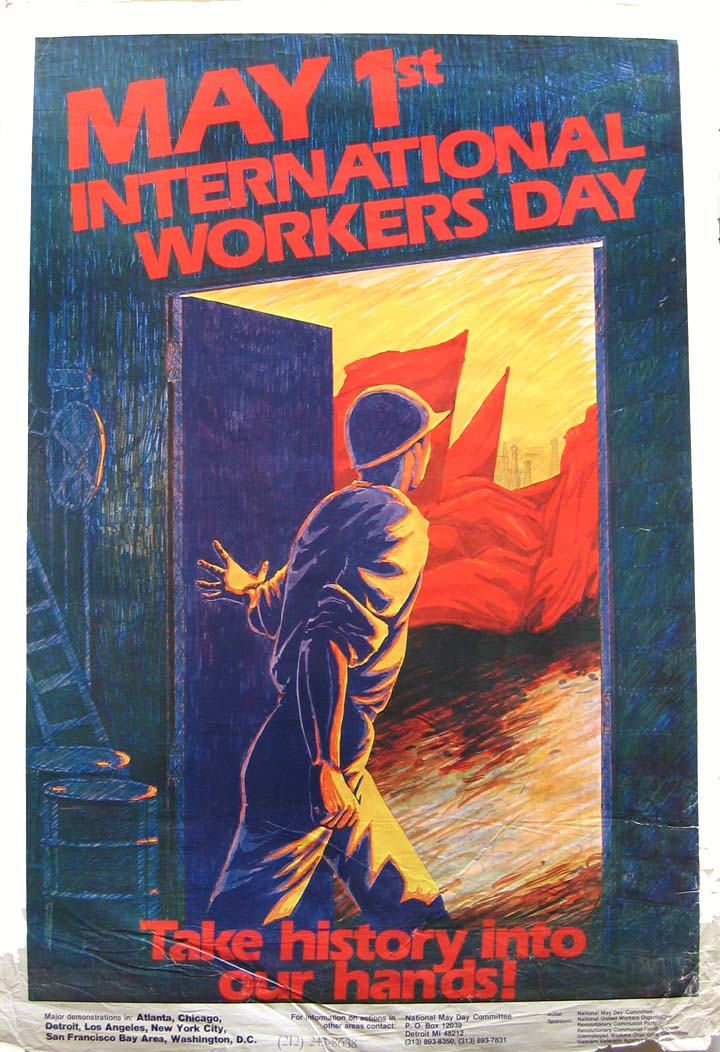
…in light of the faux ‘socialisms’ bandied about in the headlines and sound bytes of the mass media in the wake of the financial crisis, especially the absurd claim in the media of rightwing populism that the Obama administration is Marxist and socialist, I felt something a little more rigorous might be helpful.
By Carl Davidson / The Rag Blog / May 1, 2009
The current discussion around socialism in left and progressive circles in the U.S. needs to be placed in a more substantive arena. This is an effort to do so. I take note in advance of the criticism that the following eleven working hypotheses are rather dry and formal. But in light of the faux “socialisms” bandied about in the headlines and sound bytes of the mass media in the wake of the financial crisis, especially the absurd claim in the media of rightwing populism that the Obama administration is Marxist and socialist, I felt something a little more rigorous might be helpful. Obviously, criticism and commentary is invited.
1. Socialism’s fundamental building blocks are already present in US society. The means of production, for the most part, are fully developed and in fact are stagnating under the political domination of finance capital. The US labor force, again for the most part, is highly skilled at all levels of production, management, marketing, and finance. The kernels of socialist organization are also scattered across the landscape in cooperatives, socially organized human services, and centralized and widespread mass means of many-to-many communication and supply/demand data management. Many earlier attempts at socialism did not have these advantages.
2. Socialism is first of all a democratic political system where the interests and organizations of the working class and its allies have attained and hold the preponderance of political power and thus play the critical leading role in society. It is still a class society, but one in a protracted transition, over hundreds of years, to a future classless society where exploiting class privileges are abolished and classes and class distinctions generally wither away, both nationally and globally.
So socialism will have classes for some time, including some capitalists, because it will be a mixed economy, with both public and private ownership, even as the balance shifts over time. Family farmers and small proprietors will both exist and flourish alongside cooperatives. Innovative ‘high road’ entrepreneurial privately-held firms will compete with publically-own firms, and encouraged to create new wealth within an environmentally regulated and progressively taxed system. Past efforts to build socialism have suffered from aggravated conflict between and among popular classes and lack of emphasis on building wide unity among the people.
3. Socialism at the base is a transitional economic system anchored in the social mode of production brought into being by capitalist development over several centuries. Its economic system is necessarily mixed, and makes use of markets, especially in goods and services, which are regulated, especially regarding the environment. But capital markets and wage-labor markets can be sharply restricted and even abolished in due time. Markets are a function of scarcity, and all economies of any scale in a time of scarcity have them, even if they are disguised as ‘black’ or ‘tiered’ markets.
In addition to regulated markets, socialism will also feature planning, especially on the macro level of infrastructure development, in investment of public assets and funds, and other arenas where markets have failed. Planning will especially be required to face the challenges of uneven development and harsh inequalities on a global scale, as well as the challenge of moving from a carbon and uranium based energy system to one based on renewable green energy sources. The socialisms of the last century fell or stagnated due to failure to develop the proper interplay between plans and markets.
4. Socialism will be anchored in public and worker ownership of the main productive forces and natural resources. This can be achieved by various means: a) buying out major failing corporations at penny stock status, then leasing them back to the unions and having the workers in each firm—one worker, one vote—run them, b) workers directly taking ownership and control over failed and abandoned factories, c) eminent domain seizures of resources and factories, with compensation, otherwise required for the public good, and d) public funding for startups of worker-owned cooperative businesses.
Socialism will also require public ownership of most finance capital institutions, including bringing the Federal Reserve under the Treasury Department and federal ownership. Lease payments from publically owned firms will go into a public investment fund, which will in turn lend money to community and worker owned banks and credit unions. A stock market will still exist for remaining publically traded firms and investments abroad, but will be strictly controlled. A stock transfer tax will be implemented. Gambling in derivatives will be outlawed. Fair trade agreements with other countries will be on a bilateral basis for mutual benefit.
5. Socialism will require democracy in the workplace of public firms and encourage it in all places of work. Workers have the right to independent unions to protect their social and daily interests, in addition to their rights as worker-owners in the governance of their firms. In addition to direct democracy at the plant level, the organizations of the working class also participate in the wider public planning process and thus democratically shape the direction of ongoing development on the macro level as well. Under socialism the government will also serve as the employer-of-last-resort. Minimum living-wage jobs will be provided for all who want to work. Socialism is committed to genuine full employment. Every citizen will have a genuine right to work.
6. Socialism will largely be gained by the working class and it allies winning the battle for democracy in politics and civil society at large, especially taking down the structures and backward laws of class, gender and racial privilege. Women have equal rights with men, and minority nationalities have equal rights with the majority. It also defends equal rights and self-determination among all nations across the globe; no nation can itself be fully free when it oppresses another. Socialism will encourage public citizenship and mass participation at every level, with open information systems, public education and transparency in its procedures. It will need a true multiparty system, with fusion voting, proportional representation and instant runoff.
Given the size and diversity of our country, it is highly unlikely that any single party could adequately represent all popular interests; working class and progressive organizations will need to form common fronts. All trends are guaranteed the right to speak, organize, petition and stand for election. With public financing as an option, socialism can restrict the role of wealth in elections, moving away from a system, in effect, of “one dollar, one vote” and toward a system more reflective of “one person, one vote.” These are the structural measures that can allow the majority of the people, especially the working class and its allies, to secure the political leadership of government and instruments of the state by democratic means, unless these are sabotaged by reaction.
Some socialisms of the past used only limited formal democracy or simply used administrative means to implement goals, with the failure of both the goals and the overall projects. Americans are not likely to be interested in systems with elections where only one party runs and no one can lose.
7. Socialism will be a state power, specifically a democratic political order with a representative government. But the government and state components of the current order, corrupted with the thousand threads connecting it to old ruling class, will have to be broken up and replaced with new ones that are transparent, honest and serve the majority of the people. The US Constitution and Bill of Rights can still be the initial basic organizing principle for a socialist government and state. The democratic rights it has gained over the years will be protected and enhanced. Government will also be needed to organize and finance the social development benefitting the people and the environment already mentioned; but the state power behind the law will be required to compel the honest use of resources and to protect people from criminal elements, individual and organized.
Forces who try to overturn and reverse the new socialist government illegally and in violation of the Constitution will not be able to do so; they will be broken up and brought to justice. Our society will need a state power for some time to come, even as its form changes. Still, government power has limits; under socialism sovereignty resides in the people themselves, and the powers of any government are necessarily restricted and subordinate to the universal and natural rights of all humankind. Attempts to ignore or reject these principles have severely harmed socialist governments and movements in the past.
8. Socialism will be a society in harmony with the natural environment, understanding that all economies are subsets of the eco-system and ignore it at their peril. In its economics, there are no such things as “externalities” to be pushed off downstream or to future generations. The nature of pending planetary disasters necessitates a high level of planning. We need to redesign communities, promote healthier foods, and rebuild sustainable agriculture—all on a global scale with high design, but on a human scale with mass participation of communities in diverse localities.
Socialism will treasure and preserve the diversity of nature’s bounty and end the practice of genetic modification to control the human food supply. We need growth, but intelligent growth in quality and wider knowledge with a lighter environmental footprint. A socialism that simply reproduces the wasteful expansion of an earlier capitalism creates more problems than it solves.
9. Socialism values equality, and will be a society of far greater equality of opportunity, and far less economic inequality. In addition to equal rights before the law, all citizens and residents will have equitable access to a “universal toolbox” of paid-up free public education for all who want to learn, for as far as they want and are able to go; universal public pre-school care; a minimum income, as a social wage, for all who create value, whether in a workplace or otherwise; our notions of socially useful work, activity that creates value, has to be expanded beyond market definitions.
Parents raising children, students learning skills, elders educating and passing traditions to younger generations–all these create value that society can in turn reward. Universal single-payer health care with retirement benefits at the level of a living wage is critical to start. Since everyone has access to employment, the existing welfare system can be abolished; individuals will be free to choose the career path and level of income targets they desire, or not. There are no handouts for those able to work, but there are also no irrational barriers to achievement.
10. Socialism is a society where religion can be freely practiced, or not, and no religion is given any special advantages over any other. Religious freedom remains a fundamental tenant of socialism, but naturally neither its practitioners nor anyone else can deny anyone the benefits and protection of civil and criminal law, especially to women and children.
11. Socialism will require an institution of armed forces. Their mission will be to defend the people and secure their interests against any enemies and help in times of natural disasters. It will not be their task to expand markets abroad and defend the property abroad of the exploiting classes. Soldiers will be allowed to organize and petition for the redress of grievances. Armed forces also include local police, under community control, as well as a greatly reduced prison system, based on the principle of restorative justice, and mainly for the protection of society from individuals inflicted with violent pathologies and criminal practices. Non-violent conflict resolution and community-based rehabilitation will be encouraged, but the need for some coercive means will remain for some time.
[Carl Davidson, a regular contributor to The Rag Blog, is webmaster for SolidarityEconomy.net, where this article was also posted. He also blogs at Keep On Keepin On. Together with Jerry Harris, he is author of Cyber-Radicalism: A New Left for a Global Age.]

Garlic: This bud’s for you.
By Janet Gilles / The Rag Blog / May 1, 2009
The new young garlic is coming in now, and now is the time to discover its delicate yet tremendous support for your favorite recipes. Here are a few of mine.
Start out with a fresh young bud of garlic, and slice it thinly, right through all the cloves. Put the sliced pieces in a jar with a cup of the best virgin olive oil you can find. You can keep it a week or so, but then use it up.
Here are some excellent uses:
Hummus
Rinse a large can of garbanzo beans (32 oz) and let drain in a colander. In a blender, put 1/4 cup of the olive oil, 1/4 cup sesame tahini, two tablespoons fresh lemon juice (or lime), one cup fresh water, and half the beans. Maybe less than a teaspoon of a traditional salt, sea salt or mined salt, but not industrial waste that has been cleaned up and bleached. Blend well and then slowly add the rest of the beans, and a bit more water if needed to blend. This is great on toast from your favorite bread, or even served instead of butter with the bread in a meal.
Spaghetti
Make your favorite spaghetti or lasagna recipe, but use no oil. At the table, add the raw garlic olive oil. The oil is far more beneficial and delicious raw. If you buy expensive olive oils, part of what you are paying for is keeping the oil cool during pressing. If you then don’t cook it before serving, you are in for a taste treat. In Spain, where fine olive oils are expected, the oil is placed on the table where everyone can put it on the food raw and delicious, especially with garlic!
Salad Dressing
What to do with the last 1/2 cup of the garlic oil?? How about making a salad and tossing with the oil? Superb. I put a tablespoon of prepared mustard, a teaspoon of soy sauce, and two teaspoons of a good vinegar or lemon juice. Toss with lettuce or fresh young spinach. Top with lightly toasted nuts.

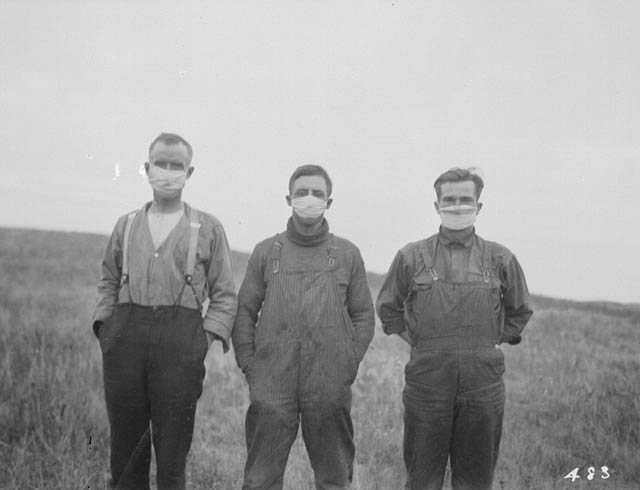
When the deaths began to pile up, and most of those affected were young healthy people, just like the Spanish flu, it is easy to see how the World Health Organization was afraid they might be looking at another deadly flu pandemic…
By Ted McLaughlin / The Rag Blog / May 1, 2009
In 1918, the Spanish flu raged around the world, killing many millions of people. That pandemic was caused by a strain of the flu virus called H1N1. A few days ago, the H1N1 virus popped up again. This time it was called Swine flu. Although it was believed to have started in Mexico (that’s where the largest number of patients and deaths are so far), it spread quickly and in just a few days has shown up in several countries on several continents.
When the deaths began to pile up, and most of those affected were young healthy people, just like the Spanish flu, it is easy to see how the World Health Organization (WHO) was afraid they might be looking at another deadly flu pandemic — just like the one 91 years ago.
The WHO, the USCDC (Center for Disease Control) and state health departments have quickly taken action to try and head off the feared new pandemic. People with any flu symptoms are urged not to go to work or school. Drugstores are selling out of face masks. Event have been cancelled and schools have been closed. News of the new flu have been covered extensively by all types of media.
These may be reasonable actions or may be overreactions. No one knows yet. But scientists who have been studying the new H1N1 virus think the new flu may be more benign than was previously believed. They have found some small differences between the current version of H1N1 and the 1918 H1N1.
One of these differences is the absence of an amino acid in the current version. This amino acid helped the 1918 virus to replicate itself very rapidly once it entered the lungs. This made the virus extremely deadly. The absence of this amino acid could be why the current version of H1N1 is not as virulent.
This does not mean the virus is not dangerous. It obviously has killed. But it may turn out to be no more deadly than more common strains of flu (which can kill 30,000 to 40,000 people each year in the United States). That is a tragic figure, but nowhere near the death toll racked up by the 1918 Spanish flu.
Another oddity of this new Swine flu is that it is not striking the elderly. Normally, the elderly and children are the groups most likely to die from the flu. Why is this virus different?
The scientists think they may know. There was a flu pandemic in 1957 that killed around 2 million people. It is believed that those who were exposed to the 1957 flu may have an immunity to the current H1N1 virus. That would basically cover those in their mid-fifties and older.
Other than gaining a bit of wisdom, there aren’t a lot of advantages to growing old. But it looks like this could be one of those few advantages.
[Ted McLaughlin also posts at jobsanger, an excellent Texas political blog.]
By Jonathan Stein / April 30, 2009
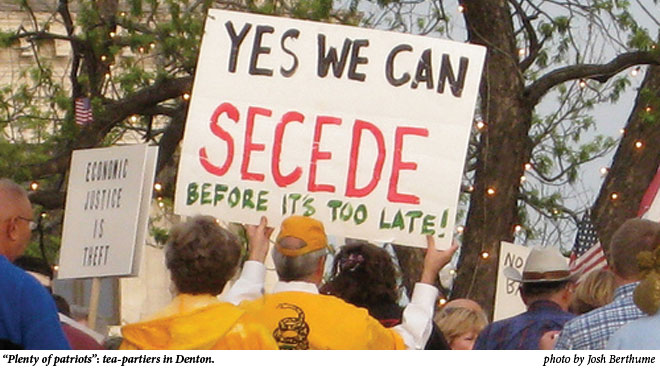
Like everyone else, I was amused when Texas Governor Rick Perry, a Republican, requested help from the CDC with swine flu medication just a week or so after he said that the “federal government has become oppressive” and that if Texans started considering seceding from the union, “who knows what might come out of that.” Perry didn’t seem to realize that throwing off the yoke of the federal government would mean no more help when the going got tough.
Today comes news that Perry has issued a disaster declaration for the state of Texas, the first step in getting assistance from federal agencies like FEMA, DHS, and HHS. I decided to take a look at how many times the federal government has bailed Texas out during Perry’s tenure. The results are pretty incredible.
According to FEMA’s website, Texas has been the site of 13 “major disaster declarations” since Perry took office following George W. Bush’s departure in 2001. That includes five instances of severe storms and flooding, two tropical storms, one “extreme wildfire threat,” and Hurricanes Claudette, Rita, Dolly, and Ike. (Texas received significant federal assistance following Hurricane Katrina, but it did not appear on FEMA’s website in the “major disaster declaration” category.)
David Riedman, a public information specialist at FEMA, explained to me that a major disaster declaration is issued when a governor “determines the state’s resources are overrun.” From that point forward, the federal government, under federal law, is required to reimburse the state for at least 75 percent of the cost of recovery. Help is primarily targeted at rebuilding roads and bridges, debris removal, and reparing damage to public buildings. In the relief efforts that are still under way from the damage done by Hurricane Ike, the federal government is reimbursing Texas for 100 percent of all expenses, according to Riedman.
In fact, since FEMA’s record-keeping began, Texas has received federal disaster assistance more times than any other state.
Source / Mother Jones

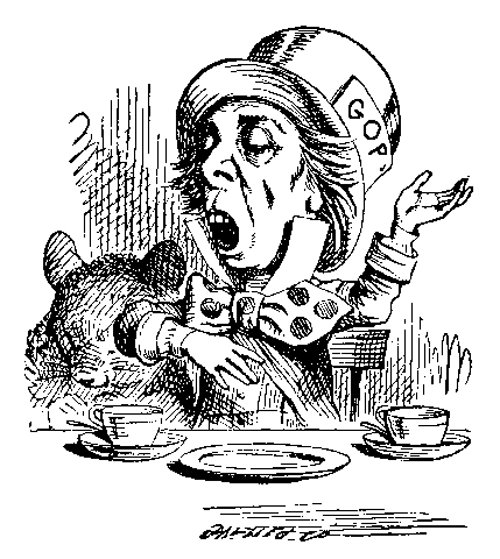
Senior Republican Senator Arlen Specter’s recent defection from the GOP to the Democratic Party has caused an uproar in the toxic hard-core of the remaining Republican party. But it has also brought forth thoughtful, constructive commentary from long-time loyal Republican moderates…
By Larry Ray / The Rag Blog / April 30, 2009
Republican diehards at some point must realize that their invitation-only (Tea) party is over. They must first acknowledge that the vast majority of Americans are simply trying to make it through the economic and societal mess left, in large part, by the last eight years of rogue Republican superintendence. The Grand Old Party is way out of touch with political reality and running mostly on bluster and using a worn out old play book of negativity and exclusion.
Defection from the Republican ranks is notable, with tens of thousands of moderate and centrist Republicans leaving their old party and becoming Democrats or independents. Concerned Americans who have already voted their centrist values rather than hewing to the strident, divisive, self-serving GOP party line.
Senior Republican Senator Arlen Specter’s recent defection from the GOP to the Democratic Party has caused an uproar in the toxic hard-core of the remaining Republican party. But it has also brought forth thoughtful, constructive commentary from long-time loyal Republican moderates like Maine Senator Olympia Snow and former New Jersey Republican Governor Christine Todd Whitman. They have both recently written strong, intelligent Op-Ed articles for The New York Times calling for a reconstituted GOP.
Former Governor Whitman minced no words: “Our democracy desperately needs two vibrant parties. And for Republicans to be that second party, we need to remind the nation of the principles for which we once stood.” Whitman listed those principals as a party “committed to such important values as fiscal restraint, less government interference in our everyday lives, environmental policies that promote a balanced approach between protection and economic interest, and a foreign policy that is engaged with the rest of the world.” The present party seems to have dozed through all their noble ideals for at least the past eight years.
Certainly fiscal restraint was not a hallmark of the Bush-Cheney years. The national debt more than doubled, growing from $5.727 trillion when Bush took office to $11.315 trillion as he hastily cobbled together fiscal bailout legislation as he was leaving office. That legislation included yet another provision to raise the debt ceiling in addition to the seven times Bush had already raised the debt ceiling while in office. For six of those eight years he had a Republican-controlled Congress to back up his reckless, endless spending.
No other administration in history had ever run up such national debt. After the total fiscal irresponsibility of a Republican controlled Congress that allowed mega-banks and mortgage giants to run rampant with virtually no supervision, leading to the worst economic downturn since the Great Depression, it is really hard to be lectured by Republicans about “fiscal responsibility.” And we have not mentioned the costs of the Iraq and Afghanistan wars which had totaled some $840,000,000 at the end of Bush’s term. That’s not far from another trillion bucks.
As far as “less government interference in our everyday lives, environmental policies that promote a balanced approach between protection and economic interest, and a foreign policy that is engaged with the rest of the world,” just analyze those yourself.
For starters, there is Bush’s warrant-less wiretapping of American citizens, unprecedented secrecy and torture, trampling the Constitution, wholesale sellout of our national resources to environmentally hostile energy companies, and a foreign policy that, against the advice of “the rest of the world” led to the unilateral invasion of Iraq, a country which had nothing at all to do with the 2001 9/11 attack.
Just what did happen to Governor Whitman’s “principals” for which her GOP once stood?
Clearly the success and amazing leadership exhibited by President Obama in his first three months in office continues to energize the nation, and the world, even as a global flu pandemic threatens. Obama’s team approach to attacking the GOP debris he inherited has garnered international admiration and support. This has all made the frantic, defeated, remaining conservative Republican leadership angry and more irrational than ever.
Instead of accepting reality and trying to formulate a new platform and bring forward constructive centrist ideas and proposals which would positively engage them with the majority party, they simply continue to implode.
The disappearance of the dinosaurs is generally attributed to a huge asteroid colliding with earth wiping them out. Daily Kos today posted an appropriate graphic that Michael Steele and his party might want to put in their offices and contemplate for a while. The clever, telling logo design even has elements of Leader Limbaugh in it.

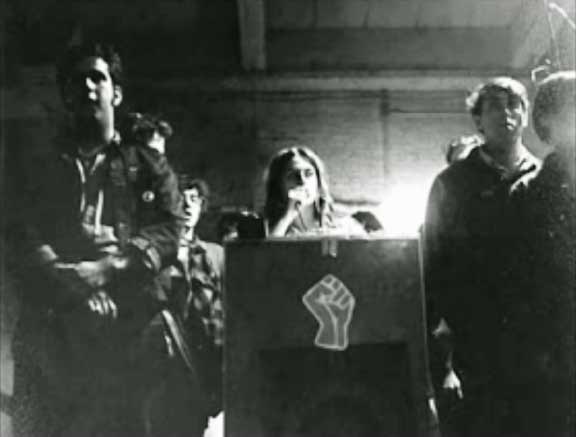
Within weeks of the collapse of SDS, Rudd, like most of the leadership of RYM, wound up in the bomb-making Weathermen claque. He regrets it: ‘Much of what the Weathermen did,’ he writes, ‘had the opposite effect of what we intended.’
By Dick J. Reavis / The Rag Blog / April 30, 2009
[The Rag Blog has run several articles inspired by Mark Rudd’s new memoir, Underground: My Life with SDS and the Weathermen. Dick J. Reavis adds an interesting element to the discussion: he addresses Rudd’s account of the 1969 split within the Students for a Democratic Society (SDS) that led to the formation of Weatherman – and the eventual demise of SDS — from the perspective of a participant. Links to additional Rag Blog treatment of Rudd’s book follow this article.}
Mark Rudd was the best-known leader of the brief 1968 takeover of Columbia University by its students. He was nationally notorious for a fleeting span of time, and for several years, was on the lam, wanted by the FBI. He has belatedly written a memoir, Underground, which I think deserves a read by all of us who were seriously involved in the Students for a Democratic Society during the group’s waning days.
Rudd’s chief historical contribution, in my view, is a chapter entitled “SDS Split,” his account of the group’s death throes. I have not read all books about the rise and fall of SDS, but I’ve read a few, and Rudd’s work is the first that fully explains what happened there — in accord with my memory as one who was present, anyway.
Rudd admits that from the podium where he stood, he and his cronies estimated that the Progressive Labor Party faction had a majority or near-majority of delegates. The incumbents with whom he ran, most members of the faction that then called itself the Revolutionary Youth Movement, responded by “expelling” the PLers in a fashion which troubles him yet.
“The long-feared split had occurred without any full debate by the whole organization, without any vote taken,” he writes. “It was a fait accompli, a coup of sorts, presented by the RYM faction.”
In other words, those who claimed — some of whom still claim — to have represented the “real” SDS, refused to accede to a changing of the leadership by democratic, if “manipulative” means. They were the tyrants, if any there were, unless “manipulation” is verboten.
As a former member of the PL faction, I could not be honest without admitting that PL manipulated — played by the rules, but played to win — in SDS. But politics, on its face, is nothing but the manipulation of other peoples’ behavior. To whimper about it as Rudd occasionally does in deconstructing SDS factional conflicts is to ask for an organization whose soul would have been naiveté.
Rudd is not a poetic writer, but his memoir is highly readable in part because of its humility. It’s a work of self-doubt and self-criticism. He does not repudiate his opposition to the Vietnam War or savage capitalism, but he does confess, time and again, that he and its other leaders were out of their league. Reading the book made me feel sorry for Mark because he blames himself too much.
Within weeks of the collapse of SDS, Rudd, like most of the leadership of RYM, wound up in the bomb-making Weathermen claque. He regrets it: “Much of what the Weathermen did,” he writes, “had the opposite effect of what we intended. We deorganized SDS while we claimed we were making it stronger; we isolated ourselves from our friends and allies as we helped split the larger antiwar movement around the issue of violence. In general, we played into the hands of the FBI — our sworn enemies. We might as well have been on their payroll.”
PL’s student leaders of the era, who perhaps should speak on the question, haven’t been heard from in 30 years, as far as I know. Nobody I know, including a dozen ex-PLers, has any idea about what has become of them. I was never a full-fledged PLer, and so am perhaps an unauthorized voice. But I was as much a PLer as anybody in Texas, and if I can still presume to speak for what was our faction, I’d say that Rudd and his comrades have long been forgiven, at least by us, their vanquished former rivals.
The split in SDS, I’ve always thought, was nearly inevitable. Smarter leadership could perhaps have prevented it, but only by abdication, and only in a limited way.
The problem was that what might be called the Port Huron generation had by 1969 spent several years protesting the Vietnam War without any significant effect on the nation’s policies or actions. Most of us had graduated or were graduating from college. We were facing 40 years of life as adults and we dreaded the prospect because we didn’t know what we would do, or where we would fit. To guide us, as we’d gone along organizing protests, we’d formed world views that were bigger than the anti-war cause.
Those of us who had become Marxists — in SDS, mainly followers of PL and of the Spartacist League — had adopted a plan that stunted our ambitions and shrunk our sense of self-importance. We’d been convinced that we had to join the industrial working class, from whose ranks we’d agitate for unions and revolution perhaps until we retired or died. PL sloganized our nearly humdrum agenda as “Build a Base in the Working Class.”
Rudd and the Weathermen claimed to be Marxists, but in effect, they substituted American youth, including themselves, for industrial workers, as the agents of socialism. Their attitude, and I’m afraid, even their political wisdom was summed-up in chants like “Oink, oink, bang, bang! Dead pig!” They wanted Revolution Now! — or if not that, Vengeance Now!—and they thought that they could spark it.
The plain facts, seen in retrospect, are that the industrial working class was already doomed to decimation, and that the much-vaunted youth rising was more nearly a generational tiff than a political one. Most of us whom PL sent into factories gave up as soon we saw that the workers wouldn’t listen. Most Weathermen dropped out after learning, as Rudd did, that life on the lam was brutish, lonely and impotent. It hurts to say so, but Bill Clinton and George Bush, and maybe even Nixon and Reagan, gauged the political capacity of our generation far better than we did.
SDS could have survived, I believe, only if it had preserved its innocence, only as a group that held out hope for capitalism and its parties and sought merely to be heard by the people in power. But to have done so, those SDSers who had learned the lessons of the protest movement — that appeals to rulers are routinely ignored or deflected — would have had to distance themselves from their base. We would have had to stand aside while greener students repeated the mistakes that we had made.
Even our abnegation would not have produced an anti-war movement of the scale we had known, because the millions of young whites who attended anti-war protests — the recruiting pool for both the PL and Weathermen factions—returned to purely personal and domestic concerns almost as soon as the draft lottery was instituted.
If anybody is responsible for the death of SDS, it is the officials who, with our concurrence, abolished conscription. They placed the question of war and peace on a new stage, on which we haven’t gotten our footing yet. The hour is late and we are nearing our graves: it’s highly unlikely that we will lead any movements now. If we are as honest as Rudd, we will admit that back in the day, we failed. Neither he nor the rest of us are to blame. It is perhaps heresy to say so in the United States, where optimism is a tenet of a Foucaultian, nearly mandatory faith, but for all of a polity’s problems, solutions are not always at hand.
[Rag Blog contributor Dick J. Reavis is an award-winning journalist, educator and author. He was active in the civil rights movement in the South and with SDS at the University of Texas in Austin. He wrote for Austin’s underground newspaper The Rag, and was a senior editor at Texas Monthly magazine. Dick Reavis’ book, The Ashes of Waco: An Investigation, about the siege and burning of the Branch Davidian compound, was published by Simon and Schuster and may be the definitive work on the subject.]
Find Mark Rudd’s Underground: My Life with SDS and the Weathermen on Amazon.com.
See other Rag Blog articles on Mark Rudd’s memoir and related subject matter:
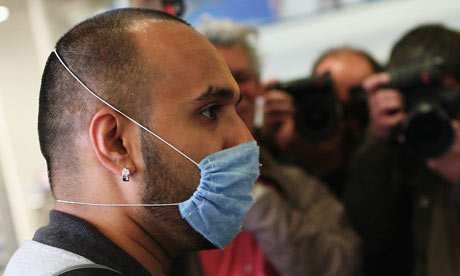
Your best defense — your only real defense in any flu season — is a bulletproof immune system.
By Janet Gilles / The Rag Blog / April 30, 2009
With all the sensationalized news about the so-called swine flu flying
around, I figured we’d better set all the facts straight.
1. So far, only 82 cases of so-called swine flu have been definitively identified worldwide, mostly in Mexico (26 confirmed, 7 deaths) and the U.S.(with 40 confirmed, no deaths). (Though about 1600 suspected cases,including 159 deaths, are reported in Mexico.) That does not add up to a pandemic swine flu outbreak.
2. This virus has nothing to do with swine. In fact, it hasn’t been seen in a single animal. And you can’t possibly get it from eating pork.
3. No existing vaccines can prevent this new flu strain. So no matter what you hear — even if it comes from your doctor — don’t get a regularflu shot. They rarely work against seasonal flu… and certainly can’t offer protection from a never-before-seen strain.
4. Speaking of this strain, it doesn’t seem to have come on naturally. According to the World Health Organization (WHO), this particular strain has never before been seen in pigs or people. And according to Reuters, the strain is a “genetic mix”of swine, avian and human flu. Was it created in a lab? We don’t know yet.
5. The drug companies are getting excited… and that’s never a good thing. According to the Associated Press at least one financial analyst estimates up to $388 million worth of Tamiflu sales in the near future –- and that’s without a pandemic outbreak.
6. Let’s not forget that Tamiflu comes with its own problems, including side effects like nausea, vomiting, diarrhea, headache, dizziness, fatigue, cough… the very symptoms you’re trying to avoid. And let’s notforget that Japan banned this drug for children back in 2007, after links to suicidal behavior.
7. Vaccines for this flu strain probably won’t have to jump through all those annoying hurdles like clinical trials for safety and effectiveness. That won’t, however, stop the government from mandating the vaccine for all of us — a very likely scenario. And if the vaccines are actually harmful… killing people, for example…the vaccine makers will be immune from lawsuits.
Your best defense — your only real defense in any flu season — is a bulletproof immune system.

Some 25 years ago the insurance industry planned, in concert, to co-opt medical care in the United States, while the medical profession through fear, misinformation, or self interest permitted it to happen.
By Dr. Stephen R. Keister / The Rag Blog / April 30, 2009
P.J. Proudhon wrote in 1858: “Justice is spontaneous respect, guaranteed, for human dignity, in whatever person it may be compromised and under whatever circumstances, and to whatever risk its defense may expose us.”
We who are in favor of single payer/universal health care face the Rubicon. The next month may well define the national character of the United States. Either we join the remainder of the industrialized world in providing decent, affordable health care for all or we retreat into the immoral, deceitful world of producing profits for the insurance companies, their richly paid executives, and the requisite injustice foisted upon the American people by the pharmaceutical industry and those who profit from it.
The concept of single payer/universal care arose with the Physicians for A National Health Program after the original program for universal care was defeated by a Republican Congress and the American Medical Association, when first conceived under the Truman administration. The sole remnant of that suggestion was the adoption of Medicare which has been a first rate success. Any further suggestions to provide anything like humanitarian care have been turned aside by the interests of those involved in profit by limiting care to those who can pay the big bills.
Some 25 years ago the insurance industry planned, in concert, to co-opt medical care in the United States, while the medical profession through fear, misinformation, or self interest permitted it to happen. We now are the only nation in the western world (add in Australia, Taiwan, and Japan) to have health care not for the good of the populace, but for the profits of two of the industries with major lobbying power in Washington. Various surveys show overall health care in this country ranking 26th in the world. A release from the Connecticut Coalition for Universal Health Care brings several startling facts to our attention.
There are further myths perpetuated by the opponents of universal care.
The propagandists and purveyors of deceit for the insurance industry flatly lie that a universal health care system would interfere with freedom of choice. The facts differ: There would be free choice of health care providers under a single payer, universal system, unlike the current managed system which mandates insurer pre-approval for services, thus undercutting patient confidentiality and taking health care decisions away from the physician and patient.
Although health care provider fees would be set as they are in 90% of cases, providers would have a means of negotiating fees unlike the current managed care system which are set in corporate board rooms with profits, not patient care in mind. Taxes, fees, and benefits would be decided by the public insurer which would be under the control of a diverse board representing consumers, providers, business, and government. It would not be a government controlled system, although the government would have to approve the taxes. The system would be in essence a Public Trust.
To be very specific, I am speaking of two bills before Congress: the Senate bill (S703) introduced by Sen. Bernie Sanders, and the House bill (HR 676) introduced into the by Rep. John Conyers.
On April 27, 2009, The New York Times printed an article titled, “Shortage of Doctors an Obstacle to Obama Goals.” This underlines what I have been pointing out for some time in articles published by The Rag Blog. This is indeed a problem of long standing and is a result of two things: the overt effort by certain elements of the medical/educational establishments to limit the number of practitioners in the United States, and the unbearable cost of medical education in the United States. We badly need primary care physicians and internists. This matter has been emphasized by the American College of Physicians in recent publications. In previous articles I have indicated two approaches, and perhaps both should be implemented. First — as in European nations — government scholarships to pay for qualified candidates in medical school. And second, the formation of a national Medical Academy similar to West Point or Annapolis. Of course, current medical schools could increase enrollment. In either instance, graduates would be directed into primary care in underserved areas for a number of years to be determined.
In addition to the single payer/universal care legislation there are other suggestions pending. One is the concept of “Medicare for All” proposed by President Obama during the campaign. This in essence would expand Medicare into what has been called by some a “public insurance” company, giving citizens the option to continue with their present private plan should they desire, or to enroll in the public plan, with equal or better medical care, but with payment determined by ability to pay. This concept gives the prostitutes of the insurance industry cat fits as they fear that with equal or better care at lesser cost the public will drift to the public plan.
A third option, put forth by Sen. Max Baucus, a major recipient of campaign contributions from the insurance and pharmaceutical industries, calls for continuation of our present system under the control of the insurance cartels, but requiring (yes, requiring) everyone to buy insurance. Of course, this is overt insanity since a comprehensive, decent insurance plan for a family of four costs something like $2400 a month. This is far beyond what the average family can endure. Several constitutional scholars have questioned whether the government can legislate that a citizen buy a product from a private purveyor. Further, the less expensive the required insurance, the less coverage, i.e. yearly deductible of, say, $10,000 — high co-payments, numerous exclusions. This is pure ledger domain, a real con-game.
Just yesterday I became aware of what could become a further complicating ingredient. The TV industry has had three major sources of advertising revenue: automobiles, pharmaceuticals, and food products. The auto revenue is disappearing, which is hurting TV advertising budgets. As we have pointed out previously on the Rag Blog, the United States is one of only two nations in the world that permit advertising for prescription drugs (New Zealand is the other); this is one of the many factors that result in prescription medication in the USA costing twice what it would in most other nations. I have suggested, as have many others, that under a universal health care plan there must be cost control of prescription medications, and further that Congress must redo the farcical “Medicare Prescription Drug Plan” to make it a vehicle for the benefit of the consumer rather than for the insurance and pharmaceutical industries.
Be assured there is a tremendous public relations campaign being launched to mislead the public regarding universal health care. The profiting industries, insurance carriers, and “nonprofits,” supported by the Republican Party and some “blue dog” Democrats, will do their best to deceive you, provide you with misinformation, formulate lies that will make you vote against your best interests. At this time we must stand resolute and do what is best for the common good, as well as for the image of our nation. There will be “letters to the editor” written by ghost writers for the powers that be. There will be ads on TV, done by actors, demeaning health care in other nations, There will be recorded phone calls warning you about the horrors of socialized medicine, telling you that they will take away your right to chose your own doctor.
Finally, remember that proper single payer, universal health care can be enacted at 40% less cost to the tax-payer than any other option. According to Ralph Nader, $225 billion to $250 billion each year is wasted on inefficiency and fraud in billing.
[Dr. Stephen R. Keister, a regular contributor to The Rag Blog, lives in Erie, PA. He is a retired physician who is active in health care reform. His previous articles on The Rag Blog can be found here.]
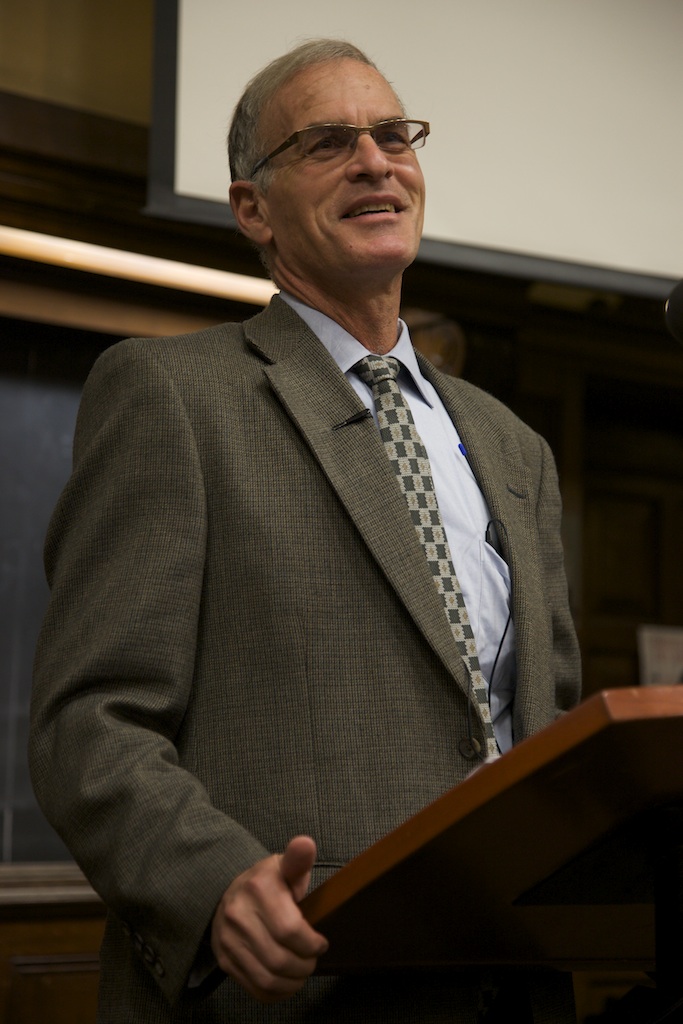
His theory on Israel’s attack on Gaza was that Hamas had become too moderate, too reasonable, too willing to make a deal. His most damning evidence was contained in quotes from Israeli politicians saying that if the cease fire went on too long it would give Hamas credibility.
By Alan Pogue / The Rag Blog / April 29, 2009
[Norman G. Finkelstein is an independent scholar with a doctorate in political science from Princeton University. For many years he taught political theory and the Israel-Palestine conflict and is the author of five books that have been translated into many languages. He is a consistent critic of Israel’s role in the Middle East. Finkelstein spoke to an overflow crowd Tuesday night at Welch Hall on the campus of the University of Texas at Austin.}
I went to hear Norman Finkelstein last night and am glad I did. He is Jewish and the child of parents who were in the Warsaw Ghetto and Auschwitz but he understands one cannot be moral only within one’s group. The invasion of Lebanon in 1982 opened his eyes to what the government of Israel was doing. He turned his formidable intellect on the lies told to justify the suppression and removal of Palestinians.
He invited the Zionists to field someone to debate with him but they demurred. No one came to heckle him. There was a standing room only crowd at Welch Hall, UT Austin. He reminds me of Noam Chomsky in that his delivery is so smooth and coherent, so well researched, that it sounds simply like sweet reason. His key theme was international law and the international consensus that Israel is breaking international law. Being the scholar that he is he gave plenty of names, dates, places, and quotes with referenced sources.
His theory on Israel’s attack on Gaza was that Hamas had become too moderate, too reasonable, too willing to make a deal. His most damning evidence was contained in quotes from Israeli politicians saying that if the cease fire went on too long it would give Hamas credibility. If Hamas gained credibility then Israel would be forced to make a deal. Israel has no intention of leaving the West Bank so Hamas had to be provoked into firing more ineffectual rockets so that Israel could then unleash the massacre of the Gazans that it had been planning for six months.
Norman also linked the attack on the helpless civilian population in Gaza to the Israeli military’s poor showing against Hezbollah in Lebanon which had caused a lack of sufficient fear of Israel among the general Arab population. Norman also quoted many Israeli military leaders in making his case. He spoke about the use of white phosphorous by the Israeli military, all made in the USA. He quoted the Red Cross, Amnesty International and Human Rights Watch on their reactions to the white phosphorous and the bombing of the U.N. schools, headquarters, food and medical supplies.
He spoke at length about the effects of the Israeli blockade of Gaza and the war crime that it is. Norman prefaced his remarks by defining the invasion of Gaza as a massacre. He pointed out that there were no battles since Hamas had no army in the same sense that Israel has an army. No Israeli war plane was shot down.
Norman asked that anyone present who wished to dispute anything he had to say to please come up and take the microphone. One student asked about the Marionites in Lebanon who asked for Israel’s aid against those inside Lebanon who were attacking them. Norman spoke about the factions within Lebanon for a minute but said that was not the subject of his lecture and that in any case there is ample evidence that Israel was not interested in the general welfare of the Lebanese people. He invited the young man to continue the discussion of Lebanese political parties later which he did.
Visit Norman Finkelstein’s website here.
To order books by Norman Finkelstein, go here.
Earlier this month, the jury in Ward Churchill‘s civil trial against the University of Colorado found, in his favor, that the university had fired him because of critical remarks he made after the terrorist attacks of September 11, 2001. While Churchill awaits a hearing on his ongoing employment at the university, this victory is something to celebrate and replicate.
At the same time, however, the noxious weeds of the new McCarthyism have begun to bear bitter fruit around the country. Reports are coming in, not just about the better-known cases of harassment and firing of Norman Finkelstein (denied tenure at DePaul and banned from a speaking engagement at Clark College) or Joel Kovel (recently fired from his position as the Alger Hiss Chair of Social Studies at Bard College). Many readers will know the horrific case of Sami al-Arian, the University of South Florida professor jailed for five years without basis or charges for the suspicion of ties to terrorism.
Fewer people will know the names of four other targets of the Right’s attack: Margo Ramlal-Nankoe, William Robinson, Nagesh Rao, and Loretta Capeheart. All four face harassment, threats, or potential removal from their jobs at their universities because they have criticized Israel, defended multiculturalism, and stood up as organized employees in defense of their rights as workers.
This rash of cases comes, not coincidentally, during an upsurge in college activism, from counter-recruitment demonstrations to the student occupation at NYU, from the struggle for gay civil rights to the demand to boycott, divest from, and sanction Israel. University campuses have always been spaces for young activists and critical scholars to demand change.
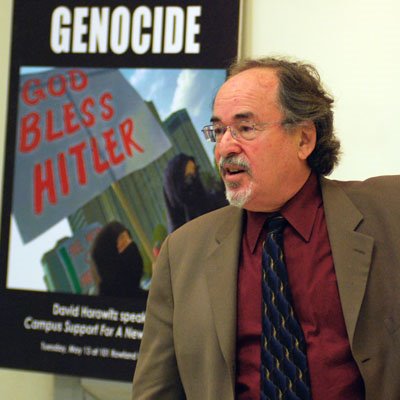
This is why the Right is still holding on by its teeth to the flag of academic freedom. In a recent attack on me in The Wall Street Journal (whose editors clearly know who benefits from policing the academy), right-wing attack dog David Horowitz condemned the recent protest of his lecture at the University of Texas. Horowitz railed against me and other protesters as “little fascists.” He claimed, in a bit of over-the-top self-aggrandizing drama, that because of his fear of people like me, he traveled with a (rather attractive) bodyguard named Floyd. (The only physical assault Horowitz ever “faced,” so to speak, involved a cream pie.)
In his lecture, he spouted offensive nonsense: for example, that racism and sexism were not barriers to achievement, that renowned critical race scholars Cornel West and Michael Eric Dyson were “buffoons” and third-rate intellects, that gender is entirely biological (and therefore so is women’s inferiority at math), that Sami al-Arian is a terrorist, that support for Palestine is anti-Semitic, and so on.
He also used the podium to attack me as an alleged indoctrinator of students; when I rose during discussion to make the point that my activism is separate from my teaching and that he should respect students (about whom he is ostensibly so concerned) enough to know that they can think for themselves. This intervention was met with a diatribe, along with the accusation that my appearing so reasonable is a consequence of my skill at manipulation and deceit.
The protest and Horowitz’s column have garnered opprobrium from both hard conservatives and liberals, who argue that confronting Horowitz and those of his ilk is an act of censorship. But if Joe McCarthy rose from the dead chanting “I have here a list” — or in Horowitz’s case, three books and a website — would they shout him down before or after he ruined hundreds of people’s lives and careers?
Those targeted by Horowitz, it seems, are expected to listen politely to his lies and distortions. However, left unchecked, the chilling climate that Horowitz and others have wrought is resulting in real damage to the lives and careers of talented scholars and conscientious teachers.
His state-by-state campaign for his Orwellian-named “Academic Bill of Rights” has prompted numbers of universities — most recently the College of DuPage — to adopt vaguely-worded and potentially repressive codes of conduct that could be deployed arbitrarily against faculty who teach from their own philosophical perspective or bring political matters into classrooms, even when relevant. AAUP President Cary Nelson called the decision “a disaster for education in a democratic society.”
Why, as the ground is shifting under the Right and the country moves to the Left politically, are we seeing this proliferation of attacks on academic freedom?
John Wilson, founder of the Institute for College Freedom, explained, “The Right lost so badly that its representatives are looking for easy targets. They see the campus as a place where they can retrench,” he said.
In addition, Wilson said that because state budgets are in currently in desperate shape, administrators of state universities see expendable targets in area studies (women’s studies, labor studies, Middle-Eastern Studies, Latin-American Studies, African-American studies, and the like), roundly condemned by Horowitz as non-scholarly indoctrination factories. In reality, these are the programs fought for and won during the 1960s and 1970s that opened up universities to the voices of the marginalized.
The coming to fruition of a decades-long assault on academic freedom (in the name of academic freedom) is the context for the repression faced by critical and activist faculty today. Faculty who have spoken out against cuts in area studies, in defense of minorities and activists on campus, or as part of their union or other organizations are particularly at risk today, as are critics of the state of Israel.
Opposition to scholars who expose and critique the treatment of Palestinians by Israel has been front and center in the cases against Professors Margo Ramlal-Nankoe and William Robinson.
Margo Ramlal-Nankoe is an assistant professor seeking tenure in Ithaca College’s Sociology Department. Her tenure process became a struggle when a small number of influential faculty and administrators began campaigning against her. She became a target of their negative campaign because she spoke out against sexual harassment within her department and challenged students and community members to think critically about US and Israeli policy in the Middle East. Ithaca College’s Board of Trustees has denied Professor Ramlal-Nankoe tenure and she is scheduled to be fired on May 12th.
A tenured professor in her department revealed racism behind their decision as well: “We had little or no expectations of her; she is after all a woman of color,” he wrote in a letter to the Sociology Tenure and Promotion Committee at Ithaca College in 2005.
Despite the campaign being waged against her, Professor Ramlal-Nankoe’s tenure review file is full of glowing letters from her students and colleagues. The Chair of the Sociology Tenure and Promotion Committee summarized the content of the numerous letters of support Professor Ramlal-Nankoe received from her students: “Most students tell us that working with Dr. Ramlal-Nankoe has transformed their views, their life, and/or their plans for the future.” The letters of support Professor Ramlal-Nankoe received from her peers also note her excellence. A typical faculty letter states that Professor Ramlal-Nankoe provides a, “superior example of pedagogy and of the teaching of traditional sociology.”
With the evidence of such support, Professor Ramlal-Nankoe has concluded, “I believe the underlying basis for the violations against me stem from a discriminatory bias towards me, especially in regards to my political views on the Israel-Palestine conflict. Violations of human rights and the subjected condition of the population in this area of the Middle East have long been a matter of concern in my teachings and other work. Faculty reactions to my involvement in activist organizations, such as Students for a Just Peace in Israel and Palestine and Ithaca Finger Lakes Interfaith Committee for a Just Peace in the Israel/Palestine Conflict, have been extremely negative and problematic, both inside and outside of the Sociology Department.”
Professor Ramlal-Nankoe’s supporters have established a Facebook page for her case at www.facebook.com/group.php?gid=72989883399. Please write in protest to President@ithaca.edu.
Professor William I. Robinson, a Sociology and Global Studies professor at the University of California, Santa Barbara, has been attacked by the Anti-Defamation League and two of his former students. In January of this year, he forwarded an email condemning the Israeli attacks on Gaza. The email was an optional read for students.
Within a week, the ADL wrote him a letter charging him with anti- Semitism and sundry violations of the Faculty Code of Conduct. The Academic Senate Charges Officer then notified him that two of he students in the class to which he circulated the email had filed complaints against him. Acting for all intents like a co-complainant of the students, the Officer fabricated additional charges not raised by the students.
The case against Williamson rests upon the assumption that any critique of Israel is evidence of anti- Semitism and that the Israeli-Palestinian issue should not be discussed in a class on globalization. These are nonsensical; a critique of Israel does not impugn Jewish people or Judaism, and of course the conflict between Israel and the Palestinians is a matter of concern for everyone interested in economic and political globalization. Proceeding with these charges serves only to sanction politically motivated attacks on academic freedom, including the freedom to criticize Israel. This case alongside others may chill those who wish to present controversial and critical subjects.
The charges have reached the Committee on Committees, which is now in the process of convening a committee to assess the complaints.
The campaign for Professor Robinson urges readers to 1) email the UCSB Chancellor and responsible authorities on campus to register your protest, and 2) sign the petition. Information and links are at sb4af.wordpress.com. Contact the Committee to Defend Academic Freedom at UCSB at cdaf.ucsb@gmail.com.
Multicultural curriculum and diversity are at issuein the case of Nagesh Rao, an assistant professor and postcolonial scholar of English at The College of New Jersey (TCNJ), a public liberal arts institution. The English department’s personnel committee rejected his tenure application and has recommended that he be denied reappointment. Those close to the case believe that there are multiple political factors involved in dismissing a fine teacher and researcher who was meeting all stated requirements for promotion.
Since arriving at TCNJ four years ago, Professor Rao, who has a Ph.D. from Brown University, has taught courses that exposed students to world literatures and postcolonial studies. His students have consistently appreciated his classes for exposing them to knowledges that they would not otherwise have encountered. He is much respected and loved by his students for challenging them to think in new ways.
Similarly, Professor Rao’s publication record has matched or exceeded the output of previous, successful applicants for tenure in his department. He arrived at TCNJ four years ago with an established record of publication and has since published two articles in peer-reviewed journals, edited a book of interviews with the late Indonesian novelist Pramoedya Ananta Toer, and developed a detailed book proposal. His review letter the previous year praised his accomplishments and put him on track towards tenure if he published another article in the following year. He did so. Yet, the English Department’s Personnel Committee voted unanimously to deny tenure to Professor Rao.
The background for this decision is a dispute inside of the English department over the status of a multicultural literature course in the curriculum. Professor Rao chaired a group of faculty defending the course in a deeply divided department. The TCNJ student body is significantly diverse, but this diversity is not represented fully in the curriculum. Also troubling is the fact that Professor Rao is one of the few people of color on the Department of English faculty, and the only South Asian in a state with a significant South Asian population. The fate of the multicultural literature course, along with his career, hangs in the balance of this politically charged dispute.
Professor Rao seeks the appointment of a new, independent, and transparent committee to review his case. There is a petition in support of Professor Rao at thepetitionsite.com/1/defend-dr-nagesh-raos-tenure-and-reappointment-at-the-college-of-new-jersey. For more information: defendrao.wordpress.com.
If conservative administrators can’t get away with openly firing critics of Israel and defenders of multiculturalism, they have another tactic at their disposal. Some university leaders are attacking outspoken faculty on the grounds that university employees have no free speech rights when it comes to criticizing their own institutions.
This argument epitomizes Northeastern Illinois University’s harassment of justice studies Professor Loretta Capeheart, who has been targeted by her administration for her outspokenness for workers’ rights in a 2004 faculty strike, her activism against the Iraq war, her defense of student protesters, and her arguments for increased representation of minority scholars at NEIU. In retaliation, she was denied merited awards and an appointment to chair of her department — a position to which she was elected. NEIU Vice President Melvin Terrell publicly defamed Professor Capeheart, accusing her, without grounds, of stalking a student.
Professor Capeheart is suing Terrell for defamation, alongside NEIU’s President and Provost for retaliation and violation of her constitutional right to free speech. Incredibly, the administrators’ response argues that Professor Capeheart, as a state employee, may not sue the University or its officials, contravene their positions, question their conduct, or speak as a faculty member on matters of public concern.
Unfortunately, the administration has frightening legal precedent, according to the AAUP. The Supreme Court’s 2006 decision in Garcetti v. Ceballos held that state employees are not afforded first amendment protection if they are speaking on subjects relevant to their professional duties. When UC Irvine professor Juan Hong angered University administrators by opposing the replacement of tenure-track faculty by term lecturers, he was denied a merit salary increase. The Court ruled against Hong, citing Garcetti.
In March, the U.S. District Court Judge of the Northern Illinois District agreed to hear Loretta’s case, despite the university’s arguments that it was “futile” for her to claim any right to free speech. She awaits this hearing.
Supporters of Professor Capeheart ask that readers sign the petition supporting her at petitiononline.com/j4lc/petition.html. Please include your email in your signature comments for updates on the case.
From the 1964 free speech movement to today’s anti-occupation organizations, campuses have always been places where struggles for justice break out. This potential might explain why, losing ground in politics and the economy, the Right seeks to maintain its grip on outspoken faculty and students. David Horowitz, Laura Ingraham, the Association of College Trustees and Alumni, and the like have played their assigned roles in fostering a new McCarthyism that has given rise to a series of witch-hunts against both prominent and emerging critical scholars and activists.
We cannot allow Zionism, racism, the attack on area studies and multiculturalism, or the violation of labor rights on our campuses to stand. We must call to account the administrations of Ithaca College, UCSB, The College of New Jersey, and Northeastern Illinois University. Professors Ramlal-Nankoe, Robinson, Rao, and Capeheart need your support. Their cases represent only a few of the many breaches of academic freedom coming to light in this moment. And we must fight on each and every one.
[Dana Cloud is Associate Professor of Communication Studies, University of Texas, Austin.]
Source / Monthly Review Zine
Thanks to Jeffrey Segal / The Rag Blog

Gardeners know that plants open and close their flowers at set times during the day. For example, the flowers of catmint open between 6:00 a.m. and 7:00 a.m.; orange hawkweed follows between 7:00 a.m. and 8:00 a.m.; field marigolds open at 9:00 a.m.
In “Philosophia Botanica” (1751), the great taxonomist Carl Linnaeus proposed that it should be possible to plant a floral clock. He noted that two species of daisy, the hawk’s-beard and the hawkbit, opened and closed at their respective times within about a half-hour each day. He suggested planting these daisies along with St. John’s Wort, marigolds, water-lilies and other species in a circle. The rhythmic opening and closing of the plants would be the effective hands of this clock.
Plants have carefully timed routines determined by internally generated rhythms. In 1729, Jean-Jacques d’Ortous de Mairan, a French astronomer, put a Mimosa plant in a cupboard to see what happened when it was kept in the dark. He peeked in at various times, and although the plant was permanently in the dark its leaves still opened and closed rhythmically – it was as though it had its own representation of day and night. The plant’s leaves still drooped during its subjective night and stiffened up during its subjective day. Furthermore, all the leaves moved at the same time. It took another 230 years or so to come up with the term circadian – about a day – to describe these rhythms.
In a similar vein, tobacco plants, stocks and evening primroses release their scent as the sun starts to go down at dusk. These plants attract pollinating moths and night-flying insects. The plants tend to be white or pale. Color vision is difficult under low light, and white best reflects the mainly bluish tinge of evening light.
But plants cannot release their scent in a timely manner simply in response to an environmental cue, like the lowering of the light levels. They need time to produce the oils. To coincide with the appearance of the nocturnal insects, the plant has to anticipate the sunset and produce the scent on a circadian schedule.
Flowers of a given species all produce nectar at about the same time each day, as this increases the chances of cross-pollination. The trick works because pollinators, which in most cases means the honeybee, concentrate foraging on a particular species into a narrow time-window. In effect the honeybee has a daily diary that can include as many as nine appointments — say, 10:00 a.m., lilac; 11:30 a.m., peonies; and so on. The bees’ time-keeping is accurate to about 20 minutes.
The bee can do this because, like the plants and just about every living creature, it has a circadian clock that is reset daily to run in time with the solar cycle. The bee can effectively consult this clock and “check” off the given time and associate this with a particular event.
Honeybees really are nature’s little treasures. They are a centimeter or so long, their brains are tiny, and a small set of simple rules can explain the sophisticated social behavior that produces the coordinated activity of a hive. They live by sets of instructions that are familiar to computer programmers as subroutines – do this until the stop code, then into the next subroutine, and so on.
These humble little bees have an innate ability to work out the location of a food source from its position in relation to the sun. They do this even on cloudy days by reading the pattern of the polarization of the light, and pass this information to other bees. In the dark of the hive, they transpose the location of a food source in the horizontal plane through the famous “waggle” dance into communication in the vertical plane of the hive.
Honeybees can tell their sisters how far away the food is up to a distance of about 15 kilometers. For good measure, they can also allow for the fact that the sun moves relative to the hive by about 15 degrees an hour and correct for this when they pass on the information. In other words, they have their own built-in global positioning system and a language that enables them to refer to objects and events that are distant in space or time.
German scientists in the early part of the last century called this ability of bees to learn the time of day when flowers start secreting nectar and visit the flowers at appropriate times Zeitgedächtnis, or time-sense. But the species of flowers in bloom, say, this week, is likely to be replaced by a different species at a different location next week or the week after. The bee needs a flexible, dynamic appointments system that it continually updates, and it has evolved an impressive ability to learn colors, odors, shapes and routes, within a time frame, quickly and accurately.
While the initial dance by a returning scout bee informs her sisters of the location and distance of food plants and the quality of their nectar, bees that visit the food source learn to synchronize their behavior with daily floral rhythms, foraging only when nectar and pollen are at their highest levels. At other times, they remain in the hive, conserving energy that otherwise would be exhausted on non-productive foraging flights.
Although most animals, including humans, cannot sustain long-lasting periods of activity without circadian rhythms, honeybees have developed a marked flexibility in their circadian rhythm that depends on the job they are doing. Whereas a particular circadian determined behavior is usually fixed to a certain phase of the cycle, in honeybees the circadian rhythm is dependent on the job the bee is doing.
Adult worker bees perform a number of tasks in the hive when they are young, like caring for eggs and larvae, and then shift to foraging for nectar and pollen as they age. However, if the hive has a shortage of foragers, some of the young nurse bees will switch jobs and become foragers. The job transition, whether triggered by age or social cues, involves changes in genes in the honeybee brain; some genes turn on, while others turn off.
Young worker bees less than two weeks of age who typically nurse the brood around-the-clock display no circadian rhythms. Older workers (more than three weeks) typically perform foraging activities and have strong circadian rhythms that are needed for the time-compensated sun-compass navigation and timing visits to flowers.
Recent research in Israel has shown that when young worker bees are removed from caring for the brood and placed in individual cages, they rapidly show circadian rhythms in their behavior. Newly emerged bees isolated in individual cages typically show circadian rhythms in locomotor activity when at 3 days to 14 days old, ages at which most bees in the hive perform around-the-clock nursing activities as mentioned above. Older foragers who revert to nursing duties switch back to around-the-clock brood care activity similar to that of young nurses in typical colonies.
The molecular clockwork mechanism that produces the circadian rhythm works by a series of feedback loops in which the proteins produced by several genes feedback to repress their own production. It is a complicated system, but the end result is a near-24-hour cycling in the levels of various proteins that in turn result in the cycling of the secretion of hormones and other substances.
It seems that there is a plasticity, or flexibility, in the organization of this molecular clockwork mechanism in honeybees, and that the social factors that influence division of labor in honeybee colonies are important also for the regulation of this circadian mechanism. As there is mounting evidence for increased pathologies and deterioration in performance when around-the-clock activity is imposed on most animals, including humans, detailed study of the plasticity of the circadian organization in honeybees may provide pointers for ways for us to have our 24/7 cake and eat it.
Honeybees are remarkable not just for the organization of their circadian clockwork. James Gould of Princeton first studied bees as an undergraduate. It was his pioneering study that showed conclusively that Karl von Frisch, who won a Nobel Prize for elucidating the waggle dance, had been right in concluding that the dance was a means of conveying information.
Ironically, an allergy meant that Gould had to stop working directly with the creatures, but his respect for them is enormous. As he has pointed out:
When a human decides whether to recommend a restaurant, taking into account its menus, the tastes of the friend being advised, the cost of the food, the distance to the establishment, the ambience of the dining room, the ease of parking and all the other factors that enter into such a decision, we have little hesitation in attributing conscious decision-making to the calculation. When a small frenetic creature enclosed in an exoskeleton and sprouting supernumerary legs and a sting performs an analogous integration of factors, however, our biases spur us to look for another explanation, different in kind.
We have been exploiting honeybees for thousands of years by systematically robbing them of their honey. The least we can do is take proper care of these wondrous creatures. Instead we are killing them off in their billions through our befouling of their environment. The honeybee brain has only a million or so neurons, several orders of magnitude less than ours. It is a moot point as to whether humans or honeybees make the best use of their neuronal resource.
For a discussion about how bees know what to do, and when, see the appropriately titled paper by Pahl M., Zhu H, Pix W., Tautz J., Zhang S. “Circadian timed episodic-like memory – a bee knows what to do when, and also where ” J Exp Biol. 2007 Oct, 210(Pt 20):3559-67.
For circadian plasticity see Shemesh Y., Cohen M., Bloch G. “Natural plasticity in circadian rhythms is mediated by reorganization in the molecular clockwork in honeybees” FASEB J. 2007 Aug;21(10):2304-11.
James Gould quote from Gould, J. L. & Gould, C. G. (1999) “The Animal Mind.” W. H. Freeman, New York.
Source / New York Times
Thorne Webb Dreyer, Editor





