Tom Hayden on Obama’s Afghanistan : Needles and Haystacks

US Troops Stuck in Afghan Sands.

‘In everyday language, Obama’s proposals for Afghanistan and Pakistan can be described as either out of the frying pan and into the fire, or attacking needles by burning down haystacks.’
By Tom Hayden / January 6, 2008

On January 21, President Barack Obama will take personal responsibility for the wars in Afghanistan and Pakistan launched under President Bush. The Afghan-Pakistan war is uniquely Democratic in origin, however. Since John Kerry’s 2004 campaign, hawkish Democratic security and political consultants have asserted that Afghanistan is a good and necessary war in comparison with Iraq which they label a diversionary one.

This argument has allowed Democrats to be critical of the Iraq War without diminishing their standing as hawks who will employ force to hunt down Al Qaeda. As a result, the rank-and-file base of the Democratic Party, and public opinion in general, remains divided and confused over Afghanistan. As a result, opponents of the Afghanistan escalation remain at the margins politically for now, although backed by a healthy public skepticism given the Iraq experience.

Back on July 14, I wrote “Chasing Needles By Burning Haystacks” for the Huffington Post, a criticism of Obama’s Iraq and Afghanistan proposals. In other writings for The Nation, I have been critical of the decision by liberal Democratic donors in 2008 to defund and shut down an independent media campaign that would have carried telelvision and radio messages against “McCain’s wars.” Now that they are becoming Obama’s wars, the challenge will be more difficult, since so many millions of Americans, myself included, want our new president to succeed, restore hope, and launch a new New Deal at home, not be distracted by a quagmire abroad.

The war in Iraq already is fading from public view, although more than 140, 000 American troops remain stationed there. The major television networks have withdrawn. US casualties are far fewer than in traffic accidents on American streets. Iraqi violence is down as well, with 8,955 civilian deaths in 2008 compared to 51,894 in the bloodiest years of 2006-2007. The shift is towards a low-visibility counterinsurgency war like those that ravaged Central America in the 1970s.

The conditions for a massive social movement against the Iraq War are ebbing, for now, unless large-scale fighting suddenly resumes or President Obama unexpectedly caves in to the Pentagon and blatantly breaks his promise to withdraw combat troops in 16 months and all troops by 2011.

That makes Afghanistan the growing focal point for public debate over what counterinsurgency gurus call “the long war” against Islamic jihad.

In everyday language, Obama’s proposals for Afghanistan and Pakistan can be described as either out of the frying pan and into the fire, or attacking needles by burning down haystacks.

The Pentagon paradigm is to defeat al-Qaeda militarily while refusing to address, and thereby worsening, the dire conditions that gave rise to the Taliban and al-Qaeda operatives in the first place. Ahmed Rashid’s new Descent into Chaos [Viking, 2008] provides a horrific portrait of Afghanistan in careful prose based on reputable sources.

It is estimated by RAND that $100 per capita is the minimum required to stabilize a country evolving out of war. Bosnia received $679 per capita, Kosovo $526, while Afghanistan received $57 per capita in the key years, 2001-2003;?- When the US installed the Hamid Karzai government, Afghanistan ranked 172nd out of 178 nations on the United Nation’s Human Development Index, having the highest rate of infant mortality in the world, a life expectancy rate of 44-45 years, and the youngest population of any country; in 2005 95 percent of Kabul’s residents were living without electrical power.?- Seven hundred civilians were killed in the first five months of 2008 alone, according to the United Nations.

Despite some gains in media and currency reform, plus a modest increase in children in school, this was the path of least reconstruction.

And despite media images of Afghan democracy that made loya jirga tribal gatherings appear to be the birth of participatory democracy, a warlord state was entrenched by the CIA. The government is “shot through with corruption and graft”, from the police to the presidential family, writes Dexter Filkins in the New York Times. [Jan. 2, 2009]

There are some 36,000 US troops stretched across Afghanistan, another 17,500 under NATO command, and 18,000 in counterinsurgency and training roles [New York Times, July 14]. It costs the Pentagon $2 billion per month to support the American troops.

The enlarged American forces are likely to “squeeze the Taliban first”. [New York Times, 12-24-08]. The target will be the support networks of the Taliban which are embedded in the vast tribal lands of Pashtun civilians, which stretch from southern Afghanistan into Pakistan. The enlarged American forces are likely to “squeeze the Taliban first”. [New York Times, 12-24-08].

Even Afghanistan’s client president, Hamid Karzai, complains of extra-judicial killings and civilian casualties from the American air war, a pattern of repression and suffering which will only worsen with more American troops pouring into combat zones.

Meanwhile, the war in Pakistan and other Central Asian countries will expand as the additional US troops seek to recover supply lines closed by recent Taliban attacks. [No one comments that the Pentagon is carrying out precisely what it accuses the Taliban of doing, using Pakistan as a supply and staging area for its forces in Afghanistan. Eighty percent of those supplies flow through Pakistan, according to the New York Times, Dec. 31, 2008]

According to Rashid, “Afghanistan is not going to be able to pay for its own army for many years to come — perhaps never.”

As of 2006, Afghanistan’s economy still rested on producing 90 percent of the world’s opium, an eerie narco-state parallel with the US counterinsurgency in Colombia from where most of America’s supply of cocaine originates.

Afghanistan is an unstable police state. By 2005, the Afghan Independent Human Rights Commission cited 800 cases of detainee abuse at some thirty U.S. firebases. “The CIA operates its own secret detention centers, which were off limits to the US military.” Ghost prisoners, known as Persons Under Control [PUCs] are held permanently without any public records of their existence. Warlords operate their own prisons with “unprecedented abuse, torture, and death of Taliban prisoners.” And as the US lowered the number of prisoners at Guantanamo, it increased the numbers held at Bagram, near Kabul. As of January, 2008, there were 630 incarcerated at Bagram, “including some who had been there for five years and whom the ICRC had still not been given access to.” After weeks of hunger strikes about detention conditions, the Taliban recently orchestrated a jailbreak of hundreds of Afghanis from the Kandahar prison, an inside job.

As in Iraq, the US contracted for police training in Afghanistan with DynCorp International; between 2003 and 2005, the US spent $860 million to train 40,000 Afghan police, “but the results were totally useless” according to Rashid. Even Richard Holbrooke described the DynCorp training program as “an appalling joke…a complete shambles.”

When the Taliban government was overthrown, the US installed a Westernized Pashtun, Hamid Karzai, a former lobbyist for Unocal, who had been out of the country during the jihad against the Soviet Union. But the Pashtun tribes themselves were violently displaced from power for the first time in 300 years. They remain by far the largest Afghan minority at 42 percent of the population, heavily concentrated in Kandahar and the southern provinces and across the federally-administered tribal areas in western Pakistan. These are the areas that the Pentagon, the New York Times, and Barack Obama [like John Kerry before him] designate as the central battlefront of the war on terrorism.

The question is not simply a moral one, but whether the expanding war in Afghanistan and Pakistan, fueled by troop transfers from Iraq, is winnable, and in what sense?

Transferring an additional 20, 000 American troops from Iraq to Afghanistan, which Obama proposes, is symbolic, a step on the treadmill of escalation. The American troop level will be pushed to 58,000, in addition to 30,000 other foreign troops. Obama may be proposing an escalation simply in order not to lose, a pattern well-documented in Daniel Ellsberg’s history of the Vietnam War.

The questionable premise of the coming escalation is that military success must precede any political solution. “What we need are more troops in Afghanistan because we need security, and eventually we will get a strategy”, says a former Special Forces officer now with the think tank Center for a New American Security. [Dec. 23, 2008] But it could deepen the quagmire and turn more Afghans against Obama and the US as well.

In Pakistan, the Pentagon has fostered the ascension of a new Pakistani general, Ashfaq Parvez Kayani, whose background includes training at Fort Benning and Fort Leavenworth. An unnamed US military official praises Kayani “for embracing new counterinsurgency training and tactics that could be more effective in countering militants in the country’s tribal areas. [New York Times, Jan. 7. 2008] Over $400 million is being spent to recruit a “frontier corps” of to “turn local tribes against militants” [New York Times, Mar. 4, 2008] CIA and Special Forces operatives already have invaded Pakistan to set up a secret base from which to hunt Osama bin Laden “before Mr. Bush leaves office” as well as fighting al Qaeda and the Taliban on the ground and from pilotless Predator drones. [New York Times, Feb. 22, 2008].

This constitutes another preventive war by the United States, this one in violation of Pakistan’s sovereignty and the overwhelming sentiment of Pakistan’s people. On the Afghan front, the Taliban will be able to retreat in the face of greater US firepower, or attack like Lilliputians from multiple sides if the US concentrates its forces around the Pakistan border. Further violence and tides of anti-American sentiment could sweep across the region into Pakistan with unpredictable results.

Michael Scheuer, the former CIA official once charged with tracking down Osama bin Laden, suggests that the American delusion is that “by establishing a minority-dominated semisecular, pro-Indian government [in Kabul], we would neither threaten the identity nor raise the ire of the Pashtun tribes nor endanger Pakistan’s national security.” Scheuer wrote this year that “for the United States, the war in Afghanistan has been lost. By failing to recognize that the only achievable US mission in Afghanistan was to destroy the Taliban and al-Qaeda and their leaders and get out, Washington is now faced with fighting a protracted and growing insurgency. The only upside of this coming defeat is that it is a debacle of our own making. We are not being defeated by our enemies; we are in the midst of defeating ourselves.” [Marching Toward Hell, 2008]

The beginning of an alternative may require unfreezing American diplomacy towards Iran and considering a “grand bargain” instead. Teheran is the single power, according to CIA director Deutch, who could destabilize the US withdrawal from Iraq. It happens that they were America’s ally against Afghanistan not so long ago. The Iranians have lost thousands of police and soldiers themselves in a border war against Afghan drug lords. According to William Polk, “ironically, the only effective deterrent to the trade is Iran.” [Violent Politics, 2008] In exchange for security guarantees against a US-directed regime change, Iran may be willing to discuss cooperation with the “Great Satan” to stabilize its borders with Iraq and Afghanistan. Improbable? That depends on whether one thinks the alternative is unthinkable.

The great reappraisal might be underway. In December 2008, Lawrence Korb and Laura Conley of the Center for American Progress published an op-ed piece calling for US-Iran talks over Afghanistan. The CAP is headed by John Podesta, senior official in the Obama transition.

Since twists and turns seem to be the only pattern in divide-and-conquer strategies, it is possible that Obama thinks being tough towards Afghanistan and Pakistan is a defensive cover for withdrawing from Iraq, and he will follow up with unspecified diplomacy after he takes office. But history shows that creeping escalations create a momentum and constituency of their own. Obama might get lucky, lower the level of the visible wars, and embrace a diplomatic offensive. But North and South Waziristan could be his Bay of Pigs.

How can this war be opposed effectively? If Obama appears to be negotiating a diplomatic solution with some success, he will enjoy wide support within the media and Congress. If the additional 20-30,000 American troops appear to be “stabilizing” the situation, public criticism may be modest in scale. But there is widespread, if latent, public opposition to anything resembling an occupation or quagmire in Afghanistan-Pakistan, especially with the American economy in dire straights. The time is coming when these will be known as Obama’s wars, and seen as an unproductive distraction from his main mission as president. The deployment of top journalists like the Times’ Dexter Filkins to the Afghan front already has increased the quality of press coverage. International protest is certain to grow, given official reservations already expressed by governments in Germany, Italy, Spain and Poland over civilian casualties, air strikes, human rights violations and counter-narcotics missions. The massive human rights violations in Afghanistan will also begin to produce a round of worldwide condemnation. An international anti-war movement is on the horizon.

The cost of Afghanistan will be seen as unsustainable as well; the $36 billion for annual military operations is certain to climb, while the $11 billion spent since 2002 on non-military development cannot begin to address the country’s problems. Whether Obama can afford guns-and-butter in Afghanistan as America’s own infrastructure and social services fall apart is a question that could move to action “cities for peace”campaigners, health care advocates, Iraq veterans and military families, among many others. And if these wars continue through Obama’s first term, a great moral discontent will grow among many Americans who voted for peace in 2006 and 2008.

[Tom Hayden is a founder of ‘Progressives for Obama’ and the author of Ending the War in Iraq [2007], The Voices of the Chicago Eight [2008], and Writings for a Democratic Society, the Tom Hayden Reader [2008].>

Source / The Huffington Post / Progressives for Obama

Thanks to Carl Davidson / The Rag Blog

Posted in RagBlog | Tagged , , , | Leave a comment

Bigotry Still Rules : The Special Suffering of Gay Americans

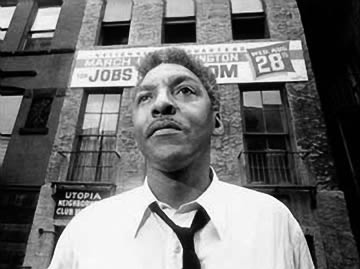
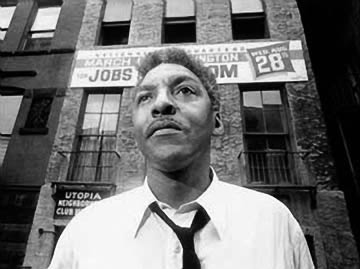
Civil rights pioneer Bayard Rustin was fired from the Friendship for Reconciliation, a pacifist group, for being gay.

The way anti-gay bigotry works is that a great deal of the violence and suffering is conducted away from the public eye. The resulting pain suffered is turned inwards, which is why one out of every three gay teens attempts suicide and why some of the most virulent anti-gay bigots turn out, in the end, to be gay themselves.

By Lisa Szefel / January 9, 2009

[Ms. Szefel is an assistant professor of modern American history at Pacific University in Forest Grove, Oregon where she teaches classes on the 1970s, the Reagan era, and the history of capitalism.]

In the summer of 2006 I attended the National Endowment for the Humanities Summer Institute at the W.E.B. Du Bois Institute at Harvard. One of the guest presenters was ninety-five year old Johnnie Carr, the woman who took over the Montgomery Improvement Association in 1956 after the successful bus boycott when Martin Luther King, Jr. went on to form the Southern Christian Leadership Convention.

Carr told stories and fielded questions. I’m not sure how the topic of gay people came up but at the mention of the word “homosexual” her face shriveled up and she moved her hand in a wide sweeping gesture, then exclaimed, “Those DISGUSTING people!” She made some inaudible comments then said the word “DISGUSTING” again. She said this even though Bayard Rustin, the man who co-founded SCLC with King, who assisted in the creation of the Committee on Racial Equality in 1942, organized the first freedom ride and the March on Washington, and helped King convert wholeheartedly to non-violence, was gay. I looked at Waldo Martin and Pat Sullivan, the two seminar leaders, and they looked away but, to their credit, they did not stop the tape recorder.

After Carr left and our group reconvened, I looked around and asked (it took no small amount of courage for me to raise this question and risk losing their respect or being seen as a troublemaker): “Did she really say that gay people were disgusting?” Everyone shrugged it off. An African American professor from North Carolina said, “Oh, that’s just her generation.” Martin replied, “She’s a devoted church lady, that’s just the way they see things.” I responded, “That doesn’t make it hurt any less.”

Now imagine someone lobbed the same spiteful word at a black person in 1955, at a time when key constitutional rights were not yet secured and violence or at least censure was always a risk. That person’s entire character would be defined as essentially racist. It would not be shrugged away, especially not now because we as a nation have come to understand the history and impact of bigotry on African Americans.

Would a newspaper or website run this article with this story and thereby run the risk of tainting the reputation of one of the great civil rights leaders? Is Carr’s reputation more important than the wave of anxiety and shame she triggered in me with her comments? Shouldn’t I be quiet? Am I simply being over-sensitive?

Understanding the sensitivity of the oppressed requires raising awareness. When I was growing up in blue collar Buffalo during the early 1970s busing was in full swing. Everyone talked about the violence at local P.S. 43. Fearing for the safety of their children, my parents sent their kids to Catholic school. I had to clean the hallways and bathrooms after hours (a job affectionately referred to as “the scum crew”) to help defray tuition costs. Years later when I was in graduate school, I told my middle class liberal friends about this. They all insisted my parents were racists and should have sent their kids to public school. In Buffalo as in Boston, it was the poorest school districts that were subjected to busing edicts and the term “limousine liberals,” coined in 1969, became widespread.

My family members were not racist but they did experience cognitive dissonance. They had black friends, neighbors, and co-workers with whom they got along well. Then, as their story goes, their African American acquaintances “one day just up and got angry.” It turns out that, as white people, while they had good intentions, they had very little idea what a black person had to endure. Adjusting to the fact that they had been dead-wrong all-along took them by surprise.

During the recent imbroglio over Barack Obama’s Inaugural invitation to Rick Warren gay people have been demonstrating their anger. Moderate liberals have jumped to the President-elect’s defense. In “Letter from Birmingham Jail” Martin Luther King, Jr. reserved his strongest rebuke for white moderates who want order and peace more than justice. “Lukewarm acceptance is much more bewildering than outright rejection,” he wrote. King also quoted a letter from a white moderate who cautioned patience: “All Christians know that the colored people will receive equal rights eventually, but it is possible that you are in too great a religious hurry,” to which King angrily responded: “Such an attitude stems from a tragic misconception of time, from the strangely irrational notion that there is something in the very flow of time that will inevitably cure all ills.” To the white clergy who had urged him to desist from public protests, King eloquently made the case for why blacks can no longer wait, insisting that freedom is never given but must be demanded, and he detailed the psychological impact of having waited 340 years to receive constitutional and God-given rights. He fiercely rejected justifications of bigotry based on majority opinion.

Few leaders have spoken so powerfully on behalf of gay rights. Hillary Clinton has made eloquent speeches in front of the Human Rights Campaign. She led the fight against the Federal Marriage Amendment and throughout the recent election spoke movingly about gay people she has known. During the primaries when I expressed my support for her over Obama, another professor asked, “Hillary and Obama are both against gay marriage, so they have the exact same stance on that issue. Am I missing something?” To me that demonstrated such a world of ignorance, as if gay people cared only about this one subject, and it neglected the senator’s history of support. Hillary opposed gay marriage as a strategy and argued for a state-by-state plan. Obama, conversely, repeatedly stated that he opposed gay marriage “as a man of Christ,” as if Jesus would be appalled. That is ideology. He also explained by saying that, if he were an advisor to the civil rights movement in 1962, he would not focus on the illegality of racial marriage, preferring to focus first on attaining voting rights.

However, this is an incorrect historical analogy. No gay person is arguing for the right to marry a straight person. They want to marry each other. Black people, after all, were allowed to get married during the hell of Jim Crow. Jewish people were allowed to get married in interwar Germany. The Untouchables in India, Japan, and Korea are allowed to get married. Moreover, many scholars have argued that a link exists between the fact that black people in antebellum America were not allowed to form families and high rates of contemporary poverty; slavery denied black men the ability to be responsible fathers. The veracity of this argument is debatable but, nevertheless, it was expected, that African Americans wanted to form relationships and experience love. What does it signify that, of all the humans on earth, only gay people are singled out as exempt from this right, from these desires? How does the restriction against participation in the most fundamental institution of every civilization on earth from time immemorial affect a gay person’s sense of self-worth? To be hopeful in such an environment would be far too audacious.

When I was growing up I never expected I would have a family of my own. Gay people were openly spoken of and depicted as pedophiles and psychopaths. A sea change occurred when Ellen Degeneres came out on national tv in 1997. Until Ellen there was no figure of stature to reference or model. If rich, powerful people were too afraid to be honest, how should poor, vulnerable people feel? The coming-out episode of her self-named TV show brought a collective sigh of relief: “Finally, someone who admits it.” Yet the visibility this brought spurred Americans across the country to insert anti-gay marriage ballot initiatives in 2000 and 2004. If earning a Ph.D. in History has taught me anything, it is that history is not a straightforward march of progress; often it takes two steps forward then one step backward. Oprah Winfrey, who played the psychologist in Ellen’s coming-out episode, said that she received more hate mail for that role than for any other thing that she has done in her life.

One year after Ellen’s coming out, 21-year-old Matthew Shepard was tortured, pistol whipped, then tied like a scarecrow to a fence and left to die in a remote area of Laramie, Wyoming. News reports indicated that the only part of his face not covered in blood was the skin cleansed by the tracks of Matt’s tears. The lynching shocked the gay community as much as the photo of Emmet Till’s bloated, distended face affected African Americans in 1955: just as young blacks were surprised to learn they could be killed simply for their skin color so too were gays shaken to discover they could be targeted just for the gender of the person who moves their heart.

After the incident Bill Clinton tried to extend the federal hate crimes laws. Before that he had the courage, the moment he became President, to try and do something about the prejudice gays endure. He failed and compromised with “Don’t Ask, Don’t Tell” but at least he tried before it was politically correct to do so. No one else had cared enough to make the attempt. On the contrary, these were the years when the sex abuse scandal rocked the Catholic Church and the uniform response of the all-male clergy was that only gay men commit child molestation. The first black president of the U.S. Conference of Catholic Bishops Wilton D. Gregory went on television to say that if the Catholic Church ferreted out all the gay clergy, there would no longer and not ever again, be a problem. Then Clinton blundered in signing the 1996 Defense of Marriage Act. But he still invited Ellen and Anne to Washington.

When I saw the picture of them with the President at the White House I almost fainted — an openly gay person was allowed inside?

Bernice King was three weeks old when her father wrote “Letter from Birmingham Jail” in 1963. In 2004, at the age of 41 and now a minister, Bernice marched in protest, just as her father did, but only this time, she was campaigning against gay marriage. She moved the funeral of her mother, Coretta, from her home church to a conservative anti-gay church, causing Julian Bond to refuse to attend. Coretta Scott King did believe the gay rights movement was similar to the struggle for black civil rights, for which she received rebuke from her community. She countered: “I still hear people say that I should not be talking about the rights of lesbian and gay people and I should stick to the issue of racial justice. But I hasten to remind them that Martin Luther King Jr. said, ‘Injustice anywhere is a threat to justice everywhere.’ ” Before another group, Coretta insisted that “Homophobia is like racism and anti-Semitism and other forms of bigotry in that it seeks to dehumanize a large group of people, to deny their humanity, their dignity.” Former SNCC leader and Congressman John Lewis too has stood up to denounce homophobia as just another variant of the same “fear, hatred, and intolerance” that animates racism, and he castigates civil unions as just another version of separate but equal.

Similarly, in a 1970 letter to his “Revolutionary Brothers and Sisters about the Women’s Liberation and Gay Liberation Movements,” Black Panther Party co-founder and leader Huey P. Newton urged cooperation while acknowledging prejudice. “I say ‘whatever your insecurities are’ because as we very well know, sometimes our first instinct is to want to hit a homosexual in the mouth.” Newton urged deleting the word “faggot” from the black activist’s vocabulary and he pleaded for understanding: “homosexuals are not given freedom and liberty by anyone in society. They might be the most oppressed people in society.”

Bayard Rustin, Langston Hughes, and James Baldwin had been marginalized from the movement because of their sexuality. Rustin was fired from the Friendship for Reconciliation, a pacifist group, for being gay. In an effort to assume a more prominent position for himself, Adam Clayton Powell, the heroic civil rights leader and congressman from Harlem, threatened to leak news about Rustin’s homosexuality unless King distanced himself from Rustin. Before Rustin died in 1987 he asserted that, just as the treatment of blacks was the barometer of human rights standards, now it was conduct toward gays that determined progress.

Too many Americans, liberals included, have no idea about the amount of suffering gay people endure. To speak in an informed way about gay marriage requires knowledge, whether speaking to a range of gay people about their experiences or reading on a regular basis websites of The Advocate, the Human Rights Campaign, and the International Gay and Lesbian Human Rights Commission. Just in the past two weeks a lesbian in San Francisco was gang-raped by four men who shouted anti-lesbian epithets at her during the attack, and the US and the Vatican refused to sign a UN declaration decriminalizing homosexuality (the Vatican’s head of the Congregation for Catholic Education, Cardinal Grocholewski, has deemed homosexuality not only a “deviation” but a “type of wound”).

The Advocate published a story about the last known gay survivor of the Holocaust, 95-year-old Rudolf Brazda, who, like thousands of others, had to remain silent for decades after World War II ended because homosexuality remained a crime (it was decriminalized in France only in 1982). And Pope Benedict XVI preached that gays are as ominous a threat to the world as climate change. Today, it is illegal for gays to adopt in Florida, Mississippi, Utah, and Arkansas. It is legal in twenty states to fire someone just for being gay. Until last week gays were not allowed to become members in Rick Warren’s Saddleback Church. Gay people in nursing homes are treated like pariahs and shunted off to Alzheimer’s wards to appease their bigoted roommates.

When I once suggested this reading strategy to a friend he furrowed his eyebrows: “Why would anyone want to torture themselves, reading all that bad news?” It was the same friend who, the day after John Kerry lost the 2004 election, said “To be realistic, we have to get rid of support for gay issues otherwise we’ll never win a national election.” That was easy to say for someone who feels secure and who has not endured a lifetime of prejudice.

Hatred for gay people is a global affair. Despite the Holocaust and almost constant warfare against the state of Israel conducted by hostile Muslims, Orthodox Jews turn around and conduct their own brand of global bigotry, protesting vehemently against homosexuals. Despite the thousand-plus years of hostility between Jews, Christians, and Muslims, they join hands in their hatred for gay people. In 2002 when Jerusalem hosted the city’s first gay pride parade, Eli Simchaioff, a city council member and deputy mayor complained, “These are sick people.” Other people held signs, “This is not Sodom!” and chanted, “There’s no place for homosexuals in the Jewish state,” and blamed attacks on Israel as a sign of divine punishment for blasphemy. Pope John Paul II delivered a sermon from the balcony on St. Peter’s Square, calling the parade an “offense to the Christian values of a city that is so dear to the hearts of Catholics across the world.”

Anti-gay bigotry is so omnipresent and potent it offers one way to unite the world. On March 31, 2005, the New York Times front page featured a photo of the religious leaders of the three major religions, Christianity (including Roman Catholic, Greek Orthodox, and Armenian), Judaism, and Islam, who met in Jerusalem to join in protest against the Jerusalem Gay Pride 2005 festival. These individuals would encourage their sons and daughters to die in battle against their religious enemies but they hate gay people even more than they hate each other. “They [homosexuals] are creating a deep and terrible sorrow that is unbearable,” Israel’s Sephardic chief rabbi Shlomo Amar proclaimed at a news conference. An Orthodox Jewish man stabbed three gay men in the parade. “We can’t permit anybody to come and make the Holy City dirty,” Abdel Aziz Bukhari, a Sufi sheik warned. “This is very ugly and very nasty to have these people come to Jerusalem.”

The Clintons were ahead of the zeitgeist. Few people even talked about gay issues before Bill Clinton was elected in 1992. Gay people do not have a political party, a country, or a continent and too often they do not have families because they are disowned the moment they are open and honest about who they are.

My godmother’s husband died of AIDs and it was taken for granted that no one would mention his name again yet alone discuss the cause of death. Another relative was on the verge of dying of AIDs in 1993—his partner had already died—and when he came out to his mother she was horrified. Once she regained her composure she told him she would tell everyone he died of a heart attack. He wrote a letter to my mom to tell her the truth because he did not want his mother to have to live with the shame and endure knowing he died of AIDs on her own. I was too afraid to come out to my father but I did tell my mother and she cried as if I were dying. “Is that why you always wear black?” was the first thing she said. The second thing was, “You can’t tell anyone else, especially Tim [my sister’s husband] because he won’t let you near the boys” [my nephews were young at the time]. At one point I did try and talk with my father about it. He immediately turned beat red, cut me off, and said, “Your sister doesn’t tell us about her sex life. I don’t want to hear about yours!” How he made that leap is ridiculous but understandable considering the prevalence of stereotypes.

A few years later I tried to talk to my sister about it and she walked away, saying “That’s gross!” When I came out to friends their reactions ranged from “You just haven’t met the right man” to “only ugly women are gay because they can’t get a man.” Some close friends stopped calling or returning my calls and my Christian friends gently told me that I am an abomination in God’s eyes. To this day my best friend from college, a black woman from Nigeria, shushes me when I use the word “gay” in front of her two children. “That’s so gay!” is a staple of teen insults.

This lack of support is a reason that the cause of gay rights has not advanced as much as it should. During the African American civil rights movement, family, friends, and church played a decisive role in the lives of activists. Memoirs of those involved in the black freedom struggle routinely discuss the critical part played by their church as well as their mothers and grandmothers who gave them advice and unconditional love on a daily basis as they faced their tormentors and fought their battles.

Melba Beals, one of the nine teenagers who integrated Little Rock high school in Arkansas, Septima Clark, the “Grandmother” of the civil rights movement, Ella Baker, the “Godmother” of the movement, Mary McLeod Bethune, college president and member of Franklin Roosevelt’s “Black Cabinet,” Student Non-violent Coordinating Committee organizer Dorothy Haight—the list of black women who attributed their strength to the aid given by their mothers and fellow Christians is extensive. Even while facing down dirty looks, water hoses, and attack dogs, black activists learned about their culture, went to church, on dates, married, and had children. National organizations sent leaders to their communities to provide counsel and financial aid. Could they have accomplished what they did without their families and community networks, the normality of socially-accepted dating and anticipation of marriage?

By families, friends, churches, and leaders, gay people are routinely silenced, ignored, and denied the hope of being able to build their own families. The way anti-gay bigotry works is that a great deal of the violence and suffering is conducted away from the public eye. The resulting pain suffered is turned inwards, which is why one out of every three gay teens attempts suicide and why some of the most virulent anti-gay bigots turn out, in the end, to be gay themselves. The societal-induced self-loathing cuts deep. Too many gay people become accustomed to dealing with problems by hiding, by digging a whole and wallowing because continuing alone only bodes further despair.

Coming out of the closet does not immediately result in happiness. Resentment over lost time brims. Memories resurface about taunts while a young kid, about the whole range of distasteful notions about gays that saturate society. The step after coming out is often not a celebration but a cauldron of frustration and anger, more akin to post-traumatic stress disorder. Rage, depression, and longing over missed opportunities jostle with the realization that entire years were wasted, spent worrying instead of growing. Huge gaps of time have simply vanished. Chunks of your life fell off yet no one noticed because the torment was invisible.

The bruises of bigotry have a long half-life. Self-loathing cannot remain hermetically sealed; it always seeps out. If it were a chemical element it would be plutonium, oozing out of steel drums, contaminating everything it touches, from water tables to blood.

That is why if gays suffer abuse from others, they suffer even more from among their own ranks. The self-hatred instilled in a young gay boy or girl is so searing and all-consuming that they will go to great lengths to hide their essential identity, even so far as persecuting others to deflect suspicion. It is similar to the “double-consciousness” that W.E.B. Du Bois discussed in his classic 1903 The Souls of Black Folk, where two identities, one legitimate, the other illegitimate, are in constant conflict. “Why did God make me an outcast and a stranger in mine own house?” Du Bois wrote about the plight of blacks in the white world of America:

a world which yields him no true self-consciousness, but only lets him see himself through the revelation of the other world. It is a peculiar sensation, this double-consciousness, this sense of always looking at one’s self through the eyes of others, of measuring one’s soul by the tape of a world that looks on in amused contempt and pity. One ever feels his two-ness, — an American, a Negro; two souls, two thoughts, two unreconciled strivings.

In 2006 another incident revealed that the constant negotiation of two sets of standards results in dissonance and erratic behavior. Ted Haggard, founder of the megachurch New Life Church and head of the National Association of Evangelicals, preached against homosexuality but secretly had sex with a male prostitute. “There is a part of my life that is so repulsive and dark that I’ve been warring against it all of my life,” he confessed.

A precedent had already been set by televangelist Paul Crouch, who founded Trinity Broadcasting Network, one of the largest Christian television and radio network in the world. Crouch paid almost a half of a million dollars, as part of a sexual harassment lawsuit, to a former male employee who alleged a homosexual encounter. In Congress, Larry Craig, the Republican senator from Idaho was arrested for “lewd conduct” in a public bathroom. For years, he voted against laws introduced in the House of Representatives designed to protect gay people, and he sang alongside Senator John Ashcroft and Trent Lott in the barbershop quartet “The Singing Senators.” Jim McGreevy, the married governor of New Jersey, resigned after revealing his affair with a man he had appointed to a lucrative state job, reluctantly making history as the first openly gay governor in U.S. history. Not exactly a hallmark of achievement to celebrate.

I did come out to the rest of my family in 2000 when Hillary was running for the Senate. I was living in Rochester, and family members in Buffalo regularly sent anti-Hillary mass emails. I finally wrote a mass email of my own, informing them that Hillary was the only one willing to stand up for me and requesting they stop circulating the scornful messages. They did. I have a deep and abiding sense of gratitude for Bill and Hillary’s words and actions on behalf of the gay community.

Now that there is increasing public support and momentum to do away with Don’t Ask, Don’t Tell, I have no doubt Obama will revoke it. But during the election he repeatedly said he was against gay marriage “As a man of Christ.” We are so used to hearing Biblical justifications for preventing gay people from marrying that it sounds normal, so Obama’s statement seems ordinary. His invitation to Rick Warren, a man who equates gay marriage with incest, pedophilia, and polygamy, seems reasonable enough. But it is damaging and hurtful.

Martin Luther King had to find an answer for his son’s question: “Daddy, why do white people treat colored people so mean?” A child knows that words hurt, symbols matter, and bullies and bigotry should never be rewarded

Source / History News Network

The Rag Blog

Posted in RagBlog | Tagged , , , , , , , , , | 2 Comments

American Public Opinion Bucks Israeli PR Machine

Public opinion. Illustration courtesy of Pew Research Center.

‘The same pundits who are cheerleading Israel’s assault on Gaza once sold the occupation of Iraq to America, and with a nearly identical set of arguments.’
By Max Blumenthal / January 5, 2009

Almost as soon as the first Israeli missile struck the Gaza Strip, a veteran cheering squad suited up to support the home team. “Israel is so scrupulous about civilian life,” Charles Krauthammer claimed in the Washington Post. Echoing Krauthammer, Alan Dershowitz called the Israeli attack on Gaza, “Perfectly ‘Proportionate.'” And in the New York Times, Israeli historian Benny Morris described his country’s airstrikes as “highly efficient.”

While the cheerleaders testified to the superior moral fiber of their team, the Palestinian civilian death toll mounted. Israeli missiles tore at least fifteen Palestinian police cadets to shreds at a graduation ceremony, blew twelve worshipers to pieces (including six children) while they left evening prayers at a mosque, flattened the elite American International School, killed five sisters while they slept in their beds, and liquidated 9 women and children in order to kill a single Hamas leader. So far, Israeli forces have killed at least 500 Gazans and wounded some two thousand, including hundreds of children. Yesterday, the IDF blanketed parts of Gaza with white phosphorus, a chemical weapon Saddam Hussein once deployed against Kurdish rebels.

“It was Israel at its best,” Yossi Klein Halevi declared in the New Republic.

By New Year’s Day, Israel’s cheering squad had turned the opinion pages of major American newspapers into their own personal romper room. Of all the editorial contributions published by the Washington Post, the Wall Street Journal, and the New York Times since the Israel’s war on Gaza began, to my knowledge only one offered a skeptical view of the assault. But that editorial, by Israeli novelist David Grossman, contained not a single word about the Palestinian casualties of IDF attacks. Even while calling for a cease fire, Grossman promised, “We can always start shooting again.”

Israeli public relations agents fanned out to broadcast studios from the US to Europe, fulfilling an aggressive strategy conceived after the country’s catastrophic 2006 attack on Lebanon. An analysis by Israel’s foreign ministry of eight hours of coverage across international broadcast media concluded that Israeli representatives received a whopping 58 minutes of airtime compared to only 19 minutes for Palestinians. “Quite a few outlets are very favorable to Israel, namely by showing [its] suffering. I am sure it is a result of the new co-ordination,” said Major Avital Leibovich, an IDF spokesperson who has become a fixture on cable news in the past weeks.

But while Israel’s PR machine cranked its Mighty Wurlitzer to full blast, drowning out all opposing voices with its droning sound, a surprisingly substantial portion of the American public decided to dance to its own tune. According to a December 31 Rasmussen poll (so far the only measure of US opinion on the Gaza assault), while Americans remained overwhelmingly supportive of Israel, they were split almost evenly on the question of whether Israel should attack Gaza — 44% in favor of the assault and 41% against it. The internals are even more remarkable.

While Republicans supported the assault on Gaza by a large margin, a predictable finding, only 31% of Democrats did. Members of the Democratic base thus stood in sharp contrast to most of their elected representatives (freshman Rep. Donna Edwards is a notable exception), who backed the latest Israeli assault in lockstep, and seem to support Israel no matter what it does. The rift between the progressive base and the party played out on Barack Obama’s Change.gov site, which was deluged in recent days with demands for a statement condemning Israel’s assault on Gaza.

So what accounts for the surprising trend in American opinion on Gaza? The proliferation of progressive online media and social networking sites could be a factor, but I have another theory: The same pundits who are cheerleading Israel’s assault on Gaza once sold the occupation of Iraq to America, and with a nearly identical set of arguments. In their voices and those of the grim Israeli PR agents carted out for cable news, many Americans hear echoes of the Bush administration’s most fantastical lies. When they see images of Gazans under withering bombardment, they flash back to Fallujah and the assorted horrors of Iraq. When they look at Israel, they see themselves during the darkest days of the Bush era.

Now, an increasing share of Americans know what Israel is doing to Gaza. And they reject it, even when Israel is “at its best.”

Source / The Huffington Post

Thanks to David Hamilton / The Rag Blog

Posted in RagBlog | Tagged , , , , | 1 Comment

Coulterman : Spandex Annie Eats Her Dates

Ms. Coulterman has never married and her housekeeper reportedly was kept employed mainly to sweep up the dried husks of dessicated paramours who mysteriously died after their first date with the self-promoting madwoman.

By Larry Ray / The Rag Blog / January 6, 2009

Trapped in her spandex supersuit, Annie Coulterman is conflicted at the very least. Preparing to make the rounds of talk shows and 4-H County Fairs to promote her new book on sinister organic poison, she had reportedly been unable to unfasten the Velcro and zippers on her around-the-home superbitch lounge wear. The fasteners are all on the far right of her supersuit and she reportedly shredded her housekeeper and stuffed a pillow with her when she was unable to loosen them for her.

Ms. Coulterman has never married and her housekeeper reportedly was kept employed mainly to sweep up the dried husks of dessicated paramours who mysteriously died after their first date with the self-promoting madwoman. Rumors reportedly still abound in the entomology department of her undergraduate alma mater, Cornell University, about supposed sightings of a large red hourglass pattern on her abdomen.

Some individuals of the male species have spent time alone with her with no reported ill effects, including a federal judge who reportedly named Coulterman to a list of the “Top 100 public intellectuals” back in 2001. And Annie Coulterman is public. But she poses no threat to private intellectuals. This female megalomaniac even proudly lists the only five “REPORTERS WHO ARE ALLOWED TO INTERVIEW ANNIE AGAIN” on a web site. But if they are actual reporters, no one I know has ever heard of them or the media for whom they supposedly report.

With the majority throng of liberals who have swept Barack Obama into office, and with the congressional liberal vote clout about to give Orrin Hatch an infarction, Annie would be better advised to go ahead and wear her superwoman suit for her interviews. That way folks might at least notice her on the book tour. Because the airwaves and newspapers are brimming over with news of the new liberal tsunami about to sweep over the remains of the GOP ravaged nation. Sorry Annie. Shout louder and ratchet up your nasal whine if you want to sell your book, but it looks like you will have to do it from atop a soapbox on street corners.

In fact, after NBC canceled your Today Show appearance, and Harry Smith noted in his interview with you on The Early Show that you are “sophomoric” and “goofy,” you might just cut the tour short and minimize your losses. You will be up against Leno in prime time and Saturday Night Live could un-spin your web leaving you to rant neath’ your cape. By the way, I would suggest you have the publicity photo wearing the supersuit touched up a little . . . your ossified ovaries look like, well you know, those things you eat last after one of your first dates.

[Retired journalist Larry Ray is a Texas native and former Austin television news anchor. He also posts at The iHandbill.]

Also see Books / Ann Coulter’s ‘Guilty’: Offensive as Charged by Greg Lewis / Media Matters / The Rag Blog / Jan. 4, 2009

And Guilty: Coulter’s latest book filled with falsehoods / Media Matters / Jan. 4, 2009

The Rag Blog

Posted in Rag Bloggers | Tagged , , , | Leave a comment

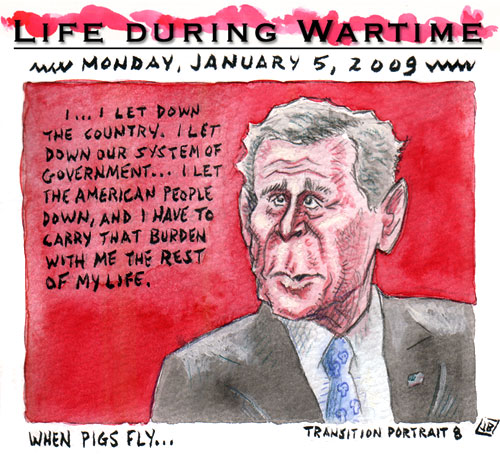
When Pigs Fly…

Political cartoon by Joshua Brown / Historians Against the War / The Rag Blog

Thanks to S. R. Keister / The Rag Blog

Posted in Rag Bloggers | Tagged , | Leave a comment

Dr. Stephen R. Keister :
Dante’s Hypocrites and Universal Health Care

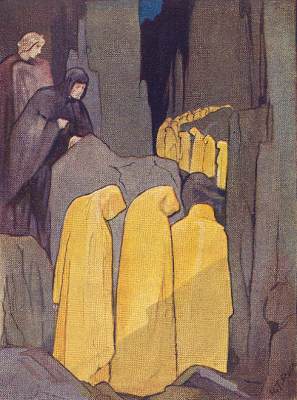
image of A Strange Procession of Hypocrites

A Strange Procession of Hypocrites. From Mary Macgregor / The Baldwin Project.

Our Divine Comedy
If we cannot influence our elected representatives, all the great efforts of all these dedicated people who desire single payer, universal health coverage will be for naught, and we must accept that the United States is little better than a Third World nation in providing health care to the majority of the population.

By Dr. Stephen R. Keister | The Rag Blog | January 6, 2009

In The Divine Comedy Dante places the hypocrites at one of the lowest levels of Hell, dressed in the finest raiment, lined with lead, shuffling along forever and making no progress.

We who have been speaking for single payer, universal health care have been encouraged by what appears to be wide spread popular support for such a program as per HR 676 introduced by Rep. John Conyers and backed by some 90 sponsors, The problem is that the bill has been sitting in committee for some years without debate, nor any sign from the House Leadership that it will get to the floor for debate.

On the other hand there are many organizations pushing for health care reform, the majority of which are joining the fight to pass HR 676. This bill was originally conceived, well researched, and well publicized by Physicians For A National Health Program and endorsed by the 125,000 member American College of Physicians, The California Nurses Association, and many labor and civic groups. Recent polls show 55% Of Americans approve of universal care and 64% indicate a willingness to pay higher taxes to finance it. However, all is not well, for during the 2006 election cycle the health care industry spent $99.7 million on campaign contributions to maintain the status quo and their lobbying costs topped $446 million in 2007.

There was an excellent article by Lindsay Beyerstein in AlterNet, Dec. 24, 2008, indicating that defeating single payer, universal care is a number one priority of the Senate Republicans.. These folks even oppose the Obama plan that would establish a public insurance plan for today’s uninsured, or for others who would opt to join it. The article quotes one Mark Hayes, a Republican health policy advisor, who expresses concern that a government plan might have access to price controls and other tools not available to private insurers. This could lead to lower premiums for the government plan and lead consumers to migrate out of the private market. But the Senate is controlled by Democrats who surely would favor universal health care….

But are we sure that the “progressive party” really has that end in mind.

The Republicans in the Senate can always fall back on the filibuster to prevent passage of a health care bill, and the Democratic leadership can always use that excuse for not providing decent health care. Here, let us follow the money utilizing The Center for Responsive Politics as our source. For the 2008 Campaign Finance Cycle Senator Harry Reed, the Democratic Leader, received $232,910 from the insurance industry, $150,425 from hospitals and nursing homes, $115,350 from pharmaceutical companies, and $326,450 from “health professionals.” The minority leader, Mitch McConell received $648,050 from “health professionals,” $512,433 from insurance companies, $386.040 from the insurance industry, and $265,050 from hospitals or nursing homes. The filibuster rule gives the Democratic majority an out for not passing a bill and blaming it on the Republicans.

The Nation Magazine, Dec. 29, 2008, makes it abundantly clear that the Democratic leadership can circumvent the filibuster by merely changing the Senate rules, which requires ONLY A MAJORITY VOTE, to change the filibuster from 60 votes to 55 votes. The question is, does the Democratic majority want this change, or do they wish to hide behind the current rules? Do the Democratic representatives of the people really want to provide decent health care in the United States or are there over-riding personal considerations?

Turning to The House of Representatives, HR 676 has been languishing in Committee for several years. The Leadership has made no effort to move it along. Let us again look at possible reasons for the indifference. Nancy Pelosi in the 2008 cycle received $117,000 from insurance companies, $81,750 from hospitals and nursing homes, $492,550 from the pharmaceutical industry, and $120,950 from hospitals and nursing homes. Her Democratic Colleague Steny Hoyer, received $153,400 from insurance, $84,500 from hospitals and nursing homes, $130,800 from pharmaceuticals, and $203,100 from “health professionals”. (It’s not germane to the present discussion, but these two representatives received $84,490 and $141,850 from AIPAC and related organizations). The Republican leadership in the House, Reps. Boehner and Blunt, received $206,725 and $93,650 from insurance companies and $159,450 and $87,250 from the pharmaceutical industries. One would trust that Speaker Pelosi would show good faith to the people of the country and get HR 676 to the floor for debate,

Many of the “proponents” of health care change emphasize the importance of computerized medical records, and “preventive care” (health club with personal trainer?). Indeed, these suggestions have merit; however, they are used largely as a distraction. We must provide initially the facilities for caring for the child with pneumonia or his father with a heart attack, or his mother with ovarian cancer. After decent care, as provided in other industrialized nations, is available, then we can consider the niceties.

Yet we who are proposing single payer, universal care must address another issue. That issue is physician availability. Ever since I started practice in 1950 until my retirement in 1990 I was aware that, somewhere behind the scenes, there was a concerted effort not to overpopulate the American scene with “too many doctors.” This explains the great number of foreign doctors, largely excellent folks from India, in American medicine. We have a great lack of general practitioners, largely because of the high tuition costs of medical school. The average student graduates owing $120,000 and his natural decision is to try for a high paying specialty such as orthopedics, or cardiovascular surgery. This nation needs family doctors, internists and internal medicine subspecialists. A suggestion which I made to Dr. Robert Doherty at the American College of Physicians:

There should be (1)government subsidization of medical education at university affiliated medical schools to qualified students, or (2)the establishment of a Medical Academy akin to Annapolis or West Point. In either event the graduate will be required to serve at least five years in areas with physician shortages.

In some ways the general public, who by and large will be the beneficiaries of universal health care, must be involved. It was not Jacque who instigated the social reform in France in 1790, but the middle class and the pamphleteers. I fear that we who talk to one another via the internet are not reaching the average American whose support is absolutely necessary. He/she must be weaned from the TV and somehow immersed in the conversation so that the elected representatives will hear from the people. I am sure if Karl Marx was writing Kapital today he would include TV as a second opiate of the people. In the U.K. during the Thatcher period the Prime Minister turned many of the government run facilities including the railroads and water systems over to private companies; however, the people and the medical community stopped her from privatizing medical care.

Finally, we need from the new administration not only a decent system of health care, avoiding the Massachusetts model in which costs are spiraling out of control using private insurance as the base. We need control of the advertising of prescription drugs on TV. We need cost control of pharmaceuticals, leaving the manufacturers reasonable, but not obscene, profits. We need control of the collusion among the pharmaceutical companies, and the publication of studies regarding new prescription drugs, as well as supervision of subsidies to medical schools by pharmaceutical companies.

If we cannot influence our elected representatives, all the great efforts of all these dedicated people who desire single payer, universal health coverage will be for naught, and we must accept that the United States is little better than a Third World nation in providing health care to the majority of the population. We must accept that health care in our nation is rationed depending on the ability to pay. We must accept that we are victim to the economic philosophies of Ayn Rand and Milton Friedman. We must learn to follow the money and recognize the hypocrisy of politicians who aver that they are against the enactment of health care legislation because “it will put a burden on the taxpayer,” and who recite the falsehood that if we have single payer care that “the government will choose your doctor and hospital.”

Finally a thought from Hannah Arendt: “As witness not of our intentions but of our conduct, we can be true or false, and the hypocrite’s crime is that he bears false witness against himself. What makes it so plausible to assume that hypocrisy is the vice of vices is that integrity can exist under the cover of all other vices except this one. Only crime and the criminal, it is true, confront us with the perplexity of radical evil; but only the hypocrite is really rotten to the core.”

[Dr. Stephen R. Keister is a retired physician who writes about health care issues for The Rag Blog.]


Posted in Rag Bloggers | Tagged , , , | Leave a comment

They are Bombing 1.5 million People in a Cage

h/t Juan Cole / The Rag Blog

Posted in RagBlog | Tagged , , , | 1 Comment

Neil Young :
A Race for the Planet

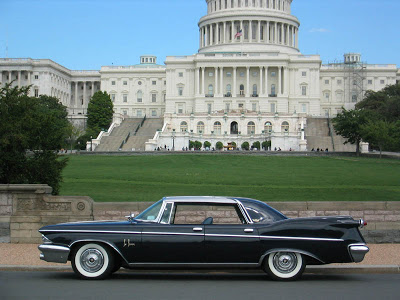
photo of car

Neil Young’s retro-fitted vintage Lincoln: The race is on.

If the Big three cannot agree to make only cars that are fuel efficient enough to get at least 50 MPG by 2011, 75 MPG by 2013 and 100 MPG by 2015, then they should go into bankruptcy and fend for themselves like all the other businesses that are having trouble.

By Neil Young | December 4, 2008

A Perfect storm for innovation is gathering in Washington. With the government’s recent financial assistance to GM and Chrysler, the Big 3 now have until the end of March to make the case that shows how they will survive. Survival is not enough though.

America now has a chance to lead the world in power and fuel efficiency. The Big three will still be looking for help at the end of March. As the major shareholder, the US government would have an opportunity to DEMAND the type of cars that will lead the world toward saving the planet for future generations.

If the Big three cannot agree to make only cars that are fuel efficient enough to get at least 50 MPG by 2011, 75 MPG by 2013 and 100 MPG by 2015, then they should go into bankruptcy and fend for themselves like all the other businesses that are having trouble. The truth is this can be done and innovators know the way to do it.

Better Place is a new model for power distribution to replace the old model of gas stations that supported the evolution of the automobile to this point. Better Place is taking hold in countries around the world and in some areas of the US. Better Place’s revolutionary concept for distribution of power to vehicles actually lowers the price of the vehicle by making the battery free to the consumer and automaker, while a subscription allows the user to only pay for miles traveled. There is a great opportunity for innovative solutions with Better Place.

The Automotive X Prize is a race of 100MPG vehicles across America in 2010 sponsored by the Progressive Insurance Company. There are many entries. These cars must be safe and have a business plan that allows for at least 10,000 units per year. Automotive X prize contenders need to share their knowledge with the Car Czar. How will they get their cars to the magic 100mpg? There are some good ways to do it. Now is the time to share.

Innovators should swarm like locusts on Washington in January, February and March to show the Car Czar how to make fuel-efficient cars.

A Car Czar who knows how it can be done, and a government in control of the automakers while they stabilize will be key to demanding all autos made in the USA have a minimum mileage rating of 50MPG. This includes cars, SUVs and pick-up trucks. Now it is time for America to take back the reins of innovation and show the true wave of the future. It is a window for a sea change and a new opportunity for America to lead the world.

Lincvolt, an X Prize contestant, is a 2.5 ton, 19.5 foot American classic now attaining 65 MPG utilizing electricity and domestic fuel. The converted 1959 Lincoln Continental MK IV demonstrates that today’s big sedans SUVs and pick-up trucks can get at least 50 MPG if they are fuel-efficient and use electric power, making it obvious that smaller cars could do even better than that. Ultimately, the Lincvolt team aims to demonstrate a Lincvolt hydro bio-electric series hybrid that will attain 100MPG with domestic fuels and very low emissions.

In February, Lincvolt will begin an historic drive to Washington to showcase “the people’s fuel,” and show the President, the Car Czar, Congress and the Senate how innovation happening right now in America can be a beacon of change to the world.

The Lincvolt team invites the other contestants in the Automotive X Prize Race, Better Place, and innovators from around the world to join us in Washington during the first 100 days of the new administration.

Source / The Huffington Post

Also see Neil Young : How to Save a Major Automobile Company by Neil Young / The Rag Blog / posted Nov. 19, 2008

The Rag Blog

Posted in RagBlog | Tagged , , , , , | 1 Comment

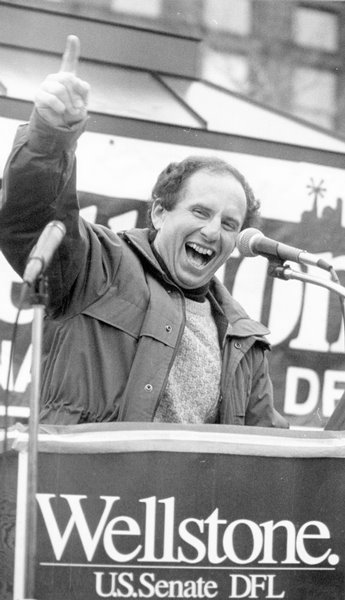
Al Franken’s Victory : Remembering Paul Wellstone’s Convenient Death

Wellstone was pulling ahead in the polls, and the victory of a man who voted against the war resolution would have been a great embarrassment to the Bush administration. This was a convenient death.

By Sherman DeBrosse / The Rag Blog / January 5, 2009

It is likely that Al Franken could be named this week as the winner of the disputed Senatorial election in Minnesota. He would be taking the seat of Paul Wellstone, one of the great progressives of our time. We remember his skill at filibustering legislation designed to pick our pockets, and hope Franken develops a similar skill.

Paul Wellstone, a two-term United States Democratic Senator from Minnesota was killed in a plane crash on Oct. 25, 2002, in Eveleth, Minn., two miles away from the Eveleth-Virginia airport. The plane had departed St. Paul. His wife Sheila and Marcia, their daughter, three staffers, and two pilots were also killed. He was aboard what is called a business turboprop — King Air A100. It was known for its safety.

He was locked in a very tight race for reelection. He was taking the then very unpopular position that invading Iraq would be a mistake, but his chances for reelection were reasonably good. Some say he was the only genuine progressive in the Senate. This writer would make that circle a little wider.

That Minnesota race was very important because the Senate was almost evenly divided and very close to falling under Republican control. Wellstone was pulling ahead in the polls, and the victory of a man who voted against the war resolution would have been a great embarrassment to the Bush administration. This was a convenient death.

The Wellstone plane was operated by two experienced pilots. It was said that visibility was poor. But it was possible to see for 2½ miles. When the plane came under the lowest cloud layer at 700 feet, the airport would have been in view. On CNN, the anchor kept talking about ice on the plane’s wings while the on-scene reporter repeatedly said it was not quite cold enough for that condition. However at the 9-11,000 feet level there would have been some icing. Another pilot landed a slightly larger aircraft there a few hours later and said he encountered light icing at 10,000 feet but that it was not a problem. A National Center for Atmospheric Research scientist discounted the icing theory. At any rate, the plane was equipped with deicing equipment, and people used to flying in Minnesota would have used it routinely. A “black box” was never found and the National Transportation Safety Board claimed there probably was none aboard the plane. However, planes of that type were required to carry them.

Plane crashes are a very good way to eliminate people. There is little evidence and few or no witnesses. They are investigated by government employees, who are subjected to all sorts of pressures. One of the two pilots was very highly rated and had a great deal of experience, and the other was well qualified. If pilot error seems unlikely, we must look for another cause. It seems they lost the ability to control the craft, and it then crashed. At the time the plane dove and lost communications, a man nearby, driving to a funeral, experienced severe cell phone problems. He heard “between a roar and loud humming voice…oscillating…screeching and humming noise.” For hours after the crash there was blue smoke coming out of the plane’s fuselage, suggesting an electrical fire.

We know that the US has microwave weapons to knock out enemy weapons systems, and some have hypothesized that they were used here. There is no solid evidence to prove this.

FBI personnel arrived at the scene with extraordinary speed — one hour after the crash. Arriving at 11 a.m., they would have to have departed St. Paul at the same time the plane took off. Did they know in advance? An airport employee insisted they came from Minneapolis/St. Paul, but the FBI later insisted the agents came from Duluth, explaining their early arrival. On the other hand, their badges would have permitted them to travel at any speed they desired. They made it difficult for fire teams and AP photographers to take photos. Gary Ulman, the airport manager, said he did not call the FBI. (As soon as the plane broke radio contact, he took off in his own plane to look for it.)

If one studies the subject some, it seems that politicians have a greater chance of dying in air crashes than others. But this could be because they use small craft. A study done after the crash suggested that Democrats are almost twice as likely as Republicans to go down in air crashes. It also appears that Democrats and liberal Republicans have worse luck with airplanes than others. Some might recall that Democratic Senators Tom Daschle and Patrick Leahy were targeted with anthrax letters. Still, lacking proof that there was skullduggery, we should probably bow to the conventional wisdom that it was an accident. The fact that this writer and others feel the necessity to raise the subject, speaks volumes about the Age of the Second Bush.

Also see Why Al Franken should NOT be riding private planes by Bob Fitrakis and Harvey Wasserman / OpEd News / Jan. 5, 2008.

The Rag Blog

Posted in Rag Bloggers | Tagged , , , | 5 Comments

Remembering Tom Bernard : The GI Movement Against the War in Vietnam

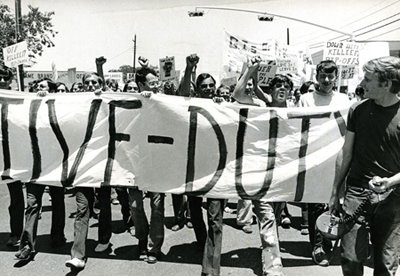
David Zeiger with active duty GI’s at Armed Farces Day, 1971, Killeen, Texas, home of Ft. Hood. Photo from Displaced Films.

Tom Bernard, 60, died Dec. 27. 2008. As an active duty GI in Vietnam, Tom was part of WORMS — We Openly Resist Military Stupidity.

‘One of the most thrilling aspects of the GI Movement during the Vietnam War was its ubiquitous nature. In every corner of the military, everywhere on the planet, GIs found creative, stunning ways to rebel.’
By David Zeiger
/ The Rag Blog / January 5, 2009

[David Zeiger produced and directed the award winning and critically praised documentary film Sir! No Sir! about the GI movement to end the War in Vietnam.]

It is with deep, deep sadness that I am writing to tell you of the death of Tom Bernard. Tom suffered a massive heart attack on Sunday, December 27. He was 60 years old.

I met Tom while filming Sir! No Sir! in what I later learned was a typical “Tom” way. I’ll never forget the email I got out of the blue from this guy I had never heard of, telling me simply that he had been part of an extremely significant group that had to be part of this film. They had never told their story publicly, and in fact had been threatened with prosecution for treason if they ever did. I was certainly intrigued, and soon Tom and I were friends.

Several months and a couple of failed attempts later, I found myself in a house with Tom and three other courageous, exemplary members of the WORMS — We Openly Resist Military Stupidity.

One of the most thrilling aspects of the GI Movement during the Vietnam War was its ubiquitous nature. In every corner of the military, everywhere on the planet, GIs found creative, stunning ways to rebel. Even if no one outside their individual unit knew they existed, they became part of an elegant tapestry of chaos and resistance.

And none were more elegant than the WORMS. Trained in Vietnamese, they were part of an ultra-secret unit that flew over North Vietnam intercepting communications from the “enemy,” and translating them for the Pentagon to use in planning military strategy. As Tom described it to me, they began developing an almost personal relationship with the voices they were hearing, and soon knew that the real “enemy” was not the people they were listening to, but their own bosses. Knowing firsthand how civilian centers were targeted and hospitals were being bombed, they decided to dedicate their lives toward ending that criminal war.

As they told me their story, the depth of their humanity and courage shown through — and I knew Tom had not exaggerated their significance. Finding themselves in a critical position for the war effort, they developed creative, challenging, fun (that was a requirement!), and profoundly effective ways of resisting. Their impact was far greater than they or anyone else knew.

I don’t know much about Tom’s life after Vietnam, but I do know that — as is true for thousands — those years as a GI resister informed all of it. I know that he never gave up his determination to change the world and his sense of purpose that was born with the WORMS.

My heart goes out to his wonderful wife, Helen, and their family. I will never forget Tom, and am very grateful to have known him the brief time I did.

Thanks to Alice Embree / The Rag Blog

Posted in Rag Bloggers | Tagged , , , , , | Leave a comment

Cheney : Faces Nation, Won’t Face Truth

‘Cheney wrapped up his version of “Through the Iraqi Looking Glass,” double-speaking his way through torture, detention, Guantanamo, wiretapping without warrant, and the administration’s basic trampling of the Constitution.’

By Larry Ray / The Rag Blog / January 4, 2009

Appearing on CBS’s “Face the Nation,” this morning, Vice-President, Dick Cheney, with as straight a face as he is capable of displaying, declared, “I think we’re very close to achieving what it is we set out to do five years ago when we first went into Iraq.” Then, after essentially declaring “Mission Accomplished,” Cheney turned and winked smugly at his invisible sidekick, Harvey Haliburton.

At the very moment Cheney was continuing his mad fairy tale, breaking news headlines included: “U.S.-installed Iraqi ex-PM says Bush “utter failure,” and “40 Shia pilgrims killed by a female suicide bomber at shrine in Baghdad.”

His delusional ramble was nothing new to veteran TV journalist, Bob Schieffer, host of “Face the Nation,” who has interviewed Cheney dozens of times. “How do you think we got it so wrong?” Schieffer asked. “I mean, we thought he had weapons of mass destruction and he didn’t; we thought we would be greeted with open arms and we weren’t. What happened?” Not missing a beat for reflection, Cheney replied, “Well, I don’t look at it as we got it so wrong, Bob.” “We got a big part of it wrong,” Schieffer continued. “There weren’t any weapons of mass destruction.” “Correct.” Cheney replied, “The original intelligence was wrong, no question about it. But there were parts of it that were right. It wasn’t 100 percent wrong.”

It looks like Cheney will ride off into some Wyoming sunset, actually believing his own cherry-picked version of the actual facts which are on the record. New York Times columnist and respected author, Frank Rich, in his book, “The Greatest Story Ever Sold” offers a detailed, 80 page time line of the whole evolution of the Iraq invasion. It starts with the September 15, 2001 Camp David meeting where Deputy Secretary of Defense, Paul Wolfowitz, speaking to his boss, Donald Rumsfeld, advocates attacking Iraq, noting the scarcity of “good targets in Afghanistan.” The whole intricately detailed and documented time line is available online in PDF format at http://www.frankrich.com and someone should read it to Cheney nightly for the rest of his unnatural life. The truth is not going to go away.

Cheney wrapped up his version of “Through the Iraqi Looking Glass,” double-speaking his way through torture, detention, Guantanamo, wiretapping without warrant, and the administration’s basic trampling of the Constitution. Meanwhile, the international press was quoting former interim Iraqi Prime Minister Iyad Allawi, basically selected and approved by Mr. Cheney, as saying “His insistence on names like ‘democracy’ and ‘open elections’, without giving attention to political stability, was a big mistake. It cast shadows on Iraq, Iran, Afghanistan and Egypt and I believe this will be remembered in history as President Bush’s policy.”

History will remember both Bush and his mad mentor, Cheney, perhaps in the context of the observation of William Shakespeare, “The very substance of the ambitious is merely the shadow of a dream.”

[Retired journalist Larry Ray is a Texas native and former Austin television news anchor. He also posts at The iHandbill.]

The Rag Blog

Posted in Rag Bloggers | Tagged , , , | Leave a comment

Current Gaza War Part of Israel’s Regional Plan

From Left to Right: Meir Dagan, Ariel Sharon, Efraim Halevy

The Invasion of Gaza: ‘Operation Cast Lead,’ Part of a Broader Israeli Military-Intelligence Agenda
By Michel Chossudovsky / January 4, 2009

The aerial bombings and the ongoing ground invasion of Gaza by Israeli ground forces must be analysed in a historical context. Operation “Cast Lead” is a carefully planned undertaking, which is part of a broader military-intelligence agenda first formulated by the government of Prime Minister Ariel Sharon in 2001:

“Sources in the defense establishment said Defense Minister Ehud Barak instructed the Israel Defense Forces to prepare for the operation over six months ago, even as Israel was beginning to negotiate a ceasefire agreement with Hamas.”(Barak Ravid, Operation “Cast Lead”: Israeli Air Force strike followed months of planning, Haaretz, December 27, 2008)

It was Israel which broke the truce on the day of the US presidential elections, November 4:

“Israel used this distraction to break the ceasefire between itself and Hamas by bombing the Gaza strip. Israel claimed this violation of the ceasefire was to prevent Hamas from digging tunnels into Israeli territory.

The very next day, Israel launched a terrorizing siege of Gaza, cutting off food, fuel, medical supplies and other necessities in an attempt to “subdue” the Palestinians while at the same time engaging in armed incursions.

In response, Hamas and others in Gaza again resorted to firing crude, homemade, and mainly inaccurate rockets into Israel. During the past seven years, these rockets have been responsible for the deaths of 17 Israelis. Over the same time span, Israeli Blitzkrieg assaults have killed thousands of Palestinians, drawing worldwide protest but falling on deaf ears at the UN.” (Shamus Cooke, The Massacre in Palestine and the Threat of a Wider War, Global Research, December 2008)

Planned Humanitarian Disaster

On December 8, US Deputy Secretary of State John Negroponte was in Tel Aviv for discussions with his Israeli counterparts including the director of Mossad, Meir Dagan.

“Operation Cast Lead” was initiated two days day after Christmas. It was coupled with a carefully designed international Public Relations campaign under the auspices of Israel’s Foreign Ministry.

Hamas’ military targets are not the main objective. Operation “Cast Lead” is intended, quite deliberately, to trigger civilian casualties.

What we are dealing with is a “planned humanitarian disaster” in Gaza in a densely populated urban area. (See map below)

The longer term objective of this plan, as formulated by Israeli policy makers, is the expulsion of Palestinians from Palestinian lands:

“Terrorize the civilian population, assuring maximal destruction of property and cultural resources… The daily life of the Palestinians must be rendered unbearable: They should be locked up in cities and towns, prevented from exercising normal economic life, cut off from workplaces, schools and hospitals, This will encourage emigration and weaken the resistance to future expulsions” Ur Shlonsky, quoted by Ghali Hassan, Gaza: The World’s Largest Prison, Global Research, 2005)

Operation Justified Vengeance”

A turning point has been reached. Operation “Cast Lead” is part of the broader military-intelligence operation initiated at the outset of the Ariel Sharon government in 2001. It was under Sharon’s “Operation Justified Vengeance” that F-16 fighter planes were initially used to bomb Palestinian cities.

“Operation Justified Vengeance” was presented in July 2001 to the Israeli government of Ariel Sharon by IDF chief of staff Shaul Mofaz, under the title “The Destruction of the Palestinian Authority and Disarmament of All Armed Forces”.

“A contingency plan, codenamed Operation Justified Vengeance, was drawn up last June [2001] to reoccupy all of the West Bank and possibly the Gaza Strip at a likely cost of “hundreds” of Israeli casualties.” (Washington Times, 19 March 2002).

According to Jane’s ‘Foreign Report’ (July 12, 2001) the Israeli army under Sharon had updated its plans for an “all-out assault to smash the Palestinian authority, force out leader Yasser Arafat and kill or detain its army”.

“Bloodshed Justification”

The “Bloodshed Justification” was an essential component of the military-intelligence agenda. The killing of Palestinian civilians was justified on “humanitarian grounds.” Israeli military operations were carefully timed to coincide with the suicide attacks:

The assault would be launched, at the government’s discretion, after a big suicide bomb attack in Israel, causing widespread deaths and injuries, citing the bloodshed as justification. (Tanya Reinhart, Evil Unleashed, Israel’s move to destroy the Palestinian Authority is a calculated plan, long in the making, Global Research, December 2001, emphasis added)

The Dagan Plan

“Operation Justified Vengeance” was also referred to as the “Dagan Plan”, named after General (ret.) Meir Dagan, who currently heads Mossad, Israel’s intelligence agency.

Reserve General Meir Dagan was Sharon’s national security adviser during the 2000 election campaign. The plan was apparently drawn up prior to Sharon’s election as Prime Minister in February 2001. “According to Alex Fishman writing in Yediot Aharonot, the Dagan Plan consisted in destroying the Palestinian authority and putting Yasser Arafat ‘out of the game’.” (Ellis Shulman, “Operation Justified Vengeance”: a Secret Plan to Destroy the Palestinian Authority, March 2001):

“As reported in the Foreign Report [Jane] and disclosed locally by Maariv, Israel’s invasion plan — reportedly dubbed Justified Vengeance — would be launched immediately following the next high-casualty suicide bombing, would last about a month and is expected to result in the death of hundreds of Israelis and thousands of Palestinians. (Ibid, emphasis added)

The “Dagan Plan” envisaged the so-called “cantonization” of the Palestinian territories whereby the West Bank and Gaza would be totally cut off from one other, with separate “governments” in each of the territories. Under this scenario, already envisaged in 2001, Israel would:

“negotiate separately with Palestinian forces that are dominant in each territory-Palestinian forces responsible for security, intelligence, and even for the Tanzim (Fatah).” The plan thus closely resembles the idea of “cantonization” of Palestinian territories, put forth by a number of ministers.” Sylvain Cypel, The infamous ‘Dagan Plan’ Sharon’s plan for getting rid of Arafat, Le Monde, December 17, 2001)

The Dagan Plan has established continuity in the military-intelligence agenda. In the wake of the 2000 elections, Meir Dagan was assigned a key role. “He became Sharon’s “go-between” in security issues with President’s Bush’s special envoys Zinni and Mitchell.” He was subsequently appointed Director of the Mossad by Prime Minister Ariel Sharon in August 2002. In the post-Sharon period, he remained head of Mossad. He was reconfirmed in his position as Director of Israeli Intelligence by Prime Minister Ehud Olmert in June 2008.

Meir Dagan, in coordination with his US counterparts, has been in charge of various military-intelligence operations. It is worth noting that Meir Dagan as a young Colonel had worked closely with defense minister Ariel Sharon in the raids on Palestinian settlements in Beirut in 1982. The 2009 ground invasion of Gaza, in many regards, bear a canny resemblance to the 1982 military operation led by Sharon and Dagan.

Continuity: From Sharon to Olmert

Olmert and Sharon

It is important to focus on a number of key events which have led up to the killings in Gaza under “Operation Cast Lead”:

1. The assassination in November 2004 of Yaser Arafat. This assassination had been on the drawing board since 1996 under “Operation Fields of Thorns”. According to an October 2000 document “prepared by the security services, at the request of then Prime Minister Ehud Barak, stated that ‘Arafat, the person, is a severe threat to the security of the state [of Israel] and the damage which will result from his disappearance is less than the damage caused by his existence'”. (Tanya Reinhart, Evil Unleashed, Israel’s move to destroy the Palestinian Authority is a calculated plan, long in the making, Global Research, December 2001. Details of the document were published in Ma’ariv, July 6, 2001.).

Arafat’s assassination was ordered in 2003 by the Israeli cabinet. It was approved by the US which vetoed a United Nations Security Resolution condemning the 2003 Israeli Cabinet decision. Reacting to increased Palestinian attacks, in August 2003, Israeli Defense Minister Shaul Mofaz declared “all out war” on the militants whom he vowed “marked for death.”

“In mid September, Israel’s government passed a law to get rid of Arafat. Israel’s cabinet for political security affairs declared it “a decision to remove Arafat as an obstacle to peace.” Mofaz threatened; “we will choose the right way and the right time to kill Arafat.” Palestinian Minister Saeb Erekat told CNN he thought Arafat was the next target. CNN asked Sharon spokesman Ra’anan Gissan if the vote meant expulsion of Arafat. Gissan clarified; “It doesn’t mean that. The Cabinet has today resolved to remove this obstacle. The time, the method, the ways by which this will take place will be decided separately, and the security services will monitor the situation and make the recommendation about proper action.” (See Trish Shuh, Road Map for a Decease Plan, www.mehrnews.com November 9 2005

Olmert and Abbas

The assassination of Arafat was part of the 2001 Dagan Plan. In all likelihood, it was carried out by Israeli Intelligence. It was intended to destroy the Palestinian Authority, foment divisions within Fatah as well as between Fatah and Hamas. Mahmoud Abbas is a Palestinian quisling. He was installed as leader of Fatah, with the approval of Israel and the US, which finance the Palestinian Authority’s paramilitary and security forces.

2. The removal, under the orders of Prime Minister Ariel Sharon in 2005, of all Jewish settlements in Gaza. A Jewish population of over 7,000 was relocated.

“It is my intention [Sharon] to carry out an evacuation – sorry, a relocation – of settlements that cause us problems and of places that we will not hold onto anyway in a final settlement, like the Gaza settlements…. I am working on the assumption that in the future there will be no Jews in Gaza,” Sharon said.” (CBC, March 2004)

The issue of the settlements in Gaza was presented as part of Washington’s “road map to peace”. Celebrated by the Palestinians as a “victory”, this measure was not directed against the Jewish settlers. Quite the opposite: It was part of the overall covert operation, which consisted in transforming Gaza into a concentration camp. As long as Jewish settlers were living inside Gaza, the objective of sustaining a large barricaded prison territory could not be achieved. The Implementation of “Operation Cast Lead” required “no Jews in Gaza”.

3. The building of the infamous Apartheid Wall was decided upon at the beginning of the Sharon government. (See Map below).

Click map to enlarge.

4. The next phase was the Hamas election victory in January 2006. Without Arafat, the Israeli military-intelligence architects knew that Fatah under Mahmoud Abbas would loose the elections. This was part of the scenario, which had been envisaged and analyzed well in advance.

With Hamas in charge of the Palestinian authority, using the pretext that Hamas is a terrorist organization, Israel would carry out the process of “cantonization” as formulated under the Dagan plan. Fatah under Mahmoud Abbas would remain formally in charge of the West Bank. The duly elected Hamas government would be confined to the Gaza strip.

Ground Attack

On January 3, Israeli tanks and infantry entered Gaza in an all out ground offensive:

“The ground operation was preceded by several hours of heavy artillery fire after dark, igniting targets in flames that burst into the night sky. Machine gun fire rattled as bright tracer rounds flashed through the darkness and the crash of hundreds of shells sent up streaks of fire. (AP, January 3, 2009)

Israeli sources have pointed to a lengthy drawn out military operation. It “won’t be easy and it won’t be short,” said Defense Minister Ehud Barak in a TV address.

Israel is not seeking to oblige Hamas “to cooperate”. What we are dealing with is the implementation of the “Dagan Plan” as initially formulated in 2001, which called for:

“an invasion of Palestinian-controlled territory by some 30,000 Israeli soldiers, with the clearly defined mission of destroying the infrastructure of the Palestinian leadership and collecting weaponry currently possessed by the various Palestinian forces, and expelling or killing its military leadership. (Ellis Shulman, op cit, emphasis added)

The broader question is whether Israel in consultation with Washington is intent upon triggering a wider war.

Mass expulsion could occur at some later stage of the ground invasion, were the Israelis to open up Gaza’s borders to allow for an exodus of population. Expulsion was referred to by Ariel Sharon as the “a 1948 style solution”. For Sharon “it is only necessary to find another state for the Palestinians. -‘Jordan is Palestine’ – was the phrase that Sharon coined.” (Tanya Reinhart, op cit)

Source / Global Research

The Rag Blog

Posted in RagBlog | Tagged , , , , | Leave a comment