In Austin and Everywhere : Today is the ‘Day Without a Gay’

December 10 is International Human Rights Day.

‘In order for this movement to continue it can’t just be about marching and being pissed off. It’s got to be creative in different ways to get into the hearts and minds of moderate voters,’ said daywithoutagay.org creator Sean Hetherington.

By Peter Henderson / November 9, 2008

See ‘Day Without a Gay in Austin!’, Below.

SAN FRANCISCO – Same-sex marriage advocates plan to “Call in gay” on Wednesday in a protest designed to show Americans how big a part of daily life — and the economy — gays and their supporters are.

The Internet-organized project, which follows California’s passage of anti-same-sex-marriage Proposition 8, urges “Day Without a Gay” participants to skip work and volunteer in the community.

The idea is creating a controversy over how to garner support without protesters hurting their cause.

Californians struck down same-sex marriage last month, reversing a court decision that had affirmed the right. The November 4 vote stopped gay unions in California — one of a handful of states, provinces and mostly European countries that allowed it.

After the vote, protest marches targeted U.S. temples of the Church of Jesus Christ of Latter-day Saints, the Mormons, who were top supporters of California Proposition 8, which limits marriage to a man and a woman. That led to a nationwide protest day on November 15.

“In order for this movement to continue it can’t just be about marching and being pissed off. It’s got to be creative in different ways to get into the hearts and minds of moderate voters,” said daywithoutagay.org creator Sean Hetherington.

The Los Angeles comedian and his boyfriend, Aaron Hartzler, put the focus on volunteering, although one of the groups behind the November 15 rallies, jointheimpact.com, urges people to shut businesses and avoid spending anything.

The protest appears inspired by the 2004 film “A Day Without a Mexican” which imagines the effect on California of a day when there are no Latinos, leading to chaos on the state.

Source / Reuters

Day Without a Gay in Austin!

Come together for a rally and speak-out at Austin City Hall in protest of inequality. Join the LGBT community in their economic boycott and nationwide direct action for marriage equality by rallying for your beliefs.

On December 10, in unison with “Day Without a Gay” there will be a rally and speak-out at Austin City Hall. This is a direct representation of our ability to repeatedly come together for a cause that has been laying idle for too long.

Bring your beautiful faces, fabulous signs and your friends. Our efforts as a community only shine the brightest when we come together as one.

If anyone would like to help out in any way — or to add your name or your organization’s name to this call — please contact: dcloud@mail.utexas.edu

Make your impact.

We’ll see you there.

Atticus Circle asks attendees to demonstrate the ways in which glbtq persons give back to our community by bringing a canned food item to donate to the Capitol Area Food Bank.

Rally speakers include: Holly Lewis (community activist & labor organizer), Paul Scott (Exec. Director, Equality Texas), Meredith Bagley (UT Ph.D student and member of the Austin Valkyries rugby club), Jodie Eldridge (Atticus Circle), Paige Schilt (former media director and current research fellow, Soul Force), City Council Member Mike Martinez, Dana Cloud (UT professor and member of Pride and Equity Faculty Staff Assoc. and the International Socialist Organization).

LGBTQA workers, business owners, consumers and taxpayers contribute over $700 billion to the U.S. economy each year and should not be treated as second-class citizens.

General strikes and economic boycotts have proven powerful weapons in the history of non-violent protests, and we must be willing to make sacrifices to fight for equal rights, including the right to marry. Until ALL are equal, NONE are equal. A day without us would be tragic because it’s a day without love, so the gay community will take a historic stance against hatred by donating love to a variety of causes.

JOIN THE IMPACT was a HUGE success and will continue to thrive because of your selfless efforts. We’ve reacted to prop 8 with anger, with resolve, and with courage. NOW, it’s time show America and the world how we love.

Dana Cloud / The Rag Blog

Go to the Day Without a Gay website.

And, to learn more and to volunteer, go to Texas — Day Without a Gay.

The Rag Blog

Posted in RagBlog | Tagged , , , , , | Leave a comment

Greek Riots Expand; Address Corrupt Political System

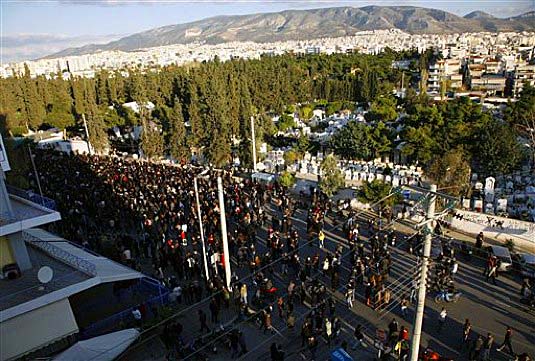
Thousands march at funeral of Greek youth Alexandros Grigoropoulos; demand end to culture of corruption. There’s more to the Greek uprising then the alleged murder of an anarchist youth. Photo by Reuters / AP.

‘A switch has been flicked and the pressure cooker’s boiled over,’ said David Lea, an analyst at Control Risks in London, who compares the riots with those in Parisian suburbs in 2005.

Greek riots fueled by graft, economic woes
By Natalie Weeks and Maria Petrakis / December 10, 2008

With tear gas and smoke lingering in the air, Spiros Politis stood in front of his Athens drugstore, ready to open after rioters firebombed the building next door.

In the small hours yesterday, the 46-year-old defiantly put out the blaze as youths pelted police with stones and threw Molotov cocktails in some of the worst violence since student rebellions helped topple a military junta in the 1970s.

“Traditions that bound society have deteriorated,” said Politis, owner of Pharmacy Philellinon adjacent to Syntagma Square, a focal point of clashes in the Greek capital following the Dec. 6 police shooting of a 15-year-old boy. “There is no political will to resolve the issues, and I mean political in a greater sense of the whole community.”

The chaos in Athens and Thessaloniki — along with a slowing economy and deepening dissatisfaction with a dynastic political order — is shaking Prime Minister Kostas Karamanlis’s government, which holds a one-vote parliamentary majority. Opposition leader George Papandreou’s Panhellenic Socialist Movement, or Pasok, is leading opinion polls for the first time in eight years.

Papandreou, the son and grandson of former prime ministers, yesterday called for early elections, saying that the government of Karamanlis, nephew of yet another former prime minister, “has lost the confidence of the Greek people.”

State workers are planning a national strike today, aiming to bring to a halt cities across the country that are waking up to the prospect of clearing up the debris from more destruction overnight. The workers are protesting Karamanlis-introduced taxes on the self-employed and small businesses aimed at helping meet budget-deficit targets.

‘Boiled Over’

“A switch has been flicked and the pressure cooker’s boiled over,” said David Lea, an analyst at Control Risks in London, who compares the riots with those in Parisian suburbs in 2005. “There are certain places where anarchists are more likely to inspire violence, and that’s Greece.”

Behind the riots is anger at an embedded culture of corruption. Greece, which joined the European Union in 1981, is the most corrupt in western Europe and ranks 24th of the 27 EU countries, according to Berlin-based Transparency International’s annual corruption perception index.

“It’s a plague on both houses,” said Professor Kevin Featherstone, director of the Hellenic Observatory at the London School of Economics. “It’s a sense of frustration. How do you change a system that has corruption so deeply embedded?”

This month, an all-party parliamentary committee will say whether any lawmakers have been involved in a corruption scandal involving a land swap with a monastery that left taxpayers 100 million euros ($130 million) poorer.

Youth Unemployment

Both New Democracy and Pasok are struggling to keep a lid on the increasingly angry youth population. The unemployment rate for the 15 to 24 age group was 19 percent in August, according to the latest figures from the National Statistics Service in Athens. That’s the highest percentage among all age groups, the statistics show.

The overall jobless rate was 7.2 percent in June, while the economy is growing at an annual rate of about 3 percent, according to national statistics.

Rioters fire-bombed stores in Athens and Thessaloniki, the country’s second-largest city, and threw rubble at police for a fourth day following the death of Alexis Grigoropoulos in an Athens suburb.

Arrests, Injuries

Police said 87 people were arrested in Athens for attacking officers, vandalism and looting. A total of 176 people were detained while 12 police were injured, police said. Mega TV reported that total arrests in Greece reached 157. Violence erupted again after the boy’s funeral yesterday in the capital.

Pavlos, who asked for his last name not be used because of fear of arrest, was among the crowd of black-clad hooded youths cheering when flames licked the three-meter high Christmas tree in Athens’s central Syntagma Square on Dec. 8.

“This isn’t violence, this is destruction,” said Pavlos, 20, who studied hotel management in the Greek capital. “The trigger was the death of the kid, but the reasons are much deeper. Consumerism, the police, the government, the way the state functions. There are no opportunities.”

Grigoropoulos was killed after a group of about 30 teenagers attacked a patrol car with projectiles in the Exarhia district of Athens, according to the Interior Ministry.

The area is adjacent to the National Technical University of Athens, the site of the 1973 student uprising against the military junta. Now the rioters, many in their teens, are hooked up via the Internet and mobile-phone text messages.

The government is promising a quick investigation into the circumstances of the shooting but Politis, the pharmacy owner, said politicians need to go beyond just finding out what happened that night in Athens.

“How do you fix it? How does the government pay for it like they say they will?” he said. “Christmas is over.”

Source / Bloomberg

The Rag Blog

Posted in RagBlog | Tagged , , , , , , , | 6 Comments

Chicago Sit-In : Courageous Union Making Impressive Statement

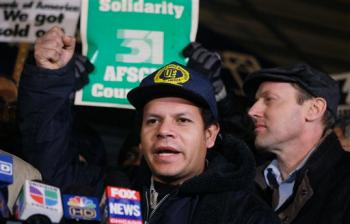
United Electrical Union Workers Local President Armando Robles, left, and U.E. Western Regional President Carl Rosen address the media about negotiations with Bank of America and Republic Windows and Doors on the fourth day of a sit-in at the companies factory Monday, Dec. 8, 2008 in Chicago. Photo by M. Spencer Green / AP.

‘They refused to walk away from their jobs quietly or to accept the argument that the lay-offs were an inevitable result of the nation’s economic hard times.’
By Peter Dreier / December 9, 2008

Since Friday, 240 members of the United Electrical, Radio and Machine Workers of America (UE), a small but feisty union that has always been in the progressive wing of the labor movement, have displayed uncommon courage. They have illegally occupied their Chicago factory after their employer abruptly told them that it was shutting down the plant.

Equally impressive, President-elect Barack Obama, by quickly endorsing the workers’ protest, showed the kind of bold leadership that progressives have been hoping for, but didn’t expect to see so soon. Indeed, Obama’s statement puts him ahead of Franklin Roosevelt, who didn’t embrace worried workers’ escalating demands until after his inauguration in March 1933, when a quarter of the workforce was unemployed.

The workers began their sit-in on Friday, after their employer, Republic Windows and Doors, closed the factory with only three days notice. The company management told the workers and their union, UE Local 1110, that the Bank of America had canceled Republic’s line of credit, making it impossible to stay in business — or even pay employees the severance and vacation pay they’d earned. The company immediately terminated the workers’ health insurance.

The BofA said that the cancellation was routine business practice, caused by Republic’s cash flow problem in the wake of declining sales in the nation’s housing construction downturn.

“When a company faces such a dire situation, its lender is not empowered to direct the company’s management how to manage its affairs and what obligations should be paid,” declared the North Carolina-based BofA in a statement. “Such decisions belong to the management and owners of the company.”

The BofA’s antiseptic statement reflected the kind of cold-blooded market fundamentalism that has led a growing number of Americans to demand more government regulation of big business.

But the Republic workers didn’t wait for government action. They refused to walk away from their jobs quietly or to accept the argument that the lay-offs were an inevitable result of the nation’s economic hard times. They peacefully took over the plant, where some of them had worked for decades, and demanded that the Bank of America and Republic management find a solution. The workers insist that they won’t leave until getting assurances they will receive severance and vacation pay, but they also hope to find a way to keep the plant open.

Although by occupying the factory they are breaking the law, no politician has called for the Chicago Police Department to arrest them — a sure sign that their action has become a symbol of working families’ distress in the unraveling Bush economy. Millions of Americans, watching interviews with the workers on TV during the past few days, can identify with their plight – the loss of their jobs, their health insurance and perhaps their homes – only a few weeks before Christmas.

The sit-in began the same day that President Bush reluctantly acknowledged, for the first time, that the country was in a recession. He released a Department of Labor report revealing that U.S. employers axed 533,000 jobs in November, the biggest monthly cut since 1974. As a result, the official unemployment rate has jumped to 6.7 percent. Now in its twelfth month, the recession is already the longest since a 16-month slump in 1981-82. Some economists predict that this downturn will set a new post-World War 2 record.

“When it comes to the situation here in Chicago with the workers who are asking for their benefits and payments they have earned,” Obama said during a press briefing on Sunday, ” I think they are absolutely right. What’s happening to them is reflective of what’s happening across this economy.”

With that statement, Obama used his bully pulpit to endorse the workers’ protest and to put pressure on the Bank of America and Republic to forge a solution. Representatives of the company, BofA, and the union have been meeting at the bank’s office in downtown Chicago. Congressman Luis Gutierrez has been moderating the talks.

The symbolism of the workers’ take-over also adds credence to Obama’s call for a major government-funded infrastructure program that will stimulate several million jobs — almost all of them in the private sector — and help jump-start the ailing economy.

“The workers want Bank of America to keep the plant open and the workers employed,” said UE President Carl Rosen. “There is always a demand for windows and doors. But with Barack Obama’s stimulus proposal, there will be even greater demand for the products made by Republic’s workers. It doesn’t make sense to close this plant when the need is so obvious.”

“We were cutting out glass for an order for 1,000 new windows last week,” 34 year-old Vicente Rangel, a Republic employee for 15 years, told the Los Angeles Times. “There was work to do. Then, the bosses called us to a meeting and said everyone was quitting, whether they wanted to or not.” The union workers earned an average of $14 an hour, and received health insurance and retirement benefits as part of their union contract.

“I’m not scared because I’m not alone on this,” said Raul Flores, according to the Chicago Tribune. The 25-year old Flores, who had worked at Republic for eight years, added, “We’re strong and we’re going to stay. This gives us the strength to keep going. This is going to be for everyone.”

Americans have rallied to the Republic workers’ cause. They’ve sent money, food, clothing, blankets, and good wishes. (To donate, go here). On Monday, protesters picketed a Bank of America branch on Chicago’s West Side, explaining that they support the workers’ sit-in. A coalition of unions and community groups, Jobs with Justice, held a rally at Chicago City Hall and threatened to organize a boycott of the Bank of America if the problem isn’t resolved.

Union members, politicians, and others have highlighted the irony that Bank of America just got $25 billion of the federal government’s bank bail-out funds, designed to push banks to start lending money again. BofA’s refusal to extend Republic further credit seems cold-blooded and hypocritical.

The bank’s hypocrisy hasn’t been lost on elected officials. Illinois Gov. Rod Blagojevich threatened to suspend all state government business dealings with BofA if a reasonable solution is not achieved quickly. He asked the state Department of Labor to investigate if Republic had violated Illinois’ plant closure laws. The company may also have violated the federal Worker Adjustment and Retraining Notification Act, a 1988 law that requires employers to provide employees and community 60 days notice in advance of plant closings and large-scale layoffs.

After U.S. Senator Dick Durbin (D-Ill.) visited the plant, he expressed support for the workers, observing, “The taxpayer dollars going into these big banks are not for dividends, they’re not for executive salaries,” according to the Chicago Tribune (which, ironically, just declared bankruptcy). “They’re for loans and credit to businesses just like Republic so they can stay in business and so these workers won’t be out on the street unemployed.”

Chicago aldermen have called for hearings on Republic, which received over $10 million in city redevelopment funds. They and Cook County officials suggested withdrawing hundreds of millions of dollars of government funds from the Bank of America.

“We never expected this,” Melvin Maclin, a factory employee and vice-president of the UE local, told the Associated Press about the support they’ve received. “We expected to go to jail.”

Inside the factory’s lobby, local residents and workers covered the walls with hand-scrawled signs, according to the Los Angeles Times.

“Thank you for showing us all how to fight back!” wrote one person. “Here’s to change, from the bottom up,” penned another.

These sentiments will sound familiar to anyone who followed Obama on the presidential campaign trail. “Change comes from the bottom up,” the former community organizer said frequently during his stump speeches.

During the past two weeks, as Obama appointed moderates and former Clintonites to high-level positions in his economic brain-trust, some progressives worried that the president-elect was already moving to the center, even as the economy nosedived. But Obama’s call for the largest public investment plan since the interstate highway program begun in the 1950s, his support for a major federal loan to the Big 3 auto companies if they retool to become more energy-efficient, and now his embrace of the Republic workers’ occupation of their factory has given many progressives assurance that Obama hasn’t forgotten his liberal instincts.

Its worth recalling that FDR did not campaign for president in 1932 — three years into the Great Depression — as a proponent of government activism or with a clear plan for economic recovery. But in the five months between his election victory and his March 1933 inauguration, Depression conditions had worsened, and grassroots worker and community protests escalated throughout the country. As soon as he took office, Roosevelt became more vocal, using his bully pulpit — in speeches and radio addresses — to promote New Deal ideas, pushing banking reform, public works, relief for struggling farmers, and help for homeowners within the first few months of his administration. In June 1933 he signed the National Industrial Recovery Act (NIRA), which for the first time recognized workers’ right to collective bargaining.

Immediately, union activists gave speeches and posted signs — on posters and billboards, and in store windows — proclaiming, “The President wants you to join the union.” Workers responded, and union membership began to climb. When the Supreme Court ruled in May 1935 that NIRA was unconstitutional, FDR and Congress immediately enacted the National Labor Relations Act, often called the Wagner Act, to preserve workers’ right to organize. Workers became even bolder in order to protect their jobs and defend their rights. Department store clerks, bakers, hospital laundry workers, longshoremen, meatpackers, steelworkers, tire and auto workers, and others engaged in various forms of protest, including the first wave of “sit-down” strikes demanding recognition of their unions. The combination of government intervention and union activism laid the foundation for the post-World War 2 prosperity that lifted the majority of Americans into the middle class.

That social contract has now been shredded, spurred by two decades of government deregulation of business, widening inequality, increasing job insecurity, and the unraveling of the social safety net, including health insurance. These trends have been compounded during the Bush years — corrupt crony capitalism, the mortgage meltdown, escalating foreclosures, and large-scale lay-offs.

The bold factory take-over by the Republic workers in Chicago may be a fluke, or it just could be the opening salvo of a new wave of grassroots activism, not only by workers and their unions, but also by community groups, enviros, religious congregations, housing crusaders, and the millions of Americans inspired by Obama’s campaign who voted for the first time in November. Clearly the Republic workers’ protest has struck a nerve with the American people, including many who don’t share their plight but can nevertheless empathize with their predicament.

It would be uplifting and useful to see vigils and rallies in cities around the country on behalf of another New Deal — a pump-priming infrastructure plan, a “green jobs” investment program, a universal health insurance proposal, a long-overdue reform of corporate-friendly labor laws, a strategy to help Americans afford housing, and a significant federal investment in public schools and college financial aid.

Like FDR, Obama can use his bully pulpit to encourage Americans to organize and raise their voices – as he did Sunday in support of the workers at Republic Windows and Doors, a month before he officially takes office. But if Americans want the country to change direction, as the election results indicated, they’ll have to follow Obama’s advice, and the Republic workers’ example: change happens from the bottom up.

[Peter Dreier teaches politics at Occidental College, where he directs the Urban & Environmental Policy Program.]

Source / The Huffington Post

The Rag Blog

Posted in RagBlog | Tagged , , , , , , | 2 Comments

Sherman DeBrosse : Big Three Bailout a Must

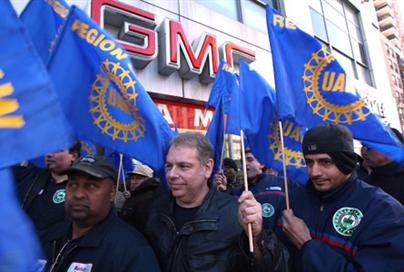
UAW workers picket GMC plant. Photo by Spencer Platt / Getty Images.

An auto bridge loan is essential to reduce the pain of recession.
By Sherman DeBrosse
/ The Rag Blog / December 10, 2008

The U.S. economy is so fragile that the Congress must extend a bridge loan to the Big Three automakers. The loan should give the government part ownership in the industry and guarantee that cost-cutting and modernizing measures will be undertaken immediately. To do otherwise is to risk greatly deepening the recession and putting at least three million people out of work. That is a conservative number, when we consider the goods and services purchased by parts manufacturers and their employees. In a very fragile economy, the ripple effects of shutting down the domestic auto industry could be enormous and take years to repair.

Most Americans believe that the Big Three have made many poor decisions, but the matter of a bridge loan should be decided on the basis of whether this is a good time to punish Detroit. The important questions are: Is it safe to risk the collapse of the domestic automobile industry at this time? Is it in the interest of the United States to have a domestic auto industry? Does having a domestic automobile industry have anything to do with national security? (Hint — think of World War II.) Is its existence key to our “industrial policy?” Some will say we have no industrial policy, but we have one that is clearly written into the tax code and other legislation.

The heads of the Big Three were foolish to come initially to Washington in private jets, and appear so ill-prepared to answer tough questions. These execs came to Washington expecting to be treated like the heads of AIG and CitiCorp — few questions and an open checkbook. As far as we know, the financiers who received help were not grilled or asked for recovery plans.

As inept as they appeared, there is evidence that these huge firms had finally gotten on the track of improving their companies. They cannot be entirely blamed for the present crisis. It was a result of a recession that has been growing worse since October, 2007 and then a credit lockdown that came about as the financial system almost completely imploded. The financial crisis has driven auto sales down 60% in the United States. The European auto industry is also on the ropes and is about to receive over $50 billion in government bailouts.

Yes, they should have been making more efficient cars and fewer SUVs, but the customers wanted the SUVs. Even recently, SUV sales went up when gas prices declined. We cannot blame the Big Three for having short-sighted customers.

Many of the opponents of a bailout mention the industry’s failure to produce energy-efficient cars as proof that Detroit’s leadership simply come up with products that people want today. There is much merit to this argument, and we all recall what happened to the ill-fated electrical car in 1999. But the Republicans who raise this argument usually were not friendly to raising fuel efficiency standards in the past.

Richard Shelby of Alabama is their main spokesman. Some other Republicans, like Shelby, have an interest in seeing the Big Three go under because their states have invested millions in helping foreign auto producers set up shop here.

The unnoticed elephant in the room is Republican dislike of unions. Republicans often overlook recent UAW concessions and complain about wages and severance and retirement packages. The fact that more than 41 Republican senators have agreed to filibuster a bridge loan is rooted in ideology and dislike of unions. Now some of the Republicans say the UAW should shoulder more of the burden of health benefits for retired workers in return for equity in the companies. And of course, we are told that the UAW would have to accept wage cuts down to the level of workers in Japanese-owned plants here. Truth is that the UAW has already accepted a portion of the burden of retiree benefits and has made concessions that will bring wages to the level of employees in Japanese owned-plants. The UAW claims that its wages are already at the level of one of the Japanese manufacturers in the US.

We are hearing that there could be a compromise package offering considerably less that 20 billion — just enough to get the companies to March, when the new administration will be able to help. No matter what the package engineered between the execs, White House, and Congressional leadership might be, it will be very difficult to head off a Republican filibuster. This might be the last chance to smite the UAW with a filibuster as we now know that it is legal to use funds from the $700 bailout package to rescue the nation’s largest industry. The Obama administration can use that money without dumping on the UAW. Another option would be to use Federal Reserve funds for the bailout; that too is legal. Chairman Ben Bernanke has been absolutely silent on the subject. A FED bailout would move the matter out of the political arena. It would be a judgment made purely on the basis of economics.

If the matter must be resolved in Congress, Democratic supporters of assistance will have to swallow steep wage and benefit cuts. If President-Elect Barack Obama is forced to specifically endorse a short-range plan that inflicts great pain on the workers, he has spent precious political capital and probably hurt himself with those workers. There are still many UAW folks who detest their leadership for previously making concessions that were absolutely unavoidable.

At the moment, 60% of the American public opposes any bail-out. Much of this is bail-out fatigue mixed with anti-union sentiment. Many who work for wages far below union scale resent other workers getting a bigger slice of the American dream, and many traditional Republicans simply cannot understand why any worker should want more than $15 an hour. Then there is the old argument about how best to reignite an economy. Most Democrats believe the depression of 1929 was caused by underconsumption, and think it best to put money in the hands of ordinary working families. On the other side, we are again reading arguments that all of FDR’s public works accomplished little. The remedy is to place a still larger share of the money supply in the hands of people at the top of the economic pyramid because they will almost certainly hasten to use it to create new jobs. The former view is informed more by ideology — economic theology — than solid analysis.

The fact is that the financial system still needs a great deal of repair; that is why the banks and other credit institutions are not making loans. Many of them are leveraged over 100% and invested in toxic mortgage and other questionable assets. The recession got a lot worse as soon as it was clear that the financial system was cratering. Half a million jobs were lost in November alone, and experts just found that job losses in previous months were far worse than reported. If GM and Chrysler are forced into bankruptcy, unemployment will explode–this is all about the velocity of money. The fear and panic created by the loss of much of the domestic auto industry will send the real economy into an absolute tail spin. Ten percent of the domestic bond and preferred securities market is in the automobile industry. The collapse of much of the auto industry could create a situation on the markets that could take decades to repair.

All of this should boil down to what is best for millions of workers. It’s the old saw about economics being made for people and not visa versa.

Much will depend upon whether Republican senators are guided by pragmatism or ideology and economic theology. This week, we will know if a compromise is possible or if the FED will give all of us a way out of this dangerous situation. Much will depend on whether the GOP can keep in line 41 pro-filibuster Senators. Auto parts suppliers are in many states, and troubled dealerships are everywhere. Should the filibuster strip people of their incomes, it is hard to imagine Republicans not losing more than a few votes among people directly and indirectly tied to the automobile industry. It could even happen that people who see no connection between themselves and the industry will be hurt, and some of them might possibly figure out what happened to them.

If there is no relief, the Big Three would be well advised to take any steps necessary to curtail spending so that they can remain in place for federal assistance next January or February. The new Congress will have larger Democratic majorities, and passage of a suitable bail-out will be more feasible.

[Sherman DeBrosse, the pseudonym for a retired history professor, is a contributor to The Rag Blog and also blogs at Sherm Says and on DailyKos.]

The Rag Blog

Posted in Rag Bloggers | Tagged , , , , , , | 1 Comment

Housing Crisis: 8 Million Foreclosures in 4 Years


Foreclosures could top 8 million: Credit Suisse
By MarketWatch / December 9, 2008

BOSTON — More than 8 million mortgages could go into foreclosure in coming years in the wake of the credit meltdown as the economy worsens and the U.S. suffers more job losses, according to a recent report.

Credit Suisse’s fixed-income research team forecast that 8.1 million mortgages will be in foreclosure over the next four years, representing 16% of all mortgages. In a recent research note, Credit Suisse lifted its earlier forecast from April when it predicted 6.5 million foreclosures, or 13% of all mortgages.

“Despite some initial signs that subprime foreclosures were near a plateau, the combination of severe weakening in the economy, continued decline in home prices, steady increase in delinquencies, particularly in the prime mortgage space, ensure that foreclosure numbers, absent more dramatic intervention, will march steadily higher,” Credit Suisse wrote.

Federal officials are struggling to find ways to restructure home loans to ease foreclosures as home prices continue to fall around the country. However, regulators are finding it difficult to modify mortgages because many were packaged up into complex credit vehicles and sold to large investors around the globe.

Earlier this week, Office of the Comptroller of the Currency director John Dugan released statistics showing a high re-default rate on mortgages that have been modified in the first two quarters of 2008.

“The results were surprising, and not in a good way,” Dugan told a gathering in Washington at the Office of Thrift Supervision’s annual conference.

According to the OCC statistics, which looked at loans modified in the first quarter and second quarter of 2008, 36% of borrowers had re-defaulted by being more than 30 days past due and after six months the rate was roughly 56%.

After eight months, 58% of borrowers had re-defaulted. The OCC tracked the number of borrowers that re-defaulted on their mortgages after the modification was completed.

Dugan acknowledged that not all re-defaulted mortgages go to foreclosure, but he argued that the number was very high. He said he was not sure why there was such a high level of re-default, pointing out that it may be because the modifications were not low enough to be affordable.

Additionally, Office of Thrift Supervision director John Reich on Monday said rather than modifying mortgages, focusing on job creation might be a better use of federal dollars. Reich’s statement clashed with Federal Deposit Insurance Corporation Chairwoman Sheila Bair over the best way to use government funds to end the financial crisis. Read more on the failure of many mortgage modifications.

Meanwhile, Credit Suisse said that if home prices continue to spiral down, more and more mainstream borrowers could end up walking away from their homes, especially if the mortgage is worth more than the value of the house.

“Thus far, the population of subprime borrowers in the U.S. is relatively small,” the analysts wrote. “However, the severe recession that appears more and more likely, coupled with the collapse of confidence in housing and resultant foreclosures and the impact on credit scores, risks transforming the U.S. into a subprime society.”

Adding to the headwinds, a deteriorating labor market will put more pressure on foreclosures, they said.

Source / MarketWatch

Thanks to Diane Stirling-Stevens / The Rag Blog

Posted in RagBlog | Tagged , , , | Leave a comment

Roger Baker : Getting a Read on this Economy Business

‘We can now observe that the creation of unlimited credit by unregulated investment banks, together with peak/near peak oil causing a steep oil price rise, is together enough to trigger a panicky deflationary spiral that has its own complex dynamics.’

By Roger Baker / The Rag Blog / November 10, 2008

See ‘Beijing holds key to prosperity’ by Henry C K Liu, Below.

Fossil fuel limits are an important key to insight, but are not sufficient for understanding the current world economic crisis.

Future oil production can be calculated almost with the precision of the laws of physics. The world is now about to decline in the production of the vital fluid that powers almost all world transportation, with no viable replacement available any time soon.

This predictable causal factor is in sharp contrast to its consequences; the impact of fossil fuels limitation in affecting the global economy. Here more traditional economic thinking can still be helpful in filling out the details of how events are likely to play out.

I will list some examples of sources that are both conscious and unconscious of peak oil, but all of which are useful, in my opinion.

We can now observe that the creation of unlimited credit by unregulated investment banks, together with peak/near peak oil causing a steep oil price rise, is together enough to trigger a panicky deflationary spiral (read run on the world’s banks) that has its own complex dynamics. The economic results are partly due to mass psychology and are accordingly hard to predict.

A useful source of economic insight from a social impact perspective is Loretta Napoleoni’s “Rogue Economics,” which anticipates and documents a global rebirth of decentralized grassroots tribalism as a result of the current unregulated and rapacious corporatism. She may be right, and this is an important concept linking economics, politics and sociology.

One clearly observable economic pattern is that oil now acts as an economic limit to the expansion of the global economy. If and when the global economy recovers, oil prices will soon rise enough to restrain the recovery, much like the automatic governing mechanism of a classic steam engine, when it is set so as to increasingly restrain its top speed.

Wrote Tom Whipple:

…In the three-way struggle among worldwide oil depletion, new oil production projects, and the global recession, we have a pretty good handle on depletion and new projects, but appreciation of the depth and length of the recession is not well understood. What was widely believed last year to be a couple of weak quarters is now generally acknowledged to be the worst economic slump since World War II. Optimists, especially on Wall Street and in Detroit, are saying that by 2010, or 2011, or 2012, the recession should be over and economic growth will return. There is great faith that the world’s governments can manage a recovery by lowering interest rates, pumping trillions of government money into the financial system, loaning money to failing corporations, and instituting massive stimulus packages. Some are not so sure…

There are many good economic analysts on the internet, and a growing minority now see the big picture in a way that incorporates peak oil. The Post Carbon Institute is a leader in providing good big picture information.

Check out their “Reality Reports” and the splendid economic lecture series by Chris Martenson. Here is one interview with Martenson.

Check out ASPO-USA . And also the Oil Drum and Energy Bulletin.

Here are a few other fossil-fuel-conscious sources I like: Matt Simmons; Jim Paplava, et al of Financial Sense; and James Howard Kunstler .

That said, it is also important to understand the valid conclusions of the best economists who do not focus much on the economics of peak oil. Some of the best independent reporting and geopolitical and economic analysis is to be found on the Asia Times Online website. It is the first place I turn for good independent reporting on affairs in Asia and the Mideast, although its writers are not always in agreement:

Here for example is a piece explaining the poor ability of classic Keynesian economic stimulation (like that now being advocated by Paul Krugman) to revive the US economy. The economic crisis is global in nature, so US-based remedies are not a good match, but there are other problems. See this and other stuff by David Goldman on the ATO blog.

To my way of thinking, Henry C. K. Liu is one of the keenest economic observers anywhere. Asia Times Online archives much of Liu’s writing.

Below Liu says that China and its acceptance of non-market based economics is the key to any potential global economic recovery. To save the global economy and to keep it from getting dragged down into the unregulated quagmire the investment banks have generated, the Chinese will have to dump market capitalism. Here are some details, by Henry C.K. Liu, from the last part of a much longer two part article, typified in its thinking by this snip:

…China’s ability to rescue the stalled global economy through reform in trade is extremely limited. The best way for China to contribute to stabilizing the world economy is to develop the country’s domestic market and to increase the purchasing power of the population through a progressive income policy with full employment. It fact, China needs to adopt a bottom-up development strategy of direct assistance to people, the opposite of the US top-down development strategy of
assistance to institutions…

China and the Global Crisis:
Beijing holds key to prosperity

By Henry C K Liu / December 6, 2008

[….]

…China needs to recognize that market capitalism with central banking is not the most effective or efficient system to achieve full employment with rising wages. China needs to adopt a full employment policy as a national objective. A socialist system must provide every able citizen who wants to work opportunity for work. China is still grossly underdeveloped economically. With so much to do to bring China into a modern nation, it is hard to imagine a country like China not having a labor shortage. China must create an economic system that puts full employment as a top priority, not allow itself to be trapped by neo-liberal market fundamentalism of using unemployment to keep wages low to protect the value of money.

What China must do

With recurring capitalistic market crashes, the world is beginning to realize that market capitalism can destroy wealth as fast as it can create wealth. While keeping markets as an auxiliary mechanism for efficient allocation of resources, China must rely on central planning to direct investment in an orderly manner in sectors need for national development, such as modernization of food production and distribution. It must rely on planning to direct investment towards physical and social infrastructure, in universal education and universal health care. These investments must be increased and accelerated with much higher targets for each five-year plan.

To do this, China must develop more respect for and reliance on domestic indigenous talent and make more opportunities available to young people. Brain drain is the greatest loss China has suffered in the past century. In recent years, a massive loss to other countries of well-educated people has blighted the Chinese finance sector. Chinamust develop policies to stop further brain drain and to revert the flow of human resources back into China.

China must invest more on domestic development than on exports, particularly on rural development. It must not look for growth through cross-border wage arbitrage by foreign capital. Wage income is the only reliable index of growth for any economy. Export-led growth is unsustainable for meeting the needs of an economy that comprises one fifth of the world’s population, particularly when export earning is denominated in fiat dollars that cannot be spent in China domestically.

Modernization is not merely blindly copying the advanced economies. China must avoid excessive faith in market forces while taking care not to ignore them. It must set a framework in which market forces that create benefits for the community are encouraged and those that create costs to community are penalized.

At its root, China is an agricultural economy. Chinese leaders have depicted the new socialist countryside program as having higher productivity, improved livelihood of farming families, a higher-degree civilization with greater socialist ethics, a clean environment and democratic management in the 11th Five-Year Program (2006-2010) period, showing the resolve of China’s leadership to spread the fruits of reform to its rural areas, especially poor regions.

The central government allocated 13 billion yuan in 2007 to its poverty reduction program, 13 times that in 1980 and 37.2% of which was earmarked for the autonomous regions of Inner Mongolia, Xinjiang, Ningxia, Guanxi and Tibet, and provinces with large ethnic populations, such as Guishou, Yunan and Qinghai.

While this a good start, it is woefully inadequate. What is needed is 100 times the amount ($160 billion) every year until these regions reach self-sustaining prosperity. After all, a nation that holds close to $2 trillion in foreign exchange reserves, should not tolerate poverty anywhere within its borders.

After more than 30 years of economic reform, the poverty rate in rural areas has dropped to less than 3%. But that still leaves 40 million poor due to China’s big (1.3 billion) population. China also has 26 million people who live at subsistence level beyond the reach of the poverty reduction program. The Chinese government has turned more attention on its rural poor by reducing various taxes and promoting free universal compulsory education. The agricultural tax, which has had a history of 2,600 years, was rescinded completely in 2006 and an increasing number of children in rural areas gained access to free compulsory education.

China also has begun to lower the price of medical services by reinstituting a rural cooperative medical service system. Still such a timid anti-poverty program for the world’s largest creditor nation is a glaring contradiction. Yet this program is too timid in allowing poverty to continue to be a drag on economic growth.

China has since unveiled ambitious plans to help the 800 million people living in the countryside catch up economically with city dwellers. More rural investment and agricultural subsidies and improved social services are the main planks of a policy to create a “new socialist countryside,” which President Hu has declared as a national priority.

The new policy regards constructing a new socialist countryside an important historic task in the process of China’s modernization. “The only way to ensure sustainable development of the national economy and continuous expansion of domestic demand is to develop the rural economy and help farmers to become more affluent,” the policy asserts. It aims to modernize the countryside, which has fallen behind in China’s development in recent decades.

From 2006 until 2010, the government promises sustained increases in farmers’ incomes, more industrial support for agriculture and fasterdevelopment of public services. Yet current plans remain timid in relation to the size of the problem and must be redoubled to prevent rural poverty from emerging as a drag on national economic development.

Local governments have been warned that they will be held to account for ineffective administration and misallocation of precious resources on false symbol of prosperity. The new measures promise greater protection and improved democracy in rural areas, and local government bureaucracies will be streamlined to increase cost effectiveness. Instead of gauging progress by GDP growth, attention should be paid to income growth, particularly farm income growth. Income is all; without income, all else is mirage.

In part, the new socialist countryside policy is driven by concerns about China’s ability to sustain food self-sufficiency going forward as a global crisis of food is fast building. The past 25 years of rapid urbanization have seen much farmland turned into urbanized development zones, and more than 200 million farmers have migrated to the cities to serve export sector needs.

The new food policy proposes that China should remain “basically self-sufficient” in grain. It promises increased subsidies for farmers growing grain, as well as continued revenue “bonuses” for local governments in the grain belt, and says the government will continue setting minimum prices for grain purchases.

With 800 million people living in the countryside, the only way to ensure sustainable development of the national economy and continuous expansion of domestic demand is to develop the rural economy and help farmers to become more affluent than city dwellers to reverse the migration trend. The program also stressed that construction of the new countryside should focus on practical development and involve democratic consultations. Most of all, ample farm credit must be provided by the central government to help poor rural region to kick start development.

Chinese agriculture is at a crossroads as the benefits of the agricultural changes first ushered in late 1978 have lost momentum. Grain production, which reached record levels in 1984, dropped suddenly in 1985 and is only now beginning to push above 1984 levels. The area under cultivation, already small compared with the population, is steadily declining as new housing, schools, factories and roads nibble away at rice paddies and wheat fields. State investment in agriculture has dropped precipitously over the past two decades.

China’s exposure to the international financial crisis is primarily a result of its high dependency on exports, which in turn is the result of high dependency on financial market forces to allocate the use of capital, particularly foreign capital.

Markets seldom direct resources where they are needed, only to where profit is easiest and highest. Market forces when unregulated and undirected always lead to uneven and sometime undesirable development. Much of China’s economic dilemma today is the result of blind acceptance of the Hayekian efficacy of market forces. The reliance of a labor market to direct economic development is counterproductive. China needs to understand that labor is not a commodity but a national resource. The value of labor should not be allowed to be set by supply and demand in a labor market. It should be set by national policy around which markets are organized to fulfill it. This is the fundamental flaw of China economic reform for the past three decades.

China’s ability to rescue the stalled global economy through reform in trade is extremely limited. The best way for China to contribute to stabilizing the world economy is to develop the country’s domestic market and to increase the purchasing power of the population through a progressive income policy with full employment. It fact, China needs to adopt a bottom-up development strategy of direct assistance to people, the opposite of the US top-down development strategy of assistance to institutions.

This means a strategy to set the increase of personal income and social benefits as a goal around which the economic system is organized, rather than letting personal income and social benefits be the outcome of imported dysfunctional economic systems such as predatory neo-liberal cowboy market capitalism.

[Henry C K Liu is chairman of a New York-based private investment group. His website is at http://www.henryckliu.com/.]

Source / Asia Times Online

The Rag Blog

Posted in Rag Bloggers | Tagged , , , , , , , | 2 Comments

Rejecting Bigotry at Tyson, Shelbyville, Tennesee


An Injury to Eid is an Injury to All
By Stuart Appelbaum / December 9, 2008

‘The only way working people ever win is if we stand together. It doesn’t matter whether it’s race or religion: United we stand, divided we fall.’

Philosopher Martha Nussbaum wrote in The New Republic in September that “religious difference drives otherwise sane people crazy.” In the wake of 9/11, few would disagree. However, Nussbaum wasn’t talking only about Muslim extremists. She was also describing the Puritan fanaticism of 17th century Massachusetts.

As Americans, we take pride that our country has been the world’s lodestar for religious pluralism. But our tolerance doesn’t mean we have purged ourselves of religious hatred. Anyone in doubt ought to talk to members of the Retail, Wholesale and Department Store Union, who work at the Tyson poultry plant in Shelbyville, Tenn.

The Tyson plant relies on a workforce that includes many immigrants. In Shelbyville, 400 of its 1,200 employees are from Somalia — one of only two countries whose population is entirely Muslim.

Like other Muslim workers, the Somalis at Tyson faced obstacles to honoring their faith. For example, most Muslims celebrate Eid Al-Fitr — the religious holiday that marks the end of Ramadan, the Islamic holy month of fasting. To those at the plant who observe Eid, the holiday is as important to them as Christmas is to Christian co-workers. However, Tyson didn’t recognize Eid as a paid holiday. That’s why when talks for a new contract began, the workers’ eight-member negotiating committee — all but two of whom were Christian — proposed making Eid a paid holiday.

Though no U.S. union had ever made these issues a bargaining priority, Tyson’s response was positive and constructive. The outcome was an agreement guaranteeing that, in exchange for Labor Day, Eid would be a paid holiday. The union’s bargaining committee endorsed the compromise and 90 percent of the union’s members voted in favor of it.

“It allows me to work on the second shift and still pray when I need to,” said Abdillahi Jama, who came to the United States as a refugee four years ago. “It’s very important to us. Eid is one of our most sacred holidays.”

For Jama’s non-Muslim co-workers, trading Labor Day for the Eid wasn’t a significant loss. Many of them pointed out that it had been 23 years since Tyson closed the plant for Labor Day and that workers welcomed the chance to put aside their holiday to work that day for premium wages.

“I know how I’d feel if someone said I couldn’t go to church,” said Waymon Walker, a 20-year Tyson employee. “It doesn’t matter what someone’s religion is. Being in a union means looking after each other. That’s all this contract does.”

Sadly, others disagreed. After learning of the agreement on Fox News, some right-wing websites referred to Shelbyville as a new battlefield in a clash of civilizations. One blogger wrote: “The problem is that the accommodation of Islamic holidays and practices abets, however unwittingly, an avowedly supremacist agenda that is directed toward supplanting American laws and mores and imposing Islamic law here.”

Within two days, more than 1,000 e-mails flooded our union’s website. Each had the same message: that the union, and me in particular, were promoting the interests of radical Islam. (Apparently, the fact that I’m also the national president of the Jewish Labor Committee didn’t dissuade them.)

Tyson also faced scorn, including calls for a consumer boycott. It approached the union and proposed bringing back Labor Day in place of Eid, but Shelbyville’s workers didn’t give in. They countered that both Labor Day and the Eid should be holidays. Tyson agreed.

Calvin Ewing, a Tyson employee for 27 years, summed up the workers’ attitude best. “The only way working people ever win is if we stand together. It doesn’t matter whether it’s race or religion, it’s always the same for working people: United we stand, divided we fall.”

Union members like Ewing have something to teach America about what it will take to overcome bigotry. They remind us that by bringing workers together, unions help break down the isolation that fosters ignorance and prejudice. They also teach us that by demonstrating the practical value of tolerance, unions can do more to bridge cultural divides than simple appeals to our better nature.

Union members aren’t fundamentally better than other Americans. They just have the advantage of being part of an institution that stands up for fundamentally good values.

At the end of the day, the labor movement may be one of the best hopes America has of overcoming the religious differences that drive otherwise sane people crazy.

[Stuart Appelbaum is president of the 100,000-member Retail, Wholesale and Department Store Union, UFCW.]

Source / In These Times

Thanks to Diane Stirling-Stevens / The Rag Blog

Posted in RagBlog | Tagged , , | 1 Comment

Winning the War on Terror: Not in Afghanistan

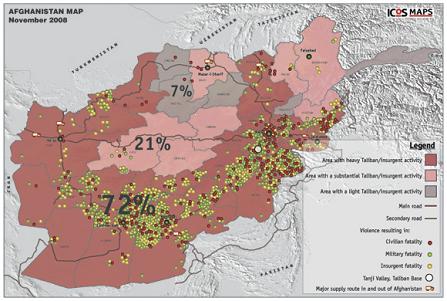
An Afghan policeman destroys poppies in March. ICOS proposes using the poppies for medicine.

Report: Taliban ‘noose’ around Kabul
December 9, 2008

LONDON, England — The Taliban insurgency is widening its presence in Afghanistan and “closing a noose around Kabul,” an international think tank report says.

The report (PDF) — issued Monday by the International Council on Security and Development (ICOS) — said the Taliban movement “now holds a permanent presence in 72 percent of Afghanistan, up from 54 percent a year ago.”

NATO, which commands about 50,000 troops in the country, disputes the figures.

Titled “Struggle for Kabul: The Taliban Advance,” the report said the international community must ramp up grass-roots economic and humanitarian relief to stop the Taliban, the group that once ruled Afghanistan and harbored the al Qaeda terror network when it attacked the United States in 2001.

“It’s a very scary situation,” said Gabrielle Archer, ICOS manager of development policy. “There’s been a dramatic increase in just one year.”

The report said the Taliban have expanded from the country’s southern region to the western and northwestern provinces and near Kabul, “where three out of the four main highways into Kabul are now compromised by Taliban activity.”

Legend:

Dark Pink: Permanent Taliban Presence (72% in 2008) = Average of one or more insurgent attacks per week, according to public record of attacks. It is highly likely that many attacks are not publicly known.

Light Pink: Substantial Taliban Presence (21% in 2008) = Based on number of attacks and local perceptions (Frequency of Taliban sightings)

Grey Areas: Light Taliban Presence (7% in 2008) = Based on number of attacks and local perceptions (Frequency of Taliban sightings)

The colour coded dots on the map represent civilian, military or insurgent fatalities since January 2008

Red = civilian fatalities

Green = military fatalities

Yellow = insurgent fatalities

“Confident in their expansion beyond the rural south, the Taliban are at the gates of the capital and infiltrating the city at will,” according to the ICOS report.

Archer explained the report’s methodology, saying that “permanent presence” is established when there has been one more or insurgent attacks per week in a province.

NATO spokesman James Appathurai, speaking Monday in a BBC radio interview, argued the methodology was faulty. He also said that while the state of affairs “is not exactly at a tipping point of success,” it’s not as bad as the report suggests.

But ICOS’ Archer says the evidence shows that the “Taliban are calling the shots, politically and militarily.”

The report says there has been “talk of reconciliation and power sharing” between moderate Taliban and elected officials nationally. It says the Taliban have filled a governance void locally.

ICOS says military “intervention and intelligence” should continue to be supported, and it wants the number of troops under NATO command increased to 80,000. But military action alone isn’t the answer, it said.

The report urges “closer collaboration between military and development efforts” and says job creation, health care, shelter, effective counter-narcotics policies, literacy, the rule of law, and a free media should also be viewed as “key security instruments.”

Archer also echoed the report’s assertion that even after seven years in the country, the international community hasn’t been able to make sure that every Afghan citizen has access to food and water and that there has been a “lack of effective aid and development” in the country.

ICOS said the Taliban use strong recruitment and propaganda efforts to make inroads among local Afghans — many of whom are disappointed by the failure of the West to eliminate grinding poverty and angered by civilian casualties caused by Western airstrikes targeting insurgents.

“They can move at will and blend into the country at will,” Archer said, emphasizing that the many young, impoverished and jobless Afghans who are listening to the Taliban “are getting angrier and angrier and angrier.”

The report calls for alternatives to fighting the Afghan drug trade, which helps fund Islamic militants and has a long reach into Western cities.

It said that “forced poppy eradication and chemical spraying” to combat the production has served to aggravate “the security situation in Afghanistan, precluding the very reconstruction and development necessary to remove Afghan farmers’ need to cultivate poppy.”

It says the poppy crop should be used for medical purposes in an effort to bring “illegal poppy cultivation under control” and to address the lack of alternatives communities have to the income provided by opium farming.

“In this process, all economic profits from medicine sales remain in the rural community, allowing for economic diversification. The ‘fair trade’ brand of Afghan morphine generated by the scheme would also provide emerging and transitional economies with access to affordable essential painkilling medicines,” the report said.

President-elect Barack Obama has said Afghanistan is the central front in the war on terror and wants to deploy more troops to the country.

Archer said the report notes that the international community can’t just wait for Obama to come up with a plan to deal with problems there; it must act now.

“The longevity of a plan for Afghanistan should not be contingent upon the U.S. electoral cycle and it is wrong for any actor to simply wait for President-elect Obama’s Afghan plan,” ICOS said.

NATO’s Appathurai said the Taliban insurgency has been intensifying its activities in areas where it already has been based — the south and the east, but it doesn’t hold territory in any areas where the Afghan and international forces can go.

He also said one of the problems with the report is that it conflates Taliban activity with criminal activity. He said the problems near the capital will be addressed by 3,000 or so U.S. troops to be arriving there soon.

Source / CNN/Asia

Thanks to Axis of Logic and Les Blough for the map and legend / The Rag Blog

Posted in RagBlog | Tagged , , , | 5 Comments

Massacre at Tlatelolco : Art Can Help Us Remember

Freedom of Speech (1968) by Adolpho Mexiac. Inspired by the student protest in 1968 in Mexico City and the massacre at Tlatelolco.

As I started to tell the story behind these sculpted ghosts, I realized how little I remembered of the events that took place on Oct 2, 1968, in the Tlatelolco district of Mexico City. It was one of the cathartic events of 1968 and a piece of history no one should be permitted to forget.

By Thorne Dreyer / The Rag Blog / November 9, 2008

This year marks the fortieth anniversary of one of the seminal years in American history.

1968, a year of great turmoil and hope, is being observed and analyzed in many corners of the world. Author Mark Kuransky called 1968 “the year that rocked the world.” I was in the middle of that action, working in the peace movement and helping to document the cascading events for the underground press.

This October Alice Embree and I participated in a panel that was part of “1968 A Global Perspective,” an interdisciplinary conference held at the University of Texas at Austin, that featured keynote speeches by Kathleen Cleaver and Daniel Ellsberg. Though not necessarily in such a formal setting, veterans of that era have inevitably been engaging in a lot of reflection.

Recently I hosted a gathering of close friends, some of whom I knew back in 1968. I was asked about a grouping of small metal sculptures depicting figures in poses of suffering and fear. The elegant set was the work of a Mexican artist named Nuñes; it was given to me years ago by my mother, a prominent artist and gallery owner.

As I started to tell the story behind these sculpted ghosts, I realized how little I remembered of the events that took place on Oct 2, 1968, in the Tlatelolco district of Mexico City. It was one of the cathartic events of 1968 and a piece of history no one should be permitted to forget.

In 1968, in Mexico, as in much of the world, there were massive student-led demonstrations that spread into the society at large. The labor movement and other sectors of society had begun to join in the mobilization against an extremely repressive government, and a grass roots movement for change was emerging.

Rallies late in the year brought hundreds of thousands into the streets of Mexico City. The government, seriously concerned about the country’s image with the Mexico Olympics ten days away, seized control of the National Autonomous University (thenceforth no longer “autonomous”) and ordered the student leaders arrested.

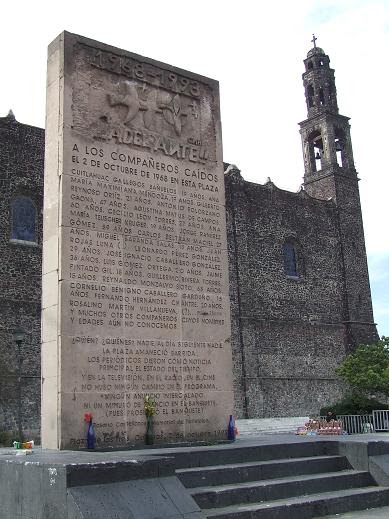
Monument at site of 1968 Mexico City Massacre.

In defiance, students called for another demonstration at the Plaza of the Three Cultures on Oct. 2, 1968, in Mexico City’s Tlatelolco district. A crowd of 15,000 marched through the streets to protest the occupation of the university and 5,000 remained for a rally that evening when demonstrators were suddenly surrounded by troops and tanks, helicopters dropped flares into the crowd and snipers in nearby buildings began shooting at the soldiers, resulting in a police rampage.

The students panicked and soldiers began indiscriminately shooting and bayoneting them. Between 200 and 400 died. Many more were arrested and tortured and the killing continued as soldiers went door to door throughout the neighborhood.

The government claimed that the snipers were student provocateurs. However, documents produced by a major investigation by the Mexican government in 2001 would prove that the shooters were in fact members of the Presidential Guard whose orders were to provoke a riot.

Thanks to inquiries made possible by the Freedom of Information Act, the National Security Archives at George Washington University released papers in 2006 that documented the major role the United States government played in the Tlatelolco events. The CIA helped in the planning of the massacre and the Pentagon provided substantial material support.

In 2006, former President Luis Echeverría Álvarez was formally charged with crimes of genocide resulting from the events but did not go to trial after a court ruled that the statute of limitations had expired.

The Tlatelolco Massacre, commemorated to this day, had a profound effect on public perceptions about the Mexican government and the ruling PRI party. Some say that it forever changed attitudes in Mexico.

Looking back, La noche de Tlatelolco (the name comes from a 1971 book) provides a stark historical capsule of those momentous events of 1968 in the United States and around the world.

The figures by sculptor Nuñes are of the dying and tortured students.

The Rag Blog’s Thorne Dreyer at home. The Tlatelolco sculptures are along the shelf. Photo by Ruth Roberts / The Rag Blog.

[Thorne Dreyer, a pioneering underground journalist in the sixties and a veteran social activist, co-edits The Rag Blog.]

The Rag Blog

Posted in Rag Bloggers | Tagged , , , , , , , , | 2 Comments

Athens Shooting Fuels Anarchist Riots

A vitrine at Athens main commercial district is smashed by Greek youth following a deadly police shooting of a teenager last night, in central Athens, Dec. 7, 2008. Photo by Louisa Gouliamaki / AFP / Getty Images.

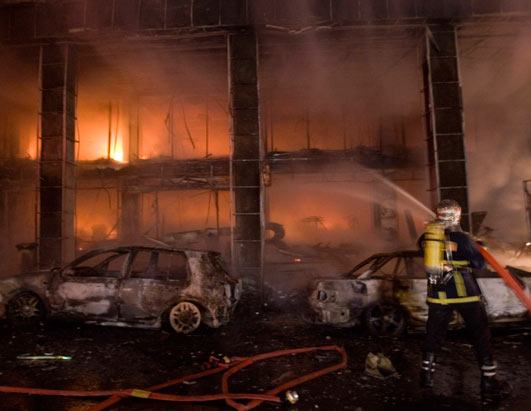
A firefighter tries to extinguish a fire in the Monastiraki area of central Athens, Greece early Sunday, Dec. 7, 2008. Photo by Petros Giannakouris / AP.

‘The shooting and its violent aftermath threatens to escalate a decades-long conflict that has simmered between police and far-left groups.’
By Nicole Itano / December 8, 2008

ATHENS – Greece’s worst rioting in years erupted late Saturday night after an Athens policeman shot and killed a teenage boy in a central neighborhood known as the base of anarchist and other antiestablishment groups.

By Sunday morning, with the riots continuing, a trail of devastation had been blazed across central Athens – with the stench of tear gas and smoke from charred vehicles and buildings hanging over parts of the ancient city. The violence quickly spread to other parts of the country, including Greece’s second-city, Thessaloniki, and the vacation islands of Crete and Corfu.

The conservative government, which was already struggling to stay in power in the wake of a recent land-exchange scandal, attempted to calm the rioters by arresting the two police officers connected with the shooting.

The fatal shooting took place in the Athens neighborhood of Exarchia, a dense warren of concrete apartment buildings home to a mix of students and anarchists. Clashes between police and radicals are common in the neighborhood.

Anarchist groups frequently set off small bombs throughout the city – on Wednesday alone a bomb damaged the offices of the French news service Agence France Presse and arsonists torched a Bosnian embassy car and a bank cash machine.

Brady Kiesling, a former US diplomat, who is writing a book about the Greek militant group November 17, says Greek police have limited power to use force against these groups because public sentiment will not tolerate it. This has resulted in a delicate balance in Exarchia, with neither pushing the other too far. Many Greeks cite the events of November 17, 1973 – a day that is still commemorated, when the army stormed the Athens Polytechnic University and killed a number of striking students – as a reason why the police must be restricted.

“The police stay out of certain areas, unless there’s a major emergency, and the anarchists don’t trash things badly unless there’s a good reason,” Mr. Kiesling says. But “once someone gets killed, the doctrine is massive retaliation.”

Details of the shooting are disputed, but police issued a statement saying the two officers had been attacked by a group of youths. One officer threw a stun grenade while the other responded with three shots. At least one bullet hit the boy, reported to be 15 or 16. According to police, he died on the way to the hospital.

The last fatal police shooting of a minor in Greece, in 1985, sparked months of nearly daily clashes between police and anarchists. The terrorist group November 17 also bombed a bus full of riot police in retaliation, Kiesling says.

Both officers involved in Saturday’s incident have been arrested. Prokopis Pavlopoulos, the country’s Interior minister, who is responsible for the police, promised punishment for those responsible.

Mr. Pavlopoulos, and his deputy minister, also offered their resignations, a move that was rejected by the prime minister.

“It is inconceivable for there not to be punishment when a person loses their life, particularly when it is a child,” Pavlopoulos said in a press conference Sunday morning. The Interior minister also condemned the actions of the rioters. “No outrage, no matter how ideologically established it is, can lead to such incidents as we witnessed last night.”

Shortly after the shooting, which took place before 10 p.m., an angry crowd – summoned by text message and the Internet – gathered in Exarchia. They clashed with police, shouting “Murderers in uniform,” and burned and looted local shops.

Later that night, the rioters moved to other areas of the city center, burning or damaging at least 31 shops and breaking windows in the tourist neighborhood of Monistiraki and along one of central Athens’ major shopping streets, Ermou. Just a few hundred yards from the ancient site of Hadrian’s Library, a charred building still smoldered late Sunday morning. Some two dozen police officers were reportedly injured in the clashes.

On Sunday afternoon, more than 2,000 people gathered near the Athens Polytechnic to march towards Athens’ central police station in protest of the killings. Greek law bars police from university buildings.

“The feeling is anger,” says John Gelis, a 28-year psychologist, shortly before joining the march. “A kid was killed just like that. It’s a sign of arrogance by the police. It’s an act against democracy.”

Mr. Gelis joined in the riots on Saturday night, saying the targets of the unrest included banks and multinational companies, not small businesses. “No one has anything against the little owners.”

But some small businesses had been ransacked, including a family-run computer store in the heart of Exarchia. Business owners and residents say they are weary of the unrest. “I’m fed up with this,” says Elina Dimitriou, a long-time resident of the neighborhood. “It needs to stop. But I don’t know who to blame.”

[Material from the Associated Press was used in this story.]

Source / Christian Science Monitor

The Rag Blog

Posted in RagBlog | Tagged , , , | Leave a comment

Bob Jones University Says ‘No’ to Racism, Abercrombie & Fitch

Students at Bob Jones University becoming smart at the Bob Jones University Library, reading books by Bob Jones. Photo by Francis Miller / Life Magazine / 1948.

‘Finally, BJ University has issued a half-hearted apology for their racist past. They blame their own disgustingly well documented racism on a social “ethos”…’

By Larry Ray / The Rag Blog / December 9, 2008

World religions, right down to localized fundamental religious schools like Bob Jones University in South Carolina, follow what they call the “local ethos” to justify dogmatic religious statements and teachings. Damning faith-based broadsides like the ones from BJ University are always also attributed to some biblical scriptural quote.

But now, finally, BJ University has issued a half-hearted apology for their racist past. They blame their own disgustingly well documented racism on a social “ethos” rather than simply having done the right thing from the beginning. At least it is an admission that what liberals of the day were telling them 30 years ago was, and still is, correct.

Bob Jones U. apologizes for racial past

GREENVILLE, S.C.– Bob Jones University, a fundamentalist Christian school in South Carolina, has apologized for its “racially hurtful” past policies.

In a statement posted on its Web site, the university blamed its policies on the “segregationist ethos” of the United States.

“Consequently, for far too long, we allowed institutional policies regarding race to be shaped more directly by that ethos than by the principles and precepts of the Scriptures,” the statement said. “We conformed to the culture rather than provide a clear Christian counterpoint to it.”

Bob Jones, founded in 1927 by evangelist Bob Jones Sr., did not admit black students until 1971 and did not admit unmarried blacks until 1975.

Interracial dating and marriage was banned until 2000, a policy the administration justified based on a commandment given Moses against the mixing of unlike things. That became an issue during the presidential campaign when George W. Bush spoke on the campus.

Source / UPI / Nov. 21, 2008

And to further understand BJU: The clothes make the man.

BJU bases its dress codes for men and women on the application of the principles of modesty, gender distinction, appropriateness and distinction from the world. ….

Brand Restrictions. Abercrombie & Fitch and its subsidiary Hollister have shown an unusual degree of antagonism to the name of Christ and an unusual display of wickedness in their promotions. In protest, articles displaying their logos are not acceptable to be worn, carried, or displayed (even if covered or masked in some way).

Go here for a dark chuckle.

See much difference in BJU and a strict Islamic Madrassa? Read this student expectation extract:

“Students are challenged to develop Christlikeness that is evidenced in consistent Christian character. To help each student to grow in Christlikeness, BJU has a reasonable, just, and firm disciplinary system.

Loyalty to Christ results in separated living. Dishonesty, lewdness, sensual behavior, adultery, homosexuality, sexual perversion of any kind, pornography, illegal use of drugs, and drunkenness all are clearly condemned by God’s Word and prohibited here. Further, we believe that biblical principles preclude gambling, dancing, and the beverage use of alcohol.

Dating and Mixed Groups

We want students to have wholesome social opportunities in a setting that provides accountability for biblical requirements of purity. It is with this in mind that we chaperon campus activities where men and women students are present and require a chaperon when students date or interact in a mixed group off campus.”

And to think, some of us went to UT in Austin when we could have been socially neutered and made brain dead in South Carolina!

The Rag Blog

Posted in Rag Bloggers | Tagged , , , , , | 4 Comments

Tim Black, Barack Obama and all that Chicago Jazz

Chicago historian and activist Timuel D.(Tim)Black turned 90 with lots of jazz and a tribute from Barack Obama.

This was also posted in Mike Klonsky’s blog, Small Talk, covering the Small Schools Workshop and its battles, a place where a number of us, including Tim Black, touched base for a while and made a difference.

Carl Davidson / The Rag Blog / December 8, 2008

‘Chicago jazz legends, including Willie Pickens, Corey Wilkes, and Jimmy Ellis, filled the Lounge with great music. But the high point of the evening was Sen. Dick Durbin’s reading of a personal birthday greeting from no less than the President-elect himself.’
By Mike Klonsky / The Rag Blog / December 8, 2008

The Checkerboard Lounge on Chicago’s south side, was jumping last night as a couple of hundred of us celebrated Tim Black’s 90th birthday. The party was organized by Tim’s wife Zenobia and the Chicago Jazz Institute.

Congressman Bobby Rush hailed Tim as the movement’s “field marshal” and the crowd, including politicians, community leaders and educators all joined in a rollicking version of Happy Birthday To Ya.

But the high point of the evening was Sen. Dick Durbin’s reading of a personal birthday greeting from no less than the President-elect himself.

Here’s the full text of Barack Obama’s messsage to Tim:

I wish I could be with you all in person today to celebrate the life of a dedicated teacher and one of the preeminent oral historians of our time, a man who keeps the soul of the South Side alive and shares his stories still, Professor Tim Black.

The Great Migration brought his family to Chicago’s South Side, and the Great Depression started him down the long path of social justice. As a student at Burke Elementary School, he’d often walk across the street to hear the orators in Washington Park argue with passion for jobs that pay a fair wage, for protections to keep workers safe, for an economy that would allow families to live in dignity and dream of a brighter future.Little did they know among their greatest lasting impacts would be the achievements of the man we honor today.

Like my grandfather, he joined the army as a fresh-faced young man in World War II. And like my great uncle, he helped liberate the Buchenwald concentration camp. It was a moment that left a mark on this man; that left no doubt as to his destiny.He returned convinced by his life experiences that the greatest impact he could make on the next generation would be to teach our youth about their communities, about the world they live in, and about how to be responsible citizens of each.

For forty years, he shaped our young men and women into those citizens. And though he may have retired from the teaching profession nearly two decades ago, he never stopped being a teacher. We are all his students in a classroom that never closes.

Because of Professor Black, jazz has a place to call home in Chicago. Because of Professor Black, the rich and vibrant chronicles of Bronzeville and the greater South Side live on. Because of Professor Black, generations of youth have grown up with a better appreciation of their neighborhoods and the history they inherit.

The man we honor today grew up in the midst of Depression and war, yet considers himself part of a fortunate generation. And he’s made it his life’s mission to give each successive generation every possible chance in this world.

“I never lose hope,” he once said. “I believe that I have responsibilities to help younger people to obtain hopes and dreams. Their present condition may be very discouraging; my aim is to help them regain a sense of hope for the future. My main interest is in building a better America, building a better world.”

Tim, for your birthday, I promise you this: that will always be my mission too. Thank you for a life well-lived. I wish you all the best for the stories you’ve yet to tell.

Happy Birthday,

Barack Obama

[Mike Klonsky posts at Small Talk.]

[Carl Davidson is webmaster at Progressives for Obama.]

The Rag Blog

Posted in Rag Bloggers | Tagged , , , , | Leave a comment