‘Mama Afrika’ : Singer Miriam Makeba Dies at 76

Miriam Makeba performed in a concert on Sunday night in southern Italy shortly before she died early Monday. Photo by Cesare Abbate / European Pressphoto Agency.

Jacob Zuma: ‘Miriam Makeba used her voice, not merely to entertain, but to give a voice to the millions of oppressed South Africans under the yoke of apartheid.’
By Alan Cowell / November 10, 2008

Miriam Makeba: Swimming Freestyle. Video Below.

LONDON — Miriam Makeba, a South African singer whose voice stirred hopes of freedom among millions in her own country though her music was formally banned by the apartheid authorities she struggled against, died overnight after performing at a concert in Italy on Sunday. She was 76.

The cause of death was cardiac arrest, according to Vincenza Di Saia, a physician at the private Pineta Grande clinic in Castel Volturno near Naples in southern Italy, where she was brought by ambulance. The time of death was listed in hospital records as midnight, the doctor said.

Ms. Makeba collapsed as she was leaving the stage, the South African authorities said. She had been singing at a concert in support of Roberto Saviano, an author who has received death threats after writing about organized crime.

Widely known as “Mama Africa,” she had been a prominent exiled opponent of apartheid since the South African authorities revoked her passport in 1960 and refused to allow her to return after she traveled abroad. She was prevented from attending her mother’s funeral after touring in the United States.

Although Ms. Makeba had been weakened by osteoarthritis, her death stunned many in South Africa, where she stood as an enduring emblem of the travails of black people under the apartheid system of racial segregation that ended with the release from prison of Nelson Mandela in 1990 and the country’s first fully democratic elections in 1994.

In a statement on Monday, Mr. Mandela said the death “of our beloved Miriam has saddened us and our nation.”

He continued: “Her haunting melodies gave voice to the pain of exile and dislocation which she felt for 31 long years. At the same time, her music inspired a powerful sense of hope in all of us.”

“She was South Africa’s first lady of song and so richly deserved the title of Mama Afrika. She was a mother to our struggle and to the young nation of ours,” Mr. Mandela’s was one of many tributes from South African leaders.

“One of the greatest songstresses of our time has ceased to sing,” Foreign Minister Nkosazana Dlamini-Zuma said in a statement. “Throughout her life, Mama Makeba communicated a positive message to the world about the struggle of the people of South Africa and the certainty of victory over the dark forces of apartheid and colonialism through the art of song.”

For 31 years, Ms. Makeba lived in exile, variously in the United States, France, Guinea and Belgium. South Africa’s state broadcasters banned her music after she spoke out against apartheid at the United Nations. “I never understood why I couldn’t come home,” Ms. Makeba said upon her return at an emotional homecoming in Johannesburg in 1990 as the apartheid system began to crumble, according to The Associated Press. “I never committed any crime.”

Music was a central part of the struggle against apartheid. The South African authorities of the era exercised strict censorship of many forms of expression, while many foreign entertainers discouraged performances in South Africa in an attempt to isolate the white authorities and show their opposition to apartheid.

From exile she acted as a constant reminder of the events in her homeland as the white authorities struggled to contain or pre-empt unrest among the black majority.

Ms. Makeba wrote in 1987: “I kept my culture. I kept the music of my roots. Through my music I became this voice and image of Africa, and the people, without even realizing.”

She was married several times and her husbands included the American black activist Stokely Carmichael, with whom she lived in Guinea, and the jazz trumpeter Hugh Masekela, who also spent many years in exile.

In the United States she became a star, touring with Harry Belafonte in the 1960s and winning a Grammy award with him in 1965. Such was her following and fame that she sang in 1962 at the birthday party of President John F. Kennedy. She also performed with Paul Simon on his Graceland concert in Zimbabwe in 1987.

But she fell afoul of the U.S. music industry because of her marriage to Mr. Carmichael and her decision to live in Guinea.

In one of her last interviews, in May 2008 with the British music critic Robin Denselow, she said she found her concerts in the United States being cancelled. “It was not a ban from the government. It was a cancellation by people who felt I should not be with Stokely because he was a rebel to them. I didn’t care about that. He was somebody I loved, who loved me, and it was my life,” she said.

Ms. Makeba was born in Johannesburg on March 4, 1932, the daughter of a Swazi mother and a father from the Xhosa people who live mainly in the eastern Cape region of South Africa. She became known to South Africans in the Sophiatown district of Johannesburg in the 1950s.

According to Agence France-Presse, she was often short of money and could not afford to buy a coffin when her only daughter died in 1985. She buried her alone, barring a handful of journalists from covering the funeral.

She was particularly renowned for her performances of songs such as what was known as the Click Song — named for a clicking sound in her native tongue — or “Qongoqothwane,” and Pata Pata, meaning Touch Touch in Xhosa. Her style of singing was widely interpreted as a blend of black township rhythms, jazz and folk music.

In her interview in 2008, Ms. Makeba said: “I’m not a political singer. I don’t know what the word means. People think I consciously decided to tell the world what was happening in South Africa. No! I was singing about my life, and in South Africa we always sang about what was happening to us — especially the things that hurt us.”

In a tribute, Jacob Zuma, head of the ruling African National Congress, said the party “dips its banner in tribute to an African heroine, Miriam Zenzile Makeba, a freedom fighter and outstanding African cultural figure.”

“Miriam Makeba used her voice, not merely to entertain, but to give a voice to the millions of oppressed South Africans under the yoke of apartheid,” Mr. Zuma said.

[Celia W. Dugger contributed reporting from Johannesburg and Rachel Donadio from Rome.]

Source / New York Times

Miriam Makeba: Swimming Freestyle

Also see Taking Africa With Her to the World by Jon Pareles / New York Times / Nov. 10, 2008

Thanks to Harry Edwards / The Rag Blog

Posted in RagBlog | Tagged , , , , , , , , | Leave a comment

Zwarich: The True Democracy Project

The time is ripe for a discussion of the structure of a viable progressive organization. Now that the election cycle (and all it entailed this year) is completed, let the discussion begin. Here is a proposal from Ray Zwarich that can serve as a starting point for discussion.

Richard Jehn / The Rag Blog

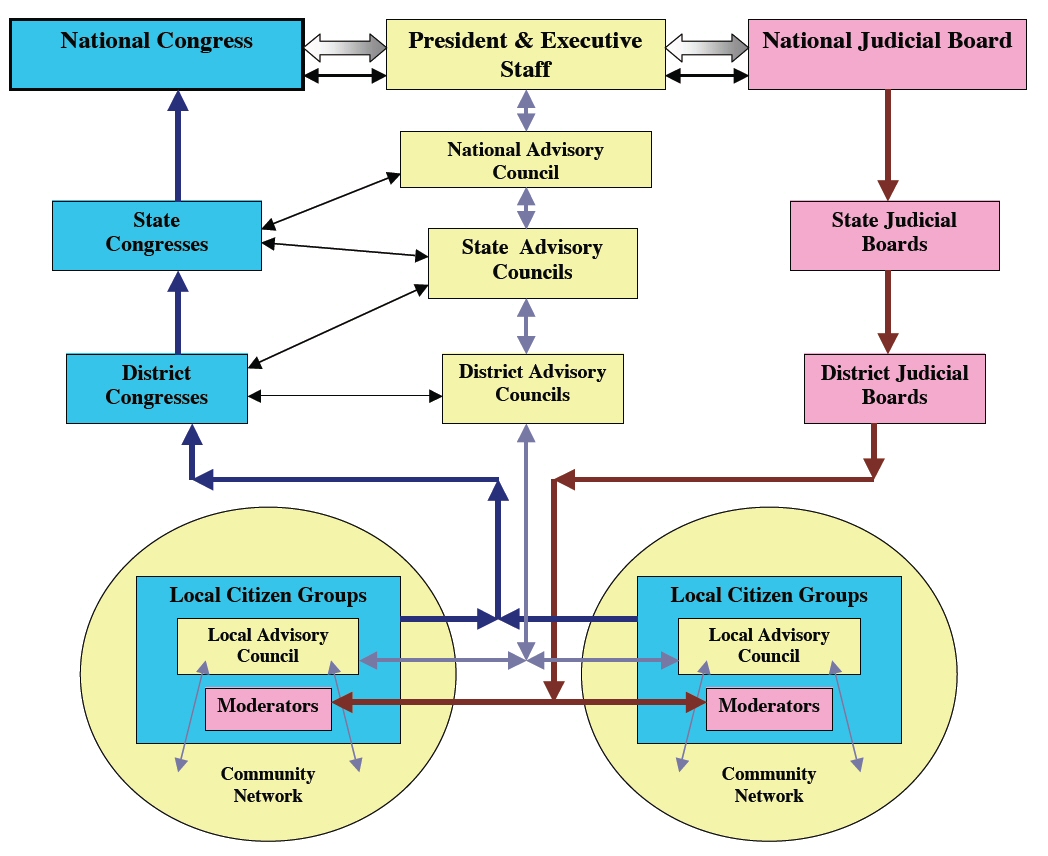
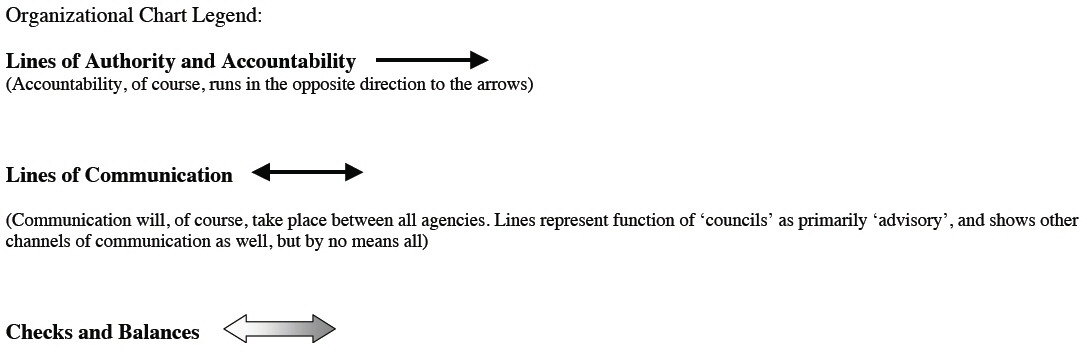
The chart represents organization by US Congressional districts, (which the ‘district’ level agencies represent). Local Citizens Groups, within Congressional districts, could be organized by existing defined wards and precincts, by zip code, by neighborhood, by issues affinity, or by other criteria as democratically established. See below for legend.

A Picture Plus 1000 Words – The True Democracy Project
By Zwarich / The Rag Blog / November 9, 2008

To My Fellow Progressives:

Amidst the post-election ‘what next?’ discussions that we hear on every side, I would like to make a brief presentation of a complex idea. Being brief is something I’m not very good at, as many may very well already know. (People who are at all familiar with my writing know that I am always far too ‘wordy’, a fault that I am trying to work on, but with only limited success).

I will try to present this concept in ‘a picture’, (an organizational chart), plus ‘a thousand words’, (I’ll try my best). The picture is the easy part. (Please see attached). The thousand words will be a challenge. (In a more thorough presentation that I am trying to finish, I have already written 13,000 words, and am just getting into ‘the meat’ of the idea).

I will try here, in these one thousand words, to simply present the basic idea, and not argue in favor of it, or present the level of detail to which I have already developed it. I hope that any who read this might consider circulating it among friends and associates. Plato posited that ideas exist apart from us, and that we do not create them, we only encounter them. Many others, including right here on The Rag Blog, (there have been comments wishing for a ‘people’s congress’), have had this same basic idea spring up in their own minds. I believe that it is an idea whose time has hopefully come.

Anyway…….here goes, (and starting the 1000 word count from here).

I think we need to expand our thinking dramatically. We need to think in a far larger and broader paradigm than we have yet allowed ourselves. Simply put: we need to build a democracy of our own, by taking advantage of the full degree of power inherent in interactive digital communications, (whose potential we have exploited somewhat, but whose full power we have barely begun to tap). We need to build a ‘fully featured’ and robust democratic organization, whose purpose will be to pool our resources in order to communicate our powerful message of ‘Democracy’ and ‘The Common Good’, to ‘the masses’ of the American citizenry, (recognizing that in a democracy, ‘communication’ is THE most basic element in acquiring political power).

This democracy we need to build, to which I refer at this point as the True Democracy Project, will practice what it preaches. Its message will be manifest in its methods. Being assiduously and scrupulously democratic, to the greatest degree that we can devise, will be the most important policy of this democratic organization. Whatever agenda this organization might democratically establish, “our process (democracy) will be our most important policy”. Democracy, as extended to its inherent purpose, the promotion of the Common Good, will also provide the framework of our most Basic Message.

The long range concept will be to grow into a ‘party’. With that in mind, this organization should call itself the True Democrats, and advance the motto, (to encapsulate its basic credo), “If you don’t believe in True Democracy, DON’T call yourself a True Democrat”.

This name will allow this group to both identify itself with the existing Democratic Party, and at the same time challenge this existing party for legitimacy as the ONE party, (of the two major parties, as our system defines), that represents the interests of The People, against the interests of The Rich, (amalgamated capital, whose interests are legitimately represented by the Republican Party, but who have captured control of both parties, in a clear ‘taxation without representation’ system in which the Common Good is NOT currently represented). Thus the long range goal is NOT to build a ‘third party’, but rather to supplant the existing Democratic Party, and to become (or take over) one of the two ‘major parties’.

This democratic organization shall focus on the full development and exploitation of the power of interactive Internet communications capacity. It will require the development of considerably advanced new software. It will use this technology, (such as email list-serve type groups and forums, coupled with web-based networking capacity), to root the entire decision making apparatus of the organization in ‘The Will of The People’.

This organization will include a ‘Judicial Branch’ to guard the rights of The People. The forums through which the business of the group is conducted will be ‘moderated’, but all ‘moderation’ will take place after the fact, using the tool of ‘censure’ to punish behavior that does not conform to democratically established standards, rather than ‘censorship’, which governs behavior, (and destroys free speech, the most basic building block of True Democracy), before the fact. The insidious democracy-destroying power of censorship lies in the fact that The People are prevented from being aware of the behavior of the censors, and they have no recourse from their autocratic decisions.

All moderators will be officers of the Judicial Branch, and their decisions will be subject to appeal up the line of authority in this branch. (See organizational chart)

The ‘Legislative Branch’ will be directly connected to the citizen-membership through the capacity of the interactive digitally networked connection. Citizen-members, at the most basic ‘neighborhood’ level, will have the direct power to vote on all major decisions. Authority and responsibility will be delegated through a representational system, (for practical reasons), but all decisions of import will be voted on by referendum, through the software that will be developed, (and using practical quorum requirements as are established, perhaps through a proxy system; quorum rules must recognize that many people may not want to have the responsibility of maintaining highly detailed daily attention).

The ‘Executive Branch’ will also be rooted in The People, not only by selection of officers by direct election, but through a system of interactive communications ‘councils’, that reach all the way down to the neighborhood level of the organization, where ‘local councils’ will send roots out into the general community.

These three branches, reflecting the three basic functions of governance, will be defined by a robust system of checks and balances that will be established, through the definition and assignation of various powers, in the group’s constitution.

There perhaps should be two classifications of membership, ‘supporting members’, and ‘governing members’.

Supporting members would be asked to make a modest initial donation, and would periodically be asked to make additional voluntary contributions. Supporting members will be welcomed to exercise limited privileges to participate in the group’s discussions, hoping that their interest will lead them to ‘upgrade’ their membership. Supporting members will comprise the group’s basic communications base.

Governing members, those who will have the right to vote, will pay regular dues, at a modest and affordable level. Dues money will be split, by statutory formula as democratically established, between the various levels of organization.

We must realize that ‘politics’ is a numbers game, and that the numbers are VERY large. The object of the ‘game’ is to get the most people on our side, and to do that we must communicate with them. We must develop the capacity to communicate with tens, and hundreds, of millions of people.

We must set the goal of building an organization that is completely scalable, that is fluidly capable of starting small, but is designed to build a membership of millions. If dues are set at merely $5 per month, an organization with 100k dues-paying citizen-members would (obviously) have an operating budget of $500k per month. But we must extend these projected numbers into the millions. An organization of a million members could do a LOT of communicating with $5 million per month. (And so on). Any who doubt that massive numbers of people would be willing to pay regular dues to an organization that benefits them directly, (by directly empowering through True Democracy), please consider that AARP currently has 35 million dues paying members, (and all it offers is some sham discounts on motel rooms and insurance policies).

If we pool our resources in this way, the ‘whole’ will be far greater than ‘the sum of its parts’. Many polls indicate that at least 7% of the current voting population, (a percentage that translates to 14 million American citizens), strongly identify themselves as progressives. If we could organize even half that number, we would have an organization with a budget of $420 million per year to use for constant and ongoing communication of our simple and powerful message of Democracy and the Common Good.

(My one thousand word limit looms. Only a few words left to sum up)

I hope that any who read this will be interested in discussing this further. I would love to share the extended material I am working on, (hoping to finish in the next few days). A project of this magnitude would require the efforts and energies of a significant number of people of diverse skills and talents, (political scholars, veteran organizers, software developers, fund raisers, etc, as well as, of course, citizens who are eager to be empowered).

I hope that anyone interested will feel free to contact me, or else take this idea and develop it yourselves. To have any chance at all to be successful, NO one can ‘own’ it. (And if anyone tried to do so, if anyone tried to maintain control by building in ‘back channel’ levers of power, the very integrity on which this idea wholly depends would be destroyed, and whatever organization was built would fail (miserably) to reach this potential). To succeed, this idea, and whatever we build from it, must be democratically owned by ALL of us.

The Rag Blog

Posted in RagBlog | Tagged , , | 2 Comments

More Bailout Bonanza : A Quiet Windfall for U.S. Banks

Lotsa’ kibble: Typical US banker post-bailout windfall, thanks to sneaky tax law adjustment.

‘Corporate tax lawyers quickly realized the enormous implications of the document: Administration officials had just given American banks a windfall of as much as $140 billion.’
By Amit R. Paley / November 10, 2008

The financial world was fixated on Capitol Hill as Congress battled over the Bush administration’s request for a $700 billion bailout of the banking industry. In the midst of this late-September drama, the Treasury Department issued a five-sentence notice that attracted almost no public attention.

But corporate tax lawyers quickly realized the enormous implications of the document: Administration officials had just given American banks a windfall of as much as $140 billion.

The sweeping change to two decades of tax policy escaped the notice of lawmakers for several days, as they remained consumed with the controversial bailout bill. When they found out, some legislators were furious. Some congressional staff members have privately concluded that the notice was illegal. But they have worried that saying so publicly could unravel several recent bank mergers made possible by the change and send the economy into an even deeper tailspin.

“Did the Treasury Department have the authority to do this? I think almost every tax expert would agree that the answer is no,” said George K. Yin, the former chief of staff of the Joint Committee on Taxation, the nonpartisan congressional authority on taxes. “They basically repealed a 22-year-old law that Congress passed as a backdoor way of providing aid to banks.”

The story of the obscure provision underscores what critics in Congress, academia and the legal profession warn are the dangers of the broad authority being exercised by Treasury Secretary Henry M. Paulson Jr. in addressing the financial crisis. Lawmakers are now looking at whether the new notice was introduced to benefit specific banks, as well as whether it inappropriately accelerated bank takeovers.

The change to Section 382 of the tax code — a provision that limited a kind of tax shelter arising in corporate mergers — came after a two-decade effort by conservative economists and Republican administration officials to eliminate or overhaul the law, which is so little-known that even influential tax experts sometimes draw a blank at its mention. Until the financial meltdown, its opponents thought it would be nearly impossible to revamp the section because this would look like a corporate giveaway, according to lobbyists.

Andrew C. DeSouza, a Treasury spokesman, said the administration had the legal authority to issue the notice as part of its power to interpret the tax code and provide legal guidance to companies. He described the Sept. 30 notice, which allows some banks to keep more money by lowering their taxes, as a way to help financial institutions during a time of economic crisis. “This is part of our overall effort to provide relief,” he said.

The Treasury itself did not estimate how much the tax change would cost, DeSouza said.

A Tax Law ‘Shock’

The guidance issued from the IRS caught even some of the closest followers of tax law off guard because it seemed to come out of the blue when Treasury’s work seemed focused almost exclusively on the bailout.

“It was a shock to most of the tax law community. It was one of those things where it pops up on your screen and your jaw drops,” said Candace A. Ridgway, a partner at Jones Day, a law firm that represents banks that could benefit from the notice. “I’ve been in tax law for 20 years, and I’ve never seen anything like this.”

More than a dozen tax lawyers interviewed for this story — including several representing banks that stand to reap billions from the change — said the Treasury had no authority to issue the notice.

Several other tax lawyers, all of whom represent banks, said the change was legal. Like DeSouza, they said the legal authority came from Section 382 itself, which says the secretary can write regulations to “carry out the purposes of this section.”

Section 382 of the tax code was created by Congress in 1986 to end what it considered an abuse of the tax system: companies sheltering their profits from taxation by acquiring shell companies whose only real value was the losses on their books. The firms would then use the acquired company’s losses to offset their gains and avoid paying taxes.

Lawmakers decried the tax shelters as a scam and created a formula to strictly limit the use of those purchased losses for tax purposes.

But from the beginning, some conservative economists and Republican administration officials criticized the new law as unwieldy and unnecessary meddling by the government in the business world.

“This has never been a good economic policy,” said Kenneth W. Gideon, an assistant Treasury secretary for tax policy under President George H.W. Bush and now a partner at Skadden, Arps, Slate, Meagher & Flom, a law firm that represents banks.

The opposition to Section 382 is part of a broader ideological battle over how the tax code deals with a company’s losses. Some conservative economists argue that not only should a firm be able to use losses to offset gains, but that in a year when a company only loses money, it should be entitled to a cash refund from the government.

During the current Bush administration, senior officials considered ways to implement some version of the policy. A Treasury paper in December 2007 — issued under the names of Eric Solomon, the top tax policy official in the department, and his deputy, Robert Carroll — criticized limits on the use of losses and suggested that they be relaxed. A logical extension of that argument would be an overhaul of 382, according to Carroll, who left his position as deputy assistant secretary in the Treasury’s office of tax policy earlier this year.

Yet lobbyists trying to modify the obscure section found that they could get no traction in Congress or with the Treasury.

“It’s really been the third rail of tax policy to touch 382,” said Kevin A. Hassett, director of economic policy studies at the American Enterprise Institute.

‘The Wells Fargo Ruling’

As turmoil swept financial markets, banking officials stepped up their efforts to change the law.

Senior executives from the banking industry told top Treasury officials at the beginning of the year that Section 382 was bad for businesses because it was preventing mergers, according to Scott E. Talbott, senior vice president for the Financial Services Roundtable, which lobbies for some of the country’s largest financial institutions. He declined to identify the executives and said the discussions were not a concerted lobbying effort. Lobbyists for the biotechnology industry also raised concerns about the provision at an April meeting with Solomon, the assistant secretary for tax policy, according to talking points prepared for the session.

DeSouza, the Treasury spokesman, said department officials in August began internal discussions about the tax change. “We received absolutely no requests from any bank or financial institution to do this,” he said.

Although the department’s action was prompted by spreading troubles in the financial markets, Carroll said, it was consistent with what the Treasury had deemed in the December report to be good tax policy.

The notice was released on a momentous day in the banking industry. It not only came 24 hours after the House of Representatives initially defeated the bailout bill, but also one day after Wachovia agreed to be acquired by Citigroup in a government-brokered deal.

The Treasury notice suddenly made it much more attractive to acquire distressed banks, and Wells Fargo, which had been an earlier suitor for Wachovia, made a new and ultimately successful play to take it over.

The Jones Day law firm said the tax change, which some analysts soon dubbed “the Wells Fargo Ruling,” could be worth about $25 billion for Wells Fargo. Wells Fargo declined to comment for this article.

Read all of this artice here / Washington Post

Thanks to Jim Retherford / The Rag Blog

Posted in RagBlog | Tagged , , , , , , | 2 Comments

Iran Nuke Documents May Have Been Forged

The parade of Bush administration fabrications to achieve their objectives seems endless. I guess it’s gotten them what they’ve wanted so frequently and with little hassle that it’s a strategy that’s hard to set aside.

Richard Jehn / The Rag Blog


Documents linking Iran to nuclear weapons push may have been fabricated
By Gareth Porter / November 10, 2008

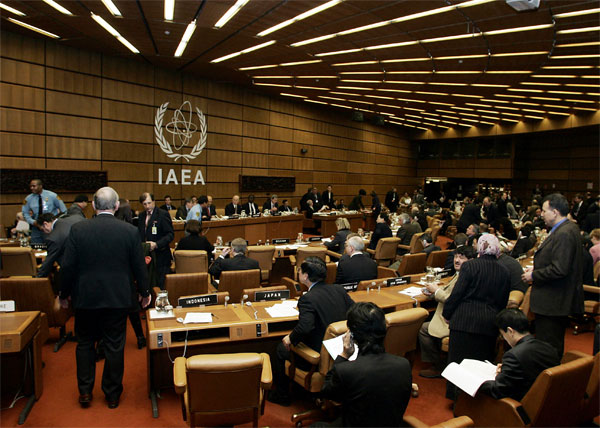
The International Atomic Energy Agency (IAEA) has obtained evidence suggesting that documents which have been described as technical studies for a secret Iranian nuclear weapons-related research program may have been fabricated.

The documents in question were acquired by U.S. intelligence in 2004 from a still unknown source — most of them in the form of electronic files allegedly stolen from a laptop computer belonging to an Iranian researcher. The US has based much of its push for sanctions against Iran on these documents.

The new evidence of possible fraud has increased pressure within the IAEA secretariat to distance the agency from the laptop documents, according to a Vienna-based diplomatic source close to the IAEA, who spoke to RAW STORY on condition of anonymity.

The laptop documents include what the IAEA has described in a published report as technical drawings of efforts to redesign the nosecone of the Iranian Shahab-3 ballistic missile “to accommodate a nuclear warhead.” The documents are also said to include studies on the use of a high explosive detonation system, drawings of a shaft apparently to be used for nuclear tests, and studies on a bench-scale uranium conversion facility.

These technical papers, along with some correspondence related to the alleged secret Iranian program — referred to by the IAEA as “alleged studies” — have been the primary basis during 2008 for the insistence by the US-led international coalition pushing for sanctions against Iran that the Iranian case must be kept going in the United Nations Security Council.

Handwritten Notes

At the center of the internal IAEA struggle is an Iranian firm named Kimia Maadan, which is portrayed in the documents as responsible for studies on a uranium conversion facility, called the “green salt” project, as part of the alleged nuclear weapons program under the Iranian Ministry of Defense.

According to a February 2006 Washington Post article, the United States and its allies believe that Kimia Maadan is a front for the Iranian military.

One of the communications included in the laptop documents – a letter allegedly sent to Kimia Maadan from an unnamed Iranian engineering firm in May 2003 – is at the center of the authenticity argument.

This letter is described in the May 26, 2008 IAEA report as “a one page annotated letter of May 2003 in Farsi.” According to a US source who has been briefed on the matter, the letter has handwritten notes on it which refer to studies on the redesign of a missile reentry vehicle.

Last January, however, Iran turned over to the IAEA a copy of the same May 2003 letter with no handwritten notes on it. This was confirmed by the director of the IAEA Safeguards Department, Olli Heinonen, during a February briefing for member states. Heinonen referred to “correspondence” related to Kimia Maadan that is “identical to that provided by Iran, with the addition of handwritten notes.”

Notes on the Heinonen briefing, compiled by unnamed diplomats who attended it, were posted on the website of the Washington-based Institute for Science and International Security.

The copy of the letter without the handwritten notes was part of a larger collection of documentation concerning Kimia Maadan provided to IAEA by Iran in response to a request for an explanation of that firm’s role in the management of the Iranian Gchine uranium mine.

After the IAEA received the copy of the letter without notes from Iran, some officials began pushing for an acknowledgment by the Agency that there were serious questions about the whether the laptop documents were fabricated, according to the Vienna-based source close to the IAEA.

“There was an effort to point out that the Agency isn’t in a position to authenticate the documents,” said the source.

Heinonen and other IAEA Safeguards Department officials have continued, however, to defend the credibility of the document in question.

According to an American source briefed on the dispute, the defenders of the authenticity of the version of the letter with the handwritten notes say that the appearance of the clean copy can be attributed to Kimia Maadan making multiple copies of the original which have been circulated to various staff members.

Only an Ore-processing Plant

Further evidence damaging to the credibility of the letter and the handwritten notes was provided to the atomic energy watchdog last January by the Iranian government. According to Iran, Kimia Maadan was not working for the Defense Ministry but for the civilian Atomic Energy Organization of Iran (AEOI).

The new Iranian documentation, described in the February 22, 2008 IAEA report, proved to IAEA’s satisfaction that the Kimia Maadan Company had been created in May 2000 solely to carry out a project to design, procure and install equipment for an ore processing plant.

The documents also showed that the core staff of Kimia Maadan was able to undertake the work on ore processing only because the nuclear agency had provided it with the technical drawings and reports as the basis for the contract.

“Information and explanations provided by Iran were supported by the documentation, the content of which is consistent with the information already available to the agency,” the IAEA concluded.

Marie Harff, a spokesperson for the CIA, declined to comment.

Additional Doubts About the Letter

Other questions surround the letter with the handwritten notes. The subject of the letter was Kimia Maadan’s inquiry to the engineering firm about procurement of a programmable logic control (PLC) system, according to the IAEA’s May 26 report.

A PLC system is one of many types of technology that the United States has long sought to deny to the Atomic Energy Organization of Iran. Iran had informed the IAEA even before 2006 that Kimia Maadan had assisted the AEOI in getting around that denial strategy by procuring various technologies for the planned uranium conversion facility at Esfahan.

Given that Kimia Maadan’s role in procurement for the conversion facility was both unrelated to its technical work for the AEOI and part of a covert effort to get around U.S. restrictions, it seems unlikely that they would have made multiple copies of the letter. Even if multiple copies were made, the firm would certainly have taken normal security precautions for a document of that type, marking each copy with a number or name.

A security procedure of that kind would have identified any missing copies. However, this was not the case with the 2003 letter. The United States, as its reason for refusing to provide a copy of the document to Iran, has argued that it would allow Iranian security personnel to identify the person who wrote the notes from their handwriting, according to the US source who has been briefed on the matter.

Another problem with the handwritten letter is the absence of any logical link between the subject of the letter and the alleged work on redesign of the missile. PLC systems, which are used for automation of industrial processes, such as control of machinery on factory assembly lines, would have been irrelevant to the technical studies on redesigning the Shahab-3 missile.

Other Documents Also Under Suspicion

Other documents from the laptop collection, allegedly showing that Kimia Maadan was working closely with the team trying to redesigning the Shahab-3 missile, have also come under suspicion of fraud.

The IAEA’s May 2008 report describes a flowsheet under Kimia Maadan’s name, showing a “process for bench scale conversion of uranium oxide” to UF4 (uranium tetraflouride), also known as “green salt.” The project number shown in the disputed documents for the “green salt” subproject is 5.13.

However, Heinonen stated that the number given to the Gchine subproject was 5.15. According to the documents obtained by the IAEA from Iran last January, this was the number of the uranium ore processing project that was assigned in 1999 by the civilian AEOI, not by the Iranian Defense Ministry. This would mean that the author of the document used the project number 5.13 for the “green salt” subproject based on their knowledge of the AEOI numbering system and not on a military designation.

In his February 25 briefing, Heinonen additionally referred to an alleged letter sent by Kimia Maadan – as manager of three subprojects – to the “missile re-entry vehicle” project, asking for a “technical opinion” on the plans for equipment for a proposed “green salt” conversion facility.

However, it is difficult to understand why the team working on redesigning the missile would be asked for a “technical opinion” on equipment for a uranium conversion facility.

A spokesperson for the State Department’s Office of Arms Control and International Security, which is responsible for IAEA affairs, said in an e-mail that specialists in the office “aren’t able to comment” on the subject of the intelligence documents now being considered by the IAEA.

The IAEA also declined to comment.

Toward a Showdown on the Contradictions

As the contradictions between the new Iranian evidence and the laptop documents relating to Kimia Maadan became apparent, some IAEA officials argued that the Agency should distance itself from what they now suspect are forgeries. Despite that argument, the May 2008 report contained no reference to the issue.

The next IAEA report, due out in mid-November, will include the first response by the Agency to a confidential 117-page Iranian critique of the laptop documents, according to the Vienna-based source.

In the past, IAEA Director General Mohamed ElBaradei has shown an ability to face off with the United States when evidence has been called into doubt. The infamous “Niger forgeries” – documents that purported to show an agreement between Niger and Iraq for the purchase of uranium oxide – were used by the White House as part of its case for war against Iraq.

In response, ElBaradei sent a letter to the White House and the National Security Council in December 2002, over three months before the US launched the Iraq War, warning that he believed the documents were forgeries and should not be cited as evidence of Iraqi intention to obtain nuclear weapons.

When ElBaradei received no response from the Bush administration, he went public to debunk the Niger forgeries. In a speech at the United Nations in March 2003, he declared that the IAEA, after “thorough analysis,” had concluded that the documents alleging the purchase of uranium by Iraqi from Niger “are in fact not authentic.”

The anomalies that have been revealed by the Iranian documents obtained from Iran last January may not be as obvious as the ones that made it clear the Niger documents were fabrications. Nevertheless, they appear to be red flags for IAEA analysts concerned with the issue.

Suspicion has surrounded the “alleged studies” documents from the beginning, because the United States has refused to say who brought the collection to US intelligence four years ago.

Gareth Porter is an investigative journalist and historian who has authored numerous foreign policy analyses and is the author of the book, Perils of Dominance: Imbalance of Power and the Road to War in Vietnam. In a 2006 article in the American Prospect, he revealed Iran’s spurned diplomatic outreach to the Bush Administration in 2003.

Source / Raw Story

And then there’s this tidbit:

IAEA expects better US co-op under Obama
IANS

November 8, 2008

VIENNA: The International Atomic Energy Agency (IAEA) has expressed its hope that the new US government under Barack Obama will have better cooperation with the organisation in propelling Iran’s de-nuclearisation process and easing tension in the Middle East.

IAEA director general Mohamed ElBaradei on Friday hailed president-elect Obama’s position to “create a world without nuclear weapons and value dialogue”.

In an article for the Time magazine, the UN nuclear watchdog chief said he hoped “conditions will be created soon for direct US-Iran negotiations, which are key for durable peace and security in the Middle East”.

He also added that effective nuclear disarmament activities with Iran might be restarted soon.

The IAEA hopes the change of guard at the White House would ease the strained relations between the organisation and Washington, another IAEA official said under condition of anonymity, adding that he was expecting the Obama government to provide the organisation bigger support and more fund.

Relations between the George W. Bush administration and the IAEA abruptly chilled when the UN nuclear watchdog said there was no evidence to bolster US intelligence pointing to an Iraqi nuclear weapons programme and other information used to justify the 2003 war that overthrew Saddam Hussein.

The Bush administration attempted to prevent Elbaradei’s re-election as IAEA chief in 2005, but failed.

The IAEA also sticks to a different stance from the current US government on the Iranian nuclear issue.

Source / Sakaal Times

The Rag Blog

Posted in RagBlog | Tagged , , , | 1 Comment

Hayden, Dohrn, Joseph : 1960s Radicals Predict Rebirth of Social Activism

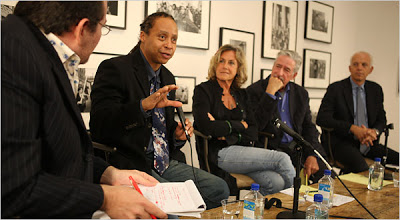
The panel moderator, Joshua Micah Marshall, left, with Jamal Joseph, Bernardine Dohrn, Tom Hayden and David Fenton. Photo by Chang W. Lee / The New York Times.

The panel moderator, Joshua Micah Marshall, left, with Jamal Joseph, Bernardine Dohrn, Tom Hayden and David Fenton. Photo by Chang W. Lee / The New York Times.

1960s Radicals Predict Rebirth of Social Activism

By Manny Fernandez | November 7, 2008

See ‘DAVID FENTON: Eye of the Revolution’ with vintage photo of Black Panther leader Eldridge Cleaver, Below.

Nothing is more non-nonconformist than a nearly two-hour panel discussion. But times have indeed changed, and the three former political radicals who gathered for one on Saturday in Manhattan did not seem to mind.

At a table in the Steven Kasher Gallery in Chelsea, Tom Hayden sat next to Bernardine Dohrn. Next to her was Jamal Joseph.

Forty years ago, Mr. Hayden was a co-founder of Students for a Democratic Society, a driving force behind the movement against the Vietnam War. He was also a member of the Chicago Seven, who were tried on charges of conspiring to incite a riot at the Democratic National Convention in 1968. Ms. Dohrn was also a leader of S.D.S., and would later help form a violent splinter group called the Weather Underground that bombed government buildings in the early 1970s. Mr. Joseph was a young Black Panther in Harlem who went to prison in the ’80s for harboring a fugitive.

Today, Mr. Hayden, Ms. Dohrn and Mr. Joseph are lecturers, writers and activists. On the Saturday after Election Day, they spoke softly into their microphones and incited no riots among the small audience, but their spirits were high. Though President-elect Barack Obama was not a product of the antiwar movement 40 years ago, the panelists described him as a benefactor of its transformations and predicted he would be the inspiration for social movements.

Mr. Hayden, a former California state senator, said that young Obama supporters “will determine the role of social activism for the next 30 years” and will be inspired by Mr. Obama to pursue community organizing work instead of Wall Street jobs. “A community organizer has been elected president of the United States,” Mr. Hayden said.

Mr. Hayden, Ms. Dohrn and Mr. Joseph met at the gallery to discuss the 1960s and the impact of an Obama presidency on the American political left. Of all the radicals, however, the one who played the biggest role in the presidential race, William Ayers, Ms. Dohrn’s husband, was not there.

Mr. Ayers, who also helped found the Weather Underground, is now a professor of education at the University of Illinois at Chicago. Mr. Obama’s association with Mr. Ayers was a favorite target of criticism by Senator John McCain and Gov. Sarah Palin of Alaska.

Early on in the panel discussion, the moderator, Joshua Micah Marshall, editor and publisher of the political blog Talking Points Memo, asked Ms. Dohrn what it was like for her and her husband to play cameo roles in the campaign.

She said they felt “tremendously lucky to have been together for almost 40 years now.” She added that they were still “proud radicals,” and were “definitively not now, or then, terrorists.”

Of Mr. McCain’s attempts to turn Mr. Obama’s association with Mr. Ayers into a political liability, she said: “It didn’t work in this campaign, if work means reaching independent voters, middle America, thinking people.” She added, “We’re fine and really eager to resume our normal lives.”

Ms. Dohrn, a clinical associate professor at Northwestern University Law School, teaches and writes about children’s law and juvenile justice. She and Mr. Ayers were indicted in 1970 for inciting to riot and conspiracy to bomb government buildings, but charges were dropped because of prosecutorial misconduct.

The discussion on Saturday was organized to promote an exhibition of photographs by David Fenton, who chronicled street protests and the lives of counterculture figures in the late 1960s and early ’70s. The exhibition, which runs until Nov. 26 at the Steven Kasher Gallery, features more than 75 photographs of Columbia University protests, Central Park be-ins and Black Panther demonstrations. Mr. Fenton went on to become chief executive of Fenton Communications, which represents the liberal antiwar group MoveOn.org.

Mr. Fenton, who also sat on the panel, said he had not seen Ms. Dohrn since he photographed the Days of Rage protests in Chicago in 1969. Mr. Fenton, 56, had dropped out of the Bronx High School of Science in 1968 to pursue photojournalism. “There were demonstrations every week,” Mr. Fenton said. “I don’t know if that will ever happen again. I hope it doesn’t have to.”

Source / New York Times

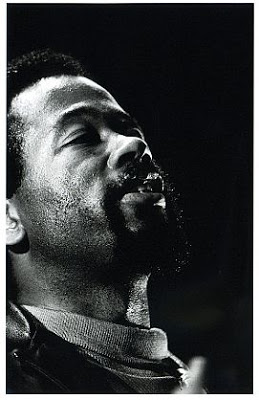
photo of Eldridge Cleaver by David Fenton

Black Panther Minister of Information Eldridge Cleaver, New York City, October 17, 1968. Photo by David Fenton. Vintage gelatin silver, printed 8 3/4 x 6 7/8 inches.

DAVID FENTON: Eye of the Revolution
Exhibition: October 30th through November 26th, 2008

40 Years after 1968 – 69, an Exhibition and Panel Discussion with Tom Hayden, Bernardine Dohrn, and others.

“These pictures are extraordinary. They capture the last couple of years of the 60s more closely than anything I know.” Norman Mailer, 2005

On October 30th the Steven Kasher Gallery in Chelsea opened the exhibition David Fenton: Eye of the Revolution, a look back at Yippies, Black Panthers, Be-Ins, Weatherman, the Chicago 7, tear gas, protests, and the years that changed America forever. The exhibition and panel will address the question of the lasting impact of the 60s on politics and the media.

Still in his teens in the late 60s, underground news photographer David Fenton –- now CEO of a major public interest communications firm –- photographed the passionate street protest and calculated mass media tactics that still shape U.S. politics and culture today. His photos appeared in anti-war and counter-cultural publications around the world, as well as in The New York Times, Life, Look, Newsweek and many others.

Fenton possessed both a police press pass and behind-the-scenes access to the leaders and celebrities of the era. Eye of the Revolution will feature over 75 photographs, including rare vintage prints. Join Fenton on a countercultural journey from Washington, D.C. to New York City, Oakland and Chicago with stops at Columbia, Yale and Berkeley, looking at Civil Rights, the Peace Movement, Black Power, Women’s Liberation, Gay Rights, Hippies, Police Riots, Yippies. Abbie Hoffman, Jerry Rubin, Bobby Seale, Huey P. Newton, Allen Ginsberg, John and Yoko, Black Panther leader Fred Hampton, Weathermen Bill Ayers and Bernardine Dohrn, and the pig who ran for President.

Since his employment at Liberation News Service – which paid him $25 a week in 1969 – Fenton’s protest-driven view of the world has evolved into Fenton Communications, the nation’s largest progressive communications firm. With clients including MoveOn.org and Nelson Mandela, he is still pushing for change in the tradition of 40 years ago.

The panel discussion on November 8th, the Saturday after the Election, will examine the negative and positive legacies of the 60s, and the evolution of alternative media then and now.

David Fenton: Eye of the Revolution will be on view through November 26th, 2008. Steven Kasher Gallery is located at 521 W. 23rd St., New York, NY 10011.

Source / Stephen Kasher Gallery / NYC

Go here to see photos from the exhibition.

Also check out David Fenton’s website.

Thanks to Carl Davidson / The Rag Blog

Posted in RagBlog | Tagged , , , , , , , , , | Leave a comment

Spy Vs. Spy : Cops Attacked by, uh, Cops During DNC Protests

Officers of the law at DNC protest in Denver, Aug. 22, 2008: Don’t spray me, bro’. I’M A COP!!

ACLU: Pepper spray used on undercover cops in Denver may have heatened up scene.
By Felisa Cardona / November 6, 2008

See videos of DNC police action, Below.

When a Jefferson County deputy deployed pepper spray into a crowd during the first night of the Democratic National Convention, he did not know that his targets were undercover Denver police officers.

During a melee that occurred Aug. 25 between protesters, police and bystanders near Civic Center Park, undercover Denver detectives staged a struggle with a police commander in order to get out of the crowd undetected.

A Jefferson County deputy, unaware of the presence of undercover police, thought that the commander was being attacked and deployed the pepper spray, according to a police use-of-force report obtained by the American Civil Liberties Union of Colorado.

The report does not say whether the pepper spray used on the undercover police officers was the first deployment or whether the melee already was underway.

About 106 people were arrested during the incident that took place at 15th Street and Court Place.

Denver police have testified during court trials that they deployed officers to the area that night because they had gathered intelligence that anarchists had planned to gather in Civic Center Park, then move toward the 16th Street Mall to wreak havoc at delegate hotels and other businesses during the DNC.

On Thursday, the ACLU of Colorado sent a letter to Denver’s Independent Monitor, Richard Rosenthal, asking for the Internal Affairs Bureau to conduct an investigation of the pepper-spraying incident.

“The actions of the undercover detectives on Aug. 25, 2008, may have had the effect of exacerbating an already ‘tense situation,’ as their feigned struggle led nearby officers and the public to believe that a commanding officer was being attacked by protesters and that the situation necessitated the use of chemical agents,” says the letter, written by ACLU staff attorney Taylor Pendergrass.

“Such actions may have escalated the overall situation by causing officers on the scene to fear that the protesters threatened their safety, when in fact, the struggle was only between uniformed officers and undercover officers,” he wrote.

Rosenthal said he had received the ACLU’s letter about the pepper-spray incident.

The monitor also received a letter from the ACLU last week requesting a probe into possible conflicting or false statements by police and whether the department withheld evidence in some of the protesters’ criminal trials.

“The letters have been received, and I am in the process of reviewing and evaluating them,” Rosenthal said Thursday.

The ACLU claims videos show that protesters, as well as otherwise uninvolved onlookers, were never ordered or given a chance to disperse before they were surrounded and detained by police.

The city has said it would prosecute as many as 60 accused protesters who declined to accept plea deals. Some cases already have been dismissed after a judge cited a lack of evidence.

Source / Denver Post

DNC standoff between cops and protestors in Denver, August, 2008

Protesters get hit with pepper spray at DNC protest.

Read the ACLU’s letter to the Office of the Independent Monitor.

Also see ‘ACLU presses Denver to investigate events…’ by Nick Cargo / The Raw Story / Nov. 9, 2008

Thanks to Carl Davidson / The Rag Blog

Posted in RagBlog | Tagged , , , , , , | Leave a comment

Bert Garskof on the Obama ‘Movement’ : Shoot Where the Ducks are

Turning the Obama campaign into a real movement: Get your ducks in a row.

Ducks in Flight:

The Obama campaign has often been described as the Obama Movement. Why? Because of the huge number of young people, students and others who flocked to work for Obama and what he promised — change.
By Bert Garskof / The Rag Blog / November 10, 2008

In 1964 I was Middlesex County, New Jersey, Chairman (not yet a “Chair-person”) for “Citizens for Johnson-Humphrey.” I was asked by the regular party chairman to come to his home on election night to watch the results come in. After the victories were reported and the cheering over, the old-time long-time state chairman leaned back in his chair and told me something I have never forgotten. He said with reference to political work, “Shoot where the ducks are!”

Working class, new working class, hippies, students, women, African-Americans, young people. These and others have been suggested as possible flocks over the last century or so. What has been the sign that has lead various parties, groups, sects, factions, fractions, or coalitions to a constituency on which to focus their energies, their theorizing, and hopes? Whom to target? Whom to go after or even, whose lives should we imitate? The latter might be labeled the “be a duck decoy, and they will come to you,” approach. At the beginning, what led Marx to bank on the working class? What led the late 1960s, organizers of the quickly proven wrong, “Free Vermont Movement;” to decide to leave the friendly streets of New York for the grass-y fields of Vermont? Or theorists to wonder about the new working class of white-collar workers? The list that could go on.

In most instances, I think that what led hopeful organizers to their constituencies may be expressed in another aphorism, this one with no attribution as far as I know, “Without motion there can be no movement.” That is, we have asked, “where is there noticeable dis-order in what part of the mass and complexly organized population?” Amongst all the people whose lives are otherwise ordered and integrated within the exploitative capitalist system who are at least partially bursting out from their assigned and yet self-imposed confines?

At this time in the United States, as the depth and complexity of economic crisis is only beginning to become apparent, and as war has drained our resources and exposed our weakness, the Obama candidacy arose and separated itself from unexciting recent elections. Kerry and Gore were candidates whose virtues may have been many, but whose campaigns were fueled for the most part by the usual combination of paid professionals and party regulars.

The Obama campaign has often been described as the Obama Movement. Why? Because of the huge unprecedented number of young people, students and others who flocked to work for Obama and what he promised — change. They are not a Movement. Not now. Not yet. They are in motion. Mobilized by hope and by the chance to participate in a historic moment – one described by Thomas Friedman as “The End of the Civil War.”

To become a movement, the adherents must stay involved and active even though the task it essentially was mobilized to accomplish has been accomplished. It must come to articulate a theory and practice that expresses change more fundamental than electoral change is able to bring about. It must transmute itself so that it becomes one constituency in a broad-democratic worldwide movement to replace Capitalism before Capitalism destroys itself and the rest of us.

A tall order or an impossible dream – which it is, does not matter. For now, the question is more limited, the scope perhaps more manageable. What can we do now to move ahead? Not exactly a small or unimportant question.

I cannot any longer avoid looking at who “we,” is? I intend until corrected by practice for “we” to be broadly defined as leftists. We cannot afford any longer to fight the battles of the 19th and 20th centuries. We need to use what we have learned to move in the present, informed by but without the weight of our own history. Those who understand the current world in terms of the scourge of capital and who hold a vision of a communal/democratic replacement must act as a “we” and act as organizers. There are too many people in motion for us to batter each other with words or for that matter to batter the Democrats or Nader with words. There is good work to be done.

The call for change resonates with our ducks. They moved from the comforts of cynicism and me-ism into action. There is among all of these actors a range of understanding of what is meant by the oft-repeated Emma Goldman quote, “If voting meant anything, they would make it illegal.” Some who worked for Obama are not yet there. They believe that, as it were, the leopard could change its spots. Many who got involved know the limited gains possible within the electoral/two party system and its government. Before Obama, many had worked in free-swinging campaigns against this or that injustice or third party building and settled on lesser goals.

We must organize among the bright- and experience-dulled eyes and all others who for whatever reasons have placed their hopes on and committed their time to Obama. To look at what must be done we must examine Obama himself and the people he mobilized as one inter-locked system. Obama nurtured grass roots volunteerism. He got it. He expressed a vision of grass-roots democratic change. So do we. Change from the bottom up; yet he is now at the top. We must insist on a seeming paradox: The top is the bottom. Hundreds of thousands flocked to this man and this notion. We of the Left must take the “word” for the possibility. The vision — in every ward, town, county, whatever unit can be traversed, say, in 90 minutes — encourage the birth of a group to decide on issues, positions, priorities and to forge an ongoing, working two-way communication with Obama. (The internet may give us virtual groups in addition to geographically defined groups.)

Perhaps we can think of these emerging groups as, (say) New Haven Voices for Change (VC). Each VC group would earn the right promised in the abstract, would earn the right to this two-way communication. I cannot imagine all of the problems and permutations opened up by this vision. I think we who might see this the way I do, and probably have already thought of it and who probably have thought more deeply, ought to get together to think collectively. However, I would also encourage anyone who sees this potential to go ahead and start. You will quickly know more about this than I do or than any collection of people theorizing same.

How to find, how to define, how to keep involvement, how to use our voices to share power (we must dare) with our President, all only must be dimly perceived without the practice that will clear our sight and define and redefine our options. I hope we open up a discussion or better yet, try it.

The Rag Blog

Posted in Rag Bloggers | Tagged , , , | 3 Comments

Kahlah al-Marri : Supremes May Hear Major Detention Case

The Supreme court may hear the case of Ali Saleh Kahlah al-Marri who has been detained in a brig in South Carolina for five years. Photo from www.psaonline.

‘The Supreme Court is now being asked to consider the legality of Marri’s detention, which is one of the broadest and most controversial assertions of executive authority since the Sept. 11, 2001, attacks.’
By Jerry Markon / November 9, 2008

Ali Saleh Kahlah al-Marri was close to going on trial for fraud when prosecutors marched into an Illinois courtroom with a demand. Dismiss the charges, they said, because President Bush had just designated the defendant an enemy combatant.

Marri’s attorneys protested, but U.S. Attorney Jan Paul Miller declared that the military had already taken custody of the Qatari national, now deemed an al-Qaeda sleeper agent. “There is no longer a judicial proceeding before this court,” he said.

With that, Marri was whisked to a Navy brig in Charleston, S.C., where he has spent more than five years. His case raises a question with vast implications for presidential power and civil liberties: Can the military indefinitely detain, without charge, a U.S. citizen or legal resident seized on U.S. soil?

The Supreme Court is now being asked to consider the legality of Marri’s detention, which is one of the broadest and most controversial assertions of executive authority since the Sept. 11, 2001, attacks. Marri’s attorneys want the court to overturn an appellate ruling that backed the administration. The final brief is due Monday, and the justices are expected to decide soon whether to take the case.

Bush administration officials argue that the ability to detain Marri — who they say was planning a wave of post-Sept. 11 attacks — is vital to protecting the nation during wartime. “Like the al-Qaeda forces that struck America on the morning of September 11,” Marri “entered the United States to plan and carry out hostile or war-like acts,” they argued in their brief.

Marri’s attorneys say such detention power is unconstitutional and dangerous, raising the possibility that the government could one day snatch anyone off the street, even a political opponent, and lock him up without a trial. A prominent group of former judges and Justice Department lawyers, along with retired military officers, filed briefs backing Marri’s position. They include Maj. Gen. Antonio M. Taguba, who led the Army’s first official investigation into abuses at Abu Ghraib prison in Iraq.

The ruling supporting Bush is “a grave threat to the civil liberties of American citizens,” said the brief submitted by people including former attorney general Janet Reno and former federal judge Abner Mikva, a longtime mentor to President-elect Barack Obama.

The case poses an early test of Obama’s approach to detainee and terrorism issues. Obama’s Justice Department would almost certainly argue before the justices if the court hears the matter, raising the possibility that he could change the government’s position.

While Obama has strongly opposed Bush on terrorism, his views on Marri and enemy combatants held inside the United States are unclear. Obama has promised to abolish military commissions underway at Guantanamo Bay, Cuba, and has said accused terrorists should be tried in civilian courts or military courts-martial.

He has also vowed to aggressively fight terrorism. Obama’s transition office did not return a telephone call Friday seeking insight into his thinking on the Marri case.

Experts said the new president could seek to charge Marri again in federal court but could also back Bush’s position — and conceivably use broad detention authority if the Supreme Court upholds it. Obama’s national security team may persuade Obama “that we have to worry about another attack, and in case of an attack we need this power,” said Stephen A. Saltzburg, a George Washington University law professor and former Justice Department official.

Marri, a graduate student in Peoria, Ill., when he was arrested in December 2001, is the last of three designated enemy combatants held since 2001. His case is most similar to that of Jose Padilla, a U.S. citizen originally accused of attempting to explode a radiological “dirty bomb” in the United States, because both were arrested inside the United States.

But Padilla was transferred to civilian custody to face terrorism charges before the Supreme Court could take up the military’s power to detain him. The Justice Department is now trying to differentiate between holding Marri, a lawful resident, and U.S. citizens. But legal specialists say citizens and residents have the same due process rights — a position the Bush administration itself took earlier in Marri’s case — so any high court ruling would apply to both.

In December 2002, Marri was charged in federal court with lying to the FBI and with using a false name and a stolen Social Security number to apply for bank accounts in Macomb, Ill., for a fictitious business. But on June 23, 2003, Bush ordered the attorney general to turn him over to the military.

The government says Marri trained at an al-Qaeda camp and met Osama bin Laden, and officials have said that the FBI came to think he was al-Qaeda’s senior operative in the United States. His attorneys acknowledge that the allegations are serious but say they must be proved in a civilian court.

A divided U.S. Court of Appeals for the 4th Circuit ruled in July that the president had the power to detain Marri but that he could contest that detention in court. If the Supreme Court declines the case, lawyers say the government could continue to detain people in the Charleston brig because it lies in the 4th Circuit.

Jonathan Hafetz, an attorney with the American Civil Liberties Union who represents Marri, said his client’s detention “is the broadest and most radical assertion of detention power since September 11. That the president can order the military to seize someone from their home, their business, from the streets and lock them up in jail potentially forever, without trial, goes against 230 years of American precedent and the basic idea that this country was founded on.”

Bobby Chesney, a national security law specialist at Wake Forest University, said critics are overstating the potential risk because anyone held could file a court challenge. “The claim isn’t that the president can detain whoever he wants, it’s that he can detain al-Qaeda members,” Chesney said. “This notion that the president is asserting some royal prerogative is silly.”

[Staff researcher Julie Tate contributed to this report.]

Source / Washington Post

Thanks to truthout / The Rag Blog

Posted in RagBlog | Tagged , , , , , , | Leave a comment

MEDIA / Larry Ray : Parsing the Pundits

Graphic by Larry Ray / The Rag Blog.

‘Like pond minnows swarming around a morsel tossed into the water, every news outlet on TV, and especially cable talk shows, have a feeding frenzy when a speculative gem is broadcast by any one of them.’
By Larry Ray
/ November 9, 2008

After months of endless guessing, speculating, pontificating, fear mongering and blathering, came the evening of November 4th, and the TV talking heads had spectacularly shown their asses. Ordinary American voters had it right. The talking heads had just been jabbering.

Let’s set this up a little first. As a retired nightly newscaster from the old school, I stayed on the air just into the gender-correct Alphonse and Gaston vaudeville co-anchor era, I know the difference between correct and commercial chowder. I lament what passes for news and commentary today. I wish America’s broadcast and cable news operations were still run by tough-nosed editors, news directors and assignment editors instead of by their corporate headquarters.

Today’s news and commentary offerings, with very few exceptions, are run strictly as major revenue producers. Most are dog food factories with higher paid, better looking employees. Good looks, perfect hairdos and smooth teleprompter reading skills are the hallmarks of “good” today. What they read is second to how it all looks. America’s remaining three major networks, broadcasting over the public airwaves, still have one newscaster sitting in the chair introducing stories beamed in via satellite as 30 second to two minute “packages.” What little network news there is sandwiched between interminable commercial breaks is generally OK, excluding the fluff stories. Cable news has lots more time to fill, and so there is lots more about Paris Hilton than there is about Paris, France, and lots more fluff.

Like pond minnows swarming around a morsel tossed into the water, every news outlet on TV, and especially cable talk shows, have a feeding frenzy when a speculative gem is broadcast by any one of them. In a matter of minutes everyone is doing their own version of the gem. “Bradley effect, is a good example.” “Bradley effect” sent the 20-something desk producers and ‘researchers’ to the Google servers. Faster than you can say “Exclusive,” all news and sorta-news outlets were predicting a dire hidden force eluding the polls that menaced the Obama campaign. In a loud “Not so” to the prognosticating pundits, more white men across the nation, and even into the old South, voted for Obama than for any Democrat since Jimmy Carter. More voted Obama than for Bubba Clinton.

Obama Hussein, the secret Muslim terrorist, was not going to get the Jewish vote, and Florida was portrayed right up to election day as teetering and a toss up. A huge helpless sigh issued from TV sets across America. Ooops. Wolf got blitzed and Olberman was overruled. In a turnout even larger than that for John Kerry, 78 percent of America’s Jews voted for Obama. And endless shuttles to the polls from retirement homes in Florida as well as the Cuban-American vote there helped produce a handy win for Obama.

The ones listening hardest to appellations like terrorist, socialist, most liberal, inexperienced, were apparently the TV pundits who endlessly repeated and combined them ad nauseam. The ones really listening to America’s heartbeat and making their own assessments clearly were average American voters, not the pundits.

There is a lesson in here somewhere for those who fill the time on cable channels and for folks reading teleprompters and doing interviews. Producers and millionaire show “hosts,” why not do your own Google searches for, “initiative,” “resourceful,” “original,” “variety,” “lucid” and “accurate.” We’ll see how you do in four years. Faux News, never mind, you don’t count.

[Retired journalist Larry Ray is a Texas native and former Austin news anchor. He also posts at The iHandbill.]

The Rag Blog

Posted in Rag Bloggers | Tagged , , , , | Leave a comment

Fossil Fuels : The Crisis Facing Obama

Cartoon by Married to the Sea.

“…The challenge just ahead is going to be the greatest since the Republic was founded. It will dwarf the challenges of the War Between the States, the Great Depression and World War II and will test your leadership to the utmost.”

Tom Whipple

Peak oil and the need to move quickly.
By Roger Baker
/ The Rag Blog / November 9, 2008

See ‘The Peak Oil Crisis: Memorandum for the President-Elect’ by Tom Whipple, Below.

Tom Whipple, as I have noted previously, was a top CIA analyst until he retired. He now writes about energy issues; he fully understands the implications of peak oil and, IMO, is right on target in his comments below. If you want lots of numbers and details to fill the picture, go to The Oil Drum” or “Energy Bulletin”.

It is worthy of note that the International Energy Agency, which advises European governments on energy policy, is just releasing a new report which warns that the world must shift away from fossil fuels as rapidly as possible to avoid crisis.

The IEA report is in executive summary form here.

The Peak Oil Crisis: Memorandum for the President-Elect
by Tom Whipple / November 6, 2008

The way things are shaping up, in less than three months you will be in charge of solving the direst set of crises since the ones faced by Lincoln back in 1861.

In every corner of the world economies are coming unglued. Our major financial institutions are approaching insolvency; unemployment is rising; public confidence in nearly every institution is collapsing; investments and savings are tanking; and to make matters worse, these forces seem to be simultaneously engulfing all the other nations of the world. There clearly are big changes just ahead and probably not for the better – at least not right away.

In sorting through the morass you soon will confront the old conundrum of the urgent vs. the important. From all directions crises are going to come at you. There are wars to settle; frozen finances and plunging markets; shortages and world adversaries seeking advantages. The list of the extremely urgent can only grow and grow for the world has become a populous, complex and interconnected place.

Beyond the obviously urgent, however, come the truly important – the problems that cannot be muddled through or solved quickly with borrowed money. Global warming and methane burps, the social security/Medicare shortfall, evaporation of retirement savings, depletion of easy-to-exploit oil deposits and perhaps a life threatening pandemic or two are examples of the truly important.

Right at the top of the truly important list, and more urgent than you probably realize, is to start the transition of the U.S. economy from fossil fuels – oil, coal, and natural gas – to renewable forms of energy as quickly as possible. If this does not start happening soon, then much of the U.S. and world economy is likely to start grinding to a halt well within the eight years you would like to remain in office. Moreover, if we rush to burn off all the remaining fossil fuel, primarily coal, in the name of economic recovery and growth, the world is likely to end up in a couple of centuries – and here opinions differ – anywhere from an unpleasant place to live to being nearly devoid of the higher forms of life.

We have heard all sorts of talk about energy independence in recent months usually coupled with calls for more domestic drilling, “clean-coal” or more ethanol. Such talk is meaningless since we are almost certain to become energy independent in the next decade or so simply because we won’t be receiving most of the 12 million barrels of crude and oil products a day we are currently importing. They just won’t be for sale, at least not to us.

There clearly has to be some sort of powerful incentive to get your administration, the Congress and the rest of the world’s governments moving more quickly on the transition to a post fossil fuels world. At the minute, the only incentive on the horizon that seems able to get everybody’s attention is high gasoline prices and actual shortages. Earlier this year we were getting close to taking action when oil was pushing $150 a barrel and the campaigns could talk of little else. However the perturbations of the financial crisis intervened and gasoline went back down to last year’s prices.

Nothing stands still these days so by the time you are inaugurated it is a good bet that the OPEC cartel will have managed to cut production enough to start driving prices upwards again, perhaps not to $150, but perhaps enough to get people’s attention and raise fears of inflationary pressures.

Sometime during your first year in office, your new Secretary of Energy is likely to come by and lay out the problem for you – world oil production is going down – perhaps faster than imagined; world oil exports are dropping even faster; prices are rising; and new domestic supplies will never make up the difference. The bottom line will be that the country is going to have to get along with steadily decreasing amounts of oil each year for the foreseeable future and that much will have to change if the economy is to continue to function.

It may take some time before you appreciate all the consequences of oil depletion. They will be everywhere. Transportation costs will go much higher. The GDP will slide. Jobs will disappear, and shortages will develop. At some point there will be a general agreement that looking for more fossil fuels or that a large scale effort to convert coal to liquid fuel is hopeless. A massive overhaul of the U.S. economy including transportation, lifestyles, jobs, agriculture, and industrial production will be necessary if we are going to continue running a civilization with declining quantities of fossil fuel.

This national epiphany will be the beginning of the great transition that will dominate the U.S. government and the world for many decades. New governmental organizations, policies, and procedures will be necessary to effect the transition for it will involve nearly every aspect of modern life. Do not be tempted by the notion that the markets alone can deal with this transition. A few minutes’ reflection on what will be involved in forced reductions in the use of fossil fuels while still maintaining social order and some semblance of 20th century lifestyles will lead to the realization that this can only be accomplished by government coordination. We are no longer in the 19th century living on scattered self-sufficient farms. There are 300 million of us in the United States today, and we are totally, utterly, completely dependent on fossil fuels for our being.

The challenge just ahead is going to be the greatest since the Republic was founded. It will dwarf the challenges of the War Between the States, the Great Depression and World War II and will test your leadership to the utmost.

Source / Energy Bulletin

The Rag Blog

Posted in Rag Bloggers | Tagged , , , | Leave a comment

Mariann G. Wizard :
Marijuana a Winner in 2008 Elections

photo of Montel Williams speaking in support of legalization of marijuana for medical uses

Talk show host Montel Williams is shown speaking out in support of legalization of marijuana for medical uses. Williams has described his need for medical marijuana to deal with the pain associated with multiple sclerosis.

Voters say ‘Yes’ in Cannabis-related initiatives.

By Mariann G. Wizard | The Rag Blog | November 9, 2008

Marijuana-related measures on various ballots around the country did fairly well in last Tuesday’s elections.

In Michigan, a medical marijuana initiative passed by 63% to 37%, making MI the 13th state to protect medical marijuana patients from arrest and jail. MI becomes the first medical marijuana state in the Midwest, and the second largest in the country (behind California).

In Massachusetts, a landmark initiative to decriminalize marijuana passed 65% to 35%, removing the threat of arrest for possession of an ounce or less of marijuana, and replacing jail time with a $100 fine, payable through the mail. This is the first time that voters anywhere have passed a statewide decrim initiative! Also in MA, four state House districts passed nonbinding public policy questions directing their representatives to vote for legislation allowing seriously ill patients to use cannabis, with the approval of their doctors.

In California, a measure that would have cut public housing benefits for those convicted of recent drug offenses, increased prison and law enforcement spending, and raised penalties for gang-related activities and other crimes, lost 70% to 30%. However, another measure that would have diverted more drug offenders from prison into treatment and improved the marijuana decrim law enacted by CA’s lege in 1975 went down to defeat, 60% to 40%. Meanwhile, in Berkeley, a measure to expand non-residential zones where medical marijuana dispensaries can locate, issue zoning certificates, and bring the city’s marijuana possession limits into line with recent court rulings passed, 62% to 38%.

Fayetteville, Arkansas and Hawaii County, Hawaii passed measures making adult marijuana offenses the lowest priority for local law enforcement, 66% to 34% in AR and 53% to 39% in HI.

For more information, go to Marijuana Policy Project.

Posted in Rag Bloggers | Tagged , , , , , , | Leave a comment

Morici: The Economy Is a Two Wheel Recession


Gone, Baby, Gone: Another 240,000 Jobs Lost
By Peter Morici / November 7, 2008

The Labor Department reported the economy lost 240,000 payroll jobs in October, after losing 284,000 jobs in September. This was much worse than was expected and represents wholesale capitulation.

The economy is a two wheel recession. The banking meltdown and failure of the Treasury bailout to free up credit are choking the housing market and construction industry, and falling retail sales, month after month, is leaving businesses with unsold goods and forcing layoffs in manufacturing and services alike.

The challenges facing President-elect Barack Obama could not be clearer. He must reverse the hemorrhaging of high quality jobs and declining real wages, and set the course to restore high quality growth. In particular, Obama’s policies must instigate growth that is not founded on excess borrowing by American consumers and from foreigners.

The economy has shed 1.2 million jobs since December, as the full weight of the banking crisis, trade deficit with China and burdens imposed by high-priced imported oil are bearing down on manufacturing, construction and the broader economy with unrelenting pressure.

Unemployment increased to 6.5 percent in October; however, factoring in discouraged workers, unemployment is closer to 8.2 percent. Add workers in part time positions that cannot find full time employment and the hidden unemployment rate is about 12 percent.

Reflecting a weaker job market, the wages of most working Americans lagged inflation through the recent economic recovery, and are now likely to decline further as the economy falls into a recession.

The banking crisis, hidden unemployment and wages lagging inflation made the economy the most important issue in the Presidential campaign. President-elect Obama got traction out of his proposals to redistribute income by raising taxes on the top five percent and cutting taxes for many other Americans. However, cutting the typical worker’s taxes by a few hundred dollars will make them feel better off for only a few months, and redistributionist policies won’t do much to create better paying jobs that have been lost in manufacturing, construction and elsewhere in the economy.

To accomplish lasting prosperity, President-elect Obama will have to fix the banks and the trade deficit. Obama must ensure that the banks use the $700 billion in federal bailout assistance to make new loans to homebuyers and businesses, and not squander federal largess by padding executive bonuses, acquiring other banks and pursuing new high-return, high-risk lines of businesses in merger activity, carbon trading and complex derivatives. Industry leaders like Citigroup have announced plans to move in those directions. Many of these bankers enjoyed influence in and contributed generously to the Obama campaign. Now it remains to be seen if a President Obama can stand up to these same bankers and persuade or compel them to reverse course.

In addition, Obama must address the huge cost of imported oil and trade deficit with China or any effort to resurrect the economy is doomed to create massive foreign borrowing, another round of excessive consumer borrowing, and a second banking crisis that the Treasury and Federal Reserve will not be able to reverse.

Ultimately, reducing the oil import bill will require higher mileage standards for automobiles and assistance to automakers to accelerate the build out of alternative, high mileage vehicles. Fixing trade with China will require a tax on dollar-yuan transactions if China continues to refuse to stop subsidizing dollar purchases of yuan to prop up its exports and shift Chinese unemployment to the U.S. manufacturing sector.

Near term, a stimulus package focused on infrastructure is critical for resuscitating growth. The recent round of tax rebate checks ended up in savings accounts or spent at the Wal-Mart on Chinese goods, and did little to create jobs or accelerate growth. Whereas projects to repair roads, rehabilitate schools and refurbish public buildings would create high-paying jobs at home and provide a legacy in capital improvements that assist growth now and in the future.

Wages and Unemployment

In October, wages rose a moderate 0.4 cents per hour, or 0.2 percent, and not enough to keep up with inflation. Moderate wage increases and decent labor productivity growth should help abate Federal Reserve concerns about inflation. Core inflation—nonfood and nonenergy price inflation—should decline over the remainder of 2008 and settle below 2 percent per year in 2009.

The unemployment rate was 6.5 percent in October, up from 6.1 percent in September. However, these numbers belie more fundamental weakness in the job market. Discouraged by a sluggish job market, many more adults are sitting on the sidelines, neither working nor looking for work, than when George Bush took the helm. Factoring in discouraged workers raises, who have left to workforce, and those forced into part time work, the unemployment rate to about to 12 percent.

During the presidential campaign, declining real wages and fewer adults working gave Barack Obama’s proposals to redistribute income through the tax system a lot of traction. However, those policies will do little to correct the fundamental systemic problems that are destroying good jobs and squeezing middle class families, even if they would make them feel better for a little while.

Going forward, solutions that create better jobs will require cutting the trade deficit by at least half to substantially boost domestic manufacturing, solving the problems of the large money center banks to get mortgage money flowing and housing construction going again, and energy policies that more aggressively develop alternative fuel sources, conserve oil, and open up new domestic fields for conventional oil and gas production. Reducing dependence on foreign oil requires doing all things environmentalists want us to do and all things environmentalists don’t want us to do.

Politically correct promises to create millions of new jobs producing alternative fuels makes effective presidential campaign slogans, but realistic policies for governing require aggressive development of more conventional oil and gas, as well as nonconventional energy sources, and efforts to improve the energy efficiency of personal transportation.

If the Democrats are not willing to drill for more oil off shore and take on the automobile industry’s resistance to significantly higher mileage vehicles, the U.S. economy will be even more indenture to Persian Gulf oil exporters at the end of President-elect Obama’s first term than it is today.

Finally, diplomacy has failed to redress the currency issue with China. If President Obama is not willing to take tough steps to redress the trade imbalance with China and reduce oil imports, together the Persian Gulf oil exporters and China’s sovereign wealth funds may be able to buy the New York stock exchange eight years from now. Americans, outside those working for the New York banks that facilitate this sellout, will find their best futures waiting on tables for Middle East and Chinese tourists.

Manufacturing, Construction and the Quality of Jobs

Going forward, the economy will add some jobs for college graduates with technical specialties in finance, health care, education, and engineering. However, for high school graduates without specialized technical skills or training and for college graduates with only liberal arts diplomas, jobs offering good pay and benefits remain tough to find. For those workers, who compose about half the working population, the quality of jobs continues to spiral downward.

Historically, manufacturing and construction offered workers with only a high school education the best pay, benefits and opportunities for skill attainment and advancement. Troubles in these industries push ordinary workers into retailing, hospitality and other industries where pay often lags.

Construction employment fell by 48,000 in October. This is a terrible indicator for future GDP growth. Retailing shed 38,000 thousand jobs, and financial services lost 14,000 jobs.

Manufacturing has lost 90,000 jobs, and over the last 103 months, manufacturing has shed more than four million jobs. The trade deficit with China and other Asia exporters are the major culprits.

The dollar is too strong against the Chinese yuan, Japanese yen and other Asian currencies. The Chinese government intervenes in foreign exchange markets to suppress the value of the yuan to gain competitive advantages for Chinese exports, and the yuan sets the pattern for other Asian currencies. Similarly, Beijing subsidizes fuel prices and increasingly requires U.S. manufacturers to make products in China to sell there.

Ending Chinese currency market manipulation and other mercantilist practices are critical to reducing the non-oil U.S. trade deficit, and instigating a recovery in U.S. employment in manufacturing and technology-intensive services that compete in trade. Neither President Bush nor Congressional leaders like Charles Rangel and Chuck Schumer have been willing to seriously challenge China on this issue, and Senators McCain and Obama appeared comfortable with continuing their approaches during the campaign.

Now President-elect Barack Obama must alter his position, and get behind a policy to reverse the trade imbalance with China, or preside over the wholesale destruction of many more U.S. manufacturing jobs. These losses have little to do with free trade based on comparative advantage. Instead, they deprive Americans of jobs in industries where they are truly internationally competitive.

In the end, without assertive steps to fix trade with China, as well as fix the banks and curtail oil imports, the Bush years will seem like a walk through the park compared to the real income losses Americans will suffer during the Obama years.

Instead, were the trade deficit cut in half and the banks fixed, manufacturing would recoup at least 2 million jobs, U.S. growth would exceed 3.5 percent a year. Real wages and domestic savings would climb, and the federal government would receive more revenues to balance its budget or address other pressing domestic needs.

The choices for the new president are simple. It’s either renaissance or decline. Fix the banks, trade with China and energy policy or become America’s Nero.

Peter Morici is a professor at the University of Maryland School of Business and former Chief Economist at the U.S. International Trade Commission.

Source / CounterPunch

The Rag Blog

Posted in RagBlog | Tagged , | 2 Comments