Do You Believe Your Vote for President Will Count?

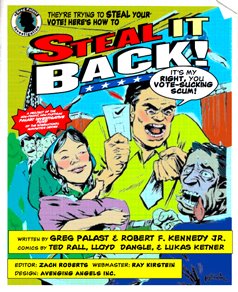
Robert F. Kennedy Jr. and Greg Palast have teamed up to tell voters how to ensure their votes will be counted. (Artwork: www.stealbackyourvote.org).

Greg Palast and Robert F. Kennedy Jr.: “Steal Back Your Vote!”
By Sari Gelzer / October 14, 2008

Greg Palast and Robert F. Kennedy Jr. believe that the 2008 elections have already been stolen. What’s an American to do given these circumstances? They suggest: “Steal it back“.

Palast, an investigative journalist, and Kennedy, a voting rights attorney, paired up to create a nonpartisan voter guide that illustrates the six ways that American votes will be stolen this election and seven ways to steal them back.

You may ask who’s stealing your votes. Palast and Kennedy believe that the Help America Vote Act (HAVA), created in 2002, is one of the main reasons votes are systematically being stolen. Secretaries of state attempting to comply with HAVA are purging voters from the registration rolls and blocking new ones from registering. The purging occurs if a voter’s name does not match a government database.

Those who are at most risk for having their vote stolen are new voters, people of color, low-income, elderly and swing state voters, Palast told Truthout.

In 2006, Palast says that 40 percent of citizens who were purged from the voter rolls in California had Islamic, Vietnamese, Chinese and Hispanic names. These names were at most risk for misspellings.

The Steal Back Your Vote Guidelines promote the importance of going to the secretary of state Web site for your state to confirm that you are registered ahead of the election.

The New York Times appeared to confirm Palast and Kennedy’s findings on mass voter purges in its report last week titled “States’ Actions to Block Voters Appear Illegal“. The newspaper found that tens of thousands of eligible voters were being illegally purged ahead of the 2008 elections.

In the crucial swing states of Indiana, Nevada, North Carolina and Ohio, The New York Times reported that Social Security databases are being used to verify voters, as opposed to more accurate state databases. Federal law requires Social Security databases to be used for verification only as a last resort.

The swing states of Michigan and Colorado are also violating federal law, according to The New York Times, because they are removing voters from the registration rolls within 90 days of the presidential election.

When a name has been purged from the voter rolls, election workers will hand out a provisional ballot. However, Palast points to 1.1 million provisional ballots that went uncounted in the 2004 elections as proof that provisional ballots often go uncounted.

“Once you sign that provisional ballot, the chances are officially one in three that your ballot will be thrown in the garbage can,” said Palast.

In their guide, Palast and Kennedy write that a provisional ballot will most often render a vote uncounted. They suggest seeking adjudication on the spot, by calling a voter’s rights hotline instead of accepting and signing the provisional ballot.

“Don’t go postal,” says Palast, urging voters not to mail in their ballot.

Palast told Truthout: “All you need is the most minor error, like you didn’t use your middle initial in your registration; not enough postage cost a third of a million votes in the US the last time around because most ballots are two stamps, not one. There’s a million ways to not count your vote on a mail-in; don’t do it.”

The other suggestions in the “Steal Back Your Vote” guide include voting early, getting involved in voter-registration and get-out-the-vote organizations, and pursuing legal action if disenfranchised.

Palast and Kennedy will be following the 2008 elections as they unfold, including publishing reports in Rolling Stone and BBC news.

Source / Truthout

The Rag Blog

Posted in RagBlog | Tagged , | 2 Comments

Why Is Diplomacy Now Called Treason in the US?

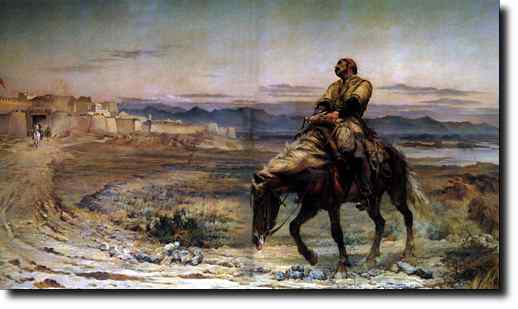
“Remnants of an Army,” Elizabeth Butler

The reality of war in Afghanistan
By Stephen Kinzer / October 15, 2008

DESPITE their differences over how to pursue the US war in Iraq, Senators John McCain and Barack Obama both want to send more American troops to Afghanistan. Both are wrong. History cries out to them, but they are not listening.

Both candidates would do well to gaze for a moment on a painting by the British artist Elizabeth Butler called “Remnants of an Army.” It depicts the lone survivor of a 15,000-strong British column that sought to march through 150 kilometers of hostile Afghan territory in 1842. His gaunt, defeated figure is a timeless reminder of what happens to foreign armies that try to subdue Afghanistan.

The McCain-Obama approach to Afghanistan, like much of US policy toward the Middle East and Central Asia, is based on emotion rather than realism. Emotion leads many Americans to want to punish perpetrators of the Sept. 11, 2001 attacks. They see war against the Taliban as a way to do it. Suggesting that victory over the Taliban is impossible, and that the United States can only hope for peace in Afghanistan through compromise with Taliban leaders, has been taken as near-treason.

This knee-jerk response ignores the pattern of fluid loyalties that has been part of Afghan tribal life for centuries. Alliances shift as interests change. Warlords who support the Taliban are not necessarily enemies of the United States. If they are today, they need not be tomorrow.

In recent weeks, this elemental truth has begun to reshape debate over Western policy toward Afghanistan. Warlords on both sides met quietly in Saudi Arabia. The Afghan defense minister called for a “political settlement with the Taliban.” Secretary of Defense Robert Gates would not go that far, but said he might ultimately be open to “reconciliation as part of the political outcome.”

Gates, however, struck a delusionary note of “can-do” cheeriness by repeating the McCain-Obama mantra: More US troops can pacify Afghanistan. Speaking days after a National Intelligence Estimate concluded that the United States was caught in a “downward spiral” there, Gates asserted that there is “no reason to be defeatist or underestimate the opportunity to be successful in the long run.”

In fact, long-run success in Afghanistan – defined as an acceptable level of violence and assurance that Afghan territory will not be used for attacks against other countries – will only be possible with fewer foreign troops on the ground, not more.

A relentless series of US attacks in Afghanistan has produced “collateral damage” in the form of hundreds of civilian deaths, which alienate the very Afghans the West needs. As long as the campaign continues, recruits will pour into Taliban ranks. It is no accident that the Taliban has mushroomed since the current bombing campaign began. It allows the Taliban to claim the mantle of resistance to a foreign occupier. In Afghanistan, there is none more sacred.

The US war in Afghanistan also serves as a recruiting tool for Al Qaeda. It is attracting a new stream of foreign fighters into the region. A few years ago, these jihadists went to Iraq to fight the Great Satan. Now they see the United States escalating its war in Afghanistan and neighboring regions of Pakistan, and are flocking there instead.

Even if the United States de-escalates its war in Afghanistan, the country will not be stable as long as the poppy trade provides huge sums of money for violent militants. Eradicating poppies is like eradicating the Taliban: a great idea but not achievable. Instead of waging endless spray-and-burn campaigns that alienate ordinary Afghans, the United States should allow planting to proceed unmolested, and then buy the entire crop. Some could be turned into morphine for medical use, and the rest destroyed. The Afghan poppy crop is worth an estimated $4 billion per year. That sum would be better spent putting cash into the pockets of Afghan peasants than firing missiles into their villages.

Deploying more US troops in Afghanistan will intensify this highly dangerous conflict, not calm it. Compromise with Al Qaeda would be both unimaginable and morally repugnant, but the Taliban is a different force. Skillful negotiation among clan leaders, based on a genuine willingness to compromise, holds the best hope for Afghanistan. It is an approach based on reality, not emotion.

Stephen Kinzer is author of “A Thousand Hills: Rwanda’s Rebirth and the Man Who Dreamed It.”

© Copyright 2008 Globe Newspaper Company.

Source / Boston Globe

The Rag Blog

Posted in RagBlog | Tagged , , | Leave a comment

The Mob : Did John McCain Play Piano in a Bordello?


‘Perhaps McCain was untainted by the mob and corruption, but one wonders if he could have been that successful had he not somehow made his peace with that situation.’
By Sherman De Brosse
/ The Rag Blog / October 15, 2008

This is the second in a series by Rag Blog contributor Sherman De Brosse on John McCain and his shady involvements, past and present.

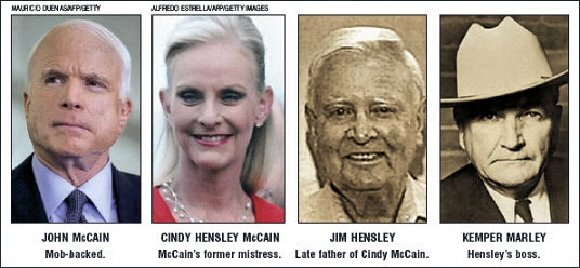
John McCain retired from the Navy in 1981 and moved to Phoenix with Cindy, his second bride. He quickly threw himself into politics, and was twice elected to the United States House of Representatives before the voters sent him to the Senate in 1986. Before 1981, he had no prior involvement with the state. No doubt, his celebrity status as a war hero had a great deal to do with his political success. The solid backing Duke Tully, publisher of The Arizona Republic, and a lot of special interest money also account for his extraordinary success. The Phoenix 40 was the closest thing to a political machine in Arizona, and this machine got behind John McCain.

Duke Tully claimed he was a fighter pilot like Mc Cain. Eventually it came out that the man had never been in the military. Old Arizona hands say McCain must have had that figured out, but said nothing.

Arizona politics then was shot through with corruption and mob influence. Perhaps McCain was untainted by the mob and corruption, but one wonders if he could have been that successful had he not somehow made his peace with that situation. It might be a bit like the fellow who played the piano in the bordello but had no idea what went on up-stairs.

The big fish in the Arizona pond was Kemper Marley (d.1990), a billionaire liquor magnate and rancher. He was the protégé of Sam Bronfman, a close friend of Al Capone and Meyer Lansky, who visited Arizona in his company. He was also very close to Gus Greenbaum, a Lansky aide and Phoenix gambler.

Gene Hensley, McCain’s father-in-law, became Marley’s chief henchman.

Greenbaum and his wife were slain in 1948, setting off a mob war that Marley won. Marley became the state’s only billionaire. In 1948, Marley escaped prison while 52 of his prisoners went were incarcerated including henchman James Willis Hensley, who would become John McCain’s father-in-law. Marley’s attorney was William Rehnquist. Hensley was general manager of Marley’s United Liquor. Hensley’s brother, Eugene, was a bootlegger and was also convicted. They both served very short sentences. The court said Hensley must never get into the liquor business again, but when he got out he received a big Budweiser distributorship. Hensley also made money in dog racing, but sold his track to the Jacobs family of Buffalo. They were also linked to the Bronfman booze empire of Canada and the Lansky interests.

Marley headed the Valley National Bank, which lent Meyer Lansky’s man, Bugsy Siegal, the money to build the Flamingo casino . Siegel was killed for stealing from his bosses, and his nationwide gambling wire was turned over to Marley.

Marley (d. 1990) was very generous with the Republican party and also controlled the Arizona Democrats. Many in major office there owed their jobs to him. Marley’s men included Dennis De Concini, a Democrat, and John McCain. Captain John McCain, married to Hensley’s beauty queen daughter Cindy Lou since May, in 1980, became a rising star in Arizona politics, and Marley did nothing to block him Mc Cain worked for his father-in-law. John Mc Cain said Cindy’s father was a “role model.” He soon went into politics.

Kemper Marley Sr. Is Dead at 83; Name Arose in ’76 Slaying Inquiry / New York Times / June 28, 1990

THE 2000 CAMPAIGN: THE ARIZONA TIES; A Beer Baron and a Powerful Publisher Put McCain on a Political Path /

Source / David Icke Articles

For McCains, a Public Path but Private Wealth / by David M. Halbfinger / New York Times / August 23, 2008

John McCain Calls Convicted Felon with Ties to the Mob a “Role Model” / Wikio News / August 25, 2008

The murder of an investigative reporter in Phoenix set off an important investigation of the influence of the mob in Phoenix.

Arizona Republic investigative reporter Don Bolles was killed in a 1976 car bombing. He had investigated crooked land deals that were tied to many of the rich and powerful and had also looked into Marley’s service on state commissions. This led to a 36 member team of investigative reporters coming to Arizona. It produced The Arizona Project: How a Team of Investigative Reporters Got Revenge on Deadline. They believed but could not prove that the Marley gang was behind the murder of Bolles. But they produced a great deal of information on the mob in Arizona.

Astonishingly Bolles lived for eleven days after the explosion and said: “They finally got me. The Mafia. Emprise. Find John (Harvey) Adamson.” There was no effort to find out who hired the man who gave Adamson the contract. Anderson, who was convicted of the car bombing, said the Marley gang also wanted Attorney General Bruce Babbitt killed because he wanted anti-trust action against them.

John McCain married mob heiress Cindy Hensley. From the time of his arrival in Phoenix in 1979, the Hensley family sponsored his political career. He received a $50,000 a year salary in 1982 to tour the state as a PR man for the family Budweiser distributorship, but of course he was beginning a Congressional campaign. Anheuser-Bush lobbyist Richard Scheffel said that Hensley used McCain as a channel to move money to politicians.

Ayers? Let’s look at the Marley-Hensley murder of Don Bolles / Political Inquirer / Sept. 23, 2008

John McCain, Married to the Mob / US Message Board / Feb. 21, 2008

John McCain: Married to the Mob / by Bob Fertig / Democrats.com / Feb. 26, 2008

McCain Top Aide Linked To Suspected Russian Mob-King, Arranged Meeting With Senator / Jeffrey H. Birnbaum and John Solomon / The Huffington Post / Jan. 25, 2008

McCain does not seem to have done anything for the mob, but he must know it was their money that fueled his career. He refrains from voting on liquor issues, but liquor interests remain near the top of the list of McCain contributors. But as chairman of the Commerce Committee he knew how to scuttle proposals detrimental to the liquor industry by declining to hold hearings. Among them were measures dealing with recyclable bottles, advertising, and safety.

In 1995, Senator McCain sent “Happy Birthday” wishes to Joseph Bonanno, the head of the New York Bonanno mob who had retired in Arizona. Five members of the Bonanno family have made large contributions to the McCain presidential campaign. In 2005, Rick Davis arranged for McCain to meet Oleg Deripaska, Russian mob figure and aluminum magnate, in Switzerland. It should be noted that earlier McCain did only a little damage to the Russian mob by exposing some of Jack Abramoff’s mistreatment of Indians running casinos.(There was some Russian mob money in some Abramoff connected casinos.) He did not dig very deep. McCain celebrated his 70th birthday aboard a yacht with convicted felon Raffaello Follieri, along with his girlfriend actress Ann Hathaway . Follieri posed as someone with close Vatican ties to bilk people of their money. McCain is also close to Rep. Rick Renzi, who has been indicted for wire fraud, extortion, and money laundering.

The bottom line is that there is a great deal we need to know about John Mc Cain before we send him to the White House.

John McCain: Married to the Mob / by Bob Fertig / Democrats.com / Feb. 26, 2008

McCain Top Aide Linked To Suspected Russian Mob-King, Arranged Meeting With Senator / Jeffrey H. Birnbaum and John Solomon / The Huffington Post / Jan. 25, 2008

Haunted by Spirits / by John Dougherty, Amy Silverman / Phoenix New Times / Feb. 17, 2008

[Sherman De Brosse, the pseudonym for a retired history professor, is a contributor to The Rag Blog and also blogs at Sherm Says and on DailyKos.]

The Rag Blog

Posted in Rag Bloggers | Tagged , , , , , | 2 Comments

Planned Parenthood Is the Winner: Thanks, Sarah!


Parental discretionary donors
By Shuchi Saraswat / October 9, 2008

How Sarah Palin generated over $1 million in donations to Planned Parenthood

Polarizin’ Palin has people everywhere opening their pocketbooks to the pro-choice movement’s benefit. A viral e-mail, of unknown origin, urged people who disliked the Alaska governor’s under-no-circumstance view on abortion to donate to Planned Parenthood, in her honor. The e-mail has been circulating for more than a month and, as of October 6, has generated 38,000 donations — at least two-thirds of them from first-time givers — to the international organization, totaling more than $1 million.

The latest high-profile boost to the “In Honor of Palin” campaign comes from singer/songwriter Gretchen Peters, who was outraged when Palin was brought on stage at a rally after Thursday’s vice-presidential debate to the strains of Martina McBride’s 1994 recording of Peters’s “Independence Day,” whose lyric centers on a victim of domestic abuse. On her Web site, gretchenpeters.com, Peters pledges to donate future “Independence Day” royalties to Planned Parenthood, on behalf of, you guessed it, the GOP veep nominee, whom Peters refers to as “a candidate who would set women’s rights back decades.”

This will be a hard one for the McCain campaign to ignore. Planned Parenthood offers to acknowledge generosity by mailing a card to the person in whose name the donation is made. The cards noting the Palin donations will be mailed to “McCain for President” headquarters, as per donors’ requests, starting this week.

Thanks to Mariann Wizard / Read all of it here. / Boston Phoenix

The Rag Blog

Posted in RagBlog | Tagged , , | 2 Comments

Remember, the Money Was There All Along


The God That Failed: The 30-Year Lie of the Market Cult
By Chris Floyd / October 11, 2008

Perhaps the most striking fact revealed by the global financial crash — or rather, by the reaction to it — is the staggering, astonishing, gargantuan amount of money that the governments of the world have at their command.

In just a matter of days, we have seen literally trillions of dollars offered to the financial services sector by national treasuries and central banks across the globe. Britain alone has put $1 trillion at the disposal of the bankers, traders, lenders and speculators; and this has been surpassed by the total package of public money that Washington is shoveling into the financial furnaces of Wall Street and the banks. These radical efforts are being replicated on a slightly smaller scale in France, Germany, Italy, Russia and many other countries.

The effectiveness of this unprecedented transfer of wealth from ordinary citizens to the top tiers of the business world remains to be seen. It will certainly insulate the very rich from the consequences of their own greed and folly and fraud; but it is not at all clear how much these measures will shield the vast majority of people from the catastrophe that has been visited upon them by the elite.

But putting aside for a moment the actual intent, details and results of the global bailout offers, it is their very extent that shocks, and shows — in a stark, harsh, all-revealing light — the brutal disdain with which the national governments of the world’s “leading democracies” have treated their own citizens for decades.

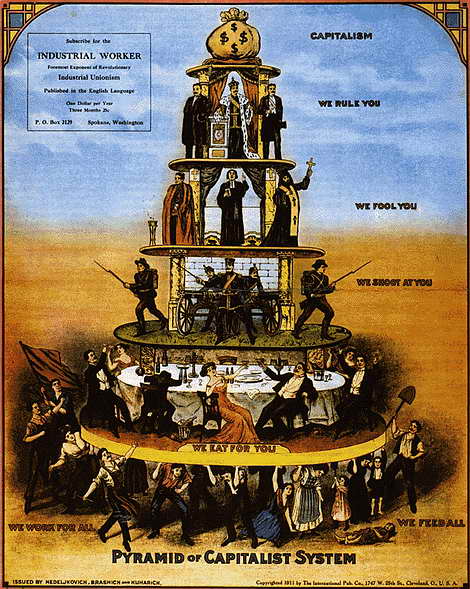
Beginning with Margaret Thatcher’s election in 1979, government after government — and party after party — fell to the onslaught of an extremist faith: the narrow, blinkered fundamentalism of the “Chicago School.” Epitomized by its patron saint, Milton Friedman, the rigid doctrine held that an unregulated market would always “correct” itself, because its workings are based on entirely rational and quantifiable principles. This was of course an absurdly reductive and savagely ignorant view of history, money and human nature; but because it flattered the rich and powerful, offering an “intellectual” justification for rapacious greed and ever-widening economic and social inequality, it was adopted as holy writ by the elite and promulgated as public policy.

This radical cult — a kind of Bolshevism from above — took its strongest hold in the United States and Britain, and was then imposed on many weaker nations through the IMF-led “Washington Consensus” (more aptly named by Naomi Klein as the “Shock Doctrine”), with devastating and deadly results. (As in Yeltsin’s Russia, for example, where life expectancy dropped precipitously and millions of people died premature deaths from poverty, illness, and despair.)

According to the cult, not only were markets to be freed from the constraints placed on them after the world-shattering effects of the Great Depression, but all public spending was to be slashed ruthlessly to the bone. (Although exceptions were always made for the Pentagon war machine.) After all, every dollar spent by a public entity on public services and amenities was a dollar taken away from the private wheeler-dealers who could more usefully employ it in increasing the wealth of the elite — who would then allow some of their vast profits to “trickle down” to the lower orders.

This was the cult that captured the governments of the United States and Britain (among others), as well as the Republican and Democratic parties, and the Conservative and Labour parties as well. And for almost thirty years, its ruthless doctrines have been put into practice. Regulation and oversight of financial markets were systematically stripped away or rendered toothless. Essential public services were sold off, for chump change, to corporate interests. Public spending on anything other than making war, threatening war and profiting from war was pared back or eliminated. Such public spending that did remain was forever under threat and derided, like the remnants of some pagan faith surviving in isolated backwaters.

Year after year, the ordinary citizens were told by their governments: we have no money to spend on your needs, on your communities, on your infrastructure, on your health, on your children, on your environment, on your quality of life. We can’t do those kinds of things any more.

Of course, when talking amongst themselves, or with the believers in the think tanks, boardrooms — and editorial offices — the cultists would speak more plainly: we don’t do those things anymore because we shouldn’t do them, we don’t want to do them, they are wrong, they are evil, they are outside the faith. But for the hoi polloi, the line was usually something like this: Budgets are tight, we must balance them (for a “balanced budget” is a core doctrine of the cult), we just can’t afford all these luxuries, sorry about that.

But now, as the emptiness and falsity of the Chicago cargo cult stands nakedly revealed, even to some of its most faithful and fanatical adherents, we can see that this 30-year mantra by our governments has been a deliberate and outright lie. The money was there — billions and billions and billions of dollars of it, trillions of dollars of it. We can see it before our very eyes today — being whisked away from our public treasuries and showered upon the banks and the brokerages.

Let’s say it again: The money was there all along.

Money to build and generously equip thousands and thousands of new schools, with well-paid, exquisitely trained teachers, small teacher-pupil ratios, a full range of enriching and inspiring programs.

Money to revitalize the nation’s crumbling inner cities, making them safe and vibrant places for businesses and families and communities to grow.

Money to provide decent, affordable and accessible health care to every citizen, to provide dignity and comfort to the elderly, and protection and humane treatment for the mentally ill.

Money to provide affordable higher education to everyone who wanted it and could qualify for it. Money to help establish and sustain local businesses and family farms, centered in and on the local community, driven by the needs and knowledge of the people in the area, and not by the dictates of distant corporations.

Money to strengthen crumbling infrastructure, to repair bridges, shore up levies, maintain roads and electric grids and sewage systems.

Money for affordable, workable public transport systems, for the pursuit of alternative sources of energy, for sustainable, sensible development, for environmental restoration.

Money to support free inquiry in science, technology, health and other areas — research unfettered from the war machine and the drive for corporate profit, and instead devoted to the betterment of human life.

Money to support culture, learning, continuing education, libraries, theater, music and the endless manifestations of the human quest to gain more meaning, more understanding, more enlightenment, a deeper, spiritually richer life.

The money for all of this — and much, much more — was there, all along. When they said we couldn’t have these things, they were lying — or else allowing themselves to be profitably duped by the high priests of the market cult. When they wanted a trillion dollars — or three trillion dollars — to wage a war of aggression in Iraq, they found it. Now, when they want trillions of dollars to save the speculators, fraudsters and profiteers of greed in the global market, they suddenly have it.

Who then can believe that these governments could not have found the money for good schools, health care, and all the rest, that they could not have enhanced the well-being and livelihood of millions of ordinary citizens, and helped create a more just and equitable and stable world — if they had wanted to?

This is one of the main facts that ordinary citizens around the world should take away from this crisis: the money to maintain, secure and improve the lives of their families and communities was always there — but their governments, and their political parties, made a deliberate, unforced choice not to use it for the common good. Instead, they subjugated the well-being of the world to the dictates of an extremist cult. A cult of greed and privilege, that preached iron discipline to the poor and the middle-class, but released the rich and powerful from all restrictions, and all responsibility for their actions.

This should be a constant — and galvanizing — thought in the minds of the public in the months and years to come. Remember what you could have had, and how it was denied you by the lies and delusions of a powerful elite and their bought-off factotums in government. Remember the trillions of dollars that suddenly appeared when the wheeler-dealers needed money to cover their own greed and stupidity.

Let these thoughts guide you as you weigh the promises and actions of politicians and candidates, and as you assess the “expert analysis” on economic and domestic policy offered by the corporate media and the corporate-bankrolled think tanks and academics.

And above all, let these thoughts be foremost in your mind when you hear — as you certainly will hear, when (and if) the markets are finally stabilized (at whatever gigantic cost in human suffering) — the adherents of the market cult emerge once more and call for “deregulation” and “untying the hands of business” and all the other ritual incantations of their false and savage fundamentalist faith.

For although the market cult has suffered a cataclysmic defeat in the last few weeks, it is by no means dead. It has 30 years of entrenchment in power to fall back on. And the leader of every major political party in the West has spent their entire political career within the cult’s confines. It has been the atmosphere they breathed, it has been the sole ladder by which they have climbed to prominence. They will be loath to abandon it, once the immediate crisis is past; most will not be able to.

So remember well the lessons of this new October crash: The money to make a better life, to serve the common good, has always been there. But it has been kept from you by deceit, by dogma, by greed, and by the ambition of those who have sold their souls, and betrayed their brothers and sisters, their fellow human creatures, for the sake of privilege and power.

Thanks to Erich Seifert / Source / Empire Burlesque

The Rag Blog

Posted in RagBlog | Tagged , , , | 2 Comments

Galveston Homeless : Where Will They Go?

Galveston: clean-up continues; many still homeless.

Post-Ike tent city for homeless to close with no back-up plan.
By Sue Sturgis / October 14, 2008

Before Hurricane Ike devastated Galveston Island on the Texas coast, about 60 homeless people spent their nights at the local Salvation Army building. But that building was extensively damaged in the storm and won’t reopen for at least two months — and the people who depended on it may soon have no place to go.

The shelter’s clients are currently living in a Red Cross tent city set up behind a local elementary school, the Galveston Daily News reports. But the tent city is scheduled to close on Oct. 26.

Major Elda Flores, director of the Salvation Army shelter, says she has heard the authorities want to pressure her to reopen soon. But she says that’s impossible because the building has been gutted. The electrical systems have to be replaced, and the flood-damaged first floor will have to be almost completely rebuilt.

At a city news conference held yesterday, it became clear that officials have no idea what will become of Galveston’s homeless when the tent city closes.

This is the latest housing problem to afflict the island’s poor residents since Ike struck a month ago. We recently reported that Galveston’s public housing residents were ordered to leave their homes but were given no answers about where they were supposed to go. Some presumably ended up in the soon-to-be-closed Salvation Army encampment.

The Federal Emergency Management Agency has announced it will launch a program providing rental assistance to families displaced by Ike, but that isn’t set to start until November — a week after the Red Cross tent city is scheduled to close.

Source / Facing South

Also see Ike Aftermath : Residents of Galveston Public Housing Given Heave-Ho / The Rag Blog / Oct. 1, 2008

The Rag Blog

Posted in RagBlog | Tagged , , , | Leave a comment

How Will the Crash of 2008 Impact the Elderly?


Health care, the nursing home, the retirement home, and, heaven help us, John McCain.
By Dr. S. R. Keister / The Rag Blog / October 15, 2008

One of the most frightening aftereffects of the crash of 2008 will be the impact on the elderly, a subject, by-in-large, as yet unaddressed. More frightening still is the fact that in my talking to the elderly regarding the upcoming election is the fact that the response that I hear most frequently is, “I will vote for Senator McCain, he is old enough to appreciate the problems of the elderly.” The disconnect and absence of information is frightening to say the least, in view of the fact that little time remains until election day.

I am myself 87 years old, practiced medicine for 40 years and after retirement worked part time at the V.A. and at St. Paul’s Free Clinic. While at the former, before the Bush administration started their budgetary cuts, I was impressed by the excellence of medical care provided by this single example of ‘socialized medicine’ in the United States. When I first approached the free clinic I anticipated so. These were good, solid, decent people in low paying jobs and unable to afford health insurance. An excellent example of our broken system of medical care in the United States.

Over the past 30 years I have noted the increasing tendency of the commercial interests in the nation to feed off of the elderly, knowing of course that many of these folks were ill informed or even worse misinformed. The advent of Social Security, Medicare, and pensions, whether employer provided, or IRA, gave the leeches a chance to attached to the bloodstream of the income of the elderly. Let us look at some of the examples….

The Nursing Home. These have proliferated like mad since approximately 1980. A recent U.S. Government report indicates that some 90% of these facilities show various deficiencies. There are two groups of nursing homes available. (1) Those sponsored by religious organizations, hereabouts Catholic, Presbyterian, Episcopalian, all of which were founded with good intentions in mind and providing first rate care. (2) The commercial establishments, many of which are large chains, established of course as business enterprises. As we all know a business is intended to make a profit for its management and stockholders. The costs for both groups are approximately $3000-$4000/month; however, objective surveys show that by-in-large better care is provided in the church sponsored homes. Quality control is largely a state matter, and of course is influenced in many instances by the relationship of the commercial management to state government. Did I say baksheesh?

Another booming industry in the past 20-25 years is The Retirement Home. These are of multiple origins. Some are unashamedly related to hotel chains and others masquerade as quasi-church related organizations, but are indeed independent ‘non-profit enterprises’. Finally, there are the bona-fide, openly, church related homes.

A word about “non-profits”. Talk to the average individual in a “non-profit” home and he/she has the idea that this is in some way related to a charitable organization, and is absolutely dumbfounded when informed that most ‘non-profits’ are tax exempt businesses that have a well-paid group of businessmen in control, and vary from a commercial business only in not having stock holders. A common ploy to entice residence is an offer to sell them an apartment, for say $120,000, refundable to the estate fully or in part, upon death of the tenant. Of course, and many folks are not aware of this, that under normal stock market conditions, that the individual loses, say, 6% interest on the money while the retirement home takes that interest as their own. (One wonders with the stock market crash how these deposits survived.) In addition the tenant pays $3000-$4000 a month maintenance fee, which includes dinner daily whether it is partaken of or not. Of course there are other fees for changing light bulbs, filling pill boxes, giving insulin injections, etc. In various states there is no legal requirement for intercom systems, auxiliary generators, or emergency notification in the event of power failures, etc.

Many of the commercial “homes” and a few of the excellent church-related homes require the ‘purchase’ of the apartment, and in house, or on-ground, facilities vary; however, the cost is still in the $3000-$4000 per month range. All of these situations have exploded in number with the advent of Medicare, Social Security, and the aforementioned plans. This burgeoning industry in much greater in the United States than in Western Europe, granted it varies by country, and government implicated Social Services are much more extensive. One can almost relate the creation of these institutes to the advent of “neo-Liberal” economics introduced in this country during the Reagan administration.

For some time Medicade provided a modicum of help to poor nursing home patients but this has been abbreviated by the Bush administration. Concurrently the Bush administration tried to privatize Social Security, and the Congress, in its one of its few brave confrontations, refused to accept the program. The Bush administration has been making a conscious effort to privatize Medicare by establishing the “Medicare Advantage Plans” which deplete the Medicvare Trust Fund by approximately 17% per enrollee per year. The Medicare, Part D, fiasco, establishing a bizarre and costly prescription plan for the elderly, and which was really a pay-off of billions of dollars to the pharmaceutical and insurance industries by the Republicans with Medicare funds. One notes of late that the co-payments have been reduced and prescriptions covered lessened by the insurers as the price of drugs has increased..

Now we must factor in the current economic crises’ effect on the elderly, to continue to pay these folks who have been by hook or by crook sharing their retirement incomes. It would appear that Social Security and Medicare, for the short term, are intact, and hopefully can be saved by an enlightened administration in Washington, free of the economic nonsense inherent in our society since 1970. Those living largely off of IRAs or 401Ks are in a more questionable position. Further, the McCain economic plan, in spite of the disaster of the past several weeks, still includes privatizing Social Security, and reducing Medicare payments by over 1.2 trillion dollars over the next 10 years. What will happen to the thousands of residents if their individual or corporate retirement accounts disappear into thin air?

When I hear the elderly supporting McCain I am reminded of the Greek myth of Erysichthon. If the older American supports McCain he is bringing on his own destruction. Why should an elderly man a professional politician, who has been consumed by self interest all his life, and who is worth millions of dollars, acquired by questionable connections, be interested in the old gentleman in a nursing home? There is a frightening disconnect here.

The Rag Blog

Posted in Rag Bloggers | Tagged , , , , , , , , , | 3 Comments

Juan Cole: Abolish Puritanism in Government Policy


The Great Reagan Pyramid Scheme Comes Crashing Down
By Juan Cole / October 15, 2008

The Republican Party that Nixon invented melded the moneyed classes of the Northeast with the white evangelicals of the South. This odd couple went on to simultaneously steal from and oppress the rest of us. The moneyed classes were happy to let the New Puritans impose their stringent morality, since they could always just buy any licentiousness they wanted, regardless of the law. And the New Puritans were so consumed with cultural issues such as homosexuality, abortion, school prayer and (yes) fighting school desegregation that they were happy to let the northeastern Money Men waltz off with a lion’s share of the country’s resources, consigning most Americans to stagnant wages and increasing debt. The Reagan revolution consolidated this alliance and brought some conservative Catholic workers into it.

These domestic policies at home were complemented by wars and belligerence abroad, which further took the eye of the public off the epochal bank robbery being conducted by the American neo-Medicis, and which were a useful way of throwing billions in government tax revenue to the military-industrial complex, which in turn funded the think tanks and reelection campaigns of the right wing politicians. The Reagan fascination with private armies and funding anti-communist death squads contributed mightily to the creation of al-Qaeda, blowback from which fuelled even bigger Pentagon budgets, spiralling upward and feeding on itself. Terrorism is much better than Communism as a bogey man, since you can just intimate that there are a handful of dangerous people out there somewhere, and force the public to pay over $1 trillion to combat them. In fact, of course, less US interventionism abroad would create less blowback, and genuine threats are better addressed through good police work by multilingual FBI agents than by a $700 billion Pentagon budget.

As a result of the Second Gilded Age and its serf-like subservience to big capital, most corporations in the US don’t pay any income taxes, despite doing $2.5 trillion annually in business.

The Reagan Revolution included the stupid idea that you can cut taxes, starve government, abolish regulation of securities, banks, & etc., and still grow the economy. The irony is that capitalist markets need to be regulated to avoid periodically becoming chaotic (as in ‘chaos theory,’) but the people who most benefit from regulation are most zealous in attempting to abolish or blunt it.

What those policies did was create the preconditions for a long-term bubble or set of bubbles that benefited (for a while) the wealthiest 3 million Americans and harmed everyone else.

The average wage of the average worker is lower now than in 1973 and has been lower or flat for the past 35 years. That’s the condition of the 300 million or so Americans.

In the meantime, the top 1 percent has multiplied its wealth many times over and now takes home 20% of the national income, owning some 45 percent of the privately held wealth in the US.

The Right keeps promising us growth, but it turns out that “growth” is mainly for them, i.e. for the 3 million (and indeed mainly for about 100,000 within the 3 million).

Those 3 million are a new aristocracy, lords of the economy, who reward each other with tens of millions in bonuses for ceremonial reasons that have nothing to do with the jobs they actually perform. Bush has been trying to make them a hereditary aristocracy by getting rid of the estate tax.

That is why banks are refusing the government bailout if it restricts the salaries of the top officers — you don’t mess with the feudal lord’s prerogatives.

The enormous wealth of a thin sliver or people at the top of US society allows them to buy members of congress and to write the legislation that regulates their industries.

Congress capitulates to this ‘regulatory capture’ because its members have to buy hugely expensive television ads to remain competitive in elections. So they fundraise from the rich, and the rich have expectations (as Keating did of McCain).

These problems could be fixed with a graduated income tax and a closing of tax loopholes (after we get out of the recession or crash or whatever this is); by legislation criminalizing regulatory capture; by requiring mass media to run political ads for free as a public service (the public owns the airwaves); and by much shortening the election season (please).

A lot of America’s fiscal and educational problems were caused by congressionally mandated fixed sentences imposed on judges with regard to marijuana possession, as a sop to the New Puritans that make up 1/3 of the Republican Party. You have a lot of people serving 5 years in jail for having small amounts of pot. The states had to build new prisons to hold them all. They took the money out of the budget for higher education, abolishing the whole idea of state universities and causing tuitions to rise.

So you’ve got more ignorant people (because people can’t afford even “state” college), and fewer high-tech firms are founded; and you’re feeding and housing large numbers of harmless potheads with your tax dollars instead. The US maintains a vast gulag of nearly 2 million prisoners, putting us in the same league as Putin’s Russia. No country in Western Europe incarcerates a similar proportion of its population.

Mexico’s president wants to decriminalize the possession of small amounts of drugs such as marijuana, cocaine and heroin for personal use, though an arrest on possession charges would require entry into a program to kick addiction.

Decriminalizing possession of small amounts of drugs; decriminalizing marijuana altogether (and taxing the resulting industry); removing mandatory federal sentencing requirements; and letting states go back to educating their children instead of putting millions in jail; would solve another big batch of America’s problems.

So there you have it. Abolish puritanism in government policy; go back to using the government to regulate industries and finance and provide services; and fight terrorism with better public diplomacy and better police work instead of with militarization– and you might get out of this thing intact.

Source / Informed Comment

The Rag Blog

Posted in RagBlog | Tagged , , | Leave a comment

Dr. William H. Schubert : The Bill Ayers I Know

Bill Ayers

Those of us who care about education and what’s been done to it in the cruel, foolish, and profligate class war from above over the quarter-century that has been my entire adult life are likely to know Bill Ayers or his work as a scholar, teacher, activist, teacher educator, fixture in Illinois politics, and extraordinarily decent person.

Marc Bousquet / Santa Clara University

My friend and colleague, Bill Ayers
By William H. Schubert / October 13, 2008

William H. Schubert is Professor of Education and University Scholar at the University of Illinois at Chicago. Considering the way the McCain campaign has been using Bill Ayers and his alleged association with Barack Obama as a political football, The Rag Blog is pleased to present these words from a major scholar who has known and respected Ayers for years amd can speak with authority about his character and his accomplishments in the field of education.

Also see ‘My Friend Bill Ayers: Once wanted by the FBI, he’s since become a model citizen’ by Thomas Frank from the Oct. 15, 2008 Wall Street Journal, Below.

I feel compelled to comment on our friend and colleague, Bill Ayers, in view of the disappointing distortions and insinuations perpetrated against him. Here is the Bill Ayers I know.

I have known Bill Ayers as a colleague at the University of Illinois at Chicago (UIC) for over twenty years and know him as a good and just human being. I served on the search committee that selected him as the most outstanding applicant based on his scholarship, teaching capacity, and doctoral work at Columbia University.

I became Chair of Curriculum and Instruction at UIC (1990-94) shortly after Dr. Ayers was hired in 1987, and became Chair again (2003-2006) as he became a recognized scholar. Moreover, as a thirty–plus year member of the American Educational Research Association (AERA) and presidents of the Society of Professors of Education, the John Dewey Society, the Society for the Study of Curriculum History, and vice president for AERA’s Division B, I have had ample opportunities to observe the emergence of Dr. Ayers’ outstanding contributions to education. The fact that Dr. Ayers was elected this year as the vice president of AERA’s Division B is a testimony of such a stature and high esteem he holds in the field of education locally, regionally, nationally, and internationally.

Bill has written extensively about social justice, democracy, school contexts, and ethics regarding students, families, and educators. His has written more than 150 chapters and articles that have appeared in such journals as the Harvard Educational Review, the Journal of Teacher Education, Teachers College Record, Rethinking Schools, the Nation, Kappan, and the Cambridge Journal of Education. He has authored or edited sixteen books. His research and innovation based on it has been supported by the MacArthur Foundation, the Joyce Foundation, the Chicago Community Trust, the Annenberg Foundation, Readers Digest, and the Chicago Public Schools.

In many of his scholarly writings, Dr. Ayers has called attention to the role of teachers to demonstrate greater social responsibility in meeting the needs of children. In 1989, he wrote The Good Preschool Teacher, research on six exemplary, though quite different, preschool teachers. He also joined an on-going project that I had developed with graduate students, called the Teacher Lore Project, an endeavor that recognized and interpreted what teachers know from experience, and we mentored several dissertations that strove to understand the meanings of teaching for teachers, culminating in the publication of the book, Teacher Lore (1992, 1999). Over twenty-five dissertations have grown from this project and its offshoot, student lore, an attempt to understand the meanings students glean from their experiences. Several books have been published, based on these dissertations, to enhance perspectives of prospective and practicing teachers.

Social justice in lives of teachers and students was the major theme of another book by Dr. Ayers, To Teach: The Journey of a Teacher (1993, 2001 revised) which was one of Teachers College Press’s best selling books; it was named Book of the Year in 1993 by Kappa Delta Pi, and won the Witten Award for Distinguished Work in Biography and Autobiography in 1995. Dr. Ayers also edited the following noteworthy volumes: To Become a Teacher: Making a Difference in Children’s Lives (1995), a compendium of perspectives on teacher education and dilemmas in teachers’ early career experiences, and City Kids/City Teachers (1996, and recently revised and expanded in 2008), wherein the plight of oppression in our urban areas is portrayed along with imaginative ways to address such circumstances through education.

Bill served as Assistant Deputy Mayor for Education in Chicago in 1990, supported by UIC. Later he applied his concern for social justice in teachers’ lives by founding the Small Schools Workshop (SSW), to provide opportunities through UIC for teachers and students in some of Chicago’s most disadvantaged schools to create small, personal communities and more relevant curriculum and teaching, thus transforming large, impersonal schools with support from many corporate foundations. Over the years the SSW has created approximately 100 secondary and elementary schools, a venture that increased academic performance, attendance, graduation rates, and decreased violence in Chicago schools. Interest from many school systems throughout the U.S. has expanded the positive impact of the Small Schools Workshop as depicted in A Simple Justice: The Challenge of Small Schools (2000), a volume for which Ayers was senior editor. Dr. Ayers was named “Citizen of the Year” for this work by Business and Professional People in the Public Interest in 1994, an award presented by Chicago’s Mayor Richard Daley.

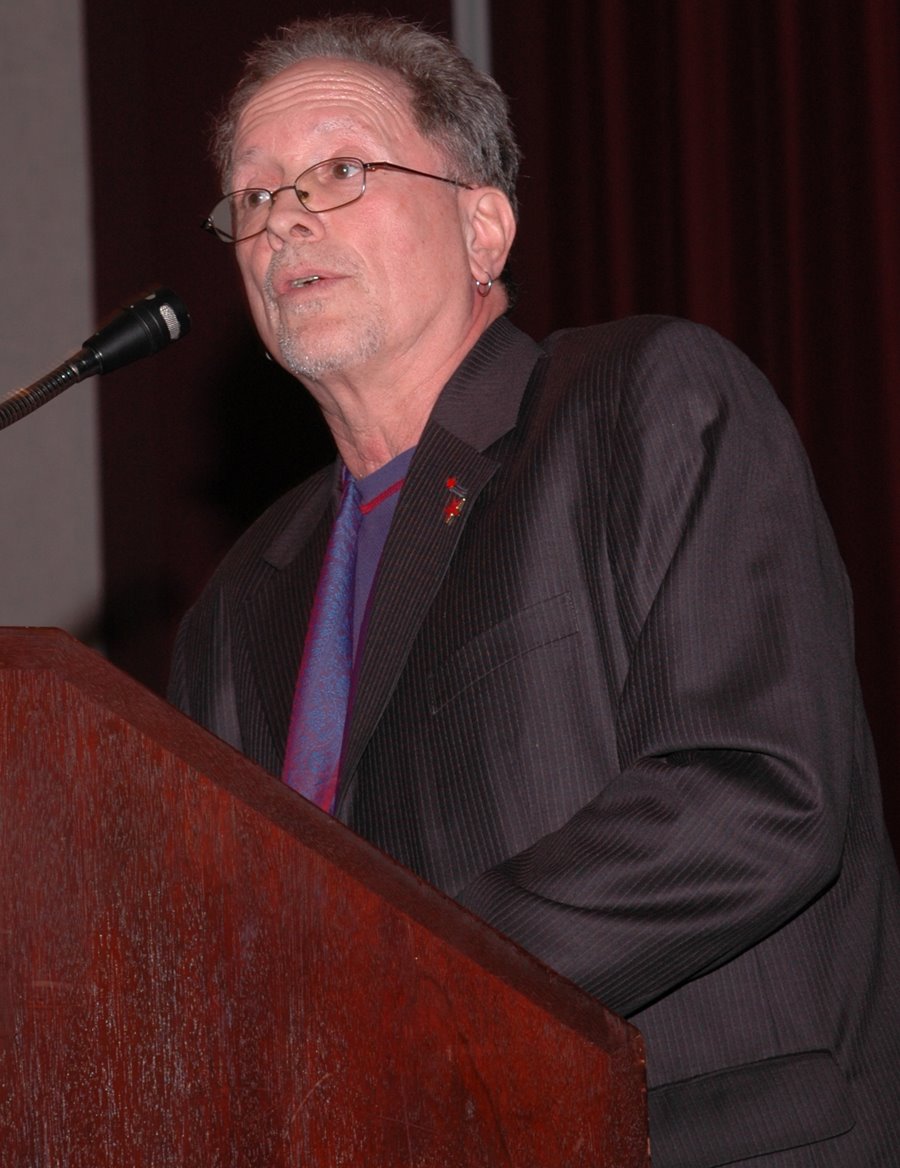
Bill Ayers, speaking at the University of South Carolina in 2006.

Dr. Ayers and I teamed in the late 1980s and early 1990s to create an alternative teacher education program at UIC wherein students learned theory and research through intensive experience in Chicago schools. This was a precursor to the GATE (Golden Apple Teacher Education) project developed by Dr. Ayers from 1999-2004, an alternative certification program that immersed students in urban school reform in their teacher preparation — emphasizing understanding and action to overcome societal factors that contribute to oppressive teaching and learning conditions. His book entitled Teaching for Social Justice (1998) continues Dr. Ayers’ deep concern for urban educational renewal and the project of democracy. To these ends, Dr. Ayers orchestrated the Chicago Annenberg Challenge (as grant writer and co-founder), a project that brought $49.2 million in a two-to-one matching award for the Chicago Public Schools — a multi-foundational endeavor that yielded approximately $150 million for the Chicago Public Schools.

In the midst of all this work, Dr. Ayers continued his critique of the oppression of people of color by studying youth and teachers in Juvenile Jail and Juvenile Court of Chicago, drawing metaphorically on pioneer social worker Jane Addams’ adage when she founded that institution, saying it should provide a kind and just parent for children in crisis. His book by that title (subtitled The Children of Juvenile Court, 1997) is a narrative based on a year-long ethnography of youth who are incarcerated.

The book led to Dr. Ayers’ nomination by business and community leaders in Chicago to the board of the Woods Fund. Subsequently, he became chair of this Board and helped to restructure it as the largest Chicago contributor to community organizing, granting three million dollars per year to that cause with heavy emphasis on education reform. Addressing racism and incarceration from another angle, he critiqued punishment of children and youth in contrast to their habilitation in Zero Tolerance, a practical and thoughtful handbook for parents, students, educators, and all concerned citizens. Dr. Ayers also founded the Center for Youth and Society in 1999, which studied and assisted urban young persons of color as they face discrimination or oppression based on race, class, or gender in our culture with special emphasis on education. Dr. Ayers’ 2003 book, On the Side of the Child, argues for child advocacy on behalf of educators. He elaborated his concern for freedom, justice, and democracy in two books of illuminating essays published in 2004: Teaching the Personal and the Political and Teaching Toward Freedom. Moreover, Dr. Ayers has created opportunity for other scholars to publish their ideas by developing a successful book series with Teachers College Press: Teaching for Social Justice.

Because of his scholarly work on and insights about social justice, Dr. Ayers is often called upon to speak and advise educators. I estimate that he has averaged a keynote address per week for the past several years. He reviews manuscripts regularly for many scholarly and professional journals, serves on editorial boards, and advises boards of many prominent educational concerns. Amidst all of this work, Dr. Ayers tirelessly serves students and the public. He strives to present fairly a diverse range of perspectives on issues he discusses and never compels students or others to adhere to his convictions. In fact, he relishes seeing students and colleagues soar to heights that surprise him with novel ideas, and then he works assiduously to enhance their ideas and research for publication or leadership opportunities. He has chaired over 40 Ph.D. dissertations and has been a member of more than 50 other dissertation committees, most at UIC, though several at other universities throughout the U.S. and in other nations. He reads students’ writing carefully and takes time to help students, other young authors, and beginning faculty members make the kinds of contributions they want to make.

Bill writes extensively in the public domain as well as in scholarly outlets, e.g., a frequent writer for major newspapers, magazines, and Internet sites. He travels nationally and internationally (e.g., South Africa, China, Korea, England, Netherlands, Germany, Egypt, France, Hong Kong, Venezuela, Canada) to speak and advise. His home is like an intellectual salon wherein he prepares wonderful dinners and hosts a constant flow of intellectuals, artists, concerned citizens, and activists with whom he and Bernardine Dohrn (Bill’s spouse, colleague, and internationally known activist law professor at Northwestern) collaborate. His devotion to his children and family is exemplary.

Bill’s contributions have been clearly recognized at UIC where he has been designated the President’s Distinguished Speaker of the University of Illinois, Distinguished Professor of Education, and University Scholar in perpetuity (normally a three year award). Notably, too, he has been named Randolph Distinguished Visiting Professor at Vassar College, Distinguished Scholar at the McKissick Museum of Education at the University of South Carolina, Visiting Scholar at Lesley College, received an honorary Doctor of Humane Letters from Nazareth College in Rochester, and has presented invited lectures or colloquia at such places as the American Educational Research Association, American Association of Curriculum and Teaching, Harvard University, Coalition of Essential Schools, University of Washington, the Detroit Institute of Art, University of Ottawa, University of Illinois at Urbana-Champaign, University Libraries Colloquia at Michigan State University, University of Wisconsin, University of Hawaii, Institute for Democracy and Education, Rethinking Schools, University of Michigan, University of Chicago, Los Angeles Public Library, Oregon State Bar, Purdue University, American Psychological Association, AATCE, State Prison of New York, The Gates Foundation, Indiana University, Columbia University, Bank Street College, Georgia Southern University, Colgate University, National Academy of Education, I Have a Dream Foundation, University of North Carolina, Children’s Law Center of Minnesota, Rice University, New York University, Yale University, and many other colleges, universities, public events, private and public schools. All of this bespeaks Bill’s work as a public intellectual based on his scholarly efforts for democracy and social justice, as does his service on several boards of directors, notably a founding member of the board of the Public Square, formerly the Center for Public Intellectuals, and his numerous radio and television appearances.

All of the above is informed by Dr. Ayers’ central concern — an unfaltering and tireless struggle of victims of socio-economic, political, national, and racial oppression.

It has been a pleasure to share over the past twenty years his weaving of tapestries of personal and political experience, teaching, scholarship, and service that inspire educational reformers to challenge oppression and injustice. Ayers has argued that social justice work demands not merely “service to” but “solidarity with” the oppressed. This turn of phrase aptly expresses the efforts of Bill Ayers to contribute to human betterment informed by scholarly work.

Dr. Ayers lives his commitment of concern for others at the interpersonal level. As busy as he is in all of the above and more, Bill is somehow always there for friends or colleagues at important junctures of their lives – for marriages, births, graduations, deaths – and in times of need he is not just a quick visitor, he remains in helpful contact for as long as needed. I have benefited from this immensely amid both tragic and joyful events of my own life.

So, when he has been heard to say, “We didn’t do enough,” it is emblematic of his philosophy that all of us, including himself, can do more to work for liberty and justice for all – a value that is deeply human and part of the best of the American creed.

This is the Bill Ayers I know!

William H. Schubert
Professor of Education and University Scholar
University of Illinois at Chicago
Coordinator, Ph.D. Program in Curriculum
Coordinator, M.Ed. Program in Educational Studies

Source / Chronicle of Higher Education

photo of Bill Ayers and Bernardine Dohrn

Bill Ayers and Bernardine Dohrn.
Photo by Corbis.

My Friend Bill Ayers
Once wanted by the FBI, he’s since become a model citizen.
By Thomas Frank
/ October 15, 2008

“Waving the bloody shirt” was the phrase once used to describe the standard demagogic tactic of the late 19th century, when memories of the Civil War were still vivid and loyalists of both parties could be moved to “vote as they shot.” As the years passed and the memories faded, the shirt got gorier, the waving more frantic.

In 1896 the Democrats chose William Jennings Bryan as their leader, a man who was born in 1860 and had thus missed the Civil War, but who seemed to threaten the consensus politics of the time. In response, Republican campaign masterminds organized a speaking tour of the Midwest by a handful of surviving Union generals. The veterans advanced through the battleground states in a special train adorned with patriotic bunting, pictures of their candidate, William McKinley, and a sign declaring, “We are Opposed to Anarchy and Repudiation.”

The culture wars are the familiar demagogic tactic of our own time, building monstrous offenses out of the tiniest slights. The fading rancor that each grievance is meant to revive, of course, dates to the 1960s and the antiwar protests, urban riots and annoying youth culture that originally triggered our great turn to the right.

This year the Democrats chose Barack Obama as their leader, a man who was born in 1961 and who largely missed our cultural civil war. In response, Republican campaign masterminds have sought to plunge him back into it in the most desperate and grotesque manner yet.

For days on end, the Republican presidential campaign has put nearly all of its remaining political capital on emphasizing Mr. Obama’s time on various foundation boards with Bill Ayers, a former member of the Weathermen, which planted bombs and issued preposterous statements in the Vietnam era. Some on the right seem to believe Mr. Ayers is Mr. Obama’s puppet-master, while others are content merely to insist that the association proves Mr. Obama to be soft on terrorism. Maybe he’s soft on anarchy and repudiation, too.

I can personally attest to the idiocy of it all because I am a friend of Mr. Ayers. In fact, I met him in the same way Mr. Obama says he did: 10 years ago, Mr. Ayers was a guy in my neighborhood in Chicago who knew something about fundraising. I knew nothing about it, I needed to learn, and a friend referred me to Bill.

Bill’s got lots of friends, and that’s because he is today a dedicated servant of those less fortunate than himself; because he is unfailingly generous to people who ask for his help; and because he is kind and affable and even humble. Moral qualities which, by the way, were celebrated boisterously on day one of the GOP convention in September.

Mr. Ayers is a professor of education at the University of Illinois at Chicago (UIC), where his work is esteemed by colleagues of different political viewpoints. Herbert Walberg, an advocate of school vouchers who is a visiting fellow at the Hoover Institution, told me he remembers Mr. Ayers as “a responsible colleague, in the professional sense of the word.” Bill Schubert, who served as the chairman of UIC’s Department of Curriculum and Instruction for many years, thinks so highly of Mr. Ayers that, in response to the current allegations, he compiled a lengthy résumé of the man’s books, journal articles, guest lectures and keynote speeches. Mr. Ayers has been involved with countless foundation efforts and has received various awards. He volunteers for everything. He may once have been wanted by the FBI, but in the intervening years the man has become such a good citizen he ought to be an honorary Eagle Scout.

I do not defend the things Mr. Ayers did in his Weatherman days. Nor will I quibble with those who find Mr. Ayers wanting in contrition. His 2001 memoir is shot through with regret, but it lacks the abject style our culture prefers.

Instead I want to note that, in its haste to convict a man merely for associating with Mr. Ayers, the GOP is effectively proposing to make the upcoming election into the largest mass trial in history, with all those professors and all those do-gooders on the hook for someone else’s deeds four decades ago. Also in the dock: the demonic city (Chicago) that once named Mr. Ayers its “Citizen of the Year.” Fire up Hurricane Katrina and point it toward Lake Michigan!

The McCain campaign has made much of its leader’s honor and bravery, but now it has chosen to mount its greatest attack against a man who poses no conceivable threat to the country, who has nothing to do with this year’s issues, and who cannot or will not defend himself. Apparently this makes him an irresistible target.

There are a lot of things to call this tactic, but “country first” isn’t one of them. The nation wants its hope and confidence restored, and Republican leaders have chosen instead to wave the bloody shirt. This is their vilest hour.

Source / Wall Street Journal

Thanks to Carl Davidson and Thomas Good / The Rag Blog

Posted in RagBlog | Tagged , , , , , , , , , , | 3 Comments

Casey Porter : Stop-Lossed in Iraq

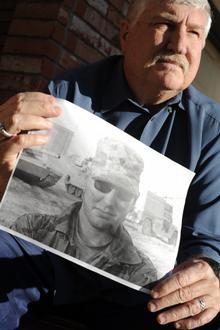
Eddy Porter holds a photo of his son, U.S. Army Spc. Casey Porter, who is returning for his second tour of duty in Iraq under the Department of Defense’s “Stop-Loss” program. Photo by Ronald W. Erdrich / Abiline Reporter-News.

Casey Porter : They’re selling us a bill of goods.
By Richard Whittaker / October 14, 2008

It’s always a good day at Newsdesk when Casey Porter calls, not least because it means that he’s still alive and in one piece. That’s not hyperbole, because Porter is currently in Iraq, one of the many US military personnel on the bad end of the bad deal known as stop-loss.

But in making the best of a bad day, Porter runs his own YouTube channel about his experiences in-country and what it’s really like on the ground.

The co-founder of Iraq Veterans Against The War’s Fort Hood ([near Kileen, Texas] branch called to give a heads-up about his latest video (which he’s still editing) about the remarkable world of commercial concessions on military bases. Troops coming back off combat missions are confronted by officially-sanctioned car dealers and jewelry firms that get them to part with their small salaries for pretty gewgaws.

“They don’t have any financial discipline and they’re not making good money, but it’s still better money than they’ve ever had,” said Porter, who once had a vendor try to sell him an $865 watch at a forward operating base. “We show the tricks and corruption in getting soldiers to spend their money.”

So why is this allowed to happen? Well, first off, the stores with the concessions are the same stores that supply the US military itself (“A mile away from open combat missions, there’s high-end stores,” said Porter. “If you walk into there, and you look at the video, you would think you were back in the states, except for the guys in miitary uniforms with guns.”) As for what the military gets, well, Porter put it bluntly: “A broke soldier is a re-enlisting soldier.”

Source / Austin Chronicle

Casey Porter and ‘Stop-Loss’

‘Critics of the policy have dubbed it a backdoor draft that forces service personnel into extending their service.’

By Celinda Emison

[The following article about Casey Porter of Austin — filmmaker and co-founder of Iraq Veterans Against the War at Fort Hood — and the army’s stop-loss program, first ran in the Abilene Reporter-News on March 22, 2008.]

U.S. Army Spc. Casey Porter is depressed and angry because he is on his way back to a war zone.

Porter, 28, of Austin, is embarking on his second tour of duty in Iraq and is one of tens of thousands of U.S. soldiers who have been ordered to continue their service in the Army due to a policy reinstated in 2001 after the Sept. 11 terrorist attacks called “Stop Loss.”

“I feel stabbed in the back,” Porter said in an e-mail message from Kuwait earlier this week.

Stop Loss is a program which allows the military to temporarily halt all voluntary separations and retirements during times of war, deployments or national emergencies. The Army has issued a Stop Loss in conjunction with wars in Iraq and Afghanistan.

“Stop-Loss” is also the name of a new fictional movie that opens Friday. But for Casey Porter and more than 81,000 other soldiers, the policy is all too real.

Porter signed up for a four-year stint in 2004, after which he planned to go to college. Porter’s stint was to end Jan. 21 of this year, but as the date approached, he started to worry.

“I thought Stop Loss would be coming, but didn’t get orders until two months before I was going to get out,” said Porter, who is now in Kuwait waiting to be sent back to Iraq within the week for another 15 months.

The Policy

Under the policy, soldiers who normally would leave when their commitments expire must remain in the Army, starting 90 days before their unit is scheduled to depart, through the end of their deployment and up to another 90 days after returning to their home base. The policy applies to all branches of the military, but currently is most used by the Army and National Guard.

“When a unit receives an alert order, we apply Stop Loss to that unit,” said Col. Bill Meehan of the Texas National Guard headquarters in Austin. “The No. 1 issue is whether the unit can do its mission. If you need 10 truck drivers for a mission, and you have 50, then there is some flexibility there. If it is the other way around, then there is obvious concern.”

Meehan said a number of units from the Texas National Guard are under Stop Loss orders. When a unit is under Stop Loss orders, there is an appeals process, he said.

“And it has been used occasionally over the past five years,” Meehan said. “We hear appeals on an individual basis. We want everyone to know we are concerned about the welfare of our soldiers and their families, and listening to our soldiers is what we are all about.”

Some military personnel say they are very aware that signing up for four years could mean eight years with reserve time and the possibility of Stop Loss orders.

Corp. Glynn Willson, 24, a Marine who is about go from Okinawa, Japan, to Iraq, said he knew about Stop Loss when he enlisted five years ago.

“When I enlisted, they (recruiters) made it very clear that I have eight years of obligated service,” Willson wrote in an e-mail from Japan. “If I serve that whole eight years active duty, then once I’m done, I’m done for good. But I am serving five years active duty. After I get out of the Marines in September, I’ll be a civilian, but they can still call me back up for up to 3 years. I know several people that this has happened to.”

Willson points out that so far, he is not under Stop Loss orders, but said if it does happen to his unit, he will fulfill his obligation.

“If I get Stop-Lossed in September, it means that I am still an active-duty Marine, and I am still a part of my current unit. I go back to work as usual, until the Stop Loss is revoked,” Willson said. “For someone to go AWOL (Absent Without Leave) over something so trivial is selfish. They are thinking about only themselves. It’s not about just you, it’s about the men and women standing next to you; that’s why you do what you need to do. Not for personal gain, but for your brothers and sisters in uniform. If a unit gets a Stop Loss and someone goes AWOL, think what that does for morale. Also, that person is not there doing his job, so everyone has to work harder to make that up.”

A father’s plight

Critics of the policy have dubbed it a backdoor draft that forces service personnel into extending their service at least 18 months after their contracts are up. And theoretically they could face Stop Loss orders again.

Casey Porter’s father, Eddy, 61, a Vietnam veteran drafted in 1966 who lives in Abilene, believes the Stop Loss policy is wrong, especially with volunteers.

“Back then, (during Vietnam) if more men were needed, they were drafted,” the elder Porter said. “This is what I call a ‘selective draft.'”

Eddy Porter, who retired from teaching high school in Austin three years ago, remembers when his son told him he wanted to serve in the military.

“He comes from a military family, and at the time I told him it would be a good start to his life,” he said. “Had I known about the policy, I would’ve suggested he do something else.”

For several years before Eddy Porter retired from teaching, he routinely encouraged his students to talk to recruiters who visited the school.

“Then I began to learn that they were promising these students training and scholarship money,” Porter said. “Then once they signed up, the commitment was one-sided, and the students felt they had been lied to. I quit allowing the recruiters in my classroom after that.”

Since Stop Loss was reinstated in 2001, numerous soldiers have challenged the policy in court, but in most cases, the military’s policy has been upheld.

When Eddy Porter found out about the policy, he began writing congressmen and senators, and pointed out that Casey was now his only son. (Another son died from complications from diabetes.)

“I got a letter back from the Inspector General which basically said due to the global war on terror, we have to manage our all-volunteer army differently than in other conflicts,” Eddy Porter said.

Eddy Porter also contacted the office of Sen. Kay Bailey Hutchison of Texas, a member of the Senate Military Construction and Veterans Affairs Appropriations Subcommittee.

“Sen. Hutchison is grateful for the dedication and sacrifice of our military personnel and their families,” Hutchison spokesman Matt Mackowiak said. “The Defense Department has assured Sen. Hutchison that they will review the need for Stop Loss restrictions on a monthly basis and only redeploy service members when it is absolutely necessary for our national security.”

Weeks before receiving his most recent orders to return to Iraq, Casey Porter formed a chapter of Iraq Veterans Against the War at Fort Hood.

“We want everyone to know, we are not against the soldiers at all,” Casey Porter says in a recent video on YouTube.

“We are against the war.”

Abilene Reporter-News

See Casey Porter interview on Democracy Now about the military’s policy of “Stop-Loss” / July 11, 2008

Also see Casey J Porter Breaks the Lob-Bomb Story! by Jimmy Higgins / Fire on the Mountain / July 12, 2008

Thanks to Debbie Russell / The Rag Blog

Posted in RagBlog | Tagged , , , , , , , | 2 Comments

Darrell Vandeveld Speaks About Guantanamo

Although we posted about this previously, this article adds more detail to the debacle that Guantanamo has become. We call on the Bush administration to own up to this failure, dismantle the mechanism of military tribunals, release the illegally held prisoners, and close down Guantanamo.

Richard Jehn / The Rag Blog

Lt. Col. Darrel J. Vandeveld is at least the fourth Guantanamo
Bay prosecutor to resign under protest
.

Guantanamo prosecutor who quit had ‘grave misgivings’ about fairness
By Josh Meyer / October 12, 2008
.
Convinced that key evidence was being withheld from the defense, Lt. Col. Darrel J. Vandeveld went from being a ‘true believer to someone who felt truly deceived’ by the tribunals.

WASHINGTON — Darrel J. Vandeveld was in despair. The hard-nosed lieutenant colonel in the Army Reserve, a self-described conformist praised by his superiors for his bravery in Iraq, had lost faith in the Guantanamo Bay war crimes tribunals in which he was a prosecutor.

His work was top secret, making it impossible to talk to family or friends. So the devout Catholic — working away from home — contacted a priest online.

Even if he had no doubt about the guilt of the accused, he wrote in an August e-mail, “I am beginning to have grave misgivings about what I am doing, and what we are doing as a country. . . .

“I no longer want to participate in the system, but I lack the courage to quit. I am married, with children, and not only will they suffer, I’ll lose a lot of friends.”

Two days later, he took the unusual step of reaching out for advice from his opposing counsel, a military defense lawyer.

“How do I get myself out of this office?” Vandeveld asked Major David J.R. Frakt of the Air Force Reserve, who represented the young Afghan Vandeveld was prosecuting for an attack on U.S. soldiers — despite Vandeveld’s doubts about whether Mohammed Jawad would get a fair trial. Vandeveld said he was seeking a “practical way of extricating myself from this mess.”

Last month, Vandeveld did just that, resigning from the Jawad case, the military commissions overall and, ultimately, active military duty. In doing so, he has become even more of a central figure in the “mess” he considers Guantanamo to be.

Vandeveld is at least the fourth prosecutor to resign under protest. Questions about the fairness of the tribunals have been raised by the very people charged with conducting them, according to legal experts, human rights observers and current and former military officials.

Vandeveld’s claims are particularly explosive.

In a declaration and subsequent testimony, he said the U.S. government was not providing defense lawyers with the evidence it had against their clients, including exculpatory information — material considered helpful to the defense.

Saying that the accused enemy combatants were more likely to be wrongly convicted without that evidence, Vandeveld testified that he went from being a “true believer to someone who felt truly deceived” by the tribunals. The system in place at the U.S. military facility in Cuba, he wrote in his declaration, was so dysfunctional that it deprived “the accused of basic due process and subject[ed] the well-intentioned prosecutor to claims of ethical misconduct.”

Army Col. Lawrence J. Morris, the chief prosecutor and Vandeveld’s boss, said the Office of Military Commissions provides “every scrap of paper and information” to the defense. Morris said that Vandeveld was disgruntled because his commanding officers disagreed with some of his legal tactics and that he “never once” raised substantive concerns.

Morris said last week that he had no idea why Vandeveld had become so antagonistic toward the tribunal process, adding that the lieutenant colonel’s outspokenness angered him because it was unfair and was a “broad blast at some very ethical and hardworking people whose performances are being smudged groundlessly.”

Vandeveld, who was prosecuting seven tribunal cases — nearly a third of pending cases — has declined to be interviewed about the particulars of the Jawad case. But he did engage in a series of e-mails with The Times about his general concerns, before being “reminded” last week that he could not talk to the press until his release from active duty was final. In the future, he said, he plans to speak out.

“I don’t know how else the creeping rot of the commissions and the politics that fostered and continued to surround them could be exposed to the curative powers of the sunlight,” he said. “I care not for myself; our enemies deserve nothing less than what we would expect from them were the situations reversed. More than anything, I hope we can rediscover some of our American values.”

Some tribunal defense lawyers are preparing to call Vandeveld as a witness, saying that his claims of systemic problems at Guantanamo, if true, could alter the outcome of every pending case there — and force the turnover of long-sought information on coercive interrogation tactics and other controversial measures used against their clients in the war on terrorism.

For years, defense lawyers and human rights organizations have raised similar concerns in individual cases. “But we never had anyone on the inside who could validate those claims,” said Michael J. Berrigan, the deputy chief defense counsel for the commissions.

Before the Sept. 11 terrorist attacks, Vandeveld led a relatively placid life outside Erie, Pa., with his wife and four children. He worked as a senior deputy state attorney general in charge of consumer protection in the region, and he served on his local school board in Millcreek Township.

Anyone who knows him, Vandeveld, 48, told The Times, “will probably tell you that I’ve been a conformist my entire life, and [that] to speak out against the injustice wrought upon our worst enemies entailed a weather shift in my worldview.”

Mark Tanenbaum, an English teacher whose children are friends with Vandeveld’s, remembers talking to him while sitting around campfires at high school gatherings. “We talked a lot about religion. I’m Jewish. We’d talk about faith, value-based philosophy. We were kindred spirits in this.

“With him, it is all about doing the right thing.”

Vandeveld, called to active duty after 9/11, received glowing evaluations as a Pentagon legal advisor and judge advocate in Bosnia, the Horn of Africa and Iraq. “An absolutely outstanding, first-class performance by an extraordinarily gifted, intelligent, knowledgeable and experienced judge advocate, whose potential is utterly unlimited,” his commanding officer, Gen. Charles J. Barr, wrote in his June 2006 evaluation. “One of the corps’ best and brightest. Save the very toughest jobs in the corps for him.”

From his Iraq assignment, Vandeveld went to Guantanamo, where he began locking horns over the Jawad case with Frakt — a law professor at Western State University in Fullerton and a former active-duty Air Force lawyer who volunteered for the tribunals.

Frakt believed that his Afghan client was, at worst, a confused teen who had been brainwashed and drugged by militant extremists who coerced him into participating in a grenade-throwing incident with other older — and more guilty — men. He insisted that the prosecution was withholding key information or not obtaining it from those at the Pentagon, CIA and other U.S. agencies that had investigated and interrogated Jawad.

Vandeveld believed that Jawad was a war criminal who had been taught by an Al Qaeda-linked group to kill American troops and, if caught, to make up claims he had been tortured and was underage. Vandeveld insisted that he had been providing all evidence to the defense.

But by July, Vandeveld told The Times, he had grown increasingly troubled. He kept finding sources of information and documents that appeared to bolster Frakt’s claims that evidence was being withheld — including some favorable to the defense, such as information suggesting that Jawad was underage, that he had been drugged before the incident and that he had been abused by U.S. forces afterward.

Vandeveld also was having difficulty obtaining authorization to release documents in his possession to the defense.

On Aug. 5, he e-mailed Father John Dear, a well-known Jesuit peace activist. Dear, who boasts of being arrested 75 times in protests, encouraged him to act, saying he might “save lives and change the direction of the entire policy.”

With Frakt pressing for the charges against Jawad to be dismissed due to “outrageous government misconduct,” Vandeveld proposed a plea agreement under which Jawad, now thought to be 22, could return to Afghanistan for rehabilitation. But his superiors rejected it, Vandeveld said.

By late August, he had told Frakt that there were other “disquieting” things about Guantanamo and that his superiors were refusing to address them or to let him quietly transfer out, Frakt said in an interview.

“Now might be a good time to take a courageous stand and expose some of the ‘disquieting’ things that you have alluded to, whatever they may be,” Frakt replied in a Sept. 2 e-mail, noting that there would soon be a change of administrations in Washington.

“It wouldn’t be a bad idea to distance yourself from a process that has become largely discredited, or at least distinguish yourself as one of the good guys, an ethical prosecutor trying to do the right thing,” Frakt wrote.

On Sept. 9, Vandeveld e-mailed Dear to say he had resigned from the Guantanamo military tribunals: “The reaction was the expected outrage and condemnation. I have and will maintain my equanimity and, while scared for me and for my family, know that Christ will watch over me.”

That, however, was only the beginning. In late September — after the military, according to Frakt, initially tried to block it — Vandeveld testified by video link for the defense, saying he believed that insurmountable problems with the tribunals might make them incapable of meting out justice fairly.

Morris said that Vandeveld is not qualified to speak about system-wide problems at Guantanamo. But Frakt said that he is and that Vandeveld’s testimony and declaration only scratched the surface of his concerns, judging by their extensive conversations and hundreds of e-mail exchanges.

“There is a lot more that he knows,” Frakt said.

Source / Los Angeles Times

The Rag Blog

Posted in RagBlog | Tagged , , , | 1 Comment

A Story of Dodging the Draft in Israel

Omer Goldman

Conscience of the Israeli spymaster’s daughter
By Igal Sarna / October 9, 2008

Igal Sarna meets a Mossad chief’s daughter who is in jail for refusing national service

Omer Goldman is a very pretty girl, slender as a model. Never still and very restless, the expected loss of her freedom fills her with anxiety. For months before she refused to be drafted into the Israel Defence Forces she went to a psychologist every week to prepare for what was to come: incarceration in a cell in a military prison. A narrow cage for a songbird.

I met her several times during September, in an apartment, with other girls who are conscientious objectors. Together they would hand out flyers against Israel’s occupation of the West Bank and Gaza at the gates of a high school like the one she completed a year ago.

On her last day of freedom as a civilian, I saw her at the gates of the intake base to which she had received orders to report for induction for a two-year stint with the Israel Defence Forces (IDF), like every Israeli girl. But she came to refuse the draft, to be tried and to be imprisoned immediately.

Several dozen supporters showed up – ­ members of Anarchists Against the Wall, her mother and a few girlfriends – and she stayed close to them as though she were trying to delay the end, the moment when she would clash all alone with the army.

For Omer, this transition is sharper and more surprising than for most conscientious objectors: she is the daughter of the outgoing deputy head of Mossad, the man who very nearly became head of the organisation.

Omer grew up all her life in the warm bosom of a huge security establishment that has now become an enemy rather than a friend. Her father appears in the newspapers as ‘N’. He was a senior intelligence officer and then transferred to Mossad and climbed to the top until in 2007 he became the deputy to Mossad chief Meir Dagan (below), now considered the most powerful mystery man in the Israeli security establishment.

Omer’s father was spoken of as Dagan’s successor.
But Dagan had no intention of retiring

‘N’, who specialises in the dilemma of Iran, was spoken of as Dagan’s designated successor, but Dagan had no intention of retiring. Differences of opinion developed between two strong bosses and ‘N’ resigned in June 2007.

This was the time when his daughter Omer, a pampered child of the wealthy suburb Ramat Hasharon, was beginning to move away from the usual high school-to-army trajectory.

Parallel to her father’s struggle and his resignation from Mossad, Omer rebelled against the way he had paved for her and went to have a look at Palestinian life on the other side of the wall. Call this an adolescent’s rebellion against her father or a battle for the heart of a father who had left home.

She is one of about 40 high school students who signed the 2008 12th-graders’ letter. Thirty-eight years ago, the first such letter caused a huge uproar. In April 1970 students from my final year in secondary school sent a letter to the prime minister, Golda Meir, against the occupation and the war of attrition. Since then there have been other letters and the uproar has died down. But in Israel conscientious objection still arouses cold, self-righteous wrath.

Omer told me that the crucial moment of her metamorphosis occurred this year when she went to a Palestinian village where the IDF had set up a roadblock. Someone she had considered her enemy all her life stood beside her and someone who was supposed to be defending her opened fire at her.

“We were sitting by the roadside talking and soldiers came along and after a few seconds they received an order and fired gas grenades and rubber bullets at us. Then it struck me, to my astonishment, that the soldiers were following an order without thinking. For the first time in my life an Israeli soldier raised his weapon and fired at me.”

And when you told your father?

“Dad was astonished and angry that I had been there and endangered my life. After that we had conversations. He supported me as his daughter and we have a good relationship, but he is decidedly opposed to what I do and even more to my refusal to serve in the army.

“At first he thought this was a passing phase of adolescence and later he understood that this is coming from a place deep inside me. He and I have very similar characters. I, too, fight to the end for what I believe in. But we are opposites ideologically.”

When I ask more about her father, Omer smiles and does not answer. A rare moment of silence. The beauty of her smile covers for everything.

On September 23 she refused to serve in the army, was tried and was sent to prison for 21 days. Next week she will be tried again – and again until the army tires or she tires.

In two weeks’ time, my own son Noam is due to join the army and I will be accompanying him to the same base where I last saw Omer Goldman. Unlike Omer, Noam intends to do his military service. I understand them both.

Source / The First Post

The Rag Blog

Posted in RagBlog | Tagged , , | Leave a comment