You Don’t Need a Weatherman : George Will and Friends Blast McCain Tactics

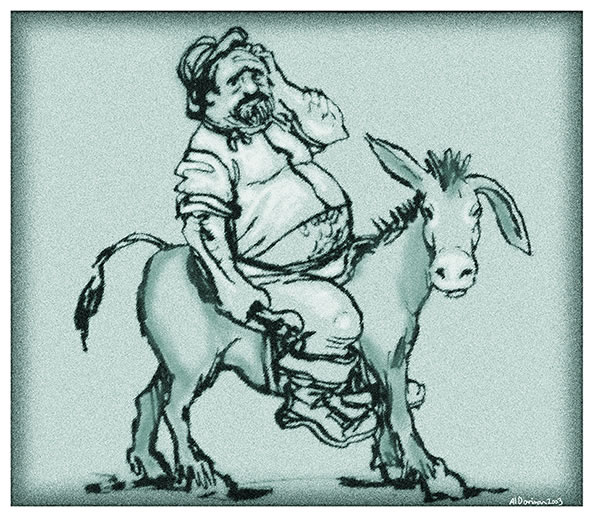
George Will calls Sarah Palin John McCain’s ‘female Sancho Panza.’

Conservative pundits say negative campaign just isn’t cutting it.
By Michael C. Moynihan / October 9, 2008

A bit of conservative blowback on the McCain campaign’s impotent strategy of making the final weeks of the election about Barack Obama’s association with former Weather Underground leader Bill Ayers. First up, George Will:

This, McCain and his female Sancho Panza say, is demonstrated by bad associations Obama had in Chicago, such as with William Ayers, the unrepentant terrorist. But the McCain-Palin charges have come just as the Obama campaign is benefiting from a mass mailing it is not paying for. Many millions of American households are gingerly opening envelopes containing reports of the third-quarter losses in their 401(k) and other retirement accounts — telling each household its portion of the nearly $2 trillion that Americans’ accounts have recently shed. In this context, the McCain-Palin campaign’s attempt to get Americans to focus on Obama’s Chicago associations seems surreal — or, as a British politician once said about criticism he was receiving, “like being savaged by a dead sheep.”

David Frum, who has been scathing in his criticism of the Sarah Palin choice, is similarly baffled by the “chummy with terrorists” line of attack. At his National Review blog, Frum unloads on Team McCain (after assuring readers that he will indeed vote for him):

American voters are staggering under the worst financial crisis since at least 1982. Asset values are tumbling, consumer spending is contracting, and a recession is visibly on the way. This crisis follows upon seven years in which middle-class incomes have stagnated and Republican economic management has been badly tarnished. Anybody who imagines that an election can be won under these circumstances by banging on about William Ayers and Jeremiah Wright is … to put it mildly … severely under-estimating the electoral importance of pocketbook issues.

We conservatives are sending a powerful, inadvertent message with this negative campaign against Barack Obama’s associations and former associations: that we lack a positive agenda of our own and that we don’t care about the economic issues that are worrying American voters.

Source / reason.com

The Rag Blog

Posted in RagBlog | Tagged , , , , , , | Leave a comment

Victory for Free Speech at University of Texas

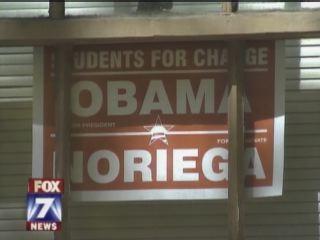
Sign supporting Obama and Rick Noriega on dorm window at UT-Austin.

Administration gives in; allows political signs in dorm windows.
By Jay Root / October 9, 2008

AUSTIN — Facing a free-speech uproar, the University of Texas backed down Thursday from punishing two students who refused to remove political signs from their dormitory window.

Connor Kincaid and his cousin and roommate, Blake Kincaid, said they were barred from registering for spring classes after refusing Wednesday to take down their signs supporting Democratic presidential candidate Barack Obama.

“Effective immediately, I am suspending the prohibition on signs in individual students’ residence hall room windows and any sanctions related to its enforcement,” UT President Bill Powers said in a written statement.

Powers said he had formed a committee to study the policy and make recommendations. In the meantime, he said, school policy now “expressly allows the display of signs and posters in students’ residence hall room windows.”

The Kincaid cousins were told during an administrative hearing Wednesday to take down their signs supporting Obama.

“This is an important free speech issue,” said Connor Kincaid, a 20-year-old junior who claimed during the hearing that he saw a sign supporting Republican candidate John McCain in the window of another dorm.

The university says the dispute had nothing to do with either candidate. UT has had a policy for more than 10 years forbidding the posting of signs in dorm windows in order to control the look of the campus and avoid the appearance that the university is supporting any candidate, said Jeff Graves, an associate vice president for UT legal affairs.

The crackdown sparked an outcry among students, and university Democrats and Republicans worked together to fight rules they said were unconstitutional. They had encouraged students across campus to put signs in their dorm windows as a form of protest.

Graves said he wasn’t aware of a prior case of a student facing an administrative hearing over the policy.

“It’s never been an issue,” he said. “Obviously this is a hot political issue, and it got pushed this time.”

UT officials believe the policy was constitutional as written but thought it made sense to allow signs to be posted inside the windows of individual living quarters, Graves said.

Source / AP / Google News

The Rag Blog

Posted in RagBlog | Tagged , , | 1 Comment

CODEPink Questions Henry Paulson’s Leadership


Should Henry ‘The Fox’ Paulson Guard the Henhouse?
By Medea Benjamin / October 9, 2008

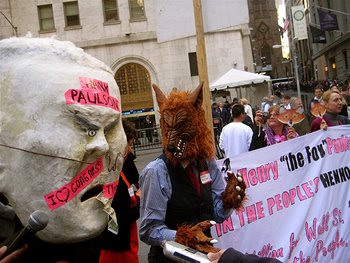
On Tuesday, October 7, a group of CODEPINK pranksters pranced in front of the New York Stock Exchange. One, wearing an oversized papier maché head of Treasury Secretary Henry Paulson, grabbed at the purses of the “chickens.” “Give me your money; give me your money,” he cried. “You might need a new house, but my buddies and I need new yachts.” Passersby, reading the sign “Henry ‘The Fox’ Paulson’ in the People’s Henhouse,” heartily agreed.

Congress thought otherwise, entrusting Paulson — the former CEO of Goldman Sachs — with $700 billion of the people’s money. On October 3, Speaker Nancy Pelosi, smiling ear to ear, congratulated Congress for passing a bill that gave Secretary Paulson unprecedented control over our nation’s economic future. An hour later, President Bush and Secretary Paulson appeared on the steps of the Treasury Department signing the bill.

“This bailout bill does not deal with the absurdity of the fox guarding the henhouse,” Senator Bernie Sanders decried on the Senate floor. But during the post-bailout hearings held by the House Oversight Committee, Congressman Dennis Kucinich was the lone voice raising questions about Paulson’s performance and his obvious conflict of interest.

Kucinich asked the witnesses from AIG and Lehman Brothers why one company — AIG — was bailed out by the Treasury Secretary while Lehman Brothers was allowed to go under. AIG owed Goldman Sachs $20 billion, so their bailout meant that Paulson’s buddies at Goldman Sachs would get repaid in full. Goldman Sachs also gained a competitive advantage from the bankruptcy of its rival Lehman Brothers. One would think that this maneuver alone, which happened BEFORE the $700 billion taxpayer bailout, would have immediately raised hackles in Congress and disqualified Paulson as economic czar.

To see the absurdity of Paulson in charge of the crisis, Congress need only have looked at Paulson’s past. On the very day that Congress passed the bailout, The New York Times published a shocking story about how the SEC was lobbied in 2004 by the nation’s five largest investment banks to change a regulation that limited the amount of debt they could take on. The exemption unshackled billions of dollars held in reserve as a cushion against losses on their investments, and led to the unraveling of the financial sector. Among the five banks leading the charge to change the rule was Goldman Sachs, which was headed by Henry Paulson. Translation: Paulson was one of the architects of the crisis!

Paulson also benefited personally from the casino economy he helped engineer. After creating billions of dollars in bizarre financial products that are now nearly worthless, he left Goldman Sachs with a personal fortune of over $700 million.

“It is remarkable that Congress would be willing to give Secretary Paulson such enormous power in running this bailout given his advocacy of rule changes that played such an important role in this financial disaster, and the extent to which he personally profited from these changes,” said Dean Baker, an economist who was one of the first in the country to sound the alarm that the housing bubble was about to burst. “This would be like giving the bank robber who cleaned out the vaults the opportunity to set the bank’s finances in order — and letting him keep the loot.”

Paulson’s job performance as Treasury Secretary since July 2006 should be enough to have him fired, as Paulson fiddled while our economy slowly burned. When sub-prime mortgage losses set off a domino effect in mid-2007, Paulson insisted that troubles in the mortgage market were not likely to spread throughout the economy. In a Jim Lehrer interview in May 2007, he stated, “We’re fortunate that we have a diverse, healthy economy” and insisted the housing problem was contained. A year later, he told the Wall Street Journal, “The worst is likely to be behind us,” and stated on CNBC: “Our long-term fundamentals in this economy are strong, and this is a strong, competitive economy.” As Cong. DeFazio stated, “This guy has been consistently wrong and out of touch or he’s been lying to Congress and the American people about how sound our fundamentals are.”

When in September we found ourselves in the midst of a full-blown crisis, Paulson’s response was to blackmail Congress. With the proverbial gun to their heads, members of Congress were asked to hand Paulson $700 billion — immediately — on the basis of a three-page proposal and with no oversight, no Congressional or Judicial review and no accountability! Where did that $700 billion figure come from? “It’s not based on any particular data point,” a Treasury spokeswoman told Forbes.com. “We just wanted to choose a really large number.” Cong. Brad Sherman called Paulson’s proposed legislation an “awe-striking, mind-boggling power grab” designed with only Wall Street in mind.

Instead of tossing out Paulson and his plan in favor of a solution for Main Street, Congress passed a bill giving Paulson enormous power to decide which companies will be bailed out and which will go under. “A plan that relies on the former chairman of Goldman Sachs disbursing hundreds of billions of dollars to Wall Street is a terrible concept and inevitably will lead to crony capitalism and the appearance of — if not the actual existence of — corruption,” said Newt Gingrich, who called on President Bush to fire Paulson.

The people’s ire over the Wall Street bailout almost derailed the entire plan, but the bankers prevailed. Paulson’s plan, however, has not calmed the markets and shouldn’t mute the public outcry. Join us in demanding that the Fox stop raiding the henhouse. Join us in insisting that Paulson must go! (go to www.paulsonmustgo.com).

Medea Benjamin (medea@globalexchange.org) is cofounder of CODEPINK: Women for Peace (www.codepinkalert.org) and Global Exchange (www.globalexchange.org).

Source / Common Dreams

The Rag Blog

Posted in RagBlog | Tagged , , , | Leave a comment

NIE: Surge Has Not Put the US on a Path to Victory


US team warns of fresh ethnic violence in Iraq
By Michael Jansen / October 9, 2008

THE TEAM preparing the latest US intelligence analysis of the situation in Iraq warns that ethnic and sectarian tensions could erupt into fresh violence, reversing security and political advances made over the past 20 months.

The 16 agencies drafting the National Intelligence Estimate, due to be presented to the White House shortly, agree that the “surge” strategy has not put the US “on a path to victory” and questions the wisdom of withdrawing US troops before stability is bolstered by solid political gains on the ground.

According to leaks from the team, the main threats to security come from the ethnic power struggle between Arabs, Turkomen and Kurds in the northern oil city of Kirkuk and from the Shia-dominated government’s refusal to recruit into the security forces Sunni “Awakening Council” fighters who fought al-Qaeda alongside US troops.

The still-secret report also expresses concern over the possibility that the Mahdi army militia loyal to dissident cleric Muqtada al-Sadr could end its ceasefire and resume attacks on US and Iraqi troops.

This assessment echoes a US defence department report issued last month as well as the words of former US commander General David Petraeus. US secretary of state Condoleezza Rice also admitted that “success in Iraq is not a sure thing”.

The leaks from the intelligence report coincided with the publication by the International Migration Office (IOM) of its latest Displacement and Return Assessment Report. This gloomy text shows that, of the 2.8 million internally-displaced persons, i.e. domestic refugees, only 16,782 families with 100,692 members had returned to their homes by September 21st. It also shows that the number of Iraqis fleeing the country, now 2.5 million, exceeds those returning.

The IOM says that although security is improving in many areas, displaced persons are unwilling or unable to go home, and they require food, shelter and other assistance where they are living.

They have not been encouraged to return to their homes by prime minister Nuri al-Maliki’s September 1st decree requiring squatters to vacate houses they “unlawfully occupy in Baghdad or face prosecution”. Those who comply receive $255 per month for six months to tide them over until they find alternative accommodation.

The decree also creates centres in the capital to register returnees, provide them with a grant of $852, and resolve property disputes. While his initiatives focus on Baghdad, Mr Maliki intends to implement these measures in Iraq’s other provinces.

© 2008 The Irish Times

Source / Irish Times

The Rag Blog

Posted in RagBlog | Tagged , , | Leave a comment

"Message Force Multipliers" to Be Investigated

Needless to say, I have a $20 bill that says this turns itself into a quiet whitewash for those poor, retired generals and the Pentagon weasels. Nothing whatsoever will come of this aside from a little neatly-bound report that sits on a back shelf in the National Archive and Library of Congress in perpetuity.

Richard Jehn / The Rag Blog


FCC to Probe Defense Department’s ‘Propaganda’ Program
By E&P Staff / October 07, 2008

NEW YORK The Federal Communications Commission has announced that it will investigate a Department of Defense propaganda program to determine whether news networks or military analysts violated the Communications Act of 1934 and FCC rules.

Earlier this year, The New York Times reported that a Department of Defense program had ex-military officers presenting the Bush administration’s position on the War on Terror as objective analysis on major television news programs and 24-hour cable news networks. Congresswoman Rosa L. DeLauro and Congressman John Dingell wrote to the FCC to investigate allegations that the news networks and the analysts failed to disclose the ex-military officers’ ties to the Pentagon — and if that violated sponsorship identification requirements in the Communications Act.

“Given the revelations in the [New York Times] article, had the FCC not heeded our request for an investigation, it would have raised serious questions about their oversight capabilities. I am pleased with today’s news, but will continue to monitor the situation to ensure the FCC fully investigates the networks in addition to the analysts,” DeLauro said in a statement Tuesday.

According to the Times report, Department of Defense documents described the analysts as “message force multipliers” instructed to deliver “administration themes and messages” to the public “in the form of their own opinions.” The report found that these analysts — who The Times called “a media Trojan horse” for the administration — were encouraged to convey specific Defense Department talking points to the public, even when they suspected the information could be exaggerated or false.

Network officials cited in the Times story acknowledged “a limited understanding” of the on-air analysts’ ties to the government. They argued that it was the analysts’ responsibility to disclose any potential conflicts of interest.

Source / Editor and Publisher

The Rag Blog

Posted in RagBlog | Tagged , , , , | Leave a comment

Cook County Sheriff Stands Up to the Bankers

Sheriff Tom Dart has suspended evictions from buildings that have been foreclosed on like this one in Albany Park. From left: Tenants Mario Hernanzez, Dart, Maria Cruz and Gabriela Maciel with her son Diego. Photo: Al Podgorski/Sun-Times.

Dart refuses to evict tenants when order is aimed at landlord
By Sheriff Tom Dart / October 9, 2008

COOK COUNTY, Ill. — As Cook County sheriff, I am responsible for running a 10,000-inmate jail, providing patrols to unincorporated areas and securing the courts.

But perhaps no part of our job is as difficult as the work done by our eviction units. On any given day, our deputies could be asked to throw a family out of their home, with all of their possessions left on a curb — sometimes pilfered through by those living nearby.

Yet no matter how difficult they are, evictions are part of our job.

What isn’t part of our job, however, is to carry out work on behalf of the multi-billion-dollar banks and mortgage industries.

Too many times, our deputies arrive at a home to carry out a mortgage foreclosure eviction, only to find a tenant — dutifully paying their rent each month — who is unaware their landlord stopped using that rent money to pay the mortgage. They had no fair warning that they were about to be thrown out of their home.

That’s because, in many cases, the banks have done nothing to determine, in advance, who’s living in the building — even though it’s required by state law. Instead, those banks expect taxpayers to pay for that investigative work for them.

That stops today.

We won’t be doing the banks’ work for them anymore.

We won’t surprise tenants with an eviction order intended for their landlord.

I may be held in contempt of court over this. If that’s the case, I’m willing to accept it though I believe most judges in Cook County share my desire to find a solution for this mess.

We’re asking either the state courts or Legislature to order the banks to simply conduct very basic work before requesting an eviction.

I’ve come to this point after spending the last year trying to work with the banking industry, even asking the Legislature to pass a bill requiring them to — at a minimum — let us know if any children, disabled or senior citizens live at the home, so we can connect them with social services. That effort was killed by banking industry lobbyists.

Until the banking industry steps up and does the right thing, I won’t continue to risk violating the law and open taxpayers to further liability.

Source / Chicago Sun Times

The Rag Blog

Posted in RagBlog | Tagged , , , | 1 Comment

Ron Ridenour: Sounds of Venezuela, Part X

Oscar Figuera (2nd from right) with colleagues. Photo: ¡Que comunismo!.

Click here to view the entire series.

Sounds of Venezuela
Part X: The Red Letter
By Ron Ridenour / The Rag Blog / October 9, 2008

On my way to town hall, I saw a grass roots organizer talking with Diego at the beginning of Hunger Street. He was explaining that he was tired of periodic failures to adequately fulfill the plan Casas de Alimentación, which provides a hot meal daily for homeless and other needy people. The federal government pays for this with oil profits but it is put into action by municipal governments. This organizer complained that some of the 100 to 150 homeless and most needy were not getting their meal or use of a shower and he was threatening to organize a protest.

In La Victoria, 20 houses are centers for this program. There are 6000 such houses in the country. Housewives volunteer their time and kitchens to make the lunches.

Another connected alimentation plan is in place in public school, currently feeding 60% of all students. Students and teachers eat nutritious meals together, which are prepared locally. Any leftovers are given out the same day to needy persons, including homeless. Diego had recently given me a leftover lunch from his lover’s school. It consisted of paella: chicken and rice, with olives and red peppers; beets and two pieces of bread. Sumptuous!

At town hall’s center, about 80 assembled to celebrate the Communist party 77th anniversary. I read their “Red Letter” leaflet printed in red ink for the occasion.

It clearly supports the Chavez-led Bolivarian Revolution and warns that imperialism, the final phase of capitalism, threatens the revolution as it does all people’s struggle for improvement, for liberation and sovereignty. The leaflet is written in common language and speaks to people’s discontent with local governments backing Chavez, including La Victoria, for failure “to accomplish the expectations generated by its electors”.

The experienced Communist party also calls upon Chavez party forces to align with it in forming a National Anti-Imperialist Front (FNAI), thus broadening the struggle against US imperialism’s real threats from abroad and internally.

Oscar Figuera stood at the podium. Short mulatto with stubby black-gray beard, he is the party’s secretary-general and a deputy from Aragua state in the parliament, one of eight Communists elected in 2005. In the 2006 presidential elections, the PCV received nearly three percent of the national vote, making it the nation’s fourth largest. It added its 342,000 votes to the Chavez Patriotic Alliance for a total of 7.3 million votes. All but 15 of the 167 National Assembly members support the Chavez-led process.

I quote from some of Figuera’s comments.

“Thousands of us Communists have shed our blood on this earth to make a better world, to create socialism. We stand beside President Chavez today…We support the PSUV and we don’t want any of them to leave it for our party, which we must maintain to guide us toward socialism. If PSUV socialists left the party, it would leave its right-wing with greater influence. But we want our parties, and other radical ones, to increase the strength of the Patriotic Alliance, and to join us in creating a massive FNAI.”

There was strong applause when Figuera spoke in support of FARC, which he said the PCV viewed as a legitimate force and a strategic ally. “We don’t condemn the armed struggle as a form of struggle against a state that closes the democratic process.”

Chavez had ceased criticizing the PCV for not merging into the PSUV, which had been his position. The PSUV had recently rejoined the shaky Patriotic Alliance, which also included the Party for All (Partido Para Todos), a second generation split off from the PCV. But, in July 2008, once Chavez had called upon FARC to dissolve and inexplicably invited Uribe to Caracas as a friend, the PCV exercised its political principles by conducting street demonstrations against the narco-trafficking, para-militarist Uribe. Chavez rebuked the PCV for this, something many Chavez supporters considered ingenuous.

When Figuera ended his speech, I spoke with Murillo Baez. At 73, he’d been a member of the PCV for 47 years. He had witnessed an act of carnality committed by Latin America’s most infamous terrorist, Luis Posada Carriles.

“Yeah, Bambi Carriles, as we knew him. He was the worst,” the gray-haired black man drawled, remembering the living nightmare. “I read he’s still a terrorist running loose in Miami with the rest of them. And Bush says those who assist terrorists are terrorists!”

“It was in late 1960s. Carriles was a high official in Venezuela’s secret police, the dreaded DISIP. Another right-wing Cuban exile working with the CIA was DISIP chief for some years [Orlando García Vázquez]. I don’t know if Leoni Otero or Caldera Rodríguez was president. It didn’t matter, really. They were all under the US government, and their secret police was run by the CIA with gusano agents [Cuban right-wing exiles].

“Our party was prohibited and many were in the mountains. I was the president of the local CTA union and was in our office in La Victoria when we heard the screams and shots. Some unionists and underground comrades were meeting up the block. Somebody must have tipped off the DISIP. Carriles led the murder of 10 people. Some were ripped up. One pregnant woman gave birth under the attack. They burned the baby with cigarette butts. We couldn’t do anything. We had no weapons and the secret police were well armed.”

As Baez and I spoke, Carriles was a free man walking the streets in Miami where he would soon be honored, on May 7th, by 500 fellow Cuban Americans. He had been released a year before from a Texas jail cell when a Bush-appointed federal judge dismissed the only charge against him—making false statements to immigration officials. He came to the United States illegally after being pardoned in Panama, in 2004, by Bush-friendly President Mireya Moscoso. He had been captured in 2000; tried and sentenced for attempted assassination of President Fidel Castro when he was to deliver a speech to students in Panama. The Panama Supreme Court recently ruled that pardon unconstitutional. [See this.]

The United States Attorney General refuses to even answer Venezuela’s request for Carriles’ extradition, thus abrogating the mutually signed extradition treaty. Carriles is wanted as a fugitive from one of the worst acts of terrorism: the bombing of a Cuban airliner, October 6, 1976, in which all 73 passengers and crew were killed. It was the first political air terrorism “hit” in the Americas. Released FBI archives show that Carriles had informed his Washington DC handler that an upcoming “hit” would occur against a Cuban airliner. [See this.]

Luis Posada Carriles is good friends with the rich and powerful in Miami and with Florida’s governor, Jeb Bush. Among his most powerful associates is co-master mind of the 1976 bombing, Orlando Bosch, also a free man living in Miami. Both had been imprisoned in Venezuela for their role in the airline bombing, but the CIA assisted their escape in the mid-1980s. Another powerful ally was former CIA agent Jorge Mas Canosa, now deceased. He became wealthy in related economic activity as a CIA agent. After his part in the Bay of Pigs invasion, he founded the Cuban-American National Foundation. CANF helped finance many acts of terrorism both within the US and in Cuba. Among them were explosions at tourist hotels in Cuba and bombing plans against museums. Carriles bragged to the “New York Times” (July 12-13, 1998) about these acts of terrorism, in which one man was killed and 11 wounded. [See this and this.]

Cuba was concerned about this sabotage. Not only was it lethal, it injured their primary income. Leaders believed (strangely) that the FBI might be interested in cooperating to stop the terrorists in Miami. Over 300 acts of sabotage and assassinations had been committed inside the United States by these terrorist groups since 1959 when Cuban exiles began operating there. Cuba had experienced thousands of terrorist acts, which had killed more than 3000 of their people and seriously wounded nearly as many. To defend their country, Cuban intelligence agents had infiltrated these circles over many years. (See my book about 27 of them: Backfire: The CIA’s Biggest Burn, published, in 1991, by Editorial José Martí, Havana: www.ronridenour.com). Just in the years 1990 to 1998, 170 planned acts of sabotage and assassinations had been prevented by these brave men and women, among them were: Gerardo Hernández, Ramon Labanino, Antonio Guerrero, Fernando González and René González.

In June 1998, the FBI was invited to Havana where they were given copies of Cuban intelligence documents in the hope the FBI would keep its promise to put a stop this terror. As Fidel later said, some of the material given included, “14 phone conversations from Luis Posada Carriles in which he provided information about terrorist attacks on Cuba. Information was provided on how to locate Posada…”

The FBI did study the material and was able to ascertain how Cuba had acquired such valuable knowledge. On September 12, 1998, the FBI arrested a dozen Cuban agents who were informing Cuban authorities about plans of terrorism against it. Five of them (named above) were sent to isolation cells for 17 months and then sentenced on “conspiracy against national security” charges to a total of four life terms plus 75 years. The Cuban Five pointed out in defense that they were only monitored the actions of Miami-based terrorist groups, in order to prevent terrorism against their country.

The PCV participates in an expanding international campaign to free the Cuban Five while demanding that the US government honor its own extradition treaty with Venezuela and return the convicted terrorist/mass murderer Luis Posada Carriles to Venezuela for completion of his prison term.

The Cuban Five’s are not terrorists, and their actions were never directed at the U.S. government; they never harmed anyone nor had weapons while in the United States. The only crime they committed was to operate as agents of a foreign government without having registered, for which one can be imprisoned for one to three years. They are still in prison ten years later simply because they acted to defend their homeland against US-baked terrorism.

The Rag Blog

Posted in Rag Bloggers | Tagged | Leave a comment

Austin’s Fontaine Maverick Tells CNN Why McCain and Palin are no Mavericks

Hey John McCain, you’re stealing our name! Jeanne Moos interviews Fontaine Maverick about the great Maverick family of Texas: The real and original Mavericks.

For more on The Rag Blog about the Maverick family and the theft of their good name, see McCain a Faux Maverick : Stealing a Texas Tradition by Paul in Austin / The Rag Blog / September 13, 2008

And Fontaine Maverick : John McCain is no Maverick! by Fontaine Maverick / The Rag Blog / August 31, 2008

And This Maverick The Real Deal by Joe Holley / The Rag Blog / March 1, 2008

Thanks to Mariann Wizard / The Rag Blog

Posted in RagBlog | Tagged , , , , , , , , | Leave a comment

Garrison Keillor : Juicing Up the Ticket With Sarah


Dishonest, cynical men put forward Sarah Palin for national office, but the truth emerges: The lady is talking freely about matters she has never thought about.
By Garrison Keillor / October 8, 2008

We are a stalwart and stouthearted people, and never more so than in hard times. People weep in the dark and arise in the morning and go to work. The waves crash on your nest egg and a chunk is swept away and you put your salami sandwich in the brown bag and get on the bus. In Philly, a woman earns $10.30/hour to care for a man brought down by cystic fibrosis. She bathes and dresses him in the morning, brings him meals, puts him to bed at night. It’s hard work lifting him and she has suffered a painful hernia that, because she can’t afford health insurance, she can’t get fixed, but she still goes to work because he’d be helpless without her. There are a lot of people like her. I know because I’m related to some of them.

Low dishonesty and craven cynicism sometimes win the day but not inevitably. The attempt to link Barack Obama to an old radical in his neighborhood has desperation and deceit written all over it. Meanwhile, stunning acts of heroism stand out, such as the fidelity of military lawyers assigned to defend detainees at Guantánamo Bay — uniformed officers faithful to their lawyerly duty to offer a vigorous defense even though it means exposing the injustice of military justice that is rigged for conviction and the mendacity of a commander in chief who commits war crimes. If your law school is looking for a name for its new library, instead of selling the honor to a fat cat alumnus, you should consider the names of Lt. Cmdr. Charles Swift, Lt. Col. Mark Bridges, Col. Steven David, Lt. Col. Sharon Shaffer, Lt. Cmdr. Philip Sundel and Maj. Michael Mori.

It was dishonest, cynical men who put forward a clueless young woman for national office, hoping to juice up the ticket, hoping she could skate through two months of chaperoned campaigning, but the truth emerges: The lady is talking freely about matters she has never thought about. The American people have an ear for B.S. They can tell when someone’s mouth is moving and the clutch is not engaged. When she said, “One thing that Americans do at this time, also, though, is let’s commit ourselves just every day, American people, Joe Six-Pack, hockey moms across the nation, I think we need to band together and say never again. Never will we be exploited and taken advantage of again by those who are managing our money and loaning us these dollars,” people smelled gas.

Some Republicans adore her because they are pranksters at heart and love the consternation of grown-ups. The ne’er-do-well son of the old Republican family as president, the idea that you increase government revenue by cutting taxes, the idea that you cut social services and thereby drive the needy into the middle class, the idea that you overthrow a dictator with a show of force and achieve democracy at no cost to yourself — one stink bomb after another, and now Gov. Palin.

She is a chatty sportscaster who lacks the guile to conceal her vacuity, and she was Mr. McCain’s first major decision as nominee. This troubles independent voters, and now she is a major drag on his candidacy. She will get a nice book deal from Regnery and a new career making personal appearances for 40 grand a pop, and she’ll become a trivia question, “What politician claimed foreign-policy expertise based on being able to see Russia from her house?” And the rest of us will have to pull ourselves out of the swamp of Republican economics.

Your broker kept saying, “Stay with the portfolio, don’t jump ship,” and you felt a strong urge to dump the stocks and get into the money market where at least you’re not going to lose your shirt, but you didn’t do it and didn’t do it, and now you’re holding a big bag of brown bananas. Me, too. But at least I know enough not to believe desperate people who are talking trash. Anybody who got whacked last week and still thinks McCain-Palin is going to lead us out of the swamp and not into a war with Iran is beyond persuasion in the English language. They’ll need to lose their homes and be out on the street in a cold hard rain before they connect the dots.

[Garrison Keillor is the author of a new Lake Wobegon novel, “Liberty” (Viking).]

© 2008 by Garrison Keillor. All rights reserved. Distributed by Tribune Media Services, Inc.

Source / salon.com

Thanks to Doug Zabel and Shelia Cheaney / The Rag Blog

Posted in RagBlog | Tagged , , , , , , | 1 Comment

Daniel Ellsberg and the Concept of Freedom of Conscience

Daniel Ellsberg at UT-Austin, Oct. 7, 2008. Photo by Carlos Lowry / The Rag Blog.

Report-back on Daniel Ellsberg speaking at the University of Texas on Tuesday: ‘Truth can free us from war.’
By Susan Van Haitsma / The Rag Blog / October 9, 2008

When I attended the presentation at the University of Texas at Austin on Tuesday evening by Daniel Ellsberg, the concept of freedom of conscience was already on my mind.

A few days prior, I had gone to a special commemoration of Gandhi’s birthday, where conscience was posed as a religious freedom issue by one of the speakers, a local war tax resister. Souvenir bookmarks containing Gandhi quotes were distributed around the tables, and the one I happened to pick up read, “In matters of conscience, the law of majority has no place.”

Then, over the weekend, an inaugural conference was held in Austin, organized chiefly by the pastor and congregation of the Austin Mennonite Church. The National Assembly to Honor Freedom of Conscience featured guest speakers Walter Wink (noted theologian and nonviolence trainer), Gene Stoltzfus (former director of Christian Peacemaker Teams) and Ann Wright, whose book, “Dissent: Voices of Conscience” was published this year and includes a foreward by Daniel Ellsberg. Conference panelists included conscientious objectors and GI resisters whose stories parallel those in Wright’s book.

Ann Wright spoke also at a book signing event at BookWoman on Monday, where matters of conscience, government, law, risk, family and the military were discussed by those present, including, again, several conscientious objectors. The week seemed to come full circle with Ellsberg’s Austin appearance the following evening.

In conjunction with a UT conference planned for the coming weekend, Ellsberg was asked to compare what was happening in 1968 with what is happening now. He packed a lot in – dates, names, places and people – while his primary message echoed what I had heard all week: truth can free us from war.

Ellsberg did not talk much about the tragedies and tumult of 1968, but rather focused on what he saw and experienced as a government insider. “1968 is a year I don’t like to relive,” he admitted. He spent most of his time describing events leading up to that year, beginning with the Gulf of Tonkin resolution in 1964 and the tangled web that was spun from it and later documented in the Pentagon Papers. Ellsberg also recounted something about the less tangible factors that led to the escalation of the Indochina War – the human strengths and frailties of the political and military actors at that time, including him.

Ellsberg spoke with an intense clarity of memory, recounting the details of who said what when, what they probably meant and what they probably did or didn’t know at the time. I sensed that in spite of the strange mix of pariah/hero status he attained following the publishing of the Pentagon Papers, he still is proud of the insider position he once held and perhaps even misses the feeling of closeness that resulted from being loyal to powerful people and knowing their secrets. In fact, he said that being called a traitor is something he has never gotten used to.

In his talk, Ellsberg didn’t fully explain his inner change of heart, the private crisis of conscience that led him to shift from personal loyalty to the president and joint chiefs of staff to a more abstract loyalty to the Constitution and international law. But, as he wrote in an article in Harpers in 2006 (quoted by UT’s Evan Carton during his introduction of Ellsberg),

I had long prized my own identity as a keeper of the president’s secrets. In 1964 it never even occurred to me to break the many secrecy agreements I had signed, in the Marines, at the Rand Corporation, in the Pentagon. Although I already knew the Vietnam War was a mistake and based on lies, my loyalties then were to the secretary of defense and the president (and to my promises of secrecy, on which my own career as a president’s man depended). I’m not proud that it took me years of war to awaken to the higher loyalties owed by every government official to the rule of law, to our soldiers in harm’s way, to our fellow citizens, and, explicitly, to the Constitution, which every one of us had sworn an oath ‘to support and uphold.’ It took me that long to recognize that the secrecy agreements we had signed frequently conflicted with our oath to uphold the Constitution.

More about the role of conscience in Ellsberg’s moral conflict can be found in a passage I read about ten years ago in Daniel Hallock’s collection of writings and interviews, Hell, Healing and Resistance: Veterans Speak. The book includes an interview with Ellsberg in which he recalls these pivotal personal events in 1968 and ’69:

Now, two things affected my life at that point. I’d been reading Gandhi since the spring of ’68, when I happened to meet people from the Quaker Action group at a conference in Princeton. I had gone there to study counter-revolution, and they were there as nonviolent revolutionaries. So I started reading MLK, Stride Toward Freedom, and Barbara Deming, who wrote an essay called Revolution and Equilibrium. I read and reread many times a book by Joan Bondurant called The Conquest of Violence, on Gandhian thought, which converted me very strongly, very impressively.

Then, in late August 1969 I went to a conference of the War Resisters League – they were founded by World War I CO’s; Einstein was once their honorary president – and in the course of this conference I was induced to go to a vigil for somebody who was going to prison for draft resistance, which was a very unusual thing for me to be doing. There I was, standing in the street outside the Philadelphia post office, passing out leaflets. This was not the sort of thing the GSA Team did. It seemed, you know, rather undignified – giving away your influence and your access in such a ridiculous way, just handing out leaflets like a bum.

Then, at the end of this conference, I met another young man, Randy Kehler, a Harvard college graduate who had gone on to Stanford but then stopped his studies to work for the War Resisters League. He gave a talk and at the end he announced that he was also on his way to prison for refusal to cooperate with the draft. And this came to me as a total shock. It just hit me that it was a terrible thing for my country that the best he and so many others could do was go to prison. I went to the men’s room and just sat on the floor and cried for about an hour and thought, ‘My country has come to this? We’re eating our young. We’re relying on them, to end the war and to fight the war?’ And I felt it was up to me. I was older. I was thirty-eight. It was up to us older people to stop the war.

Ellsberg realized his tool was information and his sacrifice was the loss of his insider position and a risk, like that of the draft resister, of imprisonment. MLK’s April 4, 1967 admonition, “A time comes when silence is betrayal,” gained special meaning for him.

Ellsberg feels we are in a similarly critical time now. It’s a time that calls for greater risk-taking. He said that Obama, for example, could risk standing against an escalation of the Iraq war into Iran, Afghanistan or Pakistan. Links ought to be made between the economic crisis and the war. “Can we afford to murder people at this cost indefinitely?” is the question we must ask, he says. He pointed out that in the five years after 1968 – when the Indochina war had lost almost all popular support, four times as many bombs were dropped in Southeast Asia as were dropped prior to 1968. He fears the same kind of enlargement of war could easily happen again. “Power doesn’t learn from history,” he said. “Power follows its own dictates; power doesn’t give up its power.”

Ellsberg concluded, “This country needs to advance in another direction.” Directed by conscience and moved by the acts of conscience of others, people can change course. His life is a case in point. Truth can stand up to power, and a bum with a leaflet can change the course of history.

[Susan Van Haitsma also blogs as makingpeace at Statesman.com.]

Also see Daniel Ellsberg, Kathleen Cleaver Headline Austin ‘1968’ Conference by Thorne Dreyer / The Rag Blog / Oct. 7, 2008

The Rag Blog

Posted in Rag Bloggers | Tagged , , , , , , , | 1 Comment

Mark Rudd : Thoughts on 2012

‘The Republicans are leaving Obama with a mess…’ Drawing by Doug Potter.

Obama’s second term: ‘a diverse group of people are working on a progressive agenda within the Demo Party that demands a second New Deal.’
By Mark Rudd / The Rag Blog / October 9, 2008

I’m thinking a lot about the 2012 election, for Obama’s second term. All of his advisors are Clintonites, ie., Republican lite. They did nothing to reverse the privatization, anti-union, free market trend begun under Reagan, quite the contrary. They laid the basis for the current wars, accomplishing next to nothing toward diplomacy and international law. They will inevitably fail to rescue the economy from depression and will win no war in Afghanistan or anywhere else.

But meanwhile, a diverse group of people are working on a progressive agenda within the Demo Party that demands a second New Deal (with disarmament and international law). That’s our four year goal. It will take that long to set up an infrastructure for the Demo Party that will do what the right-wing think tanks did for the Republicans. They took power and held it for twenty years and dominated the intervening eight with a network that included university endowments, publications, prizes, fellowships, radio and tv stations, internet outlets. They even had whole universities of their own with schools to feed them.

Of course one big difference is that the Repubs for the last 35 years have had a single unifying concept, to shrink government (except for the military) and let the markets rip. The strategy was to create a coalition of ideological conservatives and Christian conservatives. What’s the left’s unifying concept? What’s its winning strategy? The most common formula I hear is the reversal of Reagan’s dogma: the state, as the concentration of the democratic whole, has the responsibility to use its resources to help the citizens and the planet. The coalition to achieve power for this concept is much less clear.

People in the progressive political class are beginning to build a progressive infrastructure in the Demo party. Good examples are Media Matters, the Center for Independent Media, with a network of ten statewide online newspapers. There are funding organizations coming into existence behind them. Many other institutions and outlets are in place, mostly small and on the young side, which is great. But this infrastructure needs to expand very quickly to challenge the center-rightists of the party, who have been in power since at least 1992, actually longer. They’re a legacy of the McGovern defeat of 1972. At the Democratic National Convention in Denver I saw no indication that this new progressive infrastructure was even noticed by those in power. Not even a tip of the hat. Tom Hayden says that not one Obama foreign policy advisor is an anti-interventionist or of the peace camp.

The Republicans are leaving Obama with such a mess that free-market, trickle down remedies will fail and will have been exposed as bankrupt, corrupt, and insufficient: the wars will continue, at least in Afghanistan, if Obama makes good on his campaign promise. So the reelection campaign four years from now will be an historic opening for the progressive agenda. This will be equally true if, perish the thought, McCain/Palin are elected. But in that case the right-wing populist movement—racist and militarist—will be much stronger than had it not been nurtured by the government.

Sooner or later there will be a power struggle within the Demo party between the progressives and the rightists, the Clinton/DLC wing. It won’t be pretty, but it has to be, just as the conservatives had to wrest the Republican party away from the Rockefeller wing. It’s still not clear who “we” are. This election will go far to solving that problem.

For over a year, Tom Hayden’s been urging people to think about the movement necessary to push Obama to the left. That’s our goal. The Obama field campaign has been making good progress at building actual grass-root electoral organization. I haven’t seen the peace movement do anything comparable in the last five years, have you? The top down, progressive infrastructure model has zero chance of working unless there’s a movement at the base. Obama has built that structure and will maintain it. We’d better be in it or near it or we’re out in the cold.

Is all this obvious and known by everyone, or does it bear further discussion?

The Rag Blog

Posted in Rag Bloggers | Tagged , , , , | 8 Comments

Fairie Tale About the Economy : You Gotta Believe


‘Healing our sick economy is going to take the power of faith.’
By Roger Baker / The Rag Blog / October 9, 2008

Interestingly enough, those who understand the mysteries of the US economy advise us that once we have faith in the political and business leadership — then will our capitalist economic system have what it takes to recover. Thus it was with Tinker Bell the Fairy; only when the children believed could she recover. I believe the same principle applies to faith healing at prayer meetings and religious revivals.

Healing our sick economy is going to take the power of faith. Do you sincerely believe in our leaders in Washington? And the bankers too?

…The market — and the economy — will improve only once investors have confidence in the political and business leadership again. Unfortunately, that may take months or even years. The United States has entered uncharted territory, and there are no easy answers or solutions.

Getting a Grasp On the Crisis by Glenn Kessler / Washington Post / Oct. 9, 2008

You gotta believe.

…In the story if not enough people believe in fairies, Tinker Bell will die from drinking poison. The resulting plea by Peter calling out to children everywhere to sustain her, is a moment of childhood realisation that Tinkerbell should be immortal and is just too hard to believe especially as Peter has an everlasting childhood in which real death and sadness cannot exist. Long live Tinkerbell is the cry and has meant that many versions of this little fairy has inspired artists all over the world to create their own ‘Tink’ and for many children this is their introduction to the wonders of Fairyland…

Fairies World

The Rag Blog

Posted in Rag Bloggers | Tagged , , , | Leave a comment