

Thanks to Mariann Wizard / The Rag Blog / Posted July 24, 2008
Thorne Webb Dreyer, Editor

RECENT POSTS
Thanks to Mariann Wizard / The Rag Blog / Posted July 24, 2008
Last updated July 29, 2008
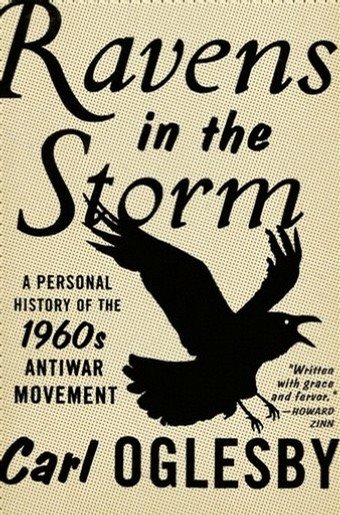
Former SDS president reflects on that organization’s stormy history at the leading edge of the sixties New Left
By Mariann G. Wizard / The Rag Blog / July 24, 2008
When I joined UT Students for a Democratic Society in the spring of 1965, a bright-eyed freshman on the fast track to scholastic probation, SDS’ national president was one Carl Oglesby, whose name was on my membership card. That was the only SDS membership card I ever had, so short-lived was the organization, and so quick the onset of its disabilities, until I got a new one last year, signed by Austin Movement for a Democratic Society Treasurer Alice Embree. Alice was a seasoned leader of the 60s UT SDS chapter – just one year older than me – when I joined. Now, 43 years later, Oglesby’s Ravens in the Storm (Scribner, New York, 2008) is a compelling personal memoir of the Sixties. While he draws no parallels between the frustrations of that era and those of the present day, peace activists will have no trouble seeing them; as in the later 1960s, anti-war protests feel increasingly fruitless as the Iraq war rockets on.
Oglesby recalls SDS in 1965 as a nonviolent, egalitarian-in-principle but elitist-in-composition group, primarily concerned with ending racism and poverty, and confronted, as he says, by Vietnam: “a terrible accident burning in the road, an event without logic but inescapably right there in front of us. We just had to… do what we could.” As the war escalated, the work of demonstrating, educating, and converting, all that peace activists could “reasonably” do, came to seem much too slow. Up against a wall of increasingly hostile administrations, the temptations of violent “direct action,” spiced with the rhetoric of the embattled Black liberation movement who we could find no way to concretely aid, became a siren song for some.
While Oglesby’s belief that the antiwar movement of the 60s, if it had not been destroyed from within and without, could have eventually forced an end to the war is an attractive idea to mature, peace-loving activists today, it is also entirely debatable, falling prey to the fact that “the Movement” was indeed destroyed. Carl identifies the extreme lack of organization, embraced by SDS at all levels, as a pre-existing deficiency allowing the group’s destruction to proceed with little effective opposition. (Bags of chapter mail are described, unopened, in a “filthy pigpen” of a National Office; I saw it even so. SDS never had any money, or accountable decision-making.) Still apparently considering himself a small-d democrat, however, he fails to acknowledge that scientific analysis might have been helpful, and seems to take the aberrant “theories” and worse behavior of the Weatherman faction as somehow representative of the “Old Left” and its outmoded anti-capitalist ideas. He knows better, but this may simply reflect an acute awareness of how far from revolutionary US society in the 1960s really was. Surely we at least learned that the Vietnam conflict was no accident, despite its burning horror, and that subsequent wars have not been accidents, either, but inevitable consequences of our economic system!
In contrast to other SDS memoirists, Oglesby never mentions the “prairie power” changes of 1966 and ’67, which set aside SDS’ founding, Ivy League-based, left-cognizant leadership for a “new guard” of state college-based, left-naïve, populist/anarchist anti-leaders. Indeed, what seemed a significant change at the time was but small change a year later, with the coming of Progressive Labor and, after them, the Revolutionary Youth Movement-slash-Weather nihilists. Still, it strikes a jarring note to see Greg Calvert’s new working class theory, which caused great upheaval and turbulence within SDS when introduced, casually co-opted into “old guard” SDS philosophy. (“[A]n increasingly high-tech economy was turning [the ‘middle class’] into a new proletariat and making its brainpower central to production. The original SDS had seen its natural constituency as this ‘new working class’…”) Another error is his naming the 1968 Columbia University strike as the birthplace of the free university movement, “a signature product of SDS”. UT SDS had spawned a Free University in Austin in 1966, led by philosophy grad student Dick Howard, and it wasn’t invented here!
Overall, this is a complex and astoundingly non-judgmental history of stormy times, when, Oglesby writes, SDS more closely resembled the raven than the traditional dove of peace, the history of which, he points out, cannot be known while government reports of penetration, spying, and dirty tricks against the movement remain secret. The many thousands of pages of documents released to persistent activists under Freedom of Information Act guidelines are so heavily redacted that, although “the Justice Department admitted to having mounted 2,370 specific separate actions against us…, we still don’t know what a single one of them was.” Oglesby takes advantage of government spy records where possible, as aides-de memoire.
Writing about his stunning “expulsion” from SDS, in Austin, TX, during a March, 1969 meeting of the National Council, in a closed meeting of SDS’ National Interim Committee, he uses transcripts of the Federal Bureau of Investigation’s high-quality recording of the event to provide verbatim excerpts from his unannounced “trial”, apparently on charges of not being a “committed Marxist-Leninist” in an avowedly democratic organization. The emergent Weather, personified by Bernardine Dohrn, comes off in these pages, despite Dohrn’s once apparently warm relationship with Oglesby, as a closed-minded, arrogant, delusional sect with no more grasp of Marxist analysis than a murder of crows. Without the FBI transcripts, Oglesby’s account, even if exactly the same, would no doubt seem outrageously exaggerated.
Austin chapter meetings by 1969 had become incredibly painful, unproductive, venomous confrontations between “regular” SDSers and minions of PL, spiked with anarchist sound and fury, and meetings had never been particularly effective decision-making opportunities. Influential “regulars” were leaving town, following the University’s dismissal of philosophy professor Larry Caroline, and in the face of the continuing escalation of a war – at home as well as abroad – they had spent the previous four or five years, like Oglesby, fighting body and soul. Reading of his dismissal by the group he had once led, I was nagged by a faint memory, confirmed in Robert Pardun’s recollection of the same events (Prairie Radical, 2001, Shire Press, Los Gatos, CA). Pardun, by 1969 a two-time former national SDS officer and leading “prairie power” organizer, highly respected for his cogent thinking and consistent principles, was living in Austin, working as a welder. Increasingly alienated from the warring SDS chapter, Bob briefly attended the first day of the Austin NC meeting and walked out, with most other Texas members, when attempts by Greg Calvert and Carol Neiman to calm the RYM/PL sloganeering match were rebuffed. Then, he says:
The second evening of the [NC] meeting, Bernardine Dohrn and several other RYM people came to my house to ask me to help in their fight for control of SDS. That meant supporting either RYM or PL – but… I didn’t agree with either side. After they left, I thought they considered me to be a “sell-out”. But that was part of the problem. The way they saw it, I was either for them or against them and I didn’t like the kind of politics that went with that mentality. After they left I decided to boycott the rest of the [NC] meeting with my Texas SDS friends.
Re-reading Bob’s account, I recognized my earlier nagging feeling as a twinge of guilt, since I was one of the Texas SDSers urging Bro. Pardun to blow off the meeting and come get high. On the third day of the NC, Oglesby’s secret trial took place, clearly part of the “fight for control” Dohrn and friends had proposed to Pardun the night before. What might have happened if those who agreed with Oglesby that “ordinary Americans,” with the help of our returning brothers from the meat grinder of Vietnam, could at last force an end to the war, had known that he was on trial by people widely seen as fools? Could they have rescued him from the Kafkaesque proceeding, and perhaps rescued SDS as well? Probably not; the rot was by then too far advanced. COINTELPRO’s unrelenting attacks were sapping the Movement’s local resources everywhere, diverting everything increasingly into legal defense work and reactions to unanticipated attacks. The Weathermen, in contrast, “really believed that the revolution was on its way… They produced a theater of the absurd and called it the revolution.”
It’s tempting, but unfair, to compare Oglesby’s mature work with former Chicago Seven defendant Tom Hayden’s 1988 Reunion: A Memoir (Random House, New York, aptly reviewed at the time by the Washington Monthly. Ravens is by far the better read, but then, twenty years’ added perspective can’t help but work wonders. Oglesby’s fleeting mentions of Hayden do not cast the author of the Port Huron Statement, SDS’ founding document, in a flattering light, but do acknowledge his influence, contrasting oddly with Hayden’s almost total neglect of fellow U. Michigan SDSer Oglesby in his work. Oglesby’s account of an almost hysterical Hayden’s response to Nixon’s invasion of Cambodia in 1970 is strikingly at odds with Hayden’s impersonal recollections. The moderate former leaders agree on many things, e.g., both saw anti-PL activist and SDS’ 1968-69 National Secretary Mike Klonsky as an arrogant and somewhat thick-headed thug. (Klonsky’s post-SDS response to the Cambodian civil war, another “terrible accident burning in the road”, was to proclaim support for Pol Pot’s genocidal Khmer Rouge.)
If the personal memoir of a pacifistic individual can be said to be a page-turner, Carl Oglesby has written one. There is enough new here, and enough uniquely recalled, to surprise even those who lived through the same years, involved in some of the same groups and swept along by the same currents. But all the memoirs to date, and they are fast becoming legion, don’t change the fact that the rise and fall of the radical youth movement of the Sixties remains a cipher, locked in an acronym, wrapped in black ops.
[For a timely and provocative article based in part on Oglesby’s book, see Bill Kauffman’s “When the Left was Right”, in the May 19, 2008 American Conservative.]
Mariann is a frequent contributor to The Rag Blog. With fellow Austin activist Alice Embree, she contributed to Students for a Democratic Society: A Graphic History (2008, Pekar H, ed. Buhle P., Hill & Wang, New York). She was a contributor to No Apologies: Texas Radicals Celebrate the ’60s (1992, ed. Janes D., Eakin Press, Austin), as was Bob Pardun. With Larry Waterhouse, she co-wrote Turning the Guns Around: Notes on the GI Movement (1971, Praeger, New York).
Find Ravens in the Storm at Amazon.com.
A response from Mike Klonsky:
This campaign to renew and refight the old SDS divisions, 40 years later (for some, it was their only moment in the sun), has been pretty well orchestrated as part of the anti-Obama, guilt-by-association tidal wave. It’s what Stanley Fish called, “the new McCarthyism.” It’s been mainly focused on Bill Ayers, as if anyone under 40 gives a hoot about Obama and Ayers.
I would think that Oglesby’s book would be one of the tools of choice in this campaign. It starts with the big lie that he was “drummed out of SDS” (as if…). His descriptions of SDS meetings and his caricature of me, Bernardine and other former SDS leaders, are delusional and would be laughable if not repeated by the professional anti-commies old and new.
As we all know, Oglesby, who early on played an important role in opposing the war in Vietnam, left the left to become the darling of the CATO institute and the libertarians. He did all that without ever changing his politics and world outlook. Shows what a big tent SDS was before the ’69 split. No one was ever expelled by the SDS leadership, nor could they be. As you know, there was no formal membership in SDS. If you said you were in–you were in. Certainly not Oglesby. Now he sounds like a doddering old fool with delusions of grandeur about his own role and pissed because no one would listen to him or follow his admittedly silly political directions.
His dialogue is obviously phony, stilted and manufactured. He writes over and over about my facial expressions in meetings held 40 years ago–as if he could really remember every furrowed brow and each grimace. Not only remember, but draw big political conclusions from each. This is the stuff of stereotypes and anti-left propaganda.
Half the time, I’m sure he is mixing me up with someone else.
Wizard’s and Kauffman’s stuff is typical of the old and new defenders of the “moderate” SDS, who are now trying to ingratiate themselves (“we weren’t really leftists, sir”) and clean up their own pasts to fit these more conservative times.
I don’t think that stuff has any more play now than it did in the are-you-now-or-have-you ever-been ’50s. But the least they (she) could do was get her facts straight when she tries to debase me and others.
Since we are somehow being connected in the right-wing blogs and media, to Obama (if only we had that kind of influence…) it puts us in a difficult position. Should we respond to each and every bit of slander and name calling and keep the issue alive in the campaign? (BTW, whose quote is that about Cambodia?)
Should we come out now and defend what should be defended from 40 years ago, revisit the roles of each faction, from PL to Weather, new working class, to the Prairie Dogs? Should I engage people like Wizard about my and her views back then (and now)? Actually I barely knew her and she doesn’t know this teacher she calls “thug” at all. Or should I (we) wait until after November to do any or all of that?
Wizard and Oglesby of course can print whatever the hell they want anywhere they can. That kind of stuff will always be well received in some quarters.
Our latest book offers a different kind of narrative, dealing as it does with the current struggle to save and defend democratic education today–as we tried to defend it against similar (segregationist) forces 40 years ago.
Now Kauffman tells us that George Wallace and his ilk weren’t such bad guys after all. He was only a “decentralizer” and just a poor anti-bureaucrat fighting big gov-a-mint.
Oglesby projects and projected similar views. Of course he had a snowball’s chance in hell of convincing SDSers in ’68 to join forces with corporate anti-communist, anti-regulation types. (Maybe he really meant laughed out, as opposed to drummed out of SDS.)
Well, Wallace is long gone, but his ideas are strongly embedded in today’s department of education and are now being being given new life in the McCain campaign. So I’ll focus my attention on them for the time being, rather than on the ex-radicals-now-moderates like Wizard and Oglesby.
Mike Klonsky / The Rag Blog / July 27, 2008
[Mike Klonsky was active in the Students for a Democratic Society in the sixties. An educator, author, school reform activist, and director of the Small Schools Workshop, he lives in Chicago. Along with Susan Klonsky, he is the author of Small Schools: Public School Reform Meets the Ownership Society.]
More comments:
Comrades:
I was unaware of Oglesby’s book until I read Wizard’s review, which in general I liked. Klonsky’s response, it seems to me, is in keeping with personality, if not with the politics for which he was known when he called himself, however wishfully, a Marxist.
Having read both posts I am left with questions about the one from Klonsky. He indicates that we shouldn’t discuss what we think for fear of its possible (if improbable) consequences on the presidential campaign. I am left wondering: 1. Has the October League become the November League? 2. Has Chairman Klonsky become an acolyte of the figure he apparently regards as Chairman Obama? 3. Has the redder-than-thou figure we knew now become more-reformist-than-thou?
Dick J. Reavis / July 27, 2008
Interesting that Klonsky ignores Tom Hayden in his response — since my only comment about Klonsky, in my review of Oglesby’s book, was to point out that both Hayden and Oglesby, despite many differences, appeared (at least when their memoirs were published; Hayden’s in 1988) to agree on Klonsky’s role. As for dialogue being manufactured, in the critical scene of Oglesby’s trial, expulsion, or whatever-you-callit; “shunning”?; from SDS, Oglesby says it comes straight from transcribed FBI tapes. If Klonsky has a gripe with that, he can take it up with Oglesby.
On the other hand, while I was reminded by Carl’s book of Klonsky’s later support for Cambodia’s Pol Pot regime, the comment is my own (that’s why it’s not in quotation marks, du’h) — is the allegation incorrect?
The fact that Klonsky attacks the reviewer of a book with which he apparently disagrees — and I assure you, our lack of acquaintance is mutual! — illustrates Bob Pardun’s comment, quoted in my review, that the proto-Weather faction demanded that everyone be “either for them or against them”. There’s never been any individual or organization with whom I agreed on every detail of every situation; not even during 10 years in the CPUSA (there, Mike, proof of my revisionism!). Overall, sometimes I’m right, and sometimes I’m not — just like everybody else. I’ve been a somewhat effective community activist ONLY because I’ve been willing and able to work with all kinds of people on common issues, through building consensus, and using basic principles like honesty, openness, equal opportunity for all to speak and be heard, fact-based accountability, attention to teeny-tiny details, consistency, and moderation (e.g., helping people who think they hold totally opposite views discover their commonalities) — few of which were ever practiced by any factions of the original SDS! Demanding that folks agree with me in all details of some cockamamie, self-aggrandizing, “revolutionary” posture never worked out all that well for me in practice! This doesn’t prevent me, btw, from holding a class analysis; moderation provides a fine base for seeing class interests. (Or maybe it’s just that Zen thing.)
Really, it is not my desire, and I really have no interest, in re-opening the wounds of 40 years past. But then, I’m not taking a leadership role in a new national organization, as are Bernardine Dohrn, Bill Ayers, and, I suppose, Mike Klonsky, although I haven’t heard much about his involvement in the new SDS and/or Movement for a Democratic Society. If I were trying to do so, and if I had been a leader in a disastrous, adventuristic, self-immolating episode of the New Left, I would certainly expect to have all of that stuff exhumed. That Mike seems surprised that this is happening now to him and his friends (and I give a rat’s ass about the Obama connection, if any) shouldn’t surprise anyone; he’s one of the guys whose analysis told him the revolution was coming in 1969, instead of a stiff wind of repression. Mistakes were made by all.
The only reason I’ve been reading all these old SDS guys’ memoirs recently, btw — and I want to read Kathy Wilkerson’s; somehow I’m expecting more from her — is because I see some current efforts retracing old footprints that led to a bad place in the sand. Thankfully, so far, these are not the desperate prints of Weather; that would be even worse; they are the footprints of Hayden and Oglesby, and even dear Pardun, whose influence I proudly acknowledge; but I don’t want to go there again. I want to go to the place where we win.
Mariann G. Wizard / July 27, 2008
Right on Mike.
I thought about running this on NLN but…
The sectarianism that has characterized and crippled the new MDS in particular doesn’t need me fanning the flames, I’ve done that previously and lived to regret it. I take responsibility for it and won’t be doing it again.
I winced when I saw the huge cc list on this post (I trimmed it substantially) – as it is highly unlikely any good can come of this – as you, Mike, allude to in your missive. It’s a classic double bind – if you don’t respond, the smear stands. If you do respond, it’s a fucking trap. I think you managed to do a good job of responding without fueling the fire but for the reasons mentioned above I am going to have your back – but in spirit only.
Anywho, great response Mike. It’s always good to hear your “voice”!
PS, I am glad I didn’t waste my money on Carl’s book. 😉 / July 28, 2008
Thomas Good
Next Left Notes
From an historical standpoint, I found the Wizard-Klonsky exchange interesting. For one thing, I’ve read Oglesby’s book and have my own thoughts about it. My input is that when we’re rehashing the past, we ought to be very explicit in limiting it to that sort of academic exercise. Otherwise, why refight the battles of 40 years ago unless there are clear and obvious lessons that can be applied to current activism? And, if and when applying those lessons, personal attacks are best left to those like Sean Hannity (or as David Graeber suggested, those pretending to be Sean Hannity).
We’ve got more than enough to do in the here-and-now. No matter if we’re for Obama, or a progressive 3rd party candidate, or a nonvoting anarchist position, this country is at a crossroads. We need to work on having the maximum effective impact on promoting a progressive agenda, and there is some very good work pointing us in that direction, with Tom’s Nextleftnotes, Thorne and company’s Rag Blog, and MDS chapter organizing. If the past can help us, that’s terrific, but regardless, we need to continue pulling it together, generate some excitement and develop some momentum. What Bob Dylan said about the hour being late is a whole lot more true now than when he first sang that song.
J. Jurie / July 28, 2008
I read Ravens in the Storm and feel it was the best piece of fiction that I’ve read about the movement. I feel awful saying that. I would not write this except that I think it’s important to support Mike. I understand his outrage even while I wish it wasn’t necessary.
I love and respect Carl Oglesby. I am one of the many who sat riveted each time he spoke whether it was in front of thousands or while playing pitcher and catcher in Ann Arbor; I don’t remember what year that was. He still writes beautifully and I was once again riveted. Unfortunately I know that a least some of what I read is untrue. Among other things I recognized that the years he recorded for some events couldn’t be true. For instance in 1967 I was both a student and working for New York Regional SDS. Bernadine was employed by the National Lawyers Guild. I used to house sit hers and Hamish Sinclair’s apartment and do his janitorial work when they traveled. That year Bernadine was an “adult” advisor to some of us as PL was just beginning its effort to take over the New York region. In his chapter 1966 – 1967 Carl quotes a dialogue with a very revolutionary and dogmatic Bernadine. This is certainly not the Bernadine that I knew during that time.
I don’t think, as Michael writes, that the dialogue is obviously phony, stilted and manufactured.” I last saw Carl in the late 90’s. It was obvious even then that dementia was beginning to grab hold. Maybe what seems memories are dreams, fantasies. That sad part is that someone published this book without authenticating the work.
I don’t know if it’s fair to write about the personal deterioration of a friend. I write this because I sense that this book causes anguish to Michael. It’s not fair to be anguished because some treat this book as history and are not privy to the sad truth about this author. Maybe we think it’s like The Man Who Shot Liberty Valence; maybe when legend supersedes truth it’s time to print the legend. I don’t think so.
For some of us the memory of this great man needs to survive this book.
Paul Millman / July 29, 2009
My impulse control has slipped badly, I can’t resist the temptation to respond. But as I admonished yesterday I’ll add the caveat that what I say here is strictly historical.
First, I read and was disappointed by Oglesby’s “Ravens in the Storm.” I won’t go into great detail with why, suffice it to say I didn’t find it anywhere close to his best writing. A vivid memory I have from the 60’s is sitting in a library reading Oglesby’s essay “The Vietnam Crucible.” At that age (I believe I was 17 when it appeared) I was already aware of Manifest Destiny, even of imperialism, and very much opposed to the war in Vietnam. Still, it was a revelation and it stirred me deeply. His portrayal of the relentless pursuit of greed and expansion was of a snake swallowing its own tail.
From that point on I looked for and eagerly read everything Oglesby wrote. His call for corporate allies to help end the war made a great deal of sense to me then, still does. I had no illusions they’d help make the revolution, still don’t. Didn’t get the drift he did either. I consider his “Notes on a Decade Ready for the Dustbin” one of the two best short assessments of the end of the 60’s (Eleanor Langer wrote the other).
Where it seems Oglesby began to lose analytic acuity was with the Yankee and Cowboy War. Following his earlier analysis of corporate liberalism, it was a logical=2 0next step to attempt a description of different factions within the ruling class, but he took it too far in speculative directions.
I’ve never met or seen Oglesby in person. When I first encountered his writings I was young and very naive. Probably still am (naive, that is).
Regardless, his earlier work made a lasting impression on me. For better or worse, I wouldn’t be who I am today if not for his persuasive words those many years ago. “Containment and Change” and the “New Left Reader” will retain their prized places in my library.
Jay D. Jurie
Michael J. Kramer is a lecturer in History and American Studies at Northwestern University. This article appears in full in The Sixties A Journal of History, Politics and Culture, Vol. I, No. 1, 2008.
Whitney Museum of American Art, New York City (originally organized by the Tate Liverpool Museum)
You need not have worn flowers in your hair to attend the Whitney Museum’s exhibition, “Summer of Love: Art of the Psychedelic Era,” but you did need to bring your wallet. The summer blockbuster seemed a blatant attempt to cash in on the 40th anniversary of the original 1967 San Francisco media event (which itself had largely been an effort to cash in on the strange psychedelic rumblings emanating from the city by the bay). Yet the exhibition turned out to offer more than just a rehashing of Sixties nostalgia, instead staging a serious reinvestigation of the definition, meaning, and continued relevance of Sixties psychedelia, as well as probing the political stances implicit in its modes of representation.
“Summer of Love” assembled a swirl of materials that itself seemed psychedelic in its mix of genres and forms: high art and kitsch, iconic imagery and esoterica, and samplings from disparate regions (San Francisco and “swinging” London, as expected, but also from the nihilistic, leather-and-heroin scene in New York City). The exhibition included collage, abstract paintings, light shows, documentary photographs, sound art, experimental film, underground newspaper graphic design, trashy novels, mystical sculptures, “mod” furniture, and wacky architectural diagrams. It veered even into abstract (Robert Rauschenberg) and pop art (Andy Warhol). This range of materials raised questions about the very definition of the psychedelic. Critics such as Holland Cotter of the New York Times criticized the exhibition for narrowing the late 1960s down to psychedelia alone, while others complained that the show lumped too much into the genre.1
The main curator, the Tate Liverpool’s Christoph Grunenberg, seems to have wanted to have his acid and eat it too. He sought to broaden the genre of the psychedelic while also maintaining that it was a transgressive, oppositional art. In the catalog that accompanied the show, Grunenberg asserted that psychedelia shared a common “spirit of euphoria and a utopian belief in a better future.” It was “adopted by those in opposition to technocratic and profit-oriented systems and in search of a more humane and authentic society.”2 But one wondered: could an artist such as Andy Warhol really be included? After all, he seemed to revel in the surface-obsessed and profit-oriented systems of postwar American mass consumer culture.
By including artists such as Warhol, “Summer of Love” asked its audience to rethink the questions driving psychedelic art rather than accept the answers we now take for granted about hippies, the counterculture, flower power, peace and love, sex, drugs, and rock ‘n’ roll, and other clichd phenomena of the late 1960s. Central to the show was the idea that the psychedelic might be understood more as a mode of inquiry than a programmatic set of conclusions; more as a widespread investigation of life than an assertion of one perspective on the way things are. In this sense, “Summer of Love” was about far more than the mythic summer of 1967 alone. Rather, it proposed that the late 1960s was a kind of extended season: a “summer” of romance, vacation, and warmth (as well as excess humidity, overheated rhetoric, and putrid rot).
The art made during these years was especially defined by the exploration of love as a guiding force and principle. But love in the late 1960s was no straightforward thing. A tumultuous time politically, socially, and culturally, the late 1960s became a vortex for many participants, sucking them into utter disorientation. From the feeling that the larger social fabric was tearing asunder to the frightening sense that the very self was cracking up, many concluded that all you need is love precisely because love seemed to be the only thing you might cling to in a time of turbulent madness.
Others, such as Warhol, held back from declaring that love could overcome all problems, but they created art that was psychedelic in the sense that it shared in the same investigation of the relationship of love to madness (Warhol explored the new kinds of quasi-religious love felt for celebrities and consumer products as well as the darker shadows of love, such as obsession or insanity itself). To quote no less an authority than Jimi Hendrix on the central question that drove psychedelic art: Is this, uh, love, baby, or is it just, uh, confusion?
Psychedelic art arose from the combination of an interest in love and a feeling of disorientation. It offered aesthetic modes for representing the crises of the late 1960s. It is worth recalling the origins of the term “psychedelic”. Coined by the psychiatrist Humphry Osmond in 1957 in response to the mystical ideas of Aldous Huxley, the psychedelic revolved around the notion that one had to destabilize set patterns of perception in order to reach a deeper truth about reality. Confusion and clarity, doubt and euphoria: they were fundamentally linked.
What better way, then, to address psychedelic art than by undermining the conventional, now clichd assumptions about the genre? This is the proposition that made “Summer of Love” more than a nostalgia trip. In place of a static definition of the psychedelic, a number of countervailing tendencies emerged in the show’s explorations of love and confusion in the late 1960s: (1) the effort to destabilize conventional conceptions of the self; (2) the urge to constitute and document community; (3) the search for the civic capacities in commercialized forms of social interaction; and (4) an interest in rethinking historical logic.
Self and community in particular appeared in continuous tension. In much of the art, the self was under attack. The experimental film of the era often explored the deconditioning of the self through radical and deeply personalized manipulations of cinematic technique. One of the most powerful segments of the exhibition was the screening of rarely seen films, such as Jerry Abrams’ Be-In (1967) and Eyetoon (1968), Ben Van Meter’s S.F. Trips Festival: An Opening (1968), and works by Kenneth Anger, Stan VanDerBeek, Jud Yalkut, and Peter Whitehead. Often trained as painters, these filmmakers used collage, speed-up, slow-down, and cut-up to transform individuals into component parts, to blur individuals with others and with their larger environs, and to suggest that the self was not fixed but rather in perpetual flux – indeed radically unstable. Most audaciously, these films continually seemed to assert that the conventional self was worth abandoning or even destroying by, in the parlance of the time, blowing one’s mind.
Indeed, there was little of the “peace and love” usually associated in this cinematic onslaught of light and form, but rather a kind of aggressive (almost violent) interrogation of the self. Yayoi Kusama’s stunning 1967 film is perhaps the best example of psychedelic filmmaking from the 1960s. The work, featured on a video monitor, chronicled Kusama’s manic obsession with noticing, painting, or pasting polka dots everywhere: on herself, a horse, a pond, the Empire State Building, crowds of commuters, a corncob, and, eventually, on the randy participants at one of her famous “naked happenings” in New York City. In her film, this all takes place to the psychedelic sounds of a rock band called the C.I.A. Change. Mania shades into paranoia, and by the film’s end, hallucination tilts into delusion, leaving us closer to madness and disintegration than magic and transcendence (or are they, to Kusama, one and the same?). All this confirms Nick Bromell’s observation that in the Sixties culture of rock and psychedelic drugs there was an ominous connection between breakthrough and breakdown.3 Despite its euphoric culminating scene of participants at a “naked happening,” Kusama’s film was titled Self-Obliteration (and Kusama now lives, by choice, in a psychiatric hospital, where she still produces polka-dot art).
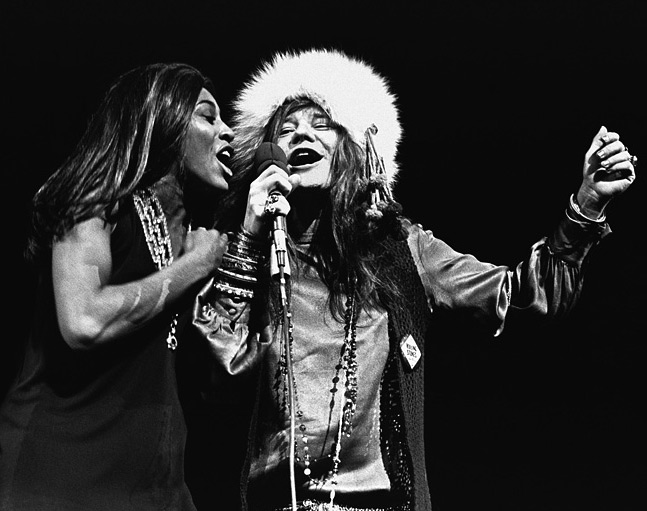
Unlike the efforts to destabilize the self in the experimental films, the photographs in “Summer of Love” often revealed an urge to represent new kinds of collectivity, to document the new society coming into being in the late 1960s. These photographs were, on the whole, surprisingly unpsychedelic at first glance. One of the most underappreciated chroniclers of the era, the photographer Amalie R. Rothschild, was virtually the Lewis Hine of rock ‘n’ roll. She simply sought to document the world of music at Bill Graham’s famous Fillmore East Ballroom, particularly the community of workers who put on the shows. Her photographs include iconic snapshots of performers, especially Janis Joplin, but also the staff behind the scenes: the light show makers and roadies, the ticket takers and band managers, and the towering mountains of equipment and machines they used.
Similarly, Elliott Landy’s photographs of the Woodstock Music Festival and Gene Anthony’s of San Francisco were not aggressive probings of the self, but instead gentle portraits of community gatherings. Even photographs that utilized collage, such as Robert Whitaker and Martin Sharp’s Plant a Flower Child (1967), revealed a new kind of self blossoming within a vision of organic community.
However, other photographs seemed to question the kind of world that was being made through rock and drugs. Just as in experimental films, photographs captured the loss of stable identity even when new visions of community came into being. Rothschild’s photograph The Crowd at Woodstock (1969) began as documentary, but the more one observed it, the more it started to resemble the radical abstractions of experimental film. In the wide-angle shot, there were so many people that Rothschild’s camera could not take in all the details. The people appeared as innumerable dots; the vastness was overwhelming, even frightening. Rothschild seemed to be asking: could the individual flourish in this kind of environment? Could community?
Psychedelic art in “Summer of Love” not only questioned the nature of self and community, but also the relationship between the counterculture and mass culture. While the popular assumption has been that capitalist companies often stole from the counterculture, “Summer of Love” offered the opposite notion. In an essay from the catalog, Jonathan Harris contended that “new forms of social and political radicalism in the later 1960s were parasitic to a significant extent upon the growth in new forms of consumption and relative affluence.” In other words, Madison Avenue did not steal from psychedelic art, but, rather, psychedelic art often embraced and explored the possibilities of post-World War II capitalism and its mass consumer culture. The clothing designer Betsey Johnson, for example, recalled using scraps and random bits of the fashion industry to investigate “the everyday mix linked to the oddball possibilities of mass production.”4
This “mix” points to a crucial dynamic in the Sixties: new technologies and commercial forms increasingly saturated the day-in, day-out life of civic interaction on the streets and through the mass media. The “Summer of Love” suggested that it was precisely in this interplay between “the everyday mix” and “the oddball possibilities of mass production” that so much psychedelic art was created. Even money itself arose as a topic for exploration in this dynamic of everyday life and mass consumerism. A fascinating bit of “parasitic” appropriation in the “Summer of Love” exhibition was the mock currency created by the San Francisco collective, the Diggers. These bills were worth “No Value.” They were called “Last Stage Money” and proclaimed a “Psychedelic Burlesque” in which “only love is legal, tender, and private.” On the back, the bills declared “In LBJ We Trust None.”
Read all of this article here. / informaworld

Congress Revisits Military’s Policy On Gays
By David Welna / July 24, 2008
More than 12,000 gay men and women have been expelled from the U.S. armed forces since the Pentagon’s policy of “don’t ask, don’t tell” took effect 15 years ago.
On Wednesday, Congress held its first hearing on whether to repeal that policy. It happened to coincide with the 60th anniversary of the order by President Harry Truman that ended racial segregation of the military.
Speaking in the Capitol Rotunda to lawmakers, administration officials and African-American veterans, the first black chairman of the Joint Chiefs of Staff, Colin Powell, proclaimed, “We are all created equal, with inalienable rights.”
“We have to make sure that those rights, those inalienable rights, belong to all Americans,” he said. “Thank you, God bless you, and thank Harry Truman.”
California House Democrat Susan Davis was at that commemoration. Hours later, she cited it as she chaired the first post-“don’t ask, don’t tell” hearing ever.
“I couldn’t help but just change some of the words that were being stated about how important it is for us to have equal treatment under the law,” she said.
Davis was unable to persuade anyone from the Pentagon to testify at the hearing. But the Armed Services panel did hear from a straight, retired African-American Army major general, Vance Coleman. He compared today’s official policy against gays in the military to the segregation he encountered enlisting in 1947.
“It’s bewildering and counterintuitive to me that we maintain a federal law that says no matter how well a person does his or her job, no matter how integral they are to their unit, they must be removed, disrespected and dismissed because of who they happen to be or who they happen to love,” Coleman said.
Another witness, retired Navy intelligence Capt. Joan Darrah, was once secretly gay. After nearly 30 years in the military, she had an epiphany after leaving an area of the Pentagon minutes before it was obliterated on Sept. 11, 2001.
“The reality is that if I had been killled, my partner then of 11 years would have been the last to know, as I had not dared to list her name in any of my paperwork or on any of my emergency contact information,” she said. “It was the events of Sept. 11 that made me realize that ‘don’t ask, don’t tell’ was taking a much greater toll than I had ever admitted.”
Darrah then retired from the Navy a year earlier than planned.
Marine Sgt. Eric Alva, a gay man visited by President Bush after losing a leg to a landmine — the first U.S. casualty in the Iraq invasion — also testified.
“That landmine may have put an end to my military career that day, but it didn’t put an end to my secret,” Alva said. “That would come years later, when I realized that I had fought and nearly died to secure the rights for others that I myself was not free to enjoy. I had proudly served a country that was not proud of me.”
Taking the opposite side was another witness, retired Army Sgt. Brian Jones, who said, “With all the important issues that require attention, it is difficult to understand why a minority faction is demanding that their concerns be given priority over more important issues.”
Jones got a sharp comeback from Connecticut Republican Chris Shays.
“We know that gays have served in every conflict in our country,” Shays said. “They’ve served in every war, and we know that gays have given their lives for everyone in this room. So, Sgt. Jones, that’s why we’re having this hearing.”
Also arguing against allowing gays in the military was Elaine Donnelly, who heads the Center for Military Readiness.
“We would lose thousands of people if they were told under a zero tolerance policy that you must accept the new paradigm, which is forced cohabitation of men and women with homosexuals in the military,” she said.
But California Democrat Ellen Tauscher, who is sponsoring legislation to repeal “don’t ask, don’t tell,” said the issue was one of civil rights.
“I believe that repealing the ‘don’t ask, don’t tell’ policy is probably the last civil rights issue we have,” Tauscher said.
Still, Democrats say Congress won’t act on repealing the policy until a new president is elected.
Source / National Public Radio
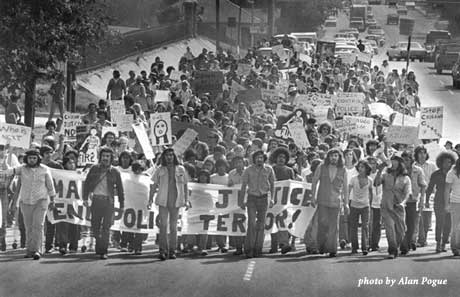
In the winter of 1969-70 I was driving a dump truck on the Highland Mall construction job, but heading back to the University in the spring. I approached my friend Paul Spencer concerning a possible near-campus housing situation among the Austin radical-hippie community. And so it was that I moved into what was then referred to as the Yellow Bordello apartment house at 2202 Nueces with my brand-new acquaintance Bob Bower and his girlfriend.
Bob was recently discharged from the Army, had ragged hair, and always wore his fatigue jacket. A Viet Nam veteran and Armored Personnel Carrier driver, he I think had been in combat (I never asked him) and had somehow become a peacenik while still in the Army. He had been stationed at Fort Hood after returning to the US, and I once saw a photo of his APC there with the name “Bolshevik” stenciled on it, in compliance with the requirement of a “B” name for his company but with an obvious defiant intent.
Bob smoked large quantities of alleged marijuana, and Army buddies dropped in all the time who apparently were addicted to heroin. He was advertised on posters around the campus as “Bob Bower, Antiwar GI” such that he came to introduce himself, with an ironic grin: “Hi, I’m Bob Bower, Antiwar GI.” Years later he described himself as having been “manipulated by the Trots” (Trotskyites) during that period, which if I recall comprised SMACK, SWAP and YASSA: the Student Mobilization Committee, the Socialist Workers Party and the Young Socialists’ Alliance.
My family’s dentist then was Harry someone, down on Rio Grande I think it was, near Fifteenth. On about the second day I knew Bob we found out we had consecutive appointments with him. I showed up in slacks and button-down shirt and sat in the waiting room. Finally the inner door opened and out lurched scrawny, long-haired, frizzy-mustached, fatigue-jacketed Bob, with buttons reading “US Out Now!” or some such, stoned out of his mind, his pupils huge and with the left half of his face drooping, paralyzed. What a sight! Bob careened through the door, and when he saw me looking up uncertainly from Newsweek he made a grotesque half-grin with the right side of his face and slobbered “Uhhhhh! Wowwww! Heyyyyyy! Faaar out! Henryyy!” Meanwhile Harry the Dentist was glaring out from behind him. I sensed an awkward situation.
As Bob reeled out the front door and I entered for my appointment, an agitated Harry demanded, “You know that guy??” Seeing Harry’s state of mind, and glancing nervously at the drill, I mumbled something noncommittal.
It turned out Harry was something of a right-wing nut, and further that Bob had apparently demanded that Harry withdraw the troops from Indochina immediately, and their conversation had become more and more acrimonious. I pictured Bob trying to carry on this argument in a principled manner while handicapped by tetra-hydro-cannabinol, Novocaine and Harry’s blunt fingers in his mouth.
Harry went on about Bob for a little while, jerking my lips this way and that, but finally calmed down, probably as he became stoned from Bob’s breath. Meanwhile I tried to nod and grunt in such a way as to indicate that I hardly knew ol’ Bob and that I completely disapproved of him. After that I always made damned sure that Bob wasn’t going to the dentist before me.
I think Bob is living today in Central America behind a scraggly beard.
Also see Under The Hood : An Anti-War GI Coffeehouse in Texas / by Tom Cleaver / The Rag Blog / July 23, 2008
And David Zeiger : Did the GI Movement End the Vietnam War? / The Rag Blog / July 25, 2008

Clowns emerging from clown car. Michael Chertoff front row, far left.
The Secure Border Fence Act passed in 2006, but the Department of Homeland Security only just realized that the homeland has an international water treaty with Mexico that prohibits the building of fences in the Rio Grande Valley’s floodplain.
DHS’ solution? A movable fence, of course. Can’t wait to see which private company gets the fat contract to move the fence before major flooding events. The more I read, the more I expect a Volkswagen to pull up with 17 clowns and Michael Chertoff crammed inside. Would anyone be surprised?
DHS is supposed to start building the border wall on top of existing levees — themselves long overdue for repairs — during the heart of this summer’s hurricane season. After the disaster in New Orleans, it boggles the mind that Hidalgo County officials have to fly to D.C. and beg for federal funding to repair their federal levees before a major flooding disaster occurs.
DHS has also proposed movable fencing along Arizona’s San Pedro River. Since the Congressional Research Office estimated $49 billion for 700 miles of border fence, then it’s reasonable to expect that movable fencing will cost taxpayers even more. Plus, the government will need to pay someone to move the fencing when disaster looms. Sounds like whoever gets the contract will also deserve hazard pay — add that to the nation’s already-bloated border security costs.
Wouldn’t it have made more sense, and cost U.S. taxpayers a lot less money, if DHS had simply consulted with border residents and border officials first? If they had asked (or listened to) groups like the Texas Border Coalition? Chertoff might have learned that eliminating salt cedar and Carrizo cane from the Rio Grande, expanding the river channel, adding more Border Patrol agents and employing virtual-fence technology (provided it works) might actually secure the border better. And how about comprehensive immigration reform?
Then again, maybe not. Where are the no-bid contracts in that?
Source / Texas Observer Blog

A young whale pokes its melon-shaped head into the cool morning air near this remote island, a sign its herd is thriving despite mounting threats in Russia’s melting Arctic.
Cameras and microphones capture the whale’s every move as scientists use the species’ only shore-side breeding ground to see how they are coping as fleets of oil tankers replace melting ice in their traditional feeding grounds.
“Belugas are a bellwether species…what happens to them reflects the effects of pollution and global warming on the whole ecosystem,” said Vsevolod Belkovich, a professor at the Russian Academy of Science who is leading the study.
Scientists have recorded a small drop in the whale population that they attribute in part to human activity in Arctic regions. “As global warming continues, the threats are going to grow dramatically,” Belkovich said.
Since monitoring began scores of whales have traveled hundreds of miles each year to this White Sea sandbank to mate, frolic and train their young.
Distinctive markings on the whales’ backs allow the researchers to track the population from year to year, monitoring their health, longevity and interactions with rival herds.
“It’s the only place in the world they come so close to the shore,” said Vladimir Baranov, a senior researcher with Moscow’s Institute of Oceanology, who films the Belugas close up underwater in their natural setting.
“They can play here because there is no danger,” said Olga Kirilova, a fellow researcher. “But in the winter they go north and face intensive shipping, the tankers and their pollution.”
With the melting of ice sheets in the Arctic, the Russian government has set the development of rich oil and gas reserves in the region as a priority, including fields in the Barents Sea where many of the Belugas spend the winter.
The volume of oil transported through the Barents Sea — part of the Arctic Ocean — has soared in less than decade from almost zero to 10 million tons, according to a study by the Norwegian funded Barents Secretariat.
Within a decade it could hit 150 million tons, the study said.
While the noise of the tankers is recognized as a major problem for the whales, who use sound to navigate, the biggest danger is the threat of a spill that could take years to clear.
It took the White Sea ecosystem over five years to overcome the effects of a small spill in 2003, Belkovich said.
A five percent fall in the White Sea Beluga population registered in recent years suggests the development is beginning to have an effect. But researchers fear much worse is to come.
The International Fund for Animal Welfare (IFAW), which is financing the research, cites the example of the Harp seal, which like the Beluga migrates between the White Sea and the Barents Sea.
Global warming and increased ship traffic in the White Sea have together robbed the Harp seal of the ice sheets where pups are born, causing a collapse in its population from 300,000 in 2003 to just over 100,000 in 2008, IFAW said.
While the Belugas are less dependent on ice, they are very sensitive to any pollution that the oil industry brings, said researcher Vera Krasnova.
“In the Saint Lawrence River in Canada, pollution has been catastrophic for the Belugas,” she said. “The same could happen here.”
Source / AFP / Discovery News
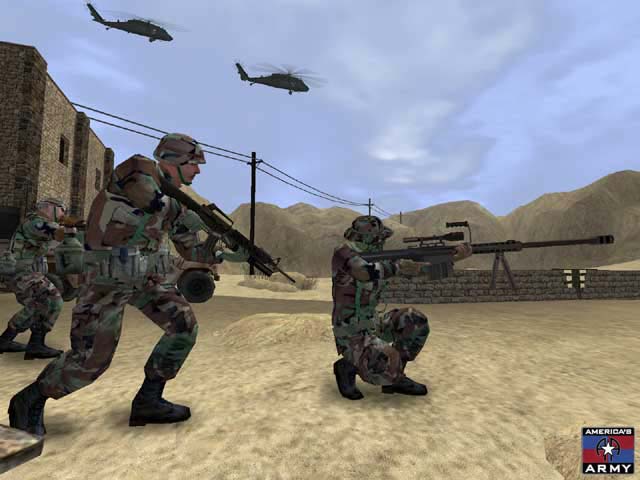
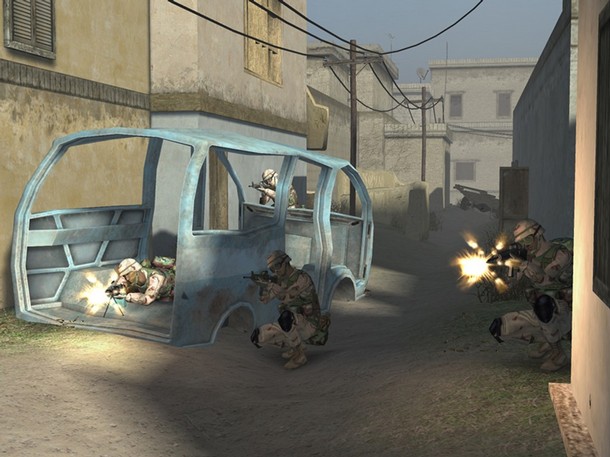
In May of 2002, the United States Army invaded E3, the annual video game convention held in Los Angeles. At the city’s Convention Center, young game enthusiasts mixed with camouflaged soldiers, Humvees and a small tank parked near the entrance. Thundering helicopter sound effects drew the curious to the Army’s interactive display, where a giant video screen flashed the words “Empower yourself. Defend America … You will be a soldier.”(1)
The Army was unveiling its latest recruitment tool, the “America’s Army” video game, free to download online or pick up at a recruiting station, and now available for purchase on the Xbox, PlayStation, cell phones and Gameboy game consoles. Since its release, the “game” has gone on to attain enormous popularity with over 30,000 players everyday, more than nine million registered users, and version 3.0 set for launch in September. “America’s Army” simulates the Army experience, immersing players in basic training before they can go on to play specialized combat roles. Most of the gameplay takes place in cyberspace where virtual Mideast cities, hospitals and oil rigs serve as backdrops for players to obliterate each other. As a “first person shooter,” the game allows players to “see what a soldier sees” in real combat situations – peek around corners, take fine aim, chose weapons that replicate those actually used by the US Army.
For the game’s commercial developers, realism is one its strongest selling points. Console version programmers were shipped to military training facilities in Wyoming, where they ran boot camp obstacle courses, fired weapons at the shooting range and got whisked around on helicopters. Back at hip, safe San Francisco Bay Area game companies, Army weapons specialists worked with developers to ensure aim, fire, sound and reload functions for all of the game’s weapons were as close to the real thing as possible. The Army also ensured that players learn real weapons skills such as breath control and the reload time for a M4 carbine. And in order to edge closer to the Army’s goal of “realism” and “authenticity,” several of the game’s missions are based on actual combat experiences in Iraq and Afghanistan. Even the training simulators and firing ranges are modeled on the real life versions at Ft. Benning, Ft. Lewis and Ft. Polk. In a 2005 press release, Ubisoft, the multimillion-dollar publisher of the console version of the game, wrote that “America’s Army” is the “deepest and most realistic military game ever to hit consoles,” hoping that it gave players a “realistic, action-packed, military experience.”(2)
But behind the fun and games is an attempt, in the words of a military booklet on “America’s Army,” “to build a game for Army strategic communication in support of recruiting.” The Army spent $6 million to develop the game at the Modeling, Virtual Environments and Simulation Institute (MOVES) before handing it over to private companies for adaptation to the console formats in 2004. As the name implies, the MOVES Institute is the military center for creating virtual training environments and simulators. A MOVES Institute booklet proclaims a later version of the game, “America’s Army: Special Forces,” was developed specifically to increase the number of Army Special Forces recruits. “The Department of Defense want[ed] to double the number of Special Forces Soldiers, so essential did they prove in Afghanistan and northern Iraq; consequently, orders … trickled down the chain of command and found application in the current release of ‘America’s Army.'”(3)
Like so many aspects of contemporary military operations, the development of later versions of the game has been handed over to corporations for private profit. Some of the biggest game companies have worked on the console, arcade and cell phone versions of “America’s Army.” Ubisoft, the world’s seventh largest video game company, is the game’s exclusive producer and has recently publicized record profits for the first quarter of 2008. Ubisoft worked closely with San Francisco based Secret Level to develop the 2005 Xbox version. Global VR, in San Jose, California, is preparing the release of the arcade version, and Gameloft programmed a version available for download to cell phones. Getting in on the action are other more traditional military contractors, such as Digital Consulting Services (DSC), a multimillion-dollar military tech company based in Newbury Park, California. Among DCS’s other projects are the Encore II Information Technology Solution for the innocuous sounding Global Information Grid, “an all encompassing communications project for the Department of Defense,” worth $13 billion over five years. Or the Navy’s Seaport-Enhanced – a $100 billion multicontract program to integrate Navy warfare operations. The Army worked closely with these and other companies to produce “America’s Army,” the first and only officially licensed Army game. It is this partnership and the close attention to technical detail that the Army and game companies claim gives “America’s Army” its realistic quality. As Col. Casey Wardynski, director of the US Army’s Office of Economic and Manpower Analysis (OEMA) and director of the game project proclaims, “America’s Army” is “the most authentic console game about soldiering in the US Army.”(4)
Yet, far from providing realism, “America’s Army” offers a sanitized version of war to propagandize youth on the benefits of an Army career and prepare them for the battlefield. In the game, soldiers are not massacred in bloody fire typical of most video games, or for that matter, real combat. When hit, bullet wounds resemble puffs of red smoke, and players can take up to four hits before being killed. To further protect youth, concerned parents can turn on optional controls that sanitize the violence even more – shots produce no blood whatsoever and dead soldiers just sit down. This presentation of war contrasts to the much more grisly reality unfolding every day in Iraq and Afghanistan, like a June suicide attack on the Fallujah City Council in which three Marines, two interpreters and 20 Iraqis, including young children, were killed. Photos by American photojournalist Zoriah depict a horror scene in a small courtyard, dismembered body parts – ears, hands and pieces of skull – spot the ground; one Marine’s head looks smeared into the pavement. Zoriah writes of the scene, “There are dying people strewn around like limp dolls along with lifeless bodies of all ages. People are screaming and crying and running as if they have something important to do, only they can’t figure out what that important thing could possibly be … people are literally frantic removing the dead, as if their pace may bring some of them back.” It is this violent, realistic quality of combat that has been excised from the game.(5)
Another ploy in the Army’s “realism” playbook is what the Army calls “America’s Army’s Real Heroes.” On the “America’s Army” web site, visitors can explore the stories of eight combat veterans who received silver or bronze stars, purple hearts, or other awards. Among them is Sgt. Tommy Rieman, an Iraq veteran who used his body to shield his gunner from incoming fire, miraculously surviving bullet wounds to the chest and shoulder. He was selected to be a “Real Hero” and media celebrity for Army recruitment not solely for his courage, but also because he survived his experience. Those who have made the “ultimate sacrifice” are unlikely to be chosen at all, like 22-year-old Specialist William L. McMillan, who was killed on July 8 when his vehicle was destroyed by a roadside bomb. Or 35-year-old Sgt. Steven Chevalier, of Flint, Michigan, father of two, who joined the Army after high school in 1991 because he couldn’t find work in Flint. On July 9, in the midst of his third tour in Iraq, Sergeant Chevalier was destroyed by a grenade attack in Samarra. Other Army nonheroes include those who have taken the courageous step of refusing orders in an illegal and immoral war, like Lt. Erin Watada or members of 2nd Platoon, Charlie Company, 1st Battalion, 26th Infantry Regiment who refused patrol orders in Adhamiya, Iraq.
What the game’s “realism” is attempting to do is to mask the violent reality of combat, and military experience in general, for very specific purposes. At a minimum, the Army hopes “America’s Army” will act as “strategic communication” to expose “kids who are college bound and technologically savvy” to positive messaging about the Army. Phase one of the propaganda effort is to expose children to “Army values” and make service look as attractive as possible. The next phase is direct recruiting. According to Colonel Wardynski, who originally thought up selling the Army to children through video games, “a well executed game would put the Army within the immediate decision-making environment of young Americans. It would thereby increase the likelihood that these Americans would include Soldiering in their set of career alternatives.” To make the connection between the game and recruitment explicit, the “America’s Army” web site links directly to the Army’s recruitment page. And gamers can explore a virtual recruitment center through the “America’s Army Real Heroes” program. Local recruiters also use the game to draw in high school children for recruitment opportunities. Recruiters stage area tournaments with free pizza and sodas; winners receive Xbox game consoles, free copies of “America’s Army” and iPods. Game centers are also set up at state fairs and public festivals with replica Humvees and .50 caliber machine guns, where children as young as 13 can test out the life-sized equipment.(6)
When players walk into Army sponsored tournaments, the government knows more about them then they may suppose. The game records players’ data and statistics in a massive database called Andromeda, which records every move a player makes and links the information to their screen name. With this information tracking system, gameplay serves as a military aptitude tester, tracking overall kills, kills per hour, a player’s virtual career path, and other statistics. According to Colonel Wardynski, players who play for a long time and do extremely well may “just get an e-mail seeing if [they’d] like any additional information on the Army.” The “America’s Army” web site, however, is quick to point out that the Army respects players’ privacy. The Army claims that player information is not linked to a person’s real world identity unless that person volunteers their identity to a recruiter. But it is not clear that recruiters have to give any sort of discloser that a voluntary relinquishing of one’s name is also an invitation to a player’s statistical information. Answering seemingly innocent questions from recruiters in “America’s Army” chat rooms or at state fairs about one’s screen name may divulge personal information without intending to.(7)
Beyond its recruitment goals, the game serves as a training device for both military tactics and weapons, and to condition players for battlefield operations. To this end, “America’s Army” game assignments are designed to simulate real world battlefield missions. For example in one mission, “Special Forces fight alongside Indigenous Forces they have trained. For this mission, [players] must rescue and escort a wounded resistance leader who’s escaped to a neutral hospital for treatment – or hinder the escape of a wounded enemy courier, depending which side you’re on.” Missions like this shadow real world military actions such as the November 2004 seizure of a Fallujah hospital, a blatant violation of international law. The Army justified the war crime by explaining the hospital was furthering enemy propaganda. Other missions designed to acclimate players to warfare take place on an offshore oil rig or reenact the “Blackhawk Down” scenario. The oil rig game environment mimics possible combat deployments like to the new military installation being built by the Navy on the Khawr al Amaya Oil Terminal in the Persian Gulf. Interestingly, in these mission environments every gun-carrying character found online has a real person behind it. Yet, all players perceive themselves as American Forces while their avatars may be represented as black masked “terrorists” to their opponents.(8)
If this weren’t enough, the Army has designed weapons systems and training simulators based on “America’s Army” simulations and gameplay and incorporated them into the game. Players are organized into groups of Army units to learn to think, act and work together, a key component of basic infantry training. With a system of honor points that can help or hinder a virtual career, players are rewarded for their teamwork and strategic thinking, and discouraged from acting like a lone Rambo. Weapons training programs are also developed from the game or incorporated into “America’s Army.” These include the Live Fire Virtual Targetry for Urban Combat, in which boot camp recruits fire live ammunition at huge screens with “America’s Army” simulations projected onto it. Additionally, training software for the Common Remotely Operated Weapons Station, a remote control vehicle with automatic weapons, was incorporated into the 2.7 version of “America’s Army.” The Army has also used the game to test new weapons. The Army’s weapons research laboratory, the Armament Research, Development and Engineering Center (ARDEC), uses “America’s Army” simulators to create virtual weapons testing grounds that are so lifelike ARDEC can “try out a new weapons system before any metal is cut.” In “America’s Army” one can play and undergo real-world military training at the same time.(9)
Most troubling of all, these recruitment and training techniques are targeted at children. Apart from sanitizing the violence of war, the Army toned down the gore in the game to get a Teen rating from the Entertainment Software Rating Board, the equivalent of a PG rating on movies, so that children as young as 13 could play “America’s Army.” Chris Chambers, the game project’s deputy director explains that “we have a teen rating that allows 13-year-olds to play, and in order to maintain that rating we have to adhere to certain standards. We want to reach young people to show them what the Army does … We can’t reach them if we are over the top with violence and other aspects of war that might not be appropriate. It’s a choice we made to be able to reach the audience we want.”(10)
The American Civil Liberties Union (ACLU) has found that Army use of the game, and its recruiting practice in general, violate international law. In May, the ACLU published a report that found the armed services “regularly target children under 17 for military recruitment. Department of Defense instruction to recruiters, the US military’s collection of information of hundreds of thousands of 16-year-olds, and military training corps for children as young as 11 reveal that students are targeted for recruitment as early as possible. By exposing children under 17 to military recruitment, the United States military violates the Optional Protocol.” The Optional Protocol on the Involvement of Children in Armed Conflict, ratified by the Senate in December 2002, protects the rights of children under 16 from military recruitment and deployment to war. The US subsequently entered a binding declaration that raised the minimum age to 17, meaning any recruitment activity targeted at those under 17 years old is not allowed in the United States. The ACLU report goes on to highlight the role of “America’s Army,” saying the Army uses the game to “attract young potential recruits … train them to use weapons, and engage in virtual combat and other military missions,” adding that the game “explicitly targets boys 13 and older.” In June, at the 48th session of the United Nations Committee on the Rights of the Child, the Committee noted US violations of the Protocol and urged the United States to “ensure that its policy and practice on deployment is consistent with the provisions of the Protocol.”(11)
Four years after the game was introduced at the 2002 Los Angles E3, and half way around the world in Mosul, Iraq, “America’s Army” was having an effect. Sgt. Sinque Swales had just fired his .50 caliber machine gun at so-called insurgents for only the second time. “It felt like I was in a big video game,” he said. “It didn’t even faze me, shooting back. It was just natural instinct. Boom! Boom! Boom! Boom!” While Sergeant Swales found game training conditioned him for combat situations, other soldiers report “America’s Army” played a direct role in guiding them to the military. Pvt. Doug Stanbro told The Christian Science Monitor in a 2006 interview that he “never really thought about the military at all before I started playing this game.” An informal Army study of the same year showed that 4 out of 100 new recruits in Ft. Benning, Georgia, credit “America’s Army” as the primary factor in convincing them to join the military. Sixty percent of those recruits surveyed said they played the game more than five times a week. And a 2004 Army survey found that nearly a third of young Americans aged 16 to 24 had some contact with the game in the previous six months.(12)
“America’s Army” is not a game; it is a recruitment and training tool that the Army uses in violation of international law. While soldiers and civilians continue to kill and die in Iraq and Afghanistan, private corporations like Ubisoft reap handsome profits from the Army’s project to train and recruit children. Military game developers are very open about this role, as Colonel Wardynski proudly proclaims in article after article, “We want kids to come into the Army and feel like they’ve already been there.” In this sense, “America’s Army” is more than a recruiting tool; it is an attempt to shift public perceptions about the Army and a conscious effort to militarize youth and video game culture. Indeed, the Army has been largely successful, so long as we accept sophisticated propaganda, recruitment and training programs like “America’s Army” as simply games and entertainment. In a statement that could apply to any of the military propaganda programs for youth, including popular movies like “Transformers” and “Iron Man,” Wardynski says, “If you don’t get in there and engage them early in life about what they’re going to do with their lives, when it comes time for them to choose, you’re in a fallback position.” With the need for fresh recruits at an all-time high due to popular opposition to the murderous and illegal wars, the Army is hoping their game will keep them from stepping into a fallback recruiting position. According to Colonel Wardynski, “today’s Soldiers are gamers,” and, we might add, the Army is hoping to make the statement true in the converse as well. When this means the militarization and recruitment of our children, we should all take special notice.(13)
[Michael B. Reagan is an activist and graduate student in the San Francisco Bay Area. He can be reached at micatron@berkeley.edu]
(1) Knight Ridder Tribune News Service: “Army Game to Draft Virtual Soldiers,” May 23, 2002, pg. 1
(2) Business Wire: “US Army and Ubisoft Join Force in Unprecedented Agreement to Deploy ‘America’s Army’ Brand Worldwide,” April 14, 2004; Business Wire: “US Army and Ubisoft Bring ‘America’s Army: Rise of a Soldier’ to Video Game Consoles; The Most Authentic Military Console Game Ever Created Ships to Retail Stores Today,” Press Release, November 15, 2005.
(3) The United States Army and the Modeling, Virtual Environments and Simulation Institute: “‘America’s Army’ PC Game Vision and Realization: A Look at the Artistry, Technique, and Impact of the United States Army’s Groundbreaking Tool for Strategic Communication,” January, 2004, pg. 22, henceforth, “MOVES Booklet”; MOVES Booklet, pg. 37.
(4) DCS web site: http://www.webdcs.com/contracts.php?id=encoreII; Business Wire: “US Army and Ubisoft Bring ‘America’s Army: Rise of a Soldier’ to Video Game Consoles; The Most Authentic Military Console Game Ever Created Ships to Retail Stores Today,” Press Release, November 15, 2005.
(5) Zoriah Photojournalist: “Suicide Bombing in Anbar – Eye Witness Account – Iraq War Photographer Diary – Graphic Images,” posted June 26, 2008, http://www.zoriah.net/blog/suicide-bombing-in-anbar-.html
(6) Carrie Kirby: “The advertising game: Adopting the latest thing in advertising, Army out to do some computer recruiting,” San Francisco Chronicle, August 5, 2002, Sec. E 1; MOVES Booklet 7; a Wisconsin counter-recruitment group was recently successful in booting recruiters armed with the video game from “Summerfest” before the Army pressured festival organizers to let them back in if they restricted game to those 17 or older.
(7) Gary Webb: “The Killing Game,” Newsreivew.com, November 4, 2004, http://www.newsreview.com/sacramento/Content?oid=23529
(8) MOVES Booklet 28.
(9) Jason Dobson: “Army Game Project’s Frank Blackwell on ‘America’s Army,'” Serious Game Source, September 2006; Webb: “The Killing Game.”
(10) Seth Schiesel: “On Maneuvers with the Army’s Game Squad,” The New York Times, February 17, 2005, Sec. G1
(11) American Civil Liberties Union US Violations of Optional Protocol on the Involvement of Children in Armed Conflict: Sons of Misfortune: Abusive US Military Recruitment and Failure to Protect Child Soldiers, May 23, 2008; United Nations Committee on the Rights of the Child, Forty-eight Session: “Consideration of Reports Submitted by States Parties Under Article 8 of the Optional Protocol to the Convention on the Rights of the Child on the Involvement of Children in Armed Conflict,” June 6, 2008.
(12) Jose Antonio Vargas: “Virtual reality prepares US soldiers for real war; Young warriors say video shooter games helped hone skills,” The Wall Street Journal Europe, February 15, 2006; Patrik Jonsson: “Enjoy the video game? Then join the Army,” The Christian Science Monitor, September 19, 2006.
(13) The Washington Post: “‘America’s Army’ video game doubles as military recruiter; Officials hope online multiplayer adventure will encourage teens to volunteer of service,” May 30, 2005, Sec. A13; Joan Ryan: “Army’s war game recruits kids,” San Francisco Chronicle, September 23, 2004, Sec. B1; Eric Gwinn: “Uncle Sam wants you – for ‘America’s Army,'” The Chicago Tribune, November 7, 2003
.Source / truthout

Why Vegan Is The New Atkins
By Kathy Freston / July 23, 2008
If you’re wondering about the recent articles claiming that a study found that high-protein diets help lose weight and drop cholesterol, please take a closer look. First, the “low fat” diet that was compared to the high-protein one in this study was a full 30 percent fat, which is not low-fat as the phrase is used by any of the top nutritionists and scientists who are using low-fat diets to help people lose weight and keep it off. Second, the study organizers encourage people to eat vegetarian protein sources, not the animal products encouraged by Atkins and South Beach . I don’t know about you, but it seems amiss to me for the media to portray this as a pro-Atkins study, really, since most of us consider Atkins to be meat-based, and shouldn’t the media help us to better understand the science?
Best-selling health writer and nutrition guru Dr. Dean Ornish wrote a good explanation for Newsweek on why the reporting on this study was really quite misleading; he does his usual excellent job of really explaining what’s so, as he did in the foreword (read it here) to his brilliant New York Times bestseller, Eat More, Weigh Less.
I am reminded of the fact that it’s been three years since Atkins Nutritionals filed for bankruptcy. And if you’re local grocery market is like mine, those once-omnipresent packaged foods with the “no-carb” labels are now harder and harder to find–with good reason, it seems to me.
While the South Beach Diet books and foods haven’t gone away, probably because it gets some things right (i.e., it recommends less meat and cutting out simple carbs–both excellent pieces of advice), its popularity should wane as the scientific consensus grows that if you want to maintain a healthy weight and fight off disease, the best diet is a truly low-fat diet (more like 10-15 percent of calories from fat) based primarily on whole grains, legumes, fruits, and vegetables. The South Beach diet is certainly a big improvement on the standard American diet (rightly called SAD), but it’s a half-measure, as Ornish and others are teaching us. Indeed, if food industry statistics, celebrity interest and the success of books like Skinny Bitch and (ok, here’s a little self promotion!) my own Quantum Wellness are any indication, there’s a growing shift toward healthy, plant-based diets, especially among people looking to lose weight and keep it off.
All of this is music to the ears of independent, qualified nutrition experts, who object to the “low-carb” diets. I’m not going to overload you with a tome of scientific evidence about why low-carb diets are bad for us. If you are looking for more in-depth info rmation on the topic, I highly recommend checking out http://www.atkinsdietalert.org/. Run by the Physicians Committee for Responsible Medicine, the website documents the health consequences of diets high in animal flesh, eggs and dairy, and lists the long history of grave concerns raised by medical experts, including an American Dietetic Association spokesperson calling Atkins “a nightmare diet”.
The experts’ concerns are really basic commonsense if you ask me, but sometimes commonsense gets swept away by a combination of wishful thinking and impressive marketing. Basically, every reputable health agency knows that a mountain of evidence indicates that the saturated fat and cholesterol in animal flesh, eggs and milk clogs your arteries and increases your risk of heart disease, among an array of other problems.
Heart disease is of course just one meat-related health problem; eating animals also raises one’s risk of cancer. For example, a massive Harvard study in 2006 found that people who frequently eat skinless chicken (often touted as the “healthy” way to cook chicken) had a whopping 52% higher rate of bladder cancer. The evidence that animal protein is carcinogenic is strong, and people who eat lots of it are raising their risk. Diabetes and high blood pressure are also linked to meat-heavy diets, and vegetarian diets are far outpacing those that include meat on an array of health-related issues, as I’ve discussed previously.
Yet another reason low-carb diets are going through tough times is that people are realizing that these diets do not work over the long run. As with any unhealthy, severely-limiting diets, you’ll lose weight over the short term (if you eat just grapefruit, you’ll also lose weight). But eventually the body objects to any unsound quick-fix and the weight creeps back, as Dr. Ornish explains so eloquently.
So what is someone who wants to lose weight supposed to do? The answer is fairly simple: Switch to a diet made up of a diverse selection of foods: vegetables, whole grains (we should skip the refined carbs– South Beach gets that right, of course), beans, chickpeas, nuts, fruit, lentils, etc. A wide array of evidence shows that vegans are less likely to be overweight or obese than meat-eaters–because it’s not a diet, it’s a lifestyle transition. Because these foods are less calorie dense and lower in fat than animal products, and because all plant foods contain zero cholesterol, eating that way allows us to shed weight in a sustainable way.
And a well-rounded vegan diet will provide us with a healthy mixture of complex carbs, protein and healthy fats, as well as vitamins, minerals and fiber. Because most nutrition advice is aimed at meat-eaters, it’s worth reading up a bit on how to maximize the health advantages of a vegan diet; I like the Optimal Vegan Nutrition web page. And of course we shouldn’t think that our healthy new diet means giving up tasty food–web sites and cookbooks with thousands of delicious vegan recipes abound; eating should be a celebration–and we should do it joyfully, like the French and others in the Mediterranean do.
Source / The Huffington Post

Google has launched a rival site to Wikipedia, called Knol. The big difference between the two is how Knol is handling authorship.
The key principle behind Knol is authorship. Every knol will have an author (or group of authors) who put their name behind their content. It’s their knol, their voice, their opinion. We expect that there will be multiple knols on the same subject, and we think that is good.
With Knol, we are introducing a new method for authors to work together that we call “moderated collaboration.” With this feature, any reader can make suggested edits to a knol which the author may then choose to accept, reject, or modify before these contributions become visible to the public. This allows authors to accept suggestions from everyone in the world while remaining in control of their content. After all, their name is associated with it!
The Guardian, meanwhile, warns,
As well as being an attack on Wikipedia, Knol represents an attack on the media industry in general. Writers don’t need to deal with pesky publishing companies, editors etc, they can just do their own thing and have it hosted by Google. Knol authors can also have Google ads on their pages and get “substantial revenue share from the proceeds of those ads,” says Google, which is not the case with Wikipedia.
Jonathan / July 23, 2008
Source / CyberJournalist

Pushing issue in Congressional campaign
By John Nichols / July 23, 2008
Does anyone seriously doubt that one of the reasons why a House Judiciary Committee hearing will at least discuss the “I” word on Friday is Cindy Sheehan’s independent challenge House Speaker Nancy Pelosi?
Pelosi, famously, took impeachment “off the table” just before the 2006 election.
Then, this summer, she edged it back on the menu – suggesting that the Judiciary Committee might take up the matter of Ohio Congressman Dennis Kucinich’s proposal to impeach the president for using deception to draw the nation into an illegal and immoral war.
Judiciary Committee chair John Conyers, the Michigan Democrat who has never made any secret of his desire to address the imperial reach of the Bush-Cheney presidency – especially on matters of war and peace – jumped at the chance to schedule the hearing. A two-hour session, at which the “i” word will be discussed openly by advocates such as Ohio Congressman Dennis Kucinich, is scheduled for Friday.
Though the hearing is unlikely to evolve into the full-fledged inquiry that many of us believe necessary, it is remarkable that in the summer of a presidential election year the key committee in a chamber where impeachment was supposed to be off the table will turn its attention to the tool that the founders afforded the legislative branch for constraining the executive.
Why is this happening now?
It is worth noting that this is petition-gathering season for independent candidates running in California. Sheehan, the mother of a slain Iraq War soldier who turned her grief into activism, and her supporters are busy collecting the 10,198 signatures that will be needed to get her name on the ballot.
And Sheehan has made impeachment a central issue of her campaign in a city that voted overwhelmingly to support holding Bush and Cheney to account.
Indeed, Sheehan announced that she would challenge the speaker after it became clear – after President Bush commuted White House aide Scooter Libby’s prison sentence last summer — that Pelosi was blocking consideration of impeachment by the House.
Local media has focused on Sheehan’s advocacy for impeachment, noting this spring when she filed initial paperwork for her candidacy that the woman who has been referred to as “the Rose Parks of the anti-war movement” had decided to run because “seeing George Bush impeached would be a victory for humanity.”
Sheehan is a realist. She admits that her candidacy is “an uphill battle.”
But she has drawn significant television, radio and newspaper coverage in San Francisco, as well as endorsements from the local Green and Peace and Freedom parties and local officials such as the president of the city’s school board and plan commission. She has raised more than $100,000 for the campaign, attracted an energetic team of volunteers. And, now, as those volunteers hit the streets to collect the signatures to put Sheehan’s name on the ballot, Pelosi is suddenly showing some flexibility – the key word being “some” – with regard to the impeachment discussion.
No matter how many votes she gets in November, give Cindy Sheehan credit for opening up the debate – not just in San Francisco but in Washington.
Source / The Nation
“I really hate jaywalkers. I despise them. Since I don’t run the country, all I can do is yell at ’em. The other option is to run ’em over, but as a compassionate conservative, I would never do that,”
Robert Novak, quoted in the Washington Post in 2001.“I didn’t know I hit him,”
Novak, today, after striking a pedestrian with his car.
Chris Bodenner / Daily Dish / July 23, 2008
Thanks to Harry Edwards / The Rag Blog
Thorne Webb Dreyer, Editor




