Health Care Reform : Our Christmas Eve Present


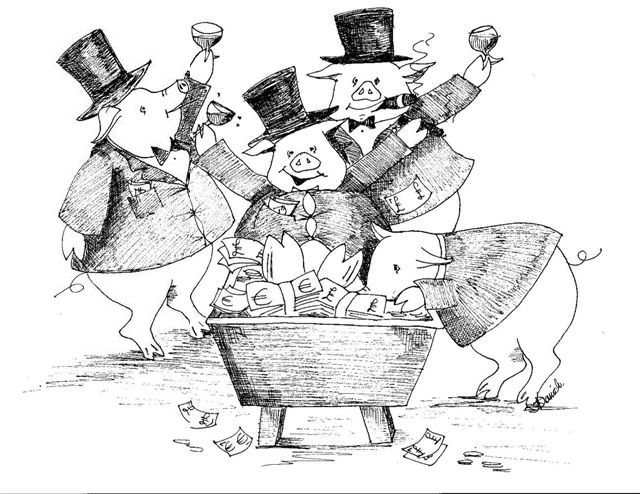
Congress’ health care reform
Promises huge returns for all

‘Their principal job is to reinforce the great ideas of yesterday while suppressing the great ideas of tomorrow.’ — Deepak Chopra on skeptics.

By Janet Gilles / The Rag Blog / December 29, 2009

[The Rag Blog has run numerous articles critical of Congress’ attempt at health care reform. Contributor Janet Gilles has a very different perspective.]

Few politicians have dared to question the health care system itself in this country. Yet, there are 99,000 easily preventable deaths a year from infections acquired in the hospital, according to the Center for Disease Control. The passage of health reform, the Christmas Eve gift to the American public, promises huge returns for everyone, even those with excellent health insurance. Because what good is good insurance when more people die from infections acquired in the hospital than from breast cancer and AIDS combined??

In most states, hospitals are not required to report these rates of infections, which is how they get away with it. New regulations in the health bill which require reporting of hospital acquired infections, will almost entirely eliminate this deadly threat.Other examples of how cost controls are going to result in a betterSystem of health care abound.

For the last decade or two, the costs of health care have skyrocketed. The Mayo Clinic has led the way, and numerous commissions have made simple recommendations to change the rules of the game, by comparing treatments to determine which are most effective. Due to their great promise of cutting costs, most of these measures have made it into the current law now so close to our grasp.

What has been needed has been a restructuring of incentives, a consistent theme in Obama’s health care reform agenda, and we are that close. Because of the power of the right, the new bill does not cover everyone, but Paul Krugman says it best. “Guys, this is a major program to aid lower and lower-middle-income families. How is that not a big progressive victory?”

Jonathan Chait explains why this legislation is the greatest social achievement of our time. Our health care system has been focused on finding the most expensive remedies; this new legislation will require an apples to apples comparison of treatments and end up changing the nature of health care. Change we can depend on.

The Rag Blog

Posted in Rag Bloggers | Tagged , , , , | 2 Comments

Corruption in Panama : Former President on the Lam

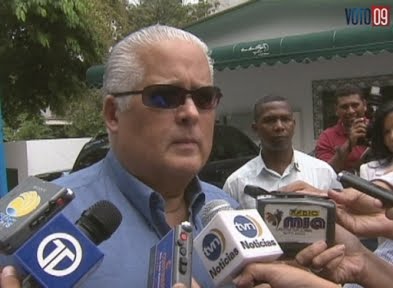
Panama’s ex-President Ernesto Pérez Balladares earlier this year. Panama’s ‘Toro’ is currently wanted by law enforcement, if not by Panama’s voters. Photo from telemetro.com.

Panama’s ‘Toro’ goes underground

Warrant issued for arrest of ex-President Ernesto Pérez Balladares for laundering money from gambling concession kickbacks…

By Eric Jackson / The Rag Blog / December 29, 2009

PANAMA CITY, Panama — On December 28 — ironically, the Day of the Holy Innocents, which is Panama’s functional equivalent of April Fools Day in the United States — prosecutors revealed that they had issued an order for police to arrest former President Ernesto “Toro” Pérez Balladares and bring him in for formal interrogation and possible preventive detention on charges that he laundered the proceeds of kickbacks he received from a gambling concession contract awarded by his administration. This was no joke.

The alleged crime is money laundering, arising from a 1997 no-bid gambling concession that the Pérez Balladares administration awarded to Lucky Games SA, a subsidiary of a mostly Spanish-owned investment group. It is alleged that a piece of that business went to a company controlled by Mr. Pérez Balladares, Shelf Holdings SA, and that from the concession’s inception up until the middle of this year Toro received a steady stream of payments from Lucky Games through Shelf Holdings.

The transactions allegedly took place through a complicated network of companies apparently controlled by or in the names of the former president’s close friends. Although a fairly damning paper trail has been published in some of the daily newspapers, Pérez Balladares denies that he has received anything from gambling concessions that his administration granted.

Rumors of the former president’s imminent arrest had been circulating for several days, and a few days before the arrest order was revealed a spokesperson said that he had left the country for Nicaragua on a personal visit. Pérez Balladares’s father was Nicaraguan, which could qualify him for Nicaraguan citizenship that could be an impediment to his extradition. But Migracion said that its records indicated that Toro was still in Panama.

On the afternoon of December 28 the National Police cordoned off part of the Panama Oeste residential area of Punta Barco, where the former president has his beach home. Meanwhile, Pérez Balladares’ lawyers went to court to file a motion to have the arrest warrant quashed. (In Panama, unlike most countries, the courts will entertain legal proceedings by a fugitive from justice and in political corruption cases this is the usual procedure.)

Having served as president from 1994 until 1999, Pérez Balladares was eligible to run for the presidency again in 1999 but after a humiliating loss in the intra-party delegate races for control of the Democratic Revolutionary Party (PRD) he shelved his plans to run in the party’s presidential primary, which in the end was narrowly won by Balbina Herrera. The PRD was routed in this past May’s general elections by Ricardo Martinelli and has been embroiled in severe infighting since then.

One of Toro’s great political liabilities is that he conspicuously flaunts great wealth but has never given any credible explanation as to its source. Over the years he has filed a number of criminal defamation charges and civil lawsuits against people who have suggested where he got his money.

In some diplomatic circles it is said that the fortune dates back to the times when General Omar Torrijos was dictator and Toro was not only a high-ranking economic policy maker but also reputedly the man who for the most part handled the general’s personal finances. However, no diplomat will spell out any details of how the fortune was amassed or even state the theory about the time and circumstances of its origins to a journalist for attribution.

Pérez Balladares was president of Panama when Bill Clinton was president of the United States, and the Clinton administration did a number of things to enrich Toro’s family, for example by incarcerating hundreds of Cuban rafters on an old US military firing range here where there was no water and giving a member of Toro’s family the contract to supply bottled water.

However, during Clinton’s time the U.S. government sought an extension of its tenure at some of the military bases in the old Canal Zone, under the guise of a multinational anti-drug center. Toro’s diplomats negotiated such a deal, but the PRD delegation in the legislature refused to go along with it, and after that the U.S. government began to leak a series of allegations about corruption on Pérez Balladares’s part.

These included participation in a scheme to provide Panamanian visas and passports to Chinese citizens seeking to illegally enter the United States and a scheme with American accomplices to obtain kickbacks in a concession to privatize the maintenance of Panama’s buoys and lighthouses. In recent weeks there have been convictions of at least two of the U.S. citizens involved in the latter scheme in U.S. federal courts.

Shortly after Toro left office in 1999, the U.S. State Department canceled his visa. Stating that such information is confidential, the State Department has never openly publicized its reasons for taking the actions that it did. For years Pérez Balladares employed top Washington attorneys and lobbyists in fruitless attempts to get his U.S. visa back.

(The pattern of Washington playing along with corrupt Panamanian politicians up to the point that the latter can or will no longer deliver what the U.S. government wants, at which point the Americans turn on such officials, has a number of precedents in U.S.-Panamanian bilateral relations. The most infamous of these is the case of one Manuel Antonio Noriega.)

The prosecution of former President Pérez Balladares comes at a time when two former education ministers from the PRD administration of Martín Torrijos are in jail awaiting trial on charges of corruption in building maintenance contracts. The party is split between those who would allow prominent PRD members facing corruption charges to fend for themselves and those who would rally behind the accused, alleging a partisan-motivated political witch hunt.

A series of prosecutions that touches scandals from the Pérez Balladares and Torrijos administrations but ignores the many scandals of the Moscoso administration could give the PRD the political circumstances it would need to make its case to much of the public. Prosecution of Moscoso-era corruption, on the other hand, might drive the Panameñista Party away from its alliance with President Martinelli’s Cambio Democratico.

Martinelli, however, has a fairly effective dodge — it is the semi-autonomous Public Ministry, headed by Attorney General Ana Matilde Gómez, that decides which cases get prosecuted and which do not. The president does not give orders to prosecutors and he can thus stand aside and tell anybody who asks that he’ll allow judicial processes to take their course without interference. This is what Martinelli is doing at the moment.

[Eric Jackson is editor of The Panama News.]

The Rag Blog

Posted in Rag Bloggers | Tagged , , , , | Leave a comment

Avatar : Contradictions of Cameron’s Animation Masterpiece


The contradictions of capital-intensive history:
James Cameron’s animation masterpiece

The stunning experience of nature, culture, and politics does achieve an important spiritual reversal of the Cowboys and Indians plot.

By Greg Moses / The Rag Blog / December 28, 2009

“I’ll sell it to you for $12 what I paid,” she says to a man holding a pale sign that says “Needed, 1 ticket.” Cheery thankyous move the long line forward, one step closer to Avatar on the last day of this box-office- busting Christmas weekend.

Inside the IMAX theater, just before the house lights come down there will be two more tickets to exchange. Mother and son pay cash at the door to strangers and locate a small, impromptu space where they can sit together against the wall, giving the rest of us the chance to see what we look like with our 3-D glasses on.

The one and only preview belongs to the Disney-branded Tim Burton edition of Alice in Wonderland starring Johnny Depp. Everything about it looks brilliant in IMAX 3-D. The Mad Hatter does not fail to chuckle. Imagine seeing all of us from his point of view, looking like a wall of human flies on flypaper, all bug-eyed.

As for the main feature, which opened Dec. 18, 2009 worldwide, it is true what the fan said who chased in vain after James Cameron’s grumpy autograph at LAX: “The plot is so simple a three-year-old could follow it.” Yes, okay, the formula of colonial imperialism is a cosmology that every preschooler can comprehend. It used to go by the name Cowboys and Indians.

Something about Cameron’s capital-intensive mythology is laudable for a Hollywood Blockbuster. The stunning experience of nature, culture, and politics does achieve an important spiritual reversal of the Cowboys and Indians plot. The audience is skillfully maneuvered into anti-imperialist sympathies so that we can tearfully commit to an improbable reversal of the kind of history that any three-year-old knows.

I came away thinking that I might like to try the Xbox version of the Avatar adventure, with opportunities to win battles of liberation using fantastic weapons upon exotic landscapes. Of course, I realized as I was pulling out my car key that a more effective spiritual reversal would have me renouncing all my capital-intensive desires and the battles they advance.

A truly improbable Avatar reversal would produce a global back-to-nature movement liberated from plastic 3-D glasses because something like “real nature” was being returned to its sacred center of attention. “I see you,” we would say to all living things. Cameron’s deeper vision suggests that all living things would be able to sigh a biologically verifiable response of collective awareness: “And I see you.”

At the high point of the plot’s arc, a masculine body of “skin” touches the feminine surface of a producer’s fantasy. In that very moment, the saturated hues of Avatar’s animation affirm what the plot renounces. Experience moves relentlessly toward the desire to be more immersed in the jungle of technology than we already are.

At any rate, the contradictions of the Hollywood Blockbuster are not proprietary to Cameron. They are the contradictions of capital-intensive history itself. With few exceptions here and there, audiences have not failed to purchase their Avatar tickets in advance.

[Greg Moses is editor of the Texas Civil Rights Review and author of Revolution of Conscience: Martin Luther King, Jr. and the Philosophy of Nonviolence. He can be reached at gmosesx@gmail.com.]

The Rag Blog

Posted in Rag Bloggers | Tagged , , , , , , , , | 5 Comments

Carl Davidson : Obama, the Democrats, and the Months Ahead

Carl Davidson. Photo by Thomas Good / Next Left Notes.

A report and perspective from the rust belt:
Obama, the Democrats and the months ahead

By Carl Davidson / The Rag Blog / December 28, 2009

Carl Davidson will be Thorne Dreyer’s guest on Rag Radio, Tuesday, December 29, 2-3 p.m. on KOOP 91.7 FM in Austin. Carl will reflect on Obama’s year and take a look at what’s ahead for the Left. For those outside the listening area, go here to stream the show.

BEAVER COUNTY, PA — I’ve been hearing from too many left activists who are simply fed up with the Democrats and want to leave the electoral arena — and just when the battles there are getting really interesting, even if we don’t have prospects of major victories. To my way of thinking, our present task is to deepen the divisions there, not walk away from them.

The sooner we stop thinking of the “Democratic Party” as if it were a single entity, the better off we will be. That’s why “Democrat control of Congress” is an illusion. The GOP Blue Dog faction in the Democratic Party combined with the regular GOP make it at least a draw. That’s why everything positive gets gutted and turned into its opposite.

The progressive majority’s forces are pretty much limited to the Progressive Caucus, the Black Caucus and the Latino Caucus, and not even all of them. We are a minority force in those upper spheres, not an emerging majority like we are at the base. We can grow to a larger minority in Congress, but to get a true majority, we’d likely have to split both major parties, and we are not close to having that strength yet.

Otherwise, we are mainly limited to passing things where there is a deep divide in finance capital and other big capital at the top, and where one side of it becomes an indirect ally. That may be shaping up on the Afghan war.

But small and medium-sized capital, as well as some larger sectors of productive capital, have yet to stand up to finance capital on HR 676 even though it’s in their interest to do so. We’ll just have to continue our “long march through the institutions” to get it. A carbon tax, immigration reform, and EFCA are going to be even more difficult.

At this point, we have two interconnected mass democratic tasks. Building the left-progressive pole inside and outside the Dems with groups like PDA and other independent forums, and dividing the GOP right to smash the Teabaggers and their allies. Neither is easy, but starting with a clear head helps a lot.

Here in Beaver County in western Pennsylvania we have about 200 or so PDA people and another few dozen Beaver County Peace Links activists. Almost all are blue collar workers or retirees. We, in this sense, are the active antiwar forces here, as well as the active left-progressive side of the spectrum among the unions and a few other groups.

There isn’t much else, save for the Tom Merton Center, the religious-liberal-green-anarchist bunch in nearby Pittburgh. Together with the unions, they pulled out 10,000 for the G20. We took part in it as best as we could. All told, about 6,000 of the 10,000 were from the wider Pittsburgh region and the nearby campuses. That’s our activist core viewed more widely.

Nonetheless a majority of our county, and certainly a majority of Dem voters, are critical of the wars — but they have yet to take any action other than voting. It’s our task to find the activities they will take up, like coming to a vigil or attending an antiwar educational, or even just honking their horns at our weekly vigils.

For the Healthcare not Warfare Afghan war protests here a few weeks ago, we got out about 60 people in the rain and cold. Not bad, considering. At least half those attending were wearing their union jackets. Besides us, the speakers were union folks and local Dem officials, plus Tim Carpenter from PDA. The speeches pushed and warned Obama, but didn’t attack him personally. They told him what he had to do in order to succeed.

If we didn’t take this approach, working with local Dems, I’d guess we could get out less than 10 people, if anyone bothered at all.

Our next project is to make use of Bob Greenwald’s Rethink Afghanistan from Brave New Films. One of our allies showed it last month at a college in the next county. Plus finding ways to work with the Steelworkers on their new collaborative with the Mondragon Coops.

If you think our strategy is reducible to “supporting Obama,” you don’t understand it. To be precise, our strategy here is to aim the main blow at low-road neoliberal finance capital and its right wing populist allies, allying with high road neoKeynesian initiatives at the top, while developing the left-center coalition among labor, minorities, women and youth at the base.

We do that in the form of expanding our PDA group; it’s platform is Out Now, HR 676, Green Jobs, the Employee Free Choice Act (EFCA), Carbon Tax and Debt Relief. Within that, among the advanced, a few of us do revolutionary socialist education that targets neo-Keynesianism as well. We work with Committees of Correspondence for Democracy and Socialism, and that way we grow CCDS in size, too.

That’s the political and class substance of it. Where Obama stands, and where we stand in relation to him, depends on the ebb and flow. We oppose him where he’s wrong, support him where he’s right, and defend him versus the racist onslaughts of the right.

So yes, I’m suggesting that people elsewhere do likewise — although I’m well aware that conditions vary, and adjustments are required.

If one of the left antiwar coalitions thinks they can pull off a march on DC, we’ll probably rent a bus or two, fill them, and go to it. If we do, we’ll try to network horizontally with others like ourselves, perhaps even meet after the march for a confab of some sort.

But we are not interested in wasting energy or resources getting into national pissing matches and intrigues over slogans and speakers. We’ll simply bring the slogans that make sense to us. But in the end, the antiwar forces need to be reoriented and rebuilt at the base, in alliance with the growth in class struggle activity around the economy.

That’s what we’re doing, and have been doing for some time. Other approaches may point to the future as well, and I’m wide open to hearing about them.

Carl Davidson became widely known in the American left as a national officer of SDS (1966-68), as a writer and editor of the New Left newsweekly The Guardian, and as a leader of the anti-Vietnam war movement. In later years, he took up the study of the social impact of technology and the revolutions in communication and high-tech production. Together with Jerry Harris, he is the author of CyberRadicalism: A New Left for a Global Age.

Most recently Carl worked as webmaster for Progressives for Obama, an independent left-progressive voice in the campaign (now renamed as Progressive America Rising). He is also a leader in the U.S. socialist movement, serving as a national co-chair of Committees of Correspondence for Democracy and Socialism. A longtime resident of Chicago, he recently moved back to the Western Pennsylvania milltowns where he was born and his family resides.

The Rag Blog

Posted in Rag Bloggers | Tagged , , , , , , , , | 6 Comments

Deadly Environment : Latin American Anti-Mining Activists Murdered

A close up of murdered anti-mining activist Marcelo Rivera’s eyes on a mural painted in front of the cultural center that he founded in San Isidro, El Salvador. Photo by Dominque Jarry-Shore / The Dominion.

Grassroots movements met with deadly violence:
Mining faces challenges in Latin America

By Val Liveoak / The Rag Blog / December 27, 2009

See ‘Who Killed Marcelo Rivera? Prominent anti-mining activist murdered in El Salvador,’ by Dominique Jarry-Shore, and ‘Chiapas Anti-Mining Organizer Murdered,’ by Kristen Bricker, Below.

There are many grassroots struggles against corporate domination going on in the Empire that we hear little about. I would argue that the military coup in Honduras was triggered in large part by these issues, and I am aware of similar struggles in Mexico, Colombia, and Costa Rica, not to mention West Virginia, Canada and the American West. And now, with the article below, in El Salvador.

Mining companies are the epitome of an extractive industry; typically flaunting concerns about health, labor issues, and the environment, they focus on ripping out tons of earth to get ounces of ore, which is almost always exported outside of the region (and in many cases outside the country) in which it is produced.

And the profits also leave the area as fast as possible. In order to increase their profits, companies must pay the lowest possible wages for hard, dangerous and dirty work, and generally use poisonous chemicals on site, mostly failing to keep them from entering local water, and air. Then they leave behind an ugly and ravaged landscape that can never return to a condition that will even minimally support life without costly rehabilitation — which they never do voluntarily.

The growing world concern with environmental issues has little success when up against these multinational corporations. Not only is it hard to take on the powerful behemoths, but they do their work (their dirty work) in isolated areas, and often control access to their sites, preventing most people from seeing the ugliness, the near enslavement of the miners, and the effects of the poisons — many slow acting — that seep into the earth. Think black lung, mercury poisoning, massive fish kills, hundreds of acres of moonscapes where before there were verdant mountains.

And like other industries that would exploit and extract the most from “their” resources, they are always ready to persecute, threaten, or kill opponents, whether they are labor leaders, environmental activists, concerned local residents, or terminally ill employees.

While global warming was on most minds at the climate conference in Copenhagen, Ecuador offered an innovative way to confront both the local negative effects of the petroleum industry — an archetype of an extractive industry — and the long term effects to the earth and the atmosphere of the consumption of the product: they offered to leave newly found Amazonian petroleum in the ground in exchange for financial support for other types of investment in their country.

It is a shame that El Salvador’s celebrated FMLN President does not have such a — dare I say it — revolutionary offer to make. Instead, as we see from the article below, he will need to be pushed to provide even the simplest protection for Salvadorans who are struggling against a goliath of a company.

Please see the two stories about murdered mining activists in El Salvador and in Chiapas, Mexico, below.

[Texan Val Liveoak is a nonviolent activist currently dividing her time between El Salvador and San Antonio. She coordinates Peacebuilding en las Americas, the Latin American Initiative of Friends Peace Teams that also has programs in the African Great Lakes region and in Indonesia.]

Esaparición y asesinato del activista Marcelo Rivera

His relatives, friends, neighbors. His students from the school, attendees of his art workshops, colleagues of the association (ASIC). His comrades from the party, his partners in the anti-mining fight [in El Salvador]. Everyone. Perhaps even his murderers.

Almost always it is the family members and closest friends who say goodbye to a fallen one by crying profusely. It is rare at a funeral to see everyone in attendance crying. The burial of Gustavo Marcelo Rivera Moreno is one of those exceptional cases, hundreds of children, youth and elders, men and women, all crying together…

The Media Coop

Who Killed Marcelo Rivera?
Prominent anti-mining activist murdered in El Salvador

By Dominique Jarry-Shore / December 16, 2009

SAN ISIDRO, El Salvador — Death and violence are an unfortunate part of everyday life in El Salvador. Local and national newspapers, with their graphic photos of bloodied corpses, track the daily tally of homicide and crime in a country that has one of the highest murder rates in the world. But even by those standards Marcelo Rivera’s torture and death were shocking.

During the evening of June 18, 2009, the community leader and anti-mining activist disappeared when he was lured away from a routine trip a few kilometers from his home in San Isidro. Twelve days later, his body was removed from an empty well 27 meters deep. His body had no hair or fingernails, his trachea had been broken and the thumb of his right hand was stuck in his mouth like a baby’s, tied in place with a piece of rope around his naked body. He had been beaten and his face was unrecognizable.

Rivera was a respected member of the community. He founded a cultural center popular with youth in San Isidro, and had been in charge of the finances of the local chapter of the FMLN, the country’s leftist and currently ruling political party. He had also campaigned vigorously against the El Dorado mining project in Cabanas, owned by Canadian company Pacific Rim Mining Corp.

Vancouver-based Pacific Rim is a publicly traded company that has subsidiaries in El Salvador and the U.S. The company is a junior exploration company that specializes in gold exploration. Pacific Rim has invested $80 million into the El Dorado project in about seven years. They claim to have invested several million dollars in social programs in Cabanas.

But the project has generated conflict in a region characterized by poverty and a dependence on remittances from family members in the U.S. Money provided by Pacific Rim for health and education is seen as a way of buying support from the people and tension is high between those for and against the mine.

The environmental effects of the mine, such as the contamination of soil and water sources like aquifers and wells, are a big worry among residents in Cabanas. Some community members have also complained about the displacement of communities to make room for the mine. On a social level, the arrival of Pacific Rim has generated conflict and violence in the area.

Apart from Rivera’s death, there have been two assassination attempts that seem to be related to anti-mining activism: In July, a priest who hosts a local radio show used as a platform for his anti-mining stance was run off the road. A few weeks later, the leader of a local community development association that is against the mine was shot eight times. Both men now have 24-hour police protection.

Rivera’s brother Miguel Rivera said his brother’s murder has caused fear among those opposed to the project. “People we work with who are against the mining project are afraid because someone has died,” he said. “They say, ‘I could be the second one. I could be next.’”

According to lawyer and activist Hector Berrios, Marcelo Rivera had already been the victim of death threats and at least one assassination attempt near his home in January 2009. “The question is,” Berrios said, “who benefited from Marcelo’s death?”

For his part, Pacific Rim CEO Tom Shrake said the company condemns violence and has spoken to employees to see if they know anything about the murder.

“They have assured us that they had absolutely nothing to do with it,” Shrake said in a telephone interview from his hotel in San Salvador.

“As far as they know—and I’ve heard this from the local police as well—his death had nothing to do with his mining activism. Now whether that’s true or not we’ll see. But we have no knowledge of it.”

That police theory — that Rivera’s death was related to a gang dispute after a night of drinking and not his anti-mining activity — didn’t make sense to Rivera’s family when they heard it. Rivera was not someone who associated with gang members and he didn’t drink alcohol.

“The police invented a scenario to be able to tell people something, because a lot of people were asking about Marcelo,” Miguel Rivera said. “The police theory was that he was killed the same day he disappeared, or early the next day.” But the doctors who examined Marcelo’s body told Miguel that his brother died about eight days after he disappeared.

That was just one of several inconsistencies in the case. Following a complaint they received from Marcelo’s family, El Salvador’s Public Attorney’s Office for the Defense of Human Rights found there had been negligence on the part of the police.

“We found some failures in terms of the lateness in mobilizing to do inspections in places where the body could be,” Gerardo Alegria, a lawyer for the Public Attorney for the Defense of Human Rights, said. “That includes where they found the body. The police had known for a few days already that the body was there.”

Alegria also said the police failed to gather information at the scene that would have helped solve the crime. His office is now keeping an eye on the investigation and Alegria said things have improved. Five adults and one minor have been arrested so far and are awaiting a hearing. But in this part of the world, there is a lot to be said about intellectual versus physical perpetrators of a crime, and questions remain about who was really behind the killing.

Meanwhile El Dorado has been at a standstill. The company stopped investing serious money into the mine about two years ago, when Tony Saca, president of El Salvador at the time, made public statements indicating Pacific Rim’s permits would not be honoured.

Pacific Rim has since filed for arbitration under the Central American Free Trade Agreement (CAFTA), although Shrake said he is confident a settlement will be reached.

As for local opposition to the project, Shrake said that is something that was expected all along. “There’s just a huge international industry that opposes any extractive industry anywhere in the world at this point. So if you don’t expect opposition to any extractive project, you’re living in a closet,” he said.

“You will have people who are emotional about it and are in your face about it but you have to act like Mahatma Ghandi. You cannot react in any way, shape or form.”

Gold mining, a practice that relies on cyanide or mercury for extraction, has long come under fire from environmentalists because of its potential for contamination. Pacific Rim markets itself as an environmentally responsible company that has “raised the bar for environmental protection.”

According to Shrake, the El Dorado design will use two impermeable liners to prevent tailings from coming in contact with the ground. They’ll also use a process called INCO to destroy the cyanide used and they’ll build their own water reservoir instead of using groundwater, purifying the water before it goes back into the water system.

Environmentalist Luis Gonzalez works with the Salvadoran Ecological Unit (UNES) in San Salvador. “It’s a concept, but on an industrial level, green mining doesn’t exist,” he said. “By definition what you’re doing is extracting a non-renewable resource.”

Gonzalez said the INCO process recycles only part of the cyanide and the rest goes into the ground. “Exploration is like exploitation on a smaller scale,” he said, noting people in Cabanas reported their wells and watering holes dried up after exploration activity by Pacific Rim.

Shrake said that was one incident involving some shoddy work on the part of a contractor and that it won’t happen again.

“Once we realized what had happened, within a day we set up a series of tanks so that they’d have water while we corrected the problem… We went back to the drill holes and cemented them from bottom to top and plugged up this disruption to the fracture system and the water’s flowing again, and has been flowing since we made the correction.”

While the future of El Dorado remains unclear, Miguel Rivera has gone ahead and set up the Marcelo Rivera Justice and Freedom Committee. He is holding out hope that his brother’s murderer will be brought to justice.

“He was my brother. Ever since we were little we spent a lot of time together and shared ideas. When we started finding out more about the impacts of mining we started spreading information to people. Marcelo was the person who had a relationship with the community.”

[Dominique Jarry-Shore is a freelance journalist based in Chiapas, Mexico. She traveled to El Salvador with the help of a grant from the International Development Research Center in Ottawa.]

Source / The Dominion

Anti- mining activist was shot to death Dec. 27. Mariano Abarca. Photo from narocsphere.

And in Mexico:
Chiapas anti-mining organizer murdered

Mariano Abarca led a growing movement to kick Canadian mining companies out of Mexican communities

By Kristin Bricker / December 1, 2009

CHIAPAS, Mexico — Mariano Abarca Roblero, one of Mexico’s most prominent anti-mining organizers, was shot to death on the evening of November 27, 2009, in front of his house in Chicomuselo, Chiapas. He left behind a wife and four children. Another man was wounded in the shooting.

The incident came just days after Abarca filed charges against two Blackfire employees, Ciro Roblero Perez and Luis Antonio Flores Villatoro, for threatening to shoot him if he didn’t stop organizing against Canadian mining company Blackfire’s barium mine in Chicomuselo.

According to a formal complaint filed by a government employee who works in the Chicomuselo municipal building, Roblero Perez arrived at the municipal building to say that he had gone to look for Abarca to “fuck him up in a hail of bullets.” He also reportedly said that Abarca and other people were on a list of people Blackfire management wants to hurt. Blackfire public relations manager Luis Antonio Flores Villatoro was mentioned in the government employee’s complaint as one of the people responsible for the list.

Ejido authorities from the Nueva Morelia ejido in Chicomuselo county took the complaint seriously and helped Abarca launch an investigation. The day before the murder, Roblero Perez and Flores Villatoro were summoned to testify regarding the alleged death threats, but they failed to appear.

[An ejido is commonly-held land traditionally managed by assembly.]

A history of harassment

Even though local authorities acted to try to protect Abarca, the Mexican Network of People Affected by Mining (REMA) blames the Chiapas state government for failing to protect the mining leader. On the contrary, the state government seems to have been complicit in Blackfire’s legal harassment of Abarca.

On August 17, 2009, unidentified armed men in unmarked cars kidnapped Abarca as he was leaving an elementary school in Chicomuselo. He had visited the school to request permission on behalf of his organization, REMA, to use the building for an anti-mining meeting scheduled for August 29-30.

The kidnappers turned out to be police. They had arrested Abarca on charges filed by Blackfire regarding a June-July 2009 highway blockade REMA set up to prevent the passage of Blackfire trucks. REMA was protesting the company’s failure to comply with promises it allegedly made regarding community development projects and environmental stewardship. According to community leaders, Blackfire’s open-pit barium mine uses too much of the area’s scarce water resources. They are concerned that the pollution could effect their crop cultivation in the near future.

Acting on Blackfire’s formal complaint, the state government charged Abarca with attacks against public roadways, criminal association, organized crime, and offenses against the peace. Theoretically, organized crime charges are reserved for drug, arms, and human traffickers, and other members of Mexico’s expansive mafia network. However, the Chiapas government has been known to accuse activists and community organizers of organized crime in order to take advantage of restricted due process rights for people accused of organized crime.

That is what happened in Abarca’s case. The organized crime charge allowed the Chiapas government to imprison him under the highly controversial and internationally criticized legal instrument of “arraigo” or pre-charge detention. Under arraigo, the government can arrest a suspect and isolate him or her for months while it pressures and sometimes tortures the person into confessing.

The state government detained Abarca for eight days before it ceded to international public pressure to release him. Abarca was released and the charges were dropped due to lack of evidence. His lawyer, Miguel Angel de los Santos, criticized the Chiapas government for ceding to the mining company’s pressure to arrest Abarca. “There was no legal justification for his arrest and detention. Preliminary investigation began on June 12th, two days after the blockade, and was only just beginning to come together. The investigation had not advanced,” he told Proceso in August following Abarca’s release.

Structural adjustment strikes again

Social discontent regarding mines in Mexico has been steadily building over the past 10 years, beginning when the effects of a World Bank-mandated mining sector deregulation scheme were first felt. A confidential World Bank document entitled “Implementation Completion Report: Mexico Mining Sector Restructuring Project,” which Narco News makes available to the public, outlines exactly how a nine-year loan project drastically transformed Mexico’s mining sector.

The project, first proposed by the Word Bank in 1989 and quickly adopted by the Mexican government, aimed to deregulate the mining industry in Mexico. The Bank proposed the project because, as its Implementation Completion Report (ICR) explains,

Past lending of the Bank for mining in Mexico was oriented towards specific investment projects, with direct lines of credit to the sector… The lessons learned from those operations were that the continued development of the mining sector required increased access to land rights, reduced ownership limitations, revision of the tax legislation, a restructuring of existing institutional setups, as well as policies that stimulate private investment in mining by both domestic and foreign firms. The Bank Mining Sector Review identified an inadequate regulatory and institutional framework as the major constraint to increase private investment and further growth of the sector.

One of the Bank’s main goals for the project was to open up Mexico’s previously protected national mining industry to foreign companies; the Bank listed “open the sector to foreigners” as its first “strategy to restructure the sector.” It hoped to do so by privatizing state-owned mining companies, slashing taxes, awarding mineral and land rights to private companies, and facilitating foreign companies’ ownership of Mexican land in order to “contribute to the increased exploration and exploitation of the vast mining potential of the country, to take advantage of Mexico’s strategic location near the United States and Canada.”

The Bank proposed a set of changes to Mexican law in its Mining Sector Report, and the Mexican government — at that point still under one-party rule — rushed to implement them under a plan called the National Mining Modernization Program. In just four years (1990-1994), the legal framework for mining in Mexico underwent a radical change. Before the ink on the new laws was dry, the Bank began to dole out money to private mining companies to “help finance the surge in demand for investment funding that was expected to result from the improved policy and institutional setting for mining operations.”

The Bank was thrilled with the results of the National Mining Modernization Program and its subsequent loans. According to the Bank, over the course of the project, which ended in 1998, over 8.7 million hectares of land were released and 17,220 new mining concessions were granted.

As a result of the legal changes mandated by the loan, the time required for processing mining concessions went down from five years to five months, and the Mexican government’s backlog of about 14,000 concession requests that were pending since 1989 disappeared virtually overnight.

The Bank was so pleased with the results of the Mining Sector Restructuring Project that it wrote, “Future Bank participation in the sector does not seem justified anymore, in view that mining exploration/exploitation is now open to domestic and foreign investors.”

The Bank’s structural adjustment of Mexico’s mining sector has played a key role in the battle for “land and territory” (as the Zapatistas refer to it) in the country. Private ownership, increased economic pressure on small and subsistence farmers, and top-down “development” projects are acutely felt in mineral-rich communities.

According to Gustavo Castro Soto of the Chiapas-based non-profit Otros Mundos, “Beginning in 2000, almost 10% of the national territory has been ceded to transnational companies through mining concessions.” REMA notes that in Chiapas, 15.21% of the state’s total territory has been ceded through mining concessions. Many of those concessions don’t expire until the year 2050. If the social unrest that frequently follows mining concessions is any indicator, Mexicans are not willingly handing over their land to foreign mining companies.

Mining industry under fire

Mariono Abarca’s murder comes at a time that the mining industry in Mexico is feeling the heat from Mexico’s social movements. Inspired by the national movement of communities affected by hydroelectric dam projects, mining-affected communities are joining forces in a unified front against destructive mining practices.

In 2008, representatives from Chicomuselo travelled to the state of Jalisco to found REMA during the First Encounter of the Mexican Network of People Affected by Mining. Representatives from mining-affected communities in eleven states and the Federal District participated in the historic event: Chihuahua, Sonora, Nayarit, Jalisco, Oaxaca, Chiapas, Guerrero, Mexico City, México State, San Luis Potosí, Coahuila, and Veracruz.

REMA agreed at that meeting to raise consciousness about the social and environmental effects of mining. It also pledged that member organizations would support each other in their struggles against destructive mines in their communities.

One of the most high-profile joint actions that REMA carried out was a protest encampment in front of the Canadian Embassy in Mexico City this past July. Abarca and representatives from other communities affected by Canadian mining companies participated in the encampment, which demanded the withdrawal of Metallic Resources/NewGold, a Canadian company, from Cerro de San Pedro, San Luis Potosi. At the protest, Abarca spoke about Canadian mining companies’ contamination of traditional water sources.

Following the protest, mining-affected communities won a temporary victory: just last month, a federal judge ordered that the Cerro de San Pedro mine be closed because the mining company had failed to comply with environmental stipulations. The closure comes after 10 years of struggle waged by a broad coalition of San Luis Potosi civil society organizations, which include organizations linked to Mexico’s center-left Democratic Revolution Party (PRD) and groups affiliated with the Zapatistas‘ Other Campaign. They opposed the gold mining project because, in addition to environmental concerns, the Cerro de San Pedro is an official historic monument. NewGold has promised to appeal the ruling.

In Chiapas, Abarca led a previously mentioned highway blockade that prevented Blackfire trucks from entering and leaving the Chicomuselo mine this past June and July. The community was protesting the company’s excessive use of scarce water supplies, its failure to follow through on commitments it reportedly made to the community, and its back-door maneuverings that allowed it to purchase 13.5 hectares of ejido land without the required approval of the ejido assembly. Blackfire claims it lost $120,000 pesos ($9,334 dollars) as a direct result of the blockade.

This past August, REMA held its Second Encounter of the Mexican Network of People Affected by Mining in Chiapas. Guatemalan communities who are resisting mining projects traveled to Chiapas to participate and share their experienes. Abarca helped organize the Encounter, and as previously mentioned, it was during the Encounter’s organizing process that state police kidnapped Abarca and charged him with organized crime at Blackfire’s request.

A communique signed by 25 Mexican organizations from six states and Mexico City holds Blackfire’s owners responsible for Abarca’s shooting and any resulting violence in the region. They called for a protest encampment outside of the Canadian Embassy and the Ministry of Economy headquarters in Mexico City on December 3 in solidarity with the people of Chicomuselo.

Source / NarcoSphere

The Rag Blog

Posted in Rag Bloggers | Tagged , , , , , , , | Leave a comment

Dark Ages Redux : Trickle Down Feudalism

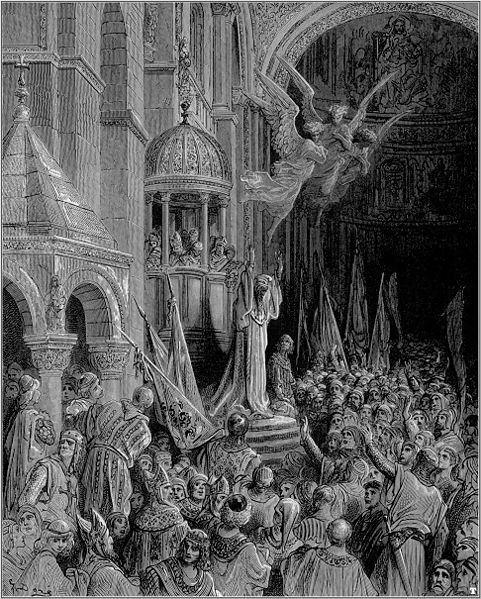
Doge Enrico Dandolo preaching the Crusade. Gustave Doré (1832-1883) / Wikimedia Commons.

The reincarnation of the Dark Ages:
White evangelicals are the new Crusaders

In place of mote-defended castles surrounded by thatched-roof shanties will be ‘gated communities’ (sporting high-tech surveillance to keep the homeless and servant class out)…

By Loren Adams / December 27, 2009

The king taxed the peasants to poverty while the royals were exempt from paying any. Reason? Unjust tax codes were a design of the rich, by the rich, and for the rich. That was the “targeted tax-cut” which invariably became law. “He who hath the gold maketh the rules.”

The Dark Ages were the birthplace of “Trickle-Down Economics.” The caste system was embraced, the church was simply a ruling arm of the monarch, and slavery was legitimatized by the religious righteous.

Republicans constantly decry labor’s “class warfare,” but this is the real war being waged across America. The cultural war is basically a derivative of class warfare — where the ruling class has employed white evangelicals to do their bidding: divide and conquer.

During the Dark Ages, wealth was exclusively inherited, not earned. The legal system was purchased like a commodity resulting in jury-less trials, military tribunals, pronouncements by a king acknowledged as sovereign and commissioned by God to rule as if the voice of Providence Himself, executive orders usurping representation, taxation without representation, etc.

Anyone disputing the monarch’s sovereignty was designated a traitor and summarily executed, tortured or banished to dungeon. These were the markings of the Dark Ages. Are they not similar to contemporary Republicanism so glaringly demonstrated during the Bush years?

America’s founders rejected the monarchical system where its legitimacy hinged on approval by the religious supremes. The “separation of church and state” concept of the new republic was established for that reason. Now we are sliding back into the realm where the head of state rides to power on a religious beast, where any successful candidate must be approved by the predominant religious system to win. Even our beloved Barack Obama during the 2008 campaign felt he must do pilgrimage to Saddleback Church and later pay homage to Pastor Rick Warren at Inaugural.

The Dark Ages were not only dark from plagues, they were darkened from ignorance, superstition and greed. The religious right denied the world was round; anyone disputing this “God-derived” doctrine was executed or imprisoned. Science was equated with Satanism. Thus, discovery, invention, innovation, and commercialism could not flourish, and the West plunged into poverty.

Does America not see the similarity? A religious system that wages war on science, denies climate change, rejects evolution, and edits Texas texts for school children to include praise for Limbaugh, Beck and Palin is a system geared toward destroying not only scientific and environmental thought, but the foundation of economy.

The religious system was USED to gain power for monarchs similar to the way current political operatives USE the religious to further their own aims. In the Middle Ages, the doctrine of the “divine right of kings” precluded civil liberties; the king/queen equaled “divinity.” Potentates (royals) were considered surrogates of God. Power was passed down from father to son — Dynasties divinely ordained by entitlement.

So, when we hear of world leaders or presidents bequeathed the title “Man of God,” watch out. It may not be long before civil liberties and human rights become casualties in the name of national unity and security — and with popular support — the masses duped by superstition. Remember the Bush theocratic dynasty.

History has witnessed its booms and busts (some massage as “cyclical market adjustments”). History repeats itself. We were at the core of an unparalleled economic boom at the close of the Clinton years — measured by purchases, low unemployment and budget surpluses. There were more jobs than people to fill them; illegals streamed across the border. Now we’re in a deep recession as a consequence of buying into Republican Dark-Age mentality.

What caused history’s busts? When capital is concentrated among the wealthiest, history warns of ominous collapse. The bubble bursts. It happened in 1837, 1857, 1884, 1893, 1907 and 1929. In all depressions there was glaring disparity of income: The poor — poorer, the rich — richer.

Prosperity is the result of healthy circulation of currency where the vast majority have robust purchasing power. When wealth fails to circulate but is dammed up by a concentration at the top, the economy falls and results in depression or severe recession. When the rich accumulate an overwhelming portion of the wealth, their house of cards comes tumbling down because there remain few to buy the goods sold by the wealthy to sustain the lifestyle.

Sure, other factors — such as over-speculation, Wall Street insider trading, anti-labor trade agreements, deregulation, and tax policies determined by greedy special interests — drive the economy into the ditch. But are not these all related? The world is loaded down with the cancers of Bernie Madoffs and Kenny Lays before downturn metastasizes itself into poverty, crime and collapse.

Consider this ominous fact: The average American’s income has remained flat since 1977 — 33 years ago, while the income of the richest 1% has more than tripled — 228% (Center on Budget and Policy Priorities). CEO (corporate executive officer) incomes rose 400% in the 1990s to $10.6 million annual income per capita, while take-home pay for the average American, the 80%, rose zero percent.

Real life experience bears it out. Most Americans don’t enjoy the purchasing power they once did when a one-income family could raise children, purchase a home, car, and college education for their kids. Now both parents work (if lucky enough to have a job) and still can’t keep up, resulting in less quality education, poor family relations, rising crime, and an eroding moral foundation.

Some in this country never learn from history. The greedy are blinded to the fact that refusing to care for others less fortunate ultimately leads to their own demise. The underlying truth may be that these tightfisted characters are not so much concerned about accumulating wealth as widening the gap. Yes, they delight in seeing the difference. Class consciousness means more to them than money in the bank. Thus, the motive defines the power struggle.

Thom Hartmann’s depiction of America’s economic and educational decline is accurate.

The political will of the radical right is more stubborn than ever. Not only do they want to defeat health care reform, they want to rid the country of any safety-net, Social Security, Medicare, Medicaid, and any other “socialist” program. It’s all “socialism” or “communism” to them. . . “un-American.”

They hide their greed behind such noble causes as “individualism,” “patriotism,” “character and family values” and “national security,” but all the while their ultimate aim is the same. Proudly they wave the flag and claim to be the lead standard bearers for patriotism; all the while we recall they’re missing in action when it really counts; wealthy family ties shield them from risk. Only the rich initiate wars, mostly the poor fight them. The double standard of justice comes from obscene wealth. Principles can be compromised at a price. And so can religion, their primary weapon of choice.

In similar manner, they buy off religious organizations and congressmen, hire the best lobbyists, and manipulate enough voters through the religious system to change laws for their benefit. Their aim? To further concentrate the wealth and leave the rest of the country destitute if need be. Their “compassionate conservatism” is hypocrisy cloaked in a sound bite.

In future years it will be written that the real enemy of our times was not communism or socialism (as many Tea-Baggers scream), but rather the re-emergence of a form of feudalism in alliance with theocracy, or what The Family (“C-Street”) calls “Dominionism.” The Handmaid’s Tale was not too far off.

In place of mote-defended castles surrounded by thatched-roof shanties will be “gated communities” (sporting high-tech surveillance to keep the homeless and servant class out) surrounded by metal trailer shanties housing 21st Century serfs. Recall “Hoovervilles”? The new shanty-towns should be aptly named “Bushvilles.” We’ve come a long way in 1,200 years or so.

Source / TPJ Magazine

Thanks to Roger Baker / The Rag Blog

Posted in RagBlog | Tagged , , , , , , , , | 9 Comments

Health Care Plan : No Cause for Celebration

Drawing from West Midlands No! Campaign.

Health Care Reform:
Progressives must stand their ground

This bill is not universal, not equitable, not affordable. It will not end bankruptcies, and will not end deaths due to denials and delays in health care.

By Dr. Stephen R. Keister / The Rag Blog / December 27, 2009

I have been reading Charles C. Mann’s excellent book 1491, New Revelations of the Americas Before Columbus. Included is a half-joking quotation from the celebrated anthropologist Clifford Geertz:

All states can be parceled into four types: pluralist, in which the state is seen by its people as having a moral legitimacy; populist, in which the government is viewed as an expression of the peoples will; ‘great beast’, in which the rulers’ power depends on using force to keep the populace cowed; and ‘great fraud’ in which the elite uses smoke and mirrors to convince the people of its inherent authority.

It would appear that we in the current United States fit rather neatly into the fourth group. Example:

President Obama has been arguing vociferously that did he did not campaign on the public option as an alternative to health care dominated and controlled by the health insurance cartel. In my files I came upon a souvenir of that campaign, a 46 page booklet entitled “Keeping America’s Promise.” Three pages are devoted to Obama’s concept for health care; in the interest of brevity I quote only selected paragraphs.

Easy enrollment: The new PUBLIC PLAN will be simple to enroll in and provide ready access to coverage… Portability and Choice: Participants in the new PUBLIC PLAN and the National Health Insurance Exchange… will be able to move from job to job without changing or jeopardizing their health care coverage.

Does President Obama have so much on his plate that he has forgotten that he campaigned with the commitment to forcefully support a PUBLIC PLAN? Where does this omission lie in his failure to face down, or even negotiate with, such Senators as Lieberman and Nelson? Why the listless support for any progressive health care program? This is not the candidate that I, or many other progressives, voted for.

Last evening I watched my favorite opera, La Boheme, on PBS. Though not of the quality that I had seen at the Met or Opera Bastille it was well done with a first rate tenor, a pleasing soprano, and those haunting duets in the first and final acts. As I watched the failing health and finally the death of Mimi I was somehow struck that I was watching a study in health care for the poor and disadvantaged in the present day United States. Which brought me back to the problem at hand: the travesty, the fraud, that the Senate has passed in the guise of “health care for all.” Indeed something is amiss in our political process.

We should take note that, even though the health insurance cartel made such a show of opposing reform legislation, once the Senate bill passed, the following occurred: the stock of Coventry Health Care, Inc. rose 31.6%; CIGNA Corp rose 29.15; Aetna Inc. rose 27.1%; WellPoint, Inc. rose 26.6%; United Health Care Group Inc. rose 20.5%; and Humana rose 13.6%.

This bill is not universal, not equitable, not affordable. It will not end bankruptcies, and will not end deaths due to denials and delays in health care. And further, there is nothing in the legislation to bring the health insurance cartel under the anti-trust laws. Smoke and mirrors indeed!

When most people consider health care they think about physicians, nurses, adjunctive therapists — practitioners. Yet conspicuously absent in the past year’s discussion have been these very people. We hear from the politicians on CSPAN, and on the TV news shows we are inundated with the opinions of media consultants, of “experts” from the think tanks; however, rarely, very rarely, has the public had an opportunity to hear from a medical profession that has expressed 60% support for a public option.

Many, or most, physicians are tired of being vassals of the insurance cartel, and wish once again, as is still the case in most other free nations, to have the ability to make medical decisions based on medical findings and not to be subject to the profit-making needs of their insurance overlords.

The practice of medicine, from the standpoint of the patient and the physician, should not be dominated by politics, profit, or profit wrapped in the cloak of religion. Physicians for a National Health Program was founded some 25-30 years ago by a group of dedicated, idealistic physicians who realized that the machinations of the health insurance cartel would indeed turn medicine from a healing profession into a profit-making business for Wall Street.

PHNP, which now includes 17,000 members, has meticulously developed a health care plan that would include all citizens, reduce costs by 40%, and give choice to the patient and his or her doctor. The plan, in brief, would be administered by a public insurance entity, not the government. The public corporation would be overseen by a board of directors from the medical profession, academia, business, and labor, with hired managers.

There would be government oversight, not by politicians who would undoubtedly corrupt the workings, but by civil servants, as they are now incorporated in the congressional budget office. It would be treated as an independent organization, like the Federal Reserve Board or the U.S.Post Office. The structure would be apolitical as is PNHP.

Never in the extensive PNHP planning have I seen the word “abortion” mentioned. PNHP deals with health care and the practice of compassionate, caring medicine, not quasi-theological subjects. “Abortion” has been injected into the present debate by the insurance industry, playing to the “right to life movement,” as a political ploy.

On December 22, PNHP came down in opposition to the Senate Health Bill. The negatives of that bill include the individual mandate requiring that people buy private insurance policies, large government subsidies to private insurers, new restrictions on abortion, the unfair taxing of high-cost health plans, and cuts in $43 billion in Medicare payments to safety-net hospitals. Moreover, at least 23 million people will remain uninsured when the plan finally takes effect. Full details can be found here.

The American Nurses Association has also come out in opposition to the legislation. Thus, we have the corporations and their political prostitutes favoring legislation to increase the profits of the insurance industry, and the healing professions standing for the rights of the patient-physician relationship and decent affordable health care.

The apologists for the senate bill inveigh “that it is better than nothing” and that it can always “be corrected in the future.” The first statement is patently absurd, and the second unrealistic, for as sure as Obama has deserted his progressive and younger voter bases, the Democratic majorities in both House and Senate will be less than robust come 2010.

We hear that the legislation as passed provides the right to purchase insurance despite pre-existing conditions; however, few sources mention that the cost can be three times the rate otherwise. Few news outlets mention that older folks will pay much more for insurance than others. There is little mention of future cost control of the insurance premiums, largely because there has been no ongoing consideration of the continued exclusion of the insurance industry from the anti-trust laws. (Major league Baseball being the only other exemption.)

The other frightening situation is the “individual mandate” which forces everyone, under the penalty of law, to buy health insurance. Even many conservatives are rightfully disturbed by this interference with our civil liberties. Never in the history of the Republic have we been forced to buy from a public company under threat of punishment. There finally is the beginning of a debate about this problem, which we referenced some months ago in The Rag Blog.

We have a constitutional question which will ultimately end up in the courts. I would suggest reading a thoughtful discussion of the case law involved in this very important area, published in AfterDowningStreet.Org and also posted on The Rag Blog. The low cost commercial health insurance that we would be forced to buy could be loaded with co-pays and deductibles that could cost the insured $4000-5000 before the insurance becomes active.

The one encouraging feature of the Senate bill is the fact that it includes an amendment by Sen. Bernie Sanders allotting $10 billion for establishment of community health centers, providing medical and dental care, and training primary health care physicians and nurses. It is noted that Senator Sanders is working with House Majority Whip James Clyburn to include $14 billion in the House version of the legislation.

Concurrently, in the House there is a move afoot once again to consider permitting the importation of prescription medications, a feature that was recently defeated in the Senate with the odd cooperation of several of our “progressive” senators. If these provisions become law many of our citizens will have the same access as our elected representatives, who have free government health care at the Office of The Attending Physician right under the Capitol dome. Here they get free health care from physicians, specialists, nurses, med-techs, pharmacists and others working as government employees.

As Jim Hightower points out,

The service is primo. Let’s say that one of the 39 Republican grumps gets gaseous or suffers a tongue cramp while giving a Senate speech denouncing socialism. He or she can scoot just a few yards away for socialized care at the OAP — no appointment necessary, no bothersome insurance forms to fill out, no co-pay, no waiting. Just care.

Perhaps even President Obama will set aside much of Rahm Emanuel’s advice and once again come on board as a friend of the young, the disadvantaged, and the unemployed, rather than being the cat’s paw of Wall Street and the corporations that dominate our society.

As I look around, it seems that things have changed little since Eugene V. Debs spoke in 1908:

Now my friends, I am opposed to the system of society in which we live today, not because I lack the natural equipment to do for myself but I am not satisfied to make myself comfortable knowing there are thousands of my fellow men who suffer for the barest necessities of life.

We were taught under the old ethic that man’s business is to look out for himself. That was the ethic of the jungle; the ethic of the wild beast. Take care of yourself, no matter what happens to your fellow man. Thousands of years ago the question was asked; ‘Am I my brothers keeper?’ That question has never yet been answered in a way that is satisfactory in a civilized society.

Yes, I am my brother’s keeper. I am under moral obligation to him, that is inspired, not by any maudlin sentimentality but by the higher duty I owe myself. What would you think if I were capable of seating myself at a table and gorging myself with food and saw about me the children of my fellow beings starving to death.

We progressives must stand up and support the few dedicated, honorable senators, and we know who they are, who are a profile in courage and who fight like hell for the public good.

We must encourage the progressive caucus in the House of Representatives to stand their ground on funding of the health care bill by requiring the wealthy to pay their fair share rather than burdening the working man with further taxes. We must encourage the progressive caucus to stand firm for a public option and to demand that the health insurance industry be included under the anti-trust in order to prevent price fixing and excessive rate increases.

We become the Greeks at Marathon, the final defense of what is ethical and morally correct.

[Dr. Stephen R. Keister lives in Erie, Pennsylvania. He is a retired physician who is active in health care reform. His writing appears regularly on The Rag Blog.]

The Rag Blog

Posted in Rag Bloggers | Tagged , , , , , | 3 Comments

Obama’s First Year : A ‘B-Plus’? Get Real!

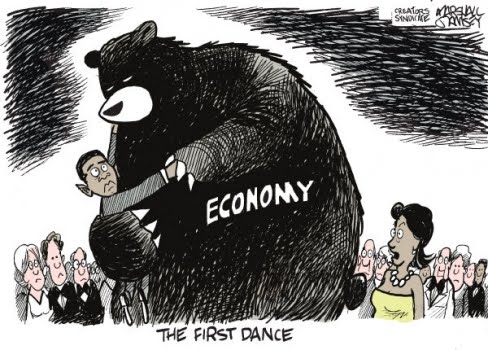
Cartoon from Orange County Register.

A year at the helm:
Does Obama make the grade?

By Ted McLaughlin / The Rag Blog / December 27, 2009

President Obama has been in office for nearly a year now. I had not thought about grading him on his performance in that first year until I heard on the news the other day that he had graded himself. It seems that he thinks he deserves a B+. That got me thinking — what grade do I think he’s earned?

Frankly, I don’t see that much has been accomplished. When I voted for him last November, I had swallowed the campaign promise of real “change.” I had visions of a Democratic presidency along the lines of Franklin Roosevelt, Harry Truman or Lyndon Johnson — presidents who showed political courage and forever changed our country for the better.

Franklin Roosevelt took on the depression and created opportunities for common folks to work with organizations like the WPA and the CCC. He also passed social security to protect the elderly and keep them from living in abject poverty. Harry Truman was capable of making the hard decisions like whether to drop the A-bomb, and he also desegregated the Armed Forces by executive order.

Lyndon Johnson had a list of nation-changing accomplishments, including two major civil rights laws, the War on Poverty, creation of Head Start, and the creation of Medicare. There is still time left in his presidency for President Obama to join this pantheon of great Democrats, but his first year puts him only in the class of such mediocre to poor Democratic presidents as Jimmy Carter and Bill Clinton.

Let’s look first at what President Obama has failed to accomplish in his first year:

  • He has not overturned the Patriot Act. The American government is still trashing the Constitution by spying on its own citizens. There is no reason for this to be happening (and never was). And don’t tell me it’s needed to prevent attacks like 9/11. The Bush Administration knew of those impending attacks (without the Patriot Act), but just chose not to do anything about it. The FBI can do their job without the unconstitutional Patriot Act, and the CIA shouldn’t be messing with American citizens at all.
  • He has not overturned “Don’t Ask, Don’t Tell.” He says he wants to do this, but so far has done nothing. Harry Truman knew Congress wouldn’t desegregate the Armed Forces, so he stepped up and did it on his own. Barack Obama could do away with “Don’t Ask, Don’t Tell” the same way, but he doesn’t have the political courage that Truman had. President Obama wants Congress to cover his butt and take some of the heat.
  • After speaking against the two wars during his campaign, even to the point of castigating Clinton for voting “yes” on the Iraqi invasion, he has done absolutely nothing to stop the wars and withdraw American troops. In fact, he is in the process of escalating one of the two wars. It actually looks like he has decided to continue the Bush Doctrine in Iraq and Afghanistan (and that was not what he was elected to do).
  • He has not passed any regulations to rein in the abuses of Wall Street, the financial giants and other corporate entities (which nearly destroyed the American economy). New regulations are badly needed, because it has become obvious that greed prevents these entities from policing themselves, and the “free market” benefits only the rich. He has proposed a few changes which Congress will consider next year, but it is not nearly enough — just a little tinkering around the edges.
  • Outside of extending unemployment, he has done little to put Americans back to work. His famous “stimulus plan” was not nearly big enough (probably because he’s still paying for two wars) and was spread out over too long a period of time. It has had little or no actual effect.
  • He has done nothing to stop the off-shoring of American jobs. I wish I could say there was some pending legislation, or at least that some proposals were being discussed, but that’s just not true. The truth is that absolutely nothing has been done or proposed. President Obama has ignored the off-shoring of American jobs since becoming president.
  • The biggest change Obama promised was the reform of our badly broken health care system. Providing real health care reform was to be the centerpiece of his first term. So what has he done? Really nothing, except for a lot of talk about bi-partisanship. He has stayed completely out of it, and let Congress do it on its own. The House passed a barely decent bill and the Senate simply put a band-aid on the current system, and now Obama wants to jump in and push the Senate mess through. He still calls it real reform, but it is actually an abandonment of real reform and a sell-out to the insurance industry. Now it may be decades before anyone tries to pass real reform again.
  • He has done nothing to help fight poverty or racism.
  • He has done nothing to bring George Bush and Dick Cheney to trial for their many abuses of office.
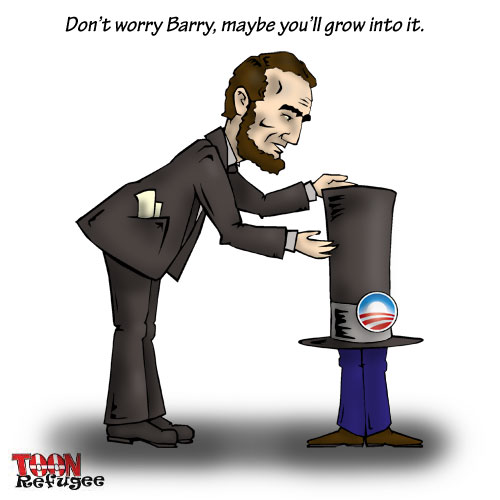
  • Cartoon from TOONRefuge.

That list of inaction and failures is pretty impressive, but hasn’t he accomplished anything? Yes, he has done the following:

  • He did sign the Lily Ledbetter Fair Pay Act, which will make it easier for women to sue when they are denied equal pay for performing the same job as a man. This was a good bill and needed to become law, but I think the Democratic Congress gets most of the credit for the law.
  • While little has been done to help the unemployed find work, Obama did bail out General Motors (which prevented thousands more from joining the ranks of the unemployed).
  • He has increased respect for America around the world and changed the way America deals with other countries. Of course, most of that was accomplished by just not being George Bush. It did get him a Nobel Peace Prize though.
  • He claims to have stopped the torturing of prisoners. I hope this is true, but there are accusations that two teens were recently tortured in Afghanistan by Special Forces troops.
  • He has successfully negotiated a new nuclear arms treaty with the Russians. This is a good thing and I don’t want to downplay its importance. He also killed the placing of missles (supposedly defensive) in Poland and the Czech Republic — another good thing.
  • He has stopped the persecution and prosecution of sick people who use medical marijuana according to their own state’s laws.

Considering all of the above, I cannot agree with the self-assessed B+. The grade I would give President Obama on his first year is a C-. I guess that’s better than the string of F’s earned by George Bush, but it’s not really anything to be proud of. He has not really shown any political courage, and seems to be happy with being a “caretaker” president who will make some small changes.

That’s very disappointing. I had much higher hopes. What do you think his grade should be?

[Rag Blog contributor Ted McLaughlin also posts at jobsanger.]

The Rag Blog

Posted in Rag Bloggers | Tagged , , , | 1 Comment

U.S. in Afghanistan : 1979-2009

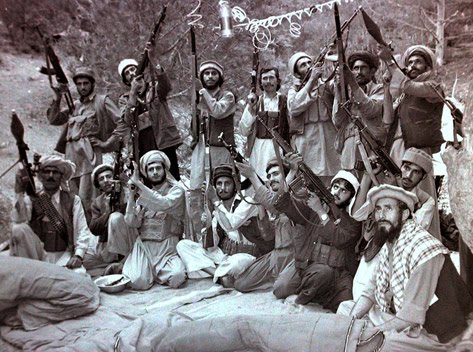
Afghanistan: Mujahedin in 1984. Photo from U.S. Foreign Policy in Perspective.

The thirty years war:
The United States in Afghanistan

By Harry Targ / The Rag Blog / December 27, 2009

When the Soviet Union sent 85,000 of its troops to Afghanistan in late December 1979 President Carter declared that the United States was forced to return to Cold War military preparedness. But, in fact, the Carter administration had been escalating military commitments and operations throughout 1979, months before the Soviet action.

In a brief televised address two weeks after the Soviet invasion, the President denounced it as “a deliberate effort by a powerful atheistic government to subjugate an independent Islamic people.” He said it threatened “both Iran and Pakistan” and was “a stepping-stone” for the Soviets’ possible control “over much of the world’s oil supplies.”

The President followed his brief condemnation with a lengthy State of the Union address to the American people on January 21, 1980. In it he announced some extraordinary changes in United States foreign policy that constituted a decisive return to Cold War with the Soviet Union.

The changes Carter initiated included the following: reduction of grain sales to the Soviet Union; curtailment of high technology trade with them; postponement of ratification of the SALT II arms control agreement; enlarging strategic forces; beefing up NATO forces; establishing a Caribbean Joint Task Force Headquarters; unleashing the CIA; installing a program of draft registration; and providing more military assistance to Pakistan, South Korea, and Thailand.

Perhaps the most important policy change was the establishment of a 100,000 person military “rapid deployment force” which could be instantly mobilized in crisis situations. And he proclaimed that the Persian Gulf was vital to U.S. security interests and would be protected; this became known as the Carter Doctrine.

All these announced changes were billed by administration spokespersons as a response to the duplicitous Soviet invasion of Afghanistan. Ultimately, the Soviets wanted to invade Iran, secure Persian Gulf oil, secure warm water ports, and expand their Asian empire. The U.S., they said, had to respond to this expansion of the Cold War.

But a careful examination of the events of 1979 prior to the Soviet invasion suggests a different timeline and interpretation. In January 1979 the Shah of Iran, the closest of U.S. allies, was toppled in a revolution. Carter’s aides initially had urged him to send troops to Teheran to save our Persian Gulf cop from ouster but the revolution came too fast to save the Shah.

After Iran, in the Caribbean and Central America revolutions occurred in tiny Grenada (March 1979) and historically anti-Communist Nicaragua (July 1979). There was a coup by military reformers in El Salvador (October 1979). In early November 1979 Iranian students took approximately 70 U.S. government representatives hostage.

The administration perceived itself as being threatened by the spread of hostile regimes and movements and the collapse of the vital ally in Iran was deemed the most critical to U.S. interests. As a result of all these crises, Carter began military rearmament, secured new bases, tried to undermine the changes occurring in Nicaragua and El Salvador, and allowed the Shah of Iran to enter the United States in October 1979 for medical treatment.

Inside the Carter administration, foreign policy decision makers feared the collapse of U.S. power around the world. However, they felt the United States could not respond because of the so-called “Vietnam Syndrome.” That is, decision makers believed that most Americans opposed a return to militarism and interventionism.

Then, fortunately for the Carter team, the Soviet Union, fearful of the collapse of an allied regime in Kabul and increasingly seeing itself as encircled by China in the East and a beefed up NATO in the West, sent troops into Afghanistan. The Soviet Union fell into a trap set by the Carter Administration.

What was the nature of this trap? Well, Jimmy Carter’s National Security Advisor, Zbigniew Brzezinski, in an interview given to the French newspaper Le Nouvel Observateur in January 1998, said that official CIA accounts which say the United States began to support rebels in Afghanistan after the Soviet invasion were lies. In fact, he said, “…it was July 3, 1979 that President Carter signed the first directive for secret aid to the opponents of the pro-Soviet regime in Kabul.” The National Security advisor said he wrote the President “…that in my opinion this aid was going to induce a Soviet military intervention.”

Brzezinski told Carter that the Soviets would probably intervene in Afghanistan if we funded rebels and that they, the Soviets, would then be buried in their own Vietnam. In retrospect, he said, the Soviet incursion led to the collapse of the Soviet Union and its “empire.” He suggested that the rise of Islamic fundamentalism was of minor concern compared to the threat of international communism.

Reflecting back 30 years, the following conclusions seem justified. First the United States returned to an aggressive Cold War policy not after the Soviet invasion of Afghanistan but before it.

Second, President Carter announced a broad array of aggressive policies toward the Soviet Union after the Soviet invasion but these were in place or in the process of development before the Soviet moves of December 1979.

Third, the United States began funding the various fundamentalist groups to fight against the secular and modernizing regime in Kabul before the Soviets sent troops. And that led subsequently, as the Center for Defense Information estimated, to the United States funneling $2 billion to rebel forces in Afghanistan in the 1980s.

Fourth, the war on the pro-Soviet regime in Kabul destroyed efforts to modernize the tradition-bound country. Women, who had become active participants in public life and the economy in the 1980s lost control of their lives after the pro-Soviet regime collapsed. In general, an estimated one million Afghans died in the 1980s from war and repression and some five million fled the country.

We know about what happened after the troubled 1980s in Afghanistan. The Soviet troops withdrew. After a time, the secular regime in Kabul was ousted from power. Competing fundamentalist militias vied for control of the state. The Taliban consolidated their power by 1996. Then the United States launched its public war on Afghanistan in October 2001. But, the record suggests, the United States initiated its war on the country as far back as July 1979.

The pain and suffering of the peoples of Afghanistan has a long history before and since the United States intervened in their political lives in 1979. Many outside powers share responsibility for their plight. But today’s situation directly relates to the covert war the United States encouraged and funded from the summer of 1979.

[Harry Tarq is a professor in American Studies who lives in West Lafayette, Indiana. He blogs at Diary of a Heartland Radical, where this article also appears.]

The Rag Blog

Posted in Rag Bloggers | Tagged , , , , , , | 5 Comments

Coltan in Venezuela : Chavez Putting Chips on War?

Above, image from Intimidad Violada. Below, capacitor made with coltan.

Valuable electronics ore mixes with oil
To produce rumbles of war with Colombia

By Marion Delgado / The Rag Blog / December 26, 2009

WARS. There are so many of them that foreign correspondent and world traveler Marion Delgado runs into them from time to time as he wanders the earth.

He was in Nicaragua during the Contra war, survived a Guatemalan coup, and was living in San Cristobol de la Casas that New Year’s Eve when the Zapatistas came to town to issue their declaration of war against the corrupt government of President Carlos Salinas in Mexico. He was briefly a prisoner of some sort of renegade armed group in El Salvador. When Colombia invaded Ecuador Marion and his companera Sylvia Avery were on the last plane out before the borders were closed.

Now, once again, he is uniquely positioned to watch the beginnings of a South American war up close. In Colombia he has had face-to-face encounters with Colombian Army (COLAR) anti-guerrilla units, the Fuerzas Armadas Revolucionarias de Colombia – Ejército del Pueblo, (FARC-EP,) and some paramilitary (paracos) each of which usually costs him a few thousand pesos. So, what is coltan and why might it interest Delgado, American taxpayers, and anti-war activists?]

CARTAGENA DE INDIES, Colombia — Coltan is the industrial name for columbite — tantalite, a dull black metallic ore containing the elements niobium (formerly “columbium”) and tantalum. The niobium-bearing mineral is columbite, hence the “col” half of the term. The mineral concentrates dominated by tantalum are called tantalite.

Tantalum from coltan is used in consumer electronics products such as cell phones, DVD players, video game systems and computers; in hearing aids and pacemakers, airbags, GPS, ignition systems and anti-lock braking systems in automobiles; in laptop computers, mobile phones, video game consoles, video cameras and digital cameras.

Niobium is used mostly in alloys, the largest part in special steel such as is used in gas pipelines. Although alloys contain a maximum of 0.1% niobium, that small amount improves the strength of the steel. The temperature stability of niobium-containing super alloys is important in jet and rocket engines.

Export of coltan from the eastern Democratic Republic of the Congo to European and American markets has been cited by experts as helping to finance the present-day conflict in the Congo. An estimated 5.4 million people have died since 1998 in the Congo conflict.

The upsurge in electronic products over the past decade resulted in a price peak in late 2000 with inflated high demand and price increases for the mineral, which lasted a few months. In 2005, the price was still at early 2000 levels.

Thanks to this mineral, the world has witnessed a reduction in size of all electronic devices. Tantalum is an ideal high-temperature superconductor, can temporarily store an electrical charge and release it when needed, and resists corrosion.

What does that have to do with a South American War? Well, a significant reserve of coltan was discovered in 2009 in western Venezuela. In 2009, the Colombian government announced that coltan reserves had been found in eastern provinces of Colombia.

In the minds of most Colombians, coltan came into existence only a couple of weeks ago, when the president of Venezuela, Hugo Chávez, announced the discovery of a giant coltan field near Venezuela’s border with Colombia. On Nov. 5, Chavez ordered a militarization of the Orinoco region to protect this strategic mineral because, he said, Colombian traffickers continue to cross the border, running through the Orinoco River basin, to extract the mineral. In what is titled Operation Blue Gold, 15,000 Air Force, Army, and Navy personnel will protect the coltan reserve, which straddles the Venezuelan states of Bolivar and Amazonas.

Vice President and Defense Minister Ramon Carrizalez visited the site of the reserve in an indigenous community called El Paloma, and said the troops would help combat drug trafficking and illegal armed groups in the region, in addition to protecting the reserve. “

We have more than 15,000 men deployed along our western border, combating all the crimes that occur along the border, as you know, crimes which come from another country and are not ours.

It is a mineral of strategic character, and therefore it stimulates the imperial appetite and the appetite of the business people who seek to obtain maximum profit without giving importance to environmental damage or the destabilization of countries.

He made specific reference to the civil war-plagued Democratic Republic of the Congo, where the world’s largest known coltan reserves lie, and where Belgium and the U.S. Central Intelligence Agency (CIA) collaborated to overthrow the first democratically elected prime minister, Patrice Lumumba, in 1964.

Called “blue gold,” “oil from the mud,” or “the new manna,” coltan has been found, besides in the Congo, in Australia, Brazil, China, and, more recently, Venezuela, Bolivia, and Colombia. Evidence of coltan deposits in the Orinoco region, especially in the Departments of Vichada, Guainía, and Vaupés, has generated a wave of traders, speculators, and armed groups around a business that this year alone could move more than $40 million USD. And that is only the tip of the iceberg.

For four years, coltan has been mined in eastern Colombia for export to international traders. A couple of months ago it was leaked to news media that a company had asked permission (licenses) to remove coltan in 35,000 hectares between Vichada and Guainía. Another four licenses are underway.

Coltan’s downside is violence spawned by greed. In Africa, the coltan bonanza — the mineral can bring between $60,000 and $100,000 USD a ton — has become fuel for multilateral conflict (often called the “world war of Africa”) which has killed hundreds of thousands of people. As many more have been displaced, and the accompanying environmental disaster of strip mining also involves the water sources of neighboring countries. Warring militias fight each other for control of coltan and other minerals in an endless spiral of violence.

There has been so much bleeding that for three years it has been prohibited to buy coltan from the Congo. However, Congo ore smuggled out from countries such as Rwanda and Uganda finds anxious buyers, especially in the U.S., Germany, Holland, Belgium, and Kazakhstan.

About three years ago, a handful of traders came to Vichada and Guainía to promote the exploitation of coltan near the Orinoco River and its tributaries. Mining of coltan is not regulated, and traders used false records to disguise the fact that some extraction sites are on Indian reservations. By the rivers and hillsides, traders collect the mineral, which is taken to Bogotá and sold. Some say traders pay a tax of $2,000–2,500 per ton to the Autodefensas Unidas de Colombia, (AUC) or to the rebel guerrillas in some coltan mining areas.

While Chavez has ordered militarization of Venezuela’s coltan area and declared it a national resource, authorities in Colombia just know theirs exists.

Meanwhile, in Venezuela, reserves of coltan and other strategic minerals were found south of the Orinoco River — in eastern Venezuela — as part of an aerial survey carried out with Iranian cooperation. Iranians, oh no, in Venezuela, what is that crazy Chavez up to now? Venezuelan Industries and Mining Minister Rodolfo Sanz didn’t reveal the amount of the coltan reserves spotted or their precise location, but added that diamond, phosphate, titanium, and lead deposits also were found.

Separately, Science and Technology Minister Jesse Chacon, who accompanied Sanz at a press conference on November 13. 2009, confirmed that important deposits of kaolinite have been found and are being developed with assistance from Russia. The Russians, too, ¡O dios mio! He said Russia will also provide technological assistance to treat Venezuela’s recently discovered uranium deposits. Chacon, who said uranium will be used for energy production “because oil will run out,” ruled out using the mineral for military purposes. Do I smell “weapons of mass destruction”?

There’s nothing particularly evil about coltan the substance itself, of course, it’s just this decade’s whale oil, and woe betide the cavorting cetaceans who might get in the way of the harpoons, as the corporate greed fest sends out its Ahabs. Venezuela, where there is not only oil in abundance but a new-found supply of coltan, is simply a bigger Moby Dick.

Forcible annexation of the Venezuelan people into corporate serfdom has therefore been marked onto PowerPoint agendas and is proceeding apace. Annoyingly, the Venezuelans are the difficult sort, and have yet to succumb to a pro-corporate dictator, at least for the past few years.

To make things worse, they’ve diverted some of the profits from the oil industry as it drains away their subsoil bonanza, and have bought tanks and planes. This means that a quick takeover by, say, Aegis, Executive Outcomes, or Xe is quite a bit more difficult; the coltan industry will have to get together with the oil industry, and hire the Big Dog to get the job done.

That’s Uncle Sam, of course, and though he is already drooling with bloodlust to crush the life out of those unprofitable humans there in Caracas, he can’t be properly unleashed without a lengthy and expensive propaganda campaign directing the U.S. population to snarl with hatred and fear at Venezuela.

That’s where you and I come in, and some of the cue-cards are already available, so let’s get cracking with our chants, to be delivered at every television-led Hate Minute:

“Chavez is a dictator!” “Chavez is in league with Ahmedinajahad!” “Chavez is a Communist in league with FARC!”

Of course the pros will come out with shorter versions of these chants, as they currently have too many syllables for Fox news watchers. Have no doubt that it will be done, however, because we’re talking about oil and coltan, and that means profits. No, not profits for you, silly, profits for our betters, who have the sense to put those profits into Euros and gold and hide them in the Cayman Islands or the Lesser Antilles, brass plate operations generally. Otherwise they’d turn into tax money and the blood — I mean profit — would get spread around rather than properly piling up with the super-rich.

For you and I, the blood can only spill from our children’s bodies as we send them in uniform to get the job done. The worse the horror, the more the corporate media polls will show we approve. The more who die pointlessly, the more we will support the troops. Support the troops! Support the troops! You support the troops, don’t you? What kind of un-American monster wouldn’t support the troops?

In Mérida, on Nov. 10, 2009, President Chavez declared that Venezuela is prepared to defend itself against an act of aggression from Colombia or the United States, countries which recently signed a military pact to allow the U.S. to use Colombian bases to increase its military and intelligence operations across Latin America.

[Colombia and the U.S. signed a military pact on October 30th to expand U.S. military presence at seven Colombian air, naval, and army bases, grant U.S. personnel diplomatic immunity for crimes they commit in Colombia, and facilitate the movement of the U.S. military throughout the country.]

Chavez called on commanders of the Venezuelan Armed Forces to “lose no time; we are going to form militias of revolutionary students, workers, women, everyone ready to defend this sacred homeland.

“Don’t make the mistake, President Obama, of ordering an overt aggression against Venezuela utilizing Colombia,” Chavez continued. “We are ready for anything, and Venezuela will never, never be a Yankee colony again.”

If the U.S. and Colombia start a war with Venezuela, he warned later on his weekly television talk show, “It would be the start of a hundred year war, and this war would extend across this entire continent.”

At the United Nations on Nov. 11, Colombia brought what it called threats of war from Venezuela to the Security Council. A letter to all members of the Security Council was seen as a move to gain U.N. approval for war on Venezuela. However, Chavez spoke of a defensive war, not invading Colombia. For months he has warned that a military pact between Bogotá and Washington could set the stage for a U.S. invasion of Venezuela from Colombia.

The U.S. and Colombia dismiss the charge, saying the pact will combat drug traffickers and Marxist insurgents in Colombia. Meanwhile, however, the U.S. is setting up the same armed drone capability that is currently bombing Afghanistan and Pakistan.

Recriminations have increased recently, with Colombia accusing Chavez of not helping combat drug-running rebels hiding on Venezuela’s side of the border and Chavez calling Colombia a lap-dog of the U.S. Empire.

  • For previous reports from Colombia by Marion Delgado, go here.

.The Rag Blog

Posted in Rag Bloggers | Tagged , , , , , , , , | 2 Comments

Life During Wartime : Barack’s Xmas Nightmare

CLICK ON IMAGE TO ENLARGE

Political cartoon by Joshua Brown / Historians Against the War / The Rag Blog

Thanks to Dr. S.R. Keister /The Rag Blog

Posted in RagBlog | Tagged , , , , | Leave a comment

Lester ‘Red’ Rodney : The Sportswriter Who Helped Break Baseball’s Color Line

Sportswriter Lester “Red” Rodney, September 2007. Photograph by Byron LaGoy / Wikipedia Commons.

More than a sportswriter:
Lester ‘Red’ Rodney: 1911-2009

By Dave Zirin / December 24, 2009

It didn’t make SportsCenter, but one of history’s most influential sportswriters died this week at the age of 98. His name was Lester Rodney.

Lester was one of the first people to write about a young Negro League prospect named Jackie Robinson. He was the last living journalist to cover the famous 1938 fight at Yankee Stadium between “The Brown Bomber” Joe Louis and Hitler favorite, Max Schmeling. He crusaded against baseball’s color line when almost every other journalist pretended it didn’t exist. He edited a political sports page that engaged his audience in how to fight for a more just sports world.

His writing, which could describe the beauty of a well-turned double play in one sentence and blast injustice in the next, is still bracing and ahead of its time. He should be in the Baseball Hall of Fame. Instead he was largely erased from the books.

If you have never heard of Lester Rodney, there is a very simple reason why: the newspaper he worked at from 1936-1958 was the Daily Worker, the party press of the U.S. Communist Party. Lester used his paper to launch the first campaign to end the color line in Major League Baseball. I spoke to Lester about this in 2004 and he said to me,

It’s amazing. You go back and you read the great newspapers in the thirties, you’ll find no editorials saying, ‘What’s going on here? This is America, land of the free and people with the wrong pigmentation of skin can’t play baseball?’ Nothing like that. No challenges to the league, to the commissioner, no talking about Satchel Paige and Josh Gibson, who were obviously of superstar caliber. So it was this tremendous vacuum waiting.

I spoke to the leaders of the YCL [the Young Communist League]. We talked about circulating the paper [at ballparks]. It just evolved as we talked about the color line and some kids in the YCL suggested, ‘Why don’t we go to the ballparks — to Yankee Stadium, Ebbets Field, the Polo Grounds — with petitions?’ We wound up with at least a million and a half signatures that we delivered straight to the desk of [baseball commissioner] Judge Landis.

As Lester fought to end the color ban, he also never stopped highlighting and covering the Negro League teams, giving them press at a time when they were invisible men outside of the African American press.

Jackie Robinson.

But it was Jackie Robinson who captured Lester’s imagination. Armed with a press pass to the Ebbets Field locker room, he saw up close the way Robinson was told to “just shut up and play” despite the constant harassment during his inaugural 1947 campaign. “Jackie was suppressing his very being, his personality,” said Lester. “He was a fiercely intelligent man. He knew his role and he accepted it. And the black players who followed him knew what he meant too.”

Lester saw the way their play — and their courage — helped inspire the struggle for civil rights, especially in the South. Lester told me about a dramatic exhibition game in Atlanta where all the dynamics of the Black freedom struggle were on display.

This exhibition game wound up with the Black fans being allowed in because they had overflowed the segregated stands, they had poured in from outlying districts to see the first integrated game in Georgia history. The Klan had said, ‘This must not happen.’

That night there was this tremendous sight of Robinson, [Dodgers African American players] Don Newcombe, and Roy Campanella coming out and the black fans behind the ropes and in the stands standing and roaring their greeting. A large sector of whites were just sitting and booing. Then other white people, hesitantly at first, stood up and consciously differentiated themselves from the booers and clapped. This was an amazing spectacle.

This was the Deep South many years before the words civil rights were widely known. So it had its impact… Roy Campanella, once said to me something like, ‘Without the Brooklyn Dodgers you don’t have Brown v. Board of Education.’ I laughed, I thought he was joking but he was stubborn. He said, ‘All I know is we were the first ones on the trains, we were the first ones down South not to go around the back of the restaurant, first ones in the hotels.’ He said, ‘We were like the teachers of the whole integration thing.’

Lester would still become emotional when he recalls Jackie Robinson and his impact.

There are very few people of whom you can say with certainty that they made this a somewhat better country. Without doubt you can say that about Jackie Robinson. His legacy was not, ‘Hooray, we did it,’ but ‘Buddy, there’s still unfinished work out there’

He was a continuing militant, and that’s why the Dodgers never considered this brilliant baseball man as a manager or coach. It’s because he was outspoken and unafraid. That’s the kind of person he was. In fact, the first time he was asked to play at an old-timers’ game at Yankee Stadium, he said ‘I must sorrowfully refuse until I see more progress being made off the playing field on the coaching lines and in the managerial departments.’

He made people uncomfortable. In fact it was that very quality which made him something special. He always made you feel that ‘Buddy, there’s still unfinished work out there.’

We can absolutely say the same about Lester Rodney, albeit with a twist. Yes, Lester made you feel like there was unfinished work out there. But he also made you feel like the great fun in life was in trying to get it done. That and seeing a perfectly turned 6-4-3 double play.

[Dave Zirin is The Nation‘s sports editor. His column, Edge of Sports, appears on Sports Illustrated‘s website and he is the host of a weekly show on XM satellite radio. He is the author of Welcome to the Terrordome: the Pain, Politics and Promise of Sports (Haymarket) and A People’s History of Sports in the United States (The New Press). He was named one of Utne Reader‘s 50 Visionaries who are Changing Your World for 2009.]

Source / Smirking Chimp

Thanks to Jeffrey Segal / The Rag Blog

Posted in RagBlog | Tagged , , , , , , , , | Leave a comment