There Is Little or Nothing Manufactured Today That Nature Loves

We will no longer be impressed by an organic T-shirt if its cotton was grown by hogging water in an arid and impoverished land, or if its dye puts workers at heightened risk for leukemia.

The Age of Eco-Angst
By Daniel Goleman / September 27, 2009

My grandson’s third birthday is at hand, and I’m looking at a toy racing car I won’t be giving him. Painted a bright yellow, this nifty little toy seemed just right for him when I paid a buck for it at a big box store. But before I could give it to him, I learned that cheap toys made in China, like this one, can have lead in their paint — particularly reds and yellows — to make them more shiny.

My pleasure at picturing his delight at the toy car melted into something between disgust and outrage. That nifty toy sits on my desk months after I bought it.

Call it eco-angst, the moment a new bit of unpleasant ecological information about some product or other plunges us into a moment (or more) of despair at the planet’s condition and the fragility of our place on it.

Eco-angst, it turns out, is but one version of a widely studied psychological phenomenon, one well-known in the world of retailing. Take a bargain bin cabernet, tell people it’s an expensive, estate-bottled varietal, and they’ll tell you they like it. They’ll even linger longer over their dinner, enjoying not just the wine but the rest of their food more. Now describe the same wine as a low-end variety from North Dakota, and they’ll tell you it’s not so good — and finish their meal faster, enjoying it less.

The difference lies, of course, in the perception, not the reality. The emotional power of this perceptual skew has been documented in experiments not just with wines, but even pain relievers — the more expensive ones always seem better. Mindset drives our experience of a product, a fact known intuitively by advertisers long before the era of “Mad Men.” Back in the 1920s, Edward Bernays, a nephew of Sigmund Freud, became an influential pioneer of public relations by capitalizing on the power of psychological manipulation of the public to sell products. Advertising and psychology has been intertwined ever since.

What’s more, brain imaging now reveals that tasting what we think is a high-end wine produces heightened activity in a key strip of neurons in the orbitofrontal cortex, which lights up during moments of keen interest — a pattern some neuroeconomists see as the brain signature for brand preference. The “low-end” wine, on the other hand elicits not a budge in orbitofrontal chatter, a pattern indicating disinterest or disgust. (Study data can be found here.)

The neural signature for disgust may soon become more prevalent in the aisles of stores with the advent of heightened transparency about the ecological impacts of retail products like deodorants, foods and toys. A new generation of information systems has begun to offer detailed evaluations of once-hidden ecological impacts for tens of thousands of items, and the picture is not always pretty.

Eco-angst dawns with the discovery that some children’s sunblock contains a chemical that becomes a carcinogen when exposed to the sun, or that the company that makes a popular organic yogurt operates in ways that result in significantly more greenhouse gases than their competitors. The moral here, or course, is not to stop using sunblock nor to give up yogurt, but to choose the brands without these downsides.

Such distasteful information has predictable consequences for marketing, particularly if the eye-opening data comes at the moment we’re comparing two brands. Psychologists call it the “contrast effect”: as Item A suddenly looks bad, we get an even stronger preference for Item B. It is also a marketing boon for products that do no harm.

Eco-angst among consumers may soon spread as information about products is increasing easy to get. GoodGuide.com, is a Web site (with its own iPhone application) that instantly compares any of 75,000 consumer products on their environmental, health, and social impacts. Another Web site, SkinDeep.com, analyzes every ingredient in personal care products to match them with findings from medical databases; it ranks, for example, more than a thousand shampoos on their likely levels of toxicity.

The blockbuster for ecological transparency was the announcement in July by Wal-Mart that they are developing a similar sustainability index with the help of an academic consortium. One day shoppers, it seems, will get ecological ratings of products along with price in Wal-Mart (and likely other major retailers as well) as they stroll the aisles.

These rating systems herald the death of “greenwashing,” the advertising sleight-of-hand that plucks a single virtue from a multitude of a product’s ecological impacts and touts its environmental goodness. We will no longer be impressed by an organic T-shirt if its cotton was grown by hogging water in an arid and impoverished land, or if its dye puts workers at heightened risk for leukemia, or if it was stitched together in a sweatshop where young women suffer from needless injuries.

Industrial ecology, the fledgling discipline that renders precise analyzes of the multitude of ecological impacts any man-made item has over its life cycle, tells us that there is little or nothing manufactured today that nature loves. Ours is an age of eco-angst because virtually all our industrial platforms, processes and chemicals were developed in a day when people were oblivious to their ecological impacts.

It’s not that no one cared — no one really knew. Industrial ecology has only come of age in the last decade or two, and has yet to make its findings widely known. But as ecological transparency comes to the aisles of stores near you and me, it opens an opportunity for us to vote with our dollars with unprecedented precision for better ecological impacts.

Rather than taking the ascetic route of “No Impact Man,” we can together become high impact shoppers, tipping market share to products with gentler ecological imprints. But to do so we need to face the often unattractive truths behind the making of our favorite stuff, and so risk a stiff dose of disgust.

Source / New York Times

The Rag Blog

Posted in RagBlog | Tagged , , | Leave a comment

Drug War : Cartels Move North of the Border

Sheriffs from El Dorado county in California dismantle a marijuana growing operation run by a Mexican cartel. Below, they show a bust of Jesus Malverde, the “Patron Saint of Drug Dealers,” found at the site. Photos by Randall Benton / Sacramento Bee.

Drug war lunacy:
Mexican cartels operating in Texas, California

With the drug cartels moving in to our country and the economic recession hurting our citizens, it makes more sense now than ever to legalize marijuana…

By Ted McLaughlin / The Rag Blog / September 28, 2009

The powers that be in the “war on drugs” thought they had the solution to end the use of marijuana in the United States. They would just severely clamp down at the U.S./Mexico border, and then pay the Mexican government hundreds of millions of dollars to attack the drug cartels. This two-pronged attack would dry up marijuana at the source and the “war” would be won.

I guess it sounded good to our political leaders, who know far less about marijuana than they think they do. Anyone who’s ever smoked a joint could have known it wouldn’t work. Marijuana grows just as well (if not better) north of the border as it does in Mexico.

Marijuana has been a huge cash crop in Texas, Oklahoma, California and many other states for many years now. But it was Americans doing this illegal growing. But since the border crackdown, we are now seeing a new phenomenon. The Mexican drug cartels are moving their growing operations north of the border.

Law enforcement organizations are now finding more marijuana being grown than ever before, and many of these are not “mom and pop” growers. They are large and sophisticated “grows” with many thousands of plants. Just this month alone, officials in Navarro county have found three crops, totaling more than 16,000 plants. Oklahoma officials have found over 30,000 plants this summer in the Kiamichi Mountains.

These were sophisticated operations outfitted with drip irrigation systems, and the kicker — they were being tended by undocumented Mexican workers brought in specifically for that purpose by the Mexican cartels. The “war on drugs” hasn’t stopped the cartels. It’s just moved their operations into our own back yard.

And what will be the response of our political leaders? If past actions are any guide, they will just throw good money after bad. They will buy airplanes and helicopters and all sorts of technological equipment, and hire more officers armed with assault rifles. They will move us even closer to a police state — all to stop an innocuous drug that is less harmful to its users than most legal drugs.

Now I don’t want the Mexican cartels operating in Texas and other states, but this approach has already been proved a failure. Marijuana is an accepted recreational drug in this country, and pouring millions more into law enforcement efforts will not stop it. And it will not stop the cartels. What it will do is keep the drug so profitable to the cartels, that the killings so prevalent in Mexico will move into our own cities and towns — and that is something no American should want to happen.

There is a sensible way to stop the cartels though. Simply legalize the growth and sale of marijuana in the United States. This would have several effects — all of them good for America. First it would put the growing back into the hands of American farmers, giving them a new and profitable cash crop. This would increase their incomes and boost the economy at large (and increase the income tax they pay — probably significantly).

It would also destroy the importing and growing by the cartels, and would take millions of dollars in profits out of their pockets. They simply would not be able to compete with the American farmers growing the crop legally.

In addition to the increased income taxes paid by growers, a substantial tax could be levied on the retail sale of marijuana. This would give both federal and state governments billions of dollars in new income (and stave off tax increases in other areas, which would benefit everyone).

The legalization would also stop the stupid and hurtful criminalization of hard-working tax-paying Americans for the recreational use of marijuana. And it would redirect police efforts toward those more vicious elements in our society.

With the drug cartels moving in to our country and the economic recession hurting our citizens, it makes more sense now than ever to legalize marijuana. And not just for medical use. It should be legalized for recreational use under the same kind of laws governing the use of alcohol.

The Rag Blog

Posted in Rag Bloggers | Tagged , , , | 3 Comments

Drug War

Sheriffs from El Dorado county in California dismantle a marijuana growing operation run by a Mexican cartel. Below, they show a bust of Jesus Malverde, the “Patron Saint of Drug Dealers” from Mexico. Photos by Randall Benton / Sacramento Bee.

Cartels moving north of the border

The powers that be in the “war on drugs” thought they had the solution to end the use of marijuana in the United States. They would just severely clamp down at the U.S./Mexico border, and then pay the Mexican government hundreds of millions of dollars to attack the drug cartels. This two-pronged attack would dry up marijuana at the source and the “war” would be won.

I guess it sounded good to our political leaders, who know far less about marijuana than they think they do. Anyone who’s ever smoked a joint could have known it wouldn’t work. Marijuana grows just as well (if not better) north of the border as it does in Mexico.

Marijuana has been a huge cash crop in Texas, Oklahoma, California and many other states for many years now. But it was Americans doing this illegal growing. But since the border crackdown, we are now seeing a new phenomenon. The Mexican drug cartels are moving their growing operations north of the border.

Law enforcement organizations are now finding more marijuana being grown than ever before, and many of these are not “mom and pop” growers. They are large and sophisticated “grows” with many thousands of plants. Just this month alone, officials in Navarro county have found three crops, totaling more than 16,000 plants. Oklahoma officials have found over 30,000 plants this summer in the Kiamichi Mountains.

These were sophisticated operations outfitted with drip irrigation systems, and the kicker — they were being tended by undocumented Mexican workers brought in specifically for that purpose by the Mexican cartels. The “war on drugs” hasn’t stopped the cartels. It’s just moved their operations into our own back yard.

And what will be the response of our political leaders? If past actions are any guide, they will just throw good money after bad. They will buy airplanes and helicopters and all sorts of technological equipment, and hire more officers armed with assault rifles. They will move us even closer to a police state — all to stop an innocuous drug that is less harmful to its users than most legal drugs.

Now I don’t want the Mexican cartels operating in Texas and other states, but this approach has already been proved a failure. Marijuana is an accepted recreational drug in this country, and pouring millions more into law enforcement efforts will not stop it. And it will not stop the cartels. What it will do is keep the drug so profitable to the cartels, that the killings so prevalent in Mexico will move into our own cities and towns — and that is something no American should want to happen.

There is a sensible way to stop the cartels though. Simply legalize the growth and sale of marijuana in the United States. This would have several effects — all of them good for America. First it would put the growing back into the hands of American farmers, giving them a new and profitable cash crop. This would increase their incomes and boost the economy at large (and increase the income tax they pay — probably significantly).

It would also destroy the importing and growing by the cartels, and would take millions of dollars in profits out of their pockets. They simply would not be able to compete with the American farmers growing the crop legally.

In addition to the increased income taxes paid by growers, a substantial tax could be levied on the retail sale of marijuana. This would give both federal and state governments billions of dollars in new income (and stave off tax increases in other areas, which would benefit everyone).

The legalization would also stop the stupid and hurtful criminalization of hard-working tax-paying Americans for the recreational use of marijuana. And it would redirect police efforts toward those more vicious elements in our society.

With the drug cartels moving in to our country and the economic recession hurting our citizens, it makes more sense now than ever to legalize marijuana. And not just for medical use. It should be legalized for recreational use under the same kind of laws governing the use of alcohol.

Source /

The Rag Blog

Posted in RagBlog | Leave a comment

Bill Maher : Bald Eagle is Out. Cute Puppy is In.


New Rule: If America Can’t Get it Together, We Lose the Bald Eagle

Get your head out of the clouds, you socialist dreamer! ‘What do we want!? A small improvement! When do we want it!? 2016!’

By Bill Maher / September 27, 2009

New Rule: If America can’t get its act together, it must lose the bald eagle as our symbol and replace it with the YouTube video of the puppy that can’t get up. As long as we’re pathetic, we might as well act like it’s cute.

I don’t care about the president’s birth certificate, I do want to know what happened to “Yes we can.” Can we get out of Iraq? No. Afghanistan? No. Fix health care? No. Close Gitmo? No. Cap-and-trade carbon emissions? No. The Obamas have been in Washington for ten months and it seems like the only thing they’ve gotten is a dog.

Well, I hate to be a nudge, but why has America become a nation that can’t make anything bad end, like wars, farm subsidies, our oil addiction, the drug war, useless weapons programs — oh, and there’s still 60,000 troops in Germany — and can’t make anything good start, like health care reform, immigration reform, rebuilding infrastructure.

Even when we address something, the plan can never start until years down the road. Congress’s climate change bill mandates a 17% cut in greenhouse gas emissions… by 2020! Fellas, slow down, where’s the fire? Oh yeah, it’s where I live, engulfing the entire western part of the United States!

We might pass new mileage standards, but even if we do, they wouldn’t start until 2016. In that year, our cars of the future will glide along at a breathtaking 35 miles-per-gallon. My goodness, is that even humanly possible? Cars that get 35 miles-per-gallon in just six years? Get your head out of the clouds, you socialist dreamer! “What do we want!? A small improvement! When do we want it!? 2016!”

When it’s something for us personally, like a laxative, it has to start working now. My TV remote has a button on it now called “On Demand.” You get your ass on my TV screen right now, Jon Cryer, and make me laugh. Now! But when it’s something for the survival of the species as a whole, we phase that in slowly.

Folks, we don’t need more efficient cars. We need something to replace cars. That’s what’s wrong with these piddly, too-little-too-late half-measures that pass for “reform” these days. They’re not reform, they’re just putting off actually solving anything to a later day, when we might by some miracle have, a) leaders with balls, and b) a general populace who can think again. Barack Obama has said, “If we were starting from scratch, then a single-payer system would probably make sense.” So let’s start from scratch.

Even if they pass the shitty Max Baucus health care bill, it doesn’t kick in for four years, during which time 175,000 people will die because they’re not covered, and about three million will go bankrupt from hospital bills. We have a pretty good idea of the Republican plan for the next three years: Don’t let Obama do anything. What kills me is that that’s the Democrats’ plan, too.

We weren’t always like this. Inert. In 1965, Lyndon Johnson signed Medicare into law and 11 months later seniors were receiving benefits. During World War II, virtually overnight FDR had auto companies making tanks and planes only. In one eight year period, America went from JFK’s ridiculous dream of landing a man on the moon, to actually landing a man on the moon.

This generation has had eight years to build something at Ground Zero. An office building, a museum, an outlet mall, I don’t care anymore. I’m tempted to say that, symbolically, all America can do lately is keep digging a hole, but Ground Zero doesn’t represent a hole. It is a hole. America: Home of the Freedom Pit. Ironically, it’s spitting distance from Wall Street, where they knock down buildings a different way — through foreclosure.

That’s the ultimate sign of our lethargy: millions thrown out of their homes, tossed out of work, lost their life savings, retirements postponed — and they just take it. 30% interest on credit cards? It’s a good thing the Supreme Court legalized sodomy a few years ago.

Why can’t we get off our back? Is it something in the food? Actually, yes. I found out something interesting researching last week’s editorial on how we should be taxing the unhealthy things Americans put into their bodies, like sodas and junk foods and gerbils. Did you know that we eat the same high-fat, high-carb, sugar-laden shit that’s served in prisons and in religious cults to keep the subjects in a zombie-like state of lethargic compliance?

Why haven’t Americans arisen en masse to demand a strong public option? Because “The Bachelor” is on. We’re tired and our brain stems hurt from washing down French fries with McDonald’s orange drink.

The research is in: high-fat diets makes you lazy and stupid. Rats on an American diet weren’t motivated to navigate their maze and once in the maze they made more mistakes. And, instead of exercising on their wheel, they just used it to hang clothes on. Of course we can’t ban assault rifles — we’re the first generation too lazy to make its own coffee.

We’re the generation that invented the soft chocolate chip cookie: like a cookie, only not so exhausting to chew. I ask you, if the food we’re eating in America isn’t making us stupid, how come the people in Carl’s Jr. ads never think to put a napkin over their pants?

[Bill Maher is host of HBO’s “Real Time with Bill Maher.”]

Source / The Huffington Post

Thanks to Bill Meacham / The Rag Blog

Posted in RagBlog | Tagged , , , , | 4 Comments

The U.S. and Iran : A Manufactured Crisis?

Iranian President Mahmoud Ahmadinejad. Art by Ben Heine © Cartoons / DesertPeace.

The new crisis in Iran:
The facts and the allegations

As intended, the hyped disclosure created headlines around the world. It probably convinced many Americans, already primed to detest Iran, that Tehran is building nuclear bombs to obliterate the U.S. and Israel.

By Jack A. Smith / The Rag Blog / September 27, 2009

No one knows what will emerge ultimately from the talks beginning in Geneva Oct. 1 between Iran and the five permanent members of the UN Security Council plus Germany on the matter of the Tehran government’s nuclear program.

Iran says it looks forward to the talks and promises to be forthcoming. But judging by the stance of the United States, Great Britain, France and Germany last week at the UN conferences in New York and the G20 meeting in Pittsburgh, draconian sanctions may be enacted against Iran in a few months. This would result in yet another crisis that the world doesn’t need just now.

Russia and China — which hold veto power in the Security Council that can weaken or prevent additional sanctions — have up to now resisted the Obama Administration’s drive for tough new UN punishments. President Barack Obama met separately during the week with Russian President Dmitri Medvedev and Chinese President Hu Jintao in an effort to obtain their agreement to threaten more stringent sanctions should Iran procrastinate during the talks.

The White House later suggested to the press that Medvedev may be coming around to Obama’s point of view, but this seems to be based on very skimpy evidence — a remark that “in some cases sanctions are inevitable.” Hu evidently didn’t even go that far. China opposes sanctions in principle as a means of resolving international disputes.

Moscow and Beijing do not subscribe to the negative depiction of Iran promoted by Washington, Tel Aviv, London, Paris and Bonn. They understand the situation to be far more complex than the U.S. and its allies publicly acknowledge.

The Iran question suddenly took center stage Sept. 25 during a week of hectic political activity. The White house set up a hastily arranged and theatrically produced press conference at the start of the G20 meeting in order to detonate a political bombshell intended to destroy Tehran’s contention that it is only interested in nuclear power, not nuclear weapons.

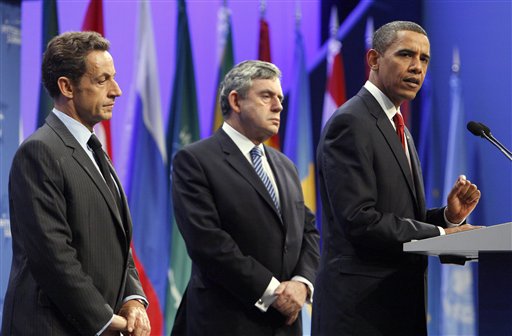
The conference opened with Obama standing at the microphone with French President Nicholas Sarkozy and British Prime Minister Gordon Brown standing solemnly to his left and right. It was explained that German Chancellor Angela Merkel would have joined the trio but was delayed.

Obama then declared that Iran had for several years been secretly building an underground plant in mountainous terrain to manufacture nuclear fuel near the city of Qom about 100 miles from Tehran, in addition to the plant and facilities in Natanz already known to the world. He suggested the new plant was intended to produce weapons without the world’s knowledge.

Obama then charged that “Iran’s decision to build yet another nuclear facility without notifying the IAEA [International Atomic Energy Agency] represents a direct challenge to the basic compact at the center of the non-proliferation regime… Iran is breaking rules that all nations must follow… and threatening the stability and security of the region and the world.” Refusal to “come clean,” he said, “is going to lead to confrontation.”

Sarkozy and Brown followed Obama and seemed to go even further than the American leader in denouncing Iran, explicitly demanding harder sanctions. Said Brown: “The level of deception by the Iranian government, and the scale of what we believe is the breach of international commitments, will shock and anger the entire international community.”

The New York Times reported that “after months of talking about the need for engagement, Mr. Obama appears to have made a leap toward viewing tough new sanctions against Iran as an inevitability… American officials said that they expected the announcement to make it easier to build a case for international sanctions.”

The majority of House and Senate members have long been critical of Iran’s government and the new allegations have only substantiated their suspicions. Right wing Florida Rep. Ileana Ros-Lehtinen, the leading Republican on the House Foreign Affairs Committee, declared: “The U.S. and other countries must immediately impose crippling sanctions on the Iranian regime, including cutting off Iran’s imports of gasoline. The world cannot stand by and watch the nightmare of a nuclear-armed Iran become reality.” Massachusetts Democrat John Kerry, chair of the Senate Foreign Relations Committee, stated “now is the time to supplement engagement with more robust international sanctions.”

As intended, the hyped disclosure created headlines around the world. It probably convinced many Americans, already primed to detest Iran, that Tehran is building nuclear bombs to obliterate the U.S. and Israel. This is not an unlikely conclusion for many people to accept after 30 years of Washington’s incessant campaign to demonize the government that overthrew and replaced America’s puppet, the dreaded Shah of Iran. The U.S. broke diplomatic relations with Iran after this act of lèse majesté and the subsequent “hostage crisis,” and has nourished a grudge to this day.

If push does come to shove with Iran it is important to remember how effortless it was to hoodwink the majority of American politicians and the masses of people into backing a completely unnecessary war against Iraq. As in the buildup to the unjust invasion of Iraq, today’s U.S. corporate mass media is playing its principal part to perfection — uncritically echoing government distortions about the danger of Iran’s nonexistent nuclear weapons. The Iran situation is different, but yet similar in terms of mass public manipulation and the possibility of a future confrontation getting out of hand.

Can this be, once again, a situation of high-stakes geopolitics where things are not as they seem? We think so. Let’s look at the immediate charge against Iran, based on the “revelations” of the last week.

The “shocking” news may have been delivered with a sense of surprise and high urgency, but U.S. intelligence agencies, joined by their counterparts in some allied countries, were aware since 2006 that Iran was constructing a second uranium processing plant that still remains under construction and is not operational. According to a Sept. 26 article circulated by the McClatchy newspaper group quoting a U.S. intelligence official, “There was dialogue with allies from a very early point.”

Bush Administration Director of National Intelligence Mike McConnel first informed Obama about the facility soon after he won election. He has been kept up to date since then. Before going public with the information last week, the president saw to it that several other governments were told in advance, as was the IAEA and others.

Washington officials claimed Iran became aware “in late spring” that the U.S. was spying on the “secret” facility. They said Iran then informed the International Atomic Energy Agency Sept. 21 about the existence of its project, implying Tehran did so because its cover was blown. In a statement Sept. 24 the IAEA acknowledged that Tehran had informed them that a “pilot fuel enrichment plant is under construction in the country,” and that it “also understands from Iran that no nuclear material has been introduced into the facility.”

Iran insisted to the Vienna-based IAEA and the world that the enrichment plant under construction is designed only for fueling nuclear power installations. Soon after Obama’s G20 speech, Iran’s Atomic Energy Organization declared the new “semi-industrial enrichment fuel facility” was “within the framework of International Atomic Energy Agency’s regulations.” Press reports said “The head of Iran’s nuclear program suggested UN inspectors would be allowed to visit the site.” The invitation was extended before Washington’s demand that it do so.

A quite unruffled Iranian President Mahmoud Ahmadinejad appeared at a press conference in New York after Obama’s disclosures. He seemed to regard the American president’s allegations, and the staged manner in which they were delivered, not only the making of a mountain out of a molehill but an act of bad faith just before the talks are to begin, suggesting non-threateningly that Obama will come to regret his confrontational demeanor.

Ahmadinejad told the press that the plant in question wouldn’t be operational for 18 more months and that it did not violate the Nuclear Non-Proliferation Treaty (NPT). He went further and said nuclear weapons “are against humanity [and] they are inhumane,” comments in keeping with his recent calls for eliminating all nuclear weapons.

The Iranian leader also said that Iran informed the IAEA about the plant only a few days ago instead of when ground was broken because construction had reached the stage where it should be reported, not because it found out that a U.S. spy agency was watching.

What are we to make of this? First it must be understood there is a complex dispute over the IAEA’s safeguard provisions governing the Nuclear Non-Proliferation Treaty.

Iran considers itself to be in total compliance with the NPT, and this appears to be true. Inter-Press Service reporter Jim Lobe wrote Sept. 25 that “Under the basic Safeguards Agreement of the Nuclear Non-Proliferation Treaty of which Iran is a signatory, member states are required to declare their nuclear facilities and designs at least 180 days before introducing nuclear materials there.”

According to an article in the Sept. 26 New York Times by Neil MacFarquhar,

Tehran’s stance hinges on different interpretations of the agency’s regulations, said Graham Allison, the director of Harvard University’s Belfer Center and an Iran nuclear expert.

For two decades, the agency required Iran to report only when nuclear material [for uranium enrichment] was introduced to a facility. By 2003 it rescinded that, in line with the guidelines for most [but not all] countries, demanding reporting when construction began, Mr. Allison said. But the agency never declared Iran out of compliance when Tehran claimed the old agreement was still in place.

In talking to the press after Obama’s speech, Ahmadinejad said that the new facility would be completed in 18 months, so under Iran’s understanding of its responsibilities, its notification was a year in advance. The U.S. maintains that Iran informed the IAEA when it learned U.S. spy agencies had become aware of the plant, but if that were so, why did Teheran wait three months before contacting the nuclear agency?

“What we did was completely legal, according to the law,” the Iranian president said. “We have informed the agency, the agency will come and take a look and produce a report and it’s nothing new.” According to the Associated Press Teheran’s notice to the IAEA specified that the enrichment level would be up to 5%, suitable only for peaceful purposes. Weapons-grade material is more than 90% enriched.”

The AP also noted that the IAEA now “says Iran is obliged to make such a notification when it begins design of such facilities” and that “a government cannot unilaterally abandon such an agreement.” This is confusing, of course. But since Iran was never designated as noncompliant and was allowed to proceed under the previous rules after it registered its rejection, the thunderous criticism emanating from the U.S., Britain and France appears to have no merit.

Dynamic trio: Obama, Sarkozy, left, and Brown, condemn Iran at the G-20 summit. Photo by Charles Dharapak / AP.

Behind the allegations

There’s obviously more than meets the eye to unproven allegations of late September from the U.S. and its allies that Iran’s nuclear program is really intended to result in the clandestine production of nuclear weapons, presumably to attack other countries.

As we proceed with our analysis, here are a few things that should be kept in mind.

  1. So far there is absolutely no evidence Iran is going to “weaponize” its nuclear power program and build atomic bombs. So far it has been abiding by the NPT, has pledged not to produce nuclear weapons, is under very close scrutiny by the IAEA, and obviously its program is the target of intensive surveillance by the United States. There is no secret way in which it can construct nuclear weapons under such circumstances.
  2. Israel possesses an arsenal of up to 200 nuclear weapons and thumbs its nose at the IAEA and the NPT, with which it is notoriously noncompliant. If President Obama must sternly castigate Iran, which does not have nuclear weapons, for “breaking rules that all nations must follow… and threatening the stability and security of the region and the world,” why does he protect Israel from international sanction and subsidize its military machine? Pakistan and India are also noncompliant, but they too are allies of Washington and thus have been granted immunity.
  3. In this connection it must be noted that the far right wing Tel Aviv government appears to be on the verge of launching an attack on Iran and has made this well known to the world. But it receives no censure for such threats from the U.S. and its European allies, or for the horror it inflicted on Gaza a few months ago. Imagine the outcry if Iran threatened to attack Israel, or its army entered the territory of a neighboring society and inflicted terrible cruelties largely upon its civilian population for not submitting to national oppression.

    And yet Tel Aviv calls Iran an “existential” threat despite Israel’s nuclear weapons, it’s superior military force and its support from the entire American military apparatus, including 2,600 strategic nuclear warheads on hair-trigger readiness. But as we’ve noted before, the only concrete threat to Israel’s existence would be if the U.S. government withdrew its political, military and financial support.

  4. Washington’s geopolitical interests are key to America’s relationship to Iran and the Middle East in general. The U.S. desires to control — or at minimum to keep out of “unfriendly” hands — the immense oil reserves possessed by Iran and neighboring Iraq. It fears a future alliance between these resource rich developing countries, who also happen to be the only two nations in the world governed by Shi’ite Muslims.

    The U.S. invaded to overthrow the “unfriendly,” Sunni-backed Iraqi government of Saddam Hussein. But it can neither rely totally on its selected successor regime in Baghdad, nor has it yet been able to remove the theocratic government in Tehran, which is conservative domestically but puts forward an anti-imperialist foreign policy that drives the world’s remaining superpower to distraction.

Washington’s objective at the talks beginning Oct. 1 is to coerce Iran to accept extremely intrusive controls on its nuclear development, combining dire threats for refusal with small rewards for agreement. The Tehran government said it will reject demands that it halt uranium enrichment, a main concern of the five members of the Security Council plus Germany, but indicated without elaboration that “Iran is ready to… help ease joint international concerns over the nuclear issue.”

(Enriched uranium is required to power nuclear plants for civilian uses. Much greatly enriched uranium is required for weapons.)

Washington wants to confine the seven-party discussions to Tehran’s nuclear project, but the Iranian government put forward its own proposal in early September for “comprehensive, all-encompassing and constructive negotiations.” The U.S. rejected the proposal, but accepted it with seeming reluctance the next day. (We don’t know what happened to change things.)

The Iranian suggestions include hastening global nuclear disarmament, ending nuclear proliferation and working toward world peace. Theoretically, Washington agrees with these goals, but doesn’t really want to discuss them with Iran.

The White House knows that in a broader discussion of nonproliferation issues Iran would draw attention to the three U.S. allies presently defying the NPT and getting away with it, and also show that the U.S. itself is noncompliant because it was supposed to have made more progress by now in reducing the Pentagon’s nuclear arsenal.

Further, the U.S. will hardly discuss an Iranian proposal for a comprehensive agreement to achieve “global peace and security based on justice” that includes an inquiry into America’s aggression in Iraq and Afghanistan, and Israel’s astonishingly disproportionate violence against Gaza and Lebanon.

The Obama Administration wants at minimum to impose stringent sanctions on Iran if no progress is made to its satisfaction in the next few months as demanded by U.S. neoconservatives, the right wing in general and those influenced by AIPAC, which describes itself as “America’s Pro-Israel Lobby.”

One reason for harsh sanctions would be to hasten the downfall of the Ahmadinejad government, if possible, by creating a serious economic crisis, unemployment, and suffering to exacerbate existing social tensions within the Islamic Republic. The last time Washington engaged in deep sanctions was from 1991-2003 when it has been verified that over a million Iraqis, including a huge number of children, died from various deprivations from hunger to unclean drinking water.

If sanctions are the minimum, the maximum response would be unleashing Israel to attack Iran — an action that would backfire as surely as there is water in the Hudson River.

After his Pittsburgh speech Obama told the press he wasn’t “taking any options off the table,” a phrase he has used a number of times in relation to Iran. It means war remains an option for the U.S., even over the relatively petty issue of an empty building still under construction that’s probably intended to produce energy, not violence.

This same statement was a favorite of Bush II as well, and he used it repeatedly in relation to Iran. In April 2006, at a time when Dick Cheney, the neoconservatives and their supporters were pushing hard for war against Iran, the BBC reported that “Bush says all options, including the use of force, are on the table.” As they say, the more things change…

Although some in Washington are hopeful that Ahmadinejad will be weakened in the nuclear talks because of opposition claims that he “stole” the June 12 election in Iran, we don’t believe this is a factor. So far, more than three and a half months later, there has not been any concrete evidence to support the opposition allegations of electoral fraud.

While the U.S. mass media depicts Ahmadinejad as being under virtual siege from a majority of Iranians, other information shows this is exaggerated. Inter-Press Service reported the following Sept. 19 in an article by Jim Lobe headlined, “New Poll Finds Strong Domestic Support for Iran Regime.”:

A new survey of Iranian public opinion released here [today] suggests majority domestic support for both him [Ahmadinejad] and the country’s basic governing institutions. Four out of five of the 1,003 Iranian respondents interviewed in the survey released by WorldPublicOpinion.org, a project of the highly respected Program on International Policy Attitudes (PIPA) of the University of Maryland, said they considered Ahmadinejad to be the legitimate president of Iran.

Sixty-two percent of respondents said they had ‘a lot of confidence’ in the declared election results, which gave Ahmadinejad 62.6% of the vote within hours of the polls’ closing Jun. 12 and which were swiftly endorsed by the Islamic Republic’s Leader, Ayatollah Ali Khamenei. Three of four respondents said Khamenei had reacted correctly in his endorsement.

No mass demonstrations have taken place from early August until Sept. 18, when thousands of protestors marched in Tehran in an attempt to rival much larger government-sponsored annual rallies in solidarity with the Palestinian struggle on what is called “Jerusalem Day” in Iran. Coming just two weeks before the opening of the nuclear talks, it was obviously intended to convey the impression internationally that Ahmadinejad did not really represent the will of the Iranian people. Police handled the dissenters with kid gloves.

A number of the demonstrators and signs seemed to oppose the Tehran government’s support for the Palestinians as well as Ahmadinejad’s re-election. The Economist reported chants of “Not Gaza, Not Lebanon, I’ll only give my life for Iran,” although Jerusalem Day observances never suggested Iranians should give their lives for either Gaza or Lebanon, both of which have been targets of Israeli military aggression. There were also chants of “Death to Russia” and “Death to China,” evidently a reference to their refusal to join the U.S. and Israel in denunciations of the Tehran government.

In a speech that day, Ahmadinejad in effect pulled the rug from under his own feet in terms of international opinion by once again charging that the Holocaust was a “lie.” Wisely, the Iranian leader did not repeat the preposterous allegation during his 35 minute speech to the UN General Assembly in New York Sept. 23. He mainly discussed building durable world peace and “elimination of all nuclear, chemical, and biological weapons to pave the way for all nations to have access to advanced and peaceful technology.”

He criticized the U.S. and Israel, but seemed somewhat subdued. According to Sarah Wheaton in the New York Times blog that evening, he “said the United States was aiding Israel in ‘racist ambitions,’ called Israel’s attack on Gaza in December ‘barbaric’ and said the economic blockade of Palestinians amounts to ‘genocide’” — comments that provoked the U.S. and 10 other delegations to walk out. Israel didn’t attend in the first place.

Soon after Ahmadinejad’s speech, Israeli Prime Minister Benjamin Netanyahu told the General Assembly that “The most urgent challenge facing this body is to prevent the tyrants of Tehran from acquiring nuclear weapons,” and urged the delegates to oppose Iranian “barbarism.”

Back in Israel Sept. 26, according to an AP dispatch from Jerusalem,

Netanyahu spoke with House Speaker Nancy Pelosi and a number of unidentified U.S. senators and told them that now is the time to act on Iran. Israel maintains the Islamic republic is seeking nuclear weapons.‘If not now then when?’ the official quoted Netanyahu as saying. He spoke on condition of anonymity because he was not allowed to speak with the media. He did not disclose what kind of action Netanyahu recommended be taken.

Israeli Foreign Minister Avigdor Lieberman said earlier in the day that the Iranian nuclear facility proves ‘without a doubt’ the Islamic republic is pursuing nuclear weapons. ‘This removes the dispute whether Iran is developing military nuclear power or not and therefore the world powers need to draw conclusions,’ Lieberman told Israel Radio. ‘Without a doubt it is a reactor for military purposes not peaceful purposes.’

[Jack A. Smith was editor of the Guardian — for decades the nation’s preeminent leftist newsweekly — that closed shop in 1992. Smith now edits the Hudson Valley Activist Newsletter, where this article also appears.]

The Rag Blog

Posted in Rag Bloggers | Tagged , , , , , | Leave a comment

PRESS / Mexico’s Leftist ‘La Jornada’ : 25 Years of Rabble Rousing


Noam Chomsky salutes left wing daily
Keynotes La Jornada anniversary event

The first issue of La Jornada rolled off borrowed presses September 19th [1984] to the universal disdain of Mexico’s ruling class which then maintained a hammerlock on the press…

By John Ross / The Rag Blog / September 27, 2009

MEXICO CITY — Seven mornings a week, Vicente Ramirez’s battered aluminum kiosk on Cinco de Mayo Street in this city’s old quarter is plastered with the front pages of 22 daily newspapers. All day handfuls of pedestrians pause to gawk at the incendiary headlines slapped to the siding, often engaging in animated debate about the nature of the news.

“This country is going down the toilet,” sneers one elderly gentleman studying a story about a particularly cruel kidnapping. “Ay Mamacita” another old gaffer exclaims, oogling a bare-breasted senorita.

Fully a quarter of the score of dailies on view at Vicente’s kiosk are dedicated to the “nota roja” or “red note.” Tabloids like La Prensa (reputedly Mexico’s biggest seller but circulation figures are elusive) and Impacto are all blood and tits, spotlighting brutal beheadings, sensational crimes of passion, and bevies of topless lasses.

Three sports dailies including the venerable Esto, which still publishes in sepia, rivet the ad hoc attentions of passerbys. Two financial papers (El Financiero and El Economista), The News (a re-incarnation of the long-lived English-language paper) and El Pais, or at least the Mexican edition of the prestigious Madrid daily, dangle from Vicente’s stand. Noontime and evening editions of Mexico City papers will join the display during the day.

Editorial slants run from hard right to soft left — Cronica, reputedly financed by the reviled ex-president Carlos Salinas, savagely slams the left-center Party of the Democratic Revolution (PRD) that has managed the affairs of the capital for the past 12 years.

Many of the dailies hung from Vicente’s kiosk exist only to cadge juicy government advertising and are hesitant to bite the hand that feeds them. Excelsior and El Universal, broadsheets founded in the midst of the Mexican Revolution not quite a hundred years ago, make much of their “impartiality” but are intractably linked to the once and future ruling PRI party.

Reforma and its tabloid sidekick Metro are sounding boards for the right-wing PAN of which President Felipe Calderon is king — both are unavailable at Vicente’s kiosk, having broken with the powerful Newspaper Venders Union, and they now field an army of comically uniformed street hawkers.

The only openly left wing daily in this vast array, La Jornada (“The Work Day”), is Vicente’s best seller at 20 a day, followed by La Prensa (15) and Universal (10.) When leftists gather in the nearby Zocalo plaza, usually for events captained by ex-Mexico City mayor Andres Manuel Lopez Obrador (AMLO), Vicente will sell up to a hundred Jornadas.

One caveat: despite this monumental exhibition of newsprint and dead trees, the first news source for 95% of all Mexicans is still the nation’s two-headed TV monopoly, Televisa and TV Azteca.

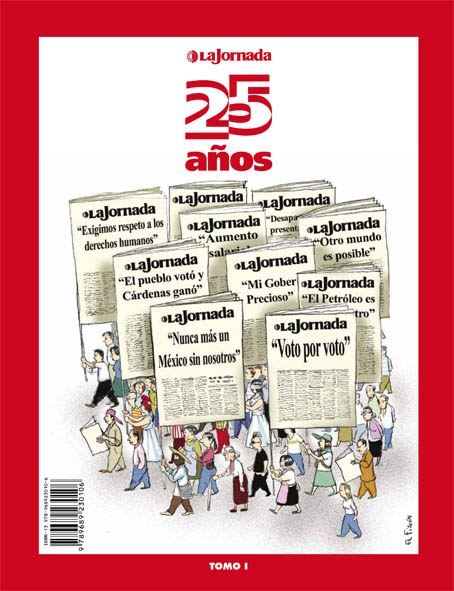
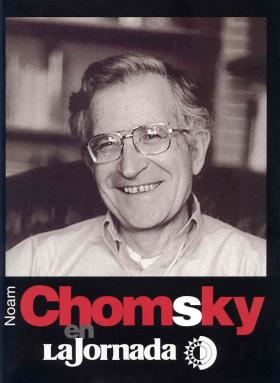
September has been a big month for La Jornada. To celebrate its 25th birthday, the National Lottery offered a commemorative ticket as did the Mexico City Metro subway system, rare mainstream honors for a lefty rag, and notorious U.S. rabble rouser Noam Chomsky came to town to help cut the cake — along with Gabriel Garcia Marquez (a founding investor) and the much-lauded Uruguayan writer Eduardo Galeano, Chomsky is one of several literary superstars whose words fill the pages of La Jornada.

The Jornada was founded in 1984 by itinerant journalists who had bounced from one short-lived left periodical to the next — for many of the original Jornaleros, like LJ’s first editor Miguel Angel Granados Chapa, the last ports of call had been Uno Mas Uno (“One Plus One”) and El Dia but when their publishers were bought off by then-president Miguel De la Madrid, the lefty newshounds trundled their old Underwoods (computers were nowhere on the horizon back then) up the winding stairs of La Jornada’s old ramshackle headquarters on Balderas Street’s newspaper row and went to work.

Nostalgia was on the menu for La Jornada’s 25th. During one celebration under chandeliers at the elegant Casa Lamm where the paper presents weekly forums on burning social issues, founding director Carlos Payan recalled how in February 1984 he summoned movers and shakers from a broad spectrum of the Mexican Left to the phantasmagoric Hotel Mexico, the unfinished dream of Spanish visionary Manuel Suarez with a revolving rooftop restaurant (it has since been converted into Mexico’s World Trade Center.)

800 potential investors showed up at the assembly, buying in at a thousand pesos a share — one of those on hand was Carlos Slim, now the third richest tycoon on the planet but then still a two-bit corporate cannibal who shared Payan’s Lebanese ancestry. Two of Mexico’s most illustrious painters, Rufino Tamayo and Francisco Toledo, donated priceless works that became La Jornada’s principal capital.

Payan’s words to those gathered in the Insurgentes Avenue ballroom that night ring just as true today as they did back then: “In this hour of crisis, we convoke a new labor of critical journalism in solidarity with those who struggle for the causes of this country.”

The first issue of La Jornada rolled off borrowed presses September 19th of that year to the universal disdain of Mexico’s ruling class which then maintained a hammerlock on the press, doling out government advertising and even newsprint to newspapers based on their allegiances to the PRI and the government it commanded. The barons of the press gave the left daily a few short months of life at best.

La Jornada was indeed born into turbulent times — always a propitious moment for independent journalism. Mexico had just gone belly up, forced into default of $100,000,00,000 USD in short-term foreign bank loans by plunging oil prices, and the crisis kicked the legs out from under outgoing president Jose Lopez Portillo and his hand-picked successor De la Madrid. Wars fomented by U.S. proxies were raging in neighboring Central America — two of the paper’s veteran reporters Carmen Lira (now Payan’s replacement as director) and Blanche Petrich (winner of the National Journalism Award) made their bones in El Salvador and Nicaragua.

On the first anniversary of La Jornada’s birth, Mexico City was savaged by an 8.1 grade earthquake that took up to 30,000 lives and when the “damnificados” (survivors) built a social movement that triggered the resurgence of Mexican civil society, La Jornada became its voice.

The left daily’s history is built on such dramatic moments. During and after the stealing of the 1988 presidential election from leftist Cuauhtemoc Cardenas by the evil Salinas and the PRI, La Jornada stood on the front lines, exposing the fraud that included everything from tens of thousands of burnt ballots to crashing computers, and the paper accompanied Cardenas when he consolidated the PRD in 1989 — the Jornada is often accused of being the left-center party’s mouthpiece.

In the aftermath of the fall of the Berlin Wall and the dissolution of the Soviet Union, also in 1989, La Jornada played a critical role in the debate about the future of the Mexican Left and the left press.

The Zapatista rebellion in Chiapas that exploded on January 1st 1994 further burnished La Jornada’s bonafides and sold tons of papers for Vicente Ramirez. Petrich rode into the jungle on horseback and got the first interview with Subcomandante Marcos and Hermann Bellinghausen, another National Journalism Award winner (he turned it down) has reported daily from that conflictive zone ever since.

As the ’90s ebbed into the new millennium, La Jornada closely covered the collapse of the PRI and the installation of the rightist PAN in Los Pinos, the Mexican White House. The paper’s platoon of mordant, militant political cartoonists continue to relentlessly lampoon and skewer the political class.

For the 12 years that the PRD has administered the affairs of this monstrous megalopolis, La Jornada has provided critical support and has, in fact, played a key role in the democratization of the most contaminated, crime-ridden, corrupt and chaotic city in the western hemisphere.

The left daily’s reportage of the heist of the 2006 “presidenciales” by Felipe Calderon from Lopez Obrador — who still enjoys the blessings of the Jornaleros — became Vicente Ramirez’s bread and butter. “I sold a ‘chingo‘ (‘a fucking lot’). They flew out of here like “balas” (‘bullets’).”

Giving this bold trajectory and because LJ has never been “a yes man for the corrupt governments of the PAN and the PRI” (Lira), the paper is despised by right-wingers and establishment intellectuals. Historian Enrique Krauze’s vitriol at La Jornada is splattered all over the glossy pages of his Letras Libres. Writing in Krauze’s rightist monthly, poet-philosopher Gabriel Zaid bemoans the influence that LJ has accumulated over the years: “how can La Jornada have so much weight when important decisions are taken in this country?” he complains, blaming the paper’s “opportunistic” use of culture. “La Jornada brings together left intellectuals who define what they think is political correct.”

Every morning, LJ’s letters to the editor column is packed with bristling epistles from government flunkies assailing La Jornada reporters for exposing the shenanigans of the bureaucracy. When the left paper reports on the dirty dealings of provincial governors and their abuses of authority, the governors are apt to send agents into the street to confiscate every Jornada in the state.

State and federal governments threaten the withdrawal of paid publicity but LJ’s clout has often nullified the denial of this lifeblood of the Mexican newspaper industry. For its 25th anniversary edition, mortal foes of La Jornada like Oaxaca’s tyrannical governor Ulises Ruiz, the Falangist state government of Guanajuato, and the Zapatista-hating mayor of San Cristobal de las Casas were all obligated to take out paid birthday greetings.

While the corporate newspaper industry appears to be gasping its last in the United States where no comparable left daily has ever survived for longer than two years (PM in New York City in the late ’40s), Jornada runs in the black.

Although La Jornada is published in Mexico City, the hub of a highly centralized nation from which all power emanates, the Jornaleros have mothered affiliated dailies in eight Mexican states and the national edition is distributed from Tijuana to Tapachula on the southern border where eager readers snatch up the paper the moment it hits the stands. In addition to the print edition, La Jornada On Line receives thousands of hits each day and has attracted a lively community of bloggers.

Despite its long reach into the provinces, La Jornada is anything but provincial. Its correspondents prowl New York and Moscow and Havana, Bolivia and Chile and Argentina. The newspaper’s perspective is firmly grounded in the global south but Robert Fisk and Patrick Cockburn share their London Independent dispatches from Middle East hotspots.

This correspondent reported on the first days of Bush’s illegal invasion of Iraq from Baghdad. Similarly, David Brooks covered the 9/11 terror attacks on New York and Washington from Ground Zero. Luis Hernandez Navarro never misses an international anti-globalization mobilization or World Social Forum. Cronista (chronicler) Arturo Cano hangs out with Mel Zelaya in Tegucigalpa.

La Jornada does not only print the news, it makes it, actively espousing social causes and decrying injustice daily on its pages. In fact, the resistance of marginated communities from Chiapas to Pais Vasco would be little noted if the news had not first run in La Jornada. Crucial to this insemination of resistance in Mexico are daily notices of meetings and forums and rallies and marches that act as a mighty force multiplier for left movements, turning handfuls into multitudes. La Jornada, whose strong suit is reporting on social movements, has itself become a social movement.

Although politics are its main course, La Jornada publishes monthly supplements on agriculture, the environment, labor, indigenous cultures, women’s struggles, and gay and lesbian rights. The weekly cultural insert and daily reports on painting, dance, literature, music, and popular entertainment have deep scratch among cultural workers.

The Jornada even once published a weekly magazine in English, a losing commercial venture that was eventually killed by Lira. “We are not going to spend the benefits of our workers” by continuing to publish a magazine “in the language of the oppressors,” Carmen explained to this writer at the time. Jornada workers have built a strong in-house union.

La Jornada also operates a book publishing arm with dozens of titles authored by its own reporters like Bellinghausen’s account of the massacre at Acteal, “A Crime of State.” Translations of Noam Chomsky’s multiple works are hot sellers.


Despite hard-wired anti-gringo sentiments, La Jornada invited the renowned gavacho gadfly to crown its 25th birthday celebration with a magnum lecture at the National University. Noam Chomsky is hardly the only U.S. lefty to adorn LJ’s op ed columns — Howard Zinn, Immanuel Wallerstein, James Petras, and Amy Goodman are regular collaborators.

In introducing his September 21st lecture at the UNAM, the oldest and most prestigious in the Americas, Carmen Lira posited that Chomsky’s analysis of mass media in writings like “Manufacturing Consent” and the ethical guidance of the late Polish journalist Ryzsward Kupascinski (“bad people cannot become good reporters”) were the cornerstones of La Jornada’s credo.

Chomsky’s near two-hour talk to a jam-packed auditorium named for the poet-king Nezahualcoytl (every seat in the house was claimed within 30 minutes of the announcement of the lecture) lazered in on Washington’s fading domination of a uni-polar world. Noam ranged far afield: how Barack Obama, the darling of Wall Street, was sold to the North American electorate “like toothpaste or a wonder drug;” the British Empire as the “first international narco-trafficker” (the Opium War); the strategic perils of U.S. bases in Colombia for the Global South. The elderly (82) MIT linguistics pioneer’s discourses are often better read on the printed page than pronounced out loud and Chomsky’s low-key, nebbishy persona left some attendees dozing despite the dazzling blizzard of data he offered.

Focusing on Washington’s crimes around the globe, the talk often approached the world on an west-east power bias rather than south to north, mentioning NATO more than NAFTA with no reference to new Latin Left leaders like Hugo Chavez with whom Chomsky had just huddled. The perennial icon of the U.S. Left also avoided much mention of contemporary Mexican politics, perhaps with an eye out for Constitutional Article 33 that gives the Mexican president carte blanche to kick out any “inconvenient” foreigner. Still, the old gringo’s condemnation of free trade, the war on drugs, and neo-liberal economics must have made Felipe Calderon (whose name was never dropped) uncomfortable.

Despite the length of the talk, Chomsky was only twice interrupted with applause — once when he advanced that like the U.S., Mexico was not a “failed state” (a favorite theme) at least for the oligarchy but for millions of the poor who have lost all social protections, the state has, in fact, failed. When Noam Chomsky counseled that the best cure for neo-liberal excess was to confront the rulers with mass mobilizations, the audience again broke into cheers.

As the very professorial Noam Chomsky stepped from the podium he was greeted by Trinidad Ramirez, wife of the imprisoned (113 years) Ignacio del Valle, leader of the Popular Front for the Defense of the Land, who tied a red kerchief around his neck and presented him with the emblematic machete of the farmers of San Salvador Atenco who count 13 political prisoners among their ranks.

After 25 years and upwards of 9000 editions, La Jornada has forcefully disproved one of Noam Chomsky’s pet theses: that an independent media cannot survive in a corporate-dominated press. “You’ve proven me wrong,” the old professor sheepishly confessed during a visit to the paper’s Spartan headquarters in the south of the city.

“Nine thousand editions! You’ve got be kidding!” Vicente Ramirez marveled in his cramped little newspaper kiosk, whipping out his pocket computer. “Lets see – 9000 editions at 10 pesos a piece times 20. That’s 1,800,000 pesos! Happy Birthday! La Jornada has been very good to me.”

[John Ross’s monstrous El Monstruo – Dread & Redemption In Mexico City will hit the streets in November (to read raving reviews from the likes of Mike Davis and Jeremy Scahill go to www.nationbooks.org.) Ross will be traveling Gringolandia much of 2009-2010 with El Monstruo and his new Haymarket title Iraqigirl, the diary of a teenager growing up under U.S. occupation. If you have a venue for presentations he would like to talk to you at johnross@igc.org.]

The Rag Blog

Posted in Rag Bloggers | Tagged , , , , , | Leave a comment

Harvey Wasserman : Obama’s LBJ Moment

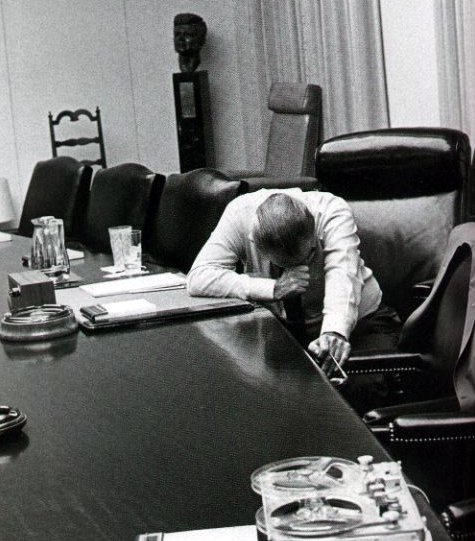
President Lyndon B. Johnson listens to tape sent by Captain Charles Robb from Vietnam, July 31, 1968. Photo by Jack Kightlinger / LBJ Library.

Obama’s LBJ moment

He has inherited from George W. Bush the beginnings of a horrific quagmire. How he handles it will determine, more than any other decision, his future and that of a deeply wounded nation…

By Harvey Wasserman / The Rag Blog / September 27, 2009

Lyndon Johnson was once on the verge of becoming one of America’s greatest presidents.

But with a single wrong turn into Vietnam, LBJ plunged himself and the nation into a ghastly tragedy that still makes us all weep and bleed.

It is NOW! up to us to make sure Barack Obama does not do the same.

Even the corporate media show signs of understanding the parallels between Vietnam and Afghanistan. So many of us are alive today who remember March, 1965, and all the horror that followed, that there is simply no excuse for allowing this lethal mistake to be repeated.

LBJ inherited the momentum of the New Frontier, the murder of John Kennedy and a huge 1964 electoral mandate. He turned them into a string of civil rights and social welfare victories that still vastly enhance all our lives.

But LBJ also inherited from JFK the beginnings of the war in Vietnam. LBJ’s choice was to escalate or pull out. Recent biographies indicate he had a strong premonition that the war was futile, and that it would do him in. A century from now, historians will still agonize over why he took the plunge anyway.

Likewise, Obama’s most critical decision today does not have to do with health care or energy. There will be bills on both. How much they help or hurt us will be a matter for debate, and for future legislative and legal battles.

But there will be no gray area in Afghanistan. If Obama chains himself to some kind of “victory,” he and what’s left of our nation are doomed.

As in Vietnam, the goal would seem to be to install a regime run by the United States and to “pacify” the country into accepting it. The last foreigner to win like that in Afghanistan was Alexander the Great, about 2300 years ago. Since then the British and Soviets have been among the many to crash and burn in this “graveyard of great powers.”

When LBJ escalated, the draft cards started burning and the protests began in earnest. But it was already too late. By 1968 more than 550,000 American troops were stuck in Southeast Asia and the war raged for yet another seven years. Millions of Vietnamese and more than 58,000 Americans died. Tens of thousands were terminally traumatized. The toxic human, economic and ecological impacts still ravage both nations.

At some point, LBJ realized what he had done. His extant image is not of a victorious, canonized Lincoln or FDR, but of the exhausted shell of an on-his-way-out president, slumped over a table, listening to a tape from his son-in-law in Vietnam (the photo is by Jack Kightlinger, July 31, 1968).

Obama could all too easily share LBJ’s fate. His mandate to make change is unmistakable and his potential for success is tangible.

But another trap has been set. He has inherited from George W. Bush the beginnings of a horrific quagmire. How he handles it will determine, more than any other decision, his future and that of a deeply wounded nation that still hasn’t recovered from the Southeast Asian catastrophe.

LBJ apparently thought he could not “lose” Vietnam because right wingers would blame him for an ensuing “success of world communism.”

Despite the billions spent in blood and treasure, the last Americans fled from a Saigon rooftop on April 30, 1975. No triumphant wave of global communist aggression ensued. By 1991, due largely to its fiasco in Afghanistan, the Soviet Union and the “world communist conspiracy” definitively disintegrated.

Today’s right wingers like Condolezza Rice shout that “losing Afghanistan” will mean more terror attacks. It’s utter nonsense. But the warning, carried by the screaming Foxist media, is that unless he drags us all into Southwest Asia, Obama will be held personally responsible for all future mayhem.

Some White House advisors could well be saying the same thing, just as JFK’s “Best and Brightest” warned LBJ not to pull out of Vietnam.

Today General Stanley McChrystal plays the role of William Westmoreland, the prime architect of Vietnam’s military catastrophe. As did Westmoreland, McChrystal is telling the public an Afghan war can be won if only we “stay the course.”

In the 1980s I debated Westmoreland on two college campuses. He told me, with a poker face, that we actually “won the war” by “buying time” for a set of non-communist Southeast Asian dictators (including Singapore’s Lee Kwan Yew, Indonesia’s Suharto and Ferdinand Marcos of the Philippines, all of whom brutalized their people and stuffed billions of dollars into their personal Swiss bank accounts).

If he prevails, General McChrystal may someday have similar things to say.

But we cannot let this happen. Afghanistan cannot be controlled any more than Vietnam could. Effectively fighting terror demands an intelligent, coordinated international effort, not a blundering unilateral plunge into yet another hopeless overseas quagmire.

It also requires a revived prosperity, a winning agenda for social justice, and a Bill of Rights that is honored and in tact.

All of this is in Obama’s reach. But ONLY if he stays out of Aghanistan, and any other military quagmire that might beckon. That would include Iran, where the crisis has internationalized, and is of a very different sort.

Afghanistan, should Obama choose to go there, will be ours and ours alone, with no victory possible and no way out that does not resemble the one from Saigon.

If we had known enough to do it, we should have begun marching against the Vietnam War in 1961, when John Kennedy first committed 11,000 troops there. With a full-blown anti-war movement, perhaps we could have stopped LBJ from committing personal and national suicide in 1965.

Today we have no excuse. This administration is teetering on the edge of catastrophe. A military plunge into Afghanistan would doom Barack Obama and the rest of us to tragedy and impoverishment beyond even LBJ’s worst nightmares.

The moment is now. Health care, yes! Energy and the climate, yes!

But first and foremost: STOP THIS WAR!!!

[Harvey Wasserman’s Solartopia! Our Green-Powered Earth is at www.harveywasserman.com, as is Harvey Wasserman’s History of the US. This article also appears at freepress.org.]

The Rag Blog

Posted in Rag Bloggers | Tagged , , , , , | 3 Comments

Children March for Education in South Africa

Now this is grassroots organization. We could take a lesson from their effort. You don’t get anything if you don’t ask for it.

Richard Jehn / The Rag Blog

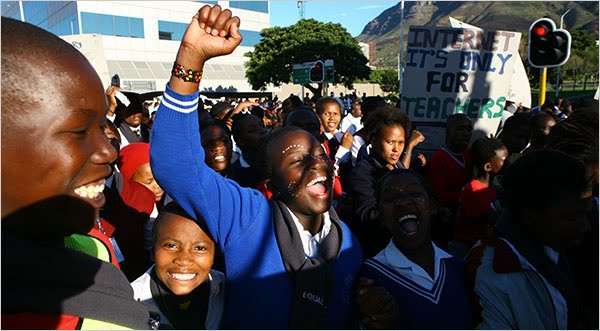
South Africa schoolchildren marched to City Hall in Cape Town this week to press for libraries and librarians at their schools. Education lags in the country. Photo: Pieter Bauermeister/New York Times.

South African Children Push for Better Schools
By Celia W. Dugger / September 24, 2009

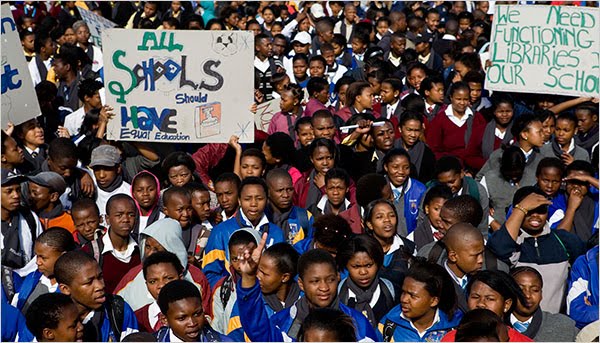
CAPE TOWN, South Africa — Thousands of children marched to City Hall this week in sensible black shoes, a stream of boys and girls from township schools across this seaside city that extended for blocks, passing in a blur of pleated skirts, blazers and rep ties. Their polite demand: Give us libraries and librarians.

“We want more information and knowledge,” said a ninth grader, Abongile Ndesi.

In the 15 years since white supremacist rule ended in South Africa, the governing party, the African National Congress, has put in place numerous policies to transform schools into engines of opportunity. But many of its leaders, including President Jacob Zuma, now acknowledge that those efforts have too often failed.

The new protest movement, with its practical goals, youthful organizers and idealistic moniker, Equal Education, is a quintessentially South African answer to a failing education system, one that self-consciously acknowledged its debt to the past in the march to City Hall.

In 1976, when police officers shot a 13-year-old named Hector Pieterson in Soweto, a children’s uprising against apartheid emerged and spread across the country to Cape Town, where students from a mixed-race high school, Salt River, marched in solidarity with black schoolchildren.

Zackie Achmat, South Africa’s wiliest campaigner for AIDS treatment, was himself a 14-year-old marcher that September day 33 years ago. Mr. Achmat, now graying, was among the protesters following the same route this week, his white straw hat bobbing in a sea of plaids and ginghams.

The idea for a new movement dedicated to educational equity was his, and he helped nurse Equal Education into being, counseling its young leaders to work with teachers and government officials whenever possible. The country’s leadership, which has been slow to grapple with the AIDS crisis, understands the urgent need for better education, he said. The new director general of the country’s Higher Education Ministry, Mary Metcalfe, has served as head of Equal Education’s board.

“In building a citizens’ movement, the most important element is giving people the sense of their own power to change things with little victories,” Mr. Achmat said.

The job of organizing the group has fallen to a pair of law school graduates from the University of Cape Town. Doron Isaacs, 29, its coordinator, was leader of Habonim South Africa, an organization of young, left-wing Jewish activists with whom Mr. Achmat has worked for years. Mr. Isaacs recruited a classmate, Yoliswa Dwane, 27, who was raised by her seamstress mother and now lives in a shack in the township of Khayelitsha, south of Cape Town, where she is caring for nieces, ages 12 and 17.

The marchers in Cape Town, who numbered in the thousands. The marchers echoed a children’s uprising against apartheid in 1976. Photo: Pieter Bauermeister for The New York Times.

Last year, Equal Education gave students in Khayelitsha, home to more than 500,000 unemployed and working-class people, disposable cameras to document problems in their high schools. They returned with shots of leaking roofs, cracked desks and children crowded around a single textbook.

One image — a bank of window panes at Luhlaza high school, all shattered, captured by a student named Zukiswa Vuka — proved the most resonant. Some 500 windows at the school had been broken for years, leaving the students shivering in wintertime classes.

Equal Education’s first campaign was to get them replaced. The school agreed to put up about $650, an amount the group said it would match. That left some $900 still needed. Over months, the group met with local and provincial managers, organized a communitywide petition drive, held a rally of hundreds of township students and garnered coverage in local newspapers.

Finally in November, provincial education officials announced that the windows would be fixed and that a sum almost 10 times what the students had requested would be invested in the school.

This year, students successfully agitated for a science teacher at Chris Hani High School when it had none for the seniors.

They also led a drive to get their classmates to come to school on time, with early-morning pickets at school gates — an effort that also showed up late-arriving teachers.

The libraries campaign is the group’s first attempt to tackle a national issue. With financial support from Atlantic Philanthropies and the Open Society Institute, among others, it is also hoping to broaden its membership to include teachers and more parents and to graduate to bigger victories.

Mr. Isaacs said Equal Education’s members knew that problems far harder to fix than windows or missing libraries awaited and that part of the answer was building alliances with the teachers’ union, which is in the governing alliance.

“We know that the teachers’ union is one of the most powerful institutions in the country,” he said, “and if we style ourselves as its adversary, we’ll be dead in the water.”

The marchers, stretched out Tuesday along Main Road in the shadow of majestic Table Mountain, were themselves a wealth of stories.

Nkosinathi Dayimani, a senior, was one of the beneficiaries of the new science teacher this year, but not soon enough to prevent his failure on the recent trial run of the national science exam.

Asanda Sparks, a petite ninth grader from Kraaifontein Township, has been hoping for a library in her school since bullies picked her pocket as she walked to the public library to research Nelson Mandela’s life.

And Nina Hoffman was among the dozens of white students who joined the march from one of the country’s formerly all-white suburban high schools — Westerford — which can afford a well-stocked library because parents pay annual fees of more than $2,200 per child.

“Coming to a march like this, I realize even more how privileged we are and how much I take for granted,” she said.

During their two-hour walk to City Hall on a gloriously sunny afternoon, the young people seemed buoyed by the hope of making a difference.

Abongile, the ninth grader from Luhlaza high school, noted appreciatively that she did not have to sit with chattering teeth in class this winter because the broken windows had been fixed.

“I saw that Equal Education can make something impossible possible,” she said.

Source / New York Times

The Rag Blog

Posted in RagBlog | Tagged , , | 4 Comments

Leonard Cohen’s ‘Concert for Reconciliation’

Leonard Cohen Sings The Anthem

Words to this song are below.

Cohen defies critics with Israeli gig
Veteran plays to 47,000 in Tel Aviv despite accusations of ‘immorality’

By Donald Macintyre / September 26, 2009

It was vintage Leonard Cohen. “We don’t know when we’ll pass this way again,” he told the sell-out audience at the Ramat Gan football stadium: “But we promise to give you everything we’ve got tonight.” And he did.

Any worries fans had after the 75-year-old Canadian poet-singer-songwriter collapsed while performing “Bird on the Wire” in Valencia last week (apparently from food poisoning) quickly dissipated.

Disbelieving laughs rippled through the crowd at those familiar lines in “Chelsea Hotel”, the beguiling elegy to his late Sixties fling with Janis Joplin: “You told me again you preferred handsome men/but for me you would make an exception”. And certainly the maestro, in customary suit and fedora, looked as good as he sounded in the still warmth of this Tel Aviv September night, his first concert in Israel for more than 25 years.

He – literally – danced off the stage before each of three encores, one of which charmed the enraptured crowd to their feet in an excited singalong, thousands waving their green glow sticks in time to “So Long Marianne”. He and his gravelly bass baritone voice were at peak form, from a gloriously funky “I’m Your Man” to the dark and haunting “Famous Blue Raincoat” and, of course, “Hallelujah” (which served as a reminder that none of the many cover versions are as good).

But this is Israel, and the political context cannot be ignored.

Mr Cohen, Jewish like the vast majority of his audience, had billed the gig on Thursday night as “A Concert for Reconciliation, Tolerance and Peace”. And this was not the usual vacuous platitude. For he had also agreed to donate its $1.5m to $2m proceeds to a new fund he is behind to promote coexistence projects.

One of these is the Parents Circle – Families Forum, a unique organisation of bereaved Israeli and Palestinians who have lost close relatives in the conflict and who meet regularly together to share their painful experiences across the divide.

In the face of protests by proponents of a cultural boycott of Israel that he was playing Tel Aviv at all, Mr Cohen had planned a similar concert in the West Bank city of Ramallah, with proceeds earmarked for a Palestinian prisoners’ charity. But that was successfully blocked by boycott campaigners – including, according to his American manager, Robert B Kory, a number of “British academics” – who argue that concerts like this and Paul McCartney’s last year validate Israel as a “normal country” as it tramples Palestinian rights.

The Palestinian Campaign for the Academic and Cultural Boycott of Israel (PACBI) said that such attempts at “balance” not only “immorally equate the oppressor with the oppressed … [but] are conscious acts of complicity in Israel’s violation of international law and human rights”.

The campaign has been given fresh impetus by Israel’s winter offensive on Gaza, which left more than 1,300 Palestinians dead.

But the Parents Circle was undeterred. At a reception before the concert, the writer and long-time peace campaigner David Grossman said: “It seems so easy to believe that war is the only possibility and that Israelis and Palestinians will continue to kill each other.” But Mr Grossman, whose tank commander son was killed on the last weekend of the 2006 Lebanon war, added: “But those gathered here tonight know what we have inflicted upon each other and the price we have paid. Leonard Cohen, through his art, indicates that he understands this suffering.”

Another of the 47,000 at the concert was Ali Abu Awwad, a 37-year-old Palestinian who was jailed for four years for his part in the first intifada, and whose brother Yusef was shot and killed at the outset of the second.

Mr Awwad has since toured mosques and synagogues in Europe and the US on behalf of the Parent’s Circle with Robi Damelin, a 65-year-old Israeli, who has complained that the occupation is “killing the moral fibre of Israel” and whose son David was killed by a Palestinian sniper while serving in the Army in 2002.

“It’s not our destiny to keep dying,” Mr Awwad said. “I can’t boycott a great heart like Leonard Cohen. I was jailed for four years, my mother was jailed for four years. I lost my brother. I am proud that Leonard Cohen is supporting us.”

For PACBI, “those sincerely interested in defending Palestinian rights … should not play Israel, period”. But for Mr Cohen, grassroots reconciliation, however modest in its reach, reflects the words of “Anthem”, the song he pointedly sang straight after plugging Parents Circle work from the stage: “There is a crack, a crack in everything/That’s how the light gets in.”

Source / The Independent

‘Anthem’ by L. Cohen

The birds they sang at the break of day
“Start again”, I seemed to hear them say
Don’t dwell on what has passed away
Or what is yet to be

Now the wars they will be fought again
The holy dove, she will be caught again
Bought and sold and bought again
The dove is never free

Ring the bells that still can ring
Forget your perfect offering
There is a crack, a crack in everything
That’s how the light gets in

We asked for signs, and the signs were sent
The birth betrayed, the marriage spent
Yeah, the widowhood of every single government
Signs for all to see

I can’t run no more with that lawless crowd
While the killers in high places say their prayers out loud
But they’ve summoned up a thundercloud
And they’re going to hear from me

Ring the bells that still can ring
Forget your perfect offering
There is a crack, a crack in everything
That’s how the light gets in

You can add up the parts, but you won’t have the sum
You can strike up the march on your little broken drum,
Every heart, every heart to love will come
But like a refugee

Ring the bells that still can ring
Forget your perfect offering
There is a crack, a crack in everything
That’s how the light gets in

Ring the bells that still can ring
Forget your perfect offering
There is a crack, a crack in everything
That’s how the light gets in

That’s how the light gets in

The Rag Blog

Posted in RagBlog | Tagged , , , | 2 Comments

Naomi Klein : Michael Moore, America’s Teacher

Filmmaker Michael Moore. Art by Ward Sutton / The Nation.

Capitalism: A Love Story
Naomi Klein interviews Michael Moore

Well, people want to believe that it’s not the economic system that’s at the core of all this. You know, it’s just a few bad eggs. But the fact of the matter is that… capitalism is the legalization of this greed.

By Naomi Klein / September 25, 2009

[On September 17, in the midst of the publicity blitz for his cinematic takedown of the capitalist order, Moore talked with Nation columnist Naomi Klein by phone about the film, the roots of our economic crisis and the promise and peril of the present political moment. To listen to a podcast of the full conversation, click here. Following is an edited transcript of their conversation.]

Naomi Klein: So, the film is wonderful. Congratulations. It is, as many people have already heard, an unapologetic call for a revolt against capitalist madness. But the week it premiered, a very different kind of revolt was in the news: the so-called tea parties, seemingly a passionate defense of capitalism and against social programs.

Meanwhile, we are not seeing too many signs of the hordes storming Wall Street. Personally, I’m hoping that your film is going to be the wake-up call and the catalyst for all of that changing. But I’m just wondering how you’re coping with this odd turn of events, these revolts for capitalism led by Glenn Beck.

Michael Moore: I don’t know if they’re so much revolts in favor of capitalism as they are being fueled by a couple of different agendas, one being the fact that a number of Americans still haven’t come to grips with the fact that there’s an African-American who is their leader. And I don’t think they like that.

NK: Do you see that as the main driving force for the tea parties?

MM:
I think it’s one of the forces — but I think there’s a number of agendas at work here. The other agenda is the corporate agenda. The healthcare companies and other corporate concerns are helping to pull together what seems like a spontaneous outpouring of citizen anger.

But the third part of this is — and this is what I really have always admired about the right wing: they are organized, they are dedicated, they are up at the crack of dawn fighting their fight. And on our side, I don’t really see that kind of commitment.

When they were showing up at the town-hall meetings in August — those meetings are open to everyone. So where are the people from our side? And then I thought, Wow, it’s August. You ever try to organize anything on the left in August?

NK: Wasn’t part of it also, though, that the left, or progressives, or whatever you want to call them, have been in something of a state of disarray with regard to the Obama administration — that most people favor universal healthcare, but they couldn’t rally behind it because it wasn’t on the table?

MM: Yes. And that’s why Obama keeps turning around and looking for the millions behind him, supporting him, and there’s nobody even standing there, because he chose to take a half measure instead of the full measure that needed to happen. Had he taken the full measure — true single-payer, universal healthcare — I think he’d have millions out there backing him up.

NK: Now that the Baucus plan is going down in flames, do you think there’s another window to put universal healthcare on the table?

MM: Yes. And we need people to articulate the message and get out in front of this and lead it. You know, there’s close to a hundred Democrats in Congress who had already signed on as co-signers to John Conyers’s bill.

Obama, I think, realizes now that whatever he thought he was trying to do with bipartisanship or holding up the olive branch, that the other side has no interest in anything other than the total destruction of anything he has stood for or was going to try and do. So if [New York Congressman Anthony] Weiner or any of the other members of Congress want to step forward, now would be the time. And I certainly would be out there. I am out there. I mean, I would use this time right now to really rally people, because I think the majority of the country wants this.

NK: Coming back to Wall Street, I want to talk a little bit more about this strange moment that we’re in, where the rage that was directed at Wall Street, what was being directed at AIG executives when people were showing up in their driveways — I don’t know what happened to that.

My fear was always that this huge anger that you show in the film, the kind of uprising in the face of the bailout, which forced Congress to vote against it that first time, that if that anger wasn’t continuously directed at the most powerful people in society, at the elites, at the people who had created the disaster, and channeled into a real project for changing the system, then it could easily be redirected at the most vulnerable people in society; I mean immigrants, or channeled into racist rage.

And what I’m trying to sort out now is, Is it the same rage or do you think these are totally different streams of American culture — have the people who were angry at AIG turned their rage on Obama and on the idea of health reform?

MM: I don’t think that is what has happened. I’m not so sure they’re the same people.

In fact, I can tell you from my travels across the country while making the film and even in the last few weeks, there is something else that’s simmering beneath the surface. You can’t avoid the anger boiling over at some point when you have one in eight mortgages in delinquency or foreclosure, where there’s a foreclosure filing once every 7.5 seconds and the unemployment rate keeps growing. That will have its own tipping point.

And the scary thing about that is that historically, at times when that has happened, the right has been able to successfully manipulate those who have been beaten down and use their rage to support what they used to call fascism.

Where has it gone since the crash? It’s a year later. I think that people felt like they got it out of their system when they voted for Obama six weeks later and that he was going to ride into town and do the right thing. And he’s kind of sauntered into town promising to do the right thing but not accomplishing a whole heck of a lot.

Now, that’s not to say that I’m not really happy with a number of things I’ve seen him do.

To hear a president of the United States admit that we overthrew a democratically elected government in Iran, that’s one of the things on my list I thought I’d never hear in my lifetime. So there have been those moments.

And maybe I’m just a bit too optimistic here, but he was raised by a single mother and grandparents and he did not grow up with money. And when he was fortunate enough to be able to go to Harvard and graduate from there, he didn’t then go and do something where he could become rich; he decides to go work in the inner city of Chicago.

Oh, and he decides to change his name back to what it was on the birth certificate — Barack. Not exactly the move of somebody who’s trying to become a politician. So he’s shown us, I think, in his lifetime many things about where his heart is, and he slipped up during the campaign and told Joe the Plumber that he believed in spreading the wealth.

And I think that those things that he believes in are still there. Now, it’s kind of up to him. If he’s going to listen to the Rubins and the Geithners and the Summerses, you and I lose. And a lot of people who have gotten involved, many of them for the first time, won’t get involved again. He will have done more to destroy what needs to happen in this country in terms of people participating in their democracy. So I hope he understands the burden that he’s carrying and does the right thing.

NK: Well, I want to push you a little bit on this, because I understand what you’re saying about the way he’s lived his life and certainly the character he appears to have. But he is the person who appointed Summers and Geithner, who you’re very appropriately hard on in the film.

And one year later, he hasn’t reined in Wall Street. He reappointed Bernanke. He’s not just appointed Summers but has given him an unprecedented degree of power for a mere economic adviser.

MM: And meets with him every morning.

NK: Exactly. So what I worry about is this idea that we’re always psychoanalyzing Obama, and the feeling I often hear from people is that he’s being duped by these guys. But these are his choices, and so why not judge him on his actions and really say, “This is on him, not on them”?

MM: I agree. I don’t think he is being duped by them; I think he’s smarter than all of them.

When he first appointed them I had just finished interviewing a bank robber who didn’t make it into the film, but he is a bank robber who is hired by the big banks to advise them on how to avoid bank robberies.

So in order to not sink into a deep, dark pit of despair, I said to myself that night, That’s what Obama’s doing. Who better to fix the mess than the people who created it? He’s bringing them in to clean up their own mess. Yeah, yeah. That’s it. That’s it. Just keep repeating it: “There’s no place like home, there’s no place like home…”

NK: And now it turns out they were just being brought in to keep stealing.

MM: Right. So now it’s on him.

NK: All right. Let’s talk about the film some more. I saw you on Leno, and I was struck that one of his first questions to you was this objection — that it’s greed that’s evil, not capitalism. And this is something that I hear a lot — this idea that greed or corruption is somehow an aberration from the logic of capitalism rather than the engine and the centerpiece of capitalism. And I think that that’s probably something you’re already hearing about the terrific sequence in the film about those corrupt Pennsylvania judges who were sending kids to private prison and getting kickbacks. I think people would say, That’s not capitalism, that’s corruption.

Why is it so hard to see the connection, and how are you responding to this?

MM: Well, people want to believe that it’s not the economic system that’s at the core of all this. You know, it’s just a few bad eggs. But the fact of the matter is that, as I said to Jay [Leno], capitalism is the legalization of this greed.

Greed has been with human beings forever. We have a number of things in our species that you would call the dark side, and greed is one of them. If you don’t put certain structures in place or restrictions on those parts of our being that come from that dark place, then it gets out of control. Capitalism does the opposite of that. It not only doesn’t really put any structure or restriction on it. It encourages it, it rewards it.

I’m asked this question every day, because people are pretty stunned at the end of the movie to hear me say that it should just be eliminated altogether. And they’re like, “Well, what’s wrong with making money? Why can’t I open a shoe store?”

And I realized that [because] we no longer teach economics in high school, they don’t really understand what any of it means.

The point is that when you have capitalism, capitalism encourages you to think of ways to make money or to make more money. And the judges never could have gotten the kickbacks had the county not privatized the juvenile hall. But because there’s been this big push in the past twenty or thirty years to privatize government services, take it out of our hands, put it in the hands of people whose only concern is their fiduciary responsibility to their shareholders or to their own pockets, it has messed everything up.

NK: The thing that I found most exciting in the film is that you make a very convincing pitch for democratically run workplaces as the alternative to this kind of loot-and-leave capitalism.

So I’m just wondering, as you’re traveling around, are you seeing any momentum out there for this idea?

MM: People love this part of the film. I’ve been kind of surprised because I thought people aren’t maybe going to understand this or it seems too hippie-dippy — but it really has resonated in the audiences that I’ve seen it with.

But, of course, I’ve pitched it as a patriotic thing to do. So if you believe in democracy, democracy can’t be being able to vote every two or four years. It has to be every part of every day of your life.

We’ve changed relationships and institutions around quite considerably because we’ve decided democracy is a better way to do it. Two hundred years ago you had to ask a woman’s father for permission to marry her, and then once the marriage happened, the man was calling all the shots. And legally, women couldn’t own property and things like that.

Thanks to the women’s movement of the ’60s and ’70s, this idea was introduced to that relationship–that both people are equal and both people should have a say. And I think we’re better off as a result of introducing democracy into an institution like marriage.

But we spend eight to ten to twelve hours of our daily lives at work, where we have no say. I think when anthropologists dig us up 400 years from now — if we make it that far — they’re going to say, “Look at these people back then. They thought they were free. They called themselves a democracy, but they spent ten hours of every day in a totalitarian situation and they allowed the richest 1 percent to have more financial wealth than the bottom 95 percent combined.”

Truly they’re going to laugh at us the way we laugh at people 150 years ago who put leeches on people’s bodies to cure them.

NK: It is one of those ideas that keeps coming up. At various points in history it’s been an enormously popular idea. It is actually what people wanted in the former Soviet Union instead of the Wild West sort of mafia capitalism that they ended up with. And what people wanted in Poland in 1989 when they voted for Solidarity was for their state-owned companies to be turned into democratically run workplaces, not to be privatized and looted.

But one of the biggest barriers I’ve found in my research around worker cooperatives is not just government and companies being resistant to it but actually unions as well. Obviously there are exceptions, like the union in your film, United Electrical Workers, which was really open to the idea of the Republic Windows & Doors factory being turned into a cooperative, if that’s what the workers wanted. But in most cases, particularly with larger unions, they have their script, and when a factory is being closed down their job is to get a big payout–as big a payout as they can, as big a severance package as they can for the workers. And they have a dynamic that is in place, which is that the powerful ones, the decision-makers, are the owners.

You had your US premiere at the AFL-CIO convention. How are you finding labor leadership in relation to this idea? Are they open to it, or are you hearing, “Well, this isn’t really workable”? Because I know you’ve also written about the idea that some of the auto plant factories or auto parts factories that are being closed down could be turned into factories producing subway cars, for instance. The unions would need to champion that idea for it to work.

MM: I sat there in the theater the other night with about 1,500 delegates of the AFL-CIO convention, and I was a little nervous as we got near that part of the film, and I was worried that it was going to get a little quiet in there.

Just the opposite. They cheered it. A couple people shouted out, “Right on!” “Absolutely!” I think that unions at this point have been so beaten down, they’re open to some new thinking and some new ideas. And I was very encouraged to see that.

The next day at the convention the AFL-CIO passed a resolution supporting single-payer healthcare. I thought, Wow, you know? Things are changing.

NK: Coming back to what we were talking about a little earlier, about people’s inability to understand basic economic theory: in your film you have this great scene where you can’t get anybody, no matter how educated they are, to explain what a derivative is.

So it isn’t just about basic education. It’s that complexity is being used as a weapon against democratic control over the economy. This was Greenspan’s argument–that derivatives were so complicated that lawmakers couldn’t regulate them.

It’s almost as if there needs to be a movement toward simplicity in economics or in financial affairs, which is something that Elizabeth Warren, the chief bailout watchdog for Congress, has been talking about in terms of the need to simplify people’s relationships with lenders.

So I’m wondering what you think about that. Also, this isn’t really much of a question, but isn’t Elizabeth Warren sort of incredible? She’s kind of like the anti-Summers. It’s enough to give you hope, that she exists.

MM: Absolutely. And can I suggest a presidential ticket for 2016 or 2012 if Obama fails us? [Ohio Congresswoman] Marcy Kaptur and Elizabeth Warren.

NK: I love it. They really are the heroes of your film. I would vote for that.

I was thinking about what to call this piece, and what I’m going to suggest to my editor is “America’s Teacher,” because the film is this incredible piece of old-style popular education. One of the things that my colleague at The Nation Bill Greider talks about is that we don’t do this kind of popular education anymore, that unions used to have budgets to do this kind of thing for their members, to just unpack economic theory and what’s going on in the world and make it accessible. I know you see yourself as an entertainer, but I’m wondering, do you also see yourself as a teacher?

MM: I’m honored that you would use such a term. I like teachers.

© 2009 The Nation

[Naomi Klein is an award-winning journalist and syndicated columnist and the author of the international and New York Times bestseller The Shock Doctrine: The Rise of Disaster Capitalism, now out in paperback. Her earlier books include the international best-seller, No Logo: Taking Aim at the Brand Bullies; and the collection Fences and Windows: Dispatches from the Front Lines of the Globalization Debate (2002). To read all her latest writing visit www.naomiklein.org.

Michael Moore is an activist, author, and filmmaker. See more of his work at his website MichaelMoore.com.]

Source / The Nation / CommonDreams

Trailer: Michael Moore’s Capitalism: A Love Story

The Rag Blog

Posted in RagBlog | Tagged , , , , , | 1 Comment

Robert Jensen : Is Obama a Socialist?

Obama the socialist. The right wing blogosphere overflows with such imagery.

Is Obama a socialist?

Reflection on the degradation of politics and the ecosystem

By Robert Jensen / The Rag Blog / September 25, 2009

[This is an expanded version of a talk given to the University Democrats student group at the University of Texas at Austin, September 23, 2009.]

For months, leftists have been pointing out the absurdity of the claim that Barack Obama is a socialist. But no matter how laughable, the claim keeps popping up, most recently in the form of the Republican Party chairman’s warning of “a socialist power grab” by Democrats.

Within the past year, Republican Sen. Jim DeMint of South Carolina has called Obama “the world’s best salesman of socialism.” Conservative economist Donald J. Boudreaux of George Mason University has acknowledged that Obama isn’t really a socialist, but warns that the “socialism lite” of such politicians “is as specious as is classic socialism.”

Silly as all this may be, it does provide an opportunity to continue talking about the promise and the limits of socialism in a moment when the economic and ecological crises are so serious. So, let’s start with the basics.

As with any complex political idea, socialism means different things to different people. But there are core concepts in socialist politics that are easy to identify, including

  1. worker control over the nature and conditions of their work;
  2. collective ownership of the major capital assets of the society, the means of production; and
  3. an egalitarian distribution of the wealth of a society.

Obama has never argued for such principles, and in fact consistently argues against them, as do virtually all politicians who are visible in mainstream U.S. politics. This is hardly surprising, given the degree to which our society is dominated by corporations, the primary institution through which capitalism operates.

Obama is not only not a socialist, he’s not even a particularly progressive capitalist. He is part of the neo-liberal camp that has undermined the limited social-democratic character of the New Deal consensus, which dominated in the United States up until the so-called “Reagan revolution.”

While Obama’s stimulus plan was Keynesian in nature, there is nothing in administration policy to suggest he is planning to move to the left in any significant way. The crisis in the financial system provided such an opportunity, but Obama didn’t take it and instead continued the transfer of wealth to banks and other financial institutions begun by Bush.

Looking at his economic advisers, this is hardly surprising. Naming neo-liberal Wall Street boys such as Timothy Geithner as secretary of the treasury and Lawrence Summers as director of the National Economic Council was a clear signal to corporate America that the Democrats would support the existing distribution of power and wealth. And that’s where his loyalty has remained.

In short: Obama and some Democrats have argued for a slight expansion of the social safety net, which is generally a good thing in a society with such dramatic wealth inequality and such a depraved disregard for vulnerable people. But that’s not socialism. It’s not even socialism lite. It’s capitalism — heavy, full throttle, and heading for the cliff.

In reaction to the issues of the day, a socialist would fight to nationalize the banks, create a national health system, and end imperialist occupations in Iraq and Afghanistan. That the right wing can accuse Obama of being a socialist when he does none of those things is one indication of how impoverished and dramatically skewed to the right our politics has become.

In most of the civilized world, discussions of policies based in socialist principles are part of the political discourse, while here they are bracketed out of any serious debate. In a recent conversation with an Indonesian journalist, I did my best to explain all this, but she remained perplexed. How can people take seriously the claim that he’s socialist, and why does applying that label to a policy brand it irrelevant? I shrugged. “Welcome to the United States,” I said, “a country that doesn’t know much about the world or its own history.”

Let’s take a moment to remember. Socialist and other radical critiques of capitalism are very much a part of U.S. history. In the last half of the 19th century, workers in this country organized against expanding corporate power and argued for worker control of factories. These ideas were not planted by “outside agitators”; immigrants at the end of the 19th and early 20th centuries contributed to radical thought and organizing, but U.S. movements grew organically in U.S. soil.

Business leaders saw this as a threat and responded with private and state violence. The Red Scare of the 19-teens and ‘20s tried to wipe out these movements, with considerable success. But radical movements rose again during the Great Depression, eventually winning the right to organize.

In the boom times after WWII, management was willing to buy off labor (for a short time, it turned out) with a larger slice of the pie in a rapidly expanding economy, and in the midst of Cold War hysteria the radical elements of the mainstream labor movement were purged. But radical ideas remain, nurtured by small groups and individuals around the country.

One of the reasons that “socialist” can be used as a slur in the United States is because that history is rarely taught. If people never hear about socialist traditions in our history, it’s easy to believe that somehow socialism is incompatible with the U.S. political and social system.

Add to this the classic tactic of presenting “false alternatives” — if the Soviet Union was the epitome of a socialist state and the only other option is capitalism, then capitalism is preferable to the totalitarianism of socialism — and it is easy to see how people might wonder if Obama is a Red to be Scared of.

This long-running campaign to eliminate critiques and/or critics of capitalism — using occasional violence and relentless propaganda — has always been a threat to basic human values and democracy. The promotion of greed and crass self-interest as the defining characteristics of human life deforms all of us and our society. The concentration of wealth in capitalism undermines the democratic features of the society. Socialist principles provide a starting place to craft a different world, based on solidarity and an egalitarian distribution of wealth.

But capitalism is not only inhuman and anti-democratic; it’s also unsustainable, and if we don’t come to terms with that one, not much else matters. Capitalism is an economic system based on the concept of unlimited growth, yet we live on a finite planet. Capitalism is, quite literally, crazy.

But on this question it’s not fair to focus only on capitalism. Industrial systems — whether operating within capitalism, fascism, or communism — are unsustainable. The problem is not just the particular organization of an economy but any economic model based on high-energy technology, endless extraction, and the generation of massive amounts of toxic waste. Extractive economies ignore the health of the underlying ecosystem, and a socialist industrial system would pose the same threat. The possibility of a decent future, of any future at all, requires that we renounce that model.

This reminds us that one of capitalism’s few legitimate claims — that it is the most productive economic system in human history in terms of output — is hardly a positive. The levels of production in capitalism, especially in the contemporary mass consumption era, are especially unsustainable.

We are caught in a death spiral, in which growth is needed to pull out of a recession/depression, but such growth only brings us closer to the edge of the cliff, or sinks the ship faster, or speeds the unraveling of the fabric of life. Pick your metaphor, but the trajectory is clear. The only question is the timing and the nature of the collapse. No amount of propaganda can erase this logic: Unsustainable systems can’t be sustained.

To demand that we continue on this path is to embrace a kind of collective death wish. So, while I endorse socialist principles, I don’t call myself a socialist, to mark a break with the politics associated with the industrial model that shapes our world. I am a radical feminist anti-capitalist who opposes white supremacy and imperialism, with a central commitment to creating a sustainable human presence on the planet. I don’t know any single term to describe those of us with such politics.

I do know that the Republican Party is not interested in this kind of politics, and neither is the Democratic Party. Both are part of a dying politics in a dying culture that, if not radically changed, will result in a dead planet, at least in terms of a human presence.

So, socialism alone isn’t the answer. In addition to telling the truth about the failures of capitalism we have to recognize the failures of the industrial model underlying traditional notions of socialism. We have to take seriously the deep patriarchal roots of all this and the tenacity of white supremacy. We have to condemn imperialism, whether the older colonial style or the contemporary American version, as immoral and criminal. We have to face the chilling facts about the degree to which humans have degraded the capacity of the ecosystem to sustain our own lives.

I’m not waiting for Obama or any other politician to speak about these things. I am, instead, working in local groups — connected in national and international networks — to create alternatives. There is no guarantee of success, but it is the work that I believe matters most. And it is joyful work when done in collaboration with others who share this spirit.

But to get there, we have to find the strength to break from the dominant culture, which is difficult. On that question, I’d like to conclude by quoting Scripture. In the Sermon on the Mount, Jesus said:

“Enter by the narrow gate; for the gate is wide and the way is easy that leads to destruction, and those who enter by it are many. For the gate is narrow and the way is hard that leads to life, and those who find it are few.” [Matt. 7:12-14]

I end with Scripture not because I think everyone should look to my particular brand of radical, non-orthodox Christianity for inspiration, but because I think the task before us demands more than new policies. To face this moment in history requires a courage that, for me, is bolstered by tapping into the deepest wisdom in our collective history, including that found in various religious traditions. We have to ask ourselves what it means to be human in this moment, a question that is deeply political and at the same time beyond politics.

At the core of these traditions is the call for humility about the limits of human knowledge and a passionate commitment to justice, both central to finding within ourselves the strength to pass through that narrow gate.

My advice to any of you who want to be part of a decent future: Find that strength wherever you find it, and step up to the narrow gate.

[Robert Jensen is a professor in the School of Journalism of the University of Texas at Austin and a board member of the Third Coast Activist Resource Center. His latest book is All My Bones Shake: Seeking a Progressive Path to the Prophetic Voice (Soft Skull Press, 2009). Jensen can be reached at rjensen@uts.cc.utexas.edu. His articles on The Rag Blog are here and his writing can also be found here.]

The Rag Blog

Posted in Rag Bloggers | Tagged , , , , , , | 8 Comments

How ACORN Took a Bite Out of Predatory Lending

ACORN has organized low income people to fight predatory lending practices since the late 1990’s.

The ACORN I Know…

A handful of ACORN staff people with great expertise and unrelenting effort organized thousands of members to drive this campaign until Household agreed to pay victims $489 million…

By David Swanson / The Rag Blog / September 24, 2009

If someone told you that a bunch of low-income people, most of them African-American or Latino, most of them women, most of them elderly, had been victimized by a predatory mortgage lender that stripped them of much of their equity or of their entire homes, you might not be surprised.

But if I told you that these women and men had gotten together and, after three years of work, brought the nation’s largest high-cost lender to its knees, forced it to sell out to a foreign company, and won back a half a billion dollars of what had been taken from them — one of the largest consumer settlements ever — you’d probably ask me what country this had happened in.

Surely it couldn’t have been in the United States of the Second Gilded Age, the land of unbridled corporate power and radical government activism on behalf of the rich and the greedy.

Yet, it was. These victims identified a problem and named it “predatory lending” in the late 1990s. Their campaign to reform Household International (also known as Household Finance and as Beneficial) played out from 2001 to 2003, concluding with a settlement that includes a ban on badmouthing the company. That’s why more people haven’t heard about this.

The families who fought back and defeated Household are barred from bragging about it or teaching the lessons they learned, because that would require recounting the damage that Household did to homes and neighborhoods. These families are members of ACORN, the Association of Community Organizations for Reform Now.

I was ACORN’s communications coordinator during much of the Household campaign, but left before it ended. No one has asked me not to tell this story.

In low-income minority neighborhoods in the United States, what little wealth there is, is in home equity. Home equity makes up 74.9 percent of the net wealth for Hispanics in the bottom two income quintiles (0-40 percent) and 78.7 percent of the net wealth for African Americans in the second income quintile (20-40 percent).

There have been gains in minority home ownership over the past few decades, in part as a result of the work by community groups like ACORN and National People’s Action to force banks to make loans in these communities, but the home ownership is fragile and not protected by additional savings. Lenders in the past decade have focused on stripping away equity and community groups have been forced to focus on keeping out loans that are worse than no loans at all.

Most high-cost loans are refinance loans. Too often they are marketed aggressively and deceptively, including through live-checks in the mail that result in very high-cost loans that the lender will be only too happy to refinance into a new mortgage. Often these loans are made with excessive, sometimes variable, interest rates, outrageously high fees, and fees financed into the loans so that the borrower pays interest on them and often is not told about them.

They are made with bogus products built in, on which the borrower also pays interest. Hidden balloon payments force repeated refinancings for additional fees each time. Mandatory arbitration clauses attempt to prevent borrowers from taking lenders to court. The practice of loaning more than the value of a home traps borrowers in loans they cannot refinance with a responsible lender. Consolidation of additional debts further decreases equity, placing the home at greater risk. Quiet omission of taxes and insurance from a mortgage that previously included those charges results in a crisis when yearly bills arrive.

Predatory lenders turn the usual logic of lending upside down. They make their money by intentionally making loans that the borrowers will be unable to repay. They charge fees for each refinancing until finally seizing the house. Fannie Mae has estimated that as many as half of all borrowers in subprime (high-cost) loans could have qualified for a lower cost mortgage.

High-cost loans are not just made to people with poor credit. They’re often made to people who have poor banking services in their neighborhoods.

ACORN members don’t take abuse of their neighborhoods lying down, and Household was a leading cause of the rows of vacant houses appearing in ACORN neighborhoods in the 1990s. ACORN launched a campaign to reform Household that included numerous strategies. One, an ACORN stand-by, was direct action. Repeatedly, ACORN members in numerous cities around the country simultaneously protested in Household offices to demand reform.

At the same time, ACORN was working to pass anti-predatory lending legislation in local and state governments and Congress. ACORN members made sure that in each case the victims testifying were victims of Household and that Household’s abuses were highlighted. When ACORN released major reports on predatory lending, the examples included were always from Household.

ACORN also worked with the Coalition for Responsible Wealth to advance a shareholder resolution that would have tied Household’s executives’ compensation to ending its predatory lending. In 2001 Household held its shareholders meeting in an out-of-the-way suburb of Tampa, Florida. A crowd of ACORN members was there with shark suits and shark balloons to protest.

The resolution won 5 percent. Over the next year, ACORN pressured state pension funds and other shareholders. Household held its 2002 meeting an hour and a half from the nearest airport in rural Kentucky. Members made the trip by car from all over the country. The protest may have been the biggest thing the town of London, Kentucky, had seen in years. The resolution won 30 percent.

As a result, various local and state governments threatened to divest from Household. ACORN also put pressure on stores like Best Buy that used Household credit cards. At the same time, ACORN Housing Corporation was assisting many Household victims in either refinancing out of their Household loans or at least canceling some of the rip-off services built into their loans, such as credit insurance. ACORN was also getting the word out to stay away from Household.

ACORN wrote up numerous accounts of Household predatory loans and took them to the attorney generals in state after state urging investigations. ACORN similarly pressured federal regulators to act. ACORN assisted borrowers in filing a number of class-action suits against Household targeting those of its practices that were clearly illegal even under existing law. They let Wall Street analysts know what Household stood to lose from these lawsuits, as well as from various reforms that Household periodically announced in its attempt to hold off the pressure.

But ACORN members never let up. They protested again and again at Household offices and held press conferences in front of homes about to be lost to Household. They protested the secondary market that was putting up capital for these predatory loans and they held a major protest at the trade group that lobbied in Washington for Household and its fellow sharks.

Then, in the summer of 2002, in the wealthy suburbs north of Chicago, victims of Household from around the country poured out of busses by the thousands onto the lawns of the board members and the CEO of Household. They knocked on doors and spoke to those who had hurt them from a distance. When the police made them leave, ACORN members plastered “Wanted” posters all over the neighborhood telling the board members’ neighbors what crimes the Household executives were guilty of.

Through all of this, we worked the media. I kept a database of victims’ stories and contact information and put them in touch with reporters whenever the reporters were willing to tell not just the victimization story but also the story of fighting back. We generated several hundred print articles and several hundred TV and radio stories about Household’s predatory lending practices.

We worked the small neighborhood papers, flyers in churches, posters on walls. We provoked lengthy articles in the New York Times, Washington Post, Wall Street Journal, Los Angeles Times, and Forbes Magazine. We kept up an endless barrage in the trade press: the American Banker, National Mortgage News, etc.

A handful of ACORN staff people with great expertise and unrelenting effort organized thousands of members to drive this campaign until Household agreed to pay victims $489 million through the 50 states attorneys general, and later agreed to pay millions more through ACORN, as well as to reform its practices.

This campaign was an example of what can be done if enough different angles are pursued at once and the company ripping you off is put on the defensive and constantly hit with the unexpected. This campaign increased the size and power of ACORN to effect future progressive change. This is good news for low-income neighborhoods, but bad news for Wells Fargo, the predatory lender next on ACORN’s list.

[David Swanson was communications coordinator for ACORN from 2000 to 2003, and is the author of the new book Daybreak: Undoing the Imperial Presidency and Forming a More Perfect Union by Seven Stories Press. You can order it and find out when tour will be in your town:here. David Swanson was a founder of AfterDowningStreet.org, where this article also appears.]

The Rag Blog

Posted in Rag Bloggers | Tagged , , , | 1 Comment