Monsanto : Those Genetically-Modified Self-Destructing Seed Planting Blues

Image from photobucket.

Monsanto : Ripe for the plucking

By Steve Russell / The Rag Blog / August 14, 2009

I see in the business news, Midwest version, that Monsanto is raising the price of seed 42%.

These jerkwads make genetically modified seeds that are supposed to self-destruct so farmers can’t plant “legacy” crops. They also make farmers sign a contract to that effect and they DO sue if their customers don’t rebuy but still appear to be growing the same stuff.

In the Midwest, that’s called “turning farmers into sharecroppers.”

Anyway, one of the first things the Obamites did was move Antitrust out of the Department of Commerce, where Bush had parked it (Can you say “Too big to fail?”), and put it back in Justice.

By contrast, the first thing the Bush Administration did was give away everything the government won in the Microsoft anti-trust case… and then they moved the whole deal out of Justice.

With any luck, Monsanto will be the first “victim” of the new Obama attitude. Would be good for farmers.

While I’m up here in Indiana, I have to pay attention to what happens to farmers, since I teach their kids.

The Rag Blog

Posted in Rag Bloggers | Tagged , , | 3 Comments

Honduras : Resistance and Repression Intensify

Photos from Indymedia Honduras.

Thousands march in Tegucigalpa
Military responds with force

By David Holmes Morris / The Rag Blog / August 14, 2009

Resistance and repression continue to intensify in Honduras after a week-long march by opponents of the golpista government.

After as long as eight days on the road, thousands of citizens from throughout the country walked into the capital, Tegucigalpa, and the second-largest city, San Pedro Sula, on Tuesday and Wednesday, August 11 and 12, where they were met by the military and the police in full riot gear and armed with tear gas, rubber bullets and M-16s. There are reports of large numbers of injuries and arrests.

Photo from Ja Jornada / Mexico City.

On Tuesday, marchers and students at the Universidad Pedagógica, in Tegucigalpa, a teacher’s college, set fire to a bus and to a fast-food restaurant identified with the U.S. and broke windows at a second U.S.-identified restaurant near the campus.

Photos from Indymedia Honduras.

In recent days, the U.S. State Department and President Barack Obama have angered Hondurans opposed to the coup by declining to take decisive action against the de facto government. At a press conference in Guadalajara, Mexico, last Friday, Obama said in response to a question about the coup, “I can’t press a button and suddenly reinstate Mr Zelaya.”

Obama further stated, “It is important to note the irony that the people that were complaining about the U.S. interfering in Latin America are now complaining that we are not interfering enough.”

The Rag Blog

Posted in Rag Bloggers | Tagged , , , | 2 Comments

Whole Foods Founder John Mackey : Reactionary on Health Care Reform


Whole Foods founder John Mackey speaks out against health care reform in Wall Street Journal

…we should be trying to achieve reforms by moving in the opposite direction — toward less government control and more individual empowermentWhole Foods founder John Mackey.

By Aptoklas / August 12, 2009

The typical Whole Foods customer tends to be educated, liberal and urbane and I would venture to guess supportive of President Obama and his attempt to reform health care so the richest country on earth no longer has a health care system ranked 37 in terms of coverage and efficiency. It is cruel that we are the only industrialized country on earth that does not mandate universal healthcare coverage for our citizens.

Whole Foods advertises their values as including:

Caring about our communities & our environment

Whole Foods does not care about the members of its communities who need true health care reform. It comes as a shock that John Mackey, Co-Founder and CEO of Whole Foods has an OpEd in todays Wall Street Journal titled: The Whole Foods Alternative to ObamaCare

He offers talking points straight out of the GOP and Health Insurance lobby play book such as:

the last thing our country needs is a massive new health-care entitlement that will create hundreds of billions of dollars of new unfunded deficits and move us much closer to a government takeover of our health-care system. Instead, we should be trying to achieve reforms by moving in the opposite direction — toward less government control and more individual empowerment.

He in essence recommends high deductible policies i.e. $2,500-5,000 with HSA’s. He also advocates the end of consumers having the rights to file lawsuits.

He also states that state laws should be curtailed that mandate the type of coverage Insurance Companies should be required to offer. Pray tell what mandates is he referring to? Cancer treatments, mammograms?

Whole Foods is known to be anti-union. Their founder has now thrown down the gauntlet and shown them to be anti-progressive and frankly a threat to the health and well being of millions who do not have health insurance and those who could barely afford it. So much for being a “Holistic Caring Company.”

It’s up to you to decide whether to frequent this store but remember, their superficial catering to liberal sensibilities is enriching those opposed to all you hold sacred.

Up to you if you want to be taken for a sucker.

Feel free to contact them:

U.S. National Offices
World Headquarters
Whole Foods Market, Inc.
550 Bowie Street
Austin, TX 78703-4644
512.477.4455
512.477.5566 voicemail
512.482.7000 fax

Source / Daily Kos

For previous Rag Blog articles on Whole Foods Market, the increasingly reactionary politics and policies embraced by founder John Mackey and the increasingly conventional nature of the “organic” giant’s inventory, go here.

The Rag Blog

Posted in RagBlog | Tagged , | 16 Comments

Red-Baiting and Racism : Socialism as the New Black Bogeyman

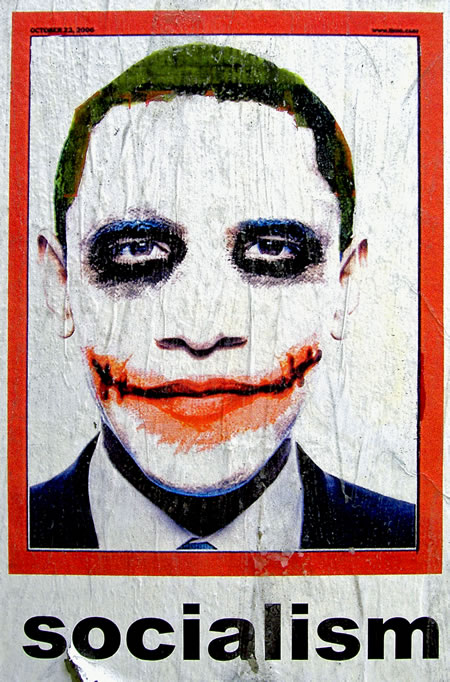
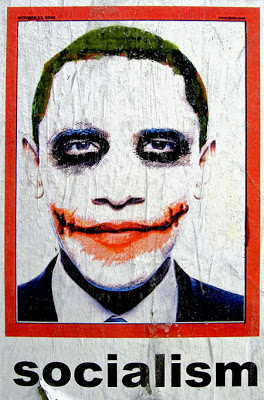
Obama as Joker: Poster currently being distributed in Los Angeles.

Red-baiting and racism:
When ‘socialism’ isn’t really about socialism

This noise is about race. It is about ‘othering’ a President who is seen as a symbol of white dispossession: dispossession of white hegemony, white entitlement, white expectation, and white power…

By Tim Wise / August 12, 2009

Throughout the first six months of his administration, President Obama — perhaps one of the most politically cautious leaders in contemporary history — has been routinely portrayed as a radical by his opponents on the far-right. In particular, persons who have apparently never actually studied Marxism (or if they did, managed to somehow find therein support for such things as bailing out banks and elite corporations) contend that Obama is indeed a socialist.

Reducing all government action other than warmaking to part of a larger socialist conspiracy, the right contends that health care reform is socialist, capping greenhouse gas emissions is socialist, even providing incentives for driving fuel efficient cars is socialist. That the right insists upon Obama’s radical-left credentials, even as they push an Obama=Hitler meme (something they apparently think is fair, since, after all the Nazis were National Socialists, albeit the kind who routinely murdered the genuine article) only speaks to the special brand of crazy currently in vogue among the nation’s reactionary forces.

As real socialists laugh at these clumsily made broadsides, and as scholars of actual socialist theory try and explain the absurdity of the analogies being drawn by conservative commentators, a key point seems to have been missed, and it is this point that best explains what the red-baiting is actually about.

It is not, and please make note of it, about socialism. Or capitalism. Or economics at all, per se.

After all, President Bush was among the most profligate government spenders in recent memory, yet few ever referred to him in terms as derisive as those being hurled at Obama. Even when President Clinton proposed health care reform, those who opposed his efforts, though vociferous in their critique, rarely trotted out the dreaded s-word as part of their arsenal. They prattled on about “big government,” yes, but not socialism as such. Likewise, when Ronald Reagan helped craft the huge FICA tax hike in 1983, in a bipartisan attempt to save Social Security, few stalwart conservatives thought to call America’s cowboy-in-chief a closet communist.

And many of the loudest voices at the recent town hall meetings — so many of which have been commandeered by angry minions ginned up by talk radio — are elderly folk whose own health care is government-provided, and whose first homes were purchased several decades ago with FHA and VA loans, underwritten by the government, for that matter. Many of them no doubt reaped the benefits of the GI Bill, either directly or indirectly through their own parents.

It is not, in other words, a simple belief in smaller government or lower taxes that animates the near-hysterical cries from the right about wanting “their country back,” from those who have presumably hijacked it: you know, those known lefties like Tim Geithner and Rahm Emanuel. No, what differentiates Obama from any of the other big spenders who have previously occupied the White House is principally one thing — his color. And it is his color that makes the bandying about of the “socialist” label especially effective and dangerous as a linguistic trope.

Indeed, I would suggest that at the present moment, socialism is little more than racist code for the longstanding white fear that black folks will steal from them, and covet everything they have. The fact that the fear may now be of a black president, and not just some random black burglar hardly changes the fact that it is fear nonetheless: a deep, abiding suspicion that African American folk can’t wait to take whitey’s stuff, as payback, as reparations, as a way to balance the historic scales of injustice that have so long tilted in our favor.

In short, the current round of red-baiting is based on implicit (and perhaps even explicit) appeals to white racial resentment. It is Mau-Mauing in the truest sense of the term, and especially since Obama’s father was from the former colonial Kenya! Unless this is understood, left-progressive responses to the tactic will likely fall flat. After all, pointing out the absurdity of calling Obama a socialist, given his real policy agenda, will mean little if the people issuing the charge were never using the term in the literal sense, but rather, as a symbol for something else entirely.

To begin with, and this is something often under-appreciated by the white left, to the right and its leadership (if not necessarily its foot-soldiers), the battle between capitalism and communism/socialism has long been seen as a racialized conflict. First, of course, is the generally non-white hue of those who have raised the socialist or communist banner from a position of national leadership. Most such places and persons have been of color: China, Vietnam, North Korea, Cuba, assorted places in Latin America from time to time, or the Caribbean, or in Africa. With the exception of the former Soviet Union and its immediate Eastern European satellites — which are understood as having had state socialism foisted upon them, rather than having it freely chosen through their own revolutions from below — Marxism in practice has been a pretty much exclusively non-white venture.

And even the Russians were seen through racialized lenses by some of America’s most vociferous cold warriors. To wit, consider what General Edward Rowney, who would become President Reagan’s chief arms negotiator with the Soviets, told Manning Marable in the late 1970s, and which Marable then recounted in his book, The Great Wells of Democracy:

“One day I asked Rowney about the prospects for peace, and he replied that meaningful negotiations with the Russian Communists were impossible. ‘The Russians,’ Rowney explained, never experienced the Renaissance, or took part in Western civilization or culture. I pressed the point, asking whether his real problem with Russia was its adherence to communism. Rowney snapped, ‘Communism has nothing to do with it!’ He looked thoughtful for a moment and then said simply, ‘The real problem with Russians is that they are Asiatics’.”

In the present day, the only remaining socialists in governance on the planet are of color: in places like Cuba or Venezuela, perhaps China (though to a more truncated extent, given their embrace of the market in recent decades) and, on the lunatic Stalinist fringe, North Korea. These are the last remaining standard-bearers, in leadership positions, who would actually use the term socialist to describe themselves.

Given the color-coding of socialism in the 21st century, at the level of governance, to use the label to describe President Obama and his administration, has the effect of tying him to these “other” socialists in power. Although he has nearly nothing in common with them politically or in terms of his policy prescriptions, he is a man of color, so the connection is made, mentally, even if it carries no intellectual or factual truth.

Secondly, and even more to the point, we must remember what “socialism” is, especially in the eyes of its critics: it is, to them, a code for redistribution. Of course, some forms of socialism are more redistributive than others, and even late-stage capitalism tends to engage in some forms of very mild redistribution (as with the income tax code). But if you were to ask most who grow apoplectic at the mere mention of the word “socialism” for the first synonym that came to their mind, redistribution is likely the one they would choose. Surely it would be among their top two or three.

Now, given the almost instinctual connection made between socialism and redistribution, imagine what many white folks would naturally assume when told that this man, this black man, this black man with an African daddy, was a socialist. Even if those using the term didn’t intend it to push racial buttons (and that is a decidedly large “if”), the fact remains that for many, it would almost certainly prompt any number of racial fears and insecurities: as in, the black guy is going to take from those who work and give to those who don’t. And naturally, we all know (or at least our ill-informed prejudices tell us) who’s in the first group and who’s in the second one.

Thus, the joke making the rounds on the internet, and likely in your workplace, about Obama planning on taxing aspirin “because it’s white and it works.” Or the guy with the sign at the April teabagger rally, which read, Obama’s Plan: White Slavery. Or others who have carried overtly racist signs to frame their message: signs suggesting that Obama hopes to provide care for all brown-skinned illegal immigrants, while simultaneously murdering the white elderly, or that cast the President in decidely simian imagery, and refer to him, crudely but clearly as a monkey.

Or Glenn Beck’s paranoid screed from late July, which sought to link health care reform, and virtually every single piece of Obama’s political agenda to some kind of backdoor reparations scheme. This, coupled with Beck’s even more unhinged claim to have discovered a communist/black nationalist conspiracy in the administration’s Green Jobs Initiative. All because the initiative is headed up by author and activist Van Jones: a guy whose recent book explains how to save capitalism through eco-friendly efforts at development and job creation.

So even there, it isn’t about socialism, so much as the fact that Jones is black, and was once (for a couple of months) a nationalist, and has a goatee, and looks determined (read:mean) in some of his more contemplative press photos.

Fact is, the longstanding association in white minds between social program spending and racial redistribution has been well-established, by scholars such as Martin Gilens, Kenneth Neubeck, Noel Cazenave, and Jill Quadagno, among others. Indeed, it was only the willingness of past presidents like FDR to all but cut blacks out of income support programs that convinced white lawmakers and the public to sign on to any form of American welfare system in the first place: a willingness that waned as soon as people of color finally gained access to these programs beginning in the 50s and 60s.

But even as strong as the social program/black folks association has been in the past, it has, until now, never had a black face to put with the effort. With a man of color in the position of president, it becomes far more convincing to those given to fear black predation already. It isn’t just that the government will tax you, white people. It’s that the black guy will. And for people like him. At your expense.

Much as the white right blew a gasket at the thought of bailing out homeowners with sub-prime and exploding mortgages a few months back (and if you listened to the rhetoric on the radio it was hard to miss the racial animosity that undergirded much of the conservative hostility to the idea, since they seemed to think only persons of color would be helped by such a plan), they now too often view Obama’s moves to more comprehensive health care as simply another way to take from those whites who have “played by the rules” and give to those folks of color who haven’t.

Even as millions of whites would stand to benefit from health care reform — and all whites, as with people of color would enjoy greater choices with the very public option that has drawn the most fire — the imagery of the recipients has remained black and brown, as with all social programs; and the imagery of the persons who would be taxed for the effort has remained hard-working white folks.

By allowing the right to throw around terms like socialist to describe the President and socialism to describe his incredibly watered-down, generally big business friendly approach to health care, while not recognizing the memetic purpose of such arguments, is to ensure that the right will succeed in their demonization campaign. To respond by pointing out how the plan really isn’t socialist, or how Obama really isn’t a socialist misses the point, which was never, in the end, about economic systems or philosophies: none of which the folks on the right raising the most hell show any signs of understanding anyway.

This noise is about race. It is about “othering” a President who is seen as a symbol of white dispossession: dispossession of white hegemony, white entitlement, white expectation, and white power, unquestioned and unchallenged from the darker skinned other. This is what animates the every move of the angry masses, individual exceptions notwithstanding.

Unless the left begins pushing back, and insisting that yes, the old days are gone, white hegemony is dead, and deserved its demise, and that we will all be better off for it, the chorus of white backlash will only grow louder. So too will it grow more effective at dividing and conquering the working people who would benefit — all of them — from a new direction.

Source / Progressives for Obama

The Rag Blog

Posted in RagBlog | Tagged , , , , , , , | 6 Comments

Former Insurance Exec Says Industry Behind Town Hall Disruptions

Wendell Potter on Rachel Maddow Show

Whistleblower: Insurance firms ‘very much’ behind town hall disruptions

The health insurance companies ‘are very much behind the town hall disruptions that you see and a lot of the deception that’s going on in terms of disinformation that many Americans, apparently, are believing.’ — Wendell Potter, former insurance executive.

By David Edwards and Daniel Tencer / August 11, 2009

Health insurance companies deserve “a great deal of the blame” for the sometimes violent disruptions to town hall meetings on health care, says a former health insurance company executive turned whistleblower.

Wendell Potter, a former executive with health insurer Cigna who now works as the senior fellow on health care at the Center for Media and Democracy, told MSNBC’s Rachel Maddow that health insurance companies “are very much behind the town hall disruptions that you see and a lot of the deception that’s going on in terms of disinformation that many Americans, apparently, are believing.”

On her show Monday night, Maddow cited statistics from the Securities and Exchange Commission showing that profits at the U.S.’s ten largest health insurance companies skyrocketed more than 400 percent between 2000 and 2007, from $2.4 billion in 2000 to $12.7 billion in 2007.

“Apparently while they quadrupled their profits, the number of Americans without health insurance grew by 19 percent,” Maddow said.

And she also pointed out that the average total take-home pay for the CEOs of those health insurance companies was $11.9 million each, per year, “while the number of Americans without health insurance, for whom a burst appendix can mean bankruptcy, has gone through the roof.”

Asked why health care costs are going up, Potter told Maddow: “Since 1983… the amount of money that insurance companies take in in premiums — less and less of that is going to pay medical claims.”

Potter said that the money health insurers spend on health care for their policy-holders has dropped from 95 percent of revenue to around 80 percent. Although Potter did not elaborate on why that is, presumably it has to do with higher bureaucratic costs, increased advertising budgets, other tangential activities not directly related to health care — and higher profit margins.

“Another thing is they kick people off the rolls when they do get sick or injured,” Potter said. “Also, they’re paying fewer claims.”

Potter suggested that health insurers’ fears of a public health alternative are unfounded, because they can still make money with a public plan in place.

“They could [turn a profit], absolutely. I’ve seen the health insurance industry change its business models many times. The insurance companies who operate now are very different from the companies that operated a few years ago and the one thing they know how to do is make money.”

Source / the raw story

The Rag Blog

Posted in RagBlog | Tagged , , , | 6 Comments

Texas : Transportation Projects in Big Trouble

Moving right along. From Mr. Ed’s Old Car Pictures.

“If the physical scientists who warn about limits to growth are right, confronting the global economic meltdown implies far more than merely getting the banks and mortgage lenders back on their feet. Indeed, in that case we face a fundamental change in our economy as significantas the advent of the industrial revolution.

“We are at a historic inflection point — the ending of decades of expansion and the beginning of an inevitable period of contraction that will continue until humanity is once again living within the limits of Earth’s regenerative systems.

“But there are few signs that policy makers understand any of this. Their thinking appears to be shaped primarily by mainstream economists’ assurances that growth can and must continue into the indefinite future, and that the economic contraction the world is currently experiencing is only temporary–a problem that can and must be solved.”

Richard Heinberg, author and commentator

CAMPO Meeting:
Screwups mean financial problems, delays, for transportation projects

By Roger Baker / The Rag Blog / August 11, 2009

CAMPO is the federally mandated bureaucracy responsible for approving federal funds for roads in Austin and its surrounding counties. (Campo is the Capital Area Metropolitan Planning Organization.)

At the CAMPO meeting last night in Austin, the big news was huge new money problems facing TIP (Transportation Improvement Program) projects (mostly roads) the next few years.

Basically, TxDOT (Texas Department of Transportation) screwed up once again on a massive scale in terms of its binding commitments around the state. As a result, CAMPO will only be getting a small fraction of the anticipated Category 2 Metropolitan Mobility funds going into the Austin area for TIP projects for 2010 and 2011.

(This probably stems from expensive commitments that TxDOT made in the salad days of yore, like pass-through tolling and whatever. Under Ric Williamson, TxDOT didn’t take financial constraints very seriously). Perhaps on the order of $4 million now expected to be going into the CAMPO area instead of the anticipated $20 million or more for these years. These funds are considered by TxDOT to be approved but postponed.

But a delay of two years for the many projects in the TIP not funded by stimulus money is a big deal, meaning that many of these projects will likely NEVER get built. Some idea of the difficulty that CAMPO now faces is that it is hiring a financial guy just to scrounge up money.

CAMPO is reserving big money for new corridor studies that it indicated may be handled by other agencies. These are barely described in the backup but will cost about $1.7 million. This corridor study funding may, I suspect, signal a big shift in thinking, perhaps toward
rail, since road funding is in such trouble, locally, statewide, and nationally (oil addiction is an expensive habit).

Austin is VERY close to exceeding (if one critical reading moves up a bit more than 1% in the next few months, bang!, its over) its federal ozone limits that would trigger a whole new and (from the standpoint of CAMPO, nightmarish) redoing of their existing planning effort.

CAMPO actually admitted last night that its long-range planning effort might be pretty academic given its current finances. I would go on to say it’s total garbage already, due to the combined effect of oil, water, and dollar shortages. (Since world oil production has probably already peaked, there is likely to be another debilitating oil price spike before CAMPO’s TIP funds from TxDOT could be restored to “normal” in 2012.)

CAMPO is now getting proprietary NEPAssist software free from TxDOT. TxDOT is apparently encouraging all its MPOs to use this software to speed up environmental studies on roads. Its database has maps of stuff like recharge features. And even the form letters where you fill in local data to generate form letters to federal officials, all according to the proper protocol.

The Rag Blog

Posted in Rag Bloggers | Tagged , , , | 1 Comment

Leonard Peltier : Your Support Could Make the Difference


The clock ticks ever faster for Leonard Peltier

Leonard’s release would do much to begin the healing process between the native community and the U.S. government.

By Harvey Wasserman / The Rag Blog / Austust 11, 2009

By Tuesday, August 18, the four sitting members of the Federal Parole Commission must decide whether they will let Leonard Peltier rejoin his family.

Leonard has been in prison for a staggering 33 years, six more than Nelson Mandela. When he was locked up, Three Mile Island was three years away, and Ronald Reagan had barely begun to run for President.

Leonard has great grandchildren he has never held.

His most recent hearing was June 28. According to his lawyer, Eric Seitz, it went very well. The Parole Commission had 21 days from then to issue its decision.

We are now in the final week.

All those familiar with the case agree that a positive political climate can affect the decision. Calls to politicians (202-224-3121) could make all the difference, as could overnight letters to the Parole Commission.

Below are two draft letters the attorney has termed “a little melodramatic but otherwise OK.” Your own versions are more than welcome.

Leonard’s release would do much to begin the healing process between the native community and the U.S. government. He has handled himself through this torturous third of a century with astonishing dignity, grace and eloquence.

Please do not let this moment go by without doing SOMETHING.

DRAFT LETTER ONE:

Dear Commissioners,

Isaac Fulwood, Jr., Cranston Mitchell, Edward Reilly and Patricia Cushware

Leonard Peltier is a man of deep sensitivities and compassion. It’s no accident he has become a figure of tremendous empathy and personal pain all over the world.

For 33 years he has maintained his dignity and composure under incredibly difficult circumstances. He is now approaching the age of 65, and suffers from a wide range of ailments that threaten his continued existence. He has grandchildren and great-grandchildren he has never seen.

Leonard has a community of relations and supporters desperately awaiting his return. His freedom will come as a huge boost to our country’s standing in the world. It will begin a desperately-needed healing process between our government and the native peoples of our own country and around the globe.

I urge you to look into your hearts at this man who has spent more than half his life behind bars and reunite him at last with his family.

Thank you,

DRAFT LETTER TWO:

To: US Parole Commission

Commissioners Isaac Fulwood, Jr., Cranston Mitchell, Edward Reilly and Patricia Cushware

Dear Commissioners.

It is in your power to right a great wrong, to grant a man and his children, grandchildren and great-grandchildren the right to live the rest of their lives together in peace, and to remove a great stain from the global reputation of the American justice system.

For more than half his life, Leonard Peltier has been held in prison for a crime millions of people worldwide do not believe he committed.

Throughout his imprisonment, Mr. Peltier has conducted himself with extraordinary dignity and grace. His behavior has become an inspiration to countless citizens within the United States and virtually everywhere else on Earth.

Leonard Peltier’s time in prison now exceeds that of Nelson Mandela by six years. Yet he is viewed with much the same reverence and respect as the man who went from a jail cell to the presidency of the nation that put him there. When Mandela was finally set free, the system of racial hatred and separation that plagued South Africa began to crumble, to the betterment of all.

Leonard Peltier was a young man when he entered the prison system; he is now nearly 65. He is plagued with diabetes and a range of other serious illnesses that make it highly possible further imprisonment could result in his death, an outcome of horrific personal and political implications for all Americans. We would all have his blood on our hands.

To follow the history of the legal proceedings that put Leonard Peltier in prison is to journey enter a nightmare of missing documents, perjured testimony, implausible accusations and an impossible conviction.

It is not our intent here to reproduce the massive record surrounding this case. But we would be remiss to say any thing other than this incarceration is viewed throughout the world as a blight on the reputation of American jurisprudence.

We believe that 33 years of imprisonment meets the standard of cruel and unusual punishment set out in the Eighth Amendment to the Constitution of the United States. Its drafters would have freed Leonard Peltier long ago. Indeed, we do not believe great legal thinkers such as James Madison, Thomas Jefferson and John Adams would have put Mr. Peltier in prison in the first place.

Every day Leonard Peltier is kept behind bars drives a wedge that grows deeper between this nation’s government and its native population. His time in jail is viewed with great antipathy by native populations, and their supporters, throughout the world.

This is a five-century wound that can only begin to heal when Leonard Peltier is released. We ask that you bring to yourselves and the rest of this nation the great relief that will accompany Leonard Peltier’s return to his family.

Thank you,

For more information go to leonardpeltier.net.

For previous material on The Rag Blog by and about Leonard Peltier, go here.

The Rag Blog

Posted in Rag Bloggers | Tagged , , , , , , | 4 Comments

Planning for the Worst : Depression as Progressive Correction

“Get the Seed Corn Miranda It’s Fixin to Storm” / Shiloh Museum.

Harvesting the seed corn:
Seizing depression as progressive correction

By rehearsing progressive responses in advance of crisis it may be possible to prevent excesses of panic and conflict that we are just beginning to see.

By Greg Moses / The Rag Blog / August 11, 2009

Anyone taking a crash course in market theory these days is seeing downside risks aplenty. Market theory uses the term “correction” to describe the general system of a down. But if these downside risks become reality, are progressive organizers ready? So far, market theory merely describes downsides for investors. The point is to put it to work for a more progressive correction.

Prior to the August recess of 2009, state actors might have done something to alleviate the crush rather than postpone it. Instead, our policy machinery has been spinning away in bubble land. As Mike Whitney sez, “It’s been two years since the crisis began and nothing. . . NOTHING has been done to fix the banking system.” A public ethic that is prepared to anticipate and seize opportunities for correction might do some good work in displacing the gaps that policy leadership won’t close.

Of course, we should pray to be wrong when we forecast a hurricane headed our way. But we should also get busy making preparations — both individually and socially. What would a progressive response to depression look like? Food, shelter, utilities, health care, education, and opportunities for productive labor — these are a few items to get us started. We certainly won’t be allowed to forget the challenge of peace.

A progressive approach might begin by imagining the correction of workable relationships not yet displaced, whether they are public, nonprofit, cooperative, or profit-seeking. This notion of relationship correction is developed as a first response against popular images of crisis that divide reality into so many warring units of self-preservation. Individualistic — and usually well-armed — imaginations have striking cultural power. They are certainly the kinds of ideas that count for “original intent” in the USA.

Grassroots progressive planning can help to grow another kind of imagination, but it won’t be the dream of all things collectivized. Transforming all relationships from private to public is not the same thing as making the world productive, ethical, or just. Versus agendas for complete nationalization on the one hand or complete privatization on the other, therefore, a progressive agenda might prepare some realistic guidelines for crisis planning that are corrective, liberating, and respectful of the workable past.

Grocery stores and department stores can deliver goods to market. Soup kitchens and homeless shelters can meet basic needs. Schools — with their lunchrooms, classrooms, and gyms — help people to grow in many ways. Progressive planning can try to keep these institutions functioning together even as they are — all of them — corrected.

By rehearsing progressive responses in advance of crisis it may be possible to prevent excesses of panic and conflict that we are just beginning to see. As some forms of assets continue to implode and take productive capacities down with them — putting people into frightened and frightening moods — we might focus on assets that can be preserved, reconstructed, reorganized, and even extended nevertheless. Already some voices are talking of depression as reeducation. We might think of a great depression as a great teacher and then throw ourselves into the learning and unlearning that great education requires.

Against the already growing conflicts between one-sided responses, I think progressive plans for depression might anticipate the blame game. One side is prepared to blame socialism. Another side will blame capitalist greed. Progressive reformers can perhaps strike a mediating position that looks for corrections both in the buildup and misuse of state power and in the pursuit of market growth. While some voices would have us learn the neglected value of personal responsibility, others will encourage nurturing communal interdependence. A progressive agenda might remind both sides how neither can speak the whole truth.

On questions of capital, I have been drawn to San Francisco economist Henry George because of the way he thinks about public and private coordination. He has a strong sense of public responsibility and a keen respect for entrepreneurial talent. A progressive approach to corrections in capital development would be neither public nor private en bloc. Our right to commons does not have to overturn our right to private properties — or vice versa.

Right wingers focus on workers’ dependence upon capital growth and earnings, while left wingers point out there can be no capital without labor first. A progressive agenda schooled in market theory might be able to transform these colliding interests into a more humane and more flexible economy. Capital is like seed corn as right wingers claim, because capital contributes to next year’s harvest. But capital is also something very different from seed corn, as left-wingers can demonstrate, because the collective organization typically demanded by capitalists prevents actual harvesters of seed corn from calling it their own next year.

Perhaps the great opportunity of the correction challenge is to work out a more progressive approach to the relationship between capital and labor such that the seed corn we all help to harvest throughout the workday is treated as a resource worthy of intense public concern. This doesn’t necessarily mean that capital is taken out of private hands, but it does mean that private holders of returns on investment have real obligations to the social labor that makes all earnings possible.

It can’t hurt to deliberate progressive plans and principles for a coming correction. Even if the crisis never comes, the exercise will help us to discover how real peace can be fought for.

[Greg Moses is editor of the Texas Civil Rights Review. He can be reached at gmosesx@gmail.com.]

The Rag Blog

Posted in Rag Bloggers | Tagged , , | 1 Comment

Health Care Reform : Screeching to a Halt?

Supporters of health care reform rally outside the office of Rep. Mario Diaz-Balart, Florida Republican. Photo from AP.

Unhappily, the current situation is much more ominous than simply the denial of proper health care. The encouragement of mob violence by the corporations and the blackshirts they are stirring up begins to cast a pall over our daily life.

By Dr. Stephen R. Keister / The Rag Blog / August 11, 2009

Meaningful, caring revision of our health care system has definitely screeched to an unhappy, unforgivable, but not unforeseen halt.

We should note that the cupidity and avarice exhibited by members of a senatorial body can be seen throughout history. When Marcus Titus Cicero announced for election to Consul in the first century BCE he found to his dismay that many members of the Senate, which was the electoral body, had been bribed and were about to support his opposition. Only with hard work, courage, and leadership did Cicero overcome the obstacles and ultimately achieve his supreme imperium.

President Obama was elected largely by progressive visionaries who have supported the concept of universal health care throughout the discussions appropriate to the election and subsequently when he was blathering about the obviously illusionary concept of bipartisanship. Last week the President admonished his dedicated supporters, in essence, to “lay-off’.”

It would seem that Obama, who likes to draw parallels to Abraham Lincoln, has found a new Civil War ideal. We are now in the era of emulating General George McClelland conducting the Peninsular Campaign. McClelland, in 1862, faced inferior forces, inferior equipment, but never took Richmond because of lack of desire and purpose. If he had shown courage Lee might have been defeated then rather than in 1984,

Thus, the progressives who desire something better for our country, the American people, and the status of the nation in the world at large, are hamstrung by a system that is near impossible to overcome. The August 3, New Yorker Magazine makes the following point:

“In other free countries, legislation, social and otherwise, gets made in a fairly straightforward manner. There is an election, in which the voters, having paid attention to the issues for six weeks or so, choose a government. The governing party or coalition then enacts its program, and the voters get a chance to render a verdict on it the next time they go to the polls. Through one or another variation of this process, the people of every other wealthy democracy on earth have obtained for themselves some form of guaranteed health insurance or universal health care.”

Rep. Dennis Kucinich, in an excellent article in the July 2009 Progressive, notes:

”We’ve got fifty million Americans without health care, tens of millions more underinsured, people losing their homes, people losing their life savings, losing a chance for their kids to go to college — all because we have an insurance-based health care system. WE have to take a stand for a not-for-profit health care system. We know these insurance companies make money by not providing health care.”

Yet because of the perfidy of the Congress, and the obfuscation of the executive, which shows a frightening tendency to be on the verge of self immolation, the process appears to be coming to a dead halt. Much can be said of the hypocrisy and avarice of the Senate Finance Committee, whose home districts’ combined resident populations account for less people than reside in the New York City area.

It is interesting to note that the poverty rates are higher and the per-capita incomes are lower in these legislators’ specific districts than in the nation as a whole. Add to this that obstruction in The House can occur in The Commerce Committee which includes seven southern Democrats. Blue Dogs, who are opposed to universal health care. In addition we are currently faced with the greatest program of lies, deceitful advertising, and misinformation that the nation has been subjected to in its history. This propaganda is obvious on talk radio, Fox News, and in the conservative press.

However, much of TV is complicit. CNN, for instance, reports these events as straight news with no effort to point out the well financed forces behind the disinformation. Thankfully MSNBC on weekday evenings has been filling us in on the frightening story behind these disruptions; however, the MSNBC audience consists of only a few million viewers who are already well educated and informed. The intrusion by mobs into town hall meetings presided over by our elected representatives has never been heard of in the history of the republic, yet the story behind it remains largely concealed by the MSM.

Rachael Maddow this past Wednesday revealed the names of the political consultants and big money backers who are selling the crazy, endless conspiracy theories that health care reform is communism, that it is a secret plot to kill grandpa, and that it is a government takeover that is going to mandate abortions and sex-change operations. In some ways these wingnuts have confused the making of a living will with a plot to kill people.

The folks behind this despicable crap include such reactionary organizations as Michael Malkin, the Red State Blog, and such vaguely named groups as Freedom Works, American Majority, Americans for Linited Government, and the Sam Adams Alliance. The director of the American Majorities Minnesota office was a regional director for the Bush-Cheney ‘04 campaign; the Kansas office, a former Republican state legislator. The Sam Adams Society is run by a former director of the Illinois State Republican Party. Sam Alliance is headed by a former Dow Chemical Engineer, and Americans for Prosperity is run by Art Pope, a North Carolina millionaire who for years has given millions to The Republican Party.

The common denominator for all is the fact that they are paid quite well — an estimated 1.4 million dollars per day, by the insurance cartel, the pharmaceutical industry, the medical equipment industry — to confuse, misinform, and lie to the uneducated, American public. These corporations will gladly deny the American people the health care that is obtainable in every other country of the industrialized world to maintain their obscene profits, multimillion dollar executive salaries and bonuses, and stockholder dividends.

If you wonder where much of the pharmaceutical industry’s income goes, merely watch TV for an hour or so and you will see that nearly every other commercial is sponsored by a drug company, drug companies that spend approximately 17% of their income on basic research according to Marcella Angel, prior editor of The New England Journal of Medicine.

The opponents of health care reform cite costs. These are the same folks who do not concern themselves with costs relative to foreign military adventures, but feel that it is in some way wrong to spend taxpayer money to help defray the costs of cancer care, child health care, and public health programs for the American taxpayer.

In truth, the program promulgated, and well documented, by The Physicians for a National Health Program would cut national health care costs by approximately 30% and at the same time provide health care for all, with free choice of physician, medical specialist, hospital, nursing home, and pharmacy. Prescription drug prices would be reduced to be commensurate with the prices in Canada or Europe. The concerns of bankruptcy or job loss and insurance would be eliminated. More family physicians would be trained, and yes, they would be better paid than now, and might even make house calls as they do in various European Countries.

The Congress will not even consider such care, since, due to the baksheesh they receive, they are willing to allow the citizen continue with health care rationed by the insurance companies, and dictated to the physicians by insurance company bureaucrats. And the Republican’s keep raising the issue of “tort reform” when indeed malpractice issues cost but a fraction of 1% of total health care spending. Another distraction is malpractice, an issue that must be dealt with but not be used as a silly issue to derail matters of importance.

Unhappily, the current situation is much more ominous than simply the denial of proper health care. The encouragement of mob violence by the corporations and the blackshirts they are stirring up begins to cast a pall over our daily life. Many serious political thinkers believe that we could be facing the Rubicon and if the right wing extremists among us are allowed to cross, that the United States as a democratic nation will be no more.

I would encourage all thinking people to read the Rag Blog article by retired history professor Sherman DeBrosse , entitled “Extremism and Right Wing Populism: The Face of the Republican Party,” as well as Frank Schaeffer’s piece entitled “Right-Wing Turncoat Gives Inside Scoop on Why Conservatives Are Rampaging Town Halls.” I would also recommend Professor DeBrosse’s new book “The New Republican Coalition, Its Rise and Impact,” now available through Barnes and Noble or Amazon.

Unfortunately it may be very difficult to sustain support for a health care program provided in the best interest of the American public, since that public seems more likely to be swayed by slogans and propaganda — enhanced by fear — than by reason. The proponents of decent health care have little funding with which to educate the public, as opposed to the billions being spent to mislead.

We must keep trying and hoping, but I trust, as an elderly physician, that if congress is about to pass a bill which is a farce, and a concession to the insurance industry, that the progressive members of The House of Representatives will stand as one and vote “No.” Better to try again in two years for real reform than produce a Frankenstein monster under the guise of “insurance reform.” As long as the insurance industry is in control they will find methods to circumvent and deceive.

As for the thugs that are denying democratic process at the town halls, the true believer cast-offs from the pro-life movement that would appear to sanction assassinations, and the unquestioning gun toters who pervert the historical and grammatical content of The Second Amendment, a thought from Eric Hoffer:

” The effectiveness of a doctrine does not come from its meaning but from its certitude. No doctrine however profound and sublime will be effective unless it is presented as the embodiment of the one and only truth. It must be the one word from which all things are and all things speak. Crude absurdities, trivial nonsense and sublime truths are equally potent in readying people for self sacrifice if they are accepted as the sole, eternal truth.”

[Dr. Stephen R. Keister lives in Erie, PA. He is a retired physician who is active in health care reform.]

The Rag Blog

Posted in Rag Bloggers | Tagged , , , , | 7 Comments

Demonizing Canadian Health Care

Cartoon by John Janik.

Health care reform and the lies about the Canadian system

When you put the two systems side by side, it is easy to see why no Canadian would even consider changing their system for ours (even conservative Canadians). In Canada, they consider decent health care to be a right of every citizen regardless of wealth or class.

By Ted McLaughlin / The Rag Blog / August 10, 2009

We’ve been hearing a lot recently from the Republicans about the Canadian health care system. If you listen to them, you would believe the Canadians have a terrible system, with rationing that is a death sentence for the elderly and possibly others, who have to wait endlessly for life-saving treatment from a government doctor.

Of course, these are all lies. But with our own system so badly broken it is indefensible, how could the Republicans possibly justify wanting to keep the current system? There was only one way. Accuse the Democrats of trying to institute a system like the Canadian system, and then tell so many lies and half-truths that the Canadian system would be so demonized that our own terrible system would look good by comparison.

They are able to get away with demonizing the Canadian health care, because very few Americans actually understand what that system entails. They just have heard that it is a government-run system, and therefore must be socialist (and Americans have been taught that anything connected to the word socialism must be bad).

A good example of this attempt to demonize Canadian health care is a TV ad paid for by an ultra-right-wing group called the Americans for Prosperity Foundation. They created and funded an organization called Patients United Now, that they were hoping gullible Americans would think was a grassroots patients organization. It isn’t. It’s a shadow organization created by the wealthy who want to keep our current badly broken health care system.

The TV ad they are running shows a Canadian woman named Shana Holmes who says she had a fast-growing and life-threatening brain tumor, but she would have had to wait six months in Canada for treatment. She claimed she would have died waiting for treatment in Canada, so she went to Arizona and was saved by the American health care system where she didn’t have to wait.

That sounds like a horrible indictment of the Canadian system. The only problem is that it is NOT TRUE! She did not have a brain tumor, and her life was not at stake. Even if she had to wait the full six months (and that is doubtful), she would not have died. What she had was a cyst, which she had since birth. It was beginning to press on her optic nerve and needed to be removed, but a short wait would have caused her no harm.

Another thing she fails to mention in the ad is that she ran up a huge medical bill by coming to America for her operation — a bill that is too large for her to pay. She is currently suing the Canadian government in an attempt to make them pay for it.

After all the lies and falsehoods being told about Canadian health care, I thought it would be good to actually compare their system to the American system. Can it be as bad as the Republicans would have us believe? If it is, why aren’t the Canadians flocking to America for treatment (and they are not, regardless of what right-wingers want us to believe)?

Here is the truth about both systems:

  • Canada has only one health insurance provider — the government. There is no need for the system to make a profit.

The United States has hundreds of private insurance companies, all trying to maximize their profits and curb the amount they pay for medical care.

  • All of Canada’s citizens have health insurance coverage.

At least 46 million Americans (and possibly many more) do not have any health insurance at all, and currently 14,000 people a week are losing their coverage in our poor economy.

  • Canadians have their choice of any doctor or hospital they want to use.

Americans must choose their doctor and hospital from a list provided by their private insurance company.

  • No Canadian can be denied insurance coverage for a pre-existing condition or because their required treatment is very expensive.

American insurance companies routinely deny coverage for pre-existing conditions, and have been known to cancel policies when treatment gets expensive.

  • Many times Canadians must wait weeks or months for elective surgery, because those with life-threatening illnesses are treated first.

Americans do not have to wait for elective surgery if they have the money to pay for it. But the insurance will pay for little or none of it. The poor and uninsured cannot get this surgery at all.

  • The Canadian system puts an emphasis on preventive care, and Canadians see their doctor more often.

The uninsured and underinsured in the U.S. get no preventive care at all.

  • Canadians live an average of three years longer than Americans.
  • The Canadian infant mortality rate is 20% lower than in the U.S.

Well, there it is. When you put the two systems side by side, it is easy to see why no Canadian would even consider changing their system for ours (even conservative Canadians). In Canada, they consider decent health care to be a right of every citizen regardless of wealth or class.

Our current system does not recognize a right to decent health care. Instead, health care is a commodity to be sold to those who can afford it. The rich get top-notch care, while the middle class struggles to get adequate care (about a million a year go bankrupt trying to pay for health care). The poor and working classes get inadequate or no health care. This is not a system worth defending. That is why the Republicans must demonize the Canadian system in order to keep our current system intact.

The truth is that none of the plans introduced by the Democrats would impose anything like the Canadian system. Even those plans with a public insurance option fall far short of the Canadian system. I wish our politicians had the political courage to propose something similar to what the Canadians have, but they don’t. The best we can hope for at this point is that the reform will contain a public option, which can be enhanced in the future when Americans come to their senses.

Don’t believe the Republican right-wing lies. Demand a public option be included in any reform.

(There is an Source excellent article in the Los Angeles Times written by a Canadian doctor. I urge you to read it.)

Also see Exposing Lies About Canadian Health Care by Victoria Foe / The Rag Blog / August 5, 2009

[Rag Blog contributor Ted McLaughlin also posts at jobsanger, an excellent Texas political blog.]

The Rag Blog

Posted in Rag Bloggers | Tagged , , | 12 Comments

Rabbi Arthur Waskow : Like War? You’ll LOVE Global Scorching

As long as the oil and coal keep pouring CO2 into our planet’s atmosphere, the food will wither, the ice will melt, the oceans will flood, and people will die — and kill.

By Rabbi Arthur Waskow / The Rag Blog / August 10, 2009

This past Friday night, I was speaking at a synagogue on the Jewish obligation to reduce the danger of global scorching. One of the congregants asked why I, who had spent so much of my life working for social justice and against war, was now working “instead” on healing the earth.

The answer came Sunday morning, on the front page of the New York Times:

“Recent [Defense Department] war games and intelligence studies conclude that over the next 20 to 30 years, vulnerable regions, particularly sub-Saharan Africa, the Middle East and South and Southeast Asia, will face the prospect of food shortages, water crises and catastrophic flooding driven by climate change that could demand an American humanitarian relief or military response.”

The same Jewish organizations, the same churches, the same Muslim networks that claim to care about the poor of Africa, Asia, and (especially!) the Middle East still see the climate crisis as a side issue that is somewhere down in the middle of their long priority lists. And anyway, it’s all 20 years away or more. Why worry now?

Actually, it isn’t 20 years off. It’s in the present, NOW. Most of the sound and fury expended on “ending the genocide” in Darfur has ignored the underlying causes of the violence there. But the same NY Times article reports that [Senator John] Kerry said the continuing conflict in southern Sudan, which has killed and displaced tens of thousands of people, is a result of drought and expansion of deserts in the north. “That is going to be repeated many times over and on a much larger scale,” he said.

What’s the connection? Formerly flourishing crops withered and died under the baleful heat of planetary climate “change.” When there’s not enough food, people will kill to feed their families. And whole ethnic groups will kill other ethnic groups to make sure their own folks get to eat.

You can proclaim “Never again!” as loud as you like, and insist the UN and the U.S. send peacekeepers, but as long as the food is withering away, the killing will continue. As long as the oil and coal keep pouring CO2 into our planet’s atmosphere, the food will wither, the ice will melt, the oceans will flood, and people will die — and kill.

George Bernard Shaw once wrote (in his play Saint Joan), “Must Christ be crucified in every generation for the benefit of those who have no imagination?”

Substitute whatever metaphor fits your own worldview: “Must Dr. King be murdered in every generation … ” “Must Auschwitz recur in every generation . . .”

Use your imagination!! If you care about Israelis, about Palestinians, about Ugandans and Kenyans and Bangla Deshis, either because you care about all who suffer or you care about your own kinfolk who suffer, USE YOUR IMAGINATION! Turn your imagination to political action — to stop global scorching.

This fall, prophetic voices like Bill McKibben have called for public actions on October 24 to demand that governments take vigorous action to curb global scorching. A wide swathe of the American Jewish community has called for making that day, the Shabbat when Jews read the biblical story of Noah, the Flood, the Ark, and the Rainbow, into “Climate Healing Shabbat,” with political action during the week before or after and prayer, sermons, discussions, Torah-nature walks, on Shabbat itself.

To register your own intention to take on this commitment, please register your community at both these places:

The international observance of “Global Climate Healing Shabbat Noach” is not the end – but a beginning, or a deepening. It points toward the crucial United Nations conference on the climate crisis scheduled for Copenhagen in December, 2009.

For more information on what you can do, please go here.

On the Shalom Center website are a number of items that may be of use to you:

A chapter, “Rainbow Sign,” from my book GODWRESTLING — ROUND 2, a midrashic examination of the Noah story for its importance in healing our planet today;

“The Return of Captain Noah,” a story by Rabbi Phyllis Berman and myself from our book Tales Of Tikkun: New Jewish Stories To Heal The Wounded World, in which Noah and his wife Naamah awake in our own generation from a long sleep in a cave on Mt Ararat to hear God’s call that the earth and all life are again in danger — and what they do to save it.

A new Haftarah to the Flood/ Rainbow story that came through me several years ago at Elat Chayyim, in my English and Reb Zalman Schachter-Shalomi’s translation into Hebrew.

And this — a song, maybe mostly for children but I have found adults get a great kick out of it as well — “GOD SAID TO NOAH: An Old/ New Song to Avert a New Flood.” It begins this way:

God said to Noah, The earth’s getting hotter, hotter,
Yet she is My (clap) beloved daughter, daughter —
Children of the Lord.

CHORUS: Rise and shine and give God the glory glory
Rise and shine and give God the glory glory
Rise and shine and (clap!) give God the glory glory
Children of the Lord!

People are making My air too smoky, smoky
Fix it now! (clap) and don’t be pokey, pokey —
Children of the Lord. … [and more verses]

I hope this will jump-start your thinking. Please write me what has begun to percolate for you, and I’ll pass the ideas around.

Shalom, salaam, shantih — peace,

Arthur

[Rabbi Arthur Waskow is director of The Shalom Center. He can be reached at awaskow@shalomctr.org.]

The Rag Blog

Posted in Rag Bloggers | Tagged , , , , | 1 Comment

Moral Relativism: We Call Our Suicide Bombers ‘Heros’

American child dressed as suicide bomber for Halloween. Photo: Source.

Our Suicide Bombers: Thoughts on Western Jihad
By John Feffer / August 6, 2009

The actor Will Smith is no one’s image of a suicide bomber. With his boyish face, he has often played comic roles. Even as the last man on earth in I Am Legend, he retains a wise-cracking, ironic demeanor. And yet, surrounded by a horde of hyperactive vampires at the end of that film, Smith clasps a live grenade to his chest and throws himself at the enemy in a final burst of heroic sacrifice.

Wait a second: surely that wasn’t a suicide bombing. Will Smith wasn’t reciting suras from the Koran. He wasn’t sporting one of those rising sun headbands that the Japanese kamikaze wore for their suicide missions. He wasn’t playing a religious fanatic or a political extremist. Will Smith was the hero of the film. So how could he be a suicide bomber? After all, he’s one of us, isn’t he?

As it happens, we have our suicide bombers too. “We” are the powerful, developed countries, the ones with an overriding concern for individual liberties and individual lives. “We” form a moral archipelago that encompasses the United States, Europe, Israel, present-day Japan, and occasionally Russia. Whether in real war stories or inspiring vignettes served up in fiction and movies, our lore is full of heroes who sacrifice themselves for motherland, democracy, or simply their band of brothers. Admittedly, these men weren’t expecting 72 virgins in paradise and they didn’t make film records of their last moments, but our suicidal heroes generally have received just as much praise and recognition as “their” martyrs.

The scholarly work on suicide bombers is large and growing. Most of these studies focus on why those other people do such terrible things, sometimes against their own compatriots but mainly against us. According to the popular view, Shiite or Tamil or Chechen suicide martyrs have a fundamentally different attitude toward life and death.

If, however, we have our own rich tradition of suicide bombers — and our own unfortunate tendency to kill civilians in our military campaigns — how different can these attitudes really be?

Western Jihad

In America’s first war against Islam, we were the ones who introduced the use of suicide bombers. Indeed, the American seamen who perished in the incident were among the U.S. military’s first missing in action.

It was September 4, 1804. The United States was at war with the Barbary pirates along the North African coast. The U.S. Navy was desperate to penetrate the enemy defenses. Commodore Edward Preble, who headed up the Third Mediterranean Squadron, chose an unusual stratagem: sending a booby-trapped U.S.S. Intrepid into the bay at Tripoli, one of the Barbary states of the Ottoman empire, to blow up as many of the enemy’s ships as possible. U.S. sailors packed 10,000 pounds of gunpowder into the boat along with 150 shells.

When Lieutenant Richard Sommers, who commanded the vessel, addressed his crew on the eve of the mission, a midshipman recorded his words:

“‘No man need accompany him, who had not come to the resolution to blow himself up, rather than be captured; and that such was fully his own determination!’ Three cheers was the only reply. The gallant crew rose, as a single man, with the resolution yielding up their lives, sooner than surrender to their enemies: while each stepped forth, and begged as a favor, that he might be permitted to apply the match!”

The crew of the boat then guided the Intrepid into the bay at night. So as not to be captured and lose so much valuable gunpowder to the enemy, they chose to blow themselves up with the boat. The explosion didn’t do much damage — at most, one Tripolitan ship went down — but the crew was killed just as surely as the two men who plowed a ship piled high with explosives into the U.S.S. Cole in the Gulf of Aden nearly 200 years later.

Despite the failure of the mission, Preble received much praise for his strategies. “A few brave men have been sacrificed, but they could not have fallen in a better cause,” opined a British navy commander. The Pope went further: “The American commander, with a small force and in a short space of time, has done more for the cause of Christianity than the most powerful nations of Christiandom have done for ages!”

Preble chose his tactic because his American forces were outgunned. It was a Hail Mary attempt to level the playing field. The bravery of his men and the reaction of his supporters could be easily transposed to the present day, when “fanatics” fighting against similar odds beg to sacrifice themselves for the cause of Islam and garner the praise of at least some of their religious leaders.

The blowing up of the Intrepid was not the only act of suicidal heroism in U.S. military history. We routinely celebrate the brave sacrifices of soldiers who knowingly give up their lives in order to save their unit or achieve a larger military mission. We commemorate the sacrifice of the defenders of the Alamo, who could have, after all, slunk away to save themselves and fight another day. The poetry of the Civil War is rich in the language of sacrifice. In Phoebe Cary’s poem “Ready” from 1861, a black sailor, “no slavish soul had he,” volunteers for certain death to push a boat to safety.

The heroic sacrifices of the twentieth century are, of course, commemorated in film. Today, you can buy several videos devoted to the “suicide missions” of American soldiers.

Our World War II propaganda films — er, wartime entertainments — often featured brave soldiers facing certain death. In Flying Tigers (1942), for example, pilot Woody Jason anticipates the Japanese kamikaze by several years by flying a plane into a bridge to prevent a cargo train from reaching the enemy. In Bataan (1943), Robert Taylor leads a crew of 13 men in what they know will be the suicidal defense of a critical position against the Japanese. With remarkable sangfroid, the soldiers keep up the fight as they are picked off one by one until only Taylor is left. The film ends with him manning a machine gun against wave upon wave of oncoming Japanese.

Our warrior culture continues to celebrate the heroism of these larger-than-life figures from World War II by taking real-life stories and turning them into Hollywood-style entertainments. For his series of “war stories” on Fox News, for instance, Oliver North narrates an episode on the Doolittle raid, an all-volunteer mission to bomb Tokyo shortly after Pearl Harbor. Since the bombers didn’t have enough fuel to return to their bases, the 80 pilots committed to what they expected to be a suicide mission. Most of them survived, miraculously, but they had been prepared for the ultimate sacrifice — and that is how they are billed today. “These are the men who restored the confidence of a shaken nation and changed the course of the Second World War,” the promotional material for the episode rather grandly reports. Tokyo had the same hopes for its kamikaze pilots a few years later.

Why Suicide Missions?

America did not, of course, dream up suicide missions. They form a rich vein in the Western tradition. In the Bible, Samson sacrificed himself in bringing down the temple on the Philistine leadership, killing more through his death than he did during his life. The Spartans, at Thermopylae, faced down the Persians, knowing that the doomed effort would nevertheless delay the invading army long enough to give the Athenians time to prepare Greek defenses. In the first century AD in the Roman province of Judea, Jewish Zealots and Sicarians (“dagger men”) launched suicide missions, mostly against Jewish moderates, to provoke an uprising against Roman rule.

Later, suicide missions played a key role in European history. “Books written in the post-9/11 period tend to place suicide bombings only in the context of Eastern history and limit them to the exotic rebels against modernism,” writes Niccolo Caldararo in an essay on suicide bombers. “A study of the late 19th century and early 20th would provide a spate of examples of suicide bombers and assassins in the heart of Europe.” These included various European nationalists, Russian anarchists, and other early practitioners of terrorism.

Given the plethora of suicide missions in the Western tradition, it should be difficult to argue that the tactic is unique to Islam or to fundamentalists. Yet some scholars enjoy constructing a restrictive genealogy for such missions that connects the Assassin sect (which went after the great sultan Saladin in the Levant in the twelfth century) to Muslim suicide guerrillas of the Philippines (first against the Spanish and then, in the early twentieth century, against Americans). They take this genealogy all the way up to more recent suicide campaigns by Hezbollah, Hamas, al-Qaeda, and Islamic rebels in the Russian province of Chechnya. The Tamil Tigers of Sri Lanka, who used suicide bombers in a profligate fashion, are ordinarily the only major non-Muslim outlier included in this series.

Uniting our suicide attackers and theirs, however, are the reasons behind the missions. Three salient common factors stand out. First, suicidal attacks, including suicide bombings, are a “weapon of the weak,” designed to level the playing field. Second, they are usually used against an occupying force. And third, they are cheap and often brutally effective.

We commonly associate suicide missions with terrorists. But states and their armies, when outnumbered, will also launch such missions against their enemies, as Preble did against Tripoli or the Japanese attempted near the end of World War II. To make up for its technological disadvantages, the Iranian regime sent waves of young volunteers, some unarmed and some reportedly as young as nine years old, against the then-U.S.-backed Iraqi army in the Iran-Iraq War of the 1980s.

Non-state actors are even more prone to launch suicide missions against occupying forces. Remove the occupying force, as Robert Pape argues in his groundbreaking book on suicide bombers, Dying to Win, and the suicide missions disappear. It is not a stretch, then, to conclude that we, the occupiers (the United States, Russia, Israel), through our actions, have played a significant part in fomenting the very suicide missions that we now find so alien and incomprehensible in Iraq, Afghanistan, Chechnya, Lebanon, and elsewhere.

The archetypal modern suicide bomber first emerged in Lebanon in the early 1980s, a response to Israel’s invasion and occupation of the country. “The Shiite suicide bomber,” writes Mike Davis in his book on the history of the car bomb, Buda’s Wagon, “was largely a Frankenstein monster of [Israeli Defense Minister] Ariel Sharon’s deliberate creation.” Not only did U.S. and Israeli occupation policies create the conditions that gave birth to these missions, but the United States even trained some of the perpetrators. The U.S. funded Pakistan’s intelligence service to run a veritable insurgency training school that processed 35,000 foreign Muslims to fight the Soviets in Afghanistan in the 1980s. Charlie Wilson’s War, the book and movie that celebrated U.S. assistance to the mujihadeen, could be subtitled: Suicide Bombers We Have Known and Funded.

Finally, the technique “works.” Suicide bombers kill 12 times more people per incident than conventional terrorism, national security specialist Mohammed Hafez points out. The U.S. military has often publicized the “precision” of its airborne weaponry, of its “smart” bombs and missiles. But in truth, suicide bombers are the “smartest” bombers because they can zero in on their target in a way no missile can — from close up — and so make last-minute corrections for accuracy. In addition, by blasting themselves to smithereens, suicide bombers can’t give away any information about their organization or its methods after the act, thus preserving the security of the group. You can’t argue with success, however bloodstained it might be. Only when the tactic itself becomes less effective or counterproductive, does it recede into the background, as seems to be the case today among armed Palestinian groups.

Individual motives for becoming a suicide bomber or attacker have, when studied, proved to be surprisingly diverse. We tend to ascribe heroism to our soldiers when, against the odds, they sacrifice themselves for us, while we assume a glassy-eyed fanaticism on the part of those who go up against us. But close studies of suicide bombers suggest that they are generally not crazy, nor — another popular explanation — just acting out of abysmal poverty or economic desperation (though, as in the case of the sole surviving Mumbai suicide attacker put on trial in India recently, this seems to have been the motivation). “Not only do they generally not have economic problems, but most of the suicide bombers also do not have an emotional disturbance that prevents them from differentiating between reality and imagination,” writes Anat Berko in her careful analysis of the topic, The Path to Paradise. Despite suggestions from Iraqi and U.S. officials that suicide bombers in Iraq have been coerced into participating in their missions, scholars have yet to record such cases.

Perhaps, however, this reflects a narrow understanding of coercion. After all, our soldiers are indoctrinated into a culture of heroic sacrifice just as are the suicide bombers of Hamas. The indoctrination doesn’t always work: scores of U.S. soldiers go AWOL or join the peace movement just as some suicide bombers give up at the last minute. But the basic-training techniques of instilling the instinct to kill, the readiness to follow orders, and a willingness to sacrifice one’s life are part of the warrior ethic everywhere.

Suicide missions are, then, a military technique that armies use when outmatched and that guerrilla movements use, especially in occupied countries, to achieve specific objectives. Those who volunteer for such missions, whether in Iraq today or on board the Intrepid in 1804, are usually placing a larger goal — liberty, national self-determination, ethnic or religious survival — above their own lives.

But wait: surely I’m not equating soldiers going on suicide missions against other soldiers with terrorists who blow up civilians in a public place. Indeed, these are two distinct categories. And yet much has happened in the history of modern warfare — in which civilians have increasingly become the victims of combat — to blur these distinctions.

Terror and Civilians

The conventional picture of today’s suicide bomber is a young man or woman, usually of Arab extraction, who makes a video proclamation of faith, straps on a vest of high explosives, and detonates him or herself in a crowded pizzeria, bus, marketplace, mosque, or church. But we must expand this picture. The September 11th hijackers targeted high-profile locations, including a military target, the Pentagon. Hezbollah’s suicidal truck driver destroyed the U.S. Marine barracks in Beirut on October 23, 1983, killing 241 U.S. soldiers. Thenmozhi Rajaratnam, a female Tamil suicide bomber, assassinated Indian Prime Minister Rajiv Gandhi in 1991.

Suicide bombers, in other words, have targeted civilians, military installations, non-military sites of great significance, and political leaders. In suicide attacks, Hezbollah, Tamil Tiger, and Chechen suicide bombers have generally focused on military and police targets: 88%, 71%, and 61% of the time, respectively. Hamas, on the other hand, has largely targeted civilians (74% of the time). Sometimes, in response to public opinion, such movements will shift focus — and targets. After a 1996 attack killed 91 civilians and created a serious image problem, the Tamil Tigers deliberately began chosing military, police, and government targets for their suicide attacks. “We don’t go after kids in Pizza Hut,” one Tiger leader told researcher Mia Bloom, referring to a Hamas attack on a Sbarro outlet in Jerusalem that killed 15 civilians in 2001.

We have been conditioned into thinking of suicide bombers as targeting civilians and so putting themselves beyond the established conventions of war. As it happens, however, the nature of war has changed in our time. In the twentieth century, armies began to target civilians as a way of destroying the will of the population, and so bringing down the leadership of the enemy country. Japanese atrocities in China in the 1930s, the Nazi air war against Britain in World War II, Allied fire bombings of German and Japanese cities, the nuclear attacks against Hiroshima and Nagasaki, U.S. carpet bombing in Cambodia and Laos, and the targeted assassinations of the Phoenix program during the Vietnam War, Russian depredations in Afghanistan and Chechnya, the tremendous civilian casualties during the Iraq War: all this has made the idea of conventional armies clashing in an area far from civilian life a quaint legacy of the past.

Terrorist attacks against civilians, particularly September 11th, prompted military historian Caleb Carr to back the Bush administration’s declaration of a war against terror. “War can only be answered with war,” he wrote in his best-selling The Lessons of Terror. “And it is incumbent on us to devise a style of war more imaginative, more decisive, and yet more humane than anything terrorists can contrive.” This more imaginative, decisive, and humane style of war has, in fact, consisted of stepped-up aerial bombing, beefed-up Special Forces (to, in part, carry out targeted assassinations globally), and recently, the widespread use of unmanned aerial drones like the Predator and the Reaper, both in the American arsenal and in 24/7 use today over the Pakistani tribal borderlands. “Predators can become a modern army’s answer to the suicide bomber,” Carr wrote.

Carr’s argument is revealing. As the U.S. military and Washington see it, the ideal use of Predator or Reaper drones, armed as they are with Hellfire missiles, is to pick off terrorist leaders; in other words, a mirror image of what that Tamil Tiger suicide bomber (who picked off the Indian prime minister) did somewhat more cost effectively. According to Carr, such a strategy with our robot planes is an effective and legitimate military tactic. In reality, though, such drone attacks regularly result in significant civilian casualties, usually referred to as “collateral damage.” According to researcher Daniel Byman, the drones kill 10 civilians for every suspected militant. As Tom Engelhardt of TomDispatch.com writes, “In Pakistan, a war of machine assassins is visibly provoking terror (and terrorism), as well as anger and hatred among people who are by no means fundamentalists. It is part of a larger destabilization of the country.”

So, the dichotomy between a “just war,” or even simply a war of any sort, and the unjust, brutal targeting of civilians by terrorists has long been blurring, thanks to the constant civilian casualties that now result from conventional war-fighting and the narrow military targets of many terrorist organizations.

Moral Relativism?

We have our suicide bombers — we call them heroes. We have our culture of indoctrination — we call it basic training. We kill civilians — we call it collateral damage.

Is this, then, the moral relativism that so outrages conservatives? Of course not. I’ve been drawing these comparisons not to excuse the actions of suicide bombers, but to point out the hypocrisy of our black-and-white depictions of our noble efforts and their barbarous acts, of our worthy goals and their despicable ends. We — the inhabitants of an archipelago of supposedly enlightened warfare — have been indoctrinated to view the atomic bombing of Hiroshima as a legitimate military target and September 11th as a heinous crime against humanity. We have been trained to see acts like the attack in Tripoli as American heroism and the U.S.S. Cole attack as rank barbarism. Explosive vests are a sign of extremism; Predator missiles, of advanced sensibility.

It would be far better if we opened our eyes when it came to our own world and looked at what we were actually doing. Yes, “they” sometimes have dismaying cults of sacrifice and martyrdom, but we do too. And who is to say that ending occupation is any less noble than making the world free for democracy? Will Smith, in I Am Legend, was willing to sacrifice himself to end the occupation of vampires. We should realize that our soldiers in the countries we now occupy may look no less menacing and unintelligible than those obviously malevolent, science-fiction creatures. And the presence of our occupying soldiers sometimes inspires similar, Will Smith-like acts of desperation and, dare I say it, courage.

The fact is: Were we to end our occupation policies, we would go a long way toward eliminating “their” suicide bombers. But when and how will we end our own cult of martyrdom?

[John Feffer is the co-director of Foreign Policy in Focus at the Institute for Policy Studies and writes its regular World Beat column. His past essays, including those for Tomdispatch.com, can be read at his website. Kathryn Zickuhr contributed research assistance to this article.]

Source / TomDispatch

The Rag Blog

Posted in RagBlog | Tagged , , | 13 Comments