Stimulus Bill Continues Tradition : No Funding for LGBT Arts Groups

San Francisco Lesbian/Gay Freedom Band during “christening” of the Pink Triangle on Twin Peaks in 2008. Photo by Bill Wilson © 2008 / San Francisco Sentinel>

After more than 40 years of business as usual, will the NEA be able to perpetuate its Eurocentric and anti-LGBT biases under a mixed-race President?

By Jeff Jones / The Rag Blog / March 4, 2009

SAN FRANCISCO — The National Endowment for the Arts will receive $50 million as part of the American Recovery and Reinvestment Act of 2009 signed by President Obama on Feb. 17, 2009. Since the Robert Mapplethorpe controversy almost 20 years ago, the NEA has refused to fund out-of–the-closet LGBT (Lesbian, Gay, Bisexual and Transgender) arts organizations. The agency’s recently released eligibility requirements for Stimulus funding ensure that the NEA’s ongoing censorship of LGBT arts groups will continue: they exclude organizations that have not been funded by NEA during the past four years.

Since the Bush administration’s NEA did not fund LGBT arts groups and only paid lip-service to diversity, most Stimulus-funded grants are expected to be funneled to the nation’s symphonies, operas and ballets (the SOBs); these groups already receive the lion’s share of government arts funds and serve almost exclusively affluent white audiences.

While the NEA’s failure to financially support the nation’s cultural diversity stretches back to its founding during the LBJ era, the agency’s anti-LGBT zeal hit its zenith during the Clinton administration, when his appointee—Jane Alexander—personally censored every LGBT grant recommended for funding by the agency’s peer panelists. The NEA’s largest grant program “Access to Artistic Excellence” illustrates the agency’s overall Eurocentric and anti-LGBT bias: in the last two rounds of funding, this NEA category awarded 1479 grants worth more than $34,000,000, but less than 10% were awarded to arts groups rooted in communities of color and not a single grant was awarded to an out-of-the-closet LGBT arts organization.

After more than 40 years of business as usual, will the NEA be able to perpetuate its Eurocentric and anti-LGBT biases under a mixed-race President? Will the NEA’s blatantly discriminatory policies be challenged along with Don’t Ask Don’t Tell? Will the NEA continue to spend millions of dollars funding Madame Butterfly instead of supporting the hundreds of community-based arts projects taking place across the country that promote social justice? More soon on this developing story.

The Rag Blog

Posted in Rag Bloggers | Tagged , , , , | Leave a comment

Peter Coyote in Cuba : A State of Grace With the Requisite Complexities

“Jose Marti Dove Hands,” Oil on Canvas portrait of Jose Marti by Rene Mederos from the Hernandez-Miyares collection. Marti was ‘widely revered as a poet and an intellectual, a soldier and resistance fighter, a lover of women, and a politician.’

Does the U.S. embargo help the Cuban government?

…every system is a series of interlocking, intractable problems, where consequences, intended and unintended, inevitably wall off potentially desirable effects from delivering their intended promises. I cannot think of a system, certainly including my own, which is not beset by contradictions and dilemmas which are the direct results of policies designed for the best of reasons.

By Peter Coyote / March 2, 2009

HAVANA — Interesting and informative as it may be, meeting virtually the entire world of cigars, running around relentlessly, speaking another language, eating different food and writing hundreds of words a day is exhausting and it’s time for a day off. I decide to visit the town of Coghinar, the site Hemingway chose as the setting for “The Old Man and the Sea.” I thought it might be nice to sit in the sun, on a beach.

Leaving Havana, on a wide clean road, in a car that appears to be a relatively new Audi A-6, the absence of any evidence of shock absorbers serves as a reminder to “stay awake” and “be observant,” transmitted through my lower back and kidneys like body-blows.

Driving on roads with virtually no traffic is like being returned to a state of grace in America of the 1950s. The way is wide and broad and there is absolutely no advertising. It’s refreshing. There are the odd signs of propaganda — reminding us of the plight of the Cuban 5, that Che and his example lives forever, that Chavez of Venezuela is a good friend to Cubans etc. Despite being clear and bright and usually cryptic, a few are too dense for me to grab in my limited Spanish. One for instance, announces that “two hours of the blockade would” (and here I lost it for the instant it took to drive by) “all the Braille in Cuba.”

For the most part however, Cubans have not considered the concept that all “public” space be made available for private exploitation, which, if you think of it, is exactly what advertising accomplishes. Before Freud’s nephew, Edward Bernays, used his uncle’s work to delve into the unconscious of consumers (dedicating his skills to successfully convince women to begin smoking) and before he had come up with the idea of re-branding his efforts as “public relations,” folks simply called it what it was quite nakedly — propaganda. In its most elemental form, it allows a corporation to place between you and the view of any scenery or vista a psychologically adroit argument (in visual coding) to buy something you probably do not need. Since it’s public space and “free,” and since Americans are a freedom-loving people, there appear to be no limits on the concentration of media messages allowed even if an actual forest is replaced by a virtual forest of brand-name exhortations. It’s “free.”

In Cuba however, the road is lined with dense green woods, or pastures, shanties, sometimes stately homes, herds of goats, or lines of distant palms. These views are uninterrupted by bright, colorful, sexually suggestive photographs of attractive people interacting with sexy products. Perhaps it’s because there appears to be so little money here, but I barely saw an inducement to buy anything, and, for one, found it restful. All the Cubans I saw were clothed, shod, and well-fed. (Though to be fair, I never saw a fat person in Cuba — unless they were a foreign visitor.) They must have purchased these items somewhere, but except for my granddaughter’s present, I saw very few stores. Cuban cars, in many cases, were newer than the hand-painted relics I find so attractive here and remember fondly from my youth. They too came from somewhere, but I never saw any of those “where’s” or any of the automobile brands advertised.

A short hop off the main road, we pulled onto a sandy knoll in the La Playa del Este region, under a palm tree, near a little bohio that sold pop. The vista is decidedly Fellini-esque with large open spaces, a single inexplicable industrial-sized building off in the distance, and a single person crossing an expanse of dried lawn. There were one or two other cars about, but no surf shops, condos, jet-ski rentals, scuba-tours, marlin tournaments, or motorboats advertised. The sand was fine and white and extended as far as I could see in two directions and the water was a magnificent collision of two bands of very distinct color next to the shore — a milky jade green; and approximately 15 feet out it turned immediately into an intense lapis lazuli extending to the horizon. I could sense the whetting of corporate knives as international hotel executives plotted to turn such a beach into a replica of the Zona de Hoteles in Cancun I found so depressing. All that potential capital going to waste; all that beauty unexploited. “These Cubans are too dumb to realize what they have, Fred.”

I rented a chair from the owner of the bohio for a peso and plotzed to look at the horizon awhile. To my left, about a hundred yards away, two men body-surfed in the swells with evident relish. To my right, an equal distance away, two people lay on the sand taking the sun. That was it. Sun, sand, gorgeous water, an old white plastic beach chair, y nada mas, as they say down here. The wind was brisk, and occasionally grains of sand stung my cheeks, but I sat for a lovely uninterrupted, unhurried hour. The week to date, however, had generated too much internal momentum to sit longer. I returned the chair and moved on.

We arrive in Santa Maria de la Mar, which may be where all the ugliest housing projects that the Russians ever gave to Cuba came to die. They are impersonal, vast as projects in the slums of the States, only more decrepit. It is unsettling to see them and hard to consider how anyone could be happy or even dream of beauty in such an environment, but my guide, catching my cultural assumptions, reminds me they are “Mejor que nada,” much better than the “nothing” that most poor Cubans possessed before the Revolution. I realize that once again, attempting to view Cuba through lenses appropriate to the United States can easily lead one astray, and that for people who grew up on dirt floors and under palm-thatch and open walls, even gray-concrete with running water and a bathroom is an improvement. Once again, I remember that I have not seen one homeless person in all of Cuba, and if it takes these ugly Russian buildings to accomplish that, I will shut my mouth about it.

From Santa Maria we descend into the little fishing village of Coghinar. Two men are playing guitar and singing on a porch opposite where we park. One is a wiry man with honey-colored skin about 50. His companion is white and stooped, probably in his late 70s. They play and harmonize beautifully, and the darker man acknowledges my interest with a lifted-chin salute and a smile.

The main street slopes down to the sea, and even from several hundred yards away, I can see the white pergola with pink-trim, which David tells me houses a bust of Ernest Hemingway. I start in that direction, when an old woman stops me. Pointing to my cigar she says, “Hay una Cohiba.” I stop to chat and show her the black band of the Gran Reserva, which she has never seen. (When the cigar went out last night, I put the remaining half in a Bolivar aluminum tube and saved it for today.) She tells me that she worked in the Cohiba factory for 25 years, wrapping the bands on the cigars and that she thought it was fine. Life now is hard, she confesses, and shows me her swollen feet and says something about “adult diabetes.” We listen to the music a bit together, and she waves goodbye as I walk on.

A bit farther down the street, a house is having some construction done. There are concrete blocks and piles of sand and cement blocking the driveway of a sweet and modest house in good repair. A handsome man in his early forties stops me and points. “You’re an actor,” he says and I nod, yes. Laying his hand lightly on my shoulder as a request to wait, he calls loudly to his wife inside to “come out and see who this is.” A younger woman with an open and expressive face comes out and smiles in surprise. She takes my hand and we chat a moment. Both she and her husband know some of my films, and the TV series, “The 4400,” is currently playing on Cuban TV. (Of course, because the U.S. refuses all relations with Cuba, they simply download such shows off the satellites and see them for nothing.)

The man’s wife then says with evident pride, “My husband is José Modesto Darcourt.” David explains that José was a champion Cuban baseball player who pitched for a team called The Industrials. I am embarrassed to have had the advantage of the distribution machinery of American culture. He knows who I am because America’s reach extends into his living room, yet because we have no reciprocity with them, I had no idea I was in the presence of a hero. I was just “well-known,” in Cuba, he was once a god.

We talked awhile and when I told him why I had come, he pointed down the hill in Hemingway’s direction, smiled and shook my hand again. His wife smiled too, clutching her apron, and moved sideways to stand beside José, proud of her husband, proud of her house, and perhaps even proud to live in a town where neighbors serenade one another and “movie stars” can suddenly appear in the street.

We walk down to the wharf at the end of town and I bow to Hemingway and take a photo of his statue with a dog sleeping at its base. Unlike Odysseus, who traveled the world and returned home and whose dog died upon recognizing him, it is this fine writer, immortalized all over Cuba, who has died, and the skinny, dusty, and undernourished dog endures, much like the rest of Cuba.

On the way back to town, we pass more cheerless, three-story concrete Russian apartments, stained with a dark grey mold. Cultural bias aside, I can’t understand how the Russia that produced Tolstoy and Dostoevsky and Turgenev and Gogol and Chagall and Kandinskii, Moussorgsky and Rachmaninoff and Rostropovich and the Bolshoi Ballet; poets like Anna Tsvetaeva and Mandelstam; which constructed the fanciful multi-colored, turreted buildings of Moscow and St. Petersburg — how could it have contributed such ugliness to the world? I’m stunned by it, will never accept it, but I can understand why it appeared to be a necessity. For that reason, at least in Cuba, I’ll keep my opinions about them to myself.

Back in Havana, we walk awhile at the Plaza de José Marti, a popular gathering spot where people argue sports and politics in loud and energetic exchanges. It’s hard to estimate the meaning of Marti for Cuba. Widely revered as a poet and an intellectual, a soldier and resistance fighter, a lover of women, and a politician, Castro acknowledged him before the entire country when he addressed it after the Revolution and told the Cuban people that he had simply finished what was begun by Jose Marti.

Born in 1853, he lived a full, active, politically engaged life, 10 years of which he spent in New York City. Statues of him are everywhere, and even the dictator Batista had a statue of him in his office. (Hypocrisy is the tax that vice pays to virtue.) He dedicated his entire life to ending imperialism and driving the Spanish from Cuba, but incidentally found much about America’s freedom and immigrant society to love even as he feared its global reach. He died in a suicidal two-man charge against Spanish positions at the Battle of Dos Rios and when the Spanish soldiers discovered who they had killed, they were afraid to burn his body for fear that his ashes would enter their throats and choke them.

No me entierren en lo oscuro
A morir como un traidor
Yo soy bueno y como bueno
Moriré de cara al sol.”

(“Do not bury me in darkness / to die like a traitor / I am good, and as a good man / I will die facing the sun.”) — Marti.

We have lunch at a restaurant, in another barrio which was called (I think) La Paila, though the waiters wore aprons embroidered with other names like “Casillero del Diablo.” As we nibble on the traditional fried Malanga crouquets, a slender American man with a beard, casually dressed, in his 50s introduces himself as Bob Israel. I’m momentarily befuddled until I realize that his son Jesse is one of my son’s best friends in New York. Bob sits a moment and explains that he’s here with a group from Dreamworks Studio (think Stephen Spielberg), being led on a tour by one of their executives who loves Cuba and loves introducing people to it. They are here under license (meaning that the government cannot fine them or confiscate their property) doing some sort of humanitarian work, but I am too surprised by the sudden intrusion of Hollywood into Havana to fully register what it was. We chat about our kids, thousands of miles away, until his food arrives and he rejoins his group, and my other friend (who I’ll leave nameless due to the nature of our conversation) and I pick up a thread we’ve been discussing throughout my trip.

Orelio (a name as good as any other) has previously explained to me that Cuba now imports sugar and tomatoes, crops which would grow here effortlessly, along with a host of other things that require them to spend precious currency. I cannot understand why. Why grow tobacco and not tomatoes? Is it only a question of which brings in the most currency? If there were more food available obviously the state would require less money. Why not grow it?

Orelio drops his voice — and I get the first intimation of why some refer to it as “a police state,” though I have seen no evidence of surveillance, or oppressive police presence, or any undue deference of the people to their fellows in uniform. Still, his gesture was reflexive, defensive in nature and I did not understand the situation fully enough to know whether he was keeping our conversation private out of respect for the people at other tables who might hold other opinions, or because he was in some way afraid.

He points out that the revolution will not allow brokers of any kind. Consequently there is no agency, public or private, to buy food from the farmers and sell it to the state. They have been forbidden, because they would inject profit into the process of sustenance and, inevitably raise the price of food and create a class that “lives off the work of others.” Food must, for a number of reasons, be kept cheap, and so the state buys directly from the farmers at a very, very small margin. This lack of ability to make money from their work acts as a disincentive for the farmers from growing much more than they need, or working overly diligently for so little money. It is honestly, the first time I have ever given any credence to Republican assertions that without money as an incentive people will not work. It never made sense to me because I enjoy writing and performing, by and large, and so do most of my friends. We have all done our work free before, and so the “incentive” argument has always seemed like a thin soup. As in most things, I can see that no one side of an argument ever owns the entire truth.

Farmwork is tough. It demands long hours, patience, dedication, endurance and hardship and it is pretty clear that people work for more than the simple human pleasures of interacting with the soil. It is intractable. If the government allows markets to develop and the price of food to rise, food may be plentiful, but it will also be too expensive for the majority of Cubans. It will also become plentiful at the expense of creating hierarchical classes of people, a condition which is anathema to the sentiments of Fidel’s revolutionary generation. Remember again the natural opposition of “freedom” and “equality.”

It’s clear that every system is a series of interlocking, intractable problems, where consequences, intended and unintended, inevitably wall off potentially desirable effects from delivering their intended promises. I cannot think of a system, certainly including my own, which is not beset by contradictions and dilemmas which are the direct results of policies designed for the best of reasons. Take the car, for instance. Who could have predicted that this vessel which offered freedom and independence, generated millions of jobs, virtually an entire economy, and nearly uncountable national wealth would wind up controlling our lives, architecture, transportation design, poisoning the planet, threatening our national security and independence and collapsing a major wing of our economy?

Americans have been trained to criticize socialist countries for their problems, but those cultures arrived at their problematic conditions the same way we did…pursuing ideologies and intentions that ensared them in unintended consequences. I’m not trying to make all problems equal, either morally or practically, but one can understand, just by examining the question of sharing food, that the dilemmas are universal.

Orelio continues, shocking me by suggesting that the embargo may serve the Cuban government with a ready-made excuse for its failures. “As things stand now, the embargo actually helps the government,” he suggests, by being the source of all things miserable in Cuba. Should it end suddenly, then people may wonder why buildings are so decrepit, why the environment is not better cared for as it should be, or why Cuba is forced to import so much of what they need. He is open, of course, to the possibility that ending the embargo might also change all those examples for the better, but he offers as evidence the following story:

A Miami Cuban counter-revolutionary group had been flying into Cuban airspace, filing false flight plans with our government, and dropping propaganda leaflets over the population for many years. The Cubans did not like it and complained to the United States for years about these violations of international law, and airspace. They were very very patient about this insult to their sovereignty. One day, however, they had enough and shot down two planes killing all aboard. “When did they shoot down the planes?” he demands. When Bill Clinton was in office and there were talks afoot to relax travel and remittances and the like, he said. Clinton was going to support liberalization of relations and it was then that the Cubans shot down the plane. That act made it impossible for Clinton to continue his liberalization efforts and gave sustenance to all Castro’s enemies in Congress, insuring (according to Orelio) that the embargo remained in place. Knowing the degree to which Clinton was dependent on the Cuban vote in Florida for his presidency, it’s hard to believe he was intending to be too liberal, but even the fact that this hypothesis is believed by (at least one) of the Cuban people, it’s informative of tensions and difficulties in the system.

“America could invade Cuba any time it wanted without a problem,” he continues. “They never will. They don’t want to take care of 11 millions Cubans” for one thing, and for another, Cuban boats patrol the maritime borders — one every five miles to interdict drug runners and (according to Orelio) escapees to the United States. “Do you know how much it would cost the United States to do such patrolling to keep drugs away? Do the math.”

Orelio is persuasive and it is less important whether he is correct than it is that he is highlighting facets and complexities of the American-Cuban interface that are never publicly discussed. There are others who probably have direct access to the information which could prove or disprove these assertions, but without open dialogue and frank exchange they never surface into public discourse and citizens of both cultures are the losers.

© 2009 Hearst Communications Inc.

[Peter Coyote is an actor and author. He was active with the San Francisco Mime Troupe and the Diggers in Sixties San Francisco. Sleeping Where I Fall, his memoir of the 1960s counter-culture, will be re-released in May 2009. This article was originally posted by Peter Coyote on Feb. 26, 2009.]

Source / SFGate

The Rag Blog

Posted in RagBlog | Tagged , , , | 1 Comment

James Howard Kunstler : Downscaling our Lifestyle

Miniature City by Theo Elsworth / Art Capacity.

‘Consumerism’ Is Dead — Can Obama Lead Us to a Downscaled Lifestyle?

In the folder marked ‘unsustainable’ you can file most of the artifacts, usufructs, habits, and expectations of recent American life: suburban living, credit-card spending, Happy Motoring, vacations in Las Vegas, college education for the masses…

By James Howard Kunstler / March 3, 2009

The public perception of the ongoing fiasco in governance has moved from sheer, mute incomprehension to goggle-eyed panic as the scrims of unreality peel away revealing something like a national death-watch scene in history’s intensive care unit. Is the USA in recession, depression, or collapse? People are at least beginning to ask. Nature’s way of hinting that something truly creepy may be up is when both Paul Volcker and George Soros both declare on the same day that the economic landscape is looking darker than the Great Depression.

Those tuned into the media-waves were enchanted, in a related instance, by Rick Santelli’s grand moment of theater in the Chicago trader’s pit when he seemed to ignite the first spark of revolution by demonstrating that bail-out fatigue had morphed into high emotion — and that the emotion could be marshaled against public policy. The traders in the pit on-screen seemed to color up and buzz loudly, like ordinary grasshoppers turning into angry locusts preparing to ravage a waiting valley. “Are you listening, President Obama?” Mr. Santelli asked portentously.

In the broad blogging margins of the web that orbit the mainstream media like the rings of Saturn, an awful lot of reasonable people have begun to ask whether President Obama is a stooge of whatever remains of Wall Street, with Citigroup and Goldman Sachs’s puppeteer, Robert Rubin, pulling strings behind an arras in the Oval Office. Personally, I doubt it, but it is still a little hard to understand what the President is up to. For one thing, the stimulus package, so-called, looks more and more like national sub-prime mortgage itself, a bad bargain made under less-than-realistic terms, with future obligations fobbed onto whoever inhabits this corner of the world for the next seven hundred years — and all to pay for a bunch of granite counter-tops and flat-screen TVs.

I suppose Mr. Obama is burdened with the knowledge that the economic truth is so much worse than he imagined back in November that there is simply nothing to do at this point except pretend to serve up a “tasting menu” of rescue plans in the hope that markets and mechanisms might be conned back into compliance with our wish to keep getting something-for-nothing forever. FDR already used the fear of fear itself trope, so Mr. O is left with little more than displaying pluck and confidence in the face of overwhelming bad news.

The sad truth is that banking has become a Chinese fire drill — a frantic act of futility — as insolvent companies persist in covering up their losses in order to avoid the counter-party hell of credit default swaps that would ring the world’s “game over” bell. This can only go on so long. All the chatter about “nationalizing” the banks really boils down to what kind of bankruptcy work-out will they be put through, how destructive will the process be, and how much of the pain can be shoved forward in time to people now in diapers and their descendants.

Among the questions that disturb the sleep of many casual observers is how come Mr. O doesn’t get that the conventional process of economic growth — based, as it was, on industrial expansion via revolving credit in a cheap-energy-resource era — is over, and why does he keep invoking it at the podium? Dear Mr. President, you are presiding over an epochal contraction, not a pause in the growth epic. Your assignment is to manage that contraction in a way that does not lead to world war, civil disorder or both. Among other things, contraction means that all the activities of everyday life need to be downscaled including standards of living, ranges of commerce, and levels of governance. “Consumerism” is dead. Revolving credit is dead — at least at the scale that became normal the last thirty years. The wealth of several future generations has already been spent and there is no equity left there to re-finance.

If contraction and downscaling are indeed the case, then the better question is: why don’t we get started on it right away instead of flogging rescue plans to restart something that is DOA? Downscaling the price of over-priced houses would be a good place to start. This gets to the heart of Rick Santelli’s crowd-stirring moment. Let the chumps and weasels who over-reached take their lumps and move into rentals. Let the bankers who parlayed these fraudulent mortgages into investment swindles lose their jobs, surrender their perks, and maybe even go to jail (if attorney general Eric Holder can be induced to investigate their deeds). No good will come of propping up the false values of mis-priced things.

No good, in fact, will come of a campaign to sustain the unsustainable, which is exactly what the Obama program is starting to look like. In the folder marked “unsustainable” you can file most of the artifacts, usufructs, habits, and expectations of recent American life: suburban living, credit-card spending, Happy Motoring, vacations in Las Vegas, college education for the masses, and cheap food among them. All these things are over. The public may suspect as much, but they can’t admit it to themselves, and political leadership has so far declined to speak the truth about it for them — in short, to form a useful consensus that will allow us to move forward effectively. One of the sad paradoxes of politics is that democracies do not seem very good at disciplining their citizens’ behavior. The wish to please voters and the influence of campaign money overwhelm even leaders with mature instincts. In America’s case, this could lead to what I like to call corn-pone Nazism a few years down the road. Someone will design snazzy uniforms and get us all marching around to “God Bless America.” At the point of a gun.

It’s not too late for President Obama to start uttering these truths so that we can avoid a turn to fascism and get on with the real business of America’s next phase of history — living locally, working hard at things that matter, and preserving civilized culture. What a lot of us can see now staring out of the abyss is a new dark age. I don’t think it’s necessarily our destiny to end up that way, but these days we’re not doing much to avoid it.

[This article was originally posted by John Howard Kunstler on Feb. 26, 2009. Read more of Kunstler’s work at Kunstler.com.]

© 2009 Kunstler.com All rights reserved.

Source / AlterNet

Thanks to David Hamilton / The Rag Blog

Posted in RagBlog | Tagged , , , , | Leave a comment

Why Don’t We Ask the Afghanis What THEY Want?

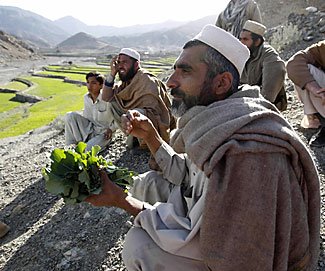
Like it or not: These farmers near Pakistan will see more US troops.
Photo: Oleg Popov/Reuters.

Many in Afghanistan oppose Obama’s troop buildup plans
By Anand Gopal / March 2, 2009

Frustration and fear is sparking opposition to plans that would nearly double the size of US forces there.

Kabul, Afghanistan – Parliamentarian Shukria Barakzai says she has an innovative amendment to Washington’s planned injection of up to 30,000 new troops here.

“Send us 30,000 scholars instead. Or 30,000 engineers. But don’t send more troops – it will just bring more violence.”

Ms. Barakzai is among the growing number of Afghans – especially in the Pashtun south – who oppose a troop increase here, posing what could be the biggest challenge to the Obama administration’s stabilization strategy.

“At least half the country is deeply suspicious of the new troops,” says Kabul-based political analyst Waheed Muzjda. “The US will have to wage an intense hearts-and-minds campaign to turn this situation around.”

The lack of public support could provide fertile recruiting ground for the Taliban and hinder US operations, Mr. Muzjda says.

After a year that saw the highest number of civilian and troop casualties since the war began in 2001, officials in Washington recently pledged to send 17,000 soldiers to stem the growing violence. The move has broad support among the American public – a recent ABC News/Washington Post poll found that 64 percent back the new deployments.

Much of the Afghan opposition comes from provinces dominated by the Pashtun ethnic group, which include areas that have seen the most fighting and where the new troops will be deployed. A group of 50 mostly Pashtun members of parliament recently formed a working group aimed at blocking the arrival of new troops and pushing for a bilateral military agreement between Kabul and Washington, which currently does not exist.

Pashtun support is crucial

Although any proposed legislation or motion condemning the troop increase would be purely symbolic – the Afghan government does not have direct say over the operations of Western forces – observers say that the development is an important gauge of public opinion in Pashtun areas.

Dozens of interviews with tribal elders, parliamentarians who are not part of the working group, and locals in Pashtun areas have revealed similar sentiments.

“I can’t find a single man in the entire province who is in favor of more troops,” says Awal Khan, a tribal leader from Logar province, just south of Kabul. “They don’t respect our tradition, culture, or religion.”

“The majority of my people disagree with this increase,” says Hanif Shah Hosseini, an MP from Khost province who is not part of the working group. “More troops won’t bring more security, just an increase in the fighting.”

US supporters targeted

Many cite civilian casualties and house raids as the main reason for their opposition. Recently in Logar, armed locals blocked the highway into Kabul for hours, in protest of a night raid where US forces killed one and detained three others. According to local reports, the nearly 2,000 protestors burned tires and chanted anti-US slogans.

In Kandahar Province, villagers recently placed the bodies of two children who were killed by mines in front of a government office, shouting anti-Western slogans. They alleged that unexploded Canadian ordnance killed the children.

Many locals also fear the reprisals of the Taliban in areas where troops operate. Recently in Wardak Province, locals saw two boys practicing their fledgling English with American soldiers who were passing by. The Taliban later executed the children, accusing them of being spies.

Some feel that the US should focus its efforts solely on reconstruction and the building of Afghan security forces. “The Americans spend thousands of dollars every month on a single soldier,” says Khost MP Mr. Hosseini. “With this huge amount of money, they can train our soldiers more effectively.”

Others say that if the troops must come, they should coordinate with the Afghan government. “Without such coordination, I don’t think sending more troops will change anything,” says Kandahar tribal leader Agha Lalai Dastageri.

He adds that if troops were under the control of the Afghan government, they would be deployed near the Pakistani border and away from populated areas, diminishing the chance of civilian casualties. Many Afghans believe that the source of insecurity partly lies in Pakistan, where the leadership of the insurgency allegedly takes refuge, and that policing the border will improve security throughout Afghanistan.

American military officials say that although the goal is to eventually transfer all security responsibilities to Afghans, troops are still needed now for development and security. “Our intent is to use the troops to secure rural areas,” says Capt. Elizabeth Mathias, spokeswoman for US forces in Afghanistan. “The Afghans are showing great promise, but they need us here for now.”

Snowmelt ups urgency

The injection of forces still enjoys support outside the Pashtun belt. Other ethnic groups, such as the Tajiks and the Hezaras, who predominantly hail from the country’s relatively peaceful north and west, back the notion. “We need these troops to strengthen security in the unstable provinces,” says Mirwais Yassini, chair of the Afghan Parliament and a Tajik. “We also need them [to provide security] for the upcoming presidential elections.”

Support for more troops is higher in the non-Pashtun areas because residents there have experienced less violence, and because they may view US forces as a buffer between them and the Taliban, analysts say. The memory of the Taliban’s harsh rule is still fresh in many non-Pashtun communities, who suffered greatly during that time.

But winning support in the rural Pashtun villages, where the war is being fought, is crucial for the plan, analysts say. Development will be a key component to this war. Military planners intend to continue focusing on projects meant to boost economic activity, which they say will show locals the benefits of US presence in the region.

“A couple of months ago Arghasan district in Kandahar was controlled by insurgents,” says Kandahar provincial council member Hajji Qasim. “But ever since USAID started a road project there, the economic situation improved and the insurgency lost influence.”

Military officials say that such development projects can only succeed if they are accompanied by a corresponding troop increase, since insurgents often attack reconstruction teams.

Officials in Washington and Pashtun villagers agree on one thing: They expect the violence to increase this summer as the new forces attempt to root out insurgent strongholds.

“I know once the snows melt, things will start to get much worse,” Logar resident Nasar Ahmad says. “The fighting will be intense, and a lot of us villagers are talking about fleeing to Kabul.”

“We are worried our families will be caught in the middle,” he adds.

Source / Christian Science Monitor

The Rag Blog

Posted in RagBlog | Tagged , , , | Leave a comment

Mind Boggling Numbers


Source / The Comic News

The Rag Blog

Posted in RagBlog | Tagged , , | Leave a comment

Texas Public Schools : State-Mandated Ignorance

‘The report, Just Say Don’t Know: Sexuality Education in Public Schools, studied materials from 990 Texas school districts and found that 94% of the districts use “abstinence-only programs that usually pass moral judgments while either downplaying or ignoring contraception and health screenings.”‘

By Steve Benen / March 2, 2009

STATE-MANDATED IGNORANCE…. McClatchy ran a disturbing piece the other day, noting the results of a new study examining Texas’ public schools and lessons on sexual health. It wasn’t at all encouraging: “The overwhelming majority of Texas schools use scare tactics and spread myths in place of teaching basic sex and health information that students can use to protect themselves and others.”

The report, Just Say Don’t Know: Sexuality Education in Public Schools, published by the Texas Freedom Network, studied materials from 990 Texas school districts and found that 94% of the districts use “abstinence-only programs that usually pass moral judgments while either downplaying or ignoring contraception and health screenings.” An additional 2% ignore sexual health altogether. “What is left is a miniscule 4 percent of Texas school districts that teach any information about responsible pregnancy and STD prevention, including various contraceptive methods,” the TFN noted.

How bad is it? Frederick Clarkson reported on some of the specifics:

Unsurprisingly, the study found that “more than 3.7 million Texas students attend school in a district where they will not encounter even the most basic information about how to protect themselves from unintended pregnancy and sexually transmitted diseases (STDs).” Just Say Don’t Know reveals that the way that Texas schools address sexuality ranges from incompetent to bizarre, but that there is little oversight from the state or from school districts.

For example, one school district utilizes a skit that compares using a condom to committing suicide. The skit titled “Jumping Off the Bridge” concludes: “Giving a condom to a teen is just like saying, “Well if you insist on killing yourself by jumping off the bridge, at least wear these elbow pads — they may protect you some?” Knowing that STDs can kill and that there is at least a 30% failure rate is like helping the teen kill them self [sic]. It is a lie to call condoms “safe sex.” If there is a 30% failure rate of condoms against life threatening diseases, then calling them a way to have “safe sex” is like “helping” someone commit suicide by giving them elbow pads to “protect” them or finding them the safest spot from the bridge to jump.'”

Crackpot claims about condoms are perhaps the leading misinformation promoted in many school districts, including long discredited assertions that latex condoms have tiny holes large enough for sperm to travel through, even if the condom is otherwise properly used.

Here are some of what the report says about the state of the programs they evaluated: alarming,” “shockingly poor,” “blatant errors of fact mixed with misleading Information,” scare tactics and shaming,” “outdated gender stereotypes” “unconstitutional religious content.” And they say that the “examples are numerous and widespread.”

Let’s not forget that state-mandated ignorance on this scale comes with considerable costs. Texas, thanks to its taxpayer-financed confusion, has one of the highest teen-pregnancy rates in the nation, costing the state “approximately $1 billion annually for the costs of teen childbearing.”

Data from the CDC further showed that “young Texans overall rate well above national averages on virtually every published statistic involving sexual risk-taking behaviors,” making this “one of the most pressing public health issues facing” Texas.

Source / Political Animal / Washington Monthly

Thanks to Tom Cleaver / The Rag Blog

Posted in RagBlog | Tagged , , , , | Leave a comment

Roger Baker : AIG and the ‘Adverse Feedback Loop’

Image from nextlogics

Bernanke hates to call our current situation a deflationary spiral despite its close resemblance to one. Perhaps because of the association of that term with the Great depression, Bernanke chooses to call our current crisis an ‘adverse feedback loop.’

By Roger Baker / The Rag Blog / March 2, 2009

American International Group (AIG) is in big trouble, its stock having fallen from $50 a few years ago to less than 50 cents today. Why is this so important?

AIG is a sort of deregulated non-bank global securities insurance “group” that has specialized in insuring securities deals, through credit default swaps, etc. This insurance was deemed smart and profitable, unless there is a world economic crisis. Such a crisis was known to be to be theoretically impossible because of readiness of the US treasury and the Fed to do whatever it takes (even dispatching helicopters full of money if needed) to stimulate the US economy enough to pull the USA out of a deflationary spiral.

Bernanke hates to call our current situation a deflationary spiral despite its close resemblance to one. Perhaps because of the association of that term with the Great depression, Bernanke chooses to call our current crisis an “adverse feedback loop.”

The adverse feedback loop and how Ben Bernanke is trying to loosen it

“…On a day when more dismal housing price data and record-low consumer confidence highlighted the continuing plight of the U.S. economy, Mr. Bernanke warned that a full recovery could take more than two to three years and that recent economic forecasts could prove optimistic. “I believe that, over all, the downside risks probably outweigh those on the upside,” the central bank chief said in his semi-annual appearance before lawmakers…”

However, before we blame AIG too harshly for risking the whole global economy by pledging too many trillions of dollars in now-failing security insurance policies, we should recall that these institutions were poorly informed by those who should know better. There were scholarly assurances from brilliant mathematicians who calculated the risk on the credit swaps, which were much of the basis for much of AIG’s business (although AIG knew how to insure anything).

It was mathematically determined that the kind of securities insurance deals that AIG sought to do could, at the same time, be highly profitable and carry a low risk.

Enough retroactive finger pointing. It is now considered vital for the U.S.A to bail out AIG’s securities’ bad insurance deals. If not, a huge amount of supposedly rock solid deals around the globe will go up in smoke, leaving the biggest players in the global economy feeling cheated, suspicious, unwilling to lend, buy treasury debt, etc.

Whether or not to admit that the biggest banks are broke, and then to nationalize them, is something else Bernanke may need to figure out fairly soon. The bank solvency problem is a related issue involving domestic investor confidence.

“…nationalisation is not an end in itself, but a consequence of the policy that most rapidly returns the banking system to health. It is a heavy cost, but there is no alternative. If taxpayers own a bank, pretending that they don’t only exacerbates the harm…”

Meanwhile, the AIG deals need our immediate attention. Bailing out the AIG deals (and perhaps similar assurances spread throughout the “shadow banking system” – see the link above) through a series of emergency cash injections is deemed absolutely necessary, no matter what the cost, as the following article indicates. The main problem is the U.S. treasury funded bailouts needed to paper over the global bad debt shortfalls seem to keep getting bigger and bigger.

AIG failure would still be disastrous for global mkts
By Lilla Zuill and Kristina Cooke / March 1, 2009

NEW YORK — A revised bailout of American International Group Inc (AIG.N) may be just another “band-aid” solution, but more than five months after it was first rescued by the government the option of letting the insurer fail would still be considered too big a shock to already fragile global markets…”The government really does not have the option of letting AIG totally blow up,” said Robert Haines, senior insurance analyst at CreditSights. AIG’s foray into the roughly $28.5 trillion credit default swap market left it heavily exposed to losses on toxic mortgage assets that it had guaranteed against default….

“European banks are about two-third of the problem… it would be a domino effect across the globe. “The ensuing panic would be disastrous,” he said…

Moody’s Investors Service and Standard & Poor’s both have AIG on review for downgrade from the seventh highest investment grade, and have said that only government support was keeping ratings from being cut to “junk” status. “If AIG is allowed to fail — many banks holding CDS paper from AIG could also fail,” said Mark Keenan, insurance partner at law firm Anderson Kill & Olick. “In other words, I don’t think the U.S. government can afford to allow AIG to fail — no matter how many bandaids may be needed,” he added. Over time, however, some analysts say the U.S. government may find that an orderly failure of AIG is the only way to stop the financial bleeding.

“The whole thing is ridiculous. How much longer are we going to do this? This is another bandaid, and we’ll be having this discussion again,” said Christopher Whalen, co-founder of Institutional Risk Analytics, a provider of analysis and ratings for banks…”

Source / Reuters, UK

The dollar value of global securities deals AIG has insured against default is fairly astronomical. The article above mentions $28 trillion. Whatever the dollar amount needed to stabilize the global economy, it apparently could dwarf the few trillion dollars in Obama’s budget and or his stimulus package. Perhaps China will decide that our US treasury bonds have, for some reason, regained their previous appeal.

However, if cutting the interest rate to zero, plus the stimulus package, plus all the bailouts so far all put together can’t seem to do the job, and if all else fails, there are always the US Treasury Department printing presses.

The Rag Blog

Posted in Rag Bloggers | Tagged , , , , | 2 Comments

Tom Hayden on Iraq and Afghanistan : Partial Peace, Looming War

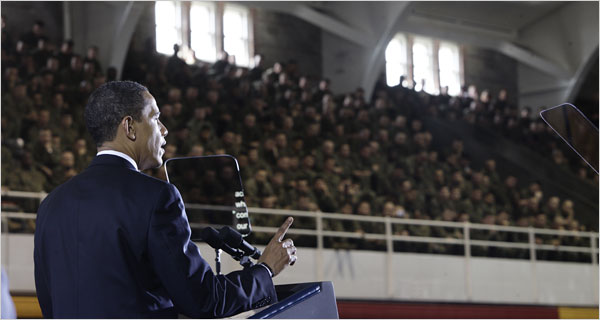
President Obama announced his plan for withdrawing troops from Iraq at Camp Lejeune, N.C., on Friday, Feb. 27. Photo by Doug Mills / The New York Times

Obama’s official stance comes after many months of appearing to support the notion of residual forces, which many in the peace movement correctly believed could lead to low-visibility counterinsurgency and a permanent military occupation.

By Tom Hayden / March 1, 2009

President Obama has surprised the national security establishment, and not a few in the peace movement, with his Friday commitment to pull all American troops out of Iraq by 2011.

The Washington Post’s Thomas Ricks predicted in his recent authoritative history, The Gamble, that Obama would keep 25,000 to 50,000 troops in Iraq as a “residual” force indefinitely. Ricks reports that generals like David Petraeus and Raymond Odierno were expecting at least that many troops, and predicts that the fighting will continue for decades.

Obama’s announced new policy must shock Ricks and the military leaders he extensively interviewed. Obama’s official stance comes after many months of appearing to support the notion of residual forces, which many in the peace movement correctly believed could lead to low-visibility counterinsurgency and a permanent military occupation. Obama said nothing to dissuade the critics until Friday’s speech at Camp Lejeune, North Carolina.

In debates within the Obama camp, only John Podesta, transition adviser and head of the Center for American Progress (CAP) was publicly advocating that all troops, including trainers and advisers, be withdrawn within one year.

Ricks’ book is wrong on another related matter, the role of the antiwar movement in this process. Ricks celebrates Petraeus for having pacified Iraq in the face of considerable Democratic doubt, and for winning the political war at home in 2007-2008. Petraeus’s stated goal was to speed up the Iraqi clock (the surge) while slowing down the American one (the electoral calendar). Ricks says he pulled it off. After Petraeus’s appearance before Congress in September 2007, Rick says, domestic criticism faded away. News coverage of Iraq sharply declined, as networks began to withdraw from Iraq. The March 2008 antiwar demonstrations were “tiny,” he writes, with fewer than 1,000 in Washington and 500 in San Francisco.

Ricks is partly right. Democratic party leaders and big donors pulled back from the issue of Iraq after Petraeus’s testimony, and after a MoveOn advertisement accusing the general of betrayal. The resulting crisis in the DC hub of antiwar advocates was never resolved, but the grassroots peace bloc in the Democratic primaries mushroomed anyway, giving Obama a needed edge in Iowa and a string of wins against Hillary Clinton.

When there was a choice between supporting Barack Obama and attending rallies organized by various Maoists, Trotskyists and neo-anarchists opposed to Obama and electoral politics, the grassroots peace movement headed for the precincts by the thousands. What appeared to Ricks to be a failed antiwar rally in Washington was only evidence that the movement was moving on, becoming a voting force in and around the Obama campaign.

That turned out to be the right strategy for the peace movement when John McCain was defeated in November, but many continued to wonder–with good reason–whether Obama was promising nothing more than partial peace under a new form of military occupation. Now it is clear that somewhere along the way Obama became persuaded that it made little sense to leave 50,000 troops in Iraq when the Pentagon couldn’t win with 150,000, the American economy was collapsing and his hands were full in Afghanistan and Pakistan.

In Iraq the situation remains unpredictable. A brutal nationalist and authoritarian state, with sectarian police and thousands of detainees, looms as the result of a seven-year war. Under Odierno’s command, according to Ricks, tens of thousands of military-aged Sunni males (called MAMs) were held in preventive detention. Bob Woodward’s recent book goes further, crediting a top-secret US program of extrajudicial killings for imposing a peace of the dead in Baghdad. The Sunni insurgency decided in 2007 that an alliance with the Americans would thwart their Al Qaeda rivals while providing protection against the Shi’a majority. They were right, and 100,000 of the so-called Sons of Iraq were paid $20 million per month not to shoot at Americans.

On the other hand, the Shi’a who already were installed in power by the Americans had no reason to fight their sponsors, especially when even the militias loyal to Moktada al-Sadr chose to take a political path to power, at least for the moment. The Iranians will be pleased to see the US troops depart on any schedule, and enjoy good relations with whichever Shi’a party prevails in Iraq. The festering Kurdish crisis could boil over, but is localized. Things could change, but most Iraqis have an interest in seeing the Americans implement the “withdrawal agreement.” Who knows, they may even throw flowers to the retreating troops instead of shoes.

The greater danger from Iraq for Obama may lie at home politically if Republicans and the generals, echoed by the mainstream media, protest Obama’s withdrawal plan as naïve or worse. In Ricks’s analysis, Obama would not want to risk a confrontation with the military early in his presidency:

“Like Clinton, Obama would also face the prospect of a de facto alliance between the military and congressional Republicans to stop him from making any major changes. “

Since Ricks was wrong about Obama’s fortitude, he may be wrong on the danger of a backlash as well. The American people are in no mood for a “forever war” in Iraq, whatever the malcontents believe in Washington think tanks.

That leaves Afghanistan and Pakistan, both in flames. In those places, the politics are reversed, with Obama having promised to defeat Al Qaeda by using Predators in Pakistan and more ground troops in Afghanistan. So far he is keeping his campaign pledges, while still proceeding cautiously in developing an overall plan. Neither the neoconservatives nor the generals are fully happy with Obama’s early approach, which they see as pointed towards a diplomatic settlement instead of “winning” militarily. On this point, Secretary Gates seems to have the president’s back, repeatedly warning that no military solution is possible.

Nevertheless, Obama is beginning an escalation with 17,000 troops bringing the American total in Afghanistan to over 50,000. Except for its political rationale, this is a puzzling military gesture. By comparison:

  • In South Vietnam, the US deployed 500,000 troops on a battlefield of 67,000 square miles containing 19 million people
  • In Iraq, we deployed 160,000 troops on a battlefield of 168,745 square miles, with 26 million people
  • In Afghanistan, Obama plans to deploy some 60,000 US troops on a battlefield of 250,001 sqare miles with 30 million people
  • And in Pakistan he has 100 special ops on the ground, with $400 million allocated for 85,000 tribal paramilitaries.

The geography and demographics are staggering. Obama cannot possibly be considering a military solution while deploying fewer American troops on larger and larger battlefields. It is hard to imagine that he plans a Vietnam-style escalation either. At the current rate of Afghanistan spending, the costs will reach over $1 trillion by the end of Obama’s first term, while he risks his presidency on economic recovery.

Until a brave few in Congress begin to catch up, the critics of Afghanistan policy will have to launch a passionate and substantive debate over the “long war” ahead, oppose the 17,000 new troops as simply 17,000 more targets for the Taliban, sketch in the content of a diplomatic settlement and propose an exit strategy. The first arena for debate, recalling the 1965 Vietnam teach-ins on campuses, will be the blogosphere. The second will be Congressional hearings, with critics at the table. And the third phase is likely to be direct dialogue and engagement in the 2010 elections, district by district. At this point, however, the movement will have to engage MoveOn and many liberal Democrats who are mired in the lingering belief that Afghanistan is the “good war.” (We might ask, what does that make Pakistan?)

There are still more battlefields in the long war. Obama will have to be persuaded to say no to an Israeli strike on Iran while he tries to engage Tehran on stability in Iraq and Afghanistan. Ultimately, Obama will also find ways to increase support for Palestinian aspirations, as the most effective approach to lessening Arab and Islamic support for jihad. It’s a long way down the road, but his choices of George Mitchell as an envoy along with Charles Freeman to a high intelligence post are the most progressive and independent Middle East appointments in a generation.

[Tom Hayden, a founder of SDS in the early Sixties and Progressives for Obama, and a former California State Senator, is the author of The Other Side (1966, with Staughton Lynd), The Love of Possession Is a Disease With Them (1972), Ending the War in Iraq (2007) and Writings for a Democratic Society: The Tom Hayden Reader (2008).]

Source / The Nation

Thanks to Carl Davidson / The Rag Blog

Posted in RagBlog | Tagged , , , , | Leave a comment

Massive Profits : The Moving Force Behind our Health Care System

Angels Mourning Avarice leading to lack of Public Healthcare in America. Painting by ProfessorEmeritusPAB.

If one believes that the Marquis de Sade espoused sexual abstinence one can believe that the CEOs of AHIP desire decent health care.

By Dr. Stephen R. Keister / The Rag Blog / February 2, 2009

Truth appears on the internet long before the mainstream media becomes cognizant of many realities. I am reminded of these words from preeminent New York Journalist John Swinton, spoken in a toast before a press banquet in 1880:

“If I allowed my honest opinions to appear in one issue of my paper, before twenty-four hours my occupation would be gone. The business of journalists is to destroy the truth; to pervert; to villify; to fawn at the feet of mammon, and to sell this country and this race for their daily bread. We are the tools and vessels of rich men behind the scenes. We are the jumping jacks, they pull the strings and we dance. Our talents, our possibilities and our lives are all the property of other men. We are intellectual prostitutes.”

This statement occurred to me after further looking into Sen. Teddy Kennedy’s dance with the devil in very secret meetings he had been having with a group of lobbyists regarding “universal health care.” I briefly alluded to this in my last essay on The Rag Blog. These meetings have now been discussed in detail by Helen Redmond in an article in Counterpunch. The author points out that Senator Kennedy has been in consultation with lobbyists from Aetna, Americas Health Insurance Plans (AHIP), the Business Roundtable, the United States Chamber of Commerce, PhRMA, the American Cancer Society, Easter Seals, AARP , the AMA and the AFL-CIO.

Nowhere at the table are representatives of the numerous grass roots proponents of universal single payer health care, i.e., the Physicians For A National Health Program (PNHP), the California Nurses Association, Health Care Now, or the numerous unions, civic and religious organizations, or the individual citizens who by the millions endorse Rep. John Conyers HR 676.

Perhaps, in time, the mainstream media will give us some insight into what is transpiring here. When this does come to pass we must look at the reporting with a jaundiced eye recalling then Vice President Cheney’s meetings with the oil cartels in 2001. The public still is not aware of what happened, or what was agreed to at these seances. In any event we must recall that the reason for any insurance company is to reward its executives and pay dividends to its stockholders. Again, remember the massive profits made by the executives of the HMO industry. To think that these folks will agree to any decent system of health care is naive. If one believes that the Marquis de Sade espoused sexual abstinence one can believe that the CEOs of AHIP desire decent health care.

I noted on TV an advertisement for an organization, Cynergy Health Plans, which would provide “health insurance” for only $5 a week. To me that was incomprehensible; hence, I clicked on their web site and found myself facing QuoteFinder.org, the web sight of United Health Care. There I discovered that “UnitedHealthOne is based in Indianapolis, Indiana, and has sold family health insurance for over 60 years. Golden Rule, PacifiCare, American Medical Security, MAMSI, Oxford Health Plans, and UnitedHealthOne, are only some of the many companies under United Healthcare.

UnitedHealthOne offers a variety of policies including the Copay Select, the HSA 100 (Health savings Account), the HSA 70, the CoPay Saver, the affordable Saver 80 and Plan 80, and the traditional _Plan 100. The medical deductibles can range from $500 to $10,000 and office visit co-pays from $25-$35. Prescription coverage ranges from a copay of $15.00 for generic drugs to a copay of $35 for brand name prescriptions.” Guess where Synergy fits in! I did not obtain any specific quotes as the site required one to contact a sales representative.

Campaign for America’s Future had an excellent article by Monica Sanchez on Feb. 2, 2009, about the ploys used by the insurance industry to avoid payment of claims. The insurance company defines “what is medically necessary for a specific treatment.” If you thought that your physician makes that decision you are dead wrong. Your doctor may believe that you need a MRI for your chronic head pain, BUT the insurance carrier (see the small print) will decide the necessity for the procedure. The insurance company will decide whether the subscriber can obtain “out-of-network care.” In other words the insurance company, rather than your doctor, will decide whether you can go to The Mayo Clinic.

The article states: “Thanks to the New York Attorney General we know now that insurance companies were in fact swindling members who sought out-of-network care. Several insurance companies including United Health Care, CIGNA and Aetna, have agreed to pay millions of dollars to settle an investigation into how they set rates for out-of-network care. It turns out that the provider [we used to call these folks physicians — SK] rates the insurance companies were claiming to be usual and customary were much lower than what the providers were actually charging, leaving patients to pay a much higher portion of the bill.”

Another gimmick used by the insurance companies is, once a claim is filed, to refuse the claim on the basis that the condition was a “pre-existing.” According to Jeffery Dach, M.D., writing on the Bio-Identical Hormone Blog, the companies streamline and expedite denial of claims, the industry buys and uses “denial engine” software. This is a computer software which can be adjusted to increase or decrease medical claims and denial rates depending on how much profit they want to keep. In the same article the author notes “United HeathCare was forced to overhaul its claims handling practices under a settlement announced Thursday, Sept. 6, 2007, with 37 state insurance departments. Total penalties could rise to as much as $20 million if additional states join the agreement.” Involved were a number of complaints about benefits, utilization review procedure, errors concerning deductibles, etc.

U.S.A. Today, in an article by Julie Appleby in 1999, reported that Humana Health Plans was facing a class action lawsuit in a Miami district court, that was brought under federal racketeering law, claiming that the company committed a fraudulent act when it failed to disclose incentives given to claims reviewers and doctors to limit medical coverage. The same author in the year 2000 reported Humana Health Care Plans paying $14.5 million to settle a federal lawsuit accusing the HMO of overcharging government health programs and state Medicaid programs.

The New York Times on October 11, 1998, reported that the Columbia/HCA Healthcare Corporation of Quorum Health Group was cited for defrauding Medicare through bogus expense claims. Analysts at that time estimated that the claim might top $1 billion.

In my last submission I referred to the fact that mandating the purchase of health insurance might indeed be unconstitutional. This is addressed at length by Karl Manheim and Jamie Court in an article in the Christian Science Monitor.

In brief the authors ask, “Are health insurance mandates constitutional? They are certainly unprecedented. The federal government does not ordinarily require Americans to purchase particular goods or services from private parties. The closest we come is when government imposes a condition on the grant of discretionary benefit or permit. For instance, in most states, you must have auto insurance to drive a car, or you are required to install fire sprinklers when building a new house. But in such cases, the ‘mandate’ is discretionary — you do not have to drive or build a house. Nor do you have a constitutional right to do so.” (Karl Manheim is a professor at Loyola Law School in L.A. Jamie Court is chairman of Consumer Watchdog in Santa Monica, Calif.)

I had intended to address the matter of cost savings re: physicians fees and malpractice insurance when the presidential commission regarding health care gets down to business; however, we will save that for a subsequent submission. I will merely note here, before closing, that there has been a repetitive TV ad for a prescription medication for a skin condition known as Rosacea. The medication advertised is sold as ORACEA, Prices vary from place to place for this; however, the cost is approximately $150 for 30 40- mg. tablets. This is actually an antibiotic which has been around for years, i.e. doxycycline. In the generic form it is available for approximately $60 for 100 100-mg. capsules. The naive observer would, from the advertising, feel that this is another expensive “research” product of a pharmaceutical company. Oh, how we are deceived!

[For previous articles on health care reform by Dr. Stephen R. Keister on The Rag Blog, go here.

The Rag Blog

Posted in Rag Bloggers | Tagged , , , | 4 Comments

PTSD Meds: Killing Soldiers When the Battle’s Over


Veterans’ families question cause of deaths: Post-traumatic stress syndrome treatment cited
By Julie Robinson / March 1, 2009

CHARLESTON, W.Va. — Stan and Shirley White’s son Andrew, a Marine reservist, died at home 2 1/2 years after he returned from Iraq. Janette Layne lost her husband, Eric, in similar circumstances after his return from Iraq.

More than a year later, they still don’t know if the medication their loved ones were taking for post-traumatic stress disorder contributed to their deaths.

Andrew White and Eric Layne were taking Seroquel, Klonopin and Paxil, along with prescription painkillers.

Three other West Virginia servicemen have died in their sleep while undergoing PTSD treatment after returning from Iraq.

Investigators from the U.S. Department of Veterans Affairs looked into the deaths. Stan White, who actively researches similar deaths and PTSD-related medications, contacted Sen. Jay Rockefeller, who requested the investigation.

The investigators interviewed the White and Layne families and visited Huntington Veterans Affairs, the Charleston Community Based Outpatient Clinic and the Cincinnati VA residential program, where Layne was treated. They reviewed autopsy and toxicology reports for both patients.

In August, they concluded that White and Layne received care that met “community standards” at the VA facilities, and that the men died from a combination of prescribed and non-prescribed medicines.

“In the presence of PTSD, other mental health conditions, and uncertain use of medications by patients, we are unable to draw conclusions about the relationship between medication regimens and these deaths,” the investigators wrote.

That’s not good enough for some family members.

“I don’t have a direct answer as to why he died,” Janette Layne said of her husband. “Nobody has told me what caused his death.”

The medical examiner listed “overintoxication of medicines” as the official cause of death for both Layne and White. The amounts of prescribed medications in both men’s systems were within acceptable limits, said Janette Layne.

They also had taken some painkillers that hadn’t been prescribed for them, according to Stan White and Janette Layne.

Narcotic painkillers are a leading cause of accidental overdose, and those painkillers can be especially dangerous when used in combination with other drugs.

“These drugs need to have a warning that you cannot mix them with painkillers,” Stan White said. “At no time, were we ever warned that Andrew should not mix them with painkillers.”

Stan White and Dr. Fred Baughman, a California neurologist who questions the use of medications to treat mental disorders except in rare circumstances, plan to visit Washington this month, armed with the stories of nine servicemen whose deaths mirror Andrew White’s situation.

The soldiers are from West Virginia, Ohio, Pennsylvania and New York. Some of their families will go to Washington with White and Baughman and meet with their state representatives.

The prescriptions were given by doctors at VA facilities in Huntington, Charleston and a residential program in Cincinnati where Layne had just completed an eight-week in-patient treatment. White’s doctor instructed him to take as much Paxil and Seroquel as needed, Shirley White said.

“They said he had lethal amounts in his system,” she said. “So, no, we don’t have answers.”

A second look

Stan White hopes to convince policy-makers in Washington to take a second look at pharmaceuticals prescribed to PTSD sufferers.

How safe are the combinations? How carefully should they be dosed? Should people with PTSD, which sometimes includes forgetfulness and memory loss, be given prescriptions that require careful monitoring?

Despite last August’s report, the Whites are convinced there is a connection to their son’s death.

“I think the goal of talking before Congress is that we don’t think the VA is approaching treatment in the right way,” Shirley White said.

Both White and Baughman urge increased counseling resources for returning veterans, including counselors available after work hours. Working veterans can’t repeatedly miss work for ongoing appointments.

“I’m not a doctor. The medicine might be needed at first, but the soldiers need therapy and counseling,” Stan White said. “I really think that’s the key to this thing.”

Stan White and Baughman track soldiers and veterans who die in their sleep or slumped at work stations. They contact the families when they hear about such deaths to ask about psychiatric diagnoses and medications. Military casualty officers won’t release details.

They found three others from West Virginia. Jeremy Harper, 19, of Dunbar died Jan. 1, 2005, at Walter Reed Army Medical Center while being treated for PTSD. Nicholas Endicott of Logan County, who died at a military hospital in Bethesda, Md., also suffered from PTSD. Derek Johnson, 22, of Hurricane died last year while taking the three drugs.

Baughman notes Seroquel’s link to fatal heart arrhythmias and irregularities. He’s now researching the death of Chad Oligschlaeger, 21, a Texas Marine who died in May while taking six medications for PTSD, including Seroquel.

“I’m telling you right now, these drugs are unfit for human consumption, across the board,” Baughman said. “Their side effects take two to three pages to list.”

Faces behind the figures

When Eric Layne died Jan. 26, 2008, Janette Layne was pregnant and was caring for their 1-year-old son, Shamus. She and her husband served together in the National Guard in Iraq. His PTSD symptoms surfaced shortly after their homecoming.

“We had no idea what post-traumatic stress disorder was. We thought it was something old Vietnam veterans on the side of the street had,” Janette Layne said. “We were working, we had jobs and were well-fed and clean. We couldn’t imagine that would ever be us.”

As Eric Layne became increasingly depressed, angry and short-tempered, his wife encouraged him to seek treatment through the VA. He was reluctant, partially because he sensed an underlying message in the military to “just suck it up,” she said.

“It’s ironic. Eric didn’t want to go and he didn’t want to take medicine,” she said. “They told him just to come and talk. He left with a prescription and the PTSD just got worse.”

When Eric Layne lost his job in the fall of 2007, he entered an eight-week residential care program in Cincinnati where his medications were strictly monitored. He came home on the weekends, and his wife scarcely recognized the detached, exhausted man he had become.

The night he completed the program and came home for good, the Laynes agreed Eric would see a doctor about the side effects of the medicine.

He died that night.

“I’ll never forget that day. I picked up Shamus from day care and a woman asked me if the baby was going to be a boy or girl. When I said she was a girl, the woman said, ‘All you need is a dog and you’ll have the perfect family,'” Janette Layne said. “That night Eric passed away.”

She was overwhelmed with single-parent responsibilities when she delivered their daughter, Jubilee, in May.

The Whites and several other members of a veterans’ family support group stepped up. They scheduled times to visit with her and watched the children so she could run errands or take classes.

“If not for them, I don’t think I could do it,” Janette Layne said.

The Whites spend Thursday evenings with the children, and Shirley White often calls on the weekends to see if she can come over.

“It’s been good for both of us,” Shirley White said. “Some days, just getting up is such an ordeal. Then I remember that we have Thursday to look forward to. Janette and her children have pretty much got us through this year.”

Just 21 months apart, Shamus, 2, and Jubilee require constant attention. The children squeal with delight when they see the Whites. Shamus asks Stan White if they can have chicken nuggets, a treat he often picks up at McDonald’s. In warmer weather, they visit the playground down the road.

“It’s not just they help with the kids. I truly love Shirley and Stan,” Janette Layne said. “They’re the parents I never had.”

Stan White, who teaches ski lessons at Canaan Valley during the week, said he thought Shamus was ready to learn. The Whites’ involvement with her children comforts Janette Layne, who worries about their future without a father.

“I just want there to be more awareness in the military. There are so many broken homes and children without fathers,” she said. “Families are suffering and sometimes they don’t even know what it’s from. When you get home [from military duty] is when the real work begins.”

Source / Charleston Gazette

The Rag Blog

Posted in RagBlog | Tagged , , , | 4 Comments

Online Porn : Conservative Americans are Biggest Users

‘Some of the people who are most outraged turn out to be consumers of the very things they claimed to be outraged by,’ says Benjamin Edelman of Harvard.

By Ewen Callaway / February 27, 2009

Americans may paint themselves in increasingly bright shades of red and blue, but new research finds one thing that varies little across the nation: the liking for online pornography.

A new nationwide study (pdf)of anonymised credit-card receipts from a major online adult entertainment provider finds little variation in consumption between states.

“When it comes to adult entertainment, it seems people are more the same than different,” says Benjamin Edelman at Harvard Business School.

However, there are some trends to be seen in the data. Those states that do consume the most porn tend to be more conservative and religious than states with lower levels of consumption, the study finds.

Political divide

Edelman spends part of his time helping companies such as Microsoft and AOL detect advertising fraud. Another consulting client runs dozens of adult websites, though he says he is not at liberty to identify the firm.

That company did, however, provide Edelman with roughly two years of credit card data from 2006 to 2008 that included a purchase date and each customer’s postal code.

After controlling for differences in broadband internet access between states – online porn tends to be a bandwidth hog – and adjusting for population, he found a relatively small difference between states with the most adult purchases and those with the fewest.

The biggest consumer, Utah, averaged 5.47 adult content subscriptions per 1000 home broadband users; Montana bought the least with 1.92 per 1000. “The differences here are not so stark,” Edelman says.

Number 10 on the list was West Virginia at 2.94 subscriptions per 1000, while number 41, Michigan, averaged 2.32.

Eight of the top 10 pornography consuming states gave their electoral votes to John McCain in last year’s presidential election – Florida and Hawaii were the exceptions. While six out of the lowest 10 favoured Barack Obama.

Old-fashioned values

Church-goers bought less online porn on Sundays – a 1% increase in a postal code’s religious attendance was associated with a 0.1% drop in subscriptions that day. However, expenditures on other days of the week brought them in line with the rest of the country, Edelman finds.

Residents of 27 states that passed laws banning gay marriages boasted 11% more porn subscribers than states that don’t explicitly restrict gay marriage.

To get a better handle on other associations between social attitudes and pornography consumption, Edelman melded his data with a previous study on public attitudes toward religion.

States where a majority of residents agreed with the statement “I have old-fashioned values about family and marriage,” bought 3.6 more subscriptions per thousand people than states where a majority disagreed. A similar difference emerged for the statement “AIDS might be God’s punishment for immoral sexual behaviour.”

“One natural hypothesis is something like repression: if you’re told you can’t have this, then you want it more,” Edelman says.

Source / NewScientist

Thanks to Tom Cleaver / The Rag Blog

Posted in RagBlog | Tagged , , , | Leave a comment

America’s Unpleasant Tendency to Bury the Past

Agent Orange Landscape. This area was defoliated with dioxin at the request of the South Vietnamese. The VC were attacking their training bases nearby from the hills. It now looks a bit like Scotland. Photo source.

Obama please note: Those who fail to ‘master the past’ are guilty, too
By Roger Pulvers / March 1, 2009

In “Guilt About the Past,” based on guest lectures that Bernhard Schlink gave at Oxford University last year, the University of Berlin law professor describes the “long shadow” cast by the perpetrators of war crimes on their descendants.

“The act of not renouncing, not judging and not repudiating carries its own guilt with it,” he states in the book published in January by University of Queensland Press.

Last week in this column I discussed issues of guilt and atonement as they relate to Germany and Japan. This week I will examine how concepts of responsibility and self-questioning apply to the United States of America.

U.S. presidents, secretaries of state and defense, and members of Congress are certainly quick to point out perceived human rights’ abuses and political crimes committed in other nations. The assumption is always that the U.S. occupies the moral high ground of human dignity — so allowing Americans to believe in themselves as altruistic and selfless.

OK, they tell themselves, we have made mistakes; but our actions have always stemmed from pure motives. Others’ evil actions are motivated by intolerance and greed; our own regrettable actions are aberrations.

In fact, buried deep in America’s moral high ground are the bones of millions of victims of whom most Americans seem purposefully oblivious.

Schlink speaks of the need to “master the past” — that is, to come to terms with your nation’s crimes through law, atonement and reconciliation for all involved. If Americans wish to avoid repeating the tragic blunders and crimes committed in Vietnam and Iraq (to name just two war zones), they would do well to heed his message:

“Guilt also reaches those who do not actively separate themselves from the perpetrators and participants through dissociation, judgment or repudiation.”

In other words, it is not sufficient to merely “regret” past actions and believe that “looking forward” and “getting the country moving again” are substitutes for atonement. Future generations must, to use Schlink’s term, “master the past” by taking responsibility for it. Americans demand this of others — why not of themselves?

Let’s get specific.

The U.S. is guilty of conducting the most massive campaign of chemical warfare since World War II — far exceeding anything perpetrated by Saddam Hussein against the Kurds of Iraq. Between 1962 and 1970, American planes sprayed the countryside of Vietnam with dioxin in order to defoliate wooded areas its opponents used to hide themselves and their supply routes from aerial observation.

Of the 3 million Vietnamese estimated to have been exposed directly to this dioxin (known in the U.S. as Agent Orange), 1 million are acknowledged to have suffered serious health problems as a consequence. In addition, some 150,000 children have been — and continue to be — born with birth defects attributed to the use of this weapon of mass destruction.

However, all appeals by Vietnamese officials to the U.S. to apologize and pay reparations or compensation have fallen on deaf ears. The U.S. government has awarded up to $1,500 a month to the 10,000 U.S. service personnel adversely affected by Agent Orange. Why hasn’t this been extended to non-American victims?

What is the difference between this and Japan’s discrimination against non-Japanese radiation victims of Hiroshima and Nagasaki? Why are Americans so averse to recognizing guilt for actions toward others?

This tendency to bury, rather than master, the past is all the more conspicuous when crimes are being committed in the present.

The U.S. spearheaded an illegal war, based on false premises, in Iraq, and for the past six years has killed, maimed and traumatized millions of that country’s citizens. Most Americans now consider the war a strategic error. But has anyone in power, even President Barack Obama, who opposed it from the beginning, spoken in terms of guilt and atonement? Do Americans care about the fates of those millions of people whose lives their state’s actions have ruined?

Several weeks ago, Patrick Leahy, chairman of the Senate Judiciary Committee, proposed the establishment of a truth commission to investigate illegal practices by members of the Bush administration. Yet President Obama has repeatedly stated his opposition to this, instead declaring that he wants “to get it right [by] moving forward.”

There’s the political rub. By proposing “change we can believe in,” as Obama has, you emphasize the importance of the future by bypassing serious reflection on the past. It’s as if you go to the PAST file, highlight it and hit the DELETE button. Then you simply create a new file headed NEW IDEALS.

As Schlink puts it, ignoring past crimes entangles you in them whether you like it or not. He writes:

“The principle is as follows: to not renounce the other includes one in that person’s guilt for past crimes, but so that a new sort of guilt is created. Those in the circle of solidarity who are themselves not guilty through actions of their own, bring about their own guilt when . . . they do not respond by dissociating themselves from those who are guilty.”

For instance, Americans are naturally perturbed by the intense animosity expressed toward them by Iranians — yet they seem ignorant of the fact that their Central Intelligence Agency, together with British intelligence, engineered a coup against Iran’s democratically elected government in 1953. Similarly, if the governments of Venezuela, Bolivia, Nicaragua and Chile have vented criticism against the U.S., wouldn’t it be helpful if Americans were aware of their country’s active intervention in Latin America to subvert the development of democratic processes?

These are old stories. Yet they need to be analyzed not as strategic or tactical errors, but as seriously unethical transgressions.

The Obama ideology of “moving ahead” without attempting to redress past wrongs implicates those in the present all over again. Even as the Obama reboot sweeps the old icons from the screen, Americans would do well to remember that the virus remains deep in the system.

What, then, is to stop them from instigating new fiascoes that result in untold misery and death? The smiling face of President Obama on the screen saver is no protection against the virus.

The era of U.S. exclusivity and pre-emption, so misinterpreted and degraded by George W. Bush and his advisers, is over. This means that Americans will be judged worldwide by the same standard once — and still — applied to Germans and Japanese.

“One deserves to be proud only of what one achieves, not of what one is,” writes Schlink in “Guilt About the Past.”

“Instead of assuring the younger generation that they have the right to be proud or denying them the right, we owe it to them to integrate the past into our collective biography.”

What will be the world’s collective view of post-Bush America? Americans should take a cold hard look at their past, as they so require of others. The world will forgive what is admitted to and atoned for. Without admittance and atonement, there is no moving forward. The positive example of Germany and the negative example of Japan should be ample testimony to that.

[Roger Pulvers is an American-born Australian author, playwright and theater director, and a professor at Tokyo Institute of Technology.]

Source / Japan Times

The Rag Blog

Posted in RagBlog | Tagged , , , | 2 Comments