Whad’Ya Know? Terrellita Maverick’s Still Fighting for the Family’s Good Name

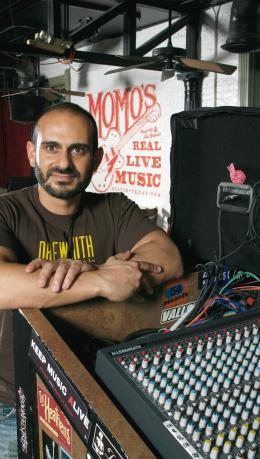
Terrillata Maverick: A real Maverick still fights the good fight.

‘Mother’s interview was priceless! She was funny and quick on the uptake. She talked about the election, ancestral anecdotes, and backpacking around the world.’
By Fontaine Maverick / The Rag Blog / November 23, 2008

After weeks of a whirl of pre-election interviews surrounding my family’s indignant “John McCain, You’re No Maverick” campaign, a period of joy and relief ensued with the November 4 election of Barack Obama. We felt good about what we had accomplished, but I, for one, was glad that I could focus on the emotion that was the result of this marvelous, historical victory.

But there was one more; my 82 year old mother (Terrellita Maverick) told me that she was to be interviewed November 22 on “some NPR radio show” at Trinity University in San Antonio. Turns out, the show was Michael Feldman’s “Whadda Ya Know”, a very popular and venerable (they have been around for over 20 years) quiz show in the format of “Prairie Home Companion” with live audience interaction and musical guests. Those of you who live in parts of the country other than Austin may be familiar with it; we, unfortunately are not.

Anyway here’s a little rundown of what was in store for me and my mom today:

I had a long day; up at dawn to get mother to the beautiful auditorium at Trinity U, got her backstage for her gig as interviewee on “Whadda Ya Know,” and settle myself in the audience with an elderly friend of hers (a lovely woman named Jane). The show was beautifully produced — very regional decor on the big stage — fiesta taco booths and Big Rainbow Colored Papier Mache letters spelling out “NIOSA” (night in old San Antonio). A very fine jazz band opened the show.

Mother’s interview (about 15 minutes long) was priceless! She was funny and quick on the uptake – best I have ever seen her. She talked about the election, ancestral anecdotes, and backpacking around the world in her late forties. You had to be there, but I was very proud of her. She was followed by Feldman’s “quiz show” with an audience member, and a phone in guest, followed by a musical interlude with the Krayolas and Augie Myers, plus the West Side Horns. Then more audience interaction, and a great cooking demo with a local SA mexican chef (yes, you can do a cooking demo on the radio, you just have to talk about everything you are doing – and have fun).

Oh, and a 7 foot tall San Antonio Spur (I forget his name) was another guest. Cute guy!

Looks like you can get a podcast after Monday the 24th on the notmuch.com website — check it out — it’s a hoot.

[The Texas Maverick clan — a venerable pack of political progressives and iconoclasts who inspired the popular usage of the term “maverick” — spoke out during the 2008 campaign about the theft of the family’s good name by John McCain and his (not so) trusty sidekick Sarah.]

More from The Rag Blog on the Maverick family of Texas:

* Hey John : You’re No Maverick. And We Can Prove it! / Brave New World Video / The Rag Blog / Oct. 29, 2008

* Austin’s Fontaine Maverick Tells CNN Why McCain and Palin are no Mavericks / Video / The Rag Blog / Oct. 9, 2008

* McCain a Faux Maverick : Stealing a Texas Tradition by Paul in Austin / The Rag Blog / Sept. 13, 2008

* Fontaine Maverick : John McCain is no Maverick! by Fontaine Maverick / The Rag Blog / August 31, 2008

And * This Maverick The Real Deal by Joe Holley / The Rag Blog / March 1, 2008

Also see Public radio host did his S.A. homework by Amy Dorsett / San Antonio Express-News / Nov. 23, 2008

The Rag Blog

Posted in Rag Bloggers | Tagged , , , , , , , | 3 Comments

Tom Hayden : Frankenstein in Mesopotamia

Frankenstein’s monster, played by Boris Korloff, from the original 1931 movie. The monster the U.S. is leaving behind in Baghdad is a police state.

‘The most important things, some say, are the things left unsaid. If so, the unmentionable thing would be the police state America is leaving behind in Baghdad.’
By Tom Hayden / November 21, 2008

The pact being negotiated between the US and Baghdad governments includes a direct rebuff to president-elect Barack Obama’s promised policy of withdrawing American combat troops in 16-18 months. The pact instead would leave those troops in place until the end of 2011, a doubling of the timeline to which Obama pledged himself. But that’s not all.

The most important things, some say, are the things left unsaid. If so, the unmentionable thing would be the police state America is leaving behind in Baghdad.

Finally, human rights observers agree that there are 40-50,000 Iraqis currently held in detention centers under either US or Iraqi control. Under terms of the pact, “we’re getting out of the detainee business”, says the US military spokesman in Iraq. The US-run camps, known as Bucca and Cropper, hold at least 17,000 detainees under a US-declared “security detention” doctrine that does not exist in either American or Iraqi law. According to Human Rights Watch, they are held “for indefinite periods, without judicial review, and under military processes that do not meet international standards.” Most of them – at least 12,000 – were mistakenly seized in American sweeps or played marginal roles the resistance. Those who are released are often killed by Shi’a death squads.

If the US and Iraqi governments were to seek a renewal of the United Nations reauthorization when it expires on December 31, chances are that accepted human rights standards would be demanded for the Iraqis detainees, such as access to legal council, family members and international observers.

But under the proposed Iraq-US pact, the 17,000 will be shifted from US to Iraqi detention facilities, a transition to even greater darkness. Knowing this, the Sunni parliamentary bloc is demanding amnesty for most of them.

The concerns are deadly serious. I interviewed an American contractor, a former Marine, just returned from Baghdad in 2005, one paid to protect the Sunni delegation in the Green Zone. He bitterly spoke of Sunni bodies, bullets lodged in their heads from short range, lye disfiguring their faces, being dumped in the streets, The 2007 Baker-Hamilton Study group issued a one-sentence confirmation that the Iraqi police “routinely engage in sectarian violence, including the unnecessary detention, torture and targeted execution of Sunni Arab civilians.”

Before the Baker-Hamilton finding, there were other revelations. The Times revealed secret prisons and torture sites in Baghdad which reported directly to the Interior Ministry, itself under sectarian Shi’a control. The Times also described “black sites” at Camp Nama, where an American task force beat, kicked, blindfolded and forced Iraqi inmates to crouch in 6-by-8 cubicles in a prison called Hotel California, where the official motto was “No Blood, No Foul.”

A Congressionally-created law enforcement commission concluded in September 2007 that the Ministry of Interior is “a ministry in name only…widely regarded as dysfunctional and sectarian.”

Even the Bush administration in 2007 confessed “evidence of sectarian bias in the appointment of senior military and police commanders [and] target lists that bypassed operational commanders and directed lower-level intelligence officers to make arrests, primarily of Sunnis.”

Dry language, dry bones

Antiseptic language is sometimes necessary in journalism and law to make objective evaluations. But it also can suppress moral and emotional responses to suffering and serve as a sedative in managing public opinion. Riveting stories of torture dungeons don’t rate much in the media in comparison to domestic violence between white Americans. For instance, clear evidence that Sunni children were being murdered by the Sunni captors, persuasive to a top US military investigator, made it into the Salt Lake Tribune, but not much further. The US Judge Advocate happened to be from Utah, making it a local story.

Counterinsurgency often is framed as winning hearts and minds, not as crushing the alleged insurgents to protect the civilian population. In South Vietnam, that led to “strategic hamlets” and the Phoenix program. In Central America, it was death squads who killed priests, nuns and thousands of civilians. In both cases, American and world opinion was shocked.

In the case of Iraq, there is silence in the West.

For example, there has not been a single Congressional inquiry into the oblique revelations in Bob Woodward’s latest book about secret operations launched in May 2006 to “locate, target, and kill individuals in extremist groups”. The top intelligence adviser on these operations, Derek Harvey, told Woodward that the killings gave him orgasms. These were extra-judicial killings, with the Pentagon acting as judge, jury and executioner. The definition of “extremist” was stretched to include anyone named by an informant as a supporter of the Sunni insurgency, supported by an overwhelming majority of Sunnis.

During Vietnam, the Phoenix program, exposed as killing over 20,000 Vietcong suspects, was closed down after an outburst of ethical fury. In 2004, the Phoenix program’s revival was recommended by Dr. David Kilkullen, described in the Washington Post as “chief adviser on counterinsurgency operations” to Gen. David Petraeus. Kilkullen advocated a “global Phoenix program” to combat global terror in a 2004 article in Small Wars Journal. He later reissued the article without the Phoenix label, having already described the Phoenix project as “unfairly maligned” and “highly effective.” He also advocates applying “armed social science” against the “physical and mental vulnerabilities” of Iraqi detainees. He walks the streets of Washington today, widely accepted in the world of national security advisers. No one in that select establishment has ever criticised his writings.

Americans already pay for this sectarian repression — which even includes the diminishment of Christian seats in parliament — with $22 billion in tax dollars from 2003 through 2007 for American advisers to the Interior Ministry, police and prison guards. In 2007, there were 90 American advisers assigned to the interior ministry, which much of training of police and prison personnel is outsourced to contractors like DynCorps, according to Congressional oversight hearings.

One of the trainers has been Gen. James Steele, a veteran of the Central American counterinsurgency wars, who was with the US Civil Police Assistance Training Team when the sectarian Iraqi militias began operating under official cover. He was quoted in 2006 as “not regretting their creation.”

How has this happened? Presumably the public lacks any sympathy for individuals accused of Islamic terrorism. But there has been ample uproar over torture at Abu Graeb and US foreign policy generally. The public simply doesn’t know much at all about the detention camps in Iraq. Most of the concerned NGOs take up less controversial causes than Iraqi inmates for their fundraising. Human rights insiders accept the paradigm that a democratic, pluralistic Iraq is a work in progress, still lacking an independent judiciary and ACLU watchdogs of their own. The international Red Cross has agrees to keep its findings secret. The peace movement is locked into an exclusive “out now” framework that subordinates police and prison issues to the margins. The Pentagon therefore succeeds in fabricating a new mirage in the desert to replace the discredited one. As our combat troops are replaced by low-visibility advisers, amnesia could take over completely, while shame and hatred beget a new generation of insurgents.

The US administration could do something about this Frankenstein. It could use its remaining leverage to insist on the release of the detainees or the application of enforceable human rights standards and access for the media and human rights workers.

But Congress and the media seem to think that a sectarian police state is the ugly price that must be paid for sharply reducing American casualties and reducing our footprint in Iraq. The hot debate among judge advocates, pro bono lawyers and Congressional investigators, is about a few hundred Guantanamo detainees, not the dark underside of counterinsurgency.

The next stop is Afghanistan, where another 50,000 detainees fester under similar conditions to Iraq, and the British envoy recently recommended an “acceptable dictator.” Instead of addressing the human rights crisis in that country, the envoy suggest that “we should think of preparing our public opinion” for dictatorship as the necessary outcome.#

[Tom Hayden can be reached at tomhayden.com. His recent books are Ending the War in Iraq (2007) and The Tom Hayden Reader (2008).]

Source / Talking Points Memo

For articles by Tom Hayden or referencing Tom Hayden published on The Rag Blog, go here.

Thanks to Carl Davidson / The Rag Blog

Posted in RagBlog | Tagged , , , , , | Leave a comment

Maryland State Police Spying: One Victim’s Story

The most telling fact concerning this story is that it appeared in the UK Guardian and on a quiet Web site for an environmental group in Seattle, Grist.org. This entire matter of the Maryland State Police spying has been routinely suppressed by the mainstream press, not terribly surprising given the ownership of more than 80% of the MSM. Ahhhhh, life in America, land of the free …

Richard Jehn / The Rag Blog

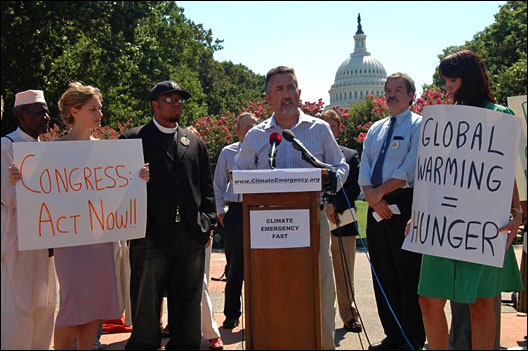
Terrorist Activist Mike Tidwell (at podium) exhibiting clearly threatening behavior. Photo: chesapeakeclimate

Police spy on climate activist while global warming goes unarrested
By Mike Tidwell / November 21, 2008

Police spied on activist Mike Tidwell for months as a ‘suspected terrorist’.

I’m not sure what’s more shocking: the news that the Maryland State Police wrongfully spied on me for months as a “suspected terrorist,” or that, despite surveillance of me, officers apparently wouldn’t recognize me if I walked into their police headquarters tomorrow.

I’m a former Peace Corps volunteer, an Eagle Scout, church member, youth baseball coach, and dedicated father. I also happen to be director of one of the largest environmental groups in Maryland, a nonprofit that promotes windmills and solar panels in the fight against global warming. So imagine my shock to get a police letter last month saying I was one of 53 Maryland activists on a terrorist watch list that has been discontinued because — can you believe it? — there’s “no evidence whatsoever of any involvement in violent crime.”

Matters turned especially Soviet-esque on October 14 when I called the police requesting a full copy of my surveillance file. A spokeswoman told me I could visually inspect the file, but I couldn’t make photocopies, I couldn’t bring an attorney, and the police would be destroying the entire file after I read it.

And bring a valid photo ID, she said, to make sure you’re who you say you are.

A what? Really? You spied on me, for God’s sake.

The mess all began last summer when astonishing evidence surfaced revealing that the Maryland State Police — under former Republican Gov. Robert Ehrlich — posed as activists and infiltrated an anti-death-penalty group, attending the organization’s meetings and taking secret notes to send back to HQ. But what were they doing to me and my organization — the Chesapeake Climate Action Network — during this surveillance program in 2005 and 2006? Bugging our phones? Reading our emails? Monitoring me as I walked my kid to the bus stop?

I still don’t know for sure. Yielding to public pressure, the police finally gave me a printed copy of my “file” on October 29. It raised more questions than it answered. Seven of the 12 pages were withheld without full explanation. And of the pages I did receive, at least half the words were redacted — blacked out with a marker.

There was a photo of me on the last page, lifted from my website. And on the first page, there were these words: “Crime: Terrorism, environmental extremists.”

What terrorism would that be? My file — what little of it I have — makes reference to a morning speech given in Bethesda, Md., by then-governor Robert Ehrlich on November 17, 2005. A small audience of invited guests and journalists attended inside a classroom at Walt Whitman High School. Ehrlich wasn’t doing enough to fight global warming, the Chesapeake Climate Action Network believed, and several of my staff arrived to peacefully demonstrate and hold up signs that said things like, “It’s Getting Hot in Here, Gov!” But troopers with the governor’s “Executive Protection Division” believed this was extreme, according to my file. For example, CCAN staffers invited high school students to hold up protest signs during the governor’s speech. Pretty extreme, huh?

There was no civil disobedience at this event. No one was arrested. No county, state, or federal laws were breached. The entire affair was utterly peaceful, above board, and appropriate. Political demonstrations exactly like this happen a thousand times a day in America. There were no media reports of anything unusual.

Yet Ehrlich’s security team considered this “aggressive protesting.” Afterward, the troopers contacted the Maryland State Police’s Homeland Security and Investigation Bureau. The result was creation of intelligence files on me and three of my staff under the crime category of “terrorism, environmental extremists.” The real motivation, however, appears to be political spying. We were opponents of the governor’s policies. We were organized and vocal about it. We wound up on an intelligence list along with dozens of other innocent, nonviolent opponents of the governor’s policies.

Ironically, I wasn’t even present at the protest in question. I’ve never been to Walt Whitman High School. But a case file was launched on me nonetheless, on November 28, 2005, with my name, photo, job title, “no SMTs” (scars, marks, or tattoos), and the declaration that no charges had been brought against me. Strangely, according to the police papers, there’s no record of any intelligence-gathering related to me after the file was created, just a narrative describing my staff’s protest at the Ehrlich speech.

Meanwhile, the state police say they’ve released everything to me that’s relevant to me, but I don’t believe them. Since July, the state police have made numerous public statements related to this spying controversy that have proved to be factually untrue. They initially said, for example, that the entire surveillance program was limited to anti-death-penalty activists. But we now know activists for peace, immigration, and the environment were spied on too. I believe more of the spying story is yet to come out, however. With the help of a heroic Maryland attorney, David Rocah of the American Civil Liberties Union, and an equally heroic Maryland state senator, Jamie Raskin of Takoma Park, I believe all the facts will soon surface and we’ll see legislation in the state General Assembly in 2009 specifically banning police abuses like this.

The final tragedy here, of course, is how much this whole episode has been a distraction to the public. The real threat of terror to Maryland and the nation is the prospect of up to 23 feet of sea-level rise as the Greenland ice sheet continues to implode from rapid global warming. The violent activity behind this threat is our astonishing over-reliance on fossil fuels, especially coal, to power our economy while suicidally saturating the atmosphere with greenhouse gases. For all our declarations of “never again,” the ground-zero site of the World Trade Center will itself be literally under water from sea-level rise if we don’t switch quickly to 100-mile-per-gallon cars and clean electricity from wind power.

But you can’t have strong and lasting environmental protections without a strong democracy. Most of the transformative, positive change experienced in American history has happened only after significant citizen engagement at a noisy grassroots level. That’s why, ultimately, the objective of almost all environmental groups — from the more liberal Greenpeace to the more conservative Nature Conservancy — is inspiring average citizens to care enough to take action, to make their desires known, to get involved in the system.

But who’s going to get involved and get noisy — in Maryland or elsewhere — if citizens fear that the police are secretly attending the same rallies and meetings, secretly watching and taking notes and keeping lists? Thank God that outraged Marylanders from Ocean City to Cumberland continue to demand full disclosure and reform in the face of this tawdry police spying affair.

The national economy is tanking, we’re bogged down in two wars, and the accelerating impacts of global warming could soon get so severe that Pentagon planners already anticipate security challenges worldwide from the inevitable social unrest spawned by biblical droughts, floods, wildfires, and the rest. History shows that it is precisely during times of war and want that governments tend to overreach and trample liberties. And it’s only in resisting these temptations that certain kinds of governments — democracies — grow stronger.

With a climate disaster looming, I’ve worked very hard for many years to promote clean, renewable energy. But perhaps the greatest contribution I’ll ever make to this cause is the action I’m taking right now: standing up and working hard to keep government itself clean.

[Mike Tidwell is director of the Chesapeake Climate Action Network and author of Bayou Farewell: The Rich Life and Tragic Death of Louisiana’s Cajun Coast.]

Source / The Guardian

The Rag Blog

Posted in RagBlog | Tagged , , , | Leave a comment

Seeing Purple : You Mean McCain DIDN’T Win Florida?

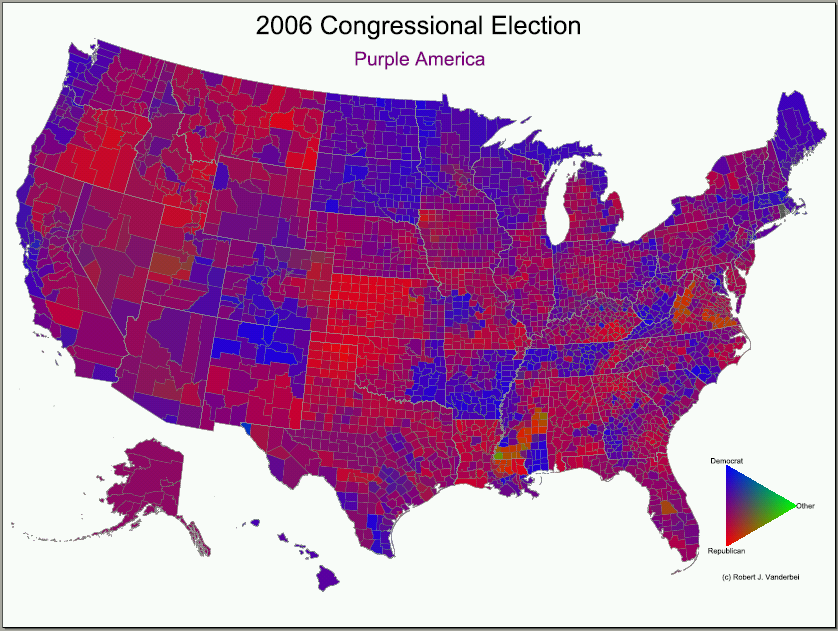
Purple America / Contested South. Graphic from Facing South.

Emerging demographic trends differentiated Florida, Virginia and North Carolina from the rest of the south sufficiently to overcome any ‘Bradley Effect’ and shift them into the Democratic column.
By Jay D. Jurie
/ The Rag Blog / November 22, 2008

On November 3rd I sent out an e-mail predicting that McCain would narrowly take Florida (see below). As we’ve seen, Obama took not only Florida, but also Virginia and North Carolina.

Emerging demographic trends differentiated these three states from the rest of the south sufficiently to overcome any “Bradley Effect” and shift them into the Democratic column.

An article entitled “A New South Rising” on the Institute for Southern Studies Facing South blog [see below] does a good job analyzing the trends, including: urbanization, young white southerners with a different outlook than previous generations, stronger minority voter turn-out, and a growing Latino population.

Other southern states are experiencing these trends. Given the region’s high population growth, the political significance of the south will increase.

I am glad to have been wrong about the election outcome.

My email:

Not to rain on anyone’s parade, and I hope otherwise, but my prediction is that McCain is going to win Florida.

It’ll be close. Maybe not as close as the 2000 election, but very close.

Based on a Mason-Dixon poll, this morning’s Orlando Sentinel shows Obama slightly ahead: 47% to 45%, an error margin of 4%, and 7% undecided. This is a fairly large “undecided” factor with early voting well under way in Florida. 84% of the 7% undecided are white, and I think this is where the so-called “Bradley effect” is hiding.

There are still voter intimidation and suppression shenanigans which may play out on Tuesday as well.

Obama has been waging a very strong and effective campaign in Florida, much stronger than either Gore in 2000 or Kerry in 2004. If Obama loses the state, it won’t be his fault. We’ll see.

A New South Rising
2008 proved that the South is politically competitive and growing in importance. But the pundits are telling a different story.

On the day before Election Day — that final moment when candidates decide where they want to make their last case to the voters they want to win the most — Barack Obama chose to visit three big battleground states: Florida, North Carolina and Virginia.

Since 1968, these Southern states had voted Democratic for president only six times between them. And president-elect Obama was about to ask voters in these states — all members of the old Confederacy — to vote the first African-American ever into the White House.

Obama’s Southern Strategy worked: the states went blue, and history was made.

But just as Southern Democrats were clinking glasses of sweet tea in celebration, the powerhouses of political punditry — especially in the North — made a bizarre move: They turned against the region that had just given one-third of its Electoral College votes to the President-elect.

Ignoring McCain’s dominance in, say, the Great Plains and Upper Mountain states — Obama’s most crushing defeats came in Idaho, Oklahoma, Utah and Wyoming — legions of commentators instead curiously trained their guns on the South, dismissing the region as politically irrelevant, a bastion of red-state conservatism uniquely out of touch with national trends.

Read all of this article here / Facing South: The Online Magazine of the Institute for Southern Studies.

Also by Jay D. Jurie on The Rag Blog: Orlando Homeless Win Big Victory in Federal Court / Sept. 27, 2008

The Rag Blog

Posted in Rag Bloggers | Tagged , , , , | Leave a comment

Mike Davis : Note to Obama: ‘Futurama’ Has to Wait Its Turn


‘We are now at a crash site, and our priority should be to save the victims, not change the tires or repair the fender, much less build a new car.’
By Mike Davis / November 21, 2008

America’s “Futurama” is defunct. The famous walk-through diorama of a car-and-suburb world, imagineered by Norman Bel Geddes for General Motors at the 1939 New York World’s Fair, has weathered into a dreary emblem of our national backwardness. While GM bleeds to death on a Detroit street corner, the steel-and-concrete Interstate landscape built in the 1950s and 1960s is rapidly decaying into this century’s equivalent of Victorian rubble.

As we wait in potholed gridlock for the next highway bridge to collapse, the French, the Japanese, and now the Spanish blissfully speed by us on their sci-fi trains. Within the next year or two, Spain’s high-speed rail network will become the world’s largest, with plans to cap construction in 2020 at an incredible 6,000 miles of fast track. Meanwhile China has launched its first 200 mile-per-hour prototype, and Saudi Arabia and Argentina are proceeding with the construction of their own state-of-the-art systems. Of the larger rich, industrial countries, only the United States has yet to build a single mile of what constitutes the new global standard of transportation.

From day one, Barack Obama campaigned to redress this infrastructure deficit through an ambitious program of public investment: “For our economy, our safety, and our workers, we have to rebuild America.” Originally he proposed to finance this spending by ending the war in Iraq. Although his present commitments to a larger military and an expanded war in Afghanistan seem to foreclose any reconversion of the Pentagon budget, he continues to emphasize the urgency of an Apollo-style program to modernize highways, ports, rail transit, and power grids.

Public works, he also promises, can put the public back to work. His “Economic Rescue Plan for the Middle Class” vows to “create 5 million new, high-wage jobs by investing in the renewable sources of energy that will eliminate the oil we currently import from the Middle East in 10 years, and we’ll create 2 million jobs by rebuilding our crumbling roads, schools, and bridges.” Of course, Bill Clinton entered the White House with a similarly ambitious plan to rebuild the derelict national infrastructure, but it was abandoned after Treasury Secretary Robert Rubin convinced the new president that deficit reduction was the true national priority. This time around, a much more powerful and desperate coalition of interests is aligned to support the Keynesian shock-and-awe of major public works.

Rolling Out the Dozers

Since the Paulson bailout plan has become so much expensive spit in the wind, and with bond spreads now premised on the possibility of double-digit unemployment over the next 18 months, massive new federal spending has become a matter of sheer economic survival. As innumerable influentials — from New York Times columnist David Brooks to House Majority Leader Nancy Pelosi — have argued, a crash program of infrastructure repair and construction, likely to include some investment in the new power grids required to bring more solar and wind energy online, is the “win-win” approach that will garner the quickest bipartisan support.

It has also been portrayed as the only lifeboat in the water for the ordinary steerage passengers in our sinking economy. The emergent Washington consensus seems to be that those five million green jobs can actually come later (after we save GM’s shareholders), but that infrastructure spending — if resolutely pushed through the lame-duck Congress or adopted in Obama’s first 100 days — can begin to pump money into the crucial construction and manufacturing sectors of the economy before the end of next winter.

Unlike Comrade Bush’s “socialist” efforts to save Wall Street, a public-works strategy for national recovery has had broad ideological respectability from the days of Alexander Hamilton and Abraham Lincoln to those of Franklin D. Roosevelt and John F. Kennedy. If Democrats can brag about the proud heritage of the Works Progress Administration and the Public Works Administration from the era of the Great Depression (ah, those magnificent post offices and parkways), there are still a few Republicans who remember the Golden Age of interstate highway construction that commenced in the 1950s with President Dwight D. Eisenhower. Indeed since the national shame of Hurricane Katrina, Americans have become outspokenly nostalgic about competent federal governments and magnificent public achievements.

If one accepts the reasonable principle of supporting the new president whenever he makes policy from the left or addresses basic social needs, shouldn’t progressives be cheering the White House as it rolls out the dozers, Cats, and big cranes? Aren’t high-speed mass transit and clean energy the kind of noble priorities that best reconcile big-bang stimulus with long-term public value?

The answer is: no, not at this stage of our national emergency. I’m not an infrastructure-crisis denialist, but first things first. We are now at a crash site, and our priority should be to save the victims, not change the tires or repair the fender, much less build a new car. In the triage situation that now confronts the president-elect, keeping local schools and hospitals open should be the first concern, rebuilding bridges and expanding ports would come next, and rescuing bank shareholders at the very end of the line.

Inexorably, the budgets of schools, cities, and states are sinking into insolvency on a scale comparable to the early 1930s. The public-sector fiscal crisis — a vicious chain reaction of falling property values, incomes, and sales — has been magnified by the unexpectedly large exposure of local governments and transit agencies to the Wall Street meltdown via complex capital lease-back arrangements. Meanwhile on the demand side, the need for public services explodes as even prudent burghers face foreclosure, not to speak of the loss of pensions and medical coverage. Although the public mega-deficits of California and New York may dominate headlines, the essence of the crisis — from the suburbs of Anchorage to the neighborhoods of West Philly — is its potential universality. Certainly, in such a rich country, wind farms and schools should never become a Sophie’s choice, but the criminal negligence of Congress over the past months should alert us to the likelihood that such a choice will be made — with disastrous results for both human services and economic recovery.

Saving Schools and Hospitals

Congress naturally loves infrastructure because it rewards manufacturers, shippers, and contractors who give large campaign contributions, and because construction sites can be handsomely bill-boarded with the names of proud sponsors. Powerful business lobbies like the National Industrial Transportation League and the Coalition for America’s Gateways and Trade Corridors stand ready to grease the wheels of their political allies. In addition, if the past century of congressional pork-barrel methods is any precedent, infrastructural spending typically resists coherent national planning or larger cost-benefit analyses.

Yet saving (and expanding) core public employment is, hands-down, the best Keynesian stimulus around. Federal investment in education and healthcare gets incomparably more bang for the buck, if jobs are the principal criterion, than expenditures on transportation equipment or road repair.

For example, $50 million in federal aid during the Clinton administration allowed Michigan schools to hire nearly 1,300 new teachers. It is also the current operating budget of a Tennessee school district made up of eight elementary schools, three middle schools, and two high schools.

On the other hand, $50 million on the order book of a niche public transit manufacturer generates only 200 jobs (plus, of course, capital costs and profits). Road construction and bridge repair, also very capital intensive, produce about the same modest, direct employment effect.

One of the most likely targets for a Congressional stimulus plan is light-rail construction. Street-car systems are enormously popular with local governments, redevelopment agencies, and middle-class commuters, but generally they operate less efficiently (per dollar per passenger) than bus systems, and at least 40% of the capital investment leaks overseas to German streetcar builders and Korean steel companies.

Personally, I would love to commute via a sleek Euro-style bullet train from my home in San Diego to my job in Riverside, 100 grueling freeway miles away, but I’ll take gridlock if the cost of rationing federal expenditure is tolerating the closure of my kids’ school or increasing the wait in the local emergency room from two to ten hours.

Obama, unlike his predecessor, has a bold vision, shared with his powerful supporters in high-tech industries, of catching up with the Spanish and Japanese, while redeeming America as the synonym for modernity. Lots of new infrastructure will, however, become so many bridges to nowhere (especially for our children) unless he and Congress first save human-needs budgets and public-sector jobs.

A good start for progressive agitation on Obama’s left flank would be to demand that his health-care reform and aid-to-education proposals be brought front and center as preferential vehicles for immediate macro-economic stimulus. Democrats should not forget that the most brilliant and enduring accomplishment of the Kennedy-Johnson era was Head Start, not the Apollo Program.

If, after saving kindergartens and county hospitals, we someday hope to ride the fast train, then we need to rebuild the antiwar movement on broader foundations. The president-elect’s original proposal for funding domestic social investment through downsizing the empire offers a brilliant starting point for basing economic growth on an economic bill of rights (as advocated by Franklin Roosevelt in 1944) instead of imperial over-reach and Pharaonic levels of military waste.

[Mike Davis is the author of In Praise of Barbarians: Essays Against Empire (Haymarket Books, 2008) and Buda’s Wagon: A Brief History of the Car Bomb (Verso, 2007). He is currently working on a book about cities and poverty.]

Source / Progressives for Obama

Also see Mike Davis : Can Obama See the Grand Canyon? by Mike Davis / The Rag Blog / October 23, 2008

The Rag Blog

Posted in RagBlog | Tagged , , , , , , | Leave a comment

The Bridge Loan to Nowhere


Cartoon by Charlie Loving / The Rag Blog

Posted in RagBlog | Tagged , | 3 Comments

Massive Baghdad Protest Against the SOFA*

An effigy of President Bush hangs on the pedestal where a famous statue of Saddam Hussein once stood in central Baghdad. It was burned after a rally for followers of anti-American cleric Muqtuda al-Sadr Friday, November 21, 2008. Photo: Caesar Ahmed.

Sadr followers protest Iraqi-U.S. pact in huge rally
By Adam Ashton / November 21, 2008

BAGHDAD — Tens of thousands of followers of radical Shiite cleric Muqtada al Sadr packed a central Baghdad square Friday, where they protested a U.S.-Iraq security agreement and likened Prime Minister Nouri al Maliki to fallen dictator Saddam Hussein.

Sheik Abdul Hadi al Mohammadawi read a nationalistic speech on behalf of Sadr urging a rejection of any pacts with the U.S., charging that approving one would infringe on Iraqi sovereignty.

The crowd chanted back, “Leave, leave, occupier.”

The rally took place in Firdous Square, the site of an iconic image of the Iraq war’s early days. It’s the spot where U.S. Marines toppled a statue of Saddam Hussein in April 2003 when they took control of Baghdad.

Sadr’s supporters on Friday hung an effigy of President George W. Bush from the statue’s pedestal during the protest. A crowd gathered around the effigy after Mohammadawi’s speech, hurling garbage at it and then pulling it down and burning it.

Otherwise, the rally was peaceful, guarded by the Iraqi military and Sadrists. Prayers encouraging unity among Iraqis followed the speeches.

Men crowded every inch of the street, sitting on colorful prayer rugs. They carried Iraqi flags and portraits of Sadr.

Mohammadawi targeted part of his speech at Iraqi members of parliament, who are considering the security agreement. He said the U.S. should leave unconditionally and hand over the country to Iraq’s military.

“Our safety cannot be solved by the occupation,” he said. “Iraqis are able to protect their country. They will take responsibility by themselves.”

The security agreement has cleared Iraq’s Cabinet and is awaiting a vote in parliament. It calls for the U.S. to leave Iraq by Dec. 31, 2011, and it gives Iraq much more control over U.S. military operations in the meantime.

Sadr’s political party has tried to derail the pact in parliament, shouting down readings of the bill over the past two days and pledging to fight it.

“History will record the honorable position of the Sadrists and those who join together to reject the humiliation” of the agreement, Mohammadawi said.

An alliance of Shiite and Kurdish parties led by Maliki backs the agreement, contending that it’s the best deal they can reach to end the American occupation. They make up a majority of the 275 seats in parliament.

The Sadr party has made its opposition to the agreement known from the outset. The pact’s supporters are concentrating on drawing Sunni Muslim parties to their side, which would enable them to claim a national accordance backing the pact.

Building that support would meet the direction of the Grand Ayatollah Ali al Sistani, who’s advised that the pact gain a consensus for the benefit of Iraq. He’s the leading religious authority among Iraq’s Shiites, and his support often is considered crucial for the success of political decisions.

Hadi al Ameri, the head of the Badr Organization, said Friday’s march wouldn’t disrupt parliament’s vote on the pact. The organization is a member of the Shiite alliance, which also includes Maliki’s party.

“With all our respect for the demonstrators, it is not a demonstration that will stop the agreement, just as it would not be a demonstration that will get it signed,” Ameri said.

The status of forces agreement was a prominent topic Friday at mosques throughout the country.

Hashim al Tai, a Sunni cleric and a member of parliament, issued a moderate appeal, encouraging parliament to consider amendments to the security pact submitted by his Tawafuq alliance. Tawafuq wants compensation for war victims and assurances that many detainees will be released instead of turned over to the Iraqi government.

Iraqi law prohibits amending the agreement, however. The Iraqi Cabinet approved the agreement Sunday, and that made it a final treaty between two states. Parliament can approve or reject it, but lawmakers can’t modify it.

Shiite cleric Nael al Moussawi told his following at al Khalani mosque that the parliament debate was a sign of democracy.

“What happened in parliament is happening a lot in other parliaments,” he said. “Everyone has the right to voice his opinion.”

Men who attended the rally in Firdous Square echoed the Sadrist line, charging that the treaty was an infringement on Iraqi authority. They contended that the exit of American forces would ease tensions among Iraqis rather than inflame them.

“By God, the violence will not come back, because Iraqis are a united people,” said Jasim Kadhim, 35.

Sadr’s militia, the Mahdi Army, was blamed for some of the sectarian violence that gripped Iraq in 2006 and 2007. It’s been on a cease-fire, but Sadr has suggested that it will rise up if the security agreement passes.

Many at the rally were skeptical about the prime minister’s motives. They sang, “Maliki is the new Saddam,” as they marched away from the rally up Saadoun Street.

“The agreement on the status of forces doesn’t help Iraq,” said Halim Hafidh, 31. “They will not give us our full rights.”

[Ashton reports for The Modesto (Calif.) Bee. McClatchy special correspondents Laith Hammoudi and Sahar Issa contributed to this report.]

Source / McClatchy

The Rag Blog

* SOFA = Status of Forces Agreement

Posted in RagBlog | Tagged , , | Leave a comment

We’ve No Business Allowing War Criminals to Walk

Just a few war criminals here … Bush Cabinet, 2001.

Moderation in the pursuit of justice is no virtue
By Joseph L. Galloway / November 18, 2008

With two months still to go before his inauguration as the 44th President of the United States, Barack Obama and his transition team are already getting off on the wrong foot, signaling that they have no intention of investigating anyone in the Bush administration for possible war crimes.

What we’re talking about here is the torture of detained terrorist suspects in American custody in a grotesque violation of both our treaty obligations under the Geneva Conventions and our historic principles as a democratic nation.

By their own machinations and attempts to redefine and pervert both treaties and our own laws, President Bush, Vice President Dick Cheney, former Defense Secretary Donald H. Rumsfeld, Attorneys General John Ashcroft and Alberto Gonzales, Cheney’s chief of staff David Addington and any number of lesser suspects sought to shield themselves from, or put themselves above, justice.

They did so knowing full well that what they were doing — clearing the way for interrogators at Guantanamo and in the Central Intelligence Agency’s secret dungeons around the world to do anything it took, short of murder, to extract information from terror suspects.

The “harsh interrogation methods” included water-boarding, stripping and humiliating prisoners, subjecting them to extremes of temperature, putting them into stressful physical positions for hours, the use of psychotropic drugs and doubtless other equally uncivilized practices.

Water boarding has always been treated as a criminal act in this country. Military officers were court-martialed at the turn of the last century for water boarding Filipino guerrillas. More recently, an East Texas sheriff was sentenced to 10 years in federal prison for water boarding a suspect and extracting a confession from him.

Moderation in the pursuit of justice is no virtue, and its no way to begin an administration that was elected on promises of change. What it says is that if you’re one of the elite and powerful, your violations of the law will be overlooked, no matter how much damage you did to our country’s standing in the world.

What signal does it send to Mr. Bush’s gang of unindicted co-conspirators, who’ve unwrapped a Pandora’s boxful of other offenses — from perverting the administration of justice, to illegally eavesdropping on the phone conversations and e-mails of ordinary Americans, to salting the stream of intelligence with bogus material, to inviting their cronies to loot the Treasury with no-bid military contracts, to lying under oath to congressional oversight committees, to applying political litmus tests to the hiring of civil service employees to the wholesale destruction of White House e-mails and records? Etcetera. Etcetera.

This nation was founded on the principle of equal justice under the law. No one — no one — ought to be able to skate or hold a get-out-of-jail-free card by virtue of having been the most powerful felon in the land, or of working for him.

This signal on torture investigations says that Sen. Obama wants to start his administration as a uniter, not a divider, trying to untangle the unholy mess that the Decider and Co. are leaving behind them in the economy, in our military, in virtually every walk of our national life. It speaks to his desire to reach across the aisle to the defeated Republicans and try to bring them back into the fold as Americans.

That’s all well and good, but not if it comes at the cost of lifting the blindfold off Justice’s eyes and letting her pick and choose who’ll pay for criminal acts and who won’t. That’s no way to begin, and no way to continue.

Out in West Texas, crusty old ranchers plagued by coyotes killing their calves and baby sheep shoot the offending beasts and hang their carcasses on the nearest barbed wire fence as an object lesson to the rest of the pack.

Unless the newly empowered Democrats in the White House and on Capitol Hill hang a few coyotes on some fences in Washington, D.C., they’re making a huge mistake that will come back to haunt them, and all the rest of us, too.

Unless the truth, the whole truth, is unearthed, justice is done and the Republican closet is emptied of festering transgressions, the next pack will do it again, secure in the knowledge that their positions will protect them from the penalties that more ordinary citizens must pay for the same crimes.

The people of this nation have spoken loudly. They voted to throw the rascals out. They voted for a different way of governing, a different way of law making. They voted for equal rights under the law.

If their desires aren’t satisfied — if the new broom sweeps no cleaner than the old one — the next time around they may move things up a notch and throw all the bastards out — and they’d be fully justified in doing so.

Source / McClatchy

The Rag Blog

Posted in RagBlog | Tagged , , | 6 Comments

National Intelligence Council : Sun Setting on The American Century

The report said that global warming will aggravate the scarcity of water, food and energy resources. Graphic: 20th Century Fox.

‘The world of the near future will be subject to an increased likelihood of conflict over resources, including food and water, and will be haunted by the persistence of rogue states and terrorist groups with greater access to nuclear weapons.’
By Tim Reid / November 21, 2008

WASHINGTON — The next two decades will see a world living with the daily threat of nuclear war, environmental catastrophe and the decline of America as the dominant global power, according to a frighteningly bleak assessment by the US intelligence community.

“The world of the near future will be subject to an increased likelihood of conflict over resources, including food and water, and will be haunted by the persistence of rogue states and terrorist groups with greater access to nuclear weapons,” said the report by the National Intelligence Council, a body of analysts from across the US intelligence community.

The analysts said that the report had been prepared in time for Barack Obama’s entry into the Oval office on January 20, where he will be faced with some of the greatest challenges of any newly elected US president.

“The likelihood that nuclear weapons will be used will increase with expanded access to technology and a widening range of options for limited strikes,” the 121-page assessment said.

The analysts draw attention to an already escalating nuclear arms race in the Middle East and anticipate that a growing number of rogue states will be prepared to share their destructive technology with terror groups. “Over the next 15-20 years reactions to the decisions Iran makes about its nuclear programme could cause a number of regional states to intensify these efforts and consider actively pursuing nuclear weapons,” the report Global Trends 2025 said. “This will add a new and more dangerous dimension to what is likely to be increasing competition for influence within the region,” it said.

The spread of nuclear capabilities will raise questions about the ability of weak states to safeguard them, it added. “If the number of nuclear-capable states increases, so will the number of countries potentially willing to provide nuclear assistance to other countries or to terrorists.”

The report said that global warming will aggravate the scarcity of water, food and energy resources. Citing a British study, it said that climate change could force up to 200 million people to migrate to more temperate zones. “Widening gaps in birth rates and wealth-to-poverty ratios, and the impact of climate change, could further exacerbate tensions,” it said.

“The international system will be almost unrecognisable by 2025, owing to the rise of emerging powers, a globalising economy, a transfer of wealth from West to East, and the growing influence of nonstate actors. Although the United States is likely to remain the single most powerful actor, the United States’ relative strength – even in the military realm – will decline and US leverage will become more strained.”

Global power will be multipolar with the rise of India and China, and the Korean peninsula will be unified in some form. Turning to the current financial situation, the analysts say that the financial crisis on Wall Street is the beginning of a global economic rebalancing.

The US dollar’s role as the major world currency will weaken to the point where it becomes a “first among equals”.

“Strategic rivalries are most likely to revolve around trade, investments and technological innovation, but we cannot rule out a 19th-century-like scenario of arms races, territorial expansion and military rivalries.” The report, based on a global survey of experts and trends, was more pessimistic about America’s global status than previous outlooks prepared every four years. It said that outcomes will depend in part on the actions of political leaders. “The next 20 years of transition to a new system are fraught with risks,” it said.

The analysts also give warning that the kind of organised crime plaguing Russia could eventually take over the government of an Eastern or Central European country, and that countries in Africa and South Asia may find themselves ungoverned, as states wither away under pressure from security threats and diminishing resources..

The US intelligence community expects that terrorism would survive until 2025, but in slightly different form, suggesting that alQaeda’s “terrorist wave” might be breaking up. “AlQaeda’s inability to attract broad-based support might cause it to decay sooner than people think,” it said.

On a positive note it added that an alternative to oil might be in place by 2025.

Source / The Times, U.K.

Read the report in full.

The Rag Blog

Posted in RagBlog | Tagged , , , | 1 Comment

Preparing for Office : Obama’s Studying Vlad the Impaler

Obama getting some tips on Capitol Hill “vlad-handing” from the master?

Obama reading biography of Vlad but spokesman quickly dismisses any plans to impale.
By Jerry and Joe Long / November 26, 2008

Also see ‘Past Legends Pass on Past Lessons’ by Rod Reyes, below.

WASHINGTON — In what could signal a major departure from the conciliatory tone of Doris Kearns Goodwin’s Team Of Rivals, aides to President-elect Obama today confirmed that he is reading a biography of 15th century Balkan ruler Vlad Tepes. Vlad, who on St. Bartholomew’s Day 1459, impaled 30,000 citizens of Brasov for corruption, dined beneath their corpses, then left the putrefying cadavers hanging outside the city walls as a warning, is considered by many Progressives to have provided the only workable model for how to deal with K Street.

An Obama spokesperson was quick to dismiss any thoughts of impaling. Though, off the record, expressed a wish that at some point in the next four to eight years they might come upon Joe Lieberman in the act of bending over.

Beltway pundits had been speculating that because Obama has read biographies of both Andrew Jackson and Aaron Burr he might withdraw the offer of Secretary of State from Hillary Clinton and fire a pistol ball at her. Though David Broder cites Obama’s reading of Julia Child’s The French Chef Cookbook as evidence that Obama will be more inclined to demonstrate to the junior senator from New York how to prevent egg yolks in hollandaise sauce from scrambling.

Source / 23/6

Past Legends Pass on Past Lessons
By Rod Reyes / November 18, 2008

What is on Barack Obama’s reading list? This is among the three most commonly asked questions during this historic transition period, right behind “what kind of dog are you buying” and “didya ask Hillary to be Secretary of State? Didya? C’mon didya”? At least, unlike the Governor of Alaska, he didn’t say “everything, you know, whatever they put in front of me.” Honestly, did she think we’d believe she just devoured the latest issue of Wired, just because someone slipped it onto the coffee table? Obama dexterously confessed to reading The Defining Moment, a retrospective of the first 100 days of the F.D.R. administration, and Team of Rivals, a book devoted to the astute choices of political adversaries for his cabinet by Abraham Lincoln. Nothing like being able to reach for one of these to show that our President-elect is doing his homework.

Certainly, there are few better role models to choose from, although there were some holes in both stories. I for one am curious why Lincoln didn’t include the one enemy who ultimately did him the most harm, John Wilkes Booth. Having him in the cabinet would have at least forced him to sit in front of Lincoln, giving the President a decent chance to duck. Okay, that’s just dumb, but, so is front loading your chief advisory board with too many people who don’t have your best interests at heart. If Obama should happen to include the John Adams biography in his list of “must reads”, he will learn that one of our second President’s gravest errors was in keeping intact the cabinet of his predecessor, George Washington. For the sake of what he believed would be a smooth transition, he surrounded himself with a scorpion’s nest that would bring about his political ruin, in spite of his keeping the nation out of a further war with England.

I don’t believe Barack Obama will be quite so accommodating of the opposition. He is said to be a proponent of dissenting opinion, but I don’t imagine that means taking a kick in the keister every time his back is turned. He will balance his cabinet with a liberal sprinkling of conservatives (there, I got both words into the same sentence), and look to place strong rivals within his own party such as Clinton and Richardson into prominent positions. This shouldn’t be as much of a risk as those Lincoln took. The great dividing issue of his time was slavery. Racism is not the flaming, passion inspiring political plank that slavery was in 1860. For Lincoln to appoint Seward, Chase, and Bates to be his closest advisers took a courage as well as political acumen rarely seen in our history. Surely racism is still a concern, but in fact, it is more of a coffee table issue for Sunday morning news shows to discuss. Bill O’Reilly can debate Rush Limbaugh and Pat Buchanan on how racism is why Republicans didn’t get the black and Latino votes.

The lessons from Roosevelt are even greater, and more appropriate to our present situation (although personally, the lesson I take from F.D.R. is that a cigarette holder makes cancer less menacing). When Joe Biden said that Obama would be tested, the Republicans quickly jumped on this as an indictment of Obama’s inexperience creating an opportunity for the villains of the world to wreak havoc in the U.S.A. The Democrats responded that every new President is tested. Imagine my surprise when I learned that Roosevelt narrowly escaped an assassination attempt less than a month before taking office. Small wonder that he felt obligated to situate several machine gun emplacements throughout the periphery of the inauguration venue. Well, it isn’t as if Roosevelt could have run away from another gunman.

Is that mean? I don’t think so, because history teaches us that perhaps the greatest accomplishment of Roosevelt’s astonishing three terms is his never letting the American public know that he couldn’t fly, much less walk. His successes were as much due to the ebullience of his character, his indomitable cheer and positive attitude as through any of his early policies, many of which failed dismally. There is a generous amount of good will being given to Obama, but it is a double edged sword.

Roosevelt took office when the nation was at rock bottom. There wasn’t anywhere else to go but up. There are even some who suggested that he refused to cooperate with Hoover in trying to do something to make the situation better just so that he could come in and start cleaning things up from scratch. Sounds familiar, but hey, Hoover had years to work on the economy after the crash, much as G.W. Bush had years to ruin the economy before our current situation exploded. I am happy to know that our new President is eager to learn the lessons of the past. Ultimately, it is the history he will help write himself that will be his own, as well as our nation’s new defining moment.

Source / 23/6

The Rag Blog

Posted in RagBlog | Tagged , , , | Leave a comment

Promoting Diplomacy with Iran

The Rag Blog has long advocated diplomacy over aggression with respect to relations with Iran. More than a year ago, we posted about the Iran Pledge of Resistance. We maintain a link to the pledge in our sidebar. The Rag Blog’s David Hamilton has written several pieces on the blog that maintain a consistent approach to diplomacy over violence. We strongly urge our readers to sign these petitions that call for a measured, diplomatic approach to Tehran, and demand the rule of international law over naked aggression.

Richard Jehn / The Rag Blog


Joint Experts’ Statement on Iran
By Juan Cole / November 21, 2008

Below is a statement on Iran that I and others are hoping will be adopted in Washington as a way forward. Any of my readers who has a way of getting this statement to decision-makers in Washington should please do so. Just Foreign Policy is doing it as a petition. Also, my blogger colleagues should please comment widely on it.

It was carried by wire services such as Reuters and also the Associated Press.

Gary Kamiya at Salon pointed to it.

Michael Theodolu covered the statement in the Gulf.

Jim Lobe has written about it, under the rubric “Obama urged to forego Iran threats.”

The statement follows:

Among the many challenges that will greet President-elect Obama when he takes office, there are few, if any, more urgent and complex than the question of Iran. There are also few issues more clouded by myths and misconceptions. In this Joint Experts’ Statement on Iran, a group of top scholars, experts and diplomats – with years of experience studying and dealing with Iran – have come together to clear away some of the myths that have driven the failed policies of the past and to outline a factually-grounded, five-step strategy for dealing successfully with Iran in the future.

Joint Experts’ Statement on Iran

Despite recent glimmers of diplomacy, the United States and Iran remain locked in a cycle of threats and defiance that destabilizes the Middle East and weakens U.S. national security.

Today, Iran and the United States are unable to coordinate campaigns against the Taliban and al-Qaeda, their common enemies. Iran is either withholding help or acting to thwart U.S. interests in Iraq, Afghanistan, Lebanon, and Gaza. Within Iran, a looming sense of external threat has empowered hard-liners and given them both motive and pretext to curb civil liberties and further restrict democracy. On the nuclear front, Iran continues to enrich uranium in spite of binding U.N. resolutions, backed by economic sanctions, calling for it to suspend enrichment.

U.S. efforts to manage Iran through isolation, threats and sanctions have been tried intermittently for more than two decades. In that time they have not solved any major problem in U.S.-Iran relations, and have made most of them worse. Faced with the manifest failure of past efforts to isolate or economically coerce Iran, some now advocate escalation of sanctions or even military attack. But dispassionate analysis shows that an attack would almost certainly backfire, wasting lives, fomenting extremism and damaging the long-term security interests of both the U.S and Israel. And long experience has shown that prospects for successfully coercing Iran through achievable economic sanctions are remote at best.

Fortunately, we are not forced to choose between a coercive strategy that has clearly failed and a military option that has very little chance of success. There is another way, one far more likely to succeed: Open the door to direct, unconditional and comprehensive negotiations at the senior diplomatic level where personal contacts can be developed, intentions tested, and possibilities explored on both sides. Adopt policies to facilitate unofficial contacts between scholars, professionals, religious leaders, lawmakers and ordinary citizens. Paradoxical as it may seem amid all the heated media rhetoric, sustained engagement is far more likely to strengthen United States national security at this stage than either escalation to war or continued efforts to threaten, intimidate or coerce Iran.

Here are five key steps the United States should take to implement an effective diplomatic strategy with Iran:

1. Replace calls for regime change with a long-term strategy

Threats are not cowing Iran and the current regime in Tehran is not in imminent peril. But few leaders will negotiate in good faith with a government they think is trying to subvert them, and that perception may well be the single greatest barrier under U.S. control to meaningful dialogue with Iran. The United States needs to stop the provocations and take a long-term view with this regime, as it did with the Soviet Union and China. We might begin by facilitating broad-ranging people-to-people contacts, opening a U.S. interest section in Tehran, and promoting cultural exchanges.

2. Support human rights through effective, international means

While the United States is rightly concerned with Iran’s worsening record of human rights violations, the best way to address that concern is through supporting recognized international efforts. Iranian human rights and democracy advocates confirm that American political interference masquerading as “democracy promotion” is harming, not helping, the cause of democracy in Iran.

3. Allow Iran a place at the table – alongside other key states – in shaping the future of Iraq, Afghanistan and the region.

This was the recommendation of the bipartisan Iraq Study Group with regard to Iraq. It may be counter-intuitive in today’s political climate – but it is sound policy. Iran has a long-term interest in the stability of its neighbors. Moreover, the United States and Iran support the same government in Iraq and face common enemies (the Taliban and al-Qaeda) in Afghanistan. Iran has shown it can be a valuable ally when included as a partner, and a troublesome thorn when not. Offering Iran a place at the table cannot assure cooperation, but it will greatly increase the likelihood of cooperation by giving Iran something it highly values that it can lose by non-cooperation. The United States might start by appointing a special envoy with broad authority to deal comprehensively and constructively with Iran (as opposed to trading accusations) and explore its willingness to work with the United States on issues of common concern.

4. Address the nuclear issue within the context of a broader U.S.-Iran opening

Nothing is gained by imposing peremptory preconditions on dialogue. The United States should take an active leadership role in ongoing multilateral talks to resolve the nuclear impasse in the context of wide-ranging dialogue with Iran. Negotiators should give the nuclear talks a reasonable deadline, and retain the threat of tougher sanctions if negotiations fail. They should also, however, offer the credible prospect of security assurances and specific, tangible benefits such as the easing of U.S. sanctions in response to positive policy shifts in Iran. Active U.S. involvement may not cure all, but it certainly will change the equation, particularly if it is part of a broader opening.

5. Re-energize the Arab-Israeli peace process and act as an honest broker in that process

Israel’s security lies in making peace with its neighbors. Any U.S. moves towards mediating the Arab-Israeli crisis in a balanced way would ease tensions in the region, and would be positively received as a step forward for peace. As a practical matter, however, experience has shown that any long-term solution to Israel’s problems with the Palestinians and Lebanon probably will require dealing, directly or indirectly, with Hamas and Hezbollah. Iran supports these organizations, and thus has influence with them. If properly managed, a U.S. rapprochement with Iran, even an opening of talks, could help in dealing with Arab-Israeli issues, benefiting Israel as well as its neighbors.

*****

Long-standing diplomatic practice makes clear that talking directly to a foreign government in no way signals approval of the government, its policies or its actions. Indeed, there are numerous instances in our history when clear-eyed U.S. diplomacy with regimes we deemed objectionable – e.g., Soviet Union, China, North Korea, Libya and Iran itself (cooperating in Afghanistan to topple the Taliban after 9/11) – produced positive results in difficult situations.

After many years of mutual hostility, no one should expect that engaging Iran will be easy. It may prove impossible. But past policies have not worked, and what has been largely missing from U.S. policy for most of the past three decades is a sustained commitment to real diplomacy with Iran. The time has come to see what true diplomacy can accomplish.

Annex: Basic Misconceptions about Iran

U.S. policies towards Iran have failed to achieve their objectives. A key reason for their failure is that they are rooted in fundamental misconceptions about Iran. This annex addresses eight key misconceptions that have driven U.S. policy in the wrong direction.

Myth # 1. President Ahmadinejad calls the shots on nuclear and foreign policy.

President Mahmoud Ahmadinejad has grabbed the world’s attention with his inflammatory and sometimes offensive statements. But he does not call the shots on Iran’s nuclear and foreign policy. The ultimate decision-maker is Supreme Leader Ali Khamenei, the commander-in-chief of Iran’s forces. Despite his frequently hostile rhetoric aimed at Israel and the West, Khamenei’s track record reveals a cautious decision-maker who acts after consulting advisors holding a range of views, including views sharply critical of Ahmadinejad. That said, it is clear that U.S. policies and rhetoric have bolstered hard-liners in Iran, just as Ahmadinejad’s confrontational rhetoric has bolstered hard-liners here.

Myth # 2. The political system of the Islamic Republic is frail and ripe for regime change.

In fact, there is currently no significant support within Iran for extra-constitutional regime change. Yes, there is popular dissatisfaction, but Iranians also recall the aftermath of their own revolution in 1979: lawlessness, mass executions, and the emigration of over half a million people, followed by a costly war. They have seen the outcome of U.S.-sponsored regime change in Afghanistan and in Iraq. They want no part of it. Regime change may come to Iran, but it would be folly to bet on it happening soon.

Myth # 3. The Iranian leadership’s religious beliefs render them undeterrable.

The recent history of Iran makes crystal clear that national self-preservation and regional influence – not some quest for martyrdom in the service of Islam – is Iran’s main foreign policy goal. For example:

• In the 1990s, Iran chose a closer relationship with Russia over support for rebellious Chechen Muslims.

• Iran actively supported and helped to finance the U.S. invasion of Afghanistan.

• Iran has ceased its efforts to export the Islamic revolution to other Persian Gulf states, in favor of developing good relations with the governments of those states.

• During the Iran-Iraq War, Iran took the pragmatic step of developing secret ties and trading arms with Israel, even as Iran and Israel denounced each other in public.

Myth # 4. Iran’s current leadership is implacably opposed to the United States.

Iran will not accept preconditions for dialogue with the United States, any more than the United States would accept preconditions for talking to Iran. But Iran is clearly open to broad-ranging dialogue with the United States. In fact, it has made multiple peace overtures that the United States has rebuffed. Right after 9/11, Iran worked with the United States to get rid of the Taliban in Afghanistan, including paying for the Afghan troops serving under U.S. command. Iran helped establish the U.S.-backed government and then contributed more than $750 million to the reconstruction of Afghanistan. Iran expressed interest in a broader dialogue in 2002 and 2003. Instead, it was labeled part of an “axis of evil.”

In 2005, reform-minded President Khatami was replaced by the hardliner, Mahmoud Ahmadinejad. But the same Supreme Leader who authorized earlier overtures is still in office today and he acknowledged, as recently as January 2008, that “the day that relations with America prove beneficial for the Iranian nation, I will be the first one to approve of that.” All this does not prove that Iran will bargain in good faith with us. But it does disprove the claim that we know for sure they will not.

Myth # 5. Iran has declared its intention to attack Israel in order to “wipe Israel off the map.”

This claim is based largely on a speech by President Ahmadinejad on Oct. 26, 2005, quoting a remark by Ayatollah Khomeini made decades ago: “This regime that is occupying Qods [Jerusalem] must be wiped off/eliminated from the pages of history/our times.” Both before and since, Ahmadinejad has made numerous other, offensive, insulting and threatening remarks about Israel and other nations – most notably his indefensible denial of the Holocaust.

However, he has been criticized within Iran for these remarks. Supreme Leader Khamenei himself has “clarified” that “the Islamic Republic has never threatened and will never threaten any country” and specifically that Iran will not attack Israel unless Iran is attacked first. Ahmadinejad also has made clear, or been forced to clarify, that he was referring to regime change through demographics (giving the Palestinians a vote in a unitary state), not war.

What we know is that Ahmadinejad’s recent statements do not appear to have materially altered Iran’s long-standing policy – which, for decades, has been to deny the legitimacy of Israel; to arm and aid groups opposing Israel in Lebanon, Gaza and the West Bank; but also, to promise to accept any deal with Israel that the Palestinians accept.

Myth # 6. U.S.-sponsored “democracy promotion” can help bring about true democracy in Iran.

Instead of fostering democratic elements inside Iran, U.S.-backed “democracy promotion” has provided an excuse to stifle them. That is why champions of human rights and democracy in Iran agree with the dissident who said, “The best thing the Americans can do for democracy in Iran is not to support it.”

Myth # 7. Iran is clearly and firmly committed to developing nuclear weapons.

If Iraq teaches anything, it is the need to be both rigorous and honest when confronted with ambiguous evidence about WMDs. Yet once again we find proponents of conflict over-stating their case, this time by claiming that Iran has declared an intention to acquire nuclear weapons. In fact, Iranian leaders have consistently denied any such intention and even said that such weapons are “against Islam.”

The issue is not what Iran is saying, but what it is doing, and here the facts are murky. We know that Iran is openly enriching uranium and learning to do it more efficiently, but claims this is only for peaceful use. There are detailed but disputed allegations that Iran secretly worked on nuclear weapons design before Ahmadinejad came to power, concerns that such work continues, and certainty that Iran is not cooperating fully with efforts to resolve the allegations. We also know that Iran has said it will negotiate on its enrichment program – without preconditions – and submit to intrusive inspections as part of a final deal. Past negotiations between Iran and a group of three European countries plus China and Russia have not gone anywhere, but the United States, Iran’s chief nemesis, has not been active in those talks.

The facts viewed as a whole give cause for deep concern, but they are not unambiguous and in fact support a variety of interpretations: that Iran views enrichment chiefly as a source of national pride (akin to our moon landing); that Iran is advancing towards weapons capability but sees this as a bargaining chip to use in broader negotiations with the United States; that Iran is intent on achieving the capability to build a weapon on short notice as a deterrent to feared U.S. or Israeli attack; or that Iran is seeking nuclear weapons to support aggressive goals. The only effective way to illuminate – and constructively alter – Iran’s intentions is through skillful and careful diplomacy. History shows that sanctions alone are unlikely to succeed, and a strategy limited to escalating threats or attacking Iran is likely to backfire – creating or hardening a resolve to acquire nuclear weapons while inciting a backlash against us throughout the region.

Myth # 8. Iran and the United States have no basis for dialogue.

Those who favored refusing Iran’s offers of dialogue in 2002 and 2003 – when they thought the U.S. position so strong there was no need to talk – now assert that our position is so weak we cannot afford to talk. Wrong in both cases. Iran is eager for an end to sanctions and isolation, and needs access to world-class technology to bring new supplies of oil and gas online. Both countries share an interest in stabilizing Iraq and Afghanistan, which border Iran. Both support the Maliki government in Iraq, and face common enemies (the Taliban and al-Qaeda) in Afghanistan. Both countries share the goal of combating narco-trafficking in the region. These opportunities exist, and the two governments have pursued them very occasionally in the past, but they have mostly been obscured in the belligerent rhetoric from both sides.

About the Experts

* Ambassador Thomas Pickering (Co-chair)
* Ambassador James F. Dobbins (Co-chair)
* Gary G. Sick (Co-chair)
* Ali Banuazizi
* Mehrzad Boroujerdi
* Juan R.I. Cole
* Rola el-Husseini
* Farideh Farhi
* Geoffrey E. Forden
* Hadi Ghaemi
* Philip Giraldi
* Farhad Kazemi
* Stephen Kinzer
* Ambassador William G. Miller
* Emile A. Nakhleh
* Augustus Richard Norton
* Trita Parsi
* Barnett R. Rubin
* John Tirman
* James Walsh

For more about the experts see the bottom of this page.

Disclaimer

This statement is the product of a large group of experts with diverse knowledge, experience and affiliations. While all members strongly support the general policy thrust and judgments reflected in this statement, they may not necessarily all concur with every specific assertion or recommendation contained therein.

Source / Informed Comment

The Rag Blog

Posted in RagBlog | Tagged , | Leave a comment

Beats Fishing


Cartoon by Charlie Loving / The Rag Blog

Posted in RagBlog | Tagged | Leave a comment